<?xml version="1.0" encoding="ISO-8859-1"?><article xmlns:mml="http://www.w3.org/1998/Math/MathML" xmlns:xlink="http://www.w3.org/1999/xlink" xmlns:xsi="http://www.w3.org/2001/XMLSchema-instance">
<front>
<journal-meta>
<journal-id>0212-1611</journal-id>
<journal-title><![CDATA[Nutrición Hospitalaria]]></journal-title>
<abbrev-journal-title><![CDATA[Nutr. Hosp.]]></abbrev-journal-title>
<issn>0212-1611</issn>
<publisher>
<publisher-name><![CDATA[Grupo Arán]]></publisher-name>
</publisher>
</journal-meta>
<article-meta>
<article-id>S0212-16112004000600005</article-id>
<title-group>
<article-title xml:lang="en"><![CDATA[Protective effects of zinc on oxidative stress enzymes in liver of protein deficient rats]]></article-title>
<article-title xml:lang="es"><![CDATA[Efectos del Zinc sobre enzimas de estrés oxidativo de ratas con déficit proteico]]></article-title>
</title-group>
<contrib-group>
<contrib contrib-type="author">
<name>
<surname><![CDATA[Sidhu]]></surname>
<given-names><![CDATA[P.]]></given-names>
</name>
</contrib>
<contrib contrib-type="author">
<name>
<surname><![CDATA[Garg]]></surname>
<given-names><![CDATA[M. L.]]></given-names>
</name>
</contrib>
<contrib contrib-type="author">
<name>
<surname><![CDATA[Dhawan]]></surname>
<given-names><![CDATA[D. K.]]></given-names>
</name>
<xref ref-type="aff" rid="A01"/>
</contrib>
</contrib-group>
<aff id="A01">
<institution><![CDATA[,Panjab University Department of Biophysics ]]></institution>
<addr-line><![CDATA[Chandigarh ]]></addr-line>
<country>India</country>
</aff>
<pub-date pub-type="pub">
<day>00</day>
<month>11</month>
<year>2004</year>
</pub-date>
<pub-date pub-type="epub">
<day>00</day>
<month>11</month>
<year>2004</year>
</pub-date>
<volume>19</volume>
<numero>6</numero>
<fpage>341</fpage>
<lpage>347</lpage>
<copyright-statement/>
<copyright-year/>
<self-uri xlink:href="http://scielo.isciii.es/scielo.php?script=sci_arttext&amp;pid=S0212-16112004000600005&amp;lng=en&amp;nrm=iso"></self-uri><self-uri xlink:href="http://scielo.isciii.es/scielo.php?script=sci_abstract&amp;pid=S0212-16112004000600005&amp;lng=en&amp;nrm=iso"></self-uri><self-uri xlink:href="http://scielo.isciii.es/scielo.php?script=sci_pdf&amp;pid=S0212-16112004000600005&amp;lng=en&amp;nrm=iso"></self-uri><abstract abstract-type="short" xml:lang="en"><p><![CDATA[This study was designed to evaluate the protective effects of zinc on the liver activities of antioxidant enzymes in protein-deficient rats. Zinc sulfate at a dose level of 227 mg/l in drinking water was administrated to Sprague Dawley normal control as well as to protein-deficient rats for a total duration of eight weeks. The effects of zinc treatment and protein deficiency alone as well as combined were studied on rat liver antioxidant enzymes which included catalase, glutathione peroxidase (GPX), glutathione reductase (GR), superoxide dismutase (SOD), and glutathione S-transferase (GST). Protein deficiency in normal rats resulted in a significant increase in hepatic lipid peroxidation and in catalase, Gpx, GR and GST activity. A significant inhibition in the levels of SOD activity and reduced glutathione (GSH) was observed following protein deficiency in normal rats. Zn treatment to protein deficient animals lowered lipid peroxidation and catalase, Gpx and GST activities, and also resulted in a significant elevation in the levels of GSH and SOD activity. The concentration of zinc decreased significantly in protein deficient animals but returned to normal levels when zinc was administered.]]></p></abstract>
<abstract abstract-type="short" xml:lang="es"><p><![CDATA[Este estudio fue diseñado para estudiar los efectos protectores del zinc sobre la actividad de los enzimas antioxidantes del hígado en ratas con déficit proteico. Se administró sulfato de zinc en una dosis de 227 mg por litro en agua a ratas Sprage Dawley control y a un grupo de ratas con déficit proteico durante un período de ocho semanas. Los efectos del tratamiento de zinc y de la deficiencia proteica per se, así como su combinación, fueron estudiados sobre los encimas antioxidantes de¡ hígado de la rata, incluyendo catalasa, glutation peroxidasa (GPX), glutation reductasa (GR), superóxido dismutasa (SOD) y glutation s-transferasa (GST). La deficiencia protéica en ratas normales produjo un aumento significativo en la peroxidación lipídica del hígado, así como en la actividad de catalasa GPX, GR y GST. Hubo una inhibición significativa de los niveles de actividad SOD y una reducción del glutation en las ratas con déficit proteico. El tratamiento con zinc a los animales con déficit proteico disminuyó la peroxidación lipídica y la actividad de catalasa GPX y GST, y también produjo una elevación significativa en los niveles de actividad de GSH y SOD. La concentración de zinc disminuyó de manera significativa en los animales con déficit proteico, pero volvió a los niveles normales cuando se administró zinc.]]></p></abstract>
<kwd-group>
<kwd lng="en"><![CDATA[Zinc]]></kwd>
<kwd lng="en"><![CDATA[Protein deficiency]]></kwd>
<kwd lng="en"><![CDATA[Liver antioxidants]]></kwd>
<kwd lng="es"><![CDATA[Zinc]]></kwd>
<kwd lng="es"><![CDATA[Déficit proteico]]></kwd>
<kwd lng="es"><![CDATA[Antioxidantes hepáticos]]></kwd>
</kwd-group>
</article-meta>
</front><body><![CDATA[ <P><B><font size="4">Original</font></B></P>     <P><B><font size=5>Protective effects of zinc on oxidative stress enzymes in liver of  protein    <br> deficient rats</font></B></P>     <P>P. Sidhu, M. L. Garg and D. K. Dhawan*</P>     <P><I><font size="2">*Department of Biophysics Panjab University Chandigarh. India</font></I></P>     <P>&nbsp;</P> <table border="0" width="100%">   <tr>     <td width="48%" valign="top">     <P><B>Abstract</B></P>     <P><B>This study was designed to evaluate the protective effects of zinc on the  liver activities of antioxidant enzymes in protein-deficient rats. Zinc sulfate  at a dose level of 227 mg/l in drinking water was administrated to Sprague  Dawley normal control as well as to protein-deficient rats for a total duration  of eight weeks. The effects of zinc treatment and protein deficiency alone as  well as combined were studied on rat liver antioxidant enzymes which included catalase, glutathione peroxidase (GPX), glutathione reductase (GR), superoxide  dismutase (SOD), and glutathione S-transferase (GST). Protein deficiency in  normal rats resulted in a significant increase in hepatic lipid peroxidation and  in catalase, Gpx, GR and GST activity. A significant inhibition in the levels of  SOD activity and reduced glutathione (GSH) was observed following protein  deficiency in normal rats. Zn treatment to protein deficient animals lowered  lipid peroxidation and catalase, Gpx and GST activities, and also resulted in a  significant elevation in the levels of GSH and SOD activity. The concentration  of zinc decreased significantly in protein deficient animals but returned to  normal levels when zinc was administered.</B></P>     <P align="right">(<i>Nutr Hosp</i> 2004, 19:341-347)</P>     <P>Key words:<I> Zinc. Protein deficiency. Liver antioxidants.</I></P>           ]]></body>
<body><![CDATA[<p>&nbsp;</td>     <td width="4%" valign="top"></td>     <td width="48%" valign="top">     <P align="center"><B>EFECTOS DEL ZINC SOBRE ENZIMAS DE ESTRÉS OXIDATIVO EN EL HÍGADO DE RATAS  CON DÉFICIT PROTEICO</B></P>     <P><B>Resumen</B></P>     <P><B>Este estudio fue diseñado para estudiar los efectos protectores del zinc  sobre la actividad de los enzimas antioxidantes del hígado en ratas con déficit  proteico. Se administró sulfato de zinc en una dosis de 227 mg por litro en agua  a ratas Sprage Dawley control y a un grupo de ratas con déficit proteico durante  un período de ocho semanas. Los efectos del tratamiento de zinc y de la  deficiencia proteica</B><I><B> per se,</B></I><B> así como su combinación,  fueron estudiados sobre los encimas antioxidantes de¡ hígado de la rata,  incluyendo catalasa, glutation peroxidasa (GPX), glutation reductasa (GR),  superóxido dismutasa (SOD) y glutation s-transferasa (GST). La deficiencia  protéica en ratas normales produjo un aumento significativo en la peroxidación  lipídica del hígado, así como en la actividad de catalasa GPX, GR y GST. Hubo  una inhibición significativa de los niveles de actividad SOD y una reducción del  glutation en las ratas con déficit proteico. El tratamiento con zinc a los  animales con déficit proteico disminuyó la peroxidación lipídica y la actividad  de catalasa GPX y GST, y también produjo una </B><I><B>elevación significativa  </B></I><B>en los niveles de actividad de GSH y SOD. La concentración de zinc  disminuyó de manera significativa en los animales con déficit proteico, pero  volvió a los</B><I><B> niveles normales </B></I><B>cuando se administró  zinc.</B></P>     <P align="right">(<i>Nutr Hosp</i> 2004, 19:341-347)</P>     <P>Palabras clave:<I> Zinc. Déficit proteico. Antioxidantes hepáticos.</I></P>     </td>   </tr> </table> <hr width="48%" align="left">     <P><font size="2"><b>Correspondence:</b> P. Sidhu    <br> Department of Biophysics    <br> Panjab University    <br> Chandigarh    ]]></body>
<body><![CDATA[<br> 160014 India    <br> E-mail: <a href="mailto:pardeepsidhu@yahoo.co.uk">pardeepsidhu@yahoo.co.uk</a></font></P>     <P><font size="2">Recibido: 30-VII-2004.    <br> Aceptado: 11-VIII-2004.</font></P>     <P>&nbsp;</P>     <P><B>Introduction</B></P>     <P>Nutritional stress in the form of deficient protein condition is quite  prevalent in the developing countries, including Asian countries in which 33% of  the world population lives<SUP>1</SUP>. Even in developed  countries like America up to 85% of the older adults living in nation´s nursing  homes suffer from protein-caloric malnutrition (PCM)<SUP>2</SUP>.  Protein deficiency is rampant among the industrial workers in India and other  third world countries<SUP>3</SUP> and this may be associated with  adverse functional disorders of body metabolism, which is likely to be  exaggerated in conditions of heavy metal toxicity. Protein malnutrition  disorders include growth failure, hypoproteoinemia, hypoalbuminemia, edema,  fatty liver, atrophy of lymphoid tissues and decreased host immune defense in  humans and animals<SUP>4,5</SUP>. Protein deficient diet intake  strongly influences the activity of drug metabolizing  enzymes<SUP>6,7</SUP> as well as antioxidant  enzymes<SUP>8,9</SUP>. Feeding of a protein-deficient diet to  rats has been shown to increase Hpid peroxidation (LPO) and to induce  significant changes in the liver activities of catalase, glutathione peroxidase  (GPX) and superoxide dismutase (SOD) in the  liver<SUP>10,11</SUP>. The significant increase in SOD activity  associated with the decrease in plasma ceruloplasmin, antioxidant vitamins and  the whole blood GPX activity in protein energy malnourished children suggest  that these children are potentially susceptible to high oxidative stress. It has  been proposed that free radical-mediated tissue damage may be involved in the  pathogenesis of liver diseases, mainly because of the inadequate protective and  repair mechanism in protein deficient  individuals<SUP>12</SUP>.</P>     <P>Persons afflicted with protein malnutrition are deficient in a variety of  micronutrients. Protein deficiency has been shown to decrease the hepatic levels  of zinc, manganese, copper, calcium and magnesium in experimental  animals<SUP>13,14</SUP>. Alterations in the levels of trace  elements result in number of diseases like hypoalbuminemia, and anemia in  malnourished children<SUP>15</SUP>.</P>     <P>Bhaskaram and Hemalatha. 1995<SUP>16</SUP> observed that  children suffering from severe protein energy malnutrition have very low levels  of the thymulin, hormone which is a sensitive indicator of zinc status in the  body, and low leukocyte count, indicating zinc deficiency, which got improved  when zinc supplements were provided along with rehabilitation diets. It is known  that dietary protein variation affects the absorption and uptake of  <SUP>65</SUP>Zn<SUP>17</SUP>. Zinc supplementation  during nutritional rehabilitation of PEM hastens the recovery from protein  deficiency and helps in gaining body weight<SUP>18</SUP>.  Supplementation of zinc restores serum thymulin activity and improves the  nutritional status of elderly people in terms of food intake and serum  albumin<SUP>19,20</SUP>.</P>     <P>Zinc has been shown to have an antioxidant potential through the  non-enzymatic stabilization of biomembranes and biostructures. Dhawan and Goel,  1994<SUP>21</SUP> have shown that CCI<SUB>4</SUB>  induced lipid peroxidation in the microsomal fraction of liver homogenates was  inhibited by adding zinc to the incubation medium. The present study was  undertaken to further elucidate the protective role of zinc on the status of  antioxidant enzymes in conditions of protein deficiency.</P>     ]]></body>
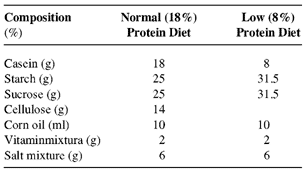
<body><![CDATA[<P><B>Materials and methods</B></P>     <P><I>Animals</I></P>     <P>Rats in the weight range of 110-120 g of Sprague Dawley (SD) strain were  obtained from the Central Animal Home, Panjab University, Chandigarh. The  animals were housed in polypropylene cages in the animal house of the Department  of Biophysics, under hygienic conditions and were acclimatized for at least one  week before putting them on different treatments. Thereafter, the animals were  randomly divided into four groups each having ten animals each.</P>     <P>G-1, Control</P>     <P>Animals in this group served as normal controls and were fed a diet with a  normal protein content (18%). Composition of the  diet<SUP>22</SUP> is given in the <a href="#t"> table</a> below.</P>     <p align=center><a name="t"><img src="/img/nh/v19n6/original3/original3_tabla.gif" width=308 height=173></a></p>     <P>    <br> G-2, Protein deficient (PD)</P>     <P>Protein deficiency was induced in the animals of this group by feeding a  protein-deficient diet with a 8% protein content. Composition of the  diet<SUP>22</SUP> is also given in the <a href="#t">table</a>.</P>     <P>G-3 Zinc treated (Zn)</P>     ]]></body>
<body><![CDATA[<P>Animals were given zinc in the form of ZnSO<SUB>4</SUB> at a  dose level of 227 mg/L in drinking water and had free access to the normal  diet.</P>     <P>G-4, Zn + PD treated</P>     <P>Animals received ZnSO<SUB>4</SUB> in the drinking water and  were given the protein deficient diet.</P>     <P>The treatments of rats continued for a period of eight weeks. At the end of  the treatment, the animals were weighted and were sacrificed by exsanguination  under light anesthesia. Livers were removed immediately and were perfused and  rinsed in normal saline (NaCl, 9 g/l/w/v). One lobe was preserved by for the  determination of various trace elements and the other was processed immediately  for various biochemical investigations.</P>     <P><I>Biochemical determinations</I></P>     <P>The livers were removed and perfused with normal saline (0.9% WN) to reduce  red blood cell contamination. Samples were homogenized in 100 mM potassium  phosphate buffer (pH 7.5) containing 0.15 M KCl to obtain 25% homogenate, using  a motor driven teflon fitted homogenizer. The homogenates were centrifuged in a  cold centrifuge (4° C, REMI instruments, Bombay) at 10,000 xg for 30 minutes.  The pellets were discarded and the supernatants were again centrifuged at 10,000  xg for 30 minutes. The pellets were discarded and final post mitochondrial  supernatant (PMS) was preserved for the estimation of antioxidant enzymes and  lipid peroxidation.</P>     <P>The method of Luck, 1971 was used for the estimation of  catalase<SUP>24</SUP>. Glutathione peroxidase was assayed by the  method of Flohe and Gurtzler<SUP>25</SUP>. Glutathione reductase  was assayed by the method of Williams and Arscott<SUP>26</SUP>.  The activity of superoxide disminase was estimated by using the method which is  based on the principle of the inhibitory effect of SOD on reduction of nitroblue  tetrazolium (NBT) dye by superoxide anions, which are generated by the  phomoxidation of hydroxzylamine hydrochloride  (NH<SUB>2</SUB>OH.HCI). Estimation of reduced glutathione was  performed in the tissue homogenates of liver by the method of Moron et  al<SUP>27</SUP>. Glutathionc-S-Transferase was assayed by the  method of Habig et al<SUP>28</SUP>. Lipid peroxidation was  estimated by the method of Ohokawa et al, 1979<SUP>29</SUP>.  Protein was measured by the method of Lowry et al,  1951<SUP>23</SUP>.</P>     <P><I>Zinc concentration</I></P>     <P>Estimations of zinc concentrations in the liver samples of the different  treatment groups were carried using Energy Depressive X-ray Fluorescence  (EDXRF), one of the most suitable analytical method to analyze trace elements  because of its properties such as non-destructive, sensitivity up to ppm and  multielemental analysis.</P>     <P>The liver tissues of all the animals were oven dried at 70° C to a constant  weight and then ground with the help of Agate Pestle and Mortar. 300 mg dried  powder of the tissue so obtained was weighed and mixed with equivalent mount of  Hoechst Wachs (wax) to make self supporting pellets. The pellets were made by  using a specially designed pure, steel dye and a hydraulic press from Paul  weber, Germany. A force of approximately 45 KN (Kilo newtons) was applied at the  dye top in order to make pellets of uniform thickness.</P>     ]]></body>
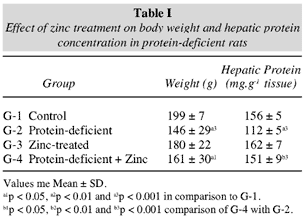
<body><![CDATA[<P>The pellets of tissues were analyzed using an EDXRF X-Lab, 2000 to determine  the levels of various elements. The X-lab, 2000 spectrometer involved a 0.4 kw  Pd mode Xray tube as source of excitation. The power of the X-ray tube was  adjusted on line for each individual measurement by the spectrophotometer  software, to secure optimum acquisition parameters for the current analysis.</P>     <P>Presently, different X-ray energies and excitation modes are being used but  the most important mode used was of 40 kV and excitation used was polarized  X-Ray. A Si (Li) detector coupled with computer (Pentium, 600 MH, software  package SPECTRO XLAB<SUP>PRO</SUP> 2.2) was used to collect the  flourescent X-ray spectra from the samples. The X-ray tube, secondary exciter,  target and the Si (Li) detector were placed in a triaxial geometry mode. This  geometry was used to minimize the background due to scattered photons.</P>     <P><I>Statistical analysis</I></P>     <P>The statistical significance of the differences was measured by one way  analysis of variance (ANOVA) followed by Newman-Keuls test. The determinations  are presented as Mean + S.D.</P>     <P><B>Results</B></P>     <P>The results of all the experiments conducted during the current study we  depicted in various tables. All the results of various treatment groups have  been compared with their normal controls. Results of zinc + protein deficient  (G-4) treated group have been computed with the results of the protein deficient  group (G-2).</P>     <P><I>Body weights</I></P>     <P>Changes in the body weight of the animals subjected to the different  treatments me shown in <a href="#t1"> table I</a>. Body weights of normal control and zinc treated  rats, increased progressively throughout the study. Protein deficiency resulted  in a significant (p &lt; 0.001) decrease in the body weights after eight weeks,  when compared to normal control rats. Zinc treatment to the protein deficient  rats tended to improve the body weight growth in comparison to protein deficient  (G-2) rats but body weights in protein deficient rats were statistically  different from normal control rats.</P>     <p align=center><a name="t1"><img src="/img/nh/v19n6/original3/original3_tabla1.gif" width=307 height=218></a></p>     <P><I>    ]]></body>
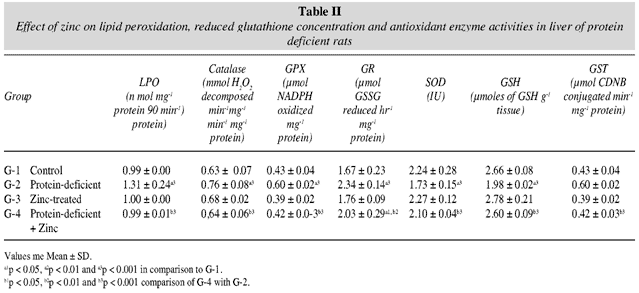
<body><![CDATA[<br> Hepatic protein contents</I></P>     <P><a href="#t1">Table I</a> shows hepatic protein contents in the different experimental groups  expressed as mg g<SUP>-1</SUP> tissue. Protein deficient animals,  showed a highly significant (P &lt; 0.001) reduction in the hepatic protein  contents as compared to the control group. However, zinc administration to the  protein deficient rats helped in raising the hepatic protein contents as  compared to their respective controls.</P>     <P><I>Antioxidant enzymes and lipid peroxidation</I></P>     <P>The effects of zinc treatment in control and protein deficient rats in  different groups on hepatic lipid peroxidation, catalase, glutathione  peroxidase, glutathione reductase, superoxide dismutase, reduced glutathione and  glutathione-S-transferase areshown in <a href="#t2"> table II</a>.</P>     <p align=center><a name="t2"><img src="/img/nh/v19n6/original3/original3_tabla2.gif" width=639 height=293></a></p>     <P>    <br> Protein deficient rats showed a significant (p &lt; 0.001) increase  in hepatic lipid peroxidation, catalase, glutathione peroxidase, glutathione  reductase, and glutathione-S-transferase. A significant (p &lt; 0.001)  inhibition in the levels of superoxide dismutase activity and reduced  glutathione was detected following protein deficiency in normal rats. </P>     <P>Zn treatment to protein deficient animals could lower significantly (p &lt;  0.01) the already raised levels of lipid peroxidation and the activities of  enzymes catalase, glutathione peroxidase and glutathione-Stransferase when  compared to control animals. Also, Zn treatment to the protein deficient animals  resulted in a significant elevation (P &lt; 0.001) in the levels of GSH and SOD  activity as compared to their respective controls, thereby indicating its  effectiveness in regulating their levels in adverse conditions.</P>     <P><I>Hepatic concentration of zinc</I></P>     <P><a href="#t3">Table III</a> shows the concentration of zinc in liver tissue of the different  groups. Zinc concentration decreased significantly in protein-deficient animals.  However zinc levels got elevated to within normal levels in these groups in  which zinc was administrated along with other treatments.</P>     ]]></body>
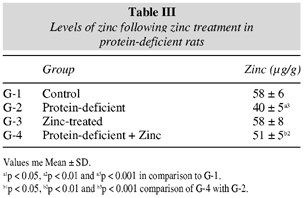
<body><![CDATA[<p align=center><a name="t3"><img src="/img/nh/v19n6/original3/original3_tabla3.gif" width=305 height=198></a></p>     <P><B>    <br> Discussion</B></P>     <P>We observed that the body weights of normal control and zinc treated rats  increased progressively throughout the study. Protein deficiency resulted in a  significant decline in the body weight after eight weeks, when compared to  normal control rats. Loss in body weight is characteristic of protein  malnutrition. In an earlier report from our laboratory it has been observed that  protein deficiency leads to significant growth retardation in animals11. Many  other workers have also reported the decrease in body weight due to protein  deficiency<SUP>30,31</SUP>. It has been observed in these studies  that retardation in body weight growth over a period is not due to low food  intake but to a deficiency in protein intake. Zinc treatment to the  protein-deficient rats tended to improve the body weight growth. Similar  protective effects of zinc in improving the body weight gain of the animals have  also been reported in other studies, in which radiations or carbon tetrachloride  was used to induce liver injury<SUP>21,32, 33</SUP>. The  protective effects of zinc could be attributed to its ability to reduce collagen  accumulation in liver and also it exerts critical physiological role in  regulating the structure and function of cells.</P>     <P>In our study, the levels of zinc decreased in protein-deficient rats, but  returned to normal following zinc supplementation. The observation of depressed  Zn levels in the liver of protein deficient rats in the present investigation we  in conformity with previous studies<SUP>34,13</SUP>.  Abnormalities in zinc metabolism leading to its deficiency are generally  attributed to various factors like, malabsorption, malnutrition, decreased  intestinal zinc binding factors or the increased excretion of the zinc via the  gastrointestinal tract or via urine are of common occurrence in chronic liver  disorders<SUP>35</SUP>.</P>     <P>The results of the current study for lowered zinc concentrations could be  explained on the basis that either it is excessively being utilized in providing  antioxidant defense mechanism or there is some defect in the absorption/  metabolism of zinc in toxic conditions created by protein deficiency. Studies  carried out in animals and humans had shown that zinc is essential for  utilization of aminoacids<SUP>36</SUP>. Conversely, protein  malnutrition plays a major role on liver zinc  depletion<SUP>34</SUP>. Zinc has been found to be associated with  metal binding proteins that are known to regulate the functions of zinc as well  as copper. Metallothionein also plays a role in the detoxification of heavy  metals and stabilize membranes<SUP>37</SUP>.</P>     <P>Protein-deficient treatment groups, showed a highly significant reduction in  the protein content as compared to normal control group which is in agreement  with the earlier reports<SUP>38</SUP>. Davenport et al,  1994<SUP>38</SUP> demonstrated that in protein deficient states,  the reduction in serum albumin contents were due to depletion in amino acid  precursors of albumin synthesis. However, zinc administration to the protein  deficient rats helped in raising the hepatic protein contents (p &lt; 0.001) and were brought to normal limits as compared to their  respective controls. This property of Zn could be attributed to its role in the  induction of metallothionein (Zn binding protein) thereby regulating the amino  acid precursors for albumin synthesis<SUP>39,40</SUP>.  </P>     <P>Lipid peroxidation is the process of oxidative degradation of polyunsaturated  fatty acids (PUFA). Its occurrence in biological membranes causes impaired  membrane function, impaired structural integrity<SUP>41</SUP>,  decrease in fluidity, and inactivation of a number of membrane bound enzymes and  protein receptors. Lipid peroxidation is an autocatalytic free-radical process  and could be responsible for DNA damage<SUP>42</SUP>.</P>     <P>A significant increase in malondialdehyde products was observed in the  protein deficient groups in the present study which suggested that low protein  diet in-take might result in enhanced lipid peroxidation in liver. These results  seems to be in agreement with previous findings<SUP>8,11</SUP>  suggesting that the rats fed on a low protein diet might be more susceptible to  peroxidative tissue damage under the influence of oxidative stress. The  increased lipo peroxidation could be attributed to the reduction in detoxifying  hyperperoxides in protein deficient conditions. Moreover, the degree of  depressions of detoxifying hyperperoxides in protein deficient conditions might  also be correlated with the degree of protein  deficiency<SUP>8</SUP>.</P>     <P>The normalization of lipo peroxidation due to Zn administration could be  attributed to its antiperoxidative property. Studies have shown that Zn causes  inhibition of both endogenous as well as induced lipid peroxidation to stabilize  biomembranes<SUP>43,</SUP>18. Further, the levels of zinc which  were reduced in low protein conditions got maintained by its supplementationand  this apparently contributed to a reduction in lipid peroxidation.</P>     ]]></body>
<body><![CDATA[<P>To protect themselves against free radicals, cells have developed antioxidant  defenses and repair systems which prevent the accumulation of oxidatively  damaged molecules. The antioxidant defense system include enzymes like  glutathione peroxidase (GPx), catalase, glutathione reductase (GR),  glutathione-stransferase (GST), superoxide dismutase (SOD), as well as small  molecules such as ascorbic acid, reduced glutathione (GSH) and uric  acid<SUP>44,</SUP>45. Catalase is a ubiquitous enzyme and is a  major component in primary antioxidant enzyme system, which catalyzes the  decomposition of H<SUB>2</SUB>O<SUB>2</SUB> to  H<SUB>2</SUB>O and sharing this function with glutathione  peroxidase (GPx). Glutathione peroxidase on the other hand is located in the  cytosol and mitochondrial matrix and catalyzes the reduction of  H<SUB>2</SUB>O<SUB>2</SUB> and lipid and nonlipid  hydroperoxides to oxidized glutathione (GSSG) using two molecules of GSH.  Further oxidized, GSSG is reduced back to GSH by glutathione reductase (GR),  which utilizes NADPH regenerated by glucose-6-phosphate dehydrogenase.</P>     <P>In the present study, after subjecting the rats to protein deficiency the  hepatic activity of catalase, glutathione peroxidase and glutathione reductase  got raised but superoxide dismutase activity was found to be inhibited. Darmon  et al, 1993<SUP>10</SUP> also observed an increase in catalase  activity in low protein diet fed rats. Zhu et al,  1993<SUP>46</SUP> accounted the high levels of GPx following  protein deficiency due to its low utilization and increase in synthesis. An  enhanced level of glutirthione reductase has been reported earlier in rats fed  protein restricted diet<SUP>47,48</SUP>. The observed elevation  in the activities of both GPx and GR in the present study under low protein diet  may be due to enhanced synthesis of these enzymes, which are actively involved  in reducing the H<SUB>2</SUB>O<SUB>2</SUB>generation<SUP>49</SUP>.</P>     <P>The observed increase in lipid peroxidation in the protein deficient group  seems to be associated with a decrease in SOD activity, as SOD inhibits hydrogen  peroxide by scavenging free oxide molecule<SUP>50</SUP>. Our  results regarding the significant decrease of SOD following restriction of  protein diet are in agreement with earlier  reports<SUP>48,</SUP>51. Following zinc treatment the altered  levels of enzymes tended to be normalized because of the antioxidant property of  zinc.</P>     <P>Glutathione-s-transferases (GSTs) form a group of enzymes that are present in  high concentrations in the cytosol and catalyze a wide variety of substitution  reactions in which glutathione (GSH) replaces an easily displaced group on the  xenobiotic, and thus prevents the subsequent toxic  reactions<SUP>52</SUP>. This reaction involves a compound with an  electrophilic atom and GST facilitates the nucleophilic attack of glutathione  thiolate on this electron deficient atom of the hydrophobic compound. GSH plays  an important role in intracellular protection against toxic compounds, reactive  oxygen species, and free radicals<SUP>53</SUP>. Reduced  glutathione (GSH) protects the liver microsomes against the effects of reactive  (peroxides and oxygen) intermediates which are formed by Cytochrome P450 system  as well as lipid peroxidation<SUP>54</SUP>.</P>     <P>In the present study the low protein diet caused a marked decrease in the  levels of GSH which is in agreement with earlier  studies<SUP>47,55</SUP>. Ayala et al<SUP>47</SUP>  observed that in rats fed on a low protein diet, supplemented with all essential  amino acids except methionine, there was a decrease of GSH levels. They proposed  that low intra-cellular concentration of cysteine available for GSH synthesis  and feed back inhibition of gamma glutamyl cysteine synthetase may be  responsible for inhibition in the activities under protein deficient conditions.  The low protein diet results in increase of hepatic levels of glutathione  degrading enzyme, gamma glutamyl transferase (gamma-GT) and, thus, a decreased  concentration of glutathione<SUP>56</SUP>. Because GSH is an  important component of the detoxification mechanism, its lowered concentration  in protein-deficient conditions would, therefore, lead to decreased  detoxification capacity of liver. Further reduction in GSH levels in protein  deficient is understandable in the light of elevation of GPx under these  conditions. The present observations of a decline in GSH levels in protein  deficient groups are in coherence with earlier  reports<SUP>11</SUP> and can be attributed to the activation of  gamma-GT to replenish intracellular glutathione on the sinusoidal surface of the  liver cells<SUP>57</SUP>.</P>     <P>We have also observed an increase in GST activity following protein  deficiency treatment. Ramdath and Golden<SUP>58</SUP> reported a  similar increase in malnourished children. Cho et al<SUP>59</SUP>  stated that the antioxidant response element (ARE)-binding activity of  protein-calorie malnutrition rats gets increased, which in turn results in  activation of certain GST mRNAs and a higher GST activity.</P>     <P>The observed normalization of GSH levels and GST activity following Zn  treatment could be because of its property to induce metallothionein (S-rich  protein) as a free radical scavenger, or its indirect action in reducing the  levels of oxygen reactive species<SUP>60</SUP>, however the  precise mechanism for these actions remains to be elucidated.</P>     <P>In conclusion, the present study highlights the protective role of zinc in  maintaining the activities of enzymes involved in oxidative of stress induced in  conditions of protein deficiency.</P>     <P><B>Acknowledgements</B></P>     <P>This work was supported by financial grant from IUC-DAE, Kolkata and ICMR,  New Delhi. We are also thankful to Prof. T. Butz, Fakultät für Physik and  Geowissenschaften, Universitdt Leipzig, Leipzig, Germany for helping in zinc analysis.</P>     ]]></body>
<body><![CDATA[<P><B>References</B></P>     <!-- ref --><P>1. Poluten J, Kapila Jordi C, Lluis A: Nickel -induced hyperglycaemia: the  role of insulin and glucagons. <I>Toxicology</I> 1992, 71:181-192.&nbsp;&nbsp;&nbsp;&nbsp;&nbsp;&nbsp;&nbsp;&nbsp;[&#160;<a href="javascript:void(0);" onclick="javascript: window.open('/scielo.php?script=sci_nlinks&ref=3453176&pid=S0212-1611200400060000500001&lng=','','width=640,height=500,resizable=yes,scrollbars=1,menubar=yes,');">Links</a>&#160;]<!-- end-ref --><!-- ref --> 2.  Crogan NL, Pasvogel A: The influence of protein-calorie malnutrition on quality  of life in nursing homes. <I>J Gerontol A Biol Sci Med Sci </I>2003, 58:159-164.    &nbsp;&nbsp;&nbsp;&nbsp;&nbsp;&nbsp;&nbsp;&nbsp;[&#160;<a href="javascript:void(0);" onclick="javascript: window.open('/scielo.php?script=sci_nlinks&ref=3453177&pid=S0212-1611200400060000500002&lng=','','width=640,height=500,resizable=yes,scrollbars=1,menubar=yes,');">Links</a>&#160;]<!-- end-ref --><!-- ref --><p>3. Kusal KD, Shbantula D: Alteration of testicular biochemistry during  protein restriction in nickel treated rats. <I>Biol Trace Elem Res</I> 1997,  60:243-249.&nbsp;&nbsp;&nbsp;&nbsp;&nbsp;&nbsp;&nbsp;&nbsp;[&#160;<a href="javascript:void(0);" onclick="javascript: window.open('/scielo.php?script=sci_nlinks&ref=3453178&pid=S0212-1611200400060000500003&lng=','','width=640,height=500,resizable=yes,scrollbars=1,menubar=yes,');">Links</a>&#160;]<!-- end-ref --><!-- ref --><p>4. Taylor CG, Potter AJ, Rabinovitch PS: Splenocyte  glutathione and CD3-mediated cell proliferation are reduced in mice fed a  protein deficient diet.<I> J Nutr </I>1997, 127:44-50.&nbsp;&nbsp;&nbsp;&nbsp;&nbsp;&nbsp;&nbsp;&nbsp;[&#160;<a href="javascript:void(0);" onclick="javascript: window.open('/scielo.php?script=sci_nlinks&ref=3453179&pid=S0212-1611200400060000500004&lng=','','width=640,height=500,resizable=yes,scrollbars=1,menubar=yes,');">Links</a>&#160;]<!-- end-ref --><!-- ref --><p>5. Keusch GT:  The history of nutrition: malnutrition, infection and immunity. <I>J Nutr  </I>2003, 133:336S-340S.&nbsp;&nbsp;&nbsp;&nbsp;&nbsp;&nbsp;&nbsp;&nbsp;[&#160;<a href="javascript:void(0);" onclick="javascript: window.open('/scielo.php?script=sci_nlinks&ref=3453180&pid=S0212-1611200400060000500005&lng=','','width=640,height=500,resizable=yes,scrollbars=1,menubar=yes,');">Links</a>&#160;]<!-- end-ref --><!-- ref --><p>6. Ammigan N, Nair UJ, Bhide SV: Effect of  dietary protein on masheri induced drug metabolizing enzymes. <I>Nutr Res</I>  1989, 9:1397-1405.&nbsp;&nbsp;&nbsp;&nbsp;&nbsp;&nbsp;&nbsp;&nbsp;[&#160;<a href="javascript:void(0);" onclick="javascript: window.open('/scielo.php?script=sci_nlinks&ref=3453181&pid=S0212-1611200400060000500006&lng=','','width=640,height=500,resizable=yes,scrollbars=1,menubar=yes,');">Links</a>&#160;]<!-- end-ref --><!-- ref --><p>7. Ramdath DD, Golden MH: Elevated  glutathione-s-transferase activity in erythrocytes from malnourished children.  <I>Eur J Clin Nutr </I>1993, 47:658-665.&nbsp;&nbsp;&nbsp;&nbsp;&nbsp;&nbsp;&nbsp;&nbsp;[&#160;<a href="javascript:void(0);" onclick="javascript: window.open('/scielo.php?script=sci_nlinks&ref=3453182&pid=S0212-1611200400060000500007&lng=','','width=640,height=500,resizable=yes,scrollbars=1,menubar=yes,');">Links</a>&#160;]<!-- end-ref --><!-- ref --><p>8. Huang CJ, Fwu ML: Degree  of protein deficiency affects the extent of the depression of arttioxidative  enzyme activities and the enhancement of tissue lipid peroxidation in rats. <I>J  Nutr </I>1993, 123:803-810.&nbsp;&nbsp;&nbsp;&nbsp;&nbsp;&nbsp;&nbsp;&nbsp;[&#160;<a href="javascript:void(0);" onclick="javascript: window.open('/scielo.php?script=sci_nlinks&ref=3453183&pid=S0212-1611200400060000500008&lng=','','width=640,height=500,resizable=yes,scrollbars=1,menubar=yes,');">Links</a>&#160;]<!-- end-ref --><!-- ref --><p>9. Tat MM, Vural H, Koc A, Kosecik M, Atas  A: Altered anti-oxidant status and increased lipid peroxidation in marasmic  children. <I>Pediatr Int </I>2000, 42:289-292.&nbsp;&nbsp;&nbsp;&nbsp;&nbsp;&nbsp;&nbsp;&nbsp;[&#160;<a href="javascript:void(0);" onclick="javascript: window.open('/scielo.php?script=sci_nlinks&ref=3453184&pid=S0212-1611200400060000500009&lng=','','width=640,height=500,resizable=yes,scrollbars=1,menubar=yes,');">Links</a>&#160;]<!-- end-ref --><!-- ref --><p>10. Darmon N, Pelissier  MA, Heyman M, Albrecht R, Desjeux JF: Oxidative stress may contribute to the  intestinal dysfunction of weanling rats fed a low protein diet. <I>J Nutt  </I>1993, 123:1068-1075.&nbsp;&nbsp;&nbsp;&nbsp;&nbsp;&nbsp;&nbsp;&nbsp;[&#160;<a href="javascript:void(0);" onclick="javascript: window.open('/scielo.php?script=sci_nlinks&ref=3453185&pid=S0212-1611200400060000500010&lng=','','width=640,height=500,resizable=yes,scrollbars=1,menubar=yes,');">Links</a>&#160;]<!-- end-ref --><!-- ref --><p>11. Tandon A, Dhawan DK, Nagpaul JP: Effect  of lithium on hepatic lipid peroxidation and antioxidative enzymes under  different dietary protein regimens.<I> J Appl Toxicol </I>1998, 18:187-190.&nbsp;&nbsp;&nbsp;&nbsp;&nbsp;&nbsp;&nbsp;&nbsp;[&#160;<a href="javascript:void(0);" onclick="javascript: window.open('/scielo.php?script=sci_nlinks&ref=3453186&pid=S0212-1611200400060000500011&lng=','','width=640,height=500,resizable=yes,scrollbars=1,menubar=yes,');">Links</a>&#160;]<!-- end-ref --><!-- ref --><p>12. Deneka SM, Gershoff SN, Fanburg BL: Potentiation of oxygen  toxicity in rats dietary protein or amino acids deficiency. J of Appl.  <I>Physiol Resp Envirin Exercise Physiol </I>1983, 54:147-157.&nbsp;&nbsp;&nbsp;&nbsp;&nbsp;&nbsp;&nbsp;&nbsp;[&#160;<a href="javascript:void(0);" onclick="javascript: window.open('/scielo.php?script=sci_nlinks&ref=3453187&pid=S0212-1611200400060000500012&lng=','','width=640,height=500,resizable=yes,scrollbars=1,menubar=yes,');">Links</a>&#160;]<!-- end-ref --><!-- ref --><p>13.  Tandon A, Nagpaul JP, Bandhu H, Singh N, Dhawan D: Effect of lithium on hepatic  and serum elemental status under different dietary protein regimens. <I>Biol  Trace Elem Res</I> 1999, 68:51-62.&nbsp;&nbsp;&nbsp;&nbsp;&nbsp;&nbsp;&nbsp;&nbsp;[&#160;<a href="javascript:void(0);" onclick="javascript: window.open('/scielo.php?script=sci_nlinks&ref=3453188&pid=S0212-1611200400060000500013&lng=','','width=640,height=500,resizable=yes,scrollbars=1,menubar=yes,');">Links</a>&#160;]<!-- end-ref --><!-- ref --><p>14. Squali Houssaini FZ, Foulon T,  Payen N, Iraqi MR, Arnaud J, Groslaeinbert P: Plasma fatty acid status in  Moroccan children: increased lipid peroxidation and impaired polyunsaturated  fatty acid metabolism in protein-calorie malnutrition. <I>Biomed  Pharmacother</I> 2001, 55:155-612.&nbsp;&nbsp;&nbsp;&nbsp;&nbsp;&nbsp;&nbsp;&nbsp;[&#160;<a href="javascript:void(0);" onclick="javascript: window.open('/scielo.php?script=sci_nlinks&ref=3453189&pid=S0212-1611200400060000500014&lng=','','width=640,height=500,resizable=yes,scrollbars=1,menubar=yes,');">Links</a>&#160;]<!-- end-ref --><!-- ref --><p>15. Singla PN, Chand P, Kumar A,  Kachhawaha JS: Serum, zinc and copper levels in children with protein energy  malnutrition. <I>Indian J Pediatr</I> 1996, 63:199-203.&nbsp;&nbsp;&nbsp;&nbsp;&nbsp;&nbsp;&nbsp;&nbsp;[&#160;<a href="javascript:void(0);" onclick="javascript: window.open('/scielo.php?script=sci_nlinks&ref=3453190&pid=S0212-1611200400060000500015&lng=','','width=640,height=500,resizable=yes,scrollbars=1,menubar=yes,');">Links</a>&#160;]<!-- end-ref --><!-- ref --><p>16. Bhaskaram  P, Hemalatha P: Zinc status of Indian children. <I>Indian J Med Res </I>1995,  102:210-215.&nbsp;&nbsp;&nbsp;&nbsp;&nbsp;&nbsp;&nbsp;&nbsp;[&#160;<a href="javascript:void(0);" onclick="javascript: window.open('/scielo.php?script=sci_nlinks&ref=3453191&pid=S0212-1611200400060000500016&lng=','','width=640,height=500,resizable=yes,scrollbars=1,menubar=yes,');">Links</a>&#160;]<!-- end-ref --><!-- ref --><p>17. Babcock AK, Henkin RI: Effects of oral zinc loading  on zinc metabolism in human II. <I>In vivo</I> kinetics. <I>Metab Clin Exp  </I>1982, 31:335-347.&nbsp;&nbsp;&nbsp;&nbsp;&nbsp;&nbsp;&nbsp;&nbsp;[&#160;<a href="javascript:void(0);" onclick="javascript: window.open('/scielo.php?script=sci_nlinks&ref=3453192&pid=S0212-1611200400060000500017&lng=','','width=640,height=500,resizable=yes,scrollbars=1,menubar=yes,');">Links</a>&#160;]<!-- end-ref --><!-- ref --><p>18. Srivastava RC, Hasan SK, Gupta J, Gupta S:  Protective role of metallothionein in nickel induced oxidative damage.  <I>Biochem Mol Biol Int</I> 1993, 30:261-370.&nbsp;&nbsp;&nbsp;&nbsp;&nbsp;&nbsp;&nbsp;&nbsp;[&#160;<a href="javascript:void(0);" onclick="javascript: window.open('/scielo.php?script=sci_nlinks&ref=3453193&pid=S0212-1611200400060000500018&lng=','','width=640,height=500,resizable=yes,scrollbars=1,menubar=yes,');">Links</a>&#160;]<!-- end-ref --><!-- ref --><p>19. Driscoll ER, Bettger  WJ: Zinc deficiency in the rat alters the lipid composition of the erythrocyte  cell membrane. <I>Triton Shell Lipids</I> 1992, 27:972-977.&nbsp;&nbsp;&nbsp;&nbsp;&nbsp;&nbsp;&nbsp;&nbsp;[&#160;<a href="javascript:void(0);" onclick="javascript: window.open('/scielo.php?script=sci_nlinks&ref=3453194&pid=S0212-1611200400060000500019&lng=','','width=640,height=500,resizable=yes,scrollbars=1,menubar=yes,');">Links</a>&#160;]<!-- end-ref --><!-- ref --><p>20.  Boukaiba: A physiological amount of zinc supplementation Effects on nutritional,  lipid and thymic status in an elderly population. <I>Am J Clin Nutr </I>1993,  57:566-572.&nbsp;&nbsp;&nbsp;&nbsp;&nbsp;&nbsp;&nbsp;&nbsp;[&#160;<a href="javascript:void(0);" onclick="javascript: window.open('/scielo.php?script=sci_nlinks&ref=3453195&pid=S0212-1611200400060000500020&lng=','','width=640,height=500,resizable=yes,scrollbars=1,menubar=yes,');">Links</a>&#160;]<!-- end-ref --><!-- ref --><p>21. Dhawan DK, Goel A: Protective role of zinc on rat  liver function in long term toxicity induced by carbon tetrachloride. <I>J Trace  Elem Exp Med </I>1994, 7:1-9&nbsp;&nbsp;&nbsp;&nbsp;&nbsp;&nbsp;&nbsp;&nbsp;[&#160;<a href="javascript:void(0);" onclick="javascript: window.open('/scielo.php?script=sci_nlinks&ref=3453196&pid=S0212-1611200400060000500021&lng=','','width=640,height=500,resizable=yes,scrollbars=1,menubar=yes,');">Links</a>&#160;]<!-- end-ref --><!-- ref --><p>22. Kau J, Jaswal VM, Nagpaul JP, Mahmood A:  Chronic ethanol feeding and microvillus membrane glycosylation in normal and  protein-malnourished rat intestine: <I>Nutrition</I> 1992, 8:338-342.&nbsp;&nbsp;&nbsp;&nbsp;&nbsp;&nbsp;&nbsp;&nbsp;[&#160;<a href="javascript:void(0);" onclick="javascript: window.open('/scielo.php?script=sci_nlinks&ref=3453197&pid=S0212-1611200400060000500022&lng=','','width=640,height=500,resizable=yes,scrollbars=1,menubar=yes,');">Links</a>&#160;]<!-- end-ref --><!-- ref --><p>23. Lowry OH, Rosebrough NJ, Farr AL, Randall J. Protein measurement  with the Folin Phenol reagent. <I>J Biol Chem</I> 1951, 193:265-275.&nbsp;&nbsp;&nbsp;&nbsp;&nbsp;&nbsp;&nbsp;&nbsp;[&#160;<a href="javascript:void(0);" onclick="javascript: window.open('/scielo.php?script=sci_nlinks&ref=3453198&pid=S0212-1611200400060000500023&lng=','','width=640,height=500,resizable=yes,scrollbars=1,menubar=yes,');">Links</a>&#160;]<!-- end-ref --><!-- ref --><p>24. Luck H. Catalase. In: Methods of Enzymatic analysis. (Eds.  Bergmeyer, HO, Academic Press, New York., London), 1971; 885-893.&nbsp;&nbsp;&nbsp;&nbsp;&nbsp;&nbsp;&nbsp;&nbsp;[&#160;<a href="javascript:void(0);" onclick="javascript: window.open('/scielo.php?script=sci_nlinks&ref=3453199&pid=S0212-1611200400060000500024&lng=','','width=640,height=500,resizable=yes,scrollbars=1,menubar=yes,');">Links</a>&#160;]<!-- end-ref --><!-- ref --><p>25.  Flohe L, Gurzler WA: Assays of glutathione peroxidase. Methods Enzymol. 1984,  105:114-21&nbsp;&nbsp;&nbsp;&nbsp;&nbsp;&nbsp;&nbsp;&nbsp;[&#160;<a href="javascript:void(0);" onclick="javascript: window.open('/scielo.php?script=sci_nlinks&ref=3453200&pid=S0212-1611200400060000500025&lng=','','width=640,height=500,resizable=yes,scrollbars=1,menubar=yes,');">Links</a>&#160;]<!-- end-ref --><!-- ref --><p>26. Williams CH Jr., Arscott ID: Glutathione reducatse.  Methods in Enzymology, Vol. XVII B (SP Colowick and NO Kaplan, Eds., Academic  Press, New York), 1971, 503-59.&nbsp;&nbsp;&nbsp;&nbsp;&nbsp;&nbsp;&nbsp;&nbsp;[&#160;<a href="javascript:void(0);" onclick="javascript: window.open('/scielo.php?script=sci_nlinks&ref=3453201&pid=S0212-1611200400060000500026&lng=','','width=640,height=500,resizable=yes,scrollbars=1,menubar=yes,');">Links</a>&#160;]<!-- end-ref --><!-- ref --><p>27. Moron MJ, Dipierre JW, Mannerv KB:  Levels of glutathione, glutathione reductase and glutathione-s-transferase  activities in rat lung and liver. <I>Biochem Biophys Acta</I> 1979, 582:67-71.&nbsp;&nbsp;&nbsp;&nbsp;&nbsp;&nbsp;&nbsp;&nbsp;[&#160;<a href="javascript:void(0);" onclick="javascript: window.open('/scielo.php?script=sci_nlinks&ref=3453202&pid=S0212-1611200400060000500027&lng=','','width=640,height=500,resizable=yes,scrollbars=1,menubar=yes,');">Links</a>&#160;]<!-- end-ref --><!-- ref --><p>28. Habig WH, Pabst MJ, Jakoby WB: Glutatjhione S-Transferase: The  first enzymatic step in mercapturic acid formation. <I>J Biol Chem</I> 1974,  249:7130-7139.&nbsp;&nbsp;&nbsp;&nbsp;&nbsp;&nbsp;&nbsp;&nbsp;[&#160;<a href="javascript:void(0);" onclick="javascript: window.open('/scielo.php?script=sci_nlinks&ref=3453203&pid=S0212-1611200400060000500028&lng=','','width=640,height=500,resizable=yes,scrollbars=1,menubar=yes,');">Links</a>&#160;]<!-- end-ref --><!-- ref --><p>29. Ohokawa H, Oshishi N, Yagi K: Assay for lipid  peroxidation in animal tissues by thiobarbituric acid reaction. <I>Anal Biochem  </I>1979, 75:351-358.&nbsp;&nbsp;&nbsp;&nbsp;&nbsp;&nbsp;&nbsp;&nbsp;[&#160;<a href="javascript:void(0);" onclick="javascript: window.open('/scielo.php?script=sci_nlinks&ref=3453204&pid=S0212-1611200400060000500029&lng=','','width=640,height=500,resizable=yes,scrollbars=1,menubar=yes,');">Links</a>&#160;]<!-- end-ref --><!-- ref --><p>30. Wang G, Yu S, Bao C: Effect of different  levels of protein in-take on metabolism of protein, zinc and copper in rats.  Zhonguo Gonggong Weishing Xuebao. 1995, 14:90-93.&nbsp;&nbsp;&nbsp;&nbsp;&nbsp;&nbsp;&nbsp;&nbsp;[&#160;<a href="javascript:void(0);" onclick="javascript: window.open('/scielo.php?script=sci_nlinks&ref=3453205&pid=S0212-1611200400060000500030&lng=','','width=640,height=500,resizable=yes,scrollbars=1,menubar=yes,');">Links</a>&#160;]<!-- end-ref --><!-- ref --><p>31. Bauman PF, Smith  TK, Bray TM: The effect of dietary protein and sulfur aminoacids on hepatic  glutathione dependent enzyme activities in the rat. <I>Can J Physiol Pharmacol  </I>1988, 66:1048-1052.&nbsp;&nbsp;&nbsp;&nbsp;&nbsp;&nbsp;&nbsp;&nbsp;[&#160;<a href="javascript:void(0);" onclick="javascript: window.open('/scielo.php?script=sci_nlinks&ref=3453206&pid=S0212-1611200400060000500031&lng=','','width=640,height=500,resizable=yes,scrollbars=1,menubar=yes,');">Links</a>&#160;]<!-- end-ref --><!-- ref --><p>32. Yao JZ, Liu JF, Zhang WN, Zhou YJ, Zhu J,  Lu JG, Wang XY: Synthesis, preliminary autigastrelcosis activity and the  protective effect on acute liver injury of zinc chloride E4 Yao Xue Xue Bao  2001, 36:188-191.&nbsp;&nbsp;&nbsp;&nbsp;&nbsp;&nbsp;&nbsp;&nbsp;[&#160;<a href="javascript:void(0);" onclick="javascript: window.open('/scielo.php?script=sci_nlinks&ref=3453207&pid=S0212-1611200400060000500032&lng=','','width=640,height=500,resizable=yes,scrollbars=1,menubar=yes,');">Links</a>&#160;]<!-- end-ref --><!-- ref --><p>33. Chen JF, Shi QJ, Zheng SY: Experimental research  of protective and therapeutic effects of zinc and vitamin E on mouse liver  radiational damage. Hunan Yi Ke Da Xue Xue Bao 2001, 26:207-210.&nbsp;&nbsp;&nbsp;&nbsp;&nbsp;&nbsp;&nbsp;&nbsp;[&#160;<a href="javascript:void(0);" onclick="javascript: window.open('/scielo.php?script=sci_nlinks&ref=3453208&pid=S0212-1611200400060000500033&lng=','','width=640,height=500,resizable=yes,scrollbars=1,menubar=yes,');">Links</a>&#160;]<!-- end-ref --><!-- ref --><p>34.  Martel AC, Reimers EG, Fernández FS, Aleman VC, Martin LG, Moreno FR, Riera AM:  Combined effects of ethanol and protein deficiency on hepatic iron, zinc,  manganese and copper contents. <I>Alcohol</I> 1992, 9:341348.&nbsp;&nbsp;&nbsp;&nbsp;&nbsp;&nbsp;&nbsp;&nbsp;[&#160;<a href="javascript:void(0);" onclick="javascript: window.open('/scielo.php?script=sci_nlinks&ref=3453209&pid=S0212-1611200400060000500034&lng=','','width=640,height=500,resizable=yes,scrollbars=1,menubar=yes,');">Links</a>&#160;]<!-- end-ref --><!-- ref --><p>35.  McClain CJ, Su Le: Zinc deficiency in the alcoholic alcoholism. Winters Press,  New York, 1983, 7:5-10.&nbsp;&nbsp;&nbsp;&nbsp;&nbsp;&nbsp;&nbsp;&nbsp;[&#160;<a href="javascript:void(0);" onclick="javascript: window.open('/scielo.php?script=sci_nlinks&ref=3453210&pid=S0212-1611200400060000500035&lng=','','width=640,height=500,resizable=yes,scrollbars=1,menubar=yes,');">Links</a>&#160;]<!-- end-ref --><!-- ref --><p>36. Sandstead HH, Vo-Khactu KP, Solomon N:  Trace elements in Human health and disease (Prasad, AS Eds., Vol. 1, Academic  Press, New York), 1976, 33-49.&nbsp;&nbsp;&nbsp;&nbsp;&nbsp;&nbsp;&nbsp;&nbsp;[&#160;<a href="javascript:void(0);" onclick="javascript: window.open('/scielo.php?script=sci_nlinks&ref=3453211&pid=S0212-1611200400060000500036&lng=','','width=640,height=500,resizable=yes,scrollbars=1,menubar=yes,');">Links</a>&#160;]<!-- end-ref --><!-- ref --><p>37. Vallee BL, Falchuk KE: The  biochemical basis of zinc physiology.<I> Physiol Rev</I> 1993, 73:79-118.&nbsp;&nbsp;&nbsp;&nbsp;&nbsp;&nbsp;&nbsp;&nbsp;[&#160;<a href="javascript:void(0);" onclick="javascript: window.open('/scielo.php?script=sci_nlinks&ref=3453212&pid=S0212-1611200400060000500037&lng=','','width=640,height=500,resizable=yes,scrollbars=1,menubar=yes,');">Links</a>&#160;]<!-- end-ref --><!-- ref --><p>38. Davenport DL Mostardi RA, Richardson DC, Gross KL, Greene, KA,  Blair K: Protein-deficient diet alters, serum alkaline phosphatase, bile acids,  protein and area nitrogen in dogs. <I>J Nutr </I>1994, 124:2677S-79S.&nbsp;&nbsp;&nbsp;&nbsp;&nbsp;&nbsp;&nbsp;&nbsp;[&#160;<a href="javascript:void(0);" onclick="javascript: window.open('/scielo.php?script=sci_nlinks&ref=3453213&pid=S0212-1611200400060000500038&lng=','','width=640,height=500,resizable=yes,scrollbars=1,menubar=yes,');">Links</a>&#160;]<!-- end-ref --><!-- ref --><p>39. Yang BS, Ishii H, Satoh A, Kato N: Supplementation of dietary  cystine elevates kidney metallothionein in rats by a mechanism involving altered  zinc metabolism. <I>J Nutt </I>1995, 125:1167-1174.&nbsp;&nbsp;&nbsp;&nbsp;&nbsp;&nbsp;&nbsp;&nbsp;[&#160;<a href="javascript:void(0);" onclick="javascript: window.open('/scielo.php?script=sci_nlinks&ref=3453214&pid=S0212-1611200400060000500039&lng=','','width=640,height=500,resizable=yes,scrollbars=1,menubar=yes,');">Links</a>&#160;]<!-- end-ref --><!-- ref --><p>40. Tekeli SK: The  study of effects on serum glucose, total lipid, total protein and albumin levels  of orally zinc in rats. <I>Trace Elem and Electro</I> 2002, 19:6-10.&nbsp;&nbsp;&nbsp;&nbsp;&nbsp;&nbsp;&nbsp;&nbsp;[&#160;<a href="javascript:void(0);" onclick="javascript: window.open('/scielo.php?script=sci_nlinks&ref=3453215&pid=S0212-1611200400060000500040&lng=','','width=640,height=500,resizable=yes,scrollbars=1,menubar=yes,');">Links</a>&#160;]<!-- end-ref --><!-- ref --><p>41. Gutteridge JM, Halliwell, B: Oxygen radicals and tissue injury.  <I>FASEB J </I>1988, 13:9-19.&nbsp;&nbsp;&nbsp;&nbsp;&nbsp;&nbsp;&nbsp;&nbsp;[&#160;<a href="javascript:void(0);" onclick="javascript: window.open('/scielo.php?script=sci_nlinks&ref=3453216&pid=S0212-1611200400060000500041&lng=','','width=640,height=500,resizable=yes,scrollbars=1,menubar=yes,');">Links</a>&#160;]<!-- end-ref --><!-- ref --><p>42. Shirali P, Teissier E, Marez T,  Hildebrand HF, Haguenoer JM: Effect of alpha  Ni<SUB>3</SUB>S<SUB>2</SUB> on arachidonic acid  metabolites in cultured human lung cells (L132 cell line). <I>Carcinogenesis</I>  1994, 15:759-762.&nbsp;&nbsp;&nbsp;&nbsp;&nbsp;&nbsp;&nbsp;&nbsp;[&#160;<a href="javascript:void(0);" onclick="javascript: window.open('/scielo.php?script=sci_nlinks&ref=3453217&pid=S0212-1611200400060000500042&lng=','','width=640,height=500,resizable=yes,scrollbars=1,menubar=yes,');">Links</a>&#160;]<!-- end-ref --><!-- ref --><p>43. Dhawan D, Goel A, Gautam CS: Effects of zinc  intake on liver enzymes in carbontetrachloride induced liver injury. <I>Med Sci  Res</I> 1992, 20:55-6.&nbsp;&nbsp;&nbsp;&nbsp;&nbsp;&nbsp;&nbsp;&nbsp;[&#160;<a href="javascript:void(0);" onclick="javascript: window.open('/scielo.php?script=sci_nlinks&ref=3453218&pid=S0212-1611200400060000500043&lng=','','width=640,height=500,resizable=yes,scrollbars=1,menubar=yes,');">Links</a>&#160;]<!-- end-ref --><!-- ref --><p>44. Chow CK: Interrelationships of cellular  antioxidant defense systems. In: Cellular Antioxidant Defense Mechanisms (Chow  C.K. Ed) Vol. II pp. 217-237. CRC Press, Boca Raton, 1989.&nbsp;&nbsp;&nbsp;&nbsp;&nbsp;&nbsp;&nbsp;&nbsp;[&#160;<a href="javascript:void(0);" onclick="javascript: window.open('/scielo.php?script=sci_nlinks&ref=3453219&pid=S0212-1611200400060000500044&lng=','','width=640,height=500,resizable=yes,scrollbars=1,menubar=yes,');">Links</a>&#160;]<!-- end-ref --><!-- ref --><p>45.  Cadenas: Biochemistry of oxygen toxicity. <I>Am Rev Biochem </I>1989, 58:79-110.&nbsp;&nbsp;&nbsp;&nbsp;&nbsp;&nbsp;&nbsp;&nbsp;[&#160;<a href="javascript:void(0);" onclick="javascript: window.open('/scielo.php?script=sci_nlinks&ref=3453220&pid=S0212-1611200400060000500045&lng=','','width=640,height=500,resizable=yes,scrollbars=1,menubar=yes,');">Links</a>&#160;]<!-- end-ref --><!-- ref --><p>46. Zhu Z, Kimura M, Itokawa Y: Effect of selenium and protein  deficiency on selenium and glutathrione peroxidase in rats. Biol Trace Elem Res  1993, 36:15-23.&nbsp;&nbsp;&nbsp;&nbsp;&nbsp;&nbsp;&nbsp;&nbsp;[&#160;<a href="javascript:void(0);" onclick="javascript: window.open('/scielo.php?script=sci_nlinks&ref=3453221&pid=S0212-1611200400060000500046&lng=','','width=640,height=500,resizable=yes,scrollbars=1,menubar=yes,');">Links</a>&#160;]<!-- end-ref --><!-- ref --><p>47. Ayala A, Gordillo E, Castano A, Lobato MF, Machado A  Involvement of diminution of glutathione, produced by deficiency of methionine  in the diet, in the elevation of malic enzyme level in rat liver. <I>Biochim  Biophys Acta</I> 1991, 1084:48-51.&nbsp;&nbsp;&nbsp;&nbsp;&nbsp;&nbsp;&nbsp;&nbsp;[&#160;<a href="javascript:void(0);" onclick="javascript: window.open('/scielo.php?script=sci_nlinks&ref=3453222&pid=S0212-1611200400060000500047&lng=','','width=640,height=500,resizable=yes,scrollbars=1,menubar=yes,');">Links</a>&#160;]<!-- end-ref --><!-- ref --><p>48. Pelissier MA, Boisset M, Atteba  S, Albrecht R: Lipid peroxidation of rat liver microsomes membranes related to a  protein deficiency and / or a PCB treatment. Food Addit Contam 1990, 7 (Supl.  1):S172-177.&nbsp;&nbsp;&nbsp;&nbsp;&nbsp;&nbsp;&nbsp;&nbsp;[&#160;<a href="javascript:void(0);" onclick="javascript: window.open('/scielo.php?script=sci_nlinks&ref=3453223&pid=S0212-1611200400060000500048&lng=','','width=640,height=500,resizable=yes,scrollbars=1,menubar=yes,');">Links</a>&#160;]<!-- end-ref --><!-- ref --><p>49. Michiels C, Raes M, Toussaint O, Remacle J:  Importance of Seglutathione peroxidase, catalase and Cu/Zn-SOD for cell survival  against oxidative stress. <I>Free Rad Biol Med </I>1994, 17:235-258.&nbsp;&nbsp;&nbsp;&nbsp;&nbsp;&nbsp;&nbsp;&nbsp;[&#160;<a href="javascript:void(0);" onclick="javascript: window.open('/scielo.php?script=sci_nlinks&ref=3453224&pid=S0212-1611200400060000500049&lng=','','width=640,height=500,resizable=yes,scrollbars=1,menubar=yes,');">Links</a>&#160;]<!-- end-ref --><!-- ref --><p>50. Fridovich I: Superoxide radical and superoxide dismutase. Annu Rev  Biochem 1995, 64:97-112.&nbsp;&nbsp;&nbsp;&nbsp;&nbsp;&nbsp;&nbsp;&nbsp;[&#160;<a href="javascript:void(0);" onclick="javascript: window.open('/scielo.php?script=sci_nlinks&ref=3453225&pid=S0212-1611200400060000500050&lng=','','width=640,height=500,resizable=yes,scrollbars=1,menubar=yes,');">Links</a>&#160;]<!-- end-ref --><!-- ref --><p>51. Ram S, Sodhi CP, Mehta S, Vaiphei K,  Katyal R, Thakur S, Mehta SK: Protein-energy malnutrition and oxidative injury  in growing rats. <I>Hum Exp Toxicol </I>1996, 15:810-814.&nbsp;&nbsp;&nbsp;&nbsp;&nbsp;&nbsp;&nbsp;&nbsp;[&#160;<a href="javascript:void(0);" onclick="javascript: window.open('/scielo.php?script=sci_nlinks&ref=3453226&pid=S0212-1611200400060000500051&lng=','','width=640,height=500,resizable=yes,scrollbars=1,menubar=yes,');">Links</a>&#160;]<!-- end-ref --><!-- ref --><p>52. Siddiqui  MKJ, Mahboob M, Mustafa M: Hepatic and extrahepatic glutathione depletion and  glutathione-s-transferase inhibition by monocrotophos and thiol analog.  <I>Toxicology </I>1990, 64:271-279.&nbsp;&nbsp;&nbsp;&nbsp;&nbsp;&nbsp;&nbsp;&nbsp;[&#160;<a href="javascript:void(0);" onclick="javascript: window.open('/scielo.php?script=sci_nlinks&ref=3453227&pid=S0212-1611200400060000500052&lng=','','width=640,height=500,resizable=yes,scrollbars=1,menubar=yes,');">Links</a>&#160;]<!-- end-ref --><!-- ref --><p>53. Meister A: New aspects of  glutathione biochemistry and tras-port selective alteration of glutathione  metabolism.<I> Nutr Rev </I>1984, 42:397-410.&nbsp;&nbsp;&nbsp;&nbsp;&nbsp;&nbsp;&nbsp;&nbsp;[&#160;<a href="javascript:void(0);" onclick="javascript: window.open('/scielo.php?script=sci_nlinks&ref=3453228&pid=S0212-1611200400060000500053&lng=','','width=640,height=500,resizable=yes,scrollbars=1,menubar=yes,');">Links</a>&#160;]<!-- end-ref --><!-- ref --><p>54. Burk RF: Glutathione  dependent protection by rat liver micro-somal protein against  lipid-peroxidation. <I>Biochem Biophys Acta</I> 1983, 757:21-28.&nbsp;&nbsp;&nbsp;&nbsp;&nbsp;&nbsp;&nbsp;&nbsp;[&#160;<a href="javascript:void(0);" onclick="javascript: window.open('/scielo.php?script=sci_nlinks&ref=3453229&pid=S0212-1611200400060000500054&lng=','','width=640,height=500,resizable=yes,scrollbars=1,menubar=yes,');">Links</a>&#160;]<!-- end-ref --><!-- ref --><p>55.  Hum S, Koski KG, Hofet LJ: Varied protein intake alters glutathione metabolism  in rats. <I>J Nutr</I> 1992, 122:2010-2018.&nbsp;&nbsp;&nbsp;&nbsp;&nbsp;&nbsp;&nbsp;&nbsp;[&#160;<a href="javascript:void(0);" onclick="javascript: window.open('/scielo.php?script=sci_nlinks&ref=3453230&pid=S0212-1611200400060000500055&lng=','','width=640,height=500,resizable=yes,scrollbars=1,menubar=yes,');">Links</a>&#160;]<!-- end-ref --><!-- ref --><p>56. Taniguchi M and  Cherian MG: Ontogenic changes in hepatic glutathione and metallothionein in rats  and the effect of a lowsulphurcontaining diet. <I>Br J Nutr </I>1990, 63:97-103.&nbsp;&nbsp;&nbsp;&nbsp;&nbsp;&nbsp;&nbsp;&nbsp;[&#160;<a href="javascript:void(0);" onclick="javascript: window.open('/scielo.php?script=sci_nlinks&ref=3453231&pid=S0212-1611200400060000500056&lng=','','width=640,height=500,resizable=yes,scrollbars=1,menubar=yes,');">Links</a>&#160;]<!-- end-ref --><!-- ref --><p>57. Chow CK: Nutritional influence on cellular antioxidant defense  systems. <I>Am J Clin Nutr</I> 1979, 32:1066-1081.&nbsp;&nbsp;&nbsp;&nbsp;&nbsp;&nbsp;&nbsp;&nbsp;[&#160;<a href="javascript:void(0);" onclick="javascript: window.open('/scielo.php?script=sci_nlinks&ref=3453232&pid=S0212-1611200400060000500057&lng=','','width=640,height=500,resizable=yes,scrollbars=1,menubar=yes,');">Links</a>&#160;]<!-- end-ref --><!-- ref --><p>58. Ramdath DD,  Golden MH: Elevated glutathione-s-transferase activity in erythrocytes from  malnourished children. <I>Eur J Clin Nutr </I>1993, 47:658-665.&nbsp;&nbsp;&nbsp;&nbsp;&nbsp;&nbsp;&nbsp;&nbsp;[&#160;<a href="javascript:void(0);" onclick="javascript: window.open('/scielo.php?script=sci_nlinks&ref=3453233&pid=S0212-1611200400060000500058&lng=','','width=640,height=500,resizable=yes,scrollbars=1,menubar=yes,');">Links</a>&#160;]<!-- end-ref --><!-- ref --><p>59.  Cho MK, Kim YG, Lee MG, Kim SG: The effect of cysteine on the altered expression  of class alpha and mu glutathione Stransferase genes in the rat liver during  protein-calorie malnutrition. <I>Biochim Biophys Acta</I> 2000, 1502:235-246.&nbsp;&nbsp;&nbsp;&nbsp;&nbsp;&nbsp;&nbsp;&nbsp;[&#160;<a href="javascript:void(0);" onclick="javascript: window.open('/scielo.php?script=sci_nlinks&ref=3453234&pid=S0212-1611200400060000500059&lng=','','width=640,height=500,resizable=yes,scrollbars=1,menubar=yes,');">Links</a>&#160;]<!-- end-ref --><!-- ref --><p>60. Seagrave J, Tobey RA, Milderbrand CE: Zinc effects on glutathione  metabolism. Relationship to zinc induced protection from alkalylating agents.  <I>Biochem Pharmacol </I>1983, 32:3017-3021.&nbsp;&nbsp;&nbsp;&nbsp;&nbsp;&nbsp;&nbsp;&nbsp;[&#160;<a href="javascript:void(0);" onclick="javascript: window.open('/scielo.php?script=sci_nlinks&ref=3453235&pid=S0212-1611200400060000500060&lng=','','width=640,height=500,resizable=yes,scrollbars=1,menubar=yes,');">Links</a>&#160;]<!-- end-ref --> ]]></body><back>
<ref-list>
<ref id="B1">
<label>1</label><nlm-citation citation-type="journal">
<person-group person-group-type="author">
<name>
<surname><![CDATA[Poluten]]></surname>
<given-names><![CDATA[J]]></given-names>
</name>
<name>
<surname><![CDATA[Kapila Jordi]]></surname>
<given-names><![CDATA[C]]></given-names>
</name>
<name>
<surname><![CDATA[Lluis]]></surname>
<given-names><![CDATA[A]]></given-names>
</name>
</person-group>
<article-title xml:lang="en"><![CDATA[Nickel -induced hyperglycaemia: the role of insulin and glucagons]]></article-title>
<source><![CDATA[Toxicology]]></source>
<year>1992</year>
<volume>71</volume>
<page-range>181-192</page-range></nlm-citation>
</ref>
<ref id="B2">
<label>2</label><nlm-citation citation-type="journal">
<person-group person-group-type="author">
<name>
<surname><![CDATA[Crogan]]></surname>
<given-names><![CDATA[NL]]></given-names>
</name>
<name>
<surname><![CDATA[Pasvogel]]></surname>
<given-names><![CDATA[A]]></given-names>
</name>
</person-group>
<article-title xml:lang="en"><![CDATA[The influence of protein-calorie malnutrition on quality of life in nursing homes]]></article-title>
<source><![CDATA[J Gerontol A Biol Sci Med Sci]]></source>
<year>2003</year>
<volume>58</volume>
<page-range>159-164</page-range></nlm-citation>
</ref>
<ref id="B3">
<label>3</label><nlm-citation citation-type="journal">
<person-group person-group-type="author">
<name>
<surname><![CDATA[Kusal]]></surname>
<given-names><![CDATA[KD]]></given-names>
</name>
<name>
<surname><![CDATA[Shbantula]]></surname>
<given-names><![CDATA[D]]></given-names>
</name>
</person-group>
<article-title xml:lang="en"><![CDATA[Alteration of testicular biochemistry during protein restriction in nickel treated rats]]></article-title>
<source><![CDATA[Biol Trace Elem Res]]></source>
<year>1997</year>
<volume>60</volume>
<page-range>243-249</page-range></nlm-citation>
</ref>
<ref id="B4">
<label>4</label><nlm-citation citation-type="journal">
<person-group person-group-type="author">
<name>
<surname><![CDATA[Taylor]]></surname>
<given-names><![CDATA[CG]]></given-names>
</name>
<name>
<surname><![CDATA[Potter]]></surname>
<given-names><![CDATA[AJ]]></given-names>
</name>
<name>
<surname><![CDATA[Rabinovitch]]></surname>
<given-names><![CDATA[PS]]></given-names>
</name>
</person-group>
<article-title xml:lang="en"><![CDATA[Splenocyte glutathione and CD3-mediated cell proliferation are reduced in mice fed a protein deficient diet]]></article-title>
<source><![CDATA[J Nutr]]></source>
<year>1997</year>
<volume>127</volume>
<page-range>44-50</page-range></nlm-citation>
</ref>
<ref id="B5">
<label>5</label><nlm-citation citation-type="journal">
<person-group person-group-type="author">
<name>
<surname><![CDATA[Keusch]]></surname>
<given-names><![CDATA[GT]]></given-names>
</name>
</person-group>
<article-title xml:lang="en"><![CDATA[The history of nutrition: malnutrition, infection and immunity]]></article-title>
<source><![CDATA[J Nutr]]></source>
<year>2003</year>
<volume>133</volume>
<page-range>336S-340S</page-range></nlm-citation>
</ref>
<ref id="B6">
<label>6</label><nlm-citation citation-type="journal">
<person-group person-group-type="author">
<name>
<surname><![CDATA[Ammigan]]></surname>
<given-names><![CDATA[N]]></given-names>
</name>
<name>
<surname><![CDATA[Nair]]></surname>
<given-names><![CDATA[UJ]]></given-names>
</name>
<name>
<surname><![CDATA[Bhide]]></surname>
<given-names><![CDATA[SV]]></given-names>
</name>
</person-group>
<article-title xml:lang="en"><![CDATA[Effect of dietary protein on masheri induced drug metabolizing enzymes]]></article-title>
<source><![CDATA[Nutr Res]]></source>
<year>1989</year>
<volume>9</volume>
<page-range>1397-1405</page-range></nlm-citation>
</ref>
<ref id="B7">
<label>7</label><nlm-citation citation-type="journal">
<person-group person-group-type="author">
<name>
<surname><![CDATA[Ramdath]]></surname>
<given-names><![CDATA[DD]]></given-names>
</name>
<name>
<surname><![CDATA[Golden]]></surname>
<given-names><![CDATA[MH]]></given-names>
</name>
</person-group>
<article-title xml:lang="en"><![CDATA[Elevated glutathione-s-transferase activity in erythrocytes from malnourished children]]></article-title>
<source><![CDATA[Eur J Clin Nutr]]></source>
<year>1993</year>
<volume>47</volume>
<page-range>658-665</page-range></nlm-citation>
</ref>
<ref id="B8">
<label>8</label><nlm-citation citation-type="journal">
<person-group person-group-type="author">
<name>
<surname><![CDATA[Huang]]></surname>
<given-names><![CDATA[CJ]]></given-names>
</name>
<name>
<surname><![CDATA[Fwu]]></surname>
<given-names><![CDATA[ML]]></given-names>
</name>
</person-group>
<article-title xml:lang="en"><![CDATA[Degree of protein deficiency affects the extent of the depression of arttioxidative enzyme activities and the enhancement of tissue lipid peroxidation in rats]]></article-title>
<source><![CDATA[J Nutr]]></source>
<year>1993</year>
<volume>123</volume>
<page-range>803-810</page-range></nlm-citation>
</ref>
<ref id="B9">
<label>9</label><nlm-citation citation-type="journal">
<person-group person-group-type="author">
<name>
<surname><![CDATA[Tat]]></surname>
<given-names><![CDATA[MM]]></given-names>
</name>
<name>
<surname><![CDATA[Vural]]></surname>
<given-names><![CDATA[H]]></given-names>
</name>
<name>
<surname><![CDATA[Koc]]></surname>
<given-names><![CDATA[A]]></given-names>
</name>
<name>
<surname><![CDATA[Kosecik]]></surname>
<given-names><![CDATA[M]]></given-names>
</name>
<name>
<surname><![CDATA[Atas]]></surname>
<given-names><![CDATA[A]]></given-names>
</name>
</person-group>
<article-title xml:lang="en"><![CDATA[Altered anti-oxidant status and increased lipid peroxidation in marasmic children]]></article-title>
<source><![CDATA[Pediatr Int]]></source>
<year>2000</year>
<volume>42</volume>
<page-range>289-292</page-range></nlm-citation>
</ref>
<ref id="B10">
<label>10</label><nlm-citation citation-type="journal">
<person-group person-group-type="author">
<name>
<surname><![CDATA[Darmon]]></surname>
<given-names><![CDATA[N]]></given-names>
</name>
<name>
<surname><![CDATA[Pelissier]]></surname>
<given-names><![CDATA[MA]]></given-names>
</name>
<name>
<surname><![CDATA[Heyman]]></surname>
<given-names><![CDATA[M]]></given-names>
</name>
<name>
<surname><![CDATA[Albrecht]]></surname>
<given-names><![CDATA[R]]></given-names>
</name>
<name>
<surname><![CDATA[Desjeux]]></surname>
<given-names><![CDATA[JF]]></given-names>
</name>
</person-group>
<article-title xml:lang="en"><![CDATA[Oxidative stress may contribute to the intestinal dysfunction of weanling rats fed a low protein diet]]></article-title>
<source><![CDATA[J Nutt]]></source>
<year>1993</year>
<volume>123</volume>
<page-range>1068-1075</page-range></nlm-citation>
</ref>
<ref id="B11">
<label>11</label><nlm-citation citation-type="journal">
<person-group person-group-type="author">
<name>
<surname><![CDATA[Tandon]]></surname>
<given-names><![CDATA[A]]></given-names>
</name>
<name>
<surname><![CDATA[Dhawan]]></surname>
<given-names><![CDATA[DK]]></given-names>
</name>
<name>
<surname><![CDATA[Nagpaul]]></surname>
<given-names><![CDATA[JP]]></given-names>
</name>
</person-group>
<article-title xml:lang="en"><![CDATA[Effect of lithium on hepatic lipid peroxidation and antioxidative enzymes under different dietary protein regimens]]></article-title>
<source><![CDATA[J Appl Toxicol]]></source>
<year>1998</year>
<volume>18</volume>
<page-range>187-190</page-range></nlm-citation>
</ref>
<ref id="B12">
<label>12</label><nlm-citation citation-type="journal">
<person-group person-group-type="author">
<name>
<surname><![CDATA[Deneka]]></surname>
<given-names><![CDATA[SM]]></given-names>
</name>
<name>
<surname><![CDATA[Gershoff]]></surname>
<given-names><![CDATA[SN]]></given-names>
</name>
<name>
<surname><![CDATA[Fanburg]]></surname>
<given-names><![CDATA[BL]]></given-names>
</name>
</person-group>
<article-title xml:lang="en"><![CDATA[Potentiation of oxygen toxicity in rats dietary protein or amino acids deficiency]]></article-title>
<source><![CDATA[J of Appl. Physiol Resp Envirin Exercise Physiol]]></source>
<year>1983</year>
<volume>54</volume>
<page-range>147-157</page-range></nlm-citation>
</ref>
<ref id="B13">
<label>13</label><nlm-citation citation-type="journal">
<person-group person-group-type="author">
<name>
<surname><![CDATA[Tandon]]></surname>
<given-names><![CDATA[A]]></given-names>
</name>
<name>
<surname><![CDATA[Nagpaul]]></surname>
<given-names><![CDATA[JP]]></given-names>
</name>
<name>
<surname><![CDATA[Bandhu]]></surname>
<given-names><![CDATA[H]]></given-names>
</name>
<name>
<surname><![CDATA[Singh]]></surname>
<given-names><![CDATA[N]]></given-names>
</name>
<name>
<surname><![CDATA[Dhawan]]></surname>
<given-names><![CDATA[D]]></given-names>
</name>
</person-group>
<article-title xml:lang="en"><![CDATA[Effect of lithium on hepatic and serum elemental status under different dietary protein regimens]]></article-title>
<source><![CDATA[Biol Trace Elem Res]]></source>
<year>1999</year>
<volume>68</volume>
<page-range>51-62</page-range></nlm-citation>
</ref>
<ref id="B14">
<label>14</label><nlm-citation citation-type="journal">
<person-group person-group-type="author">
<name>
<surname><![CDATA[Squali Houssaini]]></surname>
<given-names><![CDATA[FZ]]></given-names>
</name>
<name>
<surname><![CDATA[Foulon]]></surname>
<given-names><![CDATA[T]]></given-names>
</name>
<name>
<surname><![CDATA[Payen]]></surname>
<given-names><![CDATA[N]]></given-names>
</name>
<name>
<surname><![CDATA[Iraqi]]></surname>
<given-names><![CDATA[MR]]></given-names>
</name>
<name>
<surname><![CDATA[Arnaud]]></surname>
<given-names><![CDATA[J]]></given-names>
</name>
<name>
<surname><![CDATA[Groslaeinbert]]></surname>
<given-names><![CDATA[P]]></given-names>
</name>
</person-group>
<article-title xml:lang="en"><![CDATA[Plasma fatty acid status in Moroccan children: increased lipid peroxidation and impaired polyunsaturated fatty acid metabolism in protein-calorie malnutrition]]></article-title>
<source><![CDATA[Biomed Pharmacother]]></source>
<year>2001</year>
<volume>55</volume>
<page-range>155-612</page-range></nlm-citation>
</ref>
<ref id="B15">
<label>15</label><nlm-citation citation-type="journal">
<person-group person-group-type="author">
<name>
<surname><![CDATA[Singla]]></surname>
<given-names><![CDATA[PN]]></given-names>
</name>
<name>
<surname><![CDATA[Chand]]></surname>
<given-names><![CDATA[P]]></given-names>
</name>
<name>
<surname><![CDATA[Kumar]]></surname>
<given-names><![CDATA[A]]></given-names>
</name>
<name>
<surname><![CDATA[Kachhawaha]]></surname>
<given-names><![CDATA[JS]]></given-names>
</name>
</person-group>
<article-title xml:lang="en"><![CDATA[Serum, zinc and copper levels in children with protein energy malnutrition]]></article-title>
<source><![CDATA[Indian J Pediatr]]></source>
<year>1996</year>
<volume>63</volume>
<page-range>199-203</page-range></nlm-citation>
</ref>
<ref id="B16">
<label>16</label><nlm-citation citation-type="journal">
<person-group person-group-type="author">
<name>
<surname><![CDATA[Bhaskaram]]></surname>
<given-names><![CDATA[P]]></given-names>
</name>
<name>
<surname><![CDATA[Hemalatha]]></surname>
<given-names><![CDATA[P]]></given-names>
</name>
</person-group>
<article-title xml:lang="en"><![CDATA[Zinc status of Indian children]]></article-title>
<source><![CDATA[Indian J Med Res]]></source>
<year>1995</year>
<volume>102</volume>
<page-range>210-215</page-range></nlm-citation>
</ref>
<ref id="B17">
<label>17</label><nlm-citation citation-type="journal">
<person-group person-group-type="author">
<name>
<surname><![CDATA[Babcock]]></surname>
<given-names><![CDATA[AK]]></given-names>
</name>
<name>
<surname><![CDATA[Henkin]]></surname>
<given-names><![CDATA[RI]]></given-names>
</name>
</person-group>
<article-title xml:lang="en"><![CDATA[Effects of oral zinc loading on zinc metabolism in human II: In vivo kinetics]]></article-title>
<source><![CDATA[Metab Clin Exp]]></source>
<year>1982</year>
<volume>31</volume>
<page-range>335-347</page-range></nlm-citation>
</ref>
<ref id="B18">
<label>18</label><nlm-citation citation-type="journal">
<person-group person-group-type="author">
<name>
<surname><![CDATA[Srivastava]]></surname>
<given-names><![CDATA[RC]]></given-names>
</name>
<name>
<surname><![CDATA[Hasan]]></surname>
<given-names><![CDATA[SK]]></given-names>
</name>
<name>
<surname><![CDATA[Gupta]]></surname>
<given-names><![CDATA[J]]></given-names>
</name>
<name>
<surname><![CDATA[Gupta]]></surname>
<given-names><![CDATA[S]]></given-names>
</name>
</person-group>
<article-title xml:lang="en"><![CDATA[Protective role of metallothionein in nickel induced oxidative damage]]></article-title>
<source><![CDATA[Biochem Mol Biol Int]]></source>
<year>1993</year>
<volume>30</volume>
<page-range>261-370</page-range></nlm-citation>
</ref>
<ref id="B19">
<label>19</label><nlm-citation citation-type="journal">
<person-group person-group-type="author">
<name>
<surname><![CDATA[Driscoll]]></surname>
<given-names><![CDATA[ER]]></given-names>
</name>
<name>
<surname><![CDATA[Bettger]]></surname>
<given-names><![CDATA[WJ]]></given-names>
</name>
</person-group>
<article-title xml:lang="en"><![CDATA[Zinc deficiency in the rat alters the lipid composition of the erythrocyte cell membrane]]></article-title>
<source><![CDATA[Triton Shell Lipids]]></source>
<year>1992</year>
<volume>27</volume>
<page-range>972-977</page-range></nlm-citation>
</ref>
<ref id="B20">
<label>20</label><nlm-citation citation-type="journal">
<person-group person-group-type="author">
<name>
<surname><![CDATA[Boukaiba]]></surname>
</name>
</person-group>
<article-title xml:lang="en"><![CDATA[A physiological amount of zinc supplementation Effects on nutritional, lipid and thymic status in an elderly population]]></article-title>
<source><![CDATA[Am J Clin Nutr]]></source>
<year>1993</year>
<volume>57</volume>
<page-range>566-572</page-range></nlm-citation>
</ref>
<ref id="B21">
<label>21</label><nlm-citation citation-type="journal">
<person-group person-group-type="author">
<name>
<surname><![CDATA[Dhawan]]></surname>
<given-names><![CDATA[DK]]></given-names>
</name>
<name>
<surname><![CDATA[Goel]]></surname>
<given-names><![CDATA[A]]></given-names>
</name>
</person-group>
<article-title xml:lang="en"><![CDATA[Protective role of zinc on rat liver function in long term toxicity induced by carbon tetrachloride]]></article-title>
<source><![CDATA[J Trace Elem Exp Med]]></source>
<year>1994</year>
<volume>7</volume>
<page-range>1-9</page-range></nlm-citation>
</ref>
<ref id="B22">
<label>22</label><nlm-citation citation-type="journal">
<person-group person-group-type="author">
<name>
<surname><![CDATA[Kau]]></surname>
<given-names><![CDATA[J]]></given-names>
</name>
<name>
<surname><![CDATA[Jaswal]]></surname>
<given-names><![CDATA[VM]]></given-names>
</name>
<name>
<surname><![CDATA[Nagpaul]]></surname>
<given-names><![CDATA[JP]]></given-names>
</name>
<name>
<surname><![CDATA[Mahmood]]></surname>
<given-names><![CDATA[A]]></given-names>
</name>
</person-group>
<article-title xml:lang="en"><![CDATA[Chronic ethanol feeding and microvillus membrane glycosylation in normal and protein-malnourished rat intestine]]></article-title>
<source><![CDATA[Nutrition]]></source>
<year>1992</year>
<volume>8</volume>
<page-range>338-342</page-range></nlm-citation>
</ref>
<ref id="B23">
<label>23</label><nlm-citation citation-type="journal">
<person-group person-group-type="author">
<name>
<surname><![CDATA[Lowry]]></surname>
<given-names><![CDATA[OH]]></given-names>
</name>
<name>
<surname><![CDATA[Rosebrough]]></surname>
<given-names><![CDATA[NJ]]></given-names>
</name>
<name>
<surname><![CDATA[Farr]]></surname>
<given-names><![CDATA[AL]]></given-names>
</name>
<name>
<surname><![CDATA[Randall]]></surname>
<given-names><![CDATA[J.]]></given-names>
</name>
</person-group>
<article-title xml:lang="en"><![CDATA[Protein measurement with the Folin Phenol reagent]]></article-title>
<source><![CDATA[J Biol Chem]]></source>
<year>1951</year>
<volume>193</volume>
<page-range>265-275</page-range></nlm-citation>
</ref>
<ref id="B24">
<label>24</label><nlm-citation citation-type="book">
<person-group person-group-type="author">
<name>
<surname><![CDATA[Luck]]></surname>
<given-names><![CDATA[H.]]></given-names>
</name>
</person-group>
<article-title xml:lang="en"><![CDATA[Catalase]]></article-title>
<person-group person-group-type="editor">
<name>
<surname><![CDATA[Bergmeyer]]></surname>
<given-names><![CDATA[HO]]></given-names>
</name>
</person-group>
<source><![CDATA[Methods of Enzymatic analysis]]></source>
<year>1971</year>
<page-range>885-893</page-range><publisher-loc><![CDATA[New YorkLondon ]]></publisher-loc>
<publisher-name><![CDATA[Academic Press]]></publisher-name>
</nlm-citation>
</ref>
<ref id="B25">
<label>25</label><nlm-citation citation-type="journal">
<person-group person-group-type="author">
<name>
<surname><![CDATA[Flohe]]></surname>
<given-names><![CDATA[L]]></given-names>
</name>
<name>
<surname><![CDATA[Gurzler]]></surname>
<given-names><![CDATA[WA]]></given-names>
</name>
</person-group>
<article-title xml:lang="en"><![CDATA[Assays of glutathione peroxidase]]></article-title>
<source><![CDATA[Methods Enzymol.]]></source>
<year>1984</year>
<volume>105</volume>
<page-range>114-21</page-range></nlm-citation>
</ref>
<ref id="B26">
<label>26</label><nlm-citation citation-type="book">
<person-group person-group-type="author">
<name>
<surname><![CDATA[Williams]]></surname>
<given-names><![CDATA[CH]]></given-names>
</name>
<name>
<surname><![CDATA[Arscott]]></surname>
<given-names><![CDATA[ID]]></given-names>
</name>
</person-group>
<source><![CDATA[Glutathione reducatse]]></source>
<year>1971</year>
<volume>XVII</volume>
<page-range>503-59</page-range><publisher-loc><![CDATA[New York ]]></publisher-loc>
<publisher-name><![CDATA[Academic Press]]></publisher-name>
</nlm-citation>
</ref>
<ref id="B27">
<label>27</label><nlm-citation citation-type="journal">
<person-group person-group-type="author">
<name>
<surname><![CDATA[Moron]]></surname>
<given-names><![CDATA[MJ]]></given-names>
</name>
<name>
<surname><![CDATA[Dipierre]]></surname>
<given-names><![CDATA[JW]]></given-names>
</name>
<name>
<surname><![CDATA[Mannerv]]></surname>
<given-names><![CDATA[KB]]></given-names>
</name>
</person-group>
<article-title xml:lang="en"><![CDATA[Levels of glutathione, glutathione reductase and glutathione-s-transferase activities in rat lung and liver]]></article-title>
<source><![CDATA[Biochem Biophys Acta]]></source>
<year>1979</year>
<volume>582</volume>
<page-range>67-71</page-range></nlm-citation>
</ref>
<ref id="B28">
<label>28</label><nlm-citation citation-type="journal">
<person-group person-group-type="author">
<name>
<surname><![CDATA[Habig]]></surname>
<given-names><![CDATA[WH]]></given-names>
</name>
<name>
<surname><![CDATA[Pabst]]></surname>
<given-names><![CDATA[MJ]]></given-names>
</name>
<name>
<surname><![CDATA[Jakoby]]></surname>
<given-names><![CDATA[WB]]></given-names>
</name>
</person-group>
<article-title xml:lang="en"><![CDATA[Glutatjhione S-Transferase: The first enzymatic step in mercapturic acid formation]]></article-title>
<source><![CDATA[J Biol Chem]]></source>
<year>1974</year>
<volume>249</volume>
<page-range>7130-7139</page-range></nlm-citation>
</ref>
<ref id="B29">
<label>29</label><nlm-citation citation-type="journal">
<person-group person-group-type="author">
<name>
<surname><![CDATA[Ohokawa]]></surname>
<given-names><![CDATA[H]]></given-names>
</name>
<name>
<surname><![CDATA[Oshishi]]></surname>
<given-names><![CDATA[N]]></given-names>
</name>
<name>
<surname><![CDATA[Yagi]]></surname>
<given-names><![CDATA[K]]></given-names>
</name>
</person-group>
<article-title xml:lang="en"><![CDATA[Assay for lipid peroxidation in animal tissues by thiobarbituric acid reaction]]></article-title>
<source><![CDATA[Anal Biochem]]></source>
<year>1979</year>
<volume>75</volume>
<page-range>351-358</page-range></nlm-citation>
</ref>
<ref id="B30">
<label>30</label><nlm-citation citation-type="journal">
<person-group person-group-type="author">
<name>
<surname><![CDATA[Wang]]></surname>
<given-names><![CDATA[G]]></given-names>
</name>
<name>
<surname><![CDATA[Yu]]></surname>
<given-names><![CDATA[S]]></given-names>
</name>
<name>
<surname><![CDATA[Bao]]></surname>
<given-names><![CDATA[C]]></given-names>
</name>
</person-group>
<article-title xml:lang="en"><![CDATA[Effect of different levels of protein in-take on metabolism of protein, zinc and copper in rats]]></article-title>
<source><![CDATA[Zhonguo Gonggong Weishing Xuebao]]></source>
<year>1995</year>
<volume>14</volume>
<page-range>90-93</page-range></nlm-citation>
</ref>
<ref id="B31">
<label>31</label><nlm-citation citation-type="journal">
<person-group person-group-type="author">
<name>
<surname><![CDATA[Bauman]]></surname>
<given-names><![CDATA[PF]]></given-names>
</name>
<name>
<surname><![CDATA[Smith]]></surname>
<given-names><![CDATA[TK]]></given-names>
</name>
<name>
<surname><![CDATA[Bray]]></surname>
<given-names><![CDATA[TM]]></given-names>
</name>
</person-group>
<article-title xml:lang="en"><![CDATA[The effect of dietary protein and sulfur aminoacids on hepatic glutathione dependent enzyme activities in the rat]]></article-title>
<source><![CDATA[Can J Physiol Pharmacol]]></source>
<year>1988</year>
<volume>66</volume>
<page-range>1048-1052</page-range></nlm-citation>
</ref>
<ref id="B32">
<label>32</label><nlm-citation citation-type="journal">
<person-group person-group-type="author">
<name>
<surname><![CDATA[Yao]]></surname>
<given-names><![CDATA[JZ]]></given-names>
</name>
<name>
<surname><![CDATA[Liu]]></surname>
<given-names><![CDATA[JF]]></given-names>
</name>
<name>
<surname><![CDATA[Zhang]]></surname>
<given-names><![CDATA[WN]]></given-names>
</name>
<name>
<surname><![CDATA[Zhou]]></surname>
<given-names><![CDATA[YJ]]></given-names>
</name>
<name>
<surname><![CDATA[Zhu]]></surname>
<given-names><![CDATA[J]]></given-names>
</name>
<name>
<surname><![CDATA[Lu]]></surname>
<given-names><![CDATA[JG]]></given-names>
</name>
<name>
<surname><![CDATA[Wang]]></surname>
<given-names><![CDATA[XY]]></given-names>
</name>
</person-group>
<article-title xml:lang="en"><![CDATA[Synthesis, preliminary autigastrelcosis activity and the protective effect on acute liver injury of zinc chloride E4]]></article-title>
<source><![CDATA[Yao Xue Xue Bao]]></source>
<year>2001</year>
<volume>36</volume>
<page-range>188-191</page-range></nlm-citation>
</ref>
<ref id="B33">
<label>33</label><nlm-citation citation-type="journal">
<person-group person-group-type="author">
<name>
<surname><![CDATA[Chen]]></surname>
<given-names><![CDATA[JF]]></given-names>
</name>
<name>
<surname><![CDATA[Shi]]></surname>
<given-names><![CDATA[QJ]]></given-names>
</name>
<name>
<surname><![CDATA[Zheng]]></surname>
<given-names><![CDATA[SY]]></given-names>
</name>
</person-group>
<article-title xml:lang="en"><![CDATA[Experimental research of protective and therapeutic effects of zinc and vitamin E on mouse liver radiational damage]]></article-title>
<source><![CDATA[Hunan Yi Ke Da Xue Xue Bao]]></source>
<year>2001</year>
<volume>26</volume>
<page-range>207-210</page-range></nlm-citation>
</ref>
<ref id="B34">
<label>34</label><nlm-citation citation-type="journal">
<person-group person-group-type="author">
<name>
<surname><![CDATA[Martel]]></surname>
<given-names><![CDATA[AC]]></given-names>
</name>
<name>
<surname><![CDATA[Reimers]]></surname>
<given-names><![CDATA[EG]]></given-names>
</name>
<name>
<surname><![CDATA[Fernández]]></surname>
<given-names><![CDATA[FS]]></given-names>
</name>
<name>
<surname><![CDATA[Aleman]]></surname>
<given-names><![CDATA[VC]]></given-names>
</name>
<name>
<surname><![CDATA[Martin]]></surname>
<given-names><![CDATA[LG]]></given-names>
</name>
<name>
<surname><![CDATA[Moreno]]></surname>
<given-names><![CDATA[FR]]></given-names>
</name>
<name>
<surname><![CDATA[Riera]]></surname>
<given-names><![CDATA[AM]]></given-names>
</name>
</person-group>
<article-title xml:lang="en"><![CDATA[Combined effects of ethanol and protein deficiency on hepatic iron, zinc, manganese and copper contents]]></article-title>
<source><![CDATA[Alcohol]]></source>
<year>1992</year>
<volume>9</volume>
<page-range>341348</page-range></nlm-citation>
</ref>
<ref id="B35">
<label>35</label><nlm-citation citation-type="book">
<person-group person-group-type="author">
<name>
<surname><![CDATA[McClain]]></surname>
<given-names><![CDATA[CJ]]></given-names>
</name>
<name>
<surname><![CDATA[Su]]></surname>
<given-names><![CDATA[Le]]></given-names>
</name>
</person-group>
<source><![CDATA[Zinc deficiency in the alcoholic alcoholism]]></source>
<year>1983</year>
<volume>7</volume>
<page-range>5-10</page-range><publisher-loc><![CDATA[New York ]]></publisher-loc>
<publisher-name><![CDATA[Winters Press]]></publisher-name>
</nlm-citation>
</ref>
<ref id="B36">
<label>36</label><nlm-citation citation-type="book">
<person-group person-group-type="author">
<name>
<surname><![CDATA[Sandstead]]></surname>
<given-names><![CDATA[HH]]></given-names>
</name>
<name>
<surname><![CDATA[Vo-Khactu]]></surname>
<given-names><![CDATA[KP]]></given-names>
</name>
<name>
<surname><![CDATA[Solomon]]></surname>
<given-names><![CDATA[N]]></given-names>
</name>
</person-group>
<source><![CDATA[Trace elements in Human health and disease]]></source>
<year>1976</year>
<volume>1</volume>
<page-range>33-49</page-range><publisher-loc><![CDATA[New York ]]></publisher-loc>
<publisher-name><![CDATA[Academic Press]]></publisher-name>
</nlm-citation>
</ref>
<ref id="B37">
<label>37</label><nlm-citation citation-type="journal">
<person-group person-group-type="author">
<name>
<surname><![CDATA[Vallee]]></surname>
<given-names><![CDATA[BL]]></given-names>
</name>
<name>
<surname><![CDATA[Falchuk]]></surname>
<given-names><![CDATA[KE]]></given-names>
</name>
</person-group>
<article-title xml:lang="en"><![CDATA[The biochemical basis of zinc physiology]]></article-title>
<source><![CDATA[Physiol Rev]]></source>
<year>1993</year>
<volume>73</volume>
<page-range>79-118</page-range></nlm-citation>
</ref>
<ref id="B38">
<label>38</label><nlm-citation citation-type="journal">
<person-group person-group-type="author">
<name>
<surname><![CDATA[Davenport]]></surname>
<given-names><![CDATA[DL]]></given-names>
</name>
<name>
<surname><![CDATA[Mostardi]]></surname>
<given-names><![CDATA[RA]]></given-names>
</name>
<name>
<surname><![CDATA[Richardson]]></surname>
<given-names><![CDATA[DC]]></given-names>
</name>
<name>
<surname><![CDATA[Gross]]></surname>
<given-names><![CDATA[KL]]></given-names>
</name>
<name>
<surname><![CDATA[Greene]]></surname>
<given-names><![CDATA[KA]]></given-names>
</name>
<name>
<surname><![CDATA[Blair]]></surname>
<given-names><![CDATA[K]]></given-names>
</name>
</person-group>
<article-title xml:lang="en"><![CDATA[Protein-deficient diet alters, serum alkaline phosphatase, bile acids, protein and area nitrogen in dogs]]></article-title>
<source><![CDATA[J Nutr]]></source>
<year>1994</year>
<volume>124</volume>
<page-range>2677S-79S</page-range></nlm-citation>
</ref>
<ref id="B39">
<label>39</label><nlm-citation citation-type="journal">
<person-group person-group-type="author">
<name>
<surname><![CDATA[Yang]]></surname>
<given-names><![CDATA[BS]]></given-names>
</name>
<name>
<surname><![CDATA[Ishii]]></surname>
<given-names><![CDATA[H]]></given-names>
</name>
<name>
<surname><![CDATA[Satoh]]></surname>
<given-names><![CDATA[A]]></given-names>
</name>
<name>
<surname><![CDATA[Kato]]></surname>
<given-names><![CDATA[N]]></given-names>
</name>
</person-group>
<article-title xml:lang="en"><![CDATA[Supplementation of dietary cystine elevates kidney metallothionein in rats by a mechanism involving altered zinc metabolism]]></article-title>
<source><![CDATA[J Nutt]]></source>
<year>1995</year>
<volume>125</volume>
<page-range>1167-1174</page-range></nlm-citation>
</ref>
<ref id="B40">
<label>40</label><nlm-citation citation-type="journal">
<person-group person-group-type="author">
<name>
<surname><![CDATA[Tekeli]]></surname>
<given-names><![CDATA[SK]]></given-names>
</name>
</person-group>
<article-title xml:lang="en"><![CDATA[The study of effects on serum glucose, total lipid, total protein and albumin levels of orally zinc in rats]]></article-title>
<source><![CDATA[Trace Elem and Electro]]></source>
<year>2002</year>
<volume>19</volume>
<page-range>6-10</page-range></nlm-citation>
</ref>
<ref id="B41">
<label>41</label><nlm-citation citation-type="journal">
<person-group person-group-type="author">
<name>
<surname><![CDATA[Gutteridge]]></surname>
<given-names><![CDATA[JM]]></given-names>
</name>
<name>
<surname><![CDATA[Halliwell]]></surname>
<given-names><![CDATA[B]]></given-names>
</name>
</person-group>
<article-title xml:lang="en"><![CDATA[Oxygen radicals and tissue injury]]></article-title>
<source><![CDATA[FASEB J]]></source>
<year>1988</year>
<volume>13</volume>
<page-range>9-19</page-range></nlm-citation>
</ref>
<ref id="B42">
<label>42</label><nlm-citation citation-type="journal">
<person-group person-group-type="author">
<name>
<surname><![CDATA[Shirali]]></surname>
<given-names><![CDATA[P]]></given-names>
</name>
<name>
<surname><![CDATA[Teissier]]></surname>
<given-names><![CDATA[E]]></given-names>
</name>
<name>
<surname><![CDATA[Marez]]></surname>
<given-names><![CDATA[T]]></given-names>
</name>
<name>
<surname><![CDATA[Hildebrand]]></surname>
<given-names><![CDATA[HF]]></given-names>
</name>
<name>
<surname><![CDATA[Haguenoer]]></surname>
<given-names><![CDATA[JM]]></given-names>
</name>
</person-group>
<article-title xml:lang="en"><![CDATA[Effect of alpha Ni3S2 on arachidonic acid metabolites in cultured human lung cells (L132 cell line)]]></article-title>
<source><![CDATA[Carcinogenesis]]></source>
<year>1994</year>
<volume>15</volume>
<page-range>759-762</page-range></nlm-citation>
</ref>
<ref id="B43">
<label>43</label><nlm-citation citation-type="journal">
<person-group person-group-type="author">
<name>
<surname><![CDATA[Dhawan]]></surname>
<given-names><![CDATA[D]]></given-names>
</name>
<name>
<surname><![CDATA[Goel]]></surname>
<given-names><![CDATA[A]]></given-names>
</name>
<name>
<surname><![CDATA[Gautam]]></surname>
<given-names><![CDATA[CS]]></given-names>
</name>
</person-group>
<article-title xml:lang="en"><![CDATA[Effects of zinc intake on liver enzymes in carbontetrachloride induced liver injury]]></article-title>
<source><![CDATA[Med Sci Res]]></source>
<year>1992</year>
<volume>20</volume>
<page-range>55-6</page-range></nlm-citation>
</ref>
<ref id="B44">
<label>44</label><nlm-citation citation-type="book">
<person-group person-group-type="author">
<name>
<surname><![CDATA[Chow]]></surname>
<given-names><![CDATA[CK]]></given-names>
</name>
</person-group>
<article-title xml:lang="en"><![CDATA[Interrelationships of cellular antioxidant defense systems]]></article-title>
<person-group person-group-type="editor">
<name>
<surname><![CDATA[Chow]]></surname>
<given-names><![CDATA[C.K.]]></given-names>
</name>
</person-group>
<source><![CDATA[Cellular Antioxidant Defense Mechanisms]]></source>
<year>1989</year>
<volume>II</volume>
<page-range>217-237</page-range><publisher-loc><![CDATA[Boca Raton ]]></publisher-loc>
<publisher-name><![CDATA[CRC Press]]></publisher-name>
</nlm-citation>
</ref>
<ref id="B45">
<label>45</label><nlm-citation citation-type="journal">
<person-group person-group-type="author">
<name>
<surname><![CDATA[Cadenas]]></surname>
</name>
</person-group>
<article-title xml:lang="en"><![CDATA[Biochemistry of oxygen toxicity]]></article-title>
<source><![CDATA[Am Rev Biochem]]></source>
<year>1989</year>
<volume>58</volume>
<page-range>79-110</page-range></nlm-citation>
</ref>
<ref id="B46">
<label>46</label><nlm-citation citation-type="journal">
<person-group person-group-type="author">
<name>
<surname><![CDATA[Zhu]]></surname>
<given-names><![CDATA[Z]]></given-names>
</name>
<name>
<surname><![CDATA[Kimura]]></surname>
<given-names><![CDATA[M]]></given-names>
</name>
<name>
<surname><![CDATA[Itokawa]]></surname>
<given-names><![CDATA[Y]]></given-names>
</name>
</person-group>
<article-title xml:lang="en"><![CDATA[Effect of selenium and protein deficiency on selenium and glutathrione peroxidase in rats]]></article-title>
<source><![CDATA[Biol Trace Elem Res]]></source>
<year>1993</year>
<volume>36</volume>
<page-range>15-23</page-range></nlm-citation>
</ref>
<ref id="B47">
<label>47</label><nlm-citation citation-type="journal">
<person-group person-group-type="author">
<name>
<surname><![CDATA[Ayala]]></surname>
<given-names><![CDATA[A]]></given-names>
</name>
<name>
<surname><![CDATA[Gordillo]]></surname>
<given-names><![CDATA[E]]></given-names>
</name>
<name>
<surname><![CDATA[Castano]]></surname>
<given-names><![CDATA[A]]></given-names>
</name>
<name>
<surname><![CDATA[Lobato]]></surname>
<given-names><![CDATA[MF]]></given-names>
</name>
<name>
<surname><![CDATA[Machado]]></surname>
<given-names><![CDATA[A]]></given-names>
</name>
</person-group>
<article-title xml:lang="en"><![CDATA[Involvement of diminution of glutathione, produced by deficiency of methionine in the diet, in the elevation of malic enzyme level in rat liver]]></article-title>
<source><![CDATA[Biochim Biophys Acta]]></source>
<year>1991</year>
<volume>1084</volume>
<page-range>48-51</page-range></nlm-citation>
</ref>
<ref id="B48">
<label>48</label><nlm-citation citation-type="journal">
<person-group person-group-type="author">
<name>
<surname><![CDATA[Pelissier]]></surname>
<given-names><![CDATA[MA]]></given-names>
</name>
<name>
<surname><![CDATA[Boisset]]></surname>
<given-names><![CDATA[M]]></given-names>
</name>
<name>
<surname><![CDATA[Atteba]]></surname>
<given-names><![CDATA[S]]></given-names>
</name>
<name>
<surname><![CDATA[Albrecht]]></surname>
<given-names><![CDATA[R]]></given-names>
</name>
</person-group>
<article-title xml:lang="en"><![CDATA[Lipid peroxidation of rat liver microsomes membranes related to a protein deficiency and / or a PCB treatment]]></article-title>
<source><![CDATA[Food Addit Contam]]></source>
<year>1990</year>
<volume>7</volume>
<numero>^s1</numero>
<issue>^s1</issue>
<supplement>1</supplement>
<page-range>S172-177</page-range></nlm-citation>
</ref>
<ref id="B49">
<label>49</label><nlm-citation citation-type="journal">
<person-group person-group-type="author">
<name>
<surname><![CDATA[Michiels]]></surname>
<given-names><![CDATA[C]]></given-names>
</name>
<name>
<surname><![CDATA[Raes]]></surname>
<given-names><![CDATA[M]]></given-names>
</name>
<name>
<surname><![CDATA[Toussaint]]></surname>
<given-names><![CDATA[O]]></given-names>
</name>
<name>
<surname><![CDATA[Remacle]]></surname>
<given-names><![CDATA[J]]></given-names>
</name>
</person-group>
<article-title xml:lang="en"><![CDATA[Importance of Seglutathione peroxidase, catalase and Cu/Zn-SOD for cell survival against oxidative stress]]></article-title>
<source><![CDATA[Free Rad Biol Med]]></source>
<year>1994</year>
<volume>17</volume>
<page-range>235-258</page-range></nlm-citation>
</ref>
<ref id="B50">
<label>50</label><nlm-citation citation-type="journal">
<person-group person-group-type="author">
<name>
<surname><![CDATA[Fridovich]]></surname>
<given-names><![CDATA[I]]></given-names>
</name>
</person-group>
<article-title xml:lang="en"><![CDATA[Superoxide radical and superoxide dismutase]]></article-title>
<source><![CDATA[Annu Rev Biochem]]></source>
<year>1995</year>
<volume>64</volume>
<page-range>97-112</page-range></nlm-citation>
</ref>
<ref id="B51">
<label>51</label><nlm-citation citation-type="journal">
<person-group person-group-type="author">
<name>
<surname><![CDATA[Ram]]></surname>
<given-names><![CDATA[S]]></given-names>
</name>
<name>
<surname><![CDATA[Sodhi]]></surname>
<given-names><![CDATA[CP]]></given-names>
</name>
<name>
<surname><![CDATA[Mehta]]></surname>
<given-names><![CDATA[S]]></given-names>
</name>
<name>
<surname><![CDATA[Vaiphei]]></surname>
<given-names><![CDATA[K]]></given-names>
</name>
<name>
<surname><![CDATA[Katyal]]></surname>
<given-names><![CDATA[R]]></given-names>
</name>
<name>
<surname><![CDATA[Thakur]]></surname>
<given-names><![CDATA[S]]></given-names>
</name>
<name>
<surname><![CDATA[Mehta]]></surname>
<given-names><![CDATA[SK]]></given-names>
</name>
</person-group>
<article-title xml:lang="en"><![CDATA[Protein-energy malnutrition and oxidative injury in growing rats]]></article-title>
<source><![CDATA[Hum Exp Toxicol]]></source>
<year>1996</year>
<volume>15</volume>
<page-range>810-814</page-range></nlm-citation>
</ref>
<ref id="B52">
<label>52</label><nlm-citation citation-type="journal">
<person-group person-group-type="author">
<name>
<surname><![CDATA[Siddiqui]]></surname>
<given-names><![CDATA[MKJ]]></given-names>
</name>
<name>
<surname><![CDATA[Mahboob]]></surname>
<given-names><![CDATA[M]]></given-names>
</name>
<name>
<surname><![CDATA[Mustafa]]></surname>
<given-names><![CDATA[M]]></given-names>
</name>
</person-group>
<article-title xml:lang="en"><![CDATA[Hepatic and extrahepatic glutathione depletion and glutathione-s-transferase inhibition by monocrotophos and thiol analog]]></article-title>
<source><![CDATA[Toxicology]]></source>
<year>1990</year>
<volume>64</volume>
<page-range>271-279</page-range></nlm-citation>
</ref>
<ref id="B53">
<label>53</label><nlm-citation citation-type="journal">
<person-group person-group-type="author">
<name>
<surname><![CDATA[Meister]]></surname>
<given-names><![CDATA[A]]></given-names>
</name>
</person-group>
<article-title xml:lang="en"><![CDATA[New aspects of glutathione biochemistry and tras-port selective alteration of glutathione metabolism]]></article-title>
<source><![CDATA[Nutr Rev]]></source>
<year>1984</year>
<volume>42</volume>
<page-range>397-410</page-range></nlm-citation>
</ref>
<ref id="B54">
<label>54</label><nlm-citation citation-type="journal">
<person-group person-group-type="author">
<name>
<surname><![CDATA[Burk]]></surname>
<given-names><![CDATA[RF]]></given-names>
</name>
</person-group>
<article-title xml:lang="en"><![CDATA[Glutathione dependent protection by rat liver micro-somal protein against lipid-peroxidation]]></article-title>
<source><![CDATA[Biochem Biophys Acta]]></source>
<year>1983</year>
<volume>757</volume>
<page-range>21-28</page-range></nlm-citation>
</ref>
<ref id="B55">
<label>55</label><nlm-citation citation-type="journal">
<person-group person-group-type="author">
<name>
<surname><![CDATA[Hum]]></surname>
<given-names><![CDATA[S]]></given-names>
</name>
<name>
<surname><![CDATA[Koski]]></surname>
<given-names><![CDATA[KG]]></given-names>
</name>
<name>
<surname><![CDATA[Hofet]]></surname>
<given-names><![CDATA[LJ]]></given-names>
</name>
</person-group>
<article-title xml:lang="en"><![CDATA[Varied protein intake alters glutathione metabolism in rats]]></article-title>
<source><![CDATA[J Nutr]]></source>
<year>1992</year>
<volume>122</volume>
<page-range>2010-2018</page-range></nlm-citation>
</ref>
<ref id="B56">
<label>56</label><nlm-citation citation-type="journal">
<person-group person-group-type="author">
<name>
<surname><![CDATA[Taniguchi]]></surname>
<given-names><![CDATA[M]]></given-names>
</name>
<name>
<surname><![CDATA[Cherian]]></surname>
<given-names><![CDATA[MG]]></given-names>
</name>
</person-group>
<article-title xml:lang="en"><![CDATA[Ontogenic changes in hepatic glutathione and metallothionein in rats and the effect of a lowsulphurcontaining diet]]></article-title>
<source><![CDATA[Br J Nutr]]></source>
<year>1990</year>
<volume>63</volume>
<page-range>97-103</page-range></nlm-citation>
</ref>
<ref id="B57">
<label>57</label><nlm-citation citation-type="journal">
<person-group person-group-type="author">
<name>
<surname><![CDATA[Chow]]></surname>
<given-names><![CDATA[CK]]></given-names>
</name>
</person-group>
<article-title xml:lang="en"><![CDATA[Nutritional influence on cellular antioxidant defense systems]]></article-title>
<source><![CDATA[Am J Clin Nutr]]></source>
<year>1979</year>
<volume>32</volume>
<page-range>1066-1081</page-range></nlm-citation>
</ref>
<ref id="B58">
<label>58</label><nlm-citation citation-type="journal">
<person-group person-group-type="author">
<name>
<surname><![CDATA[Ramdath]]></surname>
<given-names><![CDATA[DD]]></given-names>
</name>
<name>
<surname><![CDATA[Golden]]></surname>
<given-names><![CDATA[MH]]></given-names>
</name>
</person-group>
<article-title xml:lang="en"><![CDATA[Elevated glutathione-s-transferase activity in erythrocytes from malnourished children]]></article-title>
<source><![CDATA[Eur J Clin Nutr]]></source>
<year>1993</year>
<volume>47</volume>
<page-range>658-665</page-range></nlm-citation>
</ref>
<ref id="B59">
<label>59</label><nlm-citation citation-type="journal">
<person-group person-group-type="author">
<name>
<surname><![CDATA[Cho]]></surname>
<given-names><![CDATA[MK]]></given-names>
</name>
<name>
<surname><![CDATA[Kim]]></surname>
<given-names><![CDATA[YG]]></given-names>
</name>
<name>
<surname><![CDATA[Lee]]></surname>
<given-names><![CDATA[MG]]></given-names>
</name>
<name>
<surname><![CDATA[Kim]]></surname>
<given-names><![CDATA[SG]]></given-names>
</name>
</person-group>
<article-title xml:lang="en"><![CDATA[The effect of cysteine on the altered expression of class alpha and mu glutathione Stransferase genes in the rat liver during protein-calorie malnutrition]]></article-title>
<source><![CDATA[Biochim Biophys Acta]]></source>
<year>2000</year>
<volume>1502</volume>
<page-range>235-246</page-range></nlm-citation>
</ref>
<ref id="B60">
<label>60</label><nlm-citation citation-type="journal">
<person-group person-group-type="author">
<name>
<surname><![CDATA[Seagrave]]></surname>
<given-names><![CDATA[J]]></given-names>
</name>
<name>
<surname><![CDATA[Tobey]]></surname>
<given-names><![CDATA[RA]]></given-names>
</name>
<name>
<surname><![CDATA[Milderbrand]]></surname>
<given-names><![CDATA[CE]]></given-names>
</name>
</person-group>
<article-title xml:lang="en"><![CDATA[Zinc effects on glutathione metabolism: Relationship to zinc induced protection from alkalylating agents]]></article-title>
<source><![CDATA[Biochem Pharmacol]]></source>
<year>1983</year>
<volume>32</volume>
<page-range>3017-3021</page-range></nlm-citation>
</ref>
</ref-list>
</back>
</article>