<?xml version="1.0" encoding="ISO-8859-1"?><article xmlns:mml="http://www.w3.org/1998/Math/MathML" xmlns:xlink="http://www.w3.org/1999/xlink" xmlns:xsi="http://www.w3.org/2001/XMLSchema-instance">
<front>
<journal-meta>
<journal-id>0212-1611</journal-id>
<journal-title><![CDATA[Nutrición Hospitalaria]]></journal-title>
<abbrev-journal-title><![CDATA[Nutr. Hosp.]]></abbrev-journal-title>
<issn>0212-1611</issn>
<publisher>
<publisher-name><![CDATA[Grupo Arán]]></publisher-name>
</publisher>
</journal-meta>
<article-meta>
<article-id>S0212-16112004000600007</article-id>
<title-group>
<article-title xml:lang="en"><![CDATA[A proposal for clinical nutrition education for health care university students and professionals in the Amazon]]></article-title>
<article-title xml:lang="es"><![CDATA[Propuesta de educación nutricional para estudiantes y profesionales de la salud en Amazonas]]></article-title>
</title-group>
<contrib-group>
<contrib contrib-type="author">
<name>
<surname><![CDATA[Acuña]]></surname>
<given-names><![CDATA[K.]]></given-names>
</name>
<xref ref-type="aff" rid="A01"/>
<xref ref-type="aff" rid="A02"/>
<xref ref-type="aff" rid="A03"/>
</contrib>
<contrib contrib-type="author">
<name>
<surname><![CDATA[Muniz]]></surname>
<given-names><![CDATA[P.]]></given-names>
</name>
<xref ref-type="aff" rid="A04"/>
</contrib>
<contrib contrib-type="author">
<name>
<surname><![CDATA[Formiga]]></surname>
<given-names><![CDATA[C.]]></given-names>
</name>
</contrib>
<contrib contrib-type="author">
<name>
<surname><![CDATA[Bastos]]></surname>
<given-names><![CDATA[G.]]></given-names>
</name>
</contrib>
<contrib contrib-type="author">
<name>
<surname><![CDATA[Camilo]]></surname>
<given-names><![CDATA[M.]]></given-names>
</name>
</contrib>
<contrib contrib-type="author">
<name>
<surname><![CDATA[Hashimoto]]></surname>
<given-names><![CDATA[R.]]></given-names>
</name>
</contrib>
<contrib contrib-type="author">
<name>
<surname><![CDATA[Ney-Oliveira]]></surname>
<given-names><![CDATA[F.]]></given-names>
</name>
</contrib>
<contrib contrib-type="author">
<name>
<surname><![CDATA[Waitzberg]]></surname>
<given-names><![CDATA[D. L.]]></given-names>
</name>
<xref ref-type="aff" rid="A05"/>
<xref ref-type="aff" rid="A06"/>
</contrib>
<contrib contrib-type="author">
<name>
<surname><![CDATA[Cruz]]></surname>
<given-names><![CDATA[T.]]></given-names>
</name>
<xref ref-type="aff" rid="A07"/>
<xref ref-type="aff" rid="A08"/>
</contrib>
</contrib-group>
<aff id="A01">
<institution><![CDATA[,Acre Federal University (UFAC) Department of Health Sciences ]]></institution>
<addr-line><![CDATA[ ]]></addr-line>
</aff>
<aff id="A02">
<institution><![CDATA[,Fundação Hospital Estadual do Acre (FUNDACRE) Multidisciplinary Nutrition Support Team of Acre State Foundation ]]></institution>
<addr-line><![CDATA[ ]]></addr-line>
</aff>
<aff id="A03">
<institution><![CDATA[,Brazilian Society of Parenteral and Enteral Nutrition (SBNPE)  ]]></institution>
<addr-line><![CDATA[ ]]></addr-line>
</aff>
<aff id="A04">
<institution><![CDATA[,Acre Federal University Department of Health Sciences ]]></institution>
<addr-line><![CDATA[ ]]></addr-line>
</aff>
<aff id="A05">
<institution><![CDATA[,USP São Paulo University Medical School LIM 35]]></institution>
<addr-line><![CDATA[ ]]></addr-line>
</aff>
<aff id="A06">
<institution><![CDATA[,Human Nutrition Group (GANEP)  ]]></institution>
<addr-line><![CDATA[ ]]></addr-line>
</aff>
<aff id="A07">
<institution><![CDATA[,Professor Edgard Santos University Hospital (HUPES) Division of Endocrinology ]]></institution>
<addr-line><![CDATA[ ]]></addr-line>
</aff>
<aff id="A08">
<institution><![CDATA[,UFBA Bahia Federal University Medical School ]]></institution>
<addr-line><![CDATA[Brazil ]]></addr-line>
</aff>
<pub-date pub-type="pub">
<day>00</day>
<month>11</month>
<year>2004</year>
</pub-date>
<pub-date pub-type="epub">
<day>00</day>
<month>11</month>
<year>2004</year>
</pub-date>
<volume>19</volume>
<numero>6</numero>
<fpage>353</fpage>
<lpage>361</lpage>
<copyright-statement/>
<copyright-year/>
<self-uri xlink:href="http://scielo.isciii.es/scielo.php?script=sci_arttext&amp;pid=S0212-16112004000600007&amp;lng=en&amp;nrm=iso"></self-uri><self-uri xlink:href="http://scielo.isciii.es/scielo.php?script=sci_abstract&amp;pid=S0212-16112004000600007&amp;lng=en&amp;nrm=iso"></self-uri><self-uri xlink:href="http://scielo.isciii.es/scielo.php?script=sci_pdf&amp;pid=S0212-16112004000600007&amp;lng=en&amp;nrm=iso"></self-uri><abstract abstract-type="short" xml:lang="en"><p><![CDATA[Changes in nutritional status are related to an increase in morbidity and mortality. It is well established that health care professionals, particularly physicians, lack formal education to recognize nutritional disorders, which malnutrition may worsen in the hospital, and that appropriate education could effectively correct this problem. Aim: To evaluate the awareness of the health care university students and professionals about the nutrition disorders in Amazon region hospitalized patients before and after a specific education program. Study design: An intensive Course on Clinical Nutrition, given in three weekly classes was offered to the multidisciplinary health care students and professionals of the health care tem. Cases and methods: 195 participants started the course. They were 97 students of nursing, 52 students of medicine, 20 nurses, 15 resident physicians, 3 physicians, 3 dietitians, 2 others, 1 no answer. 165 participants concluded it. Precourse and postcourse tests were answered. The results of these tests are presented in this study. Results and Discussion: 76.4% of the participants were graduation students. 40% of participants had no contact with patients yet. When the exposure of the participants of the course to the theme Nutrition was analyzed, 46.7% of the resident physicians considered their contact with the subject superficial and 13.3% had no contact with it, reinforcing the physician´s lack of knowledge to recognize malnutrition. Participants admitted having significantly profited from the course. Conclusions: the lack of awareness of the multidisciplinary health care team about nutritional disorders may contribute to worsen hospital malnutrition. An intensive course for graduate students and residents may help to raise awareness for clinical nutrition. The great interest and enthusiasm shown by the students and other participants and the profit obtained by them from the course suggest that teaching of clinical nutrition should be implemented in all health care schools.]]></p></abstract>
<abstract abstract-type="short" xml:lang="es"><p><![CDATA[Las alteraciones del estado nutricional están relacionadas con el aumento de la morbilidad y mortalidad. A pesar de no haber consenso en relación a los criterios diagnósticos de la malnutrición, ésta se agrava a medida que aumenta el tiempo de internación hospitalaria. Diversos autores concluyen que el equipo de salud, particularmente los médicos, no están siendo enseñados a reconocer la malnutrición, que esta malnutrición es agravada en el hospital y que la educación puede efectivamente corregir el problema. Objetivo: Evaluar la concientización de los estudiantes de graduación en salud y de los profesionales de la comisión multidisciplinar de salud al respecto de los desórdenes nutricionales de pacientes hospitalizados antes y después del programa intensivo de educación. Diseño del estudio: Un curso intensivo de Nutrición Clínica, fue administrado en tres clases semanales para los estudiantes de graduación en salud y profesionales en el equipo de salud. Pacientes y métodos. 195 participantes iniciaron el curso, frecuentado por 97 estudiantes de enfermería, 52 estudiantes de medicina, 20 enfermeros, 15 médicos residentes, 3 médicos, 3 nutricionistas, 2 otras actividades y 1 sin respuesta. 165 concluyeron el curso. Una prueba antes y una prueba después del curso fueron respondidas. El resultado de estas pruebas es presentado en este estudio. Resultados y discusión: 76,4% de los participantes son alumnos, con edad media de 24,39 años. 40% de los participantes aún no habían tenido contacto con pacientes. Cuando la exposición de los participantes del curso al tema Nutrición fue analizada, 46,7% de los médicos residentes consideró su contacto anterior con el tema como superficial y 13,3% no habían tenido ningún contacto, reforzando la idea de muchos autores que los médicos no están siendo enseñados a reconocer una malnutrición debido a falta de énfasis dada a la nutrición del currículum médico. Los participantes del curso de Nutrición Clínica reconocieron haber obtenido lucro significante. Conclusiones: Malnutrición hospitalaria puede ser agravada por la falta de concientización de la comisión multidisciplinar de salud al respecto del problema. Pero el gran interés y entusiasmo demostrado por los participantes y el lucro obtenido con el curso sugiere que la llave para abrir la puerta del armario es la educación. La enseñanza de Nutrición debe ser implementada en todas las escuelas de profesiones que cuidan de la salud.]]></p></abstract>
<kwd-group>
<kwd lng="en"><![CDATA[Nutrition disorders]]></kwd>
<kwd lng="en"><![CDATA[Hospital malnutrition]]></kwd>
<kwd lng="en"><![CDATA[Clinical Nutrition]]></kwd>
<kwd lng="en"><![CDATA[Nutritional Assessment Hospital]]></kwd>
<kwd lng="en"><![CDATA[Education-Nutrition]]></kwd>
<kwd lng="en"><![CDATA[Acre]]></kwd>
<kwd lng="en"><![CDATA[Brazil]]></kwd>
<kwd lng="es"><![CDATA[Desórdenes nutritionales]]></kwd>
<kwd lng="es"><![CDATA[Desnutrición hospitalaria]]></kwd>
<kwd lng="es"><![CDATA[Evaluación nutricional]]></kwd>
<kwd lng="es"><![CDATA[Nutrición Clínica]]></kwd>
<kwd lng="es"><![CDATA[Hospital]]></kwd>
<kwd lng="es"><![CDATA[Educación-Nutrición]]></kwd>
<kwd lng="es"><![CDATA[Acre]]></kwd>
<kwd lng="es"><![CDATA[Brasil]]></kwd>
</kwd-group>
</article-meta>
</front><body><![CDATA[ <P><B><font size="4">Original</font></B></P>     <P><B><font size=5>A proposal for clinical nutrition education for health care university students and professionals in the Amazon</font></B></P>     <P>K. Acuña*, P. Muniz**, C. Formiga***, G. Bastos***, M. Camilo****, R.  Hashimoto***, F. Ney-Oliveira*****,    <br> D. L. Waitzberg****** y T.  Cruz*******</P>     <P><I><font size="2">*Assistant Professor. Department of Health Sciences. Acre Federal  University. UFAC. Physician Chief of the Multidisciplinary Nutrition Support  Team    <br> of Acre State Foundation. Fundação Hospital Estadual do Acre. FUNDHACRE.Clinical Nutrition Specialist (Brazilian Society of Parenteral and    <br> Enteral  Nutrition. SBNPE). **Associate Professor. Dietitian. Department of Health  Sciences. Acre Fedeal University. ***Medical students. Acre    <br> Federal University. ****Nursing student. Acre Federal University. *****Medical student. Bahia  Federal University Medical School. Special    <br> Training Program (PET).  ******Associate Professor of Gastroenterology. LIM 35. São Paulo University  Medical School. USP. Director of GANEP.    <br> Human Nutrition Group. *******Associate  Professor Chief. Division of Endocrinology. Professor Edgard Santos University  Hospital (HUPES).    ]]></body>
<body><![CDATA[<br> Bahia Federal University Medical School. UFBA. Brazil.</font></I></P>     <P>&nbsp;</P> <table border="0" width="100%">   <tr>     <td width="48%" valign="top">     <P><B>Abstract</B></P>     <P><B>Changes in nutritional status are related to an increase in morbidity and mortality. It is well established that health care professionals, particularly physicians, lack formal education to recognize nutritional disorders, which  malnutrition may worsen in the hospital, and that appropriate education could  effectively correct this problem.</B><I><B>    <br> Aim: </B></I><B>To evaluate the awareness of the health care university  students and professionals about the nutrition disorders in Amazon region  hospitalized patients before and after a specific education program.</B><I><B>    <br> Study design:</B></I><B> An intensive Course on Clinical Nutrition,  given in three weekly classes was offered to the multidisciplinary health care  students and professionals of the health care tem.</B><I><B>    <br> Cases and methods: </B></I><B>195 participants started the course. They  were 97 students of nursing, 52 students of medicine, 20 nurses, 15 resident physicians, 3 physicians, 3 dietitians, 2 others, 1 no answer. 165 participants  concluded it. Precourse and postcourse tests were answered. The results of these  tests are presented in this study.</B><I><B>    <br> Results and Discussion:</B></I><B> 76.4% of the participants were  graduation students. 40% of participants had no contact with patients yet. When  the exposure of the participants of the course to the theme Nutrition was analyzed, 46.7% of the resident physicians considered their contact with the  subject superficial and 13.3% had no contact with it, reinforcing the  physician´s lack of knowledge to recognize malnutrition. Participants admitted  having significantly profited from the course.</B><I><B>    <br> Conclusions: </B></I><B>the lack of awareness of the multidisciplinary  health care team about nutritional disorders may contribute to worsen hospital malnutrition. An intensive course for graduate students and residents may help  to raise awareness for clinical nutrition. The great interest and enthusiasm  shown by the students and other participants and the profit obtained by them  from the course suggest that teaching of clinical nutrition should be  implemented in all health care schools.</B></P>     <P align="right">(<I>Nutr Hosp </I>2004, 19:353-361)</P>     ]]></body>
<body><![CDATA[<P>Key words:<I> Nutrition disorders. Hospital malnutrition. Clinical Nutrition.  Nutritional Assessment Hospital. Education-Nutrition. Acre. Brazil.</I></P>           <p>&nbsp;</td>     <td width="4%" valign="top"></td>     <td width="48%" valign="top">     <P align="center"><B>PROPUESTA DE EDUCACION NUTRICIONAL PARA ESTUDIANTES Y PROFESIONALES DE LA  SALUD EN AMAZONAS</B></P>     <P align="left"><B>Resumen</B></P>     <P><B>Las alteraciones del estado nutricional están relacionadas con el aumento  de la morbilidad y mortalidad. A pesar de no haber consenso en relación a los  criterios diagnósticos de la malnutrición, ésta se agrava a medida que aumenta  el tiempo de internación hospitalaria. Diversos autores concluyen que el equipo  de salud, particularmente los médicos, no están siendo enseñados a reconocer la  malnutrición, que esta malnutrición es agravada en el hospital y que la  educación puede efectivamente corregir el problema.</B><I><B>    <br> Objetivo: </B></I><B>Evaluar la concientización de los estudiantes de  graduación en salud y de los profesionales de la comisión multidisciplinar de  salud al respecto de los desórdenes nutricionales de pacientes hospitalizados  antes y después del programa intensivo de educación.</B><I><B>    <br> Diseño del estudio: </B></I><B>Un curso intensivo de Nutrición Clínica,  fue administrado en tres clases semanales para los estudiantes de graduación en  salud y profesionales en el equipo de salud.</B><I><B>    <br> Pacientes y métodos. </B></I><B>195 participantes iniciaron el curso,  frecuentado por 97 estudiantes de enfermería, 52 estudiantes de medicina, 20  enfermeros, 15 médicos residentes, 3 médicos, 3 nutricionistas, 2 otras  actividades y 1 sin respuesta. 165 concluyeron el curso. Una prueba antes y una  prueba después del curso fueron respondidas. El resultado de estas pruebas es  presentado en este estudio.</B><I><B>    <br> Resultados y discusión: </B></I><B>76,4% de los participantes son  alumnos, con edad media de 24,39 años. 40% de los participantes aún no habían  tenido contacto con pacientes. Cuando la exposición de los participantes del  curso al tema Nutrición fue analizada, 46,7% </B><I><B>de </B></I><B>los médicos  residentes consideró su contacto anterior con el tema como superficial y  13,3% no habían tenido ningún contacto, reforzando la idea de muchos autores que  los médicos no están siendo enseñados a reconocer una malnutrición debido a  falta de énfasis dada a la nutrición del currículum médico. Los participantes  del curso de Nutrición Clínica reconocieron haber obtenido lucro  significante.</B><I><B>    <br> Conclusiones: </B></I><B>Malnutrición hospitalaria puede ser agravada  por la falta de concientización de la comisión multidisciplinar de salud al  respecto del problema. Pero el gran interés y entusiasmo demostrado por los  participantes y el lucro obtenido con el curso sugiere que la llave para abrir  la puerta del armario es la educación. La enseñanza de Nutrición debe ser  implementada en todas las escuelas de profesiones que cuidan de la  salud.</B></P>     ]]></body>
<body><![CDATA[<P align="right">(<I>Nutr Hosp </I>2004, 19:353-361)</P>     <P>Palabras clave:<I> Desórdenes nutritionales. Desnutrición hospitalaria.  Evaluación nutricional. Nutrición Clínica. Hospital. Educación-Nutrición. Acre.  Brasil.</I></P>     </td>   </tr> </table> <hr width="48%" align="left">     <P><font size="2"><B>Correspondencia: </B>Katia Acuña.    <br> Caixa Postal 152.    <br> Correio Central, Rio Branco, Acre.    <br> 69908-970 Brazil.    <br> E-mail: <a href="mailto:katia.aravena@ac.gov.br">katia.aravena@ac.gov.br</a><a href="mailto:katialimaacuna@yahoo.com.br">    <br> katialimaacuna@yahoo.com.br</a></font></P>     <P><font size="2">Recibido: 28-II-2004.    <br> Aceptado: 30-III-2004.</font></P>     ]]></body>
<body><![CDATA[<P>&nbsp;</P>     <P><B>Introduction</B></P>     <P>The first studies demonstrating that changes in nutritional status are  related to an increase in morbidity and mortality started in the 30s of last  century<SUP>1</SUP>. But only later the classical work of  Butterworth<SUP>2</SUP> entitled "The skeleton in the hospital  closet", arouse attention for the possibility of finding malnutrition in  inpatients<SUP>3</SUP>. Malnutrition predisposes to several  severe complications, including a tendency to infection, difficulty of scar  formation, respiratory failure<SUP>4-6</SUP>, cardiac failure, a  decrease in hepatic protein synthesis, reduction of glomerular filtration and of  gastric acid production<SUP>7,</SUP>8. Malnutrition also  contributes to increase morbidity in hospitalized patients, as slow scar  formation with fistulas<SUP>9</SUP>, elevation of the rate of  hospital infection<SUP>10,</SUP>11. These complications lead to a  delay in the duration of hospital stay, to a rise in coasts and in mortality,  especially in surgical patients<SUP>11,12</SUP>. Otherwise,  overweight and obesity are also risk factors for a varied number of health  injuries, the most frequent being: ischemic heart disease, arterial  hypertension, dyslipidemia, cerebral vascular accident, type 2 diabetes  mellitus, cholelithiasis, osteoarthritis (especially of knees), postmenopausal  breast cancer, endometrial cancer, reflux esophagitis, hiatus hernia and  psychological problems<SUP>14,15</SUP>.</P>     <P>The prevalence of malnutrition in patients has varied from 10 to 70%,  depending on the diagnostic criteria used, the hospital studied and the duration  of admission<SUP>16</SUP>. Therefore classifying malnutrition  continues to be a controversial theme in the  literature<SUP>10,11</SUP>. Although there is no consensus about  the criteria for the diagnosis of malnutrition, it seems to worsen meanwhile the  hospitalization time increases<SUP>10,11, 17-21</SUP>.</P>     <P>Unfortunately, despite the high prevalence of malnutrition among inpatients,  nutrition support is, usually, neglected, that little attempt is made to reverse  malnutrition and that physicians lack concern for the nutritional status of  their patients<SUP>10,11, 18, 22-25</SUP>.</P>     <P>The high prevalence of nutritional deficiencies among hospital patients has  also been attributed to insufficient pertinent knowledge of physicians due to  the lack of emphasis given to nutrition in the medical  curriculum<SUP>17</SUP>.</P>     <P>In 1982, Long<SUP>26</SUP> published a historical review about  the problem of education in the nutrition area, relating his experience as  president of the American Society of Parenteral and Enteral Nutrition (ASPEN).  In his opinion, the key to open the closet door is medical education.</P>     <P>Roubenoff et al.<SUP>27</SUP> called attention that physicians  are not presently being taught to recognize malnutrition, which such  malnutrition is iatrogenically worse-ned in the hospital, and that physician  education can effectively correct this problem.</P>     <P>In Brazil, a sectional, multicentric, study with random choice of 4,000  patients, entitled Brazilian National Survey (IBRANUTRI) was  performed<SUP>11</SUP>. This study revealed that almost half  (48.1%) of hospitalized patients was malnourished and severe malnutrition was  found in 12.5% of them. Hospital related malnutrition progressed in proportion  to the duration of hospital stay; and only in 18.8% of the medical charts there  was any report on nutritional status of the patient. Only 7.3% patients received  nutritional therapy (6.1% enteral nutrition; 1.2% parenteral  nutrition)<SUP>11</SUP>. The authors concluded that the  prevalence of malnutrition in hospitalized patients in Brazil is high, physician  awareness of malnutrition is low, and nutrition therapy is  underprescribed<SUP>11</SUP>. Based on this study, the Brazilian  Public Health Department, with the cooperation together Brazilian, Society of  Parenteral and Enteral Nutrition, SBNPE, published rules for preparation and use  of parenteral and enteral nutrition therapy. According to these, Brazilian  hospitals are required to maintain a formally appointed multidiscipli-nary  nutrition support team composed of physicians, nurses, dietitians and  pharmacists to provide parenteral and enteral nutrition  therapies<SUP>28,29</SUP>. Efforts were developed in order to  bring education to physicians by many educational initiatives. One of these was  the course entitled Total Nutrition Therapy<SUP>30</SUP> designed  to introduce physicians to the bases of clinical  nutrition<SUP>11</SUP>.</P>     <P>Recently the impact of the TNT course was evaluated. Students were surveyed  about the use of nutrition knowledge acquired, in their clinical practice. It  was verified that the majority of the physicians participating in this survey  increased their use of nutrition assessment and time dedicated to nutrition  therapy, and increased the number of their patients placed on nutrition  therapy<SUP>22</SUP>.</P>     ]]></body>
<body><![CDATA[<P>To our knowledge there are, in Brazil, only a few medical and nurse schools  that have in the graduation curriculum time dedicated to the teaching of  clinical nutrition.</P>     <P>In the other hand Amazon region is far away from the central medical centers  in the country and suffers from its intercontinental size in terms of poor  resources for education and health care. The State of Acre (<a href="#f1">fig. 1</a>) is located  in the Amazon Region, distant from the great Brazilian Metropolitan Areas, in a  frontier region (with Peru and Bolivia). It has 557.526 habitants, but the  capital Rio Branco concentrates 45.4% of the State population (IBGE, 2000). The  annual <I>per capita</I> income is US$ 1.841.</P>     <p align=center><a name="f1"><img src="/img/nh/v19n6/original5/original5_fig1.gif" width=488 height=382></a></p>     <P align=center><I><font size="2">Fig. 1.-The Map of the State of Acre and the capital Rio Branco.</font></I></P>     <P>    <br> Health care graduate education is relatively new in Acre. The Course of  Nursing of the Federal University of Acre - UFAC was created in 1976, and has  168 students. The Course of Medicine of UFAC was recently created (2002), for 40  students per year. The post-graduating training - medical residence pro-grant  was also recently created (2000), as a part of the State government project to  improve the local medical care. It offers basic medical training. There are only  20 Resident Physicians who work with adults and old age people. The Bahia  Federal University Medical School (UFBA) is advising the State of Acre  government with actions to improve Medicine development in the region.     <P>In the tentative of reduce the lack of formal education in clinical nutrition  in our region we have developed a new educational intervention.</P>     <P>The present study aims to evaluate the awareness of health care graduating  students and professionals of the multidisciplinary health team about the  malnutrition and nutrition disorders in hospitalized patients in the Amazon  region before and after taking an intensive education program in clinical  nutrition.</P>     <P><B>Cases and methods</B></P>     <P>The present intervention study was performed from september 29 to october 15,  2003, in the Fundação Hospital Estadual do Acre (FUNDHACRE) - Acre State  Foundation - Hospital, in the town of Rio Branco, Brazilian Amazon Region. It´s  a tertiary hospital with 150 beds.</P>     ]]></body>
<body><![CDATA[<p>A Course on Clinical Nutrition, given in three weekly classes, of four hours  each, was offered to the multidisciplinary health team, consisting on students  of Nursing and Medicine of Acre Federal University (UFAC), nurses and  physicians. The purpose of this course was to raise the awareness of the multidisciplinary health team about malnutrition and nutrition disorders,  responsible for increases in morbidity and mortality in hospitalized  patients.</P>     <P>It was approved by the Ethics Committee in Research, FUNDHACRE.</P>     <P>An open divulgation of the course, through posters, was done. The candidates  were included after signing the Informed Consent in participating of the  study.</P>     <P>The design of this study was similar to the proposition of Roubenoff et al.  (1987).</P>     <P>During the first week, the class was exposed to the practice of nutritional  assessment, in which each participant evaluated the nutritional status of the  hospitalized patient. In this moment, they answered some basic questions about  their awareness on clinical nutrition, and received a book entitled "Nutritional  Assessment of Adult and Aged"<SUP>8</SUP>. In order to guide the  participants during the course, four Nursing students and six Medical students  had been trained for the previous six months.</P>     <P>On the second week, the students were required to discuss about the  theoretical subjects from the book, formerly distributed. The contents were: 1.  Nutrition disorders in the hospital setting; 2. Nutritional Assessment; 3.  Nutritional History; 4. Nutritional Physical examination; 5. Subjective Global  Assessment; 6. Anthropometry; 7. Laboratory tests; 8. Multiple indexes; 9.  Peculiarities of old-age and nutrition; 10. Practical guide for adult  nutritional assessment, for regions with shortage of resources; 11. Practical  guide of old aged nutritional assessment, for regions with shortage of  resources. The objective of the theoretical class was to awaken the  multidisciplinary health team about hospital malnutrition and to teach a  nutritional status assessment, possible for regions with shortage of resources,  but that permit the diagnosis nutritional risk patients. It was a four hour  class, using dynamic methodology. Anthropometrics measurements were taught.</P>     <P>In the last week, the practice of evaluating the nutritional status of the  hospitalized patient was repeated. Then, the participants answered some basic  questions about the course performance.</P>     <P>In this study, the results of the questions answered by the participants  before and after the course are presented.</P>     <P>For data analysis the SPSS (version 9.0) program was used. The continuous  variables were studied as averages, standard deviations, minimal and maximal  values. The qualitative variables were evaluated by their percent values. It´s a  descriptive study.</P>     <P><B>Results</B></P>     ]]></body>
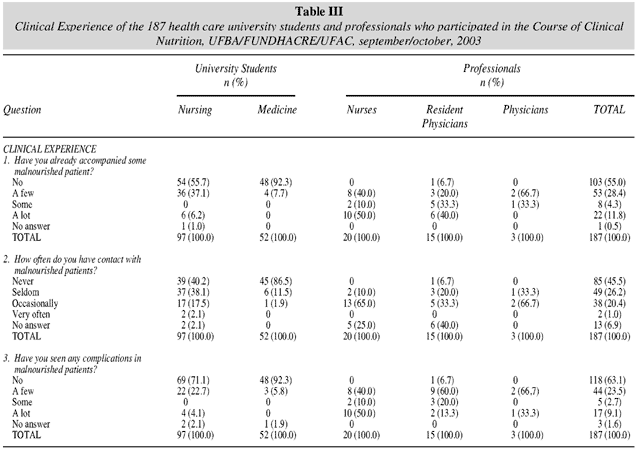
<body><![CDATA[<P>The course started with 195 participants. Their characteristics are presented  in <a href="#t1"> table I</a>. Their age varied from 17 to 51 years old. The mean age was 24.39 (± 6.21) years old. In <a href="#t1"> table I</a> their schooling is presented. Three  dietitians and two professionals of other areas participated, although they  didn´t belong to the study group, so they were excluded from analysis. In three  questionnaires the majority of the questions weren´t answered, leading to their  exclusion, totalizing 187 valid participants.</P>     <p align=center><a name="t1"><img src="/img/nh/v19n6/original5/original5_tabla1.gif" width=305 height=477></a></p>     <P>    <br> Considering that the characteristics of each category differed from each  other, each one was studied separately. Basic questions about awareness on  clinical nutrition were answered (<a href="/img/nh/v19n6/original5/original5_tabla2.gif">table II</a>). Clinical experience was also  investigated (<a href="#t3">table III</a>). The most frequent problems the participants of the  course related to malnutrition were: immune function deficit, healing  impairment, weight loss, anemia and increased predisposition to infections. They  considered the major problems related to obesity as: hypertension, diabetes and  dyslipidemia.</P>     <p align=center><a name="t3"><img src="/img/nh/v19n6/original5/original5_tabla3.gif" width=638 height=452></a></p>     <P>    <br> During the last class, a questionnaire about the course performance was  answered. A total of 165 participants concluded the course, distributed as  follows: 86 (52.1%) students of nursing, 46 (27.9%) students of medicine, 14  (8.5%) nurses, 11 (6.71%) resident physicians, 3 (1.8%) physicians, 2 (1.2%)  dietitians, 2 (1.2%) others, 1 (0.6) no answer. The answers given by  the 2 dietitians, 2 other professions and 1 no answer were excluded resulting in  160 valid answers. The absolute majority (96.7%) considered the course a very  important initiative. Considering the scale (0= very bad to 10.0= excellent),  the grades for it varied from 7.0 to 10.0, with the average grade of 8.64 (±  &nbsp;0.87). The opinions about the course given by the participants were: Fair  2, 1.2%; Good 34, 20.6%; Very good 99, 60.0%; Excellent 30, 18.2%. </P>     <P>Various aspects were investigated, reinforcing the changing of procedures to  prevent malnutrition in the hospitalized patients (<a href="#t4">table IV</a>). </P>     <p align=center><a name="t4"><img src="/img/nh/v19n6/original5/original5_tabla4.gif" width=638 height=661></a></p>     <P>    ]]></body>
<body><![CDATA[<br> An amount of 105 participants (53.8%) didn´t know about the Nutrition Support  Multidisciplinary Team, 135 (69.2%) didn´t get the information about the recent  rules for Clinical Nutrition in Brazil, but 148 (89.7%) agreed that  creation of the multiprofessional team facilitates and enriches the nutrition  support offered to the inpatient. </P>     <P>After taking the course the participants improved their diagnostic ability to  diagnose malnutrition. Most important almost 100% of the participants have  agreed that the couse has motivated their interest into practice of preventive  measures to avoid the development of hospital malnutrition. </P>     <P>The practical procedures enumerated by the participants as being important  were: measuring weight and height at hospital admission, weighting the patients  at regular intervals, to respect patients´ food preferences, to avoid prolonged  patients fasting and to take legible notes.</P>     <P><B>Discussion</B></P>     <P>In 1987, Roubenoff et al.<SUP>27</SUP> developed a study in  the John Hopkins Hospital in which they studied all patients admitted to an  acute medical ward service before and after their physicians and medical  students were taught to recognize nutritional deficiencies early and to  intervene appropriately. They demonstrated that physician education can bring  about significant improvement in the nutritional care of patients. The present  study was inspired in the methodology proposed by Roubenoff et  al.<SUP>27</SUP>.</P>     <P>The TNT course was developed for physicians by  physicians<SUP>22</SUP>, and its impact in improving physicians  knowledge of clinical nutrition and the resulting benefits on the patients care  were demonstrated.</P>     <P>But the problem of hospital malnutrition involves the multidisciplinary  health team, because nurses are not aware about the problem  too<SUP>33</SUP>.</P>     <P>And this may happen because both physicians and nurses were not taught  clinical nutrition or their contact with the theme was superficial in the  graduated school.</P>     <P>So this study was designed to present this subject to university students and  health professionals with different educational level.</P>     <P>A three class course was offered to students and professionals of Nursing and  Medicine. The Course of Clinical Nutrition, UFBA/FUNDHACRE/UFAC attracted a  public of 195 participants. Of them, 97 (57.8%) of the 168 Students of  Nursery of Acre Federal University (UFAC) participated. The Nursery Course of  UFAC has two theoretical disciplines related to Clinical Nutrition, of 30 hours  each in the second and fifth periods. This explains the fact that 34 (35.0%) of them said they had contact with the theme during the  graduation course, but due to the small class hours and the absence of practical  credits, 49 (50.5%) classified this contact as superficial. Calls the  attention the fact that 47 (48.5%) of the Nursery students and 13 (65.0%) Nurses  didn´t worry about the patients´ height.  </P>     ]]></body>
<body><![CDATA[<P>Of the 80 Medical students of UFAC, 52 (65.0%) participated. They are in the  beginning of the course, what explains the high aniount (88.5%) of them that had  no contact with patients yet. In the curriculum of the Medicine Course of UFAC,  there is no formal discipline that teaches Clinical Nutrition, which is  superficially taught during Internal Medicine in the seventh period.  </P>     <P>Of the 20 medical residents of FUNDHACRE that lead with adults and aged, 15  (75%) participated. When we analyze their contact with the theme Nutrition we  observe that 46.7% of the Resident physicians considered their exposure to the  theme superficial and 13.3% had no contact with it. Considering that  the Residents Physicians were selected from the best graduated physicians  through tests, this present observation reinforces the idea of many authors that  the physicians are not presently being taught to recognize  malnutrition<SUP>27</SUP>, that there is a lack of emphasis given  to nutrition in the medical curriculum", and that nutrition awareness is the  exception and not the rule in the hospital  setting<SUP>11</SUP>.     <P>A total of 165 participants concluded the course. Almost all considered the  course a very important initiative, giving it an high average grade. Besides the  positive evaluation, participants of the course admitted having profited  significantly from it, with the incorporation of procedures and almost 100% of  the participants have agreed that the course has motivated their interest into  practice of preventive measures to avoid the development of hospital  malnutrition, despite their clinical experience. This observation reinforces the  conclusions of Roubenoff et al<SUP>27</SUP>, who detected a great  interest and enthusiasm shown by the students and house staff in their study,  again suggesting that physicians are not <I>a priori</I> reluctant to consider  nutrition in evaluating their patients.</P>     <P>Coats et al.<SUP>21</SUP> demonstrated a great reduction in  the increasing of malnutrition prevalence in hospitalized patients after the  implementation of medical education and the creation of a multidisciplinary  nutrition support service. The influence of the present course on diagnosis  ability and incorporation of procedures by the multidisciplinary health team,  and the nutrition assessment of hospitalized patients are being analyzed for  future publication soon.</P>     <P>Corish & Kennedy<SUP>5</SUP> emphasize the importance of  the nutrition support team and the proposition that Nutrition should be  recognized as a medical specialty in Ireland. In Brazil, it is already  recognized as a medical specialty (Nutrology) and there are rules that impose to  hospitals the work of the Multidisciplinary Nutrition Support  Teams<SUP>11</SUP>. More than half of the participants of the  course considered that the relationship between the different professionals,  which take part of the Nutrition Multidisciplinary Team is very bad/fair and 148  (89.7%) agreed that the creation of the Multi-disciplinary Nutrition Support  Teams facilitates and enriches the nutrition support offered to the inpatient.  Recently, FUNDHACRE is structuring its Multidisciplinary Nutrition Support Team,  according to Brazilian rules.</P>     <P><B>Conclusions</B></P>     <P>Several studies demonstrated that hospital malnutrition is a very serious  health problem, which increases greatly the prevalence of complications and  mortality. Many factors contribute for its development, but the lack of  awareness of the multidisciplinary team about the problem has an important  participation. This is the result of the lack of emphasis given to Nutrition in  the medical curriculum. But the great interest and enthusiasm shown by the  participants as well as the apparent profit obtained suggest that the key to  open the closet door is education. Teaching of Nutrition must then be  implemented in Medical, Nursing and Pharmacy schools, and should include  theoretical and practical credits.</P>     <P><B>References</B></P>     <!-- ref --><P>1. Acuña K: Avaliaçao do Estado Nutricional de Adultos Internados em  Hospital Público do Acre. Dissertaçao de Mestrado, Universidade Federal da  Bahia, Salvador, 161p., 2002. &nbsp;&nbsp;&nbsp;&nbsp;&nbsp;&nbsp;&nbsp;&nbsp;[&#160;<a href="javascript:void(0);" onclick="javascript: window.open('/scielo.php?script=sci_nlinks&ref=3473276&pid=S0212-1611200400060000700001&lng=','','width=640,height=500,resizable=yes,scrollbars=1,menubar=yes,');">Links</a>&#160;]<!-- end-ref --><!-- ref -->2. Butterworth CE Jr: The skeleton in  the hospital closet. <I>Nutr Today</I> 1974, 9:4-8.    &nbsp;&nbsp;&nbsp;&nbsp;&nbsp;&nbsp;&nbsp;&nbsp;[&#160;<a href="javascript:void(0);" onclick="javascript: window.open('/scielo.php?script=sci_nlinks&ref=3473277&pid=S0212-1611200400060000700002&lng=','','width=640,height=500,resizable=yes,scrollbars=1,menubar=yes,');">Links</a>&#160;]<!-- end-ref --><!-- ref --><p>3. FELANPE,  Federaçao Latinoamericana de Nutrição Parenteral e Enteral. Terapia Nutricional  Total: livro de trabalho do instrutor. Desnutrição e suas conseqüên 1997;  S1.1-S1.10.&nbsp;&nbsp;&nbsp;&nbsp;&nbsp;&nbsp;&nbsp;&nbsp;[&#160;<a href="javascript:void(0);" onclick="javascript: window.open('/scielo.php?script=sci_nlinks&ref=3473278&pid=S0212-1611200400060000700003&lng=','','width=640,height=500,resizable=yes,scrollbars=1,menubar=yes,');">Links</a>&#160;]<!-- end-ref --><!-- ref --><p>4. McWhirter JP, Pennington CR: Incidence and recognition  of malnutrition in hospital. <I>Brit Med J </I>1994, 308:945-948.&nbsp;&nbsp;&nbsp;&nbsp;&nbsp;&nbsp;&nbsp;&nbsp;[&#160;<a href="javascript:void(0);" onclick="javascript: window.open('/scielo.php?script=sci_nlinks&ref=3473279&pid=S0212-1611200400060000700004&lng=','','width=640,height=500,resizable=yes,scrollbars=1,menubar=yes,');">Links</a>&#160;]<!-- end-ref --><!-- ref --><p>5.  Corish CA & Kennedy NP: Protein-energy undernutrition in hospital  in-patients. <I>Brit J Nutr </I>2000, 83:575-91.&nbsp;&nbsp;&nbsp;&nbsp;&nbsp;&nbsp;&nbsp;&nbsp;[&#160;<a href="javascript:void(0);" onclick="javascript: window.open('/scielo.php?script=sci_nlinks&ref=3473280&pid=S0212-1611200400060000700005&lng=','','width=640,height=500,resizable=yes,scrollbars=1,menubar=yes,');">Links</a>&#160;]<!-- end-ref --><!-- ref --><p>6. Acuña K, Portela  M, Costa-Matos A, Bora L, Teles MR, Waitzberg DL, Cruz T: Nutritional Assessment  of Adult Patients Admitted to a Hospital of the Amazon Region. <I>Nutrición  Hospitalaria </I>2003, 18 (3):138-46.&nbsp;&nbsp;&nbsp;&nbsp;&nbsp;&nbsp;&nbsp;&nbsp;[&#160;<a href="javascript:void(0);" onclick="javascript: window.open('/scielo.php?script=sci_nlinks&ref=3473281&pid=S0212-1611200400060000700006&lng=','','width=640,height=500,resizable=yes,scrollbars=1,menubar=yes,');">Links</a>&#160;]<!-- end-ref --><!-- ref --><p>7. OMS, Organização Mundial da  Saúde. Manejo da Desnutrição Grave: um Manual para Profissionais de Saúde de  Nível Superior e suas Equipes Auxiliares. Genebra, 2000.&nbsp;&nbsp;&nbsp;&nbsp;&nbsp;&nbsp;&nbsp;&nbsp;[&#160;<a href="javascript:void(0);" onclick="javascript: window.open('/scielo.php?script=sci_nlinks&ref=3473282&pid=S0212-1611200400060000700007&lng=','','width=640,height=500,resizable=yes,scrollbars=1,menubar=yes,');">Links</a>&#160;]<!-- end-ref --><!-- ref --><p>8. Acuña K,  Cruz T: Avaliação do Estado Nutricional do Adulto e do Idoso. Agência Nacional  de Vigilância Sanitária, Projeto Hospitais Sentinela, FUNDHACRE, 122p., Rio  Branco, Acre, 2003.&nbsp;&nbsp;&nbsp;&nbsp;&nbsp;&nbsp;&nbsp;&nbsp;[&#160;<a href="javascript:void(0);" onclick="javascript: window.open('/scielo.php?script=sci_nlinks&ref=3473283&pid=S0212-1611200400060000700008&lng=','','width=640,height=500,resizable=yes,scrollbars=1,menubar=yes,');">Links</a>&#160;]<!-- end-ref --><!-- ref --><p>9. Detsky AS, Baker JP, Mendelson RA, Wolmart SL,  Wesson DE, Jeejeebhoy N: Evaluating the accuracy of nutritional assessment  techniques applied to hospitalized patients: methodology and comparisons. <I>J  Parent Ent Nutr </I>1984, 8:153-159.&nbsp;&nbsp;&nbsp;&nbsp;&nbsp;&nbsp;&nbsp;&nbsp;[&#160;<a href="javascript:void(0);" onclick="javascript: window.open('/scielo.php?script=sci_nlinks&ref=3473284&pid=S0212-1611200400060000700009&lng=','','width=640,height=500,resizable=yes,scrollbars=1,menubar=yes,');">Links</a>&#160;]<!-- end-ref --><!-- ref --><p>10. Waitzberg DL, Caiaffa WF,  Correia MITD: Inquérito Brasileiro de Avaliação Nutricional Hospitalar  (IBRANUTRI). <I>Rev Bras Nutr Clin</I> 1999, 14:123-133.&nbsp;&nbsp;&nbsp;&nbsp;&nbsp;&nbsp;&nbsp;&nbsp;[&#160;<a href="javascript:void(0);" onclick="javascript: window.open('/scielo.php?script=sci_nlinks&ref=3473285&pid=S0212-1611200400060000700010&lng=','','width=640,height=500,resizable=yes,scrollbars=1,menubar=yes,');">Links</a>&#160;]<!-- end-ref --><!-- ref --><p>11. Waitzberg  DL, Caiffa WT, Correia MITD. Hospital Malnutrition: the Brazilian National  Survey (IBRANUTRI): a study of 4,000 patients. <I>Nutrition</I> 2001, 17:573-80.&nbsp;&nbsp;&nbsp;&nbsp;&nbsp;&nbsp;&nbsp;&nbsp;[&#160;<a href="javascript:void(0);" onclick="javascript: window.open('/scielo.php?script=sci_nlinks&ref=3473286&pid=S0212-1611200400060000700011&lng=','','width=640,height=500,resizable=yes,scrollbars=1,menubar=yes,');">Links</a>&#160;]<!-- end-ref --><!-- ref --><p>12. Silva MCGB. Avaliação Subjetiva. Global. In: Waitzberg DL.  Nutrição Oral, Enteral e Parenteral na Prática Clínica. 3.ed., São Paulo:  Atheneu, 2000:241-253.&nbsp;&nbsp;&nbsp;&nbsp;&nbsp;&nbsp;&nbsp;&nbsp;[&#160;<a href="javascript:void(0);" onclick="javascript: window.open('/scielo.php?script=sci_nlinks&ref=3473287&pid=S0212-1611200400060000700012&lng=','','width=640,height=500,resizable=yes,scrollbars=1,menubar=yes,');">Links</a>&#160;]<!-- end-ref --><!-- ref --><p>13. Campbell SE, Avenell A, Walkner AE.  Assessment of nutritional status in hospital in patients. <I>Q J Med</I> 2002,  95:83-7.&nbsp;&nbsp;&nbsp;&nbsp;&nbsp;&nbsp;&nbsp;&nbsp;[&#160;<a href="javascript:void(0);" onclick="javascript: window.open('/scielo.php?script=sci_nlinks&ref=3473288&pid=S0212-1611200400060000700013&lng=','','width=640,height=500,resizable=yes,scrollbars=1,menubar=yes,');">Links</a>&#160;]<!-- end-ref --><!-- ref --><p>14. WHO, World Health Organization. Physical Status: the Use  and Interpretation of Antropometry. Report of a WHO Expert Committee. Geneva;  1995.&nbsp;&nbsp;&nbsp;&nbsp;&nbsp;&nbsp;&nbsp;&nbsp;[&#160;<a href="javascript:void(0);" onclick="javascript: window.open('/scielo.php?script=sci_nlinks&ref=3473289&pid=S0212-1611200400060000700014&lng=','','width=640,height=500,resizable=yes,scrollbars=1,menubar=yes,');">Links</a>&#160;]<!-- end-ref --><!-- ref --><p>15. WHO, World Health Organization. Obesity: Preventing and  Managing the Global Epidemic. Geneva, 1998.&nbsp;&nbsp;&nbsp;&nbsp;&nbsp;&nbsp;&nbsp;&nbsp;[&#160;<a href="javascript:void(0);" onclick="javascript: window.open('/scielo.php?script=sci_nlinks&ref=3473290&pid=S0212-1611200400060000700015&lng=','','width=640,height=500,resizable=yes,scrollbars=1,menubar=yes,');">Links</a>&#160;]<!-- end-ref --><!-- ref --><p>16. Albert MB, Callaway  CW. Clinical Nutrition for the House Officer, Williams & Wilkins: Baltimore,  248p., 1992.    &nbsp;&nbsp;&nbsp;&nbsp;&nbsp;&nbsp;&nbsp;&nbsp;[&#160;<a href="javascript:void(0);" onclick="javascript: window.open('/scielo.php?script=sci_nlinks&ref=3473291&pid=S0212-1611200400060000700016&lng=','','width=640,height=500,resizable=yes,scrollbars=1,menubar=yes,');">Links</a>&#160;]<!-- end-ref --><!-- ref --> 17. Hill GL, Pickford I, Young GA et al.: Malnutrition in  surgical patients: an unrecognised problem. <I>The Lancet </I>I: 689-92, 1977.&nbsp;&nbsp;&nbsp;&nbsp;&nbsp;&nbsp;&nbsp;&nbsp;[&#160;<a href="javascript:void(0);" onclick="javascript: window.open('/scielo.php?script=sci_nlinks&ref=3473292&pid=S0212-1611200400060000700017&lng=','','width=640,height=500,resizable=yes,scrollbars=1,menubar=yes,');">Links</a>&#160;]<!-- end-ref --><!-- ref --><p>18. Weinsier RL, Hunker EM, Krumdiek CL, Butterworth Jr CE: Hospital  malnutrition: a prospective evaluation of general medical patients during the  course of hospitalization. <I>Am J ClinNutr </I>1979, 32:418-26.&nbsp;&nbsp;&nbsp;&nbsp;&nbsp;&nbsp;&nbsp;&nbsp;[&#160;<a href="javascript:void(0);" onclick="javascript: window.open('/scielo.php?script=sci_nlinks&ref=3473293&pid=S0212-1611200400060000700018&lng=','','width=640,height=500,resizable=yes,scrollbars=1,menubar=yes,');">Links</a>&#160;]<!-- end-ref --><!-- ref --><p>19.  Agradi E, Messina V, Campanella G et al.: Hospital Malnutrition: Incidence and  Prospective Evaluation of General Medical Patients during Hospitalization.  <I>Acta Vitaminol Enzymol </I>1994, 6(4):235-242.&nbsp;&nbsp;&nbsp;&nbsp;&nbsp;&nbsp;&nbsp;&nbsp;[&#160;<a href="javascript:void(0);" onclick="javascript: window.open('/scielo.php?script=sci_nlinks&ref=3473294&pid=S0212-1611200400060000700019&lng=','','width=640,height=500,resizable=yes,scrollbars=1,menubar=yes,');">Links</a>&#160;]<!-- end-ref --><!-- ref --><p>20. Pinchcofsky GD,  Kaminski MV: Increasing malnutrition during hospitalization: documentation by a  nutritional <I>screening </I>program. <I>J Am Coll Nutr</I> 1985, 4:471-79&nbsp;&nbsp;&nbsp;&nbsp;&nbsp;&nbsp;&nbsp;&nbsp;[&#160;<a href="javascript:void(0);" onclick="javascript: window.open('/scielo.php?script=sci_nlinks&ref=3473295&pid=S0212-1611200400060000700020&lng=','','width=640,height=500,resizable=yes,scrollbars=1,menubar=yes,');">Links</a>&#160;]<!-- end-ref --><!-- ref --><p>21. Coats KG, Morgan SL, Bartolucci AA, Weinsier RL:  Hospital-associated malnutrition: a reevaluation 12 years later. <I>J Am Diet  Assoc</I> 1993, 93(1):27-33.&nbsp;&nbsp;&nbsp;&nbsp;&nbsp;&nbsp;&nbsp;&nbsp;[&#160;<a href="javascript:void(0);" onclick="javascript: window.open('/scielo.php?script=sci_nlinks&ref=3473296&pid=S0212-1611200400060000700021&lng=','','width=640,height=500,resizable=yes,scrollbars=1,menubar=yes,');">Links</a>&#160;]<!-- end-ref --><!-- ref --><p>22. Waitzberg DL, Correia MI, Echenique M,  Ize-Lamache L, Soto JK, Mijares JM, Nin Álvarez LA, Paula JA, Rugeles S,  Cantella MS, Lloreda PS, Escallón JM: Total Nutritional Therapy: a Nutrition  Education Program for Physicians. <I>Nutr Hosp</I> 2004, 19(1):26-31.&nbsp;&nbsp;&nbsp;&nbsp;&nbsp;&nbsp;&nbsp;&nbsp;[&#160;<a href="javascript:void(0);" onclick="javascript: window.open('/scielo.php?script=sci_nlinks&ref=3473297&pid=S0212-1611200400060000700022&lng=','','width=640,height=500,resizable=yes,scrollbars=1,menubar=yes,');">Links</a>&#160;]<!-- end-ref --><!-- ref --><p>23. Garrow JS: Starvation in hospital. <I>Brit Med J </I>1994,  308:934.&nbsp;&nbsp;&nbsp;&nbsp;&nbsp;&nbsp;&nbsp;&nbsp;[&#160;<a href="javascript:void(0);" onclick="javascript: window.open('/scielo.php?script=sci_nlinks&ref=3473298&pid=S0212-1611200400060000700023&lng=','','width=640,height=500,resizable=yes,scrollbars=1,menubar=yes,');">Links</a>&#160;]<!-- end-ref --><!-- ref --><p>24. McWhirter JP, Pennington CR. Incidence and recognition of  malnutrition in hospital. <I>Brit Med J</I> 1994, 308:945-48.&nbsp;&nbsp;&nbsp;&nbsp;&nbsp;&nbsp;&nbsp;&nbsp;[&#160;<a href="javascript:void(0);" onclick="javascript: window.open('/scielo.php?script=sci_nlinks&ref=3473299&pid=S0212-1611200400060000700024&lng=','','width=640,height=500,resizable=yes,scrollbars=1,menubar=yes,');">Links</a>&#160;]<!-- end-ref --><!-- ref --><p>25.  Bistrian BR: Nutritional assessment and therapy of protein-calorie in the  hospital. <I>J Am Diet Assoc </I>1977, 71:393-97.    &nbsp;&nbsp;&nbsp;&nbsp;&nbsp;&nbsp;&nbsp;&nbsp;[&#160;<a href="javascript:void(0);" onclick="javascript: window.open('/scielo.php?script=sci_nlinks&ref=3473300&pid=S0212-1611200400060000700025&lng=','','width=640,height=500,resizable=yes,scrollbars=1,menubar=yes,');">Links</a>&#160;]<!-- end-ref --><!-- ref --> 26. Long JM: Opening  the closet door: the key is education. <I>J Parent Ent Nutr</I> 1982,  8(4):280-6.&nbsp;&nbsp;&nbsp;&nbsp;&nbsp;&nbsp;&nbsp;&nbsp;[&#160;<a href="javascript:void(0);" onclick="javascript: window.open('/scielo.php?script=sci_nlinks&ref=3473301&pid=S0212-1611200400060000700026&lng=','','width=640,height=500,resizable=yes,scrollbars=1,menubar=yes,');">Links</a>&#160;]<!-- end-ref --><!-- ref --><p>27. Roubenoff R, Roubenoff RA, Preto J, Balke W:  Malnutrition among hospitalized patients: a problem of physician awareness.  <I>Arch Int Med </I>1987, 147:1462-65.&nbsp;&nbsp;&nbsp;&nbsp;&nbsp;&nbsp;&nbsp;&nbsp;[&#160;<a href="javascript:void(0);" onclick="javascript: window.open('/scielo.php?script=sci_nlinks&ref=3473302&pid=S0212-1611200400060000700027&lng=','','width=640,height=500,resizable=yes,scrollbars=1,menubar=yes,');">Links</a>&#160;]<!-- end-ref --><!-- ref --><p>28. Ministério da Saúde.  Portaria 272 Regulamento técnico para terapia de nutrição parenteral. Diário  Oficial, 8 de abril de 1998.&nbsp;&nbsp;&nbsp;&nbsp;&nbsp;&nbsp;&nbsp;&nbsp;[&#160;<a href="javascript:void(0);" onclick="javascript: window.open('/scielo.php?script=sci_nlinks&ref=3473303&pid=S0212-1611200400060000700028&lng=','','width=640,height=500,resizable=yes,scrollbars=1,menubar=yes,');">Links</a>&#160;]<!-- end-ref --><!-- ref --><p> 29. Ministério da Saúde. Portaria 337  Regulamento técnico para terapia de nutrição enteral. Diário Oficial, 14 de  abril de 1999.&nbsp;&nbsp;&nbsp;&nbsp;&nbsp;&nbsp;&nbsp;&nbsp;[&#160;<a href="javascript:void(0);" onclick="javascript: window.open('/scielo.php?script=sci_nlinks&ref=3473304&pid=S0212-1611200400060000700029&lng=','','width=640,height=500,resizable=yes,scrollbars=1,menubar=yes,');">Links</a>&#160;]<!-- end-ref --><!-- ref --><p>30. TNT, Terapia Nutricional Total. Programa de Edução.  Federação Latinoarnericana de Nutrição Parenteral e Enteral, São Paulo, 1999.&nbsp;&nbsp;&nbsp;&nbsp;&nbsp;&nbsp;&nbsp;&nbsp;[&#160;<a href="javascript:void(0);" onclick="javascript: window.open('/scielo.php?script=sci_nlinks&ref=3473305&pid=S0212-1611200400060000700030&lng=','','width=640,height=500,resizable=yes,scrollbars=1,menubar=yes,');">Links</a>&#160;]<!-- end-ref --><!-- ref --><p>31. Mapa da Região Norte. Disponível em:  &lt;http://www.brasilviagem.com&gt;. Acesso em: 23/02/04.&nbsp;&nbsp;&nbsp;&nbsp;&nbsp;&nbsp;&nbsp;&nbsp;[&#160;<a href="javascript:void(0);" onclick="javascript: window.open('/scielo.php?script=sci_nlinks&ref=3473306&pid=S0212-1611200400060000700031&lng=','','width=640,height=500,resizable=yes,scrollbars=1,menubar=yes,');">Links</a>&#160;]<!-- end-ref --><!-- ref --><p>32. IBGE, Instituto Brasileiro de Geografia e Estatística. Censo 2000. Disponível em:  &lt;http://ibge.gov.br/home/estatistica/população/censo2000&gt;. Acesso em:  26/7/03.&nbsp;&nbsp;&nbsp;&nbsp;&nbsp;&nbsp;&nbsp;&nbsp;[&#160;<a href="javascript:void(0);" onclick="javascript: window.open('/scielo.php?script=sci_nlinks&ref=3473307&pid=S0212-1611200400060000700032&lng=','','width=640,height=500,resizable=yes,scrollbars=1,menubar=yes,');">Links</a>&#160;]<!-- end-ref --><!-- ref --><p>33. Boog MCF, Silva JB: Nurse's perceptions about nutritional care. <I>Rev Bras Nutr Clin</I> 2001, 16:17-22.&nbsp;&nbsp;&nbsp;&nbsp;&nbsp;&nbsp;&nbsp;&nbsp;[&#160;<a href="javascript:void(0);" onclick="javascript: window.open('/scielo.php?script=sci_nlinks&ref=3473308&pid=S0212-1611200400060000700033&lng=','','width=640,height=500,resizable=yes,scrollbars=1,menubar=yes,');">Links</a>&#160;]<!-- end-ref --> ]]></body><back>
<ref-list>
<ref id="B1">
<label>1</label><nlm-citation citation-type="">
<person-group person-group-type="author">
<name>
<surname><![CDATA[Acuña]]></surname>
<given-names><![CDATA[K]]></given-names>
</name>
</person-group>
<source><![CDATA[Avaliaçao do Estado Nutricional de Adultos Internados em Hospital Público do Acre]]></source>
<year>2002</year>
</nlm-citation>
</ref>
<ref id="B2">
<label>2</label><nlm-citation citation-type="journal">
<person-group person-group-type="author">
<name>
<surname><![CDATA[Butterworth]]></surname>
<given-names><![CDATA[CE]]></given-names>
</name>
</person-group>
<article-title xml:lang="en"><![CDATA[The skeleton in the hospital closet]]></article-title>
<source><![CDATA[Nutr Today]]></source>
<year>1974</year>
<volume>9</volume>
<page-range>4-8</page-range></nlm-citation>
</ref>
<ref id="B3">
<label>3</label><nlm-citation citation-type="">
<collab>Federaçao Latinoamericana de Nutrição Parenteral e Enteral</collab>
<source><![CDATA[Terapia Nutricional Total: livro de trabalho do instrutor]]></source>
<year>1997</year>
<page-range>S1.1-S1.10</page-range></nlm-citation>
</ref>
<ref id="B4">
<label>4</label><nlm-citation citation-type="journal">
<person-group person-group-type="author">
<name>
<surname><![CDATA[McWhirter]]></surname>
<given-names><![CDATA[JP]]></given-names>
</name>
<name>
<surname><![CDATA[Pennington]]></surname>
<given-names><![CDATA[CR]]></given-names>
</name>
</person-group>
<article-title xml:lang="en"><![CDATA[Incidence and recognition of malnutrition in hospital]]></article-title>
<source><![CDATA[Brit Med J]]></source>
<year>1994</year>
<volume>308</volume>
<page-range>945-948</page-range></nlm-citation>
</ref>
<ref id="B5">
<label>5</label><nlm-citation citation-type="journal">
<person-group person-group-type="author">
<name>
<surname><![CDATA[Corish]]></surname>
<given-names><![CDATA[CA]]></given-names>
</name>
<name>
<surname><![CDATA[Kennedy]]></surname>
<given-names><![CDATA[NP]]></given-names>
</name>
</person-group>
<article-title xml:lang="en"><![CDATA[Protein-energy undernutrition in hospital in-patients]]></article-title>
<source><![CDATA[Brit J Nutr]]></source>
<year>2000</year>
<volume>83</volume>
<page-range>575-91</page-range></nlm-citation>
</ref>
<ref id="B6">
<label>6</label><nlm-citation citation-type="journal">
<person-group person-group-type="author">
<name>
<surname><![CDATA[Acuña]]></surname>
<given-names><![CDATA[K]]></given-names>
</name>
<name>
<surname><![CDATA[Portela]]></surname>
<given-names><![CDATA[M]]></given-names>
</name>
<name>
<surname><![CDATA[Costa-Matos]]></surname>
<given-names><![CDATA[A]]></given-names>
</name>
<name>
<surname><![CDATA[Bora]]></surname>
<given-names><![CDATA[L]]></given-names>
</name>
<name>
<surname><![CDATA[Teles]]></surname>
<given-names><![CDATA[MR]]></given-names>
</name>
<name>
<surname><![CDATA[Waitzberg]]></surname>
<given-names><![CDATA[DL]]></given-names>
</name>
<name>
<surname><![CDATA[Cruz]]></surname>
<given-names><![CDATA[T]]></given-names>
</name>
</person-group>
<article-title xml:lang="en"><![CDATA[Nutritional Assessment of Adult Patients Admitted to a Hospital of the Amazon Region]]></article-title>
<source><![CDATA[Nutrición Hospitalaria]]></source>
<year>2003</year>
<volume>18</volume>
<numero>3</numero>
<issue>3</issue>
<page-range>138-46</page-range></nlm-citation>
</ref>
<ref id="B7">
<label>7</label><nlm-citation citation-type="">
<collab>Organização Mundial da Saúde</collab>
<source><![CDATA[Manejo da Desnutrição Grave: um Manual para Profissionais de Saúde de Nível Superior e suas Equipes Auxiliares]]></source>
<year>2000</year>
<publisher-loc><![CDATA[Genebra ]]></publisher-loc>
</nlm-citation>
</ref>
<ref id="B8">
<label>8</label><nlm-citation citation-type="book">
<person-group person-group-type="author">
<name>
<surname><![CDATA[Acuña]]></surname>
<given-names><![CDATA[K]]></given-names>
</name>
<name>
<surname><![CDATA[Cruz]]></surname>
<given-names><![CDATA[T]]></given-names>
</name>
</person-group>
<source><![CDATA[Avaliação do Estado Nutricional do Adulto e do Idoso]]></source>
<year>2003</year>
<publisher-loc><![CDATA[Rio Branco^eAcre Acre]]></publisher-loc>
<publisher-name><![CDATA[Agência Nacional de Vigilância SanitáriaProjeto Hospitais SentinelaFUNDHACRE]]></publisher-name>
</nlm-citation>
</ref>
<ref id="B9">
<label>9</label><nlm-citation citation-type="journal">
<person-group person-group-type="author">
<name>
<surname><![CDATA[Detsky]]></surname>
<given-names><![CDATA[AS]]></given-names>
</name>
<name>
<surname><![CDATA[Baker]]></surname>
<given-names><![CDATA[JP]]></given-names>
</name>
<name>
<surname><![CDATA[Mendelson]]></surname>
<given-names><![CDATA[RA]]></given-names>
</name>
<name>
<surname><![CDATA[Wolmart]]></surname>
<given-names><![CDATA[SL]]></given-names>
</name>
<name>
<surname><![CDATA[Wesson]]></surname>
<given-names><![CDATA[DE]]></given-names>
</name>
<name>
<surname><![CDATA[Jeejeebhoy]]></surname>
<given-names><![CDATA[N]]></given-names>
</name>
</person-group>
<article-title xml:lang="en"><![CDATA[Evaluating the accuracy of nutritional assessment techniques applied to hospitalized patients: methodology and comparisons]]></article-title>
<source><![CDATA[J Parent Ent Nutr]]></source>
<year>1984</year>
<volume>8</volume>
<page-range>153-159</page-range></nlm-citation>
</ref>
<ref id="B10">
<label>10</label><nlm-citation citation-type="journal">
<person-group person-group-type="author">
<name>
<surname><![CDATA[Waitzberg]]></surname>
<given-names><![CDATA[DL]]></given-names>
</name>
<name>
<surname><![CDATA[Caiaffa]]></surname>
<given-names><![CDATA[WF]]></given-names>
</name>
<name>
<surname><![CDATA[Correia]]></surname>
<given-names><![CDATA[MITD]]></given-names>
</name>
</person-group>
<article-title xml:lang="pt"><![CDATA[Inquérito Brasileiro de Avaliação Nutricional Hospitalar (IBRANUTRI)]]></article-title>
<source><![CDATA[Rev Bras Nutr Clin]]></source>
<year>1999</year>
<volume>14</volume>
<page-range>123-133</page-range></nlm-citation>
</ref>
<ref id="B11">
<label>11</label><nlm-citation citation-type="journal">
<person-group person-group-type="author">
<name>
<surname><![CDATA[Waitzberg]]></surname>
<given-names><![CDATA[DL]]></given-names>
</name>
<name>
<surname><![CDATA[Caiffa]]></surname>
<given-names><![CDATA[WT]]></given-names>
</name>
<name>
<surname><![CDATA[Correia]]></surname>
<given-names><![CDATA[MITD]]></given-names>
</name>
</person-group>
<article-title xml:lang="en"><![CDATA[Hospital Malnutrition: the Brazilian National Survey (IBRANUTRI): a study of 4,000 patients]]></article-title>
<source><![CDATA[Nutrition]]></source>
<year>2001</year>
<volume>17</volume>
<page-range>573-80</page-range></nlm-citation>
</ref>
<ref id="B12">
<label>12</label><nlm-citation citation-type="book">
<person-group person-group-type="author">
<name>
<surname><![CDATA[Silva]]></surname>
<given-names><![CDATA[MCGB]]></given-names>
</name>
</person-group>
<article-title xml:lang="pt"><![CDATA[Avaliação Subjetiva: Global]]></article-title>
<person-group person-group-type="editor">
<name>
<surname><![CDATA[Waitzberg]]></surname>
<given-names><![CDATA[DL.]]></given-names>
</name>
</person-group>
<source><![CDATA[Nutrição Oral, Enteral e Parenteral na Prática Clínica]]></source>
<year>2000</year>
<edition>3</edition>
<page-range>241-253</page-range><publisher-loc><![CDATA[São Paulo ]]></publisher-loc>
<publisher-name><![CDATA[Atheneu]]></publisher-name>
</nlm-citation>
</ref>
<ref id="B13">
<label>13</label><nlm-citation citation-type="journal">
<person-group person-group-type="author">
<name>
<surname><![CDATA[Campbell]]></surname>
<given-names><![CDATA[SE]]></given-names>
</name>
<name>
<surname><![CDATA[Avenell]]></surname>
<given-names><![CDATA[A]]></given-names>
</name>
<name>
<surname><![CDATA[Walkner]]></surname>
<given-names><![CDATA[AE.]]></given-names>
</name>
</person-group>
<article-title xml:lang="en"><![CDATA[Assessment of nutritional status in hospital in patients]]></article-title>
<source><![CDATA[Q J Med]]></source>
<year>2002</year>
<volume>95</volume>
<page-range>83-7</page-range></nlm-citation>
</ref>
<ref id="B14">
<label>14</label><nlm-citation citation-type="">
<collab>World Health Organization</collab>
<source><![CDATA[Physical Status: the Use and Interpretation of Antropometry. Report of a WHO Expert Committee]]></source>
<year>1995</year>
<publisher-loc><![CDATA[Geneva ]]></publisher-loc>
</nlm-citation>
</ref>
<ref id="B15">
<label>15</label><nlm-citation citation-type="">
<collab>World Health Organization</collab>
<source><![CDATA[Obesity: Preventing and Managing the Global Epidemic]]></source>
<year>1998</year>
<publisher-loc><![CDATA[Geneva ]]></publisher-loc>
</nlm-citation>
</ref>
<ref id="B16">
<label>16</label><nlm-citation citation-type="book">
<person-group person-group-type="author">
<name>
<surname><![CDATA[Albert]]></surname>
<given-names><![CDATA[MB]]></given-names>
</name>
<name>
<surname><![CDATA[Callaway]]></surname>
<given-names><![CDATA[CW]]></given-names>
</name>
</person-group>
<source><![CDATA[Clinical Nutrition for the House Officer]]></source>
<year>1992</year>
<publisher-loc><![CDATA[Baltimore ]]></publisher-loc>
<publisher-name><![CDATA[Williams & Wilkins]]></publisher-name>
</nlm-citation>
</ref>
<ref id="B17">
<label>17</label><nlm-citation citation-type="journal">
<person-group person-group-type="author">
<name>
<surname><![CDATA[Hill]]></surname>
<given-names><![CDATA[GL]]></given-names>
</name>
<name>
<surname><![CDATA[Pickford]]></surname>
<given-names><![CDATA[I]]></given-names>
</name>
<name>
<surname><![CDATA[Young]]></surname>
<given-names><![CDATA[GA]]></given-names>
</name>
</person-group>
<article-title xml:lang="en"><![CDATA[Malnutrition in surgical patients: an unrecognised problem]]></article-title>
<source><![CDATA[The Lancet I]]></source>
<year>1977</year>
<page-range>689-92</page-range></nlm-citation>
</ref>
<ref id="B18">
<label>18</label><nlm-citation citation-type="journal">
<person-group person-group-type="author">
<name>
<surname><![CDATA[Weinsier]]></surname>
<given-names><![CDATA[RL]]></given-names>
</name>
<name>
<surname><![CDATA[Hunker]]></surname>
<given-names><![CDATA[EM]]></given-names>
</name>
<name>
<surname><![CDATA[Krumdiek]]></surname>
<given-names><![CDATA[CL]]></given-names>
</name>
<name>
<surname><![CDATA[Butterworth Jr]]></surname>
<given-names><![CDATA[CE]]></given-names>
</name>
</person-group>
<article-title xml:lang="en"><![CDATA[Hospital malnutrition: a prospective evaluation of general medical patients during the course of hospitalization]]></article-title>
<source><![CDATA[Am J ClinNutr]]></source>
<year>1979</year>
<volume>32</volume>
<page-range>418-26</page-range></nlm-citation>
</ref>
<ref id="B19">
<label>19</label><nlm-citation citation-type="journal">
<person-group person-group-type="author">
<name>
<surname><![CDATA[Agradi]]></surname>
<given-names><![CDATA[E]]></given-names>
</name>
<name>
<surname><![CDATA[Messina]]></surname>
<given-names><![CDATA[V]]></given-names>
</name>
<name>
<surname><![CDATA[Campanella]]></surname>
<given-names><![CDATA[G]]></given-names>
</name>
</person-group>
<article-title xml:lang="en"><![CDATA[Hospital Malnutrition: Incidence and Prospective Evaluation of General Medical Patients during Hospitalization]]></article-title>
<source><![CDATA[Acta Vitaminol Enzymol]]></source>
<year>1994</year>
<volume>6</volume>
<numero>4</numero>
<issue>4</issue>
<page-range>235-242</page-range></nlm-citation>
</ref>
<ref id="B20">
<label>20</label><nlm-citation citation-type="journal">
<person-group person-group-type="author">
<name>
<surname><![CDATA[Pinchcofsky]]></surname>
<given-names><![CDATA[GD]]></given-names>
</name>
<name>
<surname><![CDATA[Kaminski]]></surname>
<given-names><![CDATA[MV]]></given-names>
</name>
</person-group>
<article-title xml:lang="en"><![CDATA[Increasing malnutrition during hospitalization: documentation by a nutritional screening program]]></article-title>
<source><![CDATA[J Am Coll Nutr]]></source>
<year>1985</year>
<volume>4</volume>
<page-range>471-79</page-range></nlm-citation>
</ref>
<ref id="B21">
<label>21</label><nlm-citation citation-type="journal">
<person-group person-group-type="author">
<name>
<surname><![CDATA[Coats]]></surname>
<given-names><![CDATA[KG]]></given-names>
</name>
<name>
<surname><![CDATA[Morgan]]></surname>
<given-names><![CDATA[SL]]></given-names>
</name>
<name>
<surname><![CDATA[Bartolucci]]></surname>
<given-names><![CDATA[AA]]></given-names>
</name>
<name>
<surname><![CDATA[Weinsier]]></surname>
<given-names><![CDATA[RL]]></given-names>
</name>
</person-group>
<article-title xml:lang="en"><![CDATA[Hospital-associated malnutrition: a reevaluation 12 years later]]></article-title>
<source><![CDATA[J Am Diet Assoc]]></source>
<year>1993</year>
<volume>93</volume>
<numero>1</numero>
<issue>1</issue>
<page-range>27-33</page-range></nlm-citation>
</ref>
<ref id="B22">
<label>22</label><nlm-citation citation-type="journal">
<person-group person-group-type="author">
<name>
<surname><![CDATA[Waitzberg]]></surname>
<given-names><![CDATA[DL]]></given-names>
</name>
<name>
<surname><![CDATA[Correia]]></surname>
<given-names><![CDATA[MI]]></given-names>
</name>
<name>
<surname><![CDATA[Echenique]]></surname>
<given-names><![CDATA[M]]></given-names>
</name>
<name>
<surname><![CDATA[Ize-Lamache]]></surname>
<given-names><![CDATA[L]]></given-names>
</name>
<name>
<surname><![CDATA[Soto]]></surname>
<given-names><![CDATA[JK]]></given-names>
</name>
<name>
<surname><![CDATA[Mijares]]></surname>
<given-names><![CDATA[JM]]></given-names>
</name>
<name>
<surname><![CDATA[Nin Álvarez]]></surname>
<given-names><![CDATA[LA]]></given-names>
</name>
<name>
<surname><![CDATA[Paula]]></surname>
<given-names><![CDATA[JA]]></given-names>
</name>
<name>
<surname><![CDATA[Rugeles]]></surname>
<given-names><![CDATA[S]]></given-names>
</name>
<name>
<surname><![CDATA[Cantella]]></surname>
<given-names><![CDATA[MS]]></given-names>
</name>
<name>
<surname><![CDATA[Lloreda]]></surname>
<given-names><![CDATA[PS]]></given-names>
</name>
<name>
<surname><![CDATA[Escallón]]></surname>
<given-names><![CDATA[JM]]></given-names>
</name>
</person-group>
<article-title xml:lang="en"><![CDATA[Total Nutritional Therapy: a Nutrition Education Program for Physicians]]></article-title>
<source><![CDATA[Nutr Hosp]]></source>
<year>2004</year>
<volume>19</volume>
<numero>1</numero>
<issue>1</issue>
<page-range>26-31</page-range></nlm-citation>
</ref>
<ref id="B23">
<label>23</label><nlm-citation citation-type="journal">
<person-group person-group-type="author">
<name>
<surname><![CDATA[Garrow]]></surname>
<given-names><![CDATA[JS]]></given-names>
</name>
</person-group>
<article-title xml:lang="en"><![CDATA[Starvation in hospital]]></article-title>
<source><![CDATA[Brit Med J]]></source>
<year>1994</year>
<volume>308</volume>
<page-range>934</page-range></nlm-citation>
</ref>
<ref id="B24">
<label>24</label><nlm-citation citation-type="journal">
<person-group person-group-type="author">
<name>
<surname><![CDATA[McWhirter]]></surname>
<given-names><![CDATA[JP]]></given-names>
</name>
<name>
<surname><![CDATA[Pennington]]></surname>
<given-names><![CDATA[CR]]></given-names>
</name>
</person-group>
<article-title xml:lang="en"><![CDATA[Incidence and recognition of malnutrition in hospital]]></article-title>
<source><![CDATA[Brit Med J]]></source>
<year>1994</year>
<volume>308</volume>
<page-range>945-48</page-range></nlm-citation>
</ref>
<ref id="B25">
<label>25</label><nlm-citation citation-type="journal">
<person-group person-group-type="author">
<name>
<surname><![CDATA[Bistrian]]></surname>
<given-names><![CDATA[BR]]></given-names>
</name>
</person-group>
<article-title xml:lang="en"><![CDATA[Nutritional assessment and therapy of protein-calorie in the hospital]]></article-title>
<source><![CDATA[J Am Diet Assoc]]></source>
<year>1977</year>
<volume>71</volume>
<page-range>393-97</page-range></nlm-citation>
</ref>
<ref id="B26">
<label>26</label><nlm-citation citation-type="journal">
<person-group person-group-type="author">
<name>
<surname><![CDATA[Long]]></surname>
<given-names><![CDATA[JM]]></given-names>
</name>
</person-group>
<article-title xml:lang="en"><![CDATA[Opening the closet door: the key is education]]></article-title>
<source><![CDATA[J Parent Ent Nutr]]></source>
<year>1982</year>
<volume>8</volume>
<numero>4</numero>
<issue>4</issue>
<page-range>280-6</page-range></nlm-citation>
</ref>
<ref id="B27">
<label>27</label><nlm-citation citation-type="journal">
<person-group person-group-type="author">
<name>
<surname><![CDATA[Roubenoff]]></surname>
<given-names><![CDATA[R]]></given-names>
</name>
<name>
<surname><![CDATA[Roubenoff]]></surname>
<given-names><![CDATA[RA]]></given-names>
</name>
<name>
<surname><![CDATA[Preto]]></surname>
<given-names><![CDATA[J]]></given-names>
</name>
<name>
<surname><![CDATA[Balke]]></surname>
<given-names><![CDATA[W]]></given-names>
</name>
</person-group>
<article-title xml:lang="en"><![CDATA[Malnutrition among hospitalized patients: a problem of physician awareness]]></article-title>
<source><![CDATA[Arch Int Med]]></source>
<year>1987</year>
<volume>147</volume>
<page-range>1462-65</page-range></nlm-citation>
</ref>
<ref id="B28">
<label>28</label><nlm-citation citation-type="book">
<collab>Ministério da Saúde</collab>
<source><![CDATA[Portaria 272 Regulamento técnico para terapia de nutrição parenteral]]></source>
<year>8 de</year>
<month> a</month>
<day>br</day>
<publisher-name><![CDATA[Diário Oficial]]></publisher-name>
</nlm-citation>
</ref>
<ref id="B29">
<label>29</label><nlm-citation citation-type="book">
<collab>Ministério da Saúde</collab>
<source><![CDATA[Portaria 337 Regulamento técnico para terapia de nutrição enteral]]></source>
<year>14 d</year>
<month>e </month>
<day>ab</day>
<publisher-name><![CDATA[Diário Oficial]]></publisher-name>
</nlm-citation>
</ref>
<ref id="B30">
<label>30</label><nlm-citation citation-type="book">
<collab>Terapia Nutricional Total</collab>
<source><![CDATA[Programa de Edução]]></source>
<year>1999</year>
<publisher-loc><![CDATA[São Paulo ]]></publisher-loc>
<publisher-name><![CDATA[Federação Latinoarnericana de Nutrição Parenteral e Enteral]]></publisher-name>
</nlm-citation>
</ref>
<ref id="B31">
<label>31</label><nlm-citation citation-type="">
<source><![CDATA[Mapa da Região Norte]]></source>
<year></year>
</nlm-citation>
</ref>
<ref id="B32">
<label>32</label><nlm-citation citation-type="">
<collab>Instituto Brasileiro de Geografia e Estatística</collab>
<source><![CDATA[Censo 2000]]></source>
<year></year>
</nlm-citation>
</ref>
<ref id="B33">
<label>33</label><nlm-citation citation-type="journal">
<person-group person-group-type="author">
<name>
<surname><![CDATA[Boog]]></surname>
<given-names><![CDATA[MCF]]></given-names>
</name>
<name>
<surname><![CDATA[Silva]]></surname>
<given-names><![CDATA[JB]]></given-names>
</name>
</person-group>
<article-title xml:lang="en"><![CDATA[Nurse's perceptions about nutritional care]]></article-title>
<source><![CDATA[Rev Bras Nutr Clin]]></source>
<year>2001</year>
<volume>16</volume>
<page-range>17-22</page-range></nlm-citation>
</ref>
</ref-list>
</back>
</article>