<?xml version="1.0" encoding="ISO-8859-1"?><article xmlns:mml="http://www.w3.org/1998/Math/MathML" xmlns:xlink="http://www.w3.org/1999/xlink" xmlns:xsi="http://www.w3.org/2001/XMLSchema-instance">
<front>
<journal-meta>
<journal-id>0212-1611</journal-id>
<journal-title><![CDATA[Nutrición Hospitalaria]]></journal-title>
<abbrev-journal-title><![CDATA[Nutr. Hosp.]]></abbrev-journal-title>
<issn>0212-1611</issn>
<publisher>
<publisher-name><![CDATA[Grupo Arán]]></publisher-name>
</publisher>
</journal-meta>
<article-meta>
<article-id>S0212-16112005000100006</article-id>
<title-group>
<article-title xml:lang="en"><![CDATA[CONUT: A tool for Controlling Nutritional Status. First validation in a hospital population]]></article-title>
<article-title xml:lang="es"><![CDATA[CONUT: una herramienta para controlar el estado nutritivo. Primera validación en una población hospitalaria]]></article-title>
</title-group>
<contrib-group>
<contrib contrib-type="author">
<name>
<surname><![CDATA[Ignacio de Ulíbarri]]></surname>
<given-names><![CDATA[J.]]></given-names>
</name>
<xref ref-type="aff" rid="A01"/>
</contrib>
<contrib contrib-type="author">
<name>
<surname><![CDATA[González-Madroño]]></surname>
<given-names><![CDATA[A.]]></given-names>
</name>
<xref ref-type="aff" rid="A01"/>
</contrib>
<contrib contrib-type="author">
<name>
<surname><![CDATA[Villar]]></surname>
<given-names><![CDATA[NG de]]></given-names>
</name>
<xref ref-type="aff" rid="A01"/>
</contrib>
<contrib contrib-type="author">
<name>
<surname><![CDATA[González]]></surname>
<given-names><![CDATA[P.]]></given-names>
</name>
<xref ref-type="aff" rid="A01"/>
</contrib>
<contrib contrib-type="author">
<name>
<surname><![CDATA[González]]></surname>
<given-names><![CDATA[B.]]></given-names>
</name>
<xref ref-type="aff" rid="A01"/>
</contrib>
<contrib contrib-type="author">
<name>
<surname><![CDATA[Mancha]]></surname>
<given-names><![CDATA[A.]]></given-names>
</name>
<xref ref-type="aff" rid="A01"/>
</contrib>
<contrib contrib-type="author">
<name>
<surname><![CDATA[Rodríguez]]></surname>
<given-names><![CDATA[F.]]></given-names>
</name>
<xref ref-type="aff" rid="A02"/>
</contrib>
<contrib contrib-type="author">
<name>
<surname><![CDATA[Fernández]]></surname>
<given-names><![CDATA[G.]]></given-names>
</name>
<xref ref-type="aff" rid="A02"/>
</contrib>
</contrib-group>
<aff id="A01">
<institution><![CDATA[,Hospital Universitario La Princesa Clinical Nutrition and Dietetic Unit ]]></institution>
<addr-line><![CDATA[ ]]></addr-line>
</aff>
<aff id="A02">
<institution><![CDATA[,Hospital Universitario La Princesa Clinical Epidemiology Unit ]]></institution>
<addr-line><![CDATA[ ]]></addr-line>
</aff>
<aff id="A03">
<institution><![CDATA[,Hospital Universitario La Princesa Service of Admission and Documentation ]]></institution>
<addr-line><![CDATA[Madrid ]]></addr-line>
<country>Spain</country>
</aff>
<pub-date pub-type="pub">
<day>00</day>
<month>02</month>
<year>2005</year>
</pub-date>
<pub-date pub-type="epub">
<day>00</day>
<month>02</month>
<year>2005</year>
</pub-date>
<volume>20</volume>
<numero>1</numero>
<fpage>38</fpage>
<lpage>45</lpage>
<copyright-statement/>
<copyright-year/>
<self-uri xlink:href="http://scielo.isciii.es/scielo.php?script=sci_arttext&amp;pid=S0212-16112005000100006&amp;lng=en&amp;nrm=iso"></self-uri><self-uri xlink:href="http://scielo.isciii.es/scielo.php?script=sci_abstract&amp;pid=S0212-16112005000100006&amp;lng=en&amp;nrm=iso"></self-uri><self-uri xlink:href="http://scielo.isciii.es/scielo.php?script=sci_pdf&amp;pid=S0212-16112005000100006&amp;lng=en&amp;nrm=iso"></self-uri><abstract abstract-type="short" xml:lang="en"><p><![CDATA[Background: The serious problem of hospital undernutrition is still being underestimated, despite its impact on clinical evolution and costs. The screening methods developed so far are not useful for daily clinical practice due to their low effectiveness/cost ratio. Objective:We present an screening tool for CONtrolling NUTritional status (CONUT) that allows an automatic daily assessment of nutritional status of all inpatients that undergo routine analysis. Design: The system is based on a computer application that compiles daily all useful patient information available in hospital databases, through the internal network. It automatically assesses the nutritional status taking into account laboratory information including serum albumin, total cholesterol level and total lymphocyte count. We have studied the association between the results of the Subjective Global Assessment (SGA) and Full Nutritional Assessment (FNA) with those from CONUT, in a sample of 53 individuals. Results: The agreement degree between CONUT and FNA as measured by kappa index is 0.669 (p = 0.003), and between CONUT and SGA is 0.488 (p = 0.034). Considering FNA as "gold standard" we obtain a sensitivity of 92.3 and a specificity of 85.0. Conclusions: CONUT seems to be an efficient tool for early detection and continuous control of hospital undernutrition, with the suitable characteristics for these screening functions.]]></p></abstract>
<abstract abstract-type="short" xml:lang="es"><p><![CDATA[Antecedentes: El grave problema de la desnutrición hospitalaria sigue siendo infravalorado, pese a sus repercusiones sobre la evolución clínica y los costes de la hospitalización. Los procedimientos de filtro desarrollados hasta ahora no son útiles para la práctica diaria por su baja relación efectividad/costo. Objetivo: Presentamos un sistema de cribado para el CONtrol NUTricional que permite valorar a diario, de manera automática, la situación nutricional de la totalidad de los pacientes ingresados a los que se practica análisis de rutina. Diseño: El sistema se basa en una aplicación informática que recopila a diario, a través de la red interna, aquellos datos de los pacientes ingresados que se consideran útiles para evaluar su estado nutricional y que están disponibles en bases de datos del hospital. Automáticamente determina la situación nutricional de los pacientes considerando los datos de laboratorio: albúmina, colesterol y linfocitos totales. Hemos estudiado la asociación entre los resultados del Subjective Global Assessment (SGA) y del Full Nutritional Assessment (FNA) con aquellos del CONUT, en una muestra de 53 individuos. Resultados: El grado de concordancia entre el CONUT y el FNA, medido por el índice kappa es de 0,699 (p = 0,003), y entre el CONUT y el SGA es de 0,488 (p = 0,034). Si consideramos que el FNA es la "prueba de referencia", obtenemos una sensibilidad del 92,3 y una especificidad del 85,0. Conclusiones: Parece que CONUT es una herramienta eficaz para la detección precoz y el control continuo de la desnutrición hospitalaria, con las características adecuadas a las funciones de cribado.]]></p></abstract>
<kwd-group>
<kwd lng="en"><![CDATA[Undernutrition]]></kwd>
<kwd lng="en"><![CDATA[malnourishment]]></kwd>
<kwd lng="en"><![CDATA[screening]]></kwd>
<kwd lng="en"><![CDATA[nutritional assessment]]></kwd>
<kwd lng="en"><![CDATA[albumin]]></kwd>
<kwd lng="en"><![CDATA[total cholesterol]]></kwd>
<kwd lng="en"><![CDATA[total lymphocyte count]]></kwd>
<kwd lng="en"><![CDATA[clinical nutrition]]></kwd>
<kwd lng="es"><![CDATA[Desnutrición]]></kwd>
<kwd lng="es"><![CDATA[malnutrición]]></kwd>
<kwd lng="es"><![CDATA[cribado]]></kwd>
<kwd lng="es"><![CDATA[valoración nutritiva]]></kwd>
<kwd lng="es"><![CDATA[albúmina]]></kwd>
<kwd lng="es"><![CDATA[colesterol total]]></kwd>
<kwd lng="es"><![CDATA[recuento linfocitario total]]></kwd>
<kwd lng="es"><![CDATA[nutrición clínica]]></kwd>
</kwd-group>
</article-meta>
</front><body><![CDATA[ <P><font size="4"><b>Original</b></font></P>      <P><font size=5><b>CONUT: A tool for Controlling Nutritional Status. First validation    <br> in a hospital population</b></font></P>      <P>J. Ignacio de Ulíbarri*, A. González-Madroño*, N. GP de Villar*, P. González*, B. González*, A. Mancha*,    <br> F. Rodríguez<sup>&#x2020;</sup>, G. Fernández<sup>&#x2021;</sup></P>      <P><I><font size="2">*Clinical Nutrition and Dietetic Unit. <sup>&#x2020;</sup>Clinical Epidemiology Unit. <sup>&#x2021;</sup>Service of Admission and Documentation.    <br> Hospital Universitario de la Princesa. Madrid. Spain.</font></I></P>      <P>&nbsp;</P>  <table border="0" width="100%">   <tr>     <td width="48%" valign="top"><b>Abstract</b>           <p><b><i>Background</i>: The serious problem of hospital undernutrition is still being       underestimated, despite its impact on clinical evolution and costs. The screening    methods developed so far are not useful for daily clinical practice due to their    low effectiveness/cost ratio.    <br>       <i>Objective</i>:We present an screening tool for CONtrolling NUTritional status       (CONUT) that allows an automatic daily assessment of nutritional status of all inpatients that undergo routine       analysis.    ]]></body>
<body><![CDATA[<br>       <i>Design</i>: The system is based on a computer application that compiles daily all useful patient information available in hospital databases, through the internal network. It automatically assesses the nutritional status taking into account laboratory information including serum albumin, total cholesterol level and total lymphocyte count. We have studied the association between the results of the Subjective Global Assessment (SGA) and Full Nutritional Assessment (FNA) with those from CONUT, in a sample of 53       individuals.    <br>       <i>Results</i>: The agreement degree between CONUT and FNA as measured by kappa index is 0.669 (p = 0.003), and between CONUT and SGA is 0.488 (p = 0.034). Considering FNA as &quot;gold       standard&quot; we obtain a sensitivity of 92.3 and a specificity of 85.0.    <br>       <i>Conclusions</i>: CONUT seems to be an efficient tool for early detection and continuous control of hospital undernutrition, with the suitable characteristics for these screening       functions.</b></p>      <P align="right">(<i>Nutr Hosp </i>2005, 20:38-45)</P>      <P align="left">Key words: <I>Undernutrition, malnourishment, screening, nutritional assessment,  albumin, total cholesterol, total lymphocyte count, clinical nutrition.</I> </P>           <p>&nbsp;</td>     <td width="4%" valign="top"></td>     <td width="48%" valign="top">           <p align="center"><b>CONUT: UNA HERRAMIENTA PARA CONTROLAR EL ESTADO NUTRITIVO. PRIMERA VALIDACIÓN EN UNA POBLACIÓN HOSPITALARIA</b></p>           <p><b>Resumen</b></p>      <P><B><i>Antecedentes</i>: El grave problema de la desnutrición    hospitalaria sigue siendo infravalorado, pese a sus repercusiones sobre la    evolución clínica y los costes de la hospitalización. Los procedimientos de    filtro desarrollados hasta ahora no son útiles para la práctica diaria por su    baja relación efectividad/costo.    <br> <i>Objetivo</i>: Presentamos un sistema de cribado para el CONtrol NUTricional que permite valorar a diario, de manera automática, la situación nutricional de la totalidad de los pacientes ingresados a los que se practica análisis de rutina.    ]]></body>
<body><![CDATA[<br> <i>Diseño</i>: El sistema se basa en una aplicación informática que recopila a diario, a través de la red interna, aquellos datos de los pacientes ingresados que se consideran útiles para evaluar su estado nutricional y que están disponibles en bases de datos del hospital. Automáticamente determina la situación nutricional de los pacientes considerando los datos de laboratorio: albúmina, colesterol y linfocitos totales. Hemos estudiado la asociación entre los resultados del Subjective Global Assessment (SGA) y del Full Nutritional Assessment (FNA) con aquellos del CONUT, en una muestra de 53 individuos.    <br> <i>Resultados</i>: El grado de concordancia entre el CONUT y el FNA, medido por  el índice kappa es de 0,699 (p = 0,003), y entre el CONUT y el SGA es de 0,488  (p = 0,034). Si consideramos que el FNA es la "prueba de referencia",  obtenemos una sensibilidad del 92,3 y una especificidad del 85,0.    <br> <i>Conclusiones</i>: Parece que CONUT es una herramienta eficaz para la detección precoz y el control continuo de la desnutrición hospitalaria, con las características adecuadas a las funciones de cribado.</b></P>      <P align="right">(<i>Nutr Hosp </i>2005, 20:38-45)</P>      <P>Palabras clave: <I>Desnutrición, malnutrición, cribado, valoración nutritiva,  albúmina, colesterol total, recuento linfocitario total, nutrición clínica.</I>        </P>      </td>   </tr> </table> <hr width="48%" align="left">     <P> <font size="2"> <B>Correspondencia: </B>J. Ignacio de Ulíbarri    <br> Unidad de Nutrición Clínica y Dietética    <br> Hospital Universitario de la Princesa    <br> Diego de León, 62    <br> 28006 Madrid    ]]></body>
<body><![CDATA[<br> E-mail: <a href="mailto:ji.uliba@arrakis.es">ji.uliba@arrakis.es</a></font>    <P> <font size="2">Recibido: 6-X-2004.    <br> Aceptado: 20-X-2004.</font>    <P> &nbsp;    <P> <b>Introduction</b>    <P> Undernutrition is a problem of great importance in clinical circles,    despite the fact that it is still not highly considered by specialists and those    responsible for Public Health. There are many studies showing that undernutrition    prevalence in hospitalised patients ranges between 30-70%<sup>1-5</sup>, varying    according to definition of undernutition, used methodology and the specific    group of studied patients.      <P>The multiple consequences of undernutrition on immunological system<sup>6-7</sup>, gastrointestinal tract<sup>8</sup>, endocrine system, cardio-respiratory function<sup>9</sup>, and on healing processes<sup>10-11</sup> are very well known. This is associated to an increase of morbidity-mortality rates, post-operative complications and an extension of length of stay (LOS) causing an increase in hospital assistance costs, up to an average of 60%<sup>12-16</sup>.</P>      <P>The average prevalence of hospital severe malnutrition is around 10% in the literature<sup>17</sup>. Our the Nutritional Unit is only consulted in 3.12% of all inpatients<sup>18</sup>, which means malnourished population in our hospital may be underdiagnosed.</P>      <P>The total assistance quality could be considerably improved by the arrangement of an automatic early detection system of undernutrition for all the inpatients. This method would allow to monitor the incidence of new cases, their follow-up and it would be followed by a full nutritional assessment and a intervention plan in order to counteract the effects of malnourishment, with the accompanying clinical and economic benefits.</P>      <P>Regarding this point, we fully agree with the conclusions of the 2003 Resolution of the Council of Europe on Food and Nutritional Care in Hospitals<sup>19</sup>. Which encourages European Countries to develop screening methods for assessing nutritional status and nutritional risk. The experts collect data from nutritional care providers and their practices of nutritional care and support showing it is sparse and inconsistent, and that the responsibilities in these context are unclear<sup>20</sup>.</P>      ]]></body>
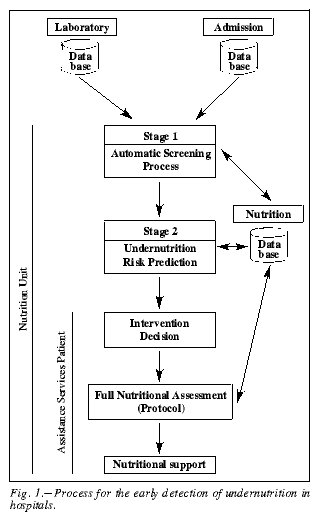
<body><![CDATA[<P>There are many studies that have tried to develop screening tools for early detection of undernutrition<sup>21-27</sup> but none of them can be applied on every inpatient, because among their evaluation parameters are some that require the intervention of an expert (physicians, nurses, and/or dieticians) for each patient individually, either for the anamnesis, for the physical examination or for the interpretation of laboratory analysis, which is not currently available in most of the hospitals around the world.</P>      <P>A screening tool should be clearly different from a full nutritional assessment, and should be based on easy and cheap-to-obtain measures and procedures, because these must be put into effect with as many patients as possible, to identify those who need a further complete nutritional evaluation, and possible treatment. We also consider it essential that nutritional control can be repeated throughout the hospitalisation, in order to be able to check the evolution of those patients previously detected as well as recognise new patients already hospitalised.</P>      <P>We have developed a tool that allows us to put into practice a permanent screening system, feasible for nearly all inpatients, automatically, without raising costs and depending initially only on historical information from different data bases, produced routinely from the current computer technology infrastructure available in most of our hospitals.</P>      <P>In this paper we describe what our screening tool consists of, and we study the agreement degree between this new procedure and two other classical nutritional evaluation methods: the Subjective Global Assessment (SGA)<sup>25-26</sup> and the Full Nutritional Assessment (FNA).</P>      <P><b>Subjects and methods</b></P>      <P><i>Description of the Screening Tool for the Nutritional    Control (CONUT)</i></P>      <P>The application has been developed in the Nutritional Section and in the Clinical Epidemiology Unit of our Hospital Universitario de la Princesa (HUP), using Microsoft Visual Foxpro 6.0 as database manager. Our hospital, linked to Universidad Autonoma of Madrid, is a 500 beds hospital, only for adults, and services a population area of 450,000.</P>      <P>The screening tool for "CONtrolling NUTritional status" (from now on, CONUT) is based on a computer application that makes a daily data compilation from different sources in the hospital, through an internal network. The posterior processing of all this information permits the selection and identification of patients with different levels of undernutrition (stage 1) or with a possible nutritional risk (stage 2) (<a href="#f1">fig. 1</a>).</P>      <P align="center"><a name="f1">     <IMG SRC="/img/nh/v20n1/original1/original103-00.gif" width="323" height="525"></a></P>      <P>    ]]></body>
<body><![CDATA[<br> The collection of daily information is possible, on one hand, thanks to the interconnection of computers in hospital through de fibre optic corporate local network, and on the other hand, to the existence of each patient's history case number (HCN), and its universal use in all databases of the hospital as a patient identifying tool.</P>      <P>The information sources are the databases generated in the Admission Service, in the Central Laboratory and in the Nutritional Unit.</P>      <P>The Admission Service also has several databases, that provides information, which allows us to identify and locate the patient in the hospital (HCN, age and sex, department, bed number, physician in charge), and admission data (date, diagnosis presumption, readmissions).</P>      <P>The Central Laboratory of the hospital also has an information system where    all the results of the analyses performed at the hospital (in and outpatients),    and from Primary Health Care are registered. The system provides automatically    the same administration data (HCN, patient's location, requesting doctor) and    also the analysis date. Among all the accumulated routine analysis data, we    select those most frequently used, which are also helpful in the evaluation    of nutritional status: serum albumin, total cholesterol level and total lymphocyte    count. Haematocrit value is used only as an indicator of the concentration variations,    caused by a change in plasma volume.</P>      <P>The result of processing all this information for the user is a screen where all the data coming from different sources are integrated.</P>      <P><i>Classification of patients according to their nutritional status and nutritional risk</i></P>      <P>The screening process has two different steps:</P>      <P>1. The first step is the nutritional status assessment. It is done automatically by the tool using two biochemical parameters (serum albumin and cholesterol level) and one immune indicator (total lymphocyte count). Serum albumin is used as an indicator of protein reserves<sup>28-29</sup>. The measurement is taken with a Hitachi -747 analyser, BCG technique (Bromocresol method). Cholesterol is used as a caloric depletion parameter<sup>30-31</sup>. It is measured with a Hitachi -747 analyser, CHOD-PAB method. Finally, total lymphocyte count is used as an indicator of loose of immune defences caused by undernutrition<sup>32-34</sup>. It is measured with an SE-9000 analyser (conventional method). The levels for these three parameters, as well as the scores assigned by the screening tool, according to the undernutrition degree, are shown in <a href="#t1"> table I</a>. Scores have been placed by the authors, according to the information published and the heuristic knowledge obtained from long experience. The albumin has double the rating than cholesterol and lymphocytes, as it provides more "weight" as an undernutrition indicator. Anyway, the relative weight of these scores will be probably adjusted in the future, by means of stepwise multivariate analysis. Following this rating, the application classifies patients in four groups of nutritional status: normal, slight undernutrition, moderate undernutrition and severe undernutrition. In this study we have selected an adult population so we still don't know if CONUT can be applied to infants or elderly until new studies validate the tool in those group of ages.</P>     <P align="center"><a name="t1"><IMG SRC="/img/nh/v20n1/original1/original1_tabla1.gif" width="518" height="216"></a></p>       <p>    ]]></body>
<body><![CDATA[<br> 2. The second step is the nutritional risk assessment. It is made by a trained    physician who uses the scores given automatically by the tool plus the other    information available in the screen: patient's biochemical evolution (since    the admission date, or even from earlier analyses, either from the outpatient    departments, or from previous admissions), the diagnosis at admission, the    patient's age, and the length of stay. With this data the physician establishes    the risk of undernutrition, even if the patient is not yet malnourished, since    it is possible to identify patients with no undernutrition in the present, but    with a nutritional risk of developing it in a short-medium timeframe due to    the diagnosis and/or the therapeutical procedure.</P>       <p>The following step would be the intervention stage. The Nutrition Section contacts with the department in charge of the moderate to severe malnourished patients (obtained from the first step of CONUT), and also of those theoretically at risk (second phase), and performs a full nutritional assessment. If necessary, nutritional support is initiated and the patient is weekly re-evaluated either by CONUT and also by the Nutrition Team.</P>       <p><i>Validation Study of the Screening Tool</i></P>       <p>To know the validity of CONUT we have studied the association and the degree of agreement among the obtained diagnosis with the first step of this tool and the one obtained with two different methods commonly used for assessing the nutritional status. Such methods were the Subjective Global Assessment and the Full Nutritional Assessment, as defined in our the Nutritional Protocol.</P>      <P><i>Subjective Global Assessment (SGA):</i> Described by Detsky and cols.<sup>25-26</sup>, is a clinical technique, which assesses nutritional status based on features of the history and physical examination. The history records data basically based on anamnesis, where all data related to weight changes in the last 6 months, modifications in diet intakes, presence of gastrointestinal symptoms and functional capacity. The physical examination includes: presence of loss of subcutaneous fat, muscle wasting ankle edema, sacral edema and ascites. The result obtained classifies patients in: normal or well nourished, moderately (or suspected of being) undernourished and severely malnourished.</P>      <P><i>Full Nutritional Assessment (FNA):</i> This is a nutritional evaluation procedure adopted by the Nutrition Protocol of our hospital, based on the recommendations of the Spanish Society of Parenteral and Enteral Nutrition (SENPE)<sup>35</sup>. It includes: patient's history and actual diagnosis, therapeutic procedures, physical examinations (weight, height and BMI, plicometry for tricipital, bicipital, subscapular and suprailiac skinfold<sup>36</sup>,</P>      <P>and bioimpedance. The lipocaliber used is Holtain, and the Impedianciometer is a Body Fat Analyzer Maltron (monofrequency). Laboratory data is also recorded including serum determinations of albumin, total cholesterol level, total lymphocyte count, haemogram, pre-albumin, transferrin, iron, lipids profile, serum and urine ions (Na, K, Cl), hepatic, renal and endocrine-metabolic function, 24 hour-clearance of creatinine and nitrogen.</P>      <P>The study was doubled blinded. All the patients of the study had SGA and FNA. Two different teams made the evaluations: SGA was made by two interns, after being trained for the project, not knowing the results obtained from the FNA and the screening with CONUT. FNA was made by the Nutrition Section physicians, helped by the Nutrition nurses, who made the anthropometrics and bioimpedance, not knowing the results of the SGA and the screening with CONUT. As a result of such an evaluations, the patients wereare classified in four groups: normal nourished patients, slightly, moderate or severely undernourished patients.</P>      <P><i>Validation and balancing of parametersfactors used in    the screening tool</i></P>      <P>For this initial study concerning the validity of the screening tool, we selected a sample of 53 patients out of a the total of 229 patients admitted at Hospital Universitario de la Princesa during four consecutive Mondays, after excluding the Intensive Care Unit, Oncology-Haematology patients under chemo or radiotherapy and patients that had been under major surgery in the last fifteen days. The reason for excluding these patients was the impact of their disease or therapeutical procedure on their biochemical and immune parameters, which could introduce biasing in the initial validation of the screening tool that we present in this study<sup>37</sup>. In the same way, patients with dementia or low consciousness levels, who were impossible to test for the nutritional evaluation using control methods (SGA and FNA), were also excluded.</P>      ]]></body>
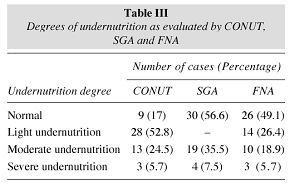
<body><![CDATA[<P>During the following four days after admission, an assessment of the nutritional status of patients (using SGA, and FNA and CONUT) was made to those patients who fulfilled inclusion criteria.</P>      <P><i>Statistical analysis:</i> The study of the differences in the means of the  screening parameters (serum albumin, total cholesterol and lymphocytes count)  between the different degrees of undernutrition diagnosed following SGA and FNA,  was made using a variance analysis. The association between the results of the  SGA and FNA with those from the screening tool, CONUT, was studied using the X<sup>2</sup>  test. Afterwards, the origin of the significance was analysed, using Freeman's<sup>38</sup>  method calculating the kappa indexes<sup>39</sup>, as a measurement of the agreement  degree and of the corresponding significance tests.</P>      <P>In the same way, we studied the sensitivity and specificity of the screening    tool, using FNA as the "gold standard". In all cases we considered    significant all p values under 0.05.</P>         <P>The analyses were done using SPSS v.8.0 and EPIDAT v.2.0.</P>         <P><b>Results</b></P>      <P>All data referring to age, sex, weight and BMI of patients studied are described in <a href="#t2"> table II</a>. The mean age of the study population was 66.8, with a similar proportion of men (52.8%) and women (47.2%). The mean BMI was 25.6 ± 4.85, being more than half of our population study overweight (BMI &gt; 25). Inpatients percentage distribution was the following: Cardiology 7.5%, Cardiovascular Surgery 7.6%, General and Digestive Surgery 17%, Maxilophacial Surgery 1.9%, Thoracic Surgery 5.7%, Gastroenterology 18.9%, Internal Medicine 15.1%, Nephrology 3.8%, Neumology 5.7%, Neurology 1.9%, Otorinolaryngology 3.8%, Reumathology 1.9%, Orthopedics 5.7% and Urology 3.8%.</P>          <P align="center">     <a name="t2">     <IMG SRC="/img/nh/v20n1/original1/original1_tabla2.gif" width="300" height="228">      </a>    </p>          <P align="left">         <br>     The prevalence of moderate-severe undernutrition varied from 24.6% in the FNA to 43% in SGA as shown in <a href="#t3"> table III</a>.    </p>      <P align="center">     <a name="t3">     <IMG SRC="/img/nh/v20n1/original1/original1_tabla3.gif" width="289" height="193">     </a> </p>      ]]></body>
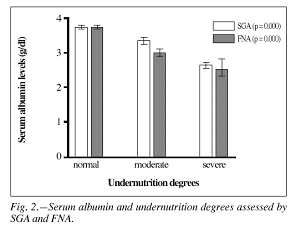
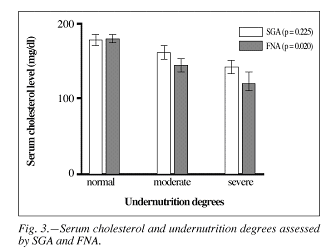
<body><![CDATA[<P align="left">         <br>     No correlation between BMI and undernutrition degree evaluated by any of the three methods in our study population was found (<a href="#t4">table IV</a>). </p>      <P align="center">     <a name="t4">     <IMG SRC="/img/nh/v20n1/original1/original1_tabla4.gif" width="312" height="204">      </a>    </p>       <P>    <br> Subjective Global Assessment differentiates three levels of nutritional status and Full Nutritional Assessment four. We collapsed the normal and light undernutrition in FNA in order to compare the results of the relationship between the three parameters and the degrees of malnutrition assessed by SGA and FNA, founding a linear trend so the higher the undernutrition is, the lower the albumin/cholesterol levels and the lymphocyte count are. This trend reached statistically significance in the three parameters for FNA and in albumin levels for SGA. Cholesterol levels and lymphocyte count were close to significance for SGA (p = 0.131 and p = 0.120 respectively) (<a href="#f2">figs. 2</a>, <a href="#f3"> 3</a> and <a href="#f4">4</a>).</P>      <P align="center"><a name="f2"><IMG SRC="/img/nh/v20n1/original1/original1_fig2.gif" width="300" height="228">    <br> </a></P>      <P align="center"><a name="f3"><IMG SRC="/img/nh/v20n1/original1/original1_fig3.gif" width="325" height="251"></a></P>      <P align="center">    <br> <a name="f4"><IMG SRC="/img/nh/v20n1/original1/original1_fig4.gif" width="325" height="251"></a></P>      ]]></body>
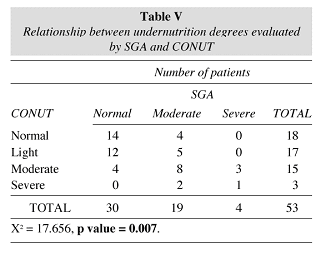
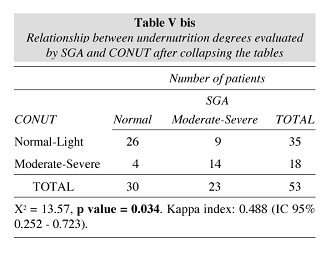
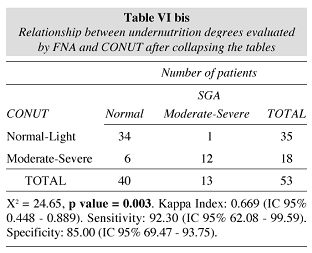
<body><![CDATA[<P>    <br> <a href="#t5">Tables V</a> and <a href="#t6"> VI</a> show the results of the raw relationship between CONUT and SGA and between CONUT and FNA, as well as their corresponding hypothesis tests, finding a high significance in both cases. We also show the analysis after the collapse of tables in two undernutrition degrees (normal-slightly undernourished and moderate-severe undernourished) with their corresponding hypothesis test and agreement degree measures, obtaining statistically significant results (p = 0.034 and kappa index = 0.488 for SGA, p = 0.003 and kappa index = 0.669 for FNA (<a href="#t5b">tables V bis</a> and <a href="#t6b"> VI bis</a>).</P>      <P align="center"><a name="t5"><IMG SRC="/img/nh/v20n1/original1/original1_tabla5.gif" width="325" height="253">    <br> </a></P>      <P align="center"><a name="t6"><IMG SRC="/img/nh/v20n1/original1/original1_tabla6.gif" width="312" height="263"></a></P>      <P align="center">    <br> <a name="t5b"><IMG SRC="/img/nh/v20n1/original1/original1_tabla5-bis.gif" width="325" height="253">     <br> </a></P>      <P align="center"><a name="t6b"><IMG SRC="/img/nh/v20n1/original1/original1_tabla6-bis.gif" width="312" height="253">  </a></P>      <P>    ]]></body>
<body><![CDATA[<br> Taking FNA as the gold standard for assessing nutritional status, the sensitivity of the screening tool was 92.30% and the specificity was 85%.</P>       <P><b>Discussion</b></P>       <P>In this preliminary study, the screening tool for detecting patients malnourished (CONUT) appears to be useful in a group of patients whose parameters are not significantly affected by the severity of the illness or by very aggressive therapeutic procedures<sup>37</sup>.</P>       <P>The prevalence of moderate or severe malnutrition found by SGA is higher than those found by FNA and CONUT because the former only differentiates three categories instead of four, so some patients classified as moderate undernourished by SGA are considerated normal or slightly malnourished by the other two methods.</P>      <P>No relationship was found between Body Mass Index (BMI) and undernutrition in our study population, assessed by any of the three methods used. BMI could be a good indicator of medium/long term undernutrition in general population, but it does not seem to be so indicative in a hospital environment (see <a href="#t4"> table IV</a>) where acute undernutrition may not be reflected by weight loss and a decrease in BMI.</P>      <P>We have found a significant statistical association between the evaluation of undernutrition with CONUT and the results obtained from SGA and FNA (<a href="#t5">tables V</a> and <a href="#t6">VI</a>), and this association does not disappear after collapsing the tables (<a href="#t5b">tables V bis</a> and <a href="#t6b"> VI bis</a>). This would support the tool utility for differentiating patients that would require immediate nutritional assistance (moderate to severe malnutrition) from those that would be included in prevention programs (normal to slightly malnourished patients).</P>      <P>Agreement levels between CONUT and SGA and FNA (k = 0.488, k = 0,669, respectively) are very acceptable in routine clinical examination<sup>40</sup>, being higher with FNA as this method includes not only retrospective nutritional data (as SGA does) but also objective parameters (anthropometry and blood tests), more in accordance with CONUT, based only on objective data.</P>      <P>The high sensitivity (92,30%) and specificity (85%) of the tool, compared to the Full Nutritional Assessment, as our "gold standard", confirm CONUT as a valid screening method for early detection of hospital malnutrition.</P>      <P>The first step of CONUT as a nutritional status screening seems to have many advantages when compared to SGA or Full Nutritional Asssessment. It is easy to use and simple to understand, it includes both the nutritional status and the disease and/or therapeutic procedures during the inpatient stay. As it is quicker and less costly, CONUT allows the Nutritional Unit to follow up on all the inpatients daily or weekly, and also follow their evolution at Primary Health Care visits. These advantages fulfil the 2003 Resolution of the European Council on Food and Nutritional Care in Hospitals<sup>20</sup>.</P>      <P>The present study includes just a small number of patients, with no severe diseases or therapeutic procedures. We are now embarking on a larger study with all kind of patients (excluding infants), diseases and treatments in order to assess the viability of our tool in screening for nutritional status and risk (second step of the tool).</P>      ]]></body>
<body><![CDATA[<P>Obviously, the biochemical parameters CONUT uses are affected by the disease or the procedure itself. The European Council states in its first paragraph that "Nutritional risk should take into account nutritional status and the severity of the disease", as it is impossible to separate both situations. The tool we describe here does not aim to differentiate one from the other. CONUT screens for patients already malnourished and for patients at risk of malnutrition (itself or related to the disease and/or treatment). We have found a linear trend between levels of serum albumin, cholesterol and lymphocyte count and the degree of malnutrition obtained by SGA and FNA, and these degrees of undernutrition perfectly correlate with those of CONUT. It confirms that biochemical parameters used in CONUT are not only indices of disease severity but also of nutrition markers.</P>      <P>Larger studies will help us to validate the screening tool in all patients and situations. If so, CONUT could be a good method to be used in hospitals and Primary Health Care centres.</P>      <P><b>References</b></P>      <!-- ref --><P>1. Kamath SK, Lawler M, Smith AE and cols.: Hospital    malnutrition: a 33-hospital screening study. <i>JAmDietAssoc</i>    1986, 86:203-6.&nbsp;&nbsp;&nbsp;&nbsp;&nbsp;&nbsp;&nbsp;&nbsp;[&#160;<a href="javascript:void(0);" onclick="javascript: window.open('/scielo.php?script=sci_nlinks&ref=3470596&pid=S0212-1611200500010000600001&lng=','','width=640,height=500,resizable=yes,scrollbars=1,menubar=yes,');">Links</a>&#160;]<!-- end-ref --><!-- ref --><P>   2. Cabre E, Montserrat A, Vilar L and cols.: Prevalencia de Malnutrición energético-proteica    (M.E.P.) en pacientes gastroenterológicos. <i>Rev    Esp Enferm Apar Dig</i> 1986, 70:241-6.&nbsp;&nbsp;&nbsp;&nbsp;&nbsp;&nbsp;&nbsp;&nbsp;[&#160;<a href="javascript:void(0);" onclick="javascript: window.open('/scielo.php?script=sci_nlinks&ref=3470597&pid=S0212-1611200500010000600002&lng=','','width=640,height=500,resizable=yes,scrollbars=1,menubar=yes,');">Links</a>&#160;]<!-- end-ref --><!-- ref --><P>   3. McWhirter JP, Pennington CR: Incidence and recognition of malnutrition in    hospital. <i>BMJ </i>1994,    308:945-8.&nbsp;&nbsp;&nbsp;&nbsp;&nbsp;&nbsp;&nbsp;&nbsp;[&#160;<a href="javascript:void(0);" onclick="javascript: window.open('/scielo.php?script=sci_nlinks&ref=3470598&pid=S0212-1611200500010000600003&lng=','','width=640,height=500,resizable=yes,scrollbars=1,menubar=yes,');">Links</a>&#160;]<!-- end-ref --><!-- ref --><P>   4. Corish CA, Kennedy NP: Protein-energy undernutrition in hospital in-patients.    <i>Br J Nutr </i>2000,    83:575-91.&nbsp;&nbsp;&nbsp;&nbsp;&nbsp;&nbsp;&nbsp;&nbsp;[&#160;<a href="javascript:void(0);" onclick="javascript: window.open('/scielo.php?script=sci_nlinks&ref=3470599&pid=S0212-1611200500010000600004&lng=','','width=640,height=500,resizable=yes,scrollbars=1,menubar=yes,');">Links</a>&#160;]<!-- end-ref --><!-- ref --><P>   5. Waitzberg DL, Caiaffa WT, Correia MI: Hospital malnutrition: the Brazilian    national survey (IBRANUTRI): a study of 4000 patients. <i>Nutrition</i>    2001, 17:573-80.&nbsp;&nbsp;&nbsp;&nbsp;&nbsp;&nbsp;&nbsp;&nbsp;[&#160;<a href="javascript:void(0);" onclick="javascript: window.open('/scielo.php?script=sci_nlinks&ref=3470600&pid=S0212-1611200500010000600005&lng=','','width=640,height=500,resizable=yes,scrollbars=1,menubar=yes,');">Links</a>&#160;]<!-- end-ref --><!-- ref --><P>   6. Chandra RK, Kumari S: Effects of nutrition on the immune system. <i>Nutrition</i>    1994, 10:207-10.&nbsp;&nbsp;&nbsp;&nbsp;&nbsp;&nbsp;&nbsp;&nbsp;[&#160;<a href="javascript:void(0);" onclick="javascript: window.open('/scielo.php?script=sci_nlinks&ref=3470601&pid=S0212-1611200500010000600006&lng=','','width=640,height=500,resizable=yes,scrollbars=1,menubar=yes,');">Links</a>&#160;]<!-- end-ref --><!-- ref --><P>   7. Marti J, Armadans L, Vaque J and cols.: Malnutrición caloricoproteica y    linfocitopenia como predictores de infección hospitalaria en ancianos. <i>Med    Clin</i> (Barc) 2001, 116:446-50.&nbsp;&nbsp;&nbsp;&nbsp;&nbsp;&nbsp;&nbsp;&nbsp;[&#160;<a href="javascript:void(0);" onclick="javascript: window.open('/scielo.php?script=sci_nlinks&ref=3470602&pid=S0212-1611200500010000600007&lng=','','width=640,height=500,resizable=yes,scrollbars=1,menubar=yes,');">Links</a>&#160;]<!-- end-ref --><!-- ref --><P>   8. Rolandelli RH, DePaula JA, Guenter P and cols.: Critical illness and sepsis.    In: Rombeau JL, Caldwell MD, Eds. Enteral and tube feeding, 2nd edn. Philadelphia:    WB Saunders, 1990: 288-305.&nbsp;&nbsp;&nbsp;&nbsp;&nbsp;&nbsp;&nbsp;&nbsp;[&#160;<a href="javascript:void(0);" onclick="javascript: window.open('/scielo.php?script=sci_nlinks&ref=3470603&pid=S0212-1611200500010000600008&lng=','','width=640,height=500,resizable=yes,scrollbars=1,menubar=yes,');">Links</a>&#160;]<!-- end-ref --><!-- ref --><P>   9. Cederhdm J, Jägrén C, Hellström K: Nutritional status and performance capacity    in internal medical patients. <i>Clin Nutr </i>1993,    12:8-14.&nbsp;&nbsp;&nbsp;&nbsp;&nbsp;&nbsp;&nbsp;&nbsp;[&#160;<a href="javascript:void(0);" onclick="javascript: window.open('/scielo.php?script=sci_nlinks&ref=3470604&pid=S0212-1611200500010000600009&lng=','','width=640,height=500,resizable=yes,scrollbars=1,menubar=yes,');">Links</a>&#160;]<!-- end-ref --><!-- ref --><P>   10. Pedersen NW, Pedersen D: Nutrition as a prognostic indicator in amputations.    A prospective study of 47 cases. <i>Acta Orthop Scand</i>    1992, 63:675-8.&nbsp;&nbsp;&nbsp;&nbsp;&nbsp;&nbsp;&nbsp;&nbsp;[&#160;<a href="javascript:void(0);" onclick="javascript: window.open('/scielo.php?script=sci_nlinks&ref=3470605&pid=S0212-1611200500010000600010&lng=','','width=640,height=500,resizable=yes,scrollbars=1,menubar=yes,');">Links</a>&#160;]<!-- end-ref --><!-- ref --><P>   11. Casimiro C, García-de-Lorenzo A, Usan L: Prevalence of decubitus ulcer    and associated risk factors in an institutionalized Spanish elderly population.    <i>Nutrition </i>2002,    18:408-14.&nbsp;&nbsp;&nbsp;&nbsp;&nbsp;&nbsp;&nbsp;&nbsp;[&#160;<a href="javascript:void(0);" onclick="javascript: window.open('/scielo.php?script=sci_nlinks&ref=3470606&pid=S0212-1611200500010000600011&lng=','','width=640,height=500,resizable=yes,scrollbars=1,menubar=yes,');">Links</a>&#160;]<!-- end-ref --><!-- ref --><P>   12. Anderson CF, Moxness K, Meisster J and cols.: The sensitivity and specificity    of nutrition-related variables in relationship to the duration of hospital    stay and the rate of complications. <i>Mayo Clin    Proc</i> 1984, 59:477-83.&nbsp;&nbsp;&nbsp;&nbsp;&nbsp;&nbsp;&nbsp;&nbsp;[&#160;<a href="javascript:void(0);" onclick="javascript: window.open('/scielo.php?script=sci_nlinks&ref=3470607&pid=S0212-1611200500010000600012&lng=','','width=640,height=500,resizable=yes,scrollbars=1,menubar=yes,');">Links</a>&#160;]<!-- end-ref --><!-- ref --><P>   13. Tucker HN, Miguel SG: Cost containment through nutrition intervention.<i>    Nutr Rev</i> 1996, 54:111-21.&nbsp;&nbsp;&nbsp;&nbsp;&nbsp;&nbsp;&nbsp;&nbsp;[&#160;<a href="javascript:void(0);" onclick="javascript: window.open('/scielo.php?script=sci_nlinks&ref=3470608&pid=S0212-1611200500010000600013&lng=','','width=640,height=500,resizable=yes,scrollbars=1,menubar=yes,');">Links</a>&#160;]<!-- end-ref --><!-- ref --><P>   14. Chima CS, Barco K, Dewitt MLA and cols.: Relationship of nutritional status    to lenght of stay hospitals costs and discharge status of patients hospitalized    in the medicine service. <i>J Am Diet Assoc</i>    1997, 97:975-8.&nbsp;&nbsp;&nbsp;&nbsp;&nbsp;&nbsp;&nbsp;&nbsp;[&#160;<a href="javascript:void(0);" onclick="javascript: window.open('/scielo.php?script=sci_nlinks&ref=3470609&pid=S0212-1611200500010000600014&lng=','','width=640,height=500,resizable=yes,scrollbars=1,menubar=yes,');">Links</a>&#160;]<!-- end-ref --><!-- ref --><P>   15. Farré Rovira R, Frasquets Pons I, Ibor Pica JF: Complicaciones postoperatorias    en pacientes malnutridos: impacto económico y valor predictivo de algunos    indicadores nutricionales. <i>Nutr Hosp</i>    1998, 13:233-9.&nbsp;&nbsp;&nbsp;&nbsp;&nbsp;&nbsp;&nbsp;&nbsp;[&#160;<a href="javascript:void(0);" onclick="javascript: window.open('/scielo.php?script=sci_nlinks&ref=3470610&pid=S0212-1611200500010000600015&lng=','','width=640,height=500,resizable=yes,scrollbars=1,menubar=yes,');">Links</a>&#160;]<!-- end-ref --><!-- ref --><P>   16. Green CJ: Existence, causes and consequences of disease-related malnutrition    in the hospitals and the community, and clinical and financial benefits of    nutritional intervention. <i>Clin Nutr </i>1999,    18(Supl):3-28.&nbsp;&nbsp;&nbsp;&nbsp;&nbsp;&nbsp;&nbsp;&nbsp;[&#160;<a href="javascript:void(0);" onclick="javascript: window.open('/scielo.php?script=sci_nlinks&ref=3470611&pid=S0212-1611200500010000600016&lng=','','width=640,height=500,resizable=yes,scrollbars=1,menubar=yes,');">Links</a>&#160;]<!-- end-ref --><!-- ref --><P>   17. Roubenoff R, Roubenoff RA, Preto J and cols.: Malnutrition among hospitalized    patients. A problem of physician awareness. <i>Arch    Intern Med</i> 1987, 147:1462-65.&nbsp;&nbsp;&nbsp;&nbsp;&nbsp;&nbsp;&nbsp;&nbsp;[&#160;<a href="javascript:void(0);" onclick="javascript: window.open('/scielo.php?script=sci_nlinks&ref=3470612&pid=S0212-1611200500010000600017&lng=','','width=640,height=500,resizable=yes,scrollbars=1,menubar=yes,');">Links</a>&#160;]<!-- end-ref --><!-- ref --><P>   18. Ulíbarri JI, Picón MJ, García E and cols.: Detección precoz y control de    la desnutrición hospitalaria. <i>Nutr Hosp</i>    2002, 17:139-46.&nbsp;&nbsp;&nbsp;&nbsp;&nbsp;&nbsp;&nbsp;&nbsp;[&#160;<a href="javascript:void(0);" onclick="javascript: window.open('/scielo.php?script=sci_nlinks&ref=3470613&pid=S0212-1611200500010000600018&lng=','','width=640,height=500,resizable=yes,scrollbars=1,menubar=yes,');">Links</a>&#160;]<!-- end-ref --><!-- ref --><P>   19. Council of Europe. Comittee of Ministers on 12 November 2003 at the 860th    meeting of the Ministers' Deputies. Resolution.    ResAP(2003)3 on food and nutritional care in hospitals. Internet: https://wcm.coe.int/rsi/CM/index.jsp   &nbsp;&nbsp;&nbsp;&nbsp;&nbsp;&nbsp;&nbsp;&nbsp;[&#160;<a href="javascript:void(0);" onclick="javascript: window.open('/scielo.php?script=sci_nlinks&ref=3470614&pid=S0212-1611200500010000600019&lng=','','width=640,height=500,resizable=yes,scrollbars=1,menubar=yes,');">Links</a>&#160;]<!-- end-ref --><!-- ref --><P>   20. Beck AM, Balknas UN, Furst P and cols.: Council of Europe (the Committee    of Experts on Nutrition, Food Safety and Consumer Health of the Partial Agreement    in the Social and Public Health Field). Food and nutritional care in hospitals:    how to prevent undernutrition&#x2014;report and guidelines from the Council    of Europe. <i>Clin Nutr</i>    2001, 20:455-60.&nbsp;&nbsp;&nbsp;&nbsp;&nbsp;&nbsp;&nbsp;&nbsp;[&#160;<a href="javascript:void(0);" onclick="javascript: window.open('/scielo.php?script=sci_nlinks&ref=3470615&pid=S0212-1611200500010000600020&lng=','','width=640,height=500,resizable=yes,scrollbars=1,menubar=yes,');">Links</a>&#160;]<!-- end-ref --><!-- ref --><P>   21. Buzby G, Mullen J y cols.: Prognostic nutritional index in gastrointestinal    surgery. <i>Am J Surg</i>    1980, 139:160-7.&nbsp;&nbsp;&nbsp;&nbsp;&nbsp;&nbsp;&nbsp;&nbsp;[&#160;<a href="javascript:void(0);" onclick="javascript: window.open('/scielo.php?script=sci_nlinks&ref=3470616&pid=S0212-1611200500010000600021&lng=','','width=640,height=500,resizable=yes,scrollbars=1,menubar=yes,');">Links</a>&#160;]<!-- end-ref --><!-- ref --><P>   22. Wolinsky FD, Coe RM, Chavez MN and cols.: Further assessment of the reliability    and validity of a Nutritional Risk Index: analysis of a three-wave panel study    of elderly adults. <i>Health Serv Res </i>1986,    20:977-90.&nbsp;&nbsp;&nbsp;&nbsp;&nbsp;&nbsp;&nbsp;&nbsp;[&#160;<a href="javascript:void(0);" onclick="javascript: window.open('/scielo.php?script=sci_nlinks&ref=3470617&pid=S0212-1611200500010000600022&lng=','','width=640,height=500,resizable=yes,scrollbars=1,menubar=yes,');">Links</a>&#160;]<!-- end-ref --><!-- ref --><P>   23. Vellas B, Guigoz Y, Garry PJ and cols.: The Mini Nutritional Assessment    (MNA) and its use in grading the nutritional state of elderly patients. <i>Nutrition</i>    1999, 15:116-22.&nbsp;&nbsp;&nbsp;&nbsp;&nbsp;&nbsp;&nbsp;&nbsp;[&#160;<a href="javascript:void(0);" onclick="javascript: window.open('/scielo.php?script=sci_nlinks&ref=3470618&pid=S0212-1611200500010000600023&lng=','','width=640,height=500,resizable=yes,scrollbars=1,menubar=yes,');">Links</a>&#160;]<!-- end-ref --><!-- ref --><P>   24. Seltzer MH, Bastidas JA, Cooper DM and cols.: Instant nutritional assessment.    <i>JPEN J Parenter Enteral Nutr</i>    1979, 3:157-9.&nbsp;&nbsp;&nbsp;&nbsp;&nbsp;&nbsp;&nbsp;&nbsp;[&#160;<a href="javascript:void(0);" onclick="javascript: window.open('/scielo.php?script=sci_nlinks&ref=3470619&pid=S0212-1611200500010000600024&lng=','','width=640,height=500,resizable=yes,scrollbars=1,menubar=yes,');">Links</a>&#160;]<!-- end-ref --><!-- ref --><P>   25. Detsky AS, McLaughlin JR, Baker JP and cols.: What is subjective global    assessment of nutritional status? <i>JPEN</i>    1987, 11:8-13.&nbsp;&nbsp;&nbsp;&nbsp;&nbsp;&nbsp;&nbsp;&nbsp;[&#160;<a href="javascript:void(0);" onclick="javascript: window.open('/scielo.php?script=sci_nlinks&ref=3470620&pid=S0212-1611200500010000600025&lng=','','width=640,height=500,resizable=yes,scrollbars=1,menubar=yes,');">Links</a>&#160;]<!-- end-ref --><!-- ref --><P>   26. Detsky AS, Smalley PS, Chang J: The rational clinical examination. Is    this patient malnourished? <i>JAMA </i>1994,    271:54-8.&nbsp;&nbsp;&nbsp;&nbsp;&nbsp;&nbsp;&nbsp;&nbsp;[&#160;<a href="javascript:void(0);" onclick="javascript: window.open('/scielo.php?script=sci_nlinks&ref=3470621&pid=S0212-1611200500010000600026&lng=','','width=640,height=500,resizable=yes,scrollbars=1,menubar=yes,');">Links</a>&#160;]<!-- end-ref --><!-- ref --><P>   27. Kondrup J, Rasmussen HH, Hamberg O and cols.: Ad Hoc ESPEN Working Group.    Nutritional risk screening (NRS 2002): a new method based on an analysis of    controlled clinical trials. <i>Clin Nutr</i>    2003, 22:321-36.&nbsp;&nbsp;&nbsp;&nbsp;&nbsp;&nbsp;&nbsp;&nbsp;[&#160;<a href="javascript:void(0);" onclick="javascript: window.open('/scielo.php?script=sci_nlinks&ref=3470622&pid=S0212-1611200500010000600027&lng=','','width=640,height=500,resizable=yes,scrollbars=1,menubar=yes,');">Links</a>&#160;]<!-- end-ref --><!-- ref --><P>   28. Gibbs J, Cull W, Henderson W and cols.: Preoperative serum albumin level    as a predictor of operative mortality and morbidity: results from the National    VA Surgical Risk Study. <i>Arch Surg</i>    1999, 134:36-42.&nbsp;&nbsp;&nbsp;&nbsp;&nbsp;&nbsp;&nbsp;&nbsp;[&#160;<a href="javascript:void(0);" onclick="javascript: window.open('/scielo.php?script=sci_nlinks&ref=3470623&pid=S0212-1611200500010000600028&lng=','','width=640,height=500,resizable=yes,scrollbars=1,menubar=yes,');">Links</a>&#160;]<!-- end-ref --><!-- ref --><P>   29. Sullivan DH, Walls RC, Bopp MM: Protein-energy undernutrition and the    risk of mortality within one year of hospital discharge: a follow up study.    <i>J Am Geriatr Soc</i>    1995, 43:507-12.&nbsp;&nbsp;&nbsp;&nbsp;&nbsp;&nbsp;&nbsp;&nbsp;[&#160;<a href="javascript:void(0);" onclick="javascript: window.open('/scielo.php?script=sci_nlinks&ref=3470624&pid=S0212-1611200500010000600029&lng=','','width=640,height=500,resizable=yes,scrollbars=1,menubar=yes,');">Links</a>&#160;]<!-- end-ref --><!-- ref --><P>   30. López-Martínez J, Sánchez-Castilla M, García-de-Lorenzo A: Hypocholesterolemia    in critically ill patients. <i>Intensive Care Med</i> 2000, 26:259-60.&nbsp;&nbsp;&nbsp;&nbsp;&nbsp;&nbsp;&nbsp;&nbsp;[&#160;<a href="javascript:void(0);" onclick="javascript: window.open('/scielo.php?script=sci_nlinks&ref=3470625&pid=S0212-1611200500010000600030&lng=','','width=640,height=500,resizable=yes,scrollbars=1,menubar=yes,');">Links</a>&#160;]<!-- end-ref --><!-- ref --><P>   31. Reuben DB, Ix JH, Grendale GA and cols.: The predictive    value of combined Hypoalbuminemia and hypocholesterolemia in high functioning    community-dwelling older persons: Mac Arthur Studies of succesful aging. <i>J    Am Geriatr Soc</i> 1999, 47:402-6.&nbsp;&nbsp;&nbsp;&nbsp;&nbsp;&nbsp;&nbsp;&nbsp;[&#160;<a href="javascript:void(0);" onclick="javascript: window.open('/scielo.php?script=sci_nlinks&ref=3470626&pid=S0212-1611200500010000600031&lng=','','width=640,height=500,resizable=yes,scrollbars=1,menubar=yes,');">Links</a>&#160;]<!-- end-ref --><!-- ref --><P>   32. Shronts EP: Basic concepts of immunology and its application to clinical    nutrition. <i>Nutr Clin Pract</i>    1993, 8:177-83.&nbsp;&nbsp;&nbsp;&nbsp;&nbsp;&nbsp;&nbsp;&nbsp;[&#160;<a href="javascript:void(0);" onclick="javascript: window.open('/scielo.php?script=sci_nlinks&ref=3470627&pid=S0212-1611200500010000600032&lng=','','width=640,height=500,resizable=yes,scrollbars=1,menubar=yes,');">Links</a>&#160;]<!-- end-ref --><!-- ref --><P>   33. Casey J, Flinn WR, Yao JS and cols.: Correlation of immune and nutritional    status with wound complications in patients undergoing vascular operations.    <i>Surgery</i> 1983, 93:822-7.   &nbsp;&nbsp;&nbsp;&nbsp;&nbsp;&nbsp;&nbsp;&nbsp;[&#160;<a href="javascript:void(0);" onclick="javascript: window.open('/scielo.php?script=sci_nlinks&ref=3470628&pid=S0212-1611200500010000600033&lng=','','width=640,height=500,resizable=yes,scrollbars=1,menubar=yes,');">Links</a>&#160;]<!-- end-ref --><!-- ref --><P>   34. Tayek JA, Blackburn GL: Goals of nutritional support in acute infections.    <i>Am J Med</i> 1984, 76:81-90.   &nbsp;&nbsp;&nbsp;&nbsp;&nbsp;&nbsp;&nbsp;&nbsp;[&#160;<a href="javascript:void(0);" onclick="javascript: window.open('/scielo.php?script=sci_nlinks&ref=3470629&pid=S0212-1611200500010000600034&lng=','','width=640,height=500,resizable=yes,scrollbars=1,menubar=yes,');">Links</a>&#160;]<!-- end-ref --><!-- ref --><P>   35. Busturia P, Clapés J, Culebras J and cols.: Valoración nutricional. In:    Protocolos para la prescripción de nutrición parenteral y enteral. Documento    2-A-EP-1998 (Parte I). Grupo de Estandarización y Protocolos del Comité Científico    Educacional de la Sociedad Española de Nutrición Parenteral y Enteral (SENPE).    Zaragoza, 1998; 1-13. (URL in: http://www.senpe.com/pages/1.pdf).&nbsp;&nbsp;&nbsp;&nbsp;&nbsp;&nbsp;&nbsp;&nbsp;[&#160;<a href="javascript:void(0);" onclick="javascript: window.open('/scielo.php?script=sci_nlinks&ref=3470630&pid=S0212-1611200500010000600035&lng=','','width=640,height=500,resizable=yes,scrollbars=1,menubar=yes,');">Links</a>&#160;]<!-- end-ref --><!-- ref --><P>   36. Durning JV, Womersley J: Body fat assessed from total body density and its    estimation from skinfold thickness: measurements on 481 men and women aged    from 16 to 72 years. <i>Br J Nutr</i>    1974, 32:77-97.&nbsp;&nbsp;&nbsp;&nbsp;&nbsp;&nbsp;&nbsp;&nbsp;[&#160;<a href="javascript:void(0);" onclick="javascript: window.open('/scielo.php?script=sci_nlinks&ref=3470631&pid=S0212-1611200500010000600036&lng=','','width=640,height=500,resizable=yes,scrollbars=1,menubar=yes,');">Links</a>&#160;]<!-- end-ref --><!-- ref --><P>   37. Nierenberg AA, Feinstein AR: How to evaluate a diagnostic marker test. Lessons    from the rise and fall of dexamethasone suppression test. <i>JAMA</i>    1988, 259:1699-702.&nbsp;&nbsp;&nbsp;&nbsp;&nbsp;&nbsp;&nbsp;&nbsp;[&#160;<a href="javascript:void(0);" onclick="javascript: window.open('/scielo.php?script=sci_nlinks&ref=3470632&pid=S0212-1611200500010000600037&lng=','','width=640,height=500,resizable=yes,scrollbars=1,menubar=yes,');">Links</a>&#160;]<!-- end-ref --><!-- ref --><P>   38. Freeman DH: Applied Categorical Data Analysis. New York: Marcel Dekker,    1987.&nbsp;&nbsp;&nbsp;&nbsp;&nbsp;&nbsp;&nbsp;&nbsp;[&#160;<a href="javascript:void(0);" onclick="javascript: window.open('/scielo.php?script=sci_nlinks&ref=3470633&pid=S0212-1611200500010000600038&lng=','','width=640,height=500,resizable=yes,scrollbars=1,menubar=yes,');">Links</a>&#160;]<!-- end-ref --><!-- ref --><P>   39. Fleiss JL: Statistical methods for rates and proportions, 2nd edn. New York:    John Wiley and Sons, 1981:217-34.&nbsp;&nbsp;&nbsp;&nbsp;&nbsp;&nbsp;&nbsp;&nbsp;[&#160;<a href="javascript:void(0);" onclick="javascript: window.open('/scielo.php?script=sci_nlinks&ref=3470634&pid=S0212-1611200500010000600039&lng=','','width=640,height=500,resizable=yes,scrollbars=1,menubar=yes,');">Links</a>&#160;]<!-- end-ref --><!-- ref --><P>   40. Landis JR, Koch GG: The measurement of observer agreement for categorical    data. <i>Biometrics</i>    1977, 33:159-74.&nbsp;&nbsp;&nbsp;&nbsp;&nbsp;&nbsp;&nbsp;&nbsp;[&#160;<a href="javascript:void(0);" onclick="javascript: window.open('/scielo.php?script=sci_nlinks&ref=3470635&pid=S0212-1611200500010000600040&lng=','','width=640,height=500,resizable=yes,scrollbars=1,menubar=yes,');">Links</a>&#160;]<!-- end-ref --><!-- ref --><P>   41. Caparrós T, López J, Grau T: Early enteral nutrition in critically ill    patients with a high-protein diet enriched with arginine, fiber, and antioxidants    compared with a standard high-protein diet. The effect on nosocomial infections    and outcome. <i>JPEN</i>    2001, 25:299-308.&nbsp;&nbsp;&nbsp;&nbsp;&nbsp;&nbsp;&nbsp;&nbsp;[&#160;<a href="javascript:void(0);" onclick="javascript: window.open('/scielo.php?script=sci_nlinks&ref=3470636&pid=S0212-1611200500010000600041&lng=','','width=640,height=500,resizable=yes,scrollbars=1,menubar=yes,');">Links</a>&#160;]<!-- end-ref --> ]]></body><back>
<ref-list>
<ref id="B1">
<label>1</label><nlm-citation citation-type="journal">
<person-group person-group-type="author">
<name>
<surname><![CDATA[Kamath]]></surname>
<given-names><![CDATA[SK]]></given-names>
</name>
<name>
<surname><![CDATA[Lawler]]></surname>
<given-names><![CDATA[M]]></given-names>
</name>
<name>
<surname><![CDATA[Smith]]></surname>
<given-names><![CDATA[AE]]></given-names>
</name>
</person-group>
<article-title xml:lang="en"><![CDATA[Hospital malnutrition: a 33-hospital screening study]]></article-title>
<source><![CDATA[JAmDietAssoc]]></source>
<year>1986</year>
<volume>86</volume>
<page-range>203-6</page-range></nlm-citation>
</ref>
<ref id="B2">
<label>2</label><nlm-citation citation-type="journal">
<person-group person-group-type="author">
<name>
<surname><![CDATA[Cabre]]></surname>
<given-names><![CDATA[E]]></given-names>
</name>
<name>
<surname><![CDATA[Montserrat]]></surname>
<given-names><![CDATA[A]]></given-names>
</name>
<name>
<surname><![CDATA[Vilar]]></surname>
<given-names><![CDATA[L]]></given-names>
</name>
</person-group>
<article-title xml:lang="es"><![CDATA[Prevalencia de Malnutrición energético-proteica (M.E.P.) en pacientes gastroenterológicos]]></article-title>
<source><![CDATA[Rev Esp Enferm Apar Dig]]></source>
<year>1986</year>
<volume>70</volume>
<page-range>241-6</page-range></nlm-citation>
</ref>
<ref id="B3">
<label>3</label><nlm-citation citation-type="journal">
<person-group person-group-type="author">
<name>
<surname><![CDATA[McWhirter]]></surname>
<given-names><![CDATA[JP]]></given-names>
</name>
<name>
<surname><![CDATA[Pennington]]></surname>
<given-names><![CDATA[CR]]></given-names>
</name>
</person-group>
<article-title xml:lang="en"><![CDATA[Incidence and recognition of malnutrition in hospital]]></article-title>
<source><![CDATA[BMJ]]></source>
<year>1994</year>
<volume>308</volume>
<page-range>945-8</page-range></nlm-citation>
</ref>
<ref id="B4">
<label>4</label><nlm-citation citation-type="journal">
<person-group person-group-type="author">
<name>
<surname><![CDATA[Corish]]></surname>
<given-names><![CDATA[CA]]></given-names>
</name>
<name>
<surname><![CDATA[Kennedy]]></surname>
<given-names><![CDATA[NP]]></given-names>
</name>
</person-group>
<article-title xml:lang="en"><![CDATA[Protein-energy undernutrition in hospital in-patients]]></article-title>
<source><![CDATA[Br J Nutr]]></source>
<year>2000</year>
<volume>83</volume>
<page-range>575-91</page-range></nlm-citation>
</ref>
<ref id="B5">
<label>5</label><nlm-citation citation-type="journal">
<person-group person-group-type="author">
<name>
<surname><![CDATA[Waitzberg]]></surname>
<given-names><![CDATA[DL]]></given-names>
</name>
<name>
<surname><![CDATA[Caiaffa]]></surname>
<given-names><![CDATA[WT]]></given-names>
</name>
<name>
<surname><![CDATA[Correia]]></surname>
<given-names><![CDATA[MI]]></given-names>
</name>
</person-group>
<article-title xml:lang="en"><![CDATA[Hospital malnutrition: the Brazilian national survey (IBRANUTRI): a study of 4000 patients]]></article-title>
<source><![CDATA[Nutrition]]></source>
<year>2001</year>
<volume>17</volume>
<page-range>573-80</page-range></nlm-citation>
</ref>
<ref id="B6">
<label>6</label><nlm-citation citation-type="journal">
<person-group person-group-type="author">
<name>
<surname><![CDATA[Chandra]]></surname>
<given-names><![CDATA[RK]]></given-names>
</name>
<name>
<surname><![CDATA[Kumari]]></surname>
<given-names><![CDATA[S]]></given-names>
</name>
</person-group>
<article-title xml:lang="en"><![CDATA[Effects of nutrition on the immune system]]></article-title>
<source><![CDATA[Nutrition]]></source>
<year>1994</year>
<volume>10</volume>
<page-range>207-10</page-range></nlm-citation>
</ref>
<ref id="B7">
<label>7</label><nlm-citation citation-type="journal">
<person-group person-group-type="author">
<name>
<surname><![CDATA[Marti]]></surname>
<given-names><![CDATA[J]]></given-names>
</name>
<name>
<surname><![CDATA[Armadans]]></surname>
<given-names><![CDATA[L]]></given-names>
</name>
<name>
<surname><![CDATA[Vaque]]></surname>
<given-names><![CDATA[J]]></given-names>
</name>
</person-group>
<article-title xml:lang="en"><![CDATA[Malnutrición caloricoproteica y linfocitopenia como predictores de infección hospitalaria en ancianos]]></article-title>
<source><![CDATA[Med Clin]]></source>
<year>2001</year>
<volume>116</volume>
<page-range>446-50</page-range><publisher-loc><![CDATA[Barc ]]></publisher-loc>
</nlm-citation>
</ref>
<ref id="B8">
<label>8</label><nlm-citation citation-type="book">
<person-group person-group-type="author">
<name>
<surname><![CDATA[Rolandelli]]></surname>
<given-names><![CDATA[RH]]></given-names>
</name>
<name>
<surname><![CDATA[DePaula]]></surname>
<given-names><![CDATA[JA]]></given-names>
</name>
<name>
<surname><![CDATA[Guenter]]></surname>
<given-names><![CDATA[P]]></given-names>
</name>
</person-group>
<article-title xml:lang="en"><![CDATA[Critical illness and sepsis]]></article-title>
<person-group person-group-type="editor">
<name>
<surname><![CDATA[Rombeau]]></surname>
<given-names><![CDATA[JL]]></given-names>
</name>
<name>
<surname><![CDATA[Caldwell]]></surname>
<given-names><![CDATA[MD]]></given-names>
</name>
</person-group>
<source><![CDATA[Enteral and tube feeding]]></source>
<year>1990</year>
<edition>2</edition>
<page-range>288-305</page-range><publisher-loc><![CDATA[Philadelphia ]]></publisher-loc>
<publisher-name><![CDATA[WB Saunders]]></publisher-name>
</nlm-citation>
</ref>
<ref id="B9">
<label>9</label><nlm-citation citation-type="journal">
<person-group person-group-type="author">
<name>
<surname><![CDATA[Cederhdm]]></surname>
<given-names><![CDATA[J]]></given-names>
</name>
<name>
<surname><![CDATA[Jägrén]]></surname>
<given-names><![CDATA[C]]></given-names>
</name>
<name>
<surname><![CDATA[Hellström]]></surname>
<given-names><![CDATA[K]]></given-names>
</name>
</person-group>
<article-title xml:lang="en"><![CDATA[Nutritional status and performance capacity in internal medical patients]]></article-title>
<source><![CDATA[Clin Nutr]]></source>
<year>1993</year>
<volume>12</volume>
<page-range>8-14</page-range></nlm-citation>
</ref>
<ref id="B10">
<label>10</label><nlm-citation citation-type="journal">
<person-group person-group-type="author">
<name>
<surname><![CDATA[Pedersen]]></surname>
<given-names><![CDATA[NW]]></given-names>
</name>
<name>
<surname><![CDATA[Pedersen]]></surname>
<given-names><![CDATA[D]]></given-names>
</name>
</person-group>
<article-title xml:lang="en"><![CDATA[Nutrition as a prognostic indicator in amputations: A prospective study of 47 cases]]></article-title>
<source><![CDATA[Acta Orthop Scand]]></source>
<year>1992</year>
<volume>63</volume>
<page-range>675-8</page-range></nlm-citation>
</ref>
<ref id="B11">
<label>11</label><nlm-citation citation-type="journal">
<person-group person-group-type="author">
<name>
<surname><![CDATA[Casimiro]]></surname>
<given-names><![CDATA[C]]></given-names>
</name>
<name>
<surname><![CDATA[García-de-Lorenzo]]></surname>
<given-names><![CDATA[A]]></given-names>
</name>
<name>
<surname><![CDATA[Usan]]></surname>
<given-names><![CDATA[L]]></given-names>
</name>
</person-group>
<article-title xml:lang="en"><![CDATA[Prevalence of decubitus ulcer and associated risk factors in an institutionalized Spanish elderly population]]></article-title>
<source><![CDATA[Nutrition]]></source>
<year>2002</year>
<volume>18</volume>
<page-range>408-14</page-range></nlm-citation>
</ref>
<ref id="B12">
<label>12</label><nlm-citation citation-type="journal">
<person-group person-group-type="author">
<name>
<surname><![CDATA[Anderson]]></surname>
<given-names><![CDATA[CF]]></given-names>
</name>
<name>
<surname><![CDATA[Moxness]]></surname>
<given-names><![CDATA[K]]></given-names>
</name>
<name>
<surname><![CDATA[Meisster]]></surname>
<given-names><![CDATA[J]]></given-names>
</name>
</person-group>
<article-title xml:lang="en"><![CDATA[The sensitivity and specificity of nutrition-related variables in relationship to the duration of hospital stay and the rate of complications]]></article-title>
<source><![CDATA[Mayo Clin Proc]]></source>
<year>1984</year>
<volume>59</volume>
<page-range>477-83</page-range></nlm-citation>
</ref>
<ref id="B13">
<label>13</label><nlm-citation citation-type="journal">
<person-group person-group-type="author">
<name>
<surname><![CDATA[Tucker]]></surname>
<given-names><![CDATA[HN]]></given-names>
</name>
<name>
<surname><![CDATA[Miguel]]></surname>
<given-names><![CDATA[SG]]></given-names>
</name>
</person-group>
<article-title xml:lang="en"><![CDATA[Cost containment through nutrition intervention]]></article-title>
<source><![CDATA[Nutr Rev]]></source>
<year>1996</year>
<volume>54</volume>
<page-range>111-21</page-range></nlm-citation>
</ref>
<ref id="B14">
<label>14</label><nlm-citation citation-type="journal">
<person-group person-group-type="author">
<name>
<surname><![CDATA[Chima]]></surname>
<given-names><![CDATA[CS]]></given-names>
</name>
<name>
<surname><![CDATA[Barco]]></surname>
<given-names><![CDATA[K]]></given-names>
</name>
<name>
<surname><![CDATA[Dewitt]]></surname>
<given-names><![CDATA[MLA]]></given-names>
</name>
</person-group>
<article-title xml:lang="en"><![CDATA[Relationship of nutritional status to lenght of stay hospitals costs and discharge status of patients hospitalized in the medicine service]]></article-title>
<source><![CDATA[J Am Diet Assoc]]></source>
<year>1997</year>
<volume>97</volume>
<page-range>975-8</page-range></nlm-citation>
</ref>
<ref id="B15">
<label>15</label><nlm-citation citation-type="journal">
<person-group person-group-type="author">
<name>
<surname><![CDATA[Farré Rovira]]></surname>
<given-names><![CDATA[R]]></given-names>
</name>
<name>
<surname><![CDATA[Frasquets Pons]]></surname>
<given-names><![CDATA[I]]></given-names>
</name>
<name>
<surname><![CDATA[Ibor Pica]]></surname>
<given-names><![CDATA[JF]]></given-names>
</name>
</person-group>
<article-title xml:lang="es"><![CDATA[Complicaciones postoperatorias en pacientes malnutridos: impacto económico y valor predictivo de algunos indicadores nutricionales]]></article-title>
<source><![CDATA[Nutr Hosp]]></source>
<year>1998</year>
<volume>13</volume>
<page-range>233-9</page-range></nlm-citation>
</ref>
<ref id="B16">
<label>16</label><nlm-citation citation-type="journal">
<person-group person-group-type="author">
<name>
<surname><![CDATA[Green]]></surname>
<given-names><![CDATA[CJ]]></given-names>
</name>
</person-group>
<article-title xml:lang="en"><![CDATA[Existence, causes and consequences of disease-related malnutrition in the hospitals and the community, and clinical and financial benefits of nutritional intervention]]></article-title>
<source><![CDATA[Clin Nutr]]></source>
<year>1999</year>
<volume>18</volume>
<page-range>3-28</page-range></nlm-citation>
</ref>
<ref id="B17">
<label>17</label><nlm-citation citation-type="journal">
<person-group person-group-type="author">
<name>
<surname><![CDATA[Roubenoff]]></surname>
<given-names><![CDATA[R]]></given-names>
</name>
<name>
<surname><![CDATA[Roubenoff]]></surname>
<given-names><![CDATA[RA]]></given-names>
</name>
<name>
<surname><![CDATA[Preto]]></surname>
<given-names><![CDATA[J]]></given-names>
</name>
</person-group>
<article-title xml:lang="en"><![CDATA[Malnutrition among hospitalized patients: A problem of physician awareness]]></article-title>
<source><![CDATA[Arch Intern Med]]></source>
<year>1987</year>
<volume>147</volume>
<page-range>1462-65</page-range></nlm-citation>
</ref>
<ref id="B18">
<label>18</label><nlm-citation citation-type="journal">
<person-group person-group-type="author">
<name>
<surname><![CDATA[Ulíbarri]]></surname>
<given-names><![CDATA[JI]]></given-names>
</name>
<name>
<surname><![CDATA[Picón]]></surname>
<given-names><![CDATA[MJ]]></given-names>
</name>
<name>
<surname><![CDATA[García]]></surname>
<given-names><![CDATA[E]]></given-names>
</name>
</person-group>
<article-title xml:lang="es"><![CDATA[Detección precoz y control de la desnutrición hospitalaria]]></article-title>
<source><![CDATA[Nutr Hosp]]></source>
<year>2002</year>
<volume>17</volume>
<page-range>139-46</page-range></nlm-citation>
</ref>
<ref id="B19">
<label>19</label><nlm-citation citation-type="">
<collab>Council of Europe</collab>
<source><![CDATA[Comittee of Ministers on 12 November 2003 at the 860th meeting of the Ministers' Deputies: Resolution. ResAP(2003)3 on food and nutritional care in hospitals]]></source>
<year></year>
</nlm-citation>
</ref>
<ref id="B20">
<label>20</label><nlm-citation citation-type="journal">
<person-group person-group-type="author">
<name>
<surname><![CDATA[Beck]]></surname>
<given-names><![CDATA[AM]]></given-names>
</name>
<name>
<surname><![CDATA[Balknas]]></surname>
<given-names><![CDATA[UN]]></given-names>
</name>
<name>
<surname><![CDATA[Furst]]></surname>
<given-names><![CDATA[P]]></given-names>
</name>
</person-group>
<article-title xml:lang="en"><![CDATA[Council of Europe (the Committee of Experts on Nutrition, Food Safety and Consumer Health of the Partial Agreement in the Social and Public Health Field): Food and nutritional care in hospitals: how to prevent undernutrition_x2014;report and guidelines from the Council of Europe]]></article-title>
<source><![CDATA[Clin Nutr]]></source>
<year>2001</year>
<volume>20</volume>
<page-range>455-60</page-range></nlm-citation>
</ref>
<ref id="B21">
<label>21</label><nlm-citation citation-type="journal">
<person-group person-group-type="author">
<name>
<surname><![CDATA[Buzby]]></surname>
<given-names><![CDATA[G]]></given-names>
</name>
<name>
<surname><![CDATA[Mullen]]></surname>
<given-names><![CDATA[J]]></given-names>
</name>
</person-group>
<article-title xml:lang="en"><![CDATA[Prognostic nutritional index in gastrointestinal surgery]]></article-title>
<source><![CDATA[Am J Surg]]></source>
<year>1980</year>
<volume>139</volume>
<page-range>160-7</page-range></nlm-citation>
</ref>
<ref id="B22">
<label>22</label><nlm-citation citation-type="journal">
<person-group person-group-type="author">
<name>
<surname><![CDATA[Wolinsky]]></surname>
<given-names><![CDATA[FD]]></given-names>
</name>
<name>
<surname><![CDATA[Coe]]></surname>
<given-names><![CDATA[RM]]></given-names>
</name>
<name>
<surname><![CDATA[Chavez]]></surname>
<given-names><![CDATA[MN]]></given-names>
</name>
</person-group>
<article-title xml:lang="en"><![CDATA[Further assessment of the reliability and validity of a Nutritional Risk Index: analysis of a three-wave panel study of elderly adults]]></article-title>
<source><![CDATA[Health Serv Res]]></source>
<year>1986</year>
<volume>20</volume>
<page-range>977-90</page-range></nlm-citation>
</ref>
<ref id="B23">
<label>23</label><nlm-citation citation-type="journal">
<person-group person-group-type="author">
<name>
<surname><![CDATA[Vellas]]></surname>
<given-names><![CDATA[B]]></given-names>
</name>
<name>
<surname><![CDATA[Guigoz]]></surname>
<given-names><![CDATA[Y]]></given-names>
</name>
<name>
<surname><![CDATA[Garry]]></surname>
<given-names><![CDATA[PJ]]></given-names>
</name>
</person-group>
<article-title xml:lang="en"><![CDATA[The Mini Nutritional Assessment (MNA) and its use in grading the nutritional state of elderly patients]]></article-title>
<source><![CDATA[Nutrition]]></source>
<year>1999</year>
<volume>15</volume>
<page-range>116-22</page-range></nlm-citation>
</ref>
<ref id="B24">
<label>24</label><nlm-citation citation-type="journal">
<person-group person-group-type="author">
<name>
<surname><![CDATA[Seltzer]]></surname>
<given-names><![CDATA[MH]]></given-names>
</name>
<name>
<surname><![CDATA[Bastidas]]></surname>
<given-names><![CDATA[JA]]></given-names>
</name>
<name>
<surname><![CDATA[Cooper]]></surname>
<given-names><![CDATA[DM]]></given-names>
</name>
</person-group>
<article-title xml:lang="en"><![CDATA[Instant nutritional assessment]]></article-title>
<source><![CDATA[JPEN J Parenter Enteral Nutr]]></source>
<year>1979</year>
<volume>3</volume>
<page-range>157-9</page-range></nlm-citation>
</ref>
<ref id="B25">
<label>25</label><nlm-citation citation-type="journal">
<person-group person-group-type="author">
<name>
<surname><![CDATA[Detsky]]></surname>
<given-names><![CDATA[AS]]></given-names>
</name>
<name>
<surname><![CDATA[McLaughlin]]></surname>
<given-names><![CDATA[JR]]></given-names>
</name>
<name>
<surname><![CDATA[Baker]]></surname>
<given-names><![CDATA[JP]]></given-names>
</name>
</person-group>
<article-title xml:lang="en"><![CDATA[What is subjective global assessment of nutritional status?]]></article-title>
<source><![CDATA[JPEN]]></source>
<year>1987</year>
<volume>11</volume>
<page-range>8-13</page-range></nlm-citation>
</ref>
<ref id="B26">
<label>26</label><nlm-citation citation-type="journal">
<person-group person-group-type="author">
<name>
<surname><![CDATA[Detsky]]></surname>
<given-names><![CDATA[AS]]></given-names>
</name>
<name>
<surname><![CDATA[Smalley]]></surname>
<given-names><![CDATA[PS]]></given-names>
</name>
<name>
<surname><![CDATA[Chang]]></surname>
<given-names><![CDATA[J]]></given-names>
</name>
</person-group>
<article-title xml:lang="en"><![CDATA[The rational clinical examination: Is this patient malnourished?]]></article-title>
<source><![CDATA[JAMA]]></source>
<year>1994</year>
<volume>271</volume>
<page-range>54-8</page-range></nlm-citation>
</ref>
<ref id="B27">
<label>27</label><nlm-citation citation-type="journal">
<person-group person-group-type="author">
<name>
<surname><![CDATA[Kondrup]]></surname>
<given-names><![CDATA[J]]></given-names>
</name>
<name>
<surname><![CDATA[Rasmussen]]></surname>
<given-names><![CDATA[HH]]></given-names>
</name>
<name>
<surname><![CDATA[Hamberg]]></surname>
<given-names><![CDATA[O]]></given-names>
</name>
</person-group>
<collab>Ad Hoc ESPEN Working Group</collab>
<article-title xml:lang="en"><![CDATA[Nutritional risk screening (NRS 2002): a new method based on an analysis of controlled clinical trials]]></article-title>
<source><![CDATA[Clin Nutr]]></source>
<year>2003</year>
<volume>22</volume>
<page-range>321-36</page-range></nlm-citation>
</ref>
<ref id="B28">
<label>28</label><nlm-citation citation-type="journal">
<person-group person-group-type="author">
<name>
<surname><![CDATA[Gibbs]]></surname>
<given-names><![CDATA[J]]></given-names>
</name>
<name>
<surname><![CDATA[Cull]]></surname>
<given-names><![CDATA[W]]></given-names>
</name>
<name>
<surname><![CDATA[Henderson]]></surname>
<given-names><![CDATA[W]]></given-names>
</name>
</person-group>
<article-title xml:lang="en"><![CDATA[Preoperative serum albumin level as a predictor of operative mortality and morbidity: results from the National VA Surgical Risk Study]]></article-title>
<source><![CDATA[Arch Surg]]></source>
<year>1999</year>
<volume>134</volume>
<page-range>36-42</page-range></nlm-citation>
</ref>
<ref id="B29">
<label>29</label><nlm-citation citation-type="journal">
<person-group person-group-type="author">
<name>
<surname><![CDATA[Sullivan]]></surname>
<given-names><![CDATA[DH]]></given-names>
</name>
<name>
<surname><![CDATA[Walls]]></surname>
<given-names><![CDATA[RC]]></given-names>
</name>
<name>
<surname><![CDATA[Bopp]]></surname>
<given-names><![CDATA[MM]]></given-names>
</name>
</person-group>
<article-title xml:lang="en"><![CDATA[Protein-energy undernutrition and the risk of mortality within one year of hospital discharge: a follow up study]]></article-title>
<source><![CDATA[J Am Geriatr Soc]]></source>
<year>1995</year>
<volume>43</volume>
<page-range>507-12</page-range></nlm-citation>
</ref>
<ref id="B30">
<label>30</label><nlm-citation citation-type="journal">
<person-group person-group-type="author">
<name>
<surname><![CDATA[López-Martínez]]></surname>
<given-names><![CDATA[J]]></given-names>
</name>
<name>
<surname><![CDATA[Sánchez-Castilla]]></surname>
<given-names><![CDATA[M]]></given-names>
</name>
<name>
<surname><![CDATA[García-de-Lorenzo]]></surname>
<given-names><![CDATA[A]]></given-names>
</name>
</person-group>
<article-title xml:lang="en"><![CDATA[Hypocholesterolemia in critically ill patients]]></article-title>
<source><![CDATA[Intensive Care Med]]></source>
<year>2000</year>
<volume>26</volume>
<page-range>259-60</page-range></nlm-citation>
</ref>
<ref id="B31">
<label>31</label><nlm-citation citation-type="journal">
<person-group person-group-type="author">
<name>
<surname><![CDATA[Reuben]]></surname>
<given-names><![CDATA[DB]]></given-names>
</name>
<name>
<surname><![CDATA[Ix]]></surname>
<given-names><![CDATA[JH]]></given-names>
</name>
<name>
<surname><![CDATA[Grendale]]></surname>
<given-names><![CDATA[GA]]></given-names>
</name>
</person-group>
<article-title xml:lang="en"><![CDATA[The predictive value of combined Hypoalbuminemia and hypocholesterolemia in high functioning community-dwelling older persons: Mac Arthur Studies of succesful aging]]></article-title>
<source><![CDATA[J Am Geriatr Soc]]></source>
<year>1999</year>
<volume>47</volume>
<page-range>402-6</page-range></nlm-citation>
</ref>
<ref id="B32">
<label>32</label><nlm-citation citation-type="journal">
<person-group person-group-type="author">
<name>
<surname><![CDATA[Shronts]]></surname>
<given-names><![CDATA[EP]]></given-names>
</name>
</person-group>
<article-title xml:lang="en"><![CDATA[Basic concepts of immunology and its application to clinical nutrition]]></article-title>
<source><![CDATA[Nutr Clin Pract]]></source>
<year>1993</year>
<volume>8</volume>
<page-range>177-83</page-range></nlm-citation>
</ref>
<ref id="B33">
<label>33</label><nlm-citation citation-type="journal">
<person-group person-group-type="author">
<name>
<surname><![CDATA[Casey]]></surname>
<given-names><![CDATA[J]]></given-names>
</name>
<name>
<surname><![CDATA[Flinn]]></surname>
<given-names><![CDATA[WR]]></given-names>
</name>
<name>
<surname><![CDATA[Yao]]></surname>
<given-names><![CDATA[JS]]></given-names>
</name>
</person-group>
<article-title xml:lang="en"><![CDATA[Correlation of immune and nutritional status with wound complications in patients undergoing vascular operations]]></article-title>
<source><![CDATA[Surgery]]></source>
<year>1983</year>
<volume>93</volume>
<page-range>822-7</page-range></nlm-citation>
</ref>
<ref id="B34">
<label>34</label><nlm-citation citation-type="journal">
<person-group person-group-type="author">
<name>
<surname><![CDATA[Tayek]]></surname>
<given-names><![CDATA[JA]]></given-names>
</name>
<name>
<surname><![CDATA[Blackburn]]></surname>
<given-names><![CDATA[GL]]></given-names>
</name>
</person-group>
<article-title xml:lang="en"><![CDATA[Goals of nutritional support in acute infections]]></article-title>
<source><![CDATA[Am J Med]]></source>
<year>1984</year>
<volume>76</volume>
<page-range>81-90</page-range></nlm-citation>
</ref>
<ref id="B35">
<label>35</label><nlm-citation citation-type="book">
<person-group person-group-type="author">
<name>
<surname><![CDATA[Busturia]]></surname>
<given-names><![CDATA[P]]></given-names>
</name>
<name>
<surname><![CDATA[Clapés]]></surname>
<given-names><![CDATA[J]]></given-names>
</name>
<name>
<surname><![CDATA[Culebras]]></surname>
<given-names><![CDATA[J]]></given-names>
</name>
</person-group>
<article-title xml:lang="es"><![CDATA[Valoración nutricional]]></article-title>
<source><![CDATA[Protocolos para la prescripción de nutrición parenteral y enteral: Documento 2-A-EP-1998 (Parte I)]]></source>
<year>1998</year>
<page-range>1-13</page-range><publisher-loc><![CDATA[Zaragoza ]]></publisher-loc>
<publisher-name><![CDATA[Grupo de Estandarización y Protocolos del Comité Científico Educacional de la Sociedad Española de Nutrición Parenteral y Enteral]]></publisher-name>
</nlm-citation>
</ref>
<ref id="B36">
<label>36</label><nlm-citation citation-type="journal">
<person-group person-group-type="author">
<name>
<surname><![CDATA[Durning]]></surname>
<given-names><![CDATA[JV]]></given-names>
</name>
<name>
<surname><![CDATA[Womersley]]></surname>
<given-names><![CDATA[J]]></given-names>
</name>
</person-group>
<article-title xml:lang="en"><![CDATA[Body fat assessed from total body density and its estimation from skinfold thickness: measurements on 481 men and women aged from 16 to 72 years]]></article-title>
<source><![CDATA[Br J Nutr]]></source>
<year>1974</year>
<volume>32</volume>
<page-range>77-97</page-range></nlm-citation>
</ref>
<ref id="B37">
<label>37</label><nlm-citation citation-type="journal">
<person-group person-group-type="author">
<name>
<surname><![CDATA[Nierenberg]]></surname>
<given-names><![CDATA[AA]]></given-names>
</name>
<name>
<surname><![CDATA[Feinstein]]></surname>
<given-names><![CDATA[AR]]></given-names>
</name>
</person-group>
<article-title xml:lang="en"><![CDATA[How to evaluate a diagnostic marker test: Lessons from the rise and fall of dexamethasone suppression test]]></article-title>
<source><![CDATA[JAMA]]></source>
<year>1988</year>
<volume>259</volume>
<page-range>1699-702</page-range></nlm-citation>
</ref>
<ref id="B38">
<label>38</label><nlm-citation citation-type="book">
<person-group person-group-type="author">
<name>
<surname><![CDATA[Freeman]]></surname>
<given-names><![CDATA[DH]]></given-names>
</name>
</person-group>
<source><![CDATA[Applied Categorical Data Analysis]]></source>
<year>1987</year>
<publisher-loc><![CDATA[New York ]]></publisher-loc>
<publisher-name><![CDATA[Marcel Dekker]]></publisher-name>
</nlm-citation>
</ref>
<ref id="B39">
<label>39</label><nlm-citation citation-type="book">
<person-group person-group-type="author">
<name>
<surname><![CDATA[Fleiss]]></surname>
<given-names><![CDATA[JL]]></given-names>
</name>
</person-group>
<source><![CDATA[Statistical methods for rates and proportions]]></source>
<year>1981</year>
<edition>2</edition>
<page-range>217-34</page-range><publisher-loc><![CDATA[New York ]]></publisher-loc>
<publisher-name><![CDATA[John Wiley and Sons]]></publisher-name>
</nlm-citation>
</ref>
<ref id="B40">
<label>40</label><nlm-citation citation-type="journal">
<person-group person-group-type="author">
<name>
<surname><![CDATA[Landis]]></surname>
<given-names><![CDATA[JR]]></given-names>
</name>
<name>
<surname><![CDATA[Koch]]></surname>
<given-names><![CDATA[GG]]></given-names>
</name>
</person-group>
<article-title xml:lang="en"><![CDATA[The measurement of observer agreement for categorical data]]></article-title>
<source><![CDATA[Biometrics]]></source>
<year>1977</year>
<volume>33</volume>
<page-range>159-74</page-range></nlm-citation>
</ref>
<ref id="B41">
<label>41</label><nlm-citation citation-type="journal">
<person-group person-group-type="author">
<name>
<surname><![CDATA[Caparrós]]></surname>
<given-names><![CDATA[T]]></given-names>
</name>
<name>
<surname><![CDATA[López]]></surname>
<given-names><![CDATA[J]]></given-names>
</name>
<name>
<surname><![CDATA[Grau]]></surname>
<given-names><![CDATA[T]]></given-names>
</name>
</person-group>
<article-title xml:lang="en"><![CDATA[Early enteral nutrition in critically ill patients with a high-protein diet enriched with arginine, fiber, and antioxidants compared with a standard high-protein diet: The effect on nosocomial infections and outcome]]></article-title>
<source><![CDATA[JPEN]]></source>
<year>2001</year>
<volume>25</volume>
<page-range>299-308</page-range></nlm-citation>
</ref>
</ref-list>
</back>
</article>