<?xml version="1.0" encoding="ISO-8859-1"?><article xmlns:mml="http://www.w3.org/1998/Math/MathML" xmlns:xlink="http://www.w3.org/1999/xlink" xmlns:xsi="http://www.w3.org/2001/XMLSchema-instance">
<front>
<journal-meta>
<journal-id>0212-1611</journal-id>
<journal-title><![CDATA[Nutrición Hospitalaria]]></journal-title>
<abbrev-journal-title><![CDATA[Nutr. Hosp.]]></abbrev-journal-title>
<issn>0212-1611</issn>
<publisher>
<publisher-name><![CDATA[Grupo Arán]]></publisher-name>
</publisher>
</journal-meta>
<article-meta>
<article-id>S0212-16112005000100007</article-id>
<title-group>
<article-title xml:lang="en"><![CDATA[Current use of parenteral nutrition in a pediatric hospital: Comparison to the practise 8 years ago]]></article-title>
<article-title xml:lang="es"><![CDATA[Uso actual de la nutrición parenteral en un hospital pediátrico: Comparación con la práctica hace 8 años]]></article-title>
</title-group>
<contrib-group>
<contrib contrib-type="author">
<name>
<surname><![CDATA[Moreno Villares]]></surname>
<given-names><![CDATA[J. M.]]></given-names>
</name>
<xref ref-type="aff" rid="A01"/>
</contrib>
<contrib contrib-type="author">
<name>
<surname><![CDATA[Fernández Carrión]]></surname>
<given-names><![CDATA[F.]]></given-names>
</name>
<xref ref-type="aff" rid="A02"/>
</contrib>
<contrib contrib-type="author">
<name>
<surname><![CDATA[Sánchez Díaz]]></surname>
<given-names><![CDATA[J. I.]]></given-names>
</name>
<xref ref-type="aff" rid="A02"/>
</contrib>
<contrib contrib-type="author">
<name>
<surname><![CDATA[Gomis Muñoz]]></surname>
<given-names><![CDATA[P.]]></given-names>
</name>
<xref ref-type="aff" rid="A03"/>
</contrib>
<contrib contrib-type="author">
<name>
<surname><![CDATA[León Sanz]]></surname>
<given-names><![CDATA[M.]]></given-names>
</name>
<xref ref-type="aff" rid="A01"/>
</contrib>
</contrib-group>
<aff id="A01">
<institution><![CDATA[,Hospital Universitario 12 de Octubre Nutrition Unit ]]></institution>
<addr-line><![CDATA[ ]]></addr-line>
</aff>
<aff id="A02">
<institution><![CDATA[,Hospital Universitario 12 de Octubre Pediatric Intensive Carne Unit ]]></institution>
<addr-line><![CDATA[ ]]></addr-line>
</aff>
<aff id="A03">
<institution><![CDATA[,Hospital Universitario 12 de Octubre Pharmacy Department ]]></institution>
<addr-line><![CDATA[Madrid ]]></addr-line>
<country>Spain</country>
</aff>
<pub-date pub-type="pub">
<day>00</day>
<month>02</month>
<year>2005</year>
</pub-date>
<pub-date pub-type="epub">
<day>00</day>
<month>02</month>
<year>2005</year>
</pub-date>
<volume>20</volume>
<numero>1</numero>
<fpage>46</fpage>
<lpage>51</lpage>
<copyright-statement/>
<copyright-year/>
<self-uri xlink:href="http://scielo.isciii.es/scielo.php?script=sci_arttext&amp;pid=S0212-16112005000100007&amp;lng=en&amp;nrm=iso"></self-uri><self-uri xlink:href="http://scielo.isciii.es/scielo.php?script=sci_abstract&amp;pid=S0212-16112005000100007&amp;lng=en&amp;nrm=iso"></self-uri><self-uri xlink:href="http://scielo.isciii.es/scielo.php?script=sci_pdf&amp;pid=S0212-16112005000100007&amp;lng=en&amp;nrm=iso"></self-uri><abstract abstract-type="short" xml:lang="en"><p><![CDATA[Parenteral nutrition (PN) has become a mainstay in the treatment of critically ill children, and in the management of extremely premature newborns. We analyse the changes in the profile of pediatric PN in our institution during the last decade. Method: The clinical record of all patients under 16 who received PN in 1994 and 2002 were reviewed. Epidemiological data as well as composition of the solutions were recorded. Student t test and Chi-square were used for comparisons as appropriate. p value < 0.05 was considered as statistically significant. Results: 194 patients received PN in 1994 (123 neonates and 71 children); 186 in 2002 (112 neonates and 74 children). The percentage of inpatients who received PN was 10.7% in 1994 vs 3.7% in 2002 in neonates; 1% in 1994 vs 1.3% in 2002, in infants and children. Gastrointestinal surgery in infants and children and extreme prematurity in newborns were the most frequent indication. All neonates received tailored PN solutions while it was standardised in almost 60% of children. Internal jugular vein in children and peripherally inserted central venous catheters in neonates were the most usual vascular access. Length of PN was 10 ± 8.7 days in 1994 vs 9.2 ± 8.2 in 2002 in neonates; 15.2 ± 14.8 days in 1994 vs 11.0 ± 14.9 in 2002 in infants and children. 21% of the children presented at least one complication due to PN. Conclusions: There have been very few changes in the use as well as in the profile of the PN practise during the last decade. Gastrointestinal surgery and prematurity were the most frequent indications.]]></p></abstract>
<abstract abstract-type="short" xml:lang="es"><p><![CDATA[La nutrición parenteral (NP) constituye un elemento fundamental en el tratamiento de los niños gravemente enfermos, así como en el cuidado de recién nacidos de muy bajo peso. Presentamos los resultados del uso de la NP en un hospital pediátrico terciario y su variación respecto a la práctica ocho años antes. Métodos: Revisamos las historias clínicas de todos los pacientes menores de 16 años que recibieron NP en el año 2002 y en el año 1994. Se recogieron datos epidemiológicos de cada paciente, así como la composición de las soluciones empleadas. Se utilizó la t de Student y el test de la Chi-cuadrado para las comparaciones oportunas. Un valor de p < 0,05 fue considerado significativo. Resultados: 186 pacientes recibieron NP en 2002 (112 neonatos y 74 niños) frente a 194 pacientes en 1994 (123 neonatos y 71 niños). El porcentaje de pacientes ingresados que recibieron NP fue del 3,7% de los neonatos en 2002 vs 10,7% en 1994; para los niños y adolescentes, 1,3% en 2002 vs 1,0% en 1994. Las intervenciones quirúrgicas sobre el aparato digestivo fueron la indicación más frecuente en niños, mientras que en recién nacidos lo fue la gran prematuridad. Todos los neonatos recibieron NP individualizadas mientras que la NP en niños fue estandarizada en casi el 60% de los casos. La vena yugular interna en los niños y los catéteres venosos centrales insertados por vía periférica en neonatos fueron los accesos venosos más empleados. La duración de la NP disminuyó ligeramente en 2002 frente a 1994 en los dos grupos de edad (9,2 ± 8,2 vs 10,0 ± 8,7 en neonatos y 11,0 ± 14,9 vs 15,2 ± 14,8 días en el resto de edades). Se presentaron complicaciones asociadas a la NP en el 21% de los niños fuera del periodo neonatal. Conclusiones: La cirugía del aparato digestivo y la prematuridad son las indicaciones más frecuentes para el uso de NP en nuestra población. Hemos observado poca variación en la práctica clínica sobre su uso en los dos años estudiados.]]></p></abstract>
<kwd-group>
<kwd lng="en"><![CDATA[Parenteral nutrition]]></kwd>
<kwd lng="en"><![CDATA[children]]></kwd>
<kwd lng="en"><![CDATA[neonates]]></kwd>
<kwd lng="en"><![CDATA[nutrition support]]></kwd>
<kwd lng="en"><![CDATA[liver dysfunction]]></kwd>
<kwd lng="en"><![CDATA[catheter]]></kwd>
<kwd lng="es"><![CDATA[Nutrición parenteral]]></kwd>
<kwd lng="es"><![CDATA[niños]]></kwd>
<kwd lng="es"><![CDATA[neonatos]]></kwd>
<kwd lng="es"><![CDATA[soporte nutricional]]></kwd>
<kwd lng="es"><![CDATA[catéter]]></kwd>
<kwd lng="es"><![CDATA[complicaciones]]></kwd>
</kwd-group>
</article-meta>
</front><body><![CDATA[ <P><font size="4"><b>Original</b></font></P>      <P><font size=5><b>Current use of parenteral nutrition in a pediatric hospital. Comparison to the    <br>practise 8 years ago</b></font></P>      <P>J. M. Moreno Villares, F. Fernández Carrión*, J. I. Sánchez Díaz*, P. Gomis Muñoz** and M. León Sanz</P>      <P><I><font size="2">Nutrition Unit. *Pediatric Intensive Carne Unit. **Pharmacy Department.    Hospital Universitario 12 de Octubre. Madrid. Spain.</font></I></P>      <P>&nbsp;</P>  <table border="0" width="100%">   <tr>     <td width="48%" valign="top">      <P><b>Abstract</b></P>      <P><b>Parenteral nutrition (PN) has become a mainstay in the treatment of critically    ill children, and in the management of extremely premature newborns. We analyse    the changes in the profile of pediatric PN in our institution during the last decade.    <br> <i>Method</i>: The clinical record of all patients under 16 who received PN in    1994 and 2002 were reviewed. Epidemiological data as well as composition of    the solutions were recorded. Student t test and Chi-square were used for comparisons    as appropriate. p value &lt; 0.05 was considered as statistically significant.    <br> <i>Results</i>: 194 patients received PN in 1994 (123 neonates and 71 children);    186 in 2002 (112 neonates and 74 children). The percentage of inpatients who    received PN was 10.7% in 1994 vs 3.7% in 2002 in neonates; 1% in 1994 vs 1.3%    in 2002, in infants and children. Gastrointestinal surgery in infants and children    and extreme prematurity in newborns were the most frequent indication. All neonates    received tailored PN solutions while it was standardised in almost 60% of children.    Internal jugular vein in children and peripherally inserted central venous catheters    in neonates were the most usual vascular access. Length of PN was 10 ± 8.7 days    in 1994 vs 9.2 ± 8.2 in 2002 in neonates; 15.2 ± 14.8 days in 1994 vs 11.0 ±    14.9 in 2002 in infants and children. 21% of the children presented at least    one complication due to PN.    ]]></body>
<body><![CDATA[<br> <i>Conclusions</i>: There have been very few changes in the use as well as in    the profile of the PN practise during the last decade. Gastrointestinal surgery    and prematurity were the most frequent indications.</b></P>      <P align="right">(<i>Nutr Hosp </i>2005, 20:46-51)</P>      <P>Key words:<b> </b><i>Parenteral nutrition, children, neonates, nutrition support,  liver dysfunction, catheter.</i></P>           <p>&nbsp;</td>     <td width="4%"></td>     <td width="48%" valign="top">      <p align="center"><b>USO ACTUAL DE LA NUTRICIÓN PARENTERAL EN UN HOSPITAL PEDIÁTRICO. COMPARACIÓN    CON LA PRÁCTICA HACE 8 AÑOS</b></P>      <p align="left"><b>Resumen</b></P>      <p align="left"><b>La nutrición parenteral (NP) constituye un elemento fundamental en el tratamiento    de los niños gravemente enfermos, así como en el cuidado de recién nacidos de    muy bajo peso. Presentamos los resultados del uso de la NP en un hospital pediátrico    terciario y su variación respecto a la práctica ocho años antes.    <br> <i>Métodos</i>: Revisamos las historias clínicas de todos los pacientes menores    de 16 años que recibieron NP en el año 2002 y en el año 1994. Se recogieron    datos epidemiológicos de cada paciente, así como la composición de las soluciones    empleadas. Se utilizó la t de Student y el test de la Chi-cuadrado para las    comparaciones oportunas. Un valor de p &lt; 0,05 fue considerado significativo.    <br> <i>Resultados</i>: 186 pacientes recibieron NP en 2002 (112 neonatos y 74 niños)    frente a 194 pacientes en 1994 (123 neonatos y 71 niños). El porcentaje de pacientes    ingresados que recibieron NP fue del 3,7% de los neonatos en 2002 vs 10,7% en    1994; para los niños y adolescentes, 1,3% en 2002 vs 1,0% en 1994. Las intervenciones    quirúrgicas sobre el aparato digestivo fueron la indicación más frecuente en    niños, mientras que en recién nacidos lo fue la gran prematuridad. Todos los    neonatos recibieron NP individualizadas mientras que la NP en niños fue estandarizada    en casi el 60% de los casos. La vena yugular interna en los niños y los catéteres    venosos centrales insertados por vía periférica en neonatos fueron los accesos    venosos más empleados. La duración de la NP disminuyó ligeramente en 2002 frente    a 1994 en los dos grupos de edad (9,2 ± 8,2 vs 10,0 ± 8,7 en neonatos y 11,0    ± 14,9 vs 15,2 ± 14,8 días en el resto de edades). Se presentaron complicaciones    asociadas a la NP en el 21% de los niños fuera del periodo neonatal.    <br> <i>Conclusiones</i>: La cirugía del aparato digestivo y la prematuridad son las    indicaciones más frecuentes para el uso de NP en nuestra población. Hemos observado    poca variación en la práctica clínica sobre su uso en los dos años estudiados.</b></P>      ]]></body>
<body><![CDATA[<p align="right">(<i>Nutr Hosp </i>2005, 20:46-51)</P>      <p align="left">Palabras clave:<b> </b><i>Nutrición parenteral, niños, neonatos, soporte nutricional,    catéter, complicaciones.</i></P>     </td>   </tr> </table> <hr width="48%" align="left">     <p><font size="2"><b>Correspondencia: </b>José Manuel Moreno Villares    <br> Nutrition Unit    <br> Hospital Universitario 12 de Octubre    <br> Ctra. de Andalucía, km    5,400    <br> 28041 Madrid    <br> E-mail: <a href="mailto:jmoreno.hdoc@salud.madrid.org">jmoreno.hdoc@salud.madrid.org</a></font></p>     <p><font size="2">Recibido: 20-IV-2004.    <br> Aceptado: 21-V-2004.</font></p>     ]]></body>
<body><![CDATA[<p>&nbsp;</p>     <p>The development of the technique of parenteral nutrition (PN) was closely related    to its use in children, to the point that the initial report was referred to    an infant<sup>1</sup>. Since then, PN has become a mainstay in the treatment of critically ill or surgical pediatric patients, as well as in the management of extremely premature newborns<sup>2</sup>.</p>     <p>Since the early 1990s a large number of published articles emphasized the potential danger of PN and advocated the use of enteral nutrition (EN)<sup>3,</sup>4. Based on these references it would seem that the use of PN would be decreasing and, obviously, increasing EN use. In patients with a functioning gastrointestinal system, nutritional support should preferably be based on enteral feeds, either alone or in combination with PN. Furthermore, despite recent advances in PN solutions and technique, there is still significant morbidity associated with PN therapy in childhood.</p>      <P>Within this scenario, our rationale was to analyse the changes in the profile    of pediatric PN in a tertiary level hospital (200 pediatric/neonatal beds) during    the last decade. Although we understand that the period between the two analysed    years is not so long, we consider the results may help to better understand    the prescription and use of PN in order to establish a plan to improve the quality    of inpatient pediatric nutritional support. Our conclusions may not be representative    of the general practise of PN in Spain, mainly if we realized, as reported,    the great variability in prescription and elaboration of PN in different Spanish    hospitals<sup>5</sup>.</P>      <P><b>Methods</b></P>      <P>The clinical records of all patients under 16 who received PN in the hospital    in 1994 and 2002 were reviewed. Hospital 12 de Octubre is a tertiary level    hospital with 200 pediatric beds, including 14 Pediatric Intensive Care Unit    beds and 50 Neonatal Care Unit beds. The Nutrition Support team was establish    in 1992 and directly supervises all the non-neonatal PN orders. <a href="#t1"> Table I</a> shows    the number of patients who received PN as well as the number of bags elaborated.</P>      <P align="center"><a name="t1"><IMG SRC="/img/nh/v20n1/original2/original2_tabla1.gif" width="312" height="264"></a></P>      <P><b>    <br> Definitions</b></P>      <P>A patient was considered newborn if, at the time of the beginning of PN, his/her age was under 28 days.</P>      ]]></body>
<body><![CDATA[<P>There are three possibilities of prescription in our institution: tailored solutions, standardized solutions, and partially standardized (tailored energy and protein needs plus standard electrolytes, vitamins and minerals)<sup>6</sup>.</P>      <P>The definitions of catheter related infection closely follow those of the Centres for Disease Control Guidelines<sup>7</sup>.</P>      <P>We consider PN-related liver disease when conjugated bilirubin was &gt; 2.0 g/dL and/or GGT, GOT (AST) or GPT (ALT) were higher x2 normal values in our laboratory in two consecutive samples in the absence of previous liver disease.</P>      <P>Epidemiological data as well as the composition of the solutions were recorded. Student t test and Chisquare were used for comparisons as appropriate. P value &lt; 0.05 was considered as statistically significant.</P>      <P><b>Results</b></P>      <P>The frequency of use did not change during the period of study, neither    in the total number nor if related to the percentage of hospital admissions    (<a href="#t2">table II</a>). The apparent decrease in relative use in neonates is explained    by an administrative change: while in 1994 only the admissions in the Neonatal    Intensive Care Unit (NICU) were registered, in 2002 all neonates admitted to the Neonatal Unit were taken into account. Most of the patients, both neonates and children, were located in the NICU and the Pediatric Intensive Care Unit (PICU) when the PN was first started.</P>      <P align="center"><a name="t2"><IMG SRC="/img/nh/v20n1/original2/original2_tabla2.gif" width="325" height="180"></a></P>     <P align="left">    <br> In 2002 the number of pediatric patients who received PN because of a non-surgical gastrointestinal disease (e.g. Crohn's disease) decreased. In neonates prematurity as the main indication of PN increased from 1994 to 2002 (<a href="#f1">fig. 1</a>). Mean length decreased in 2002, although with no significant difference (children: 11 days, SD 14.9 in 2002 <i>vs </i>15.2 (SD 14.8) in 1994; neonates, 9.2 (SD 8.2) in 2002 <i>vs </i>10 (SD 8.7) days in 1994).</p>     <P align="center"><a name="f1"><IMG SRC="/img/nh/v20n1/original2/original203-00.gif" width="665" height="466"></a></p>     ]]></body>
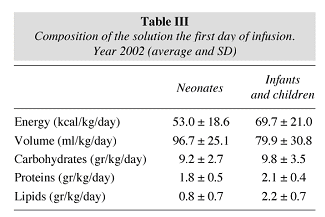
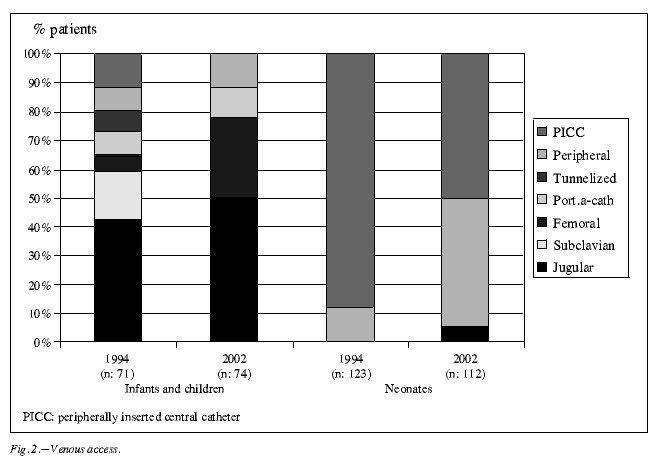
<body><![CDATA[<P>    <br> Neonatal PN was always tailored as per protocol in our institution, whilst near 2/3 of PN are partially or totally standardized in children. Although we could only record the data from 2002, it took 1.5 days (SD: 0.96) in children to achieve the estimated requeriments against 3.75 (SD: 2.39) in neonates. The composition of the PN in the first day is shown in <a href="#t3"> table III</a>.</P>      <P align="center"><a name="t3"><IMG SRC="/img/nh/v20n1/original2/original2_tabla3.gif" width="325" height="217"></a></P>      <P>    <br> The type of intravenous access has changed over the years. In infants and children the subclavian vein was no longer used, while the femoral vein has become the 2<sup>nd</sup> venous access after the internal jugular vein. The jugular vein is the preferable access used by the anesthesiologists in the operating room; the femoral vein by the intensive care unit pediatricians. In neonates, peripheral venous cannulae have been increasingly used (<a href="#f2">fig. 2</a>).</P>      <P align="center"><a name="f2"><IMG SRC="/img/nh/v20n1/original2/original204-01.gif" width="661" height="465"></a></P>      <P>The main reason to stop PN was the change to the oral/enteral route in both neonates (91% in 1994) and children (79% in 1994; 86,8% in 2002, p &lt; 0.05).</P>      <P>Because of the retrospective method of the study we could only analyze the complications in the group of infants and children. There is a trend to a lower frequency of complications with no statistical difference (<a href="#t4">table IV</a>).</P>      <p align="center"><a name="t4"><IMG SRC="/img/nh/v20n1/original2/original2_tabla4.gif" width="325" height="217"></a></p>     <P><b>    ]]></body>
<body><![CDATA[<br> Discussion</b></P>     <P>Parenteral nutrition has a critical role in the treatment of neonates    and children with intestinal failure as well as extreme prematurity, critical    illness, acute pancreatitis or malignancies<sup>8</sup>. Despite recent advances, there is still significant morbidity asociated with PN in childhood; therefore    patients receiving this therapy need to be closely monitored for evidence    of metabolic disturbance, sepsis, catheter-related complications and micronutrient    deficiencies or excesses<sup>9</sup>. The implication of Nutrition Support Teams    in the care of PN patients has improved clinical and economical outcomes by    decreasing the incidence of complications, optimal selection of the feeding    route, and by reducing wastage of PN solutions and resources<sup>10</sup>. Nevertheless periodic studies on the quality of PN need to be done in each institution    in order to analyse causes and factors related to detect defects and look    for solutions<sup>11,12</sup>.</P>     <P>In this study we analysed the changes in PN support for pediatric patients in our department. The results showed that the number of patients, underlying diseases, and indications did not significatively change over the period of study. The percentage of neonates increased because of the increase in the number of extreme premature babies partly due to the development of assisted reproductive technology<sup>13</sup>.</P>      <P>PN composition is thought to cover all the requeriments of energy and nutrients. Over the years we have estimated the Basal Metabolic Rate of the majority of pediatric patients according to the Schofield equations<sup>14</sup> multiplying by a factor of 1.2-1.5<sup>15-17</sup>. The maintenance requeriments for water are determined by the caloric expenditure. By means of the classic HollidaySegar formula it is possible to determine the water requeriments from weight alone<sup>18</sup>.</P>      <P>Maintenance requirements of sodium, chloride, and potassium are 3.0, 2.0,    and 2.0 mEq/100 kcal/day, repectively. This allows us to elaborate a PN solution    with standardized electrolytes adjusted to volume. Standardization of PN simplyfies    elaboration and decreases the risk of mistakes during the process; on the    contrary, customized PN allows flexibility and individualized solutions<sup>19</sup>.    We have chosen a system that makes possible to have both standard and tailored    solutions<sup>7</sup>. Almost 2/3 of our non-neonatal patients use totally    or partially standardized solutions.</P>      <P>The timing of PN progression is also under discussion. In 2002 it took 1.5 days in infants and children and 3.75 days in neonates to achieve the total estimated requeriments. As a result of the aggressive enteral support in neonates, the length of PN has shortenned<sup>20</sup>.</P>      <P>Despite the development and commercial availability of new solutions, the nutritional components have remained almost identical during the period of study. Glucose constitutes the main energy source, but avoiding to exceed the maximum rate of glucose oxidation<sup>21</sup>. We use intravenous fat emulsions daily not only for the prevention of essential fatty acid deficiency but also as an energy source. In 1994, we used traditional soy bean-based solutions (Intralipid 20%<sup>®</sup>, Fresenius Kabi) in neonates and MCT/LCT emulsions in infants and children (Lipofundin<sup>®</sup>, Braun) but recently we have switched to an olive oil-based lipid emulsion (ClinOleic<sup>®</sup>, Baxter Healthcare corporation). No problems in the tolerance to intravenous fat emulsions or in the rate of complications have been observed with the change of type of lipid emulsion. Carnitine is not routinely added to our PN mixture.</P>      <P>Our policy is to use 3-in-1 admixture of nutrient solution whenever possible. Nevertheless, in neonates the use of "all-in-one" admixture has been exceptional because the risk of destabilization. Several reports have described the incompatibility of all-in-one PN admixtures and heparine<sup>22,23</sup> and in consequence our guidelines do not include heparine in the mixtures. If the risk of catheter thrombosis outweight the advantages of the "3-in-1" admixture, e.g. very low infusion rates, where the use of heparine may be advisable, we choose not to use "3-in-1" mixtures.</P>      <P>Amino acid requirements vary from <font size="2"> &#x2265;</font> 2.5 g·kg<sup>-1</sup>·d<sup>-1</sup> for preterm infants to 0.75 g·kg<sup>-1</sup>·d<sup>-1 </sup>for adolescents<sup>24</sup>. It has been stated in the literature that amino acid intakes should be gradually increased over the first few days of PN administration. We consider, in agreement with Shulman and Phillips<sup>17</sup>, that there is no good scientific support for this view. Our practice is to start with the total requeriments in the first day of PN and we have not observed any negative metabolic consequences. Our practice in neonates has moved from the more conservative approach to early amino acid introduction<sup>25,</sup>26. The pediatric amino acid solutions used in our instituon contain essential amino acids, including branched chain amino acids, adapted to the special needs of the neonate (Trophamine<sup>®</sup>, McGraw Hill in 1994; Primene<sup>®</sup>, Baxter Healthcare corporation in 2002). These solutions are employed in patients up to 10 years old.</P>      <P>Vitamin and mineral supplementation follows the guideline of the American Society for Clinical Nutrition<sup>27</sup>, with some modifications for the prematures. Adult parenteral vitamin and mineral solutions are used for children older than 10 years. We slightly modify the supplementation in case of liver or renal disease, although there are no individual preparations for intrevenous minerals in Spain except for zinc and iron.</P>      ]]></body>
<body><![CDATA[<P>Regarding the intravenous access, the most significant change along the period of study has been the decreased use of the subclavian vein in infants and children. Its room has been occupied by the femoral vein. Internal jugular vein continues being the most current access. In our series the use of tunnelized devices for the infusion has almost dissapeared. The explanation is that for bone marrow infusion in bone marrow transplant patients a tunnelized venous access was required in 1994, while in 2002 is a percutaneous one. Home parenteral nutrition patients are not considered in this review. Because of the use of an early aggressive enteral support in premature infants, peripheral venous cannulae have had a steadily increasing role as intrevenous access for PN in neonates although peripheral percutaneous intravenous central catheters are still the most common access.</P>      <P>Similarly to other reports<sup>12</sup>, the indications for PN have not changed over time. Prematurity is the first indication in neonates. In older children postoperative care secondary to gastrointestinal diseases or congenital malformations was the most common indication.</P>      <P>We could only record the frequency of complications in the non-neonatal group. Liver disfunction was the most common complication, although mild and transient. It was not necessary to stop PN because of this reason in any case. The existence of a Nutrition Support Team and the practices to avoid complications of central venous cathetherization<sup>28</sup> may explain the low frequency of infectious complications.</P>      <P>PN is still a life-saving therapy as it has been for over 40 years. Despite the increasing use of EN, the frequency of use and indications has not shown significant differences over time in our experience. Adopting a more pro-enteral nutrition approach will enable children to be fed optimally with fewer complications.</P>      <P><b>References</b></P>      <!-- ref --><P>1. Wilmore DW, Dudrick SJ: Growth and development of    an infant receiving all nutrients exclusively via a vein. <i>JAMA    </i>1968, 20:860-864.&nbsp;&nbsp;&nbsp;&nbsp;&nbsp;&nbsp;&nbsp;&nbsp;[&#160;<a href="javascript:void(0);" onclick="javascript: window.open('/scielo.php?script=sci_nlinks&ref=3469533&pid=S0212-1611200500010000700001&lng=','','width=640,height=500,resizable=yes,scrollbars=1,menubar=yes,');">Links</a>&#160;]<!-- end-ref --><!-- ref --><P>   2. Schewnk WF: Specialized nutrition support: the pediatric perspective. <i>J    Parent Ent Nutr</i> 2003, 27:160-167.&nbsp;&nbsp;&nbsp;&nbsp;&nbsp;&nbsp;&nbsp;&nbsp;[&#160;<a href="javascript:void(0);" onclick="javascript: window.open('/scielo.php?script=sci_nlinks&ref=3469534&pid=S0212-1611200500010000700002&lng=','','width=640,height=500,resizable=yes,scrollbars=1,menubar=yes,');">Links</a>&#160;]<!-- end-ref --><!-- ref --><P>   3. AGA Technical review on parenteral nutrition. <i>Gastroenterology</i> 2001, 121:970-1001.&nbsp;&nbsp;&nbsp;&nbsp;&nbsp;&nbsp;&nbsp;&nbsp;[&#160;<a href="javascript:void(0);" onclick="javascript: window.open('/scielo.php?script=sci_nlinks&ref=3469535&pid=S0212-1611200500010000700003&lng=','','width=640,height=500,resizable=yes,scrollbars=1,menubar=yes,');">Links</a>&#160;]<!-- end-ref --><!-- ref --><P>   4. Collier S, Lo C: Advances in parenteral nutrition.<i>    Curr Opinion Pediatr</i> 1996, 8:476-482.&nbsp;&nbsp;&nbsp;&nbsp;&nbsp;&nbsp;&nbsp;&nbsp;[&#160;<a href="javascript:void(0);" onclick="javascript: window.open('/scielo.php?script=sci_nlinks&ref=3469536&pid=S0212-1611200500010000700004&lng=','','width=640,height=500,resizable=yes,scrollbars=1,menubar=yes,');">Links</a>&#160;]<!-- end-ref --><!-- ref --><P>   5. Moreno Villares JM, Fernández-Shaw Toda C, Muñoz García MJ, Gomis Muñoz P:    Encuesta sobre la variabilidad en la elaboración de la nutrición parenteral    en pediatría. <i>Nutr Hosp </i>2002,    17:251-255.&nbsp;&nbsp;&nbsp;&nbsp;&nbsp;&nbsp;&nbsp;&nbsp;[&#160;<a href="javascript:void(0);" onclick="javascript: window.open('/scielo.php?script=sci_nlinks&ref=3469537&pid=S0212-1611200500010000700005&lng=','','width=640,height=500,resizable=yes,scrollbars=1,menubar=yes,');">Links</a>&#160;]<!-- end-ref --><!-- ref --><P>   6. Moreno Villares JM, Fernández-Shaw C, Gomis Muñoz P, Valero Zanuy MA, León    Sanz M: Nutrición parenteral en pediatría: ¿soluciones normalizadas mejor    que individualizadas? <i>An Esp Pediatr</i>    2002, 57:29-33.&nbsp;&nbsp;&nbsp;&nbsp;&nbsp;&nbsp;&nbsp;&nbsp;[&#160;<a href="javascript:void(0);" onclick="javascript: window.open('/scielo.php?script=sci_nlinks&ref=3469538&pid=S0212-1611200500010000700006&lng=','','width=640,height=500,resizable=yes,scrollbars=1,menubar=yes,');">Links</a>&#160;]<!-- end-ref --><!-- ref --><P>   7. Hodge D, Puntis JW: Diagnosis, prevention and management of catheter related    bloodstream infection during long-term parenteral    nutrition. <i>Arch Dis Child Fetal Neonatal Ed </i>2002,    87:F21-F24.&nbsp;&nbsp;&nbsp;&nbsp;&nbsp;&nbsp;&nbsp;&nbsp;[&#160;<a href="javascript:void(0);" onclick="javascript: window.open('/scielo.php?script=sci_nlinks&ref=3469539&pid=S0212-1611200500010000700007&lng=','','width=640,height=500,resizable=yes,scrollbars=1,menubar=yes,');">Links</a>&#160;]<!-- end-ref --><!-- ref --><P>   8. Heine RG, Bines JE: New approaches to parenteral nutrition in infants and    children. <i>J. Paedriatr Child Health </i>2002,    38:433-437.&nbsp;&nbsp;&nbsp;&nbsp;&nbsp;&nbsp;&nbsp;&nbsp;[&#160;<a href="javascript:void(0);" onclick="javascript: window.open('/scielo.php?script=sci_nlinks&ref=3469540&pid=S0212-1611200500010000700008&lng=','','width=640,height=500,resizable=yes,scrollbars=1,menubar=yes,');">Links</a>&#160;]<!-- end-ref --><!-- ref --><P>   9. Meadows N: Monitoring and complications of parenteral nutrition. <i>Nutrition</i>    1998, 14:806-808.&nbsp;&nbsp;&nbsp;&nbsp;&nbsp;&nbsp;&nbsp;&nbsp;[&#160;<a href="javascript:void(0);" onclick="javascript: window.open('/scielo.php?script=sci_nlinks&ref=3469541&pid=S0212-1611200500010000700009&lng=','','width=640,height=500,resizable=yes,scrollbars=1,menubar=yes,');">Links</a>&#160;]<!-- end-ref --><!-- ref --><P>   10. Newton R, Timmis L, Bowling TE: Changes in parenteral nutrition supply    when the nutrition support team controls prescribing.<i>    Nutrition</i> 2001, 17:347-348.&nbsp;&nbsp;&nbsp;&nbsp;&nbsp;&nbsp;&nbsp;&nbsp;[&#160;<a href="javascript:void(0);" onclick="javascript: window.open('/scielo.php?script=sci_nlinks&ref=3469542&pid=S0212-1611200500010000700010&lng=','','width=640,height=500,resizable=yes,scrollbars=1,menubar=yes,');">Links</a>&#160;]<!-- end-ref --><!-- ref --><P>   11. Gómez-Ramos MJ, Saturno Hernández PJ: Utilización de la nutrición parenteral    total en un hospital general: criterios de calidad y factores asociados a su    cumplimiento. <i>Med Clin (Barc) </i>2002,    119:686-689.&nbsp;&nbsp;&nbsp;&nbsp;&nbsp;&nbsp;&nbsp;&nbsp;[&#160;<a href="javascript:void(0);" onclick="javascript: window.open('/scielo.php?script=sci_nlinks&ref=3469543&pid=S0212-1611200500010000700011&lng=','','width=640,height=500,resizable=yes,scrollbars=1,menubar=yes,');">Links</a>&#160;]<!-- end-ref --><!-- ref --><P>   12. Suita S, Yamanouchi T, Masumoto K, Ogita K, Nakamura M, Taguchi S: Changing    profile of parenteral nutrition in pediatric surgery: a 30-year experience    at one institution. <i>Surgery </i>2002,    131:S275-S282.&nbsp;&nbsp;&nbsp;&nbsp;&nbsp;&nbsp;&nbsp;&nbsp;[&#160;<a href="javascript:void(0);" onclick="javascript: window.open('/scielo.php?script=sci_nlinks&ref=3469544&pid=S0212-1611200500010000700012&lng=','','width=640,height=500,resizable=yes,scrollbars=1,menubar=yes,');">Links</a>&#160;]<!-- end-ref --><!-- ref --><P>   13. Kovalewsky G, Coutifaris C: Low and very low birth weight after use of assisted    reproductive technology.<i> N Engl J Med </i>2002,    347:1451.&nbsp;&nbsp;&nbsp;&nbsp;&nbsp;&nbsp;&nbsp;&nbsp;[&#160;<a href="javascript:void(0);" onclick="javascript: window.open('/scielo.php?script=sci_nlinks&ref=3469545&pid=S0212-1611200500010000700013&lng=','','width=640,height=500,resizable=yes,scrollbars=1,menubar=yes,');">Links</a>&#160;]<!-- end-ref --><!-- ref --><P>   14. Schofied W: Predicting basal metabolic rate, new standards and review of    previous work. <i>Hum Nutr Clin Nutr</i>    1985, 39C S1:5-41.&nbsp;&nbsp;&nbsp;&nbsp;&nbsp;&nbsp;&nbsp;&nbsp;[&#160;<a href="javascript:void(0);" onclick="javascript: window.open('/scielo.php?script=sci_nlinks&ref=3469546&pid=S0212-1611200500010000700014&lng=','','width=640,height=500,resizable=yes,scrollbars=1,menubar=yes,');">Links</a>&#160;]<!-- end-ref --><!-- ref --><P>   15. Sentengo TA, Tershakovec AM, Mascarenhas MR, Watson MH, Stallings VA: Resting    energy expenditure and prediction equations in young children with failure to    thrive. <i>J Pediatr </i>2000,    136:345-350.&nbsp;&nbsp;&nbsp;&nbsp;&nbsp;&nbsp;&nbsp;&nbsp;[&#160;<a href="javascript:void(0);" onclick="javascript: window.open('/scielo.php?script=sci_nlinks&ref=3469547&pid=S0212-1611200500010000700015&lng=','','width=640,height=500,resizable=yes,scrollbars=1,menubar=yes,');">Links</a>&#160;]<!-- end-ref --><!-- ref --><P>   16. Chwals WJ, Lally KP, Woolley MM, Mahour GH: Measured energy expenditure    in critically ill infants and young children. <i>J    Surg Res </i>1988, 44:467-472.&nbsp;&nbsp;&nbsp;&nbsp;&nbsp;&nbsp;&nbsp;&nbsp;[&#160;<a href="javascript:void(0);" onclick="javascript: window.open('/scielo.php?script=sci_nlinks&ref=3469548&pid=S0212-1611200500010000700016&lng=','','width=640,height=500,resizable=yes,scrollbars=1,menubar=yes,');">Links</a>&#160;]<!-- end-ref --><!-- ref --><P>   17. Shulman RJ, Phillips S: Parenteral nutrition in infants and children.<i>    J Pediatr Gastroenterol Nutr</i> 2003, 36:587-607.   &nbsp;&nbsp;&nbsp;&nbsp;&nbsp;&nbsp;&nbsp;&nbsp;[&#160;<a href="javascript:void(0);" onclick="javascript: window.open('/scielo.php?script=sci_nlinks&ref=3469549&pid=S0212-1611200500010000700017&lng=','','width=640,height=500,resizable=yes,scrollbars=1,menubar=yes,');">Links</a>&#160;]<!-- end-ref --><!-- ref --><P>   18. Holliday MA, Segar WE: The maintenance need for water in parenteral fluid    therapy. <i>Pediatrics</i>    1957, 19:823-832.&nbsp;&nbsp;&nbsp;&nbsp;&nbsp;&nbsp;&nbsp;&nbsp;[&#160;<a href="javascript:void(0);" onclick="javascript: window.open('/scielo.php?script=sci_nlinks&ref=3469550&pid=S0212-1611200500010000700018&lng=','','width=640,height=500,resizable=yes,scrollbars=1,menubar=yes,');">Links</a>&#160;]<!-- end-ref --><!-- ref --><P>   19. Stettler N, Sentongo TA, Carroll M, Schears GJ, Mascarenhas MR: Impact of    customized parenteral nutrition in a pediatric hospital. <i>NCP    </i>2001, 16:345-348.&nbsp;&nbsp;&nbsp;&nbsp;&nbsp;&nbsp;&nbsp;&nbsp;[&#160;<a href="javascript:void(0);" onclick="javascript: window.open('/scielo.php?script=sci_nlinks&ref=3469551&pid=S0212-1611200500010000700019&lng=','','width=640,height=500,resizable=yes,scrollbars=1,menubar=yes,');">Links</a>&#160;]<!-- end-ref --><!-- ref --><P>   20. Wilson DC, Cairns P, Halliday HL, Reid M, McClure G, Dodge JA: Randomized    controlled trial of an agressive nutritional regimen in sick very low birthweight    infants. <i>Arch Dis Child Fetal Neonatal Ed </i>1997,    77:F4-11.&nbsp;&nbsp;&nbsp;&nbsp;&nbsp;&nbsp;&nbsp;&nbsp;[&#160;<a href="javascript:void(0);" onclick="javascript: window.open('/scielo.php?script=sci_nlinks&ref=3469552&pid=S0212-1611200500010000700020&lng=','','width=640,height=500,resizable=yes,scrollbars=1,menubar=yes,');">Links</a>&#160;]<!-- end-ref --><!-- ref --><P>   21. Jones MO, Pierro A, Hammond P, Nunn A, Lloyd DA: Glucose utilization in    the surgical newborn infant receiving total parenteral nutrition.<i>    J Pediatr Surg</i> 1993, 1121-1125.&nbsp;&nbsp;&nbsp;&nbsp;&nbsp;&nbsp;&nbsp;&nbsp;[&#160;<a href="javascript:void(0);" onclick="javascript: window.open('/scielo.php?script=sci_nlinks&ref=3469553&pid=S0212-1611200500010000700021&lng=','','width=640,height=500,resizable=yes,scrollbars=1,menubar=yes,');">Links</a>&#160;]<!-- end-ref --><!-- ref --><P>   22. Johnson OL, Washington C, Davis SS, Bentley PK, Lowe KC: The destabilization    of parenteral feeding emulsions by heparin. <i>Int    J Pharm</i> 1989, 53:237-240.&nbsp;&nbsp;&nbsp;&nbsp;&nbsp;&nbsp;&nbsp;&nbsp;[&#160;<a href="javascript:void(0);" onclick="javascript: window.open('/scielo.php?script=sci_nlinks&ref=3469554&pid=S0212-1611200500010000700022&lng=','','width=640,height=500,resizable=yes,scrollbars=1,menubar=yes,');">Links</a>&#160;]<!-- end-ref --><!-- ref --><P>   23. Silvers KM, Darlow BA, Winterbourn CC: Pharmacologic levels of heparin    do not destabilize neonatal parenteral nutrition. <i>J    Parent Ent Nutr </i>1998, 22:311-314.&nbsp;&nbsp;&nbsp;&nbsp;&nbsp;&nbsp;&nbsp;&nbsp;[&#160;<a href="javascript:void(0);" onclick="javascript: window.open('/scielo.php?script=sci_nlinks&ref=3469555&pid=S0212-1611200500010000700023&lng=','','width=640,height=500,resizable=yes,scrollbars=1,menubar=yes,');">Links</a>&#160;]<!-- end-ref --><!-- ref --><P>   24. National Advisory Group on Standards and Practice Guidelines for Parenteral    Nutrition. Safe practices for parenteral nutrition formulations. <i>J    Parent Ent Nutr </i>1998, 22:49-66.&nbsp;&nbsp;&nbsp;&nbsp;&nbsp;&nbsp;&nbsp;&nbsp;[&#160;<a href="javascript:void(0);" onclick="javascript: window.open('/scielo.php?script=sci_nlinks&ref=3469556&pid=S0212-1611200500010000700024&lng=','','width=640,height=500,resizable=yes,scrollbars=1,menubar=yes,');">Links</a>&#160;]<!-- end-ref --><!-- ref --><P>   25. Thureen PJ, Melara D, Fennessey PV, Hay WJ: Effect of low versus high intravenous    amino acid intake on very low birth weight infants in the early neonatal period.    <i>Pediatr Res </i>2003,    53:24-32.&nbsp;&nbsp;&nbsp;&nbsp;&nbsp;&nbsp;&nbsp;&nbsp;[&#160;<a href="javascript:void(0);" onclick="javascript: window.open('/scielo.php?script=sci_nlinks&ref=3469557&pid=S0212-1611200500010000700025&lng=','','width=640,height=500,resizable=yes,scrollbars=1,menubar=yes,');">Links</a>&#160;]<!-- end-ref --><!-- ref --><P>   26. Porcelli PJ, Sisk PM: Increased parenteral amino acid administration to    extremely low-birth-weight infants during early postnatal life. <i>J    Pediatr Gastroenterol Nutr </i>2002, 34:174179.&nbsp;&nbsp;&nbsp;&nbsp;&nbsp;&nbsp;&nbsp;&nbsp;[&#160;<a href="javascript:void(0);" onclick="javascript: window.open('/scielo.php?script=sci_nlinks&ref=3469558&pid=S0212-1611200500010000700026&lng=','','width=640,height=500,resizable=yes,scrollbars=1,menubar=yes,');">Links</a>&#160;]<!-- end-ref --><!-- ref --><P>   27. Greene HL, Hambridge KM, Schanler R, Tsang RC: Guidelines for the use    of vitamins, trace elements, calcium, magnesium and phosphorus in infants    and children receiving total parenteral nutrition: report of the committee on    clinical practice issues of the American Society for Clinical Nutritional.    <i>Am J Clin Nutr</i> 1988,    48:1324-1342.&nbsp;&nbsp;&nbsp;&nbsp;&nbsp;&nbsp;&nbsp;&nbsp;[&#160;<a href="javascript:void(0);" onclick="javascript: window.open('/scielo.php?script=sci_nlinks&ref=3469559&pid=S0212-1611200500010000700027&lng=','','width=640,height=500,resizable=yes,scrollbars=1,menubar=yes,');">Links</a>&#160;]<!-- end-ref --><!-- ref --><P>   28. McGee DC, Gould MK: Preventing complications of central venous catheterization.<i>    N Engl J Med </i>2003, 348:1123-1133.&nbsp;&nbsp;&nbsp;&nbsp;&nbsp;&nbsp;&nbsp;&nbsp;[&#160;<a href="javascript:void(0);" onclick="javascript: window.open('/scielo.php?script=sci_nlinks&ref=3469560&pid=S0212-1611200500010000700028&lng=','','width=640,height=500,resizable=yes,scrollbars=1,menubar=yes,');">Links</a>&#160;]<!-- end-ref --> ]]></body><back>
<ref-list>
<ref id="B1">
<label>1</label><nlm-citation citation-type="journal">
<person-group person-group-type="author">
<name>
<surname><![CDATA[Wilmore]]></surname>
<given-names><![CDATA[DW]]></given-names>
</name>
<name>
<surname><![CDATA[Dudrick]]></surname>
<given-names><![CDATA[SJ]]></given-names>
</name>
</person-group>
<article-title xml:lang="en"><![CDATA[Growth and development of an infant receiving all nutrients exclusively via a vein]]></article-title>
<source><![CDATA[JAMA]]></source>
<year>1968</year>
<volume>20</volume>
<page-range>860-864</page-range></nlm-citation>
</ref>
<ref id="B2">
<label>2</label><nlm-citation citation-type="journal">
<person-group person-group-type="author">
<name>
<surname><![CDATA[Schewnk]]></surname>
<given-names><![CDATA[WF]]></given-names>
</name>
</person-group>
<article-title xml:lang="en"><![CDATA[Specialized nutrition support: the pediatric perspective]]></article-title>
<source><![CDATA[J Parent Ent Nutr]]></source>
<year>2003</year>
<volume>27</volume>
<page-range>160-167</page-range></nlm-citation>
</ref>
<ref id="B3">
<label>3</label><nlm-citation citation-type="journal">
<article-title xml:lang="en"><![CDATA[AGA Technical review on parenteral nutrition]]></article-title>
<source><![CDATA[Gastroenterology]]></source>
<year>2001</year>
<volume>121</volume>
<page-range>970-1001</page-range></nlm-citation>
</ref>
<ref id="B4">
<label>4</label><nlm-citation citation-type="journal">
<person-group person-group-type="author">
<name>
<surname><![CDATA[Collier]]></surname>
<given-names><![CDATA[S]]></given-names>
</name>
<name>
<surname><![CDATA[Lo]]></surname>
<given-names><![CDATA[C]]></given-names>
</name>
</person-group>
<article-title xml:lang="en"><![CDATA[Advances in parenteral nutrition]]></article-title>
<source><![CDATA[Curr Opinion Pediatr]]></source>
<year>1996</year>
<volume>8</volume>
<page-range>476-482</page-range></nlm-citation>
</ref>
<ref id="B5">
<label>5</label><nlm-citation citation-type="journal">
<person-group person-group-type="author">
<name>
<surname><![CDATA[Moreno Villares]]></surname>
<given-names><![CDATA[JM]]></given-names>
</name>
<name>
<surname><![CDATA[Fernández-Shaw Toda]]></surname>
<given-names><![CDATA[C]]></given-names>
</name>
<name>
<surname><![CDATA[Muñoz García]]></surname>
<given-names><![CDATA[MJ]]></given-names>
</name>
<name>
<surname><![CDATA[Gomis Muñoz]]></surname>
<given-names><![CDATA[P]]></given-names>
</name>
</person-group>
<article-title xml:lang="es"><![CDATA[Encuesta sobre la variabilidad en la elaboración de la nutrición parenteral en pediatría]]></article-title>
<source><![CDATA[Nutr Hosp]]></source>
<year>2002</year>
<volume>17</volume>
<page-range>251-255</page-range></nlm-citation>
</ref>
<ref id="B6">
<label>6</label><nlm-citation citation-type="journal">
<person-group person-group-type="author">
<name>
<surname><![CDATA[Moreno Villares]]></surname>
<given-names><![CDATA[JM]]></given-names>
</name>
<name>
<surname><![CDATA[Fernández-Shaw]]></surname>
<given-names><![CDATA[C]]></given-names>
</name>
<name>
<surname><![CDATA[Gomis Muñoz]]></surname>
<given-names><![CDATA[P]]></given-names>
</name>
<name>
<surname><![CDATA[Valero Zanuy]]></surname>
<given-names><![CDATA[MA]]></given-names>
</name>
<name>
<surname><![CDATA[León Sanz]]></surname>
<given-names><![CDATA[M]]></given-names>
</name>
</person-group>
<article-title xml:lang="es"><![CDATA[Nutrición parenteral en pediatría: ¿soluciones normalizadas mejor que individualizadas]]></article-title>
<source><![CDATA[An Esp Pediatr]]></source>
<year>2002</year>
<volume>57</volume>
<page-range>29-33</page-range></nlm-citation>
</ref>
<ref id="B7">
<label>7</label><nlm-citation citation-type="journal">
<person-group person-group-type="author">
<name>
<surname><![CDATA[Hodge]]></surname>
<given-names><![CDATA[D]]></given-names>
</name>
<name>
<surname><![CDATA[Puntis]]></surname>
<given-names><![CDATA[JW]]></given-names>
</name>
</person-group>
<article-title xml:lang="en"><![CDATA[Diagnosis, prevention and management of catheter related bloodstream infection during long-term parenteral nutrition]]></article-title>
<source><![CDATA[Arch Dis Child Fetal Neonatal Ed]]></source>
<year>2002</year>
<volume>87</volume>
<page-range>F21-F24</page-range></nlm-citation>
</ref>
<ref id="B8">
<label>8</label><nlm-citation citation-type="journal">
<person-group person-group-type="author">
<name>
<surname><![CDATA[Heine]]></surname>
<given-names><![CDATA[RG]]></given-names>
</name>
<name>
<surname><![CDATA[Bines]]></surname>
<given-names><![CDATA[JE]]></given-names>
</name>
</person-group>
<article-title xml:lang="en"><![CDATA[New approaches to parenteral nutrition in infants and children]]></article-title>
<source><![CDATA[J. Paedriatr Child Health]]></source>
<year>2002</year>
<volume>38</volume>
<page-range>433-437</page-range></nlm-citation>
</ref>
<ref id="B9">
<label>9</label><nlm-citation citation-type="journal">
<person-group person-group-type="author">
<name>
<surname><![CDATA[Meadows]]></surname>
<given-names><![CDATA[N]]></given-names>
</name>
</person-group>
<article-title xml:lang="en"><![CDATA[Monitoring and complications of parenteral nutrition]]></article-title>
<source><![CDATA[Nutrition]]></source>
<year>1998</year>
<volume>14</volume>
<page-range>806-808</page-range></nlm-citation>
</ref>
<ref id="B10">
<label>10</label><nlm-citation citation-type="journal">
<person-group person-group-type="author">
<name>
<surname><![CDATA[Newton]]></surname>
<given-names><![CDATA[R]]></given-names>
</name>
<name>
<surname><![CDATA[Timmis]]></surname>
<given-names><![CDATA[L]]></given-names>
</name>
<name>
<surname><![CDATA[Bowling]]></surname>
<given-names><![CDATA[TE]]></given-names>
</name>
</person-group>
<article-title xml:lang="en"><![CDATA[Changes in parenteral nutrition supply when the nutrition support team controls prescribing]]></article-title>
<source><![CDATA[Nutrition]]></source>
<year>2001</year>
<volume>17</volume>
<page-range>347-348</page-range></nlm-citation>
</ref>
<ref id="B11">
<label>11</label><nlm-citation citation-type="journal">
<person-group person-group-type="author">
<name>
<surname><![CDATA[Gómez-Ramos]]></surname>
<given-names><![CDATA[MJ]]></given-names>
</name>
<name>
<surname><![CDATA[Saturno Hernández]]></surname>
<given-names><![CDATA[PJ]]></given-names>
</name>
</person-group>
<article-title xml:lang="es"><![CDATA[Utilización de la nutrición parenteral total en un hospital general: criterios de calidad y factores asociados a su cumplimiento]]></article-title>
<source><![CDATA[Med Clin]]></source>
<year>2002</year>
<volume>119</volume>
<page-range>686-689</page-range><publisher-loc><![CDATA[Barc ]]></publisher-loc>
</nlm-citation>
</ref>
<ref id="B12">
<label>12</label><nlm-citation citation-type="journal">
<person-group person-group-type="author">
<name>
<surname><![CDATA[Suita]]></surname>
<given-names><![CDATA[S]]></given-names>
</name>
<name>
<surname><![CDATA[Yamanouchi]]></surname>
<given-names><![CDATA[T]]></given-names>
</name>
<name>
<surname><![CDATA[Masumoto]]></surname>
<given-names><![CDATA[K]]></given-names>
</name>
<name>
<surname><![CDATA[Ogita]]></surname>
<given-names><![CDATA[K]]></given-names>
</name>
<name>
<surname><![CDATA[Nakamura]]></surname>
<given-names><![CDATA[M]]></given-names>
</name>
<name>
<surname><![CDATA[Taguchi]]></surname>
<given-names><![CDATA[S]]></given-names>
</name>
</person-group>
<article-title xml:lang="en"><![CDATA[Changing profile of parenteral nutrition in pediatric surgery: a 30-year experience at one institution]]></article-title>
<source><![CDATA[Surgery]]></source>
<year>2002</year>
<volume>131</volume>
<page-range>S275-S282</page-range></nlm-citation>
</ref>
<ref id="B13">
<label>13</label><nlm-citation citation-type="journal">
<person-group person-group-type="author">
<name>
<surname><![CDATA[Kovalewsky]]></surname>
<given-names><![CDATA[G]]></given-names>
</name>
<name>
<surname><![CDATA[Coutifaris]]></surname>
<given-names><![CDATA[C]]></given-names>
</name>
</person-group>
<article-title xml:lang="en"><![CDATA[Low and very low birth weight after use of assisted reproductive technology]]></article-title>
<source><![CDATA[N Engl J Med]]></source>
<year>2002</year>
<volume>347</volume>
<page-range>1451</page-range></nlm-citation>
</ref>
<ref id="B14">
<label>14</label><nlm-citation citation-type="journal">
<person-group person-group-type="author">
<name>
<surname><![CDATA[Schofied]]></surname>
<given-names><![CDATA[W]]></given-names>
</name>
</person-group>
<article-title xml:lang="en"><![CDATA[Predicting basal metabolic rate, new standards and review of previous work]]></article-title>
<source><![CDATA[Hum Nutr Clin Nutr]]></source>
<year>1985</year>
<volume>39C S1</volume>
<page-range>5-41</page-range></nlm-citation>
</ref>
<ref id="B15">
<label>15</label><nlm-citation citation-type="journal">
<person-group person-group-type="author">
<name>
<surname><![CDATA[Sentengo]]></surname>
<given-names><![CDATA[TA]]></given-names>
</name>
<name>
<surname><![CDATA[Tershakovec]]></surname>
<given-names><![CDATA[AM]]></given-names>
</name>
<name>
<surname><![CDATA[Mascarenhas]]></surname>
<given-names><![CDATA[MR]]></given-names>
</name>
<name>
<surname><![CDATA[Watson]]></surname>
<given-names><![CDATA[MH]]></given-names>
</name>
<name>
<surname><![CDATA[Stallings]]></surname>
<given-names><![CDATA[VA]]></given-names>
</name>
</person-group>
<article-title xml:lang="en"><![CDATA[Resting energy expenditure and prediction equations in young children with failure to thrive]]></article-title>
<source><![CDATA[J Pediatr]]></source>
<year>2000</year>
<volume>136</volume>
<page-range>345-350</page-range></nlm-citation>
</ref>
<ref id="B16">
<label>16</label><nlm-citation citation-type="journal">
<person-group person-group-type="author">
<name>
<surname><![CDATA[Chwals]]></surname>
<given-names><![CDATA[WJ]]></given-names>
</name>
<name>
<surname><![CDATA[Lally]]></surname>
<given-names><![CDATA[KP]]></given-names>
</name>
<name>
<surname><![CDATA[Woolley]]></surname>
<given-names><![CDATA[MM]]></given-names>
</name>
<name>
<surname><![CDATA[Mahour]]></surname>
<given-names><![CDATA[GH]]></given-names>
</name>
</person-group>
<article-title xml:lang="en"><![CDATA[Measured energy expenditure in critically ill infants and young children]]></article-title>
<source><![CDATA[J Surg Res]]></source>
<year>1988</year>
<volume>44</volume>
<page-range>467-472</page-range></nlm-citation>
</ref>
<ref id="B17">
<label>17</label><nlm-citation citation-type="journal">
<person-group person-group-type="author">
<name>
<surname><![CDATA[Shulman]]></surname>
<given-names><![CDATA[RJ]]></given-names>
</name>
<name>
<surname><![CDATA[Phillips]]></surname>
<given-names><![CDATA[S]]></given-names>
</name>
</person-group>
<article-title xml:lang="en"><![CDATA[Parenteral nutrition in infants and children]]></article-title>
<source><![CDATA[J Pediatr Gastroenterol Nutr]]></source>
<year>2003</year>
<volume>36</volume>
<page-range>587-607</page-range></nlm-citation>
</ref>
<ref id="B18">
<label>18</label><nlm-citation citation-type="journal">
<person-group person-group-type="author">
<name>
<surname><![CDATA[Holliday]]></surname>
<given-names><![CDATA[MA]]></given-names>
</name>
<name>
<surname><![CDATA[Segar]]></surname>
<given-names><![CDATA[WE]]></given-names>
</name>
</person-group>
<article-title xml:lang="en"><![CDATA[The maintenance need for water in parenteral fluid therapy]]></article-title>
<source><![CDATA[Pediatrics]]></source>
<year>1957</year>
<volume>19</volume>
<page-range>823-832</page-range></nlm-citation>
</ref>
<ref id="B19">
<label>19</label><nlm-citation citation-type="journal">
<person-group person-group-type="author">
<name>
<surname><![CDATA[Stettler]]></surname>
<given-names><![CDATA[N]]></given-names>
</name>
<name>
<surname><![CDATA[Sentongo]]></surname>
<given-names><![CDATA[TA]]></given-names>
</name>
<name>
<surname><![CDATA[Carroll]]></surname>
<given-names><![CDATA[M]]></given-names>
</name>
<name>
<surname><![CDATA[Schears]]></surname>
<given-names><![CDATA[GJ]]></given-names>
</name>
<name>
<surname><![CDATA[Mascarenhas]]></surname>
<given-names><![CDATA[MR]]></given-names>
</name>
</person-group>
<article-title xml:lang="en"><![CDATA[Impact of customized parenteral nutrition in a pediatric hospital]]></article-title>
<source><![CDATA[NCP]]></source>
<year>2001</year>
<volume>16</volume>
<page-range>345-348</page-range></nlm-citation>
</ref>
<ref id="B20">
<label>20</label><nlm-citation citation-type="journal">
<person-group person-group-type="author">
<name>
<surname><![CDATA[Wilson]]></surname>
<given-names><![CDATA[DC]]></given-names>
</name>
<name>
<surname><![CDATA[Cairns]]></surname>
<given-names><![CDATA[P]]></given-names>
</name>
<name>
<surname><![CDATA[Halliday]]></surname>
<given-names><![CDATA[HL]]></given-names>
</name>
<name>
<surname><![CDATA[Reid]]></surname>
<given-names><![CDATA[M]]></given-names>
</name>
<name>
<surname><![CDATA[McClure]]></surname>
<given-names><![CDATA[G]]></given-names>
</name>
<name>
<surname><![CDATA[Dodge]]></surname>
<given-names><![CDATA[JA]]></given-names>
</name>
</person-group>
<article-title xml:lang="en"><![CDATA[Randomized controlled trial of an agressive nutritional regimen in sick very low birthweight infants]]></article-title>
<source><![CDATA[Arch Dis Child Fetal Neonatal Ed]]></source>
<year>1997</year>
<volume>77</volume>
<page-range>F4-11</page-range></nlm-citation>
</ref>
<ref id="B21">
<label>21</label><nlm-citation citation-type="journal">
<person-group person-group-type="author">
<name>
<surname><![CDATA[Jones]]></surname>
<given-names><![CDATA[MO]]></given-names>
</name>
<name>
<surname><![CDATA[Pierro]]></surname>
<given-names><![CDATA[A]]></given-names>
</name>
<name>
<surname><![CDATA[Hammond]]></surname>
<given-names><![CDATA[P]]></given-names>
</name>
<name>
<surname><![CDATA[Nunn]]></surname>
<given-names><![CDATA[A]]></given-names>
</name>
<name>
<surname><![CDATA[Lloyd]]></surname>
<given-names><![CDATA[DA]]></given-names>
</name>
</person-group>
<article-title xml:lang="en"><![CDATA[Glucose utilization in the surgical newborn infant receiving total parenteral nutrition]]></article-title>
<source><![CDATA[J Pediatr Surg]]></source>
<year>1993</year>
<page-range>1121-1125</page-range></nlm-citation>
</ref>
<ref id="B22">
<label>22</label><nlm-citation citation-type="journal">
<person-group person-group-type="author">
<name>
<surname><![CDATA[Johnson]]></surname>
<given-names><![CDATA[OL]]></given-names>
</name>
<name>
<surname><![CDATA[Washington]]></surname>
<given-names><![CDATA[C]]></given-names>
</name>
<name>
<surname><![CDATA[Davis]]></surname>
<given-names><![CDATA[SS]]></given-names>
</name>
<name>
<surname><![CDATA[Bentley]]></surname>
<given-names><![CDATA[PK]]></given-names>
</name>
<name>
<surname><![CDATA[Lowe]]></surname>
<given-names><![CDATA[KC]]></given-names>
</name>
</person-group>
<article-title xml:lang="en"><![CDATA[The destabilization of parenteral feeding emulsions by heparin]]></article-title>
<source><![CDATA[Int J Pharm]]></source>
<year>1989</year>
<volume>53</volume>
<page-range>237-240</page-range></nlm-citation>
</ref>
<ref id="B23">
<label>23</label><nlm-citation citation-type="journal">
<person-group person-group-type="author">
<name>
<surname><![CDATA[Silvers]]></surname>
<given-names><![CDATA[KM]]></given-names>
</name>
<name>
<surname><![CDATA[Darlow]]></surname>
<given-names><![CDATA[BA]]></given-names>
</name>
<name>
<surname><![CDATA[Winterbourn]]></surname>
<given-names><![CDATA[CC]]></given-names>
</name>
</person-group>
<article-title xml:lang="en"><![CDATA[Pharmacologic levels of heparin do not destabilize neonatal parenteral nutrition]]></article-title>
<source><![CDATA[J Parent Ent Nutr]]></source>
<year>1998</year>
<volume>22</volume>
<page-range>311-314</page-range></nlm-citation>
</ref>
<ref id="B24">
<label>24</label><nlm-citation citation-type="journal">
<collab>National Advisory Group on Standards and Practice Guidelines for Parenteral Nutrition</collab>
<article-title xml:lang="en"><![CDATA[Safe practices for parenteral nutrition formulations]]></article-title>
<source><![CDATA[J Parent Ent Nutr]]></source>
<year>1998</year>
<volume>22</volume>
<page-range>49-66</page-range></nlm-citation>
</ref>
<ref id="B25">
<label>25</label><nlm-citation citation-type="journal">
<person-group person-group-type="author">
<name>
<surname><![CDATA[Thureen]]></surname>
<given-names><![CDATA[PJ]]></given-names>
</name>
<name>
<surname><![CDATA[Melara]]></surname>
<given-names><![CDATA[D]]></given-names>
</name>
<name>
<surname><![CDATA[Fennessey]]></surname>
<given-names><![CDATA[PV]]></given-names>
</name>
<name>
<surname><![CDATA[Hay]]></surname>
<given-names><![CDATA[WJ]]></given-names>
</name>
</person-group>
<article-title xml:lang="en"><![CDATA[Effect of low versus high intravenous amino acid intake on very low birth weight infants in the early neonatal period]]></article-title>
<source><![CDATA[Pediatr Res]]></source>
<year>2003</year>
<volume>53</volume>
<page-range>24-32</page-range></nlm-citation>
</ref>
<ref id="B26">
<label>26</label><nlm-citation citation-type="journal">
<person-group person-group-type="author">
<name>
<surname><![CDATA[Porcelli]]></surname>
<given-names><![CDATA[PJ]]></given-names>
</name>
<name>
<surname><![CDATA[Sisk]]></surname>
<given-names><![CDATA[PM]]></given-names>
</name>
</person-group>
<article-title xml:lang="en"><![CDATA[Increased parenteral amino acid administration to extremely low-birth-weight infants during early postnatal life]]></article-title>
<source><![CDATA[J Pediatr Gastroenterol Nutr]]></source>
<year>2002</year>
<volume>34</volume>
<page-range>174179</page-range></nlm-citation>
</ref>
<ref id="B27">
<label>27</label><nlm-citation citation-type="journal">
<person-group person-group-type="author">
<name>
<surname><![CDATA[Greene]]></surname>
<given-names><![CDATA[HL]]></given-names>
</name>
<name>
<surname><![CDATA[Hambridge]]></surname>
<given-names><![CDATA[KM]]></given-names>
</name>
<name>
<surname><![CDATA[Schanler]]></surname>
<given-names><![CDATA[R]]></given-names>
</name>
<name>
<surname><![CDATA[Tsang]]></surname>
<given-names><![CDATA[RC]]></given-names>
</name>
</person-group>
<article-title xml:lang="en"><![CDATA[Guidelines for the use of vitamins, trace elements, calcium, magnesium and phosphorus in infants and children receiving total parenteral nutrition: report of the committee on clinical practice issues of the American Society for Clinical Nutritional]]></article-title>
<source><![CDATA[Am J Clin Nutr]]></source>
<year>1988</year>
<volume>48</volume>
<page-range>1324-1342</page-range></nlm-citation>
</ref>
<ref id="B28">
<label>28</label><nlm-citation citation-type="journal">
<person-group person-group-type="author">
<name>
<surname><![CDATA[McGee]]></surname>
<given-names><![CDATA[DC]]></given-names>
</name>
<name>
<surname><![CDATA[Gould]]></surname>
<given-names><![CDATA[MK]]></given-names>
</name>
</person-group>
<article-title xml:lang="en"><![CDATA[Preventing complications of central venous catheterization]]></article-title>
<source><![CDATA[N Engl J Med]]></source>
<year>2003</year>
<volume>348</volume>
<page-range>1123-1133</page-range></nlm-citation>
</ref>
</ref-list>
</back>
</article>