<?xml version="1.0" encoding="ISO-8859-1"?><article xmlns:mml="http://www.w3.org/1998/Math/MathML" xmlns:xlink="http://www.w3.org/1999/xlink" xmlns:xsi="http://www.w3.org/2001/XMLSchema-instance">
<front>
<journal-meta>
<journal-id>0212-1611</journal-id>
<journal-title><![CDATA[Nutrición Hospitalaria]]></journal-title>
<abbrev-journal-title><![CDATA[Nutr. Hosp.]]></abbrev-journal-title>
<issn>0212-1611</issn>
<publisher>
<publisher-name><![CDATA[Grupo Arán]]></publisher-name>
</publisher>
</journal-meta>
<article-meta>
<article-id>S0212-16112005000200006</article-id>
<title-group>
<article-title xml:lang="en"><![CDATA[Food, energy and macronutrient intake of postmenopausal women from a menopause program]]></article-title>
<article-title xml:lang="es"><![CDATA[Consumo de alimentos, energía y macronutrientes en mujeres postmenopáusicas de un programa de menopausia]]></article-title>
</title-group>
<contrib-group>
<contrib contrib-type="author">
<name>
<surname><![CDATA[Schoppen]]></surname>
<given-names><![CDATA[S.]]></given-names>
</name>
<xref ref-type="aff" rid="A01"/>
</contrib>
<contrib contrib-type="author">
<name>
<surname><![CDATA[Carbajal]]></surname>
<given-names><![CDATA[A.]]></given-names>
</name>
<xref ref-type="aff" rid="A02"/>
</contrib>
<contrib contrib-type="author">
<name>
<surname><![CDATA[Pérez-Granados]]></surname>
<given-names><![CDATA[A. M.ª]]></given-names>
</name>
<xref ref-type="aff" rid="A01"/>
</contrib>
<contrib contrib-type="author">
<name>
<surname><![CDATA[Vivas]]></surname>
<given-names><![CDATA[F.]]></given-names>
</name>
<xref ref-type="aff" rid="A03"/>
</contrib>
<contrib contrib-type="author">
<name>
<surname><![CDATA[Vaquero]]></surname>
<given-names><![CDATA[M. Pilar]]></given-names>
</name>
<xref ref-type="aff" rid="A01"/>
</contrib>
</contrib-group>
<aff id="A01">
<institution><![CDATA[,Spanish Council for Scientific Research (CSIC) Instituto del Frío Department of Metabolism and Nutrition]]></institution>
<addr-line><![CDATA[ ]]></addr-line>
</aff>
<aff id="A02">
<institution><![CDATA[,Madrid Complutense University Faculty of Pharmacy Department of Nutrition]]></institution>
<addr-line><![CDATA[Madrid ]]></addr-line>
<country>Spain</country>
</aff>
<aff id="A03">
<institution><![CDATA[,Madrid City Council Health Centre  ]]></institution>
<addr-line><![CDATA[Madrid ]]></addr-line>
<country>Spain</country>
</aff>
<pub-date pub-type="pub">
<day>00</day>
<month>04</month>
<year>2005</year>
</pub-date>
<pub-date pub-type="epub">
<day>00</day>
<month>04</month>
<year>2005</year>
</pub-date>
<volume>20</volume>
<numero>2</numero>
<fpage>101</fpage>
<lpage>109</lpage>
<copyright-statement/>
<copyright-year/>
<self-uri xlink:href="http://scielo.isciii.es/scielo.php?script=sci_arttext&amp;pid=S0212-16112005000200006&amp;lng=en&amp;nrm=iso"></self-uri><self-uri xlink:href="http://scielo.isciii.es/scielo.php?script=sci_abstract&amp;pid=S0212-16112005000200006&amp;lng=en&amp;nrm=iso"></self-uri><self-uri xlink:href="http://scielo.isciii.es/scielo.php?script=sci_pdf&amp;pid=S0212-16112005000200006&amp;lng=en&amp;nrm=iso"></self-uri><abstract abstract-type="short" xml:lang="en"><p><![CDATA[Objective: This study aimed to analyse the food, energy and macronutrient intake of a group of postmenopausal women participating in a health-care-program. Methods: Subjects included were 38 healthy postmenopausal women aged between 46 and 60 years, recruited from the Menopause Program of the Madrid City Council. Physical activity, some anthropometric data and dietary information was obtained using a modified version of the dietary history method, which contained a 24-hour-recall and a food frequency questionnaire covering the preceding month as reference period. Dietary quality indexes, including those of the energy provided by macronutrients, alcohol and fatty acids and PUFA + MUFA/SFA and PUFA/SFA ratios were calculated. Results: This group consumed a diet very similar to the traditional Mediterranean diet. Intake of vegetables (415 ± 165 g/d), fruits (396 ± 178 g/d) and fish (131 ± 69 g/d) was high and a wide variety of these products was consumed. Potato and cereal (157 ± 76 g/d) intake was low. Dairy products, meat, poultry and eggs were only a modest part of this diet. The fat quality (PUFA + MUFA/SFA = 2.26) was satisfactory. Conclusion: The diet of this group of postmenopausal women attending a prevention program closely conforms to current nutritional guidelines. Physical activity, body weight and intake of vegetable foods are adequate and may be very useful to counterbalance the increased risk of several pathologies after menopause. However, consumption of carbohydrate rich foods is lower than recommended. Participation in the menopause healthcare-program is useful for weight control and dietary advice.]]></p></abstract>
<abstract abstract-type="short" xml:lang="es"><p><![CDATA[Objetivo: Analizar la ingesta de alimentos, energía y macronutrientes de un grupo de mujeres postmenopáusicas que participan en un programa de postmenopausia. Métodos: La muestra está formada por 38 mujeres postmenopáusicas de 46 a 60 años de edad, pertenecientes al Programa de Menopausia del Excmo. Ayuntamiento de Madrid. Se ha recogido información sobre actividad física y parámetros antropométricos y dietéticos. Para conocer el consumo de alimentos se empleó una historia dietética modificada, constituida por un recuerdo de 24 horas y una frecuencia de consumo referida al último mes. Para juzgar la calidad de la dieta, se ha calculado: perfil calórico, perfil lipídico y las relaciones AGP + AGM/AGS y AGP/AGS. Resultados: El grupo estudiado consume una dieta variada que responde a las características de la dieta Mediterránea tradicional. Presenta una alta ingesta y variedad de verduras y hortalizas (415 ± 165 g/día), frutas (396 ± 178 g/día) y pescado (131 ± 69 g/día). El consumo de cereales y patatas fue bajo (157 ± 76 g/día). Lácteos, carnes y huevos se consumen en cantidades moderadas. La calidad de la ingesta grasa fue satisfactoria (AGP + AGM/AGS = 2.26). Conclusión: La dieta consumida por este grupo de mujeres postmenopáusicas que pertenecen a un programa de atención primaria se adecua a las recomendaciones actuales de dieta prudente. La actividad física, el peso corporal y la ingesta de alimentos de origen vegetal fueron adecuados y podrían actuar favorablemente y contrarrestar el mayor riesgo de diversas patologías durante la menopausia. El consumo de alimentos ricos en hidratos de carbono fue, sin embargo, menor del recomendado. La participación en programas de prevención, especialmente en esta etapa de la vida, puede ser efectiva en el control del peso y en el seguimiento de hábitos dietéticos saludables.]]></p></abstract>
<kwd-group>
<kwd lng="en"><![CDATA[Postmenopausal women]]></kwd>
<kwd lng="en"><![CDATA[Food intake]]></kwd>
<kwd lng="en"><![CDATA[Nutrient intake]]></kwd>
<kwd lng="en"><![CDATA[Anthropometry]]></kwd>
<kwd lng="en"><![CDATA[Physical activity]]></kwd>
<kwd lng="en"><![CDATA[Health-care program]]></kwd>
<kwd lng="es"><![CDATA[Mujeres postmenopáusicas]]></kwd>
<kwd lng="es"><![CDATA[Ingesta alimentaria]]></kwd>
<kwd lng="es"><![CDATA[Nutrientes]]></kwd>
<kwd lng="es"><![CDATA[Antropometría]]></kwd>
<kwd lng="es"><![CDATA[Actividad física]]></kwd>
<kwd lng="es"><![CDATA[Programa de menopausia]]></kwd>
</kwd-group>
</article-meta>
</front><body><![CDATA[ <p><font size="4"><b>Original</b></font></p>      <p><font size=5><b>Food, energy and macronutrient intake of postmenopausal women from    <br> a menopause program</b></font></p>      <p>S. Schoppen* BS, A. Carbajal** PhD, A. M.ª Pérez-Granados* PhD, F. Vivas*** MD, PhD y M. Pilar Vaquero* PhD</p>      <p><i><font size="2">*Department of Metabolism and Nutrition. Instituto del Frío. Spanish Council for Scientific Research (CSIC). **Department of Nutrition.    <br> Faculty of Pharmacy. Madrid Complutense University. Madrid. Spain. ***Madrid City Council Health Centre. Madrid. Spain.</font></i></p>      <p>&nbsp;</p>  <table border="0" width="100%">   <tr>     <td width="48%" valign="top">     <p><b>Abstract</b></p>      <p><b><i>Objective:</i> This study aimed to analyse the food, energy and macronutrient intake of a group of postmenopausal women participating in a health-care-program.<i>    <br> Methods: </i>Subjects included were 38 healthy postmenopausal women aged between 46 and 60 years, recruited from the Menopause Program of the Madrid City Council. Physical activity, some anthropometric data and dietary information was obtained using a modified version of the dietary history method, which contained a 24-hour-recall and a food frequency questionnaire covering the preceding month as reference period. Dietary quality indexes, including those of the energy provided by macronutrients, alcohol and fatty acids and PUFA + MUFA/SFA and PUFA/SFA ratios were calculated.<i>    ]]></body>
<body><![CDATA[<br> Results: </i>This group consumed a diet very similar to the traditional Mediterranean diet. Intake of vegetables (415 ± 165 g/d), fruits (396 ± 178 g/d) and fish (131 ± 69 g/d) was high and a wide variety of these products was consumed. Potato and cereal (157 ± 76 g/d) intake was low. Dairy products, meat, poultry and eggs were only a modest part of this diet. The fat quality (PUFA + MUFA/SFA = 2.26) was satisfactory.<i>    <br> Conclusion:</i> The diet of this group of postmenopausal women attending a prevention program closely conforms to current nutritional guidelines. Physical activity, body weight and intake of vegetable foods are adequate and may be very useful to counterbalance the increased risk of several pathologies after menopause. However, consumption of carbohydrate rich foods is lower than recommended. Participation in the menopause healthcare-program is useful for weight control and dietary advice.</b></p>      <p align="right">(<i>Nutr Hosp </i>2005, 20:101-109)</p>     <p>Key words: <i>Postmenopausal women. Food intake. Nutrient intake. Anthropometry. Physical activity. Health-care program.</i></p>           <p>&nbsp;</td>     <td width="4%" valign="top"></td>     <td width="48%" valign="top">     <p align="center"><b>CONSUMO DE ALIMENTOS, ENERGÍA Y MACRONUTRIENTES EN MUJERES    <br> POSTMENOPÁUSICAS DE UN PROGRAMA    <br> DE MENOPAUSIA </b></p>      <p><b>Resumen  </b></p>      <p><b><i>Objetivo: </i>Analizar la ingesta de alimentos, energía y macronutrientes de un grupo de mujeres postmenopáusicas que participan en un programa de postmenopausia.<i>    ]]></body>
<body><![CDATA[<br> Métodos:</i> La muestra está formada por 38 mujeres postmenopáusicas de 46 a 60 años de edad, pertenecientes al Programa de Menopausia del Excmo. Ayuntamiento de Madrid. Se ha recogido información sobre actividad física y parámetros antropométricos y dietéticos. Para conocer el consumo de alimentos se empleó una historia dietética modificada, constituida por un recuerdo de 24 horas y una frecuencia de consumo referida al último mes. Para juzgar la calidad de la dieta, se ha calculado: perfil calórico, perfil lipídico y las relaciones AGP + AGM/AGS y AGP/AGS.<i>    <br> Resultados:</i> El grupo estudiado consume una dieta variada que responde a las características de la dieta Mediterránea tradicional. Presenta una alta ingesta y variedad de verduras y hortalizas (415 ± 165 g/día), frutas (396 ± 178 g/día) y pescado (131 ± 69 g/día). El consumo de cereales y patatas fue bajo (157 ± 76 g/día). Lácteos, carnes y huevos se consumen en cantidades moderadas. La calidad de la ingesta grasa fue satisfactoria (AGP + AGM/AGS = 2.26).<I>    <br> Conclusión:</I> La dieta consumida por este grupo de mujeres postmenopáusicas que pertenecen a un programa de atención primaria se adecua a las recomendaciones actuales de dieta prudente. La actividad física, el peso corporal y la ingesta de alimentos de origen vegetal fueron adecuados y podrían actuar favorablemente y contrarrestar el mayor riesgo de diversas patologías durante la menopausia. El consumo de alimentos ricos en hidratos de carbono fue, sin embargo, menor del recomendado. La participación en programas de prevención, especialmente en esta etapa de la vida, puede ser efectiva</b> <b>en el control del peso y en el seguimiento de hábitos dietéticos saludables. </b></p>      <p align="right">(<i>Nutr Hosp </i>2005, 20:101-109)</p>      <p>Palabras clave: <i>Mujeres postmenopáusicas. Ingesta alimentaria. Nutrientes. Antropometría. Actividad física. Programa de menopausia.</i></p>     </td>   </tr> </table> <hr width="48%" align="left">     <p><font size="2"><b>Correspondence: </b>Ángeles Carbajal Azcona    <br> Departamento de Nutrición. Facultad de Farmacia    <br> Universidad Complutense de Madrid    <br> E-mail: <a href="mailto:carbajal@farm.ucm.es">carbajal@farm.ucm.es</a></font></p>     <p><font size="2">Recibido: 26-IV-2004.    ]]></body>
<body><![CDATA[<br> Aceptado: 12-VI-2004.</font></p>     <p>&nbsp;</p>     <p><b>Introduction</b></p>     <p>Mean life expectancy of Spanish women now exceeds 82 years<sup>1</sup>. Approximately one third of this time is postmenopausal, as menopause typically occurs at about 51 years of age<sup>2</sup>.</p>      <p>Menopause, characterised by decreasing ovarian function, represents a major physiological and often psychological transition in the lives of women. Commencement of menopause, its symptoms and the metabolic changes that accompany this period vary greatly from one woman to another. Several studies on the health of menopausal women have shown that overall well-being during the climacteric period is highly related to the following variables: general good health and a healthy lifestyle including a balanced diet, non-smoking habits and regular physical exercise, a positive attitude towards ageing and menopause, a lasting partnership and good friendships<sup>3-5</sup>.</p>      <p>Menopause is associated with bone mineral loss, which can lead to osteoporosis, often asymptotic and undiagnosed. It increases the risk of fractures, including those of the hip and spine. Today, management of this risk focuses first on non-pharmacological measures, such as a balanced diet that includes sufficient dairy product intake among other foodstuff<sup>6-9</sup>. Calcium intake has also been associated with reduced fracture risk in periand postmenopausal women and also with beneficial effects in several non-skeletal disorders, primarily hypertension, and also in obesity and other diseases<sup>7,10</sup>.</p>      <p>In addition, adverse changes in lipid metabolism have been reported during menopause. Oestrogen depletion has major repercussions on the cardiovascular system, influencing lipid and lipoprotein levels and blood pressure, which increase the risk of cardiovascular disease (CVD)<sup>11</sup>. In addition, factors such as homocysteine levels<sup>12</sup>, age, body mass index (BMI), food habits and others related to lifestyle, also greatly influence CVD risk<sup>13,14</sup>.</p>      <p>During menopause women tend to gain body fat<sup>15 </sup>and undergo changes in body fat distribution. Centralisation of fat deposits occurs<sup>16</sup> and may have direct implications in cardiovascular risk<sup>17</sup>. Some authors suggest that this body fat distribution pattern in women is more related to age than to menopause<sup>18</sup>. Obesity affects 60% of women after menopause as a consequence of the changes of the balance between caloric intake and energy expenditure<sup>19</sup>. Blümel et al.<sup>20 </sup>conclude that increased physical activity is highly recommended in order to prevent weight gain. Furthermore, regular exercise is known to be beneficial for overall health<sup>21</sup>.</p>      <p>Different lifestyle practices, particularly diet may delay the appearance of risk factors in this population group<sup>22-24</sup>. Women who have access to information about menopause may take preventive measures. Activities to promote health in this women aim to reduce the risk of fractures, CVD and obesity after menopause<sup>2</sup> and to improve overall quality of life.</p>      <p>Few studies of Spanish postmenopausal women have been carried out to determine their dietary intake as a whole or their consumption of nutrients and foodstuff although specific studies on certain nutrients<sup>25,26 </sup>have been published. The consequences of food intake necessarily involve foodstuff and nutrient and their combined effects and can only be evaluated by considering the entire eating pattern, because nutrient bioavailability depends on the amount ingested and on the other nutrients and non-nutrients consumed. An analysis of the patterns of food consumption offers an additional dimension when examining the relationship that exists between diet and disease risk<sup>14,27</sup>. This descriptive study aimed to analyse the food, energy and macronutrient intake of a group of healthy postmenopausal women participating in a health-care program. Furthermore the study aimed to determine anthropometric measures and the physical activity of these women.</p>      ]]></body>
<body><![CDATA[<p><b>Methods</b></p>      <p><i>Subjects</i></p>     <p>All women were selected out of postmenopausal   women who participate in the Menopause Program of   the Madrid City Council. In this prevention program   the women periodically undergo clinical evaluation by   means of anthropometric measurements, blood tests,   bone mineral density determination and mammography. Women also receive special attention with regard to menopause-related problems and information   concerning the influence of dietary habits and lifestyle. In addition, these women learn of measures that   may be taken to prevent numerous conditions that can affect postmenopausal women. Their doctor plays an important role in counselling them with regard to making changes in their lifestyle, diet and exercise routines. Although the Madrid City Council has 13 medical health centres, the percentage of possible volunteers was limited by the number of centres willing to collaborate, the percentage of women receiving some kind of medical treatment and the percentage of women who did not comply inclusion criteria. From the possible volunteers a majority did not want or was not able, because of their personal situation, to participate in this study. Finally we recruited 38 postmenopausal women out of 4 centres from the Menopause Program of the Area of Health and Consumption of the Madrid City Council for participation in a series of nutritional intervention studies. The average attendance to the Menopause Program of the recruited women was 3.7 years.</p>     <p>Only women who had undergone natural menopause were recruited at ages between 46 and 60 years, and were at least one year of amenorrhoea. Exclusion criteria included obesity, hormone replacement therapy or any other medication known to affect bone and lipid metabolism and vitamin, mineral or phytoestrogen supplementation. Only one woman consuming calcium supplements, due to lactose intolerance, was included. Women who had followed a restrictive diet at some time during the previous year or who had experienced short-term changes in body weight were also excluded from the study.</p>      <p>In this report, dietetic, anthropometric and physical activity data from 38 lower-to-middle-class women, 53 ± 3.7 years of age (mean ± SD) are reported. </p>      <p>The Ethics Committee of the Spanish Council for Scientific Research (CSIC) approved the study protocol.</p>      <p><i>Methods  </i></p>      <p>General questionnaire</p>     <p>The questionnaire was designed to obtain personal   data and information regarding lifestyle and socioeconomic status.     Dietary intake</p>     <p>Dietary information was obtained using a version of   the dietary history method<sup>28</sup>, which reflects the habitual   dietary intake of the subject. Dietary history consisted   of a food frequency questionnaire covering the preceding month as a reference period. Dietary data included   in the questionnaire involved the foods that supply 95%   of the energy in the average Spanish diet<sup>29</sup>. A trained   dietician carried out the dietary history of each study   participant in a personal interview that lasted over oneand-a-half hours. The food frequency questionnaire   was structured by meals, taking into account the dietary   habits of the participants. In addition to recording the   frequency of food intake, the dietician took note of preparation methods and recipes as well as the quantity   consumed. To estimate the portion sizes of every food   item ingested, the subject referred to a photo-book<sup>30</sup></p>     ]]></body>
<body><![CDATA[<p>containing pictures of different portions of commonly eaten foods or estimated portions using units or standard household measures or, in some cases, grams. The dietary history was validated with a 3-days record. </p>      <p>Foods were classified and codified according to Spanish food-composition tables<sup>31</sup> and energy, macronutrient, cholesterol and alcohol intake were calculated using this database. All food records were checked and coded by the same dietician who carried out the dietary history interview.</p>      <p>In order to judge the diet's quality, energy and macronutrient intakes were compared with current Spanish recommended dietary intakes and guidelines<sup>32,33</sup>.</p>      <p>Dietary quality indexes, including the energy provided by macronutrients, alcohol and fatty acids as well as PUFA + MUFA/SFA and PUFA/SFA ratios were also calculated.</p>      <p>Physical activity</p>      <p>The questionnaire about physical activity was completed during the interview. For its determination all women were asked about their occupation, sleeping hours and additional activities at work and during the rest of the day.</p>      <p>The physical activity questionnaire included representative values expressed as multiples of Resting Energy Expenditure (REE). Average daily exercise was calculated taking into account the intensity level and time spent on each activity. Activities were divided in 5 categories (resting, very light, light, moderate and heavy)<sup>34</sup>.</p>      <p>Anthropometric data</p>      <p>Trained personnel obtained body weight and height in addition to waist and hip circumferences using standardised methodology.</p>      <p>Body weight was measured to the nearest 0.1 kg using a calibrated balance scale, after breakfast and after emptying the bladder. Subjects were weighed wearing only light undergarments.</p>      ]]></body>
<body><![CDATA[<p>Standing body height was measured to the nearest 0.1 cm using a microtoise fixed to the wall. The subject stood barefoot with her heels together, hands and arms hanging relaxed, and measurements were taken with the Frankfurt plane in a horizontal position.</p>      <p>Duplicate waist and hip circumferences were taken to the nearest 0.1 cm using an inelastic, flexible tape measure. Waist circumference was recorded with the subject standing with her feet spread about 15 cm apart and her weight equally distributed between them. The measurement was obtained midway between the lower rib margin and the iliac crest, at the end of a gentle exhalation. Hip circumference (maximum circumference over the buttocks) was also taken with the subject standing with her feet spread about 15 cm apart and her weight equally distributed between them. This measurement was also recorded to the nearest 0.1 cm. The body mass index (BMI) (kg/m<sup>2</sup>) and waist-to-hip ratio (WHR) of each study participant were also calculated.</p>       <p>Data analysis</p>      <p>Descriptive statistics were calculated using the SPSS statistical package. Raw means and standard deviations as well as median, range and number of consumers are presented.</p>     <p><b>Results </b></p>     <p><a href="#t1">Table I</a> includes the age, anthropometric data and activity level of the 38 postmenopausal study participants.</p>     <p align="center"><a name="t1"><img src="/img/nh/v20n2/original1/original1_tabla1.gif" WIDTH="658" HEIGHT="237"></a></p>     <p>    <br> The mean BMI value was 25.9 ± 2.8 kg/m<sup>2</sup>. Three women displayed a BMI above 30 kg/m<sup>2</sup>, but no value over 32 kg/m<sup>2</sup> was recorded. None of the subjects modified her weight during the next 5 months. Nine women (23.7%) presented waist circumference values above 88 cm and a BMI above 27 kg/m<sup>2</sup> while 4 subjects (10.5%) exhibited a WHR of 0.90.</p>      <p>Half of the sample showed a moderate physical activity (1.64&#x2013;1.69). Only one woman had a high activity factor (1.83) while the remaining study participants presented a light activity routine (activity factor = 1.45&#x2013;1.63). Eighty-five per cent of the women walked at a moderate pace for 30 to 60 min/day and all of them used the underground and bus and thus had to climb stairs and all women realised cleaning and cooking activities.</p>      ]]></body>
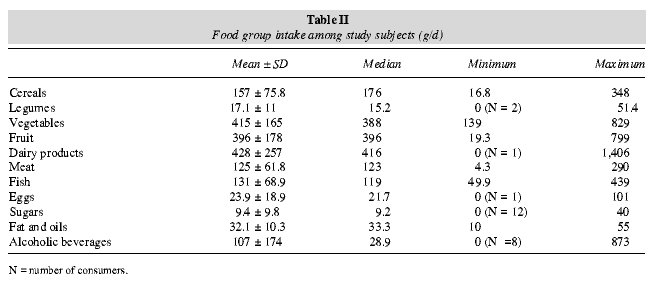
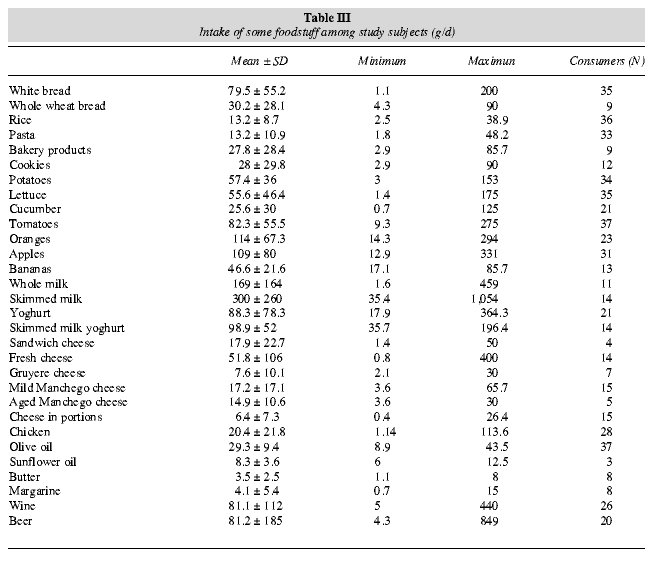
<body><![CDATA[<p>Food groups and several individual food items of special interest in the diet of postmenopausal women are presented in <a href="#t2"> tables II</a> and <a href="#t3">III</a>. Varying percentages of women did not consume any products within one or more of the following food groups: legumes, milk products, eggs, sugars and alcoholic beverages (<a href="#t2">table II</a>). </p>     <p align="center"><a name="t2"><img src="/img/nh/v20n2/original1/original1_tabla2.gif" WIDTH="658" HEIGHT="286"></a>    <br> </p>     <p align="center"><a name="t3"><img src="/img/nh/v20n2/original1/original1_tabla3.gif" WIDTH="656" HEIGHT="563"></a></p>      <p>    <br> Cereal intake was low and displayed a wide dispersion. Most of the women (N = 35) consumed white bread, which was the most consumed food within the cereal group. Only 9 women consumed whole wheat bread (<a href="#t3">table III</a>).</p>      <p>Vegetables and fruit intake was high but also varied greatly (<a href="#t2">table II</a>). Intake of fresh fruit (generally as a dessert or between-meal snack) and salads (tomato, lettuce and cucumber), was high. The fruits eaten most were oranges, apples and bananas (<a href="#t3">table III</a>). </p>      <p>The principal items in the group of dairy products were milk, primarily skimmed (36.8%), yoghurt (a maximum of 4 units per day) and a wide variety of cheeses (fresh and partially aged cheese (11% and 25% fat, respectively)) (<a href="#t3">table III</a>). One women did not consume dairy products due to lactose intolerance. Only 68.4% of the participants consumed sugars (sugar and honey).</p>      <p>Meat and fish intake were similar and presented a wide dispersion.</p>      <p>Practically all the women (37/38) used olive oil in cooking. A few of the participants used other oils such as sunflower oil or fats such as butter and margarine, but their intake was low (<a href="#t3">table III</a>).</p>      ]]></body>
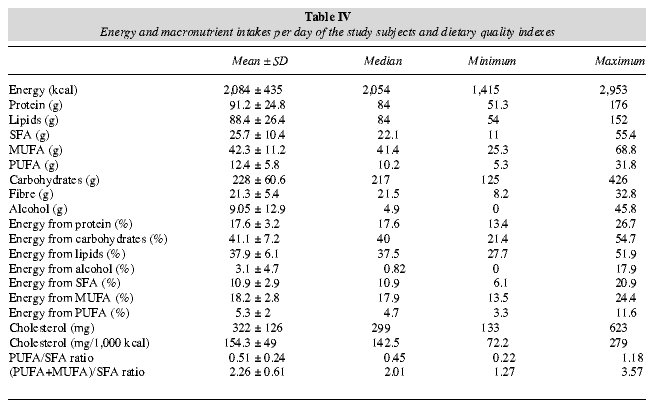
<body><![CDATA[<p>The most alcoholic beverages consumed were wine (consumed with meal) and beer (consumed between meals) (<a href="#t3">table III</a>).</p>      <p><a href="#t4">Table IV</a> shows data on intake of energy, macronutrients and cholesterol, as well as data concerning some dietary quality indexes. Mean energy intake was adequate but 25% of the sample consumed between 1,415 y 1,676 kcal/d. Most women consumed a large amount of protein and fat and therefore caloric profile showed high energy percentage from proteins and fats, and low from carbohydrates. However, fat quality judged by PUFA/SFA and PUFA + MUFA/SFA ratios was satisfactory (<a href="#t4">table IV</a>). Mean cholesterol intake was slightly over recommendations.      <p align="center"><a name="t4"><img src="/img/nh/v20n2/original1/original1_tabla4.gif" WIDTH="661" HEIGHT="412"></a></p>     <p><b>    <br> Discussion</b></p>     <p>Maintaining good nutrition is important for health   promotion and disease prevention especially among   postmenopausal women. The participants in this   study, coinciding with the findings of Montero et al.<sup>35</sup>, were conscious of their special physiological situation and tried to adapt to new dietary guidelines. Although the study of food consumption patterns is essential to detect groups at risk and apply appropriate measures to prevent certain diseases, until now, there is few data about food consumption in this group of the population available.</p>      <p>The women studied displayed a lifestyle and dietary habits that closely resemble those recommended to improve and forestall some of the consequences of the physiological changes that occur during this stage of life. These individuals maintained appropriate body weight, exercised regularly and consumed a diet very similar to the traditional Mediterranean diet considered to be a model of a healthy and adequate diet (high intake of vegetables and fruits, adequate ratios of fatty acid intake) and whose benefits have repeatedly been demonstrated<sup>36-39</sup>. In another study of this group of women, their good health status has been observed by determining cardiovascular disease risk parameters in serum and the Framingham ATP III tables<sup>40</sup>.</p>      <p>Food intake of this postmenopausal women was very heterogeneous. Vegetables, fruit and fish intake was high and a wide variety of these products was consumed. Nevertheless, coinciding with the eating habits of many western countries, potato and cereal intake was low. Dairy products, meat, poultry and eggs were only a modest part of this diet. Intake of precooked and processed products was very low.</p>      <p>The high intake of fruit and vegetables (excluding potatoes), over 750 g/d, amply exceeds present-day recommendations (&gt; 250 g/d of vegetables and &gt; 300 g/d of fruit)<sup>33,41</sup>. It also exceeded that of other similar Spanish and European population groups<sup>42,43</sup>. This plant food, particularly high in nutrient content, guarantee an adequate intake of minerals (potassium, magnesium, etc.), vitamins (antioxidants, folates, etc.), fibre, protein and a variety of potentially bioactive non-nutritive components, which may display various protective mechanisms<sup>6,38,44</sup>. High consumption of fruit and vegetables is recommended to prevent cardiovascular diseases<sup>14</sup> and osteoporosis<sup>45,46</sup>. The risk of both pathologies increases after menopause and these women appeared to be well protected.</p>      <p>Lettuce, tomatoes and cucumbers, available yearround and eaten raw in the form of salads (with an olive oil dressing), represent almost 40% of the total vegetable intake. Apples, oranges and bananas represent 68% of all fruit consumed. A high intake of fresh and/or raw products, such as was the case in this study, makes nutrients (especially folate and vitamin C) available without any loss due to the cooking process. For example, half of the vitamin C ingested, which was very high, came from fresh or/and raw foods (data not reported).</p>      ]]></body>
<body><![CDATA[<p>Cereal and derivates intake was below the values currently recommended in Spain (4-6 portions, including potatoes)<sup>33</sup>. The unfavourable caloric profile of the diet (41% of energy from carbohydrates) was mainly due to the low consumption of cereals and potatoes and the moderate legume intake. This imbalance coincides with that of the Spanish population at large<sup>30</sup>.</p>       <p>The mean legume intake was equivalent to approximately two portions a week. Greater legume consumption is recommended due to the health properties of these foods: good supply of minerals and vitamins, a very favourable type of fibre and protein, as well as its content of phytoestrogens, among others<sup>47</sup>. A higher intake of legumes, cereals and potatoes would help balance the dietary caloric profile of this group of women, improving its dietary quality.</p>      <p>The high vegetable intake resulted in a high nutrient density of this diet (data not presented). It seems that the nutrient density of the diet was not diluted by the mean sugar and honey intake, which was quite low, since these products were almost only used to sweeten coffee, milk or tea.</p>      <p>Energy obtained from fat intake was higher than recommended<sup>33</sup>, although its quality was satisfactory. Thirty-five per cent of total fat intake was from the group of fats and oils, mainly olive oil. The relatively high fat intake of these women could be partially compensated by its high quality. Most of it was from monounsaturated fatty acids (18.2% kcal). Olive oil supplied 50% of the total MUFA intake. The energy contributions of SFA and PUFA are both within the recommended values<sup>33</sup>. The British Nutrition Foundation<sup>48</sup> recommends an energy intake from PUFAs of 7.5%, while the Spanish Society of Community Nutrition, due to the high MUFA intake in Spain, recommended that PUFAs should contribute approximately 5% of the energy supplied<sup>49</sup>.</p>      <p>In addition, according to current national guidelines, the fat quality of the diet, judging from the PUFA + MUFA/SFA ratio, was satisfactory (recommended: &gt; 2.00<sup>33,50</sup>). This value is similar or higher than that found in other Mediterranean countries and thus better than that of northern European populations<sup>51</sup>. The low intake of butter, margarine and bakery products contributed to a better fat quality of the diet and to a very low ingestion of trans fatty acids (data not reported)<sup>52,53</sup>. Because fat quality was acceptable, the diet of this group of postmenopausal women could be improved by only a small reduction in fat intake and enhancing the carbohydrate rich food, as discussed before.</p>      <p>The moderate intake of meat and eggs also contributed to a better diet quality, limiting saturated fat, cholesterol and sodium consumption, especially important at this age, while ensuring sufficient intake of certain nutrients as for example zinc, iron and vitamin B<sub>12</sub>, among others. The also moderate consumption of dairy products ensured adequate calcium intake (1,007 ± 410 mg/d, data not reported). Sixty-seven percent of the calcium in the diet of these women came from dairy products, which implies high calcium bioavailibility<sup>10</sup>.</p>      <p>The average fish intake, somewhat higher than that of meat, was the main source of n-3 PUFA (EPA and DHA) and of vitamin D. Fish supplied 76% of total vitamin D intake. This intake, together with the sufficient exposure to sunlight of these women, may be enough to meet their vitamin D requirements.</p>      <p>The consumption patterns of the subjects of the present study closely correspond with those of an adequate diet. This diet supplies an adequate density of nutrients, being based on food items without the necessity of using any kind of supplements.</p>      <p>Some authors indicate the consumption of an adequate diet is generally related to other characteristics of healthy life-style such as physical exercise, nonsmoking and moderate alcohol consumption<sup>54</sup>.</p>      <p>Only three of the women smoked and alcohol intake was moderate. Thirteen per cent reported drinking more than the maximum value recommended of 30 g/day<sup>33</sup>. This moderate consumption of alcohol is considered a favourable dietary factor to prevent cardiovascular risk. According to the NRC<sup>55</sup> mean BMI was in the adequate range, while according to the SEEDO study<sup>56</sup> these women present a slight overweight. Mean waist circumference was in the adequate range<sup>57</sup>. Waist circumference and the WHR offer an estimate of intra-abdominal fat and both have been used as indicators for cardiovascular disease, diabetes, hypertension and other chronic diseases risks. In women, the reference cut-off points for risk are &gt; 88 cm for waist circumference and &gt; 0.80 for WHR<sup>14,58</sup>.</p>      ]]></body>
<body><![CDATA[<p>Current guidelines recommend at least 30 minutes of moderately vigorous activity daily, including a brisk walk<sup>59</sup>, in agreement, this group of postmenopausal women exercised regularly (including walking) and maintained body weight. This moderate physical activity and the satisfactory dietary patterns of these women can have a positive impact on the cardiovascular system<sup>60</sup> and bone density<sup>61</sup>.</p>     <p>  <b>Conclusions</b></p>     <p>Although the eating habits of the overall Spanish   population have changed in recent years and are no   longer those represented by the traditional healthy   Mediterranean diet, the diet of this group of postmenopausal women closely conformed to current nutritional guidelines. Physical activity, weight control and   intake of vegetable foods were adequate and may be   very useful to counterbalance the increased risk of several pathologies due to the hormonal changes in the   menopause period as well as other chronic diseases.</p>     <p>Nevertheless, we must recommend a decrease in the fat intake and an increased intake of cereals, legumes and potatoes in order to balance the caloric profile without adding excess calories to the diet. Participation in the Menopause Program appears to have a very positive effect in maintaining healthy habits that contribute to improving the quality of life and the health of these women.</p>     <p><b>Acknowledgement  </b></p>     <p>We thank Mª Luz Rentero, MD; Carmen Otegui, MD; Mercedes Martín-Nieto, MD and Ignacio Sánchez-Arcilla, MD from the Madrid City Council, and the study participants.</p>     <p>  <b>Source of funding</b></p>     <p>This work was supported by Vichy Catalan, SA, and a fellowship from the &quot;DAAD&quot; (Germany).</p>     <p>  <b>References </b></p>     <!-- ref --><p>1. INE (Instituto Nacional de Estadística) España en cifras. Madrid: INE; 2001.&nbsp;&nbsp;&nbsp;&nbsp;&nbsp;&nbsp;&nbsp;&nbsp;[&#160;<a href="javascript:void(0);" onclick="javascript: window.open('/scielo.php?script=sci_nlinks&ref=3458617&pid=S0212-1611200500020000600001&lng=','','width=640,height=500,resizable=yes,scrollbars=1,menubar=yes,');">Links</a>&#160;]<!-- end-ref --><!-- ref --><p>2. Keller C, Fullerton J, Fleury J. Primary and secondary prevention strategies among older postmenopausal women. <i>J Nurse Midwifery</i> 1998, 43:262-272.&nbsp;&nbsp;&nbsp;&nbsp;&nbsp;&nbsp;&nbsp;&nbsp;[&#160;<a href="javascript:void(0);" onclick="javascript: window.open('/scielo.php?script=sci_nlinks&ref=3458618&pid=S0212-1611200500020000600002&lng=','','width=640,height=500,resizable=yes,scrollbars=1,menubar=yes,');">Links</a>&#160;]<!-- end-ref --><!-- ref --><p>3. Gutherie JR, Smith MA, Dennerstein L, Morse C. Physical activity and the menopause experience a sectional study. <i>Maturitas</i> 1995, 20:7180.&nbsp;&nbsp;&nbsp;&nbsp;&nbsp;&nbsp;&nbsp;&nbsp;[&#160;<a href="javascript:void(0);" onclick="javascript: window.open('/scielo.php?script=sci_nlinks&ref=3458619&pid=S0212-1611200500020000600003&lng=','','width=640,height=500,resizable=yes,scrollbars=1,menubar=yes,');">Links</a>&#160;]<!-- end-ref --><!-- ref --><p>4. Greene J, Visser AP. Longitudinal studies. <i>Maturitas</i> 1992, 14:157-160.&nbsp;&nbsp;&nbsp;&nbsp;&nbsp;&nbsp;&nbsp;&nbsp;[&#160;<a href="javascript:void(0);" onclick="javascript: window.open('/scielo.php?script=sci_nlinks&ref=3458620&pid=S0212-1611200500020000600004&lng=','','width=640,height=500,resizable=yes,scrollbars=1,menubar=yes,');">Links</a>&#160;]<!-- end-ref --><!-- ref --><p>5. Kaufert PA, Gilbert P, Tate R. The Manitoba project. In: Reimer C, von Sydow K, ed. Psychosomatik der Menopause: Literaturüberblick 1988-1992. Stuttgart: Thieme, 1994: 225-236.&nbsp;&nbsp;&nbsp;&nbsp;&nbsp;&nbsp;&nbsp;&nbsp;[&#160;<a href="javascript:void(0);" onclick="javascript: window.open('/scielo.php?script=sci_nlinks&ref=3458621&pid=S0212-1611200500020000600005&lng=','','width=640,height=500,resizable=yes,scrollbars=1,menubar=yes,');">Links</a>&#160;]<!-- end-ref --><!-- ref --><p>6. Tucker KL, Hannan MT, Chen H, Cupples LA, Wilson PW, Kiel DP. Potassium, magnesium, and fruit and vegetable intakes are associated with greater bone mineral density in elderly men and women. <i>Am J Clin Nutr </i>1999, 69:727-736.&nbsp;&nbsp;&nbsp;&nbsp;&nbsp;&nbsp;&nbsp;&nbsp;[&#160;<a href="javascript:void(0);" onclick="javascript: window.open('/scielo.php?script=sci_nlinks&ref=3458622&pid=S0212-1611200500020000600006&lng=','','width=640,height=500,resizable=yes,scrollbars=1,menubar=yes,');">Links</a>&#160;]<!-- end-ref --><!-- ref --><p>7. NAMS (North American Menopause Society). The role of calcium in periand postmenopausal women: consensus opinion of the North American Menopause Society. <i>Menopause</i> 2001, 8:84-95.&nbsp;&nbsp;&nbsp;&nbsp;&nbsp;&nbsp;&nbsp;&nbsp;[&#160;<a href="javascript:void(0);" onclick="javascript: window.open('/scielo.php?script=sci_nlinks&ref=3458623&pid=S0212-1611200500020000600007&lng=','','width=640,height=500,resizable=yes,scrollbars=1,menubar=yes,');">Links</a>&#160;]<!-- end-ref --><!-- ref --><p>8. Brown JP, Josse RG. Clinical practice guidelines for the diagnosis and management of osteoporosis in Canada. <i>Can Med Assoc J </i>2002, 12, Supl. 10:S1-S34.&nbsp;&nbsp;&nbsp;&nbsp;&nbsp;&nbsp;&nbsp;&nbsp;[&#160;<a href="javascript:void(0);" onclick="javascript: window.open('/scielo.php?script=sci_nlinks&ref=3458624&pid=S0212-1611200500020000600008&lng=','','width=640,height=500,resizable=yes,scrollbars=1,menubar=yes,');">Links</a>&#160;]<!-- end-ref --><!-- ref --><p>9. Sclavo M. Physical Activity and risk for cardiovascular events in diabetic women. <i>Ital Heart J</i> 2001, 2:563-565.&nbsp;&nbsp;&nbsp;&nbsp;&nbsp;&nbsp;&nbsp;&nbsp;[&#160;<a href="javascript:void(0);" onclick="javascript: window.open('/scielo.php?script=sci_nlinks&ref=3458625&pid=S0212-1611200500020000600009&lng=','','width=640,height=500,resizable=yes,scrollbars=1,menubar=yes,');">Links</a>&#160;]<!-- end-ref --><!-- ref --><p>10. Vaquero MP. Nutrición y enfermedades metabólicas del hueso. En: La alimentación y la nutrición en el siglo XXI. Madrid: Fundesforsa; 2002: 211-225.&nbsp;&nbsp;&nbsp;&nbsp;&nbsp;&nbsp;&nbsp;&nbsp;[&#160;<a href="javascript:void(0);" onclick="javascript: window.open('/scielo.php?script=sci_nlinks&ref=3458626&pid=S0212-1611200500020000600010&lng=','','width=640,height=500,resizable=yes,scrollbars=1,menubar=yes,');">Links</a>&#160;]<!-- end-ref --><!-- ref --><p>11. Poehlman ET, Toth MF, Ades PA, Rosen CJ. Menopause-associated changes in plasma lipids, insulin like growth factor I and blood pressure: a longitudinal study. <i>Eur J Clin Invest </i>1997, 4:322-326.&nbsp;&nbsp;&nbsp;&nbsp;&nbsp;&nbsp;&nbsp;&nbsp;[&#160;<a href="javascript:void(0);" onclick="javascript: window.open('/scielo.php?script=sci_nlinks&ref=3458627&pid=S0212-1611200500020000600011&lng=','','width=640,height=500,resizable=yes,scrollbars=1,menubar=yes,');">Links</a>&#160;]<!-- end-ref --><!-- ref --><p>12. Hak AE, Polderman KH, Westendorp IC et al. Increased plasma homocysteine after menopause. <i>Atherosclerosis</i> 2000, 149:163-168.&nbsp;&nbsp;&nbsp;&nbsp;&nbsp;&nbsp;&nbsp;&nbsp;[&#160;<a href="javascript:void(0);" onclick="javascript: window.open('/scielo.php?script=sci_nlinks&ref=3458628&pid=S0212-1611200500020000600012&lng=','','width=640,height=500,resizable=yes,scrollbars=1,menubar=yes,');">Links</a>&#160;]<!-- end-ref --><!-- ref --><p>13. Hall G, Collins A, Csemiczky G, Landgren BM. Lipoproteins and BMI: a comparison between women during transition to menopause and regularly menstruating healthy women. <i>Maturitas</i> 2002, 41:177-185.&nbsp;&nbsp;&nbsp;&nbsp;&nbsp;&nbsp;&nbsp;&nbsp;[&#160;<a href="javascript:void(0);" onclick="javascript: window.open('/scielo.php?script=sci_nlinks&ref=3458629&pid=S0212-1611200500020000600013&lng=','','width=640,height=500,resizable=yes,scrollbars=1,menubar=yes,');">Links</a>&#160;]<!-- end-ref --><!-- ref --><p>14. Krauss RM, Eckel RH, Howard B et al. AHA Dietary Guidelines: revision 2000: a statement for healthcare professionals from the Nutrition Committee of the American Heart Association. <i>Circulation</i> 2000, 102:2284-2299.&nbsp;&nbsp;&nbsp;&nbsp;&nbsp;&nbsp;&nbsp;&nbsp;[&#160;<a href="javascript:void(0);" onclick="javascript: window.open('/scielo.php?script=sci_nlinks&ref=3458630&pid=S0212-1611200500020000600014&lng=','','width=640,height=500,resizable=yes,scrollbars=1,menubar=yes,');">Links</a>&#160;]<!-- end-ref --><!-- ref --><p>15. Poehlman ET, Toth MJ, Gardner AW. Changes in energy balance and body composition at menopause: a controlled longitudinal study. <i>Ann Intern Med</i> 1995, 123:673-675.&nbsp;&nbsp;&nbsp;&nbsp;&nbsp;&nbsp;&nbsp;&nbsp;[&#160;<a href="javascript:void(0);" onclick="javascript: window.open('/scielo.php?script=sci_nlinks&ref=3458631&pid=S0212-1611200500020000600015&lng=','','width=640,height=500,resizable=yes,scrollbars=1,menubar=yes,');">Links</a>&#160;]<!-- end-ref --><!-- ref --><p>16. Milewicz A, Tworowska U, Demissie M. Menopausal obesity&#x2013;myth or fact? Climacteric: <i>J Int Menopause Soc</i> 2001, 4:273-283.&nbsp;&nbsp;&nbsp;&nbsp;&nbsp;&nbsp;&nbsp;&nbsp;[&#160;<a href="javascript:void(0);" onclick="javascript: window.open('/scielo.php?script=sci_nlinks&ref=3458632&pid=S0212-1611200500020000600016&lng=','','width=640,height=500,resizable=yes,scrollbars=1,menubar=yes,');">Links</a>&#160;]<!-- end-ref --><!-- ref --><p>17. Garaulet M, Pérez-Llamas F, Zamora S, Tébar FJ. Comparative study of the type of obesity in preand postmenopausal women: relationship with fat cell data, fatty acid composition and endocrine, metabolic, nutritional and psychological variables. <i>Medicina Clínica</i> 2002, 118:281-286.&nbsp;&nbsp;&nbsp;&nbsp;&nbsp;&nbsp;&nbsp;&nbsp;[&#160;<a href="javascript:void(0);" onclick="javascript: window.open('/scielo.php?script=sci_nlinks&ref=3458633&pid=S0212-1611200500020000600017&lng=','','width=640,height=500,resizable=yes,scrollbars=1,menubar=yes,');">Links</a>&#160;]<!-- end-ref --><!-- ref --><p>18. Wang Q, Hassager C, Ravn P, Wang S, Christiansen C. Total and regional body composition changes in early postmenopausal women: age-related or menopause-related? <i>Am J Clin Nutr </i>1994, 60:843-848.&nbsp;&nbsp;&nbsp;&nbsp;&nbsp;&nbsp;&nbsp;&nbsp;[&#160;<a href="javascript:void(0);" onclick="javascript: window.open('/scielo.php?script=sci_nlinks&ref=3458634&pid=S0212-1611200500020000600018&lng=','','width=640,height=500,resizable=yes,scrollbars=1,menubar=yes,');">Links</a>&#160;]<!-- end-ref --><!-- ref --><p>19. Milewicz A, Bidzinska B, Mikulski E, Demissie M, Tworowska U. Influence of obesity and menopausal status on serum leptin, cholecystokinin, galanin and neuropeptide Y levels. <i>Gynecol Endocrinol</i> 2000, 14:196-203.&nbsp;&nbsp;&nbsp;&nbsp;&nbsp;&nbsp;&nbsp;&nbsp;[&#160;<a href="javascript:void(0);" onclick="javascript: window.open('/scielo.php?script=sci_nlinks&ref=3458635&pid=S0212-1611200500020000600019&lng=','','width=640,height=500,resizable=yes,scrollbars=1,menubar=yes,');">Links</a>&#160;]<!-- end-ref --><!-- ref --><p>20. Blümel JE, Castelo-Branco C, Rocangliolo ME, Bifa L, Tacla X, Mamni L. Changes in body mass index around menopause: a population study of Chilean women. <i>Menopause</i> 2001, 8:239-244.&nbsp;&nbsp;&nbsp;&nbsp;&nbsp;&nbsp;&nbsp;&nbsp;[&#160;<a href="javascript:void(0);" onclick="javascript: window.open('/scielo.php?script=sci_nlinks&ref=3458636&pid=S0212-1611200500020000600020&lng=','','width=640,height=500,resizable=yes,scrollbars=1,menubar=yes,');">Links</a>&#160;]<!-- end-ref --><!-- ref --><p>21. Anderson JJB, Sjöberg HE. Dietary calcium and bone health in the elderly: uncertainties about recommendations. <i>Nutr Rev </i>2001, 21:263-268.&nbsp;&nbsp;&nbsp;&nbsp;&nbsp;&nbsp;&nbsp;&nbsp;[&#160;<a href="javascript:void(0);" onclick="javascript: window.open('/scielo.php?script=sci_nlinks&ref=3458637&pid=S0212-1611200500020000600021&lng=','','width=640,height=500,resizable=yes,scrollbars=1,menubar=yes,');">Links</a>&#160;]<!-- end-ref --><!-- ref --><p>22. Owens JF, Matthews KA, Raikkonen K, Kuller LH. It is never too late: change in physical activity fosters change in cardiovascular risk factors in middle aged women. <i>Prev Cardiol </i>2003, 6:22-28.&nbsp;&nbsp;&nbsp;&nbsp;&nbsp;&nbsp;&nbsp;&nbsp;[&#160;<a href="javascript:void(0);" onclick="javascript: window.open('/scielo.php?script=sci_nlinks&ref=3458638&pid=S0212-1611200500020000600022&lng=','','width=640,height=500,resizable=yes,scrollbars=1,menubar=yes,');">Links</a>&#160;]<!-- end-ref --><!-- ref --><p>23. Bittner V. Women and coronary heart disease risk factors. <i>J Cardiol Risk</i> 2002, 9:315-322.&nbsp;&nbsp;&nbsp;&nbsp;&nbsp;&nbsp;&nbsp;&nbsp;[&#160;<a href="javascript:void(0);" onclick="javascript: window.open('/scielo.php?script=sci_nlinks&ref=3458639&pid=S0212-1611200500020000600023&lng=','','width=640,height=500,resizable=yes,scrollbars=1,menubar=yes,');">Links</a>&#160;]<!-- end-ref --><!-- ref --><p>24. O'Brian Cousins S, Edwards K. Alice in menopause-land: the jabberwocky of medicalised middle age. <i>Health Care Women </i>Int 2002, 23:325-343.&nbsp;&nbsp;&nbsp;&nbsp;&nbsp;&nbsp;&nbsp;&nbsp;[&#160;<a href="javascript:void(0);" onclick="javascript: window.open('/scielo.php?script=sci_nlinks&ref=3458640&pid=S0212-1611200500020000600024&lng=','','width=640,height=500,resizable=yes,scrollbars=1,menubar=yes,');">Links</a>&#160;]<!-- end-ref --><!-- ref --><p>25. Vidal MC, Farré R. Anthropometric assessment of nutritional status and estimate of iron and vitamin C intake in postmenopausal women and men over 45 years of age. <i>Nutr Hosp</i> 2001, 16:162-169.&nbsp;&nbsp;&nbsp;&nbsp;&nbsp;&nbsp;&nbsp;&nbsp;[&#160;<a href="javascript:void(0);" onclick="javascript: window.open('/scielo.php?script=sci_nlinks&ref=3458641&pid=S0212-1611200500020000600025&lng=','','width=640,height=500,resizable=yes,scrollbars=1,menubar=yes,');">Links</a>&#160;]<!-- end-ref --><!-- ref --><p>26. Rico H, Canal ML, Mañas P, Lavado JM, Costa C, Pedrera JD. Effects of caffeine, vitamin D, and other nutrients on quantitative phalangeal bone ultrasound in postmenopausal women. <i>Nutrition</i> 2002, 18:189-193.&nbsp;&nbsp;&nbsp;&nbsp;&nbsp;&nbsp;&nbsp;&nbsp;[&#160;<a href="javascript:void(0);" onclick="javascript: window.open('/scielo.php?script=sci_nlinks&ref=3458642&pid=S0212-1611200500020000600026&lng=','','width=640,height=500,resizable=yes,scrollbars=1,menubar=yes,');">Links</a>&#160;]<!-- end-ref --><!-- ref --><p>27. WHO. World Health Report. Reducing Risks, Promoting Healthy Life. Geneva: World Health Organization; 2002.&nbsp;&nbsp;&nbsp;&nbsp;&nbsp;&nbsp;&nbsp;&nbsp;[&#160;<a href="javascript:void(0);" onclick="javascript: window.open('/scielo.php?script=sci_nlinks&ref=3458643&pid=S0212-1611200500020000600027&lng=','','width=640,height=500,resizable=yes,scrollbars=1,menubar=yes,');">Links</a>&#160;]<!-- end-ref --><!-- ref --><p>28. Cameron ME, van Staveren WA. Manual of methodology for food consumption surveys. Oxford: Oxford University Press; 1988.&nbsp;&nbsp;&nbsp;&nbsp;&nbsp;&nbsp;&nbsp;&nbsp;[&#160;<a href="javascript:void(0);" onclick="javascript: window.open('/scielo.php?script=sci_nlinks&ref=3458644&pid=S0212-1611200500020000600028&lng=','','width=640,height=500,resizable=yes,scrollbars=1,menubar=yes,');">Links</a>&#160;]<!-- end-ref --><!-- ref --><p>29. Varela G, Moreiras O, Carbajal A, Campo M. Estudio Nacional de Nutrición y Alimentación 1991. Encuesta de Presupuestos Familiares 1990/91. Tomo I. Madrid: INE; 1995.&nbsp;&nbsp;&nbsp;&nbsp;&nbsp;&nbsp;&nbsp;&nbsp;[&#160;<a href="javascript:void(0);" onclick="javascript: window.open('/scielo.php?script=sci_nlinks&ref=3458645&pid=S0212-1611200500020000600029&lng=','','width=640,height=500,resizable=yes,scrollbars=1,menubar=yes,');">Links</a>&#160;]<!-- end-ref --><!-- ref --><p>30. Abbott M (ed). Portion photos of popular foods. The American Dietetic Association and Center for Nutrition Education. University of Wisconsin. Stout: 1997.&nbsp;&nbsp;&nbsp;&nbsp;&nbsp;&nbsp;&nbsp;&nbsp;[&#160;<a href="javascript:void(0);" onclick="javascript: window.open('/scielo.php?script=sci_nlinks&ref=3458646&pid=S0212-1611200500020000600030&lng=','','width=640,height=500,resizable=yes,scrollbars=1,menubar=yes,');">Links</a>&#160;]<!-- end-ref --><!-- ref --><p>31. Moreiras O, Carbajal A, Cabrera L, Cuadrado C. Tablas de composición de alimentos. Madrid: Ediciones Pirámide; 2003.&nbsp;&nbsp;&nbsp;&nbsp;&nbsp;&nbsp;&nbsp;&nbsp;[&#160;<a href="javascript:void(0);" onclick="javascript: window.open('/scielo.php?script=sci_nlinks&ref=3458647&pid=S0212-1611200500020000600031&lng=','','width=640,height=500,resizable=yes,scrollbars=1,menubar=yes,');">Links</a>&#160;]<!-- end-ref --><!-- ref --><p>32. Moreiras O, Carbajal A, Cabrera L, Cuadrado C. Ingestas recomendadas para la población española. En: Departamento de Nutrición, UCM, ed. Tablas de composición de alimentos. Madrid: Ediciones Pirámide; 2003.&nbsp;&nbsp;&nbsp;&nbsp;&nbsp;&nbsp;&nbsp;&nbsp;[&#160;<a href="javascript:void(0);" onclick="javascript: window.open('/scielo.php?script=sci_nlinks&ref=3458648&pid=S0212-1611200500020000600032&lng=','','width=640,height=500,resizable=yes,scrollbars=1,menubar=yes,');">Links</a>&#160;]<!-- end-ref --><!-- ref --><p>33. Aranceta J, Serra-Majem Ll. Estructura general de las guías alimentarias para la población española. Decálogo para una dieta saludable. En: Sociedad Española de Nutrición Comunitaria, ed. Guías alimentarias para la población española. Madrid: IM&amp;C, 2001:183-194.&nbsp;&nbsp;&nbsp;&nbsp;&nbsp;&nbsp;&nbsp;&nbsp;[&#160;<a href="javascript:void(0);" onclick="javascript: window.open('/scielo.php?script=sci_nlinks&ref=3458649&pid=S0212-1611200500020000600033&lng=','','width=640,height=500,resizable=yes,scrollbars=1,menubar=yes,');">Links</a>&#160;]<!-- end-ref --><!-- ref --><p>34. NRC (National Research Council). Recommended Dietary Allowances. Washington DC: National Academy Press; 1989.&nbsp;&nbsp;&nbsp;&nbsp;&nbsp;&nbsp;&nbsp;&nbsp;[&#160;<a href="javascript:void(0);" onclick="javascript: window.open('/scielo.php?script=sci_nlinks&ref=3458650&pid=S0212-1611200500020000600034&lng=','','width=640,height=500,resizable=yes,scrollbars=1,menubar=yes,');">Links</a>&#160;]<!-- end-ref --><!-- ref --><p>35. Montero P, Bernis C, Varea C, Arias S. Hábitos alimentarios en mujeres: frecuencia de consumo de alimentos y valoración del cambio en el comportamiento alimentario. <i>Atención primaria</i> 1999, 23:127-131.&nbsp;&nbsp;&nbsp;&nbsp;&nbsp;&nbsp;&nbsp;&nbsp;[&#160;<a href="javascript:void(0);" onclick="javascript: window.open('/scielo.php?script=sci_nlinks&ref=3458651&pid=S0212-1611200500020000600035&lng=','','width=640,height=500,resizable=yes,scrollbars=1,menubar=yes,');">Links</a>&#160;]<!-- end-ref --><!-- ref --><p>36. Carbajal A, Ortega RM. La dieta mediterránea como modelo de dieta prudente y saludable. <i>Rev Chil Nutr</i> 2001, 28:224-236.&nbsp;&nbsp;&nbsp;&nbsp;&nbsp;&nbsp;&nbsp;&nbsp;[&#160;<a href="javascript:void(0);" onclick="javascript: window.open('/scielo.php?script=sci_nlinks&ref=3458652&pid=S0212-1611200500020000600036&lng=','','width=640,height=500,resizable=yes,scrollbars=1,menubar=yes,');">Links</a>&#160;]<!-- end-ref --><!-- ref --><p>37. Trichopoulou A, Lagiou P. Healthy traditional Mediterranean diet: an expression of culture, history and lifestyle. <i>Nutr Rev </i>1997, 55:383-389.&nbsp;&nbsp;&nbsp;&nbsp;&nbsp;&nbsp;&nbsp;&nbsp;[&#160;<a href="javascript:void(0);" onclick="javascript: window.open('/scielo.php?script=sci_nlinks&ref=3458653&pid=S0212-1611200500020000600037&lng=','','width=640,height=500,resizable=yes,scrollbars=1,menubar=yes,');">Links</a>&#160;]<!-- end-ref --><!-- ref --><p>38. Kushi LE, Lenart EB, Willett WC. Heath implications of Mediterranean diets in the light of contemporary knowledge I. Plant foods and dairy products. II. Meat, wine, fats and oils. <i>Am J Clin Nutr </i>1995, 5(Supl. 6):S1407-S1415 and S1416S1427.&nbsp;&nbsp;&nbsp;&nbsp;&nbsp;&nbsp;&nbsp;&nbsp;[&#160;<a href="javascript:void(0);" onclick="javascript: window.open('/scielo.php?script=sci_nlinks&ref=3458654&pid=S0212-1611200500020000600038&lng=','','width=640,height=500,resizable=yes,scrollbars=1,menubar=yes,');">Links</a>&#160;]<!-- end-ref --><!-- ref --><p>39. Willett WC, Sacks F, Trichopoulou A et al. Mediterranean diet pyramid: a cultural model for healthy eating. <i>Am J Clin Nutr </i>1995, 61(Supl. 6):S1402-S1406.&nbsp;&nbsp;&nbsp;&nbsp;&nbsp;&nbsp;&nbsp;&nbsp;[&#160;<a href="javascript:void(0);" onclick="javascript: window.open('/scielo.php?script=sci_nlinks&ref=3458655&pid=S0212-1611200500020000600039&lng=','','width=640,height=500,resizable=yes,scrollbars=1,menubar=yes,');">Links</a>&#160;]<!-- end-ref --><!-- ref --><p>40. Schoppen S, Pérez-Granados AM, Carbajal A, Oubiña P, Sánchez-Muniz FJ, Gómez-Gerique JA, Vaquero MP. A SodiumRich Carbonated Mineral Water Reduces Cardiovascular Risk in Postmenopausal Women.<i> J Nutr</i> 2004: 1058-1063.&nbsp;&nbsp;&nbsp;&nbsp;&nbsp;&nbsp;&nbsp;&nbsp;[&#160;<a href="javascript:void(0);" onclick="javascript: window.open('/scielo.php?script=sci_nlinks&ref=3458656&pid=S0212-1611200500020000600040&lng=','','width=640,height=500,resizable=yes,scrollbars=1,menubar=yes,');">Links</a>&#160;]<!-- end-ref --><!-- ref --><p>41. Williams C. Healthy eating: clarifying advice about fruit and vegetables. <i>Brit Med J</i> 1995, 310:1453-1455.&nbsp;&nbsp;&nbsp;&nbsp;&nbsp;&nbsp;&nbsp;&nbsp;[&#160;<a href="javascript:void(0);" onclick="javascript: window.open('/scielo.php?script=sci_nlinks&ref=3458657&pid=S0212-1611200500020000600041&lng=','','width=640,height=500,resizable=yes,scrollbars=1,menubar=yes,');">Links</a>&#160;]<!-- end-ref --><!-- ref --><p>42. Agudo A, Amiano P, Barcos A et al. Dietary intake of vegetables and fruits among adults in five regions of Spain. EPIC Group of Spain. European Prospective Investigation into Cancer and Nutrition. <i>Eur J Clin Nutr</i> 1999, 53:174-180.&nbsp;&nbsp;&nbsp;&nbsp;&nbsp;&nbsp;&nbsp;&nbsp;[&#160;<a href="javascript:void(0);" onclick="javascript: window.open('/scielo.php?script=sci_nlinks&ref=3458658&pid=S0212-1611200500020000600042&lng=','','width=640,height=500,resizable=yes,scrollbars=1,menubar=yes,');">Links</a>&#160;]<!-- end-ref --><!-- ref --><p>43. Schroll K, Carbajal A, Decarli B et al. Food patterns of elderly Europeans. <i>Eur J Clin Nutr</i> 1996, 50(Supl. 2):S86-S100.&nbsp;&nbsp;&nbsp;&nbsp;&nbsp;&nbsp;&nbsp;&nbsp;[&#160;<a href="javascript:void(0);" onclick="javascript: window.open('/scielo.php?script=sci_nlinks&ref=3458659&pid=S0212-1611200500020000600043&lng=','','width=640,height=500,resizable=yes,scrollbars=1,menubar=yes,');">Links</a>&#160;]<!-- end-ref --><!-- ref --><p>44. Ness AR, Powles JW. Fruit and vegetables and cardiovascular disease: a review. <i>Int J Epidemiol</i> 1997, 26:1-13.&nbsp;&nbsp;&nbsp;&nbsp;&nbsp;&nbsp;&nbsp;&nbsp;[&#160;<a href="javascript:void(0);" onclick="javascript: window.open('/scielo.php?script=sci_nlinks&ref=3458660&pid=S0212-1611200500020000600044&lng=','','width=640,height=500,resizable=yes,scrollbars=1,menubar=yes,');">Links</a>&#160;]<!-- end-ref --><!-- ref --><p>45. New SA. Nutrition Society Medal Lecture. The role of the skeleton in acid-base homeostasis. <i>Proc Nutr Soc</i> 2002, 61:151-64.&nbsp;&nbsp;&nbsp;&nbsp;&nbsp;&nbsp;&nbsp;&nbsp;[&#160;<a href="javascript:void(0);" onclick="javascript: window.open('/scielo.php?script=sci_nlinks&ref=3458661&pid=S0212-1611200500020000600045&lng=','','width=640,height=500,resizable=yes,scrollbars=1,menubar=yes,');">Links</a>&#160;]<!-- end-ref --><!-- ref --><p>46. Tucker KL, Hannan MT, Kiel DP. The acid-base hypothesis: diet and bone in the Framingham Study. <i>Eur J Nutr</i> 2001, 40:231-237.&nbsp;&nbsp;&nbsp;&nbsp;&nbsp;&nbsp;&nbsp;&nbsp;[&#160;<a href="javascript:void(0);" onclick="javascript: window.open('/scielo.php?script=sci_nlinks&ref=3458662&pid=S0212-1611200500020000600046&lng=','','width=640,height=500,resizable=yes,scrollbars=1,menubar=yes,');">Links</a>&#160;]<!-- end-ref --><!-- ref --><p>47. Messina MJ. Legumes and soybeans: overview of their nutritional profiles and health effects. <i>Am J Clin Nutr</i> 1999, 70/Supl. 3:S439-S450.&nbsp;&nbsp;&nbsp;&nbsp;&nbsp;&nbsp;&nbsp;&nbsp;[&#160;<a href="javascript:void(0);" onclick="javascript: window.open('/scielo.php?script=sci_nlinks&ref=3458663&pid=S0212-1611200500020000600047&lng=','','width=640,height=500,resizable=yes,scrollbars=1,menubar=yes,');">Links</a>&#160;]<!-- end-ref --><!-- ref --><p>48. British Nutrition Foundation. Unsaturated fatty acids: nutritional and physiological significance: the report of the British Nutrition Foundation's task force. London: Chapman & Hall; 1992.&nbsp;&nbsp;&nbsp;&nbsp;&nbsp;&nbsp;&nbsp;&nbsp;[&#160;<a href="javascript:void(0);" onclick="javascript: window.open('/scielo.php?script=sci_nlinks&ref=3458664&pid=S0212-1611200500020000600048&lng=','','width=640,height=500,resizable=yes,scrollbars=1,menubar=yes,');">Links</a>&#160;]<!-- end-ref --><!-- ref --><p>49. Serra-Majem Ll, Aranceta J. Objetivos nutricionales para la población española. Consenso de la Sociedad Española de Nutrición Comunitaria. Guías alimentarias para la población Española. Madrid: SENC. IM & C; 2001.&nbsp;&nbsp;&nbsp;&nbsp;&nbsp;&nbsp;&nbsp;&nbsp;[&#160;<a href="javascript:void(0);" onclick="javascript: window.open('/scielo.php?script=sci_nlinks&ref=3458665&pid=S0212-1611200500020000600049&lng=','','width=640,height=500,resizable=yes,scrollbars=1,menubar=yes,');">Links</a>&#160;]<!-- end-ref --><!-- ref --><p>50. Carbajal A, Sánchez-Muniz F. Valoración de la calidad nutricional de una dieta. Guía de Prácticas. En: García-Arias MT, García-Fernández MC. Eds. Nutrición y Dietética. León: Universidad de León; 2003: 61a-67a.&nbsp;&nbsp;&nbsp;&nbsp;&nbsp;&nbsp;&nbsp;&nbsp;[&#160;<a href="javascript:void(0);" onclick="javascript: window.open('/scielo.php?script=sci_nlinks&ref=3458666&pid=S0212-1611200500020000600050&lng=','','width=640,height=500,resizable=yes,scrollbars=1,menubar=yes,');">Links</a>&#160;]<!-- end-ref --><!-- ref --><p>51. Moreiras O, van Staveren WA, Amorim Cruz JA, Nes M, Lund-Larsen K. Intake of energy and nutrients. Euronut-SENECA. Nutrition and the elderly in Europe. <i>Eur J Clin Nutr </i>1991, 45:105-119.&nbsp;&nbsp;&nbsp;&nbsp;&nbsp;&nbsp;&nbsp;&nbsp;[&#160;<a href="javascript:void(0);" onclick="javascript: window.open('/scielo.php?script=sci_nlinks&ref=3458667&pid=S0212-1611200500020000600051&lng=','','width=640,height=500,resizable=yes,scrollbars=1,menubar=yes,');">Links</a>&#160;]<!-- end-ref --><!-- ref --><p>52. Van de Vijver LP, Kardinaal AF, Couet C et al. Association between trans fatty acid intake and cardiovascular risk factors in Europe: the TRANSFAIR study. <i>Eur J Clin Nutr </i>2000, 54:126-135.&nbsp;&nbsp;&nbsp;&nbsp;&nbsp;&nbsp;&nbsp;&nbsp;[&#160;<a href="javascript:void(0);" onclick="javascript: window.open('/scielo.php?script=sci_nlinks&ref=3458668&pid=S0212-1611200500020000600052&lng=','','width=640,height=500,resizable=yes,scrollbars=1,menubar=yes,');">Links</a>&#160;]<!-- end-ref --><!-- ref --><p>53. Carbajal A, Cuadrado C, Núñez C, Beltrán B, Toledano G, Moreiras O. Estudio TRANSFAIR. II. Ingesta de ácidos grasos - cis y trans-  a través de la dieta total en España. <i>Clin Invest Arteriosclerosis </i>2000, 12:256-262.&nbsp;&nbsp;&nbsp;&nbsp;&nbsp;&nbsp;&nbsp;&nbsp;[&#160;<a href="javascript:void(0);" onclick="javascript: window.open('/scielo.php?script=sci_nlinks&ref=3458669&pid=S0212-1611200500020000600053&lng=','','width=640,height=500,resizable=yes,scrollbars=1,menubar=yes,');">Links</a>&#160;]<!-- end-ref --><!-- ref --><p>54. Jacques PF, Tucker KL. Are dietary patterns useful for understanding the role of diet in chronic disease? <i>Am J Clin Nutr </i>2001, 73:1-2.&nbsp;&nbsp;&nbsp;&nbsp;&nbsp;&nbsp;&nbsp;&nbsp;[&#160;<a href="javascript:void(0);" onclick="javascript: window.open('/scielo.php?script=sci_nlinks&ref=3458670&pid=S0212-1611200500020000600054&lng=','','width=640,height=500,resizable=yes,scrollbars=1,menubar=yes,');">Links</a>&#160;]<!-- end-ref --><!-- ref --><p>55. NRC (National Research Council). Diet and health. Implications for reducing chronic disease risk. Report of the Committee on Diet and Health, Food and Nutrition Board, Commission of Life Sciences. Washington DC: National Academy Press; 1989.&nbsp;&nbsp;&nbsp;&nbsp;&nbsp;&nbsp;&nbsp;&nbsp;[&#160;<a href="javascript:void(0);" onclick="javascript: window.open('/scielo.php?script=sci_nlinks&ref=3458671&pid=S0212-1611200500020000600055&lng=','','width=640,height=500,resizable=yes,scrollbars=1,menubar=yes,');">Links</a>&#160;]<!-- end-ref --><!-- ref --><p>56. SEEDO (Sociedad Española para el Estudio de la Obesidad). Consenso SEEDO 2000 para la evaluación del sobrepeso y la obesidad y el establecimiento de criterios de intervención terapéutica. <i>Med Clin</i> (Barc) 2000, 115:587-597.&nbsp;&nbsp;&nbsp;&nbsp;&nbsp;&nbsp;&nbsp;&nbsp;[&#160;<a href="javascript:void(0);" onclick="javascript: window.open('/scielo.php?script=sci_nlinks&ref=3458672&pid=S0212-1611200500020000600056&lng=','','width=640,height=500,resizable=yes,scrollbars=1,menubar=yes,');">Links</a>&#160;]<!-- end-ref --><!-- ref --><p>57. Obesidad y riesgo cardiovascular. Documento consensuado. Available at: http://www.searteriosclerosis.org/recomendaciones/monografico_obesidad.pdf. Accessed May 23, 2003.&nbsp;&nbsp;&nbsp;&nbsp;&nbsp;&nbsp;&nbsp;&nbsp;[&#160;<a href="javascript:void(0);" onclick="javascript: window.open('/scielo.php?script=sci_nlinks&ref=3458673&pid=S0212-1611200500020000600057&lng=','','width=640,height=500,resizable=yes,scrollbars=1,menubar=yes,');">Links</a>&#160;]<!-- end-ref --><!-- ref --><p>58. WHO. Expert Committee on Physical Status Physical status: the use and interpretation of anthropometry: report of a WHO expert committee. WHO Technical Report Series 854. Geneva: World Health Organization; 1995.&nbsp;&nbsp;&nbsp;&nbsp;&nbsp;&nbsp;&nbsp;&nbsp;[&#160;<a href="javascript:void(0);" onclick="javascript: window.open('/scielo.php?script=sci_nlinks&ref=3458674&pid=S0212-1611200500020000600058&lng=','','width=640,height=500,resizable=yes,scrollbars=1,menubar=yes,');">Links</a>&#160;]<!-- end-ref --><!-- ref --><p>59. WHO. Diet, Nutrition and the prevention of chronic diseases. Joint FAO/WHO Expert Consultation. WHO Technical Report Series 916. Geneva: World Health Organisation; 2003.&nbsp;&nbsp;&nbsp;&nbsp;&nbsp;&nbsp;&nbsp;&nbsp;[&#160;<a href="javascript:void(0);" onclick="javascript: window.open('/scielo.php?script=sci_nlinks&ref=3458675&pid=S0212-1611200500020000600059&lng=','','width=640,height=500,resizable=yes,scrollbars=1,menubar=yes,');">Links</a>&#160;]<!-- end-ref --><!-- ref --><p>60. Wang J, Weaver M, DuBose KD, Kirtland KA, Ainsworth BE. Participation in physical activity to lower the risk of heart disease or stroke. <i>J S C Med Assoc </i>2002, 98:313-315.&nbsp;&nbsp;&nbsp;&nbsp;&nbsp;&nbsp;&nbsp;&nbsp;[&#160;<a href="javascript:void(0);" onclick="javascript: window.open('/scielo.php?script=sci_nlinks&ref=3458676&pid=S0212-1611200500020000600060&lng=','','width=640,height=500,resizable=yes,scrollbars=1,menubar=yes,');">Links</a>&#160;]<!-- end-ref --><!-- ref --><p>61. Lewis RD, Modlesky CM. Nutrition, physical activity and bone health in women. <i>Int J Sport Nutr </i>1998, 8:250-284.&nbsp;&nbsp;&nbsp;&nbsp;&nbsp;&nbsp;&nbsp;&nbsp;[&#160;<a href="javascript:void(0);" onclick="javascript: window.open('/scielo.php?script=sci_nlinks&ref=3458677&pid=S0212-1611200500020000600061&lng=','','width=640,height=500,resizable=yes,scrollbars=1,menubar=yes,');">Links</a>&#160;]<!-- end-ref --> ]]></body><back>
<ref-list>
<ref id="B1">
<label>1</label><nlm-citation citation-type="book">
<collab>Instituto Nacional de Estadística</collab>
<source><![CDATA[España en cifras]]></source>
<year>2001</year>
<publisher-loc><![CDATA[Madrid ]]></publisher-loc>
<publisher-name><![CDATA[INE]]></publisher-name>
</nlm-citation>
</ref>
<ref id="B2">
<label>2</label><nlm-citation citation-type="journal">
<person-group person-group-type="author">
<name>
<surname><![CDATA[Keller]]></surname>
<given-names><![CDATA[C]]></given-names>
</name>
<name>
<surname><![CDATA[Fullerton]]></surname>
<given-names><![CDATA[J]]></given-names>
</name>
<name>
<surname><![CDATA[Fleury]]></surname>
<given-names><![CDATA[J]]></given-names>
</name>
</person-group>
<article-title xml:lang="en"><![CDATA[Primary and secondary prevention strategies among older postmenopausal women]]></article-title>
<source><![CDATA[J Nurse Midwifery]]></source>
<year>1998</year>
<volume>43</volume>
<page-range>262-272</page-range></nlm-citation>
</ref>
<ref id="B3">
<label>3</label><nlm-citation citation-type="journal">
<person-group person-group-type="author">
<name>
<surname><![CDATA[Gutherie]]></surname>
<given-names><![CDATA[JR]]></given-names>
</name>
<name>
<surname><![CDATA[Smith]]></surname>
<given-names><![CDATA[MA]]></given-names>
</name>
<name>
<surname><![CDATA[Dennerstein]]></surname>
<given-names><![CDATA[L]]></given-names>
</name>
<name>
<surname><![CDATA[Morse]]></surname>
<given-names><![CDATA[C]]></given-names>
</name>
</person-group>
<article-title xml:lang="en"><![CDATA[Physical activity and the menopause experience a sectional study]]></article-title>
<source><![CDATA[Maturitas]]></source>
<year>1995</year>
<volume>20</volume>
<page-range>7180</page-range></nlm-citation>
</ref>
<ref id="B4">
<label>4</label><nlm-citation citation-type="journal">
<person-group person-group-type="author">
<name>
<surname><![CDATA[Greene]]></surname>
<given-names><![CDATA[J]]></given-names>
</name>
<name>
<surname><![CDATA[Visser]]></surname>
<given-names><![CDATA[AP]]></given-names>
</name>
</person-group>
<article-title xml:lang="en"><![CDATA[Longitudinal studies]]></article-title>
<source><![CDATA[Maturitas]]></source>
<year>1992</year>
<volume>14</volume>
<page-range>157-160</page-range></nlm-citation>
</ref>
<ref id="B5">
<label>5</label><nlm-citation citation-type="book">
<person-group person-group-type="author">
<name>
<surname><![CDATA[Kaufert]]></surname>
<given-names><![CDATA[PA]]></given-names>
</name>
<name>
<surname><![CDATA[Gilbert]]></surname>
<given-names><![CDATA[P]]></given-names>
</name>
<name>
<surname><![CDATA[Tate]]></surname>
<given-names><![CDATA[R]]></given-names>
</name>
</person-group>
<article-title xml:lang="en"><![CDATA[The Manitoba project]]></article-title>
<person-group person-group-type="editor">
<name>
<surname><![CDATA[Reimer]]></surname>
<given-names><![CDATA[C]]></given-names>
</name>
<name>
<surname><![CDATA[von Sydow]]></surname>
<given-names><![CDATA[K]]></given-names>
</name>
</person-group>
<source><![CDATA[Psychosomatik der Menopause: Literaturüberblick 1988-1992]]></source>
<year>1994</year>
<page-range>225-236</page-range><publisher-loc><![CDATA[Stuttgart ]]></publisher-loc>
<publisher-name><![CDATA[Thieme]]></publisher-name>
</nlm-citation>
</ref>
<ref id="B6">
<label>6</label><nlm-citation citation-type="journal">
<person-group person-group-type="author">
<name>
<surname><![CDATA[Tucker]]></surname>
<given-names><![CDATA[KL]]></given-names>
</name>
<name>
<surname><![CDATA[Hannan]]></surname>
<given-names><![CDATA[MT]]></given-names>
</name>
<name>
<surname><![CDATA[Chen]]></surname>
<given-names><![CDATA[H]]></given-names>
</name>
<name>
<surname><![CDATA[Cupples]]></surname>
<given-names><![CDATA[LA]]></given-names>
</name>
<name>
<surname><![CDATA[Wilson]]></surname>
<given-names><![CDATA[PW]]></given-names>
</name>
<name>
<surname><![CDATA[Kiel]]></surname>
<given-names><![CDATA[DP]]></given-names>
</name>
</person-group>
<article-title xml:lang="en"><![CDATA[Potassium, magnesium, and fruit and vegetable intakes are associated with greater bone mineral density in elderly men and women]]></article-title>
<source><![CDATA[Am J Clin Nutr]]></source>
<year>1999</year>
<volume>69</volume>
<page-range>727-736</page-range></nlm-citation>
</ref>
<ref id="B7">
<label>7</label><nlm-citation citation-type="journal">
<collab>North American Menopause Society</collab>
<article-title xml:lang="en"><![CDATA[The role of calcium in periand postmenopausal women: consensus opinion of the North American Menopause Society]]></article-title>
<source><![CDATA[Menopause]]></source>
<year>2001</year>
<volume>8</volume>
<page-range>84-95</page-range></nlm-citation>
</ref>
<ref id="B8">
<label>8</label><nlm-citation citation-type="journal">
<person-group person-group-type="author">
<name>
<surname><![CDATA[Brown]]></surname>
<given-names><![CDATA[JP]]></given-names>
</name>
<name>
<surname><![CDATA[Josse]]></surname>
<given-names><![CDATA[RG]]></given-names>
</name>
</person-group>
<article-title xml:lang="en"><![CDATA[Clinical practice guidelines for the diagnosis and management of osteoporosis in Canada]]></article-title>
<source><![CDATA[Can Med Assoc J]]></source>
<year>2002</year>
<volume>12</volume>
<numero>^s10</numero>
<issue>^s10</issue>
<supplement>10</supplement>
<page-range>S1-S34</page-range></nlm-citation>
</ref>
<ref id="B9">
<label>9</label><nlm-citation citation-type="journal">
<person-group person-group-type="author">
<name>
<surname><![CDATA[Sclavo]]></surname>
<given-names><![CDATA[M]]></given-names>
</name>
</person-group>
<article-title xml:lang="en"><![CDATA[Physical Activity and risk for cardiovascular events in diabetic women]]></article-title>
<source><![CDATA[Ital Heart J]]></source>
<year>2001</year>
<volume>2</volume>
<page-range>563-565</page-range></nlm-citation>
</ref>
<ref id="B10">
<label>10</label><nlm-citation citation-type="book">
<person-group person-group-type="author">
<name>
<surname><![CDATA[Vaquero]]></surname>
<given-names><![CDATA[MP]]></given-names>
</name>
</person-group>
<article-title xml:lang="es"><![CDATA[Nutrición y enfermedades metabólicas del hueso]]></article-title>
<source><![CDATA[La alimentación y la nutrición en el siglo XXI]]></source>
<year>2002</year>
<page-range>211-225</page-range><publisher-loc><![CDATA[Madrid ]]></publisher-loc>
<publisher-name><![CDATA[Fundesforsa]]></publisher-name>
</nlm-citation>
</ref>
<ref id="B11">
<label>11</label><nlm-citation citation-type="journal">
<person-group person-group-type="author">
<name>
<surname><![CDATA[Poehlman]]></surname>
<given-names><![CDATA[ET]]></given-names>
</name>
<name>
<surname><![CDATA[Toth]]></surname>
<given-names><![CDATA[MF]]></given-names>
</name>
<name>
<surname><![CDATA[Ades]]></surname>
<given-names><![CDATA[PA]]></given-names>
</name>
<name>
<surname><![CDATA[Rosen]]></surname>
<given-names><![CDATA[CJ]]></given-names>
</name>
</person-group>
<article-title xml:lang="en"><![CDATA[Menopause-associated changes in plasma lipids, insulin like growth factor I and blood pressure: a longitudinal study]]></article-title>
<source><![CDATA[Eur J Clin Invest]]></source>
<year>1997</year>
<volume>4</volume>
<page-range>322-326</page-range></nlm-citation>
</ref>
<ref id="B12">
<label>12</label><nlm-citation citation-type="journal">
<person-group person-group-type="author">
<name>
<surname><![CDATA[Hak]]></surname>
<given-names><![CDATA[AE]]></given-names>
</name>
<name>
<surname><![CDATA[Polderman]]></surname>
<given-names><![CDATA[KH]]></given-names>
</name>
<name>
<surname><![CDATA[Westendorp]]></surname>
<given-names><![CDATA[IC]]></given-names>
</name>
</person-group>
<article-title xml:lang="en"><![CDATA[Increased plasma homocysteine after menopause]]></article-title>
<source><![CDATA[Atherosclerosis]]></source>
<year>2000</year>
<volume>149</volume>
<page-range>163-168</page-range></nlm-citation>
</ref>
<ref id="B13">
<label>13</label><nlm-citation citation-type="journal">
<person-group person-group-type="author">
<name>
<surname><![CDATA[Hall]]></surname>
<given-names><![CDATA[G]]></given-names>
</name>
<name>
<surname><![CDATA[Collins]]></surname>
<given-names><![CDATA[A]]></given-names>
</name>
<name>
<surname><![CDATA[Csemiczky]]></surname>
<given-names><![CDATA[G]]></given-names>
</name>
<name>
<surname><![CDATA[Landgren]]></surname>
<given-names><![CDATA[BM]]></given-names>
</name>
</person-group>
<article-title xml:lang="en"><![CDATA[Lipoproteins and BMI: a comparison between women during transition to menopause and regularly menstruating healthy women]]></article-title>
<source><![CDATA[Maturitas]]></source>
<year>2002</year>
<volume>41</volume>
<page-range>177-185</page-range></nlm-citation>
</ref>
<ref id="B14">
<label>14</label><nlm-citation citation-type="journal">
<person-group person-group-type="author">
<name>
<surname><![CDATA[Krauss]]></surname>
<given-names><![CDATA[RM]]></given-names>
</name>
<name>
<surname><![CDATA[Eckel]]></surname>
<given-names><![CDATA[RH]]></given-names>
</name>
<name>
<surname><![CDATA[Howard]]></surname>
<given-names><![CDATA[B]]></given-names>
</name>
</person-group>
<article-title xml:lang="en"><![CDATA[AHA Dietary Guidelines: revision 2000: a statement for healthcare professionals from the Nutrition Committee of the American Heart Association]]></article-title>
<source><![CDATA[Circulation]]></source>
<year>2000</year>
<volume>102</volume>
<page-range>2284-2299</page-range></nlm-citation>
</ref>
<ref id="B15">
<label>15</label><nlm-citation citation-type="journal">
<person-group person-group-type="author">
<name>
<surname><![CDATA[Poehlman]]></surname>
<given-names><![CDATA[ET]]></given-names>
</name>
<name>
<surname><![CDATA[Toth]]></surname>
<given-names><![CDATA[MJ]]></given-names>
</name>
<name>
<surname><![CDATA[Gardner]]></surname>
<given-names><![CDATA[AW]]></given-names>
</name>
</person-group>
<article-title xml:lang="en"><![CDATA[Changes in energy balance and body composition at menopause: a controlled longitudinal study]]></article-title>
<source><![CDATA[Ann Intern Med]]></source>
<year>1995</year>
<volume>123</volume>
<page-range>673-675</page-range></nlm-citation>
</ref>
<ref id="B16">
<label>16</label><nlm-citation citation-type="journal">
<person-group person-group-type="author">
<name>
<surname><![CDATA[Milewicz]]></surname>
<given-names><![CDATA[A]]></given-names>
</name>
<name>
<surname><![CDATA[Tworowska]]></surname>
<given-names><![CDATA[U]]></given-names>
</name>
<name>
<surname><![CDATA[Demissie]]></surname>
<given-names><![CDATA[M]]></given-names>
</name>
</person-group>
<article-title xml:lang="en"><![CDATA[Menopausal obesity_x2013;myth or fact?: Climacteric]]></article-title>
<source><![CDATA[J Int Menopause Soc]]></source>
<year>2001</year>
<volume>4</volume>
<page-range>273-283</page-range></nlm-citation>
</ref>
<ref id="B17">
<label>17</label><nlm-citation citation-type="journal">
<person-group person-group-type="author">
<name>
<surname><![CDATA[Garaulet]]></surname>
<given-names><![CDATA[M]]></given-names>
</name>
<name>
<surname><![CDATA[Pérez-Llamas]]></surname>
<given-names><![CDATA[F]]></given-names>
</name>
<name>
<surname><![CDATA[Zamora]]></surname>
<given-names><![CDATA[S]]></given-names>
</name>
<name>
<surname><![CDATA[Tébar]]></surname>
<given-names><![CDATA[FJ]]></given-names>
</name>
</person-group>
<article-title xml:lang="en"><![CDATA[Comparative study of the type of obesity in preand postmenopausal women: relationship with fat cell data, fatty acid composition and endocrine, metabolic, nutritional and psychological variables]]></article-title>
<source><![CDATA[Medicina Clínica]]></source>
<year>2002</year>
<volume>118</volume>
<page-range>281-286</page-range></nlm-citation>
</ref>
<ref id="B18">
<label>18</label><nlm-citation citation-type="journal">
<person-group person-group-type="author">
<name>
<surname><![CDATA[Wang]]></surname>
<given-names><![CDATA[Q]]></given-names>
</name>
<name>
<surname><![CDATA[Hassager]]></surname>
<given-names><![CDATA[C]]></given-names>
</name>
<name>
<surname><![CDATA[Ravn]]></surname>
<given-names><![CDATA[P]]></given-names>
</name>
<name>
<surname><![CDATA[Wang]]></surname>
<given-names><![CDATA[S]]></given-names>
</name>
<name>
<surname><![CDATA[Christiansen]]></surname>
<given-names><![CDATA[C]]></given-names>
</name>
</person-group>
<article-title xml:lang="en"><![CDATA[Total and regional body composition changes in early postmenopausal women: age-related or menopause-related?]]></article-title>
<source><![CDATA[Am J Clin Nutr]]></source>
<year>1994</year>
<volume>60</volume>
<page-range>843-848</page-range></nlm-citation>
</ref>
<ref id="B19">
<label>19</label><nlm-citation citation-type="journal">
<person-group person-group-type="author">
<name>
<surname><![CDATA[Milewicz]]></surname>
<given-names><![CDATA[A]]></given-names>
</name>
<name>
<surname><![CDATA[Bidzinska]]></surname>
<given-names><![CDATA[B]]></given-names>
</name>
<name>
<surname><![CDATA[Mikulski]]></surname>
<given-names><![CDATA[E]]></given-names>
</name>
<name>
<surname><![CDATA[Demissie]]></surname>
<given-names><![CDATA[M]]></given-names>
</name>
<name>
<surname><![CDATA[Tworowska]]></surname>
<given-names><![CDATA[U]]></given-names>
</name>
</person-group>
<article-title xml:lang="en"><![CDATA[Influence of obesity and menopausal status on serum leptin, cholecystokinin, galanin and neuropeptide Y levels]]></article-title>
<source><![CDATA[Gynecol Endocrinol]]></source>
<year>2000</year>
<volume>14</volume>
<page-range>196-203</page-range></nlm-citation>
</ref>
<ref id="B20">
<label>20</label><nlm-citation citation-type="journal">
<person-group person-group-type="author">
<name>
<surname><![CDATA[Blümel]]></surname>
<given-names><![CDATA[JE]]></given-names>
</name>
<name>
<surname><![CDATA[Castelo-Branco]]></surname>
<given-names><![CDATA[C]]></given-names>
</name>
<name>
<surname><![CDATA[Rocangliolo]]></surname>
<given-names><![CDATA[ME]]></given-names>
</name>
<name>
<surname><![CDATA[Bifa]]></surname>
<given-names><![CDATA[L]]></given-names>
</name>
<name>
<surname><![CDATA[Tacla]]></surname>
<given-names><![CDATA[X]]></given-names>
</name>
<name>
<surname><![CDATA[Mamni]]></surname>
<given-names><![CDATA[L]]></given-names>
</name>
</person-group>
<article-title xml:lang="en"><![CDATA[Changes in body mass index around menopause: a population study of Chilean women]]></article-title>
<source><![CDATA[Menopause]]></source>
<year>2001</year>
<volume>8</volume>
<page-range>239-244</page-range></nlm-citation>
</ref>
<ref id="B21">
<label>21</label><nlm-citation citation-type="journal">
<person-group person-group-type="author">
<name>
<surname><![CDATA[Anderson]]></surname>
<given-names><![CDATA[JJB]]></given-names>
</name>
<name>
<surname><![CDATA[Sjöberg]]></surname>
<given-names><![CDATA[HE]]></given-names>
</name>
</person-group>
<article-title xml:lang="en"><![CDATA[Dietary calcium and bone health in the elderly: uncertainties about recommendations]]></article-title>
<source><![CDATA[Nutr Rev]]></source>
<year>2001</year>
<volume>21</volume>
<page-range>263-268</page-range></nlm-citation>
</ref>
<ref id="B22">
<label>22</label><nlm-citation citation-type="journal">
<person-group person-group-type="author">
<name>
<surname><![CDATA[Owens]]></surname>
<given-names><![CDATA[JF]]></given-names>
</name>
<name>
<surname><![CDATA[Matthews]]></surname>
<given-names><![CDATA[KA]]></given-names>
</name>
<name>
<surname><![CDATA[Raikkonen]]></surname>
<given-names><![CDATA[K]]></given-names>
</name>
<name>
<surname><![CDATA[Kuller]]></surname>
<given-names><![CDATA[LH]]></given-names>
</name>
</person-group>
<article-title xml:lang="en"><![CDATA[It is never too late: change in physical activity fosters change in cardiovascular risk factors in middle aged women]]></article-title>
<source><![CDATA[Prev Cardiol]]></source>
<year>2003</year>
<volume>6</volume>
<page-range>22-28</page-range></nlm-citation>
</ref>
<ref id="B23">
<label>23</label><nlm-citation citation-type="journal">
<person-group person-group-type="author">
<name>
<surname><![CDATA[Bittner]]></surname>
<given-names><![CDATA[V]]></given-names>
</name>
</person-group>
<article-title xml:lang="en"><![CDATA[Women and coronary heart disease risk factors]]></article-title>
<source><![CDATA[J Cardiol Risk]]></source>
<year>2002</year>
<volume>9</volume>
<page-range>315-322</page-range></nlm-citation>
</ref>
<ref id="B24">
<label>24</label><nlm-citation citation-type="journal">
<person-group person-group-type="author">
<name>
<surname><![CDATA[O'Brian Cousins]]></surname>
<given-names><![CDATA[S]]></given-names>
</name>
<name>
<surname><![CDATA[Edwards]]></surname>
<given-names><![CDATA[K]]></given-names>
</name>
</person-group>
<article-title xml:lang="en"><![CDATA[Alice in menopause-land: the jabberwocky of medicalised middle age]]></article-title>
<source><![CDATA[Health Care Women Int]]></source>
<year>2002</year>
<volume>23</volume>
<page-range>325-343</page-range></nlm-citation>
</ref>
<ref id="B25">
<label>25</label><nlm-citation citation-type="journal">
<person-group person-group-type="author">
<name>
<surname><![CDATA[Vidal]]></surname>
<given-names><![CDATA[MC]]></given-names>
</name>
<name>
<surname><![CDATA[Farré]]></surname>
<given-names><![CDATA[R]]></given-names>
</name>
</person-group>
<article-title xml:lang="en"><![CDATA[Anthropometric assessment of nutritional status and estimate of iron and vitamin C intake in postmenopausal women and men over 45 years of age]]></article-title>
<source><![CDATA[Nutr Hosp]]></source>
<year>2001</year>
<volume>16</volume>
<page-range>162-169</page-range></nlm-citation>
</ref>
<ref id="B26">
<label>26</label><nlm-citation citation-type="journal">
<person-group person-group-type="author">
<name>
<surname><![CDATA[Rico]]></surname>
<given-names><![CDATA[H]]></given-names>
</name>
<name>
<surname><![CDATA[Canal]]></surname>
<given-names><![CDATA[ML]]></given-names>
</name>
<name>
<surname><![CDATA[Mañas]]></surname>
<given-names><![CDATA[P]]></given-names>
</name>
<name>
<surname><![CDATA[Lavado]]></surname>
<given-names><![CDATA[JM]]></given-names>
</name>
<name>
<surname><![CDATA[Costa]]></surname>
<given-names><![CDATA[C]]></given-names>
</name>
<name>
<surname><![CDATA[Pedrera]]></surname>
<given-names><![CDATA[JD]]></given-names>
</name>
</person-group>
<article-title xml:lang="en"><![CDATA[Effects of caffeine, vitamin D, and other nutrients on quantitative phalangeal bone ultrasound in postmenopausal women]]></article-title>
<source><![CDATA[Nutrition]]></source>
<year>2002</year>
<volume>18</volume>
<page-range>189-193</page-range></nlm-citation>
</ref>
<ref id="B27">
<label>27</label><nlm-citation citation-type="book">
<collab>WHO</collab>
<source><![CDATA[World Health Report: Reducing Risks, Promoting Healthy Life]]></source>
<year>2002</year>
<publisher-loc><![CDATA[Geneva ]]></publisher-loc>
<publisher-name><![CDATA[World Health Organization]]></publisher-name>
</nlm-citation>
</ref>
<ref id="B28">
<label>28</label><nlm-citation citation-type="book">
<person-group person-group-type="author">
<name>
<surname><![CDATA[Cameron]]></surname>
<given-names><![CDATA[ME]]></given-names>
</name>
<name>
<surname><![CDATA[van Staveren]]></surname>
<given-names><![CDATA[WA]]></given-names>
</name>
</person-group>
<source><![CDATA[Manual of methodology for food consumption surveys]]></source>
<year>1988</year>
<publisher-loc><![CDATA[Oxford ]]></publisher-loc>
<publisher-name><![CDATA[Oxford University Press]]></publisher-name>
</nlm-citation>
</ref>
<ref id="B29">
<label>29</label><nlm-citation citation-type="book">
<person-group person-group-type="author">
<name>
<surname><![CDATA[Varela]]></surname>
<given-names><![CDATA[G]]></given-names>
</name>
<name>
<surname><![CDATA[Moreiras]]></surname>
<given-names><![CDATA[O]]></given-names>
</name>
<name>
<surname><![CDATA[Carbajal]]></surname>
<given-names><![CDATA[A]]></given-names>
</name>
<name>
<surname><![CDATA[Campo]]></surname>
<given-names><![CDATA[M]]></given-names>
</name>
</person-group>
<source><![CDATA[Estudio Nacional de Nutrición y Alimentación 1991: Encuesta de Presupuestos Familiares 1990/91]]></source>
<year>1995</year>
<publisher-loc><![CDATA[Madrid ]]></publisher-loc>
<publisher-name><![CDATA[INE]]></publisher-name>
</nlm-citation>
</ref>
<ref id="B30">
<label>30</label><nlm-citation citation-type="book">
<person-group person-group-type="author">
<name>
<surname><![CDATA[Abbott]]></surname>
<given-names><![CDATA[M]]></given-names>
</name>
</person-group>
<source><![CDATA[Portion photos of popular foods: The American Dietetic Association and Center for Nutrition Education]]></source>
<year>1997</year>
<publisher-name><![CDATA[University of Wisconsin]]></publisher-name>
</nlm-citation>
</ref>
<ref id="B31">
<label>31</label><nlm-citation citation-type="book">
<person-group person-group-type="author">
<name>
<surname><![CDATA[Moreiras]]></surname>
<given-names><![CDATA[O]]></given-names>
</name>
<name>
<surname><![CDATA[Carbajal]]></surname>
<given-names><![CDATA[A]]></given-names>
</name>
<name>
<surname><![CDATA[Cabrera]]></surname>
<given-names><![CDATA[L]]></given-names>
</name>
<name>
<surname><![CDATA[Cuadrado]]></surname>
<given-names><![CDATA[C]]></given-names>
</name>
</person-group>
<source><![CDATA[Tablas de composición de alimentos]]></source>
<year>2003</year>
<publisher-loc><![CDATA[Madrid ]]></publisher-loc>
<publisher-name><![CDATA[Ediciones Pirámide]]></publisher-name>
</nlm-citation>
</ref>
<ref id="B32">
<label>32</label><nlm-citation citation-type="book">
<person-group person-group-type="author">
<name>
<surname><![CDATA[Moreiras]]></surname>
<given-names><![CDATA[O]]></given-names>
</name>
<name>
<surname><![CDATA[Carbajal]]></surname>
<given-names><![CDATA[A]]></given-names>
</name>
<name>
<surname><![CDATA[Cabrera]]></surname>
<given-names><![CDATA[L]]></given-names>
</name>
<name>
<surname><![CDATA[Cuadrado]]></surname>
<given-names><![CDATA[C]]></given-names>
</name>
</person-group>
<article-title xml:lang="es"><![CDATA[Ingestas recomendadas para la población española]]></article-title>
<collab>UCM^dDepartamento de Nutrición</collab>
<source><![CDATA[Tablas de composición de alimentos]]></source>
<year>2003</year>
<publisher-loc><![CDATA[Madrid ]]></publisher-loc>
<publisher-name><![CDATA[Ediciones Pirámide]]></publisher-name>
</nlm-citation>
</ref>
<ref id="B33">
<label>33</label><nlm-citation citation-type="">
<person-group person-group-type="author">
<name>
<surname><![CDATA[Aranceta]]></surname>
<given-names><![CDATA[J]]></given-names>
</name>
<name>
<surname><![CDATA[Serra-Majem]]></surname>
<given-names><![CDATA[Ll]]></given-names>
</name>
</person-group>
<article-title xml:lang="es"><![CDATA[Estructura general de las guías alimentarias para la población española: Decálogo para una dieta saludable]]></article-title>
<collab>Sociedad Española de Nutrición Comunitaria</collab>
<source><![CDATA[Guías alimentarias para la población española]]></source>
<year>2001</year>
<page-range>183-194</page-range><publisher-loc><![CDATA[Madrid ]]></publisher-loc>
</nlm-citation>
</ref>
<ref id="B34">
<label>34</label><nlm-citation citation-type="book">
<collab>National Research Council</collab>
<source><![CDATA[Recommended Dietary Allowances]]></source>
<year>1989</year>
<publisher-loc><![CDATA[Washington DC ]]></publisher-loc>
<publisher-name><![CDATA[National Academy Press]]></publisher-name>
</nlm-citation>
</ref>
<ref id="B35">
<label>35</label><nlm-citation citation-type="journal">
<person-group person-group-type="author">
<name>
<surname><![CDATA[Montero]]></surname>
<given-names><![CDATA[P]]></given-names>
</name>
<name>
<surname><![CDATA[Bernis]]></surname>
<given-names><![CDATA[C]]></given-names>
</name>
<name>
<surname><![CDATA[Varea]]></surname>
<given-names><![CDATA[C]]></given-names>
</name>
<name>
<surname><![CDATA[Arias]]></surname>
<given-names><![CDATA[S]]></given-names>
</name>
</person-group>
<article-title xml:lang="es"><![CDATA[Hábitos alimentarios en mujeres: frecuencia de consumo de alimentos y valoración del cambio en el comportamiento alimentario]]></article-title>
<source><![CDATA[Atención primaria]]></source>
<year>1999</year>
<volume>23</volume>
<page-range>127-131</page-range></nlm-citation>
</ref>
<ref id="B36">
<label>36</label><nlm-citation citation-type="journal">
<person-group person-group-type="author">
<name>
<surname><![CDATA[Carbajal]]></surname>
<given-names><![CDATA[A]]></given-names>
</name>
<name>
<surname><![CDATA[Ortega]]></surname>
<given-names><![CDATA[RM]]></given-names>
</name>
</person-group>
<article-title xml:lang="es"><![CDATA[La dieta mediterránea como modelo de dieta prudente y saludable]]></article-title>
<source><![CDATA[Rev Chil Nutr]]></source>
<year>2001</year>
<volume>28</volume>
<page-range>224-236</page-range></nlm-citation>
</ref>
<ref id="B37">
<label>37</label><nlm-citation citation-type="journal">
<person-group person-group-type="author">
<name>
<surname><![CDATA[Trichopoulou]]></surname>
<given-names><![CDATA[A]]></given-names>
</name>
<name>
<surname><![CDATA[Lagiou]]></surname>
<given-names><![CDATA[P]]></given-names>
</name>
</person-group>
<article-title xml:lang="en"><![CDATA[Healthy traditional Mediterranean diet: an expression of culture, history and lifestyle]]></article-title>
<source><![CDATA[Nutr Rev]]></source>
<year>1997</year>
<volume>55</volume>
<page-range>383-389</page-range></nlm-citation>
</ref>
<ref id="B38">
<label>38</label><nlm-citation citation-type="journal">
<person-group person-group-type="author">
<name>
<surname><![CDATA[Kushi]]></surname>
<given-names><![CDATA[LE]]></given-names>
</name>
<name>
<surname><![CDATA[Lenart]]></surname>
<given-names><![CDATA[EB]]></given-names>
</name>
<name>
<surname><![CDATA[Willett]]></surname>
<given-names><![CDATA[WC]]></given-names>
</name>
</person-group>
<article-title xml:lang="en"><![CDATA[Heath implications of Mediterranean diets in the light of contemporary knowledge I: Plant foods and dairy products. II. Meat, wine, fats and oils]]></article-title>
<source><![CDATA[Am J Clin Nutr]]></source>
<year>1995</year>
<volume>5</volume>
<numero>^s6</numero>
<issue>^s6</issue>
<supplement>6</supplement>
<page-range>S1407-S1415 and S1416S1427</page-range></nlm-citation>
</ref>
<ref id="B39">
<label>39</label><nlm-citation citation-type="journal">
<person-group person-group-type="author">
<name>
<surname><![CDATA[Willett]]></surname>
<given-names><![CDATA[WC]]></given-names>
</name>
<name>
<surname><![CDATA[Sacks]]></surname>
<given-names><![CDATA[F]]></given-names>
</name>
<name>
<surname><![CDATA[Trichopoulou]]></surname>
<given-names><![CDATA[A]]></given-names>
</name>
</person-group>
<article-title xml:lang="en"><![CDATA[Mediterranean diet pyramid: a cultural model for healthy eating]]></article-title>
<source><![CDATA[Am J Clin Nutr]]></source>
<year>1995</year>
<volume>61</volume>
<numero>^s6</numero>
<issue>^s6</issue>
<supplement>6</supplement>
<page-range>S1402-S1406</page-range></nlm-citation>
</ref>
<ref id="B40">
<label>40</label><nlm-citation citation-type="journal">
<person-group person-group-type="author">
<name>
<surname><![CDATA[Schoppen]]></surname>
<given-names><![CDATA[S]]></given-names>
</name>
<name>
<surname><![CDATA[Pérez-Granados]]></surname>
<given-names><![CDATA[AM]]></given-names>
</name>
<name>
<surname><![CDATA[Carbajal]]></surname>
<given-names><![CDATA[A]]></given-names>
</name>
<name>
<surname><![CDATA[Oubiña]]></surname>
<given-names><![CDATA[P]]></given-names>
</name>
<name>
<surname><![CDATA[Sánchez-Muniz]]></surname>
<given-names><![CDATA[FJ]]></given-names>
</name>
<name>
<surname><![CDATA[Gómez-Gerique]]></surname>
<given-names><![CDATA[JA]]></given-names>
</name>
<name>
<surname><![CDATA[Vaquero]]></surname>
<given-names><![CDATA[MP]]></given-names>
</name>
</person-group>
<article-title xml:lang="en"><![CDATA[A SodiumRich Carbonated Mineral Water Reduces Cardiovascular Risk in Postmenopausal Women]]></article-title>
<source><![CDATA[J Nutr]]></source>
<year>2004</year>
<page-range>1058-1063</page-range></nlm-citation>
</ref>
<ref id="B41">
<label>41</label><nlm-citation citation-type="journal">
<person-group person-group-type="author">
<name>
<surname><![CDATA[Williams]]></surname>
<given-names><![CDATA[C]]></given-names>
</name>
</person-group>
<article-title xml:lang="en"><![CDATA[Healthy eating: clarifying advice about fruit and vegetables]]></article-title>
<source><![CDATA[Brit Med J]]></source>
<year>1995</year>
<volume>310</volume>
<page-range>1453-1455</page-range></nlm-citation>
</ref>
<ref id="B42">
<label>42</label><nlm-citation citation-type="journal">
<person-group person-group-type="author">
<name>
<surname><![CDATA[Agudo]]></surname>
<given-names><![CDATA[A]]></given-names>
</name>
<name>
<surname><![CDATA[Amiano]]></surname>
<given-names><![CDATA[P]]></given-names>
</name>
<name>
<surname><![CDATA[Barcos]]></surname>
<given-names><![CDATA[A]]></given-names>
</name>
</person-group>
<article-title xml:lang="en"><![CDATA[Dietary intake of vegetables and fruits among adults in five regions of Spain: EPIC Group of Spain. European Prospective Investigation into Cancer and Nutrition]]></article-title>
<source><![CDATA[Eur J Clin Nutr]]></source>
<year>1999</year>
<volume>53</volume>
<page-range>174-180</page-range></nlm-citation>
</ref>
<ref id="B43">
<label>43</label><nlm-citation citation-type="journal">
<person-group person-group-type="author">
<name>
<surname><![CDATA[Schroll]]></surname>
<given-names><![CDATA[K]]></given-names>
</name>
<name>
<surname><![CDATA[Carbajal]]></surname>
<given-names><![CDATA[A]]></given-names>
</name>
<name>
<surname><![CDATA[Decarli]]></surname>
<given-names><![CDATA[B]]></given-names>
</name>
</person-group>
<article-title xml:lang="en"><![CDATA[Food patterns of elderly Europeans]]></article-title>
<source><![CDATA[Eur J Clin Nutr]]></source>
<year>1996</year>
<volume>50</volume>
<numero>^s2</numero>
<issue>^s2</issue>
<supplement>2</supplement>
<page-range>S86-S100</page-range></nlm-citation>
</ref>
<ref id="B44">
<label>44</label><nlm-citation citation-type="journal">
<person-group person-group-type="author">
<name>
<surname><![CDATA[Ness]]></surname>
<given-names><![CDATA[AR]]></given-names>
</name>
<name>
<surname><![CDATA[Powles]]></surname>
<given-names><![CDATA[JW]]></given-names>
</name>
</person-group>
<article-title xml:lang="en"><![CDATA[Fruit and vegetables and cardiovascular disease: a review]]></article-title>
<source><![CDATA[Int J Epidemiol]]></source>
<year>1997</year>
<volume>26</volume>
<page-range>1-13</page-range></nlm-citation>
</ref>
<ref id="B45">
<label>45</label><nlm-citation citation-type="journal">
<person-group person-group-type="author">
<name>
<surname><![CDATA[New]]></surname>
<given-names><![CDATA[SA]]></given-names>
</name>
</person-group>
<article-title xml:lang="en"><![CDATA[Nutrition Society Medal Lecture: The role of the skeleton in acid-base homeostasis]]></article-title>
<source><![CDATA[Proc Nutr Soc]]></source>
<year>2002</year>
<volume>61</volume>
<page-range>151-64</page-range></nlm-citation>
</ref>
<ref id="B46">
<label>46</label><nlm-citation citation-type="journal">
<person-group person-group-type="author">
<name>
<surname><![CDATA[Tucker]]></surname>
<given-names><![CDATA[KL]]></given-names>
</name>
<name>
<surname><![CDATA[Hannan]]></surname>
<given-names><![CDATA[MT]]></given-names>
</name>
<name>
<surname><![CDATA[Kiel]]></surname>
<given-names><![CDATA[DP]]></given-names>
</name>
</person-group>
<article-title xml:lang="en"><![CDATA[The acid-base hypothesis: diet and bone in the Framingham Study]]></article-title>
<source><![CDATA[Eur J Nutr]]></source>
<year>2001</year>
<volume>40</volume>
<page-range>231-237</page-range></nlm-citation>
</ref>
<ref id="B47">
<label>47</label><nlm-citation citation-type="journal">
<person-group person-group-type="author">
<name>
<surname><![CDATA[Messina]]></surname>
<given-names><![CDATA[MJ]]></given-names>
</name>
</person-group>
<article-title xml:lang="en"><![CDATA[Legumes and soybeans: overview of their nutritional profiles and health effects]]></article-title>
<source><![CDATA[Am J Clin Nutr]]></source>
<year>1999</year>
<volume>70/</volume>
<numero>^s3</numero>
<issue>^s3</issue>
<supplement>3</supplement>
<page-range>S439-S450</page-range></nlm-citation>
</ref>
<ref id="B48">
<label>48</label><nlm-citation citation-type="book">
<collab>British Nutrition Foundation</collab>
<source><![CDATA[Unsaturated fatty acids: nutritional and physiological significance: the report of the British Nutrition Foundation's task force]]></source>
<year>1992</year>
<publisher-loc><![CDATA[London ]]></publisher-loc>
<publisher-name><![CDATA[Chapman & Hall]]></publisher-name>
</nlm-citation>
</ref>
<ref id="B49">
<label>49</label><nlm-citation citation-type="book">
<person-group person-group-type="author">
<name>
<surname><![CDATA[Serra-Majem]]></surname>
<given-names><![CDATA[Ll]]></given-names>
</name>
<name>
<surname><![CDATA[Aranceta]]></surname>
<given-names><![CDATA[J]]></given-names>
</name>
</person-group>
<source><![CDATA[Objetivos nutricionales para la población española: Consenso de la Sociedad Española de Nutrición Comunitaria. Guías alimentarias para la población Española]]></source>
<year>2001</year>
<publisher-loc><![CDATA[Madrid ]]></publisher-loc>
<publisher-name><![CDATA[SENC]]></publisher-name>
</nlm-citation>
</ref>
<ref id="B50">
<label>50</label><nlm-citation citation-type="book">
<person-group person-group-type="author">
<name>
<surname><![CDATA[Carbajal]]></surname>
<given-names><![CDATA[A]]></given-names>
</name>
<name>
<surname><![CDATA[Sánchez-Muniz]]></surname>
<given-names><![CDATA[F]]></given-names>
</name>
</person-group>
<article-title xml:lang="es"><![CDATA[Valoración de la calidad nutricional de una dieta: Guía de Prácticas]]></article-title>
<person-group person-group-type="editor">
<name>
<surname><![CDATA[García-Arias]]></surname>
<given-names><![CDATA[MT]]></given-names>
</name>
<name>
<surname><![CDATA[García-Fernández]]></surname>
<given-names><![CDATA[MC]]></given-names>
</name>
</person-group>
<source><![CDATA[Nutrición y Dietética]]></source>
<year>2003</year>
<page-range>61a-67a</page-range><publisher-loc><![CDATA[León ]]></publisher-loc>
<publisher-name><![CDATA[Universidad de León]]></publisher-name>
</nlm-citation>
</ref>
<ref id="B51">
<label>51</label><nlm-citation citation-type="journal">
<person-group person-group-type="author">
<name>
<surname><![CDATA[Moreiras]]></surname>
<given-names><![CDATA[O]]></given-names>
</name>
<name>
<surname><![CDATA[van Staveren]]></surname>
<given-names><![CDATA[WA]]></given-names>
</name>
<name>
<surname><![CDATA[Amorim Cruz]]></surname>
<given-names><![CDATA[JA]]></given-names>
</name>
<name>
<surname><![CDATA[Nes]]></surname>
<given-names><![CDATA[M]]></given-names>
</name>
<name>
<surname><![CDATA[Lund-Larsen]]></surname>
<given-names><![CDATA[K]]></given-names>
</name>
</person-group>
<article-title xml:lang="en"><![CDATA[Intake of energy and nutrients: Euronut-SENECA. Nutrition and the elderly in Europe]]></article-title>
<source><![CDATA[. Eur J Clin Nutr]]></source>
<year>1991</year>
<volume>45</volume>
<page-range>105-119</page-range></nlm-citation>
</ref>
<ref id="B52">
<label>52</label><nlm-citation citation-type="journal">
<person-group person-group-type="author">
<name>
<surname><![CDATA[Van de Vijver]]></surname>
<given-names><![CDATA[LP]]></given-names>
</name>
<name>
<surname><![CDATA[Kardinaal]]></surname>
<given-names><![CDATA[AF]]></given-names>
</name>
<name>
<surname><![CDATA[Couet]]></surname>
<given-names><![CDATA[C]]></given-names>
</name>
</person-group>
<article-title xml:lang="en"><![CDATA[Association between trans fatty acid intake and cardiovascular risk factors in Europe: the TRANSFAIR study]]></article-title>
<source><![CDATA[Eur J Clin Nutr]]></source>
<year>2000</year>
<volume>54</volume>
<page-range>126-135</page-range></nlm-citation>
</ref>
<ref id="B53">
<label>53</label><nlm-citation citation-type="journal">
<person-group person-group-type="author">
<name>
<surname><![CDATA[Carbajal]]></surname>
<given-names><![CDATA[A]]></given-names>
</name>
<name>
<surname><![CDATA[Cuadrado]]></surname>
<given-names><![CDATA[C]]></given-names>
</name>
<name>
<surname><![CDATA[Núñez]]></surname>
<given-names><![CDATA[C]]></given-names>
</name>
<name>
<surname><![CDATA[Beltrán]]></surname>
<given-names><![CDATA[B]]></given-names>
</name>
<name>
<surname><![CDATA[Toledano]]></surname>
<given-names><![CDATA[G]]></given-names>
</name>
<name>
<surname><![CDATA[Moreiras]]></surname>
<given-names><![CDATA[O]]></given-names>
</name>
</person-group>
<article-title xml:lang="es"><![CDATA[Estudio TRANSFAIR: II. Ingesta de ácidos grasos - cis y trans- a través de la dieta total en España]]></article-title>
<source><![CDATA[Clin Invest Arteriosclerosis]]></source>
<year>2000</year>
<volume>12</volume>
<page-range>256-262</page-range></nlm-citation>
</ref>
<ref id="B54">
<label>54</label><nlm-citation citation-type="journal">
<person-group person-group-type="author">
<name>
<surname><![CDATA[Jacques]]></surname>
<given-names><![CDATA[PF]]></given-names>
</name>
<name>
<surname><![CDATA[Tucker]]></surname>
<given-names><![CDATA[KL]]></given-names>
</name>
</person-group>
<article-title xml:lang="en"><![CDATA[Are dietary patterns useful for understanding the role of diet in chronic disease?]]></article-title>
<source><![CDATA[Am J Clin Nutr]]></source>
<year>2001</year>
<volume>73</volume>
<page-range>1-2</page-range></nlm-citation>
</ref>
<ref id="B55">
<label>55</label><nlm-citation citation-type="confpro">
<collab>National Research Council</collab>
<source><![CDATA[Diet and health: Implications for reducing chronic disease risk]]></source>
<year>1989</year>
<conf-name><![CDATA[ Report of the Committee on Diet and Health, Food and Nutrition Board, Commission of Life Sciences]]></conf-name>
<conf-loc> </conf-loc>
<publisher-loc><![CDATA[Washington DC ]]></publisher-loc>
<publisher-name><![CDATA[National Academy Press]]></publisher-name>
</nlm-citation>
</ref>
<ref id="B56">
<label>56</label><nlm-citation citation-type="journal">
<collab>Sociedad Española para el Estudio de la Obesidad</collab>
<article-title xml:lang="es"><![CDATA[Consenso SEEDO 2000 para la evaluación del sobrepeso y la obesidad y el establecimiento de criterios de intervención terapéutica]]></article-title>
<source><![CDATA[Med Clin]]></source>
<year>2000</year>
<volume>115</volume>
<page-range>587-597</page-range></nlm-citation>
</ref>
<ref id="B57">
<label>57</label><nlm-citation citation-type="">
<source><![CDATA[Obesidad y riesgo cardiovascular]]></source>
<year></year>
</nlm-citation>
</ref>
<ref id="B58">
<label>58</label><nlm-citation citation-type="book">
<collab>WHO</collab>
<source><![CDATA[Expert Committee on Physical Status Physical status: the use and interpretation of anthropometry: report of a WHO expert committee]]></source>
<year>1995</year>
<publisher-loc><![CDATA[Geneva ]]></publisher-loc>
<publisher-name><![CDATA[World Health Organization]]></publisher-name>
</nlm-citation>
</ref>
<ref id="B59">
<label>59</label><nlm-citation citation-type="book">
<collab>WHO</collab>
<source><![CDATA[Diet, Nutrition and the prevention of chronic diseases: Joint FAO/WHO Expert Consultation]]></source>
<year>2003</year>
<publisher-loc><![CDATA[Geneva ]]></publisher-loc>
<publisher-name><![CDATA[World Health Organisation]]></publisher-name>
</nlm-citation>
</ref>
<ref id="B60">
<label>60</label><nlm-citation citation-type="journal">
<person-group person-group-type="author">
<name>
<surname><![CDATA[Wang]]></surname>
<given-names><![CDATA[J]]></given-names>
</name>
<name>
<surname><![CDATA[Weaver]]></surname>
<given-names><![CDATA[M]]></given-names>
</name>
<name>
<surname><![CDATA[DuBose]]></surname>
<given-names><![CDATA[KD]]></given-names>
</name>
<name>
<surname><![CDATA[Kirtland]]></surname>
<given-names><![CDATA[KA]]></given-names>
</name>
<name>
<surname><![CDATA[Ainsworth]]></surname>
<given-names><![CDATA[BE]]></given-names>
</name>
</person-group>
<article-title xml:lang="en"><![CDATA[Participation in physical activity to lower the risk of heart disease or stroke]]></article-title>
<source><![CDATA[J S C Med Assoc]]></source>
<year>2002</year>
<volume>98</volume>
<page-range>313-315</page-range></nlm-citation>
</ref>
<ref id="B61">
<label>61</label><nlm-citation citation-type="journal">
<person-group person-group-type="author">
<name>
<surname><![CDATA[Lewis]]></surname>
<given-names><![CDATA[RD]]></given-names>
</name>
<name>
<surname><![CDATA[Modlesky]]></surname>
<given-names><![CDATA[CM]]></given-names>
</name>
</person-group>
<article-title xml:lang="en"><![CDATA[Nutrition, physical activity and bone health in women]]></article-title>
<source><![CDATA[Int J Sport Nutr]]></source>
<year>1998</year>
<volume>8</volume>
<page-range>250-284</page-range></nlm-citation>
</ref>
</ref-list>
</back>
</article>