<?xml version="1.0" encoding="ISO-8859-1"?><article xmlns:mml="http://www.w3.org/1998/Math/MathML" xmlns:xlink="http://www.w3.org/1999/xlink" xmlns:xsi="http://www.w3.org/2001/XMLSchema-instance">
<front>
<journal-meta>
<journal-id>0212-1611</journal-id>
<journal-title><![CDATA[Nutrición Hospitalaria]]></journal-title>
<abbrev-journal-title><![CDATA[Nutr. Hosp.]]></abbrev-journal-title>
<issn>0212-1611</issn>
<publisher>
<publisher-name><![CDATA[Grupo Arán]]></publisher-name>
</publisher>
</journal-meta>
<article-meta>
<article-id>S0212-16112005000400002</article-id>
<title-group>
<article-title xml:lang="en"><![CDATA[Nutritional risks and colorectal cancer in a Portuguese population]]></article-title>
<article-title xml:lang="es"><![CDATA[Riesgos nutricionales y cáncer colorrectal en una población portuguesa]]></article-title>
</title-group>
<contrib-group>
<contrib contrib-type="author">
<name>
<surname><![CDATA[Ravasco]]></surname>
<given-names><![CDATA[P.]]></given-names>
</name>
<xref ref-type="aff" rid="A01"/>
</contrib>
<contrib contrib-type="author">
<name>
<surname><![CDATA[Monteiro-Grillo]]></surname>
<given-names><![CDATA[I.]]></given-names>
</name>
<xref ref-type="aff" rid="A01"/>
<xref ref-type="aff" rid="A02"/>
</contrib>
<contrib contrib-type="author">
<name>
<surname><![CDATA[Marqués Vidal]]></surname>
<given-names><![CDATA[P.]]></given-names>
</name>
<xref ref-type="aff" rid="A01"/>
</contrib>
<contrib contrib-type="author">
<name>
<surname><![CDATA[Camilo]]></surname>
<given-names><![CDATA[M.ª E.]]></given-names>
</name>
<xref ref-type="aff" rid="A01"/>
</contrib>
</contrib-group>
<aff id="A01">
<institution><![CDATA[,University of Lisbon Faculty of Medicine Institute of Molecular Medicine]]></institution>
<addr-line><![CDATA[Lisboa ]]></addr-line>
<country>Portugal</country>
</aff>
<aff id="A02">
<institution><![CDATA[,Santa Maria University Hospital Radiotherapy Department ]]></institution>
<addr-line><![CDATA[Lisboa ]]></addr-line>
<country>Portugal</country>
</aff>
<pub-date pub-type="pub">
<day>00</day>
<month>06</month>
<year>2005</year>
</pub-date>
<pub-date pub-type="epub">
<day>00</day>
<month>06</month>
<year>2005</year>
</pub-date>
<volume>20</volume>
<numero>3</numero>
<fpage>165</fpage>
<lpage>172</lpage>
<copyright-statement/>
<copyright-year/>
<self-uri xlink:href="http://scielo.isciii.es/scielo.php?script=sci_arttext&amp;pid=S0212-16112005000400002&amp;lng=en&amp;nrm=iso"></self-uri><self-uri xlink:href="http://scielo.isciii.es/scielo.php?script=sci_abstract&amp;pid=S0212-16112005000400002&amp;lng=en&amp;nrm=iso"></self-uri><self-uri xlink:href="http://scielo.isciii.es/scielo.php?script=sci_pdf&amp;pid=S0212-16112005000400002&amp;lng=en&amp;nrm=iso"></self-uri><abstract abstract-type="short" xml:lang="en"><p><![CDATA[Background: Food and nutrition as major causes of colorectal cancer (CRC) are still debatable. Aim of the Study: This cross-sectional study in a Portuguese population aimed to characterize and identify "high-risk" diets/life-styles and explore their associations with colorectal cancer. Methods: In 70 colorectal cancer patients and 70 sex, age-matched subjects without cancer history, we evaluated: diet history and detailed nutrient intake (DIET-PLAN5 2002, UK), alcohol (amount, type, years), smoking (number packages/year, years), physical activity, co-morbidities and body mass index. Age-adjusted Relative Risks were calculated, Proportional Hazards models adjusted the analysis for multiple risk factors. Results: Smoking was a risk factor (1.90). Increased colorectal cancer risk regarding the lowest vs the highest intake quartile emerged for: vitamin B12 (3.41), cholesterol (3.15), total fat (2.87), saturated fat (1.98), animal protein (1.95), energy (1.85), alcohol (1.70), iron (1.49), refined carbohydrates (1.39). Reduced colorectal cancer risk for the highest vs the lowest intake quartile was found for: n-3 fatty acids (0.10), insoluble fiber/folate (0.15), flavonoids/vitamin E (0.25), isoflavones/ß-carotene (0.30), selenium (0.36), copper (0.41), vitamin B6 (0.46). Conclusion: Our results corroborated well-established risk factors and identified emergent nutrients. Prolonged excessive intake of macronutrients and some micronutrients concurrent with marked deficits of fiber and protective compounds were dominant in colorectal cancer and more significant than alcohol and smoking. The interaction diet- colorectal cancer is consistent and the relevance of new nutrients is emerging.]]></p></abstract>
<abstract abstract-type="short" xml:lang="es"><p><![CDATA[Antecedentes: Se sigue debatiendo el que los alimentos y la nutrición sean causas principales en el cáncer colorrectal (CCR). Objetivo del estudio: Este estudio transversal en una población portuguesa tenía como objetivo caracterizar e identificar las dietas/estilos de vida de "riesgo elevado" y explorar sus asociaciones con el cáncer colorrectal. Métodos: En 70 pacientes con cáncer colorrectal y en 70 individuos sin antecedentes de cáncer, emparejados por edad y sexo, evaluamos: los antecedentes dietéticos y la ingestión detallada de nutrientes (DIETPLAN5 2002, RU), alcohol (cantidad, tipo, años), tabaquismo (número de paquetes/año, años), la actividad física, las enfermedades concomitantes, y el índice de masa corporal. Se calcularon los riesgos relativos ajustados por edad, y los modelos de riesgos proporcionales ajustaron el análisis para múltiples factores de riesgo. Resultados: El tabaquismo fue un factor de riesgo (1,90). Destacaba un riesgo aumentado para cáncer colorrectal con respecto a los cuartiles de ingestión inferior frente al superior para: vitamina B12 (3,41), colesterol (3,15), grasa total (2,87), grasa saturada (1,98), proteína animal (1,95), energía (1,85), alcohol (1,70), hierro (1,49), carbohidratos refinados (1,39). Se halló un riesgo disminuido para cáncer colorrectal con respecto al cuartil de ingestión superior frente al inferior para: ácidos grasos n-3 (0,10), fibra insoluble/folatos (0,15), flavonoides/vitamina E (0,25), isoflavonas/ß-caroteno (0,30), selenio (0,36), cobre (0,41), vitamina B6 (0,46). Conclusiones: Nuestros resultados corroboraban los factores de riesgo bien establecidos e identificaron nuevos nutrientes. La ingestión excesiva prolongada de macronutrientes y algunos micronutrientes concomitantemente con deficiencias marcadas de fibra y componentes protectores eran dominantes en el cáncer colorrectal y más significativos que el alcohol y el tabaquismo. La interacción dieta-cáncer colorrectal es coherente y emerge la relevancia de nuevos nutrientes.]]></p></abstract>
<kwd-group>
<kwd lng="en"><![CDATA[Colorectal cancer]]></kwd>
<kwd lng="en"><![CDATA[Risk factors]]></kwd>
<kwd lng="en"><![CDATA[Diet]]></kwd>
<kwd lng="en"><![CDATA[Nutrients]]></kwd>
<kwd lng="en"><![CDATA[Alcohol]]></kwd>
<kwd lng="en"><![CDATA[Tobacco]]></kwd>
<kwd lng="es"><![CDATA[Cáncer colorrectal]]></kwd>
<kwd lng="es"><![CDATA[Factores de riesgo]]></kwd>
<kwd lng="es"><![CDATA[Dieta]]></kwd>
<kwd lng="es"><![CDATA[Nutrientes]]></kwd>
<kwd lng="es"><![CDATA[Alcohol]]></kwd>
<kwd lng="es"><![CDATA[Tabaco]]></kwd>
</kwd-group>
</article-meta>
</front><body><![CDATA[ <P><font size="4"><b>Original</b></font></P>      <P><b><font size=5>Nutritional risks and colorectal cancer in a portuguese population</font></b></P>      <p><font size="3">P. Ravasco*, I. Monteiro-Grillo*<sup>,</sup>**, P. Marqués Vidal* y M.ª E. Camilo*</font> </p>     <P ><font size="2"><i>*Unit of Nutrition and Metabolism, Institute of Molecular Medicine of the Faculty of Medicine of the University of Lisbon, Avenida Prof. Egas Moniz 1649-028 Lisboa, Portugal. <a href="mailto:p.ravasco@fm.ul.pt" target="_blank">p.ravasco@fm.ul.pt</a> **Radiotherapy Department of the Santa Maria University Hospital, Avenida Prof. Egas Moniz 1649-035 Lisboa, Portugal and Unit of Nutrition and Metabolism, Institute of Molecular Medicine of the Faculty of Medicine of the University of Lisbon, Avenida Prof. Egas Moniz 1649-028 Lisboa, Portugal. <a href="mailto:imonteiro.grillo@hsm.min-saude.pt" target="_blank">imonteiro.grillo@hsm.min-saude.pt</a></i></font> </P>       <P >&nbsp;</P>   <table border="0" width="100%">   <tr>     <td width="48%" valign="top">       <P><b>Abstract</b></P>      <P><b><i>Background</i>: Food and nutrition as major causes of colorectal cancer (CRC) are still debatable.    <br> <i>Aim of the Study</i>: This cross-sectional study in a Portuguese population aimed to characterize and identify &quot;high-risk&quot; diets/life-styles and explore their associations with colorectal cancer.<i>    <br> Methods</i>: In 70 colorectal cancer patients and 70 sex, age-matched subjects without cancer history, we evaluated: diet history and detailed nutrient intake (DIET-PLAN5 2002, UK), alcohol (amount, type, years), smoking (number packages/year, years), physical activity, co-morbidities and body mass index. Age-adjusted Relative Risks were calculated, Proportional Hazards models adjusted the analysis for multiple risk factors.<i>    <br> Results</i>: Smoking was a risk factor (1.90). Increased colorectal cancer risk regarding the lowest vs the highest intake quartile emerged for: vitamin B12 (3.41), cholesterol (3.15), total fat (2.87), saturated fat (1.98), animal protein (1.95), energy (1.85), alcohol (1.70), iron (1.49), refined carbohydrates (1.39). Reduced colorectal cancer risk for the highest vs the lowest intake quartile was found for: n-3 fatty acids (0.10), insoluble fiber/folate (0.15), flavonoids/vitamin E (0.25), isoflavones/</b>ß<b>-carotene (0.30), selenium (0.36), copper (0.41), vitamin B6 (0.46).<i>    ]]></body>
<body><![CDATA[<br> Conclusion</i>: Our results corroborated well-established risk factors and identified emergent nutrients. Prolonged excessive intake of macronutrients and some micronutrients concurrent with marked deficits of fiber and protective compounds were dominant in colorectal cancer and more significant than alcohol and smoking. The interaction diet- colorectal cancer is consistent and the relevance of new nutrients is emerging.</b></P>       <P align="right">(<i>Nutr Hosp </i>2005, 20:165-172)</P>      <P>Key words: <i>Colorectal cancer. Risk factors. Diet. Nutrients. Alcohol. Tobacco.</i></P>     </td>     <td width="4%" valign="top"></td>     <td width="48%" valign="top">      <P align="center"><b>RIESGOS NUTRICIONALES Y CÁNCER COLORRECTAL EN UNA POBLACIÓN PORTUGUESA</b></P>      <P><b>Resumen</b></P>      <P><b><i>Antecedentes</i>: Se sigue debatiendo el que los alimentos y la nutrición sean causas principales en el cáncer colorrectal (CCR).<i>    <br> Objetivo del estudio</i>: Este estudio transversal en una población portuguesa tenía como objetivo caracterizar e identificar las dietas/estilos de vida de "riesgo elevado" y explorar sus asociaciones con el cáncer colorrectal.<i>    <br> Métodos</i>: En 70 pacientes con cáncer colorrectal y en 70 individuos sin antecedentes de cáncer, emparejados por edad y sexo, evaluamos: los antecedentes dietéticos y la ingestión detallada de nutrientes (DIETPLAN5 2002, RU), alcohol (cantidad, tipo, años), tabaquismo (número de paquetes/año, años), la actividad física, las enfermedades concomitantes, y el índice de masa corporal. Se calcularon los riesgos relativos ajustados por edad, y los modelos de riesgos proporcionales ajustaron el análisis para múltiples factores de riesgo.<i>    <br> Resultados</i>: El tabaquismo fue un factor de riesgo (1,90). Destacaba un riesgo aumentado para cáncer colorrectal con respecto a los cuartiles de ingestión inferior frente al superior para: vitamina B12 (3,41), colesterol (3,15), grasa total (2,87), grasa saturada (1,98), proteína animal (1,95), energía (1,85), alcohol (1,70), hierro (1,49), carbohidratos refinados (1,39). Se halló un riesgo disminuido para cáncer colorrectal con respecto al cuartil de ingestión superior frente al inferior para: ácidos grasos n-3 (0,10), fibra insoluble/folatos (0,15), flavonoides/vitamina E (0,25), isoflavonas/</b>ß<b>-caroteno (0,30), selenio (0,36), cobre (0,41), vitamina B6 (0,46).<i>    <br> Conclusiones</i>: Nuestros resultados corroboraban los factores de riesgo bien establecidos e identificaron nuevos nutrientes. La ingestión excesiva prolongada de macronutrientes y algunos micronutrientes concomitantemente con deficiencias marcadas de fibra y componentes protectores eran dominantes en el cáncer colorrectal y más significativos que el alcohol y el tabaquismo. La interacción dieta-cáncer colorrectal es coherente y emerge la relevancia de nuevos nutrientes.</b></P>      ]]></body>
<body><![CDATA[<P align="right">(<i>Nutr Hosp </i>2005, 20:165-172)</P>      <P>Palabras clave: <i>Cáncer colorrectal. Factores de riesgo. Dieta. Nutrientes. Alcohol. Tabaco. </i></p>     </td>   </tr> </table> <hr width="48%" align="left">     <P><font size="2"><b>Correspondence: </b>Paula Ravasco    <br> Unidade de Nutrição e Metabolismo    <br> Instituto de Medicina Molecular    <br> Faculdade de Medicina de Lisboa    <br> Avda. Prof. Egas Moniz    <br> 1649-028 Lisboa (Portugal)    <br> E-mail: <a href="mailto:p.ravasco@fm.ul.pt">p.ravasco@fm.ul.pt</a></font> </P>     <P><font size="2">Recibido: 21-IX-2004.    ]]></body>
<body><![CDATA[<br> Aceptado: 15-XI-2004.</font><b>    <BR>  </b> </P>     <P><b>Introduction</b></P>      <P>Dietary epidemiology worldwide ascribes the incidence of about a third of cancers to nutritional factors<sup>1,2</sup>; their identification in different geographical areas is a priority since about 50% of cancers are estimated to be preventable by adequate nutrition and body weight, regular physical activity and tobacco abstention<sup>1,3</sup>. Notwithstanding individual genetics, nutrient-gene interactions and nutrient-modulated gene expression may further explain cancer incidence and progression<sup>4-7</sup>.</P>      <P>For colorectal cancer (CRC) some nutritional components are putatively accepted as risk factors, e.g. refined carbohydrates<sup>8</sup> and lipids<sup>9</sup>, whereas protein and alcohol are still controversial<sup>10-14</sup>; conversely, other nutrients are regarded as protectors, e.g. insoluble fiber<sup>15,16</sup> and micronutrients<sup>17-19</sup>. </P>      <P>The increasing incidence of colorectal cancer (CRC) in Portugal calls for objective dietary epidemiological data. Thus, our main purpose was to address this issue and investigate potential indicative patterns with both clinical and Public Health relevance. This study aimed to characterize and identify the prevalence of high-risk life-styles and diet patterns, based on detailed food composition analysis in all classical and recently identified bioactive food constituents, and their associations with colorectal cancer.</P>      <P><b>Materials and methods</b></P>      <P>This cross-sectional study approved by the University Hospital Ethics Committee was conducted in accordance with the Helsinki Declaration of 1975 as revised in 1983, and designed to characterize and identify the prevalence of high-risk life-styles and diet patterns and their associations with colorectal cancer. All participants gave their informed consent and individual data were registered in forms preconceived for statistical analysis.</P>      <P><i>Subjects</i></P>      <P>Between July 2000 and January 2002, all consecutive ambulatory patients with CRC referred to the Radiotherapy Department (n = 70) were considered eligible. For every patient the clinical and CRC family history, and co-morbidities were registered. Diagnosis was established by histology and imaging methods, according to the TNM classification (American Joint Committee on Cancer)<sup>20</sup>. The control population was recruited at community health centers or amongst administrative/technical hospital staff, and consisted of 70 randomly selected subjects without any cancer history, matched for sex and age, the latter stratified in 5-year intervals; only subjects with no reported recent weight changes or dietary restrictions were included.</P>      ]]></body>
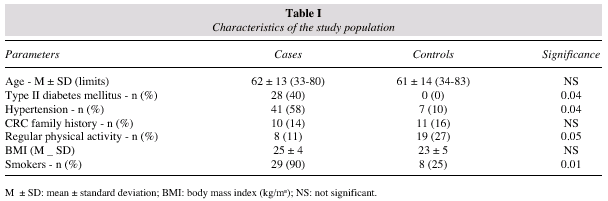
<body><![CDATA[<P><i>Life-styles and nutritional status</i></P>     <P><i>&nbsp;</i>Height was obtained with a stadiometer and weight was   determined with a calibrated floor Jofre<sup>®</sup> scale. Body mass   index (BMI) was calculated and categorized as severe malnutrition (<font size="2">&ge;</font> 16 kg/m<sup>2</sup>), malnutrition (&gt; 16-19 kg/m<sup>2</sup>), adequate (<font size="2">&ge;</font> 20-25 kg/m<sup>2</sup>), overweight (&gt; 25-30 kg/m<sup>2</sup>), stage 1   obesity (&gt; 30-35 kg/m<sup>2</sup>), stage 2 obesity (&gt; 35-40 kg/m<sup>2</sup>) and   stage 3 obesity (&gt; 40 kg/m<sup>2</sup>)<sup>21</sup>. Jackson's questionnaire categorized physical activity level in a 0 to 7 scale, ranging from   "did not perform any regular intense physical exercise or   leisure activity" to "did perform regular intense physical   exercise"<sup>22</sup>. According to the previous and present smoking   habits, subjects were defined as non-smokers (never or occasional consumption) or smokers (regular consumption &gt;10 years even if not currently consuming); number of packages per day, duration of consumption (years) and the total   number of packages per year was calculated.</P>     <P><i>Dietary pattern</i></P>     <P>The diet history method (including alcohol consumption) comprising a 24-hour recall food questionnaire, a food frequency questionnaire and a 72-hours diet diary (2 week days and 1 weekend day)<sup>23,24</sup> was always used; the same registered research dietician (PR) interviewed all subjects who were also questioned on the use of dietary supplements. The software DIETPLAN version 5 for Windows (Forestfield software Ltd 2002, Horsham, UK) was used to analyze nutrient contents of foodstuffs and meals. In what concerns alcohol consumption, the duration (years), type of alcoholic beverages and intake frequency were registered, the usual intake amounts were quantified by using photographic models<sup>25</sup>, and the total alcohol intake was calculated (expressed in grams per day). Total nutrient and alcohol intake were compared with the Dietary Recommended Intake (DRI)<sup>26,27</sup>; for flavonoids or isoflavones, lacking established DRI, comparisons were based on median intakes and the average content of rich dietary sources. Nutritional intake analysis comprised the foods/nutrients classically associated with CRC and "new" components, whose relevance has been recently suggested <i>in vitro</i>.</P>      <P><i>Statistical Analysis</i></P>     <P>Statistical analysis was conducted using SPSS 10.0   (SPSS Inc, Chicago, USA) and EPI-Info 2000 (CDC, Atlanta, USA). Parametrical (Students't) and non-parametrical (Wilcoxon) tests determined differences in nutritional status and life-style variables between cases and controls. Correlations were assessed by Spearman rank method. For both food and total nutrient intake, subjects were categorized according to quartiles of intake. We used relative risk as a measure of association, defined as the incidence of CRC in each food intake quartile, divided by the corresponding rate among the subjects on the lowest quartile. Age-adjusted relative risks were calculated after stratification according to 5-year categories. Proportional hazards models were used to adjust for multiple risk factors simultaneously (age, BMI, CRC family history, tobacco, physical activity, co-morbidities). In addition stratified analyses were conducted to determine whether the influence of nutritional intake was modified by other risk factors for CRC. All P values are two-sided. To evaluate the influence of measurement error on our findings, we used a correction procedure that adjusts the relative risks and confidence intervals to account for errors in assessing nutritional intake<sup>28</sup>. For all statistics, significance was accepted at the 5% probability level.</P>      <P><b>Results</b></P>     <P>Characteristics of the study population are shown in <a href="#t1"> table I</a>; subjects with type II diabetes <i>mellitus</i> and/or hypertension were just treated with drug therapy and did not follow any specific diet. There was an overall trend associating a lower BMI to higher level of physical activity (p = 0.09) though the latter was unrelated to CRC risk. In what concerns smoking there were 29 current smokers amongst CRC patients and 8 amongst controls, all female patients and controls were non-smokers; there was a smoking-associated relative risk of 1.90 (1.86-1.97). None of the participants was taking nutritional supplements.</P>      <P align="center"><a name="t1"><img src="/img/nh/v20n3/original1/original1_tabla1.gif" width=608 height=201></a></P>      <P>    ]]></body>
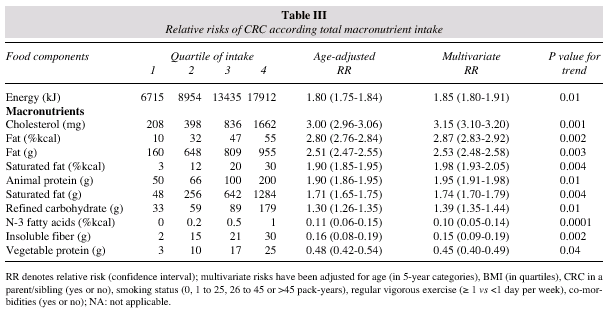
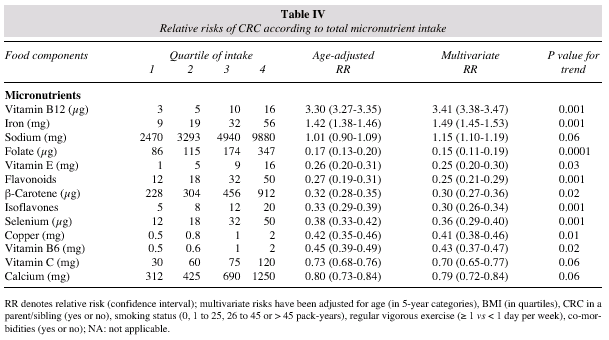
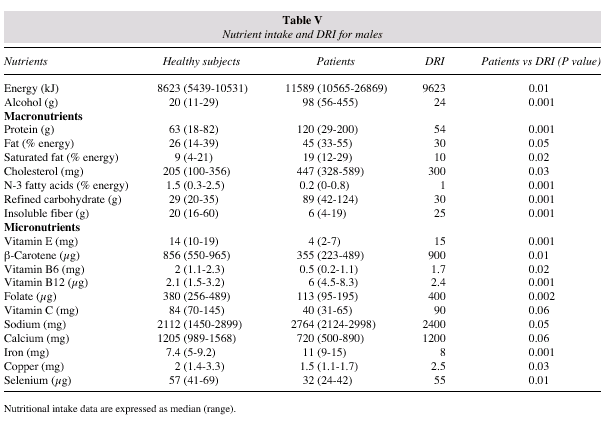
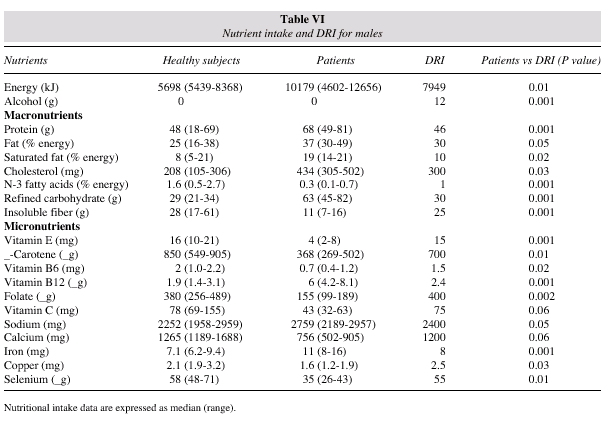
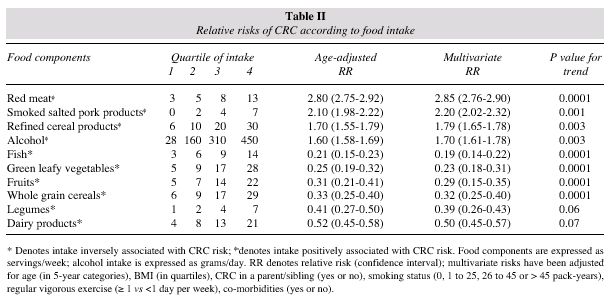
<body><![CDATA[<br> Age-adjusted and multivariate analyses showed that both the diet pattern and the intake of specific nutrients were strongly associated with the incidence of CRC, in the highest as compared with the lowest quartile, <a href="#t2"> tables II</a>, <a href="#t3"> III</a> and <a href="#t4">IV</a>. In multivariate analyses, each increment of 4 servings per week of red meat, smoked salted pork products and 100g of alcohol corresponded to an increased relative risk of 1.29 (95% CI: 1.21-1.34). In what concerns nutrients, each increment of at least 50% in the weekly intake of protein, total fat, saturated fat, cholesterol, refined carbohydrates, iron, vitamin B<sub>12</sub>,sodium and alcohol corresponded to an increased relative risk of 1.53 (95% CI: 1.47-1.59). Conversely, the increment of 4 servings per day of green leafy vegetables, fruits and fish corresponded to a decreased relative risk of 0.35 (95% CI: 0.29-0.41). Each increment of at least 50% in the weekly intake of n-3 fatty acids, insoluble fibber, vitamin E, flavonoids, isoflavones, ß-carotene, folate and selenium corresponded to a decreased relative risk of 0.31 (95% CI: 0.26-0.37). Further nutrient analysis in patients identified several differences between current intake and the DRI, <a href="#t5"> tables V</a> and &nbsp;<a href="#t6">VI</a>. The median intake of flavonoids and isoflavones was also significantly lower (p = 0.001) than the comparison value.</P>      <p align="center"><a name="t2"><img src="/img/nh/v20n3/original1/original1_tabla2.gif" width=612 height=296>    <br> </a></p>     <p align="center"><a name="t3"><img src="/img/nh/v20n3/original1/original1_tabla3.gif" width=608 height=311></a>    <br> </p>     <p align="center"><a name="t4"><img src="/img/nh/v20n3/original1/original1_tabla4.gif" width=609 height=340>    <br> </a></p>      <P align="center"><a name="t5"><img src="/img/nh/v20n3/original1/original1_tabla5.gif" width=610 height=426>    <br> </a></P>      <P align="center"><a name="t6"><img src="/img/nh/v20n3/original1/original1_tabla6.gif" width=605 height=422></a></P>      ]]></body>
<body><![CDATA[<P><b>    <br> Discussion</b></P>     <P>Nutrition is a putative though controversial risk factor for CRC. This prospective study thoroughly investigated epidemiological data previously unknown in Portugal. The diet of "healthy subjects" was indeed similar to the Mediterranean pattern<sup>1,29, 30</sup>, unlike CRC patients' monotonous and unbalanced diet, characterized by high risk nutritional deficits and surpluses. Patients' diet was characterized by frequent and excessive consumption of red meat and processed meat products resulting in excessive intake of animal protein, saturated fat, cholesterol, vitamin B<sub>12</sub> and haem iron; likewise, refined carbohydrates and alcohol consumption was overabundant. Conversely, the intake of fruits and vegetables was lower than the recommended 5-9 daily portions<sup>31</sup> with subsequent deficits of insoluble fiber, vitamins, minerals and other protective compounds, e.g. flavonoids<sup>29,32</sup> and isoflavones<sup>33</sup>; the intake of fish and n-3 fatty acids was also very low. This diet pattern was associated with smoking habits in 45% of patients and with low physical activity in 77%, though the latter was unrelated to CRC risk unlike previously suggested<sup>34,35</sup>. Among life-style risk factors, several case-control studies demonstrated a consistent association between tobacco consumption and CRC<sup>35-37</sup>; our results are only concordant in men since women were non-smokers. CRC risk associated with alcohol abuse is controversial<sup>14,38, 39</sup>, potentially enhanced by concurrent vita-min deficits; in this study women were teetotal, thus alcohol was a risk factor just for men whose diets were also markedly deficient in various vitamins, similarly to what we have previously shown<sup>40,41</sup>.</P>      <P>Epidemiological data concerning energy intake and CRC have been inconsistent, excessive energy intake and increased risk<sup>42</sup> versus no risk<sup>43</sup>. In our study, high energy intake represented an 85% increase of CRC risk, and energy sources, e.g. total fat and refined carbohydrates, which independently represented 187% and 79% increased risk, respectively; this association is consistent with their pro-carcinogenic effect on colorectal cell lines<sup>9,44</sup>. The association between excessive protein intake and CRC has been inconsistent, no risk<sup>11,12</sup> versus increased risk<sup>10</sup>, the latter was corroborated by our study; the citotoxicity of protein metabolism end products may act as a carcinogenesis promoter<sup>45</sup>.</P>      <P>A marked reduction of CRC risk associated with frequent fish consumption and n-3 fatty acids was a major novelty of this study; its relevance may bear to their anti-inflammatory effects<sup>46</sup> and potential pro-apoptotic properties<sup>47</sup>. </P>      <P>A high intake of insoluble fiber is consistently recommended given its ascribed direct<sup>48-50</sup> and indirect protective roles<sup>8,51</sup>. CRC patients' diet was markedly deficient in insoluble fiber that whenever consumed according to recommendations<sup>31</sup> is expected to result in an 85% risk reduction.</P>      <P>Deficits of antioxidants are likely to promote oxidative stress and carcinogenesis<sup>52</sup>. Patients' diet contained a marked surplus of haem iron associated with free radicals production<sup>53</sup>, while the concurrent vitamin E deficit forbear their protective effects<sup>54-56</sup>. Epidemiology also reports an association between low blood &#945;-tocopherol concentrations and increased CRC risk<sup>57</sup>, our study is however the first to show that an adequate intake of vitamin E is associated with 75% reduced risk. Selenium, seldom evaluated<sup>58</sup>, now revealed a protective effect. Flavonoids are a hot research topic due to their antioxidant<sup>59</sup>, pro-apoptotic properties<sup>60</sup>, and cell proliferation inhibitory effect<sup>61</sup>; this study first shows epidemiological data on their protective effect with 75% risk reduction. Fruits and vegetables, main sources of vitamin C and ß-carotene, are rich in numerous beneficial compounds<sup>62-64</sup>; indeed a significant protective effect higher than 60% was attributed to an adequate intake of green leafy vegetables, fruits and legumes. </P>      <P>In spite of the potential physiological properties of isoflavones<sup>33,65</sup>, exclusively conveyed by vegetables, our study is so far the first to have identified a significant protective effect against CRC. </P>      <P>Epidemiological evidence associates folate deficiencies to CRC incidence, since chronically deficient diets determine DNA hypomethylation and chromosomic alterations (66, 67). Two studies showed a modest risk increase associated with prolonged deficits of vitamin B6, methionine, folate and vitamin B12<sup>68,69</sup>. Notwithstanding the lack of data related to excessive intake, vitamin B12 in excess may compete with folate on the remethylation cycle and determine DNA hypomethylation<sup>19</sup>. In CRC patients' diet, vitamin B6 and folate was &gt;3 times below the DRI whereas vitamin B12 in-take was 3 times higher the DRI; both deficit and surplus were associated with &gt;70% increased risk. </P>      <P>Despite the study's limitations related to its sample size, data were adjusted for all recognized confounding variables and still pinpointed nutrients identified worldwide since 1982 as risk factors for CRC<sup>27</sup> and reinforced the protective of others, whilst disclosing emerging protective nutrients<sup>33,59</sup><sub>, </sub><sup> 60</sup>. Given the worldwide high and increasing incidence of CRC, investigations of nutrient-carcinogenesis interactions are warranted to further stress the relevance of preventive nutrition.</P>      ]]></body>
<body><![CDATA[<P><b>ACNOWLEDGEMENTS</b></P>      <P>We are indebted to the medical, nursing and technical staff of the Radiotherapy Department of the Hospital of Santa Maria.</P>      <P><b>REFERENCES</b></P>     <!-- ref --><P>1. World Cancer Research Fund: American Institute of Cancer Research. Food, nutrition and the prevention of cancer: a global perspective. In: American Institute for Cancer Research, 1997.    &nbsp;&nbsp;&nbsp;&nbsp;&nbsp;&nbsp;&nbsp;&nbsp;[&#160;<a href="javascript:void(0);" onclick="javascript: window.open('/scielo.php?script=sci_nlinks&ref=3465820&pid=S0212-1611200500040000200001&lng=','','width=640,height=500,resizable=yes,scrollbars=1,menubar=yes,');">Links</a>&#160;]<!-- end-ref --><!-- ref --><P>2. Working Group on Diet and Cancer of the Committee on Medical Aspects on Food and Nutrition Policy: Nutritional aspects of the development of cancer. London: Dep. Health Rep. Health Social Subjects 48 (The Stationery Office), 1998.    &nbsp;&nbsp;&nbsp;&nbsp;&nbsp;&nbsp;&nbsp;&nbsp;[&#160;<a href="javascript:void(0);" onclick="javascript: window.open('/scielo.php?script=sci_nlinks&ref=3465821&pid=S0212-1611200500040000200002&lng=','','width=640,height=500,resizable=yes,scrollbars=1,menubar=yes,');">Links</a>&#160;]<!-- end-ref --><!-- ref --><P>3. World Health Organization: Prevention of cancer. Geneva: WHO, 1964. Report No.: WHO Tech. Rep. 276.    &nbsp;&nbsp;&nbsp;&nbsp;&nbsp;&nbsp;&nbsp;&nbsp;[&#160;<a href="javascript:void(0);" onclick="javascript: window.open('/scielo.php?script=sci_nlinks&ref=3465822&pid=S0212-1611200500040000200003&lng=','','width=640,height=500,resizable=yes,scrollbars=1,menubar=yes,');">Links</a>&#160;]<!-- end-ref --><!-- ref --><P>4. Palli D, Vineis P, Russo A et al: Diet, metabolic plolymorphisms and DNA adducts: the EPIC-Italy cross-sectional study. <i>Int J Cancer</i> 2000, 87:444-451.    &nbsp;&nbsp;&nbsp;&nbsp;&nbsp;&nbsp;&nbsp;&nbsp;[&#160;<a href="javascript:void(0);" onclick="javascript: window.open('/scielo.php?script=sci_nlinks&ref=3465823&pid=S0212-1611200500040000200004&lng=','','width=640,height=500,resizable=yes,scrollbars=1,menubar=yes,');">Links</a>&#160;]<!-- end-ref --><!-- ref --><P>5. Slattery M, Andersen K, Curtin K, Ma K-N, Schaffer D, Samowitz W: Dietary intake and microsatellite instability in colon tumors. <i>Int J Cancer</i> 2001, 93:601-607.    &nbsp;&nbsp;&nbsp;&nbsp;&nbsp;&nbsp;&nbsp;&nbsp;[&#160;<a href="javascript:void(0);" onclick="javascript: window.open('/scielo.php?script=sci_nlinks&ref=3465824&pid=S0212-1611200500040000200005&lng=','','width=640,height=500,resizable=yes,scrollbars=1,menubar=yes,');">Links</a>&#160;]<!-- end-ref --><!-- ref --><P>6. Hill M: Mechanisms of diet and colon carcinogenesis. <i>Eur J Cancer Prev</i> 1999, 8:S95-S98.    &nbsp;&nbsp;&nbsp;&nbsp;&nbsp;&nbsp;&nbsp;&nbsp;[&#160;<a href="javascript:void(0);" onclick="javascript: window.open('/scielo.php?script=sci_nlinks&ref=3465825&pid=S0212-1611200500040000200006&lng=','','width=640,height=500,resizable=yes,scrollbars=1,menubar=yes,');">Links</a>&#160;]<!-- end-ref --><!-- ref --><P>7. Rock C, Lampe J, Patterson R: Nutrition, genetics and risks of cancer. <i>Annu Rev Public Health</i> 2000, 21:47-64.    &nbsp;&nbsp;&nbsp;&nbsp;&nbsp;&nbsp;&nbsp;&nbsp;[&#160;<a href="javascript:void(0);" onclick="javascript: window.open('/scielo.php?script=sci_nlinks&ref=3465826&pid=S0212-1611200500040000200007&lng=','','width=640,height=500,resizable=yes,scrollbars=1,menubar=yes,');">Links</a>&#160;]<!-- end-ref --><!-- ref --><P>8. Franceschi S, dal Maso L, Augustin L et al: Dietary glycemic load and colorectal cancer risk. <i>Ann Oncol</i> 2001, 12:173-178.    &nbsp;&nbsp;&nbsp;&nbsp;&nbsp;&nbsp;&nbsp;&nbsp;[&#160;<a href="javascript:void(0);" onclick="javascript: window.open('/scielo.php?script=sci_nlinks&ref=3465827&pid=S0212-1611200500040000200008&lng=','','width=640,height=500,resizable=yes,scrollbars=1,menubar=yes,');">Links</a>&#160;]<!-- end-ref --><!-- ref --><P>9. Hill M, Aries V: Faecal steroid composition and its relationship to cancer of the large bowel. <i>J Pathol</i> 1971, 104:129-139.    &nbsp;&nbsp;&nbsp;&nbsp;&nbsp;&nbsp;&nbsp;&nbsp;[&#160;<a href="javascript:void(0);" onclick="javascript: window.open('/scielo.php?script=sci_nlinks&ref=3465828&pid=S0212-1611200500040000200009&lng=','','width=640,height=500,resizable=yes,scrollbars=1,menubar=yes,');">Links</a>&#160;]<!-- end-ref --><!-- ref --><P>10. Meyer F, White E: Alcohol and nutrients in relation to colon cancer in middle-aged adults. <i>Am J Epidemiol</i> 1993, 138:225-236.&nbsp;&nbsp;&nbsp;&nbsp;&nbsp;&nbsp;&nbsp;&nbsp;[&#160;<a href="javascript:void(0);" onclick="javascript: window.open('/scielo.php?script=sci_nlinks&ref=3465829&pid=S0212-1611200500040000200010&lng=','','width=640,height=500,resizable=yes,scrollbars=1,menubar=yes,');">Links</a>&#160;]<!-- end-ref --><!-- ref --><P>11. Macquart-Moulin G, Riboli E, Cornee J, Charnay B, Berthezene P, Day N: Case-control study on colorectal cancer and diet in Marseilles. <i>Int J Cancer</i> 1986, 38:183-191.&nbsp;&nbsp;&nbsp;&nbsp;&nbsp;&nbsp;&nbsp;&nbsp;[&#160;<a href="javascript:void(0);" onclick="javascript: window.open('/scielo.php?script=sci_nlinks&ref=3465830&pid=S0212-1611200500040000200011&lng=','','width=640,height=500,resizable=yes,scrollbars=1,menubar=yes,');">Links</a>&#160;]<!-- end-ref --><!-- ref --><P>12. Benito E, Stiggelbout A, Bosch F et al: Nutritional factors in colorectal cancer risk: a case-control study in Majorca. <i>Int J Cancer </i>1991, 49:161-167.    &nbsp;&nbsp;&nbsp;&nbsp;&nbsp;&nbsp;&nbsp;&nbsp;[&#160;<a href="javascript:void(0);" onclick="javascript: window.open('/scielo.php?script=sci_nlinks&ref=3465831&pid=S0212-1611200500040000200012&lng=','','width=640,height=500,resizable=yes,scrollbars=1,menubar=yes,');">Links</a>&#160;]<!-- end-ref --><!-- ref -->  13. Breuer-Katschinski B, Nemes K, Marr A et al: Alcohol and cigarette smoking and the risk of colorectal adenomas. <i>Dig Dis Sci </i>2000, 45:487-493.&nbsp;&nbsp;&nbsp;&nbsp;&nbsp;&nbsp;&nbsp;&nbsp;[&#160;<a href="javascript:void(0);" onclick="javascript: window.open('/scielo.php?script=sci_nlinks&ref=3465832&pid=S0212-1611200500040000200013&lng=','','width=640,height=500,resizable=yes,scrollbars=1,menubar=yes,');">Links</a>&#160;]<!-- end-ref --><!-- ref --><P>14. Kearney J, Giovannucci E, Rimm E et al: Diet, alcohol, and smoking and the occurrence of hyperplastic polyps of the colon and rectum (United States). <i>Cancer Causes Control</i> 1995, 6:45-56.&nbsp;&nbsp;&nbsp;&nbsp;&nbsp;&nbsp;&nbsp;&nbsp;[&#160;<a href="javascript:void(0);" onclick="javascript: window.open('/scielo.php?script=sci_nlinks&ref=3465833&pid=S0212-1611200500040000200014&lng=','','width=640,height=500,resizable=yes,scrollbars=1,menubar=yes,');">Links</a>&#160;]<!-- end-ref --><!-- ref --><P>15. Reddy B, Engle A, Katsifis S, et al: Biochemical epidemiology of colon cancer: effect of types of dietary fiber on fecal mutagens, acid, and neutral sterols in healthy subjects. <i>Cancer Res </i>1989, 49:4629-35.&nbsp;&nbsp;&nbsp;&nbsp;&nbsp;&nbsp;&nbsp;&nbsp;[&#160;<a href="javascript:void(0);" onclick="javascript: window.open('/scielo.php?script=sci_nlinks&ref=3465834&pid=S0212-1611200500040000200015&lng=','','width=640,height=500,resizable=yes,scrollbars=1,menubar=yes,');">Links</a>&#160;]<!-- end-ref --><!-- ref --><P>16. Harris P, Ferguson L: Dietary fibers may protect or enhance carcinogenesis. <i>Mutas Res</i> 1999, 443:95-110.&nbsp;&nbsp;&nbsp;&nbsp;&nbsp;&nbsp;&nbsp;&nbsp;[&#160;<a href="javascript:void(0);" onclick="javascript: window.open('/scielo.php?script=sci_nlinks&ref=3465835&pid=S0212-1611200500040000200016&lng=','','width=640,height=500,resizable=yes,scrollbars=1,menubar=yes,');">Links</a>&#160;]<!-- end-ref --><!-- ref --><P>17. El-Bayoumy K; The protective role of selenium on genetic damage and on cancer. <i>Mutas Res</i> 2001, 475:123-139.&nbsp;&nbsp;&nbsp;&nbsp;&nbsp;&nbsp;&nbsp;&nbsp;[&#160;<a href="javascript:void(0);" onclick="javascript: window.open('/scielo.php?script=sci_nlinks&ref=3465836&pid=S0212-1611200500040000200017&lng=','','width=640,height=500,resizable=yes,scrollbars=1,menubar=yes,');">Links</a>&#160;]<!-- end-ref --><!-- ref --><P>18. Claycombe K, Meydani S: Vitamin E and genome stability. <i>Mutas Res</i> 2001, 475:37-44.&nbsp;&nbsp;&nbsp;&nbsp;&nbsp;&nbsp;&nbsp;&nbsp;[&#160;<a href="javascript:void(0);" onclick="javascript: window.open('/scielo.php?script=sci_nlinks&ref=3465837&pid=S0212-1611200500040000200018&lng=','','width=640,height=500,resizable=yes,scrollbars=1,menubar=yes,');">Links</a>&#160;]<!-- end-ref --><!-- ref --><P>19. Ames B: DNA damage from micronutrient deficiencies is likely to be a major cause of cancer has a modest but potentially important protective effect against colorectal cancer. <i>Mutat Res</i> 2001, 475:7-20.&nbsp;&nbsp;&nbsp;&nbsp;&nbsp;&nbsp;&nbsp;&nbsp;[&#160;<a href="javascript:void(0);" onclick="javascript: window.open('/scielo.php?script=sci_nlinks&ref=3465838&pid=S0212-1611200500040000200019&lng=','','width=640,height=500,resizable=yes,scrollbars=1,menubar=yes,');">Links</a>&#160;]<!-- end-ref --><!-- ref --><P>20. Sobin L, Ch W: UICC TNM Classification of malignant tumors. New York: John Willey &amp; Sons, Inc., 1997.&nbsp;&nbsp;&nbsp;&nbsp;&nbsp;&nbsp;&nbsp;&nbsp;[&#160;<a href="javascript:void(0);" onclick="javascript: window.open('/scielo.php?script=sci_nlinks&ref=3465839&pid=S0212-1611200500040000200020&lng=','','width=640,height=500,resizable=yes,scrollbars=1,menubar=yes,');">Links</a>&#160;]<!-- end-ref --><!-- ref --><P>21. Garrow JS: Treat obesity seriously. Edinburgh: Churchil Livingstone, 1981.&nbsp;&nbsp;&nbsp;&nbsp;&nbsp;&nbsp;&nbsp;&nbsp;[&#160;<a href="javascript:void(0);" onclick="javascript: window.open('/scielo.php?script=sci_nlinks&ref=3465840&pid=S0212-1611200500040000200021&lng=','','width=640,height=500,resizable=yes,scrollbars=1,menubar=yes,');">Links</a>&#160;]<!-- end-ref --><!-- ref --><P>22. Arroll B, Jackson R, Beaglehole R: Validation of a three-month physical activity recall questionnaire with a seven-day food intake and physical activity diary. <i>Epidemiology</i> 1991, 2:296-299.&nbsp;&nbsp;&nbsp;&nbsp;&nbsp;&nbsp;&nbsp;&nbsp;[&#160;<a href="javascript:void(0);" onclick="javascript: window.open('/scielo.php?script=sci_nlinks&ref=3465841&pid=S0212-1611200500040000200022&lng=','','width=640,height=500,resizable=yes,scrollbars=1,menubar=yes,');">Links</a>&#160;]<!-- end-ref --><!-- ref --><P>23. Burke B: The diet history as a tool in research. <i>J Am Diet Assoc</i> 1947, 23:1041-1046.&nbsp;&nbsp;&nbsp;&nbsp;&nbsp;&nbsp;&nbsp;&nbsp;[&#160;<a href="javascript:void(0);" onclick="javascript: window.open('/scielo.php?script=sci_nlinks&ref=3465842&pid=S0212-1611200500040000200023&lng=','','width=640,height=500,resizable=yes,scrollbars=1,menubar=yes,');">Links</a>&#160;]<!-- end-ref --><!-- ref --><P>24. Ocké M, Kaaks R: Biochemical markers as additional measurements in dietary validity studies: application of the methods of triads with examples from the European Prospective Investigation into Cancer and Nutrition. <i>A J Clin Nutr</i> 1997, 65 (Supl. 4):1240S-1245S.&nbsp;&nbsp;&nbsp;&nbsp;&nbsp;&nbsp;&nbsp;&nbsp;[&#160;<a href="javascript:void(0);" onclick="javascript: window.open('/scielo.php?script=sci_nlinks&ref=3465843&pid=S0212-1611200500040000200024&lng=','','width=640,height=500,resizable=yes,scrollbars=1,menubar=yes,');">Links</a>&#160;]<!-- end-ref --><!-- ref --><P>25. Marques M, Pinho O, Vaz de Almeida M: Manual de quantificação de alimentos. 1ª ed. Porto: Rocha Artes Gráficas, Lda, 1996.&nbsp;&nbsp;&nbsp;&nbsp;&nbsp;&nbsp;&nbsp;&nbsp;[&#160;<a href="javascript:void(0);" onclick="javascript: window.open('/scielo.php?script=sci_nlinks&ref=3465844&pid=S0212-1611200500040000200025&lng=','','width=640,height=500,resizable=yes,scrollbars=1,menubar=yes,');">Links</a>&#160;]<!-- end-ref --><!-- ref --><P>26. Food and Nutrition Information Center: Dietary Reference In-takes (DRI) and Recommended Dietary Allowances (RDA). Beltsville, Maryland: National Agricultural Library (NAL) and U.S. Department of Agriculture (USDA), 2001.&nbsp;&nbsp;&nbsp;&nbsp;&nbsp;&nbsp;&nbsp;&nbsp;[&#160;<a href="javascript:void(0);" onclick="javascript: window.open('/scielo.php?script=sci_nlinks&ref=3465845&pid=S0212-1611200500040000200026&lng=','','width=640,height=500,resizable=yes,scrollbars=1,menubar=yes,');">Links</a>&#160;]<!-- end-ref --><!-- ref --><P>27. WHO SG: Diet, nutrition and the prevention of chronic diseases. Geneva: WHO, 1990. Report No.: Technical report series no 797.&nbsp;&nbsp;&nbsp;&nbsp;&nbsp;&nbsp;&nbsp;&nbsp;[&#160;<a href="javascript:void(0);" onclick="javascript: window.open('/scielo.php?script=sci_nlinks&ref=3465846&pid=S0212-1611200500040000200027&lng=','','width=640,height=500,resizable=yes,scrollbars=1,menubar=yes,');">Links</a>&#160;]<!-- end-ref --><!-- ref --><P>28. Rosner B, Spiegelman D, Willet W: Correction of logistic regression relative risk estimates and confidence intervals for measurement error: the case of multiple covariates measured with error. <i>Am J Epidemiol</i> 1990, 132:734-745.&nbsp;&nbsp;&nbsp;&nbsp;&nbsp;&nbsp;&nbsp;&nbsp;[&#160;<a href="javascript:void(0);" onclick="javascript: window.open('/scielo.php?script=sci_nlinks&ref=3465847&pid=S0212-1611200500040000200028&lng=','','width=640,height=500,resizable=yes,scrollbars=1,menubar=yes,');">Links</a>&#160;]<!-- end-ref --><!-- ref --><P>29. Panagiotakos D, Chrysohoou C, Pitsavos C et al: The association of Mediterranean diet with lower risk of acute coronary syndromes in hypertensive subjects. <i>Int J Cardiol</i> 2002, 82:141-147.&nbsp;&nbsp;&nbsp;&nbsp;&nbsp;&nbsp;&nbsp;&nbsp;[&#160;<a href="javascript:void(0);" onclick="javascript: window.open('/scielo.php?script=sci_nlinks&ref=3465848&pid=S0212-1611200500040000200029&lng=','','width=640,height=500,resizable=yes,scrollbars=1,menubar=yes,');">Links</a>&#160;]<!-- end-ref --><!-- ref --><P>30. La Vecchia C AA, Tavani A: Vegetables, fruit, antioxidants and cancer: a review of Italian studies. <i>Eur J Nutr</i> 2001, 40:261-267.&nbsp;&nbsp;&nbsp;&nbsp;&nbsp;&nbsp;&nbsp;&nbsp;[&#160;<a href="javascript:void(0);" onclick="javascript: window.open('/scielo.php?script=sci_nlinks&ref=3465849&pid=S0212-1611200500040000200030&lng=','','width=640,height=500,resizable=yes,scrollbars=1,menubar=yes,');">Links</a>&#160;]<!-- end-ref --><!-- ref --><P>31. National Cancer Institute and the Produce for Better Health Foundation: 5 a day for better health: National Cancer Institute and the Produce for Better Health Foundation, 2001.&nbsp;&nbsp;&nbsp;&nbsp;&nbsp;&nbsp;&nbsp;&nbsp;[&#160;<a href="javascript:void(0);" onclick="javascript: window.open('/scielo.php?script=sci_nlinks&ref=3465850&pid=S0212-1611200500040000200031&lng=','','width=640,height=500,resizable=yes,scrollbars=1,menubar=yes,');">Links</a>&#160;]<!-- end-ref --><!-- ref --><P>32. Perez-Jimenez F, Lopez-Miranda J, Pinillos M et al: A Mediterranean and a high-carbohydrate diet improve glucose metabolism in healthy young persons. <i>Diabetologia</i> 2001, 44:2038-43.&nbsp;&nbsp;&nbsp;&nbsp;&nbsp;&nbsp;&nbsp;&nbsp;[&#160;<a href="javascript:void(0);" onclick="javascript: window.open('/scielo.php?script=sci_nlinks&ref=3465851&pid=S0212-1611200500040000200032&lng=','','width=640,height=500,resizable=yes,scrollbars=1,menubar=yes,');">Links</a>&#160;]<!-- end-ref --><!-- ref --><P>33. Nagel S, vom Saal F, Welshons W: The effective free fraction of estradiol and xenoestrogens in human serum measured by whole cell uptake assays: physiology of delivery modifies estrogenic activity. <i>Proc Soc Exp Biol Med</i> 1998, 217:300-309.&nbsp;&nbsp;&nbsp;&nbsp;&nbsp;&nbsp;&nbsp;&nbsp;[&#160;<a href="javascript:void(0);" onclick="javascript: window.open('/scielo.php?script=sci_nlinks&ref=3465852&pid=S0212-1611200500040000200033&lng=','','width=640,height=500,resizable=yes,scrollbars=1,menubar=yes,');">Links</a>&#160;]<!-- end-ref --><!-- ref --><P>34. Giovannucci E, Ascherio A, Rimm E, Colditz G, Stampfer M, Willett W: Physical activity, obesity, and risk for colon cancer and adenoma in men. <i>Ann Intern Med </i>1995, 122:327-34.&nbsp;&nbsp;&nbsp;&nbsp;&nbsp;&nbsp;&nbsp;&nbsp;[&#160;<a href="javascript:void(0);" onclick="javascript: window.open('/scielo.php?script=sci_nlinks&ref=3465853&pid=S0212-1611200500040000200034&lng=','','width=640,height=500,resizable=yes,scrollbars=1,menubar=yes,');">Links</a>&#160;]<!-- end-ref --><!-- ref --><P>35. Terry P, Ekbom A, Lichtenstein P, Feychting M, Wolk A: Long-term tobacco smoking and colorectal cancer in a prospective cohort study. <i>Int J Cancer</i> 2001, 91:585-7.&nbsp;&nbsp;&nbsp;&nbsp;&nbsp;&nbsp;&nbsp;&nbsp;[&#160;<a href="javascript:void(0);" onclick="javascript: window.open('/scielo.php?script=sci_nlinks&ref=3465854&pid=S0212-1611200500040000200035&lng=','','width=640,height=500,resizable=yes,scrollbars=1,menubar=yes,');">Links</a>&#160;]<!-- end-ref --><!-- ref --><P>36. Slattery M, Potter J, Friedman G, Ma K, Edwards S: Tobacco use and colon cancer. <i>Int J Cancer </i>1997, 70:259-264.&nbsp;&nbsp;&nbsp;&nbsp;&nbsp;&nbsp;&nbsp;&nbsp;[&#160;<a href="javascript:void(0);" onclick="javascript: window.open('/scielo.php?script=sci_nlinks&ref=3465855&pid=S0212-1611200500040000200036&lng=','','width=640,height=500,resizable=yes,scrollbars=1,menubar=yes,');">Links</a>&#160;]<!-- end-ref --><!-- ref --><P>37. Heineman E, Zahm S, McLaughlin J, Vaught J: Increased risk of colorectal cancer among smokers: results of a 26-year follow-up of US veterans and a review. <i>Int J Cancer</i> 1994, 59:728-738.&nbsp;&nbsp;&nbsp;&nbsp;&nbsp;&nbsp;&nbsp;&nbsp;[&#160;<a href="javascript:void(0);" onclick="javascript: window.open('/scielo.php?script=sci_nlinks&ref=3465856&pid=S0212-1611200500040000200037&lng=','','width=640,height=500,resizable=yes,scrollbars=1,menubar=yes,');">Links</a>&#160;]<!-- end-ref --><!-- ref --><P>38. Bardou M, Montembault S, Giraud V et al: Excessive alcohol consumption favours high risk polyp or colorectal cancer occurrence among patients with adenomas: a case control study. <i>Gut</i> 2002, 50:38-42.&nbsp;&nbsp;&nbsp;&nbsp;&nbsp;&nbsp;&nbsp;&nbsp;[&#160;<a href="javascript:void(0);" onclick="javascript: window.open('/scielo.php?script=sci_nlinks&ref=3465857&pid=S0212-1611200500040000200038&lng=','','width=640,height=500,resizable=yes,scrollbars=1,menubar=yes,');">Links</a>&#160;]<!-- end-ref --><!-- ref --><P>39. Jedrychowski W, Steindorf K, Popiela T et al: Risk of colorectal cancer from alcohol consumption at lower vitamin intakes. A hospital-based case-control study in Poland. <i>Rev Environ Health</i> 2001, 16:213-222.&nbsp;&nbsp;&nbsp;&nbsp;&nbsp;&nbsp;&nbsp;&nbsp;[&#160;<a href="javascript:void(0);" onclick="javascript: window.open('/scielo.php?script=sci_nlinks&ref=3465858&pid=S0212-1611200500040000200039&lng=','','width=640,height=500,resizable=yes,scrollbars=1,menubar=yes,');">Links</a>&#160;]<!-- end-ref --><!-- ref --><P>40. Cravo M, Glória ML, Camilo ME, Neves Cardoso J, Nobre Leitao C, Mira F: Deficiências vitamínicas nos alcoólicos crónicos: consequências metabólicas e implicações clínicas. <i>Jornal Português de Gastrenterologia</i> 1995, 2:74-79.&nbsp;&nbsp;&nbsp;&nbsp;&nbsp;&nbsp;&nbsp;&nbsp;[&#160;<a href="javascript:void(0);" onclick="javascript: window.open('/scielo.php?script=sci_nlinks&ref=3465859&pid=S0212-1611200500040000200040&lng=','','width=640,height=500,resizable=yes,scrollbars=1,menubar=yes,');">Links</a>&#160;]<!-- end-ref --><!-- ref --><P>41. Glória ML, Cravo M, Camilo ME et al: Nutritional deficiencies in chronic alcoholics: relation to dietary intake and alcohol consumption. <i>Am J Gastroenterology</i> 1997, 92:485-489.&nbsp;&nbsp;&nbsp;&nbsp;&nbsp;&nbsp;&nbsp;&nbsp;[&#160;<a href="javascript:void(0);" onclick="javascript: window.open('/scielo.php?script=sci_nlinks&ref=3465860&pid=S0212-1611200500040000200041&lng=','','width=640,height=500,resizable=yes,scrollbars=1,menubar=yes,');">Links</a>&#160;]<!-- end-ref --><!-- ref --><P>42. Lyon J, Mahoney A, West D et al: Energy intake: its relationship to colon cancer risk. <i>J Natl Cancer Inst</i> 1987, 78:853-861.&nbsp;&nbsp;&nbsp;&nbsp;&nbsp;&nbsp;&nbsp;&nbsp;[&#160;<a href="javascript:void(0);" onclick="javascript: window.open('/scielo.php?script=sci_nlinks&ref=3465861&pid=S0212-1611200500040000200042&lng=','','width=640,height=500,resizable=yes,scrollbars=1,menubar=yes,');">Links</a>&#160;]<!-- end-ref --><!-- ref --><P>43. Bostick R, Potter J, Kushi L et al: Sugar, meat, and fat intake, and non-dietary risk factors for colon cancer incidence in Iowa women (United States). <i>Cancer Causes Control</i> 1994, 5:31-52.&nbsp;&nbsp;&nbsp;&nbsp;&nbsp;&nbsp;&nbsp;&nbsp;[&#160;<a href="javascript:void(0);" onclick="javascript: window.open('/scielo.php?script=sci_nlinks&ref=3465862&pid=S0212-1611200500040000200043&lng=','','width=640,height=500,resizable=yes,scrollbars=1,menubar=yes,');">Links</a>&#160;]<!-- end-ref --><!-- ref --><P>44. Young G, McIntyre A, Albert V, Folino M, Muir J, Gibson P: Wheat bran suppresses potato starch-potentiated colorectal tumorigenesis at the aberrant crypt stage in a rat model. <i>Gastroenterology</i> 1996, 110:508-514.&nbsp;&nbsp;&nbsp;&nbsp;&nbsp;&nbsp;&nbsp;&nbsp;[&#160;<a href="javascript:void(0);" onclick="javascript: window.open('/scielo.php?script=sci_nlinks&ref=3465863&pid=S0212-1611200500040000200044&lng=','','width=640,height=500,resizable=yes,scrollbars=1,menubar=yes,');">Links</a>&#160;]<!-- end-ref --><!-- ref --><P>45. Cummings J, Macfarlane G: The control and consequences of bacterial fermentation in the human colon.<i> J Appl Bacteriol </i>1991, 70:443-459.&nbsp;&nbsp;&nbsp;&nbsp;&nbsp;&nbsp;&nbsp;&nbsp;[&#160;<a href="javascript:void(0);" onclick="javascript: window.open('/scielo.php?script=sci_nlinks&ref=3465864&pid=S0212-1611200500040000200045&lng=','','width=640,height=500,resizable=yes,scrollbars=1,menubar=yes,');">Links</a>&#160;]<!-- end-ref --><!-- ref --><P>46. Latham P, Lund E, Johnson I: Dietary n-3 PUFA increases the apoptotic response to 1,2-dimethylhydrazine, reduces mitosis and suppresses the induction of carcinogenesis in the rat colon. <i>Carcinogenesis</i> 1999, 20:645-650.&nbsp;&nbsp;&nbsp;&nbsp;&nbsp;&nbsp;&nbsp;&nbsp;[&#160;<a href="javascript:void(0);" onclick="javascript: window.open('/scielo.php?script=sci_nlinks&ref=3465865&pid=S0212-1611200500040000200046&lng=','','width=640,height=500,resizable=yes,scrollbars=1,menubar=yes,');">Links</a>&#160;]<!-- end-ref --><!-- ref --><P>47. Chen Z, Istfan N: Docosahexaenoic acid is a potent inducer of apoptosis in HT-29 colon cancer cells. <i>Prostaglandins Leukot Essent Fatty Acids </i>2000, 63:301-308.&nbsp;&nbsp;&nbsp;&nbsp;&nbsp;&nbsp;&nbsp;&nbsp;[&#160;<a href="javascript:void(0);" onclick="javascript: window.open('/scielo.php?script=sci_nlinks&ref=3465866&pid=S0212-1611200500040000200047&lng=','','width=640,height=500,resizable=yes,scrollbars=1,menubar=yes,');">Links</a>&#160;]<!-- end-ref --><!-- ref --><P>48. van Munster I, Tangerman A, Nagengast F: Effect of resistant starch on colonic fermentation, bile acid metabolism, and mucosal proliferation. <i>Dig Dis Sci</i> 1994, 39:834-42.&nbsp;&nbsp;&nbsp;&nbsp;&nbsp;&nbsp;&nbsp;&nbsp;[&#160;<a href="javascript:void(0);" onclick="javascript: window.open('/scielo.php?script=sci_nlinks&ref=3465867&pid=S0212-1611200500040000200048&lng=','','width=640,height=500,resizable=yes,scrollbars=1,menubar=yes,');">Links</a>&#160;]<!-- end-ref --><!-- ref --><P>49. Jenkins D, Kendall C, Popovich D et al: Effect of a very-high-fiber vegetable, fruit, and nut diet on serum lipids and colonic function. <i>Metabolism</i> 2001, 50:494-503.&nbsp;&nbsp;&nbsp;&nbsp;&nbsp;&nbsp;&nbsp;&nbsp;[&#160;<a href="javascript:void(0);" onclick="javascript: window.open('/scielo.php?script=sci_nlinks&ref=3465868&pid=S0212-1611200500040000200049&lng=','','width=640,height=500,resizable=yes,scrollbars=1,menubar=yes,');">Links</a>&#160;]<!-- end-ref --><!-- ref --><P>50. Wang J, Friedman E: Short-chain fatty acids induce cell cycle inhibitors in colonocytes. <i>Gastroenterology</i> 1998, 114:940-946.&nbsp;&nbsp;&nbsp;&nbsp;&nbsp;&nbsp;&nbsp;&nbsp;[&#160;<a href="javascript:void(0);" onclick="javascript: window.open('/scielo.php?script=sci_nlinks&ref=3465869&pid=S0212-1611200500040000200050&lng=','','width=640,height=500,resizable=yes,scrollbars=1,menubar=yes,');">Links</a>&#160;]<!-- end-ref --><!-- ref --><P>51. Bruce W, Wolever T, Giacca A: Mechanisms linking diet and colorectal cancer: the possible role of insulin resistance. <i>Nutr Cancer</i> 2000, 37:19-26.&nbsp;&nbsp;&nbsp;&nbsp;&nbsp;&nbsp;&nbsp;&nbsp;[&#160;<a href="javascript:void(0);" onclick="javascript: window.open('/scielo.php?script=sci_nlinks&ref=3465870&pid=S0212-1611200500040000200051&lng=','','width=640,height=500,resizable=yes,scrollbars=1,menubar=yes,');">Links</a>&#160;]<!-- end-ref --><!-- ref --><P>52. Bruce W, Giacca A, Medline A: Possible mechanisms relating diet and risk of colon cancer. <i>Cancer Epidemiol Biomarkers Prev</i> 2000, 9:1271-1279.&nbsp;&nbsp;&nbsp;&nbsp;&nbsp;&nbsp;&nbsp;&nbsp;[&#160;<a href="javascript:void(0);" onclick="javascript: window.open('/scielo.php?script=sci_nlinks&ref=3465871&pid=S0212-1611200500040000200052&lng=','','width=640,height=500,resizable=yes,scrollbars=1,menubar=yes,');">Links</a>&#160;]<!-- end-ref --><!-- ref --><P>53. Babbs C: Free radicals and the etiology of colon cancer. <i>Free Radic Biol Med</i> 1990, 8:191-200.&nbsp;&nbsp;&nbsp;&nbsp;&nbsp;&nbsp;&nbsp;&nbsp;[&#160;<a href="javascript:void(0);" onclick="javascript: window.open('/scielo.php?script=sci_nlinks&ref=3465872&pid=S0212-1611200500040000200053&lng=','','width=640,height=500,resizable=yes,scrollbars=1,menubar=yes,');">Links</a>&#160;]<!-- end-ref --><!-- ref --><P>54. Chinery R, Brockman J, Peeler M, Shyr Y, Beauchamp R, Coffey R: Antioxidants enhance the citotoxicity of chemotherapeutic agents in colorectal cancer: a p53-independent function of p21WAF1/CIP1 via c/EBP beta. <i>Nat Med</i> 1997, 3:1233-1240.&nbsp;&nbsp;&nbsp;&nbsp;&nbsp;&nbsp;&nbsp;&nbsp;[&#160;<a href="javascript:void(0);" onclick="javascript: window.open('/scielo.php?script=sci_nlinks&ref=3465873&pid=S0212-1611200500040000200054&lng=','','width=640,height=500,resizable=yes,scrollbars=1,menubar=yes,');">Links</a>&#160;]<!-- end-ref --><!-- ref --><P>55. Dubois R, Radhika A, Reddy B, Entingh A: Incrased COX-2 levels in carcinogen-induced rat colonic tumours. <i>Gastroenterology</i> 1996, 110:1259-1264.&nbsp;&nbsp;&nbsp;&nbsp;&nbsp;&nbsp;&nbsp;&nbsp;[&#160;<a href="javascript:void(0);" onclick="javascript: window.open('/scielo.php?script=sci_nlinks&ref=3465874&pid=S0212-1611200500040000200055&lng=','','width=640,height=500,resizable=yes,scrollbars=1,menubar=yes,');">Links</a>&#160;]<!-- end-ref --><!-- ref --><P>56. Eberhart C, Coffey R, Radhika A, Giardello F, Ferrenbach S, Dubois R: Up-regulation of COX-2 gene expression in human colorectal adenomas and adenocarcinomas. <i>Gastroenterology </i>1994, 107:1183-1188.&nbsp;&nbsp;&nbsp;&nbsp;&nbsp;&nbsp;&nbsp;&nbsp;[&#160;<a href="javascript:void(0);" onclick="javascript: window.open('/scielo.php?script=sci_nlinks&ref=3465875&pid=S0212-1611200500040000200056&lng=','','width=640,height=500,resizable=yes,scrollbars=1,menubar=yes,');">Links</a>&#160;]<!-- end-ref --><!-- ref --><P>57. Longnecker M, Martin-Moreno J, Knekt P et al: Serum alpha-tocopherol concentration in relation to subsequent colorectal cancer: pooled data from five cohorts. <i>J Natl Cancer Inst </i>1992, 84:430-435.&nbsp;&nbsp;&nbsp;&nbsp;&nbsp;&nbsp;&nbsp;&nbsp;[&#160;<a href="javascript:void(0);" onclick="javascript: window.open('/scielo.php?script=sci_nlinks&ref=3465876&pid=S0212-1611200500040000200057&lng=','','width=640,height=500,resizable=yes,scrollbars=1,menubar=yes,');">Links</a>&#160;]<!-- end-ref --><!-- ref --><P>58. Clark L, Cantor K, Allaway W: Selenium in forage crops and cancer mortality in U.S. counties. <i>Arch Environ Health</i> 1991, 46:37-42.&nbsp;&nbsp;&nbsp;&nbsp;&nbsp;&nbsp;&nbsp;&nbsp;[&#160;<a href="javascript:void(0);" onclick="javascript: window.open('/scielo.php?script=sci_nlinks&ref=3465877&pid=S0212-1611200500040000200058&lng=','','width=640,height=500,resizable=yes,scrollbars=1,menubar=yes,');">Links</a>&#160;]<!-- end-ref --><!-- ref --><P>59. Owen R, Giacosa A, Hull W, Haubner R, Spiegelhalder B, Bartsch H: The antioxidant/anticancer potential of phenolic compounds isolated from olive oil. <i>Eur J Cancer</i> 2000, 36:1235-1247.&nbsp;&nbsp;&nbsp;&nbsp;&nbsp;&nbsp;&nbsp;&nbsp;[&#160;<a href="javascript:void(0);" onclick="javascript: window.open('/scielo.php?script=sci_nlinks&ref=3465878&pid=S0212-1611200500040000200059&lng=','','width=640,height=500,resizable=yes,scrollbars=1,menubar=yes,');">Links</a>&#160;]<!-- end-ref --><!-- ref --><P>60. Wenzel U, Kuntz S, Brendel M, Daniel H: Dietary flavone is a potent apoptosis inducer in human colon carcinoma cells. <i>Cancer Res</i> 2000, 60:3823-3831.&nbsp;&nbsp;&nbsp;&nbsp;&nbsp;&nbsp;&nbsp;&nbsp;[&#160;<a href="javascript:void(0);" onclick="javascript: window.open('/scielo.php?script=sci_nlinks&ref=3465879&pid=S0212-1611200500040000200060&lng=','','width=640,height=500,resizable=yes,scrollbars=1,menubar=yes,');">Links</a>&#160;]<!-- end-ref --><!-- ref --><P>61. Kuntz S, Wenzel U, Daniel H: Comparative analysis of the effects of flavonoids on proliferation, cytotoxicity, and apoptosis in human colon cancer cell lines. <i>Eur J Nutr</i> 1999, 38:133-142.&nbsp;&nbsp;&nbsp;&nbsp;&nbsp;&nbsp;&nbsp;&nbsp;[&#160;<a href="javascript:void(0);" onclick="javascript: window.open('/scielo.php?script=sci_nlinks&ref=3465880&pid=S0212-1611200500040000200061&lng=','','width=640,height=500,resizable=yes,scrollbars=1,menubar=yes,');">Links</a>&#160;]<!-- end-ref --><!-- ref --><P>62. Cook N, Le I, Manson J, Buring J, Hennekens C: Effects of beta-carotene supplementation on cancer incidence by baseline characteristics in the Physicians' Health Study (United States). <i>Cancer Causes Control </i>2000, 11:617-626.&nbsp;&nbsp;&nbsp;&nbsp;&nbsp;&nbsp;&nbsp;&nbsp;[&#160;<a href="javascript:void(0);" onclick="javascript: window.open('/scielo.php?script=sci_nlinks&ref=3465881&pid=S0212-1611200500040000200062&lng=','','width=640,height=500,resizable=yes,scrollbars=1,menubar=yes,');">Links</a>&#160;]<!-- end-ref --><!-- ref --><P>63. Palozza P, Calviello G, Serini S et al: beta-carotene at high concentrations induces apoptosis by enhancing oxy-radical production in human adenocarcinoma cells. <i>Free Radic Biol Med </i>2001, 30:1000-1007.&nbsp;&nbsp;&nbsp;&nbsp;&nbsp;&nbsp;&nbsp;&nbsp;[&#160;<a href="javascript:void(0);" onclick="javascript: window.open('/scielo.php?script=sci_nlinks&ref=3465882&pid=S0212-1611200500040000200063&lng=','','width=640,height=500,resizable=yes,scrollbars=1,menubar=yes,');">Links</a>&#160;]<!-- end-ref --><!-- ref --><P>64. Palozza P, Calviello, G, Maggiano N, Lanza P, Ranelletti F, Bartoli G: Beta-carotene antagonizes the effects of eicosapentaenoic acid on cell growth and lipid peroxidation in WiDr adenocarcinoma cells. <i>Free Radic Biol Med</i> 2000, 28:228-234.&nbsp;&nbsp;&nbsp;&nbsp;&nbsp;&nbsp;&nbsp;&nbsp;[&#160;<a href="javascript:void(0);" onclick="javascript: window.open('/scielo.php?script=sci_nlinks&ref=3465883&pid=S0212-1611200500040000200064&lng=','','width=640,height=500,resizable=yes,scrollbars=1,menubar=yes,');">Links</a>&#160;]<!-- end-ref --><!-- ref --><P>65. Frentzel-Beyme R, Chang-Claude J: Vegetarian diets and colon cancer: the German experience. <i>Am J Clin Nutr</i> 1994, 59 (5 Supl.): 1143S-1152S.&nbsp;&nbsp;&nbsp;&nbsp;&nbsp;&nbsp;&nbsp;&nbsp;[&#160;<a href="javascript:void(0);" onclick="javascript: window.open('/scielo.php?script=sci_nlinks&ref=3465884&pid=S0212-1611200500040000200065&lng=','','width=640,height=500,resizable=yes,scrollbars=1,menubar=yes,');">Links</a>&#160;]<!-- end-ref --><!-- ref --><P>66. Pufulete M, Al-Ghnaniem R, Leather A et al: Folate status, genomic DNA hypomethylation, and risk of colorectal adenoma and cancer: a case control study. <i>Gastroenterology</i> 2003, 124:1240-1248.&nbsp;&nbsp;&nbsp;&nbsp;&nbsp;&nbsp;&nbsp;&nbsp;[&#160;<a href="javascript:void(0);" onclick="javascript: window.open('/scielo.php?script=sci_nlinks&ref=3465885&pid=S0212-1611200500040000200066&lng=','','width=640,height=500,resizable=yes,scrollbars=1,menubar=yes,');">Links</a>&#160;]<!-- end-ref --><!-- ref --><P>67. Konings E, Goldbohm R, Brants H, Saris W, van den Brandt P: Intake of dietary folate vitamers and risk of colorectal carcinoma: results from The Netherlands Cohort Study. <i>Cancer </i>2002, 95:1421-1433.&nbsp;&nbsp;&nbsp;&nbsp;&nbsp;&nbsp;&nbsp;&nbsp;[&#160;<a href="javascript:void(0);" onclick="javascript: window.open('/scielo.php?script=sci_nlinks&ref=3465886&pid=S0212-1611200500040000200067&lng=','','width=640,height=500,resizable=yes,scrollbars=1,menubar=yes,');">Links</a>&#160;]<!-- end-ref --><!-- ref --><P>68. Harnack L, Jacobs DJ, Nicodemus K, Lazovich D, Anderson K, Folsom A: Relationship of folate, vitamin B-6, vitamin B-12, and methionine intake to incidence of colorectal cancers. <i>Nutr Cancer</i> 2003, 43:152-158.&nbsp;&nbsp;&nbsp;&nbsp;&nbsp;&nbsp;&nbsp;&nbsp;[&#160;<a href="javascript:void(0);" onclick="javascript: window.open('/scielo.php?script=sci_nlinks&ref=3465887&pid=S0212-1611200500040000200068&lng=','','width=640,height=500,resizable=yes,scrollbars=1,menubar=yes,');">Links</a>&#160;]<!-- end-ref --><!-- ref --><P>69. Slattery M, Schaffer D, Edwards S, Ma K, Potter J: Are dietary factors involved in DNA methylation associated with colon cancer? <i>Nutr Cancer</i> 1997, 28:52-62.&nbsp;&nbsp;&nbsp;&nbsp;&nbsp;&nbsp;&nbsp;&nbsp;[&#160;<a href="javascript:void(0);" onclick="javascript: window.open('/scielo.php?script=sci_nlinks&ref=3465888&pid=S0212-1611200500040000200069&lng=','','width=640,height=500,resizable=yes,scrollbars=1,menubar=yes,');">Links</a>&#160;]<!-- end-ref --> ]]></body><back>
<ref-list>
<ref id="B1">
<label>1</label><nlm-citation citation-type="">
<collab>World Cancer Research Fund</collab>
<article-title xml:lang="en"><![CDATA[American Institute of Cancer Research. Food, nutrition and the prevention of cancer: a global perspective]]></article-title>
<collab>American Institute for Cancer Research</collab>
<source><![CDATA[]]></source>
<year>1997</year>
</nlm-citation>
</ref>
<ref id="B2">
<label>2</label><nlm-citation citation-type="book">
<collab>Working Group on Diet and Cancer of the Committee on Medical Aspects on Food and Nutrition Policy</collab>
<source><![CDATA[Nutritional aspects of the development of cancer]]></source>
<year>1998</year>
<publisher-loc><![CDATA[London ]]></publisher-loc>
<publisher-name><![CDATA[Dep. Health Rep. Health Social Subjects 48 (The Stationery Office)]]></publisher-name>
</nlm-citation>
</ref>
<ref id="B3">
<label>3</label><nlm-citation citation-type="book">
<collab>World Health Organization</collab>
<source><![CDATA[Prevention of cancer]]></source>
<year>1964</year>
<publisher-loc><![CDATA[Geneva ]]></publisher-loc>
<publisher-name><![CDATA[WHO]]></publisher-name>
</nlm-citation>
</ref>
<ref id="B4">
<label>4</label><nlm-citation citation-type="journal">
<person-group person-group-type="author">
<name>
<surname><![CDATA[Palli]]></surname>
<given-names><![CDATA[D]]></given-names>
</name>
<name>
<surname><![CDATA[Vineis]]></surname>
<given-names><![CDATA[P]]></given-names>
</name>
<name>
<surname><![CDATA[Russo]]></surname>
<given-names><![CDATA[A]]></given-names>
</name>
</person-group>
<article-title xml:lang="en"><![CDATA[Diet, metabolic plolymorphisms and DNA adducts: the EPIC-Italy cross-sectional study]]></article-title>
<source><![CDATA[Int J Cancer]]></source>
<year>2000</year>
<volume>87</volume>
<page-range>444-451</page-range></nlm-citation>
</ref>
<ref id="B5">
<label>5</label><nlm-citation citation-type="journal">
<person-group person-group-type="author">
<name>
<surname><![CDATA[Slattery]]></surname>
<given-names><![CDATA[M]]></given-names>
</name>
<name>
<surname><![CDATA[Andersen]]></surname>
<given-names><![CDATA[K]]></given-names>
</name>
<name>
<surname><![CDATA[Curtin]]></surname>
<given-names><![CDATA[K]]></given-names>
</name>
<name>
<surname><![CDATA[Ma]]></surname>
<given-names><![CDATA[K-N]]></given-names>
</name>
<name>
<surname><![CDATA[Schaffer]]></surname>
<given-names><![CDATA[D]]></given-names>
</name>
<name>
<surname><![CDATA[Samowitz]]></surname>
<given-names><![CDATA[W]]></given-names>
</name>
</person-group>
<article-title xml:lang="en"><![CDATA[Dietary intake and microsatellite instability in colon tumors]]></article-title>
<source><![CDATA[Int J Cancer]]></source>
<year>2001</year>
<volume>93</volume>
<page-range>601-607</page-range></nlm-citation>
</ref>
<ref id="B6">
<label>6</label><nlm-citation citation-type="journal">
<person-group person-group-type="author">
<name>
<surname><![CDATA[Hill]]></surname>
<given-names><![CDATA[M]]></given-names>
</name>
</person-group>
<article-title xml:lang="en"><![CDATA[Mechanisms of diet and colon carcinogenesis]]></article-title>
<source><![CDATA[Eur J Cancer Prev]]></source>
<year>1999</year>
<volume>8</volume>
<page-range>S95-S98</page-range></nlm-citation>
</ref>
<ref id="B7">
<label>7</label><nlm-citation citation-type="journal">
<person-group person-group-type="author">
<name>
<surname><![CDATA[Rock]]></surname>
<given-names><![CDATA[C]]></given-names>
</name>
<name>
<surname><![CDATA[Lampe]]></surname>
<given-names><![CDATA[J]]></given-names>
</name>
<name>
<surname><![CDATA[Patterson]]></surname>
<given-names><![CDATA[R]]></given-names>
</name>
</person-group>
<article-title xml:lang="en"><![CDATA[Nutrition, genetics and risks of cancer]]></article-title>
<source><![CDATA[Annu Rev Public Health]]></source>
<year>2000</year>
<volume>21</volume>
<page-range>47-64</page-range></nlm-citation>
</ref>
<ref id="B8">
<label>8</label><nlm-citation citation-type="journal">
<person-group person-group-type="author">
<name>
<surname><![CDATA[Franceschi]]></surname>
<given-names><![CDATA[S]]></given-names>
</name>
<name>
<surname><![CDATA[dal Maso]]></surname>
<given-names><![CDATA[L]]></given-names>
</name>
<name>
<surname><![CDATA[Augustin]]></surname>
<given-names><![CDATA[L]]></given-names>
</name>
</person-group>
<article-title xml:lang="en"><![CDATA[Dietary glycemic load and colorectal cancer risk]]></article-title>
<source><![CDATA[Ann Oncol]]></source>
<year>2001</year>
<volume>12</volume>
<page-range>173-178</page-range></nlm-citation>
</ref>
<ref id="B9">
<label>9</label><nlm-citation citation-type="journal">
<person-group person-group-type="author">
<name>
<surname><![CDATA[Hill]]></surname>
<given-names><![CDATA[M]]></given-names>
</name>
<name>
<surname><![CDATA[Aries]]></surname>
<given-names><![CDATA[V]]></given-names>
</name>
</person-group>
<article-title xml:lang="en"><![CDATA[Faecal steroid composition and its relationship to cancer of the large bowel]]></article-title>
<source><![CDATA[J Pathol]]></source>
<year>1971</year>
<volume>104</volume>
<page-range>129-139</page-range></nlm-citation>
</ref>
<ref id="B10">
<label>10</label><nlm-citation citation-type="journal">
<person-group person-group-type="author">
<name>
<surname><![CDATA[Meyer]]></surname>
<given-names><![CDATA[F]]></given-names>
</name>
<name>
<surname><![CDATA[White]]></surname>
<given-names><![CDATA[E]]></given-names>
</name>
</person-group>
<article-title xml:lang="en"><![CDATA[Alcohol and nutrients in relation to colon cancer in middle-aged adults]]></article-title>
<source><![CDATA[Am J Epidemiol]]></source>
<year>1993</year>
<volume>138</volume>
<page-range>225-236</page-range></nlm-citation>
</ref>
<ref id="B11">
<label>11</label><nlm-citation citation-type="journal">
<person-group person-group-type="author">
<name>
<surname><![CDATA[Macquart-Moulin]]></surname>
<given-names><![CDATA[G]]></given-names>
</name>
<name>
<surname><![CDATA[Riboli]]></surname>
<given-names><![CDATA[E]]></given-names>
</name>
<name>
<surname><![CDATA[Cornee]]></surname>
<given-names><![CDATA[J]]></given-names>
</name>
<name>
<surname><![CDATA[Charnay]]></surname>
<given-names><![CDATA[B]]></given-names>
</name>
<name>
<surname><![CDATA[Berthezene]]></surname>
<given-names><![CDATA[P]]></given-names>
</name>
<name>
<surname><![CDATA[Day]]></surname>
<given-names><![CDATA[N]]></given-names>
</name>
</person-group>
<article-title xml:lang="en"><![CDATA[Case-control study on colorectal cancer and diet in Marseilles]]></article-title>
<source><![CDATA[Int J Cancer]]></source>
<year>1986</year>
<volume>38</volume>
<page-range>183-191</page-range></nlm-citation>
</ref>
<ref id="B12">
<label>12</label><nlm-citation citation-type="journal">
<person-group person-group-type="author">
<name>
<surname><![CDATA[Benito]]></surname>
<given-names><![CDATA[E]]></given-names>
</name>
<name>
<surname><![CDATA[Stiggelbout]]></surname>
<given-names><![CDATA[A]]></given-names>
</name>
<name>
<surname><![CDATA[Bosch]]></surname>
<given-names><![CDATA[F]]></given-names>
</name>
</person-group>
<article-title xml:lang="en"><![CDATA[Nutritional factors in colorectal cancer risk: a case-control study in Majorca]]></article-title>
<source><![CDATA[Int J Cancer]]></source>
<year>1991</year>
<volume>49</volume>
<page-range>161-167</page-range></nlm-citation>
</ref>
<ref id="B13">
<label>13</label><nlm-citation citation-type="journal">
<person-group person-group-type="author">
<name>
<surname><![CDATA[Breuer-Katschinski]]></surname>
<given-names><![CDATA[B]]></given-names>
</name>
<name>
<surname><![CDATA[Nemes]]></surname>
<given-names><![CDATA[K]]></given-names>
</name>
<name>
<surname><![CDATA[Marr]]></surname>
<given-names><![CDATA[A]]></given-names>
</name>
</person-group>
<article-title xml:lang="en"><![CDATA[Alcohol and cigarette smoking and the risk of colorectal adenomas]]></article-title>
<source><![CDATA[Dig Dis Sci]]></source>
<year>2000</year>
<volume>45</volume>
<page-range>487-493</page-range></nlm-citation>
</ref>
<ref id="B14">
<label>14</label><nlm-citation citation-type="journal">
<person-group person-group-type="author">
<name>
<surname><![CDATA[Kearney]]></surname>
<given-names><![CDATA[J]]></given-names>
</name>
<name>
<surname><![CDATA[Giovannucci]]></surname>
<given-names><![CDATA[E]]></given-names>
</name>
<name>
<surname><![CDATA[Rimm]]></surname>
<given-names><![CDATA[E]]></given-names>
</name>
</person-group>
<article-title xml:lang="en"><![CDATA[Diet, alcohol, and smoking and the occurrence of hyperplastic polyps of the colon and rectum (United States)]]></article-title>
<source><![CDATA[Cancer Causes Control]]></source>
<year>1995</year>
<volume>6</volume>
<page-range>45-56</page-range></nlm-citation>
</ref>
<ref id="B15">
<label>15</label><nlm-citation citation-type="journal">
<person-group person-group-type="author">
<name>
<surname><![CDATA[Reddy]]></surname>
<given-names><![CDATA[B]]></given-names>
</name>
<name>
<surname><![CDATA[Engle]]></surname>
<given-names><![CDATA[A]]></given-names>
</name>
<name>
<surname><![CDATA[Katsifis]]></surname>
<given-names><![CDATA[S]]></given-names>
</name>
</person-group>
<article-title xml:lang="en"><![CDATA[Biochemical epidemiology of colon cancer: effect of types of dietary fiber on fecal mutagens, acid, and neutral sterols in healthy subjects]]></article-title>
<source><![CDATA[Cancer Res]]></source>
<year>1989</year>
<volume>49</volume>
<page-range>4629-35</page-range></nlm-citation>
</ref>
<ref id="B16">
<label>16</label><nlm-citation citation-type="journal">
<person-group person-group-type="author">
<name>
<surname><![CDATA[Harris]]></surname>
<given-names><![CDATA[P]]></given-names>
</name>
<name>
<surname><![CDATA[Ferguson]]></surname>
<given-names><![CDATA[L]]></given-names>
</name>
</person-group>
<article-title xml:lang="en"><![CDATA[Dietary fibers may protect or enhance carcinogenesis]]></article-title>
<source><![CDATA[Mutas Res]]></source>
<year>1999</year>
<volume>443</volume>
<page-range>95-110</page-range></nlm-citation>
</ref>
<ref id="B17">
<label>17</label><nlm-citation citation-type="journal">
<person-group person-group-type="author">
<name>
<surname><![CDATA[El-Bayoumy]]></surname>
<given-names><![CDATA[K]]></given-names>
</name>
</person-group>
<article-title xml:lang="en"><![CDATA[The protective role of selenium on genetic damage and on cancer]]></article-title>
<source><![CDATA[Mutas Res]]></source>
<year>2001</year>
<volume>475</volume>
<page-range>123-139</page-range></nlm-citation>
</ref>
<ref id="B18">
<label>18</label><nlm-citation citation-type="journal">
<person-group person-group-type="author">
<name>
<surname><![CDATA[Claycombe]]></surname>
<given-names><![CDATA[K]]></given-names>
</name>
<name>
<surname><![CDATA[Meydani]]></surname>
<given-names><![CDATA[S]]></given-names>
</name>
</person-group>
<article-title xml:lang="en"><![CDATA[Vitamin E and genome stability]]></article-title>
<source><![CDATA[Mutas Res]]></source>
<year>2001</year>
<volume>475</volume>
<page-range>37-44</page-range></nlm-citation>
</ref>
<ref id="B19">
<label>19</label><nlm-citation citation-type="journal">
<person-group person-group-type="author">
<name>
<surname><![CDATA[Ames]]></surname>
<given-names><![CDATA[B]]></given-names>
</name>
</person-group>
<article-title xml:lang="en"><![CDATA[DNA damage from micronutrient deficiencies is likely to be a major cause of cancer has a modest but potentially important protective effect against colorectal cancer]]></article-title>
<source><![CDATA[Mutat Res]]></source>
<year>2001</year>
<volume>475</volume>
<page-range>7-20</page-range></nlm-citation>
</ref>
<ref id="B20">
<label>20</label><nlm-citation citation-type="book">
<person-group person-group-type="author">
<name>
<surname><![CDATA[Sobin]]></surname>
<given-names><![CDATA[L]]></given-names>
</name>
<name>
<surname><![CDATA[Ch]]></surname>
<given-names><![CDATA[W]]></given-names>
</name>
</person-group>
<source><![CDATA[UICC TNM Classification of malignant tumors]]></source>
<year>1997</year>
<publisher-loc><![CDATA[New York ]]></publisher-loc>
<publisher-name><![CDATA[John Willey & Sons, Inc.]]></publisher-name>
</nlm-citation>
</ref>
<ref id="B21">
<label>21</label><nlm-citation citation-type="book">
<person-group person-group-type="author">
<name>
<surname><![CDATA[Garrow]]></surname>
<given-names><![CDATA[JS]]></given-names>
</name>
</person-group>
<source><![CDATA[Treat obesity seriously]]></source>
<year>1981</year>
<publisher-loc><![CDATA[Edinburgh ]]></publisher-loc>
<publisher-name><![CDATA[Churchil Livingstone]]></publisher-name>
</nlm-citation>
</ref>
<ref id="B22">
<label>22</label><nlm-citation citation-type="journal">
<person-group person-group-type="author">
<name>
<surname><![CDATA[Arroll]]></surname>
<given-names><![CDATA[B]]></given-names>
</name>
<name>
<surname><![CDATA[Jackson]]></surname>
<given-names><![CDATA[R]]></given-names>
</name>
<name>
<surname><![CDATA[Beaglehole]]></surname>
<given-names><![CDATA[R]]></given-names>
</name>
</person-group>
<article-title xml:lang="en"><![CDATA[Validation of a three-month physical activity recall questionnaire with a seven-day food intake and physical activity diary]]></article-title>
<source><![CDATA[Epidemiology]]></source>
<year>1991</year>
<volume>2</volume>
<page-range>296-299</page-range></nlm-citation>
</ref>
<ref id="B23">
<label>23</label><nlm-citation citation-type="journal">
<person-group person-group-type="author">
<name>
<surname><![CDATA[Burke]]></surname>
<given-names><![CDATA[B]]></given-names>
</name>
</person-group>
<article-title xml:lang="en"><![CDATA[The diet history as a tool in research]]></article-title>
<source><![CDATA[J Am Diet Assoc]]></source>
<year>1947</year>
<volume>23</volume>
<page-range>1041-1046</page-range></nlm-citation>
</ref>
<ref id="B24">
<label>24</label><nlm-citation citation-type="journal">
<person-group person-group-type="author">
<name>
<surname><![CDATA[Ocké]]></surname>
<given-names><![CDATA[M]]></given-names>
</name>
<name>
<surname><![CDATA[Kaaks]]></surname>
<given-names><![CDATA[R]]></given-names>
</name>
</person-group>
<article-title xml:lang="en"><![CDATA[Biochemical markers as additional measurements in dietary validity studies: application of the methods of triads with examples from the European Prospective Investigation into Cancer and Nutrition]]></article-title>
<source><![CDATA[A J Clin Nutr]]></source>
<year>1997</year>
<volume>65</volume>
<numero>^s4</numero>
<issue>^s4</issue>
<supplement>4</supplement>
<page-range>1240S-1245S</page-range></nlm-citation>
</ref>
<ref id="B25">
<label>25</label><nlm-citation citation-type="book">
<person-group person-group-type="author">
<name>
<surname><![CDATA[Marques]]></surname>
<given-names><![CDATA[M]]></given-names>
</name>
<name>
<surname><![CDATA[Pinho]]></surname>
<given-names><![CDATA[O]]></given-names>
</name>
<name>
<surname><![CDATA[Vaz de Almeida]]></surname>
<given-names><![CDATA[M]]></given-names>
</name>
</person-group>
<source><![CDATA[Manual de quantificação de alimentos]]></source>
<year>1996</year>
<edition>1</edition>
<publisher-loc><![CDATA[Porto ]]></publisher-loc>
<publisher-name><![CDATA[Rocha Artes Gráficas, Lda]]></publisher-name>
</nlm-citation>
</ref>
<ref id="B26">
<label>26</label><nlm-citation citation-type="book">
<collab>Food and Nutrition Information Center</collab>
<source><![CDATA[Dietary Reference In-takes (DRI) and Recommended Dietary Allowances (RDA)]]></source>
<year>2001</year>
<publisher-loc><![CDATA[Beltsville^eMaryland Maryland]]></publisher-loc>
<publisher-name><![CDATA[National Agricultural Library (NAL)U.S. Department of Agriculture (USDA)]]></publisher-name>
</nlm-citation>
</ref>
<ref id="B27">
<label>27</label><nlm-citation citation-type="book">
<collab>WHO SG</collab>
<source><![CDATA[Diet, nutrition and the prevention of chronic diseases]]></source>
<year>1990</year>
<publisher-loc><![CDATA[Geneva ]]></publisher-loc>
<publisher-name><![CDATA[WHO]]></publisher-name>
</nlm-citation>
</ref>
<ref id="B28">
<label>28</label><nlm-citation citation-type="journal">
<person-group person-group-type="author">
<name>
<surname><![CDATA[Rosner]]></surname>
<given-names><![CDATA[B]]></given-names>
</name>
<name>
<surname><![CDATA[Spiegelman]]></surname>
<given-names><![CDATA[D]]></given-names>
</name>
<name>
<surname><![CDATA[Willet]]></surname>
<given-names><![CDATA[W]]></given-names>
</name>
</person-group>
<article-title xml:lang="en"><![CDATA[Correction of logistic regression relative risk estimates and confidence intervals for measurement error: the case of multiple covariates measured with error]]></article-title>
<source><![CDATA[Am J Epidemiol]]></source>
<year>1990</year>
<volume>132</volume>
<page-range>734-745</page-range></nlm-citation>
</ref>
<ref id="B29">
<label>29</label><nlm-citation citation-type="journal">
<person-group person-group-type="author">
<name>
<surname><![CDATA[Panagiotakos]]></surname>
<given-names><![CDATA[D]]></given-names>
</name>
<name>
<surname><![CDATA[Chrysohoou]]></surname>
<given-names><![CDATA[C]]></given-names>
</name>
<name>
<surname><![CDATA[Pitsavos]]></surname>
<given-names><![CDATA[C]]></given-names>
</name>
</person-group>
<article-title xml:lang="en"><![CDATA[The association of Mediterranean diet with lower risk of acute coronary syndromes in hypertensive subjects]]></article-title>
<source><![CDATA[Int J Cardiol]]></source>
<year>2002</year>
<volume>82</volume>
<page-range>141-147</page-range></nlm-citation>
</ref>
<ref id="B30">
<label>30</label><nlm-citation citation-type="journal">
<person-group person-group-type="author">
<name>
<surname><![CDATA[La Vecchia]]></surname>
<given-names><![CDATA[C AA]]></given-names>
</name>
<name>
<surname><![CDATA[Tavani]]></surname>
<given-names><![CDATA[A]]></given-names>
</name>
</person-group>
<article-title xml:lang="en"><![CDATA[Vegetables, fruit, antioxidants and cancer: a review of Italian studies]]></article-title>
<source><![CDATA[Eur J Nutr]]></source>
<year>2001</year>
<volume>40</volume>
<page-range>261-267</page-range></nlm-citation>
</ref>
<ref id="B31">
<label>31</label><nlm-citation citation-type="">
<collab>National Cancer Institute and the Produce for Better Health Foundation</collab>
<source><![CDATA[5 a day for better health: National Cancer Institute and the Produce for Better Health Foundation]]></source>
<year>2001</year>
</nlm-citation>
</ref>
<ref id="B32">
<label>32</label><nlm-citation citation-type="journal">
<person-group person-group-type="author">
<name>
<surname><![CDATA[Perez-Jimenez]]></surname>
<given-names><![CDATA[F]]></given-names>
</name>
<name>
<surname><![CDATA[Lopez-Miranda]]></surname>
<given-names><![CDATA[J]]></given-names>
</name>
<name>
<surname><![CDATA[Pinillos]]></surname>
<given-names><![CDATA[M]]></given-names>
</name>
</person-group>
<article-title xml:lang="en"><![CDATA[A Mediterranean and a high-carbohydrate diet improve glucose metabolism in healthy young persons]]></article-title>
<source><![CDATA[Diabetologia]]></source>
<year>2001</year>
<volume>44</volume>
<page-range>2038-43</page-range></nlm-citation>
</ref>
<ref id="B33">
<label>33</label><nlm-citation citation-type="journal">
<person-group person-group-type="author">
<name>
<surname><![CDATA[Nagel]]></surname>
<given-names><![CDATA[S]]></given-names>
</name>
<name>
<surname><![CDATA[vom Saal]]></surname>
<given-names><![CDATA[F]]></given-names>
</name>
<name>
<surname><![CDATA[Welshons]]></surname>
<given-names><![CDATA[W]]></given-names>
</name>
</person-group>
<article-title xml:lang="en"><![CDATA[The effective free fraction of estradiol and xenoestrogens in human serum measured by whole cell uptake assays: physiology of delivery modifies estrogenic activity]]></article-title>
<source><![CDATA[Proc Soc Exp Biol Med]]></source>
<year>1998</year>
<volume>217</volume>
<page-range>300-309</page-range></nlm-citation>
</ref>
<ref id="B34">
<label>34</label><nlm-citation citation-type="journal">
<person-group person-group-type="author">
<name>
<surname><![CDATA[Giovannucci]]></surname>
<given-names><![CDATA[E]]></given-names>
</name>
<name>
<surname><![CDATA[Ascherio]]></surname>
<given-names><![CDATA[A]]></given-names>
</name>
<name>
<surname><![CDATA[Rimm]]></surname>
<given-names><![CDATA[E]]></given-names>
</name>
<name>
<surname><![CDATA[Colditz]]></surname>
<given-names><![CDATA[G]]></given-names>
</name>
<name>
<surname><![CDATA[Stampfer]]></surname>
<given-names><![CDATA[M]]></given-names>
</name>
<name>
<surname><![CDATA[Willett]]></surname>
<given-names><![CDATA[W]]></given-names>
</name>
</person-group>
<article-title xml:lang="en"><![CDATA[Physical activity, obesity, and risk for colon cancer and adenoma in men]]></article-title>
<source><![CDATA[Ann Intern Med]]></source>
<year>1995</year>
<volume>122</volume>
<page-range>327-34</page-range></nlm-citation>
</ref>
<ref id="B35">
<label>35</label><nlm-citation citation-type="journal">
<person-group person-group-type="author">
<name>
<surname><![CDATA[Terry]]></surname>
<given-names><![CDATA[P]]></given-names>
</name>
<name>
<surname><![CDATA[Ekbom]]></surname>
<given-names><![CDATA[A]]></given-names>
</name>
<name>
<surname><![CDATA[Lichtenstein]]></surname>
<given-names><![CDATA[P]]></given-names>
</name>
<name>
<surname><![CDATA[Feychting]]></surname>
<given-names><![CDATA[M]]></given-names>
</name>
<name>
<surname><![CDATA[Wolk]]></surname>
<given-names><![CDATA[A]]></given-names>
</name>
</person-group>
<article-title xml:lang="en"><![CDATA[Long-term tobacco smoking and colorectal cancer in a prospective cohort study]]></article-title>
<source><![CDATA[Int J Cancer]]></source>
<year>2001</year>
<volume>91</volume>
<page-range>585-7</page-range></nlm-citation>
</ref>
<ref id="B36">
<label>36</label><nlm-citation citation-type="journal">
<person-group person-group-type="author">
<name>
<surname><![CDATA[Slattery]]></surname>
<given-names><![CDATA[M]]></given-names>
</name>
<name>
<surname><![CDATA[Potter]]></surname>
<given-names><![CDATA[J]]></given-names>
</name>
<name>
<surname><![CDATA[Friedman]]></surname>
<given-names><![CDATA[G]]></given-names>
</name>
<name>
<surname><![CDATA[Ma]]></surname>
<given-names><![CDATA[K]]></given-names>
</name>
<name>
<surname><![CDATA[Edwards]]></surname>
<given-names><![CDATA[S]]></given-names>
</name>
</person-group>
<article-title xml:lang="en"><![CDATA[Tobacco use and colon cancer]]></article-title>
<source><![CDATA[Int J Cancer]]></source>
<year>1997</year>
<volume>70</volume>
<page-range>259-264</page-range></nlm-citation>
</ref>
<ref id="B37">
<label>37</label><nlm-citation citation-type="journal">
<person-group person-group-type="author">
<name>
<surname><![CDATA[Heineman]]></surname>
<given-names><![CDATA[E]]></given-names>
</name>
<name>
<surname><![CDATA[Zahm]]></surname>
<given-names><![CDATA[S]]></given-names>
</name>
<name>
<surname><![CDATA[McLaughlin]]></surname>
<given-names><![CDATA[J]]></given-names>
</name>
<name>
<surname><![CDATA[Vaught]]></surname>
<given-names><![CDATA[J]]></given-names>
</name>
</person-group>
<article-title xml:lang="en"><![CDATA[Increased risk of colorectal cancer among smokers: results of a 26-year follow-up of US veterans and a review]]></article-title>
<source><![CDATA[Int J Cancer]]></source>
<year>1994</year>
<volume>59</volume>
<page-range>728-738</page-range></nlm-citation>
</ref>
<ref id="B38">
<label>38</label><nlm-citation citation-type="journal">
<person-group person-group-type="author">
<name>
<surname><![CDATA[Bardou]]></surname>
<given-names><![CDATA[M]]></given-names>
</name>
<name>
<surname><![CDATA[Montembault]]></surname>
<given-names><![CDATA[S]]></given-names>
</name>
<name>
<surname><![CDATA[Giraud]]></surname>
<given-names><![CDATA[V]]></given-names>
</name>
</person-group>
<article-title xml:lang="en"><![CDATA[Excessive alcohol consumption favours high risk polyp or colorectal cancer occurrence among patients with adenomas: a case control study]]></article-title>
<source><![CDATA[Gut]]></source>
<year>2002</year>
<volume>50</volume>
<page-range>38-42</page-range></nlm-citation>
</ref>
<ref id="B39">
<label>39</label><nlm-citation citation-type="journal">
<person-group person-group-type="author">
<name>
<surname><![CDATA[Jedrychowski]]></surname>
<given-names><![CDATA[W]]></given-names>
</name>
<name>
<surname><![CDATA[Steindorf]]></surname>
<given-names><![CDATA[K]]></given-names>
</name>
<name>
<surname><![CDATA[Popiela]]></surname>
<given-names><![CDATA[T]]></given-names>
</name>
</person-group>
<article-title xml:lang="en"><![CDATA[Risk of colorectal cancer from alcohol consumption at lower vitamin intakes: A hospital-based case-control study in Poland]]></article-title>
<source><![CDATA[Rev Environ Health]]></source>
<year>2001</year>
<volume>16</volume>
<page-range>213-222</page-range></nlm-citation>
</ref>
<ref id="B40">
<label>40</label><nlm-citation citation-type="journal">
<person-group person-group-type="author">
<name>
<surname><![CDATA[Cravo]]></surname>
<given-names><![CDATA[M]]></given-names>
</name>
<name>
<surname><![CDATA[Glória]]></surname>
<given-names><![CDATA[ML]]></given-names>
</name>
<name>
<surname><![CDATA[Camilo]]></surname>
<given-names><![CDATA[ME]]></given-names>
</name>
<name>
<surname><![CDATA[Neves Cardoso]]></surname>
<given-names><![CDATA[J]]></given-names>
</name>
<name>
<surname><![CDATA[Nobre Leitao]]></surname>
<given-names><![CDATA[C]]></given-names>
</name>
<name>
<surname><![CDATA[Mira]]></surname>
<given-names><![CDATA[F]]></given-names>
</name>
</person-group>
<article-title xml:lang="pt"><![CDATA[Deficiências vitamínicas nos alcoólicos crónicos: consequências metabólicas e implicações clínicas]]></article-title>
<source><![CDATA[Jornal Português de Gastrenterologia]]></source>
<year>1995</year>
<volume>2</volume>
<page-range>74-79</page-range></nlm-citation>
</ref>
<ref id="B41">
<label>41</label><nlm-citation citation-type="journal">
<person-group person-group-type="author">
<name>
<surname><![CDATA[Glória]]></surname>
<given-names><![CDATA[ML]]></given-names>
</name>
<name>
<surname><![CDATA[Cravo]]></surname>
<given-names><![CDATA[M]]></given-names>
</name>
<name>
<surname><![CDATA[Camilo]]></surname>
<given-names><![CDATA[ME]]></given-names>
</name>
</person-group>
<article-title xml:lang="en"><![CDATA[Nutritional deficiencies in chronic alcoholics: relation to dietary intake and alcohol consumption]]></article-title>
<source><![CDATA[Am J Gastroenterology]]></source>
<year>1997</year>
<volume>92</volume>
<page-range>485-489</page-range></nlm-citation>
</ref>
<ref id="B42">
<label>42</label><nlm-citation citation-type="journal">
<person-group person-group-type="author">
<name>
<surname><![CDATA[Lyon]]></surname>
<given-names><![CDATA[J]]></given-names>
</name>
<name>
<surname><![CDATA[Mahoney]]></surname>
<given-names><![CDATA[A]]></given-names>
</name>
<name>
<surname><![CDATA[West]]></surname>
<given-names><![CDATA[D]]></given-names>
</name>
</person-group>
<article-title xml:lang="en"><![CDATA[Energy intake: its relationship to colon cancer risk]]></article-title>
<source><![CDATA[J Natl Cancer Inst]]></source>
<year>1987</year>
<volume>78</volume>
<page-range>853-861</page-range></nlm-citation>
</ref>
<ref id="B43">
<label>43</label><nlm-citation citation-type="journal">
<person-group person-group-type="author">
<name>
<surname><![CDATA[Bostick]]></surname>
<given-names><![CDATA[R]]></given-names>
</name>
<name>
<surname><![CDATA[Potter]]></surname>
<given-names><![CDATA[J]]></given-names>
</name>
<name>
<surname><![CDATA[Kushi]]></surname>
<given-names><![CDATA[L]]></given-names>
</name>
</person-group>
<article-title xml:lang="en"><![CDATA[Sugar, meat, and fat intake, and non-dietary risk factors for colon cancer incidence in Iowa women (United States)]]></article-title>
<source><![CDATA[Cancer Causes Control]]></source>
<year>1994</year>
<volume>5</volume>
<page-range>31-52</page-range></nlm-citation>
</ref>
<ref id="B44">
<label>44</label><nlm-citation citation-type="journal">
<person-group person-group-type="author">
<name>
<surname><![CDATA[Young]]></surname>
<given-names><![CDATA[G]]></given-names>
</name>
<name>
<surname><![CDATA[McIntyre]]></surname>
<given-names><![CDATA[A]]></given-names>
</name>
<name>
<surname><![CDATA[Albert]]></surname>
<given-names><![CDATA[V]]></given-names>
</name>
<name>
<surname><![CDATA[Folino]]></surname>
<given-names><![CDATA[M]]></given-names>
</name>
<name>
<surname><![CDATA[Muir]]></surname>
<given-names><![CDATA[J]]></given-names>
</name>
<name>
<surname><![CDATA[Gibson]]></surname>
<given-names><![CDATA[P]]></given-names>
</name>
</person-group>
<article-title xml:lang="en"><![CDATA[Wheat bran suppresses potato starch-potentiated colorectal tumorigenesis at the aberrant crypt stage in a rat model]]></article-title>
<source><![CDATA[Gastroenterology]]></source>
<year>1996</year>
<volume>110</volume>
<page-range>508-514</page-range></nlm-citation>
</ref>
<ref id="B45">
<label>45</label><nlm-citation citation-type="journal">
<person-group person-group-type="author">
<name>
<surname><![CDATA[Cummings]]></surname>
<given-names><![CDATA[J]]></given-names>
</name>
<name>
<surname><![CDATA[Macfarlane]]></surname>
<given-names><![CDATA[G]]></given-names>
</name>
</person-group>
<article-title xml:lang="en"><![CDATA[The control and consequences of bacterial fermentation in the human colon]]></article-title>
<source><![CDATA[J Appl Bacteriol]]></source>
<year>1991</year>
<volume>70</volume>
<page-range>443-459</page-range></nlm-citation>
</ref>
<ref id="B46">
<label>46</label><nlm-citation citation-type="journal">
<person-group person-group-type="author">
<name>
<surname><![CDATA[Latham]]></surname>
<given-names><![CDATA[P]]></given-names>
</name>
<name>
<surname><![CDATA[Lund]]></surname>
<given-names><![CDATA[E]]></given-names>
</name>
<name>
<surname><![CDATA[Johnson]]></surname>
<given-names><![CDATA[I]]></given-names>
</name>
</person-group>
<article-title xml:lang="en"><![CDATA[Dietary n-3 PUFA increases the apoptotic response to 1,2-dimethylhydrazine, reduces mitosis and suppresses the induction of carcinogenesis in the rat colon]]></article-title>
<source><![CDATA[Carcinogenesis]]></source>
<year>1999</year>
<volume>20</volume>
<page-range>645-650</page-range></nlm-citation>
</ref>
<ref id="B47">
<label>47</label><nlm-citation citation-type="journal">
<person-group person-group-type="author">
<name>
<surname><![CDATA[Chen]]></surname>
<given-names><![CDATA[Z]]></given-names>
</name>
<name>
<surname><![CDATA[Istfan]]></surname>
<given-names><![CDATA[N]]></given-names>
</name>
</person-group>
<article-title xml:lang="en"><![CDATA[Docosahexaenoic acid is a potent inducer of apoptosis in HT-29 colon cancer cells]]></article-title>
<source><![CDATA[Prostaglandins Leukot Essent Fatty Acids]]></source>
<year>2000</year>
<volume>63</volume>
<page-range>301-308</page-range></nlm-citation>
</ref>
<ref id="B48">
<label>48</label><nlm-citation citation-type="journal">
<person-group person-group-type="author">
<name>
<surname><![CDATA[van Munster]]></surname>
<given-names><![CDATA[I]]></given-names>
</name>
<name>
<surname><![CDATA[Tangerman]]></surname>
<given-names><![CDATA[A]]></given-names>
</name>
<name>
<surname><![CDATA[Nagengast]]></surname>
<given-names><![CDATA[F]]></given-names>
</name>
</person-group>
<article-title xml:lang="en"><![CDATA[Effect of resistant starch on colonic fermentation, bile acid metabolism, and mucosal proliferation]]></article-title>
<source><![CDATA[Dig Dis Sci]]></source>
<year>1994</year>
<volume>39</volume>
<page-range>834-42</page-range></nlm-citation>
</ref>
<ref id="B49">
<label>49</label><nlm-citation citation-type="journal">
<person-group person-group-type="author">
<name>
<surname><![CDATA[Jenkins]]></surname>
<given-names><![CDATA[D]]></given-names>
</name>
<name>
<surname><![CDATA[Kendall]]></surname>
<given-names><![CDATA[C]]></given-names>
</name>
<name>
<surname><![CDATA[Popovich]]></surname>
<given-names><![CDATA[D]]></given-names>
</name>
</person-group>
<article-title xml:lang="en"><![CDATA[Effect of a very-high-fiber vegetable, fruit, and nut diet on serum lipids and colonic function]]></article-title>
<source><![CDATA[Metabolism]]></source>
<year>2001</year>
<volume>50</volume>
<page-range>494-503</page-range></nlm-citation>
</ref>
<ref id="B50">
<label>50</label><nlm-citation citation-type="journal">
<person-group person-group-type="author">
<name>
<surname><![CDATA[Wang]]></surname>
<given-names><![CDATA[J]]></given-names>
</name>
<name>
<surname><![CDATA[Friedman]]></surname>
<given-names><![CDATA[E]]></given-names>
</name>
</person-group>
<article-title xml:lang="en"><![CDATA[Short-chain fatty acids induce cell cycle inhibitors in colonocytes]]></article-title>
<source><![CDATA[Gastroenterology]]></source>
<year>1998</year>
<volume>114</volume>
<page-range>940-946</page-range></nlm-citation>
</ref>
<ref id="B51">
<label>51</label><nlm-citation citation-type="journal">
<person-group person-group-type="author">
<name>
<surname><![CDATA[Bruce]]></surname>
<given-names><![CDATA[W]]></given-names>
</name>
<name>
<surname><![CDATA[Wolever]]></surname>
<given-names><![CDATA[T]]></given-names>
</name>
<name>
<surname><![CDATA[Giacca]]></surname>
<given-names><![CDATA[A]]></given-names>
</name>
</person-group>
<article-title xml:lang="en"><![CDATA[Mechanisms linking diet and colorectal cancer: the possible role of insulin resistance]]></article-title>
<source><![CDATA[Nutr Cancer]]></source>
<year>2000</year>
<volume>37</volume>
<page-range>19-26</page-range></nlm-citation>
</ref>
<ref id="B52">
<label>52</label><nlm-citation citation-type="journal">
<person-group person-group-type="author">
<name>
<surname><![CDATA[Bruce]]></surname>
<given-names><![CDATA[W]]></given-names>
</name>
<name>
<surname><![CDATA[Giacca]]></surname>
<given-names><![CDATA[A]]></given-names>
</name>
<name>
<surname><![CDATA[Medline]]></surname>
<given-names><![CDATA[A]]></given-names>
</name>
</person-group>
<article-title xml:lang="en"><![CDATA[Possible mechanisms relating diet and risk of colon cancer]]></article-title>
<source><![CDATA[Cancer Epidemiol Biomarkers Prev]]></source>
<year>2000</year>
<volume>9</volume>
<page-range>1271-1279</page-range></nlm-citation>
</ref>
<ref id="B53">
<label>53</label><nlm-citation citation-type="journal">
<person-group person-group-type="author">
<name>
<surname><![CDATA[Babbs]]></surname>
<given-names><![CDATA[C]]></given-names>
</name>
</person-group>
<article-title xml:lang="en"><![CDATA[Free radicals and the etiology of colon cancer]]></article-title>
<source><![CDATA[Free Radic Biol Med]]></source>
<year>1990</year>
<volume>8</volume>
<page-range>191-200</page-range></nlm-citation>
</ref>
<ref id="B54">
<label>54</label><nlm-citation citation-type="journal">
<person-group person-group-type="author">
<name>
<surname><![CDATA[Chinery]]></surname>
<given-names><![CDATA[R]]></given-names>
</name>
<name>
<surname><![CDATA[Brockman]]></surname>
<given-names><![CDATA[J]]></given-names>
</name>
<name>
<surname><![CDATA[Peeler]]></surname>
<given-names><![CDATA[M]]></given-names>
</name>
<name>
<surname><![CDATA[Shyr]]></surname>
<given-names><![CDATA[Y]]></given-names>
</name>
<name>
<surname><![CDATA[Beauchamp]]></surname>
<given-names><![CDATA[R]]></given-names>
</name>
<name>
<surname><![CDATA[Coffey]]></surname>
<given-names><![CDATA[R]]></given-names>
</name>
</person-group>
<article-title xml:lang="en"><![CDATA[Antioxidants enhance the citotoxicity of chemotherapeutic agents in colorectal cancer: a p53-independent function of p21WAF1/CIP1 via c/EBP beta]]></article-title>
<source><![CDATA[Nat Med]]></source>
<year>1997</year>
<volume>3</volume>
<page-range>1233-1240</page-range></nlm-citation>
</ref>
<ref id="B55">
<label>55</label><nlm-citation citation-type="journal">
<person-group person-group-type="author">
<name>
<surname><![CDATA[Dubois]]></surname>
<given-names><![CDATA[R]]></given-names>
</name>
<name>
<surname><![CDATA[Radhika]]></surname>
<given-names><![CDATA[A]]></given-names>
</name>
<name>
<surname><![CDATA[Reddy]]></surname>
<given-names><![CDATA[B]]></given-names>
</name>
<name>
<surname><![CDATA[Entingh]]></surname>
<given-names><![CDATA[A]]></given-names>
</name>
</person-group>
<article-title xml:lang="en"><![CDATA[Incrased COX-2 levels in carcinogen-induced rat colonic tumours]]></article-title>
<source><![CDATA[Gastroenterology]]></source>
<year>1996</year>
<volume>110</volume>
<page-range>1259-1264</page-range></nlm-citation>
</ref>
<ref id="B56">
<label>56</label><nlm-citation citation-type="journal">
<person-group person-group-type="author">
<name>
<surname><![CDATA[Eberhart]]></surname>
<given-names><![CDATA[C]]></given-names>
</name>
<name>
<surname><![CDATA[Coffey]]></surname>
<given-names><![CDATA[R]]></given-names>
</name>
<name>
<surname><![CDATA[Radhika]]></surname>
<given-names><![CDATA[A]]></given-names>
</name>
<name>
<surname><![CDATA[Giardello]]></surname>
<given-names><![CDATA[F]]></given-names>
</name>
<name>
<surname><![CDATA[Ferrenbach]]></surname>
<given-names><![CDATA[S]]></given-names>
</name>
<name>
<surname><![CDATA[Dubois]]></surname>
<given-names><![CDATA[R]]></given-names>
</name>
</person-group>
<article-title xml:lang="en"><![CDATA[Up-regulation of COX-2 gene expression in human colorectal adenomas and adenocarcinomas]]></article-title>
<source><![CDATA[Gastroenterology]]></source>
<year>1994</year>
<volume>107</volume>
<page-range>1183-1188</page-range></nlm-citation>
</ref>
<ref id="B57">
<label>57</label><nlm-citation citation-type="journal">
<person-group person-group-type="author">
<name>
<surname><![CDATA[Longnecker]]></surname>
<given-names><![CDATA[M]]></given-names>
</name>
<name>
<surname><![CDATA[Martin-Moreno]]></surname>
<given-names><![CDATA[J]]></given-names>
</name>
<name>
<surname><![CDATA[Knekt]]></surname>
<given-names><![CDATA[P]]></given-names>
</name>
</person-group>
<article-title xml:lang="en"><![CDATA[Serum alpha-tocopherol concentration in relation to subsequent colorectal cancer: pooled data from five cohorts]]></article-title>
<source><![CDATA[J Natl Cancer Inst]]></source>
<year>1992</year>
<volume>84</volume>
<page-range>430-435</page-range></nlm-citation>
</ref>
<ref id="B58">
<label>58</label><nlm-citation citation-type="journal">
<person-group person-group-type="author">
<name>
<surname><![CDATA[Clark]]></surname>
<given-names><![CDATA[L]]></given-names>
</name>
<name>
<surname><![CDATA[Cantor]]></surname>
<given-names><![CDATA[K]]></given-names>
</name>
<name>
<surname><![CDATA[Allaway]]></surname>
<given-names><![CDATA[W]]></given-names>
</name>
</person-group>
<article-title xml:lang="en"><![CDATA[Selenium in forage crops and cancer mortality in U.S. counties]]></article-title>
<source><![CDATA[Arch Environ Health]]></source>
<year>1991</year>
<volume>46</volume>
<page-range>37-42</page-range></nlm-citation>
</ref>
<ref id="B59">
<label>59</label><nlm-citation citation-type="journal">
<person-group person-group-type="author">
<name>
<surname><![CDATA[Owen]]></surname>
<given-names><![CDATA[R]]></given-names>
</name>
<name>
<surname><![CDATA[Giacosa]]></surname>
<given-names><![CDATA[A]]></given-names>
</name>
<name>
<surname><![CDATA[Hull]]></surname>
<given-names><![CDATA[W]]></given-names>
</name>
<name>
<surname><![CDATA[Haubner]]></surname>
<given-names><![CDATA[R]]></given-names>
</name>
<name>
<surname><![CDATA[Spiegelhalder]]></surname>
<given-names><![CDATA[B]]></given-names>
</name>
<name>
<surname><![CDATA[Bartsch]]></surname>
<given-names><![CDATA[H]]></given-names>
</name>
</person-group>
<article-title xml:lang="en"><![CDATA[The antioxidant/anticancer potential of phenolic compounds isolated from olive oil]]></article-title>
<source><![CDATA[Eur J Cancer]]></source>
<year>2000</year>
<volume>36</volume>
<page-range>1235-1247</page-range></nlm-citation>
</ref>
<ref id="B60">
<label>60</label><nlm-citation citation-type="journal">
<person-group person-group-type="author">
<name>
<surname><![CDATA[Wenzel]]></surname>
<given-names><![CDATA[U]]></given-names>
</name>
<name>
<surname><![CDATA[Kuntz]]></surname>
<given-names><![CDATA[S]]></given-names>
</name>
<name>
<surname><![CDATA[Brendel]]></surname>
<given-names><![CDATA[M]]></given-names>
</name>
<name>
<surname><![CDATA[Daniel]]></surname>
<given-names><![CDATA[H]]></given-names>
</name>
</person-group>
<article-title xml:lang="en"><![CDATA[Dietary flavone is a potent apoptosis inducer in human colon carcinoma cells]]></article-title>
<source><![CDATA[Cancer Res]]></source>
<year>2000</year>
<volume>60</volume>
<page-range>3823-3831</page-range></nlm-citation>
</ref>
<ref id="B61">
<label>61</label><nlm-citation citation-type="journal">
<person-group person-group-type="author">
<name>
<surname><![CDATA[Kuntz]]></surname>
<given-names><![CDATA[S]]></given-names>
</name>
<name>
<surname><![CDATA[Wenzel]]></surname>
<given-names><![CDATA[U]]></given-names>
</name>
<name>
<surname><![CDATA[Daniel]]></surname>
<given-names><![CDATA[H]]></given-names>
</name>
</person-group>
<article-title xml:lang="en"><![CDATA[Comparative analysis of the effects of flavonoids on proliferation, cytotoxicity, and apoptosis in human colon cancer cell lines]]></article-title>
<source><![CDATA[Eur J Nutr]]></source>
<year>1999</year>
<volume>38</volume>
<page-range>133-142</page-range></nlm-citation>
</ref>
<ref id="B62">
<label>62</label><nlm-citation citation-type="journal">
<person-group person-group-type="author">
<name>
<surname><![CDATA[Cook]]></surname>
<given-names><![CDATA[N]]></given-names>
</name>
<name>
<surname><![CDATA[Le]]></surname>
<given-names><![CDATA[I]]></given-names>
</name>
<name>
<surname><![CDATA[Manson]]></surname>
<given-names><![CDATA[J]]></given-names>
</name>
<name>
<surname><![CDATA[Buring]]></surname>
<given-names><![CDATA[J]]></given-names>
</name>
<name>
<surname><![CDATA[Hennekens]]></surname>
<given-names><![CDATA[C]]></given-names>
</name>
</person-group>
<article-title xml:lang="en"><![CDATA[Effects of beta-carotene supplementation on cancer incidence by baseline characteristics in the Physicians' Health Study (United States)]]></article-title>
<source><![CDATA[Cancer Causes Control]]></source>
<year>2000</year>
<volume>11</volume>
<page-range>617-626</page-range></nlm-citation>
</ref>
<ref id="B63">
<label>63</label><nlm-citation citation-type="journal">
<person-group person-group-type="author">
<name>
<surname><![CDATA[Palozza]]></surname>
<given-names><![CDATA[P]]></given-names>
</name>
<name>
<surname><![CDATA[Calviello]]></surname>
<given-names><![CDATA[G]]></given-names>
</name>
<name>
<surname><![CDATA[Serini]]></surname>
<given-names><![CDATA[S]]></given-names>
</name>
</person-group>
<article-title xml:lang="en"><![CDATA[beta-carotene at high concentrations induces apoptosis by enhancing oxy-radical production in human adenocarcinoma cells]]></article-title>
<source><![CDATA[Free Radic Biol Med]]></source>
<year>2001</year>
<volume>30</volume>
<page-range>1000-1007</page-range></nlm-citation>
</ref>
<ref id="B64">
<label>64</label><nlm-citation citation-type="journal">
<person-group person-group-type="author">
<name>
<surname><![CDATA[Palozza]]></surname>
<given-names><![CDATA[P]]></given-names>
</name>
<name>
<surname><![CDATA[Calviello]]></surname>
<given-names><![CDATA[G]]></given-names>
</name>
<name>
<surname><![CDATA[Maggiano]]></surname>
<given-names><![CDATA[N]]></given-names>
</name>
<name>
<surname><![CDATA[Lanza]]></surname>
<given-names><![CDATA[P]]></given-names>
</name>
<name>
<surname><![CDATA[Ranelletti]]></surname>
<given-names><![CDATA[F]]></given-names>
</name>
<name>
<surname><![CDATA[Bartoli]]></surname>
<given-names><![CDATA[G]]></given-names>
</name>
</person-group>
<article-title xml:lang="en"><![CDATA[Beta-carotene antagonizes the effects of eicosapentaenoic acid on cell growth and lipid peroxidation in WiDr adenocarcinoma cells]]></article-title>
<source><![CDATA[Free Radic Biol Med]]></source>
<year>2000</year>
<volume>28</volume>
<page-range>228-234</page-range></nlm-citation>
</ref>
<ref id="B65">
<label>65</label><nlm-citation citation-type="journal">
<person-group person-group-type="author">
<name>
<surname><![CDATA[Frentzel-Beyme]]></surname>
<given-names><![CDATA[R]]></given-names>
</name>
<name>
<surname><![CDATA[Chang-Claude]]></surname>
<given-names><![CDATA[J]]></given-names>
</name>
</person-group>
<article-title xml:lang="en"><![CDATA[Vegetarian diets and colon cancer: the German experience]]></article-title>
<source><![CDATA[Am J Clin Nutr]]></source>
<year>1994</year>
<volume>59</volume>
<numero>5^sSupl</numero>
<issue>5^sSupl</issue>
<supplement>Supl</supplement>
<page-range>1143S-1152S</page-range></nlm-citation>
</ref>
<ref id="B66">
<label>66</label><nlm-citation citation-type="journal">
<person-group person-group-type="author">
<name>
<surname><![CDATA[Pufulete]]></surname>
<given-names><![CDATA[M]]></given-names>
</name>
<name>
<surname><![CDATA[Al-Ghnaniem]]></surname>
<given-names><![CDATA[R]]></given-names>
</name>
<name>
<surname><![CDATA[Leather]]></surname>
<given-names><![CDATA[A]]></given-names>
</name>
</person-group>
<article-title xml:lang="en"><![CDATA[Folate status, genomic DNA hypomethylation, and risk of colorectal adenoma and cancer: a case control study]]></article-title>
<source><![CDATA[Gastroenterology]]></source>
<year>2003</year>
<volume>124</volume>
<page-range>1240-1248</page-range></nlm-citation>
</ref>
<ref id="B67">
<label>67</label><nlm-citation citation-type="journal">
<person-group person-group-type="author">
<name>
<surname><![CDATA[Konings]]></surname>
<given-names><![CDATA[E]]></given-names>
</name>
<name>
<surname><![CDATA[Goldbohm]]></surname>
<given-names><![CDATA[R]]></given-names>
</name>
<name>
<surname><![CDATA[Brants]]></surname>
<given-names><![CDATA[H]]></given-names>
</name>
<name>
<surname><![CDATA[Saris]]></surname>
<given-names><![CDATA[W]]></given-names>
</name>
<name>
<surname><![CDATA[van den Brandt]]></surname>
<given-names><![CDATA[P]]></given-names>
</name>
</person-group>
<article-title xml:lang="en"><![CDATA[Intake of dietary folate vitamers and risk of colorectal carcinoma: results from The Netherlands Cohort Study]]></article-title>
<source><![CDATA[Cancer]]></source>
<year>2002</year>
<volume>95</volume>
<page-range>1421-1433</page-range></nlm-citation>
</ref>
<ref id="B68">
<label>68</label><nlm-citation citation-type="journal">
<person-group person-group-type="author">
<name>
<surname><![CDATA[Harnack]]></surname>
<given-names><![CDATA[L]]></given-names>
</name>
<name>
<surname><![CDATA[Jacobs]]></surname>
<given-names><![CDATA[DJ]]></given-names>
</name>
<name>
<surname><![CDATA[Nicodemus]]></surname>
<given-names><![CDATA[K]]></given-names>
</name>
<name>
<surname><![CDATA[Lazovich]]></surname>
<given-names><![CDATA[D]]></given-names>
</name>
<name>
<surname><![CDATA[Anderson]]></surname>
<given-names><![CDATA[K]]></given-names>
</name>
<name>
<surname><![CDATA[Folsom]]></surname>
<given-names><![CDATA[A]]></given-names>
</name>
</person-group>
<article-title xml:lang="en"><![CDATA[Relationship of folate, vitamin B-6, vitamin B-12, and methionine intake to incidence of colorectal cancers]]></article-title>
<source><![CDATA[Nutr Cancer]]></source>
<year>2003</year>
<volume>43</volume>
<page-range>152-158</page-range></nlm-citation>
</ref>
<ref id="B69">
<label>69</label><nlm-citation citation-type="journal">
<person-group person-group-type="author">
<name>
<surname><![CDATA[Slattery]]></surname>
<given-names><![CDATA[M]]></given-names>
</name>
<name>
<surname><![CDATA[Schaffer]]></surname>
<given-names><![CDATA[D]]></given-names>
</name>
<name>
<surname><![CDATA[Edwards]]></surname>
<given-names><![CDATA[S]]></given-names>
</name>
<name>
<surname><![CDATA[Ma]]></surname>
<given-names><![CDATA[K]]></given-names>
</name>
<name>
<surname><![CDATA[Potter]]></surname>
<given-names><![CDATA[J]]></given-names>
</name>
</person-group>
<article-title xml:lang="en"><![CDATA[Are dietary factors involved in DNA methylation associated with colon cancer?]]></article-title>
<source><![CDATA[Nutr Cancer]]></source>
<year>1997</year>
<volume>28</volume>
<page-range>52-62</page-range></nlm-citation>
</ref>
</ref-list>
</back>
</article>