<?xml version="1.0" encoding="ISO-8859-1"?><article xmlns:mml="http://www.w3.org/1998/Math/MathML" xmlns:xlink="http://www.w3.org/1999/xlink" xmlns:xsi="http://www.w3.org/2001/XMLSchema-instance">
<front>
<journal-meta>
<journal-id>0212-1611</journal-id>
<journal-title><![CDATA[Nutrición Hospitalaria]]></journal-title>
<abbrev-journal-title><![CDATA[Nutr. Hosp.]]></abbrev-journal-title>
<issn>0212-1611</issn>
<publisher>
<publisher-name><![CDATA[Grupo Arán]]></publisher-name>
</publisher>
</journal-meta>
<article-meta>
<article-id>S0212-16112005000600001</article-id>
<title-group>
<article-title xml:lang="en"><![CDATA[Colorectal cancer: lifestyle and dietary factors]]></article-title>
<article-title xml:lang="es"><![CDATA[Cáncer colorrectal: hábitos de vida y factores dietéticos]]></article-title>
</title-group>
<contrib-group>
<contrib contrib-type="author">
<name>
<surname><![CDATA[Corrêa Lima]]></surname>
<given-names><![CDATA[M. P.]]></given-names>
</name>
<xref ref-type="aff" rid="A01"/>
</contrib>
<contrib contrib-type="author">
<name>
<surname><![CDATA[Gomes-da-Silva]]></surname>
<given-names><![CDATA[M. H. G.]]></given-names>
</name>
<xref ref-type="aff" rid="A01"/>
</contrib>
</contrib-group>
<aff id="A01">
<institution><![CDATA[,Mato Grosso Federal University Department of Food and Nutrition ]]></institution>
<addr-line><![CDATA[Cuiabá ]]></addr-line>
<country>Brasil</country>
</aff>
<pub-date pub-type="pub">
<day>00</day>
<month>08</month>
<year>2005</year>
</pub-date>
<pub-date pub-type="epub">
<day>00</day>
<month>08</month>
<year>2005</year>
</pub-date>
<volume>20</volume>
<numero>4</numero>
<fpage>235</fpage>
<lpage>241</lpage>
<copyright-statement/>
<copyright-year/>
<self-uri xlink:href="http://scielo.isciii.es/scielo.php?script=sci_arttext&amp;pid=S0212-16112005000600001&amp;lng=en&amp;nrm=iso"></self-uri><self-uri xlink:href="http://scielo.isciii.es/scielo.php?script=sci_abstract&amp;pid=S0212-16112005000600001&amp;lng=en&amp;nrm=iso"></self-uri><self-uri xlink:href="http://scielo.isciii.es/scielo.php?script=sci_pdf&amp;pid=S0212-16112005000600001&amp;lng=en&amp;nrm=iso"></self-uri><abstract abstract-type="short" xml:lang="en"><p><![CDATA[Introduction: Colorectal cancer is the most common tumor in the developed countries, and the number of new cases annualy is aproximately equal for men and women. Several environmental factors can interact in all steps of carcinogenesis. Lately the balance between genetic predisposition and these factors, including nutritional components and lifestyle behaviors, determines individual susceptibility to develop colorectal cancer. The aim of this study is to revise the references about lifestyle include diet, physical exercise, tobacco smoking and use of alcohol, and the risk of colorectal cancer in databases published during 1994-2004. Dietary factors: According to the reports high intake of red meat, and particularly of processed meat and positive energetic balance (high intake of total fat and carbohydrate) was associated with a moderate but significant increase in colorectal cancer risk. Convincing preventive factors include increase consumption of a wide variety of fruit and vegetable, particularly, dark-green leafy, cruciferous, a deep-yellow on tones, and fibre. Lifestyle: Physical activity as a means for the primary prevention of colorectal cancer. There is a probable synergic effect among physical inactivity, high energy intake and obesity and incidence of colorectal cancer. A growing body of evidence supports that avoidance overweight and the use of tobacco and alcohol is recommended to prevent colorectal cancer. Conclusion: Current data suggest that lifestyle modification including proper diet such as the ones rich in vegetable and poor in red meat and fat, regular physical activity and maintaining an appropriate body weight and avoiding the use of tobacco and alcohol may lead to reduce colorectal cancer risk.]]></p></abstract>
<abstract abstract-type="short" xml:lang="es"><p><![CDATA[Introducción: el cáncer colorrectal es el tumor más frecuente de los países desarrollados, y el número anual de casos nuevos es aproximadamente igual en hombres que en mujeres. Diversos factores ambientales pueden interactuar en todas las etapas de la carcinogénesis. Últimamente, el equilibrio entre la predisposición y estos factores, incluyendo los componentes nutricionales y los hábitos de vida, determina la susceptibilidad individual para el desarrollo de cáncer colorrectal. El objetivo de este estudio es revisar las referencias acerca de los hábitos de vida, incluyendo la dieta, el ejercicio físico, el tabaquismo y el consumo de alcohol, y el riesgo de cáncer colorrectal en las bases de datos publicadas durante 1994-2004. Factores dietéticos: según los informes, la ingestión elevada de carne roja, y especialmente de carne procesada, y el balance energético positivo (ingestión elevada de hidratos de carbono y grasas totales) se asociaba con un aumento moderado pero significativo en el riesgo de cáncer colorrectal. Los factores preventivos convincentes incluyen el aumento de la ingestión de frutas y vegetales variados, particularmente los de hoja verde oscura, las crucíferas, los de tono amarillo oscuro y la fibra. Hábitos de vida: la actividad física como medida de prevención primaria del cáncer colorrectal. Probablemente, exista un efecto sinérgico entre la inactividad física, el consumo elevado de energía y la obesidad, y la incidencia de cáncer colorrectal. Un cuerpo de evidencia cada vez mayor apoya la recomendación de evitar el sobrepeso y el consumo de tabaco y alcohol para prevenir el cáncer colorrectal. Conclusión: los datos actuales sugieren que la modificación de los hábitos de vida, incluyendo una dieta adecuada, como las ricas en vegetales y bajas en carne roja y grasa, la actividad física habitual y el mantenimiento de un peso corporal adecuado, así como la evitación del consumo de tabaco y alcohol pueden reducir el riesgo de cáncer colorrectal.]]></p></abstract>
<kwd-group>
<kwd lng="en"><![CDATA[Colorectal cancer]]></kwd>
<kwd lng="en"><![CDATA[Lifestyle]]></kwd>
<kwd lng="en"><![CDATA[Dietary factors]]></kwd>
<kwd lng="es"><![CDATA[cáncer colorrectal]]></kwd>
<kwd lng="es"><![CDATA[hábitos de vida]]></kwd>
<kwd lng="es"><![CDATA[factores dietéticos]]></kwd>
</kwd-group>
</article-meta>
</front><body><![CDATA[ <p><b><font size="4">Revisión</font></b></p>     <p><b><font size=5>Colorectal cancer: lifestyle and dietary factors</font></b></p>     <p>M. P. Corrêa Lima and M. H. G. Gomes-da-Silva</p>     <p><i><font size="2">Department of Food and Nutrition. Mato Grosso Federal University. Cuiabá. Brasil.</font></i></p>      <p>&nbsp;</p>  <table border="0" cellpadding="0" cellspacing="0" style="border-collapse: collapse" bordercolor="#111111" width="100%">   <tr>     <td width="48%" valign="top"><b>Abstract</b>    <p><b><i>Introduction</i>: Colorectal      cancer is the most common tumor in the developed countries, and the number      of new cases annualy is aproximately equal for men and women. Several      environmental factors can interact in all steps of carcinogenesis. Lately      the balance between genetic predisposition and these factors, including      nutritional components and lifestyle behaviors, determines individual      susceptibility to develop colorectal cancer. The aim of this study is to      revise the references about lifestyle include diet, physical exercise,      tobacco smoking and use of alcohol, and the risk of colorectal cancer in      databases published during 1994-2004.    <br>       <i>     Dietary factors</i>: According to the reports high intake of red meat, and      particularly of processed meat and positive energetic balance (high intake      of total fat and carbohydrate) was associated with a moderate but      significant increase in colorectal cancer risk. Convincing preventive      factors include increase consumption of a wide variety of fruit and      vegetable, particularly, dark-green leafy, cruciferous, a deep-yellow on      tones, and fibre.    <br>       <i>Lifestyle</i>: Physical activity as a means for the primary prevention of      colorectal cancer. There is a probable synergic effect among physical      inactivity, high energy intake and obesity and incidence of colorectal      cancer. A growing body of evidence supports that avoidance overweight and      the use of tobacco and alcohol is recommended to prevent colorectal cancer.    <br>       <i>Conclusion</i>: Current data suggest that lifestyle modification including      proper diet such as the ones rich in vegetable and poor in red meat and fat,      regular physical activity and maintaining an appropriate body weight and      avoiding the use of tobacco and alcohol may lead to reduce colorectal cancer      risk.</p>      </b>      <p align="right">(<i>Nutr Hosp</i> 2005, 20:235-241)</p>      ]]></body>
<body><![CDATA[<p>Key words:<i> Colorectal cancer. Lifestyle. Dietary factors.</i></p>      </td>     <td width="4%" valign="top">&nbsp;</td>     <td width="48%" valign="top">      <p align="center"><b>CÁNCER COLORRECTAL, HÁBITOS DE VIDA Y FACTORES DIETÉTICOS</b></p>      <p><b>Resumen</b></p>      <p><b><i>Introducción</i>: el cáncer colorrectal es el tumor más frecuente de los  países desarrollados, y el número anual de casos nuevos es aproximadamente igual  en hombres que en mujeres. Diversos factores ambientales pueden interactuar en  todas las etapas de la carcinogénesis. Últimamente, el equilibrio entre la  predisposición y estos factores, incluyendo los componentes nutricionales y los  hábitos de vida, determina la susceptibilidad individual para el desarrollo de  cáncer colorrectal. El objetivo de este estudio es revisar las referencias  acerca de los hábitos de vida, incluyendo la dieta, el ejercicio físico, el  tabaquismo y el consumo de alcohol, y el riesgo de cáncer colorrectal en las  bases de datos publicadas durante 1994-2004.    <br> <i> Factores dietéticos</i>: según los informes, la ingestión elevada de carne roja, y  especialmente de carne procesada, y el balance energético positivo (ingestión  elevada de hidratos de carbono y grasas totales) se asociaba con un aumento  moderado pero significativo en el riesgo de cáncer colorrectal. Los factores  preventivos convincentes incluyen el aumento de la ingestión de frutas y  vegetales variados, particularmente los de hoja verde oscura, las crucíferas,  los de tono amarillo oscuro y la fibra.     <br> <i> Hábitos de vida</i>: la actividad física como medida de prevención primaria del  cáncer colorrectal. Probablemente, exista un efecto sinérgico entre la  inactividad física, el consumo elevado de energía y la obesidad, y la incidencia  de cáncer colorrectal. Un cuerpo de evidencia cada vez mayor apoya la  recomendación de evitar el sobrepeso y el consumo de tabaco y alcohol para  prevenir el cáncer colorrectal.    <br> <i>Conclusión</i>: los datos actuales sugieren que la modificación de los hábitos de  vida, incluyendo una dieta adecuada, como las ricas en vegetales y bajas en  carne roja y grasa, la actividad física habitual y el mantenimiento de un peso  corporal adecuado, así como la evitación del consumo de tabaco y alcohol pueden  reducir el riesgo de cáncer colorrectal.</b></p>      <p align="right">(<i>Nutr Hosp</i> 2005, 20:235-241)</p>     <p>Palabras clave:<i> cáncer colorrectal; hábitos de vida; factores dietéticos.</i></p>      </td>   </tr> </table>  <hr width="48%" align="left">      <p><b><font size="2">Correspondencia: </font> </b><font size="2">Maria Helena Gaíva Gomes-da-Silva    ]]></body>
<body><![CDATA[<br> &nbsp;Departamento de Alimentos e Nutrição - FANUT/UFMT    <br> &nbsp;Avda. Fernando Correa da Costa, s/n. Bairro Coxipó    <br> &nbsp;CEP: 78100-000 Cuiabá, MT. Brasil    <br> &nbsp;E-mail: <a href="mailto:marihele@cpd.ufmt.br">marihele@cpd.ufmt.br</a></font></p>      <p><font size="2">Recibido: 27-XII-2004.    <br> Aceptado: 13-III-2005.</font></p>      <p>&nbsp;</p>       <p><b>Introduction</b></p>      <p>Colorectal cancer is one of the most frequent causes of cancer death in developed countries, including United States, Canada, Australia, New Zealand and West Europe, exhibiting more than a tenfold excess when compared to rural populations in Africa, Asia and certain parts of South America<sup>1-6</sup>.</p>      <p>Considerable evidence in literature suggest that colorectal cancer incidence is 90% in people over 50 years old and the number of new cases annually is approximately equal for men and women<sup>7, 8</sup>.</p>      ]]></body>
<body><![CDATA[<p>Internationally, incidence and mortality rates of colorectal cancer show that the significant variations in dietary habits among populations of different cultures and life-styles could help explain the differences between regions<sup>4,8-10</sup>. Both hereditary and mainly, environmental factors (potential carcinogens and mutagens present in the diet and tobacco and alcohol consumption and physical activity) contribute to the development of colorectal cancer<sup>11, 12</sup>.</p>      <p>In vitro, in animal, and epidemiologic studies, have all contributed to understanding the relationship between nutrition and cancer. Epidemiologic studies, such as migrations, case-control, and prospective observational studies, have contributed greatly to identifying risk factors and generating hypotesis. </p>      <p>In 1997, the World Cancer Research Fund (WCRF)<sup>13 </sup>and the American Institute for Cancer Research (AICR) working group of experts denoted four levels of the strength of evidence of causal relationships between diet and the different kinds of cancer: convincing, probable, possible and insufficient<sup>12</sup>.</p>      <p>Diet is the major source of human exposure to environmental carcinogens and anticarcinogens on a daily weight basis (<i>National Research Counsil, Carcinogens and Anticarcinogens in the Human Diet, National Academy Press, Washington, DC, 1996</i>). Consequently, dietary components play a major role in the enhancement as well as the reduction of cancer risk<sup>14</sup>.</p>      <p>Different analytical studies, have indicated that the risk of developing colorectal cancer is greater in populations that consume high levels of red meat, processed or cured, saturated fat, high energy intake and limited intake of fruits and vegetables (high fibre and chemopreventive factors)<sup>2, 5, 15, 16</sup>. </p>      <p>In the present paper we report the result of the review in the scientific literature, especially articles published from 1994 through 2004 using the terms dietary factors and colorectal cancer. A number of studies suggest that diet quality and some causal environmental exposures have a strong influence in the risk for this kind of cancer. </p>       <p><b>Dietary factors</b></p>      <p><i>1. Energy</i></p>      <p>Several dietary factors and lifestyle factors are likely to have a major influence on the risk of colorectal cancer. Overconsumption of energy is likely to be on of the major contributors to the high rates of this kind of cancer in Western countries<sup>17, 18</sup>.</p>      <p>Because many case-control studies that found an association with total energy intake, the apparent association with dietary fat could be due, at least in part, to total energy intake<sup>19</sup>.</p>      ]]></body>
<body><![CDATA[<p>There is a considerable interest in the relationship between total caloric intake and colorectal cancer risk. Evidence in laboratory animals indicates that the effect of high caloric intake on colorectal cancer risk is independent of total dietary fat<sup>20</sup> and has provided that caloric restriction inhibits chemically induced colon tumor incidence by about 20%-40% over the incidence rates observed in animals <i> fed ad libitum</i><sup>21</sup>.</p>      <p>Rouillier et al in a case-control study concluded that a low-energy diet appeared as protective all along the adenoma-carcinoma sequence, contrary to a high-energy, high-processed meat and alcohol diet<sup>22</sup>.</p>       <p><i>2. Dietary Fat</i></p>      <p>Evidence for an association between the intake of saturated fat or animal fat and colorectal cancer risk is very strong. The total contents of fat in diet seem to be related to the main dietary factor in the development of colorectal cancer - CRC<sup>23</sup>. The incidence rates skarply increase in people from low incidence areas to regions with a high fat consumption<sup>12</sup>.</p>      <p>The epidemiological evidences are not clear of causal relationships of different kinds of fats and the carcinogenesis and experimental studies in animal models can support human evidence, but by themselves they can only suggest a link<sup>24</sup>.</p>      <p>Various mechanisms have been proposed to explain the promoting effect of a high fat diet. These mechanisms include high-fat-induced alterations of tumor-promoting secondary bile acid (deoxycholic acid and lithocolic acid) that induce cell proliferation and act as promoters of cancer of the colon by enhancing the activity of colonic epithelial ornithine decarboxylase, a rate-limiting enzyme in polyamine biosynthesis, and cell proliferation<sup>2, 5, 9, 15, 20, 23</sup>.</p>      <p>Another related mechanism by which high dietary fat modulate colon carcinogenesis is through alteration of membrane phospholipid turnover and prostaglandin syntesis<sup>9, 23</sup>.</p>      <p>Saturated fat is by far the most important contributor to the Western diet and appears to contribute to enhance tumor formation during both initiation and promotion phases<sup>19</sup>. A recent assay in mice demonstrated that administration of a high-fat diet simulating the mixed-lipid composition of the average American and other Western countries where the risk for colorectal cancer is high diet produces dysplastic lesions in the colon, indicative of tumorigenesis<sup>23</sup>.</p>      <p>An ecological study suggests an inverse correlation between marine fish and fish oil consumption and colorectal cancer<sup>9, 15, 23</sup>. The diet containing high levels of w3 fatty acids such as docosahexaenoic and eicosapentaenoic acids seems to exert a chemopreventive role in carcinogenesis. The proposed mechanism is that these fatty acids effects to appear evident in the initiation and promotion stages, being in part for decrease of the adulterated DNA and the increasing apoptosis<sup>23, 25, 26</sup>.</p>       <p>The effect of olive oil (w9 fatty acids) on colon carcinogenesis has been scarcely studied. However, in some studies, high fat diets contaning olive oil have also been reported to be protective against oxidative stress and carcinogenesis. Bartoli et al. (2000) in animal studies, concluded that diet with olive oil prevents colonic carcinogenesis. This effect may be partly due to the modulation of arachidonic acid metabolism and local PGE2 shyntesis<sup>27</sup>.</p>      ]]></body>
<body><![CDATA[<p>WCRF e AIRC (1997) reported that higher intake of total fat and saturated fatty are risk factors, but insufficient or weak and that, no specific recommendation on total fat intake should be made<sup>12, 13, 15, 28, 29</sup>. However, recent evidence suggests that dietary fats are associated with risk of colorectal cancer and that the effect of fats depends not only on the quantity, but also on their composition in specific fatty acids<sup>30</sup>.</p>      <p><i>3. Red Meat</i></p>      <p>Rates of colorectal cancer in various countries are strongly correlated with per-capita consumption of red meat and animal fat<sup>31</sup>.</p>      <p>The products of the processed and heavily cooked meats, rises the risk. Any meat exposed to high heat, as with frying or grilling, is susceptible to the formation of carcinogenic substances, especially if fat is present to fuel the fire<sup>19, 32, 33</sup>. The pyridoimidazole and pyridoindole were amongst the first pyrolysis mutagens to be isolated and identified and the quinoxalines are major mutagens found in fried beef. Limited studies have been supported that polycyclic aromatic hydrocarbons and heterocyclic amines produced when red meat is cooked may contribute to carcinogenesis.</p>      <p>Other factors in red meat may account for its association with colon cancer it is that high consumption of red meat may increase concentration of fecal iron, which could influence risk of this cancer via the generation of hydroxyl radicals but, there are limited supportive animal and human data<sup>25, 34</sup>.</p>      <p>Meta-analyses study of articles published during 1973-1999, reports that the hypothesis that consumption of red and processed meat increases colorectal cancer risk is reassessed. The risk fraction attributable to currents levels of read meat intake is in the range of 10-25% in regions where red meat intake is high<sup>35</sup>.</p>      <p>Dietary exposure to food derived heterocyclic amine (HA) carcinogens and polyciclic aromatic hydrocarbons (PAH) have been proposed as especific risk factors to colorectal cancer. A pharmacogenetic study to investigate the role of this kind of diet suggests that HA does not play an important role in the aetiology of colorectal cancer, but that exposure to other carcinogens such as PAH may be important determinants<sup>36</sup>.</p>      <p>According to the report by WCRF/AIRC probably risk to colorectal cancer includes red meat<sup>13, 37</sup>.</p>       <p><i>4. Vegetables and fruits</i>  </p>     <p>Colorectal cancer is more prevalent in the countries that have an occidental type diet (rich in meat, animal fat, and refined carbohydrates and poor in fibre) and is lower in Mediterranean countries that diet is characterized by high consumption of foods of plant origin, relatively low intake of red meat, and high of olive oil<sup>15, 38, 39</sup>.</p>     ]]></body>
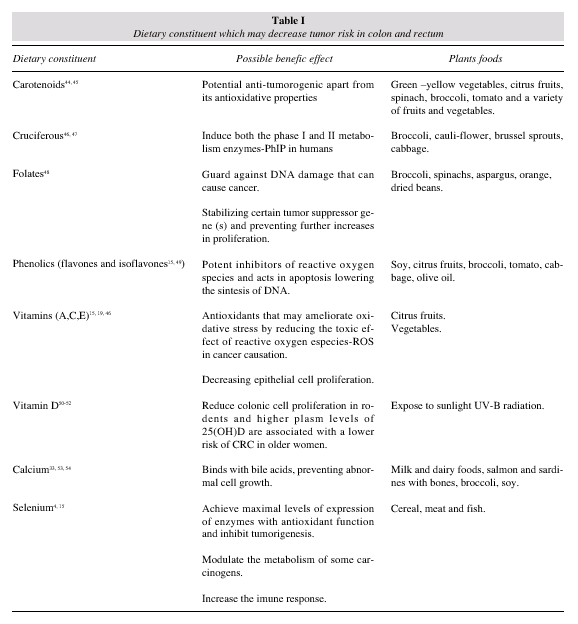
<body><![CDATA[<p>More recent epidemiologic studies have generaly not supported a strong influence of dietary fibre or fruits and vegetables, although these have other health benefits, and their consumption should be encouraged<sup>6</sup>.</p>      <p>A recent case-control study examined associations of various food groups with colon cancer in African -Americans and Caucasians and supported the evidence that plant foods may protect against colon cancer<sup>40</sup>.</p>      <p>In a reviewed analytic epidemiological studies of the major Japanese digestive tract cancers (esophageal, stomach, colon and rectal) pointed that, sufficient intake of vegetables, including green-yellow vegetables, and fruits was regarded as a possible protective factor for these cancers<sup>41</sup>.</p>      <p>4.1. Fibre</p>     <p>The hypothesis that dietary fibre prevents large bowel cancer must be credited largely to Burkitt, who in 1971 described the epidemiology of colorectal cancer and suggested an association between dietary fibre and large bowel function<sup>42</sup>.</p>      <p>High fibre content in food has traditionally been considered as a protector factor against colorectal cancer because of the multiple epidemiological studies, clinical trials have not been able to confirm it maybe due to methodological problems<sup>15</sup>. Possibly, some specific component or type of fibre rather than total dietary fibre may be protective, or perhaps the influence of fibres occurs during erlier stages of carcinogenesis<sup>24</sup>.</p>      <p>Mechanisms by which certain dietary fibres may act to reduce the risk of colon cancer are thought to involve the dilution, absorption, and removal of carcinogens, cocarcinogens, and/or tumor promoters that are present in the gut. Dietary fibre binds bile acids and carcinogens, potentially lessening their toxic effects. Also, fibre is fermented to volatile fatty acids that may be protective. Fermentation to volatile fatty acids also lowers the pH, which prevents the conversion of primary to secondary bile acids<sup>19-21</sup>.</p>      <p>Complex carbohydrates rich in fibres are degraded in the colon to short-chain fatty acids which exhibit protective effects in experimental models of carcinogenesis<sup>43</sup>.</p>      <p>4.2. Anticarcinogenic compounds</p>     <p>Vegetables and fruits contain an abundant array of recognized nutrients such as vitamins (A, C, D, E and folic acid), minerals (calcium, selenium) and phytochemicals with biological principles, such carotenoids (e.g., lycopene, lutein, zeaxanthin, &#946;-cryptoxanthin, &#946;-carotene), tiols such as isothiacyanates, phenolics substances (e.g., lignans, flavonoids, simple phenols), indoles, that protect against colorectal cancer. </p>      ]]></body>
<body><![CDATA[<p><a href="#t1">Table I</a> summarizes how some of these compounds exert a protective effect in carcinogenesis and the plant food rich in these.</p>     <p align="center"><a name="t1"><IMG SRC="/img/nh/v20n4/01CancerColorectal/revision_tabla1.gif" width="578" height="624"></a></p>      <p><b>Lifestyle aspects</b></p>     <p>1. Physical Activity</p>      <p>Scientific evidence is accumulating on physical activity as a means for the primary prevention of cancer. In nearly 170 observational studies of physical activity and cancer risk the evidence is classified as convincing for colon cancer<sup>55</sup>.</p>     <p>Several plausible hypothesized biological mecanisms exist for the association between physical activity and colorectal cancer, including decreased obesity and central adiposity that has been particularyimplicated in promoting metabolic condition amenable to carcinogenesis and possible changes in immune function, decrease circulating insulin levels thought to stimulate tumor growth<sup>19, 55, 56</sup>, speeds the passage of the intestinal contents, limiting the amount of the time potencial carcinogens come in contact with the large intestine<sup>15, 33</sup>.</p>       <p>2. <i> Obesity</i></p>      <p>Obesity is an increasing problem for industrialized nations. The WCRF/AIRC pointed the high body mass as possible risk factor for colorectal cancer<sup>37, 57.</sup></p>      <p>According to the WHO/FAO report 2003 based on review of published epidemiological studies, there is convincing evidence between colorectal cancer and its association with overweight/obesity<sup>57</sup>.</p>      <p>Overweight people are typically less active, often secrete excessive insulin and may consume too many of the "wrong" calories, that are, undesirable fats and highly processed carbohydrates and sugar<sup>6, 24</sup>.</p>      ]]></body>
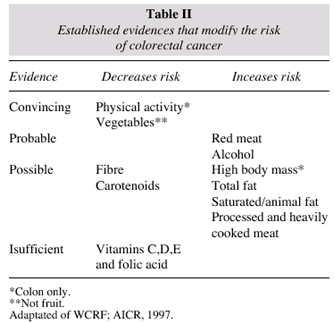
<body><![CDATA[<p>In case-controls studies, excessive weight predicts colorectal cancer risk in men, whereas abdominal obesity represents a more reliable risk in women<sup>58</sup>.</p>      <p>3. <i> Alcohol</i> </p>     <p>Alcohol stimules cell proliferation in the rectum and may thus increase cancer risk<sup>43</sup>. Alcohol appears to increase the risk, particulary when folate intake is low. Epidemiological, clinical, and animal studies collectivelly indicate that diet intake and blood folate levels are inversely associated with colorectal cancer. Folate plays an essencial role in one-carbon transfer involving remethylation of homocysteine to methionine, that maintain the stability of DNA. Desregulation and aberrant patterns of DNA methylation are generally involved in colorectal carcinogenesis<sup>59, 60</sup>.</p>     <p>4. <i> Smoking</i></p>     <p>A positive association between tobacco and colorectal cancer has been suggested. Smoking is, however, also associated whith "poor" dietary habits, which in turn may be related to the risk of adenomas.</p>      <p>A case-control study lends support to the theory of an initiating role of tobacco smoke in neoplasia formation<sup>61</sup> after a long induction period<sup>62, 63</sup>.</p>       <p><b>The mains evidences about life-style and colorectal cancer</b></p>     <p>Summarizing the strength of evidence to reduce the colorectal cancer this review suggests the panel's judgements based on criteria established by WCRF and IARC (<a href="#t2">table II</a>).</p>     <p align="center"><a name="t2"><IMG SRC="/img/nh/v20n4/01CancerColorectal/revision_tabla2.gif" width="335" height="323"></a></p>      <p><b>    ]]></body>
<body><![CDATA[<br> Conclusion</b></p>     <p>A large number of evidence indicates that several dietary and lifestyle factors affect colorectal cancer carcinogenesis in a complex form. Dietary components either promote or inhibit the carcinogenic process. </p>      <p>There is convincing evidence that dietary factors including obesity and low physical activity enhance the risk of colorectal cancer and that preserved and red meat probably increase the risk. </p>      <p>Numerous properties suggest that carotenoids and others antioxidants present in fruit and vegetables may be valuable chemopreventive agents. Fibre, however, has not proven the risk reducing properties that were attributed to it by epidemiological studies, possible because this term encompassed several very different substances. Moreover it is very difficult to know the effect of a isolated nutrient as these are intimately ent-wined in the foods.</p>      <p>A healthy lifestyle with regard to the risk of colorectal cancer, includes a large consumption of vegetable and whole cereals, a limit of caloric intake with fats not exceeding 30%, avoidance of red meat and alcohol, and do regularly physical exercise.</p>      <p><b>References</b></p>      <!-- ref --><p>1. Greenwald P, Lanza E and Eddy GA: Dietary fiber in the reduction of colon cancer risk.<i> J Am Diet Assoc</i> 1987, 87:1178-1188.&nbsp;&nbsp;&nbsp;&nbsp;&nbsp;&nbsp;&nbsp;&nbsp;[&#160;<a href="javascript:void(0);" onclick="javascript: window.open('/scielo.php?script=sci_nlinks&ref=3490228&pid=S0212-1611200500060000100001&lng=','','width=640,height=500,resizable=yes,scrollbars=1,menubar=yes,');">Links</a>&#160;]<!-- end-ref --><!-- ref --><p>2. Reddy BS: Dietary fat and colon cancer: animal model studies. <i>Lipids</i> 1992, 27:807-813.&nbsp;&nbsp;&nbsp;&nbsp;&nbsp;&nbsp;&nbsp;&nbsp;[&#160;<a href="javascript:void(0);" onclick="javascript: window.open('/scielo.php?script=sci_nlinks&ref=3490229&pid=S0212-1611200500060000100002&lng=','','width=640,height=500,resizable=yes,scrollbars=1,menubar=yes,');">Links</a>&#160;]<!-- end-ref --><!-- ref --><p>3. Steinmetz KA, Kushi LH, Bostick RM, Folson AR, Potter JD: Vegetables, fruit, and colon cancer in the Iowa Women's Health Study. <i>Am J Epidemiol</i> 1994, 139:1-13.&nbsp;&nbsp;&nbsp;&nbsp;&nbsp;&nbsp;&nbsp;&nbsp;[&#160;<a href="javascript:void(0);" onclick="javascript: window.open('/scielo.php?script=sci_nlinks&ref=3490230&pid=S0212-1611200500060000100003&lng=','','width=640,height=500,resizable=yes,scrollbars=1,menubar=yes,');">Links</a>&#160;]<!-- end-ref --><!-- ref --><p>4. Hornsby-Lewis L: Dietary factors “ vitamins and minerals. In: Cohen AA, Hinawek S P J, editors. <i>Cancer of the colon, rectum and anus. </i>New York: McGraw“Hill; 1995,. p. 41-49.&nbsp;&nbsp;&nbsp;&nbsp;&nbsp;&nbsp;&nbsp;&nbsp;[&#160;<a href="javascript:void(0);" onclick="javascript: window.open('/scielo.php?script=sci_nlinks&ref=3490231&pid=S0212-1611200500060000100004&lng=','','width=640,height=500,resizable=yes,scrollbars=1,menubar=yes,');">Links</a>&#160;]<!-- end-ref --><!-- ref --><p>5. Potter JD: Risk factors for colon neoplasica-epidemiology and biology. <i>Eur J Cancer</i> 1995, 31:1033-1038.&nbsp;&nbsp;&nbsp;&nbsp;&nbsp;&nbsp;&nbsp;&nbsp;[&#160;<a href="javascript:void(0);" onclick="javascript: window.open('/scielo.php?script=sci_nlinks&ref=3490232&pid=S0212-1611200500060000100005&lng=','','width=640,height=500,resizable=yes,scrollbars=1,menubar=yes,');">Links</a>&#160;]<!-- end-ref --><!-- ref --><p>6. Giovannucci E. Diet, body,weight, and colorectal cancer: a summary of the epidemiologic evidence. <i>J Womens Health (Larchmt) </i>2003,12:173-82.&nbsp;&nbsp;&nbsp;&nbsp;&nbsp;&nbsp;&nbsp;&nbsp;[&#160;<a href="javascript:void(0);" onclick="javascript: window.open('/scielo.php?script=sci_nlinks&ref=3490233&pid=S0212-1611200500060000100006&lng=','','width=640,height=500,resizable=yes,scrollbars=1,menubar=yes,');">Links</a>&#160;]<!-- end-ref --><!-- ref --><p>7. Schirmbeck FG, Franceschi WB, Mayer GG, Almeida AS, Fontana M, Salles CP: Tratamento das neoplasias malignas do cólon e reto. <i>Rev Médica HSVP</i> 1999, 11:10-15.&nbsp;&nbsp;&nbsp;&nbsp;&nbsp;&nbsp;&nbsp;&nbsp;[&#160;<a href="javascript:void(0);" onclick="javascript: window.open('/scielo.php?script=sci_nlinks&ref=3490234&pid=S0212-1611200500060000100007&lng=','','width=640,height=500,resizable=yes,scrollbars=1,menubar=yes,');">Links</a>&#160;]<!-- end-ref --><!-- ref --><p>8. Schottenfeld D: Epidemiology. In: Cohen AA; Hinawek SPJ, editors. <i>Cancer of the Colon, Rectum and Anus. </i>New York: McGraw-Hill, 1995.&nbsp;&nbsp;&nbsp;&nbsp;&nbsp;&nbsp;&nbsp;&nbsp;[&#160;<a href="javascript:void(0);" onclick="javascript: window.open('/scielo.php?script=sci_nlinks&ref=3490235&pid=S0212-1611200500060000100008&lng=','','width=640,height=500,resizable=yes,scrollbars=1,menubar=yes,');">Links</a>&#160;]<!-- end-ref --><!-- ref --><p>9. Rao CV, Simi B, Wynn TT, Garr K, Reddy BS: Modulating effects of amount and types of dietary fat on colonic mucosal phospholipase A2 phosphatidylinosital-specific phospholipase C activities, and cyclooxygenase metabolite formation during different stages of colon tumor promotion in male F344 rats. <i>Cancer Res</i> 1996, 56:532-537.&nbsp;&nbsp;&nbsp;&nbsp;&nbsp;&nbsp;&nbsp;&nbsp;[&#160;<a href="javascript:void(0);" onclick="javascript: window.open('/scielo.php?script=sci_nlinks&ref=3490236&pid=S0212-1611200500060000100009&lng=','','width=640,height=500,resizable=yes,scrollbars=1,menubar=yes,');">Links</a>&#160;]<!-- end-ref --><!-- ref --><p>10. Wynder EL, Shigematsu T: Environmental factors of cancer of the colon and rectum. <i>Cancer</i> 1967, 20:1520-1561.&nbsp;&nbsp;&nbsp;&nbsp;&nbsp;&nbsp;&nbsp;&nbsp;[&#160;<a href="javascript:void(0);" onclick="javascript: window.open('/scielo.php?script=sci_nlinks&ref=3490237&pid=S0212-1611200500060000100010&lng=','','width=640,height=500,resizable=yes,scrollbars=1,menubar=yes,');">Links</a>&#160;]<!-- end-ref --><!-- ref --><p>11. Leszkowicz A P, Gross Y, Carrière V, Lugnenc PH, Berguer A, Carnot F et al.: High levels of DNA adducts in human colon are associated with colorectal cancer. <i>Cancer Res</i> 1995, 55:5611-5616.&nbsp;&nbsp;&nbsp;&nbsp;&nbsp;&nbsp;&nbsp;&nbsp;[&#160;<a href="javascript:void(0);" onclick="javascript: window.open('/scielo.php?script=sci_nlinks&ref=3490238&pid=S0212-1611200500060000100011&lng=','','width=640,height=500,resizable=yes,scrollbars=1,menubar=yes,');">Links</a>&#160;]<!-- end-ref --><!-- ref --><p>12. Zock PL: Dietary fats and cancer. <i>Curr Opin Lipidol</i> 2001, 12:5-10.&nbsp;&nbsp;&nbsp;&nbsp;&nbsp;&nbsp;&nbsp;&nbsp;[&#160;<a href="javascript:void(0);" onclick="javascript: window.open('/scielo.php?script=sci_nlinks&ref=3490239&pid=S0212-1611200500060000100012&lng=','','width=640,height=500,resizable=yes,scrollbars=1,menubar=yes,');">Links</a>&#160;]<!-- end-ref --><!-- ref --><p>13. World Cancer Research Fund (WCRF). Food, nutrition and the prevention of cancer. A global perspective, Washington (D.C): American Institute for Cancer Research; 1997.&nbsp;&nbsp;&nbsp;&nbsp;&nbsp;&nbsp;&nbsp;&nbsp;[&#160;<a href="javascript:void(0);" onclick="javascript: window.open('/scielo.php?script=sci_nlinks&ref=3490240&pid=S0212-1611200500060000100013&lng=','','width=640,height=500,resizable=yes,scrollbars=1,menubar=yes,');">Links</a>&#160;]<!-- end-ref --><!-- ref --><p>14. DeMarine DM, Hastings SB, Brooks LR, Eischen BT, Bell D A, Watson MA et al.: Pilot study of free and conjugated urinary mutagenicity during consumption of pan fried meats: possible modulation by cruciferous vegetables, glutathione Stransferase-M1, and N- acety1transferase-2. <i>Mutat Res</i> 1997, 381:83-96.&nbsp;&nbsp;&nbsp;&nbsp;&nbsp;&nbsp;&nbsp;&nbsp;[&#160;<a href="javascript:void(0);" onclick="javascript: window.open('/scielo.php?script=sci_nlinks&ref=3490241&pid=S0212-1611200500060000100014&lng=','','width=640,height=500,resizable=yes,scrollbars=1,menubar=yes,');">Links</a>&#160;]<!-- end-ref --><!-- ref --><p>15. Casimiro, C: Factores Etiopatogénicos en el cáncer colorrectal. Aspectos nutricionales y de estilo de vida. <i>Nutr Hosp </i>2002, 17:128-138.&nbsp;&nbsp;&nbsp;&nbsp;&nbsp;&nbsp;&nbsp;&nbsp;[&#160;<a href="javascript:void(0);" onclick="javascript: window.open('/scielo.php?script=sci_nlinks&ref=3490242&pid=S0212-1611200500060000100015&lng=','','width=640,height=500,resizable=yes,scrollbars=1,menubar=yes,');">Links</a>&#160;]<!-- end-ref --><!-- ref --><p>16. Howe GR, Benito E, Castelleto R, Cornée J, Estève J, Gallagher RP et al.: Dietary intake of fiber and decreased risk of cancers of the colon and rectum: evidence from the combined analysis of 13 cases- control studies. <i>J Natl Cancer Inst</i> 1992, 84:1887-1896.&nbsp;&nbsp;&nbsp;&nbsp;&nbsp;&nbsp;&nbsp;&nbsp;[&#160;<a href="javascript:void(0);" onclick="javascript: window.open('/scielo.php?script=sci_nlinks&ref=3490243&pid=S0212-1611200500060000100016&lng=','','width=640,height=500,resizable=yes,scrollbars=1,menubar=yes,');">Links</a>&#160;]<!-- end-ref --><!-- ref --><p>17. Slattery ML, Caan BJ, Potter JD, Berry TD, Coates A, Duncan D et al.: <i>Am J Epidemiol</i> 1997, 145:199-210.&nbsp;&nbsp;&nbsp;&nbsp;&nbsp;&nbsp;&nbsp;&nbsp;[&#160;<a href="javascript:void(0);" onclick="javascript: window.open('/scielo.php?script=sci_nlinks&ref=3490244&pid=S0212-1611200500060000100017&lng=','','width=640,height=500,resizable=yes,scrollbars=1,menubar=yes,');">Links</a>&#160;]<!-- end-ref --><!-- ref --><p>18. Giovannucci E: Modifiable risk factors for colon cancer. <i>Gastroenterol Clin North Am</i> 2002, 31:925-943.&nbsp;&nbsp;&nbsp;&nbsp;&nbsp;&nbsp;&nbsp;&nbsp;[&#160;<a href="javascript:void(0);" onclick="javascript: window.open('/scielo.php?script=sci_nlinks&ref=3490245&pid=S0212-1611200500060000100018&lng=','','width=640,height=500,resizable=yes,scrollbars=1,menubar=yes,');">Links</a>&#160;]<!-- end-ref --><!-- ref --><p>19. Hensrud DD, Heimburguer DC: Diet, Nutrients, and Gastrointestinal Cancer. In: <i>Gastroenterol Clin of North Am</i> 1998, 27:325-346.&nbsp;&nbsp;&nbsp;&nbsp;&nbsp;&nbsp;&nbsp;&nbsp;[&#160;<a href="javascript:void(0);" onclick="javascript: window.open('/scielo.php?script=sci_nlinks&ref=3490246&pid=S0212-1611200500060000100019&lng=','','width=640,height=500,resizable=yes,scrollbars=1,menubar=yes,');">Links</a>&#160;]<!-- end-ref --><!-- ref --><p>20. El-Bayoumy K, Chung FL, Richie J, Reddy BS, Cohen L, Weisburger J, Winder EL: Dietary control of cancer. <i>Proc Soc Exp Biol Med</i> 1997, 226:211-223.&nbsp;&nbsp;&nbsp;&nbsp;&nbsp;&nbsp;&nbsp;&nbsp;[&#160;<a href="javascript:void(0);" onclick="javascript: window.open('/scielo.php?script=sci_nlinks&ref=3490247&pid=S0212-1611200500060000100020&lng=','','width=640,height=500,resizable=yes,scrollbars=1,menubar=yes,');">Links</a>&#160;]<!-- end-ref --><!-- ref --><p>21. Reddy BS: Nutricional factors and colon cancer. <i>Crit Rev Food Sci Nutr</i> 1995, 35:175-190.&nbsp;&nbsp;&nbsp;&nbsp;&nbsp;&nbsp;&nbsp;&nbsp;[&#160;<a href="javascript:void(0);" onclick="javascript: window.open('/scielo.php?script=sci_nlinks&ref=3490248&pid=S0212-1611200500060000100021&lng=','','width=640,height=500,resizable=yes,scrollbars=1,menubar=yes,');">Links</a>&#160;]<!-- end-ref --><!-- ref --><p>22. Rouillier P, Senesse P, Cottet V, Valleau A, Faivre J, Ruault B: Dietary patters and the adenocarcinoma sequence of colon cancer. <i>Eur J Nutr</i> 2004 Aug 20 (Epub ahead of print).&nbsp;&nbsp;&nbsp;&nbsp;&nbsp;&nbsp;&nbsp;&nbsp;[&#160;<a href="javascript:void(0);" onclick="javascript: window.open('/scielo.php?script=sci_nlinks&ref=3490249&pid=S0212-1611200500060000100022&lng=','','width=640,height=500,resizable=yes,scrollbars=1,menubar=yes,');">Links</a>&#160;]<!-- end-ref --><!-- ref --><p>23. Rao CV, Hirose Y, Indranie C, Reddy BS: Modulation of experimental colon tumorigenesis by types and amounts of dietary fatty acids. <i>Cancer Res</i> 2001, 61:1927-1933.&nbsp;&nbsp;&nbsp;&nbsp;&nbsp;&nbsp;&nbsp;&nbsp;[&#160;<a href="javascript:void(0);" onclick="javascript: window.open('/scielo.php?script=sci_nlinks&ref=3490250&pid=S0212-1611200500060000100023&lng=','','width=640,height=500,resizable=yes,scrollbars=1,menubar=yes,');">Links</a>&#160;]<!-- end-ref --><!-- ref --><p>24. Giovannucci E, Rimm EB, Stampfer MJ, Colditiz GA, Ascherio A, Willet WC: Intake of fat, meat, and fiber in relation to risk of colon cancer in men. <i>Cancer Res</i> 1994, 54:2390-2397.&nbsp;&nbsp;&nbsp;&nbsp;&nbsp;&nbsp;&nbsp;&nbsp;[&#160;<a href="javascript:void(0);" onclick="javascript: window.open('/scielo.php?script=sci_nlinks&ref=3490251&pid=S0212-1611200500060000100024&lng=','','width=640,height=500,resizable=yes,scrollbars=1,menubar=yes,');">Links</a>&#160;]<!-- end-ref --><!-- ref --><p>25. Reddy BS, Burill C, Rigotty J: Effect of diets higt in w3 and w6 fatty acids on initiation and postinitiation stages of colon carcinogenesis. <i>Cancer Res</i> 1991, 51:487-91.&nbsp;&nbsp;&nbsp;&nbsp;&nbsp;&nbsp;&nbsp;&nbsp;[&#160;<a href="javascript:void(0);" onclick="javascript: window.open('/scielo.php?script=sci_nlinks&ref=3490252&pid=S0212-1611200500060000100025&lng=','','width=640,height=500,resizable=yes,scrollbars=1,menubar=yes,');">Links</a>&#160;]<!-- end-ref --><!-- ref --><p>26. Hong MY, Lupton JR, Morris JS, Wang N, Carroll RJ, Davidson LA, Elder RH et al.: Dietary fish oil reduces O6 methyl guanine DNA adduct levels in rat colon in part by increasing apoptosis during tumor initiation. <i>Cancer Epidemiol Biomaekers Prev</i> 2000, 9:819-826.&nbsp;&nbsp;&nbsp;&nbsp;&nbsp;&nbsp;&nbsp;&nbsp;[&#160;<a href="javascript:void(0);" onclick="javascript: window.open('/scielo.php?script=sci_nlinks&ref=3490253&pid=S0212-1611200500060000100026&lng=','','width=640,height=500,resizable=yes,scrollbars=1,menubar=yes,');">Links</a>&#160;]<!-- end-ref --><!-- ref --><p>27. Bartoli, R, Bañares FF, Navarro E, Castellà&nbsp; E, Maña J, Pastor C et al.: Effect of olive oil on early and late events of colon carcinogenesis in rats: modulation of arachidonic acid metabolism and local prostaglandin E2 synthesis. <i>Gut</i> 2000, 46:191-199.&nbsp;&nbsp;&nbsp;&nbsp;&nbsp;&nbsp;&nbsp;&nbsp;[&#160;<a href="javascript:void(0);" onclick="javascript: window.open('/scielo.php?script=sci_nlinks&ref=3490254&pid=S0212-1611200500060000100027&lng=','','width=640,height=500,resizable=yes,scrollbars=1,menubar=yes,');">Links</a>&#160;]<!-- end-ref --><!-- ref --><p>28. Stemmermann GN, Nomura AMY, Heilbrun LK: Dietary fat and the risk of colorectal cancer. <i>Cancer Res</i> 1984, 44:4633-4637.&nbsp;&nbsp;&nbsp;&nbsp;&nbsp;&nbsp;&nbsp;&nbsp;[&#160;<a href="javascript:void(0);" onclick="javascript: window.open('/scielo.php?script=sci_nlinks&ref=3490255&pid=S0212-1611200500060000100028&lng=','','width=640,height=500,resizable=yes,scrollbars=1,menubar=yes,');">Links</a>&#160;]<!-- end-ref --><!-- ref --><p>29. Zock PL, Katan MB: Linoleic acid intake and cancer risk : a review and meta-analysis. <i>Am J Clin Nutr</i> 1998, 68:142-153.    &nbsp;&nbsp;&nbsp;&nbsp;&nbsp;&nbsp;&nbsp;&nbsp;[&#160;<a href="javascript:void(0);" onclick="javascript: window.open('/scielo.php?script=sci_nlinks&ref=3490256&pid=S0212-1611200500060000100029&lng=','','width=640,height=500,resizable=yes,scrollbars=1,menubar=yes,');">Links</a>&#160;]<!-- end-ref --><!-- ref --> <p<30. Nkondjock A, Shatenstein B, Maisonneuve P, Ghadirian P: Specific fatty acids and human colorectal cancer: an overview. <i>Cancer Detect Prev 2003, 27:55-66.&nbsp;&nbsp;&nbsp;&nbsp;&nbsp;&nbsp;&nbsp;&nbsp;[&#160;<a href="javascript:void(0);" onclick="javascript: window.open('/scielo.php?script=sci_nlinks&ref=3490257&pid=S0212-1611200500060000100030&lng=','','width=640,height=500,resizable=yes,scrollbars=1,menubar=yes,');">Links</a>&#160;]<!-- end-ref --><!-- ref --><p>31. Giovannucci E, Stampfer MJ, Colditz GA, Rrimm EB, Willett WC: Relationship of diet to risk of colorectal adenoma in men. <i>J Natl Cancer Inst</i> 1992, 84:91-98.&nbsp;&nbsp;&nbsp;&nbsp;&nbsp;&nbsp;&nbsp;&nbsp;[&#160;<a href="javascript:void(0);" onclick="javascript: window.open('/scielo.php?script=sci_nlinks&ref=3490258&pid=S0212-1611200500060000100031&lng=','','width=640,height=500,resizable=yes,scrollbars=1,menubar=yes,');">Links</a>&#160;]<!-- end-ref --><!-- ref --><p>32. Hill MJ: Dietary factors - the intestinal milieu. In: Cohen, A A, Hinawek, SPJ, editors. <i>Cancer of the Colon, Rectum and Anus.</i> New York: McGraw-Hill:1995, p. 27-34.&nbsp;&nbsp;&nbsp;&nbsp;&nbsp;&nbsp;&nbsp;&nbsp;[&#160;<a href="javascript:void(0);" onclick="javascript: window.open('/scielo.php?script=sci_nlinks&ref=3490259&pid=S0212-1611200500060000100032&lng=','','width=640,height=500,resizable=yes,scrollbars=1,menubar=yes,');">Links</a>&#160;]<!-- end-ref --><!-- ref --><p>33. Antinoro L: Defending against colon cancer: a healthy lifestyle goes a long away. <i>Environmental Nutrition</i> 2003,26:1 (letter).&nbsp;&nbsp;&nbsp;&nbsp;&nbsp;&nbsp;&nbsp;&nbsp;[&#160;<a href="javascript:void(0);" onclick="javascript: window.open('/scielo.php?script=sci_nlinks&ref=3490260&pid=S0212-1611200500060000100033&lng=','','width=640,height=500,resizable=yes,scrollbars=1,menubar=yes,');">Links</a>&#160;]<!-- end-ref --><!-- ref --><p>34. Babbs CF: Free radicals and the etiology of colon cancer. <i>Free Rad Biol Med</i> 1990, 8:191-200.&nbsp;&nbsp;&nbsp;&nbsp;&nbsp;&nbsp;&nbsp;&nbsp;[&#160;<a href="javascript:void(0);" onclick="javascript: window.open('/scielo.php?script=sci_nlinks&ref=3490261&pid=S0212-1611200500060000100034&lng=','','width=640,height=500,resizable=yes,scrollbars=1,menubar=yes,');">Links</a>&#160;]<!-- end-ref --><!-- ref --><p>35. Norat T, Lukanova A, Ferrari P, Riboli E: Meat consumption and colorectal cancer risk: dose response meta- analysis of epidemiological studies. <i>J Cancer</i> 2002, 98:241-256.&nbsp;&nbsp;&nbsp;&nbsp;&nbsp;&nbsp;&nbsp;&nbsp;[&#160;<a href="javascript:void(0);" onclick="javascript: window.open('/scielo.php?script=sci_nlinks&ref=3490262&pid=S0212-1611200500060000100035&lng=','','width=640,height=500,resizable=yes,scrollbars=1,menubar=yes,');">Links</a>&#160;]<!-- end-ref --><!-- ref --><p>36. Sachse C, Smith G, Wilkie MJ, Barrett JH, Waxman R, Sullivan F et al.: A pharmacogenetic study to investigate the role of dietary carcinogens in the etiology of colorectal cancer. <i>Carcinogenesis</i> 2002, 23:1839-1849.&nbsp;&nbsp;&nbsp;&nbsp;&nbsp;&nbsp;&nbsp;&nbsp;[&#160;<a href="javascript:void(0);" onclick="javascript: window.open('/scielo.php?script=sci_nlinks&ref=3490263&pid=S0212-1611200500060000100036&lng=','','width=640,height=500,resizable=yes,scrollbars=1,menubar=yes,');">Links</a>&#160;]<!-- end-ref --><!-- ref --><p>37. Tamakoshi K, Tokumode S, Kuriki K, Takekuma K, Toyoshima H : Epidemiology and primary prevention of colorectal cancer. <i>Gan To Kagaku Ryoho</i> 2001, 28:146-150 (abstract).&nbsp;&nbsp;&nbsp;&nbsp;&nbsp;&nbsp;&nbsp;&nbsp;[&#160;<a href="javascript:void(0);" onclick="javascript: window.open('/scielo.php?script=sci_nlinks&ref=3490264&pid=S0212-1611200500060000100037&lng=','','width=640,height=500,resizable=yes,scrollbars=1,menubar=yes,');">Links</a>&#160;]<!-- end-ref --><!-- ref --><p>38. Reddy BS, Wang CH, Samaha H, Lubet R, Steele VE, Kelloff GJ, Rao CV : Chemoprevention of colon carcinogenesis by dietary perillyl alcohol. <i>Cancer Res</i> 1997, 57:420-425.&nbsp;&nbsp;&nbsp;&nbsp;&nbsp;&nbsp;&nbsp;&nbsp;[&#160;<a href="javascript:void(0);" onclick="javascript: window.open('/scielo.php?script=sci_nlinks&ref=3490265&pid=S0212-1611200500060000100038&lng=','','width=640,height=500,resizable=yes,scrollbars=1,menubar=yes,');">Links</a>&#160;]<!-- end-ref --><!-- ref --><p>39. Trichopoulou A, Lagiou P, Kuper H, Trichopoulos D: Cancer and mediterranean dietary traditions. <i>Cancer Epidemiol Biomarkers Prev</i> 2000, 9:869-873.&nbsp;&nbsp;&nbsp;&nbsp;&nbsp;&nbsp;&nbsp;&nbsp;[&#160;<a href="javascript:void(0);" onclick="javascript: window.open('/scielo.php?script=sci_nlinks&ref=3490266&pid=S0212-1611200500060000100039&lng=','','width=640,height=500,resizable=yes,scrollbars=1,menubar=yes,');">Links</a>&#160;]<!-- end-ref --><!-- ref --><p>40. Satia-Abouta J, Galanko JA, Martín CF, Ammerman A, Sandler RS: Food groups and colon cancer risk in African- Americans and Caucasians. <i>Int J Cancer</i> 2004, 109:728-736.&nbsp;&nbsp;&nbsp;&nbsp;&nbsp;&nbsp;&nbsp;&nbsp;[&#160;<a href="javascript:void(0);" onclick="javascript: window.open('/scielo.php?script=sci_nlinks&ref=3490267&pid=S0212-1611200500060000100040&lng=','','width=640,height=500,resizable=yes,scrollbars=1,menubar=yes,');">Links</a>&#160;]<!-- end-ref --><!-- ref --><p>41. Ogimoto I, Shibata A, Fukuda K: World Cancer Research Fund/American Institute of Cancer Research 1997 recommendations: applicability to digestive tract cancer in Japan.<i> Cancer Causes Control</i> 2000, 11:9-23 (abstract).&nbsp;&nbsp;&nbsp;&nbsp;&nbsp;&nbsp;&nbsp;&nbsp;[&#160;<a href="javascript:void(0);" onclick="javascript: window.open('/scielo.php?script=sci_nlinks&ref=3490268&pid=S0212-1611200500060000100041&lng=','','width=640,height=500,resizable=yes,scrollbars=1,menubar=yes,');">Links</a>&#160;]<!-- end-ref --><!-- ref --><p>42. Burkitt DP: Epidemiology of cancer of the colon and rectum. <i>Cancer</i> 1971, 28:3-13.&nbsp;&nbsp;&nbsp;&nbsp;&nbsp;&nbsp;&nbsp;&nbsp;[&#160;<a href="javascript:void(0);" onclick="javascript: window.open('/scielo.php?script=sci_nlinks&ref=3490269&pid=S0212-1611200500060000100042&lng=','','width=640,height=500,resizable=yes,scrollbars=1,menubar=yes,');">Links</a>&#160;]<!-- end-ref --><!-- ref --><p>43. Scheppach W, Boxberger F, Luhrs H, Melcher R, Menzel T: Effect of nutrition factors on the pathogenesis of colorectal carcinoma. <i>Zentralbl Chir</i> 2000, 125 (Suppl 1):5-7 (abstract).&nbsp;&nbsp;&nbsp;&nbsp;&nbsp;&nbsp;&nbsp;&nbsp;[&#160;<a href="javascript:void(0);" onclick="javascript: window.open('/scielo.php?script=sci_nlinks&ref=3490270&pid=S0212-1611200500060000100043&lng=','','width=640,height=500,resizable=yes,scrollbars=1,menubar=yes,');">Links</a>&#160;]<!-- end-ref --><!-- ref --><p>44. Mühlhöfer A, Bühler-Ritter B, Frank J, Zoller WG, Merkle P, Bosse A et al.: Carotenoids are decreased in biopsies from colorectal adenomas. <i>Clin Nutr</i> 2003, 22:65-70.&nbsp;&nbsp;&nbsp;&nbsp;&nbsp;&nbsp;&nbsp;&nbsp;[&#160;<a href="javascript:void(0);" onclick="javascript: window.open('/scielo.php?script=sci_nlinks&ref=3490271&pid=S0212-1611200500060000100044&lng=','','width=640,height=500,resizable=yes,scrollbars=1,menubar=yes,');">Links</a>&#160;]<!-- end-ref --><!-- ref --><p>45. Murtaugh MA, Ma KN, Benson J, Curtin K, Caan B, Slattery ML: Antioxidants, carotenoids, and risk of rectal cancer. <i>Am J Epidemiol</i> 2004, 159:32-41.&nbsp;&nbsp;&nbsp;&nbsp;&nbsp;&nbsp;&nbsp;&nbsp;[&#160;<a href="javascript:void(0);" onclick="javascript: window.open('/scielo.php?script=sci_nlinks&ref=3490272&pid=S0212-1611200500060000100045&lng=','','width=640,height=500,resizable=yes,scrollbars=1,menubar=yes,');">Links</a>&#160;]<!-- end-ref --><!-- ref --><p>46. Heber D, Blackburn GL, Go VLW, Holland E, Giovannucci E,Clinton SK, Block AS, Nixon DW: Nutritional Oncology. <i>Nutrition</i> 2003, 19:81-85 (Book Review).&nbsp;&nbsp;&nbsp;&nbsp;&nbsp;&nbsp;&nbsp;&nbsp;[&#160;<a href="javascript:void(0);" onclick="javascript: window.open('/scielo.php?script=sci_nlinks&ref=3490273&pid=S0212-1611200500060000100046&lng=','','width=640,height=500,resizable=yes,scrollbars=1,menubar=yes,');">Links</a>&#160;]<!-- end-ref --><!-- ref --><p>47. Walters DG, Young PJ, Agus C, Knize MG, Boobis AR, Gooderhan BG : Cruciferous vegetable consumption alters the metabolism of carcinogen 2- amino-1 methyl-6 phenylimidazo (4,5-b)pyridin humans. <i>Carcinogenesis</i> 2004, 25:1659-1669 (abstract).&nbsp;&nbsp;&nbsp;&nbsp;&nbsp;&nbsp;&nbsp;&nbsp;[&#160;<a href="javascript:void(0);" onclick="javascript: window.open('/scielo.php?script=sci_nlinks&ref=3490274&pid=S0212-1611200500060000100047&lng=','','width=640,height=500,resizable=yes,scrollbars=1,menubar=yes,');">Links</a>&#160;]<!-- end-ref --><!-- ref --><p>48. Nagothu KK, Jaszewski R, Moragoda L, Rishi AK, Finkenauer R, Tobi M et al.: Folic acid mediated attenuation of loss of heterozygosity of DCC tumor suppressor gene in the colonic mucosa of patients with colorectal adenomas. <i>Cancer Detect and Preven</i> 2003, 27:297-304.&nbsp;&nbsp;&nbsp;&nbsp;&nbsp;&nbsp;&nbsp;&nbsp;[&#160;<a href="javascript:void(0);" onclick="javascript: window.open('/scielo.php?script=sci_nlinks&ref=3490275&pid=S0212-1611200500060000100048&lng=','','width=640,height=500,resizable=yes,scrollbars=1,menubar=yes,');">Links</a>&#160;]<!-- end-ref --><!-- ref --><p>49. Owen RW, Giacosa A, Hull WE, Haubner R, Spiegelhalder B, Bartsch H: The antioxidant/anticancer potential of phenolic compounds isolated from olive oil. <i>Eur J Cancer</i> 2000, 36: 1235-1247.&nbsp;&nbsp;&nbsp;&nbsp;&nbsp;&nbsp;&nbsp;&nbsp;[&#160;<a href="javascript:void(0);" onclick="javascript: window.open('/scielo.php?script=sci_nlinks&ref=3490276&pid=S0212-1611200500060000100049&lng=','','width=640,height=500,resizable=yes,scrollbars=1,menubar=yes,');">Links</a>&#160;]<!-- end-ref --><!-- ref --><p>50. Grant WB, Garland CF: Reviews: A critical rewiew of studies on vitanim D in relation to colorectal cancer. <i>Nutr Cancer </i>2004, 48:115-123.&nbsp;&nbsp;&nbsp;&nbsp;&nbsp;&nbsp;&nbsp;&nbsp;[&#160;<a href="javascript:void(0);" onclick="javascript: window.open('/scielo.php?script=sci_nlinks&ref=3490277&pid=S0212-1611200500060000100050&lng=','','width=640,height=500,resizable=yes,scrollbars=1,menubar=yes,');">Links</a>&#160;]<!-- end-ref --><!-- ref --><p>51. Metha RG, Metha RR: Vitamin D and cancer. <i>J Nutr Biochem </i>2002, 13: 252-264.&nbsp;&nbsp;&nbsp;&nbsp;&nbsp;&nbsp;&nbsp;&nbsp;[&#160;<a href="javascript:void(0);" onclick="javascript: window.open('/scielo.php?script=sci_nlinks&ref=3490278&pid=S0212-1611200500060000100051&lng=','','width=640,height=500,resizable=yes,scrollbars=1,menubar=yes,');">Links</a>&#160;]<!-- end-ref --><!-- ref --><p>52. Feskanich D, Ma J, Fuchs CS, Kirkner GJ, Hankinson SE, Hollis BW and Giovannucci EL: Plasma vitamin D metabolites and risk of colorectal cancer in women. <i>Cancer Epidemiol Biomarkers Prev</i> 2004, 13:1502-1508.&nbsp;&nbsp;&nbsp;&nbsp;&nbsp;&nbsp;&nbsp;&nbsp;[&#160;<a href="javascript:void(0);" onclick="javascript: window.open('/scielo.php?script=sci_nlinks&ref=3490279&pid=S0212-1611200500060000100052&lng=','','width=640,height=500,resizable=yes,scrollbars=1,menubar=yes,');">Links</a>&#160;]<!-- end-ref --><!-- ref --><p>53. Van der Meer R, Lapre JA, Govers MJ, Kleibeuker JH: Mechanisms of the intestinal effects of dietary fats and milk products on colon carcinogenesis. <i>Cancer Lett</i> 1997, 114:75-83.&nbsp;&nbsp;&nbsp;&nbsp;&nbsp;&nbsp;&nbsp;&nbsp;[&#160;<a href="javascript:void(0);" onclick="javascript: window.open('/scielo.php?script=sci_nlinks&ref=3490280&pid=S0212-1611200500060000100053&lng=','','width=640,height=500,resizable=yes,scrollbars=1,menubar=yes,');">Links</a>&#160;]<!-- end-ref --><!-- ref --><p>54. Cho E, Smith-Warner SA, Spiegelman D, Beeson WL, van den Brant PA, Colditz GA et al.: Dairy foods, calcium, and colorectal cancer:a pooled analysis of 10 cohort studies. <i>J Natl Cancer Inst</i> 2004, 96:1015-1022.&nbsp;&nbsp;&nbsp;&nbsp;&nbsp;&nbsp;&nbsp;&nbsp;[&#160;<a href="javascript:void(0);" onclick="javascript: window.open('/scielo.php?script=sci_nlinks&ref=3490281&pid=S0212-1611200500060000100054&lng=','','width=640,height=500,resizable=yes,scrollbars=1,menubar=yes,');">Links</a>&#160;]<!-- end-ref --><!-- ref --><p>55. Friedenreich CM, Orenstein MR: Physical activity and cancer prevention: ethiologic evidence and biological mechanisms. <i>J Nutr</i> 2002, 132:3456S-3464S.&nbsp;&nbsp;&nbsp;&nbsp;&nbsp;&nbsp;&nbsp;&nbsp;[&#160;<a href="javascript:void(0);" onclick="javascript: window.open('/scielo.php?script=sci_nlinks&ref=3490282&pid=S0212-1611200500060000100055&lng=','','width=640,height=500,resizable=yes,scrollbars=1,menubar=yes,');">Links</a>&#160;]<!-- end-ref --><!-- ref --><p>56. Bianchini F, KAAKS R, Vainio H: Weight control and physical activity in cancer prevention. <i>Obes Rev</i> 2002, 3:5-8.&nbsp;&nbsp;&nbsp;&nbsp;&nbsp;&nbsp;&nbsp;&nbsp;[&#160;<a href="javascript:void(0);" onclick="javascript: window.open('/scielo.php?script=sci_nlinks&ref=3490283&pid=S0212-1611200500060000100056&lng=','','width=640,height=500,resizable=yes,scrollbars=1,menubar=yes,');">Links</a>&#160;]<!-- end-ref --><!-- ref --><p>57. Almendingen K, Hofstad B, Vatn MH: Does high body fatness increase the risk of presence and growth of colorectal adenomas followed up in situ for 3 years? <i>Am J Gastroenterol</i> 2001, 96:2238-2246.&nbsp;&nbsp;&nbsp;&nbsp;&nbsp;&nbsp;&nbsp;&nbsp;[&#160;<a href="javascript:void(0);" onclick="javascript: window.open('/scielo.php?script=sci_nlinks&ref=3490284&pid=S0212-1611200500060000100057&lng=','','width=640,height=500,resizable=yes,scrollbars=1,menubar=yes,');">Links</a>&#160;]<!-- end-ref --><!-- ref --><p>57.2 Tsugane S: Dietary factors and cancer risk- evidence from epidemiological studies. <i>Gan To Kagaky Ryoho</i> 2004, 31: 847-52 (abstract).&nbsp;&nbsp;&nbsp;&nbsp;&nbsp;&nbsp;&nbsp;&nbsp;[&#160;<a href="javascript:void(0);" onclick="javascript: window.open('/scielo.php?script=sci_nlinks&ref=3490285&pid=S0212-1611200500060000100058&lng=','','width=640,height=500,resizable=yes,scrollbars=1,menubar=yes,');">Links</a>&#160;]<!-- end-ref --><!-- ref --><p>58. Russo A, Franceschi S, Vecchia C, Dal Maso L, Montella M, Conti E et al.: Body size and colorectal cancer risk. <i>Int J Cancer</i> 1998, 78:161-5.&nbsp;&nbsp;&nbsp;&nbsp;&nbsp;&nbsp;&nbsp;&nbsp;[&#160;<a href="javascript:void(0);" onclick="javascript: window.open('/scielo.php?script=sci_nlinks&ref=3490286&pid=S0212-1611200500060000100059&lng=','','width=640,height=500,resizable=yes,scrollbars=1,menubar=yes,');">Links</a>&#160;]<!-- end-ref --><!-- ref --><p>59. Giovannucci E: Alcohol, one-carbon metabolism, and colorectal cancer: recent insights from molecular studies.<i> J Nutr</i> 2004, 134: 2475S 2481S.&nbsp;&nbsp;&nbsp;&nbsp;&nbsp;&nbsp;&nbsp;&nbsp;[&#160;<a href="javascript:void(0);" onclick="javascript: window.open('/scielo.php?script=sci_nlinks&ref=3490287&pid=S0212-1611200500060000100060&lng=','','width=640,height=500,resizable=yes,scrollbars=1,menubar=yes,');">Links</a>&#160;]<!-- end-ref --><!-- ref --><p>60. Kim YI: Folate and DNA methylation: a mechanistic link betweem folate feficiency and colorectal cancer? <i>Cancer Epiodemiol Biomarkers Prev</i> 2004, 13: 511-519.&nbsp;&nbsp;&nbsp;&nbsp;&nbsp;&nbsp;&nbsp;&nbsp;[&#160;<a href="javascript:void(0);" onclick="javascript: window.open('/scielo.php?script=sci_nlinks&ref=3490288&pid=S0212-1611200500060000100061&lng=','','width=640,height=500,resizable=yes,scrollbars=1,menubar=yes,');">Links</a>&#160;]<!-- end-ref --><!-- ref --><p>61. Almendingen K, Hofstad B, Trygg K, Hoff G, Hussain A, Vatn MH: Smoking and colorectal adenomas: a case-control study. <i>Eur J Cancer Prev</i> 2000, 9:193-203.&nbsp;&nbsp;&nbsp;&nbsp;&nbsp;&nbsp;&nbsp;&nbsp;[&#160;<a href="javascript:void(0);" onclick="javascript: window.open('/scielo.php?script=sci_nlinks&ref=3490289&pid=S0212-1611200500060000100062&lng=','','width=640,height=500,resizable=yes,scrollbars=1,menubar=yes,');">Links</a>&#160;]<!-- end-ref --><!-- ref --><p>62. Knekt P, Hakama M, Jarvinen R, Pukkala E, Heliovaara M: Smoking and risk of colorectal cancer. <i>Br J Cancer</i> 1998, 78:136-139.&nbsp;&nbsp;&nbsp;&nbsp;&nbsp;&nbsp;&nbsp;&nbsp;[&#160;<a href="javascript:void(0);" onclick="javascript: window.open('/scielo.php?script=sci_nlinks&ref=3490290&pid=S0212-1611200500060000100063&lng=','','width=640,height=500,resizable=yes,scrollbars=1,menubar=yes,');">Links</a>&#160;]<!-- end-ref --><!-- ref --><p>63. Erhardt JG, Kreichgauer HP, Meisner C, Bode JC, Bode C: Alcohol, cigarette smoking, dietary factors and the risk of colorectal adenomas and hyperplastic polyps - a case control study. <i>Eur J Nutr</i> 2002, 41:35-43.&nbsp;&nbsp;&nbsp;&nbsp;&nbsp;&nbsp;&nbsp;&nbsp;[&#160;<a href="javascript:void(0);" onclick="javascript: window.open('/scielo.php?script=sci_nlinks&ref=3490291&pid=S0212-1611200500060000100064&lng=','','width=640,height=500,resizable=yes,scrollbars=1,menubar=yes,');">Links</a>&#160;]<!-- end-ref --> ]]></body><back>
<ref-list>
<ref id="B1">
<label>1</label><nlm-citation citation-type="journal">
<person-group person-group-type="author">
<name>
<surname><![CDATA[Greenwald]]></surname>
<given-names><![CDATA[P]]></given-names>
</name>
<name>
<surname><![CDATA[Lanza]]></surname>
<given-names><![CDATA[E]]></given-names>
</name>
<name>
<surname><![CDATA[Eddy]]></surname>
<given-names><![CDATA[GA]]></given-names>
</name>
</person-group>
<article-title xml:lang="en"><![CDATA[Dietary fiber in the reduction of colon cancer risk]]></article-title>
<source><![CDATA[J Am Diet Assoc]]></source>
<year>1987</year>
<volume>87</volume>
<page-range>1178-1188</page-range></nlm-citation>
</ref>
<ref id="B2">
<label>2</label><nlm-citation citation-type="journal">
<person-group person-group-type="author">
<name>
<surname><![CDATA[Reddy]]></surname>
<given-names><![CDATA[BS]]></given-names>
</name>
</person-group>
<article-title xml:lang="en"><![CDATA[Dietary fat and colon cancer: animal model studies]]></article-title>
<source><![CDATA[Lipids]]></source>
<year>1992</year>
<volume>27</volume>
<page-range>807-813</page-range></nlm-citation>
</ref>
<ref id="B3">
<label>3</label><nlm-citation citation-type="journal">
<person-group person-group-type="author">
<name>
<surname><![CDATA[Steinmetz]]></surname>
<given-names><![CDATA[KA]]></given-names>
</name>
<name>
<surname><![CDATA[Kushi]]></surname>
<given-names><![CDATA[LH]]></given-names>
</name>
<name>
<surname><![CDATA[Bostick]]></surname>
<given-names><![CDATA[RM]]></given-names>
</name>
<name>
<surname><![CDATA[Folson]]></surname>
<given-names><![CDATA[AR]]></given-names>
</name>
<name>
<surname><![CDATA[Potter]]></surname>
<given-names><![CDATA[JD]]></given-names>
</name>
</person-group>
<article-title xml:lang="en"><![CDATA[Vegetables, fruit, and colon cancer in the Iowa Women's Health Study]]></article-title>
<source><![CDATA[Am J Epidemiol]]></source>
<year>1994</year>
<volume>139</volume>
<page-range>1-13</page-range></nlm-citation>
</ref>
<ref id="B4">
<label>4</label><nlm-citation citation-type="book">
<person-group person-group-type="author">
<name>
<surname><![CDATA[Hornsby-Lewis]]></surname>
<given-names><![CDATA[L]]></given-names>
</name>
</person-group>
<article-title xml:lang="en"><![CDATA[Dietary factors " vitamins and minerals]]></article-title>
<person-group person-group-type="editor">
<name>
<surname><![CDATA[Cohen]]></surname>
<given-names><![CDATA[AA]]></given-names>
</name>
<name>
<surname><![CDATA[Hinawek]]></surname>
<given-names><![CDATA[S P J]]></given-names>
</name>
</person-group>
<source><![CDATA[Cancer of the colon, rectum and anus]]></source>
<year>1995</year>
<page-range>41-49</page-range><publisher-loc><![CDATA[New York ]]></publisher-loc>
<publisher-name><![CDATA[McGraw"Hill]]></publisher-name>
</nlm-citation>
</ref>
<ref id="B5">
<label>5</label><nlm-citation citation-type="journal">
<person-group person-group-type="author">
<name>
<surname><![CDATA[Potter]]></surname>
<given-names><![CDATA[JD]]></given-names>
</name>
</person-group>
<article-title xml:lang="en"><![CDATA[Risk factors for colon neoplasica-epidemiology and biology]]></article-title>
<source><![CDATA[Eur J Cancer]]></source>
<year>1995</year>
<volume>31</volume>
<page-range>1033-1038</page-range></nlm-citation>
</ref>
<ref id="B6">
<label>6</label><nlm-citation citation-type="journal">
<person-group person-group-type="author">
<name>
<surname><![CDATA[Giovannucci]]></surname>
<given-names><![CDATA[E]]></given-names>
</name>
</person-group>
<article-title xml:lang="en"><![CDATA[Diet, body,weight, and colorectal cancer: a summary of the epidemiologic evidence]]></article-title>
<source><![CDATA[J Womens Health]]></source>
<year>2003</year>
<volume>12</volume>
<page-range>173-82</page-range><publisher-loc><![CDATA[Larchmt ]]></publisher-loc>
</nlm-citation>
</ref>
<ref id="B7">
<label>7</label><nlm-citation citation-type="journal">
<person-group person-group-type="author">
<name>
<surname><![CDATA[Schirmbeck]]></surname>
<given-names><![CDATA[FG]]></given-names>
</name>
<name>
<surname><![CDATA[Franceschi]]></surname>
<given-names><![CDATA[WB]]></given-names>
</name>
<name>
<surname><![CDATA[Mayer]]></surname>
<given-names><![CDATA[GG]]></given-names>
</name>
<name>
<surname><![CDATA[Almeida]]></surname>
<given-names><![CDATA[AS]]></given-names>
</name>
<name>
<surname><![CDATA[Fontana]]></surname>
<given-names><![CDATA[M]]></given-names>
</name>
<name>
<surname><![CDATA[Salles]]></surname>
<given-names><![CDATA[CP]]></given-names>
</name>
</person-group>
<article-title xml:lang="pt"><![CDATA[Tratamento das neoplasias malignas do cólon e reto]]></article-title>
<source><![CDATA[Rev Médica HSVP]]></source>
<year>1999</year>
<volume>11</volume>
<page-range>10-15</page-range></nlm-citation>
</ref>
<ref id="B8">
<label>8</label><nlm-citation citation-type="book">
<person-group person-group-type="author">
<name>
<surname><![CDATA[Schottenfeld]]></surname>
<given-names><![CDATA[D]]></given-names>
</name>
</person-group>
<article-title xml:lang="en"><![CDATA[Epidemiology]]></article-title>
<person-group person-group-type="editor">
<name>
<surname><![CDATA[Cohen]]></surname>
<given-names><![CDATA[AA]]></given-names>
</name>
<name>
<surname><![CDATA[Hinawek]]></surname>
<given-names><![CDATA[SPJ]]></given-names>
</name>
</person-group>
<source><![CDATA[Cancer of the Colon, Rectum and Anus]]></source>
<year>1995</year>
<publisher-loc><![CDATA[New York ]]></publisher-loc>
<publisher-name><![CDATA[McGraw-Hill]]></publisher-name>
</nlm-citation>
</ref>
<ref id="B9">
<label>9</label><nlm-citation citation-type="journal">
<person-group person-group-type="author">
<name>
<surname><![CDATA[Rao]]></surname>
<given-names><![CDATA[CV]]></given-names>
</name>
<name>
<surname><![CDATA[Simi]]></surname>
<given-names><![CDATA[B]]></given-names>
</name>
<name>
<surname><![CDATA[Wynn]]></surname>
<given-names><![CDATA[TT]]></given-names>
</name>
<name>
<surname><![CDATA[Garr]]></surname>
<given-names><![CDATA[K]]></given-names>
</name>
<name>
<surname><![CDATA[Reddy]]></surname>
<given-names><![CDATA[BS]]></given-names>
</name>
</person-group>
<article-title xml:lang="en"><![CDATA[Modulating effects of amount and types of dietary fat on colonic mucosal phospholipase A2 phosphatidylinosital-specific phospholipase C activities, and cyclooxygenase metabolite formation during different stages of colon tumor promotion in male F344 rats]]></article-title>
<source><![CDATA[Cancer Res]]></source>
<year>1996</year>
<volume>56</volume>
<page-range>532-537</page-range></nlm-citation>
</ref>
<ref id="B10">
<label>10</label><nlm-citation citation-type="journal">
<person-group person-group-type="author">
<name>
<surname><![CDATA[Wynder]]></surname>
<given-names><![CDATA[EL]]></given-names>
</name>
<name>
<surname><![CDATA[Shigematsu]]></surname>
<given-names><![CDATA[T]]></given-names>
</name>
</person-group>
<article-title xml:lang="en"><![CDATA[Environmental factors of cancer of the colon and rectum]]></article-title>
<source><![CDATA[Cancer]]></source>
<year>1967</year>
<volume>20</volume>
<page-range>1520-1561</page-range></nlm-citation>
</ref>
<ref id="B11">
<label>11</label><nlm-citation citation-type="journal">
<person-group person-group-type="author">
<name>
<surname><![CDATA[Leszkowicz]]></surname>
<given-names><![CDATA[A P]]></given-names>
</name>
<name>
<surname><![CDATA[Gross]]></surname>
<given-names><![CDATA[Y]]></given-names>
</name>
<name>
<surname><![CDATA[Carrière]]></surname>
<given-names><![CDATA[V]]></given-names>
</name>
<name>
<surname><![CDATA[Lugnenc]]></surname>
<given-names><![CDATA[PH]]></given-names>
</name>
<name>
<surname><![CDATA[Berguer]]></surname>
<given-names><![CDATA[A]]></given-names>
</name>
<name>
<surname><![CDATA[Carnot]]></surname>
<given-names><![CDATA[F]]></given-names>
</name>
</person-group>
<article-title xml:lang="en"><![CDATA[High levels of DNA adducts in human colon are associated with colorectal cancer]]></article-title>
<source><![CDATA[Cancer Res]]></source>
<year>1995</year>
<volume>55</volume>
<page-range>5611-5616</page-range></nlm-citation>
</ref>
<ref id="B12">
<label>12</label><nlm-citation citation-type="journal">
<person-group person-group-type="author">
<name>
<surname><![CDATA[Zock]]></surname>
<given-names><![CDATA[PL]]></given-names>
</name>
</person-group>
<article-title xml:lang="en"><![CDATA[Dietary fats and cancer]]></article-title>
<source><![CDATA[Curr Opin Lipidol]]></source>
<year>2001</year>
<volume>12</volume>
<page-range>5-10</page-range></nlm-citation>
</ref>
<ref id="B13">
<label>13</label><nlm-citation citation-type="book">
<collab>World Cancer Research Fund</collab>
<source><![CDATA[Food, nutrition and the prevention of cancer: A global perspective]]></source>
<year>1997</year>
<publisher-loc><![CDATA[Washington (D.C) ]]></publisher-loc>
<publisher-name><![CDATA[American Institute for Cancer Research]]></publisher-name>
</nlm-citation>
</ref>
<ref id="B14">
<label>14</label><nlm-citation citation-type="journal">
<person-group person-group-type="author">
<name>
<surname><![CDATA[DeMarine]]></surname>
<given-names><![CDATA[DM]]></given-names>
</name>
<name>
<surname><![CDATA[Hastings]]></surname>
<given-names><![CDATA[SB]]></given-names>
</name>
<name>
<surname><![CDATA[Brooks]]></surname>
<given-names><![CDATA[LR]]></given-names>
</name>
<name>
<surname><![CDATA[Eischen]]></surname>
<given-names><![CDATA[BT]]></given-names>
</name>
<name>
<surname><![CDATA[Bell]]></surname>
<given-names><![CDATA[D A]]></given-names>
</name>
<name>
<surname><![CDATA[Watson]]></surname>
<given-names><![CDATA[MA]]></given-names>
</name>
</person-group>
<article-title xml:lang="en"><![CDATA[Pilot study of free and conjugated urinary mutagenicity during consumption of pan fried meats: possible modulation by cruciferous vegetables, glutathione Stransferase-M1, and N- acety1transferase-2]]></article-title>
<source><![CDATA[Mutat Res]]></source>
<year>1997</year>
<volume>381</volume>
<page-range>83-96</page-range></nlm-citation>
</ref>
<ref id="B15">
<label>15</label><nlm-citation citation-type="journal">
<person-group person-group-type="author">
<name>
<surname><![CDATA[Casimiro]]></surname>
<given-names><![CDATA[C]]></given-names>
</name>
</person-group>
<article-title xml:lang="es"><![CDATA[Factores Etiopatogénicos en el cáncer colorrectal: Aspectos nutricionales y de estilo de vida]]></article-title>
<source><![CDATA[Nutr Hosp]]></source>
<year>2002</year>
<volume>17</volume>
<page-range>128-138</page-range></nlm-citation>
</ref>
<ref id="B16">
<label>16</label><nlm-citation citation-type="journal">
<person-group person-group-type="author">
<name>
<surname><![CDATA[Howe]]></surname>
<given-names><![CDATA[GR]]></given-names>
</name>
<name>
<surname><![CDATA[Benito]]></surname>
<given-names><![CDATA[E]]></given-names>
</name>
<name>
<surname><![CDATA[Castelleto]]></surname>
<given-names><![CDATA[R]]></given-names>
</name>
<name>
<surname><![CDATA[Cornée]]></surname>
<given-names><![CDATA[J]]></given-names>
</name>
<name>
<surname><![CDATA[Estève]]></surname>
<given-names><![CDATA[J]]></given-names>
</name>
<name>
<surname><![CDATA[Gallagher]]></surname>
<given-names><![CDATA[RP]]></given-names>
</name>
</person-group>
<article-title xml:lang="en"><![CDATA[Dietary intake of fiber and decreased risk of cancers of the colon and rectum: evidence from the combined analysis of 13 cases- control studies]]></article-title>
<source><![CDATA[J Natl Cancer Inst]]></source>
<year>1992</year>
<volume>84</volume>
<page-range>1887-1896</page-range></nlm-citation>
</ref>
<ref id="B17">
<label>17</label><nlm-citation citation-type="journal">
<person-group person-group-type="author">
<name>
<surname><![CDATA[Slattery]]></surname>
<given-names><![CDATA[ML]]></given-names>
</name>
<name>
<surname><![CDATA[Caan]]></surname>
<given-names><![CDATA[BJ]]></given-names>
</name>
<name>
<surname><![CDATA[Potter]]></surname>
<given-names><![CDATA[JD]]></given-names>
</name>
<name>
<surname><![CDATA[Berry]]></surname>
<given-names><![CDATA[TD]]></given-names>
</name>
<name>
<surname><![CDATA[Coates]]></surname>
<given-names><![CDATA[A]]></given-names>
</name>
<name>
<surname><![CDATA[Duncan]]></surname>
<given-names><![CDATA[D]]></given-names>
</name>
</person-group>
<source><![CDATA[Am J Epidemiol]]></source>
<year>1997</year>
<volume>145</volume>
<page-range>199-210</page-range></nlm-citation>
</ref>
<ref id="B18">
<label>18</label><nlm-citation citation-type="journal">
<person-group person-group-type="author">
<name>
<surname><![CDATA[Giovannucci]]></surname>
<given-names><![CDATA[E]]></given-names>
</name>
</person-group>
<article-title xml:lang="en"><![CDATA[Modifiable risk factors for colon cancer]]></article-title>
<source><![CDATA[Gastroenterol Clin North Am]]></source>
<year>2002</year>
<volume>31</volume>
<page-range>925-943</page-range></nlm-citation>
</ref>
<ref id="B19">
<label>19</label><nlm-citation citation-type="journal">
<person-group person-group-type="author">
<name>
<surname><![CDATA[Hensrud]]></surname>
<given-names><![CDATA[DD]]></given-names>
</name>
<name>
<surname><![CDATA[Heimburguer]]></surname>
<given-names><![CDATA[DC]]></given-names>
</name>
</person-group>
<article-title xml:lang="en"><![CDATA[Diet, Nutrients, and Gastrointestinal Cancer]]></article-title>
<source><![CDATA[Gastroenterol Clin of North Am]]></source>
<year>1998</year>
<volume>27</volume>
<page-range>325-346</page-range></nlm-citation>
</ref>
<ref id="B20">
<label>20</label><nlm-citation citation-type="journal">
<person-group person-group-type="author">
<name>
<surname><![CDATA[El-Bayoumy]]></surname>
<given-names><![CDATA[K]]></given-names>
</name>
<name>
<surname><![CDATA[Chung]]></surname>
<given-names><![CDATA[FL]]></given-names>
</name>
<name>
<surname><![CDATA[Richie]]></surname>
<given-names><![CDATA[J]]></given-names>
</name>
<name>
<surname><![CDATA[Reddy]]></surname>
<given-names><![CDATA[BS]]></given-names>
</name>
<name>
<surname><![CDATA[Cohen]]></surname>
<given-names><![CDATA[L]]></given-names>
</name>
<name>
<surname><![CDATA[Weisburger]]></surname>
<given-names><![CDATA[J]]></given-names>
</name>
<name>
<surname><![CDATA[Winder]]></surname>
<given-names><![CDATA[EL]]></given-names>
</name>
</person-group>
<article-title xml:lang="en"><![CDATA[Dietary control of cancer]]></article-title>
<source><![CDATA[Proc Soc Exp Biol Med]]></source>
<year>1997</year>
<volume>226</volume>
<page-range>211-223</page-range></nlm-citation>
</ref>
<ref id="B21">
<label>21</label><nlm-citation citation-type="journal">
<person-group person-group-type="author">
<name>
<surname><![CDATA[Reddy]]></surname>
<given-names><![CDATA[BS]]></given-names>
</name>
</person-group>
<article-title xml:lang="en"><![CDATA[Nutricional factors and colon cancer]]></article-title>
<source><![CDATA[Crit Rev Food Sci Nutr]]></source>
<year>1995</year>
<volume>35</volume>
<page-range>175-190</page-range></nlm-citation>
</ref>
<ref id="B22">
<label>22</label><nlm-citation citation-type="journal">
<person-group person-group-type="author">
<name>
<surname><![CDATA[Rouillier]]></surname>
<given-names><![CDATA[P]]></given-names>
</name>
<name>
<surname><![CDATA[Senesse]]></surname>
<given-names><![CDATA[P]]></given-names>
</name>
<name>
<surname><![CDATA[Cottet]]></surname>
<given-names><![CDATA[V]]></given-names>
</name>
<name>
<surname><![CDATA[Valleau]]></surname>
<given-names><![CDATA[A]]></given-names>
</name>
<name>
<surname><![CDATA[Faivre]]></surname>
<given-names><![CDATA[J]]></given-names>
</name>
<name>
<surname><![CDATA[Ruault]]></surname>
<given-names><![CDATA[B]]></given-names>
</name>
</person-group>
<article-title xml:lang="en"><![CDATA[Dietary patters and the adenocarcinoma sequence of colon cancer]]></article-title>
<source><![CDATA[Eur J Nutr]]></source>
<year>2004</year>
<month> A</month>
<day>ug</day>
</nlm-citation>
</ref>
<ref id="B23">
<label>23</label><nlm-citation citation-type="journal">
<person-group person-group-type="author">
<name>
<surname><![CDATA[Rao]]></surname>
<given-names><![CDATA[CV]]></given-names>
</name>
<name>
<surname><![CDATA[Hirose]]></surname>
<given-names><![CDATA[Y]]></given-names>
</name>
<name>
<surname><![CDATA[Indranie]]></surname>
<given-names><![CDATA[C]]></given-names>
</name>
<name>
<surname><![CDATA[Reddy]]></surname>
<given-names><![CDATA[BS]]></given-names>
</name>
</person-group>
<article-title xml:lang="en"><![CDATA[Modulation of experimental colon tumorigenesis by types and amounts of dietary fatty acids]]></article-title>
<source><![CDATA[Cancer Res]]></source>
<year>2001</year>
<volume>61</volume>
<page-range>1927-1933</page-range></nlm-citation>
</ref>
<ref id="B24">
<label>24</label><nlm-citation citation-type="journal">
<person-group person-group-type="author">
<name>
<surname><![CDATA[Giovannucci]]></surname>
<given-names><![CDATA[E]]></given-names>
</name>
<name>
<surname><![CDATA[Rimm]]></surname>
<given-names><![CDATA[EB]]></given-names>
</name>
<name>
<surname><![CDATA[Stampfer]]></surname>
<given-names><![CDATA[MJ]]></given-names>
</name>
<name>
<surname><![CDATA[Colditiz]]></surname>
<given-names><![CDATA[GA]]></given-names>
</name>
<name>
<surname><![CDATA[Ascherio]]></surname>
<given-names><![CDATA[A]]></given-names>
</name>
<name>
<surname><![CDATA[Willet]]></surname>
<given-names><![CDATA[WC]]></given-names>
</name>
</person-group>
<article-title xml:lang="en"><![CDATA[Intake of fat, meat, and fiber in relation to risk of colon cancer in men]]></article-title>
<source><![CDATA[Cancer Res]]></source>
<year>1994</year>
<volume>54</volume>
<page-range>2390-2397</page-range></nlm-citation>
</ref>
<ref id="B25">
<label>25</label><nlm-citation citation-type="journal">
<person-group person-group-type="author">
<name>
<surname><![CDATA[Reddy]]></surname>
<given-names><![CDATA[BS]]></given-names>
</name>
<name>
<surname><![CDATA[Burill]]></surname>
<given-names><![CDATA[C]]></given-names>
</name>
<name>
<surname><![CDATA[Rigotty]]></surname>
<given-names><![CDATA[J]]></given-names>
</name>
</person-group>
<article-title xml:lang="en"><![CDATA[Effect of diets higt in w3 and w6 fatty acids on initiation and postinitiation stages of colon carcinogenesis]]></article-title>
<source><![CDATA[Cancer Res]]></source>
<year>1991</year>
<volume>51</volume>
<page-range>487-91</page-range></nlm-citation>
</ref>
<ref id="B26">
<label>26</label><nlm-citation citation-type="journal">
<person-group person-group-type="author">
<name>
<surname><![CDATA[Hong]]></surname>
<given-names><![CDATA[MY]]></given-names>
</name>
<name>
<surname><![CDATA[Lupton]]></surname>
<given-names><![CDATA[JR]]></given-names>
</name>
<name>
<surname><![CDATA[Morris]]></surname>
<given-names><![CDATA[JS]]></given-names>
</name>
<name>
<surname><![CDATA[Wang]]></surname>
<given-names><![CDATA[N]]></given-names>
</name>
<name>
<surname><![CDATA[Carroll]]></surname>
<given-names><![CDATA[RJ]]></given-names>
</name>
<name>
<surname><![CDATA[Davidson]]></surname>
<given-names><![CDATA[LA]]></given-names>
</name>
<name>
<surname><![CDATA[Elder]]></surname>
<given-names><![CDATA[RH]]></given-names>
</name>
</person-group>
<article-title xml:lang="en"><![CDATA[Dietary fish oil reduces O6 methyl guanine DNA adduct levels in rat colon in part by increasing apoptosis during tumor initiation]]></article-title>
<source><![CDATA[Cancer Epidemiol Biomaekers Prev]]></source>
<year>2000</year>
<volume>9</volume>
<page-range>819-826</page-range></nlm-citation>
</ref>
<ref id="B27">
<label>27</label><nlm-citation citation-type="journal">
<person-group person-group-type="author">
<name>
<surname><![CDATA[Bartoli]]></surname>
<given-names><![CDATA[R]]></given-names>
</name>
<name>
<surname><![CDATA[Bañares]]></surname>
<given-names><![CDATA[FF]]></given-names>
</name>
<name>
<surname><![CDATA[Navarro]]></surname>
<given-names><![CDATA[E]]></given-names>
</name>
<name>
<surname><![CDATA[Castellà]]></surname>
<given-names><![CDATA[E]]></given-names>
</name>
<name>
<surname><![CDATA[Maña]]></surname>
<given-names><![CDATA[J]]></given-names>
</name>
<name>
<surname><![CDATA[Pastor]]></surname>
<given-names><![CDATA[C]]></given-names>
</name>
</person-group>
<article-title xml:lang="en"><![CDATA[Effect of olive oil on early and late events of colon carcinogenesis in rats: modulation of arachidonic acid metabolism and local prostaglandin E2 synthesis]]></article-title>
<source><![CDATA[Gut]]></source>
<year>2000</year>
<volume>46</volume>
<page-range>191-199</page-range></nlm-citation>
</ref>
<ref id="B28">
<label>28</label><nlm-citation citation-type="journal">
<person-group person-group-type="author">
<name>
<surname><![CDATA[Stemmermann]]></surname>
<given-names><![CDATA[GN]]></given-names>
</name>
<name>
<surname><![CDATA[Nomura]]></surname>
<given-names><![CDATA[AMY]]></given-names>
</name>
<name>
<surname><![CDATA[Heilbrun]]></surname>
<given-names><![CDATA[LK]]></given-names>
</name>
</person-group>
<article-title xml:lang="en"><![CDATA[Dietary fat and the risk of colorectal cancer]]></article-title>
<source><![CDATA[Cancer Res]]></source>
<year>1984</year>
<volume>44</volume>
<page-range>4633-4637</page-range></nlm-citation>
</ref>
<ref id="B29">
<label>29</label><nlm-citation citation-type="journal">
<person-group person-group-type="author">
<name>
<surname><![CDATA[Zock]]></surname>
<given-names><![CDATA[PL]]></given-names>
</name>
<name>
<surname><![CDATA[Katan]]></surname>
<given-names><![CDATA[MB]]></given-names>
</name>
</person-group>
<article-title xml:lang="en"><![CDATA[Linoleic acid intake and cancer risk: a review and meta-analysis]]></article-title>
<source><![CDATA[Am J Clin Nutr]]></source>
<year>1998</year>
<volume>68</volume>
<page-range>142-153</page-range></nlm-citation>
</ref>
<ref id="B30">
<label>30</label><nlm-citation citation-type="journal">
<person-group person-group-type="author">
<name>
<surname><![CDATA[Nkondjock]]></surname>
<given-names><![CDATA[A]]></given-names>
</name>
<name>
<surname><![CDATA[Shatenstein]]></surname>
<given-names><![CDATA[B]]></given-names>
</name>
<name>
<surname><![CDATA[Maisonneuve]]></surname>
<given-names><![CDATA[P]]></given-names>
</name>
<name>
<surname><![CDATA[Ghadirian]]></surname>
<given-names><![CDATA[P]]></given-names>
</name>
</person-group>
<article-title xml:lang="en"><![CDATA[Specific fatty acids and human colorectal cancer: an overview]]></article-title>
<source><![CDATA[Cancer Detect Prev]]></source>
<year>2003</year>
<volume>27</volume>
<page-range>55-66</page-range></nlm-citation>
</ref>
<ref id="B31">
<label>31</label><nlm-citation citation-type="journal">
<person-group person-group-type="author">
<name>
<surname><![CDATA[Giovannucci]]></surname>
<given-names><![CDATA[E]]></given-names>
</name>
<name>
<surname><![CDATA[Stampfer]]></surname>
<given-names><![CDATA[MJ]]></given-names>
</name>
<name>
<surname><![CDATA[Colditz]]></surname>
<given-names><![CDATA[GA]]></given-names>
</name>
<name>
<surname><![CDATA[Rrimm]]></surname>
<given-names><![CDATA[EB]]></given-names>
</name>
<name>
<surname><![CDATA[Willett]]></surname>
<given-names><![CDATA[WC]]></given-names>
</name>
</person-group>
<article-title xml:lang="en"><![CDATA[Relationship of diet to risk of colorectal adenoma in men]]></article-title>
<source><![CDATA[J Natl Cancer Inst]]></source>
<year>1992</year>
<volume>84</volume>
<page-range>91-98</page-range></nlm-citation>
</ref>
<ref id="B32">
<label>32</label><nlm-citation citation-type="book">
<person-group person-group-type="author">
<name>
<surname><![CDATA[Hill]]></surname>
<given-names><![CDATA[MJ]]></given-names>
</name>
</person-group>
<article-title xml:lang="en"><![CDATA[Dietary factors: the intestinal milieu]]></article-title>
<person-group person-group-type="editor">
<name>
<surname><![CDATA[Cohen]]></surname>
<given-names><![CDATA[A A]]></given-names>
</name>
<name>
<surname><![CDATA[Hinawek]]></surname>
<given-names><![CDATA[SPJ]]></given-names>
</name>
</person-group>
<source><![CDATA[Cancer of the Colon, Rectum and Anus]]></source>
<year>1995</year>
<page-range>27-34</page-range><publisher-loc><![CDATA[New York ]]></publisher-loc>
<publisher-name><![CDATA[McGraw-Hill]]></publisher-name>
</nlm-citation>
</ref>
<ref id="B33">
<label>33</label><nlm-citation citation-type="journal">
<person-group person-group-type="author">
<name>
<surname><![CDATA[Antinoro]]></surname>
<given-names><![CDATA[L]]></given-names>
</name>
</person-group>
<article-title xml:lang="es"><![CDATA[Defending against colon cancer: a healthy lifestyle goes a long away]]></article-title>
<source><![CDATA[Environmental Nutrition]]></source>
<year>2003</year>
<volume>26</volume>
<page-range>1</page-range></nlm-citation>
</ref>
<ref id="B34">
<label>34</label><nlm-citation citation-type="journal">
<person-group person-group-type="author">
<name>
<surname><![CDATA[Babbs]]></surname>
<given-names><![CDATA[CF]]></given-names>
</name>
</person-group>
<article-title xml:lang="en"><![CDATA[Free radicals and the etiology of colon cancer]]></article-title>
<source><![CDATA[Free Rad Biol Med]]></source>
<year>1990</year>
<volume>8</volume>
<page-range>191-200</page-range></nlm-citation>
</ref>
<ref id="B35">
<label>35</label><nlm-citation citation-type="journal">
<person-group person-group-type="author">
<name>
<surname><![CDATA[Norat]]></surname>
<given-names><![CDATA[T]]></given-names>
</name>
<name>
<surname><![CDATA[Lukanova]]></surname>
<given-names><![CDATA[A]]></given-names>
</name>
<name>
<surname><![CDATA[Ferrari]]></surname>
<given-names><![CDATA[P]]></given-names>
</name>
<name>
<surname><![CDATA[Riboli]]></surname>
<given-names><![CDATA[E]]></given-names>
</name>
</person-group>
<article-title xml:lang="en"><![CDATA[Meat consumption and colorectal cancer risk: dose response meta- analysis of epidemiological studies]]></article-title>
<source><![CDATA[J Cancer]]></source>
<year>2002</year>
<volume>98</volume>
<page-range>241-256</page-range></nlm-citation>
</ref>
<ref id="B36">
<label>36</label><nlm-citation citation-type="journal">
<person-group person-group-type="author">
<name>
<surname><![CDATA[Sachse]]></surname>
<given-names><![CDATA[C]]></given-names>
</name>
<name>
<surname><![CDATA[Smith]]></surname>
<given-names><![CDATA[G]]></given-names>
</name>
<name>
<surname><![CDATA[Wilkie]]></surname>
<given-names><![CDATA[MJ]]></given-names>
</name>
<name>
<surname><![CDATA[Barrett]]></surname>
<given-names><![CDATA[JH]]></given-names>
</name>
<name>
<surname><![CDATA[Waxman]]></surname>
<given-names><![CDATA[R]]></given-names>
</name>
<name>
<surname><![CDATA[Sullivan]]></surname>
<given-names><![CDATA[F]]></given-names>
</name>
</person-group>
<article-title xml:lang="en"><![CDATA[A pharmacogenetic study to investigate the role of dietary carcinogens in the etiology of colorectal cancer]]></article-title>
<source><![CDATA[Carcinogenesis]]></source>
<year>2002</year>
<volume>23</volume>
<page-range>1839-1849</page-range></nlm-citation>
</ref>
<ref id="B37">
<label>37</label><nlm-citation citation-type="journal">
<person-group person-group-type="author">
<name>
<surname><![CDATA[Tamakoshi]]></surname>
<given-names><![CDATA[K]]></given-names>
</name>
<name>
<surname><![CDATA[Tokumode]]></surname>
<given-names><![CDATA[S]]></given-names>
</name>
<name>
<surname><![CDATA[Kuriki]]></surname>
<given-names><![CDATA[K]]></given-names>
</name>
<name>
<surname><![CDATA[Takekuma]]></surname>
<given-names><![CDATA[K]]></given-names>
</name>
<name>
<surname><![CDATA[Toyoshima]]></surname>
<given-names><![CDATA[H]]></given-names>
</name>
</person-group>
<article-title xml:lang="en"><![CDATA[Epidemiology and primary prevention of colorectal cancer]]></article-title>
<source><![CDATA[Gan To Kagaku Ryoho]]></source>
<year>2001</year>
<volume>28</volume>
<page-range>146-150</page-range></nlm-citation>
</ref>
<ref id="B38">
<label>38</label><nlm-citation citation-type="journal">
<person-group person-group-type="author">
<name>
<surname><![CDATA[Reddy]]></surname>
<given-names><![CDATA[BS]]></given-names>
</name>
<name>
<surname><![CDATA[Wang]]></surname>
<given-names><![CDATA[CH]]></given-names>
</name>
<name>
<surname><![CDATA[Samaha]]></surname>
<given-names><![CDATA[H]]></given-names>
</name>
<name>
<surname><![CDATA[Lubet]]></surname>
<given-names><![CDATA[R]]></given-names>
</name>
<name>
<surname><![CDATA[Steele]]></surname>
<given-names><![CDATA[VE]]></given-names>
</name>
<name>
<surname><![CDATA[Kelloff]]></surname>
<given-names><![CDATA[GJ]]></given-names>
</name>
<name>
<surname><![CDATA[Rao]]></surname>
<given-names><![CDATA[CV]]></given-names>
</name>
</person-group>
<article-title xml:lang="en"><![CDATA[Chemoprevention of colon carcinogenesis by dietary perillyl alcohol]]></article-title>
<source><![CDATA[Cancer Res]]></source>
<year>1997</year>
<volume>57</volume>
<page-range>420-425</page-range></nlm-citation>
</ref>
<ref id="B39">
<label>39</label><nlm-citation citation-type="journal">
<person-group person-group-type="author">
<name>
<surname><![CDATA[Trichopoulou]]></surname>
<given-names><![CDATA[A]]></given-names>
</name>
<name>
<surname><![CDATA[Lagiou]]></surname>
<given-names><![CDATA[P]]></given-names>
</name>
<name>
<surname><![CDATA[Kuper]]></surname>
<given-names><![CDATA[H]]></given-names>
</name>
<name>
<surname><![CDATA[Trichopoulos]]></surname>
<given-names><![CDATA[D]]></given-names>
</name>
</person-group>
<article-title xml:lang="en"><![CDATA[Cancer and mediterranean dietary traditions]]></article-title>
<source><![CDATA[Cancer Epidemiol Biomarkers Prev]]></source>
<year>2000</year>
<volume>9</volume>
<page-range>869-873</page-range></nlm-citation>
</ref>
<ref id="B40">
<label>40</label><nlm-citation citation-type="journal">
<person-group person-group-type="author">
<name>
<surname><![CDATA[Satia-Abouta]]></surname>
<given-names><![CDATA[J]]></given-names>
</name>
<name>
<surname><![CDATA[Galanko]]></surname>
<given-names><![CDATA[JA]]></given-names>
</name>
<name>
<surname><![CDATA[Martín]]></surname>
<given-names><![CDATA[CF]]></given-names>
</name>
<name>
<surname><![CDATA[Ammerman]]></surname>
<given-names><![CDATA[A]]></given-names>
</name>
<name>
<surname><![CDATA[Sandler]]></surname>
<given-names><![CDATA[RS]]></given-names>
</name>
</person-group>
<article-title xml:lang="en"><![CDATA[Food groups and colon cancer risk in African- Americans and Caucasians]]></article-title>
<source><![CDATA[Int J Cancer]]></source>
<year>2004</year>
<volume>109</volume>
<page-range>728-736</page-range></nlm-citation>
</ref>
<ref id="B41">
<label>41</label><nlm-citation citation-type="journal">
<person-group person-group-type="author">
<name>
<surname><![CDATA[Ogimoto]]></surname>
<given-names><![CDATA[I]]></given-names>
</name>
<name>
<surname><![CDATA[Shibata]]></surname>
<given-names><![CDATA[A]]></given-names>
</name>
<name>
<surname><![CDATA[Fukuda]]></surname>
<given-names><![CDATA[K]]></given-names>
</name>
</person-group>
<article-title xml:lang="en"><![CDATA[World Cancer Research Fund/American Institute of Cancer Research 1997 recommendations: applicability to digestive tract cancer in Japan]]></article-title>
<source><![CDATA[Cancer Causes Control]]></source>
<year>2000</year>
<volume>11</volume>
<page-range>9-23</page-range></nlm-citation>
</ref>
<ref id="B42">
<label>42</label><nlm-citation citation-type="journal">
<person-group person-group-type="author">
<name>
<surname><![CDATA[Burkitt]]></surname>
<given-names><![CDATA[DP]]></given-names>
</name>
</person-group>
<article-title xml:lang="en"><![CDATA[Epidemiology of cancer of the colon and rectum]]></article-title>
<source><![CDATA[Cancer]]></source>
<year>1971</year>
<volume>28</volume>
<page-range>3-13</page-range></nlm-citation>
</ref>
<ref id="B43">
<label>43</label><nlm-citation citation-type="journal">
<person-group person-group-type="author">
<name>
<surname><![CDATA[Scheppach]]></surname>
<given-names><![CDATA[W]]></given-names>
</name>
<name>
<surname><![CDATA[Boxberger]]></surname>
<given-names><![CDATA[F]]></given-names>
</name>
<name>
<surname><![CDATA[Luhrs]]></surname>
<given-names><![CDATA[H]]></given-names>
</name>
<name>
<surname><![CDATA[Melcher]]></surname>
<given-names><![CDATA[R]]></given-names>
</name>
<name>
<surname><![CDATA[Menzel]]></surname>
<given-names><![CDATA[T]]></given-names>
</name>
</person-group>
<article-title xml:lang="en"><![CDATA[Effect of nutrition factors on the pathogenesis of colorectal carcinoma]]></article-title>
<source><![CDATA[Zentralbl Chir]]></source>
<year>2000</year>
<volume>125</volume>
<numero>Suppl 1</numero>
<issue>Suppl 1</issue>
<page-range>5-7</page-range></nlm-citation>
</ref>
<ref id="B44">
<label>44</label><nlm-citation citation-type="journal">
<person-group person-group-type="author">
<name>
<surname><![CDATA[Mühlhöfer]]></surname>
<given-names><![CDATA[A]]></given-names>
</name>
<name>
<surname><![CDATA[Bühler-Ritter]]></surname>
<given-names><![CDATA[B]]></given-names>
</name>
<name>
<surname><![CDATA[Frank]]></surname>
<given-names><![CDATA[J]]></given-names>
</name>
<name>
<surname><![CDATA[Zoller]]></surname>
<given-names><![CDATA[WG]]></given-names>
</name>
<name>
<surname><![CDATA[Merkle]]></surname>
<given-names><![CDATA[P]]></given-names>
</name>
<name>
<surname><![CDATA[Bosse]]></surname>
<given-names><![CDATA[A]]></given-names>
</name>
</person-group>
<article-title xml:lang="en"><![CDATA[Carotenoids are decreased in biopsies from colorectal adenomas]]></article-title>
<source><![CDATA[Clin Nutr]]></source>
<year>2003</year>
<volume>22</volume>
<page-range>65-70</page-range></nlm-citation>
</ref>
<ref id="B45">
<label>45</label><nlm-citation citation-type="journal">
<person-group person-group-type="author">
<name>
<surname><![CDATA[Murtaugh]]></surname>
<given-names><![CDATA[MA]]></given-names>
</name>
<name>
<surname><![CDATA[Ma]]></surname>
<given-names><![CDATA[KN]]></given-names>
</name>
<name>
<surname><![CDATA[Benson]]></surname>
<given-names><![CDATA[J]]></given-names>
</name>
<name>
<surname><![CDATA[Curtin]]></surname>
<given-names><![CDATA[K]]></given-names>
</name>
<name>
<surname><![CDATA[Caan]]></surname>
<given-names><![CDATA[B]]></given-names>
</name>
<name>
<surname><![CDATA[Slattery]]></surname>
<given-names><![CDATA[ML]]></given-names>
</name>
</person-group>
<article-title xml:lang="en"><![CDATA[Antioxidants, carotenoids, and risk of rectal cancer]]></article-title>
<source><![CDATA[Am J Epidemiol]]></source>
<year>2004</year>
<volume>159</volume>
<page-range>32-41</page-range></nlm-citation>
</ref>
<ref id="B46">
<label>46</label><nlm-citation citation-type="journal">
<person-group person-group-type="author">
<name>
<surname><![CDATA[Heber]]></surname>
<given-names><![CDATA[D]]></given-names>
</name>
<name>
<surname><![CDATA[Blackburn]]></surname>
<given-names><![CDATA[GL]]></given-names>
</name>
<name>
<surname><![CDATA[Go]]></surname>
<given-names><![CDATA[VLW]]></given-names>
</name>
<name>
<surname><![CDATA[Holland]]></surname>
<given-names><![CDATA[E]]></given-names>
</name>
<name>
<surname><![CDATA[Giovannucci]]></surname>
<given-names><![CDATA[E]]></given-names>
</name>
<name>
<surname><![CDATA[Clinton]]></surname>
<given-names><![CDATA[SK]]></given-names>
</name>
<name>
<surname><![CDATA[Block]]></surname>
<given-names><![CDATA[AS]]></given-names>
</name>
<name>
<surname><![CDATA[Nixon]]></surname>
<given-names><![CDATA[DW]]></given-names>
</name>
</person-group>
<article-title xml:lang="en"><![CDATA[Nutritional Oncology]]></article-title>
<source><![CDATA[Nutrition]]></source>
<year>2003</year>
<volume>19</volume>
<page-range>81-85</page-range></nlm-citation>
</ref>
<ref id="B47">
<label>47</label><nlm-citation citation-type="journal">
<person-group person-group-type="author">
<name>
<surname><![CDATA[Walters]]></surname>
<given-names><![CDATA[DG]]></given-names>
</name>
<name>
<surname><![CDATA[Young]]></surname>
<given-names><![CDATA[PJ]]></given-names>
</name>
<name>
<surname><![CDATA[Agus]]></surname>
<given-names><![CDATA[C]]></given-names>
</name>
<name>
<surname><![CDATA[Knize]]></surname>
<given-names><![CDATA[MG]]></given-names>
</name>
<name>
<surname><![CDATA[Boobis]]></surname>
<given-names><![CDATA[AR]]></given-names>
</name>
<name>
<surname><![CDATA[Gooderhan]]></surname>
<given-names><![CDATA[BG]]></given-names>
</name>
</person-group>
<article-title xml:lang="en"><![CDATA[Cruciferous vegetable consumption alters the metabolism of carcinogen 2- amino-1 methyl-6 phenylimidazo (4,5-b)pyridin humans]]></article-title>
<source><![CDATA[Carcinogenesis]]></source>
<year>2004</year>
<volume>25</volume>
<page-range>1659-1669</page-range></nlm-citation>
</ref>
<ref id="B48">
<label>48</label><nlm-citation citation-type="journal">
<person-group person-group-type="author">
<name>
<surname><![CDATA[Nagothu]]></surname>
<given-names><![CDATA[KK]]></given-names>
</name>
<name>
<surname><![CDATA[Jaszewski]]></surname>
<given-names><![CDATA[R]]></given-names>
</name>
<name>
<surname><![CDATA[Moragoda]]></surname>
<given-names><![CDATA[L]]></given-names>
</name>
<name>
<surname><![CDATA[Rishi]]></surname>
<given-names><![CDATA[AK]]></given-names>
</name>
<name>
<surname><![CDATA[Finkenauer]]></surname>
<given-names><![CDATA[R]]></given-names>
</name>
<name>
<surname><![CDATA[Tobi]]></surname>
<given-names><![CDATA[M]]></given-names>
</name>
</person-group>
<article-title xml:lang="en"><![CDATA[Folic acid mediated attenuation of loss of heterozygosity of DCC tumor suppressor gene in the colonic mucosa of patients with colorectal adenomas]]></article-title>
<source><![CDATA[Cancer Detect and Preven]]></source>
<year>2003</year>
<volume>27</volume>
<page-range>297-304</page-range></nlm-citation>
</ref>
<ref id="B49">
<label>49</label><nlm-citation citation-type="journal">
<person-group person-group-type="author">
<name>
<surname><![CDATA[Owen]]></surname>
<given-names><![CDATA[RW]]></given-names>
</name>
<name>
<surname><![CDATA[Giacosa]]></surname>
<given-names><![CDATA[A]]></given-names>
</name>
<name>
<surname><![CDATA[Hull]]></surname>
<given-names><![CDATA[WE]]></given-names>
</name>
<name>
<surname><![CDATA[Haubner]]></surname>
<given-names><![CDATA[R]]></given-names>
</name>
<name>
<surname><![CDATA[Spiegelhalder]]></surname>
<given-names><![CDATA[B]]></given-names>
</name>
<name>
<surname><![CDATA[Bartsch]]></surname>
<given-names><![CDATA[H]]></given-names>
</name>
</person-group>
<article-title xml:lang="en"><![CDATA[The antioxidant/anticancer potential of phenolic compounds isolated from olive oil]]></article-title>
<source><![CDATA[Eur J Cancer]]></source>
<year>2000</year>
<volume>36</volume>
<page-range>1235-1247</page-range></nlm-citation>
</ref>
<ref id="B50">
<label>50</label><nlm-citation citation-type="journal">
<person-group person-group-type="author">
<name>
<surname><![CDATA[Grant]]></surname>
<given-names><![CDATA[WB]]></given-names>
</name>
<name>
<surname><![CDATA[Garland]]></surname>
<given-names><![CDATA[CF]]></given-names>
</name>
</person-group>
<article-title xml:lang="en"><![CDATA[Reviews: A critical rewiew of studies on vitanim D in relation to colorectal cancer]]></article-title>
<source><![CDATA[Nutr Cancer]]></source>
<year>2004</year>
<volume>48</volume>
<page-range>115-123</page-range></nlm-citation>
</ref>
<ref id="B51">
<label>51</label><nlm-citation citation-type="journal">
<person-group person-group-type="author">
<name>
<surname><![CDATA[Metha]]></surname>
<given-names><![CDATA[RG]]></given-names>
</name>
<name>
<surname><![CDATA[Metha]]></surname>
<given-names><![CDATA[RR]]></given-names>
</name>
</person-group>
<article-title xml:lang="en"><![CDATA[Vitamin D and cancer]]></article-title>
<source><![CDATA[J Nutr Biochem]]></source>
<year>2002</year>
<volume>13</volume>
<page-range>252-264</page-range></nlm-citation>
</ref>
<ref id="B52">
<label>52</label><nlm-citation citation-type="journal">
<person-group person-group-type="author">
<name>
<surname><![CDATA[Feskanich]]></surname>
<given-names><![CDATA[D]]></given-names>
</name>
<name>
<surname><![CDATA[Ma]]></surname>
<given-names><![CDATA[J]]></given-names>
</name>
<name>
<surname><![CDATA[Fuchs]]></surname>
<given-names><![CDATA[CS]]></given-names>
</name>
<name>
<surname><![CDATA[Kirkner]]></surname>
<given-names><![CDATA[GJ]]></given-names>
</name>
<name>
<surname><![CDATA[Hankinson]]></surname>
<given-names><![CDATA[SE]]></given-names>
</name>
<name>
<surname><![CDATA[Hollis]]></surname>
<given-names><![CDATA[BW]]></given-names>
</name>
<name>
<surname><![CDATA[Giovannucci]]></surname>
<given-names><![CDATA[EL]]></given-names>
</name>
</person-group>
<article-title xml:lang="en"><![CDATA[Plasma vitamin D metabolites and risk of colorectal cancer in women]]></article-title>
<source><![CDATA[Cancer Epidemiol Biomarkers Prev]]></source>
<year>2004</year>
<volume>13</volume>
<page-range>1502-1508</page-range></nlm-citation>
</ref>
<ref id="B53">
<label>53</label><nlm-citation citation-type="journal">
<person-group person-group-type="author">
<name>
<surname><![CDATA[Van der Meer]]></surname>
<given-names><![CDATA[R]]></given-names>
</name>
<name>
<surname><![CDATA[Lapre]]></surname>
<given-names><![CDATA[JA]]></given-names>
</name>
<name>
<surname><![CDATA[Govers]]></surname>
<given-names><![CDATA[MJ]]></given-names>
</name>
<name>
<surname><![CDATA[Kleibeuker]]></surname>
<given-names><![CDATA[JH]]></given-names>
</name>
</person-group>
<article-title xml:lang="en"><![CDATA[Mechanisms of the intestinal effects of dietary fats and milk products on colon carcinogenesis]]></article-title>
<source><![CDATA[Cancer Lett]]></source>
<year>1997</year>
<volume>114</volume>
<page-range>75-83</page-range></nlm-citation>
</ref>
<ref id="B54">
<label>54</label><nlm-citation citation-type="journal">
<person-group person-group-type="author">
<name>
<surname><![CDATA[Cho]]></surname>
<given-names><![CDATA[E]]></given-names>
</name>
<name>
<surname><![CDATA[Smith-Warner]]></surname>
<given-names><![CDATA[SA]]></given-names>
</name>
<name>
<surname><![CDATA[Spiegelman]]></surname>
<given-names><![CDATA[D]]></given-names>
</name>
<name>
<surname><![CDATA[Beeson]]></surname>
<given-names><![CDATA[WL]]></given-names>
</name>
<name>
<surname><![CDATA[van den Brant]]></surname>
<given-names><![CDATA[PA]]></given-names>
</name>
<name>
<surname><![CDATA[Colditz]]></surname>
<given-names><![CDATA[GA]]></given-names>
</name>
</person-group>
<article-title xml:lang="en"><![CDATA[Dairy foods, calcium, and colorectal cancer: a pooled analysis of 10 cohort studies]]></article-title>
<source><![CDATA[J Natl Cancer Inst]]></source>
<year>2004</year>
<volume>96</volume>
<page-range>1015-1022</page-range></nlm-citation>
</ref>
<ref id="B55">
<label>55</label><nlm-citation citation-type="journal">
<person-group person-group-type="author">
<name>
<surname><![CDATA[Friedenreich]]></surname>
<given-names><![CDATA[CM]]></given-names>
</name>
<name>
<surname><![CDATA[Orenstein]]></surname>
<given-names><![CDATA[MR]]></given-names>
</name>
</person-group>
<article-title xml:lang="en"><![CDATA[Physical activity and cancer prevention: ethiologic evidence and biological mechanisms]]></article-title>
<source><![CDATA[J Nutr]]></source>
<year>2002</year>
<volume>132</volume>
<page-range>3456S-3464S</page-range></nlm-citation>
</ref>
<ref id="B56">
<label>56</label><nlm-citation citation-type="journal">
<person-group person-group-type="author">
<name>
<surname><![CDATA[Bianchini]]></surname>
<given-names><![CDATA[F]]></given-names>
</name>
<name>
<surname><![CDATA[KAAKS]]></surname>
<given-names><![CDATA[R]]></given-names>
</name>
<name>
<surname><![CDATA[Vainio]]></surname>
<given-names><![CDATA[H]]></given-names>
</name>
</person-group>
<article-title xml:lang="en"><![CDATA[Weight control and physical activity in cancer prevention]]></article-title>
<source><![CDATA[Obes Rev]]></source>
<year>2002</year>
<volume>3</volume>
<page-range>5-8</page-range></nlm-citation>
</ref>
<ref id="B57">
<label>57</label><nlm-citation citation-type="journal">
<person-group person-group-type="author">
<name>
<surname><![CDATA[Almendingen]]></surname>
<given-names><![CDATA[K]]></given-names>
</name>
<name>
<surname><![CDATA[Hofstad]]></surname>
<given-names><![CDATA[B]]></given-names>
</name>
<name>
<surname><![CDATA[Vatn]]></surname>
<given-names><![CDATA[MH]]></given-names>
</name>
</person-group>
<article-title xml:lang="en"><![CDATA[Does high body fatness increase the risk of presence and growth of colorectal adenomas followed up in situ for 3 years?]]></article-title>
<source><![CDATA[Am J Gastroenterol]]></source>
<year>2001</year>
<volume>96</volume>
<page-range>2238-2246</page-range></nlm-citation>
</ref>
<ref id="B58">
<label>57</label><nlm-citation citation-type="journal">
<person-group person-group-type="author">
<name>
<surname><![CDATA[2 Tsugane]]></surname>
<given-names><![CDATA[S]]></given-names>
</name>
</person-group>
<article-title xml:lang="en"><![CDATA[Dietary factors and cancer risk- evidence from epidemiological studies]]></article-title>
<source><![CDATA[Gan To Kagaky Ryoho]]></source>
<year>2004</year>
<volume>31</volume>
<page-range>847-52</page-range></nlm-citation>
</ref>
<ref id="B59">
<label>58</label><nlm-citation citation-type="journal">
<person-group person-group-type="author">
<name>
<surname><![CDATA[Russo]]></surname>
<given-names><![CDATA[A]]></given-names>
</name>
<name>
<surname><![CDATA[Franceschi]]></surname>
<given-names><![CDATA[S]]></given-names>
</name>
<name>
<surname><![CDATA[Vecchia]]></surname>
<given-names><![CDATA[C]]></given-names>
</name>
<name>
<surname><![CDATA[DalMaso]]></surname>
<given-names><![CDATA[L]]></given-names>
</name>
<name>
<surname><![CDATA[Montella]]></surname>
<given-names><![CDATA[M]]></given-names>
</name>
<name>
<surname><![CDATA[Conti]]></surname>
<given-names><![CDATA[E]]></given-names>
</name>
</person-group>
<article-title xml:lang="en"><![CDATA[Body size and colorectal cancer risk]]></article-title>
<source><![CDATA[Int J Cancer]]></source>
<year>1998</year>
<volume>78</volume>
<page-range>161-5</page-range></nlm-citation>
</ref>
<ref id="B60">
<label>59</label><nlm-citation citation-type="journal">
<person-group person-group-type="author">
<name>
<surname><![CDATA[Giovannucci]]></surname>
<given-names><![CDATA[E]]></given-names>
</name>
</person-group>
<article-title xml:lang="en"><![CDATA[Alcohol, one-carbon metabolism, and colorectal cancer: recent insights from molecular studies]]></article-title>
<source><![CDATA[J Nutr]]></source>
<year>2004</year>
<volume>134</volume>
<page-range>2475S 2481S</page-range></nlm-citation>
</ref>
<ref id="B61">
<label>60</label><nlm-citation citation-type="journal">
<person-group person-group-type="author">
<name>
<surname><![CDATA[Kim]]></surname>
<given-names><![CDATA[YI]]></given-names>
</name>
</person-group>
<article-title xml:lang="en"><![CDATA[Folate and DNA methylation: a mechanistic link betweem folate feficiency and colorectal cancer?]]></article-title>
<source><![CDATA[Cancer Epiodemiol Biomarkers Prev]]></source>
<year>2004</year>
<volume>13</volume>
<page-range>511-519</page-range></nlm-citation>
</ref>
<ref id="B62">
<label>61</label><nlm-citation citation-type="journal">
<person-group person-group-type="author">
<name>
<surname><![CDATA[Almendingen]]></surname>
<given-names><![CDATA[K]]></given-names>
</name>
<name>
<surname><![CDATA[Hofstad]]></surname>
<given-names><![CDATA[B]]></given-names>
</name>
<name>
<surname><![CDATA[Trygg]]></surname>
<given-names><![CDATA[K]]></given-names>
</name>
<name>
<surname><![CDATA[Hoff]]></surname>
<given-names><![CDATA[G]]></given-names>
</name>
<name>
<surname><![CDATA[Hussain]]></surname>
<given-names><![CDATA[A]]></given-names>
</name>
<name>
<surname><![CDATA[Vatn]]></surname>
<given-names><![CDATA[MH]]></given-names>
</name>
</person-group>
<article-title xml:lang="en"><![CDATA[Smoking and colorectal adenomas: a case-control study]]></article-title>
<source><![CDATA[Eur J Cancer Prev]]></source>
<year>2000</year>
<volume>9</volume>
<page-range>193-203</page-range></nlm-citation>
</ref>
<ref id="B63">
<label>62</label><nlm-citation citation-type="journal">
<person-group person-group-type="author">
<name>
<surname><![CDATA[Knekt]]></surname>
<given-names><![CDATA[P]]></given-names>
</name>
<name>
<surname><![CDATA[Hakama]]></surname>
<given-names><![CDATA[M]]></given-names>
</name>
<name>
<surname><![CDATA[Jarvinen]]></surname>
<given-names><![CDATA[R]]></given-names>
</name>
<name>
<surname><![CDATA[Pukkala]]></surname>
<given-names><![CDATA[E]]></given-names>
</name>
<name>
<surname><![CDATA[Heliovaara]]></surname>
<given-names><![CDATA[M]]></given-names>
</name>
</person-group>
<article-title xml:lang="en"><![CDATA[Smoking and risk of colorectal cancer]]></article-title>
<source><![CDATA[Br J Cancer]]></source>
<year>1998</year>
<volume>78</volume>
<page-range>136-139</page-range></nlm-citation>
</ref>
<ref id="B64">
<label>63</label><nlm-citation citation-type="journal">
<person-group person-group-type="author">
<name>
<surname><![CDATA[Erhardt]]></surname>
<given-names><![CDATA[JG]]></given-names>
</name>
<name>
<surname><![CDATA[Kreichgauer]]></surname>
<given-names><![CDATA[HP]]></given-names>
</name>
<name>
<surname><![CDATA[Meisner]]></surname>
<given-names><![CDATA[C]]></given-names>
</name>
<name>
<surname><![CDATA[Bode]]></surname>
<given-names><![CDATA[JC]]></given-names>
</name>
<name>
<surname><![CDATA[Bode]]></surname>
<given-names><![CDATA[C]]></given-names>
</name>
</person-group>
<article-title xml:lang="en"><![CDATA[Alcohol, cigarette smoking, dietary factors and the risk of colorectal adenomas and hyperplastic polyps - a case control study]]></article-title>
<source><![CDATA[Eur J Nutr]]></source>
<year>2002</year>
<volume>41</volume>
<page-range>35-43</page-range></nlm-citation>
</ref>
</ref-list>
</back>
</article>