<?xml version="1.0" encoding="ISO-8859-1"?><article xmlns:mml="http://www.w3.org/1998/Math/MathML" xmlns:xlink="http://www.w3.org/1999/xlink" xmlns:xsi="http://www.w3.org/2001/XMLSchema-instance">
<front>
<journal-meta>
<journal-id>0212-1611</journal-id>
<journal-title><![CDATA[Nutrición Hospitalaria]]></journal-title>
<abbrev-journal-title><![CDATA[Nutr. Hosp.]]></abbrev-journal-title>
<issn>0212-1611</issn>
<publisher>
<publisher-name><![CDATA[Grupo Arán]]></publisher-name>
</publisher>
</journal-meta>
<article-meta>
<article-id>S0212-16112005000800003</article-id>
<title-group>
<article-title xml:lang="en"><![CDATA[Ineffectiveness of Nickel in augmenting the hepatotoxicity in protein deficient rats]]></article-title>
<article-title xml:lang="es"><![CDATA[Eficacia del níquel en aumentar la hepatotoxicidad en ratas con deficiencia en proteínas]]></article-title>
</title-group>
<contrib-group>
<contrib contrib-type="author">
<name>
<surname><![CDATA[Sidhu]]></surname>
<given-names><![CDATA[P.]]></given-names>
</name>
<xref ref-type="aff" rid="A01"/>
</contrib>
<contrib contrib-type="author">
<name>
<surname><![CDATA[Garg]]></surname>
<given-names><![CDATA[M. L.]]></given-names>
</name>
<xref ref-type="aff" rid="A02"/>
</contrib>
<contrib contrib-type="author">
<name>
<surname><![CDATA[Morgenstern]]></surname>
<given-names><![CDATA[P.]]></given-names>
</name>
<xref ref-type="aff" rid="A03"/>
</contrib>
<contrib contrib-type="author">
<name>
<surname><![CDATA[Vogt]]></surname>
<given-names><![CDATA[J.]]></given-names>
</name>
<xref ref-type="aff" rid="A04"/>
</contrib>
<contrib contrib-type="author">
<name>
<surname><![CDATA[Butz]]></surname>
<given-names><![CDATA[T.]]></given-names>
</name>
<xref ref-type="aff" rid="A04"/>
</contrib>
<contrib contrib-type="author">
<name>
<surname><![CDATA[Dhawan]]></surname>
<given-names><![CDATA[D. K.]]></given-names>
</name>
<xref ref-type="aff" rid="A01"/>
<xref ref-type="aff" rid="A05"/>
</contrib>
</contrib-group>
<aff id="A01">
<institution><![CDATA[,Friedrich-Alexander University Institute of Physiology and Experimental Pathophysiology ]]></institution>
<addr-line><![CDATA[Erlangen ]]></addr-line>
<country>Germany</country>
</aff>
<aff id="A02">
<institution><![CDATA[,Panjab University Department of Biophysics ]]></institution>
<addr-line><![CDATA[Chandigarh ]]></addr-line>
<country>India</country>
</aff>
<aff id="A03">
<institution><![CDATA[,Universität Leipzig Germany für Physik und Geowissenschaften ]]></institution>
<addr-line><![CDATA[Leipzig ]]></addr-line>
<country>Germany</country>
</aff>
<aff id="A04">
<institution><![CDATA[,Universität Leipzig Fakultät für Physik und Geowissenschaften ]]></institution>
<addr-line><![CDATA[Leipzig ]]></addr-line>
<country>Germany</country>
</aff>
<aff id="A05">
<institution><![CDATA[,Panjab University Chandigarh Department of Biophysics ]]></institution>
<addr-line><![CDATA[ ]]></addr-line>
<country>India</country>
</aff>
<pub-date pub-type="pub">
<day>00</day>
<month>12</month>
<year>2005</year>
</pub-date>
<pub-date pub-type="epub">
<day>00</day>
<month>12</month>
<year>2005</year>
</pub-date>
<volume>20</volume>
<numero>6</numero>
<fpage>378</fpage>
<lpage>385</lpage>
<copyright-statement/>
<copyright-year/>
<self-uri xlink:href="http://scielo.isciii.es/scielo.php?script=sci_arttext&amp;pid=S0212-16112005000800003&amp;lng=en&amp;nrm=iso"></self-uri><self-uri xlink:href="http://scielo.isciii.es/scielo.php?script=sci_abstract&amp;pid=S0212-16112005000800003&amp;lng=en&amp;nrm=iso"></self-uri><self-uri xlink:href="http://scielo.isciii.es/scielo.php?script=sci_pdf&amp;pid=S0212-16112005000800003&amp;lng=en&amp;nrm=iso"></self-uri><abstract abstract-type="short" xml:lang="en"><p><![CDATA[This study was designed to determine the toxic effects of nickel sulfate on the biochemical and elemental profile of liver in protein deficient rats. Nickel sulfate in the dose of 800mg/l in drinking water was administrated to Sprauge Dawley (S.D) normal control as well as protein deficient rats for a total duration of eight weeks. The effects of nickel treatment and protein deficiency when given separately and in combination were studied on rat liver marker enzymes like Alkaline phosphatase (ALP),Glutamate oxaloacetate transaminase (GOT), Glutamate pyruvate transaminase (GPT) and also on the status of essential elements in rat liver. Protein deficient,Ni treated as well as combined protein deficient and nickel treated rats showed significant reductions in the body weight and hepatic protein contents as compared to normal control rats. Hepatic alkaline phosphatase activity and alanine aminotransferase showed a significant elevation in rats subjected to protein deficiency, nickel treatment and combined protein deficiency and nickel treatment.As regards to hepatic levels of aspartate aminotransferase a significant elevation was observed in protein deficient and nickel treated protein deficient animals. Nickel administration to normal and protein deficient rats has resulted in a significant increase in concentrations of nickel, phosphorus and sulfur in liver tissue. The concentration of zinc and copper in liver tissue decreased significantly in protein deficient, nickel treated and nickel treated protein deficient animals. Tissue iron concentrations were found to be decreased in protein deficient animals, but the concentrations of iron got elevated significantly in nickel treated and nickel treated protein deficient animals. It has been observed that selenium got decreased significantly in protein deficient, nickel treated and nickel treated protein deficient animals when compared to normal animals. The elevation of selenium in nickel treated protein deficient animals was also significantly higher when compared to protein deficient animals.]]></p></abstract>
<abstract abstract-type="short" xml:lang="es"><p><![CDATA[Este estudio fue diseñado para determinar los efectos tóxicos del sulfato de níquel sobre el perfil bioquímico y de oligoelementos del hígado en ratas con deficiencia de proteínas.Se administró sulfato de níquel, a la dosis de 800 mg/l, en el agua de bebida de ratas Sprauge Dawley (S-D) normales control y con deficiencia de proteínas, durante 8 semanas. Se estudiaron los efectos del tratamiento con níquel y de la deficiencia de proteínas, por separado y en combinación,sobre marcadores enzimáticos hepáticos de la rata como la fosfatasa alcalina (FA), la glutamato oxalacetato transaminasa (GOT), la glutamato piruvato transaminasa (GPT) y también el estado de oligoelementos en el hígado de la rata. Las ratas con deficiencia de proteínas, las ratas tratadas con níquel, así cómo aquéllas con la combinación de deficiencia de proteínas y tratamiento con níquel mostraron reducciones significativas en el peso corporal y en el contenido hepático de proteína, en comparación con las ratas normales control. La actividad hepática fosfatasa alcalina y alanina aminotransferasa mostró una elevación significativa en las ratas sometidas a deficiencia de proteínas, a tratamiento con níquel, y a la combinación de deficiencia de proteínas y tratamiento con níquel. Con respecto de las concentraciones hepáticas de aspartato aminotransferasa, se observó una elevación significativa en los animales con deficiencia de proteínas y en aquellos tratado con níquel y con deficiencia de proteínas. La administración de níquel a ratas normales y con deficiencia de proteínas ha producido un aumento significativo de las concentraciones de níquel, fósforo y azufre en el tejido hepático. La concentración de cinc y cobre en el tejido hepático disminuyó significativamente los animales con deficiencia de proteínas, los tratados con níquel, y aquellos con deficiencia de proteínas tratados con níquel. Se halló que las concentraciones tisulares de hierro estaban disminuidas en los animales con deficiencia de proteínas, pero aumentaron significativamente en los animales tratados níquel y aquellos con deficiencia de proteínas tratados con níquel. Se observó que el selenio disminuyó significativamente en los animales con deficiencia de proteínas, los tratados con níquel, y aquellos con deficiencia de proteínas tratados con níquel, en comparación con los animales normales. La elevación de selenio en los animales con deficiencia de proteínas tratados con níquel también fue significativamente superior en comparación con los animales con deficiencia de proteínas.]]></p></abstract>
<kwd-group>
<kwd lng="en"><![CDATA[Protein deficiency]]></kwd>
<kwd lng="en"><![CDATA[Liver marker enzymes]]></kwd>
<kwd lng="en"><![CDATA[Trace elements]]></kwd>
<kwd lng="es"><![CDATA[Níquel]]></kwd>
<kwd lng="es"><![CDATA[Deficiencia de proteínas]]></kwd>
<kwd lng="es"><![CDATA[Enzimas marcadoras hepáticas]]></kwd>
<kwd lng="es"><![CDATA[Elementos traza]]></kwd>
</kwd-group>
</article-meta>
</front><body><![CDATA[ <p><b><font size="4">Original</font></b></p>     <p>   <b>   <font size=5>Ineffectiveness of Nickel in augmenting the hepatotoxicity    in protein deficient rats</font><font size=5>   </font></b> </p>     <p>    <font>P. Sidhu<sup>a</sup>, M. L. Garg<sup>b</sup>, P. Morgenstern<sup>c</sup>, J. Vogt<sup>d</sup>, T. Butz<sup>d</sup>, D. K. Dhawan<sup>a</sup>*</font></p>     <p><font size="2">   <i><sup>a</sup>Institute of Physiology and Experimental Pathophysiology ,Friedrich-Alexander University,Erlangen-91054,Germany.    <br>   <sup>b</sup>Department of Biophysics, Panjab University, Chandigarh-160014, India.  <sup>c</sup>Umweltforschungszentrum Leipzig-Halle, Leipzig,    <br>   Germany f&uuml;r Physik und Geowissenschaften,Universit&auml;t Leipzig, Leipzig,Germany.<sup>d</sup>Fakult&auml;t f&uuml;r Physik und    <br>   Geowissenschaften,Universit&auml;t Leipzig, Leipzig,Germany. *Department of Biophysics Panjab University Chandigarh, India..</i></font><font size="2"></font>&nbsp;</p>     <p>&nbsp;</p> <table border="0" width="100%">   <tr>     <td width="48%" valign="top">  <font><b>Abstract&nbsp;</b></font>    <p>  <font><b>This study was designed to determine the toxic effects of nickel sulfate on the biochemical and elemental profile of liver in protein deficient rats. Nickel sulfate in the dose of 800mg/l in drinking water was administrated to Sprauge Dawley (S.D) normal control as well as protein deficient rats for a total duration of eight weeks. The effects of nickel treatment and protein deficiency when given separately and in combination were studied on rat liver   marker enzymes like Alkaline phosphatase (ALP),Glutamate oxaloacetate transaminase (GOT), Glutamate pyruvate transaminase (GPT) and also on the    <br>   status of essential elements in rat liver. Protein deficient,Ni treated as well as combined protein deficient and nickel treated rats showed significant reductions in the body weight and hepatic protein contents as compared to normal control rats. Hepatic alkaline phosphatase activity and alanine aminotransferase showed a significant elevation in rats subjected to protein deficiency, nickel treatment and combined protein deficiency and nickel   treatment.As regards to hepatic levels of aspartate aminotransferase a significant elevation was observed in protein deficient and nickel treated protein deficient animals. Nickel administration to normal and protein deficient rats has resulted in a significant increase in concentrations of nickel, phosphorus and sulfur in liver tissue. The concentration of zinc and copper in liver tissue decreased significantly in protein deficient, nickel treated and nickel treated protein deficient animals. Tissue iron concentrations were found to be decreased in protein deficient animals, but the concentrations of iron got elevated   significantly in nickel treated and nickel treated protein deficient animals. It has been observed that selenium got decreased significantly in protein deficient, nickel treated and nickel treated protein deficient animals when compared to normal animals. The elevation of selenium in nickel treated protein deficient animals was also significantly higher when compared to protein deficient animals.  </b> </font></p>         ]]></body>
<body><![CDATA[<p align="right">  <font>(Nutr Hosp 2005, 20:378-385)</font></p>         <p>  <font>Key words:<i> Nickel. Protein deficiency. Liver marker enzymes. Trace elements.</i></font></td>     <td width="4%">&nbsp;</td>     <td width="48%" valign="top">         <p align="center"> <font><b>EFICACIA DEL N&Iacute;QUEL EN AUMENTAR LA HEPATOTOXICIDAD EN RATAS CON DEFICIENCIA EN PROTE&Iacute;NAS</b></font></p>         <p>  <font><b>Resumen</b></font></p>         <p>  <font><b>Este estudio fue dise&ntilde;ado para determinar los efectos t&oacute;xicos del sulfato de n&iacute;quel sobre el perfil bioqu&iacute;mico y de oligoelementos del h&iacute;gado en ratas con deficiencia de prote&iacute;nas.Se administr&oacute; sulfato de n&iacute;quel, a la dosis de 800 mg/l, en el agua de bebida de ratas Sprauge Dawley (S-D) normales control y con deficiencia de prote&iacute;nas, durante 8 semanas. Se estudiaron los efectos del tratamiento con n&iacute;quel y de la deficiencia de prote&iacute;nas, por separado y en combinaci&oacute;n,sobre marcadores enzim&aacute;ticos hep&aacute;ticos de la rata como la fosfatasa alcalina (FA), la glutamato oxalacetato transaminasa (GOT), la glutamato piruvato transaminasa (GPT) y tambi&eacute;n el estado de oligoelementos en el h&iacute;gado de la rata. Las ratas con deficiencia de prote&iacute;nas, las ratas tratadas con n&iacute;quel, as&iacute; c&oacute;mo aqu&eacute;llas con la combinaci&oacute;n de deficiencia de prote&iacute;nas y tratamiento con n&iacute;quel mostraron reducciones significativas en el peso corporal y en el contenido hep&aacute;tico de prote&iacute;na, en comparaci&oacute;n con las ratas normales control. La actividad hep&aacute;tica fosfatasa alcalina y alanina aminotransferasa mostr&oacute; una elevaci&oacute;n significativa en las ratas sometidas a deficiencia de prote&iacute;nas, a tratamiento con n&iacute;quel, y a la combinaci&oacute;n de deficiencia de prote&iacute;nas y tratamiento con n&iacute;quel. Con respecto de las concentraciones hep&aacute;ticas de aspartato aminotransferasa, se observ&oacute; una elevaci&oacute;n significativa en los animales con deficiencia de prote&iacute;nas y en aquellos tratado con n&iacute;quel y con deficiencia de prote&iacute;nas. La administraci&oacute;n de n&iacute;quel a ratas normales y con deficiencia de prote&iacute;nas ha producido un aumento significativo de las concentraciones de n&iacute;quel, f&oacute;sforo y azufre en el tejido hep&aacute;tico. La concentraci&oacute;n de cinc y cobre en el tejido hep&aacute;tico disminuy&oacute; significativamente los animales con deficiencia de prote&iacute;nas, los tratados con n&iacute;quel, y aquellos con deficiencia de prote&iacute;nas tratados con n&iacute;quel. Se hall&oacute; que las concentraciones tisulares de hierro estaban disminuidas en los animales con deficiencia de prote&iacute;nas, pero aumentaron significativamente en los animales tratados n&iacute;quel y aquellos con deficiencia de prote&iacute;nas tratados con n&iacute;quel. Se observ&oacute; que el selenio disminuy&oacute; significativamente en los animales con deficiencia de prote&iacute;nas, los tratados con n&iacute;quel, y aquellos con deficiencia de prote&iacute;nas tratados con n&iacute;quel, en comparaci&oacute;n con los animales normales. La elevaci&oacute;n de selenio en los animales con deficiencia de prote&iacute;nas tratados con n&iacute;quel tambi&eacute;n fue significativamente superior en comparaci&oacute;n con los animales con deficiencia de prote&iacute;nas.</b></font></p>         <p align="right">  <font>(Nutr Hosp 2005, 20:378-385)</font></p>         <p>  <font>Palabras clave:<i> N&iacute;quel. Deficiencia de prote&iacute;nas. Enzimas marcadoras hep&aacute;ticas. Elementos traza.</i></font></td>   </tr> </table> <hr align="left" width="48%">     <p> <font size="2"><b> <font>Correspondencia: </font> </b> <font>P. Sidhu    <br>    E-mail: <a href="mailto:pardeepsidhu@yahoo.co.ur">pardeepsidhu@yahoo.co.ur</a></font></font></p>     <p>      <font size="2">      <font>Recibido:</font>   <font size="2">18-X-2004</font>.    ]]></body>
<body><![CDATA[<br>     <font size="2">Aceptado:</font>   <font size="2">6-III-2005.</font></font></p>     <p>      &nbsp;</p>     <p>      <font><b>Introduction</b></font></p>     <p>      <font>In the developing countries like India protein nergy malnutrition (PEM), is a prominent cause of malnutrition and this may be associated with adverse functional disorders of body metabolism, which is likely to be exaggerated in conditions of heavy metal toxicity. Malnourished people living in the vicinity of nickel (Ni) industrial and smelting units are more prone to nickel toxicity. The protein calorie malnutrition affects the synthesis of the mRNA suggesting that a defect occurs at a pre-transcriptional level that results in a diminution of the concentration of mRNA<sup>1</sup>. PEM is known to be associated with many biochemical disturbances in the body. The increases in serum alanine aminotransferease and alkaline phosphatase in animals fed on a protein deficient diet, suggests hepatocellular dysfunctions<sup>2, 3</sup>. </font></p>     <p>      <font>Persons afflicted with protein malnutrition are almost deficient in a variety of micronutrients. Protein deficiency has been shown to decrease the hepatic levels of zinc, manganese, copper, calcium and magnesium in experimental animals<sup>4, 5</sup>. Alterations in the levels of trace elements results in number of diseases like hypoalbuminemia, and anemia in malnourished children<sup>6</sup>. Bhaskaram and Hemalatha, 1995<sup>7</sup> observed that children suffering from severe protein energy malnutrition have very low levels of the thymulin hormone, which is a sensitive indicator of zinc status in body. It is known that dietary protein variation affects the absorption and uptake of <sup>&nbsp;65</sup>Zn<sup>8</sup>.  </font></p>     <p>      <font>Nickel is a common respirable sized particulate pollutant and nickel compounds of commercial importance are used in the preparation of nickel alloys, ground coated enamels, in cooling of ceramics and glass, electroplating, nickel-iron storage batteries, electronic components and to prepare nickel catalysts<sup>9</sup>. Nickel breaks down the immunity by affecting    the T-cell system and suppresses the activity of natural killer cells in rats and mice<sup>10, 11</sup>.</font></p>     <p>      <font>&nbsp;Nickel has been shown to interact with number of trace elements including iron, zinc, copper, manganese, sodium and potassium<sup>12, 13</sup>. Nickel mobilizes and promotes the excretion of copper, zinc and manganese from organs and promotes storage of chromium in organs<sup>14</sup>. Nickel affects the iron metabolism and intensifies the erythropoiesis with induced hemolytic anemia<sup>15</sup>.  </font></p>     <p>      <font>In view of the increasing incidences of cancer, cardiovascular, respiratory and gastrointestinal diseases, due to heavy metal toxicity, the analysis of dietary intake for the toxic and protective elements and their levelsin tissue needs further research. Since, nutrients are essential for all the fundamental cellular processes as they modulate cellular oxidative and antioxidativedefense system in the body, therefore, it becomes a matter of concern to elucidate their role in manifestation of functional disorders of different organs.  </font></p>     <p>      <font>Liver, being a major metabolic organ, plays an important role in the regulation of biochemical and trace element metabolism. The present investigations were designed to study the hepatotoxic effects of nickel in rats subjected to protein deficiency. </font></p>     <p>      <font> <b>Materials and methods</b></font> </p>     ]]></body>
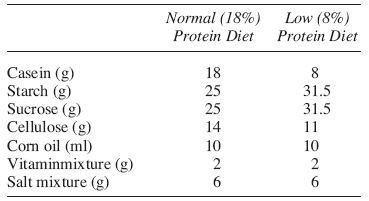
<body><![CDATA[<p> <font> <i>Grouping of animals</i>    <br> Rats in the weight range of 110-120 g of Sprague Dawley (S.D.) strain were procured from the Central Animal House, Panjab University, Chandigarh. The animals were housed in polypropylene cages in the animal house of the Department of Biophysics, under hygienic conditions and were acclimatized for at least one week before putting them on different treatments. Thereafter, the animals were randomly and equally divided into the four groups each having ten animals.</font></p>     <p> <font>&nbsp;G-1, Normal Control    <br> Animals in this group served as normal controls and were fed with diet containing normal protein contents (18%). Composition of the diet used was as described by Kaur et al, 1992 and given in table below.  </font></p>     <p> <font>G-2, Protein deficient,(PD)     <br> Protein deficiency was induced in the animals of this group by maintaining them on the laboratory prepared protein deficient diet with 8% protein contents. Composition of the diet used was as described by Kaur et al, 1992 (16) and given in table below.  </font></p>     <p> <font>G-3, Nickel treated, (Ni)     <br> Animals in this group were given nickel in the form of NiSO4. 6H2O at a dose level of 800 mg/L in drinking water and the animals had free access to the drinking water containing nickel and the normal diet.  </font></p>     <p> <font>G-4, Ni+PD treated     <br> Animals in this group were given protein deficient diet as given to G-2 animals and in addition were subjected to Ni treatment as mentioned for G-3 animals.</font></p>     ]]></body>
<body><![CDATA[<p> <font> <i>Composition of diets (weight %)</i>    <br> The composition of the diet is given in the following <a href="#f">table</a> (Kaur y cols., 1992).</font></p>     <P align="center" > <font><a name="f"> <img src="/img/revistas/nh/v20n6/orig3_f.gif" width="369" height="201"></a></font></p>     <p> <font>    <br> The treatments of rats continued for a period of eight weeks. At the end of the treatment, the animals were weighted and were sacrificed by exsanguination under light anesthesia. Livers were removed immediately and were perfused and rinsed in normal saline (NaCl, 9 g/l/w/v). One lobe was preserved by freezing for the determination of various trace elements and the other was processed immediately for various biochemical studies.</font></p>     <p> <font> <i>Biochemical Estimations.</i></font></p>     <p> <font>Protein    <br> Protein assay was done by the method of Lowry y cols., 1951<sup>17</sup>.</font></p>     <p> <font>   <i>Estimation of liver marker enzymes in liver</i>    <br>   The enzyme activity of Alkaline Phosphatase (ALP) was measured by the method of Wooton<sup>18</sup> and the enzyme activities of aspartate aminotransferases (AST)   and Alanine Aminotransferase (ALT) were estimated according to the procedure of Reitman and Frankel<sup>19</sup>.</font></p>     ]]></body>
<body><![CDATA[<p> <font>Elemental analysis of liver samples    <br>   Estimations of various elements in the liver samples of different treatment groups were carried using Energy Depressive X-ray Fluorescence (EDXRF) technique.   Energy depressive X-ray fluorescence technique is one of the most suitable analytical method to analyze trace elements because of its properties such as non-destructive, sensitivity up to ppm and multi-elemental analysis.</font></p>     <p> <font>- Sample Preparation for EDXRF    <br>   The liver tissues of all the animals were oven dried at 70ºC to a constant weight and then ground with the help of Agate Pestle and Mortar. 300 mg dried powder   of the tissue so obtained was weighed and mixed with equivalent amount of Hoechst Wachs (wax) to make self supporting pellets. The pellets were made by   using a specially designed pure steel dye and a hydraulic press from Paul weber, Germany. A force of approximately 45 KN (Kilo newtons) was applied at the dye   top in order to make pellets of uniform thickness.</font></p>     <p> <font>- EDXRF Setup    <br>   In the present work, the pellets of tissues were analyzed using an EDXRF X-Lab, 2000 to determine the levels of various elements. The X-lab, 2000 spectrometer   involved a 0.4 kw Pd anode X-ray tube as source of excitation. The power of the X-ray tube was adjusted on line for each individual measurement by the spectropho-tometer software, to secure optimum acquisition parameters for the current analysis.  </font></p>     <p> <font>Presently, different X-ray energies and excitation modes are being used but the most important mode used was of 40 kV and excitation used was polarized X-Ray. A Si (Li) detector coupled with computer (Pentium, 600 MHz, software package SPECTRO X-LAB<sup>PRO</sup> 2.2) was used to collect the flourescent X-ray spectra from the samples. The X-ray tube, secondary exciter, target and the Si (Li) detector were placed in a triaxial geometry mode. This geometry was used to minimize the background due to scattered photons.</font></p>     <p> <font>   <b>Results</b></font> </p>     <p> <font>The results of all the experiments conducted during the current study are depicted in various tables. All the results of various treatment groups have been compared   with their normal controls. Results of nickel + protein deficient (G-4) treated group have been compared with the results of the protein deficient group (G-2) also.</font></p>     <p> <font>   <i>Statistsical Analysis</i>    ]]></body>
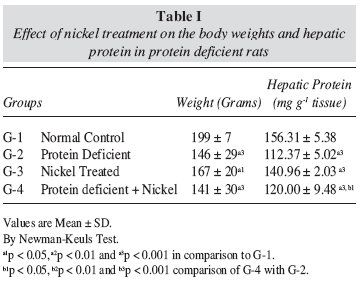
<body><![CDATA[<br>   The statistical significance of the values has been determined by using one way analysis of variance</font>  <font> (ANOVA) followed by Student-Newman-Keuls test. The determinations are represented as Mean &plusmn; SD.</font></p>     <p>   <font>    <i>Body weights</i>    <br>   The variations in the body weights of the animals subjected to different treatments are shown in  <a href="#t1">table I</a>. It was observed that the protein deficiency resulted in a   significant (p &lt; 0.001) decease in the body weights after eight weeks, when compared to normal control rats. Nickel treatment to normal control rats resulted   in some decrease (p &lt; 0.05) in the body weights but nickel treatment to protein deficient rats resulted in appreciable reduction (p &lt; 0.001) in the body weights   as compared to normal control rats.</font></p>     <p align="center">   <font> <a name="t1">   <img src="/img/revistas/nh/v20n6/orig3_t1.gif" width="361" height="288"></a> </font></p>     <p>   <font>    <i>    <br>   Hepatic protein Contents</i>    <br>   The hepatic protein contents in various treatment groups expressed as mg g<sup>-1</sup> tissue are shown in  <a href="#t1">tableI</a>. Protein deficient, Ni treated as well as combined protein   deficient and nickel treated rats showed significant (P &lt; 0.001) reductions in the hepatic protein contents as compared to normal control rats.</font></p>     <p>   <font>    <i>Alkaline phosphatase</i>    <br>   Hepatic alkaline phosphatase activity showed a significant elevation (p &lt; 0.01) in rats subjected to protein deficiency, nickel treatment and combined protein deficiency   and nickel treatment as shown in <a target="_blank" href="/img/revistas/nh/v20n6/orig3_t2.gif">table II</a>.</font></p>     <p>   <font>    <i>Aspartate Aminotransferase</i>    ]]></body>
<body><![CDATA[<br>   As regards to hepatic levels of AST, a significant (p &lt; 0.001) elevation was observed in protein deficient and nickel treated protein deficient animals (<a target="_blank" href="/img/revistas/nh/v20n6/orig3_t2.gif">table II</a>).</font></p>     <p>   <font>    <i>Alanine Aminotransferase</i>    <br>   <a target="_blank" href="/img/revistas/nh/v20n6/orig3_t2.gif">Table II</a> depicts the hepatic observations of ALT where significant (p &lt; 0.001) elevation in ALT levels has been observed in protein deficient, nickel and nickel   treated protein deficient animals.  </font></p>     <p>   <font> <i>Hepatic concentration of various elements</i>     <br> The concentrations of various elements have been depicted in <a target="_blank" href="/img/revistas/nh/v20n6/orig3_t3.gif">table III</a>. The nickel administration to normal and protein deficient rats has resulted in a significant (p &lt; 0.001) increase in concentrations of nickel in liver tissue.  </font></p>     <p>   <font> The concentration   of zinc and copper in liver tissue got decreased significantly (p &lt; 0.001) in protein deficient, nickel treated and nickel treated protein deficient animals.</font></p>     <p>   <font> Tissue iron concentrations were found to be decreased in protein deficient animals, but the concentrations of iron got elevated significantly (p &lt; 0.001) in nickel   treated and nickel treated protein deficient animals.  </font></p>     <p>   <font> It has been observed that selenium got decreased significantly (p &lt; 0.001) in protein deficient, nickel treated and nickel treated protein deficient animals when compared to normal animals. The elevation of selenium in nickel treated protein deficient animals was also significantly   (p &lt; 0.05) higher when compared to protein deficient animals.</font></p>     <p>   <font> Significant (p &lt; 0.001) decrease has been observed in potassium concentration in nickel treated and nickel treated protein deficient animals. On the other hand   phosphorus and sulfur concentrations were found to be increased significantly in nickel treated and nickel treated protein deficient animals.</font></p>     <p>   <font>     <b>Discussion</b></font> </p>     ]]></body>
<body><![CDATA[<p>   <font>We observed a significant (p &lt; 0.001) decline in the body weights of rats subjected to protein deficiency for a period of eight weeks, when compared to normal control rats. Loss in body weight is characteristic of protein malnutrition. In an earlier report from our laboratory it has been observed that protein deficiency leads to significant growth retardation in animals<sup>2</sup>. Many other workers have also reported the decrease in body weight due to protein deficiency<sup>20, 21</sup>. It has been seen in these reports that retardation in body weight growth over a period is not due to low intake of diet but deficiency in protein intake.</font></p>     <p>   <font>Nickel treatment to normal control and protein deficient   rats resulted in marked reduction in the body weights as compared to normal control rats. The reduction in body weights following nickel treatment has also been reported earlier<sup>22, 23</sup>. The decrease in body weight may not solely be attributed to protein deficiency alone as the Ni treatment alone also has caused significant decline in body weight. The decrease in body weight due to nickel treatment has been connected by researchers to be not due to low intake of diet consumption of the rats following toxic treatment with nickel, vis a vis normal rats, and thus it is anticipated that this effect could possibly be due to the  overall increased degeneration of lipids proteins as a result of nickel toxicity<sup>23,24</sup>.</font></p>     <p>   Rats in protein de<font>ficient, Ni treated and combined PD+Ni  treated groups, showed a highly significant (p &lt; 0.001) reduction in the  hepatic protein contents as compared to rats of normal control group. Davenport  y cols., 1994<sup>25</sup> demonstrated that in protein deficient states, the  reduction in protein contents are due to depletion in amino acid precursors.  Nickel in earlier reports, has also been able to cause significant depression in  protein levels<sup>26,27</sup>. Nickel diminishes the DNA and RNA polymerase  activity and decreases DNA replication fidelity<sup>28</sup> which in turn can  reduce the protein synthesis.</font></p>     <p>   Hepatic alkaline phosphatase activity folowed a significant elevation due to  protein deficiency and nickel treatment. This elevation coul be anticipated to  the reason that ALP is bound to the intracellular membranes, and does not leak  out with the increased permeability of the cell membranes. Moreover, Hultberg  and Disaksson, 1983<sup>29</sup> proposed that activated macrophages including  the Kupffer cells are the cellular source for the increased levels of ALP in  conditions of liver damage. Davenport y cols., 1994<sup>25 </sup>also postulated  tath many hepatic and extrahepatic conditions could also result due to protein-restricted  diets that in a way caused increased production of alkaline phosphatase  isoenzymes from bone and hepatobiliary source.</p>     <p>   The aminotransferases are intracellular enzymes, which are active in operating  the reversible exchange of aminoacids between alpha-amino and alpha-ketoacids.  As all the naturally occurring amino acids can undergo amino transfer reactions  thus this class of intracellular enzymes (aminotransferases) form an important  link between protein and carbohydrate metabolism<sup>30</sup>.</p>     <p>   Hepatic levels of AST and ALT got significantly (p&lt;0.001) elevated in protein  deficient and nickel treated protein deficient animals.<font> The observed increased activities of hepatic AST and ALT in the animals given protein deficient diet are in conformity with the study of Pond y cols., 1992<sup>31</sup>. They reported that the increase in ALT activity in protein deficient pigs shows altered liver functions, although microscopic anatomy revealed no evidence of excessive fat accumulation or of pathologic changes. Similar observations were noticed by Kumari y cols., 1993<sup>32</sup> who estimated ALT and AST activities in the samples of 30 cases of pediatric PEM. These authors explained that during hepatobiliary disorder, amino acids are released form exaggerated tissue breakdown and in order to metabolize these amino acids, the process of transmutation gets enhanced leading to increased activity of the related enzymes AST and ALT. Heavy metals have also been found to cause the increase in AST and ALT levels<sup>33</sup>. A earlier report from this laboratory has also shown the alterations in the AST and ALT concentrations due to lead intoxication<sup>34</sup>.  </font></p>     <p>   <font>It is now well authorized that the liver has an important function in the regulation of trace element metabolism<sup>35, 36</sup>. Further trace elements serve as cofactors for many enzymes in numerous metabolic pathways; therefore, changes in the distribution of these essential elements in the body can have both nutritional and toxicological consequences with regard to the metabolism of other metals<sup>37</sup>. Those metals which are essential for maintenance of the structural and functional integrity of the living organisms are found in all living systems and are conserved within strict concentration limits in the systems<sup>38</sup>. However, imbalances in the supply of any of the essential elements in the body can have both nutritional and toxicological consequences with regard to the metabolism of other metals. They can further be responsible for the development of clinical signs of trace element deficiencies or can modify the susceptibility to metal toxicity<sup>39</sup>. It is well insinuated that metals that have similar chemical and physical properties would often interact biologically and antagonize or embellish each other's function<sup>34</sup>.  </font></p>     <p>   <font>In the present study, nickel concentration has been found to be increased in liver tissue following the administration of nickel to normal and protein deficient rats. Our results are in agreement with earlier reports<sup>40, 41</sup>. </font></p>     <p>   <font>Although zinc had been known to be essential for the growth of microorganisms for over hundred years, the advances in the knowledge of zinc chemistry and biochemistry have been explored only during the last two decades<sup>42</sup>. Furthermore, a large number of zinccontaining enzymes and proteins have been recognized to participate in the metabolism of proteins, nucleic acids, carbohydrates and lipids. Consequently, zinc deficiency is the most significant pathological and biochemical state involving abnormalities in the metal's metabolism. This can be due to inadequate dietary intake, increased requirements or excretion, conditioned deficiency or genetic disorders<sup>43, 44</sup>.  </font></p>     <p>   <font>In present study, observation of depressed Zn levels in liver of protein deficient rats are in conformity with previous studies<sup>45, 46</sup>. We have also observed decrease in hepatic zinc concentration following nickel toxicity, which may be because nickel mobilizes and promotes the excretion of copper, zinc and manganese from organs and promotes storage of chromium in organs<sup>14, 23</sup>. Abnormalities in zinc metabolism leading to its deficiency are generally attributed to various factors like, malabsorption, malnutrition, decreased intestinal zinc binding factors or the increased excretion of the zinc via the gastrointestinal tract or via urine are of common occurrence in chronic liver disorders<sup>47</sup>.  </font></p>     ]]></body>
<body><![CDATA[<p>   <font>Protein restricted diet led to marked reduction in copper contents in the present study which is in agreement with earlier reports<sup>45, 46</sup>. Copper depletion is associated with depressed hepatic Cu-Zn superoxide dismutase (SOD) activity and it is well known that protein deficiency results in reduction in SOD activity<sup>48</sup>. Since Ni and Cu are closely related chemically, an interaction between these two metals may exist. Significant inhibition is observed in copper concentrations, following nickel and protein deficient treatment. High levels of dietary Ni have been reported to decrease the levels of tissue copper and activities of a Cucontaining enzymes like cytochrome oxidase<sup>49</sup>. In an earlier study from our lab, hepatic Cu levels have also been found to be decreased following lead treatment<sup>50</sup>.  </font></p>     <p>   <font>Iron plays an important role, not only in oxygen delivery to the tissues, but also as a cofactor with several enzymes involved in energy metabolism and thermoregulation<sup>51</sup>. Further, the enzymes cytochromes P450 and b5 involve the metal in the metabolism of compounds such as steroids and in the degradation of xenobiotics<sup>52, 53</sup>. </font></p>     <p>   <font>The hepatic Fe contents, in the present study, were found significantly depressed in protein deficient rats as compared to normal control group. Reduction in Fe contents following protein deficiency has previously been reported by Klavins et al, 1962<sup>54</sup> and Tandon y cols., 1999<sup>4</sup>. They concluded that protein plays an important role in the absorption of iron from the gastrointestinal tract and protein deficiency results in decreased absorption of iron.  </font></p>     <p>   <font>During the course of this study, we have also observed increased hepatic iron contents in the animals, given nickel treatment, which has also been reported earlier<sup>55</sup>. Pronounced increase in iron concentration at a higher dose of nickel could be because of nickel functioning as a cofactor that facilitates the intestinal absorption of the iron by enhancing its compellation to a lipophilic molecule<sup>56</sup>. Increased hepatic iron levels in response to the toxic conditions established by nickel also suggests that the body requirement of iron has been so severe that more and more of this metal ion is transported to the liver, as it serves as a cofactor for many key enzymes involved in various energy generation pathways, which could have been adversely affected in stress conditions. When serum iron levels exceed the iron binding capacity of transferrin a &#946;<sub>1</sub>- glycoprotein synthesized in the liver, the circulating free iron initially accumulates in Kupffer cells and later in the hepatocytes resulting in the increased concentration of iron in liver tissue. It can also be speculated that the nickel treatment leads to the activation of host defense system which results in the enhancement of hepatic iron content so as to combat the toxic conditions created by nickel administration. Another possible reason for increased liver iron concentrations could be thought of due to impaired hepatic elimination of this metal from the liver. Hepatic iron overload as observed in our study may lead to the development of a severe oxidative stress status in the tissue, thus contributing to the concomitant liver injury as reported by Boisier y cols., 1999<sup>57</sup> and also observed by us in the form of enhanced ALP, AST and ALT levels.  </font></p>     <p>   <font>Selenium, which is an essential trace metal and inactivates sulfhydryl groups in certain enzymes and is also a component of glutathione peroxidase<sup>58</sup>. This ubiquitous enzyme located in both cytosol and mitochondrial matrix uses glutathione to reduce organic hydropero-xides, thereby, prevents oxidative damage to various cell organelles. In the present study, selenium was found to be decreased significantly in protein deficient, nickel treated and nickel treated protein deficient animals. It has been reported that nickel and selenium act antagonistically and the detoxifying effect of selenium on nickel toxicity seems to be due to the formation of a Ni-selenide excretable complex<sup>59</sup> which seems to have been marginalized due to high dose of nickel in the present study.</font></p>     <p>   <font>Potassium is an essential intracellular ion involved in cellular homeostasis and electrical conduction. We have observed a statistically significant decrease in potassium levels in nickel treated and nickel treated protein deficient animals. Rai y cols.,1990<sup>12</sup> has also observed the loss of K<sup>+</sup> and Na<sup>+</sup> by Nickel. As potassium is a major cation of intracellular fluid, and functions in balance with the extracellular ionized sodium to maintain normal osmotic pressure and water balance hence it is possible that nickel could have lead to alterations in the membrane permeability of hepatocytes especially with regard to potassium channels or has caused inhibition of ATPase leading to decreased levels of potassium. Its deficiency affects the activity of muscles and transmission of electrochemical impulses. It has been reported that nickel inhibits the Na-K-ATPase<sup>60</sup>.  </font></p>     <p>   <font>Phosphorus, which is an essential part of key cellular nucleoproteins such as DNA, has also been found to increase significantly in nickel treated and nickel treated protein deficient animals. It may possibly be due to increased requirement of phosphorus either due to the inhibitory effects of nickel on DNA synthesis leading to hyperplasia or increased mobilization from bones. Sulfur is an important constituent of many amino acids like methionine, cysteine, cystine, homocysteine, homocystine, and taurine and also of enzymes like S-adenosylmethionine (SAM) and glutathione (GSH)<sup>61</sup>. Sulfur concentrations got elevated in nickel and PD+Ni treated animals, which could be to counter the toxic effects of nickel.  </font></p>     <p>   <font>Our results in the present findings indicate the disturbance in the marker enzymes of rat liver following protein deficiency (PD) and nickel treatment which may be the consequence of alterations in the levels of essential trace elements as a result of hepatic injury.</font></p>     <p>   <font>   <b>Conclusion</b></font> </p>     <p>   <font>The findings indicate that protein deficiency does not enhance the signs of nickel toxicity in rats.</font></p>     ]]></body>
<body><![CDATA[<p>   <font>   <b>Acknowledgements</b></font> </p>     <p>   <font>This work was supported by grant from IUC-DAE, Kolkata and ICMR, New Delhi. </font></p>     <p>   <font>   <b>References</b></font> </p>     <!-- ref --><p>   <font>1. Adames AE, Requena CR, Pascale JM and Adames M: Effects of maternal protein-calorie malnutrition on the concentration of protein A messenger RNA in surfactant of fetal rat lungs.   Rev Med Panama 1999; 24(1):26-33.</font>&nbsp;&nbsp;&nbsp;&nbsp;&nbsp;&nbsp;&nbsp;&nbsp;[&#160;<a href="javascript:void(0);" onclick="javascript: window.open('/scielo.php?script=sci_nlinks&ref=3472898&pid=S0212-1611200500080000300001&lng=','','width=640,height=500,resizable=yes,scrollbars=1,menubar=yes,');">Links</a>&#160;]<!-- end-ref --><!-- ref --><p>   <font>2. Tandon A, Dhawan DK and Nagpaul JP: Effect of lithium on hepatic lipid peroxidation and antioxidative enzymes under different dietary protein regimens. J Appl Toxicol 1998;18:187-90.</font>&nbsp;&nbsp;&nbsp;&nbsp;&nbsp;&nbsp;&nbsp;&nbsp;[&#160;<a href="javascript:void(0);" onclick="javascript: window.open('/scielo.php?script=sci_nlinks&ref=3472899&pid=S0212-1611200500080000300002&lng=','','width=640,height=500,resizable=yes,scrollbars=1,menubar=yes,');">Links</a>&#160;]<!-- end-ref --><!-- ref --><p>   <font>3. Obatolu VA, Ketiku A, Adebowale EA: Effect of feeding maize/ legume mixtures on biochemical indices in rats. Ann Nutr Metab 2003; 47(3-4):170-5.</font>&nbsp;&nbsp;&nbsp;&nbsp;&nbsp;&nbsp;&nbsp;&nbsp;[&#160;<a href="javascript:void(0);" onclick="javascript: window.open('/scielo.php?script=sci_nlinks&ref=3472900&pid=S0212-1611200500080000300003&lng=','','width=640,height=500,resizable=yes,scrollbars=1,menubar=yes,');">Links</a>&#160;]<!-- end-ref --><!-- ref --><p>   <font>4. Tandon A, Nagpaul JP, Bandhu H, Singh N, Dhawan D: Effect of lithium on hepatic and serum elemental status under different dietary protein regimens. Biol Trace Elem Res 1999; 68:51-62.</font>&nbsp;&nbsp;&nbsp;&nbsp;&nbsp;&nbsp;&nbsp;&nbsp;[&#160;<a href="javascript:void(0);" onclick="javascript: window.open('/scielo.php?script=sci_nlinks&ref=3472901&pid=S0212-1611200500080000300004&lng=','','width=640,height=500,resizable=yes,scrollbars=1,menubar=yes,');">Links</a>&#160;]<!-- end-ref --><!-- ref --><p>   <font>5. Squali Houssaini FZ, Foulon T, Payen N, Iraqi MR, Arnaud J y Groslambert P: Plasma fatty acid status in Moroccan children: increased lipid peroxidation and impaired polyunsaturated   fatty acid metabolism in protein-calorie malnutrition. Biomed Pharmacother 2001; 55(3):155-62.</font>&nbsp;&nbsp;&nbsp;&nbsp;&nbsp;&nbsp;&nbsp;&nbsp;[&#160;<a href="javascript:void(0);" onclick="javascript: window.open('/scielo.php?script=sci_nlinks&ref=3472902&pid=S0212-1611200500080000300005&lng=','','width=640,height=500,resizable=yes,scrollbars=1,menubar=yes,');">Links</a>&#160;]<!-- end-ref --><!-- ref --><p>   <font>6. Singla PN, Chand P, Kumar A y Kachhawaha JS: Serum, zinc and copper levels in children with protein energy malnutrition. Indian J Pediatr 1996; 63(2):199-203.</font>&nbsp;&nbsp;&nbsp;&nbsp;&nbsp;&nbsp;&nbsp;&nbsp;[&#160;<a href="javascript:void(0);" onclick="javascript: window.open('/scielo.php?script=sci_nlinks&ref=3472903&pid=S0212-1611200500080000300006&lng=','','width=640,height=500,resizable=yes,scrollbars=1,menubar=yes,');">Links</a>&#160;]<!-- end-ref --><!-- ref --><p>   <font>7. Bhaskaram P and Hemalatha P: Zinc status of Indian children Indian J Med Res 1995; 102:210-5.</font>&nbsp;&nbsp;&nbsp;&nbsp;&nbsp;&nbsp;&nbsp;&nbsp;[&#160;<a href="javascript:void(0);" onclick="javascript: window.open('/scielo.php?script=sci_nlinks&ref=3472904&pid=S0212-1611200500080000300007&lng=','','width=640,height=500,resizable=yes,scrollbars=1,menubar=yes,');">Links</a>&#160;]<!-- end-ref --><!-- ref --><p>   <font>8. Babcock AK and Henkin RI: Effects of oral zinc loading on zinc metabolism in human II. In vivo kinetics. Metab Clin Exp 1982; 31:335-47.</font>&nbsp;&nbsp;&nbsp;&nbsp;&nbsp;&nbsp;&nbsp;&nbsp;[&#160;<a href="javascript:void(0);" onclick="javascript: window.open('/scielo.php?script=sci_nlinks&ref=3472905&pid=S0212-1611200500080000300008&lng=','','width=640,height=500,resizable=yes,scrollbars=1,menubar=yes,');">Links</a>&#160;]<!-- end-ref --><!-- ref --><p>   <font>9. Denkhaus E and Salnikow K: Nickel essentiality, toxicity, and carcinogenicity. Crit Rev Oncol Hematol 2002; 42(1):35-56.</font>&nbsp;&nbsp;&nbsp;&nbsp;&nbsp;&nbsp;&nbsp;&nbsp;[&#160;<a href="javascript:void(0);" onclick="javascript: window.open('/scielo.php?script=sci_nlinks&ref=3472906&pid=S0212-1611200500080000300009&lng=','','width=640,height=500,resizable=yes,scrollbars=1,menubar=yes,');">Links</a>&#160;]<!-- end-ref --><!-- ref --><p>   <font>10. Goutet M, Ban M and Binet S: Effects of nickel sulfate on pulmonary natural immunity in Wistar rats. Toxicology 145(1): 15-26.</font>&nbsp;&nbsp;&nbsp;&nbsp;&nbsp;&nbsp;&nbsp;&nbsp;[&#160;<a href="javascript:void(0);" onclick="javascript: window.open('/scielo.php?script=sci_nlinks&ref=3472907&pid=S0212-1611200500080000300010&lng=','','width=640,height=500,resizable=yes,scrollbars=1,menubar=yes,');">Links</a>&#160;]<!-- end-ref --><!-- ref --><p>   <font>11. Condevaux F, Guichard J, Forichon A, Aujoulat M y Descotes J: Compared effects of morphine and nickel chloride on NK cell activity in vitro in rats and monkeys. J Appl Toxicol 2001;   21(5):431-4.</font>&nbsp;&nbsp;&nbsp;&nbsp;&nbsp;&nbsp;&nbsp;&nbsp;[&#160;<a href="javascript:void(0);" onclick="javascript: window.open('/scielo.php?script=sci_nlinks&ref=3472908&pid=S0212-1611200500080000300011&lng=','','width=640,height=500,resizable=yes,scrollbars=1,menubar=yes,');">Links</a>&#160;]<!-- end-ref --><!-- ref --><p>   <font>12. Rai LC, Raizada M, Mallick N, Husaini Y, Singh AK y Dubey SK: Effect of four heavy metals on the biology of Nostoc muscorum. Biol Met 1990; 2(4):229-34.</font>&nbsp;&nbsp;&nbsp;&nbsp;&nbsp;&nbsp;&nbsp;&nbsp;[&#160;<a href="javascript:void(0);" onclick="javascript: window.open('/scielo.php?script=sci_nlinks&ref=3472909&pid=S0212-1611200500080000300012&lng=','','width=640,height=500,resizable=yes,scrollbars=1,menubar=yes,');">Links</a>&#160;]<!-- end-ref --><!-- ref --><p>   <font>13. Alcon MP, Arola L and Mas A: Response to acute nickel toxicity in rats as a function of sex. Biol Met 1991; 4(3):136-40.</font>&nbsp;&nbsp;&nbsp;&nbsp;&nbsp;&nbsp;&nbsp;&nbsp;[&#160;<a href="javascript:void(0);" onclick="javascript: window.open('/scielo.php?script=sci_nlinks&ref=3472910&pid=S0212-1611200500080000300013&lng=','','width=640,height=500,resizable=yes,scrollbars=1,menubar=yes,');">Links</a>&#160;]<!-- end-ref --><!-- ref --><p>   <font>14. Henry AS, Marian M and Alexis PN: Life term effects of nickel in rats: Survival, Tumors, Interactions with trace elements and tissue levels. J Nutr 1974; 104:239-43.</font>&nbsp;&nbsp;&nbsp;&nbsp;&nbsp;&nbsp;&nbsp;&nbsp;[&#160;<a href="javascript:void(0);" onclick="javascript: window.open('/scielo.php?script=sci_nlinks&ref=3472911&pid=S0212-1611200500080000300014&lng=','','width=640,height=500,resizable=yes,scrollbars=1,menubar=yes,');">Links</a>&#160;]<!-- end-ref --><!-- ref --><p>   <font>15. Anke M, Kronemann H, Grappel B, Hening A, Meissner D and Schneider HJ: The influence of Ni deficiency on growth, reproduction, longevity and different biochemical parameters of goats   In: 3, Supeenelement Symposium Nickel. pp. 3-10, Friedrich Schiller Universtat, Jena DDR.</font>&nbsp;&nbsp;&nbsp;&nbsp;&nbsp;&nbsp;&nbsp;&nbsp;[&#160;<a href="javascript:void(0);" onclick="javascript: window.open('/scielo.php?script=sci_nlinks&ref=3472912&pid=S0212-1611200500080000300015&lng=','','width=640,height=500,resizable=yes,scrollbars=1,menubar=yes,');">Links</a>&#160;]<!-- end-ref --><!-- ref --><p>   <font>16. Kaur J, Jaswal VM, Nagpaul JP, Mahmood A: Chronic ethanol feeding and microvillus membrane glycosylation in normal and protein-malnourished rat intestine. Nutrition 1992; 8(5):338-42.</font>&nbsp;&nbsp;&nbsp;&nbsp;&nbsp;&nbsp;&nbsp;&nbsp;[&#160;<a href="javascript:void(0);" onclick="javascript: window.open('/scielo.php?script=sci_nlinks&ref=3472913&pid=S0212-1611200500080000300016&lng=','','width=640,height=500,resizable=yes,scrollbars=1,menubar=yes,');">Links</a>&#160;]<!-- end-ref --><!-- ref --><p>   <font>17. Lowry OH, Rosebrough NJ, Farr AL and Randall J: Protein measurement with the Folin Phenol reagent. J Biol Chem 1951; 193: 265-75.</font>&nbsp;&nbsp;&nbsp;&nbsp;&nbsp;&nbsp;&nbsp;&nbsp;[&#160;<a href="javascript:void(0);" onclick="javascript: window.open('/scielo.php?script=sci_nlinks&ref=3472914&pid=S0212-1611200500080000300017&lng=','','width=640,height=500,resizable=yes,scrollbars=1,menubar=yes,');">Links</a>&#160;]<!-- end-ref --><!-- ref --><p>   <font>18. Wooton IDP: In: Microanalysis in Medical Biochemistry (4th edition, King, E.J., Churchill, London), 1964; 101-5.</font>&nbsp;&nbsp;&nbsp;&nbsp;&nbsp;&nbsp;&nbsp;&nbsp;[&#160;<a href="javascript:void(0);" onclick="javascript: window.open('/scielo.php?script=sci_nlinks&ref=3472915&pid=S0212-1611200500080000300018&lng=','','width=640,height=500,resizable=yes,scrollbars=1,menubar=yes,');">Links</a>&#160;]<!-- end-ref --><!-- ref --><p>   <font>19. Reitman S y Frankel S: A colorimetric method for the determination of serum glutamic oxaloacetic acid and glutamic pyruvic transaminases. Am J Clin Pathol 1957; 28:56.</font>&nbsp;&nbsp;&nbsp;&nbsp;&nbsp;&nbsp;&nbsp;&nbsp;[&#160;<a href="javascript:void(0);" onclick="javascript: window.open('/scielo.php?script=sci_nlinks&ref=3472916&pid=S0212-1611200500080000300019&lng=','','width=640,height=500,resizable=yes,scrollbars=1,menubar=yes,');">Links</a>&#160;]<!-- end-ref --><!-- ref --><p>   <font>20. Wang G, Yu S and Bao C: Effect of different levels of protein intake on metabolism of protein, zinc and copper in rats. Zhonguo Gonggong Weishing Xuebao. 1995; 14 (2): 90-3.</font>&nbsp;&nbsp;&nbsp;&nbsp;&nbsp;&nbsp;&nbsp;&nbsp;[&#160;<a href="javascript:void(0);" onclick="javascript: window.open('/scielo.php?script=sci_nlinks&ref=3472917&pid=S0212-1611200500080000300020&lng=','','width=640,height=500,resizable=yes,scrollbars=1,menubar=yes,');">Links</a>&#160;]<!-- end-ref --><!-- ref --><p>   <font>21. Das KK and Dasgupta S: Effect of nickel sulfate on testicular steroidogenesis in rats during protein restriction. Environ Health Perspect 2002; 110(9):923-26.</font>&nbsp;&nbsp;&nbsp;&nbsp;&nbsp;&nbsp;&nbsp;&nbsp;[&#160;<a href="javascript:void(0);" onclick="javascript: window.open('/scielo.php?script=sci_nlinks&ref=3472918&pid=S0212-1611200500080000300021&lng=','','width=640,height=500,resizable=yes,scrollbars=1,menubar=yes,');">Links</a>&#160;]<!-- end-ref --><!-- ref --><p>   <font>22. Sunderman FW Jr, Shen SK, Mitchell JM, Allpass PR y Damjanov I: Embryotoxicity and fetal toxicity of nickel in rats. Toxicol Appl Pharmacol 1978; 43(2):381-90.</font>&nbsp;&nbsp;&nbsp;&nbsp;&nbsp;&nbsp;&nbsp;&nbsp;[&#160;<a href="javascript:void(0);" onclick="javascript: window.open('/scielo.php?script=sci_nlinks&ref=3472919&pid=S0212-1611200500080000300022&lng=','','width=640,height=500,resizable=yes,scrollbars=1,menubar=yes,');">Links</a>&#160;]<!-- end-ref --><!-- ref --><p>   <font>23. Cempel M and Janicka K: Distribution of nickel, zinc, and copper in rat organs after oral administration of nickel(II) chloride. Biol Trace Elem Res 2002; 90(1-3):215-26.</font>&nbsp;&nbsp;&nbsp;&nbsp;&nbsp;&nbsp;&nbsp;&nbsp;[&#160;<a href="javascript:void(0);" onclick="javascript: window.open('/scielo.php?script=sci_nlinks&ref=3472920&pid=S0212-1611200500080000300023&lng=','','width=640,height=500,resizable=yes,scrollbars=1,menubar=yes,');">Links</a>&#160;]<!-- end-ref --><!-- ref --><p>   <font>24. Dieter MP, Jameson CW, Tucker AN, Luster MI, French JE, Hong HL, Boorman GA: Evaluation of tissue disposition, myelopoietic, and immunologic responses in mice after longterm exposure to   nickel sulfate in the drinking water. J Toxicol Environ Health 1988; 24(3):357-72.</font>&nbsp;&nbsp;&nbsp;&nbsp;&nbsp;&nbsp;&nbsp;&nbsp;[&#160;<a href="javascript:void(0);" onclick="javascript: window.open('/scielo.php?script=sci_nlinks&ref=3472921&pid=S0212-1611200500080000300024&lng=','','width=640,height=500,resizable=yes,scrollbars=1,menubar=yes,');">Links</a>&#160;]<!-- end-ref --><!-- ref --><p>   <font>25. Davenport DJ, Mostardi RA, Richardson DC, Gross KL, Greene, KA, Blair K: Protein-deficient diet alters serum alkaline phosphatase, bile acids, protein and urea nitrogen in dogs. J Nutr 1994; 124: 2677S-79S.</font>&nbsp;&nbsp;&nbsp;&nbsp;&nbsp;&nbsp;&nbsp;&nbsp;[&#160;<a href="javascript:void(0);" onclick="javascript: window.open('/scielo.php?script=sci_nlinks&ref=3472922&pid=S0212-1611200500080000300025&lng=','','width=640,height=500,resizable=yes,scrollbars=1,menubar=yes,');">Links</a>&#160;]<!-- end-ref --><!-- ref --><p>   <font>26. Sreedevi P, Sivaramakrishan B, Suresh A, Radhakrishanaiah K: Effect of nickel on some aspects of protein metabolism inselected organs of the freshwater mussel Lamellidens marginalis.Biomed Environ Sci 1992; 5(3):208-20.</font>&nbsp;&nbsp;&nbsp;&nbsp;&nbsp;&nbsp;&nbsp;&nbsp;[&#160;<a href="javascript:void(0);" onclick="javascript: window.open('/scielo.php?script=sci_nlinks&ref=3472923&pid=S0212-1611200500080000300026&lng=','','width=640,height=500,resizable=yes,scrollbars=1,menubar=yes,');">Links</a>&#160;]<!-- end-ref --><!-- ref --><p>   <font>27. Kusal KD and Shakuntala D: Effect of Ni on testicular nucleic acid concentration on protein restriction. Biol Trace Elem Res2000; 73(2):175-180.</font>&nbsp;&nbsp;&nbsp;&nbsp;&nbsp;&nbsp;&nbsp;&nbsp;[&#160;<a href="javascript:void(0);" onclick="javascript: window.open('/scielo.php?script=sci_nlinks&ref=3472924&pid=S0212-1611200500080000300027&lng=','','width=640,height=500,resizable=yes,scrollbars=1,menubar=yes,');">Links</a>&#160;]<!-- end-ref --><!-- ref --><p>   <font>28. Sirover MA and Loeb LA: Infidelitly of DNA synthesis in vitro; screening for potential metal mutagens carcinogens. Science 1976; 194:1434-36.    &nbsp;&nbsp;&nbsp;&nbsp;&nbsp;&nbsp;&nbsp;&nbsp;[&#160;<a href="javascript:void(0);" onclick="javascript: window.open('/scielo.php?script=sci_nlinks&ref=3472925&pid=S0212-1611200500080000300028&lng=','','width=640,height=500,resizable=yes,scrollbars=1,menubar=yes,');">Links</a>&#160;]<!-- end-ref --><!-- ref --><br>   29. Hultberg B, Isakasson A: Isoenzyme Pattern of serum B- Hexosaminidose in liver disease, Alcohol intoxication and pregnancy. Enzyme 1983; 30:166-71.</font>&nbsp;&nbsp;&nbsp;&nbsp;&nbsp;&nbsp;&nbsp;&nbsp;[&#160;<a href="javascript:void(0);" onclick="javascript: window.open('/scielo.php?script=sci_nlinks&ref=3472926&pid=S0212-1611200500080000300029&lng=','','width=640,height=500,resizable=yes,scrollbars=1,menubar=yes,');">Links</a>&#160;]<!-- end-ref --><!-- ref --><p>   <font>30. Plaa GL and Hewitt WR: Detection and evaluation of chemically induced liver injury. In: Principles and methods of toxicology. (Eds. Hayes, W. A., Raven Press Ltd., New York), 1989; 599-628.</font>&nbsp;&nbsp;&nbsp;&nbsp;&nbsp;&nbsp;&nbsp;&nbsp;[&#160;<a href="javascript:void(0);" onclick="javascript: window.open('/scielo.php?script=sci_nlinks&ref=3472927&pid=S0212-1611200500080000300030&lng=','','width=640,height=500,resizable=yes,scrollbars=1,menubar=yes,');">Links</a>&#160;]<!-- end-ref --><!-- ref --><p>   <font>31. Pond WC, Ellis KJ, Schoknecht P: Response of blood serum constituents to production of and recovery from a kwashiorkor-like syndrome in the young pig. Proc Soc Exp Biol Med 1992; 200:555-61.</font>&nbsp;&nbsp;&nbsp;&nbsp;&nbsp;&nbsp;&nbsp;&nbsp;[&#160;<a href="javascript:void(0);" onclick="javascript: window.open('/scielo.php?script=sci_nlinks&ref=3472928&pid=S0212-1611200500080000300031&lng=','','width=640,height=500,resizable=yes,scrollbars=1,menubar=yes,');">Links</a>&#160;]<!-- end-ref --><!-- ref --><p>   <font>32. Kumari R, Rao YN, Talukdar B, Agarwal S, Puri RK: Serum enzymes abnormalities in protein energy malnutrition. Indian Pediatrics 1993; 30:469-73.</font>&nbsp;&nbsp;&nbsp;&nbsp;&nbsp;&nbsp;&nbsp;&nbsp;[&#160;<a href="javascript:void(0);" onclick="javascript: window.open('/scielo.php?script=sci_nlinks&ref=3472929&pid=S0212-1611200500080000300032&lng=','','width=640,height=500,resizable=yes,scrollbars=1,menubar=yes,');">Links</a>&#160;]<!-- end-ref --><!-- ref --><p>   <font>33. Bersenyi A, Fekete SG, Szocs Z, Berta E: Effect of ingested heavy metals (Cd, Pb and Hg) on haematology and serum biochemistry in rabbits. Acta Vet Hung. 2003; 51(3):297-304.</font>&nbsp;&nbsp;&nbsp;&nbsp;&nbsp;&nbsp;&nbsp;&nbsp;[&#160;<a href="javascript:void(0);" onclick="javascript: window.open('/scielo.php?script=sci_nlinks&ref=3472930&pid=S0212-1611200500080000300033&lng=','','width=640,height=500,resizable=yes,scrollbars=1,menubar=yes,');">Links</a>&#160;]<!-- end-ref --><!-- ref --><p>   <font>34. Singh B, Dhawan D, Chand B y cols.: Lead pollution-its impact on the status of other hepatic trace metals in blood and alteration in the hepatic functions. Biol Trace Elem Res 1994; 40:21-9.</font>&nbsp;&nbsp;&nbsp;&nbsp;&nbsp;&nbsp;&nbsp;&nbsp;[&#160;<a href="javascript:void(0);" onclick="javascript: window.open('/scielo.php?script=sci_nlinks&ref=3472931&pid=S0212-1611200500080000300034&lng=','','width=640,height=500,resizable=yes,scrollbars=1,menubar=yes,');">Links</a>&#160;]<!-- end-ref --><!-- ref --><p>   <font>35. Failla ML, Kiser RA: Hepatic and renal metabolism of copper and zinc in the diabetic rat. Am J Physiol 1983; 244:E113-21.</font>&nbsp;&nbsp;&nbsp;&nbsp;&nbsp;&nbsp;&nbsp;&nbsp;[&#160;<a href="javascript:void(0);" onclick="javascript: window.open('/scielo.php?script=sci_nlinks&ref=3472932&pid=S0212-1611200500080000300035&lng=','','width=640,height=500,resizable=yes,scrollbars=1,menubar=yes,');">Links</a>&#160;]<!-- end-ref --><!-- ref --><p>   <font>36. Dhawan D, Goel A: Further evidence for zinc as a hepatoprotective agent in rat liver toxicity. Exp Mol Pathol 1996; 63: 110-17.</font>&nbsp;&nbsp;&nbsp;&nbsp;&nbsp;&nbsp;&nbsp;&nbsp;[&#160;<a href="javascript:void(0);" onclick="javascript: window.open('/scielo.php?script=sci_nlinks&ref=3472933&pid=S0212-1611200500080000300036&lng=','','width=640,height=500,resizable=yes,scrollbars=1,menubar=yes,');">Links</a>&#160;]<!-- end-ref --><!-- ref --><p>   <font>37. Dhawan DK and Goel A: Protective role of zinc on rat liver function in long term toxicity induced by carbon tetrachloride. J Trace Elements In Experimental Medicine 1994; 7:1-9.</font>&nbsp;&nbsp;&nbsp;&nbsp;&nbsp;&nbsp;&nbsp;&nbsp;[&#160;<a href="javascript:void(0);" onclick="javascript: window.open('/scielo.php?script=sci_nlinks&ref=3472934&pid=S0212-1611200500080000300037&lng=','','width=640,height=500,resizable=yes,scrollbars=1,menubar=yes,');">Links</a>&#160;]<!-- end-ref --><!-- ref --><p>   <font>38. McCall JT, Goldstein NP and Smith LH: Implications of trace metals in human diseases. Fed Proc 1971; 30 1011-15.</font>&nbsp;&nbsp;&nbsp;&nbsp;&nbsp;&nbsp;&nbsp;&nbsp;[&#160;<a href="javascript:void(0);" onclick="javascript: window.open('/scielo.php?script=sci_nlinks&ref=3472935&pid=S0212-1611200500080000300038&lng=','','width=640,height=500,resizable=yes,scrollbars=1,menubar=yes,');">Links</a>&#160;]<!-- end-ref --><!-- ref --><p>   <font>39. Hill CH and Matrone G: Chemical parameters in the study of in-vivo and in-vitro interactions of various trace elements. Fed Proc 1970; 29:1474-81.</font>&nbsp;&nbsp;&nbsp;&nbsp;&nbsp;&nbsp;&nbsp;&nbsp;[&#160;<a href="javascript:void(0);" onclick="javascript: window.open('/scielo.php?script=sci_nlinks&ref=3472936&pid=S0212-1611200500080000300039&lng=','','width=640,height=500,resizable=yes,scrollbars=1,menubar=yes,');">Links</a>&#160;]<!-- end-ref --><!-- ref --><p>   <font>40. Severa J, Yskocil, Fiala Z and Cizara M: Distribution of nickel in body fluids and organs of rats chronically exposed to nickel sulphate. Human and Experimental Toxicology 1995; 14:955-58.</font>&nbsp;&nbsp;&nbsp;&nbsp;&nbsp;&nbsp;&nbsp;&nbsp;[&#160;<a href="javascript:void(0);" onclick="javascript: window.open('/scielo.php?script=sci_nlinks&ref=3472937&pid=S0212-1611200500080000300040&lng=','','width=640,height=500,resizable=yes,scrollbars=1,menubar=yes,');">Links</a>&#160;]<!-- end-ref --><!-- ref --><p>   <font>41. Obone E, Chakrabarti SK, Bai C, Malick MA, Lamontagne L, Subramanian KS: Toxicity and bioaccumulation of nickel sulfate in Sprague-Dawley rats following 13 weeks of subchronic exposure. J Toxicol Environ Health 1999; 57(6):379-401.</font>&nbsp;&nbsp;&nbsp;&nbsp;&nbsp;&nbsp;&nbsp;&nbsp;[&#160;<a href="javascript:void(0);" onclick="javascript: window.open('/scielo.php?script=sci_nlinks&ref=3472938&pid=S0212-1611200500080000300041&lng=','','width=640,height=500,resizable=yes,scrollbars=1,menubar=yes,');">Links</a>&#160;]<!-- end-ref --><!-- ref --><p>   <font>42. Vallee BL, Falchuk KH: The biochemical basis of zinc physiology. Physiol Reviews 1983; 73(1):79-118.</font>&nbsp;&nbsp;&nbsp;&nbsp;&nbsp;&nbsp;&nbsp;&nbsp;[&#160;<a href="javascript:void(0);" onclick="javascript: window.open('/scielo.php?script=sci_nlinks&ref=3472939&pid=S0212-1611200500080000300042&lng=','','width=640,height=500,resizable=yes,scrollbars=1,menubar=yes,');">Links</a>&#160;]<!-- end-ref --><!-- ref --><p>   <font>43. Forbes RM: Use of laboratory animals to define physiological functions and bioavailability of zinc. Fed Proc 1984; 43:2835-39.</font>&nbsp;&nbsp;&nbsp;&nbsp;&nbsp;&nbsp;&nbsp;&nbsp;[&#160;<a href="javascript:void(0);" onclick="javascript: window.open('/scielo.php?script=sci_nlinks&ref=3472940&pid=S0212-1611200500080000300043&lng=','','width=640,height=500,resizable=yes,scrollbars=1,menubar=yes,');">Links</a>&#160;]<!-- end-ref --><!-- ref --><p>   <font>44. Vallee BL, Galden A: The metallo-biochemistry of Zn enzyme. Advances In Enzymology 1984; 56:284-430.</font>&nbsp;&nbsp;&nbsp;&nbsp;&nbsp;&nbsp;&nbsp;&nbsp;[&#160;<a href="javascript:void(0);" onclick="javascript: window.open('/scielo.php?script=sci_nlinks&ref=3472941&pid=S0212-1611200500080000300044&lng=','','width=640,height=500,resizable=yes,scrollbars=1,menubar=yes,');">Links</a>&#160;]<!-- end-ref --><!-- ref --><p>   <font>45. Wallwork JC, Johnson LK, Milne DB, Sanstead HH: The effect of interaction between dietary egg white protein and zinc on body weight , bone growth and tissue trance metals in the   30 day old rat. J Nutr 1983; 113:1307-20.</font>&nbsp;&nbsp;&nbsp;&nbsp;&nbsp;&nbsp;&nbsp;&nbsp;[&#160;<a href="javascript:void(0);" onclick="javascript: window.open('/scielo.php?script=sci_nlinks&ref=3472942&pid=S0212-1611200500080000300045&lng=','','width=640,height=500,resizable=yes,scrollbars=1,menubar=yes,');">Links</a>&#160;]<!-- end-ref --><!-- ref --><p>   <font>46. Martel AC, Reimers EG, Fern&aacute;ndez FS, Aleman VC, Martin LG, Moreno FR, Riera AM (1992). Combined effects of ethanol and protein deficiency on hepatic iron, zinc, manganese and copper   contents . Alcohol 1992; 9:341-48.</font>&nbsp;&nbsp;&nbsp;&nbsp;&nbsp;&nbsp;&nbsp;&nbsp;[&#160;<a href="javascript:void(0);" onclick="javascript: window.open('/scielo.php?script=sci_nlinks&ref=3472943&pid=S0212-1611200500080000300046&lng=','','width=640,height=500,resizable=yes,scrollbars=1,menubar=yes,');">Links</a>&#160;]<!-- end-ref --><!-- ref --><p>   <font>47. McClain CJ and Su Le: Zinc deficiency in the alcoholic alcoholism. Winters Press, New York, 1983; 7:5-10.</font>&nbsp;&nbsp;&nbsp;&nbsp;&nbsp;&nbsp;&nbsp;&nbsp;[&#160;<a href="javascript:void(0);" onclick="javascript: window.open('/scielo.php?script=sci_nlinks&ref=3472944&pid=S0212-1611200500080000300047&lng=','','width=640,height=500,resizable=yes,scrollbars=1,menubar=yes,');">Links</a>&#160;]<!-- end-ref --><!-- ref --><p>   <font>48. Huang CJ, Fwu ML: Degree of protein deficiency affects the extent of the depression of ant oxidative enzyme activities and the enhancement of tissue lipid peroxidation in rats. J Nutr 1993;   123:803-10.</font>&nbsp;&nbsp;&nbsp;&nbsp;&nbsp;&nbsp;&nbsp;&nbsp;[&#160;<a href="javascript:void(0);" onclick="javascript: window.open('/scielo.php?script=sci_nlinks&ref=3472945&pid=S0212-1611200500080000300048&lng=','','width=640,height=500,resizable=yes,scrollbars=1,menubar=yes,');">Links</a>&#160;]<!-- end-ref --><!-- ref --><p>   <font>49. Burnett FM: A possible role of zinc in the pathology of dementia. Lancet 1981; 1:186-188.</font>&nbsp;&nbsp;&nbsp;&nbsp;&nbsp;&nbsp;&nbsp;&nbsp;[&#160;<a href="javascript:void(0);" onclick="javascript: window.open('/scielo.php?script=sci_nlinks&ref=3472946&pid=S0212-1611200500080000300049&lng=','','width=640,height=500,resizable=yes,scrollbars=1,menubar=yes,');">Links</a>&#160;]<!-- end-ref --><!-- ref --><p>   <font>50. Dhawan D, Singh B, Chand B, Singh N, Mangal PC, Trehan PN: X-ray flourescence in the assessment of inter elemental interactions in rat liver following lead treatment. Biometals 1995; 8:105-10.</font>&nbsp;&nbsp;&nbsp;&nbsp;&nbsp;&nbsp;&nbsp;&nbsp;[&#160;<a href="javascript:void(0);" onclick="javascript: window.open('/scielo.php?script=sci_nlinks&ref=3472947&pid=S0212-1611200500080000300050&lng=','','width=640,height=500,resizable=yes,scrollbars=1,menubar=yes,');">Links</a>&#160;]<!-- end-ref --><!-- ref --><p>   <font>51. Rosenzweig PH, Volpe SL: Iron, thermoregulation, and metabolic rate Crit Rev Food Sci Nutr 1999; 39(2):131-48.</font>&nbsp;&nbsp;&nbsp;&nbsp;&nbsp;&nbsp;&nbsp;&nbsp;[&#160;<a href="javascript:void(0);" onclick="javascript: window.open('/scielo.php?script=sci_nlinks&ref=3472948&pid=S0212-1611200500080000300051&lng=','','width=640,height=500,resizable=yes,scrollbars=1,menubar=yes,');">Links</a>&#160;]<!-- end-ref --><!-- ref --><p>   <font>52. Galan P, Hereberg S, Tovitouy Y: The activity of tissue enzyme in iron deficient rats and man; an overview. Comparative biochemistry and physiology 1984; 77(4):647-53.</font>&nbsp;&nbsp;&nbsp;&nbsp;&nbsp;&nbsp;&nbsp;&nbsp;[&#160;<a href="javascript:void(0);" onclick="javascript: window.open('/scielo.php?script=sci_nlinks&ref=3472949&pid=S0212-1611200500080000300052&lng=','','width=640,height=500,resizable=yes,scrollbars=1,menubar=yes,');">Links</a>&#160;]<!-- end-ref --><!-- ref --><p>   <font>53. Aggette PJ: Physiology and metabolism of essential trace elements. Clinics in endocrinology and metabolism 1985; 14(3):281.</font>&nbsp;&nbsp;&nbsp;&nbsp;&nbsp;&nbsp;&nbsp;&nbsp;[&#160;<a href="javascript:void(0);" onclick="javascript: window.open('/scielo.php?script=sci_nlinks&ref=3472950&pid=S0212-1611200500080000300053&lng=','','width=640,height=500,resizable=yes,scrollbars=1,menubar=yes,');">Links</a>&#160;]<!-- end-ref --><!-- ref --><p>   <font>54. Klavins JV, Kineey TD, Kaufman N: The influence of dietary protein on iron absorption. Br J Exp Pathol 1962; 43:172-80.</font>&nbsp;&nbsp;&nbsp;&nbsp;&nbsp;&nbsp;&nbsp;&nbsp;[&#160;<a href="javascript:void(0);" onclick="javascript: window.open('/scielo.php?script=sci_nlinks&ref=3472951&pid=S0212-1611200500080000300054&lng=','','width=640,height=500,resizable=yes,scrollbars=1,menubar=yes,');">Links</a>&#160;]<!-- end-ref --><!-- ref --><p>   <font>55. Forrest HN, Thomas JZ, Michael EC, Duane RM: Nickel Deprivation in Rats: Nickel-Iron Interactions. J Nutr 1979; 109:1623-32.</font>&nbsp;&nbsp;&nbsp;&nbsp;&nbsp;&nbsp;&nbsp;&nbsp;[&#160;<a href="javascript:void(0);" onclick="javascript: window.open('/scielo.php?script=sci_nlinks&ref=3472952&pid=S0212-1611200500080000300055&lng=','','width=640,height=500,resizable=yes,scrollbars=1,menubar=yes,');">Links</a>&#160;]<!-- end-ref --><!-- ref --><p>   <font>56. Nielsen FH, Shuler TR, Mcleod TG, Zimmerman TJ: Nickel influences iron metabolism through physiologic, pharmacologic and toxicologic mechanism in the rat. J Nutr 1984; 114: 1280-88.</font>&nbsp;&nbsp;&nbsp;&nbsp;&nbsp;&nbsp;&nbsp;&nbsp;[&#160;<a href="javascript:void(0);" onclick="javascript: window.open('/scielo.php?script=sci_nlinks&ref=3472953&pid=S0212-1611200500080000300056&lng=','','width=640,height=500,resizable=yes,scrollbars=1,menubar=yes,');">Links</a>&#160;]<!-- end-ref --><!-- ref --><p>   <font>57. Boisier X, Schon M, Sepulveda A, Basualdo A, Cornejo P, Bosco C, Carrion Y, Galleano M, Tapia G, Puntarulo S, Fernandez V, Videla LA: Dearrangement of Kupffer cell functioning and hepatotoxicity in hyperthyroid rats subjected to acute iron overload. Redox Rep 1999; 4(5):243-50.</font>&nbsp;&nbsp;&nbsp;&nbsp;&nbsp;&nbsp;&nbsp;&nbsp;[&#160;<a href="javascript:void(0);" onclick="javascript: window.open('/scielo.php?script=sci_nlinks&ref=3472954&pid=S0212-1611200500080000300057&lng=','','width=640,height=500,resizable=yes,scrollbars=1,menubar=yes,');">Links</a>&#160;]<!-- end-ref --><!-- ref --><p>   <font>58. Rukgauer M, Neugebauer RJ, Plecko T: The relation between selenium, zinc and copper concentration and the trace element dependent antioxidative status. J Trace Elem Med Biol 2001;15(2-3):73-8.</font>&nbsp;&nbsp;&nbsp;&nbsp;&nbsp;&nbsp;&nbsp;&nbsp;[&#160;<a href="javascript:void(0);" onclick="javascript: window.open('/scielo.php?script=sci_nlinks&ref=3472955&pid=S0212-1611200500080000300058&lng=','','width=640,height=500,resizable=yes,scrollbars=1,menubar=yes,');">Links</a>&#160;]<!-- end-ref --><!-- ref --><p>   <font>59. Khandelwal S, Flora SJ and Tandon SK: Nickel-selenium interaction- time dependent biochemical alterations and metal decorporation in rats. Chem Biol Interact 1990; 75(3):341-7.</font>&nbsp;&nbsp;&nbsp;&nbsp;&nbsp;&nbsp;&nbsp;&nbsp;[&#160;<a href="javascript:void(0);" onclick="javascript: window.open('/scielo.php?script=sci_nlinks&ref=3472956&pid=S0212-1611200500080000300059&lng=','','width=640,height=500,resizable=yes,scrollbars=1,menubar=yes,');">Links</a>&#160;]<!-- end-ref --><!-- ref --><p>   <font>60. Rubanyi G, Bakos M, Hajdu K, Pataki T: Dependence of nickel- induced coronary vasoconstriction on the activity of the electrogenic Na+, K+-pump. Acta Physiol Acad Sci Hung 1982;   59(2):169-74.</font>&nbsp;&nbsp;&nbsp;&nbsp;&nbsp;&nbsp;&nbsp;&nbsp;[&#160;<a href="javascript:void(0);" onclick="javascript: window.open('/scielo.php?script=sci_nlinks&ref=3472957&pid=S0212-1611200500080000300060&lng=','','width=640,height=500,resizable=yes,scrollbars=1,menubar=yes,');">Links</a>&#160;]<!-- end-ref --><!-- ref --><p>   <font>61. Parcell S: Sulfur in human nutrition and applications in medicine. Altern Med Rev 2002; 7(1):22-44.</font>&nbsp;&nbsp;&nbsp;&nbsp;&nbsp;&nbsp;&nbsp;&nbsp;[&#160;<a href="javascript:void(0);" onclick="javascript: window.open('/scielo.php?script=sci_nlinks&ref=3472958&pid=S0212-1611200500080000300061&lng=','','width=640,height=500,resizable=yes,scrollbars=1,menubar=yes,');">Links</a>&#160;]<!-- end-ref --> ]]></body><back>
<ref-list>
<ref id="B1">
<label>1</label><nlm-citation citation-type="journal">
<person-group person-group-type="author">
<name>
<surname><![CDATA[Adames]]></surname>
<given-names><![CDATA[AE]]></given-names>
</name>
<name>
<surname><![CDATA[Requena]]></surname>
<given-names><![CDATA[CR]]></given-names>
</name>
<name>
<surname><![CDATA[Pascale]]></surname>
<given-names><![CDATA[JM]]></given-names>
</name>
<name>
<surname><![CDATA[Adames]]></surname>
<given-names><![CDATA[M]]></given-names>
</name>
</person-group>
<article-title xml:lang="en"><![CDATA[Effects of maternal protein-calorie malnutrition on the concentration of protein A messenger RNA in surfactant of fetal rat lungs]]></article-title>
<source><![CDATA[Rev Med Panama]]></source>
<year>1999</year>
<volume>24</volume><volume>1</volume>
<page-range>26-33</page-range></nlm-citation>
</ref>
<ref id="B2">
<label>2</label><nlm-citation citation-type="journal">
<person-group person-group-type="author">
<name>
<surname><![CDATA[Tandon]]></surname>
<given-names><![CDATA[A]]></given-names>
</name>
<name>
<surname><![CDATA[Dhawan]]></surname>
<given-names><![CDATA[DK]]></given-names>
</name>
<name>
<surname><![CDATA[Nagpaul]]></surname>
<given-names><![CDATA[JP]]></given-names>
</name>
</person-group>
<article-title xml:lang="en"><![CDATA[Effect of lithium on hepatic lipid peroxidation and antioxidative enzymes under different dietary protein regimens]]></article-title>
<source><![CDATA[J Appl Toxicol]]></source>
<year>1998</year>
<volume>18</volume>
<page-range>187-90</page-range></nlm-citation>
</ref>
<ref id="B3">
<label>3</label><nlm-citation citation-type="journal">
<person-group person-group-type="author">
<name>
<surname><![CDATA[Obatolu]]></surname>
<given-names><![CDATA[VA]]></given-names>
</name>
<name>
<surname><![CDATA[Ketiku]]></surname>
<given-names><![CDATA[A]]></given-names>
</name>
<name>
<surname><![CDATA[Adebowale]]></surname>
<given-names><![CDATA[EA]]></given-names>
</name>
</person-group>
<article-title xml:lang="en"><![CDATA[Effect of feeding maize/ legume mixtures on biochemical indices in rats]]></article-title>
<source><![CDATA[Ann Nutr Metab]]></source>
<year>2003</year>
<volume>47</volume>
<numero>3-4</numero>
<issue>3-4</issue>
<page-range>170-5</page-range></nlm-citation>
</ref>
<ref id="B4">
<label>4</label><nlm-citation citation-type="journal">
<person-group person-group-type="author">
<name>
<surname><![CDATA[Tandon]]></surname>
<given-names><![CDATA[A]]></given-names>
</name>
<name>
<surname><![CDATA[Nagpaul]]></surname>
<given-names><![CDATA[JP]]></given-names>
</name>
<name>
<surname><![CDATA[Bandhu]]></surname>
<given-names><![CDATA[H]]></given-names>
</name>
<name>
<surname><![CDATA[Singh]]></surname>
<given-names><![CDATA[N]]></given-names>
</name>
<name>
<surname><![CDATA[Dhawan]]></surname>
<given-names><![CDATA[D]]></given-names>
</name>
</person-group>
<article-title xml:lang="en"><![CDATA[Effect of lithium on hepatic and serum elemental status under different dietary protein regimens]]></article-title>
<source><![CDATA[Biol Trace Elem Res]]></source>
<year>1999</year>
<volume>68</volume>
<page-range>51-62</page-range></nlm-citation>
</ref>
<ref id="B5">
<label>5</label><nlm-citation citation-type="journal">
<person-group person-group-type="author">
<name>
<surname><![CDATA[Squali Houssaini]]></surname>
<given-names><![CDATA[FZ]]></given-names>
</name>
<name>
<surname><![CDATA[Foulon]]></surname>
<given-names><![CDATA[T]]></given-names>
</name>
<name>
<surname><![CDATA[Payen]]></surname>
<given-names><![CDATA[N]]></given-names>
</name>
<name>
<surname><![CDATA[Iraqi]]></surname>
<given-names><![CDATA[MR]]></given-names>
</name>
<name>
<surname><![CDATA[Arnaud]]></surname>
<given-names><![CDATA[J]]></given-names>
</name>
<name>
<surname><![CDATA[Groslambert]]></surname>
<given-names><![CDATA[P]]></given-names>
</name>
</person-group>
<article-title xml:lang="en"><![CDATA[Plasma fatty acid status in Moroccan children: increased lipid peroxidation and impaired polyunsaturated fatty acid metabolism in protein-calorie malnutrition]]></article-title>
<source><![CDATA[Biomed Pharmacother]]></source>
<year>2001</year>
<volume>55</volume>
<numero>3</numero>
<issue>3</issue>
<page-range>155-62</page-range></nlm-citation>
</ref>
<ref id="B6">
<label>6</label><nlm-citation citation-type="journal">
<person-group person-group-type="author">
<name>
<surname><![CDATA[Singla]]></surname>
<given-names><![CDATA[PN]]></given-names>
</name>
<name>
<surname><![CDATA[Chand]]></surname>
<given-names><![CDATA[P]]></given-names>
</name>
<name>
<surname><![CDATA[Kumar]]></surname>
<given-names><![CDATA[A]]></given-names>
</name>
<name>
<surname><![CDATA[Kachhawaha]]></surname>
<given-names><![CDATA[JS]]></given-names>
</name>
</person-group>
<article-title xml:lang="en"><![CDATA[Serum, zinc and copper levels in children with protein energy malnutrition]]></article-title>
<source><![CDATA[Indian J Pediatr]]></source>
<year>1996</year>
<volume>63</volume>
<numero>2</numero>
<issue>2</issue>
<page-range>199-203</page-range></nlm-citation>
</ref>
<ref id="B7">
<label>7</label><nlm-citation citation-type="journal">
<person-group person-group-type="author">
<name>
<surname><![CDATA[Bhaskaram]]></surname>
<given-names><![CDATA[P]]></given-names>
</name>
<name>
<surname><![CDATA[Hemalatha]]></surname>
<given-names><![CDATA[P]]></given-names>
</name>
</person-group>
<article-title xml:lang="en"><![CDATA[Zinc status of Indian children]]></article-title>
<source><![CDATA[Indian J Med Res]]></source>
<year>1995</year>
<volume>102</volume>
<page-range>210-5</page-range></nlm-citation>
</ref>
<ref id="B8">
<label>8</label><nlm-citation citation-type="journal">
<person-group person-group-type="author">
<name>
<surname><![CDATA[Babcock]]></surname>
<given-names><![CDATA[AK]]></given-names>
</name>
<name>
<surname><![CDATA[Henkin]]></surname>
<given-names><![CDATA[RI]]></given-names>
</name>
</person-group>
<article-title xml:lang="en"><![CDATA[Effects of oral zinc loading on zinc metabolism in human II: In vivo kinetics]]></article-title>
<source><![CDATA[Metab Clin Exp]]></source>
<year>1982</year>
<volume>31</volume>
<page-range>335-47</page-range></nlm-citation>
</ref>
<ref id="B9">
<label>9</label><nlm-citation citation-type="journal">
<person-group person-group-type="author">
<name>
<surname><![CDATA[Denkhaus]]></surname>
<given-names><![CDATA[E]]></given-names>
</name>
<name>
<surname><![CDATA[Salnikow]]></surname>
<given-names><![CDATA[K]]></given-names>
</name>
</person-group>
<article-title xml:lang="en"><![CDATA[Nickel essentiality, toxicity, and carcinogenicity]]></article-title>
<source><![CDATA[Crit Rev Oncol Hematol]]></source>
<year>2002</year>
<volume>42</volume>
<numero>1</numero>
<issue>1</issue>
<page-range>35-56</page-range></nlm-citation>
</ref>
<ref id="B10">
<label>10</label><nlm-citation citation-type="journal">
<person-group person-group-type="author">
<name>
<surname><![CDATA[Goutet]]></surname>
<given-names><![CDATA[M]]></given-names>
</name>
<name>
<surname><![CDATA[Ban]]></surname>
<given-names><![CDATA[M]]></given-names>
</name>
<name>
<surname><![CDATA[Binet]]></surname>
<given-names><![CDATA[S]]></given-names>
</name>
</person-group>
<article-title xml:lang="en"><![CDATA[Effects of nickel sulfate on pulmonary natural immunity in Wistar rats]]></article-title>
<source><![CDATA[Toxicology]]></source>
<year></year>
<volume>145</volume>
<numero>1</numero>
<issue>1</issue>
<page-range>15-26</page-range></nlm-citation>
</ref>
<ref id="B11">
<label>11</label><nlm-citation citation-type="journal">
<person-group person-group-type="author">
<name>
<surname><![CDATA[Condevaux]]></surname>
<given-names><![CDATA[F]]></given-names>
</name>
<name>
<surname><![CDATA[Guichard]]></surname>
<given-names><![CDATA[J]]></given-names>
</name>
<name>
<surname><![CDATA[Forichon]]></surname>
<given-names><![CDATA[A]]></given-names>
</name>
<name>
<surname><![CDATA[Aujoulat]]></surname>
<given-names><![CDATA[M]]></given-names>
</name>
<name>
<surname><![CDATA[Descotes]]></surname>
<given-names><![CDATA[J]]></given-names>
</name>
</person-group>
<article-title xml:lang="en"><![CDATA[Compared effects of morphine and nickel chloride on NK cell activity in vitro in rats and monkeys]]></article-title>
<source><![CDATA[J Appl Toxicol]]></source>
<year>2001</year>
<volume>21</volume>
<numero>5</numero>
<issue>5</issue>
<page-range>431-4</page-range></nlm-citation>
</ref>
<ref id="B12">
<label>12</label><nlm-citation citation-type="journal">
<person-group person-group-type="author">
<name>
<surname><![CDATA[Rai]]></surname>
<given-names><![CDATA[LC]]></given-names>
</name>
<name>
<surname><![CDATA[Raizada]]></surname>
<given-names><![CDATA[M]]></given-names>
</name>
<name>
<surname><![CDATA[Mallick]]></surname>
<given-names><![CDATA[N]]></given-names>
</name>
<name>
<surname><![CDATA[Husaini]]></surname>
<given-names><![CDATA[Y]]></given-names>
</name>
<name>
<surname><![CDATA[Singh]]></surname>
<given-names><![CDATA[AK]]></given-names>
</name>
<name>
<surname><![CDATA[Dubey]]></surname>
<given-names><![CDATA[SK]]></given-names>
</name>
</person-group>
<article-title xml:lang="en"><![CDATA[Effect of four heavy metals on the biology of Nostoc muscorum]]></article-title>
<source><![CDATA[Biol Met]]></source>
<year>1990</year>
<volume>2</volume>
<numero>4</numero>
<issue>4</issue>
<page-range>229-34</page-range></nlm-citation>
</ref>
<ref id="B13">
<label>13</label><nlm-citation citation-type="journal">
<person-group person-group-type="author">
<name>
<surname><![CDATA[Alcon]]></surname>
<given-names><![CDATA[MP]]></given-names>
</name>
<name>
<surname><![CDATA[Arola]]></surname>
<given-names><![CDATA[L]]></given-names>
</name>
<name>
<surname><![CDATA[Mas]]></surname>
<given-names><![CDATA[A]]></given-names>
</name>
</person-group>
<article-title xml:lang="en"><![CDATA[Response to acute nickel toxicity in rats as a function of sex]]></article-title>
<source><![CDATA[Biol Met]]></source>
<year>1991</year>
<volume>4</volume>
<numero>3</numero>
<issue>3</issue>
<page-range>136-40</page-range></nlm-citation>
</ref>
<ref id="B14">
<label>14</label><nlm-citation citation-type="journal">
<person-group person-group-type="author">
<name>
<surname><![CDATA[Henry]]></surname>
<given-names><![CDATA[AS]]></given-names>
</name>
<name>
<surname><![CDATA[Marian]]></surname>
<given-names><![CDATA[M]]></given-names>
</name>
<name>
<surname><![CDATA[Alexis]]></surname>
<given-names><![CDATA[PN]]></given-names>
</name>
</person-group>
<article-title xml:lang="en"><![CDATA[Life term effects of nickel in rats: Survival, Tumors, Interactions with trace elements and tissue levels]]></article-title>
<source><![CDATA[J Nutr]]></source>
<year>1974</year>
<volume>104</volume>
<page-range>239-43</page-range></nlm-citation>
</ref>
<ref id="B15">
<label>15</label><nlm-citation citation-type="book">
<person-group person-group-type="author">
<name>
<surname><![CDATA[Anke]]></surname>
<given-names><![CDATA[M]]></given-names>
</name>
<name>
<surname><![CDATA[Kronemann]]></surname>
<given-names><![CDATA[H]]></given-names>
</name>
<name>
<surname><![CDATA[Grappel]]></surname>
<given-names><![CDATA[B]]></given-names>
</name>
<name>
<surname><![CDATA[Hening]]></surname>
<given-names><![CDATA[A]]></given-names>
</name>
<name>
<surname><![CDATA[Meissner]]></surname>
<given-names><![CDATA[D]]></given-names>
</name>
<name>
<surname><![CDATA[Schneider]]></surname>
<given-names><![CDATA[HJ]]></given-names>
</name>
</person-group>
<article-title xml:lang="en"><![CDATA[The influence of Ni deficiency on growth, reproduction, longevity and different biochemical parameters of goats]]></article-title>
<source><![CDATA[3, Supeenelement Symposium Nickel]]></source>
<year></year>
<page-range>3-10</page-range><publisher-name><![CDATA[Friedrich Schiller Universtat]]></publisher-name>
</nlm-citation>
</ref>
<ref id="B16">
<label>16</label><nlm-citation citation-type="journal">
<person-group person-group-type="author">
<name>
<surname><![CDATA[Kaur]]></surname>
<given-names><![CDATA[J]]></given-names>
</name>
<name>
<surname><![CDATA[Jaswal]]></surname>
<given-names><![CDATA[VM]]></given-names>
</name>
<name>
<surname><![CDATA[Nagpaul]]></surname>
<given-names><![CDATA[JP]]></given-names>
</name>
<name>
<surname><![CDATA[Mahmood]]></surname>
<given-names><![CDATA[A]]></given-names>
</name>
</person-group>
<article-title xml:lang="en"><![CDATA[Chronic ethanol feeding and microvillus membrane glycosylation in normal and protein-malnourished rat intestine]]></article-title>
<source><![CDATA[Nutrition]]></source>
<year>1992</year>
<volume>8</volume>
<numero>5</numero>
<issue>5</issue>
<page-range>338-42</page-range></nlm-citation>
</ref>
<ref id="B17">
<label>17</label><nlm-citation citation-type="journal">
<person-group person-group-type="author">
<name>
<surname><![CDATA[Lowry]]></surname>
<given-names><![CDATA[OH]]></given-names>
</name>
<name>
<surname><![CDATA[Rosebrough]]></surname>
<given-names><![CDATA[NJ]]></given-names>
</name>
<name>
<surname><![CDATA[Farr]]></surname>
<given-names><![CDATA[AL]]></given-names>
</name>
<name>
<surname><![CDATA[Randall]]></surname>
<given-names><![CDATA[J]]></given-names>
</name>
</person-group>
<article-title xml:lang="en"><![CDATA[Protein measurement with the Folin Phenol reagent]]></article-title>
<source><![CDATA[J Biol Chem]]></source>
<year>1951</year>
<volume>193</volume>
<page-range>265-75</page-range></nlm-citation>
</ref>
<ref id="B18">
<label>18</label><nlm-citation citation-type="book">
<article-title xml:lang="en"><![CDATA[Wooton IDP]]></article-title>
<person-group person-group-type="author">
<name>
<surname><![CDATA[King]]></surname>
<given-names><![CDATA[E.J]]></given-names>
</name>
</person-group>
<source><![CDATA[Microanalysis in Medical Biochemistry]]></source>
<year>1964</year>
<edition>4</edition>
<page-range>101-5</page-range><publisher-loc><![CDATA[London ]]></publisher-loc>
<publisher-name><![CDATA[Churchill]]></publisher-name>
</nlm-citation>
</ref>
<ref id="B19">
<label>19</label><nlm-citation citation-type="journal">
<person-group person-group-type="author">
<name>
<surname><![CDATA[Reitman]]></surname>
<given-names><![CDATA[S]]></given-names>
</name>
<name>
<surname><![CDATA[Frankel]]></surname>
<given-names><![CDATA[S]]></given-names>
</name>
</person-group>
<article-title xml:lang="en"><![CDATA[A colorimetric method for the determination of serum glutamic oxaloacetic acid and glutamic pyruvic transaminases]]></article-title>
<source><![CDATA[Am J Clin Pathol]]></source>
<year>1957</year>
<volume>28</volume>
<page-range>56</page-range></nlm-citation>
</ref>
<ref id="B20">
<label>20</label><nlm-citation citation-type="journal">
<person-group person-group-type="author">
<name>
<surname><![CDATA[Wang]]></surname>
<given-names><![CDATA[G]]></given-names>
</name>
<name>
<surname><![CDATA[Yu]]></surname>
<given-names><![CDATA[S]]></given-names>
</name>
<name>
<surname><![CDATA[Bao]]></surname>
<given-names><![CDATA[C]]></given-names>
</name>
</person-group>
<article-title xml:lang="en"><![CDATA[Effect of different levels of protein intake on metabolism of protein, zinc and copper in rats]]></article-title>
<source><![CDATA[Zhonguo Gonggong Weishing Xuebao]]></source>
<year>1995</year>
<volume>14</volume>
<numero>2</numero>
<issue>2</issue>
<page-range>90-3</page-range></nlm-citation>
</ref>
<ref id="B21">
<label>21</label><nlm-citation citation-type="journal">
<person-group person-group-type="author">
<name>
<surname><![CDATA[Das]]></surname>
<given-names><![CDATA[KK]]></given-names>
</name>
<name>
<surname><![CDATA[Dasgupta]]></surname>
<given-names><![CDATA[S]]></given-names>
</name>
</person-group>
<article-title xml:lang="en"><![CDATA[Effect of nickel sulfate on testicular steroidogenesis in rats during protein restriction]]></article-title>
<source><![CDATA[Environ Health Perspect]]></source>
<year>2002</year>
<volume>110</volume>
<numero>9</numero>
<issue>9</issue>
<page-range>923-26</page-range></nlm-citation>
</ref>
<ref id="B22">
<label>22</label><nlm-citation citation-type="journal">
<person-group person-group-type="author">
<name>
<surname><![CDATA[Sunderman]]></surname>
<given-names><![CDATA[FW Jr]]></given-names>
</name>
<name>
<surname><![CDATA[Shen]]></surname>
<given-names><![CDATA[SK]]></given-names>
</name>
<name>
<surname><![CDATA[Mitchell]]></surname>
<given-names><![CDATA[JM]]></given-names>
</name>
<name>
<surname><![CDATA[Allpass]]></surname>
<given-names><![CDATA[PR]]></given-names>
</name>
<name>
<surname><![CDATA[Damjanov]]></surname>
<given-names><![CDATA[I]]></given-names>
</name>
</person-group>
<article-title xml:lang="en"><![CDATA[Embryotoxicity and fetal toxicity of nickel in rats]]></article-title>
<source><![CDATA[Toxicol Appl Pharmacol]]></source>
<year>1978</year>
<volume>43</volume>
<numero>2</numero>
<issue>2</issue>
<page-range>381-90</page-range></nlm-citation>
</ref>
<ref id="B23">
<label>23</label><nlm-citation citation-type="journal">
<person-group person-group-type="author">
<name>
<surname><![CDATA[Cempel]]></surname>
<given-names><![CDATA[M]]></given-names>
</name>
<name>
<surname><![CDATA[Janicka]]></surname>
<given-names><![CDATA[K]]></given-names>
</name>
</person-group>
<article-title xml:lang="en"><![CDATA[Distribution of nickel, zinc, and copper in rat organs after oral administration of nickel(II) chloride]]></article-title>
<source><![CDATA[Biol Trace Elem Res]]></source>
<year>2002</year>
<volume>90</volume>
<numero>1-3</numero>
<issue>1-3</issue>
<page-range>215-26</page-range></nlm-citation>
</ref>
<ref id="B24">
<label>24</label><nlm-citation citation-type="journal">
<person-group person-group-type="author">
<name>
<surname><![CDATA[Dieter]]></surname>
<given-names><![CDATA[MP]]></given-names>
</name>
<name>
<surname><![CDATA[Jameson]]></surname>
<given-names><![CDATA[CW]]></given-names>
</name>
<name>
<surname><![CDATA[Tucker]]></surname>
<given-names><![CDATA[AN]]></given-names>
</name>
<name>
<surname><![CDATA[Luster]]></surname>
<given-names><![CDATA[MI]]></given-names>
</name>
<name>
<surname><![CDATA[French]]></surname>
<given-names><![CDATA[JE]]></given-names>
</name>
<name>
<surname><![CDATA[Hong]]></surname>
<given-names><![CDATA[HL]]></given-names>
</name>
<name>
<surname><![CDATA[Boorman]]></surname>
<given-names><![CDATA[GA]]></given-names>
</name>
</person-group>
<article-title xml:lang="en"><![CDATA[Evaluation of tissue disposition, myelopoietic, and immunologic responses in mice after longterm exposure to nickel sulfate in the drinking water]]></article-title>
<source><![CDATA[J Toxicol Environ Health]]></source>
<year>1988</year>
<volume>24</volume>
<numero>3</numero>
<issue>3</issue>
<page-range>357-72</page-range></nlm-citation>
</ref>
<ref id="B25">
<label>25</label><nlm-citation citation-type="journal">
<person-group person-group-type="author">
<name>
<surname><![CDATA[Davenport]]></surname>
<given-names><![CDATA[DJ]]></given-names>
</name>
<name>
<surname><![CDATA[Mostardi]]></surname>
<given-names><![CDATA[RA]]></given-names>
</name>
<name>
<surname><![CDATA[Richardson]]></surname>
<given-names><![CDATA[DC]]></given-names>
</name>
<name>
<surname><![CDATA[Gross]]></surname>
<given-names><![CDATA[KL]]></given-names>
</name>
<name>
<surname><![CDATA[Greene]]></surname>
<given-names><![CDATA[KA]]></given-names>
</name>
<name>
<surname><![CDATA[Blair]]></surname>
<given-names><![CDATA[K]]></given-names>
</name>
</person-group>
<article-title xml:lang="en"><![CDATA[Protein-deficient diet alters serum alkaline phosphatase, bile acids, protein and urea nitrogen in dogs]]></article-title>
<source><![CDATA[J Nutr]]></source>
<year>1994</year>
<volume>124</volume>
<page-range>2677S-79S</page-range></nlm-citation>
</ref>
<ref id="B26">
<label>26</label><nlm-citation citation-type="journal">
<person-group person-group-type="author">
<name>
<surname><![CDATA[Sreedevi]]></surname>
<given-names><![CDATA[P]]></given-names>
</name>
<name>
<surname><![CDATA[Sivaramakrishan]]></surname>
<given-names><![CDATA[B]]></given-names>
</name>
<name>
<surname><![CDATA[Suresh]]></surname>
<given-names><![CDATA[A]]></given-names>
</name>
<name>
<surname><![CDATA[Radhakrishanaiah]]></surname>
<given-names><![CDATA[K]]></given-names>
</name>
</person-group>
<article-title xml:lang="en"><![CDATA[Effect of nickel on some aspects of protein metabolism inselected organs of the freshwater mussel Lamellidens marginalis]]></article-title>
<source><![CDATA[Biomed Environ Sci]]></source>
<year>1992</year>
<volume>5</volume>
<numero>3</numero>
<issue>3</issue>
<page-range>208-20</page-range></nlm-citation>
</ref>
<ref id="B27">
<label>27</label><nlm-citation citation-type="journal">
<person-group person-group-type="author">
<name>
<surname><![CDATA[Kusal]]></surname>
<given-names><![CDATA[KD]]></given-names>
</name>
<name>
<surname><![CDATA[Shakuntala]]></surname>
<given-names><![CDATA[D]]></given-names>
</name>
</person-group>
<article-title xml:lang="en"><![CDATA[Effect of Ni on testicular nucleic acid concentration on protein restriction]]></article-title>
<source><![CDATA[Biol Trace Elem Res]]></source>
<year>2000</year>
<volume>73</volume>
<numero>2</numero>
<issue>2</issue>
<page-range>175-180</page-range></nlm-citation>
</ref>
<ref id="B28">
<label>28</label><nlm-citation citation-type="journal">
<person-group person-group-type="author">
<name>
<surname><![CDATA[Sirover]]></surname>
<given-names><![CDATA[MA]]></given-names>
</name>
<name>
<surname><![CDATA[Loeb]]></surname>
<given-names><![CDATA[LA]]></given-names>
</name>
</person-group>
<article-title xml:lang="en"><![CDATA[Infidelitly of DNA synthesis in vitro: screening for potential metal mutagens carcinogens]]></article-title>
<source><![CDATA[Science]]></source>
<year>1976</year>
<volume>194</volume>
<page-range>1434-36</page-range></nlm-citation>
</ref>
<ref id="B29">
<label>29</label><nlm-citation citation-type="journal">
<person-group person-group-type="author">
<name>
<surname><![CDATA[Hultberg]]></surname>
<given-names><![CDATA[B]]></given-names>
</name>
<name>
<surname><![CDATA[Isakasson]]></surname>
<given-names><![CDATA[A]]></given-names>
</name>
</person-group>
<article-title xml:lang="en"><![CDATA[Isoenzyme Pattern of serum B- Hexosaminidose in liver disease, Alcohol intoxication and pregnancy]]></article-title>
<source><![CDATA[Enzyme]]></source>
<year>1983</year>
<volume>30</volume>
<page-range>166-71</page-range></nlm-citation>
</ref>
<ref id="B30">
<label>30</label><nlm-citation citation-type="book">
<person-group person-group-type="author">
<name>
<surname><![CDATA[Plaa]]></surname>
<given-names><![CDATA[GL]]></given-names>
</name>
<name>
<surname><![CDATA[Hewitt]]></surname>
<given-names><![CDATA[WR]]></given-names>
</name>
</person-group>
<article-title xml:lang="en"><![CDATA[Detection and evaluation of chemically induced liver injury]]></article-title>
<person-group person-group-type="editor">
<name>
<surname><![CDATA[Hayes]]></surname>
<given-names><![CDATA[W. A.]]></given-names>
</name>
</person-group>
<source><![CDATA[Principles and methods of toxicology]]></source>
<year>1989</year>
<page-range>599-628</page-range><publisher-loc><![CDATA[New York ]]></publisher-loc>
<publisher-name><![CDATA[Raven Press]]></publisher-name>
</nlm-citation>
</ref>
<ref id="B31">
<label>31</label><nlm-citation citation-type="journal">
<person-group person-group-type="author">
<name>
<surname><![CDATA[Pond]]></surname>
<given-names><![CDATA[WC]]></given-names>
</name>
<name>
<surname><![CDATA[Ellis]]></surname>
<given-names><![CDATA[KJ]]></given-names>
</name>
<name>
<surname><![CDATA[Schoknecht]]></surname>
<given-names><![CDATA[P]]></given-names>
</name>
</person-group>
<article-title xml:lang="en"><![CDATA[Response of blood serum constituents to production of and recovery from a kwashiorkor-like syndrome in the young pig]]></article-title>
<source><![CDATA[Proc Soc Exp Biol Med]]></source>
<year>1992</year>
<volume>200</volume>
<page-range>555-61</page-range></nlm-citation>
</ref>
<ref id="B32">
<label>32</label><nlm-citation citation-type="journal">
<person-group person-group-type="author">
<name>
<surname><![CDATA[Kumari]]></surname>
<given-names><![CDATA[R]]></given-names>
</name>
<name>
<surname><![CDATA[Rao]]></surname>
<given-names><![CDATA[YN]]></given-names>
</name>
<name>
<surname><![CDATA[Talukdar]]></surname>
<given-names><![CDATA[B]]></given-names>
</name>
<name>
<surname><![CDATA[Agarwal]]></surname>
<given-names><![CDATA[S]]></given-names>
</name>
<name>
<surname><![CDATA[Puri]]></surname>
<given-names><![CDATA[RK]]></given-names>
</name>
</person-group>
<article-title xml:lang="en"><![CDATA[Serum enzymes abnormalities in protein energy malnutrition]]></article-title>
<source><![CDATA[Indian Pediatrics]]></source>
<year>1993</year>
<volume>30</volume>
<page-range>469-73</page-range></nlm-citation>
</ref>
<ref id="B33">
<label>33</label><nlm-citation citation-type="journal">
<person-group person-group-type="author">
<name>
<surname><![CDATA[Bersenyi]]></surname>
<given-names><![CDATA[A]]></given-names>
</name>
<name>
<surname><![CDATA[Fekete]]></surname>
<given-names><![CDATA[SG]]></given-names>
</name>
<name>
<surname><![CDATA[Szocs]]></surname>
<given-names><![CDATA[Z]]></given-names>
</name>
<name>
<surname><![CDATA[Berta]]></surname>
<given-names><![CDATA[E]]></given-names>
</name>
</person-group>
<article-title xml:lang="en"><![CDATA[Effect of ingested heavy metals (Cd, Pb and Hg) on haematology and serum biochemistry in rabbits]]></article-title>
<source><![CDATA[Acta Vet Hung.]]></source>
<year>2003</year>
<volume>51</volume>
<numero>3</numero>
<issue>3</issue>
<page-range>297-304</page-range></nlm-citation>
</ref>
<ref id="B34">
<label>34</label><nlm-citation citation-type="journal">
<person-group person-group-type="author">
<name>
<surname><![CDATA[Singh]]></surname>
<given-names><![CDATA[B]]></given-names>
</name>
<name>
<surname><![CDATA[Dhawan]]></surname>
<given-names><![CDATA[D]]></given-names>
</name>
<name>
<surname><![CDATA[Chand]]></surname>
<given-names><![CDATA[B]]></given-names>
</name>
</person-group>
<article-title xml:lang="en"><![CDATA[Lead pollution-its impact on the status of other hepatic trace metals in blood and alteration in the hepatic functions]]></article-title>
<source><![CDATA[Biol Trace Elem Res]]></source>
<year>1994</year>
<volume>40</volume>
<page-range>21-9</page-range></nlm-citation>
</ref>
<ref id="B35">
<label>35</label><nlm-citation citation-type="journal">
<person-group person-group-type="author">
<name>
<surname><![CDATA[Failla]]></surname>
<given-names><![CDATA[ML]]></given-names>
</name>
<name>
<surname><![CDATA[Kiser]]></surname>
<given-names><![CDATA[RA]]></given-names>
</name>
</person-group>
<article-title xml:lang="en"><![CDATA[Hepatic and renal metabolism of copper and zinc in the diabetic rat]]></article-title>
<source><![CDATA[Am J Physiol]]></source>
<year>1983</year>
<volume>244</volume>
<page-range>E113-21</page-range></nlm-citation>
</ref>
<ref id="B36">
<label>36</label><nlm-citation citation-type="journal">
<person-group person-group-type="author">
<name>
<surname><![CDATA[Dhawan]]></surname>
<given-names><![CDATA[D]]></given-names>
</name>
<name>
<surname><![CDATA[Goel]]></surname>
<given-names><![CDATA[A]]></given-names>
</name>
</person-group>
<article-title xml:lang="en"><![CDATA[Further evidence for zinc as a hepatoprotective agent in rat liver toxicity]]></article-title>
<source><![CDATA[Exp Mol Pathol]]></source>
<year>1996</year>
<volume>63</volume>
<page-range>110-17</page-range></nlm-citation>
</ref>
<ref id="B37">
<label>37</label><nlm-citation citation-type="journal">
<person-group person-group-type="author">
<name>
<surname><![CDATA[Dhawan]]></surname>
<given-names><![CDATA[DK]]></given-names>
</name>
<name>
<surname><![CDATA[Goel]]></surname>
<given-names><![CDATA[A]]></given-names>
</name>
</person-group>
<article-title xml:lang="en"><![CDATA[Protective role of zinc on rat liver function in long term toxicity induced by carbon tetrachloride]]></article-title>
<source><![CDATA[J Trace Elements In Experimental Medicine]]></source>
<year>1994</year>
<volume>7</volume>
<page-range>1-9</page-range></nlm-citation>
</ref>
<ref id="B38">
<label>38</label><nlm-citation citation-type="journal">
<person-group person-group-type="author">
<name>
<surname><![CDATA[McCall]]></surname>
<given-names><![CDATA[JT]]></given-names>
</name>
<name>
<surname><![CDATA[Goldstein]]></surname>
<given-names><![CDATA[NP]]></given-names>
</name>
<name>
<surname><![CDATA[Smith]]></surname>
<given-names><![CDATA[LH]]></given-names>
</name>
</person-group>
<article-title xml:lang="en"><![CDATA[Implications of trace metals in human diseases]]></article-title>
<source><![CDATA[Fed Proc]]></source>
<year>1971</year>
<volume>30</volume>
<page-range>1011-15</page-range></nlm-citation>
</ref>
<ref id="B39">
<label>39</label><nlm-citation citation-type="journal">
<person-group person-group-type="author">
<name>
<surname><![CDATA[Hill]]></surname>
<given-names><![CDATA[CH]]></given-names>
</name>
<name>
<surname><![CDATA[Matrone]]></surname>
<given-names><![CDATA[G]]></given-names>
</name>
</person-group>
<article-title xml:lang="en"><![CDATA[Chemical parameters in the study of in-vivo and in-vitro interactions of various trace elements]]></article-title>
<source><![CDATA[Fed Proc]]></source>
<year>1970</year>
<volume>29</volume>
<page-range>1474-81</page-range></nlm-citation>
</ref>
<ref id="B40">
<label>40</label><nlm-citation citation-type="journal">
<person-group person-group-type="author">
<name>
<surname><![CDATA[Severa]]></surname>
<given-names><![CDATA[J]]></given-names>
</name>
<name>
<surname><![CDATA[Yskocil, Fiala]]></surname>
<given-names><![CDATA[Z]]></given-names>
</name>
<name>
<surname><![CDATA[Cizara]]></surname>
<given-names><![CDATA[M]]></given-names>
</name>
</person-group>
<article-title xml:lang="en"><![CDATA[Distribution of nickel in body fluids and organs of rats chronically exposed to nickel sulphate]]></article-title>
<source><![CDATA[Human and Experimental Toxicology]]></source>
<year>1995</year>
<volume>14</volume>
<page-range>955-58</page-range></nlm-citation>
</ref>
<ref id="B41">
<label>41</label><nlm-citation citation-type="journal">
<person-group person-group-type="author">
<name>
<surname><![CDATA[Obone]]></surname>
<given-names><![CDATA[E]]></given-names>
</name>
<name>
<surname><![CDATA[Chakrabarti]]></surname>
<given-names><![CDATA[SK]]></given-names>
</name>
<name>
<surname><![CDATA[Bai]]></surname>
<given-names><![CDATA[C]]></given-names>
</name>
<name>
<surname><![CDATA[Malick]]></surname>
<given-names><![CDATA[MA]]></given-names>
</name>
<name>
<surname><![CDATA[Lamontagne]]></surname>
<given-names><![CDATA[L]]></given-names>
</name>
<name>
<surname><![CDATA[Subramanian]]></surname>
<given-names><![CDATA[KS]]></given-names>
</name>
</person-group>
<article-title xml:lang="en"><![CDATA[Toxicity and bioaccumulation of nickel sulfate in Sprague-Dawley rats following 13 weeks of subchronic exposure]]></article-title>
<source><![CDATA[J Toxicol Environ Health]]></source>
<year>1999</year>
<volume>57</volume>
<numero>6</numero>
<issue>6</issue>
<page-range>379-401</page-range></nlm-citation>
</ref>
<ref id="B42">
<label>42</label><nlm-citation citation-type="journal">
<person-group person-group-type="author">
<name>
<surname><![CDATA[Vallee]]></surname>
<given-names><![CDATA[BL]]></given-names>
</name>
<name>
<surname><![CDATA[Falchuk]]></surname>
<given-names><![CDATA[KH]]></given-names>
</name>
</person-group>
<article-title xml:lang="en"><![CDATA[The biochemical basis of zinc physiology]]></article-title>
<source><![CDATA[Physiol Reviews]]></source>
<year>1983</year>
<volume>73</volume>
<numero>1</numero>
<issue>1</issue>
<page-range>79-118</page-range></nlm-citation>
</ref>
<ref id="B43">
<label>43</label><nlm-citation citation-type="journal">
<person-group person-group-type="author">
<name>
<surname><![CDATA[Forbes]]></surname>
<given-names><![CDATA[RM]]></given-names>
</name>
</person-group>
<article-title xml:lang="en"><![CDATA[Use of laboratory animals to define physiological functions and bioavailability of zinc]]></article-title>
<source><![CDATA[Fed Proc]]></source>
<year>1984</year>
<volume>43</volume>
<page-range>2835-39</page-range></nlm-citation>
</ref>
<ref id="B44">
<label>44</label><nlm-citation citation-type="journal">
<person-group person-group-type="author">
<name>
<surname><![CDATA[Vallee]]></surname>
<given-names><![CDATA[BL]]></given-names>
</name>
<name>
<surname><![CDATA[Galden]]></surname>
<given-names><![CDATA[A]]></given-names>
</name>
</person-group>
<article-title xml:lang="en"><![CDATA[The metallo-biochemistry of Zn enzyme]]></article-title>
<source><![CDATA[Advances In Enzymology]]></source>
<year>1984</year>
<volume>56</volume>
<page-range>284-430</page-range></nlm-citation>
</ref>
<ref id="B45">
<label>45</label><nlm-citation citation-type="journal">
<person-group person-group-type="author">
<name>
<surname><![CDATA[Wallwork]]></surname>
<given-names><![CDATA[JC]]></given-names>
</name>
<name>
<surname><![CDATA[Johnson]]></surname>
<given-names><![CDATA[LK]]></given-names>
</name>
<name>
<surname><![CDATA[Milne]]></surname>
<given-names><![CDATA[DB]]></given-names>
</name>
<name>
<surname><![CDATA[Sanstead]]></surname>
<given-names><![CDATA[HH]]></given-names>
</name>
</person-group>
<article-title xml:lang="en"><![CDATA[The effect of interaction between dietary egg white protein and zinc on body weight , bone growth and tissue trance metals in the 30 day old rat]]></article-title>
<source><![CDATA[J Nutr]]></source>
<year>1983</year>
<volume>113</volume>
<page-range>1307-20</page-range></nlm-citation>
</ref>
<ref id="B46">
<label>46</label><nlm-citation citation-type="journal">
<person-group person-group-type="author">
<name>
<surname><![CDATA[Martel]]></surname>
<given-names><![CDATA[AC]]></given-names>
</name>
<name>
<surname><![CDATA[Reimers]]></surname>
<given-names><![CDATA[EG]]></given-names>
</name>
<name>
<surname><![CDATA[Fernández]]></surname>
<given-names><![CDATA[FS]]></given-names>
</name>
<name>
<surname><![CDATA[Aleman]]></surname>
<given-names><![CDATA[VC]]></given-names>
</name>
<name>
<surname><![CDATA[Martin]]></surname>
<given-names><![CDATA[LG]]></given-names>
</name>
<name>
<surname><![CDATA[Moreno]]></surname>
<given-names><![CDATA[FR]]></given-names>
</name>
<name>
<surname><![CDATA[Riera]]></surname>
<given-names><![CDATA[AM]]></given-names>
</name>
</person-group>
<article-title xml:lang="en"><![CDATA[Combined effects of ethanol and protein deficiency on hepatic iron, zinc, manganese and copper contents]]></article-title>
<source><![CDATA[Alcohol]]></source>
<year>1992</year>
<volume>9</volume>
<page-range>341-48</page-range></nlm-citation>
</ref>
<ref id="B47">
<label>47</label><nlm-citation citation-type="book">
<person-group person-group-type="author">
<name>
<surname><![CDATA[McClain]]></surname>
<given-names><![CDATA[CJ]]></given-names>
</name>
<name>
<surname><![CDATA[Su]]></surname>
<given-names><![CDATA[Le]]></given-names>
</name>
</person-group>
<source><![CDATA[Zinc deficiency in the alcoholic alcoholism]]></source>
<year>1983</year>
<volume>7</volume>
<publisher-loc><![CDATA[New York ]]></publisher-loc>
<publisher-name><![CDATA[Winters Press]]></publisher-name>
</nlm-citation>
</ref>
<ref id="B48">
<label>48</label><nlm-citation citation-type="journal">
<person-group person-group-type="author">
<name>
<surname><![CDATA[Huang]]></surname>
<given-names><![CDATA[CJ]]></given-names>
</name>
<name>
<surname><![CDATA[Fwu]]></surname>
<given-names><![CDATA[ML]]></given-names>
</name>
</person-group>
<article-title xml:lang="en"><![CDATA[Degree of protein deficiency affects the extent of the depression of ant oxidative enzyme activities and the enhancement of tissue lipid peroxidation in rats]]></article-title>
<source><![CDATA[J Nutr]]></source>
<year>1993</year>
<volume>123</volume>
<page-range>803-10</page-range></nlm-citation>
</ref>
<ref id="B49">
<label>49</label><nlm-citation citation-type="journal">
<person-group person-group-type="author">
<name>
<surname><![CDATA[Burnett]]></surname>
<given-names><![CDATA[FM]]></given-names>
</name>
</person-group>
<article-title xml:lang="en"><![CDATA[A possible role of zinc in the pathology of dementia]]></article-title>
<source><![CDATA[Lancet]]></source>
<year>1981</year>
<volume>1</volume>
<page-range>186-188</page-range></nlm-citation>
</ref>
<ref id="B50">
<label>50</label><nlm-citation citation-type="journal">
<person-group person-group-type="author">
<name>
<surname><![CDATA[Dhawan]]></surname>
<given-names><![CDATA[D]]></given-names>
</name>
<name>
<surname><![CDATA[Singh]]></surname>
<given-names><![CDATA[B]]></given-names>
</name>
<name>
<surname><![CDATA[Chand]]></surname>
<given-names><![CDATA[B]]></given-names>
</name>
<name>
<surname><![CDATA[Singh]]></surname>
<given-names><![CDATA[N]]></given-names>
</name>
<name>
<surname><![CDATA[Mangal]]></surname>
<given-names><![CDATA[PC]]></given-names>
</name>
<name>
<surname><![CDATA[Trehan]]></surname>
<given-names><![CDATA[PN]]></given-names>
</name>
</person-group>
<article-title xml:lang="en"><![CDATA[X-ray flourescence in the assessment of inter elemental interactions in rat liver following lead treatment]]></article-title>
<source><![CDATA[Biometals]]></source>
<year>1995</year>
<volume>8</volume>
<page-range>105-10</page-range></nlm-citation>
</ref>
<ref id="B51">
<label>51</label><nlm-citation citation-type="journal">
<person-group person-group-type="author">
<name>
<surname><![CDATA[Rosenzweig]]></surname>
<given-names><![CDATA[PH]]></given-names>
</name>
<name>
<surname><![CDATA[Volpe]]></surname>
<given-names><![CDATA[SL]]></given-names>
</name>
</person-group>
<article-title xml:lang="en"><![CDATA[Iron, thermoregulation, and metabolic rate]]></article-title>
<source><![CDATA[Crit Rev Food Sci Nutr]]></source>
<year>1999</year>
<volume>39</volume>
<numero>2</numero>
<issue>2</issue>
<page-range>131-48</page-range></nlm-citation>
</ref>
<ref id="B52">
<label>52</label><nlm-citation citation-type="journal">
<person-group person-group-type="author">
<name>
<surname><![CDATA[Galan]]></surname>
<given-names><![CDATA[P]]></given-names>
</name>
<name>
<surname><![CDATA[Hereberg]]></surname>
<given-names><![CDATA[S]]></given-names>
</name>
<name>
<surname><![CDATA[Tovitouy]]></surname>
<given-names><![CDATA[Y]]></given-names>
</name>
</person-group>
<article-title xml:lang="en"><![CDATA[The activity of tissue enzyme in iron deficient rats and man; an overview]]></article-title>
<source><![CDATA[Comparative biochemistry and physiology]]></source>
<year>1984</year>
<volume>77</volume>
<numero>4</numero>
<issue>4</issue>
<page-range>647-53</page-range></nlm-citation>
</ref>
<ref id="B53">
<label>53</label><nlm-citation citation-type="journal">
<person-group person-group-type="author">
<name>
<surname><![CDATA[Aggette]]></surname>
<given-names><![CDATA[PJ]]></given-names>
</name>
</person-group>
<article-title xml:lang="en"><![CDATA[Physiology and metabolism of essential trace elements]]></article-title>
<source><![CDATA[Clinics in endocrinology and metabolism]]></source>
<year>1985</year>
<volume>14</volume>
<numero>3</numero>
<issue>3</issue>
<page-range>281</page-range></nlm-citation>
</ref>
<ref id="B54">
<label>54</label><nlm-citation citation-type="journal">
<person-group person-group-type="author">
<name>
<surname><![CDATA[Klavins]]></surname>
<given-names><![CDATA[JV]]></given-names>
</name>
<name>
<surname><![CDATA[Kineey]]></surname>
<given-names><![CDATA[TD]]></given-names>
</name>
<name>
<surname><![CDATA[Kaufman]]></surname>
<given-names><![CDATA[N]]></given-names>
</name>
</person-group>
<article-title xml:lang="en"><![CDATA[The influence of dietary protein on iron absorption]]></article-title>
<source><![CDATA[Br J Exp Pathol]]></source>
<year>1962</year>
<volume>43</volume>
<page-range>172-80</page-range></nlm-citation>
</ref>
<ref id="B55">
<label>55</label><nlm-citation citation-type="journal">
<person-group person-group-type="author">
<name>
<surname><![CDATA[Forrest]]></surname>
<given-names><![CDATA[HN]]></given-names>
</name>
<name>
<surname><![CDATA[Thomas]]></surname>
<given-names><![CDATA[JZ]]></given-names>
</name>
<name>
<surname><![CDATA[Michael]]></surname>
<given-names><![CDATA[EC]]></given-names>
</name>
<name>
<surname><![CDATA[Duane]]></surname>
<given-names><![CDATA[RM]]></given-names>
</name>
</person-group>
<article-title xml:lang="en"><![CDATA[Nickel Deprivation in Rats: Nickel-Iron Interactions]]></article-title>
<source><![CDATA[J Nutr]]></source>
<year>1979</year>
<volume>109</volume>
<page-range>1623-32</page-range></nlm-citation>
</ref>
<ref id="B56">
<label>56</label><nlm-citation citation-type="journal">
<person-group person-group-type="author">
<name>
<surname><![CDATA[Nielsen]]></surname>
<given-names><![CDATA[FH]]></given-names>
</name>
<name>
<surname><![CDATA[Shuler]]></surname>
<given-names><![CDATA[TR]]></given-names>
</name>
<name>
<surname><![CDATA[Mcleod]]></surname>
<given-names><![CDATA[TG]]></given-names>
</name>
<name>
<surname><![CDATA[Zimmerman]]></surname>
<given-names><![CDATA[TJ]]></given-names>
</name>
</person-group>
<article-title xml:lang="en"><![CDATA[Nickel influences iron metabolism through physiologic, pharmacologic and toxicologic mechanism in the rat]]></article-title>
<source><![CDATA[J Nutr]]></source>
<year>1984</year>
<volume>114</volume>
<page-range>1280-88</page-range></nlm-citation>
</ref>
<ref id="B57">
<label>57</label><nlm-citation citation-type="journal">
<person-group person-group-type="author">
<name>
<surname><![CDATA[Boisier]]></surname>
<given-names><![CDATA[X]]></given-names>
</name>
<name>
<surname><![CDATA[Schon]]></surname>
<given-names><![CDATA[M]]></given-names>
</name>
<name>
<surname><![CDATA[Sepulveda]]></surname>
<given-names><![CDATA[A]]></given-names>
</name>
<name>
<surname><![CDATA[Basualdo]]></surname>
<given-names><![CDATA[A]]></given-names>
</name>
<name>
<surname><![CDATA[Cornejo]]></surname>
<given-names><![CDATA[P]]></given-names>
</name>
<name>
<surname><![CDATA[Bosco]]></surname>
<given-names><![CDATA[C]]></given-names>
</name>
<name>
<surname><![CDATA[Carrion]]></surname>
<given-names><![CDATA[Y]]></given-names>
</name>
<name>
<surname><![CDATA[Galleano]]></surname>
<given-names><![CDATA[M]]></given-names>
</name>
<name>
<surname><![CDATA[Tapia]]></surname>
<given-names><![CDATA[G]]></given-names>
</name>
<name>
<surname><![CDATA[Puntarulo]]></surname>
<given-names><![CDATA[S]]></given-names>
</name>
<name>
<surname><![CDATA[Fernandez]]></surname>
<given-names><![CDATA[V]]></given-names>
</name>
<name>
<surname><![CDATA[Videla]]></surname>
<given-names><![CDATA[LA]]></given-names>
</name>
</person-group>
<article-title xml:lang="en"><![CDATA[Dearrangement of Kupffer cell functioning and hepatotoxicity in hyperthyroid rats subjected to acute iron overload]]></article-title>
<source><![CDATA[Redox Rep]]></source>
<year>1999</year>
<volume>4</volume>
<numero>5</numero>
<issue>5</issue>
<page-range>243-50</page-range></nlm-citation>
</ref>
<ref id="B58">
<label>58</label><nlm-citation citation-type="journal">
<person-group person-group-type="author">
<name>
<surname><![CDATA[Rukgauer]]></surname>
<given-names><![CDATA[M]]></given-names>
</name>
<name>
<surname><![CDATA[Neugebauer]]></surname>
<given-names><![CDATA[RJ]]></given-names>
</name>
<name>
<surname><![CDATA[Plecko]]></surname>
<given-names><![CDATA[T]]></given-names>
</name>
</person-group>
<article-title xml:lang="en"><![CDATA[The relation between selenium, zinc and copper concentration and the trace element dependent antioxidative status]]></article-title>
<source><![CDATA[J Trace Elem Med Biol]]></source>
<year>2001</year>
<volume>15</volume>
<numero>2-3</numero>
<issue>2-3</issue>
<page-range>73-8</page-range></nlm-citation>
</ref>
<ref id="B59">
<label>59</label><nlm-citation citation-type="journal">
<person-group person-group-type="author">
<name>
<surname><![CDATA[Khandelwal]]></surname>
<given-names><![CDATA[S]]></given-names>
</name>
<name>
<surname><![CDATA[Flora]]></surname>
<given-names><![CDATA[SJ]]></given-names>
</name>
<name>
<surname><![CDATA[Tandon]]></surname>
<given-names><![CDATA[SK]]></given-names>
</name>
</person-group>
<article-title xml:lang="en"><![CDATA[Nickel-selenium interaction- time dependent biochemical alterations and metal decorporation in rats]]></article-title>
<source><![CDATA[Chem Biol Interact]]></source>
<year>1990</year>
<volume>75</volume>
<numero>3</numero>
<issue>3</issue>
<page-range>341-7</page-range></nlm-citation>
</ref>
<ref id="B60">
<label>60</label><nlm-citation citation-type="journal">
<person-group person-group-type="author">
<name>
<surname><![CDATA[Rubanyi]]></surname>
<given-names><![CDATA[G]]></given-names>
</name>
<name>
<surname><![CDATA[Bakos]]></surname>
<given-names><![CDATA[M]]></given-names>
</name>
<name>
<surname><![CDATA[Hajdu]]></surname>
<given-names><![CDATA[K]]></given-names>
</name>
<name>
<surname><![CDATA[Pataki]]></surname>
<given-names><![CDATA[T]]></given-names>
</name>
</person-group>
<article-title xml:lang="en"><![CDATA[Dependence of nickel- induced coronary vasoconstriction on the activity of the electrogenic Na+, K+-pump]]></article-title>
<source><![CDATA[Acta Physiol Acad Sci Hung]]></source>
<year>1982</year>
<volume>59</volume>
<numero>2</numero>
<issue>2</issue>
<page-range>169-74</page-range></nlm-citation>
</ref>
<ref id="B61">
<label>61</label><nlm-citation citation-type="journal">
<person-group person-group-type="author">
<name>
<surname><![CDATA[Parcell]]></surname>
<given-names><![CDATA[S]]></given-names>
</name>
</person-group>
<article-title xml:lang="en"><![CDATA[Sulfur in human nutrition and applications in medicine]]></article-title>
<source><![CDATA[Altern Med Rev]]></source>
<year>2002</year>
<volume>7</volume>
<numero>1</numero>
<issue>1</issue>
<page-range>22-44</page-range></nlm-citation>
</ref>
</ref-list>
</back>
</article>
