<?xml version="1.0" encoding="ISO-8859-1"?><article xmlns:mml="http://www.w3.org/1998/Math/MathML" xmlns:xlink="http://www.w3.org/1999/xlink" xmlns:xsi="http://www.w3.org/2001/XMLSchema-instance">
<front>
<journal-meta>
<journal-id>0212-1611</journal-id>
<journal-title><![CDATA[Nutrición Hospitalaria]]></journal-title>
<abbrev-journal-title><![CDATA[Nutr. Hosp.]]></abbrev-journal-title>
<issn>0212-1611</issn>
<publisher>
<publisher-name><![CDATA[Grupo Arán]]></publisher-name>
</publisher>
</journal-meta>
<article-meta>
<article-id>S0212-16112006000100008</article-id>
<title-group>
<article-title xml:lang="en"><![CDATA[Characteristics of glucose transport across the microvillous membranes of human term placenta]]></article-title>
<article-title xml:lang="es"><![CDATA[Características del transporte de glucosa a través de las membranas con microvellosidades de la placenta humana a término]]></article-title>
</title-group>
<contrib-group>
<contrib contrib-type="author">
<name>
<surname><![CDATA[Kaur Anand]]></surname>
<given-names><![CDATA[Ravinderjit]]></given-names>
</name>
<xref ref-type="aff" rid="A02"/>
</contrib>
<contrib contrib-type="author">
<name>
<surname><![CDATA[Kanwar]]></surname>
<given-names><![CDATA[Usha]]></given-names>
</name>
<xref ref-type="aff" rid="A02"/>
</contrib>
<contrib contrib-type="author">
<name>
<surname><![CDATA[Nath Sanyal]]></surname>
<given-names><![CDATA[Sankar]]></given-names>
</name>
<xref ref-type="aff" rid="A01"/>
</contrib>
</contrib-group>
<aff id="A01">
<institution><![CDATA[,Panjab University Department of Biophysics ]]></institution>
<addr-line><![CDATA[ ]]></addr-line>
</aff>
<aff id="A02">
<institution><![CDATA[,Panjab University Department of Zoology ]]></institution>
<addr-line><![CDATA[Chandigarh ]]></addr-line>
<country>India</country>
</aff>
<pub-date pub-type="pub">
<day>00</day>
<month>02</month>
<year>2006</year>
</pub-date>
<pub-date pub-type="epub">
<day>00</day>
<month>02</month>
<year>2006</year>
</pub-date>
<volume>21</volume>
<numero>1</numero>
<fpage>38</fpage>
<lpage>46</lpage>
<copyright-statement/>
<copyright-year/>
<self-uri xlink:href="http://scielo.isciii.es/scielo.php?script=sci_arttext&amp;pid=S0212-16112006000100008&amp;lng=en&amp;nrm=iso"></self-uri><self-uri xlink:href="http://scielo.isciii.es/scielo.php?script=sci_abstract&amp;pid=S0212-16112006000100008&amp;lng=en&amp;nrm=iso"></self-uri><self-uri xlink:href="http://scielo.isciii.es/scielo.php?script=sci_pdf&amp;pid=S0212-16112006000100008&amp;lng=en&amp;nrm=iso"></self-uri><abstract abstract-type="short" xml:lang="en"><p><![CDATA[Transport characteristics of D-glucose were studied in the microvillous vesicles isolated from the human term placenta. Transport occurred by selective and rapid facilitated diffusion system which was inhibitable by phloretin and HgCl2. The transport was dependent on a transmembrane. Na+-gradient indicating a "secondary active transport" system operating. The transport influx was saturable and the kinetic analysis based on Hanes-Woolf plot produced a kt and Jmax value of 1.2 mM and 34 nmoles. mgprotein-1.min-1, respectively. The efflux of D-glucose from the membrane vesicles in a pre-equilibrated assay conditions showed a distinct biphasic pattern differing significantly in the half time efflux. The t1/2 of the fast and slow components was found to be 15 sec and 660 sec, respectively. The transport showed distinct sensitivity to temperature and the Ea values both below and above the transition temperature of 37 &ordm;C, as calculated from the Arrhenius plot were found to be 7600 and 5472 kCa1.mol-1, respectively. Inhibition studies with a number of sugars for hexose transport pathway showed that the glucose epimers, phosphorylated sugars, and even the disaccharides and the pentose sugars competed effectively with D-glucose. The influx was also inhibited by a number of steroids such as progesterone, 17&#945;-hydroxyprogesterone, testosterone and estrogen. Insulin was found to increase glucose transport in a dose- dependent fashion at a concentration of 0.2-1 unit.ml-1. Ouabain, dinitrophenoi and nicotine strongly inhibited D-glucose uptake in the membrane vesicles.]]></p></abstract>
<abstract abstract-type="short" xml:lang="es"><p><![CDATA[Se estudiaron las características del transporte de la D-glucosa en las vesículas con microvellosidades aisladas de la placenta humana a término. El transporte ocurría por un sistema de difusión selectiva y facilitada rápida que podía inhibirse por floretina y por HgCl2. El transporte dependía de un gradiente de Na+ transmembrana,indicativo de un sistema operativo de "transporte activo secundario". El flujo de entrada del transporte era saturable y el análisis cinético basado en el gráfico de Hanes- Woolf produjo una k t y una Jmax de 1,2 mM y 34 nmoles&bull; mg de proteína4&bull;min-1, respectivamente. El flujo de salida de la D-glucosa desde las vesículas de membrana en condiciones de ensayo de pre-equilibrio mostró un patrón bifásico distintivo que difería significativamente en la mitad del flujo de salida. Se halló que la t1/2 de los componentes rápido y lento 15 seg. y 660 seg., respectivamente. El transporte mostró una sensibilidad distintiva a la temperatura, y se encontró que los valores de Ea, tanto por encima como por debajo de la temperatura de transición de 37&ordm; C, calculada por el gráfico de Arrhenius, fueron de 7.600 y 5.472 kCa1.mol-1, respectivamente. Los estudios de inhibición con una serie de azúcares para la ruta del transporte de la hexosa mostraron que los epímeros de la glucosa, los azúcares fosforilados, e incluso los disacáridos y los azúcares pentosa, competían de forma eficaz con la D-glucosa. El flujo de entrada también se inhibió por una serie de esteroides como la progesterona, la 17&alpha;-hidroxiprogesterona, la testosterona y los estrógenos. Se encontró que la insulina aumentaba el transporte de glucosa de manera dependiente de la dosis a una concentración de 0,2-1 unidades&bull;ml-1. La ouabaína, el dinitrofenol y la nicotina inhibieron fuertemente la captación de D-glucosa por las vesículas de membrana.]]></p></abstract>
<kwd-group>
<kwd lng="en"><![CDATA[Glucose transport]]></kwd>
<kwd lng="en"><![CDATA[Brush border membrane]]></kwd>
<kwd lng="en"><![CDATA[Placenta]]></kwd>
<kwd lng="es"><![CDATA[Transporte de glucosa]]></kwd>
<kwd lng="es"><![CDATA[Membrana con borde en cepillo]]></kwd>
<kwd lng="es"><![CDATA[Placenta]]></kwd>
</kwd-group>
</article-meta>
</front><body><![CDATA[ <p align="right"><font face="Verdana" size="2"><b>ORIGINAL</b></font></p>     <p align="right">&nbsp;</p>     <p align="left"><font face="Verdana" size="4"><b><a name="top10"></a>Characteristics of glucose transport across the microvillous membranes    <br> of human term placenta</b></font></p>     <p><font face="Verdana" size="4"><b>Características del transporte de glucosa a través de las membranas con    <br> microvellosidades de la placenta humana a término</b></font></p>     <p>&nbsp;</p>     <p>&nbsp;</p>     <p><font face="Verdana" size="2"><b>Ravinderjit Kaur Anand<sup>**</sup> , Usha Kanwar<sup>**</sup> y Sankar Nath Sanyal<sup>*</sup></b></font></p>     <p><font face="Verdana" size="2">*Department of Biophysics. **Department of Zoology, Panjab University, Chandigarh - 160014, India.</font></p>     ]]></body>
<body><![CDATA[<p><font face="Verdana" size="2"><a href="#back10">Correspondencia</a></font></p>     <p>&nbsp;</p>     <p>&nbsp;</p>  <hr align="left" size="1">     <p><font face="Verdana" size="2"><b>ABSTRACT</b></font></p>     <p><font face="Verdana" size="2">Transport characteristics of D-glucose were studied in the microvillous vesicles isolated from the human term placenta. Transport occurred by selective and rapid facilitated diffusion system which was inhibitable by phloretin and HgCl<sub>2</sub>. The transport was dependent on a transmembrane.    <br> Na<sup>+</sup>-gradient indicating a "secondary active transport" system operating. The transport influx was saturable and the kinetic analysis based on Hanes-Woolf plot </font><font face="Verdana" size="2">   produced a kt and J<sub>max</sub> value of 1.2 mM and 34 nmoles. mgprotein<sup>-1</sup>.min<sup>-1</sup>, respectively. The efflux of D-glucose from the membrane vesicles in a pre-equilibrated assay conditions showed a distinct biphasic pattern differing significantly in the half time efflux. The t<sub>1/2</sub> of the fast and slow components was found to be 15 sec and 660 sec, respectively. The transport showed distinct sensitivity to temperature and the Ea values both below and above the   transition temperature of 37 &ordm;C, as calculated from the Arrhenius plot were found to be 7600 and 5472 kCa1.mol<sup>-1</sup>, respectively. Inhibition studies with a number of sugars for hexose transport pathway showed that the glucose epimers, phosphorylated sugars, and even the disaccharides and the pentose sugars competed effectively with D-glucose. The influx was also inhibited by a number of steroids such as progesterone, 17&#945;-hydroxyprogesterone,   testosterone and estrogen. Insulin was found to increase glucose transport in a dose- dependent fashion at a concentration of 0.2-1 unit.ml<sup>-1</sup>. Ouabain, dinitrophenoi and nicotine strongly inhibited D-glucose uptake in the membrane vesicles.&nbsp;  &nbsp;</font></p>     <p><font face="Verdana" size="2"><b>Key words:</b><i>  </i> Glucose transport. Brush border membrane. Placenta.</font></p> <hr align="left" size="1">     <p><font face="Verdana" size="2"><b>RESUMEN</b></font></p>     <p><font face="Verdana" size="2">Se estudiaron las caracter&iacute;sticas del transporte de la D-glucosa en las ves&iacute;culas con microvellosidades aisladas de la placenta humana a t&eacute;rmino. El transporte ocurr&iacute;a por un sistema de difusi&oacute;n selectiva y facilitada r&aacute;pida que pod&iacute;a inhibirse por floretina y por HgCl<sub>2</sub>. El transporte depend&iacute;a de un gradiente de Na<sup>+</sup> transmembrana,indicativo de un sistema operativo de "transporte activo secundario". El flujo de entrada del transporte era saturable y el an&aacute;lisis cin&eacute;tico basado en el gr&aacute;fico de Hanes- Woolf produjo una k<sub>t</sub> y una J<sub>max</sub> de 1,2 mM y 34 nmoles&bull; mg de prote&iacute;na<sup>4</sup>&bull;min<sup>-1</sup>, respectivamente. El flujo de salida de la D-glucosa desde las ves&iacute;culas de membrana en condiciones de ensayo de pre-equilibrio mostr&oacute; un patr&oacute;n bif&aacute;sico distintivo que difer&iacute;a significativamente en la mitad del flujo de salida. Se hall&oacute; que la t<sub>1/2</sub> de los componentes r&aacute;pido y lento 15 seg. y 660 seg., respectivamente. El transporte mostr&oacute; una sensibilidad distintiva a la temperatura, y se encontr&oacute; que los valores de Ea, tanto por encima como por debajo de la temperatura de transici&oacute;n de 37&ordm; C, calculada por el gr&aacute;fico de Arrhenius, fueron de 7.600 y 5.472 kCa1.mol<sup>-1</sup>, respectivamente. Los estudios de inhibici&oacute;n con una serie de az&uacute;cares para la ruta del transporte de la hexosa mostraron que los ep&iacute;meros de la glucosa, los az&uacute;cares fosforilados, e incluso los disac&aacute;ridos y los az&uacute;cares pentosa, compet&iacute;an de forma eficaz con la D-glucosa. El flujo de entrada tambi&eacute;n se inhibi&oacute; por una serie de esteroides como la progesterona, la 17&alpha;-hidroxiprogesterona, la testosterona y los estr&oacute;genos. Se encontr&oacute; que la insulina aumentaba el transporte de glucosa de manera dependiente de la dosis a una concentraci&oacute;n de 0,2-1 unidades&bull;ml<sup>-1</sup>. La ouaba&iacute;na, el dinitrofenol y la nicotina inhibieron fuertemente la captaci&oacute;n de D-glucosa por las ves&iacute;culas de membrana.</font></p>     <p><font face="Verdana" size="2"><b>Palabras clave:</b><i>  </i> Transporte de glucosa. Membrana con borde en cepillo. Placenta.</font></p> <hr align="left" size="1">     ]]></body>
<body><![CDATA[<p>&nbsp;</p>     <p><b><font face="Verdana" size="3">Introduction</font></b></p>     <p><font face="Verdana" size="2">Placenta of various species has been shown to be selectively permeable to the D-isomer of glucose and related monosaccharides in the perfused tissue, and the transport is characterized by competitive inhibition and uphill movement by counterflow<sup>1</sup>. In vitro studies with the whole villous tissue have demonstrated that uptake of glucose into the syncytiotrophoblast is the initial step in the placental transfer<sup>2</sup> which occurs both by diffusion and by a mediated sodium-dependent process conforming to the requirement of Michaelis- Menten kinetics<sup>3</sup>. However, the use of wholevillous tissue in the study of specific characteristics of placental transport is seriously limited by the presence of various cell types and subcellular membranes, while an isolated membrane preparation would clearly facilitate such investigation. The absorptive epithelial plasma membrane, called the microvilli, from the placental syncytium can be obtained in homogeneous preparation<sup>4</sup>. In further modification of the method, we have prepared closed vesicles capable of actively transporting amino acids and ions, while the purity of the membrane was established by electron micros-copy, marker enzyme assays, lipid compositional analysis and SDS-PAGE profile of the membrane proteins<sup>5- 8</sup>. In this article, we report investigations on Dglucose uptake which includes substrate specificity, kinetic properties of the transport, temperature dependence, effects of inhibitors and potential regulatory hormones and the sensitivity of the transport system to a number of membrane perturbing compounds. The transport in the isolated membrane vesicles which seemingly minimized the recapture of substrate from the medium<sup>9</sup>, also demonstrates the existence of a mediated pathway for exodus of the    sugar.</font></p>        <p>&nbsp;</p>        <p><b><font face="Verdana" size="3">Materials and Methods</font></b></p>        <p><font face="Verdana" size="2"><i>Collection of placenta</i></font></p>        <p><font face="Verdana" size="2">Placentae were collected within 30 min of vaginal delivery from mothers with uncomplicated full-term pregnancies through the courtesy of the Government General Hospital, Sector-16, Chandigarh, on written request. Strict medical ethics was followed in obtaining the placentae and the patient's clinical history was checked from the antenatal Clinics record to avoid any pathological state such as the diabetes, hypertension and preeclampsia.</font></p>        <p><font face="Verdana" size="2"><i>    <br>    Placental microvillous (brush border) membrane preparation</i></font></p>        <p><font face="Verdana" size="2">The placenta was immediately placed on ice, brought to the laboratory within minutes and cut into pieces approximately 10-15 cm in diameter. Decidua and the chorionic plates were removed using a sharp microtome blade. The resulting villous tissue was washed with Earle's balanced salt solution to remove the    blood<sup>10</sup> which included 23 mM CaCl<sub>2</sub>, 1 mM Mg- SO<sub>4</sub>, 5.4 mM KCl, 116 mM NaCl, 5.6 mM D-glucose, 26 mM    NaHCO<sub>3</sub>, 1 mM NaH<sub>2</sub>PO<sub>4</sub> and 11 mg phenol red per liter of the solution. A 15-20 g placental tissue sample was spread out manually and then washed successively in ice- cold isotonic CaCl2 solution, in Earle's solution and in 40 mM Tris-HCl buffer, pH 7.4. These washings removed much of the blood from the intervillous spaces. The sample is briefly grounded with an electric food processor into small pieces of 1- 5 mm in diameter and placed in an ice-cold 0.9% NaCl solution. The pH of all solutions used in the preparation was adjusted to 7.4 and except where noted otherwise, all the steps were strictly performed at 4&deg;C. They were then gently agitated at 4&deg;C for 30 min using a magnetic stirrer. During this procedure the    chorionic villi were spread out so that their surfaces could be well irrigated. The saline is poured off and centrifuged for 10 min at 800g in a refrigerated centrifuge (g forces are average value applied to the midpoint of the tube) to remove any fragments of tissues and further centrifuged at 10,000g for 10 min to remove the larger particles and intracellular debris. This is then followed by a high speed run of 100,000 g for 60 min in a Beckman ultracentrifuge (Model L8 80) using the Ti 60 fixed angle rotor, yielded a pale yellow jelly-like pellet. The brush border membrane (pellet) was further suspended in a 2 mM Tris-Hepes buffer by homogenization in an all glass hand    homogenizer and repeatedly passing through the 23 gauge needle to give a final protein concentration of approximately 2 mg.ml -1. The isolated membrane was used for characterizations such as the transmission electron microscopy, marker enzyme analysis, SDS/PAGE of the membrane proteins, quantitative distribution of the lipids, as well as the studies on membrane transport.</font></p>        ]]></body>
<body><![CDATA[<p><font face="Verdana" size="2"><i>    <br>    Transport measurements</i></font></p>        <p><font face="Verdana" size="2">Measurement of glucose transport from the medium into the vesicles was performed under isotonic conditions. Membrane vesicles suspended in 2 mM Tris-Hepes buffer, pH 7.4 (buffer I), in the presence or absence of 130 mM NaCl were mixed with known concentration (1 mM) of 14 C-D-glucose in the same buffer with a sudden vortexing. The incubations were made at room temperature in a water bath and at indicated time interval as short as 3 sec, the transport was stopped by diluting the medium 10-fold with ice cold phloretin solution (0.2 mM in buffer I plus 2% ethanol). The vesicles were immediately separated from the substrate medium by rapid filtration under reduced pressure on mixed ester filters (0.45    <i> &micro;</i>m pore size, 0.25 mm diameter) (Whatman Limited, Maidstone, England). The membrane vesicles were harvested on    the filters pre-wet with dulled buffer I and on a syringe type filter holder (Whatman Limited, Maidstone, England). The vacuum for rapid filtration was generated with the help of a high capacity motor driven suction pump. The harvested vesicles were washed extensively 3-4 times with ice-cold buffer I. Non-specific binding of radioactivity to the filter in the absence of protein was determined by placing 100    <i> &micro;</i>l of incubation solution (lacking vesicles) on the filter and by washing them as described. The radioactivity counts on such filter were accepted as the "filter blank". Each filter was suspended in scintillation cocktail containing 0.2% PPO, 0.04% POPOP, 6% naphthalene, 2% acetic acid, 2% ethylene glycol, 10% methanol and the rest 1,4    dioxan<sup>11</sup>. The radioactivity was determined by scintillation spectrometry using a Beckman (LS 7000) liquid scintillation counter.</font></p>        <p><font face="Verdana" size="2">Measurement of transport of the same substrate in an outward direction or egress was performed according to the method of Johnson and    Smith<sup>12</sup>. Vesicles were preloaded by equilibrating them for 1.5 h at 22&deg;C with 14C-D-glucose (&#091;S&#093; =1 mM) in the presence or absence of 130 mM NaCl and were immersed in an ice bath thereafter. Aliquots of 100    <i> &micro;</i>l each were warmed to 22&deg;C and a large aliquot (2 ml) of buffer I was rapidly added to dilute the external substrate concentration to a low level and initiate egress. Phloretin as transport blocking agent (2 ml at 0&deg;C) was added rapidly after a desired time interval to stop the egress and the vesicles were quickly recovered as above.</font></p>        <p><font face="Verdana" size="2"><i>    <br>    Measurement of membrane proteins</i></font></p>        <p><font face="Verdana" size="2">The amount of protein in the BBM surfaces was estimated    by the modified sodium dodecyl sulphate (SDS)-Lowry procedure of Lees and    Paxman<sup>13</sup>.</font></p>        <p>&nbsp;</p>        <p><font face="Verdana" size="3"><b>Results</b></font></p>        <p><font face="Verdana" size="2"><i>Time course of D-glucose influx and egress in the placental BBM vesicles</i></font></p>        ]]></body>
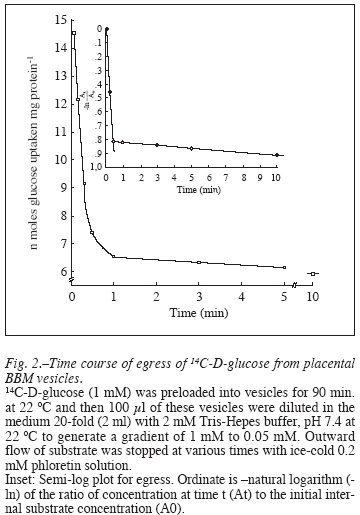
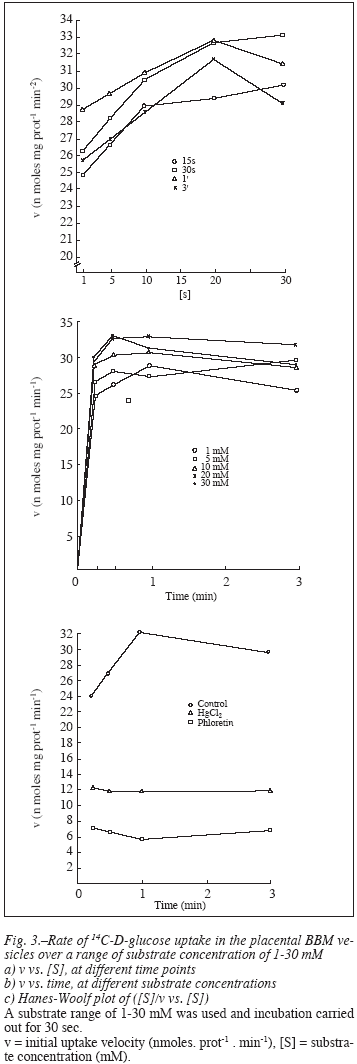
<body><![CDATA[<p><font face="Verdana" size="2"><a href="#f1">Fig. 1</a> shows that in the presence of an inwardly directed sodium gradient (initial conditions: 130mM NaCl outside and zero inside), the influx of D-glucose in the placental BBM vesicles appeared to be extremely fast and follows a characteristic time dependent pattern. The quantity of the sugar in the vesicles reached a peak value of 32.17 nmoles.mg protein<sup>-1</sup> at about 1 min which declined steadily thereafter and attained a near equilibrium value (steady state) at about 5 min. In the absence of    Na<sup>+</sup>, the rate of uptake in the vesicles was much slower, never attained any peak accumulation and proceeded at a constant rate of about 20 nmoles.mg protein<sup>-1</sup>, which is only about 60% of the peak value as attained in the presence of    Na<sup>+</sup>. The transient accumulation of the sugar in the vesicles suggests that the process is in some way linked to the inward movement of    Na<sup>+</sup> ions until that time when the vesicles were also equilibrated with the ion. In the subsequent experiments, the vesicles were incubated with the substrate for a period of 30 sec because it falls in the linear region of the uptake velocity.</font></p>        <p align="center"><a name="f1"><img src="/img/revistas/nh/v21n1/original6_1.gif" width="360" height="397"></a></p>        <p><font face="Verdana" size="2">    <br>    Efflux of the substrate from the preloaded vesicles, called the 'egress' was equally fast with the internal concentration of the label falling to 75% in 20 sec and 30 sec in the presence and absence of NaCl, respectively    (<a href="#f2">fig. 2</a>). The rate then slowed abruptly as egress was studied for 10 min. The time course of egress was thus biphasic as clearly evident in the semi log plot    (<a href="#f2">fig. 2 inset</a>) that shows a halftime of 15 sec and 660 sec for the fast and slow components, respectively. Kinetic properties of the transport system were investigated with a range of substrate concentration of 1-30 mM and by measuring the initial rate of uptake of the label into the vesicles. The rate of D-glucose uptake was found to be concentration dependent over a range of 1-10 mM    (<a href="#f3">fig. 3 a y b</a>), which then saturates at higher concentrations of the monosaccharide assuming the hyperbolic kinetics typical of a protein mediated facilitated diffusion. In subsequent experiments, a substrate concentration of 30 mM was adopted ensuring a linear kinetics of the uptake process at a saturable substrate concentration. The data of uptake velocity (v) versus the substrate concentration (&#091;S&#093;) were transformed to a linear plot of HanesWoolf (&#091;S&#093;/v vs. &#091;S&#093;), and the apparent affinity constant of the uptake    (k<sub>t</sub>) and the initial apparent maximum velocity (J<sub>max</sub>) were calculated from the x-intercept and the slope, respectively    (<a href="#f3">fig. 3c</a>). It follows the usual form of Michaelis-Menten equation for enzyme    kinetics,</font></p>        <p align="center"><img src="/img/revistas/nh/v21n1/original6_formula1.gif" width="137" height="44"></p>        <p><font face="Verdana" size="2">The uptake data plotted in this way produced a    k<sub>t</sub> and J<sub>max</sub> value of 1.2 mM and 34.3 nmoleslmg protein/ min, respectively.</font></p>        <p align="center"><a name="f2"><img src="/img/revistas/nh/v21n1/original6_2.gif" width="360" height="515"></a>    <br> </p>        <p align="center"><a name="f3"><img src="/img/revistas/nh/v21n1/original6_3.gif" width="357" height="1064"></a></p>        <p><i><font face="Verdana" size="2">    ]]></body>
<body><![CDATA[<br>    Inhibition by phloretin and HgCl<sub>2</sub></font></i></p>        <p><font face="Verdana" size="2"><a href="#f4">Fig. 4</a> shows that the uptake of D-glucose in BBM vesicles was found to be inhibited by phloretin (60% inhibition) and    H9Cl<sub>2</sub> (30%). The time course of inhibition </font><font face="Verdana" size="2">    was also followed from 15 sec to 3 min, and while the "overshoot" in D-glucose uptake was once again visible, the inhibitory effects of phloretin and    HgC</font><font face="Verdana" size="2">l<sub>2</sub> were clearly and uniformly discernible at all time points. Phloretin was therefore used as transport terminator in subsequent experiments to counter the rapidity with which the influx took place during the time lapse between incubation and filtration of membrane vesicles which was although as less as 1-2 sec.</font></p>        <p align="center"><a name="f4"><img src="/img/revistas/nh/v21n1/original6_4.gif" width="359" height="427"></a></p> <font face="Verdana" size="2">        <br>    <i>The temperature dependence of uptake</i></font>     <p> <font face="Verdana" size="2">    The effect of temperature, if any, on the D-glucose uptake in the BBM vesicles was studied by following the uptake process at different temperatures ranging from 4-48 &ordm;C (<a href="#f5">fig.    5</a>). The results demonstrate that although the glucose uptake can be visualized even at lower temperatures, the optimum activity takes place at 37 &ordm;C which considerably decreases thereafter at 48 &ordm;C (25% inhibition). The uptake velocity at 0 &ordm;C was only about 35% of that obtained at 37 &ordm;C and at temperatures from 10-28 &ordm;C, the uptake was found to increase linearly. The data was transformed to Arrhenius relationship of log maximum velocity to 1/T (absolute temperature) that yielded a non-linear curve (inset). From the plot were yielded the energy of activation (Ea) values below and above the transition temperature as calculated from the slope which were found to be 7600 and 5472 kCal.mol<sup>-1</sup>, respectively. The transition temperature (37 &ordm;C) was directly recorded from the plot.</font></p>        <p align="center"><a name="f5"><img src="/img/revistas/nh/v21n1/original6_5.gif" width="355" height="625"></a></p>        <p><i><font size="2" face="Verdana">    <br>    Substrate specificity</font></i></p>        <p><font size="2" face="Verdana">The substrate specificity for D-glucose transport in the placental BBM vesicles was determined by competitive inhibition with a number of mono- and disaccharides    </font> <font size="2" face="Verdana">    and their structural analogues when tested in a tenfold molar excess over the substrate in the incubation medium which also contained 130 mM NaC&#093;.    <a href="/img/revistas/nh/v21n1/original6_7.gif" target="_blank"> Table I</a> shows that the D-glucose transport was inhibited substantially by the glucose analogue, D-galactose, deoxyglucose, D-mannose, pentose sugars like D-arabinose, D-xylose and the disaccharides such as a-lactose, maltose and sucrose. The phosphorylated sugars, glucose-1- phosphate, glucosc-6-phosphate and fructose 1,6-diphosphate also produced strong inhibition of D-glucose uptake in these vesicles. The inhibition constant (k<sub>i</sub>) as listed in the table was calculated following the equation:</font> </p>     <p align="center"><img src="/img/revistas/nh/v21n1/original6_formula2.gif" width="270" height="51"></p>        ]]></body>
<body><![CDATA[<p> <font size="2" face="Verdana">  The k<sub>i</sub> values showed, as listed in <a target="_blank" href="/img/revistas/nh/v21n1/original6_7.gif"> table I</a>, that the disaccharides, phosphorylated sugars and arabinose with small ki values may prove to be the more potent  inhibitors.</font> </p>        <p> <i><font face="Verdana" size="2">Effect of steroids</font></i> </p>        <p><font face="Verdana" size="2">To study the effect of a number of steroid hormones on the uptake of D-glucose in the BBM vesicles, the membranes were preincubated for 10 min with a steroid and then the uptake studies carried out. During the transport, the media contained 500    <i> &micro;</i>M steroid; 30 mM substrate and 130 mM NaCl. Progesterone, 17&alpha;-hydroxyprogesterone and testosterone strongly inhibited the uptake process and 13-estradiol inhibited moderately while cholesterol produced a rather weak inhibition    (<a href="/img/revistas/nh/v21n1/original6_9.gif" target="_blank">table II</a>). Also, an amount of 5% ethanol present as solvent for the steroids had no effect on glucose uptake. The inhibition constant as listed showed that the hydroxylated progesterone with 0.22 mM was the most potent inhibitor.</font></p>        <p><i><font face="Verdana" size="2">Effect of insulin</font></i></p>        <p><font face="Verdana" size="2">Insulin was found to stimulate the glucose uptake in the placental BBM vesicles.    <a href="#f6"> Fig. 6</a> showed a dose dependent linear relationship of the increase in D-glucose uptake with an increment in insulin concentration in the incubation medium. It is also interesting to note that an extrapolation of the linear plot to the insulin concentration intersects the y-axis at a point which was identical to the    J<sub>max</sub> value as obtained in the substrate kinetics experiment. The uptake values however, were    </font> <font face="Verdana" size="2">    obtained when BSA was present along with insulin, while without BSA, the value was about 29.5% less.</font> </p>        <p align="center"><a name="f6"><img src="/img/revistas/nh/v21n1/original6_6.gif" width="357" height="316"></a></p>        <p><i><font face="Verdana" size="2">    <br>    Effect of inhibitors</font></i></p>        <p><font face="Verdana" size="2">The uptake was inhibited by a number of compounds which are known membrane perturbing agents or metabolic inhibitors    (<a href="#f7">fig. 7</a>). Ouabain, a competitive inhibitor of Na<sup>+</sup> /K<sup>+</sup> -ATPase showed about 20% inhibition of glucose uptake. 2,4-dinitrophenol (DNP), a potent metabolic inhibitor blocked the influx to as much as 50% while its para substituent remained almost without any effect. Nicotine, a well documented drug of abuse, depressed the uptake significantly up to 18% of the control value.</font></p>       <p align="center"><a name="f7"><img src="/img/revistas/nh/v21n1/original6_8.gif" width="361" height="310"></a></p>       ]]></body>
<body><![CDATA[<p><font face="Verdana" size="3"><b>    <br>   Discussion</b></font></p>        <p><font size="2" face="Verdana">Glucose is a major fetal nutrient and understanding its transport across placenta is fundamental to the understanding of the fetal nutrition and metabolism. Since, the fetal liver is known to be deficient in gluconeogenic    activities<sup>14</sup>, a transplacental movement of sugar from the maternal blood remained the only source for this primary energy molecule. Transport through the microvillous plasma membrane of the placental syncytiotrophoblast is believed to be the first step in the transfer process.    </font><font size="2" face="Verdana">The study of D-glucose uptake in the isolated membrane vesicles in the present investigation clearly demonstrates the presence of a high affinity glucose transport which is selective and mediated by a facilitated diffusion system. The process was saturable and had a kt of 1.2 mM which is similar to that reported in a number of tissues such as the adipocyte and the cultured fibroblasts from baby hamster    kidney<sup>15</sup>. The results suggest that the monosaccharide is transiently accumulated within the vesicles by an electrogenic process dependent on the presence of an inward gradient of NaCl. The process is therefore, powered by sodium co-transport and aptly called as the "secondary active transport&quot;<sup>16</sup>. The transport is characterized by a huge overshoot phenomenon which is also variously reported in 10 experiments with glucose and amino acid transport in the isolated microvillous membrane vesicles of similar transport epithelia, like intestinal villous and renal proximal    tubule<sup>17,18</sup>. Outward flux of the monosaccharide is characterized by two distinct phases, a slower one preceded by an extremely rapid flux. The biphasic time course indicates the possibility    </font> <font size="2" face="Verdana">    of existence of two types of vesicular compartments with transport system of different affinity - one that fills and empties much faster than the other one. The    transport also showed clearly its sensitivity towards temperature of incubation. The uptake was negligible at 4-15&deg;C, proceeded maximally at 37&deg;C and was inhibited    thereafter, thus further suggesting that the process was transport protein-mediated and depended on the changes in membrane lipid microenvironment. The non-linearity in Arrhenius plot demonstrates a selective partitioning of the protein (transporter) in the ordered and liquid crystalline lipid phases. The break point as visualized directly from the plot corresponds to the membrane lipid phase transition (Tc). The Ea below the Tc (7600    kCal.mol<sup>-1</sup>) corresponded to the transition of the native molecule to the activated state while the Ea above the Tc (5472 kCal.mor1) may relate to denaturation or unfolding of the higher order structures.</font> </p>        <p> <font size="2" face="Verdana">    The D-glucose uptake in placental BBM vesicles prefers substrates which are conformational analogues such as the D-galactose, D-mannose or the phosphorylated sugar at one or six position. It was interesting to note that a number of disaccharides also compete for the glucose binding sites. The possible explanation could be that these membranes are also richly endowed with disaccharide    hydrolases<sup>19</sup> which could provide the ready source, of the competing monosaccharide substrate. The transport system also seems to have little discrimination for the pentose sugar and the ketohexoses.</font></p>        <p> <font size="2" face="Verdana">    The microvillous membrane glucose transport system is inhibited by a number of steroid hormones which    although are synthesized <i> in vivo</i> by the placenta and their local concentration cannot be told precisely, but may be presumed to be quite high. Smith and    Brush<sup>20</sup>    reported a value of 1-2 <i> &micro;</i>g of progesterone per g of isolated microvilli from placenta that corresponds to about 5 x    10<sup>-6</sup> M which is within the range of the steroids where inhibition of glucose transport was observed in the present study. Direct inhibitory effects of steroids on glucose transport had been demonstrated in other cell types such as the diethylstilbestrol in    erythrocytes<sup>21</sup>. It seems that the inhibition of glucose uptake in placental microvillous membranes from the maternal blood in ten-fold molar excess of the steroids is a part of the unique self regulatory mechanism of a tissue which is known to be autonomous. However, cholesterol, the precursor molecule for these steroids did have little effect on the uptake process. Steroid hormones have also been shown to inhibit strongly the uptake process of different amino acids in the placental    membranes<sup>22</sup>. On the other hand, the transport process was stimulated in a dose dependent fashion by insulin. Placentalmembranes are richly endowed with high affinity insulin    receptors<sup>23-25</sup>, although the biological effects of insulin on placenta are unknown and the membrane contains no hormone-sensitive adenylate    cyclase<sup>26</sup>. Insulin however, seemed to inhibit the amino acid    movement<sup>27</sup>. The inhibition is particularly pronounced in placental slice    preparations<sup>28</sup>. Since, insulin is rapidly degraded by placental    tissues<sup>24,29</sup> we have added BSA to the incubation medium to slow down the proteolysis of insulin.</font></p>        <p><font size="2" face="Verdana">A number of drugs, membrane perturbing agents and metabolic inhibitors have been shown to inhibit the glucose uptake in the present study. Ouabain, a cardiac glycoside which specifically inhibits the Na+ /K+ ATPase by competitively binding with the    K<sup>+</sup> -inding sites of the enzyme<sup>30</sup>. The enzyme is responsible for generating the    Na<sup>+</sup> -gradient and therefore, the inhibitory effect of the drug on glucose transport which has to be cotransported with    Na<sup>+</sup>, is also expected. Ouabain has also been found to inhibit the amino acid transport in    placental<sup>22</sup> and other epithelial surfaces<sup>31</sup>. Similar compounds like digoxin and ethacrynic acid which inhibited the transport ATPase, also strongly blocked the amino acid and glucose transport in placental    membranes<sup>32</sup>. The oxidative inhibitor, dinitrophenol inhibited the uptake while in the presence of p-nitrophenyl phosphate, the uptake of glucose appeared to maintain the near normal rate. The results are similar to that of the glucose and amino acid uptake in placental slice    experiments<sup>32</sup>. Dinitrophenol is also reported to inhibit the vitamin    B<sub>12</sub> uptake in placental membranes<sup>33</sup>.</font></p>        <p> <font size="2" face="Verdana">    The uptake is also inhibited drastically by metabolic    poison, HgCl<sub>2</sub> and also by phloretin. Phloretin has some structural similarities to the steroids and is also known to be weakly    estrogenic<sup>34</sup>. It has an o-&beta;-D-glucopyra-nosine in its molecule, which is used experimentally to produce glycosuria and is a potent inhibitor of glucose transport in the intestinal and renal membrane    vesicles<sup>35,36</sup>. Nicotine is a major drug of abuse, known to depress the placental amino acid    transport<sup>37</sup> and may be one of the factors that cause reduction in intrauterine fetal growth in smoking    mothers<sup>38</sup>. Nicotine considerably inhibited the glucose uptake which is surprising in view of the fact that placenta is devoid of any kind of nerve. However, it is known that placenta is rich in acetyl choline and its metabolizing    enzymes<sup>39</sup>. Nicotine binds to the acetyl choline/muscarinic receptor and it is believed that cholinergic regulation may form the basis of glucose and amino acid transport in    placenta<sup>37</sup>.</font></p>        <p>&nbsp;</p>        <p><font face="Verdana" size="3"><b>References</b></font></p>        <!-- ref --><p><font size="2" face="Verdana">1. Johnson LW, Smith CH: Glucose transport across the basal plasma membrane of human placental syncytiotrophoblast. Biochim Biophys Acta 1985, 815: 44-50.</font>&nbsp;&nbsp;&nbsp;&nbsp;&nbsp;&nbsp;&nbsp;&nbsp;[&#160;<a href="javascript:void(0);" onclick="javascript: window.open('/scielo.php?script=sci_nlinks&ref=3474828&pid=S0212-1611200600010000800001&lng=','','width=640,height=500,resizable=yes,scrollbars=1,menubar=yes,');">Links</a>&#160;]<!-- end-ref --><!-- ref -->    &nbsp;&nbsp;&nbsp;&nbsp;&nbsp;&nbsp;&nbsp;&nbsp;[&#160;<a href="javascript:void(0);" onclick="javascript: window.open('/scielo.php?script=sci_nlinks&ref=3474829&pid=S0212-1611200600010000800002&lng=','','width=640,height=500,resizable=yes,scrollbars=1,menubar=yes,');">Links</a>&#160;]<!-- end-ref --><!-- ref --><p><font size="2" face="Verdana">3. Stacey TE, Weedon AP, Haworth C, Ward RHT, Boyd RDH: Fetomatemal transfer of glucose analogues by sheep placenta. Am J Physiol 1978, 234: E32-E37.</font>&nbsp;&nbsp;&nbsp;&nbsp;&nbsp;&nbsp;&nbsp;&nbsp;[&#160;<a href="javascript:void(0);" onclick="javascript: window.open('/scielo.php?script=sci_nlinks&ref=3474830&pid=S0212-1611200600010000800003&lng=','','width=640,height=500,resizable=yes,scrollbars=1,menubar=yes,');">Links</a>&#160;]<!-- end-ref --><!-- ref --><p><font size="2" face="Verdana">4. Smith NC, Brush MG, Luckett S: Preparation of human placental villous surface membrane. Nature 1974, 252: 302-303.</font>&nbsp;&nbsp;&nbsp;&nbsp;&nbsp;&nbsp;&nbsp;&nbsp;[&#160;<a href="javascript:void(0);" onclick="javascript: window.open('/scielo.php?script=sci_nlinks&ref=3474831&pid=S0212-1611200600010000800004&lng=','','width=640,height=500,resizable=yes,scrollbars=1,menubar=yes,');">Links</a>&#160;]<!-- end-ref --><!-- ref --><p><font size="2" face="Verdana">5. Anand RJK, Kanwar U, Sanyal SN: Isolation and characterization of the basal cell membranes of the human term placenta. Indian J Expt Biol 1996a, 33: 298-307.</font>&nbsp;&nbsp;&nbsp;&nbsp;&nbsp;&nbsp;&nbsp;&nbsp;[&#160;<a href="javascript:void(0);" onclick="javascript: window.open('/scielo.php?script=sci_nlinks&ref=3474832&pid=S0212-1611200600010000800005&lng=','','width=640,height=500,resizable=yes,scrollbars=1,menubar=yes,');">Links</a>&#160;]<!-- end-ref --><!-- ref --><p><font size="2" face="Verdana">6. Anand RJK, Kanwar U, Sanyal SN: Ca 2+ - transport across brush border and basal surfaces of human term placenta. Indian J Expt Biol 1996b, 34: 786-793.</font>&nbsp;&nbsp;&nbsp;&nbsp;&nbsp;&nbsp;&nbsp;&nbsp;[&#160;<a href="javascript:void(0);" onclick="javascript: window.open('/scielo.php?script=sci_nlinks&ref=3474833&pid=S0212-1611200600010000800006&lng=','','width=640,height=500,resizable=yes,scrollbars=1,menubar=yes,');">Links</a>&#160;]<!-- end-ref --><!-- ref --><p><font size="2" face="Verdana">7. Anand RJK, Kanwar U, Sanyal SN: Placental membrane transport. Leucine transport across the brush border and basal cell membrane surfaces. Res Expt Med 1996c, 196:29-43.</font>&nbsp;&nbsp;&nbsp;&nbsp;&nbsp;&nbsp;&nbsp;&nbsp;[&#160;<a href="javascript:void(0);" onclick="javascript: window.open('/scielo.php?script=sci_nlinks&ref=3474834&pid=S0212-1611200600010000800007&lng=','','width=640,height=500,resizable=yes,scrollbars=1,menubar=yes,');">Links</a>&#160;]<!-- end-ref --><!-- ref --><p><font size="2" face="Verdana">8. Anand RJK, Kanwar U, Sanyal SN: Transport of glycine in the brush border and basal cell membrane vesicles of the human term placenta. Biochem Mol Biol Intn 1996d, 38(1): 21-30.</font>&nbsp;&nbsp;&nbsp;&nbsp;&nbsp;&nbsp;&nbsp;&nbsp;[&#160;<a href="javascript:void(0);" onclick="javascript: window.open('/scielo.php?script=sci_nlinks&ref=3474835&pid=S0212-1611200600010000800008&lng=','','width=640,height=500,resizable=yes,scrollbars=1,menubar=yes,');">Links</a>&#160;]<!-- end-ref --><!-- ref --><p><font size="2" face="Verdana">9. Smith CH, Nelson DM, King BF, Donohue TM, Ruzycki SM, Kelley LK: Characterization of a microvillous membrane preparation from human placental syncytiotrophoblast, a morphologic, biochemical, and physiologic study. Am J Obstet Gynecol 1977, 128: 190-197.</font>&nbsp;&nbsp;&nbsp;&nbsp;&nbsp;&nbsp;&nbsp;&nbsp;[&#160;<a href="javascript:void(0);" onclick="javascript: window.open('/scielo.php?script=sci_nlinks&ref=3474836&pid=S0212-1611200600010000800009&lng=','','width=640,height=500,resizable=yes,scrollbars=1,menubar=yes,');">Links</a>&#160;]<!-- end-ref --><!-- ref --><p><font size="2" face="Verdana">10. Paul J. In: Cell and Tissue Culture. Williams &amp; Wilkins, Baltimore, 1965, p. 83.</font>&nbsp;&nbsp;&nbsp;&nbsp;&nbsp;&nbsp;&nbsp;&nbsp;[&#160;<a href="javascript:void(0);" onclick="javascript: window.open('/scielo.php?script=sci_nlinks&ref=3474837&pid=S0212-1611200600010000800010&lng=','','width=640,height=500,resizable=yes,scrollbars=1,menubar=yes,');">Links</a>&#160;]<!-- end-ref --><!-- ref --><p><font size="2" face="Verdana">11. Butler FE: Determination of tritium in water and urine. Liquid scintillation counting and rate of drift determination. Anal Chem 1961, 33: 409-413.</font>&nbsp;&nbsp;&nbsp;&nbsp;&nbsp;&nbsp;&nbsp;&nbsp;[&#160;<a href="javascript:void(0);" onclick="javascript: window.open('/scielo.php?script=sci_nlinks&ref=3474838&pid=S0212-1611200600010000800011&lng=','','width=640,height=500,resizable=yes,scrollbars=1,menubar=yes,');">Links</a>&#160;]<!-- end-ref --><!-- ref --><p><font size="2" face="Verdana">12. Johnson LW. Smith CH: Monosaccharide transport across microvillous membrane of human placenta. Am J Physiol 1980, 238: C160-C168.</font>&nbsp;&nbsp;&nbsp;&nbsp;&nbsp;&nbsp;&nbsp;&nbsp;[&#160;<a href="javascript:void(0);" onclick="javascript: window.open('/scielo.php?script=sci_nlinks&ref=3474839&pid=S0212-1611200600010000800012&lng=','','width=640,height=500,resizable=yes,scrollbars=1,menubar=yes,');">Links</a>&#160;]<!-- end-ref --><!-- ref --><p><font size="2" face="Verdana">13. Lees M, Paxman S: Modification of the Lowry procedure for the analysis of proteolipid protein. Anal Biochem 1972, 47: 184-194.</font>&nbsp;&nbsp;&nbsp;&nbsp;&nbsp;&nbsp;&nbsp;&nbsp;[&#160;<a href="javascript:void(0);" onclick="javascript: window.open('/scielo.php?script=sci_nlinks&ref=3474840&pid=S0212-1611200600010000800013&lng=','','width=640,height=500,resizable=yes,scrollbars=1,menubar=yes,');">Links</a>&#160;]<!-- end-ref --><!-- ref --><p><font size="2" face="Verdana">14. Kalhan SC, D' Angelo LJ, Savin SM, Adam P AJ: Glucose production in pregnant women at term gestation: Sources of glucose for human fetus. J Clin Invest 1979, 63:388-394.</font>&nbsp;&nbsp;&nbsp;&nbsp;&nbsp;&nbsp;&nbsp;&nbsp;[&#160;<a href="javascript:void(0);" onclick="javascript: window.open('/scielo.php?script=sci_nlinks&ref=3474841&pid=S0212-1611200600010000800014&lng=','','width=640,height=500,resizable=yes,scrollbars=1,menubar=yes,');">Links</a>&#160;]<!-- end-ref --><!-- ref --><p><font size="2" face="Verdana">15. Eilam Y, Stein WD: Kinetic studies of transport across red blood cell membranes. In: Methods in Membrane Biology, (E.D. Kom, ed.) Plenum Publishing Corporation, New York, 1974, Vol. 2, pp.283.</font>&nbsp;&nbsp;&nbsp;&nbsp;&nbsp;&nbsp;&nbsp;&nbsp;[&#160;<a href="javascript:void(0);" onclick="javascript: window.open('/scielo.php?script=sci_nlinks&ref=3474842&pid=S0212-1611200600010000800015&lng=','','width=640,height=500,resizable=yes,scrollbars=1,menubar=yes,');">Links</a>&#160;]<!-- end-ref --><!-- ref --><p><font size="2" face="Verdana">16. Boyd CAR, Lund EK: L. Proline transport by brush border membrane vesicles prepared from human placenta. J Physiol 1981, 315: 9-19.</font>&nbsp;&nbsp;&nbsp;&nbsp;&nbsp;&nbsp;&nbsp;&nbsp;[&#160;<a href="javascript:void(0);" onclick="javascript: window.open('/scielo.php?script=sci_nlinks&ref=3474843&pid=S0212-1611200600010000800016&lng=','','width=640,height=500,resizable=yes,scrollbars=1,menubar=yes,');">Links</a>&#160;]<!-- end-ref --><!-- ref --><p><font size="2" face="Verdana">17. Ghishan FK, Sutter W, Said H, Leonard D, Pietsch J, Abumrad N: Glutamine transport by rat basolateral membrane vesicles. Biochim Biophys Acta 1989, 979: 77-81.</font>&nbsp;&nbsp;&nbsp;&nbsp;&nbsp;&nbsp;&nbsp;&nbsp;[&#160;<a href="javascript:void(0);" onclick="javascript: window.open('/scielo.php?script=sci_nlinks&ref=3474844&pid=S0212-1611200600010000800017&lng=','','width=640,height=500,resizable=yes,scrollbars=1,menubar=yes,');">Links</a>&#160;]<!-- end-ref --><!-- ref --><p><font size="2" face="Verdana">18. Inui K, Okano T, Takano M, Kitazawa S, Hori R: A simple method for the isolation of basolateral plasma membrane vesicles from rat kidney cortex. Biochim Biophys Acta 1981, 647: 150-154.</font>&nbsp;&nbsp;&nbsp;&nbsp;&nbsp;&nbsp;&nbsp;&nbsp;[&#160;<a href="javascript:void(0);" onclick="javascript: window.open('/scielo.php?script=sci_nlinks&ref=3474845&pid=S0212-1611200600010000800018&lng=','','width=640,height=500,resizable=yes,scrollbars=1,menubar=yes,');">Links</a>&#160;]<!-- end-ref --><!-- ref --><p><font size="2" face="Verdana">19. Ramaswamy D, Malathi P, Crane RK: Demonstration of hydrolase related glucose transport in brush border membrane vesicles prepared from guinea pig intestine. Biochem Biophys Res Commun 1976, 68: 162-168.</font>&nbsp;&nbsp;&nbsp;&nbsp;&nbsp;&nbsp;&nbsp;&nbsp;[&#160;<a href="javascript:void(0);" onclick="javascript: window.open('/scielo.php?script=sci_nlinks&ref=3474846&pid=S0212-1611200600010000800019&lng=','','width=640,height=500,resizable=yes,scrollbars=1,menubar=yes,');">Links</a>&#160;]<!-- end-ref --><!-- ref --><p><font size="2" face="Verdana">20. Smith NC, Brush MG: Preparation and characterization of human syncytiotrophoblast plasma membrane. Medical BioI 1978, 56: 272-276.&nbsp;</font>&nbsp;&nbsp;&nbsp;&nbsp;&nbsp;&nbsp;&nbsp;&nbsp;[&#160;<a href="javascript:void(0);" onclick="javascript: window.open('/scielo.php?script=sci_nlinks&ref=3474847&pid=S0212-1611200600010000800020&lng=','','width=640,height=500,resizable=yes,scrollbars=1,menubar=yes,');">Links</a>&#160;]<!-- end-ref --><!-- ref --><p><font size="2" face="Verdana">    21. LeFevre PG: Molecular structural factors in competitive inhibition of sugar transport. Science 1959, 130: 104-105.</font>&nbsp;&nbsp;&nbsp;&nbsp;&nbsp;&nbsp;&nbsp;&nbsp;[&#160;<a href="javascript:void(0);" onclick="javascript: window.open('/scielo.php?script=sci_nlinks&ref=3474848&pid=S0212-1611200600010000800021&lng=','','width=640,height=500,resizable=yes,scrollbars=1,menubar=yes,');">Links</a>&#160;]<!-- end-ref --><!-- ref --><p><font size="2" face="Verdana">22. Sybulski S, Tremblay PC: Uptake and incorporation into protein of radioactive glycine by human placentae in vitro. Am J Obstet Gynccol 1967, 97: 1111-1118.</font>&nbsp;&nbsp;&nbsp;&nbsp;&nbsp;&nbsp;&nbsp;&nbsp;[&#160;<a href="javascript:void(0);" onclick="javascript: window.open('/scielo.php?script=sci_nlinks&ref=3474849&pid=S0212-1611200600010000800022&lng=','','width=640,height=500,resizable=yes,scrollbars=1,menubar=yes,');">Links</a>&#160;]<!-- end-ref --><!-- ref --><p><font size="2" face="Verdana">23. Nelson DM, Smith RM, Jarett L: Nonuniform distribution and grouping of insulin receptors on the surface of human placental syncytial trophoblast. Diabetes 1978, 27:530-538.</font>&nbsp;&nbsp;&nbsp;&nbsp;&nbsp;&nbsp;&nbsp;&nbsp;[&#160;<a href="javascript:void(0);" onclick="javascript: window.open('/scielo.php?script=sci_nlinks&ref=3474850&pid=S0212-1611200600010000800023&lng=','','width=640,height=500,resizable=yes,scrollbars=1,menubar=yes,');">Links</a>&#160;]<!-- end-ref --><!-- ref --><p><font size="2" face="Verdana">24. Steel RB, Mostey JD, Smith CH: Insulin and placenta: degradation and stabilization, binding to microvillous membrane receptors, and amino acid uptake. Am J Obstet Gynecol 1979, 135: 522-529.</font>&nbsp;&nbsp;&nbsp;&nbsp;&nbsp;&nbsp;&nbsp;&nbsp;[&#160;<a href="javascript:void(0);" onclick="javascript: window.open('/scielo.php?script=sci_nlinks&ref=3474851&pid=S0212-1611200600010000800024&lng=','','width=640,height=500,resizable=yes,scrollbars=1,menubar=yes,');">Links</a>&#160;]<!-- end-ref --><!-- ref --><p><font size="2" face="Verdana">25. Whitsett JA, Lessard JL: Characteristics of the microvillous brush border of human placenta: insulin receptor localization in brush border membranes. Endocrinology 1978, 103: 1458-1468.</font>&nbsp;&nbsp;&nbsp;&nbsp;&nbsp;&nbsp;&nbsp;&nbsp;[&#160;<a href="javascript:void(0);" onclick="javascript: window.open('/scielo.php?script=sci_nlinks&ref=3474852&pid=S0212-1611200600010000800025&lng=','','width=640,height=500,resizable=yes,scrollbars=1,menubar=yes,');">Links</a>&#160;]<!-- end-ref --><!-- ref --><p><font size="2" face="Verdana">26. Whitsett JA, Johnson CL, Howkins K: Differences in localization of insulin receptors and adenylate cyclase in the human placenta. Am J Obstet Gynecol 1979, 133: 204-207.</font>&nbsp;&nbsp;&nbsp;&nbsp;&nbsp;&nbsp;&nbsp;&nbsp;[&#160;<a href="javascript:void(0);" onclick="javascript: window.open('/scielo.php?script=sci_nlinks&ref=3474853&pid=S0212-1611200600010000800026&lng=','','width=640,height=500,resizable=yes,scrollbars=1,menubar=yes,');">Links</a>&#160;]<!-- end-ref --><!-- ref --><p><font size="2" face="Verdana">27. Shotwell MA, Kilberg MS, Oxender DL: The regulation of neutral amino acid transport in mammalian cells. Biochim Biophys Acta 1983, 737: 267-284.</font>&nbsp;&nbsp;&nbsp;&nbsp;&nbsp;&nbsp;&nbsp;&nbsp;[&#160;<a href="javascript:void(0);" onclick="javascript: window.open('/scielo.php?script=sci_nlinks&ref=3474854&pid=S0212-1611200600010000800027&lng=','','width=640,height=500,resizable=yes,scrollbars=1,menubar=yes,');">Links</a>&#160;]<!-- end-ref --><!-- ref --><p><font size="2" face="Verdana">28. Dancis J, Money WL, Springer D, Levitz M: Transport of amino acids by placenta. Am J Obstet Gynecol 1968, 101: 820+829.</font>&nbsp;&nbsp;&nbsp;&nbsp;&nbsp;&nbsp;&nbsp;&nbsp;[&#160;<a href="javascript:void(0);" onclick="javascript: window.open('/scielo.php?script=sci_nlinks&ref=3474855&pid=S0212-1611200600010000800028&lng=','','width=640,height=500,resizable=yes,scrollbars=1,menubar=yes,');">Links</a>&#160;]<!-- end-ref --><!-- ref --><p><font size="2" face="Verdana">29. Posner, B.I: Insulin receptors in human and animal placental tissue. Diabetes 1974, 23: 209-217.</font>&nbsp;&nbsp;&nbsp;&nbsp;&nbsp;&nbsp;&nbsp;&nbsp;[&#160;<a href="javascript:void(0);" onclick="javascript: window.open('/scielo.php?script=sci_nlinks&ref=3474856&pid=S0212-1611200600010000800029&lng=','','width=640,height=500,resizable=yes,scrollbars=1,menubar=yes,');">Links</a>&#160;]<!-- end-ref --><!-- ref --><p><font size="2" face="Verdana">30. Yudilevich DL, Sweiry JH: Transport of amino acids in the placenta. Biochim Biophys Acta 1985, 822: 169-201.</font>&nbsp;&nbsp;&nbsp;&nbsp;&nbsp;&nbsp;&nbsp;&nbsp;[&#160;<a href="javascript:void(0);" onclick="javascript: window.open('/scielo.php?script=sci_nlinks&ref=3474857&pid=S0212-1611200600010000800030&lng=','','width=640,height=500,resizable=yes,scrollbars=1,menubar=yes,');">Links</a>&#160;]<!-- end-ref --><!-- ref --><p><font size="2" face="Verdana">31. Miller RK, Bemdt WO: Mechanisms of transport across the placenta: An in vitro approach. Life Sci 1975, 16: 7-30.</font>&nbsp;&nbsp;&nbsp;&nbsp;&nbsp;&nbsp;&nbsp;&nbsp;[&#160;<a href="javascript:void(0);" onclick="javascript: window.open('/scielo.php?script=sci_nlinks&ref=3474858&pid=S0212-1611200600010000800031&lng=','','width=640,height=500,resizable=yes,scrollbars=1,menubar=yes,');">Links</a>&#160;]<!-- end-ref --><!-- ref --><p><font size="2" face="Verdana">32. Garrett RJB, Garreett NE: Archdeacon JW. Binding of iron by rat placental tissues. Experientia 1973, 29(4): 463-464.</font>&nbsp;&nbsp;&nbsp;&nbsp;&nbsp;&nbsp;&nbsp;&nbsp;[&#160;<a href="javascript:void(0);" onclick="javascript: window.open('/scielo.php?script=sci_nlinks&ref=3474859&pid=S0212-1611200600010000800032&lng=','','width=640,height=500,resizable=yes,scrollbars=1,menubar=yes,');">Links</a>&#160;]<!-- end-ref --><!-- ref --><p><font size="2" face="Verdana">33. Dodds EC, Lawson W: Molecular structure in relation to oestrogenic activity. Compounds without a phenanthrene nucleus. Proc Royal Soc London Ser BV 1938, 125: 222-232.</font>&nbsp;&nbsp;&nbsp;&nbsp;&nbsp;&nbsp;&nbsp;&nbsp;[&#160;<a href="javascript:void(0);" onclick="javascript: window.open('/scielo.php?script=sci_nlinks&ref=3474860&pid=S0212-1611200600010000800033&lng=','','width=640,height=500,resizable=yes,scrollbars=1,menubar=yes,');">Links</a>&#160;]<!-- end-ref --><!-- ref --><p><font size="2" face="Verdana">34. Atisook K, Carlson S, Madara JL: Effects of phlorizin and sodium on glucose elicited alterations of cell junctions in intestinal epithelia. Am J Physiol 1990, 258: C77-C85.</font>&nbsp;&nbsp;&nbsp;&nbsp;&nbsp;&nbsp;&nbsp;&nbsp;[&#160;<a href="javascript:void(0);" onclick="javascript: window.open('/scielo.php?script=sci_nlinks&ref=3474861&pid=S0212-1611200600010000800034&lng=','','width=640,height=500,resizable=yes,scrollbars=1,menubar=yes,');">Links</a>&#160;]<!-- end-ref --><!-- ref --><p><font size="2" face="Verdana">35. Semenza G, Kessler M, Hosang M, Weber J, Schmidt U: Biochemistry of the Na + , D-glucose cotransporter of the small intestinal brush border membrane. Biochim Biophys Acta 1984, 779: 343-379.</font>&nbsp;&nbsp;&nbsp;&nbsp;&nbsp;&nbsp;&nbsp;&nbsp;[&#160;<a href="javascript:void(0);" onclick="javascript: window.open('/scielo.php?script=sci_nlinks&ref=3474862&pid=S0212-1611200600010000800035&lng=','','width=640,height=500,resizable=yes,scrollbars=1,menubar=yes,');">Links</a>&#160;]<!-- end-ref --><!-- ref --><p><font size="2" face="Verdana">36. Sastry BVR. Placental toxicology: Tobacco smoke, abused drugs, multiple chemical interactions and placental function.    Reprod Fertil Dev 1991, 3: 355-372.</font>&nbsp;&nbsp;&nbsp;&nbsp;&nbsp;&nbsp;&nbsp;&nbsp;[&#160;<a href="javascript:void(0);" onclick="javascript: window.open('/scielo.php?script=sci_nlinks&ref=3474863&pid=S0212-1611200600010000800036&lng=','','width=640,height=500,resizable=yes,scrollbars=1,menubar=yes,');">Links</a>&#160;]<!-- end-ref --><!-- ref --><p><font size="2" face="Verdana">37. Hasselmeyer EG, Meyer MB, Catz C, Longo LD: Pregnancy and infant health. In: Smoking and Health: A report of the Surgeon General (JM Pinney, ed.) US Department of Health, Education and Welfare, Washington DC; Publication No. (PHS) 79-5006, 1979, p.8-1to 8-93.</font>&nbsp;&nbsp;&nbsp;&nbsp;&nbsp;&nbsp;&nbsp;&nbsp;[&#160;<a href="javascript:void(0);" onclick="javascript: window.open('/scielo.php?script=sci_nlinks&ref=3474864&pid=S0212-1611200600010000800037&lng=','','width=640,height=500,resizable=yes,scrollbars=1,menubar=yes,');">Links</a>&#160;]<!-- end-ref --><!-- ref --><p><font size="2" face="Verdana">38. Sastry BVR. Olubadewo J, Boehm FH: Effects of nicotine and cocaine on the release of acetylcholine from isolated placental villi. Arch lnt Pharmacodyn Ther 1977, 229: 23-26.</font>&nbsp;&nbsp;&nbsp;&nbsp;&nbsp;&nbsp;&nbsp;&nbsp;[&#160;<a href="javascript:void(0);" onclick="javascript: window.open('/scielo.php?script=sci_nlinks&ref=3474865&pid=S0212-1611200600010000800038&lng=','','width=640,height=500,resizable=yes,scrollbars=1,menubar=yes,');">Links</a>&#160;]<!-- end-ref --><!-- ref --><p><font size="2" face="Verdana">39. Sastry BVR. Bishop MR, Janson VE, Ochillo RF: Relationship between acetylcholine and maturation of human placenta. Pharmacologist 1978, 20(3): 202.</font>&nbsp;&nbsp;&nbsp;&nbsp;&nbsp;&nbsp;&nbsp;&nbsp;[&#160;<a href="javascript:void(0);" onclick="javascript: window.open('/scielo.php?script=sci_nlinks&ref=3474866&pid=S0212-1611200600010000800039&lng=','','width=640,height=500,resizable=yes,scrollbars=1,menubar=yes,');">Links</a>&#160;]<!-- end-ref --><p>&nbsp;</p>     <p>&nbsp;</p>     ]]></body>
<body><![CDATA[<p><font size="2" face="Verdana"><b><a href="#top10"><img border="0" src="/img/revistas/nh/v21n1/seta.gif" width="15" height="17"></a><a name="back10"></a>Correspondencia:    <br> </b>Dr. S. N. Sanyal    <br> Department of Biophysics    <br> Panjab University, Chandigarh- 160 014, INDIA    <br> Tel: +91-172-2534119    <br> E-mail: <a href="mailto:sanyalpu@yahoo.co.in"> sanyalpu@yahoo.co.in</a>; <a href="mailto:sanyal@pu.ac.in">sanyal@pu.ac.in</a></font></p>     <p><font size="2" face="Verdana">Recibido: 28-IV-2005.    <br> Aceptado: 14-VI-2005.</font></p>      ]]></body><back>
<ref-list>
<ref id="B1">
<label>1</label><nlm-citation citation-type="journal">
<person-group person-group-type="author">
<name>
<surname><![CDATA[Johnson]]></surname>
<given-names><![CDATA[LW]]></given-names>
</name>
<name>
<surname><![CDATA[Smith]]></surname>
<given-names><![CDATA[CH]]></given-names>
</name>
</person-group>
<article-title xml:lang="en"><![CDATA[Glucose transport across the basal plasma membrane of human placental syncytiotrophoblast]]></article-title>
<source><![CDATA[Biochim Biophys Acta]]></source>
<year>1985</year>
<volume>815</volume>
<page-range>44-50</page-range></nlm-citation>
</ref>
<ref id="B2">
<label>2</label><nlm-citation citation-type="journal">
<person-group person-group-type="author">
<name>
<surname><![CDATA[Laga]]></surname>
<given-names><![CDATA[EM]]></given-names>
</name>
<name>
<surname><![CDATA[Driscolli]]></surname>
<given-names><![CDATA[SG]]></given-names>
</name>
<name>
<surname><![CDATA[Munro]]></surname>
<given-names><![CDATA[HN]]></given-names>
</name>
</person-group>
<article-title xml:lang="en"><![CDATA[Quantitative studies of human placenta I]]></article-title>
<source><![CDATA[Morphomery Bioil Neonate]]></source>
<year>1973</year>
<volume>23</volume>
<page-range>231- 259</page-range></nlm-citation>
</ref>
<ref id="B3">
<label>3</label><nlm-citation citation-type="journal">
<person-group person-group-type="author">
<name>
<surname><![CDATA[Stacey]]></surname>
<given-names><![CDATA[TE]]></given-names>
</name>
<name>
<surname><![CDATA[Weedon]]></surname>
<given-names><![CDATA[AP]]></given-names>
</name>
<name>
<surname><![CDATA[Haworth]]></surname>
<given-names><![CDATA[C]]></given-names>
</name>
<name>
<surname><![CDATA[Ward]]></surname>
<given-names><![CDATA[RHT]]></given-names>
</name>
<name>
<surname><![CDATA[Boyd]]></surname>
<given-names><![CDATA[RDH]]></given-names>
</name>
</person-group>
<article-title xml:lang="en"><![CDATA[Fetomatemal transfer of glucose analogues by sheep placenta]]></article-title>
<source><![CDATA[Am J Physiol]]></source>
<year>1978</year>
<volume>234</volume>
<page-range>E32-E37</page-range></nlm-citation>
</ref>
<ref id="B4">
<label>4</label><nlm-citation citation-type="journal">
<person-group person-group-type="author">
<name>
<surname><![CDATA[Smith]]></surname>
<given-names><![CDATA[NC]]></given-names>
</name>
<name>
<surname><![CDATA[Brush]]></surname>
<given-names><![CDATA[MG]]></given-names>
</name>
<name>
<surname><![CDATA[Luckett]]></surname>
<given-names><![CDATA[S]]></given-names>
</name>
</person-group>
<article-title xml:lang="en"><![CDATA[Preparation of human placental villous surface membrane]]></article-title>
<source><![CDATA[Nature]]></source>
<year>1974</year>
<volume>252</volume>
<page-range>302-303</page-range></nlm-citation>
</ref>
<ref id="B5">
<label>5</label><nlm-citation citation-type="journal">
<person-group person-group-type="author">
<name>
<surname><![CDATA[Anand]]></surname>
<given-names><![CDATA[RJK]]></given-names>
</name>
<name>
<surname><![CDATA[Kanwar]]></surname>
<given-names><![CDATA[U]]></given-names>
</name>
<name>
<surname><![CDATA[Sanyal]]></surname>
<given-names><![CDATA[SN]]></given-names>
</name>
</person-group>
<article-title xml:lang="en"><![CDATA[Isolation and characterization of the basal cell membranes of the human term placenta]]></article-title>
<source><![CDATA[Indian J Expt Biol]]></source>
<year>1996</year>
<volume>33</volume>
<page-range>298-307</page-range></nlm-citation>
</ref>
<ref id="B6">
<label>6</label><nlm-citation citation-type="journal">
<person-group person-group-type="author">
<name>
<surname><![CDATA[Anand]]></surname>
<given-names><![CDATA[RJK]]></given-names>
</name>
<name>
<surname><![CDATA[Kanwar]]></surname>
<given-names><![CDATA[U]]></given-names>
</name>
<name>
<surname><![CDATA[Sanyal]]></surname>
<given-names><![CDATA[SN]]></given-names>
</name>
</person-group>
<article-title xml:lang="en"><![CDATA[Ca 2+ - transport across brush border and basal surfaces of human term placenta]]></article-title>
<source><![CDATA[Indian J Expt Biol]]></source>
<year>1996</year>
<volume>34</volume>
<page-range>786-793</page-range></nlm-citation>
</ref>
<ref id="B7">
<label>7</label><nlm-citation citation-type="journal">
<person-group person-group-type="author">
<name>
<surname><![CDATA[Anand]]></surname>
<given-names><![CDATA[RJK]]></given-names>
</name>
<name>
<surname><![CDATA[Kanwar]]></surname>
<given-names><![CDATA[U]]></given-names>
</name>
<name>
<surname><![CDATA[Sanyal]]></surname>
<given-names><![CDATA[SN]]></given-names>
</name>
</person-group>
<article-title xml:lang="en"><![CDATA[Placental membrane transport: Leucine transport across the brush border and basal cell membrane surfaces]]></article-title>
<source><![CDATA[Res Expt Med]]></source>
<year>1996</year>
<volume>196</volume>
<page-range>29-43</page-range></nlm-citation>
</ref>
<ref id="B8">
<label>8</label><nlm-citation citation-type="journal">
<person-group person-group-type="author">
<name>
<surname><![CDATA[Anand]]></surname>
<given-names><![CDATA[RJK]]></given-names>
</name>
<name>
<surname><![CDATA[Kanwar]]></surname>
<given-names><![CDATA[U]]></given-names>
</name>
<name>
<surname><![CDATA[Sanyal]]></surname>
<given-names><![CDATA[SN]]></given-names>
</name>
</person-group>
<article-title xml:lang="en"><![CDATA[Transport of glycine in the brush border and basal cell membrane vesicles of the human term placenta]]></article-title>
<source><![CDATA[Biochem Mol Biol Intn]]></source>
<year>1996</year>
<volume>38</volume>
<numero>1</numero>
<issue>1</issue>
<page-range>21-30</page-range></nlm-citation>
</ref>
<ref id="B9">
<label>9</label><nlm-citation citation-type="journal">
<person-group person-group-type="author">
<name>
<surname><![CDATA[Smith]]></surname>
<given-names><![CDATA[CH]]></given-names>
</name>
<name>
<surname><![CDATA[Nelson]]></surname>
<given-names><![CDATA[DM]]></given-names>
</name>
<name>
<surname><![CDATA[King]]></surname>
<given-names><![CDATA[BF]]></given-names>
</name>
<name>
<surname><![CDATA[Donohue]]></surname>
<given-names><![CDATA[TM]]></given-names>
</name>
<name>
<surname><![CDATA[Ruzycki]]></surname>
<given-names><![CDATA[SM]]></given-names>
</name>
<name>
<surname><![CDATA[Kelley]]></surname>
<given-names><![CDATA[LK]]></given-names>
</name>
</person-group>
<article-title xml:lang="en"><![CDATA[Characterization of a microvillous membrane preparation from human placental syncytiotrophoblast, a morphologic, biochemical, and physiologic study]]></article-title>
<source><![CDATA[Am J Obstet Gynecol]]></source>
<year>1977</year>
<volume>128</volume>
<page-range>190-197</page-range></nlm-citation>
</ref>
<ref id="B10">
<label>10</label><nlm-citation citation-type="book">
<person-group person-group-type="author">
<name>
<surname><![CDATA[Paul]]></surname>
<given-names><![CDATA[J]]></given-names>
</name>
</person-group>
<source><![CDATA[Cell and Tissue Culture]]></source>
<year>1965</year>
<page-range>83</page-range><publisher-loc><![CDATA[Baltimore ]]></publisher-loc>
<publisher-name><![CDATA[Williams & Wilkins]]></publisher-name>
</nlm-citation>
</ref>
<ref id="B11">
<label>11</label><nlm-citation citation-type="journal">
<person-group person-group-type="author">
<name>
<surname><![CDATA[Butler]]></surname>
<given-names><![CDATA[FE]]></given-names>
</name>
</person-group>
<article-title xml:lang="en"><![CDATA[Determination of tritium in water and urine: Liquid scintillation counting and rate of drift determination]]></article-title>
<source><![CDATA[Anal Chem]]></source>
<year>1961</year>
<volume>33</volume>
<page-range>409-413</page-range></nlm-citation>
</ref>
<ref id="B12">
<label>12</label><nlm-citation citation-type="journal">
<person-group person-group-type="author">
<name>
<surname><![CDATA[Johnson]]></surname>
<given-names><![CDATA[LW]]></given-names>
</name>
<name>
<surname><![CDATA[Smith]]></surname>
<given-names><![CDATA[CH]]></given-names>
</name>
</person-group>
<article-title xml:lang="en"><![CDATA[Monosaccharide transport across microvillous membrane of human placenta]]></article-title>
<source><![CDATA[Am J Physiol]]></source>
<year>1980</year>
<volume>238</volume>
<page-range>C160-C168</page-range></nlm-citation>
</ref>
<ref id="B13">
<label>13</label><nlm-citation citation-type="journal">
<person-group person-group-type="author">
<name>
<surname><![CDATA[Lees]]></surname>
<given-names><![CDATA[M]]></given-names>
</name>
<name>
<surname><![CDATA[Paxman]]></surname>
<given-names><![CDATA[S]]></given-names>
</name>
</person-group>
<article-title xml:lang="en"><![CDATA[Modification of the Lowry procedure for the analysis of proteolipid protein]]></article-title>
<source><![CDATA[Anal Biochem]]></source>
<year>1972</year>
<volume>47</volume>
<page-range>184-194</page-range></nlm-citation>
</ref>
<ref id="B14">
<label>14</label><nlm-citation citation-type="journal">
<person-group person-group-type="author">
<name>
<surname><![CDATA[Kalhan]]></surname>
<given-names><![CDATA[SC]]></given-names>
</name>
<name>
<surname><![CDATA[D' Angelo]]></surname>
<given-names><![CDATA[LJ]]></given-names>
</name>
<name>
<surname><![CDATA[Savin]]></surname>
<given-names><![CDATA[SM]]></given-names>
</name>
<name>
<surname><![CDATA[Adam]]></surname>
<given-names><![CDATA[P AJ]]></given-names>
</name>
</person-group>
<article-title xml:lang="en"><![CDATA[Glucose production in pregnant women at term gestation: Sources of glucose for human fetus]]></article-title>
<source><![CDATA[J Clin Invest]]></source>
<year>1979</year>
<volume>63</volume>
<page-range>388-394</page-range></nlm-citation>
</ref>
<ref id="B15">
<label>15</label><nlm-citation citation-type="book">
<person-group person-group-type="author">
<name>
<surname><![CDATA[Eilam]]></surname>
<given-names><![CDATA[Y]]></given-names>
</name>
<name>
<surname><![CDATA[Stein]]></surname>
<given-names><![CDATA[WD]]></given-names>
</name>
</person-group>
<article-title xml:lang="en"><![CDATA[Kinetic studies of transport across red blood cell membranes]]></article-title>
<person-group person-group-type="editor">
<name>
<surname><![CDATA[Kom]]></surname>
<given-names><![CDATA[E.D.]]></given-names>
</name>
</person-group>
<source><![CDATA[Methods in Membrane Biology]]></source>
<year>1974</year>
<volume>2</volume>
<page-range>283</page-range><publisher-loc><![CDATA[New York ]]></publisher-loc>
<publisher-name><![CDATA[Plenum Publishing Corporation]]></publisher-name>
</nlm-citation>
</ref>
<ref id="B16">
<label>16</label><nlm-citation citation-type="journal">
<person-group person-group-type="author">
<name>
<surname><![CDATA[Boyd]]></surname>
<given-names><![CDATA[CAR]]></given-names>
</name>
<name>
<surname><![CDATA[Lund]]></surname>
<given-names><![CDATA[EK]]></given-names>
</name>
</person-group>
<article-title xml:lang="en"><![CDATA[L. Proline transport by brush border membrane vesicles prepared from human placenta]]></article-title>
<source><![CDATA[J Physiol]]></source>
<year>1981</year>
<volume>315</volume>
<page-range>9-19</page-range></nlm-citation>
</ref>
<ref id="B17">
<label>17</label><nlm-citation citation-type="journal">
<person-group person-group-type="author">
<name>
<surname><![CDATA[Ghishan]]></surname>
<given-names><![CDATA[FK]]></given-names>
</name>
<name>
<surname><![CDATA[Sutter]]></surname>
<given-names><![CDATA[W]]></given-names>
</name>
<name>
<surname><![CDATA[Said]]></surname>
<given-names><![CDATA[H]]></given-names>
</name>
<name>
<surname><![CDATA[Leonard]]></surname>
<given-names><![CDATA[D]]></given-names>
</name>
<name>
<surname><![CDATA[Pietsch]]></surname>
<given-names><![CDATA[J]]></given-names>
</name>
<name>
<surname><![CDATA[Abumrad]]></surname>
<given-names><![CDATA[N]]></given-names>
</name>
</person-group>
<article-title xml:lang="en"><![CDATA[Glutamine transport by rat basolateral membrane vesicles]]></article-title>
<source><![CDATA[Biochim Biophys Acta]]></source>
<year>1989</year>
<volume>979</volume>
<page-range>77-81</page-range></nlm-citation>
</ref>
<ref id="B18">
<label>18</label><nlm-citation citation-type="journal">
<person-group person-group-type="author">
<name>
<surname><![CDATA[Inui]]></surname>
<given-names><![CDATA[K]]></given-names>
</name>
<name>
<surname><![CDATA[Okano]]></surname>
<given-names><![CDATA[T]]></given-names>
</name>
<name>
<surname><![CDATA[Takano]]></surname>
<given-names><![CDATA[M]]></given-names>
</name>
<name>
<surname><![CDATA[Kitazawa]]></surname>
<given-names><![CDATA[S]]></given-names>
</name>
<name>
<surname><![CDATA[Hori]]></surname>
<given-names><![CDATA[R]]></given-names>
</name>
</person-group>
<article-title xml:lang="en"><![CDATA[A simple method for the isolation of basolateral plasma membrane vesicles from rat kidney cortex]]></article-title>
<source><![CDATA[Biochim Biophys Acta]]></source>
<year>1981</year>
<volume>647</volume>
<page-range>150-154</page-range></nlm-citation>
</ref>
<ref id="B19">
<label>19</label><nlm-citation citation-type="journal">
<person-group person-group-type="author">
<name>
<surname><![CDATA[Ramaswamy]]></surname>
<given-names><![CDATA[D]]></given-names>
</name>
<name>
<surname><![CDATA[Malathi]]></surname>
<given-names><![CDATA[P]]></given-names>
</name>
<name>
<surname><![CDATA[Crane]]></surname>
<given-names><![CDATA[RK]]></given-names>
</name>
</person-group>
<article-title xml:lang="en"><![CDATA[Demonstration of hydrolase related glucose transport in brush border membrane vesicles prepared from guinea pig intestine]]></article-title>
<source><![CDATA[Biochem Biophys Res Commun]]></source>
<year>1976</year>
<volume>68</volume>
<page-range>162-168</page-range></nlm-citation>
</ref>
<ref id="B20">
<label>20</label><nlm-citation citation-type="journal">
<person-group person-group-type="author">
<name>
<surname><![CDATA[Smith]]></surname>
<given-names><![CDATA[NC]]></given-names>
</name>
<name>
<surname><![CDATA[Brush]]></surname>
<given-names><![CDATA[MG]]></given-names>
</name>
</person-group>
<article-title xml:lang="en"><![CDATA[Preparation and characterization of human syncytiotrophoblast plasma membrane]]></article-title>
<source><![CDATA[Medical BioI]]></source>
<year>1978</year>
<volume>56</volume>
<page-range>272-276</page-range></nlm-citation>
</ref>
<ref id="B21">
<label>21</label><nlm-citation citation-type="journal">
<person-group person-group-type="author">
<name>
<surname><![CDATA[LeFevre]]></surname>
<given-names><![CDATA[PG]]></given-names>
</name>
</person-group>
<article-title xml:lang="en"><![CDATA[Molecular structural factors in competitive inhibition of sugar transport]]></article-title>
<source><![CDATA[Science]]></source>
<year>1959</year>
<volume>130</volume>
<page-range>104-105</page-range></nlm-citation>
</ref>
<ref id="B22">
<label>22</label><nlm-citation citation-type="journal">
<person-group person-group-type="author">
<name>
<surname><![CDATA[Sybulski]]></surname>
<given-names><![CDATA[S]]></given-names>
</name>
<name>
<surname><![CDATA[Tremblay]]></surname>
<given-names><![CDATA[PC]]></given-names>
</name>
</person-group>
<article-title xml:lang="en"><![CDATA[Uptake and incorporation into protein of radioactive glycine by human placentae in vitro]]></article-title>
<source><![CDATA[Am J Obstet Gynccol]]></source>
<year>1967</year>
<volume>97</volume>
<page-range>1111-1118</page-range></nlm-citation>
</ref>
<ref id="B23">
<label>23</label><nlm-citation citation-type="journal">
<person-group person-group-type="author">
<name>
<surname><![CDATA[Nelson]]></surname>
<given-names><![CDATA[DM]]></given-names>
</name>
<name>
<surname><![CDATA[Smith]]></surname>
<given-names><![CDATA[RM]]></given-names>
</name>
<name>
<surname><![CDATA[Jarett]]></surname>
<given-names><![CDATA[L]]></given-names>
</name>
</person-group>
<article-title xml:lang="en"><![CDATA[Nonuniform distribution and grouping of insulin receptors on the surface of human placental syncytial trophoblast]]></article-title>
<source><![CDATA[Diabetes]]></source>
<year>1978</year>
<volume>27</volume>
<page-range>530-538</page-range></nlm-citation>
</ref>
<ref id="B24">
<label>24</label><nlm-citation citation-type="journal">
<person-group person-group-type="author">
<name>
<surname><![CDATA[Steel]]></surname>
<given-names><![CDATA[RB]]></given-names>
</name>
<name>
<surname><![CDATA[Mostey]]></surname>
<given-names><![CDATA[JD]]></given-names>
</name>
<name>
<surname><![CDATA[Smith]]></surname>
<given-names><![CDATA[CH]]></given-names>
</name>
</person-group>
<article-title xml:lang="en"><![CDATA[Insulin and placenta: degradation and stabilization, binding to microvillous membrane receptors, and amino acid uptake]]></article-title>
<source><![CDATA[Am J Obstet Gynecol]]></source>
<year>1979</year>
<volume>135</volume>
<page-range>522-529</page-range></nlm-citation>
</ref>
<ref id="B25">
<label>25</label><nlm-citation citation-type="journal">
<person-group person-group-type="author">
<name>
<surname><![CDATA[Whitsett]]></surname>
<given-names><![CDATA[JA]]></given-names>
</name>
<name>
<surname><![CDATA[Lessard]]></surname>
<given-names><![CDATA[JL]]></given-names>
</name>
</person-group>
<article-title xml:lang="en"><![CDATA[Characteristics of the microvillous brush border of human placenta: insulin receptor localization in brush border membranes]]></article-title>
<source><![CDATA[Endocrinology]]></source>
<year>1978</year>
<volume>103</volume>
<page-range>1458-1468</page-range></nlm-citation>
</ref>
<ref id="B26">
<label>26</label><nlm-citation citation-type="journal">
<person-group person-group-type="author">
<name>
<surname><![CDATA[Whitsett]]></surname>
<given-names><![CDATA[JA]]></given-names>
</name>
<name>
<surname><![CDATA[Johnson]]></surname>
<given-names><![CDATA[CL]]></given-names>
</name>
<name>
<surname><![CDATA[Howkins]]></surname>
<given-names><![CDATA[K]]></given-names>
</name>
</person-group>
<article-title xml:lang="en"><![CDATA[Differences in localization of insulin receptors and adenylate cyclase in the human placenta]]></article-title>
<source><![CDATA[Am J Obstet Gynecol]]></source>
<year>1979</year>
<volume>133</volume>
<page-range>204-207</page-range></nlm-citation>
</ref>
<ref id="B27">
<label>27</label><nlm-citation citation-type="journal">
<person-group person-group-type="author">
<name>
<surname><![CDATA[Shotwell]]></surname>
<given-names><![CDATA[MA]]></given-names>
</name>
<name>
<surname><![CDATA[Kilberg]]></surname>
<given-names><![CDATA[MS]]></given-names>
</name>
<name>
<surname><![CDATA[Oxender]]></surname>
<given-names><![CDATA[DL]]></given-names>
</name>
</person-group>
<article-title xml:lang="en"><![CDATA[The regulation of neutral amino acid transport in mammalian cells]]></article-title>
<source><![CDATA[Biochim Biophys Acta]]></source>
<year>1983</year>
<volume>737</volume>
<page-range>267-284</page-range></nlm-citation>
</ref>
<ref id="B28">
<label>28</label><nlm-citation citation-type="journal">
<person-group person-group-type="author">
<name>
<surname><![CDATA[Dancis]]></surname>
<given-names><![CDATA[J]]></given-names>
</name>
<name>
<surname><![CDATA[Money]]></surname>
<given-names><![CDATA[WL]]></given-names>
</name>
<name>
<surname><![CDATA[Springer]]></surname>
<given-names><![CDATA[D]]></given-names>
</name>
<name>
<surname><![CDATA[Levitz]]></surname>
<given-names><![CDATA[M]]></given-names>
</name>
</person-group>
<article-title xml:lang="en"><![CDATA[Transport of amino acids by placenta]]></article-title>
<source><![CDATA[Am J Obstet Gynecol]]></source>
<year>1968</year>
<volume>101</volume>
<page-range>820+829</page-range></nlm-citation>
</ref>
<ref id="B29">
<label>29</label><nlm-citation citation-type="journal">
<person-group person-group-type="author">
<name>
<surname><![CDATA[Posner]]></surname>
<given-names><![CDATA[B.I]]></given-names>
</name>
</person-group>
<article-title xml:lang="en"><![CDATA[Insulin receptors in human and animal placental tissue]]></article-title>
<source><![CDATA[Diabetes]]></source>
<year>1974</year>
<volume>23</volume>
<page-range>209-217</page-range></nlm-citation>
</ref>
<ref id="B30">
<label>30</label><nlm-citation citation-type="journal">
<person-group person-group-type="author">
<name>
<surname><![CDATA[Yudilevich]]></surname>
<given-names><![CDATA[DL]]></given-names>
</name>
<name>
<surname><![CDATA[Sweiry]]></surname>
<given-names><![CDATA[JH]]></given-names>
</name>
</person-group>
<article-title xml:lang="en"><![CDATA[Transport of amino acids in the placenta]]></article-title>
<source><![CDATA[Biochim Biophys Acta]]></source>
<year>1985</year>
<volume>822</volume>
<page-range>169-201</page-range></nlm-citation>
</ref>
<ref id="B31">
<label>31</label><nlm-citation citation-type="journal">
<person-group person-group-type="author">
<name>
<surname><![CDATA[Miller]]></surname>
<given-names><![CDATA[RK]]></given-names>
</name>
<name>
<surname><![CDATA[Bemdt]]></surname>
<given-names><![CDATA[WO]]></given-names>
</name>
</person-group>
<article-title xml:lang="en"><![CDATA[Mechanisms of transport across the placenta: An in vitro approach]]></article-title>
<source><![CDATA[Life Sci]]></source>
<year>1975</year>
<volume>16</volume>
<page-range>7-30</page-range></nlm-citation>
</ref>
<ref id="B32">
<label>32</label><nlm-citation citation-type="journal">
<person-group person-group-type="author">
<name>
<surname><![CDATA[Garrett]]></surname>
<given-names><![CDATA[RJB]]></given-names>
</name>
<name>
<surname><![CDATA[Garreett]]></surname>
<given-names><![CDATA[NE]]></given-names>
</name>
<name>
<surname><![CDATA[Archdeacon]]></surname>
<given-names><![CDATA[JW]]></given-names>
</name>
</person-group>
<article-title xml:lang="en"><![CDATA[Binding of iron by rat placental tissues]]></article-title>
<source><![CDATA[Experientia]]></source>
<year>1973</year>
<volume>29</volume>
<numero>4</numero>
<issue>4</issue>
<page-range>463-464</page-range></nlm-citation>
</ref>
<ref id="B33">
<label>33</label><nlm-citation citation-type="journal">
<person-group person-group-type="author">
<name>
<surname><![CDATA[Dodds]]></surname>
<given-names><![CDATA[EC]]></given-names>
</name>
<name>
<surname><![CDATA[Lawson]]></surname>
<given-names><![CDATA[W]]></given-names>
</name>
</person-group>
<article-title xml:lang="en"><![CDATA[Molecular structure in relation to oestrogenic activity: Compounds without a phenanthrene nucleus]]></article-title>
<source><![CDATA[Proc Royal Soc London Ser BV]]></source>
<year>1938</year>
<volume>125</volume>
<page-range>222-232</page-range></nlm-citation>
</ref>
<ref id="B34">
<label>34</label><nlm-citation citation-type="journal">
<person-group person-group-type="author">
<name>
<surname><![CDATA[Atisook]]></surname>
<given-names><![CDATA[K]]></given-names>
</name>
<name>
<surname><![CDATA[Carlson]]></surname>
<given-names><![CDATA[S]]></given-names>
</name>
<name>
<surname><![CDATA[Madara]]></surname>
<given-names><![CDATA[JL]]></given-names>
</name>
</person-group>
<article-title xml:lang="en"><![CDATA[Effects of phlorizin and sodium on glucose elicited alterations of cell junctions in intestinal epithelia]]></article-title>
<source><![CDATA[Am J Physiol]]></source>
<year>1990</year>
<volume>258</volume>
<page-range>C77-C85</page-range></nlm-citation>
</ref>
<ref id="B35">
<label>35</label><nlm-citation citation-type="journal">
<person-group person-group-type="author">
<name>
<surname><![CDATA[Semenza]]></surname>
<given-names><![CDATA[G]]></given-names>
</name>
<name>
<surname><![CDATA[Kessler]]></surname>
<given-names><![CDATA[M]]></given-names>
</name>
<name>
<surname><![CDATA[Hosang]]></surname>
<given-names><![CDATA[M]]></given-names>
</name>
<name>
<surname><![CDATA[Weber]]></surname>
<given-names><![CDATA[J]]></given-names>
</name>
<name>
<surname><![CDATA[Schmidt]]></surname>
<given-names><![CDATA[U]]></given-names>
</name>
</person-group>
<article-title xml:lang="en"><![CDATA[Biochemistry of the Na + , D-glucose cotransporter of the small intestinal brush border membrane]]></article-title>
<source><![CDATA[Biochim Biophys Acta]]></source>
<year>1984</year>
<volume>779</volume>
<page-range>343-379</page-range></nlm-citation>
</ref>
<ref id="B36">
<label>36</label><nlm-citation citation-type="journal">
<person-group person-group-type="author">
<name>
<surname><![CDATA[Sastry]]></surname>
<given-names><![CDATA[BVR]]></given-names>
</name>
</person-group>
<article-title xml:lang="en"><![CDATA[Placental toxicology: Tobacco smoke, abused drugs, multiple chemical interactions and placental function]]></article-title>
<source><![CDATA[Reprod Fertil Dev]]></source>
<year>1991</year>
<volume>3</volume>
<page-range>355-372</page-range></nlm-citation>
</ref>
<ref id="B37">
<label>37</label><nlm-citation citation-type="book">
<person-group person-group-type="author">
<name>
<surname><![CDATA[Hasselmeyer]]></surname>
<given-names><![CDATA[EG]]></given-names>
</name>
<name>
<surname><![CDATA[Meyer]]></surname>
<given-names><![CDATA[MB]]></given-names>
</name>
<name>
<surname><![CDATA[Catz]]></surname>
<given-names><![CDATA[C]]></given-names>
</name>
<name>
<surname><![CDATA[Longo]]></surname>
<given-names><![CDATA[LD]]></given-names>
</name>
</person-group>
<article-title xml:lang="en"><![CDATA[Pregnancy and infant health]]></article-title>
<person-group person-group-type="editor">
<name>
<surname><![CDATA[Pinney]]></surname>
<given-names><![CDATA[JM]]></given-names>
</name>
</person-group>
<source><![CDATA[Smoking and Health: A report of the Surgeon General]]></source>
<year>1979</year>
<volume>79-5006</volume>
<page-range>8-1to 8-93</page-range><publisher-loc><![CDATA[Washington DC ]]></publisher-loc>
<publisher-name><![CDATA[US Department of Health, Education and Welfare]]></publisher-name>
</nlm-citation>
</ref>
<ref id="B38">
<label>38</label><nlm-citation citation-type="journal">
<person-group person-group-type="author">
<name>
<surname><![CDATA[Sastry]]></surname>
<given-names><![CDATA[BVR]]></given-names>
</name>
<name>
<surname><![CDATA[Olubadewo]]></surname>
<given-names><![CDATA[J]]></given-names>
</name>
<name>
<surname><![CDATA[Boehm]]></surname>
<given-names><![CDATA[FH]]></given-names>
</name>
</person-group>
<article-title xml:lang="en"><![CDATA[Effects of nicotine and cocaine on the release of acetylcholine from isolated placental villi]]></article-title>
<source><![CDATA[Arch lnt Pharmacodyn Ther]]></source>
<year>1977</year>
<volume>229</volume>
<page-range>23-26</page-range></nlm-citation>
</ref>
<ref id="B39">
<label>39</label><nlm-citation citation-type="journal">
<person-group person-group-type="author">
<name>
<surname><![CDATA[Sastry]]></surname>
<given-names><![CDATA[BVR]]></given-names>
</name>
<name>
<surname><![CDATA[Bishop]]></surname>
<given-names><![CDATA[MR]]></given-names>
</name>
<name>
<surname><![CDATA[Janson]]></surname>
<given-names><![CDATA[VE]]></given-names>
</name>
<name>
<surname><![CDATA[Ochillo]]></surname>
<given-names><![CDATA[RF]]></given-names>
</name>
</person-group>
<article-title xml:lang="en"><![CDATA[Relationship between acetylcholine and maturation of human placenta]]></article-title>
<source><![CDATA[Pharmacologist]]></source>
<year>1978</year>
<volume>20</volume>
<numero>3</numero>
<issue>3</issue>
<page-range>202</page-range></nlm-citation>
</ref>
</ref-list>
</back>
</article>