<?xml version="1.0" encoding="ISO-8859-1"?><article xmlns:mml="http://www.w3.org/1998/Math/MathML" xmlns:xlink="http://www.w3.org/1999/xlink" xmlns:xsi="http://www.w3.org/2001/XMLSchema-instance">
<front>
<journal-meta>
<journal-id>0212-1611</journal-id>
<journal-title><![CDATA[Nutrición Hospitalaria]]></journal-title>
<abbrev-journal-title><![CDATA[Nutr. Hosp.]]></abbrev-journal-title>
<issn>0212-1611</issn>
<publisher>
<publisher-name><![CDATA[Grupo Arán]]></publisher-name>
</publisher>
</journal-meta>
<article-meta>
<article-id>S0212-16112006000800007</article-id>
<title-group>
<article-title xml:lang="en"><![CDATA[The impact of malnutrition on morbidity, mortality and length of hospital stay in trauma patients]]></article-title>
<article-title xml:lang="es"><![CDATA[El impacto de la malnutrición sobre la morbilidad, mortalidad y duración de la estancia hospitalaria en pacientes traumatológicos]]></article-title>
</title-group>
<contrib-group>
<contrib contrib-type="author">
<name>
<surname><![CDATA[Goiburu]]></surname>
<given-names><![CDATA[M. E.]]></given-names>
</name>
<xref ref-type="aff" rid="A01"/>
</contrib>
<contrib contrib-type="author">
<name>
<surname><![CDATA[Jure Goiburu]]></surname>
<given-names><![CDATA[M. M.]]></given-names>
</name>
<xref ref-type="aff" rid="A01"/>
</contrib>
<contrib contrib-type="author">
<name>
<surname><![CDATA[Bianco]]></surname>
<given-names><![CDATA[H.]]></given-names>
</name>
<xref ref-type="aff" rid="A02"/>
</contrib>
<contrib contrib-type="author">
<name>
<surname><![CDATA[Ruiz Díaz]]></surname>
<given-names><![CDATA[J.]]></given-names>
</name>
<xref ref-type="aff" rid="A02"/>
</contrib>
<contrib contrib-type="author">
<name>
<surname><![CDATA[Alderete]]></surname>
<given-names><![CDATA[F.]]></given-names>
</name>
<xref ref-type="aff" rid="A03"/>
</contrib>
<contrib contrib-type="author">
<name>
<surname><![CDATA[Palacios]]></surname>
<given-names><![CDATA[M. C.]]></given-names>
</name>
<xref ref-type="aff" rid="A01"/>
</contrib>
<contrib contrib-type="author">
<name>
<surname><![CDATA[Cabral]]></surname>
<given-names><![CDATA[V.]]></given-names>
</name>
<xref ref-type="aff" rid="A03"/>
</contrib>
<contrib contrib-type="author">
<name>
<surname><![CDATA[Escobar]]></surname>
<given-names><![CDATA[D.]]></given-names>
</name>
<xref ref-type="aff" rid="A03"/>
</contrib>
<contrib contrib-type="author">
<name>
<surname><![CDATA[López]]></surname>
<given-names><![CDATA[R.]]></given-names>
</name>
<xref ref-type="aff" rid="A03"/>
</contrib>
<contrib contrib-type="author">
<name>
<surname><![CDATA[Waitzberg]]></surname>
<given-names><![CDATA[D. L.]]></given-names>
</name>
<xref ref-type="aff" rid="A04"/>
</contrib>
</contrib-group>
<aff id="A01">
<institution><![CDATA[,Universidade de Sao Paulo Faculdade de Medicina Department of Nutrition]]></institution>
<addr-line><![CDATA[ ]]></addr-line>
</aff>
<aff id="A02">
<institution><![CDATA[,Centro de Emergencias Médicas Asunción-Paraguay Intensive Care Service ]]></institution>
<addr-line><![CDATA[ ]]></addr-line>
</aff>
<aff id="A03">
<institution><![CDATA[,Centro de Emergencias Médicas Asunción-Paraguay Surgery of Trauma ]]></institution>
<addr-line><![CDATA[ ]]></addr-line>
</aff>
<aff id="A04">
<institution><![CDATA[,Universidade de São Paulo Faculdade de Medicina Departament of Gastroenterology]]></institution>
<addr-line><![CDATA[São Paulo ]]></addr-line>
<country>Brasil</country>
</aff>
<pub-date pub-type="pub">
<day>00</day>
<month>10</month>
<year>2006</year>
</pub-date>
<pub-date pub-type="epub">
<day>00</day>
<month>10</month>
<year>2006</year>
</pub-date>
<volume>21</volume>
<numero>5</numero>
<fpage>604</fpage>
<lpage>610</lpage>
<copyright-statement/>
<copyright-year/>
<self-uri xlink:href="http://scielo.isciii.es/scielo.php?script=sci_arttext&amp;pid=S0212-16112006000800007&amp;lng=en&amp;nrm=iso"></self-uri><self-uri xlink:href="http://scielo.isciii.es/scielo.php?script=sci_abstract&amp;pid=S0212-16112006000800007&amp;lng=en&amp;nrm=iso"></self-uri><self-uri xlink:href="http://scielo.isciii.es/scielo.php?script=sci_pdf&amp;pid=S0212-16112006000800007&amp;lng=en&amp;nrm=iso"></self-uri><abstract abstract-type="short" xml:lang="en"><p><![CDATA[Background & aim: To asses the nutritional status ofhospitalised trauma patients and the repercussion on the clinical follow up. Methods: In a prospective way 161 adult patients admitted to the units of Intensive Care (ICU), General Surgery, Maxillofacial Surgery and Orthopedics of the Centro de Emergencias Médicas in Asunción, Paraguay, from March 2002 to March 2004 were evaluated at admission by using the Subjective Global Assessment (SGA). Patients were followed to determine length of hospital stay, complications and in-hospital mortality. Results: From the trauma patients median age was 27 (14-92) years and 94% were males. Most patients (74%) were from the countryside. The most frequent anatomic sites of trauma were: head 25%, thorax 16.6%, limbs 15.4%, abdomen 14%. The median Injury Severity Score (ISS) was 20 (1-39). From this population of patients, 40% were malnourished or at risk of malnutrition according to the SGA. Multivariate analysis identified as significant risk factors for mortality: malnutrition according to the SGA (p = 0.04, RR = 4 (1-15), and admission to the ICU (p = 0.0001, RR 53 (12-234). Risk factors for complications were malnutrition according to the SGA (p = 0.003, RR 2.9 (1.4-5.8) and ISS over 20 (p = 0.001, RR = 8.4 (2.3-29.9). The risk factors for length of stay were malnutrition according to the Subjective Global Assesment (p = 0.01, RR = 2.3 (1.2-4.7) and Injury Severity Score over 20, p = 0.03, RR = 2.8 (1-7.3). Conclusions: In the conditions of this study, malnutrition is frequent on admission in trauma patients, and is an independent risk factor for morbidity, mortality, and prolongs the length of hospitalisation. Efforts should be made to quickly assess the nutritional status of these patients and early start nutritional intervention.]]></p></abstract>
<abstract abstract-type="short" xml:lang="es"><p><![CDATA[Antecedentes y objetivo: determinar el estado nutritivo de pacientes traumatológicos hospitalizados y su repercusión sobre el seguimiento clínico. Métodos: evaluamos de forma prospectiva a 161 pacientes adultos ingresados en las unidades de cuidados intensivos (UCI), cirugía general, cirugía maxilofacial y traumatología, en el Centro de Emergencias Médicas de Asunción, Paraguay, desde marzo de 2002 a marzo de 2004, a su ingreso, mediante el Subjective Global Assessment (SGA). Se siguió a los pacientes para determinar la duración de la estancia hospitalaria, las complicaciones y la mortalidad intra-hospitalaria. Resultados: en la unidad traumatológica, la edad media de los pacientes fue 27 años (14-92) y el 94% eran varones. La mayoría era de origen rural (74%). Los sitios anatómicos lesionados con mayor frecuencia fueron: cabeza 25%, tórax 16,6%, miembros 15,4%, abdomen 14%. La puntuación mediana del Injury Severity Score (ISS) fue 20 (1-39). En esta población de pacientes, 40% estaba malnutrida o en riesgo de malnutrición de acuerdo con el SGA. El análisis multivariado identificó los siguientes factores de riesgo de mortalidad: malnutrición según el SGA (p = 0,04, RR = 4 (1-15), y el ingreso en la UCI (p = 0,0001, RR = 53 (12-234). Los factores de riesgo de complicaciones fueron la malnutrición según el SGA (p = 0,003, RR = 2,9 (1,4-5,8) y el ISS mayor de 20 (p = 0,001, RR = 8,4 (2,3-29,9). Los factores de riesgo para la duración de la estancia fueron la malnutrición según el SGA (p = 0,01, RR = 2,3 (1,2-4,7) y el ISS mayor de 20 (p = 0,03, RR = 2,8 (1-7,3). Conclusiones: en las condiciones de estudio, la malnutrición es frecuente al ingreso de pacientes traumatológicos, y es un factor de riesgo independiente sobre la morbilidad, mortalidad y prolonga la duración de la hospitalización. Se deberían realizar esfuerzos para valorar rápidamente el estado nutritivo de estos pacientes y comenzar una intervención nutricional de forma precoz.]]></p></abstract>
<kwd-group>
<kwd lng="en"><![CDATA[Nutritional Assessment]]></kwd>
<kwd lng="en"><![CDATA[Malnutrition]]></kwd>
<kwd lng="en"><![CDATA[Trauma]]></kwd>
<kwd lng="en"><![CDATA[Mortality]]></kwd>
<kwd lng="en"><![CDATA[Outcome]]></kwd>
<kwd lng="es"><![CDATA[Evaluación nutricional]]></kwd>
<kwd lng="es"><![CDATA[Malnutrición]]></kwd>
<kwd lng="es"><![CDATA[Traumatismo]]></kwd>
<kwd lng="es"><![CDATA[Mortalidad]]></kwd>
<kwd lng="es"><![CDATA[Pronóstico]]></kwd>
</kwd-group>
</article-meta>
</front><body><![CDATA[ <p align="right"><font face="Verdana" size="2"><b><a name="top"></a>ORIGINAL</b></font>    <p>&nbsp;    <p> <b><font face="Verdana" size="4">The impact of malnutrition on morbidity, mortality and length of hospital stay in trauma patients</font></b>    <p> <b><font face="Verdana" size="4">El impacto de la malnutrición sobre la  morbilidad, mortalidad y duración de la estancia hospitalaria en pacientes  traumatológicos</font></b></p>     <p>&nbsp;</p>     <p>&nbsp;</p>     <p><font face="Verdana" size="2"><B>M. E. Goiburu<sup>*</sup>, M. M. Jure Goiburu<sup>*</sup>, H. Bianco<sup>**</sup>, J. Ruiz D&iacute;az<sup>**</sup>, F. Alderete<sup>***</sup>, M. C. Palacios<sup>*</sup>,      <br> V. Cabral<sup>***</sup>, D. Escobar<sup>***</sup>, R. L&oacute;pez*** y D. L. Waitzberg<sup>****</sup></B></font></p>     <p><font face="Verdana" size="2"><sup>*</sup>Department of Nutrition.    <BR><sup>**</sup>Intensive Care Service.    ]]></body>
<body><![CDATA[<BR><sup>***</sup>Surgery of Trauma "Centro de Emergencias M&eacute;dicas" Asunci&oacute;n-Paraguay.    <BR><sup>****</sup>Departament of Gastroenterology. LIM 35. Faculdade de Medicina da Universidade de S&atilde;o Paulo. S&atilde;o Paulo-Brasil.</font></p>     <p><font face="Verdana" size="2"><a href="#bajo">Address for correspondence</a></font></p>     <p>&nbsp;</p>     <p>&nbsp;</p><hr size="1">      <P><font face="Verdana" size="2"><B>ABSTRACT</B></font></P>     <P><font face="Verdana" size="2"><B>Background &amp; aim</B>: To asses the nutritional status ofhospitalised trauma patients and the repercussion on the clinical follow up.    <BR> <b>Methods</b>: In a prospective way 161 adult patients admitted to the units of Intensive Care (ICU), General Surgery, Maxillofacial Surgery and Orthopedics of the Centro de Emergencias M&eacute;dicas in Asunci&oacute;n, Paraguay, from March 2002 to March 2004 were evaluated at admission by using the Subjective Global Assessment (SGA). Patients were followed to determine length of hospital stay, complications and in-hospital mortality.    <BR><B>Results</B>: From the trauma patients median age was 27 (14-92) years and 94% were males. Most patients (74%) were from the countryside. The most frequent anatomic sites of trauma were: head 25%, thorax 16.6%, limbs 15.4%, abdomen 14%. The median Injury Severity Score (ISS) was 20 (1-39). From this population of patients, 40% were malnourished or at risk of malnutrition according to the SGA. Multivariate analysis identified as significant risk factors for mortality: malnutrition according to the SGA (p = 0.04, RR = 4 (1-15), and admission to the ICU (p = 0.0001, RR 53 (12-234). Risk factors for complications were malnutrition according to the SGA (p = 0.003, RR 2.9 (1.4-5.8) and ISS over 20 (p = 0.001, RR = 8.4 (2.3-29.9). The risk factors for length of stay were malnutrition according to the Subjective Global Assesment (p = 0.01, RR = 2.3 (1.2-4.7) and Injury Severity Score over 20, p = 0.03, RR = 2.8 (1-7.3).    <BR><B>Conclusions</B>: In the conditions of this study, malnutrition is frequent on admission in trauma patients, and is an independent risk factor for morbidity, mortality, and prolongs the length of hospitalisation. Efforts should be made to quickly assess the nutritional status of these patients and early start nutritional intervention.</font></p>     ]]></body>
<body><![CDATA[<p><font face="Verdana" size="2"><B>Key words</B>:&nbsp; Nutritional Assessment. Malnutrition. Trauma. Mortality. Outcome.</font></p>  <hr size="1">      <p><font face="Verdana" size="2"><B>RESUMEN</B></font></p>     <P><font face="Verdana" size="2"><B>Antecedentes y objetivo:</B> determinar el estado nutritivo de pacientes traumatol&oacute;gicos hospitalizados y su repercusi&oacute;n sobre el seguimiento cl&iacute;nico.    <BR><B>M&eacute;todos:</B> evaluamos de forma prospectiva a 161 pacientes adultos ingresados en las unidades de cuidados intensivos (UCI), cirug&iacute;a general, cirug&iacute;a maxilofacial y traumatolog&iacute;a, en el Centro de Emergencias M&eacute;dicas de Asunci&oacute;n, Paraguay, desde marzo de 2002 a marzo de 2004, a su ingreso, mediante el Subjective Global Assessment (SGA). Se sigui&oacute; a los pacientes para determinar la duraci&oacute;n de la estancia hospitalaria, las complicaciones y la mortalidad intra-hospitalaria.    <BR><B>Resultados</B>: en la unidad traumatol&oacute;gica, la edad media de los pacientes fue 27 a&ntilde;os (14-92) y el 94% eran varones. La mayor&iacute;a era de origen rural (74%). Los sitios anat&oacute;micos lesionados con mayor frecuencia fueron: cabeza 25%, t&oacute;rax 16,6%, miembros 15,4%, abdomen 14%. La puntuaci&oacute;n mediana del Injury Severity Score (ISS) fue 20 (1-39). En esta poblaci&oacute;n de pacientes, 40% estaba malnutrida o en riesgo de malnutrici&oacute;n de acuerdo con el SGA. El an&aacute;lisis multivariado identific&oacute; los siguientes factores de riesgo de mortalidad: malnutrici&oacute;n seg&uacute;n el SGA (p = 0,04, RR = 4 (1-15), y el ingreso en la UCI (p = 0,0001, RR = 53 (12-234). Los factores de riesgo de complicaciones fueron la malnutrici&oacute;n seg&uacute;n el SGA (p = 0,003, RR = 2,9 (1,4-5,8) y el ISS mayor de 20 (p = 0,001, RR = 8,4 (2,3-29,9). Los factores de riesgo para la duraci&oacute;n de la estancia fueron la malnutrici&oacute;n seg&uacute;n el SGA (p = 0,01, RR = 2,3 (1,2-4,7) y el ISS mayor de 20 (p = 0,03, RR = 2,8 (1-7,3).    <BR><B>Conclusiones</B>: en las condiciones de estudio, la malnutrici&oacute;n es frecuente al ingreso de pacientes traumatol&oacute;gicos, y es un factor de riesgo independiente sobre la morbilidad, mortalidad y prolonga la duraci&oacute;n de la hospitalizaci&oacute;n. Se deber&iacute;an realizar esfuerzos para valorar r&aacute;pidamente el estado nutritivo de estos pacientes y comenzar una intervenci&oacute;n nutricional de forma precoz.</font></P>     <p><font face="Verdana" size="2"><B>Palabras clave:</B> Evaluaci&oacute;n nutricional. Malnutrici&oacute;n. Traumatismo. Mortalidad. Pron&oacute;stico.</font></P> <hr size="1">     <p>&nbsp;</p>     <p><font face="Verdana"><B>Introducci&oacute;n</B></font></p>     <p><font face="Verdana" size="2">Malnutrition is frequent in hospitalized patients, and is not always recognized by health care professionals´ team. The relationship between nutritional status and postoperative mortality was first described in 1939<sup>1</sup>. The nutritional status at hospital admission is compounded by primary malnutrition mainly reflecting poor social-economic condition, and secondary malnutrition reflecting, usually, the impact of degenerative and chronic diseases. Systematic surveys of hospital malnutrition have found a prevalence from 30 to 70%<sup>2-6</sup>.</font></p>     ]]></body>
<body><![CDATA[<p><font face="Verdana" size="2">In the last years trauma is assuming a leading cause of hospital admission of young people and associated to high rates of morbidity and mortality. Paraguay is a country with a population of 6,036,900 inhabitants with an average age of 26 years and a  <i>per capita</i> product of US$ 4,200. An important part of the population (39.9%) lives in rural areas with poor access to health care. Approximately 2.8% of health care is carried on by the State<sup>7</sup>.</font></p>     <p><font face="Verdana" size="2">A recent study of hospital malnutrition done in adults have identified in Paraguay approximately 40% of undernutrition assessed through the SGA<sup>8</sup>.</font></p>     <p><font face="Verdana" size="2">There are few reports about the incidence of malnutrition in trauma patients, specially when coming from rural areas and its repercussion on mortality and morbidity<sup>9-14</sup>.</font></p>     <p><font face="Verdana" size="2">It is therefore interesting to study the nutritional risk in trauma patients and the specific impact of this risk on in-hospital clinical course. In the present prospective study the nutritional status in trauma patients was assessed within 72 hours of admission. A multinominal logistic regression model was used to study the correlation between nutritional status and the incidence of complications, mortality and length of hospital stay.</font></p>     <p>&nbsp;</p>     <p><font face="Verdana"><b>Materials and methods</b></font></p>     <p><i><font face="Verdana" size="2">Patient selection</font></i></p>     <P><font face="Verdana" size="2">This prospective, analytical cohort study included 161 consecutive trauma patients admitted to the Centro de Emergencias M&eacute;dicas in Asunci&oacute;n, Paraguay from March 2002 to March 2004. Inclusion criteria were: nutritional assessment done within 72 hours of hospital admission, trauma patients admitted to general surgery, maxillofacial surgery, orthopaedics or the intensive care unit (ICU) of a major trauma reference center, and age over 13 years. Exclusion criteria were: pregnant women, patients with chronic illnesses referred from other hospitals, elective surgical patients,non-trauma patients and those receiving out-patient treatment. Sampling was non-probabilistic, including consecutive cases fulfilling inclusion criteria. The research protocol was approved by the hospital research and ethical committee.</font></p>     <p><i><font face="Verdana" size="2">Nutritional evaluation</font></i></p>     <P><font face="Verdana" size="2">The Subjective Global Assessment (SGA)<sup>15</sup> was used to determine the prevalence of malnutrition and to divide patients into two cohorts: well nourished and malnourished (including moderately malnourished or at risk of malnutrition, and severely malnourished) (<a href="#t1">table I</a>).</font></p>     ]]></body>
<body><![CDATA[<P align="center"><font face="Verdana" size="2"><a name="t1"><img src="/img/revistas/nh/v21n5/052006_original6_1_ing.gif" width="302" height="602"></a></font></p>     <P>&nbsp;</p>     <P><i><font face="Verdana" size="2">Complications, mortality and length of hospital stay</font></i></p>     <P><font face="Verdana" size="2">Complications were defined to be the appearance of a disease condition or accident in addition to the preexisting condition which motivated hospital admission, without a specific relationship between the two.Complications can be infectious or non-infectious in nature. Length of hospital stay was measured in days, from the day of admission to hospital to the time of release or death. Data were collected prospectively to determine length of hospital stay, rate of complications and mortality.</font></p>     <p><i><font face="Verdana" size="2">Statistical analysis</font></i></p>     <P><font face="Verdana" size="2">Data were collected in a pre-encoded research form and processed with EPIINFO 2004 (version 3.2.2,CDC, Atlanta). Multivariate analysis was done with the SPSS 11.5 software. Descriptive statistics were used to characterize the population. Continuous variable (length of hospital stay, age) were reported as average&plusmn; standard deviation, or median for variables without a normal distribution. Dichotomous variables, total complications (infectious and non-infectious), and mortality were expressed as percentages.</font></p>     <P><font face="Verdana" size="2">The Student or Wilcoxon tests were used to compare the two cohorts´ length of hospital stay, with p &lt; 0.05 defined as the alpha value. The chi square test (p &lt; 0.05) was used to compare mortality and complications of the two cohorts, with the Yates correctionas needed. The power of association between the variables was calculated as relative risk (RR) witha 95% confidence interval. Variables considered to be risk factors for morbidity and mortality (risk of malnutrition according to SGA, age, injury severity score (ISS)<sup>16</sup>, surgery, admission to ICU, hypoalbuminemia, anemia, sex) and length of hospital stay were analyzed using a multinominal logistic regression model.</font></p>     <P><font face="Verdana" size="2">Sample size was calculated using a pre-test, for an expected difference of 40% of mortality, two-tailed alpha of 0.05 and beta 0.20. Hulley´s table 13B (1993)<sup>17</sup> showed a sample size of 23 patients per cohort.</font></p>     <P>&nbsp;</p>     <P><font face="Verdana"><b>Results</b></font></p>     ]]></body>
<body><![CDATA[<p><font face="Verdana" size="2">A total of 161 patients were evaluated, 94% of which were male. Median age was 27 (range 14-92), with 13% of patients aged over 50. Most patients, 74%, were from rural areas. A total of 37% of patients were admitted to general surgery, 17% to maxillofacial surgery, 22% to orthopaedics and 24% to the ICU.</font></p>     <p><font face="Verdana" size="2">The most frequent mechanisms of trauma were stab wounds (in 25% of patients), motor vehicle accidents (20%), gunshot wounds (18%), free falls (8%) and electrical injuries (5%). The most frequent anatomic sites of injury were head trauma (25%), thoracic trauma (16.6%), limb injuries (15.4%), abdominal injuries (14%), and polytrauma (4%). Median of injury severity score (ISS) was 20 (range 1-39).</font></p>     <p><font face="Verdana" size="2">According to the SGA, 40% (n = 65) of patients had moderate malnutrition or were at risk of malnutrition (<a href="#t2">table II</a>) and there were no severely malnourished patients.</font></p>     <p align="center"><font face="Verdana" size="2"><a name="t2"><img src="/img/revistas/nh/v21n5/052006_original6_2_ing.gif" width="311" height="607"></a></font></p>     <p>&nbsp;</p>     <p><font face="Verdana" size="2">Of all patients studied, 58.4% (n = 94) had complications.Overall mortality was 13% (n = 21) and the median length of hospital stay was 17 days (range 1-139 days).</font></p>     <p><font face="Verdana" size="2">Univariate analysis showed a significant correlation between increase in mortality, and admission to ICU (46% vs 3%) and ISS &gt; 20 (27% vs 10%). Surgery was associated with greater survival. No significant correlation was found between mortality, age over 50 years or risk of malnutrition according to SGA (<a href="#t3">table III</a>). Multivariate analysis showed that risk of malnutrition according to SGA and admission to ICU were significant risk factors for mortality (<a href="#t4">table IV</a>).</font></p>     <p>&nbsp;</p>     <p align="center"><font face="Verdana" size="2"><a name="t3"><img src="/img/revistas/nh/v21n5/052006_original6_3_ing.gif" width="632" height="491"></a></font></p>     <p align="center">&nbsp;</p>     ]]></body>
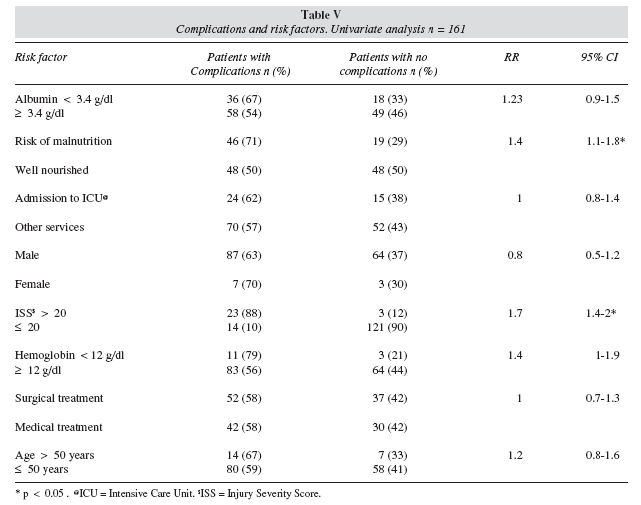
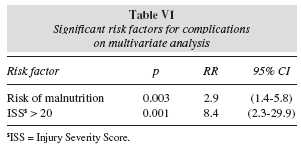
<body><![CDATA[<p align="center"><font face="Verdana" size="2"><a name="t4"><img src="/img/revistas/nh/v21n5/052006_original6_4_ing.gif" width="299" height="130"></a></font></p>     <p>&nbsp;</p>     <p><font face="Verdana" size="2">According to univariate analysis, complications were significantly more frequent among those at risk of malnutrition than among the well nourished (71% vs 50%) and among those with ISS &gt; 20 than among those with ISS &le; 20 (88% vs 53%). There was no significant relation between rate of complications and admission to ICU, or surgery (<a href="#t5">table V</a>). Multivariate analysis showed a significant correlation between complications, risk of malnutrition and ISS &gt; 20 (<a href="#t6">table VI</a>).</font></p>      <p align="center"><font face="Verdana" size="2"><a name="t5"><img src="/img/revistas/nh/v21n5/052006_original6_5_ing.gif" width="641" height="505"></a></font></p>     <p>&nbsp;</p>     <p align="center"><font face="Verdana" size="2"><a name="t6"><img src="/img/revistas/nh/v21n5/052006_original6_6_ing.gif" width="301" height="150"></a></font></p>     <p>&nbsp;</p>     <p><font face="Verdana" size="2">Length of hospital stay of over 14 days had a significant correlation with risk of malnutrition (63% vs 47%). Surgery was correlated with a hospital stay of less than 14 days (<a href="#t7">table VII</a>). Multinominal logistic regression showed a significant correlation between risk of malnutrition, ISS &gt; 20 and length of hospital stay (<a href="#t8">table VIII</a>).</font></p>      <p align="center"><font face="Verdana" size="2"><a name="t7"><img src="/img/revistas/nh/v21n5/052006_original6_7_ing.gif" width="627" height="511"></a></font>    <p>&nbsp;    ]]></body>
<body><![CDATA[<p align="center"><font face="Verdana" size="2"> <a name="t8"><img src="/img/revistas/nh/v21n5/052006_original6_8_ing.gif" width="304" height="152"></a></font>    <p>&nbsp;    <p> <font face="Verdana"><b>Discussion</b></font>     <p><font face="Verdana" size="2">In the present study in trauma patients at hospital admission, it was found a high prevalence of moderately malnutrition or risk of malnutrition. This observation calls attention because the patients were primarily young workers in rural areas. The frequency of malnutrition found by us is similar to that found in other medical or surgical adult patient populations<sup>18,19</sup> who generally are older and have chronic diseases which are expected to be at greater nutritional risk than acute trauma.</font></p>      <P><font face="Verdana" size="2">Although previous studies have shown the impact of nutritional status on morbidity, mortality and length of hospital stay<sup>20,21</sup>, there is little information about the clinical course of trauma patients in relation to their nutritional status<sup>22-25</sup>. Therein lies the importance of the present work, in which we demonstrate that young trauma patients at risk of malnutrition had a significantly higher rate of overall complications (71% vs 50%) and an increase in length of hospital stay (63% of those at risk of malnutrition had a hospital stay of over 14 days vs 47% of those who were well nourished).</font></p>     <P><font face="Verdana" size="2">A multinominal logistic regression model was used to determine the effect of malnutrition as an independent variable on clinical course in trauma patients, as other factors, such as injury severity, admission to ICU, surgery and others may be confounding variables.Our results show that previous malnutrition is an independent predictive factor for mortality, morbidity and an increase in length of hospital stay in trauma patients. It is interesting that surgery initially appeared as a protective factor against mortality and length of hospital stay, but this did not stand the test of multivariate analysis, possibly because we included 25% of patients with head trauma whose prognosis was more severe and who were not surgical candidates.</font></p>     <P><font face="Verdana" size="2">Based on these results, it can be concluded that for trauma patients, the risk of malnutrition is one of several factors, including admission to the ICU and injury severity, associated with an unfavourable clinical course.</font></p>     <P><font face="Verdana" size="2">It has been shown<sup>26-28</sup> that an adequate intervention can prevent hospital malnutrition and that early detection of malnutrition with a nutritional evaluation can decrease complications, length of hospital stay, and hospital costs.</font></p>     <P><font face="Verdana" size="2">Future studies should evaluate the effect of malnutrition on subgroups of trauma patients with similar diagnoses, and the effects of nutritional treatment, which was not evaluated in this work. It should be remarked that, in nutrition, scientific discoveries can be based on deduction of hypotheses, as it is not ethical to randomize a group of patients for feeding and another group for fasting. Large reviews have been published on the negative effects of malnutrition on the immune system, gastrointestinal tract, skin, and loss of muscle mass and consequently the deleterious effects on clinical course<sup>29</sup>, and yet not all health care professionals are aware of the need of adequate nutritional support.</font></p>     <P><font face="Verdana" size="2">Epidemiologists define a "common disease" as one with a prevalence of 10%<sup>30</sup>. Malnutrition can therefore be termed as a very common disease in hospitalized patients. Therefore, it is wise to treat the disease and feed the patient. In trauma, efforts had been done in order to evaluate the most effective type of formula<sup>31</sup>, the need for early enteral nutrition, the best route for the administration of nutrients and the potential advantages of immunomodulatory diets<sup>32</sup>.</font></p>     ]]></body>
<body><![CDATA[<P><font face="Verdana" size="2">Nutritional therapy use in the clinical course of patients who cannot eat during their disease may be compared to that of mechanical respiratory assistance in patients with respiratory failure. If malnutrition can also determine the trauma patient´s clinical course,health care teams should take note and evaluate the nutritional status at admission, to detect patients at risk of malnutrition. Optimal nutritional assessment could then be employed in the attempt to decrease the rate of complications.</font></p>     <P>&nbsp;</p>     <P><b><font face="Verdana">Conclusion</font></b></p>     <p><font face="Verdana" size="2">In the conditions of the present observations it can be concluded that the risk of malnutrition is frequent in adult trauma patients on admission in Paraguay. It must be diagnosed early on, as it is an independent risk factor for morbidity and mortality, and prolongs the length of hospital stay.</font></p>     <p>&nbsp;</p>     <p><b><font face="Verdana">Acknowledgments</font></b></p>      <p><font face="Verdana" size="2">To Dra Margarita Samudio and Dra. Graciela Velazquez from de "Instituto de Investigaciones de la Salud" de Asunci&oacute;n - Paraguay for the help whith the statistics analysis.</font></p>     <p>&nbsp;</p>     <p><font face="Verdana"><b>Referencias</b></font></p>     <!-- ref --><p><font face="Verdana" size="2">1. Stundley HO. Percentage of weigh loss. A basic indicator of surgical risk in patients with crhonic peptic ulcer. JAMA 1939; 106:458-60.</font>&nbsp;&nbsp;&nbsp;&nbsp;&nbsp;&nbsp;&nbsp;&nbsp;[&#160;<a href="javascript:void(0);" onclick="javascript: window.open('/scielo.php?script=sci_nlinks&ref=3512504&pid=S0212-1611200600080000700001&lng=','','width=640,height=500,resizable=yes,scrollbars=1,menubar=yes,');">Links</a>&#160;]<!-- end-ref --><!-- ref --><p> <font face="Verdana" size="2">2. Bistrian BR, Blackburn GL, Halowell E, Heddler R. Protein status of general surgical patients. JAMA 1974; 230:858-60.</font>&nbsp;&nbsp;&nbsp;&nbsp;&nbsp;&nbsp;&nbsp;&nbsp;[&#160;<a href="javascript:void(0);" onclick="javascript: window.open('/scielo.php?script=sci_nlinks&ref=3512505&pid=S0212-1611200600080000700002&lng=','','width=640,height=500,resizable=yes,scrollbars=1,menubar=yes,');">Links</a>&#160;]<!-- end-ref --><!-- ref --><p> <font face="Verdana" size="2">3. Bistrian BR, Blackburn GL, Vitale J, Cochran D, Nailor J. Prevalence of malnutrition on general medical patients. JAMA 1976; 235:1567-70.</font>&nbsp;&nbsp;&nbsp;&nbsp;&nbsp;&nbsp;&nbsp;&nbsp;[&#160;<a href="javascript:void(0);" onclick="javascript: window.open('/scielo.php?script=sci_nlinks&ref=3512506&pid=S0212-1611200600080000700003&lng=','','width=640,height=500,resizable=yes,scrollbars=1,menubar=yes,');">Links</a>&#160;]<!-- end-ref --><!-- ref --><p> <font face="Verdana" size="2">4. Blackburn GL, Bistrian BR, Maiani BS, Schlamm HT, Smith MF. Nutritional and metabolic assessment of the hospitalized patients. JPEN 1977; 1:11-22.</font>&nbsp;&nbsp;&nbsp;&nbsp;&nbsp;&nbsp;&nbsp;&nbsp;[&#160;<a href="javascript:void(0);" onclick="javascript: window.open('/scielo.php?script=sci_nlinks&ref=3512507&pid=S0212-1611200600080000700004&lng=','','width=640,height=500,resizable=yes,scrollbars=1,menubar=yes,');">Links</a>&#160;]<!-- end-ref --><!-- ref --><p> <font face="Verdana" size="2">5. Weisier RL, Hunker EM, Krumdiek CL. Hospital malnutrition. A prospective evaluation of general medical patients during the course of hospitalization. Am J Clin Nutr 1979; 32:418-26.</font>&nbsp;&nbsp;&nbsp;&nbsp;&nbsp;&nbsp;&nbsp;&nbsp;[&#160;<a href="javascript:void(0);" onclick="javascript: window.open('/scielo.php?script=sci_nlinks&ref=3512508&pid=S0212-1611200600080000700005&lng=','','width=640,height=500,resizable=yes,scrollbars=1,menubar=yes,');">Links</a>&#160;]<!-- end-ref --><!-- ref --><p> <font face="Verdana" size="2">6. Blackburn GL, Benotti PN, Bistiran BR, Bothe A, Maini BS, Schlamm HT et al. Nutritional assessment ant treatment of hospital malnutrition. JPEN 1979; 6:238-50.</font>&nbsp;&nbsp;&nbsp;&nbsp;&nbsp;&nbsp;&nbsp;&nbsp;[&#160;<a href="javascript:void(0);" onclick="javascript: window.open('/scielo.php?script=sci_nlinks&ref=3512509&pid=S0212-1611200600080000700006&lng=','','width=640,height=500,resizable=yes,scrollbars=1,menubar=yes,');">Links</a>&#160;]<!-- end-ref --><!-- ref --><p> <font face="Verdana" size="2">7. Constituciones Hispanoamericanas - Paraguay. URL disponible en:  http://www.cervantesvirtual.com/portal/constituciones/pais.formato?pais=Paraguay&amp;indice=datos.</font>&nbsp;&nbsp;&nbsp;&nbsp;&nbsp;&nbsp;&nbsp;&nbsp;[&#160;<a href="javascript:void(0);" onclick="javascript: window.open('/scielo.php?script=sci_nlinks&ref=3512510&pid=S0212-1611200600080000700007&lng=','','width=640,height=500,resizable=yes,scrollbars=1,menubar=yes,');">Links</a>&#160;]<!-- end-ref --><!-- ref --><p> <font face="Verdana" size="2">8. Figueredo R, Chirife G, Mendoza L, Ayala F, Jim&eacute;nez C et al. Paraguayan Initiative agains Malnutrition - Preliminary report of the INPACTD study. NCP 2005; 20(1):136-7.</font>&nbsp;&nbsp;&nbsp;&nbsp;&nbsp;&nbsp;&nbsp;&nbsp;[&#160;<a href="javascript:void(0);" onclick="javascript: window.open('/scielo.php?script=sci_nlinks&ref=3512511&pid=S0212-1611200600080000700008&lng=','','width=640,height=500,resizable=yes,scrollbars=1,menubar=yes,');">Links</a>&#160;]<!-- end-ref --><!-- ref --><p> <font face="Verdana" size="2">9. Lumbers M, New SA, Gibson S, Murphy MC. Nutritional status in elderly female hip fracture patients: comparison with an age-matched home living group attending day centres. Br J Nutr 2001 Jun; 85(6):733-40.</font>&nbsp;&nbsp;&nbsp;&nbsp;&nbsp;&nbsp;&nbsp;&nbsp;[&#160;<a href="javascript:void(0);" onclick="javascript: window.open('/scielo.php?script=sci_nlinks&ref=3512512&pid=S0212-1611200600080000700009&lng=','','width=640,height=500,resizable=yes,scrollbars=1,menubar=yes,');">Links</a>&#160;]<!-- end-ref --><!-- ref --><p> <font face="Verdana" size="2">10. Cerra FB. Role of Nutrition in the management of Malnutrition and Inmune Dysfunction of Trauma. J of Am Col of Nutrition 1992; 11:512-8.</font>&nbsp;&nbsp;&nbsp;&nbsp;&nbsp;&nbsp;&nbsp;&nbsp;[&#160;<a href="javascript:void(0);" onclick="javascript: window.open('/scielo.php?script=sci_nlinks&ref=3512513&pid=S0212-1611200600080000700010&lng=','','width=640,height=500,resizable=yes,scrollbars=1,menubar=yes,');">Links</a>&#160;]<!-- end-ref --><!-- ref --><p> <font face="Verdana" size="2">11. Cruse JM, Lewis RE, Roe DL, Dilioglou S, Blaine MC, Wallace WF, Chen RS. Facilitation of immune function, healing of pressure ulcers, and nutritional status in spinal cord injury patients. Exp Mol Pathol 2000 Feb; 68(1):38-54.</font>&nbsp;&nbsp;&nbsp;&nbsp;&nbsp;&nbsp;&nbsp;&nbsp;[&#160;<a href="javascript:void(0);" onclick="javascript: window.open('/scielo.php?script=sci_nlinks&ref=3512514&pid=S0212-1611200600080000700011&lng=','','width=640,height=500,resizable=yes,scrollbars=1,menubar=yes,');">Links</a>&#160;]<!-- end-ref --><!-- ref --><p> <font face="Verdana" size="2">12. Paillaud E, Bories PN, Le Parco JC, Campillo. B Nutritional status and energy expenditure in elderly patients with recent hip fracture during a 2-month follow-up. Br J Nutr 2000 Feb; 83(2):97-103.</font>&nbsp;&nbsp;&nbsp;&nbsp;&nbsp;&nbsp;&nbsp;&nbsp;[&#160;<a href="javascript:void(0);" onclick="javascript: window.open('/scielo.php?script=sci_nlinks&ref=3512515&pid=S0212-1611200600080000700012&lng=','','width=640,height=500,resizable=yes,scrollbars=1,menubar=yes,');">Links</a>&#160;]<!-- end-ref --><!-- ref --><p> <font face="Verdana" size="2">13. Campillo B, Paillaud E, Bories PN, Noel M, Porquet D, Le Parco JC. Serum levels of insulin-like growth factor-1 in the three months following surgery for a hip fracture in elderly: relationship with nutritional status and inflammatory reaction.Clin Nutr 2000 Oct; 19(5):349-54.</font>&nbsp;&nbsp;&nbsp;&nbsp;&nbsp;&nbsp;&nbsp;&nbsp;[&#160;<a href="javascript:void(0);" onclick="javascript: window.open('/scielo.php?script=sci_nlinks&ref=3512516&pid=S0212-1611200600080000700013&lng=','','width=640,height=500,resizable=yes,scrollbars=1,menubar=yes,');">Links</a>&#160;]<!-- end-ref --><!-- ref --><p> <font face="Verdana" size="2">14. Manus RC Jr, Dodson TB, Miller EJ Jr, Perciaccante VJ. Nutritional status of substance abusers with mandible fractures. J Oral Maxillofac Surg 2000 Feb; 58(2):153-7.</font>&nbsp;&nbsp;&nbsp;&nbsp;&nbsp;&nbsp;&nbsp;&nbsp;[&#160;<a href="javascript:void(0);" onclick="javascript: window.open('/scielo.php?script=sci_nlinks&ref=3512517&pid=S0212-1611200600080000700014&lng=','','width=640,height=500,resizable=yes,scrollbars=1,menubar=yes,');">Links</a>&#160;]<!-- end-ref --><!-- ref --><p> <font face="Verdana" size="2">15. Detsky A, McLaughtlin JR, Beker J, Jonston N, Whittaker S, Mendelson R. What is Subjetive Global Assessment of nutritional status? JPEN 1987; 11(1):8-13.</font>&nbsp;&nbsp;&nbsp;&nbsp;&nbsp;&nbsp;&nbsp;&nbsp;[&#160;<a href="javascript:void(0);" onclick="javascript: window.open('/scielo.php?script=sci_nlinks&ref=3512518&pid=S0212-1611200600080000700015&lng=','','width=640,height=500,resizable=yes,scrollbars=1,menubar=yes,');">Links</a>&#160;]<!-- end-ref --><!-- ref --><p> <font face="Verdana" size="2">16. Baker SP, O´Neill B, Haddon W Jr, Long WB. The injury severity score: a method for describing patients with multiple injuries and evaluating emergency care. Trauma 1974; 14: 187- 196.</font>&nbsp;&nbsp;&nbsp;&nbsp;&nbsp;&nbsp;&nbsp;&nbsp;[&#160;<a href="javascript:void(0);" onclick="javascript: window.open('/scielo.php?script=sci_nlinks&ref=3512519&pid=S0212-1611200600080000700016&lng=','','width=640,height=500,resizable=yes,scrollbars=1,menubar=yes,');">Links</a>&#160;]<!-- end-ref --><!-- ref --><p> <font face="Verdana" size="2">17. Hulley SB, Cummings SR. Editores. Dise&ntilde;o de la investigaci&oacute;n cl&iacute;nica. Barcelona: Doyma; 1993.</font>&nbsp;&nbsp;&nbsp;&nbsp;&nbsp;&nbsp;&nbsp;&nbsp;[&#160;<a href="javascript:void(0);" onclick="javascript: window.open('/scielo.php?script=sci_nlinks&ref=3512520&pid=S0212-1611200600080000700017&lng=','','width=640,height=500,resizable=yes,scrollbars=1,menubar=yes,');">Links</a>&#160;]<!-- end-ref --><!-- ref --><p> <font face="Verdana" size="2">18. Larsson AC, Schenck, Thorslund H, Unosson M, Bjurulf P.The correlation between anergy, malnutrition and clinical outcome in an elderly hospital population. Clin Nutr 1990; 9:185- 189.</font>&nbsp;&nbsp;&nbsp;&nbsp;&nbsp;&nbsp;&nbsp;&nbsp;[&#160;<a href="javascript:void(0);" onclick="javascript: window.open('/scielo.php?script=sci_nlinks&ref=3512521&pid=S0212-1611200600080000700018&lng=','','width=640,height=500,resizable=yes,scrollbars=1,menubar=yes,');">Links</a>&#160;]<!-- end-ref --><!-- ref --><p> <font face="Verdana" size="2">19. Goiburu ME, Olveira G. Impacto de la malnutrici&oacute;n sobre las complicaciones, mortalidad, tiempo de estancia y costes en pacientes hospitalizados. Anales de la Sociedad Paraguaya de Medicina Interna 2002; 6:16-21.</font>&nbsp;&nbsp;&nbsp;&nbsp;&nbsp;&nbsp;&nbsp;&nbsp;[&#160;<a href="javascript:void(0);" onclick="javascript: window.open('/scielo.php?script=sci_nlinks&ref=3512522&pid=S0212-1611200600080000700019&lng=','','width=640,height=500,resizable=yes,scrollbars=1,menubar=yes,');">Links</a>&#160;]<!-- end-ref --><!-- ref --><p> <font face="Verdana" size="2">20. Correia I, Waitzberg DL. The impact of malnutrition on morbidity, mortality, length of hospital stay and costs evaluated though a multivariate model analysis. Clin Nutr 2003; 22(3):235-9.</font>&nbsp;&nbsp;&nbsp;&nbsp;&nbsp;&nbsp;&nbsp;&nbsp;[&#160;<a href="javascript:void(0);" onclick="javascript: window.open('/scielo.php?script=sci_nlinks&ref=3512523&pid=S0212-1611200600080000700020&lng=','','width=640,height=500,resizable=yes,scrollbars=1,menubar=yes,');">Links</a>&#160;]<!-- end-ref --><!-- ref --><p> <font face="Verdana" size="2">21. Naber HJ, Schermer T, De Bree A, Nusteling K, Eggink L, Kruimel WJ. Prevalence of malnutrition in nonsurgical hospitalized patients and its asoociation with disease complications. Am J Clin Nutr 1997; 66:1232-9.</font>&nbsp;&nbsp;&nbsp;&nbsp;&nbsp;&nbsp;&nbsp;&nbsp;[&#160;<a href="javascript:void(0);" onclick="javascript: window.open('/scielo.php?script=sci_nlinks&ref=3512524&pid=S0212-1611200600080000700021&lng=','','width=640,height=500,resizable=yes,scrollbars=1,menubar=yes,');">Links</a>&#160;]<!-- end-ref --><!-- ref --><p> <font face="Verdana" size="2">22. Van Hoang H, Silverstone FA, Leventer S, Wolf-Klein GP, Foley CJ. The effect of nutritional status on length of stay in elderly hip fracture patients. J Nutr Health Aging 1998; 2(3):159-61</font>&nbsp;&nbsp;&nbsp;&nbsp;&nbsp;&nbsp;&nbsp;&nbsp;[&#160;<a href="javascript:void(0);" onclick="javascript: window.open('/scielo.php?script=sci_nlinks&ref=3512525&pid=S0212-1611200600080000700022&lng=','','width=640,height=500,resizable=yes,scrollbars=1,menubar=yes,');">Links</a>&#160;]<!-- end-ref --><!-- ref --><p> <font face="Verdana" size="2">23. Koval KJ, Maurer SG, Su ET, Aharonoff GB, Zuckerman JD. The effects of nutritional status on outcome after hip fracture. J Orthop Trauma 1999 Mar-Apr;13(3):164-9.</font>&nbsp;&nbsp;&nbsp;&nbsp;&nbsp;&nbsp;&nbsp;&nbsp;[&#160;<a href="javascript:void(0);" onclick="javascript: window.open('/scielo.php?script=sci_nlinks&ref=3512526&pid=S0212-1611200600080000700023&lng=','','width=640,height=500,resizable=yes,scrollbars=1,menubar=yes,');">Links</a>&#160;]<!-- end-ref --><!-- ref --><p> <font face="Verdana" size="2">24. Bachrach-Lindstrom MA, Ek AC, Unosson M. Nutritional state and functional capacity among elderly Swedish people with acute hip fracture. Scand J Caring Sci 2000; 14(4):268-74.</font>&nbsp;&nbsp;&nbsp;&nbsp;&nbsp;&nbsp;&nbsp;&nbsp;[&#160;<a href="javascript:void(0);" onclick="javascript: window.open('/scielo.php?script=sci_nlinks&ref=3512527&pid=S0212-1611200600080000700024&lng=','','width=640,height=500,resizable=yes,scrollbars=1,menubar=yes,');">Links</a>&#160;]<!-- end-ref --><!-- ref --><p> <font face="Verdana" size="2">25. Lynch AC, Palmer C, Anthony A, Roake JA, Frye J, Frizelle FA. Nutritional and immune status following spinal cord injury: a case controlled study. Spinal Cord 2002 Dec; 40(12):627-30.</font>&nbsp;&nbsp;&nbsp;&nbsp;&nbsp;&nbsp;&nbsp;&nbsp;[&#160;<a href="javascript:void(0);" onclick="javascript: window.open('/scielo.php?script=sci_nlinks&ref=3512528&pid=S0212-1611200600080000700025&lng=','','width=640,height=500,resizable=yes,scrollbars=1,menubar=yes,');">Links</a>&#160;]<!-- end-ref --><!-- ref --><p> <font face="Verdana" size="2">26. Olveira Fuster G, Mancha Doblas I, Gonz&aacute;lez-Romero S, Goiburu Martinetti ME, Mu&ntilde;oz Aguilar A. Calidad Asistencial en nutrici&oacute;n parenteral: beneficios tras la incorporaci&oacute;n de un equipo de soporte nutricional. Nutr Hosp 2000;15:118-22.</font>&nbsp;&nbsp;&nbsp;&nbsp;&nbsp;&nbsp;&nbsp;&nbsp;[&#160;<a href="javascript:void(0);" onclick="javascript: window.open('/scielo.php?script=sci_nlinks&ref=3512529&pid=S0212-1611200600080000700026&lng=','','width=640,height=500,resizable=yes,scrollbars=1,menubar=yes,');">Links</a>&#160;]<!-- end-ref --><!-- ref --><p> <font face="Verdana" size="2">27. Buzby GP, Williford WO, Peterson OL, Crosby LO, Page CP, Reinhardt GF et al. A randomized clinical trial of total parenteral nutrition in malnourished surgical patients: the rationale and inpact of previous clinical trials and pilot study on protocol design. Am J Clin Nutr 1988; 47:357-65.</font>&nbsp;&nbsp;&nbsp;&nbsp;&nbsp;&nbsp;&nbsp;&nbsp;[&#160;<a href="javascript:void(0);" onclick="javascript: window.open('/scielo.php?script=sci_nlinks&ref=3512530&pid=S0212-1611200600080000700027&lng=','','width=640,height=500,resizable=yes,scrollbars=1,menubar=yes,');">Links</a>&#160;]<!-- end-ref --><!-- ref --><p> <font face="Verdana" size="2">28. Buzby GP, Knox LS, Crosby LO, Eisenberg JM, Haakenson CM, McNeal GE et al. Study protocol: a randomized clinical trial of total parenteral nutrition in malnourished surgical patients. Am J Clin Nutr 1985; 4:61-6.</font>&nbsp;&nbsp;&nbsp;&nbsp;&nbsp;&nbsp;&nbsp;&nbsp;[&#160;<a href="javascript:void(0);" onclick="javascript: window.open('/scielo.php?script=sci_nlinks&ref=3512531&pid=S0212-1611200600080000700028&lng=','','width=640,height=500,resizable=yes,scrollbars=1,menubar=yes,');">Links</a>&#160;]<!-- end-ref --><!-- ref --><p> <font face="Verdana" size="2">29. Green CJ. Existence, causes and consequences of disease-realted malnutrition in the hospital and the community, and clinical and financial banefits of nutritional intervention. Clin Nutr 1999; 18 (suppl 2):3-28.</font>&nbsp;&nbsp;&nbsp;&nbsp;&nbsp;&nbsp;&nbsp;&nbsp;[&#160;<a href="javascript:void(0);" onclick="javascript: window.open('/scielo.php?script=sci_nlinks&ref=3512532&pid=S0212-1611200600080000700029&lng=','','width=640,height=500,resizable=yes,scrollbars=1,menubar=yes,');">Links</a>&#160;]<!-- end-ref --><!-- ref --><p> <font face="Verdana" size="2">30. Kahn HA, Sempos CT. Statistical methods in epidemiology. 2nd ed. New York: Osford University Press, 1989.</font>&nbsp;&nbsp;&nbsp;&nbsp;&nbsp;&nbsp;&nbsp;&nbsp;[&#160;<a href="javascript:void(0);" onclick="javascript: window.open('/scielo.php?script=sci_nlinks&ref=3512533&pid=S0212-1611200600080000700030&lng=','','width=640,height=500,resizable=yes,scrollbars=1,menubar=yes,');">Links</a>&#160;]<!-- end-ref --><!-- ref --><p> <font face="Verdana" size="2">31. Meredith JW, Ditesheim JA, Zaloga GP. Visceral protein levels in trauma patients are greater with peptide diet than with intact protein diet. J Trauma 1990 Jul; 30(7):825-8.</font>&nbsp;&nbsp;&nbsp;&nbsp;&nbsp;&nbsp;&nbsp;&nbsp;[&#160;<a href="javascript:void(0);" onclick="javascript: window.open('/scielo.php?script=sci_nlinks&ref=3512534&pid=S0212-1611200600080000700031&lng=','','width=640,height=500,resizable=yes,scrollbars=1,menubar=yes,');">Links</a>&#160;]<!-- end-ref --><!-- ref --><p> <font face="Verdana" size="2">32. Biffl WL, Moore EE, Haenel JB. Nutrition support of the trauma patient. Nutrition 2002 Nov-Dec; 18(11-12):960-5.</font>&nbsp;&nbsp;&nbsp;&nbsp;&nbsp;&nbsp;&nbsp;&nbsp;[&#160;<a href="javascript:void(0);" onclick="javascript: window.open('/scielo.php?script=sci_nlinks&ref=3512535&pid=S0212-1611200600080000700032&lng=','','width=640,height=500,resizable=yes,scrollbars=1,menubar=yes,');">Links</a>&#160;]<!-- end-ref --><p> &nbsp;</p>     <p> &nbsp;</p>     <p> <font face="Verdana" size="2"><b><a href="#top"> <img border="0" src="/img/revistas/nh/v21n5/seta.gif" width="15" height="17"></a><a name="bajo"></a>Address for correspondence:</b>    <BR> Dra. María Elena Goiburu    <br> Centro de Emergencias Médicas    <br> Avda. General Santos    <br> Asunción, Paraguay    <BR> E-mail address: <a href="mailto:megoiburu@hotmail.com">megoiburu@hotmail.com</a></font></p>     <p> <font face="Verdana" size="2">Recibido: 14-XI-2005.    ]]></body>
<body><![CDATA[<BR> Aceptado: 10-XII-2005.</font></p>       ]]></body><back>
<ref-list>
<ref id="B1">
<label>1</label><nlm-citation citation-type="journal">
<person-group person-group-type="author">
<name>
<surname><![CDATA[Stundley]]></surname>
<given-names><![CDATA[HO]]></given-names>
</name>
</person-group>
<article-title xml:lang="en"><![CDATA[Percentage of weigh loss: A basic indicator of surgical risk in patients with crhonic peptic ulcer]]></article-title>
<source><![CDATA[JAMA]]></source>
<year>1939</year>
<volume>106</volume>
<page-range>458-60</page-range></nlm-citation>
</ref>
<ref id="B2">
<label>2</label><nlm-citation citation-type="journal">
<person-group person-group-type="author">
<name>
<surname><![CDATA[Bistrian]]></surname>
<given-names><![CDATA[BR]]></given-names>
</name>
<name>
<surname><![CDATA[Blackburn]]></surname>
<given-names><![CDATA[GL]]></given-names>
</name>
<name>
<surname><![CDATA[Halowell]]></surname>
<given-names><![CDATA[E]]></given-names>
</name>
<name>
<surname><![CDATA[Heddler]]></surname>
<given-names><![CDATA[R]]></given-names>
</name>
</person-group>
<article-title xml:lang="en"><![CDATA[Protein status of general surgical patients]]></article-title>
<source><![CDATA[JAMA]]></source>
<year>1974</year>
<volume>230</volume>
<page-range>858-60</page-range></nlm-citation>
</ref>
<ref id="B3">
<label>3</label><nlm-citation citation-type="journal">
<person-group person-group-type="author">
<name>
<surname><![CDATA[Bistrian]]></surname>
<given-names><![CDATA[BR]]></given-names>
</name>
<name>
<surname><![CDATA[Blackburn]]></surname>
<given-names><![CDATA[GL]]></given-names>
</name>
<name>
<surname><![CDATA[Vitale]]></surname>
<given-names><![CDATA[J]]></given-names>
</name>
<name>
<surname><![CDATA[Cochran]]></surname>
<given-names><![CDATA[D]]></given-names>
</name>
<name>
<surname><![CDATA[Nailor]]></surname>
<given-names><![CDATA[J]]></given-names>
</name>
</person-group>
<article-title xml:lang="en"><![CDATA[Prevalence of malnutrition on general medical patients]]></article-title>
<source><![CDATA[JAMA]]></source>
<year>1976</year>
<volume>235</volume>
<page-range>1567-70</page-range></nlm-citation>
</ref>
<ref id="B4">
<label>4</label><nlm-citation citation-type="journal">
<person-group person-group-type="author">
<name>
<surname><![CDATA[Blackburn]]></surname>
<given-names><![CDATA[GL]]></given-names>
</name>
<name>
<surname><![CDATA[Bistrian]]></surname>
<given-names><![CDATA[BR]]></given-names>
</name>
<name>
<surname><![CDATA[Maiani]]></surname>
<given-names><![CDATA[BS]]></given-names>
</name>
<name>
<surname><![CDATA[Schlamm]]></surname>
<given-names><![CDATA[HT]]></given-names>
</name>
<name>
<surname><![CDATA[Smith]]></surname>
<given-names><![CDATA[MF]]></given-names>
</name>
</person-group>
<article-title xml:lang="en"><![CDATA[Nutritional and metabolic assessment of the hospitalized patients]]></article-title>
<source><![CDATA[JPEN]]></source>
<year>1977</year>
<volume>1</volume>
<page-range>11-22</page-range></nlm-citation>
</ref>
<ref id="B5">
<label>5</label><nlm-citation citation-type="journal">
<person-group person-group-type="author">
<name>
<surname><![CDATA[Weisier]]></surname>
<given-names><![CDATA[RL]]></given-names>
</name>
<name>
<surname><![CDATA[Hunker]]></surname>
<given-names><![CDATA[EM]]></given-names>
</name>
<name>
<surname><![CDATA[Krumdiek]]></surname>
<given-names><![CDATA[CL]]></given-names>
</name>
</person-group>
<article-title xml:lang="en"><![CDATA[Hospital malnutrition: A prospective evaluation of general medical patients during the course of hospitalization]]></article-title>
<source><![CDATA[Am J Clin Nutr]]></source>
<year>1979</year>
<volume>32</volume>
<page-range>418-26</page-range></nlm-citation>
</ref>
<ref id="B6">
<label>6</label><nlm-citation citation-type="journal">
<person-group person-group-type="author">
<name>
<surname><![CDATA[Blackburn]]></surname>
<given-names><![CDATA[GL]]></given-names>
</name>
<name>
<surname><![CDATA[Benotti]]></surname>
<given-names><![CDATA[PN]]></given-names>
</name>
<name>
<surname><![CDATA[Bistiran]]></surname>
<given-names><![CDATA[BR]]></given-names>
</name>
<name>
<surname><![CDATA[Bothe]]></surname>
<given-names><![CDATA[A]]></given-names>
</name>
<name>
<surname><![CDATA[Maini]]></surname>
<given-names><![CDATA[BS]]></given-names>
</name>
<name>
<surname><![CDATA[Schlamm]]></surname>
<given-names><![CDATA[HT]]></given-names>
</name>
</person-group>
<article-title xml:lang="en"><![CDATA[Nutritional assessment ant treatment of hospital malnutrition]]></article-title>
<source><![CDATA[JPEN]]></source>
<year>1979</year>
<volume>6</volume>
<page-range>238-50</page-range></nlm-citation>
</ref>
<ref id="B7">
<label>7</label><nlm-citation citation-type="">
<source><![CDATA[]]></source>
<year></year>
</nlm-citation>
</ref>
<ref id="B8">
<label>8</label><nlm-citation citation-type="journal">
<person-group person-group-type="author">
<name>
<surname><![CDATA[Figueredo]]></surname>
<given-names><![CDATA[R]]></given-names>
</name>
<name>
<surname><![CDATA[Chirife]]></surname>
<given-names><![CDATA[G]]></given-names>
</name>
<name>
<surname><![CDATA[Mendoza]]></surname>
<given-names><![CDATA[L]]></given-names>
</name>
<name>
<surname><![CDATA[Ayala]]></surname>
<given-names><![CDATA[F]]></given-names>
</name>
<name>
<surname><![CDATA[Jiménez]]></surname>
<given-names><![CDATA[C]]></given-names>
</name>
</person-group>
<article-title xml:lang="en"><![CDATA[Paraguayan Initiative agains Malnutrition - Preliminary report of the INPACTD study]]></article-title>
<source><![CDATA[NCP]]></source>
<year>2005</year>
<volume>20</volume>
<numero>1</numero>
<issue>1</issue>
<page-range>136-7</page-range></nlm-citation>
</ref>
<ref id="B9">
<label>9</label><nlm-citation citation-type="journal">
<person-group person-group-type="author">
<name>
<surname><![CDATA[Lumbers]]></surname>
<given-names><![CDATA[M]]></given-names>
</name>
<name>
<surname><![CDATA[New]]></surname>
<given-names><![CDATA[SA]]></given-names>
</name>
<name>
<surname><![CDATA[Gibson]]></surname>
<given-names><![CDATA[S]]></given-names>
</name>
<name>
<surname><![CDATA[Murphy]]></surname>
<given-names><![CDATA[MC]]></given-names>
</name>
</person-group>
<article-title xml:lang="en"><![CDATA[Nutritional status in elderly female hip fracture patients: comparison with an age-matched home living group attending day centres]]></article-title>
<source><![CDATA[Br J Nutr]]></source>
<year>2001</year>
<month> J</month>
<day>un</day>
<volume>85</volume>
<numero>6</numero>
<issue>6</issue>
<page-range>733-40</page-range></nlm-citation>
</ref>
<ref id="B10">
<label>10</label><nlm-citation citation-type="journal">
<person-group person-group-type="author">
<name>
<surname><![CDATA[Cerra]]></surname>
<given-names><![CDATA[FB]]></given-names>
</name>
</person-group>
<article-title xml:lang="en"><![CDATA[Role of Nutrition in the management of Malnutrition and Inmune Dysfunction of Trauma]]></article-title>
<source><![CDATA[J of Am Col of Nutrition]]></source>
<year>1992</year>
<volume>11</volume>
<page-range>512-8</page-range></nlm-citation>
</ref>
<ref id="B11">
<label>11</label><nlm-citation citation-type="journal">
<person-group person-group-type="author">
<name>
<surname><![CDATA[Cruse]]></surname>
<given-names><![CDATA[JM]]></given-names>
</name>
<name>
<surname><![CDATA[Lewis]]></surname>
<given-names><![CDATA[RE]]></given-names>
</name>
<name>
<surname><![CDATA[Roe]]></surname>
<given-names><![CDATA[DL]]></given-names>
</name>
<name>
<surname><![CDATA[Dilioglou]]></surname>
<given-names><![CDATA[S]]></given-names>
</name>
<name>
<surname><![CDATA[Blaine]]></surname>
<given-names><![CDATA[MC]]></given-names>
</name>
<name>
<surname><![CDATA[Wallace]]></surname>
<given-names><![CDATA[WF]]></given-names>
</name>
<name>
<surname><![CDATA[Chen]]></surname>
<given-names><![CDATA[RS]]></given-names>
</name>
</person-group>
<article-title xml:lang="en"><![CDATA[Facilitation of immune function, healing of pressure ulcers, and nutritional status in spinal cord injury patients]]></article-title>
<source><![CDATA[Exp Mol Pathol]]></source>
<year>2000</year>
<month> F</month>
<day>eb</day>
<volume>68</volume>
<numero>1</numero>
<issue>1</issue>
<page-range>38-54</page-range></nlm-citation>
</ref>
<ref id="B12">
<label>12</label><nlm-citation citation-type="journal">
<person-group person-group-type="author">
<name>
<surname><![CDATA[Paillaud]]></surname>
<given-names><![CDATA[E]]></given-names>
</name>
<name>
<surname><![CDATA[Bories]]></surname>
<given-names><![CDATA[PN]]></given-names>
</name>
<name>
<surname><![CDATA[Le Parco]]></surname>
<given-names><![CDATA[JC]]></given-names>
</name>
<name>
<surname><![CDATA[Campillo]]></surname>
<given-names><![CDATA[B]]></given-names>
</name>
</person-group>
<article-title xml:lang="en"><![CDATA[Nutritional status and energy expenditure in elderly patients with recent hip fracture during a 2-month follow-up]]></article-title>
<source><![CDATA[Br J Nutr]]></source>
<year>2000</year>
<month> F</month>
<day>eb</day>
<volume>83</volume>
<numero>2</numero>
<issue>2</issue>
<page-range>97-103</page-range></nlm-citation>
</ref>
<ref id="B13">
<label>13</label><nlm-citation citation-type="journal">
<person-group person-group-type="author">
<name>
<surname><![CDATA[Campillo]]></surname>
<given-names><![CDATA[B]]></given-names>
</name>
<name>
<surname><![CDATA[Paillaud]]></surname>
<given-names><![CDATA[E]]></given-names>
</name>
<name>
<surname><![CDATA[Bories]]></surname>
<given-names><![CDATA[PN]]></given-names>
</name>
<name>
<surname><![CDATA[Noel]]></surname>
<given-names><![CDATA[M]]></given-names>
</name>
<name>
<surname><![CDATA[Porquet]]></surname>
<given-names><![CDATA[D]]></given-names>
</name>
<name>
<surname><![CDATA[Le Parco]]></surname>
<given-names><![CDATA[JC]]></given-names>
</name>
</person-group>
<article-title xml:lang="en"><![CDATA[Serum levels of insulin-like growth factor-1 in the three months following surgery for a hip fracture in elderly: relationship with nutritional status and inflammatory reaction]]></article-title>
<source><![CDATA[Clin Nutr]]></source>
<year>2000</year>
<month> O</month>
<day>ct</day>
<volume>19</volume>
<numero>5</numero>
<issue>5</issue>
<page-range>349-54</page-range></nlm-citation>
</ref>
<ref id="B14">
<label>14</label><nlm-citation citation-type="journal">
<person-group person-group-type="author">
<name>
<surname><![CDATA[Manus]]></surname>
<given-names><![CDATA[RC Jr]]></given-names>
</name>
<name>
<surname><![CDATA[Dodson]]></surname>
<given-names><![CDATA[TB]]></given-names>
</name>
<name>
<surname><![CDATA[Miller]]></surname>
<given-names><![CDATA[EJ Jr]]></given-names>
</name>
<name>
<surname><![CDATA[Perciaccante]]></surname>
<given-names><![CDATA[VJ]]></given-names>
</name>
</person-group>
<article-title xml:lang="en"><![CDATA[Nutritional status of substance abusers with mandible fractures]]></article-title>
<source><![CDATA[J Oral Maxillofac Surg]]></source>
<year>2000</year>
<month> F</month>
<day>eb</day>
<volume>58</volume>
<numero>2</numero>
<issue>2</issue>
<page-range>153-7</page-range></nlm-citation>
</ref>
<ref id="B15">
<label>15</label><nlm-citation citation-type="journal">
<person-group person-group-type="author">
<name>
<surname><![CDATA[Detsky]]></surname>
<given-names><![CDATA[A]]></given-names>
</name>
<name>
<surname><![CDATA[McLaughtlin]]></surname>
<given-names><![CDATA[JR]]></given-names>
</name>
<name>
<surname><![CDATA[Beker]]></surname>
<given-names><![CDATA[J]]></given-names>
</name>
<name>
<surname><![CDATA[Jonston]]></surname>
<given-names><![CDATA[N]]></given-names>
</name>
<name>
<surname><![CDATA[Whittaker]]></surname>
<given-names><![CDATA[S]]></given-names>
</name>
<name>
<surname><![CDATA[Mendelson]]></surname>
<given-names><![CDATA[R]]></given-names>
</name>
</person-group>
<article-title xml:lang="en"><![CDATA[What is Subjetive Global Assessment of nutritional status?]]></article-title>
<source><![CDATA[JPEN]]></source>
<year>1987</year>
<volume>11</volume>
<numero>1</numero>
<issue>1</issue>
<page-range>8-13</page-range></nlm-citation>
</ref>
<ref id="B16">
<label>16</label><nlm-citation citation-type="journal">
<person-group person-group-type="author">
<name>
<surname><![CDATA[Baker]]></surname>
<given-names><![CDATA[SP]]></given-names>
</name>
<name>
<surname><![CDATA[O´Neill]]></surname>
<given-names><![CDATA[B]]></given-names>
</name>
<name>
<surname><![CDATA[Haddon]]></surname>
<given-names><![CDATA[W Jr]]></given-names>
</name>
<name>
<surname><![CDATA[Long]]></surname>
<given-names><![CDATA[WB]]></given-names>
</name>
</person-group>
<article-title xml:lang="en"><![CDATA[The injury severity score: a method for describing patients with multiple injuries and evaluating emergency care]]></article-title>
<source><![CDATA[Trauma]]></source>
<year>1974</year>
<volume>14</volume>
<page-range>187- 196</page-range></nlm-citation>
</ref>
<ref id="B17">
<label>17</label><nlm-citation citation-type="book">
<person-group person-group-type="author">
<name>
<surname><![CDATA[Hulley]]></surname>
<given-names><![CDATA[SB]]></given-names>
</name>
<name>
<surname><![CDATA[Cummings]]></surname>
<given-names><![CDATA[SR]]></given-names>
</name>
</person-group>
<source><![CDATA[Diseño de la investigación clínica]]></source>
<year>1993</year>
<publisher-loc><![CDATA[Barcelona ]]></publisher-loc>
<publisher-name><![CDATA[Doyma]]></publisher-name>
</nlm-citation>
</ref>
<ref id="B18">
<label>18</label><nlm-citation citation-type="journal">
<person-group person-group-type="author">
<name>
<surname><![CDATA[Larsson]]></surname>
<given-names><![CDATA[AC]]></given-names>
</name>
<name>
<surname><![CDATA[Schenck]]></surname>
</name>
<name>
<surname><![CDATA[Thorslund]]></surname>
<given-names><![CDATA[H]]></given-names>
</name>
<name>
<surname><![CDATA[Unosson]]></surname>
<given-names><![CDATA[M]]></given-names>
</name>
<name>
<surname><![CDATA[Bjurulf]]></surname>
<given-names><![CDATA[P]]></given-names>
</name>
</person-group>
<article-title xml:lang="en"><![CDATA[The correlation between anergy, malnutrition and clinical outcome in an elderly hospital population]]></article-title>
<source><![CDATA[Clin Nutr]]></source>
<year>1990</year>
<volume>9</volume>
<page-range>185- 189</page-range></nlm-citation>
</ref>
<ref id="B19">
<label>19</label><nlm-citation citation-type="journal">
<person-group person-group-type="author">
<name>
<surname><![CDATA[Goiburu]]></surname>
<given-names><![CDATA[ME]]></given-names>
</name>
<name>
<surname><![CDATA[Olveira]]></surname>
<given-names><![CDATA[G]]></given-names>
</name>
</person-group>
<article-title xml:lang="es"><![CDATA[Impacto de la malnutrición sobre las complicaciones, mortalidad, tiempo de estancia y costes en pacientes hospitalizados]]></article-title>
<source><![CDATA[Anales de la Sociedad Paraguaya de Medicina Interna]]></source>
<year>2002</year>
<volume>6</volume>
<page-range>16-21</page-range></nlm-citation>
</ref>
<ref id="B20">
<label>20</label><nlm-citation citation-type="journal">
<person-group person-group-type="author">
<name>
<surname><![CDATA[Correia]]></surname>
<given-names><![CDATA[I]]></given-names>
</name>
<name>
<surname><![CDATA[Waitzberg]]></surname>
<given-names><![CDATA[DL]]></given-names>
</name>
</person-group>
<article-title xml:lang="en"><![CDATA[The impact of malnutrition on morbidity, mortality, length of hospital stay and costs evaluated though a multivariate model analysis]]></article-title>
<source><![CDATA[Clin Nutr]]></source>
<year>2003</year>
<volume>22</volume>
<numero>3</numero>
<issue>3</issue>
<page-range>235-9</page-range></nlm-citation>
</ref>
<ref id="B21">
<label>21</label><nlm-citation citation-type="journal">
<person-group person-group-type="author">
<name>
<surname><![CDATA[Naber]]></surname>
<given-names><![CDATA[HJ]]></given-names>
</name>
<name>
<surname><![CDATA[Schermer]]></surname>
<given-names><![CDATA[T]]></given-names>
</name>
<name>
<surname><![CDATA[De Bree]]></surname>
<given-names><![CDATA[A]]></given-names>
</name>
<name>
<surname><![CDATA[Nusteling]]></surname>
<given-names><![CDATA[K]]></given-names>
</name>
<name>
<surname><![CDATA[Eggink]]></surname>
<given-names><![CDATA[L]]></given-names>
</name>
<name>
<surname><![CDATA[Kruimel]]></surname>
<given-names><![CDATA[WJ]]></given-names>
</name>
</person-group>
<article-title xml:lang="en"><![CDATA[Prevalence of malnutrition in nonsurgical hospitalized patients and its asoociation with disease complications]]></article-title>
<source><![CDATA[Am J Clin Nutr]]></source>
<year>1997</year>
<volume>66</volume>
<page-range>1232-9</page-range></nlm-citation>
</ref>
<ref id="B22">
<label>22</label><nlm-citation citation-type="journal">
<person-group person-group-type="author">
<name>
<surname><![CDATA[Van Hoang]]></surname>
<given-names><![CDATA[H]]></given-names>
</name>
<name>
<surname><![CDATA[Silverstone]]></surname>
<given-names><![CDATA[FA]]></given-names>
</name>
<name>
<surname><![CDATA[Leventer]]></surname>
<given-names><![CDATA[S]]></given-names>
</name>
<name>
<surname><![CDATA[Wolf-Klein]]></surname>
<given-names><![CDATA[GP]]></given-names>
</name>
<name>
<surname><![CDATA[Foley]]></surname>
<given-names><![CDATA[CJ]]></given-names>
</name>
</person-group>
<article-title xml:lang="en"><![CDATA[The effect of nutritional status on length of stay in elderly hip fracture patients]]></article-title>
<source><![CDATA[J Nutr Health Aging]]></source>
<year>1998</year>
<volume>2</volume>
<numero>3</numero>
<issue>3</issue>
<page-range>159-61</page-range></nlm-citation>
</ref>
<ref id="B23">
<label>23</label><nlm-citation citation-type="journal">
<person-group person-group-type="author">
<name>
<surname><![CDATA[Koval]]></surname>
<given-names><![CDATA[KJ]]></given-names>
</name>
<name>
<surname><![CDATA[Maurer]]></surname>
<given-names><![CDATA[SG]]></given-names>
</name>
<name>
<surname><![CDATA[Su]]></surname>
<given-names><![CDATA[ET]]></given-names>
</name>
<name>
<surname><![CDATA[Aharonoff]]></surname>
<given-names><![CDATA[GB]]></given-names>
</name>
<name>
<surname><![CDATA[Zuckerman]]></surname>
<given-names><![CDATA[JD]]></given-names>
</name>
</person-group>
<article-title xml:lang="en"><![CDATA[The effects of nutritional status on outcome after hip fracture]]></article-title>
<source><![CDATA[J Orthop Trauma]]></source>
<year>1999</year>
<month> M</month>
<day>ar</day>
<volume>13</volume>
<numero>3</numero>
<issue>3</issue>
<page-range>164-9</page-range></nlm-citation>
</ref>
<ref id="B24">
<label>24</label><nlm-citation citation-type="journal">
<person-group person-group-type="author">
<name>
<surname><![CDATA[Bachrach-Lindstrom]]></surname>
<given-names><![CDATA[MA]]></given-names>
</name>
<name>
<surname><![CDATA[Ek]]></surname>
<given-names><![CDATA[AC]]></given-names>
</name>
<name>
<surname><![CDATA[Unosson]]></surname>
<given-names><![CDATA[M]]></given-names>
</name>
</person-group>
<article-title xml:lang="en"><![CDATA[Nutritional state and functional capacity among elderly Swedish people with acute hip fracture]]></article-title>
<source><![CDATA[Scand J Caring Sci]]></source>
<year>2000</year>
<volume>14</volume>
<numero>4</numero>
<issue>4</issue>
<page-range>268-74</page-range></nlm-citation>
</ref>
<ref id="B25">
<label>25</label><nlm-citation citation-type="journal">
<person-group person-group-type="author">
<name>
<surname><![CDATA[Lynch]]></surname>
<given-names><![CDATA[AC]]></given-names>
</name>
<name>
<surname><![CDATA[Palmer]]></surname>
<given-names><![CDATA[C]]></given-names>
</name>
<name>
<surname><![CDATA[Anthony]]></surname>
<given-names><![CDATA[A]]></given-names>
</name>
<name>
<surname><![CDATA[Roake]]></surname>
<given-names><![CDATA[JA]]></given-names>
</name>
<name>
<surname><![CDATA[Frye]]></surname>
<given-names><![CDATA[J]]></given-names>
</name>
<name>
<surname><![CDATA[Frizelle]]></surname>
<given-names><![CDATA[FA]]></given-names>
</name>
</person-group>
<article-title xml:lang="en"><![CDATA[Nutritional and immune status following spinal cord injury: a case controlled study]]></article-title>
<source><![CDATA[Spinal Cord]]></source>
<year>2002</year>
<month> D</month>
<day>ec</day>
<volume>40</volume>
<numero>12</numero>
<issue>12</issue>
<page-range>627-30</page-range></nlm-citation>
</ref>
<ref id="B26">
<label>26</label><nlm-citation citation-type="journal">
<person-group person-group-type="author">
<name>
<surname><![CDATA[Olveira Fuster]]></surname>
<given-names><![CDATA[G]]></given-names>
</name>
<name>
<surname><![CDATA[Mancha Doblas]]></surname>
<given-names><![CDATA[I]]></given-names>
</name>
<name>
<surname><![CDATA[González-Romero]]></surname>
<given-names><![CDATA[S]]></given-names>
</name>
<name>
<surname><![CDATA[Goiburu Martinetti]]></surname>
<given-names><![CDATA[ME]]></given-names>
</name>
<name>
<surname><![CDATA[Muñoz Aguilar]]></surname>
<given-names><![CDATA[A]]></given-names>
</name>
</person-group>
<article-title xml:lang="es"><![CDATA[Calidad Asistencial en nutrición parenteral: beneficios tras la incorporación de un equipo de soporte nutricional]]></article-title>
<source><![CDATA[Nutr Hosp]]></source>
<year>2000</year>
<volume>15</volume>
<page-range>118-22</page-range></nlm-citation>
</ref>
<ref id="B27">
<label>27</label><nlm-citation citation-type="journal">
<person-group person-group-type="author">
<name>
<surname><![CDATA[Buzby]]></surname>
<given-names><![CDATA[GP]]></given-names>
</name>
<name>
<surname><![CDATA[Williford]]></surname>
<given-names><![CDATA[WO]]></given-names>
</name>
<name>
<surname><![CDATA[Peterson]]></surname>
<given-names><![CDATA[OL]]></given-names>
</name>
<name>
<surname><![CDATA[Crosby]]></surname>
<given-names><![CDATA[LO]]></given-names>
</name>
<name>
<surname><![CDATA[Page]]></surname>
<given-names><![CDATA[CP]]></given-names>
</name>
<name>
<surname><![CDATA[Reinhardt]]></surname>
<given-names><![CDATA[GF]]></given-names>
</name>
</person-group>
<article-title xml:lang="en"><![CDATA[A randomized clinical trial of total parenteral nutrition in malnourished surgical patients: the rationale and inpact of previous clinical trials and pilot study on protocol design]]></article-title>
<source><![CDATA[Am J Clin Nutr]]></source>
<year>1988</year>
<volume>47</volume>
<page-range>357-65</page-range></nlm-citation>
</ref>
<ref id="B28">
<label>28</label><nlm-citation citation-type="journal">
<person-group person-group-type="author">
<name>
<surname><![CDATA[Buzby]]></surname>
<given-names><![CDATA[GP]]></given-names>
</name>
<name>
<surname><![CDATA[Knox]]></surname>
<given-names><![CDATA[LS]]></given-names>
</name>
<name>
<surname><![CDATA[Crosby]]></surname>
<given-names><![CDATA[LO]]></given-names>
</name>
<name>
<surname><![CDATA[Eisenberg]]></surname>
<given-names><![CDATA[JM]]></given-names>
</name>
<name>
<surname><![CDATA[Haakenson]]></surname>
<given-names><![CDATA[CM]]></given-names>
</name>
<name>
<surname><![CDATA[McNeal]]></surname>
<given-names><![CDATA[GE]]></given-names>
</name>
</person-group>
<article-title xml:lang="en"><![CDATA[Study protocol: a randomized clinical trial of total parenteral nutrition in malnourished surgical patients]]></article-title>
<source><![CDATA[Am J Clin Nutr]]></source>
<year>1985</year>
<volume>4</volume>
<page-range>61-6</page-range></nlm-citation>
</ref>
<ref id="B29">
<label>29</label><nlm-citation citation-type="journal">
<person-group person-group-type="author">
<name>
<surname><![CDATA[Green]]></surname>
<given-names><![CDATA[CJ]]></given-names>
</name>
</person-group>
<article-title xml:lang="en"><![CDATA[Existence, causes and consequences of disease-realted malnutrition in the hospital and the community, and clinical and financial banefits of nutritional intervention]]></article-title>
<source><![CDATA[Clin Nutr]]></source>
<year>1999</year>
<volume>18</volume>
<numero>^s2</numero>
<issue>^s2</issue>
<supplement>2</supplement>
<page-range>3-28</page-range></nlm-citation>
</ref>
<ref id="B30">
<label>30</label><nlm-citation citation-type="book">
<person-group person-group-type="author">
<name>
<surname><![CDATA[Kahn]]></surname>
<given-names><![CDATA[HA]]></given-names>
</name>
<name>
<surname><![CDATA[Sempos]]></surname>
<given-names><![CDATA[CT]]></given-names>
</name>
</person-group>
<source><![CDATA[Statistical methods in epidemiology]]></source>
<year>1989</year>
<edition>2</edition>
<publisher-loc><![CDATA[New York ]]></publisher-loc>
<publisher-name><![CDATA[Osford University Press]]></publisher-name>
</nlm-citation>
</ref>
<ref id="B31">
<label>31</label><nlm-citation citation-type="journal">
<person-group person-group-type="author">
<name>
<surname><![CDATA[Meredith]]></surname>
<given-names><![CDATA[JW]]></given-names>
</name>
<name>
<surname><![CDATA[Ditesheim]]></surname>
<given-names><![CDATA[JA]]></given-names>
</name>
<name>
<surname><![CDATA[Zaloga]]></surname>
<given-names><![CDATA[GP]]></given-names>
</name>
</person-group>
<article-title xml:lang="en"><![CDATA[Visceral protein levels in trauma patients are greater with peptide diet than with intact protein diet]]></article-title>
<source><![CDATA[J Trauma]]></source>
<year>1990</year>
<month> J</month>
<day>ul</day>
<volume>30</volume>
<numero>7</numero>
<issue>7</issue>
<page-range>825-8</page-range></nlm-citation>
</ref>
<ref id="B32">
<label>32</label><nlm-citation citation-type="journal">
<person-group person-group-type="author">
<name>
<surname><![CDATA[Biffl]]></surname>
<given-names><![CDATA[WL]]></given-names>
</name>
<name>
<surname><![CDATA[Moore]]></surname>
<given-names><![CDATA[EE]]></given-names>
</name>
<name>
<surname><![CDATA[Haenel]]></surname>
<given-names><![CDATA[JB]]></given-names>
</name>
</person-group>
<article-title xml:lang="en"><![CDATA[Nutrition support of the trauma patient]]></article-title>
<source><![CDATA[Nutrition]]></source>
<year>2002</year>
<month> N</month>
<day>ov</day>
<volume>18</volume>
<numero>11-12</numero>
<issue>11-12</issue>
<page-range>960-5</page-range></nlm-citation>
</ref>
</ref-list>
</back>
</article>