<?xml version="1.0" encoding="ISO-8859-1"?><article xmlns:mml="http://www.w3.org/1998/Math/MathML" xmlns:xlink="http://www.w3.org/1999/xlink" xmlns:xsi="http://www.w3.org/2001/XMLSchema-instance">
<front>
<journal-meta>
<journal-id>0212-1611</journal-id>
<journal-title><![CDATA[Nutrición Hospitalaria]]></journal-title>
<abbrev-journal-title><![CDATA[Nutr. Hosp.]]></abbrev-journal-title>
<issn>0212-1611</issn>
<publisher>
<publisher-name><![CDATA[Grupo Arán]]></publisher-name>
</publisher>
</journal-meta>
<article-meta>
<article-id>S0212-16112007000200003</article-id>
<title-group>
<article-title xml:lang="en"><![CDATA[Effects of a very low birth weight newborn on family: literature review]]></article-title>
<article-title xml:lang="es"><![CDATA[Efectos del peso extremadamente bajo al nacimiento sobre la familia: revisión bibliográfica]]></article-title>
</title-group>
<contrib-group>
<contrib contrib-type="author">
<name>
<surname><![CDATA[Konstantyner]]></surname>
<given-names><![CDATA[T.]]></given-names>
</name>
<xref ref-type="aff" rid="A01"/>
</contrib>
<contrib contrib-type="author">
<name>
<surname><![CDATA[Leite]]></surname>
<given-names><![CDATA[H. P.]]></given-names>
</name>
<xref ref-type="aff" rid="A01"/>
</contrib>
<contrib contrib-type="author">
<name>
<surname><![CDATA[A. C. Taddei]]></surname>
<given-names><![CDATA[J. A.]]></given-names>
</name>
<xref ref-type="aff" rid="A01"/>
</contrib>
</contrib-group>
<aff id="A01">
<institution><![CDATA[,Universidade Federal de São Paulo (Unifesp) Department of Pediatrics ]]></institution>
<addr-line><![CDATA[São Paulo ]]></addr-line>
<country>Brazil</country>
</aff>
<pub-date pub-type="pub">
<day>00</day>
<month>04</month>
<year>2007</year>
</pub-date>
<pub-date pub-type="epub">
<day>00</day>
<month>04</month>
<year>2007</year>
</pub-date>
<volume>22</volume>
<numero>2</numero>
<fpage>138</fpage>
<lpage>145</lpage>
<copyright-statement/>
<copyright-year/>
<self-uri xlink:href="http://scielo.isciii.es/scielo.php?script=sci_arttext&amp;pid=S0212-16112007000200003&amp;lng=en&amp;nrm=iso"></self-uri><self-uri xlink:href="http://scielo.isciii.es/scielo.php?script=sci_abstract&amp;pid=S0212-16112007000200003&amp;lng=en&amp;nrm=iso"></self-uri><self-uri xlink:href="http://scielo.isciii.es/scielo.php?script=sci_pdf&amp;pid=S0212-16112007000200003&amp;lng=en&amp;nrm=iso"></self-uri><abstract abstract-type="short" xml:lang="en"><p><![CDATA[Objective: The present study is a literature review to identify the effects of a very low birth weight newborn on family. This is an important instrument to clarify epidemiological issues and to suggest the directions for health policy efforts. Method: A three-step review was carried out using databases of journals indexed for Medline/Lilacs/Scielo/Cochrane published between 1966 and 2005 using specific criteria of inclusion. The first step selected 12 articles from 2,889 when searching for the keyword "very low birth weight infant"; the second step used the crossing of keyword "premature infant" with other pertinent keywords and terms resulting in 191 articles generating 7 more articles matching the criteria of inclusion. The third step was to analyze the references of articles in steps 1 and 2 (12 + 7 = 19), selecting 3 additional ones totalizing 22 selected articles. Result: Evidences in literature state that the families of very low birth weight newborns suffer potential negative effects on their operational dynamics, which is associated to the clinical seriousness, the age and the neuropsycomotor development of such children. It seems that the mother is the most affected member due to the situation imposed to the family, and the one who needs psychosocial support more frequently. Conclusion: The number of existing studies is still insufficient to clarify whether the effects on the family considering all their aspects are preponderantly positive or negative.]]></p></abstract>
<abstract abstract-type="short" xml:lang="es"><p><![CDATA[Objetivo: este estudio es una revisión bibliográfica para intentar identificar los efectos que el recién nacido de peso muy bajo tiene en una familia. Este es un instrumento importante para aclarar los aspectos epidemiológicos y sugerir las directrices en los esfuerzos de políticas sanitaria. Método: se realizó una revisión en tres pasos empleando las bases de datos de las revistas indexadas en Medline/Lilacs/Scielo/Cochrane con fecha de publicación entre 1966 y 2005, utilizando criterios de inclusión específicos. El primer paso seleccionó 12 artículos de 2.899 cuando se buscó el término clave "very low birth weight infant"; el segundo paso utilizó la combinación de las palabras clave "premature infant" con otros términos clave pertinentes, lo que produjo 191 artículos que, a su vez, originaron 7 artículos más que cumplían los criterios de inclusión. El tercer paso consistió en analizar las citas de los artículos en los pasos 1 y 2 (12 + 7 = 19), seleccionando otros 3 más, con un total de 22 artículos seleccionados. Resultado: las evidencias bibliográficas afirman que las familias con recién nacidos de peso muy bajo al nacimiento sufren efectos potencialmente negativos en su dinámica operativa, lo que se asocia con la gravedad clínica, la edad y el desarrollo neuropsicomotor de tales niños. La madre parece ser el miembro más afectado dada la situación impuesta a la familia, y también aquel que requiere apoyo psicosocial con mayor frecuencia. Conclusión: el número de estudios exigentes sigue siendo insuficiente para aclarar si los efectos sobre la familia, considerando todos sus aspectos, son predominantemente positivos o negativos.]]></p></abstract>
<kwd-group>
<kwd lng="en"><![CDATA[Very low birth weight infant]]></kwd>
<kwd lng="en"><![CDATA[Premature infant]]></kwd>
<kwd lng="en"><![CDATA[Family]]></kwd>
<kwd lng="en"><![CDATA[Stress]]></kwd>
<kwd lng="en"><![CDATA[Stressful events]]></kwd>
<kwd lng="en"><![CDATA[Life change events]]></kwd>
<kwd lng="en"><![CDATA[Review literature]]></kwd>
<kwd lng="es"><![CDATA[Lactante de peso muy bajo al nacimiento]]></kwd>
<kwd lng="es"><![CDATA[Lactante prematuro]]></kwd>
<kwd lng="es"><![CDATA[Estrés familiar]]></kwd>
<kwd lng="es"><![CDATA[Acontecimientos angustiantes]]></kwd>
<kwd lng="es"><![CDATA[Acontecimiento de cambio de vida]]></kwd>
<kwd lng="es"><![CDATA[Revisión bibliográfica]]></kwd>
</kwd-group>
</article-meta>
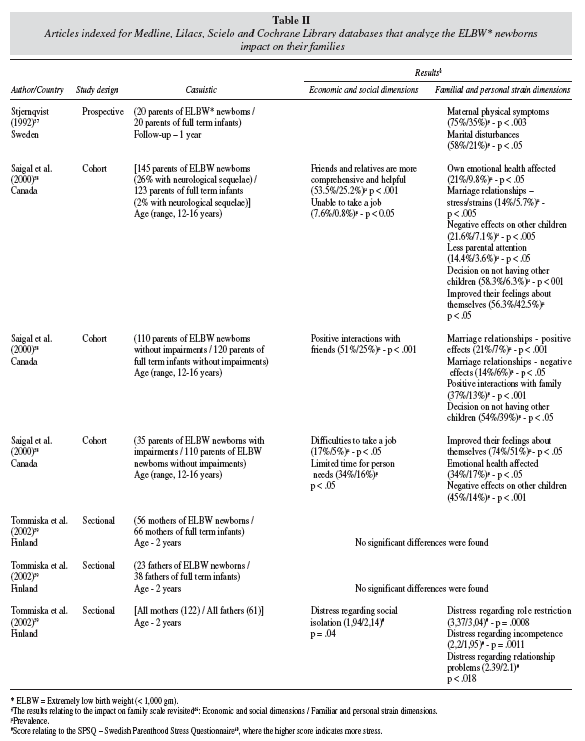
</front><body><![CDATA[ <p align="right"><font face="Verdana" size="2"><b><a name="top"></a>REVISIÓN</b></font></p>     <p>&nbsp;</p>     <p><font face="Verdana" size="4"><b>Effects of a very low birth weight newborn on family: literature review</b></font></p>     <p><b><font face="Verdana" size="4">Efectos del peso extremadamente bajo al nacimiento sobre la familia: revisi&oacute;n bibliogr&aacute;fica</font></b></p>     <p>&nbsp;</p>     <p>&nbsp;</p>     <p><font face="Verdana" size="2"><b>T. Konstantyner, H. P. Leite, J. A., A. C. Taddei</b></font></p>     <p><font face="Verdana" size="2">Discipline of Nutrology. Department of Pediatrics. Universidade Federal de S&atilde;o Paulo (Unifesp). Brazil.</font></p>     <p><font face="Verdana" size="2"><a href="#back">Correspondence</a></font></p>     <p>&nbsp;</p>     ]]></body>
<body><![CDATA[<p>&nbsp;</p> <hr size="1">     <p><font face="Verdana" size="2"><B>ABSTRACT</B></font></p>     <p><font face="Verdana" size="2"><B>Objective:</B> The present study is a literature review to identify the effects of a very low birth weight newborn on family. This is an important instrument to clarify epidemiological issues and to suggest the directions for health policy efforts.    <BR><B>Method:</B> A three-step review was carried out using databases of journals indexed for Medline/Lilacs/Scielo/Cochrane published between 1966 and 2005 using specific criteria of inclusion. The first step selected 12 articles from 2,889 when searching for the keyword "very low birth weight infant"; the second step used the crossing of keyword "premature infant" with other pertinent keywords and terms resulting in 191 articles generating 7 more articles matching the criteria of inclusion. The third step was to analyze the references of articles in steps 1 and 2 (12 + 7 = 19), selecting 3 additional ones totalizing 22 selected articles.    <BR><B>Result:</B> Evidences in literature state that the families of very low birth weight newborns suffer potential negative effects on their operational dynamics, which is associated to the clinical seriousness, the age and the neuropsycomotor development of such children. It seems that the mother is the most affected member due to the situation imposed to the family, and the one who needs psychosocial support more frequently.    <BR><B>Conclusion:</B> The number of existing studies is still insufficient to clarify whether the effects on the family considering all their aspects are preponderantly positive or negative.</font></p>     <p><font face="Verdana" size="2"><B>Key words:</B> Very low birth weight infant. Premature infant. Family. Stress. Stressful events. Life change events. Review literature.</font></p> <hr size="1">     <p><font face="Verdana" size="2"><b>RESUMEN</b></font></p>     <p><font face="Verdana" size="2"><B>Objetivo:</B> este estudio es una revisi&oacute;n bibliogr&aacute;fica para intentar identificar los efectos que el reci&eacute;n nacido de peso muy bajo tiene en una familia. Este es un instrumento importante para aclarar los aspectos epidemiol&oacute;gicos y sugerir las directrices en los esfuerzos de pol&iacute;ticas sanitaria.    <BR><B>M&eacute;todo:</B> se realiz&oacute; una revisi&oacute;n en tres pasos empleando las bases de datos de las revistas indexadas en Medline/Lilacs/Scielo/Cochrane con fecha de publicaci&oacute;n entre 1966 y 2005, utilizando criterios de inclusi&oacute;n espec&iacute;ficos. El primer paso seleccion&oacute; 12 art&iacute;culos de 2.899 cuando se busc&oacute; el t&eacute;rmino clave "very low birth weight infant"; el segundo paso utiliz&oacute; la combinaci&oacute;n de las palabras clave "premature infant" con otros t&eacute;rminos clave pertinentes, lo que produjo 191 art&iacute;culos que, a su vez, originaron 7 art&iacute;culos m&aacute;s que cumpl&iacute;an los criterios de inclusi&oacute;n. El tercer paso consisti&oacute; en analizar las citas de los art&iacute;culos en los pasos 1 y 2 (12 + 7 = 19), seleccionando otros 3 m&aacute;s, con un total de 22 art&iacute;culos seleccionados.    ]]></body>
<body><![CDATA[<BR><B>Resultado:</B> las evidencias bibliogr&aacute;ficas afirman que las familias con reci&eacute;n nacidos de peso muy bajo al nacimiento sufren efectos potencialmente negativos en su din&aacute;mica operativa, lo que se asocia con la gravedad cl&iacute;nica, la edad y el desarrollo neuropsicomotor de tales ni&ntilde;os. La madre parece ser el miembro m&aacute;s afectado dada la situaci&oacute;n impuesta a la familia, y tambi&eacute;n aquel que requiere apoyo psicosocial con mayor frecuencia.    <BR><B>Conclusi&oacute;n:</B> el n&uacute;mero de estudios exigentes sigue siendo insuficiente para aclarar si los efectos sobre la familia, considerando todos sus aspectos, son predominantemente positivos o negativos.</b></font></p>     <p><font face="Verdana" size="2"><B>Palabras clave:</B> Lactante de peso muy bajo al nacimiento. Lactante prematuro. Estr&eacute;s familiar. Acontecimientos angustiantes. Acontecimiento de cambio de vida. Revisi&oacute;n bibliogr&aacute;fica.</font></p> <hr size="1">     <p>&nbsp;</p>     <p><font face="Verdana"><B>Introduction</B></font></p>     <p><font face="Verdana" size="2">An expressive increase of the survival rate among very low birth weight newborns (VLBW) with birth weight less than 1,500 g, receiving intensive care has been registered over the last 25 years<sup>1,2</sup>.</font></p>     <p><font face="Verdana" size="2">According to Rugolo<sup>3</sup>, to take care of a newborn with VLBW, besides guaranteeing the survival and minimizing the immediate morbidity, implies also in a favorable outcome. In this context, researchers started to question the quality of life of such surviving premature infants, once the increase of survival rates was not followed by the fall of newborn morbidity, what led to a big increase of survivors and a greater frequency of diseases in VLBW newborns<sup>4</sup>.</font></p>     <p><font face="Verdana" size="2">Therefore, the increase of survivors among VLBW newborns brings up the long-term neuropsychomotor development issue<sup>5,6</sup>, especially during the integration period at school<sup>7</sup>, which is the first step towards the good quality of life in adulthood<sup>8,9</sup>.</font></p>     <p><font face="Verdana" size="2">These findings lead to questions on the preparation the families have to receive, welcome and take care of a VLBW newborn. Would the families of such infants promote changes in their family dynamics during the admission period of their children and by the time of hospital discharge?</font></p>     <p><font face="Verdana" size="2">What are the effects caused by the arrival of a VLBW newborn with or without neuropsychomotor disturbance on the family structure? Would this impact be economical (changes in the family economic condition), social (quality and quantity of relationships with nonmembers of the family), familial (quality of relationship among members of the family), individual (the subjective idea experimented by any individual) or an association of all these factors? Are the families of these children prepared for these effects or would they need some kind of assistance? Would there be enough studies to describe and elucidate these issues?</font></p>     ]]></body>
<body><![CDATA[<p><font face="Verdana" size="2"><i>Historical records</i></font></p>     <p><font face="Verdana" size="2">Medicine developed fast during the XIX and XX centuries. The acceleration of this evolution broughttransformations in the whole context of the world health care. Regarding the assistance to children, one of the main chapters of this history is the establishment of Newborn Intensive Care Units (NICU).</font></p>     <p><font face="Verdana" size="2">In the past, the attention to newborns was limited to the well-intended actions to promote their survival by their parents, midwives and doctors<sup>10</sup>. Efforts aimed at providing an environment similar to the intra-uterine one and all energies were focused to three basic supporting needs: temperature, nutrition and protection against infections<sup>11</sup>. The interest of industry enabled investigation, discovery and improvement of equipment, drugs and nutrients, contributing along with the scientific community for the establishment of NTICUs<sup>12</sup>, and consequently the world started to experiment a constant fall of neonatal mortality at all birth weight ranges<sup>1,13-17</sup>.</font></p>     <p><font face="Verdana" size="2"><i>World statistics</i></font></p>     <p><font face="Verdana" size="2">Follow-up studies indicate that VLBW children frequently present delayed neuropsychomotor developments<sup>1,18</sup>. Brain paralysis has been one of the main consequences of prematurity during the last decade, affecting 10 to 15% of VLBW newborns<sup>2</sup>. According to Volpe<sup>19</sup>, the VLBW newborn survival rate is good, ranging around 85%. However, from the survivors, five to 15% presented motor deficiency characterized as brain paralysis and, yet some other 25 to 50% presented at some extent, motor development onset, cognitive or behavioral, that will further result in learning difficulty. Kohlhauser et al.<sup>20</sup>, studying 76 VLBW children found a development delay in one third of them at the age of 12 months. VLBW newborns, premature infants or those small for gestational age<sup>21</sup>, also presented a greater risk of long-term growth<sup>22,23</sup>. Surveys in Spain have registered a brain paralysis rate of 13% among VLBW newborns<sup>24</sup>.</font></p>     <p><font face="Verdana" size="2">In developing countries, there are few publications on short and medium term development of newborns, mainly the VLBW premature infants<sup>25-27</sup>. The majority of studies available present data showing important deficiencies in cognitive, motor and intellectual aspects of VLBW children when compared to those with sufficient weight<sup>28</sup>. Brazilian researchers found neuropsychomotor development disturbance rates around 30%, but pointed to the difficulties of measuring them due to the high rate of giving up the medical ambulatory accompaniment (around 26.8%) caused by change of address, refusal to participate in the study or any other factors related to the social and cultural condition of the family, such as parents&rsquo; difficulties of understanding the importance of the medical follow-up, as well as the lack of means, resources and time to bring their children to the medical ambulatory<sup>12,29,30</sup>.</font></p>     <p><font face="Verdana" size="2"><i>Objective</i></font></p>     <p><font face="Verdana" size="2">The objective of this study is to identify the effects of a VLBW newborn on family. It turns out to be an important instrument to clarify epidemiological issues of such population and to suggest the directions for health policy efforts in order to promote a better quality of life for these children, their families and society.</font></p>     <p>&nbsp;</p>     <p><font face="Verdana"><b>Methodology</b></font></p>     ]]></body>
<body><![CDATA[<p><font face="Verdana" size="2">The literature review was done in three steps. The first consisted of listing 2,889 articles from Medline, Lilacs, Scielo and Cochrane Library databases using the keyword "very low birth weight infant". From this total we selected 12 articles that matched the following inclusion criteria:</font></p>     <blockquote> 	    <p><font face="Verdana" size="2">&bull; Original article published in the period between 1966 and 2005;1966 and 2005;</font></p> 	    <p><font face="Verdana" size="2">&#8226; Cohort, case-control and cross-sectional studies<sup>31</sup>; 	</font></p> 	    <p><font face="Verdana" size="2">&#8226; Researches describing the characteristics of families of premature infants or families of VLBW newborns.</font></p> </blockquote>     <p><font face="Verdana" size="2">The second step consisted of combining the key words "premature infant" with each of the following key words and terms:</font></p>     <blockquote> 	    <p><font face="Verdana" size="2">Key words: <i>psychosocial impact; family; stress; stressful events; life change events; adjustment disorders; depression; maternal.</i></font></p> 	    <p><font face="Verdana" size="2">Terms: <i>family impact; social impact; extremely low birth weight; parental stress; parental attitudes; stress psychological.</i></font></p> </blockquote>     <p><font face="Verdana" size="2">With this second procedure we obtained 191 articles and based on the same inclusion criteria linked above, 7 more articles were selected.</font></p>     ]]></body>
<body><![CDATA[<p><font face="Verdana" size="2">Finally, the third step was to review the references of the 19 (12 + 7) selected articles in first and second steps, in order to identify more articles that fulfilled the selection criteria. Thus, in this step we identified 3 additional articles. The final number of reviewed articles were then, 22 (12 + 7 + 3).</font></p>     <p><font face="Verdana" size="2">Duplicate articles were accounted for just once.</font></p>     <p>&nbsp;</p>     <p><font face="Verdana"><b>Discussion</b></font></p>     <p><font face="Verdana" size="2">We found a Kaplan &amp; Mason<sup>32</sup> study published in 1960 that described the birth of premature infant as an acute emotional crisis for the mother; however this assessment was restricted to mothers of premature infants. Later on, other studies showed some concern with the way mothers feel their premature infants<sup>33</sup>, as well as parents and children suffering<sup>34</sup>.</font></p>     <p><font face="Verdana" size="2">In the past, the first comparative studies identified analyzed mothers&rsquo; reactions to pre-term infants with distinct methodologies (different cutoff points concerning birth weight and different times for data collection). Smith et al.<sup>35</sup> assessed 35 mothers of pre-terms (birth weight between 1,400 and 2,500 g) and 35 mothers of full-term infants (birth weight higher than 2,500 g) from a psychiatric point of view, and results showed no significant differences between groups of the first week postpartum. Nevertheless, Choi<sup>36</sup> in 1970 compared 20 mothers of pre-terms to 20 mothers of full-term infants, also in the first week postpartum and found significantly higher levels of depression and anxiety in the mothers of premature infants.</font></p>     <p><font face="Verdana" size="2">Parents&rsquo; emotional response after the first week postpartum was initially studied by Jeffcoate et al.<sup>37</sup> who adopted unusual cutoff points for birth weights of newborns. They interviewed 17 families of pre-term infants (birth weight between 1,200 and 2,100 g) and 17 families of full-term infants (birth weight more than 2,500 g) between their children&rsquo;s 6<sup>th</sup> to 20<sup>th</sup> month of life. Although the study had shown that the preterm birth of an infant produced emotional disturbance, delayed or inadequate maternal attachment and undue problems in caring for the infant at home for both parents compared to a full-term birth, a number significantly higher of negative emotions in mothers were found when compared to fathers of the same group.</font></p>     <p><font face="Verdana" size="2">On the other hand, Trause &amp; Kramer<sup>38</sup> in 1980 studied 38 parents of 19 low-risk pre-term infants and 28 parents of 14 healthy term infants, and found that parents of full-term infants experimented significantly more depression and emotional disturbances than parents of pre-term infants at 1 month postpartum. However, Scheiner et al.<sup>39</sup> in 1985, found no differences in the depression level of 17 mothers of full-terms and 17 mothers of pre-term infants when their children were 12 to 18 months old.</font></p>     <p><font face="Verdana" size="2">The main researchers&rsquo; concern on the above mentioned was understanding the effects the birth of a preterm infant on their parents and whether they were ready to receive this infant within the family environment. Nevertheless, studies until then produced inconsistent and inconclusive results according to Gennaro<sup>40</sup>, who consequently, realized a longitudinal study. He examined 41 mothers of pre-terms infants (birth weight between 1,000 and 2,500 g) and 41 mothers of full-term infants (birth weight more than 2,500 g) in the immediate postpartum period (1 week) and over time (first 7 postpartum weeks) using the State-Trait Anxiety Inventory (STAI) and the Depression Adjective Check List (DACL). Results showed mothers of premature infants had heightened anxiety and depression in the first postpartum week than mothers of control group. However, this difference disappeared during the second to the seventh postpartum weeks and still mothers did not experience differences in anxiety and depression based on the level of illness of their infant. In another follow-up case, Lambrenos et al.<sup>41</sup> investigated depression in 96 mothers: 30 of premature infants at risk for the development of cerebral palsy, 35 of premature infants considered not to be at risk for the developing cerebral palsy and 31 of healthy full-term infants. They found equally high levels of depression in all three groups of mothers throughout the first year of the children&rsquo;s lives.</font></p>     <p><font face="Verdana" size="2">We observed that researchers concentrated their efforts on assessing the prevalence of depression, anxiety and emotional disturbances of premature newborn parents, mainly the mothers, thus limiting the analysis of the contextual process of caring for an infant that, besides the individual aspects of parents, also included the financial, social and environmental aspects of the whole family. Additionally, the heterogeneity of the studies regarding children&rsquo;s birth weight ranges, as well as the instruments utilized, limit the analysis of results found.</font></p>     ]]></body>
<body><![CDATA[<p><font face="Verdana" size="2">We identified the survey by Rivers et al.<sup>42</sup> as the first study that specifically assessed, the effects of a VLBW newborn on family and the first study considering other variables in addition to parents&rsquo; individual aspects. Researchers interviewed the parents of VLBW newborns with an average age of 4.3 (three to seven years) presenting neurological abnormalities (17 brain paralysis and five hydrocephaly), parents of VLBW children without neurological sequelae. The comparison of results indicated that the costs with medical care were frequently higher for the families of children with neurological abnormalities than for the families of normal children; VLBW children with neurological abnormalities demanded more hospitalization after birth than the ones in the group of normal children; and the families of children with neurological abnormalities registered significantly more stress due to medical doubts not clarified when compared with the control group (<a href="#t1">table I</a>).</font></p>     <p align="center"><font face="Verdana" size="2"><a name="t1"><img src="/img/revistas/nh/v22n2/3_t1.gif"></a></font></p>     <p align="center">&nbsp;</p>     <p><font face="Verdana" size="2">Brooten et al.<sup>43</sup> returned to focus parents&rsquo; individual aspects and followed 47 mothers of VLBW newborns, using The Multiple Affect Adjective Checklist<sup>44</sup>. They found that these mothers were significantly more anxious and depressed before their infants were discharged from hospital than when the infants were 9 months old. However, Lee et al.<sup>45</sup> using a scale for measuring the impact on family<sup>46</sup> when comparing information supplied by three groups of VLBW newborn parents newborns with development quotient (DQ) measured by Griffiths Mental Development Scales: 1) DQ less than 80; 2) DQ more than 80, and 3) normal birth weight by the time children presented an average age of 36.5 months (12 to 72 months), showed that the parents in 1) presented no worse impact than those in 3), however the ones in 2) presented a more positive impact (less score) than the two other groups.</font></p>     <p><font face="Verdana" size="2">Cronin et al.<sup>47</sup>, using the same scale for measuring the impact on family<sup>45</sup>, compared families of VLBW newborns with families of normal birth weight newborns (age between one and five years) and found significant differences in score for all items of impact (economical, social, familial and individual) showing that the families of VLBW newborns, mainly those with lower DQ measured by Gesell Development Scales<sup>48</sup> suffer a more negative impact (higher score) than the families in control group.</font></p>     <p><font face="Verdana" size="2">Collins et al.<sup>49</sup>, using a structured questionnaire, compared two groups of Afro-American mothers (VLBW newborns and normal weight newborns) and identified that the mothers of VLBW newborns presented more stressful events and expressed unfavorable overall perception of their residential environments.</font></p>     <p><font face="Verdana" size="2">Subsequently, studies returned to focus parents&rsquo; individual aspects, but keeping the reference of VLBW infants. Singer et al.<sup>50</sup> compared three groups of mothers with newborns in their first month of life (VLBW newborns with bronchopulmonar dysplasia (BPD); without BPD and normal birth weight) and found more psychological distress in mothers of the 2 first groups than in mothers of normal birth weight newborns.</font></p>     <p><font face="Verdana" size="2">In the same manner, Halpern et al.<sup>51</sup> and Ong et al.<sup>52</sup> found a higher prevalence of maternal stress in families of VLBW newborns when compared to families of normal birth weight newborns, respectively at 9 months and at fourth year of their children&rsquo;s lives.</font></p>     <p><font face="Verdana" size="2">Taylor et al.<sup>53</sup> compared 3 groups of parents (families of newborns with birth weight less than 750 g; with birth weight between 750 to 1,499 g and with normal birth weight) and found that families of the first group presented more stress in relation to the control groups and newborns with greater neonatal risk presented more negative impacts on their families.</font></p>     <p><font face="Verdana" size="2">In the same year, Prindham et al.<sup>54</sup> studied mothers of newborns with BPD and without BPD and with normal birth weight, and found more symptoms of maternal depression in the families of VLBW newborns with BPD in comparison to the two other groups.</font></p>     ]]></body>
<body><![CDATA[<p><font face="Verdana" size="2">Recently, Kersting et al.<sup>55</sup>, in a prospective longitudinal study compared the posttraumatic stress response of 50 mothers after the birth of a VLBW infant with 30 mothers of healthy term infants, at four measuring time points (1-3 days postpartum, 14 days postpartum and 6 e 14 months postpartum) using the Impact of Event Scale (IES-R), psychometric instruments (Structured Clinical Interview for DSM-IV, SCID-I), Back Depression Inventory (BDI), Montgomery Asberg Depression Scale (MADRS), State-Trait Anxiety Inventory (STAI) and Hamilton Anxiety Scale (HAMA). At all four measuring time points (except 6 months postpartum), the mothers of VLBW infants recorded significantly higher values for traumatic experience and depressive symptoms and anxiety compared to the controls. In contrast to the mothers in the control group, the mothers of the VLBW infants showed no significant reduction in posttraumatic symptoms (IES-total), even 14 months after birth.</font></p>     <p><font face="Verdana" size="2">Padovani et al.<sup>56</sup>, in a Brazilian study assessed 43 mothers of VLBW infants without a psychiatric background using STAI and BDI in two moments: during the hospitalization of infant and after the discharge. After infants&rsquo; discharge, the number of mothers with clinical level of emotional symptoms decreased significantly in comparison to the first assessment. The anxiety-state level decreased significantly from the first to the second assessment. No differences in depression and dysphoria symptoms between two assessments were found.</font></p>     <p><font face="Verdana" size="2">We also found studies that assessed the impact on families, more specifically, on survival of newborns with extreme low birth weight (ELBW -birth weights less than 1,000 g). Stjernqvist<sup>57</sup> interviewed parents of ELBW, found more reactional crises in mothers than in fathers and stated that parents of these newborns reported more stress during the first year of child&rsquo;s life, what causes more tension in marital relationship when compared to the control group comprising fathers of newborns with normal weight; however the same study identified no relation between permanent neurological disturbances in childhood and strong reactions by the members of the family (<a href="#t2">table II</a>).</font></p>     <p align="center"><font face="Verdana" size="2"><a name="t2"><img src="/img/revistas/nh/v22n2/3_t2.gif"></a></font></p>     <p><font face="Verdana" size="2">Nevertheless, Saigal et al.<sup>58</sup> compared families of ELBW newborns with families of pre-terms infants from the same social-demographic condition and found that the positive effects as much as the negative ones on marital relationship were more frequent in the families of ELBW newborns. Additionally, neurological sequelae in children with ELBW promote difficulties in the familial context, in spite of causing a refinement of parents&rsquo; feelings about themselves, concluding that parents of ELBW newborns adjusted reasonably well their works and family responsibilities and that, although some negative effects had been identified, there was still considerable preparation for the active treatment of their children.</font></p>     <p><font face="Verdana" size="2">Subsequently, Tommiska et al.<sup>59</sup>, using the Swedish Parenthood Stress Questionnaire (SPSQ) found no significant differences when comparing mothers of ELBW newborns to mothers of full children, or when comparing fathers of ELBW newborns to fathers of control group. Nevertheless, differences were found when all mothers were compared to all fathers. Mothers indicated significantly more distresses regarding the functional restrictive part and their children&rsquo;s incapacity in addition to the marital relationship problems; however fathers indicated significant more distresses regarding the social isolation this situation imposes<sup>60</sup>.</font></p>     <p>&nbsp;</p>     <p><font face="Verdana"><b>Conclusion</b></font></p>     <p><font face="Verdana" size="2">The data analysis leads to the conclusion that the families of VLBW newborns suffer potential effects on their daily dynamics, which relates to the clinical seriousness, age and neuropsychomotor development of such children. It seems that the mother is the most affected member of the family due to the situation imposed to the family, and who more frequently needs psychosocia support, mainly during the first week of life and before the discharge. The lines of research lead us to understand that the families of VLBW newborns with development disturbances suffer negative impact, complicating the handling of such situations. On the other hand, the families of VLBW newborns with or without neuropsychomotor development disturbances suffer a positive impact in comparison to newborns with normal birth weights. Nevertheless, the number of existing studies is still insufficient to clarify whether the effects, considering all their aspects, are predominantly positives or negatives, once the analyzed aspects presented differences among the studies showing inconsistencies when comparing their results. Yet, the studies selected were preponderantly performed in developed countries, what might limit the validity of the results when applied to developing countries. Therefore, we concluded that new studies should be performed in order to enhance the knowledge on the effects suffered by the families of VLBW newborns to subsidize proposals of health programs and policies.</font></p>     <p><font face="Verdana" size="2">Concomitantly, we concluded that follow-up programs should incorporate a psychological evaluation and support services to the VLBW newborn mothers, immediately in the postpartum period, as well as to provide multi-disciplinary follow-up support to these newborns and their families. Such programs, already a routine in other countries, are not emphasized in developing countries health policies, what hampers the family comprehension of attendance frequency to outpatient clinics. In line with this, some new perspectives should be created in order to give support to the families of VLBW newborns, giving them conditions to face the challenge in order to prevent the negative effects aiming at a better quality of life.</font></p>     ]]></body>
<body><![CDATA[<p>&nbsp;</p>     <p><font face="Verdana"><B>Referencias</B></font></p>     <!-- ref --><p><font face="Verdana" size="2">1. Hack M, Wright LL, Shankaran S et al. Very-low-birth-weight outcomes of the National Institute of Child Health and Human Development Neonatal Network, November 1989 to October 1990. Am J Obstet Gynecol 1995; 172 (2 Pt 1): 457-64.</font>&nbsp;&nbsp;&nbsp;&nbsp;&nbsp;&nbsp;&nbsp;&nbsp;[&#160;<a href="javascript:void(0);" onclick="javascript: window.open('/scielo.php?script=sci_nlinks&ref=3499849&pid=S0212-1611200700020000300001&lng=','','width=640,height=500,resizable=yes,scrollbars=1,menubar=yes,');">Links</a>&#160;]<!-- end-ref --><!-- ref --><p><font face="Verdana" size="2">2. Aylward GP, Pfeiffer SI, Wright A, Verhulst SJ. Outcome studies of low birth weight infants published in the last decade: a meta-analysis. J Pediatr 1989; 115 (4): 515-20.</font>&nbsp;&nbsp;&nbsp;&nbsp;&nbsp;&nbsp;&nbsp;&nbsp;[&#160;<a href="javascript:void(0);" onclick="javascript: window.open('/scielo.php?script=sci_nlinks&ref=3499850&pid=S0212-1611200700020000300002&lng=','','width=640,height=500,resizable=yes,scrollbars=1,menubar=yes,');">Links</a>&#160;]<!-- end-ref --><!-- ref --><p><font face="Verdana" size="2">3. Rugolo LM. Follow-up do rec&eacute;m-nascido de muito baixo peso. In: Costa HP, Marba ST, editors. O rec&eacute;m-nascido de muito baixo peso. S&eacute;rie Atualiza&ccedil;&otilde;es Pedi&aacute;tricas da Sociedade de Pediatria de S&atilde;o Paulo. S&atilde;o Paulo: Atheneu; 2003. pp. 469-77.</font>&nbsp;&nbsp;&nbsp;&nbsp;&nbsp;&nbsp;&nbsp;&nbsp;[&#160;<a href="javascript:void(0);" onclick="javascript: window.open('/scielo.php?script=sci_nlinks&ref=3499851&pid=S0212-1611200700020000300003&lng=','','width=640,height=500,resizable=yes,scrollbars=1,menubar=yes,');">Links</a>&#160;]<!-- end-ref --><!-- ref --><p><font face="Verdana" size="2">4. Robertson CM, Hrynchyshyn GJ, Etches PC, Pain KS. Population-based study of the incidence, complexity, and severity of neurologic disability among survivors weighing 500 through 1,250 grams at birth: a comparison of two birth cohorts. Pediatrics 1992; 90 (5): 750-5.</font>&nbsp;&nbsp;&nbsp;&nbsp;&nbsp;&nbsp;&nbsp;&nbsp;[&#160;<a href="javascript:void(0);" onclick="javascript: window.open('/scielo.php?script=sci_nlinks&ref=3499852&pid=S0212-1611200700020000300004&lng=','','width=640,height=500,resizable=yes,scrollbars=1,menubar=yes,');">Links</a>&#160;]<!-- end-ref --><!-- ref --><p><font face="Verdana" size="2">5. Bennett FC, Robinson NM, Sells CJ. Growth and development of infants weighing less than 800 grams at birth. Pediatrics 1983; 71 (3): 319-23.</font>&nbsp;&nbsp;&nbsp;&nbsp;&nbsp;&nbsp;&nbsp;&nbsp;[&#160;<a href="javascript:void(0);" onclick="javascript: window.open('/scielo.php?script=sci_nlinks&ref=3499853&pid=S0212-1611200700020000300005&lng=','','width=640,height=500,resizable=yes,scrollbars=1,menubar=yes,');">Links</a>&#160;]<!-- end-ref --><!-- ref --><p><font face="Verdana" size="2">6. Cooke RW. Factors affecting survival and outcome at 3 years in extremely pre-term infants. Arch Dis Child Fetal Neonatal Ed 1994; 71 (1): F28-31.</font>&nbsp;&nbsp;&nbsp;&nbsp;&nbsp;&nbsp;&nbsp;&nbsp;[&#160;<a href="javascript:void(0);" onclick="javascript: window.open('/scielo.php?script=sci_nlinks&ref=3499854&pid=S0212-1611200700020000300006&lng=','','width=640,height=500,resizable=yes,scrollbars=1,menubar=yes,');">Links</a>&#160;]<!-- end-ref --><!-- ref --><p><font face="Verdana" size="2">7. Stjernqvist K, Svenningsen NW. Extremely low-birth-weight infants less than 901 g: development and behavior after 4 years of life. Acta Paediatr 1995; 84 (5): 500-6.</font>&nbsp;&nbsp;&nbsp;&nbsp;&nbsp;&nbsp;&nbsp;&nbsp;[&#160;<a href="javascript:void(0);" onclick="javascript: window.open('/scielo.php?script=sci_nlinks&ref=3499855&pid=S0212-1611200700020000300007&lng=','','width=640,height=500,resizable=yes,scrollbars=1,menubar=yes,');">Links</a>&#160;]<!-- end-ref --><!-- ref --><p><font face="Verdana" size="2">8. World Health Organization. International classification of impairments, disabilities and handicaps-a manual of classification relating to the consequences of disease. Geneva: WHO; 1980.</font>&nbsp;&nbsp;&nbsp;&nbsp;&nbsp;&nbsp;&nbsp;&nbsp;[&#160;<a href="javascript:void(0);" onclick="javascript: window.open('/scielo.php?script=sci_nlinks&ref=3499856&pid=S0212-1611200700020000300008&lng=','','width=640,height=500,resizable=yes,scrollbars=1,menubar=yes,');">Links</a>&#160;]<!-- end-ref --><!-- ref --><p><font face="Verdana" size="2">9. Bjerager M, Steensberg J, Greisen G. Quality of life among young adults born with very low birth weights. Acta Paediatr 1995; 84 (12): 1339-43.</font>&nbsp;&nbsp;&nbsp;&nbsp;&nbsp;&nbsp;&nbsp;&nbsp;[&#160;<a href="javascript:void(0);" onclick="javascript: window.open('/scielo.php?script=sci_nlinks&ref=3499857&pid=S0212-1611200700020000300009&lng=','','width=640,height=500,resizable=yes,scrollbars=1,menubar=yes,');">Links</a>&#160;]<!-- end-ref --><!-- ref --><p><font face="Verdana" size="2">10. Fern&aacute;ndez-Carrocera LA, Pa&ntilde;uela-Olaya MA. Crecimiento y neurodesarrollo del reci&eacute;n nacido de alto riesgo. Bol Med Hosp Infant Mex 1999; 56 (11): 623-35.</font>&nbsp;&nbsp;&nbsp;&nbsp;&nbsp;&nbsp;&nbsp;&nbsp;[&#160;<a href="javascript:void(0);" onclick="javascript: window.open('/scielo.php?script=sci_nlinks&ref=3499858&pid=S0212-1611200700020000300010&lng=','','width=640,height=500,resizable=yes,scrollbars=1,menubar=yes,');">Links</a>&#160;]<!-- end-ref --><!-- ref --><p><font face="Verdana" size="2">11. O'Donnell J. The development of a climate for caring: a historical review of premature care in the United States from 1900 to 1979. Neonatal Netw 1990; 8(6):7-17.</font>&nbsp;&nbsp;&nbsp;&nbsp;&nbsp;&nbsp;&nbsp;&nbsp;[&#160;<a href="javascript:void(0);" onclick="javascript: window.open('/scielo.php?script=sci_nlinks&ref=3499859&pid=S0212-1611200700020000300011&lng=','','width=640,height=500,resizable=yes,scrollbars=1,menubar=yes,');">Links</a>&#160;]<!-- end-ref --><!-- ref --><p><font face="Verdana" size="2">12. Meio MD. Como est&atilde;o sobrevivendo os pequenos prematuros? Um olhar sobre a popula&ccedil;&atilde;o do Instituto Fernandes Figueira &#091;dissertation&#093;. Rio de Janeiro: Instituto de Medicina Social da Universidade do Estado do Rio de Janeiro; 1999.</font>&nbsp;&nbsp;&nbsp;&nbsp;&nbsp;&nbsp;&nbsp;&nbsp;[&#160;<a href="javascript:void(0);" onclick="javascript: window.open('/scielo.php?script=sci_nlinks&ref=3499860&pid=S0212-1611200700020000300012&lng=','','width=640,height=500,resizable=yes,scrollbars=1,menubar=yes,');">Links</a>&#160;]<!-- end-ref --><!-- ref --><p><font face="Verdana" size="2">13. McCormick MC, Shapiro S, Starfield BH. The regionalization of perinatal services. Summary of the evaluation of a national demonstration program. JAMA 1985; 253 (6): 799-804.</font>&nbsp;&nbsp;&nbsp;&nbsp;&nbsp;&nbsp;&nbsp;&nbsp;[&#160;<a href="javascript:void(0);" onclick="javascript: window.open('/scielo.php?script=sci_nlinks&ref=3499861&pid=S0212-1611200700020000300013&lng=','','width=640,height=500,resizable=yes,scrollbars=1,menubar=yes,');">Links</a>&#160;]<!-- end-ref --><!-- ref --><p><font face="Verdana" size="2">14. Hack M, Fanaroff AA. How small is too small? Considerations in evaluating the outcome of the tiny infant. Clin Perinatol 1988; 15 (4): 773-88.</font>&nbsp;&nbsp;&nbsp;&nbsp;&nbsp;&nbsp;&nbsp;&nbsp;[&#160;<a href="javascript:void(0);" onclick="javascript: window.open('/scielo.php?script=sci_nlinks&ref=3499862&pid=S0212-1611200700020000300014&lng=','','width=640,height=500,resizable=yes,scrollbars=1,menubar=yes,');">Links</a>&#160;]<!-- end-ref --><!-- ref --><p><font face="Verdana" size="2">15. Hack M, Horbar JD, Malloy MH, Tyson JE, Wright E, Wright L. Very low birth weight outcomes of the National Institute of Child Health and Human Development Neonatal Network. Pediatrics 1991; 87 (5): 587-97.</font>&nbsp;&nbsp;&nbsp;&nbsp;&nbsp;&nbsp;&nbsp;&nbsp;[&#160;<a href="javascript:void(0);" onclick="javascript: window.open('/scielo.php?script=sci_nlinks&ref=3499863&pid=S0212-1611200700020000300015&lng=','','width=640,height=500,resizable=yes,scrollbars=1,menubar=yes,');">Links</a>&#160;]<!-- end-ref --><!-- ref --><p><font face="Verdana" size="2">16. Guyer B, Strobino DM, Ventura SJ, Singh GK. Annual summary of vital statistics-1994. Pediatrics 1995; 96 (6): 1029-39.</font>&nbsp;&nbsp;&nbsp;&nbsp;&nbsp;&nbsp;&nbsp;&nbsp;[&#160;<a href="javascript:void(0);" onclick="javascript: window.open('/scielo.php?script=sci_nlinks&ref=3499864&pid=S0212-1611200700020000300016&lng=','','width=640,height=500,resizable=yes,scrollbars=1,menubar=yes,');">Links</a>&#160;]<!-- end-ref --><!-- ref --><p><font face="Verdana" size="2">17. Fanaroff AA, Wright LL, Stevenson DK et al. Very-low-birthweight outcomes of the National Institute of Child Health and Human Development Neonatal Research Network, May 1991 through December 1992. Am J Obstet Gynecol 1995; 173 (5): 1423-31.</font>&nbsp;&nbsp;&nbsp;&nbsp;&nbsp;&nbsp;&nbsp;&nbsp;[&#160;<a href="javascript:void(0);" onclick="javascript: window.open('/scielo.php?script=sci_nlinks&ref=3499865&pid=S0212-1611200700020000300017&lng=','','width=640,height=500,resizable=yes,scrollbars=1,menubar=yes,');">Links</a>&#160;]<!-- end-ref --><!-- ref --><p><font face="Verdana" size="2">18. Piecurch RE, Leonard CH, Cooper BA. Infants with birth weight 1,000-1,499 grams born in three time periods: has outcome changed over time? Clin Pediatr (Phila). 1998; 37 (9): 537-45.</font>&nbsp;&nbsp;&nbsp;&nbsp;&nbsp;&nbsp;&nbsp;&nbsp;[&#160;<a href="javascript:void(0);" onclick="javascript: window.open('/scielo.php?script=sci_nlinks&ref=3499866&pid=S0212-1611200700020000300018&lng=','','width=640,height=500,resizable=yes,scrollbars=1,menubar=yes,');">Links</a>&#160;]<!-- end-ref --><!-- ref --><p><font face="Verdana" size="2">19. Volpe JJ. Brain injury in the premature infant -from pathogenesis to prevention. Brain Dev 1997; 19 (8): 519-34.</font>&nbsp;&nbsp;&nbsp;&nbsp;&nbsp;&nbsp;&nbsp;&nbsp;[&#160;<a href="javascript:void(0);" onclick="javascript: window.open('/scielo.php?script=sci_nlinks&ref=3499867&pid=S0212-1611200700020000300019&lng=','','width=640,height=500,resizable=yes,scrollbars=1,menubar=yes,');">Links</a>&#160;]<!-- end-ref --><!-- ref --><p><font face="Verdana" size="2">20. Kohlhauser C, Fuiko R, Panagl A, et al. Outcome of very-lowbirth-weight infants at 1 and 2 years of age. The importance of early identification of neuro developmental deficits. Clin Pediatr (Phila). 2000; 39 (8): 441-9.</font>&nbsp;&nbsp;&nbsp;&nbsp;&nbsp;&nbsp;&nbsp;&nbsp;[&#160;<a href="javascript:void(0);" onclick="javascript: window.open('/scielo.php?script=sci_nlinks&ref=3499868&pid=S0212-1611200700020000300020&lng=','','width=640,height=500,resizable=yes,scrollbars=1,menubar=yes,');">Links</a>&#160;]<!-- end-ref --><!-- ref --><p><font face="Verdana" size="2">21. Sung IK, Vohr B, Oh W. Growth and neuro developmental outcome of very low birth weight infants with intrauterine growth retardation: comparison with control subjects matched by birth weight and gestational age. J Pediatr 1993; 123 (4): 618-24.</font>&nbsp;&nbsp;&nbsp;&nbsp;&nbsp;&nbsp;&nbsp;&nbsp;[&#160;<a href="javascript:void(0);" onclick="javascript: window.open('/scielo.php?script=sci_nlinks&ref=3499869&pid=S0212-1611200700020000300021&lng=','','width=640,height=500,resizable=yes,scrollbars=1,menubar=yes,');">Links</a>&#160;]<!-- end-ref --><!-- ref --><p><font face="Verdana" size="2">22. Ericson A, Kallen B. Very low birth weights boys at the age of 19. Arch Dis Child Fetal Neonatal Ed. 1998; 78 (3): F171-4.</font>&nbsp;&nbsp;&nbsp;&nbsp;&nbsp;&nbsp;&nbsp;&nbsp;[&#160;<a href="javascript:void(0);" onclick="javascript: window.open('/scielo.php?script=sci_nlinks&ref=3499870&pid=S0212-1611200700020000300022&lng=','','width=640,height=500,resizable=yes,scrollbars=1,menubar=yes,');">Links</a>&#160;]<!-- end-ref --><!-- ref --><p><font face="Verdana" size="2">23. Riegel K, Ohrt B, Wolke D, Osterlund K. Die Entwicklung gefahrdet geborener Kinder bis zum funften Lebensjahr &#091;The development of at-risk children until the fifth year of life. The Arvo Ylppo longitudinal study in South Bavaria and South Finland&#093;. Stuttgart: Ferdinand Enke Verlag; 1995.</font>&nbsp;&nbsp;&nbsp;&nbsp;&nbsp;&nbsp;&nbsp;&nbsp;[&#160;<a href="javascript:void(0);" onclick="javascript: window.open('/scielo.php?script=sci_nlinks&ref=3499871&pid=S0212-1611200700020000300023&lng=','','width=640,height=500,resizable=yes,scrollbars=1,menubar=yes,');">Links</a>&#160;]<!-- end-ref --><!-- ref --><p><font face="Verdana" size="2">24. Pallas Alonso CR, De la Cruz BJ, Medina Lopez MC et al. &#091;Outcome at 3 years of age in a low birth weight cohort&#093;. An Esp Pediatr 1998; 48 (2): 152-8.</font>&nbsp;&nbsp;&nbsp;&nbsp;&nbsp;&nbsp;&nbsp;&nbsp;[&#160;<a href="javascript:void(0);" onclick="javascript: window.open('/scielo.php?script=sci_nlinks&ref=3499872&pid=S0212-1611200700020000300024&lng=','','width=640,height=500,resizable=yes,scrollbars=1,menubar=yes,');">Links</a>&#160;]<!-- end-ref --><!-- ref --><p><font face="Verdana" size="2">25. Meio MD, Melo RR, Morsch DS, Porto MA. Utiliza&ccedil;&atilde;o do m&eacute;todo de Gesell na avalia&ccedil;&atilde;o do desenvolvimento de crian&ccedil;as que necessitam de terapia intensiva neonatal. J Pediatr (Rio J). 1992; 68: 18-20.</font>&nbsp;&nbsp;&nbsp;&nbsp;&nbsp;&nbsp;&nbsp;&nbsp;[&#160;<a href="javascript:void(0);" onclick="javascript: window.open('/scielo.php?script=sci_nlinks&ref=3499873&pid=S0212-1611200700020000300025&lng=','','width=640,height=500,resizable=yes,scrollbars=1,menubar=yes,');">Links</a>&#160;]<!-- end-ref --><!-- ref --><p><font face="Verdana" size="2">26. Gherpelli JL, Ferreira H, Costa HP. Neurologic follow-up of small-for-gestational age newborn infants. A study of risk factors related to prognosis at one year of age. Arq Neuropsiquiatr 1993; 51 (1): 50-8.</font>&nbsp;&nbsp;&nbsp;&nbsp;&nbsp;&nbsp;&nbsp;&nbsp;[&#160;<a href="javascript:void(0);" onclick="javascript: window.open('/scielo.php?script=sci_nlinks&ref=3499874&pid=S0212-1611200700020000300026&lng=','','width=640,height=500,resizable=yes,scrollbars=1,menubar=yes,');">Links</a>&#160;]<!-- end-ref --><!-- ref --><p><font face="Verdana" size="2">27. Mello RR. Valores de predi&ccedil;&atilde;o da avalia&ccedil;&atilde;o neurol&oacute;gica neonatal pelo m&eacute;todo de Dubowitz e da ultra-sonografia cerebral em rela&ccedil;&atilde;o ao desenvolvimento de prematuros de muito baixo peso &#091;dissertation&#093;. Rio de Janeiro: Instituto Fernandes Figueira/Funda&ccedil;&atilde;o Oswaldo Cruz; 1996.</font>&nbsp;&nbsp;&nbsp;&nbsp;&nbsp;&nbsp;&nbsp;&nbsp;[&#160;<a href="javascript:void(0);" onclick="javascript: window.open('/scielo.php?script=sci_nlinks&ref=3499875&pid=S0212-1611200700020000300027&lng=','','width=640,height=500,resizable=yes,scrollbars=1,menubar=yes,');">Links</a>&#160;]<!-- end-ref --><!-- ref --><p><font face="Verdana" size="2">28. Fisberg M, Anti SM, Yamashiro SN. Baixo peso ao nascimento II: desenvolvimento neuropsicomotor de crian&ccedil;as PIG. Pediatr Mod 1997; 33 (3): 124-7.</font>&nbsp;&nbsp;&nbsp;&nbsp;&nbsp;&nbsp;&nbsp;&nbsp;[&#160;<a href="javascript:void(0);" onclick="javascript: window.open('/scielo.php?script=sci_nlinks&ref=3499876&pid=S0212-1611200700020000300028&lng=','','width=640,height=500,resizable=yes,scrollbars=1,menubar=yes,');">Links</a>&#160;]<!-- end-ref --><!-- ref --><p><font face="Verdana" size="2">29. Perosa GB. Avalia&ccedil;&atilde;o do desenvolvimento psicol&oacute;gico: an&aacute;lise de um ambulat&oacute;rio especializado em um Hospital de Cl&iacute;nicas. Rev Paul Pediatr 1996; 14 (2): 66-72.</font>&nbsp;&nbsp;&nbsp;&nbsp;&nbsp;&nbsp;&nbsp;&nbsp;[&#160;<a href="javascript:void(0);" onclick="javascript: window.open('/scielo.php?script=sci_nlinks&ref=3499877&pid=S0212-1611200700020000300029&lng=','','width=640,height=500,resizable=yes,scrollbars=1,menubar=yes,');">Links</a>&#160;]<!-- end-ref --><!-- ref --><p><font face="Verdana" size="2">30. Magalh&atilde;es LC, Barbosa VM, Paix&atilde;o ML, Figueredo EM, Gontijo AP. Acompanhamento ambulatorial do desenvolvimento de rec&eacute;m-nascidos de alto risco: caracter&iacute;sticas da popula&ccedil;&atilde;o e incid&ecirc;ncia de seq&uuml;elas funcionais. Rev Paul Pediatr 1998; 16 (4): 191-6.</font>&nbsp;&nbsp;&nbsp;&nbsp;&nbsp;&nbsp;&nbsp;&nbsp;[&#160;<a href="javascript:void(0);" onclick="javascript: window.open('/scielo.php?script=sci_nlinks&ref=3499878&pid=S0212-1611200700020000300030&lng=','','width=640,height=500,resizable=yes,scrollbars=1,menubar=yes,');">Links</a>&#160;]<!-- end-ref --><!-- ref --><p><font face="Verdana" size="2">31. Hulley SB, Cummings SR, Browner WS, Grady D, Hearst N, Newman TB. Delineando a pesquisa cl&iacute;nica: uma abordagem epidemiológica. 2.ª ed. Porto Alegre: Artmed; 2003.</font>&nbsp;&nbsp;&nbsp;&nbsp;&nbsp;&nbsp;&nbsp;&nbsp;[&#160;<a href="javascript:void(0);" onclick="javascript: window.open('/scielo.php?script=sci_nlinks&ref=3499879&pid=S0212-1611200700020000300031&lng=','','width=640,height=500,resizable=yes,scrollbars=1,menubar=yes,');">Links</a>&#160;]<!-- end-ref --><!-- ref --><p><font face="Verdana" size="2">32. Kaplan DM, Mason EA. Maternal reactions to premature birth viewed as an acute emotional disorder. Am J Orthopsychiatry 1960; 30: 539-52.</font>&nbsp;&nbsp;&nbsp;&nbsp;&nbsp;&nbsp;&nbsp;&nbsp;[&#160;<a href="javascript:void(0);" onclick="javascript: window.open('/scielo.php?script=sci_nlinks&ref=3499880&pid=S0212-1611200700020000300032&lng=','','width=640,height=500,resizable=yes,scrollbars=1,menubar=yes,');">Links</a>&#160;]<!-- end-ref --><!-- ref --><p><font face="Verdana" size="2">33. Elmer E. Children in jeopardy. A study of abused minors and their families. Pittsburgh (PA): University of Pittsburg Press; 1967.</font>&nbsp;&nbsp;&nbsp;&nbsp;&nbsp;&nbsp;&nbsp;&nbsp;[&#160;<a href="javascript:void(0);" onclick="javascript: window.open('/scielo.php?script=sci_nlinks&ref=3499881&pid=S0212-1611200700020000300033&lng=','','width=640,height=500,resizable=yes,scrollbars=1,menubar=yes,');">Links</a>&#160;]<!-- end-ref --><!-- ref --><p><font face="Verdana" size="2">34. Bishop FI. Children at risk. Med J Aust 1971; 1 (12): 623-8.</font>&nbsp;&nbsp;&nbsp;&nbsp;&nbsp;&nbsp;&nbsp;&nbsp;[&#160;<a href="javascript:void(0);" onclick="javascript: window.open('/scielo.php?script=sci_nlinks&ref=3499882&pid=S0212-1611200700020000300034&lng=','','width=640,height=500,resizable=yes,scrollbars=1,menubar=yes,');">Links</a>&#160;]<!-- end-ref --><!-- ref --><p><font face="Verdana" size="2">35. Smith N, Schwartz JR, Mandell W, Silberstein RM, Dalack JD, Sacks S. Mothers' psychological reactions to premature and full-size newborns. Arch Gen Psychiatry 1969; 21 (2): 177-81.</font>&nbsp;&nbsp;&nbsp;&nbsp;&nbsp;&nbsp;&nbsp;&nbsp;[&#160;<a href="javascript:void(0);" onclick="javascript: window.open('/scielo.php?script=sci_nlinks&ref=3499883&pid=S0212-1611200700020000300035&lng=','','width=640,height=500,resizable=yes,scrollbars=1,menubar=yes,');">Links</a>&#160;]<!-- end-ref --><!-- ref --><p><font face="Verdana" size="2">36. Choi MW. A comparison of maternal psychological reactions to premature and full-size newborns. Matern Child Nurs J 1973; 2 (1): 1-13.</font>&nbsp;&nbsp;&nbsp;&nbsp;&nbsp;&nbsp;&nbsp;&nbsp;[&#160;<a href="javascript:void(0);" onclick="javascript: window.open('/scielo.php?script=sci_nlinks&ref=3499884&pid=S0212-1611200700020000300036&lng=','','width=640,height=500,resizable=yes,scrollbars=1,menubar=yes,');">Links</a>&#160;]<!-- end-ref --><!-- ref --><p><font face="Verdana" size="2">37. Jeffcoate JA, Humphrey ME, Lloyd JK. Role perception and response to stress in fathers and mothers following pre-term delivery. Soc Sci Med 1979; 13A (2): 139-45.</font>&nbsp;&nbsp;&nbsp;&nbsp;&nbsp;&nbsp;&nbsp;&nbsp;[&#160;<a href="javascript:void(0);" onclick="javascript: window.open('/scielo.php?script=sci_nlinks&ref=3499885&pid=S0212-1611200700020000300037&lng=','','width=640,height=500,resizable=yes,scrollbars=1,menubar=yes,');">Links</a>&#160;]<!-- end-ref --><!-- ref --><p><font face="Verdana" size="2">38. Trause MA, Kramer LI. The effects of premature birth on parents and their relationship. Dev Med Child Neurol 1983; 25 (4): 459-65.</font>&nbsp;&nbsp;&nbsp;&nbsp;&nbsp;&nbsp;&nbsp;&nbsp;[&#160;<a href="javascript:void(0);" onclick="javascript: window.open('/scielo.php?script=sci_nlinks&ref=3499886&pid=S0212-1611200700020000300038&lng=','','width=640,height=500,resizable=yes,scrollbars=1,menubar=yes,');">Links</a>&#160;]<!-- end-ref --><!-- ref --><p><font face="Verdana" size="2">39. Scheiner AP, Sexton ME, Rockwood J, Sullivan D, Davis H. The vulnerable child syndrome: fact and theory. J Dev Behav Pediatr 1985; 6 (5): 298-301.</font>&nbsp;&nbsp;&nbsp;&nbsp;&nbsp;&nbsp;&nbsp;&nbsp;[&#160;<a href="javascript:void(0);" onclick="javascript: window.open('/scielo.php?script=sci_nlinks&ref=3499887&pid=S0212-1611200700020000300039&lng=','','width=640,height=500,resizable=yes,scrollbars=1,menubar=yes,');">Links</a>&#160;]<!-- end-ref --><!-- ref --><p><font face="Verdana" size="2">40. Gennaro S. Postpartal anxiety and depression in mothers of term and preterm infants. Nurs Res 1988; 37 (2): 82-5.</font>&nbsp;&nbsp;&nbsp;&nbsp;&nbsp;&nbsp;&nbsp;&nbsp;[&#160;<a href="javascript:void(0);" onclick="javascript: window.open('/scielo.php?script=sci_nlinks&ref=3499888&pid=S0212-1611200700020000300040&lng=','','width=640,height=500,resizable=yes,scrollbars=1,menubar=yes,');">Links</a>&#160;]<!-- end-ref --><!-- ref --><p><font face="Verdana" size="2">41. Lambrenos K, Weindling AM, Calam R, Cox AD. The effect of a child's disability on mother's mental health. Arch Dis Child 1996; 74 (2): 115-20.</font>&nbsp;&nbsp;&nbsp;&nbsp;&nbsp;&nbsp;&nbsp;&nbsp;[&#160;<a href="javascript:void(0);" onclick="javascript: window.open('/scielo.php?script=sci_nlinks&ref=3499889&pid=S0212-1611200700020000300041&lng=','','width=640,height=500,resizable=yes,scrollbars=1,menubar=yes,');">Links</a>&#160;]<!-- end-ref --><!-- ref --><p><font face="Verdana" size="2">42. Rivers A, Caron B, Hack M. Experience of families with very low birth weight children with neurologic sequelae. Clin Pediatr (Phila). 1987; 26 (5): 223-30.</font>&nbsp;&nbsp;&nbsp;&nbsp;&nbsp;&nbsp;&nbsp;&nbsp;[&#160;<a href="javascript:void(0);" onclick="javascript: window.open('/scielo.php?script=sci_nlinks&ref=3499890&pid=S0212-1611200700020000300042&lng=','','width=640,height=500,resizable=yes,scrollbars=1,menubar=yes,');">Links</a>&#160;]<!-- end-ref --><!-- ref --><p><font face="Verdana" size="2">43. Brooten D, Gennaro S, Brown LP et al. Anxiety, depression, and hostility in mothers of preterm infants. Nurs Res 1988; 37 (4): 213-6.</font>&nbsp;&nbsp;&nbsp;&nbsp;&nbsp;&nbsp;&nbsp;&nbsp;[&#160;<a href="javascript:void(0);" onclick="javascript: window.open('/scielo.php?script=sci_nlinks&ref=3499891&pid=S0212-1611200700020000300043&lng=','','width=640,height=500,resizable=yes,scrollbars=1,menubar=yes,');">Links</a>&#160;]<!-- end-ref --><!-- ref --><p><font face="Verdana" size="2">44. Zuckerman M, Lubin B. Manual for the MAACL-R, The Multiple Affect Adjective Check List Revised. San Diego (CA): Educational and Industrial Testing Service; 1985.</font>&nbsp;&nbsp;&nbsp;&nbsp;&nbsp;&nbsp;&nbsp;&nbsp;[&#160;<a href="javascript:void(0);" onclick="javascript: window.open('/scielo.php?script=sci_nlinks&ref=3499892&pid=S0212-1611200700020000300044&lng=','','width=640,height=500,resizable=yes,scrollbars=1,menubar=yes,');">Links</a>&#160;]<!-- end-ref --><!-- ref --><p><font face="Verdana" size="2">45. Lee SK, Penner PL, Cox M. Impact of very low birth weight infants on the family and its relationship to parental attitudes. Pediatrics 1991; 88 (1): 105-9.</font>&nbsp;&nbsp;&nbsp;&nbsp;&nbsp;&nbsp;&nbsp;&nbsp;[&#160;<a href="javascript:void(0);" onclick="javascript: window.open('/scielo.php?script=sci_nlinks&ref=3499893&pid=S0212-1611200700020000300045&lng=','','width=640,height=500,resizable=yes,scrollbars=1,menubar=yes,');">Links</a>&#160;]<!-- end-ref --><!-- ref --><p><font face="Verdana" size="2">46. Stein RE, Riessman CK. The development of an impact-on-family scale: preliminary findings. Med Care 1980; 18 (4): 465-72.</font>&nbsp;&nbsp;&nbsp;&nbsp;&nbsp;&nbsp;&nbsp;&nbsp;[&#160;<a href="javascript:void(0);" onclick="javascript: window.open('/scielo.php?script=sci_nlinks&ref=3499894&pid=S0212-1611200700020000300046&lng=','','width=640,height=500,resizable=yes,scrollbars=1,menubar=yes,');">Links</a>&#160;]<!-- end-ref --><!-- ref --><p><font face="Verdana" size="2">47. Cronin CM, Shapiro CR, Casiro OG, Cheang MS. The impact of very low-birth-weight infants on the family is long lasting. A matched control study. Arch Pediatr Adolesc Med 1995; 149 (2): 151-8.</font>&nbsp;&nbsp;&nbsp;&nbsp;&nbsp;&nbsp;&nbsp;&nbsp;[&#160;<a href="javascript:void(0);" onclick="javascript: window.open('/scielo.php?script=sci_nlinks&ref=3499895&pid=S0212-1611200700020000300047&lng=','','width=640,height=500,resizable=yes,scrollbars=1,menubar=yes,');">Links</a>&#160;]<!-- end-ref --><!-- ref --><p><font face="Verdana" size="2">48. Knobloch H, Pasamanick B. Gesell and Amatruda's developmental diagnosis: the evaluation and management of normal and abnormal neuropsychologic development in infancy and early childhood. 3rd ed. New York: Harper &amp; Row Publishers; 1974.</font>&nbsp;&nbsp;&nbsp;&nbsp;&nbsp;&nbsp;&nbsp;&nbsp;[&#160;<a href="javascript:void(0);" onclick="javascript: window.open('/scielo.php?script=sci_nlinks&ref=3499896&pid=S0212-1611200700020000300048&lng=','','width=640,height=500,resizable=yes,scrollbars=1,menubar=yes,');">Links</a>&#160;]<!-- end-ref --><!-- ref --><p><font face="Verdana" size="2">49. Collins JW Jr, David RJ, Symons R, Handler A, Wall S, Andes S. African-American mothers' perception of their residential environment, stressful life events, and very low birth weights. Epidemiology 1998; 9(3):286-9.</font>&nbsp;&nbsp;&nbsp;&nbsp;&nbsp;&nbsp;&nbsp;&nbsp;[&#160;<a href="javascript:void(0);" onclick="javascript: window.open('/scielo.php?script=sci_nlinks&ref=3499897&pid=S0212-1611200700020000300049&lng=','','width=640,height=500,resizable=yes,scrollbars=1,menubar=yes,');">Links</a>&#160;]<!-- end-ref --><!-- ref --><p><font face="Verdana" size="2">50. Singer LT, Salvator A, Guo S, Collin M, Lilien L, Baley J. Maternal psychological distress and parenting stress after the birth of a very low-birth-weight infant. JAMA 1999; 281 (9): 799-805.</font>&nbsp;&nbsp;&nbsp;&nbsp;&nbsp;&nbsp;&nbsp;&nbsp;[&#160;<a href="javascript:void(0);" onclick="javascript: window.open('/scielo.php?script=sci_nlinks&ref=3499898&pid=S0212-1611200700020000300050&lng=','','width=640,height=500,resizable=yes,scrollbars=1,menubar=yes,');">Links</a>&#160;]<!-- end-ref --><!-- ref --><p><font face="Verdana" size="2">51. Halpern LF, Brand KL, Malone AF. Parenting stress in mothers of very-low-birth-weight (VLBWW) and full-term infants: a function of infant behavioral characteristics and childrearing attitudes. J Pediatr Psychol 2001; 26 (2): 93-104.</font>&nbsp;&nbsp;&nbsp;&nbsp;&nbsp;&nbsp;&nbsp;&nbsp;[&#160;<a href="javascript:void(0);" onclick="javascript: window.open('/scielo.php?script=sci_nlinks&ref=3499899&pid=S0212-1611200700020000300051&lng=','','width=640,height=500,resizable=yes,scrollbars=1,menubar=yes,');">Links</a>&#160;]<!-- end-ref --><!-- ref --><p><font face="Verdana" size="2">52. Ong LC, Chandran V, Boo NY. Comparison of parenting stress between Malaysian mothers of four-year-old very low birth weight and normal birth weight children. Acta Paediatr 2001; 90 (12): 1464-9.</font>&nbsp;&nbsp;&nbsp;&nbsp;&nbsp;&nbsp;&nbsp;&nbsp;[&#160;<a href="javascript:void(0);" onclick="javascript: window.open('/scielo.php?script=sci_nlinks&ref=3499900&pid=S0212-1611200700020000300052&lng=','','width=640,height=500,resizable=yes,scrollbars=1,menubar=yes,');">Links</a>&#160;]<!-- end-ref --><!-- ref --><p><font face="Verdana" size="2">53. Taylor HG, Klein N, Minich NM, Hack M. Long-term family outcomes for children with very low birth weights. Arch Pediatr Adolesc Med 2001; 155 (2): 155-61.</font>&nbsp;&nbsp;&nbsp;&nbsp;&nbsp;&nbsp;&nbsp;&nbsp;[&#160;<a href="javascript:void(0);" onclick="javascript: window.open('/scielo.php?script=sci_nlinks&ref=3499901&pid=S0212-1611200700020000300053&lng=','','width=640,height=500,resizable=yes,scrollbars=1,menubar=yes,');">Links</a>&#160;]<!-- end-ref --><!-- ref --><p><font face="Verdana" size="2">54. Pridham K, Lin CY, Brown R. Mothers' evaluation of their care giving for premature and full-term infants through the first year: contributing factors. Res Nurs Health 2001; 24 (3): 157-69.</font>&nbsp;&nbsp;&nbsp;&nbsp;&nbsp;&nbsp;&nbsp;&nbsp;[&#160;<a href="javascript:void(0);" onclick="javascript: window.open('/scielo.php?script=sci_nlinks&ref=3499902&pid=S0212-1611200700020000300054&lng=','','width=640,height=500,resizable=yes,scrollbars=1,menubar=yes,');">Links</a>&#160;]<!-- end-ref --><!-- ref --><p><font face="Verdana" size="2">55. Kersting A, Dorsch M, Wesselmann U, et al. Maternal posttraumatic stress response after the birth of a very low-birthweight infant. J Psychosom Res 2004; 57 (5): 473-6.</font>&nbsp;&nbsp;&nbsp;&nbsp;&nbsp;&nbsp;&nbsp;&nbsp;[&#160;<a href="javascript:void(0);" onclick="javascript: window.open('/scielo.php?script=sci_nlinks&ref=3499903&pid=S0212-1611200700020000300055&lng=','','width=640,height=500,resizable=yes,scrollbars=1,menubar=yes,');">Links</a>&#160;]<!-- end-ref --><!-- ref --><p><font face="Verdana" size="2">56. Padovani FH, Linhares MB, Carvalho AE, Duarte G, Martinez FE. &#091;Anxiety and depression symptoms assessment in preterm neonates' mothers during and after hospitalization in neonatal intensive care unit&#093;. Rev Bras Psiquiatr 2004; 26 (4): 251-4.</font>&nbsp;&nbsp;&nbsp;&nbsp;&nbsp;&nbsp;&nbsp;&nbsp;[&#160;<a href="javascript:void(0);" onclick="javascript: window.open('/scielo.php?script=sci_nlinks&ref=3499904&pid=S0212-1611200700020000300056&lng=','','width=640,height=500,resizable=yes,scrollbars=1,menubar=yes,');">Links</a>&#160;]<!-- end-ref --><!-- ref --><p><font face="Verdana" size="2">57. Stjernqvist KM. Extremely low birth weight infants less than 901 g. Impact on the family during the first year. Scand J Soc Med 1992; 20 (4): 226-33.</font>&nbsp;&nbsp;&nbsp;&nbsp;&nbsp;&nbsp;&nbsp;&nbsp;[&#160;<a href="javascript:void(0);" onclick="javascript: window.open('/scielo.php?script=sci_nlinks&ref=3499905&pid=S0212-1611200700020000300057&lng=','','width=640,height=500,resizable=yes,scrollbars=1,menubar=yes,');">Links</a>&#160;]<!-- end-ref --><!-- ref --><p><font face="Verdana" size="2">58. Saigal S, Burrows E, Stoskopf BL, Rosenbaum PL, Streiner D. Impact of extreme prematurity on families of adolescent children. J Pediatr 2000; 137 (5): 701-6.</font>&nbsp;&nbsp;&nbsp;&nbsp;&nbsp;&nbsp;&nbsp;&nbsp;[&#160;<a href="javascript:void(0);" onclick="javascript: window.open('/scielo.php?script=sci_nlinks&ref=3499906&pid=S0212-1611200700020000300058&lng=','','width=640,height=500,resizable=yes,scrollbars=1,menubar=yes,');">Links</a>&#160;]<!-- end-ref --><!-- ref --><p><font face="Verdana" size="2">59. Tommiska V, Ostberg M, Fellman V. Parental stress in families of 2 year old extremely low birth weights infants. Arch Dis Child Fetal Neonatal Ed 2002; 86 (3): F161-4.</font>&nbsp;&nbsp;&nbsp;&nbsp;&nbsp;&nbsp;&nbsp;&nbsp;[&#160;<a href="javascript:void(0);" onclick="javascript: window.open('/scielo.php?script=sci_nlinks&ref=3499907&pid=S0212-1611200700020000300059&lng=','','width=640,height=500,resizable=yes,scrollbars=1,menubar=yes,');">Links</a>&#160;]<!-- end-ref --><!-- ref --><p><font face="Verdana" size="2">60. Ostberg M, Hagekull B. A structural modeling approach to the understanding of parenting stress. J Clin Child Psychol 2000; 29 (4): 615-25.</font>&nbsp;&nbsp;&nbsp;&nbsp;&nbsp;&nbsp;&nbsp;&nbsp;[&#160;<a href="javascript:void(0);" onclick="javascript: window.open('/scielo.php?script=sci_nlinks&ref=3499908&pid=S0212-1611200700020000300060&lng=','','width=640,height=500,resizable=yes,scrollbars=1,menubar=yes,');">Links</a>&#160;]<!-- end-ref --><p>&nbsp;</p>     <p>&nbsp;</p>     <p><font face="Verdana" size="2"><b><a name="back"></a><a href="#top"><img border="0" src="/img/revistas/nh/v22n2/seta.gif" width="15" height="17"></a>Correspondence:</b>    <BR>José Augusto de Aguiar Carrazedo Taddei    <BR>Universidade Federal de São Paulo (Unifesp)    <BR>Disciplina de Nutrologia do Departamento de Pediatria    <BR>Rua Loefgreen, 1.647    <BR>São Paulo (SP) - Brasil - CEP 04040-032    ]]></body>
<body><![CDATA[<BR>E-mail: <a href="mailto:taddei.dped@epm.br">taddei.dped@epm.br</a> / <a href="mailto:nutsec@yahoo.com.br">nutsec@yahoo.com.br</a></font></p>     <p><font face="Verdana" size="2">Recibido: 2-III-2006.    <BR>Aceptado: 06-XI-2006.</font></p>      ]]></body><back>
<ref-list>
<ref id="B1">
<label>1</label><nlm-citation citation-type="journal">
<person-group person-group-type="author">
<name>
<surname><![CDATA[Hack]]></surname>
<given-names><![CDATA[M]]></given-names>
</name>
<name>
<surname><![CDATA[Wright]]></surname>
<given-names><![CDATA[LL]]></given-names>
</name>
<name>
<surname><![CDATA[Shankaran]]></surname>
<given-names><![CDATA[S]]></given-names>
</name>
</person-group>
<article-title xml:lang="en"><![CDATA[Very-low-birth-weight outcomes of the National Institute of Child Health and Human Development Neonatal Network, November 1989 to October 1990]]></article-title>
<source><![CDATA[Am J Obstet Gynecol]]></source>
<year>1995</year>
<volume>172</volume>
<numero>2</numero>
<issue>2</issue>
<page-range>457-64</page-range></nlm-citation>
</ref>
<ref id="B2">
<label>2</label><nlm-citation citation-type="journal">
<person-group person-group-type="author">
<name>
<surname><![CDATA[Aylward]]></surname>
<given-names><![CDATA[GP]]></given-names>
</name>
<name>
<surname><![CDATA[Pfeiffer]]></surname>
<given-names><![CDATA[SI]]></given-names>
</name>
<name>
<surname><![CDATA[Wright]]></surname>
<given-names><![CDATA[A]]></given-names>
</name>
<name>
<surname><![CDATA[Verhulst]]></surname>
<given-names><![CDATA[SJ]]></given-names>
</name>
</person-group>
<article-title xml:lang="en"><![CDATA[Outcome studies of low birth weight infants published in the last decade: a meta-analysis]]></article-title>
<source><![CDATA[J Pediatr]]></source>
<year>1989</year>
<volume>115</volume>
<numero>4</numero>
<issue>4</issue>
<page-range>515-20</page-range></nlm-citation>
</ref>
<ref id="B3">
<label>3</label><nlm-citation citation-type="book">
<person-group person-group-type="author">
<name>
<surname><![CDATA[Rugolo]]></surname>
<given-names><![CDATA[LM]]></given-names>
</name>
</person-group>
<article-title xml:lang="pt"><![CDATA[Follow-up do recém-nascido de muito baixo peso]]></article-title>
<person-group person-group-type="editor">
<name>
<surname><![CDATA[Costa]]></surname>
<given-names><![CDATA[HP]]></given-names>
</name>
<name>
<surname><![CDATA[Marba]]></surname>
<given-names><![CDATA[ST]]></given-names>
</name>
</person-group>
<source><![CDATA[O recém-nascido de muito baixo peso]]></source>
<year>2003</year>
<page-range>469-77</page-range><publisher-loc><![CDATA[São Paulo ]]></publisher-loc>
<publisher-name><![CDATA[Atheneu]]></publisher-name>
</nlm-citation>
</ref>
<ref id="B4">
<label>4</label><nlm-citation citation-type="journal">
<person-group person-group-type="author">
<name>
<surname><![CDATA[Robertson]]></surname>
<given-names><![CDATA[CM]]></given-names>
</name>
<name>
<surname><![CDATA[Hrynchyshyn]]></surname>
<given-names><![CDATA[GJ]]></given-names>
</name>
<name>
<surname><![CDATA[Etches]]></surname>
<given-names><![CDATA[PC]]></given-names>
</name>
<name>
<surname><![CDATA[Pain]]></surname>
<given-names><![CDATA[KS]]></given-names>
</name>
</person-group>
<article-title xml:lang="en"><![CDATA[Population-based study of the incidence, complexity, and severity of neurologic disability among survivors weighing 500 through 1,250 grams at birth: a comparison of two birth cohorts]]></article-title>
<source><![CDATA[Pediatrics]]></source>
<year>1992</year>
<volume>90</volume>
<numero>5</numero>
<issue>5</issue>
<page-range>750-5</page-range></nlm-citation>
</ref>
<ref id="B5">
<label>5</label><nlm-citation citation-type="journal">
<person-group person-group-type="author">
<name>
<surname><![CDATA[Bennett]]></surname>
<given-names><![CDATA[FC]]></given-names>
</name>
<name>
<surname><![CDATA[Robinson]]></surname>
<given-names><![CDATA[NM]]></given-names>
</name>
<name>
<surname><![CDATA[Sells]]></surname>
<given-names><![CDATA[CJ]]></given-names>
</name>
</person-group>
<article-title xml:lang="en"><![CDATA[Growth and development of infants weighing less than 800 grams at birth]]></article-title>
<source><![CDATA[Pediatrics]]></source>
<year>1983</year>
<volume>71</volume>
<numero>3</numero>
<issue>3</issue>
<page-range>319-23</page-range></nlm-citation>
</ref>
<ref id="B6">
<label>6</label><nlm-citation citation-type="journal">
<person-group person-group-type="author">
<name>
<surname><![CDATA[Cooke]]></surname>
<given-names><![CDATA[RW]]></given-names>
</name>
</person-group>
<article-title xml:lang="en"><![CDATA[Factors affecting survival and outcome at 3 years in extremely pre-term infants]]></article-title>
<source><![CDATA[Arch Dis Child Fetal Neonatal Ed]]></source>
<year>1994</year>
<volume>71</volume>
<numero>1</numero>
<issue>1</issue>
<page-range>F28-31</page-range></nlm-citation>
</ref>
<ref id="B7">
<label>7</label><nlm-citation citation-type="journal">
<person-group person-group-type="author">
<name>
<surname><![CDATA[Stjernqvist]]></surname>
<given-names><![CDATA[K]]></given-names>
</name>
<name>
<surname><![CDATA[Svenningsen]]></surname>
<given-names><![CDATA[NW]]></given-names>
</name>
</person-group>
<article-title xml:lang="en"><![CDATA[Extremely low-birth-weight infants less than 901 g: development and behavior after 4 years of life]]></article-title>
<source><![CDATA[Acta Paediatr]]></source>
<year>1995</year>
<volume>84</volume>
<numero>5</numero>
<issue>5</issue>
<page-range>500-6</page-range></nlm-citation>
</ref>
<ref id="B8">
<label>8</label><nlm-citation citation-type="book">
<collab>World Health Organization</collab>
<source><![CDATA[International classification of impairments, disabilities and handicaps-a manual of classification relating to the consequences of disease]]></source>
<year>1980</year>
<publisher-loc><![CDATA[Geneva ]]></publisher-loc>
<publisher-name><![CDATA[WHO]]></publisher-name>
</nlm-citation>
</ref>
<ref id="B9">
<label>9</label><nlm-citation citation-type="journal">
<person-group person-group-type="author">
<name>
<surname><![CDATA[Bjerager]]></surname>
<given-names><![CDATA[M]]></given-names>
</name>
<name>
<surname><![CDATA[Steensberg]]></surname>
<given-names><![CDATA[J]]></given-names>
</name>
<name>
<surname><![CDATA[Greisen]]></surname>
<given-names><![CDATA[G]]></given-names>
</name>
</person-group>
<article-title xml:lang="en"><![CDATA[Quality of life among young adults born with very low birth weights]]></article-title>
<source><![CDATA[Acta Paediatr]]></source>
<year>1995</year>
<volume>84</volume>
<numero>12</numero>
<issue>12</issue>
<page-range>1339-43</page-range></nlm-citation>
</ref>
<ref id="B10">
<label>10</label><nlm-citation citation-type="journal">
<person-group person-group-type="author">
<name>
<surname><![CDATA[Fernández-Carrocera]]></surname>
<given-names><![CDATA[LA]]></given-names>
</name>
<name>
<surname><![CDATA[Pañuela-Olaya]]></surname>
<given-names><![CDATA[MA]]></given-names>
</name>
</person-group>
<article-title xml:lang="es"><![CDATA[Crecimiento y neurodesarrollo del recién nacido de alto riesgo]]></article-title>
<source><![CDATA[Bol Med Hosp Infant Mex]]></source>
<year>1999</year>
<volume>56</volume>
<numero>11</numero>
<issue>11</issue>
<page-range>623-35</page-range></nlm-citation>
</ref>
<ref id="B11">
<label>11</label><nlm-citation citation-type="journal">
<person-group person-group-type="author">
<name>
<surname><![CDATA[O’Donnell]]></surname>
<given-names><![CDATA[J]]></given-names>
</name>
</person-group>
<article-title xml:lang="en"><![CDATA[The development of a climate for caring: a historical review of premature care in the United States from 1900 to 1979]]></article-title>
<source><![CDATA[Neonatal Netw]]></source>
<year>1990</year>
<volume>8</volume>
<numero>6</numero>
<issue>6</issue>
<page-range>7-17</page-range></nlm-citation>
</ref>
<ref id="B12">
<label>12</label><nlm-citation citation-type="book">
<person-group person-group-type="author">
<name>
<surname><![CDATA[Meio]]></surname>
<given-names><![CDATA[MD]]></given-names>
</name>
</person-group>
<source><![CDATA[Como estão sobrevivendo os pequenos prematuros?: Um olhar sobre a população do Instituto Fernandes Figueira [dissertation]]]></source>
<year>1999</year>
<publisher-loc><![CDATA[Rio de Janeiro ]]></publisher-loc>
<publisher-name><![CDATA[Instituto de Medicina Social da Universidade do Estado do Rio de Janeiro]]></publisher-name>
</nlm-citation>
</ref>
<ref id="B13">
<label>13</label><nlm-citation citation-type="journal">
<person-group person-group-type="author">
<name>
<surname><![CDATA[McCormick]]></surname>
<given-names><![CDATA[MC]]></given-names>
</name>
<name>
<surname><![CDATA[Shapiro]]></surname>
<given-names><![CDATA[S]]></given-names>
</name>
<name>
<surname><![CDATA[Starfield]]></surname>
<given-names><![CDATA[BH]]></given-names>
</name>
</person-group>
<article-title xml:lang="en"><![CDATA[The regionalization of perinatal services: Summary of the evaluation of a national demonstration program]]></article-title>
<source><![CDATA[JAMA]]></source>
<year>1985</year>
<volume>253</volume>
<numero>6</numero>
<issue>6</issue>
<page-range>799-804</page-range></nlm-citation>
</ref>
<ref id="B14">
<label>14</label><nlm-citation citation-type="journal">
<person-group person-group-type="author">
<name>
<surname><![CDATA[Hack]]></surname>
<given-names><![CDATA[M]]></given-names>
</name>
<name>
<surname><![CDATA[Fanaroff]]></surname>
<given-names><![CDATA[AA]]></given-names>
</name>
</person-group>
<article-title xml:lang="en"><![CDATA[How small is too small?: Considerations in evaluating the outcome of the tiny infant]]></article-title>
<source><![CDATA[Clin Perinatol]]></source>
<year>1988</year>
<volume>15</volume>
<numero>4</numero>
<issue>4</issue>
<page-range>773-88</page-range></nlm-citation>
</ref>
<ref id="B15">
<label>15</label><nlm-citation citation-type="journal">
<person-group person-group-type="author">
<name>
<surname><![CDATA[Hack]]></surname>
<given-names><![CDATA[M]]></given-names>
</name>
<name>
<surname><![CDATA[Horbar]]></surname>
<given-names><![CDATA[JD]]></given-names>
</name>
<name>
<surname><![CDATA[Malloy]]></surname>
<given-names><![CDATA[MH]]></given-names>
</name>
<name>
<surname><![CDATA[Tyson]]></surname>
<given-names><![CDATA[JE]]></given-names>
</name>
<name>
<surname><![CDATA[Wright]]></surname>
<given-names><![CDATA[E]]></given-names>
</name>
<name>
<surname><![CDATA[Wright]]></surname>
<given-names><![CDATA[L]]></given-names>
</name>
</person-group>
<article-title xml:lang="en"><![CDATA[Very low birth weight outcomes of the National Institute of Child Health and Human Development Neonatal Network]]></article-title>
<source><![CDATA[Pediatrics]]></source>
<year>1991</year>
<volume>87</volume>
<numero>5</numero>
<issue>5</issue>
<page-range>587-97</page-range></nlm-citation>
</ref>
<ref id="B16">
<label>16</label><nlm-citation citation-type="journal">
<person-group person-group-type="author">
<name>
<surname><![CDATA[Guyer]]></surname>
<given-names><![CDATA[B]]></given-names>
</name>
<name>
<surname><![CDATA[Strobino]]></surname>
<given-names><![CDATA[DM]]></given-names>
</name>
<name>
<surname><![CDATA[Ventura]]></surname>
<given-names><![CDATA[SJ]]></given-names>
</name>
<name>
<surname><![CDATA[Singh]]></surname>
<given-names><![CDATA[GK]]></given-names>
</name>
</person-group>
<article-title xml:lang="en"><![CDATA[Annual summary of vital statistics-1994]]></article-title>
<source><![CDATA[Pediatrics]]></source>
<year>1995</year>
<volume>96</volume>
<numero>6</numero>
<issue>6</issue>
<page-range>1029-39</page-range></nlm-citation>
</ref>
<ref id="B17">
<label>17</label><nlm-citation citation-type="journal">
<person-group person-group-type="author">
<name>
<surname><![CDATA[Fanaroff]]></surname>
<given-names><![CDATA[AA]]></given-names>
</name>
<name>
<surname><![CDATA[Wright]]></surname>
<given-names><![CDATA[LL]]></given-names>
</name>
<name>
<surname><![CDATA[Stevenson]]></surname>
<given-names><![CDATA[DK]]></given-names>
</name>
</person-group>
<article-title xml:lang="en"><![CDATA[Very-low-birthweight outcomes of the National Institute of Child Health and Human Development Neonatal Research Network, May 1991 through December 1992]]></article-title>
<source><![CDATA[Am J Obstet Gynecol]]></source>
<year>1995</year>
<volume>173</volume>
<numero>5</numero>
<issue>5</issue>
<page-range>1423-31</page-range></nlm-citation>
</ref>
<ref id="B18">
<label>18</label><nlm-citation citation-type="journal">
<person-group person-group-type="author">
<name>
<surname><![CDATA[Piecurch]]></surname>
<given-names><![CDATA[RE]]></given-names>
</name>
<name>
<surname><![CDATA[Leonard]]></surname>
<given-names><![CDATA[CH]]></given-names>
</name>
<name>
<surname><![CDATA[Cooper]]></surname>
<given-names><![CDATA[BA]]></given-names>
</name>
</person-group>
<article-title xml:lang="en"><![CDATA[Infants with birth weight 1,000-1,499 grams born in three time periods: has outcome changed over time?]]></article-title>
<source><![CDATA[Clin Pediatr (Phila).]]></source>
<year>1998</year>
<volume>37</volume>
<numero>9</numero>
<issue>9</issue>
<page-range>537-45</page-range></nlm-citation>
</ref>
<ref id="B19">
<label>19</label><nlm-citation citation-type="journal">
<person-group person-group-type="author">
<name>
<surname><![CDATA[Volpe]]></surname>
<given-names><![CDATA[JJ]]></given-names>
</name>
</person-group>
<article-title xml:lang="en"><![CDATA[Brain injury in the premature infant -from pathogenesis to prevention]]></article-title>
<source><![CDATA[Brain Dev]]></source>
<year>1997</year>
<volume>19</volume>
<numero>8</numero>
<issue>8</issue>
<page-range>519-34</page-range></nlm-citation>
</ref>
<ref id="B20">
<label>20</label><nlm-citation citation-type="journal">
<person-group person-group-type="author">
<name>
<surname><![CDATA[Kohlhauser]]></surname>
<given-names><![CDATA[C]]></given-names>
</name>
<name>
<surname><![CDATA[Fuiko]]></surname>
<given-names><![CDATA[R]]></given-names>
</name>
<name>
<surname><![CDATA[Panagl]]></surname>
<given-names><![CDATA[A]]></given-names>
</name>
</person-group>
<article-title xml:lang="en"><![CDATA[Outcome of very-lowbirth-weight infants at 1 and 2 years of age: The importance of early identification of neuro developmental deficits]]></article-title>
<source><![CDATA[Clin Pediatr (Phila).]]></source>
<year>2000</year>
<volume>39</volume>
<numero>8</numero>
<issue>8</issue>
<page-range>441-9</page-range></nlm-citation>
</ref>
<ref id="B21">
<label>21</label><nlm-citation citation-type="journal">
<person-group person-group-type="author">
<name>
<surname><![CDATA[Sung]]></surname>
<given-names><![CDATA[IK]]></given-names>
</name>
<name>
<surname><![CDATA[Vohr]]></surname>
<given-names><![CDATA[B]]></given-names>
</name>
<name>
<surname><![CDATA[Oh]]></surname>
<given-names><![CDATA[W]]></given-names>
</name>
</person-group>
<article-title xml:lang="en"><![CDATA[Growth and neuro developmental outcome of very low birth weight infants with intrauterine growth retardation: comparison with control subjects matched by birth weight and gestational age]]></article-title>
<source><![CDATA[J Pediatr]]></source>
<year>1993</year>
<volume>123</volume>
<numero>4</numero>
<issue>4</issue>
<page-range>618-24</page-range></nlm-citation>
</ref>
<ref id="B22">
<label>22</label><nlm-citation citation-type="journal">
<person-group person-group-type="author">
<name>
<surname><![CDATA[Ericson]]></surname>
<given-names><![CDATA[A]]></given-names>
</name>
<name>
<surname><![CDATA[Kallen]]></surname>
<given-names><![CDATA[B]]></given-names>
</name>
</person-group>
<article-title xml:lang="en"><![CDATA[Very low birth weights boys at the age of 19]]></article-title>
<source><![CDATA[Arch Dis Child Fetal Neonatal Ed.]]></source>
<year>1998</year>
<volume>78</volume>
<numero>3</numero>
<issue>3</issue>
<page-range>F171-4</page-range></nlm-citation>
</ref>
<ref id="B23">
<label>23</label><nlm-citation citation-type="book">
<person-group person-group-type="author">
<name>
<surname><![CDATA[Riegel]]></surname>
<given-names><![CDATA[K]]></given-names>
</name>
<name>
<surname><![CDATA[Ohrt]]></surname>
<given-names><![CDATA[B]]></given-names>
</name>
<name>
<surname><![CDATA[Wolke]]></surname>
<given-names><![CDATA[D]]></given-names>
</name>
<name>
<surname><![CDATA[Osterlund]]></surname>
<given-names><![CDATA[K]]></given-names>
</name>
</person-group>
<source><![CDATA[Die Entwicklung gefahrdet geborener Kinder bis zum funften Lebensjahr: The development of at-risk children until the fifth year of life. The Arvo Ylppo longitudinal study in South Bavaria and South Finland]]></source>
<year>1995</year>
<publisher-loc><![CDATA[Stuttgart ]]></publisher-loc>
<publisher-name><![CDATA[Ferdinand Enke Verlag]]></publisher-name>
</nlm-citation>
</ref>
<ref id="B24">
<label>24</label><nlm-citation citation-type="journal">
<person-group person-group-type="author">
<name>
<surname><![CDATA[Pallas Alonso]]></surname>
<given-names><![CDATA[CR]]></given-names>
</name>
<name>
<surname><![CDATA[De la Cruz]]></surname>
<given-names><![CDATA[BJ]]></given-names>
</name>
<name>
<surname><![CDATA[Medina Lopez]]></surname>
<given-names><![CDATA[MC]]></given-names>
</name>
</person-group>
<article-title xml:lang="en"><![CDATA[[Outcome at 3 years of age in a low birth weight cohort]]]></article-title>
<source><![CDATA[An Esp Pediatr]]></source>
<year>1998</year>
<volume>48</volume>
<numero>2</numero>
<issue>2</issue>
<page-range>152-8</page-range></nlm-citation>
</ref>
<ref id="B25">
<label>25</label><nlm-citation citation-type="journal">
<person-group person-group-type="author">
<name>
<surname><![CDATA[Meio]]></surname>
<given-names><![CDATA[MD]]></given-names>
</name>
<name>
<surname><![CDATA[Melo]]></surname>
<given-names><![CDATA[RR]]></given-names>
</name>
<name>
<surname><![CDATA[Morsch]]></surname>
<given-names><![CDATA[DS]]></given-names>
</name>
<name>
<surname><![CDATA[Porto]]></surname>
<given-names><![CDATA[MA]]></given-names>
</name>
</person-group>
<article-title xml:lang="pt"><![CDATA[Utilização do método de Gesell na avaliação do desenvolvimento de crianças que necessitam de terapia intensiva neonatal]]></article-title>
<source><![CDATA[J Pediatr (Rio J).]]></source>
<year>1992</year>
<volume>68</volume>
<page-range>18-20</page-range></nlm-citation>
</ref>
<ref id="B26">
<label>26</label><nlm-citation citation-type="journal">
<person-group person-group-type="author">
<name>
<surname><![CDATA[Gherpelli]]></surname>
<given-names><![CDATA[JL]]></given-names>
</name>
<name>
<surname><![CDATA[Ferreira]]></surname>
<given-names><![CDATA[H]]></given-names>
</name>
<name>
<surname><![CDATA[Costa]]></surname>
<given-names><![CDATA[HP]]></given-names>
</name>
</person-group>
<article-title xml:lang="en"><![CDATA[Neurologic follow-up of small-for-gestational age newborn infants: A study of risk factors related to prognosis at one year of age]]></article-title>
<source><![CDATA[Arq Neuropsiquiatr]]></source>
<year>1993</year>
<volume>51</volume>
<numero>1</numero>
<issue>1</issue>
<page-range>50-8</page-range></nlm-citation>
</ref>
<ref id="B27">
<label>27</label><nlm-citation citation-type="book">
<person-group person-group-type="author">
<name>
<surname><![CDATA[Mello]]></surname>
<given-names><![CDATA[RR]]></given-names>
</name>
</person-group>
<source><![CDATA[Valores de predição da avaliação neurológica neonatal pelo método de Dubowitz e da ultra-sonografia cerebral em relação ao desenvolvimento de prematuros de muito baixo peso [dissertation]]]></source>
<year>1996</year>
<publisher-loc><![CDATA[Rio de Janeiro ]]></publisher-loc>
<publisher-name><![CDATA[Instituto Fernandes Figueira/Fundação Oswaldo Cruz]]></publisher-name>
</nlm-citation>
</ref>
<ref id="B28">
<label>28</label><nlm-citation citation-type="journal">
<person-group person-group-type="author">
<name>
<surname><![CDATA[Fisberg]]></surname>
<given-names><![CDATA[M]]></given-names>
</name>
<name>
<surname><![CDATA[Anti]]></surname>
<given-names><![CDATA[SM]]></given-names>
</name>
<name>
<surname><![CDATA[Yamashiro]]></surname>
<given-names><![CDATA[SN]]></given-names>
</name>
</person-group>
<article-title xml:lang="pt"><![CDATA[Baixo peso ao nascimento II: desenvolvimento neuropsicomotor de crianças PIG]]></article-title>
<source><![CDATA[Pediatr Mod]]></source>
<year>1997</year>
<volume>33</volume>
<numero>3</numero>
<issue>3</issue>
<page-range>124-7</page-range></nlm-citation>
</ref>
<ref id="B29">
<label>29</label><nlm-citation citation-type="journal">
<person-group person-group-type="author">
<name>
<surname><![CDATA[Perosa]]></surname>
<given-names><![CDATA[GB]]></given-names>
</name>
</person-group>
<article-title xml:lang="pt"><![CDATA[Avaliação do desenvolvimento psicológico: análise de um ambulatório especializado em um Hospital de Clínicas]]></article-title>
<source><![CDATA[Rev Paul Pediatr]]></source>
<year>1996</year>
<volume>14</volume>
<numero>2</numero>
<issue>2</issue>
<page-range>66-72</page-range></nlm-citation>
</ref>
<ref id="B30">
<label>30</label><nlm-citation citation-type="journal">
<person-group person-group-type="author">
<name>
<surname><![CDATA[Magalhães]]></surname>
<given-names><![CDATA[LC]]></given-names>
</name>
<name>
<surname><![CDATA[Barbosa]]></surname>
<given-names><![CDATA[VM]]></given-names>
</name>
<name>
<surname><![CDATA[Paixão]]></surname>
<given-names><![CDATA[ML]]></given-names>
</name>
<name>
<surname><![CDATA[Figueredo]]></surname>
<given-names><![CDATA[EM]]></given-names>
</name>
<name>
<surname><![CDATA[Gontijo]]></surname>
<given-names><![CDATA[AP]]></given-names>
</name>
</person-group>
<article-title xml:lang="pt"><![CDATA[Acompanhamento ambulatorial do desenvolvimento de recém-nascidos de alto risco: características da população e incidência de seqüelas funcionais]]></article-title>
<source><![CDATA[Rev Paul Pediatr]]></source>
<year>1998</year>
<volume>16</volume>
<numero>4</numero>
<issue>4</issue>
<page-range>191-6</page-range></nlm-citation>
</ref>
<ref id="B31">
<label>31</label><nlm-citation citation-type="book">
<person-group person-group-type="author">
<name>
<surname><![CDATA[Hulley]]></surname>
<given-names><![CDATA[SB]]></given-names>
</name>
<name>
<surname><![CDATA[Cummings]]></surname>
<given-names><![CDATA[SR]]></given-names>
</name>
<name>
<surname><![CDATA[Browner]]></surname>
<given-names><![CDATA[WS]]></given-names>
</name>
<name>
<surname><![CDATA[Grady]]></surname>
<given-names><![CDATA[D]]></given-names>
</name>
<name>
<surname><![CDATA[Hearst]]></surname>
<given-names><![CDATA[N]]></given-names>
</name>
<name>
<surname><![CDATA[Newman]]></surname>
<given-names><![CDATA[TB]]></given-names>
</name>
</person-group>
<source><![CDATA[Delineando a pesquisa clínica: uma abordagem epidemiológica]]></source>
<year>2003</year>
<edition>2</edition>
<publisher-loc><![CDATA[Porto Alegre ]]></publisher-loc>
<publisher-name><![CDATA[Artmed]]></publisher-name>
</nlm-citation>
</ref>
<ref id="B32">
<label>32</label><nlm-citation citation-type="journal">
<person-group person-group-type="author">
<name>
<surname><![CDATA[Kaplan]]></surname>
<given-names><![CDATA[DM]]></given-names>
</name>
<name>
<surname><![CDATA[Mason]]></surname>
<given-names><![CDATA[EA]]></given-names>
</name>
</person-group>
<article-title xml:lang="en"><![CDATA[Maternal reactions to premature birth viewed as an acute emotional disorder]]></article-title>
<source><![CDATA[Am J Orthopsychiatry]]></source>
<year>1960</year>
<volume>30</volume>
<page-range>539-52</page-range></nlm-citation>
</ref>
<ref id="B33">
<label>33</label><nlm-citation citation-type="book">
<person-group person-group-type="author">
<name>
<surname><![CDATA[Elmer]]></surname>
<given-names><![CDATA[E]]></given-names>
</name>
</person-group>
<source><![CDATA[Children in jeopardy: A study of abused minors and their families]]></source>
<year>1967</year>
<publisher-loc><![CDATA[Pittsburgh^ePA PA]]></publisher-loc>
<publisher-name><![CDATA[University of Pittsburg Press]]></publisher-name>
</nlm-citation>
</ref>
<ref id="B34">
<label>34</label><nlm-citation citation-type="journal">
<person-group person-group-type="author">
<name>
<surname><![CDATA[Bishop]]></surname>
<given-names><![CDATA[FI]]></given-names>
</name>
</person-group>
<article-title xml:lang="en"><![CDATA[Children at risk]]></article-title>
<source><![CDATA[Med J Aust]]></source>
<year>1971</year>
<volume>1</volume>
<numero>12</numero>
<issue>12</issue>
<page-range>623-8</page-range></nlm-citation>
</ref>
<ref id="B35">
<label>35</label><nlm-citation citation-type="journal">
<person-group person-group-type="author">
<name>
<surname><![CDATA[Smith]]></surname>
<given-names><![CDATA[N]]></given-names>
</name>
<name>
<surname><![CDATA[Schwartz]]></surname>
<given-names><![CDATA[JR]]></given-names>
</name>
<name>
<surname><![CDATA[Mandell]]></surname>
<given-names><![CDATA[W]]></given-names>
</name>
<name>
<surname><![CDATA[Silberstein]]></surname>
<given-names><![CDATA[RM]]></given-names>
</name>
<name>
<surname><![CDATA[Dalack]]></surname>
<given-names><![CDATA[JD]]></given-names>
</name>
<name>
<surname><![CDATA[Sacks]]></surname>
<given-names><![CDATA[S]]></given-names>
</name>
</person-group>
<article-title xml:lang="en"><![CDATA[Mothers’ psychological reactions to premature and full-size newborns]]></article-title>
<source><![CDATA[Arch Gen Psychiatry]]></source>
<year>1969</year>
<volume>21</volume>
<numero>2</numero>
<issue>2</issue>
<page-range>177-81</page-range></nlm-citation>
</ref>
<ref id="B36">
<label>36</label><nlm-citation citation-type="journal">
<person-group person-group-type="author">
<name>
<surname><![CDATA[Choi]]></surname>
<given-names><![CDATA[MW]]></given-names>
</name>
</person-group>
<article-title xml:lang="en"><![CDATA[A comparison of maternal psychological reactions to premature and full-size newborns]]></article-title>
<source><![CDATA[Matern Child Nurs J]]></source>
<year>1973</year>
<volume>2</volume>
<numero>1</numero>
<issue>1</issue>
<page-range>1-13</page-range></nlm-citation>
</ref>
<ref id="B37">
<label>37</label><nlm-citation citation-type="journal">
<person-group person-group-type="author">
<name>
<surname><![CDATA[Jeffcoate]]></surname>
<given-names><![CDATA[JA]]></given-names>
</name>
<name>
<surname><![CDATA[Humphrey]]></surname>
<given-names><![CDATA[ME]]></given-names>
</name>
<name>
<surname><![CDATA[Lloyd]]></surname>
<given-names><![CDATA[JK]]></given-names>
</name>
</person-group>
<article-title xml:lang="en"><![CDATA[Role perception and response to stress in fathers and mothers following pre-term delivery]]></article-title>
<source><![CDATA[Soc Sci Med]]></source>
<year>1979</year>
<volume>13A</volume>
<numero>2</numero>
<issue>2</issue>
<page-range>139-45</page-range></nlm-citation>
</ref>
<ref id="B38">
<label>38</label><nlm-citation citation-type="journal">
<person-group person-group-type="author">
<name>
<surname><![CDATA[Trause]]></surname>
<given-names><![CDATA[MA]]></given-names>
</name>
<name>
<surname><![CDATA[Kramer]]></surname>
<given-names><![CDATA[LI]]></given-names>
</name>
</person-group>
<article-title xml:lang="en"><![CDATA[The effects of premature birth on parents and their relationship]]></article-title>
<source><![CDATA[Dev Med Child Neurol]]></source>
<year>1983</year>
<volume>25</volume>
<numero>4</numero>
<issue>4</issue>
<page-range>459-65</page-range></nlm-citation>
</ref>
<ref id="B39">
<label>39</label><nlm-citation citation-type="journal">
<person-group person-group-type="author">
<name>
<surname><![CDATA[Scheiner]]></surname>
<given-names><![CDATA[AP]]></given-names>
</name>
<name>
<surname><![CDATA[Sexton]]></surname>
<given-names><![CDATA[ME]]></given-names>
</name>
<name>
<surname><![CDATA[Rockwood]]></surname>
<given-names><![CDATA[J]]></given-names>
</name>
<name>
<surname><![CDATA[Sullivan]]></surname>
<given-names><![CDATA[D]]></given-names>
</name>
<name>
<surname><![CDATA[Davis]]></surname>
<given-names><![CDATA[H]]></given-names>
</name>
</person-group>
<article-title xml:lang="en"><![CDATA[The vulnerable child syndrome: fact and theory]]></article-title>
<source><![CDATA[J Dev Behav Pediatr]]></source>
<year>1985</year>
<volume>6</volume>
<numero>5</numero>
<issue>5</issue>
<page-range>298-301</page-range></nlm-citation>
</ref>
<ref id="B40">
<label>40</label><nlm-citation citation-type="journal">
<person-group person-group-type="author">
<name>
<surname><![CDATA[Gennaro]]></surname>
<given-names><![CDATA[S]]></given-names>
</name>
</person-group>
<article-title xml:lang="en"><![CDATA[Postpartal anxiety and depression in mothers of term and preterm infants]]></article-title>
<source><![CDATA[Nurs Res]]></source>
<year>1988</year>
<volume>37</volume>
<numero>2</numero>
<issue>2</issue>
<page-range>82-5</page-range></nlm-citation>
</ref>
<ref id="B41">
<label>41</label><nlm-citation citation-type="journal">
<person-group person-group-type="author">
<name>
<surname><![CDATA[Lambrenos]]></surname>
<given-names><![CDATA[K]]></given-names>
</name>
<name>
<surname><![CDATA[Weindling]]></surname>
<given-names><![CDATA[AM]]></given-names>
</name>
<name>
<surname><![CDATA[Calam]]></surname>
<given-names><![CDATA[R]]></given-names>
</name>
<name>
<surname><![CDATA[Cox]]></surname>
<given-names><![CDATA[AD]]></given-names>
</name>
</person-group>
<article-title xml:lang="en"><![CDATA[The effect of a child’s disability on mother’s mental health]]></article-title>
<source><![CDATA[Arch Dis Child]]></source>
<year>1996</year>
<volume>74</volume>
<numero>2</numero>
<issue>2</issue>
<page-range>115-20</page-range></nlm-citation>
</ref>
<ref id="B42">
<label>42</label><nlm-citation citation-type="journal">
<person-group person-group-type="author">
<name>
<surname><![CDATA[Rivers]]></surname>
<given-names><![CDATA[A]]></given-names>
</name>
<name>
<surname><![CDATA[Caron]]></surname>
<given-names><![CDATA[B]]></given-names>
</name>
<name>
<surname><![CDATA[Hack]]></surname>
<given-names><![CDATA[M]]></given-names>
</name>
</person-group>
<article-title xml:lang="en"><![CDATA[Experience of families with very low birth weight children with neurologic sequelae]]></article-title>
<source><![CDATA[Clin Pediatr (Phila).]]></source>
<year>1987</year>
<volume>26</volume>
<numero>5</numero>
<issue>5</issue>
<page-range>223-30</page-range></nlm-citation>
</ref>
<ref id="B43">
<label>43</label><nlm-citation citation-type="journal">
<person-group person-group-type="author">
<name>
<surname><![CDATA[Brooten]]></surname>
<given-names><![CDATA[D]]></given-names>
</name>
<name>
<surname><![CDATA[Gennaro]]></surname>
<given-names><![CDATA[S]]></given-names>
</name>
<name>
<surname><![CDATA[Brown]]></surname>
<given-names><![CDATA[LP]]></given-names>
</name>
</person-group>
<article-title xml:lang="en"><![CDATA[Anxiety, depression, and hostility in mothers of preterm infants]]></article-title>
<source><![CDATA[Nurs Res]]></source>
<year>1988</year>
<volume>37</volume>
<numero>4</numero>
<issue>4</issue>
<page-range>213-6</page-range></nlm-citation>
</ref>
<ref id="B44">
<label>44</label><nlm-citation citation-type="book">
<person-group person-group-type="author">
<name>
<surname><![CDATA[Zuckerman]]></surname>
<given-names><![CDATA[M]]></given-names>
</name>
<name>
<surname><![CDATA[Lubin]]></surname>
<given-names><![CDATA[B]]></given-names>
</name>
</person-group>
<source><![CDATA[Manual for the MAACL-R, The Multiple Affect Adjective Check List Revised]]></source>
<year>1985</year>
<publisher-loc><![CDATA[San Diego^eCA CA]]></publisher-loc>
<publisher-name><![CDATA[Educational and Industrial Testing Service]]></publisher-name>
</nlm-citation>
</ref>
<ref id="B45">
<label>45</label><nlm-citation citation-type="journal">
<person-group person-group-type="author">
<name>
<surname><![CDATA[Lee]]></surname>
<given-names><![CDATA[SK]]></given-names>
</name>
<name>
<surname><![CDATA[Penner]]></surname>
<given-names><![CDATA[PL]]></given-names>
</name>
<name>
<surname><![CDATA[Cox]]></surname>
<given-names><![CDATA[M]]></given-names>
</name>
</person-group>
<article-title xml:lang="en"><![CDATA[Impact of very low birth weight infants on the family and its relationship to parental attitudes]]></article-title>
<source><![CDATA[Pediatrics]]></source>
<year>1991</year>
<volume>88</volume>
<numero>1</numero>
<issue>1</issue>
<page-range>105-9</page-range></nlm-citation>
</ref>
<ref id="B46">
<label>46</label><nlm-citation citation-type="journal">
<person-group person-group-type="author">
<name>
<surname><![CDATA[Stein]]></surname>
<given-names><![CDATA[RE]]></given-names>
</name>
<name>
<surname><![CDATA[Riessman]]></surname>
<given-names><![CDATA[CK]]></given-names>
</name>
</person-group>
<article-title xml:lang="en"><![CDATA[The development of an impact-on-family scale: preliminary findings]]></article-title>
<source><![CDATA[Med Care]]></source>
<year>1980</year>
<volume>18</volume>
<numero>4</numero>
<issue>4</issue>
<page-range>465-72</page-range></nlm-citation>
</ref>
<ref id="B47">
<label>47</label><nlm-citation citation-type="journal">
<person-group person-group-type="author">
<name>
<surname><![CDATA[Cronin]]></surname>
<given-names><![CDATA[CM]]></given-names>
</name>
<name>
<surname><![CDATA[Shapiro]]></surname>
<given-names><![CDATA[CR]]></given-names>
</name>
<name>
<surname><![CDATA[Casiro]]></surname>
<given-names><![CDATA[OG]]></given-names>
</name>
<name>
<surname><![CDATA[Cheang]]></surname>
<given-names><![CDATA[MS]]></given-names>
</name>
</person-group>
<article-title xml:lang="en"><![CDATA[The impact of very low-birth-weight infants on the family is long lasting: A matched control study]]></article-title>
<source><![CDATA[Arch Pediatr Adolesc Med]]></source>
<year>1995</year>
<volume>149</volume>
<numero>2</numero>
<issue>2</issue>
<page-range>151-8</page-range></nlm-citation>
</ref>
<ref id="B48">
<label>48</label><nlm-citation citation-type="book">
<person-group person-group-type="author">
<name>
<surname><![CDATA[Knobloch]]></surname>
<given-names><![CDATA[H]]></given-names>
</name>
<name>
<surname><![CDATA[Pasamanick]]></surname>
<given-names><![CDATA[B]]></given-names>
</name>
</person-group>
<source><![CDATA[Gesell and Amatruda’s developmental diagnosis: the evaluation and management of normal and abnormal neuropsychologic development in infancy and early childhood]]></source>
<year>1974</year>
<edition>3</edition>
<publisher-loc><![CDATA[New York ]]></publisher-loc>
<publisher-name><![CDATA[Harper & Row Publishers]]></publisher-name>
</nlm-citation>
</ref>
<ref id="B49">
<label>49</label><nlm-citation citation-type="journal">
<person-group person-group-type="author">
<name>
<surname><![CDATA[Collins]]></surname>
<given-names><![CDATA[JW Jr]]></given-names>
</name>
<name>
<surname><![CDATA[David]]></surname>
<given-names><![CDATA[RJ]]></given-names>
</name>
<name>
<surname><![CDATA[Symons]]></surname>
<given-names><![CDATA[R]]></given-names>
</name>
<name>
<surname><![CDATA[Handler]]></surname>
<given-names><![CDATA[A]]></given-names>
</name>
<name>
<surname><![CDATA[Wall]]></surname>
<given-names><![CDATA[S]]></given-names>
</name>
<name>
<surname><![CDATA[Andes]]></surname>
<given-names><![CDATA[S]]></given-names>
</name>
</person-group>
<article-title xml:lang="en"><![CDATA[African-American mothers’ perception of their residential environment, stressful life events, and very low birth weights]]></article-title>
<source><![CDATA[Epidemiology]]></source>
<year>1998</year>
<volume>9</volume>
<numero>3</numero>
<issue>3</issue>
<page-range>286-9</page-range></nlm-citation>
</ref>
<ref id="B50">
<label>50</label><nlm-citation citation-type="journal">
<person-group person-group-type="author">
<name>
<surname><![CDATA[Singer]]></surname>
<given-names><![CDATA[LT]]></given-names>
</name>
<name>
<surname><![CDATA[Salvator]]></surname>
<given-names><![CDATA[A]]></given-names>
</name>
<name>
<surname><![CDATA[Guo]]></surname>
<given-names><![CDATA[S]]></given-names>
</name>
<name>
<surname><![CDATA[Collin]]></surname>
<given-names><![CDATA[M]]></given-names>
</name>
<name>
<surname><![CDATA[Lilien]]></surname>
<given-names><![CDATA[L]]></given-names>
</name>
<name>
<surname><![CDATA[Baley]]></surname>
<given-names><![CDATA[J]]></given-names>
</name>
</person-group>
<article-title xml:lang="en"><![CDATA[Maternal psychological distress and parenting stress after the birth of a very low-birth-weight infant]]></article-title>
<source><![CDATA[JAMA]]></source>
<year>1999</year>
<volume>281</volume>
<numero>9</numero>
<issue>9</issue>
<page-range>799-805</page-range></nlm-citation>
</ref>
<ref id="B51">
<label>51</label><nlm-citation citation-type="journal">
<person-group person-group-type="author">
<name>
<surname><![CDATA[Halpern]]></surname>
<given-names><![CDATA[LF]]></given-names>
</name>
<name>
<surname><![CDATA[Brand]]></surname>
<given-names><![CDATA[KL]]></given-names>
</name>
<name>
<surname><![CDATA[Malone]]></surname>
<given-names><![CDATA[AF]]></given-names>
</name>
</person-group>
<article-title xml:lang="en"><![CDATA[Parenting stress in mothers of very-low-birth-weight (VLBWW) and full-term infants: a function of infant behavioral characteristics and childrearing attitudes]]></article-title>
<source><![CDATA[J Pediatr Psychol]]></source>
<year>2001</year>
<volume>26</volume>
<numero>2</numero>
<issue>2</issue>
<page-range>93-104</page-range></nlm-citation>
</ref>
<ref id="B52">
<label>52</label><nlm-citation citation-type="journal">
<person-group person-group-type="author">
<name>
<surname><![CDATA[Ong]]></surname>
<given-names><![CDATA[LC]]></given-names>
</name>
<name>
<surname><![CDATA[Chandran]]></surname>
<given-names><![CDATA[V]]></given-names>
</name>
<name>
<surname><![CDATA[Boo]]></surname>
<given-names><![CDATA[NY]]></given-names>
</name>
</person-group>
<article-title xml:lang="en"><![CDATA[Comparison of parenting stress between Malaysian mothers of four-year-old very low birth weight and normal birth weight children]]></article-title>
<source><![CDATA[Acta Paediatr]]></source>
<year>2001</year>
<volume>90</volume>
<numero>12</numero>
<issue>12</issue>
<page-range>1464-9</page-range></nlm-citation>
</ref>
<ref id="B53">
<label>53</label><nlm-citation citation-type="journal">
<person-group person-group-type="author">
<name>
<surname><![CDATA[Taylor]]></surname>
<given-names><![CDATA[HG]]></given-names>
</name>
<name>
<surname><![CDATA[Klein]]></surname>
<given-names><![CDATA[N]]></given-names>
</name>
<name>
<surname><![CDATA[Minich]]></surname>
<given-names><![CDATA[NM]]></given-names>
</name>
<name>
<surname><![CDATA[Hack]]></surname>
<given-names><![CDATA[M]]></given-names>
</name>
</person-group>
<article-title xml:lang="en"><![CDATA[Long-term family outcomes for children with very low birth weights]]></article-title>
<source><![CDATA[Arch Pediatr Adolesc Med]]></source>
<year>2001</year>
<volume>155</volume>
<numero>2</numero>
<issue>2</issue>
<page-range>155-61</page-range></nlm-citation>
</ref>
<ref id="B54">
<label>54</label><nlm-citation citation-type="journal">
<person-group person-group-type="author">
<name>
<surname><![CDATA[Pridham]]></surname>
<given-names><![CDATA[K]]></given-names>
</name>
<name>
<surname><![CDATA[Lin]]></surname>
<given-names><![CDATA[CY]]></given-names>
</name>
<name>
<surname><![CDATA[Brown]]></surname>
<given-names><![CDATA[R]]></given-names>
</name>
</person-group>
<article-title xml:lang="en"><![CDATA[Mothers’ evaluation of their care giving for premature and full-term infants through the first year: contributing factors]]></article-title>
<source><![CDATA[Res Nurs Health]]></source>
<year>2001</year>
<volume>24</volume>
<numero>3</numero>
<issue>3</issue>
<page-range>157-69</page-range></nlm-citation>
</ref>
<ref id="B55">
<label>55</label><nlm-citation citation-type="journal">
<person-group person-group-type="author">
<name>
<surname><![CDATA[Kersting]]></surname>
<given-names><![CDATA[A]]></given-names>
</name>
<name>
<surname><![CDATA[Dorsch]]></surname>
<given-names><![CDATA[M]]></given-names>
</name>
<name>
<surname><![CDATA[Wesselmann]]></surname>
<given-names><![CDATA[U]]></given-names>
</name>
</person-group>
<article-title xml:lang="en"><![CDATA[Maternal posttraumatic stress response after the birth of a very low-birthweight infant]]></article-title>
<source><![CDATA[J Psychosom Res]]></source>
<year>2004</year>
<volume>57</volume>
<numero>5</numero>
<issue>5</issue>
<page-range>473-6</page-range></nlm-citation>
</ref>
<ref id="B56">
<label>56</label><nlm-citation citation-type="journal">
<person-group person-group-type="author">
<name>
<surname><![CDATA[Padovani]]></surname>
<given-names><![CDATA[FH]]></given-names>
</name>
<name>
<surname><![CDATA[Linhares]]></surname>
<given-names><![CDATA[MB]]></given-names>
</name>
<name>
<surname><![CDATA[Carvalho]]></surname>
<given-names><![CDATA[AE]]></given-names>
</name>
<name>
<surname><![CDATA[Duarte]]></surname>
<given-names><![CDATA[G]]></given-names>
</name>
<name>
<surname><![CDATA[Martinez]]></surname>
<given-names><![CDATA[FE]]></given-names>
</name>
</person-group>
<article-title xml:lang="en"><![CDATA[Anxiety and depression symptoms assessment in preterm neonates’ mothers during and after hospitalization in neonatal intensive care unit]]></article-title>
<source><![CDATA[Rev Bras Psiquiatr]]></source>
<year>2004</year>
<volume>26</volume>
<numero>4</numero>
<issue>4</issue>
<page-range>251-4</page-range></nlm-citation>
</ref>
<ref id="B57">
<label>57</label><nlm-citation citation-type="journal">
<person-group person-group-type="author">
<name>
<surname><![CDATA[Stjernqvist]]></surname>
<given-names><![CDATA[KM]]></given-names>
</name>
</person-group>
<article-title xml:lang="en"><![CDATA[Extremely low birth weight infants less than 901 g: Impact on the family during the first year]]></article-title>
<source><![CDATA[Scand J Soc Med]]></source>
<year>1992</year>
<volume>20</volume>
<numero>4</numero>
<issue>4</issue>
<page-range>226-33</page-range></nlm-citation>
</ref>
<ref id="B58">
<label>58</label><nlm-citation citation-type="journal">
<person-group person-group-type="author">
<name>
<surname><![CDATA[Saigal]]></surname>
<given-names><![CDATA[S]]></given-names>
</name>
<name>
<surname><![CDATA[Burrows]]></surname>
<given-names><![CDATA[E]]></given-names>
</name>
<name>
<surname><![CDATA[Stoskopf]]></surname>
<given-names><![CDATA[BL]]></given-names>
</name>
<name>
<surname><![CDATA[Rosenbaum]]></surname>
<given-names><![CDATA[PL]]></given-names>
</name>
<name>
<surname><![CDATA[Streiner]]></surname>
<given-names><![CDATA[D]]></given-names>
</name>
</person-group>
<article-title xml:lang="en"><![CDATA[Impact of extreme prematurity on families of adolescent children]]></article-title>
<source><![CDATA[J Pediatr]]></source>
<year>2000</year>
<volume>137</volume>
<numero>5</numero>
<issue>5</issue>
<page-range>701-6</page-range></nlm-citation>
</ref>
<ref id="B59">
<label>59</label><nlm-citation citation-type="journal">
<person-group person-group-type="author">
<name>
<surname><![CDATA[Tommiska]]></surname>
<given-names><![CDATA[V]]></given-names>
</name>
<name>
<surname><![CDATA[Ostberg]]></surname>
<given-names><![CDATA[M]]></given-names>
</name>
<name>
<surname><![CDATA[Fellman]]></surname>
<given-names><![CDATA[V]]></given-names>
</name>
</person-group>
<article-title xml:lang="en"><![CDATA[Parental stress in families of 2 year old extremely low birth weights infants]]></article-title>
<source><![CDATA[Arch Dis Child Fetal Neonatal Ed]]></source>
<year>2002</year>
<volume>86</volume>
<numero>3</numero>
<issue>3</issue>
<page-range>F161-4</page-range></nlm-citation>
</ref>
<ref id="B60">
<label>60</label><nlm-citation citation-type="journal">
<person-group person-group-type="author">
<name>
<surname><![CDATA[Ostberg]]></surname>
<given-names><![CDATA[M]]></given-names>
</name>
<name>
<surname><![CDATA[Hagekull]]></surname>
<given-names><![CDATA[B]]></given-names>
</name>
</person-group>
<article-title xml:lang="en"><![CDATA[A structural modeling approach to the understanding of parenting stress]]></article-title>
<source><![CDATA[J Clin Child Psychol]]></source>
<year>2000</year>
<volume>29</volume>
<numero>4</numero>
<issue>4</issue>
<page-range>615-25</page-range></nlm-citation>
</ref>
</ref-list>
</back>
</article>