<?xml version="1.0" encoding="ISO-8859-1"?><article xmlns:mml="http://www.w3.org/1998/Math/MathML" xmlns:xlink="http://www.w3.org/1999/xlink" xmlns:xsi="http://www.w3.org/2001/XMLSchema-instance">
<front>
<journal-meta>
<journal-id>0212-1611</journal-id>
<journal-title><![CDATA[Nutrición Hospitalaria]]></journal-title>
<abbrev-journal-title><![CDATA[Nutr. Hosp.]]></abbrev-journal-title>
<issn>0212-1611</issn>
<publisher>
<publisher-name><![CDATA[Grupo Arán]]></publisher-name>
</publisher>
</journal-meta>
<article-meta>
<article-id>S0212-16112007000200014</article-id>
<title-group>
<article-title xml:lang="en"><![CDATA[Recommendations from SPNS/GEAM/SENBA/SENPE/AEDN/SEDCA/GESIDA on nutrition in the HIV-infected patient]]></article-title>
<article-title xml:lang="es"><![CDATA[Recomendaciones de SPNS/GEAM/SENBA/SENPE/AEDN/SEDCA/GESIDA sobre nutrición en el paciente con infección por VIH]]></article-title>
</title-group>
<contrib-group>
<contrib contrib-type="author">
<name>
<surname><![CDATA[Polo]]></surname>
<given-names><![CDATA[R.]]></given-names>
</name>
<xref ref-type="aff" rid="A01"/>
</contrib>
<contrib contrib-type="author">
<name>
<surname><![CDATA[Gómez-Candela]]></surname>
<given-names><![CDATA[C.]]></given-names>
</name>
<xref ref-type="aff" rid="A02"/>
</contrib>
<contrib contrib-type="author">
<name>
<surname><![CDATA[Miralles]]></surname>
<given-names><![CDATA[C.]]></given-names>
</name>
<xref ref-type="aff" rid="A03"/>
</contrib>
<contrib contrib-type="author">
<name>
<surname><![CDATA[Locutura]]></surname>
<given-names><![CDATA[J.]]></given-names>
</name>
</contrib>
<contrib contrib-type="author">
<name>
<surname><![CDATA[Álvarez]]></surname>
<given-names><![CDATA[J.]]></given-names>
</name>
</contrib>
<contrib contrib-type="author">
<name>
<surname><![CDATA[Barreiro]]></surname>
<given-names><![CDATA[F.]]></given-names>
</name>
</contrib>
<contrib contrib-type="author">
<name>
<surname><![CDATA[Bellido]]></surname>
<given-names><![CDATA[D.]]></given-names>
</name>
</contrib>
<contrib contrib-type="author">
<name>
<surname><![CDATA[Câncer]]></surname>
<given-names><![CDATA[E.]]></given-names>
</name>
</contrib>
<contrib contrib-type="author">
<name>
<surname><![CDATA[Cánoves]]></surname>
<given-names><![CDATA[D.]]></given-names>
</name>
</contrib>
<contrib contrib-type="author">
<name>
<surname><![CDATA[Domingo]]></surname>
<given-names><![CDATA[P.]]></given-names>
</name>
</contrib>
<contrib contrib-type="author">
<name>
<surname><![CDATA[Estrada]]></surname>
<given-names><![CDATA[V.]]></given-names>
</name>
</contrib>
<contrib contrib-type="author">
<name>
<surname><![CDATA[Fumaz]]></surname>
<given-names><![CDATA[C. R.]]></given-names>
</name>
</contrib>
<contrib contrib-type="author">
<name>
<surname><![CDATA[Galindo]]></surname>
<given-names><![CDATA[M. J.]]></given-names>
</name>
</contrib>
<contrib contrib-type="author">
<name>
<surname><![CDATA[García-Benayas]]></surname>
<given-names><![CDATA[T.]]></given-names>
</name>
</contrib>
<contrib contrib-type="author">
<name>
<surname><![CDATA[Iglesias]]></surname>
<given-names><![CDATA[C.]]></given-names>
</name>
</contrib>
<contrib contrib-type="author">
<name>
<surname><![CDATA[Irles]]></surname>
<given-names><![CDATA[J. A.]]></given-names>
</name>
</contrib>
<contrib contrib-type="author">
<name>
<surname><![CDATA[Jiménez-Nacher]]></surname>
<given-names><![CDATA[I.]]></given-names>
</name>
</contrib>
<contrib contrib-type="author">
<name>
<surname><![CDATA[Lozano]]></surname>
<given-names><![CDATA[F.]]></given-names>
</name>
</contrib>
<contrib contrib-type="author">
<name>
<surname><![CDATA[Marqués]]></surname>
<given-names><![CDATA[I.]]></given-names>
</name>
</contrib>
<contrib contrib-type="author">
<name>
<surname><![CDATA[Martínez-Álvarez]]></surname>
<given-names><![CDATA[J. R.]]></given-names>
</name>
</contrib>
<contrib contrib-type="author">
<name>
<surname><![CDATA[Mellado]]></surname>
<given-names><![CDATA[M. J.]]></given-names>
</name>
</contrib>
<contrib contrib-type="author">
<name>
<surname><![CDATA[Miján]]></surname>
<given-names><![CDATA[A.]]></given-names>
</name>
</contrib>
<contrib contrib-type="author">
<name>
<surname><![CDATA[Ramos]]></surname>
<given-names><![CDATA[J. T.]]></given-names>
</name>
</contrib>
<contrib contrib-type="author">
<name>
<surname><![CDATA[Riobo]]></surname>
<given-names><![CDATA[P.]]></given-names>
</name>
</contrib>
</contrib-group>
<aff id="A01">
<institution><![CDATA[,Plan Nacional sobre el Sida Secretaría ]]></institution>
<addr-line><![CDATA[ ]]></addr-line>
</aff>
<aff id="A02">
<institution><![CDATA[,Hospital Universitario Nuestra Señora de La Candelaria Servicio de Endocrinología y Nutrición ]]></institution>
<addr-line><![CDATA[ ]]></addr-line>
</aff>
<aff id="A03">
<institution><![CDATA[,Complejo Hospitalario Xeral de Vigo Unidad de VIH ]]></institution>
<addr-line><![CDATA[Vigo ]]></addr-line>
<country>España</country>
</aff>
<pub-date pub-type="pub">
<day>00</day>
<month>04</month>
<year>2007</year>
</pub-date>
<pub-date pub-type="epub">
<day>00</day>
<month>04</month>
<year>2007</year>
</pub-date>
<volume>22</volume>
<numero>2</numero>
<fpage>229</fpage>
<lpage>243</lpage>
<copyright-statement/>
<copyright-year/>
<self-uri xlink:href="http://scielo.isciii.es/scielo.php?script=sci_arttext&amp;pid=S0212-16112007000200014&amp;lng=en&amp;nrm=iso"></self-uri><self-uri xlink:href="http://scielo.isciii.es/scielo.php?script=sci_abstract&amp;pid=S0212-16112007000200014&amp;lng=en&amp;nrm=iso"></self-uri><self-uri xlink:href="http://scielo.isciii.es/scielo.php?script=sci_pdf&amp;pid=S0212-16112007000200014&amp;lng=en&amp;nrm=iso"></self-uri><abstract abstract-type="short" xml:lang="en"><p><![CDATA[Objective: to make recommendations on the approach to nutritional problems (malnutrition, cachexia, micronutrient deficiency, obesity, lipodystrophy) affecting HIV-infected patients. Methods: these recommendations have been agreed upon by a group of expertes in the nutrition and care of HIV-infected patients, on behalf of the different groups involved in drafting them. Therefore, the latest advances in pathophysiology, epidemiology, and clinical care presented in studies published in medical journals or at scientific meetings were evaluated. Results: there is no single method of evaluating nutrition, and diferent techniques -CT, MRI, and DXA-must be combined. The energy requirements of symptomatic patients increase by 20-30%. There is no evidence to support the increase in protein or fat intake. Micronutrient supplementation in only necessary in special circumstances (vitamin A in children and pregnant woman). Aerobic and resistance excercise is beneficial both for cardiovascular health and for improving lean mass and muscular strength. It is important to follow the rules of food safety at every stage in the chain. Therapeutic intervention in anorexia and cachexia must be tailored, by combining nutritional and pharmacological support (appetite stimulants, anabolic steroids, and, in some cases, testosterone). Artificial nutrition (oral supplementation, enteral or parenteral nutrition) is safe and efficacious, and improves nutritional status and response to therapy. In children, nutritional recommendations must be made early, and are a necessary component of therapy. Conclusion: appropriate nutritional evaluation and relevant therapeutic action are an essential part of the care of HIV-infected patients.]]></p></abstract>
<abstract abstract-type="short" xml:lang="es"><p><![CDATA[Objetivo: realizar recomendaciones sobre el abordaje de los problemas nutricionales (malnutrición, caquexia, déficit de micronutrientes, obesidad, lipodistrofia) presentes en la infección VIH. Métodos: estas recomendaciones se han consensuado por un grupo de expertos en nutrición y en atención al enfermo VIH, en representación de las distintas sociedades firmantes. Para ello se han revisado los últimos avances fisiopatológicos, epidemiológicos y clínicos recogidos en estudios publicados en revistas médicas o presentados en congresos. Resultados: no existe un único método de valoración nutricional, debiendo combinarse cuestionarios y técnicas como TAC, RNM y DEXA. Los requerimientos energéticos en enfermos sintomáticos aumentan en un 20-30%. No existe evidencia que respalde el incremento del aporte proteico o graso. La suplementación de micronutrientes sólo es necesaria en circunstancias especiales (Vitamina A en niños y embarazadas). El ejercicio aeróbico de resistencia es beneficioso tanto para la salud cardiovascular como para mejorar la masa magra y la fuerza muscular. Es importante seguir normas de seguridad en toda la cadena alimentaria. La intervención terapéutica en la anorexia y caquexia debe ser individualizada, combinando soporte nutricional y farmacológico (estimulantes del apetito, agentes anabolizantes y testosterona en algún caso). La nutrición artificial (suplementación oral, nutrición enteral o parenteral) es segura y eficaz, mejorando el estado nutricional y la respuesta al tratamiento. En niños, las recomendaciones nutricionales deben ser muy precoces, formando necesariamente parte del tratamiento. Conclusión: La adecuada valoración nutricional y la pertinente actuación terapéutica son parte esencial de la asistencia del enfermo VIH.]]></p></abstract>
<kwd-group>
<kwd lng="en"><![CDATA[Nutrition]]></kwd>
<kwd lng="en"><![CDATA[HIV]]></kwd>
<kwd lng="en"><![CDATA[Caquexia]]></kwd>
<kwd lng="es"><![CDATA[Nutrición]]></kwd>
<kwd lng="es"><![CDATA[VIH]]></kwd>
<kwd lng="es"><![CDATA[Caquexia]]></kwd>
</kwd-group>
</article-meta>
</front><body><![CDATA[ <p align="right"><font face="Verdana" size="2"><a name="top"></a><b>ORIGINAL</b></font></p>     <p align="right">&nbsp;</p>     <p align="left"><font face="Verdana" size="4"><b>Recommendations from SPNS/GEAM/SENBA/SENPE/AEDN/SEDCA/GESIDA on nutrition in the HIV-infected patient</b></font></p>     <p align="left"><font face="Verdana" size="4"><B>Recomendaciones de SPNS/GEAM/SENBA/SENPE/AEDN/SEDCA/GESIDA sobre nutrici&oacute;n en el paciente con infecci&oacute;n por VIH</B></font></p>     <p align="left">&nbsp;</p>     <p align="left">&nbsp;</p>     <p align="left"><font face="Verdana" size="2"><b>R. Polo*, C. G&oacute;mez-Candela**, C. Miralles***, J. Locutura, J. &Aacute;lvarez, F. Barreiro, D. Bellido, E. C&acirc;ncer, D. C&aacute;noves, P. Domingo, V. Estrada, C. R. Fumaz, M. J. Galindo, T. Garc&iacute;a-Benayas, C. Iglesias, J. A. Irles, I. Jim&eacute;nez-Nacher, F. Lozano, I. Marqu&eacute;s, J. R. Mart&iacute;nez-&Aacute;lvarez, M. J. Mellado, A. Mij&aacute;n, J. T. Ramos y P. Riobo</b></font></p>     <p><font face="Verdana" size="2">*Secretar&iacute;a del Plan Nacional sobre el Sida. **Servicio de Endocrinolog&iacute;a y Nutrici&oacute;n. Hospital Universitario Nuestra Se&ntilde;ora de La Candelaria. ***Unidad de VIH. Complejo Hospitalario Xeral de Vigo. Espa&ntilde;a.</font></p>     <p><font face="Verdana" size="2"><a href="#back">Correspondence</a></font></p>     <p>&nbsp;</p>     ]]></body>
<body><![CDATA[<p>&nbsp;</p> <hr size="1">     <p><font face="Verdana" size="2"><B>ABSTRACT</B></font></p>     <p><font face="Verdana" size="2"><B>Objective:</B> to make recommendations on the approach to nutritional problems (malnutrition, cachexia, micronutrient deficiency, obesity, lipodystrophy) affecting HIV-infected patients.    <BR><B>Methods:</B> these recommendations have been agreed upon by a group of expertes in the nutrition and care of HIV-infected patients, on behalf of the different groups involved in drafting them. Therefore, the latest advances in pathophysiology, epidemiology, and clinical care presented in studies published in medical journals or at scientific meetings were evaluated.    <BR><B>Results:</B> there is no single method of evaluating nutrition, and diferent techniques -CT, MRI, and DXA-must be combined. The energy requirements of symptomatic patients increase by 20-30%. There is no evidence to support the increase in protein or fat intake. Micronutrient supplementation in only necessary in special circumstances (vitamin A in children and pregnant woman). Aerobic and resistance excercise is beneficial both for cardiovascular health and for improving lean mass and muscular strength. It is important to follow the rules of food safety at every stage in the chain. Therapeutic intervention in anorexia and cachexia must be tailored, by combining nutritional and pharmacological support (appetite stimulants, anabolic steroids, and, in some cases, testosterone). Artificial nutrition (oral supplementation, enteral or parenteral nutrition) is safe and efficacious, and improves nutritional status and response to therapy. In children, nutritional recommendations must be made early, and are a necessary component of therapy.    <BR><B>Conclusion:</B> appropriate nutritional evaluation and relevant therapeutic action are an essential part of the care of HIV-infected patients.</font></p>     <p><font face="Verdana" size="2"><B>Key words:</B> Nutrition. HIV. Caquexia.</font></p> <hr size="1">     <p><font face="Verdana" size="2"><b>RESUMEN</b></font></p>     <p><font face="Verdana" size="2"><B>Objetivo:</B> realizar recomendaciones sobre el abordaje de los problemas nutricionales (malnutrici&oacute;n, caquexia, d&eacute;ficit de micronutrientes, obesidad, lipodistrofia) presentes en la infecci&oacute;n VIH.    <BR><B>M&eacute;todos:</B> estas recomendaciones se han consensuado por un grupo de expertos en nutrici&oacute;n y en atenci&oacute;n al enfermo VIH, en representaci&oacute;n de las distintas sociedades firmantes. Para ello se han revisado los &uacute;ltimos avances fisiopatol&oacute;gicos, epidemiol&oacute;gicos y cl&iacute;nicos recogidos en estudios publicados en revistas m&eacute;dicas o presentados en congresos.    ]]></body>
<body><![CDATA[<BR><B>Resultados:</B> no existe un &uacute;nico m&eacute;todo de valoraci&oacute;n nutricional, debiendo combinarse cuestionarios y t&eacute;cnicas como TAC, RNM y DEXA. Los requerimientos energ&eacute;ticos en enfermos sintom&aacute;ticos aumentan en un 20-30%. No existe evidencia que respalde el incremento del aporte proteico o graso. La suplementaci&oacute;n de micronutrientes s&oacute;lo es necesaria en circunstancias especiales (Vitamina A en ni&ntilde;os y embarazadas). El ejercicio aer&oacute;bico de resistencia es beneficioso tanto para la salud cardiovascular como para mejorar la masa magra y la fuerza muscular. Es importante seguir normas de seguridad en toda la cadena alimentaria. La intervenci&oacute;n terap&eacute;utica en la anorexia y caquexia debe ser individualizada, combinando soporte nutricional y farmacol&oacute;gico (estimulantes del apetito, agentes anabolizantes y testosterona en alg&uacute;n caso). La nutrici&oacute;n artificial (suplementaci&oacute;n oral, nutrici&oacute;n enteral o parenteral) es segura y eficaz, mejorando el estado nutricional y la respuesta al tratamiento. En ni&ntilde;os, las recomendaciones nutricionales deben ser muy precoces, formando necesariamente parte del tratamiento.    <BR><B>Conclusi&oacute;n:</B> La adecuada valoraci&oacute;n nutricional y la pertinente actuaci&oacute;n terap&eacute;utica son parte esencial de la asistencia del enfermo VIH.</font></p>     <p><font face="Verdana" size="2"><B>Palabras clave:</B> Nutrici&oacute;n. VIH. Caquexia.</font></p> <hr size="1">     <p>&nbsp;</p>     <p><font face="Verdana"><b>Introduction</b></font></p>     <p><font face="Verdana" size="2">Knowledge of the nutritional needs of HIV/AIDSinfected patients remains an important issue due to the persistence of situations that require calculation or measurement. HIV/AIDS is still a pandemic and is one of the most important health problems in the world, particularly in Africa and Asia. This is compounded by the growing appearance of different profiles of metabolic or nutritional involvement in infected patients, specifically obesity and lipodystrophy.</font></p>     <p><font face="Verdana" size="2">This document has been structured according to the interest it may provide for different areas of health care. The authors are experts in their field, their contributions are based on the latest information available, and they follow strict and homogeneous norms in order to facilitate consultation and enable the recommendations to be applied in daily practice. This is followed by a review by all the authors to explain areas that may be less clear, to bring together the information presented in each chapter, and to avoid redundancy.</font></p>     <p><font face="Verdana" size="2">We have tried to provide a broad view of the nutritional problems of HIV-infected patients and guidelines on early diagnosis and treatment. Thanks to the multidisciplinary effort of the most prestigious experts in the fields of infectious diseases, endocrinology and nutrition, dietetics, pharmacology, and food safety, this text will be of help to Spanish healthcare professionals working directly or indirectly with HIV-infected patients. Thus, any advances in this field can be included in the following editions of this text.</font></p>     <p><font face="Verdana" size="2">As with any practical approach, we have applied the so-called <i>levels of evidence</i> based on the source of the data that support the suggestions, indications, and recommendations in this document (Level A: Comparative and randomized studies. Level B: Cohort studies or case studies. Level C: Descriptive studies or expert opinions). The fact that nutrition has only recently been perceived as important, and that nutritional follow-up is difficult in some centers accounts for the paucity of studies with definitive conclusions on HIV-infected patients. Nevertheless, and owing to the need for treatment to include nutrition, we feel that the time is right to prepare a clear and concise document in which the healthcare professional can identify what is certain and what is uncertain and worthy of further investigation in order to improve the care provided for patients infected by HIV.</font></p>     <p>&nbsp;</p>     ]]></body>
<body><![CDATA[<p><font face="Verdana"><b>Malnutrition</b></font></p>     <p><font face="Verdana" size="2">The term malnutrition includes conditions produced both by an excess of nutrients and by a lack of nutrients. However, it is generally used to refer to undernourishment, i.e. disorders stemming from a lack of macronutrients and micronutrients.</font></p>     <p><font face="Verdana" size="2">During the pre-HAART era, weight loss was usually accompanied by fever, diarrhea, and anorexia. Today, the situation has changed, but there are still many ways both the disease and treatment can contribute to an involuntary weight loss and reduction in energy production-changes in metabolism, increased energy needs, intestinal malabsorption, persistent diarrhea, and the reduced calorie-protein intake as a result of anxiety or depression accompanying HIV infection.</font></p>     <p><font face="Verdana" size="2">In patients taking HAART, weight loss produced by wasting due to metabolic alterations can be difficult to differentiate from lipodystrophy (especially lipoatrophy) or weight loss produced by low intake.<sup>9,10</sup></font></p>     <p><font face="Verdana" size="2">It is essential to monitor patients&rsquo; weight, evaluate their nutritional status, and accurately assess the changes in body composition in order to act as early as possible and avoid more serious problems<sup>11</sup>.</font></p>     <p><font face="Verdana" size="2"><i>Concepts</i></font></p>     <p><font face="Verdana" size="2">Undernourishment</font></p>     <p><font face="Verdana" size="2">This is defined as a disorder of body composition characterized by an increase in extracellular water, and a potassium and muscle mass deficit often associated with reduced fatty tissue and hypoproteinemia, which interferes with the normal host response to disease and its treatment.</font></p>     <p><font face="Verdana" size="2">Calorie-protein undernourishment occurs when daily requirements are not covered by diet. In many cases, it reverts when intake returns and the underlying problem is resolved.</font></p>     <p><font face="Verdana" size="2">Wasting</font></p>     ]]></body>
<body><![CDATA[<p><font face="Verdana" size="2">The 1987 CDC definition describes wasting as an involuntary weight loss of &gt; 10% of baseline body weight plus chronic fever, weakness, or diarrhea.</font></p>     <p><font face="Verdana" size="2">According to the current definition of wasting, patients must fulfill at least one of the criteria shown in <a href="#t1">Table I</a>. This definition stresses that most patients are asymptomatic, and that there are differences between the sexes with regard to fat distribution and muscle mass. It also includes a time profile.<sup>11-12</sup></font></p>     <p align="center"><font face="Verdana" size="2"><a name="t1"><img src="/img/revistas/nh/v22n2/original5_t1.gif"></a></font></p>     <p><font face="Verdana" size="2">Lipoatrophy</font></p>     <p><font face="Verdana" size="2">This is the main differential diagnosis of wasting, and is defined as a loss of peripheral fat in the upper or lower limbs, buttocks, or face. The loss is asymmetrical, not necessarily associated with weight loss, and is not related to calorie-protein malnutrition. Wasting and lipoatrophy can be observed simultaneously in the same patient. This aspect is examined exhaustively in the GEAM/PNS recommendations on morphological and metabolic alterations in HIV-infected patients.<sup>13-15</sup></font></p>     <p><font face="Verdana" size="2"><i>Pathogenesis of wasting</i><sup>11,14,16</sup></font></p>     <p><font face="Verdana" size="2">Many factors are involved in the pathogenesis of wasting and it is sometimes difficult to identify the main cause. It is characterized by a disproportionate loss of lean mass due to specific metabolic alterations as part of the body&rsquo;s defense mechanism against a stressful situation. When this state is maintained, it leads to protein depletion, especially in skeletal muscle, and it does not recover with intake, since the whole process is caused by metabolic changes in cells (<a href="#al1">Algorithm 1</a>). This is somewhat similar to the process in other diseases, including tumors; energy is obtained as an acute inflammatory response in which the tumor necrosis factor and interleukins 1 and 6 intervene. Baseline energy expenditure increases in some AIDS patients from 20% to 60%. There have also been reports of hormonal alterations that exacerbate the situation. These include hypogonadism in men, reduced production of insulin-like growth factor I, the growth hormone messenger in men and women, which can lead to resistance and alteration of the energy balance.</font></p>     <p align="center"><font face="Verdana" size="2"><a name="al1"><img src="/img/revistas/nh/v22n2/original5_f1.gif"></a></font></p>     <p><font face="Verdana" size="2"><i>Recommendations</i></font></p>     <p><font face="Verdana" size="2">&bull; Alterations in weight and body composition are common in HIV-infected patients (Level B).</font></p>     ]]></body>
<body><![CDATA[<p><font face="Verdana" size="2">&bull; It is important to suitably evaluate HIV-infected patients in order to make an early diagnosis of malabsorption (Level B).</font></p>     <p><font face="Verdana" size="2">&bull; The incidence of wasting has fallen since the introduction of HAART, but it still exists (Level B).</font></p>     <p><font face="Verdana" size="2">&bull; A differential diagnosis with lipoatrophy must be made (Level A).</font></p>     <p>&nbsp;</p>     <p><font face="Verdana"><b>Nutritional needs of HIV-infected patients</b></font></p>     <p><font face="Verdana" size="2"><i>Macronutrients</i></font></p>     <p><font face="Verdana" size="2">Nutritional recommendations vary according to different factors that can act alone but that often combine in the same patient. Specific problems (diabetes, pancreatitis, renal insufficiency, obesity, lipodystrophy, and other metabolic alterations) require specific recommendations.</font></p>     <p><font face="Verdana" size="2"><i>Energy and proteins</i></font></p>     <p><font face="Verdana" size="2">There is no consensus on the baseline energy requirements of HIV-infected patients, although it is known that these are greater at all stages. There are few data on protein requirements, and an improvement in clinical patterns due to a greater intake of protein has not been proven.</font></p>     <p><font face="Verdana" size="2">The recommendations of the World Health Association (WHO)<sup>22</sup> are shown in <a href="#t2">Table II</a>.</font></p>     ]]></body>
<body><![CDATA[<p align="center"><font face="Verdana" size="2"><a name="t2"><img src="/img/revistas/nh/v22n2/original5_t2.gif"></a></font></p>     <p>&nbsp;</p>     <p><font face="Verdana" size="2"><i>Micronutrients</i></font></p>     <p><font face="Verdana" size="2">The general recommendations of the WHO on the need for micronutrients in HIV-infected patients<sup>22</sup> are shown in  <a href="#t3">Table III</a>.</font></p>     <p align="center"><font face="Verdana" size="2"><a name="t3"><img src="/img/revistas/nh/v22n2/original5_t3.gif"></a></font></p>     <p><font face="Verdana" size="2"><i>Recommendations</i></font></p>     <p><font face="Verdana" size="2">Energy</font></p>     <blockquote> 	    <p><font face="Verdana" size="2">&bull; During the asymptomatic phase, energy requirements probably increase by 10% in HIV-infected children, adolescents and adults (B). During the symptomatic phases, requirements increase by approximately 20-30% in children, with no weight loss, and in adults and adolescents (Level B).</font></p> 	    <p><font face="Verdana" size="2">&bull; In symptomatic children with weight loss, requirements should be increased by 50-100% (Level B).</font></p> 	    ]]></body>
<body><![CDATA[<p><font face="Verdana" size="2">&bull; HIV-infected pregnant and breastfeeding women should follow the recommendations for adolescents and adults. In addition to these requirements, they must consume the extra energy, proteins, and micronutrients necessary in their condition (Level B).</font></p> </blockquote>     <p><font face="Verdana" size="2">Proteins</font></p>     <blockquote> 	    <p><font face="Verdana" size="2">&bull; For all groups, protein requirements will be the same as in non-infected individuals of the same age, sex, and physical state and activity (Level B).</font></p> </blockquote>     <p><font face="Verdana" size="2">Fat</font></p>     <blockquote> 	    <p><font face="Verdana" size="2">&bull; There is no evidence that requirements are different due to HIV infection (Level B).</font></p> </blockquote>     <p><font face="Verdana" size="2">Micronutrients</font></p>     <blockquote> 	    <p><font face="Verdana" size="2">&bull; There is no evidence that micronutrient supplements reduce morbidity and mortality in infected adults, even in pregnant and breastfeeding women (Level A).</font></p> 	    ]]></body>
<body><![CDATA[<p><font face="Verdana" size="2">&bull; There is evidence of the benefit of vitamin A supplement in children (Level A).</font></p> 	    <p><font face="Verdana" size="2">&bull; During pregnancy and breastfeeding, the daily intake of vitamin A should not surpass RDI recommendations in infected women (Level A).</font></p> </blockquote>     <p align="center">&nbsp;</p>     <p><font face="Verdana"><b>Evaluation of nutritional status in HIV</b></font></p>     <p><font face="Verdana" size="2">Very recent studies have observed that severe undernourishment, cachexia, continues to be a serious problem affecting more than 17% of infected patients, of whom more than 70% were receiving HAART<sup>27</sup>. Cachexia is not only a problem of calorie-protein undernourishment; it also involves an alteration of body composition (BC) with a specific loss of body cell mass (BCM).<sup>15</sup></font></p>     <p><font face="Verdana" size="2"><i>Methods for evaluating nutritional status</i></font></p>     <p><font face="Verdana" size="2">A good marker of nutritional status should bring together the following characteristics: it should not be affected by non-nutritional factors, it should return to normal values with appropriate nutritional support, and it should be sensitive and specific. It should not be altered in patients who are not undernourished.</font></p>     <p><font face="Verdana" size="2"><i>Clinical history</i></font></p>     <p><font face="Verdana" size="2">The following should be obtained: clinical data, dietary history, social factors (financial, work, etc.),<sup>28</sup> and a physical examination with anthropometric data.</font></p>     <p><font face="Verdana" size="2"><i>Laboratory parameters</i></font></p>     ]]></body>
<body><![CDATA[<p><font face="Verdana" size="2">These include the measurement of protein levels in plasma (albumin, transthyretine &#091;prealbumin&#093;, and transferrin), calculation of nitrogen balance, creatinine-height balance, and measurement of trace elements, vitamins, and electrolytes. Immunological parameters to be measured include the lymphocyte count and delayed hypersensitivity skin tests.</font></p>     <p><font face="Verdana" size="2"><i>Functional tests</i></font></p>     <p><font face="Verdana" size="2">These allow us to evaluate the repercussion of the loss of muscle mass by means of dynamometry, lunar nerve stimulation, and muscle biopsy.</font></p>     <p><font face="Verdana" size="2"><i>Methods of global evaluation and screening in patients at risk of undernourishment</i></font></p>     <p><font face="Verdana" size="2">a) Global subjective evaluation adapted to HIV (GSE).<sup>30</sup> This can be used in hospitalized patients or ambulatory patients and divides patients into three groups:</font></p>     <blockquote> 	    <p><font face="Verdana" size="2">A. Well nourished.</font></p> 	    <p><font face="Verdana" size="2">B. Moderately nourished or at risk of becoming undernourished.</font></p> 	    <p><font face="Verdana" size="2">C. Severely undernourished.</font></p> </blockquote>     <p><font face="Verdana" size="2">b) Other methods to be taken into account:</font></p>     ]]></body>
<body><![CDATA[<p><font face="Verdana" size="2">MUST: this is a method used to screen for the risk of malnutrition, and is currently recommended by the European Society of Parenteral and Enteral Nutrition (ESPEN) as a method of population screening.<sup>31</sup></font></p>     <p><font face="Verdana" size="2">c) Analysis of body composition.</font></p>     <p><font face="Verdana" size="2">The most widely used methods in habitual clinical practice, due to their application in BC studies, are bioelectric impedance (BIA),<sup>32-37</sup> dual Xray absorptiometry (DXA)<sup>38</sup> and techniques for measuring regional fat (CT and MRI).</font></p>     <p align="center"><font face="Verdana" size="2"><img src="/img/revistas/nh/v22n2/original5_f2.gif"></font></p>     <p><font face="Verdana" size="2"><i>Recommendations</i></font></p>     <p><font face="Verdana" size="2">&bull; HIV-infected patients should have their nutritional status evaluated (Level A).</font></p>     <p><font face="Verdana" size="2">&bull; It is important to identify patients at greater risk of altered nutritional status who need specific intervention (Level A).</font></p>     <p><font face="Verdana" size="2">&bull; There is no ideal method for evaluating the nutritional status of HIV-infected patients. The SGE adapted to the HIV population is a simple questionnaire that includes essential parameters of the clinical history and examination, and provides a first diagnosis of the nutritional status (Level B).</font></p>     <p><font face="Verdana" size="2">&bull; The analysis of BC is fundamental in a complete nutritional evaluation. There is no ideal method for analyzing BC. It should be evaluated using specific techniques, such as DXA, BIA, CT, or MRI (Level C).</font></p>     <p>&nbsp;</p>     ]]></body>
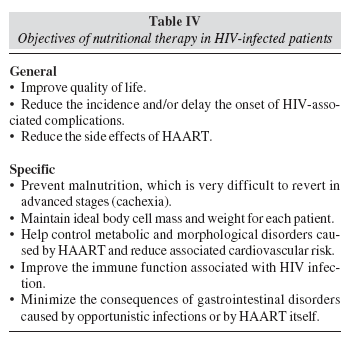
<body><![CDATA[<p><font face="Verdana"><b>Objectives of nutritional therapy</b></font></p>     <p><font face="Verdana" size="2"><a href="#t4">Table IV</a> shows the general and specific objectives of nutritional therapy in HIV-infected patients.<sup>39-42</sup> Now that most patients are taking HAART and have a suppressed viral load, the reduction of cardiovascular risk and monitoring of overweight are the most important objectives. Nutritional objectives should be set on an individual basis. Therefore, without ruling out protocols and clinical practice guides, problems should be prioritized, and the "ideal" objectives set by the physician should be adjusted to the individual patient.</font></p>     <p align="center"><font face="Verdana" size="2"><a name="t4"><img src="/img/revistas/nh/v22n2/original5_t4.gif"></a></font></p>     <p><font face="Verdana" size="2"><i>General recommendations</i></font></p>     <p><font face="Verdana" size="2">Nutritional intervention and education should form part of the HIV-infected patient&rsquo;s care package from diagnosis and throughout follow-up. There is firm scientific evidence that advice on nutrition, in addition to offering suitable dietary habits, is efficacious in improving the state of health of these patients.<sup>39</sup></font></p>     <p><font face="Verdana" size="2">Training for healthcare professionals, the development of behavioral skills, and the use of protocols and guidelines adapted to these patients can improve the quality of care. The following nutrition strategies should be applied to all HIV-infected patients: 1) integration of nutritional therapy in the patient&rsquo;s care package; 2) early nutritional intervention; 3) systematic nutritional evaluation from diagnosis and at each of the periodic check-ups; 4) tailored diet and adaptation of the diet to the different stages and chronic complications (glucose intolerance, dyslipidemia, hepatic or renal insufficiency, etc.).</font></p>     <p><font face="Verdana" size="2">It is particularly important to determine the risk of malnutrition in order to set priorities for evaluation and nutritional therapy. The <i>American Dietetic Association</i> (ADA) classifies this risk into three levels: high, medium, and low, and recommends that these interventions take place before one week in high-risk patients, and before one month in medium-risk patients. Furthermore, the ADA recommends adapting the visit schedule to the patient&rsquo;s CDC category (at least three visits per year in stage I, three to six visits in stages II and III), and carrying out more frequent monitoring in children.<sup>39,40</sup></font></p>     <p><font face="Verdana" size="2"><i>Recommendations</i></font></p>     <p><font face="Verdana" size="2">&bull; Integral health care for HIV-infected patients should include prevention and treatment of the frequent nutritional disorders presented by HIVinfected patients as a consequence of the infection itself, of the associated conditions, or of antiretroviral therapy (Level A).</font></p>     <p><font face="Verdana" size="2">&bull; Nutritional intervention should be early and periodic. It should be tailored to the HIV stage and to the type and intensity of the disorders mentioned above, and carried out by experts (Level C).</font></p>     ]]></body>
<body><![CDATA[<p>&nbsp;</p>     <p><font face="Verdana"><b>Lifestyles and psychological variables: nutritional advice</b></font></p>     <p><font face="Verdana" size="2">Prolonged use of drugs leads to toxicity, which has a proven impact on quality of life,<sup>43</sup> with the result that a multidisciplinary approach is essential. Therefore, patients must participate actively in decision-making and in the management and care of their illness.</font></p>     <p><font face="Verdana" size="2"><i>Therapeutic scenarios and the most frequent clinical situations</i></font></p>     <p><font face="Verdana" size="2">In the case of nutritional problems, the main challenge for the clinician is often to differentiate between whether the disorder is organic in nature, or psychological. The key lies in a wide view by the clinician, and visits should include, first, an evaluation of nutritional and emotional aspects and, second, the use of suitably communicative language.</font></p>     <p><font face="Verdana" size="2">There are two types of situation associated with nutrition in the HIV-infected patient:</font></p>     <p><font face="Verdana" size="2">1. <i>Physical symptoms that can have an organic, toxic, or psychological origin:</i> Tiredness, loss of appetite, dry mouth and throat, nausea, diarrhea/constipation, problems swallowing-if neither an organic nor iatrogenic cause can be determined, the patient should be asked</font></p>     <blockquote> 	    <p><font face="Verdana" size="2">1. if there have been any noticeable changes in his/her daily routine.</font></p> 	    <p><font face="Verdana" size="2">2. if any events in particular are worrying him/her.</font></p> 	    ]]></body>
<body><![CDATA[<p><font face="Verdana" size="2">3. about his/her state of mind.</font></p> </blockquote>     <p><font face="Verdana" size="2"><i>Approach:</i> if emotional problems are present or suspected as the origin of these symptoms, the patient must be referred to a psychologist or other qualified professional.</font></p>     <p><font face="Verdana" size="2">2. <i>Eating disorders based on a mental disorder:</i> These are very difficult to detect during a consultation, since the patient has no complaints and tends to hide any problems. Therefore, the clinician should use the physical signs of the disorder as clues. Advantage should be taken of any information on eating habits and health provided by those accompanying the patient.</font></p>     <p><font face="Verdana" size="2"><i>General clinical approach:</i> the interview is a basic tool given the possibility it offers to collect information and boost the physician-patient relationship. Feedback received during the interview is extremely important, since it allows teamwork to be continually redirected. Specialized questionnaires make it possible to obtain data on the patient&rsquo;s eating disorder. The ACTA questionnaire<sup>52</sup>is valid for this purpose.</font></p>     <p><font face="Verdana" size="2"><i>Communication strategies</i></font></p>     <p><font face="Verdana" size="2">The basic aspects of the communication process are as follows:</font></p>     <p><font face="Verdana" size="2"><i>Priorities.</i> When patients inform their physician. These situations are of particular interest, since they represent the manifestation of what is most worrying for the patient.</font></p>     <p><font face="Verdana" size="2"><i>Personality variables.</i> A patient&rsquo;s personality characteristics make him/her more or less receptive to advice on nutrition, as well as to adherence and cooperation with their therapy provider.</font></p>     <p><font face="Verdana" size="2"><i>Lifestyles.</i> When approaching therapy, it is always necessary to consider the patient&rsquo;s lifestyle and concerns, as these can condition his/her behavior.</font></p>     <p><font face="Verdana" size="2"><i>Recommendations</i></font></p>     ]]></body>
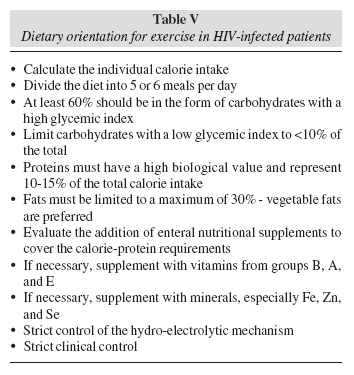
<body><![CDATA[<p><font face="Verdana" size="2">&bull; It is important to have support material during consultations in order to provide specific information and resources (Level C).</font></p>     <p><font face="Verdana" size="2">&bull; Non-profit-making organizations (NGO) are yet another element to extend these recommendations (Level C).</font></p>     <p><font face="Verdana" size="2">&bull; If emotional alterations are observed, the patient must be referred to a clinical psychologist and/or psychiatrist for evaluation and therapy (Level C).</font></p>     <p>&nbsp;</p>     <p><font face="Verdana"><b>Nutrition and physical exercise in HIV-infected patients</b></font></p>     <p><font face="Verdana" size="2">In recent years, different studies have been published on the effect of exercise on the status and progress of HIV-infected patients.<sup>55-58</sup> Moderate exercise also helps to maintain the metabolic capacity for synthesizing proteins, by increasing muscle mass, even in patients suffering from the wasting syndrome.<sup>59</sup></font></p>     <p><font face="Verdana" size="2"><i>Therapeutic approach to the HIV-infected patient</i></font></p>     <p><font face="Verdana" size="2"><a href="#t5">Table V</a> shows a series of simple norms to be followed.</font></p>     <p align="center"><font face="Verdana" size="2"><a name="t5"><img src="/img/revistas/nh/v22n2/original5_t5.gif"></a></font></p>     <p align="left"><font face="Verdana" size="2">Any HIV-infected patient deciding to train for and participate in a high-level event, such as a marathon or semi-professional or professional cycling event, should seek the advice of his/her physician, a personal trainer, and an expert in sports nutrition.</font></p>     ]]></body>
<body><![CDATA[<p><font face="Verdana" size="2"><i>Ergogenic aids</i></font></p>     <p><font face="Verdana" size="2">Ergogenic aids are any type of compound, substance, or external aid used to enhance sports performance.</font></p>     <p><font face="Verdana" size="2">Athletes, particularly in strength sports, use creatine as a means of increasing muscle mass and strength, and although its effects on healthy athletes are controversial, they continue to be used. In a recent study<sup>68</sup> involving patients on HAART, creatine was administered to a group of 17 patients, and placebo to a group of 16; creatine was observed to significantly improve lean muscle mass compared with placebo. However, in both groups, a similar increase in strength was observed (40%), with no significant differences.</font></p>     <p><font face="Verdana" size="2">Overloads of branched amino acids and proteins have also been used to increase lean mass. No improvement has been observed after use in comparisons with control groups.</font></p>     <p><font face="Verdana" size="2"><i>Recommendations</i></font></p>     <p><font face="Verdana" size="2">&bull; Aerobic and resistance exercise is beneficial for the cardiovascular health of patients with HIV infection (Level A).</font></p>     <p><font face="Verdana" size="2">&bull; Aerobic and resistance exercise can improve lean mass and muscular strength in HIV-infected patients on antiretrovirals (Level A).</font></p>     <p><font face="Verdana" size="2">&bull; There is not sufficient evidence to show the benefit of using ergogenic aids such as creatine in HIVinfected patients on antiretrovirals (Level C).</font></p>     <p><font face="Verdana" size="2">&bull; In any case, we must recommend moderate and regular aerobic sports, as this can also improve the mental health and quality of life of these patients, and become an important concomitant therapy (Level A).</font></p>     <p>&nbsp;</p>     ]]></body>
<body><![CDATA[<p><font face="Verdana"><b>Dietary recommendations in special situations</b></font></p>     <p><font face="Verdana" size="2">Dietary recommendations in special situations should aim to tailor food and meals to individual patient needs, improve and counter the effects brought about by special situations that could lead to malnutrition, optimize nutritional status, and prevent and/or treat possible nutritional deficiencies. We should include these recommendations during pregnancy, vegetarian diets, and recommendations for gastrointestinal alterations-these can be consulted in the complete document at <a target="_blank" href="http://www.msc.es">www.msc.es</a> and <a target="_blank" href="http://www.gesida.es">www.gesida.es</a></font></p>     <p><font face="Verdana" size="2"><i>Recommendations</i></font></p>     <p><font face="Verdana" size="2">&bull; During pregnancy and breastfeeding, the risk of malnutrition increases due to the increase in energy expenditure. Therefore, specific nutritional recommendations may not be sufficient, and it is necessary to evaluate the indication of nutritional support (Level B).</font></p>     <p><font face="Verdana" size="2">&bull; Advice on diet should be on an individual basis and adapted to the needs of each patient (Level C).</font></p>     <p>&nbsp;</p>     <p><font face="Verdana"><b>Norms for food safety</b></font></p>     <p><font face="Verdana" size="2">Quality of food and drinks is very important for HIV-infected individuals, especially when they have been inappropriately handled or when water is not suitable for drinking.<sup>78,79</sup></font></p>     <p><font face="Verdana" size="2"><i>Precautions to be taken with food and drinks</i></font></p>     <p><font face="Verdana" size="2">The following recommendations should be observed for the handling, preparation, and consumption of food and drinks:</font></p>     ]]></body>
<body><![CDATA[<p><font face="Verdana" size="2"><i>Safety</i>. Only foods that have been hygienically handled and have undergone the necessary checks by the corresponding health authorities should be eaten.</font></p>     <p><font face="Verdana" size="2"><i>Raw products</i>. Raw or lightly cooked eggs, meats, poultry, fish, or shellfish (including marinated products, anchovies in vinegar, etc.) should not be consumed. The same applies to milk or dairy products that have not been treated industrially.</font></p>     <p><font face="Verdana" size="2"><i>Eggs and sauces</i>. Patients should not consume unpasteurized sauces or other products made with eggs. Only packed sauces that have undergone heat treatment (mayonnaise, salsa rosa, b&eacute;arnaise, hollandaise, etc.) should be consumed</font></p>     <p><font face="Verdana" size="2"><i>Shopping</i>. When shopping for food, patients should pay particular attention to quality, both in the case of fresh products (vegetables, fruit, meat, etc.) and in the case of preserves (tinned food, frozen food, etc.). The characteristics of all foods should be verified.</font></p>     <p><font face="Verdana" size="2"><i>Storage</i>. Recently purchased foods should be conserved in suitable conditions. Thus, perishables (meat, poultry, and fish) must be stored in the refrigerator at temperatures below 3 ºC, and fruit, vegetables, eggs, and dairy produce at between 5 ºC and 7 ºC. Frozen foods should be kept at no more than -18 ºC.</font></p>     <p><font face="Verdana" size="2"><i>Thawing</i>. Frozen products (potatoes, croquettes, vegetables, etc.) can be consumed by heating them directly where possible. When this is not possible, they should be thawed for the necessary time by keeping them in the refrigerator until they have thawed.</font></p>     <p><font face="Verdana" size="2"><i>Preparation</i>. When food is being prepared for cooking or made ready for eating, special attention must be paid to handling. Avoid speaking, sneezing, coughing, or touching the face, nose or hair.</font></p>     <p><font face="Verdana" size="2"><i>Hand-washing.</i></font></p>     <p><font face="Verdana" size="2"><i>Conservation</i>. Those foods to be consumed after cooking and appropriate storage (e.g. in the refrigerator) should be reheated to boiling point in the case of soups and other liquid products, and to 70 ºC at the center of other products.</font></p>     <p>    ]]></body>
<body><![CDATA[<p><font face="Verdana" size="2"><i>Recommendations</i></font></p>     <p><font face="Verdana" size="2">&bull; Immunodepressed patients who receive suitable training and education in food hygiene and handling can benefit from improved health, with reduced incidence of diarrhea and the subsequent improvement in global nutritional status (Level C).</font></p>     <p><font face="Verdana" size="2">&bull; Training programs in food hygiene and manipulation should include a study of the food chain, from acquisition to preparation and consumption. Special attention should be paid to foods consumed outside the home (Level C).</font></p>     <p>&nbsp;</p>     <p><font face="Verdana"><b>Pharmacological interactions</b></font></p>     <p><font face="Verdana" size="2">HIV and drugs interact in 2 ways. On the one hand, HIV can affect the absorption of some active ingredients and reduce their bioavailability. On the other, some drugs can affect the patient&rsquo;s nutritional status by producing gastrointestinal side effects.<sup>87</sup> Any approach to this topic should also take into account food interactions, the consumption of drugs of abuse, and the increasingly extended use of the so-called "medicinal plants".<sup>88,89</sup></font></p>     <p><font face="Verdana" size="2">There are four types of interaction:</font></p>     <p><font face="Verdana" size="2">1. Effect of nutrients on pharmacokinetics. These effects are grouped according to how they affect the processes of release, absorption, distribution, metabolism, and elimination of drugs).</font></p>     <p><font face="Verdana" size="2">2. Effect of drugs on nutrient kinetics</font></p>     <blockquote> 	    ]]></body>
<body><![CDATA[<p><font face="Verdana" size="2">a) Effects on the metabolism<sup>91</sup></font></p> 	    <p><font face="Verdana" size="2">b) Effects on excretion<sup>92</sup></font></p> </blockquote>     <p><font face="Verdana" size="2">3. Effects of nutritional status on availability</font></p>     <blockquote> 	    <p><font face="Verdana" size="2">a) Gastrointestinal alterations</font></p> 	    <p><font face="Verdana" size="2">b) Liver alterations<sup>93,94</sup></font></p> </blockquote>     <p><font face="Verdana" size="2">4. Effect of drugs on nutritional status</font></p>     <blockquote> 	    <p><font face="Verdana" size="2">a) Action on gastrointestinal motility</font></p> </blockquote>     <p><font face="Verdana" size="2"><i>Recommendations</i></font></p>     ]]></body>
<body><![CDATA[<p><font face="Verdana" size="2">&bull; The only antiretroviral whose pharmacokinetics is affected by food is didanosine (Level A).</font></p>     <p><font face="Verdana" size="2">&bull; Knowledge and efficacious management of drugfood interactions can influence the success of treatment and slow down the progress of the disease (Level C).</font></p>     <p><font face="Verdana" size="2">&bull; The consumption of some herbal preparations can compromise the efficacy of antiretrovirals that are metabolized by CYP450 3A4 (Level A).</font></p>     <p><font face="Verdana" size="2">&bull; Calcium and phosphorus determinations should be made in patients being treated with tenofovir due to the possibility of developing hypophosphatemia (Level B).</font></p>     <p>&nbsp;</p>     <p><font face="Verdana"><b>Pharmacological therapy</b></font></p>     <p><font face="Verdana" size="2">Several pharmacological treatments have been tried to improve the clinical signs of cachexia, i.e., anorexia and extreme weight loss.</font></p>     <p><font face="Verdana" size="2">The drugs studied can be classified according to their mechanism of action as orexins or appetite stimulants, anabolic steroids, and cytokine production modulators (see <a href="#t6">Table VI</a>).</font></p>     <p align="center"><font face="Verdana" size="2"><a name="t6"><img src="/img/revistas/nh/v22n2/original5_t6.gif"></a></font></p>     <p><font face="Verdana" size="2"><i>Appetite stimulants</i><sup>95-101</sup></font></p>     ]]></body>
<body><![CDATA[<p><font face="Verdana" size="2">The best-known and used drugs in HIV patients are megestrol acetate and dronabinol. Both have CNS, gastrointestinal and cardiovascular side effects. Despite this, the results obtained in patients suffering from anorexia have been satisfactory.</font></p>     <p><font face="Verdana" size="2"><i>Anabolic steroids</i></font></p>     <p><font face="Verdana" size="2">Testosterone has been shown to increase body lean mass and improve quality of life.<sup>103,104</sup> In addition, an improvement in insulin sensitivity has been observed.</font></p>     <p><font face="Verdana" size="2">The use of other synthetic anabolic agents such as oxandrolone, nandrolone, and oxymetholone has also been associated with an increase in weight and lean mass in patients with HIV-associated cachexia in placebo-controlled studies both in isolation and associated with resistance exercise.<sup>104</sup> Nevertheless, despite being associated with increases in lean mass, testosterone or its derivatives at supraphysiological doses in eugonadal males can reduce HDL levels and cause liver dysfunction and hypogonadism; therefore, it should be used with caution.</font></p>     <p><font face="Verdana" size="2">More recent studies do not show any advantage with nandrolone in patients with moderate or severe weight loss compared with growth hormone (GH).<sup>105</sup></font></p>     <p>    <p><font face="Verdana" size="2">Recombinant GH in isolation has improved nitrogen balance and increased lean mass and body weight in HIV-infected patients with cachexia. Furthermore, it seems to provide certain advantages with regard to improved functional capacity and quality of life compared with testosterone and other anabolic steroids.<sup>104</sup></font></p>     <p><font face="Verdana" size="2"><i>Multivitamins</i></font></p>     <p><font face="Verdana" size="2">The administration of vitamin and oligoelement supplements continues to be controversial, there being no accurate definition of ideal recommendations for this type of patient.<sup>108</sup> If a micronutrient deficiency is detected, we recommend replacing the drug following the same lines as in any other situation of deficiency.</font></p>     <p><font face="Verdana" size="2"><i>Recommendations</i></font></p>     ]]></body>
<body><![CDATA[<p><font face="Verdana" size="2">&bull; HIV-infected patients with anorexia-cachexia syndrome must be treated. Therapy should be tailored and should include therapy specific to HIV infection and opportunistic infections, identification and treatment of the causes of malnutrition, and provision of appropriate pharmacological and nutritional support (Level A).</font></p>     <p><font face="Verdana" size="2">&bull; If AIDS-related cachexia is accompanied by anorexia, appetite stimulants should be used. Hypogonadism in males should be treated with testosterone (Level A).</font></p>     <p><font face="Verdana" size="2">&bull; Anabolic agents and resistance training can be used to improve weight and body composition on an individual basis (B).</font></p>     <p><font face="Verdana" size="2">See <a target="_blank" href="/img/revistas/nh/v22n2/original5_f3.gif"> figure 1</a></font><b>    <p><font face="Verdana">Artificial nutrition</font></b></p>     <p><font face="Verdana" size="2">Artificial nutrition is indicated in all undernourished patients or in patients at risk of undernourishment who cannot, or do not want to eat by mouth.</font></p>     <p><font face="Verdana" size="2">The following patients are eligible for oral supplementation (OS)<sup>112,113</sup> and enteral nutrition (EN):</font></p>     <blockquote> 	    <p><font face="Verdana" size="2">- patients who maintain a sufficient digestive functional capacity with scarce oral intake (&lt; 1000 kcal and 30 g of proteins).</font></p> 	    <p><font face="Verdana" size="2">- patients who present processes such as dysphagia (motor or functional) and who have a risk of malnutrition or already present frank malnutrition.</font></p> 	    ]]></body>
<body><![CDATA[<p><font face="Verdana" size="2">- patients who present malabsorption-maldigestion and who have a risk of malnutrition or already present frank malnutrition.</font></p> 	    <p><font face="Verdana" size="2">- patients with poor adherence to antiretroviral therapy.</font></p> 	    <p><font face="Verdana" size="2">- patients with opportunistic infections or tumors.</font></p> </blockquote>     <p><font face="Verdana" size="2">Patients for whom EN is contraindicated or for whom it does not cover 100% of their needs are eligible for parenteral nutrition (PN).</font></p>     <p><font face="Verdana" size="2"><i>Oral supplementation</i> is indicated when natural food is sufficient to cover the body&rsquo;s needs and the patient has a functioning intestine. The different formulas of OS can prove effective to increase the total supply of energy and micronutrients in these patients. <i>Enteral nutrition.</i> The indications would be insurmountable anorexia, severe malnutrition, motor or functional odynophagia and/or dysphagia, tumors, neurological alterations, enteropathy, pancreatitis, side effects of radiotherapy and chemotherapy, and low-flow fistulas. The access route depends on the patient&rsquo;s clinical situation and the expected duration of the intervention. The oral route is indicated in patients who adhere to therapy, do not have dysphagia, and who accept the product. The nasogastric route is for patients with motor or functional dysphagia, or undernourished patients who require extra amounts and cannot ingest them orally. In some cases, it may be necessary to use a nasoenteric tube or an ostomy.</font></p>     <p><font face="Verdana" size="2">There is no consensus on the best enteral formula for HIV-infected patients.<sup>114-116</sup> The most important factor is that the choice of enteral formula in this group cater for the patient&rsquo;s clinical situation at all times, taking into account the degree of catabolism, requirements, digestive function, concomitant digestive disorders, etc., as for the healthy population. Enteral nutrition can be administered in boluses, with gravity systems, or with infusion pumps (this system is obligatory in patients with jejunostomy).</font></p>     <p><font face="Verdana" size="2"><i>Parenteral nutrition</i> is indicated in patients for whom EN is contraindicated, but who need nutritional support; or in patients with opportunistic infections which lead to severe diarrhea and malabsorption; and in patients who cover at least 75% of their requirements with EN. Patients with HIV infection have a high degree of catabolism with very high calorie-protein needs. Furthermore, special care must be taken with some elements such as zinc and selenium. Therefore, for the PN formula, the following are recommended:<sup>117-118</sup></font></p>     <blockquote> 	    <p><font face="Verdana" size="2">- Calorie intake: 35 kcal/kg/day; l.</font></p> 	    <p><font face="Verdana" size="2">- Nitrogen intake: between 1.2 - 1.75 g/kg/day of protein.</font></p> 	    ]]></body>
<body><![CDATA[<p><font face="Verdana" size="2">- 60%-70% of the non-protein calorie intake must be carbohydrates (glucose). No more than 5 mg/kg/min of glucose.</font></p> 	    <p><font face="Verdana" size="2">- 30%-40% of the non-protein calorie intake must be lipids. No more than 0.11 g/kg/h.</font></p> 	    <p><font face="Verdana" size="2">- Iron, mineral, vitamins, oligoelements and water supplements will be administered on an individual basis.</font></p> </blockquote>     <p><font face="Verdana" size="2"><i>Home artificial nutrition</i>.<sup>119</sup> This allows patients the benefits of AN at home with the aim of optimizing their quality of life. It requires the collaboration and training of patients and their families in home artificial nutrition techniques and a minimum availability of human and material resources.</font></p>     <p><font face="Verdana" size="2"><i>Recommendations</i></font></p>     <p><font face="Verdana" size="2">&bull; OS with artificial formulas optimizes the response to therapy and improves patients&rsquo; nutritional status (B).</font></p>     <p><font face="Verdana" size="2">&bull; Oral EN via tube or ostomy is safe and efficient since it improves nutritional status with a gain in weight, lean mass and fatty mass, provides functional benefits (immune system and quality of life), and the different formulas are well tolerated. There is no evidence that immunomodulatory formulas offer additional advantages (B).</font></p>     <p><font face="Verdana" size="2">&bull; The choice of enteral formula in HIV-infected patients must take into account the patient&rsquo;s clinical situation at all times, given the degree of catabolism, requirements, digestive function, concomitant metabolic disorders, etc., as with the healthy population (C).</font></p>     <p><font face="Verdana" size="2">&bull; Nutritional support with PN in HIV-infected patients must take into account the same factors as for other groups (C).</font></p>     <p>&nbsp;</p>     ]]></body>
<body><![CDATA[<p><font face="Verdana"><b>Nutrition in HIV-infected children</b></font></p>     <p><font face="Verdana" size="2"><i>Nutritional risk situations in HIV-infected children</i></font></p>     <p><font face="Verdana" size="2">The introduction of HAART during the early months of life means that it is unusual to find undernourished children. Children with a stable disease may suffer from subclinical undernourishment (suboptimal intake of essential nutrients), especially during puberty. The coexistence of lipodystrophy, dyslipidemia, insulin resistance, and inadequate bone mineralization complicates diet planning. Paradoxically, overweight is increasingly common, due to the excessive intake of calories and fats, which mirrors the situation in healthy children of the same age.</font></p>     <p><font face="Verdana" size="2"><i>Nutritional evaluation</i></font></p>     <p><font face="Verdana" size="2">This should include a clinical history, dietary history, physical examination, anthropometry, body composition markers, and complementary examinations (bone age, DXA of the spinal column).</font></p>     <p><font face="Verdana" size="2"><i>Consequences of a change in habits and diet among children in our area</i></font></p>     <p><font face="Verdana" size="2">Our objective is to promote from an early age a healthy lifestyle with physical activity and a healthy diet. In developed countries there has been a change in the consumption of food in the population aged &lt; 18 years. This involves sweet fizzy drinks, non-citric fruit nectars, pizzas, salted snacks, semi-skimmed milk, and a reduction of as much as 36% in whole milk, bread, fruit and vegetables. The current situation of children is further complicated by sedentary habits, and the danger of obesity and osteoporosis.<sup>121,122</sup></font></p>     <p><font face="Verdana" size="2"><i>Nutritional intervention</i></font></p>     <p><font face="Verdana" size="2">This is the set of measures necessary to achieve an optimal nutritional situation, by avoiding metabolic and cardiovascular risks.</font></p>     <blockquote> 	    ]]></body>
<body><![CDATA[<p><font face="Verdana" size="2">1. <i>Efficacious HAART.</i> Associated with an improved nutritional status. The first intervention should be an efficacious therapeutic regimen.<sup>123</sup></font></p> 	    <p><font face="Verdana" size="2">2. <i>Carefully selected HAART</i>. There is no ideal regimen; therapy should be initiated when strictly necessary and less toxic NRTIs should be combined with NNRTIs or PIs with a better metabolic profile.<sup>124</sup></font></p> 	    <p><font face="Verdana" size="2">3. <i>Diet</i>. Recommendations on energy requirements should take age into account and will be modified according to physical activity (sedentary, active, or sporting)<sup>121,125</sup> (<a href="#t7">table VII</a>). The most important nutritional problem for infected children today is the increase in lipids and the risk of osteopenia.<sup>123,126</sup></font></p> 	    <p align="center"><font face="Verdana" size="2"><a name="t7"><img src="/img/revistas/nh/v22n2/original5_t7.gif"></a></font></p> 	    <p><font face="Verdana" size="2">4. <i>Dietary supplements.</i> Vitamins are indicated in risk situations-the first year of life (A and D), and in isolated cases, e.g. convalescence from severe infections, and occasionally in adolescents. Bisphosphonates in proven osteoporosis or pathological fractures could be indicated in children.</font></p> 	    <p><font face="Verdana" size="2">5. <i>Lifestyle changes.</i> Physical exercise reduces blood lipid levels, evens heart rate, reduces the frequency of AHT, and improves bone mineralization. These benefits are more obvious in pre-adolescence.</font></p> 	    <p><font face="Verdana" size="2">6. <i>Other treatments</i>. At present, statins and fibrates are only indicated in selected adolescent cases.</font></p> </blockquote>     <p><font face="Verdana" size="2"><i>Recommendations</i></font></p>     <p><font face="Verdana" size="2">&bull; Nutritional recommendations in HIV-infected children should be early and form part of integral therapy (Level A).</font></p>     <p><font face="Verdana" size="2">&bull; Recommendations on energy intake in infected children should be made taking into account age and sex, although a dynamic calculation will als o be made and modified according to the degree of physical activity (Level B).</font></p>     ]]></body>
<body><![CDATA[<p><font face="Verdana" size="2">&bull; Supplementation with multivitamins and minerals can be occasionally recommended, especially if diet is deficient and during periods of risk: first year of life, convalescence, and adolescence (Level B).</font></p>     <p><font face="Verdana" size="2">&bull; Vitamin D and calcium supplements have not been shown to be efficacious in children with osteopenia; the best approach is to ensure that the recommendations for intake of dairy products are being observed (Level B and C).</font></p>     <p><font face="Verdana" size="2">&bull; Physical exercise in children reduces blood lipid levels, evens heart rate, reduces the frequency of AHT, and improves bone mineralization. These benefits are very obvious in pre-adolescence (Level B).</font></p>     <p><font face="Verdana" size="2">&bull; At present, there are no indications for pediatric administration of drugs that modify blood lipids and insulin resistance, such as the statins and fibrates used in adults. These are only authorized in selected adolescent cases (Level B).</font></p>     <p>&nbsp;</p>     <p><font face="Verdana"><B>References</B></font></p>     <!-- ref --><p><font face="Verdana" size="2">1. Shevitz AH, Knox TA: Nutrition in the era of highly active antiretroviral therapy. Clin Infect Dis 2001; 32: 1769-1775.</font>&nbsp;&nbsp;&nbsp;&nbsp;&nbsp;&nbsp;&nbsp;&nbsp;[&#160;<a href="javascript:void(0);" onclick="javascript: window.open('/scielo.php?script=sci_nlinks&ref=3499925&pid=S0212-1611200700020001400001&lng=','','width=640,height=500,resizable=yes,scrollbars=1,menubar=yes,');">Links</a>&#160;]<!-- end-ref --><!-- ref --><p><font face="Verdana" size="2">2. Kathleen Mahan L, Escott-Stump S: Nutrici&oacute;n y Dietoterapia de Krause. Ed. McGraw-Hill Interamericana Editores. 11º Edici&oacute;n, M&eacute;xico 2003.</font>&nbsp;&nbsp;&nbsp;&nbsp;&nbsp;&nbsp;&nbsp;&nbsp;[&#160;<a href="javascript:void(0);" onclick="javascript: window.open('/scielo.php?script=sci_nlinks&ref=3499926&pid=S0212-1611200700020001400002&lng=','','width=640,height=500,resizable=yes,scrollbars=1,menubar=yes,');">Links</a>&#160;]<!-- end-ref --><!-- ref --><p><font face="Verdana" size="2">3. Polo R, Galindo MJ, Mart&iacute;nez E et al.: GEAM/SPNS recommendations for managing metabolic and morphologic alterations in patients with HIV infection. Nutrition and Metabolic Disorders in HIV Infections Apr-Jun 2005; 3(3): 467-73.</font>&nbsp;&nbsp;&nbsp;&nbsp;&nbsp;&nbsp;&nbsp;&nbsp;[&#160;<a href="javascript:void(0);" onclick="javascript: window.open('/scielo.php?script=sci_nlinks&ref=3499927&pid=S0212-1611200700020001400003&lng=','','width=640,height=500,resizable=yes,scrollbars=1,menubar=yes,');">Links</a>&#160;]<!-- end-ref --><!-- ref --><p><font face="Verdana" size="2">4. Gil Hern&aacute;ndez A: Tratado de Nutrici&oacute;n. Acci&oacute;n Medica ED. Madrid. 2005.</font>&nbsp;&nbsp;&nbsp;&nbsp;&nbsp;&nbsp;&nbsp;&nbsp;[&#160;<a href="javascript:void(0);" onclick="javascript: window.open('/scielo.php?script=sci_nlinks&ref=3499928&pid=S0212-1611200700020001400004&lng=','','width=640,height=500,resizable=yes,scrollbars=1,menubar=yes,');">Links</a>&#160;]<!-- end-ref --><!-- ref --><p><font face="Verdana" size="2">5. R Polo: Manual de Nutrici&oacute;n y Sida. Ed Rosa Polo. Graficas Nilo. Madrid 2002.</font>&nbsp;&nbsp;&nbsp;&nbsp;&nbsp;&nbsp;&nbsp;&nbsp;[&#160;<a href="javascript:void(0);" onclick="javascript: window.open('/scielo.php?script=sci_nlinks&ref=3499929&pid=S0212-1611200700020001400005&lng=','','width=640,height=500,resizable=yes,scrollbars=1,menubar=yes,');">Links</a>&#160;]<!-- end-ref --><!-- ref --><p><font face="Verdana" size="2">6. National Academy of Sciences, Institute of Medicine, Food and Nutrition Board. Dietary Reference Intakes for Energy, Carbohydrate, Fiber, Fat, Fatty Acids, Cholesterol, Protein, and Amino Acids. National Academy Press, September 2002.</font>&nbsp;&nbsp;&nbsp;&nbsp;&nbsp;&nbsp;&nbsp;&nbsp;[&#160;<a href="javascript:void(0);" onclick="javascript: window.open('/scielo.php?script=sci_nlinks&ref=3499930&pid=S0212-1611200700020001400006&lng=','','width=640,height=500,resizable=yes,scrollbars=1,menubar=yes,');">Links</a>&#160;]<!-- end-ref --><!-- ref --><p><font face="Verdana" size="2">7. Diet, Nutrition and the Prevention of Chronic Diseases; report of a Joint WHO/FAO Expert Consultation; WHO Technical Report Series 916, WHO Geneva 2003</font>&nbsp;&nbsp;&nbsp;&nbsp;&nbsp;&nbsp;&nbsp;&nbsp;[&#160;<a href="javascript:void(0);" onclick="javascript: window.open('/scielo.php?script=sci_nlinks&ref=3499931&pid=S0212-1611200700020001400007&lng=','','width=640,height=500,resizable=yes,scrollbars=1,menubar=yes,');">Links</a>&#160;]<!-- end-ref --><!-- ref --><p><font face="Verdana" size="2">8. Sobre alimentaci&oacute;n y atenci&oacute;n nutricional en hospitales. Resoluci&oacute;n del Comit&eacute; de Ministros del Consejo de Europa de 12 de noviembre de 2003.<a target="_blank" href="https://wcm.coe.int/rsi/CM/index.jsp">https://wcm.coe.int/rsi/CM/index.jsp</a></font>&nbsp;&nbsp;&nbsp;&nbsp;&nbsp;&nbsp;&nbsp;&nbsp;[&#160;<a href="javascript:void(0);" onclick="javascript: window.open('/scielo.php?script=sci_nlinks&ref=3499932&pid=S0212-1611200700020001400008&lng=','','width=640,height=500,resizable=yes,scrollbars=1,menubar=yes,');">Links</a>&#160;]<!-- end-ref --><!-- ref --><p><font face="Verdana" size="2">9. Mulligan K, Tai VW, Schambelan M: Cross sectional and longitudinal evaluation of body composition in men with HIV infection. J Acquired Immune Defic Syndr Hum Retrovirol 1997b; 15: 43-48.</font>&nbsp;&nbsp;&nbsp;&nbsp;&nbsp;&nbsp;&nbsp;&nbsp;[&#160;<a href="javascript:void(0);" onclick="javascript: window.open('/scielo.php?script=sci_nlinks&ref=3499933&pid=S0212-1611200700020001400009&lng=','','width=640,height=500,resizable=yes,scrollbars=1,menubar=yes,');">Links</a>&#160;]<!-- end-ref --><!-- ref --><p><font face="Verdana" size="2">10. Wanke CA, Silva M, Knox TA et al.: Weight loss and wasting remain common complications in individuals infected with human immunodeficiency virus in the era of highly active antiretroviral therapy. Clin Infect Dis 2000; 31: 803-805.</font>&nbsp;&nbsp;&nbsp;&nbsp;&nbsp;&nbsp;&nbsp;&nbsp;[&#160;<a href="javascript:void(0);" onclick="javascript: window.open('/scielo.php?script=sci_nlinks&ref=3499934&pid=S0212-1611200700020001400010&lng=','','width=640,height=500,resizable=yes,scrollbars=1,menubar=yes,');">Links</a>&#160;]<!-- end-ref --><!-- ref --><p><font face="Verdana" size="2">11. Polsky B, Kotler D, Stenihart C: HIV associated wasting in the HAART era: guidelines for assessment, diagnosis and treatment. AIDS patients Care STDs 2001; 15: 411-423.</font>&nbsp;&nbsp;&nbsp;&nbsp;&nbsp;&nbsp;&nbsp;&nbsp;[&#160;<a href="javascript:void(0);" onclick="javascript: window.open('/scielo.php?script=sci_nlinks&ref=3499935&pid=S0212-1611200700020001400011&lng=','','width=640,height=500,resizable=yes,scrollbars=1,menubar=yes,');">Links</a>&#160;]<!-- end-ref --><!-- ref --><p><font face="Verdana" size="2">12. Kotler DP, Tierney A R, Wang J, Pierson R: Magnitude of body-cell-mass depletion and the timing of death from wastingin AIDS. Am J Clin Nutr 1989; 50: 444-447.</font>&nbsp;&nbsp;&nbsp;&nbsp;&nbsp;&nbsp;&nbsp;&nbsp;[&#160;<a href="javascript:void(0);" onclick="javascript: window.open('/scielo.php?script=sci_nlinks&ref=3499936&pid=S0212-1611200700020001400012&lng=','','width=640,height=500,resizable=yes,scrollbars=1,menubar=yes,');">Links</a>&#160;]<!-- end-ref --><!-- ref --><p><font face="Verdana" size="2">13. Polo R, Galindo MJ, Mart&iacute;nez E, &Aacute;lvarez J et al.: Recomendaciones de GEAM/SPNS sobre el manejo de las alteraciones metab&oacute;licas y morfol&oacute;gicas en el paciente con infecci&oacute;n por VIH. 2005.</font>&nbsp;&nbsp;&nbsp;&nbsp;&nbsp;&nbsp;&nbsp;&nbsp;[&#160;<a href="javascript:void(0);" onclick="javascript: window.open('/scielo.php?script=sci_nlinks&ref=3499937&pid=S0212-1611200700020001400013&lng=','','width=640,height=500,resizable=yes,scrollbars=1,menubar=yes,');">Links</a>&#160;]<!-- end-ref --><!-- ref --><p><font face="Verdana" size="2">14. Wanke C: Pathogenesis and consequences of HIV associated wasting. J Acquir Immune Defic Syndr 2004; 37 (Supl. 5): S277-S279.</font>&nbsp;&nbsp;&nbsp;&nbsp;&nbsp;&nbsp;&nbsp;&nbsp;[&#160;<a href="javascript:void(0);" onclick="javascript: window.open('/scielo.php?script=sci_nlinks&ref=3499938&pid=S0212-1611200700020001400014&lng=','','width=640,height=500,resizable=yes,scrollbars=1,menubar=yes,');">Links</a>&#160;]<!-- end-ref --><!-- ref --><p><font face="Verdana" size="2">15. Kotler D: Challenges to diagnosis of HIV-associated wasting. J Acquir Immune Defic Syndr 2004; 37 (Supl. 5): S280-S283.</font>&nbsp;&nbsp;&nbsp;&nbsp;&nbsp;&nbsp;&nbsp;&nbsp;[&#160;<a href="javascript:void(0);" onclick="javascript: window.open('/scielo.php?script=sci_nlinks&ref=3499939&pid=S0212-1611200700020001400015&lng=','','width=640,height=500,resizable=yes,scrollbars=1,menubar=yes,');">Links</a>&#160;]<!-- end-ref --><!-- ref --><p><font face="Verdana" size="2">16. Mart&iacute;nez Valls JF, Mesejo A, Gimeno V: Principios generales. En: Manual b&aacute;sico de nutrici&oacute;n cl&iacute;nica y diet&eacute;tica. Coordinador Mesejo Arizmendi A. Editorial Generalitat Valenciana. 2000.</font>&nbsp;&nbsp;&nbsp;&nbsp;&nbsp;&nbsp;&nbsp;&nbsp;[&#160;<a href="javascript:void(0);" onclick="javascript: window.open('/scielo.php?script=sci_nlinks&ref=3499940&pid=S0212-1611200700020001400016&lng=','','width=640,height=500,resizable=yes,scrollbars=1,menubar=yes,');">Links</a>&#160;]<!-- end-ref --><!-- ref --><p><font face="Verdana" size="2">17. Food and Nutrition Board. Recommended Dietary Allowances. 10th edition. Washington, Dc: National Academy Press; 1989.</font>&nbsp;&nbsp;&nbsp;&nbsp;&nbsp;&nbsp;&nbsp;&nbsp;[&#160;<a href="javascript:void(0);" onclick="javascript: window.open('/scielo.php?script=sci_nlinks&ref=3499941&pid=S0212-1611200700020001400017&lng=','','width=640,height=500,resizable=yes,scrollbars=1,menubar=yes,');">Links</a>&#160;]<!-- end-ref --><!-- ref --><p><font face="Verdana" size="2">18. Association of Nutrition Services Agencies (ANSA). Nutrition Guidelines for Agencies providing food to people living with HIV disease. 2nd ed. Washington, DC, 2002.<a target="_blank" href="http://www.aidsnutrition.org">www.aidsnutrition.org</a> (acceso noviembre 2005).</font>&nbsp;&nbsp;&nbsp;&nbsp;&nbsp;&nbsp;&nbsp;&nbsp;[&#160;<a href="javascript:void(0);" onclick="javascript: window.open('/scielo.php?script=sci_nlinks&ref=3499942&pid=S0212-1611200700020001400018&lng=','','width=640,height=500,resizable=yes,scrollbars=1,menubar=yes,');">Links</a>&#160;]<!-- end-ref --><!-- ref --><p><font face="Verdana" size="2">19. British Columbia Centre for excellence in HIV/AIDS. Therapeutic Guidelines for HIV/AIDS and related conditions. Section 9:2. December 2001.</font>&nbsp;&nbsp;&nbsp;&nbsp;&nbsp;&nbsp;&nbsp;&nbsp;[&#160;<a href="javascript:void(0);" onclick="javascript: window.open('/scielo.php?script=sci_nlinks&ref=3499943&pid=S0212-1611200700020001400019&lng=','','width=640,height=500,resizable=yes,scrollbars=1,menubar=yes,');">Links</a>&#160;]<!-- end-ref --><!-- ref --><p><font face="Verdana" size="2">20. New York state department of Health. Criteria for the medical care of adults with HIV. New York, NY: New York state department of Health; 2001.</font>&nbsp;&nbsp;&nbsp;&nbsp;&nbsp;&nbsp;&nbsp;&nbsp;[&#160;<a href="javascript:void(0);" onclick="javascript: window.open('/scielo.php?script=sci_nlinks&ref=3499944&pid=S0212-1611200700020001400020&lng=','','width=640,height=500,resizable=yes,scrollbars=1,menubar=yes,');">Links</a>&#160;]<!-- end-ref --><!-- ref --><p><font face="Verdana" size="2">21. The American Dietetic Association: Nutrition Management of HIV infection and AIDS. En: Goot SA et al., eds. American Manual of Clinical Dietetics, 5<sup>th</sup> ed. Chicago, Ill. section 5:388; 1996.</font>&nbsp;&nbsp;&nbsp;&nbsp;&nbsp;&nbsp;&nbsp;&nbsp;[&#160;<a href="javascript:void(0);" onclick="javascript: window.open('/scielo.php?script=sci_nlinks&ref=3499945&pid=S0212-1611200700020001400021&lng=','','width=640,height=500,resizable=yes,scrollbars=1,menubar=yes,');">Links</a>&#160;]<!-- end-ref --><!-- ref --><p><font face="Verdana" size="2">22. Nutrient requirements for people living with HIV/AIDS: report of a technical consultation. World Health Organization; Geneva, Switzerland. 2003.<a target="_blank" href="http://www.who.int/nut/documents/hivaids_nut_require.pdf">http://www.who.int/nut/documents/hivaids_nut_require.pdf</a> (Access November 2005).</font>&nbsp;&nbsp;&nbsp;&nbsp;&nbsp;&nbsp;&nbsp;&nbsp;[&#160;<a href="javascript:void(0);" onclick="javascript: window.open('/scielo.php?script=sci_nlinks&ref=3499946&pid=S0212-1611200700020001400022&lng=','','width=640,height=500,resizable=yes,scrollbars=1,menubar=yes,');">Links</a>&#160;]<!-- end-ref --><!-- ref --><p><font face="Verdana" size="2">23. HIV/AIDS: A Guide por Nutritional Care and Support, 2nd ed. Food and Nutrition Technical Assistance Project, Academy for Educational Development, Washington DC, 2004.<a target="_blank" href="http://www.fantaproject.org/downloads/pdfs/HIV_nut_reqs_2004.pdf">http://www.fantaproject.org/downloads/pdfs/HIV_nut_reqs_2004.pdf</a> y <a target="_blank" href="http://www.fantaproject.org/downloads/pdfs/HIVAIDS_Guide02.pdf">http://www.fantaproject.org/downloads/pdfs/HIVAIDS_Guide02.pdf</a> (Access November 2005).</font>&nbsp;&nbsp;&nbsp;&nbsp;&nbsp;&nbsp;&nbsp;&nbsp;[&#160;<a href="javascript:void(0);" onclick="javascript: window.open('/scielo.php?script=sci_nlinks&ref=3499947&pid=S0212-1611200700020001400023&lng=','','width=640,height=500,resizable=yes,scrollbars=1,menubar=yes,');">Links</a>&#160;]<!-- end-ref --><!-- ref --><p><font face="Verdana" size="2">24. Lau N, Kotler DP: Acquired Immunodeficiency Syndrome and Parenteral Nutrition. In: Parenteral Nutrition (JL Rombeau, RH Rolandelli eds). WB Saunders; Philadelphia, PA. 2001.</font>&nbsp;&nbsp;&nbsp;&nbsp;&nbsp;&nbsp;&nbsp;&nbsp;[&#160;<a href="javascript:void(0);" onclick="javascript: window.open('/scielo.php?script=sci_nlinks&ref=3499948&pid=S0212-1611200700020001400024&lng=','','width=640,height=500,resizable=yes,scrollbars=1,menubar=yes,');">Links</a>&#160;]<!-- end-ref --><!-- ref --><p><font face="Verdana" size="2">25. Irlam JH, Visser ME, Rollins N et al.: Micronutrient supplementation in children and adults with HIV infection (review). The Cochrane database of systematic Reviews 2005, Issue 4. Art. No.: CD003650.pub2. DOI: 10.1002/14651858.CD003650.pub2. Version online 19 October 2005.</font>&nbsp;&nbsp;&nbsp;&nbsp;&nbsp;&nbsp;&nbsp;&nbsp;[&#160;<a href="javascript:void(0);" onclick="javascript: window.open('/scielo.php?script=sci_nlinks&ref=3499949&pid=S0212-1611200700020001400025&lng=','','width=640,height=500,resizable=yes,scrollbars=1,menubar=yes,');">Links</a>&#160;]<!-- end-ref --><!-- ref --><p><font face="Verdana" size="2">26. National Academy of Sciences-Food and Nutrition Board. <a href="http://www.nas.edu." target="_blank">http://www.nas.edu.</a></font>&nbsp;&nbsp;&nbsp;&nbsp;&nbsp;&nbsp;&nbsp;&nbsp;[&#160;<a href="javascript:void(0);" onclick="javascript: window.open('/scielo.php?script=sci_nlinks&ref=3499950&pid=S0212-1611200700020001400026&lng=','','width=640,height=500,resizable=yes,scrollbars=1,menubar=yes,');">Links</a>&#160;]<!-- end-ref --><!-- ref --><p><font face="Verdana" size="2">27. Campa A, Yang Z, Lai S et al.: HIV-related wasting in HIV-infected drug users in the era of HAART. CID 2005; 41: 1179-85</font>&nbsp;&nbsp;&nbsp;&nbsp;&nbsp;&nbsp;&nbsp;&nbsp;[&#160;<a href="javascript:void(0);" onclick="javascript: window.open('/scielo.php?script=sci_nlinks&ref=3499951&pid=S0212-1611200700020001400027&lng=','','width=640,height=500,resizable=yes,scrollbars=1,menubar=yes,');">Links</a>&#160;]<!-- end-ref --><!-- ref --><p><font face="Verdana" size="2">28. Newton JM, Halsted CH: Clinical and functional assessment of adults. In: Shils ME, Olson JA, Shike M, Ross AC (eds). Modern nutrition in health and disease. Baltimore: Williams &amp; Wilkins, 9th edition, 1999, pp. 895-902.</font>&nbsp;&nbsp;&nbsp;&nbsp;&nbsp;&nbsp;&nbsp;&nbsp;[&#160;<a href="javascript:void(0);" onclick="javascript: window.open('/scielo.php?script=sci_nlinks&ref=3499952&pid=S0212-1611200700020001400028&lng=','','width=640,height=500,resizable=yes,scrollbars=1,menubar=yes,');">Links</a>&#160;]<!-- end-ref --><!-- ref --><p><font face="Verdana" size="2">29. Marianne AB, van der Sande MD, MPH PhD, * Maarten F, Schim van der Loeff MD MSc PhD, Akum A, Aveika B et al.: Body Mass Index at Time of HIV Diagnosis. A Strong and Independent Predictor of Survival J Acquir Immune Defic Syndr 2004; 37(2): 1288-94.</font>&nbsp;&nbsp;&nbsp;&nbsp;&nbsp;&nbsp;&nbsp;&nbsp;[&#160;<a href="javascript:void(0);" onclick="javascript: window.open('/scielo.php?script=sci_nlinks&ref=3499953&pid=S0212-1611200700020001400029&lng=','','width=640,height=500,resizable=yes,scrollbars=1,menubar=yes,');">Links</a>&#160;]<!-- end-ref --><!-- ref --><p><font face="Verdana" size="2">30. Detsky AS, McLaghlin JR, Baker JP, Johnston N, Whittaker S, Mendelson RA et al.: What is subjective global assessment of nutritional status? JPEN 1987; 11: 8-13.</font>&nbsp;&nbsp;&nbsp;&nbsp;&nbsp;&nbsp;&nbsp;&nbsp;[&#160;<a href="javascript:void(0);" onclick="javascript: window.open('/scielo.php?script=sci_nlinks&ref=3499954&pid=S0212-1611200700020001400030&lng=','','width=640,height=500,resizable=yes,scrollbars=1,menubar=yes,');">Links</a>&#160;]<!-- end-ref --><!-- ref --><p><font face="Verdana" size="2">31. Stratton J, Longmore D, Elia M: Concurrent validity of a newly developed malnutrition universal screening tool (MUST). Clin Nutr 2003; 22 (Supl. 1): S34.</font>&nbsp;&nbsp;&nbsp;&nbsp;&nbsp;&nbsp;&nbsp;&nbsp;[&#160;<a href="javascript:void(0);" onclick="javascript: window.open('/scielo.php?script=sci_nlinks&ref=3499955&pid=S0212-1611200700020001400031&lng=','','width=640,height=500,resizable=yes,scrollbars=1,menubar=yes,');">Links</a>&#160;]<!-- end-ref --><!-- ref --><p><font face="Verdana" size="2">32. Kotler DP, Burastero S, Wang J, Pierson Jr RN: Prediction of body cell mass, fat-free mass, and total body water with bioelectrical impedance analysis: effects of race, sex, and disease. Am J Clin Nutr 1996; 64: 489S-97S.</font>&nbsp;&nbsp;&nbsp;&nbsp;&nbsp;&nbsp;&nbsp;&nbsp;[&#160;<a href="javascript:void(0);" onclick="javascript: window.open('/scielo.php?script=sci_nlinks&ref=3499956&pid=S0212-1611200700020001400032&lng=','','width=640,height=500,resizable=yes,scrollbars=1,menubar=yes,');">Links</a>&#160;]<!-- end-ref --><!-- ref --><p><font face="Verdana" size="2">33. Corcoran C, Anderson EJ, Burrows B et al.: Comparison of total body potassium with other techniques for measuring lean body mass in men and women with AIDS wasting. Am J Clin Nutr 2000; 72: 1053-8.</font>&nbsp;&nbsp;&nbsp;&nbsp;&nbsp;&nbsp;&nbsp;&nbsp;[&#160;<a href="javascript:void(0);" onclick="javascript: window.open('/scielo.php?script=sci_nlinks&ref=3499957&pid=S0212-1611200700020001400033&lng=','','width=640,height=500,resizable=yes,scrollbars=1,menubar=yes,');">Links</a>&#160;]<!-- end-ref --><!-- ref --><p><font face="Verdana" size="2">34. Ward L, Cornish BH, Paton NI, Thomas BJ: Multiple frequency bioelectrical impedance analysis: a cross-validation study of the inductor circuit and Cole models. Physiol Meas 1999; 20: 333-47.</font>&nbsp;&nbsp;&nbsp;&nbsp;&nbsp;&nbsp;&nbsp;&nbsp;[&#160;<a href="javascript:void(0);" onclick="javascript: window.open('/scielo.php?script=sci_nlinks&ref=3499958&pid=S0212-1611200700020001400034&lng=','','width=640,height=500,resizable=yes,scrollbars=1,menubar=yes,');">Links</a>&#160;]<!-- end-ref --><!-- ref --><p><font face="Verdana" size="2">35. Earthman CP, Matthie JR, Reid PM, Harper IT, Ravussin E, Howell WH: A comparison of bioimpedance methods for detection of body cell mass change in HIV infection. J Appl Physiol 2000; 88: 944-56.</font>&nbsp;&nbsp;&nbsp;&nbsp;&nbsp;&nbsp;&nbsp;&nbsp;[&#160;<a href="javascript:void(0);" onclick="javascript: window.open('/scielo.php?script=sci_nlinks&ref=3499959&pid=S0212-1611200700020001400035&lng=','','width=640,height=500,resizable=yes,scrollbars=1,menubar=yes,');">Links</a>&#160;]<!-- end-ref --><!-- ref --><p><font face="Verdana" size="2">36. Kyle UG, Bosaeaus I, De Lorenzo A et al.: Bioelectrical Impedance analysis-part II: utilization in clinical practice. Clin Nutr 2004; 23: 1430-1453.</font>&nbsp;&nbsp;&nbsp;&nbsp;&nbsp;&nbsp;&nbsp;&nbsp;[&#160;<a href="javascript:void(0);" onclick="javascript: window.open('/scielo.php?script=sci_nlinks&ref=3499960&pid=S0212-1611200700020001400036&lng=','','width=640,height=500,resizable=yes,scrollbars=1,menubar=yes,');">Links</a>&#160;]<!-- end-ref --><!-- ref --><p><font face="Verdana" size="2">37. Schwenk A, Beisenherz A, R&ouml;mer K, Kremer G, Salzberger B, and Elia M: Phase angle from bioelectrical impedance analysis remains an independent predictive marker in HIV-infected patients in the era of highly active antiretroviral treatment. Am J Clin Nutr 2000; 72: 496-501.</font>&nbsp;&nbsp;&nbsp;&nbsp;&nbsp;&nbsp;&nbsp;&nbsp;[&#160;<a href="javascript:void(0);" onclick="javascript: window.open('/scielo.php?script=sci_nlinks&ref=3499961&pid=S0212-1611200700020001400037&lng=','','width=640,height=500,resizable=yes,scrollbars=1,menubar=yes,');">Links</a>&#160;]<!-- end-ref --><!-- ref --><p><font face="Verdana" size="2">38. Plank LD: Dual-energy X-ray absorptiometry and body composition. Current Opinion in Clinical Nutrition and Metabolic Care 2005, 8: 305-309.</font>&nbsp;&nbsp;&nbsp;&nbsp;&nbsp;&nbsp;&nbsp;&nbsp;[&#160;<a href="javascript:void(0);" onclick="javascript: window.open('/scielo.php?script=sci_nlinks&ref=3499962&pid=S0212-1611200700020001400038&lng=','','width=640,height=500,resizable=yes,scrollbars=1,menubar=yes,');">Links</a>&#160;]<!-- end-ref --><!-- ref --><p><font face="Verdana" size="2">39. Nerad J, Romeyn M, Silverman E, Allen-Reid J, Dieterich D, Merchant J et al: General nutrition management in patients infected with human immunodeficiency virus. Clin Infect Dis 2003; 36 (Supl. 2 ): S52-S61.</font>&nbsp;&nbsp;&nbsp;&nbsp;&nbsp;&nbsp;&nbsp;&nbsp;[&#160;<a href="javascript:void(0);" onclick="javascript: window.open('/scielo.php?script=sci_nlinks&ref=3499963&pid=S0212-1611200700020001400039&lng=','','width=640,height=500,resizable=yes,scrollbars=1,menubar=yes,');">Links</a>&#160;]<!-- end-ref --><!-- ref --><p><font face="Verdana" size="2">40. Position of the American Dietetic Association and Dietitians of Canada: Nutrition intervention in the care of persons with human immunodeficiency virus infection. J Am Diet Assoc 2004; 104: 1425-1441.</font>&nbsp;&nbsp;&nbsp;&nbsp;&nbsp;&nbsp;&nbsp;&nbsp;[&#160;<a href="javascript:void(0);" onclick="javascript: window.open('/scielo.php?script=sci_nlinks&ref=3499964&pid=S0212-1611200700020001400040&lng=','','width=640,height=500,resizable=yes,scrollbars=1,menubar=yes,');">Links</a>&#160;]<!-- end-ref --><!-- ref --><p><font face="Verdana" size="2">41. McNally L: AIDS and HIV infection. In: Scott-Stump S, ed. Nutrition and diagnosis related care. 5<sup>th</sup> Edition. Lippincott, Baltimore, 2002; pp. 614-617. ISBN 0-7817-3760-5.</font>&nbsp;&nbsp;&nbsp;&nbsp;&nbsp;&nbsp;&nbsp;&nbsp;[&#160;<a href="javascript:void(0);" onclick="javascript: window.open('/scielo.php?script=sci_nlinks&ref=3499965&pid=S0212-1611200700020001400041&lng=','','width=640,height=500,resizable=yes,scrollbars=1,menubar=yes,');">Links</a>&#160;]<!-- end-ref --><!-- ref --><p><font face="Verdana" size="2">42. Miralles C: Nutritional management of the HIV patient. Nutr Metabol Dis HIV Infect 2005; 4: 779-793.</font>&nbsp;&nbsp;&nbsp;&nbsp;&nbsp;&nbsp;&nbsp;&nbsp;[&#160;<a href="javascript:void(0);" onclick="javascript: window.open('/scielo.php?script=sci_nlinks&ref=3499966&pid=S0212-1611200700020001400042&lng=','','width=640,height=500,resizable=yes,scrollbars=1,menubar=yes,');">Links</a>&#160;]<!-- end-ref --><!-- ref --><p><font face="Verdana" size="2">43. Johnson MO, Stallworth T, Neilands TB: The drugs or the disease? Causal attributions of symptoms held by HIV-positive adults on HAART. AIDS Behav 2003; 7 (2): 109-17.</font>&nbsp;&nbsp;&nbsp;&nbsp;&nbsp;&nbsp;&nbsp;&nbsp;[&#160;<a href="javascript:void(0);" onclick="javascript: window.open('/scielo.php?script=sci_nlinks&ref=3499967&pid=S0212-1611200700020001400043&lng=','','width=640,height=500,resizable=yes,scrollbars=1,menubar=yes,');">Links</a>&#160;]<!-- end-ref --><!-- ref --><p><font face="Verdana" size="2">44. Nieuwkerk PT, Gisolf EH, Colebunders R, Wu AW, Danner SA, Sprangers MA: Quality of life in asymptomatic and symptomatic HIV infected patients in a trial of ritonavir/saquinavir therapy. AIDS 2000; 14 (2): 181-87.</font>&nbsp;&nbsp;&nbsp;&nbsp;&nbsp;&nbsp;&nbsp;&nbsp;[&#160;<a href="javascript:void(0);" onclick="javascript: window.open('/scielo.php?script=sci_nlinks&ref=3499968&pid=S0212-1611200700020001400044&lng=','','width=640,height=500,resizable=yes,scrollbars=1,menubar=yes,');">Links</a>&#160;]<!-- end-ref --><!-- ref --><p><font face="Verdana" size="2">45. Manheimer SB, Matts J, Telzak E, Chesney M, Child C, Wu AW et al.: Quality of life in HIV-infected individuals receiving antiretroviral therapy is related to adherence. AIDS Care 2005; 17 (1): 10-22.</font>&nbsp;&nbsp;&nbsp;&nbsp;&nbsp;&nbsp;&nbsp;&nbsp;[&#160;<a href="javascript:void(0);" onclick="javascript: window.open('/scielo.php?script=sci_nlinks&ref=3499969&pid=S0212-1611200700020001400045&lng=','','width=640,height=500,resizable=yes,scrollbars=1,menubar=yes,');">Links</a>&#160;]<!-- end-ref --><!-- ref --><p><font face="Verdana" size="2">46. Knox TA, Zafonte-Sanders M, Fields-Gardner C, Moen K, Johansen D, Paton N: Assessment of nutritional status, body composition, and human immunodeficiency virus-associated morphologic changes. Clin Infect Dis 2003; 36 (Supl. 2): S63-8.</font>&nbsp;&nbsp;&nbsp;&nbsp;&nbsp;&nbsp;&nbsp;&nbsp;[&#160;<a href="javascript:void(0);" onclick="javascript: window.open('/scielo.php?script=sci_nlinks&ref=3499970&pid=S0212-1611200700020001400046&lng=','','width=640,height=500,resizable=yes,scrollbars=1,menubar=yes,');">Links</a>&#160;]<!-- end-ref --><!-- ref --><p><font face="Verdana" size="2">47. Tromble-Hoke SM, Langkamp-Henken B, Reid K, Hoffinger R, Uphold CR: Severe stress events and use of stress-management behaviors are associated with nutrition-related parameters in men with HIV-AIDS. J Am Diet Assoc 2005; 105 (10): 1541-8.</font>&nbsp;&nbsp;&nbsp;&nbsp;&nbsp;&nbsp;&nbsp;&nbsp;[&#160;<a href="javascript:void(0);" onclick="javascript: window.open('/scielo.php?script=sci_nlinks&ref=3499971&pid=S0212-1611200700020001400047&lng=','','width=640,height=500,resizable=yes,scrollbars=1,menubar=yes,');">Links</a>&#160;]<!-- end-ref --><!-- ref --><p><font face="Verdana" size="2">48. Corless IB, Nicholas PK, McGibbon CA, Wilson C. Weight change, body image, and quality of life in HIV disease: a pilot study. Appl Nurs Res 2004; 17 (4): 292-6.</font>&nbsp;&nbsp;&nbsp;&nbsp;&nbsp;&nbsp;&nbsp;&nbsp;[&#160;<a href="javascript:void(0);" onclick="javascript: window.open('/scielo.php?script=sci_nlinks&ref=3499972&pid=S0212-1611200700020001400048&lng=','','width=640,height=500,resizable=yes,scrollbars=1,menubar=yes,');">Links</a>&#160;]<!-- end-ref --><!-- ref --><p><font face="Verdana" size="2">49. Collins, Wagner y Walmsley: Psychosocial impact of the lipodystrophy syndrome in HIV infection. AIDS Read 2000; 10 (9): 546-50.</font>&nbsp;&nbsp;&nbsp;&nbsp;&nbsp;&nbsp;&nbsp;&nbsp;[&#160;<a href="javascript:void(0);" onclick="javascript: window.open('/scielo.php?script=sci_nlinks&ref=3499973&pid=S0212-1611200700020001400049&lng=','','width=640,height=500,resizable=yes,scrollbars=1,menubar=yes,');">Links</a>&#160;]<!-- end-ref --><!-- ref --><p><font face="Verdana" size="2">50. Burgoyne R, Collins E, Wagner C, Abbey S, Halman M, Nur M, Walmsley S: The relationship between lipodystrophy-associated body changes and measures of quality of life and mental health for HIV-positive adults. Qual Life Res 2005; 14 (4): 981-90.</font>&nbsp;&nbsp;&nbsp;&nbsp;&nbsp;&nbsp;&nbsp;&nbsp;[&#160;<a href="javascript:void(0);" onclick="javascript: window.open('/scielo.php?script=sci_nlinks&ref=3499974&pid=S0212-1611200700020001400050&lng=','','width=640,height=500,resizable=yes,scrollbars=1,menubar=yes,');">Links</a>&#160;]<!-- end-ref --><!-- ref --><p><font face="Verdana" size="2">51. Granell V, C&aacute;noves L, Ortega E: Importancia del consejo nutricional en pacientes VIH, SEISIDA 2003 Abs. Vol. 14 n&uacute;m 5, p. 188. SIN: 1130-1597.</font>&nbsp;&nbsp;&nbsp;&nbsp;&nbsp;&nbsp;&nbsp;&nbsp;[&#160;<a href="javascript:void(0);" onclick="javascript: window.open('/scielo.php?script=sci_nlinks&ref=3499975&pid=S0212-1611200700020001400051&lng=','','width=640,height=500,resizable=yes,scrollbars=1,menubar=yes,');">Links</a>&#160;]<!-- end-ref --><!-- ref --><p><font face="Verdana" size="2">52. Beato Fern&aacute;ndez L, Rodr&iacute;guez Cano T: El cuestionario de actitudes frente al cambio en los trastornos de la conducta alimentaria (ACTA). Desarrollo y propiedades psicom&eacute;tricas. Actas espa&ntilde;olas de psiquiatr&iacute;a 2003; 31 (3): 111-19.</font>&nbsp;&nbsp;&nbsp;&nbsp;&nbsp;&nbsp;&nbsp;&nbsp;[&#160;<a href="javascript:void(0);" onclick="javascript: window.open('/scielo.php?script=sci_nlinks&ref=3499976&pid=S0212-1611200700020001400052&lng=','','width=640,height=500,resizable=yes,scrollbars=1,menubar=yes,');">Links</a>&#160;]<!-- end-ref --><!-- ref --><p><font face="Verdana" size="2">53. Nassis GP, Papantakou K, Skenderi K, Triandafillopoulou M, Kavouras SA, Yannakoulia M, Chrousos GP, Sidossis LS: Aerobic exercise training improves insulin sensitivity without changes in body weight, body fat, adiponectin, and inflammatory markers in overweight and obese girls. Metabolism 2005  Nov; 54 (11): 1472-9.</font>&nbsp;&nbsp;&nbsp;&nbsp;&nbsp;&nbsp;&nbsp;&nbsp;[&#160;<a href="javascript:void(0);" onclick="javascript: window.open('/scielo.php?script=sci_nlinks&ref=3499977&pid=S0212-1611200700020001400053&lng=','','width=640,height=500,resizable=yes,scrollbars=1,menubar=yes,');">Links</a>&#160;]<!-- end-ref --><!-- ref --><p><font face="Verdana" size="2">54. Ring C, Carroll D, Hoving J, Ormerod J, Harrison LK, Drayson M. Effects of competition, exercise, and mental stress on secretory immunity. J Sports Sci 2005 May; 23 (5): 501-8.</font>&nbsp;&nbsp;&nbsp;&nbsp;&nbsp;&nbsp;&nbsp;&nbsp;[&#160;<a href="javascript:void(0);" onclick="javascript: window.open('/scielo.php?script=sci_nlinks&ref=3499978&pid=S0212-1611200700020001400054&lng=','','width=640,height=500,resizable=yes,scrollbars=1,menubar=yes,');">Links</a>&#160;]<!-- end-ref --><!-- ref --><p><font face="Verdana" size="2">55. Nixon S, O'Brien K, Glazier RH, Tynan AM: Aerobic exercise interventions for adults living with HIV/AIDS The Cochrane Database of Systematic Reviews. The Cochrane Library, Copyright 2005, The Cochrane Collaboration. Volume (3), 2005.</font>&nbsp;&nbsp;&nbsp;&nbsp;&nbsp;&nbsp;&nbsp;&nbsp;[&#160;<a href="javascript:void(0);" onclick="javascript: window.open('/scielo.php?script=sci_nlinks&ref=3499979&pid=S0212-1611200700020001400055&lng=','','width=640,height=500,resizable=yes,scrollbars=1,menubar=yes,');">Links</a>&#160;]<!-- end-ref --><!-- ref --><p><font face="Verdana" size="2">56. O'Brien K, Nixon S, Glazier RH, Tynan, AM: Progressive resistive exercise interventions for adults living with HIV/AIDS. The Cochrane Library, 2005, (3), Oxford.</font>&nbsp;&nbsp;&nbsp;&nbsp;&nbsp;&nbsp;&nbsp;&nbsp;[&#160;<a href="javascript:void(0);" onclick="javascript: window.open('/scielo.php?script=sci_nlinks&ref=3499980&pid=S0212-1611200700020001400056&lng=','','width=640,height=500,resizable=yes,scrollbars=1,menubar=yes,');">Links</a>&#160;]<!-- end-ref --><!-- ref --><p><font face="Verdana" size="2">57. Perna FM, LaPerriere A, Klimas N, Ironson G, Perry A, Pavone J, Goldstein A, Majors P, Makemson D, Talutto C, Schneiderman N, Fletcher MA, Meijer OG, Koppes L: Cardiopulmonary and CD4 cell changes in response to exercise training in early symptomatic HIV infection. Medicine &amp; Science in Sports &amp; Exercise 1999 Jul; 31 (7): 973-9.</font>&nbsp;&nbsp;&nbsp;&nbsp;&nbsp;&nbsp;&nbsp;&nbsp;[&#160;<a href="javascript:void(0);" onclick="javascript: window.open('/scielo.php?script=sci_nlinks&ref=3499981&pid=S0212-1611200700020001400057&lng=','','width=640,height=500,resizable=yes,scrollbars=1,menubar=yes,');">Links</a>&#160;]<!-- end-ref --><!-- ref --><p><font face="Verdana" size="2">58. Mustafa T, Sy FS, Macera CA, Thompson SJ, Jackson KL, Selassie A, Dean LL: Association between exercise and HIV disease progression in a cohort of homosexual men. Annals of Epidemiology 199 Feb; 9 (2): 127-31.</font>&nbsp;&nbsp;&nbsp;&nbsp;&nbsp;&nbsp;&nbsp;&nbsp;[&#160;<a href="javascript:void(0);" onclick="javascript: window.open('/scielo.php?script=sci_nlinks&ref=3499982&pid=S0212-1611200700020001400058&lng=','','width=640,height=500,resizable=yes,scrollbars=1,menubar=yes,');">Links</a>&#160;]<!-- end-ref --><!-- ref --><p><font face="Verdana" size="2">59. Roubenoff R, Abad LW, Lundgren N: Effect of acquired immune deficiency syndrome wasting on the protein metabolic response to acute exercise. Metabolism: Clinical &amp; Experimental 2001 Mar; 50 (3): 288-92.</font>&nbsp;&nbsp;&nbsp;&nbsp;&nbsp;&nbsp;&nbsp;&nbsp;[&#160;<a href="javascript:void(0);" onclick="javascript: window.open('/scielo.php?script=sci_nlinks&ref=3499983&pid=S0212-1611200700020001400059&lng=','','width=640,height=500,resizable=yes,scrollbars=1,menubar=yes,');">Links</a>&#160;]<!-- end-ref --><!-- ref --><p><font face="Verdana" size="2">60. Birk TJ, MacArthur RD, Lipton LM, Levine SD: Aerobic exercise training fails to lower hypertriglyceridemia levels in persons with advanced HIV-1 infection. Journal of the Association of Nurses in AIDS Care 2002 Nov-Dec; 13 (6): 20-4.</font>&nbsp;&nbsp;&nbsp;&nbsp;&nbsp;&nbsp;&nbsp;&nbsp;[&#160;<a href="javascript:void(0);" onclick="javascript: window.open('/scielo.php?script=sci_nlinks&ref=3499984&pid=S0212-1611200700020001400060&lng=','','width=640,height=500,resizable=yes,scrollbars=1,menubar=yes,');">Links</a>&#160;]<!-- end-ref --><!-- ref --><p><font face="Verdana" size="2">61. Domingo P, Sambeat MA, Perez A, Ordonez J, Rodriguez J, Vazquez G: Fat distribution and metabolic abnormalities in HIV-infected patients on first combination antiretroviral therapy including stavudine or zidovudine: role of physical activity as a protective factor. Antivir Ther 2003 Jun; 8 (3): 223-31.</font>&nbsp;&nbsp;&nbsp;&nbsp;&nbsp;&nbsp;&nbsp;&nbsp;[&#160;<a href="javascript:void(0);" onclick="javascript: window.open('/scielo.php?script=sci_nlinks&ref=3499985&pid=S0212-1611200700020001400061&lng=','','width=640,height=500,resizable=yes,scrollbars=1,menubar=yes,');">Links</a>&#160;]<!-- end-ref --><!-- ref --><p><font face="Verdana" size="2">62. Ware LJ, Wootton SA, Morlese JM, Gazzard BG, Jackson AA: The paradox of improved antiretroviral therapy in HIV: potential for nutritional modulation? Proc Nutr Soc 2002 Feb; 61 (1): 131-6.</font>&nbsp;&nbsp;&nbsp;&nbsp;&nbsp;&nbsp;&nbsp;&nbsp;[&#160;<a href="javascript:void(0);" onclick="javascript: window.open('/scielo.php?script=sci_nlinks&ref=3499986&pid=S0212-1611200700020001400062&lng=','','width=640,height=500,resizable=yes,scrollbars=1,menubar=yes,');">Links</a>&#160;]<!-- end-ref --><!-- ref --><p><font face="Verdana" size="2">63. Shephard RJ: Exercise, immune function and HIV infection. J Sports Med Phys Fitness 1998 Jun; 38 (2): 101-10.</font>&nbsp;&nbsp;&nbsp;&nbsp;&nbsp;&nbsp;&nbsp;&nbsp;[&#160;<a href="javascript:void(0);" onclick="javascript: window.open('/scielo.php?script=sci_nlinks&ref=3499987&pid=S0212-1611200700020001400063&lng=','','width=640,height=500,resizable=yes,scrollbars=1,menubar=yes,');">Links</a>&#160;]<!-- end-ref --><!-- ref --><p><font face="Verdana" size="2">64. Terry L, Sprinz E, Ribeiro JP: Moderate and high intensity exercise training in HIV-1 seropositive individuals: a randomized trial. International Journal of Sports Medicine 1999 Feb; 20 (2): 142-6.</font>&nbsp;&nbsp;&nbsp;&nbsp;&nbsp;&nbsp;&nbsp;&nbsp;[&#160;<a href="javascript:void(0);" onclick="javascript: window.open('/scielo.php?script=sci_nlinks&ref=3499988&pid=S0212-1611200700020001400064&lng=','','width=640,height=500,resizable=yes,scrollbars=1,menubar=yes,');">Links</a>&#160;]<!-- end-ref --><!-- ref --><p><font face="Verdana" size="2">65. LaPerriere A, Klimas N, Fletcher MA, Perry A, Ironson G, Perna F, Schneiderman N: Change in CD4+ cell enumeration following aerobic exercise training in HIV-1 disease: possible mechanisms and practical applications. International Journal of Sports Medicine 1997 Mar; 18 (Supl. 1): S56-61.</font>&nbsp;&nbsp;&nbsp;&nbsp;&nbsp;&nbsp;&nbsp;&nbsp;[&#160;<a href="javascript:void(0);" onclick="javascript: window.open('/scielo.php?script=sci_nlinks&ref=3499989&pid=S0212-1611200700020001400065&lng=','','width=640,height=500,resizable=yes,scrollbars=1,menubar=yes,');">Links</a>&#160;]<!-- end-ref --><!-- ref --><p><font face="Verdana" size="2">66. Bopp CM, Phillips KD, Fulk LJ, Dudgeon WD, Sowell R, Hand GA: Physical activity and immunity in HIV-infected individuals. AIDS Care 2004 Apr; 16 (3): 387-93.</font>&nbsp;&nbsp;&nbsp;&nbsp;&nbsp;&nbsp;&nbsp;&nbsp;[&#160;<a href="javascript:void(0);" onclick="javascript: window.open('/scielo.php?script=sci_nlinks&ref=3499990&pid=S0212-1611200700020001400066&lng=','','width=640,height=500,resizable=yes,scrollbars=1,menubar=yes,');">Links</a>&#160;]<!-- end-ref --><!-- ref --><p><font face="Verdana" size="2">67. Ciccolo J.T, Jowers E.M, Bartholomew J.B. The benefits of exercise training for quality of life in HIV/AIDS in the post-HAART era. Sports medicine 2004; 34(8): 487-499.</font>&nbsp;&nbsp;&nbsp;&nbsp;&nbsp;&nbsp;&nbsp;&nbsp;[&#160;<a href="javascript:void(0);" onclick="javascript: window.open('/scielo.php?script=sci_nlinks&ref=3499991&pid=S0212-1611200700020001400067&lng=','','width=640,height=500,resizable=yes,scrollbars=1,menubar=yes,');">Links</a>&#160;]<!-- end-ref --><!-- ref --><p><font face="Verdana" size="2">68. Sakkas GK et al.: Creatine supplementation fails to augment the benefits derived from resistance exercise training in patients with HIV infection. Antiviral Therapy 2005; 10: L6.</font>&nbsp;&nbsp;&nbsp;&nbsp;&nbsp;&nbsp;&nbsp;&nbsp;[&#160;<a href="javascript:void(0);" onclick="javascript: window.open('/scielo.php?script=sci_nlinks&ref=3499992&pid=S0212-1611200700020001400068&lng=','','width=640,height=500,resizable=yes,scrollbars=1,menubar=yes,');">Links</a>&#160;]<!-- end-ref --><!-- ref --><p><font face="Verdana" size="2">69. Nutrici&oacute;n y VIH/SIDA. Informe de la Secretar&iacute;a. Organizaci&oacute;n Mundial de la Salud, EB116/12, 2005.</font>&nbsp;&nbsp;&nbsp;&nbsp;&nbsp;&nbsp;&nbsp;&nbsp;[&#160;<a href="javascript:void(0);" onclick="javascript: window.open('/scielo.php?script=sci_nlinks&ref=3499993&pid=S0212-1611200700020001400069&lng=','','width=640,height=500,resizable=yes,scrollbars=1,menubar=yes,');">Links</a>&#160;]<!-- end-ref --><!-- ref --><p><font face="Verdana" size="2">70. HIV/AIDS: A guide for nutritional care and support 2nd Edition. Food and nutritional technical assistance. Washington DC, 2004.</font>&nbsp;&nbsp;&nbsp;&nbsp;&nbsp;&nbsp;&nbsp;&nbsp;[&#160;<a href="javascript:void(0);" onclick="javascript: window.open('/scielo.php?script=sci_nlinks&ref=3499994&pid=S0212-1611200700020001400070&lng=','','width=640,height=500,resizable=yes,scrollbars=1,menubar=yes,');">Links</a>&#160;]<!-- end-ref --><!-- ref --><p><font face="Verdana" size="2">71. Requerimentos nutricionales durante la gestaci&oacute;n y la lactancia. Tratado de Nutrici&oacute;n,Tomo III, &Oacute;scar Constantino Thompson Chagoy&aacute;n, &Aacute;ngel Gil Hern&aacute;ndez. Ed. Acci&oacute;n M&eacute;dica. 1ª Ed., 2005.</font>&nbsp;&nbsp;&nbsp;&nbsp;&nbsp;&nbsp;&nbsp;&nbsp;[&#160;<a href="javascript:void(0);" onclick="javascript: window.open('/scielo.php?script=sci_nlinks&ref=3499995&pid=S0212-1611200700020001400071&lng=','','width=640,height=500,resizable=yes,scrollbars=1,menubar=yes,');">Links</a>&#160;]<!-- end-ref --><!-- ref --><p><font face="Verdana" size="2">72. Fern&aacute;ndez Ballart J, Arija Val V: Dieta durante el embarazo y la lactancia. Nutrici&oacute;n y diet&eacute;tica cl&iacute;nica. Ed. Doyma. 1st Ed., 2000.</font>&nbsp;&nbsp;&nbsp;&nbsp;&nbsp;&nbsp;&nbsp;&nbsp;[&#160;<a href="javascript:void(0);" onclick="javascript: window.open('/scielo.php?script=sci_nlinks&ref=3499996&pid=S0212-1611200700020001400072&lng=','','width=640,height=500,resizable=yes,scrollbars=1,menubar=yes,');">Links</a>&#160;]<!-- end-ref --><!-- ref --><p><font face="Verdana" size="2">73. Cervera P, Clapes J, Rigolfas R: McGraw-Hill-Interamericana. Alimentaci&oacute;n y dietoterapia. 4th Ed., 2004.</font>&nbsp;&nbsp;&nbsp;&nbsp;&nbsp;&nbsp;&nbsp;&nbsp;[&#160;<a href="javascript:void(0);" onclick="javascript: window.open('/scielo.php?script=sci_nlinks&ref=3499997&pid=S0212-1611200700020001400073&lng=','','width=640,height=500,resizable=yes,scrollbars=1,menubar=yes,');">Links</a>&#160;]<!-- end-ref --><!-- ref --><p><font face="Verdana" size="2">74. Pibernat i Tornabell A: Reflujo gastroesof&aacute;gico. Nutrici&oacute;n y diet&eacute;tica cl&iacute;nica, Ed. Doyma, 2000.</font>&nbsp;&nbsp;&nbsp;&nbsp;&nbsp;&nbsp;&nbsp;&nbsp;[&#160;<a href="javascript:void(0);" onclick="javascript: window.open('/scielo.php?script=sci_nlinks&ref=3499998&pid=S0212-1611200700020001400074&lng=','','width=640,height=500,resizable=yes,scrollbars=1,menubar=yes,');">Links</a>&#160;]<!-- end-ref --><!-- ref --><p><font face="Verdana" size="2">75. Sal&oacute; i Sol&agrave; ME: Dieta astringente. Nutrici&oacute;n y diet&eacute;tica cl&iacute;nica, Ed. Doyma, 1st Ed. 2000.</font>&nbsp;&nbsp;&nbsp;&nbsp;&nbsp;&nbsp;&nbsp;&nbsp;[&#160;<a href="javascript:void(0);" onclick="javascript: window.open('/scielo.php?script=sci_nlinks&ref=3499999&pid=S0212-1611200700020001400075&lng=','','width=640,height=500,resizable=yes,scrollbars=1,menubar=yes,');">Links</a>&#160;]<!-- end-ref --><!-- ref --><p><font face="Verdana" size="2">76. Johnston S: Consejos diet&eacute;ticos, suplementos nutricionales orales y vitam&iacute;nicos en la infecci&oacute;n por VIH. In: Manual de Nutrici&oacute;n y SIDA. Edit Rosa Polo Rodr&iacute;guez. 3rd Ed. Madrid, 2002.</font>&nbsp;&nbsp;&nbsp;&nbsp;&nbsp;&nbsp;&nbsp;&nbsp;[&#160;<a href="javascript:void(0);" onclick="javascript: window.open('/scielo.php?script=sci_nlinks&ref=3500000&pid=S0212-1611200700020001400076&lng=','','width=640,height=500,resizable=yes,scrollbars=1,menubar=yes,');">Links</a>&#160;]<!-- end-ref --><!-- ref --><p><font face="Verdana" size="2">77. Guelar A, Johnston S, Colon J, Gimenez A, Buira E: Manual de Nutrici&oacute;n y SIDA. Departamento de Sanidad y Seguridad Social. Generalitat de Catalunia, 2004.</font>&nbsp;&nbsp;&nbsp;&nbsp;&nbsp;&nbsp;&nbsp;&nbsp;[&#160;<a href="javascript:void(0);" onclick="javascript: window.open('/scielo.php?script=sci_nlinks&ref=3500001&pid=S0212-1611200700020001400077&lng=','','width=640,height=500,resizable=yes,scrollbars=1,menubar=yes,');">Links</a>&#160;]<!-- end-ref --><!-- ref --><p><font face="Verdana" size="2">78. Hayes C, Elliot E, Krales E, Downer G: Food and water safety for persons infected with human immunodeficiency virus. Clin Infect Dis 2003 Apr 1; 36 (Supl. 2): S106-9.</font>&nbsp;&nbsp;&nbsp;&nbsp;&nbsp;&nbsp;&nbsp;&nbsp;[&#160;<a href="javascript:void(0);" onclick="javascript: window.open('/scielo.php?script=sci_nlinks&ref=3500002&pid=S0212-1611200700020001400078&lng=','','width=640,height=500,resizable=yes,scrollbars=1,menubar=yes,');">Links</a>&#160;]<!-- end-ref --><!-- ref --><p><font face="Verdana" size="2">79. Hayes C, Elliot E, Krales E, and Downer G: Food and Water Safety for Persons Infected with Human Immunodeficiency Virus. Clinical Infectious Diseases 2003; 36: S106-S109.</font>&nbsp;&nbsp;&nbsp;&nbsp;&nbsp;&nbsp;&nbsp;&nbsp;[&#160;<a href="javascript:void(0);" onclick="javascript: window.open('/scielo.php?script=sci_nlinks&ref=3500003&pid=S0212-1611200700020001400079&lng=','','width=640,height=500,resizable=yes,scrollbars=1,menubar=yes,');">Links</a>&#160;]<!-- end-ref --><!-- ref --><p><font face="Verdana" size="2">80. Tinnerello D: HIV and nutrition. Body Posit 1998 Sep; 11 (9): 24-7, 30-1.</font>&nbsp;&nbsp;&nbsp;&nbsp;&nbsp;&nbsp;&nbsp;&nbsp;[&#160;<a href="javascript:void(0);" onclick="javascript: window.open('/scielo.php?script=sci_nlinks&ref=3500004&pid=S0212-1611200700020001400080&lng=','','width=640,height=500,resizable=yes,scrollbars=1,menubar=yes,');">Links</a>&#160;]<!-- end-ref --><!-- ref --><p><font face="Verdana" size="2">81. Hanna L: Food safety guidelines. BETA 1997 Jun; 27, 58.</font>&nbsp;&nbsp;&nbsp;&nbsp;&nbsp;&nbsp;&nbsp;&nbsp;[&#160;<a href="javascript:void(0);" onclick="javascript: window.open('/scielo.php?script=sci_nlinks&ref=3500005&pid=S0212-1611200700020001400081&lng=','','width=640,height=500,resizable=yes,scrollbars=1,menubar=yes,');">Links</a>&#160;]<!-- end-ref --><!-- ref --><p><font face="Verdana" size="2">82. Hoffman EW, Bergmann V, Shultz JA, Kendall P, Medeiros LC, Hillers VN: Application of a five-step message development model for food safety education materials targeting people with HIV/AIDS. J Am Diet Assoc 2005 Oct; 105 (10): 1597-604.</font>&nbsp;&nbsp;&nbsp;&nbsp;&nbsp;&nbsp;&nbsp;&nbsp;[&#160;<a href="javascript:void(0);" onclick="javascript: window.open('/scielo.php?script=sci_nlinks&ref=3500006&pid=S0212-1611200700020001400082&lng=','','width=640,height=500,resizable=yes,scrollbars=1,menubar=yes,');">Links</a>&#160;]<!-- end-ref --><!-- ref --><p><font face="Verdana" size="2">83. Highleyman L: Tratamiento de las nauseas, v&oacute;mitos y diarreas. BETA 2002 spring; 15 (2): 29-39.</font>&nbsp;&nbsp;&nbsp;&nbsp;&nbsp;&nbsp;&nbsp;&nbsp;[&#160;<a href="javascript:void(0);" onclick="javascript: window.open('/scielo.php?script=sci_nlinks&ref=3500007&pid=S0212-1611200700020001400083&lng=','','width=640,height=500,resizable=yes,scrollbars=1,menubar=yes,');">Links</a>&#160;]<!-- end-ref --><!-- ref --><p><font face="Verdana" size="2">84. Bowers M: Diarrhea. BETA 1997 Jun; 28-32, 58.</font>&nbsp;&nbsp;&nbsp;&nbsp;&nbsp;&nbsp;&nbsp;&nbsp;[&#160;<a href="javascript:void(0);" onclick="javascript: window.open('/scielo.php?script=sci_nlinks&ref=3500008&pid=S0212-1611200700020001400084&lng=','','width=640,height=500,resizable=yes,scrollbars=1,menubar=yes,');">Links</a>&#160;]<!-- end-ref --><!-- ref --><p><font face="Verdana" size="2">85. Celum CL, Chaisson RE, Rutherford GW, Barnhart JL, Echenberg DF: Incidence of salmonellosis in patients with AIDS. J Infect Dis 1987; 156: 998-1002.</font>&nbsp;&nbsp;&nbsp;&nbsp;&nbsp;&nbsp;&nbsp;&nbsp;[&#160;<a href="javascript:void(0);" onclick="javascript: window.open('/scielo.php?script=sci_nlinks&ref=3500009&pid=S0212-1611200700020001400085&lng=','','width=640,height=500,resizable=yes,scrollbars=1,menubar=yes,');">Links</a>&#160;]<!-- end-ref --><!-- ref --><p><font face="Verdana" size="2">86. Mead PS, Slutsker L, Dietz V et al: Food-related illness and death in the United States. Emerg Infect Dis 1999; 5: 607-25.</font>&nbsp;&nbsp;&nbsp;&nbsp;&nbsp;&nbsp;&nbsp;&nbsp;[&#160;<a href="javascript:void(0);" onclick="javascript: window.open('/scielo.php?script=sci_nlinks&ref=3500010&pid=S0212-1611200700020001400086&lng=','','width=640,height=500,resizable=yes,scrollbars=1,menubar=yes,');">Links</a>&#160;]<!-- end-ref --><!-- ref --><p><font face="Verdana" size="2">87. D'Arcy PF: Nutrient-drug interactions. Adverse Drug React Toxicol Rev 1995; 14: 233-54.</font>&nbsp;&nbsp;&nbsp;&nbsp;&nbsp;&nbsp;&nbsp;&nbsp;[&#160;<a href="javascript:void(0);" onclick="javascript: window.open('/scielo.php?script=sci_nlinks&ref=3500011&pid=S0212-1611200700020001400087&lng=','','width=640,height=500,resizable=yes,scrollbars=1,menubar=yes,');">Links</a>&#160;]<!-- end-ref --><!-- ref --><p><font face="Verdana" size="2">88. Orden SCO/190/2004, de 28 de enero por la que se establece la lista de plantas cuya venta al p&uacute;blico queda prohibida o restringida por raz&oacute;n de su toxicidad. (BOE n&uacute;m 32 de 6 de febrero 2004).</font>&nbsp;&nbsp;&nbsp;&nbsp;&nbsp;&nbsp;&nbsp;&nbsp;[&#160;<a href="javascript:void(0);" onclick="javascript: window.open('/scielo.php?script=sci_nlinks&ref=3500012&pid=S0212-1611200700020001400088&lng=','','width=640,height=500,resizable=yes,scrollbars=1,menubar=yes,');">Links</a>&#160;]<!-- end-ref --><!-- ref --><p><font face="Verdana" size="2">89. Interacciones hierbas-medicamentos. <a target="_blank" href="http://www.healthandage.com/html/res/com/indexC.html">http://www.healthandage.com/html/res/com/indexC.html</a></font>&nbsp;&nbsp;&nbsp;&nbsp;&nbsp;&nbsp;&nbsp;&nbsp;[&#160;<a href="javascript:void(0);" onclick="javascript: window.open('/scielo.php?script=sci_nlinks&ref=3500013&pid=S0212-1611200700020001400089&lng=','','width=640,height=500,resizable=yes,scrollbars=1,menubar=yes,');">Links</a>&#160;]<!-- end-ref --><!-- ref --><p><font face="Verdana" size="2">90. Singh BN: Effects of food on clinical pharmacokinetics 1999; 37: 213-255.</font>&nbsp;&nbsp;&nbsp;&nbsp;&nbsp;&nbsp;&nbsp;&nbsp;[&#160;<a href="javascript:void(0);" onclick="javascript: window.open('/scielo.php?script=sci_nlinks&ref=3500014&pid=S0212-1611200700020001400090&lng=','','width=640,height=500,resizable=yes,scrollbars=1,menubar=yes,');">Links</a>&#160;]<!-- end-ref --><!-- ref --><p><font face="Verdana" size="2">91. Riddler S, Smith E, Cole S et al.: Impact of HIV infection and HAART on serum lipids in men. JAMA 2003; 289: 2978-82.</font>&nbsp;&nbsp;&nbsp;&nbsp;&nbsp;&nbsp;&nbsp;&nbsp;[&#160;<a href="javascript:void(0);" onclick="javascript: window.open('/scielo.php?script=sci_nlinks&ref=3500015&pid=S0212-1611200700020001400091&lng=','','width=640,height=500,resizable=yes,scrollbars=1,menubar=yes,');">Links</a>&#160;]<!-- end-ref --><!-- ref --><p><font face="Verdana" size="2">92. Gallant J, Staszewski S, Pozniak A, de Jes&uacute;s E et al.: Efficacy and safety of tenofovir DF vs stavudine in combination therapy in antiretroviral naive patients: a 3-year randomized trial. JAMA 2004; 292: 191-201.</font>&nbsp;&nbsp;&nbsp;&nbsp;&nbsp;&nbsp;&nbsp;&nbsp;[&#160;<a href="javascript:void(0);" onclick="javascript: window.open('/scielo.php?script=sci_nlinks&ref=3500016&pid=S0212-1611200700020001400092&lng=','','width=640,height=500,resizable=yes,scrollbars=1,menubar=yes,');">Links</a>&#160;]<!-- end-ref --><!-- ref --><p><font face="Verdana" size="2">93. Wyles D, Gerber J: Antiretroviral drug pharmacokinetics in hepatitis with hepatic dysfunction. Clin Infect Dis 2005; 40: 174-81.</font>&nbsp;&nbsp;&nbsp;&nbsp;&nbsp;&nbsp;&nbsp;&nbsp;[&#160;<a href="javascript:void(0);" onclick="javascript: window.open('/scielo.php?script=sci_nlinks&ref=3500017&pid=S0212-1611200700020001400093&lng=','','width=640,height=500,resizable=yes,scrollbars=1,menubar=yes,');">Links</a>&#160;]<!-- end-ref --><!-- ref --><p><font face="Verdana" size="2">94. Drug-drug interactions between HAART, medications used in substance use treatment, and recreational drugs, 2005.<a target="_blank" href="http://www.hiv.guidelines.org">http://www.hiv.guidelines.org</a></font>&nbsp;&nbsp;&nbsp;&nbsp;&nbsp;&nbsp;&nbsp;&nbsp;[&#160;<a href="javascript:void(0);" onclick="javascript: window.open('/scielo.php?script=sci_nlinks&ref=3500018&pid=S0212-1611200700020001400094&lng=','','width=640,height=500,resizable=yes,scrollbars=1,menubar=yes,');">Links</a>&#160;]<!-- end-ref --><!-- ref --><p><font face="Verdana" size="2">95. Von Roenn JH, Armstrong D, Kotler DP: Megestrol acetate in patients with AIDS-related cachexia. Ann Intern Med 1994; 121 (6): 393-399.</font>&nbsp;&nbsp;&nbsp;&nbsp;&nbsp;&nbsp;&nbsp;&nbsp;[&#160;<a href="javascript:void(0);" onclick="javascript: window.open('/scielo.php?script=sci_nlinks&ref=3500019&pid=S0212-1611200700020001400095&lng=','','width=640,height=500,resizable=yes,scrollbars=1,menubar=yes,');">Links</a>&#160;]<!-- end-ref --><!-- ref --><p><font face="Verdana" size="2">96. Batterham MJ, Garsia R: A comparison of megestrol acetate, nandrolone decanoate and dietary counselling for HIV associated weight loss. Intern J Andr 2001; august 24 (4): 232-240.</font>&nbsp;&nbsp;&nbsp;&nbsp;&nbsp;&nbsp;&nbsp;&nbsp;[&#160;<a href="javascript:void(0);" onclick="javascript: window.open('/scielo.php?script=sci_nlinks&ref=3500020&pid=S0212-1611200700020001400096&lng=','','width=640,height=500,resizable=yes,scrollbars=1,menubar=yes,');">Links</a>&#160;]<!-- end-ref --><!-- ref --><p><font face="Verdana" size="2">97. Berenstein EG, Ortiz Z: Megestrol acetate for the treatment of anorexia-cachexia syndrome. Cochrane Database Syst Rev 2005; Apr 18.</font>&nbsp;&nbsp;&nbsp;&nbsp;&nbsp;&nbsp;&nbsp;&nbsp;[&#160;<a href="javascript:void(0);" onclick="javascript: window.open('/scielo.php?script=sci_nlinks&ref=3500021&pid=S0212-1611200700020001400097&lng=','','width=640,height=500,resizable=yes,scrollbars=1,menubar=yes,');">Links</a>&#160;]<!-- end-ref --><!-- ref --><p><font face="Verdana" size="2">98. Beal JE, Olson R, Laubenstein L, Morales JP, Bellman P, Yangco B, Lefkowitz L, Plasse TF, Shepard KV: Dronabinol as  a treatment for anorexia associated with weight loss in patients with AIDS. J Pain Symptom Manag 1995; 10: 89-97.</font>&nbsp;&nbsp;&nbsp;&nbsp;&nbsp;&nbsp;&nbsp;&nbsp;[&#160;<a href="javascript:void(0);" onclick="javascript: window.open('/scielo.php?script=sci_nlinks&ref=3500022&pid=S0212-1611200700020001400098&lng=','','width=640,height=500,resizable=yes,scrollbars=1,menubar=yes,');">Links</a>&#160;]<!-- end-ref --><!-- ref --><p><font face="Verdana" size="2">99. Impone JG, Wright DJ, Li N, Egorin MJ, Enama ME, Mayers J, Galetto G, and the DATRI 004 Study Group: The safety and pharmacokinetics of single-agent and combination therapy with megestrol acetate and dronabinol for the treatment of HIV wasting syndrome. AIDS Res Hum Retroviruses 1997; 13: 305-15.</font>&nbsp;&nbsp;&nbsp;&nbsp;&nbsp;&nbsp;&nbsp;&nbsp;[&#160;<a href="javascript:void(0);" onclick="javascript: window.open('/scielo.php?script=sci_nlinks&ref=3500023&pid=S0212-1611200700020001400099&lng=','','width=640,height=500,resizable=yes,scrollbars=1,menubar=yes,');">Links</a>&#160;]<!-- end-ref --><!-- ref --><p><font face="Verdana" size="2">100. Di Franco MJ, Shepard HW, Hunter DJ: The lack of association of marihuana and other recreational drugs with progression to AIDS in San Francisco Men. Ann Epidemiol 1996; 6: 283-89.</font>&nbsp;&nbsp;&nbsp;&nbsp;&nbsp;&nbsp;&nbsp;&nbsp;[&#160;<a href="javascript:void(0);" onclick="javascript: window.open('/scielo.php?script=sci_nlinks&ref=3500024&pid=S0212-1611200700020001400100&lng=','','width=640,height=500,resizable=yes,scrollbars=1,menubar=yes,');">Links</a>&#160;]<!-- end-ref --><!-- ref --><p><font face="Verdana" size="2">101. Whitfield RM, Bechtel LM, Starich GH: The impact of ethanol and Marinol/marijuana usage HIV+AIDS patients undergoing azidothymidine, azidothymidine/dideoxycytine, oro dideoxynosine therapy. Alcohol Clin Exp Nada 1997; 21: 122-27. Health Study. Ann Epidemiol 1996; 6: 283-89.</font>&nbsp;&nbsp;&nbsp;&nbsp;&nbsp;&nbsp;&nbsp;&nbsp;[&#160;<a href="javascript:void(0);" onclick="javascript: window.open('/scielo.php?script=sci_nlinks&ref=3500025&pid=S0212-1611200700020001400101&lng=','','width=640,height=500,resizable=yes,scrollbars=1,menubar=yes,');">Links</a>&#160;]<!-- end-ref --><!-- ref --><p><font face="Verdana" size="2">102. Kosel BW, Aweeka FT, Benowitz NL, Shade SB, Hilton JF, Lizak PS, Abrams D: The effects of cannabinoids the pharmacokinetics of indinavir and nelfinavir. AIDS 2002; 16: 543-50.</font>&nbsp;&nbsp;&nbsp;&nbsp;&nbsp;&nbsp;&nbsp;&nbsp;[&#160;<a href="javascript:void(0);" onclick="javascript: window.open('/scielo.php?script=sci_nlinks&ref=3500026&pid=S0212-1611200700020001400102&lng=','','width=640,height=500,resizable=yes,scrollbars=1,menubar=yes,');">Links</a>&#160;]<!-- end-ref --><!-- ref --><p><font face="Verdana" size="2">103. Grinspoon S, Corcoran C, Askari H et al.: Effects of androgen administration in men with AIDS wasting: a randomized, placebo-controlled trial. Ann Intern Med 1998; 129: 18-26.</font>&nbsp;&nbsp;&nbsp;&nbsp;&nbsp;&nbsp;&nbsp;&nbsp;[&#160;<a href="javascript:void(0);" onclick="javascript: window.open('/scielo.php?script=sci_nlinks&ref=3500027&pid=S0212-1611200700020001400103&lng=','','width=640,height=500,resizable=yes,scrollbars=1,menubar=yes,');">Links</a>&#160;]<!-- end-ref --><!-- ref --><p><font face="Verdana" size="2">104. Moley, Graeme J MD, Schoelles K MD et al.: Efficacy of Selected Treatments on HIV Wasting: A systematic Review and Meta-Analysis. JAIDS. Management of HIV Wasting Syndrome: A consensus Conference 2004; December 1; 37 (Supl. 1): S262-S276.</font>&nbsp;&nbsp;&nbsp;&nbsp;&nbsp;&nbsp;&nbsp;&nbsp;[&#160;<a href="javascript:void(0);" onclick="javascript: window.open('/scielo.php?script=sci_nlinks&ref=3500028&pid=S0212-1611200700020001400104&lng=','','width=640,height=500,resizable=yes,scrollbars=1,menubar=yes,');">Links</a>&#160;]<!-- end-ref --><!-- ref --><p><font face="Verdana" size="2">105. Storer TW, Woodhouse LJ, Sattler F et al.: A Randomized, Placebo-Controlled Trial of Nandrolone Decanoate in Human Immunodeficiency Virus-Infected Men with Mild to Moderate Weight Loss with Recombinant Human Growth Hormone as Active Reference. Treatment 2005 August; 90 (8): 4474-4482.</font>&nbsp;&nbsp;&nbsp;&nbsp;&nbsp;&nbsp;&nbsp;&nbsp;[&#160;<a href="javascript:void(0);" onclick="javascript: window.open('/scielo.php?script=sci_nlinks&ref=3500029&pid=S0212-1611200700020001400105&lng=','','width=640,height=500,resizable=yes,scrollbars=1,menubar=yes,');">Links</a>&#160;]<!-- end-ref --><!-- ref --><p><font face="Verdana" size="2">106. Dolan, S, Wilkie, S, Aliabadi, N y cols.: Effects of testosterone administration in human immunodeficiency virus-infected women with low weight: a randomized placebo-controlled study. Arch Intern Med 2004; 164: 897.</font>&nbsp;&nbsp;&nbsp;&nbsp;&nbsp;&nbsp;&nbsp;&nbsp;[&#160;<a href="javascript:void(0);" onclick="javascript: window.open('/scielo.php?script=sci_nlinks&ref=3500030&pid=S0212-1611200700020001400106&lng=','','width=640,height=500,resizable=yes,scrollbars=1,menubar=yes,');">Links</a>&#160;]<!-- end-ref --><!-- ref --><p><font face="Verdana" size="2">107. Kaplan G, Thomas S, Fierer DS et al.: Thalidomide for the treatment of AIDS-associated wasting. AIDS Res Hum Retroviruses 2000; 16: 1345-1355.</font>&nbsp;&nbsp;&nbsp;&nbsp;&nbsp;&nbsp;&nbsp;&nbsp;[&#160;<a href="javascript:void(0);" onclick="javascript: window.open('/scielo.php?script=sci_nlinks&ref=3500031&pid=S0212-1611200700020001400107&lng=','','width=640,height=500,resizable=yes,scrollbars=1,menubar=yes,');">Links</a>&#160;]<!-- end-ref --><!-- ref --><p><font face="Verdana" size="2">108. Baum MK, Shor-Posner G, Lu Y, Rosner B, Sauberlich HE, Fletcher MA et al.: Micronutrient and HIV-1 disease progression. AIDS 1995; 9: 1051-1056.</font>&nbsp;&nbsp;&nbsp;&nbsp;&nbsp;&nbsp;&nbsp;&nbsp;[&#160;<a href="javascript:void(0);" onclick="javascript: window.open('/scielo.php?script=sci_nlinks&ref=3500032&pid=S0212-1611200700020001400108&lng=','','width=640,height=500,resizable=yes,scrollbars=1,menubar=yes,');">Links</a>&#160;]<!-- end-ref --><!-- ref --><p><font face="Verdana" size="2">109. ASPEN Board of Directors. Guidelines for the use of parenteral and enteral nutrition in adult and paediatric patients. JPEN 2002; 26 (Supl. 1): 85SA-88SA.</font>&nbsp;&nbsp;&nbsp;&nbsp;&nbsp;&nbsp;&nbsp;&nbsp;[&#160;<a href="javascript:void(0);" onclick="javascript: window.open('/scielo.php?script=sci_nlinks&ref=3500033&pid=S0212-1611200700020001400109&lng=','','width=640,height=500,resizable=yes,scrollbars=1,menubar=yes,');">Links</a>&#160;]<!-- end-ref --><!-- ref --><p><font face="Verdana" size="2">110. Salas J, Garc&iacute;a Lorda P: The metabolic puzzle during the evolution of HIV infection. Clin Nutr 2001; 20 (5): 379-391.</font>&nbsp;&nbsp;&nbsp;&nbsp;&nbsp;&nbsp;&nbsp;&nbsp;[&#160;<a href="javascript:void(0);" onclick="javascript: window.open('/scielo.php?script=sci_nlinks&ref=3500034&pid=S0212-1611200700020001400110&lng=','','width=640,height=500,resizable=yes,scrollbars=1,menubar=yes,');">Links</a>&#160;]<!-- end-ref --><!-- ref --><p><font face="Verdana" size="2">111. Keithley JK, Swanson B, Nerad J: HIV/AIDS. En: The Science and Practice of Nutrition Support. A Case-Based Core Curriculum. ASPEN 2001; USA: 619-642.</font>&nbsp;&nbsp;&nbsp;&nbsp;&nbsp;&nbsp;&nbsp;&nbsp;[&#160;<a href="javascript:void(0);" onclick="javascript: window.open('/scielo.php?script=sci_nlinks&ref=3500035&pid=S0212-1611200700020001400111&lng=','','width=640,height=500,resizable=yes,scrollbars=1,menubar=yes,');">Links</a>&#160;]<!-- end-ref --><!-- ref --><p><font face="Verdana" size="2">112. Stratton RJ, Green CJ, Elia M: Disease- Related Malnutrition: as Evidence-based approach to treatment. CABI Publishing (ed). UK 2003; 197-236; 702-706.</font>&nbsp;&nbsp;&nbsp;&nbsp;&nbsp;&nbsp;&nbsp;&nbsp;[&#160;<a href="javascript:void(0);" onclick="javascript: window.open('/scielo.php?script=sci_nlinks&ref=3500036&pid=S0212-1611200700020001400112&lng=','','width=640,height=500,resizable=yes,scrollbars=1,menubar=yes,');">Links</a>&#160;]<!-- end-ref --><!-- ref --><p><font face="Verdana" size="2">113. Keithley JK, Swanson B: Oral Nutritional Supplements in Human Immunodeficiency Virus Disease: A review of the evidence. Nutr Clin Pract 2001; 16: 98-104.</font>&nbsp;&nbsp;&nbsp;&nbsp;&nbsp;&nbsp;&nbsp;&nbsp;[&#160;<a href="javascript:void(0);" onclick="javascript: window.open('/scielo.php?script=sci_nlinks&ref=3500037&pid=S0212-1611200700020001400113&lng=','','width=640,height=500,resizable=yes,scrollbars=1,menubar=yes,');">Links</a>&#160;]<!-- end-ref --><!-- ref --><p><font face="Verdana" size="2">114. Keithley JK, Swanson B, Zeller JM, Sha BE, Cohen M, Hershow R, Novak R: Comparison of standard and Immune-Enhancing Oral Formulas in Asymptomatic HIV-Infected Persons: A Multicenter Randomized Controlled Clinical Trial. JPEN 2002; 26 (1): 6-14.</font>&nbsp;&nbsp;&nbsp;&nbsp;&nbsp;&nbsp;&nbsp;&nbsp;[&#160;<a href="javascript:void(0);" onclick="javascript: window.open('/scielo.php?script=sci_nlinks&ref=3500038&pid=S0212-1611200700020001400114&lng=','','width=640,height=500,resizable=yes,scrollbars=1,menubar=yes,');">Links</a>&#160;]<!-- end-ref --><!-- ref --><p><font face="Verdana" size="2">115. Guidelines for the USE of Parenteral and Enteral Nutrition in Adult and Pediatric Patients. ASPEN. Board of Directors and The Clinical Guidelines Task Force. JPEN 2002; 1 supplement: 85SA-87SA.</font>&nbsp;&nbsp;&nbsp;&nbsp;&nbsp;&nbsp;&nbsp;&nbsp;[&#160;<a href="javascript:void(0);" onclick="javascript: window.open('/scielo.php?script=sci_nlinks&ref=3500039&pid=S0212-1611200700020001400115&lng=','','width=640,height=500,resizable=yes,scrollbars=1,menubar=yes,');">Links</a>&#160;]<!-- end-ref --><!-- ref --><p><font face="Verdana" size="2">116. Kotler DP, Fogleman L, Tierney AR: Comparison of total parenteral nutrition (TPN) and an oral, semielemental diet on body composition, physical function, and nutrition-related costs in patients with malabsorption due to acquired immunodeficiency syndrome. JPEN 1998, 22: 120-126.</font>&nbsp;&nbsp;&nbsp;&nbsp;&nbsp;&nbsp;&nbsp;&nbsp;[&#160;<a href="javascript:void(0);" onclick="javascript: window.open('/scielo.php?script=sci_nlinks&ref=3500040&pid=S0212-1611200700020001400116&lng=','','width=640,height=500,resizable=yes,scrollbars=1,menubar=yes,');">Links</a>&#160;]<!-- end-ref --><!-- ref --><p><font face="Verdana" size="2">117. Gelas P, Cotte L, Poitevin-Later F et al.: Effect of Parenteral Medium- and Long-chain Triglycerides on Lymphocyte subpopulations and functions in patients with Acquired Immunodeficiency Syndrome: A prospective study. JPEN 1998, 22: 67-71.</font>&nbsp;&nbsp;&nbsp;&nbsp;&nbsp;&nbsp;&nbsp;&nbsp;[&#160;<a href="javascript:void(0);" onclick="javascript: window.open('/scielo.php?script=sci_nlinks&ref=3500041&pid=S0212-1611200700020001400117&lng=','','width=640,height=500,resizable=yes,scrollbars=1,menubar=yes,');">Links</a>&#160;]<!-- end-ref --><!-- ref --><p><font face="Verdana" size="2">118. Alvarez J: Soporte nutricional en pacientes infectados por VIH. En: Tratado de Nutrici&oacute;n Artificial. Celaya S (ed). Grupo Aula M&eacute;dica SA. Madrid 1998, pp. 369-384.</font>&nbsp;&nbsp;&nbsp;&nbsp;&nbsp;&nbsp;&nbsp;&nbsp;[&#160;<a href="javascript:void(0);" onclick="javascript: window.open('/scielo.php?script=sci_nlinks&ref=3500042&pid=S0212-1611200700020001400118&lng=','','width=640,height=500,resizable=yes,scrollbars=1,menubar=yes,');">Links</a>&#160;]<!-- end-ref --><!-- ref --><p><font face="Verdana" size="2">119. Iglesias C, de Cos A, Castillo C, G&oacute;mez C: Nutrici&oacute;n Artificial Domiciliaria y SIDA. En: Manual de Nutrci&oacute;n y SIDA. R Polo (3rd ed). Madrid 2002, pp. 246-269.</font>&nbsp;&nbsp;&nbsp;&nbsp;&nbsp;&nbsp;&nbsp;&nbsp;[&#160;<a href="javascript:void(0);" onclick="javascript: window.open('/scielo.php?script=sci_nlinks&ref=3500043&pid=S0212-1611200700020001400119&lng=','','width=640,height=500,resizable=yes,scrollbars=1,menubar=yes,');">Links</a>&#160;]<!-- end-ref --><!-- ref --><p><font face="Verdana" size="2">120. McComsey G, Leonard E: Metabolic complications of HIV therapy in children. AIDS 2004; 18: 1753-1768.</font>&nbsp;&nbsp;&nbsp;&nbsp;&nbsp;&nbsp;&nbsp;&nbsp;[&#160;<a href="javascript:void(0);" onclick="javascript: window.open('/scielo.php?script=sci_nlinks&ref=3500044&pid=S0212-1611200700020001400120&lng=','','width=640,height=500,resizable=yes,scrollbars=1,menubar=yes,');">Links</a>&#160;]<!-- end-ref --><!-- ref --><p><font face="Verdana" size="2">121. Kruzich LA, Marquis GS, Carriquiry AL, Wilson CM, Stephensen CB. US youths in the early stages of HIV disease have low intakes of some micronutrients important for optimal immune function. J Am Diet Assoc 2004 Jul; 104 (7): 1095-101.</font>&nbsp;&nbsp;&nbsp;&nbsp;&nbsp;&nbsp;&nbsp;&nbsp;[&#160;<a href="javascript:void(0);" onclick="javascript: window.open('/scielo.php?script=sci_nlinks&ref=3500045&pid=S0212-1611200700020001400121&lng=','','width=640,height=500,resizable=yes,scrollbars=1,menubar=yes,');">Links</a>&#160;]<!-- end-ref --><!-- ref --><p><font face="Verdana" size="2">122. Mellado MJ: Problemas nutricionales y manejo nutricional del ni&ntilde;o con infecci&oacute;n por VIH. En Manual de nutrici&oacute;n y SIDA. Ed: R. Polo. 2000: 168-204.</font>&nbsp;&nbsp;&nbsp;&nbsp;&nbsp;&nbsp;&nbsp;&nbsp;[&#160;<a href="javascript:void(0);" onclick="javascript: window.open('/scielo.php?script=sci_nlinks&ref=3500046&pid=S0212-1611200700020001400122&lng=','','width=640,height=500,resizable=yes,scrollbars=1,menubar=yes,');">Links</a>&#160;]<!-- end-ref --><!-- ref --><p><font face="Verdana" size="2">123. The National Academies. Health, diet and eating patterns of children and youth. 2005.<a target="_blank" href="http://www.nap.edu/books/0309097134/html/35.html">http://www.nap.edu/books/0309097134/html/35.html</a></font>&nbsp;&nbsp;&nbsp;&nbsp;&nbsp;&nbsp;&nbsp;&nbsp;[&#160;<a href="javascript:void(0);" onclick="javascript: window.open('/scielo.php?script=sci_nlinks&ref=3500047&pid=S0212-1611200700020001400123&lng=','','width=640,height=500,resizable=yes,scrollbars=1,menubar=yes,');">Links</a>&#160;]<!-- end-ref --><!-- ref --><p><font face="Verdana" size="2">124. The National Academies. Food marketing to children and youth: threat or opportunity. 2005.<a target="_blank" href="http://darwin.nap.edu/books/0309097134/html/35.html">http://darwin.nap.edu/books/0309097134/html/35.html</a></font>&nbsp;&nbsp;&nbsp;&nbsp;&nbsp;&nbsp;&nbsp;&nbsp;[&#160;<a href="javascript:void(0);" onclick="javascript: window.open('/scielo.php?script=sci_nlinks&ref=3500048&pid=S0212-1611200700020001400124&lng=','','width=640,height=500,resizable=yes,scrollbars=1,menubar=yes,');">Links</a>&#160;]<!-- end-ref --><!-- ref --><p><font face="Verdana" size="2">125. Miller TL: Nutritional aspects of HIV-infected children receiving highly active antiretroviral therapy. AIDS 2003;17 (Supl. 1): S130-40.</font>&nbsp;&nbsp;&nbsp;&nbsp;&nbsp;&nbsp;&nbsp;&nbsp;[&#160;<a href="javascript:void(0);" onclick="javascript: window.open('/scielo.php?script=sci_nlinks&ref=3500049&pid=S0212-1611200700020001400125&lng=','','width=640,height=500,resizable=yes,scrollbars=1,menubar=yes,');">Links</a>&#160;]<!-- end-ref --><!-- ref --><p><font face="Verdana" size="2">126. Ramos JT, De Jos&eacute; MI, Polo R, Fortuny C, Mellado MJ, Mu&ntilde;oz-Fernandez MA et al: Recomendaciones CEVIH/SEIP/AEP/PNS respecto al tratamiento antirretroviral de ni&ntilde;os y adolescentes infectados por VIH. An Esp Ped 2005; 60: 262-268.</font>&nbsp;&nbsp;&nbsp;&nbsp;&nbsp;&nbsp;&nbsp;&nbsp;[&#160;<a href="javascript:void(0);" onclick="javascript: window.open('/scielo.php?script=sci_nlinks&ref=3500050&pid=S0212-1611200700020001400126&lng=','','width=640,height=500,resizable=yes,scrollbars=1,menubar=yes,');">Links</a>&#160;]<!-- end-ref --><!-- ref --><p><font face="Verdana" size="2">127. Wittenberg D, Benitez CV, Canani RB, Hadigan C, Perin NM, Rabinowitz S, Ukarapol N; Commonwealth Association of Paediatric Gastroenterology and Nutrition: HIV Infection: Working Group Report of the Second World Congress of Pediatric Gastroenterology, Hepatology, and Nutrition. J Pediatr Gastroenterol Nutr 2004 Jun; 39 (Supl. 2): S640-6.</font>&nbsp;&nbsp;&nbsp;&nbsp;&nbsp;&nbsp;&nbsp;&nbsp;[&#160;<a href="javascript:void(0);" onclick="javascript: window.open('/scielo.php?script=sci_nlinks&ref=3500051&pid=S0212-1611200700020001400127&lng=','','width=640,height=500,resizable=yes,scrollbars=1,menubar=yes,');">Links</a>&#160;]<!-- end-ref --><!-- ref --><p><font face="Verdana" size="2">128. Smit E: Balancing the health benefits and the risks of obesity among HIV-infected youth. J Am Diet Assoc 2004 Oct; 104 (10): 1554-60.</font>&nbsp;&nbsp;&nbsp;&nbsp;&nbsp;&nbsp;&nbsp;&nbsp;[&#160;<a href="javascript:void(0);" onclick="javascript: window.open('/scielo.php?script=sci_nlinks&ref=3500052&pid=S0212-1611200700020001400128&lng=','','width=640,height=500,resizable=yes,scrollbars=1,menubar=yes,');">Links</a>&#160;]<!-- end-ref --><!-- ref --><p><font face="Verdana" size="2">129. Jacobson DL, Spiegelman D, Duggan C, Weinberg GA, Bechard L et al.: Predictors of bone mineral density in human immunodeficiency virus-infected children. J Pediatr Gastroenterol Nutr 2005; 41: 339-46.</font>&nbsp;&nbsp;&nbsp;&nbsp;&nbsp;&nbsp;&nbsp;&nbsp;[&#160;<a href="javascript:void(0);" onclick="javascript: window.open('/scielo.php?script=sci_nlinks&ref=3500053&pid=S0212-1611200700020001400129&lng=','','width=640,height=500,resizable=yes,scrollbars=1,menubar=yes,');">Links</a>&#160;]<!-- end-ref --><p>&nbsp;</p>     <p>&nbsp;</p>     <p><font face="Verdana" size="2"><b><a name="back"></a><a href="#top"><img border="0" src="/img/revistas/nh/v22n2/seta.gif" width="15" height="17"></a>Correspondence:</b>    <BR>R. Polo    <BR>Secretar&iacute;a del Plan Nacional sobre el Sida</font></p>     ]]></body>
<body><![CDATA[<p><font face="Verdana" size="2">Recibido: 9-XI-2006.    <BR>Aceptado: 20-XI-2006.</font></p>      ]]></body><back>
<ref-list>
<ref id="B1">
<label>1</label><nlm-citation citation-type="journal">
<person-group person-group-type="author">
<name>
<surname><![CDATA[Shevitz]]></surname>
<given-names><![CDATA[AH]]></given-names>
</name>
<name>
<surname><![CDATA[Knox]]></surname>
<given-names><![CDATA[TA]]></given-names>
</name>
</person-group>
<article-title xml:lang="en"><![CDATA[Nutrition in the era of highly active antiretroviral therapy]]></article-title>
<source><![CDATA[Clin Infect Dis]]></source>
<year>2001</year>
<volume>32</volume>
<page-range>1769-1775</page-range></nlm-citation>
</ref>
<ref id="B2">
<label>2</label><nlm-citation citation-type="book">
<person-group person-group-type="author">
<name>
<surname><![CDATA[Kathleen Mahan]]></surname>
<given-names><![CDATA[L]]></given-names>
</name>
<name>
<surname><![CDATA[Escott-Stump]]></surname>
<given-names><![CDATA[S]]></given-names>
</name>
</person-group>
<source><![CDATA[Nutrición y Dietoterapia de Krause]]></source>
<year>2003</year>
<edition>11</edition>
<publisher-loc><![CDATA[México ]]></publisher-loc>
<publisher-name><![CDATA[McGraw-Hill Interamericana Editores]]></publisher-name>
</nlm-citation>
</ref>
<ref id="B3">
<label>3</label><nlm-citation citation-type="journal">
<person-group person-group-type="author">
<name>
<surname><![CDATA[Polo]]></surname>
<given-names><![CDATA[R]]></given-names>
</name>
<name>
<surname><![CDATA[Galindo]]></surname>
<given-names><![CDATA[MJ]]></given-names>
</name>
<name>
<surname><![CDATA[Martínez]]></surname>
<given-names><![CDATA[E]]></given-names>
</name>
</person-group>
<article-title xml:lang="en"><![CDATA[GEAM/SPNS recommendations for managing metabolic and morphologic alterations in patients with HIV infection]]></article-title>
<source><![CDATA[Nutrition and Metabolic Disorders in HIV Infections]]></source>
<year>Apr-</year>
<month>Ju</month>
<day>n </day>
<volume>3</volume>
<numero>3</numero>
<issue>3</issue>
<page-range>467-73</page-range></nlm-citation>
</ref>
<ref id="B4">
<label>4</label><nlm-citation citation-type="book">
<person-group person-group-type="author">
<name>
<surname><![CDATA[Gil Hernández]]></surname>
<given-names><![CDATA[A]]></given-names>
</name>
</person-group>
<source><![CDATA[Tratado de Nutrición]]></source>
<year>2005</year>
<publisher-loc><![CDATA[Madrid ]]></publisher-loc>
<publisher-name><![CDATA[Acción Medica]]></publisher-name>
</nlm-citation>
</ref>
<ref id="B5">
<label>5</label><nlm-citation citation-type="book">
<person-group person-group-type="author">
<name>
<surname><![CDATA[Polo]]></surname>
<given-names><![CDATA[R]]></given-names>
</name>
<name>
<surname><![CDATA[Polo]]></surname>
<given-names><![CDATA[Rosa]]></given-names>
</name>
</person-group>
<source><![CDATA[Manual de Nutrición y Sida]]></source>
<year>2002</year>
<publisher-loc><![CDATA[Madrid ]]></publisher-loc>
<publisher-name><![CDATA[Graficas Nilo]]></publisher-name>
</nlm-citation>
</ref>
<ref id="B6">
<label>6</label><nlm-citation citation-type="book">
<collab>National Academy of Sciences^dInstitute of Medicine, Food and Nutrition Board</collab>
<source><![CDATA[Dietary Reference Intakes for Energy, Carbohydrate, Fiber, Fat, Fatty Acids, Cholesterol, Protein, and Amino Acids]]></source>
<year>Sept</year>
<month>em</month>
<day>be</day>
<publisher-name><![CDATA[National Academy Press]]></publisher-name>
</nlm-citation>
</ref>
<ref id="B7">
<label>7</label><nlm-citation citation-type="book">
<source><![CDATA[Diet, Nutrition and the Prevention of Chronic Diseases: report of a Joint WHO/FAO Expert Consultation]]></source>
<year>2003</year>
<volume>916</volume>
<publisher-loc><![CDATA[Geneva ]]></publisher-loc>
<publisher-name><![CDATA[WHO]]></publisher-name>
</nlm-citation>
</ref>
<ref id="B8">
<label>8</label><nlm-citation citation-type="">
<source><![CDATA[Sobre alimentación y atención nutricional en hospitales: Resolución del Comité de Ministros del Consejo de Europa de 12 de noviembre de 2003]]></source>
<year></year>
</nlm-citation>
</ref>
<ref id="B9">
<label>9</label><nlm-citation citation-type="journal">
<person-group person-group-type="author">
<name>
<surname><![CDATA[Mulligan]]></surname>
<given-names><![CDATA[K]]></given-names>
</name>
<name>
<surname><![CDATA[Tai]]></surname>
<given-names><![CDATA[VW]]></given-names>
</name>
<name>
<surname><![CDATA[Schambelan]]></surname>
<given-names><![CDATA[M]]></given-names>
</name>
</person-group>
<article-title xml:lang="en"><![CDATA[Cross sectional and longitudinal evaluation of body composition in men with HIV infection]]></article-title>
<source><![CDATA[J Acquired Immune Defic Syndr Hum Retrovirol]]></source>
<year>1997</year>
<volume>15</volume>
<page-range>43-48</page-range></nlm-citation>
</ref>
<ref id="B10">
<label>10</label><nlm-citation citation-type="journal">
<person-group person-group-type="author">
<name>
<surname><![CDATA[Wanke]]></surname>
<given-names><![CDATA[CA]]></given-names>
</name>
<name>
<surname><![CDATA[Silva]]></surname>
<given-names><![CDATA[M]]></given-names>
</name>
<name>
<surname><![CDATA[Knox]]></surname>
<given-names><![CDATA[TA]]></given-names>
</name>
</person-group>
<article-title xml:lang="en"><![CDATA[Weight loss and wasting remain common complications in individuals infected with human immunodeficiency virus in the era of highly active antiretroviral therapy]]></article-title>
<source><![CDATA[Clin Infect Dis]]></source>
<year>2000</year>
<volume>31</volume>
<page-range>803-805</page-range></nlm-citation>
</ref>
<ref id="B11">
<label>11</label><nlm-citation citation-type="journal">
<person-group person-group-type="author">
<name>
<surname><![CDATA[Polsky]]></surname>
<given-names><![CDATA[B]]></given-names>
</name>
<name>
<surname><![CDATA[Kotler]]></surname>
<given-names><![CDATA[D]]></given-names>
</name>
<name>
<surname><![CDATA[Stenihart]]></surname>
<given-names><![CDATA[C]]></given-names>
</name>
</person-group>
<article-title xml:lang="en"><![CDATA[HIV associated wasting in the HAART era: guidelines for assessment, diagnosis and treatment]]></article-title>
<source><![CDATA[AIDS patients Care STDs]]></source>
<year>2001</year>
<volume>15</volume>
<page-range>411-423</page-range></nlm-citation>
</ref>
<ref id="B12">
<label>12</label><nlm-citation citation-type="journal">
<person-group person-group-type="author">
<name>
<surname><![CDATA[Kotler]]></surname>
<given-names><![CDATA[DP]]></given-names>
</name>
<name>
<surname><![CDATA[Tierney]]></surname>
<given-names><![CDATA[A R]]></given-names>
</name>
<name>
<surname><![CDATA[Wang]]></surname>
<given-names><![CDATA[J]]></given-names>
</name>
<name>
<surname><![CDATA[Pierson]]></surname>
<given-names><![CDATA[R]]></given-names>
</name>
</person-group>
<article-title xml:lang="en"><![CDATA[Magnitude of body-cell-mass depletion and the timing of death from wastingin AIDS]]></article-title>
<source><![CDATA[Am J Clin Nutr]]></source>
<year>1989</year>
<volume>50</volume>
<page-range>444-447</page-range></nlm-citation>
</ref>
<ref id="B13">
<label>13</label><nlm-citation citation-type="">
<person-group person-group-type="author">
<name>
<surname><![CDATA[Polo]]></surname>
<given-names><![CDATA[R]]></given-names>
</name>
<name>
<surname><![CDATA[Galindo]]></surname>
<given-names><![CDATA[MJ]]></given-names>
</name>
<name>
<surname><![CDATA[Martínez]]></surname>
<given-names><![CDATA[E]]></given-names>
</name>
<name>
<surname><![CDATA[Álvarez]]></surname>
<given-names><![CDATA[J]]></given-names>
</name>
</person-group>
<source><![CDATA[Recomendaciones de GEAM/SPNS sobre el manejo de las alteraciones metabólicas y morfológicas en el paciente con infección por VIH]]></source>
<year>2005</year>
</nlm-citation>
</ref>
<ref id="B14">
<label>14</label><nlm-citation citation-type="journal">
<person-group person-group-type="author">
<name>
<surname><![CDATA[Wanke]]></surname>
<given-names><![CDATA[C]]></given-names>
</name>
</person-group>
<article-title xml:lang="en"><![CDATA[Pathogenesis and consequences of HIV associated wasting]]></article-title>
<source><![CDATA[J Acquir Immune Defic Syndr]]></source>
<year>2004</year>
<volume>37</volume>
<numero>^s5</numero>
<issue>^s5</issue>
<supplement>5</supplement>
<page-range>S277-S279</page-range></nlm-citation>
</ref>
<ref id="B15">
<label>15</label><nlm-citation citation-type="journal">
<person-group person-group-type="author">
<name>
<surname><![CDATA[Kotler]]></surname>
<given-names><![CDATA[D]]></given-names>
</name>
</person-group>
<article-title xml:lang="en"><![CDATA[Challenges to diagnosis of HIV-associated wasting]]></article-title>
<source><![CDATA[J Acquir Immune Defic Syndr]]></source>
<year>2004</year>
<volume>37</volume>
<numero>^s5</numero>
<issue>^s5</issue>
<supplement>5</supplement>
<page-range>S280-S283</page-range></nlm-citation>
</ref>
<ref id="B16">
<label>16</label><nlm-citation citation-type="book">
<person-group person-group-type="author">
<name>
<surname><![CDATA[Martínez Valls]]></surname>
<given-names><![CDATA[JF]]></given-names>
</name>
<name>
<surname><![CDATA[Mesejo]]></surname>
<given-names><![CDATA[A]]></given-names>
</name>
<name>
<surname><![CDATA[Gimeno]]></surname>
<given-names><![CDATA[V]]></given-names>
</name>
</person-group>
<article-title xml:lang="es"><![CDATA[Principios generales]]></article-title>
<person-group person-group-type="editor">
<name>
<surname><![CDATA[Mesejo Arizmendi]]></surname>
<given-names><![CDATA[A]]></given-names>
</name>
</person-group>
<source><![CDATA[Manual básico de nutrición clínica y dietética]]></source>
<year>2000</year>
<publisher-name><![CDATA[Generalitat Valenciana]]></publisher-name>
</nlm-citation>
</ref>
<ref id="B17">
<label>17</label><nlm-citation citation-type="book">
<source><![CDATA[Food and Nutrition Board: Recommended Dietary Allowances]]></source>
<year>1989</year>
<edition>10</edition>
<publisher-loc><![CDATA[Washington, Dc ]]></publisher-loc>
<publisher-name><![CDATA[National Academy Press]]></publisher-name>
</nlm-citation>
</ref>
<ref id="B18">
<label>18</label><nlm-citation citation-type="">
<collab>Association of Nutrition Services Agencies (ANSA)</collab>
<source><![CDATA[Nutrition Guidelines for Agencies providing food to people living with HIV disease]]></source>
<year>2002</year>
<edition>2</edition>
<publisher-loc><![CDATA[Washington, DC ]]></publisher-loc>
</nlm-citation>
</ref>
<ref id="B19">
<label>19</label><nlm-citation citation-type="">
<collab>British Columbia Centre for excellence in HIV/AIDS</collab>
<source><![CDATA[Therapeutic Guidelines for HIV/AIDS and related conditions: Section 9:2]]></source>
<year>Dece</year>
<month>mb</month>
<day>er</day>
</nlm-citation>
</ref>
<ref id="B20">
<label>20</label><nlm-citation citation-type="book">
<collab>New York state department of Health</collab>
<source><![CDATA[Criteria for the medical care of adults with HIV]]></source>
<year>2001</year>
<publisher-loc><![CDATA[New York^eNY NY]]></publisher-loc>
<publisher-name><![CDATA[New York state department of Health]]></publisher-name>
</nlm-citation>
</ref>
<ref id="B21">
<label>21</label><nlm-citation citation-type="">
<collab>The American Dietetic Association</collab>
<article-title xml:lang="en"><![CDATA[Nutrition Management of HIV infection and AIDS]]></article-title>
<person-group person-group-type="author">
<name>
<surname><![CDATA[Goot]]></surname>
<given-names><![CDATA[SA]]></given-names>
</name>
</person-group>
<source><![CDATA[American Manual of Clinical Dietetics]]></source>
<year>1996</year>
<edition>5</edition>
<page-range>388</page-range><publisher-loc><![CDATA[Chicago^eIll Ill]]></publisher-loc>
</nlm-citation>
</ref>
<ref id="B22">
<label>22</label><nlm-citation citation-type="book">
<source><![CDATA[Nutrient requirements for people living with HIV/AIDS: report of a technical consultation]]></source>
<year>2003</year>
<publisher-loc><![CDATA[Geneva ]]></publisher-loc>
<publisher-name><![CDATA[World Health Organization]]></publisher-name>
</nlm-citation>
</ref>
<ref id="B23">
<label>23</label><nlm-citation citation-type="book">
<source><![CDATA[HIV/AIDS: A Guide por Nutritional Care and Support]]></source>
<year>2004</year>
<edition>2</edition>
<publisher-loc><![CDATA[Washington DC ]]></publisher-loc>
<publisher-name><![CDATA[Food and Nutrition Technical Assistance Project, Academy for Educational Development]]></publisher-name>
</nlm-citation>
</ref>
<ref id="B24">
<label>24</label><nlm-citation citation-type="book">
<person-group person-group-type="author">
<name>
<surname><![CDATA[Lau]]></surname>
<given-names><![CDATA[N]]></given-names>
</name>
<name>
<surname><![CDATA[Kotler]]></surname>
<given-names><![CDATA[DP]]></given-names>
</name>
</person-group>
<article-title xml:lang="en"><![CDATA[Acquired Immunodeficiency Syndrome and Parenteral Nutrition]]></article-title>
<person-group person-group-type="editor">
<name>
<surname><![CDATA[Rombeau]]></surname>
<given-names><![CDATA[JL]]></given-names>
</name>
<name>
<surname><![CDATA[Rolandelli]]></surname>
<given-names><![CDATA[RH]]></given-names>
</name>
</person-group>
<source><![CDATA[Parenteral Nutrition]]></source>
<year>2001</year>
<publisher-loc><![CDATA[Philadelphia^ePA PA]]></publisher-loc>
<publisher-name><![CDATA[WB Saunders]]></publisher-name>
</nlm-citation>
</ref>
<ref id="B25">
<label>25</label><nlm-citation citation-type="journal">
<person-group person-group-type="author">
<name>
<surname><![CDATA[Irlam]]></surname>
<given-names><![CDATA[JH]]></given-names>
</name>
<name>
<surname><![CDATA[Visser]]></surname>
<given-names><![CDATA[ME]]></given-names>
</name>
<name>
<surname><![CDATA[Rollins]]></surname>
<given-names><![CDATA[N]]></given-names>
</name>
</person-group>
<article-title xml:lang="en"><![CDATA[Micronutrient supplementation in children and adults with HIV infection (review)]]></article-title>
<source><![CDATA[The Cochrane database of systematic Reviews]]></source>
<year>2005</year>
<numero>4</numero>
<issue>4</issue>
</nlm-citation>
</ref>
<ref id="B26">
<label>26</label><nlm-citation citation-type="">
<collab>National Academy of Sciences-Food and Nutrition Board</collab>
<source><![CDATA[]]></source>
<year></year>
</nlm-citation>
</ref>
<ref id="B27">
<label>27</label><nlm-citation citation-type="journal">
<person-group person-group-type="author">
<name>
<surname><![CDATA[Campa]]></surname>
<given-names><![CDATA[A]]></given-names>
</name>
<name>
<surname><![CDATA[Yang]]></surname>
<given-names><![CDATA[Z]]></given-names>
</name>
<name>
<surname><![CDATA[Lai]]></surname>
<given-names><![CDATA[S]]></given-names>
</name>
</person-group>
<article-title xml:lang="en"><![CDATA[HIV-related wasting in HIV-infected drug users in the era of HAART]]></article-title>
<source><![CDATA[CID]]></source>
<year>2005</year>
<volume>41</volume>
<page-range>1179-85</page-range></nlm-citation>
</ref>
<ref id="B28">
<label>28</label><nlm-citation citation-type="book">
<person-group person-group-type="author">
<name>
<surname><![CDATA[Newton]]></surname>
<given-names><![CDATA[JM]]></given-names>
</name>
<name>
<surname><![CDATA[Halsted]]></surname>
<given-names><![CDATA[CH]]></given-names>
</name>
</person-group>
<article-title xml:lang="en"><![CDATA[Clinical and functional assessment of adults]]></article-title>
<person-group person-group-type="editor">
<name>
<surname><![CDATA[Shils]]></surname>
<given-names><![CDATA[ME]]></given-names>
</name>
<name>
<surname><![CDATA[Olson]]></surname>
<given-names><![CDATA[JA]]></given-names>
</name>
<name>
<surname><![CDATA[Shike]]></surname>
<given-names><![CDATA[M]]></given-names>
</name>
<name>
<surname><![CDATA[Ross]]></surname>
<given-names><![CDATA[AC]]></given-names>
</name>
</person-group>
<source><![CDATA[Modern nutrition in health and disease]]></source>
<year>1999</year>
<edition>9</edition>
<page-range>895-902</page-range><publisher-loc><![CDATA[Baltimore ]]></publisher-loc>
<publisher-name><![CDATA[Williams & Wilkins]]></publisher-name>
</nlm-citation>
</ref>
<ref id="B29">
<label>29</label><nlm-citation citation-type="journal">
<person-group person-group-type="author">
<name>
<surname><![CDATA[Marianne]]></surname>
<given-names><![CDATA[AB]]></given-names>
</name>
<name>
<surname><![CDATA[van der Sande]]></surname>
<given-names><![CDATA[MD, MPH PhD]]></given-names>
</name>
<name>
<surname><![CDATA[Maarten]]></surname>
<given-names><![CDATA[F]]></given-names>
</name>
<name>
<surname><![CDATA[Schim van der Loeff]]></surname>
<given-names><![CDATA[MD MSc PhD]]></given-names>
</name>
<name>
<surname><![CDATA[Akum]]></surname>
<given-names><![CDATA[A]]></given-names>
</name>
<name>
<surname><![CDATA[Aveika]]></surname>
<given-names><![CDATA[B]]></given-names>
</name>
</person-group>
<article-title xml:lang="en"><![CDATA[Body Mass Index at Time of HIV Diagnosis: A Strong and Independent Predictor of Survival]]></article-title>
<source><![CDATA[J Acquir Immune Defic Syndr]]></source>
<year>2004</year>
<volume>37</volume>
<numero>2</numero>
<issue>2</issue>
<page-range>1288-94</page-range></nlm-citation>
</ref>
<ref id="B30">
<label>30</label><nlm-citation citation-type="journal">
<person-group person-group-type="author">
<name>
<surname><![CDATA[Detsky]]></surname>
<given-names><![CDATA[AS]]></given-names>
</name>
<name>
<surname><![CDATA[McLaghlin]]></surname>
<given-names><![CDATA[JR]]></given-names>
</name>
<name>
<surname><![CDATA[Baker]]></surname>
<given-names><![CDATA[JP]]></given-names>
</name>
<name>
<surname><![CDATA[Johnston]]></surname>
<given-names><![CDATA[N]]></given-names>
</name>
<name>
<surname><![CDATA[Whittaker]]></surname>
<given-names><![CDATA[S]]></given-names>
</name>
<name>
<surname><![CDATA[Mendelson]]></surname>
<given-names><![CDATA[RA]]></given-names>
</name>
</person-group>
<article-title xml:lang="en"><![CDATA[What is subjective global assessment of nutritional status?]]></article-title>
<source><![CDATA[JPEN]]></source>
<year>1987</year>
<volume>11</volume>
<page-range>8-13</page-range></nlm-citation>
</ref>
<ref id="B31">
<label>31</label><nlm-citation citation-type="journal">
<person-group person-group-type="author">
<name>
<surname><![CDATA[Stratton]]></surname>
<given-names><![CDATA[J]]></given-names>
</name>
<name>
<surname><![CDATA[Longmore]]></surname>
<given-names><![CDATA[D]]></given-names>
</name>
<name>
<surname><![CDATA[Elia]]></surname>
<given-names><![CDATA[M]]></given-names>
</name>
</person-group>
<article-title xml:lang="en"><![CDATA[Concurrent validity of a newly developed malnutrition universal screening tool (MUST)]]></article-title>
<source><![CDATA[Clin Nutr]]></source>
<year>2003</year>
<volume>22</volume>
<numero>^s1</numero>
<issue>^s1</issue>
<supplement>1</supplement>
<page-range>S34</page-range></nlm-citation>
</ref>
<ref id="B32">
<label>32</label><nlm-citation citation-type="journal">
<person-group person-group-type="author">
<name>
<surname><![CDATA[Kotler]]></surname>
<given-names><![CDATA[DP]]></given-names>
</name>
<name>
<surname><![CDATA[Burastero]]></surname>
<given-names><![CDATA[S]]></given-names>
</name>
<name>
<surname><![CDATA[Wang]]></surname>
<given-names><![CDATA[J]]></given-names>
</name>
<name>
<surname><![CDATA[Pierson]]></surname>
<given-names><![CDATA[Jr RN]]></given-names>
</name>
</person-group>
<article-title xml:lang="en"><![CDATA[Prediction of body cell mass, fat-free mass, and total body water with bioelectrical impedance analysis: effects of race, sex, and disease]]></article-title>
<source><![CDATA[Am J Clin Nutr]]></source>
<year>1996</year>
<volume>64</volume>
<page-range>489S-97S</page-range></nlm-citation>
</ref>
<ref id="B33">
<label>33</label><nlm-citation citation-type="journal">
<person-group person-group-type="author">
<name>
<surname><![CDATA[Corcoran]]></surname>
<given-names><![CDATA[C]]></given-names>
</name>
<name>
<surname><![CDATA[Anderson]]></surname>
<given-names><![CDATA[EJ]]></given-names>
</name>
<name>
<surname><![CDATA[Burrows]]></surname>
<given-names><![CDATA[B]]></given-names>
</name>
</person-group>
<article-title xml:lang="en"><![CDATA[Comparison of total body potassium with other techniques for measuring lean body mass in men and women with AIDS wasting]]></article-title>
<source><![CDATA[Am J Clin Nutr]]></source>
<year>2000</year>
<volume>72</volume>
<page-range>1053-8</page-range></nlm-citation>
</ref>
<ref id="B34">
<label>34</label><nlm-citation citation-type="journal">
<person-group person-group-type="author">
<name>
<surname><![CDATA[Ward]]></surname>
<given-names><![CDATA[L]]></given-names>
</name>
<name>
<surname><![CDATA[Cornish]]></surname>
<given-names><![CDATA[BH]]></given-names>
</name>
<name>
<surname><![CDATA[Paton]]></surname>
<given-names><![CDATA[NI]]></given-names>
</name>
<name>
<surname><![CDATA[Thomas]]></surname>
<given-names><![CDATA[BJ]]></given-names>
</name>
</person-group>
<article-title xml:lang="en"><![CDATA[Multiple frequency bioelectrical impedance analysis: a cross-validation study of the inductor circuit and Cole models]]></article-title>
<source><![CDATA[Physiol Meas]]></source>
<year>1999</year>
<volume>20</volume>
<page-range>333-47</page-range></nlm-citation>
</ref>
<ref id="B35">
<label>35</label><nlm-citation citation-type="journal">
<person-group person-group-type="author">
<name>
<surname><![CDATA[Earthman]]></surname>
<given-names><![CDATA[CP]]></given-names>
</name>
<name>
<surname><![CDATA[Matthie]]></surname>
<given-names><![CDATA[JR]]></given-names>
</name>
<name>
<surname><![CDATA[Reid]]></surname>
<given-names><![CDATA[PM]]></given-names>
</name>
<name>
<surname><![CDATA[Harper]]></surname>
<given-names><![CDATA[IT]]></given-names>
</name>
<name>
<surname><![CDATA[Ravussin]]></surname>
<given-names><![CDATA[E]]></given-names>
</name>
<name>
<surname><![CDATA[Howell]]></surname>
<given-names><![CDATA[WH]]></given-names>
</name>
</person-group>
<article-title xml:lang="en"><![CDATA[A comparison of bioimpedance methods for detection of body cell mass change in HIV infection]]></article-title>
<source><![CDATA[J Appl Physiol]]></source>
<year>2000</year>
<volume>88</volume>
<page-range>944-56</page-range></nlm-citation>
</ref>
<ref id="B36">
<label>36</label><nlm-citation citation-type="journal">
<person-group person-group-type="author">
<name>
<surname><![CDATA[Kyle]]></surname>
<given-names><![CDATA[UG]]></given-names>
</name>
<name>
<surname><![CDATA[Bosaeaus]]></surname>
<given-names><![CDATA[I]]></given-names>
</name>
<name>
<surname><![CDATA[De Lorenzo]]></surname>
<given-names><![CDATA[A]]></given-names>
</name>
</person-group>
<article-title xml:lang="en"><![CDATA[Bioelectrical Impedance analysis-part II: utilization in clinical practice]]></article-title>
<source><![CDATA[Clin Nutr]]></source>
<year>2004</year>
<volume>23</volume>
<page-range>1430-1453</page-range></nlm-citation>
</ref>
<ref id="B37">
<label>37</label><nlm-citation citation-type="journal">
<person-group person-group-type="author">
<name>
<surname><![CDATA[Schwenk]]></surname>
<given-names><![CDATA[A]]></given-names>
</name>
<name>
<surname><![CDATA[Beisenherz]]></surname>
<given-names><![CDATA[A]]></given-names>
</name>
<name>
<surname><![CDATA[Römer]]></surname>
<given-names><![CDATA[K]]></given-names>
</name>
<name>
<surname><![CDATA[Kremer]]></surname>
<given-names><![CDATA[G]]></given-names>
</name>
<name>
<surname><![CDATA[Salzberger]]></surname>
<given-names><![CDATA[B]]></given-names>
</name>
<name>
<surname><![CDATA[Elia]]></surname>
<given-names><![CDATA[M]]></given-names>
</name>
</person-group>
<article-title xml:lang="en"><![CDATA[Phase angle from bioelectrical impedance analysis remains an independent predictive marker in HIV-infected patients in the era of highly active antiretroviral treatment]]></article-title>
<source><![CDATA[Am J Clin Nutr]]></source>
<year>2000</year>
<volume>72</volume>
<page-range>496-501</page-range></nlm-citation>
</ref>
<ref id="B38">
<label>38</label><nlm-citation citation-type="journal">
<person-group person-group-type="author">
<name>
<surname><![CDATA[Plank]]></surname>
<given-names><![CDATA[LD]]></given-names>
</name>
</person-group>
<article-title xml:lang="en"><![CDATA[Dual-energy X-ray absorptiometry and body composition]]></article-title>
<source><![CDATA[Current Opinion in Clinical Nutrition and Metabolic Care]]></source>
<year>2005</year>
<volume>8</volume>
<page-range>305-309</page-range></nlm-citation>
</ref>
<ref id="B39">
<label>39</label><nlm-citation citation-type="journal">
<person-group person-group-type="author">
<name>
<surname><![CDATA[Nerad]]></surname>
<given-names><![CDATA[J]]></given-names>
</name>
<name>
<surname><![CDATA[Romeyn]]></surname>
<given-names><![CDATA[M]]></given-names>
</name>
<name>
<surname><![CDATA[Silverman]]></surname>
<given-names><![CDATA[E]]></given-names>
</name>
<name>
<surname><![CDATA[Allen-Reid]]></surname>
<given-names><![CDATA[J]]></given-names>
</name>
<name>
<surname><![CDATA[Dieterich]]></surname>
<given-names><![CDATA[D]]></given-names>
</name>
<name>
<surname><![CDATA[Merchant]]></surname>
<given-names><![CDATA[J]]></given-names>
</name>
</person-group>
<article-title xml:lang="en"><![CDATA[General nutrition management in patients infected with human immunodeficiency virus]]></article-title>
<source><![CDATA[Clin Infect Dis]]></source>
<year>2003</year>
<volume>36</volume>
<numero>^s2</numero>
<issue>^s2</issue>
<supplement>2</supplement>
<page-range>S52-S61</page-range></nlm-citation>
</ref>
<ref id="B40">
<label>40</label><nlm-citation citation-type="journal">
<article-title xml:lang="en"><![CDATA[Position of the American Dietetic Association and Dietitians of Canada: Nutrition intervention in the care of persons with human immunodeficiency virus infection]]></article-title>
<source><![CDATA[J Am Diet Assoc]]></source>
<year>2004</year>
<volume>104</volume>
<page-range>1425-1441</page-range></nlm-citation>
</ref>
<ref id="B41">
<label>41</label><nlm-citation citation-type="book">
<person-group person-group-type="author">
<name>
<surname><![CDATA[McNally]]></surname>
<given-names><![CDATA[L]]></given-names>
</name>
</person-group>
<article-title xml:lang="en"><![CDATA[AIDS and HIV infection]]></article-title>
<person-group person-group-type="editor">
<name>
<surname><![CDATA[Scott-Stump]]></surname>
<given-names><![CDATA[S]]></given-names>
</name>
</person-group>
<source><![CDATA[Nutrition and diagnosis related care]]></source>
<year>2002</year>
<edition>5</edition>
<page-range>614-617</page-range><publisher-loc><![CDATA[Baltimore ]]></publisher-loc>
<publisher-name><![CDATA[Lippincott]]></publisher-name>
</nlm-citation>
</ref>
<ref id="B42">
<label>42</label><nlm-citation citation-type="journal">
<person-group person-group-type="author">
<name>
<surname><![CDATA[Miralles]]></surname>
<given-names><![CDATA[C]]></given-names>
</name>
</person-group>
<article-title xml:lang="en"><![CDATA[Nutritional management of the HIV patient]]></article-title>
<source><![CDATA[Nutr Metabol Dis HIV Infect]]></source>
<year>2005</year>
<volume>4</volume>
<page-range>779-793</page-range></nlm-citation>
</ref>
<ref id="B43">
<label>43</label><nlm-citation citation-type="journal">
<person-group person-group-type="author">
<name>
<surname><![CDATA[Johnson]]></surname>
<given-names><![CDATA[MO]]></given-names>
</name>
<name>
<surname><![CDATA[Stallworth]]></surname>
<given-names><![CDATA[T]]></given-names>
</name>
<name>
<surname><![CDATA[Neilands]]></surname>
<given-names><![CDATA[TB]]></given-names>
</name>
</person-group>
<article-title xml:lang="en"><![CDATA[The drugs or the disease?: Causal attributions of symptoms held by HIV-positive adults on HAART]]></article-title>
<source><![CDATA[AIDS Behav]]></source>
<year>2003</year>
<volume>7</volume>
<numero>2</numero>
<issue>2</issue>
<page-range>109-17</page-range></nlm-citation>
</ref>
<ref id="B44">
<label>44</label><nlm-citation citation-type="journal">
<person-group person-group-type="author">
<name>
<surname><![CDATA[Nieuwkerk]]></surname>
<given-names><![CDATA[PT]]></given-names>
</name>
<name>
<surname><![CDATA[Gisolf]]></surname>
<given-names><![CDATA[EH]]></given-names>
</name>
<name>
<surname><![CDATA[Colebunders]]></surname>
<given-names><![CDATA[R]]></given-names>
</name>
<name>
<surname><![CDATA[Wu]]></surname>
<given-names><![CDATA[AW]]></given-names>
</name>
<name>
<surname><![CDATA[Danner]]></surname>
<given-names><![CDATA[SA]]></given-names>
</name>
<name>
<surname><![CDATA[Sprangers]]></surname>
<given-names><![CDATA[MA]]></given-names>
</name>
</person-group>
<article-title xml:lang="en"><![CDATA[Quality of life in asymptomatic and symptomatic HIV infected patients in a trial of ritonavir/saquinavir therapy]]></article-title>
<source><![CDATA[AIDS]]></source>
<year>2000</year>
<volume>14</volume>
<numero>2</numero>
<issue>2</issue>
<page-range>181-87</page-range></nlm-citation>
</ref>
<ref id="B45">
<label>45</label><nlm-citation citation-type="journal">
<person-group person-group-type="author">
<name>
<surname><![CDATA[Manheimer]]></surname>
<given-names><![CDATA[SB]]></given-names>
</name>
<name>
<surname><![CDATA[Matts]]></surname>
<given-names><![CDATA[J]]></given-names>
</name>
<name>
<surname><![CDATA[Telzak]]></surname>
<given-names><![CDATA[E]]></given-names>
</name>
<name>
<surname><![CDATA[Chesney]]></surname>
<given-names><![CDATA[M]]></given-names>
</name>
<name>
<surname><![CDATA[Child]]></surname>
<given-names><![CDATA[C]]></given-names>
</name>
<name>
<surname><![CDATA[Wu]]></surname>
<given-names><![CDATA[AW]]></given-names>
</name>
</person-group>
<article-title xml:lang="en"><![CDATA[Quality of life in HIV-infected individuals receiving antiretroviral therapy is related to adherence]]></article-title>
<source><![CDATA[AIDS Care]]></source>
<year>2005</year>
<volume>17</volume>
<numero>1</numero>
<issue>1</issue>
<page-range>10-22</page-range></nlm-citation>
</ref>
<ref id="B46">
<label>46</label><nlm-citation citation-type="journal">
<person-group person-group-type="author">
<name>
<surname><![CDATA[Knox]]></surname>
<given-names><![CDATA[TA]]></given-names>
</name>
<name>
<surname><![CDATA[Zafonte-Sanders]]></surname>
<given-names><![CDATA[M]]></given-names>
</name>
<name>
<surname><![CDATA[Fields-Gardner]]></surname>
<given-names><![CDATA[C]]></given-names>
</name>
<name>
<surname><![CDATA[Moen]]></surname>
<given-names><![CDATA[K]]></given-names>
</name>
<name>
<surname><![CDATA[Johansen]]></surname>
<given-names><![CDATA[D]]></given-names>
</name>
<name>
<surname><![CDATA[Paton]]></surname>
<given-names><![CDATA[N]]></given-names>
</name>
</person-group>
<article-title xml:lang="en"><![CDATA[Assessment of nutritional status, body composition, and human immunodeficiency virus-associated morphologic changes]]></article-title>
<source><![CDATA[Clin Infect Dis]]></source>
<year>2003</year>
<volume>36</volume>
<numero>^s2</numero>
<issue>^s2</issue>
<supplement>2</supplement>
<page-range>S63-8</page-range></nlm-citation>
</ref>
<ref id="B47">
<label>47</label><nlm-citation citation-type="journal">
<person-group person-group-type="author">
<name>
<surname><![CDATA[Tromble-Hoke]]></surname>
<given-names><![CDATA[SM]]></given-names>
</name>
<name>
<surname><![CDATA[Langkamp-Henken]]></surname>
<given-names><![CDATA[B]]></given-names>
</name>
<name>
<surname><![CDATA[Reid]]></surname>
<given-names><![CDATA[K]]></given-names>
</name>
<name>
<surname><![CDATA[Hoffinger]]></surname>
<given-names><![CDATA[R]]></given-names>
</name>
<name>
<surname><![CDATA[Uphold]]></surname>
<given-names><![CDATA[CR]]></given-names>
</name>
</person-group>
<article-title xml:lang="en"><![CDATA[Severe stress events and use of stress-management behaviors are associated with nutrition-related parameters in men with HIV-AIDS]]></article-title>
<source><![CDATA[J Am Diet Assoc]]></source>
<year>2005</year>
<volume>105</volume>
<numero>10</numero>
<issue>10</issue>
<page-range>1541-8</page-range></nlm-citation>
</ref>
<ref id="B48">
<label>48</label><nlm-citation citation-type="journal">
<person-group person-group-type="author">
<name>
<surname><![CDATA[Corless]]></surname>
<given-names><![CDATA[IB]]></given-names>
</name>
<name>
<surname><![CDATA[Nicholas]]></surname>
<given-names><![CDATA[PK]]></given-names>
</name>
<name>
<surname><![CDATA[McGibbon]]></surname>
<given-names><![CDATA[CA]]></given-names>
</name>
<name>
<surname><![CDATA[Wilson]]></surname>
<given-names><![CDATA[C]]></given-names>
</name>
</person-group>
<article-title xml:lang="en"><![CDATA[Weight change, body image, and quality of life in HIV disease: a pilot study]]></article-title>
<source><![CDATA[Appl Nurs Res]]></source>
<year>2004</year>
<volume>17</volume>
<numero>4</numero>
<issue>4</issue>
<page-range>292-6</page-range></nlm-citation>
</ref>
<ref id="B49">
<label>49</label><nlm-citation citation-type="journal">
<person-group person-group-type="author">
<name>
<surname><![CDATA[Collins]]></surname>
</name>
<name>
<surname><![CDATA[Wagner]]></surname>
</name>
<name>
<surname><![CDATA[Walmsley]]></surname>
</name>
</person-group>
<article-title xml:lang="en"><![CDATA[Psychosocial impact of the lipodystrophy syndrome in HIV infection]]></article-title>
<source><![CDATA[AIDS Read]]></source>
<year>2000</year>
<volume>10</volume>
<numero>9</numero>
<issue>9</issue>
<page-range>546-50</page-range></nlm-citation>
</ref>
<ref id="B50">
<label>50</label><nlm-citation citation-type="journal">
<person-group person-group-type="author">
<name>
<surname><![CDATA[Burgoyne]]></surname>
<given-names><![CDATA[R]]></given-names>
</name>
<name>
<surname><![CDATA[Collins]]></surname>
<given-names><![CDATA[E]]></given-names>
</name>
<name>
<surname><![CDATA[Wagner]]></surname>
<given-names><![CDATA[C]]></given-names>
</name>
<name>
<surname><![CDATA[Abbey]]></surname>
<given-names><![CDATA[S]]></given-names>
</name>
<name>
<surname><![CDATA[Halman]]></surname>
<given-names><![CDATA[M]]></given-names>
</name>
<name>
<surname><![CDATA[Nur]]></surname>
<given-names><![CDATA[M]]></given-names>
</name>
<name>
<surname><![CDATA[Walmsley]]></surname>
<given-names><![CDATA[S]]></given-names>
</name>
</person-group>
<article-title xml:lang="en"><![CDATA[The relationship between lipodystrophy-associated body changes and measures of quality of life and mental health for HIV-positive adults]]></article-title>
<source><![CDATA[Qual Life Res]]></source>
<year>2005</year>
<volume>14</volume>
<numero>4</numero>
<issue>4</issue>
<page-range>981-90</page-range></nlm-citation>
</ref>
<ref id="B51">
<label>51</label><nlm-citation citation-type="journal">
<person-group person-group-type="author">
<name>
<surname><![CDATA[Granell]]></surname>
<given-names><![CDATA[V]]></given-names>
</name>
<name>
<surname><![CDATA[Cánoves]]></surname>
<given-names><![CDATA[L]]></given-names>
</name>
<name>
<surname><![CDATA[Ortega]]></surname>
<given-names><![CDATA[E]]></given-names>
</name>
</person-group>
<article-title xml:lang="es"><![CDATA[Importancia del consejo nutricional en pacientes VIH]]></article-title>
<source><![CDATA[SEISIDA]]></source>
<year>2003</year>
<volume>14</volume>
<numero>5</numero>
<issue>5</issue>
<page-range>188</page-range></nlm-citation>
</ref>
<ref id="B52">
<label>52</label><nlm-citation citation-type="journal">
<person-group person-group-type="author">
<name>
<surname><![CDATA[Beato Fernández]]></surname>
<given-names><![CDATA[L]]></given-names>
</name>
<name>
<surname><![CDATA[Rodríguez Cano]]></surname>
<given-names><![CDATA[T]]></given-names>
</name>
</person-group>
<article-title xml:lang="es"><![CDATA[El cuestionario de actitudes frente al cambio en los trastornos de la conducta alimentaria (ACTA): Desarrollo y propiedades psicométricas]]></article-title>
<source><![CDATA[Actas españolas de psiquiatría]]></source>
<year>2003</year>
<volume>31</volume>
<numero>3</numero>
<issue>3</issue>
<page-range>111-19</page-range></nlm-citation>
</ref>
<ref id="B53">
<label>53</label><nlm-citation citation-type="journal">
<person-group person-group-type="author">
<name>
<surname><![CDATA[Nassis]]></surname>
<given-names><![CDATA[GP]]></given-names>
</name>
<name>
<surname><![CDATA[Papantakou]]></surname>
<given-names><![CDATA[K]]></given-names>
</name>
<name>
<surname><![CDATA[Skenderi]]></surname>
<given-names><![CDATA[K]]></given-names>
</name>
<name>
<surname><![CDATA[Triandafillopoulou]]></surname>
<given-names><![CDATA[M]]></given-names>
</name>
<name>
<surname><![CDATA[Kavouras]]></surname>
<given-names><![CDATA[SA]]></given-names>
</name>
<name>
<surname><![CDATA[Yannakoulia]]></surname>
<given-names><![CDATA[M]]></given-names>
</name>
<name>
<surname><![CDATA[Chrousos]]></surname>
<given-names><![CDATA[GP]]></given-names>
</name>
<name>
<surname><![CDATA[Sidossis]]></surname>
<given-names><![CDATA[LS]]></given-names>
</name>
</person-group>
<article-title xml:lang="en"><![CDATA[Aerobic exercise training improves insulin sensitivity without changes in body weight, body fat, adiponectin, and inflammatory markers in overweight and obese girls]]></article-title>
<source><![CDATA[Metabolism]]></source>
<year>2005</year>
<month> N</month>
<day>ov</day>
<volume>54</volume>
<numero>11</numero>
<issue>11</issue>
<page-range>1472-9</page-range></nlm-citation>
</ref>
<ref id="B54">
<label>54</label><nlm-citation citation-type="journal">
<person-group person-group-type="author">
<name>
<surname><![CDATA[Ring]]></surname>
<given-names><![CDATA[C]]></given-names>
</name>
<name>
<surname><![CDATA[Carroll]]></surname>
<given-names><![CDATA[D]]></given-names>
</name>
<name>
<surname><![CDATA[Hoving]]></surname>
<given-names><![CDATA[J]]></given-names>
</name>
<name>
<surname><![CDATA[Ormerod]]></surname>
<given-names><![CDATA[J]]></given-names>
</name>
<name>
<surname><![CDATA[Harrison]]></surname>
<given-names><![CDATA[LK]]></given-names>
</name>
<name>
<surname><![CDATA[Drayson]]></surname>
<given-names><![CDATA[M]]></given-names>
</name>
</person-group>
<article-title xml:lang="en"><![CDATA[Effects of competition, exercise, and mental stress on secretory immunity]]></article-title>
<source><![CDATA[J Sports Sci]]></source>
<year>2005</year>
<month> M</month>
<day>ay</day>
<volume>23</volume>
<numero>5</numero>
<issue>5</issue>
<page-range>501-8</page-range></nlm-citation>
</ref>
<ref id="B55">
<label>55</label><nlm-citation citation-type="journal">
<person-group person-group-type="author">
<name>
<surname><![CDATA[Nixon S, O’Brien]]></surname>
<given-names><![CDATA[K]]></given-names>
</name>
<name>
<surname><![CDATA[Glazier]]></surname>
<given-names><![CDATA[RH]]></given-names>
</name>
<name>
<surname><![CDATA[Tynan]]></surname>
<given-names><![CDATA[AM]]></given-names>
</name>
</person-group>
<article-title xml:lang="en"><![CDATA[Aerobic exercise interventions for adults living with HIV/AIDS]]></article-title>
<source><![CDATA[The Cochrane Database of Systematic Reviews]]></source>
<year>2005</year>
<volume>3</volume>
</nlm-citation>
</ref>
<ref id="B56">
<label>56</label><nlm-citation citation-type="journal">
<person-group person-group-type="author">
<name>
<surname><![CDATA[O’Brien]]></surname>
<given-names><![CDATA[K]]></given-names>
</name>
<name>
<surname><![CDATA[Nixon]]></surname>
<given-names><![CDATA[S]]></given-names>
</name>
<name>
<surname><![CDATA[Glazier]]></surname>
<given-names><![CDATA[RH]]></given-names>
</name>
<name>
<surname><![CDATA[Tynan]]></surname>
<given-names><![CDATA[AM]]></given-names>
</name>
</person-group>
<article-title xml:lang="en"><![CDATA[Progressive resistive exercise interventions for adults living with HIV/AIDS]]></article-title>
<source><![CDATA[The Cochrane Library]]></source>
<year>2005</year>
<volume>3</volume>
<publisher-loc><![CDATA[Oxford ]]></publisher-loc>
</nlm-citation>
</ref>
<ref id="B57">
<label>57</label><nlm-citation citation-type="journal">
<person-group person-group-type="author">
<name>
<surname><![CDATA[Perna]]></surname>
<given-names><![CDATA[FM]]></given-names>
</name>
<name>
<surname><![CDATA[LaPerriere]]></surname>
<given-names><![CDATA[A]]></given-names>
</name>
<name>
<surname><![CDATA[Klimas]]></surname>
<given-names><![CDATA[N]]></given-names>
</name>
<name>
<surname><![CDATA[Ironson]]></surname>
<given-names><![CDATA[G]]></given-names>
</name>
<name>
<surname><![CDATA[Perry]]></surname>
<given-names><![CDATA[A]]></given-names>
</name>
<name>
<surname><![CDATA[Pavone]]></surname>
<given-names><![CDATA[J]]></given-names>
</name>
<name>
<surname><![CDATA[Goldstein]]></surname>
<given-names><![CDATA[A]]></given-names>
</name>
<name>
<surname><![CDATA[Majors]]></surname>
<given-names><![CDATA[P]]></given-names>
</name>
<name>
<surname><![CDATA[Makemson]]></surname>
<given-names><![CDATA[D]]></given-names>
</name>
<name>
<surname><![CDATA[Talutto]]></surname>
<given-names><![CDATA[C]]></given-names>
</name>
<name>
<surname><![CDATA[Schneiderman]]></surname>
<given-names><![CDATA[N]]></given-names>
</name>
<name>
<surname><![CDATA[Fletcher]]></surname>
<given-names><![CDATA[MA]]></given-names>
</name>
<name>
<surname><![CDATA[Meijer]]></surname>
<given-names><![CDATA[OG]]></given-names>
</name>
<name>
<surname><![CDATA[Koppes]]></surname>
<given-names><![CDATA[L]]></given-names>
</name>
</person-group>
<article-title xml:lang="en"><![CDATA[Cardiopulmonary and CD4 cell changes in response to exercise training in early symptomatic HIV infection]]></article-title>
<source><![CDATA[Medicine & Science in Sports & Exercise]]></source>
<year>1999</year>
<month> J</month>
<day>ul</day>
<volume>31</volume>
<numero>7</numero>
<issue>7</issue>
<page-range>973-9</page-range></nlm-citation>
</ref>
<ref id="B58">
<label>58</label><nlm-citation citation-type="journal">
<person-group person-group-type="author">
<name>
<surname><![CDATA[Mustafa]]></surname>
<given-names><![CDATA[T]]></given-names>
</name>
<name>
<surname><![CDATA[Sy]]></surname>
<given-names><![CDATA[FS]]></given-names>
</name>
<name>
<surname><![CDATA[Macera]]></surname>
<given-names><![CDATA[CA]]></given-names>
</name>
<name>
<surname><![CDATA[Thompson]]></surname>
<given-names><![CDATA[SJ]]></given-names>
</name>
<name>
<surname><![CDATA[Jackson]]></surname>
<given-names><![CDATA[KL]]></given-names>
</name>
<name>
<surname><![CDATA[Selassie]]></surname>
<given-names><![CDATA[A]]></given-names>
</name>
<name>
<surname><![CDATA[Dean]]></surname>
<given-names><![CDATA[LL]]></given-names>
</name>
</person-group>
<article-title xml:lang="en"><![CDATA[Association between exercise and HIV disease progression in a cohort of homosexual men]]></article-title>
<source><![CDATA[Annals of Epidemiology]]></source>
<year></year>
<volume>9</volume>
<numero>2</numero>
<issue>2</issue>
<page-range>127-31</page-range></nlm-citation>
</ref>
<ref id="B59">
<label>59</label><nlm-citation citation-type="journal">
<person-group person-group-type="author">
<name>
<surname><![CDATA[Roubenoff]]></surname>
<given-names><![CDATA[R]]></given-names>
</name>
<name>
<surname><![CDATA[Abad]]></surname>
<given-names><![CDATA[LW]]></given-names>
</name>
<name>
<surname><![CDATA[Lundgren]]></surname>
<given-names><![CDATA[N]]></given-names>
</name>
</person-group>
<article-title xml:lang="en"><![CDATA[Effect of acquired immune deficiency syndrome wasting on the protein metabolic response to acute exercise]]></article-title>
<source><![CDATA[Metabolism: Clinical & Experimental]]></source>
<year>2001</year>
<month> M</month>
<day>ar</day>
<volume>50</volume>
<numero>3</numero>
<issue>3</issue>
<page-range>288-92</page-range></nlm-citation>
</ref>
<ref id="B60">
<label>60</label><nlm-citation citation-type="journal">
<person-group person-group-type="author">
<name>
<surname><![CDATA[Birk]]></surname>
<given-names><![CDATA[TJ]]></given-names>
</name>
<name>
<surname><![CDATA[MacArthur]]></surname>
<given-names><![CDATA[RD]]></given-names>
</name>
<name>
<surname><![CDATA[Lipton]]></surname>
<given-names><![CDATA[LM]]></given-names>
</name>
<name>
<surname><![CDATA[Levine]]></surname>
<given-names><![CDATA[SD]]></given-names>
</name>
</person-group>
<article-title xml:lang="en"><![CDATA[Aerobic exercise training fails to lower hypertriglyceridemia levels in persons with advanced HIV-1 infection]]></article-title>
<source><![CDATA[Journal of the Association of Nurses in AIDS Care]]></source>
<year>2002</year>
<month> N</month>
<day>ov</day>
<volume>13</volume>
<numero>6</numero>
<issue>6</issue>
<page-range>20-4</page-range></nlm-citation>
</ref>
<ref id="B61">
<label>61</label><nlm-citation citation-type="journal">
<person-group person-group-type="author">
<name>
<surname><![CDATA[Domingo]]></surname>
<given-names><![CDATA[P]]></given-names>
</name>
<name>
<surname><![CDATA[Sambeat]]></surname>
<given-names><![CDATA[MA]]></given-names>
</name>
<name>
<surname><![CDATA[Perez]]></surname>
<given-names><![CDATA[A]]></given-names>
</name>
<name>
<surname><![CDATA[Ordonez]]></surname>
<given-names><![CDATA[J]]></given-names>
</name>
<name>
<surname><![CDATA[Rodriguez]]></surname>
<given-names><![CDATA[J]]></given-names>
</name>
<name>
<surname><![CDATA[Vazquez]]></surname>
<given-names><![CDATA[G]]></given-names>
</name>
</person-group>
<article-title xml:lang="en"><![CDATA[Fat distribution and metabolic abnormalities in HIV-infected patients on first combination antiretroviral therapy including stavudine or zidovudine: role of physical activity as a protective factor]]></article-title>
<source><![CDATA[Antivir Ther]]></source>
<year>2003</year>
<month> J</month>
<day>un</day>
<volume>8</volume>
<numero>3</numero>
<issue>3</issue>
<page-range>223-31</page-range></nlm-citation>
</ref>
<ref id="B62">
<label>62</label><nlm-citation citation-type="journal">
<person-group person-group-type="author">
<name>
<surname><![CDATA[Ware]]></surname>
<given-names><![CDATA[LJ]]></given-names>
</name>
<name>
<surname><![CDATA[Wootton]]></surname>
<given-names><![CDATA[SA]]></given-names>
</name>
<name>
<surname><![CDATA[Morlese]]></surname>
<given-names><![CDATA[JM]]></given-names>
</name>
<name>
<surname><![CDATA[Gazzard]]></surname>
<given-names><![CDATA[BG]]></given-names>
</name>
<name>
<surname><![CDATA[Jackson]]></surname>
<given-names><![CDATA[AA]]></given-names>
</name>
</person-group>
<article-title xml:lang="en"><![CDATA[The paradox of improved antiretroviral therapy in HIV: potential for nutritional modulation?]]></article-title>
<source><![CDATA[Proc Nutr Soc]]></source>
<year>2002</year>
<month> F</month>
<day>eb</day>
<volume>61</volume>
<numero>1</numero>
<issue>1</issue>
<page-range>131-6</page-range></nlm-citation>
</ref>
<ref id="B63">
<label>63</label><nlm-citation citation-type="journal">
<person-group person-group-type="author">
<name>
<surname><![CDATA[Shephard]]></surname>
<given-names><![CDATA[RJ]]></given-names>
</name>
</person-group>
<article-title xml:lang="en"><![CDATA[Exercise, immune function and HIV infection]]></article-title>
<source><![CDATA[J Sports Med Phys Fitness]]></source>
<year>1998</year>
<month> J</month>
<day>un</day>
<volume>38</volume>
<numero>2</numero>
<issue>2</issue>
<page-range>101-10</page-range></nlm-citation>
</ref>
<ref id="B64">
<label>64</label><nlm-citation citation-type="journal">
<person-group person-group-type="author">
<name>
<surname><![CDATA[Terry]]></surname>
<given-names><![CDATA[L]]></given-names>
</name>
<name>
<surname><![CDATA[Sprinz]]></surname>
<given-names><![CDATA[E]]></given-names>
</name>
<name>
<surname><![CDATA[Ribeiro]]></surname>
<given-names><![CDATA[JP]]></given-names>
</name>
</person-group>
<article-title xml:lang="en"><![CDATA[Moderate and high intensity exercise training in HIV-1 seropositive individuals: a randomized trial]]></article-title>
<source><![CDATA[International Journal of Sports Medicine]]></source>
<year>1999</year>
<month> F</month>
<day>eb</day>
<volume>20</volume>
<numero>2</numero>
<issue>2</issue>
<page-range>142-6</page-range></nlm-citation>
</ref>
<ref id="B65">
<label>65</label><nlm-citation citation-type="journal">
<person-group person-group-type="author">
<name>
<surname><![CDATA[LaPerriere]]></surname>
<given-names><![CDATA[A]]></given-names>
</name>
<name>
<surname><![CDATA[Klimas]]></surname>
<given-names><![CDATA[N]]></given-names>
</name>
<name>
<surname><![CDATA[Fletcher]]></surname>
<given-names><![CDATA[MA]]></given-names>
</name>
<name>
<surname><![CDATA[Perry]]></surname>
<given-names><![CDATA[A]]></given-names>
</name>
<name>
<surname><![CDATA[Ironson]]></surname>
<given-names><![CDATA[G]]></given-names>
</name>
<name>
<surname><![CDATA[Perna]]></surname>
<given-names><![CDATA[F]]></given-names>
</name>
<name>
<surname><![CDATA[Schneiderman]]></surname>
<given-names><![CDATA[N]]></given-names>
</name>
</person-group>
<article-title xml:lang="en"><![CDATA[Change in CD4+ cell enumeration following aerobic exercise training in HIV-1 disease: possible mechanisms and practical applications]]></article-title>
<source><![CDATA[International Journal of Sports Medicine]]></source>
<year>1997</year>
<month> M</month>
<day>ar</day>
<volume>18</volume>
<numero>^s1</numero>
<issue>^s1</issue>
<supplement>1</supplement>
<page-range>S56-61</page-range></nlm-citation>
</ref>
<ref id="B66">
<label>66</label><nlm-citation citation-type="journal">
<person-group person-group-type="author">
<name>
<surname><![CDATA[Bopp]]></surname>
<given-names><![CDATA[CM]]></given-names>
</name>
<name>
<surname><![CDATA[Phillips]]></surname>
<given-names><![CDATA[KD]]></given-names>
</name>
<name>
<surname><![CDATA[Fulk]]></surname>
<given-names><![CDATA[LJ]]></given-names>
</name>
<name>
<surname><![CDATA[Dudgeon]]></surname>
<given-names><![CDATA[WD]]></given-names>
</name>
<name>
<surname><![CDATA[Sowell]]></surname>
<given-names><![CDATA[R]]></given-names>
</name>
<name>
<surname><![CDATA[Hand]]></surname>
<given-names><![CDATA[GA]]></given-names>
</name>
</person-group>
<article-title xml:lang="en"><![CDATA[Physical activity and immunity in HIV-infected individuals]]></article-title>
<source><![CDATA[AIDS Care]]></source>
<year>2004</year>
<month> A</month>
<day>pr</day>
<volume>16</volume>
<numero>3</numero>
<issue>3</issue>
<page-range>387-93</page-range></nlm-citation>
</ref>
<ref id="B67">
<label>67</label><nlm-citation citation-type="journal">
<person-group person-group-type="author">
<name>
<surname><![CDATA[Ciccolo]]></surname>
<given-names><![CDATA[J.T]]></given-names>
</name>
<name>
<surname><![CDATA[Jowers]]></surname>
<given-names><![CDATA[E.M]]></given-names>
</name>
<name>
<surname><![CDATA[Bartholomew]]></surname>
<given-names><![CDATA[J.B.]]></given-names>
</name>
</person-group>
<article-title xml:lang="en"><![CDATA[The benefits of exercise training for quality of life in HIV/AIDS in the post-HAART era]]></article-title>
<source><![CDATA[Sports medicine]]></source>
<year>2004</year>
<volume>34</volume>
<numero>8</numero>
<issue>8</issue>
<page-range>487-499</page-range></nlm-citation>
</ref>
<ref id="B68">
<label>68</label><nlm-citation citation-type="journal">
<person-group person-group-type="author">
<name>
<surname><![CDATA[Sakkas]]></surname>
<given-names><![CDATA[GK]]></given-names>
</name>
</person-group>
<article-title xml:lang="en"><![CDATA[Creatine supplementation fails to augment the benefits derived from resistance exercise training in patients with HIV infection]]></article-title>
<source><![CDATA[Antiviral Therapy]]></source>
<year>2005</year>
<volume>10</volume>
<page-range>L6</page-range></nlm-citation>
</ref>
<ref id="B69">
<label>69</label><nlm-citation citation-type="book">
<source><![CDATA[Nutrición y VIH/SIDA: Informe de la Secretaría]]></source>
<year>2005</year>
<publisher-name><![CDATA[Organización Mundial de la Salud]]></publisher-name>
</nlm-citation>
</ref>
<ref id="B70">
<label>70</label><nlm-citation citation-type="book">
<source><![CDATA[HIV/AIDS: A guide for nutritional care and support]]></source>
<year>2004</year>
<edition>2</edition>
<publisher-loc><![CDATA[Washington DC ]]></publisher-loc>
<publisher-name><![CDATA[Food and nutritional technical assistance]]></publisher-name>
</nlm-citation>
</ref>
<ref id="B71">
<label>71</label><nlm-citation citation-type="book">
<article-title xml:lang="es"><![CDATA[Requerimentos nutricionales durante la gestación y la lactancia]]></article-title>
<person-group person-group-type="author">
<name>
<surname><![CDATA[Thompson Chagoyán]]></surname>
<given-names><![CDATA[Óscar Constantino]]></given-names>
</name>
<name>
<surname><![CDATA[Gil Hernández]]></surname>
<given-names><![CDATA[Ángel]]></given-names>
</name>
</person-group>
<source><![CDATA[Tratado de Nutrición: Tomo III]]></source>
<year>2005</year>
<edition>1</edition>
<publisher-name><![CDATA[Acción Médica]]></publisher-name>
</nlm-citation>
</ref>
<ref id="B72">
<label>72</label><nlm-citation citation-type="book">
<person-group person-group-type="author">
<name>
<surname><![CDATA[Fernández Ballart]]></surname>
<given-names><![CDATA[J]]></given-names>
</name>
<name>
<surname><![CDATA[Arija Val]]></surname>
<given-names><![CDATA[V]]></given-names>
</name>
</person-group>
<source><![CDATA[Dieta durante el embarazo y la lactancia: Nutrición y dietética clínica]]></source>
<year>2000</year>
<edition>1</edition>
<publisher-name><![CDATA[Doyma]]></publisher-name>
</nlm-citation>
</ref>
<ref id="B73">
<label>73</label><nlm-citation citation-type="book">
<person-group person-group-type="author">
<name>
<surname><![CDATA[Cervera]]></surname>
<given-names><![CDATA[P]]></given-names>
</name>
<name>
<surname><![CDATA[Clapes]]></surname>
<given-names><![CDATA[J]]></given-names>
</name>
<name>
<surname><![CDATA[Rigolfas]]></surname>
<given-names><![CDATA[R]]></given-names>
</name>
</person-group>
<source><![CDATA[Alimentación y dietoterapia]]></source>
<year>2004</year>
<edition>4</edition>
<publisher-name><![CDATA[McGraw-Hill-Interamericana]]></publisher-name>
</nlm-citation>
</ref>
<ref id="B74">
<label>74</label><nlm-citation citation-type="book">
<person-group person-group-type="author">
<name>
<surname><![CDATA[Pibernat i Tornabell]]></surname>
<given-names><![CDATA[A]]></given-names>
</name>
</person-group>
<source><![CDATA[Reflujo gastroesofágico: Nutrición y dietética clínica]]></source>
<year>2000</year>
<publisher-name><![CDATA[Doyma]]></publisher-name>
</nlm-citation>
</ref>
<ref id="B75">
<label>75</label><nlm-citation citation-type="book">
<person-group person-group-type="author">
<name>
<surname><![CDATA[Saló i Solà]]></surname>
<given-names><![CDATA[ME]]></given-names>
</name>
</person-group>
<source><![CDATA[Dieta astringente: Nutrición y dietética clínica]]></source>
<year>2000</year>
<edition>1</edition>
<publisher-name><![CDATA[Doyma]]></publisher-name>
</nlm-citation>
</ref>
<ref id="B76">
<label>76</label><nlm-citation citation-type="">
<person-group person-group-type="author">
<name>
<surname><![CDATA[Johnston]]></surname>
<given-names><![CDATA[S]]></given-names>
</name>
</person-group>
<article-title xml:lang="es"><![CDATA[Consejos dietéticos, suplementos nutricionales orales y vitamínicos en la infección por VIH]]></article-title>
<person-group person-group-type="editor">
<name>
<surname><![CDATA[Polo Rodríguez]]></surname>
<given-names><![CDATA[Rosa]]></given-names>
</name>
</person-group>
<source><![CDATA[Manual de Nutrición y SIDA]]></source>
<year>2002</year>
<edition>3</edition>
<publisher-loc><![CDATA[Madrid ]]></publisher-loc>
</nlm-citation>
</ref>
<ref id="B77">
<label>77</label><nlm-citation citation-type="book">
<person-group person-group-type="author">
<name>
<surname><![CDATA[Guelar]]></surname>
<given-names><![CDATA[A]]></given-names>
</name>
<name>
<surname><![CDATA[Johnston]]></surname>
<given-names><![CDATA[S]]></given-names>
</name>
<name>
<surname><![CDATA[Colon]]></surname>
<given-names><![CDATA[J]]></given-names>
</name>
<name>
<surname><![CDATA[Gimenez]]></surname>
<given-names><![CDATA[A]]></given-names>
</name>
<name>
<surname><![CDATA[Buira]]></surname>
<given-names><![CDATA[E]]></given-names>
</name>
</person-group>
<source><![CDATA[Manual de Nutrición y SIDA]]></source>
<year>2004</year>
<publisher-name><![CDATA[Departamento de Sanidad y Seguridad Social. Generalitat de Catalunia]]></publisher-name>
</nlm-citation>
</ref>
<ref id="B78">
<label>78</label><nlm-citation citation-type="journal">
<person-group person-group-type="author">
<name>
<surname><![CDATA[Hayes]]></surname>
<given-names><![CDATA[C]]></given-names>
</name>
<name>
<surname><![CDATA[Elliot]]></surname>
<given-names><![CDATA[E]]></given-names>
</name>
<name>
<surname><![CDATA[Krales]]></surname>
<given-names><![CDATA[E]]></given-names>
</name>
<name>
<surname><![CDATA[Downer]]></surname>
<given-names><![CDATA[G]]></given-names>
</name>
</person-group>
<article-title xml:lang="en"><![CDATA[Food and water safety for persons infected with human immunodeficiency virus]]></article-title>
<source><![CDATA[Clin Infect Dis]]></source>
<year>2003</year>
<month> A</month>
<day>pr</day>
<volume>36</volume>
<numero>^s2</numero>
<issue>^s2</issue>
<supplement>2</supplement>
<page-range>S106-9</page-range></nlm-citation>
</ref>
<ref id="B79">
<label>79</label><nlm-citation citation-type="journal">
<person-group person-group-type="author">
<name>
<surname><![CDATA[Hayes]]></surname>
<given-names><![CDATA[C]]></given-names>
</name>
<name>
<surname><![CDATA[Elliot]]></surname>
<given-names><![CDATA[E]]></given-names>
</name>
<name>
<surname><![CDATA[Krales]]></surname>
<given-names><![CDATA[E]]></given-names>
</name>
<name>
<surname><![CDATA[Downer]]></surname>
<given-names><![CDATA[G]]></given-names>
</name>
</person-group>
<article-title xml:lang="en"><![CDATA[Food and Water Safety for Persons Infected with Human Immunodeficiency Virus]]></article-title>
<source><![CDATA[Clinical Infectious Diseases]]></source>
<year>2003</year>
<volume>36</volume>
<page-range>S106-S109</page-range></nlm-citation>
</ref>
<ref id="B80">
<label>80</label><nlm-citation citation-type="journal">
<person-group person-group-type="author">
<name>
<surname><![CDATA[Tinnerello]]></surname>
<given-names><![CDATA[D]]></given-names>
</name>
</person-group>
<article-title xml:lang="en"><![CDATA[HIV and nutrition]]></article-title>
<source><![CDATA[Body Posit]]></source>
<year>1998</year>
<month> S</month>
<day>ep</day>
<volume>11</volume>
<numero>9</numero>
<issue>9</issue>
<page-range>24-7, 30-1</page-range></nlm-citation>
</ref>
<ref id="B81">
<label>81</label><nlm-citation citation-type="journal">
<person-group person-group-type="author">
<name>
<surname><![CDATA[Hanna]]></surname>
<given-names><![CDATA[L]]></given-names>
</name>
</person-group>
<article-title xml:lang="en"><![CDATA[Food safety guidelines]]></article-title>
<source><![CDATA[BETA]]></source>
<year>1997</year>
<month> J</month>
<day>un</day>
<volume>27</volume>
<page-range>58</page-range></nlm-citation>
</ref>
<ref id="B82">
<label>82</label><nlm-citation citation-type="journal">
<person-group person-group-type="author">
<name>
<surname><![CDATA[Hoffman]]></surname>
<given-names><![CDATA[EW]]></given-names>
</name>
<name>
<surname><![CDATA[Bergmann]]></surname>
<given-names><![CDATA[V]]></given-names>
</name>
<name>
<surname><![CDATA[Shultz]]></surname>
<given-names><![CDATA[JA]]></given-names>
</name>
<name>
<surname><![CDATA[Kendall]]></surname>
<given-names><![CDATA[P]]></given-names>
</name>
<name>
<surname><![CDATA[Medeiros]]></surname>
<given-names><![CDATA[LC]]></given-names>
</name>
<name>
<surname><![CDATA[Hillers]]></surname>
<given-names><![CDATA[VN]]></given-names>
</name>
</person-group>
<article-title xml:lang="en"><![CDATA[Application of a five-step message development model for food safety education materials targeting people with HIV/AIDS]]></article-title>
<source><![CDATA[J Am Diet Assoc]]></source>
<year>2005</year>
<month> O</month>
<day>ct</day>
<volume>105</volume>
<numero>10</numero>
<issue>10</issue>
<page-range>1597-604</page-range></nlm-citation>
</ref>
<ref id="B83">
<label>83</label><nlm-citation citation-type="journal">
<person-group person-group-type="author">
<name>
<surname><![CDATA[Highleyman]]></surname>
<given-names><![CDATA[L]]></given-names>
</name>
</person-group>
<article-title xml:lang="es"><![CDATA[Tratamiento de las nauseas, vómitos y diarreas]]></article-title>
<source><![CDATA[BETA]]></source>
<year>2002</year>
<month> s</month>
<day>pr</day>
<volume>15</volume>
<numero>2</numero>
<issue>2</issue>
<page-range>29-39</page-range></nlm-citation>
</ref>
<ref id="B84">
<label>84</label><nlm-citation citation-type="journal">
<person-group person-group-type="author">
<name>
<surname><![CDATA[Bowers]]></surname>
<given-names><![CDATA[M]]></given-names>
</name>
</person-group>
<article-title xml:lang="en"><![CDATA[Diarrhea]]></article-title>
<source><![CDATA[BETA]]></source>
<year>1997</year>
<month> J</month>
<day>un</day>
<page-range>28-32, 58</page-range></nlm-citation>
</ref>
<ref id="B85">
<label>85</label><nlm-citation citation-type="journal">
<person-group person-group-type="author">
<name>
<surname><![CDATA[Celum]]></surname>
<given-names><![CDATA[CL]]></given-names>
</name>
<name>
<surname><![CDATA[Chaisson]]></surname>
<given-names><![CDATA[RE]]></given-names>
</name>
<name>
<surname><![CDATA[Rutherford]]></surname>
<given-names><![CDATA[GW]]></given-names>
</name>
<name>
<surname><![CDATA[Barnhart]]></surname>
<given-names><![CDATA[JL]]></given-names>
</name>
<name>
<surname><![CDATA[Echenberg]]></surname>
<given-names><![CDATA[DF]]></given-names>
</name>
</person-group>
<article-title xml:lang="en"><![CDATA[Incidence of salmonellosis in patients with AIDS]]></article-title>
<source><![CDATA[J Infect Dis]]></source>
<year>1987</year>
<volume>156</volume>
<page-range>998-1002</page-range></nlm-citation>
</ref>
<ref id="B86">
<label>86</label><nlm-citation citation-type="journal">
<person-group person-group-type="author">
<name>
<surname><![CDATA[Mead]]></surname>
<given-names><![CDATA[PS]]></given-names>
</name>
<name>
<surname><![CDATA[Slutsker]]></surname>
<given-names><![CDATA[L]]></given-names>
</name>
<name>
<surname><![CDATA[Dietz]]></surname>
<given-names><![CDATA[V]]></given-names>
</name>
</person-group>
<article-title xml:lang="en"><![CDATA[Food-related illness and death in the United States]]></article-title>
<source><![CDATA[Emerg Infect Dis]]></source>
<year>1999</year>
<volume>5</volume>
<page-range>607-25</page-range></nlm-citation>
</ref>
<ref id="B87">
<label>87</label><nlm-citation citation-type="journal">
<person-group person-group-type="author">
<name>
<surname><![CDATA[D’Arcy]]></surname>
<given-names><![CDATA[PF]]></given-names>
</name>
</person-group>
<article-title xml:lang="en"><![CDATA[Nutrient-drug interactions]]></article-title>
<source><![CDATA[Adverse Drug React Toxicol Rev]]></source>
<year>1995</year>
<volume>14</volume>
<page-range>233-54</page-range></nlm-citation>
</ref>
<ref id="B88">
<label>88</label><nlm-citation citation-type="journal">
<article-title xml:lang="es"><![CDATA[Orden SCO/190/2004, de 28 de enero por la que se establece la lista de plantas cuya venta al público queda prohibida o restringida por razón de su toxicidad]]></article-title>
<source><![CDATA[BOE]]></source>
<year>6 de</year>
<month> f</month>
<day>eb</day>
<numero>32</numero>
<issue>32</issue>
</nlm-citation>
</ref>
<ref id="B89">
<label>89</label><nlm-citation citation-type="">
<source><![CDATA[Interacciones hierbas-medicamentos]]></source>
<year></year>
</nlm-citation>
</ref>
<ref id="B90">
<label>90</label><nlm-citation citation-type="">
<person-group person-group-type="author">
<name>
<surname><![CDATA[Singh]]></surname>
<given-names><![CDATA[BN]]></given-names>
</name>
</person-group>
<article-title xml:lang="en"><![CDATA[Effects of food on clinical pharmacokinetics]]></article-title>
<source><![CDATA[]]></source>
<year>1999</year>
<volume>37</volume>
<page-range>213-255</page-range></nlm-citation>
</ref>
<ref id="B91">
<label>91</label><nlm-citation citation-type="journal">
<person-group person-group-type="author">
<name>
<surname><![CDATA[Riddler]]></surname>
<given-names><![CDATA[S]]></given-names>
</name>
<name>
<surname><![CDATA[Smith]]></surname>
<given-names><![CDATA[E]]></given-names>
</name>
<name>
<surname><![CDATA[Cole]]></surname>
<given-names><![CDATA[S]]></given-names>
</name>
</person-group>
<article-title xml:lang="en"><![CDATA[Impact of HIV infection and HAART on serum lipids in men]]></article-title>
<source><![CDATA[JAMA]]></source>
<year>2003</year>
<volume>289</volume>
<page-range>2978-82</page-range></nlm-citation>
</ref>
<ref id="B92">
<label>92</label><nlm-citation citation-type="journal">
<person-group person-group-type="author">
<name>
<surname><![CDATA[Gallant]]></surname>
<given-names><![CDATA[J]]></given-names>
</name>
<name>
<surname><![CDATA[Staszewski]]></surname>
<given-names><![CDATA[S]]></given-names>
</name>
<name>
<surname><![CDATA[Pozniak]]></surname>
<given-names><![CDATA[A]]></given-names>
</name>
<name>
<surname><![CDATA[de Jesús]]></surname>
<given-names><![CDATA[E]]></given-names>
</name>
</person-group>
<article-title xml:lang="en"><![CDATA[Efficacy and safety of tenofovir DF vs stavudine in combination therapy in antiretroviral naive patients: a 3-year randomized trial]]></article-title>
<source><![CDATA[JAMA]]></source>
<year>2004</year>
<volume>292</volume>
<page-range>191-201</page-range></nlm-citation>
</ref>
<ref id="B93">
<label>93</label><nlm-citation citation-type="journal">
<person-group person-group-type="author">
<name>
<surname><![CDATA[Wyles]]></surname>
<given-names><![CDATA[D]]></given-names>
</name>
<name>
<surname><![CDATA[Gerber]]></surname>
<given-names><![CDATA[J]]></given-names>
</name>
</person-group>
<article-title xml:lang="en"><![CDATA[Antiretroviral drug pharmacokinetics in hepatitis with hepatic dysfunction]]></article-title>
<source><![CDATA[Clin Infect Dis]]></source>
<year>2005</year>
<volume>40</volume>
<page-range>174-81</page-range></nlm-citation>
</ref>
<ref id="B94">
<label>94</label><nlm-citation citation-type="">
<source><![CDATA[Drug-drug interactions between HAART, medications used in substance use treatment, and recreational drugs]]></source>
<year>2005</year>
</nlm-citation>
</ref>
<ref id="B95">
<label>95</label><nlm-citation citation-type="journal">
<person-group person-group-type="author">
<name>
<surname><![CDATA[Von Roenn]]></surname>
<given-names><![CDATA[JH]]></given-names>
</name>
<name>
<surname><![CDATA[Armstrong]]></surname>
<given-names><![CDATA[D]]></given-names>
</name>
<name>
<surname><![CDATA[Kotler]]></surname>
<given-names><![CDATA[DP]]></given-names>
</name>
</person-group>
<article-title xml:lang="en"><![CDATA[Megestrol acetate in patients with AIDS-related cachexia]]></article-title>
<source><![CDATA[Ann Intern Med]]></source>
<year>1994</year>
<volume>121</volume>
<numero>6</numero>
<issue>6</issue>
<page-range>393-399</page-range></nlm-citation>
</ref>
<ref id="B96">
<label>96</label><nlm-citation citation-type="journal">
<person-group person-group-type="author">
<name>
<surname><![CDATA[Batterham]]></surname>
<given-names><![CDATA[MJ]]></given-names>
</name>
<name>
<surname><![CDATA[Garsia]]></surname>
<given-names><![CDATA[R]]></given-names>
</name>
</person-group>
<article-title xml:lang="en"><![CDATA[A comparison of megestrol acetate, nandrolone decanoate and dietary counselling for HIV associated weight loss]]></article-title>
<source><![CDATA[Intern J Andr]]></source>
<year>2001</year>
<month>; </month>
<day>au</day>
<volume>24</volume>
<numero>4</numero>
<issue>4</issue>
<page-range>232-240</page-range></nlm-citation>
</ref>
<ref id="B97">
<label>97</label><nlm-citation citation-type="journal">
<person-group person-group-type="author">
<name>
<surname><![CDATA[Berenstein]]></surname>
<given-names><![CDATA[EG]]></given-names>
</name>
<name>
<surname><![CDATA[Ortiz]]></surname>
<given-names><![CDATA[Z]]></given-names>
</name>
</person-group>
<article-title xml:lang="en"><![CDATA[Megestrol acetate for the treatment of anorexia-cachexia syndrome]]></article-title>
<source><![CDATA[Cochrane Database Syst Rev]]></source>
<year>2005</year>
<month>; </month>
<day>Ap</day>
</nlm-citation>
</ref>
<ref id="B98">
<label>98</label><nlm-citation citation-type="journal">
<person-group person-group-type="author">
<name>
<surname><![CDATA[Beal]]></surname>
<given-names><![CDATA[JE]]></given-names>
</name>
<name>
<surname><![CDATA[Olson]]></surname>
<given-names><![CDATA[R]]></given-names>
</name>
<name>
<surname><![CDATA[Laubenstein]]></surname>
<given-names><![CDATA[L]]></given-names>
</name>
<name>
<surname><![CDATA[Morales]]></surname>
<given-names><![CDATA[JP]]></given-names>
</name>
<name>
<surname><![CDATA[Bellman]]></surname>
<given-names><![CDATA[P]]></given-names>
</name>
<name>
<surname><![CDATA[Yangco]]></surname>
<given-names><![CDATA[B]]></given-names>
</name>
<name>
<surname><![CDATA[Lefkowitz]]></surname>
<given-names><![CDATA[L]]></given-names>
</name>
<name>
<surname><![CDATA[Plasse]]></surname>
<given-names><![CDATA[TF]]></given-names>
</name>
<name>
<surname><![CDATA[Shepard]]></surname>
<given-names><![CDATA[KV]]></given-names>
</name>
</person-group>
<article-title xml:lang="en"><![CDATA[Dronabinol as a treatment for anorexia associated with weight loss in patients with AIDS]]></article-title>
<source><![CDATA[J Pain Symptom Manag]]></source>
<year>1995</year>
<volume>10</volume>
<page-range>89-97</page-range></nlm-citation>
</ref>
<ref id="B99">
<label>99</label><nlm-citation citation-type="journal">
<person-group person-group-type="author">
<name>
<surname><![CDATA[Impone]]></surname>
<given-names><![CDATA[JG]]></given-names>
</name>
<name>
<surname><![CDATA[Wright]]></surname>
<given-names><![CDATA[DJ]]></given-names>
</name>
<name>
<surname><![CDATA[Li]]></surname>
<given-names><![CDATA[N]]></given-names>
</name>
<name>
<surname><![CDATA[Egorin]]></surname>
<given-names><![CDATA[MJ]]></given-names>
</name>
<name>
<surname><![CDATA[Enama]]></surname>
<given-names><![CDATA[ME]]></given-names>
</name>
<name>
<surname><![CDATA[Mayers]]></surname>
<given-names><![CDATA[J]]></given-names>
</name>
<name>
<surname><![CDATA[Galetto]]></surname>
<given-names><![CDATA[G]]></given-names>
</name>
</person-group>
<collab>DATRI 004 Study Group</collab>
<article-title xml:lang="en"><![CDATA[The safety and pharmacokinetics of single-agent and combination therapy with megestrol acetate and dronabinol for the treatment of HIV wasting syndrome]]></article-title>
<source><![CDATA[AIDS Res Hum Retroviruses]]></source>
<year>1997</year>
<volume>13</volume>
<page-range>305-15</page-range></nlm-citation>
</ref>
<ref id="B100">
<label>100</label><nlm-citation citation-type="journal">
<person-group person-group-type="author">
<name>
<surname><![CDATA[Di Franco]]></surname>
<given-names><![CDATA[MJ]]></given-names>
</name>
<name>
<surname><![CDATA[Shepard]]></surname>
<given-names><![CDATA[HW]]></given-names>
</name>
<name>
<surname><![CDATA[Hunter]]></surname>
<given-names><![CDATA[DJ]]></given-names>
</name>
</person-group>
<article-title xml:lang="en"><![CDATA[The lack of association of marihuana and other recreational drugs with progression to AIDS in San Francisco Men]]></article-title>
<source><![CDATA[Ann Epidemiol]]></source>
<year>1996</year>
<volume>6</volume>
<page-range>283-89</page-range></nlm-citation>
</ref>
<ref id="B101">
<label>101</label><nlm-citation citation-type="journal">
<person-group person-group-type="author">
<name>
<surname><![CDATA[Whitfield]]></surname>
<given-names><![CDATA[RM]]></given-names>
</name>
<name>
<surname><![CDATA[Bechtel]]></surname>
<given-names><![CDATA[LM]]></given-names>
</name>
<name>
<surname><![CDATA[Starich]]></surname>
<given-names><![CDATA[GH]]></given-names>
</name>
</person-group>
<article-title xml:lang="en"><![CDATA[The impact of ethanol and Marinol/marijuana usage HIV+AIDS patients undergoing azidothymidine, azidothymidine/dideoxycytine, oro dideoxynosine therapy]]></article-title>
<source><![CDATA[Alcohol Clin Exp Nada]]></source>
<year>1997</year>
<volume>21</volume>
<page-range>122-27</page-range></nlm-citation>
</ref>
<ref id="B102">
<label>102</label><nlm-citation citation-type="journal">
<person-group person-group-type="author">
<name>
<surname><![CDATA[Kosel]]></surname>
<given-names><![CDATA[BW]]></given-names>
</name>
<name>
<surname><![CDATA[Aweeka]]></surname>
<given-names><![CDATA[FT]]></given-names>
</name>
<name>
<surname><![CDATA[Benowitz]]></surname>
<given-names><![CDATA[NL]]></given-names>
</name>
<name>
<surname><![CDATA[Shade]]></surname>
<given-names><![CDATA[SB]]></given-names>
</name>
<name>
<surname><![CDATA[Hilton]]></surname>
<given-names><![CDATA[JF]]></given-names>
</name>
<name>
<surname><![CDATA[Lizak]]></surname>
<given-names><![CDATA[PS]]></given-names>
</name>
<name>
<surname><![CDATA[Abrams]]></surname>
<given-names><![CDATA[D]]></given-names>
</name>
</person-group>
<article-title xml:lang="en"><![CDATA[The effects of cannabinoids the pharmacokinetics of indinavir and nelfinavir]]></article-title>
<source><![CDATA[AIDS]]></source>
<year>2002</year>
<volume>16</volume>
<page-range>543-50</page-range></nlm-citation>
</ref>
<ref id="B103">
<label>103</label><nlm-citation citation-type="journal">
<person-group person-group-type="author">
<name>
<surname><![CDATA[Grinspoon]]></surname>
<given-names><![CDATA[S]]></given-names>
</name>
<name>
<surname><![CDATA[Corcoran]]></surname>
<given-names><![CDATA[C]]></given-names>
</name>
<name>
<surname><![CDATA[Askari]]></surname>
<given-names><![CDATA[H]]></given-names>
</name>
</person-group>
<article-title xml:lang="en"><![CDATA[Effects of androgen administration in men with AIDS wasting: a randomized, placebo-controlled trial]]></article-title>
<source><![CDATA[Ann Intern Med]]></source>
<year>1998</year>
<volume>129</volume>
<page-range>18-26</page-range></nlm-citation>
</ref>
<ref id="B104">
<label>104</label><nlm-citation citation-type="journal">
<person-group person-group-type="author">
<name>
<surname><![CDATA[Moley, Graeme]]></surname>
<given-names><![CDATA[J]]></given-names>
</name>
<name>
<surname><![CDATA[Schoelles]]></surname>
<given-names><![CDATA[K]]></given-names>
</name>
</person-group>
<article-title xml:lang="en"><![CDATA[Efficacy of Selected Treatments on HIV Wasting: A systematic Review and Meta-Analysis]]></article-title>
<source><![CDATA[JAIDS]]></source>
<year>2004</year>
<month>; </month>
<day>De</day>
<volume>37</volume>
<numero>^s1</numero>
<issue>^s1</issue>
<supplement>1</supplement>
<page-range>S262-S276</page-range></nlm-citation>
</ref>
<ref id="B105">
<label>105</label><nlm-citation citation-type="journal">
<person-group person-group-type="author">
<name>
<surname><![CDATA[Storer]]></surname>
<given-names><![CDATA[TW]]></given-names>
</name>
<name>
<surname><![CDATA[Woodhouse]]></surname>
<given-names><![CDATA[LJ]]></given-names>
</name>
<name>
<surname><![CDATA[Sattler]]></surname>
<given-names><![CDATA[F]]></given-names>
</name>
</person-group>
<article-title xml:lang="en"><![CDATA[A Randomized, Placebo-Controlled Trial of Nandrolone Decanoate in Human Immunodeficiency Virus-Infected Men with Mild to Moderate Weight Loss with Recombinant Human Growth Hormone as Active Reference]]></article-title>
<source><![CDATA[Treatment]]></source>
<year>2005</year>
<month> A</month>
<day>ug</day>
<volume>90</volume>
<numero>8</numero>
<issue>8</issue>
<page-range>4474-4482</page-range></nlm-citation>
</ref>
<ref id="B106">
<label>106</label><nlm-citation citation-type="journal">
<person-group person-group-type="author">
<name>
<surname><![CDATA[Dolan]]></surname>
<given-names><![CDATA[S]]></given-names>
</name>
<name>
<surname><![CDATA[Wilkie]]></surname>
<given-names><![CDATA[S]]></given-names>
</name>
<name>
<surname><![CDATA[Aliabadi]]></surname>
<given-names><![CDATA[N]]></given-names>
</name>
</person-group>
<article-title xml:lang="en"><![CDATA[Effects of testosterone administration in human immunodeficiency virus-infected women with low weight: a randomized placebo-controlled study]]></article-title>
<source><![CDATA[Arch Intern Med]]></source>
<year>2004</year>
<volume>164</volume>
<page-range>897</page-range></nlm-citation>
</ref>
<ref id="B107">
<label>107</label><nlm-citation citation-type="journal">
<person-group person-group-type="author">
<name>
<surname><![CDATA[Kaplan]]></surname>
<given-names><![CDATA[G]]></given-names>
</name>
<name>
<surname><![CDATA[Thomas]]></surname>
<given-names><![CDATA[S]]></given-names>
</name>
<name>
<surname><![CDATA[Fierer]]></surname>
<given-names><![CDATA[DS]]></given-names>
</name>
</person-group>
<article-title xml:lang="en"><![CDATA[Thalidomide for the treatment of AIDS-associated wasting]]></article-title>
<source><![CDATA[AIDS Res Hum Retroviruses]]></source>
<year>2000</year>
<volume>16</volume>
<page-range>1345-1355</page-range></nlm-citation>
</ref>
<ref id="B108">
<label>108</label><nlm-citation citation-type="journal">
<person-group person-group-type="author">
<name>
<surname><![CDATA[Baum]]></surname>
<given-names><![CDATA[MK]]></given-names>
</name>
<name>
<surname><![CDATA[Shor-Posner]]></surname>
<given-names><![CDATA[G]]></given-names>
</name>
<name>
<surname><![CDATA[Lu]]></surname>
<given-names><![CDATA[Y]]></given-names>
</name>
<name>
<surname><![CDATA[Rosner]]></surname>
<given-names><![CDATA[B]]></given-names>
</name>
<name>
<surname><![CDATA[Sauberlich]]></surname>
<given-names><![CDATA[HE]]></given-names>
</name>
<name>
<surname><![CDATA[Fletcher]]></surname>
<given-names><![CDATA[MA]]></given-names>
</name>
</person-group>
<article-title xml:lang="en"><![CDATA[Micronutrient and HIV-1 disease progression]]></article-title>
<source><![CDATA[AIDS]]></source>
<year>1995</year>
<volume>9</volume>
<page-range>1051-1056</page-range></nlm-citation>
</ref>
<ref id="B109">
<label>109</label><nlm-citation citation-type="journal">
<collab>ASPEN Board of Directors</collab>
<article-title xml:lang="en"><![CDATA[Guidelines for the use of parenteral and enteral nutrition in adult and paediatric patients]]></article-title>
<source><![CDATA[JPEN]]></source>
<year>2002</year>
<volume>26</volume>
<numero>^s1</numero>
<issue>^s1</issue>
<supplement>1</supplement>
<page-range>85SA-88SA</page-range></nlm-citation>
</ref>
<ref id="B110">
<label>110</label><nlm-citation citation-type="journal">
<person-group person-group-type="author">
<name>
<surname><![CDATA[Salas]]></surname>
<given-names><![CDATA[J]]></given-names>
</name>
<name>
<surname><![CDATA[García Lorda]]></surname>
<given-names><![CDATA[P]]></given-names>
</name>
</person-group>
<article-title xml:lang="en"><![CDATA[The metabolic puzzle during the evolution of HIV infection]]></article-title>
<source><![CDATA[Clin Nutr]]></source>
<year>2001</year>
<volume>20</volume>
<numero>5</numero>
<issue>5</issue>
<page-range>379-391</page-range></nlm-citation>
</ref>
<ref id="B111">
<label>111</label><nlm-citation citation-type="book">
<person-group person-group-type="author">
<name>
<surname><![CDATA[Keithley]]></surname>
<given-names><![CDATA[JK]]></given-names>
</name>
<name>
<surname><![CDATA[Swanson]]></surname>
<given-names><![CDATA[B]]></given-names>
</name>
<name>
<surname><![CDATA[Nerad]]></surname>
<given-names><![CDATA[J]]></given-names>
</name>
</person-group>
<article-title xml:lang="en"><![CDATA[HIV/AIDS]]></article-title>
<source><![CDATA[The Science and Practice of Nutrition Support: A Case-Based Core Curriculum]]></source>
<year>2001</year>
<page-range>619-642</page-range><publisher-name><![CDATA[ASPEN]]></publisher-name>
</nlm-citation>
</ref>
<ref id="B112">
<label>112</label><nlm-citation citation-type="book">
<person-group person-group-type="author">
<name>
<surname><![CDATA[Stratton]]></surname>
<given-names><![CDATA[RJ]]></given-names>
</name>
<name>
<surname><![CDATA[Green]]></surname>
<given-names><![CDATA[CJ]]></given-names>
</name>
<name>
<surname><![CDATA[Elia]]></surname>
<given-names><![CDATA[M]]></given-names>
</name>
</person-group>
<source><![CDATA[Disease- Related Malnutrition: as Evidence-based approach to treatment]]></source>
<year>2003</year>
<page-range>197-236; 702-706</page-range><publisher-name><![CDATA[CABI Publishing]]></publisher-name>
</nlm-citation>
</ref>
<ref id="B113">
<label>113</label><nlm-citation citation-type="journal">
<person-group person-group-type="author">
<name>
<surname><![CDATA[Keithley]]></surname>
<given-names><![CDATA[JK]]></given-names>
</name>
<name>
<surname><![CDATA[Swanson]]></surname>
<given-names><![CDATA[B]]></given-names>
</name>
</person-group>
<article-title xml:lang="en"><![CDATA[Oral Nutritional Supplements in Human Immunodeficiency Virus Disease: A review of the evidence]]></article-title>
<source><![CDATA[Nutr Clin Pract]]></source>
<year>2001</year>
<volume>16</volume>
<page-range>98-104</page-range></nlm-citation>
</ref>
<ref id="B114">
<label>114</label><nlm-citation citation-type="journal">
<person-group person-group-type="author">
<name>
<surname><![CDATA[Keithley]]></surname>
<given-names><![CDATA[JK]]></given-names>
</name>
<name>
<surname><![CDATA[Swanson]]></surname>
<given-names><![CDATA[B]]></given-names>
</name>
<name>
<surname><![CDATA[Zeller]]></surname>
<given-names><![CDATA[JM]]></given-names>
</name>
<name>
<surname><![CDATA[Sha]]></surname>
<given-names><![CDATA[BE]]></given-names>
</name>
<name>
<surname><![CDATA[Cohen]]></surname>
<given-names><![CDATA[M]]></given-names>
</name>
<name>
<surname><![CDATA[Hershow]]></surname>
<given-names><![CDATA[R]]></given-names>
</name>
<name>
<surname><![CDATA[Novak]]></surname>
<given-names><![CDATA[R]]></given-names>
</name>
</person-group>
<article-title xml:lang="en"><![CDATA[Comparison of standard and Immune-Enhancing Oral Formulas in Asymptomatic HIV-Infected Persons: A Multicenter Randomized Controlled Clinical Trial]]></article-title>
<source><![CDATA[JPEN]]></source>
<year>2002</year>
<volume>26</volume>
<numero>1</numero>
<issue>1</issue>
<page-range>6-14</page-range></nlm-citation>
</ref>
<ref id="B115">
<label>115</label><nlm-citation citation-type="journal">
<collab>ASPEN</collab>
<collab>Board of Directors and The Clinical Guidelines Task Force</collab>
<article-title xml:lang="en"><![CDATA[Guidelines for the USE of Parenteral and Enteral Nutrition in Adult and Pediatric Patients]]></article-title>
<source><![CDATA[JPEN]]></source>
<year>2002</year>
<numero>^s1</numero>
<issue>^s1</issue>
<supplement>1</supplement>
<page-range>85SA-87SA</page-range></nlm-citation>
</ref>
<ref id="B116">
<label>116</label><nlm-citation citation-type="journal">
<person-group person-group-type="author">
<name>
<surname><![CDATA[Kotler]]></surname>
<given-names><![CDATA[DP]]></given-names>
</name>
<name>
<surname><![CDATA[Fogleman]]></surname>
<given-names><![CDATA[L]]></given-names>
</name>
<name>
<surname><![CDATA[Tierney]]></surname>
<given-names><![CDATA[AR]]></given-names>
</name>
</person-group>
<article-title xml:lang="en"><![CDATA[Comparison of total parenteral nutrition (TPN) and an oral, semielemental diet on body composition, physical function, and nutrition-related costs in patients with malabsorption due to acquired immunodeficiency syndrome]]></article-title>
<source><![CDATA[JPEN]]></source>
<year>1998</year>
<volume>22</volume>
<page-range>120-126</page-range></nlm-citation>
</ref>
<ref id="B117">
<label>117</label><nlm-citation citation-type="journal">
<person-group person-group-type="author">
<name>
<surname><![CDATA[Gelas]]></surname>
<given-names><![CDATA[P]]></given-names>
</name>
<name>
<surname><![CDATA[Cotte]]></surname>
<given-names><![CDATA[L]]></given-names>
</name>
<name>
<surname><![CDATA[Poitevin-Later]]></surname>
<given-names><![CDATA[F]]></given-names>
</name>
</person-group>
<article-title xml:lang="en"><![CDATA[Effect of Parenteral Medium- and Long-chain Triglycerides on Lymphocyte subpopulations and functions in patients with Acquired Immunodeficiency Syndrome: A prospective study]]></article-title>
<source><![CDATA[JPEN]]></source>
<year>1998</year>
<volume>22</volume>
<page-range>67-71</page-range></nlm-citation>
</ref>
<ref id="B118">
<label>118</label><nlm-citation citation-type="book">
<person-group person-group-type="author">
<name>
<surname><![CDATA[Alvarez]]></surname>
<given-names><![CDATA[J]]></given-names>
</name>
</person-group>
<article-title xml:lang="es"><![CDATA[Soporte nutricional en pacientes infectados por VIH]]></article-title>
<person-group person-group-type="editor">
<name>
<surname><![CDATA[Celaya]]></surname>
<given-names><![CDATA[S]]></given-names>
</name>
</person-group>
<source><![CDATA[Tratado de Nutrición Artificial]]></source>
<year>1998</year>
<page-range>369-384</page-range><publisher-loc><![CDATA[Madrid ]]></publisher-loc>
<publisher-name><![CDATA[Grupo Aula Médica]]></publisher-name>
</nlm-citation>
</ref>
<ref id="B119">
<label>119</label><nlm-citation citation-type="">
<person-group person-group-type="author">
<name>
<surname><![CDATA[Iglesias]]></surname>
<given-names><![CDATA[C]]></given-names>
</name>
<name>
<surname><![CDATA[de Cos]]></surname>
<given-names><![CDATA[A]]></given-names>
</name>
<name>
<surname><![CDATA[Castillo]]></surname>
<given-names><![CDATA[C]]></given-names>
</name>
<name>
<surname><![CDATA[Gómez]]></surname>
<given-names><![CDATA[C]]></given-names>
</name>
</person-group>
<article-title xml:lang="es"><![CDATA[Nutrición Artificial Domiciliaria y SIDA]]></article-title>
<person-group person-group-type="editor">
<name>
<surname><![CDATA[Polo]]></surname>
<given-names><![CDATA[R]]></given-names>
</name>
</person-group>
<source><![CDATA[Manual de Nutrción y SIDA]]></source>
<year>2002</year>
<edition>3</edition>
<page-range>246-269</page-range><publisher-loc><![CDATA[Madrid ]]></publisher-loc>
</nlm-citation>
</ref>
<ref id="B120">
<label>120</label><nlm-citation citation-type="journal">
<person-group person-group-type="author">
<name>
<surname><![CDATA[McComsey]]></surname>
<given-names><![CDATA[G]]></given-names>
</name>
<name>
<surname><![CDATA[Leonard]]></surname>
<given-names><![CDATA[E]]></given-names>
</name>
</person-group>
<article-title xml:lang="en"><![CDATA[Metabolic complications of HIV therapy in children]]></article-title>
<source><![CDATA[AIDS]]></source>
<year>2004</year>
<volume>18</volume>
<page-range>1753-1768</page-range></nlm-citation>
</ref>
<ref id="B121">
<label>121</label><nlm-citation citation-type="journal">
<person-group person-group-type="author">
<name>
<surname><![CDATA[Kruzich]]></surname>
<given-names><![CDATA[LA]]></given-names>
</name>
<name>
<surname><![CDATA[Marquis]]></surname>
<given-names><![CDATA[GS]]></given-names>
</name>
<name>
<surname><![CDATA[Carriquiry]]></surname>
<given-names><![CDATA[AL]]></given-names>
</name>
<name>
<surname><![CDATA[Wilson]]></surname>
<given-names><![CDATA[CM]]></given-names>
</name>
<name>
<surname><![CDATA[Stephensen]]></surname>
<given-names><![CDATA[CB]]></given-names>
</name>
</person-group>
<article-title xml:lang="en"><![CDATA[US youths in the early stages of HIV disease have low intakes of some micronutrients important for optimal immune function]]></article-title>
<source><![CDATA[J Am Diet Assoc]]></source>
<year>2004</year>
<month> J</month>
<day>ul</day>
<volume>104</volume>
<numero>7</numero>
<issue>7</issue>
<page-range>1095-101</page-range></nlm-citation>
</ref>
<ref id="B122">
<label>122</label><nlm-citation citation-type="">
<person-group person-group-type="author">
<name>
<surname><![CDATA[Mellado]]></surname>
<given-names><![CDATA[MJ]]></given-names>
</name>
</person-group>
<article-title xml:lang="es"><![CDATA[Problemas nutricionales y manejo nutricional del niño con infección por VIH]]></article-title>
<person-group person-group-type="editor">
<name>
<surname><![CDATA[Polo]]></surname>
<given-names><![CDATA[R.]]></given-names>
</name>
</person-group>
<source><![CDATA[Manual de nutrición y SIDA]]></source>
<year>2000</year>
<page-range>168-204</page-range></nlm-citation>
</ref>
<ref id="B123">
<label>123</label><nlm-citation citation-type="">
<collab>The National Academies</collab>
<source><![CDATA[Health, diet and eating patterns of children and youth]]></source>
<year>2005</year>
</nlm-citation>
</ref>
<ref id="B124">
<label>124</label><nlm-citation citation-type="">
<collab>The National Academies</collab>
<source><![CDATA[Food marketing to children and youth: threat or opportunity]]></source>
<year>2005</year>
</nlm-citation>
</ref>
<ref id="B125">
<label>125</label><nlm-citation citation-type="journal">
<person-group person-group-type="author">
<name>
<surname><![CDATA[Miller]]></surname>
<given-names><![CDATA[TL]]></given-names>
</name>
</person-group>
<article-title xml:lang="en"><![CDATA[Nutritional aspects of HIV-infected children receiving highly active antiretroviral therapy]]></article-title>
<source><![CDATA[AIDS]]></source>
<year>2003</year>
<volume>17</volume>
<numero>^s1</numero>
<issue>^s1</issue>
<supplement>1</supplement>
<page-range>S130-40</page-range></nlm-citation>
</ref>
<ref id="B126">
<label>126</label><nlm-citation citation-type="journal">
<person-group person-group-type="author">
<name>
<surname><![CDATA[Ramos]]></surname>
<given-names><![CDATA[JT]]></given-names>
</name>
<name>
<surname><![CDATA[De José]]></surname>
<given-names><![CDATA[MI]]></given-names>
</name>
<name>
<surname><![CDATA[Polo]]></surname>
<given-names><![CDATA[R]]></given-names>
</name>
<name>
<surname><![CDATA[Fortuny]]></surname>
<given-names><![CDATA[C]]></given-names>
</name>
<name>
<surname><![CDATA[Mellado]]></surname>
<given-names><![CDATA[MJ]]></given-names>
</name>
<name>
<surname><![CDATA[Muñoz-Fernandez]]></surname>
<given-names><![CDATA[MA]]></given-names>
</name>
</person-group>
<article-title xml:lang="es"><![CDATA[Recomendaciones CEVIH/SEIP/AEP/PNS respecto al tratamiento antirretroviral de niños y adolescentes infectados por VIH]]></article-title>
<source><![CDATA[An Esp Ped]]></source>
<year>2005</year>
<volume>60</volume>
<page-range>262-268</page-range></nlm-citation>
</ref>
<ref id="B127">
<label>127</label><nlm-citation citation-type="journal">
<person-group person-group-type="author">
<name>
<surname><![CDATA[Wittenberg]]></surname>
<given-names><![CDATA[D]]></given-names>
</name>
<name>
<surname><![CDATA[Benitez]]></surname>
<given-names><![CDATA[CV]]></given-names>
</name>
<name>
<surname><![CDATA[Canani]]></surname>
<given-names><![CDATA[RB]]></given-names>
</name>
<name>
<surname><![CDATA[Hadigan]]></surname>
<given-names><![CDATA[C]]></given-names>
</name>
<name>
<surname><![CDATA[Perin]]></surname>
<given-names><![CDATA[NM]]></given-names>
</name>
<name>
<surname><![CDATA[Rabinowitz]]></surname>
<given-names><![CDATA[S]]></given-names>
</name>
<name>
<surname><![CDATA[Ukarapol]]></surname>
<given-names><![CDATA[N]]></given-names>
</name>
</person-group>
<collab>Commonwealth Association of Paediatric Gastroenterology and Nutrition</collab>
<article-title xml:lang="en"><![CDATA[HIV Infection: Working Group Report of the Second World Congress of Pediatric Gastroenterology, Hepatology, and Nutrition]]></article-title>
<source><![CDATA[J Pediatr Gastroenterol Nutr]]></source>
<year>2004</year>
<month> J</month>
<day>un</day>
<volume>39</volume>
<numero>^s2</numero>
<issue>^s2</issue>
<supplement>2</supplement>
<page-range>S640-6</page-range></nlm-citation>
</ref>
<ref id="B128">
<label>128</label><nlm-citation citation-type="journal">
<person-group person-group-type="author">
<name>
<surname><![CDATA[Smit]]></surname>
<given-names><![CDATA[E]]></given-names>
</name>
</person-group>
<article-title xml:lang="en"><![CDATA[Balancing the health benefits and the risks of obesity among HIV-infected youth]]></article-title>
<source><![CDATA[J Am Diet Assoc]]></source>
<year>2004</year>
<month> O</month>
<day>ct</day>
<volume>104</volume>
<numero>10</numero>
<issue>10</issue>
<page-range>1554-60</page-range></nlm-citation>
</ref>
<ref id="B129">
<label>129</label><nlm-citation citation-type="journal">
<person-group person-group-type="author">
<name>
<surname><![CDATA[Jacobson]]></surname>
<given-names><![CDATA[DL]]></given-names>
</name>
<name>
<surname><![CDATA[Spiegelman]]></surname>
<given-names><![CDATA[D]]></given-names>
</name>
<name>
<surname><![CDATA[Duggan]]></surname>
<given-names><![CDATA[C]]></given-names>
</name>
<name>
<surname><![CDATA[Weinberg]]></surname>
<given-names><![CDATA[GA]]></given-names>
</name>
<name>
<surname><![CDATA[Bechard]]></surname>
<given-names><![CDATA[L]]></given-names>
</name>
</person-group>
<article-title xml:lang="en"><![CDATA[Predictors of bone mineral density in human immunodeficiency virus-infected children]]></article-title>
<source><![CDATA[J Pediatr Gastroenterol Nutr]]></source>
<year>2005</year>
<volume>41</volume>
<page-range>339-46</page-range></nlm-citation>
</ref>
</ref-list>
</back>
</article>