<?xml version="1.0" encoding="ISO-8859-1"?><article xmlns:mml="http://www.w3.org/1998/Math/MathML" xmlns:xlink="http://www.w3.org/1999/xlink" xmlns:xsi="http://www.w3.org/2001/XMLSchema-instance">
<front>
<journal-meta>
<journal-id>0212-1611</journal-id>
<journal-title><![CDATA[Nutrición Hospitalaria]]></journal-title>
<abbrev-journal-title><![CDATA[Nutr. Hosp.]]></abbrev-journal-title>
<issn>0212-1611</issn>
<publisher>
<publisher-name><![CDATA[Grupo Arán]]></publisher-name>
</publisher>
</journal-meta>
<article-meta>
<article-id>S0212-16112007000700006</article-id>
<title-group>
<article-title xml:lang="en"><![CDATA[Perception of body size among Mexican teachers and parents]]></article-title>
<article-title xml:lang="es"><![CDATA[Percepción del tamaño corporal en profesores y padres mexicanos]]></article-title>
</title-group>
<contrib-group>
<contrib contrib-type="author">
<name>
<surname><![CDATA[Jiménez-Cruz]]></surname>
<given-names><![CDATA[A.]]></given-names>
</name>
<xref ref-type="aff" rid="A01"/>
</contrib>
<contrib contrib-type="author">
<name>
<surname><![CDATA[Bacardí-Gascón]]></surname>
<given-names><![CDATA[M.]]></given-names>
</name>
<xref ref-type="aff" rid="A01"/>
</contrib>
<contrib contrib-type="author">
<name>
<surname><![CDATA[Castellón-Zaragoza]]></surname>
<given-names><![CDATA[A.]]></given-names>
</name>
<xref ref-type="aff" rid="A01"/>
</contrib>
<contrib contrib-type="author">
<name>
<surname><![CDATA[García-Gallardo]]></surname>
<given-names><![CDATA[J.L.]]></given-names>
</name>
<xref ref-type="aff" rid="A01"/>
</contrib>
<contrib contrib-type="author">
<name>
<surname><![CDATA[Hovell]]></surname>
<given-names><![CDATA[M.]]></given-names>
</name>
<xref ref-type="aff" rid="A02"/>
</contrib>
</contrib-group>
<aff id="A01">
<institution><![CDATA[,Universidad Autónoma de Baja California Tijuana Medical School Nutrition Program]]></institution>
<addr-line><![CDATA[Tijuana B. C.]]></addr-line>
<country>México</country>
</aff>
<aff id="A02">
<institution><![CDATA[,SDSU GSPH ]]></institution>
<addr-line><![CDATA[San Diego CA]]></addr-line>
</aff>
<pub-date pub-type="pub">
<day>00</day>
<month>10</month>
<year>2007</year>
</pub-date>
<pub-date pub-type="epub">
<day>00</day>
<month>10</month>
<year>2007</year>
</pub-date>
<volume>22</volume>
<numero>5</numero>
<fpage>560</fpage>
<lpage>564</lpage>
<copyright-statement/>
<copyright-year/>
<self-uri xlink:href="http://scielo.isciii.es/scielo.php?script=sci_arttext&amp;pid=S0212-16112007000700006&amp;lng=en&amp;nrm=iso"></self-uri><self-uri xlink:href="http://scielo.isciii.es/scielo.php?script=sci_abstract&amp;pid=S0212-16112007000700006&amp;lng=en&amp;nrm=iso"></self-uri><self-uri xlink:href="http://scielo.isciii.es/scielo.php?script=sci_pdf&amp;pid=S0212-16112007000700006&amp;lng=en&amp;nrm=iso"></self-uri><abstract abstract-type="short" xml:lang="en"><p><![CDATA[Obesity in Mexico has reached epidemic proportions; and body image and body satisfaction might be culturally related. Body dissatisfaction has been related to low self-esteem. The aim of this study was to assess the range of perception among Mexican teachers and parents of the ideal body size of adults, boys and girls. Two-hundred and five teachers and eighty parents from Tijuana and Tecate schools participated in the study. Participants were asked to indicate the ideal body size for each group, as well as their own ideal body size. Average perception of ideal body weight for adults 35 to 45 years of age was 4.0 &plusmn; 0.84. Average perception for boys and girls was 4.6. Positive correlations were shown between self-perception of body size and body mass index (0.62, P < 001), waist circumference (0.55, P < 0.001). Self-perception of body size was associated with perception of ideal body size for boys (0.23, P 0.001) and girls (0.22, P < 0.001), but BMI was not associated to perception of ideal body size for boys and girls. These results suggest that teachers and parents should be taught to more accurately assess excess weight status and to initiate action to prevent or correct excessive weight among children and adults.]]></p></abstract>
<abstract abstract-type="short" xml:lang="es"><p><![CDATA[La obesidad en México ha alcanzado proporciones epidérmicas: la imagen corporal y la satisfacción con el cuerpo de uno mismo podrían tener un componente cultural. La insatisfacción con el cuerpo de uno mismo se ha relacionado con auto-estima baja. El propósito de este estudio fue evaluar, entre los profesores y padres mexicanos, el rango de percepción del tamaño corporal ideal de adultos, niños y niñas. Doscientos cinco profesores y ochenta padres de colegios de Tijuana y Tecate participaron en el estudio. Se pidió a los participantes que indicasen el tamaño corporal ideal para cada grupo, así como su propio tamaño corporal ideal. La percepción promedio del peso corporal ideal para adultos de entre 35 y 45 años de edad fue 4,0 &plusmn; 0,84. La percepción ideal para niños y niñas fue 4,6. Se observaron correlaciones positivas entre la auto-percepción del tamaño corporal y el índice de masa corporal (0,62, P < 0,001), y la circunferencia de la cintura (0,55, P < 0,001). La auto-percepción del tamaño corporal se asoció con la percepción del tamaño corporal ideal para los niños (0,23, P < 0,001) y las niñas (0,22, P < 0,001), pero el IMC no se asoció con la percepción del tamaño corporal ideal en niños y niñas. Esto sugiere que se debería enseñar a los profesores y padres a evaluar de una forma más precisa el estado de peso e iniciar una acción preventiva o corregir el exceso de peso en niños y adultos.]]></p></abstract>
<kwd-group>
<kwd lng="en"><![CDATA[Body size perception]]></kwd>
<kwd lng="en"><![CDATA[Mexican teachers]]></kwd>
<kwd lng="en"><![CDATA[Discrimination]]></kwd>
<kwd lng="es"><![CDATA[Percepción]]></kwd>
<kwd lng="es"><![CDATA[Tamaño corporal]]></kwd>
<kwd lng="es"><![CDATA[Profesores mexicanos]]></kwd>
<kwd lng="es"><![CDATA[Discriminación]]></kwd>
</kwd-group>
</article-meta>
</front><body><![CDATA[ <p align="right"><font face="Verdana" size="2"><a name="top"></a><b>ORIGINAL</b></font></p>     <p align="right">&nbsp;</p>     <p align="left"><font face="Verdana" size="4"><b>Perception of body size among Mexican teachers and parents</b></font></p>     <p><font face="Verdana" size="4"><B>Percepci&oacute;n del tama&ntilde;o corporal en profesores y padres mexicanos</B></font></p>     <p>&nbsp;</p>     <p>&nbsp;</p>     <p><font face="Verdana" size="2"><b>A. Jim&eacute;nez-Cruz<sup>*</sup>, M. Bacard&iacute;-Gasc&oacute;n<sup>*</sup>, A. Castell&oacute;n-Zaragoza<sup>*</sup>, J.L. Garc&iacute;a-Gallardo<sup>*</sup> and M. Hovell<sup>**</sup></b></font></p>     <p><font face="Verdana" size="2"><sup>*</sup>Nutrition Program. Tijuana Medical School. Universidad Aut&oacute;noma de Baja California. Calzada Tecnol&oacute;gico 14418. Unidad Universitaria. Tijuana, B. C. M&eacute;xico.    <br><sup>**</sup>GSPH. SDSU. San Diego, CA.</font></p>     <p><a href="#back"><font face="Verdana" size="2">Correspondence</font></a></p>     ]]></body>
<body><![CDATA[<p>&nbsp;</p>     <p>&nbsp;</p> <hr size="1">     <p><font face="Verdana" size="2"><B>ABSTRACT</B></font></p>     <p><font face="Verdana" size="2">Obesity in Mexico has reached epidemic proportions; and body image and body satisfaction might be culturally related. Body dissatisfaction has been related to low self-esteem. The aim of this study was to assess the range of perception among Mexican teachers and parents of the ideal body size of adults, boys and girls. Two-hundred and five teachers and eighty parents from Tijuana and Tecate schools participated in the study. Participants were asked to indicate the ideal body size for each group, as well as their own ideal body size. Average perception of ideal body weight for adults 35 to 45 years of age was 4.0 &plusmn; 0.84. Average perception for boys and girls was 4.6. Positive correlations were shown between self-perception of body size and body mass index (0.62, P &lt; 001), waist circumference (0.55, P &lt; 0.001). Self-perception of body size was associated with perception of ideal body size for boys (0.23, P 0.001) and girls (0.22, P &lt; 0.001), but BMI was not associated to perception of ideal body size for boys and girls.    <BR>These results suggest that teachers and parents should be taught to more accurately assess excess weight status and to initiate action to prevent or correct excessive weight among children and adults.</font></p>     <p><font face="Verdana" size="2"><B>Key words:</B> Body size perception. Mexican teachers. Discrimination.</font></p> <hr size="1">     <p><font face="Verdana" size="2"><b>RESUMEN</b></font></p>     <p><font face="Verdana" size="2">La obesidad en M&eacute;xico ha alcanzado proporciones epid&eacute;rmicas: la imagen corporal y la satisfacci&oacute;n con el cuerpo de uno mismo podr&iacute;an tener un componente cultural. La insatisfacci&oacute;n con el cuerpo de uno mismo se ha relacionado con auto-estima baja. El prop&oacute;sito de este estudio fue evaluar, entre los profesores y padres mexicanos, el rango de percepci&oacute;n del tama&ntilde;o corporal ideal de adultos, ni&ntilde;os y ni&ntilde;as. Doscientos cinco profesores y ochenta padres de colegios de Tijuana y Tecate participaron en el estudio. Se pidi&oacute; a los participantes que indicasen el tama&ntilde;o corporal ideal para cada grupo, as&iacute; como su propio tama&ntilde;o corporal ideal. La percepci&oacute;n promedio del peso corporal ideal para adultos de entre 35 y 45 a&ntilde;os de edad fue 4,0 &plusmn; 0,84. La percepci&oacute;n ideal para ni&ntilde;os y ni&ntilde;as fue 4,6. Se observaron correlaciones positivas entre la auto-percepci&oacute;n del tama&ntilde;o corporal y el &iacute;ndice de masa corporal (0,62, P &lt; 0,001), y la circunferencia de la cintura (0,55, P &lt; 0,001). La auto-percepci&oacute;n del tama&ntilde;o corporal se asoci&oacute; con la percepci&oacute;n del tama&ntilde;o corporal ideal para los ni&ntilde;os (0,23, P &lt; 0,001) y las ni&ntilde;as (0,22, P &lt; 0,001), pero el IMC no se asoci&oacute; con la percepci&oacute;n del tama&ntilde;o corporal ideal en ni&ntilde;os y ni&ntilde;as.    <BR>Esto sugiere que se deber&iacute;a ense&ntilde;ar a los profesores y padres a evaluar de una forma m&aacute;s precisa el estado de peso e iniciar una acci&oacute;n preventiva o corregir el exceso de peso en ni&ntilde;os y adultos.</font></p>     <p><font face="Verdana" size="2"><B>Palabras clave:</B> Percepci&oacute;n. Tama&ntilde;o corporal. Profesores mexicanos. Discriminaci&oacute;n.</font></p> <hr size="1">     ]]></body>
<body><![CDATA[<p>&nbsp;</p>     <p><font face="Verdana"><b>Introduction</b></font></p>     <p><font face="Verdana" size="2">Obesity in Mexico has reached epidemic proportions and the burden of obesity and diabetes is increasing.<sup>1</sup> Overweight and obesity have a strong genetic/biologic component and several environmental factors pre-natal and postnatal have been reported.<sup>2-4</sup> During pre-school, elementary school and adolescence, adult environmental factors have been linked to economic restraints,<sup>5</sup> sedentary lifestyle, and food consumption.<sup>6-8</sup> Societal factors affect food choice and physical activity, which has been associated to the obesity epidemics and the limited success in changing behavior.<sup>7</sup> Ecologic models of behavior specify that health behaviors be influenced by biologic, demographic, psychological, social/cultural, environmental, and policy variables.<sup>7</sup> Hovell has<sup>8</sup> proposed that obesity could be the result of cultural contingencies of reinforcement,<sup>8</sup> including several levels of environmental control: individual level, family and friends level, and social agencies, which includes clinicians, teachers, the broader society, and media. These sources of influence range from minimal to intensive in nature. Additionally, social and economic systems have evolved to provide inexpensive energy-dense foods, to remove the need of physical activity, and to provide sedentary entertainment options.<sup>7, 8</sup> Several psychological implications have been reported to be associated to obesity, which might be culturally related, including poor selfesteem and depressive symptoms.<sup>9</sup> African-American women tend to be more satisfied with their bodies than Anglo-American,<sup>10, 11</sup> and poor body image and dissatisfaction have been found to correlate with depressive symptoms in American native children and adolescence. <sup>12-14</sup> In a study conducted by Guinn et al in the USMexico border region, it was shown that Mexican-American female Adolescents self-esteem was related to body image,<sup>15</sup> while Latina women preferred a thin figure for themselves but a plumber figure for their children.<sup>10</sup> In Mexico, a modified version of six drawings used by Richardson and colleagues,<sup>16</sup> and by Latner and Stunkard<sup>17</sup> was used to assess the degree of stigmatization of obesity among children and adolescents. The obese child was ranked last among 10 to 11 year olds and 4<sup>th</sup> among 12 to 17 year olds.<sup>18, 19</sup> Mexicans faced different environmental influences when living in Mexico and overseas; furthermore, they might have different societal factors which affect food consumption and physical activities when living in the Mexico-US border or in different regions of Mexico, in urban or in rural areas, and those from different ethnical background. However, we have found no studies, which evaluate the rank of perception of the body image among Mexicans. The present study assess the range of perception of ideal body size and the correlation with body size, body mass index, waist circumference and perception of ideal body size of children among teachers and parents living in the Mexico-US border.</font></p>     <p>&nbsp;</p>     <p><font face="Verdana"><b>Methodology</b></font></p>     <p><font face="Verdana" size="2"><i>Setting:</i> Tijuana and Tecate are the two northwestern-most Mexican Cities from the State of Baja California that also border the US county of San Diego, California, according to the 2,000 census<sup>20</sup>. Baja California had approximately 2,480.000 residents and shares a strong economic and cultural relationship with the United States. Tijuana had approximately 1,210 000 and Tecate 78,000 residents. According to INEGI, during the 2003-2004 academic years the numbers of operating schools were 3,011 with 597,000 enrolled students, and 25,993 teachers. Respectively, Tecate had 66 public elementary schools, 492 teachers, and 12,906 students, and Tijuana had 553 public elementary schools, 5,767 teachers, and 183,600 students.</font></p>     <p><font face="Verdana" size="2"><i>Subjects:</i> Two-hundred and five teachers (100 from Tecate and 105 from Tijuana) and eighty parents from 12 Tijuana elementary public schools and 9 Tecate schools participated in the study.</font></p>     <p><font face="Verdana" size="2">Recruitment procedures and representative samples. The school principals, teachers and parents were contacted and told about the purpose of the study. The principals were also asked permission to recruit subjects outside the classrooms and during the break. All teachers from all the schools of a school district (medium to low socioeconomic status area), in each city were asked to participate during a eight week period (february-april, 2005). Ninety percent of them agreed to participate. Parents were asked to participate before or after school hours, 79% agreed to participate. The ethical committee of the Instituto de Nutrici&oacute;n de Baja California approved the study. Written informed consent was obtained from all participants.</font></p>     <p><font face="Verdana" size="2"><i>Measurments:</i> The subject's body weight was measured to the nearest 0.1 kg using a Tanita electronic scale (model 2001, Tanita Corp, Tokyo, Japan). Standing height was measured without choose to the nearest 10 mm with a portable stadiometer (Model 2113 Road Rod, Seca Corp, Hanover, MD, USA). Waist circumference was measured at the minimum circumference between the iliac crest and the last rib.</font></p>     <p><font face="Verdana" size="2"><i>Questionnaires:</i> A questionnaire of demographic characteristics, self reported weight and height, selfestimation of body size, and estimation of ideal body size for adults and children. Perceived and ideal body shapes were determined by the figure rating scale adapted from Stunkard.<sup>21</sup> They were shown pictograms of two different age groups: ages 6 to 10 and 35 to 45 for both males and females, consisted of a series of nine figures drawings arranged from thinnest to heaviest, and numbered from smallest to largest (e.g., the thinnest figure was labeled with the number one and the heaviest figure with the number 9), developed by Stunkard<sup>21</sup> and modified by Rand.<sup>22</sup> Each body image was placed on its own 8.5 &times; 11 inch white sheet with the male figures on the top and the female figure on the bottom. The numbers of the scale have been categorized into five groups:<sup>11</sup> images 1 and 2 = underweight; images 3 and 4 = correct weight; images 5 = slightly overweight; images 6 and 7 = moderately overweight; and images 8 and 9 = very overweight.</font></p>     ]]></body>
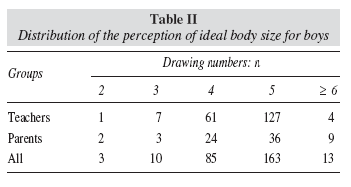
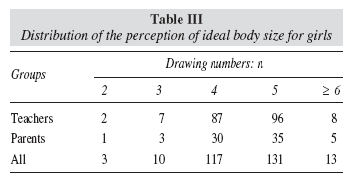
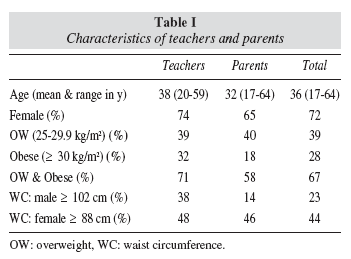
<body><![CDATA[<p><font face="Verdana" size="2"><i>Ratings</i>: Subjects were asked to indicate the number that they identify with the healthy or ideal body size for each group from the pictograms as well as to indicate the number that they identify with their own body size. The questionnaire was given by two-research assistant who asked participants to rate how they perceive their current body, the ideal body size of a 35 to 45 year old adult, and the ideal body size of a 8 to 10 year old boy and girl. Completed questionnaires were returned directly to the research assistant.</font></p>     <p><font face="Verdana" size="2"><i>Reliability:</i> Reliability of the questionnaire, including identification of body sizes, was determined by a 1-3 week test-retest procedure. Test-retest agreement for the ideal body size and self-identification of body size was higher than 0.8 (p &lt; 0.05).</font></p>     <p><font face="Verdana" size="2"><i>Data analysis:</i> Data were analyzed using SPSS for Windows 11.5. Spearman rank sum correlation was used to assess univariate associations of BMI and body figure ratings.</font></p>     <p>&nbsp;</p>     <p><font face="Verdana"><b>Results</b></font></p>     <p><font face="Verdana" size="2">Two hundred and eighty-five individuals responded the questionnaire; 205 teachers, 80 parents. <a href="#t1">Table I</a> show the characteristics of the population studied. Average perception of ideal body weight for adults 35 to 45 years of age was 4.0 &plusmn; 8, while 52% considered the ideal body weight drawing number at 4, 24% number 5, and 2%, number 6. Average perception for boys and girls was 4.6. <a href="#t2">Table II</a> and <a href="#t3">III</a> show the perception of ideal body size for boys and girls among teachers and parents. <a target="_blank" href="/img/revistas/nh/v22n5/original5_t4.gif">Table IV</a> shows BMI, waist circumference and self-perception of body size correlation with boys and girls perception of ideal body size. Sixty six percent of the teachers and 70% of the parents picked as the ideal body size for boys a figure that correspond to a slightly overweight or heavier body shape; and 52% of teachers and 63% of parents picked as the ideal body size for girls a figure that represented slightly overweight or heavier.</font></p>     <p align="center"><font face="Verdana" size="2"><a name="t1"><img src="/img/revistas/nh/v22n5/original5_t1.gif"></a></font></p>     <p align="center"><font face="Verdana" size="2"><a name="t2"><img src="/img/revistas/nh/v22n5/original5_t2.gif"></a></font></p>     <p align="center"><font face="Verdana" size="2"><a name="t3"><img src="/img/revistas/nh/v22n5/original5_t3.gif" width="351" height="187"></a></font></p>     <p>&nbsp;</p>     ]]></body>
<body><![CDATA[<p><font face="Verdana" size="2">Self-perception of body size was positively associated with ideal body size for boys (0.23, p &lt; 0.0001) and girls (0.22, p &lt; 0.0001) and perception of ideal body size for adults was positively correlated with perception of ideal body size for boys (r = 0.41, p &lt; 0.0001 and girls (r = 0.45, p &lt; 0.0001).</font></p>     <p>&nbsp;</p>     <p><font face="Verdana"><b>Discussion</b></font></p>     <p><font face="Verdana" size="2">This population, on average, chose as an ideal body size (IBS) the drawing number 4 and the average ideal body size for boys and girls was 4.6. More than 25% of them picked as the ideal weight for adults a figure, which is slightly overweight or heavier; and more than 60% of them picked the same figures for boys and girls (table <a href="#t1">I</a> and <a href="#t2">II</a>). Therefore, this study shows than Mexican teachers and parents living in the US-Mexican border region picked heavier figures as an ideal shape for adults; additionally, most of the participants picked for boys and girls slightly overweight or heavier body shapes. Rand<sup>22</sup> assessed the evaluation of ideal body sizes across a wide subject age span; 261 young adults and 326 middle-age adults selected similar body sizes (4.2-4.4 for boys and 3.9-4.2 for girls and 4.0-4.1 for middle-age men and 3.7-3.8 for middle-age women); therefore, while the average ideal body size for adults are similar to the Americans, the participants of this study believed that the ideal body size for boys and girls should be heavier than what has been proposed. This result suggests that they might be more tolerant toward the obese child; however, Mexican parents preferred a non-obese child for a friend to their children.<sup>18</sup> The result of this study also suggest that teachers and parents might disregard children health risks associated with obesity, and be less likely to promote healthy lifestyles and healthier weight status.</font></p>     <p><font face="Verdana" size="2">Several studies have looked at race differences and validation of instruments to assess the perception of ideal body size.<sup>10, 11</sup> Bhuiyan et al.<sup>12</sup> found that the odds of having a lower perception of body shape (vs body mass index) were 1.7 higher in blacks compared to White, while Stevens11 found that the average ideal weight for black adults was 3.6 and for white 3.5. Cachelin et al<sup>23</sup> found in 1,229 (548 Hispanics) participants that average ideal figure for adults were 3.9 for Hispanics and 3.7 for White, and 2.9 for Hispanics and 2.7 for White female. They also found that BMI was positively correlated with figure ratings, while in this study no relationship between BMI and figure ratings was observed. As in this study, Latina women in New York City, selected relatively thinner body image as the most healthy for themselves, while a heavier figure for their children.<sup>24</sup> The 4.6 average children body shape picked by parents and teachers of this group is also higher than the 3.2 and 3.9 among urban native American female and male,<sup>14</sup> while are only slightly higher than what middle age women pick<sup>22</sup> for the ideal body size of boys (4.4) and girls (4.2).</font></p>     <p><font face="Verdana" size="2">A strong correlation was shown between Self Perception of Body size and perceptions of Ideal Body Size (IBS) for boys and girls (0.23 and 0.22 for boys and girls, P &lt; 0.001), and with the perception of IBS for adults (0.41 and 0.45 for boys and girls, P &lt; 0.001). These results suggest those who perceive themselves as obese would consider heavier children as healthy, which might be a risk of under detecting overweight children with health and community implications. From the perspective for prevention this findings are highly relevant, since overweight and obesity have alarming increased to more then 65% in the adult Mexican population , and more than 35% among children living in the US-Mexico border.<sup>1</sup> In addition, these obese population will be not only a negative role model for the children, but they might lack support additional efforts to prevent and treat childhood obesity.</font></p>     <p><font face="Verdana" size="2">While greater acceptance of overweight may be protective against discrimination, it could nonetheless be a risk factor for obesity if they are not adequately diagnosed or identified by teachers and parents.</font></p>     <p><font face="Verdana" size="2">There are several limitations to this study. This is a convenient sample of specifically selected schools (chosen for logistic purposes); however, the participants in Tecate include more than 20% of schools and elementary school teachers; this study was correlation in nature, and therefore, could not address causality. Other limitations were that we used only the figure rating measure to assess the body image and size perceptions, for a small number of parents. Despite these limitations there are important strengths of this study. First, the test-retest reliability was high. Second, to our knowledge this is the first study in Mexico that evaluates the perception of ideal body size for middle-aged adults, as well as boys and girls. Third, this study shows a significant correlation between self-perception of body size and ideal body size for boys and girls. Fourth, this could help to understand the attitudes of Mexicans and Mexican migrants toward obesity. Erroneous perception of boys and girls ideal body size may have important health and behavioral implications, in particular among a Mexican adult population with more than 60% of overweight and obesity.<sup>1</sup></font></p>     <p><font face="Verdana" size="2">In conclusion, we observe that in terms of ranking, perception of ideal body size for boys and girls were higher than that reported in the United States, and that there is a correlation of self-perception of body size among teachers and parents with perception of body size for boys and girls. The determination of how Mexican teachers and parents view the children body shape is important for informing interventions to refine the perception of excess weight and for taking health promotion action to prevent or reverse obesity in adults and children. Therefore, intervention programs for the Mexican population should also be address to the appropriate identification of ideal body size of children.</font></p>     <p>&nbsp;</p>     ]]></body>
<body><![CDATA[<p><font face="Verdana"><b>Acknowledgement</b></font></p>     <p><font face="Verdana" size="2">Financed in part by a Research Grant of Universidad Aut&oacute;noma, Baja California, 9<sup>th</sup> Edition.</font></p>     <p>&nbsp;</p>     <p><font face="Verdana"><B>References</B></font></p>     <!-- ref --><p><font face="Verdana" size="2">1. Jim&eacute;nez-Cruz A, Bacard&iacute;-Gasc&oacute;n M. "The fattening burden of type 2 diabetes to Mexicans: projections from early growth to adulthood". Diabetes Care 2004; 27(5):1190-3.</font>&nbsp;&nbsp;&nbsp;&nbsp;&nbsp;&nbsp;&nbsp;&nbsp;[&#160;<a href="javascript:void(0);" onclick="javascript: window.open('/scielo.php?script=sci_nlinks&ref=3527416&pid=S0212-1611200700070000600001&lng=','','width=640,height=500,resizable=yes,scrollbars=1,menubar=yes,');">Links</a>&#160;]<!-- end-ref --><!-- ref --><p><font face="Verdana" size="2">2. Bouchard C, Perusse L, Leblanc C, Tremblay A, Theriault G. Inheritance of the amount and distribution of human body fat. Int J Obes 1988; 12:205-15.</font>&nbsp;&nbsp;&nbsp;&nbsp;&nbsp;&nbsp;&nbsp;&nbsp;[&#160;<a href="javascript:void(0);" onclick="javascript: window.open('/scielo.php?script=sci_nlinks&ref=3527417&pid=S0212-1611200700070000600002&lng=','','width=640,height=500,resizable=yes,scrollbars=1,menubar=yes,');">Links</a>&#160;]<!-- end-ref --><!-- ref --><p><font face="Verdana" size="2">3. Dietz William H. Periods Of Risk in Childhood for the development of Adult Obesity_What do we need to learn? The Journal Of Nutrition 1997; 127:1884s-1886s.</font>&nbsp;&nbsp;&nbsp;&nbsp;&nbsp;&nbsp;&nbsp;&nbsp;[&#160;<a href="javascript:void(0);" onclick="javascript: window.open('/scielo.php?script=sci_nlinks&ref=3527418&pid=S0212-1611200700070000600003&lng=','','width=640,height=500,resizable=yes,scrollbars=1,menubar=yes,');">Links</a>&#160;]<!-- end-ref --><!-- ref --><p><font face="Verdana" size="2">4. Dulloo AG, Jacquet J, Montani JP. Pathways from weight fluctuations to metabolic diseases: focus on maladaptive thermogenesis during catch-up fat. Int J Obes 2002; 26:S46-S57.</font>&nbsp;&nbsp;&nbsp;&nbsp;&nbsp;&nbsp;&nbsp;&nbsp;[&#160;<a href="javascript:void(0);" onclick="javascript: window.open('/scielo.php?script=sci_nlinks&ref=3527419&pid=S0212-1611200700070000600004&lng=','','width=640,height=500,resizable=yes,scrollbars=1,menubar=yes,');">Links</a>&#160;]<!-- end-ref --><!-- ref --><p><font face="Verdana" size="2">5. Stunkard AJ, Sorensen TI. Obesity and socioeconomic status: a complex relation. N Engl J Med 1993;329:1036-7.</font>&nbsp;&nbsp;&nbsp;&nbsp;&nbsp;&nbsp;&nbsp;&nbsp;[&#160;<a href="javascript:void(0);" onclick="javascript: window.open('/scielo.php?script=sci_nlinks&ref=3527420&pid=S0212-1611200700070000600005&lng=','','width=640,height=500,resizable=yes,scrollbars=1,menubar=yes,');">Links</a>&#160;]<!-- end-ref --><!-- ref --><p><font face="Verdana" size="2">6. Ritchie LD, Welk G, Styne D, Gerstein DE, Crawford PB. Family environment and pediatric overweight: what is a parent to do? J Am Diet Assoc 2005; 105(5 Pt 2):70-9.</font>&nbsp;&nbsp;&nbsp;&nbsp;&nbsp;&nbsp;&nbsp;&nbsp;[&#160;<a href="javascript:void(0);" onclick="javascript: window.open('/scielo.php?script=sci_nlinks&ref=3527421&pid=S0212-1611200700070000600006&lng=','','width=640,height=500,resizable=yes,scrollbars=1,menubar=yes,');">Links</a>&#160;]<!-- end-ref --><!-- ref --><p><font face="Verdana" size="2">7. Booth SL, Sallis JF, Ritenbaugh C, Hill JO, Birch LL, Frank LD, Glanz K, Himmelgreen DA, Mudd M, Popkin BM, Rickard KA, ST Jeor S, Hays NP. Environmental and societal factors affect food choice and physical activity: rationale, influences, and leverage points. Nutr Rev 2001; 59(3 Pt 2):S21-39.</font>&nbsp;&nbsp;&nbsp;&nbsp;&nbsp;&nbsp;&nbsp;&nbsp;[&#160;<a href="javascript:void(0);" onclick="javascript: window.open('/scielo.php?script=sci_nlinks&ref=3527422&pid=S0212-1611200700070000600007&lng=','','width=640,height=500,resizable=yes,scrollbars=1,menubar=yes,');">Links</a>&#160;]<!-- end-ref --><!-- ref --><p><font face="Verdana" size="2">8. Hovell M, Hillman E, Blumberg E, et al. A behavioral-ecological model of adolescent sexual development: a template for AIDS prevention. Journal of Sex Research 1994; 31:267-89.</font>&nbsp;&nbsp;&nbsp;&nbsp;&nbsp;&nbsp;&nbsp;&nbsp;[&#160;<a href="javascript:void(0);" onclick="javascript: window.open('/scielo.php?script=sci_nlinks&ref=3527423&pid=S0212-1611200700070000600008&lng=','','width=640,height=500,resizable=yes,scrollbars=1,menubar=yes,');">Links</a>&#160;]<!-- end-ref --><!-- ref --><p><font face="Verdana" size="2">9. Strauss RS. Childhood Obesity and self-esteem. Pediatrics 2000; 105(1):1-5.</font>&nbsp;&nbsp;&nbsp;&nbsp;&nbsp;&nbsp;&nbsp;&nbsp;[&#160;<a href="javascript:void(0);" onclick="javascript: window.open('/scielo.php?script=sci_nlinks&ref=3527424&pid=S0212-1611200700070000600009&lng=','','width=640,height=500,resizable=yes,scrollbars=1,menubar=yes,');">Links</a>&#160;]<!-- end-ref --><!-- ref --><p><font face="Verdana" size="2">10. Stevens J, Kumanyika SK, Keil JE. Attitudes toward body size and dieting: differences between elderly black and white women. Am J Public Health 1994; 84:1322-5.</font>&nbsp;&nbsp;&nbsp;&nbsp;&nbsp;&nbsp;&nbsp;&nbsp;[&#160;<a href="javascript:void(0);" onclick="javascript: window.open('/scielo.php?script=sci_nlinks&ref=3527425&pid=S0212-1611200700070000600010&lng=','','width=640,height=500,resizable=yes,scrollbars=1,menubar=yes,');">Links</a>&#160;]<!-- end-ref --><!-- ref --><p><font face="Verdana" size="2">11. Bhuiyan AR, Gustat J, Srinivasan SR, Berenson GS. Differences in body shape representations among young adults from a biracial (black-white), semirural community. Am J Epidemiol 2003; 158:792-7.</font>&nbsp;&nbsp;&nbsp;&nbsp;&nbsp;&nbsp;&nbsp;&nbsp;[&#160;<a href="javascript:void(0);" onclick="javascript: window.open('/scielo.php?script=sci_nlinks&ref=3527426&pid=S0212-1611200700070000600011&lng=','','width=640,height=500,resizable=yes,scrollbars=1,menubar=yes,');">Links</a>&#160;]<!-- end-ref --><!-- ref --><p><font face="Verdana" size="2">12. Neumark-Sztainer D, Story M, Resnick MD, Blum RW. Psychosocial concerns and weight control behaviors among overweight and nonoverweight Native American Adolescents. J Am Diet Assoc 1997; 97:598-604.</font>&nbsp;&nbsp;&nbsp;&nbsp;&nbsp;&nbsp;&nbsp;&nbsp;[&#160;<a href="javascript:void(0);" onclick="javascript: window.open('/scielo.php?script=sci_nlinks&ref=3527427&pid=S0212-1611200700070000600012&lng=','','width=640,height=500,resizable=yes,scrollbars=1,menubar=yes,');">Links</a>&#160;]<!-- end-ref --><!-- ref --><p><font face="Verdana" size="2">13. Davis SM, Lambert LC. Body image and weight concerns among Southwestern Native American preadolescent schoolchildren. Etn Dis 2000; 10:184-94.</font>&nbsp;&nbsp;&nbsp;&nbsp;&nbsp;&nbsp;&nbsp;&nbsp;[&#160;<a href="javascript:void(0);" onclick="javascript: window.open('/scielo.php?script=sci_nlinks&ref=3527428&pid=S0212-1611200700070000600013&lng=','','width=640,height=500,resizable=yes,scrollbars=1,menubar=yes,');">Links</a>&#160;]<!-- end-ref --><!-- ref --><p><font face="Verdana" size="2">14. Rinderknecht K, Smith C. Body-Image perceptions among urban native American Youth. Obes Res 2002; 10(5):315-27.</font>&nbsp;&nbsp;&nbsp;&nbsp;&nbsp;&nbsp;&nbsp;&nbsp;[&#160;<a href="javascript:void(0);" onclick="javascript: window.open('/scielo.php?script=sci_nlinks&ref=3527429&pid=S0212-1611200700070000600014&lng=','','width=640,height=500,resizable=yes,scrollbars=1,menubar=yes,');">Links</a>&#160;]<!-- end-ref --><!-- ref --><p><font face="Verdana" size="2">15. Guinn B, Semper T, Jorgensen L, Skaggs S. Body image perception in female Mexican-American adolescents. The J School Health 1997; 67(3):112-5.</font>&nbsp;&nbsp;&nbsp;&nbsp;&nbsp;&nbsp;&nbsp;&nbsp;[&#160;<a href="javascript:void(0);" onclick="javascript: window.open('/scielo.php?script=sci_nlinks&ref=3527430&pid=S0212-1611200700070000600015&lng=','','width=640,height=500,resizable=yes,scrollbars=1,menubar=yes,');">Links</a>&#160;]<!-- end-ref --><!-- ref --><p><font face="Verdana" size="2">16. Richardson SA, Goodman N, Hastorf AH, Dornbusch SM. Cultural uniformity in reaction to physical disabilities. Am Sociol Rev 1961; 26:241-7.</font>&nbsp;&nbsp;&nbsp;&nbsp;&nbsp;&nbsp;&nbsp;&nbsp;[&#160;<a href="javascript:void(0);" onclick="javascript: window.open('/scielo.php?script=sci_nlinks&ref=3527431&pid=S0212-1611200700070000600016&lng=','','width=640,height=500,resizable=yes,scrollbars=1,menubar=yes,');">Links</a>&#160;]<!-- end-ref --><!-- ref --><p><font face="Verdana" size="2">17. Latner JD, Stunkard AJ. Getting Worse: The Stigmatization of Obese Children. Obes Res 2003; 11(3):452-6.</font>&nbsp;&nbsp;&nbsp;&nbsp;&nbsp;&nbsp;&nbsp;&nbsp;[&#160;<a href="javascript:void(0);" onclick="javascript: window.open('/scielo.php?script=sci_nlinks&ref=3527432&pid=S0212-1611200700070000600017&lng=','','width=640,height=500,resizable=yes,scrollbars=1,menubar=yes,');">Links</a>&#160;]<!-- end-ref --><!-- ref --><p><font face="Verdana" size="2">18. Le&oacute;n-Reyes MJ, Bacard&iacute;-Gasc&oacute;n M, Jim&eacute;nez-Cruz A. The stigmatization of obese children by their Mexican mothers. Obes Res 2004; 12(Supl.):A75-P287.</font>&nbsp;&nbsp;&nbsp;&nbsp;&nbsp;&nbsp;&nbsp;&nbsp;[&#160;<a href="javascript:void(0);" onclick="javascript: window.open('/scielo.php?script=sci_nlinks&ref=3527433&pid=S0212-1611200700070000600018&lng=','','width=640,height=500,resizable=yes,scrollbars=1,menubar=yes,');">Links</a>&#160;]<!-- end-ref --><!-- ref --><p><font face="Verdana" size="2">19. Castell&oacute;n-Zaragoza A, Bacard&iacute;-Gasc&oacute;n M, Jim&eacute;nez-Cruz A. Perception of healthy and obese Mexican teenagers towards their obese peer. Obes Res 2004 ;12(Supl.):A72-P274.</font>&nbsp;&nbsp;&nbsp;&nbsp;&nbsp;&nbsp;&nbsp;&nbsp;[&#160;<a href="javascript:void(0);" onclick="javascript: window.open('/scielo.php?script=sci_nlinks&ref=3527434&pid=S0212-1611200700070000600019&lng=','','width=640,height=500,resizable=yes,scrollbars=1,menubar=yes,');">Links</a>&#160;]<!-- end-ref --><!-- ref --><p><font face="Verdana" size="2">20. INEGI.  <a target="_blank" href="http://www.inegi.gob.mx">www.inegi.gob.mx</a> access May 12, 2005.</font>&nbsp;&nbsp;&nbsp;&nbsp;&nbsp;&nbsp;&nbsp;&nbsp;[&#160;<a href="javascript:void(0);" onclick="javascript: window.open('/scielo.php?script=sci_nlinks&ref=3527435&pid=S0212-1611200700070000600020&lng=','','width=640,height=500,resizable=yes,scrollbars=1,menubar=yes,');">Links</a>&#160;]<!-- end-ref --><!-- ref --><p><font face="Verdana" size="2">21. Stunkard AJ, Sorensen T, Schulsinger F. Use of a Danish adoption register for the study of obesity and thinness. In: Kety SS, Rowland LP, Sidman RL, Matthysse SW. eds. The Genetics of Neurological and Psychiatric Disorders. New York: Raven Press; 1983:115-20.</font>&nbsp;&nbsp;&nbsp;&nbsp;&nbsp;&nbsp;&nbsp;&nbsp;[&#160;<a href="javascript:void(0);" onclick="javascript: window.open('/scielo.php?script=sci_nlinks&ref=3527436&pid=S0212-1611200700070000600021&lng=','','width=640,height=500,resizable=yes,scrollbars=1,menubar=yes,');">Links</a>&#160;]<!-- end-ref --><!-- ref --><p><font face="Verdana" size="2">22. Rand SW, Wright BA. Continuity and change in the evaluation of ideal and acceptable body sizes across a wide age span. Int J Eat Disord 2000; 28:90-100.</font>&nbsp;&nbsp;&nbsp;&nbsp;&nbsp;&nbsp;&nbsp;&nbsp;[&#160;<a href="javascript:void(0);" onclick="javascript: window.open('/scielo.php?script=sci_nlinks&ref=3527437&pid=S0212-1611200700070000600022&lng=','','width=640,height=500,resizable=yes,scrollbars=1,menubar=yes,');">Links</a>&#160;]<!-- end-ref --><!-- ref --><p><font face="Verdana" size="2">23. Cachelin FM, Rebeck RM, Chung GH, Pelayo E. Does ethnicity influence body-size preference? A comparison of body image and body size. Obes Res 2002; 10(3):158-66.</font>&nbsp;&nbsp;&nbsp;&nbsp;&nbsp;&nbsp;&nbsp;&nbsp;[&#160;<a href="javascript:void(0);" onclick="javascript: window.open('/scielo.php?script=sci_nlinks&ref=3527438&pid=S0212-1611200700070000600023&lng=','','width=640,height=500,resizable=yes,scrollbars=1,menubar=yes,');">Links</a>&#160;]<!-- end-ref --><!-- ref --><p><font face="Verdana" size="2">24. Contento IR, Basch C, Zybert P. Body image, weight, and food choices of Latina women and their young children. J Nutr Educ Behav 2003; 35(5):236-48.</font>&nbsp;&nbsp;&nbsp;&nbsp;&nbsp;&nbsp;&nbsp;&nbsp;[&#160;<a href="javascript:void(0);" onclick="javascript: window.open('/scielo.php?script=sci_nlinks&ref=3527439&pid=S0212-1611200700070000600024&lng=','','width=640,height=500,resizable=yes,scrollbars=1,menubar=yes,');">Links</a>&#160;]<!-- end-ref --><p>&nbsp;</p>     <p>&nbsp;</p>     ]]></body>
<body><![CDATA[<p><font face="Verdana" size="2"><a name="back"></a><a href="#top"><img border="0" src="/img/revistas/nh/v22n5/seta.gif" width="15" height="17"></a><b>Correspondence:</b>    <BR>Dr. A. Jim&eacute;nez-Cruz.    <BR>Nutrition Program. Tijuana Medical School.    <BR>Universidad Aut&oacute;noma de Baja California.    <BR>Calzada Tecnol&oacute;gico 14418.    <BR> Unidad Universitaria. Tijuana, B. C. M&eacute;xico.    <BR>E-mail: <a href="mailto:ajimenez@uabc.mx">ajimenez@uabc.mx</a></font></p>     <p><font face="Verdana" size="2">Recibido: 5-IX-2006.    <BR>Aceptado: 10-V-2007.</font></p>      ]]></body><back>
<ref-list>
<ref id="B1">
<label>1</label><nlm-citation citation-type="journal">
<person-group person-group-type="author">
<name>
<surname><![CDATA[Jiménez-Cruz]]></surname>
<given-names><![CDATA[A]]></given-names>
</name>
<name>
<surname><![CDATA[Bacardí-Gascón]]></surname>
<given-names><![CDATA[M.]]></given-names>
</name>
</person-group>
<article-title xml:lang="en"><![CDATA[The fattening burden of type 2 diabetes to Mexicans: projections from early growth to adulthood]]></article-title>
<source><![CDATA[Diabetes Care]]></source>
<year>2004</year>
<volume>27</volume>
<numero>5</numero>
<issue>5</issue>
<page-range>1190-3</page-range></nlm-citation>
</ref>
<ref id="B2">
<label>2</label><nlm-citation citation-type="journal">
<person-group person-group-type="author">
<name>
<surname><![CDATA[Bouchard]]></surname>
<given-names><![CDATA[C]]></given-names>
</name>
<name>
<surname><![CDATA[Perusse]]></surname>
<given-names><![CDATA[L]]></given-names>
</name>
<name>
<surname><![CDATA[Leblanc]]></surname>
<given-names><![CDATA[C]]></given-names>
</name>
<name>
<surname><![CDATA[Tremblay]]></surname>
<given-names><![CDATA[A]]></given-names>
</name>
<name>
<surname><![CDATA[Theriault]]></surname>
<given-names><![CDATA[G]]></given-names>
</name>
</person-group>
<article-title xml:lang="en"><![CDATA[Inheritance of the amount and distribution of human body fat]]></article-title>
<source><![CDATA[Int J Obes]]></source>
<year>1988</year>
<volume>12</volume>
<page-range>205-15</page-range></nlm-citation>
</ref>
<ref id="B3">
<label>3</label><nlm-citation citation-type="journal">
<person-group person-group-type="author">
<name>
<surname><![CDATA[Dietz William]]></surname>
<given-names><![CDATA[H]]></given-names>
</name>
</person-group>
<article-title xml:lang="en"><![CDATA[Periods Of Risk in Childhood for the development of Adult Obesity_What do we need to learn?]]></article-title>
<source><![CDATA[The Journal Of Nutrition]]></source>
<year>1997</year>
<volume>127</volume>
<page-range>1884s-1886s</page-range></nlm-citation>
</ref>
<ref id="B4">
<label>4</label><nlm-citation citation-type="journal">
<person-group person-group-type="author">
<name>
<surname><![CDATA[Dulloo]]></surname>
<given-names><![CDATA[AG]]></given-names>
</name>
<name>
<surname><![CDATA[Jacquet]]></surname>
<given-names><![CDATA[J]]></given-names>
</name>
<name>
<surname><![CDATA[Montani]]></surname>
<given-names><![CDATA[JP]]></given-names>
</name>
</person-group>
<article-title xml:lang="en"><![CDATA[Pathways from weight fluctuations to metabolic diseases: focus on maladaptive thermogenesis during catch-up fat]]></article-title>
<source><![CDATA[Int J Obes]]></source>
<year>2002</year>
<volume>26</volume>
<page-range>S46-S57</page-range></nlm-citation>
</ref>
<ref id="B5">
<label>5</label><nlm-citation citation-type="journal">
<person-group person-group-type="author">
<name>
<surname><![CDATA[Stunkard]]></surname>
<given-names><![CDATA[AJ]]></given-names>
</name>
<name>
<surname><![CDATA[Sorensen]]></surname>
<given-names><![CDATA[TI]]></given-names>
</name>
</person-group>
<article-title xml:lang="en"><![CDATA[Obesity and socioeconomic status: a complex relation]]></article-title>
<source><![CDATA[N Engl J Med]]></source>
<year>1993</year>
<volume>329</volume>
<page-range>1036-7</page-range></nlm-citation>
</ref>
<ref id="B6">
<label>6</label><nlm-citation citation-type="journal">
<person-group person-group-type="author">
<name>
<surname><![CDATA[Ritchie]]></surname>
<given-names><![CDATA[LD]]></given-names>
</name>
<name>
<surname><![CDATA[Welk]]></surname>
<given-names><![CDATA[G]]></given-names>
</name>
<name>
<surname><![CDATA[Styne]]></surname>
<given-names><![CDATA[D]]></given-names>
</name>
<name>
<surname><![CDATA[Gerstein]]></surname>
<given-names><![CDATA[DE]]></given-names>
</name>
<name>
<surname><![CDATA[Crawford]]></surname>
<given-names><![CDATA[PB]]></given-names>
</name>
</person-group>
<article-title xml:lang="en"><![CDATA[Family environment and pediatric overweight: what is a parent to do?]]></article-title>
<source><![CDATA[J Am Diet Assoc]]></source>
<year>2005</year>
<volume>105</volume>
<numero>5 Pt 2</numero>
<issue>5 Pt 2</issue>
<page-range>70-9</page-range></nlm-citation>
</ref>
<ref id="B7">
<label>7</label><nlm-citation citation-type="journal">
<person-group person-group-type="author">
<name>
<surname><![CDATA[Booth]]></surname>
<given-names><![CDATA[SL]]></given-names>
</name>
<name>
<surname><![CDATA[Sallis]]></surname>
<given-names><![CDATA[JF]]></given-names>
</name>
<name>
<surname><![CDATA[Ritenbaugh]]></surname>
<given-names><![CDATA[C]]></given-names>
</name>
<name>
<surname><![CDATA[Hill]]></surname>
<given-names><![CDATA[JO]]></given-names>
</name>
<name>
<surname><![CDATA[Birch]]></surname>
<given-names><![CDATA[LL]]></given-names>
</name>
<name>
<surname><![CDATA[Frank]]></surname>
<given-names><![CDATA[LD]]></given-names>
</name>
<name>
<surname><![CDATA[Glanz]]></surname>
<given-names><![CDATA[K]]></given-names>
</name>
<name>
<surname><![CDATA[Himmelgreen]]></surname>
<given-names><![CDATA[DA]]></given-names>
</name>
<name>
<surname><![CDATA[Mudd]]></surname>
<given-names><![CDATA[M]]></given-names>
</name>
<name>
<surname><![CDATA[Popkin]]></surname>
<given-names><![CDATA[BM]]></given-names>
</name>
<name>
<surname><![CDATA[Rickard]]></surname>
<given-names><![CDATA[KA]]></given-names>
</name>
<name>
<surname><![CDATA[ST]]></surname>
<given-names><![CDATA[Jeor S]]></given-names>
</name>
<name>
<surname><![CDATA[Hays]]></surname>
<given-names><![CDATA[NP]]></given-names>
</name>
</person-group>
<article-title xml:lang="en"><![CDATA[Environmental and societal factors affect food choice and physical activity: rationale, influences, and leverage points]]></article-title>
<source><![CDATA[Nutr Rev]]></source>
<year>2001</year>
<volume>59</volume>
<numero>3 Pt 2</numero>
<issue>3 Pt 2</issue>
<page-range>S21-39</page-range></nlm-citation>
</ref>
<ref id="B8">
<label>8</label><nlm-citation citation-type="journal">
<person-group person-group-type="author">
<name>
<surname><![CDATA[Hovell]]></surname>
<given-names><![CDATA[M]]></given-names>
</name>
<name>
<surname><![CDATA[Hillman]]></surname>
<given-names><![CDATA[E]]></given-names>
</name>
<name>
<surname><![CDATA[Blumberg]]></surname>
<given-names><![CDATA[E]]></given-names>
</name>
</person-group>
<article-title xml:lang="en"><![CDATA[A behavioral-ecological model of adolescent sexual development: a template for AIDS prevention]]></article-title>
<source><![CDATA[Journal of Sex Research]]></source>
<year>1994</year>
<volume>31</volume>
<page-range>267-89</page-range></nlm-citation>
</ref>
<ref id="B9">
<label>9</label><nlm-citation citation-type="journal">
<person-group person-group-type="author">
<name>
<surname><![CDATA[Strauss]]></surname>
<given-names><![CDATA[RS]]></given-names>
</name>
</person-group>
<article-title xml:lang="en"><![CDATA[Childhood Obesity and self-esteem]]></article-title>
<source><![CDATA[Pediatrics]]></source>
<year>2000</year>
<volume>105</volume>
<numero>1</numero>
<issue>1</issue>
<page-range>1-5</page-range></nlm-citation>
</ref>
<ref id="B10">
<label>10</label><nlm-citation citation-type="journal">
<person-group person-group-type="author">
<name>
<surname><![CDATA[Stevens]]></surname>
<given-names><![CDATA[J]]></given-names>
</name>
<name>
<surname><![CDATA[Kumanyika]]></surname>
<given-names><![CDATA[SK]]></given-names>
</name>
<name>
<surname><![CDATA[Keil]]></surname>
<given-names><![CDATA[JE]]></given-names>
</name>
</person-group>
<article-title xml:lang="en"><![CDATA[Attitudes toward body size and dieting: differences between elderly black and white women]]></article-title>
<source><![CDATA[Am J Public Health]]></source>
<year>1994</year>
<volume>84</volume>
<page-range>1322-5</page-range></nlm-citation>
</ref>
<ref id="B11">
<label>11</label><nlm-citation citation-type="journal">
<person-group person-group-type="author">
<name>
<surname><![CDATA[Bhuiyan]]></surname>
<given-names><![CDATA[AR]]></given-names>
</name>
<name>
<surname><![CDATA[Gustat]]></surname>
<given-names><![CDATA[J]]></given-names>
</name>
<name>
<surname><![CDATA[Srinivasan]]></surname>
<given-names><![CDATA[SR]]></given-names>
</name>
<name>
<surname><![CDATA[Berenson]]></surname>
<given-names><![CDATA[GS]]></given-names>
</name>
</person-group>
<article-title xml:lang="en"><![CDATA[Differences in body shape representations among young adults from a biracial (black-white), semirural community]]></article-title>
<source><![CDATA[Am J Epidemiol]]></source>
<year>2003</year>
<volume>158</volume>
<page-range>792-7</page-range></nlm-citation>
</ref>
<ref id="B12">
<label>12</label><nlm-citation citation-type="journal">
<person-group person-group-type="author">
<name>
<surname><![CDATA[Neumark-Sztainer]]></surname>
<given-names><![CDATA[D]]></given-names>
</name>
<name>
<surname><![CDATA[Story]]></surname>
<given-names><![CDATA[M]]></given-names>
</name>
<name>
<surname><![CDATA[Resnick]]></surname>
<given-names><![CDATA[MD]]></given-names>
</name>
<name>
<surname><![CDATA[Blum]]></surname>
<given-names><![CDATA[RW]]></given-names>
</name>
</person-group>
<article-title xml:lang="en"><![CDATA[Psychosocial concerns and weight control behaviors among overweight and nonoverweight Native American Adolescents]]></article-title>
<source><![CDATA[J Am Diet Assoc]]></source>
<year>1997</year>
<volume>97</volume>
<page-range>598-604</page-range></nlm-citation>
</ref>
<ref id="B13">
<label>13</label><nlm-citation citation-type="journal">
<person-group person-group-type="author">
<name>
<surname><![CDATA[Davis]]></surname>
<given-names><![CDATA[SM]]></given-names>
</name>
<name>
<surname><![CDATA[Lambert]]></surname>
<given-names><![CDATA[LC]]></given-names>
</name>
</person-group>
<article-title xml:lang="en"><![CDATA[Body image and weight concerns among Southwestern Native American preadolescent schoolchildren]]></article-title>
<source><![CDATA[Etn Dis]]></source>
<year>2000</year>
<volume>10</volume>
<page-range>184-94</page-range></nlm-citation>
</ref>
<ref id="B14">
<label>14</label><nlm-citation citation-type="journal">
<person-group person-group-type="author">
<name>
<surname><![CDATA[Rinderknecht]]></surname>
<given-names><![CDATA[K]]></given-names>
</name>
<name>
<surname><![CDATA[Smith]]></surname>
<given-names><![CDATA[C]]></given-names>
</name>
</person-group>
<article-title xml:lang="en"><![CDATA[Body-Image perceptions among urban native American Youth]]></article-title>
<source><![CDATA[Obes Res]]></source>
<year>2002</year>
<volume>10</volume>
<numero>5</numero>
<issue>5</issue>
<page-range>315-27</page-range></nlm-citation>
</ref>
<ref id="B15">
<label>15</label><nlm-citation citation-type="journal">
<person-group person-group-type="author">
<name>
<surname><![CDATA[Guinn]]></surname>
<given-names><![CDATA[B]]></given-names>
</name>
<name>
<surname><![CDATA[Semper]]></surname>
<given-names><![CDATA[T]]></given-names>
</name>
<name>
<surname><![CDATA[Jorgensen]]></surname>
<given-names><![CDATA[L]]></given-names>
</name>
<name>
<surname><![CDATA[Skaggs]]></surname>
<given-names><![CDATA[S]]></given-names>
</name>
</person-group>
<article-title xml:lang="en"><![CDATA[Body image perception in female Mexican-American adolescents]]></article-title>
<source><![CDATA[The J School Health]]></source>
<year>1997</year>
<volume>67</volume>
<numero>3</numero>
<issue>3</issue>
<page-range>112-5</page-range></nlm-citation>
</ref>
<ref id="B16">
<label>16</label><nlm-citation citation-type="journal">
<person-group person-group-type="author">
<name>
<surname><![CDATA[Richardson]]></surname>
<given-names><![CDATA[SA]]></given-names>
</name>
<name>
<surname><![CDATA[Goodman]]></surname>
<given-names><![CDATA[N]]></given-names>
</name>
<name>
<surname><![CDATA[Hastorf]]></surname>
<given-names><![CDATA[AH]]></given-names>
</name>
<name>
<surname><![CDATA[Dornbusch]]></surname>
<given-names><![CDATA[SM]]></given-names>
</name>
</person-group>
<article-title xml:lang="en"><![CDATA[Cultural uniformity in reaction to physical disabilities]]></article-title>
<source><![CDATA[Am Sociol Rev]]></source>
<year>1961</year>
<volume>26</volume>
<page-range>241-7</page-range></nlm-citation>
</ref>
<ref id="B17">
<label>17</label><nlm-citation citation-type="journal">
<person-group person-group-type="author">
<name>
<surname><![CDATA[Latner]]></surname>
<given-names><![CDATA[JD]]></given-names>
</name>
<name>
<surname><![CDATA[Stunkard]]></surname>
<given-names><![CDATA[AJ]]></given-names>
</name>
</person-group>
<article-title xml:lang="en"><![CDATA[Getting Worse: The Stigmatization of Obese Children]]></article-title>
<source><![CDATA[Obes Res]]></source>
<year>2003</year>
<volume>11</volume>
<numero>3</numero>
<issue>3</issue>
<page-range>452-6</page-range></nlm-citation>
</ref>
<ref id="B18">
<label>18</label><nlm-citation citation-type="journal">
<person-group person-group-type="author">
<name>
<surname><![CDATA[León-Reyes]]></surname>
<given-names><![CDATA[MJ]]></given-names>
</name>
<name>
<surname><![CDATA[Bacardí-Gascón]]></surname>
<given-names><![CDATA[M]]></given-names>
</name>
<name>
<surname><![CDATA[Jiménez-Cruz]]></surname>
<given-names><![CDATA[A]]></given-names>
</name>
</person-group>
<article-title xml:lang="en"><![CDATA[The stigmatization of obese children by their Mexican mothers]]></article-title>
<source><![CDATA[Obes Res]]></source>
<year>2004</year>
<volume>12</volume>
<page-range>A75-P287</page-range></nlm-citation>
</ref>
<ref id="B19">
<label>19</label><nlm-citation citation-type="journal">
<person-group person-group-type="author">
<name>
<surname><![CDATA[Castellón-Zaragoza]]></surname>
<given-names><![CDATA[A]]></given-names>
</name>
<name>
<surname><![CDATA[Bacardí-Gascón]]></surname>
<given-names><![CDATA[M]]></given-names>
</name>
<name>
<surname><![CDATA[Jiménez-Cruz]]></surname>
<given-names><![CDATA[A]]></given-names>
</name>
</person-group>
<article-title xml:lang="en"><![CDATA[Perception of healthy and obese Mexican teenagers towards their obese peer]]></article-title>
<source><![CDATA[Obes Res]]></source>
<year>2004</year>
<volume>12</volume>
<page-range>A72-P274</page-range></nlm-citation>
</ref>
<ref id="B20">
<label>20</label><nlm-citation citation-type="">
<collab>INEGI</collab>
<source><![CDATA[]]></source>
<year></year>
</nlm-citation>
</ref>
<ref id="B21">
<label>21</label><nlm-citation citation-type="book">
<person-group person-group-type="author">
<name>
<surname><![CDATA[Stunkard]]></surname>
<given-names><![CDATA[AJ]]></given-names>
</name>
<name>
<surname><![CDATA[Sorensen]]></surname>
<given-names><![CDATA[T]]></given-names>
</name>
<name>
<surname><![CDATA[Schulsinger]]></surname>
<given-names><![CDATA[F]]></given-names>
</name>
</person-group>
<article-title xml:lang="en"><![CDATA[Use of a Danish adoption register for the study of obesity and thinness]]></article-title>
<person-group person-group-type="editor">
<name>
<surname><![CDATA[Kety]]></surname>
<given-names><![CDATA[SS]]></given-names>
</name>
<name>
<surname><![CDATA[Rowland]]></surname>
<given-names><![CDATA[LP]]></given-names>
</name>
<name>
<surname><![CDATA[Sidman]]></surname>
<given-names><![CDATA[RL]]></given-names>
</name>
<name>
<surname><![CDATA[Matthysse]]></surname>
<given-names><![CDATA[SW]]></given-names>
</name>
</person-group>
<source><![CDATA[The Genetics of Neurological and Psychiatric Disorders]]></source>
<year>1983</year>
<page-range>115-20</page-range><publisher-loc><![CDATA[New York ]]></publisher-loc>
<publisher-name><![CDATA[Raven Press]]></publisher-name>
</nlm-citation>
</ref>
<ref id="B22">
<label>22</label><nlm-citation citation-type="journal">
<person-group person-group-type="author">
<name>
<surname><![CDATA[Rand]]></surname>
<given-names><![CDATA[SW]]></given-names>
</name>
<name>
<surname><![CDATA[Wright]]></surname>
<given-names><![CDATA[BA]]></given-names>
</name>
</person-group>
<article-title xml:lang="en"><![CDATA[Continuity and change in the evaluation of ideal and acceptable body sizes across a wide age span]]></article-title>
<source><![CDATA[Int J Eat Disord]]></source>
<year>2000</year>
<volume>28</volume>
<page-range>90-100</page-range></nlm-citation>
</ref>
<ref id="B23">
<label>23</label><nlm-citation citation-type="journal">
<person-group person-group-type="author">
<name>
<surname><![CDATA[Cachelin]]></surname>
<given-names><![CDATA[FM]]></given-names>
</name>
<name>
<surname><![CDATA[Rebeck]]></surname>
<given-names><![CDATA[RM]]></given-names>
</name>
<name>
<surname><![CDATA[Chung]]></surname>
<given-names><![CDATA[GH]]></given-names>
</name>
<name>
<surname><![CDATA[Pelayo]]></surname>
<given-names><![CDATA[E]]></given-names>
</name>
</person-group>
<article-title xml:lang="en"><![CDATA[Does ethnicity influence body-size preference?: A comparison of body image and body size]]></article-title>
<source><![CDATA[Obes Res]]></source>
<year>2002</year>
<volume>10</volume>
<numero>3</numero>
<issue>3</issue>
<page-range>158-66</page-range></nlm-citation>
</ref>
<ref id="B24">
<label>24</label><nlm-citation citation-type="journal">
<person-group person-group-type="author">
<name>
<surname><![CDATA[Contento]]></surname>
<given-names><![CDATA[IR]]></given-names>
</name>
<name>
<surname><![CDATA[Basch]]></surname>
<given-names><![CDATA[C]]></given-names>
</name>
<name>
<surname><![CDATA[Zybert]]></surname>
<given-names><![CDATA[P]]></given-names>
</name>
</person-group>
<article-title xml:lang="en"><![CDATA[Body image, weight, and food choices of Latina women and their young children]]></article-title>
<source><![CDATA[J Nutr Educ Behav]]></source>
<year>2003</year>
<volume>35</volume>
<numero>5</numero>
<issue>5</issue>
<page-range>236-48</page-range></nlm-citation>
</ref>
</ref-list>
</back>
</article>