<?xml version="1.0" encoding="ISO-8859-1"?><article xmlns:mml="http://www.w3.org/1998/Math/MathML" xmlns:xlink="http://www.w3.org/1999/xlink" xmlns:xsi="http://www.w3.org/2001/XMLSchema-instance">
<front>
<journal-meta>
<journal-id>0212-1611</journal-id>
<journal-title><![CDATA[Nutrición Hospitalaria]]></journal-title>
<abbrev-journal-title><![CDATA[Nutr. Hosp.]]></abbrev-journal-title>
<issn>0212-1611</issn>
<publisher>
<publisher-name><![CDATA[Grupo Arán]]></publisher-name>
</publisher>
</journal-meta>
<article-meta>
<article-id>S0212-16112008000700004</article-id>
<title-group>
<article-title xml:lang="en"><![CDATA[Nutritional recommendation alone does not change the obesity profile of health professionals]]></article-title>
<article-title xml:lang="es"><![CDATA[La recomendación nutricional por sí sola no modifica el perfil de obesidad de los profesionales sanitarios]]></article-title>
</title-group>
<contrib-group>
<contrib contrib-type="author">
<name>
<surname><![CDATA[Teixeira da Silva]]></surname>
<given-names><![CDATA[M.ª de L.]]></given-names>
</name>
<xref ref-type="aff" rid="A01"/>
</contrib>
<contrib contrib-type="author">
<name>
<surname><![CDATA[Renofio Martins]]></surname>
<given-names><![CDATA[J.]]></given-names>
</name>
<xref ref-type="aff" rid="A01"/>
</contrib>
<contrib contrib-type="author">
<name>
<surname><![CDATA[Midori Shiroma]]></surname>
<given-names><![CDATA[G.]]></given-names>
</name>
<xref ref-type="aff" rid="A01"/>
</contrib>
<contrib contrib-type="author">
<name>
<surname><![CDATA[Ortolani]]></surname>
<given-names><![CDATA[M.ª C.]]></given-names>
</name>
<xref ref-type="aff" rid="A01"/>
</contrib>
<contrib contrib-type="author">
<name>
<surname><![CDATA[Mika Horie]]></surname>
<given-names><![CDATA[L.]]></given-names>
</name>
<xref ref-type="aff" rid="A01"/>
</contrib>
<contrib contrib-type="author">
<name>
<surname><![CDATA[Waitzberg]]></surname>
<given-names><![CDATA[D. L.]]></given-names>
</name>
<xref ref-type="aff" rid="A01"/>
<xref ref-type="aff" rid="A02"/>
</contrib>
</contrib-group>
<aff id="A02">
<institution><![CDATA[,University of São Paulo (USP) School of Medicine Department of Gastroentrology]]></institution>
<addr-line><![CDATA[São Paulo ]]></addr-line>
</aff>
<aff id="A01">
<institution><![CDATA[,GANEP - Nutrição Humana  ]]></institution>
<addr-line><![CDATA[São Paulo ]]></addr-line>
<country>Brasil</country>
</aff>
<pub-date pub-type="pub">
<day>00</day>
<month>10</month>
<year>2008</year>
</pub-date>
<pub-date pub-type="epub">
<day>00</day>
<month>10</month>
<year>2008</year>
</pub-date>
<volume>23</volume>
<numero>5</numero>
<fpage>429</fpage>
<lpage>432</lpage>
<copyright-statement/>
<copyright-year/>
<self-uri xlink:href="http://scielo.isciii.es/scielo.php?script=sci_arttext&amp;pid=S0212-16112008000700004&amp;lng=en&amp;nrm=iso"></self-uri><self-uri xlink:href="http://scielo.isciii.es/scielo.php?script=sci_abstract&amp;pid=S0212-16112008000700004&amp;lng=en&amp;nrm=iso"></self-uri><self-uri xlink:href="http://scielo.isciii.es/scielo.php?script=sci_pdf&amp;pid=S0212-16112008000700004&amp;lng=en&amp;nrm=iso"></self-uri><abstract abstract-type="short" xml:lang="en"><p><![CDATA[Objective: To evaluate the frequency of overweight and obesity in health professionals, before and after a single specialized dietary recommendation. Methods: Anthropometric measures of 579 workers of a general hospital in the city of São Paulo, Brazil were taken. The weight (f), height (h) and waist circunference (wc) were interpreted according to the WHO and NCEP ATP III guidelines. Nutrition specialist provided dietary and behavioral recommendations. The entire sample underwent a new evaluation one year later. Results: At the first evaluation, 79 employees presente WC &ge; 102 cm (male) or WC &ge; 88 cm (female). The association between WC &ge; 102 cm (men) or WC &ge; 88 cm (women) and BMI &ge; 30 kg/m² was found in 12.8% (69 subjects). The BMI distribution per age group indicated that the increase in overweight and obesity was directly proportional to the age increase. Physical activities were not practiced by 75% of the subjects studied. A year later, the evaluation indicated lack of statistical differences regarding the BMI and waist circumference of the sample and only 2.8% started to practice a physical activity. Conclusion: Dietary recommendation alone failed to promote changes in the eating habits of health professionals who work at a general hospital or to encourage them to practice exercise.]]></p></abstract>
<abstract abstract-type="short" xml:lang="es"><p><![CDATA[Objetivo: Evaluar la frecuencia de sobrepeso y obesidad en los profesionales sanitarios, antes y después de unaúnica recomendación dietética especializada. Métodos: Se realizaron mediciones antropométricas en 579 trabajadores de un hospital en la ciudad de São Paulo, Brasil. El peso (p), la talla (T) y la circunferencia de la cintura (CC) se interpretaron de acuerdo con las guías de la OMS y la NCEP ATP III. Los especialistas en nutrición proporcionaron recomendaciones sobre dieta y conducta. La muestra completa fue sometida a una nueva evaluación un año más tarde. Resultados: En la primera evaluación, 79 trabajadores presentaban CC &ge; 102 cm (varón) o CC &ge; 88 cm (mujer). Se halló una asociación entre CC &ge; 102 cm (hombres) o CC &ge; 88 cm (mujeres) y el IMC &ge; 30 kg/m² en el 12,8% (69 individuos). La distribución del IMC por grupos de edad indicaba que el aumento de sobrepeso y obesidad se relacionaba proporcionalmente con el aumento de edad. Las actividades físicas no fueron practicadas por el 75% de los individuos estudiados. Un año más tarde, la evaluación indicaba la falta de diferencias significativas con respecto al IMC y la circunferencia de la cintura en la muestra y sólo el 2,8% comenzó a practicar alguna actividad física. Conclusiones: La simple recomendación dietética no consiguió modificar los hábitos de alimentación en los profesionales sanitarios que trabajan en un hospital general o animarles a practicar ejercicio físico.]]></p></abstract>
<kwd-group>
<kwd lng="en"><![CDATA[Nutrition intervention]]></kwd>
<kwd lng="en"><![CDATA[Obesity]]></kwd>
<kwd lng="en"><![CDATA[Waist circumference]]></kwd>
<kwd lng="en"><![CDATA[BMI (Body Mass Index)]]></kwd>
<kwd lng="en"><![CDATA[Overweight]]></kwd>
<kwd lng="es"><![CDATA[Nutrición intervención]]></kwd>
<kwd lng="es"><![CDATA[Obesidad]]></kwd>
<kwd lng="es"><![CDATA[Circunferencia de la cintura]]></kwd>
<kwd lng="es"><![CDATA[IMC (Índice de Masa Corporal)]]></kwd>
<kwd lng="es"><![CDATA[Sobrepeso]]></kwd>
</kwd-group>
</article-meta>
</front><body><![CDATA[ <p align="right"><font face="Verdana" size="2"><a name="top"></a><b>ORIGINAL</b></font></p>     <p align="right">&nbsp;</p>     <p align="left"><font face="Verdana" size="4"><b>Nutritional recommendation alone does not change the obesity profile of health professionals</b></font></p>     <p align="left"><b><font face="Verdana" size="4">La recomendación nutricional por sí sola no modifica el perfil de obesidad de los profesionales sanitarios</font></b></p>     <p align="left">&nbsp;</p>     <p align="left">&nbsp;</p>     <p align="left"><font face="Verdana" size="2"><b>M.ª de L. Teixeira da Silva<sup>1</sup>, J. Renofio Martins<sup>1</sup>, G. Midori Shiroma<sup>1</sup>, M.ª C. Ortolani<sup>1</sup>, L. Mika Horie<sup>1</sup> and D. L. Waitzberg<sup>2</sup></b></font></p>     <p><font face="Verdana" size="2"><sup>1</sup>GANEP - Nutrição Humana.    <br><sup>2</sup>Department of Gastroentrology of the School of Medicine of the University of São Paulo (USP). LIM 35. GANEP - Nutrição Humana. Brasil.</font></p>     <p><font face="Verdana" size="2"><a href="#back">Correspondence</a></font></p>     ]]></body>
<body><![CDATA[<p>&nbsp;</p>     <p>&nbsp;</p> <hr size="1">     <p><font face="Verdana" size="2"><B>ABSTRACT</B></font></p>     <p><font face="Verdana" size="2"><B>Objective:</B> To evaluate the frequency of overweight and obesity in health professionals, before and after a single specialized dietary recommendation.    <br><B>Methods:</B> Anthropometric measures of 579 workers of a general hospital in the city of São Paulo, Brazil were taken. The weight (f), height (h) and waist circunference (wc) were interpreted according to the WHO and NCEP ATP III guidelines. Nutrition specialist provided dietary and behavioral recommendations. The entire sample underwent a new evaluation one year later.    <br><B>Results:</B> At the first evaluation, 79 employees presente WC &ge; 102 cm (male) or WC &ge; 88 cm (female). The association between WC &ge; 102 cm (men) or WC &ge; 88 cm (women) and BMI &ge; 30 kg/m<sup>2</sup> was found in 12.8% (69 subjects). The BMI distribution per age group indicated that the increase in overweight and obesity was directly proportional to the age increase. Physical activities were not practiced by 75% of the subjects studied. A year later, the evaluation indicated lack of statistical differences regarding the BMI and waist circumference of the sample and only 2.8% started to practice a physical activity.    <br><B>Conclusion:</B> Dietary recommendation alone failed to promote changes in the eating habits of health professionals who work at a general hospital or to encourage them to practice exercise.</font></p>     <p><font face="Verdana" size="2"><B>Key words:</B> Nutrition intervention. Obesity. Waist circumference. BMI (Body Mass Index). Overweight.</font></p> <hr size="1">     <p><font face="Verdana" size="2"><b>RESUMEN</b></font></p>     <p><font face="Verdana" size="2"><B>Objetivo:</B> Evaluar la frecuencia de sobrepeso y obesidad en los profesionales sanitarios, antes y despu&eacute;s de una&uacute;nica recomendación diet&eacute;tica especializada.    ]]></body>
<body><![CDATA[<br><B>M&eacute;todos:</B> Se realizaron mediciones antropom&eacute;tricas en 579 trabajadores de un hospital en la ciudad de São Paulo, Brasil. El peso (p), la talla (T) y la circunferencia de la cintura (CC) se interpretaron de acuerdo con las gu&iacute;as de la OMS y la NCEP ATP III. Los especialistas en nutrición proporcionaron recomendaciones sobre dieta y conducta. La muestra completa fue sometida a una nueva evaluación un a&ntilde;o m&aacute;s tarde.    <br><B>Resultados:</B> En la primera evaluación, 79 trabajadores presentaban CC &ge; 102 cm (varón) o CC &ge; 88 cm (mujer). Se halló una asociación entre CC &ge; 102 cm (hombres) o CC &ge; 88 cm (mujeres) y el IMC &ge; 30 kg/m<sup>2</sup> en el 12,8% (69 individuos). La distribución del IMC por grupos de edad indicaba que el aumento de sobrepeso y obesidad se relacionaba proporcionalmente con el aumento de edad. Las actividades f&iacute;sicas no fueron practicadas por el 75% de los individuos estudiados. Un a&ntilde;o m&aacute;s tarde, la evaluación indicaba la falta de diferencias significativas con respecto al IMC y la circunferencia de la cintura en la muestra y sólo el 2,8% comenzó a practicar alguna actividad f&iacute;sica.    <br><B>Conclusiones:</B> La simple recomendación diet&eacute;tica no consiguió modificar los h&aacute;bitos de alimentación en los profesionales sanitarios que trabajan en un hospital general o animarles a practicar ejercicio f&iacute;sico.</font></p>     <p><font face="Verdana" size="2"><B>Palabras clave:</B> Nutrición intervención. Obesidad. Circunferencia de la cintura. IMC (Índice de Masa Corporal). Sobrepeso.</font></p> <hr size="1">     <p>&nbsp;</p>     <p><font face="Verdana"><b>Introduction and Objectives</b></font></p>     <p><font face="Verdana" size="2">Obesity is an endocrine-metabolic, chronic, heterogeneous and multifactorial condition, marked by excess body fat.<sup>1,2</sup> Results of epidemiologic studies carried out over the last decade indicate that obesity is an important condition that predisposes increased morbidity and mortality.<sup>3-6</sup> The relative risk for cardiovascular diseases and the metabolic syndrome significantly increases with abdominal obesity, defined as waist circumference larger than 102 cm for men and 88 cm for women.<sup>7</sup></font></p>     <p><font face="Verdana" size="2">The prevalence of obesity is increasing in developed and developing countries.<sup>8</sup> In Brazil, its prevalence increased between 1975 and 1997. Today, it is estimated that 40% of Brazilian adults are overweight, 13% of which are obese. In the city of São Paulo, 45.3% of the men and 36.2% of the women are overweight and 10.3% and 13.2% are obese respectively.<sup>9</sup> Some population-based strategies were designed as an attempt to curb this true epidemic, such as comprehensive public policies. In 2007, the Brazilian Ministry of Health established the <i>N&uacute;cleos de Apoio &agrave; Sa&uacute;de da Fam&iacute;lia</i> (Centers to Support Family Health) that aim to promote healthy diet and actions related to programs to manage and prevent nutrition disorders such as overweight and obesity.<sup>10</sup> Additionally, private initiatives were developed. They are considered public actions to encourage the increase in the practice of physical activities and knowledge about the benefits of an active lifestyle.<sup>2 </sup>The positive impact of such actions led to the development of other programs acknowledged by the World Health Organization (WHO) in Brazil and abroad. Health professionals and administration workers of a hospital are supposed to have more access to information and a better perception about obesity related risks. This study was designed to evaluate the frequency of overweight and obesity in professionals who work at a general hospital in Brazil. All participants were evaluated and received nutrition and behavior recommendations by trained dietitians, focusing on weight loss for those overweight or obese. The impact of the recommendations on body weight was evaluated again a year later.</font></p>     <p>&nbsp;</p>     <p><font face="Verdana"><b>Materials and methods</b></font></p>     ]]></body>
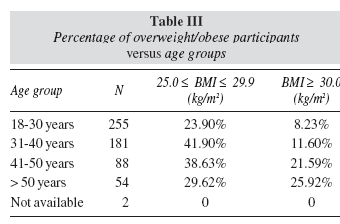
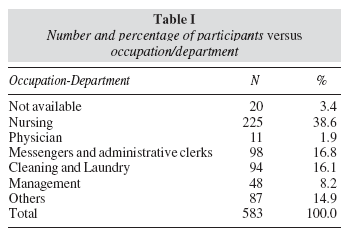
<body><![CDATA[<p><font face="Verdana" size="2">Prospective, non-controlled study conducted at a general hospital with 1920 beds in the city of São Paulo, Brazil. The São Joaquim da Real and Benem&eacute;rita Sociedade Portuguesa de Benefic&ecirc;ncia de São Paulo hospital has 6,712 employees, including physicians, dietitians, biomedical specialists, physical therapists, the nursing team, messengers, administrative clerks, facility and management employees.</font></p>     <p><font face="Verdana" size="2">In August 2006, leaflets and posters were distributed to stimulate and to invite health professionals to volunteer and participate of a nutritional and behavior assessment that would take place in the following month. This program was opened by a lecture on Nutrition and Quality of Life, focusing on the evidence that the diseases that are responsible for higher mortality rate can be prevented or that the mortality rate can be decreased with proper diet and behavior.</font></p>     <p><font face="Verdana" size="2">In the first phase of the study, 579 employees were evaluated. A questionnaire with personal data, height, eating habits (24-h recall), practice of physical activities, pre-existing conditions, use of medications and results of diagnostic tests (whenever applicable, ie, most recent result for blood glucose for diabetic subjects) was applied to each individual. The waist circumference (WC) in centimeters was measured by a nonstretchable tape; the weight (f) in kilograms and the height (H) in centimeters were provided by the sample. The BMI was calculated as recommended by the 1995 WHO guidelines.<sup>11</sup></font></p>     <p><font face="Verdana" size="2">A dietitian provided counseling to all participants identified as overweight or obese based on their body mass index (BMI). The recommendations included improvement of their eating habits and encouragement of regular practice of physical activity targeting weight loss. All participants received a hard copy of the recommendations together with a leaflet to improve their eating habits based on the Brazilian food pyramid.<sup>12</sup></font></p>     <p><font face="Verdana" size="2">All the data obtained were stored in a data base (Excel<sup>&reg;</sup>-Microsoft). Patients were considered either overweight or obese based on their BMI and WC following the guidelines of the WHO<sup>8</sup> and the National Heart Lung and Blood Institute of the USA-NHLBI (ATP-NCEP III).<sup>13</sup></font></p>     <p><font face="Verdana" size="2">One year later, the same subjects were invited for a reassessment. Their body weight and waist circumference were measured again at this second phase. Participants filled a self-assessment questionnaire related to the suggestions proposed at the previous recommendation.</font></p>     <p>&nbsp;</p>     <p><b><font face="Verdana">Results and discussion</font></b></p>     <p><font face="Verdana" size="2">At the first phase of this study, 583 employees participated (11.5% of the total number of hospital employees) (<a href="#t1">table I</a>). Seventy-eight individuals (13.49%) presented BMI equal to or above 30 kg/m<sup>2</sup> and 146 (25.25%) had waist circumference equal to or above 102 cm (men) or 88 cm (women) (<a target="_blank" href="/img/revistas/nh/v23n5/original1_t2.gif">table II</a>). There was a positive association between the two variables in 12.1% of the cases (70 subjects) (<a target="_blank" href="/img/revistas/nh/v23n5/original1_t2.gif">table II</a>). The BMI distribution per age group indicated that the increase in obesity (percentage) was directly proportional to age increase.</font></p>     <p align="center"><font face="Verdana" size="2"><a name="t1"> <img src="/img/revistas/nh/v23n5/original1_t1.gif"></a></font></p>     ]]></body>
<body><![CDATA[<p><font face="Verdana" size="2">At the first evaluation, 75.3% of the sample did not practice any physical activity.</font></p>     <p><font face="Verdana" size="2">The second phase of this study, a year later, evaluated 101 employees &ntilde; administrative and others, 63%; nurses and nursing students, 31% and other occupations, 6%. There were no significant differences regarding the frequency of BMI and WC distribution. As for exercise, 2.8% of the participants had started to practice some type of physical activity.</font></p>     <p><font face="Verdana" size="2">In this study, the frequency of obesity at the first evaluation is similar to results found in Brazil. It is interesting that the age group of employees between 18 and 30 years (group of women, n = 156) presented the lower percentage of overweight and obesity (23.9% and 8.23%, respectively). In a group of 234 Spanish university students, mean age of 22 years, Ortega et al. found that the percentage of overweight men was higher than women (39.6% vs 3.8%), although approximately half of the sample of both genders wished to lose weight,<sup>14 </sup>suggesting that women are more concerned with weight loss than men. Other studies show that many women are concerned with weight loss, particularly that overweight.<sup>15</sup></font></p>     <p align="center"><font face="Verdana" size="2"><img src="/img/revistas/nh/v23n5/original1_t3.gif"></font></p>     <p><font face="Verdana" size="2">As for population strategies of health promotion, the major challenge is the adherence of the target population to the programs proposed. A multicenter strategy for weight management and obesity prevention at the workplace is being carried out by the American National Heart Lung and Blood Institute in 114 companies, reaching approximately 48,000 employees. The adherence to the program ranges between 16% and 81% in different American states.</font></p>     <p><font face="Verdana" size="2">The 3W program (Work, Weight and Wellness Program), conducted at 31 hotels in Hawaii, USA, 39% (mean) of almost 12,000 employees adhered to the changes proposed in lifestyle and eating habits.<sup>16</sup></font></p>     <p><font face="Verdana" size="2">In this study, despite passive and active attraction of respondents, it is worth mentioning that only 11.5% of hospital professionals participated. A possible reason to explain the low response rate is the fact that there was a low adherence of physicians and head nurses, and in general the active participation of leaders would encourage other employees.<sup>17</sup></font></p>     <p><font face="Verdana" size="2">At the first phase, all subjects claimed to be sedentary, in accordance to other studies that indicated that most adults do not engage in exercise to the extent in which it would promote health;<sup>18-20</sup> this scenario did not present any significant change after the intervention. A study conducted by Monteiro et al. revealed that 13% of Brazilians report to practice at least 30 minutes of physical activity at least once a week and only 3.3% practice it at least five days a week.<sup>21</sup></font></p>     <p><font face="Verdana" size="2">There was an 82.6% decrease in the number of participants in the second phase of the study and results did not change. The model and intensity of the nutritional intervention did not trigger the interest of health professionals in a general hospital. It also failed to promote changes in eating habits and/or weight loss, and to stimulate the practice of regular physical activity. These poor results can be explained by the fact that there was a single consultation in which regular exercise was recommended, without any strategy detailed plan, because the team did not have the help of specialized professionals. The most efficient strategies for weight loss and weight management in the short and the long term are those that combine recommendations regarding diet and physical activity.<sup>17,18</sup></font></p>     <p><font face="Verdana" size="2">On the other hand, the single intervention model, without period follow-up seems to be inadequate to foster significant changes that promote weight management. The Counterweight Programme, carried out in England, with 1,256 obese patients revealed that the frequency of consultations with the multidisciplinary team is essential for a successful strategy -43% of patients that attended 12 appointments in 12 months attained the goal (at least 5% of weight loss in the same period) <i>vs</i> 34% that did not attend all consultations.<sup>22</sup> An Australian randomized, controlled study with patients receiving antipsychotic medication associated with weight gain (up to 7 kg in the first three months of treatment) presented good results with the nutritional intervention model- the group that received nutrition and behavior recommendation for six hours in three months had a weight increase that was significantly lower than the control group (mean of 2 kg vs 6 kg). The weight gain also affected a smaller percentage of patients (13% vs 64% in the control group).<sup>23 </sup></font></p>     ]]></body>
<body><![CDATA[<p><font face="Verdana" size="2">The world epidemics of obesity calls for the attention of all society and government sectors, and health professionals can contribute establishing new potential actions. Based in this study, we suggest actions that can improve the increasing the number of regular visits; enhance the engagement of the health community working with group leaders who can be role models to be followed and finally, changing the work environment (changes in menus of the cafeteria and coffee shop, limit the consumption of processed foods, encourage exercise establishing partnerships with health clubs or programs that promote gymnastics at work) in order to promote and facilitate the adoption of a healthier lifestyle.</font></p>     <p>&nbsp;</p>     <p><font face="Verdana"><B>References</B></font></p>     <!-- ref --><p><font face="Verdana" size="2">1. Monteiro AC. Epidemiologia da Obesidade. In: Halpern A, Matos AFG, Suplicy HL, Mancini MC, Zanella MT. Obesidade. Lemos Editorial; 1998, pp. 14:29.</font>&nbsp;&nbsp;&nbsp;&nbsp;&nbsp;&nbsp;&nbsp;&nbsp;[&#160;<a href="javascript:void(0);" onclick="javascript: window.open('/scielo.php?script=sci_nlinks&ref=3546873&pid=S0212-1611200800070000400001&lng=','','width=640,height=500,resizable=yes,scrollbars=1,menubar=yes,');">Links</a>&#160;]<!-- end-ref --><!-- ref --><p><font face="Verdana" size="2">2. Halpern A. Como Diagnosticar e Tratar Obesidade. Rev Bras Med 1995; 52:404-17.</font>&nbsp;&nbsp;&nbsp;&nbsp;&nbsp;&nbsp;&nbsp;&nbsp;[&#160;<a href="javascript:void(0);" onclick="javascript: window.open('/scielo.php?script=sci_nlinks&ref=3546874&pid=S0212-1611200800070000400002&lng=','','width=640,height=500,resizable=yes,scrollbars=1,menubar=yes,');">Links</a>&#160;]<!-- end-ref --><!-- ref --><p><font face="Verdana" size="2">3. Hubert HB, Feinleib M, McNamara PM, Castelli WP. Obesity as an independent risk factor for cardiovascular disease: a 26-year follow-up of participants in the Framingham Heart Study. Circulation 1983; 67:968-77.</font>&nbsp;&nbsp;&nbsp;&nbsp;&nbsp;&nbsp;&nbsp;&nbsp;[&#160;<a href="javascript:void(0);" onclick="javascript: window.open('/scielo.php?script=sci_nlinks&ref=3546875&pid=S0212-1611200800070000400003&lng=','','width=640,height=500,resizable=yes,scrollbars=1,menubar=yes,');">Links</a>&#160;]<!-- end-ref --><!-- ref --><p><font face="Verdana" size="2">4. Wilcosky T, Hyde J, Anderson JJB, Bangdiwala S, Duncan B. Obesity and mortality in the Lipid Research Clinics Program Follow-Up Study. J Clin Epidemiol 1990; 43:743-52.</font>&nbsp;&nbsp;&nbsp;&nbsp;&nbsp;&nbsp;&nbsp;&nbsp;[&#160;<a href="javascript:void(0);" onclick="javascript: window.open('/scielo.php?script=sci_nlinks&ref=3546876&pid=S0212-1611200800070000400004&lng=','','width=640,height=500,resizable=yes,scrollbars=1,menubar=yes,');">Links</a>&#160;]<!-- end-ref --><!-- ref --><p><font face="Verdana" size="2">5. Manson JE, Colditz GA, Stampfer MJ, Willett WC, Rosner B, Monson RR, Speizer FE, Hennekens CH. A prospective study of obesity and risk of coronary heart disease in women. N Engl J Med 1990; 322:882-9.</font>&nbsp;&nbsp;&nbsp;&nbsp;&nbsp;&nbsp;&nbsp;&nbsp;[&#160;<a href="javascript:void(0);" onclick="javascript: window.open('/scielo.php?script=sci_nlinks&ref=3546877&pid=S0212-1611200800070000400005&lng=','','width=640,height=500,resizable=yes,scrollbars=1,menubar=yes,');">Links</a>&#160;]<!-- end-ref --><!-- ref --><p><font face="Verdana" size="2">6. Calle EE, Thun MJ, Petrelli JM, Rodr&iacute;guez C, Heath CW. Body-mass index and mortality in a prospective cohort of U.S. adults. N Engl J Med 1999; 341: 1097-105.</font>&nbsp;&nbsp;&nbsp;&nbsp;&nbsp;&nbsp;&nbsp;&nbsp;[&#160;<a href="javascript:void(0);" onclick="javascript: window.open('/scielo.php?script=sci_nlinks&ref=3546878&pid=S0212-1611200800070000400006&lng=','','width=640,height=500,resizable=yes,scrollbars=1,menubar=yes,');">Links</a>&#160;]<!-- end-ref --><!-- ref --><p><font face="Verdana" size="2">7. Bethesda MD. Clinical guidelines on the identification, evaluation, and treatment of overweight and obesity in adults -the evidence report. National Institutes of Health-National Heart, Lung and Blood Institute; 1998, 228 p. Pub. No. 98-4083.</font>&nbsp;&nbsp;&nbsp;&nbsp;&nbsp;&nbsp;&nbsp;&nbsp;[&#160;<a href="javascript:void(0);" onclick="javascript: window.open('/scielo.php?script=sci_nlinks&ref=3546879&pid=S0212-1611200800070000400007&lng=','','width=640,height=500,resizable=yes,scrollbars=1,menubar=yes,');">Links</a>&#160;]<!-- end-ref --><!-- ref --><p><font face="Verdana" size="2">8. Obesity-prevention and management of the global epidemic. Geneva: the World Health Organization Consultation on Obesity; 2004 June.</font>&nbsp;&nbsp;&nbsp;&nbsp;&nbsp;&nbsp;&nbsp;&nbsp;[&#160;<a href="javascript:void(0);" onclick="javascript: window.open('/scielo.php?script=sci_nlinks&ref=3546880&pid=S0212-1611200800070000400008&lng=','','width=640,height=500,resizable=yes,scrollbars=1,menubar=yes,');">Links</a>&#160;]<!-- end-ref --><!-- ref --><p><font face="Verdana" size="2">9. 1.º Simpósio Pontos Relevantes em Obesidade -IBGE (Instituto Brasileiro de Geografia e Estat&iacute;stica), 2001. In: www.ministeriodasaude.gov.br.</font>&nbsp;&nbsp;&nbsp;&nbsp;&nbsp;&nbsp;&nbsp;&nbsp;[&#160;<a href="javascript:void(0);" onclick="javascript: window.open('/scielo.php?script=sci_nlinks&ref=3546881&pid=S0212-1611200800070000400009&lng=','','width=640,height=500,resizable=yes,scrollbars=1,menubar=yes,');">Links</a>&#160;]<!-- end-ref --><!-- ref --><p><font face="Verdana" size="2">10. Portaria n&uacute;mero 154 do Minist&eacute;rio da Sa&uacute;de do Governo do Brasil. In: sa&uacute;de.gov.br/nutri&ccedil;ão</font>&nbsp;&nbsp;&nbsp;&nbsp;&nbsp;&nbsp;&nbsp;&nbsp;[&#160;<a href="javascript:void(0);" onclick="javascript: window.open('/scielo.php?script=sci_nlinks&ref=3546882&pid=S0212-1611200800070000400010&lng=','','width=640,height=500,resizable=yes,scrollbars=1,menubar=yes,');">Links</a>&#160;]<!-- end-ref --><!-- ref --><p><font face="Verdana" size="2">11. Physical status: the use and interpretation of anthropometry. Report of a WHO Expert Committee. WHO Technical Report Series 854. Geneva: World Health Organization, 1995.</font>&nbsp;&nbsp;&nbsp;&nbsp;&nbsp;&nbsp;&nbsp;&nbsp;[&#160;<a href="javascript:void(0);" onclick="javascript: window.open('/scielo.php?script=sci_nlinks&ref=3546883&pid=S0212-1611200800070000400011&lng=','','width=640,height=500,resizable=yes,scrollbars=1,menubar=yes,');">Links</a>&#160;]<!-- end-ref --><!-- ref --><p><font face="Verdana" size="2">12. Phillipi ST, Laterza AR, Cruz ATR, Ribeiro LC. Pir,mide Alimentar Adaptada: Guia para Escolha dos Alimentos. Rev Nutr 1999;12(1):65-80.</font>&nbsp;&nbsp;&nbsp;&nbsp;&nbsp;&nbsp;&nbsp;&nbsp;[&#160;<a href="javascript:void(0);" onclick="javascript: window.open('/scielo.php?script=sci_nlinks&ref=3546884&pid=S0212-1611200800070000400012&lng=','','width=640,height=500,resizable=yes,scrollbars=1,menubar=yes,');">Links</a>&#160;]<!-- end-ref --><!-- ref --><p><font face="Verdana" size="2">13. Third Report of the Expert Panel on Detection, Evaluation, and Treatment of the High Blood Cholesterol in Adults (Adult Treatment Panel III). In: <a target="_blank" href="http://www.nhlbi.nih.gov/guidelines">www.nhlbi.nih.gov/guidelines</a>.</font>&nbsp;&nbsp;&nbsp;&nbsp;&nbsp;&nbsp;&nbsp;&nbsp;[&#160;<a href="javascript:void(0);" onclick="javascript: window.open('/scielo.php?script=sci_nlinks&ref=3546885&pid=S0212-1611200800070000400013&lng=','','width=640,height=500,resizable=yes,scrollbars=1,menubar=yes,');">Links</a>&#160;]<!-- end-ref --><!-- ref --><p><font face="Verdana" size="2">14. Navia B, Ortega RM, Requejo AM, Mena MC, Perea JM, López-Sobaler AM. Influence of the desire to lose weight on food habits, and knowledge of the characteristics of a balanced diet, in a group of Madrid university students. Eur J Clin Nutr 2003; 57(Supl. 1):S90-3.</font>&nbsp;&nbsp;&nbsp;&nbsp;&nbsp;&nbsp;&nbsp;&nbsp;[&#160;<a href="javascript:void(0);" onclick="javascript: window.open('/scielo.php?script=sci_nlinks&ref=3546886&pid=S0212-1611200800070000400014&lng=','','width=640,height=500,resizable=yes,scrollbars=1,menubar=yes,');">Links</a>&#160;]<!-- end-ref --><!-- ref --><p><font face="Verdana" size="2">15. Rodr&iacute;guez-Rodr&iacute;guez E, Perea JM, Bermejo LM, Mar&iacute;n-Arias L, López-Sobaler AM, Ortega RM. H&aacute;bitos alimentarios y su relación con los conocimientos, respecto al concepto de dieta equilibrada, de un colectivo de mujeres jóvenes con sobrepeso/obesidad. Nutr Hosp 2007; 22(6):654-60.</font>&nbsp;&nbsp;&nbsp;&nbsp;&nbsp;&nbsp;&nbsp;&nbsp;[&#160;<a href="javascript:void(0);" onclick="javascript: window.open('/scielo.php?script=sci_nlinks&ref=3546887&pid=S0212-1611200800070000400015&lng=','','width=640,height=500,resizable=yes,scrollbars=1,menubar=yes,');">Links</a>&#160;]<!-- end-ref --><!-- ref --><p><font face="Verdana" size="2">16. Williams AE, Vogt TM, Stevens VJ, Albright CA, Nigg CR, Meenan RT, Finucane ML. Work, Weight, and Wellness: the 3W Program: a worksite obesity prevention and intervention trial. Obesity (Silver Spring) 2007; 15(Supl. 1):16S-26S.</font>&nbsp;&nbsp;&nbsp;&nbsp;&nbsp;&nbsp;&nbsp;&nbsp;[&#160;<a href="javascript:void(0);" onclick="javascript: window.open('/scielo.php?script=sci_nlinks&ref=3546888&pid=S0212-1611200800070000400016&lng=','','width=640,height=500,resizable=yes,scrollbars=1,menubar=yes,');">Links</a>&#160;]<!-- end-ref --><!-- ref --><p><font face="Verdana" size="2">17. Macera CA, Ham SA, Yore MM, Jones DA, Ainsworth BE, Kimsey CD, Kohl HW 3<sup>rd</sup>. Prevalence of physical activity in the United States: Behavioral Risk Factor Surveillance System, 2001. Prev Chronic Dis 2005; 2(2):A17.</font>&nbsp;&nbsp;&nbsp;&nbsp;&nbsp;&nbsp;&nbsp;&nbsp;[&#160;<a href="javascript:void(0);" onclick="javascript: window.open('/scielo.php?script=sci_nlinks&ref=3546889&pid=S0212-1611200800070000400017&lng=','','width=640,height=500,resizable=yes,scrollbars=1,menubar=yes,');">Links</a>&#160;]<!-- end-ref --><!-- ref --><p><font face="Verdana" size="2">18. Beresford SA, Locke E, Bishop S, West B, McGregor BA, Bruemmer B, Duncan GE, Thompson B. Worksite study promoting activity and changes in eating (PACE): design and baseline results. Obesity (Silver Spring) 2007; 15(Supl. 1):4S-15S.</font>&nbsp;&nbsp;&nbsp;&nbsp;&nbsp;&nbsp;&nbsp;&nbsp;[&#160;<a href="javascript:void(0);" onclick="javascript: window.open('/scielo.php?script=sci_nlinks&ref=3546890&pid=S0212-1611200800070000400018&lng=','','width=640,height=500,resizable=yes,scrollbars=1,menubar=yes,');">Links</a>&#160;]<!-- end-ref --><!-- ref --><p><font face="Verdana" size="2">19. Martins Bion F, Chagas MHC, Muniz GS, Sousa LGO. Estado nutricional, medidas antropom&eacute;tricas, nivel socioeconómico y actividad f&iacute;sica en universitarios brasile&ntilde;os. Nutr Hosp 2008; 23(3):234-241.</font>&nbsp;&nbsp;&nbsp;&nbsp;&nbsp;&nbsp;&nbsp;&nbsp;[&#160;<a href="javascript:void(0);" onclick="javascript: window.open('/scielo.php?script=sci_nlinks&ref=3546891&pid=S0212-1611200800070000400019&lng=','','width=640,height=500,resizable=yes,scrollbars=1,menubar=yes,');">Links</a>&#160;]<!-- end-ref --><!-- ref --><p><font face="Verdana" size="2">20. Dombois OT, Braun-Fahrl&auml;nder C, Martin-Diener E. Comparison of adult physical activity levels in three Swiss alpine communities with varying access to motorized transportation. Health Place 2007; 13(3):757-66.</font>&nbsp;&nbsp;&nbsp;&nbsp;&nbsp;&nbsp;&nbsp;&nbsp;[&#160;<a href="javascript:void(0);" onclick="javascript: window.open('/scielo.php?script=sci_nlinks&ref=3546892&pid=S0212-1611200800070000400020&lng=','','width=640,height=500,resizable=yes,scrollbars=1,menubar=yes,');">Links</a>&#160;]<!-- end-ref --><!-- ref --><p><font face="Verdana" size="2">21. Monteiro CA, Conde WL, Matsudo SM, Matsudo VR, Bonse&ntilde;or IM, Lotufo PA. A descriptive epidemiology of leisure-time physical activity in Brazil, 1996-1997. Rev Panam Salud Publica 2003; 14(4):246-54.</font>&nbsp;&nbsp;&nbsp;&nbsp;&nbsp;&nbsp;&nbsp;&nbsp;[&#160;<a href="javascript:void(0);" onclick="javascript: window.open('/scielo.php?script=sci_nlinks&ref=3546893&pid=S0212-1611200800070000400021&lng=','','width=640,height=500,resizable=yes,scrollbars=1,menubar=yes,');">Links</a>&#160;]<!-- end-ref --><!-- ref --><p><font face="Verdana" size="2">22. Laws R; Counterweight Project Team. A new evidence-based model for weight management in primary care: the Counterweight Programme. J Hum Nutr Diet 2004; 17(3):191-208.</font>&nbsp;&nbsp;&nbsp;&nbsp;&nbsp;&nbsp;&nbsp;&nbsp;[&#160;<a href="javascript:void(0);" onclick="javascript: window.open('/scielo.php?script=sci_nlinks&ref=3546894&pid=S0212-1611200800070000400022&lng=','','width=640,height=500,resizable=yes,scrollbars=1,menubar=yes,');">Links</a>&#160;]<!-- end-ref --><!-- ref --><p><font face="Verdana" size="2">23. Evans S, Newton R, Higgins S. Nutritional intervention to prevent weight gain in patients commenced on olanzapine: a randomized controlled trial. Aust N Z J Psychiatry 2005; 39(6):479-86.</font>&nbsp;&nbsp;&nbsp;&nbsp;&nbsp;&nbsp;&nbsp;&nbsp;[&#160;<a href="javascript:void(0);" onclick="javascript: window.open('/scielo.php?script=sci_nlinks&ref=3546895&pid=S0212-1611200800070000400023&lng=','','width=640,height=500,resizable=yes,scrollbars=1,menubar=yes,');">Links</a>&#160;]<!-- end-ref --><p>&nbsp;</p>     <p>&nbsp;</p>     <p><font face="Verdana" size="2"><b><a name="back"></a><a href="#top"><img border="0" src="/img/revistas/nh/v23n5/seta.gif" width="15" height="17"></a> Correspondence:</b>    <br>Dan L. Waitzberg.    ]]></body>
<body><![CDATA[<br>R. Maestro Cardim, 1175.    <br>CEP: 01323-001. São Paulo, SP. Brasil.    <br>E-mail: <a href="mailto:dan@ganep.com.br">dan@ganep.com.br</a></font></p>     <p><font face="Verdana" size="2">Recibido: 11-VI-2008.    <br>Aceptado: 20-VI-2008.</font></p>      ]]></body><back>
<ref-list>
<ref id="B1">
<label>1</label><nlm-citation citation-type="book">
<person-group person-group-type="author">
<name>
<surname><![CDATA[Monteiro]]></surname>
<given-names><![CDATA[AC]]></given-names>
</name>
</person-group>
<article-title xml:lang="pt"><![CDATA[Epidemiologia da Obesidade]]></article-title>
<person-group person-group-type="editor">
<name>
<surname><![CDATA[Halpern]]></surname>
<given-names><![CDATA[A]]></given-names>
</name>
<name>
<surname><![CDATA[Matos]]></surname>
<given-names><![CDATA[AFG]]></given-names>
</name>
<name>
<surname><![CDATA[Suplicy]]></surname>
<given-names><![CDATA[HL]]></given-names>
</name>
<name>
<surname><![CDATA[Mancini]]></surname>
<given-names><![CDATA[MC]]></given-names>
</name>
<name>
<surname><![CDATA[Zanella]]></surname>
<given-names><![CDATA[MT]]></given-names>
</name>
</person-group>
<source><![CDATA[Obesidade]]></source>
<year>1998</year>
<page-range>14:29</page-range><publisher-name><![CDATA[Lemos Editorial]]></publisher-name>
</nlm-citation>
</ref>
<ref id="B2">
<label>2</label><nlm-citation citation-type="journal">
<person-group person-group-type="author">
<name>
<surname><![CDATA[Halpern]]></surname>
<given-names><![CDATA[A]]></given-names>
</name>
</person-group>
<article-title xml:lang="pt"><![CDATA[Como Diagnosticar e Tratar Obesidade]]></article-title>
<source><![CDATA[Rev Bras Med]]></source>
<year>1995</year>
<volume>52</volume>
<page-range>404-17</page-range></nlm-citation>
</ref>
<ref id="B3">
<label>3</label><nlm-citation citation-type="journal">
<person-group person-group-type="author">
<name>
<surname><![CDATA[Hubert]]></surname>
<given-names><![CDATA[HB]]></given-names>
</name>
<name>
<surname><![CDATA[Feinleib]]></surname>
<given-names><![CDATA[M]]></given-names>
</name>
<name>
<surname><![CDATA[McNamara]]></surname>
<given-names><![CDATA[PM]]></given-names>
</name>
<name>
<surname><![CDATA[Castelli]]></surname>
<given-names><![CDATA[WP]]></given-names>
</name>
</person-group>
<article-title xml:lang="en"><![CDATA[Obesity as an independent risk factor for cardiovascular disease: a 26-year follow-up of participants in the Framingham Heart Study]]></article-title>
<source><![CDATA[Circulation]]></source>
<year>1983</year>
<volume>67</volume>
<page-range>968-77</page-range></nlm-citation>
</ref>
<ref id="B4">
<label>4</label><nlm-citation citation-type="journal">
<person-group person-group-type="author">
<name>
<surname><![CDATA[Wilcosky]]></surname>
<given-names><![CDATA[T]]></given-names>
</name>
<name>
<surname><![CDATA[Hyde]]></surname>
<given-names><![CDATA[J]]></given-names>
</name>
<name>
<surname><![CDATA[Anderson]]></surname>
<given-names><![CDATA[JJB]]></given-names>
</name>
<name>
<surname><![CDATA[Bangdiwala]]></surname>
<given-names><![CDATA[S]]></given-names>
</name>
<name>
<surname><![CDATA[Duncan]]></surname>
<given-names><![CDATA[B]]></given-names>
</name>
</person-group>
<article-title xml:lang="en"><![CDATA[Obesity and mortality in the Lipid Research Clinics Program Follow-Up Study]]></article-title>
<source><![CDATA[J Clin Epidemiol]]></source>
<year>1990</year>
<volume>43</volume>
<page-range>743-52</page-range></nlm-citation>
</ref>
<ref id="B5">
<label>5</label><nlm-citation citation-type="journal">
<person-group person-group-type="author">
<name>
<surname><![CDATA[Manson]]></surname>
<given-names><![CDATA[JE]]></given-names>
</name>
<name>
<surname><![CDATA[Colditz]]></surname>
<given-names><![CDATA[GA]]></given-names>
</name>
<name>
<surname><![CDATA[Stampfer]]></surname>
<given-names><![CDATA[MJ]]></given-names>
</name>
<name>
<surname><![CDATA[Willett]]></surname>
<given-names><![CDATA[WC]]></given-names>
</name>
<name>
<surname><![CDATA[Rosner]]></surname>
<given-names><![CDATA[B]]></given-names>
</name>
<name>
<surname><![CDATA[Monson]]></surname>
<given-names><![CDATA[RR]]></given-names>
</name>
<name>
<surname><![CDATA[Speizer]]></surname>
<given-names><![CDATA[FE]]></given-names>
</name>
<name>
<surname><![CDATA[Hennekens]]></surname>
<given-names><![CDATA[CH]]></given-names>
</name>
</person-group>
<article-title xml:lang="en"><![CDATA[A prospective study of obesity and risk of coronary heart disease in women]]></article-title>
<source><![CDATA[N Engl J Med]]></source>
<year>1990</year>
<volume>322</volume>
<page-range>882-9</page-range></nlm-citation>
</ref>
<ref id="B6">
<label>6</label><nlm-citation citation-type="journal">
<person-group person-group-type="author">
<name>
<surname><![CDATA[Calle]]></surname>
<given-names><![CDATA[EE]]></given-names>
</name>
<name>
<surname><![CDATA[Thun]]></surname>
<given-names><![CDATA[MJ]]></given-names>
</name>
<name>
<surname><![CDATA[Petrelli]]></surname>
<given-names><![CDATA[JM]]></given-names>
</name>
<name>
<surname><![CDATA[Rodríguez]]></surname>
<given-names><![CDATA[C]]></given-names>
</name>
<name>
<surname><![CDATA[Heath]]></surname>
<given-names><![CDATA[CW]]></given-names>
</name>
</person-group>
<article-title xml:lang="en"><![CDATA[Body-mass index and mortality in a prospective cohort of U.S. adults]]></article-title>
<source><![CDATA[N Engl J Med]]></source>
<year>1999</year>
<volume>341</volume>
<page-range>1097-105</page-range></nlm-citation>
</ref>
<ref id="B7">
<label>7</label><nlm-citation citation-type="book">
<person-group person-group-type="author">
<name>
<surname><![CDATA[Bethesda]]></surname>
<given-names><![CDATA[MD]]></given-names>
</name>
</person-group>
<source><![CDATA[Clinical guidelines on the identification, evaluation, and treatment of overweight and obesity in adults: the evidence report]]></source>
<year>1998</year>
<publisher-name><![CDATA[National Institutes of Health-National Heart, Lung and Blood Institute]]></publisher-name>
</nlm-citation>
</ref>
<ref id="B8">
<label>8</label><nlm-citation citation-type="book">
<source><![CDATA[Obesity-prevention and management of the global epidemic]]></source>
<year>2004</year>
<month> J</month>
<day>un</day>
<publisher-loc><![CDATA[Geneva ]]></publisher-loc>
<publisher-name><![CDATA[World Health Organization]]></publisher-name>
</nlm-citation>
</ref>
<ref id="B9">
<label>9</label><nlm-citation citation-type="confpro">
<source><![CDATA[]]></source>
<year></year>
<conf-name><![CDATA[1 Simpósio Pontos Relevantes em Obesidade]]></conf-name>
<conf-date>2001</conf-date>
<conf-loc> </conf-loc>
</nlm-citation>
</ref>
<ref id="B10">
<label>10</label><nlm-citation citation-type="">
<source><![CDATA[]]></source>
<year></year>
</nlm-citation>
</ref>
<ref id="B11">
<label>11</label><nlm-citation citation-type="book">
<collab>WHO^dExpert Committee</collab>
<source><![CDATA[Physical status: the use and interpretation of anthropometry]]></source>
<year>1995</year>
<volume>854</volume>
<publisher-loc><![CDATA[Geneva ]]></publisher-loc>
<publisher-name><![CDATA[World Health Organization]]></publisher-name>
</nlm-citation>
</ref>
<ref id="B12">
<label>12</label><nlm-citation citation-type="journal">
<person-group person-group-type="author">
<name>
<surname><![CDATA[Phillipi]]></surname>
<given-names><![CDATA[ST]]></given-names>
</name>
<name>
<surname><![CDATA[Laterza]]></surname>
<given-names><![CDATA[AR]]></given-names>
</name>
<name>
<surname><![CDATA[Cruz]]></surname>
<given-names><![CDATA[ATR]]></given-names>
</name>
<name>
<surname><![CDATA[Ribeiro]]></surname>
<given-names><![CDATA[LC]]></given-names>
</name>
</person-group>
<article-title xml:lang="pt"><![CDATA[Pir,mide Alimentar Adaptada: Guia para Escolha dos Alimentos]]></article-title>
<source><![CDATA[Rev Nutr]]></source>
<year>1999</year>
<volume>12</volume>
<numero>1</numero>
<issue>1</issue>
<page-range>65-80</page-range></nlm-citation>
</ref>
<ref id="B13">
<label>13</label><nlm-citation citation-type="">
<source><![CDATA[Third Report of the Expert Panel on Detection, Evaluation, and Treatment of the High Blood Cholesterol in Adults: Adult Treatment Panel III]]></source>
<year></year>
</nlm-citation>
</ref>
<ref id="B14">
<label>14</label><nlm-citation citation-type="journal">
<person-group person-group-type="author">
<name>
<surname><![CDATA[Navia]]></surname>
<given-names><![CDATA[B]]></given-names>
</name>
<name>
<surname><![CDATA[Ortega]]></surname>
<given-names><![CDATA[RM]]></given-names>
</name>
<name>
<surname><![CDATA[Requejo]]></surname>
<given-names><![CDATA[AM]]></given-names>
</name>
<name>
<surname><![CDATA[Mena]]></surname>
<given-names><![CDATA[MC]]></given-names>
</name>
<name>
<surname><![CDATA[Perea]]></surname>
<given-names><![CDATA[JM]]></given-names>
</name>
<name>
<surname><![CDATA[López-Sobaler]]></surname>
<given-names><![CDATA[AM]]></given-names>
</name>
</person-group>
<article-title xml:lang="en"><![CDATA[Influence of the desire to lose weight on food habits, and knowledge of the characteristics of a balanced diet, in a group of Madrid university students]]></article-title>
<source><![CDATA[Eur J Clin Nutr]]></source>
<year>2003</year>
<volume>57</volume>
<numero>^s1</numero>
<issue>^s1</issue>
<supplement>1</supplement>
<page-range>S90-3</page-range></nlm-citation>
</ref>
<ref id="B15">
<label>15</label><nlm-citation citation-type="journal">
<person-group person-group-type="author">
<name>
<surname><![CDATA[Rodríguez-Rodríguez]]></surname>
<given-names><![CDATA[E]]></given-names>
</name>
<name>
<surname><![CDATA[Perea]]></surname>
<given-names><![CDATA[JM]]></given-names>
</name>
<name>
<surname><![CDATA[Bermejo]]></surname>
<given-names><![CDATA[LM]]></given-names>
</name>
<name>
<surname><![CDATA[Marín-Arias]]></surname>
<given-names><![CDATA[L]]></given-names>
</name>
<name>
<surname><![CDATA[López-Sobaler]]></surname>
<given-names><![CDATA[AM]]></given-names>
</name>
<name>
<surname><![CDATA[Ortega]]></surname>
<given-names><![CDATA[RM]]></given-names>
</name>
</person-group>
<article-title xml:lang="es"><![CDATA[Hábitos alimentarios y su relación con los conocimientos, respecto al concepto de dieta equilibrada, de un colectivo de mujeres jóvenes con sobrepeso/obesidad]]></article-title>
<source><![CDATA[Nutr Hosp]]></source>
<year>2007</year>
<volume>22</volume>
<numero>6</numero>
<issue>6</issue>
<page-range>654-60</page-range></nlm-citation>
</ref>
<ref id="B16">
<label>16</label><nlm-citation citation-type="journal">
<person-group person-group-type="author">
<name>
<surname><![CDATA[Williams]]></surname>
<given-names><![CDATA[AE]]></given-names>
</name>
<name>
<surname><![CDATA[Vogt]]></surname>
<given-names><![CDATA[TM]]></given-names>
</name>
<name>
<surname><![CDATA[Stevens]]></surname>
<given-names><![CDATA[VJ]]></given-names>
</name>
<name>
<surname><![CDATA[Albright]]></surname>
<given-names><![CDATA[CA]]></given-names>
</name>
<name>
<surname><![CDATA[Nigg]]></surname>
<given-names><![CDATA[CR]]></given-names>
</name>
<name>
<surname><![CDATA[Meenan]]></surname>
<given-names><![CDATA[RT]]></given-names>
</name>
<name>
<surname><![CDATA[Finucane]]></surname>
<given-names><![CDATA[ML]]></given-names>
</name>
</person-group>
<article-title xml:lang="en"><![CDATA[Work, Weight, and Wellness: the 3W Program: a worksite obesity prevention and intervention trial]]></article-title>
<source><![CDATA[Obesity]]></source>
<year>2007</year>
<volume>15</volume>
<numero>^s1</numero>
<issue>^s1</issue>
<supplement>1</supplement>
<page-range>16S-26S</page-range><publisher-loc><![CDATA[Silver Spring ]]></publisher-loc>
</nlm-citation>
</ref>
<ref id="B17">
<label>17</label><nlm-citation citation-type="journal">
<person-group person-group-type="author">
<name>
<surname><![CDATA[Macera]]></surname>
<given-names><![CDATA[CA]]></given-names>
</name>
<name>
<surname><![CDATA[Ham]]></surname>
<given-names><![CDATA[SA]]></given-names>
</name>
<name>
<surname><![CDATA[Yore]]></surname>
<given-names><![CDATA[MM]]></given-names>
</name>
<name>
<surname><![CDATA[Jones]]></surname>
<given-names><![CDATA[DA]]></given-names>
</name>
<name>
<surname><![CDATA[Ainsworth]]></surname>
<given-names><![CDATA[BE]]></given-names>
</name>
<name>
<surname><![CDATA[Kimsey]]></surname>
<given-names><![CDATA[CD]]></given-names>
</name>
<name>
<surname><![CDATA[Kohl]]></surname>
<given-names><![CDATA[HW 3rd]]></given-names>
</name>
</person-group>
<article-title xml:lang="en"><![CDATA[Prevalence of physical activity in the United States: Behavioral Risk Factor Surveillance System, 2001]]></article-title>
<source><![CDATA[Prev Chronic Dis]]></source>
<year>2005</year>
<volume>2</volume>
<numero>2</numero>
<issue>2</issue>
<page-range>A17</page-range></nlm-citation>
</ref>
<ref id="B18">
<label>18</label><nlm-citation citation-type="journal">
<person-group person-group-type="author">
<name>
<surname><![CDATA[Beresford]]></surname>
<given-names><![CDATA[SA]]></given-names>
</name>
<name>
<surname><![CDATA[Locke]]></surname>
<given-names><![CDATA[E]]></given-names>
</name>
<name>
<surname><![CDATA[Bishop]]></surname>
<given-names><![CDATA[S]]></given-names>
</name>
<name>
<surname><![CDATA[West]]></surname>
<given-names><![CDATA[B]]></given-names>
</name>
<name>
<surname><![CDATA[McGregor]]></surname>
<given-names><![CDATA[BA]]></given-names>
</name>
<name>
<surname><![CDATA[Bruemmer]]></surname>
<given-names><![CDATA[B]]></given-names>
</name>
<name>
<surname><![CDATA[Duncan]]></surname>
<given-names><![CDATA[GE]]></given-names>
</name>
<name>
<surname><![CDATA[Thompson]]></surname>
<given-names><![CDATA[B]]></given-names>
</name>
</person-group>
<article-title xml:lang="en"><![CDATA[Worksite study promoting activity and changes in eating (PACE): design and baseline results]]></article-title>
<source><![CDATA[Obesity]]></source>
<year>2007</year>
<volume>15</volume>
<numero>^s1</numero>
<issue>^s1</issue>
<supplement>1</supplement>
<page-range>4S-15S</page-range><publisher-loc><![CDATA[Silver Spring ]]></publisher-loc>
</nlm-citation>
</ref>
<ref id="B19">
<label>19</label><nlm-citation citation-type="journal">
<person-group person-group-type="author">
<name>
<surname><![CDATA[Martins Bion]]></surname>
<given-names><![CDATA[F]]></given-names>
</name>
<name>
<surname><![CDATA[Chagas]]></surname>
<given-names><![CDATA[MHC]]></given-names>
</name>
<name>
<surname><![CDATA[Muniz]]></surname>
<given-names><![CDATA[GS]]></given-names>
</name>
<name>
<surname><![CDATA[Sousa]]></surname>
<given-names><![CDATA[LGO]]></given-names>
</name>
</person-group>
<article-title xml:lang="es"><![CDATA[Estado nutricional, medidas antropométricas, nivel socioeconómico y actividad física en universitarios brasileños]]></article-title>
<source><![CDATA[Nutr Hosp]]></source>
<year>2008</year>
<volume>23</volume>
<numero>3</numero>
<issue>3</issue>
<page-range>234-241</page-range></nlm-citation>
</ref>
<ref id="B20">
<label>20</label><nlm-citation citation-type="journal">
<person-group person-group-type="author">
<name>
<surname><![CDATA[Dombois]]></surname>
<given-names><![CDATA[OT]]></given-names>
</name>
<name>
<surname><![CDATA[Braun-Fahrländer]]></surname>
<given-names><![CDATA[C]]></given-names>
</name>
<name>
<surname><![CDATA[Martin-Diener]]></surname>
<given-names><![CDATA[E]]></given-names>
</name>
</person-group>
<article-title xml:lang="en"><![CDATA[Comparison of adult physical activity levels in three Swiss alpine communities with varying access to motorized transportation]]></article-title>
<source><![CDATA[Health Place]]></source>
<year>2007</year>
<volume>13</volume>
<numero>3</numero>
<issue>3</issue>
<page-range>757-66</page-range></nlm-citation>
</ref>
<ref id="B21">
<label>21</label><nlm-citation citation-type="journal">
<person-group person-group-type="author">
<name>
<surname><![CDATA[Monteiro]]></surname>
<given-names><![CDATA[CA]]></given-names>
</name>
<name>
<surname><![CDATA[Conde]]></surname>
<given-names><![CDATA[WL]]></given-names>
</name>
<name>
<surname><![CDATA[Matsudo]]></surname>
<given-names><![CDATA[SM]]></given-names>
</name>
<name>
<surname><![CDATA[Matsudo]]></surname>
<given-names><![CDATA[VR]]></given-names>
</name>
<name>
<surname><![CDATA[Bonseñor]]></surname>
<given-names><![CDATA[IM]]></given-names>
</name>
<name>
<surname><![CDATA[Lotufo]]></surname>
<given-names><![CDATA[PA]]></given-names>
</name>
</person-group>
<article-title xml:lang="en"><![CDATA[A descriptive epidemiology of leisure-time physical activity in Brazil: 1996-1997]]></article-title>
<source><![CDATA[Rev Panam Salud Publica]]></source>
<year>2003</year>
<volume>14</volume>
<numero>4</numero>
<issue>4</issue>
<page-range>246-54</page-range></nlm-citation>
</ref>
<ref id="B22">
<label>22</label><nlm-citation citation-type="journal">
<person-group person-group-type="author">
<name>
<surname><![CDATA[Laws]]></surname>
<given-names><![CDATA[R]]></given-names>
</name>
</person-group>
<collab>Counterweight^dProject Team</collab>
<article-title xml:lang="en"><![CDATA[A new evidence-based model for weight management in primary care: the Counterweight Programme]]></article-title>
<source><![CDATA[J Hum Nutr Diet]]></source>
<year>2004</year>
<volume>17</volume>
<numero>3</numero>
<issue>3</issue>
<page-range>191-208</page-range></nlm-citation>
</ref>
<ref id="B23">
<label>23</label><nlm-citation citation-type="journal">
<person-group person-group-type="author">
<name>
<surname><![CDATA[Evans]]></surname>
<given-names><![CDATA[S]]></given-names>
</name>
<name>
<surname><![CDATA[Newton]]></surname>
<given-names><![CDATA[R]]></given-names>
</name>
<name>
<surname><![CDATA[Higgins]]></surname>
<given-names><![CDATA[S]]></given-names>
</name>
</person-group>
<article-title xml:lang="en"><![CDATA[Nutritional intervention to prevent weight gain in patients commenced on olanzapine: a randomized controlled trial]]></article-title>
<source><![CDATA[Aust N Z J Psychiatry]]></source>
<year>2005</year>
<volume>39</volume>
<numero>6</numero>
<issue>6</issue>
<page-range>479-86</page-range></nlm-citation>
</ref>
</ref-list>
</back>
</article>