<?xml version="1.0" encoding="ISO-8859-1"?><article xmlns:mml="http://www.w3.org/1998/Math/MathML" xmlns:xlink="http://www.w3.org/1999/xlink" xmlns:xsi="http://www.w3.org/2001/XMLSchema-instance">
<front>
<journal-meta>
<journal-id>0212-1611</journal-id>
<journal-title><![CDATA[Nutrición Hospitalaria]]></journal-title>
<abbrev-journal-title><![CDATA[Nutr. Hosp.]]></abbrev-journal-title>
<issn>0212-1611</issn>
<publisher>
<publisher-name><![CDATA[Grupo Arán]]></publisher-name>
</publisher>
</journal-meta>
<article-meta>
<article-id>S0212-16112008000800012</article-id>
<title-group>
<article-title xml:lang="en"><![CDATA[Evolution of nutritional status of pediatric in patients of a tertiary care general hospital in Brazil]]></article-title>
<article-title xml:lang="es"><![CDATA[Evolución del estado nutritivo de pacientes pediátricos ingresados en hospital general terciario de Brasil]]></article-title>
</title-group>
<contrib-group>
<contrib contrib-type="author">
<name>
<surname><![CDATA[Moraes Silveira]]></surname>
<given-names><![CDATA[C. R. De]]></given-names>
</name>
<xref ref-type="aff" rid="A01"/>
</contrib>
<contrib contrib-type="author">
<name>
<surname><![CDATA[Mello]]></surname>
<given-names><![CDATA[E. D. De]]></given-names>
</name>
<xref ref-type="aff" rid="A03"/>
</contrib>
<contrib contrib-type="author">
<name>
<surname><![CDATA[Antonacci Carvalho]]></surname>
<given-names><![CDATA[P. R.]]></given-names>
</name>
<xref ref-type="aff" rid="A02"/>
</contrib>
</contrib-group>
<aff id="A01">
<institution><![CDATA[,Hospital de Clínicas de Porto Alegre Serviço de Nutrologia ]]></institution>
<addr-line><![CDATA[Porto Alegre ]]></addr-line>
<country>Brazil</country>
</aff>
<aff id="A02">
<institution><![CDATA[,Hospital de Clínicas de Porto Alegre Serviço de Pediatria ]]></institution>
<addr-line><![CDATA[Porto Alegre ]]></addr-line>
<country>Brazil</country>
</aff>
<aff id="A03">
<institution><![CDATA[,Universidade Federal do Rio Grande do Sul Faculdade de Medicina Departamento de Pediatria]]></institution>
<addr-line><![CDATA[ Rio Grande do Sul]]></addr-line>
<country>Brazil</country>
</aff>
<pub-date pub-type="pub">
<day>00</day>
<month>12</month>
<year>2008</year>
</pub-date>
<pub-date pub-type="epub">
<day>00</day>
<month>12</month>
<year>2008</year>
</pub-date>
<volume>23</volume>
<numero>6</numero>
<fpage>599</fpage>
<lpage>606</lpage>
<copyright-statement/>
<copyright-year/>
<self-uri xlink:href="http://scielo.isciii.es/scielo.php?script=sci_arttext&amp;pid=S0212-16112008000800012&amp;lng=en&amp;nrm=iso"></self-uri><self-uri xlink:href="http://scielo.isciii.es/scielo.php?script=sci_abstract&amp;pid=S0212-16112008000800012&amp;lng=en&amp;nrm=iso"></self-uri><self-uri xlink:href="http://scielo.isciii.es/scielo.php?script=sci_pdf&amp;pid=S0212-16112008000800012&amp;lng=en&amp;nrm=iso"></self-uri><abstract abstract-type="short" xml:lang="en"><p><![CDATA[Justification and objective: Identify changes in the nutritional status of hospitalized children is fundamental for the early establishment of interventions. This study aims at describing the prevalence of undernutrition at admission and over the weeks of in-hospital stay in pediatric patients and evaluate the association between nutritional status and length of in-hospital stay. Materials and methods: A cohort study was carried out. It followed all the in-patients admitted to the general pediatric unit, composed of 72 beds, in the Hospital de Clínicas de Porto Alegre (HCPA), in the south of Brazil, from 20 march to 20 october in 2004. Patients who were between 1 month and 12 years of age and who had been admitted for clinical or/and surgical reasons were included. Those with Down Syndrome or without clinical condition and/or stature for weight measurement were excluded. Anthropometric data were collected up to 48 hours after admission and, weekly, up to hospital discharge (at admission, on 7th, 14th, and 21st day after admission). In children below 5 years of age, the standard defined by the World Heath Organization (WHO/2006) for the classification of the z-score for the stature/age (S/A), weight/age (W/A) and weight/stature (W/S) scores was used. In children from 5 to 10 years of age, the standards of the National Center for Health Statistics (NCHS, 1977) were used to classify the same rates as reference values. In children above 10 years of age, the classification of the Body Mass Index (BMI) was used (OMS/1995). In order to compare the z-scores over the four evaluation moments, analysis of variance (ANOVA) was used for repeated measurements, with Bonferroni's Post-Hoc test, and, for the evaluation of the in-hospital stay length, according to the nutritional status, Kaplan-Meier's survival curve, in the SPSS program, version 12.0, was used. Results: 426 patients were included in the study. 57% of them were male and 50.7% were below one year of age. At admission, the prevalence of malnutrition was 10%, 18%, 21% and 14.7%, according to the W/S, W/A, S/A, and BMI criteria, respectively. Improvement of the nutritional status over the in-hospital stay was observed (at admission to 21st day) in children below 5 years (Z-score W/A: from -1.49 &plusmn; 2.47 to -0.85 &plusmn; 2.36, p = 0.001, and S/A: from -1.69 &plusmn; 2.05 to -1.21 &plusmn; 1.99, p = 0.007) and also in 5 to 10 years of age (S/A: from -0.43 &plusmn; 1.31 to -0.30 &plusmn; 1.37, p = 0.024). Undernourished patients, compared to nourished patients (according to the W/S rate for children below 10 years of age and BMI for above 10 years of age), showed a higher probability of remaining hospitalized (HR = 1.41; IC95%: 1.02-1.92). Conclusions: The prevalence of malnutrition by the W/S score was about half the prevalence found by the W/A and W/A indices, possibly reflecting a chronic impairment of the nutritional status. Undernutrition was confirmed as a health problem, once undernourished patients remained hospitalized for longer periods, which is a treatable problem as it was observed an improvement in the nutritional status rates over in-hospital stay.]]></p></abstract>
<abstract abstract-type="short" xml:lang="es"><p><![CDATA[Justificación y objetivo: Identificar los cambios en el estado nutritivo de niños hospitalizados es fundamental para el establecimiento precoz de las intervenciones. Este estudio pretende describir la prevalencia de la hiponutrición al ingreso y a lo largo de las semanas de estancia hospitalaria de pacientes pediátricos y evaluar la asociación entre el estado nutritivo y la duración de la estancia hospitalaria. Material y métodos: Se realizó un estudio de cohortes. Se siguió a todos los pacientes ingresados en la Unidad de Pediatría General, compuesta de 72 camas, en el Hospital de Clínicas de Porto Alegre (HCPA), en el sur de Brasil, desde el 20 de marzo hasta el 20 de octubre de 2004. Se incluyeron aquellos pacientes entre 1 mes y 12 años de edad, ingresados por motivos médicos y/o quirúrgicos. Se excluyó a aquellos con síndrome Down o con una situación clínica y/o por peso que impidiesen la medición del peso. Se recogieron los datos antropométricos hasta 48 horas después del ingreso y luego semanalmente hasta el alta hospitalaria (al ingreso, y en los días 7º, 14º y 21º tras la admisión). En niños menores de 5 años, se utilizó el estándar definido por la Organización Mundial de la Salud (OMS/2006) para la clasificación de la puntuación z de las puntuaciones de talla / edad (T/E), peso/edad (P/E) y peso/talla (P/T). En niños de 5 a 10 años, se utilizaron los estándares del Centro Nacional para Estadísticas Sanitarias (NCHS, 1977) para clasificar las mismas tasas como valores de referencia. En niños mayores de 10 años de edad, se empleó la clasificación del Índice de masa corporal (IMC) (OMS/1995). Con el fin de comparar las puntuaciones z a lo largo de los 4 momentos de evaluación, se empleó el análisis de varianza (ANOVA) para mediciones repetidas, con un test Post-Hoc de Bonferroni, y para la evaluación de la duración de la estancia hospitalaria en función del estado nutritivo, se empleó la curva de supervivencia de Kaplan-Meier del programa SPSS, versión 12.0, Resultados: 426 pacientes fueron incluidos en el estudio. 57% eran varones y 50,7% eran menores de 1 año de edad. Al ingreso, la prevalencia de malnutrición fue del 10%,18%, 21% y 14,7%, según los criterios de P/T, P/E, T/E e IMC, respectivamente. Se apreció una mejoría del estado nutritivo a lo largo de la estancia hospitalaria (desde el ingreso hasta el día 21º) en los niños menores de 5 años (puntuación Z P/E: desde -1,49 &plusmn; 2,47 a -0,85 &plusmn; 2,36, p = 0,001, y T/E: desde -1,69 &plusmn; 2,05 a -1,21 &plusmn; 1,99, p = 0,007) y también en aquellos entre 5 y 10 años (T/E: desde -0,43 &plusmn; 1,31 a -0,30 &plusmn; 1,37, p = 0,024). Los pacientes malnutridos, en comparación con los bien nutridos (según la tasa P/T para los niños menores de 10 años y el IMC para los mayores de 10 años de edad), mostraron una mayor probabilidad de permanecer hospitalizados (TH = 1,41; IC 95%: 1,02-1,92). Conclusiones: La prevalencia de malnutrición por la puntuación P/T fue aproximadamente la mitad de la prevalencia hallada mediante los índices T/E y P/E, lo que probablemente refleje el trastorno crónico del estado nutritivo. La hiponutrición se confirmó como un problema sanitario puesto que los pacientes malnutridos permanecieron hospitalizados durante más tiempo, lo cual es un problema tratable puesto que se observó una mejoría del estado nutritivo a lo largo de la estancia hospitalaria.]]></p></abstract>
<kwd-group>
<kwd lng="en"><![CDATA[Undernutrition]]></kwd>
<kwd lng="en"><![CDATA[Nutritional status]]></kwd>
<kwd lng="en"><![CDATA[Nutritional risk]]></kwd>
<kwd lng="en"><![CDATA[In-hospital undernutrition]]></kwd>
<kwd lng="en"><![CDATA[Children]]></kwd>
<kwd lng="en"><![CDATA[Pediatrics]]></kwd>
<kwd lng="es"><![CDATA[Hiponutrición]]></kwd>
<kwd lng="es"><![CDATA[Estado nutritivo]]></kwd>
<kwd lng="es"><![CDATA[Riesgo nutricional]]></kwd>
<kwd lng="es"><![CDATA[Hiponutrición hospitalaria]]></kwd>
<kwd lng="es"><![CDATA[Niños]]></kwd>
<kwd lng="es"><![CDATA[Pediatría]]></kwd>
</kwd-group>
</article-meta>
</front><body><![CDATA[ <p align="right"><a name="top" id="top"></a><b><font face="Verdana" size="2">ORIGINAL</font></b></p>     <p align="right">&nbsp;</p>     <p><font face="Verdana" size="4"><b>Evolution of nutritional status of pediatric in patients of a tertiary care general hospital in Brazil</b></font></p>     <p><b><font face="Verdana" size="4">Evolución del estado nutritivo de pacientes pediátricos ingresados en hospital general terciario de Brasil</font></b></p>     <p>&nbsp;</p>     <p>&nbsp;</p>     <p><font size="2" face="Verdana"><b>C. R. De Moraes Silveira<sup>1</sup>, E. D. De Mello<sup>1,3</sup> and P. R. Antonacci Carvalho<sup>2,3</sup></b></font></p>     <p><font size="2" face="Verdana"><sup>1</sup>Servi&ccedil;o de Nutrologia do Hospital de Clínicas de Porto Alegre.    <br><sup>2</sup>Servi&ccedil;o de Pediatria do Hospital de Cl&iacute;nicas de Porto Alegre.    <BR><sup>3</sup>Departamento de Pediatria. Faculdade de Medicina. Universidade Federal do Rio Grande do Sul. Brazil.</font></p>     ]]></body>
<body><![CDATA[<p><font size="2" face="Verdana"><a href="#back">Correspondence</a></font></p>     <p>&nbsp;</p>     <p>&nbsp;</p> <hr size="1">     <p><b><font size="2" face="Verdana">ABSTRACT</font></b></p>     <p><font size="2" face="Verdana"><b>Justification and objective:</b> Identify changes in the nutritional status of hospitalized children is fundamental for the early establishment of interventions. This study aims at describing the prevalence of undernutrition at admission and over the weeks of in-hospital stay in pediatric patients and evaluate the association between nutritional status and length of in-hospital stay.    <br><b>Materials and methods:</b> A cohort study was carried out. It followed all the in-patients admitted to the general pediatric unit, composed of 72 beds, in the Hospital de Cl&iacute;nicas de Porto Alegre (HCPA), in the south of Brazil, from 20 march to 20 october in 2004. Patients who were between 1 month and 12 years of age and who had been admitted for clinical or/and surgical reasons were included. Those with Down Syndrome or without clinical condition and/or stature for weight measurement were excluded. Anthropometric data were collected up to 48 hours after admission and, weekly, up to hospital discharge (at admission, on 7<sup>th</sup>, 14<sup>th</sup>, and 21<sup>st</sup> day after admission). In children below 5 years of age, the standard defined by the World Heath Organization (WHO/2006) for the classification of the z-score for the stature/age (S/A), weight/age (W/A) and weight/stature (W/S) scores was used. In children from 5 to 10 years of age, the standards of the <i>National Center for Health Statistics</i> (NCHS, 1977) were used to classify the same rates as reference values. In children above 10 years of age, the classification of the Body Mass Index (BMI) was used (OMS/1995). In order to compare the z-scores over the four evaluation moments, analysis of variance (ANOVA) was used for repeated measurements, with Bonferroni's <i>Post-Hoc</i> test, and, for the evaluation of the in-hospital stay length, according to the nutritional status, Kaplan-Meier's survival curve, in the SPSS program, version 12.0, was used.    <br><b>Results:</b> 426 patients were included in the study. 57% of them were male and 50.7% were below one year of age. At admission, the prevalence of malnutrition was 10%, 18%, 21% and 14.7%, according to the W/S, W/A, S/A, and BMI criteria, respectively. Improvement of the nutritional status over the in-hospital stay was observed (at admission to 21<sup>st</sup> day) in children below 5 years (Z-score W/A: from -1.49 &plusmn; 2.47 to -0.85 &plusmn; 2.36, p = 0.001, and S/A: from -1.69 &plusmn; 2.05 to -1.21 &plusmn; 1.99, p = 0.007) and also in 5 to 10 years of age (S/A: from -0.43 &plusmn; 1.31 to -0.30 &plusmn; 1.37, p = 0.024). Undernourished patients, compared to nourished patients (according to the W/S rate for children below 10 years of age and BMI for above 10 years of age), showed a higher probability of remaining hospitalized (HR = 1.41; IC95%: 1.02-1.92).    <br><b>Conclusions:</b> The prevalence of malnutrition by the W/S score was about half the prevalence found by the W/A and W/A indices, possibly reflecting a chronic impairment of the nutritional status. Undernutrition was confirmed as a health problem, once undernourished patients remained hospitalized for longer periods, which is a treatable problem as it was observed an improvement in the nutritional status rates over in-hospital stay.</font></p>     <p><font size="2" face="Verdana"><b>Key words:</b> Undernutrition. Nutritional status. Nutritional risk. In-hospital undernutrition. Children. Pediatrics.</font></p> <hr size="1">     <p><b><font size="2" face="Verdana">RESUMEN</font></b></p>     ]]></body>
<body><![CDATA[<p><font size="2" face="Verdana"><b>Justificaci&oacute;n y objetivo:</b> Identificar los cambios en el estado nutritivo de ni&ntilde;os hospitalizados es fundamental para el establecimiento precoz de las intervenciones. Este estudio pretende describir la prevalencia de la hiponutrici&oacute;n al ingreso y a lo largo de las semanas de estancia hospitalaria de pacientes pedi&aacute;tricos y evaluar la asociaci&oacute;n entre el estado nutritivo y la duraci&oacute;n de la estancia hospitalaria.    <br><b>Material y m&eacute;todos:</b> Se realiz&oacute; un estudio de cohortes. Se sigui&oacute; a todos los pacientes ingresados en la Unidad de Pediatr&iacute;a General, compuesta de 72 camas, en el Hospital de Cl&iacute;nicas de Porto Alegre (HCPA), en el sur de Brasil, desde el 20 de marzo hasta el 20 de octubre de 2004. Se incluyeron aquellos pacientes entre 1 mes y 12 a&ntilde;os de edad, ingresados por motivos m&eacute;dicos y/o quir&uacute;rgicos. Se excluy&oacute; a aquellos con s&iacute;ndrome Down o con una situaci&oacute;n cl&iacute;nica y/o por peso que impidiesen la medici&oacute;n del peso. Se recogieron los datos antropom&eacute;tricos hasta 48 horas despu&eacute;s del ingreso y luego semanalmente hasta el alta hospitalaria (al ingreso, y en los d&iacute;as 7º, 14º y 21º tras la admisi&oacute;n). En ni&ntilde;os menores de 5 a&ntilde;os, se utiliz&oacute; el est&aacute;ndar definido por la Organizaci&oacute;n Mundial de la Salud (OMS/2006) para la clasificaci&oacute;n de la puntuaci&oacute;n z de las puntuaciones de talla / edad (T/E), peso/edad (P/E) y peso/talla (P/T). En ni&ntilde;os de 5 a 10 a&ntilde;os, se utilizaron los est&aacute;ndares del Centro Nacional para Estad&iacute;sticas Sanitarias (NCHS, 1977) para clasificar las mismas tasas como valores de referencia. En ni&ntilde;os mayores de 10 a&ntilde;os de edad, se emple&oacute; la clasificaci&oacute;n del &Iacute;ndice de masa corporal (IMC) (OMS/1995). Con el fin de comparar las puntuaciones z a lo largo de los 4 momentos de evaluaci&oacute;n, se emple&oacute; el an&aacute;lisis de varianza (ANOVA) para mediciones repetidas, con un test Post-Hoc de Bonferroni, y para la evaluaci&oacute;n de la duraci&oacute;n de la estancia hospitalaria en funci&oacute;n del estado nutritivo, se emple&oacute; la curva de supervivencia de Kaplan-Meier del programa SPSS, versi&oacute;n 12.0,    <br><b>Resultados:</b> 426 pacientes fueron incluidos en el estudio. 57% eran varones y 50,7% eran menores de 1 a&ntilde;o de edad. Al ingreso, la prevalencia de malnutrici&oacute;n fue del 10%,18%, 21% y 14,7%, seg&uacute;n los criterios de P/T, P/E, T/E e IMC, respectivamente. Se apreci&oacute; una mejor&iacute;a del estado nutritivo a lo largo de la estancia hospitalaria (desde el ingreso hasta el d&iacute;a 21º) en los ni&ntilde;os menores de 5 a&ntilde;os (puntuaci&oacute;n Z P/E: desde -1,49 &plusmn; 2,47 a -0,85 &plusmn; 2,36, p = 0,001, y T/E: desde -1,69 &plusmn; 2,05 a -1,21 &plusmn; 1,99, p = 0,007) y tambi&eacute;n en aquellos entre 5 y 10 a&ntilde;os (T/E: desde -0,43 &plusmn; 1,31 a -0,30 &plusmn; 1,37, p = 0,024). Los pacientes malnutridos, en comparaci&oacute;n con los bien nutridos (seg&uacute;n la tasa P/T para los ni&ntilde;os menores de 10 a&ntilde;os y el IMC para los mayores de 10 a&ntilde;os de edad), mostraron una mayor probabilidad de permanecer hospitalizados (TH = 1,41; IC 95%: 1,02-1,92).    <br><b>Conclusiones:</b> La prevalencia de malnutrici&oacute;n por la puntuaci&oacute;n P/T fue aproximadamente la mitad de la prevalencia hallada mediante los &iacute;ndices T/E y P/E, lo que probablemente refleje el trastorno cr&oacute;nico del estado nutritivo. La hiponutrici&oacute;n se confirm&oacute; como un problema sanitario puesto que los pacientes malnutridos permanecieron hospitalizados durante m&aacute;s tiempo, lo cual es un problema tratable puesto que se observ&oacute; una mejor&iacute;a del estado nutritivo a lo largo de la estancia hospitalaria.</font></p>     <p><font size="2" face="Verdana"><b>Palabras clave:</b> Hiponutrici&oacute;n. Estado nutritivo. Riesgo nutricional. Hiponutrici&oacute;n hospitalaria. Ni&ntilde;os. Pediatr&iacute;a.</font></p> <hr size="1">     <p>&nbsp;</p>     <p><font face="Verdana"><b>Introduction</b></font></p>     <p><font size="2" face="Verdana">In-hospital undernutrition is recognized as a risk factor for morbid-mortality.<sup>1-4</sup> In Brazil, the rate of in-hospital lethality in hospitalized children with severe undernutrition is about 20%. This rate can be underestimated, once the diagnosis of undernutrition is not performed at all times and recorded in the medical record of the patients.<sup>3-5</sup></font></p>     <p><font size="2" face="Verdana">The magnitude of the problem may vary in different hospital contexts and may reach alarming rates. In children hospitalized in public hospitals in Latin America, the prevalence of undernourishment was described as being between 7% and 90%.<sup>5-12</sup></font></p>     <p><font size="2" face="Verdana">Identifying alteration in the nutritional status in hospitalized children is fundamental for the early establishment of interventions, preventing the installation of undernourishment in risk situations or diminishing its severity when it is already present.<sup>13,14</sup> There are several methods for the evaluation of the nutritional status and there is no technique which is not subject to criticism. The recommendation is that the one that is better to detect the nutritional problem of the population under study should used.<sup>15</sup> The most often used measurements, weight and stature, are elemental in the assessment of growth. The advantages of anthropometry are its low cost, its facility of execution and, mainly, its universal use.</font></p>     ]]></body>
<body><![CDATA[<p><font size="2" face="Verdana">Once one has the weight and stature measurements, one can calculate the three anthropometric rates which are most often used and recommended by the World Health Organization (WHO): stature/age (S/A), weight/age (W/A) and weight/stature (W/S). The impairment of the stature/age (S/A) rate indicates that the child's growth is altered in long term processes ("<i>stunting</i>", or nanism), traditionally known as an index of previous undernutrition, reflecting deficient health and feeding conditions. The weight/age (W/A) rate may be related either to the nutritional past of the child or to current problems may result in insufficient weight gain or weight loss, and may also reflect deficiency of weight and stature. The deficit in the weight/stature index (W/S) reflects a more recent impairment; it indicates the current nutritional status ("<i>wasting</i>").<sup>16</sup></font></p>     <p><font size="2" face="Verdana">Considering the importance of the nutritional status for a good evolution of the hospitalized patient, the present study aims at learning more, from the nutritional point of view, about the pediatric population attended in a general school hospital in the south of Brazil. More specifically, the objectives of this study are: a) describing the prevalence of undernourishment at admission and over the weeks of in-hospital stay in these patients; b) evaluating the association between nutritional status and in-hospital stay; c) identifying the proportion of medical records who have a record of nutritional status at the information of hospital discharge and; d) evaluating the percentage of adequacy, compared to the recommendations for age and sex, of the calorie and protein prescription.</font></p>     <p>&nbsp;</p>     <p><font face="Verdana"><b>Materials and methods</b></font></p>     <p><font size="2" face="Verdana">A cohort study was carried out. It followed all the inpatients admitted to the general pediatric unit, composed of 72 beds, in the Hospital de Cl&iacute;nicas de Porto Alegre (HCPA), in the south of Brazil, from 20 march to 20 october in 2004. Patients who were between 1 month and 12 years of age and who had been admitted for clinical or/and surgical reasons were included. Those with Down Syndrome or without clinical condition and/or stature for weight measurement such as: wearing a cast, with muscular spasticity or with bone deformity were excluded.</font></p>     <p><font size="2" face="Verdana">Anthropometric data were collected up to 48 hours after admission and weekly up to the discharge form hospital (at admission, on the 7<sup>th</sup> day, 14<sup>th</sup> day and 21<sup>st</sup> day of in-hospital stay).</font></p>     <p><font size="2" face="Verdana">For the measurement of body weight, digital scales existing in the pediatric unit and which had been previously checked were used. Children below 2 years of age or below 15 kg were weighed completely naked, placed lying or sitting in the middle of the scale, without any external support. Older children were weighed wearing light clothing and with their feet bare, placed standing in the middle of the scale. For the measurement of their length, children below 2 years of age were measured lying, on a flat surface, with the use of a ruler whose extremities have a fixed support for the positioning of the head and retractile support for the positioning of the feet (procedure carried out by two examiners in order to make sure that the body was stretched and the position correct). For the measurement of the height of older children, a wall anthropometer was used. The child was placed on it bare footed, with their heels together touching the haste vertical of the anthropometer, with the head erect, being the horizontal cursor of the anthropometer retracted to the highest point of the head.</font></p>     <p><font size="2" face="Verdana">For children below five years of age, the data were analyzed in the ANTHRO/2006 software, which used the standards of the World Health Organization/2006, for the calculation of the z-score for the Stature/Age (S/A), weight/age (W/A) and weight/stature (W/S). For children from five years old and a month to children nine years old and eleven months of age, the data were analyzed in the Epi Info software version 12.0 (Atlanta, Georgia), which used as its reference the standards of the <i>National Center for Health Statistics</i>,<sup>17</sup> recommended by the WHO for this age group for the calculation of the z-score for the S/A, W/A, and W/S rates. According to these rates, the nutritional status can be classified as: undernutrition for weight deficit (Z-Score &le; -2 for the W/A and W/S indices), low stature (Z-score &le; -2 for S/A), nutritional risk for low weight (Z-score between -1.99 and -1.28 for W/S and W/A), eutrophism (Z-score between -1.27 and +1.27 for W/S and W/A, and &gt; -1.99 for S/A), overweight risk (Z-score between +1.28 and +1.99 for W/S or W/A) and overweight and obesity (Z-score &ge; +2.00 for W/S and W/A).<sup>18-21</sup> For the premature birth patients who were younger than 2 years of age, chronological age was corrected according to prematurity.<sup>22</sup></font></p>     <p><font size="2" face="Verdana">For children in the age group above 10 years of age, the Body Mass Index (BMI) was used. Patients who were below the 5<sup>th</sup> percentile were diagnosed as undernourished, between the 15<sup>th</sup> and the 85<sup>th</sup> percentile were classified as eutrophic, between the 85<sup>th</sup> and the 95<sup>th</sup> percentile as overweight, and those who were above the 95<sup>th</sup> percentile as obese. Patients between the 5<sup>th</sup> and the 15<sup>th</sup> percentile16,23 were considered at nutritional risk.</font></p>     <p><font size="2" face="Verdana">The adequacy of the total prescription de calories per day was assessed based on the <i>Recommended Dietary Allowances</i><sup>24</sup> and the prescription of grams of protein per day based on the <i>Dietary Reference Intake</i>,<sup>25</sup> in accordance to the age group and sex. The prescription of calories and proteins was considered adequate when it represented 90 to 110% of the recommendation, "too many calories" if above 110% of the recommendation and "too few calories" if below 90% of the recommendation.</font></p>     ]]></body>
<body><![CDATA[<p><font size="2" face="Verdana">In order to compare the scores over the four evaluations, analysis of variance (ANOVA) was used for repeated measures. It was followed by Bonferroni's Post-Hoc test. For the evaluation of length of hospital stay, according to nutritional status, Kaplan-Meier's survival curve was used in the analysis. These analyses were done with the use of the SPSS software (<i>Statistical Package for the Social Sciences</i>) version 12.0.</font></p>     <p><font size="2" face="Verdana">The study was approved by the Research Ethics Committee of the institution and a free and written informed consent was obtained from all the parents and/or people responsible for the children. There was no interference of the researchers regarding the patients' admission, handling, or length of hospital stay in the study.</font></p>     <p>&nbsp;</p>     <p><font face="Verdana"><b>Results</b></font></p>     <p><font size="2" face="Verdana">426 patients were included in the study, being 57% male and approximately half (50.7%) below one year of age (<a href="#t1">table I</a>).</font></p>     <p align="center"><a name="t1"><img border="0" src="/img/revistas/nh/v23n6/original9_t1.gif" width="600" height="416"></a></p>     <p><font size="2" face="Verdana">The median of the length of hospital stay was 8 days (5-15). Up to the second anthropometrical evaluation, on the 7<sup>th</sup> day of hospitalization, 143 patients remained hospitalized (33.5% of the initial sample). Up to the 14<sup>th</sup> day, 74 children remained hospitalized (17.4% of the initial sample). On the fourth anthropometrical measurement, on the 21<sup>st</sup> day of the in-hospital stay, 31 patients were still hospitalized (7.3% of the initial sample).</font></p>     <p><font size="2" face="Verdana">The main clinical diagnosis at admission was respiratory disease (50%) and the diet was predominantly administered orally (82%). Over the following weeks, the diminution of acute respiratory problems and surgical corrections as reasons for the hospitalization were observed, considering that hepatic disease, cystic fibrosis, and endocrine disease were clinical reasons that proportionally started to be more observed in patients who remained hospitalized for a longer period (<a href="#t1">table I</a>).</font></p>     <p><font size="2" face="Verdana">At admission, the prevalence of undernutrition was 10%, 18%, 21%, and 14.7% according to the W/S, W/A, S/A, and BMI criteria, respectively (<a href="#t2">table II</a>). As the clinical diagnosis tends to be different for the patients who remained hospitalized for a shorter or longer period, the evolution of nutritional status over the in-hospital days was evaluated breaking the patients into those who stayed in-hospital for up to 7, 14 or 21 days (<a href="#f1">fig. 1</a>). For children below five years of age, it was observed that, even for patients who remained hospitalized for a shorter period (7 days), there was improvement of the nutritional status during the in-hospital stay (Z-score W/A: from -1.18 &plusmn; 1.74 to -1.04 &plusmn; 1.69. p &lt; 0.001, and S/A: from -1.21 &plusmn; 1.71 to -1.02 &plusmn; 1.71, p &lt; 0.001). The same occurred for children who remained in hospital for up to 2 weeks (W/A: from -1.59 &plusmn; 2.01 to -1.17 &plusmn; 1.85, p &lt; 0.001, and S/A: from 1.63 &plusmn; 1.94 to -1.27 &plusmn; 1.81, p &lt; 0.001) and 3 weeks in hospital (W/A: from -1.49 &plusmn; 2.47 to -0.85 &plusmn; 2.36, p = 0.001, and S/A: from -1.69 &plusmn; 2.05 to -1.21 &plusmn; 1.99, p = 0.007). For the W/S rate, although in absolute terms the values observed were not statistically different from admission to the 21<sup>st</sup> day (p = 0.163), a linear improvement over this period was observed (from -0.41 &plusmn; 1.94 to - 0.02 &plusmn; 1.76, p = 0.024). In the age group from 5 to 10 years of age, despite the small number of patients, the same pattern of improvement was observed significantly for the S/A score (from -0.43 &plusmn; 1.31 to -0.30 &plusmn; 1.37, p = 0.024, from admission to the 21<sup>st</sup> day).</font></p>     <p align="center"><a name="t2"><img border="0" src="/img/revistas/nh/v23n6/original9_t2.gif" width="600" height="443"></a></p>     ]]></body>
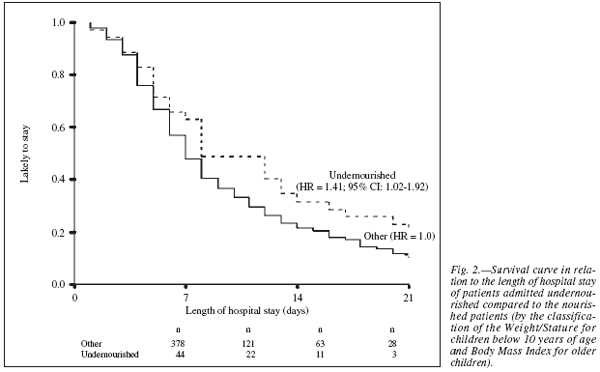
<body><![CDATA[<p align="center">&nbsp;</p>     <p align="center"><a name="f1"><img border="0" src="/img/revistas/nh/v23n6/original9_f1.gif" width="600" height="322"></a></p>     <p><font size="2" face="Verdana"><a href="#f2">Figure 2</a> shows that undernourished patients, compared to nourished patients (according to the W/S score for children below 10 years and BMI for children above), showed a probability 41% greater of remaining hospitalized (HR = 1.41; IC 95%: 1.02-1.92).</font></p>     <p align="center"><a name="f2"><img border="0" src="/img/revistas/nh/v23n6/original9_f2.gif" width="600" height="372"></a></p>     <p><font size="2" face="Verdana">When the adequacy of the dietary prescription was evaluated (<a href="#t3">table III</a>), it was noticed that the proportion of patients who received less calories than recommended in the RDA diminished from approximately 30% at admission to 25% on the 21<sup>st</sup> day of in-hospital stay, whereas the protein intake was predominantly superior to that which is recommended in the DRI, increasing over the in-hospital stay and reaching 90% of the patients on the 21<sup>st</sup> day. Regarding the medical note of the nutritional status of the patients on the discharge papers, it was found that, from the 426 medical records checked, 29 (7%) made a reference to weight loss or gain during hospital stay and 8 (2%) had a record of the diagnosis of undernutrition.</font></p>     <p align="center"><a name="t3"><img border="0" src="/img/revistas/nh/v23n6/original9_t3.gif" width="600" height="236"></a></p>     <p align="center">&nbsp;</p>     <p><font face="Verdana"><b>Discussion</b></font></p>     <p><font size="2" face="Verdana">In this study, which followed patients from 1 month to 12 years of age during in-hospital stay, in a tertiary care hospital in the south of Brazil, the prevalence of undernutrition found at admission was from 10 to 21%, depending on the nutritional evaluation index used. These results are very similar to those found by Dur&aacute;n &amp; Ramos<sup>6</sup> in 661 patients younger than six years of age in Argentina and those by Rocha et al.<sup>7</sup> in 203 children younger than five years of age in a hospital in Fortaleza (Brazil). On the other hand, higher frequencies of undernutrition are described in other Brazilian hospitals. Ferreira et al.,<sup>11</sup> using the W/A score, found a prevalence of undernutrition of 40% in a University Hospital in Alagoas (Brazil), which is almost twice as high as that found in our study. Barbosa et al.,<sup>12</sup> in a study carried out at the Nutrology Unit of the Children's Hospital in Florian&oacute;polis (Brazil), found 90% of the children undernourished by the W/A score. Sanabria et al.<sup>8</sup> identified, in patients younger than five years of age in Paraguay, by means of the W/A and W/S indices, prevalence of undernutrition of 31% and 13%, respectively.</font></p>     <p><font size="2" face="Verdana">The high prevalence of S/A deficit (21%) and the lower prevalence of W/S (10%) deficit may be explained by the information of the Brazilian Health Department that in the Brazilian population, as a whole, the prevailing type of undernutrition is the insidious type, which has a more chronic character, that is, it presents linear growth retardation and, most times, adequate weight for the stature. This type of undernutrition may be easily overlooked, mainly in populations that are used to low stature, which is then attributed to genetic factors.<sup>21</sup> This is not a pattern only in Brazil. Studies involving Latin American populations of low socioeconomic level a high prevalence of S/A deficit and, simultaneously, a low prevalence of W/S deficits.<sup>26-29</sup> This reinforces the necessity of giving more importance to the three indices (S/A, W/A, and W/S) so that undernutrition is detected, either if the results from a chronic or an acute impairment, so that adequate nutritional therapy for the recovery and/or nutritional improvement is planned.</font></p>     ]]></body>
<body><![CDATA[<p><font size="2" face="Verdana">A comforting result of the present study was an improvement of the nutritional status observed over the hospital stay. This result differs from that obtained by Ferreira &amp; Fran&ccedil;a,<sup>11</sup> who found a high prevalence of the deficit for the W/A score among children at the moment of admission, without any alteration on the occasion of the discharge from hospital, regardless of the clinical diagnosis and the length of hospital stay. On the other hand, Oliveira et al.,<sup>30</sup> when assessing the nutritional evolution of children among six months and 3 years of age, found a significant improvement of the W/S score during the hospitalization. Sarni et al.,<sup>31</sup> however, assessing the evolution of the anthropometric data of undernourished children from zero to five years of age, also found an improvement in the W/S and W/A scores, followed by the S/A.</font></p>     <p><font size="2" face="Verdana">Several factors may be involved in the improvement of the nutritional condition during hospitalization that was observed in the present study, such as the termination of the acute phase of some diseases, the diminution of the clinical symptoms of infection, availability of nutritional formulae that favor an adequate handling of the diet, as well as the use of a nutritional assessment protocol that enables a permanent observation of the patient's nutritional status, from admission to hospital discharge.<sup>1,32-34</sup></font></p>     <p><font size="2" face="Verdana">When it was analyzed if the nutritional status influences the patient's length of hospital stay, it was found that undernourished children have 41% more probability of staying in hospital when compared to other children. Oliveira et al.<sup>30</sup> and Ferreira &amp; Fran&ccedil;a<sup>11</sup> also noticed that children with higher nutritional deficit were the ones who stayed in hospital for a longer period.</font></p>     <p><font size="2" face="Verdana">The profile of our patients, regarding the most frequent clinical diagnosis is similar to that of other studies, as respiratory diseases are the main reason for hospitalization.<sup>6,7,12,31</sup> On the other hand, the Hospital de Cl&iacute;nicas de Porto Alegre is also a reference center for the treatment of cystic fibrosis and for pediatric liver transplantation, which justifies the high percentage of pneumopathic patients and chronic hepatopaths in longer hospital stays. Nevertheless, it was not possible to establish an association to nutritional diagnosis and the clinical diagnosis of the patients because of the small number of individuals in each category.</font></p>     <p><font size="2" face="Verdana">Regarding the adequacy of the prescription of calories and proteins,<sup>24,25</sup> the present study shows what is usually observed in the clinical practice: that the protein intake is superior to the recommendation. This overcharge may be necessary, once the nutritional requirements of the patients that are under metabolic stress may be higher than those of healthy subjects,<sup>35,36</sup> even though there is no consensus regarding the best method to estimate the requirements of hospitalized children. Moreover, even among the population, the consumption of protein is much greater than reference values.<sup>21</sup></font></p>     <p><font size="2" face="Verdana">The small number of undernutrition diagnoses as a health problem in medical records is not a problem of our institution. Kanashiro<sup>37</sup> verified that in hospitals in Belo Horizonte, Brazil, in there was a specific note regarding the nutritional status of the patients in only 2.7% of the medical records. It is possible that factors such shared responsibility in the care of a child, failure in considering health habits, and a focus on the basic problem that led to the admission favor this lack of importance given to undernutrition as a fundamental clinical data in the patient's evolution.</font></p>     <p><font size="2" face="Verdana">Among the implications of the present study is the valorization of undernutrition as a factor associated to longer hospital stay, even as a problem that is treatable and that can be improved over hospitalization. This way, planning actions aimed at minimizing hospital undernutrition may in fact help the clinical evolution of a child.</font></p>     <p>&nbsp;</p>     <p><font face="Verdana"><b>References</b></font></p>     <!-- ref --><p><font size="2" face="Verdana">1. Corish C, Kennedy NP. Protein-energy undernutrition in hospital in-patients. Br J Nutrition 2000; 83:575-591.</font>&nbsp;&nbsp;&nbsp;&nbsp;&nbsp;&nbsp;&nbsp;&nbsp;[&#160;<a href="javascript:void(0);" onclick="javascript: window.open('/scielo.php?script=sci_nlinks&ref=3549300&pid=S0212-1611200800080001200001&lng=','','width=640,height=500,resizable=yes,scrollbars=1,menubar=yes,');">Links</a>&#160;]<!-- end-ref --><!-- ref --><p><font size="2" face="Verdana">2. Sermet-Gaudelus I, Poisson-Salomon AS, Colomb V et al. Simple pediatric nutritional risk score to identify children at risk of malnutrition. Am J Clin Nutr 2000; 72:64-70.</font>&nbsp;&nbsp;&nbsp;&nbsp;&nbsp;&nbsp;&nbsp;&nbsp;[&#160;<a href="javascript:void(0);" onclick="javascript: window.open('/scielo.php?script=sci_nlinks&ref=3549301&pid=S0212-1611200800080001200002&lng=','','width=640,height=500,resizable=yes,scrollbars=1,menubar=yes,');">Links</a>&#160;]<!-- end-ref --><!-- ref --><p><font size="2" face="Verdana">3. Costa CM, G&oacute;mez FN, Millet PR et al. Factores de riesgo relacionados con la malnutrici&oacute;n infantil en el medio hospitalario. Nutr Hosp 2007; 19(1):71.</font>&nbsp;&nbsp;&nbsp;&nbsp;&nbsp;&nbsp;&nbsp;&nbsp;[&#160;<a href="javascript:void(0);" onclick="javascript: window.open('/scielo.php?script=sci_nlinks&ref=3549302&pid=S0212-1611200800080001200003&lng=','','width=640,height=500,resizable=yes,scrollbars=1,menubar=yes,');">Links</a>&#160;]<!-- end-ref --><!-- ref --><p><font size="2" face="Verdana">4. Ul&iacute;barri JI. La desnutrici&oacute;n hospitalaria. Nutr Hosp 2003; 18(3):109-112.</font>&nbsp;&nbsp;&nbsp;&nbsp;&nbsp;&nbsp;&nbsp;&nbsp;[&#160;<a href="javascript:void(0);" onclick="javascript: window.open('/scielo.php?script=sci_nlinks&ref=3549303&pid=S0212-1611200800080001200004&lng=','','width=640,height=500,resizable=yes,scrollbars=1,menubar=yes,');">Links</a>&#160;]<!-- end-ref --><!-- ref --><p><font size="2" face="Verdana">5. Minist&eacute;rio da Sa&uacute;de. Secretaria de Aten&ccedil;&atilde;o &agrave; Sa&uacute;de. Coordena&ccedil;&atilde;o Geral da Pol&iacute;tica de Alimenta&ccedil;&atilde;o e Nutri&ccedil;&atilde;o. Manual de Atendimento da crian&ccedil;a com desnutri&ccedil;&atilde;o grave em n&iacute;vel hospitalar. S&eacute;rie A. Normas e Manuais T&eacute;cnicos. Bras&iacute;lia-DF; 2005:144 p.</font>&nbsp;&nbsp;&nbsp;&nbsp;&nbsp;&nbsp;&nbsp;&nbsp;[&#160;<a href="javascript:void(0);" onclick="javascript: window.open('/scielo.php?script=sci_nlinks&ref=3549304&pid=S0212-1611200800080001200005&lng=','','width=640,height=500,resizable=yes,scrollbars=1,menubar=yes,');">Links</a>&#160;]<!-- end-ref --><!-- ref --><p><font size="2" face="Verdana">6. Dur&aacute;n DP, Ramos O. Modificaci&oacute;n en la situaci&oacute;n nutricional durante la internaci&oacute;n y factores asociados. Arch Argent Pediatr 2001; 99(5):405-413.</font>&nbsp;&nbsp;&nbsp;&nbsp;&nbsp;&nbsp;&nbsp;&nbsp;[&#160;<a href="javascript:void(0);" onclick="javascript: window.open('/scielo.php?script=sci_nlinks&ref=3549305&pid=S0212-1611200800080001200006&lng=','','width=640,height=500,resizable=yes,scrollbars=1,menubar=yes,');">Links</a>&#160;]<!-- end-ref --><!-- ref --><p><font size="2" face="Verdana">7. Rocha GA, Rocha EJM, Martins CV. Hospitaliza&ccedil;&atilde;o: efeito sobre o estado nutricional em crian&ccedil;as. J Pediatr (Rio J) 2006; 82(1):70-4.</font>&nbsp;&nbsp;&nbsp;&nbsp;&nbsp;&nbsp;&nbsp;&nbsp;[&#160;<a href="javascript:void(0);" onclick="javascript: window.open('/scielo.php?script=sci_nlinks&ref=3549306&pid=S0212-1611200800080001200007&lng=','','width=640,height=500,resizable=yes,scrollbars=1,menubar=yes,');">Links</a>&#160;]<!-- end-ref --><!-- ref --><p><font size="2" face="Verdana">8. Sanabria MC, Dietz E, Varela CA. Evaluaci&oacute;n nutricional de ni&ntilde;os hospitalizados en un servicio de pediatria de referencia. Pediatria 2000;27. Dispon&iacute;vel em: http//www.spp.org.py/pediatria/210103.htm.</font>&nbsp;&nbsp;&nbsp;&nbsp;&nbsp;&nbsp;&nbsp;&nbsp;[&#160;<a href="javascript:void(0);" onclick="javascript: window.open('/scielo.php?script=sci_nlinks&ref=3549307&pid=S0212-1611200800080001200008&lng=','','width=640,height=500,resizable=yes,scrollbars=1,menubar=yes,');">Links</a>&#160;]<!-- end-ref --><!-- ref --><p><font size="2" face="Verdana">9. Kac G, Dias PC, Coutinho DS, Lopes RS, Martins VV, Pinheiro AB. Length of stay is associated with incidence of in-hospital malnutrition in a group of low-income Brazilian children. Salud Publica Mex 2000; 42:407-412.</font>&nbsp;&nbsp;&nbsp;&nbsp;&nbsp;&nbsp;&nbsp;&nbsp;[&#160;<a href="javascript:void(0);" onclick="javascript: window.open('/scielo.php?script=sci_nlinks&ref=3549308&pid=S0212-1611200800080001200009&lng=','','width=640,height=500,resizable=yes,scrollbars=1,menubar=yes,');">Links</a>&#160;]<!-- end-ref --><!-- ref --><p><font size="2" face="Verdana">10. P&eacute;ret Filho LA. O aparelho digestivo nas formas moderada e grave da desnutri&ccedil;&atilde;o proteico-cal&oacute;rica. En: P&eacute;ret Filho LA. Terapia nutricional nas doen&ccedil;as do apar&eacute;elo digestivo na infancia 2ª ed. Rio de Janeiro; Med&iacute;s, 2003, pp. 31-38.</font>&nbsp;&nbsp;&nbsp;&nbsp;&nbsp;&nbsp;&nbsp;&nbsp;[&#160;<a href="javascript:void(0);" onclick="javascript: window.open('/scielo.php?script=sci_nlinks&ref=3549309&pid=S0212-1611200800080001200010&lng=','','width=640,height=500,resizable=yes,scrollbars=1,menubar=yes,');">Links</a>&#160;]<!-- end-ref --><!-- ref --><p><font size="2" face="Verdana">11. Ferreira HS, Fran&ccedil;a AO. Evolu&ccedil;&atilde;o do estado nutricional de crian&ccedil;as submetidas &agrave; interna&ccedil;&atilde;o hospitalar. J Pediatr (Rio J) 2002; 78:491-196.</font>&nbsp;&nbsp;&nbsp;&nbsp;&nbsp;&nbsp;&nbsp;&nbsp;[&#160;<a href="javascript:void(0);" onclick="javascript: window.open('/scielo.php?script=sci_nlinks&ref=3549310&pid=S0212-1611200800080001200011&lng=','','width=640,height=500,resizable=yes,scrollbars=1,menubar=yes,');">Links</a>&#160;]<!-- end-ref --><!-- ref --><p><font size="2" face="Verdana">12. Barbosa E, Colombo PPF, Nogueira TL, Freitas SFT. Perfil nutricional de crian&ccedil;as desnutridas internadas - uma realidade do Hospital Infantil Joana de Gusm&atilde;o. Rev Bras Nutr Clin 2002; 17(4):137-142.</font>&nbsp;&nbsp;&nbsp;&nbsp;&nbsp;&nbsp;&nbsp;&nbsp;[&#160;<a href="javascript:void(0);" onclick="javascript: window.open('/scielo.php?script=sci_nlinks&ref=3549311&pid=S0212-1611200800080001200012&lng=','','width=640,height=500,resizable=yes,scrollbars=1,menubar=yes,');">Links</a>&#160;]<!-- end-ref --><!-- ref --><p><font size="2" face="Verdana">13. Leone C. Avalia&ccedil;&atilde;o da condi&ccedil;&atilde;o nutricional. In: N&oacute;brega FJ Dist&uacute;rbios da nutri&ccedil;&atilde;o 2ª ed. Rio de Janeiro; Revinter, 1998 pp. 65-70.</font>&nbsp;&nbsp;&nbsp;&nbsp;&nbsp;&nbsp;&nbsp;&nbsp;[&#160;<a href="javascript:void(0);" onclick="javascript: window.open('/scielo.php?script=sci_nlinks&ref=3549312&pid=S0212-1611200800080001200013&lng=','','width=640,height=500,resizable=yes,scrollbars=1,menubar=yes,');">Links</a>&#160;]<!-- end-ref --><!-- ref --><p><font size="2" face="Verdana">14. Fern&aacute;ndez CC, Gonz&aacute;lez IG, Ju&aacute;rez FMA et al. Detecci&oacute;n de malnutric&oacute;n al ingreso en el hospital. Nutr Hosp 2003; 18(2):69-74.</font>&nbsp;&nbsp;&nbsp;&nbsp;&nbsp;&nbsp;&nbsp;&nbsp;[&#160;<a href="javascript:void(0);" onclick="javascript: window.open('/scielo.php?script=sci_nlinks&ref=3549313&pid=S0212-1611200800080001200014&lng=','','width=640,height=500,resizable=yes,scrollbars=1,menubar=yes,');">Links</a>&#160;]<!-- end-ref --><!-- ref --><p><font size="2" face="Verdana">15. Heiward VH, Stolarczyk LM. Avalia&ccedil;&atilde;o da composi&ccedil;&atilde;o corporal aplicada. Rio de Janeiro: Manole; 2000, pp. 243.</font>&nbsp;&nbsp;&nbsp;&nbsp;&nbsp;&nbsp;&nbsp;&nbsp;[&#160;<a href="javascript:void(0);" onclick="javascript: window.open('/scielo.php?script=sci_nlinks&ref=3549314&pid=S0212-1611200800080001200015&lng=','','width=640,height=500,resizable=yes,scrollbars=1,menubar=yes,');">Links</a>&#160;]<!-- end-ref --><!-- ref --><p><font size="2" face="Verdana">16. WHO. Physical status: the use and interpretation of anthropometry. Report of a WHO Expert Committee. Technical Report Series n.º 854. Geneva: World Health Organization; 1995.</font>&nbsp;&nbsp;&nbsp;&nbsp;&nbsp;&nbsp;&nbsp;&nbsp;[&#160;<a href="javascript:void(0);" onclick="javascript: window.open('/scielo.php?script=sci_nlinks&ref=3549315&pid=S0212-1611200800080001200016&lng=','','width=640,height=500,resizable=yes,scrollbars=1,menubar=yes,');">Links</a>&#160;]<!-- end-ref --><!-- ref --><p><font size="2" face="Verdana">17. National Center for Health Statistics. Growth curves for children birth to18 years: United States Department of Health Education and Welfare, Vital and Health Statistic; 1977 Series 11. Nb.165.</font>&nbsp;&nbsp;&nbsp;&nbsp;&nbsp;&nbsp;&nbsp;&nbsp;[&#160;<a href="javascript:void(0);" onclick="javascript: window.open('/scielo.php?script=sci_nlinks&ref=3549316&pid=S0212-1611200800080001200017&lng=','','width=640,height=500,resizable=yes,scrollbars=1,menubar=yes,');">Links</a>&#160;]<!-- end-ref --><!-- ref --><p><font size="2" face="Verdana">18. Onis M, Onyango AW, Borghi E, Garza C, Yang H. Comparison of the World Health Organization (WHO) Child Growth Standards and the National Center for Health Statistics/WHO. International growth reference: Implications for chid health programmes. Public Health Nutr 2006; 9(7):942-947.</font>&nbsp;&nbsp;&nbsp;&nbsp;&nbsp;&nbsp;&nbsp;&nbsp;[&#160;<a href="javascript:void(0);" onclick="javascript: window.open('/scielo.php?script=sci_nlinks&ref=3549317&pid=S0212-1611200800080001200018&lng=','','width=640,height=500,resizable=yes,scrollbars=1,menubar=yes,');">Links</a>&#160;]<!-- end-ref --><!-- ref --><p><font size="2" face="Verdana">19. ASPEN. Teitelbaum D, Guenter P, Howel WH, Kochevar ME, Roth J, Seidner DL. Definition of terms, style, and conventions used in ASPEN. Guidelines and Standards. Nutr Clin Pract 2005; 20:281-285.</font>&nbsp;&nbsp;&nbsp;&nbsp;&nbsp;&nbsp;&nbsp;&nbsp;[&#160;<a href="javascript:void(0);" onclick="javascript: window.open('/scielo.php?script=sci_nlinks&ref=3549318&pid=S0212-1611200800080001200019&lng=','','width=640,height=500,resizable=yes,scrollbars=1,menubar=yes,');">Links</a>&#160;]<!-- end-ref --><!-- ref --><p><font size="2" face="Verdana">20. Almeida CAN, Ricco RG, Nogueira, MPC, Ciampo LAD, Muccillo G. Avalia&ccedil;&atilde;o do uso do percentil 10 de peso para idade como ponto de corte para detec&ccedil;&atilde;o de crian&ccedil;as sob risco nutricional. J Pediatr (Rio J) 1999; 75:345-349.</font>&nbsp;&nbsp;&nbsp;&nbsp;&nbsp;&nbsp;&nbsp;&nbsp;[&#160;<a href="javascript:void(0);" onclick="javascript: window.open('/scielo.php?script=sci_nlinks&ref=3549319&pid=S0212-1611200800080001200020&lng=','','width=640,height=500,resizable=yes,scrollbars=1,menubar=yes,');">Links</a>&#160;]<!-- end-ref --><!-- ref --><p><font size="2" face="Verdana">21. Minist&eacute;rio da Sa&uacute;de. Secretaria de Pol&iacute;tica de Sa&uacute;de. Sa&uacute;de da crian&ccedil;a -Acompanhamento do crescimento e desenvolvimento infantil. S&eacute;rie Cadernos de Aten&ccedil;&atilde;o B&aacute;sica: n.11, S&eacute;rie A. Normas e Manuais T&eacute;cnicos, n. 173. Bras&iacute;lia: DF, 2002.</font>&nbsp;&nbsp;&nbsp;&nbsp;&nbsp;&nbsp;&nbsp;&nbsp;[&#160;<a href="javascript:void(0);" onclick="javascript: window.open('/scielo.php?script=sci_nlinks&ref=3549320&pid=S0212-1611200800080001200021&lng=','','width=640,height=500,resizable=yes,scrollbars=1,menubar=yes,');">Links</a>&#160;]<!-- end-ref --><!-- ref --><p><font size="2" face="Verdana">22. Guo SS, Roche AF, Chumlea WC, Casey PH, Moore WM. Growth in weight, recumbent length, and head circumference for preterm low-birth weight infants during the first three years of life using gestation-adjusted ages. Early Hum Dev 1997; 47:305-325.</font>&nbsp;&nbsp;&nbsp;&nbsp;&nbsp;&nbsp;&nbsp;&nbsp;[&#160;<a href="javascript:void(0);" onclick="javascript: window.open('/scielo.php?script=sci_nlinks&ref=3549321&pid=S0212-1611200800080001200022&lng=','','width=640,height=500,resizable=yes,scrollbars=1,menubar=yes,');">Links</a>&#160;]<!-- end-ref --><!-- ref --><p><font size="2" face="Verdana">23. Frisancho AR. Anthropometric Standards for the Assessment of Growth and Nutritional Status. Ann Arbor: The University of Michigan Press, 1990.</font>&nbsp;&nbsp;&nbsp;&nbsp;&nbsp;&nbsp;&nbsp;&nbsp;[&#160;<a href="javascript:void(0);" onclick="javascript: window.open('/scielo.php?script=sci_nlinks&ref=3549322&pid=S0212-1611200800080001200023&lng=','','width=640,height=500,resizable=yes,scrollbars=1,menubar=yes,');">Links</a>&#160;]<!-- end-ref --><!-- ref --><p><font size="2" face="Verdana">24. Committee on Dietary Allowances, Food and Nutrition Board. Recommended Dietary Allowances (RDA), 10<sup>th</sup> revised edition, National Academy of Science (NAS), Washington D.C., 1989.</font>&nbsp;&nbsp;&nbsp;&nbsp;&nbsp;&nbsp;&nbsp;&nbsp;[&#160;<a href="javascript:void(0);" onclick="javascript: window.open('/scielo.php?script=sci_nlinks&ref=3549323&pid=S0212-1611200800080001200024&lng=','','width=640,height=500,resizable=yes,scrollbars=1,menubar=yes,');">Links</a>&#160;]<!-- end-ref --><!-- ref --><p><font size="2" face="Verdana">25. Institute of Medicine, Food and Nutrition Board: Dietary Reference Intakes: energy, carbohydrates, fiber, fat, fatty acids, cholesterol, protein, and amino acids. National Academy Press, Washington, DC, 2002.</font>&nbsp;&nbsp;&nbsp;&nbsp;&nbsp;&nbsp;&nbsp;&nbsp;[&#160;<a href="javascript:void(0);" onclick="javascript: window.open('/scielo.php?script=sci_nlinks&ref=3549324&pid=S0212-1611200800080001200025&lng=','','width=640,height=500,resizable=yes,scrollbars=1,menubar=yes,');">Links</a>&#160;]<!-- end-ref --><!-- ref --><p><font size="2" face="Verdana">26. Trowbridge FL, Marks JS, Romana GL, Madrid S, Boutton TW, Klein PD. Body composition of Peruvian children with shot stature and high weight-for-height. Il implications for the interpretation for weight-for-height as an indicator of nutritional status. Am J Clin Nutr 1987; 46:411-418.</font>&nbsp;&nbsp;&nbsp;&nbsp;&nbsp;&nbsp;&nbsp;&nbsp;[&#160;<a href="javascript:void(0);" onclick="javascript: window.open('/scielo.php?script=sci_nlinks&ref=3549325&pid=S0212-1611200800080001200026&lng=','','width=640,height=500,resizable=yes,scrollbars=1,menubar=yes,');">Links</a>&#160;]<!-- end-ref --><!-- ref --><p><font size="2" face="Verdana">27. C&eacute;sar JA, Victora CG, Morris SS, Post CA. Abdominal circumference contributes to absence of wasting in Brazilian children. J Nutr 1996; 126:2752-2756.</font>&nbsp;&nbsp;&nbsp;&nbsp;&nbsp;&nbsp;&nbsp;&nbsp;[&#160;<a href="javascript:void(0);" onclick="javascript: window.open('/scielo.php?script=sci_nlinks&ref=3549326&pid=S0212-1611200800080001200027&lng=','','width=640,height=500,resizable=yes,scrollbars=1,menubar=yes,');">Links</a>&#160;]<!-- end-ref --><!-- ref --><p><font size="2" face="Verdana">28. Post CLA, Victora CG, Barros AJD. Baixa preval&ecirc;ncia de d&eacute;ficit de peso para estatura: compara&ccedil;&atilde;o de crian&ccedil;as brasileira com e sem d&eacute;ficit estatural. Rev Sa&uacute;de P&uacute;blica 1999; 33(6): 575-585.</font>&nbsp;&nbsp;&nbsp;&nbsp;&nbsp;&nbsp;&nbsp;&nbsp;[&#160;<a href="javascript:void(0);" onclick="javascript: window.open('/scielo.php?script=sci_nlinks&ref=3549327&pid=S0212-1611200800080001200028&lng=','','width=640,height=500,resizable=yes,scrollbars=1,menubar=yes,');">Links</a>&#160;]<!-- end-ref --><!-- ref --><p><font size="2" face="Verdana">29. Post CLA, Victora CG. The low prevalence of weight-forheight deficits in Brazilian children is related to body proportions. J Nutr 2001; 131:1133-1134.</font>&nbsp;&nbsp;&nbsp;&nbsp;&nbsp;&nbsp;&nbsp;&nbsp;[&#160;<a href="javascript:void(0);" onclick="javascript: window.open('/scielo.php?script=sci_nlinks&ref=3549328&pid=S0212-1611200800080001200029&lng=','','width=640,height=500,resizable=yes,scrollbars=1,menubar=yes,');">Links</a>&#160;]<!-- end-ref --><!-- ref --><p><font size="2" face="Verdana">30. Oliveira AF, Oliveira FLC, Juliano Y, Ancona-L&oacute;pez F. Evolu&ccedil;&atilde;o nutricional de crian&ccedil;as hospitalizadas e sob acompanhamento nutricional. Rev Nutr 2005; 18(3):341-348.</font>&nbsp;&nbsp;&nbsp;&nbsp;&nbsp;&nbsp;&nbsp;&nbsp;[&#160;<a href="javascript:void(0);" onclick="javascript: window.open('/scielo.php?script=sci_nlinks&ref=3549329&pid=S0212-1611200800080001200030&lng=','','width=640,height=500,resizable=yes,scrollbars=1,menubar=yes,');">Links</a>&#160;]<!-- end-ref --><!-- ref --><p><font size="2" face="Verdana">31. Sarni ROS, Souza FIS, Catherino P, Kochi C, Oliveira FLC, N&oacute;brega FJ. Tratamento da desnutri&ccedil;&atilde;o em crian&ccedil;as hospitalizadas em S&atilde;o Paulo. Revista da Associa&ccedil;&atilde;o Brasileira de Medicina 2005; 51(2):106-112.</font>&nbsp;&nbsp;&nbsp;&nbsp;&nbsp;&nbsp;&nbsp;&nbsp;[&#160;<a href="javascript:void(0);" onclick="javascript: window.open('/scielo.php?script=sci_nlinks&ref=3549330&pid=S0212-1611200800080001200031&lng=','','width=640,height=500,resizable=yes,scrollbars=1,menubar=yes,');">Links</a>&#160;]<!-- end-ref --><!-- ref --><p><font size="2" face="Verdana">32. O'Flynn J, Peake H, Hickson M, Foster D, Frost G. The prevalence of malnutrition in hospitals can be reduced: results from three consecutive cross-sectional studies. Clin Nutr 2005; 24:1078-1088.</font>&nbsp;&nbsp;&nbsp;&nbsp;&nbsp;&nbsp;&nbsp;&nbsp;[&#160;<a href="javascript:void(0);" onclick="javascript: window.open('/scielo.php?script=sci_nlinks&ref=3549331&pid=S0212-1611200800080001200032&lng=','','width=640,height=500,resizable=yes,scrollbars=1,menubar=yes,');">Links</a>&#160;]<!-- end-ref --><!-- ref --><p><font size="2" face="Verdana">33. Clavijo SL, Vaqu&eacute; C, Muns MD et al. Influencia del estado nutricional en la evoluci&oacute;n del paciente oncol&oacute;gico. Nutr Hosp 2004; 19(1):9.</font>&nbsp;&nbsp;&nbsp;&nbsp;&nbsp;&nbsp;&nbsp;&nbsp;[&#160;<a href="javascript:void(0);" onclick="javascript: window.open('/scielo.php?script=sci_nlinks&ref=3549332&pid=S0212-1611200800080001200033&lng=','','width=640,height=500,resizable=yes,scrollbars=1,menubar=yes,');">Links</a>&#160;]<!-- end-ref --><!-- ref --><p><font size="2" face="Verdana">34. Leandro-Merhi VA, Garc&iacute;a RWD, M&ocirc;naco DV et al. Comparaci&oacute;n del estado nutricional, consumo alimenticio y tiempo de hospitalizaci&oacute;n de pacientes de dos hospitales, uno p&uacute;blico y otro privado. Nutr Hosp 2006; 21(1):32-7.</font>&nbsp;&nbsp;&nbsp;&nbsp;&nbsp;&nbsp;&nbsp;&nbsp;[&#160;<a href="javascript:void(0);" onclick="javascript: window.open('/scielo.php?script=sci_nlinks&ref=3549333&pid=S0212-1611200800080001200034&lng=','','width=640,height=500,resizable=yes,scrollbars=1,menubar=yes,');">Links</a>&#160;]<!-- end-ref --><!-- ref --><p><font size="2" face="Verdana">35. Garza C. Effect of infection on energy requeriments of infants and children. Public Health Nutr 2005; 8:1187-1190.</font>&nbsp;&nbsp;&nbsp;&nbsp;&nbsp;&nbsp;&nbsp;&nbsp;[&#160;<a href="javascript:void(0);" onclick="javascript: window.open('/scielo.php?script=sci_nlinks&ref=3549334&pid=S0212-1611200800080001200035&lng=','','width=640,height=500,resizable=yes,scrollbars=1,menubar=yes,');">Links</a>&#160;]<!-- end-ref --><!-- ref --><p><font size="2" face="Verdana">36. Giugliani ERJ, Victora CG. Normas alimentares para crian&ccedil;as brasileiras menores de dois anos. OMS -Organiza&ccedil;&atilde;o Mundial da Sa&uacute;de-, OPAS -Organiza&ccedil;&atilde;o Pan-Americana da Sa&uacute;de-, 1997.</font>&nbsp;&nbsp;&nbsp;&nbsp;&nbsp;&nbsp;&nbsp;&nbsp;[&#160;<a href="javascript:void(0);" onclick="javascript: window.open('/scielo.php?script=sci_nlinks&ref=3549335&pid=S0212-1611200800080001200036&lng=','','width=640,height=500,resizable=yes,scrollbars=1,menubar=yes,');">Links</a>&#160;]<!-- end-ref --><!-- ref --><p><font size="2" face="Verdana">37. Kanashiro M. Avalia&ccedil;&atilde;o nutricional de crian&ccedil;as internadas em Hospitais de Belo Horizonte. 2006. 75f. Disserta&ccedil;&atilde;o de mestrado. Orientador: Luciano Am&eacute;dee P&eacute;ret Filho. Universidade Federal de Minas Gerais-Faculdade de Medicina.</font>&nbsp;&nbsp;&nbsp;&nbsp;&nbsp;&nbsp;&nbsp;&nbsp;[&#160;<a href="javascript:void(0);" onclick="javascript: window.open('/scielo.php?script=sci_nlinks&ref=3549336&pid=S0212-1611200800080001200037&lng=','','width=640,height=500,resizable=yes,scrollbars=1,menubar=yes,');">Links</a>&#160;]<!-- end-ref --><p>&nbsp;</p>     <p>&nbsp;</p>     <p><font size="2" face="Verdana"><a href="#top"><img src="/img/revistas/nh/v23n6/seta.gif" alt="" width="15" height="17" border="0"></a><a name="back" id="back"></a><b>Correspondence:</b>    <br>Carla Rosane de Moraes Silveira.    ]]></body>
<body><![CDATA[<br>Rua Veador Porto, 582/803.    <br>90610-200 Porto Alegre-RS. Brasil.    <br>E-mail: <a href="mailto:csilveira@hcpa.urfgs.br">csilveira@hcpa.urfgs.br</a></font></p>     <p><font size="2" face="Verdana">Recibido: 22-X-2007.    <br>Aceptado: 15-IV-2008.</font></p>      ]]></body><back>
<ref-list>
<ref id="B1">
<label>1</label><nlm-citation citation-type="journal">
<person-group person-group-type="author">
<name>
<surname><![CDATA[Corish]]></surname>
<given-names><![CDATA[C]]></given-names>
</name>
<name>
<surname><![CDATA[Kennedy]]></surname>
<given-names><![CDATA[NP]]></given-names>
</name>
</person-group>
<article-title xml:lang="en"><![CDATA[Protein-energy undernutrition in hospital in-patients]]></article-title>
<source><![CDATA[Br J Nutrition]]></source>
<year>2000</year>
<volume>83</volume>
<page-range>575-591</page-range></nlm-citation>
</ref>
<ref id="B2">
<label>2</label><nlm-citation citation-type="journal">
<person-group person-group-type="author">
<name>
<surname><![CDATA[Sermet-Gaudelus]]></surname>
<given-names><![CDATA[I]]></given-names>
</name>
<name>
<surname><![CDATA[Poisson-Salomon]]></surname>
<given-names><![CDATA[AS]]></given-names>
</name>
<name>
<surname><![CDATA[Colomb]]></surname>
<given-names><![CDATA[V]]></given-names>
</name>
</person-group>
<article-title xml:lang="en"><![CDATA[Simple pediatric nutritional risk score to identify children at risk of malnutrition]]></article-title>
<source><![CDATA[Am J Clin Nutr]]></source>
<year>2000</year>
<volume>72</volume>
<page-range>64-70</page-range></nlm-citation>
</ref>
<ref id="B3">
<label>3</label><nlm-citation citation-type="journal">
<person-group person-group-type="author">
<name>
<surname><![CDATA[Costa]]></surname>
<given-names><![CDATA[CM]]></given-names>
</name>
<name>
<surname><![CDATA[Gómez]]></surname>
<given-names><![CDATA[FN]]></given-names>
</name>
<name>
<surname><![CDATA[Millet]]></surname>
<given-names><![CDATA[PR]]></given-names>
</name>
</person-group>
<article-title xml:lang="es"><![CDATA[Factores de riesgo relacionados con la malnutrición infantil en el medio hospitalario]]></article-title>
<source><![CDATA[Nutr Hosp]]></source>
<year>2007</year>
<volume>19</volume>
<numero>1</numero>
<issue>1</issue>
<page-range>71</page-range></nlm-citation>
</ref>
<ref id="B4">
<label>4</label><nlm-citation citation-type="journal">
<person-group person-group-type="author">
<name>
<surname><![CDATA[Ulíbarri]]></surname>
<given-names><![CDATA[JI]]></given-names>
</name>
</person-group>
<article-title xml:lang="es"><![CDATA[La desnutrición hospitalaria]]></article-title>
<source><![CDATA[Nutr Hosp]]></source>
<year>2003</year>
<volume>18</volume>
<numero>3</numero>
<issue>3</issue>
<page-range>109-112</page-range></nlm-citation>
</ref>
<ref id="B5">
<label>5</label><nlm-citation citation-type="">
<collab>Ministério da Saúde^dSecretaria de Atenção à Saúde. Coordenação Geral da Política de Alimentação e Nutrição</collab>
<source><![CDATA[Manual de Atendimento da criança com desnutrição grave em nível hospitalar]]></source>
<year>2005</year>
<page-range>144</page-range><publisher-loc><![CDATA[Brasília ]]></publisher-loc>
</nlm-citation>
</ref>
<ref id="B6">
<label>6</label><nlm-citation citation-type="journal">
<person-group person-group-type="author">
<name>
<surname><![CDATA[Durán]]></surname>
<given-names><![CDATA[DP]]></given-names>
</name>
<name>
<surname><![CDATA[Ramos]]></surname>
<given-names><![CDATA[O]]></given-names>
</name>
</person-group>
<article-title xml:lang="es"><![CDATA[Modificación en la situación nutricional durante la internación y factores asociados]]></article-title>
<source><![CDATA[Arch Argent Pediatr]]></source>
<year>2001</year>
<volume>99</volume>
<numero>5</numero>
<issue>5</issue>
<page-range>405-413</page-range></nlm-citation>
</ref>
<ref id="B7">
<label>7</label><nlm-citation citation-type="journal">
<person-group person-group-type="author">
<name>
<surname><![CDATA[Rocha]]></surname>
<given-names><![CDATA[GA]]></given-names>
</name>
<name>
<surname><![CDATA[Rocha]]></surname>
<given-names><![CDATA[EJM]]></given-names>
</name>
<name>
<surname><![CDATA[Martins]]></surname>
<given-names><![CDATA[CV]]></given-names>
</name>
</person-group>
<article-title xml:lang="pt"><![CDATA[Hospitalização: efeito sobre o estado nutricional em crianças]]></article-title>
<source><![CDATA[J Pediatr (Rio J)]]></source>
<year>2006</year>
<volume>82</volume>
<numero>1</numero>
<issue>1</issue>
<page-range>70-4</page-range></nlm-citation>
</ref>
<ref id="B8">
<label>8</label><nlm-citation citation-type="journal">
<person-group person-group-type="author">
<name>
<surname><![CDATA[Sanabria]]></surname>
<given-names><![CDATA[MC]]></given-names>
</name>
<name>
<surname><![CDATA[Dietz]]></surname>
<given-names><![CDATA[E]]></given-names>
</name>
<name>
<surname><![CDATA[Varela]]></surname>
<given-names><![CDATA[CA]]></given-names>
</name>
</person-group>
<article-title xml:lang="es"><![CDATA[Evaluación nutricional de niños hospitalizados en un servicio de pediatria de referencia]]></article-title>
<source><![CDATA[Pediatria]]></source>
<year>2000</year>
<volume>27</volume>
</nlm-citation>
</ref>
<ref id="B9">
<label>9</label><nlm-citation citation-type="journal">
<person-group person-group-type="author">
<name>
<surname><![CDATA[Kac]]></surname>
<given-names><![CDATA[G]]></given-names>
</name>
<name>
<surname><![CDATA[Dias]]></surname>
<given-names><![CDATA[PC]]></given-names>
</name>
<name>
<surname><![CDATA[Coutinho]]></surname>
<given-names><![CDATA[DS]]></given-names>
</name>
<name>
<surname><![CDATA[Lopes]]></surname>
<given-names><![CDATA[RS]]></given-names>
</name>
<name>
<surname><![CDATA[Martins]]></surname>
<given-names><![CDATA[VV]]></given-names>
</name>
<name>
<surname><![CDATA[Pinheiro]]></surname>
<given-names><![CDATA[AB]]></given-names>
</name>
</person-group>
<article-title xml:lang="en"><![CDATA[Length of stay is associated with incidence of in-hospital malnutrition in a group of low-income Brazilian children]]></article-title>
<source><![CDATA[Salud Publica Mex]]></source>
<year>2000</year>
<volume>42</volume>
<page-range>407-412</page-range></nlm-citation>
</ref>
<ref id="B10">
<label>10</label><nlm-citation citation-type="book">
<person-group person-group-type="author">
<name>
<surname><![CDATA[Péret Filho]]></surname>
<given-names><![CDATA[LA]]></given-names>
</name>
</person-group>
<article-title xml:lang="pt"><![CDATA[O aparelho digestivo nas formas moderada e grave da desnutrição proteico-calórica]]></article-title>
<person-group person-group-type="editor">
<name>
<surname><![CDATA[Péret Filho]]></surname>
<given-names><![CDATA[LA]]></given-names>
</name>
</person-group>
<source><![CDATA[Terapia nutricional nas doenças do aparéelo digestivo na infancia]]></source>
<year>2003</year>
<edition>2</edition>
<page-range>31-38</page-range><publisher-loc><![CDATA[Rio de Janeiro ]]></publisher-loc>
<publisher-name><![CDATA[Medís]]></publisher-name>
</nlm-citation>
</ref>
<ref id="B11">
<label>11</label><nlm-citation citation-type="journal">
<person-group person-group-type="author">
<name>
<surname><![CDATA[Ferreira]]></surname>
<given-names><![CDATA[HS]]></given-names>
</name>
<name>
<surname><![CDATA[França]]></surname>
<given-names><![CDATA[AO]]></given-names>
</name>
</person-group>
<article-title xml:lang="pt"><![CDATA[Evolução do estado nutricional de crianças submetidas à internação hospitalar]]></article-title>
<source><![CDATA[J Pediatr (Rio J)]]></source>
<year>2002</year>
<volume>78</volume>
<page-range>491-196</page-range></nlm-citation>
</ref>
<ref id="B12">
<label>12</label><nlm-citation citation-type="journal">
<person-group person-group-type="author">
<name>
<surname><![CDATA[Barbosa]]></surname>
<given-names><![CDATA[E]]></given-names>
</name>
<name>
<surname><![CDATA[Colombo]]></surname>
<given-names><![CDATA[PPF]]></given-names>
</name>
<name>
<surname><![CDATA[Nogueira]]></surname>
<given-names><![CDATA[TL]]></given-names>
</name>
<name>
<surname><![CDATA[Freitas]]></surname>
<given-names><![CDATA[SFT]]></given-names>
</name>
</person-group>
<article-title xml:lang="pt"><![CDATA[Perfil nutricional de crianças desnutridas internadas: uma realidade do Hospital Infantil Joana de Gusmão]]></article-title>
<source><![CDATA[Rev Bras Nutr Clin]]></source>
<year>2002</year>
<volume>17</volume>
<numero>4</numero>
<issue>4</issue>
<page-range>137-142</page-range></nlm-citation>
</ref>
<ref id="B13">
<label>13</label><nlm-citation citation-type="book">
<person-group person-group-type="author">
<name>
<surname><![CDATA[Leone]]></surname>
<given-names><![CDATA[C]]></given-names>
</name>
</person-group>
<article-title xml:lang="pt"><![CDATA[Avaliação da condição nutricional]]></article-title>
<person-group person-group-type="editor">
<name>
<surname><![CDATA[Nóbrega]]></surname>
<given-names><![CDATA[FJ]]></given-names>
</name>
</person-group>
<source><![CDATA[Distúrbios da nutrição]]></source>
<year>1998</year>
<edition>2</edition>
<page-range>65-70</page-range><publisher-loc><![CDATA[Rio de Janeiro ]]></publisher-loc>
<publisher-name><![CDATA[Revinter]]></publisher-name>
</nlm-citation>
</ref>
<ref id="B14">
<label>14</label><nlm-citation citation-type="journal">
<person-group person-group-type="author">
<name>
<surname><![CDATA[Fernández]]></surname>
<given-names><![CDATA[CC]]></given-names>
</name>
<name>
<surname><![CDATA[González]]></surname>
<given-names><![CDATA[IG]]></given-names>
</name>
<name>
<surname><![CDATA[Juárez]]></surname>
<given-names><![CDATA[FMA]]></given-names>
</name>
</person-group>
<article-title xml:lang="es"><![CDATA[Detección de malnutricón al ingreso en el hospital]]></article-title>
<source><![CDATA[Nutr Hosp]]></source>
<year>2003</year>
<volume>18</volume>
<numero>2</numero>
<issue>2</issue>
<page-range>69-74</page-range></nlm-citation>
</ref>
<ref id="B15">
<label>15</label><nlm-citation citation-type="book">
<person-group person-group-type="author">
<name>
<surname><![CDATA[Heiward]]></surname>
<given-names><![CDATA[VH]]></given-names>
</name>
<name>
<surname><![CDATA[Stolarczyk]]></surname>
<given-names><![CDATA[LM]]></given-names>
</name>
</person-group>
<source><![CDATA[Avaliação da composição corporal aplicada]]></source>
<year>2000</year>
<page-range>243</page-range><publisher-loc><![CDATA[Rio de Janeiro ]]></publisher-loc>
<publisher-name><![CDATA[Manole]]></publisher-name>
</nlm-citation>
</ref>
<ref id="B16">
<label>16</label><nlm-citation citation-type="book">
<collab>WHO</collab>
<source><![CDATA[Physical status: the use and interpretation of anthropometry: Report of a WHO Expert Committee]]></source>
<year>1995</year>
<volume>854</volume>
<publisher-loc><![CDATA[Geneva ]]></publisher-loc>
<publisher-name><![CDATA[World Health Organization]]></publisher-name>
</nlm-citation>
</ref>
<ref id="B17">
<label>17</label><nlm-citation citation-type="">
<collab>National Center for Health Statistics</collab>
<source><![CDATA[Growth curves for children birth to18 years: United States Department of Health Education and Welfare, Vital and Health Statistic]]></source>
<year>1977</year>
<volume>11</volume>
</nlm-citation>
</ref>
<ref id="B18">
<label>18</label><nlm-citation citation-type="journal">
<person-group person-group-type="author">
<name>
<surname><![CDATA[Onis]]></surname>
<given-names><![CDATA[M]]></given-names>
</name>
<name>
<surname><![CDATA[Onyango]]></surname>
<given-names><![CDATA[AW]]></given-names>
</name>
<name>
<surname><![CDATA[Borghi]]></surname>
<given-names><![CDATA[E]]></given-names>
</name>
<name>
<surname><![CDATA[Garza]]></surname>
<given-names><![CDATA[C]]></given-names>
</name>
<name>
<surname><![CDATA[Yang]]></surname>
<given-names><![CDATA[H]]></given-names>
</name>
</person-group>
<article-title xml:lang="en"><![CDATA[Comparison of the World Health Organization (WHO) Child Growth Standards and the National Center for Health Statistics/WHO. International growth reference: Implications for chid health programmes]]></article-title>
<source><![CDATA[Public Health Nutr]]></source>
<year>2006</year>
<volume>9</volume>
<numero>7</numero>
<issue>7</issue>
<page-range>942-947</page-range></nlm-citation>
</ref>
<ref id="B19">
<label>19</label><nlm-citation citation-type="journal">
<person-group person-group-type="author">
<name>
<surname><![CDATA[Teitelbaum]]></surname>
<given-names><![CDATA[D]]></given-names>
</name>
<name>
<surname><![CDATA[Guenter]]></surname>
<given-names><![CDATA[P]]></given-names>
</name>
<name>
<surname><![CDATA[Howel]]></surname>
<given-names><![CDATA[WH]]></given-names>
</name>
<name>
<surname><![CDATA[Kochevar]]></surname>
<given-names><![CDATA[ME]]></given-names>
</name>
<name>
<surname><![CDATA[Roth]]></surname>
<given-names><![CDATA[J]]></given-names>
</name>
<name>
<surname><![CDATA[Seidner]]></surname>
<given-names><![CDATA[DL]]></given-names>
</name>
</person-group>
<collab>ASPEN</collab>
<article-title xml:lang="en"><![CDATA[Definition of terms, style, and conventions used in ASPEN: Guidelines and Standards]]></article-title>
<source><![CDATA[Nutr Clin Pract]]></source>
<year>2005</year>
<volume>20</volume>
<page-range>281-285</page-range></nlm-citation>
</ref>
<ref id="B20">
<label>20</label><nlm-citation citation-type="journal">
<person-group person-group-type="author">
<name>
<surname><![CDATA[Almeida]]></surname>
<given-names><![CDATA[CAN]]></given-names>
</name>
<name>
<surname><![CDATA[Ricco]]></surname>
<given-names><![CDATA[RG]]></given-names>
</name>
<name>
<surname><![CDATA[Nogueira]]></surname>
<given-names><![CDATA[MPC]]></given-names>
</name>
<name>
<surname><![CDATA[Ciampo]]></surname>
<given-names><![CDATA[LAD]]></given-names>
</name>
<name>
<surname><![CDATA[Muccillo]]></surname>
<given-names><![CDATA[G]]></given-names>
</name>
</person-group>
<article-title xml:lang="pt"><![CDATA[Avaliação do uso do percentil 10 de peso para idade como ponto de corte para detecção de crianças sob risco nutricional]]></article-title>
<source><![CDATA[J Pediatr (Rio J)]]></source>
<year>1999</year>
<volume>75</volume>
<page-range>345-349</page-range></nlm-citation>
</ref>
<ref id="B21">
<label>21</label><nlm-citation citation-type="">
<collab>Ministério da Saúde^dSecretaria de Política de Saúde</collab>
<source><![CDATA[Saúde da criança: Acompanhamento do crescimento e desenvolvimento infantil]]></source>
<year>2002</year>
<volume>11</volume><volume>173</volume>
<publisher-loc><![CDATA[Brasília^eDF DF]]></publisher-loc>
</nlm-citation>
</ref>
<ref id="B22">
<label>22</label><nlm-citation citation-type="journal">
<person-group person-group-type="author">
<name>
<surname><![CDATA[Guo]]></surname>
<given-names><![CDATA[SS]]></given-names>
</name>
<name>
<surname><![CDATA[Roche]]></surname>
<given-names><![CDATA[AF]]></given-names>
</name>
<name>
<surname><![CDATA[Chumlea]]></surname>
<given-names><![CDATA[WC]]></given-names>
</name>
<name>
<surname><![CDATA[Casey]]></surname>
<given-names><![CDATA[PH]]></given-names>
</name>
<name>
<surname><![CDATA[Moore]]></surname>
<given-names><![CDATA[WM]]></given-names>
</name>
</person-group>
<article-title xml:lang="en"><![CDATA[Growth in weight, recumbent length, and head circumference for preterm low-birth weight infants during the first three years of life using gestation-adjusted ages]]></article-title>
<source><![CDATA[Early Hum Dev]]></source>
<year>1997</year>
<volume>47</volume>
<page-range>305-325</page-range></nlm-citation>
</ref>
<ref id="B23">
<label>23</label><nlm-citation citation-type="book">
<person-group person-group-type="author">
<name>
<surname><![CDATA[Frisancho]]></surname>
<given-names><![CDATA[AR]]></given-names>
</name>
</person-group>
<source><![CDATA[Anthropometric Standards for the Assessment of Growth and Nutritional Status]]></source>
<year>1990</year>
<publisher-loc><![CDATA[Ann Arbor ]]></publisher-loc>
<publisher-name><![CDATA[The University of Michigan Press]]></publisher-name>
</nlm-citation>
</ref>
<ref id="B24">
<label>24</label><nlm-citation citation-type="book">
<collab>Food and Nutrition Board^dCommittee on Dietary Allowances</collab>
<source><![CDATA[Recommended Dietary Allowances (RDA)]]></source>
<year>1989</year>
<edition>10</edition>
<publisher-loc><![CDATA[Washington D.C. ]]></publisher-loc>
<publisher-name><![CDATA[National Academy of Science (NAS)]]></publisher-name>
</nlm-citation>
</ref>
<ref id="B25">
<label>25</label><nlm-citation citation-type="book">
<collab>Institute of Medicine^dFood and Nutrition Board</collab>
<source><![CDATA[Dietary Reference Intakes: energy, carbohydrates, fiber, fat, fatty acids, cholesterol, protein, and amino acids]]></source>
<year>2002</year>
<publisher-loc><![CDATA[Washington, DC ]]></publisher-loc>
<publisher-name><![CDATA[National Academy Press]]></publisher-name>
</nlm-citation>
</ref>
<ref id="B26">
<label>26</label><nlm-citation citation-type="journal">
<person-group person-group-type="author">
<name>
<surname><![CDATA[Trowbridge]]></surname>
<given-names><![CDATA[FL]]></given-names>
</name>
<name>
<surname><![CDATA[Marks]]></surname>
<given-names><![CDATA[JS]]></given-names>
</name>
<name>
<surname><![CDATA[Romana]]></surname>
<given-names><![CDATA[GL]]></given-names>
</name>
<name>
<surname><![CDATA[Madrid]]></surname>
<given-names><![CDATA[S]]></given-names>
</name>
<name>
<surname><![CDATA[Boutton]]></surname>
<given-names><![CDATA[TW]]></given-names>
</name>
<name>
<surname><![CDATA[Klein]]></surname>
<given-names><![CDATA[PD]]></given-names>
</name>
</person-group>
<article-title xml:lang="en"><![CDATA[Body composition of Peruvian children with shot stature and high weight-for-height: Il implications for the interpretation for weight-for-height as an indicator of nutritional status]]></article-title>
<source><![CDATA[Am J Clin Nutr]]></source>
<year>1987</year>
<volume>46</volume>
<page-range>411-418</page-range></nlm-citation>
</ref>
<ref id="B27">
<label>27</label><nlm-citation citation-type="journal">
<person-group person-group-type="author">
<name>
<surname><![CDATA[César]]></surname>
<given-names><![CDATA[JA]]></given-names>
</name>
<name>
<surname><![CDATA[Victora]]></surname>
<given-names><![CDATA[CG]]></given-names>
</name>
<name>
<surname><![CDATA[Morris]]></surname>
<given-names><![CDATA[SS]]></given-names>
</name>
<name>
<surname><![CDATA[Post]]></surname>
<given-names><![CDATA[CA]]></given-names>
</name>
</person-group>
<article-title xml:lang="en"><![CDATA[Abdominal circumference contributes to absence of wasting in Brazilian children]]></article-title>
<source><![CDATA[J Nutr]]></source>
<year>1996</year>
<volume>126</volume>
<page-range>2752-2756</page-range></nlm-citation>
</ref>
<ref id="B28">
<label>28</label><nlm-citation citation-type="journal">
<person-group person-group-type="author">
<name>
<surname><![CDATA[Post]]></surname>
<given-names><![CDATA[CLA]]></given-names>
</name>
<name>
<surname><![CDATA[Victora]]></surname>
<given-names><![CDATA[CG]]></given-names>
</name>
<name>
<surname><![CDATA[Barros]]></surname>
<given-names><![CDATA[AJD]]></given-names>
</name>
</person-group>
<article-title xml:lang="pt"><![CDATA[Baixa prevalência de déficit de peso para estatura: comparação de crianças brasileira com e sem déficit estatural]]></article-title>
<source><![CDATA[Rev Saúde Pública]]></source>
<year>1999</year>
<volume>33</volume>
<numero>6</numero>
<issue>6</issue>
<page-range>575-585</page-range></nlm-citation>
</ref>
<ref id="B29">
<label>29</label><nlm-citation citation-type="journal">
<person-group person-group-type="author">
<name>
<surname><![CDATA[Post]]></surname>
<given-names><![CDATA[CLA]]></given-names>
</name>
<name>
<surname><![CDATA[Victora]]></surname>
<given-names><![CDATA[CG]]></given-names>
</name>
</person-group>
<article-title xml:lang="en"><![CDATA[The low prevalence of weight-forheight deficits in Brazilian children is related to body proportions]]></article-title>
<source><![CDATA[J Nutr]]></source>
<year>2001</year>
<volume>131</volume>
<page-range>1133-1134</page-range></nlm-citation>
</ref>
<ref id="B30">
<label>30</label><nlm-citation citation-type="journal">
<person-group person-group-type="author">
<name>
<surname><![CDATA[Oliveira]]></surname>
<given-names><![CDATA[AF]]></given-names>
</name>
<name>
<surname><![CDATA[Oliveira]]></surname>
<given-names><![CDATA[FLC]]></given-names>
</name>
<name>
<surname><![CDATA[Juliano]]></surname>
<given-names><![CDATA[Y]]></given-names>
</name>
<name>
<surname><![CDATA[Ancona-López]]></surname>
<given-names><![CDATA[F]]></given-names>
</name>
</person-group>
<article-title xml:lang="pt"><![CDATA[Evolução nutricional de crianças hospitalizadas e sob acompanhamento nutricional]]></article-title>
<source><![CDATA[Rev Nutr]]></source>
<year>2005</year>
<volume>18</volume>
<numero>3</numero>
<issue>3</issue>
<page-range>341-348</page-range></nlm-citation>
</ref>
<ref id="B31">
<label>31</label><nlm-citation citation-type="journal">
<person-group person-group-type="author">
<name>
<surname><![CDATA[Sarni]]></surname>
<given-names><![CDATA[ROS]]></given-names>
</name>
<name>
<surname><![CDATA[Souza]]></surname>
<given-names><![CDATA[FIS]]></given-names>
</name>
<name>
<surname><![CDATA[Catherino]]></surname>
<given-names><![CDATA[P]]></given-names>
</name>
<name>
<surname><![CDATA[Kochi]]></surname>
<given-names><![CDATA[C]]></given-names>
</name>
<name>
<surname><![CDATA[Oliveira]]></surname>
<given-names><![CDATA[FLC]]></given-names>
</name>
<name>
<surname><![CDATA[Nóbrega]]></surname>
<given-names><![CDATA[FJ]]></given-names>
</name>
</person-group>
<article-title xml:lang="pt"><![CDATA[Tratamento da desnutrição em crianças hospitalizadas em São Paulo]]></article-title>
<source><![CDATA[Revista da Associação Brasileira de Medicina]]></source>
<year>2005</year>
<volume>51</volume>
<numero>2</numero>
<issue>2</issue>
<page-range>106-112</page-range></nlm-citation>
</ref>
<ref id="B32">
<label>32</label><nlm-citation citation-type="journal">
<person-group person-group-type="author">
<name>
<surname><![CDATA[O'Flynn]]></surname>
<given-names><![CDATA[J]]></given-names>
</name>
<name>
<surname><![CDATA[Peake]]></surname>
<given-names><![CDATA[H]]></given-names>
</name>
<name>
<surname><![CDATA[Hickson]]></surname>
<given-names><![CDATA[M]]></given-names>
</name>
<name>
<surname><![CDATA[Foster]]></surname>
<given-names><![CDATA[D]]></given-names>
</name>
<name>
<surname><![CDATA[Frost]]></surname>
<given-names><![CDATA[G]]></given-names>
</name>
</person-group>
<article-title xml:lang="en"><![CDATA[The prevalence of malnutrition in hospitals can be reduced: results from three consecutive cross-sectional studies]]></article-title>
<source><![CDATA[Clin Nutr]]></source>
<year>2005</year>
<volume>24</volume>
<page-range>1078-1088</page-range></nlm-citation>
</ref>
<ref id="B33">
<label>33</label><nlm-citation citation-type="journal">
<person-group person-group-type="author">
<name>
<surname><![CDATA[Clavijo]]></surname>
<given-names><![CDATA[SL]]></given-names>
</name>
<name>
<surname><![CDATA[Vaqué]]></surname>
<given-names><![CDATA[C]]></given-names>
</name>
<name>
<surname><![CDATA[Muns]]></surname>
<given-names><![CDATA[MD]]></given-names>
</name>
</person-group>
<article-title xml:lang="es"><![CDATA[Influencia del estado nutricional en la evolución del paciente oncológico]]></article-title>
<source><![CDATA[Nutr Hosp]]></source>
<year>2004</year>
<volume>19</volume>
<numero>1</numero>
<issue>1</issue>
<page-range>9</page-range></nlm-citation>
</ref>
<ref id="B34">
<label>34</label><nlm-citation citation-type="journal">
<person-group person-group-type="author">
<name>
<surname><![CDATA[Leandro-Merhi]]></surname>
<given-names><![CDATA[VA]]></given-names>
</name>
<name>
<surname><![CDATA[García]]></surname>
<given-names><![CDATA[RWD]]></given-names>
</name>
<name>
<surname><![CDATA[Mônaco]]></surname>
<given-names><![CDATA[DV]]></given-names>
</name>
</person-group>
<article-title xml:lang="es"><![CDATA[Comparación del estado nutricional, consumo alimenticio y tiempo de hospitalización de pacientes de dos hospitales, uno público y otro privado]]></article-title>
<source><![CDATA[Nutr Hosp]]></source>
<year>2006</year>
<volume>21</volume>
<numero>1</numero>
<issue>1</issue>
<page-range>32-7</page-range></nlm-citation>
</ref>
<ref id="B35">
<label>35</label><nlm-citation citation-type="journal">
<person-group person-group-type="author">
<name>
<surname><![CDATA[Garza]]></surname>
<given-names><![CDATA[C]]></given-names>
</name>
</person-group>
<article-title xml:lang="en"><![CDATA[Effect of infection on energy requeriments of infants and children]]></article-title>
<source><![CDATA[Public Health Nutr]]></source>
<year>2005</year>
<volume>8</volume>
<page-range>1187-1190</page-range></nlm-citation>
</ref>
<ref id="B36">
<label>36</label><nlm-citation citation-type="book">
<person-group person-group-type="author">
<name>
<surname><![CDATA[Giugliani]]></surname>
<given-names><![CDATA[ERJ]]></given-names>
</name>
<name>
<surname><![CDATA[Victora]]></surname>
<given-names><![CDATA[CG]]></given-names>
</name>
</person-group>
<source><![CDATA[Normas alimentares para crianças brasileiras menores de dois anos]]></source>
<year>1997</year>
<publisher-name><![CDATA[Organização Mundial da SaúdeOrganização Pan-Americana da Saúde]]></publisher-name>
</nlm-citation>
</ref>
<ref id="B37">
<label>37</label><nlm-citation citation-type="">
<person-group person-group-type="author">
<name>
<surname><![CDATA[Kanashiro]]></surname>
<given-names><![CDATA[M]]></given-names>
</name>
</person-group>
<source><![CDATA[Avaliação nutricional de crianças internadas em Hospitais de Belo Horizonte: 2006]]></source>
<year></year>
</nlm-citation>
</ref>
</ref-list>
</back>
</article>