<?xml version="1.0" encoding="ISO-8859-1"?><article xmlns:mml="http://www.w3.org/1998/Math/MathML" xmlns:xlink="http://www.w3.org/1999/xlink" xmlns:xsi="http://www.w3.org/2001/XMLSchema-instance">
<front>
<journal-meta>
<journal-id>0212-1611</journal-id>
<journal-title><![CDATA[Nutrición Hospitalaria]]></journal-title>
<abbrev-journal-title><![CDATA[Nutr. Hosp.]]></abbrev-journal-title>
<issn>0212-1611</issn>
<publisher>
<publisher-name><![CDATA[Grupo Arán]]></publisher-name>
</publisher>
</journal-meta>
<article-meta>
<article-id>S0212-16112008000800014</article-id>
<title-group>
<article-title xml:lang="en"><![CDATA[Validation of predictive equations for weight and height using a metric tape]]></article-title>
<article-title xml:lang="es"><![CDATA[Validación de ecuaciones predictivas para el peso y talla utilizando cinta métrica]]></article-title>
</title-group>
<contrib-group>
<contrib contrib-type="author">
<name>
<surname><![CDATA[Rabito]]></surname>
<given-names><![CDATA[E. I.]]></given-names>
</name>
<xref ref-type="aff" rid="A01"/>
</contrib>
<contrib contrib-type="author">
<name>
<surname><![CDATA[Mialich]]></surname>
<given-names><![CDATA[M. S.]]></given-names>
</name>
<xref ref-type="aff" rid="A02"/>
</contrib>
<contrib contrib-type="author">
<name>
<surname><![CDATA[Martínez]]></surname>
<given-names><![CDATA[E. Z.]]></given-names>
</name>
<xref ref-type="aff" rid="A03"/>
</contrib>
<contrib contrib-type="author">
<name>
<surname><![CDATA[García]]></surname>
<given-names><![CDATA[R. W. D.]]></given-names>
</name>
<xref ref-type="aff" rid="A02"/>
</contrib>
<contrib contrib-type="author">
<name>
<surname><![CDATA[Jordao]]></surname>
<given-names><![CDATA[A. A. Jr.]]></given-names>
</name>
<xref ref-type="aff" rid="A02"/>
</contrib>
<contrib contrib-type="author">
<name>
<surname><![CDATA[Marchini]]></surname>
<given-names><![CDATA[J. S.]]></given-names>
</name>
<xref ref-type="aff" rid="A01"/>
</contrib>
</contrib-group>
<aff id="A01">
<institution><![CDATA[,University of Sao Paolo (USP) Faculty of Medicine Department of Internal Medicine]]></institution>
<addr-line><![CDATA[Ribeirão Preto ]]></addr-line>
<country>Brazil</country>
</aff>
<aff id="A02">
<institution><![CDATA[,University of Sao Paolo (USP) Faculty of Medicine Department of Internal Medicine]]></institution>
<addr-line><![CDATA[Ribeirão Preto ]]></addr-line>
<country>Brazil</country>
</aff>
<aff id="A03">
<institution><![CDATA[,University of Sao Paolo (USP) Faculty of Medicine Department of Social Medicine]]></institution>
<addr-line><![CDATA[Ribeirão Preto ]]></addr-line>
<country>Brazil</country>
</aff>
<pub-date pub-type="pub">
<day>00</day>
<month>12</month>
<year>2008</year>
</pub-date>
<pub-date pub-type="epub">
<day>00</day>
<month>12</month>
<year>2008</year>
</pub-date>
<volume>23</volume>
<numero>6</numero>
<fpage>614</fpage>
<lpage>618</lpage>
<copyright-statement/>
<copyright-year/>
<self-uri xlink:href="http://scielo.isciii.es/scielo.php?script=sci_arttext&amp;pid=S0212-16112008000800014&amp;lng=en&amp;nrm=iso"></self-uri><self-uri xlink:href="http://scielo.isciii.es/scielo.php?script=sci_abstract&amp;pid=S0212-16112008000800014&amp;lng=en&amp;nrm=iso"></self-uri><self-uri xlink:href="http://scielo.isciii.es/scielo.php?script=sci_pdf&amp;pid=S0212-16112008000800014&amp;lng=en&amp;nrm=iso"></self-uri><abstract abstract-type="short" xml:lang="en"><p><![CDATA[Weight and height measurements are important data for the evaluation of nutritional status but some situations prevent the execution of these measurements in the standard manner, using special equipment or an estimate by predictive equations. Predictive equations of height and weight requiring only a metric tape as an instrument have been recently developed. Objective: To validate three predictive equations for weight and two for height by Rabito and evaluating their agreement with the equations proposed by Chumlea. Methods: The following data were collected: sex, age and anthropometric measurements, ie, weight (kg), height (m), subscapular skinfold (mm), calf (cm), arm (cm) and abdominal (cm) circumferences, arm length (cm), and half span (cm). Data were analyzed statistically using the Lin coefficient to test the agreement between the equations and the St. Laurent coefficient to compare the estimated weight and height values with real values. Results: 100 adults (age 48 ± 18 years) admitted to the University Hospital (HCFMRP/USP) were evaluated. Equations I: W(kg) = 0.5030 (AC) + 0.5634 (AbC) + 1.3180 (CC) +0.0339 (SSSF) - 43.1560 and II: W (kg) = 0.4808 (AC) + 0.5646 (AbC) +1.3160 (CC) - 42.2450 showed the highest coefficients of agreement for weight and equations IV and V showed the highest coefficients of agreement for height. The St. Laurent coefficient indicated that equations III and V were valid for weight and height, respectively. Conclusion: Among the validated equations, the number III W (kg) = 0.5759 (AC) + 0.5263 (AbC) +1.2452 (CC) - 4.8689 (S) - 32.9241 and VH (m) = 63,525 -3,237(S) - 0,06904 (A) + 1,293 (HS) are recommended for height or weight because of their easy use for hospitalized patients and the equations be validated in other situations.]]></p></abstract>
<abstract abstract-type="short" xml:lang="es"><p><![CDATA[Las medidas de peso y talla son datos importantes para la evaluación del estado nutricional y también para el planeamiento de terapias nutricionales y medicamentosas. Entretanto, algunas situaciones imposibilitan la realización de estas medidas de forma convencional. En estos casos son necesarios equipamientos especiales o la estimativa por medio de ecuaciones predictivas. Recientemente fueran desarrolladas ecuaciones predictivas de peso y talla que requieren como instrumento la cinta métrica. Objetivo: Validar tres ecuaciones predictivas para el peso y dos ecuaciones para talla, evaluando la concordancia de estas con las ecuaciones propuestas por Chumlea. Métodos: Los datos recogidos fueran de sexo, edad, y medidas antropométricas como peso (kg); talla (m); pliegue cutáneo sub-escapular (mm); circunferencia de la pantorrilla (cm), del brazo (cm) y del abdomen (cm); longitud del brazo (cm) y media envergadura (cm). La evaluación estadística fue realizada utilizando el coeficiente de Lin, para evaluar la concordancia entre las ecuaciones, y el coeficiente St. Laurent, para comparar los valores estimados del peso y talla con los valores reales. Resultados: Fueron evaluados 100 individuos de los cuales 52% son del sexo femenino, internados en el Hospital de Clínicas (HCFMRP-USP). Las ecuaciones que presentaron mayores coeficientes de concordancia fueran I y II, para el peso y el IV y V para talla. Lo coeficiente de St. Laurent ha indicado que las ecuaciones III y V presentan validad para peso y talla, respectivamente. Conclusión: Las ecuaciones III y V, validadas en este estudio, son recomendables por la facilidad de utilización.]]></p></abstract>
<kwd-group>
<kwd lng="en"><![CDATA[Anthropometry]]></kwd>
<kwd lng="en"><![CDATA[Predictive equations]]></kwd>
<kwd lng="en"><![CDATA[Weight]]></kwd>
<kwd lng="en"><![CDATA[Height]]></kwd>
<kwd lng="en"><![CDATA[Hospitalized patients]]></kwd>
<kwd lng="es"><![CDATA[Antropometría]]></kwd>
<kwd lng="es"><![CDATA[Ecuaciones predictivas]]></kwd>
<kwd lng="es"><![CDATA[Peso]]></kwd>
<kwd lng="es"><![CDATA[Altura]]></kwd>
<kwd lng="es"><![CDATA[Pacientes hospitalizados]]></kwd>
</kwd-group>
</article-meta>
</front><body><![CDATA[ <p align="right"><a name="top" id="top"></a><b><font face="Verdana" size="2">ORIGINAL</font></b></p>     <p align="right">&nbsp;</p>     <p><font size="4" face="Verdana"><b>Validation of predictive equations for weight and height using a metric tape</b></font></p>     <p><font size="4" face="Verdana"><b>Validación de ecuaciones predictivas para el peso y talla utilizando cinta métrica</b></font></p>     <p>&nbsp;</p>     <p>&nbsp;</p>     <p><font size="2" face="Verdana"><b>E. I. Rabito<sup>1,2</sup>, M. S. Mialich<sup>3</sup>, E. Z. Martínez<sup>4</sup>, R. W. D. García<sup>3</sup>, A. A. Jr. Jordao<sup>3</sup> and J. S. Marchini<sup>1</sup></b></font></p>     <p><font size="2" face="Verdana"><sup>1</sup>Nutrition Division. Department of Internal Medicine. Faculty of Medicine of Ribeirão Preto/USP.    <br> <sup>2</sup>Curso de Nutrição da UFTM. Universidade Federal do Triângulo Mineiro.    <BR><sup>3</sup>Nutrition and Metabolism Course. Department of Internal Medicine. Faculty of Medicine of Ribeirão Preto/USP.    ]]></body>
<body><![CDATA[<BR><sup>4</sup>Department of Social Medicine. Faculty of Medicine of Ribeirão Preto/USP.</font></p>     <p><font size="2" face="Verdana"><a href="#back">Correspondence</a></font></p>     <p>&nbsp;</p>     <p>&nbsp;</p> <hr size="1">     <p><b><font size="2" face="Verdana">ABSTRACT</font></b></p>     <p><font size="2" face="Verdana">Weight and height measurements are important data for the evaluation of nutritional status but some situations prevent the execution of these measurements in the standard manner, using special equipment or an estimate by predictive equations. Predictive equations of height and weight requiring only a metric tape as an instrument have been recently developed.    <br><b>Objective:</b> To validate three predictive equations for weight and two for height by Rabito and evaluating their agreement with the equations proposed by Chumlea.    <br><b>Methods:</b> The following data were collected: sex, age and anthropometric measurements, ie, weight (kg), height (m), subscapular skinfold (mm), calf (cm), arm (cm) and abdominal (cm) circumferences, arm length (cm), and half span (cm). Data were analyzed statistically using the Lin coefficient to test the agreement between the equations and the St. Laurent coefficient to compare the estimated weight and height values with real values.    <br><b>Results:</b> 100 adults (age 48 ± 18 years) admitted to the University Hospital (HCFMRP/USP) were evaluated. Equations I: W(kg) = 0.5030 (AC) + 0.5634 (AbC) + 1.3180 (CC) +0.0339 (SSSF) - 43.1560 and II: W (kg) = 0.4808 (AC) + 0.5646 (AbC) +1.3160 (CC) - 42.2450 showed the highest coefficients of agreement for weight and equations IV and V showed the highest coefficients of agreement for height. The St. Laurent coefficient indicated that equations III and V were valid for weight and height, respectively.    <br><b>Conclusion:</b> Among the validated equations, the number III W (kg) = 0.5759 (AC) + 0.5263 (AbC) +1.2452 (CC) - 4.8689 (S) - 32.9241 and VH (m) = 63,525 -3,237(S) - 0,06904 (A) + 1,293 (HS) are recommended for height or weight because of their easy use for hospitalized patients and the equations be validated in other situations.</font></p>     ]]></body>
<body><![CDATA[<p><font size="2" face="Verdana"><b>Key words:</b> Anthropometry. Predictive equations. Weight. Height. Hospitalized patients.</font></p> <hr size="1">     <p><b><font size="2" face="Verdana">RESUMEN</font></b></p>     <p><font size="2" face="Verdana">Las medidas de peso y talla son datos importantes para la evaluación del estado nutricional y también para el planeamiento de terapias nutricionales y medicamentosas. Entretanto, algunas situaciones imposibilitan la realización de estas medidas de forma convencional. En estos casos son necesarios equipamientos especiales o la estimativa por medio de ecuaciones predictivas. Recientemente fueran desarrolladas ecuaciones predictivas de peso y talla que requieren como instrumento la cinta métrica.    <br><b>Objetivo:</b> Validar tres ecuaciones predictivas para el peso y dos ecuaciones para talla, evaluando la concordancia de estas con las ecuaciones propuestas por Chumlea.    <br><b>Métodos:</b> Los datos recogidos fueran de sexo, edad, y medidas antropométricas como peso (kg); talla (m); pliegue cutáneo sub-escapular (mm); circunferencia de la pantorrilla (cm), del brazo (cm) y del abdomen (cm); longitud del brazo (cm) y media envergadura (cm). La evaluación estadística fue realizada utilizando el coeficiente de Lin, para evaluar la concordancia entre las ecuaciones, y el coeficiente St. Laurent, para comparar los valores estimados del peso y talla con los valores reales.    <br><b>Resultados:</b> Fueron evaluados 100 individuos de los cuales 52% son del sexo femenino, internados en el Hospital de Clínicas (HCFMRP-USP). Las ecuaciones que presentaron mayores coeficientes de concordancia fueran I y II, para el peso y el IV y V para talla. Lo coeficiente de St. Laurent ha indicado que las ecuaciones III y V presentan validad para peso y talla, respectivamente.    <BR><B>Conclusión:</B> Las ecuaciones III y V, validadas en este estudio, son recomendables por la facilidad de utilización.</font></p>     <p><font size="2" face="Verdana"><b>Palabras clave:</b> Antropometría. Ecuaciones predictivas. Peso. Altura. Pacientes hospitalizados.</font></p> <hr size="1">     <p>&nbsp;</p>     <p><font face="Verdana"><b>Introduction</b></font></p>     ]]></body>
<body><![CDATA[<p><font size="2" face="Verdana">The monitoring of the nutritional status of hospitalized patients may be defined as a process based on diagnostic procedure that will determine the presence of tissue changes and/or nutrient depletion.<sup>1</sup> The evaluation of patients submitted to long periods of hospitalization suggests an increased risk of nutrition complications.<sup>2 </sup>The risk of malnutrition in the elderly, specially under nutrition which is a common problem among elderly people living at home and during hospitalizations, condition that is closely related to the increasing of morbidity, mortality and costs.<sup>3</sup></font></p>     <p><font size="2" face="Verdana">Although most hospital diets provide sufficient energy and nutrients, previous studies examining food consumption in hospitalized patients showed mean daily energy and protein intakes in general patients failing to meet the Estimated Average Requirements-EAR.<sup>4</sup></font></p>     <p><font size="2" face="Verdana">Prevalence of hyponutrition in hospitalized patients is very high and it has been shown to be an important prognostic factor. Most of admitted patients depend on hospital food to cover their nutritional demands being important to assess the factors influencing their intake, which may be modified in order to improve it and prevent the consequences of inadequate feeding.<sup>5</sup></font></p>     <p><font size="2" face="Verdana">Body weight is extensively used as an indicator of nutrition status. Several studies correlate anthropometric characteristics such as weight with the incidence of certain types of chronic diseases.<sup>6,7</sup> However, there are some situations in which these measurements cannot be made by standard methods, as is the case for bedridden patients and patients with difficulty in walking. Prevalence of hyponutrition in hospitalized patients is very high and it has been shown to be an important prognostic factor. Most of admitted patients depend on hospital food to cover their nutritional demands being important to assess the factors influencing their intake, which may be modified in order to improve it and prevent the consequences of inadequate feeding.<sup>8</sup> The nutrition in hopital influenced the body weight of hospitalized patients. Height is also an important element of anthropometric evaluation that may be difficult to determine using direct standard methods. In some cases, height measurements on a patient lying in bed using a metric tape can be adequate for hospitalized patients in a coma, critically ill or unable to move and the lean bodyweight has been recommended for scaling drug doses.<sup>9</sup></font></p>     <p><font size="2" face="Verdana">In view of these difficulties, several studies have been carried out to establish equations for the estimate of weight and height of hospitalized patients belonging to specific populations.<sup>10-12</sup> These studies use other anthropometric measurements which require low cost equipment.<sup>12</sup> The major problem is to adapt these equations according to the validity and applicability criteria used for each ethnic group.<sup>13</sup> On this basis, it is imperative to validate these equations using a sample belonging to the same population, in addition to comparing them to similar equations based on the results of different studies.<sup>14</sup></font></p>     <p><font size="2" face="Verdana">Thus, the objective of the present study was to validate equations, in adults hospitalized patients, recently developed for the estimate of weight and height by Rabito et al<sup>10</sup> and to compare them to equations already described in the by Chumlea et al<sup>15,16</sup> in order to contribute to the process of nutritional evaluation of hospitalized Brazilian patients.</font></p>     <p>&nbsp;</p>     <p><font face="Verdana"><b>Methods</b></font></p>     <p><font size="2" face="Verdana">The study was conducted on the wards of the University Hospital, Faculty of Medicine of Ribeirão Preto, University of São Paulo, and was approved by the Ethics Committee of the Hospital. All patients or participating gave written informed consent. The inclusion criterion was patients able to walk, whereas patients with amputated limbs or immobilized, pregnant women and puerperae, patients with edema and/or ascites, and patients receiving intravenous hydration were excluded.</font></p>     <p><font size="2" face="Verdana">The measurements were made on 100 patients of both sexes older than 18 years after an overnight fast. The measurements were made on the right side in triplicate by trained professionals and the mean of the values obtained was calculated, being accepted the measures with variation lower that 5%. The following measurements were obtained: height (H, cm), weight (W, kg)<sup>17</sup> with a stadiometer and a Filizola<sup>®</sup> platform scale with 0.5 cm and 100 g divisions, respectively; knee height (KH, cm),<sup>16</sup> using a pediatric stadiometer; arm length (AL, cm),<sup>18</sup> calf circumference (CC,cm),<sup>15 </sup>arm circumference (AC, cm),<sup>18</sup> abdominal circumference (AbC, cm),<sup>17</sup> and half-span (HS, cm),<sup>19</sup> measured with an non-extensible metric tape with 0.1 cm divisions; skinfolds (mm) measured with a Lange<sup>®</sup> caliper calibrated with a constant pressure of 10 g/mm<sup>2</sup>: bicipital, tricipital, suprailiac, and subscapular (SSSF) with 1.0 mm division.<sup>20</sup> After these measurements were obtained, concordance coefficients were calculated with the estimates of weight and height described by Rabito et al.,<sup>6</sup> and as shown in <a href="#t1"> table I</a>. The equations described by Chumlea et al. <sup>15,16 </sup>were also used for comparison, as shown in <a href="#t1">table I</a>.</font></p>     ]]></body>
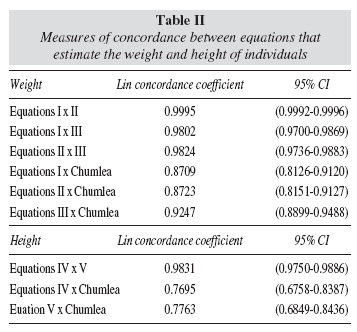
<body><![CDATA[<p align="center"><a name="t1"><img border="0" src="/img/revistas/nh/v23n6/original11_t1.gif" width="356" height="495"></a></p>     <p><font size="2" face="Verdana">In the statistical analysis, the agreement between the equations developed by different authors was determined by the Lin coefficient,<sup>21,22</sup> a concordance measure similar to the well known kappa coefficient.<sup>23</sup> However, the kappa coefficient is suitable for the analysis of agreement between qualitative measurements, whereas the Lin coefficient is appropriate for measurements of a continuous nature. The absolute value of this measure varies between 0 and 1, and a high coefficient indicates that the respective equations will most likely equivalents. The measurements obtained by the equation by Rabito et al<sup>10</sup> to be validated were compared to the real weight and height values using the St Laurent coefficient,<sup>24</sup> which is an extension of the Lin coefficient based on the assumption that one of the measurements in question is the gold standard or a measurement not subjected to measurement error. A high St Laurent coefficient indicates that the values from the equation under study are near to real weight and height values. Lin and St Laurent agreement coefficients were calculated with their 95% confidence intervals (95% CI).</font></p>     <p>&nbsp;</p>     <p><font face="Verdana"><b>Results</b></font></p>     <p><font size="2" face="Verdana">A total of 100 patients, 52% of them females, were chosen at random in the Hospital ambulatory and evaluated. Mean age was 48 ± 18 years, weight 66 ± 16.5 kg, height 162 ± 10.4 cm, and body mass index 25 ± 5.1 kg/m<sup>2</sup>. The results obtained regarding the agreement of the equations for weight and height estimate are listed in <a href="#t2">table II</a>. High Lin coefficients indicated greater agreement between the measurements obtained by equations I and II.<sup>10</sup> The results presented in <a href="#t2"> table II</a> indicate that there was greater agreement between the height estimates obtained by equations IV and V.<sup>10</sup></font></p>     <p align="center"><a name="t2"><img border="0" src="/img/revistas/nh/v23n6/original11_t2.gif" width="357" height="332"></a>     <p><font size="2" face="Verdana">The estimates obtained with the equations were compared to real weight and height values using the St. Laurent coefficient with a 95% confidence interval, presented in <a href="#t3">table III</a>. Figures <a href="#f1">1</a> and <a href="#f2">2</a> indicate that the equations that presented validity were equations III and V of Rabito et al.10 for weight and height, respectively.</font></p>     <p align="center"><a name="t3"><img border="0" src="/img/revistas/nh/v23n6/original11_t3.gif" width="352" height="286"></a></p>     <p align="center"><a name="f1">    <br> <img border="0" src="/img/revistas/nh/v23n6/original11_f1.gif" width="600" height="371"></a></p>     ]]></body>
<body><![CDATA[<p align="center"><a name="f2"><img border="0" src="/img/revistas/nh/v23n6/original11_f2.gif" width="600" height="365"></a></p>     <p align="center">&nbsp;</p>     <p><font face="Verdana"><b>Discussion</b></font></p>     <p><font size="2" face="Verdana">On the basis of the results of the analysis it was possible to observe that the equations for weight estimate showed high concordance. However, equations I and II<sup>10</sup> were those that presented the highest coefficient when compared to Chumlea,<sup>15</sup> as showed in <a href="#t1">table I</a>. Regarding the equations for height estimate, particularly outstanding was the high coefficient detected between equations IV and V,<sup>10</sup> explained by the close proximity of the measurements estimated by them.</font></p>     <p><font size="2" face="Verdana">The St. Laurent coefficient is used to measure the extent to which these equations estimate values of variables such as weight and height comparable to real measures. The equation for weight estimate that presented the highest coefficient was the equation proposed by Chumlea,<sup>15,16</sup> with a result statistically similar to that obtained for equation III.<sup>10</sup> Thus, the choice of one of the two equations does not impair the weight estimate since the easy execution of the measurements is only one criterion for the choice of one of them, with the data needed for equation III being easier to obtain. The measurements made by equation III<sup>10</sup> require only a metric tape, whereas the equation reported in the literature<sup>15,16 </sup>requires a metric tape, an adipometer and a pediatric stadiometer. Another limitation of the equation for weight estimate proposed by Chumlea<sup>15,16</sup> concerns bedridden individuals with immobilized lower limbs that do not permit leg flexion for the measurement of knee height.</font></p>     <p><font size="2" face="Verdana">Among the equations for the estimate of height, equation V<sup>10</sup> presented better agreement with real height; however, this equation shows limitations when applied to individuals with immobilized upper limbs. This limitation is similar to that of the equation proposed in the literature regarding the lower limbs. Thus, the choice of estimate methods is related to the clinical situation and to the equipment available in an institution. Hernándz et al<sup>25</sup> worked with estimed equations achieved a very good correlation with the real height. Thus, in those subjects in whom assessment of the real height is not possible by conventional means, it is possible to use height prediction equations from simple techniques and equipment accessible to the whole health care staff.<sup>25</sup></font></p>     <p><font size="2" face="Verdana">A method extensively used in intensive care or emergency units is the visual estimate of patient weight. Several studies have confirmed that this visual estimate of weight and height in intensive care units is of low accuracy when compared to real values.<sup>26</sup> Also, in cases of emergency care it is necessary to obtain patient weight and height values very close to the real ones since the dose of the drugs to be administered depends on these measurements and, if incorrectly applied, it may cause toxicity or may not have the expected therapeutic effects. A recent study<sup>27</sup> stated that the weight and height reported by the patient when he arrives at an emergency unit are more accurate than those estimated visually by the health professionals themselves. However, some limitations should be considered, such as patients with alterations of mental status, with injury or trauma who are unable to inform about their weight when they are hospitalized.</font></p>     <p><font size="2" face="Verdana">In view of the above considerations, it is very important to implement rapid and effective methods requiring little manipulation of the patient in order to obtain better estimates of height and weight in situations in which these measurements are essential, eg, for the calculation of drug doses to be administered.</font></p>     <p>&nbsp;</p>     <p><font face="Verdana"><b>Conclusion</b></font></p>     ]]></body>
<body><![CDATA[<p><font size="2" face="Verdana">Among the equations validated in the present study, we recommend equations III and V<sup>10</sup> for the estimate of weight and height in hospitalized adults, respectively, since they are easier to use and their statistical significance is high for sample of individuals in Brazil, permitting the determination of these data in a simple and direct manner. The easiness of obtain these measures allows to the same validation or the creation of new equations in other situations or populations.</font></p>     <p>&nbsp;</p>     <p><font face="Verdana"><b>References</b></font></p>     <!-- ref --><p><font size="2" face="Verdana">1. Kyle UG, Pirlich M, Lochs H, Schuetz T, Pichard C. Increased length of hospital stay in underweight and overweight patients at hospital admission: a controlled population study. Clin Nutr 2005; 24:133-42.</font>&nbsp;&nbsp;&nbsp;&nbsp;&nbsp;&nbsp;&nbsp;&nbsp;[&#160;<a href="javascript:void(0);" onclick="javascript: window.open('/scielo.php?script=sci_nlinks&ref=3533716&pid=S0212-1611200800080001400001&lng=','','width=640,height=500,resizable=yes,scrollbars=1,menubar=yes,');">Links</a>&#160;]<!-- end-ref --><!-- ref --><p><font size="2" face="Verdana">2. Kyle UG, Schneider SM, Pirlich M, Lochs H, Hebuterne X, Pichard C. Does nutritional risk, as assessed by Nutritional Risk Index, increase during hospital stay? a multinational population-based study. Clin Nutr 2005; 24:516-24.</font>&nbsp;&nbsp;&nbsp;&nbsp;&nbsp;&nbsp;&nbsp;&nbsp;[&#160;<a href="javascript:void(0);" onclick="javascript: window.open('/scielo.php?script=sci_nlinks&ref=3533717&pid=S0212-1611200800080001400002&lng=','','width=640,height=500,resizable=yes,scrollbars=1,menubar=yes,');">Links</a>&#160;]<!-- end-ref --><!-- ref --><p><font size="2" face="Verdana">3. Reyes JGG, Zúñiga AS, Cruz MG. Prevalencia de desnutrición del adulto mayor al ingreso hospitalario. Nutr Hosp 2007; 22(6):702-9.</font>&nbsp;&nbsp;&nbsp;&nbsp;&nbsp;&nbsp;&nbsp;&nbsp;[&#160;<a href="javascript:void(0);" onclick="javascript: window.open('/scielo.php?script=sci_nlinks&ref=3533718&pid=S0212-1611200800080001400003&lng=','','width=640,height=500,resizable=yes,scrollbars=1,menubar=yes,');">Links</a>&#160;]<!-- end-ref --><!-- ref --><p><font size="2" face="Verdana">4. Tavares MM, Matos L, Amaral TF. Insufficient voluntary intake of nutrients and energy in hospitalized patients. Nutr Hosp 2007; 22(5):584-89.</font>&nbsp;&nbsp;&nbsp;&nbsp;&nbsp;&nbsp;&nbsp;&nbsp;[&#160;<a href="javascript:void(0);" onclick="javascript: window.open('/scielo.php?script=sci_nlinks&ref=3533719&pid=S0212-1611200800080001400004&lng=','','width=640,height=500,resizable=yes,scrollbars=1,menubar=yes,');">Links</a>&#160;]<!-- end-ref --><!-- ref --><p><font size="2" face="Verdana">5. Molero G, Fuster GO, Liébana MI, Oliva L, López ML, Aguilar AM. Influencia de la temperatura en la ingesta de pacientes hospitalizados. Nutr Hosp 2008; 23(1):54-9.</font>&nbsp;&nbsp;&nbsp;&nbsp;&nbsp;&nbsp;&nbsp;&nbsp;[&#160;<a href="javascript:void(0);" onclick="javascript: window.open('/scielo.php?script=sci_nlinks&ref=3533720&pid=S0212-1611200800080001400005&lng=','','width=640,height=500,resizable=yes,scrollbars=1,menubar=yes,');">Links</a>&#160;]<!-- end-ref --><!-- ref --><p><font size="2" face="Verdana">6. Blair CK, Cerhan JR, Folsom AR, Ross JA. Anthropometric characteristics and risk of multiple myeloma. Epidemiol 2005; 16:691-694.</font>&nbsp;&nbsp;&nbsp;&nbsp;&nbsp;&nbsp;&nbsp;&nbsp;[&#160;<a href="javascript:void(0);" onclick="javascript: window.open('/scielo.php?script=sci_nlinks&ref=3533721&pid=S0212-1611200800080001400006&lng=','','width=640,height=500,resizable=yes,scrollbars=1,menubar=yes,');">Links</a>&#160;]<!-- end-ref --><!-- ref --><p><font size="2" face="Verdana">7. Hoyo C, Berchuck A, Halabi S, Bentley RC, Moorman P, Calingaert B et al. Anthropometric measurements and epithelial ovarian cancer risk in African-American and White women. Cancer Causes Control 2005; 16:955-63.</font>&nbsp;&nbsp;&nbsp;&nbsp;&nbsp;&nbsp;&nbsp;&nbsp;[&#160;<a href="javascript:void(0);" onclick="javascript: window.open('/scielo.php?script=sci_nlinks&ref=3533722&pid=S0212-1611200800080001400007&lng=','','width=640,height=500,resizable=yes,scrollbars=1,menubar=yes,');">Links</a>&#160;]<!-- end-ref --><!-- ref --><p><font size="2" face="Verdana">8. Merhi VAL, Oliveira MRM, Caran AL, Tristão TMG, Ambo RM, Tanner MA, Vergna CM. Tiempo de hospitalización y estado nutricional en pacientes hospitalizados. Nutr Hosp 2007; 22(5):590-5.</font>&nbsp;&nbsp;&nbsp;&nbsp;&nbsp;&nbsp;&nbsp;&nbsp;[&#160;<a href="javascript:void(0);" onclick="javascript: window.open('/scielo.php?script=sci_nlinks&ref=3533723&pid=S0212-1611200800080001400008&lng=','','width=640,height=500,resizable=yes,scrollbars=1,menubar=yes,');">Links</a>&#160;]<!-- end-ref --><!-- ref --><p><font size="2" face="Verdana">9. Janmahasatian S, Duffull SB, Ash S, Ward LC, Byrne NM, Green B. Quantification of lean body weight. Clin Pharmacokinet 2005; 44:1051-65.</font>&nbsp;&nbsp;&nbsp;&nbsp;&nbsp;&nbsp;&nbsp;&nbsp;[&#160;<a href="javascript:void(0);" onclick="javascript: window.open('/scielo.php?script=sci_nlinks&ref=3533724&pid=S0212-1611200800080001400009&lng=','','width=640,height=500,resizable=yes,scrollbars=1,menubar=yes,');">Links</a>&#160;]<!-- end-ref --><!-- ref --><p><font size="2" face="Verdana">10. Rabito EI, Vannucchi GB, Suen VMM, Castilho-Neto LL. Marchini JS. Estimate of weight and height of hospitalized patients. Rev Nutr 2006; 19:655-661.</font>&nbsp;&nbsp;&nbsp;&nbsp;&nbsp;&nbsp;&nbsp;&nbsp;[&#160;<a href="javascript:void(0);" onclick="javascript: window.open('/scielo.php?script=sci_nlinks&ref=3533725&pid=S0212-1611200800080001400010&lng=','','width=640,height=500,resizable=yes,scrollbars=1,menubar=yes,');">Links</a>&#160;]<!-- end-ref --><!-- ref --><p><font size="2" face="Verdana">11. Hickson M, Frost G. A comparison of three methods for estimating height in the acutely ill elderly population. J Hum Nutr Dietet 2003; 16:1320.</font>&nbsp;&nbsp;&nbsp;&nbsp;&nbsp;&nbsp;&nbsp;&nbsp;[&#160;<a href="javascript:void(0);" onclick="javascript: window.open('/scielo.php?script=sci_nlinks&ref=3533726&pid=S0212-1611200800080001400011&lng=','','width=640,height=500,resizable=yes,scrollbars=1,menubar=yes,');">Links</a>&#160;]<!-- end-ref --><!-- ref --><p><font size="2" face="Verdana">12. Wagner K, Hothorn T, Koebnick C, Zunft HJ, Trippo U. Improved prediction of body fat by measuring skinfold thickness, circumferences, and bone breadths. Obes Res 2005; 13:626-634.</font>&nbsp;&nbsp;&nbsp;&nbsp;&nbsp;&nbsp;&nbsp;&nbsp;[&#160;<a href="javascript:void(0);" onclick="javascript: window.open('/scielo.php?script=sci_nlinks&ref=3533727&pid=S0212-1611200800080001400012&lng=','','width=640,height=500,resizable=yes,scrollbars=1,menubar=yes,');">Links</a>&#160;]<!-- end-ref --><!-- ref --><p><font size="2" face="Verdana">13. Pongchaiyakul C, Kosulwat V, Rojroongwasinkul N, Charoenkiatkul S, Thepsuthammarat K, Laopaiboon M, Nguyen TV, Rajatanavin R. Prediction of percentage body fat in rural Thai population using simple anthropometric measurements. Obes Res 2005; 13:729-738.</font>&nbsp;&nbsp;&nbsp;&nbsp;&nbsp;&nbsp;&nbsp;&nbsp;[&#160;<a href="javascript:void(0);" onclick="javascript: window.open('/scielo.php?script=sci_nlinks&ref=3533728&pid=S0212-1611200800080001400013&lng=','','width=640,height=500,resizable=yes,scrollbars=1,menubar=yes,');">Links</a>&#160;]<!-- end-ref --><!-- ref --><p><font size="2" face="Verdana">14. Lohman TG. Skinfolds and body density and their relation to body fatness: a review. Hum Biol 1981; 53:181-225.</font>&nbsp;&nbsp;&nbsp;&nbsp;&nbsp;&nbsp;&nbsp;&nbsp;[&#160;<a href="javascript:void(0);" onclick="javascript: window.open('/scielo.php?script=sci_nlinks&ref=3533729&pid=S0212-1611200800080001400014&lng=','','width=640,height=500,resizable=yes,scrollbars=1,menubar=yes,');">Links</a>&#160;]<!-- end-ref --><!-- ref --><p><font size="2" face="Verdana">15. Chumlea WC, Guo S, Roche AF, Steinbaugh ML. Prediction of body weight for the nonambulatory elderly from anthropometry. J Am Diet Assoc 1988; 88:564-568.</font>&nbsp;&nbsp;&nbsp;&nbsp;&nbsp;&nbsp;&nbsp;&nbsp;[&#160;<a href="javascript:void(0);" onclick="javascript: window.open('/scielo.php?script=sci_nlinks&ref=3533730&pid=S0212-1611200800080001400015&lng=','','width=640,height=500,resizable=yes,scrollbars=1,menubar=yes,');">Links</a>&#160;]<!-- end-ref --><!-- ref --><p><font size="2" face="Verdana">16. Chumlea WC, Guo S, Roche AF, Steinbaugh ML. Estimating stature from knee height for person 60 to 90 years of age. J Am Geriatr Soc 1985; 33:116-120.</font>&nbsp;&nbsp;&nbsp;&nbsp;&nbsp;&nbsp;&nbsp;&nbsp;[&#160;<a href="javascript:void(0);" onclick="javascript: window.open('/scielo.php?script=sci_nlinks&ref=3533731&pid=S0212-1611200800080001400016&lng=','','width=640,height=500,resizable=yes,scrollbars=1,menubar=yes,');">Links</a>&#160;]<!-- end-ref --><!-- ref --><p><font size="2" face="Verdana">17. Heymsfield SB. Anthropometric measurements: application in hospitalized patients. Infusionstherapie 1990; 17:48-51.</font>&nbsp;&nbsp;&nbsp;&nbsp;&nbsp;&nbsp;&nbsp;&nbsp;[&#160;<a href="javascript:void(0);" onclick="javascript: window.open('/scielo.php?script=sci_nlinks&ref=3533732&pid=S0212-1611200800080001400017&lng=','','width=640,height=500,resizable=yes,scrollbars=1,menubar=yes,');">Links</a>&#160;]<!-- end-ref --><!-- ref --><p><font size="2" face="Verdana">18. Frisancho AR. New norms of upper limb fat muscle areas for assessment of nutritional status. Am J Clin Nutr 1981; 34:2540-2545.</font>&nbsp;&nbsp;&nbsp;&nbsp;&nbsp;&nbsp;&nbsp;&nbsp;[&#160;<a href="javascript:void(0);" onclick="javascript: window.open('/scielo.php?script=sci_nlinks&ref=3533733&pid=S0212-1611200800080001400018&lng=','','width=640,height=500,resizable=yes,scrollbars=1,menubar=yes,');">Links</a>&#160;]<!-- end-ref --><!-- ref --><p><font size="2" face="Verdana">19. Mitchell CO, Lipschitz DA. Arm length measurement as an alternative to height in nutritional assessment of the elderly. J Parentr Enteral Nutr 1982; 6:226-229.</font>&nbsp;&nbsp;&nbsp;&nbsp;&nbsp;&nbsp;&nbsp;&nbsp;[&#160;<a href="javascript:void(0);" onclick="javascript: window.open('/scielo.php?script=sci_nlinks&ref=3533734&pid=S0212-1611200800080001400019&lng=','','width=640,height=500,resizable=yes,scrollbars=1,menubar=yes,');">Links</a>&#160;]<!-- end-ref --><!-- ref --><p><font size="2" face="Verdana">20. Durnin JV, Womersley J. Body fat assessed from total body density and its estimation from skinfold thickness: measurements on 481 men and women aged from 16 to 72 years. Br J Nutr 1974; 32:77-97.</font>&nbsp;&nbsp;&nbsp;&nbsp;&nbsp;&nbsp;&nbsp;&nbsp;[&#160;<a href="javascript:void(0);" onclick="javascript: window.open('/scielo.php?script=sci_nlinks&ref=3533735&pid=S0212-1611200800080001400020&lng=','','width=640,height=500,resizable=yes,scrollbars=1,menubar=yes,');">Links</a>&#160;]<!-- end-ref --><!-- ref --><p><font size="2" face="Verdana">21. Lin LIK. A concordance correlation coefficient to evaluate reproducibility. Biometrics 1989; 45:255-268.</font>&nbsp;&nbsp;&nbsp;&nbsp;&nbsp;&nbsp;&nbsp;&nbsp;[&#160;<a href="javascript:void(0);" onclick="javascript: window.open('/scielo.php?script=sci_nlinks&ref=3533736&pid=S0212-1611200800080001400021&lng=','','width=640,height=500,resizable=yes,scrollbars=1,menubar=yes,');">Links</a>&#160;]<!-- end-ref --><!-- ref --><p><font size="2" face="Verdana">22. Lin LIK. Assay validation using the concordance correlation coefficient. Biometrics 1992; 48:599-604.</font>&nbsp;&nbsp;&nbsp;&nbsp;&nbsp;&nbsp;&nbsp;&nbsp;[&#160;<a href="javascript:void(0);" onclick="javascript: window.open('/scielo.php?script=sci_nlinks&ref=3533737&pid=S0212-1611200800080001400022&lng=','','width=640,height=500,resizable=yes,scrollbars=1,menubar=yes,');">Links</a>&#160;]<!-- end-ref --><!-- ref --><p><font size="2" face="Verdana">23. Cohen J. A coefficient of agreement for nominal scales. Educ and Psychol Meas 1960; 20:37-46.</font>&nbsp;&nbsp;&nbsp;&nbsp;&nbsp;&nbsp;&nbsp;&nbsp;[&#160;<a href="javascript:void(0);" onclick="javascript: window.open('/scielo.php?script=sci_nlinks&ref=3533738&pid=S0212-1611200800080001400023&lng=','','width=640,height=500,resizable=yes,scrollbars=1,menubar=yes,');">Links</a>&#160;]<!-- end-ref --><!-- ref --><p><font size="2" face="Verdana">24. St Laurent RT. Evaluation of agreement with a gold standard in method comparison studies. Biometrics 1998; 54:537-545.</font>&nbsp;&nbsp;&nbsp;&nbsp;&nbsp;&nbsp;&nbsp;&nbsp;[&#160;<a href="javascript:void(0);" onclick="javascript: window.open('/scielo.php?script=sci_nlinks&ref=3533739&pid=S0212-1611200800080001400024&lng=','','width=640,height=500,resizable=yes,scrollbars=1,menubar=yes,');">Links</a>&#160;]<!-- end-ref --><!-- ref --><p><font size="2" face="Verdana">25. Hernández CG, Calderón GR, Hernández RAH. Estimación de la estatura a partir de la longitud de pierna medida con cinta métrica. Nutr Hosp 2005; 20(5):358-363.</font>&nbsp;&nbsp;&nbsp;&nbsp;&nbsp;&nbsp;&nbsp;&nbsp;[&#160;<a href="javascript:void(0);" onclick="javascript: window.open('/scielo.php?script=sci_nlinks&ref=3533740&pid=S0212-1611200800080001400025&lng=','','width=640,height=500,resizable=yes,scrollbars=1,menubar=yes,');">Links</a>&#160;]<!-- end-ref --><!-- ref --><p><font size="2" face="Verdana">26. Leary TS, Milner QJW, Niblett DJ. The accuracy of the estimation of body weight and height in the intensive care unit. Eur J Anaesthesiol 2000; 17:698.</font>&nbsp;&nbsp;&nbsp;&nbsp;&nbsp;&nbsp;&nbsp;&nbsp;[&#160;<a href="javascript:void(0);" onclick="javascript: window.open('/scielo.php?script=sci_nlinks&ref=3533741&pid=S0212-1611200800080001400026&lng=','','width=640,height=500,resizable=yes,scrollbars=1,menubar=yes,');">Links</a>&#160;]<!-- end-ref --><!-- ref --><p><font size="2" face="Verdana">27. Menon S, Kelly AM. How accurate is weight estimation in the emergency department? Emerg Med Australia 2005; 17:13-116.</font>&nbsp;&nbsp;&nbsp;&nbsp;&nbsp;&nbsp;&nbsp;&nbsp;[&#160;<a href="javascript:void(0);" onclick="javascript: window.open('/scielo.php?script=sci_nlinks&ref=3533742&pid=S0212-1611200800080001400027&lng=','','width=640,height=500,resizable=yes,scrollbars=1,menubar=yes,');">Links</a>&#160;]<!-- end-ref --><p>&nbsp;</p>     <p>&nbsp;</p>     <p><font size="2" face="Verdana"><a name="back" id="back"></a><a href="#top"><img src="/img/revistas/nh/v23n6/seta.gif" width="15" height="17" border="0"></a><b>Correspondence:</b>    <br>Julio Sergio Marchini.    <br>Nutrition Division - Department of Internal Medicine.    <br>Faculty of Medicine of Ribeirão Preto/USP.    <br>Av. Bandeirantes 3900.    <br>14049-900 Ribeirão Preto/SP. Brazil.    <br>E-mail: <a href="mailto:jsmarchi@fmrp.usp.br">jsmarchi@fmrp.usp.br</a></font></p>     <p><font size="2" face="Verdana">Recibido: 17-IX-2007.    ]]></body>
<body><![CDATA[<br>Aceptado: 6-VI-2008.</font></p>      ]]></body><back>
<ref-list>
<ref id="B1">
<label>1</label><nlm-citation citation-type="journal">
<person-group person-group-type="author">
<name>
<surname><![CDATA[Kyle]]></surname>
<given-names><![CDATA[UG]]></given-names>
</name>
<name>
<surname><![CDATA[Pirlich]]></surname>
<given-names><![CDATA[M]]></given-names>
</name>
<name>
<surname><![CDATA[Lochs]]></surname>
<given-names><![CDATA[H]]></given-names>
</name>
<name>
<surname><![CDATA[Schuetz]]></surname>
<given-names><![CDATA[T]]></given-names>
</name>
<name>
<surname><![CDATA[Pichard]]></surname>
<given-names><![CDATA[C]]></given-names>
</name>
</person-group>
<article-title xml:lang="en"><![CDATA[Increased length of hospital stay in underweight and overweight patients at hospital admission: a controlled population study]]></article-title>
<source><![CDATA[Clin Nutr]]></source>
<year>2005</year>
<volume>24</volume>
<page-range>133-42</page-range></nlm-citation>
</ref>
<ref id="B2">
<label>2</label><nlm-citation citation-type="journal">
<person-group person-group-type="author">
<name>
<surname><![CDATA[Kyle]]></surname>
<given-names><![CDATA[UG]]></given-names>
</name>
<name>
<surname><![CDATA[Schneider]]></surname>
<given-names><![CDATA[SM]]></given-names>
</name>
<name>
<surname><![CDATA[Pirlich]]></surname>
<given-names><![CDATA[M]]></given-names>
</name>
<name>
<surname><![CDATA[Lochs]]></surname>
<given-names><![CDATA[H]]></given-names>
</name>
<name>
<surname><![CDATA[Hebuterne]]></surname>
<given-names><![CDATA[X]]></given-names>
</name>
<name>
<surname><![CDATA[Pichard]]></surname>
<given-names><![CDATA[C]]></given-names>
</name>
</person-group>
<article-title xml:lang="en"><![CDATA[Does nutritional risk, as assessed by Nutritional Risk Index, increase during hospital stay?: a multinational population-based study]]></article-title>
<source><![CDATA[Clin Nutr]]></source>
<year>2005</year>
<volume>24</volume>
<page-range>516-24</page-range></nlm-citation>
</ref>
<ref id="B3">
<label>3</label><nlm-citation citation-type="journal">
<person-group person-group-type="author">
<name>
<surname><![CDATA[Reyes]]></surname>
<given-names><![CDATA[JGG]]></given-names>
</name>
<name>
<surname><![CDATA[Zúñiga]]></surname>
<given-names><![CDATA[AS]]></given-names>
</name>
<name>
<surname><![CDATA[Cruz]]></surname>
<given-names><![CDATA[MG]]></given-names>
</name>
</person-group>
<article-title xml:lang="es"><![CDATA[Prevalencia de desnutrición del adulto mayor al ingreso hospitalario]]></article-title>
<source><![CDATA[Nutr Hosp]]></source>
<year>2007</year>
<volume>22</volume>
<numero>6</numero>
<issue>6</issue>
<page-range>702-9</page-range></nlm-citation>
</ref>
<ref id="B4">
<label>4</label><nlm-citation citation-type="journal">
<person-group person-group-type="author">
<name>
<surname><![CDATA[Tavares]]></surname>
<given-names><![CDATA[MM]]></given-names>
</name>
<name>
<surname><![CDATA[Matos]]></surname>
<given-names><![CDATA[L]]></given-names>
</name>
<name>
<surname><![CDATA[Amaral]]></surname>
<given-names><![CDATA[TF]]></given-names>
</name>
</person-group>
<article-title xml:lang="en"><![CDATA[Insufficient voluntary intake of nutrients and energy in hospitalized patients]]></article-title>
<source><![CDATA[Nutr Hosp]]></source>
<year>2007</year>
<volume>22</volume>
<numero>5</numero>
<issue>5</issue>
<page-range>584-89</page-range></nlm-citation>
</ref>
<ref id="B5">
<label>5</label><nlm-citation citation-type="journal">
<person-group person-group-type="author">
<name>
<surname><![CDATA[Molero]]></surname>
<given-names><![CDATA[G]]></given-names>
</name>
<name>
<surname><![CDATA[Fuster]]></surname>
<given-names><![CDATA[GO]]></given-names>
</name>
<name>
<surname><![CDATA[Liébana]]></surname>
<given-names><![CDATA[MI]]></given-names>
</name>
<name>
<surname><![CDATA[Oliva]]></surname>
<given-names><![CDATA[L]]></given-names>
</name>
<name>
<surname><![CDATA[López]]></surname>
<given-names><![CDATA[ML]]></given-names>
</name>
<name>
<surname><![CDATA[Aguilar]]></surname>
<given-names><![CDATA[AM]]></given-names>
</name>
</person-group>
<article-title xml:lang="es"><![CDATA[Influencia de la temperatura en la ingesta de pacientes hospitalizados]]></article-title>
<source><![CDATA[Nutr Hosp]]></source>
<year>2008</year>
<volume>23</volume>
<numero>1</numero>
<issue>1</issue>
<page-range>54-9</page-range></nlm-citation>
</ref>
<ref id="B6">
<label>6</label><nlm-citation citation-type="journal">
<person-group person-group-type="author">
<name>
<surname><![CDATA[Blair]]></surname>
<given-names><![CDATA[CK]]></given-names>
</name>
<name>
<surname><![CDATA[Cerhan]]></surname>
<given-names><![CDATA[JR]]></given-names>
</name>
<name>
<surname><![CDATA[Folsom]]></surname>
<given-names><![CDATA[AR]]></given-names>
</name>
<name>
<surname><![CDATA[Ross]]></surname>
<given-names><![CDATA[JA]]></given-names>
</name>
</person-group>
<article-title xml:lang="en"><![CDATA[Anthropometric characteristics and risk of multiple myeloma]]></article-title>
<source><![CDATA[Epidemiol]]></source>
<year>2005</year>
<volume>16</volume>
<page-range>691-694</page-range></nlm-citation>
</ref>
<ref id="B7">
<label>7</label><nlm-citation citation-type="journal">
<person-group person-group-type="author">
<name>
<surname><![CDATA[Hoyo]]></surname>
<given-names><![CDATA[C]]></given-names>
</name>
<name>
<surname><![CDATA[Berchuck]]></surname>
<given-names><![CDATA[A]]></given-names>
</name>
<name>
<surname><![CDATA[Halabi]]></surname>
<given-names><![CDATA[S]]></given-names>
</name>
<name>
<surname><![CDATA[Bentley]]></surname>
<given-names><![CDATA[RC]]></given-names>
</name>
<name>
<surname><![CDATA[Moorman]]></surname>
<given-names><![CDATA[P]]></given-names>
</name>
<name>
<surname><![CDATA[Calingaert]]></surname>
<given-names><![CDATA[B]]></given-names>
</name>
</person-group>
<article-title xml:lang="en"><![CDATA[Anthropometric measurements and epithelial ovarian cancer risk in African-American and White women]]></article-title>
<source><![CDATA[Cancer Causes Control]]></source>
<year>2005</year>
<volume>16</volume>
<page-range>955-63</page-range></nlm-citation>
</ref>
<ref id="B8">
<label>8</label><nlm-citation citation-type="journal">
<person-group person-group-type="author">
<name>
<surname><![CDATA[Merhi]]></surname>
<given-names><![CDATA[VAL]]></given-names>
</name>
<name>
<surname><![CDATA[Oliveira]]></surname>
<given-names><![CDATA[MRM]]></given-names>
</name>
<name>
<surname><![CDATA[Caran]]></surname>
<given-names><![CDATA[AL]]></given-names>
</name>
<name>
<surname><![CDATA[Tristão]]></surname>
<given-names><![CDATA[TMG]]></given-names>
</name>
<name>
<surname><![CDATA[Ambo]]></surname>
<given-names><![CDATA[RM]]></given-names>
</name>
<name>
<surname><![CDATA[Tanner]]></surname>
<given-names><![CDATA[MA]]></given-names>
</name>
<name>
<surname><![CDATA[Vergna]]></surname>
<given-names><![CDATA[CM]]></given-names>
</name>
</person-group>
<article-title xml:lang="es"><![CDATA[Tiempo de hospitalización y estado nutricional en pacientes hospitalizados]]></article-title>
<source><![CDATA[Nutr Hosp]]></source>
<year>2007</year>
<volume>22</volume>
<numero>5</numero>
<issue>5</issue>
<page-range>590-5</page-range></nlm-citation>
</ref>
<ref id="B9">
<label>9</label><nlm-citation citation-type="journal">
<person-group person-group-type="author">
<name>
<surname><![CDATA[Janmahasatian]]></surname>
<given-names><![CDATA[S]]></given-names>
</name>
<name>
<surname><![CDATA[Duffull]]></surname>
<given-names><![CDATA[SB]]></given-names>
</name>
<name>
<surname><![CDATA[Ash]]></surname>
<given-names><![CDATA[S]]></given-names>
</name>
<name>
<surname><![CDATA[Ward]]></surname>
<given-names><![CDATA[LC]]></given-names>
</name>
<name>
<surname><![CDATA[Byrne]]></surname>
<given-names><![CDATA[NM]]></given-names>
</name>
<name>
<surname><![CDATA[Green]]></surname>
<given-names><![CDATA[B]]></given-names>
</name>
</person-group>
<article-title xml:lang="en"><![CDATA[Quantification of lean body weight]]></article-title>
<source><![CDATA[Clin Pharmacokinet]]></source>
<year>2005</year>
<volume>44</volume>
<page-range>1051-65</page-range></nlm-citation>
</ref>
<ref id="B10">
<label>10</label><nlm-citation citation-type="journal">
<person-group person-group-type="author">
<name>
<surname><![CDATA[Rabito]]></surname>
<given-names><![CDATA[EI]]></given-names>
</name>
<name>
<surname><![CDATA[Vannucchi]]></surname>
<given-names><![CDATA[GB]]></given-names>
</name>
<name>
<surname><![CDATA[Suen]]></surname>
<given-names><![CDATA[VMM]]></given-names>
</name>
<name>
<surname><![CDATA[Castilho-Neto]]></surname>
<given-names><![CDATA[LL]]></given-names>
</name>
<name>
<surname><![CDATA[Marchini]]></surname>
<given-names><![CDATA[JS]]></given-names>
</name>
</person-group>
<article-title xml:lang="en"><![CDATA[Estimate of weight and height of hospitalized patients]]></article-title>
<source><![CDATA[Rev Nutr]]></source>
<year>2006</year>
<volume>19</volume>
<page-range>655-661</page-range></nlm-citation>
</ref>
<ref id="B11">
<label>11</label><nlm-citation citation-type="journal">
<person-group person-group-type="author">
<name>
<surname><![CDATA[Hickson]]></surname>
<given-names><![CDATA[M]]></given-names>
</name>
<name>
<surname><![CDATA[Frost]]></surname>
<given-names><![CDATA[G]]></given-names>
</name>
</person-group>
<article-title xml:lang="en"><![CDATA[A comparison of three methods for estimating height in the acutely ill elderly population]]></article-title>
<source><![CDATA[J Hum Nutr Dietet]]></source>
<year>2003</year>
<volume>16</volume>
<page-range>1320</page-range></nlm-citation>
</ref>
<ref id="B12">
<label>12</label><nlm-citation citation-type="journal">
<person-group person-group-type="author">
<name>
<surname><![CDATA[Wagner]]></surname>
<given-names><![CDATA[K]]></given-names>
</name>
<name>
<surname><![CDATA[Hothorn]]></surname>
<given-names><![CDATA[T]]></given-names>
</name>
<name>
<surname><![CDATA[Koebnick]]></surname>
<given-names><![CDATA[C]]></given-names>
</name>
<name>
<surname><![CDATA[Zunft]]></surname>
<given-names><![CDATA[HJ]]></given-names>
</name>
<name>
<surname><![CDATA[Trippo]]></surname>
<given-names><![CDATA[U]]></given-names>
</name>
</person-group>
<article-title xml:lang="en"><![CDATA[Improved prediction of body fat by measuring skinfold thickness, circumferences, and bone breadths]]></article-title>
<source><![CDATA[Obes Res]]></source>
<year>2005</year>
<volume>13</volume>
<page-range>626-634</page-range></nlm-citation>
</ref>
<ref id="B13">
<label>13</label><nlm-citation citation-type="journal">
<person-group person-group-type="author">
<name>
<surname><![CDATA[Pongchaiyakul]]></surname>
<given-names><![CDATA[C]]></given-names>
</name>
<name>
<surname><![CDATA[Kosulwat]]></surname>
<given-names><![CDATA[V]]></given-names>
</name>
<name>
<surname><![CDATA[Rojroongwasinkul]]></surname>
<given-names><![CDATA[N]]></given-names>
</name>
<name>
<surname><![CDATA[Charoenkiatkul]]></surname>
<given-names><![CDATA[S]]></given-names>
</name>
<name>
<surname><![CDATA[Thepsuthammarat]]></surname>
<given-names><![CDATA[K]]></given-names>
</name>
<name>
<surname><![CDATA[Laopaiboon]]></surname>
<given-names><![CDATA[M]]></given-names>
</name>
<name>
<surname><![CDATA[Nguyen]]></surname>
<given-names><![CDATA[TV]]></given-names>
</name>
<name>
<surname><![CDATA[Rajatanavin]]></surname>
<given-names><![CDATA[R]]></given-names>
</name>
</person-group>
<article-title xml:lang="en"><![CDATA[Prediction of percentage body fat in rural Thai population using simple anthropometric measurements]]></article-title>
<source><![CDATA[Obes Res]]></source>
<year>2005</year>
<volume>13</volume>
<page-range>729-738</page-range></nlm-citation>
</ref>
<ref id="B14">
<label>14</label><nlm-citation citation-type="journal">
<person-group person-group-type="author">
<name>
<surname><![CDATA[Lohman]]></surname>
<given-names><![CDATA[TG]]></given-names>
</name>
</person-group>
<article-title xml:lang="en"><![CDATA[Skinfolds and body density and their relation to body fatness: a review]]></article-title>
<source><![CDATA[Hum Biol]]></source>
<year>1981</year>
<volume>53</volume>
<page-range>181-225</page-range></nlm-citation>
</ref>
<ref id="B15">
<label>15</label><nlm-citation citation-type="journal">
<person-group person-group-type="author">
<name>
<surname><![CDATA[Chumlea]]></surname>
<given-names><![CDATA[WC]]></given-names>
</name>
<name>
<surname><![CDATA[Guo]]></surname>
<given-names><![CDATA[S]]></given-names>
</name>
<name>
<surname><![CDATA[Roche]]></surname>
<given-names><![CDATA[AF]]></given-names>
</name>
<name>
<surname><![CDATA[Steinbaugh]]></surname>
<given-names><![CDATA[ML]]></given-names>
</name>
</person-group>
<article-title xml:lang="en"><![CDATA[Prediction of body weight for the nonambulatory elderly from anthropometry]]></article-title>
<source><![CDATA[J Am Diet Assoc]]></source>
<year>1988</year>
<volume>88</volume>
<page-range>564-568</page-range></nlm-citation>
</ref>
<ref id="B16">
<label>16</label><nlm-citation citation-type="journal">
<person-group person-group-type="author">
<name>
<surname><![CDATA[Chumlea]]></surname>
<given-names><![CDATA[WC]]></given-names>
</name>
<name>
<surname><![CDATA[Guo]]></surname>
<given-names><![CDATA[S]]></given-names>
</name>
<name>
<surname><![CDATA[Roche]]></surname>
<given-names><![CDATA[AF]]></given-names>
</name>
<name>
<surname><![CDATA[Steinbaugh]]></surname>
<given-names><![CDATA[ML]]></given-names>
</name>
</person-group>
<article-title xml:lang="en"><![CDATA[Estimating stature from knee height for person 60 to 90 years of age]]></article-title>
<source><![CDATA[J Am Geriatr Soc]]></source>
<year>1985</year>
<volume>33</volume>
<page-range>116-120</page-range></nlm-citation>
</ref>
<ref id="B17">
<label>17</label><nlm-citation citation-type="journal">
<person-group person-group-type="author">
<name>
<surname><![CDATA[Heymsfield]]></surname>
<given-names><![CDATA[SB]]></given-names>
</name>
</person-group>
<article-title xml:lang="en"><![CDATA[Anthropometric measurements: application in hospitalized patients]]></article-title>
<source><![CDATA[Infusionstherapie]]></source>
<year>1990</year>
<volume>17</volume>
<page-range>48-51</page-range></nlm-citation>
</ref>
<ref id="B18">
<label>18</label><nlm-citation citation-type="journal">
<person-group person-group-type="author">
<name>
<surname><![CDATA[Frisancho]]></surname>
<given-names><![CDATA[AR]]></given-names>
</name>
</person-group>
<article-title xml:lang="en"><![CDATA[New norms of upper limb fat muscle areas for assessment of nutritional status]]></article-title>
<source><![CDATA[Am J Clin Nutr]]></source>
<year>1981</year>
<volume>34</volume>
<page-range>2540-2545</page-range></nlm-citation>
</ref>
<ref id="B19">
<label>19</label><nlm-citation citation-type="journal">
<person-group person-group-type="author">
<name>
<surname><![CDATA[Mitchell]]></surname>
<given-names><![CDATA[CO]]></given-names>
</name>
<name>
<surname><![CDATA[Lipschitz]]></surname>
<given-names><![CDATA[DA]]></given-names>
</name>
</person-group>
<article-title xml:lang="en"><![CDATA[Arm length measurement as an alternative to height in nutritional assessment of the elderly]]></article-title>
<source><![CDATA[J Parentr Enteral Nutr]]></source>
<year>1982</year>
<volume>6</volume>
<page-range>226-229</page-range></nlm-citation>
</ref>
<ref id="B20">
<label>20</label><nlm-citation citation-type="journal">
<person-group person-group-type="author">
<name>
<surname><![CDATA[Durnin]]></surname>
<given-names><![CDATA[JV]]></given-names>
</name>
<name>
<surname><![CDATA[Womersley]]></surname>
<given-names><![CDATA[J]]></given-names>
</name>
</person-group>
<article-title xml:lang="en"><![CDATA[Body fat assessed from total body density and its estimation from skinfold thickness: measurements on 481 men and women aged from 16 to 72 years]]></article-title>
<source><![CDATA[Br J Nutr]]></source>
<year>1974</year>
<volume>32</volume>
<page-range>77-97</page-range></nlm-citation>
</ref>
<ref id="B21">
<label>21</label><nlm-citation citation-type="journal">
<person-group person-group-type="author">
<name>
<surname><![CDATA[Lin]]></surname>
<given-names><![CDATA[LIK]]></given-names>
</name>
</person-group>
<article-title xml:lang="en"><![CDATA[A concordance correlation coefficient to evaluate reproducibility]]></article-title>
<source><![CDATA[Biometrics]]></source>
<year>1989</year>
<volume>45</volume>
<page-range>255-268</page-range></nlm-citation>
</ref>
<ref id="B22">
<label>22</label><nlm-citation citation-type="journal">
<person-group person-group-type="author">
<name>
<surname><![CDATA[Lin]]></surname>
<given-names><![CDATA[LIK]]></given-names>
</name>
</person-group>
<article-title xml:lang="en"><![CDATA[Assay validation using the concordance correlation coefficient]]></article-title>
<source><![CDATA[Biometrics]]></source>
<year>1992</year>
<volume>48</volume>
<page-range>599-604</page-range></nlm-citation>
</ref>
<ref id="B23">
<label>23</label><nlm-citation citation-type="journal">
<person-group person-group-type="author">
<name>
<surname><![CDATA[Cohen]]></surname>
<given-names><![CDATA[J]]></given-names>
</name>
</person-group>
<article-title xml:lang="en"><![CDATA[A coefficient of agreement for nominal scales]]></article-title>
<source><![CDATA[Educ and Psychol Meas]]></source>
<year>1960</year>
<volume>20</volume>
<page-range>37-46</page-range></nlm-citation>
</ref>
<ref id="B24">
<label>24</label><nlm-citation citation-type="journal">
<person-group person-group-type="author">
<name>
<surname><![CDATA[St Laurent]]></surname>
<given-names><![CDATA[RT]]></given-names>
</name>
</person-group>
<article-title xml:lang="en"><![CDATA[Evaluation of agreement with a gold standard in method comparison studies]]></article-title>
<source><![CDATA[Biometrics]]></source>
<year>1998</year>
<volume>54</volume>
<page-range>537-545</page-range></nlm-citation>
</ref>
<ref id="B25">
<label>25</label><nlm-citation citation-type="journal">
<person-group person-group-type="author">
<name>
<surname><![CDATA[Hernández]]></surname>
<given-names><![CDATA[CG]]></given-names>
</name>
<name>
<surname><![CDATA[Calderón]]></surname>
<given-names><![CDATA[GR]]></given-names>
</name>
<name>
<surname><![CDATA[Hernández]]></surname>
<given-names><![CDATA[RAH]]></given-names>
</name>
</person-group>
<article-title xml:lang="es"><![CDATA[Estimación de la estatura a partir de la longitud de pierna medida con cinta métrica]]></article-title>
<source><![CDATA[Nutr Hosp]]></source>
<year>2005</year>
<volume>20</volume>
<numero>5</numero>
<issue>5</issue>
<page-range>358-363</page-range></nlm-citation>
</ref>
<ref id="B26">
<label>26</label><nlm-citation citation-type="journal">
<person-group person-group-type="author">
<name>
<surname><![CDATA[Leary]]></surname>
<given-names><![CDATA[TS]]></given-names>
</name>
<name>
<surname><![CDATA[Milner]]></surname>
<given-names><![CDATA[QJW]]></given-names>
</name>
<name>
<surname><![CDATA[Niblett]]></surname>
<given-names><![CDATA[DJ]]></given-names>
</name>
</person-group>
<article-title xml:lang="en"><![CDATA[The accuracy of the estimation of body weight and height in the intensive care unit]]></article-title>
<source><![CDATA[Eur J Anaesthesiol]]></source>
<year>2000</year>
<volume>17</volume>
<page-range>698</page-range></nlm-citation>
</ref>
<ref id="B27">
<label>27</label><nlm-citation citation-type="journal">
<person-group person-group-type="author">
<name>
<surname><![CDATA[Menon]]></surname>
<given-names><![CDATA[S]]></given-names>
</name>
<name>
<surname><![CDATA[Kelly]]></surname>
<given-names><![CDATA[AM]]></given-names>
</name>
</person-group>
<article-title xml:lang="en"><![CDATA[How accurate is weight estimation in the emergency department?]]></article-title>
<source><![CDATA[Emerg Med Australia]]></source>
<year>2005</year>
<volume>17</volume>
<page-range>13-116</page-range></nlm-citation>
</ref>
</ref-list>
</back>
</article>