<?xml version="1.0" encoding="ISO-8859-1"?><article xmlns:mml="http://www.w3.org/1998/Math/MathML" xmlns:xlink="http://www.w3.org/1999/xlink" xmlns:xsi="http://www.w3.org/2001/XMLSchema-instance">
<front>
<journal-meta>
<journal-id>0212-1611</journal-id>
<journal-title><![CDATA[Nutrición Hospitalaria]]></journal-title>
<abbrev-journal-title><![CDATA[Nutr. Hosp.]]></abbrev-journal-title>
<issn>0212-1611</issn>
<publisher>
<publisher-name><![CDATA[Grupo Arán]]></publisher-name>
</publisher>
</journal-meta>
<article-meta>
<article-id>S0212-16112008000800017</article-id>
<title-group>
<article-title xml:lang="en"><![CDATA[Nutritional diagnosis obtained by subjective global assessment in surgical patients and ocurrence of post operative complications]]></article-title>
<article-title xml:lang="es"><![CDATA[Diagnóstico nutricional obtenido mediante valoración global subjetiva en pacientes quirúrgicas y aparición de complicaciones posoperatorias]]></article-title>
</title-group>
<contrib-group>
<contrib contrib-type="author">
<name>
<surname><![CDATA[D'Alegría]]></surname>
<given-names><![CDATA[B.]]></given-names>
</name>
<xref ref-type="aff" rid="A01"/>
</contrib>
<contrib contrib-type="author">
<name>
<surname><![CDATA[Cohen]]></surname>
<given-names><![CDATA[C.]]></given-names>
</name>
<xref ref-type="aff" rid="A01"/>
</contrib>
<contrib contrib-type="author">
<name>
<surname><![CDATA[Medeiros]]></surname>
<given-names><![CDATA[F.]]></given-names>
</name>
<xref ref-type="aff" rid="A02"/>
</contrib>
<contrib contrib-type="author">
<name>
<surname><![CDATA[Portari Filho]]></surname>
<given-names><![CDATA[P. E.]]></given-names>
</name>
<xref ref-type="aff" rid="A02"/>
</contrib>
</contrib-group>
<aff id="A01">
<institution><![CDATA[,Gaffrée e Guinle Hospital Member of Nutritional Therapy Commission ]]></institution>
<addr-line><![CDATA[Rio de Janeiro ]]></addr-line>
<country>Brasil</country>
</aff>
<aff id="A02">
<institution><![CDATA[,University of Rio de Janeiro Nutrition School ]]></institution>
<addr-line><![CDATA[Rio de Janeiro ]]></addr-line>
<country>Brasil</country>
</aff>
<pub-date pub-type="pub">
<day>00</day>
<month>12</month>
<year>2008</year>
</pub-date>
<pub-date pub-type="epub">
<day>00</day>
<month>12</month>
<year>2008</year>
</pub-date>
<volume>23</volume>
<numero>6</numero>
<fpage>621</fpage>
<lpage>621</lpage>
<copyright-statement/>
<copyright-year/>
<self-uri xlink:href="http://scielo.isciii.es/scielo.php?script=sci_arttext&amp;pid=S0212-16112008000800017&amp;lng=en&amp;nrm=iso"></self-uri><self-uri xlink:href="http://scielo.isciii.es/scielo.php?script=sci_abstract&amp;pid=S0212-16112008000800017&amp;lng=en&amp;nrm=iso"></self-uri><self-uri xlink:href="http://scielo.isciii.es/scielo.php?script=sci_pdf&amp;pid=S0212-16112008000800017&amp;lng=en&amp;nrm=iso"></self-uri></article-meta>
</front><body><![CDATA[ <p align="right"><font face="Verdana" size="2"><a name="top"></a><b>CARTAS CIENTÍFICAS</b></font></p>     <p>&nbsp;</p>     <p><font face="Verdana" size="4"><b>Nutritional diagnosis obtained by subjective global assessment in surgical patients and ocurrence of post operative complications</b></font></p>     <p><font face="Verdana" size="4"><b>Diagnóstico nutricional obtenido mediante valoración global subjetiva en pacientes quirúrgicas y aparición de complicaciones posoperatorias</b></font></p>     <p>&nbsp;</p>     <p>&nbsp;</p>     <p><font face="Verdana" size="2"><a href="#back">Correspondence</a></font></p>     <p>&nbsp;</p>     <p>&nbsp;</p>     <p><font size="2" face="Verdana">Malnutrition is an independent factor for the increase of morbidity and mortality. In this context, surgical population needs a special attention because surgery amplifies pre-existing malnutrition, leading to an increased risk of complications.<sup>1</sup> Nutritional assessment can help to identify these patients and prevent post-operative complications. By the way, a gold standard has not been found. So, our objective was to validate the Subjective Global Assessment Protocol (SGA) as a reliable method for detecting malnourished surgical patients.</font></p>     ]]></body>
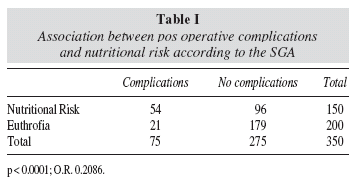
<body><![CDATA[<p><font size="2" face="Verdana">We evaluated adult patients hospitalized at surgery clinic of Gaffr&eacute;e e Guinle's University Hospital. The SGA protocol<sup>2</sup> and the Anthropometric Assessment<sup>3</sup> were done by the same well-trained appraiser at the moment of hospitalization or, at least, three days after. After nutritional assessment, patients were divided in 2 groups (patients with and without <i>nutritional risk</i> by SGA protocol) and followed for post operative complications.</font></p>     <p><font size="2" face="Verdana">From August/2002 to March/2005, 350 patients (mean age of 54.07 &plusmn; 15.73 years) were assessed, 134 with cancer diagnosis. 42.86% of the admitted patients had nutritional risk at admission, being 28% of these with severe malnutrition risk according to SGA. In general, these patients had lower mean values of arm circumference, triciptal skin fold and body mass index when compared with euthrofic ones (p &lt; 0.0001), showing that SGA had convergent validity with anthropometric parameters. Indeed, 54 of the 75 patients who had some type of post operative complication were malnourished according to SGA (p &lt; 0.0001, <a href="#t1">table I</a>). This result was extremely significant, showing that SGA had prognostic value for nutrition-related complications. Not least, twenty of the 24 deaths registered had nutritional risk according to SGA.</font></p>     <p align="center"><a name="t1"><img border="0" src="/img/revistas/nh/v23n6/carta_cientifica3_t1.gif" width="355" height="177"></a></p>     <p><font size="2" face="Verdana">These results bring us to a discussion still present in nutritional assessment. There is some reluctance in accept SGA as a diagnostic method because it has a different concept of malnutrition. To the objective methods, malnutrition is characterized by alterations at body compartments, at somatic or visceral protein reserves, for example.<sup>4</sup> Malnutrition concept applied in SGA goes far beyond these alterations, considering clinical history e physical examination of the patient, which lead to believe that the diagnosis given by SGA is only a marker of "health status".<sup>5</sup></font></p>     <p><font size="2" face="Verdana">In our study, SGA proved to be of great prognostic value in surgical patients and can be used as a good method for nutritional assessment in this population. Nevertheless, cancer is a determinant factor of morbimortality in this population.</font></p>     <p>&nbsp;</p>     <p align="right"><font size="2" face="Verdana"><b>B. D'Alegr&iacute;a<sup>1</sup>, C. Cohen<sup>1</sup>, F. Medeiros<sup>2</sup> and P. E. Portari Filho<sup>2</sup></b></font></p>     <p align="right"><font size="2" face="Verdana"><sup>1</sup>Nutritionist. Member of Nutritional Therapy Commission. Gaffr&eacute;e e Guinle Hospital. University of Rio de Janeiro.    <br><sup>2</sup>Assistant Professor of the Nutrition School of the University of Rio de Janeiro and member of Nutritional Therapy Commission.    <br>Gaffr&eacute;e e Guinle Hospital. University of Rio de Janeiro. Brasil.</font></p>     ]]></body>
<body><![CDATA[<p>&nbsp;</p>     <p><font face="Verdana"><b>References</b></font></p>     <!-- ref --><p><font size="2" face="Verdana">1. Detsky AS et al. Predicting nutrition-associated complications for patients undergoing gastrointestinal surgery. JPEN J Parenter Enteral Nutr 1987; 11(5):440-6.</font>&nbsp;&nbsp;&nbsp;&nbsp;&nbsp;&nbsp;&nbsp;&nbsp;[&#160;<a href="javascript:void(0);" onclick="javascript: window.open('/scielo.php?script=sci_nlinks&ref=3549184&pid=S0212-1611200800080001700001&lng=','','width=640,height=500,resizable=yes,scrollbars=1,menubar=yes,');">Links</a>&#160;]<!-- end-ref --><!-- ref --><p><font size="2" face="Verdana">2. Detsky AS et al. What is subjective global assessment of nutritional status? JPEN J Parenter Enteral Nutr 1987; 11(1): 8-13.</font>&nbsp;&nbsp;&nbsp;&nbsp;&nbsp;&nbsp;&nbsp;&nbsp;[&#160;<a href="javascript:void(0);" onclick="javascript: window.open('/scielo.php?script=sci_nlinks&ref=3549185&pid=S0212-1611200800080001700002&lng=','','width=640,height=500,resizable=yes,scrollbars=1,menubar=yes,');">Links</a>&#160;]<!-- end-ref --><!-- ref --><p><font size="2" face="Verdana">3. WHO (World Health Organization) Physical Status: the use and interpretation of anthropometry. World Health Organization (Technical Report Series, Editor. 1995: Geneva. pp. 375-411.</font>&nbsp;&nbsp;&nbsp;&nbsp;&nbsp;&nbsp;&nbsp;&nbsp;[&#160;<a href="javascript:void(0);" onclick="javascript: window.open('/scielo.php?script=sci_nlinks&ref=3549186&pid=S0212-1611200800080001700003&lng=','','width=640,height=500,resizable=yes,scrollbars=1,menubar=yes,');">Links</a>&#160;]<!-- end-ref --><!-- ref --><p><font size="2" face="Verdana">4. Barbosa-Silva MC, AJ de Barros. &#091;Subjective nutrition assessment: Part 1 - A review of its validity after two decades of use&#093;. Arq Gastroenterol 2002; 39(3):181-7.</font>&nbsp;&nbsp;&nbsp;&nbsp;&nbsp;&nbsp;&nbsp;&nbsp;[&#160;<a href="javascript:void(0);" onclick="javascript: window.open('/scielo.php?script=sci_nlinks&ref=3549187&pid=S0212-1611200800080001700004&lng=','','width=640,height=500,resizable=yes,scrollbars=1,menubar=yes,');">Links</a>&#160;]<!-- end-ref --><!-- ref --><p><font size="2" face="Verdana">5. Detsky AS. Nutritional status assessment: does it improve diagnostic or prognostic Information? Nutrition 1991; 7(1):37-38.</font>&nbsp;&nbsp;&nbsp;&nbsp;&nbsp;&nbsp;&nbsp;&nbsp;[&#160;<a href="javascript:void(0);" onclick="javascript: window.open('/scielo.php?script=sci_nlinks&ref=3549188&pid=S0212-1611200800080001700005&lng=','','width=640,height=500,resizable=yes,scrollbars=1,menubar=yes,');">Links</a>&#160;]<!-- end-ref --><p>&nbsp;</p>     <p>&nbsp;</p>     <p><font size="2" face="Verdana"><a name="back"></a><a href="#top"><img border="0" src="/img/revistas/nh/v23n6/seta.gif" width="15" height="17"></a><b>Correspondence:</b>    ]]></body>
<body><![CDATA[<br>Fernanda Medeiros.    <br>Rua Marqu&ecirc;s de Abrantes 197/304.    <br>RJ-Brasil-CEP-22230-060.    <br>E-mail: <a href="mailto:medeiros.fernanda@gmail.com">medeiros.fernanda@gmail.com</a></font></p>     <p><font size="2" face="Verdana">Recibido: 19-V-2008.    <br>Aceptado: 14-VIII-2008.</font></p>      ]]></body><back>
<ref-list>
<ref id="B1">
<label>1</label><nlm-citation citation-type="journal">
<person-group person-group-type="author">
<name>
<surname><![CDATA[Detsky]]></surname>
<given-names><![CDATA[AS]]></given-names>
</name>
</person-group>
<article-title xml:lang="en"><![CDATA[Predicting nutrition-associated complications for patients undergoing gastrointestinal surgery]]></article-title>
<source><![CDATA[JPEN J Parenter Enteral Nutr]]></source>
<year>1987</year>
<volume>11</volume>
<numero>5</numero>
<issue>5</issue>
<page-range>440-6</page-range></nlm-citation>
</ref>
<ref id="B2">
<label>2</label><nlm-citation citation-type="journal">
<person-group person-group-type="author">
<name>
<surname><![CDATA[Detsky]]></surname>
<given-names><![CDATA[AS]]></given-names>
</name>
</person-group>
<article-title xml:lang="en"><![CDATA[What is subjective global assessment of nutritional status?]]></article-title>
<source><![CDATA[JPEN J Parenter Enteral Nutr]]></source>
<year>1987</year>
<volume>11</volume>
<numero>1</numero>
<issue>1</issue>
<page-range>8-13</page-range></nlm-citation>
</ref>
<ref id="B3">
<label>3</label><nlm-citation citation-type="book">
<collab>World Health Organization</collab>
<source><![CDATA[Physical Status: the use and interpretation of anthropometry]]></source>
<year>1995</year>
<page-range>375-411</page-range><publisher-loc><![CDATA[Geneva ]]></publisher-loc>
<publisher-name><![CDATA[World Health Organization]]></publisher-name>
</nlm-citation>
</ref>
<ref id="B4">
<label>4</label><nlm-citation citation-type="journal">
<person-group person-group-type="author">
<name>
<surname><![CDATA[Barbosa-Silva]]></surname>
<given-names><![CDATA[MC]]></given-names>
</name>
<name>
<surname><![CDATA[Barros]]></surname>
<given-names><![CDATA[AJ de]]></given-names>
</name>
</person-group>
<article-title xml:lang="en"><![CDATA[Subjective nutrition assessment: Part 1 - A review of its validity after two decades of use]]></article-title>
<source><![CDATA[Arq Gastroenterol]]></source>
<year>2002</year>
<volume>39</volume>
<numero>3</numero>
<issue>3</issue>
<page-range>181-7</page-range></nlm-citation>
</ref>
<ref id="B5">
<label>5</label><nlm-citation citation-type="journal">
<person-group person-group-type="author">
<name>
<surname><![CDATA[Detsky]]></surname>
<given-names><![CDATA[AS]]></given-names>
</name>
</person-group>
<article-title xml:lang="en"><![CDATA[Nutritional status assessment: does it improve diagnostic or prognostic Information?]]></article-title>
<source><![CDATA[Nutrition]]></source>
<year>1991</year>
<volume>7</volume>
<numero>1</numero>
<issue>1</issue>
<page-range>37-38</page-range></nlm-citation>
</ref>
</ref-list>
</back>
</article>
