<?xml version="1.0" encoding="ISO-8859-1"?><article xmlns:mml="http://www.w3.org/1998/Math/MathML" xmlns:xlink="http://www.w3.org/1999/xlink" xmlns:xsi="http://www.w3.org/2001/XMLSchema-instance">
<front>
<journal-meta>
<journal-id>0212-1611</journal-id>
<journal-title><![CDATA[Nutrición Hospitalaria]]></journal-title>
<abbrev-journal-title><![CDATA[Nutr. Hosp.]]></abbrev-journal-title>
<issn>0212-1611</issn>
<publisher>
<publisher-name><![CDATA[Grupo Arán]]></publisher-name>
</publisher>
</journal-meta>
<article-meta>
<article-id>S0212-16112009000200016</article-id>
<title-group>
<article-title xml:lang="en"><![CDATA[Birth weight variation according to maternal characteristics and gestational weight gain in Brazilian women]]></article-title>
<article-title xml:lang="es"><![CDATA[Variación del peso corporal en función de las características maternas y la ganancia de peso gestacional en mujeres brasileñas]]></article-title>
</title-group>
<contrib-group>
<contrib contrib-type="author">
<name>
<surname><![CDATA[Carvalho Padilha]]></surname>
<given-names><![CDATA[P. De]]></given-names>
</name>
<xref ref-type="aff" rid="A01"/>
<xref ref-type="aff" rid="A03"/>
</contrib>
<contrib contrib-type="author">
<name>
<surname><![CDATA[Accioly]]></surname>
<given-names><![CDATA[E.]]></given-names>
</name>
<xref ref-type="aff" rid="A02"/>
<xref ref-type="aff" rid="A03"/>
</contrib>
<contrib contrib-type="author">
<name>
<surname><![CDATA[Chagas]]></surname>
<given-names><![CDATA[C.]]></given-names>
</name>
<xref ref-type="aff" rid="A03"/>
</contrib>
<contrib contrib-type="author">
<name>
<surname><![CDATA[Portela]]></surname>
<given-names><![CDATA[E.]]></given-names>
</name>
<xref ref-type="aff" rid="A03"/>
</contrib>
<contrib contrib-type="author">
<name>
<surname><![CDATA[Da Silva]]></surname>
<given-names><![CDATA[C. L.]]></given-names>
</name>
<xref ref-type="aff" rid="A03"/>
</contrib>
<contrib contrib-type="author">
<name>
<surname><![CDATA[Saunders]]></surname>
<given-names><![CDATA[C.]]></given-names>
</name>
<xref ref-type="aff" rid="A02"/>
<xref ref-type="aff" rid="A03"/>
<xref ref-type="aff" rid="A04"/>
</contrib>
</contrib-group>
<aff id="A01">
<institution><![CDATA[,Universidade Federal do Rio de Janeiro/UFRJ Instituto de Puericultura e Pediatria Martagão Gesteira (IPPMG) ]]></institution>
<addr-line><![CDATA[Rio de Janeiro RJ]]></addr-line>
<country>Brazil</country>
</aff>
<aff id="A02">
<institution><![CDATA[,Universidade Federal do Rio de Janeiro/UFRJ Instituto de Nutrição Josué de Castro/INJC Departamento de Nutrição e Dietética]]></institution>
<addr-line><![CDATA[Rio de Janeiro RJ]]></addr-line>
<country>Brazil</country>
</aff>
<aff id="A03">
<institution><![CDATA[,Grupo de Pesquisa em Saúde Materna e Infantil (GPSMI) Núcleo de Pesquisa em Micronutrientes (NPqM) ]]></institution>
<addr-line><![CDATA[Rio de Janeiro RJ]]></addr-line>
<country>Brazil</country>
</aff>
<aff id="A04">
<institution><![CDATA[,Universidade Federal do Rio de Janeiro/UFRJ Maternidade Escola ]]></institution>
<addr-line><![CDATA[Rio de Janeiro RJ]]></addr-line>
<country>Brazil</country>
</aff>
<pub-date pub-type="pub">
<day>00</day>
<month>04</month>
<year>2009</year>
</pub-date>
<pub-date pub-type="epub">
<day>00</day>
<month>04</month>
<year>2009</year>
</pub-date>
<volume>24</volume>
<numero>2</numero>
<fpage>207</fpage>
<lpage>212</lpage>
<copyright-statement/>
<copyright-year/>
<self-uri xlink:href="http://scielo.isciii.es/scielo.php?script=sci_arttext&amp;pid=S0212-16112009000200016&amp;lng=en&amp;nrm=iso"></self-uri><self-uri xlink:href="http://scielo.isciii.es/scielo.php?script=sci_abstract&amp;pid=S0212-16112009000200016&amp;lng=en&amp;nrm=iso"></self-uri><self-uri xlink:href="http://scielo.isciii.es/scielo.php?script=sci_pdf&amp;pid=S0212-16112009000200016&amp;lng=en&amp;nrm=iso"></self-uri><abstract abstract-type="short" xml:lang="en"><p><![CDATA[Objectives: This study aims to identify birth weight variation according to maternal characteristics and gestational weight gain. Methods: It is a cross-sectional descriptive study with 433 puerperal women (&#8805; 20 years old) who attended a public maternity hospital in Rio de Janeiro. The data were collected through interviews with the women and access to their medical records. Several models were tested using linear regression, using the stepwise method to identify the predictive variables of birth weight. Results: The mean maternal age and gestational age at the end of pregnancy were 27 years old (&plusmn; 5.09 years) and 39 weeks (+ 1.68 weeks), respectively. The data shows that the mean number of prenatal and nutritional prenatal care appointments were 8.24 (&plusmn; 2.98) and 2.26 (&plusmn; 2.33), respectively. Among the predictor variables of birth weight, total gestational weight gain (ß = 25.29; p = 0.000), pre-gestational BMI (ß =13.02; p = 0.037), and the number of pre-natal care appointments (ß = 28.21; p = 0.007) were highlighted. The association of weight gain in the three trimesters was also verified. Conclusions: This study confirms the interface between adequacy of the pre-gestational and gestational nutritional status and some maternal characteristics with birth weight. Nutritional care should be recognised aspart of the actions during pre-natal assistance.]]></p></abstract>
<abstract abstract-type="short" xml:lang="es"><p><![CDATA[Objetivo: Este estudio tiene por objeto identificar la variación de peso al nacimiento en función de las características maternas y la ganancia de peso gestacional. Métodos: Se trata de un estudio transversal y descriptivo con 433 mujeres puérperas (&#8805; 20 años de edad) que acudieron a un hospital maternal de Río de Janeiro. Se recogieron los datos mediante entrevistas con las mujeres y acceso a sus historiales clínicos. Se ensayaron diversos modelos utilizando la regresión linear y el método por pasos para identificar las variables predictivas del peso al nacimiento. Resultados: La edad media materna y la edad gestacional al final del embarazo fueron 27 años (&plusmn; 5,09 años) y 39 semanas (&plusmn; 1,68 semanas), respectivamente. Los datos muestran que el número medio de visitas prenatales y de educación nutricional prenatal fue de 8,24 (&plusmn; 2,98) y 2,26 (&plusmn; 2,33), respectivamente. Entre las variables predictivas del peso al nacimiento, destacaban la ganancia total de peso gestacional (ß = 25,29; p = 0.000), el IMC pre-gestacional (ß = 13,02; p = 0,037) y el número de visitas prenatales (ß = 28,21; p = 0,007). También se verificó la asociación de ganancia de peso en los tres trimestres del embarazo. Conclusiones: Este estudio confirma la interrelación entre un estado nutricional pre-gestacional y gestacional adecuado y algunas características maternas con el peso al nacimiento. Debería reconocerse la atención nutricional como parte de las acciones de la asistencia prenatal.]]></p></abstract>
<kwd-group>
<kwd lng="en"><![CDATA[Pregnant women]]></kwd>
<kwd lng="en"><![CDATA[Anthropometry]]></kwd>
<kwd lng="en"><![CDATA[Weight gain]]></kwd>
<kwd lng="en"><![CDATA[Newborns]]></kwd>
<kwd lng="en"><![CDATA[Birth weight]]></kwd>
<kwd lng="es"><![CDATA[Mujeres gestantes]]></kwd>
<kwd lng="es"><![CDATA[Antropometría]]></kwd>
<kwd lng="es"><![CDATA[Ganancia de peso]]></kwd>
<kwd lng="es"><![CDATA[Recién nacidos]]></kwd>
<kwd lng="es"><![CDATA[Peso al nacimiento]]></kwd>
</kwd-group>
</article-meta>
</front><body><![CDATA[ <p align="right"><font face="Verdana" size="2"><a name="top"></a><b>ORIGINAL</b></font></p>     <p>&nbsp;</p>     <p><font face="Verdana" size="4"><b>Birth weight variation according to maternal characteristics and gestational weight gain in Brazilian women</b></font></p>     <p><font face="Verdana" size="4"><b>Variaci&oacute;n del peso corporal en funci&oacute;n de las caracter&iacute;sticas maternas y la ganancia de peso gestacional en mujeres brasile&ntilde;as</b></font></p>     <p>&nbsp;</p>     <p>&nbsp;</p>     <p><font face="Verdana" size="2"><b>P. De Carvalho Padilha<sup>1</sup>, E. Accioly<sup>2</sup>, C. Chagas<sup>3</sup>, E. Portela<sup>3</sup>, C. L. Da Silva<sup>3</sup> y C. Saunders<sup>4</sup></b></font></p>     <p><font face="Verdana" size="2"><sup>1</sup>Nutritionist of Instituto de Puericultura e Pediatria Martag&atilde;o Gesteira (IPPMG) of Universidade Federal do Rio de Janeiro/UFRJ. Master in Nutrition (Postgraduate Program of Instituto de Nutri&ccedil;&atilde;o Josu&eacute; de Castro/INJC/UFRJ). Researcher of the Grupo de Pesquisa em Sa&uacute;de Materna e Infantil (GPSMI)/N&uacute;cleo de Pesquisa em Micronutrientes (NPqM). Rio de Janeiro. RJ. Brazil.    <br><sup>2</sup>Professor of the Departamento de Nutri&ccedil;&atilde;o e Diet&eacute;tica of INJC/UFRJ. Researcher of the GPSMI/NPqM. Rio de Janeiro. RJ. Brazil.    <br><sup>3</sup>Nutricionist. Researcher of the GPSMI/NPqM. Rio de Janeiro. RJ. Brazil.    ]]></body>
<body><![CDATA[<br><sup>4</sup>Professor of the Departamento de Nutri&ccedil;&atilde;o e Diet&eacute;tica of INJC/UFRJ and Maternidade Escola/UFRJ. Coordinator of the GPSMI/NPqM. Rio de Janeiro. RJ. Brazil.</font></p>     <p><font face="Verdana" size="2"><a href="#back">Correspondence</a></font></p>     <p>&nbsp;</p>     <p>&nbsp;</p> <hr size="1">     <p><font face="Verdana" size="2"><b>ABSTRACT</b></font></p>     <p><font face="Verdana" size="2"><b>Objectives:</b> This study aims to identify birth weight variation according to maternal characteristics and gestationalweight gain.    <br><b>Methods:</b> It is a cross-sectional descriptive study with 433 puerperal women (&#8805; 20 years old) who attended a public maternity hospital in Rio de Janeiro. The data were collected through interviews with the women and access to their medical records. Several models were tested using linear regression, using the stepwise method to identify the predictive variables of birth weight.    <br><b>Results:</b> The mean maternal age and gestational age at the end of pregnancy were 27 years old (&plusmn; 5.09 years) and 39 weeks (+ 1.68 weeks), respectively. The data shows that the mean number of prenatal and nutritional prenatal care appointments were 8.24 (&plusmn; 2.98) and 2.26 (&plusmn; 2.33), respectively. Among the predictor variables of birth weight, total gestational weight gain (&szlig; = 25.29; p = 0.000), pre-gestational BMI (&szlig; =13.02; p = 0.037), and the number of pre-natal care appointments (&szlig; = 28.21; p = 0.007) were highlighted. The association of weight gain in the three trimesters was also verified.    <br><b>Conclusions:</b> This study confirms the interface between adequacy of the pre-gestational and gestational nutritional status and some maternal characteristics with birth weight. Nutritional care should be recognised aspart of the actions during pre-natal assistance.</font></p>     <p><font face="Verdana" size="2"><b>Key words:</b> Pregnant women. Anthropometry. Weight gain. Newborns. Birth weight.</font></p> <hr size="1">     ]]></body>
<body><![CDATA[<p><font face="Verdana" size="2"><b>RESUMEN</b></font></p>     <p><font face="Verdana" size="2"><b>Objetivo:</b> Este estudio tiene por objeto identificar la variaci&oacute;n de peso al nacimiento en funci&oacute;n de las caracter&iacute;sticas maternas y la ganancia de peso gestacional.    <br><b>M&eacute;todos:</b> Se trata de un estudio transversal y descriptivo con 433 mujeres pu&eacute;rperas (&#8805; 20 a&ntilde;os de edad) que acudieron a un hospital maternal de R&iacute;o de Janeiro. Se recogieron los datos mediante entrevistas con las mujeres y acceso a sus historiales cl&iacute;nicos. Se ensayaron diversos modelos utilizando la regresi&oacute;n linear y el m&eacute;todo por pasos para identificar las variables predictivas del peso al nacimiento.    <br><b>Resultados:</b> La edad media materna y la edad gestacional al final del embarazo fueron 27 a&ntilde;os (&plusmn; 5,09 a&ntilde;os) y 39 semanas (&plusmn; 1,68 semanas), respectivamente. Los datos muestran que el n&uacute;mero medio de visitas prenatales y de educaci&oacute;n nutricional prenatal fue de 8,24 (&plusmn; 2,98) y 2,26 (&plusmn; 2,33), respectivamente. Entre las variables predictivas del peso al nacimiento, destacaban la ganancia total de peso gestacional (&szlig; = 25,29; p = 0.000), el IMC pre-gestacional (&szlig; = 13,02; p = 0,037) y el n&uacute;mero de visitas prenatales (&szlig; = 28,21; p = 0,007). Tambi&eacute;n se verific&oacute; la asociaci&oacute;n de ganancia de peso en los tres trimestres del embarazo.    <br><b>Conclusiones:</b> Este estudio confirma la interrelaci&oacute;n entre un estado nutricional pre-gestacional y gestacional adecuado y algunas caracter&iacute;sticas maternas con el peso al nacimiento. Deber&iacute;a reconocerse la atenci&oacute;n nutricional como parte de las acciones de la asistencia prenatal.</font></p>     <p><font face="Verdana" size="2"><b>Palabras clave:</b> Mujeres gestantes. Antropometr&iacute;a. Ganancia de peso. Reci&eacute;n nacidos. Peso al nacimiento.</font></p> <hr size="1">     <p>&nbsp;</p>     <p><font face="Verdana"><b>Introduction</b></font></p>     <p><font face="Verdana" size="2">The maternal caractheristics has been considered an important indicator of pregnancy prognosis, of birth conditions, especially those related to birth weight and perinatal mortality. Birth weight plays an important role in infant mortality and morbidity, child development, and adult metabolic diseases.<sup>1-6</sup></font></p>     <p><font face="Verdana" size="2">Several studies shows the influences of maternal genetic, socio-cultural, demographic, and behavioral factors on birth weight. For example, pre-pregnancy body mass index (BMI) and gestational weight gain influence newborn birth weight and play significant roles in adverse pregnancy outcomes.<sup>2-6</sup></font></p>     ]]></body>
<body><![CDATA[<p><font face="Verdana" size="2">In this case, both insufficient and excessive weight gain during pregnancy are strongly associated with maternal-fetal complications such as gestational diabetes, hypertensive pregnancy disorders (HPD), macrosomia and low birth weight.<sup>2-9 </sup>Moreover, excessive weight gain during pregnancy represents one of the factors most strongly associated with postpartum weight retention, and consequently to postpartum obesity.<sup>7-9</sup></font></p>     <p><font face="Verdana" size="2">Facing these facts, the aim of the present study is to identify the maternal predictive characteristics of birth weight.</font></p>     <p>&nbsp;</p>     <p><font face="Verdana"><b>Materials and methods</b></font></p>     <p><i><font face="Verdana" size="2">Design</font></i></p>     <p><font face="Verdana" size="2">This is a cross-sectional descriptive study, using the data collected in Maternidade Escola (ME) of Universidade Federal do Rio de Janeiro (UFRJ).The sample was composed by 433 puerperal women (&ge; 20 years old), who did not suffer from chronic diseases, with gestational age determined by last menstrual period or ultrasound assessment, single-fetus pregnancy, known pre-gestational weight or weight measured up to the  end of the 13<sup>th</sup> gestational week, access to prenatal care and no dietary restrictions. Characteristics of the newborns were also studied.</font></p>     <p><font face="Verdana" size="2">This Health Unit assists patients with characteristics similar to those presented by patients assisted in other Public Health Units in the city of Rio de Janeiro, according to the variables maternal age and number of prenatal care appointments.<sup>7,8</sup></font></p>     <p><font face="Verdana" size="2">Data was collected through interviews with the women and access to their medical records.</font></p>     <p><i><font face="Verdana" size="2">Maternal and newborn anthropometric status assessment</font></i></p>     <p><font face="Verdana" size="2">Data about pre-gestacional weight (either informed by women during pre-natal appointments or measured up to the end of the 13<sup>th</sup> gestational week<sup>9-11</sup>); weight measured on the last prenatal care appointment,<sup>12</sup> or weight at the partum moment and maternal height were collected. All women in the study attended prenatal care service at ME/UFRJ or at other health units, and their anthropometric measures were recorded in their medical records.</font></p>     ]]></body>
<body><![CDATA[<p><font face="Verdana" size="2">Pre-gestational BMI was calculated according to reported or measured pre-gestational weight and total gestational weight gain was calculated subtracting pregestational weight from either weight at the partum moment or the weight measured on the last prenatal care appointment before delivery.</font></p>     <p><font face="Verdana" size="2">BMI cut-offs used to evaluate pre-gestational BMI used were &lt; 18.5 kg/m<sup>2</sup> for <i>low weight</i>; BMI between 18.5 e 24.9 kg/m<sup>2</sup> for <i>normal weight</i>; BMI between 25 e 29.9 kg/m<sup>2</sup> for <i>overweight</i> and BMI &gt; 30 kg/m<sup>2</sup> for <i>obesity</i>. <sup>13</sup> Recommended weight gain ranges are 12.5-18 kg, 11.5-16 kg, 7-11.5 kg, and 7 kg for low weight, normal weight, overweight and obese pregnant women, respectively.<sup>14,15</sup></font></p>     <p><font face="Verdana" size="2">In a sub-sample (n = 208), weight gains during the first trimester (up to the end of the 13<sup>th</sup> gestational week), the second trimester (from the 14<sup>th</sup> to the 28<sup>th</sup> gestational weeks) and the third trimester (from the 28<sup>th</sup> gestational week on) were estimated.</font></p>     <p><i><font face="Verdana" size="2">Ethical questions</font></i></p>     <p><font face="Verdana" size="2">This study was approved by the Ethic Committee and all participants signed an informed consent form.</font></p>     <p><i><font face="Verdana" size="2">Data reliability</font></i></p>     <p><font face="Verdana" size="2">Aiming at standardizing data collection procedures, the researchers involved in this study were trained, recycled and supervised. Data reliability was evaluated by a retest applied to a sub-sample and a duplicated data collected independently by two different interviewers assessing the same medical records.</font></p>     <p><i><font face="Verdana" size="2">Statistical analysis</font></i></p>     <p><font face="Verdana" size="2">Measures of central tendency and dispersion of variables were calculated in the exploratory analysis of data.</font></p>     <p><font face="Verdana" size="2"><i>T-student</i> and ANOVA tests were used to test statistical similarity among means, and the pos-hoc test chosen was Tukey. To test the homogeneity of variables the <i>Levene</i> test was applied. A 5% statistical significance level was considered.</font></p>     ]]></body>
<body><![CDATA[<p><font face="Verdana" size="2">To identify predictor variables of birth weight (dependent variable), a linear regression model was tested using the <i>stepwise</i> method.</font></p>     <p><font face="Verdana" size="2">In this analysis, p &gt; 0.10 and p &lt; 0.05 were considered as the significance limits to the exclusion and inclusion of variables, respectively. Statistical analysis was performed using the SPSS statistical package for Windows version 13.0.</font></p>     <p>&nbsp;</p>     <p><font face="Verdana"><b>Results</b></font></p>     <p><font face="Verdana" size="2">The mean mother age was 27 years old (&plusmn; 5.09 years), 26.3% (n = 114) of them were nulliparous and the mean gestational age at the end of pregnancy was 39 weeks (&plusmn; 1.68 weeks). The mean birth interval was 56 months (&plusmn; 36.72 months).</font></p>     <p><font face="Verdana" size="2">Based on <a href="#t1">table I</a>, we notice that about 32% of the women began pregnancy with some weight deviation, low weight, overweight or obesity, and the great majority had a stable relationship with partner (77.4%) and good sanitary conditions at home (96.1%), meaning the availability of sanitary facilities such as running water, garbage disposal and sanitation. 5.5% of the women (n= 24) were smokers.</font></p>     <p align="center"><font face="Verdana" size="2"><a name="t1"><img src="/img/revistas/nh/v24n2/original13_t1.gif" width="355" height="507"></a></font></p>     <p><font face="Verdana" size="2">As to the maternal anthropometric assessment, the means of pre-gestational BMI and total gestational weight gain were 23.23 kg/m<sup>2</sup> ( &plusmn; 3.81 kg) and 12.99 kg (&plusmn; 5.21 kg), respectively (<a href="#t2">table II</a>).</font></p>     <p align="center"><font face="Verdana" size="2"><a name="t2"><img src="/img/revistas/nh/v24n2/original13_t2.gif" width="356" height="446"></a></font></p>     <p><font face="Verdana" size="2">Prenatal care data show that the mean number of prenatal and nutritional prenatal care appointments were 8.24 (&plusmn; 2.98) and 2.26 (&plusmn; 2.33), respectively. The mean maternal height was 1.59 m (&plusmn; 0.006 m), and the percentiles 3, 10, 50, 90 and 97 were 1.47 m, 1.51 m, 1.59 m, 1.68 m and 1.74 m, respectively. Regarding newborns, the mean birth weight was 3,285.23 g (&plusmn; 479.62 g) and the mean birth length was 49.07 cm (&plusmn; 2.79 cm) (<a href="#t4">table IV</a>). Preterm delivery index (&lt; 37 weeks) was 6.3% (n =27), and 4.6% (n = 20) presented low birth weight.</font></p>     ]]></body>
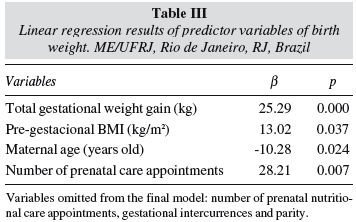
<body><![CDATA[<p><font face="Verdana" size="2">Linear regression showed association between maternal variables -total gestational weight gain, pregestational BMI, maternal age and number of prenatal care appointments- and the dependent variable birth weight. The variables number of prenatal nutritional care appointments, gestational intercurrences and parity were omitted from the final model (<a href="#t3">table III</a>).</font></p>     <p align="center"><font face="Verdana" size="2"><a name="t3"><img src="/img/revistas/nh/v24n2/original13_t3.gif" width="356" height="222"></a></font></p>     <p align="center"><font face="Verdana" size="2"><a name="t4"><img src="/img/revistas/nh/v24n2/original13_t4.gif" width="370" height="355"></a></font></p>     <p>&nbsp;</p>     <p><font face="Verdana" size="2">Due to the considerable significance of gestational weight gain as a predictive factor of birth weight, it was considered opportune to follow gestational weight gain during the three trimesters of pregnancy and verify its contribution to birth weight. Thus, in the linear regression model, trimester weight gain was substituted for total weight gain. In this analysis, weight gains in the three trimesters remained significantly in the model, together with prenatal care. In the first trimester, maternal age was also associated with birth weight, each year in maternal age contributing with a decrease of about 14 g to birth weight (<a href="#t4">table IV</a>).</font></p>     <p>&nbsp;</p>     <p><font face="Verdana"><b>Discussion</b></font></p>     <p><font face="Verdana" size="2">In this study, the predictor variables of birth weight were total gestational weight gain, pre-gestational BMI, maternal age and number of prenatal care appointments. Socio-demographic obstetric and prenatal care characteristics were controlled. This data corroborate the findings of several other studies, which recognize the association between gestational weight gain and birth conditions.<sup>16</sup></font></p>     <p><font face="Verdana" size="2">Nowadays, maternal anthropometric aspects such as pre-gestational nutritional status and gestational weight gain are considered to be changeable determiners of great relevance to adequate fetal growth. Prenatal nutritional intervention is related to favorable outcomes and should be incorporated in prenatal care.<sup>3,16-19</sup></font></p>     <p><font face="Verdana" size="2">In this study, maternal age contributed negatively to birth weight. It is worth mentioning that there are few studies which relate these variables among adult women, especially those over 40 years old. As a general rule, studies focus on LBW risk among adolescents.<sup>20</sup> Nevertheless, in a recent review about biological aspects determining maternal weight gain, the IOM<sup>6</sup> presents data which emphasize a tendency among adult pregnant women to show lower weight gain rates. This might explain the reverse impact of maternal age on observed birth weight.</font></p>     ]]></body>
<body><![CDATA[<p><font face="Verdana" size="2">Yekta et al.<sup>21</sup> suggest that deviations in maternal gestational weight gain, as well as inadequate pre-gestational BMI, act as newborn birth weight markers. In the same study, the authors recognize the importance of following prenatal weight gain, aiming at better outcomes. This monitoring would allow early identification of nutritional risk, thus proposing nutritional counseling as one major goal.</font></p>     <p><font face="Verdana" size="2">In face of this context, prenatal care is used as an indicator of measure qualities and care with the mother-child binomial, neutralizing risk factors associated with pregnancy. Considering that one of the aims of prenatal care is to early identify the risk of unfavorable outcomes, adequate intervention measures can be implemented.<sup>11,15</sup> Effectiveness of nutritional intervention during pregnancy, based on growing evidence about the benefits of adequate nutrition, has been suggested not only to obstetric outcome, but also to children during their first years of life.<sup>22-24</sup></font></p>     <p><font face="Verdana" size="2">More recently, the WHO<sup>16 </sup>has recognized nutritional factors, among other measures capable of predicting favorable perinatal and neonatal results, as an indicator of prenatal care quality. Therefore, this corroborates the current tendency towards recognition of many complications during pregnancy being caused by pregestational behaviors and circumstances, mostly nutritional aspects.<sup>16,25,26</sup></font></p>     <p><font face="Verdana" size="2">The close association found between the number of prenatal care appointments and birth weight reinforces the role of measures concerning the mother-child binomial in order to optimize the obstetric result. In a systematic revision of prenatal adequacy and birth weight, findings are that, generally, transversal studies pointed out a protector effect of prenatal over birth weight. However, random transversal studies are necessary to clarify this association. On the other hand, the early beginning of prenatal care observed in this study might have brought a decisive contribution to birth weight, as an opportune beginning indicates good practice in promoting mother and child health.<sup>27</sup></font></p>     <p><font face="Verdana" size="2">Omitting the number of prenatal nutritional care appointments from the predictor model of birth weight might be due to its small quantity: the mean number of appointments was 2.26 (&plusmn; 2.33). Thus, it calls for a reinforcement of the importance of an early beginning bearing in mind a minimum number of nutritional assistance appointments.</font></p>     <p><font face="Verdana" size="2">To corroborate an early and opportune beginning of prenatal care, it was verified in this study that gestational weight gain in the first trimester is a significant predictive of birth weight, which goes against the statement made by some authors that the relevant maternal weight gain to birth weight occurs only in the second and third trimesters.<sup>5</sup> However, it is known fact that literature does not reach a consensus concerning the gestational period of most impact on birth weight.</font></p>     <p><font face="Verdana" size="2">Neufeld et al.<sup>28</sup>, in an investigation about the relationship between weight gains in different gestational periods, highlighted that the first trimester is the most important predictive of fetal linear growth. Besides, evidence shows the origin of limitations to fetal growth related to aggravations in the first trimester, which reinforces that some intercurrences at the end of pregnancy might have their origin in this period.<sup>29</sup> Findings reported by Brown et al.<sup>30</sup> show weight gains in the first and second trimesters as predictives of birth weight, representing 31 g and 14 g of it, respectively. However, evaluating the impact of maternal weight gain on child weight index, it was observed that deeply expressive results were obtained only in the first and third trimesters.</font></p>     <p><font face="Verdana" size="2">Gestational weight gain in the third trimester has an important role in LBW prevention, which might potentially contribute to prevent chronic diseases associated to such outcome.<sup>30</sup></font></p>     <p><font face="Verdana" size="2">It is worth noticing in this study that maternal age as a predictor variable of birth weight remains in the statistical model only in the first trimester, each year in maternal age contributing with a decrease of about 14 g in birth weight. This finding suggests that maternal age influences physiological adaptations and placental structure alterations. It is a fact that the consequences of these alterations will be more evident in the first trimester of pregnancy, because embryogenesis is strongly determined in this period. Along this period, embryo development is extremely sensitive to environment factors, and there is growing evidence that even infinitely subtle influences might also influence pregnancy outcomes.<sup>16,31</sup></font></p>     <p><font face="Verdana" size="2">The IOM guidelines, based on the weight gain ranges according to pre-gestational BMI have been the most internationally used ones for over a decade.<sup>32</sup></font></p>     ]]></body>
<body><![CDATA[<p><font face="Verdana" size="2">Throughout the years, a direct proportionality between maternal nutrition and newborn birth weight has been demonstrated, using the recommendations by the IOM to evaluate perinatal risks. Several authors have concluded that gestational weight gain, according the variations stated by the referred committee, predicts birth conditions and is favorable to maternal nutritional status after delivery.<sup>33-35</sup></font></p>     <p><font face="Verdana" size="2">Studies testing the Brazilian adaptations proposed by the Ministry of Health<sup>11</sup> have not been published yet. The referred proposal does not consider a minimum gestational weight gain for low-height pregnant women and limits to 7 kg the total weight gain to obese pregnant women. Although the recommended weight gain ranges are similar to those recommended by the IOM, the cut-offs to classify pre-gestational BMI are not presented, which causes doubts. Prenatal care units adopt both the IOM<sup>13,14</sup> and the WHO<sup>9</sup> cut-offs for pregestational BMI.</font></p>     <p><font face="Verdana" size="2">The findings suggest that the low-height value (&lt; 1,57 m) recommended by the American committee may not be adequate to the Brazilian population, due to different height patterns among both populations. Moreover, there is a questioning about cut-offs to be adopted to pre-gestational nutritional status classification, and further discussion is necessary. In this casuistry, adequacy of the gestational weight gain made by the pre-gestational BMI classification according to the criteria stated by both the WHO<sup>9</sup> and the IOM<sup>13,14</sup> was associated with birth weight.</font></p>     <p><font face="Verdana" size="2">It becomes necessary to effectively implement prenatal nutritional care, due to the fact that anthropometry alone presents limitations to the nutritional diagnosis of pregnant women, especially to the identification of specific nutritional deficits risk situations, such as anemia and vitamin A deficiency. Their impact in short, medium and long terms are also related with birth conditions, and may have consequences throughout childhood and adulthood, as well as a great impact on maternal a child morbimortality.<sup>8,16,36</sup></font></p>     <p><font face="Verdana" size="2">Another aspect that makes prenatal care extremely important is the omission of gestational intercurrences from the regression model, which indicates an efficient care and quality prevention of harm. On the other hand, omission of prenatal nutritional assistance might have happened due to the mean number of appointments (2,46 &plusmn; 2,33), a lower value than the established, which is, ideally, 4 throughout pregnancy or, at least, one in each trimester.</font></p>     <p><font face="Verdana" size="2">Within the limitations of this research is the use of informed pre-gestational weight endorsed by preliminary study of part of the sample and of literature, where there is an agreement between the informed and measured weights. Also, the inclusion of smoker pregnant women could be seen as a selection factor, although the number of smokers was less than 5%, thus acceptable, when compared to other studies.</font></p>     <p>&nbsp;</p>     <p><font face="Verdana"><b>Conclusion</b></font></p>     <p><font face="Verdana" size="2">Inadequacy of nutritional status within reproductive age and pregnancy is an important health and nutritional problem among women and their children, which might bring undesirable consequences to reproductive health, as well as negatively contribute to child development, with reflections on birth conditions and morbimortality rates.</font></p>     <p><font face="Verdana" size="2">In this analysis, among other maternal characteristics, age, total gestational weight gain, pre-gestational BMI and the number of prenatal care appointments are recognized as predictive factor to birth weight. Also, the results show a need for monitoring gestational weight gain from the first trimester and throughout pregnancy, as weight gain in all trimesters significantly contributed to birth weight.</font></p>     ]]></body>
<body><![CDATA[<p><font face="Verdana" size="2">Nevertheless, there should be further discussion concerning the BMI values recommended to different populations.</font></p>     <p><font face="Verdana" size="2">To meet the expectations of the health committees and the scientific community, efforts must be made in an attempt to make nutritional assistance part of prenatal care. Nutritional counseling must focus not only on anthropometric assessment, but also on dietary quantitative and qualitative aspects, aiming at an interdisciplinary context within prenatal care.</font></p>     <p>&nbsp;</p>     <p><font face="Verdana"><b>Acknowledgements</b></font></p>     <p><font face="Verdana" size="2">The authors would like to thank the following research support agencies that sponsored the study: Funda&ccedil;&atilde;o Carlos Chagas Filho de Amparo &agrave; Pesquisa do Estado do Rio de Janeiro (FAPERJ) and ConselhoNacional de Desenvolvimento Cient&iacute;fico e Tecnol&oacute;gico (CNPq); the directors of the Maternidade Escola of the Universidade Federal do Rio de Janeiro, Drs. Joffre Amin J&uacute;nior and Rita Bornia, for indispensable support in conducting the study; and the volunteer interns and scientific initiation scholarship students who collaborated in the data collection. Special thanks goes to Paulo Borges for statistical consultancy and to Dr Hermogenes Chaves Netto for the valuable consultancyin developing this study.</font></p>     <p>&nbsp;</p>     <p><font face="Verdana"><b>References</b></font></p>     <!-- ref --><p><font face="Verdana" size="2">1. Coelho KS, Souza AI, Batista Filho M. Avalia&ccedil;&atilde;o antropom&eacute;trica do estado nutricional da gestante: vis&atilde;o retrospectiva e prospectiva. Rev Bras Sa&uacute;de Matern Infant 2002; 2 (1): 57-61.</font>&nbsp;&nbsp;&nbsp;&nbsp;&nbsp;&nbsp;&nbsp;&nbsp;[&#160;<a href="javascript:void(0);" onclick="javascript: window.open('/scielo.php?script=sci_nlinks&ref=3538381&pid=S0212-1611200900020001600001&lng=','','width=640,height=500,resizable=yes,scrollbars=1,menubar=yes,');">Links</a>&#160;]<!-- end-ref --><!-- ref --><p><font face="Verdana" size="2">2. Mohanty C, Prasad R, Srikanth AR, Ghosh JK, Singh TB, Das BK. Maternal anthropometry as predictors of low birth weight. J Trop Pediatr 2006; 52 (1): 24-9.</font>&nbsp;&nbsp;&nbsp;&nbsp;&nbsp;&nbsp;&nbsp;&nbsp;[&#160;<a href="javascript:void(0);" onclick="javascript: window.open('/scielo.php?script=sci_nlinks&ref=3538382&pid=S0212-1611200900020001600002&lng=','','width=640,height=500,resizable=yes,scrollbars=1,menubar=yes,');">Links</a>&#160;]<!-- end-ref --><!-- ref --><p><font face="Verdana" size="2">3. Cedergren M. Effects of gestational weight gain and body mass index on obstetric outcome in Sweden. Int J Gynaecol Obstet 2006; 93 (3): 269-74.</font>&nbsp;&nbsp;&nbsp;&nbsp;&nbsp;&nbsp;&nbsp;&nbsp;[&#160;<a href="javascript:void(0);" onclick="javascript: window.open('/scielo.php?script=sci_nlinks&ref=3538383&pid=S0212-1611200900020001600003&lng=','','width=640,height=500,resizable=yes,scrollbars=1,menubar=yes,');">Links</a>&#160;]<!-- end-ref --><!-- ref --><p><font face="Verdana" size="2">4. Atalah E, Castro R. Obesidad materna y riesgo reproductivo. Rev Med Chile 2004; 132 (8): 923-30.</font>&nbsp;&nbsp;&nbsp;&nbsp;&nbsp;&nbsp;&nbsp;&nbsp;[&#160;<a href="javascript:void(0);" onclick="javascript: window.open('/scielo.php?script=sci_nlinks&ref=3538384&pid=S0212-1611200900020001600004&lng=','','width=640,height=500,resizable=yes,scrollbars=1,menubar=yes,');">Links</a>&#160;]<!-- end-ref --><!-- ref --><p><font face="Verdana" size="2">5. Andreto LM, De Souza AI, Figueiroa JN, Cabral-Filho JE. Fatores associados ao ganho ponderal excessivo em gestantes atendidas em um servi&ccedil;o p&uacute;blico de pr&eacute;-natal na cidade de Recife, Pernambuco, Brasil. Cad Sa&uacute;de P&uacute;blica 2006; 22 (11): 2401-9.</font>&nbsp;&nbsp;&nbsp;&nbsp;&nbsp;&nbsp;&nbsp;&nbsp;[&#160;<a href="javascript:void(0);" onclick="javascript: window.open('/scielo.php?script=sci_nlinks&ref=3538385&pid=S0212-1611200900020001600005&lng=','','width=640,height=500,resizable=yes,scrollbars=1,menubar=yes,');">Links</a>&#160;]<!-- end-ref --><!-- ref --><p><font face="Verdana" size="2">6. National Research Council and Institute of Medicine. Influence of Pregnancy Weight on Maternal and Child Health. Workshop Report. Washington: The National Academy Press; 2007.</font>&nbsp;&nbsp;&nbsp;&nbsp;&nbsp;&nbsp;&nbsp;&nbsp;[&#160;<a href="javascript:void(0);" onclick="javascript: window.open('/scielo.php?script=sci_nlinks&ref=3538386&pid=S0212-1611200900020001600006&lng=','','width=640,height=500,resizable=yes,scrollbars=1,menubar=yes,');">Links</a>&#160;]<!-- end-ref --><!-- ref --><p><font face="Verdana" size="2">7. Coelho CSP. Defici&ecirc;ncia de vitamina A no bin&ocirc;mio m&atilde;e-filho e distribui&ccedil;&atilde;o intraplacent&aacute;ria de retinol. Escola Nacional de Sa&uacute;de P&uacute;blica da Funda&ccedil;&atilde;o Oswaldo Cruz. (Tese de Doutorado) Orientadores: Maria do Carmo Leal, Rejane Andr&eacute;a Ramalho Nunes da Silva. Rio de Janeiro, dezembro, 2003.</font>&nbsp;&nbsp;&nbsp;&nbsp;&nbsp;&nbsp;&nbsp;&nbsp;[&#160;<a href="javascript:void(0);" onclick="javascript: window.open('/scielo.php?script=sci_nlinks&ref=3538387&pid=S0212-1611200900020001600007&lng=','','width=640,height=500,resizable=yes,scrollbars=1,menubar=yes,');">Links</a>&#160;]<!-- end-ref --><!-- ref --><p><font face="Verdana" size="2">8. Saunders C, Ramalho RA, Lima APPT, Gomes MM, Campos LFC, Silva BAS, Soares AG, Leal MC. Association between gestational night blindness and serum retinol in mother/newborn pairs in the city of Rio de Janeiro, Brazil. Nutrition 2005; 21 (4): 456-61.</font>&nbsp;&nbsp;&nbsp;&nbsp;&nbsp;&nbsp;&nbsp;&nbsp;[&#160;<a href="javascript:void(0);" onclick="javascript: window.open('/scielo.php?script=sci_nlinks&ref=3538388&pid=S0212-1611200900020001600008&lng=','','width=640,height=500,resizable=yes,scrollbars=1,menubar=yes,');">Links</a>&#160;]<!-- end-ref --><!-- ref --><p><font face="Verdana" size="2">9. World Health Organization. Physical status: the use and interpretation of report anthropometry: report of a WHO Expert Committee. Geneva: WHO; 1995.</font>&nbsp;&nbsp;&nbsp;&nbsp;&nbsp;&nbsp;&nbsp;&nbsp;[&#160;<a href="javascript:void(0);" onclick="javascript: window.open('/scielo.php?script=sci_nlinks&ref=3538389&pid=S0212-1611200900020001600009&lng=','','width=640,height=500,resizable=yes,scrollbars=1,menubar=yes,');">Links</a>&#160;]<!-- end-ref --><!-- ref --><p><font face="Verdana" size="2">10. Minist&eacute;rio da Sa&uacute;de (MS). Nota T&eacute;cnica -Fevereiro de 2004- &Aacute;rea T&eacute;cnica de Sa&uacute;de da Mulher e CGPAN - Coordena&ccedil;&atilde;o Geral da Pol&iacute;tica de Alimenta&ccedil;&atilde;o e Nutri&ccedil;&atilde;o/MS. Bras&iacute;lia (DF): MS; 2004.</font>&nbsp;&nbsp;&nbsp;&nbsp;&nbsp;&nbsp;&nbsp;&nbsp;[&#160;<a href="javascript:void(0);" onclick="javascript: window.open('/scielo.php?script=sci_nlinks&ref=3538390&pid=S0212-1611200900020001600010&lng=','','width=640,height=500,resizable=yes,scrollbars=1,menubar=yes,');">Links</a>&#160;]<!-- end-ref --><!-- ref --><p><font face="Verdana" size="2">11. Minist&eacute;rio da Sa&uacute;de (MS). Pr&eacute;-natal e Puerp&eacute;rio: aten&ccedil;&atilde;o qualificada e humanizada - manual t&eacute;cnico. Bras&iacute;lia (DF): MS; 2005.</font>&nbsp;&nbsp;&nbsp;&nbsp;&nbsp;&nbsp;&nbsp;&nbsp;[&#160;<a href="javascript:void(0);" onclick="javascript: window.open('/scielo.php?script=sci_nlinks&ref=3538391&pid=S0212-1611200900020001600011&lng=','','width=640,height=500,resizable=yes,scrollbars=1,menubar=yes,');">Links</a>&#160;]<!-- end-ref --><!-- ref --><p><font face="Verdana" size="2">12. Abrams B, Parker JD. Maternal weight gain in women with good pregnancy outcome. Obstet Gynecol 1990;76 (1): 1-7.</font>&nbsp;&nbsp;&nbsp;&nbsp;&nbsp;&nbsp;&nbsp;&nbsp;[&#160;<a href="javascript:void(0);" onclick="javascript: window.open('/scielo.php?script=sci_nlinks&ref=3538392&pid=S0212-1611200900020001600012&lng=','','width=640,height=500,resizable=yes,scrollbars=1,menubar=yes,');">Links</a>&#160;]<!-- end-ref --><!-- ref --><p><font face="Verdana" size="2">13. IOM (Institute of Medicine). Nutrition during pregnancy. Washington: The National Academy Press; 1990.</font>&nbsp;&nbsp;&nbsp;&nbsp;&nbsp;&nbsp;&nbsp;&nbsp;[&#160;<a href="javascript:void(0);" onclick="javascript: window.open('/scielo.php?script=sci_nlinks&ref=3538393&pid=S0212-1611200900020001600013&lng=','','width=640,height=500,resizable=yes,scrollbars=1,menubar=yes,');">Links</a>&#160;]<!-- end-ref --><!-- ref --><p><font face="Verdana" size="2">14. IOM (Institute of Medicine). Nutrition during Pregnancy and Lactation. An implementation Guide. Washington: The National Academy Press; 1992.</font>&nbsp;&nbsp;&nbsp;&nbsp;&nbsp;&nbsp;&nbsp;&nbsp;[&#160;<a href="javascript:void(0);" onclick="javascript: window.open('/scielo.php?script=sci_nlinks&ref=3538394&pid=S0212-1611200900020001600014&lng=','','width=640,height=500,resizable=yes,scrollbars=1,menubar=yes,');">Links</a>&#160;]<!-- end-ref --><!-- ref --><p><font face="Verdana" size="2">15. Minist&eacute;rio da Sa&uacute;de (MS). Assist&ecirc;ncia Pr&eacute;-natal: manual t&eacute;cnico. Bras&iacute;lia (DF): MS; 2000.</font>&nbsp;&nbsp;&nbsp;&nbsp;&nbsp;&nbsp;&nbsp;&nbsp;[&#160;<a href="javascript:void(0);" onclick="javascript: window.open('/scielo.php?script=sci_nlinks&ref=3538395&pid=S0212-1611200900020001600015&lng=','','width=640,height=500,resizable=yes,scrollbars=1,menubar=yes,');">Links</a>&#160;]<!-- end-ref --><!-- ref --><p><font face="Verdana" size="2">16. World Health Organization. Promoting optimal fetal development: report of a technical consultation. Geneva: WHO; 2006.</font>&nbsp;&nbsp;&nbsp;&nbsp;&nbsp;&nbsp;&nbsp;&nbsp;[&#160;<a href="javascript:void(0);" onclick="javascript: window.open('/scielo.php?script=sci_nlinks&ref=3538396&pid=S0212-1611200900020001600016&lng=','','width=640,height=500,resizable=yes,scrollbars=1,menubar=yes,');">Links</a>&#160;]<!-- end-ref --><!-- ref --><p><font face="Verdana" size="2">17. World Health Organization. Technical consultation towards the development of a strategy for promoting optimal fetal development. Geneva: WHO; 25-27 November 2003.</font>&nbsp;&nbsp;&nbsp;&nbsp;&nbsp;&nbsp;&nbsp;&nbsp;[&#160;<a href="javascript:void(0);" onclick="javascript: window.open('/scielo.php?script=sci_nlinks&ref=3538397&pid=S0212-1611200900020001600017&lng=','','width=640,height=500,resizable=yes,scrollbars=1,menubar=yes,');">Links</a>&#160;]<!-- end-ref --><!-- ref --><p><font face="Verdana" size="2">18. World Health Organization. Meeting of advisory group on maternal nutrition and low birth weight. Geneva: WHO; 4-6 December 2002.</font>&nbsp;&nbsp;&nbsp;&nbsp;&nbsp;&nbsp;&nbsp;&nbsp;[&#160;<a href="javascript:void(0);" onclick="javascript: window.open('/scielo.php?script=sci_nlinks&ref=3538398&pid=S0212-1611200900020001600018&lng=','','width=640,height=500,resizable=yes,scrollbars=1,menubar=yes,');">Links</a>&#160;]<!-- end-ref --><!-- ref --><p><font face="Verdana" size="2">19. Brennand EA, Dannenbaum D, Willows ND. Pregnancy outcomes of First Nations women in relation to pregravid weight and pregnancy weight gain. J Obstet Gynaecol Can 2005; 27 (10): 936-44.</font>&nbsp;&nbsp;&nbsp;&nbsp;&nbsp;&nbsp;&nbsp;&nbsp;[&#160;<a href="javascript:void(0);" onclick="javascript: window.open('/scielo.php?script=sci_nlinks&ref=3538399&pid=S0212-1611200900020001600019&lng=','','width=640,height=500,resizable=yes,scrollbars=1,menubar=yes,');">Links</a>&#160;]<!-- end-ref --><!-- ref --><p><font face="Verdana" size="2">20. Gigante DP, Rasmussen KM, Victora CG. Pregnancy increases BMI in adolescents of a population-based birth cohort. J Nutr 2005; 135 (1): 74-80.</font>&nbsp;&nbsp;&nbsp;&nbsp;&nbsp;&nbsp;&nbsp;&nbsp;[&#160;<a href="javascript:void(0);" onclick="javascript: window.open('/scielo.php?script=sci_nlinks&ref=3538400&pid=S0212-1611200900020001600020&lng=','','width=640,height=500,resizable=yes,scrollbars=1,menubar=yes,');">Links</a>&#160;]<!-- end-ref --><!-- ref --><p><font face="Verdana" size="2">21. Yekta Z, Ayatollahi H, Porali R, Farzin A. The effect of pre-pregnancy body mass index and gestational weight gain on pregnancy outcomes in urban care settings in Urmia-Iran. BMC Pregnancy Childbirth 2006; 20: 6-15.</font>&nbsp;&nbsp;&nbsp;&nbsp;&nbsp;&nbsp;&nbsp;&nbsp;[&#160;<a href="javascript:void(0);" onclick="javascript: window.open('/scielo.php?script=sci_nlinks&ref=3538401&pid=S0212-1611200900020001600021&lng=','','width=640,height=500,resizable=yes,scrollbars=1,menubar=yes,');">Links</a>&#160;]<!-- end-ref --><!-- ref --><p><font face="Verdana" size="2">22. Boyd NR, Windsor RA. A formative evaluation in maternal and child health practice: the partners for life nutrition education program for pregnant women. Mater Child Health J 2003; 7 (2): 137-43.</font>&nbsp;&nbsp;&nbsp;&nbsp;&nbsp;&nbsp;&nbsp;&nbsp;[&#160;<a href="javascript:void(0);" onclick="javascript: window.open('/scielo.php?script=sci_nlinks&ref=3538402&pid=S0212-1611200900020001600022&lng=','','width=640,height=500,resizable=yes,scrollbars=1,menubar=yes,');">Links</a>&#160;]<!-- end-ref --><!-- ref --><p><font face="Verdana" size="2">23. Villar J, Merialdi M, Gülmezoglu AM, Abalos E, Carroli G, KulierR, Oni M. Nutritional interventions during pregnancy for the prevention or treatment of maternal morbity and preterm delivery: an overview of randomized controlled trials. J Nutr 2003; 133: 1606S-25S.</font>&nbsp;&nbsp;&nbsp;&nbsp;&nbsp;&nbsp;&nbsp;&nbsp;[&#160;<a href="javascript:void(0);" onclick="javascript: window.open('/scielo.php?script=sci_nlinks&ref=3538403&pid=S0212-1611200900020001600023&lng=','','width=640,height=500,resizable=yes,scrollbars=1,menubar=yes,');">Links</a>&#160;]<!-- end-ref --><!-- ref --><p><font face="Verdana" size="2">24. Lima GSP, Sampaio HAC. Influ&ecirc;ncia de fatores obst&eacute;tricos, socioecon&ocirc;micos e nutricionais da gestante sobre o peso do rec&eacute;m-nascido: estudo realizado em uma maternidade em Teresina, Piau&iacute;. Rev Bras Sa&uacute;de Matern Infant 2004; 4 (3): 256-61.</font>&nbsp;&nbsp;&nbsp;&nbsp;&nbsp;&nbsp;&nbsp;&nbsp;[&#160;<a href="javascript:void(0);" onclick="javascript: window.open('/scielo.php?script=sci_nlinks&ref=3538404&pid=S0212-1611200900020001600024&lng=','','width=640,height=500,resizable=yes,scrollbars=1,menubar=yes,');">Links</a>&#160;]<!-- end-ref --><!-- ref --><p><font face="Verdana" size="2">25. Feresu SA, Harlow SD, Woelk GB. Risk factors for prematurity at Harare Maternity Hospital, Zimbabwe. Int J Epidemiol 2004; 33 (6): 1194-201.</font>&nbsp;&nbsp;&nbsp;&nbsp;&nbsp;&nbsp;&nbsp;&nbsp;[&#160;<a href="javascript:void(0);" onclick="javascript: window.open('/scielo.php?script=sci_nlinks&ref=3538405&pid=S0212-1611200900020001600025&lng=','','width=640,height=500,resizable=yes,scrollbars=1,menubar=yes,');">Links</a>&#160;]<!-- end-ref --><!-- ref --><p><font face="Verdana" size="2">26. Reichman NE, Teitler JO. Timing of enhanced prenatal care and birth outcomes in New Jersey's HealthStart program. Mater Child Health J 2005; 9 (2): 151-8.</font>&nbsp;&nbsp;&nbsp;&nbsp;&nbsp;&nbsp;&nbsp;&nbsp;[&#160;<a href="javascript:void(0);" onclick="javascript: window.open('/scielo.php?script=sci_nlinks&ref=3538406&pid=S0212-1611200900020001600026&lng=','','width=640,height=500,resizable=yes,scrollbars=1,menubar=yes,');">Links</a>&#160;]<!-- end-ref --><!-- ref --><p><font face="Verdana" size="2">27. Silveira DS, Santos IS. Adequacy of prenatal care and birth weight: a systematic review. Cad Sa&uacute;de P&uacute;blica 2004; 20 (5): 1160-8.</font>&nbsp;&nbsp;&nbsp;&nbsp;&nbsp;&nbsp;&nbsp;&nbsp;[&#160;<a href="javascript:void(0);" onclick="javascript: window.open('/scielo.php?script=sci_nlinks&ref=3538407&pid=S0212-1611200900020001600027&lng=','','width=640,height=500,resizable=yes,scrollbars=1,menubar=yes,');">Links</a>&#160;]<!-- end-ref --><!-- ref --><p><font face="Verdana" size="2">28. Neufeld LM, Haas JD, Grajeda R, Martorell R. Changes in maternal weight from the first to second trimester of pregnancy are associated with fetal growth and infant length at birth. Am J Clin Nutr 2004; 79 (4): 646-5.</font>&nbsp;&nbsp;&nbsp;&nbsp;&nbsp;&nbsp;&nbsp;&nbsp;[&#160;<a href="javascript:void(0);" onclick="javascript: window.open('/scielo.php?script=sci_nlinks&ref=3538408&pid=S0212-1611200900020001600028&lng=','','width=640,height=500,resizable=yes,scrollbars=1,menubar=yes,');">Links</a>&#160;]<!-- end-ref --><!-- ref --><p><font face="Verdana" size="2">29. Smith GC. First trimester origins of fetal growth impairment. Semin Perinatol 2004; 28 (1): 41-50.</font>&nbsp;&nbsp;&nbsp;&nbsp;&nbsp;&nbsp;&nbsp;&nbsp;[&#160;<a href="javascript:void(0);" onclick="javascript: window.open('/scielo.php?script=sci_nlinks&ref=3538409&pid=S0212-1611200900020001600029&lng=','','width=640,height=500,resizable=yes,scrollbars=1,menubar=yes,');">Links</a>&#160;]<!-- end-ref --><!-- ref --><p><font face="Verdana" size="2">30. Brown JE, Murtaugh AM, Jacobs RD, Margellos CH. Variation in newborn size according to pregnancy weight change by trimester. Am J Clin Nutr 2002; 76: 205S-9.</font>&nbsp;&nbsp;&nbsp;&nbsp;&nbsp;&nbsp;&nbsp;&nbsp;[&#160;<a href="javascript:void(0);" onclick="javascript: window.open('/scielo.php?script=sci_nlinks&ref=3538410&pid=S0212-1611200900020001600030&lng=','','width=640,height=500,resizable=yes,scrollbars=1,menubar=yes,');">Links</a>&#160;]<!-- end-ref --><!-- ref --><p><font face="Verdana" size="2">31. Cross JC, Mickelson L. Nutritional Influences on Implantation and Placental Development. Nutr Reviews 2006; 64 (Supl. 1): 12-8.</font>&nbsp;&nbsp;&nbsp;&nbsp;&nbsp;&nbsp;&nbsp;&nbsp;[&#160;<a href="javascript:void(0);" onclick="javascript: window.open('/scielo.php?script=sci_nlinks&ref=3538411&pid=S0212-1611200900020001600031&lng=','','width=640,height=500,resizable=yes,scrollbars=1,menubar=yes,');">Links</a>&#160;]<!-- end-ref --><!-- ref --><p><font face="Verdana" size="2">32. Ochsenbein-koible N; Roos M, Gasser T, Zimmermann R. Cross-sectional study of weight gain and increase in BMI throughout pregnancy. Eur J Obstet Gynecol Reprod Biol 2007; 130 (2): 180-6.</font>&nbsp;&nbsp;&nbsp;&nbsp;&nbsp;&nbsp;&nbsp;&nbsp;[&#160;<a href="javascript:void(0);" onclick="javascript: window.open('/scielo.php?script=sci_nlinks&ref=3538412&pid=S0212-1611200900020001600032&lng=','','width=640,height=500,resizable=yes,scrollbars=1,menubar=yes,');">Links</a>&#160;]<!-- end-ref --><!-- ref --><p><font face="Verdana" size="2">33. Kruger HS. Maternal anthropometry and pregnancy outcomes: a proposal for the monitoring of pregnancy weight gain in outpatient clinics in South Africa. Curationis 2005; 28 (4): 40-9.</font>&nbsp;&nbsp;&nbsp;&nbsp;&nbsp;&nbsp;&nbsp;&nbsp;[&#160;<a href="javascript:void(0);" onclick="javascript: window.open('/scielo.php?script=sci_nlinks&ref=3538413&pid=S0212-1611200900020001600033&lng=','','width=640,height=500,resizable=yes,scrollbars=1,menubar=yes,');">Links</a>&#160;]<!-- end-ref --><!-- ref --><p><font face="Verdana" size="2">34. Wells CS, Schwalberg R, Noonan G, Gabor V. Factors influencing inadequate and excessive weight gain in pregnancy: Colorado, 2000-2002. Mater Child Health J 2006; 10 (1): 55-62.</font>&nbsp;&nbsp;&nbsp;&nbsp;&nbsp;&nbsp;&nbsp;&nbsp;[&#160;<a href="javascript:void(0);" onclick="javascript: window.open('/scielo.php?script=sci_nlinks&ref=3538414&pid=S0212-1611200900020001600034&lng=','','width=640,height=500,resizable=yes,scrollbars=1,menubar=yes,');">Links</a>&#160;]<!-- end-ref --><!-- ref --><p><font face="Verdana" size="2">35. Dietz PM, Callaghan WM, Cogswell ME, Morrow B, Ferre C, Schieve LA. Combined effects of prepregnancy body mass index and weight gain during pregnancy on the risk of preterm delivery. Epidemiol 2006; 17 (2): 170-7.</font>&nbsp;&nbsp;&nbsp;&nbsp;&nbsp;&nbsp;&nbsp;&nbsp;[&#160;<a href="javascript:void(0);" onclick="javascript: window.open('/scielo.php?script=sci_nlinks&ref=3538415&pid=S0212-1611200900020001600035&lng=','','width=640,height=500,resizable=yes,scrollbars=1,menubar=yes,');">Links</a>&#160;]<!-- end-ref --><!-- ref --><p><font face="Verdana" size="2">36. Mason JB, Lotfi M, Dalmiya N, Sethuraman K, Deitchler M. The Micronutrient Report. Current progress and trends in the control of vitamin A, iodine, and iron deficiencies. Ottawa, Canada: The Micronutrient Iniciative/UNICEF; 2001.</font>&nbsp;&nbsp;&nbsp;&nbsp;&nbsp;&nbsp;&nbsp;&nbsp;[&#160;<a href="javascript:void(0);" onclick="javascript: window.open('/scielo.php?script=sci_nlinks&ref=3538416&pid=S0212-1611200900020001600036&lng=','','width=640,height=500,resizable=yes,scrollbars=1,menubar=yes,');">Links</a>&#160;]<!-- end-ref --><p>&nbsp;</p>     <p>&nbsp;</p>     <p><font face="Verdana" size="2"><a name="back"></a><a href="#top"><img border="0" src="/img/revistas/nh/v24n2/seta.gif" width="15" height="17"></a><b>Correspondence:</b>    <br>Patricia de Carvalho Padilha.    <br>Rua Gramado, 475 - Bloco C - apto. 202.    <br>Campo Grande-Rio de Janeiro-RJ, Brazil.    <br>CEP: 23050-090.    ]]></body>
<body><![CDATA[<br>E-mail: <a href="mailto:paticpadilha@yahoo.com.br">paticpadilha@yahoo.com.br</a></font></p>     <p><font face="Verdana" size="2">Recibido: 21-IV-2008.    <br>Aceptado: 17-VI-2008.</font></p>      ]]></body><back>
<ref-list>
<ref id="B1">
<label>1</label><nlm-citation citation-type="journal">
<person-group person-group-type="author">
<name>
<surname><![CDATA[Coelho]]></surname>
<given-names><![CDATA[KS]]></given-names>
</name>
<name>
<surname><![CDATA[Souza]]></surname>
<given-names><![CDATA[AI]]></given-names>
</name>
<name>
<surname><![CDATA[Batista Filho]]></surname>
<given-names><![CDATA[M]]></given-names>
</name>
</person-group>
<article-title xml:lang="pt"><![CDATA[Avaliação antropométrica do estado nutricional da gestante: visão retrospectiva e prospectiva]]></article-title>
<source><![CDATA[Rev Bras Saúde Matern Infant]]></source>
<year>2002</year>
<volume>2</volume>
<numero>1</numero>
<issue>1</issue>
<page-range>57-61</page-range></nlm-citation>
</ref>
<ref id="B2">
<label>2</label><nlm-citation citation-type="journal">
<person-group person-group-type="author">
<name>
<surname><![CDATA[Mohanty]]></surname>
<given-names><![CDATA[C]]></given-names>
</name>
<name>
<surname><![CDATA[Prasad]]></surname>
<given-names><![CDATA[R]]></given-names>
</name>
<name>
<surname><![CDATA[Srikanth]]></surname>
<given-names><![CDATA[AR]]></given-names>
</name>
<name>
<surname><![CDATA[Ghosh]]></surname>
<given-names><![CDATA[JK]]></given-names>
</name>
<name>
<surname><![CDATA[Singh]]></surname>
<given-names><![CDATA[TB]]></given-names>
</name>
<name>
<surname><![CDATA[Das]]></surname>
<given-names><![CDATA[BK]]></given-names>
</name>
</person-group>
<article-title xml:lang="en"><![CDATA[Maternal anthropometry as predictors of low birth weight]]></article-title>
<source><![CDATA[J Trop Pediatr]]></source>
<year>2006</year>
<volume>52</volume>
<numero>1</numero>
<issue>1</issue>
<page-range>24-9</page-range></nlm-citation>
</ref>
<ref id="B3">
<label>3</label><nlm-citation citation-type="journal">
<person-group person-group-type="author">
<name>
<surname><![CDATA[Cedergren]]></surname>
<given-names><![CDATA[M]]></given-names>
</name>
</person-group>
<article-title xml:lang="en"><![CDATA[Effects of gestational weight gain and body mass index on obstetric outcome in Sweden]]></article-title>
<source><![CDATA[Int J Gynaecol Obstet]]></source>
<year>2006</year>
<volume>93</volume>
<numero>3</numero>
<issue>3</issue>
<page-range>269-74</page-range></nlm-citation>
</ref>
<ref id="B4">
<label>4</label><nlm-citation citation-type="journal">
<person-group person-group-type="author">
<name>
<surname><![CDATA[Atalah]]></surname>
<given-names><![CDATA[E]]></given-names>
</name>
<name>
<surname><![CDATA[Castro]]></surname>
<given-names><![CDATA[R]]></given-names>
</name>
</person-group>
<article-title xml:lang="es"><![CDATA[Obesidad materna y riesgo reproductivo]]></article-title>
<source><![CDATA[Rev Med Chile]]></source>
<year>2004</year>
<volume>132</volume>
<numero>8</numero>
<issue>8</issue>
<page-range>923-30</page-range></nlm-citation>
</ref>
<ref id="B5">
<label>5</label><nlm-citation citation-type="journal">
<person-group person-group-type="author">
<name>
<surname><![CDATA[Andreto]]></surname>
<given-names><![CDATA[LM]]></given-names>
</name>
<name>
<surname><![CDATA[De Souza]]></surname>
<given-names><![CDATA[AI]]></given-names>
</name>
<name>
<surname><![CDATA[Figueiroa]]></surname>
<given-names><![CDATA[JN]]></given-names>
</name>
<name>
<surname><![CDATA[Cabral-Filho]]></surname>
<given-names><![CDATA[JE]]></given-names>
</name>
</person-group>
<article-title xml:lang="pt"><![CDATA[Fatores associados ao ganho ponderal excessivo em gestantes atendidas em um serviço público de pré-natal na cidade de Recife, Pernambuco, Brasil]]></article-title>
<source><![CDATA[Cad Saúde Pública]]></source>
<year>2006</year>
<volume>22</volume>
<numero>11</numero>
<issue>11</issue>
<page-range>2401-9</page-range></nlm-citation>
</ref>
<ref id="B6">
<label>6</label><nlm-citation citation-type="book">
<collab>National Research Council</collab>
<collab>Institute of Medicine</collab>
<source><![CDATA[Influence of Pregnancy Weight on Maternal and Child Health: Workshop Report]]></source>
<year>2007</year>
<publisher-loc><![CDATA[Washington ]]></publisher-loc>
<publisher-name><![CDATA[The National Academy Press]]></publisher-name>
</nlm-citation>
</ref>
<ref id="B7">
<label>7</label><nlm-citation citation-type="">
<person-group person-group-type="author">
<name>
<surname><![CDATA[Coelho]]></surname>
<given-names><![CDATA[CSP]]></given-names>
</name>
</person-group>
<source><![CDATA[Deficiência de vitamina A no binômio mãe-filho e distribuição intraplacentária de retinol]]></source>
<year></year>
</nlm-citation>
</ref>
<ref id="B8">
<label>8</label><nlm-citation citation-type="journal">
<person-group person-group-type="author">
<name>
<surname><![CDATA[Saunders]]></surname>
<given-names><![CDATA[C]]></given-names>
</name>
<name>
<surname><![CDATA[Ramalho]]></surname>
<given-names><![CDATA[RA]]></given-names>
</name>
<name>
<surname><![CDATA[Lima]]></surname>
<given-names><![CDATA[APPT]]></given-names>
</name>
<name>
<surname><![CDATA[Gomes]]></surname>
<given-names><![CDATA[MM]]></given-names>
</name>
<name>
<surname><![CDATA[Campos]]></surname>
<given-names><![CDATA[LFC]]></given-names>
</name>
<name>
<surname><![CDATA[Silva]]></surname>
<given-names><![CDATA[BAS]]></given-names>
</name>
<name>
<surname><![CDATA[Soares]]></surname>
<given-names><![CDATA[AG]]></given-names>
</name>
<name>
<surname><![CDATA[Leal]]></surname>
<given-names><![CDATA[MC]]></given-names>
</name>
</person-group>
<article-title xml:lang="en"><![CDATA[Association between gestational night blindness and serum retinol in mother/newborn pairs in the city of Rio de Janeiro, Brazil]]></article-title>
<source><![CDATA[Nutrition]]></source>
<year>2005</year>
<volume>21</volume>
<numero>4</numero>
<issue>4</issue>
<page-range>456-61</page-range></nlm-citation>
</ref>
<ref id="B9">
<label>9</label><nlm-citation citation-type="book">
<collab>World Health Organization</collab>
<source><![CDATA[Physical status: the use and interpretation of report anthropometry: report of a WHO Expert Committee]]></source>
<year>1995</year>
<publisher-loc><![CDATA[Geneva ]]></publisher-loc>
<publisher-name><![CDATA[WHO]]></publisher-name>
</nlm-citation>
</ref>
<ref id="B10">
<label>10</label><nlm-citation citation-type="book">
<collab>Ministério da Saúde (MS)</collab>
<source><![CDATA[Nota Técnica]]></source>
<year>Feve</year>
<month>re</month>
<day>ir</day>
<publisher-loc><![CDATA[Brasília^eDF DF]]></publisher-loc>
<publisher-name><![CDATA[Área Técnica de Saúde da Mulher e CGPAN - Coordenação Geral da Política de Alimentação e Nutrição/MS]]></publisher-name>
</nlm-citation>
</ref>
<ref id="B11">
<label>11</label><nlm-citation citation-type="book">
<collab>Ministério da Saúde (MS)</collab>
<source><![CDATA[Pré-natal e Puerpério: atenção qualificada e humanizada - manual técnico]]></source>
<year>2005</year>
<publisher-loc><![CDATA[Brasília^eDF DF]]></publisher-loc>
<publisher-name><![CDATA[MS]]></publisher-name>
</nlm-citation>
</ref>
<ref id="B12">
<label>12</label><nlm-citation citation-type="journal">
<person-group person-group-type="author">
<name>
<surname><![CDATA[Abrams]]></surname>
<given-names><![CDATA[B]]></given-names>
</name>
<name>
<surname><![CDATA[Parker]]></surname>
<given-names><![CDATA[JD]]></given-names>
</name>
</person-group>
<article-title xml:lang="en"><![CDATA[Maternal weight gain in women with good pregnancy outcome]]></article-title>
<source><![CDATA[Obstet Gynecol]]></source>
<year>1990</year>
<volume>76</volume>
<numero>1</numero>
<issue>1</issue>
<page-range>1-7</page-range></nlm-citation>
</ref>
<ref id="B13">
<label>13</label><nlm-citation citation-type="book">
<collab>IOM (Institute of Medicine)</collab>
<source><![CDATA[Nutrition during pregnancy]]></source>
<year>1990</year>
<publisher-loc><![CDATA[Washington ]]></publisher-loc>
<publisher-name><![CDATA[The National Academy Press]]></publisher-name>
</nlm-citation>
</ref>
<ref id="B14">
<label>14</label><nlm-citation citation-type="book">
<collab>IOM (Institute of Medicine)</collab>
<source><![CDATA[Nutrition during Pregnancy and Lactation: An implementation Guide]]></source>
<year>1992</year>
<publisher-loc><![CDATA[Washington ]]></publisher-loc>
<publisher-name><![CDATA[The National Academy Press]]></publisher-name>
</nlm-citation>
</ref>
<ref id="B15">
<label>15</label><nlm-citation citation-type="book">
<collab>Ministério da Saúde (MS)</collab>
<source><![CDATA[Assistência Pré-natal: manual técnico]]></source>
<year>2000</year>
<publisher-loc><![CDATA[Brasília^eDF DF]]></publisher-loc>
<publisher-name><![CDATA[MS]]></publisher-name>
</nlm-citation>
</ref>
<ref id="B16">
<label>16</label><nlm-citation citation-type="book">
<collab>World Health Organization</collab>
<source><![CDATA[Promoting optimal fetal development: report of a technical consultation]]></source>
<year>2006</year>
<publisher-loc><![CDATA[Geneva ]]></publisher-loc>
<publisher-name><![CDATA[WHO]]></publisher-name>
</nlm-citation>
</ref>
<ref id="B17">
<label>17</label><nlm-citation citation-type="book">
<collab>World Health Organization</collab>
<source><![CDATA[Technical consultation towards the development of a strategy for promoting optimal fetal development]]></source>
<year>25-2</year>
<month>7 </month>
<day>No</day>
<publisher-loc><![CDATA[Geneva ]]></publisher-loc>
<publisher-name><![CDATA[WHO]]></publisher-name>
</nlm-citation>
</ref>
<ref id="B18">
<label>18</label><nlm-citation citation-type="book">
<collab>World Health Organization</collab>
<source><![CDATA[Meeting of advisory group on maternal nutrition and low birth weight]]></source>
<year>4-6 </year>
<month>De</month>
<day>ce</day>
<publisher-loc><![CDATA[Geneva ]]></publisher-loc>
<publisher-name><![CDATA[WHO]]></publisher-name>
</nlm-citation>
</ref>
<ref id="B19">
<label>19</label><nlm-citation citation-type="journal">
<person-group person-group-type="author">
<name>
<surname><![CDATA[Brennand]]></surname>
<given-names><![CDATA[EA]]></given-names>
</name>
<name>
<surname><![CDATA[Dannenbaum]]></surname>
<given-names><![CDATA[D]]></given-names>
</name>
<name>
<surname><![CDATA[Willows]]></surname>
<given-names><![CDATA[ND]]></given-names>
</name>
</person-group>
<article-title xml:lang="en"><![CDATA[Pregnancy outcomes of First Nations women in relation to pregravid weight and pregnancy weight gain]]></article-title>
<source><![CDATA[J Obstet Gynaecol Can]]></source>
<year>2005</year>
<volume>27</volume>
<numero>10</numero>
<issue>10</issue>
<page-range>936-44</page-range></nlm-citation>
</ref>
<ref id="B20">
<label>20</label><nlm-citation citation-type="journal">
<person-group person-group-type="author">
<name>
<surname><![CDATA[Gigante]]></surname>
<given-names><![CDATA[DP]]></given-names>
</name>
<name>
<surname><![CDATA[Rasmussen]]></surname>
<given-names><![CDATA[KM]]></given-names>
</name>
<name>
<surname><![CDATA[Victora]]></surname>
<given-names><![CDATA[CG]]></given-names>
</name>
</person-group>
<article-title xml:lang="en"><![CDATA[Pregnancy increases BMI in adolescents of a population-based birth cohort]]></article-title>
<source><![CDATA[J Nutr]]></source>
<year>2005</year>
<volume>135</volume>
<numero>1</numero>
<issue>1</issue>
<page-range>74-80</page-range></nlm-citation>
</ref>
<ref id="B21">
<label>21</label><nlm-citation citation-type="journal">
<person-group person-group-type="author">
<name>
<surname><![CDATA[Yekta]]></surname>
<given-names><![CDATA[Z]]></given-names>
</name>
<name>
<surname><![CDATA[Ayatollahi]]></surname>
<given-names><![CDATA[H]]></given-names>
</name>
<name>
<surname><![CDATA[Porali]]></surname>
<given-names><![CDATA[R]]></given-names>
</name>
<name>
<surname><![CDATA[Farzin]]></surname>
<given-names><![CDATA[A]]></given-names>
</name>
</person-group>
<article-title xml:lang="en"><![CDATA[The effect of pre-pregnancy body mass index and gestational weight gain on pregnancy outcomes in urban care settings in Urmia-Iran]]></article-title>
<source><![CDATA[BMC Pregnancy Childbirth]]></source>
<year>2006</year>
<volume>20</volume>
<page-range>6-15</page-range></nlm-citation>
</ref>
<ref id="B22">
<label>22</label><nlm-citation citation-type="journal">
<person-group person-group-type="author">
<name>
<surname><![CDATA[Boyd]]></surname>
<given-names><![CDATA[NR]]></given-names>
</name>
<name>
<surname><![CDATA[Windsor]]></surname>
<given-names><![CDATA[RA]]></given-names>
</name>
</person-group>
<article-title xml:lang="en"><![CDATA[A formative evaluation in maternal and child health practice: the partners for life nutrition education program for pregnant women]]></article-title>
<source><![CDATA[Mater Child Health J]]></source>
<year>2003</year>
<volume>7</volume>
<numero>2</numero>
<issue>2</issue>
<page-range>137-43</page-range></nlm-citation>
</ref>
<ref id="B23">
<label>23</label><nlm-citation citation-type="journal">
<person-group person-group-type="author">
<name>
<surname><![CDATA[Villar]]></surname>
<given-names><![CDATA[J]]></given-names>
</name>
<name>
<surname><![CDATA[Merialdi]]></surname>
<given-names><![CDATA[M]]></given-names>
</name>
<name>
<surname><![CDATA[Gülmezoglu]]></surname>
<given-names><![CDATA[AM]]></given-names>
</name>
<name>
<surname><![CDATA[Abalos]]></surname>
<given-names><![CDATA[E]]></given-names>
</name>
<name>
<surname><![CDATA[Carroli]]></surname>
<given-names><![CDATA[G]]></given-names>
</name>
<name>
<surname><![CDATA[Kulier]]></surname>
<given-names><![CDATA[R]]></given-names>
</name>
<name>
<surname><![CDATA[Oni]]></surname>
<given-names><![CDATA[M]]></given-names>
</name>
</person-group>
<article-title xml:lang="en"><![CDATA[Nutritional interventions during pregnancy for the prevention or treatment of maternal morbity and preterm delivery: an overview of randomized controlled trials]]></article-title>
<source><![CDATA[J Nutr]]></source>
<year>2003</year>
<volume>133</volume>
<page-range>1606S-25S</page-range></nlm-citation>
</ref>
<ref id="B24">
<label>24</label><nlm-citation citation-type="journal">
<person-group person-group-type="author">
<name>
<surname><![CDATA[Lima]]></surname>
<given-names><![CDATA[GSP]]></given-names>
</name>
<name>
<surname><![CDATA[Sampaio]]></surname>
<given-names><![CDATA[HAC]]></given-names>
</name>
</person-group>
<article-title xml:lang="pt"><![CDATA[Influência de fatores obstétricos, socioeconômicos e nutricionais da gestante sobre o peso do recém-nascido: estudo realizado em uma maternidade em Teresina, Piauí]]></article-title>
<source><![CDATA[Rev Bras Saúde Matern Infant]]></source>
<year>2004</year>
<volume>4</volume>
<numero>3</numero>
<issue>3</issue>
<page-range>256-61</page-range></nlm-citation>
</ref>
<ref id="B25">
<label>25</label><nlm-citation citation-type="journal">
<person-group person-group-type="author">
<name>
<surname><![CDATA[Feresu]]></surname>
<given-names><![CDATA[SA]]></given-names>
</name>
<name>
<surname><![CDATA[Harlow]]></surname>
<given-names><![CDATA[SD]]></given-names>
</name>
<name>
<surname><![CDATA[Woelk]]></surname>
<given-names><![CDATA[GB]]></given-names>
</name>
</person-group>
<article-title xml:lang="en"><![CDATA[Risk factors for prematurity at Harare Maternity Hospital, Zimbabwe]]></article-title>
<source><![CDATA[Int J Epidemiol]]></source>
<year>2004</year>
<volume>33</volume>
<numero>6</numero>
<issue>6</issue>
<page-range>1194-201</page-range></nlm-citation>
</ref>
<ref id="B26">
<label>26</label><nlm-citation citation-type="journal">
<person-group person-group-type="author">
<name>
<surname><![CDATA[Reichman]]></surname>
<given-names><![CDATA[NE]]></given-names>
</name>
<name>
<surname><![CDATA[Teitler]]></surname>
<given-names><![CDATA[JO]]></given-names>
</name>
</person-group>
<article-title xml:lang="en"><![CDATA[Timing of enhanced prenatal care and birth outcomes in New Jersey's HealthStart program]]></article-title>
<source><![CDATA[Mater Child Health J]]></source>
<year>2005</year>
<volume>9</volume>
<numero>2</numero>
<issue>2</issue>
<page-range>151-8</page-range></nlm-citation>
</ref>
<ref id="B27">
<label>27</label><nlm-citation citation-type="journal">
<person-group person-group-type="author">
<name>
<surname><![CDATA[Silveira]]></surname>
<given-names><![CDATA[DS]]></given-names>
</name>
<name>
<surname><![CDATA[Santos]]></surname>
<given-names><![CDATA[IS]]></given-names>
</name>
</person-group>
<article-title xml:lang="en"><![CDATA[Adequacy of prenatal care and birth weight: a systematic review]]></article-title>
<source><![CDATA[Cad Saúde Pública]]></source>
<year>2004</year>
<volume>20</volume>
<numero>5</numero>
<issue>5</issue>
<page-range>1160-8</page-range></nlm-citation>
</ref>
<ref id="B28">
<label>28</label><nlm-citation citation-type="journal">
<person-group person-group-type="author">
<name>
<surname><![CDATA[Neufeld]]></surname>
<given-names><![CDATA[LM]]></given-names>
</name>
<name>
<surname><![CDATA[Haas]]></surname>
<given-names><![CDATA[JD]]></given-names>
</name>
<name>
<surname><![CDATA[Grajeda]]></surname>
<given-names><![CDATA[R]]></given-names>
</name>
<name>
<surname><![CDATA[Martorell]]></surname>
<given-names><![CDATA[R]]></given-names>
</name>
</person-group>
<article-title xml:lang="en"><![CDATA[Changes in maternal weight from the first to second trimester of pregnancy are associated with fetal growth and infant length at birth]]></article-title>
<source><![CDATA[Am J Clin Nutr]]></source>
<year>2004</year>
<volume>79</volume>
<numero>4</numero>
<issue>4</issue>
<page-range>646-5</page-range></nlm-citation>
</ref>
<ref id="B29">
<label>29</label><nlm-citation citation-type="journal">
<person-group person-group-type="author">
<name>
<surname><![CDATA[Smith]]></surname>
<given-names><![CDATA[GC]]></given-names>
</name>
</person-group>
<article-title xml:lang="en"><![CDATA[First trimester origins of fetal growth impairment]]></article-title>
<source><![CDATA[Semin Perinatol]]></source>
<year>2004</year>
<volume>28</volume>
<numero>1</numero>
<issue>1</issue>
<page-range>41-50</page-range></nlm-citation>
</ref>
<ref id="B30">
<label>30</label><nlm-citation citation-type="journal">
<person-group person-group-type="author">
<name>
<surname><![CDATA[Brown]]></surname>
<given-names><![CDATA[JE]]></given-names>
</name>
<name>
<surname><![CDATA[Murtaugh]]></surname>
<given-names><![CDATA[AM]]></given-names>
</name>
<name>
<surname><![CDATA[Jacobs]]></surname>
<given-names><![CDATA[RD]]></given-names>
</name>
<name>
<surname><![CDATA[Margellos]]></surname>
<given-names><![CDATA[CH]]></given-names>
</name>
</person-group>
<article-title xml:lang="en"><![CDATA[Variation in newborn size according to pregnancy weight change by trimester]]></article-title>
<source><![CDATA[Am J Clin Nutr]]></source>
<year>2002</year>
<volume>76</volume>
<page-range>205S-9</page-range></nlm-citation>
</ref>
<ref id="B31">
<label>31</label><nlm-citation citation-type="journal">
<person-group person-group-type="author">
<name>
<surname><![CDATA[Cross]]></surname>
<given-names><![CDATA[JC]]></given-names>
</name>
<name>
<surname><![CDATA[Mickelson]]></surname>
<given-names><![CDATA[L]]></given-names>
</name>
</person-group>
<article-title xml:lang="en"><![CDATA[Nutritional Influences on Implantation and Placental Development]]></article-title>
<source><![CDATA[Nutr Reviews]]></source>
<year>2006</year>
<volume>64</volume>
<numero>^s1</numero>
<issue>^s1</issue>
<supplement>1</supplement>
<page-range>12-8</page-range></nlm-citation>
</ref>
<ref id="B32">
<label>32</label><nlm-citation citation-type="journal">
<person-group person-group-type="author">
<name>
<surname><![CDATA[Ochsenbein-koible]]></surname>
<given-names><![CDATA[N]]></given-names>
</name>
<name>
<surname><![CDATA[Roos]]></surname>
<given-names><![CDATA[M]]></given-names>
</name>
<name>
<surname><![CDATA[Gasser]]></surname>
<given-names><![CDATA[T]]></given-names>
</name>
<name>
<surname><![CDATA[Zimmermann]]></surname>
<given-names><![CDATA[R]]></given-names>
</name>
</person-group>
<article-title xml:lang="en"><![CDATA[Cross-sectional study of weight gain and increase in BMI throughout pregnancy]]></article-title>
<source><![CDATA[Eur J Obstet Gynecol Reprod Biol]]></source>
<year>2007</year>
<volume>130</volume>
<numero>2</numero>
<issue>2</issue>
<page-range>180-6</page-range></nlm-citation>
</ref>
<ref id="B33">
<label>33</label><nlm-citation citation-type="journal">
<person-group person-group-type="author">
<name>
<surname><![CDATA[Kruger]]></surname>
<given-names><![CDATA[HS]]></given-names>
</name>
</person-group>
<article-title xml:lang="en"><![CDATA[Maternal anthropometry and pregnancy outcomes: a proposal for the monitoring of pregnancy weight gain in outpatient clinics in South Africa]]></article-title>
<source><![CDATA[Curationis]]></source>
<year>2005</year>
<volume>28</volume>
<numero>4</numero>
<issue>4</issue>
<page-range>40-9</page-range></nlm-citation>
</ref>
<ref id="B34">
<label>34</label><nlm-citation citation-type="journal">
<person-group person-group-type="author">
<name>
<surname><![CDATA[Wells]]></surname>
<given-names><![CDATA[CS]]></given-names>
</name>
<name>
<surname><![CDATA[Schwalberg]]></surname>
<given-names><![CDATA[R]]></given-names>
</name>
<name>
<surname><![CDATA[Noonan]]></surname>
<given-names><![CDATA[G]]></given-names>
</name>
<name>
<surname><![CDATA[Gabor]]></surname>
<given-names><![CDATA[V]]></given-names>
</name>
</person-group>
<article-title xml:lang="en"><![CDATA[Factors influencing inadequate and excessive weight gain in pregnancy: Colorado, 2000-2002]]></article-title>
<source><![CDATA[Mater Child Health J]]></source>
<year>2006</year>
<volume>10</volume>
<numero>1</numero>
<issue>1</issue>
<page-range>55-62</page-range></nlm-citation>
</ref>
<ref id="B35">
<label>35</label><nlm-citation citation-type="journal">
<person-group person-group-type="author">
<name>
<surname><![CDATA[Dietz]]></surname>
<given-names><![CDATA[PM]]></given-names>
</name>
<name>
<surname><![CDATA[Callaghan]]></surname>
<given-names><![CDATA[WM]]></given-names>
</name>
<name>
<surname><![CDATA[Cogswell]]></surname>
<given-names><![CDATA[ME]]></given-names>
</name>
<name>
<surname><![CDATA[Morrow]]></surname>
<given-names><![CDATA[B]]></given-names>
</name>
<name>
<surname><![CDATA[Ferre]]></surname>
<given-names><![CDATA[C]]></given-names>
</name>
<name>
<surname><![CDATA[Schieve]]></surname>
<given-names><![CDATA[LA]]></given-names>
</name>
</person-group>
<article-title xml:lang="en"><![CDATA[Combined effects of prepregnancy body mass index and weight gain during pregnancy on the risk of preterm delivery]]></article-title>
<source><![CDATA[Epidemiol]]></source>
<year>2006</year>
<volume>17</volume>
<numero>2</numero>
<issue>2</issue>
<page-range>170-7</page-range></nlm-citation>
</ref>
<ref id="B36">
<label>36</label><nlm-citation citation-type="book">
<person-group person-group-type="author">
<name>
<surname><![CDATA[Mason]]></surname>
<given-names><![CDATA[JB]]></given-names>
</name>
<name>
<surname><![CDATA[Lotfi]]></surname>
<given-names><![CDATA[M]]></given-names>
</name>
<name>
<surname><![CDATA[Dalmiya]]></surname>
<given-names><![CDATA[N]]></given-names>
</name>
<name>
<surname><![CDATA[Sethuraman]]></surname>
<given-names><![CDATA[K]]></given-names>
</name>
<name>
<surname><![CDATA[Deitchler]]></surname>
<given-names><![CDATA[M]]></given-names>
</name>
</person-group>
<source><![CDATA[The Micronutrient Report: Current progress and trends in the control of vitamin A, iodine, and iron deficiencies]]></source>
<year>2001</year>
<publisher-loc><![CDATA[Ottawa ]]></publisher-loc>
<publisher-name><![CDATA[The Micronutrient Iniciative/UNICEF]]></publisher-name>
</nlm-citation>
</ref>
</ref-list>
</back>
</article>