<?xml version="1.0" encoding="ISO-8859-1"?><article xmlns:mml="http://www.w3.org/1998/Math/MathML" xmlns:xlink="http://www.w3.org/1999/xlink" xmlns:xsi="http://www.w3.org/2001/XMLSchema-instance">
<front>
<journal-meta>
<journal-id>0212-1611</journal-id>
<journal-title><![CDATA[Nutrición Hospitalaria]]></journal-title>
<abbrev-journal-title><![CDATA[Nutr. Hosp.]]></abbrev-journal-title>
<issn>0212-1611</issn>
<publisher>
<publisher-name><![CDATA[Grupo Arán]]></publisher-name>
</publisher>
</journal-meta>
<article-meta>
<article-id>S0212-16112009000300007</article-id>
<title-group>
<article-title xml:lang="en"><![CDATA[Anthropometry of height, weight, arm, wrist, abdominal circumference and body mass index, for Bolivian adolescents 12 to 18 years: Bolivian adolescent percentile values from the MESA study]]></article-title>
<article-title xml:lang="es"><![CDATA[Referencias antropométricas de los adolescentes bolivianos de 12 a 18 años: estatura, peso, circunferencia del brazo, muñeca y abdominal, índice de masa corporal: Percentiles de adolescentes bolivianos (PAB) del estudio MESA]]></article-title>
</title-group>
<contrib-group>
<contrib contrib-type="author">
<name>
<surname><![CDATA[Baya Botti]]></surname>
<given-names><![CDATA[A.]]></given-names>
</name>
<xref ref-type="aff" rid="A01"/>
<xref ref-type="aff" rid="A05"/>
</contrib>
<contrib contrib-type="author">
<name>
<surname><![CDATA[Pérez-Cueto]]></surname>
<given-names><![CDATA[F. J. A.]]></given-names>
</name>
<xref ref-type="aff" rid="A01"/>
<xref ref-type="aff" rid="A02"/>
</contrib>
<contrib contrib-type="author">
<name>
<surname><![CDATA[Vasquez Monllor]]></surname>
<given-names><![CDATA[P. A.]]></given-names>
</name>
<xref ref-type="aff" rid="A03"/>
<xref ref-type="aff" rid="A05"/>
</contrib>
<contrib contrib-type="author">
<name>
<surname><![CDATA[Kolsteren]]></surname>
<given-names><![CDATA[P. W.]]></given-names>
</name>
<xref ref-type="aff" rid="A01"/>
<xref ref-type="aff" rid="A04"/>
</contrib>
</contrib-group>
<aff id="A01">
<institution><![CDATA[,Prince Leopold Institute of Tropical Medicine Department of Public Health Nutrition and Child Health Unit]]></institution>
<addr-line><![CDATA[Antwerp ]]></addr-line>
<country>Belgium</country>
</aff>
<aff id="A02">
<institution><![CDATA[,Ghent University Faculty of Bioscience Engineering Department of Agricultural Economics]]></institution>
<addr-line><![CDATA[Ghent ]]></addr-line>
<country>Belgium</country>
</aff>
<aff id="A03">
<institution><![CDATA[,Universidade de Campinas Faculdade de Engenharia dos Alimentos ]]></institution>
<addr-line><![CDATA[Campinas SP]]></addr-line>
<country>Brasil</country>
</aff>
<aff id="A04">
<institution><![CDATA[,Ghent University Faculty of Bioscience Engineering Department of Food Safety and Food Quality]]></institution>
<addr-line><![CDATA[Ghent ]]></addr-line>
<country>Belgium</country>
</aff>
<aff id="A05">
<institution><![CDATA[,Universidad del Valle Dirección Nacional de Investigación Unidad de Nutrición]]></institution>
<addr-line><![CDATA[Cochabamba ]]></addr-line>
<country>Bolivia</country>
</aff>
<pub-date pub-type="pub">
<day>00</day>
<month>06</month>
<year>2009</year>
</pub-date>
<pub-date pub-type="epub">
<day>00</day>
<month>06</month>
<year>2009</year>
</pub-date>
<volume>24</volume>
<numero>3</numero>
<fpage>304</fpage>
<lpage>311</lpage>
<copyright-statement/>
<copyright-year/>
<self-uri xlink:href="http://scielo.isciii.es/scielo.php?script=sci_arttext&amp;pid=S0212-16112009000300007&amp;lng=en&amp;nrm=iso"></self-uri><self-uri xlink:href="http://scielo.isciii.es/scielo.php?script=sci_abstract&amp;pid=S0212-16112009000300007&amp;lng=en&amp;nrm=iso"></self-uri><self-uri xlink:href="http://scielo.isciii.es/scielo.php?script=sci_pdf&amp;pid=S0212-16112009000300007&amp;lng=en&amp;nrm=iso"></self-uri><abstract abstract-type="short" xml:lang="en"><p><![CDATA[Anthropometry is important as clinical tool for individual follow-up as well as for planning and health policymaking at population level. Recent references of Bolivian Adolescents are not available. The aim of this cross sectional study was to provide age and sex specific centile values and charts of Body Mass Index, height, weight, arm, wrist and abdominal circumference from Bolivian Adolescents. Data from the MEtabolic Syndrome in Adolescents (MESA) study was used. Thirty-two Bolivian clusters from urban and rural areas were selected randomly considering population proportions, 3445 school going adolescents, 12 to 18 y, 45% males; 55% females underwent anthropometric evaluation by trained personnel using standardized protocols for all interviews and examinations. Weight, height, wrist, arm and abdominal circumference data were collected. Body Mass Index was calculated. Smoothed age- and gender specific 3rd, 5th, 10th, 25th, 50th, 75th, 85th, 90th, 95th and 97th Bolivian adolescent percentiles(BAP) and Charts(BAC) where derived using LMS regression. Percentile-based reference data for the antropometrics of for Bolivian Adolescents are presented for the first time.]]></p></abstract>
<abstract abstract-type="short" xml:lang="es"><p><![CDATA[La antropometría es una herramienta clínica importante para el seguimiento individual de los pacientes así como para la planificación de políticas públicas. En Bolivia no existen referencias antropométricas nacionales para adolescentes. El objetivo de este estudio transversal fue de desarrollar percentiles y diagramas de crecimiento para peso, talla, índice de masa corporal, presión arterial sistólica y diastólica, circunferencia de muñeca, brazo y abdominal de adolescentes bolivianos. Los datos antropométricos en el estudio MESA (Síndrome metabólico en adolescentes bolivianos) fueron obtenidos a partir de 32 unidades muestrales, considerando proporcionalidad muestral con reposición. Fueron evaluados 3445 adolescentes de 12 a 18, 45% hombres; 55% mujeres, de colegios de áreas urbanas y rurales. La evaluación fue efectuada por personal entrenado siguiendo procedimientos estandarizados. Se tomaron medidas del peso, talla circunferencias de muñeca, brazo y abdominal. El índice de masa corporal fue calculado. Se obtuvieron los valores de los percentiles 3º, 5º, 10º, 25º, 50º, 75º, 85º, 90º, 95º y 97º utilizando regresión por el método LMS. Las referencias antropométricas para los adolescentes bolivianos son presentadas por vez primera a la comunidad médica.]]></p></abstract>
<kwd-group>
<kwd lng="en"><![CDATA[Anthropometry]]></kwd>
<kwd lng="en"><![CDATA[Body Mass Index (BMI)]]></kwd>
<kwd lng="en"><![CDATA[Growth percentiles]]></kwd>
<kwd lng="en"><![CDATA[Waist circumference]]></kwd>
<kwd lng="en"><![CDATA[Abdominal circumference]]></kwd>
<kwd lng="en"><![CDATA[Height]]></kwd>
<kwd lng="en"><![CDATA[Weight]]></kwd>
<kwd lng="en"><![CDATA[Adolescents]]></kwd>
<kwd lng="en"><![CDATA[Bolivia]]></kwd>
<kwd lng="es"><![CDATA[Antropometría]]></kwd>
<kwd lng="es"><![CDATA[Índice de Masa Corporal (IMC)]]></kwd>
<kwd lng="es"><![CDATA[Percentiles de crecimiento]]></kwd>
<kwd lng="es"><![CDATA[Circunferencia de la cintura]]></kwd>
<kwd lng="es"><![CDATA[Circunferencia abdominal]]></kwd>
<kwd lng="es"><![CDATA[Talla]]></kwd>
<kwd lng="es"><![CDATA[Peso]]></kwd>
<kwd lng="es"><![CDATA[Adolescentes]]></kwd>
<kwd lng="es"><![CDATA[Bolivia]]></kwd>
</kwd-group>
</article-meta>
</front><body><![CDATA[ <p align="left"><a name="top"></a><font size="2" face="Verdana"><b>ORIGINAL</b></font></p>     <p align="right">&nbsp;</p>     <p><font face="Verdana" size="4"><b>Anthropometry of height, weight, arm, wrist, abdominal circumference and body mass index, for Bolivian Adolescents 12 to 18 years - Bolivian adolescent percentile values from the MESA study</b></font></p>     <p><font face="Verdana" size="4"><b>Referencias antropométricas de los adolescentes bolivianos de 12 a 18 años: estatura, peso, circunferencia del brazo, muñeca y abdominal, índice de masa corporal. Percentiles de adolescentes bolivianos (PAB) del estudio MESA</b></font></p>     <p>&nbsp;</p>     <p>&nbsp;</p>     <p><font size="2" face="Verdana"><b>A. Baya Botti<sup>1,5</sup>, F. J. A. P&eacute;rez-Cueto<sup>1,2</sup>, P. A. Vasquez Monllor<sup>3,5</sup> and P. W. Kolsteren<sup>1,4</sup></b></font></p>     <p><font size="2" face="Verdana"><sup>1</sup>Nutrition and Child Health Unit. Department of Public Health. Prince Leopold Institute of Tropical Medicine. Antwerp. Belgium.    <br><sup>2</sup>Department of Agricultural Economics. Faculty of Bioscience Engineering. Ghent University. Ghent. Belgium.    <br><sup>3</sup>Faculdade de Engenharia dos Alimentos. Universidade de Campinas. Campinas. SP. Brasil.    ]]></body>
<body><![CDATA[<br><sup>4</sup>Department of Food Safety and Food Quality. Faculty of Bioscience Engineering. Ghent. Belgium.    <br><sup>5</sup>Unidad de Nutrici&oacute;n. Direcci&oacute;n Nacional de Investigaci&oacute;n. Universidad del Valle. Cochabamba. Bolivia.</font></p>     <p><font size="2" face="Verdana"><a href="#back">Correspondence</a></font></p>     <p>&nbsp;</p>     <p>&nbsp;</p> <hr size="1">     <p><b><font size="2" face="Verdana">ABSTRACT</font></b></p>     <p><font size="2" face="Verdana">Anthropometry is important as clinical tool for individual follow-up as well as for planning and health policymaking at population level. Recent references of Bolivian Adolescents are not available. The aim of this cross sectional study was to provide age and sex specific centile values and charts of Body Mass Index, height, weight, arm, wrist and abdominal circumference from Bolivian Adolescents. Data from the MEtabolic Syndrome in Adolescents (MESA) study was used. Thirty-two Bolivian clusters from urban and rural areas were selected randomly considering population proportions, 3445 school going adolescents, 12 to 18 y, 45% males; 55% females underwent anthropometric evaluation by trained personnel using standardized protocols for all interviews and examinations. Weight, height, wrist, arm and abdominal circumference data were collected. Body Mass Index was calculated. Smoothed age- and gender specific 3<sup>rd</sup>, 5<sup>th</sup>, 10<sup>th</sup>, 25<sup>th</sup>, 50<sup>th</sup>, 75<sup>th</sup>, 85<sup>th</sup>, 90<sup>th</sup>, 95<sup>th</sup> and 97<sup>th</sup> Bolivian adolescent percentiles(BAP) and Charts(BAC) where derived using LMS regression. Percentile-based reference data for the antropometrics of for Bolivian Adolescents are presented for the first time.</font></p>     <p><font size="2" face="Verdana"><b>Key words:</b> Anthropometry. Body Mass Index (BMI). Growth percentiles. Waist circumference. Abdominal circumference. Height. Weight. Adolescents. Bolivia.</font></p> <hr size="1">     <p><font size="2" face="Verdana"><b>RESUMEN</b></font></p>     <p><font size="2" face="Verdana">La antropometr&iacute;a es una herramienta cl&iacute;nica importante para el seguimiento individual de los pacientes as&iacute; como para la planificaci&oacute;n de pol&iacute;ticas p&uacute;blicas. En Bolivia no existen referencias antropom&eacute;tricas nacionales para adolescentes. El objetivo de este estudio transversal fue de desarrollar percentiles y diagramas de crecimiento para peso, talla, &iacute;ndice de masa corporal, presi&oacute;n arterial sist&oacute;lica y diast&oacute;lica, circunferencia de mu&ntilde;eca, brazo y abdominal de adolescentes bolivianos. Los datos antropom&eacute;tricos en el estudio MESA (S&iacute;ndrome metab&oacute;lico en adolescentes bolivianos) fueron obtenidos a partir de 32 unidades muestrales, considerando proporcionalidad muestral con reposici&oacute;n. Fueron evaluados 3445 adolescentes de 12 a 18, 45% hombres; 55% mujeres, de colegios de &aacute;reas urbanas y rurales. La evaluaci&oacute;n fue efectuada por personal entrenado siguiendo procedimientos estandarizados. Se tomaron medidas del peso, talla circunferencias de mu&ntilde;eca, brazo y abdominal. El &iacute;ndice de masa corporal fue calculado. Se obtuvieron los valores de los percentiles 3º, 5º, 10º, 25º, 50º, 75º, 85º, 90º, 95º y 97º utilizando regresi&oacute;n por el m&eacute;todo LMS. Las referencias antropom&eacute;tricas para los adolescentes bolivianos son presentadas por vez primera a la comunidad m&eacute;dica. ( En la versi&oacute;n electronica de Nutrici&oacute;n Hospitalaria se puede consultar el texto integro en castellano de este articulo).</font></p>     ]]></body>
<body><![CDATA[<p><font size="2" face="Verdana"><b>Palabras clave:</b> Antropometr&iacute;a. &Iacute;ndice de Masa Corporal (IMC). Percentiles de crecimiento. Circunferencia de la cintura. Circunferencia abdominal. Talla. Peso. Adolescentes. Bolivia.</font></p> <hr size="1">     <p>&nbsp;</p>     <p><font face="Verdana"><b>Introduction</b></font></p>     <p><font size="2" face="Verdana">Anthropometric parameters and their derived indices are frequently used by physicians and health workers as a valuable instrument to determine health and disease, to define nutritional status, to assess growth and development, to determine differences in body proportion between populations as well as to optimize diagnosis and treatment.<sup>1-3</sup></font></p>     <p><font size="2" face="Verdana">Decisions for policy making and planning in public health nutrition must be based on anthropometric accurate information about the population for which it is intended to be used. Since little is known regarding anthropometry of Bolivian adolescents,<sup>4</sup> and no national reference percentiles or charts have been developed, international references<sup>5-7</sup> have been used systematically for growth monitoring and nutritional classification of individuals.</font></p>     <p><font size="2" face="Verdana">Previous studies in La Paz, and from other regions of Bolivia<sup>4,8-10</sup> confirmed the need for updated information to address the nutritional status of adolescents in Bolivia. The country faces nutritional transition and adolescents are among the most vulnerable group to its impact. Increased numbers of overweight and obese adolescents has been described recently.<sup>4</sup> For the Bolivian health system, having access to local growth references and clinical evaluation parameters for adolescents is urgent and crucial to measure trends in nutritional status and to develop concurrent policies.</font></p>     <p><font size="2" face="Verdana">Local anthropometric references are indispensable to perform high-quality clinical practices. Health care providers base their diagnosis on percentile values to decide extent of a problem and level of treatment. This is particularly true for predicting and assessing risk for cardiovascular diseases and metabolic syndrome, which uses among other factors, percentile values of Body Mass Index (BMI), abdominal circumference and blood pressure. For the assessment of high blood pressure percentiles of height is required for adolescents. The use of heights derived from other populations could induce to diagnosis error.</font></p>     <p><font size="2" face="Verdana">For nutritional intervention programs local population percentile values could help to portrait future risk associated to nutritional transition outcomes, and initiate activities to reduce morbidity and mortality rates associated with risk factors for chronic diseases, such as hyperlipidaemia, hyperinsulinaemia, hypertension, and early atheroesclerosis in adulthood.<sup>6,11-14</sup> Treatment of diet related diseases depletes the Bolivian limited health budget resources. Therefore interventions based in early detection and correct targeting of populations at risk is likely to reduce future expenditures.</font></p>     <p><font size="2" face="Verdana">In 2005 a national study called the MEtabolic Syndrome in Adolescents (MESA) was carried out to assess the cardiovascular and metabolic syndrome of Bolivian adolescents in relation to obesity, diabetes, income, food intake and physical activity in Bolivia. The first component of the MESA study was to document references of anthropometric parameters needed to measure risk. This document provide age and sex specific percentile values and charts of BMI, height, weight, arm, and wrist and waist circumference from Bolivian adolescents.</font></p>     <p>&nbsp;</p>     ]]></body>
<body><![CDATA[<p><font face="Verdana"><b>Methods</b></font></p>     <p><font size="2" face="Verdana">Sample size was estimated using Epi info v 3 Software assuming a prevalence of 2.5% obesity, at 95% confidence level. A total of 32 clusters proportional to population size, with replacement from the national list of Counties were selected randomly. A cluster was defined as a school. Schools were chosen from the corresponding Education District's list of the County. Individuals were chosen from the school register. The sample size calculated for each school was 120 subjects, about 20 per grade from 7<sup>th</sup> to 12<sup>th</sup> grade. Data was collected from September 2005 to June 2007.</font></p>     <p><font size="2" face="Verdana">The random selection ensured that the Bolivian population from the Andean highlands, valleys and tropics were appropriately represented. Rural, semi-urban and urban settings were also represented in the sample. The study protocol was approved by the ethics committee of the Universidad del Valle and the Bolivian Ministry of Education. Ethical procedures comply with the Helsinki declaration of 1975 reviewed in 2000.<sup>15</sup> Informed consent was obtained from all participants, and a parent or legal guardian.</font></p>     <p><font size="2" face="Verdana">Adolescents completed a self administered questionnaire on sociodemographic, nutritional intake and physical activity aspects. A date for a school visit was scheduled for data collection.</font></p>     <p><font size="2" face="Verdana">Weight, height, wrist, arm and abdominal circumference were recorded twice for each individual by trained personnel following WHO's recommendations.<sup>1</sup> Average values were used for the analysis. Weight was recorded in light, indoor clothing with a Beurer's digital scale to the nearest 0.1 kg, height was measured without shoes to the nearest 0.1 cm using a portable metal stadiometer. Abdominal circumference was measured to the nearest 0.1 cm at the high point of the iliac crest at minimal respiration when the participant was in a standing position, using a steel measuring tape following WHO recommendations.<sup>1</sup> Pregnant adolescents were excluded.</font></p>     <p><font size="2" face="Verdana">For each participant of all locations, the same equipment was used for the anthropometric measurements. All evaluations were carried out from eight to eleven in the morning. Data quality was assured by previous extensive training of the medical assistants.</font></p>     <p><font size="2" face="Verdana">BMI was calculated applying the standard formula: Weight in kilograms divided by the square of height.</font></p>     <p><font size="2" face="Verdana">For comparability with other studies, the 3<sup>rd</sup>, 5<sup>th</sup>, 10<sup>th</sup>, 25<sup>th</sup>, 50<sup>th</sup>, 75<sup>th</sup>, 85<sup>th</sup>, 90<sup>th</sup>, 95<sup>th</sup> and 97<sup>th</sup> percentiles were chosen as reference values. Smoothed age- and gender specific values and charts for each percentile value and for each anthropometric index where derived using the least median squares (LMS) regression. The Cole's LMS method<sup>16</sup> also called maximum penalized likelihood approach was used because it has proven to be a powerful and compact technique for deriving and presenting reference charts. It calculates the Box-Cox power needed to transform the data to normality at each age, and displaying the results as a smooth curve of power plotted against age allowing the original centiles to be reconstructed to high accuracy. The LMS Pro software used for data management was obtained from the institute of Child Health, London. Descriptive statistics were computed using SPSS v 12 and graphs and charts from LMSChartMaker 2006.</font></p>     <p>&nbsp;</p>     <p><font face="Verdana"><b>Results</b></font></p>     ]]></body>
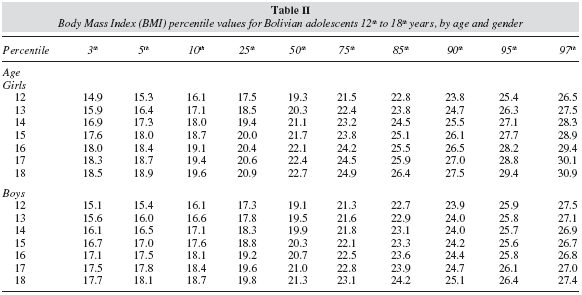
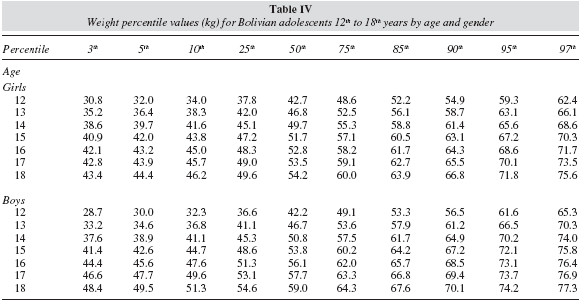
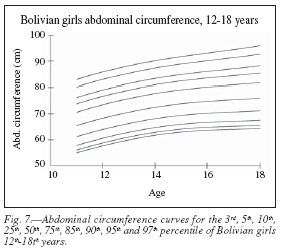
<body><![CDATA[<p><font size="2" face="Verdana">Data was collected on 3,445 adolescents, 1,551 boys and 1,894 girls, from rural (34.8%) and urban areas (65.2%), and from public (76.4%) and private (23.6%) schools. Although 4,013 adolescents were selected initially to participate on the study, 3,445 finally participated in the study. Adolescents dropped out of the study due to refusal of parental consent, failure to attend the day of data collection, failure to fill the birth date or name, failure to return the questionnaire or failure to have their anthropometric data taken or completed. Characteristics of the population sample by age are presented in  <a href="#t1">table I</a>.</font></p>     <p align="center"><a name="t1"><img src="/img/revistas/nh/v24n3/original4_t1.gif"></a></p>     <p><font size="2" face="Verdana"><a href="#t2">Table II to VII</a> shows smoothed percentile values respectively for BMI, height, weight, abdominal, arm and wrist circumference by age- and gender.</font></p>     <p align="center"><a name="t2"><img src="/img/revistas/nh/v24n3/original4_t2.gif"></a></p>     <p align="center"><img src="/img/revistas/nh/v24n3/original4_t3.gif"></p>     <p align="center"><img src="/img/revistas/nh/v24n3/original4_t4.gif"></p>     <p align="center"><img src="/img/revistas/nh/v24n3/original4_t5.gif"></p>     <p align="center"><img src="/img/revistas/nh/v24n3/original4_t6.gif"></p>     <p align="center"><img src="/img/revistas/nh/v24n3/original4_t7.gif"></p>     <p><font size="2" face="Verdana"><a href="#f1">Figures 1 to 12</a> show the smoothed charts for each anthropometric parameter in order to be available for practical clinical application.</font></p>     ]]></body>
<body><![CDATA[<p align="center"><a name="f1"><img src="/img/revistas/nh/v24n3/original4_f1.gif"></a></p>     <p align="center"><img src="/img/revistas/nh/v24n3/original4_f2.gif"></p>     <p align="center"><img src="/img/revistas/nh/v24n3/original4_f3.gif"></p>     <p align="center"><img src="/img/revistas/nh/v24n3/original4_f4.gif"></p>     <p align="center"><img src="/img/revistas/nh/v24n3/original4_f5.gif"></p>     <p align="center"><img src="/img/revistas/nh/v24n3/original4_f6.gif"></p>     <p align="center"><img src="/img/revistas/nh/v24n3/original4_f7.gif"></p>     <p align="center"><img src="/img/revistas/nh/v24n3/original4_f8.gif"></p>     <p align="center"><img src="/img/revistas/nh/v24n3/original4_f9.gif"></p>     <p align="center"><img src="/img/revistas/nh/v24n3/original4_f10.gif"></p>     ]]></body>
<body><![CDATA[<p align="center"><img src="/img/revistas/nh/v24n3/original4_f11.gif"></p>     <p align="center"><img src="/img/revistas/nh/v24n3/original4_f12.gif"></p>     <p align="center">&nbsp;</p>     <p><font face="Verdana"><b>Conclusion</b></font></p>     <p><font size="2" face="Verdana">Smoothed age- and gender specific 3<sup>rd</sup>, 5<sup>th</sup>, 10<sup>th</sup>, 25<sup>th</sup>, 50<sup>th</sup>, 75<sup>th</sup>, 85<sup>th</sup>, 90<sup>th</sup>, 95<sup>th</sup> and 97<sup>th</sup> Bolivian adolescent per centiles(BAP) and Charts(BAC) for the anthropometric parameters of height, weight, arm, wrist, and abdominal circumference and body mass index for Bolivian Adolescents 12 to 18y were developed.</font></p>     <p><font size="2" face="Verdana">The data of the sample distribution resembles the population distribution of the country. As stated in the 2007 projection of the 2001 National Census<sup>17;18</sup> the urban and rural population is estimated respectively at 65.4% and 34.6%. The study was carried out with school attending adolescents missing the ones that do not attend it, thus no claim can be made for complete representativeness. However there is no indication that anthropometric values of this group could vary due to genetic factors from the adolescents that have participated in the study. This factor may on the other hand have reduced data collection from a more vulnerable adolescent population that may have suffered more from infection or disease two elements that can negatively affect malnutrition and growth.</font></p>     <p><font size="2" face="Verdana">Anthropometry provides the single most convenient, universally applicable, inexpensive and non-invasive technique for assessing size, proportions and composition of the human body. It reflects both health and nutritional status and predicts performance, health and survival.<sup>1,4</sup></font></p>     <p><font size="2" face="Verdana">For adolescents it is also useful to determine biological maturity and health risks. To the knowledge of the authors, this is the largest anthropometric survey carried out in Bolivia, providing nationally representative data. Bolivian health providers have for the first time locally developed anthropometric tables and charts at their disposal, to assess the nutritional status of Bolivian adolescents 12 to 18 y which can also to be used for other clinical applications.</font></p>     <p><font size="2" face="Verdana">Several characteristics make this tool valuable and reliable: they came from a large set of data, in which all the 327 Counties of Bolivia had similar opportunity to be selected, rural and urban areas were represented at the same level of distribution as the general population, all ages and gender of adolescents from 12 to 18<sup>th</sup> year were assessed in the same study, following a standard protocol, using the same equipment and carried out by the same research team.</font></p>     <p><font size="2" face="Verdana">It is important to mention that percentile values and charts came from a descriptive study that portraits the present situation of adolescents, and does not claim to be a standard that describes a population that followed healthy recommendations for all parameters that could affect normal growth and body composition, or a population that have developed its full genetic potential. Values and charts must be used for this reason with caution by the medical community. Once an international or a national reference that considers these aspects is developed, the BAP must be replaced by it.</font></p>     ]]></body>
<body><![CDATA[<p><font size="2" face="Verdana">Clearly there will be quantitative and qualitative dimensions to consider with the introduction of the newly developed Bolivian Adolescent Percentiles (BAP) Reference in replacement of the CDC or other international available references such as the IOTF. There is a need to compare the performance of these different References in their ability to classify individuals according to their nutritional status or to diagnose the risk of chronic disease in this population.</font></p>     <p><font size="2" face="Verdana">It may be that the criteria to identify adolescents at risk of overweight or a biochemical imbalance needs to be revised when differences are observed in sensitivity and specificity between the different references for a variety of outcome parameters.</font></p>     <p>&nbsp;</p>     <p><font face="Verdana"><b>Acknowledgments</b></font></p>     <p><font size="2" face="Verdana">The authors wish to thank the adolescents, their parents, and school directors from the 32 locations were the studies were conducted. Also to students and the staff of the Faculty of Medicine of the Universidad del Valle as well as the personnel of other institutions for their cooperation during different steps of the study. Special thanks go to the Prince Leopold Institute of Tropical Medicine who has supported this study and to Nutrition Third World for making it possible through funding it.</font></p>     <p>&nbsp;</p>     <p><font face="Verdana"><b>References</b></font></p>     <!-- ref --><p><font size="2" face="Verdana">1. WHO. Physical status : The use and interpretation of anthropometry. Report of a WHO Expert Committee. 1995; 854: 1-453. Geneva, WHO. WHO Technical Report Series. Ref Type: Report.</font>&nbsp;&nbsp;&nbsp;&nbsp;&nbsp;&nbsp;&nbsp;&nbsp;[&#160;<a href="javascript:void(0);" onclick="javascript: window.open('/scielo.php?script=sci_nlinks&ref=3542414&pid=S0212-1611200900030000700001&lng=','','width=640,height=500,resizable=yes,scrollbars=1,menubar=yes,');">Links</a>&#160;]<!-- end-ref --><!-- ref --><p><font size="2" face="Verdana">2. The World Health Organization MONICA Project (monitoring trends and determinants in cardiovascular disease): a major international collaboration. WHO MONICA Project Principal Investigators. J Clin Epidemiol 1988; 41: 105-14.</font>&nbsp;&nbsp;&nbsp;&nbsp;&nbsp;&nbsp;&nbsp;&nbsp;[&#160;<a href="javascript:void(0);" onclick="javascript: window.open('/scielo.php?script=sci_nlinks&ref=3542415&pid=S0212-1611200900030000700002&lng=','','width=640,height=500,resizable=yes,scrollbars=1,menubar=yes,');">Links</a>&#160;]<!-- end-ref --><!-- ref --><p><font size="2" face="Verdana">3. De Onis M, Garza C, Onyango AW, Martorell R. WHO Child growth standards. Taylor and Francis, 2006.</font>&nbsp;&nbsp;&nbsp;&nbsp;&nbsp;&nbsp;&nbsp;&nbsp;[&#160;<a href="javascript:void(0);" onclick="javascript: window.open('/scielo.php?script=sci_nlinks&ref=3542416&pid=S0212-1611200900030000700003&lng=','','width=640,height=500,resizable=yes,scrollbars=1,menubar=yes,');">Links</a>&#160;]<!-- end-ref --><!-- ref --><p><font size="2" face="Verdana">4. P&eacute;rez-Cueto A, Almanza M, Kolsteren P. Female gender and wealth are associated to overweight among adolescents in La Paz, Bolivia. Eur J Clin Nutr 2005; 59: 82-7.</font>&nbsp;&nbsp;&nbsp;&nbsp;&nbsp;&nbsp;&nbsp;&nbsp;[&#160;<a href="javascript:void(0);" onclick="javascript: window.open('/scielo.php?script=sci_nlinks&ref=3542417&pid=S0212-1611200900030000700004&lng=','','width=640,height=500,resizable=yes,scrollbars=1,menubar=yes,');">Links</a>&#160;]<!-- end-ref --><!-- ref --><p><font size="2" face="Verdana">5. Ogden CL, Kuczmarski RJ, Flegal KM et al. Centers by Disease Control and Prevention 200 growth charts for the United States: Improvements to the 1977 National Center for Health Statistical version. Pediatrics 2002; 109: 45-60.</font>&nbsp;&nbsp;&nbsp;&nbsp;&nbsp;&nbsp;&nbsp;&nbsp;[&#160;<a href="javascript:void(0);" onclick="javascript: window.open('/scielo.php?script=sci_nlinks&ref=3542418&pid=S0212-1611200900030000700005&lng=','','width=640,height=500,resizable=yes,scrollbars=1,menubar=yes,');">Links</a>&#160;]<!-- end-ref --><!-- ref --><p><font size="2" face="Verdana">6. Cole TJ, Bellizzi MC, Flegal KM, Dietz WH. Establishing a standard definition for child overweight and obesity worldwide: international survey. BMJ 2000; 320: 1240-3.</font>&nbsp;&nbsp;&nbsp;&nbsp;&nbsp;&nbsp;&nbsp;&nbsp;[&#160;<a href="javascript:void(0);" onclick="javascript: window.open('/scielo.php?script=sci_nlinks&ref=3542419&pid=S0212-1611200900030000700006&lng=','','width=640,height=500,resizable=yes,scrollbars=1,menubar=yes,');">Links</a>&#160;]<!-- end-ref --><!-- ref --><p><font size="2" face="Verdana">7. Flegal KM, Nicholls D, Jackson AA. Body mass index cut offs to define thinness in children and adolescents: international survey. BMJ 2007; 8: 299-306.</font>&nbsp;&nbsp;&nbsp;&nbsp;&nbsp;&nbsp;&nbsp;&nbsp;[&#160;<a href="javascript:void(0);" onclick="javascript: window.open('/scielo.php?script=sci_nlinks&ref=3542420&pid=S0212-1611200900030000700007&lng=','','width=640,height=500,resizable=yes,scrollbars=1,menubar=yes,');">Links</a>&#160;]<!-- end-ref --><!-- ref --><p><font size="2" face="Verdana">8. P&eacute;rez-Cueto FJA, Naska A, Monterrey J, Almanza-L&oacute;pez M, Trichopoulou A, Kolsteren P. Monitoring food and nutrient availability in a nationally representative sample of Bolivian households. BJN 2006; 95: 555-567.</font>&nbsp;&nbsp;&nbsp;&nbsp;&nbsp;&nbsp;&nbsp;&nbsp;[&#160;<a href="javascript:void(0);" onclick="javascript: window.open('/scielo.php?script=sci_nlinks&ref=3542421&pid=S0212-1611200900030000700008&lng=','','width=640,height=500,resizable=yes,scrollbars=1,menubar=yes,');">Links</a>&#160;]<!-- end-ref --><!-- ref --><p><font size="2" face="Verdana">9. P&eacute;rez-Cueto FJ, Kolsteren P. Changes in the nutritional status of Bolivian women 1994-1998: demographic and social predictors. Eur J Clin Nutr 2004; 58: 660-6.</font>&nbsp;&nbsp;&nbsp;&nbsp;&nbsp;&nbsp;&nbsp;&nbsp;[&#160;<a href="javascript:void(0);" onclick="javascript: window.open('/scielo.php?script=sci_nlinks&ref=3542422&pid=S0212-1611200900030000700009&lng=','','width=640,height=500,resizable=yes,scrollbars=1,menubar=yes,');">Links</a>&#160;]<!-- end-ref --><!-- ref --><p><font size="2" face="Verdana">10. Benefice E, L&oacute;pez R, Monroy SL, Rodr&iacute;guez S. Fatness and overweight in women and children from riverine Amerindian communities of the Beni River (Bolivian Amazon). Am J Hum Biol 2007; 19: 61-73.</font>&nbsp;&nbsp;&nbsp;&nbsp;&nbsp;&nbsp;&nbsp;&nbsp;[&#160;<a href="javascript:void(0);" onclick="javascript: window.open('/scielo.php?script=sci_nlinks&ref=3542423&pid=S0212-1611200900030000700010&lng=','','width=640,height=500,resizable=yes,scrollbars=1,menubar=yes,');">Links</a>&#160;]<!-- end-ref --><!-- ref --><p><font size="2" face="Verdana">11. Zimmet P, Alberti KG, Kaufman F et al. The metabolic syndrome in children and adolescents-and IDF consensus report. Pediatr Diabetes 2007; 8: 299-306.</font>&nbsp;&nbsp;&nbsp;&nbsp;&nbsp;&nbsp;&nbsp;&nbsp;[&#160;<a href="javascript:void(0);" onclick="javascript: window.open('/scielo.php?script=sci_nlinks&ref=3542424&pid=S0212-1611200900030000700011&lng=','','width=640,height=500,resizable=yes,scrollbars=1,menubar=yes,');">Links</a>&#160;]<!-- end-ref --><!-- ref --><p><font size="2" face="Verdana">12. De Onis M, Onyango AW, Borghi E, Garza C, Yang H. Comparison of the World Health Organization (WHO) Child Growth Standards and the National Center for Health Statistics/WHO international growth reference: implications for child health programmes. Public Health Nutr 2006; 9: 942-7.</font>&nbsp;&nbsp;&nbsp;&nbsp;&nbsp;&nbsp;&nbsp;&nbsp;[&#160;<a href="javascript:void(0);" onclick="javascript: window.open('/scielo.php?script=sci_nlinks&ref=3542425&pid=S0212-1611200900030000700012&lng=','','width=640,height=500,resizable=yes,scrollbars=1,menubar=yes,');">Links</a>&#160;]<!-- end-ref --><!-- ref --><p><font size="2" face="Verdana">13. Goran MI, Ball GD, Cruz ML. Obesity and risk of type 2 diabetes and cardiovascular disease in children and adolescents. J Clin Endocrinol Metab 2003; 88: 1417-27.</font>&nbsp;&nbsp;&nbsp;&nbsp;&nbsp;&nbsp;&nbsp;&nbsp;[&#160;<a href="javascript:void(0);" onclick="javascript: window.open('/scielo.php?script=sci_nlinks&ref=3542426&pid=S0212-1611200900030000700013&lng=','','width=640,height=500,resizable=yes,scrollbars=1,menubar=yes,');">Links</a>&#160;]<!-- end-ref --><!-- ref --><p><font size="2" face="Verdana">14. Hauner H. Insulin resistance and the metabolic syndrome-a challenge of the new millennium. Eur J Clin Nutr 2002; 56 (Supl. 1): S25-S29.</font>&nbsp;&nbsp;&nbsp;&nbsp;&nbsp;&nbsp;&nbsp;&nbsp;[&#160;<a href="javascript:void(0);" onclick="javascript: window.open('/scielo.php?script=sci_nlinks&ref=3542427&pid=S0212-1611200900030000700014&lng=','','width=640,height=500,resizable=yes,scrollbars=1,menubar=yes,');">Links</a>&#160;]<!-- end-ref --><!-- ref --><p><font size="2" face="Verdana">15. World Medical Association Declaration of Helsinki: ethical principles for medical research involving human subjects. JAMA 2000; 284: 3043-5.</font>&nbsp;&nbsp;&nbsp;&nbsp;&nbsp;&nbsp;&nbsp;&nbsp;[&#160;<a href="javascript:void(0);" onclick="javascript: window.open('/scielo.php?script=sci_nlinks&ref=3542428&pid=S0212-1611200900030000700015&lng=','','width=640,height=500,resizable=yes,scrollbars=1,menubar=yes,');">Links</a>&#160;]<!-- end-ref --><!-- ref --><p><font size="2" face="Verdana">16. Cole TJ. The LMS method for constructing normalized growth standards. Eur J Clin Nutr 1990; 44: 45-60.</font>&nbsp;&nbsp;&nbsp;&nbsp;&nbsp;&nbsp;&nbsp;&nbsp;[&#160;<a href="javascript:void(0);" onclick="javascript: window.open('/scielo.php?script=sci_nlinks&ref=3542429&pid=S0212-1611200900030000700016&lng=','','width=640,height=500,resizable=yes,scrollbars=1,menubar=yes,');">Links</a>&#160;]<!-- end-ref --><!-- ref --><p><font size="2" face="Verdana">17. Instituto Nacional de Estadistica. Bolivia Indicadores Sociodemograficos por provincial y secciones de provincial 1992-2001. Instituto Nacional de Estadistica, 2006.</font>&nbsp;&nbsp;&nbsp;&nbsp;&nbsp;&nbsp;&nbsp;&nbsp;[&#160;<a href="javascript:void(0);" onclick="javascript: window.open('/scielo.php?script=sci_nlinks&ref=3542430&pid=S0212-1611200900030000700017&lng=','','width=640,height=500,resizable=yes,scrollbars=1,menubar=yes,');">Links</a>&#160;]<!-- end-ref --><!-- ref --><p><font size="2" face="Verdana">18. Instituto Nacional de Estadistica. Bolivia Proyecciones de poblacion por provincias y municipios, segun sexo y grupos de edad, periodo 2000-2010. 2005.</font>&nbsp;&nbsp;&nbsp;&nbsp;&nbsp;&nbsp;&nbsp;&nbsp;[&#160;<a href="javascript:void(0);" onclick="javascript: window.open('/scielo.php?script=sci_nlinks&ref=3542431&pid=S0212-1611200900030000700018&lng=','','width=640,height=500,resizable=yes,scrollbars=1,menubar=yes,');">Links</a>&#160;]<!-- end-ref --><p>&nbsp;</p>     <p>&nbsp;</p>     <p><font size="2" face="Verdana"><b><a name="back"></a><a href="#top"><img border="0" src="/img/revistas/nh/v24n3/seta.gif" width="15" height="17"></a>Correspondence:</b>    <br>Ana Baya Botti.    <br>Pasaje La Sevillana 1353.    ]]></body>
<body><![CDATA[<br>P. O. Box 6557 Cochabamba - Bolivia.    <br>E-mail:  <a href="mailto:baya.ana@gmail.com">baya.ana@gmail.com</a></font></p>     <p><font size="2" face="Verdana">Recibido: 5-VI-2008.    <br>Aceptado: 1-VII-2008.</font></p>      ]]></body><back>
<ref-list>
<ref id="B1">
<label>1</label><nlm-citation citation-type="book">
<collab>WHO</collab>
<source><![CDATA[Physical status : The use and interpretation of anthropometry: Report of a WHO Expert Committee]]></source>
<year>1995</year>
<volume>854</volume>
<page-range>1-453</page-range><publisher-loc><![CDATA[Geneva ]]></publisher-loc>
<publisher-name><![CDATA[WHO]]></publisher-name>
</nlm-citation>
</ref>
<ref id="B2">
<label>2</label><nlm-citation citation-type="journal">
<article-title xml:lang="en"><![CDATA[The World Health Organization MONICA Project (monitoring trends and determinants in cardiovascular disease): a major international collaboration. WHO MONICA Project Principal Investigators]]></article-title>
<source><![CDATA[J Clin Epidemiol]]></source>
<year>1988</year>
<volume>41</volume>
<page-range>105-14</page-range></nlm-citation>
</ref>
<ref id="B3">
<label>3</label><nlm-citation citation-type="book">
<person-group person-group-type="author">
<name>
<surname><![CDATA[De Onis]]></surname>
<given-names><![CDATA[M]]></given-names>
</name>
<name>
<surname><![CDATA[Garza]]></surname>
<given-names><![CDATA[C]]></given-names>
</name>
<name>
<surname><![CDATA[Onyango]]></surname>
<given-names><![CDATA[AW]]></given-names>
</name>
<name>
<surname><![CDATA[Martorell]]></surname>
<given-names><![CDATA[R]]></given-names>
</name>
</person-group>
<source><![CDATA[WHO Child growth standards]]></source>
<year>2006</year>
<publisher-name><![CDATA[Taylor and Francis]]></publisher-name>
</nlm-citation>
</ref>
<ref id="B4">
<label>4</label><nlm-citation citation-type="journal">
<person-group person-group-type="author">
<name>
<surname><![CDATA[Pérez-Cueto]]></surname>
<given-names><![CDATA[A]]></given-names>
</name>
<name>
<surname><![CDATA[Almanza]]></surname>
<given-names><![CDATA[M]]></given-names>
</name>
<name>
<surname><![CDATA[Kolsteren]]></surname>
<given-names><![CDATA[P]]></given-names>
</name>
</person-group>
<article-title xml:lang="en"><![CDATA[Female gender and wealth are associated to overweight among adolescents in La Paz, Bolivia]]></article-title>
<source><![CDATA[Eur J Clin Nutr]]></source>
<year>2005</year>
<volume>59</volume>
<page-range>82-7</page-range></nlm-citation>
</ref>
<ref id="B5">
<label>5</label><nlm-citation citation-type="journal">
<person-group person-group-type="author">
<name>
<surname><![CDATA[Ogden]]></surname>
<given-names><![CDATA[CL]]></given-names>
</name>
<name>
<surname><![CDATA[Kuczmarski]]></surname>
<given-names><![CDATA[RJ]]></given-names>
</name>
<name>
<surname><![CDATA[Flegal]]></surname>
<given-names><![CDATA[KM]]></given-names>
</name>
</person-group>
<article-title xml:lang="en"><![CDATA[Centers by Disease Control and Prevention 200 growth charts for the United States: Improvements to the 1977 National Center for Health Statistical version]]></article-title>
<source><![CDATA[Pediatrics]]></source>
<year>2002</year>
<volume>109</volume>
<page-range>45-60</page-range></nlm-citation>
</ref>
<ref id="B6">
<label>6</label><nlm-citation citation-type="journal">
<person-group person-group-type="author">
<name>
<surname><![CDATA[Cole]]></surname>
<given-names><![CDATA[TJ]]></given-names>
</name>
<name>
<surname><![CDATA[Bellizzi]]></surname>
<given-names><![CDATA[MC]]></given-names>
</name>
<name>
<surname><![CDATA[Flegal]]></surname>
<given-names><![CDATA[KM]]></given-names>
</name>
<name>
<surname><![CDATA[Dietz]]></surname>
<given-names><![CDATA[WH]]></given-names>
</name>
</person-group>
<article-title xml:lang="en"><![CDATA[Establishing a standard definition for child overweight and obesity worldwide: international survey]]></article-title>
<source><![CDATA[BMJ]]></source>
<year>2000</year>
<volume>320</volume>
<page-range>1240-3</page-range></nlm-citation>
</ref>
<ref id="B7">
<label>7</label><nlm-citation citation-type="journal">
<person-group person-group-type="author">
<name>
<surname><![CDATA[Flegal]]></surname>
<given-names><![CDATA[KM]]></given-names>
</name>
<name>
<surname><![CDATA[Nicholls]]></surname>
<given-names><![CDATA[D]]></given-names>
</name>
<name>
<surname><![CDATA[Jackson]]></surname>
<given-names><![CDATA[AA]]></given-names>
</name>
</person-group>
<article-title xml:lang="en"><![CDATA[Body mass index cut offs to define thinness in children and adolescents: international survey]]></article-title>
<source><![CDATA[BMJ]]></source>
<year>2007</year>
<volume>8</volume>
<page-range>299-306</page-range></nlm-citation>
</ref>
<ref id="B8">
<label>8</label><nlm-citation citation-type="journal">
<person-group person-group-type="author">
<name>
<surname><![CDATA[Pérez-Cueto]]></surname>
<given-names><![CDATA[FJA]]></given-names>
</name>
<name>
<surname><![CDATA[Naska]]></surname>
<given-names><![CDATA[A]]></given-names>
</name>
<name>
<surname><![CDATA[Monterrey]]></surname>
<given-names><![CDATA[J]]></given-names>
</name>
<name>
<surname><![CDATA[Almanza-López]]></surname>
<given-names><![CDATA[M]]></given-names>
</name>
<name>
<surname><![CDATA[Trichopoulou]]></surname>
<given-names><![CDATA[A]]></given-names>
</name>
<name>
<surname><![CDATA[Kolsteren]]></surname>
<given-names><![CDATA[P]]></given-names>
</name>
</person-group>
<article-title xml:lang="en"><![CDATA[Monitoring food and nutrient availability in a nationally representative sample of Bolivian households]]></article-title>
<source><![CDATA[BJN]]></source>
<year>2006</year>
<volume>95</volume>
<page-range>555-567</page-range></nlm-citation>
</ref>
<ref id="B9">
<label>9</label><nlm-citation citation-type="journal">
<person-group person-group-type="author">
<name>
<surname><![CDATA[Pérez-Cueto]]></surname>
<given-names><![CDATA[FJ]]></given-names>
</name>
<name>
<surname><![CDATA[Kolsteren]]></surname>
<given-names><![CDATA[P]]></given-names>
</name>
</person-group>
<article-title xml:lang="en"><![CDATA[Changes in the nutritional status of Bolivian women 1994-1998: demographic and social predictors]]></article-title>
<source><![CDATA[Eur J Clin Nutr]]></source>
<year>2004</year>
<volume>58</volume>
<page-range>660-6</page-range></nlm-citation>
</ref>
<ref id="B10">
<label>10</label><nlm-citation citation-type="journal">
<person-group person-group-type="author">
<name>
<surname><![CDATA[Benefice]]></surname>
<given-names><![CDATA[E]]></given-names>
</name>
<name>
<surname><![CDATA[López]]></surname>
<given-names><![CDATA[R]]></given-names>
</name>
<name>
<surname><![CDATA[Monroy]]></surname>
<given-names><![CDATA[SL]]></given-names>
</name>
<name>
<surname><![CDATA[Rodríguez]]></surname>
<given-names><![CDATA[S]]></given-names>
</name>
</person-group>
<article-title xml:lang="en"><![CDATA[Fatness and overweight in women and children from riverine Amerindian communities of the Beni River (Bolivian Amazon)]]></article-title>
<source><![CDATA[Am J Hum Biol]]></source>
<year>2007</year>
<volume>19</volume>
<page-range>61-73</page-range></nlm-citation>
</ref>
<ref id="B11">
<label>11</label><nlm-citation citation-type="journal">
<person-group person-group-type="author">
<name>
<surname><![CDATA[Zimmet]]></surname>
<given-names><![CDATA[P]]></given-names>
</name>
<name>
<surname><![CDATA[Alberti]]></surname>
<given-names><![CDATA[KG]]></given-names>
</name>
<name>
<surname><![CDATA[Kaufman]]></surname>
<given-names><![CDATA[F]]></given-names>
</name>
</person-group>
<article-title xml:lang="en"><![CDATA[The metabolic syndrome in children and adolescents-and IDF consensus report]]></article-title>
<source><![CDATA[Pediatr Diabetes]]></source>
<year>2007</year>
<volume>8</volume>
<page-range>299-306</page-range></nlm-citation>
</ref>
<ref id="B12">
<label>12</label><nlm-citation citation-type="journal">
<person-group person-group-type="author">
<name>
<surname><![CDATA[De Onis]]></surname>
<given-names><![CDATA[M]]></given-names>
</name>
<name>
<surname><![CDATA[Onyango]]></surname>
<given-names><![CDATA[AW]]></given-names>
</name>
<name>
<surname><![CDATA[Borghi]]></surname>
<given-names><![CDATA[E]]></given-names>
</name>
<name>
<surname><![CDATA[Garza]]></surname>
<given-names><![CDATA[C]]></given-names>
</name>
<name>
<surname><![CDATA[Yang]]></surname>
<given-names><![CDATA[H]]></given-names>
</name>
</person-group>
<article-title xml:lang="en"><![CDATA[Comparison of the World Health Organization (WHO) Child Growth Standards and the National Center for Health Statistics/WHO international growth reference: implications for child health programmes]]></article-title>
<source><![CDATA[Public Health Nutr]]></source>
<year>2006</year>
<volume>9</volume>
<page-range>942-7</page-range></nlm-citation>
</ref>
<ref id="B13">
<label>13</label><nlm-citation citation-type="journal">
<person-group person-group-type="author">
<name>
<surname><![CDATA[Goran]]></surname>
<given-names><![CDATA[MI]]></given-names>
</name>
<name>
<surname><![CDATA[Ball]]></surname>
<given-names><![CDATA[GD]]></given-names>
</name>
<name>
<surname><![CDATA[Cruz]]></surname>
<given-names><![CDATA[ML]]></given-names>
</name>
</person-group>
<article-title xml:lang="en"><![CDATA[Obesity and risk of type 2 diabetes and cardiovascular disease in children and adolescents]]></article-title>
<source><![CDATA[J Clin Endocrinol Metab]]></source>
<year>2003</year>
<volume>88</volume>
<page-range>1417-27</page-range></nlm-citation>
</ref>
<ref id="B14">
<label>14</label><nlm-citation citation-type="journal">
<person-group person-group-type="author">
<name>
<surname><![CDATA[Hauner]]></surname>
<given-names><![CDATA[H]]></given-names>
</name>
</person-group>
<article-title xml:lang="en"><![CDATA[Insulin resistance and the metabolic syndrome-a challenge of the new millennium]]></article-title>
<source><![CDATA[Eur J Clin Nutr]]></source>
<year>2002</year>
<volume>56</volume>
<numero>^s1</numero>
<issue>^s1</issue>
<supplement>1</supplement>
<page-range>S25-S29</page-range></nlm-citation>
</ref>
<ref id="B15">
<label>15</label><nlm-citation citation-type="journal">
<article-title xml:lang="en"><![CDATA[World Medical Association Declaration of Helsinki: ethical principles for medical research involving human subjects]]></article-title>
<source><![CDATA[JAMA]]></source>
<year>2000</year>
<volume>284</volume>
<page-range>3043-5</page-range></nlm-citation>
</ref>
<ref id="B16">
<label>16</label><nlm-citation citation-type="journal">
<person-group person-group-type="author">
<name>
<surname><![CDATA[Cole]]></surname>
<given-names><![CDATA[TJ]]></given-names>
</name>
</person-group>
<article-title xml:lang="en"><![CDATA[The LMS method for constructing normalized growth standards]]></article-title>
<source><![CDATA[Eur J Clin Nutr]]></source>
<year>1990</year>
<volume>44</volume>
<page-range>45-60</page-range></nlm-citation>
</ref>
<ref id="B17">
<label>17</label><nlm-citation citation-type="book">
<collab>Instituto Nacional de Estadistica</collab>
<source><![CDATA[Bolivia Indicadores Sociodemograficos por provincial y secciones de provincial 1992-2001]]></source>
<year>2006</year>
<publisher-name><![CDATA[Instituto Nacional de Estadistica]]></publisher-name>
</nlm-citation>
</ref>
<ref id="B18">
<label>18</label><nlm-citation citation-type="">
<collab>Instituto Nacional de Estadistica</collab>
<source><![CDATA[Bolivia Proyecciones de poblacion por provincias y municipios, segun sexo y grupos de edad, periodo 2000-2010]]></source>
<year>2005</year>
</nlm-citation>
</ref>
</ref-list>
</back>
</article>