<?xml version="1.0" encoding="ISO-8859-1"?><article xmlns:mml="http://www.w3.org/1998/Math/MathML" xmlns:xlink="http://www.w3.org/1999/xlink" xmlns:xsi="http://www.w3.org/2001/XMLSchema-instance">
<front>
<journal-meta>
<journal-id>0212-1611</journal-id>
<journal-title><![CDATA[Nutrición Hospitalaria]]></journal-title>
<abbrev-journal-title><![CDATA[Nutr. Hosp.]]></abbrev-journal-title>
<issn>0212-1611</issn>
<publisher>
<publisher-name><![CDATA[Grupo Arán]]></publisher-name>
</publisher>
</journal-meta>
<article-meta>
<article-id>S0212-16112009000300008</article-id>
<title-group>
<article-title xml:lang="en"><![CDATA[Serum concentrations of vitamin A and oxidative stress in critically ill patients with sepsis]]></article-title>
<article-title xml:lang="es"><![CDATA[Concentraciones séricas de vitamina A y estrés oxidativo en pacientes críticos con sepsis]]></article-title>
</title-group>
<contrib-group>
<contrib contrib-type="author">
<name>
<surname><![CDATA[Ribeiro Nogueira]]></surname>
<given-names><![CDATA[C.]]></given-names>
</name>
<xref ref-type="aff" rid="A01"/>
</contrib>
<contrib contrib-type="author">
<name>
<surname><![CDATA[Ramalho]]></surname>
<given-names><![CDATA[A.]]></given-names>
</name>
<xref ref-type="aff" rid="A01"/>
</contrib>
<contrib contrib-type="author">
<name>
<surname><![CDATA[Lameu]]></surname>
<given-names><![CDATA[E.]]></given-names>
</name>
<xref ref-type="aff" rid="A02"/>
</contrib>
<contrib contrib-type="author">
<name>
<surname><![CDATA[Da Silva Franca]]></surname>
<given-names><![CDATA[C. A.]]></given-names>
</name>
<xref ref-type="aff" rid="A01"/>
</contrib>
<contrib contrib-type="author">
<name>
<surname><![CDATA[David]]></surname>
<given-names><![CDATA[C.]]></given-names>
</name>
<xref ref-type="aff" rid="A03"/>
</contrib>
<contrib contrib-type="author">
<name>
<surname><![CDATA[Accioly]]></surname>
<given-names><![CDATA[E.]]></given-names>
</name>
<xref ref-type="aff" rid="A01"/>
</contrib>
</contrib-group>
<aff id="A01">
<institution><![CDATA[,Universidade Federal do Rio de Janeiro (UFRJ) Instituto de Nutrição Josué de Castro (INJC) Vitamin A Research Group (Grupo de Pesquisa em Vitamina A-GPVA)]]></institution>
<addr-line><![CDATA[Rio de Janeiro ]]></addr-line>
<country>Brazil</country>
</aff>
<aff id="A02">
<institution><![CDATA[,Hospital São Vicente de Paulo (HSVP) Team of Enteral and Parenteral Nutritional Support ]]></institution>
<addr-line><![CDATA[ ]]></addr-line>
</aff>
<aff id="A03">
<institution><![CDATA[,Universidade Federal do Rio de Janeiro (UFRJ) Hospital Universitário Clementino Fraga Filho (HUCFF) Intensive Care Unit (ICU)]]></institution>
<addr-line><![CDATA[ ]]></addr-line>
<country>Brazil</country>
</aff>
<pub-date pub-type="pub">
<day>00</day>
<month>06</month>
<year>2009</year>
</pub-date>
<pub-date pub-type="epub">
<day>00</day>
<month>06</month>
<year>2009</year>
</pub-date>
<volume>24</volume>
<numero>3</numero>
<fpage>312</fpage>
<lpage>317</lpage>
<copyright-statement/>
<copyright-year/>
<self-uri xlink:href="http://scielo.isciii.es/scielo.php?script=sci_arttext&amp;pid=S0212-16112009000300008&amp;lng=en&amp;nrm=iso"></self-uri><self-uri xlink:href="http://scielo.isciii.es/scielo.php?script=sci_abstract&amp;pid=S0212-16112009000300008&amp;lng=en&amp;nrm=iso"></self-uri><self-uri xlink:href="http://scielo.isciii.es/scielo.php?script=sci_pdf&amp;pid=S0212-16112009000300008&amp;lng=en&amp;nrm=iso"></self-uri><abstract abstract-type="short" xml:lang="en"><p><![CDATA[Introduction: Sepsis is one of the main causes of mortality in patients in Intensive Care Units. As a result of the systemic inflammatory response and of the decrease of the aerobic metabolism in sepsis, the oxidative stress occurs. Vitamin A is recognized by the favorable effect that it exerts on the immune response to infections and antioxidant action. Objetive: To bring new elements for reviewing of the nutritional support addressed to critically ill patients with sepsis, with emphasis to vitamin A. Methods: Critically ill patients with sepsis had circulating concentrations of retinol, &beta;-carotene, thiobarbituric acid-reactive substances (TBARS) and C-reactive protein (CRP) measured in Medicosurgical Intensive Care Unit in the city of Rio de Janeiro, Brazil. The patients were divided into two groups: patients who were receiving nutritional support and those without support. At the act of the patient's admission, APACHE II score was calculated. Results: 46 patients were studied (with diet n = 24 and without diet n = 22). Reduced levels of retinol and &beta;-carotene were found in 65.2% and 73.9% of the patients, respectively. Among the patients who presented lower concentrations of CRP it was found higher &beta;-carotene inadequacy (64.8%) and 50% of retinol inadequacy. There was no significant difference as regards retinol, TBARS and APACHE II levels among the patients with and without nutritional support. However, higher levels of CRP (p = 0.001) and lower levels of serum &beta;-carotene (p = 0.047) were found in patients without nutritional support. Conclusions: Septic patients presented an important inadequacy of retinol and &beta;-carotene. The present study bring elements to the elaboration/review of the nutritional protocol directed to the group studied, especially as regards vitamin A intake.]]></p></abstract>
<abstract abstract-type="short" xml:lang="es"><p><![CDATA[Introducción: La sepsis es una de las principales causas de mortalidad en pacientes en las Unidades de Cuidados Intensivos. Como consecuencia de la respuesta inflamatoria sistémica y de la disminución del metabolismo aeróbico en la sepsis se produce estrés oxidativo. La vitamina A es reconocida por el efecto favorable que ejerce sobre la respuesta inmunitaria a las infecciones y por su acción antioxidante. Objetivo: Aportar nuevos elementos a la hora de revisar el soporte nutricional de los pacientes críticos con sepsis, con un énfasis sobre la vitamina A. Métodos: Se midieron las concentraciones circulantes de retinol, &beta;-caroteno, ácido tiobarbitúrico-sustancias reactivas (ATBSR) y proteína C reactiva (PCR) de pacientes críticos con sepsis en la Unidad de Cuidados Intensivos Medicoquirúrgica de la ciudad de Río de Janeiro, Brasil. Se dividió a los pacientes en dos grupos: pacientes que recibían soporte nutricional y aquellos que no. Se calculó la puntuación APACHE en el momento de su ingreso. Resultados: Se estudiaron 46 pacientes (con dieta n = 24 y sin dieta n = 22). Se hallaron concentraciones disminuidas de retinol y &beta;-caroteno en el 65,2% y 73,9% de los pacientes, respectivamente. De entre los pacientes que presentaron las menores concentraciones de PCR, se halló una mayor inadecuación de &beta;-caroteno (64,8%) y un 50% de inadecuación de retinol. No hubo diferencias significativas con respecto al retinol, ATBSR y las puntuaciones APACHE II entre los pacientes con y sin soporte nutricional. Sin embargo, se hallaron mayores concentraciones de PCR (p = 0,001) y menores concentraciones séricas de &beta;-caroteno (p = 0,047) en los pacientes sin soporte nutricional. Conclusiones: Los pacientes sépticos presentaron una inadecuación importante de retinol y &beta;-caroteno. El presente estudio aporta elementos a la elaboración/revisión del protocolo nutricional dirigido al grupo estudiado, especialmente con respecto de la toma de vitamina A.]]></p></abstract>
<kwd-group>
<kwd lng="en"><![CDATA[Sepsis]]></kwd>
<kwd lng="en"><![CDATA[Retinol]]></kwd>
<kwd lng="en"><![CDATA[&beta;-carotene]]></kwd>
<kwd lng="en"><![CDATA[Vitamin A]]></kwd>
<kwd lng="en"><![CDATA[Oxidative stress]]></kwd>
<kwd lng="en"><![CDATA[Critical care]]></kwd>
<kwd lng="en"><![CDATA[C-reactive protein]]></kwd>
<kwd lng="es"><![CDATA[Sepsis]]></kwd>
<kwd lng="es"><![CDATA[Retinol]]></kwd>
<kwd lng="es"><![CDATA[&beta;-caroteno]]></kwd>
<kwd lng="es"><![CDATA[Vitamina A]]></kwd>
<kwd lng="es"><![CDATA[Estrés oxidativo]]></kwd>
<kwd lng="es"><![CDATA[Atención crítica]]></kwd>
<kwd lng="es"><![CDATA[Proteína C reactiva]]></kwd>
</kwd-group>
</article-meta>
</front><body><![CDATA[ <p align="left"><a name="top"></a><font size="2" face="Verdana"><b>ORIGINAL</b></font></p>     <p align="right">&nbsp;</p>     <p><font face="Verdana" size="4"><b>Serum concentrations of vitamin A and oxidative stress in critically ill patients with sepsis</b></font></p>     <p><font face="Verdana" size="4"><b>Concentraciones séricas de vitamina A y estrés oxidativo en pacientes críticos con sepsis</b></font></p>     <p>&nbsp;</p>     <p>&nbsp;</p>     <p><font size="2" face="Verdana"><b>C. Ribeiro Nogueira<sup>1</sup>, A. Ramalho<sup>1</sup>, E. Lameu<sup>2</sup>, C. A. Da Silva Franca<sup>1</sup>, C. David<sup>3</sup> and E. Accioly<sup>1</sup></b></font></p>     <p><font size="2" face="Verdana"><sup>1</sup>Researcher of the Vitamin A Research Group (Grupo de Pesquisa em Vitamina A-GPVA) of Instituto de Nutri&ccedil;&atilde;o Josu&eacute; de Castro (INJC) of Universidade Federal do Rio de Janeiro (UFRJ). Brazil.    <br> <sup>2</sup>Head of Team of Enteral and Parenteral Nutritional Support of Hospital S&atilde;o Vicente de Paulo (HSVP).    <br> <sup>3</sup>Head of the Intensive Care Unit (ICU) of Hospital Universit&aacute;rio Clementino Fraga Filho (HUCFF) of UFRJ. Brazil.</font></p>     ]]></body>
<body><![CDATA[<p><font size="2" face="Verdana"><a href="#back">Correspondence</a></font></p>     <p>&nbsp;</p>     <p>&nbsp;</p> <hr size="1">     <p><b><font size="2" face="Verdana">ABSTRACT</font></b></p>     <p><font size="2" face="Verdana"><b>Introduction:</b> Sepsis is one of the main causes of mortality in patients in Intensive Care Units. As a result of the systemic inflammatory response and of the decrease of the aerobic metabolism in sepsis, the oxidative stress occurs. Vitamin A is recognized by the favorable effect that it exerts on the immune response to infections and antioxidant action.    <br><b>Objetive:</b> To bring new elements for reviewing of the nutritional support addressed to critically ill patients with sepsis, with emphasis to vitamin A.    <br><b>Methods:</b> Critically ill patients with sepsis had circulating concentrations of retinol, &beta;-carotene, thiobarbituric acid-reactive substances (TBARS) and C-reactive protein (CRP) measured in Medicosurgical Intensive Care Unit in the city of Rio de Janeiro, Brazil. The patients were divided into two groups: patients who were receiving nutritional support and those without support. At the act of the patient's admission, APACHE II score was calculated.    <br><b>Results:</b> 46 patients were studied (with diet n = 24 and without diet n = 22). Reduced levels of retinol and &beta;-carotene were found in 65.2% and 73.9% of the patients, respectively. Among the patients who presented lower concentrations of CRP it was found higher &beta;-carotene inadequacy (64.8%) and 50% of retinol inadequacy. There was no significant difference as regards retinol, TBARS and APACHE II levels among the patients with and without nutritional support. However, higher levels of CRP (p = 0.001) and lower levels of serum &beta;-carotene (p = 0.047) were found in patients without nutritional support.    <br><b>Conclusions:</b> Septic patients presented an important inadequacy of retinol and &beta;-carotene. The present study bring elements to the elaboration/review of the nutritional protocol directed to the group studied, especially as regards vitamin A intake.</font></p>     <p><font size="2" face="Verdana"><b>Key words:</b> Sepsis. Retinol. &beta;-carotene. Vitamin A. Oxidative stress. Critical care. C-reactive protein.</font></p> <hr size="1">     ]]></body>
<body><![CDATA[<p><font size="2" face="Verdana"><b>RESUMEN</b></font></p>     <p><font size="2" face="Verdana"><b>Introducci&oacute;n:</b> La sepsis es una de las principales causas de mortalidad en pacientes en las Unidades de Cuidados Intensivos. Como consecuencia de la respuesta inflamatoria sist&eacute;mica y de la disminuci&oacute;n del metabolismo aer&oacute;bico en la sepsis se produce estr&eacute;s oxidativo. La vitamina A es reconocida por el efecto favorable que ejerce sobre la respuesta inmunitaria a las infecciones y por su acci&oacute;n antioxidante.    <br><b>Objetivo:</b> Aportar nuevos elementos a la hora de revisar el soporte nutricional de los pacientes cr&iacute;ticos con sepsis, con un &eacute;nfasis sobre la vitamina A.    <br><b>M&eacute;todos:</b> Se midieron las concentraciones circulantes de retinol, &beta;-caroteno, &aacute;cido tiobarbit&uacute;rico-sustancias reactivas (ATBSR) y prote&iacute;na C reactiva (PCR) de pacientes cr&iacute;ticos con sepsis en la Unidad de Cuidados Intensivos Medicoquir&uacute;rgica de la ciudad de R&iacute;o de Janeiro, Brasil. Se dividi&oacute; a los pacientes en dos grupos: pacientes que recib&iacute;an soporte nutricional y aquellos que no. Se calcul&oacute; la puntuaci&oacute;n APACHE en el momento de su ingreso.    <br><b>Resultados:</b> Se estudiaron 46 pacientes (con dieta n = 24 y sin dieta n = 22). Se hallaron concentraciones disminuidas de retinol y &beta;-caroteno en el 65,2% y 73,9% de los pacientes, respectivamente. De entre los pacientes que presentaron las menores concentraciones de PCR, se hall&oacute; una mayor inadecuaci&oacute;n de &beta;-caroteno (64,8%) y un 50% de inadecuaci&oacute;n de retinol. No hubo diferencias significativas con respecto al retinol, ATBSR y las puntuaciones APACHE II entre los pacientes con y sin soporte nutricional. Sin embargo, se hallaron mayores concentraciones de PCR (p = 0,001) y menores concentraciones s&eacute;ricas de &beta;-caroteno (p = 0,047) en los pacientes sin soporte nutricional.    <br><b>Conclusiones:</b> Los pacientes s&eacute;pticos presentaron una inadecuaci&oacute;n importante de retinol y &beta;-caroteno. El presente estudio aporta elementos a la elaboraci&oacute;n/revisi&oacute;n del protocolo nutricional dirigido al grupo estudiado, especialmente con respecto de la toma de vitamina A.</font></p>     <p><font size="2" face="Verdana"><b>Palabras clave:</b> Sepsis. Retinol. &beta;-caroteno. Vitamina A. Estr&eacute;s oxidativo. Atenci&oacute;n cr&iacute;tica. Prote&iacute;na C reactiva.</font></p> <hr size="1">     <p>&nbsp;</p>     <p><font face="Verdana"><b>Introduction</b></font></p>     <p><font size="2" face="Verdana">The survival of critical patients depends on a complex and careful immune response through all organic systems. Generally, the immune response dysfunction is present in two different ways: excessive performance of the cellular immune response that is clinically manifested as Systemic Inflammatory Response Syndrome (SIRS) and reduction of the immune response, leading to a significant increase in susceptibility to infections that result in sepsis.<sup>1</sup></font></p>     ]]></body>
<body><![CDATA[<p><font size="2" face="Verdana">Sepsis, which may be considered as SIRS face to an infectious stimulus, is one of the main causes of mortality in patients in Intensive Care Units (ICUs), despite improvements in supportive and antimicrobial therapies. <sup>2</sup> It is characterized by multiple manifestations which can determine dysfunction or failure of one or more organs, or even death.<sup>3</sup> Mortality rate for severe sepsis varies between 30-50% in critical patients,<sup>1</sup> and it is the cause of around 2% of hospital admissions.<sup>4</sup> Mean sepsis incidence is 50-95 cases for every 100,000 patients and has been rising around 9% every year.<sup>4</sup></font></p>     <p><font size="2" face="Verdana">As a result of systemic inflammatory response and decrease in aerobic metabolism in sepsis, oxidative stress occurs in extracellular and in intracellular spaces. <sup>5</sup> Oxidative stress has been implicated in human diseases by a growing body of scientific evidences,<sup>6</sup> and it may be defined as the situation where an increase of the physiological levels of the reactive oxygen species (ROS) occurs, resulting either from the decrease of antioxidant defense levels or from high production of ROS.<sup>7</sup> Oxidative stress is capable of causing lipid peroxidation of cellular membranes. Lipid peroxidation is a complex process, whereby polyunsaturated fatty acids of cellular membranes undergo reaction with oxygen to yield lipid hydroperoxides. The generation of products of lipid peroxidation after oxidative stress may be measured in the form of TBARS (thiobarbituric acid-reactive substances), where malondialdhyde stands out.<sup>8</sup></font></p>     <p><font size="2" face="Verdana">Acute severe pathological conditions such as sepsis are associated with the increase of ROS production and other species of radicals with a consequent oxidative stress that will be able to exacerbate organic injury.<sup>1</sup></font></p>     <p><font size="2" face="Verdana">Alterations in concentrations of some plasmatic proteins occur in critical patients such as C-reactive protein (CRP) increased production by the liver. CRP is one of the main proteins of the acute phase that has been utilized as a precocious and sensitive biomarker of the response to infectious or inflammatory processes, and it may increase from 19 to 100 times in the first 12 hours after aggression.<sup>9</sup></font></p>     <p><font size="2" face="Verdana">The potential toxicity of ROS may becounteracted by antioxidants.<sup>10,11</sup> Antioxidants may be defined as any substance that when present in low concentrations, compared to those of oxidable substrates, significantly postpones or inhibits the oxidation of these substrates.<sup>12</sup></font></p>     <p><font size="2" face="Verdana">Antioxidant systems include glutathione, vitamins (A, C and E) and several enzymes.<sup>13</sup> Previous studies have demonstrated that, in sepsis, an increase in the levels of oxidative stress and a decrease in the circulating concentration of antioxidant components of the defense system occur, including vitamins C, E, A and beta-carotene.<sup>2</sup> Antioxidant concentrations seem to increase the quantity of the immune system cells when compared to other cells.<sup>14</sup> Vitamin A stands out, since the favorable effect it exerts on immune response to infections is recognized. </font></p>     <p><font size="2" face="Verdana">Vitamin A participates in several primordial functions in human systems playing a role in visual acuity, cellular proliferation and differentiation, antioxidant action and immunological activity. The term vitamin A embodies the terminologies retinol and carotenoids, which are, respectively, the pre-formed vitamin and its precursors. Among these, &beta;-carotene is recognized as the most potent retinol precursor.<sup>15</sup> As much its biologically active form, as its provitamin forms, have gained prominence for their role against ROS, protecting the organism against oxidative stress and, consequently, preventing damages and tissue lesions.<sup>16</sup> Retinol possesses antioxidant activity as it associates with peroxil radicals before these are able to propagate peroxidation to the cellular lipid component and to generate hydroperoxides. As regards carotenoids, they neutralize peroxil radicals and singlet oxygen.<sup>17</sup> &beta;-carotene has an antioxidant activity five times higher than retinol.<sup>15</sup></font></p>     <p><font size="2" face="Verdana">In view of this context, the present study aimed to assess the serum concentrations of retinol, &beta;-carotene and oxidative stress and their relationship to CRP in septic patients hospitalized in ICU as a means of bringing new elements to the review of the nutritional support addressed to this group, with emphasis on the intake of vitamin A.</font></p>     <p>&nbsp;</p>     <p><font face="Verdana"><b>Materials and methods</b></font></p>     ]]></body>
<body><![CDATA[<p><font size="2" face="Verdana">The present study was conducted in Medicosurgical Intensive Care Unit in the city of Rio de Janeiro, Brazil. The study was approved by the Research Ethics Committee of Hospital Universit&aacute;rio Clementino Fraga Filho/ Universidade Federal do Rio de Janeiro (under the n.174/05). Informed consent was obtained from the patients' relatives.</font></p>     <p><font size="2" face="Verdana">All the adult patients hospitalized with sepsis diagnosis according to the International Sepsis Definitions Conference<sup>18</sup> were included in the study from January through December 2006. Patients who had chronic renal insufficiency, liver cirrhosis, and pregnant women, as well patients in immediate postoperative period and with parenteral nutritional support, were excluded.</font></p>     <p><font size="2" face="Verdana">At the time of enrollment in the study, patients were divided into two groups at random: patients who were receiving enteral nutritional support and those without support. According to hospital routine, the patients with nutritional support received hypercaloric enteral diet (1.5 kcal/ml) and hyperproteic diet (18 &plusmn; 2% of protein/day), and medical supplement (containing 5,000 IU/day of vitamin A).</font></p>     <p><font size="2" face="Verdana">At the act of the patient's admission, APACHE II score was calculated<sup>19</sup> and the following biochemical assessments were conducted:</font></p>     <blockquote> 	    <p><font size="2" face="Verdana">&bull; <i>Vitamin A</i>: Plasma retinol and &beta;-carotene were determined by high performance liquid chromatography (HPLC).<sup>20</sup> Levels of serum retinol were presented by interval classes of 0.35 &mu;mol/L (or 10 &mu;g/dl) to allow its classification according to the recommendations of the World Health Organization. 	<sup>21</sup> This enables to detect the groups with values of severe deficiency (&lt; 0.35 &mu;mol/L or &lt; 10 &mu;g/dl), moderate marginal (0.35 &mu;mol/L &le; 0.70 &mu;mol/L or 10 &mu;g/dl &le; 20 &mu;g/dl) and doubtful values (0.70 &mu;mol/L &le; 1.05 &mu;mol/L or 20 &mu;g/dl &le; 30 &mu;g/dl). The cutoff utilized to indicating inadequacy of serum values of &beta;-carotene was &pound; 40 &mu;g/dL, as suggested by Sauberlich et al.<sup>22</sup></font></p> 	    <p><font size="2" face="Verdana">&bull; <i>Oxidative Stress</i>: Thiobarbituric acid-reactive substances (TBARS) were measured by the method described by Ohkawa et al.<sup>23</sup></font></p> 	    <p><font size="2" face="Verdana">&bull; <i>C-Reactive Protein (CRP):</i> It was assessed through the method of nephelometry</font></p> </blockquote>     <p><font size="2" face="Verdana"><i>Statistical Analysis</i></font></p>     <p><font size="2" face="Verdana">Measures of central tendency and dispersion were calculated. Pearson and Spearman correlations were performed according to each variable behavior, adopting as strong correlation values higher than 0.6, and regular correlation from 0.3 to 0.6. Student "t" and Mann-Whitney tests were applied for comparison of continuous variables. To assessing association between categorical variables, Chi-square (C<sup>2</sup>) was applied. The significance level of 5% of probability (P &le; 0.05) was adopted. Statistical analysis was performed through the statistical program SPSS for Windows (version 13; SPSS INC., Chicago, IL, USA).</font></p>     ]]></body>
<body><![CDATA[<p>&nbsp;</p>     <p><font face="Verdana"><b>Results</b></font></p>     <p><font size="2" face="Verdana">Forty-six individuals were studied. In the act of enrollment in this study, it was observed that 52.2% (n = 24) of the patients received enteral diet, whereas 47.8% (n = 22) were without nutritional support. The collection of the patients with nutritional support occurred between Day 2 and Day 4 after they received the diet and the supplement (the patients had received the 90 to 100% their nutritional needs and regarding the supplement of vitamin A, the dose was full from the entrance of the patient). Among those who were without nutritional support, the time ranged from 24 to 72 hours. There was no report of diarrhea in any of the patients enrolled.</font></p>     <p><font size="2" face="Verdana">The general characteristics are shown in  <a href="#t1">table I</a>.</font></p>     <p align="center"><a name="t1"><img src="/img/revistas/nh/v24n3/original5_t1.gif"></a></p>     <p align="center">&nbsp;</p>     <p><font size="2" face="Verdana">As regards the serum concentrations of retinol, it was observed that 39.1% of the patients (n = 18) presented severe deficiency, 15.2% (n = 7) marginal deficiency, 10.9% (n = 5) doubtful values, and 34.8% (n = 16) presented normal concentrations (&gt;1.05 &mu;mol/L). As regards &beta;-carotene, it was observed an inadequacy of 73.9% (n = 34).</font></p>     <p><font size="2" face="Verdana">It was observed that the inadequacy of retinol and bcarotene was more frequent (77% ; n = 23 and 74%; n = 25, respectively) in patients with higher circulating levels of TBARS (allocated in the 50<sup>th</sup> and 75<sup>th</sup> quartiles), however no statistical significance was presented (p = 0.58 and p = 0.39, respectively).</font></p>     <p><font size="2" face="Verdana">It was not found a relationship among the continuous variables studied, except as regards age and APACHE II score which were positive and significantly correlated (p = 0.009 and r = 0.381).</font></p>     <p><font size="2" face="Verdana">Patients with adequate retinol presented high frequency of inadequate &beta;-carotene (62.5%), even without statistical significance (p = 0.29).</font></p>     ]]></body>
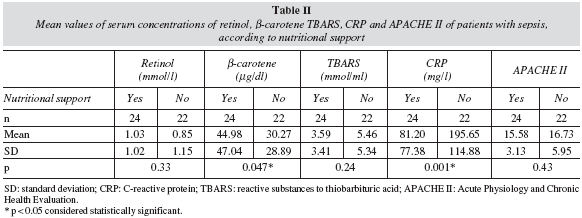
<body><![CDATA[<p><font size="2" face="Verdana">Among the patients who presented lower concentrations of CRP (allocated in the 25<sup>th</sup> quartile) it was found a higher &beta;-carotene inadequacy (64.8%) and 50% of retinol inadequacy.</font></p>     <p><font size="2" face="Verdana">Mean offer of vitamin A was 8,622 &plusmn; 4,090 IU/day, corresponding to 288% of the value of the recommended daily dietary intake (DRI)<sup>21</sup> (<a href="#f1">fig. 1</a>).</font></p>     <p align="center">&nbsp;</p>     <p align="center"><a name="f1"><img src="/img/revistas/nh/v24n3/original5_f1.gif"></a></p>     <p align="center">&nbsp;</p>     <p><font size="2" face="Verdana">Proportion of serum inadequacy of retinol in the groups with and without diet was 54% (n = 13) and 77% (n = 17), respectively, 62.5% (n = 15) of &beta;-carotene in the group with diet, and 86% (n = 19) in the group without diet.</font></p>     <p><font size="2" face="Verdana">There was no significant difference between the groups with and without diet as regards the mean serum retinol concentrations, TBARS and APACHE II score, differently from what occurred as regards serum concentrations of &beta;-carotene and of CRP (<a href="#t2">table II</a>).</font></p>     <p align="center"><a name="t2"><img src="/img/revistas/nh/v24n3/original5_t2.gif"></a></p>     <p align="center">&nbsp;</p>     <p><font face="Verdana"><b>Discussion</b></font></p>     ]]></body>
<body><![CDATA[<p><font size="2" face="Verdana">The present study conducted an assessment of the nutritional status of vitamin A and oxidative stress in individuals admitted in ICU with sepsis, aiming to contribute to the review of the nutritional support addressed to this group, with emphasis on the intake of vitamin A.</font></p>     <p><font size="2" face="Verdana">One of the factors which may lead to vitamin A deficiency (VAD) is the frequency of infectious episodes. Nowadays it is known that even subclinical VAD (when Xerophthalmia signs are absent) intensifies the severity of infirmities and of several infectious processes, and it may provoke immunodeficiency status of an exclusively nutritional origin<sup>21</sup> added to a higher metabolic utilization of vitamin A against oxidative stress to which individuals with infectious processes are more exposed to.<sup>1</sup></font></p>     <p><font size="2" face="Verdana">In the group studied, besides the high prevalence of deficiency of retinol and &beta;-carotene found, it was observed evidences of lipid peroxidation associated with high CRP, which jeopardizes the clinical condition of the septic patients assessed in a more intense way.</font></p>     <p><font size="2" face="Verdana">The hypercatabolic status derived from the septic status increases the demand of antioxidant vitamins as vitamin A. Low organic levels of this vitamin may contribute to sepsis aggravation, mainly when other conditions of risk are added as, for example, advanced age.<sup>2</sup></font></p>     <p><font size="2" face="Verdana">In the present study an association of APACHE II score was found with age, which could possibly be explained by the fact that the referred score attributes a higher score according to increase of age. Aging may be related to an infectious status aggravation by compromising organ functions, and by all consequences that normally accompany this process.<sup>24</sup></font></p>     <p><font size="2" face="Verdana">In the present study, it was observed high mean values of CRP compatible with the inflammatory systemic response and existence of infectious process. This finding corroborates others presented by Andriolo et al<sup>9</sup> who observed similar levels of this marker (146.1 mg/L) in the serum of septic patients who evolved to death. The same was pointed out by Castelli et al<sup>25</sup> who assessed the serum concentrations of CRP in patients with SIRS, sepsis and trauma, finding a mean of 150 mg/L of CRP in the group of septic patients.</font></p>     <p><font size="2" face="Verdana">A statistical difference (p = 0.001) was observed when the mean serum concentrations of CRP of the groups with and without diet were compared. Concentrations of CRP significantly higher in the group without diet may be related to the very absence of nutritional support whose impact would contribute to the increase of the catabolic demand.</font></p>     <p><font size="2" face="Verdana">Among the patients who presented lower concentrations of CRP, higher inadequacy of &beta;-carotene was found, and half of them presented retinol inadequacy. Data of the National Health and Nutrition Examination Survey in the USA (NHANES III) showed that individuals with values of CRP higher than 10 mg/L presented risk of VAD up to 8.6 times more than individuals with normal inflammatory activity. VAD has alreadybeing described as a risk factor for mortality in a large number of infectious diseases.<sup>26</sup> The most consensual justification is that the presence of infections would increase the organic utilization of vitamin A, thus causing firstly a decrease in the serum levels of retinol, which would promote depletion of the liver stores of this micronutrient. On the other hand, VAD associates with damage in the immunological response creating more susceptibility to infections, therefore generating the cycle "infection, deficiency, infection". Such statements may in part explain the increase of severity and mortality in the presence of the status of deficiency of vitamin A.</font></p>     <p><font size="2" face="Verdana">It is important to point out the findings related to urinary retinol loss associated with infectious processes.<sup>27</sup> Stephensen et al<sup>28</sup> conducted a study with 29 patients in ICU who presented pneumonia or sepsis, and they found an increase in the urinary excretion of retinol in the group studied when compared to healthy individuals. The patients presented an APACHE II score of 18 &plusmn; 7 in the first 24 hours of admission to the ICU (a finding similar to the values found in the present study: 16.13 &plusmn; 4.68). It was observed that the most severe patients (score &gt; 20) excreted 10 times more retinol than those who were the less severe ones (p &lt; 0.0022). Neves et al<sup>29</sup> observed a strong correlation between low serum levels of retinol and higher urinary loss of this nutrient in individuals with infection. Such findings must be taken into account in the understanding of the physiopathological mechanisms related to the development of VAD in patients with infection, mainly during severe infectious processes.</font></p>     <p><font size="2" face="Verdana">Goode et al<sup>2</sup> studied 16 patients interned in an ICU with a diagnosis of septic shock and secondary organ dysfunction and they found evidences of oxidative stress, as well reduced values of vitamins A and E, and carotenoids (lycopene and &beta;-carotene). Mean serum retinol found was 26.5 &mu;g/dl, mean APACHE II score was 16.6, and the concentrations of TBARS showed a strong negative correlation with those of serum retinol (p &lt; 0.01). In the present study, mean retinol was 0.95 &mu;mol/L (27.14 &mu;g/dl) and mean APACHE II was 16.13, results similar to the study previously cited; however it was not found an association between serum levels of TBARS and blood retinol. It was observed that retinol and &beta;-carotene inadequacy was more frequent in patients with higher circulating levels of TBARS (allocated in the 50<sup>th</sup> and 75<sup>th</sup> quartiles), nonetheless, no statistical significance was found. All patients studied by Goode et al<sup>2</sup> presented &beta;-carotene inadequacy. Such findings are in agreement with the high serum &beta;-carotene inadequacy observed in the present study.</font></p>     ]]></body>
<body><![CDATA[<p><font size="2" face="Verdana">In the present study, it was not found a statistical difference as regards serum levels of retinol, TBARS and APACHE II score in the groups with and without diet. Up to the present moment, literature does not present results similar to those of the present study, which would enable comparisons with these findings.</font></p>     <p><font size="2" face="Verdana">As regards &beta;-carotene, it was observed serum concentrations significantly lower in the group without diet. &beta;-carotene is considered provitaminic forms on account of their capacity of bioconversion to retinol, which is the active form of vitamin A. They are formed by an extensive conjugated system of double binds, and are five times more efficient than retinoids as regards protection against oxidative stress.<sup>15</sup> According to Mecocci et al,<sup>30</sup> the adequate nutritional status of vitamin A reduces the conversion of carotenoids into retinol, hence demonstrating that there is a relationship between the nutritional status of retinol and carotenoids. In the present study, besides a reduction of &beta;-carotene in the group without diet, it was verified that individuals with adequate serum concentrations of retinol presented a higher frequency of inadequacy of &beta;-carotene. Such factors could be explained by the mobilization of &beta;-carotene as antioxidants in the fight against oxidative stress (which was higher in the group without diet), and by bioconversion in order to maintain serum retinol concentrations that, despite the inadequate concentrations for the assemblage of patients, did not present statistically significant difference between patients with and without nutritional support. These findings demonstrated that critical patients with sepsis, included in the present study and who did not receive the diet, would be prevented from the antioxidant power of &beta;-carotene taking into account the lower mean serum concentrations found in this subgroup.</font></p>     <p><font size="2" face="Verdana">Dietary Reference Intake (DRI) of vitamin A for adults is 900 &mu;g/day (males) and 700 &mu;g/day (females) and the UL (Tolerable Upper Intake Level) is 3,000 &mu;g/day.<sup>15</sup></font></p>     <p><font size="2" face="Verdana">In the present study, the mean vitamin A administered to patients was 8,622 IU, corresponding approximately to three times the recommended intake for adults;<sup>15</sup> therefore suggesting that the dose of vitamin A routinely offered to these patients was not able to meet the demand of this group, due to the high frequency of serum inadequacy of retinol and &beta;-carotene found in the study.</font></p>     <p>&nbsp;</p>     <p><font face="Verdana"><b>Conclusion</b></font></p>     <p><font size="2" face="Verdana">Septic patients presented an important inadequacy of retinol and &beta;-carotene. The results found in the present study brought elements to the elaboration/review of the nutritional protocol addressed to the group studied, especially as regards the intake of vitamin A as a means of improving the prognosis and evolution of these patients.</font></p>     <p>&nbsp;</p>     <p><font face="Verdana"><b>Acknowledgments</b></font></p>     <p><font size="2" face="Verdana">We want to thank Dr. Guilherme Aguiar, Dr. Carlos Guida (Laborat&oacute;rio Santa Therezinha de An&aacute;lises e Pesquisas Cl&iacute;nicas LTDA), the General and Medical Board of HSVP, ICU Team and Laboratory of HSVP, ICU of HUCFF, F&aacute;tima Bastos, Mauro Baldanza, Juliana Barreto, Andr&eacute;a Cardoso, Marina Gribel and all members of the team of the Vitamin A Research Group/UFRJ.</font></p>     ]]></body>
<body><![CDATA[<p>&nbsp;</p>     <p><font face="Verdana"><b>References</b></font></p>     <!-- ref --><p><font size="2" face="Verdana">1. Crimi E, Sica V, Williams-Ignarro S et al. The role of oxidative stress in adult critical care. Free Radic Biol Med 2006; 40: 398-406.</font>&nbsp;&nbsp;&nbsp;&nbsp;&nbsp;&nbsp;&nbsp;&nbsp;[&#160;<a href="javascript:void(0);" onclick="javascript: window.open('/scielo.php?script=sci_nlinks&ref=3543585&pid=S0212-1611200900030000800001&lng=','','width=640,height=500,resizable=yes,scrollbars=1,menubar=yes,');">Links</a>&#160;]<!-- end-ref --><!-- ref --><p><font size="2" face="Verdana">2. Goode HF, Cowley HC, Walker BE, Howdle PD, Webster NR. Decreased antioxidant status and increased lipid peroxidation in patients with septic shock and secondary organ dysfunction. Crit Care Med 1995; 23: 646-651.</font>&nbsp;&nbsp;&nbsp;&nbsp;&nbsp;&nbsp;&nbsp;&nbsp;[&#160;<a href="javascript:void(0);" onclick="javascript: window.open('/scielo.php?script=sci_nlinks&ref=3543586&pid=S0212-1611200900030000800002&lng=','','width=640,height=500,resizable=yes,scrollbars=1,menubar=yes,');">Links</a>&#160;]<!-- end-ref --><!-- ref --><p><font size="2" face="Verdana">3. Bernard GR, Vincent JL, Laterre PF et al. Efficacy and safety of recombinant human activated protein C for severe sepsis. N Engl J Med 2001; 344: 699-709.</font>&nbsp;&nbsp;&nbsp;&nbsp;&nbsp;&nbsp;&nbsp;&nbsp;[&#160;<a href="javascript:void(0);" onclick="javascript: window.open('/scielo.php?script=sci_nlinks&ref=3543587&pid=S0212-1611200900030000800003&lng=','','width=640,height=500,resizable=yes,scrollbars=1,menubar=yes,');">Links</a>&#160;]<!-- end-ref --><!-- ref --><p><font size="2" face="Verdana">4. Annane D, Bellisante E, Cavaillon JM. Septic Shock. Lancet 2005; 365: 63-78.</font>&nbsp;&nbsp;&nbsp;&nbsp;&nbsp;&nbsp;&nbsp;&nbsp;[&#160;<a href="javascript:void(0);" onclick="javascript: window.open('/scielo.php?script=sci_nlinks&ref=3543588&pid=S0212-1611200900030000800004&lng=','','width=640,height=500,resizable=yes,scrollbars=1,menubar=yes,');">Links</a>&#160;]<!-- end-ref --><!-- ref --><p><font size="2" face="Verdana">5. Taylor DE, Piantadosi CA. Oxidative Metabolism in Sepsis and Sepsis Syndrome. J Crit Care 1995; 10: 122-135.</font>&nbsp;&nbsp;&nbsp;&nbsp;&nbsp;&nbsp;&nbsp;&nbsp;[&#160;<a href="javascript:void(0);" onclick="javascript: window.open('/scielo.php?script=sci_nlinks&ref=3543589&pid=S0212-1611200900030000800005&lng=','','width=640,height=500,resizable=yes,scrollbars=1,menubar=yes,');">Links</a>&#160;]<!-- end-ref --><!-- ref --><p><font size="2" face="Verdana">6. Bjelakovic G, Nikolova D, Gluud LL, Simonetti RG, Gluud C. Mortality in Randomized Trials of Antioxidant Supplements for Primary and Secondary Prevention. JAMA 2007; 297: 842-857.</font>&nbsp;&nbsp;&nbsp;&nbsp;&nbsp;&nbsp;&nbsp;&nbsp;[&#160;<a href="javascript:void(0);" onclick="javascript: window.open('/scielo.php?script=sci_nlinks&ref=3543590&pid=S0212-1611200900030000800006&lng=','','width=640,height=500,resizable=yes,scrollbars=1,menubar=yes,');">Links</a>&#160;]<!-- end-ref --><!-- ref --><p><font size="2" face="Verdana">7. Hargraves WA, Hentall ID. Analgesic effects of dietary caloric restriction in adult mice. Pain 2005; 114: 455-461.</font>&nbsp;&nbsp;&nbsp;&nbsp;&nbsp;&nbsp;&nbsp;&nbsp;[&#160;<a href="javascript:void(0);" onclick="javascript: window.open('/scielo.php?script=sci_nlinks&ref=3543591&pid=S0212-1611200900030000800007&lng=','','width=640,height=500,resizable=yes,scrollbars=1,menubar=yes,');">Links</a>&#160;]<!-- end-ref --><!-- ref --><p><font size="2" face="Verdana">8. Roth E, Manhart N, Wessner B. Assessing the antioxidative status in critically ill patients. Curr Opin Clin Nutr Metab Care 2004; 7: 161-168.</font>&nbsp;&nbsp;&nbsp;&nbsp;&nbsp;&nbsp;&nbsp;&nbsp;[&#160;<a href="javascript:void(0);" onclick="javascript: window.open('/scielo.php?script=sci_nlinks&ref=3543592&pid=S0212-1611200900030000800008&lng=','','width=640,height=500,resizable=yes,scrollbars=1,menubar=yes,');">Links</a>&#160;]<!-- end-ref --><!-- ref --><p><font size="2" face="Verdana">9. Andriolo A, Costa RP, Novo NF. Pr&oacute;-calcitonina e prote&iacute;na C reativa em processos infecciosos graves. J Bras Patol Med Lab 2004; 40: 169-174.</font>&nbsp;&nbsp;&nbsp;&nbsp;&nbsp;&nbsp;&nbsp;&nbsp;[&#160;<a href="javascript:void(0);" onclick="javascript: window.open('/scielo.php?script=sci_nlinks&ref=3543593&pid=S0212-1611200900030000800009&lng=','','width=640,height=500,resizable=yes,scrollbars=1,menubar=yes,');">Links</a>&#160;]<!-- end-ref --><!-- ref --><p><font size="2" face="Verdana">10. Akobeng AK, Richmond K, Miller V, Thomas AG. Effect of exclusive enteral nutritional treatment on plasma antioxidant concentrations in childhood Crohn's disease. Clin Nutr 2007; 26: 51-56.</font>&nbsp;&nbsp;&nbsp;&nbsp;&nbsp;&nbsp;&nbsp;&nbsp;[&#160;<a href="javascript:void(0);" onclick="javascript: window.open('/scielo.php?script=sci_nlinks&ref=3543594&pid=S0212-1611200900030000800010&lng=','','width=640,height=500,resizable=yes,scrollbars=1,menubar=yes,');">Links</a>&#160;]<!-- end-ref --><!-- ref --><p><font size="2" face="Verdana">11. Quasim T, Mcmillan DC, Talwar D, Sattar N, O'Reilly J, Kinsella J. Lower concentrations of carotenoids in the critically ill patient are related to a systemic inflammatory response and increased lipid peroxidation. Clin Nutr 2003; 22: 459-62.</font>&nbsp;&nbsp;&nbsp;&nbsp;&nbsp;&nbsp;&nbsp;&nbsp;[&#160;<a href="javascript:void(0);" onclick="javascript: window.open('/scielo.php?script=sci_nlinks&ref=3543595&pid=S0212-1611200900030000800011&lng=','','width=640,height=500,resizable=yes,scrollbars=1,menubar=yes,');">Links</a>&#160;]<!-- end-ref --><!-- ref --><p><font size="2" face="Verdana">12. Halliwell B. Antioxidant characterization. Methodology and mechanism. Biochem Pharmacol 1995; 49: 1341-1348.</font>&nbsp;&nbsp;&nbsp;&nbsp;&nbsp;&nbsp;&nbsp;&nbsp;[&#160;<a href="javascript:void(0);" onclick="javascript: window.open('/scielo.php?script=sci_nlinks&ref=3543596&pid=S0212-1611200900030000800012&lng=','','width=640,height=500,resizable=yes,scrollbars=1,menubar=yes,');">Links</a>&#160;]<!-- end-ref --><!-- ref --><p><font size="2" face="Verdana">13. Berger MM. Can oxidative damage be treated nutritionally? Clin Nutr 2005; 24: 172-183.</font>&nbsp;&nbsp;&nbsp;&nbsp;&nbsp;&nbsp;&nbsp;&nbsp;[&#160;<a href="javascript:void(0);" onclick="javascript: window.open('/scielo.php?script=sci_nlinks&ref=3543597&pid=S0212-1611200900030000800013&lng=','','width=640,height=500,resizable=yes,scrollbars=1,menubar=yes,');">Links</a>&#160;]<!-- end-ref --><!-- ref --><p><font size="2" face="Verdana">14. Meydani SN, Wu D, Santos MS, Hayek MG. Antioxidants and immune response in aged persons: overview of present evidence. Am J Clin Nutr 1995; (Supl. 6): 1462S-1476S.</font>&nbsp;&nbsp;&nbsp;&nbsp;&nbsp;&nbsp;&nbsp;&nbsp;[&#160;<a href="javascript:void(0);" onclick="javascript: window.open('/scielo.php?script=sci_nlinks&ref=3543598&pid=S0212-1611200900030000800014&lng=','','width=640,height=500,resizable=yes,scrollbars=1,menubar=yes,');">Links</a>&#160;]<!-- end-ref --><!-- ref --><p><font size="2" face="Verdana">15. IOM-Institute of Medicine. Vitamin A, In National Academic Press(ed): Dietary Reference Intakes for Vitamin A, Vitamin K, Arsenic, Boron, Chromium, Copper, Iodine, Iron, Manganese, Molybdenum, Nickel, Silicon, Vanadium, and Zinc. Washington, 2001, pp. 82-161.</font>&nbsp;&nbsp;&nbsp;&nbsp;&nbsp;&nbsp;&nbsp;&nbsp;[&#160;<a href="javascript:void(0);" onclick="javascript: window.open('/scielo.php?script=sci_nlinks&ref=3543599&pid=S0212-1611200900030000800015&lng=','','width=640,height=500,resizable=yes,scrollbars=1,menubar=yes,');">Links</a>&#160;]<!-- end-ref --><!-- ref --><p><font size="2" face="Verdana">16. Gray A, McMillan DC, Wilson C, Williamson C, O'Reilly DSJ, Talwar D. The relationship between the acute changes in the systemic inflammatory response, lipid soluble antioxidant vitamins and lipid peroxidation following elective knee arthroplasty. Clin Nutr 2005; 24: 746-750.</font>&nbsp;&nbsp;&nbsp;&nbsp;&nbsp;&nbsp;&nbsp;&nbsp;[&#160;<a href="javascript:void(0);" onclick="javascript: window.open('/scielo.php?script=sci_nlinks&ref=3543600&pid=S0212-1611200900030000800016&lng=','','width=640,height=500,resizable=yes,scrollbars=1,menubar=yes,');">Links</a>&#160;]<!-- end-ref --><!-- ref --><p><font size="2" face="Verdana">17. Stahl W. Lipid oxidation and antioxidants. Curr Opin Clin Nutr Metab Care 2000; 3: 121-126.</font>&nbsp;&nbsp;&nbsp;&nbsp;&nbsp;&nbsp;&nbsp;&nbsp;[&#160;<a href="javascript:void(0);" onclick="javascript: window.open('/scielo.php?script=sci_nlinks&ref=3543601&pid=S0212-1611200900030000800017&lng=','','width=640,height=500,resizable=yes,scrollbars=1,menubar=yes,');">Links</a>&#160;]<!-- end-ref --><!-- ref --><p><font size="2" face="Verdana">18. Levy MM, Fink MP, Marshall JC et al. 2001 SCCM/ESICM/ACCP/ATS/SIS International Sepsis Definitions Conference. Crit Care Med 2003; 31: 1250-1256.</font>&nbsp;&nbsp;&nbsp;&nbsp;&nbsp;&nbsp;&nbsp;&nbsp;[&#160;<a href="javascript:void(0);" onclick="javascript: window.open('/scielo.php?script=sci_nlinks&ref=3543602&pid=S0212-1611200900030000800018&lng=','','width=640,height=500,resizable=yes,scrollbars=1,menubar=yes,');">Links</a>&#160;]<!-- end-ref --><!-- ref --><p><font size="2" face="Verdana">19. Knaus WA, Draper EA, Wagner DP, Zimmerman JE. APACHE II: A severity of disease classification system. Crit Care Med 1985; 13: 818-829.</font>&nbsp;&nbsp;&nbsp;&nbsp;&nbsp;&nbsp;&nbsp;&nbsp;[&#160;<a href="javascript:void(0);" onclick="javascript: window.open('/scielo.php?script=sci_nlinks&ref=3543603&pid=S0212-1611200900030000800019&lng=','','width=640,height=500,resizable=yes,scrollbars=1,menubar=yes,');">Links</a>&#160;]<!-- end-ref --><!-- ref --><p><font size="2" face="Verdana">20. Talwar D, Ha TK, Cooney J, Brownlee C, O'Reilly DS. A routine method for the simultaneous measurement of retinol, alpha-tocopherol and five carotenoids in human plasma by reverse phase HPLC. Clin Chim Acta 1998; 270: 85-100.</font>&nbsp;&nbsp;&nbsp;&nbsp;&nbsp;&nbsp;&nbsp;&nbsp;[&#160;<a href="javascript:void(0);" onclick="javascript: window.open('/scielo.php?script=sci_nlinks&ref=3543604&pid=S0212-1611200900030000800020&lng=','','width=640,height=500,resizable=yes,scrollbars=1,menubar=yes,');">Links</a>&#160;]<!-- end-ref --><!-- ref --><p><font size="2" face="Verdana">21. World Health Organization/WHO. Indicators for assessing Vitamin A deficiency and their application in monitoring and evaluating intervention programmes. Micronutrient Series WHO/NUT.10 Geneva: 66, 1996.</font>&nbsp;&nbsp;&nbsp;&nbsp;&nbsp;&nbsp;&nbsp;&nbsp;[&#160;<a href="javascript:void(0);" onclick="javascript: window.open('/scielo.php?script=sci_nlinks&ref=3543605&pid=S0212-1611200900030000800021&lng=','','width=640,height=500,resizable=yes,scrollbars=1,menubar=yes,');">Links</a>&#160;]<!-- end-ref --><!-- ref --><p><font size="2" face="Verdana">22. Sauberlich HE, Hodges RE, Wallace DL, et al. Vitamin A metabolism and requirements in the human studied with the use of labeled retinol. Vitam Horm 1974; 32: 251-275.</font>&nbsp;&nbsp;&nbsp;&nbsp;&nbsp;&nbsp;&nbsp;&nbsp;[&#160;<a href="javascript:void(0);" onclick="javascript: window.open('/scielo.php?script=sci_nlinks&ref=3543606&pid=S0212-1611200900030000800022&lng=','','width=640,height=500,resizable=yes,scrollbars=1,menubar=yes,');">Links</a>&#160;]<!-- end-ref --><!-- ref --><p><font size="2" face="Verdana">23. Ohkawa H, Oshishi N, Yagi K. Assay for lipid peroxides in animal tissues by thiobarbituric acid reaction. Anal Biochem 1979; 95: 351-358.</font>&nbsp;&nbsp;&nbsp;&nbsp;&nbsp;&nbsp;&nbsp;&nbsp;[&#160;<a href="javascript:void(0);" onclick="javascript: window.open('/scielo.php?script=sci_nlinks&ref=3543607&pid=S0212-1611200900030000800023&lng=','','width=640,height=500,resizable=yes,scrollbars=1,menubar=yes,');">Links</a>&#160;]<!-- end-ref --><!-- ref --><p><font size="2" face="Verdana">24. Ausman LM &amp; Russel M. Nutri&ccedil;&atilde;o do idoso. In Shills ME, Ed. Tratado de Nutri&ccedil;&atilde;o Moderna na Sa&uacute;de e na Doen&ccedil;a, 9th edn. S&atilde;o Paulo: Manole, 2003: 931-944.</font>&nbsp;&nbsp;&nbsp;&nbsp;&nbsp;&nbsp;&nbsp;&nbsp;[&#160;<a href="javascript:void(0);" onclick="javascript: window.open('/scielo.php?script=sci_nlinks&ref=3543608&pid=S0212-1611200900030000800024&lng=','','width=640,height=500,resizable=yes,scrollbars=1,menubar=yes,');">Links</a>&#160;]<!-- end-ref --><!-- ref --><p><font size="2" face="Verdana">25. Castelli GP, Pognani C, Meisner M, Stuani A, Bellomi D, Sgarbi L. Procalcitonin and C-reactive protein during systemic inflammatory response syndrome, sepsis and organ dysfunction. Crit Care 2004; 8: R234-R242.</font>&nbsp;&nbsp;&nbsp;&nbsp;&nbsp;&nbsp;&nbsp;&nbsp;[&#160;<a href="javascript:void(0);" onclick="javascript: window.open('/scielo.php?script=sci_nlinks&ref=3543609&pid=S0212-1611200900030000800025&lng=','','width=640,height=500,resizable=yes,scrollbars=1,menubar=yes,');">Links</a>&#160;]<!-- end-ref --><!-- ref --><p><font size="2" face="Verdana">26. Tang AM, Graham NM, Semba RD, Saah AJ. Association between serum vitamin A and E levels and HIV-1 disease progression. AIDS 1997; 11: 613-620.</font>&nbsp;&nbsp;&nbsp;&nbsp;&nbsp;&nbsp;&nbsp;&nbsp;[&#160;<a href="javascript:void(0);" onclick="javascript: window.open('/scielo.php?script=sci_nlinks&ref=3543610&pid=S0212-1611200900030000800026&lng=','','width=640,height=500,resizable=yes,scrollbars=1,menubar=yes,');">Links</a>&#160;]<!-- end-ref --><!-- ref --><p><font size="2" face="Verdana">27. Jord&auml;o Jr AA, Figueiredo JFC, Silveira S, Franco MVMJ, Vannucchi H. Excre&ccedil;&atilde;o urinaria de vitamina A e subst&acirc;ncias reativas ao acido tiobarbit&uacute;rico em pacientes com AIDS. Rev Hosp Clin Fac Med Univ S&atilde;o Paulo 1998; 53: 11-15.</font>&nbsp;&nbsp;&nbsp;&nbsp;&nbsp;&nbsp;&nbsp;&nbsp;[&#160;<a href="javascript:void(0);" onclick="javascript: window.open('/scielo.php?script=sci_nlinks&ref=3543611&pid=S0212-1611200900030000800027&lng=','','width=640,height=500,resizable=yes,scrollbars=1,menubar=yes,');">Links</a>&#160;]<!-- end-ref --><!-- ref --><p><font size="2" face="Verdana">28. Stephensen CB, Alvarez JO, Kohatsu J, Hardmeier R, Kennedy JI, Gammon RB. Vitamin A is excreted in the urine during acute infection. Am J Clin Nutr 1994; 60: 388-392.</font>&nbsp;&nbsp;&nbsp;&nbsp;&nbsp;&nbsp;&nbsp;&nbsp;[&#160;<a href="javascript:void(0);" onclick="javascript: window.open('/scielo.php?script=sci_nlinks&ref=3543612&pid=S0212-1611200900030000800028&lng=','','width=640,height=500,resizable=yes,scrollbars=1,menubar=yes,');">Links</a>&#160;]<!-- end-ref --><!-- ref --><p><font size="2" face="Verdana">29. Neves FF, Vannucchi H, Jord&atilde;o Jr AA, Figueiredo JF. Recommended dose for repair of serum vitamin A levels in patients with HIV infection/AIDS may be insufficient because of high urinary losses. Nutrition 2006; 22: 483-489.</font>&nbsp;&nbsp;&nbsp;&nbsp;&nbsp;&nbsp;&nbsp;&nbsp;[&#160;<a href="javascript:void(0);" onclick="javascript: window.open('/scielo.php?script=sci_nlinks&ref=3543613&pid=S0212-1611200900030000800029&lng=','','width=640,height=500,resizable=yes,scrollbars=1,menubar=yes,');">Links</a>&#160;]<!-- end-ref --><!-- ref --><p><font size="2" face="Verdana">30. Mecocci P, Polidori MC, Troiano L et al. Plasma antioxidants and longevity: a study on healthy centenarians. Free Radic Biol Med 2000; 28:1243-1248.</font>&nbsp;&nbsp;&nbsp;&nbsp;&nbsp;&nbsp;&nbsp;&nbsp;[&#160;<a href="javascript:void(0);" onclick="javascript: window.open('/scielo.php?script=sci_nlinks&ref=3543614&pid=S0212-1611200900030000800030&lng=','','width=640,height=500,resizable=yes,scrollbars=1,menubar=yes,');">Links</a>&#160;]<!-- end-ref --><p>&nbsp;</p>     <p>&nbsp;</p>     <p><font size="2" face="Verdana"><b><a name="back"></a><a href="#top"><img border="0" src="/img/revistas/nh/v24n3/seta.gif" width="15" height="17"></a>Correspondence:</b>    <br>Carla Ribeiro Nogueira.    <br>N&uacute;cleo de Pesquisa en Micronutrientes. Instituto de Nutri&ccedil;&atilde;o.    <br>Centro de Ci&ecirc;ncias da Sa&uacute;de. Universidade Federal do Rio de Janeiro.    <br>Av. Brigadeiro Trompovwsky, s/n 2º andar, Bloco J - Ilha do Fund&atilde;o.    <br>CEP 21941-590 Rio de Janeiro - RJ - Brasil.    ]]></body>
<body><![CDATA[<br>E-mail:  <a href="mailto:carlafrancanut@yahoo.com.br">carlafrancanut@yahoo.com.br</a></font></p>     <p><font size="2" face="Verdana">Recibido: 24-IX-2008.    <br>Aceptado: 3-II-2009.</font></p>      ]]></body><back>
<ref-list>
<ref id="B1">
<label>1</label><nlm-citation citation-type="journal">
<person-group person-group-type="author">
<name>
<surname><![CDATA[Crimi]]></surname>
<given-names><![CDATA[E]]></given-names>
</name>
<name>
<surname><![CDATA[Sica]]></surname>
<given-names><![CDATA[V]]></given-names>
</name>
<name>
<surname><![CDATA[Williams-Ignarro]]></surname>
<given-names><![CDATA[S]]></given-names>
</name>
</person-group>
<article-title xml:lang="en"><![CDATA[The role of oxidative stress in adult critical care]]></article-title>
<source><![CDATA[Free Radic Biol Med]]></source>
<year>2006</year>
<volume>40</volume>
<page-range>398-406</page-range></nlm-citation>
</ref>
<ref id="B2">
<label>2</label><nlm-citation citation-type="journal">
<person-group person-group-type="author">
<name>
<surname><![CDATA[Goode]]></surname>
<given-names><![CDATA[HF]]></given-names>
</name>
<name>
<surname><![CDATA[Cowley]]></surname>
<given-names><![CDATA[HC]]></given-names>
</name>
<name>
<surname><![CDATA[Walker]]></surname>
<given-names><![CDATA[BE]]></given-names>
</name>
<name>
<surname><![CDATA[Howdle]]></surname>
<given-names><![CDATA[PD]]></given-names>
</name>
<name>
<surname><![CDATA[Webster]]></surname>
<given-names><![CDATA[NR]]></given-names>
</name>
</person-group>
<article-title xml:lang="en"><![CDATA[Decreased antioxidant status and increased lipid peroxidation in patients with septic shock and secondary organ dysfunction]]></article-title>
<source><![CDATA[Crit Care Med]]></source>
<year>1995</year>
<volume>23</volume>
<page-range>646-651</page-range></nlm-citation>
</ref>
<ref id="B3">
<label>3</label><nlm-citation citation-type="journal">
<person-group person-group-type="author">
<name>
<surname><![CDATA[Bernard]]></surname>
<given-names><![CDATA[GR]]></given-names>
</name>
<name>
<surname><![CDATA[Vincent]]></surname>
<given-names><![CDATA[JL]]></given-names>
</name>
<name>
<surname><![CDATA[Laterre]]></surname>
<given-names><![CDATA[PF]]></given-names>
</name>
</person-group>
<article-title xml:lang="en"><![CDATA[Efficacy and safety of recombinant human activated protein C for severe sepsis]]></article-title>
<source><![CDATA[N Engl J Med]]></source>
<year>2001</year>
<volume>344</volume>
<page-range>699-709</page-range></nlm-citation>
</ref>
<ref id="B4">
<label>4</label><nlm-citation citation-type="journal">
<person-group person-group-type="author">
<name>
<surname><![CDATA[Annane]]></surname>
<given-names><![CDATA[D]]></given-names>
</name>
<name>
<surname><![CDATA[Bellisante]]></surname>
<given-names><![CDATA[E]]></given-names>
</name>
<name>
<surname><![CDATA[Cavaillon]]></surname>
<given-names><![CDATA[JM]]></given-names>
</name>
</person-group>
<article-title xml:lang="en"><![CDATA[Septic Shock]]></article-title>
<source><![CDATA[Lancet]]></source>
<year>2005</year>
<volume>365</volume>
<page-range>63-78</page-range></nlm-citation>
</ref>
<ref id="B5">
<label>5</label><nlm-citation citation-type="journal">
<person-group person-group-type="author">
<name>
<surname><![CDATA[Taylor]]></surname>
<given-names><![CDATA[DE]]></given-names>
</name>
<name>
<surname><![CDATA[Piantadosi]]></surname>
<given-names><![CDATA[CA]]></given-names>
</name>
</person-group>
<article-title xml:lang="en"><![CDATA[Oxidative Metabolism in Sepsis and Sepsis Syndrome]]></article-title>
<source><![CDATA[J Crit Care]]></source>
<year>1995</year>
<volume>10</volume>
<page-range>122-135</page-range></nlm-citation>
</ref>
<ref id="B6">
<label>6</label><nlm-citation citation-type="journal">
<person-group person-group-type="author">
<name>
<surname><![CDATA[Bjelakovic]]></surname>
<given-names><![CDATA[G]]></given-names>
</name>
<name>
<surname><![CDATA[Nikolova]]></surname>
<given-names><![CDATA[D]]></given-names>
</name>
<name>
<surname><![CDATA[Gluud]]></surname>
<given-names><![CDATA[LL]]></given-names>
</name>
<name>
<surname><![CDATA[Simonetti]]></surname>
<given-names><![CDATA[RG]]></given-names>
</name>
<name>
<surname><![CDATA[Gluud]]></surname>
<given-names><![CDATA[C]]></given-names>
</name>
</person-group>
<article-title xml:lang="en"><![CDATA[Mortality in Randomized Trials of Antioxidant Supplements for Primary and Secondary Prevention]]></article-title>
<source><![CDATA[JAMA]]></source>
<year>2007</year>
<volume>297</volume>
<page-range>842-857</page-range></nlm-citation>
</ref>
<ref id="B7">
<label>7</label><nlm-citation citation-type="journal">
<person-group person-group-type="author">
<name>
<surname><![CDATA[Hargraves]]></surname>
<given-names><![CDATA[WA]]></given-names>
</name>
<name>
<surname><![CDATA[Hentall]]></surname>
<given-names><![CDATA[ID]]></given-names>
</name>
</person-group>
<article-title xml:lang="en"><![CDATA[Analgesic effects of dietary caloric restriction in adult mice]]></article-title>
<source><![CDATA[Pain]]></source>
<year>2005</year>
<volume>114</volume>
<page-range>455-461</page-range></nlm-citation>
</ref>
<ref id="B8">
<label>8</label><nlm-citation citation-type="journal">
<person-group person-group-type="author">
<name>
<surname><![CDATA[Roth]]></surname>
<given-names><![CDATA[E]]></given-names>
</name>
<name>
<surname><![CDATA[Manhart]]></surname>
<given-names><![CDATA[N]]></given-names>
</name>
<name>
<surname><![CDATA[Wessner]]></surname>
<given-names><![CDATA[B]]></given-names>
</name>
</person-group>
<article-title xml:lang="en"><![CDATA[Assessing the antioxidative status in critically ill patients]]></article-title>
<source><![CDATA[Curr Opin Clin Nutr Metab Care]]></source>
<year>2004</year>
<volume>7</volume>
<page-range>161-168</page-range></nlm-citation>
</ref>
<ref id="B9">
<label>9</label><nlm-citation citation-type="journal">
<person-group person-group-type="author">
<name>
<surname><![CDATA[Andriolo]]></surname>
<given-names><![CDATA[A]]></given-names>
</name>
<name>
<surname><![CDATA[Costa]]></surname>
<given-names><![CDATA[RP]]></given-names>
</name>
<name>
<surname><![CDATA[Novo]]></surname>
<given-names><![CDATA[NF]]></given-names>
</name>
</person-group>
<article-title xml:lang="pt"><![CDATA[Pró-calcitonina e proteína C reativa em processos infecciosos graves]]></article-title>
<source><![CDATA[J Bras Patol Med Lab]]></source>
<year>2004</year>
<volume>40</volume>
<page-range>169-174</page-range></nlm-citation>
</ref>
<ref id="B10">
<label>10</label><nlm-citation citation-type="journal">
<person-group person-group-type="author">
<name>
<surname><![CDATA[Akobeng]]></surname>
<given-names><![CDATA[AK]]></given-names>
</name>
<name>
<surname><![CDATA[Richmond]]></surname>
<given-names><![CDATA[K]]></given-names>
</name>
<name>
<surname><![CDATA[Miller]]></surname>
<given-names><![CDATA[V]]></given-names>
</name>
<name>
<surname><![CDATA[Thomas]]></surname>
<given-names><![CDATA[AG]]></given-names>
</name>
</person-group>
<article-title xml:lang="en"><![CDATA[Effect of exclusive enteral nutritional treatment on plasma antioxidant concentrations in childhood Crohn's disease]]></article-title>
<source><![CDATA[Clin Nutr]]></source>
<year>2007</year>
<volume>26</volume>
<page-range>51-56</page-range></nlm-citation>
</ref>
<ref id="B11">
<label>11</label><nlm-citation citation-type="journal">
<person-group person-group-type="author">
<name>
<surname><![CDATA[Quasim]]></surname>
<given-names><![CDATA[T]]></given-names>
</name>
<name>
<surname><![CDATA[Mcmillan]]></surname>
<given-names><![CDATA[DC]]></given-names>
</name>
<name>
<surname><![CDATA[Talwar]]></surname>
<given-names><![CDATA[D]]></given-names>
</name>
<name>
<surname><![CDATA[Sattar]]></surname>
<given-names><![CDATA[N]]></given-names>
</name>
<name>
<surname><![CDATA[O'Reilly]]></surname>
<given-names><![CDATA[J]]></given-names>
</name>
<name>
<surname><![CDATA[Kinsella]]></surname>
<given-names><![CDATA[J]]></given-names>
</name>
</person-group>
<article-title xml:lang="en"><![CDATA[Lower concentrations of carotenoids in the critically ill patient are related to a systemic inflammatory response and increased lipid peroxidation]]></article-title>
<source><![CDATA[Clin Nutr]]></source>
<year>2003</year>
<volume>22</volume>
<page-range>459-62</page-range></nlm-citation>
</ref>
<ref id="B12">
<label>12</label><nlm-citation citation-type="journal">
<person-group person-group-type="author">
<name>
<surname><![CDATA[Halliwell]]></surname>
<given-names><![CDATA[B]]></given-names>
</name>
</person-group>
<article-title xml:lang="en"><![CDATA[Antioxidant characterization: Methodology and mechanism]]></article-title>
<source><![CDATA[Biochem Pharmacol]]></source>
<year>1995</year>
<volume>49</volume>
<page-range>1341-1348</page-range></nlm-citation>
</ref>
<ref id="B13">
<label>13</label><nlm-citation citation-type="journal">
<person-group person-group-type="author">
<name>
<surname><![CDATA[Berger]]></surname>
<given-names><![CDATA[MM]]></given-names>
</name>
</person-group>
<article-title xml:lang="en"><![CDATA[Can oxidative damage be treated nutritionally?]]></article-title>
<source><![CDATA[Clin Nutr]]></source>
<year>2005</year>
<volume>24</volume>
<page-range>172-183</page-range></nlm-citation>
</ref>
<ref id="B14">
<label>14</label><nlm-citation citation-type="journal">
<person-group person-group-type="author">
<name>
<surname><![CDATA[Meydani]]></surname>
<given-names><![CDATA[SN]]></given-names>
</name>
<name>
<surname><![CDATA[Wu]]></surname>
<given-names><![CDATA[D]]></given-names>
</name>
<name>
<surname><![CDATA[Santos]]></surname>
<given-names><![CDATA[MS]]></given-names>
</name>
<name>
<surname><![CDATA[Hayek]]></surname>
<given-names><![CDATA[MG]]></given-names>
</name>
</person-group>
<article-title xml:lang="en"><![CDATA[Antioxidants and immune response in aged persons: overview of present evidence]]></article-title>
<source><![CDATA[Am J Clin Nutr]]></source>
<year>1995</year>
<numero>^s6</numero>
<issue>^s6</issue>
<supplement>6</supplement>
<page-range>1462S-1476S</page-range></nlm-citation>
</ref>
<ref id="B15">
<label>15</label><nlm-citation citation-type="">
<collab>IOM-Institute of Medicine</collab>
<article-title xml:lang="en"><![CDATA[Vitamin A]]></article-title>
<collab>National Academic Press</collab>
<source><![CDATA[Dietary Reference Intakes for Vitamin A, Vitamin K, Arsenic, Boron, Chromium, Copper, Iodine, Iron, Manganese, Molybdenum, Nickel, Silicon, Vanadium, and Zinc]]></source>
<year>2001</year>
<page-range>82-161</page-range><publisher-loc><![CDATA[Washington ]]></publisher-loc>
</nlm-citation>
</ref>
<ref id="B16">
<label>16</label><nlm-citation citation-type="journal">
<person-group person-group-type="author">
<name>
<surname><![CDATA[Gray]]></surname>
<given-names><![CDATA[A]]></given-names>
</name>
<name>
<surname><![CDATA[McMillan]]></surname>
<given-names><![CDATA[DC]]></given-names>
</name>
<name>
<surname><![CDATA[Wilson]]></surname>
<given-names><![CDATA[C]]></given-names>
</name>
<name>
<surname><![CDATA[Williamson]]></surname>
<given-names><![CDATA[C]]></given-names>
</name>
<name>
<surname><![CDATA[O'Reilly]]></surname>
<given-names><![CDATA[DSJ]]></given-names>
</name>
<name>
<surname><![CDATA[Talwar]]></surname>
<given-names><![CDATA[D]]></given-names>
</name>
</person-group>
<article-title xml:lang="en"><![CDATA[The relationship between the acute changes in the systemic inflammatory response, lipid soluble antioxidant vitamins and lipid peroxidation following elective knee arthroplasty]]></article-title>
<source><![CDATA[Clin Nutr]]></source>
<year>2005</year>
<volume>24</volume>
<page-range>746-750</page-range></nlm-citation>
</ref>
<ref id="B17">
<label>17</label><nlm-citation citation-type="journal">
<person-group person-group-type="author">
<name>
<surname><![CDATA[Stahl]]></surname>
<given-names><![CDATA[W]]></given-names>
</name>
</person-group>
<article-title xml:lang="en"><![CDATA[Lipid oxidation and antioxidants]]></article-title>
<source><![CDATA[Curr Opin Clin Nutr Metab Care]]></source>
<year>2000</year>
<volume>3</volume>
<page-range>121-126</page-range></nlm-citation>
</ref>
<ref id="B18">
<label>18</label><nlm-citation citation-type="journal">
<person-group person-group-type="author">
<name>
<surname><![CDATA[Levy]]></surname>
<given-names><![CDATA[MM]]></given-names>
</name>
<name>
<surname><![CDATA[Fink]]></surname>
<given-names><![CDATA[MP]]></given-names>
</name>
<name>
<surname><![CDATA[Marshall]]></surname>
<given-names><![CDATA[JC]]></given-names>
</name>
</person-group>
<article-title xml:lang="en"><![CDATA[2001 SCCM/ESICM/ACCP/ATS/SIS International Sepsis Definitions Conference]]></article-title>
<source><![CDATA[Crit Care Med]]></source>
<year>2003</year>
<volume>31</volume>
<page-range>1250-1256</page-range></nlm-citation>
</ref>
<ref id="B19">
<label>19</label><nlm-citation citation-type="journal">
<person-group person-group-type="author">
<name>
<surname><![CDATA[Knaus]]></surname>
<given-names><![CDATA[WA]]></given-names>
</name>
<name>
<surname><![CDATA[Draper]]></surname>
<given-names><![CDATA[EA]]></given-names>
</name>
<name>
<surname><![CDATA[Wagner]]></surname>
<given-names><![CDATA[DP]]></given-names>
</name>
<name>
<surname><![CDATA[Zimmerman]]></surname>
<given-names><![CDATA[JE]]></given-names>
</name>
</person-group>
<article-title xml:lang="en"><![CDATA[APACHE II: A severity of disease classification system]]></article-title>
<source><![CDATA[Crit Care Med]]></source>
<year>1985</year>
<volume>13</volume>
<page-range>818-829</page-range></nlm-citation>
</ref>
<ref id="B20">
<label>20</label><nlm-citation citation-type="journal">
<person-group person-group-type="author">
<name>
<surname><![CDATA[Talwar]]></surname>
<given-names><![CDATA[D]]></given-names>
</name>
<name>
<surname><![CDATA[Ha]]></surname>
<given-names><![CDATA[TK]]></given-names>
</name>
<name>
<surname><![CDATA[Cooney]]></surname>
<given-names><![CDATA[J]]></given-names>
</name>
<name>
<surname><![CDATA[Brownlee]]></surname>
<given-names><![CDATA[C]]></given-names>
</name>
<name>
<surname><![CDATA[O'Reilly]]></surname>
<given-names><![CDATA[DS]]></given-names>
</name>
</person-group>
<article-title xml:lang="en"><![CDATA[A routine method for the simultaneous measurement of retinol, alpha-tocopherol and five carotenoids in human plasma by reverse phase HPLC]]></article-title>
<source><![CDATA[Clin Chim Acta]]></source>
<year>1998</year>
<volume>270</volume>
<page-range>85-100</page-range></nlm-citation>
</ref>
<ref id="B21">
<label>21</label><nlm-citation citation-type="">
<collab>World Health Organization/WHO</collab>
<source><![CDATA[Indicators for assessing Vitamin A deficiency and their application in monitoring and evaluating intervention programmes: Micronutrient Series WHO/NUT.10]]></source>
<year>1996</year>
<volume>66</volume>
<publisher-loc><![CDATA[Geneva ]]></publisher-loc>
</nlm-citation>
</ref>
<ref id="B22">
<label>22</label><nlm-citation citation-type="journal">
<person-group person-group-type="author">
<name>
<surname><![CDATA[Sauberlich]]></surname>
<given-names><![CDATA[HE]]></given-names>
</name>
<name>
<surname><![CDATA[Hodges]]></surname>
<given-names><![CDATA[RE]]></given-names>
</name>
<name>
<surname><![CDATA[Wallace]]></surname>
<given-names><![CDATA[DL]]></given-names>
</name>
</person-group>
<article-title xml:lang="en"><![CDATA[Vitamin A metabolism and requirements in the human studied with the use of labeled retinol]]></article-title>
<source><![CDATA[Vitam Horm]]></source>
<year>1974</year>
<volume>32</volume>
<page-range>251-275</page-range></nlm-citation>
</ref>
<ref id="B23">
<label>23</label><nlm-citation citation-type="journal">
<person-group person-group-type="author">
<name>
<surname><![CDATA[Ohkawa]]></surname>
<given-names><![CDATA[H]]></given-names>
</name>
<name>
<surname><![CDATA[Oshishi]]></surname>
<given-names><![CDATA[N]]></given-names>
</name>
<name>
<surname><![CDATA[Yagi]]></surname>
<given-names><![CDATA[K]]></given-names>
</name>
</person-group>
<article-title xml:lang="en"><![CDATA[Assay for lipid peroxides in animal tissues by thiobarbituric acid reaction]]></article-title>
<source><![CDATA[Anal Biochem]]></source>
<year>1979</year>
<volume>95</volume>
<page-range>351-358</page-range></nlm-citation>
</ref>
<ref id="B24">
<label>24</label><nlm-citation citation-type="book">
<person-group person-group-type="author">
<name>
<surname><![CDATA[Ausman]]></surname>
<given-names><![CDATA[LM]]></given-names>
</name>
<name>
<surname><![CDATA[Russel]]></surname>
<given-names><![CDATA[M]]></given-names>
</name>
</person-group>
<article-title xml:lang="pt"><![CDATA[Nutrição do idoso]]></article-title>
<person-group person-group-type="editor">
<name>
<surname><![CDATA[Shills]]></surname>
<given-names><![CDATA[ME]]></given-names>
</name>
</person-group>
<source><![CDATA[Tratado de Nutrição Moderna na Saúde e na Doença]]></source>
<year>2003</year>
<edition>9</edition>
<page-range>931-944</page-range><publisher-loc><![CDATA[São Paulo ]]></publisher-loc>
<publisher-name><![CDATA[Manole]]></publisher-name>
</nlm-citation>
</ref>
<ref id="B25">
<label>25</label><nlm-citation citation-type="journal">
<person-group person-group-type="author">
<name>
<surname><![CDATA[Castelli]]></surname>
<given-names><![CDATA[GP]]></given-names>
</name>
<name>
<surname><![CDATA[Pognani]]></surname>
<given-names><![CDATA[C]]></given-names>
</name>
<name>
<surname><![CDATA[Meisner]]></surname>
<given-names><![CDATA[M]]></given-names>
</name>
<name>
<surname><![CDATA[Stuani]]></surname>
<given-names><![CDATA[A]]></given-names>
</name>
<name>
<surname><![CDATA[Bellomi]]></surname>
<given-names><![CDATA[D]]></given-names>
</name>
<name>
<surname><![CDATA[Sgarbi]]></surname>
<given-names><![CDATA[L]]></given-names>
</name>
</person-group>
<article-title xml:lang="en"><![CDATA[Procalcitonin and C-reactive protein during systemic inflammatory response syndrome, sepsis and organ dysfunction]]></article-title>
<source><![CDATA[Crit Care]]></source>
<year>2004</year>
<volume>8</volume>
<page-range>R234-R242</page-range></nlm-citation>
</ref>
<ref id="B26">
<label>26</label><nlm-citation citation-type="journal">
<person-group person-group-type="author">
<name>
<surname><![CDATA[Tang]]></surname>
<given-names><![CDATA[AM]]></given-names>
</name>
<name>
<surname><![CDATA[Graham]]></surname>
<given-names><![CDATA[NM]]></given-names>
</name>
<name>
<surname><![CDATA[Semba]]></surname>
<given-names><![CDATA[RD]]></given-names>
</name>
<name>
<surname><![CDATA[Saah]]></surname>
<given-names><![CDATA[AJ]]></given-names>
</name>
</person-group>
<article-title xml:lang="en"><![CDATA[Association between serum vitamin A and E levels and HIV-1 disease progression]]></article-title>
<source><![CDATA[AIDS]]></source>
<year>1997</year>
<volume>11</volume>
<page-range>613-620</page-range></nlm-citation>
</ref>
<ref id="B27">
<label>27</label><nlm-citation citation-type="journal">
<person-group person-group-type="author">
<name>
<surname><![CDATA[Jordäo]]></surname>
<given-names><![CDATA[Jr AA]]></given-names>
</name>
<name>
<surname><![CDATA[Figueiredo]]></surname>
<given-names><![CDATA[JFC]]></given-names>
</name>
<name>
<surname><![CDATA[Silveira]]></surname>
<given-names><![CDATA[S]]></given-names>
</name>
<name>
<surname><![CDATA[Franco]]></surname>
<given-names><![CDATA[MVMJ]]></given-names>
</name>
<name>
<surname><![CDATA[Vannucchi]]></surname>
<given-names><![CDATA[H]]></given-names>
</name>
</person-group>
<article-title xml:lang="pt"><![CDATA[Excreção urinaria de vitamina A e substâncias reativas ao acido tiobarbitúrico em pacientes com AIDS]]></article-title>
<source><![CDATA[Rev Hosp Clin Fac Med Univ São Paulo]]></source>
<year>1998</year>
<volume>53</volume>
<page-range>11-15</page-range></nlm-citation>
</ref>
<ref id="B28">
<label>28</label><nlm-citation citation-type="journal">
<person-group person-group-type="author">
<name>
<surname><![CDATA[Stephensen]]></surname>
<given-names><![CDATA[CB]]></given-names>
</name>
<name>
<surname><![CDATA[Alvarez]]></surname>
<given-names><![CDATA[JO]]></given-names>
</name>
<name>
<surname><![CDATA[Kohatsu]]></surname>
<given-names><![CDATA[J]]></given-names>
</name>
<name>
<surname><![CDATA[Hardmeier]]></surname>
<given-names><![CDATA[R]]></given-names>
</name>
<name>
<surname><![CDATA[Kennedy]]></surname>
<given-names><![CDATA[JI]]></given-names>
</name>
<name>
<surname><![CDATA[Gammon]]></surname>
<given-names><![CDATA[RB]]></given-names>
</name>
</person-group>
<article-title xml:lang="en"><![CDATA[Vitamin A is excreted in the urine during acute infection]]></article-title>
<source><![CDATA[Am J Clin Nutr]]></source>
<year>1994</year>
<volume>60</volume>
<page-range>388-392</page-range></nlm-citation>
</ref>
<ref id="B29">
<label>29</label><nlm-citation citation-type="journal">
<person-group person-group-type="author">
<name>
<surname><![CDATA[Neves]]></surname>
<given-names><![CDATA[FF]]></given-names>
</name>
<name>
<surname><![CDATA[Vannucchi]]></surname>
<given-names><![CDATA[H]]></given-names>
</name>
<name>
<surname><![CDATA[Jordão]]></surname>
<given-names><![CDATA[Jr AA]]></given-names>
</name>
<name>
<surname><![CDATA[Figueiredo]]></surname>
<given-names><![CDATA[JF]]></given-names>
</name>
</person-group>
<article-title xml:lang="en"><![CDATA[Recommended dose for repair of serum vitamin A levels in patients with HIV infection/AIDS may be insufficient because of high urinary losses]]></article-title>
<source><![CDATA[Nutrition]]></source>
<year>2006</year>
<volume>22</volume>
<page-range>483-489</page-range></nlm-citation>
</ref>
<ref id="B30">
<label>30</label><nlm-citation citation-type="journal">
<person-group person-group-type="author">
<name>
<surname><![CDATA[Mecocci]]></surname>
<given-names><![CDATA[P]]></given-names>
</name>
<name>
<surname><![CDATA[Polidori]]></surname>
<given-names><![CDATA[MC]]></given-names>
</name>
<name>
<surname><![CDATA[Troiano]]></surname>
<given-names><![CDATA[L]]></given-names>
</name>
</person-group>
<article-title xml:lang="en"><![CDATA[Plasma antioxidants and longevity: a study on healthy centenarians]]></article-title>
<source><![CDATA[Free Radic Biol Med]]></source>
<year>2000</year>
<volume>28</volume>
<page-range>1243-1248</page-range></nlm-citation>
</ref>
</ref-list>
</back>
</article>