<?xml version="1.0" encoding="ISO-8859-1"?><article xmlns:mml="http://www.w3.org/1998/Math/MathML" xmlns:xlink="http://www.w3.org/1999/xlink" xmlns:xsi="http://www.w3.org/2001/XMLSchema-instance">
<front>
<journal-meta>
<journal-id>0212-1611</journal-id>
<journal-title><![CDATA[Nutrición Hospitalaria]]></journal-title>
<abbrev-journal-title><![CDATA[Nutr. Hosp.]]></abbrev-journal-title>
<issn>0212-1611</issn>
<publisher>
<publisher-name><![CDATA[Grupo Arán]]></publisher-name>
</publisher>
</journal-meta>
<article-meta>
<article-id>S0212-16112009000300010</article-id>
<title-group>
<article-title xml:lang="en"><![CDATA[Effect of non-steroidal anti-inflammatory drug etoricoxib on the hematological parameters and enzymes of colon and kidney]]></article-title>
<article-title xml:lang="es"><![CDATA[Efecto del fármaco antiinflamatorio no esteroideo etoricoxib sobre los parámetros hematológicos y las enzimas del colon y el riñón]]></article-title>
</title-group>
<contrib-group>
<contrib contrib-type="author">
<name>
<surname><![CDATA[Behal]]></surname>
<given-names><![CDATA[N.]]></given-names>
</name>
<xref ref-type="aff" rid="A01"/>
</contrib>
<contrib contrib-type="author">
<name>
<surname><![CDATA[Singh Kanwar]]></surname>
<given-names><![CDATA[S.]]></given-names>
</name>
<xref ref-type="aff" rid="A01"/>
</contrib>
<contrib contrib-type="author">
<name>
<surname><![CDATA[Sharma]]></surname>
<given-names><![CDATA[P.]]></given-names>
</name>
<xref ref-type="aff" rid="A01"/>
</contrib>
<contrib contrib-type="author">
<name>
<surname><![CDATA[Sanyal]]></surname>
<given-names><![CDATA[S. N.]]></given-names>
</name>
<xref ref-type="aff" rid="A01"/>
</contrib>
</contrib-group>
<aff id="A01">
<institution><![CDATA[,Panjab University Department of Biophysics ]]></institution>
<addr-line><![CDATA[Chandigarh ]]></addr-line>
<country>India</country>
</aff>
<pub-date pub-type="pub">
<day>00</day>
<month>06</month>
<year>2009</year>
</pub-date>
<pub-date pub-type="epub">
<day>00</day>
<month>06</month>
<year>2009</year>
</pub-date>
<volume>24</volume>
<numero>3</numero>
<fpage>326</fpage>
<lpage>332</lpage>
<copyright-statement/>
<copyright-year/>
<self-uri xlink:href="http://scielo.isciii.es/scielo.php?script=sci_arttext&amp;pid=S0212-16112009000300010&amp;lng=en&amp;nrm=iso"></self-uri><self-uri xlink:href="http://scielo.isciii.es/scielo.php?script=sci_abstract&amp;pid=S0212-16112009000300010&amp;lng=en&amp;nrm=iso"></self-uri><self-uri xlink:href="http://scielo.isciii.es/scielo.php?script=sci_pdf&amp;pid=S0212-16112009000300010&amp;lng=en&amp;nrm=iso"></self-uri><abstract abstract-type="short" xml:lang="en"><p><![CDATA[The present study was designed to investigate the effects of a selective COX-2 inhibitor, etoricoxib in rats on the hematological and toxicity parameters in colon and kidney at two different doses of the drug, one within the therapeutic anti-inflammatory range as based on the reported ED50 value (Eto-1) while the other at ten times higher (Eto-2), relative to the toxicity studies which have not been reported so far. The results showed that the control and the drug treated animals achieved similar linear growth rate and also showed no major alterations in the histological parameters in the liver and kidney tissue. The animals treated with lower dose of etoricoxib showed an overall decrease in total leukocytes counts as well as in the number of neutrophils, lymphocytes, monocytes and eosinophills while the higher dose of the drug produced a highly significant increase in all the cell counts. However, the drug treatment at both the dose level produced significant fall in the activities of alkaline phosphatase, sucrase, lactase and maltase in the kidney but increased the activity of alkaline phosphatase in colon. The treatment of etoricoxib did not produce any change in the nitric oxide and citrulline levels in kidney while an increase was noted in the colonic tissue. It was concluded that etoricoxib is a relatively safe drug at its anti-inflammatory ED50 dose in rats when the hematological parameters and the structural and functional characteristics of kidney and colonic tissues were studied.]]></p></abstract>
<abstract abstract-type="short" xml:lang="es"><p><![CDATA[El presente estudio se diseñó para investigar los efectos de un inhibidor selectivo de la COX-2, etoricoxib, sobre los parámetros hematológicos y de toxicidad en colon y riñón de rata, con dos dosis distintas del fármaco, una dentro del rango terapéutico sobre la base del valor ED50 notificado (Eto-1) mientras que la otra fue diez veces superior (Eto-2), relativa a los estudios de toxicidad que aún no han sido publicados. Los resultados mostraron que los animales control y los tratados consiguieron tasas de crecimiento linear similares y no mostraron alteraciones importantes en los parámetros histológicos del hígado o riñón. Los animales tratados con la dosis inferior de etoricoxib mostraron una disminución global del recuento de neutrófilos, linfocitos, monocitos y eosinófilos, mientras que la dosis superior del fármaco produjo un aumento significativo de todos los recuentos celulares. Sin embargo, el tratamiento con el fármaco a ambas dosis produjo una caída significativa de las actividades de la fosfatasa alcalina, sucrasa, lactasa y maltasa del riñón y una actividad aumentada de la fosfatasa alcalina del colon. El tratamiento con etoricoxib no produjo ningún cambio en las concentraciones de óxido nítrico ni de citrulina en el riñón pero sí se observó un aumento en el tejido colónico. Se concluyó que el etoricoxib es un fármaco relativamente seguro a su dosis ED50 antiinflamatoria en ratas cuando se estudiaron los parámetros hematológicos y las características estructurales y funcionales de los tejidos renal y colónico.]]></p></abstract>
<kwd-group>
<kwd lng="en"><![CDATA[Non-steroidal anti-inflammatory drug etoricoxib]]></kwd>
<kwd lng="en"><![CDATA[Leukocyte cell counts]]></kwd>
<kwd lng="en"><![CDATA[Enzymes of rat colon and kidney]]></kwd>
<kwd lng="es"><![CDATA[Fármaco antiinflamatorio no esteroideo etoricoxib]]></kwd>
<kwd lng="es"><![CDATA[Recuentos leucocitarios]]></kwd>
<kwd lng="es"><![CDATA[Enzimas del colon y riñón de rata]]></kwd>
</kwd-group>
</article-meta>
</front><body><![CDATA[ <p align="left"><a name="top"></a><font size="2" face="Verdana"><b>ORIGINAL</b></font></p>     <p>&nbsp;</p>     <p><font face="Verdana" size="4"><b>Effect of non-steroidal anti-inflammatory drug etoricoxib on the hematological parameters and enzymes of colon and kidney</b></font></p>     <p><font face="Verdana" size="4"><b>Efecto del fármaco antiinflamatorio no esteroideo etoricoxib sobre los parámetros hematológicos y las enzimas del colon y el riñón</b></font></p>     <p>&nbsp;</p>     <p>&nbsp;</p>     <p><font size="2" face="Verdana"><b>N. Behal, S. Singh Kanwar, P. Sharma and S. N. Sanyal</b></font></p>     <p><font size="2" face="Verdana">Department of Biophysics. Panjab University. Chandigarh. India.</font></p>     <p><font size="2" face="Verdana"><a href="#back">Correspondence</a></font></p>     <p>&nbsp;</p>     ]]></body>
<body><![CDATA[<p>&nbsp;</p> <hr size="1">     <p><b><font size="2" face="Verdana">ABSTRACT</font></b></p>     <p><font size="2" face="Verdana">The present study was designed to investigate the effects of a selective COX-2 inhibitor, etoricoxib in rats on the hematological and toxicity parameters in colon and kidney at two different doses of the drug, one within the therapeutic anti-inflammatory range as based on the reported ED50 value (Eto-1) while the other at ten times higher (Eto-2), relative to the toxicity studies which have not been reported so far. The results showed that the control and the drug treated animals achieved similar linear growth rate and also showed no major alterations in the histological parameters in the liver and kidney tissue. The animals treated with lower dose of etoricoxib showed an overall decrease in total leukocytes counts as well as in the number of neutrophils, lymphocytes, monocytes and eosinophills while the higher dose of the drug produced a highly significant increase in all the cell counts. However, the drug treatment at both the dose level produced significant fall in the activities of alkaline phosphatase, sucrase, lactase and maltase in the kidney but increased the activity of alkaline phosphatase in colon. The treatment of etoricoxib did not produce any change in the nitric oxide and citrulline levels in kidney while an increase was noted in the colonic tissue. It was concluded that etoricoxib is a relatively safe drug at its anti-inflammatory ED50 dose in rats when the hematological parameters and the structural and functional characteristics of kidney and colonic tissues were studied.</font></p>     <p><font size="2" face="Verdana"><b>Key words:</b> Non-steroidal anti-inflammatory drug etoricoxib. Leukocyte cell counts. Enzymes of rat colon and kidney.</font></p> <hr size="1">     <p><font size="2" face="Verdana"><b>RESUMEN</b></font></p>     <p><font size="2" face="Verdana">El presente estudio se dise&ntilde;&oacute; para investigar los efectos de un inhibidor selectivo de la COX-2, etoricoxib, sobre los par&aacute;metros hematol&oacute;gicos y de toxicidad en colon y ri&ntilde;&oacute;n de rata, con dos dosis distintas del f&aacute;rmaco, una dentro del rango terap&eacute;utico sobre la base del valor ED50 notificado (Eto-1) mientras que la otra fue diez veces superior (Eto-2), relativa a los estudios de toxicidad que a&uacute;n no han sido publicados. Los resultados mostraron que los animales control y los tratados consiguieron tasas de crecimiento linear similares y no mostraron alteraciones importantes en los par&aacute;metros histol&oacute;gicos del h&iacute;gado o ri&ntilde;&oacute;n. Los animales tratados con la dosis inferior de etoricoxib mostraron una disminuci&oacute;n global del recuento de neutr&oacute;filos, linfocitos, monocitos y eosin&oacute;filos, mientras que la dosis superior del f&aacute;rmaco produjo un aumento significativo de todos los recuentos celulares. Sin embargo, el tratamiento con el f&aacute;rmaco a ambas dosis produjo una ca&iacute;da significativa de las actividades de la fosfatasa alcalina, sucrasa, lactasa y maltasa del ri&ntilde;&oacute;n y una actividad aumentada de la fosfatasa alcalina del colon. El tratamiento con etoricoxib no produjo ning&uacute;n cambio en las concentraciones de &oacute;xido n&iacute;trico ni de citrulina en el ri&ntilde;&oacute;n pero s&iacute; se observ&oacute; un aumento en el tejido col&oacute;nico. Se concluy&oacute; que el etoricoxib es un f&aacute;rmaco relativamente seguro a su dosis ED50 antiinflamatoria en ratas cuando se estudiaron los par&aacute;metros hematol&oacute;gicos y las caracter&iacute;sticas estructurales y funcionales de los tejidos renal y col&oacute;nico.</font></p>     <p><font size="2" face="Verdana"><b>Palabras clave:</b> F&aacute;rmaco antiinflamatorio no esteroideo etoricoxib. Recuentos leucocitarios. Enzimas del colon y ri&ntilde;&oacute;n de rata.</font></p> <hr size="1">     <p>&nbsp;</p>     <p><font face="Verdana"><b>Introduction</b></font></p>     <p><font size="2" face="Verdana">Non-steroidal anti-inflammatory drugs (NSAIDs) have come to play an important role over the years in pharmacological management of arthritis and pain.<sup>1</sup> NSAIDs are effective in controlling the joint pain and swelling in rheumatoid arthritis and have also shown in recent times to prevent the formation of cancer in different tissues.<sup>2</sup> However, NSAIDs are associated in humans with toxicities such as gastro-intestinal ulcer and bleeding.<sup>3</sup> The anti-inflammatory action of NSAIDs can be explained by their capability to inhibit the synthesis of prostaglandins, particularly to inhibit the cyclooxygenase (COX) enzymes.<sup>4</sup> COX is demonstrated to be existing as three distinct isoforms, COX-1, COX-2 and COX-3.<sup>5</sup> COX-1 is expressed constitutively in human kidney and brain, while its expression is being induced in many tissues during inflammation, normal wound healing and neoplasia.<sup>6</sup> Therefore, it was proposed that the selective COX-2 inhibitors may become more effective and safe chemopreventive agents than classical NSAIDs which preferentially inhibit COX-1.<sup>7</sup> Studies have also shown that the selective COX-2 inhibitors are effective and well tolerated in treatments for rheumatoid arthritis and other inflammatory disorders.<sup>8,9</sup></font></p>     ]]></body>
<body><![CDATA[<p><font size="2" face="Verdana">Etoricoxib (5-chloro-6-methyl-3-&#091;4-(methyl sulfonyl) phenyl&#093;-2-3'-bipyridine) is a recent entry into the field of selective COX-2 inhibitors that has been developed for treatment of osteoarthritis, rheumatoid arthritis and pain.<sup>10</sup> Etoricoxib, being COX-2 inhibitor, has the therapeutic advantage of decreasing inflammation at the tissue sites particularly in joints, while sparing gastrointestinal mucosa due to continued prostaglandin production via the COX-1 isoform.<sup>11</sup> However, COX-2 enzymes are also expressed at multiple nephron sites in the mammalian kidney including the cortical thick ascending limb, macula densa, medullary interstitial cells and the endothelium of arteries and veins as well as glomerular podocytes.<sup>12</sup> Thus, it is possible that inhibition of COX-2 enzymes may be associated with alterations in renal functions. Also, the expression of COX-2 is increasingly induced during consecutive stages of cancer. The role of this enzyme in colorectal carcinogenesis is well established by Oshima and Taketo<sup>13</sup> showing that COX-2 deficiency partly suppressed the familial adenomatous polyposis and cancers. Thus, the chemopreventive role of COX-2 inhibitors is also a major consideration in their therapeutic dose and being investigated in the present laboratory in experimental colon cancer.<sup>14-18</sup></font></p>     <p><font size="2" face="Verdana">In the present study, an attempt has been made to investigate the effect of the COX-2 selective inhibitor, etoricoxib on rat kidney and colon histoarchitecture and enzyme profiles at two different doses, one at within its therapeutic anti-inflammatory range as based on the reported ED50 value for rats while the other at a ten times higher dose which is expected to relate to the toxicity effects. In view of the immunosuppressive response of the drug, the hematological parameters were also studied in the peripheral blood leukocytes.</font></p>     <p>&nbsp;</p>     <p><font face="Verdana"><b>Materials and methods</b></font></p>     <p><font size="2" face="Verdana">The experiments were performed on male Wistar rats of body weights ranging between 135-150 g, obtained from the central animal house of Panjab University. The animals were housed in plastic cages embedded with rice husk and maintained on standard rodent feed, and also had free access to water. The body weights of the animals were recorded weekly in a single pan animal scale. All of the animal procedures as reported here followed the guidelines approved by the Panjab University Ethical Committee on the use of the experimental animals for biomedical research.</font></p>     <p><font size="2" face="Verdana">A six week study was designed where the animals were divided into three different groups having 6 animals each. Group 1: The animals served as control receiving the daily dose of 0.5% carboxy methyl cellulose sodium salt as vehicle of the NSAID. Group 2: The animals were given a daily oral administration of Etoricoxib at a concentration of 0.64 mg/kg body wt, called Eto-1. Group 3: The animals were given a daily oral administration of Etoricoxib at a concentration of 6 mg/kg body weight, called Eto-2.</font></p>     <p><font size="2" face="Verdana">At the end of the six weeks duration, the animals were anesthetized with ether and blood collected from the ocular vein with a glass capillary. The animals were thereof sacrificed with an overdose of ether and tissues collected.</font></p>     <p><font size="2" face="Verdana">Total leukocytes count (TLC) was done following the methods of Dacie and Lewis<sup>19</sup> in blood samples diluted with freshly prepared Turk's solution containing crystal violet stain and using a WBC diluting tube (Thomas White Cell Pipette) with a dilution of 1:20. The cells were then counted in a Neubauer Chamber and using a light microscope. Differential leukocyte count (DLC) was done by the thick smear method of blood followed by Field's stain which contained the stains, Azure A, Methylene blue and Eosin. Eosinophills appeared as bright red, large cells with well defined granules, neutrophils as pale purple pink and small indistinct cells, basophils as deep blue cells with reddish cast while the monocytes were large sized cells with kidney shaped nucleus.</font></p>     <p><font size="2" face="Verdana">For histopathological studies, small pieces of colon and kidney were taken, washed with ice-cold 0.9% saline and fixed in Bouin's fixative for 24 hours.<sup>20</sup> After fixation, the tissues were processed carefully for paraffin wax (58-60º C), embedded in the wax and sections were cut at 5 &mu;M thickness in a microtome. Parrafin sections as taken on an albumin coated glass slides as a continuous ribbon were dewaxed in xylene, down graded (hydrated) in decreasing percentage of alcohols and brought to water, stained with haematoxylin for 20 sec and washed in tap water till the appearance of blue color. The slides were then rinsed in ammonia water, again washed with water and treated with acid water if over stained. The sections were upgraded in alcohol till 70%, stained with 1% alcoholic eosin for 30 sec and differentiated in 90% alcohol (Delafield hematoxylineosin technique). The slides were cleaned in xylene and finally mounted in distyrene plasticizer xylene (DPX).<sup>21</sup></font></p>     <p><font size="2" face="Verdana">The kidney and colonic tissues were dissected, washed and a 10% homogenate of the tissue made in chilled 1 mM tris-50 mM mannitol buffer (pH 7.4). For colon, the intestinal segment starting from the ligament of Triez was dissected and thoroughly flushed with the chilled buffer. The homogenate was centrifuged at 1,000 x g for 10 min at 4º C. The pellet was discarded and the supernatant was used for various biochemical estimations.</font></p>     ]]></body>
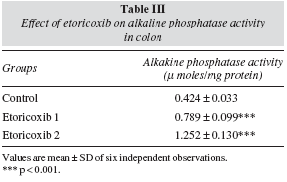
<body><![CDATA[<p><font size="2" face="Verdana">Alkaline phosphatase activity was assayed according to the method of Bergmeyer<sup>22</sup> where p-nitrophenyl phosphate was used as the substrate which was hydrolyzed by the enzyme to yield p-nitrophenol at an alkaline pH. The yellow color of p-nitrophenol was measured at 410 nm.</font></p>     <p><font size="2" face="Verdana">The activity of the three disaccharidase enzymes, sucrase, lactase and maltase was determined by measuring the D-glucose liberated from the respective sugar substrate using a glucose oxidase-peroxidase (GODPOD) enzymatic system.<sup>23</sup> Nitric oxide (NO) production by nitric oxide synthase was estimated by measuring the nitrite, a stable metabolic product of NO which quickly reacts with oxygen to yield nitrite. Nitrite thus formed, reacts with Griess reagent to form a purple azo dye, the color of which can be read at 540 nm.<sup>24</sup> The citrulline assay was based on its reaction with diacetylmonooxime and the absorbance of the color produced was measured at 530 nm.</font></p>     <p>&nbsp;</p>     <p><font face="Verdana"><b>Results</b></font></p>     <p><font size="2" face="Verdana">The weight change profile showed a linear growth in the body weight during a complete six week treatment schedule which was shown in  <a href="#f1">figure 1</a>. No significant change in the body weight was observed between the control and the treated animals.  <a href="#t1">Table I</a> shows the total and the differential leukocyte counts in the different treatment groups during a six weeks treatment regimen. Eto-1 group showed an overall decrease in total leukocyte counts as well as the individual count of neutrophils, lymphocytes, monocytes and eosinophils in comparison to the control group. On the other hand, Eto-2 group showed a fairly significant increase in the leukocyte counts. The neutrophils did not show much change in the cell counts.</font></p>     <p align="center"><a name="f1"><img src="/img/revistas/nh/v24n3/original7_f1.gif"></a></p>     <p align="center">&nbsp;</p>     <p align="center"><a name="t1"><img src="/img/revistas/nh/v24n3/original7_t1.gif"></a></p>     <p align="center">&nbsp;</p>     <p><font size="2" face="Verdana"><a href="#t2">Table II</a> demonstrated the activity of the four different enzymes in the kidney namely, alkaline phosphatase, sucrase, lactase and maltase which shows a highly significant decrease in both the Eto-1 and Eto-2 groups when compared to the controls. However, the alkaline phosphatase activity in colon showed a significant increase in both the treated groups (<a href="#t3">table III</a>).  <a href="#t4">Table IV</a> demonstrates that there was no significant change in the nitric oxide and citrulline level in kidney in the Eto-1 and Eto-2 groups of the animals as compared to the controls while an increase was registered in the colonic tissues for the same in both the treatment groups.</font></p>     ]]></body>
<body><![CDATA[<p align="center">&nbsp;</p>     <p align="center"><a name="t2"><img src="/img/revistas/nh/v24n3/original7_t2.gif"></a></p>     <p align="center">&nbsp;</p>     <p align="center"><a name="t3"><img src="/img/revistas/nh/v24n3/original7_t3.gif"></a></p>     <p align="center">&nbsp;</p>     <p align="center"><a name="t4"><img src="/img/revistas/nh/v24n3/original7_t4.gif"></a></p>     <p align="center">&nbsp;</p>     <p><font size="2" face="Verdana">Histologicaly, the paraffin embedded sections of colon and kidney were critically examined under light microscope following hematoxylin and eosin staining (H/E). The normal histological architecture of colon comprises of mucosal layer containing crypt lined with the various epithelial cells which included absorptive columnar cells, mucin producing goblet cells and neuroendocrine cells (<a href="#f2">fig. 2</a>). These are embedded in the connective tissues called stroma. Mucosa rests over the sub mucosa below which lines the muscularis mucosa. The H/E results produced no major histoarchitectural changes in etoricoxib treated animals when compared with the control.  <a href="#f3">Figure 3</a> shows the histoarchitecture of the kidney cortex. The Bowman's capsule structure was prominent. However, no major alteration was seen in both the etoricoxib groups in kidney, when compared to the controls (fig. with Eto-2 not shown).  <a href="#f4">Figure 4</a> which shows the effect of Eto-1 treatment on the kidney histoarchitecture in the medullary region also revealed no major change in the same.</font></p>     <p align="center">&nbsp;</p>     <p align="center"><a name="f2"><img src="/img/revistas/nh/v24n3/original7_f2.gif"></a></p>     ]]></body>
<body><![CDATA[<p align="center">&nbsp;</p>     <p align="center"><a name="f3"><img src="/img/revistas/nh/v24n3/original7_f3.gif"></a></p>     <p align="center">&nbsp;</p>     <p align="center"><a name="f4"><img src="/img/revistas/nh/v24n3/original7_f4.gif"></a></p>     <p align="center">&nbsp;</p>     <p><font face="Verdana"><b>Discussion</b></font></p>     <p><font size="2" face="Verdana">NSAIDs are among the most widely prescribed class of pharmaceutical agents worldwide, having broad clinical utility in treating pain, fever and inflammation.<sup>25,26</sup> The anti-inflammatory action of NSAIDs rests in their ability to inhibit the activity of COX enzymes which in turn results in a diminished synthesis of proinflammatory prostaglandins (PGs).<sup>27</sup> COX-1 and COX-2, the two isoforms of COX are almost identical in structure but have important differences in substrate and inhibitor selectivity.<sup>28</sup> COX-1 synthesizes protective PGs which preserved the integrity of stomach and intestinal lining and maintain normal functioning of kidney as well. It also plays a role in the production of thromboxane A<sub>2</sub>, causing an aggregation of platelets to prevent inappropriate bleeding.<sup>29</sup> On the other hand COX-2 emerged out as an inducible isoform for it could be induced by inflammatory stimulus and by cytokines in migratory and other cells.<sup>30</sup> The discovery of COX-2 isoenzyme and the characterization of its role in inflammation fostered the development of a new class of compounds that selectively inhibits COX-2 without affecting the COX-1 dependent PG biosynthesis necessary for physiological functions.<sup>31</sup> This new generation of anti-inflammatory drugs has been proven <i>in vitro</i> to selectively inhibit COX-2 activity and used to be as efficacious as the standard NSAIDs (both COX-1 and COX-2 inhibitors) in a number of <i>in vivo</i> models of inflammation (rat carrageenan-induced foot paw edema and rat adjuvant-induced arthritis)<sup>32</sup> and hyperalgesia (rat carrageenan-induced hyperalgesia).<sup>33</sup> Two selective COX-2 inhibitors in particular (called COXIBs) rofecoxib and celecoxib, have proven to provide significant relief in clinical trials of the signs and symptoms of osteoarthritis and rheumatoid arthritis and in eliminating pain following dental extraction, while reducing the incidence of gastrointestinal ulcers and erosions as seen with standard NSAID therapy.<sup>34</sup> Moreover, these eagerly awaited highly selective COX-2 inhibitors are of great interest because they may represent an alternative therapeutic option for the treatment of inflammation in diseases such as cirrhosis with ascites in which renal function is critically dependent on PGs.<sup>35</sup> However, in recent times unfortunately both rofecoxib and celecoxib have been reported to produce cardiovascular complications<sup>36,37</sup> and therefore necessitates searching for safer drugs. A second generation of selective COX-2 inhibitors such as valdecoxib, lumiracoxib and etoricoxib is currently under evaluation for clinical use,<sup>38</sup> and among these, etoricoxib has shown particular promise in chemoprevention in colon cancer in animal studies recently in our laboratory.<sup>14-18</sup></font></p>     <p><font size="2" face="Verdana">The results of the present study wherein two different doses of etoricoxib were used in rats, one at the anti-inflammatory therapeutic dose and the other at ten times higher conclusively show that the drug does not interfere with the normal growth profile of the animal as well as the structural and functional parameters of kidney and colon. However, it was also demonstrated that etoricoxib at both the dose can influence the activities of sucrase, maltase, lactase and alkaline phosphatase in kidney. These enzyme activities are intimately associated with the process of membrane transport in the kidney brush border as shown by us earlier.<sup>39</sup> An increase in alkaline phosphatase activity in colon is seen in the present study where it has been reported to have a link with the transport of phosphate and calciumions<sup>40</sup> may play a crucial role in signal transduction mechanism in the colonic brush border membrane.<sup>41</sup></font></p>     <p><font size="2" face="Verdana">NO is produced by three nitric oxide synthase (NOs) enzymes. Endothelial NOs and neuronal NOs are both constitutively expressed while inducible NOs expression is enhanced by various inflammatory cytokines.<sup>42</sup> The role of NO in carcinogenesis is controversial as NO has both anti-tumor and tumor promotive properties. <sup>43</sup> The principal role of NO in the cellular microenvironment may depend on various factors such as the level of NO production and the genetic make up of the cells.<sup>44</sup> There are two pathways of citrulline production. It can be derived from arginine/NOs pathway and/or arginine/arginase pathway.<sup>45</sup> NOs pathway being responsible for the production of NO as well as citrulline, may play a major role in cell growth and proliferation. The present study of etoricoxib treatment at two different dose level led to no significant change in NO and citrulline level in the kidney tissues, while in colon only, NO was found to be increased and the citrulline level unaltered. Etoricoxib may help in replenishing the highly protective cells of colon as a little higher level of NO than normal is required for cell differentiation. <sup>46</sup> The results therefore suggest that etoricoxib may modulate the cellular environment in case of colon while no effects are seen in the kidney. Based on the present results it can be concluded that the specific COX-2 inhibitor, etoricoxib is a safe drug for therapeutic use at its ED50 value.</font></p>     <p>&nbsp;</p>     ]]></body>
<body><![CDATA[<p><font face="Verdana"><b>References</b></font></p>     <!-- ref --><p><font size="2" face="Verdana">1. Vane JR, Bottling RM. The mechanism of action of aspirin. Thromb Res 2003; 110: 255-258.</font>&nbsp;&nbsp;&nbsp;&nbsp;&nbsp;&nbsp;&nbsp;&nbsp;[&#160;<a href="javascript:void(0);" onclick="javascript: window.open('/scielo.php?script=sci_nlinks&ref=3543856&pid=S0212-1611200900030001000001&lng=','','width=640,height=500,resizable=yes,scrollbars=1,menubar=yes,');">Links</a>&#160;]<!-- end-ref --><!-- ref --><p><font size="2" face="Verdana">2. Sengupta S, Lynda A, Sellers et al. Cyclooxygenase-2-selective nonsteroidal anti-inflammatory drugs inhibit hepatocyte growth factor/scatter factor-induced angiogenesis. Cancer Res 2003; 63: 8351-8359.</font>&nbsp;&nbsp;&nbsp;&nbsp;&nbsp;&nbsp;&nbsp;&nbsp;[&#160;<a href="javascript:void(0);" onclick="javascript: window.open('/scielo.php?script=sci_nlinks&ref=3543857&pid=S0212-1611200900030001000002&lng=','','width=640,height=500,resizable=yes,scrollbars=1,menubar=yes,');">Links</a>&#160;]<!-- end-ref --><!-- ref --><p><font size="2" face="Verdana">3. Gretzer B, Maricic N, Respondek M et al. Effects of specific inhibition of cyclo-oxygenase-1 and cyclo-oxygenase-2 in the rat stomach with normal mucosa and after acid challenge. Br J Pharmacol 2001; 132: 1565-1573.</font>&nbsp;&nbsp;&nbsp;&nbsp;&nbsp;&nbsp;&nbsp;&nbsp;[&#160;<a href="javascript:void(0);" onclick="javascript: window.open('/scielo.php?script=sci_nlinks&ref=3543858&pid=S0212-1611200900030001000003&lng=','','width=640,height=500,resizable=yes,scrollbars=1,menubar=yes,');">Links</a>&#160;]<!-- end-ref --><!-- ref --><p><font size="2" face="Verdana">4. Vane JR, Bakhle YS, Botting RM. Cyclooxygenase 1 and 2. Ann Rev Pharmacol Toxicol 1998; 38: 97-120.</font>&nbsp;&nbsp;&nbsp;&nbsp;&nbsp;&nbsp;&nbsp;&nbsp;[&#160;<a href="javascript:void(0);" onclick="javascript: window.open('/scielo.php?script=sci_nlinks&ref=3543859&pid=S0212-1611200900030001000004&lng=','','width=640,height=500,resizable=yes,scrollbars=1,menubar=yes,');">Links</a>&#160;]<!-- end-ref --><!-- ref --><p><font size="2" face="Verdana">5. Willoughby DA, Moore AR, Colville-Nash PR. COX-1, COX-2 and COX-3 and the future treatment of chronic inflammatory disease. Lancet 2000; 355: 646-648.</font>&nbsp;&nbsp;&nbsp;&nbsp;&nbsp;&nbsp;&nbsp;&nbsp;[&#160;<a href="javascript:void(0);" onclick="javascript: window.open('/scielo.php?script=sci_nlinks&ref=3543860&pid=S0212-1611200900030001000005&lng=','','width=640,height=500,resizable=yes,scrollbars=1,menubar=yes,');">Links</a>&#160;]<!-- end-ref --><!-- ref --><p><font size="2" face="Verdana">6. Bombardier, Laine L, Reicin A. Comparison of upper gastrointestinal toxicity of rofecoxib and naproxen in patients with rheumatoid arthritis. New Engl J Med 2000; 343: 1520-1528.</font>&nbsp;&nbsp;&nbsp;&nbsp;&nbsp;&nbsp;&nbsp;&nbsp;[&#160;<a href="javascript:void(0);" onclick="javascript: window.open('/scielo.php?script=sci_nlinks&ref=3543861&pid=S0212-1611200900030001000006&lng=','','width=640,height=500,resizable=yes,scrollbars=1,menubar=yes,');">Links</a>&#160;]<!-- end-ref --><!-- ref --><p><font size="2" face="Verdana">7. Schwartz JI, Chan, CC, Mukhopadhyay S. Cyclooxygenase-2 inhibition by rofecoxib reverses naturally occurring fever in humans. Clin Pharmacol Ther 1999; 65: 653-660.</font>&nbsp;&nbsp;&nbsp;&nbsp;&nbsp;&nbsp;&nbsp;&nbsp;[&#160;<a href="javascript:void(0);" onclick="javascript: window.open('/scielo.php?script=sci_nlinks&ref=3543862&pid=S0212-1611200900030001000007&lng=','','width=640,height=500,resizable=yes,scrollbars=1,menubar=yes,');">Links</a>&#160;]<!-- end-ref --><!-- ref --><p><font size="2" face="Verdana">8. Emery P, Zeidler H, Kvien TK et al. Celecoxib versus diclofenac in long- term management of rheumatoid arthritis: randomized double-blind comparison. Lancet 1999; 354: 2106-2111.</font>&nbsp;&nbsp;&nbsp;&nbsp;&nbsp;&nbsp;&nbsp;&nbsp;[&#160;<a href="javascript:void(0);" onclick="javascript: window.open('/scielo.php?script=sci_nlinks&ref=3543863&pid=S0212-1611200900030001000008&lng=','','width=640,height=500,resizable=yes,scrollbars=1,menubar=yes,');">Links</a>&#160;]<!-- end-ref --><!-- ref --><p><font size="2" face="Verdana">9. Matsumoto J, Melian A, Mandel DR. A randomized, controlled, clinical trial of etoricoxib in the treatment of rheumatoid arthritis. J Rheumatol 2002; 29: 1623-1630.</font>&nbsp;&nbsp;&nbsp;&nbsp;&nbsp;&nbsp;&nbsp;&nbsp;[&#160;<a href="javascript:void(0);" onclick="javascript: window.open('/scielo.php?script=sci_nlinks&ref=3543864&pid=S0212-1611200900030001000009&lng=','','width=640,height=500,resizable=yes,scrollbars=1,menubar=yes,');">Links</a>&#160;]<!-- end-ref --><!-- ref --><p><font size="2" face="Verdana">10. Riendeau D, Percival MD, Brideau C. Etoricoxib: a preclinical profile and comparison with other agents that selectively inhibit cyclooxygenase-2. J Pharmacol Exp Ther 2001; 296: 558-566.</font>&nbsp;&nbsp;&nbsp;&nbsp;&nbsp;&nbsp;&nbsp;&nbsp;[&#160;<a href="javascript:void(0);" onclick="javascript: window.open('/scielo.php?script=sci_nlinks&ref=3543865&pid=S0212-1611200900030001000010&lng=','','width=640,height=500,resizable=yes,scrollbars=1,menubar=yes,');">Links</a>&#160;]<!-- end-ref --><!-- ref --><p><font size="2" face="Verdana">11. Gregory LB, Michael HS, Jeffrey GM et al. Acute renal failure and hyperkalaemia associated with cyclooxygenase-2 inhibitors. Nephrol Dial Transplant 2004; 19: 1149-1153.</font>&nbsp;&nbsp;&nbsp;&nbsp;&nbsp;&nbsp;&nbsp;&nbsp;[&#160;<a href="javascript:void(0);" onclick="javascript: window.open('/scielo.php?script=sci_nlinks&ref=3543866&pid=S0212-1611200900030001000011&lng=','','width=640,height=500,resizable=yes,scrollbars=1,menubar=yes,');">Links</a>&#160;]<!-- end-ref --><!-- ref --><p><font size="2" face="Verdana">12. Harris RC. Cyclooxygenase-2 in the kidney. J Am Soc Nephrol 2000; 11: 2387-2394.</font>&nbsp;&nbsp;&nbsp;&nbsp;&nbsp;&nbsp;&nbsp;&nbsp;[&#160;<a href="javascript:void(0);" onclick="javascript: window.open('/scielo.php?script=sci_nlinks&ref=3543867&pid=S0212-1611200900030001000012&lng=','','width=640,height=500,resizable=yes,scrollbars=1,menubar=yes,');">Links</a>&#160;]<!-- end-ref --><!-- ref --><p><font size="2" face="Verdana">13. Oshima M, Taketo MM. COX inhibitor, suppression of polyposis, and chemoprevention. Nippon Yakurigaku Zasshi 2002; 120 (5): 276-84.</font>&nbsp;&nbsp;&nbsp;&nbsp;&nbsp;&nbsp;&nbsp;&nbsp;[&#160;<a href="javascript:void(0);" onclick="javascript: window.open('/scielo.php?script=sci_nlinks&ref=3543868&pid=S0212-1611200900030001000013&lng=','','width=640,height=500,resizable=yes,scrollbars=1,menubar=yes,');">Links</a>&#160;]<!-- end-ref --><!-- ref --><p><font size="2" face="Verdana">14. Kanwar SS, Vaiphei K, Nehru B et al. Chemopreventive effects of non steroidal anti-inflammatory drugs on 1, 2-dimethylhydrazine-induced colon carcinogenesis in rats. Toxicol Mecha Meth 2007; 17: 1-8.</font>&nbsp;&nbsp;&nbsp;&nbsp;&nbsp;&nbsp;&nbsp;&nbsp;[&#160;<a href="javascript:void(0);" onclick="javascript: window.open('/scielo.php?script=sci_nlinks&ref=3543869&pid=S0212-1611200900030001000014&lng=','','width=640,height=500,resizable=yes,scrollbars=1,menubar=yes,');">Links</a>&#160;]<!-- end-ref --><!-- ref --><p><font size="2" face="Verdana">15. Kanwar SS, Vaiphei K, Nehru B et al. Chemopreventive effects of non-steroidal anti-inflammatory drugs in the membrane lipid composition and fluidity parameters of the 1, 2-dimethylhydrazine induced colon carcinogenesis in rats. Drug Chem Toxicol 2007; 30: 293-30.</font>&nbsp;&nbsp;&nbsp;&nbsp;&nbsp;&nbsp;&nbsp;&nbsp;[&#160;<a href="javascript:void(0);" onclick="javascript: window.open('/scielo.php?script=sci_nlinks&ref=3543870&pid=S0212-1611200900030001000015&lng=','','width=640,height=500,resizable=yes,scrollbars=1,menubar=yes,');">Links</a>&#160;]<!-- end-ref --><!-- ref --><p><font size="2" face="Verdana">16. Kanwar SS, Vaiphei K, Nehru B et al. Antioxidative effects of Non-steroidal anti-inflammatory drugs (NSAIDs) during the initiation stages of experimental colon carcinogenesis in rats. J Env Pathol Toxicol Oncol 2008; 27 (2): 89-100.</font>&nbsp;&nbsp;&nbsp;&nbsp;&nbsp;&nbsp;&nbsp;&nbsp;[&#160;<a href="javascript:void(0);" onclick="javascript: window.open('/scielo.php?script=sci_nlinks&ref=3543871&pid=S0212-1611200900030001000016&lng=','','width=640,height=500,resizable=yes,scrollbars=1,menubar=yes,');">Links</a>&#160;]<!-- end-ref --><!-- ref --><p><font size="2" face="Verdana">17. Mittal N, Kanwar SS, Sanyal SN. The effect of etoricoxib, a cyclooxygenase-2 specific inhibitor on the 1, 2-dimethylhydrazine administered rat intestinal membrane structure and function. Toxicol Mech Meth 2007; 18: 53-62.</font>&nbsp;&nbsp;&nbsp;&nbsp;&nbsp;&nbsp;&nbsp;&nbsp;[&#160;<a href="javascript:void(0);" onclick="javascript: window.open('/scielo.php?script=sci_nlinks&ref=3543872&pid=S0212-1611200900030001000017&lng=','','width=640,height=500,resizable=yes,scrollbars=1,menubar=yes,');">Links</a>&#160;]<!-- end-ref --><!-- ref --><p><font size="2" face="Verdana">18. Mittal N, Kanwar SS, Sanyal SN. Effect of non-steroidal antiinflammatory drugs and the pro-carcinogen 1, 2 dimethylhydrazine on the antioxidant defense system. Int J Toxicol 2007; 27: 169-174.</font>&nbsp;&nbsp;&nbsp;&nbsp;&nbsp;&nbsp;&nbsp;&nbsp;[&#160;<a href="javascript:void(0);" onclick="javascript: window.open('/scielo.php?script=sci_nlinks&ref=3543873&pid=S0212-1611200900030001000018&lng=','','width=640,height=500,resizable=yes,scrollbars=1,menubar=yes,');">Links</a>&#160;]<!-- end-ref --><!-- ref --><p><font size="2" face="Verdana">19. Dacie JV, Lewis K. Practical Haematology. 4<sup>th</sup> ed. Churchill, London 1968.</font>&nbsp;&nbsp;&nbsp;&nbsp;&nbsp;&nbsp;&nbsp;&nbsp;[&#160;<a href="javascript:void(0);" onclick="javascript: window.open('/scielo.php?script=sci_nlinks&ref=3543874&pid=S0212-1611200900030001000019&lng=','','width=640,height=500,resizable=yes,scrollbars=1,menubar=yes,');">Links</a>&#160;]<!-- end-ref --><!-- ref --><p><font size="2" face="Verdana">20. Pearse AGE. In: Histochemistry, Theoritical and Applied. 3<sup>rd</sup>Edn, p-660 Vol 1. Churchill, Livingstone, London 1968.</font>&nbsp;&nbsp;&nbsp;&nbsp;&nbsp;&nbsp;&nbsp;&nbsp;[&#160;<a href="javascript:void(0);" onclick="javascript: window.open('/scielo.php?script=sci_nlinks&ref=3543875&pid=S0212-1611200900030001000020&lng=','','width=640,height=500,resizable=yes,scrollbars=1,menubar=yes,');">Links</a>&#160;]<!-- end-ref --><!-- ref --><p><font size="2" face="Verdana">21. Humanson GL. In: Basic procedures - Animal tissue technique, Part-1, pp. 1961; 130-132.</font>&nbsp;&nbsp;&nbsp;&nbsp;&nbsp;&nbsp;&nbsp;&nbsp;[&#160;<a href="javascript:void(0);" onclick="javascript: window.open('/scielo.php?script=sci_nlinks&ref=3543876&pid=S0212-1611200900030001000021&lng=','','width=640,height=500,resizable=yes,scrollbars=1,menubar=yes,');">Links</a>&#160;]<!-- end-ref --><!-- ref --><p><font size="2" face="Verdana">22. Bergemeyer HU. Phosphatase (phosphomonoesterases). Determination in serum with p - nitrophenyl phosphate. In: Methods of Enzymatic Analysis, HU Bergmeyer (Ed), 1963, pp. 783-785. Academic Press, New York.</font>&nbsp;&nbsp;&nbsp;&nbsp;&nbsp;&nbsp;&nbsp;&nbsp;[&#160;<a href="javascript:void(0);" onclick="javascript: window.open('/scielo.php?script=sci_nlinks&ref=3543877&pid=S0212-1611200900030001000022&lng=','','width=640,height=500,resizable=yes,scrollbars=1,menubar=yes,');">Links</a>&#160;]<!-- end-ref --><!-- ref --><p><font size="2" face="Verdana">23. Dahlqvist A. Methods for assay of intestinal disaccharides. Anal. Biochem 1964; 7: 18-25.</font>&nbsp;&nbsp;&nbsp;&nbsp;&nbsp;&nbsp;&nbsp;&nbsp;[&#160;<a href="javascript:void(0);" onclick="javascript: window.open('/scielo.php?script=sci_nlinks&ref=3543878&pid=S0212-1611200900030001000023&lng=','','width=640,height=500,resizable=yes,scrollbars=1,menubar=yes,');">Links</a>&#160;]<!-- end-ref --><!-- ref --><p><font size="2" face="Verdana">24. Boyde TR, Rahmatullah M. Optimization of conditions for the colorimetric determination of citrulline, using diacetyl monoxime. Anal Biochem 1980; 107 (2): 424-31.</font>&nbsp;&nbsp;&nbsp;&nbsp;&nbsp;&nbsp;&nbsp;&nbsp;[&#160;<a href="javascript:void(0);" onclick="javascript: window.open('/scielo.php?script=sci_nlinks&ref=3543879&pid=S0212-1611200900030001000024&lng=','','width=640,height=500,resizable=yes,scrollbars=1,menubar=yes,');">Links</a>&#160;]<!-- end-ref --><!-- ref --><p><font size="2" face="Verdana">25. Flower RJ, Moncada S, Vane JR et al. Analgesic - antipyretics and anti inflammatory agents: drugs employed in treatment of gout. The Pharmacological Basis of Therapeutics: Macmillan. 1992; pp. 674.</font>&nbsp;&nbsp;&nbsp;&nbsp;&nbsp;&nbsp;&nbsp;&nbsp;[&#160;<a href="javascript:void(0);" onclick="javascript: window.open('/scielo.php?script=sci_nlinks&ref=3543880&pid=S0212-1611200900030001000025&lng=','','width=640,height=500,resizable=yes,scrollbars=1,menubar=yes,');">Links</a>&#160;]<!-- end-ref --><!-- ref --><p><font size="2" face="Verdana">26. Payan DG, Katzung BG. NSAID's: Non-opioid analgesics; drugs used in gout, in: Basic and Clinical Pharmacology; Katzung BG (Ed), 1995; pp. 536-559. Appleton and Lange, Norwalk.</font>&nbsp;&nbsp;&nbsp;&nbsp;&nbsp;&nbsp;&nbsp;&nbsp;[&#160;<a href="javascript:void(0);" onclick="javascript: window.open('/scielo.php?script=sci_nlinks&ref=3543881&pid=S0212-1611200900030001000026&lng=','','width=640,height=500,resizable=yes,scrollbars=1,menubar=yes,');">Links</a>&#160;]<!-- end-ref --><!-- ref --><p><font size="2" face="Verdana">27. Vane JR. Inhibition of prostaglandin synthesis as a mechanism of action for aspirin- like drugs. Nat New Biol 1991; 231: 232-235.</font>&nbsp;&nbsp;&nbsp;&nbsp;&nbsp;&nbsp;&nbsp;&nbsp;[&#160;<a href="javascript:void(0);" onclick="javascript: window.open('/scielo.php?script=sci_nlinks&ref=3543882&pid=S0212-1611200900030001000027&lng=','','width=640,height=500,resizable=yes,scrollbars=1,menubar=yes,');">Links</a>&#160;]<!-- end-ref --><!-- ref --><p><font size="2" face="Verdana">28. Jouzeau JY, Terlain B, Abid A et al. Cyclo-oxygenase isoenzymes. How recent findings affect thinking about nonsteroidal anti-inflammatory drugs. Drugs 1997; 53 (4): 563-582.</font>&nbsp;&nbsp;&nbsp;&nbsp;&nbsp;&nbsp;&nbsp;&nbsp;[&#160;<a href="javascript:void(0);" onclick="javascript: window.open('/scielo.php?script=sci_nlinks&ref=3543883&pid=S0212-1611200900030001000028&lng=','','width=640,height=500,resizable=yes,scrollbars=1,menubar=yes,');">Links</a>&#160;]<!-- end-ref --><!-- ref --><p><font size="2" face="Verdana">29. Funk CD, Funk LB, Kennedy ME et al. Human platelet/erythroleukemia cell prostaglandin G/H synthase: cDNA cloning, expression, and gene chromosomal assignment. FASEB J 1991 5: 2304-2312.</font>&nbsp;&nbsp;&nbsp;&nbsp;&nbsp;&nbsp;&nbsp;&nbsp;[&#160;<a href="javascript:void(0);" onclick="javascript: window.open('/scielo.php?script=sci_nlinks&ref=3543884&pid=S0212-1611200900030001000029&lng=','','width=640,height=500,resizable=yes,scrollbars=1,menubar=yes,');">Links</a>&#160;]<!-- end-ref --><!-- ref --><p><font size="2" face="Verdana">30. Raz A, Wyche A, Fagan D et al. The cell biology of fibroblast cyclooxygenase. Adv Exp Med Biol 1989; 259: 1-21.</font>&nbsp;&nbsp;&nbsp;&nbsp;&nbsp;&nbsp;&nbsp;&nbsp;[&#160;<a href="javascript:void(0);" onclick="javascript: window.open('/scielo.php?script=sci_nlinks&ref=3543885&pid=S0212-1611200900030001000030&lng=','','width=640,height=500,resizable=yes,scrollbars=1,menubar=yes,');">Links</a>&#160;]<!-- end-ref --><!-- ref --><p><font size="2" face="Verdana">31. Gilroy DW, Tomlinson A, Willoughby DA. Differential effects of inhibitors of cycloxygenase (cycloxygenase 1 and cycloxygenase 2) in acute inflammation. Eur J Pharmacol 1998; 355: 211-217.</font>&nbsp;&nbsp;&nbsp;&nbsp;&nbsp;&nbsp;&nbsp;&nbsp;[&#160;<a href="javascript:void(0);" onclick="javascript: window.open('/scielo.php?script=sci_nlinks&ref=3543886&pid=S0212-1611200900030001000031&lng=','','width=640,height=500,resizable=yes,scrollbars=1,menubar=yes,');">Links</a>&#160;]<!-- end-ref --><!-- ref --><p><font size="2" face="Verdana">32. Smith CJ, Zhang Y, Koboldt CM. Pharmacological analysis of cycloxygenase-1 in inflammation. Proc Natl Acad Sci (USA) 1998; 95: 13313-13318.</font>&nbsp;&nbsp;&nbsp;&nbsp;&nbsp;&nbsp;&nbsp;&nbsp;[&#160;<a href="javascript:void(0);" onclick="javascript: window.open('/scielo.php?script=sci_nlinks&ref=3543887&pid=S0212-1611200900030001000032&lng=','','width=640,height=500,resizable=yes,scrollbars=1,menubar=yes,');">Links</a>&#160;]<!-- end-ref --><!-- ref --><p><font size="2" face="Verdana">33. Warner TD, Giuliano F, Vojnovic I et al. Nonsteroid drug selectivities for cyclo-oxygenase 1 rather than cyclo-oxygenase 2 are associated with human gastrointestinal toxicity: a full in vitro analysis. Proc Natl Acad Sci (USA) 1999; 967: 563-756.</font>&nbsp;&nbsp;&nbsp;&nbsp;&nbsp;&nbsp;&nbsp;&nbsp;[&#160;<a href="javascript:void(0);" onclick="javascript: window.open('/scielo.php?script=sci_nlinks&ref=3543888&pid=S0212-1611200900030001000033&lng=','','width=640,height=500,resizable=yes,scrollbars=1,menubar=yes,');">Links</a>&#160;]<!-- end-ref --><!-- ref --><p><font size="2" face="Verdana">34. Lanas A. Clinical experience with cyclooxygenase-2 inhibitors. Rheumatol 2002; (Supl. 1): 16-22.</font>&nbsp;&nbsp;&nbsp;&nbsp;&nbsp;&nbsp;&nbsp;&nbsp;[&#160;<a href="javascript:void(0);" onclick="javascript: window.open('/scielo.php?script=sci_nlinks&ref=3543889&pid=S0212-1611200900030001000034&lng=','','width=640,height=500,resizable=yes,scrollbars=1,menubar=yes,');">Links</a>&#160;]<!-- end-ref --><!-- ref --><p><font size="2" face="Verdana">35. L&oacute;pez-Parra M, Claria J, Planaguma A et al. Cyclooxygenase-1 derived prostaglandins are involved in the maintenance of renal function in rats with cirrhosis and ascitses. Brit J Pharm 2002; 135: 891-900.</font>&nbsp;&nbsp;&nbsp;&nbsp;&nbsp;&nbsp;&nbsp;&nbsp;[&#160;<a href="javascript:void(0);" onclick="javascript: window.open('/scielo.php?script=sci_nlinks&ref=3543890&pid=S0212-1611200900030001000035&lng=','','width=640,height=500,resizable=yes,scrollbars=1,menubar=yes,');">Links</a>&#160;]<!-- end-ref --><!-- ref --><p><font size="2" face="Verdana">36. Aguilar JFN, Antich IA, Martinez AP et al. Cycloxygenase-2 inhibition in colon experimental carcinogenesis. Rev Esp En En form Dig (Madrid) 2005; 97: 637-647.</font>&nbsp;&nbsp;&nbsp;&nbsp;&nbsp;&nbsp;&nbsp;&nbsp;[&#160;<a href="javascript:void(0);" onclick="javascript: window.open('/scielo.php?script=sci_nlinks&ref=3543891&pid=S0212-1611200900030001000036&lng=','','width=640,height=500,resizable=yes,scrollbars=1,menubar=yes,');">Links</a>&#160;]<!-- end-ref --><!-- ref --><p><font size="2" face="Verdana">37. Subhashini J, Mahipal SVK, Reddana P. Anti-proliferation and apoptotic effects of celecoxib on human chronic myeloid leukemia in vitro. Cancer Lett 2005; 224: 31-43.</font>&nbsp;&nbsp;&nbsp;&nbsp;&nbsp;&nbsp;&nbsp;&nbsp;[&#160;<a href="javascript:void(0);" onclick="javascript: window.open('/scielo.php?script=sci_nlinks&ref=3543892&pid=S0212-1611200900030001000037&lng=','','width=640,height=500,resizable=yes,scrollbars=1,menubar=yes,');">Links</a>&#160;]<!-- end-ref --><!-- ref --><p><font size="2" face="Verdana">38. Esser R, Berry C, Du Z et al. Preclinical pharmacology of lumiracoxib: a novel selective inhibiter of cycloxygenase-2. Br J Pharmacol 2005; 144: 538-550.</font>&nbsp;&nbsp;&nbsp;&nbsp;&nbsp;&nbsp;&nbsp;&nbsp;[&#160;<a href="javascript:void(0);" onclick="javascript: window.open('/scielo.php?script=sci_nlinks&ref=3543893&pid=S0212-1611200900030001000038&lng=','','width=640,height=500,resizable=yes,scrollbars=1,menubar=yes,');">Links</a>&#160;]<!-- end-ref --><!-- ref --><p><font size="2" face="Verdana">39. Sanyal SN, Singh G, Kanwar SS. Thermotropic lipid phase transition and the behavior of hydrolytic enzymes in the cortex brush border membrane. Chem Biodiver 2006; 3: 1102-1115.</font>&nbsp;&nbsp;&nbsp;&nbsp;&nbsp;&nbsp;&nbsp;&nbsp;[&#160;<a href="javascript:void(0);" onclick="javascript: window.open('/scielo.php?script=sci_nlinks&ref=3543894&pid=S0212-1611200900030001000039&lng=','','width=640,height=500,resizable=yes,scrollbars=1,menubar=yes,');">Links</a>&#160;]<!-- end-ref --><!-- ref --><p><font size="2" face="Verdana">40. Shiffle H, Binswanger V. Calcium ATPase and intestinal calcium transport in uremic rats. Am J Physiol 1980; 238: G 424.</font>&nbsp;&nbsp;&nbsp;&nbsp;&nbsp;&nbsp;&nbsp;&nbsp;[&#160;<a href="javascript:void(0);" onclick="javascript: window.open('/scielo.php?script=sci_nlinks&ref=3543895&pid=S0212-1611200900030001000040&lng=','','width=640,height=500,resizable=yes,scrollbars=1,menubar=yes,');">Links</a>&#160;]<!-- end-ref --><!-- ref --><p><font size="2" face="Verdana">41. Lizumi Y, Hirano K, Sugoira M et al. Evidence for the physiological function of alkaline phasohatase. Chem Pharm Bull 1983; 32: 772-775.</font>&nbsp;&nbsp;&nbsp;&nbsp;&nbsp;&nbsp;&nbsp;&nbsp;[&#160;<a href="javascript:void(0);" onclick="javascript: window.open('/scielo.php?script=sci_nlinks&ref=3543896&pid=S0212-1611200900030001000041&lng=','','width=640,height=500,resizable=yes,scrollbars=1,menubar=yes,');">Links</a>&#160;]<!-- end-ref --><!-- ref --><p><font size="2" face="Verdana">42. Nathan C, Xie QW. Regulation of biosynthesis of nitric oxide. J Biol Chem 1994; 269: 13725-13728.</font>&nbsp;&nbsp;&nbsp;&nbsp;&nbsp;&nbsp;&nbsp;&nbsp;[&#160;<a href="javascript:void(0);" onclick="javascript: window.open('/scielo.php?script=sci_nlinks&ref=3543897&pid=S0212-1611200900030001000042&lng=','','width=640,height=500,resizable=yes,scrollbars=1,menubar=yes,');">Links</a>&#160;]<!-- end-ref --><!-- ref --><p><font size="2" face="Verdana">43. Ricciardolo FL, Sterk PJ, Gaston B. Nitric oxide in health and disease of the respiratory system. Physiol Rev 2004; 84: 731-765.</font>&nbsp;&nbsp;&nbsp;&nbsp;&nbsp;&nbsp;&nbsp;&nbsp;[&#160;<a href="javascript:void(0);" onclick="javascript: window.open('/scielo.php?script=sci_nlinks&ref=3543898&pid=S0212-1611200900030001000043&lng=','','width=640,height=500,resizable=yes,scrollbars=1,menubar=yes,');">Links</a>&#160;]<!-- end-ref --><!-- ref --><p><font size="2" face="Verdana">44. Wu G, Morris SM. Arginine metabolism: nitric oxide and beyond. Biochem J 1998; 336: 1-17.</font>&nbsp;&nbsp;&nbsp;&nbsp;&nbsp;&nbsp;&nbsp;&nbsp;[&#160;<a href="javascript:void(0);" onclick="javascript: window.open('/scielo.php?script=sci_nlinks&ref=3543899&pid=S0212-1611200900030001000044&lng=','','width=640,height=500,resizable=yes,scrollbars=1,menubar=yes,');">Links</a>&#160;]<!-- end-ref --><!-- ref --><p><font size="2" face="Verdana">45. Lala PK. Significance of nitric oxide in carcinogenesis, tumor progression and cancer therapy. Cancer Metastasis Rev 1998; 17: 1-6.</font>&nbsp;&nbsp;&nbsp;&nbsp;&nbsp;&nbsp;&nbsp;&nbsp;[&#160;<a href="javascript:void(0);" onclick="javascript: window.open('/scielo.php?script=sci_nlinks&ref=3543900&pid=S0212-1611200900030001000045&lng=','','width=640,height=500,resizable=yes,scrollbars=1,menubar=yes,');">Links</a>&#160;]<!-- end-ref --><!-- ref --><p><font size="2" face="Verdana">46. Stuehr DJ, Marletta MA. Synthesis of nitrite and nitrate in murine macrophage cell lines. Cancer Res 1987; 47 (21): 5590-5594.</font>&nbsp;&nbsp;&nbsp;&nbsp;&nbsp;&nbsp;&nbsp;&nbsp;[&#160;<a href="javascript:void(0);" onclick="javascript: window.open('/scielo.php?script=sci_nlinks&ref=3543901&pid=S0212-1611200900030001000046&lng=','','width=640,height=500,resizable=yes,scrollbars=1,menubar=yes,');">Links</a>&#160;]<!-- end-ref --><p>&nbsp;</p>     <p>&nbsp;</p>     <p><font size="2" face="Verdana"><b><a name="back"></a><a href="#top"><img border="0" src="/img/revistas/nh/v24n3/seta.gif" width="15" height="17"></a>Correspondence:</b>    ]]></body>
<body><![CDATA[<br>S. N. Sanyal.    <br>Department of Biophysics.    <br>Panjab University.    <br>160014 Chandigarh - India.    <br>E-mail:  <a href="mailto:sanyalpu@pu.ac.in">sanyalpu@pu.ac.in</a></font></p>     <p><font size="2" face="Verdana">Recibido: 15-IX-2008.    <br>Aceptado: 2-II-2009.</font></p>      ]]></body><back>
<ref-list>
<ref id="B1">
<label>1</label><nlm-citation citation-type="journal">
<person-group person-group-type="author">
<name>
<surname><![CDATA[Vane]]></surname>
<given-names><![CDATA[JR]]></given-names>
</name>
<name>
<surname><![CDATA[Bottling]]></surname>
<given-names><![CDATA[RM]]></given-names>
</name>
</person-group>
<article-title xml:lang="en"><![CDATA[The mechanism of action of aspirin]]></article-title>
<source><![CDATA[Thromb Res]]></source>
<year>2003</year>
<volume>110</volume>
<page-range>255-258</page-range></nlm-citation>
</ref>
<ref id="B2">
<label>2</label><nlm-citation citation-type="journal">
<person-group person-group-type="author">
<name>
<surname><![CDATA[Sengupta]]></surname>
<given-names><![CDATA[S]]></given-names>
</name>
<name>
<surname><![CDATA[Lynda]]></surname>
<given-names><![CDATA[A]]></given-names>
</name>
<name>
<surname><![CDATA[Sellers]]></surname>
</name>
</person-group>
<article-title xml:lang="en"><![CDATA[Cyclooxygenase-2-selective nonsteroidal anti-inflammatory drugs inhibit hepatocyte growth factor/scatter factor-induced angiogenesis]]></article-title>
<source><![CDATA[Cancer Res]]></source>
<year>2003</year>
<volume>63</volume>
<page-range>8351-8359</page-range></nlm-citation>
</ref>
<ref id="B3">
<label>3</label><nlm-citation citation-type="journal">
<person-group person-group-type="author">
<name>
<surname><![CDATA[Gretzer]]></surname>
<given-names><![CDATA[B]]></given-names>
</name>
<name>
<surname><![CDATA[Maricic]]></surname>
<given-names><![CDATA[N]]></given-names>
</name>
<name>
<surname><![CDATA[Respondek]]></surname>
<given-names><![CDATA[M]]></given-names>
</name>
</person-group>
<article-title xml:lang="en"><![CDATA[Effects of specific inhibition of cyclo-oxygenase-1 and cyclo-oxygenase-2 in the rat stomach with normal mucosa and after acid challenge]]></article-title>
<source><![CDATA[Br J Pharmacol]]></source>
<year>2001</year>
<volume>132</volume>
<page-range>1565-1573</page-range></nlm-citation>
</ref>
<ref id="B4">
<label>4</label><nlm-citation citation-type="journal">
<person-group person-group-type="author">
<name>
<surname><![CDATA[Vane]]></surname>
<given-names><![CDATA[JR]]></given-names>
</name>
<name>
<surname><![CDATA[Bakhle]]></surname>
<given-names><![CDATA[YS]]></given-names>
</name>
<name>
<surname><![CDATA[Botting]]></surname>
<given-names><![CDATA[RM]]></given-names>
</name>
</person-group>
<article-title xml:lang="en"><![CDATA[Cyclooxygenase 1 and 2]]></article-title>
<source><![CDATA[Ann Rev Pharmacol Toxicol]]></source>
<year>1998</year>
<volume>38</volume>
<page-range>97-120</page-range></nlm-citation>
</ref>
<ref id="B5">
<label>5</label><nlm-citation citation-type="journal">
<person-group person-group-type="author">
<name>
<surname><![CDATA[Willoughby]]></surname>
<given-names><![CDATA[DA]]></given-names>
</name>
<name>
<surname><![CDATA[Moore]]></surname>
<given-names><![CDATA[AR]]></given-names>
</name>
<name>
<surname><![CDATA[Colville-Nash]]></surname>
<given-names><![CDATA[PR]]></given-names>
</name>
</person-group>
<article-title xml:lang="en"><![CDATA[COX-1, COX-2 and COX-3 and the future treatment of chronic inflammatory disease]]></article-title>
<source><![CDATA[Lancet]]></source>
<year>2000</year>
<volume>355</volume>
<page-range>646-648</page-range></nlm-citation>
</ref>
<ref id="B6">
<label>6</label><nlm-citation citation-type="journal">
<person-group person-group-type="author">
<name>
<surname><![CDATA[Bombardier]]></surname>
</name>
<name>
<surname><![CDATA[Laine]]></surname>
<given-names><![CDATA[L]]></given-names>
</name>
<name>
<surname><![CDATA[Reicin]]></surname>
<given-names><![CDATA[A]]></given-names>
</name>
</person-group>
<article-title xml:lang="en"><![CDATA[Comparison of upper gastrointestinal toxicity of rofecoxib and naproxen in patients with rheumatoid arthritis]]></article-title>
<source><![CDATA[New Engl J Med]]></source>
<year>2000</year>
<volume>343</volume>
<page-range>1520-1528</page-range></nlm-citation>
</ref>
<ref id="B7">
<label>7</label><nlm-citation citation-type="journal">
<person-group person-group-type="author">
<name>
<surname><![CDATA[Schwartz]]></surname>
<given-names><![CDATA[JI]]></given-names>
</name>
<name>
<surname><![CDATA[Chan]]></surname>
<given-names><![CDATA[CC]]></given-names>
</name>
<name>
<surname><![CDATA[Mukhopadhyay]]></surname>
<given-names><![CDATA[S]]></given-names>
</name>
</person-group>
<article-title xml:lang="en"><![CDATA[Cyclooxygenase-2 inhibition by rofecoxib reverses naturally occurring fever in humans]]></article-title>
<source><![CDATA[Clin Pharmacol Ther]]></source>
<year>1999</year>
<volume>65</volume>
<page-range>653-660</page-range></nlm-citation>
</ref>
<ref id="B8">
<label>8</label><nlm-citation citation-type="journal">
<person-group person-group-type="author">
<name>
<surname><![CDATA[Emery]]></surname>
<given-names><![CDATA[P]]></given-names>
</name>
<name>
<surname><![CDATA[Zeidler]]></surname>
<given-names><![CDATA[H]]></given-names>
</name>
<name>
<surname><![CDATA[Kvien]]></surname>
<given-names><![CDATA[TK]]></given-names>
</name>
</person-group>
<article-title xml:lang="en"><![CDATA[Celecoxib versus diclofenac in long- term management of rheumatoid arthritis: randomized double-blind comparison]]></article-title>
<source><![CDATA[Lancet]]></source>
<year>1999</year>
<volume>354</volume>
<page-range>2106-2111</page-range></nlm-citation>
</ref>
<ref id="B9">
<label>9</label><nlm-citation citation-type="journal">
<person-group person-group-type="author">
<name>
<surname><![CDATA[Matsumoto]]></surname>
<given-names><![CDATA[J]]></given-names>
</name>
<name>
<surname><![CDATA[Melian]]></surname>
<given-names><![CDATA[A]]></given-names>
</name>
<name>
<surname><![CDATA[Mandel]]></surname>
<given-names><![CDATA[DR]]></given-names>
</name>
</person-group>
<article-title xml:lang="en"><![CDATA[A randomized, controlled, clinical trial of etoricoxib in the treatment of rheumatoid arthritis]]></article-title>
<source><![CDATA[J Rheumatol]]></source>
<year>2002</year>
<volume>29</volume>
<page-range>1623-1630</page-range></nlm-citation>
</ref>
<ref id="B10">
<label>10</label><nlm-citation citation-type="journal">
<person-group person-group-type="author">
<name>
<surname><![CDATA[Riendeau]]></surname>
<given-names><![CDATA[D]]></given-names>
</name>
<name>
<surname><![CDATA[Percival]]></surname>
<given-names><![CDATA[MD]]></given-names>
</name>
<name>
<surname><![CDATA[Brideau]]></surname>
<given-names><![CDATA[C]]></given-names>
</name>
</person-group>
<article-title xml:lang="en"><![CDATA[Etoricoxib: a preclinical profile and comparison with other agents that selectively inhibit cyclooxygenase-2]]></article-title>
<source><![CDATA[J Pharmacol Exp Ther]]></source>
<year>2001</year>
<volume>296</volume>
<page-range>558-566</page-range></nlm-citation>
</ref>
<ref id="B11">
<label>11</label><nlm-citation citation-type="journal">
<person-group person-group-type="author">
<name>
<surname><![CDATA[Gregory]]></surname>
<given-names><![CDATA[LB]]></given-names>
</name>
<name>
<surname><![CDATA[Michael]]></surname>
<given-names><![CDATA[HS]]></given-names>
</name>
<name>
<surname><![CDATA[Jeffrey]]></surname>
<given-names><![CDATA[GM]]></given-names>
</name>
</person-group>
<article-title xml:lang="en"><![CDATA[Acute renal failure and hyperkalaemia associated with cyclooxygenase-2 inhibitors]]></article-title>
<source><![CDATA[Nephrol Dial Transplant]]></source>
<year>2004</year>
<volume>19</volume>
<page-range>1149-1153</page-range></nlm-citation>
</ref>
<ref id="B12">
<label>12</label><nlm-citation citation-type="journal">
<person-group person-group-type="author">
<name>
<surname><![CDATA[Harris]]></surname>
<given-names><![CDATA[RC]]></given-names>
</name>
</person-group>
<article-title xml:lang="en"><![CDATA[Cyclooxygenase-2 in the kidney]]></article-title>
<source><![CDATA[J Am Soc Nephrol]]></source>
<year>2000</year>
<volume>11</volume>
<page-range>2387-2394</page-range></nlm-citation>
</ref>
<ref id="B13">
<label>13</label><nlm-citation citation-type="journal">
<person-group person-group-type="author">
<name>
<surname><![CDATA[Oshima]]></surname>
<given-names><![CDATA[M]]></given-names>
</name>
<name>
<surname><![CDATA[Taketo]]></surname>
<given-names><![CDATA[MM]]></given-names>
</name>
</person-group>
<article-title xml:lang="en"><![CDATA[COX inhibitor, suppression of polyposis, and chemoprevention]]></article-title>
<source><![CDATA[Nippon Yakurigaku Zasshi]]></source>
<year>2002</year>
<volume>120</volume>
<numero>5</numero>
<issue>5</issue>
<page-range>276-84</page-range></nlm-citation>
</ref>
<ref id="B14">
<label>14</label><nlm-citation citation-type="journal">
<person-group person-group-type="author">
<name>
<surname><![CDATA[Kanwar]]></surname>
<given-names><![CDATA[SS]]></given-names>
</name>
<name>
<surname><![CDATA[Vaiphei]]></surname>
<given-names><![CDATA[K]]></given-names>
</name>
<name>
<surname><![CDATA[Nehru]]></surname>
<given-names><![CDATA[B]]></given-names>
</name>
</person-group>
<article-title xml:lang="en"><![CDATA[Chemopreventive effects of non steroidal anti-inflammatory drugs on 1, 2-dimethylhydrazine-induced colon carcinogenesis in rats]]></article-title>
<source><![CDATA[Toxicol Mecha Meth]]></source>
<year>2007</year>
<volume>17</volume>
<page-range>1-8</page-range></nlm-citation>
</ref>
<ref id="B15">
<label>15</label><nlm-citation citation-type="journal">
<person-group person-group-type="author">
<name>
<surname><![CDATA[Kanwar]]></surname>
<given-names><![CDATA[SS]]></given-names>
</name>
<name>
<surname><![CDATA[Vaiphei]]></surname>
<given-names><![CDATA[K]]></given-names>
</name>
<name>
<surname><![CDATA[Nehru]]></surname>
<given-names><![CDATA[B]]></given-names>
</name>
</person-group>
<article-title xml:lang="en"><![CDATA[Chemopreventive effects of non-steroidal anti-inflammatory drugs in the membrane lipid composition and fluidity parameters of the 1, 2-dimethylhydrazine induced colon carcinogenesis in rats]]></article-title>
<source><![CDATA[Drug Chem Toxicol]]></source>
<year>2007</year>
<volume>30</volume>
<page-range>293-30</page-range></nlm-citation>
</ref>
<ref id="B16">
<label>16</label><nlm-citation citation-type="journal">
<person-group person-group-type="author">
<name>
<surname><![CDATA[Kanwar]]></surname>
<given-names><![CDATA[SS]]></given-names>
</name>
<name>
<surname><![CDATA[Vaiphei]]></surname>
<given-names><![CDATA[K]]></given-names>
</name>
<name>
<surname><![CDATA[Nehru]]></surname>
<given-names><![CDATA[B]]></given-names>
</name>
</person-group>
<article-title xml:lang="en"><![CDATA[Antioxidative effects of Non-steroidal anti-inflammatory drugs (NSAIDs) during the initiation stages of experimental colon carcinogenesis in rats]]></article-title>
<source><![CDATA[J Env Pathol Toxicol Oncol]]></source>
<year>2008</year>
<volume>27</volume>
<numero>2</numero>
<issue>2</issue>
<page-range>89-100</page-range></nlm-citation>
</ref>
<ref id="B17">
<label>17</label><nlm-citation citation-type="journal">
<person-group person-group-type="author">
<name>
<surname><![CDATA[Mittal]]></surname>
<given-names><![CDATA[N]]></given-names>
</name>
<name>
<surname><![CDATA[Kanwar]]></surname>
<given-names><![CDATA[SS]]></given-names>
</name>
<name>
<surname><![CDATA[Sanyal]]></surname>
<given-names><![CDATA[SN]]></given-names>
</name>
</person-group>
<article-title xml:lang="en"><![CDATA[The effect of etoricoxib, a cyclooxygenase-2 specific inhibitor on the 1, 2-dimethylhydrazine administered rat intestinal membrane structure and function]]></article-title>
<source><![CDATA[Toxicol Mech Meth]]></source>
<year>2007</year>
<volume>18</volume>
<page-range>53-62</page-range></nlm-citation>
</ref>
<ref id="B18">
<label>18</label><nlm-citation citation-type="journal">
<person-group person-group-type="author">
<name>
<surname><![CDATA[Mittal]]></surname>
<given-names><![CDATA[N]]></given-names>
</name>
<name>
<surname><![CDATA[Kanwar]]></surname>
<given-names><![CDATA[SS]]></given-names>
</name>
<name>
<surname><![CDATA[Sanyal]]></surname>
<given-names><![CDATA[SN]]></given-names>
</name>
</person-group>
<article-title xml:lang="en"><![CDATA[Effect of non-steroidal antiinflammatory drugs and the pro-carcinogen 1, 2 dimethylhydrazine on the antioxidant defense system]]></article-title>
<source><![CDATA[Int J Toxicol]]></source>
<year>2007</year>
<volume>27</volume>
<page-range>169-174</page-range></nlm-citation>
</ref>
<ref id="B19">
<label>19</label><nlm-citation citation-type="book">
<person-group person-group-type="author">
<name>
<surname><![CDATA[Dacie]]></surname>
<given-names><![CDATA[JV]]></given-names>
</name>
<name>
<surname><![CDATA[Lewis]]></surname>
<given-names><![CDATA[K]]></given-names>
</name>
</person-group>
<source><![CDATA[Practical Haematology]]></source>
<year>1968</year>
<edition>4</edition>
<publisher-loc><![CDATA[London ]]></publisher-loc>
<publisher-name><![CDATA[Churchill]]></publisher-name>
</nlm-citation>
</ref>
<ref id="B20">
<label>20</label><nlm-citation citation-type="book">
<person-group person-group-type="author">
<name>
<surname><![CDATA[Pearse]]></surname>
<given-names><![CDATA[AGE]]></given-names>
</name>
</person-group>
<source><![CDATA[Histochemistry, Theoritical and Applied]]></source>
<year>1968</year>
<volume>1</volume>
<edition>3</edition>
<page-range>660</page-range><publisher-loc><![CDATA[London ]]></publisher-loc>
<publisher-name><![CDATA[ChurchillLivingstone]]></publisher-name>
</nlm-citation>
</ref>
<ref id="B21">
<label>21</label><nlm-citation citation-type="">
<person-group person-group-type="author">
<name>
<surname><![CDATA[Humanson]]></surname>
<given-names><![CDATA[GL]]></given-names>
</name>
</person-group>
<source><![CDATA[Basic procedures: Animal tissue technique, Part-1]]></source>
<year>1961</year>
<page-range>130-132</page-range></nlm-citation>
</ref>
<ref id="B22">
<label>22</label><nlm-citation citation-type="book">
<person-group person-group-type="author">
<name>
<surname><![CDATA[Bergemeyer]]></surname>
<given-names><![CDATA[HU]]></given-names>
</name>
</person-group>
<article-title xml:lang="en"><![CDATA[Phosphatase (phosphomonoesterases): Determination in serum with p - nitrophenyl phosphate]]></article-title>
<person-group person-group-type="editor">
<name>
<surname><![CDATA[Bergmeyer]]></surname>
<given-names><![CDATA[HU]]></given-names>
</name>
</person-group>
<source><![CDATA[Methods of Enzymatic Analysis]]></source>
<year>1963</year>
<page-range>783-785</page-range><publisher-loc><![CDATA[New York ]]></publisher-loc>
<publisher-name><![CDATA[Academic Press]]></publisher-name>
</nlm-citation>
</ref>
<ref id="B23">
<label>23</label><nlm-citation citation-type="journal">
<person-group person-group-type="author">
<name>
<surname><![CDATA[Dahlqvist]]></surname>
<given-names><![CDATA[A]]></given-names>
</name>
</person-group>
<article-title xml:lang="en"><![CDATA[Methods for assay of intestinal disaccharides]]></article-title>
<source><![CDATA[Anal. Biochem]]></source>
<year>1964</year>
<volume>7</volume>
<page-range>18-25</page-range></nlm-citation>
</ref>
<ref id="B24">
<label>24</label><nlm-citation citation-type="journal">
<person-group person-group-type="author">
<name>
<surname><![CDATA[Boyde]]></surname>
<given-names><![CDATA[TR]]></given-names>
</name>
<name>
<surname><![CDATA[Rahmatullah]]></surname>
<given-names><![CDATA[M]]></given-names>
</name>
</person-group>
<article-title xml:lang="en"><![CDATA[Optimization of conditions for the colorimetric determination of citrulline, using diacetyl monoxime]]></article-title>
<source><![CDATA[Anal Biochem]]></source>
<year>1980</year>
<volume>107</volume>
<numero>2</numero>
<issue>2</issue>
<page-range>424-31</page-range></nlm-citation>
</ref>
<ref id="B25">
<label>25</label><nlm-citation citation-type="book">
<person-group person-group-type="author">
<name>
<surname><![CDATA[Flower]]></surname>
<given-names><![CDATA[RJ]]></given-names>
</name>
<name>
<surname><![CDATA[Moncada]]></surname>
<given-names><![CDATA[S]]></given-names>
</name>
<name>
<surname><![CDATA[Vane]]></surname>
<given-names><![CDATA[JR]]></given-names>
</name>
</person-group>
<source><![CDATA[Analgesic - antipyretics and anti inflammatory agents: drugs employed in treatment of gout: The Pharmacological Basis of Therapeutics]]></source>
<year>1992</year>
<page-range>674</page-range><publisher-name><![CDATA[Macmillan]]></publisher-name>
</nlm-citation>
</ref>
<ref id="B26">
<label>26</label><nlm-citation citation-type="book">
<person-group person-group-type="author">
<name>
<surname><![CDATA[Payan]]></surname>
<given-names><![CDATA[DG]]></given-names>
</name>
<name>
<surname><![CDATA[Katzung]]></surname>
<given-names><![CDATA[BG]]></given-names>
</name>
</person-group>
<article-title xml:lang="en"><![CDATA[NSAID's: Non-opioid analgesics: drugs used in gout]]></article-title>
<person-group person-group-type="editor">
<name>
<surname><![CDATA[Katzung]]></surname>
<given-names><![CDATA[BG]]></given-names>
</name>
</person-group>
<source><![CDATA[Basic and Clinical Pharmacology]]></source>
<year>1995</year>
<page-range>536-559</page-range><publisher-loc><![CDATA[Norwalk ]]></publisher-loc>
<publisher-name><![CDATA[Appleton and Lange]]></publisher-name>
</nlm-citation>
</ref>
<ref id="B27">
<label>27</label><nlm-citation citation-type="journal">
<person-group person-group-type="author">
<name>
<surname><![CDATA[Vane]]></surname>
<given-names><![CDATA[JR]]></given-names>
</name>
</person-group>
<article-title xml:lang="en"><![CDATA[Inhibition of prostaglandin synthesis as a mechanism of action for aspirin- like drugs]]></article-title>
<source><![CDATA[Nat New Biol]]></source>
<year>1991</year>
<volume>231</volume>
<page-range>232-235</page-range></nlm-citation>
</ref>
<ref id="B28">
<label>28</label><nlm-citation citation-type="journal">
<person-group person-group-type="author">
<name>
<surname><![CDATA[Jouzeau]]></surname>
<given-names><![CDATA[JY]]></given-names>
</name>
<name>
<surname><![CDATA[Terlain]]></surname>
<given-names><![CDATA[B]]></given-names>
</name>
<name>
<surname><![CDATA[Abid]]></surname>
<given-names><![CDATA[A]]></given-names>
</name>
</person-group>
<article-title xml:lang="en"><![CDATA[Cyclo-oxygenase isoenzymes: How recent findings affect thinking about nonsteroidal anti-inflammatory drugs]]></article-title>
<source><![CDATA[Drugs]]></source>
<year>1997</year>
<volume>53</volume>
<numero>4</numero>
<issue>4</issue>
<page-range>563-582</page-range></nlm-citation>
</ref>
<ref id="B29">
<label>29</label><nlm-citation citation-type="journal">
<person-group person-group-type="author">
<name>
<surname><![CDATA[Funk]]></surname>
<given-names><![CDATA[CD]]></given-names>
</name>
<name>
<surname><![CDATA[Funk]]></surname>
<given-names><![CDATA[LB]]></given-names>
</name>
<name>
<surname><![CDATA[Kennedy]]></surname>
<given-names><![CDATA[ME]]></given-names>
</name>
</person-group>
<article-title xml:lang="en"><![CDATA[Human platelet/erythroleukemia cell prostaglandin G/H synthase: cDNA cloning, expression, and gene chromosomal assignment]]></article-title>
<source><![CDATA[FASEB J]]></source>
<year>1991</year>
<volume>5</volume>
<page-range>2304-2312</page-range></nlm-citation>
</ref>
<ref id="B30">
<label>30</label><nlm-citation citation-type="journal">
<person-group person-group-type="author">
<name>
<surname><![CDATA[Raz]]></surname>
<given-names><![CDATA[A]]></given-names>
</name>
<name>
<surname><![CDATA[Wyche]]></surname>
<given-names><![CDATA[A]]></given-names>
</name>
<name>
<surname><![CDATA[Fagan]]></surname>
<given-names><![CDATA[D]]></given-names>
</name>
</person-group>
<article-title xml:lang="en"><![CDATA[The cell biology of fibroblast cyclooxygenase]]></article-title>
<source><![CDATA[Adv Exp Med Biol]]></source>
<year>1989</year>
<volume>259</volume>
<page-range>1-21</page-range></nlm-citation>
</ref>
<ref id="B31">
<label>31</label><nlm-citation citation-type="journal">
<person-group person-group-type="author">
<name>
<surname><![CDATA[Gilroy]]></surname>
<given-names><![CDATA[DW]]></given-names>
</name>
<name>
<surname><![CDATA[Tomlinson]]></surname>
<given-names><![CDATA[A]]></given-names>
</name>
<name>
<surname><![CDATA[Willoughby]]></surname>
<given-names><![CDATA[DA]]></given-names>
</name>
</person-group>
<article-title xml:lang="en"><![CDATA[Differential effects of inhibitors of cycloxygenase (cycloxygenase 1 and cycloxygenase 2) in acute inflammation]]></article-title>
<source><![CDATA[Eur J Pharmacol]]></source>
<year>1998</year>
<volume>355</volume>
<page-range>211-217</page-range></nlm-citation>
</ref>
<ref id="B32">
<label>32</label><nlm-citation citation-type="journal">
<person-group person-group-type="author">
<name>
<surname><![CDATA[Smith]]></surname>
<given-names><![CDATA[CJ]]></given-names>
</name>
<name>
<surname><![CDATA[Zhang]]></surname>
<given-names><![CDATA[Y]]></given-names>
</name>
<name>
<surname><![CDATA[Koboldt]]></surname>
<given-names><![CDATA[CM]]></given-names>
</name>
</person-group>
<article-title xml:lang="en"><![CDATA[Pharmacological analysis of cycloxygenase-1 in inflammation]]></article-title>
<source><![CDATA[Proc Natl Acad Sci (USA)]]></source>
<year>1998</year>
<volume>95</volume>
<page-range>13313-13318</page-range></nlm-citation>
</ref>
<ref id="B33">
<label>33</label><nlm-citation citation-type="journal">
<person-group person-group-type="author">
<name>
<surname><![CDATA[Warner]]></surname>
<given-names><![CDATA[TD]]></given-names>
</name>
<name>
<surname><![CDATA[Giuliano]]></surname>
<given-names><![CDATA[F]]></given-names>
</name>
<name>
<surname><![CDATA[Vojnovic]]></surname>
<given-names><![CDATA[I]]></given-names>
</name>
</person-group>
<article-title xml:lang="en"><![CDATA[Nonsteroid drug selectivities for cyclo-oxygenase 1 rather than cyclo-oxygenase 2 are associated with human gastrointestinal toxicity: a full in vitro analysis]]></article-title>
<source><![CDATA[Proc Natl Acad Sci (USA)]]></source>
<year>1999</year>
<volume>967</volume>
<page-range>563-756</page-range></nlm-citation>
</ref>
<ref id="B34">
<label>34</label><nlm-citation citation-type="journal">
<person-group person-group-type="author">
<name>
<surname><![CDATA[Lanas]]></surname>
<given-names><![CDATA[A]]></given-names>
</name>
</person-group>
<article-title xml:lang="en"><![CDATA[Clinical experience with cyclooxygenase-2 inhibitors]]></article-title>
<source><![CDATA[Rheumatol]]></source>
<year>2002</year>
<numero>^s1</numero>
<issue>^s1</issue>
<supplement>1</supplement>
<page-range>16-22</page-range></nlm-citation>
</ref>
<ref id="B35">
<label>35</label><nlm-citation citation-type="journal">
<person-group person-group-type="author">
<name>
<surname><![CDATA[López-Parra]]></surname>
<given-names><![CDATA[M]]></given-names>
</name>
<name>
<surname><![CDATA[Claria]]></surname>
<given-names><![CDATA[J]]></given-names>
</name>
<name>
<surname><![CDATA[Planaguma]]></surname>
<given-names><![CDATA[A]]></given-names>
</name>
</person-group>
<article-title xml:lang="en"><![CDATA[Cyclooxygenase-1 derived prostaglandins are involved in the maintenance of renal function in rats with cirrhosis and ascitses]]></article-title>
<source><![CDATA[Brit J Pharm]]></source>
<year>2002</year>
<volume>135</volume>
<page-range>891-900</page-range></nlm-citation>
</ref>
<ref id="B36">
<label>36</label><nlm-citation citation-type="journal">
<person-group person-group-type="author">
<name>
<surname><![CDATA[Aguilar]]></surname>
<given-names><![CDATA[JFN]]></given-names>
</name>
<name>
<surname><![CDATA[Antich]]></surname>
<given-names><![CDATA[IA]]></given-names>
</name>
<name>
<surname><![CDATA[Martinez]]></surname>
<given-names><![CDATA[AP]]></given-names>
</name>
</person-group>
<article-title xml:lang="en"><![CDATA[Cycloxygenase-2 inhibition in colon experimental carcinogenesis]]></article-title>
<source><![CDATA[Rev Esp En En form Dig (Madrid)]]></source>
<year>2005</year>
<volume>97</volume>
<page-range>637-647</page-range></nlm-citation>
</ref>
<ref id="B37">
<label>37</label><nlm-citation citation-type="journal">
<person-group person-group-type="author">
<name>
<surname><![CDATA[Subhashini]]></surname>
<given-names><![CDATA[J]]></given-names>
</name>
<name>
<surname><![CDATA[Mahipal]]></surname>
<given-names><![CDATA[SVK]]></given-names>
</name>
<name>
<surname><![CDATA[Reddana]]></surname>
<given-names><![CDATA[P]]></given-names>
</name>
</person-group>
<article-title xml:lang="en"><![CDATA[Anti-proliferation and apoptotic effects of celecoxib on human chronic myeloid leukemia in vitro]]></article-title>
<source><![CDATA[Cancer Lett]]></source>
<year>2005</year>
<volume>224</volume>
<page-range>31-43</page-range></nlm-citation>
</ref>
<ref id="B38">
<label>38</label><nlm-citation citation-type="journal">
<person-group person-group-type="author">
<name>
<surname><![CDATA[Esser]]></surname>
<given-names><![CDATA[R]]></given-names>
</name>
<name>
<surname><![CDATA[Berry]]></surname>
<given-names><![CDATA[C]]></given-names>
</name>
<name>
<surname><![CDATA[Du]]></surname>
<given-names><![CDATA[Z]]></given-names>
</name>
</person-group>
<article-title xml:lang="en"><![CDATA[Preclinical pharmacology of lumiracoxib: a novel selective inhibiter of cycloxygenase-2]]></article-title>
<source><![CDATA[Br J Pharmacol]]></source>
<year>2005</year>
<volume>144</volume>
<page-range>538-550</page-range></nlm-citation>
</ref>
<ref id="B39">
<label>39</label><nlm-citation citation-type="journal">
<person-group person-group-type="author">
<name>
<surname><![CDATA[Sanyal]]></surname>
<given-names><![CDATA[SN]]></given-names>
</name>
<name>
<surname><![CDATA[Singh]]></surname>
<given-names><![CDATA[G]]></given-names>
</name>
<name>
<surname><![CDATA[Kanwar]]></surname>
<given-names><![CDATA[SS]]></given-names>
</name>
</person-group>
<article-title xml:lang="en"><![CDATA[Thermotropic lipid phase transition and the behavior of hydrolytic enzymes in the cortex brush border membrane]]></article-title>
<source><![CDATA[Chem Biodiver]]></source>
<year>2006</year>
<volume>3</volume>
<page-range>1102-1115</page-range></nlm-citation>
</ref>
<ref id="B40">
<label>40</label><nlm-citation citation-type="journal">
<person-group person-group-type="author">
<name>
<surname><![CDATA[Shiffle]]></surname>
<given-names><![CDATA[H]]></given-names>
</name>
<name>
<surname><![CDATA[Binswanger]]></surname>
<given-names><![CDATA[V]]></given-names>
</name>
</person-group>
<article-title xml:lang="en"><![CDATA[Calcium ATPase and intestinal calcium transport in uremic rats]]></article-title>
<source><![CDATA[Am J Physiol]]></source>
<year>1980</year>
<volume>238</volume>
<page-range>G 424</page-range></nlm-citation>
</ref>
<ref id="B41">
<label>41</label><nlm-citation citation-type="journal">
<person-group person-group-type="author">
<name>
<surname><![CDATA[Lizumi]]></surname>
<given-names><![CDATA[Y]]></given-names>
</name>
<name>
<surname><![CDATA[Hirano]]></surname>
<given-names><![CDATA[K]]></given-names>
</name>
<name>
<surname><![CDATA[Sugoira]]></surname>
<given-names><![CDATA[M]]></given-names>
</name>
</person-group>
<article-title xml:lang="en"><![CDATA[Evidence for the physiological function of alkaline phasohatase]]></article-title>
<source><![CDATA[Chem Pharm Bull]]></source>
<year>1983</year>
<volume>32</volume>
<page-range>772-775</page-range></nlm-citation>
</ref>
<ref id="B42">
<label>42</label><nlm-citation citation-type="journal">
<person-group person-group-type="author">
<name>
<surname><![CDATA[Nathan]]></surname>
<given-names><![CDATA[C]]></given-names>
</name>
<name>
<surname><![CDATA[Xie]]></surname>
<given-names><![CDATA[QW]]></given-names>
</name>
</person-group>
<article-title xml:lang="en"><![CDATA[Regulation of biosynthesis of nitric oxide]]></article-title>
<source><![CDATA[J Biol Chem]]></source>
<year>1994</year>
<volume>269</volume>
<page-range>13725-13728</page-range></nlm-citation>
</ref>
<ref id="B43">
<label>43</label><nlm-citation citation-type="journal">
<person-group person-group-type="author">
<name>
<surname><![CDATA[Ricciardolo]]></surname>
<given-names><![CDATA[FL]]></given-names>
</name>
<name>
<surname><![CDATA[Sterk]]></surname>
<given-names><![CDATA[PJ]]></given-names>
</name>
<name>
<surname><![CDATA[Gaston]]></surname>
<given-names><![CDATA[B]]></given-names>
</name>
</person-group>
<article-title xml:lang="en"><![CDATA[Nitric oxide in health and disease of the respiratory system]]></article-title>
<source><![CDATA[Physiol Rev]]></source>
<year>2004</year>
<volume>84</volume>
<page-range>731-765</page-range></nlm-citation>
</ref>
<ref id="B44">
<label>44</label><nlm-citation citation-type="journal">
<person-group person-group-type="author">
<name>
<surname><![CDATA[Wu]]></surname>
<given-names><![CDATA[G]]></given-names>
</name>
<name>
<surname><![CDATA[Morris]]></surname>
<given-names><![CDATA[SM]]></given-names>
</name>
</person-group>
<article-title xml:lang="en"><![CDATA[Arginine metabolism: nitric oxide and beyond]]></article-title>
<source><![CDATA[Biochem J]]></source>
<year>1998</year>
<volume>336</volume>
<page-range>1-17</page-range></nlm-citation>
</ref>
<ref id="B45">
<label>45</label><nlm-citation citation-type="journal">
<person-group person-group-type="author">
<name>
<surname><![CDATA[Lala]]></surname>
<given-names><![CDATA[PK]]></given-names>
</name>
</person-group>
<article-title xml:lang="en"><![CDATA[Significance of nitric oxide in carcinogenesis, tumor progression and cancer therapy]]></article-title>
<source><![CDATA[Cancer Metastasis Rev]]></source>
<year>1998</year>
<volume>17</volume>
<page-range>1-6</page-range></nlm-citation>
</ref>
<ref id="B46">
<label>46</label><nlm-citation citation-type="journal">
<person-group person-group-type="author">
<name>
<surname><![CDATA[Stuehr]]></surname>
<given-names><![CDATA[DJ]]></given-names>
</name>
<name>
<surname><![CDATA[Marletta]]></surname>
<given-names><![CDATA[MA]]></given-names>
</name>
</person-group>
<article-title xml:lang="en"><![CDATA[Synthesis of nitrite and nitrate in murine macrophage cell lines]]></article-title>
<source><![CDATA[Cancer Res]]></source>
<year>1987</year>
<volume>47</volume>
<numero>21</numero>
<issue>21</issue>
<page-range>5590-5594</page-range></nlm-citation>
</ref>
</ref-list>
</back>
</article>