<?xml version="1.0" encoding="ISO-8859-1"?><article xmlns:mml="http://www.w3.org/1998/Math/MathML" xmlns:xlink="http://www.w3.org/1999/xlink" xmlns:xsi="http://www.w3.org/2001/XMLSchema-instance">
<front>
<journal-meta>
<journal-id>0212-1611</journal-id>
<journal-title><![CDATA[Nutrición Hospitalaria]]></journal-title>
<abbrev-journal-title><![CDATA[Nutr. Hosp.]]></abbrev-journal-title>
<issn>0212-1611</issn>
<publisher>
<publisher-name><![CDATA[Grupo Arán]]></publisher-name>
</publisher>
</journal-meta>
<article-meta>
<article-id>S0212-16112009000500001</article-id>
<title-group>
<article-title xml:lang="en"><![CDATA[Trans fatty acids (tFA): sources and intake levels, biological effects and content in commercial Spanish food]]></article-title>
<article-title xml:lang="es"><![CDATA[Ácidos grasos trans (AGt): fuentes y niveles de ingesta, efectos biológicos y contenido en los alimentos comerciales españoles]]></article-title>
</title-group>
<contrib-group>
<contrib contrib-type="author">
<name>
<surname><![CDATA[Fernández-San Juan]]></surname>
<given-names><![CDATA[P.-M.]]></given-names>
</name>
<xref ref-type="aff" rid="A01"/>
</contrib>
</contrib-group>
<aff id="A01">
<institution><![CDATA[,Agencia Española de Seguridad Alimentaria y Nutrición Centro Nacional de Alimentación Sección de Componentes y Aditivos]]></institution>
<addr-line><![CDATA[Majadahonda Madrid]]></addr-line>
<country>Spain</country>
</aff>
<pub-date pub-type="pub">
<day>00</day>
<month>10</month>
<year>2009</year>
</pub-date>
<pub-date pub-type="epub">
<day>00</day>
<month>10</month>
<year>2009</year>
</pub-date>
<volume>24</volume>
<numero>5</numero>
<fpage>515</fpage>
<lpage>520</lpage>
<copyright-statement/>
<copyright-year/>
<self-uri xlink:href="http://scielo.isciii.es/scielo.php?script=sci_arttext&amp;pid=S0212-16112009000500001&amp;lng=en&amp;nrm=iso"></self-uri><self-uri xlink:href="http://scielo.isciii.es/scielo.php?script=sci_abstract&amp;pid=S0212-16112009000500001&amp;lng=en&amp;nrm=iso"></self-uri><self-uri xlink:href="http://scielo.isciii.es/scielo.php?script=sci_pdf&amp;pid=S0212-16112009000500001&amp;lng=en&amp;nrm=iso"></self-uri><abstract abstract-type="short" xml:lang="en"><p><![CDATA[Recent studies of dietary habits in children and adolescents performed in Spain show that a high percentage of the daily energy intake corresponds to fat (42.0-43.0%). These findings show an excessive contribution of saturated fatty acids and also a considerable supply of trans fatty acids. These compounds are formed generally during partial hydrogenation of vegetable oils, a process that converts vegetable oils into semisolid fats. Also, in some cases naturally occurring trans fatty acids in smaller amounts in meat and dairy products from ruminants (cows, sheep), these trans fatty acids are produced by the action of bacteria in the ruminant stomach by reactions of biohydrogenation. On the other hand, metabolic studies have clearly shown that trans fatty acids increase LDL cholesterol and reduce HDL cholesterol. Our results show that major sources of trans fatty acids in commercial Spanish foods are fast-food (hamburger, French fries), snacks, bakery products (cakes, donuts, biscuits), margarines and dehydrated soups.]]></p></abstract>
<abstract abstract-type="short" xml:lang="es"><p><![CDATA[Estudios recientes sobre los hábitos alimentarios de niños y adolescentes llevados a cabo en nuestro país revelan que un alto porcentaje de las calorías que se ingieren en estos colectivos corresponden a las grasas (42,0-43,0%). Estos estudios muestran que existe una excesiva ingesta de ácidos grasos saturados y un preocupante incremento de la ingesta de ácidos grasos trans. Estos compuestos se forman generalmente en el proceso de hidrogenación catalítica parcial de los aceites vegetales comestibles, proceso que los convierte en grasas semisólidas, aunque en algunos casos también están presentes en pequeñas cantidades en carnes, leche y productos lácteos procedentes de animales rumiantes (vacas y ovejas) ya que se originan de forma natural en reacciones de biohidrogenación producidas por la florabacteriana en el estómago de estos animales. Por otro lado, estudios metabólicos han demostrado que los ácidos grasos trans elevan los niveles del LDL colesterol y disminuyen los del HDL-colesterol. Nuestros resultados muestran que la mayor fuente de ácidos grasos trans en alimentos comerciales consumidos por la población española son alimentos tipo fast-food (hamburguesas, patatas fritas), aperitivos (snacks), productos de bollería industrial, margarinas y sopas deshidratadas.]]></p></abstract>
<kwd-group>
<kwd lng="en"><![CDATA[Fats]]></kwd>
<kwd lng="en"><![CDATA[Trans fatty acids]]></kwd>
<kwd lng="en"><![CDATA[Commercial spanish foods]]></kwd>
<kwd lng="es"><![CDATA[Grasas]]></kwd>
<kwd lng="es"><![CDATA[Ácidos grasos trans]]></kwd>
<kwd lng="es"><![CDATA[Alimentos comerciales españoles]]></kwd>
</kwd-group>
</article-meta>
</front><body><![CDATA[ <p><a name="top"></a><font size="2" face="Verdana"><b>REVISIÓN</b></font></p>     <p>&nbsp;</p>     <p><font face="Verdana" size="4"><b><i>Trans</i> fatty acids (<i>t</i>FA): sources and intake levels, biological effects and content in commercial Spanish food</b></font></p>     <p><font face="Verdana" size="4"><b>&Aacute;cidos grasos trans (AGt): Fuentes y niveles de ingesta, efectos biol&oacute;gicos y contenido en los alimentos comerciales espa&ntilde;oles</b></font></p>     <p>&nbsp;</p>     <p>&nbsp;</p>     <p><font size="2" face="Verdana"><b>P.-M. Fern&aacute;ndez-San Juan</b></font></p>     <p><font size="2" face="Verdana">Jefe de Secci&oacute;n de Componentes y Aditivos. Centro Nacional de Alimentaci&oacute;n. Agencia Espa&ntilde;ola de Segurida Alimentaria y Nutrici&oacute;n. Majadahonda. Madrid. Spain.</font></p>     <p><font size="2" face="Verdana"><a href="#back">Correspondence</a></font></p>     <p>&nbsp;</p>     ]]></body>
<body><![CDATA[<p>&nbsp;</p> <hr size="1">     <p><b><font size="2" face="Verdana">ABSTRACT</font></b></p>     <p><font size="2" face="Verdana">Recent studies of dietary habits in children and adolescents performed in Spain show that a high percentage of the daily energy intake corresponds to fat (42.0-43.0%). These findings show an excessive contribution of saturated fatty acids and also a considerable supply of <i>trans</i> fatty acids. These compounds are formed generally during partial hydrogenation of vegetable oils, a process that converts vegetable oils into semisolid fats. Also, in some cases naturally occurring <i>trans</i> fatty acids in smaller amounts in meat and dairy products from ruminants (cows, sheep), these <i>trans</i> fatty acids are produced by the action of bacteria in the ruminant stomach by reactions of biohydrogenation.    <br>On the other hand, metabolic studies have clearly shown that <i>trans</i> fatty acids increase LDL cholesterol and reduce HDL cholesterol.    <br>Our results show that major sources of <i>trans</i> fatty acids in commercial Spanish foods are fast-food (hamburger, French fries), snacks, bakery products (cakes, donuts, biscuits), margarines and dehydrated soups.</font></p>     <p><font size="2" face="Verdana"><b>Key words:</b> Fats. Trans fatty acids. Commercial spanish foods.</font></p> <hr size="1">     <p><font size="2" face="Verdana"><b>RESUMEN</b></font></p>     <p><font size="2" face="Verdana">Estudios recientes sobre los h&aacute;bitos alimentarios de ni&ntilde;os y adolescentes llevados a cabo en nuestro pa&iacute;s revelan que un alto porcentaje de las calor&iacute;as que se ingieren en estos colectivos corresponden a las grasas (42,0-43,0%). Estos estudios muestran que existe una excesiva ingesta de &aacute;cidos grasos saturados y un preocupante incremento de la ingesta de &aacute;cidos grasos <i>trans</i>. Estos compuestos se forman generalmente en el proceso de hidrogenaci&oacute;n catal&iacute;tica parcial de los aceites vegetales comestibles, proceso que los convierte en grasas semis&oacute;lidas, aunque en algunos casos tambi&eacute;n est&aacute;n presentes en peque&ntilde;as cantidades en carnes, leche y productos l&aacute;cteos procedentes de animales rumiantes (vacas y ovejas) ya que se originan de forma natural en reacciones de biohidrogenaci&oacute;n producidas por la florabacteriana en el est&oacute;mago de estos animales.    <br>Por otro lado, estudios metab&oacute;licos han demostrado que los &aacute;cidos grasos <i>trans</i> elevan los niveles del LDL colesterol y disminuyen los del HDL-colesterol.    <br>Nuestros resultados muestran que la mayor fuente de &aacute;cidos grasos <i>trans</i> en alimentos comerciales consumidos por la poblaci&oacute;n espa&ntilde;ola son alimentos tipo fast-food (hamburguesas, patatas fritas), aperitivos (snacks), productos de boller&iacute;a industrial, margarinas y sopas deshidratadas.</font></p>     ]]></body>
<body><![CDATA[<p><font size="2" face="Verdana"><b>Palabras clave:</b> Grasas. &Aacute;cidos grasos trans. Alimentos comerciales espa&ntilde;oles.</font></p> <hr size="1">     <p>&nbsp;</p>     <p><font size="2" face="Verdana"><b>Introduction</b></font></p>     <p><font size="2" face="Verdana">The objective of this review is to evaluate the available data until now on the nutritional and clinical aspects of <i>trans</i> fatty acids and food sources in which they find themselves, in order to advise some dietary recommendations that may help to the consumer in general and our children in particular.</font></p>     <p><font size="2" face="Verdana">As we all know the diet is one of the so-called environmental factors that are better defined, and within the food, the type of fats are more closely associated with macronutrient levels and quality of plasma lipids. While it is clear that all fatty acids are not equal, it is worth recalling that in general unsaturated fatty acids (monounsaturated and polyunsaturated) whose sources are edible oils (olive, sunflower, soybean, corn) and nuts (almonds, hazelnuts , walnuts, pine nuts, pistachios) as well as fish oils rich in polyunsaturated fatty acids type w-3 are recommended, compared with less desirable saturated fatty acids (present in animal fats and vegetable fats such as palm, coconut and palm kernel oils) and the aforementioned <i>trans</i> fatty acids.</font></p>     <p>&nbsp;</p>     <p><font size="2" face="Verdana"><b>Sources and intake levels of <i>trans</i> fatty acids</b></font></p>     <p><font size="2" face="Verdana">In the unsaturated fatty acids two carbon atoms are joined by a double bond, this kind of union can produce an stereochemistry isomerization, and sections of the molecule that are on both sides of the double bond may be at the same side (<i>cis</i> isomers) or on opposite sides (<i>trans</i> isomers). The fatty acids found in nature have their double bonds in the form of <i>cis</i> isomers, with this configuration which gives them the essential character. The presence of <i>trans</i> isomers may be due either to natural causes, such as side effects that occur in the biological hydrogenation processes in the stomach of some animals (ruminants such as cows and sheep), or as a result of industrial processes, such as the refining and catalytic hydrogenation. In the process of hydrogenation, unsaturated vegetable oils undergo the introduction of hydrogen gas under certain conditions of pressure and temperature using a catalyst metal (nickel, palladium, platinum, ruthenium). The hydrogenation process involves the formation of a certain amount of isomers respect to initial fatty acids, which was transformed from <i>cis</i> configuration to <i>trans</i>. This change has not only physical and biological implications as we shall see later, but also from a nutritional point of view, since the transformation process of a <i>cis</i> form to <i>trans</i> form represents a loss of value of essential fatty acids, and therefore will be taken into account, in order that the intake is appropriate.</font></p>     <p><font size="2" face="Verdana">With regard to <i>t</i>FA, it has been observing a significant increase of these compounds over the past decades, due to the consumption of margarines, bakery products, French fries, hamburgers, snacks or appetizers, and the use of hydrogenated vegetable oils in the frying process. Dairy products and meat from ruminant animals also contain these acids (specifically transvaccenic acid C18: 1t, n-7) but in a natural way, because have not been subjected to catalytic hydrogenation.</font></p>     <p><font size="2" face="Verdana">In relation to the intake levels of <i>t</i>FA it is clear that depend on the lifestyle, dietary habits, socioeconomic status of the population, the frequency of consumption of products containing these compounds, strata of the population and so on. In successive studies that have been published about the consumption of these <i>t</i>FA, it has been established an estimated average consumption in developed countries of approximately 7-8 grams per person/day, representing around 6% of total fat intake, although obviously varies greatly depending on the country, the geographical area, and the age of the studied group. According to these data, the higher consumption corresponded to the United States and Canada with values of 13 grams per day (involving an 8% of total fatty acids).<sup>1</sup></font></p>     ]]></body>
<body><![CDATA[<p><font size="2" face="Verdana">In the so-called TRANFAIR study conducted by Hulshof et al.<sup>2</sup> in which they assessed the total intake of <i>t</i>FA in Europe, based on various sources such as dietary surveys, study of the frequency of consumption and analysis of food samples, we found that lower consumption of <i>t</i>FA corresponded to the Mediterranean area, Finland and Germany, remain moderate in countries such as Belgium, Holland, Norway and Great Britain. The highest intake level correspond to Iceland (<a href="#t1">table I</a>). It is interesting to notice that in Korea and Japan <i>t</i>FA consumption was very low (less than 1-2 grams/day). In another study conducted by Boatella et al.<sup>3</sup> in our country, they have shown an average intake of 2.4 grams per person/day. But evaluating our results of <i>t</i>FA at different levels of usual food consumption, we fear that these values are higher at present, especially in the younger population strata of our society (children and adolescents).</font></p>     <p align="center"><font size="2" face="Verdana"><a name="t1"><img src="/img/revistas/nh/v24n5/revision1_t1.gif" align="top"></a></font></p>     <p><font size="2" face="Verdana">As discussed above these differences in the intakes of <i>t</i>FA are directly related to eating habits among different countries, as well as the type of fats that are commonly used for the manufacture of foods (animal fats, butter, margarine, shortenings, hydrogenated vegetable oils).</font></p>     <p><font size="2" face="Verdana">Since it has been shown that <i>t</i>FA cross the placental barrier and they are in breast milk, these sources should be considered, especially if pregnant women or nursing mothers are consuming foods rich in <i>t</i>FA.</font></p>     <p><font size="2" face="Verdana">It should be stressed that during lactation, <i>t</i>FA content of breast milk is directly related to the type of fat that mother ingests, and so, we can find values ranging between 6-7% in Canada and U.S. whereas in France are 1.9% and 0.95% in Spain. With regard to the levels of these compounds in infant formulas it should be noted that in general are low, being in Spain 2.3%. Although the effects of <i>t</i>FA in the early stages of life and its possible negative consequences have not been sufficiently studied, it has been established an inverse correlation between <i>t</i>FA level and polyunsaturated fatty acids (PUFA) content in blood of premature, in fetal tissue, umbilical blood of babies to term and plasma phospholipids in healthy children. From these studies, it appears to be convenient increase the levels of linoleic acid (C18: 2, w-6) in the diet in order to counter the possible effect of the liver enzymatic activity inhibition (enzyme desaturase), especially in stages of pregnancy and lactation, given the importance of essential fatty acids in the early phases of development.<sup>4,5</sup></font></p>     <p>&nbsp;</p>     <p><font size="2" face="Verdana"><b>Biological effects</b></font></p>     <p><font size="2" face="Verdana">Since the 80's to date, there have been numerous research papers in order to know the possible effect of <i>trans</i>-isomers of monounsaturated and polyunsaturated fatty acids on cell metabolism.</font></p>     <p><font size="2" face="Verdana">Currently there are more data about the effects that the intake of <i>trans</i> fatty acids may have on the human body in general, and its long term consequences on the metabolism in stages of growth and development of children. Firstly it should be noted that the physical properties of biological membranes depend on lipids and fatty acids that make up them. Therefore, replacing the usual fatty acid cis by the <i>trans</i> configuration represents a significant reduction in the fluidity of the membrane, while increasing its rigidity.<sup>6</sup> The incorporation of <i>trans</i> fatty acids to phospholipids of the membrane can alter their physical properties, and the enzymatic activities associated with it.</font></p>     <p><font size="2" face="Verdana">In addition, because of its effects on metabolism of gamma-linolenic acid and arachidonic acid, <i>trans</i> fatty acids intake can affect the metabolism of prostaglandins and other eicosanoid and thus alter platelet aggregation and vascular function.<sup>7</sup> Moreover, <i>trans</i> fatty acids interact on a competitive basis with the metabolism of essential fatty acids inhibiting their incorporation into the phospholipids of membrane and reducing its conversion to eicosanoid in different animal cells, leading to a deficiency of these fatty acids.<sup>8</sup></font></p>     ]]></body>
<body><![CDATA[<p><font size="2" face="Verdana">As for its influence on lipid metabolism, <i>trans</i> fatty acids produce a rise in LDL cholesterol as well as the lipoprotein (a), along with a decrease of HDL cholesterol, effects all of them associated with an increased cardiovascular risk. Hence, its effect on the lipoproteic profile is at least as unfavourable as that of saturated fatty acids. Studies conducted in different countries have shown a clear association between intake of trans fatty acids from partially hydrogenated fats and coronary heart disease (CHD).<sup>9,10</sup></font></p>     <p><font size="2" face="Verdana">Ascherio et al.<sup>11</sup> reported a lineal relationship between the change in LDL/HDL ratio (a measure of CHD risk) and the percentage of energy from either <i>trans</i> FA or saturated FA in the diet. These authors also concluded that the adverse effect on LDL/HDL ratio of <i>trans</i> appeared to be stronger than that of saturated FA.</font></p>     <p><font size="2" face="Verdana">One of the most important studies in this regard was conducted by Mensink et al.<sup>12</sup> in a meta-analysis of 60 controlled trials focusing on the effects of dietary fats on the ratio of total cholesterol/HDL cholesterol, and on serum lipoproteins. Among the most interesting findings in this study are those that relate consumption of <i>trans</i> fatty acids with increased levels of LDL cholesterol and decreased levels of HDL-cholesterol, which implies an increase in total cholesterol/HDL cholesterol ratio, which is known as an indicator of possible risk of cardiovascular disorders. These authors determined that this ratio was decreased most effectively (corresponding to decreased risk of CHD) when <i>trans</i> FA and saturated FA were replaced with cis unsaturated FA.</font></p>     <p><font size="2" face="Verdana">In addition, <i>trans</i> fatty acids increase triglyceride levels compared with other blood fats, as well as levels of lipoprotein (a).</font></p>     <p><font size="2" face="Verdana">One of the latest reviews on the <i>trans</i> fatty acids and its possible effects on cardiovascular disease has been conducted by Mozaffarian et al.<sup>13</sup> In this review they state that <i>trans</i> fats appears to affect lipid metabolism through several pathways. In vitro, <i>trans</i> fatty acids alter the secretion, lipid composition, and size of apolipoprotein B-100 (apoB-100) particles produced by hepatic cells. Such alteration is paralleled in studies in humans by decreased rates of LDL apoB-100 catabolism, reductions in the size of LDL cholesterol particles, increased rates of apo A-I catabolism, and changes in serum lipid levels. <i>Trans</i> fatty acid also increase the cellular accumulation and the secretion of free cholesterol and cholesterol esters by hepatocytes in vitro. In humans, the consumption of <i>trans</i> fat increases plasma activity of cholesteryl ester transfer protein, the main enzyme for the transfer of cholesterol esters from HDL to LDL and very low - density lipoprotein (VLDL). This increases activity may explain decrease in the levels of HDL and increases the levels of LDL and VLDL cholesterol, seen with intake of <i>trans</i> fatty acids.<sup>14</sup></font></p>     <p><font size="2" face="Verdana">On the other hand, in another study conducted by Clifton et al.<sup>15</sup> showed that there is a positive association between the intake levels of <i>trans</i> fatty acids and the risk of non-fatal myocardial infarction, and deducted that this risk was mitigated after 1996 when in Australia were eliminated the <i>trans</i> fatty acids of margarines.</font></p>     <p><font size="2" face="Verdana">Besides, <i>trans</i> fats appears to increase the risk of CHD more than any other macronutrient, conferring a substantially increase risk at low levels of consumption (1 to 3 percent of total energy intake). In a meta-analysis of four prospective cohort studies involving nearly 140,000 subjects, including updated analyses from the two largest studies, a 2 percent increase in energy intake from trans fatty acids was associated with a 23 percent increase in the incidence of CHD.<sup>16-20</sup>.</font></p>     <p><font size="2" face="Verdana">The confirmation of these findings should alert paediatricians and nutritionists, who should advise about dietary recommendations for infant population in general and specially for those children with hyperlipidemia problems or other atherosclerosis risk factor. In this sense, it seems prudent to restrict the intake of the products mentioned above with a higher <i>trans</i> fatty acids content and potentially widely extended consumption among our children, mainly due to its attractive presentation and high palatability (bakery and confectionery products, industrial products, fast-food, hamburger, French fries and appetizers or snacks). At present, products labelling does not include (with limited exceptions) their content in <i>trans</i> fatty acids, which complicates their identification by consumers. Indeed, taking into account that the main <i>trans</i> isomer which is cited in these foods is the <i>trans</i> isomer of oleic acid called elaidic acid (C 18:1 n-9 <i>trans</i>), in many cases in nutritional labelling is included among monounsaturated fatty acids, which in our opinion, is clearly misinformation.</font></p>     <p><font size="2" face="Verdana">In view of these facts, in different countries have taken various measures such as bans in Denmark (2004) those foods containing more than 2% of <i>trans</i> fatty acids, also in the U.S. since 2006, there is necessary that appear on the labelling of food consumed the percentage of <i>trans</i> fatty acids.<sup>21,22</sup> In our country, initiatives such as the NAOS Strategy (nutrition, physical activity and obesity prevention) have developed with the aim of reducing the levels of both total fat and <i>trans</i> fatty acids content in foods consumed by children.<sup>23</sup></font></p>     <p>&nbsp;</p>     ]]></body>
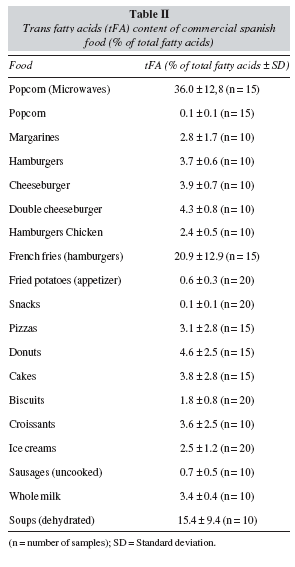
<body><![CDATA[<p><font size="2" face="Verdana"><b>Study of <i>trans</i> fatty acid content in commercial spanish food</b></font></p>     <p><font size="2" face="Verdana">In Spain, food patterns have changed in recent years, especially by the increased consumption of vegetable oils and fats, having decreased consumption of animal fats. This change has resulted in an increase in consumption of compounds chemically altered (due to the process of hydrogenation) called <i>trans</i> fatty acids.</font></p>     <p><font size="2" face="Verdana">Generally, the composition of fatty acids in food is one of the methods used to assess the nutritional quality of them. Moreover, the hydrogenated oils that contain a considerable amount of <i>t</i>FA are often used for the manufacture of processed foods.</font></p>     <p><font size="2" face="Verdana">Compared with <i>cis</i>-unsaturated fatty acids, structure, physical properties (e.g. a high melting point, higher chemical stability and less likely to oxidize the <i>trans</i> fatty) resembles the saturated fatty acids, and physiological effects of <i>trans</i> fatty, it was considered that may be closer to those of saturated fatty acids than the <i>cis</i>-unsaturated fatty acids.</font></p>     <p><font size="2" face="Verdana">Fatty acids composition of different commercial Spanish food with diverse origin of fats (animal, vegetable oils, partially hydrogenated) were analysed by gas-liquid chromatography (GLC) using capillary columns. Fatty acid methyl esters were prepared from lipid extracts following the Official EEC Method for analysis of oils.<sup>24</sup> In our analytical data we can appreciate the different levels of <i>trans</i> fatty acid in various foods commonly consumed by the Spanish population (<a href="#t2">table II</a>). We can appreciate that in the manufacture of margarines, in some cases, has been replaced industrial method, replacing hydrogenated oils of yesteryear by other manufacturing methods (for example the process of interesterification), which has affected the levels of <i>trans</i> fatty acids so favourable.</font></p>     <p align="center"><font size="2" face="Verdana"><a name="t2"><img src="/img/revistas/nh/v24n5/revision1_t2.gif" align="top"></a></font></p>     <p><font size="2" face="Verdana">The interesterification process involves the rearrangement (randomization) of the FA on the glycerol backbone of the fat in the presence of a chemical catalyst or an enzyme. Interesterification modifies the melting and crystallization behaviour of the fat, thus producing fats with the desirable physical properties of <i>trans</i> fats but without trans FA. One current application of this process is in the production of <i>trans</i> -free or low- <i>trans</i> fats for margarine, spread, and shortening applications. Several human studies have shown no significant effects of interesterified fats on blood lipid parameters.<sup>25,26</sup></font></p>     <p><font size="2" face="Verdana">Our results also show a decrease of these compounds in some bakery products due to replace of hydrogenated  fats for edible oils. We must also highlight the high levels found in the popcorn prepared in the microwaves  (36.0%), because the basic ingredients of these snacks are corn and hydrogenated oils. Also, it is worth noting the differences between the contents of <i>trans</i> fatty acid in the French fries served in fast-food outlets (20.9%) compared with those consumed as an appetizer (0.6%). In addition, it surprises the low content of these compounds in snacks or appetizers, but nevertheless, it should be noted that in many cases these foods have been prepared with saturated vegetable fats (coconut oil, palm oil or palm kernel oil) and therefore are not highly recommended.<sup>27,28</sup> Moreover, it should be noted that those products from ruminant animal fats, such as hamburgers, cheese, milk and ice creams, part of the contents in <i>trans</i>-isomers is due to the presence of <i>trans</i>-vaccenic acid (C18: 1t, n-7) that as indicated above are found naturally in the fat of these animals.</font></p>     <p><font size="2" face="Verdana">Assuming that a child of ten years old should eat foods that will provide a total of about 2,000 kcal/day and if we consider as a nutritionally desirable goal that 2% of total daily calories come from <i>trans</i> fatty acids, this would be a contribution of 40 kcal/day, expressed in grams of fat would fall to 4.44 grams of trans fatty acids per day.</font></p>     <p><font size="2" face="Verdana">In view of these data, we have the following question. Are we sure that our children do not exceed these intake levels?</font></p>     ]]></body>
<body><![CDATA[<p><font size="2" face="Verdana">Finally, we believe that observing the results obtained there is a great variability in the content of <i>trans</i> fatty acids in foods consumed by children, we need a special vigilance on the intake levels of these compounds by the general population and especially by the younger population strata of our society.</font></p>     <p><font size="2" face="Verdana">In conclusion, taking into account available data, the general consensus is to moderate the consumption of <i>trans</i> fatty acids due to its potential adverse effects.</font></p>     <p>&nbsp;</p>     <p><font size="2" face="Verdana"><b>Conclusions</b></font></p>     <p><font size="2" face="Verdana">- Currently the most likely source of <i>trans</i> fatty acids in food are hydrogenated fats.</font></p>     <p><font size="2" face="Verdana">- As result of the effects of dietary <i>trans</i> FA on LDL-cholesterol and HDL-cholesterol, most health professional experts have recommended reduced consumption of <i>trans</i> as well as saturated FA.</font></p>     <p><font size="2" face="Verdana">- Our data confirm that food such as fast-food, snacks, bakery products and prepared meals are the main source of these compounds.</font></p>     <p>&nbsp;</p>     <p><font size="2" face="Verdana"><b>References</b></font></p>     <!-- ref --><p><font size="2" face="Verdana">1. Allison DB, Egan SK, Barraj LM, Caughman C, Infante M, Heimbach JT. Estimated intakes in trans fatty and others fatty acids in the US population. J Am Diet Assoc 1999; 99: 166-147.</font>&nbsp;&nbsp;&nbsp;&nbsp;&nbsp;&nbsp;&nbsp;&nbsp;[&#160;<a href="javascript:void(0);" onclick="javascript: window.open('/scielo.php?script=sci_nlinks&ref=3550496&pid=S0212-1611200900050000100001&lng=','','width=640,height=500,resizable=yes,scrollbars=1,menubar=yes,');">Links</a>&#160;]<!-- end-ref --><!-- ref --><p><font size="2" face="Verdana">2. Hulshof KFAM, Van Erp-Baart Ma, Anttolainen M, Becker W, Church SM, Couet C. Intake of fatty acids in Western Europe with emphasis on trans fatty. The TRANSFAIR study. Eur J Clin Nutr 1999; 53: 143-157.</font>&nbsp;&nbsp;&nbsp;&nbsp;&nbsp;&nbsp;&nbsp;&nbsp;[&#160;<a href="javascript:void(0);" onclick="javascript: window.open('/scielo.php?script=sci_nlinks&ref=3550497&pid=S0212-1611200900050000100002&lng=','','width=640,height=500,resizable=yes,scrollbars=1,menubar=yes,');">Links</a>&#160;]<!-- end-ref --><!-- ref --><p><font size="2" face="Verdana">3. Boatella J, Rafecas M, Codony R. Isomers trans fatty acids in the Spanish diet and the relationship with changes in fat intake patterms. Eur J Clin Nutr 1993; 47: S62-S65.</font>&nbsp;&nbsp;&nbsp;&nbsp;&nbsp;&nbsp;&nbsp;&nbsp;[&#160;<a href="javascript:void(0);" onclick="javascript: window.open('/scielo.php?script=sci_nlinks&ref=3550498&pid=S0212-1611200900050000100003&lng=','','width=640,height=500,resizable=yes,scrollbars=1,menubar=yes,');">Links</a>&#160;]<!-- end-ref --><!-- ref --><p><font size="2" face="Verdana">4. Leal Orozco, A. Acidos grasos trans, cops y lops: evidencia actual de su influencia sobre la salud infantil. Acta Pedi&aacute;trica Espa&ntilde;ola 2005; 63: 22-26.</font>&nbsp;&nbsp;&nbsp;&nbsp;&nbsp;&nbsp;&nbsp;&nbsp;[&#160;<a href="javascript:void(0);" onclick="javascript: window.open('/scielo.php?script=sci_nlinks&ref=3550499&pid=S0212-1611200900050000100004&lng=','','width=640,height=500,resizable=yes,scrollbars=1,menubar=yes,');">Links</a>&#160;]<!-- end-ref --><!-- ref --><p><font size="2" face="Verdana">5. Graig-Schmidt MC. Isomeric fatty acids: evaluating status and implications for maternal and child health. Am J Clin Nutr 1997; 715S-731S.</font>&nbsp;&nbsp;&nbsp;&nbsp;&nbsp;&nbsp;&nbsp;&nbsp;[&#160;<a href="javascript:void(0);" onclick="javascript: window.open('/scielo.php?script=sci_nlinks&ref=3550500&pid=S0212-1611200900050000100005&lng=','','width=640,height=500,resizable=yes,scrollbars=1,menubar=yes,');">Links</a>&#160;]<!-- end-ref --><!-- ref --><p><font size="2" face="Verdana">6. Valenzuela A, Morgado N.Trans fatty acids isomersin human health and in the food industry. Biol Res 1999; 32: 273-287.</font>&nbsp;&nbsp;&nbsp;&nbsp;&nbsp;&nbsp;&nbsp;&nbsp;[&#160;<a href="javascript:void(0);" onclick="javascript: window.open('/scielo.php?script=sci_nlinks&ref=3550501&pid=S0212-1611200900050000100006&lng=','','width=640,height=500,resizable=yes,scrollbars=1,menubar=yes,');">Links</a>&#160;]<!-- end-ref --><!-- ref --><p><font size="2" face="Verdana">7. Ascherio A, Hennekens C, Buring J, Master C, Stampfer MJ, Willet WC. Fatty acids intake and risk myocardial infarction. Circulation 1994; 89: 94-101.</font>&nbsp;&nbsp;&nbsp;&nbsp;&nbsp;&nbsp;&nbsp;&nbsp;[&#160;<a href="javascript:void(0);" onclick="javascript: window.open('/scielo.php?script=sci_nlinks&ref=3550502&pid=S0212-1611200900050000100007&lng=','','width=640,height=500,resizable=yes,scrollbars=1,menubar=yes,');">Links</a>&#160;]<!-- end-ref --><!-- ref --><p><font size="2" face="Verdana">8. Zevenberger JL, HoustmullerVM, Gottenbos JJ. Linolenic acid requirements of rats fed trans fatty acids. Lipids 1988; 23: 178-186.</font>&nbsp;&nbsp;&nbsp;&nbsp;&nbsp;&nbsp;&nbsp;&nbsp;[&#160;<a href="javascript:void(0);" onclick="javascript: window.open('/scielo.php?script=sci_nlinks&ref=3550503&pid=S0212-1611200900050000100008&lng=','','width=640,height=500,resizable=yes,scrollbars=1,menubar=yes,');">Links</a>&#160;]<!-- end-ref --><!-- ref --><p><font size="2" face="Verdana">9. Hu FB, Stampfer MJ, Mason JE Rimm E, Colditz GA, Rosner B. Dietary fat intakes and the risk of coronary heart disease in woman. N. Engl J Med 1997; 337: 1491-1499.</font>&nbsp;&nbsp;&nbsp;&nbsp;&nbsp;&nbsp;&nbsp;&nbsp;[&#160;<a href="javascript:void(0);" onclick="javascript: window.open('/scielo.php?script=sci_nlinks&ref=3550504&pid=S0212-1611200900050000100009&lng=','','width=640,height=500,resizable=yes,scrollbars=1,menubar=yes,');">Links</a>&#160;]<!-- end-ref --><!-- ref --><p><font size="2" face="Verdana">10. Oomen C, Ock&eacute; MC, Feskens EJ, Van Erp-Baart MAJ, Kok FJ, Kromhout D. Association between trans fatty acids intake and 10-year risk of coronary heart disease in the Zutphen Elderly Study: a prospective population-based study. Lancet 2001; 357: 746-751.</font>&nbsp;&nbsp;&nbsp;&nbsp;&nbsp;&nbsp;&nbsp;&nbsp;[&#160;<a href="javascript:void(0);" onclick="javascript: window.open('/scielo.php?script=sci_nlinks&ref=3550505&pid=S0212-1611200900050000100010&lng=','','width=640,height=500,resizable=yes,scrollbars=1,menubar=yes,');">Links</a>&#160;]<!-- end-ref --><!-- ref --><p><font size="2" face="Verdana">11. Ascherio A, Katan MB, Zock PL, Stampfer MJ, Willett WC. Trans fatty acids and coronary heart disease. N Engl J Med 1999; 340: 1994-1998.</font>&nbsp;&nbsp;&nbsp;&nbsp;&nbsp;&nbsp;&nbsp;&nbsp;[&#160;<a href="javascript:void(0);" onclick="javascript: window.open('/scielo.php?script=sci_nlinks&ref=3550506&pid=S0212-1611200900050000100011&lng=','','width=640,height=500,resizable=yes,scrollbars=1,menubar=yes,');">Links</a>&#160;]<!-- end-ref --><!-- ref --><p><font size="2" face="Verdana">12. Menskink RP, Zock PL, Kester AD, Katan MB. Effects of dietary fatty acids and the carbohydrates on the ratio of serum total to HDL cholesterol and on serum lipids and apolipoproteins: a meta - analysis of 60 controlled trials. Am J Clin Nutr 2003; 77: 1146-1155.</font>&nbsp;&nbsp;&nbsp;&nbsp;&nbsp;&nbsp;&nbsp;&nbsp;[&#160;<a href="javascript:void(0);" onclick="javascript: window.open('/scielo.php?script=sci_nlinks&ref=3550507&pid=S0212-1611200900050000100012&lng=','','width=640,height=500,resizable=yes,scrollbars=1,menubar=yes,');">Links</a>&#160;]<!-- end-ref --><!-- ref --><p><font size="2" face="Verdana">13. Mozaffarian D, Katan MB, Ascherio A, Stampfer MJ and Willett WC. Trans fatty acids and cardiovascular disease. N. Engl J Med 2006; 354: 1601-1613.</font>&nbsp;&nbsp;&nbsp;&nbsp;&nbsp;&nbsp;&nbsp;&nbsp;[&#160;<a href="javascript:void(0);" onclick="javascript: window.open('/scielo.php?script=sci_nlinks&ref=3550508&pid=S0212-1611200900050000100013&lng=','','width=640,height=500,resizable=yes,scrollbars=1,menubar=yes,');">Links</a>&#160;]<!-- end-ref --><!-- ref --><p><font size="2" face="Verdana">14. Van Tol A, Zock PL, Van Gent T, Scheek LM, Katan MB. Dietary trans fatty acids increase serum cholesterylester transfer protein activity in man. Atherosclerosis 1995; 115:129-134.</font>&nbsp;&nbsp;&nbsp;&nbsp;&nbsp;&nbsp;&nbsp;&nbsp;[&#160;<a href="javascript:void(0);" onclick="javascript: window.open('/scielo.php?script=sci_nlinks&ref=3550509&pid=S0212-1611200900050000100014&lng=','','width=640,height=500,resizable=yes,scrollbars=1,menubar=yes,');">Links</a>&#160;]<!-- end-ref --><!-- ref --><p><font size="2" face="Verdana">15. Clifton PM, Keogh JB, Noakes M. Trans fatty acids in adipose tissue and the food supply are associated with myocardial infarction. J Nutr 2004; 134: 874-879.</font>&nbsp;&nbsp;&nbsp;&nbsp;&nbsp;&nbsp;&nbsp;&nbsp;[&#160;<a href="javascript:void(0);" onclick="javascript: window.open('/scielo.php?script=sci_nlinks&ref=3550510&pid=S0212-1611200900050000100015&lng=','','width=640,height=500,resizable=yes,scrollbars=1,menubar=yes,');">Links</a>&#160;]<!-- end-ref --><!-- ref --><p><font size="2" face="Verdana">16. Pietinen N, Ascherio A, Korhonen P. Intake of fatty acid and risk of coronary heart disease in a cohort of Finnish men: the Alpha-Thocoferol, Beta-Carotene Cancer Prevention Study. Am J Epidemiol 1997; 145: 876-887.</font>&nbsp;&nbsp;&nbsp;&nbsp;&nbsp;&nbsp;&nbsp;&nbsp;[&#160;<a href="javascript:void(0);" onclick="javascript: window.open('/scielo.php?script=sci_nlinks&ref=3550511&pid=S0212-1611200900050000100016&lng=','','width=640,height=500,resizable=yes,scrollbars=1,menubar=yes,');">Links</a>&#160;]<!-- end-ref --><!-- ref --><p><font size="2" face="Verdana">17. Oomen CM, Ocke MC, Feskens EJ, Van Erp-Baart MA, Kok FJ, Kromhout D. Association between trans fatty acid intake and 10-year risk of coronary heart disease in the Zutphen Eldely Study: a prospective population-based study. Lancet 2001; 357: 746-751.</font>&nbsp;&nbsp;&nbsp;&nbsp;&nbsp;&nbsp;&nbsp;&nbsp;[&#160;<a href="javascript:void(0);" onclick="javascript: window.open('/scielo.php?script=sci_nlinks&ref=3550512&pid=S0212-1611200900050000100017&lng=','','width=640,height=500,resizable=yes,scrollbars=1,menubar=yes,');">Links</a>&#160;]<!-- end-ref --><!-- ref --><p><font size="2" face="Verdana">18. Oh K, Hu FB, Manson JE, Stampfer MJ, Willett WC. Dietary fat intake and risk of coronary heart disease in women: 20 years of follow-up of the Nurses' Health Study. Am J Epidemiol 2005; 161: 672-679.</font>&nbsp;&nbsp;&nbsp;&nbsp;&nbsp;&nbsp;&nbsp;&nbsp;[&#160;<a href="javascript:void(0);" onclick="javascript: window.open('/scielo.php?script=sci_nlinks&ref=3550513&pid=S0212-1611200900050000100018&lng=','','width=640,height=500,resizable=yes,scrollbars=1,menubar=yes,');">Links</a>&#160;]<!-- end-ref --><!-- ref --><p><font size="2" face="Verdana">19. Ascherio, A. Rimm EB, Giovannucci EL, Stampfer M, Willett WC. Dietary fat and risk of coronary heart disease in men: cohort follow up study in the United States. BMJ 1996; 313: 84-90.</font>&nbsp;&nbsp;&nbsp;&nbsp;&nbsp;&nbsp;&nbsp;&nbsp;[&#160;<a href="javascript:void(0);" onclick="javascript: window.open('/scielo.php?script=sci_nlinks&ref=3550514&pid=S0212-1611200900050000100019&lng=','','width=640,height=500,resizable=yes,scrollbars=1,menubar=yes,');">Links</a>&#160;]<!-- end-ref --><!-- ref --><p><font size="2" face="Verdana">20. Aro A, Kardinaal AF, Salminen I. Adipose tissue isomeric trans fatty acidand risk of myocardial infarction in nine countries: the EURAMIC study. Lancet 1995; 345: 273-278.</font>&nbsp;&nbsp;&nbsp;&nbsp;&nbsp;&nbsp;&nbsp;&nbsp;[&#160;<a href="javascript:void(0);" onclick="javascript: window.open('/scielo.php?script=sci_nlinks&ref=3550515&pid=S0212-1611200900050000100020&lng=','','width=640,height=500,resizable=yes,scrollbars=1,menubar=yes,');">Links</a>&#160;]<!-- end-ref --><!-- ref --><p><font size="2" face="Verdana">21. Foods and Drug Administration FDA acts to provide better information to consumers on trans fats. 2005 (Accessed March 17, 2006, at <a target="_blank" href="http://www.fda.gov/oc/initiatives/transfat/">http://www.fda.gov/oc/initiatives/transfat/</a>)</font>&nbsp;&nbsp;&nbsp;&nbsp;&nbsp;&nbsp;&nbsp;&nbsp;[&#160;<a href="javascript:void(0);" onclick="javascript: window.open('/scielo.php?script=sci_nlinks&ref=3550516&pid=S0212-1611200900050000100021&lng=','','width=640,height=500,resizable=yes,scrollbars=1,menubar=yes,');">Links</a>&#160;]<!-- end-ref --><!-- ref --><p><font size="2" face="Verdana">22. Health department asks restaurateurs and food suppliers to voluntary make an oil change and eliminate artificial trans fat. Press release of the New York City Department of Health and Mental Hygiene, New York, August 10, 2005 (Accessed March 17, 2006, at http: <a target="_blank" href="http://www.nyc.gov/html/doh/htlm/pr/pr083-05.shtml">www.nyc.gov/html/doh/htlm/pr/pr083-05.shtml</a>).</font>&nbsp;&nbsp;&nbsp;&nbsp;&nbsp;&nbsp;&nbsp;&nbsp;[&#160;<a href="javascript:void(0);" onclick="javascript: window.open('/scielo.php?script=sci_nlinks&ref=3550517&pid=S0212-1611200900050000100022&lng=','','width=640,height=500,resizable=yes,scrollbars=1,menubar=yes,');">Links</a>&#160;]<!-- end-ref --><!-- ref --><p><font size="2" face="Verdana">23. Estrategia NAOS. Nutrici&oacute;n, actividad f&iacute;sica y prevenci&oacute;n de la obesidad. Ministerio de Sanidad y Consumo. Agencia Espa&ntilde;ola de Seguridad Alimentaria. Editorial M&eacute;dica Panamericana 2006.</font>&nbsp;&nbsp;&nbsp;&nbsp;&nbsp;&nbsp;&nbsp;&nbsp;[&#160;<a href="javascript:void(0);" onclick="javascript: window.open('/scielo.php?script=sci_nlinks&ref=3550518&pid=S0212-1611200900050000100023&lng=','','width=640,height=500,resizable=yes,scrollbars=1,menubar=yes,');">Links</a>&#160;]<!-- end-ref --><!-- ref --><p><font size="2" face="Verdana">24. Regulation EEC 2568/91 and modifications. Official EEC  Methods for analysis of oils. L248, 1-83. Official Dairy of  European Communities. 65: 362-366.</font>&nbsp;&nbsp;&nbsp;&nbsp;&nbsp;&nbsp;&nbsp;&nbsp;[&#160;<a href="javascript:void(0);" onclick="javascript: window.open('/scielo.php?script=sci_nlinks&ref=3550519&pid=S0212-1611200900050000100024&lng=','','width=640,height=500,resizable=yes,scrollbars=1,menubar=yes,');">Links</a>&#160;]<!-- end-ref --><!-- ref --><p><font size="2" face="Verdana">25. Hunter JE. Studies on effects of dietary fatty acids as related to their position on triglycerides. Lipids 2001; 36: 655-668.</font>&nbsp;&nbsp;&nbsp;&nbsp;&nbsp;&nbsp;&nbsp;&nbsp;[&#160;<a href="javascript:void(0);" onclick="javascript: window.open('/scielo.php?script=sci_nlinks&ref=3550520&pid=S0212-1611200900050000100025&lng=','','width=640,height=500,resizable=yes,scrollbars=1,menubar=yes,');">Links</a>&#160;]<!-- end-ref --><!-- ref --><p><font size="2" face="Verdana">26. Hunter JE. Dietary trans fatty acids: review of recent human studies and food industry responses. Lipids 2006; 41: 967-992.</font>&nbsp;&nbsp;&nbsp;&nbsp;&nbsp;&nbsp;&nbsp;&nbsp;[&#160;<a href="javascript:void(0);" onclick="javascript: window.open('/scielo.php?script=sci_nlinks&ref=3550521&pid=S0212-1611200900050000100026&lng=','','width=640,height=500,resizable=yes,scrollbars=1,menubar=yes,');">Links</a>&#160;]<!-- end-ref --><!-- ref --><p><font size="2" face="Verdana">27. Fern&aacute;ndez San Juan PM. Fatty acid composition of commercial Spanish fast-food and snack food. Journal of Food Composition and Analysis 2000; 13: 275-281.</font>&nbsp;&nbsp;&nbsp;&nbsp;&nbsp;&nbsp;&nbsp;&nbsp;[&#160;<a href="javascript:void(0);" onclick="javascript: window.open('/scielo.php?script=sci_nlinks&ref=3550522&pid=S0212-1611200900050000100027&lng=','','width=640,height=500,resizable=yes,scrollbars=1,menubar=yes,');">Links</a>&#160;]<!-- end-ref --><!-- ref --><p><font size="2" face="Verdana">28. Griguol V, Le&oacute;n-Camacho M, Vicario IM. Revisi&oacute;n de los niveles de &aacute;cidos grasos trans encontrados en distintos tipos de alimentos. Grasas y aceites 2007; 58 (1): 87-98.</font>&nbsp;&nbsp;&nbsp;&nbsp;&nbsp;&nbsp;&nbsp;&nbsp;[&#160;<a href="javascript:void(0);" onclick="javascript: window.open('/scielo.php?script=sci_nlinks&ref=3550523&pid=S0212-1611200900050000100028&lng=','','width=640,height=500,resizable=yes,scrollbars=1,menubar=yes,');">Links</a>&#160;]<!-- end-ref --><p>&nbsp;</p>     <p>&nbsp;</p>     <p><font size="2" face="Verdana"><a name="back"></a><a href="#top"><img border="0" src="/img/revistas/nh/v24n5/seta.gif" width="15" height="17"></a><b>Correspondence:</b>    ]]></body>
<body><![CDATA[<br>P.-M- Fern&aacute;ndez-San Juan.    <br>Centro Nacional de Alimentaci&oacute;n.    <br>Agencia Espa&ntilde;ola de Seguridad Alimentaria y Nutrici&oacute;n.    <br>28220 Majadahonda (Madrid).    <br>E-mail: <a href="mailto:pfernandezs@msc.es">pfernandezs@msc.es</a></font></p>     <p><font size="2" face="Verdana">Recibido: 23-VII-2008.    <br>Aceptado: 4-IV-2009.</font></p>      ]]></body><back>
<ref-list>
<ref id="B1">
<label>1</label><nlm-citation citation-type="journal">
<person-group person-group-type="author">
<name>
<surname><![CDATA[Allison]]></surname>
<given-names><![CDATA[DB]]></given-names>
</name>
<name>
<surname><![CDATA[Egan]]></surname>
<given-names><![CDATA[SK]]></given-names>
</name>
<name>
<surname><![CDATA[Barraj]]></surname>
<given-names><![CDATA[LM]]></given-names>
</name>
<name>
<surname><![CDATA[Caughman]]></surname>
<given-names><![CDATA[C]]></given-names>
</name>
<name>
<surname><![CDATA[Infante]]></surname>
<given-names><![CDATA[M]]></given-names>
</name>
<name>
<surname><![CDATA[Heimbach]]></surname>
<given-names><![CDATA[JT]]></given-names>
</name>
</person-group>
<article-title xml:lang="en"><![CDATA[Estimated intakes in trans fatty and others fatty acids in the US population]]></article-title>
<source><![CDATA[J Am Diet Assoc]]></source>
<year>1999</year>
<volume>99</volume>
<page-range>166-147</page-range></nlm-citation>
</ref>
<ref id="B2">
<label>2</label><nlm-citation citation-type="journal">
<person-group person-group-type="author">
<name>
<surname><![CDATA[Hulshof]]></surname>
<given-names><![CDATA[KFAM]]></given-names>
</name>
<name>
<surname><![CDATA[Van Erp-Baart]]></surname>
<given-names><![CDATA[Ma]]></given-names>
</name>
<name>
<surname><![CDATA[Anttolainen]]></surname>
<given-names><![CDATA[M]]></given-names>
</name>
<name>
<surname><![CDATA[Becker]]></surname>
<given-names><![CDATA[W]]></given-names>
</name>
<name>
<surname><![CDATA[Church]]></surname>
<given-names><![CDATA[SM]]></given-names>
</name>
<name>
<surname><![CDATA[Couet]]></surname>
<given-names><![CDATA[C]]></given-names>
</name>
</person-group>
<article-title xml:lang="en"><![CDATA[Intake of fatty acids in Western Europe with emphasis on trans fatty: The TRANSFAIR study]]></article-title>
<source><![CDATA[Eur J Clin Nutr]]></source>
<year>1999</year>
<volume>53</volume>
<page-range>143-157</page-range></nlm-citation>
</ref>
<ref id="B3">
<label>3</label><nlm-citation citation-type="journal">
<person-group person-group-type="author">
<name>
<surname><![CDATA[Boatella]]></surname>
<given-names><![CDATA[J]]></given-names>
</name>
<name>
<surname><![CDATA[Rafecas]]></surname>
<given-names><![CDATA[M]]></given-names>
</name>
<name>
<surname><![CDATA[Codony]]></surname>
<given-names><![CDATA[R]]></given-names>
</name>
</person-group>
<article-title xml:lang="en"><![CDATA[Isomers trans fatty acids in the Spanish diet and the relationship with changes in fat intake patterms]]></article-title>
<source><![CDATA[Eur J Clin Nutr]]></source>
<year>1993</year>
<volume>47</volume>
<page-range>S62-S65</page-range></nlm-citation>
</ref>
<ref id="B4">
<label>4</label><nlm-citation citation-type="journal">
<person-group person-group-type="author">
<name>
<surname><![CDATA[Leal Orozco]]></surname>
<given-names><![CDATA[A]]></given-names>
</name>
</person-group>
<article-title xml:lang="es"><![CDATA[Acidos grasos trans, cops y lops: evidencia actual de su influencia sobre la salud infantil]]></article-title>
<source><![CDATA[Acta Pediátrica Española]]></source>
<year>2005</year>
<volume>63</volume>
<page-range>22-26</page-range></nlm-citation>
</ref>
<ref id="B5">
<label>5</label><nlm-citation citation-type="journal">
<person-group person-group-type="author">
<name>
<surname><![CDATA[Graig-Schmidt]]></surname>
<given-names><![CDATA[MC]]></given-names>
</name>
</person-group>
<article-title xml:lang="en"><![CDATA[Isomeric fatty acids: evaluating status and implications for maternal and child health]]></article-title>
<source><![CDATA[Am J Clin Nutr]]></source>
<year>1997</year>
<page-range>715S-731S</page-range></nlm-citation>
</ref>
<ref id="B6">
<label>6</label><nlm-citation citation-type="journal">
<person-group person-group-type="author">
<name>
<surname><![CDATA[Valenzuela]]></surname>
<given-names><![CDATA[A]]></given-names>
</name>
<name>
<surname><![CDATA[Morgado]]></surname>
<given-names><![CDATA[N]]></given-names>
</name>
</person-group>
<article-title xml:lang="en"><![CDATA[Trans fatty acids isomersin human health and in the food industry]]></article-title>
<source><![CDATA[Biol Res]]></source>
<year>1999</year>
<volume>32</volume>
<page-range>273-287</page-range></nlm-citation>
</ref>
<ref id="B7">
<label>7</label><nlm-citation citation-type="journal">
<person-group person-group-type="author">
<name>
<surname><![CDATA[Ascherio]]></surname>
<given-names><![CDATA[A]]></given-names>
</name>
<name>
<surname><![CDATA[Hennekens]]></surname>
<given-names><![CDATA[C]]></given-names>
</name>
<name>
<surname><![CDATA[Buring]]></surname>
<given-names><![CDATA[J]]></given-names>
</name>
<name>
<surname><![CDATA[Master]]></surname>
<given-names><![CDATA[C]]></given-names>
</name>
<name>
<surname><![CDATA[Stampfer]]></surname>
<given-names><![CDATA[MJ]]></given-names>
</name>
<name>
<surname><![CDATA[Willet]]></surname>
<given-names><![CDATA[WC]]></given-names>
</name>
</person-group>
<article-title xml:lang="en"><![CDATA[Fatty acids intake and risk myocardial infarction]]></article-title>
<source><![CDATA[Circulation]]></source>
<year>1994</year>
<volume>89</volume>
<page-range>94-101</page-range></nlm-citation>
</ref>
<ref id="B8">
<label>8</label><nlm-citation citation-type="journal">
<person-group person-group-type="author">
<name>
<surname><![CDATA[Zevenberger]]></surname>
<given-names><![CDATA[JL]]></given-names>
</name>
<name>
<surname><![CDATA[Houstmuller]]></surname>
<given-names><![CDATA[VM]]></given-names>
</name>
<name>
<surname><![CDATA[Gottenbos]]></surname>
<given-names><![CDATA[JJ]]></given-names>
</name>
</person-group>
<article-title xml:lang="en"><![CDATA[Linolenic acid requirements of rats fed trans fatty acids]]></article-title>
<source><![CDATA[Lipids]]></source>
<year>1988</year>
<volume>23</volume>
<page-range>178-186</page-range></nlm-citation>
</ref>
<ref id="B9">
<label>9</label><nlm-citation citation-type="journal">
<person-group person-group-type="author">
<name>
<surname><![CDATA[Hu]]></surname>
<given-names><![CDATA[FB]]></given-names>
</name>
<name>
<surname><![CDATA[Stampfer]]></surname>
<given-names><![CDATA[MJ]]></given-names>
</name>
<name>
<surname><![CDATA[Mason]]></surname>
<given-names><![CDATA[JE]]></given-names>
</name>
<name>
<surname><![CDATA[Rimm]]></surname>
<given-names><![CDATA[E]]></given-names>
</name>
<name>
<surname><![CDATA[Colditz]]></surname>
<given-names><![CDATA[GA]]></given-names>
</name>
<name>
<surname><![CDATA[Rosner]]></surname>
<given-names><![CDATA[B]]></given-names>
</name>
</person-group>
<article-title xml:lang="en"><![CDATA[Dietary fat intakes and the risk of coronary heart disease in woman]]></article-title>
<source><![CDATA[N. Engl J Med]]></source>
<year>1997</year>
<volume>337</volume>
<page-range>1491-1499</page-range></nlm-citation>
</ref>
<ref id="B10">
<label>10</label><nlm-citation citation-type="journal">
<person-group person-group-type="author">
<name>
<surname><![CDATA[Oomen]]></surname>
<given-names><![CDATA[C]]></given-names>
</name>
<name>
<surname><![CDATA[Ocké]]></surname>
<given-names><![CDATA[MC]]></given-names>
</name>
<name>
<surname><![CDATA[Feskens]]></surname>
<given-names><![CDATA[EJ]]></given-names>
</name>
<name>
<surname><![CDATA[Van Erp-Baart]]></surname>
<given-names><![CDATA[MAJ]]></given-names>
</name>
<name>
<surname><![CDATA[Kok]]></surname>
<given-names><![CDATA[FJ]]></given-names>
</name>
<name>
<surname><![CDATA[Kromhout]]></surname>
<given-names><![CDATA[D]]></given-names>
</name>
</person-group>
<article-title xml:lang="en"><![CDATA[Association between trans fatty acids intake and 10-year risk of coronary heart disease in the Zutphen Elderly Study: a prospective population-based study]]></article-title>
<source><![CDATA[Lancet]]></source>
<year>2001</year>
<volume>357</volume>
<page-range>746-751</page-range></nlm-citation>
</ref>
<ref id="B11">
<label>11</label><nlm-citation citation-type="journal">
<person-group person-group-type="author">
<name>
<surname><![CDATA[Ascherio]]></surname>
<given-names><![CDATA[A]]></given-names>
</name>
<name>
<surname><![CDATA[Katan]]></surname>
<given-names><![CDATA[MB]]></given-names>
</name>
<name>
<surname><![CDATA[Zock]]></surname>
<given-names><![CDATA[PL]]></given-names>
</name>
<name>
<surname><![CDATA[Stampfer]]></surname>
<given-names><![CDATA[MJ]]></given-names>
</name>
<name>
<surname><![CDATA[Willett]]></surname>
<given-names><![CDATA[WC]]></given-names>
</name>
</person-group>
<article-title xml:lang="en"><![CDATA[Trans fatty acids and coronary heart disease]]></article-title>
<source><![CDATA[N Engl J Med]]></source>
<year>1999</year>
<volume>340</volume>
<page-range>1994-1998</page-range></nlm-citation>
</ref>
<ref id="B12">
<label>12</label><nlm-citation citation-type="journal">
<person-group person-group-type="author">
<name>
<surname><![CDATA[Menskink]]></surname>
<given-names><![CDATA[RP]]></given-names>
</name>
<name>
<surname><![CDATA[Zock]]></surname>
<given-names><![CDATA[PL]]></given-names>
</name>
<name>
<surname><![CDATA[Kester]]></surname>
<given-names><![CDATA[AD]]></given-names>
</name>
<name>
<surname><![CDATA[Katan]]></surname>
<given-names><![CDATA[MB]]></given-names>
</name>
</person-group>
<article-title xml:lang="en"><![CDATA[Effects of dietary fatty acids and the carbohydrates on the ratio of serum total to HDL cholesterol and on serum lipids and apolipoproteins: a meta - analysis of 60 controlled trials]]></article-title>
<source><![CDATA[Am J Clin Nutr]]></source>
<year>2003</year>
<volume>77</volume>
<page-range>1146-1155</page-range></nlm-citation>
</ref>
<ref id="B13">
<label>13</label><nlm-citation citation-type="journal">
<person-group person-group-type="author">
<name>
<surname><![CDATA[Mozaffarian]]></surname>
<given-names><![CDATA[D]]></given-names>
</name>
<name>
<surname><![CDATA[Katan]]></surname>
<given-names><![CDATA[MB]]></given-names>
</name>
<name>
<surname><![CDATA[Ascherio]]></surname>
<given-names><![CDATA[A]]></given-names>
</name>
<name>
<surname><![CDATA[Stampfer]]></surname>
<given-names><![CDATA[MJ]]></given-names>
</name>
<name>
<surname><![CDATA[Willett]]></surname>
<given-names><![CDATA[WC]]></given-names>
</name>
</person-group>
<article-title xml:lang="en"><![CDATA[Trans fatty acids and cardiovascular disease]]></article-title>
<source><![CDATA[N. Engl J Med]]></source>
<year>2006</year>
<volume>354</volume>
<page-range>1601-1613</page-range></nlm-citation>
</ref>
<ref id="B14">
<label>14</label><nlm-citation citation-type="journal">
<person-group person-group-type="author">
<name>
<surname><![CDATA[Van Tol]]></surname>
<given-names><![CDATA[A]]></given-names>
</name>
<name>
<surname><![CDATA[Zock]]></surname>
<given-names><![CDATA[PL]]></given-names>
</name>
<name>
<surname><![CDATA[Van Gent]]></surname>
<given-names><![CDATA[T]]></given-names>
</name>
<name>
<surname><![CDATA[Scheek]]></surname>
<given-names><![CDATA[LM]]></given-names>
</name>
<name>
<surname><![CDATA[Katan]]></surname>
<given-names><![CDATA[MB]]></given-names>
</name>
</person-group>
<article-title xml:lang="en"><![CDATA[Dietary trans fatty acids increase serum cholesterylester transfer protein activity in man]]></article-title>
<source><![CDATA[Atherosclerosis]]></source>
<year>1995</year>
<volume>115</volume>
<page-range>129-134</page-range></nlm-citation>
</ref>
<ref id="B15">
<label>15</label><nlm-citation citation-type="journal">
<person-group person-group-type="author">
<name>
<surname><![CDATA[Clifton]]></surname>
<given-names><![CDATA[PM]]></given-names>
</name>
<name>
<surname><![CDATA[Keogh]]></surname>
<given-names><![CDATA[JB]]></given-names>
</name>
<name>
<surname><![CDATA[Noakes]]></surname>
<given-names><![CDATA[M]]></given-names>
</name>
</person-group>
<article-title xml:lang="en"><![CDATA[Trans fatty acids in adipose tissue and the food supply are associated with myocardial infarction]]></article-title>
<source><![CDATA[J Nutr]]></source>
<year>2004</year>
<volume>134</volume>
<page-range>874-879</page-range></nlm-citation>
</ref>
<ref id="B16">
<label>16</label><nlm-citation citation-type="journal">
<person-group person-group-type="author">
<name>
<surname><![CDATA[Pietinen]]></surname>
<given-names><![CDATA[N]]></given-names>
</name>
<name>
<surname><![CDATA[Ascherio]]></surname>
<given-names><![CDATA[A]]></given-names>
</name>
<name>
<surname><![CDATA[Korhonen]]></surname>
<given-names><![CDATA[P]]></given-names>
</name>
</person-group>
<article-title xml:lang="en"><![CDATA[Intake of fatty acid and risk of coronary heart disease in a cohort of Finnish men: the Alpha-Thocoferol, Beta-Carotene Cancer Prevention Study]]></article-title>
<source><![CDATA[Am J Epidemiol]]></source>
<year>1997</year>
<volume>145</volume>
<page-range>876-887</page-range></nlm-citation>
</ref>
<ref id="B17">
<label>17</label><nlm-citation citation-type="journal">
<person-group person-group-type="author">
<name>
<surname><![CDATA[Oomen]]></surname>
<given-names><![CDATA[CM]]></given-names>
</name>
<name>
<surname><![CDATA[Ocke]]></surname>
<given-names><![CDATA[MC]]></given-names>
</name>
<name>
<surname><![CDATA[Feskens]]></surname>
<given-names><![CDATA[EJ]]></given-names>
</name>
<name>
<surname><![CDATA[Van Erp-Baart]]></surname>
<given-names><![CDATA[MA]]></given-names>
</name>
<name>
<surname><![CDATA[Kok]]></surname>
<given-names><![CDATA[FJ]]></given-names>
</name>
<name>
<surname><![CDATA[Kromhout]]></surname>
<given-names><![CDATA[D]]></given-names>
</name>
</person-group>
<article-title xml:lang="en"><![CDATA[Association between trans fatty acid intake and 10-year risk of coronary heart disease in the Zutphen Eldely Study: a prospective population-based study]]></article-title>
<source><![CDATA[Lancet]]></source>
<year>2001</year>
<volume>357</volume>
<page-range>746-751</page-range></nlm-citation>
</ref>
<ref id="B18">
<label>18</label><nlm-citation citation-type="journal">
<person-group person-group-type="author">
<name>
<surname><![CDATA[Oh]]></surname>
<given-names><![CDATA[K]]></given-names>
</name>
<name>
<surname><![CDATA[Hu]]></surname>
<given-names><![CDATA[FB]]></given-names>
</name>
<name>
<surname><![CDATA[Manson]]></surname>
<given-names><![CDATA[JE]]></given-names>
</name>
<name>
<surname><![CDATA[Stampfer]]></surname>
<given-names><![CDATA[MJ]]></given-names>
</name>
<name>
<surname><![CDATA[Willett]]></surname>
<given-names><![CDATA[WC]]></given-names>
</name>
</person-group>
<article-title xml:lang="en"><![CDATA[Dietary fat intake and risk of coronary heart disease in women: 20 years of follow-up of the Nurses' Health Study]]></article-title>
<source><![CDATA[Am J Epidemiol]]></source>
<year>2005</year>
<volume>161</volume>
<page-range>672-679</page-range></nlm-citation>
</ref>
<ref id="B19">
<label>19</label><nlm-citation citation-type="journal">
<person-group person-group-type="author">
<name>
<surname><![CDATA[Ascherio]]></surname>
<given-names><![CDATA[A]]></given-names>
</name>
<name>
<surname><![CDATA[Rimm]]></surname>
<given-names><![CDATA[EB]]></given-names>
</name>
<name>
<surname><![CDATA[Giovannucci]]></surname>
<given-names><![CDATA[EL]]></given-names>
</name>
<name>
<surname><![CDATA[Stampfer]]></surname>
<given-names><![CDATA[M]]></given-names>
</name>
<name>
<surname><![CDATA[Willett]]></surname>
<given-names><![CDATA[WC]]></given-names>
</name>
</person-group>
<article-title xml:lang="en"><![CDATA[Dietary fat and risk of coronary heart disease in men: cohort follow up study in the United States]]></article-title>
<source><![CDATA[BMJ]]></source>
<year>1996</year>
<volume>313</volume>
<page-range>84-90</page-range></nlm-citation>
</ref>
<ref id="B20">
<label>20</label><nlm-citation citation-type="journal">
<person-group person-group-type="author">
<name>
<surname><![CDATA[Aro]]></surname>
<given-names><![CDATA[A]]></given-names>
</name>
<name>
<surname><![CDATA[Kardinaal]]></surname>
<given-names><![CDATA[AF]]></given-names>
</name>
<name>
<surname><![CDATA[Salminen]]></surname>
<given-names><![CDATA[I]]></given-names>
</name>
</person-group>
<article-title xml:lang="en"><![CDATA[Adipose tissue isomeric trans fatty acidand risk of myocardial infarction in nine countries: the EURAMIC study]]></article-title>
<source><![CDATA[Lancet]]></source>
<year>1995</year>
<volume>345</volume>
<page-range>273-278</page-range></nlm-citation>
</ref>
<ref id="B21">
<label>21</label><nlm-citation citation-type="">
<source><![CDATA[Foods and Drug Administration FDA acts to provide better information to consumers on trans fats]]></source>
<year>2005</year>
</nlm-citation>
</ref>
<ref id="B22">
<label>22</label><nlm-citation citation-type="">
<source><![CDATA[Health department asks restaurateurs and food suppliers to voluntary make an oil change and eliminate artificial trans fat: Press release of the New York City Department of Health and Mental Hygiene]]></source>
<year>Augu</year>
<month>st</month>
<day> 1</day>
<publisher-loc><![CDATA[New York ]]></publisher-loc>
</nlm-citation>
</ref>
<ref id="B23">
<label>23</label><nlm-citation citation-type="book">
<source><![CDATA[Estrategia NAOS. Nutrición, actividad física y prevención de la obesidad]]></source>
<year>2006</year>
<publisher-name><![CDATA[Ministerio de Sanidad y Consumo. Agencia Española de Seguridad AlimentariaMédica Panamericana]]></publisher-name>
</nlm-citation>
</ref>
<ref id="B24">
<label>24</label><nlm-citation citation-type="journal">
<article-title xml:lang="en"><![CDATA[Regulation EEC 2568/91 and modifications: Official EEC Methods for analysis of oils. L248, 1-83]]></article-title>
<source><![CDATA[Official Dairy of European Communities]]></source>
<year></year>
<volume>65</volume>
<page-range>362-366</page-range></nlm-citation>
</ref>
<ref id="B25">
<label>25</label><nlm-citation citation-type="journal">
<person-group person-group-type="author">
<name>
<surname><![CDATA[Hunter]]></surname>
<given-names><![CDATA[JE]]></given-names>
</name>
</person-group>
<article-title xml:lang="en"><![CDATA[Studies on effects of dietary fatty acids as related to their position on triglycerides]]></article-title>
<source><![CDATA[Lipids]]></source>
<year>2001</year>
<volume>36</volume>
<page-range>655-668</page-range></nlm-citation>
</ref>
<ref id="B26">
<label>26</label><nlm-citation citation-type="journal">
<person-group person-group-type="author">
<name>
<surname><![CDATA[Hunter]]></surname>
<given-names><![CDATA[JE]]></given-names>
</name>
</person-group>
<article-title xml:lang="en"><![CDATA[Dietary trans fatty acids: review of recent human studies and food industry responses]]></article-title>
<source><![CDATA[Lipids]]></source>
<year>2006</year>
<volume>41</volume>
<page-range>967-992</page-range></nlm-citation>
</ref>
<ref id="B27">
<label>27</label><nlm-citation citation-type="journal">
<person-group person-group-type="author">
<name>
<surname><![CDATA[Fernández San Juan]]></surname>
<given-names><![CDATA[PM]]></given-names>
</name>
</person-group>
<article-title xml:lang="en"><![CDATA[Fatty acid composition of commercial Spanish fast-food and snack food]]></article-title>
<source><![CDATA[Journal of Food Composition and Analysis]]></source>
<year>2000</year>
<volume>13</volume>
<page-range>275-281</page-range></nlm-citation>
</ref>
<ref id="B28">
<label>28</label><nlm-citation citation-type="journal">
<person-group person-group-type="author">
<name>
<surname><![CDATA[Griguol]]></surname>
<given-names><![CDATA[V]]></given-names>
</name>
<name>
<surname><![CDATA[León-Camacho]]></surname>
<given-names><![CDATA[M]]></given-names>
</name>
<name>
<surname><![CDATA[Vicario]]></surname>
<given-names><![CDATA[IM]]></given-names>
</name>
</person-group>
<article-title xml:lang="es"><![CDATA[Revisión de los niveles de ácidos grasos trans encontrados en distintos tipos de alimentos]]></article-title>
<source><![CDATA[Grasas y aceites]]></source>
<year>2007</year>
<volume>58</volume>
<numero>1</numero>
<issue>1</issue>
<page-range>87-98</page-range></nlm-citation>
</ref>
</ref-list>
</back>
</article>