<?xml version="1.0" encoding="ISO-8859-1"?><article xmlns:mml="http://www.w3.org/1998/Math/MathML" xmlns:xlink="http://www.w3.org/1999/xlink" xmlns:xsi="http://www.w3.org/2001/XMLSchema-instance">
<front>
<journal-meta>
<journal-id>0212-1611</journal-id>
<journal-title><![CDATA[Nutrición Hospitalaria]]></journal-title>
<abbrev-journal-title><![CDATA[Nutr. Hosp.]]></abbrev-journal-title>
<issn>0212-1611</issn>
<publisher>
<publisher-name><![CDATA[Grupo Arán]]></publisher-name>
</publisher>
</journal-meta>
<article-meta>
<article-id>S0212-16112010000100009</article-id>
<title-group>
<article-title xml:lang="en"><![CDATA[Quality of dietary control in phenylketonuric patients and its relationship with general intelligence]]></article-title>
<article-title xml:lang="es"><![CDATA[Calidad del control de la dieta en pacientes fenilcetonúricos y su relación con la inteligencia general]]></article-title>
</title-group>
<contrib-group>
<contrib contrib-type="author">
<name>
<surname><![CDATA[Vilaseca]]></surname>
<given-names><![CDATA[M. A.]]></given-names>
</name>
<xref ref-type="aff" rid="A01"/>
</contrib>
<contrib contrib-type="author">
<name>
<surname><![CDATA[Lambruschini]]></surname>
<given-names><![CDATA[N.]]></given-names>
</name>
<xref ref-type="aff" rid="A02"/>
<xref ref-type="aff" rid="A05"/>
</contrib>
<contrib contrib-type="author">
<name>
<surname><![CDATA[Gómez-López]]></surname>
<given-names><![CDATA[L.]]></given-names>
</name>
<xref ref-type="aff" rid="A02"/>
<xref ref-type="aff" rid="A05"/>
<xref ref-type="aff" rid="A06"/>
</contrib>
<contrib contrib-type="author">
<name>
<surname><![CDATA[Gutiérrez]]></surname>
<given-names><![CDATA[A.]]></given-names>
</name>
<xref ref-type="aff" rid="A02"/>
<xref ref-type="aff" rid="A05"/>
</contrib>
<contrib contrib-type="author">
<name>
<surname><![CDATA[Fusté]]></surname>
<given-names><![CDATA[E.]]></given-names>
</name>
<xref ref-type="aff" rid="A03"/>
<xref ref-type="aff" rid="A05"/>
</contrib>
<contrib contrib-type="author">
<name>
<surname><![CDATA[Gassió]]></surname>
<given-names><![CDATA[R.]]></given-names>
</name>
<xref ref-type="aff" rid="A04"/>
</contrib>
<contrib contrib-type="author">
<name>
<surname><![CDATA[Artuch]]></surname>
<given-names><![CDATA[R.]]></given-names>
</name>
<xref ref-type="aff" rid="A01"/>
<xref ref-type="aff" rid="A05"/>
<xref ref-type="aff" rid="A06"/>
</contrib>
<contrib contrib-type="author">
<name>
<surname><![CDATA[Campistol]]></surname>
<given-names><![CDATA[J.]]></given-names>
</name>
<xref ref-type="aff" rid="A04"/>
<xref ref-type="aff" rid="A05"/>
<xref ref-type="aff" rid="A06"/>
</contrib>
</contrib-group>
<aff id="A01">
<institution><![CDATA[,Hospital San Joan de Déu  ]]></institution>
<addr-line><![CDATA[Barcelona ]]></addr-line>
<country>Spain</country>
</aff>
<aff id="A02">
<institution><![CDATA[,Hospital Sant Joan de Déu Division of Pediatric Gastroenterology, Hepatology and Nutrition ]]></institution>
<addr-line><![CDATA[ ]]></addr-line>
</aff>
<aff id="A03">
<institution><![CDATA[,Hospital Sant Joan de Déu Department of Psychology ]]></institution>
<addr-line><![CDATA[ ]]></addr-line>
</aff>
<aff id="A04">
<institution><![CDATA[,Hospital Sant Joan de Déu Department of Neurology ]]></institution>
<addr-line><![CDATA[ ]]></addr-line>
</aff>
<aff id="A05">
<institution><![CDATA[,Hospital Sant Joan de Déu Phenylketonuria folow-up unit ]]></institution>
<addr-line><![CDATA[Barcelona ]]></addr-line>
<country>Spain</country>
</aff>
<aff id="A06">
<institution><![CDATA[,Institut of Health Carlos III Centre for Biomedical Research on Rare Disease (CIBERER) ]]></institution>
<addr-line><![CDATA[ ]]></addr-line>
<country>Spain</country>
</aff>
<pub-date pub-type="pub">
<day>00</day>
<month>02</month>
<year>2010</year>
</pub-date>
<pub-date pub-type="epub">
<day>00</day>
<month>02</month>
<year>2010</year>
</pub-date>
<volume>25</volume>
<numero>1</numero>
<fpage>60</fpage>
<lpage>66</lpage>
<copyright-statement/>
<copyright-year/>
<self-uri xlink:href="http://scielo.isciii.es/scielo.php?script=sci_arttext&amp;pid=S0212-16112010000100009&amp;lng=en&amp;nrm=iso"></self-uri><self-uri xlink:href="http://scielo.isciii.es/scielo.php?script=sci_abstract&amp;pid=S0212-16112010000100009&amp;lng=en&amp;nrm=iso"></self-uri><self-uri xlink:href="http://scielo.isciii.es/scielo.php?script=sci_pdf&amp;pid=S0212-16112010000100009&amp;lng=en&amp;nrm=iso"></self-uri><abstract abstract-type="short" xml:lang="en"><p><![CDATA[Objectives: Assessment of the quality of dietary treatment of phenylketonuria (PKU) patients and investigation of its relationship with the general intelligence of the patients. Methods: Cross-sectional and longitudinal study of 105 PKU treated patients. The index of dietary control (IDC) was calculated as the phenylalanine (Phe) data reduction in half-year medians and the mean of all medians throughout the patient's life. We calculated four different IDCs related to age: IDC-A (< 6 years), IDC-B (6-12 years), IDC-C (13-18 years) and IDC-D (> 18 years). To evaluate the fluctuation of Phe values we calculated the standard error of the estimate of the regression of Phe concentration over age. Development quotient was calculated with the Brunet-Lezine test (< 4 years). Intelligence quotient was evaluated with the Kaufman Bit Intelligence Test (K-Bit), Wechsler Intelligence Scale for Children-Revised (WISC-R) and Wechsler Adult Intelligence Scale Third Edition (WAIS III). Results: Cross-sectional study: The IDC in age groups were significantly different and so were the number of patients with good, acceptable and poor IDC related to age (p < 0.001). Sampling frequency was good in 72, acceptable in 23 and poor in 10 patients. The general intelligence (101 &plusmn; 10) correlated negatively with the IDC (p < 0.0001) and Phe fluctuations (p < 0.004). Longitudinal study: Significant differences were observed between the IDC through the patients' lifetime except in the adolescent/adult period. Conclusions: 85% of PKU patients showed good/acceptable quality of dietary control. General intelligence correlates with the IDC at all ages, which highlights the importance of good control to achieve good prognosis.]]></p></abstract>
<abstract abstract-type="short" xml:lang="es"><p><![CDATA[Objetivos: Evaluación de la calidad del control dietético en pacientes con fenilcetonuria (PKU) e investigación de su relacióncon el nivel de inteligencia. Métodos: Estudio transversal y longitudinal de 105 pacientes PKU en tratamiento dietético. El índice de control de la dieta (IDC) se ha calculado como la reducción de los valores de fenilalanina (Phe) a las medianas de cada 6 meses y la media de todas las medianas a lo largo de la vida del paciente. Se han calculado cuatro diferentes IDC según la edad: IDC-A (< 6 años), IDC-B (6-12 años), IDC-C (13-18 años) and IDC-D (> 18 años). Para evaluar las fluctuaciones de los valores de Phe hemos calculado el error estándar de la regresión estimada de la concentración de Phe según la edad. El índice de inteligencia se ha evaluado mediante el test de Brunet-Lezine (< 4 años) y el coeficiente de inteligencia mediante Kaufman Bit Intelligence Test (K-Bit), Wechsler Intelligence Scale for Children-Revised (WISC-R) y Wechsler Adult Intelligence Scale Third Edition (WAIS III). Resultados: Estudio transversal: El IDC en los diferentes grupos de edad es significativamente diferente y también lo son el número de pacientes con un IDC bueno, aceptable y malo en relación con la edad (p < 0,001). La frecuencia de controles de Phe fue buena en 72 pacientes, aceptable en 23 y mala en 10. La inteligencia general (101 &plusmn; 10) se correlaciona negativamente con el IDC (p < 0,0001) y con las fluctuaciones de Phe (p < 0,004). Estudio longitudinal: Se han observado diferencias significativas entre ICD a lo largo de la vida de los pacientes a excepción del período adolescencia/edad adulta. Conclusiones: El 85% de pacientes PKU mostraron una calidad del control de la dieta buena/aceptable. Los niveles de inteligencia general se correlacionan con el IDC en todas las edades, lo que muestra la importancia del buen control de la dieta para lograr un buen pronóstico.]]></p></abstract>
<kwd-group>
<kwd lng="en"><![CDATA[Phenylketonuria]]></kwd>
<kwd lng="en"><![CDATA[Phenylalanine]]></kwd>
<kwd lng="en"><![CDATA[Dietary treatment]]></kwd>
<kwd lng="en"><![CDATA[Intelligence quotient]]></kwd>
<kwd lng="en"><![CDATA[Recommendations]]></kwd>
<kwd lng="es"><![CDATA[Fenilcetonuria]]></kwd>
<kwd lng="es"><![CDATA[Fenilalanina]]></kwd>
<kwd lng="es"><![CDATA[Control dietético]]></kwd>
<kwd lng="es"><![CDATA[Coeficiente de inteligencia]]></kwd>
<kwd lng="es"><![CDATA[Recomendaciones]]></kwd>
</kwd-group>
</article-meta>
</front><body><![CDATA[ <p><a name="top"></a><font size="2" face="Verdana"><b>ORIGINAL</b></font></p>     <p>&nbsp;</p>     <p><font face="Verdana" size="4"><b>Quality of dietary control in phenylketonuric patients and its relationship with general intelligence</b></font></p>     <p><b><font face="Verdana" size="4">Calidad del control de la dieta en pacientes fenilcetonúricos y su relación con la inteligencia general</font></b></p>     <p>&nbsp;</p>     <p>&nbsp;</p>     <p><font size="2" face="Verdana"><b>M. A. Vilaseca<sup>1,5</sup>, N. Lambruschini<sup>2,5</sup>, L. G&oacute;mez-L&oacute;pez<sup>2,5,6</sup>, A. Guti&eacute;rrez<sup>2,5</sup>, E. Fust&eacute;<sup>3,5</sup>, R. Gassi&oacute;<sup>4</sup>, R. Artuch<sup>1,5,6</sup> and J. Campistol<sup>4,5,6</sup></b></font></p>     <p><font size="2" face="Verdana"><sup>1</sup>Department of Biochemistry.    <br><sup>2</sup>Division of Pediatric Gastroenterology. Hepatology and Nutrition.    <br><sup>3</sup>Department of Psychology.    ]]></body>
<body><![CDATA[<br><sup>4</sup>Department of Neurology.    <br><sup>5</sup>PKU follow-up Unit. Hospital Sant Joan de D&eacute;u. University of Barcelona. Spain.    <br><sup>6</sup>Centre for Biomedical Research on Rare Disease (CIBERER). Institut of Heat Carlos III. Spain.</font></p>     <p><font size="2" face="Verdana"><a href="#back">Correspondence</a></font></p>     <p>&nbsp;</p>     <p>&nbsp;</p> <hr size="1">     <p><b><font size="2" face="Verdana">ABSTRACT</font></b></p>     <p><font size="2" face="Verdana"><b>Objectives:</b> Assessment of the quality of dietary treatment of phenylketonuria (PKU) patients and investigation of its relationship with the general intelligence of the patients.    <br><b>Methods:</b> Cross-sectional and longitudinal study of 105 PKU treated patients. The index of dietary control (IDC) was calculated as the phenylalanine (Phe) data reduction in half-year medians and the mean of all medians throughout the patient's life. We calculated four different IDCs related to age: IDC-A (&lt; 6 years), IDC-B (6-12 years), IDC-C (13-18 years) and IDC-D (&gt; 18 years). To evaluate the fluctuation of Phe values we calculated the standard error of the estimate of the regression of Phe concentration over age. Development quotient was calculated with the Brunet-Lezine test (&lt; 4 years). Intelligence quotient was evaluated with the Kaufman Bit Intelligence Test (K-Bit), Wechsler Intelligence Scale for Children-Revised (WISC-R) and Wechsler Adult Intelligence Scale Third Edition (WAIS III).    <br><b>Results:</b> Cross-sectional study: The IDC in age groups were significantly different and so were the number of patients with good, acceptable and poor IDC related to age (p &lt; 0.001). Sampling frequency was good in 72, acceptable in 23 and poor in 10 patients. The general intelligence (101 &plusmn; 10) correlated negatively with the IDC (p &lt; 0.0001) and Phe fluctuations (p &lt; 0.004). Longitudinal study: Significant differences were observed between the IDC through the patients' lifetime except in the adolescent/adult period.    ]]></body>
<body><![CDATA[<br><b>Conclusions:</b> 85% of PKU patients showed good/acceptable quality of dietary control. General intelligence correlates with the IDC at all ages, which highlights the importance of good control to achieve good prognosis.</font></p>     <p><font size="2" face="Verdana"><b>Key words:</b> Phenylketonuria. Phenylalanine. Dietary treatment. Intelligence quotient. Recommendations.</font></p> <hr size="1">     <p><font size="2" face="Verdana"><b>RESUMEN</b></font></p>     <p><font size="2" face="Verdana"><b>Objetivos:</b> Evaluaci&oacute;n de la calidad del control diet&eacute;tico en pacientes con fenilcetonuria (PKU) e investigaci&oacute;n de su relaci&oacute;ncon el nivel de inteligencia.    <br><b>M&eacute;todos:</b> Estudio transversal y longitudinal de 105 pacientes PKU en tratamiento diet&eacute;tico. El &iacute;ndice de control de la dieta (IDC) se ha calculado como la reducci&oacute;n de los valores de fenilalanina (Phe) a las medianas de cada 6 meses y la media de todas las medianas a lo largo de la vida del paciente. Se han calculado cuatro diferentes IDC seg&uacute;n la edad: IDC-A (&lt; 6 a&ntilde;os), IDC-B (6-12 a&ntilde;os), IDC-C (13-18 a&ntilde;os) and IDC-D (&gt; 18 a&ntilde;os). Para evaluar las fluctuaciones de los valores de Phe hemos calculado el error est&aacute;ndar de la regresi&oacute;n estimada de la concentraci&oacute;n de Phe seg&uacute;n la edad. El &iacute;ndice de inteligencia se ha evaluado mediante el test de Brunet-Lezine (&lt; 4 a&ntilde;os) y el coeficiente de inteligencia mediante Kaufman Bit Intelligence Test (K-Bit), Wechsler Intelligence Scale for Children-Revised (WISC-R) y Wechsler Adult Intelligence Scale Third Edition (WAIS III).    <br><b>Resultados:</b> Estudio transversal: El IDC en los diferentes grupos de edad es significativamente diferente y tambi&eacute;n lo son el n&uacute;mero de pacientes con un IDC bueno, aceptable y malo en relaci&oacute;n con la edad (p &lt; 0,001). La frecuencia de controles de Phe fue buena en 72 pacientes, aceptable en 23 y mala en 10. La inteligencia general (101 &plusmn; 10) se correlaciona negativamente con el IDC (p &lt; 0,0001) y con las fluctuaciones de Phe (p &lt; 0,004). Estudio longitudinal: Se han observado diferencias significativas entre ICD a lo largo de la vida de los pacientes a excepci&oacute;n del per&iacute;odo adolescencia/edad adulta.    <br><b>Conclusiones:</b> El 85% de pacientes PKU mostraron una calidad del control de la dieta buena/aceptable. Los niveles de inteligencia general se correlacionan con el IDC en todas las edades, lo que muestra la importancia del buen control de la dieta para lograr un buen pron&oacute;stico.</font></p>     <p><font size="2" face="Verdana"><b>Palabras clave:</b> Fenilcetonuria. Fenilalanina. Control diet&eacute;tico. Coeficiente de inteligencia. Recomendaciones.</font></p> <hr size="1">     <p>&nbsp;</p>     <p><font size="2" face="Verdana"><b>Introduction</b></font></p>     ]]></body>
<body><![CDATA[<p><font size="2" face="Verdana">Phenylketonuria (PKU) (McKusick 261600) is an inborn error of phenylalanine (Phe) metabolism resulting from deficient activity of phenylalanine-4-monooxygenase (EC 1.14.16.1), the hepatic enzyme that catalyses the synthesis of tyrosine from phenylalanine. <sup>1</sup> Phenylalanine accumulation in plasma and tissues with decreased tyrosine biosynthesis seems to be involved in the pathogenesis of PKU. Treatment of PKU patients consists of restriction of phenylalanine intake, which means a natural protein-restricted diet supplemented with a phenylalanine-free amino acid mixture enriched with some essential micronutrients, such as vitamins, minerals and trace elements.<sup>2</sup> Alternative treatment with tetrahydrobiopterin (BH4) also results in lowering plasma Phe in BH4-responsive patients.<sup>3,4</sup> Early treatment of PKU prevents severe neurological damage, although a slight reduction in intelligence quotient compared with control populations and/or specific executive function deficits may arise, especially when careful dietary compliance is not achieved.<sup>1,5-8</sup> Quality of dietary treatment appears to be, therefore, a most important condition for good prognosis.  <sup>9</sup> Different indices of dietary control (IDC)<sup>10</sup> and parameters of Phe fluctuation<sup>11</sup> have been computed from Phe levels during certain periods of time or throughout life for evaluation of long-term compliance. Several guidelines for the management of PKU have been published with recommendations about frequency of monitoring and desirable plasma Phe concentrations, <sup>12-15</sup> although there is a lack of internationally accepted guidelines, especially for the management of adolescent/adult patients<sup>16</sup>. Therefore, the experience of a reference centre in the management of PKU patients may yield further information.</font></p>     <p>&nbsp;</p>     <p><font size="2" face="Verdana"><b>Objectives</b></font></p>     <p><font size="2" face="Verdana">Our aim was to assess the quality of dietary treatment of PKU patients and to determine its relationship with the general intelligence of the patients.</font></p>     <p>&nbsp;</p>     <p><font size="2" face="Verdana"><b>Material and methods</b></font></p>     <p><font size="2" face="Verdana"><i>Patients</i></font></p>     <p><font size="2" face="Verdana">We did a cross-sectional and longitudinal study of 105 PKU patients who were selected from a group of 192 hyperphenylalaninemic patients periodically controlled in our hospital (Reference Centre for PKU in Catalonia) &#091;sex: 59 females and 46 males; mean age: 15.7 (SD: 11.6; range: 3 months-40 years)&#093;. Inclusion criteria were: a) phenylalanine-4-monooxygenase deficiency confirmed by differential diagnosis and mutation analysis, and b) pre-treatment plasma Phe concentrations higher than 360 &mu;mol/L. Exclusion criteria were: a) treatment refusal (7 adult diagnosed patients), b) death owing to causes other than PKU (2 patients), and c) change of residence to other parts of the country and control in other PKU reference centres (5 patients).</font></p>     <p><font size="2" face="Verdana">PKU diagnosis was performed in 76 patients through newborn screening and 29 patients were late diagnosed. All patients were treated with a Pherestricted diet just after diagnosis. In 10 BH4-responsive patients<sup>17</sup> diet was replaced by BH4 therapy (5-15 mg/kg/day) for the three years prior to the study. However, since the IDC was not significantly different in these patients treated with Phe-restricted diet (280&plusmn;66 &mu;mol/L) or with BH4 (298&plusmn;53 &mu;mol/L),<sup>4</sup> we included them in the study.</font></p>     <p><font size="2" face="Verdana">All children or their guardians signed an informed consent agreement in accord with the Helsinki Declaration of 1964, revised in Edinburgh in 2000. Our hospital ethics committee approved the study.</font></p>     ]]></body>
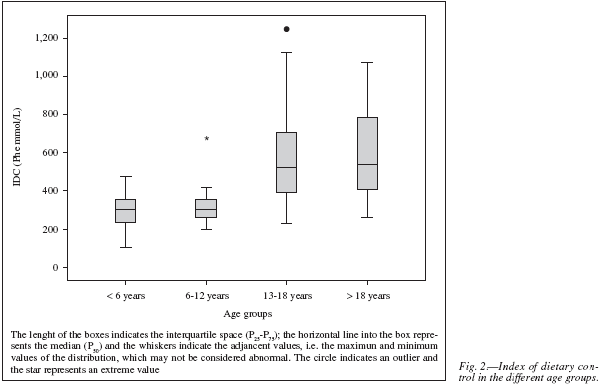
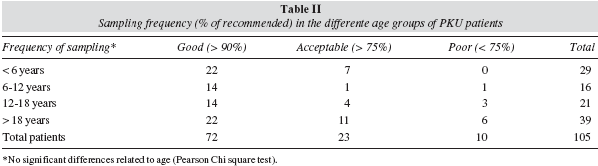
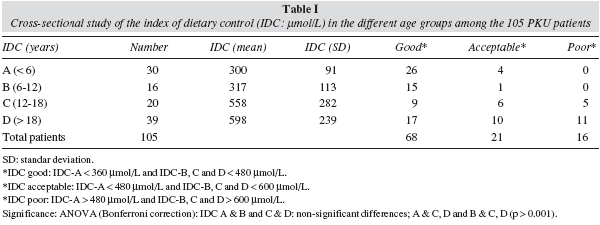
<body><![CDATA[<p><font size="2" face="Verdana"><i>Methods</i></font></p>     <p><font size="2" face="Verdana"><i>Biochemical methods</i>: Plasma and dried blood spot Phe concentrations were analysed by ion exchange chromatography (Biochrom 30, Pharmacia Biotech). The frequency of Phe measurements varied from every week (&lt; 2 month of age), or every two weeks (2 months-4 years old) to every month (&gt; 4 years of age). We considered it correct when the proportion of samples expected was &gt; 90%, acceptable &gt;75% and poor &lt; 75%.</font></p>     <p><font size="2" face="Verdana">To summarise plasma Phe values along patients' life we plot them as a longitudinal history of dietary control (<a target="_blank" href="/img/revistas/nh/v25n1/original5_f1.gif">fig.1 A and B</a>). Moreover, we calculate the IDC as the Phe data reduction in half-year medians and the mean of all medians<sup>18</sup> throughout the patient's life. Since in previous studies we found that IDC increases significantly with age (r = 0.636, p &lt; 0.001),<sup>19</sup> we calculated four different IDCs related to age: IDC-A (&lt; 6 years), IDC-B (6-12 years), IDC-C (13-18 years) and IDC-D (&gt; 18 years). We consider it to be good control with IDC-A &lt; 360 &mu;mol/L and IDC-B, C and D &lt; 480 &mu;mol/L, acceptable control with IDC-A &lt; 480 &mu;mol/L and IDC-B, C and D &lt; 600 &mu;mol/L and poor control when IDC was higher than those values. To evaluate the fluctuation of Phe values we calculated the standard error of the estimate (SEE) of the regression of Phe concentration over age.<sup>11</sup></font></p>     <p><font size="2" face="Verdana"><i>General intelligence measurement</i>: Development quotients were calculated with the Brunet-Lezine test in patients younger than 4 years of age (N = 21). Intelligence quotient (IQ) was evaluated with the Kaufman Bit Intelligence Test (K-Bit) (patients from 4 to 6 years) (N = 6), Wechsler Intelligence Scale for Children-Revised (WISC-R) (patients from 6 to 18 years) (N = 35), and Wechsler Adult Intelligence Scale Third Edition WAIS III (patients older than 18 years) (N = 6). Late diagnosed patients were excluded from this part of the study. Intelligence measurement was not available for 8 patients.</font></p>     <p><font size="2" face="Verdana"><i>Statistical analysis</i>: Statistical analyses were performed using the package SPSS (version 15.0).  <i>Cross-sectional study:</i> The ANOVA test with Bonferroni correction was used to compare the IDC among the A, B, C and D groups. Pearson Chi square test was applied to search for association between categorical variables:(good, acceptable and poor IDC at different age groups and frequency of sampling). Pearson test was used to determine the correlations between the quantitative variables studied (IDC, SEE, and general intelligence). <i>Longitudinal study</i>: Student-T test for paired data was used to analyse the differences between IDC (A, B, C, and D) from the same patient throughout life. Statistical significance was accepted at P &lt; 0.05.</font></p>     <p>&nbsp;</p>     <p><font size="2" face="Verdana"><b>Results</b></font></p>     <p><font size="2" face="Verdana"><i>Cross-sectional study</i>: The IDCs in the different age groups were significantly different (ANOVA with Bon- ferroni correction; p &lt; 0.001) (<a href="#t1">table I</a>; <a href="#f2">fig. 2</a>). The number of patients with good, acceptable and poor IDC was significantly different related to age (Pearson Chi square test: p &lt; 0.001) (<a href="#t1">table I</a>). However, no significant differences  were observed regarding sex in any age group. Frequency of sampling was correct in 72 patients, intermediate in 23 and poor in 10 patients, although there were no significant differences related to age (<a href="#t2">table II</a>). The IDC was significantly different in patients with good (383 &plusmn; 186 &mu;mol/L), intermediate (550 &plusmn; 258 &mu;mol/L) and poor frequency of sampling (829 &plusmn; 162 &mu;mol/L) (ANOVA with Bonferroni correction; p &lt; 0.001).</font></p>     <p align="center"><font size="2" face="Verdana"><a name="t1"><img src="/img/revistas/nh/v25n1/original5_t1.gif" alt="figura 1" align="top"></a></font></p>     <p align="center"><font size="2" face="Verdana"><a name="f2"><img src="/img/revistas/nh/v25n1/original5_f2.gif" alt="figura 1" align="top"></a></font></p>     ]]></body>
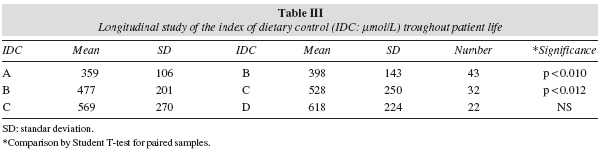
<body><![CDATA[<p align="center"><font size="2" face="Verdana"><a name="t2"><img src="/img/revistas/nh/v25n1/original5_t2.gif" alt="figura 1" align="top"></a></font></p>     <p><font size="2" face="Verdana">Excluding the late-diagnosed PKU patients (N = 29), the general intelligence of PKU patients was 101 &plusmn; 10 (range: 80-129) and showed a negative correlation with the present IDC of the patients (r = -0.468; p &lt; 0.0001), an even stronger negative correlation with the IDC-A of these patients (r = -0.501; p &lt; 0.0001), but no correlation with pre-treatment Phe values. General intelligence showed a significantly negative correlation with the SEE (r = -0.347; p &lt; 0.004). A significant correlation was observed between the IDC and the SEE (r = 0.618; p &lt; 0.0001). Pre-treatment Phe values only showed a correlation with the SEE (r = 0.391; p &lt; 0.001).</font></p>     <p><font size="2" face="Verdana"><i>Longitudinal study:</i> Taking into account the IDC throughout patient life, significant differences (Student T-test for paired samples) were observed between the IDC A &amp; B (p &lt; 0.01), and B &amp; C (p &lt; 0.012), but not between C &amp; D (<a href="#t3">table III</a>).</font></p>     <p align="center"><font size="2" face="Verdana"><a name="t3"><img src="/img/revistas/nh/v25n1/original5_t3.gif" alt="figura 1" align="top"></a></font></p>     <p>&nbsp;</p>     <p><font size="2" face="Verdana"><b>Discussion</b></font></p>     <p><font size="2" face="Verdana">Although the metabolic control of PKU patients includes many biochemical parameters involved in their nutritional status that may be deficient owing to the natural protein restricted diet,<sup>2</sup> here we focused only on the blood Phe levels throughout life. The biochemical follow-up of PKU children involves so much data on Phe control that it can become confusing for the clinicians in charge of the management of the patients. To compute all data and plot it as a longitudinal history of dietary control (based on the half-year medians of Phe values) is very useful for the clinical staff and for the family when it comes to evaluating the evolution of that control.<sup>10</sup> Medians are better than means since they correct for the sporadic decompensation caused by illness (cough, diarrhoea, or other infections). The mean of half-year medians is a useful index for correlation with clinical and neuropsychological data, which is indispensable in patients' follow-up.<sup>8,9,13,20</sup> However, since in previous studies we observed that IDC increases significantly with age,<sup>19</sup> we calculated here four different IDCs related to patient age (A, B, C, and D). Moreover, a fluctuation index (SEE) also seems necessary for the complete evaluation of the quality of diet, since the same IDC might be associated with a calm but increasing profile or an erratic but even profile.<sup>11</sup></font></p>     <p><font size="2" face="Verdana">In the cross-sectional study, although there was a positive correlation between IDC of the total group and age (r = 0.627; p &lt; 0.0001), the quality of control was good in infancy and childhood (IDC-A and B) and clearly impaired in adolescence (IDC-C), although it remained stable in adult age (IDC-D). The longitudinal study confirmed this increasing trend when comparing the different IDCs in the same patient throughout life. In a previous study performed by our group in latediagnosed patients or those who resumed Pherestricted diet after a period of discontinuation, only half of the patients achieved an acceptable/good control despite their belief that their quality of life had improved with the diet.<sup>21</sup></font></p>     <p><font size="2" face="Verdana">Recommendations for sampling frequency were followed by 95% (good/acceptable frequency) of the patients. There is a clear relationship between correct sampling frequency and good IDC. All these results agree with evaluation studies performed in other reference centres,<sup>22</sup> although they only evaluate patients younger than 19 years of age. Interestingly, we found no relationship between patient age and sampling frequency, suggesting that adult patients accept management guidelines better than adolescents. Sex seems not to play a significant role in the quality of control in PKU patients, even in adults, among whom some women spent long periods of time with very good control owing to future pregnancies &#091;women (N = 24): 583 &plusmn; 217 &mu;mol/L versus men (N = 15): 679 &plusmn; 276 &mu;mol/L, not significantly different&#093;.</font></p>     <p><font size="2" face="Verdana">The lack of correlation between the IDC and plasma Phe levels at diagnosis, observed by other authors as well,<sup>23</sup> suggests that the quality of treatment is not related to the severity of the PKU phenotype. Conversely, a highly significant relationship was observed between Phe fluctuations (SEE) and pre-treatment Phelevels. Moreover, a significant relationship was observed between the SEE and the IDC, which suggests that fluctuations might also be partially corrected by accurate dietary control. This confirms the observations of other authors<sup>23</sup> in different PKU populations with diverse phenotypes, genotypes and even followup conditions, and indicates that the efforts made by the patients and their families for diet compliance can achieve good control of Phe levels, independently of the severity of the mutations .</font></p>     ]]></body>
<body><![CDATA[<p><font size="2" face="Verdana">According to our results, general intelligence shows a negative correlation with the IDC and the SEE but not with the pre-treatment Phe values. In previous extensive neuropsychological studies performed in 37 PKU patients we found that these patients showed lower values in intelligence and in visuospatial, fine motor, executive and attention functions when compared with a control population, and we also found that these cognitive functions were negatively associated with plasma Phe values in the first 6 years of life.<sup>8</sup> In another study we evaluated school performance in 26 PKU patients and found that they presented with more learning difficulties than controls. In that study, the index of dietary control for the last 6 months was significantly higher than the index for the first 6 years of life only in the patients with learning difficulties, which points to the importance of long-lasting good dietary control in PKU.<sup>24</sup> Moreover, grey and white matter volume changes related to the duration and strict observation of dietary treatment was demonstrated by our group in 27 treated PKU patients (mean age: 20 &plusmn; 7years).<sup>25</sup> In this study, significant correlations were observed between white matter volumes and concurrent Phe values, and between white matter and mean Phe values for the 12 months previous to the study in early treated PKU patients.<sup>25</sup> In the present study, of the whole PKU group (excluding late diagnosed patients), general intelligence correlates with the IDC from the first 6 years of age, but also with the IDC at any age.</font></p>     <p><font size="2" face="Verdana">These results point to the importance of improving the quality of dietary control of PKU at all ages, which can be achieved with a motivating policy designed by the follow-up unit including training plans, dietary and psychological support and frequent Phe controls.<sup>21</sup> The application of new treatment strategies will probably make it easier to achieve metabolic control of PKU patients.</font></p>     <p><font size="2" face="Verdana">In summary, 85% of PKU patients in our reference centre showed good/acceptable quality of dietary control. The lack of a relationship between the IDC and pre-treatment Phe values and the relation observed between the IDC and correct frequency of sampling point up the great importance of lifestyle in the quality of treatment in the face of the PKU biochemical phenotype. General intelligence correlates with the IDC not only in the first 6 years of age, but also with the IDC at any age, which highlights the importance of good control throughout life to achieve an improved prognosis.</font></p>     <p>&nbsp;</p>     <p><font size="2" face="Verdana"><b>Acknowledgements</b></font></p>     <p><font size="2" face="Verdana">We very much appreciate the skilful technical assistance of Juan Moreno and the collaboration of the PKU patients and their families in the study.</font></p>     <p>&nbsp;</p>     <p><font size="2" face="Verdana"><b>References</b></font></p>     <!-- ref --><p><font size="2" face="Verdana">1. Scriver CR, Kaufman C, Eisensmith RC, Woo SLC. The hyperphenylalaninemias. In: Scriver CR, Beaudet AL, Sly WS, Valle D, Eds. The metabolic and molecular basis of inherited disease. New York: McGraw Hill, 2001, pp. 1667-724.</font>&nbsp;&nbsp;&nbsp;&nbsp;&nbsp;&nbsp;&nbsp;&nbsp;[&#160;<a href="javascript:void(0);" onclick="javascript: window.open('/scielo.php?script=sci_nlinks&ref=3573449&pid=S0212-1611201000010000900001&lng=','','width=640,height=500,resizable=yes,scrollbars=1,menubar=yes,');">Links</a>&#160;]<!-- end-ref --><!-- ref --><p><font size="2" face="Verdana">2. Przyrembel H, Bremer HJ. Nutrition, physical growth, and bone density in treated phenylketonuria. Eur J Pediatr 2000; 159 (Supl. 2): S129-35.</font>&nbsp;&nbsp;&nbsp;&nbsp;&nbsp;&nbsp;&nbsp;&nbsp;[&#160;<a href="javascript:void(0);" onclick="javascript: window.open('/scielo.php?script=sci_nlinks&ref=3573450&pid=S0212-1611201000010000900002&lng=','','width=640,height=500,resizable=yes,scrollbars=1,menubar=yes,');">Links</a>&#160;]<!-- end-ref --><!-- ref --><p><font size="2" face="Verdana">3. Blau N, Erlandsen H. The metabolic and molecular bases of tetrahydrobiopterin-responsive phenylalanine hydroxylase deficiency. Mol Genet Metab 2004; 82: 101-11.</font>&nbsp;&nbsp;&nbsp;&nbsp;&nbsp;&nbsp;&nbsp;&nbsp;[&#160;<a href="javascript:void(0);" onclick="javascript: window.open('/scielo.php?script=sci_nlinks&ref=3573451&pid=S0212-1611201000010000900003&lng=','','width=640,height=500,resizable=yes,scrollbars=1,menubar=yes,');">Links</a>&#160;]<!-- end-ref --><!-- ref --><p><font size="2" face="Verdana">4. Lambruschini N, Perez-Duenas B, Vilaseca MA et al. Clinical and nutritional evaluation of phenylketonuric patients on tetrahydrobiopterin monotherapy. Mol Genet Metab 2005; 86 (Supl. 1): S54-60.</font>&nbsp;&nbsp;&nbsp;&nbsp;&nbsp;&nbsp;&nbsp;&nbsp;[&#160;<a href="javascript:void(0);" onclick="javascript: window.open('/scielo.php?script=sci_nlinks&ref=3573452&pid=S0212-1611201000010000900004&lng=','','width=640,height=500,resizable=yes,scrollbars=1,menubar=yes,');">Links</a>&#160;]<!-- end-ref --><!-- ref --><p><font size="2" face="Verdana">5. Welsh MC, Pennington BF, Ozonoff S. Neuropsychology of early-treated phenylketonuria: Specific executive function deficits. Child Dev 1990; 61: 1967.</font>&nbsp;&nbsp;&nbsp;&nbsp;&nbsp;&nbsp;&nbsp;&nbsp;[&#160;<a href="javascript:void(0);" onclick="javascript: window.open('/scielo.php?script=sci_nlinks&ref=3573453&pid=S0212-1611201000010000900005&lng=','','width=640,height=500,resizable=yes,scrollbars=1,menubar=yes,');">Links</a>&#160;]<!-- end-ref --><!-- ref --><p><font size="2" face="Verdana">6. Waisbren SE, Brown MJ, de Sonneville LMJ, Levy HL. Review of neuropsychological functioning in treated phenylketonuria: an information processing approach. Acta Paediatr Suppl 1994; 407: 98-103.</font>&nbsp;&nbsp;&nbsp;&nbsp;&nbsp;&nbsp;&nbsp;&nbsp;[&#160;<a href="javascript:void(0);" onclick="javascript: window.open('/scielo.php?script=sci_nlinks&ref=3573454&pid=S0212-1611201000010000900006&lng=','','width=640,height=500,resizable=yes,scrollbars=1,menubar=yes,');">Links</a>&#160;]<!-- end-ref --><!-- ref --><p><font size="2" face="Verdana">7. Anderson PJ, Wood SJ, Francis DE et al. Neuropsychological functioning in children with early-treated phenylketonuria: impact of white matter abnormalities. Dev Med Child Neurol 2004; 46: 230-8.</font>&nbsp;&nbsp;&nbsp;&nbsp;&nbsp;&nbsp;&nbsp;&nbsp;[&#160;<a href="javascript:void(0);" onclick="javascript: window.open('/scielo.php?script=sci_nlinks&ref=3573455&pid=S0212-1611201000010000900007&lng=','','width=640,height=500,resizable=yes,scrollbars=1,menubar=yes,');">Links</a>&#160;]<!-- end-ref --><!-- ref --><p><font size="2" face="Verdana">8. Gassio R, Artuch R, Vilaseca MA et al. Cognitive functions in classic phenylketonuria and mild hyperphenylalaninaemia: experience in a paediatric population. Dev Med Child Neurol 2005; 47: 443-8.</font>&nbsp;&nbsp;&nbsp;&nbsp;&nbsp;&nbsp;&nbsp;&nbsp;[&#160;<a href="javascript:void(0);" onclick="javascript: window.open('/scielo.php?script=sci_nlinks&ref=3573456&pid=S0212-1611201000010000900008&lng=','','width=640,height=500,resizable=yes,scrollbars=1,menubar=yes,');">Links</a>&#160;]<!-- end-ref --><!-- ref --><p><font size="2" face="Verdana">9. Smith I, Beasley MG, Ades AE. Intelligence and quality of dietary treatment in phenylketonuria. Arch Dis Child 1990; 65: 472-8.</font>&nbsp;&nbsp;&nbsp;&nbsp;&nbsp;&nbsp;&nbsp;&nbsp;[&#160;<a href="javascript:void(0);" onclick="javascript: window.open('/scielo.php?script=sci_nlinks&ref=3573457&pid=S0212-1611201000010000900009&lng=','','width=640,height=500,resizable=yes,scrollbars=1,menubar=yes,');">Links</a>&#160;]<!-- end-ref --><!-- ref --><p><font size="2" face="Verdana">10. Rupp A, Burgard P. Comparison of different indices of dietary control in phenylketonuria. Acta Paediatr 1995; 84: 521-7.</font>&nbsp;&nbsp;&nbsp;&nbsp;&nbsp;&nbsp;&nbsp;&nbsp;[&#160;<a href="javascript:void(0);" onclick="javascript: window.open('/scielo.php?script=sci_nlinks&ref=3573458&pid=S0212-1611201000010000900010&lng=','','width=640,height=500,resizable=yes,scrollbars=1,menubar=yes,');">Links</a>&#160;]<!-- end-ref --><!-- ref --><p><font size="2" face="Verdana">11. Lichter-Konecki U, Rupp A, Konecki DS, Trefz FK, Schmidt H, Burgard P. Relation between phenylalanine hydroxylase genotypes and phenotypic parameters of diagnosis and treatment of hyperphenylalaninemic disorders. J Inherit Metab Dis 1994; 17: 362-5.</font>&nbsp;&nbsp;&nbsp;&nbsp;&nbsp;&nbsp;&nbsp;&nbsp;[&#160;<a href="javascript:void(0);" onclick="javascript: window.open('/scielo.php?script=sci_nlinks&ref=3573459&pid=S0212-1611201000010000900011&lng=','','width=640,height=500,resizable=yes,scrollbars=1,menubar=yes,');">Links</a>&#160;]<!-- end-ref --><!-- ref --><p><font size="2" face="Verdana">12. Anon. Recommendations on the dietary management of phenylketonuria: Report of Medical Research Council Working Party on Phenylketonuria. Arch Dis Child 1993; 68: 426-7.</font>&nbsp;&nbsp;&nbsp;&nbsp;&nbsp;&nbsp;&nbsp;&nbsp;[&#160;<a href="javascript:void(0);" onclick="javascript: window.open('/scielo.php?script=sci_nlinks&ref=3573460&pid=S0212-1611201000010000900012&lng=','','width=640,height=500,resizable=yes,scrollbars=1,menubar=yes,');">Links</a>&#160;]<!-- end-ref --><!-- ref --><p><font size="2" face="Verdana">13. Burgard P, Bremer HJ, B&uuml;hrdel P et al. Rationale for the German recommendations for phenylalanine level control in phenylketonuria 1997. Eur J Pediatr 1999; 158: 46-54.</font>&nbsp;&nbsp;&nbsp;&nbsp;&nbsp;&nbsp;&nbsp;&nbsp;[&#160;<a href="javascript:void(0);" onclick="javascript: window.open('/scielo.php?script=sci_nlinks&ref=3573461&pid=S0212-1611201000010000900013&lng=','','width=640,height=500,resizable=yes,scrollbars=1,menubar=yes,');">Links</a>&#160;]<!-- end-ref --><!-- ref --><p><font size="2" face="Verdana">14. Wappner R, Cho S, Kronmal RA, Schuett V, Seashore MR. Management of phenylketonuria for optimal outcome: a review of guidelines for phenylketonuria management and a report of surveys of parents, patients, and clinic directors. Pediatrics 1999; 104: 4-9.</font>&nbsp;&nbsp;&nbsp;&nbsp;&nbsp;&nbsp;&nbsp;&nbsp;[&#160;<a href="javascript:void(0);" onclick="javascript: window.open('/scielo.php?script=sci_nlinks&ref=3573462&pid=S0212-1611201000010000900014&lng=','','width=640,height=500,resizable=yes,scrollbars=1,menubar=yes,');">Links</a>&#160;]<!-- end-ref --><!-- ref --><p><font size="2" face="Verdana">15. Ogier de Baulny HO, Abadie V, Feillet F, de Parscau L. Management of phenylketonuria and hyperphenylalaninemia. J Nutr 2007; 137: 1561S-3S.</font>&nbsp;&nbsp;&nbsp;&nbsp;&nbsp;&nbsp;&nbsp;&nbsp;[&#160;<a href="javascript:void(0);" onclick="javascript: window.open('/scielo.php?script=sci_nlinks&ref=3573463&pid=S0212-1611201000010000900015&lng=','','width=640,height=500,resizable=yes,scrollbars=1,menubar=yes,');">Links</a>&#160;]<!-- end-ref --><!-- ref --><p><font size="2" face="Verdana">16. Schweitzer-Krantz S, Burgard P. Survey of national guidelines for the treatment of phenylketonuria. Eur J Pediatr 2000; 159 (Supl. 2): S70-S73.</font>&nbsp;&nbsp;&nbsp;&nbsp;&nbsp;&nbsp;&nbsp;&nbsp;[&#160;<a href="javascript:void(0);" onclick="javascript: window.open('/scielo.php?script=sci_nlinks&ref=3573464&pid=S0212-1611201000010000900016&lng=','','width=640,height=500,resizable=yes,scrollbars=1,menubar=yes,');">Links</a>&#160;]<!-- end-ref --><!-- ref --><p><font size="2" face="Verdana">17. P&eacute;rez-Due&ntilde;as B, Vilaseca MA, Mas A et al. Tetrahydrobiopterin responsiveness in patients with phenylketonuria. Clin Biochem 2004; 37: 1083-90.</font>&nbsp;&nbsp;&nbsp;&nbsp;&nbsp;&nbsp;&nbsp;&nbsp;[&#160;<a href="javascript:void(0);" onclick="javascript: window.open('/scielo.php?script=sci_nlinks&ref=3573465&pid=S0212-1611201000010000900017&lng=','','width=640,height=500,resizable=yes,scrollbars=1,menubar=yes,');">Links</a>&#160;]<!-- end-ref --><!-- ref --><p><font size="2" face="Verdana">18. Pietz J, Benninger C, Schmidt H, Scheffner D, Bickel H Longterm development of intelligence (IQ) and EEG in 34 children with phenylketonuria treated early. Eur J Pediatr 1988; 147: 361-7.</font>&nbsp;&nbsp;&nbsp;&nbsp;&nbsp;&nbsp;&nbsp;&nbsp;[&#160;<a href="javascript:void(0);" onclick="javascript: window.open('/scielo.php?script=sci_nlinks&ref=3573466&pid=S0212-1611201000010000900018&lng=','','width=640,height=500,resizable=yes,scrollbars=1,menubar=yes,');">Links</a>&#160;]<!-- end-ref --><!-- ref --><p><font size="2" face="Verdana">19. Vilaseca MA, Campistol J, Cambra FJ, Lambruschini N. Index of dietary control of PKU patients. Qu&iacute;m Clin 1995; 14: 271.</font>&nbsp;&nbsp;&nbsp;&nbsp;&nbsp;&nbsp;&nbsp;&nbsp;[&#160;<a href="javascript:void(0);" onclick="javascript: window.open('/scielo.php?script=sci_nlinks&ref=3573467&pid=S0212-1611201000010000900019&lng=','','width=640,height=500,resizable=yes,scrollbars=1,menubar=yes,');">Links</a>&#160;]<!-- end-ref --><!-- ref --><p><font size="2" face="Verdana">20. Wendel U, Ullrich K, Schmidt H, Batzler U. Six-year follow-up of phenylalanine intakes and plasma phenylalanine concentrations. Eur J Pediatr 1990; 149 &#091;Supl. 1&#093;: S13-S16.</font>&nbsp;&nbsp;&nbsp;&nbsp;&nbsp;&nbsp;&nbsp;&nbsp;[&#160;<a href="javascript:void(0);" onclick="javascript: window.open('/scielo.php?script=sci_nlinks&ref=3573468&pid=S0212-1611201000010000900020&lng=','','width=640,height=500,resizable=yes,scrollbars=1,menubar=yes,');">Links</a>&#160;]<!-- end-ref --><!-- ref --><p><font size="2" face="Verdana">21. Gassi&oacute; R, Campistol J, Vilaseca MA, Lambruschini N, Cambra FJ, Fust&eacute; E. Do adult patients with phenylketonuria improve their quality of life after introduction/resumption of a phenylalanine-restricted diet? Acta Paediatr 2003: 92: 1-6.</font>&nbsp;&nbsp;&nbsp;&nbsp;&nbsp;&nbsp;&nbsp;&nbsp;[&#160;<a href="javascript:void(0);" onclick="javascript: window.open('/scielo.php?script=sci_nlinks&ref=3573469&pid=S0212-1611201000010000900021&lng=','','width=640,height=500,resizable=yes,scrollbars=1,menubar=yes,');">Links</a>&#160;]<!-- end-ref --><!-- ref --><p><font size="2" face="Verdana">22. Walter JH, White FJ, Hall SK et al. How practical are recommendations for dietary control in phenylketonuria? Lancet 2002; 360: 55-7.</font>&nbsp;&nbsp;&nbsp;&nbsp;&nbsp;&nbsp;&nbsp;&nbsp;[&#160;<a href="javascript:void(0);" onclick="javascript: window.open('/scielo.php?script=sci_nlinks&ref=3573470&pid=S0212-1611201000010000900022&lng=','','width=640,height=500,resizable=yes,scrollbars=1,menubar=yes,');">Links</a>&#160;]<!-- end-ref --><!-- ref --><p><font size="2" face="Verdana">23. Burgard P, Schmidt E, Rupp A, Schneider W, Bremer HJ. Intellectual development of the patients of the German Collaborative Study of children treated for phenylketonuria. Eur J Pediatr 1996; 155 (Supl. 1): S33-8.</font>&nbsp;&nbsp;&nbsp;&nbsp;&nbsp;&nbsp;&nbsp;&nbsp;[&#160;<a href="javascript:void(0);" onclick="javascript: window.open('/scielo.php?script=sci_nlinks&ref=3573471&pid=S0212-1611201000010000900023&lng=','','width=640,height=500,resizable=yes,scrollbars=1,menubar=yes,');">Links</a>&#160;]<!-- end-ref --><!-- ref --><p><font size="2" face="Verdana">24. Gassio R, Fust&eacute; E, L&oacute;pez A, Artuch R, Vilaseca MA, Campistol J. School performance in early and continuously treated phenylketonuria. Pediatr Neurol 2005; 33: 267-71.</font>&nbsp;&nbsp;&nbsp;&nbsp;&nbsp;&nbsp;&nbsp;&nbsp;[&#160;<a href="javascript:void(0);" onclick="javascript: window.open('/scielo.php?script=sci_nlinks&ref=3573472&pid=S0212-1611201000010000900024&lng=','','width=640,height=500,resizable=yes,scrollbars=1,menubar=yes,');">Links</a>&#160;]<!-- end-ref --><!-- ref --><p><font size="2" face="Verdana">25. P&eacute;rez-Due&ntilde;as B, Pujol J, Soriano-Mas C et al. Global and regional volume changes in the brains of patients with phenylketonuria. Neurology 2006; 66: 1074-8.</font>&nbsp;&nbsp;&nbsp;&nbsp;&nbsp;&nbsp;&nbsp;&nbsp;[&#160;<a href="javascript:void(0);" onclick="javascript: window.open('/scielo.php?script=sci_nlinks&ref=3573473&pid=S0212-1611201000010000900025&lng=','','width=640,height=500,resizable=yes,scrollbars=1,menubar=yes,');">Links</a>&#160;]<!-- end-ref --><p>&nbsp;</p>     <p>&nbsp;</p>     <p><font size="2" face="Verdana"><b><a name="back"></a><a href="#top"><img border="0" src="/img/revistas/nh/v25n1/seta.gif" width="15" height="17"></a>Correspondence:</b>    <br>Lilianne G&oacute;mez L&oacute;pez.    <br>Hospital Sant Joan de Deu.    <br>Passeig San Joan de Deu, 2.    <br>08950 Esplugues-Barcelona (Espa&ntilde;a).    ]]></body>
<body><![CDATA[<br>E-mail: <a href="mailto:lgomez@hsjdbcn.org">lgomez@hsjdbcn.org</a></font></p>     <p><font size="2" face="Verdana">Recibido: 24-VIII-2009.    <br>Aceptado: 2-XI-2009.</font></p>      ]]></body><back>
<ref-list>
<ref id="B1">
<label>1</label><nlm-citation citation-type="book">
<person-group person-group-type="author">
<name>
<surname><![CDATA[Scriver]]></surname>
<given-names><![CDATA[CR]]></given-names>
</name>
<name>
<surname><![CDATA[Kaufman]]></surname>
<given-names><![CDATA[C]]></given-names>
</name>
<name>
<surname><![CDATA[Eisensmith]]></surname>
<given-names><![CDATA[RC]]></given-names>
</name>
<name>
<surname><![CDATA[Woo]]></surname>
<given-names><![CDATA[SLC]]></given-names>
</name>
</person-group>
<article-title xml:lang="en"><![CDATA[The hyperphenylalaninemias]]></article-title>
<person-group person-group-type="editor">
<name>
<surname><![CDATA[Scriver]]></surname>
<given-names><![CDATA[CR]]></given-names>
</name>
<name>
<surname><![CDATA[Beaudet]]></surname>
<given-names><![CDATA[AL]]></given-names>
</name>
<name>
<surname><![CDATA[Sly]]></surname>
<given-names><![CDATA[WS]]></given-names>
</name>
<name>
<surname><![CDATA[Valle]]></surname>
<given-names><![CDATA[D]]></given-names>
</name>
</person-group>
<source><![CDATA[The metabolic and molecular basis of inherited disease]]></source>
<year>2001</year>
<page-range>1667-724</page-range><publisher-loc><![CDATA[New York ]]></publisher-loc>
<publisher-name><![CDATA[McGraw Hill]]></publisher-name>
</nlm-citation>
</ref>
<ref id="B2">
<label>2</label><nlm-citation citation-type="journal">
<person-group person-group-type="author">
<name>
<surname><![CDATA[Przyrembel]]></surname>
<given-names><![CDATA[H]]></given-names>
</name>
<name>
<surname><![CDATA[Bremer]]></surname>
<given-names><![CDATA[HJ]]></given-names>
</name>
</person-group>
<article-title xml:lang="en"><![CDATA[Nutrition, physical growth, and bone density in treated phenylketonuria]]></article-title>
<source><![CDATA[Eur J Pediatr]]></source>
<year>2000</year>
<volume>159</volume>
<numero>^s2</numero>
<issue>^s2</issue>
<supplement>2</supplement>
<page-range>S129-35</page-range></nlm-citation>
</ref>
<ref id="B3">
<label>3</label><nlm-citation citation-type="journal">
<person-group person-group-type="author">
<name>
<surname><![CDATA[Blau]]></surname>
<given-names><![CDATA[N]]></given-names>
</name>
<name>
<surname><![CDATA[Erlandsen]]></surname>
<given-names><![CDATA[H]]></given-names>
</name>
</person-group>
<article-title xml:lang="en"><![CDATA[The metabolic and molecular bases of tetrahydrobiopterin-responsive phenylalanine hydroxylase deficiency]]></article-title>
<source><![CDATA[Mol Genet Metab]]></source>
<year>2004</year>
<volume>82</volume>
<page-range>101-11</page-range></nlm-citation>
</ref>
<ref id="B4">
<label>4</label><nlm-citation citation-type="journal">
<person-group person-group-type="author">
<name>
<surname><![CDATA[Lambruschini]]></surname>
<given-names><![CDATA[N]]></given-names>
</name>
<name>
<surname><![CDATA[Perez-Duenas]]></surname>
<given-names><![CDATA[B]]></given-names>
</name>
<name>
<surname><![CDATA[Vilaseca]]></surname>
<given-names><![CDATA[MA]]></given-names>
</name>
</person-group>
<article-title xml:lang="en"><![CDATA[Clinical and nutritional evaluation of phenylketonuric patients on tetrahydrobiopterin monotherapy]]></article-title>
<source><![CDATA[Mol Genet Metab]]></source>
<year>2005</year>
<volume>86</volume>
<numero>^s1</numero>
<issue>^s1</issue>
<supplement>1</supplement>
<page-range>S54-60</page-range></nlm-citation>
</ref>
<ref id="B5">
<label>5</label><nlm-citation citation-type="journal">
<person-group person-group-type="author">
<name>
<surname><![CDATA[Welsh]]></surname>
<given-names><![CDATA[MC]]></given-names>
</name>
<name>
<surname><![CDATA[Pennington]]></surname>
<given-names><![CDATA[BF]]></given-names>
</name>
<name>
<surname><![CDATA[Ozonoff]]></surname>
<given-names><![CDATA[S]]></given-names>
</name>
</person-group>
<article-title xml:lang="en"><![CDATA[Neuropsychology of early-treated phenylketonuria: Specific executive function deficits]]></article-title>
<source><![CDATA[Child Dev]]></source>
<year>1990</year>
<volume>61</volume>
<page-range>1967</page-range></nlm-citation>
</ref>
<ref id="B6">
<label>6</label><nlm-citation citation-type="journal">
<person-group person-group-type="author">
<name>
<surname><![CDATA[Waisbren]]></surname>
<given-names><![CDATA[SE]]></given-names>
</name>
<name>
<surname><![CDATA[Brown]]></surname>
<given-names><![CDATA[MJ]]></given-names>
</name>
<name>
<surname><![CDATA[de Sonneville]]></surname>
<given-names><![CDATA[LMJ]]></given-names>
</name>
<name>
<surname><![CDATA[Levy]]></surname>
<given-names><![CDATA[HL]]></given-names>
</name>
</person-group>
<article-title xml:lang="en"><![CDATA[Review of neuropsychological functioning in treated phenylketonuria: an information processing approach]]></article-title>
<source><![CDATA[Acta Paediatr Suppl]]></source>
<year>1994</year>
<volume>407</volume>
<page-range>98-103</page-range></nlm-citation>
</ref>
<ref id="B7">
<label>7</label><nlm-citation citation-type="journal">
<person-group person-group-type="author">
<name>
<surname><![CDATA[Anderson]]></surname>
<given-names><![CDATA[PJ]]></given-names>
</name>
<name>
<surname><![CDATA[Wood]]></surname>
<given-names><![CDATA[SJ]]></given-names>
</name>
<name>
<surname><![CDATA[Francis]]></surname>
<given-names><![CDATA[DE]]></given-names>
</name>
</person-group>
<article-title xml:lang="en"><![CDATA[Neuropsychological functioning in children with early-treated phenylketonuria: impact of white matter abnormalities]]></article-title>
<source><![CDATA[Dev Med Child Neurol]]></source>
<year>2004</year>
<volume>46</volume>
<page-range>230-8</page-range></nlm-citation>
</ref>
<ref id="B8">
<label>8</label><nlm-citation citation-type="journal">
<person-group person-group-type="author">
<name>
<surname><![CDATA[Gassio]]></surname>
<given-names><![CDATA[R]]></given-names>
</name>
<name>
<surname><![CDATA[Artuch]]></surname>
<given-names><![CDATA[R]]></given-names>
</name>
<name>
<surname><![CDATA[Vilaseca]]></surname>
<given-names><![CDATA[MA]]></given-names>
</name>
</person-group>
<article-title xml:lang="en"><![CDATA[Cognitive functions in classic phenylketonuria and mild hyperphenylalaninaemia: experience in a paediatric population]]></article-title>
<source><![CDATA[Dev Med Child Neurol]]></source>
<year>2005</year>
<volume>47</volume>
<page-range>443-8</page-range></nlm-citation>
</ref>
<ref id="B9">
<label>9</label><nlm-citation citation-type="journal">
<person-group person-group-type="author">
<name>
<surname><![CDATA[Smith]]></surname>
<given-names><![CDATA[I]]></given-names>
</name>
<name>
<surname><![CDATA[Beasley]]></surname>
<given-names><![CDATA[MG]]></given-names>
</name>
<name>
<surname><![CDATA[Ades]]></surname>
<given-names><![CDATA[AE]]></given-names>
</name>
</person-group>
<article-title xml:lang="en"><![CDATA[Intelligence and quality of dietary treatment in phenylketonuria]]></article-title>
<source><![CDATA[Arch Dis Child]]></source>
<year>1990</year>
<volume>65</volume>
<page-range>472-8</page-range></nlm-citation>
</ref>
<ref id="B10">
<label>10</label><nlm-citation citation-type="journal">
<person-group person-group-type="author">
<name>
<surname><![CDATA[Rupp]]></surname>
<given-names><![CDATA[A]]></given-names>
</name>
<name>
<surname><![CDATA[Burgard]]></surname>
<given-names><![CDATA[P]]></given-names>
</name>
</person-group>
<article-title xml:lang="en"><![CDATA[Comparison of different indices of dietary control in phenylketonuria]]></article-title>
<source><![CDATA[Acta Paediatr]]></source>
<year>1995</year>
<volume>84</volume>
<page-range>521-7</page-range></nlm-citation>
</ref>
<ref id="B11">
<label>11</label><nlm-citation citation-type="journal">
<person-group person-group-type="author">
<name>
<surname><![CDATA[Lichter-Konecki]]></surname>
<given-names><![CDATA[U]]></given-names>
</name>
<name>
<surname><![CDATA[Rupp]]></surname>
<given-names><![CDATA[A]]></given-names>
</name>
<name>
<surname><![CDATA[Konecki]]></surname>
<given-names><![CDATA[DS]]></given-names>
</name>
<name>
<surname><![CDATA[Trefz]]></surname>
<given-names><![CDATA[FK]]></given-names>
</name>
<name>
<surname><![CDATA[Schmidt]]></surname>
<given-names><![CDATA[H]]></given-names>
</name>
<name>
<surname><![CDATA[Burgard]]></surname>
<given-names><![CDATA[P]]></given-names>
</name>
</person-group>
<article-title xml:lang="en"><![CDATA[Relation between phenylalanine hydroxylase genotypes and phenotypic parameters of diagnosis and treatment of hyperphenylalaninemic disorders]]></article-title>
<source><![CDATA[J Inherit Metab Dis]]></source>
<year>1994</year>
<volume>17</volume>
<page-range>362-5</page-range></nlm-citation>
</ref>
<ref id="B12">
<label>12</label><nlm-citation citation-type="journal">
<person-group person-group-type="author">
<name>
</name>
<name>
</name>
</person-group>
<article-title xml:lang="en"><![CDATA[Recommendations on the dietary management of phenylketonuria: Report of Medical Research Council Working Party on Phenylketonuria]]></article-title>
<source><![CDATA[Arch Dis Child]]></source>
<year>1993</year>
<volume>68</volume>
<page-range>426-7</page-range></nlm-citation>
</ref>
<ref id="B13">
<label>13</label><nlm-citation citation-type="journal">
<person-group person-group-type="author">
<name>
<surname><![CDATA[Burgard]]></surname>
<given-names><![CDATA[P]]></given-names>
</name>
<name>
<surname><![CDATA[Bremer]]></surname>
<given-names><![CDATA[HJ]]></given-names>
</name>
<name>
<surname><![CDATA[Bührdel]]></surname>
<given-names><![CDATA[P]]></given-names>
</name>
</person-group>
<article-title xml:lang="en"><![CDATA[Rationale for the German recommendations for phenylalanine level control in phenylketonuria 1997]]></article-title>
<source><![CDATA[Eur J Pediatr]]></source>
<year>1999</year>
<volume>158</volume>
<page-range>46-54</page-range></nlm-citation>
</ref>
<ref id="B14">
<label>14</label><nlm-citation citation-type="journal">
<person-group person-group-type="author">
<name>
<surname><![CDATA[Wappner]]></surname>
<given-names><![CDATA[R]]></given-names>
</name>
<name>
<surname><![CDATA[Cho]]></surname>
<given-names><![CDATA[S]]></given-names>
</name>
<name>
<surname><![CDATA[Kronmal]]></surname>
<given-names><![CDATA[RA]]></given-names>
</name>
<name>
<surname><![CDATA[Schuett]]></surname>
<given-names><![CDATA[V]]></given-names>
</name>
<name>
<surname><![CDATA[Seashore]]></surname>
<given-names><![CDATA[MR]]></given-names>
</name>
</person-group>
<article-title xml:lang="en"><![CDATA[Management of phenylketonuria for optimal outcome: a review of guidelines for phenylketonuria management and a report of surveys of parents, patients, and clinic directors]]></article-title>
<source><![CDATA[Pediatrics]]></source>
<year>1999</year>
<volume>104</volume>
<page-range>4-9</page-range></nlm-citation>
</ref>
<ref id="B15">
<label>15</label><nlm-citation citation-type="journal">
<person-group person-group-type="author">
<name>
<surname><![CDATA[Ogier de Baulny]]></surname>
<given-names><![CDATA[HO]]></given-names>
</name>
<name>
<surname><![CDATA[Abadie]]></surname>
<given-names><![CDATA[V]]></given-names>
</name>
<name>
<surname><![CDATA[Feillet]]></surname>
<given-names><![CDATA[F]]></given-names>
</name>
<name>
<surname><![CDATA[de Parscau]]></surname>
<given-names><![CDATA[L]]></given-names>
</name>
</person-group>
<article-title xml:lang="en"><![CDATA[Management of phenylketonuria and hyperphenylalaninemia]]></article-title>
<source><![CDATA[J Nutr]]></source>
<year>2007</year>
<volume>137</volume>
<page-range>1561S-3S</page-range></nlm-citation>
</ref>
<ref id="B16">
<label>16</label><nlm-citation citation-type="journal">
<person-group person-group-type="author">
<name>
<surname><![CDATA[Schweitzer-Krantz]]></surname>
<given-names><![CDATA[S]]></given-names>
</name>
<name>
<surname><![CDATA[Burgard]]></surname>
<given-names><![CDATA[P]]></given-names>
</name>
</person-group>
<article-title xml:lang="en"><![CDATA[Survey of national guidelines for the treatment of phenylketonuria]]></article-title>
<source><![CDATA[Eur J Pediatr]]></source>
<year>2000</year>
<volume>159</volume>
<numero>^s2</numero>
<issue>^s2</issue>
<supplement>2</supplement>
<page-range>S70-S73</page-range></nlm-citation>
</ref>
<ref id="B17">
<label>17</label><nlm-citation citation-type="journal">
<person-group person-group-type="author">
<name>
<surname><![CDATA[Pérez-Dueñas]]></surname>
<given-names><![CDATA[B]]></given-names>
</name>
<name>
<surname><![CDATA[Vilaseca]]></surname>
<given-names><![CDATA[MA]]></given-names>
</name>
<name>
<surname><![CDATA[Mas]]></surname>
<given-names><![CDATA[A]]></given-names>
</name>
</person-group>
<article-title xml:lang="en"><![CDATA[Tetrahydrobiopterin responsiveness in patients with phenylketonuria]]></article-title>
<source><![CDATA[Clin Biochem]]></source>
<year>2004</year>
<volume>37</volume>
<page-range>1083-90</page-range></nlm-citation>
</ref>
<ref id="B18">
<label>18</label><nlm-citation citation-type="journal">
<person-group person-group-type="author">
<name>
<surname><![CDATA[Pietz]]></surname>
<given-names><![CDATA[J]]></given-names>
</name>
<name>
<surname><![CDATA[Benninger]]></surname>
<given-names><![CDATA[C]]></given-names>
</name>
<name>
<surname><![CDATA[Schmidt]]></surname>
<given-names><![CDATA[H]]></given-names>
</name>
<name>
<surname><![CDATA[Scheffner]]></surname>
<given-names><![CDATA[D]]></given-names>
</name>
<name>
<surname><![CDATA[Bickel]]></surname>
<given-names><![CDATA[H]]></given-names>
</name>
</person-group>
<article-title xml:lang="en"><![CDATA[Longterm development of intelligence (IQ) and EEG in 34 children with phenylketonuria treated early]]></article-title>
<source><![CDATA[Eur J Pediatr]]></source>
<year>1988</year>
<volume>147</volume>
<page-range>361-7</page-range></nlm-citation>
</ref>
<ref id="B19">
<label>19</label><nlm-citation citation-type="journal">
<person-group person-group-type="author">
<name>
<surname><![CDATA[Vilaseca]]></surname>
<given-names><![CDATA[MA]]></given-names>
</name>
<name>
<surname><![CDATA[Campistol]]></surname>
<given-names><![CDATA[J]]></given-names>
</name>
<name>
<surname><![CDATA[Cambra]]></surname>
<given-names><![CDATA[FJ]]></given-names>
</name>
<name>
<surname><![CDATA[Lambruschini]]></surname>
<given-names><![CDATA[N]]></given-names>
</name>
</person-group>
<article-title xml:lang="en"><![CDATA[Index of dietary control of PKU patients]]></article-title>
<source><![CDATA[Quím Clin]]></source>
<year>1995</year>
<volume>14</volume>
<page-range>271</page-range></nlm-citation>
</ref>
<ref id="B20">
<label>20</label><nlm-citation citation-type="journal">
<person-group person-group-type="author">
<name>
<surname><![CDATA[Wendel]]></surname>
<given-names><![CDATA[U]]></given-names>
</name>
<name>
<surname><![CDATA[Ullrich]]></surname>
<given-names><![CDATA[K]]></given-names>
</name>
<name>
<surname><![CDATA[Schmidt]]></surname>
<given-names><![CDATA[H]]></given-names>
</name>
<name>
<surname><![CDATA[Batzler]]></surname>
<given-names><![CDATA[U]]></given-names>
</name>
</person-group>
<article-title xml:lang="en"><![CDATA[Six-year follow-up of phenylalanine intakes and plasma phenylalanine concentrations]]></article-title>
<source><![CDATA[Eur J Pediatr]]></source>
<year>1990</year>
<volume>149</volume>
<numero>^s1</numero>
<issue>^s1</issue>
<supplement>1</supplement>
<page-range>S13-S16</page-range></nlm-citation>
</ref>
<ref id="B21">
<label>21</label><nlm-citation citation-type="journal">
<person-group person-group-type="author">
<name>
<surname><![CDATA[Gassió]]></surname>
<given-names><![CDATA[R]]></given-names>
</name>
<name>
<surname><![CDATA[Campistol]]></surname>
<given-names><![CDATA[J]]></given-names>
</name>
<name>
<surname><![CDATA[Vilaseca]]></surname>
<given-names><![CDATA[MA]]></given-names>
</name>
<name>
<surname><![CDATA[Lambruschini]]></surname>
<given-names><![CDATA[N]]></given-names>
</name>
<name>
<surname><![CDATA[Cambra]]></surname>
<given-names><![CDATA[FJ]]></given-names>
</name>
<name>
<surname><![CDATA[Fusté]]></surname>
<given-names><![CDATA[E]]></given-names>
</name>
</person-group>
<article-title xml:lang="en"><![CDATA[Do adult patients with phenylketonuria improve their quality of life after introduction/resumption of a phenylalanine-restricted diet?]]></article-title>
<source><![CDATA[Acta Paediatr]]></source>
<year>2003</year>
<volume>92</volume>
<page-range>1-6</page-range></nlm-citation>
</ref>
<ref id="B22">
<label>22</label><nlm-citation citation-type="journal">
<person-group person-group-type="author">
<name>
<surname><![CDATA[Walter]]></surname>
<given-names><![CDATA[JH]]></given-names>
</name>
<name>
<surname><![CDATA[White]]></surname>
<given-names><![CDATA[FJ]]></given-names>
</name>
<name>
<surname><![CDATA[Hall]]></surname>
<given-names><![CDATA[SK]]></given-names>
</name>
</person-group>
<article-title xml:lang="en"><![CDATA[How practical are recommendations for dietary control in phenylketonuria?]]></article-title>
<source><![CDATA[Lancet]]></source>
<year>2002</year>
<volume>360</volume>
<page-range>55-7</page-range></nlm-citation>
</ref>
<ref id="B23">
<label>23</label><nlm-citation citation-type="journal">
<person-group person-group-type="author">
<name>
<surname><![CDATA[Burgard]]></surname>
<given-names><![CDATA[P]]></given-names>
</name>
<name>
<surname><![CDATA[Schmidt]]></surname>
<given-names><![CDATA[E]]></given-names>
</name>
<name>
<surname><![CDATA[Rupp]]></surname>
<given-names><![CDATA[A]]></given-names>
</name>
<name>
<surname><![CDATA[Schneider]]></surname>
<given-names><![CDATA[W]]></given-names>
</name>
<name>
<surname><![CDATA[Bremer]]></surname>
<given-names><![CDATA[HJ]]></given-names>
</name>
</person-group>
<article-title xml:lang="en"><![CDATA[Intellectual development of the patients of the German Collaborative Study of children treated for phenylketonuria]]></article-title>
<source><![CDATA[Eur J Pediatr]]></source>
<year>1996</year>
<volume>155</volume>
<numero>^s1</numero>
<issue>^s1</issue>
<supplement>1</supplement>
<page-range>S33-8</page-range></nlm-citation>
</ref>
<ref id="B24">
<label>24</label><nlm-citation citation-type="journal">
<person-group person-group-type="author">
<name>
<surname><![CDATA[Gassio]]></surname>
<given-names><![CDATA[R]]></given-names>
</name>
<name>
<surname><![CDATA[Fusté]]></surname>
<given-names><![CDATA[E]]></given-names>
</name>
<name>
<surname><![CDATA[López]]></surname>
<given-names><![CDATA[A]]></given-names>
</name>
<name>
<surname><![CDATA[Artuch]]></surname>
<given-names><![CDATA[R]]></given-names>
</name>
<name>
<surname><![CDATA[Vilaseca]]></surname>
<given-names><![CDATA[MA]]></given-names>
</name>
<name>
<surname><![CDATA[Campistol]]></surname>
<given-names><![CDATA[J]]></given-names>
</name>
</person-group>
<article-title xml:lang="en"><![CDATA[School performance in early and continuously treated phenylketonuria]]></article-title>
<source><![CDATA[Pediatr Neurol]]></source>
<year>2005</year>
<volume>33</volume>
<page-range>267-71</page-range></nlm-citation>
</ref>
<ref id="B25">
<label>25</label><nlm-citation citation-type="journal">
<person-group person-group-type="author">
<name>
<surname><![CDATA[Pérez-Dueñas]]></surname>
<given-names><![CDATA[B]]></given-names>
</name>
<name>
<surname><![CDATA[Pujol]]></surname>
<given-names><![CDATA[J]]></given-names>
</name>
<name>
<surname><![CDATA[Soriano-Mas]]></surname>
<given-names><![CDATA[C]]></given-names>
</name>
</person-group>
<article-title xml:lang="en"><![CDATA[Global and regional volume changes in the brains of patients with phenylketonuria]]></article-title>
<source><![CDATA[Neurology]]></source>
<year>2006</year>
<volume>66</volume>
<page-range>1074-8</page-range></nlm-citation>
</ref>
</ref-list>
</back>
</article>