<?xml version="1.0" encoding="ISO-8859-1"?><article xmlns:mml="http://www.w3.org/1998/Math/MathML" xmlns:xlink="http://www.w3.org/1999/xlink" xmlns:xsi="http://www.w3.org/2001/XMLSchema-instance">
<front>
<journal-meta>
<journal-id>0212-1611</journal-id>
<journal-title><![CDATA[Nutrición Hospitalaria]]></journal-title>
<abbrev-journal-title><![CDATA[Nutr. Hosp.]]></abbrev-journal-title>
<issn>0212-1611</issn>
<publisher>
<publisher-name><![CDATA[Grupo Arán]]></publisher-name>
</publisher>
</journal-meta>
<article-meta>
<article-id>S0212-16112010000400008</article-id>
<title-group>
<article-title xml:lang="en"><![CDATA[Role of -55CT polymorphism of UCP3 gene on non alcoholic fatty liver disease and insulin resistance in patients with obesity]]></article-title>
<article-title xml:lang="es"><![CDATA[Efecto del polimorfismo -55CT sobre el hígado graso y la resistencia a la insulina en pacientes con sobrepeso]]></article-title>
</title-group>
<contrib-group>
<contrib contrib-type="author">
<name>
<surname><![CDATA[Aller]]></surname>
<given-names><![CDATA[R.]]></given-names>
</name>
<xref ref-type="aff" rid="A01"/>
</contrib>
<contrib contrib-type="author">
<name>
<surname><![CDATA[Luis]]></surname>
<given-names><![CDATA[D. A. De]]></given-names>
</name>
<xref ref-type="aff" rid="A02"/>
</contrib>
<contrib contrib-type="author">
<name>
<surname><![CDATA[Izaola]]></surname>
<given-names><![CDATA[O.]]></given-names>
</name>
<xref ref-type="aff" rid="A02"/>
</contrib>
<contrib contrib-type="author">
<name>
<surname><![CDATA[González Sagrado]]></surname>
<given-names><![CDATA[M.]]></given-names>
</name>
<xref ref-type="aff" rid="A02"/>
</contrib>
<contrib contrib-type="author">
<name>
<surname><![CDATA[Conde]]></surname>
<given-names><![CDATA[R.]]></given-names>
</name>
<xref ref-type="aff" rid="A02"/>
</contrib>
<contrib contrib-type="author">
<name>
<surname><![CDATA[Alvarez]]></surname>
<given-names><![CDATA[T.]]></given-names>
</name>
<xref ref-type="aff" rid="A01"/>
</contrib>
<contrib contrib-type="author">
<name>
<surname><![CDATA[Pacheco]]></surname>
<given-names><![CDATA[D.]]></given-names>
</name>
<xref ref-type="aff" rid="A02"/>
</contrib>
<contrib contrib-type="author">
<name>
<surname><![CDATA[Velasco]]></surname>
<given-names><![CDATA[M. C.]]></given-names>
</name>
<xref ref-type="aff" rid="A02"/>
</contrib>
</contrib-group>
<aff id="A01">
<institution><![CDATA[,Hospital Clínico Universitario de Valladolid Departement of Gastroenterology ]]></institution>
<addr-line><![CDATA[Valladolid ]]></addr-line>
<country>Spain</country>
</aff>
<aff id="A02">
<institution><![CDATA[,Hospital Rio Hortega Institute of Endocrinology and Nutrition, Medicine School and Unit of Investigation ]]></institution>
<addr-line><![CDATA[Valladolid ]]></addr-line>
<country>Spain</country>
</aff>
<pub-date pub-type="pub">
<day>00</day>
<month>08</month>
<year>2010</year>
</pub-date>
<pub-date pub-type="epub">
<day>00</day>
<month>08</month>
<year>2010</year>
</pub-date>
<volume>25</volume>
<numero>4</numero>
<fpage>572</fpage>
<lpage>576</lpage>
<copyright-statement/>
<copyright-year/>
<self-uri xlink:href="http://scielo.isciii.es/scielo.php?script=sci_arttext&amp;pid=S0212-16112010000400008&amp;lng=en&amp;nrm=iso"></self-uri><self-uri xlink:href="http://scielo.isciii.es/scielo.php?script=sci_abstract&amp;pid=S0212-16112010000400008&amp;lng=en&amp;nrm=iso"></self-uri><self-uri xlink:href="http://scielo.isciii.es/scielo.php?script=sci_pdf&amp;pid=S0212-16112010000400008&amp;lng=en&amp;nrm=iso"></self-uri><abstract abstract-type="short" xml:lang="en"><p><![CDATA[Background and aims: Some studies have pointed to a role of UCP3 in the regulation of biochemical and fat parameters in overweight patients. The aim of our study was to investigate the influence of -55CT polymorphism of UCP3 gene (rs1800849) on histological changes and insulin resistance in patients with non-alcoholic fatty liver disease (NAFLD). Material and methods: A population of 39 patients with NAFLD was recruited in a cross sectional study. The inclusion criterion was the presence of biopsy-proven NAFLD. A biochemical analysis of serum (lipid profile, and adipocytokines) was measured. An anthropometric analysis was assessed, too. Genotype of UCP3 gene -55CT was studied. Results: Nine patients (23%) had the genotype 55CC (mutant type group) and 30 patients (77%) 55CT (wild type group).TT genotype was not detected. Insulin levels and HOMA were higher in mutant type group (insulin: 17.7 &plusmn; 10.9 mUI/L vs 11.9 &plusmn; 4.7 mUI/L/; p < 0.05) and (HOMA: 3.2 &plusmn; 1.8 vs 4.5 &plusmn; 2.8; p < 0.05). Adiponectin levels were lower in mutants type group (36.5 &plusmn; 28.1 ug/ml vs 21.5 &plusmn; 18.6 ug/ml:p < 0.05). Moderate-severe inflammation and moderate-severe steatosis were more frequent in mutant type group, with higher levels of insulin and lower levels of adiponectin than mild stages. Conclusion: -55CT genotype is associated with high insulin resistance and low adiponectin levels than -55CC genotype. Patients with -55CT genotype have more frequently moderate-severe steatosis and inflammation than -55CC genotype.]]></p></abstract>
<abstract abstract-type="short" xml:lang="es"><p><![CDATA[Introducción y objetivos: Algunos trabajos han señalado una relación entre el polimorfismo de UCP3 y parámetros bioquímicos y antropométricos en pacientes con sobrepeso. El objetivo de nuestro trabajo es valorar la influencia del polimorfismo -55CT del gen UCP3 (rs1800849) en parámetros histológicos y resistencia a la insulina en paciente con esteatohepatitis no alcohólica (EHNA) y sobrepeso. Material y métodos: Se seleccionó una muestra de 39 pacientes con EHNA. El criterio de inclusión fue la presencia de EHNA comprobado con biopsia hepática. Se realizó una evaluación analítica (lípidos y adipocitoquinas, así como una evaluación antropométrica. Se evaluó el genotipo de UCP3 -55CT. Resultados: Un total de 9 pacientes (23%) presentaron el genotipo mutado 55CC y 30 pacientes (77%) 55CT (genotipo salvaje).El genotipo TT no fue detectado. Los niveles de insulina y de resistencia a la insulina (HOMA) fueron más elevados en los pacientes con genotipo mutado (insulina: 17,7 &plusmn; 10,9 mUI/L vs 11,9 &plusmn; 4,7 mUI/L/; p < 0,05) y (HOMA: 3,2 &plusmn; 1,8 vs 4,5 &plusmn; 2,8; p < 0,05). Los niveles de adiponectina fueron más bajos en los pacientes con genotipo mutado (36,5 &plusmn; 28,1 ug/ml vs 21,5 &plusmn; 18,6 ug/ml:p < 0,05). La inflamación moderada-severa y la esteatosis moderada-severa fue más frecuente en el grupo mutado, con niveles mas elevados de insulina y más bajos de adiponectina que en los estadios leves. Conclusión: El genotipo -55CT se asocial a niveles más elevados de insulina y más bajos de adiponectina que el genotipo -55CC. Los pacientes con genotipo -55CT presentan con más frecuencia esteatosis e inflamación en grado moderado severo que los pacientes con genotipo 55CC.]]></p></abstract>
<kwd-group>
<kwd lng="en"><![CDATA[-55CT polymorphism of UCP3 gene]]></kwd>
<kwd lng="en"><![CDATA[Biopsy]]></kwd>
<kwd lng="en"><![CDATA[Insulin resistance]]></kwd>
<kwd lng="en"><![CDATA[Steatosis]]></kwd>
<kwd lng="en"><![CDATA[Obesity]]></kwd>
<kwd lng="es"><![CDATA[-55CT polimorfismo de UCP3]]></kwd>
<kwd lng="es"><![CDATA[Biopsia]]></kwd>
<kwd lng="es"><![CDATA[Insulín resistencia]]></kwd>
<kwd lng="es"><![CDATA[Esteatosis]]></kwd>
<kwd lng="es"><![CDATA[Obesidad]]></kwd>
</kwd-group>
</article-meta>
</front><body><![CDATA[ <p><font face="Verdana" size="2"><a name="top"></a><b>ORIGINAL</b></font></p>     <p>&nbsp;</p>     <p><font face="Verdana" size="4"><b>Role of -55CT polymorphism of UCP3 gene on non alcoholic fatty liver disease and insulin resistance in patients with obesity</b></font></p>     <p><font face="Verdana" size="4"><b>Efecto del polimorfismo -55CT sobre el h&iacute;gado graso y la resistencia a la insulina en pacientes con sobrepeso</b></font></p>     <p>&nbsp;</p>     <p>&nbsp;</p>     <p><font face="Verdana" size="2"><b>R. Aller<sup>1</sup>, D. A. De Luis<sup>2</sup>, O. Izaola<sup>2</sup>, M. Gonz&aacute;lez Sagrado<sup>2</sup>, R. Conde<sup>2</sup>, T. Alvarez<sup>1</sup>, D. Pacheco<sup>2</sup> and M. C. Velasco<sup>2</sup></b></font></p>     <p><font face="Verdana" size="2"><sup>1</sup>Departement of Gastroenterology. Hospital Cl&iacute;nico Universitario de Valladolid. Spain.    <br><sup>2</sup>Institute of Endocrinology and Nutrition, Medicine School and Unit of Investigation. Hospital Rio Hortega. University of Valladolid. Valladolid. Spain.</font></p>     <p><font face="Verdana" size="2"><a href="#back">Correspondence</a></font></p>     ]]></body>
<body><![CDATA[<p>&nbsp;</p>     <p>&nbsp;</p> <hr size="1">     <p><font face="Verdana" size="2"><b>ABSTRACT</b></font></p>     <p><font face="Verdana" size="2"><b>Background and aims:</b> Some studies have pointed to a role of UCP3 in the regulation of biochemical and fat parameters in overweight patients. The aim of our study was to investigate the influence of -55CT polymorphism of UCP3 gene (rs1800849) on histological changes and insulin resistance in patients with non-alcoholic fatty liver disease (NAFLD).    <br><b>Material and methods:</b> A population of 39 patients with NAFLD was recruited in a cross sectional study. The inclusion criterion was the presence of biopsy-proven NAFLD. A biochemical analysis of serum (lipid profile, and adipocytokines) was measured. An anthropometric analysis was assessed, too. Genotype of UCP3 gene -55CT was studied.    <br><b>Results:</b> Nine patients (23%) had the genotype 55CC (mutant type group) and 30 patients (77%)  <i>55CT</i> (wild type group).TT genotype was not detected. Insulin levels and HOMA were higher in mutant type group (insulin: 17.7 &plusmn; 10.9 mUI/L  <i>vs</i> 11.9 &plusmn; 4.7 mUI/L/; p &lt; 0.05) and (HOMA: 3.2 &plusmn; 1.8 vs 4.5 &plusmn; 2.8; p &lt; 0.05). Adiponectin levels were lower in mutants type group (36.5 &plusmn; 28.1 ug/ml vs 21.5 &plusmn; 18.6 ug/ml:p &lt; 0.05). Moderate-severe inflammation and moderate-severe steatosis were more frequent in mutant type group, with higher levels of insulin and lower levels of adiponectin than mild stages.    <br><b>Conclusion:</b> -55CT genotype is associated with high insulin resistance and low adiponectin levels than -55CC genotype. Patients with -55CT genotype have more frequently moderate-severe steatosis and inflammation than -55CC genotype.</font></p>     <p><font face="Verdana" size="2"><b>Key words:</b> -55CT polymorphism of UCP3 gene. Biopsy. Insulin resistance. Steatosis. Obesity.</font></p> <hr size="1">     <p><font face="Verdana" size="2"><b>RESUMEN</b></font></p>     <p><font face="Verdana" size="2"><b>Introducci&oacute;n y objetivos:</b> Algunos trabajos han se&ntilde;alado una relaci&oacute;n entre el polimorfismo de UCP3 y par&aacute;metros bioqu&iacute;micos y antropom&eacute;tricos en pacientes con sobrepeso. El objetivo de nuestro trabajo es valorar la influencia del polimorfismo -55CT del gen UCP3 (rs1800849) en par&aacute;metros histol&oacute;gicos y resistencia a la insulina en paciente con esteatohepatitis no alcoh&oacute;lica (EHNA) y sobrepeso.    ]]></body>
<body><![CDATA[<br><b>Material y m&eacute;todos:</b> Se seleccion&oacute; una muestra de 39 pacientes con EHNA. El criterio de inclusi&oacute;n fue la presencia de EHNA comprobado con biopsia hep&aacute;tica. Se realiz&oacute; una evaluaci&oacute;n anal&iacute;tica (l&iacute;pidos y adipocitoquinas, as&iacute; como una evaluaci&oacute;n antropom&eacute;trica. Se evalu&oacute; el genotipo de UCP3 -55CT.    <br><b>Resultados:</b> Un total de 9 pacientes (23%) presentaron el genotipo mutado 55CC y 30 pacientes (77%) 55CT (genotipo salvaje).El genotipo TT no fue detectado. Los niveles de insulina y de resistencia a la insulina (HOMA) fueron m&aacute;s elevados en los pacientes con genotipo mutado (insulina: 17,7 &plusmn; 10,9 mUI/L vs 11,9 &plusmn; 4,7 mUI/L/; p &lt; 0,05) y (HOMA: 3,2 &plusmn; 1,8 vs 4,5 &plusmn; 2,8; p &lt; 0,05). Los niveles de adiponectina fueron m&aacute;s bajos en los pacientes con genotipo mutado (36,5 &plusmn; 28,1 ug/ml vs 21,5 &plusmn; 18,6 ug/ml:p &lt; 0,05). La inflamaci&oacute;n moderada-severa y la esteatosis moderada-severa fue m&aacute;s frecuente en el grupo mutado, con niveles mas elevados de insulina y m&aacute;s bajos de adiponectina que en los estadios leves.    <br><b>Conclusi&oacute;n:</b> El genotipo -55CT se asocial a niveles m&aacute;s elevados de insulina y m&aacute;s bajos de adiponectina que el genotipo -55CC. Los pacientes con genotipo -55CT presentan con m&aacute;s frecuencia esteatosis e inflamaci&oacute;n en grado moderado severo que los pacientes con genotipo 55CC.</font></p>     <p><font face="Verdana" size="2"><b>Palabras clave:</b> -55CT polimorfismo de UCP3. Biopsia. Insul&iacute;n resistencia. Esteatosis. Obesidad.</font></p> <hr size="1">     <p>&nbsp;</p>     <p><font face="Verdana" size="2"><b>Introduction</b></font></p>     <p><font face="Verdana" size="2">Non-alcoholic fat liver disease (NAFLD) is a common liver disease characterized by elevated serum aminotransferase levels, hepatomegaly and accumulation of fat in liver accompanied by inflammation and necrosis resembling alcoholic hepatitis in the absence of heavy alcohol consumption.<sup>1</sup> Although not all patients with NAFLD are obese, obesity is considered the most important risk factor.</font></p>     <p><font face="Verdana" size="2">In different studies, waist to hip circumference ratio was correlated with degree of steatosis on liver biopsy.<sup>2</sup> Insulin resistance has been associated with fat liver and NAFLD, too.<sup>3</sup> The association with insulin resistance and obesity has also suggested that NAFLD should be considered part of the metabolic syndrome with hyperlipidemia, glucose intolerance, hypertension, and obesity.<sup>4</sup></font></p>     <p><font face="Verdana" size="2">Adipose tissue secretes several bioactive proteins, or adipocytokines, that regulate hepatic and peripheral glucose and lipid metabolism. These adipocytokines include leptin, tumor necrosis factor alpha (TNF-alpha), resistin, and adiponectin. Recently, Hui et al.<sup>5</sup> suggested that raised serum leptin levels in non alcoholic steatohepatitis (NASH) may be a reflection of the failure of leptin to stimulate hepatic lipid turnover, it could be called as a leptin resistance status. Reduced adiponectin level is associated with more extensive liver necroinflammation and may contribute to the development of necroinflammatory forms of NAFLD.<sup>6</sup> However, relationship with genetic factors such as single nucleotide polymorphism remains unknown.</font></p>     <p><font face="Verdana" size="2">For example, uncoupling protein 3 (UCP3) belongs to a family of mitochondrial transporters that could uncouple the oxidative phosphorylation by increasing the proton leak of the inner mitochondrial membrane.<sup>7</sup> Decreased expression or function of UCP3 could reduce energy expenditure and increase the storage of energy as fat.<sup>8</sup> Some studies have pointed to a role of UCP3 in the regulation of whole body energy homeostasis, <sup>9</sup> diet induced obesity,<sup>10</sup> and regulation of lipids as metabolic substrates.<sup>11</sup>.</font></p>     ]]></body>
<body><![CDATA[<p><font face="Verdana" size="2">The C/C genotype of a polymorphism in the UCP3 promotor (-55C-&gt; T) (rs1800849) is associated with increased expression of UCP3 mRNA in muscle of Pima Indians.<sup>12</sup> Other authors have reported that the -55 T/T genotype is associated with increased BMI.<sup>13</sup> It was shown that T/T genotype was associated with an atherogenic lipid profile in French Caucasians and with a decreased risk of type 2 diabetes.<sup>14</sup> Recently, a study realized in our country (North Area) has demonstrated an apparently lower risk of obesity in UCP3 -55 C/T carriers.<sup>15</sup></font></p>     <p><font face="Verdana" size="2">The aim of our study was to investigate the influence of -55CT polymorphism of UCP3 gene on the histological changes and insulin resistance of NAFLD and adipocytokines levels in overweight patients.</font></p>     <p>&nbsp;</p>     <p><font face="Verdana" size="2"><b>Subjects and methods</b></font></p>     <p><font face="Verdana" size="2"><i>Subjects</i></font></p>     <p><font face="Verdana" size="2">Consecutive 39 overweight Spanish whites born in Castilla-Leon subjects seen between 2004 and 2007 were enrolled for this study. The exclusion criteria was hepatitis B, C, cytomegalovirus, Epstein Barr infections, nonorgan-specific autoantibodies, alcohol consumption, diabetes mellitus, intolerance fasting glucose, medication (blood-pressure lowering medication and statins) and hereditary defects (iron and copper storage diseases and alpha 1-antitrypsin deficiency). These patients were studied in a Nutrition Clinic Unit. The study was approved by the institutional ethics committee. These patients were studied in a Nutrition Clinic Unit and signed an informed consent.</font></p>     <p><font face="Verdana" size="2"><i>Liver biopsies</i></font></p>     <p><font face="Verdana" size="2">The diagnosis of liver steatosis was confirmed by percutaneous liver biopsy performed in all subjects with a 1.6 mm Menghini-type biopsy needle. Liver samples were routinely processed, sectioned, and stained with hematoxilin-eosin and Manson's trichome. All biopsies were studied by the same liver pathologist (T.A.G.). Histology was analysed using the Brunt classification.<sup>16</sup> Steatosis was graded as follows: mild (&lt; 5% of hepatocytes affected); moderate-severe (<u>&gt;</u> 5%of hepatocytes affected). The Brunt system also includes as grading: portal inflammation, balloning, lobular inflammation and stating fibrosis: stage 1: zone 3 perivenular perisinusoidal/pericellular fibrosis, focal or extensive; stage 2: as above with focal or extensive periportal fibrosis; stage 3: bridging fibrosis, focal or extensive; stage 4: cirrhosis. In our study, fibrosis stage was divided as absent or presence and inflammation (portal and lobulillar) stage was divided as mild or moderate-severe.</font></p>     <p><font face="Verdana" size="2"><i>Procedures</i></font></p>     <p><font face="Verdana" size="2">Basal glucose, c-reactive protein (CRP), insulin, insulin resistance (HOMA), total cholesterol, LDLcholesterol, HDL-cholesterol, triglycerides, resistin, leptin, adiponectin, interleukin-6 and TNF-alpha blood levels were analyzed.</font></p>     ]]></body>
<body><![CDATA[<p><font face="Verdana" size="2">Plasma glucose levels were determined by using an automated glucose oxidase method (Glucose analyser <sup>2</sup>, Beckman Instruments, Fullerton, California). Insulin was measured by RIA (RIA Diagnostic Corporation, Los Angeles, CA) with a sensitivity of 0.5 mUI/L (normal range 0.5-30 mUI/L)<sup>17</sup> and the homeostasis model assessment for insulin sensitivity (HOMA) was calculated using these values.<sup>18</sup> CRP was measured by immunoturbimetry (Roche Diagnostcis GmbH, Mannheim, Germany), with a normal range of (0-7 mg/dl) and analytical sensivity 0.5 mg/dl.</font></p>     <p><font face="Verdana" size="2">Serum total cholesterol and triglyceride concentrations were determined by enzymatic colorimetric assay (Technicon Instruments, Ltd., New York, N.Y., USA), while HDL cholesterol was determined enzymatically in the supernatant after precipitation of other lipoproteins with dextran sulfate-magnesium. LDL cholesterol was calculated using Friedewald formula.</font></p>     <p><font face="Verdana" size="2">Resistin was measured by ELISA (Biovendor Laboratory, Inc., Brno, Czech Republic) with a sensitivity of 0.2 ng/ml with a normal range of 4-12 ng/ml.<sup>19</sup> Leptin was measured by ELISA (Diagnostic Systems Laboratories, Inc., Texas, USA) with a sensitivity of 0.05 ng/ml and a normal range of 10-100 ng/ml.<sup>20</sup> Adiponectin was measured by ELISA (R&amp;D systems, Inc., Mineapolis, USA) with a sensitivity of 0.246 ng/ml and a normal range of 8.65-21.43 ng/ml.<sup>21</sup> Interleukin 6 and TNF alpha were measured by ELISA (R&amp;D systems, Inc., Mineapolis, USA) with a sensitivity of 0.7 pg/ml and 0.5 pg/ml, respectively. Normal values of IL6 was (1.12-12.5 pg/ml) and TNFalpha (0.5-15.6 pg/ml).<sup>22,23</sup></font></p>     <p><font face="Verdana" size="2">Weight and body mass index (BMI) were measured. Body weight was measured to an accuracy of 0.5 kg and body mass index computed as body weight/ (height<sup>2</sup>).</font></p>     <p><font face="Verdana" size="2"><i>Genotyping of UCP3 gene polymorphism</i></font></p>     <p><font face="Verdana" size="2">Oligonucleotide primers and probes were designed with the Beacon Designer 4.0 (Premier Biosoft International<sup>&reg;</sup>, LA, CA). The polymerase chain reaction (PCR) was carried out with 250 ng of genomic DNA, 0.5 uL of each oligonucleotide primer (primer forward: 5'-GAT CTG GAA CTC ACT CAC CTC-3'; primer reverse: 5'-CTG TTG TCT CTG CTG CTT CT-3'), and 0.25 uL of each probes (wild probe: 5'-Fam-TAT ACA CAC GGG CTG ACC TGA-Tamra-3') and (mutant probe: 5'-Hex-CTT ATA CAC ACA GGC TGA CCT GA- Tamra -3') (Termociclador iCycler IQ (Bio-Rad<sup>&reg;</sup>), Hercules, CA). DNA was denaturated at 95<sup>o</sup>C for 3 min; this was followed by 50 cycles of denaturation at 95<sup>o</sup>C for 15 s, and annealing at 59.3<sup>o</sup> for 45 s). The PCR were run in a 25 uL final volume containing 12.5 uL of IQTM Supermix (Bio-Rad<sup>&reg;</sup>, Hercules, CA) with hot start Taq DNA polymerase.</font></p>     <p><font face="Verdana" size="2"><i>Anthropometric measurements</i></font></p>     <p><font face="Verdana" size="2">Body weight was measured to an accuracy of 0.5 kg and body mass index computed as body weight/(height<sup>2</sup>). Waist (narrowest diameter between xiphoid process and iliac crest) and hip (widest diameter over greater trochanters) circumferences to derive waist-to hip ratio (WHR) were measured, too.</font></p>     <p><font face="Verdana" size="2"><i>Statistical analysis</i></font></p>     <p><font face="Verdana" size="2">Sample size was calculated to detect differences over 2 kg of fat mass with 90% power and 5% significance. The statistical analysis was performed for the combined <i>-55CT</i> and <i>-55TT</i> as a mutant group and wild type <i>-55CC</i> as second group. (dominant model). The results were expressed as average &plusmn; standard deviation. The distribution of variables was analyzed with Kolmogorov-Smirnov test. Quantitative variables with normal distribution were analyzed with a two-tailed, paired Student's-t test. Non-parametric variables were analyzed with the Mann-Whitney U test. Qualitative variables were analyzed with the chi-square test, with Yates correction as necessary, and Fisher's test. Correlation analysis was performed with Pearson and Spearman tests. Hardy-Weinberg equilibrium was assessed. A p-value under 0.05 was considered statistically significant.</font></p>     ]]></body>
<body><![CDATA[<p>&nbsp;</p>     <p><font face="Verdana" size="2"><b>Results</b></font></p>     <p><font face="Verdana" size="2">Thirty-nine patients gave informed consent and were enrolled in the study. The mean age was 44.1 &plusmn; 9.8 years and the mean BMI 29.2 &plusmn; 4.5 with 28 males (71.7%) and 11 females (28.3%). Nine patients (2 females/7 males) (23%) had the genotype <i>55CT</i> (mutant type group) and 30 patients (6 females/24 males) (77%) <i>55CC</i> (wild type group). TT genotype was not detected. All subjects were weight stable during the 2 weeks period preceding the study (body weight change, 0.22 &plusmn; 0.1 kg).</font></p>     <p><font face="Verdana" size="2"><a href="#t1">Table I</a> shows the anthropometric variables in wild and mutant type groups. No differences were detected in fat mass or other anthropometric parameters.</font></p>     <p align="center"><a name="t1"><img src="/img/revistas/nh/v25n4/original4_t1.gif" align="top"></a></font></p>     <p>&nbsp;</p>     <p><font face="Verdana" size="2"><a href="#t2">Table II</a> shows the differences in cardiovascular risk factors. Insulin levels and HOMA were higher in mutant type group than wild type group. No differences were detected in other parameters.</font></p>     <p align="center"><a name="t2"><img src="/img/revistas/nh/v25n4/original4_t2.gif" align="top"></a></font></p>     <p>&nbsp;</p>     <p><font face="Verdana" size="2"><a href="#t3">Table III</a> shows adipocytokine levels. Patients with 55CC genotype had higher adiponectin levels than mutant type group.</font></p>     ]]></body>
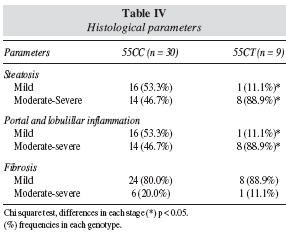
<body><![CDATA[<p align="center"><a name="t3"><img src="/img/revistas/nh/v25n4/original4_t3.gif" align="top"></a></font></p>     <p>&nbsp;</p>     <p><font face="Verdana" size="2"><a href="#t4">Table IV</a> shows the histological lesions in relation to both genotypes. Patients with mutant type group presented more moderate-severe inflammation (portal and lobulillar) (88.9%) in liver biopsy compared to patient with wild genotype (46.7%). Mutant type group had more moderate-severe steatosis (88.9%) than wild type group (46.7%).</font></p>     <p align="center"><a name="t4"><img src="/img/revistas/nh/v25n4/original4_t4.gif" align="top"></a></font></p>     <p>&nbsp;</p>     <p><font face="Verdana" size="2">Patients with moderate-severe steatosis had higher levels of insulin (15.8 &plusmn; 7.7 mUI/L vs 10.4 &plusmn; 4.7 mUI/L: p &lt; 0.05) and HOMA (4.2 &plusmn; 2.2 <i>vs</i> 2.6 &plusmn; 1.7: p &lt; 0.05) than patients with mild steatosis. Adiponectin levels were higher in patients with mild steatosis (42.2 &plusmn; 24.2 ug/ml vs 26.3 &plusmn; 57.0 ug/ml: p &lt; 0.05).</font></p>     <p><font face="Verdana" size="2">Patients with moderate-severe inflammation had higher levels of insulin (14.9 &plusmn; 7.8 mUI/L vs 11.3 &plusmn; 5.1 mUI/L: p &lt; 0.05) and HOMA (4.1 &plusmn; 2.3 vs 2.9 &plusmn; 1.7: p &lt; 0.05) than patients with mild inflammation. Adiponectin levels were higher in patients with mild inflammation (40.5 &plusmn; 25.9 ug/ml vs 27.7 &plusmn; 26.1 ug/ml: p &lt; 0.05).</font></p>     <p>&nbsp;</p>     <p><font face="Verdana" size="2"><b>Discussion</b></font></p>     <p><font face="Verdana" size="2">The ubiquitous expression of UCP2, the expression of UCP3 in skeletal muscle, and their homology with UCP1 made UCP3 attractive targets for studies on obesity patients and its relation with biochemical and anthropometric parameters in NAFLD patients.<sup>24</sup> UCP3 is involved in thermogenesis through the uncoupling of oxidative phosphorylation in skeletal muscle.</font></p>     ]]></body>
<body><![CDATA[<p><font face="Verdana" size="2">The C/C genotype of the polymorphism in the UCP3 promotor (-55C-&gt; T) is associated with obesity. The frequency of C to T variant at -55 of the UCP3 gen was evaluated, frequency of the T allele was 26% among obese draftees and 26.9% in the control group.<sup>25</sup> Our group had similar prevalence, without differences in weight or other anthropometric parameters between wild and mutant type groups. However, Liu et al.<sup>26</sup> found statistically association and linkage between - 55CT and BMI, and subjects carrying the T allele had an average of 3.5% lower BMI than those without it. In the study by Cassell et al.<sup>27</sup> the waist to hip ratio was higher in females carrying the UCP3 gene -55CT polymorphism, but BMI was no different in both groups. However, other study has demonstrated a lower risk of obesity in UCP3 -55 C/T carriers.<sup>15 </sup>These contradictories data has not a clear explanation, perhaps other unknown interactions between genotype and environment could modulate the results of UCP3's studies. A second hypothesis to explain the different frequency of the minor allele UCP3-55T and the lack of association with obesity, a possibility is that the genotyping methods did not produce accurate results and a second method to assess accuracy has not been realized.</font></p>     <p><font face="Verdana" size="2">In our population, adiponectin was higher in wild type group with better insulin and HOMA levels than mutant type group; this is a novel result in the literature without a clear explanation. Perhaps the presence of mutant allele of UCP could produce a more proimflammatory state, for instance in skeletal muscle and adipose tissue may modified the production of cytokines. For example, Meirhaeghe et al.<sup>14</sup> have detected that TT genotype had a worse lipid profile than subjects bearing wild or heterozygous genotypes.</font></p>     <p><font face="Verdana" size="2">The other novel finding of our study is the relationship of UCP3 -55CT polymorphism with moderatesevere inflammation and steatosis on liver biopsy. Perhaps, the explanation of this relation is the high levels of insulin and insulin resistance in mutant type group patients. Marchesini et al.<sup>28</sup> demonstrated a closely correlation between insulin resitance (HOMA) and NAFLD, too. Other authors have been detected this relation using the clamp technique<sup>29-31</sup> with results supporting our conclusions.</font></p>     <p><font face="Verdana" size="2">In our study, adiponectin may protect against inflammation and steatosis also through its anti-inflammatory action. Adiponectin inhibits liver TNF alpha expression and also inhibits expression of several cytokines in hepatic stellate cells.<sup>32</sup> Serum adiponectin levels are reduced with insulin resistance,<sup>33</sup> this relation was detected in our study, patients with moderate-severe steatosis and inflammation had higher levels of insulin, HOMA and lower levels pf adiponectin than patients with mild steatosis and inflammation.</font></p>     <p><font face="Verdana" size="2">In conclusion, -55CT genotype is associated with high insulin resistance and low adiponectin levels than -55CC genotype. Patients with -55CT genotype have more frequently moderate-severe steatosis and inflammation than -55CC genotype. Adiponectin and insulin resistance may be the biochemical nexus.</font></p>     <p>&nbsp;</p>     <p><font face="Verdana" size="2"><b>Referencias</b></font></p>     <!-- ref --><p><font face="Verdana" size="2">1. Ludwig J, Viggiano TR, McGill DB, Oh BJ. Nonalcoholic steatohepatitis: Mayo Clinic experiences with a hitherto unnamed disease. Mayo Clinic Proc 1980; 55: 434-8.</font>&nbsp;&nbsp;&nbsp;&nbsp;&nbsp;&nbsp;&nbsp;&nbsp;[&#160;<a href="javascript:void(0);" onclick="javascript: window.open('/scielo.php?script=sci_nlinks&ref=3588390&pid=S0212-1611201000040000800001&lng=','','width=640,height=500,resizable=yes,scrollbars=1,menubar=yes,');">Links</a>&#160;]<!-- end-ref --><!-- ref --><p><font face="Verdana" size="2">2. Kral JG, Schaffner F, Pierson RN, Wang J: Body fat topography as an independent predictor of fatty liver. Metabolism 1993; 42: 548-51.</font>&nbsp;&nbsp;&nbsp;&nbsp;&nbsp;&nbsp;&nbsp;&nbsp;[&#160;<a href="javascript:void(0);" onclick="javascript: window.open('/scielo.php?script=sci_nlinks&ref=3588391&pid=S0212-1611201000040000800002&lng=','','width=640,height=500,resizable=yes,scrollbars=1,menubar=yes,');">Links</a>&#160;]<!-- end-ref --><!-- ref --><p><font face="Verdana" size="2">3. Aller R, de Luis DA, Fernadez L, Caller F, Velayos B, Olcoz JL, Izaola O, Gonzalez Sagrado M, Conde R, Gonzalez JM. Influence of insulin resistance and adipokines in the grade of steatosis of non-alcoholic fatty liver disease. Dig Dis Sci 2008; 53: 1088-92.</font>&nbsp;&nbsp;&nbsp;&nbsp;&nbsp;&nbsp;&nbsp;&nbsp;[&#160;<a href="javascript:void(0);" onclick="javascript: window.open('/scielo.php?script=sci_nlinks&ref=3588392&pid=S0212-1611201000040000800003&lng=','','width=640,height=500,resizable=yes,scrollbars=1,menubar=yes,');">Links</a>&#160;]<!-- end-ref --><!-- ref --><p><font face="Verdana" size="2">4. Marceau P, Biron S, Hould FS, Marceau S, Simard S, Thung SN, Kral JG: Liver pathology and the metabolic syndrome X in severe obesity. J Clin Endocrinol Metab 1999; 84: 1513-7.</font>&nbsp;&nbsp;&nbsp;&nbsp;&nbsp;&nbsp;&nbsp;&nbsp;[&#160;<a href="javascript:void(0);" onclick="javascript: window.open('/scielo.php?script=sci_nlinks&ref=3588393&pid=S0212-1611201000040000800004&lng=','','width=640,height=500,resizable=yes,scrollbars=1,menubar=yes,');">Links</a>&#160;]<!-- end-ref --><!-- ref --><p><font face="Verdana" size="2">5. Hui JM, Hodge A, Farrell GC, Kench JG, Kriketos A, George J. Beyond insulin resistance in NASH: TNF-alpha or adiponectin? Hepatology 2004; 40: 46-54.</font>&nbsp;&nbsp;&nbsp;&nbsp;&nbsp;&nbsp;&nbsp;&nbsp;[&#160;<a href="javascript:void(0);" onclick="javascript: window.open('/scielo.php?script=sci_nlinks&ref=3588394&pid=S0212-1611201000040000800005&lng=','','width=640,height=500,resizable=yes,scrollbars=1,menubar=yes,');">Links</a>&#160;]<!-- end-ref --><!-- ref --><p><font face="Verdana" size="2">6. Newberry EP, Xie Y, Kennedy SM, Luo J, Davidson NO. Protection against Western diet-induced obesity and hepatic steatosis in liver fatty acid-binding protein knockout mice. Hepatology 2006: 44: 1191-205.</font>&nbsp;&nbsp;&nbsp;&nbsp;&nbsp;&nbsp;&nbsp;&nbsp;[&#160;<a href="javascript:void(0);" onclick="javascript: window.open('/scielo.php?script=sci_nlinks&ref=3588395&pid=S0212-1611201000040000800006&lng=','','width=640,height=500,resizable=yes,scrollbars=1,menubar=yes,');">Links</a>&#160;]<!-- end-ref --><!-- ref --><p><font face="Verdana" size="2">7. Bouchard C, Perusse L, Chagnon YC, Warden C, Ricquier D. Linkage between markers in the vicinity of uncoupling protein 2 gene and resisting metabolic rate in humans. Hum Mol Gent 1997; 6: 1887-9.</font>&nbsp;&nbsp;&nbsp;&nbsp;&nbsp;&nbsp;&nbsp;&nbsp;[&#160;<a href="javascript:void(0);" onclick="javascript: window.open('/scielo.php?script=sci_nlinks&ref=3588396&pid=S0212-1611201000040000800007&lng=','','width=640,height=500,resizable=yes,scrollbars=1,menubar=yes,');">Links</a>&#160;]<!-- end-ref --><!-- ref --><p><font face="Verdana" size="2">8. Clapham J, Arch J, Chapman H et al. Mice over expressing human uncoupling protein 3 in skeletal muscle are hyperphagic lean. Nature 2000; 406: 415-8.</font>&nbsp;&nbsp;&nbsp;&nbsp;&nbsp;&nbsp;&nbsp;&nbsp;[&#160;<a href="javascript:void(0);" onclick="javascript: window.open('/scielo.php?script=sci_nlinks&ref=3588397&pid=S0212-1611201000040000800008&lng=','','width=640,height=500,resizable=yes,scrollbars=1,menubar=yes,');">Links</a>&#160;]<!-- end-ref --><!-- ref --><p><font face="Verdana" size="2">9. Samec S, Seydoux J, Dullo A. Role of UCP homologues in skeletal muscles and brown adipose tissue: mediators of thermogenesis or regulators of lipids as fuel substrate? FASEB J 1998; 12: 715-24.</font>&nbsp;&nbsp;&nbsp;&nbsp;&nbsp;&nbsp;&nbsp;&nbsp;[&#160;<a href="javascript:void(0);" onclick="javascript: window.open('/scielo.php?script=sci_nlinks&ref=3588398&pid=S0212-1611201000040000800009&lng=','','width=640,height=500,resizable=yes,scrollbars=1,menubar=yes,');">Links</a>&#160;]<!-- end-ref --><!-- ref --><p><font face="Verdana" size="2">10. De Luis DA, Aller R, Izaola O, Gonz&aacute;lez Sagrado M, Conde R. Modulation of insulin concentrations and metabolic parameters in obese patients by -55CT polymorphism of the UCP3 gene secondary to two hypocaloric diets. Horm Metab Res 2009; 41: 62-6.</font>&nbsp;&nbsp;&nbsp;&nbsp;&nbsp;&nbsp;&nbsp;&nbsp;[&#160;<a href="javascript:void(0);" onclick="javascript: window.open('/scielo.php?script=sci_nlinks&ref=3588399&pid=S0212-1611201000040000800010&lng=','','width=640,height=500,resizable=yes,scrollbars=1,menubar=yes,');">Links</a>&#160;]<!-- end-ref --><!-- ref --><p><font face="Verdana" size="2">11. De Luis DA, Gonz&aacute;lez Sagrado M, Conde R, Aller R, Izaola O. Lack of association of -55ct polymorphism of UCP3 gene with fat distribution in obese patients. Ann Nutr Metab 2007; 51: 374-8.</font>&nbsp;&nbsp;&nbsp;&nbsp;&nbsp;&nbsp;&nbsp;&nbsp;[&#160;<a href="javascript:void(0);" onclick="javascript: window.open('/scielo.php?script=sci_nlinks&ref=3588400&pid=S0212-1611201000040000800011&lng=','','width=640,height=500,resizable=yes,scrollbars=1,menubar=yes,');">Links</a>&#160;]<!-- end-ref --><!-- ref --><p><font face="Verdana" size="2">12. Schrauwen P, Xia J, Walder K, Snitker S, Ravussin E. A novel polymorphism in the proximal UCP3 promoter region: effect on skeletal muscle. UCP3 m RNA expression and obesity in male non-diabetic Pima Indians. Int J Obes 1999; 23: 1242-5.</font>&nbsp;&nbsp;&nbsp;&nbsp;&nbsp;&nbsp;&nbsp;&nbsp;[&#160;<a href="javascript:void(0);" onclick="javascript: window.open('/scielo.php?script=sci_nlinks&ref=3588401&pid=S0212-1611201000040000800012&lng=','','width=640,height=500,resizable=yes,scrollbars=1,menubar=yes,');">Links</a>&#160;]<!-- end-ref --><!-- ref --><p><font face="Verdana" size="2">13. Otabe S, Clement K, Dina C et al. A genetic variation in the 5'flanking region of the UCP3 is associated with body mass index in humans in interaction with physical activity. Diabetologia 2000: 43: 245-9.</font>&nbsp;&nbsp;&nbsp;&nbsp;&nbsp;&nbsp;&nbsp;&nbsp;[&#160;<a href="javascript:void(0);" onclick="javascript: window.open('/scielo.php?script=sci_nlinks&ref=3588402&pid=S0212-1611201000040000800013&lng=','','width=640,height=500,resizable=yes,scrollbars=1,menubar=yes,');">Links</a>&#160;]<!-- end-ref --><!-- ref --><p><font face="Verdana" size="2">14. Meirhaeghe A, Amouyel P, Helbecque N et al. An uncoupling protein 3 gene polymorphism associated with a lower risk of developing type 2 diabetes and with atherogenic lipid profile in a French cohort. Diabetologia 2000: 43: 1424-8.</font>&nbsp;&nbsp;&nbsp;&nbsp;&nbsp;&nbsp;&nbsp;&nbsp;[&#160;<a href="javascript:void(0);" onclick="javascript: window.open('/scielo.php?script=sci_nlinks&ref=3588403&pid=S0212-1611201000040000800014&lng=','','width=640,height=500,resizable=yes,scrollbars=1,menubar=yes,');">Links</a>&#160;]<!-- end-ref --><!-- ref --><p><font face="Verdana" size="2">15. Alonso A, Marti A, Corbalan MS, Mart&iacute;nez Gonz&aacute;lez MA, Forga L, Mart&iacute;nez JA. Association of UCP3 gene -55CT polymorphism and obesity in a Spanish population. Ann Nutr Metab 2005; 49: 183-8.</font>&nbsp;&nbsp;&nbsp;&nbsp;&nbsp;&nbsp;&nbsp;&nbsp;[&#160;<a href="javascript:void(0);" onclick="javascript: window.open('/scielo.php?script=sci_nlinks&ref=3588404&pid=S0212-1611201000040000800015&lng=','','width=640,height=500,resizable=yes,scrollbars=1,menubar=yes,');">Links</a>&#160;]<!-- end-ref --><!-- ref --><p><font face="Verdana" size="2">16. Brunt EM. Nonalcoholic steatohepatitis: definition and pathology. Semin Liver Dis 2001; 21: 3-16.</font>&nbsp;&nbsp;&nbsp;&nbsp;&nbsp;&nbsp;&nbsp;&nbsp;[&#160;<a href="javascript:void(0);" onclick="javascript: window.open('/scielo.php?script=sci_nlinks&ref=3588405&pid=S0212-1611201000040000800016&lng=','','width=640,height=500,resizable=yes,scrollbars=1,menubar=yes,');">Links</a>&#160;]<!-- end-ref --><!-- ref --><p><font face="Verdana" size="2">17. Duart MJ, Arroyo CO, Moreno JL. Validation of a insulin model for the reactions in RIA. Clin Chem Lab Med 2002; 40: 1161-7.</font>&nbsp;&nbsp;&nbsp;&nbsp;&nbsp;&nbsp;&nbsp;&nbsp;[&#160;<a href="javascript:void(0);" onclick="javascript: window.open('/scielo.php?script=sci_nlinks&ref=3588406&pid=S0212-1611201000040000800017&lng=','','width=640,height=500,resizable=yes,scrollbars=1,menubar=yes,');">Links</a>&#160;]<!-- end-ref --><!-- ref --><p><font face="Verdana" size="2">18. Mathews DR, Hosker JP, Rudenski AS, Naylor BA, Treacher DF, Pedersen O. Homeostasis model assessment: insulin resistance and beta cell function from fasting plasma glucose and insulin concentrations in man. Diabetologia 1985; 28: 412-4.</font>&nbsp;&nbsp;&nbsp;&nbsp;&nbsp;&nbsp;&nbsp;&nbsp;[&#160;<a href="javascript:void(0);" onclick="javascript: window.open('/scielo.php?script=sci_nlinks&ref=3588407&pid=S0212-1611201000040000800018&lng=','','width=640,height=500,resizable=yes,scrollbars=1,menubar=yes,');">Links</a>&#160;]<!-- end-ref --><!-- ref --><p><font face="Verdana" size="2">19. Pfutzner A, Langefeld M, Kunt T, Lobig M. Evaluation of human resistin assays with serum from patients with type 2 diabetes and different degrees of insulin resistance. Clin lab 2003; 49: 571-6.</font>&nbsp;&nbsp;&nbsp;&nbsp;&nbsp;&nbsp;&nbsp;&nbsp;[&#160;<a href="javascript:void(0);" onclick="javascript: window.open('/scielo.php?script=sci_nlinks&ref=3588408&pid=S0212-1611201000040000800019&lng=','','width=640,height=500,resizable=yes,scrollbars=1,menubar=yes,');">Links</a>&#160;]<!-- end-ref --><!-- ref --><p><font face="Verdana" size="2">20. Meier U, Gressner M. Endocrine regulation of energy metabolis: review of pathobiochemical and clinical chemical aspects of leptin, Ghrelin, adiponectin, and resistin. Clinical Chemistry 2004; 50: 1511-25.</font>&nbsp;&nbsp;&nbsp;&nbsp;&nbsp;&nbsp;&nbsp;&nbsp;[&#160;<a href="javascript:void(0);" onclick="javascript: window.open('/scielo.php?script=sci_nlinks&ref=3588409&pid=S0212-1611201000040000800020&lng=','','width=640,height=500,resizable=yes,scrollbars=1,menubar=yes,');">Links</a>&#160;]<!-- end-ref --><!-- ref --><p><font face="Verdana" size="2">21. Suominen P. evaluation of an enzyme immunometric assay to measure serum adiponectin concentrations. Clin Chem 2004; 50: 219-21.</font>&nbsp;&nbsp;&nbsp;&nbsp;&nbsp;&nbsp;&nbsp;&nbsp;[&#160;<a href="javascript:void(0);" onclick="javascript: window.open('/scielo.php?script=sci_nlinks&ref=3588410&pid=S0212-1611201000040000800021&lng=','','width=640,height=500,resizable=yes,scrollbars=1,menubar=yes,');">Links</a>&#160;]<!-- end-ref --><!-- ref --><p><font face="Verdana" size="2">22. Lubrano V, Cocci F, Battaglia D, Papa A. Usefulness of high -sensitivity IL6 measurmentbfor clinical characterization of patients with coronary artery disease. J Clin Lab Anal 2005; 19: 110-4.</font>&nbsp;&nbsp;&nbsp;&nbsp;&nbsp;&nbsp;&nbsp;&nbsp;[&#160;<a href="javascript:void(0);" onclick="javascript: window.open('/scielo.php?script=sci_nlinks&ref=3588411&pid=S0212-1611201000040000800022&lng=','','width=640,height=500,resizable=yes,scrollbars=1,menubar=yes,');">Links</a>&#160;]<!-- end-ref --><!-- ref --><p><font face="Verdana" size="2">23. Khan SS, Smith MS, reda D, Suffredini AF, Mc Coy JP. Multiplex bead array assays for detection of soluble cytokines: comparisons of sensitivity and quantitative values among kits from multiple manufactures. Cytometry B Clin Cytom 2004; 61: 35-9.</font>&nbsp;&nbsp;&nbsp;&nbsp;&nbsp;&nbsp;&nbsp;&nbsp;[&#160;<a href="javascript:void(0);" onclick="javascript: window.open('/scielo.php?script=sci_nlinks&ref=3588412&pid=S0212-1611201000040000800023&lng=','','width=640,height=500,resizable=yes,scrollbars=1,menubar=yes,');">Links</a>&#160;]<!-- end-ref --><!-- ref --><p><font face="Verdana" size="2">24. Hesselink MKC, Mensink M, Schrauwen. Human uncoupling protein-3 and obesity. Obesity Research 2003; 11; 1429-40.</font>&nbsp;&nbsp;&nbsp;&nbsp;&nbsp;&nbsp;&nbsp;&nbsp;[&#160;<a href="javascript:void(0);" onclick="javascript: window.open('/scielo.php?script=sci_nlinks&ref=3588413&pid=S0212-1611201000040000800024&lng=','','width=640,height=500,resizable=yes,scrollbars=1,menubar=yes,');">Links</a>&#160;]<!-- end-ref --><!-- ref --><p><font face="Verdana" size="2">25. Dalgaard LT, Sorensen TIA, Drivshom T, Borch Johnsen K, Andersen T, Hansen T. A prevalent polymorphism in the promoter of the UCP3 gene and its relationship to body mass index and long term body weight change in the Danish population. J Clin Endoc Metab 2001; 86: 1398-402.</font>&nbsp;&nbsp;&nbsp;&nbsp;&nbsp;&nbsp;&nbsp;&nbsp;[&#160;<a href="javascript:void(0);" onclick="javascript: window.open('/scielo.php?script=sci_nlinks&ref=3588414&pid=S0212-1611201000040000800025&lng=','','width=640,height=500,resizable=yes,scrollbars=1,menubar=yes,');">Links</a>&#160;]<!-- end-ref --><!-- ref --><p><font face="Verdana" size="2">26. Liu YJ, Liu PY, Long J, Lu Y, Elze L, Recker RR, Deng HW. Linkage and association analyses of the UCP3 gene with obesity phenotypes in Caucasian families. Physiol Genomics 2005; 22: 197-203.</font>&nbsp;&nbsp;&nbsp;&nbsp;&nbsp;&nbsp;&nbsp;&nbsp;[&#160;<a href="javascript:void(0);" onclick="javascript: window.open('/scielo.php?script=sci_nlinks&ref=3588415&pid=S0212-1611201000040000800026&lng=','','width=640,height=500,resizable=yes,scrollbars=1,menubar=yes,');">Links</a>&#160;]<!-- end-ref --><!-- ref --><p><font face="Verdana" size="2">27. Cassell PG, Saker PJ, Huxtable SJ, Kousta E, Jackson AE, Hattersle AT. Evidence that single nucleotide polymorphism in the uncoupling protein 3 gene influences fat distribution in women of European and Asian origin. Diabetologia 2000; 43: 1558-64.</font>&nbsp;&nbsp;&nbsp;&nbsp;&nbsp;&nbsp;&nbsp;&nbsp;[&#160;<a href="javascript:void(0);" onclick="javascript: window.open('/scielo.php?script=sci_nlinks&ref=3588416&pid=S0212-1611201000040000800027&lng=','','width=640,height=500,resizable=yes,scrollbars=1,menubar=yes,');">Links</a>&#160;]<!-- end-ref --><!-- ref --><p><font face="Verdana" size="2">28. Marchesini G, Brizi M, Morselli-Labate A, Bianchi G, Bugianesi E, McCullough AJ: Association of nonalcoholic fatty liver disease with insulin resistance. Am J of Medicine 1999; 107: 450-4.</font>&nbsp;&nbsp;&nbsp;&nbsp;&nbsp;&nbsp;&nbsp;&nbsp;[&#160;<a href="javascript:void(0);" onclick="javascript: window.open('/scielo.php?script=sci_nlinks&ref=3588417&pid=S0212-1611201000040000800028&lng=','','width=640,height=500,resizable=yes,scrollbars=1,menubar=yes,');">Links</a>&#160;]<!-- end-ref --><!-- ref --><p><font face="Verdana" size="2">29. Sanyal AJ, Campbell Sargent C, Mirshashi F, Rizzo WB, Contos MJ, Sterling RK, Luketic VA: Nonalcoholic steatohepatitis: association of insulin resistance and mitochondrial abnormalities. Gastroenterology 2001; 120: 1183-92.</font>&nbsp;&nbsp;&nbsp;&nbsp;&nbsp;&nbsp;&nbsp;&nbsp;[&#160;<a href="javascript:void(0);" onclick="javascript: window.open('/scielo.php?script=sci_nlinks&ref=3588418&pid=S0212-1611201000040000800029&lng=','','width=640,height=500,resizable=yes,scrollbars=1,menubar=yes,');">Links</a>&#160;]<!-- end-ref --><!-- ref --><p><font face="Verdana" size="2">30. Rashid M, Roberts EA: Nonalcoholic steatohepatitis in children. J Pediatr Gastroenterol Nutr 2000; 30: 48-53.</font>&nbsp;&nbsp;&nbsp;&nbsp;&nbsp;&nbsp;&nbsp;&nbsp;[&#160;<a href="javascript:void(0);" onclick="javascript: window.open('/scielo.php?script=sci_nlinks&ref=3588419&pid=S0212-1611201000040000800030&lng=','','width=640,height=500,resizable=yes,scrollbars=1,menubar=yes,');">Links</a>&#160;]<!-- end-ref --><!-- ref --><p><font face="Verdana" size="2">31. Chitturi S, Abeygunasekera S, Farrell G, Holmes-Walker J: NASH and insulin resistance: insulin hypersecretion and specific association with the insulin resistance syndrome. Hepatology 2002; 73: 373-8.</font>&nbsp;&nbsp;&nbsp;&nbsp;&nbsp;&nbsp;&nbsp;&nbsp;[&#160;<a href="javascript:void(0);" onclick="javascript: window.open('/scielo.php?script=sci_nlinks&ref=3588420&pid=S0212-1611201000040000800031&lng=','','width=640,height=500,resizable=yes,scrollbars=1,menubar=yes,');">Links</a>&#160;]<!-- end-ref --><!-- ref --><p><font face="Verdana" size="2">32. Pagano C, Soardoo g, Esposito W, Fallo F, Basan L, Donnini D, Federspil G. Plasma adiponectin is decreased in nonalcoholic fatty liver disease. Eur J of endocrinology 2005; 152: 113-8.</font>&nbsp;&nbsp;&nbsp;&nbsp;&nbsp;&nbsp;&nbsp;&nbsp;[&#160;<a href="javascript:void(0);" onclick="javascript: window.open('/scielo.php?script=sci_nlinks&ref=3588421&pid=S0212-1611201000040000800032&lng=','','width=640,height=500,resizable=yes,scrollbars=1,menubar=yes,');">Links</a>&#160;]<!-- end-ref --><!-- ref --><p><font face="Verdana" size="2">33. Shklyaev S, Aslanidi G, Tennant M, Prima V, Kohlbrenner E, Kroutov V. Sustained peripheral expression of transgene adiponectin offsets the development of diet-induced obesity in rats. Proc Natl Acad Sci USA 2003; 100: 14217-22.</font>&nbsp;&nbsp;&nbsp;&nbsp;&nbsp;&nbsp;&nbsp;&nbsp;[&#160;<a href="javascript:void(0);" onclick="javascript: window.open('/scielo.php?script=sci_nlinks&ref=3588422&pid=S0212-1611201000040000800033&lng=','','width=640,height=500,resizable=yes,scrollbars=1,menubar=yes,');">Links</a>&#160;]<!-- end-ref --><p>&nbsp;</p>     <p>&nbsp;</p>     <p><font face="Verdana" size="2"><b><a name="back"></a><a href="#top"><img border="0" src="/img/revistas/nh/v25n4/seta.gif" width="15" height="17"></a>Correspondence:</b>    <br>Daniel Antonio de Luis Rom&aacute;n.    <br>Associated Professor of Nutrition.    <br>Executive Director of Institute of Endocrinology and Nutrition.    <br>Medicine School. Valladolid University.    <br>C/ Los Perales, 16.    <br>47130 Simancas. Valladolid. Spain.    <br>E-mail: <a href="mailto:dadluis@yahoo.es">dadluis@yahoo.es</a></font></p>     ]]></body>
<body><![CDATA[<p><font face="Verdana" size="2">Recibido: 25-VIII-2009.    <br>Aceptado: 26-VIII-2009.</font></p>      ]]></body><back>
<ref-list>
<ref id="B1">
<label>1</label><nlm-citation citation-type="journal">
<person-group person-group-type="author">
<name>
<surname><![CDATA[Ludwig]]></surname>
<given-names><![CDATA[J]]></given-names>
</name>
<name>
<surname><![CDATA[Viggiano]]></surname>
<given-names><![CDATA[TR]]></given-names>
</name>
<name>
<surname><![CDATA[McGill]]></surname>
<given-names><![CDATA[DB]]></given-names>
</name>
<name>
<surname><![CDATA[Oh]]></surname>
<given-names><![CDATA[BJ]]></given-names>
</name>
</person-group>
<article-title xml:lang="en"><![CDATA[Nonalcoholic steatohepatitis: Mayo Clinic experiences with a hitherto unnamed disease]]></article-title>
<source><![CDATA[Mayo Clinic Proc]]></source>
<year>1980</year>
<volume>55</volume>
<page-range>434-8</page-range></nlm-citation>
</ref>
<ref id="B2">
<label>2</label><nlm-citation citation-type="journal">
<person-group person-group-type="author">
<name>
<surname><![CDATA[Kral]]></surname>
<given-names><![CDATA[JG]]></given-names>
</name>
<name>
<surname><![CDATA[Schaffner]]></surname>
<given-names><![CDATA[F]]></given-names>
</name>
<name>
<surname><![CDATA[Pierson]]></surname>
<given-names><![CDATA[RN]]></given-names>
</name>
<name>
<surname><![CDATA[Wang]]></surname>
<given-names><![CDATA[J]]></given-names>
</name>
</person-group>
<article-title xml:lang="en"><![CDATA[Body fat topography as an independent predictor of fatty liver]]></article-title>
<source><![CDATA[Metabolism]]></source>
<year>1993</year>
<volume>42</volume>
<page-range>548-51</page-range></nlm-citation>
</ref>
<ref id="B3">
<label>3</label><nlm-citation citation-type="journal">
<person-group person-group-type="author">
<name>
<surname><![CDATA[Aller]]></surname>
<given-names><![CDATA[R]]></given-names>
</name>
<name>
<surname><![CDATA[de Luis]]></surname>
<given-names><![CDATA[DA]]></given-names>
</name>
<name>
<surname><![CDATA[Fernadez]]></surname>
<given-names><![CDATA[L]]></given-names>
</name>
<name>
<surname><![CDATA[Caller]]></surname>
<given-names><![CDATA[F]]></given-names>
</name>
<name>
<surname><![CDATA[Velayos]]></surname>
<given-names><![CDATA[B]]></given-names>
</name>
<name>
<surname><![CDATA[Olcoz]]></surname>
<given-names><![CDATA[JL]]></given-names>
</name>
<name>
<surname><![CDATA[Izaola]]></surname>
<given-names><![CDATA[O]]></given-names>
</name>
<name>
<surname><![CDATA[Gonzalez Sagrado]]></surname>
<given-names><![CDATA[M]]></given-names>
</name>
<name>
<surname><![CDATA[Conde]]></surname>
<given-names><![CDATA[R]]></given-names>
</name>
<name>
<surname><![CDATA[Gonzalez]]></surname>
<given-names><![CDATA[JM]]></given-names>
</name>
</person-group>
<article-title xml:lang="en"><![CDATA[Influence of insulin resistance and adipokines in the grade of steatosis of non-alcoholic fatty liver disease]]></article-title>
<source><![CDATA[Dig Dis Sci]]></source>
<year>2008</year>
<volume>53</volume>
<page-range>1088-92</page-range></nlm-citation>
</ref>
<ref id="B4">
<label>4</label><nlm-citation citation-type="journal">
<person-group person-group-type="author">
<name>
<surname><![CDATA[Marceau]]></surname>
<given-names><![CDATA[P]]></given-names>
</name>
<name>
<surname><![CDATA[Biron]]></surname>
<given-names><![CDATA[S]]></given-names>
</name>
<name>
<surname><![CDATA[Hould]]></surname>
<given-names><![CDATA[FS]]></given-names>
</name>
<name>
<surname><![CDATA[Marceau]]></surname>
<given-names><![CDATA[S]]></given-names>
</name>
<name>
<surname><![CDATA[Simard]]></surname>
<given-names><![CDATA[S]]></given-names>
</name>
<name>
<surname><![CDATA[Thung]]></surname>
<given-names><![CDATA[SN]]></given-names>
</name>
<name>
<surname><![CDATA[Kral]]></surname>
<given-names><![CDATA[JG]]></given-names>
</name>
</person-group>
<article-title xml:lang="en"><![CDATA[Liver pathology and the metabolic syndrome X in severe obesity]]></article-title>
<source><![CDATA[J Clin Endocrinol Metab]]></source>
<year>1999</year>
<volume>84</volume>
<page-range>1513-7</page-range></nlm-citation>
</ref>
<ref id="B5">
<label>5</label><nlm-citation citation-type="journal">
<person-group person-group-type="author">
<name>
<surname><![CDATA[Hui]]></surname>
<given-names><![CDATA[JM]]></given-names>
</name>
<name>
<surname><![CDATA[Hodge]]></surname>
<given-names><![CDATA[A]]></given-names>
</name>
<name>
<surname><![CDATA[Farrell]]></surname>
<given-names><![CDATA[GC]]></given-names>
</name>
<name>
<surname><![CDATA[Kench]]></surname>
<given-names><![CDATA[JG]]></given-names>
</name>
<name>
<surname><![CDATA[Kriketos]]></surname>
<given-names><![CDATA[A]]></given-names>
</name>
<name>
<surname><![CDATA[George]]></surname>
<given-names><![CDATA[J]]></given-names>
</name>
</person-group>
<article-title xml:lang="en"><![CDATA[Beyond insulin resistance in NASH: TNF-alpha or adiponectin?]]></article-title>
<source><![CDATA[Hepatology]]></source>
<year>2004</year>
<volume>40</volume>
<page-range>46-54</page-range></nlm-citation>
</ref>
<ref id="B6">
<label>6</label><nlm-citation citation-type="journal">
<person-group person-group-type="author">
<name>
<surname><![CDATA[Newberry]]></surname>
<given-names><![CDATA[EP]]></given-names>
</name>
<name>
<surname><![CDATA[Xie]]></surname>
<given-names><![CDATA[Y]]></given-names>
</name>
<name>
<surname><![CDATA[Kennedy]]></surname>
<given-names><![CDATA[SM]]></given-names>
</name>
<name>
<surname><![CDATA[Luo]]></surname>
<given-names><![CDATA[J]]></given-names>
</name>
<name>
<surname><![CDATA[Davidson]]></surname>
<given-names><![CDATA[NO]]></given-names>
</name>
</person-group>
<article-title xml:lang="en"><![CDATA[Protection against Western diet-induced obesity and hepatic steatosis in liver fatty acid-binding protein knockout mice]]></article-title>
<source><![CDATA[Hepatology]]></source>
<year>2006</year>
<volume>44</volume>
<page-range>1191-205</page-range></nlm-citation>
</ref>
<ref id="B7">
<label>7</label><nlm-citation citation-type="journal">
<person-group person-group-type="author">
<name>
<surname><![CDATA[Bouchard]]></surname>
<given-names><![CDATA[C]]></given-names>
</name>
<name>
<surname><![CDATA[Perusse]]></surname>
<given-names><![CDATA[L]]></given-names>
</name>
<name>
<surname><![CDATA[Chagnon]]></surname>
<given-names><![CDATA[YC]]></given-names>
</name>
<name>
<surname><![CDATA[Warden]]></surname>
<given-names><![CDATA[C]]></given-names>
</name>
<name>
<surname><![CDATA[Ricquier]]></surname>
<given-names><![CDATA[D]]></given-names>
</name>
</person-group>
<article-title xml:lang="en"><![CDATA[Linkage between markers in the vicinity of uncoupling protein 2 gene and resisting metabolic rate in humans]]></article-title>
<source><![CDATA[Hum Mol Gent]]></source>
<year>1997</year>
<volume>6</volume>
<page-range>1887-9</page-range></nlm-citation>
</ref>
<ref id="B8">
<label>8</label><nlm-citation citation-type="journal">
<person-group person-group-type="author">
<name>
<surname><![CDATA[Clapham]]></surname>
<given-names><![CDATA[J]]></given-names>
</name>
<name>
<surname><![CDATA[Arch]]></surname>
<given-names><![CDATA[J]]></given-names>
</name>
<name>
<surname><![CDATA[Chapman]]></surname>
<given-names><![CDATA[H]]></given-names>
</name>
</person-group>
<article-title xml:lang="en"><![CDATA[Mice over expressing human uncoupling protein 3 in skeletal muscle are hyperphagic lean]]></article-title>
<source><![CDATA[Nature]]></source>
<year>2000</year>
<volume>406</volume>
<page-range>415-8</page-range></nlm-citation>
</ref>
<ref id="B9">
<label>9</label><nlm-citation citation-type="journal">
<person-group person-group-type="author">
<name>
<surname><![CDATA[Samec]]></surname>
<given-names><![CDATA[S]]></given-names>
</name>
<name>
<surname><![CDATA[Seydoux]]></surname>
<given-names><![CDATA[J]]></given-names>
</name>
<name>
<surname><![CDATA[Dullo]]></surname>
<given-names><![CDATA[A]]></given-names>
</name>
</person-group>
<article-title xml:lang="en"><![CDATA[Role of UCP homologues in skeletal muscles and brown adipose tissue: mediators of thermogenesis or regulators of lipids as fuel substrate?]]></article-title>
<source><![CDATA[FASEB J]]></source>
<year>1998</year>
<volume>12</volume>
<page-range>715-24</page-range></nlm-citation>
</ref>
<ref id="B10">
<label>10</label><nlm-citation citation-type="journal">
<person-group person-group-type="author">
<name>
<surname><![CDATA[De Luis]]></surname>
<given-names><![CDATA[DA]]></given-names>
</name>
<name>
<surname><![CDATA[Aller]]></surname>
<given-names><![CDATA[R]]></given-names>
</name>
<name>
<surname><![CDATA[Izaola]]></surname>
<given-names><![CDATA[O]]></given-names>
</name>
<name>
<surname><![CDATA[González Sagrado]]></surname>
<given-names><![CDATA[M]]></given-names>
</name>
<name>
<surname><![CDATA[Conde]]></surname>
<given-names><![CDATA[R]]></given-names>
</name>
</person-group>
<article-title xml:lang="en"><![CDATA[Modulation of insulin concentrations and metabolic parameters in obese patients by -55CT polymorphism of the UCP3 gene secondary to two hypocaloric diets]]></article-title>
<source><![CDATA[Horm Metab Res]]></source>
<year>2009</year>
<volume>41</volume>
<page-range>62-6</page-range></nlm-citation>
</ref>
<ref id="B11">
<label>11</label><nlm-citation citation-type="journal">
<person-group person-group-type="author">
<name>
<surname><![CDATA[De Luis]]></surname>
<given-names><![CDATA[DA]]></given-names>
</name>
<name>
<surname><![CDATA[González Sagrado]]></surname>
<given-names><![CDATA[M]]></given-names>
</name>
<name>
<surname><![CDATA[Conde]]></surname>
<given-names><![CDATA[R]]></given-names>
</name>
<name>
<surname><![CDATA[Aller]]></surname>
<given-names><![CDATA[R]]></given-names>
</name>
<name>
<surname><![CDATA[Izaola]]></surname>
<given-names><![CDATA[O]]></given-names>
</name>
</person-group>
<article-title xml:lang="en"><![CDATA[Lack of association of -55ct polymorphism of UCP3 gene with fat distribution in obese patients]]></article-title>
<source><![CDATA[Ann Nutr Metab]]></source>
<year>2007</year>
<volume>51</volume>
<page-range>374-8</page-range></nlm-citation>
</ref>
<ref id="B12">
<label>12</label><nlm-citation citation-type="journal">
<person-group person-group-type="author">
<name>
<surname><![CDATA[Schrauwen]]></surname>
<given-names><![CDATA[P]]></given-names>
</name>
<name>
<surname><![CDATA[Xia]]></surname>
<given-names><![CDATA[J]]></given-names>
</name>
<name>
<surname><![CDATA[Walder]]></surname>
<given-names><![CDATA[K]]></given-names>
</name>
<name>
<surname><![CDATA[Snitker]]></surname>
<given-names><![CDATA[S]]></given-names>
</name>
<name>
<surname><![CDATA[Ravussin]]></surname>
<given-names><![CDATA[E]]></given-names>
</name>
</person-group>
<article-title xml:lang="en"><![CDATA[A novel polymorphism in the proximal UCP3 promoter region: effect on skeletal muscle. UCP3 m RNA expression and obesity in male non-diabetic Pima Indians]]></article-title>
<source><![CDATA[Int J Obes]]></source>
<year>1999</year>
<volume>23</volume>
<page-range>1242-5</page-range></nlm-citation>
</ref>
<ref id="B13">
<label>13</label><nlm-citation citation-type="journal">
<person-group person-group-type="author">
<name>
<surname><![CDATA[Otabe]]></surname>
<given-names><![CDATA[S]]></given-names>
</name>
<name>
<surname><![CDATA[Clement]]></surname>
<given-names><![CDATA[K]]></given-names>
</name>
<name>
<surname><![CDATA[Dina]]></surname>
<given-names><![CDATA[C]]></given-names>
</name>
</person-group>
<article-title xml:lang="en"><![CDATA[A genetic variation in the 5'flanking region of the UCP3 is associated with body mass index in humans in interaction with physical activity]]></article-title>
<source><![CDATA[Diabetologia]]></source>
<year>2000</year>
<volume>43</volume>
<page-range>245-9</page-range></nlm-citation>
</ref>
<ref id="B14">
<label>14</label><nlm-citation citation-type="journal">
<person-group person-group-type="author">
<name>
<surname><![CDATA[Meirhaeghe]]></surname>
<given-names><![CDATA[A]]></given-names>
</name>
<name>
<surname><![CDATA[Amouyel]]></surname>
<given-names><![CDATA[P]]></given-names>
</name>
<name>
<surname><![CDATA[Helbecque]]></surname>
<given-names><![CDATA[N]]></given-names>
</name>
</person-group>
<article-title xml:lang="en"><![CDATA[An uncoupling protein 3 gene polymorphism associated with a lower risk of developing type 2 diabetes and with atherogenic lipid profile in a French cohort]]></article-title>
<source><![CDATA[Diabetologia]]></source>
<year>2000</year>
<volume>43</volume>
<page-range>1424-8</page-range></nlm-citation>
</ref>
<ref id="B15">
<label>15</label><nlm-citation citation-type="journal">
<person-group person-group-type="author">
<name>
<surname><![CDATA[Alonso]]></surname>
<given-names><![CDATA[A]]></given-names>
</name>
<name>
<surname><![CDATA[Marti]]></surname>
<given-names><![CDATA[A]]></given-names>
</name>
<name>
<surname><![CDATA[Corbalan]]></surname>
<given-names><![CDATA[MS]]></given-names>
</name>
<name>
<surname><![CDATA[Martínez González]]></surname>
<given-names><![CDATA[MA]]></given-names>
</name>
<name>
<surname><![CDATA[Forga]]></surname>
<given-names><![CDATA[L]]></given-names>
</name>
<name>
<surname><![CDATA[Martínez]]></surname>
<given-names><![CDATA[JA]]></given-names>
</name>
</person-group>
<article-title xml:lang="en"><![CDATA[Association of UCP3 gene -55CT polymorphism and obesity in a Spanish population]]></article-title>
<source><![CDATA[Ann Nutr Metab]]></source>
<year>2005</year>
<volume>49</volume>
<page-range>183-8</page-range></nlm-citation>
</ref>
<ref id="B16">
<label>16</label><nlm-citation citation-type="journal">
<person-group person-group-type="author">
<name>
<surname><![CDATA[Brunt]]></surname>
<given-names><![CDATA[EM]]></given-names>
</name>
</person-group>
<article-title xml:lang="en"><![CDATA[Nonalcoholic steatohepatitis: definition and pathology]]></article-title>
<source><![CDATA[Semin Liver Dis]]></source>
<year>2001</year>
<volume>21</volume>
<page-range>3-16</page-range></nlm-citation>
</ref>
<ref id="B17">
<label>17</label><nlm-citation citation-type="journal">
<person-group person-group-type="author">
<name>
<surname><![CDATA[Duart]]></surname>
<given-names><![CDATA[MJ]]></given-names>
</name>
<name>
<surname><![CDATA[Arroyo]]></surname>
<given-names><![CDATA[CO]]></given-names>
</name>
<name>
<surname><![CDATA[Moreno]]></surname>
<given-names><![CDATA[JL]]></given-names>
</name>
</person-group>
<article-title xml:lang="en"><![CDATA[Validation of a insulin model for the reactions in RIA]]></article-title>
<source><![CDATA[Clin Chem Lab Med]]></source>
<year>2002</year>
<volume>40</volume>
<page-range>1161-7</page-range></nlm-citation>
</ref>
<ref id="B18">
<label>18</label><nlm-citation citation-type="journal">
<person-group person-group-type="author">
<name>
<surname><![CDATA[Mathews]]></surname>
<given-names><![CDATA[DR]]></given-names>
</name>
<name>
<surname><![CDATA[Hosker]]></surname>
<given-names><![CDATA[JP]]></given-names>
</name>
<name>
<surname><![CDATA[Rudenski]]></surname>
<given-names><![CDATA[AS]]></given-names>
</name>
<name>
<surname><![CDATA[Naylor]]></surname>
<given-names><![CDATA[BA]]></given-names>
</name>
<name>
<surname><![CDATA[Treacher]]></surname>
<given-names><![CDATA[DF]]></given-names>
</name>
<name>
<surname><![CDATA[Pedersen]]></surname>
<given-names><![CDATA[O]]></given-names>
</name>
</person-group>
<article-title xml:lang="en"><![CDATA[Homeostasis model assessment: insulin resistance and beta cell function from fasting plasma glucose and insulin concentrations in man]]></article-title>
<source><![CDATA[Diabetologia]]></source>
<year>1985</year>
<volume>28</volume>
<page-range>412-4</page-range></nlm-citation>
</ref>
<ref id="B19">
<label>19</label><nlm-citation citation-type="journal">
<person-group person-group-type="author">
<name>
<surname><![CDATA[Pfutzner]]></surname>
<given-names><![CDATA[A]]></given-names>
</name>
<name>
<surname><![CDATA[Langefeld]]></surname>
<given-names><![CDATA[M]]></given-names>
</name>
<name>
<surname><![CDATA[Kunt]]></surname>
<given-names><![CDATA[T]]></given-names>
</name>
<name>
<surname><![CDATA[Lobig]]></surname>
<given-names><![CDATA[M]]></given-names>
</name>
</person-group>
<article-title xml:lang="en"><![CDATA[Evaluation of human resistin assays with serum from patients with type 2 diabetes and different degrees of insulin resistance]]></article-title>
<source><![CDATA[Clin lab]]></source>
<year>2003</year>
<volume>49</volume>
<page-range>571-6</page-range></nlm-citation>
</ref>
<ref id="B20">
<label>20</label><nlm-citation citation-type="journal">
<person-group person-group-type="author">
<name>
<surname><![CDATA[Meier]]></surname>
<given-names><![CDATA[U]]></given-names>
</name>
<name>
<surname><![CDATA[Gressner]]></surname>
<given-names><![CDATA[M]]></given-names>
</name>
</person-group>
<article-title xml:lang="en"><![CDATA[Endocrine regulation of energy metabolis: review of pathobiochemical and clinical chemical aspects of leptin, Ghrelin, adiponectin, and resistin]]></article-title>
<source><![CDATA[Clinical Chemistry]]></source>
<year>2004</year>
<volume>50</volume>
<page-range>1511-25</page-range></nlm-citation>
</ref>
<ref id="B21">
<label>21</label><nlm-citation citation-type="journal">
<person-group person-group-type="author">
<name>
<surname><![CDATA[Suominen]]></surname>
<given-names><![CDATA[P]]></given-names>
</name>
</person-group>
<article-title xml:lang="en"><![CDATA[evaluation of an enzyme immunometric assay to measure serum adiponectin concentrations]]></article-title>
<source><![CDATA[Clin Chem]]></source>
<year>2004</year>
<volume>50</volume>
<page-range>219-21</page-range></nlm-citation>
</ref>
<ref id="B22">
<label>22</label><nlm-citation citation-type="journal">
<person-group person-group-type="author">
<name>
<surname><![CDATA[Lubrano]]></surname>
<given-names><![CDATA[V]]></given-names>
</name>
<name>
<surname><![CDATA[Cocci]]></surname>
<given-names><![CDATA[F]]></given-names>
</name>
<name>
<surname><![CDATA[Battaglia]]></surname>
<given-names><![CDATA[D]]></given-names>
</name>
<name>
<surname><![CDATA[Papa]]></surname>
<given-names><![CDATA[A]]></given-names>
</name>
</person-group>
<article-title xml:lang="en"><![CDATA[Usefulness of high -sensitivity IL6 measurmentbfor clinical characterization of patients with coronary artery disease]]></article-title>
<source><![CDATA[J Clin Lab Anal]]></source>
<year>2005</year>
<volume>19</volume>
<page-range>110-4</page-range></nlm-citation>
</ref>
<ref id="B23">
<label>23</label><nlm-citation citation-type="journal">
<person-group person-group-type="author">
<name>
<surname><![CDATA[Khan]]></surname>
<given-names><![CDATA[SS]]></given-names>
</name>
<name>
<surname><![CDATA[Smith]]></surname>
<given-names><![CDATA[MS]]></given-names>
</name>
<name>
<surname><![CDATA[reda]]></surname>
<given-names><![CDATA[D]]></given-names>
</name>
<name>
<surname><![CDATA[Suffredini]]></surname>
<given-names><![CDATA[AF]]></given-names>
</name>
<name>
<surname><![CDATA[Mc Coy]]></surname>
<given-names><![CDATA[JP]]></given-names>
</name>
</person-group>
<article-title xml:lang="en"><![CDATA[Multiplex bead array assays for detection of soluble cytokines: comparisons of sensitivity and quantitative values among kits from multiple manufactures]]></article-title>
<source><![CDATA[Cytometry B Clin Cytom]]></source>
<year>2004</year>
<volume>61</volume>
<page-range>35-9</page-range></nlm-citation>
</ref>
<ref id="B24">
<label>24</label><nlm-citation citation-type="journal">
<person-group person-group-type="author">
<name>
<surname><![CDATA[Hesselink]]></surname>
<given-names><![CDATA[MKC]]></given-names>
</name>
<name>
<surname><![CDATA[Mensink]]></surname>
<given-names><![CDATA[M]]></given-names>
</name>
<name>
<surname><![CDATA[Schrauwen]]></surname>
</name>
</person-group>
<article-title xml:lang="en"><![CDATA[Human uncoupling protein-3 and obesity]]></article-title>
<source><![CDATA[Obesity Research]]></source>
<year>2003</year>
<volume>11</volume>
<page-range>1429-40</page-range></nlm-citation>
</ref>
<ref id="B25">
<label>25</label><nlm-citation citation-type="journal">
<person-group person-group-type="author">
<name>
<surname><![CDATA[Dalgaard]]></surname>
<given-names><![CDATA[LT]]></given-names>
</name>
<name>
<surname><![CDATA[Sorensen]]></surname>
<given-names><![CDATA[TIA]]></given-names>
</name>
<name>
<surname><![CDATA[Drivshom]]></surname>
<given-names><![CDATA[T]]></given-names>
</name>
<name>
<surname><![CDATA[Borch Johnsen]]></surname>
<given-names><![CDATA[K]]></given-names>
</name>
<name>
<surname><![CDATA[Andersen]]></surname>
<given-names><![CDATA[T]]></given-names>
</name>
<name>
<surname><![CDATA[Hansen]]></surname>
<given-names><![CDATA[T]]></given-names>
</name>
</person-group>
<article-title xml:lang="en"><![CDATA[A prevalent polymorphism in the promoter of the UCP3 gene and its relationship to body mass index and long term body weight change in the Danish population]]></article-title>
<source><![CDATA[J Clin Endoc Metab]]></source>
<year>2001</year>
<volume>86</volume>
<page-range>1398-402</page-range></nlm-citation>
</ref>
<ref id="B26">
<label>26</label><nlm-citation citation-type="journal">
<person-group person-group-type="author">
<name>
<surname><![CDATA[Liu]]></surname>
<given-names><![CDATA[YJ]]></given-names>
</name>
<name>
<surname><![CDATA[Liu]]></surname>
<given-names><![CDATA[PY]]></given-names>
</name>
<name>
<surname><![CDATA[Long]]></surname>
<given-names><![CDATA[J]]></given-names>
</name>
<name>
<surname><![CDATA[Lu]]></surname>
<given-names><![CDATA[Y]]></given-names>
</name>
<name>
<surname><![CDATA[Elze]]></surname>
<given-names><![CDATA[L]]></given-names>
</name>
<name>
<surname><![CDATA[Recker]]></surname>
<given-names><![CDATA[RR]]></given-names>
</name>
<name>
<surname><![CDATA[Deng]]></surname>
<given-names><![CDATA[HW]]></given-names>
</name>
</person-group>
<article-title xml:lang="en"><![CDATA[Linkage and association analyses of the UCP3 gene with obesity phenotypes in Caucasian families]]></article-title>
<source><![CDATA[Physiol Genomics]]></source>
<year>2005</year>
<volume>22</volume>
<page-range>197-203</page-range></nlm-citation>
</ref>
<ref id="B27">
<label>27</label><nlm-citation citation-type="journal">
<person-group person-group-type="author">
<name>
<surname><![CDATA[Cassell]]></surname>
<given-names><![CDATA[PG]]></given-names>
</name>
<name>
<surname><![CDATA[Saker]]></surname>
<given-names><![CDATA[PJ]]></given-names>
</name>
<name>
<surname><![CDATA[Huxtable]]></surname>
<given-names><![CDATA[SJ]]></given-names>
</name>
<name>
<surname><![CDATA[Kousta]]></surname>
<given-names><![CDATA[E]]></given-names>
</name>
<name>
<surname><![CDATA[Jackson]]></surname>
<given-names><![CDATA[AE]]></given-names>
</name>
<name>
<surname><![CDATA[Hattersle]]></surname>
<given-names><![CDATA[AT]]></given-names>
</name>
</person-group>
<article-title xml:lang="en"><![CDATA[Evidence that single nucleotide polymorphism in the uncoupling protein 3 gene influences fat distribution in women of European and Asian origin]]></article-title>
<source><![CDATA[Diabetologia]]></source>
<year>2000</year>
<volume>43</volume>
<page-range>1558-64</page-range></nlm-citation>
</ref>
<ref id="B28">
<label>28</label><nlm-citation citation-type="journal">
<person-group person-group-type="author">
<name>
<surname><![CDATA[Marchesini]]></surname>
<given-names><![CDATA[G]]></given-names>
</name>
<name>
<surname><![CDATA[Brizi]]></surname>
<given-names><![CDATA[M]]></given-names>
</name>
<name>
<surname><![CDATA[Morselli-Labate]]></surname>
<given-names><![CDATA[A]]></given-names>
</name>
<name>
<surname><![CDATA[Bianchi]]></surname>
<given-names><![CDATA[G]]></given-names>
</name>
<name>
<surname><![CDATA[Bugianesi]]></surname>
<given-names><![CDATA[E]]></given-names>
</name>
<name>
<surname><![CDATA[McCullough]]></surname>
<given-names><![CDATA[AJ]]></given-names>
</name>
</person-group>
<article-title xml:lang="en"><![CDATA[Association of nonalcoholic fatty liver disease with insulin resistance]]></article-title>
<source><![CDATA[Am J of Medicine]]></source>
<year>1999</year>
<volume>107</volume>
<page-range>450-4</page-range></nlm-citation>
</ref>
<ref id="B29">
<label>29</label><nlm-citation citation-type="journal">
<person-group person-group-type="author">
<name>
<surname><![CDATA[Sanyal]]></surname>
<given-names><![CDATA[AJ]]></given-names>
</name>
<name>
<surname><![CDATA[Campbell Sargent]]></surname>
<given-names><![CDATA[C]]></given-names>
</name>
<name>
<surname><![CDATA[Mirshashi]]></surname>
<given-names><![CDATA[F]]></given-names>
</name>
<name>
<surname><![CDATA[Rizzo]]></surname>
<given-names><![CDATA[WB]]></given-names>
</name>
<name>
<surname><![CDATA[Contos]]></surname>
<given-names><![CDATA[MJ]]></given-names>
</name>
<name>
<surname><![CDATA[Sterling]]></surname>
<given-names><![CDATA[RK]]></given-names>
</name>
<name>
<surname><![CDATA[Luketic]]></surname>
<given-names><![CDATA[VA]]></given-names>
</name>
</person-group>
<article-title xml:lang="en"><![CDATA[Nonalcoholic steatohepatitis: association of insulin resistance and mitochondrial abnormalities]]></article-title>
<source><![CDATA[Gastroenterology]]></source>
<year>2001</year>
<volume>120</volume>
<page-range>1183-92</page-range></nlm-citation>
</ref>
<ref id="B30">
<label>30</label><nlm-citation citation-type="journal">
<person-group person-group-type="author">
<name>
<surname><![CDATA[Rashid]]></surname>
<given-names><![CDATA[M]]></given-names>
</name>
<name>
<surname><![CDATA[Roberts]]></surname>
<given-names><![CDATA[EA]]></given-names>
</name>
</person-group>
<article-title xml:lang="en"><![CDATA[Nonalcoholic steatohepatitis in children]]></article-title>
<source><![CDATA[J Pediatr Gastroenterol Nutr]]></source>
<year>2000</year>
<volume>30</volume>
<page-range>48-53</page-range></nlm-citation>
</ref>
<ref id="B31">
<label>31</label><nlm-citation citation-type="journal">
<person-group person-group-type="author">
<name>
<surname><![CDATA[Chitturi]]></surname>
<given-names><![CDATA[S]]></given-names>
</name>
<name>
<surname><![CDATA[Abeygunasekera]]></surname>
<given-names><![CDATA[S]]></given-names>
</name>
<name>
<surname><![CDATA[Farrell]]></surname>
<given-names><![CDATA[G]]></given-names>
</name>
<name>
<surname><![CDATA[Holmes-Walker]]></surname>
<given-names><![CDATA[J]]></given-names>
</name>
</person-group>
<article-title xml:lang="en"><![CDATA[NASH and insulin resistance: insulin hypersecretion and specific association with the insulin resistance syndrome]]></article-title>
<source><![CDATA[Hepatology]]></source>
<year>2002</year>
<volume>73</volume>
<page-range>373-8</page-range></nlm-citation>
</ref>
<ref id="B32">
<label>32</label><nlm-citation citation-type="journal">
<person-group person-group-type="author">
<name>
<surname><![CDATA[Pagano]]></surname>
<given-names><![CDATA[C]]></given-names>
</name>
<name>
<surname><![CDATA[Soardoo]]></surname>
<given-names><![CDATA[g]]></given-names>
</name>
<name>
<surname><![CDATA[Esposito]]></surname>
<given-names><![CDATA[W]]></given-names>
</name>
<name>
<surname><![CDATA[Fallo]]></surname>
<given-names><![CDATA[F]]></given-names>
</name>
<name>
<surname><![CDATA[Basan]]></surname>
<given-names><![CDATA[L]]></given-names>
</name>
<name>
<surname><![CDATA[Donnini]]></surname>
<given-names><![CDATA[D]]></given-names>
</name>
<name>
<surname><![CDATA[Federspil]]></surname>
<given-names><![CDATA[G]]></given-names>
</name>
</person-group>
<article-title xml:lang="en"><![CDATA[Plasma adiponectin is decreased in nonalcoholic fatty liver disease]]></article-title>
<source><![CDATA[Eur J of endocrinology]]></source>
<year>2005</year>
<volume>152</volume>
<page-range>113-8</page-range></nlm-citation>
</ref>
<ref id="B33">
<label>33</label><nlm-citation citation-type="journal">
<person-group person-group-type="author">
<name>
<surname><![CDATA[Shklyaev]]></surname>
<given-names><![CDATA[S]]></given-names>
</name>
<name>
<surname><![CDATA[Aslanidi]]></surname>
<given-names><![CDATA[G]]></given-names>
</name>
<name>
<surname><![CDATA[Tennant]]></surname>
<given-names><![CDATA[M]]></given-names>
</name>
<name>
<surname><![CDATA[Prima]]></surname>
<given-names><![CDATA[V]]></given-names>
</name>
<name>
<surname><![CDATA[Kohlbrenner]]></surname>
<given-names><![CDATA[E]]></given-names>
</name>
<name>
<surname><![CDATA[Kroutov]]></surname>
<given-names><![CDATA[V]]></given-names>
</name>
</person-group>
<article-title xml:lang="en"><![CDATA[Sustained peripheral expression of transgene adiponectin offsets the development of diet-induced obesity in rats]]></article-title>
<source><![CDATA[Proc Natl Acad Sci USA]]></source>
<year>2003</year>
<volume>100</volume>
<page-range>14217-22</page-range></nlm-citation>
</ref>
</ref-list>
</back>
</article>