<?xml version="1.0" encoding="ISO-8859-1"?><article xmlns:mml="http://www.w3.org/1998/Math/MathML" xmlns:xlink="http://www.w3.org/1999/xlink" xmlns:xsi="http://www.w3.org/2001/XMLSchema-instance">
<front>
<journal-meta>
<journal-id>0212-1611</journal-id>
<journal-title><![CDATA[Nutrición Hospitalaria]]></journal-title>
<abbrev-journal-title><![CDATA[Nutr. Hosp.]]></abbrev-journal-title>
<issn>0212-1611</issn>
<publisher>
<publisher-name><![CDATA[Grupo Arán]]></publisher-name>
</publisher>
</journal-meta>
<article-meta>
<article-id>S0212-16112010000500004</article-id>
<title-group>
<article-title xml:lang="en"><![CDATA[Home parenteral nutrition in children: procedures, experiences and reflections]]></article-title>
<article-title xml:lang="es"><![CDATA[La nutrición parenteral pediátrica domiciliaria: procedimientos, experiencias y reflexiones]]></article-title>
</title-group>
<contrib-group>
<contrib contrib-type="author">
<name>
<surname><![CDATA[Pedrón-Giner]]></surname>
<given-names><![CDATA[C.]]></given-names>
</name>
<xref ref-type="aff" rid="A01"/>
</contrib>
<contrib contrib-type="author">
<name>
<surname><![CDATA[Martínez-Costa]]></surname>
<given-names><![CDATA[C.]]></given-names>
</name>
<xref ref-type="aff" rid="A02"/>
<xref ref-type="aff" rid="A11"/>
</contrib>
<contrib contrib-type="author">
<name>
<surname><![CDATA[Gómez-López]]></surname>
<given-names><![CDATA[L.]]></given-names>
</name>
<xref ref-type="aff" rid="A03"/>
</contrib>
<contrib contrib-type="author">
<name>
<surname><![CDATA[Navas-López]]></surname>
<given-names><![CDATA[V. M.]]></given-names>
</name>
<xref ref-type="aff" rid="A04"/>
</contrib>
<contrib contrib-type="author">
<name>
<surname><![CDATA[Redecillas Ferreiro]]></surname>
<given-names><![CDATA[S.]]></given-names>
</name>
<xref ref-type="aff" rid="A05"/>
</contrib>
<contrib contrib-type="author">
<name>
<surname><![CDATA[Moreno-Villares]]></surname>
<given-names><![CDATA[J. M.]]></given-names>
</name>
<xref ref-type="aff" rid="A06"/>
</contrib>
<contrib contrib-type="author">
<name>
<surname><![CDATA[Prieto Borzano]]></surname>
<given-names><![CDATA[G.]]></given-names>
</name>
<xref ref-type="aff" rid="A07"/>
</contrib>
<contrib contrib-type="author">
<name>
<surname><![CDATA[Gomis Muñoz]]></surname>
<given-names><![CDATA[P.]]></given-names>
</name>
<xref ref-type="aff" rid="A08"/>
</contrib>
<contrib contrib-type="author">
<name>
<surname><![CDATA[Morais López]]></surname>
<given-names><![CDATA[A.]]></given-names>
</name>
<xref ref-type="aff" rid="A09"/>
</contrib>
<contrib contrib-type="author">
<name>
<surname><![CDATA[Irastorza Terradillos]]></surname>
<given-names><![CDATA[I.]]></given-names>
</name>
<xref ref-type="aff" rid="A10"/>
</contrib>
<contrib contrib-type="author">
<name>
<surname><![CDATA[García-Novo]]></surname>
<given-names><![CDATA[M.ª D.]]></given-names>
</name>
<xref ref-type="aff" rid="A01"/>
</contrib>
</contrib-group>
<aff id="A01">
<institution><![CDATA[,Hospital Infantil Universitario Niño Jesús Division of Gastroenterology and Nutrition ]]></institution>
<addr-line><![CDATA[Madrid ]]></addr-line>
<country>Spain</country>
</aff>
<aff id="A02">
<institution><![CDATA[,University of Valencia School of Medicine Department of Pediatrics]]></institution>
<addr-line><![CDATA[ ]]></addr-line>
</aff>
<aff id="A11">
<institution><![CDATA[,Hospital Clínico Universitario of Valencia Pediatric Gastroenterology, and Nutrition Unit ]]></institution>
<addr-line><![CDATA[ ]]></addr-line>
<country>Spain</country>
</aff>
<aff id="A03">
<institution><![CDATA[,Hospital Sant Joan de Deu Division of Gastroenterology, Hepatology, and Nutrition ]]></institution>
<addr-line><![CDATA[Barcelona ]]></addr-line>
<country>Spain</country>
</aff>
<aff id="A04">
<institution><![CDATA[,Hospital Materno-Infantil Division of Pediatric Gastroenterology, Hepatology, and Nutrition ]]></institution>
<addr-line><![CDATA[Málaga ]]></addr-line>
<country>Spain</country>
</aff>
<aff id="A05">
<institution><![CDATA[,Nutrition Unit. Hospital Vall d'Hebrón  ]]></institution>
<addr-line><![CDATA[Spain ]]></addr-line>
</aff>
<aff id="A06">
<institution><![CDATA[,Hospital Doce de Octubre Nutrition Unit ]]></institution>
<addr-line><![CDATA[Madrid ]]></addr-line>
<country>Spain</country>
</aff>
<aff id="A07">
<institution><![CDATA[,Hospital Infantil La Paz Pediatric Gastroenterology, and Nutrition Service Intestinal Rehabilitation Unit]]></institution>
<addr-line><![CDATA[Madrid ]]></addr-line>
<country>Spain</country>
</aff>
<aff id="A08">
<institution><![CDATA[,Hospital Doce de Octubre Department of Pharmacy ]]></institution>
<addr-line><![CDATA[Madrid ]]></addr-line>
<country>Spain</country>
</aff>
<aff id="A09">
<institution><![CDATA[,Hospital Infantil La Paz Pediatric Nutrition Unit ]]></institution>
<addr-line><![CDATA[Madrid ]]></addr-line>
<country>Spain</country>
</aff>
<aff id="A10">
<institution><![CDATA[,Hospital de Cruces Pediatric Gastroenterology, Hepatology and Nutrition Unit ]]></institution>
<addr-line><![CDATA[Vizcaya ]]></addr-line>
<country>Spain</country>
</aff>
<pub-date pub-type="pub">
<day>00</day>
<month>10</month>
<year>2010</year>
</pub-date>
<pub-date pub-type="epub">
<day>00</day>
<month>10</month>
<year>2010</year>
</pub-date>
<volume>25</volume>
<numero>5</numero>
<fpage>705</fpage>
<lpage>711</lpage>
<copyright-statement/>
<copyright-year/>
<self-uri xlink:href="http://scielo.isciii.es/scielo.php?script=sci_arttext&amp;pid=S0212-16112010000500004&amp;lng=en&amp;nrm=iso"></self-uri><self-uri xlink:href="http://scielo.isciii.es/scielo.php?script=sci_abstract&amp;pid=S0212-16112010000500004&amp;lng=en&amp;nrm=iso"></self-uri><self-uri xlink:href="http://scielo.isciii.es/scielo.php?script=sci_pdf&amp;pid=S0212-16112010000500004&amp;lng=en&amp;nrm=iso"></self-uri><abstract abstract-type="short" xml:lang="en"><p><![CDATA[This document summarizes the issues raised in a thinktank meeting held by professionals with expertise in pediatric Home Parenteral Nutrition. This nutritional technology enables patients to return home to their family and social environment, improves their quality of life and decreases health-care costs; however, it is complex and requires an experienced nutritional support team. Patient selection is normally made according to their underlying disease, the estimated duration of support and family and social characteristics. The patient''s family must agree to take on caregiver's responsibilities and should be able to perform treatment safely and effectively after receiving proper training from the nutritional support team. Close monitoring must be carried out to ensure tolerance and effectiveness of nutritional support, thereby avoiding complications. This nutritional treatment achieves, in most cases, recovery and intestinal adaptation in varying periods of time. In certain diseases, and when home parenteral nutrition becomes complicated, intestinal transplant may be recommendable, so referral to rehabilitation units and IntestinalTransplantation should be made early on.]]></p></abstract>
<abstract abstract-type="short" xml:lang="es"><p><![CDATA[El presente documento resume los aspectos abordados en una Jornada de puesta en común con la participación de profesionales con experiencia en nutrición parenteral domiciliaria pediátrica. Este tratamiento permite el retorno de los pacientes a su medio familiar y social, mejora su calidad de vida y disminuye los costes sanitarios pero es complejo y requiere un equipo de soporte nutricional experimentado. La selección del paciente se realizará en función de su enfermedad de base, la duración estimada del soporte y las características familiares y sociales. La familia del paciente ha de querer hacerse cargo de su cuidado y debe ser capaz de realizar el tratamiento de forma segura y eficaz tras recibir la formación adecuada por el equipo de soporte nutricional. El seguimiento ha de efectuarse de forma estrecha para asegurar la tolerancia y eficacia del soporte, evitando las complicaciones. Este tratamiento nutricional consigue, en la mayoría de los casos, la recuperación y adaptación intestinal en periodos variables de tiempo. En ciertas patologías y cuando la nutrición parenteral domiciliaria se complica puede estar indicado el trasplante intestinal, por lo que la remisión a las Unidades de Rehabilitación Intestinal y Trasplante debe hacerse de forma precoz.]]></p></abstract>
<kwd-group>
<kwd lng="en"><![CDATA[Home parenteral nutrition]]></kwd>
<kwd lng="en"><![CDATA[Home care services]]></kwd>
<kwd lng="en"><![CDATA[Pediatrics]]></kwd>
<kwd lng="en"><![CDATA[Nutritional support]]></kwd>
<kwd lng="es"><![CDATA[Nutrición parenteral domiciliaria]]></kwd>
<kwd lng="es"><![CDATA[Cuidados domiciliarios]]></kwd>
<kwd lng="es"><![CDATA[Pediatría]]></kwd>
<kwd lng="es"><![CDATA[Soporte nutricional]]></kwd>
</kwd-group>
</article-meta>
</front><body><![CDATA[ <p><font face="Verdana" size="2"><a name="top"></a><b>SPECIAL ARTICLE</b></font></p>     <p>&nbsp;</p>     <p><font face="Verdana" size="4"><b>Home parenteral nutritrion in children: procedures, experiences and reflections</b></font></p>     <p><font face="Verdana" size="4"><b>La nutrici&oacute;n parenteral pedi&aacute;trica domiciliaria: procedimientos, experiencias y reflexiones</b></font></p>     <p>&nbsp;</p>     <p>&nbsp;</p>     <p><font face="Verdana" size="2"><b>C. Pedr&oacute;n-Giner<sup>1</sup>, *C. Mart&iacute;nez-Costa<sup>2</sup>, *L. G&oacute;mez-L&oacute;pez<sup>3</sup>, V. M. Navas-L&oacute;pez<sup>4</sup>, S. Redecillas Ferreiro<sup>5</sup>, J. M. Moreno-Villares<sup>6</sup>, G. Prieto Borzano<sup>7</sup>, P. Gomis Mu&ntilde;oz<sup>8</sup>, A. Morais L&oacute;pez<sup>9</sup>, I. Irastorza Terradillos<sup>10</sup> y M.<sup>a</sup> D. Garc&iacute;a-Novo<sup>1</sup></b></font></p>     <p><font face="Verdana" size="2"><sup>1</sup>Division of Gastroenterology, and Nutrition. Hospital Infantil Universitario Ni&ntilde;o Jes&uacute;s. Madrid, Spain.    <br><sup>2</sup>Department of Pediatrics. School of Medicine. University of Valencia. Pediatric Gastroenterology, and Nutrition Unit. Hospital Cl&iacute;nico Universitario of Valencia, Spain.    <br><sup>3</sup>Division of Gastroenterology, Hepatology, and Nutrition. Hospital Sant Joan de Deu. Barcelona, Spain.    ]]></body>
<body><![CDATA[<br><sup>4</sup>Division of Pediatric Gastroenterology, Hepatology, and Nutrition. Hospital Materno-Infantil. M&aacute;laga, Spain.    <br><sup>5</sup>Nutrition Unit. Hospital Vall d'Hebr&oacute;n. Barcelona, Spain.    <br><sup>6</sup>Nutrition Unit. Hospital Doce de Octubre. Madrid, Spain.    <br><sup>7</sup>Pediatric Gastroenterology, and Nutrition Service. Intestinal Rehabilitation Unit. Hospital Infantil La Paz. Madrid, Spain.    <br><sup>8</sup>Department of Pharmacy. Hospital Doce de Octubre. Madrid, Spain.    <br><sup>9</sup>Pediatric Nutrition Unit. Hospital Infantil La Paz. Madrid, Spain.    <br><sup>10</sup>Pediatric Gastroenterology, Hepatology and Nutrition Unit. Hospital de Cruces. Baracaldo, Vizcaya, Spain.    <br>*CMC and LGM have both contributed in drafting of the manuscript</font></p>     <p><font face="Verdana" size="2"><a href="#back">Correspondence</a></font></p>     <p>&nbsp;</p>     ]]></body>
<body><![CDATA[<p>&nbsp;</p> <hr size="1">     <p><font face="Verdana" size="2"><b>ABSTRACT</b></font></p>     <p><font face="Verdana" size="2">This document summarizes the issues raised in a thinktank meeting held by professionals with expertise in pediatric Home Parenteral Nutrition. This nutritional technology enables patients to return home to their family and social environment, improves their quality of life and decreases health-care costs; however, it is complex and requires an experienced nutritional support team. Patient selection is normally made according to their underlying disease, the estimated duration of support and family and social characteristics. The patient''s family must agree to take on caregiver's responsibilities and should be able to perform treatment safely and effectively after receiving proper training from the nutritional support team. Close monitoring must be carried out to ensure tolerance and effectiveness of nutritional support, thereby avoiding complications. This nutritional treatment achieves, in most cases, recovery and intestinal adaptation in varying periods of time. In certain diseases, and when home parenteral nutrition becomes complicated, intestinal transplant may be recommendable, so referral to rehabilitation units and IntestinalTransplantation should be made early on.</font></p>     <p><font face="Verdana" size="2"><b>Key words:</b> Home parenteral nutrition. Home care services. Pediatrics. Nutritional support.</font></p> <hr size="1">     <p><font face="Verdana" size="2"><b>RESUMEN</b></font></p>     <p><font face="Verdana" size="2">El presente documento resume los aspectos abordados en una Jornada de puesta en com&uacute;n con la participaci&oacute;n de profesionales con experiencia en nutrici&oacute;n parenteral domiciliaria pedi&aacute;trica. Este tratamiento permite el retorno de los pacientes a su medio familiar y social, mejora su calidad de vida y disminuye los costes sanitarios pero es complejo y requiere un equipo de soporte nutricional experimentado. La selecci&oacute;n del paciente se realizar&aacute; en funci&oacute;n de su enfermedad de base, la duraci&oacute;n estimada del soporte y las caracter&iacute;sticas familiares y sociales. La familia del paciente ha de querer hacerse cargo de su cuidado y debe ser capaz de realizar el tratamiento de forma segura y eficaz tras recibir la formaci&oacute;n adecuada por el equipo de soporte nutricional. El seguimiento ha de efectuarse de forma estrecha para asegurar la tolerancia y eficacia del soporte, evitando las complicaciones. Este tratamiento nutricional consigue, en la mayor&iacute;a de los casos, la recuperaci&oacute;n y adaptaci&oacute;n intestinal en periodos variables de tiempo. En ciertas patolog&iacute;as y cuando la nutrici&oacute;n parenteral domiciliaria se complica puede estar indicado el trasplante intestinal, por lo que la remisi&oacute;n a las Unidades de Rehabilitaci&oacute;n Intestinal y Trasplante debe hacerse de forma precoz.</font></p>     <p><font face="Verdana" size="2"><b>Palabras clave:</b> Nutrici&oacute;n parenteral domiciliaria. Cuidados domiciliarios. Pediatr&iacute;a. Soporte nutricional.</font></p> <hr size="1">     <p><font face="Verdana" size="2"><b>Abbreviations</b></font></p>     <p><font face="Verdana" size="2">CVC: Central venous catheter    <br>FDA: Food and Drug Administration    ]]></body>
<body><![CDATA[<br>HPN: Home parenteral nutrition    <br>IT: Intestinal Transplantation    <br>MCT / LCT: Medium-Chain Triglycerides / Long-Chain Triglycerides    <br>PHPN: Pediatric home parenteral nutrition    <br>PN: Parenteral nutrition    <br>PNALD: Parenteral nutrition associated liver disease    <br>PPN: Pediatric parenteral nutrition    <br>PTE: Pulmonary thromboembolism    <br>QoL: Quality of Life    <br>SENPE: Spanish Society of Parenteral and Enteral Nutrition.</font></p>     ]]></body>
<body><![CDATA[<p>&nbsp;</p>     <p><font face="Verdana" size="2"><b>Introduction</b></font></p>     <p><font face="Verdana" size="2">Parenteral nutrition (PN) is an artificial nutritional technology whereby nutrients are administered intravenously. Home PN (HPN) refers to instances where this nutritional support is administered in the patient's house. Although this form of treatment is expensive and complex, it facilitates patients' social rehabilitation, returning them to their home environment, reducing healthcare costs and improving quality of life (QoL). Pediatric patients present specific technical characteristics, as not only should a proper nutritional status be maintained, but optimal growth and development should also be sought<sup>1</sup>.</font></p>     <p><font face="Verdana" size="2">The Standardization Team of the Spanish Society for Parenteral and Enteral Nutrition (SENPE) published a consensus document<sup>2</sup> in 2007, which gathered detailed and accurate information on all aspects of pediatric PN (PPN). This document focuses exclusively on its home management. Likewise, the NADYA-SENPE Team has recently published a Guide to HPN<sup>3</sup> covering all age ranges.</font></p>     <p><font face="Verdana" size="2">HPN is a service covered by the Spanish National Health System (RD 1030/2006); however, there is no specific legislation for this treatment like there is for home enteral nutrition.</font></p>     <p><font face="Verdana" size="2">Another remarkable aspect is that in Spain, unlike other European countries, there are no HPN referral units. Such units could improve the efficacy of this treatment which, as it is rare, should be carried out by specialized units. The NADYA-SENPE Team has developed a voluntary on-line register, in accordance with the Personal Data Protection Act, in order to discover the characteristics of HPN in practice (<a target="_blank" href="http://www.nadya-senpe.com">www.nadya-senpe.com</a>). It aims to improve the quality and equity of access to this nutritional support service, establish treatment protocols for specific disease groups and reveal the aspects that need improvement<sup>3</sup>.</font></p>     <p><font face="Verdana" size="2">To establish and supervise a case of HPN, the nutritional support of a multidisciplinary experienced team is needed. This should include at least one doctor, who is ultimately responsible for the patient, a nurse and/or dietitian and a pharmacist, as well as other health-care professionals. Equipment components vary according to the characteristics and capabilities of each center<sup>4</sup>.</font></p>     <p><font face="Verdana" size="2">This team selects HPN candidates according to:</font></p>     <blockquote> 	    <p><font face="Verdana" size="2">1. The underlying disease, likelihood of rehabilitation and life expectancy. The condition determining PN must be stable and not improve with hospitalization. Prior to patient discharge, it is essential to check their tolerance and the safety of the treatment.</font></p> 	    ]]></body>
<body><![CDATA[<p><font face="Verdana" size="2">2. The estimated duration of support: although it is unclear whether there is a minimum, some authors believe it should be at least 30 days.</font></p> 	    <p><font face="Verdana" size="2">3. Family and social characteristics: the patient's family (usually the mother) must be able and willing to provide care and must be able to administer the treatment safely and effectively after proper training.</font></p> 	    <p><font face="Verdana" size="2">4. Availability of both hospital and family financial resources, enabling the provision of materials and care after discharg.</font></p> </blockquote>     <p><font face="Verdana" size="2">The team will conduct education and training in the HPN technique to parents and/or caregivers (and patients, age permitting). The team will also prescribe the treatment mode and monitor it. Due to possible complications and incidents related to HPN patients, the family must have access to trained personnel for patient management 24 hours a day.</font></p>     <p><font face="Verdana" size="2">The main aims of pediatric HPN (PHPN) are:</font></p>     <blockquote> 	    <p><font face="Verdana" size="2">1. From the medical viewpoint, PHPN seeks to recover or maintain children's nutritional status thereby facilitating optimal growth and development, controlling or improving their condition and allowing for intestinal adaptation. Secondarily PHPN reduces the complications of hospitalization, especially infections.</font></p> 	    <p><font face="Verdana" size="2">2. Psychological and social issues: shortens hospital stay, integrating the child into his/her family and social environment, improves QoL of both children and their families.</font></p> 	    <p><font face="Verdana" size="2">3. Economic: reduces treatment costs and increases availability of hospital beds.</font></p> </blockquote>     <p><font face="Verdana" size="2">PHPN requires a restructuring of family, social and work habits<sup>5</sup>: it requires siblings to adapt, limits mobility and travelling, demands changes in working hours or work abandonment by the primary caregiver, usually the mother. Although one must recognize this type of support cuts economic costs considerably for health-care institutions, it is very expensive for family members who, by giving up work, reduce their income. Furthermore, the fear of complications and initial handling must be borne in mind.</font></p>     ]]></body>
<body><![CDATA[<p>&nbsp;</p>     <p><font face="Verdana" size="2"><b>PHPN indications</b></font></p>     <p><font face="Verdana" size="2">PHPN is recommended for children with primary or secondary intestinal failure<sup>6,7</sup> and is the first therapeutic choice<sup>8</sup>. The most frequent intestinal disorder is the short bowel syndrome (secondary to necrotizing enterocolitis, gastroschisis, intestinal atresia or volvulus), followed by gastrointestinal motility disorders, severe malabsorption syndromes (untreatable diarrhea by microvillic atrophy, intestinal dysplasia or autoimmune enteropathy) and inflammatory bowel disease (especially Crohn's disease). The most common extraintestinal processes are those associated with tumor pathology (graft-versus-host disease, post-irradiation or post-chemotherapy enteritis) and congenital or acquired immune-deficiencies. It may also be necessary in cases of cystic fibrosis, chronic liver disease with severe malnutrition prior to liver transplantation, etc.</font></p>     <p><font face="Verdana" size="2">In most cases, this nutritional treatment achieves the recovery and intestinal adaptation over varying time periods. In certain diseases and when complications arise with HPN, intestinal transplantation (IT) may be recommended.</font></p>     <p>&nbsp;</p>     <p><font face="Verdana" size="2"><b>Access Line</b></font></p>     <p><font face="Verdana" size="2">PHPN requires central venous access1. This must be performed in all patients requiring PN for more than 3-4 weeks. Currently in use are tunneled catheters, subcutaneous or implanted reservoirs and peripheral access central catheters, whose size should be adapted to the patient's age and weight<sup>9</sup>.</font></p>     <p><font face="Verdana" size="2">Probably the most convenient access is via a tunneled one-lumen central venous catheter (CVC) (Broviac<sup>&reg;</sup> o Hickman<sup>&reg;</sup>), which can be capped when PN is not being administered, thus reducing care and likelihood of contamination and displacement.</font></p>     <p><font face="Verdana" size="2">In patients with a reservoir, the reservoir will be used, although it is not a choice method for HPN. The reason is that the puncture of the skin for reservoir placement is more difficult and painful than for tunneled catheter connection. Also when the needle is inserted, the tubing is always open, which raises the risk of infection. Reservoir is optimal access in patients requiring repeated and prolonged intravenous treatments (cancer, HIV, hemophilia, etc). They do not change the body image and if unused for long periods they require minimal upkeep.</font></p>     <p><font face="Verdana" size="2"><i>Line Care</i></font></p>     ]]></body>
<body><![CDATA[<p><font face="Verdana" size="2">A strict protocol should be followed regarding aseptic techniques and staff training<sup>3,7</sup>.</font></p>     <p><font face="Verdana" size="2">The fundamental principles are:</font></p>     <blockquote> 	    <p><font face="Verdana" size="2">- The placement of such catheters must be performed under sterile conditions in an operating or interventional radiology room, general or local anesthesia should be applied depending on age and placement location.</font></p> 	    <p><font face="Verdana" size="2">- It is preferable to use one-lumen catheters for PN because it reduces the incidence of infection. If more than one lumen is necessary, one of the channels will be reserved for PN.</font></p> 	    <p><font face="Verdana" size="2">- It is essential to ensure catheters are firmly fixed, especially in young children, to prevent accidental removal or extraction.</font></p> 	    <p><font face="Verdana" size="2">- Antiseptic washing of hands and use of sterile gloves is essential prior to handling of any kind.</font></p> 	    <p><font face="Verdana" size="2">- The transparent or gauze dressing covering the catheter exit tunneled through the skin, should be changed weekly, whenever it is dirty or when insertion point inspection is necessary.</font></p> 	    <p><font face="Verdana" size="2">- Children may be submerged in water for bathing if the catheter is protected with a waterproof dressing.</font></p> 	    <p><font face="Verdana" size="2">- In fixed catheters, the needle must be replaced, together with the dressing, at a frequency of no more than seven days.</font></p> 	    ]]></body>
<body><![CDATA[<p><font face="Verdana" size="2">- Uncommon used tunneled catheters should be flushed weekly with heparin at a concentration of 1/1000 (1%) while subcutaneous reservoirs should be heparinized once a month.</font></p> 	    <p><font face="Verdana" size="2">- Regularly used vascular accesses can be kept permeable with heparin or saline, although it is unknown whether its efficacy is similar to that of adult patients. Once parents have received training, they must be responsible for management of the tubing at all times, even during periods of hospital admission.</font></p> </blockquote>     <p>&nbsp;</p>     <p><font face="Verdana" size="2"><b>Composition of HPN paediatric solutions</b></font></p>     <p><font face="Verdana" size="2">PHPN composition should be adapted to age, nutritional status, underlying disease and patient's needs based on oral and/or enteral ingestion<sup>1,2</sup>.</font></p>     <p><font face="Verdana" size="2">For newborn infants specific solutions should be used containing conditionally essential amino acids, although it is not known when they reach adult levels of metabolism and therefore they are no longer needed.</font></p>     <p><font face="Verdana" size="2">D-glucose will be the exclusive supply of carbohydrates. Lipid emulsions are administered at 20% (MCT/LCT or mixed with olive oil or fish oil); it is essential to ensure a minimum supply of essential fatty acids. Some specialists restrict fat intake to three days a week in order to reduce liver complications<sup>10</sup>. The use of &omega;3 is currently under study to reverse or reduce this problem.</font></p>     <p><font face="Verdana" size="2">Phosphorus requirements can be met without precipitation problems by using sodium glycerophosphate, which has proven effective and safe<sup>10</sup>. Trace elements and vitamins should be administered to children daily when nutrients are administered solely by PN. Some metals such as manganese (which also forms part of trace element preparations) and aluminum contaminate PN solutions and can cause toxicity in HPN. There is an FDA recommendation<sup>12</sup> stating that the maximum level of aluminum in these solutions must be specified in the U.S. but similar legislation does not exist in Europe yet.</font></p>     <p><font face="Verdana" size="2">Children's prescriptions are commonly individualized and should be prepared by the Hospital Pharmacy Service under strictly controlled conditions. Multicompartmental solutions can also be used, their advantage lies in their stability and extended useful life, while drawbacks involve their predefined composition and non inclusion of vitamins or trace elements. Recently an industrial catering service (NutriService<sup>&reg;</sup>) has become available providing individual solutions, although not all formulations are on the market, and offering the great advantage of home delivery.</font></p>     <p>&nbsp;</p>     ]]></body>
<body><![CDATA[<p><font face="Verdana" size="2"><b>Modes of administration/delivery</b></font></p>     <p><font face="Verdana" size="2">HPN should be administered cyclically as far as possible, adjusting the resting hours to patient tolerance and infusing preferably overnight by volumetric pumps. Three-to-one preparation and 1.2 micron filters should be used. Also multilayered bags should be used to store the nutritional solution in a dark refrigerator and both the bag and the system of administration during infusion should be protected from the light.</font></p>     <p>&nbsp;</p>     <p><font face="Verdana" size="2"><b>Discharge planning: training and provision of supplies</b></font></p>     <p><font face="Verdana" size="2">Discharge planning should start on the first day the child is assessed and when the goals are set. One must be sincere, supportive and make the family feel confident, and also explain the benefits and risks of the technique.</font></p>     <p><font face="Verdana" size="2">Training of families, caregivers and the patient should aim to afford the knowledge and skills required to provide the care for PN administration at home and to foresee, recognize and tackle complications.</font></p>     <p><font face="Verdana" size="2">The training program should be structured in several stages, to be accomplished gradually, based on oral and written instructions, covering a period of 1-2 weeks<sup>13</sup>. The procedure should be learned in due course, the caregiver should repeat it until no mistakes are made then there should be a final theoretical-practical assessment. The staff responsible for training should be clearly identified (e.g. the hospital nurse or nutrition team, pediatric specialist). It is also necessary to train both parents or, in any event, more than one caregiver and repeat training periodically.</font></p>     <p><font face="Verdana" size="2">It is important to plan for the whole circuit to include the different components (PN bags, transport and storage, pumps, gauze dressing, systems, etc.), site care, sample collection during hospital consultancy appointments or emergency hospital visits or home visits.</font></p>     <p><font face="Verdana" size="2">Finally, we must always consider the important psychosocial repercussions for the patient and their family. Parents' associations afford an important support group so one should facilitate contacts (<a target="_blank" href="http://www.aepannupa.org">http://www.aepannupa.org</a>). Also written documents such as "The handbook for families"<sup>14</sup>, help to increase confidence and a feeling of security.</font></p>     <p>&nbsp;</p>     ]]></body>
<body><![CDATA[<p><font face="Verdana" size="2"><b>Follow-up</b></font></p>     <p><font face="Verdana" size="2">Follow-up of patients should monitor administration (daily volume of PN and other inputs, technique and material used), tolerance (clinical and biochemical, detection and solution of complications, troubleshooting, onset of intercurrent diseases) and PN efficacy (anthropometric measurements and biochemical parameters). <a href="#t1">Table I</a> shows an outline of the main clinical and biochemical check-ups to be performed.</font></p>     <p align="center"><font face="Verdana" size="2"><a name="t1"><img src="/img/revistas/nh/v25n5/articulo_especial3_t1.gif" align="top"></a></font></p>     <p>&nbsp;</p>     <p><font face="Verdana" size="2"><b>Complications</b></font></p>     <p><font face="Verdana" size="2">There are numerous possible HPN complications, some of which are potentially fatal. An important aspect is prevention and early diagnosis, which will allow the relevant treatment to be started quickly to avoid immediate and future consequences (indication of IT). HPN complications are classified as:</font></p>     <p><font face="Verdana" size="2"><i>CVC related:</i></font></p>     <blockquote> 	    <p><font face="Verdana" size="2">- <i>Mechanical complications:</i> related to insertion (pneumothorax, laceration of a vessel, cardiac perforation, cardiac tamponade, etc.). Anomalous placement, accidental breakage or displacement of the catheter.</font></p> 	    <p><font face="Verdana" size="2">- <i>Thrombotic and non thrombotic occlusion of the catheter</i><sup>14</sup> should be suspected when drainage occurs around the catheter or when the alarm is set off by infusion pump pressure. First of all, non thrombotic occlusion should be discarded and it should be treated adequately. Fibrinolytic treatment is used for thrombotic obstruction employing natural or recombinant streptokinase, urokinase or a plasminogen activating factor (alteplase or reteplase).</font></p> 	    ]]></body>
<body><![CDATA[<p><font face="Verdana" size="2">- <i>Venous thrombosis and pulmonary thromboembolism (PTE)</i><sup>15,16</sup>: very serious complaints, especially PTE as it can be fatal. If suspected, anticoagulant or thrombolytic therapy should be given and the catheter removed. There are currently some centers that has successfully eradicated mortality from PTE by routinely anticoagulating patients.</font></p> 	    <p><font face="Verdana" size="2">- <i>Catheter-related infections (sepsis and others)</i><sup>7,17</sup>: are one of the most frequent and major complications, especially in children under 2 years of age. They are directly related to patient prognosis and progression as there is a clear relationship between the number of catheter-related infections, tubing leakage and PN-associated liver disease (PNALD).</font></p> </blockquote>     <p><font face="Verdana" size="2">Catheter-associated infection should be suspected if the child's temperature rises above 38.5<sup>o</sup>, presents metabolic acidosis, thrombocytopenia, or glucose homeostatic instability in the absence of any other focus of infection on exploration. On suspecting infection, simultaneous blood cultures should be performed from peripheral and central blood drawn through each lumen of the catheter, and then broadspectrum antibiotics should be given in accordance with the directions of each institution. When the difference in the growth time of blood cultures obtained from the central channel versus the peripheral channel is over 2 hours in favor of the central channel, we can assume that the source of infection is the catheter. Once blood-culture and antibiogram results are known, if necessary, the administration of antibiotics will be modified. The duration of treatment depends on the germ isolated.</font></p>     <p><font face="Verdana" size="2">In cases where fever or bacteremia persists 48 hours after starting antibiotic treatment, there is sepsis complicated by septic shock or other organ failure, signs of pulmonary embolism, endocarditis or septic thrombophlebitis, tunnel infection or indication of fungal infection or by other pathogens difficult to treat with antibiotics (<i>S. aureus, Pseudomonas, or polymicrobial isolates</i>), then CVC withdrawal should be considered. Sealing the CVC with antibiotics can prevent its withdrawal in certain instances.</font></p>     <p><font face="Verdana" size="2"><i>Metabolic complications<sup>2,7</sup></i></font></p>     <blockquote> 	    <p><font face="Verdana" size="2">- <i>Deficit or excess of fluid, macro and micronutrients</i>: the most common. It is important to adjust the nutrients and fluids to patients' needs also taking into account the enteral supply.</font></p> 	    <p><font face="Verdana" size="2">- <i>Stunted growth</i>: prevention is essential. Clinical, anthropometric and biochemical check-ups must be made at each visit to the clinic (see <a href="#t1">table I</a>).</font></p> 	    <p><font face="Verdana" size="2">- <i>Metabolic bone disease:</i> multifactorial cause, it is related to excess trace-element inputs (aluminum, phosphorus and vitamin D), macronutrients (amino acids) and energy. Biochemical monitoring is summarized in <a href="#t1">table I</a>.</font></p> 	    <p><font face="Verdana" size="2">- <i>PN-associated liver disease</i><sup>18</sup>: it usually manifests as cholestasis, unlike adults where steatosis is more common. There is an increased risk of PNALD in cases of recurrent sepsis or malnutrition. Developmental factors include: factors related to the underlying disease and patient characteristics (prematurity and low-birth weight, infection and/or chronic inflammation, use of hepatotoxic drugs, etc.); lack of enteral stimulation; bacterial overgrowth and factors associated with PN either due to excessive input (calories, amino acids or glucose, phytosterols, manganese, etc.) or shortage (essential fatty acids, taurine, carnitine or choline).</font></p> </blockquote>     ]]></body>
<body><![CDATA[<p><font face="Verdana" size="2">Liver-function monitoring is summarized in the check-up table. Persistent hyperbilirubinemia is the most worrying sign in children (above 2 mg/dl), although there is low correlation between changes in liver function test results and biopsy findings.</font></p>     <p><font face="Verdana" size="2">Management of this complication involves: 1) Review and regulate PN (use cyclic administration, adjust lipid and glucose supply, use taurine-enriched amino acids, add &omega;3); 2) Try to start or, where appropriate, maximize enteral support 3) Consider other possible causes of hepatotoxicity (medicines or bile-duct obstruction), 4) prevent or treat bacterial overgrowth; and 5) use ursodeoxycholic acid.</font></p>     <p><font face="Verdana" size="2"><i>Psychosocial considerations:</i></font></p>     <p><font face="Verdana" size="2">Where possible, ensure that the patient is attending school and attends classes regularly, that they can travel and attend extracurricular activities. The family unit and patient autonomy must be preserved.</font></p>     <p>&nbsp;</p>     <p><font face="Verdana" size="2"><b>Ethics and Quality of Life</b></font></p>     <p><font face="Verdana" size="2">HPN is a medical treatment and therefore applicable only when it benefits the patient<sup>xix</sup>. Whether or not this technique should be implemented is still controversial in some situations, for example, in the case of severe bowel syndrome in very premature children or neurological damage. Furthermore, thanks to the existence of IT programs and their results, the decision of when to refer a child with HPN for intestinal transplantation is a fundamental question.</font></p>     <p><font face="Verdana" size="2">Many issues come into play when assessing how this technique can limit or condition the patient's life. This is influenced both by the infusion schedule (how often infusion should take place), and the type of catheter or the existence of support groups. But undoubtedly the most important factor is the patient's and his/her family's outlook: positive or negative.</font></p>     <p><font face="Verdana" size="2">There are no specific questionnaires designed to assess QoL in children with HPN, although there is a wide range of questionnaires available for this age group<sup>xx</sup>. There is only one study which addresses the QoL in children participating in the five existing PHPN programs in France<sup>21</sup>. The results show that their QoL is similar to that of the healthy reference population explored in all areas except those related to health. An interesting finding is that the siblings also revealed to have average QoL, including, of course, their health. By contrast, mothers had a lower score in for QoL than those of healthy children, which was also significantly lower than that of fathers in matters relating to work, home life and feelings of freedom.</font></p>     <p><font face="Verdana" size="2">Although there is a growing trend to developing HPN-specific QoL questionnaires<sup>22</sup>, with children this tendency is still in its infancy.</font></p>     ]]></body>
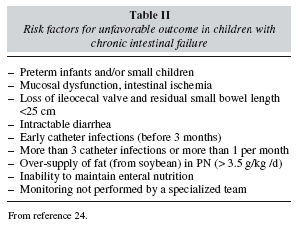
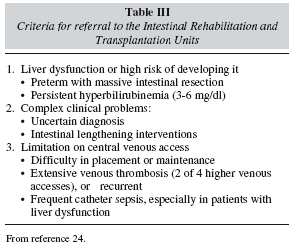
<body><![CDATA[<p>&nbsp;</p>     <p><font face="Verdana" size="2"><b>Referral of patients to Intestinal Rehabilitation and Transplantation Units</b></font></p>     <p><font face="Verdana" size="2">PHPN is a safe therapy and is the treatment of choice for intestinal failure because it facilitates intestinal adaptation and digestive autonomy in most children. However, the success of intestinal adaptation is compromised by certain circumstances<sup>23</sup>, listed in <a href="#t2">table II</a>, which often fulfill the criteria for PN failure<sup>24</sup>: 1) Difficulty in maintaining an adequate state of nutrition and hydration despite PN optimization; 2) Impossibility of surviving without hospitalization due to complications; 3) Development of severe PN secondary complications (PNALD, loss of venous access, recurrent sepsis or metabolic disorders).</font></p>     <p align="center"><font face="Verdana" size="2"><a name="t2"><img src="/img/revistas/nh/v25n5/articulo_especial3_t2.gif" align="top"></a></font></p>     <p><font face="Verdana" size="2">Patients with intestinal failure are complex, which is why Intestinal Rehabilitation and Transplantation Units have been set up, where treatment is individualized over a time period depending on each patient's characteristics, trying to adapt the residual intestine through medical, surgical or nutritional strategies with the aim of achieving total or partial "weaning" from PN<sup>24</sup>.</font></p>     <p><font face="Verdana" size="2">Good communication is essential between those initially responsible for patients and these units. Early referral (when it is anticipated that within three months of starting treatment, the patient's PN requirements will exceed 50% of requirements) for appropriate assessment could improve prognosis<sup>24,25</sup>. Current assessment criteria are given in <a href="#t3">table III</a><sup>24</sup>.</font></p>     <p align="center"><font face="Verdana" size="2"><a name="t3"><img src="/img/revistas/nh/v25n5/articulo_especial3_t3.gif" align="top"></a></font></p>     <p><font face="Verdana" size="2">In the past 10 years (1999-2009) the following cases have been assessed at the Intestinal Rehabilitation Unit of the Hospital Infantil Universitario La Paz: 137 children with intestinal failure, 110 referred from other centers as potential candidates for intestinal transplantation. The most common pathology was short bowel syndrome (79 patients; 57%) various causes (necrotizing enterocolitis, gastroschisis, volvulus, intestinal atresia); 26 children had less than 15 cm of small intestine remaining. Other less common diseases were: motor disorders (18 patients; 13%) and epithelial abnormalities (6 patients; 4.3%). Seventy patients (63%) had nutritional impairment, 69 (62%) intestinalfailure associated liver disease (36% moderate or severe) and 21 (19%) had more than two occluded central venous accesses.</font></p>     <p><font face="Verdana" size="2">Of all patients assessed, 73 (53%) were put on the transplant waiting-list, of which 48 received transplants, 12 died on the waiting-list, 9 were removed from the list on achieving digestive autonomy and 4 are still on the list. Of the total group, 80 (58.5%) achieved digestive autonomy, with or without transplantation, and 70 (51%) received HPN for shorter or longer periods.</font></p>     <p><font face="Verdana" size="2">In summary, although the number of patients receiving PHPN is not great, better knowledge, organization, administration and monitoring of this support technology by specially trained personnel and their timely referral to Intestinal Rehabilitation and Transplantation Units can improve the outcome for these children in all respects.</font></p>     ]]></body>
<body><![CDATA[<p>&nbsp;</p>     <p><font face="Verdana" size="2"><b>Acknowledgements</b></font></p>     <p><font face="Verdana" size="2">Laboratorios B Braun Medical SA and Laboratorios Fresenius Kabi for their help in holding the meeting.</font></p>     <p>&nbsp;</p>     <p><font face="Verdana" size="2"><b>References</b></font></p>     <!-- ref --><p><font face="Verdana" size="2">1. Mart&iacute;nez Costa C, Sierra C, Pedr&oacute;n Giner C, Moreno Villares JM, Lama R, Codoceo R. Nutrici&oacute;n enteral y parenteral en pediatr&iacute;a. An Esp Pediatr 2000; 52 &#091;Supl 3&#093;: 1-33.</font>&nbsp;&nbsp;&nbsp;&nbsp;&nbsp;&nbsp;&nbsp;&nbsp;[&#160;<a href="javascript:void(0);" onclick="javascript: window.open('/scielo.php?script=sci_nlinks&ref=3583932&pid=S0212-1611201000050000400001&lng=','','width=640,height=500,resizable=yes,scrollbars=1,menubar=yes,');">Links</a>&#160;]<!-- end-ref --><!-- ref --><p><font face="Verdana" size="2">2. Gomis Mu&ntilde;oz P, G&oacute;mez L&oacute;pez L, Mart&iacute;nez Costa C, Moreno Villares JM, Pedr&oacute;n Giner C, P&eacute;rez-Portabella Maristany C et al. &#091;Consensus on paediatric parenteral nutrition: a document approved by SENPE/SEGHNP/SEFH&#093;. Nutr Hosp 2007; 22(6): 710-9. Full text available at: <a target="_blank" href="http://www.nutricionhospitalaria.com/Documento_de_Consenso.pdf">http://www.nutricionhospitalaria.com/Documento_de_Consenso.pdf</a> y <a target="_blank" href="http://www.gastroinf.com/">http://www.gastroinf.com/</a> ; Documents &amp; protocols.</font>&nbsp;&nbsp;&nbsp;&nbsp;&nbsp;&nbsp;&nbsp;&nbsp;[&#160;<a href="javascript:void(0);" onclick="javascript: window.open('/scielo.php?script=sci_nlinks&ref=3583933&pid=S0212-1611201000050000400002&lng=','','width=640,height=500,resizable=yes,scrollbars=1,menubar=yes,');">Links</a>&#160;]<!-- end-ref --><!-- ref --><p><font face="Verdana" size="2">3. Grupo de Trabajo de Nutrici&oacute;n Artificial Domiciliaria y Ambulatoria (NADYA). &#091;Practice guideline in home-based parenteral nutrition&#093;. Nutr Hosp Supl 2009; 2(1): 1-36.</font>&nbsp;&nbsp;&nbsp;&nbsp;&nbsp;&nbsp;&nbsp;&nbsp;[&#160;<a href="javascript:void(0);" onclick="javascript: window.open('/scielo.php?script=sci_nlinks&ref=3583934&pid=S0212-1611201000050000400003&lng=','','width=640,height=500,resizable=yes,scrollbars=1,menubar=yes,');">Links</a>&#160;]<!-- end-ref --><!-- ref --><p><font face="Verdana" size="2">4. A.S.P.E.N. Board of Directors and the Standards for Specialized Nutrition Support Task Force; Kovacevich DS, Frederick A, Kelly D, Nishikawa RA, Young L. Standards for specialized nutrition support: home care patients. Nutr Clin Pract 2005; 20: 579-90.</font>&nbsp;&nbsp;&nbsp;&nbsp;&nbsp;&nbsp;&nbsp;&nbsp;[&#160;<a href="javascript:void(0);" onclick="javascript: window.open('/scielo.php?script=sci_nlinks&ref=3583935&pid=S0212-1611201000050000400004&lng=','','width=640,height=500,resizable=yes,scrollbars=1,menubar=yes,');">Links</a>&#160;]<!-- end-ref --><!-- ref --><p><font face="Verdana" size="2">5. Sexton E, Coad J, Holden C. Review for homecare packages for paediatric HPN patients. Br J Nurs 2005; 14: 1080-5.</font>&nbsp;&nbsp;&nbsp;&nbsp;&nbsp;&nbsp;&nbsp;&nbsp;[&#160;<a href="javascript:void(0);" onclick="javascript: window.open('/scielo.php?script=sci_nlinks&ref=3583936&pid=S0212-1611201000050000400005&lng=','','width=640,height=500,resizable=yes,scrollbars=1,menubar=yes,');">Links</a>&#160;]<!-- end-ref --><!-- ref --><p><font face="Verdana" size="2">6. A.S.P.E.N. Board of Directors. Guidelines for the use of parenteral and enteral nutrition in adult and pediatric patients. Administration for specialized nutrition support. JPEN J Parenter Enteral Nutr 2002; 26(Suppl 1): 18SA-21SA.</font>&nbsp;&nbsp;&nbsp;&nbsp;&nbsp;&nbsp;&nbsp;&nbsp;[&#160;<a href="javascript:void(0);" onclick="javascript: window.open('/scielo.php?script=sci_nlinks&ref=3583937&pid=S0212-1611201000050000400006&lng=','','width=640,height=500,resizable=yes,scrollbars=1,menubar=yes,');">Links</a>&#160;]<!-- end-ref --><!-- ref --><p><font face="Verdana" size="2">7. Koletzko B, Goulet O, Hunt J, Krohn K, Shamir R. Guidelines on Paediatric Parenteral Nutrition of the European Society of Paediatric Gastroenterology, Hepatology and Nutrition (ESPGHAN) and the European Society for Clinical Nutrition and Metabolism (ESPEN), Supported by the European Society of Paediatric Research (ESPR). J Pediatr Gastroenterol Nutr 2005; 41(Suppl 2): S1-87.</font>&nbsp;&nbsp;&nbsp;&nbsp;&nbsp;&nbsp;&nbsp;&nbsp;[&#160;<a href="javascript:void(0);" onclick="javascript: window.open('/scielo.php?script=sci_nlinks&ref=3583938&pid=S0212-1611201000050000400007&lng=','','width=640,height=500,resizable=yes,scrollbars=1,menubar=yes,');">Links</a>&#160;]<!-- end-ref --><!-- ref --><p><font face="Verdana" size="2">8. Pironi L, Forbes A, Joly F, Colomb V, Lyszkowska M, Van Gossum A, et al. Home Artificial Nutrition Working Group of the European Society for Clinical Nutrition and Metabolism (ESPEN). Survival of patients identified as candidates for intestinal transplantation: a 3-year prospective follow-up. Gastroenterology 2008; 135(1): 61-71.</font>&nbsp;&nbsp;&nbsp;&nbsp;&nbsp;&nbsp;&nbsp;&nbsp;[&#160;<a href="javascript:void(0);" onclick="javascript: window.open('/scielo.php?script=sci_nlinks&ref=3583939&pid=S0212-1611201000050000400008&lng=','','width=640,height=500,resizable=yes,scrollbars=1,menubar=yes,');">Links</a>&#160;]<!-- end-ref --><!-- ref --><p><font face="Verdana" size="2">9. Chawls WJ. Vascular access for home intravenous therapy in children. JPEN J Parenter Enteral Nutr 2006; 30: S57-64.</font>&nbsp;&nbsp;&nbsp;&nbsp;&nbsp;&nbsp;&nbsp;&nbsp;[&#160;<a href="javascript:void(0);" onclick="javascript: window.open('/scielo.php?script=sci_nlinks&ref=3583940&pid=S0212-1611201000050000400009&lng=','','width=640,height=500,resizable=yes,scrollbars=1,menubar=yes,');">Links</a>&#160;]<!-- end-ref --><!-- ref --><p><font face="Verdana" size="2">10. Colomb V, Jobert-Giraud A, Lacaille F, Goulet O, Fournet JC, Ricour C. Role of lipid emulsions in cholestasis associated with long-term parenteral nutrition in children. JPEN J Parenter Enteral Nutr 2000; 24(6): 345-50.</font>&nbsp;&nbsp;&nbsp;&nbsp;&nbsp;&nbsp;&nbsp;&nbsp;[&#160;<a href="javascript:void(0);" onclick="javascript: window.open('/scielo.php?script=sci_nlinks&ref=3583941&pid=S0212-1611201000050000400010&lng=','','width=640,height=500,resizable=yes,scrollbars=1,menubar=yes,');">Links</a>&#160;]<!-- end-ref --><!-- ref --><p><font face="Verdana" size="2">11. Lee SI, Valim C, Johnston P, Le HD, Meisel J, Arsenault DA, et al. The impact of fish oil-based lipid emulsion on serum triglyceride, bilirubin, and albumin levels in children with parenteral nutrition-associated liver disease. Pediatr Res 2009; 66 (6): 698-703.</font>&nbsp;&nbsp;&nbsp;&nbsp;&nbsp;&nbsp;&nbsp;&nbsp;[&#160;<a href="javascript:void(0);" onclick="javascript: window.open('/scielo.php?script=sci_nlinks&ref=3583942&pid=S0212-1611201000050000400011&lng=','','width=640,height=500,resizable=yes,scrollbars=1,menubar=yes,');">Links</a>&#160;]<!-- end-ref --><!-- ref --><p><font face="Verdana" size="2">12. Cardona Pera D, Cervera Peris M, Fern&aacute;ndez Ar&eacute;valo M, Gomis Mu&ntilde;oz P, Mart&iacute;nez Tutor MJ, Pi&ntilde;eiro Corrales G et al. Consenso espa&ntilde;ol sobre preparaci&oacute;n de mezclas nutrientes parenterales 2008. Farm Hosp 2009; 33(Supl 1): 81-107.</font>&nbsp;&nbsp;&nbsp;&nbsp;&nbsp;&nbsp;&nbsp;&nbsp;[&#160;<a href="javascript:void(0);" onclick="javascript: window.open('/scielo.php?script=sci_nlinks&ref=3583943&pid=S0212-1611201000050000400012&lng=','','width=640,height=500,resizable=yes,scrollbars=1,menubar=yes,');">Links</a>&#160;]<!-- end-ref --><!-- ref --><p><font face="Verdana" size="2">13. Poole RL, Hintz SR, Mackenzie NI, Kerner JA Jr. Aluminum exposure from pediatric parenteral nutrition: meeting the new FDA regulation. JPEN J Parenter Enteral Nutr 2008; 32(3): 242-6.</font>&nbsp;&nbsp;&nbsp;&nbsp;&nbsp;&nbsp;&nbsp;&nbsp;[&#160;<a href="javascript:void(0);" onclick="javascript: window.open('/scielo.php?script=sci_nlinks&ref=3583944&pid=S0212-1611201000050000400013&lng=','','width=640,height=500,resizable=yes,scrollbars=1,menubar=yes,');">Links</a>&#160;]<!-- end-ref --><!-- ref --><p><font face="Verdana" size="2">14. G&oacute;mez L&oacute;pez L, Gutierrez Su&aacute;rez M. Programa de nutrici&oacute;n parenteral domiciliaria pedi&aacute;trica. Cuaderno de informaci&oacute;n para las familias. Valencia: Gr&aacute;ficas Diamante 2008. ISBN 84-691-5079-5. Available at <a target="_blank" href="http://www.nadya-senpe.com/public/elementos.htm">http://www.nadya-senpe.com/public/elementos.htm</a> y <a target="_blank" href="http://www.gastroinf.com/">http://www.gastroinf.com/</a>; Documents &amp; protocols.</font>&nbsp;&nbsp;&nbsp;&nbsp;&nbsp;&nbsp;&nbsp;&nbsp;[&#160;<a href="javascript:void(0);" onclick="javascript: window.open('/scielo.php?script=sci_nlinks&ref=3583945&pid=S0212-1611201000050000400014&lng=','','width=640,height=500,resizable=yes,scrollbars=1,menubar=yes,');">Links</a>&#160;]<!-- end-ref --><!-- ref --><p><font face="Verdana" size="2">15. Kerner JA, Garcia-Careaga MG, Fisher AA, Poole RL. Treatment of catheter occlusion in pediatrics patients. JPEN J Parenter Enteral Nutr 2006; 30: S73-81.</font>&nbsp;&nbsp;&nbsp;&nbsp;&nbsp;&nbsp;&nbsp;&nbsp;[&#160;<a href="javascript:void(0);" onclick="javascript: window.open('/scielo.php?script=sci_nlinks&ref=3583946&pid=S0212-1611201000050000400015&lng=','','width=640,height=500,resizable=yes,scrollbars=1,menubar=yes,');">Links</a>&#160;]<!-- end-ref --><!-- ref --><p><font face="Verdana" size="2">16. Veerabagu MP, Tuttle-Newhall J, Maliakkal R, Champagne C, Mascioli EA. Warfarin and reduced central venous thrombosis in home total parenteral nutrition patients. Nutrition 1995; 11: 142-4.</font>&nbsp;&nbsp;&nbsp;&nbsp;&nbsp;&nbsp;&nbsp;&nbsp;[&#160;<a href="javascript:void(0);" onclick="javascript: window.open('/scielo.php?script=sci_nlinks&ref=3583947&pid=S0212-1611201000050000400016&lng=','','width=640,height=500,resizable=yes,scrollbars=1,menubar=yes,');">Links</a>&#160;]<!-- end-ref --><!-- ref --><p><font face="Verdana" size="2">17. Monreal M, Alastrue A, Rull M, Mira X, Muxart J, Rosell R, et al. Upper extremity deep venous thrombosis in cancer patients with venous access devices-prophylaxis with a low molecular weight heparin (Fragmin). Thromb Haemost 1996; 75: 251-3</font>&nbsp;&nbsp;&nbsp;&nbsp;&nbsp;&nbsp;&nbsp;&nbsp;[&#160;<a href="javascript:void(0);" onclick="javascript: window.open('/scielo.php?script=sci_nlinks&ref=3583948&pid=S0212-1611201000050000400017&lng=','','width=640,height=500,resizable=yes,scrollbars=1,menubar=yes,');">Links</a>&#160;]<!-- end-ref --><!-- ref --><p><font face="Verdana" size="2">18. Cuerda C, Bret&oacute;n I, Bonada A, Planas M, y grupo NADYA. &#091;Protocol for the diagnosis and treatment of catheter related infections in patients with home parenteral nutrition&#093;. Rev Clin Esp 2005; 205(8): 386-91.</font>&nbsp;&nbsp;&nbsp;&nbsp;&nbsp;&nbsp;&nbsp;&nbsp;[&#160;<a href="javascript:void(0);" onclick="javascript: window.open('/scielo.php?script=sci_nlinks&ref=3583949&pid=S0212-1611201000050000400018&lng=','','width=640,height=500,resizable=yes,scrollbars=1,menubar=yes,');">Links</a>&#160;]<!-- end-ref --><!-- ref --><p><font face="Verdana" size="2">19. Moreno Villares JM. &#091;Parenteral nutrition-associated liver complications&#093;. Nutr Hosp 2008; 23(Suppl 2): 25-33.</font>&nbsp;&nbsp;&nbsp;&nbsp;&nbsp;&nbsp;&nbsp;&nbsp;[&#160;<a href="javascript:void(0);" onclick="javascript: window.open('/scielo.php?script=sci_nlinks&ref=3583950&pid=S0212-1611201000050000400019&lng=','','width=640,height=500,resizable=yes,scrollbars=1,menubar=yes,');">Links</a>&#160;]<!-- end-ref --><!-- ref --><p><font face="Verdana" size="2">20. Howard L. Home parenteral nutrition: a transatlantic view. Clin Nutr 1999; 18(3): 131-3.</font>&nbsp;&nbsp;&nbsp;&nbsp;&nbsp;&nbsp;&nbsp;&nbsp;[&#160;<a href="javascript:void(0);" onclick="javascript: window.open('/scielo.php?script=sci_nlinks&ref=3583951&pid=S0212-1611201000050000400020&lng=','','width=640,height=500,resizable=yes,scrollbars=1,menubar=yes,');">Links</a>&#160;]<!-- end-ref --><!-- ref --><p><font face="Verdana" size="2">21. Pane S, Solans M, Gaite L, Serra-Sutton V, Estrada MD, Rajmil L. Instrumentos de calidad de vida relacionada con la salud en la edad pedi&aacute;trica. Revisi&oacute;n sistem&aacute;tica de la literatura: actualizaci&oacute;n. Ag&egrave;ncia d'Avaluaci&oacute; de Tecnolog&iacute;a i Recerca M&egrave;diques. Barcelona, enero de 2006.</font>&nbsp;&nbsp;&nbsp;&nbsp;&nbsp;&nbsp;&nbsp;&nbsp;[&#160;<a href="javascript:void(0);" onclick="javascript: window.open('/scielo.php?script=sci_nlinks&ref=3583952&pid=S0212-1611201000050000400021&lng=','','width=640,height=500,resizable=yes,scrollbars=1,menubar=yes,');">Links</a>&#160;]<!-- end-ref --><!-- ref --><p><font face="Verdana" size="2">22. Gottrand F, Staszewski P, Colomb V, Loras-Duclaux I, Gumber D, Mariner E, et al. Satisfaction in different life domains in children receiving home parenteral nutrition and their families. J Pediatr 2005; 146: 793-7.</font>&nbsp;&nbsp;&nbsp;&nbsp;&nbsp;&nbsp;&nbsp;&nbsp;[&#160;<a href="javascript:void(0);" onclick="javascript: window.open('/scielo.php?script=sci_nlinks&ref=3583953&pid=S0212-1611201000050000400022&lng=','','width=640,height=500,resizable=yes,scrollbars=1,menubar=yes,');">Links</a>&#160;]<!-- end-ref --><!-- ref --><p><font face="Verdana" size="2">23. Baxter JP, Fayers PM, McKinlay AW. The development and translation of a treatment-specific quality of life questionnaire for adult patients on home parenteral nutrition. e-SPEN 2008; 3: e22-8.</font>&nbsp;&nbsp;&nbsp;&nbsp;&nbsp;&nbsp;&nbsp;&nbsp;[&#160;<a href="javascript:void(0);" onclick="javascript: window.open('/scielo.php?script=sci_nlinks&ref=3583954&pid=S0212-1611201000050000400023&lng=','','width=640,height=500,resizable=yes,scrollbars=1,menubar=yes,');">Links</a>&#160;]<!-- end-ref --><!-- ref --><p><font face="Verdana" size="2">24. Beath S, Pironi L, Gabe S, Horslen S, Sudan D, Mazeriegos G, et al. Collaborative strategies to reduce mortality and morbidity in patients with chronic intestinal failure including those who are referred for small bowel transplantation. Transplantation 2008; 85: 1378-84.</font>&nbsp;&nbsp;&nbsp;&nbsp;&nbsp;&nbsp;&nbsp;&nbsp;[&#160;<a href="javascript:void(0);" onclick="javascript: window.open('/scielo.php?script=sci_nlinks&ref=3583955&pid=S0212-1611201000050000400024&lng=','','width=640,height=500,resizable=yes,scrollbars=1,menubar=yes,');">Links</a>&#160;]<!-- end-ref --><!-- ref --><p><font face="Verdana" size="2">25. Fecteau A, Atkinson P, Grant D. Early referral is essential for successful pediatric small bowel transplantation: The canadian experience. J Pediatr Surg 2001; 36: 681-4.</font>&nbsp;&nbsp;&nbsp;&nbsp;&nbsp;&nbsp;&nbsp;&nbsp;[&#160;<a href="javascript:void(0);" onclick="javascript: window.open('/scielo.php?script=sci_nlinks&ref=3583956&pid=S0212-1611201000050000400025&lng=','','width=640,height=500,resizable=yes,scrollbars=1,menubar=yes,');">Links</a>&#160;]<!-- end-ref --><!-- ref --><p><font face="Verdana" size="2">26. Kaufman SS, Atkinson JB, Bianchi A, Goulet OJ, Grant D, Langnas AN, et al. Indications for pediatric intestinal transplantation: A position paper of the American Society of Transplantation. Pediatr Transplantation 2001; 5: 80-7.</font>&nbsp;&nbsp;&nbsp;&nbsp;&nbsp;&nbsp;&nbsp;&nbsp;[&#160;<a href="javascript:void(0);" onclick="javascript: window.open('/scielo.php?script=sci_nlinks&ref=3583957&pid=S0212-1611201000050000400026&lng=','','width=640,height=500,resizable=yes,scrollbars=1,menubar=yes,');">Links</a>&#160;]<!-- end-ref --><p>&nbsp;</p>     <p>&nbsp;</p>     <p><font face="Verdana" size="2"><b><a name="back"></a><a href="#top"><img border="0" src="/img/revistas/nh/v25n5/seta.gif" width="15" height="17"></a>Correspondence:</b>    <br>Consuelo Pedr&oacute;n Giner.    <br>Hospital Infantil Universitario Ni&ntilde;o Jes&uacute;s.    <br>Men&eacute;ndez Pelayo, 65.    <br>28009 Madrid.</font></p>     <p><font face="Verdana" size="2">Recibido: 1-XII-2009.    <br>Aceptado: 08-XII-2009.</font></p>     ]]></body>
<body><![CDATA[ ]]></body><back>
<ref-list>
<ref id="B1">
<label>1</label><nlm-citation citation-type="journal">
<person-group person-group-type="author">
<name>
<surname><![CDATA[Martínez Costa]]></surname>
<given-names><![CDATA[C]]></given-names>
</name>
<name>
<surname><![CDATA[Sierra]]></surname>
<given-names><![CDATA[C]]></given-names>
</name>
<name>
<surname><![CDATA[Pedrón Giner]]></surname>
<given-names><![CDATA[C]]></given-names>
</name>
<name>
<surname><![CDATA[Moreno Villares]]></surname>
<given-names><![CDATA[JM]]></given-names>
</name>
<name>
<surname><![CDATA[Lama]]></surname>
<given-names><![CDATA[R]]></given-names>
</name>
<name>
<surname><![CDATA[Codoceo]]></surname>
<given-names><![CDATA[R]]></given-names>
</name>
</person-group>
<article-title xml:lang="es"><![CDATA[Nutrición enteral y parenteral en pediatría]]></article-title>
<source><![CDATA[An Esp Pediatr]]></source>
<year>2000</year>
<volume>52</volume>
<numero>^s3</numero>
<issue>^s3</issue>
<supplement>3</supplement>
<page-range>1-33</page-range></nlm-citation>
</ref>
<ref id="B2">
<label>2</label><nlm-citation citation-type="journal">
<person-group person-group-type="author">
<name>
<surname><![CDATA[Gomis Muñoz]]></surname>
<given-names><![CDATA[P]]></given-names>
</name>
<name>
<surname><![CDATA[Gómez López]]></surname>
<given-names><![CDATA[L]]></given-names>
</name>
<name>
<surname><![CDATA[Martínez Costa]]></surname>
<given-names><![CDATA[C]]></given-names>
</name>
<name>
<surname><![CDATA[Moreno Villares]]></surname>
<given-names><![CDATA[JM]]></given-names>
</name>
<name>
<surname><![CDATA[Pedrón Giner]]></surname>
<given-names><![CDATA[C]]></given-names>
</name>
<name>
<surname><![CDATA[Pérez-Portabella Maristany]]></surname>
<given-names><![CDATA[C]]></given-names>
</name>
</person-group>
<article-title xml:lang="en"><![CDATA[Consensus on paediatric parenteral nutrition: a document approved by SENPE/SEGHNP/SEFH]]></article-title>
<source><![CDATA[Nutr Hosp]]></source>
<year>2007</year>
<volume>22</volume>
<numero>6</numero>
<issue>6</issue>
<page-range>710-9</page-range></nlm-citation>
</ref>
<ref id="B3">
<label>3</label><nlm-citation citation-type="journal">
<collab>Grupo de Trabajo de Nutrición Artificial Domiciliaria y Ambulatoria (NADYA)</collab>
<article-title xml:lang="en"><![CDATA[[Practice guideline in home-based parenteral nutrition]]]></article-title>
<source><![CDATA[Nutr Hosp Supl]]></source>
<year>2009</year>
<volume>2</volume>
<numero>1</numero>
<issue>1</issue>
<page-range>1-36</page-range></nlm-citation>
</ref>
<ref id="B4">
<label>4</label><nlm-citation citation-type="journal">
<person-group person-group-type="author">
<name>
<surname><![CDATA[Kovacevich]]></surname>
<given-names><![CDATA[DS]]></given-names>
</name>
<name>
<surname><![CDATA[Frederick]]></surname>
<given-names><![CDATA[A]]></given-names>
</name>
<name>
<surname><![CDATA[Kelly]]></surname>
<given-names><![CDATA[D]]></given-names>
</name>
<name>
<surname><![CDATA[Nishikawa]]></surname>
<given-names><![CDATA[RA]]></given-names>
</name>
<name>
<surname><![CDATA[Young]]></surname>
<given-names><![CDATA[L]]></given-names>
</name>
</person-group>
<collab>A.S.P.E.N. Board of Directors and the Standards for Specialized Nutrition Support Task Force</collab>
<article-title xml:lang="en"><![CDATA[Standards for specialized nutrition support: home care patients]]></article-title>
<source><![CDATA[NutrClin Pract]]></source>
<year>2005</year>
<volume>20</volume>
<page-range>579-90</page-range></nlm-citation>
</ref>
<ref id="B5">
<label>5</label><nlm-citation citation-type="journal">
<person-group person-group-type="author">
<name>
<surname><![CDATA[Sexton]]></surname>
<given-names><![CDATA[E]]></given-names>
</name>
<name>
<surname><![CDATA[Coad]]></surname>
<given-names><![CDATA[J]]></given-names>
</name>
<name>
<surname><![CDATA[Holden]]></surname>
<given-names><![CDATA[C]]></given-names>
</name>
</person-group>
<article-title xml:lang="en"><![CDATA[Review for homecare packages for paediatric HPN patients]]></article-title>
<source><![CDATA[Br J Nurs]]></source>
<year>2005</year>
<volume>14</volume>
<page-range>1080-5</page-range></nlm-citation>
</ref>
<ref id="B6">
<label>6</label><nlm-citation citation-type="journal">
<collab>A.S.P.E.N. Board of Directors</collab>
<article-title xml:lang="en"><![CDATA[Guidelines for the use of parenteral and enteral nutrition in adult and pediatric patients: Administration for specialized nutrition support]]></article-title>
<source><![CDATA[JPEN J Parenter Enteral Nutr]]></source>
<year>2002</year>
<volume>26</volume>
<numero>^s1</numero>
<issue>^s1</issue>
<supplement>1</supplement>
<page-range>18SA-21SA</page-range></nlm-citation>
</ref>
<ref id="B7">
<label>7</label><nlm-citation citation-type="journal">
<person-group person-group-type="author">
<name>
<surname><![CDATA[Koletzko]]></surname>
<given-names><![CDATA[B]]></given-names>
</name>
<name>
<surname><![CDATA[Goulet]]></surname>
<given-names><![CDATA[O]]></given-names>
</name>
<name>
<surname><![CDATA[Hunt]]></surname>
<given-names><![CDATA[J]]></given-names>
</name>
<name>
<surname><![CDATA[Krohn]]></surname>
<given-names><![CDATA[K]]></given-names>
</name>
<name>
<surname><![CDATA[Shamir]]></surname>
<given-names><![CDATA[R]]></given-names>
</name>
</person-group>
<article-title xml:lang="en"><![CDATA[Guidelines on Paediatric Parenteral Nutrition of the European Society of Paediatric Gastroenterology, Hepatology and Nutrition (ESPGHAN) and the European Society for Clinical Nutrition and Metabolism (ESPEN), Supported by the European Society of Paediatric Research (ESPR)]]></article-title>
<source><![CDATA[J Pediatr Gastroenterol Nutr]]></source>
<year>2005</year>
<volume>41</volume>
<numero>^s2</numero>
<issue>^s2</issue>
<supplement>2</supplement>
<page-range>S1-87</page-range></nlm-citation>
</ref>
<ref id="B8">
<label>8</label><nlm-citation citation-type="journal">
<person-group person-group-type="author">
<name>
<surname><![CDATA[Pironi]]></surname>
<given-names><![CDATA[L]]></given-names>
</name>
<name>
<surname><![CDATA[Forbes]]></surname>
<given-names><![CDATA[A]]></given-names>
</name>
<name>
<surname><![CDATA[Joly]]></surname>
<given-names><![CDATA[F]]></given-names>
</name>
<name>
<surname><![CDATA[Colomb]]></surname>
<given-names><![CDATA[V]]></given-names>
</name>
<name>
<surname><![CDATA[Lyszkowska]]></surname>
<given-names><![CDATA[M]]></given-names>
</name>
<name>
<surname><![CDATA[Van Gossum]]></surname>
<given-names><![CDATA[A]]></given-names>
</name>
</person-group>
<article-title xml:lang="en"><![CDATA[Home Artificial Nutrition Working Group of the European Society for Clinical Nutrition and Metabolism (ESPEN). Survival of patients identified as candidates for intestinal transplantation: a 3-year prospective follow-up]]></article-title>
<source><![CDATA[Gastroenterology]]></source>
<year>2008</year>
<volume>135</volume>
<numero>1</numero>
<issue>1</issue>
<page-range>61-71</page-range></nlm-citation>
</ref>
<ref id="B9">
<label>9</label><nlm-citation citation-type="journal">
<person-group person-group-type="author">
<name>
<surname><![CDATA[Chawls]]></surname>
<given-names><![CDATA[WJ]]></given-names>
</name>
</person-group>
<article-title xml:lang="en"><![CDATA[Vascular access for home intravenous therapy in children]]></article-title>
<source><![CDATA[JPEN J Parenter Enteral Nutr]]></source>
<year>2006</year>
<volume>30</volume>
<page-range>S57-64</page-range></nlm-citation>
</ref>
<ref id="B10">
<label>10</label><nlm-citation citation-type="journal">
<person-group person-group-type="author">
<name>
<surname><![CDATA[Colomb]]></surname>
<given-names><![CDATA[V]]></given-names>
</name>
<name>
<surname><![CDATA[Jobert-Giraud]]></surname>
<given-names><![CDATA[A]]></given-names>
</name>
<name>
<surname><![CDATA[Lacaille]]></surname>
<given-names><![CDATA[F]]></given-names>
</name>
<name>
<surname><![CDATA[Goulet]]></surname>
<given-names><![CDATA[O]]></given-names>
</name>
<name>
<surname><![CDATA[Fournet]]></surname>
<given-names><![CDATA[JC]]></given-names>
</name>
<name>
<surname><![CDATA[Ricour]]></surname>
<given-names><![CDATA[C]]></given-names>
</name>
</person-group>
<article-title xml:lang="en"><![CDATA[Role of lipid emulsions in cholestasis associated with long-term parenteral nutrition in children]]></article-title>
<source><![CDATA[JPEN J Parenter Enteral Nutr]]></source>
<year>2000</year>
<volume>24</volume>
<numero>6</numero>
<issue>6</issue>
<page-range>345-50</page-range></nlm-citation>
</ref>
<ref id="B11">
<label>11</label><nlm-citation citation-type="journal">
<person-group person-group-type="author">
<name>
<surname><![CDATA[Lee]]></surname>
<given-names><![CDATA[SI]]></given-names>
</name>
<name>
<surname><![CDATA[Valim]]></surname>
<given-names><![CDATA[C]]></given-names>
</name>
<name>
<surname><![CDATA[Johnston]]></surname>
<given-names><![CDATA[P]]></given-names>
</name>
<name>
<surname><![CDATA[Le]]></surname>
<given-names><![CDATA[HD]]></given-names>
</name>
<name>
<surname><![CDATA[Meisel]]></surname>
<given-names><![CDATA[J]]></given-names>
</name>
<name>
<surname><![CDATA[Arsenault]]></surname>
<given-names><![CDATA[DA]]></given-names>
</name>
</person-group>
<article-title xml:lang="en"><![CDATA[The impact of fish oil-based lipid emulsion on serum triglyceride, bilirubin, and albumin levels in children with parenteral nutrition-associated liver disease]]></article-title>
<source><![CDATA[Pediatr Res]]></source>
<year>2009</year>
<volume>66</volume>
<numero>6</numero>
<issue>6</issue>
<page-range>698-703</page-range></nlm-citation>
</ref>
<ref id="B12">
<label>12</label><nlm-citation citation-type="journal">
<person-group person-group-type="author">
<name>
<surname><![CDATA[Cardona Pera]]></surname>
<given-names><![CDATA[D]]></given-names>
</name>
<name>
<surname><![CDATA[Cervera Peris]]></surname>
<given-names><![CDATA[M]]></given-names>
</name>
<name>
<surname><![CDATA[Fernández Arévalo]]></surname>
<given-names><![CDATA[M]]></given-names>
</name>
<name>
<surname><![CDATA[Gomis Muñoz]]></surname>
<given-names><![CDATA[P]]></given-names>
</name>
<name>
<surname><![CDATA[Martínez Tutor]]></surname>
<given-names><![CDATA[MJ]]></given-names>
</name>
<name>
<surname><![CDATA[Piñeiro Corrales]]></surname>
<given-names><![CDATA[G]]></given-names>
</name>
</person-group>
<article-title xml:lang="es"><![CDATA[Consenso español sobre preparación de mezclas nutrientes parenterales 2008]]></article-title>
<source><![CDATA[Farm Hosp]]></source>
<year>2009</year>
<volume>33</volume>
<numero>^s1</numero>
<issue>^s1</issue>
<supplement>1</supplement>
<page-range>81-107</page-range></nlm-citation>
</ref>
<ref id="B13">
<label>13</label><nlm-citation citation-type="journal">
<person-group person-group-type="author">
<name>
<surname><![CDATA[Poole]]></surname>
<given-names><![CDATA[RL]]></given-names>
</name>
<name>
<surname><![CDATA[Hintz]]></surname>
<given-names><![CDATA[SR]]></given-names>
</name>
<name>
<surname><![CDATA[Mackenzie]]></surname>
<given-names><![CDATA[NI]]></given-names>
</name>
<name>
<surname><![CDATA[Kerner]]></surname>
<given-names><![CDATA[JA Jr]]></given-names>
</name>
</person-group>
<article-title xml:lang="en"><![CDATA[Aluminum exposure from pediatric parenteral nutrition: meeting the new FDA regulation]]></article-title>
<source><![CDATA[JPEN J Parenter Enteral Nutr]]></source>
<year>2008</year>
<volume>32</volume>
<numero>3</numero>
<issue>3</issue>
<page-range>242-6</page-range></nlm-citation>
</ref>
<ref id="B14">
<label>14</label><nlm-citation citation-type="book">
<person-group person-group-type="author">
<name>
<surname><![CDATA[Gómez López]]></surname>
<given-names><![CDATA[L]]></given-names>
</name>
<name>
<surname><![CDATA[Gutierrez Suárez]]></surname>
<given-names><![CDATA[M.]]></given-names>
</name>
</person-group>
<source><![CDATA[Programa de nutrición parenteral domiciliaria pediátrica: Cuaderno de información para las familias]]></source>
<year>2008</year>
<publisher-loc><![CDATA[Valencia ]]></publisher-loc>
<publisher-name><![CDATA[Gráficas Diamante]]></publisher-name>
</nlm-citation>
</ref>
<ref id="B15">
<label>15</label><nlm-citation citation-type="journal">
<person-group person-group-type="author">
<name>
<surname><![CDATA[Kerner]]></surname>
<given-names><![CDATA[JA]]></given-names>
</name>
<name>
<surname><![CDATA[Garcia-Careaga]]></surname>
<given-names><![CDATA[MG]]></given-names>
</name>
<name>
<surname><![CDATA[Fisher]]></surname>
<given-names><![CDATA[AA]]></given-names>
</name>
<name>
<surname><![CDATA[Poole]]></surname>
<given-names><![CDATA[RL]]></given-names>
</name>
</person-group>
<article-title xml:lang="en"><![CDATA[Treatment of catheter occlusion in pediatrics patients]]></article-title>
<source><![CDATA[JPEN J Parenter Enteral Nutr]]></source>
<year>2006</year>
<volume>30</volume>
<page-range>S73-81</page-range></nlm-citation>
</ref>
<ref id="B16">
<label>16</label><nlm-citation citation-type="journal">
<person-group person-group-type="author">
<name>
<surname><![CDATA[Veerabagu]]></surname>
<given-names><![CDATA[MP]]></given-names>
</name>
<name>
<surname><![CDATA[Tuttle-Newhall]]></surname>
<given-names><![CDATA[J]]></given-names>
</name>
<name>
<surname><![CDATA[Maliakkal]]></surname>
<given-names><![CDATA[R]]></given-names>
</name>
<name>
<surname><![CDATA[Champagne]]></surname>
<given-names><![CDATA[C]]></given-names>
</name>
<name>
<surname><![CDATA[Mascioli]]></surname>
<given-names><![CDATA[EA]]></given-names>
</name>
</person-group>
<article-title xml:lang="en"><![CDATA[Warfarin and reduced central venous thrombosis in home total parenteral nutrition patients]]></article-title>
<source><![CDATA[Nutrition]]></source>
<year>1995</year>
<volume>11</volume>
<page-range>142-4</page-range></nlm-citation>
</ref>
<ref id="B17">
<label>17</label><nlm-citation citation-type="journal">
<person-group person-group-type="author">
<name>
<surname><![CDATA[Monreal]]></surname>
<given-names><![CDATA[M]]></given-names>
</name>
<name>
<surname><![CDATA[Alastrue]]></surname>
<given-names><![CDATA[A]]></given-names>
</name>
<name>
<surname><![CDATA[Rull]]></surname>
<given-names><![CDATA[M]]></given-names>
</name>
<name>
<surname><![CDATA[Mira]]></surname>
<given-names><![CDATA[X]]></given-names>
</name>
<name>
<surname><![CDATA[Muxart]]></surname>
<given-names><![CDATA[J]]></given-names>
</name>
<name>
<surname><![CDATA[Rosell]]></surname>
<given-names><![CDATA[R]]></given-names>
</name>
</person-group>
<article-title xml:lang="en"><![CDATA[Upper extremity deep venous thrombosis in cancer patients with venous access devices-prophylaxis with a low molecular weight heparin (Fragmin)]]></article-title>
<source><![CDATA[Thromb Haemost]]></source>
<year>1996</year>
<volume>75</volume>
<page-range>251-3</page-range></nlm-citation>
</ref>
<ref id="B18">
<label>18</label><nlm-citation citation-type="journal">
<person-group person-group-type="author">
<name>
<surname><![CDATA[Cuerda]]></surname>
<given-names><![CDATA[C]]></given-names>
</name>
<name>
<surname><![CDATA[Bretón]]></surname>
<given-names><![CDATA[I]]></given-names>
</name>
<name>
<surname><![CDATA[Bonada]]></surname>
<given-names><![CDATA[A]]></given-names>
</name>
<name>
<surname><![CDATA[Planas]]></surname>
<given-names><![CDATA[M]]></given-names>
</name>
</person-group>
<collab>grupo NADYA</collab>
<article-title xml:lang="en"><![CDATA[[Protocol for the diagnosis and treatment of catheter related infections in patients with home parenteral nutrition]]]></article-title>
<source><![CDATA[Rev Clin Esp]]></source>
<year>2005</year>
<volume>205</volume>
<numero>8</numero>
<issue>8</issue>
<page-range>386-91</page-range></nlm-citation>
</ref>
<ref id="B19">
<label>19</label><nlm-citation citation-type="journal">
<person-group person-group-type="author">
<name>
<surname><![CDATA[Moreno Villares]]></surname>
<given-names><![CDATA[JM]]></given-names>
</name>
</person-group>
<article-title xml:lang="en"><![CDATA[[Parenteral nutrition-associated liver complications]]]></article-title>
<source><![CDATA[Nutr Hosp]]></source>
<year>2008</year>
<volume>23</volume>
<numero>^s2</numero>
<issue>^s2</issue>
<supplement>2</supplement>
<page-range>25-33</page-range></nlm-citation>
</ref>
<ref id="B20">
<label>20</label><nlm-citation citation-type="journal">
<person-group person-group-type="author">
<name>
<surname><![CDATA[Howard]]></surname>
<given-names><![CDATA[L]]></given-names>
</name>
</person-group>
<article-title xml:lang="en"><![CDATA[Home parenteral nutrition: a transatlantic view]]></article-title>
<source><![CDATA[Clin Nutr]]></source>
<year>1999</year>
<volume>18</volume>
<numero>3</numero>
<issue>3</issue>
<page-range>131-3</page-range></nlm-citation>
</ref>
<ref id="B21">
<label>21</label><nlm-citation citation-type="book">
<person-group person-group-type="author">
<name>
<surname><![CDATA[Pane]]></surname>
<given-names><![CDATA[S]]></given-names>
</name>
<name>
<surname><![CDATA[Solans]]></surname>
<given-names><![CDATA[M]]></given-names>
</name>
<name>
<surname><![CDATA[Gaite]]></surname>
<given-names><![CDATA[L]]></given-names>
</name>
<name>
<surname><![CDATA[Serra-Sutton]]></surname>
</name>
<name>
<surname><![CDATA[Estrada]]></surname>
<given-names><![CDATA[MD]]></given-names>
</name>
<name>
<surname><![CDATA[Rajmil]]></surname>
<given-names><![CDATA[L.]]></given-names>
</name>
</person-group>
<source><![CDATA[Instrumentos de calidad de vida relacionada con la salud en la edad pediátrica: Revisión sistemática de la literatura: actualización]]></source>
<year>ener</year>
<month>o </month>
<day>de</day>
<publisher-loc><![CDATA[Barcelona ]]></publisher-loc>
<publisher-name><![CDATA[Agència d'Avaluació de Tecnología i Recerca Mèdiques]]></publisher-name>
</nlm-citation>
</ref>
<ref id="B22">
<label>22</label><nlm-citation citation-type="journal">
<person-group person-group-type="author">
<name>
<surname><![CDATA[Gottrand]]></surname>
<given-names><![CDATA[F]]></given-names>
</name>
<name>
<surname><![CDATA[Staszewski]]></surname>
<given-names><![CDATA[P]]></given-names>
</name>
<name>
<surname><![CDATA[Colomb]]></surname>
<given-names><![CDATA[V]]></given-names>
</name>
<name>
<surname><![CDATA[Loras-Duclaux]]></surname>
<given-names><![CDATA[I]]></given-names>
</name>
<name>
<surname><![CDATA[Gumber]]></surname>
<given-names><![CDATA[D]]></given-names>
</name>
<name>
<surname><![CDATA[Mariner]]></surname>
<given-names><![CDATA[E]]></given-names>
</name>
</person-group>
<article-title xml:lang="en"><![CDATA[Satisfaction in different life domains in children receiving home parenteral nutrition and their families]]></article-title>
<source><![CDATA[J Pediatr]]></source>
<year>2005</year>
<volume>146</volume>
<page-range>793-7</page-range></nlm-citation>
</ref>
<ref id="B23">
<label>23</label><nlm-citation citation-type="journal">
<person-group person-group-type="author">
<name>
<surname><![CDATA[Baxter]]></surname>
<given-names><![CDATA[JP]]></given-names>
</name>
<name>
<surname><![CDATA[Fayers]]></surname>
<given-names><![CDATA[PM]]></given-names>
</name>
<name>
<surname><![CDATA[McKinlay]]></surname>
<given-names><![CDATA[AW]]></given-names>
</name>
</person-group>
<article-title xml:lang="en"><![CDATA[The development and translation of a treatment-specific quality of life questionnaire for adult patients on home parenteral nutrition]]></article-title>
<source><![CDATA[e-SPEN]]></source>
<year>2008</year>
<volume>3</volume>
<page-range>e22-8</page-range></nlm-citation>
</ref>
<ref id="B24">
<label>24</label><nlm-citation citation-type="journal">
<person-group person-group-type="author">
<name>
<surname><![CDATA[Beath]]></surname>
<given-names><![CDATA[S]]></given-names>
</name>
<name>
<surname><![CDATA[Pironi]]></surname>
<given-names><![CDATA[L]]></given-names>
</name>
<name>
<surname><![CDATA[Gabe]]></surname>
<given-names><![CDATA[S]]></given-names>
</name>
<name>
<surname><![CDATA[Horslen]]></surname>
<given-names><![CDATA[S]]></given-names>
</name>
<name>
<surname><![CDATA[Sudan]]></surname>
<given-names><![CDATA[D]]></given-names>
</name>
<name>
<surname><![CDATA[Mazeriegos]]></surname>
<given-names><![CDATA[G]]></given-names>
</name>
</person-group>
<article-title xml:lang="en"><![CDATA[Collaborative strategies to reduce mortality and morbidity in patients with chronic intestinal failure including those who are referred for small bowel transplantation]]></article-title>
<source><![CDATA[Transplantation]]></source>
<year>2008</year>
<volume>85</volume>
<page-range>1378-84</page-range></nlm-citation>
</ref>
<ref id="B25">
<label>25</label><nlm-citation citation-type="journal">
<person-group person-group-type="author">
<name>
<surname><![CDATA[Fecteau]]></surname>
<given-names><![CDATA[A]]></given-names>
</name>
<name>
<surname><![CDATA[Atkinson]]></surname>
<given-names><![CDATA[P]]></given-names>
</name>
<name>
<surname><![CDATA[Grant]]></surname>
<given-names><![CDATA[D]]></given-names>
</name>
</person-group>
<article-title xml:lang="en"><![CDATA[Early referral is essential for successful pediatric small bowel transplantation: The canadian experience]]></article-title>
<source><![CDATA[J Pediatr Surg]]></source>
<year>2001</year>
<volume>36</volume>
<page-range>681-4</page-range></nlm-citation>
</ref>
<ref id="B26">
<label>26</label><nlm-citation citation-type="journal">
<person-group person-group-type="author">
<name>
<surname><![CDATA[Kaufman]]></surname>
<given-names><![CDATA[SS]]></given-names>
</name>
<name>
<surname><![CDATA[Atkinson]]></surname>
<given-names><![CDATA[JB]]></given-names>
</name>
<name>
<surname><![CDATA[Bianchi]]></surname>
<given-names><![CDATA[A]]></given-names>
</name>
<name>
<surname><![CDATA[Goulet]]></surname>
<given-names><![CDATA[OJ]]></given-names>
</name>
<name>
<surname><![CDATA[Grant]]></surname>
<given-names><![CDATA[D]]></given-names>
</name>
<name>
<surname><![CDATA[Langnas]]></surname>
<given-names><![CDATA[AN]]></given-names>
</name>
</person-group>
<article-title xml:lang="en"><![CDATA[Indications for pediatric intestinal transplantation: A position paper of the American Society of Transplantation]]></article-title>
<source><![CDATA[Pediatr Transplantation]]></source>
<year>2001</year>
<volume>5</volume>
<page-range>80-7</page-range></nlm-citation>
</ref>
</ref-list>
</back>
</article>