<?xml version="1.0" encoding="ISO-8859-1"?><article xmlns:mml="http://www.w3.org/1998/Math/MathML" xmlns:xlink="http://www.w3.org/1999/xlink" xmlns:xsi="http://www.w3.org/2001/XMLSchema-instance">
<front>
<journal-meta>
<journal-id>0212-1611</journal-id>
<journal-title><![CDATA[Nutrición Hospitalaria]]></journal-title>
<abbrev-journal-title><![CDATA[Nutr. Hosp.]]></abbrev-journal-title>
<issn>0212-1611</issn>
<publisher>
<publisher-name><![CDATA[Grupo Arán]]></publisher-name>
</publisher>
</journal-meta>
<article-meta>
<article-id>S0212-16112010000500020</article-id>
<title-group>
<article-title xml:lang="en"><![CDATA[Current status of pediatric home enteral nutrition in Spain: The importance of the NEPAD register]]></article-title>
<article-title xml:lang="es"><![CDATA[Estado actual de la nutrición enteral pediátrica en España: la importancia del registro NEPAD]]></article-title>
</title-group>
<contrib-group>
<contrib contrib-type="author">
<name>
<surname><![CDATA[Gómez-López]]></surname>
<given-names><![CDATA[L.]]></given-names>
</name>
<xref ref-type="aff" rid="A01"/>
</contrib>
<contrib contrib-type="author">
<name>
<surname><![CDATA[Martínez-Costa]]></surname>
<given-names><![CDATA[C.]]></given-names>
</name>
<xref ref-type="aff" rid="A02"/>
</contrib>
<contrib contrib-type="author">
<name>
<surname><![CDATA[Pedrón-Giner]]></surname>
<given-names><![CDATA[C.]]></given-names>
</name>
<xref ref-type="aff" rid="A03"/>
</contrib>
<contrib contrib-type="author">
<name>
<surname><![CDATA[Calderón-Garrido]]></surname>
<given-names><![CDATA[C.]]></given-names>
</name>
<xref ref-type="aff" rid="A04"/>
</contrib>
<contrib contrib-type="author">
<name>
<surname><![CDATA[Navas López]]></surname>
<given-names><![CDATA[V.M.]]></given-names>
</name>
<xref ref-type="aff" rid="A05"/>
</contrib>
<contrib contrib-type="author">
<name>
<surname><![CDATA[Martínez Zazo]]></surname>
<given-names><![CDATA[A.]]></given-names>
</name>
<xref ref-type="aff" rid="A06"/>
</contrib>
<contrib contrib-type="author">
<name>
<surname><![CDATA[Moreno Villares]]></surname>
<given-names><![CDATA[J.M.]]></given-names>
</name>
<xref ref-type="aff" rid="A07"/>
</contrib>
</contrib-group>
<aff id="A01">
<institution><![CDATA[,University of Barcelona Hospital Sant Joan de Déu Division of Pediatric Gastroenterology, Hepatology and Nutrition]]></institution>
<addr-line><![CDATA[Barcelona ]]></addr-line>
<country>Spain</country>
</aff>
<aff id="A02">
<institution><![CDATA[,University of Valencia School of Medicine and Hospital Clínico Department of Pediatrics]]></institution>
<addr-line><![CDATA[Valencia ]]></addr-line>
<country>Spain</country>
</aff>
<aff id="A03">
<institution><![CDATA[,Hospital Infantil Universitario Niño Jesús Division of Gastroenterology and Nutrition ]]></institution>
<addr-line><![CDATA[Madrid ]]></addr-line>
<country>Spain</country>
</aff>
<aff id="A04">
<institution><![CDATA[,University of Barcelona Faculty of Psychology Deparment of Personality, Assessment and Psychological Treatment]]></institution>
<addr-line><![CDATA[Barcelona ]]></addr-line>
<country>Spain</country>
</aff>
<aff id="A05">
<institution><![CDATA[,Hospital Materno Infantil de Málaga Division of Pediatric Gastroenterology, Hepatology, and Nutrition ]]></institution>
<addr-line><![CDATA[Málaga ]]></addr-line>
<country>Spain</country>
</aff>
<aff id="A06">
<institution><![CDATA[,Hospital Infanta Sofía Department of Pediatrics ]]></institution>
<addr-line><![CDATA[San Sebastián de los Reyes ]]></addr-line>
<country>Spain</country>
</aff>
<aff id="A07">
<institution><![CDATA[,Hospital Doce de Octubre Nutrition Unit ]]></institution>
<addr-line><![CDATA[Madrid ]]></addr-line>
<country>Spain</country>
</aff>
<pub-date pub-type="pub">
<day>00</day>
<month>10</month>
<year>2010</year>
</pub-date>
<pub-date pub-type="epub">
<day>00</day>
<month>10</month>
<year>2010</year>
</pub-date>
<volume>25</volume>
<numero>5</numero>
<fpage>810</fpage>
<lpage>813</lpage>
<copyright-statement/>
<copyright-year/>
<self-uri xlink:href="http://scielo.isciii.es/scielo.php?script=sci_arttext&amp;pid=S0212-16112010000500020&amp;lng=en&amp;nrm=iso"></self-uri><self-uri xlink:href="http://scielo.isciii.es/scielo.php?script=sci_abstract&amp;pid=S0212-16112010000500020&amp;lng=en&amp;nrm=iso"></self-uri><self-uri xlink:href="http://scielo.isciii.es/scielo.php?script=sci_pdf&amp;pid=S0212-16112010000500020&amp;lng=en&amp;nrm=iso"></self-uri><abstract abstract-type="short" xml:lang="en"><p><![CDATA[Abstract Home enteral nutrition (HEN) is a type of enteral nutrition (EN) which is becoming progressively more widespread in pediatrics due to the benefits it affords to patients, their families and to reducing hospital costs. However, the true extent of its use is unknown in Spain as the data-base set up for this purpose is still underused (Registro de Nutrición Enteral Pediátrica Ambulatoria y Domiciliaria -NEPAD-). More thorough registration of patients in the NEPAD online register will provide information about the characteristics of HEN in Spain: prevalence, diagnosis, the population sector being administered HEN, complications and developments. Likewise, forecast and planning of the necessary resources could be made while those in use could be analysed.]]></p></abstract>
<abstract abstract-type="short" xml:lang="es"><p><![CDATA[La nutrición enteral domiciliaria (NED) es una modalidad de nutrición enteral (NE) con una progresiva extensión en pediatría por los beneficios que supone para el paciente, sus familiares y la disminución de los costes hospitalarios. Sin embargo, se desconoce su verdadero alcance en España ya que el registro creado a tal efecto está aún infrautilizado (Registro de Nutrición Enteral Pediátrica Ambulatoria y Domiciliaria -NEPAD-). La inclusión exhaustiva de pacientes en NEPAD permitiría conocer las características de la NED en España: prevalencia, indicaciones, población a la que se le está administrando, complicaciones y evolución. Así mismo se podría realizar una previsión y planificación de los recursos que se precisan y analizar los que se están utilizando.]]></p></abstract>
<kwd-group>
<kwd lng="en"><![CDATA[Home enteral nutrition]]></kwd>
<kwd lng="en"><![CDATA[Online pediatric register]]></kwd>
<kwd lng="en"><![CDATA[NEPAD]]></kwd>
<kwd lng="es"><![CDATA[Nutrición enteral domiciliaria]]></kwd>
<kwd lng="es"><![CDATA[Registro pediátrico online]]></kwd>
<kwd lng="es"><![CDATA[NEPAD]]></kwd>
</kwd-group>
</article-meta>
</front><body><![CDATA[ <p><font face="Verdana" size="2"><a name="top"></a><b>ORIGINALS</b></font></p>     <p>&nbsp;</p>     <p><font face="Verdana" size="4"><b>Current status of pediatric home enteral nutrition in Spain: The importance of the NEPAD register</b></font></p>     <p><font face="Verdana" size="4"><b>Estado actual de la nutrición enteral pediátrica en España: la importancia del registro NEPAD</b></font></p>     <p>&nbsp;</p>     <p>&nbsp;</p>     <p><font face="Verdana" size="2"><b>L. G&oacute;mez-L&oacute;pez<sup>1</sup>, C. Mart&iacute;nez-Costa<sup>2</sup>, C. Pedr&oacute;n-Giner<sup>3</sup>, C. Calder&oacute;n-Garrido<sup>4</sup>, V.M. Navas L&oacute;pez<sup>5</sup>, A. Mart&iacute;nez Zazo<sup>6</sup> y J.M. Moreno Villares<sup>7</sup></b></font></p>     <p><font face="Verdana" size="2"><sup>1</sup>Division of Pediatric Gastroenterology, Hepatology and Nutrition. Hospital Sant Joan de D&eacute;u. University of Barcelona. Spain.    <br><sup>2</sup>Gastroenterology and Nutrition Unit. Department of Pediatrics, School of Medicine and Hospital Cl&iacute;nico. University of Valencia, Spain.    <br><sup>3</sup>Division of Gastroenterology and Nutrition. Hospital Infantil Universitario Ni&ntilde;o Jes&uacute;s. Madrid, Spain.    ]]></body>
<body><![CDATA[<br><sup>4</sup>Deparment of Personality, Assessment and Psychological Treatment. Faculty of Psychology. University of Barcelona, Spain.    <br><sup>5</sup>Division of Pediatric Gastroenterology, Hepatology, and Nutrition. Hospital Materno Infantil. M&aacute;laga. Spain.    <br><sup>6</sup>Department of Pediatrics. Hospital Infanta Sof&iacute;a. San Sebasti&aacute;n de los Reyes, Madrid, Spain.    <br><sup>7</sup>Nutrition Unit. Hospital Doce de Octubre, Madrid, Spain</font></p>     <p><font face="Verdana" size="2"><a href="#back">Correspondence</a></font></p>     <p>&nbsp;</p>     <p>&nbsp;</p> <hr size="1">     <p><font face="Verdana" size="2"><b>ABSTRACT</b></font></p>     <p><font face="Verdana" size="2">Abstract Home enteral nutrition (HEN) is a type of enteral nutrition (EN) which is becoming progressively more widespread in pediatrics due to the benefits it affords to patients, their families and to reducing hospital costs. However, the true extent of its use is unknown in Spain as the data-base set up for this purpose is still underused (Registro de Nutrici&oacute;n Enteral Pedi&aacute;trica Ambulatoria y Domiciliaria -NEPAD-). More thorough registration of patients in the NEPAD online register will provide information about the characteristics of HEN in Spain: prevalence, diagnosis, the population sector being administered HEN, complications and developments. Likewise, forecast and planning of the necessary resources could be made while those in use could be analysed.</font></p>     <p><font face="Verdana" size="2"><b>Key words:</b> Home enteral nutrition. Online pediatric register NEPAD.</font></p> <hr size="1">     ]]></body>
<body><![CDATA[<p><font face="Verdana" size="2"><b>RESUMEN</b></font></p>     <p><font face="Verdana" size="2">La nutrici&oacute;n enteral domiciliaria (NED) es una modalidad de nutrici&oacute;n enteral (NE) con una progresiva extensi&oacute;n en pediatr&iacute;a por los beneficios que supone para el paciente, sus familiares y la disminuci&oacute;n de los costes hospitalarios. Sin embargo, se desconoce su verdadero alcance en Espa&ntilde;a ya que el registro creado a tal efecto est&aacute; a&uacute;n infrautilizado (Registro de Nutrici&oacute;n Enteral Pedi&aacute;trica Ambulatoria y Domiciliaria -NEPAD-). La inclusi&oacute;n exhaustiva de pacientes en NEPAD permitir&iacute;a conocer las caracter&iacute;sticas de la NED en Espa&ntilde;a: prevalencia, indicaciones, poblaci&oacute;n a la que se le est&aacute; administrando, complicaciones y evoluci&oacute;n. As&iacute; mismo se podr&iacute;a realizar una previsi&oacute;n y planificaci&oacute;n de los recursos que se precisan y analizar los que se est&aacute;n utilizando.</font></p>     <p><font face="Verdana" size="2"><b>Palabras clave:</b> Nutrici&oacute;n enteral domiciliaria. Registro pedi&aacute;trico online. NEPAD.</font></p> <hr size="1">     <p>&nbsp;</p>     <p><font face="Verdana" size="2"><b>Introduction</b></font></p>     <p><font face="Verdana" size="2">Home enteral nutrition (HEN) is administered outside the hospital. It is apt for patients whose illness is under control but who still require nutritional support. Its objectives are to ensure nutritional support in the home and shorten hospital stays thereby reducing treatment costs<sup>1</sup>, hospitalism and potential complications of nosocomial infection<sup>2</sup>. It also facilitates reincorporation of patients and their families into school, family, work and social environments and increases survival rate and the quality of life of both children<sup>3</sup> and their caregivers<sup>4</sup>.</font></p>     <p>&nbsp;</p>     <p><font face="Verdana" size="2"><b>HEN register</b></font></p>     <p><font face="Verdana" size="2">Home enteral nutrition began in the 70s and since then various strategies have been undertaken to widen its range, reduce costs and improve patient care. However, it is difficult to know the exact impact of HEN, especially in pediatrics, where few cases are reported. There are many reasons: differences in patient followup practices depending on the socio-political ambit and the hospital, lack of agreement on the definition of EN and whether or not it encompasses oral feeding, failure to register cases in data-bases, this not being a compulsory requirement<sup>5</sup>. It should be noted that the EN records are essential because they reflect its prevalence, provide information on specific indications, effectiveness and incidence of complications. They are also useful for resource planning and to quantify those in use.</font></p>     <p><font face="Verdana" size="2">In most countries HEN registers include both pediatric and adult patients, while in Spain there are two separate registers:</font></p>     ]]></body>
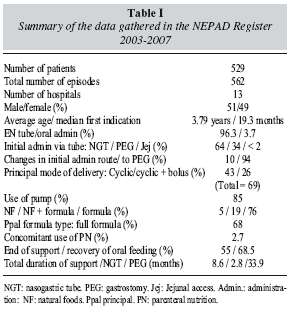
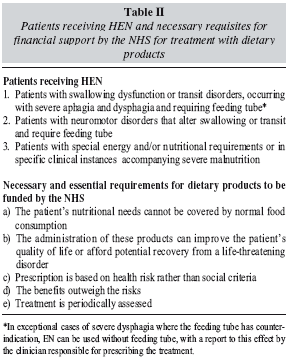
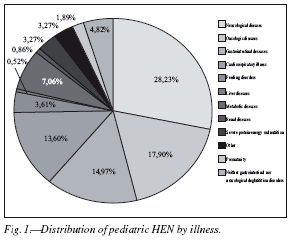
<body><![CDATA[<p><font face="Verdana" size="2">1. The National Register of Adults NADYASENPE (<a target="_blank" href="http://www.nadia-senpe.com">www.nadia-senpe.com</a>). This is an online data-base registering patients since 1992. The latest data from 2007 reveal a prevalence of 113 patients/million inhabitants<sup>6</sup>. This figure is probably lower than the actual prevalence in Spain as it is lower than that recorded in other studies conducted in certain Spanish autonomous regions, in Italy (mean prevalence of 128 patients/million inhabitants/year), in the European register of European Society of Parenteral and Enteral Nutrition (ESPEN HAN <a target="_blank" href="http://www.espen.org">http://www.espen.org</a>) (163 patients/million inhabitants), the British record kept by the British Artificial Nutrition Survey, 2007 (453 patients /million inhabitants in adults and children, not including oral EN) and United States in the period 1989-1992 (415 patients/million inhabitants).</font></p>     <p><font face="Verdana" size="2">2. Register of Pediatric Outpatient and Home Enteral Nutrition (NEPAD). This is the online database kept by the Spanish Society of Gastroenterology, Hepatology and Pediatric Nutrition (SEGHNP). Launched in 2003, it has been approved by the Ethics Committee of the Hospital Infantil Universitario Ni&ntilde;o Jes&uacute;s in Madrid and the inclusion of patients is optional and meets all the requisites of the Data Protection Act 15/99. Located at <a target="_blank" href="http://www.gastroinf.com/">http://www.gastroinf.com/</a> of SEGHNP, which makes available all additional material for users: informed consent (requesting patient's inclusion in the database), and user's manual. In 2003, NEPAD registered only 124 children from six Spanish hospitals<sup>7</sup> while in the last assessment undertaken in 2007 (<a href="#f1">fig. 1</a> and <a href="#t1">table I</a>) both the number of patients and hospitals had increased<sup>8</sup>. Although the data are similar to those recorded in other countries, they are probably biased due to the small number of centers they include and the differences among the patients' characteristics. Other pediatric records reflect a higher prevalence, for example the UK BANS records 5250 patients from 253 centers.</font></p>     <p align="center"><font face="Verdana" size="2"><a name="f1"><img src="/img/revistas/nh/v25n5/original14_f1.gif" align="top"></a></font></p>     <p align="center"><font face="Verdana" size="2"><a name="t1"><img src="/img/revistas/nh/v25n5/original14_t1.gif" align="top"></a></font></p>     <p align="center">&nbsp;</p>     <p><font face="Verdana" size="2"><b>Legal framework</b></font></p>     <p><font face="Verdana" size="2">Hospital malnutrition and nutritional support are issues of general concern; however, the legal framework and criteria for funding HEN vary firm country to country. In Spain, this service has been regulated since 2<sup>nd</sup> June 1998 by the General Directorate of National Health Service and Inspectorate (<i>Direcci&oacute;n General de Cohesi&oacute;n del Sistema Nacional de Salud y Alta Inspecci&oacute;n</i>), through the Advisory Committee for dietary product supply. Recently, the legal framework was updated in accordance with the Order <i>Real Decreto</i> 1030/2006. Dietary products eligible for financing, registered in the General Health Register of Food as dietary foods for special medical purposes, must be approved by a group of specialists, including pediatricians, in order to be listed as dietary products available (<i>nomenclator</i>) by Ministerial Order 3858/2006. In 1998, accompanying the regulation of HEN, guidelines for HEN good clinical practice were issued, which have recently been updated<sup>9</sup>. Prescription of HEN is usually made by specialists assigned to a hospital nutritional unit, provided the illnesses in question are listed as subject to HEN (<a href="#t2">Table II</a>).</font></p>     <p align="center"><font face="Verdana" size="2"><a name="t2"><img border="0" src="/img/revistas/nh/v25n5/original14_t2.gif" width="290" height="363"></a></font></p>     <p>&nbsp;</p>     <p><font face="Verdana" size="2"><b>Psychosocial consequences of HEN</b></font></p>     ]]></body>
<body><![CDATA[<p><font face="Verdana" size="2">When a child is diagnosed with a chronic illness requiring nutritional support at home, this involves radical changes in family life, often implying extensive use of health resources and changes in family activity<sup>10</sup>. Therefore, when establishing HEN one should consider not only the technical aspects but also its impact on the behavioral, psychological and physiological repercussions of the caregivers. Furthermore, the burden of home care generally corresponds to the mother, with likely consequences for her health or social, cultural or professional capacity. A survey conducted in a Spanish hospital revealed the mother is the primary caregiver in most cases and up to 66% claimed to have given up or cut down their occupational activity. Few studies have been made into this impact of HEN on personal, family and social life, nor the potential improvements after its introduction. Currently, these circumstances are not sufficiently covered by health systems and hence the main issues still to be addressed by HEN programs are:</font></p>     <blockquote> 	    <p><font face="Verdana" size="2">1. The delegation of responsibilities to patients and their caregivers. HEN requires the child's family to be able to take on the responsibility of providing care, receive training and adequate financial support. The Personal Autonomy and Dependent Care Law 39/2006 (<a target="_blank" href="http://www.saad.mtas.es/portal/">http://www.saad.mtas.es/portal/</a>) is trying to remedy the latter to some extent.</font></p> 	    <p><font face="Verdana" size="2">2. The weak link between primary and specialist care.</font></p> 	    <p><font face="Verdana" size="2">3. The importance of house-hold associated risks and the detection, management and/or prevention of complications.</font></p> 	    <p><font face="Verdana" size="2">4. The extent of use despite the lack of studies on cost-effectiveness.</font></p> 	    <p><font face="Verdana" size="2">5. The need for supervision by a multidisciplinary team (Grade A recommendation).</font></p> </blockquote>     <p>&nbsp;</p>     <p><font face="Verdana" size="2"><b>Conclusions</b></font></p>     <p><font face="Verdana" size="2">HEN is an increasingly used nutritional support service which enables patients and their families to return to their homes, thereby improving their socialization and "normalization-adaptation" of their way of life. For this to happen, professionals must provide optimal support and monitoring, with a focus on the family, from the moment this support is prescribed. Therefore, there is a need for a multidisciplinary team, which can carry out training and monitoring, making the dispensing of formulas and related equipment both simple and convenient for the patient and providing maximum collaboration with pediatricians in primary care.</font></p>     ]]></body>
<body><![CDATA[<p><font face="Verdana" size="2">Likewise, it is necessary to have a register of this service in order to know about the implementation of HEN in Spain, its use, resources required by our patients and the ability to request them from the corresponding authority. The NEPAD database has this goal; however, it is only useful if we acquire the habit of entering patient information systematically.</font></p>     <p>&nbsp;</p>     <p><font face="Verdana" size="2"><b>References</b></font></p>     <!-- ref --><p><font face="Verdana" size="2">1. Stratton RJ, Elia M; British Artificial Nutrition Survey (BANS). A cost-utility analysis in patients receiving enteral tube feeding at home and in nursing homes. Proc Nutr Soc 2008; 67(OCE): E111.</font>&nbsp;&nbsp;&nbsp;&nbsp;&nbsp;&nbsp;&nbsp;&nbsp;[&#160;<a href="javascript:void(0);" onclick="javascript: window.open('/scielo.php?script=sci_nlinks&ref=3570445&pid=S0212-1611201000050002000001&lng=','','width=640,height=500,resizable=yes,scrollbars=1,menubar=yes,');">Links</a>&#160;]<!-- end-ref --><!-- ref --><p><font face="Verdana" size="2">2. Pedr&oacute;n Giner C, Mart&iacute;nez Costa C. Indicaciones y t&eacute;cnicas de soporte nutricional. An Esp Pediatr 2001; 55: 260-6.</font>&nbsp;&nbsp;&nbsp;&nbsp;&nbsp;&nbsp;&nbsp;&nbsp;[&#160;<a href="javascript:void(0);" onclick="javascript: window.open('/scielo.php?script=sci_nlinks&ref=3570446&pid=S0212-1611201000050002000002&lng=','','width=640,height=500,resizable=yes,scrollbars=1,menubar=yes,');">Links</a>&#160;]<!-- end-ref --><!-- ref --><p><font face="Verdana" size="2">3. Loeser C, von Herz U, K&uuml;chler T, Rzehak P, M&uuml;ller MJ. Quality of life and nutritional state in patients on home enteral tube feeding. Nutrition 2003; 19: 605-11.</font>&nbsp;&nbsp;&nbsp;&nbsp;&nbsp;&nbsp;&nbsp;&nbsp;[&#160;<a href="javascript:void(0);" onclick="javascript: window.open('/scielo.php?script=sci_nlinks&ref=3570447&pid=S0212-1611201000050002000003&lng=','','width=640,height=500,resizable=yes,scrollbars=1,menubar=yes,');">Links</a>&#160;]<!-- end-ref --><!-- ref --><p><font face="Verdana" size="2">4. Skok A, Harvey D, Reddihough D. Perceived stress, perceived social support, and wellbeing among mothers of school-aged children with cerebral palsy. J Intellect Dev Disabil 2006; 31: 53-7.</font>&nbsp;&nbsp;&nbsp;&nbsp;&nbsp;&nbsp;&nbsp;&nbsp;[&#160;<a href="javascript:void(0);" onclick="javascript: window.open('/scielo.php?script=sci_nlinks&ref=3570448&pid=S0212-1611201000050002000004&lng=','','width=640,height=500,resizable=yes,scrollbars=1,menubar=yes,');">Links</a>&#160;]<!-- end-ref --><!-- ref --><p><font face="Verdana" size="2">5. Moreno JM, Shaffer J, Staun M, Hebuterne X, Bozzetti F, Pertkiewicz M et al; Home Artificial Nutrition Working Group-ESPEN. Survey on legislation and funding of home artificial nutrition in different European countries. Clin Nutr 2001; 20: 117-23.</font>&nbsp;&nbsp;&nbsp;&nbsp;&nbsp;&nbsp;&nbsp;&nbsp;[&#160;<a href="javascript:void(0);" onclick="javascript: window.open('/scielo.php?script=sci_nlinks&ref=3570449&pid=S0212-1611201000050002000005&lng=','','width=640,height=500,resizable=yes,scrollbars=1,menubar=yes,');">Links</a>&#160;]<!-- end-ref --><!-- ref --><p><font face="Verdana" size="2">6. Cuerda C, Planas M, G&oacute;mez Candela C, Luengo L.M and the NADYA-SENPE group. Trends in home enteral nutrition in Spain; analyses of the NADYA registry 1992-2007. Nutr Hosp 2009; 24: 347-53.</font>&nbsp;&nbsp;&nbsp;&nbsp;&nbsp;&nbsp;&nbsp;&nbsp;[&#160;<a href="javascript:void(0);" onclick="javascript: window.open('/scielo.php?script=sci_nlinks&ref=3570450&pid=S0212-1611201000050002000006&lng=','','width=640,height=500,resizable=yes,scrollbars=1,menubar=yes,');">Links</a>&#160;]<!-- end-ref --><!-- ref --><p><font face="Verdana" size="2">7. Moreno Villares JM, Pedr&oacute;n Giner C, Mart&iacute;nez Costa C, Oliveros Leal L, Galera Peinado AP, Rosell Camps A et al. Nutrici&oacute;n enteral domiciliaria en Espa&ntilde;a. Resultados del registro de la Sociedad Espa&ntilde;ola de Gastroenterolog&iacute;a, Hepatolog&iacute;a y Nutrici&oacute;n Pedi&aacute;trica del a&ntilde;o 2003. An Pediatr 2006; 64: 239-43.</font>&nbsp;&nbsp;&nbsp;&nbsp;&nbsp;&nbsp;&nbsp;&nbsp;[&#160;<a href="javascript:void(0);" onclick="javascript: window.open('/scielo.php?script=sci_nlinks&ref=3570451&pid=S0212-1611201000050002000007&lng=','','width=640,height=500,resizable=yes,scrollbars=1,menubar=yes,');">Links</a>&#160;]<!-- end-ref --><!-- ref --><p><font face="Verdana" size="2">8. Mart&iacute;nez Zazo AB, Quijada Fraile P, Pedr&oacute;n Giner C, Redecillas Ferreiro SE, Moreno Villares JM, Lavilla Oiz A et al. Register of paediatric home enteral nutrition (PHEN) of Spanish Society for Paediatric Gastroenterology, Hepatology and Nutrition from 2003 to 2007. Clin Nutr 2008; 3 (Supl 1): 188 (P376).</font>&nbsp;&nbsp;&nbsp;&nbsp;&nbsp;&nbsp;&nbsp;&nbsp;[&#160;<a href="javascript:void(0);" onclick="javascript: window.open('/scielo.php?script=sci_nlinks&ref=3570452&pid=S0212-1611201000050002000008&lng=','','width=640,height=500,resizable=yes,scrollbars=1,menubar=yes,');">Links</a>&#160;]<!-- end-ref --><!-- ref --><p><font face="Verdana" size="2">9. Planas Vil&aacute; M, Wanden-Berghe Lozano C, Cuerda Comp&eacute;s MC y Grupo NADYA-SENPE. Gu&iacute;a de nutrici&oacute;n enteral domiciliaria en el Sistema Nacional de Salud. 2<sup>a</sup> ed. Madrid: Ministerio de Sanidad y Consumo; 2008. ISBN 978-84-7670-695-4.</font>&nbsp;&nbsp;&nbsp;&nbsp;&nbsp;&nbsp;&nbsp;&nbsp;[&#160;<a href="javascript:void(0);" onclick="javascript: window.open('/scielo.php?script=sci_nlinks&ref=3570453&pid=S0212-1611201000050002000009&lng=','','width=640,height=500,resizable=yes,scrollbars=1,menubar=yes,');">Links</a>&#160;]<!-- end-ref --><!-- ref --><p><font face="Verdana" size="2">10. Nuuzila L, Santaler S. Children with a long-term disease: parents' experience of care. J Pediatr Nursing 2006; 21: 153-60.</font>&nbsp;&nbsp;&nbsp;&nbsp;&nbsp;&nbsp;&nbsp;&nbsp;[&#160;<a href="javascript:void(0);" onclick="javascript: window.open('/scielo.php?script=sci_nlinks&ref=3570454&pid=S0212-1611201000050002000010&lng=','','width=640,height=500,resizable=yes,scrollbars=1,menubar=yes,');">Links</a>&#160;]<!-- end-ref --><p>&nbsp;</p>     <p>&nbsp;</p>     <p><font face="Verdana" size="2"><b><a name="back"></a><a href="#top"><img border="0" src="/img/revistas/nh/v25n5/seta.gif" width="15" height="17"></a>Correspondence:</b>    <br>Liliane G&oacute;mez L&oacute;pez.    <br>Hospital Sant Joan de D&eacute;u.    <br>Passeig Sant Joan de D&eacute;u, 2    <br>08950 Esplugues. Barcelona.    ]]></body>
<body><![CDATA[<br>E-mail: <a href="mailto:lgomez@hsjdbcn.org">lgomez@hsjdbcn.org</a></font></p>     <p><font face="Verdana" size="2">Recibido: 31-VII-2009.    <br>Aceptado: 18-VIII-2009.</font></p>      ]]></body><back>
<ref-list>
<ref id="B1">
<label>1</label><nlm-citation citation-type="journal">
<person-group person-group-type="author">
<name>
<surname><![CDATA[Stratton]]></surname>
<given-names><![CDATA[RJ]]></given-names>
</name>
<name>
<surname><![CDATA[Elia]]></surname>
<given-names><![CDATA[M]]></given-names>
</name>
</person-group>
<article-title xml:lang="en"><![CDATA[British Artificial Nutrition Survey (BANS): A cost-utility analysis in patients receiving enteral tube feeding at home and in nursing homes]]></article-title>
<source><![CDATA[Proc Nutr Soc]]></source>
<year>2008</year>
<volume>67</volume>
<page-range>E111</page-range></nlm-citation>
</ref>
<ref id="B2">
<label>2</label><nlm-citation citation-type="journal">
<person-group person-group-type="author">
<name>
<surname><![CDATA[Pedrón Giner]]></surname>
<given-names><![CDATA[C]]></given-names>
</name>
<name>
<surname><![CDATA[Martínez Costa]]></surname>
<given-names><![CDATA[C]]></given-names>
</name>
</person-group>
<article-title xml:lang="es"><![CDATA[Indicaciones y técnicas de soporte nutricional]]></article-title>
<source><![CDATA[An Esp Pediatr]]></source>
<year>2001</year>
<volume>55</volume>
<page-range>260-6</page-range></nlm-citation>
</ref>
<ref id="B3">
<label>3</label><nlm-citation citation-type="journal">
<person-group person-group-type="author">
<name>
<surname><![CDATA[Loeser]]></surname>
<given-names><![CDATA[C]]></given-names>
</name>
<name>
<surname><![CDATA[von Herz]]></surname>
<given-names><![CDATA[U]]></given-names>
</name>
<name>
<surname><![CDATA[Küchler]]></surname>
<given-names><![CDATA[T]]></given-names>
</name>
<name>
<surname><![CDATA[Rzehak]]></surname>
<given-names><![CDATA[P]]></given-names>
</name>
<name>
<surname><![CDATA[Müller]]></surname>
<given-names><![CDATA[MJ]]></given-names>
</name>
</person-group>
<article-title xml:lang="en"><![CDATA[Quality of life and nutritional state in patients on home enteral tube feeding]]></article-title>
<source><![CDATA[Nutrition]]></source>
<year>2003</year>
<volume>19</volume>
<page-range>605-11</page-range></nlm-citation>
</ref>
<ref id="B4">
<label>4</label><nlm-citation citation-type="journal">
<person-group person-group-type="author">
<name>
<surname><![CDATA[Skok]]></surname>
<given-names><![CDATA[A]]></given-names>
</name>
<name>
<surname><![CDATA[Harvey]]></surname>
<given-names><![CDATA[D]]></given-names>
</name>
<name>
<surname><![CDATA[Reddihough]]></surname>
<given-names><![CDATA[D]]></given-names>
</name>
</person-group>
<article-title xml:lang="en"><![CDATA[Perceived stress, perceived social support, and wellbeing among mothers of school-aged children with cerebral palsy]]></article-title>
<source><![CDATA[J Intellect Dev Disabil]]></source>
<year>2006</year>
<volume>31</volume>
<page-range>53-7</page-range></nlm-citation>
</ref>
<ref id="B5">
<label>5</label><nlm-citation citation-type="journal">
<person-group person-group-type="author">
<name>
<surname><![CDATA[Moreno]]></surname>
<given-names><![CDATA[JM]]></given-names>
</name>
<name>
<surname><![CDATA[Shaffer]]></surname>
<given-names><![CDATA[J]]></given-names>
</name>
<name>
<surname><![CDATA[Staun]]></surname>
<given-names><![CDATA[M]]></given-names>
</name>
<name>
<surname><![CDATA[Hebuterne]]></surname>
<given-names><![CDATA[X]]></given-names>
</name>
<name>
<surname><![CDATA[Bozzetti]]></surname>
<given-names><![CDATA[F]]></given-names>
</name>
<name>
<surname><![CDATA[Pertkiewicz]]></surname>
<given-names><![CDATA[M]]></given-names>
</name>
</person-group>
<article-title xml:lang="en"><![CDATA[Survey on legislation and funding of home artificial nutrition in different European countries]]></article-title>
<source><![CDATA[Clin Nutr]]></source>
<year>2001</year>
<volume>20</volume>
<page-range>117-23</page-range></nlm-citation>
</ref>
<ref id="B6">
<label>6</label><nlm-citation citation-type="journal">
<person-group person-group-type="author">
<name>
<surname><![CDATA[Cuerda]]></surname>
<given-names><![CDATA[C]]></given-names>
</name>
<name>
<surname><![CDATA[Planas]]></surname>
<given-names><![CDATA[M]]></given-names>
</name>
<name>
<surname><![CDATA[Gómez Candela]]></surname>
<given-names><![CDATA[C]]></given-names>
</name>
<name>
<surname><![CDATA[Luengo]]></surname>
<given-names><![CDATA[L.M]]></given-names>
</name>
</person-group>
<collab>NADYA-SENPE group</collab>
<article-title xml:lang="en"><![CDATA[Trends in home enteral nutrition in Spain: analyses of the NADYA registry 1992-2007]]></article-title>
<source><![CDATA[Nutr Hosp]]></source>
<year>2009</year>
<volume>24</volume>
<page-range>347-53</page-range></nlm-citation>
</ref>
<ref id="B7">
<label>7</label><nlm-citation citation-type="journal">
<person-group person-group-type="author">
<name>
<surname><![CDATA[Moreno Villares]]></surname>
<given-names><![CDATA[JM]]></given-names>
</name>
<name>
<surname><![CDATA[Pedrón Giner]]></surname>
<given-names><![CDATA[C]]></given-names>
</name>
<name>
<surname><![CDATA[Martínez Costa]]></surname>
<given-names><![CDATA[C]]></given-names>
</name>
<name>
<surname><![CDATA[Oliveros Leal]]></surname>
<given-names><![CDATA[L]]></given-names>
</name>
<name>
<surname><![CDATA[Galera Peinado]]></surname>
<given-names><![CDATA[AP]]></given-names>
</name>
<name>
<surname><![CDATA[Rosell Camps]]></surname>
<given-names><![CDATA[A]]></given-names>
</name>
</person-group>
<article-title xml:lang="es"><![CDATA[Nutrición enteral domiciliaria en España: Resultados del registro de la Sociedad Española de Gastroenterología, Hepatología y Nutrición Pediátrica del año 2003]]></article-title>
<source><![CDATA[An Pediatr]]></source>
<year>2006</year>
<volume>64</volume>
<page-range>239-43</page-range></nlm-citation>
</ref>
<ref id="B8">
<label>8</label><nlm-citation citation-type="journal">
<person-group person-group-type="author">
<name>
<surname><![CDATA[Martínez Zazo]]></surname>
<given-names><![CDATA[AB]]></given-names>
</name>
<name>
<surname><![CDATA[Quijada Fraile]]></surname>
<given-names><![CDATA[P]]></given-names>
</name>
<name>
<surname><![CDATA[Pedrón Giner]]></surname>
<given-names><![CDATA[C]]></given-names>
</name>
<name>
<surname><![CDATA[Redecillas Ferreiro]]></surname>
<given-names><![CDATA[SE]]></given-names>
</name>
<name>
<surname><![CDATA[Moreno Villares]]></surname>
<given-names><![CDATA[JM]]></given-names>
</name>
<name>
<surname><![CDATA[Lavilla Oiz]]></surname>
<given-names><![CDATA[A]]></given-names>
</name>
</person-group>
<article-title xml:lang="en"><![CDATA[Register of paediatric home enteral nutrition (PHEN) of Spanish Society for Paediatric Gastroenterology, Hepatology and Nutrition from 2003 to 2007]]></article-title>
<source><![CDATA[Clin Nutr]]></source>
<year>2008</year>
<volume>3</volume>
<numero>^s1</numero>
<issue>^s1</issue>
<supplement>1</supplement>
<page-range>188 (P376)</page-range></nlm-citation>
</ref>
<ref id="B9">
<label>9</label><nlm-citation citation-type="book">
<person-group person-group-type="author">
<name>
<surname><![CDATA[Planas Vilá]]></surname>
<given-names><![CDATA[M]]></given-names>
</name>
<name>
<surname><![CDATA[Wanden-Berghe Lozano]]></surname>
<given-names><![CDATA[C]]></given-names>
</name>
<name>
<surname><![CDATA[Cuerda Compés]]></surname>
<given-names><![CDATA[MC]]></given-names>
</name>
</person-group>
<collab>Grupo NADYA-SENPE</collab>
<source><![CDATA[Guía de nutrición enteral domiciliaria en el Sistema Nacional de Salud]]></source>
<year>2008</year>
<edition>2</edition>
<publisher-loc><![CDATA[Madrid ]]></publisher-loc>
<publisher-name><![CDATA[Ministerio de Sanidad y Consumo]]></publisher-name>
</nlm-citation>
</ref>
<ref id="B10">
<label>10</label><nlm-citation citation-type="journal">
<person-group person-group-type="author">
<name>
<surname><![CDATA[Nuuzila]]></surname>
<given-names><![CDATA[L]]></given-names>
</name>
<name>
<surname><![CDATA[Santaler]]></surname>
<given-names><![CDATA[S]]></given-names>
</name>
</person-group>
<article-title xml:lang="en"><![CDATA[Children with a long-term disease: parents' experience of care]]></article-title>
<source><![CDATA[J Pediatr Nursing]]></source>
<year>2006</year>
<volume>21</volume>
<page-range>153-60</page-range></nlm-citation>
</ref>
</ref-list>
</back>
</article>