<?xml version="1.0" encoding="ISO-8859-1"?><article xmlns:mml="http://www.w3.org/1998/Math/MathML" xmlns:xlink="http://www.w3.org/1999/xlink" xmlns:xsi="http://www.w3.org/2001/XMLSchema-instance">
<front>
<journal-meta>
<journal-id>0212-1611</journal-id>
<journal-title><![CDATA[Nutrición Hospitalaria]]></journal-title>
<abbrev-journal-title><![CDATA[Nutr. Hosp.]]></abbrev-journal-title>
<issn>0212-1611</issn>
<publisher>
<publisher-name><![CDATA[Grupo Arán]]></publisher-name>
</publisher>
</journal-meta>
<article-meta>
<article-id>S0212-16112010000500026</article-id>
<title-group>
<article-title xml:lang="en"><![CDATA[Spanish version of the irrational food beliefs scale]]></article-title>
<article-title xml:lang="es"><![CDATA[Versión Española de la escala de creencias irracionales sobre los alimentos]]></article-title>
</title-group>
<contrib-group>
<contrib contrib-type="author">
<name>
<surname><![CDATA[Jáuregui Lobera]]></surname>
<given-names><![CDATA[I.]]></given-names>
</name>
<xref ref-type="aff" rid="A01"/>
</contrib>
<contrib contrib-type="author">
<name>
<surname><![CDATA[Bolaños]]></surname>
<given-names><![CDATA[P.]]></given-names>
</name>
<xref ref-type="aff" rid="A02"/>
</contrib>
</contrib-group>
<aff id="A01">
<institution><![CDATA[,Pablo de Olavide University Department of Bromatology and Nutrition ]]></institution>
<addr-line><![CDATA[Seville ]]></addr-line>
<country>Spain</country>
</aff>
<aff id="A02">
<institution><![CDATA[,Behavioural Sciences Institute  ]]></institution>
<addr-line><![CDATA[Seville ]]></addr-line>
<country>Spain</country>
</aff>
<pub-date pub-type="pub">
<day>00</day>
<month>10</month>
<year>2010</year>
</pub-date>
<pub-date pub-type="epub">
<day>00</day>
<month>10</month>
<year>2010</year>
</pub-date>
<volume>25</volume>
<numero>5</numero>
<fpage>852</fpage>
<lpage>859</lpage>
<copyright-statement/>
<copyright-year/>
<self-uri xlink:href="http://scielo.isciii.es/scielo.php?script=sci_arttext&amp;pid=S0212-16112010000500026&amp;lng=en&amp;nrm=iso"></self-uri><self-uri xlink:href="http://scielo.isciii.es/scielo.php?script=sci_abstract&amp;pid=S0212-16112010000500026&amp;lng=en&amp;nrm=iso"></self-uri><self-uri xlink:href="http://scielo.isciii.es/scielo.php?script=sci_pdf&amp;pid=S0212-16112010000500026&amp;lng=en&amp;nrm=iso"></self-uri><abstract abstract-type="short" xml:lang="en"><p><![CDATA[Objective: The aim of the study was to develop a Spanish adaptation of the Irrational Food Beliefs Scale (IFBS). This is important due not only to the scarcity and limitations of existing instruments in Spanish, but also to the potential of the IFBS in terms of studying the difficulties some people face in achieving healthy weight control. Methods: Subjects were 323 secondary-level and highschool students (12-20 years; 152 females, 171 males). In addition to the IFBS, we determined the body mass index and analysed the following variables: influence of the aesthetic body shape model, perceived stress, coping strategies, self-esteem and variables from the Eating Disorders Inventory-2. Results: The factor analysis yielded two factors corresponding to irrational and rational beliefs about food. The internal consistency (Cronbach's alpha coefficient) of the IFBS as a whole and of the irrational and rational subscales was 0.863, 0.881 and 0.779, respectively. The analysis of correlations with the abovementioned variables showed an adequate construct validity. Discussion: The Spanish version of the IFBS fulfils the psychometric requirements for a measure of irrational/rational food beliefs and shows adequate internal consistency and construct validity.]]></p></abstract>
<abstract abstract-type="short" xml:lang="es"><p><![CDATA[Objetivo: El propósito del estudio fue adaptar la Irrational Food Beliefs Scale (IFBS) a la población española. La escasez y limitaciones de instrumentos similares en nuestra lengua y las posibilidades de la IFBS para estudiar las dificultades en el control de peso de manera saludable justifican el trabajo. Métodos: Fueron aceptados 323 estudiantes de educación secundaria y bachillerato (12-20 años; 152 mujeres, 171 hombres). Además de la IFBS, se determinó el índice de masa corporal y se analizaron las siguientes variables: influencia del modelo estético corporal, estrés percibido, estrategias de afrontamiento, autoestima y variables del Eating Disorders Inventory-2. Resultados: El análisis factorial sugirió dos factores que representan las creencias irracionales y racionales sobre los alimentos. La consistencia interna del IFBS y de sus subescalas (coeficiente alpha de Cronbach) fue de 0.881 y 0.779 para la subescala irracional y racional respectivamente. La IFBS presentó un a=0,863. El análisis de correlaciones con las variables mencionadas demostró una adecuada validez de constructo. Discusión: La IFBS, en su versión española, cubre los requisitos psicométricos para medir las creencias racionales-irracionales acerca de los alimentos, con una adecuada consistencia interna y validez de constructo.]]></p></abstract>
<kwd-group>
<kwd lng="en"><![CDATA[Food beliefs]]></kwd>
<kwd lng="en"><![CDATA[Irrational beliefs]]></kwd>
<kwd lng="en"><![CDATA[Eating disorders]]></kwd>
<kwd lng="en"><![CDATA[Obesity]]></kwd>
<kwd lng="en"><![CDATA[Weight control]]></kwd>
<kwd lng="es"><![CDATA[Creencias sobre los alimentos]]></kwd>
<kwd lng="es"><![CDATA[Creencias irracionales]]></kwd>
<kwd lng="es"><![CDATA[Trastornos de la conducta alimentaria]]></kwd>
<kwd lng="es"><![CDATA[Obesidad]]></kwd>
<kwd lng="es"><![CDATA[Control del peso]]></kwd>
</kwd-group>
</article-meta>
</front><body><![CDATA[ <p><font face="Verdana" size="2"><a name="top"></a><b>ORIGINALS</b></font></p>     <p>&nbsp;</p>     <p><font face="Verdana" size="4"><b>Spanish version of the irrational food beliefs scale</b></font></p>     <p><font face="Verdana" size="4"><b>Versi&oacute;n Espa&ntilde;ola de la escala de creencias irracionales sobre los alimentos</b></font></p>     <p>&nbsp;</p>     <p>&nbsp;</p>     <p><font face="Verdana" size="2"><b>I. J&aacute;uregui Lobera<sup>1,2</sup> and P. Bola&ntilde;os<sup>2</sup></b></font></p>     <p><font face="Verdana" size="2"><sup>1</sup>Department of Bromatology and Nutrition, Pablo de Olavide University, Seville, Spain.    <br><sup>2</sup>Behavioural Sciences Institute, Seville, Spain</font></p>     <p><font face="Verdana" size="2"><a href="#back">Correspondence</a></font></p>     ]]></body>
<body><![CDATA[<p>&nbsp;</p>     <p>&nbsp;</p> <hr size="1">     <p><font face="Verdana" size="2"><b>ABSTRACT</b></font></p>     <p><font face="Verdana" size="2"><b>Objective:</b> The aim of the study was to develop a Spanish adaptation of the Irrational Food Beliefs Scale (IFBS). This is important due not only to the scarcity and limitations of existing instruments in Spanish, but also to the potential of the IFBS in terms of studying the difficulties some people face in achieving healthy weight control.    <br><b>Methods:</b> Subjects were 323 secondary-level and highschool students (12-20 years; 152 females, 171 males). In addition to the IFBS, we determined the body mass index and analysed the following variables: influence of the aesthetic body shape model, perceived stress, coping strategies, self-esteem and variables from the Eating Disorders Inventory-2.    <br><b>Results:</b> The factor analysis yielded two factors corresponding to irrational and rational beliefs about food. The internal consistency (Cronbach's alpha coefficient) of the IFBS as a whole and of the irrational and rational subscales was 0.863, 0.881 and 0.779, respectively. The analysis of correlations with the abovementioned variables showed an adequate construct validity.    <br><b>Discussion:</b> The Spanish version of the IFBS fulfils the psychometric requirements for a measure of irrational/rational food beliefs and shows adequate internal consistency and construct validity.</font></p>     <p><font face="Verdana" size="2"><b>Key words:</b> Food beliefs. Irrational beliefs. Eating disorders. Obesity. Weight control.</font></p> <hr size="1">     <p><font face="Verdana" size="2"><b>RESUMEN</b></font></p>     <p><font face="Verdana" size="2"><b>Objetivo:</b> El prop&oacute;sito del estudio fue adaptar la Irrational Food Beliefs Scale (IFBS) a la poblaci&oacute;n espa&ntilde;ola. La escasez y limitaciones de instrumentos similares en nuestra lengua y las posibilidades de la IFBS para estudiar las dificultades en el control de peso de manera saludable justifican el trabajo.    ]]></body>
<body><![CDATA[<br><b>M&eacute;todos:</b> Fueron aceptados 323 estudiantes de educaci&oacute;n secundaria y bachillerato (12-20 a&ntilde;os; 152 mujeres, 171 hombres). Adem&aacute;s de la IFBS, se determin&oacute; el &iacute;ndice de masa corporal y se analizaron las siguientes variables: influencia del modelo est&eacute;tico corporal, estr&eacute;s percibido, estrategias de afrontamiento, autoestima y variables del Eating Disorders Inventory-2.    <br><b>Resultados:</b> El an&aacute;lisis factorial sugiri&oacute; dos factores que representan las creencias irracionales y racionales sobre los alimentos. La consistencia interna del IFBS y de sus subescalas (coeficiente alpha de Cronbach) fue de 0.881 y 0.779 para la subescala irracional y racional respectivamente. La IFBS present&oacute; un a=0,863. El an&aacute;lisis de correlaciones con las variables mencionadas demostr&oacute; una adecuada validez de constructo.    <br><b>Discusi&oacute;n:</b> La IFBS, en su versi&oacute;n espa&ntilde;ola, cubre los requisitos psicom&eacute;tricos para medir las creencias racionales-irracionales acerca de los alimentos, con una adecuada consistencia interna y validez de constructo.</font></p>     <p><font face="Verdana" size="2"><b>Palabras clave:</b> Creencias sobre los alimentos. Creencias irracionales. Trastornos de la conducta alimentaria. Obesidad. Control del peso.</font></p> <hr size="1">     <p><font face="Verdana" size="2"><b>Abreviaturas</b></font></p>     <p><font face="Verdana" size="2">IFBS: Irrational Food Beliefs Scale    <br>USA: United States of America    <br>UK: United Kingdom    <br>ED: Eating Disorders    <br>M: Mean; SD: Standard Deviation    ]]></body>
<body><![CDATA[<br>BMI: Body Mass Index    <br>CIMEC: Cuestionario de Influencias del Modelo Est&eacute;tico Corporal; CIMEC-V: idem-Varones.    <br>PSQ: Perceived Stress Questionnaire    <br>CSI: Coping Strategies Inventory    <br>SES: Self Esteem Scale    <br>EDI-2: Eating Disorders Inventory-2.</font></p>     <p>&nbsp;</p>     <p><font face="Verdana" size="2"><b>Introduction</b></font></p>     <p><font face="Verdana" size="2">Obesity and overweight have become two of the most serious health problems facing society, with recent studies in Spain reporting a prevalence of 15.5% for obesity, and 39.2% for overweight<sup>1</sup>. Among school-age children the prevalence of overweightness and obesity is particularly high in the USA, the UK and south-west Europe<sup>2</sup>. Research in Spain among the population aged 2-24 years has reported rates of 13.9% for obesity and 12.4% for overweightness (26.3% overall)<sup>3</sup>.</font></p>     <p><font face="Verdana" size="2">Eating disorders (ED) are also a common problem, with the rate of anorexia nervosa among women being  0.5%, ten times the prevalence found among men<sup>4</sup>. In the case of bulimia nervosa the prevalence is 1.1-4.2%, and once again the majority of sufferers are women, although the gender difference is less marked than for anorexia nervosa<sup>5</sup>.</font></p>     ]]></body>
<body><![CDATA[<p><font face="Verdana" size="2">Since the construct of irrational beliefs was first formulated<sup>6</sup> the association between cognitive distortions and certain behaviours, for example, phobias, has been demonstrated<sup>7</sup>. These findings have been replicated in the field of ED, where research has reported a high presence of irrational thoughts and behaviours related to weight, food and body image<sup>8</sup>.</font></p>     <p><font face="Verdana" size="2">One of the most relevant cognitive factors involved in the maintenance and poor control of body weight seems to be dichotomous thinking<sup>9</sup>. Thus, in the treatment of obesity it has been shown that this factor can be a predictor of new weight gain<sup>10</sup>. In the context of ED, patients commonly classify foods into good (permitted) and bad (forbidden) on the basis of dichotomous thinking, which leads them to eat certain foods (lower in calories) and avoid others (higher in calories)<sup>11</sup>. Research has shown that dysfunctional cognitive style plays a key role in the maintenance of restrictive diets as a way of regulating food intake and weight<sup>12</sup>. The dysfunctional cognitive style in ED, which is characterised by numerous irrational beliefs, is often accompanied by symptoms of anxiety and depression, and it is therefore important to study it so as to develop effective treatments<sup>13</sup>.</font></p>     <p><font face="Verdana" size="2">As regards weight control, several studies have sought to measure the cognitive variables involved. Some research has focussed on the variable locus of control, other studies have analysed learned expectancies about the reinforcement of foods, and more recently, it has been developed a questionnaire to measure the relative reinforcing value of different foods<sup>14</sup>.</font></p>     <p><font face="Verdana" size="2">Just as irrational beliefs about matters of health can lead to inappropriate health-related behaviours, beliefs about food may play an important role in terms of what someone chooses to eat<sup>15</sup>. Indeed, ED patients hold dysfunctional beliefs about diet, with especially negative thoughts concerning food. More specifically, research has shown a relationship between irrational beliefs and bulimic symptoms<sup>16</sup>, as well as between such beliefs and the relative success achieved by obese people in maintaining weight loss<sup>17</sup>.</font></p>     <p><font face="Verdana" size="2">The Irrational Food Beliefs Scale (IFBS)<sup>15</sup> was developed with the aim of analysing the cognitive distortions and inappropriate attitudes and beliefs about food. The scale has shown adequate psychometric properties and factor analysis revealed two factors, corresponding to the irrational food beliefs subscale and the rational food beliefs subscale; the Cronbach's alpha values were 0.89 and 0.70, respectively. The scale consists of 57 items, 41 on the irrational beliefs sub-scale and 16 on the rational beliefs sub-scale. The original study found no differences between men and women in terms of sub-scale scores.</font></p>     <p>&nbsp;</p>     <p><font face="Verdana" size="2"><b>Objective</b></font></p>     <p><font face="Verdana" size="2">The general aim of the present study was to analyse, in a Spanish population, the psychometric properties of the IFBS, including its factor structure and internal consistency. In addition, and in order to determine the construct validity, we analysed the relationships between the IFBS and several variables (Body Mass Index, Questionnaire on Influences on Body Shape Model, Perceived Stress Questionnaire, Coping Strategies Inventory, Rosenberg Self-Esteem Scale and the Eating Disorders Inventory-2) so as to evaluate the convergent and discriminant validity.</font></p>     <p>&nbsp;</p>     <p><font face="Verdana" size="2"><b>Methods</b></font></p>     ]]></body>
<body><![CDATA[<p><font face="Verdana" size="2"><i>Participants</i></font></p>     <p><font face="Verdana" size="2">The initial number of 571 participants was subsequently reduced to 527 after any incomplete protocols were rejected. Regarding to the IFBS, only in seven cases (1.22%) the questionnaire was incomplete and then they were rejected. Among the participants nobody showed any comprehension and/or language difficulties. They were all adolescents aged 12-20 years (mean 15.83, SD=1.35) and were either secondary or high school students drawn from two state schools. There were 268 females and 303 males, a ratio that corresponded to the gender demographics of the two schools. After rejecting the incomplete protocols there were 260 females (49,33%) and 267 males (50,67%).</font></p>     <p><font face="Verdana" size="2"><i>Measures</i></font></p>     <p><font face="Verdana" size="2">The students were weighed and measured (without their shoes) using calibrated electronic instruments and the BMI scores (weight in Kg/height in m squared) were calculated.</font></p>     <p><font face="Verdana" size="2">Questionnaire on Influences on Body Shape Model (CIMEC and CIMEC-V).</font></p>     <p><font face="Verdana" size="2">This instrument was designed to assess the influence of the prevailing aesthetic model in both normal and clinical populations. The original questionnaire (CIMEC), which was validated in girls, was subsequently adapted for boys (CIMEC-V) and it has been shown to be adequate for assessing socio-cultural influences on the aesthetic body shape model<sup>18</sup>. The questionnaire measures the influence of ideal models, the concern with being thin, the influence of social models, family influences, the influence of friends, interpersonal influences, behaviours aimed at weight loss, body-related anxiety, the influence of advertising and the concern with being fat. The CIMEC and CIMEC-V used here were the 40-item versions. Each item has three possible responses: <i>a great deal, slightly or not at all</i>. The original study in which the instrument was validated reported adequate reliability (Cronbach's alpha &gt; 0.70).</font></p>     <p><font face="Verdana" size="2">Perceived Stress Questionnaire (PSQ)</font></p>     <p><font face="Verdana" size="2">This instrument was specifically designed to evaluate stress in clinical psychosomatic research and comprises 30 items that differentially measure the <i>general</i> and <i>recent</i> forms of perceived stress. The present study used the Spanish version of the PSQ (19), which has shown adequate internal consistency (Cohen's a coefficient = 0.90) and test-retest reliability (r=0.80), as well as adequate predictive validity in stress-related disorders.</font></p>     <p><font face="Verdana" size="2">Coping Strategies Inventory (CSI)</font></p>     <p><font face="Verdana" size="2">Once again, the Spanish version was used here<sup>20</sup>. The inventory consists of a test in which eight primary strategies (problem solving, self-criticism, emotional expression, wishful thinking, social support, cognitive restructuring, problem avoidance and social withdrawal), four secondary strategies (adaptive and maladaptive coping with problems, adaptive and maladaptive coping with emotions) and two tertiary strategies (adaptive and maladaptive coping) are explored on the basis of the description of a stressful situation. Subjects respond to 72 items scored on a fivepoint Likert scale, such that they indicate how often in the described situation they did what is expressed in each item. Finally, they respond to a further item about the perceived effectiveness of their coping. In its Spanish version the questionnaire has shown adequate internal consistency, with Cronbach's coefficients for the different factors between 0.63 and 0.89.</font></p>     ]]></body>
<body><![CDATA[<p><font face="Verdana" size="2">Self-Esteem Scale (SES)</font></p>     <p><font face="Verdana" size="2">This scale is widely used in psychological research, both social and clinical, and comprises ten items that measure global self-esteem. The present study used the Spanish version of the instrument<sup>21</sup>, which shows adequate internal consistency (Cronbach's a coefficient = 0.87), test-retest reliability (r=0.72) and construct validity.</font></p>     <p><font face="Verdana" size="2">Eating Disorders Inventory-2 (EDI-2)</font></p>     <p><font face="Verdana" size="2">A self-report questionnaire with 11 subscales (drive for thinness, bulimia, body dissatisfaction, ineffectiveness, perfectionism, interpersonal distrust, interoceptive awareness, maturity fears, asceticism, impulse regulation and social insecurity), the scores of which provide a profile that can be compared with norms for patients and the normal population<sup>22</sup>. The internal consistency ranges between 0.83 and 0.92 in patient samples and between 0.65 and 0.93 in various non-clinical samples. Test-retest reliability ranges between 0.41 and 0.97 depending on the sample, and the inventory shows adequate construct validity.</font></p>     <p><font face="Verdana" size="2"><i>Procedure</i></font></p>     <p><font face="Verdana" size="2">The Spanish version of the IFBS was obtained by conducting a translation and back translation procedure. Twenty students were randomly selected from the sample for preliminary testing in order to confirm that the scale could be read and understood by the age group of interest. During test administration the students were asked for their interpretations of the questions. Their suggestions and comments were then used to prepare the instructions and to ensure that the participants had no difficulties reading the items.</font></p>     <p><font face="Verdana" size="2">In the case of students under the age of eighteen, parental consent and the child's assent were obtained before the data were collected. Parents were asked to return the consent form even in the event that they did not want their children to participate in the research, in this case indicating no consent. Students over the age of eighteen provided their own consent and their parents were informed about the nature of the study, which was conducted with the permission and collaboration of the heads of the respective schools, and having obtained the approval of the Ethics and Deontology Department of them.</font></p>     <p><font face="Verdana" size="2">Once informed consent had been obtained, students completed the abovementioned questionnaires in group sessions with no time limit; this was done in classroom time in the presence of a psychologist and a dietician. One session was used to measure weight and height, while a further two were dedicated to questionnaire administration. All participants volunteered to take part in the study and none of them received any kind of recompense for responding to the questionnaires.</font></p>     <p>&nbsp;</p>     <p><font face="Verdana" size="2"><b>Results</b></font></p>     ]]></body>
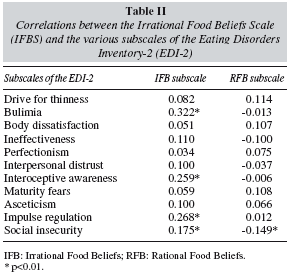
<body><![CDATA[<p><font face="Verdana" size="2"><i>Factor structure and internal consistency of the IFBS</i></font></p>     <p><font face="Verdana" size="2">A factor analysis was conducted using principal components extraction with varimax rotation. Various indicators of the high degree of inter-relationship between the variables confirmed the suitability of the analysis: Bartlett's test of sphericity gave X<sup>2</sup>=4575.56 (significance&lt;0.0001), while the Kaiser-Meyer-Olkin index was 0.853. The number of factors was determined by considering those with eigenvalues above 1, as well as through examination of the scree plot. The best solution from the principal factors analysis of the 57 items of the IFBS revealed two factors corresponding to the two subscales (<i>irrational</i> and <i>rational</i> beliefs), as reported by the authors of the questionnaire. The <i>irrational beliefs</i> sub-scale measures cognitive distortions and unhealthy beliefs and attitudes related with food, whereas the <i>rational beliefs</i> sub-scale refers to beliefs that are consistent with current guidelines on healthy eating.</font></p>     <p><font face="Verdana" size="2"><a href="#t1">Table 1</a> shows the rotated factor loadings, the explained variance and the accumulated variance.</font></p>     <p align="center"><font face="Verdana" size="2"><a name="t1"><img src="/img/revistas/nh/v25n5/original20_t1.gif" align="top"></a></font></p>     <p><font face="Verdana" size="2">The first factor, which explains 34.76% of the total variance, groups together the 41 items of the <i>irrational beliefs</i> sub-scale of the IFBS. The second factor explains 18.90% of the total variance and groups together the remaining 16 items, those from the <i>rational beliefs</i> sub-scale.</font></p>     <p><font face="Verdana" size="2">The internal consistency of the IFBS and its subscales was determined by calculating Cronbach's alpha coefficient. The <i>irrational beliefs</i> factor gave a=0.881, while the <i>rational beliefs</i> factor yielded a=0.779. Overall, the IFBS had a=0.863.</font></p>     <p><font face="Verdana" size="2"><i>Correlation of the IFBS with other variables</i></font></p>     <p><font face="Verdana" size="2">There was a negative and significant correlation (p&lt;0.01) between the irrational beliefs sub-scale of the IFBS and BMI (r=-0.21).</font></p>     <p><font face="Verdana" size="2">As regards the IFBS and the CIMEC the analysis of correlations showed a positive and significant correlation (p&lt;0.01) between CIMEC total score and the irrational beliefs sub-scale of the IFBS (r=0.22). With respect to the different areas of influence explored by the CIMEC, there were positive and significant correlations (p&lt;0.01) between the irrational beliefs subscale of the IFBS and the concern with being thin (r=0.20), the influence of friends (r=0.20) and the influence of advertising (r=0.23).</font></p>     <p><font face="Verdana" size="2">The irrational beliefs sub-scale of the IFBS was positively correlated with perceived stress, both general (r=0.17; p&lt;0.01) and recent (r=0.14; p&lt;0.05).</font></p>     ]]></body>
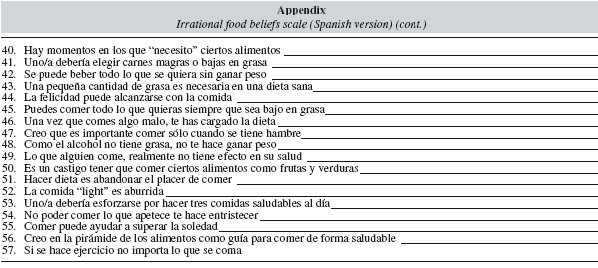
<body><![CDATA[<p><font face="Verdana" size="2">As regards the CSI and the IFBS the analysis revealed  a positive and significant correlation between the irrational beliefs sub-scale and self-criticism (r=0.17; p&lt;0.01), maladaptive coping with emotions (r=0.15; p&lt;0.01), and maladaptive coping (r=0.12; p&lt;0.05). The irrational beliefs sub-scale was negatively and significantly correlated with the CSI score for perceived effectiveness of coping (r=-0.14; p&lt; 0.05). As regards the rational beliefs sub-scale of the IFBS, this showed a positive correlation with social support (r=0.14; p&lt;0.05).</font></p>     <p><font face="Verdana" size="2">The irrational beliefs sub-scale of the IFBS was also negatively and significantly correlated with self-esteem (r=-0.21; p&lt;0.01).</font></p>     <p><font face="Verdana" size="2">The relationship between the IFBS and specific eating pathology was determined by means of the EDI-2, the results being shown in <a href="#t2">Table II</a>. The most important findings are the correlations observed between the irrational beliefs sub-scale of the IFBS and bulimia, interoceptive awareness, impulse regulation and social insecurity.</font></p>     <p align="center"><font face="Verdana" size="2"><a name="t2"><img src="/img/revistas/nh/v25n5/original20_t2.gif" align="top"></a></font></p>     <p>&nbsp;</p>     <p><font face="Verdana" size="2"><i>Differences between girls and boys</i></font></p>     <p><font face="Verdana" size="2">Although there were no significant differences between girls and boys as regards the irrational beliefs sub-scale (M=75.10, SD=14.21; and M=75.46, SD=15.82, respectively), such differences were observed with respect to the rational beliefs sub-scale (M=51.00, SD=7.67; and M=46.47, SD=9.02; p&lt;0.001). Within the rational beliefs sub-scale the most significant differences (p&lt;0.0001) were obtained on items 12 (<i>Healthy eating should be a way of life</i>) and 56 (<i>I believe in the food pyramid as a guide to healthy eating</i>) &#091;girls and boys, respectively: M=3.39, SD=0.71; and M=2.97, SD=0.98 on item 12; M=3.20, SD=0.75; and M=2.77, SD=0.77 on item 56&#093;.</font></p>     <p>&nbsp;</p>     <p><font face="Verdana" size="2"><b>Discussion</b></font></p>     <p><font face="Verdana" size="2">As in the original research that validated the IFBS, the present study obtained two factors corresponding to the irrational and rational beliefs subscales, with 41 and 16 items, respectively. The <i>irrational</i> sub-scale measures cognitive distortions and unhealthy beliefs and attitudes related to food, whereas the <i>rational</i> subscale refers to current guidelines on healthy eating. In general, this validation study of the Spanish version of the IFBS, conducted with adolescents, fulfils the requirements for measuring the construct "rational/irrational beliefs about food". The reliability analysis showed that both the total IFBS and its two subscales have adequate internal consistency.</font></p>     ]]></body>
<body><![CDATA[<p><font face="Verdana" size="2">In the original study<sup>15</sup> the rational beliefs sub-scale of the IFBS showed no significant, positive correlations with any of the variables analysed, a finding that was replicated here with the exception of the "social support" strategy of the CSI; this coping strategy refers to the search for emotional support, and is considered to be adaptive in comparison to "social withdrawal"<sup>20</sup>.</font></p>     <p><font face="Verdana" size="2">In contrast to the original research<sup>15</sup> the present study found a negative and significant correlation between the irrational beliefs sub-scale of the IFBS and BMI; however, BMI was here calculated using weight and height measurements taken from participants as part of the study, whereas in the original research it was calculated on self-reported weight and height values, which may introduce a degree of bias. The observed correlation is consistent with the fact that using similar instruments a relationship has been found between thoughts related to food, low body esteem and dietary restriction<sup>23</sup>.</font></p>     <p><font face="Verdana" size="2">The present study demonstrates the relationship between the influence of the aesthetic body shape model and irrational food beliefs, especially as regards the concern with being thin and the influence of friends and advertising. As a common denominator, the anxiety produced by the prevailing aesthetic body shape model among adolescents appears to be related to irrational thoughts about food that are geared toward weight loss. The influence of the media (of advertising) on the development of eating disorders may explain some of the correlations found here.</font></p>     <p><font face="Verdana" size="2">The relationship between stress and eating disorders has been explained in terms of the link between cognitive constructs (for example, thoughts about food) and certain eating behaviours<sup>24</sup>. The present study reveals a certain relationship between the perceived stress of adolescents and their irrational food beliefs. This relationship has also been reported for a number of eating behaviours, it being found that dietary profile changes in line with an increase in perceived stress<sup>25</sup>. Similarly, perceived stress in everyday life has been related to a greater risk of eating disorders<sup>26</sup>.</font></p>     <p><font face="Verdana" size="2">Coping difficulties in the context of eating disorders have been widely studied, and research has found that maladaptive coping with emotions is associated with episodes of binging; furthermore, it appears that sub-groups of patients with eating disorders could be established on the basis of the coping strategies they use<sup>27</sup>. In the present study the irrational beliefs subscale was positively correlated with strategies such as self-criticism and maladaptive coping with emotions, and negatively correlated with the perceived effectiveness of coping with problems and emotions. These findings, together with the negative correlation between irrational food beliefs and self-esteem (which was observed both here and in the original study), seem to support the idea of distinguishing potential sub-groups of eating disorder patients on the basis of variables other than the traditional categories of restrictive vs. purging, since doing so may have therapeutic and prognostic implications<sup>27</sup>.</font></p>     <p><font face="Verdana" size="2">As regards the relationship between irrational food beliefs and symptoms of eating disorders, the present study found correlations between irrational thoughts and bulimic symptoms, this being consistent with the original report. This suggests that irrational food beliefs may increase the risk of losing control over eating behaviour. The same occurs with the relationship between irrational beliefs and impulse regulation, which has been associated with a worse prognosis in eating disorders on the basis of poorer coping with emotions<sup>28</sup>. Finally, social anxiety has also been linked to the irrational beliefs sub-scale (Osberg et al., 2008), and the present study observed a similar relationship with "social insecurity", as measured by the EDI-2.</font></p>     <p><font face="Verdana" size="2">For the age range of the present sample, there are differences between girls and boys as regards the rational beliefs sub-scale. Given that this sub-scale refers to current guidelines on healthy eating it could be concluded from the results that girls are more knowledgeable in this respect. However, although the higher scores of girls are associated with body dissatisfaction and the desire to lose weight, those scores are not related to BMI. This apparent lack of connection between nutritional knowledge and eating behaviour, mediated by body dissatisfaction, has been reported previously<sup>29</sup>. In the case of irrational beliefs the relationship with BMI takes a negative direction: the higher the score on the irrational beliefs sub-scale, the lower the BMI. Furthermore, the relationship between the irrational beliefs sub-scale and bulimic behaviour suggests that irrational food beliefs may contribute to loss of control over eating (bulimic symptoms) and to weight loss achieved via compensatory restrictive practices (lower BMI).</font></p>     <p><font face="Verdana" size="2"><i>Limitations</i></font></p>     <p><font face="Verdana" size="2">The present validation study was conducted with a group of healthy adolescents, and therefore future investigations would need to apply the IFBS to adolescent clinical samples, those with eating disorders, overweightness or obesity. Indeed, the clinical implications which irrational food beliefs might have, in terms of both weight gain and weight loss or maintenance, would constitute the main contribution of the scale when it comes to working with these specific distortions, as well as with others that are found in these patients (such as those related to body image).</font></p>     <p><font face="Verdana" size="2">A further point is that the psychometric properties of the scale now need to be investigated in a population of healthy Spanish adults, who were not included in the present study.</font></p>     ]]></body>
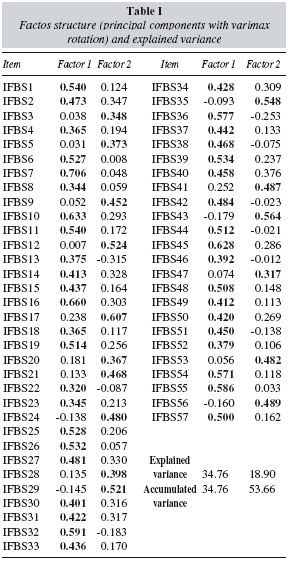
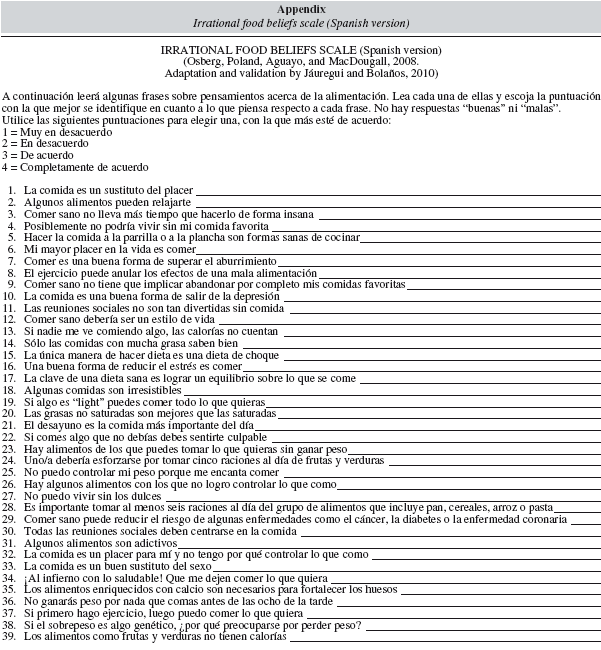
<body><![CDATA[<p><font face="Verdana" size="2">Future research should also analyse the relationship between irrational/rational food beliefs and actual food intake, both in terms of calorie content and macronutrient/micronutrient composition. These aspects would need to be analysed in the context of eating disorders and in overweight/obese subjects, and for both child/adolescent and adult populations.</font></p>     <p align="center"><font face="Verdana" size="2"><img src="/img/revistas/nh/v25n5/original20_a1.gif" align="top"></font></p>     <p align="center"><font face="Verdana" size="2"><img src="/img/revistas/nh/v25n5/original20_a2.gif" align="top"></font></p>     <p>&nbsp;</p>     <p><font face="Verdana" size="2"><b>References</b></font></p>     <!-- ref --><p><font face="Verdana" size="2">1. Affenito SG, Dohm FA, Crawford PB, Daniels SR, Striegel-Moore RH. Macronutrient intake in anorexia nervosa: The National Heart, Lung, and Blood Institute Growth and Health Study. J Pediatr 2002; 141: 701-705.</font>&nbsp;&nbsp;&nbsp;&nbsp;&nbsp;&nbsp;&nbsp;&nbsp;[&#160;<a href="javascript:void(0);" onclick="javascript: window.open('/scielo.php?script=sci_nlinks&ref=3571394&pid=S0212-1611201000050002600001&lng=','','width=640,height=500,resizable=yes,scrollbars=1,menubar=yes,');">Links</a>&#160;]<!-- end-ref --><!-- ref --><p><font face="Verdana" size="2">2. American Psychiatric Association. Diagnostic and Statistical Manual of Mental Disorders: DSM IV-RT. Washington DC: American Psychiatric Association; 2000.</font>&nbsp;&nbsp;&nbsp;&nbsp;&nbsp;&nbsp;&nbsp;&nbsp;[&#160;<a href="javascript:void(0);" onclick="javascript: window.open('/scielo.php?script=sci_nlinks&ref=3571395&pid=S0212-1611201000050002600002&lng=','','width=640,height=500,resizable=yes,scrollbars=1,menubar=yes,');">Links</a>&#160;]<!-- end-ref --><!-- ref --><p><font face="Verdana" size="2">3. Aranceta-Bartrina J, P&eacute;rez-Rodrigo C, Ribas-Barba L, Serra-Majem L. Epidemiolog&iacute;a y factores determinantes de la obesidad infantil y juvenil en Espa&ntilde;a. Rev Pediatr Aten Primaria 2005; 7 (Supl 1): S 13-20.</font>&nbsp;&nbsp;&nbsp;&nbsp;&nbsp;&nbsp;&nbsp;&nbsp;[&#160;<a href="javascript:void(0);" onclick="javascript: window.open('/scielo.php?script=sci_nlinks&ref=3571396&pid=S0212-1611201000050002600003&lng=','','width=640,height=500,resizable=yes,scrollbars=1,menubar=yes,');">Links</a>&#160;]<!-- end-ref --><!-- ref --><p><font face="Verdana" size="2">4. Aranceta-Bartrina J, Serra-Majem L, Foz-Sala M, Moreno-Esteban B, Grupo Colaborativo de la SEEDO. Prevalencia de obesidad en Espa&ntilde;a. Med Cl&iacute;n (Barc) 2005; 125: 460-466.</font>&nbsp;&nbsp;&nbsp;&nbsp;&nbsp;&nbsp;&nbsp;&nbsp;[&#160;<a href="javascript:void(0);" onclick="javascript: window.open('/scielo.php?script=sci_nlinks&ref=3571397&pid=S0212-1611201000050002600004&lng=','','width=640,height=500,resizable=yes,scrollbars=1,menubar=yes,');">Links</a>&#160;]<!-- end-ref --><!-- ref --><p><font face="Verdana" size="2">5. Axelson ML, Federline TL, Birnberg D. A meta-analysis of food and nutrition related research. J Nutr Educ 1985; 17: 51-54</font>&nbsp;&nbsp;&nbsp;&nbsp;&nbsp;&nbsp;&nbsp;&nbsp;[&#160;<a href="javascript:void(0);" onclick="javascript: window.open('/scielo.php?script=sci_nlinks&ref=3571398&pid=S0212-1611201000050002600005&lng=','','width=640,height=500,resizable=yes,scrollbars=1,menubar=yes,');">Links</a>&#160;]<!-- end-ref --><!-- ref --><p><font face="Verdana" size="2">6. Birmingham CL, Beaumont P. Medical management of eating disorders. Cambridge: Cambridge University Press; 2004.</font>&nbsp;&nbsp;&nbsp;&nbsp;&nbsp;&nbsp;&nbsp;&nbsp;[&#160;<a href="javascript:void(0);" onclick="javascript: window.open('/scielo.php?script=sci_nlinks&ref=3571399&pid=S0212-1611201000050002600006&lng=','','width=640,height=500,resizable=yes,scrollbars=1,menubar=yes,');">Links</a>&#160;]<!-- end-ref --><!-- ref --><p><font face="Verdana" size="2"> 7. Byrne SM, Cooper Z, Fairburn CG. Psychological predictors of weight regain in obesity. Behav Res Ther 2004; 42: 1341-1356.</font>&nbsp;&nbsp;&nbsp;&nbsp;&nbsp;&nbsp;&nbsp;&nbsp;[&#160;<a href="javascript:void(0);" onclick="javascript: window.open('/scielo.php?script=sci_nlinks&ref=3571400&pid=S0212-1611201000050002600007&lng=','','width=640,height=500,resizable=yes,scrollbars=1,menubar=yes,');">Links</a>&#160;]<!-- end-ref --><!-- ref --><p><font face="Verdana" size="2">8. Cano Garc&iacute;a FJ, Rodr&iacute;guez Franco L, Garc&iacute;a Mart&iacute;nez J. Spanish version of the Coping Strategies Inventory. Actas Esp Psiquiatri 2007; 35 (1): 29-39.</font>&nbsp;&nbsp;&nbsp;&nbsp;&nbsp;&nbsp;&nbsp;&nbsp;[&#160;<a href="javascript:void(0);" onclick="javascript: window.open('/scielo.php?script=sci_nlinks&ref=3571401&pid=S0212-1611201000050002600008&lng=','','width=640,height=500,resizable=yes,scrollbars=1,menubar=yes,');">Links</a>&#160;]<!-- end-ref --><!-- ref --><p><font face="Verdana" size="2">9. Cooper Z, Fairburn CG. A new cognitive behavioural approach to the treatment of obesity. Behav Res Ther 2001; 39: 499-511.</font>&nbsp;&nbsp;&nbsp;&nbsp;&nbsp;&nbsp;&nbsp;&nbsp;[&#160;<a href="javascript:void(0);" onclick="javascript: window.open('/scielo.php?script=sci_nlinks&ref=3571402&pid=S0212-1611201000050002600009&lng=','','width=640,height=500,resizable=yes,scrollbars=1,menubar=yes,');">Links</a>&#160;]<!-- end-ref --><!-- ref --><p><font face="Verdana" size="2">10. Daigle-Leblanc D, Villalon L. Perceived stress and its influence on the eating behaviours of students at the University of Moncton, Moncton Campus. Can J Diet Pract Res 2008; 69(3): 133-140.</font>&nbsp;&nbsp;&nbsp;&nbsp;&nbsp;&nbsp;&nbsp;&nbsp;[&#160;<a href="javascript:void(0);" onclick="javascript: window.open('/scielo.php?script=sci_nlinks&ref=3571403&pid=S0212-1611201000050002600010&lng=','','width=640,height=500,resizable=yes,scrollbars=1,menubar=yes,');">Links</a>&#160;]<!-- end-ref --><!-- ref --><p><font face="Verdana" size="2">11. Dohm FA, Beattie JA, Aibel C, Striegel-Moore RH. Factors differentiating women and men who successfully maintain weight loss from women and men who do not. J Clin Psychol 2001; 57: 105-117.</font>&nbsp;&nbsp;&nbsp;&nbsp;&nbsp;&nbsp;&nbsp;&nbsp;[&#160;<a href="javascript:void(0);" onclick="javascript: window.open('/scielo.php?script=sci_nlinks&ref=3571404&pid=S0212-1611201000050002600011&lng=','','width=640,height=500,resizable=yes,scrollbars=1,menubar=yes,');">Links</a>&#160;]<!-- end-ref --><!-- ref --><p><font face="Verdana" size="2">12. Ellis A. Reason and emotion in psychotherapy. New York: Lyle Stuart; 1962.</font>&nbsp;&nbsp;&nbsp;&nbsp;&nbsp;&nbsp;&nbsp;&nbsp;[&#160;<a href="javascript:void(0);" onclick="javascript: window.open('/scielo.php?script=sci_nlinks&ref=3571405&pid=S0212-1611201000050002600012&lng=','','width=640,height=500,resizable=yes,scrollbars=1,menubar=yes,');">Links</a>&#160;]<!-- end-ref --><!-- ref --><p><font face="Verdana" size="2">13. Garner DM. Inventario de trastornos de la conducta alimentaria-2. Madrid: Tea Ediciones; 1988.</font>&nbsp;&nbsp;&nbsp;&nbsp;&nbsp;&nbsp;&nbsp;&nbsp;[&#160;<a href="javascript:void(0);" onclick="javascript: window.open('/scielo.php?script=sci_nlinks&ref=3571406&pid=S0212-1611201000050002600013&lng=','','width=640,height=500,resizable=yes,scrollbars=1,menubar=yes,');">Links</a>&#160;]<!-- end-ref --><!-- ref --><p><font face="Verdana" size="2">14. Goldfield GS, Epstein LH, Davidson M, Saad F. Validation of a questionnaire measure of the relative reinforcing value of food. Eat Behav 2005; 6: 283-292.</font>&nbsp;&nbsp;&nbsp;&nbsp;&nbsp;&nbsp;&nbsp;&nbsp;[&#160;<a href="javascript:void(0);" onclick="javascript: window.open('/scielo.php?script=sci_nlinks&ref=3571407&pid=S0212-1611201000050002600014&lng=','','width=640,height=500,resizable=yes,scrollbars=1,menubar=yes,');">Links</a>&#160;]<!-- end-ref --><!-- ref --><p><font face="Verdana" size="2">15. J&aacute;uregui Lobera I, Est&eacute;banez S, Santiago MJ, Álvarez E, Garrido, O. Coping strategies in eating disorders. Eur Eat Disord Rev 2009; 17 (3): 220-226.</font>&nbsp;&nbsp;&nbsp;&nbsp;&nbsp;&nbsp;&nbsp;&nbsp;[&#160;<a href="javascript:void(0);" onclick="javascript: window.open('/scielo.php?script=sci_nlinks&ref=3571408&pid=S0212-1611201000050002600015&lng=','','width=640,height=500,resizable=yes,scrollbars=1,menubar=yes,');">Links</a>&#160;]<!-- end-ref --><!-- ref --><p><font face="Verdana" size="2">16. Janssen I, Kartzmarzyk PT, Boyce WF, Vereecken C, Mulvihill C, et al. Comparison of overweight and obesity prevalence in school-aged youth from 34 countries and their relationships with physical activity and dietary patterns. Obes Rev 2005; 6(2): 123-132.</font>&nbsp;&nbsp;&nbsp;&nbsp;&nbsp;&nbsp;&nbsp;&nbsp;[&#160;<a href="javascript:void(0);" onclick="javascript: window.open('/scielo.php?script=sci_nlinks&ref=3571409&pid=S0212-1611201000050002600016&lng=','','width=640,height=500,resizable=yes,scrollbars=1,menubar=yes,');">Links</a>&#160;]<!-- end-ref --><!-- ref --><p><font face="Verdana" size="2">17. Kowaleski SE. A test of a model for eating and weight normalization among non-clinically eating disordered adults. Dissertation Abstracts International: Section B. The Sciences and Engineering 1999; 1-B: 0369.</font>&nbsp;&nbsp;&nbsp;&nbsp;&nbsp;&nbsp;&nbsp;&nbsp;[&#160;<a href="javascript:void(0);" onclick="javascript: window.open('/scielo.php?script=sci_nlinks&ref=3571410&pid=S0212-1611201000050002600017&lng=','','width=640,height=500,resizable=yes,scrollbars=1,menubar=yes,');">Links</a>&#160;]<!-- end-ref --><!-- ref --><p><font face="Verdana" size="2">18. Martz DM, Sturgis ET, Gustafson SB. Development and preliminary validation of the cognitive behavioral dieting scale. Int J Eat Disord 1996; 19(3): 297-309.</font>&nbsp;&nbsp;&nbsp;&nbsp;&nbsp;&nbsp;&nbsp;&nbsp;[&#160;<a href="javascript:void(0);" onclick="javascript: window.open('/scielo.php?script=sci_nlinks&ref=3571411&pid=S0212-1611201000050002600018&lng=','','width=640,height=500,resizable=yes,scrollbars=1,menubar=yes,');">Links</a>&#160;]<!-- end-ref --><!-- ref --><p><font face="Verdana" size="2">19. Masheb RM. Grilo CM. Binge eating disorder: A need for additional diagnostic criteria. Compr Psychiat 2000; 3: 159-162.</font>&nbsp;&nbsp;&nbsp;&nbsp;&nbsp;&nbsp;&nbsp;&nbsp;[&#160;<a href="javascript:void(0);" onclick="javascript: window.open('/scielo.php?script=sci_nlinks&ref=3571412&pid=S0212-1611201000050002600019&lng=','','width=640,height=500,resizable=yes,scrollbars=1,menubar=yes,');">Links</a>&#160;]<!-- end-ref --><!-- ref --><p><font face="Verdana" size="2">20. Matto HC. An integrative approach to the treatment of women with eating disorders. Art Psychother 1997; 4: 346-354.</font>&nbsp;&nbsp;&nbsp;&nbsp;&nbsp;&nbsp;&nbsp;&nbsp;[&#160;<a href="javascript:void(0);" onclick="javascript: window.open('/scielo.php?script=sci_nlinks&ref=3571413&pid=S0212-1611201000050002600020&lng=','','width=640,height=500,resizable=yes,scrollbars=1,menubar=yes,');">Links</a>&#160;]<!-- end-ref --><!-- ref --><p><font face="Verdana" size="2">21. Nagata T, Matsuyama M, Kiriike N, Iketani T, Oshima J. Stress coping strategy in Japanese patients with eating disorders: relationship with bulimic and impulsive behaviors. J Nerv Ment Dis 2000; 188(5): 280-286.</font>&nbsp;&nbsp;&nbsp;&nbsp;&nbsp;&nbsp;&nbsp;&nbsp;[&#160;<a href="javascript:void(0);" onclick="javascript: window.open('/scielo.php?script=sci_nlinks&ref=3571414&pid=S0212-1611201000050002600021&lng=','','width=640,height=500,resizable=yes,scrollbars=1,menubar=yes,');">Links</a>&#160;]<!-- end-ref --><!-- ref --><p><font face="Verdana" size="2">22. Osberg TM, Poland D, Aguayo G, MacDougall S. The irrational food beliefs scale: Development and validation. Eat Behav 2008; 9: 25-40.</font>&nbsp;&nbsp;&nbsp;&nbsp;&nbsp;&nbsp;&nbsp;&nbsp;[&#160;<a href="javascript:void(0);" onclick="javascript: window.open('/scielo.php?script=sci_nlinks&ref=3571415&pid=S0212-1611201000050002600022&lng=','','width=640,height=500,resizable=yes,scrollbars=1,menubar=yes,');">Links</a>&#160;]<!-- end-ref --><!-- ref --><p><font face="Verdana" size="2">23. Poulakis Z, Wertheim EH. Relationships among dysfunctional cognitions, depressive symptoms, and bulimic tendencies. Cognitive Ther Res 1993; 17: 549-559.</font>&nbsp;&nbsp;&nbsp;&nbsp;&nbsp;&nbsp;&nbsp;&nbsp;[&#160;<a href="javascript:void(0);" onclick="javascript: window.open('/scielo.php?script=sci_nlinks&ref=3571416&pid=S0212-1611201000050002600023&lng=','','width=640,height=500,resizable=yes,scrollbars=1,menubar=yes,');">Links</a>&#160;]<!-- end-ref --><!-- ref --><p><font face="Verdana" size="2">24. Ruggiero GM, Bertelli S, Boccalari L, Centorame F, Ditucci A, et al. The influence of stress on the relationship between cognitive variables and measures of eating disorders (in healthy female university students): a quasi-experimental study. Eat Weight Disord 2008; 13(3): 142-148.</font>&nbsp;&nbsp;&nbsp;&nbsp;&nbsp;&nbsp;&nbsp;&nbsp;[&#160;<a href="javascript:void(0);" onclick="javascript: window.open('/scielo.php?script=sci_nlinks&ref=3571417&pid=S0212-1611201000050002600024&lng=','','width=640,height=500,resizable=yes,scrollbars=1,menubar=yes,');">Links</a>&#160;]<!-- end-ref --><!-- ref --><p><font face="Verdana" size="2">25. Sanz-Carrillo C, Garc&iacute;a-Campayo J, Rubio A, Santed MA, Montoro M. Validation of the Spanish version of the Perceived Stress Questionnaire. J Psychosom Res 2002; 52: 167-72.</font>&nbsp;&nbsp;&nbsp;&nbsp;&nbsp;&nbsp;&nbsp;&nbsp;[&#160;<a href="javascript:void(0);" onclick="javascript: window.open('/scielo.php?script=sci_nlinks&ref=3571418&pid=S0212-1611201000050002600025&lng=','','width=640,height=500,resizable=yes,scrollbars=1,menubar=yes,');">Links</a>&#160;]<!-- end-ref --><!-- ref --><p><font face="Verdana" size="2">26. Scott Mizes J, Landolf-Fritsche B, Grossman-Mc Kee D. Patterns of distorted cognitions in phobic disorders: An investigation of clinically severe simple phobics, social phobics and agoraphobics. Cognitive Ther Res 1987; 5: 583-592.</font>&nbsp;&nbsp;&nbsp;&nbsp;&nbsp;&nbsp;&nbsp;&nbsp;[&#160;<a href="javascript:void(0);" onclick="javascript: window.open('/scielo.php?script=sci_nlinks&ref=3571419&pid=S0212-1611201000050002600026&lng=','','width=640,height=500,resizable=yes,scrollbars=1,menubar=yes,');">Links</a>&#160;]<!-- end-ref --><!-- ref --><p><font face="Verdana" size="2">27. Toro J, Castro J, Gila A, Pombo C. Assessment of socio-cultural influences on the body shape model in adolescent males with anorexia nervosa. Eur Eat Disord Rev 2005; 13: 351-359.</font>&nbsp;&nbsp;&nbsp;&nbsp;&nbsp;&nbsp;&nbsp;&nbsp;[&#160;<a href="javascript:void(0);" onclick="javascript: window.open('/scielo.php?script=sci_nlinks&ref=3571420&pid=S0212-1611201000050002600027&lng=','','width=640,height=500,resizable=yes,scrollbars=1,menubar=yes,');">Links</a>&#160;]<!-- end-ref --><!-- ref --><p><font face="Verdana" size="2">28. V&aacute;zquez AJ, Jim&eacute;nez R, V&aacute;zquez-Morej&oacute;n R. Escala de autoestima de Rosenberg: fiabilidad y validez en poblaci&oacute;n cl&iacute;nica espa&ntilde;ola. Apuntes de Psicolog&iacute;a 2004; 22(2): 247-55.</font>&nbsp;&nbsp;&nbsp;&nbsp;&nbsp;&nbsp;&nbsp;&nbsp;[&#160;<a href="javascript:void(0);" onclick="javascript: window.open('/scielo.php?script=sci_nlinks&ref=3571421&pid=S0212-1611201000050002600028&lng=','','width=640,height=500,resizable=yes,scrollbars=1,menubar=yes,');">Links</a>&#160;]<!-- end-ref --><!-- ref --><p><font face="Verdana" size="2">29. Waaddegaard M, Davidsen M, Kjoller M. Comparison between risk behaviour for eating disorders and SF-36 and perceived stress among 16-29-year old Danish women. Ugeskrift for Laeger 2009; 171(9): 709-712.</font>&nbsp;&nbsp;&nbsp;&nbsp;&nbsp;&nbsp;&nbsp;&nbsp;[&#160;<a href="javascript:void(0);" onclick="javascript: window.open('/scielo.php?script=sci_nlinks&ref=3571422&pid=S0212-1611201000050002600029&lng=','','width=640,height=500,resizable=yes,scrollbars=1,menubar=yes,');">Links</a>&#160;]<!-- end-ref --><p>&nbsp;</p>     <p>&nbsp;</p>     <p><font face="Verdana" size="2"><b><a name="back"></a><a href="#top"><img border="0" src="/img/revistas/nh/v25n5/seta.gif" width="15" height="17"></a>Correspondence:</b>    <br>J&aacute;uregui Lobera I.    <br>Virgen del Monte, 31.    <br>41011 Sevilla.    ]]></body>
<body><![CDATA[<br>E-mail: <a href="mailto:igjl@upo.es">igjl@upo.es</a>    <br><a href="mailto:ijl@tcasevilla.com">ijl@tcasevilla.com</a></font></p>     <p><font face="Verdana" size="2">Recibido: 7-III-2010.    <br>Aceptado: 6-IV-2010.</font></p>      ]]></body><back>
<ref-list>
<ref id="B1">
<label>1</label><nlm-citation citation-type="journal">
<person-group person-group-type="author">
<name>
<surname><![CDATA[Affenito]]></surname>
<given-names><![CDATA[SG]]></given-names>
</name>
<name>
<surname><![CDATA[Dohm]]></surname>
<given-names><![CDATA[FA]]></given-names>
</name>
<name>
<surname><![CDATA[Crawford]]></surname>
<given-names><![CDATA[PB]]></given-names>
</name>
<name>
<surname><![CDATA[Daniels]]></surname>
<given-names><![CDATA[SR]]></given-names>
</name>
<name>
<surname><![CDATA[Striegel-Moore]]></surname>
<given-names><![CDATA[RH]]></given-names>
</name>
</person-group>
<article-title xml:lang="en"><![CDATA[Macronutrient intake in anorexia nervosa: The National Heart, Lung, and Blood Institute Growth and Health Study]]></article-title>
<source><![CDATA[J Pediatr]]></source>
<year>2002</year>
<volume>141</volume>
<page-range>701-705</page-range></nlm-citation>
</ref>
<ref id="B2">
<label>2</label><nlm-citation citation-type="book">
<collab>American Psychiatric Association</collab>
<source><![CDATA[Diagnostic and Statistical Manual of Mental Disorders: DSM IV-RT]]></source>
<year>2000</year>
<publisher-loc><![CDATA[Washington^eDC DC]]></publisher-loc>
<publisher-name><![CDATA[American Psychiatric Association]]></publisher-name>
</nlm-citation>
</ref>
<ref id="B3">
<label>3</label><nlm-citation citation-type="journal">
<person-group person-group-type="author">
<name>
<surname><![CDATA[Aranceta-Bartrina]]></surname>
<given-names><![CDATA[J]]></given-names>
</name>
<name>
<surname><![CDATA[Pérez-Rodrigo]]></surname>
<given-names><![CDATA[C]]></given-names>
</name>
<name>
<surname><![CDATA[Ribas-Barba]]></surname>
<given-names><![CDATA[L]]></given-names>
</name>
<name>
<surname><![CDATA[Serra-Majem]]></surname>
<given-names><![CDATA[L]]></given-names>
</name>
</person-group>
<article-title xml:lang="es"><![CDATA[Epidemiología y factores determinantes de la obesidad infantil y juvenil en España]]></article-title>
<source><![CDATA[Rev Pediatr Aten Primaria]]></source>
<year>2005</year>
<volume>7</volume>
<numero>^s1</numero>
<issue>^s1</issue>
<supplement>1</supplement>
<page-range>S 13-20</page-range></nlm-citation>
</ref>
<ref id="B4">
<label>4</label><nlm-citation citation-type="journal">
<person-group person-group-type="author">
<name>
<surname><![CDATA[Aranceta-Bartrina]]></surname>
<given-names><![CDATA[J]]></given-names>
</name>
<name>
<surname><![CDATA[Serra-Majem]]></surname>
<given-names><![CDATA[L]]></given-names>
</name>
<name>
<surname><![CDATA[Foz-Sala]]></surname>
<given-names><![CDATA[M]]></given-names>
</name>
<name>
<surname><![CDATA[Moreno-Esteban]]></surname>
<given-names><![CDATA[B]]></given-names>
</name>
</person-group>
<collab>SEEDO</collab>
<article-title xml:lang="es"><![CDATA[Prevalencia de obesidad en España]]></article-title>
<source><![CDATA[Med Clín (Barc)]]></source>
<year>2005</year>
<volume>125</volume>
<page-range>460-466</page-range></nlm-citation>
</ref>
<ref id="B5">
<label>5</label><nlm-citation citation-type="journal">
<person-group person-group-type="author">
<name>
<surname><![CDATA[Axelson]]></surname>
<given-names><![CDATA[ML]]></given-names>
</name>
<name>
<surname><![CDATA[Federline]]></surname>
<given-names><![CDATA[TL]]></given-names>
</name>
<name>
<surname><![CDATA[Birnberg]]></surname>
<given-names><![CDATA[D]]></given-names>
</name>
</person-group>
<article-title xml:lang="en"><![CDATA[A meta-analysis of food and nutrition related research]]></article-title>
<source><![CDATA[J Nutr Educ]]></source>
<year>1985</year>
<volume>17</volume>
<page-range>51-54</page-range></nlm-citation>
</ref>
<ref id="B6">
<label>6</label><nlm-citation citation-type="book">
<person-group person-group-type="author">
<name>
<surname><![CDATA[Birmingham]]></surname>
<given-names><![CDATA[CL]]></given-names>
</name>
<name>
<surname><![CDATA[Beaumont]]></surname>
<given-names><![CDATA[P]]></given-names>
</name>
</person-group>
<source><![CDATA[Medical management of eating disorders]]></source>
<year>2004</year>
<publisher-loc><![CDATA[Cambridge ]]></publisher-loc>
<publisher-name><![CDATA[Cambridge University Press]]></publisher-name>
</nlm-citation>
</ref>
<ref id="B7">
<label>7</label><nlm-citation citation-type="journal">
<person-group person-group-type="author">
<name>
<surname><![CDATA[Byrne]]></surname>
<given-names><![CDATA[SM]]></given-names>
</name>
<name>
<surname><![CDATA[Cooper]]></surname>
<given-names><![CDATA[Z]]></given-names>
</name>
<name>
<surname><![CDATA[Fairburn]]></surname>
<given-names><![CDATA[CG]]></given-names>
</name>
</person-group>
<article-title xml:lang="en"><![CDATA[Psychological predictors of weight regain in obesity]]></article-title>
<source><![CDATA[Behav Res Ther]]></source>
<year>2004</year>
<volume>42</volume>
<page-range>1341-1356</page-range></nlm-citation>
</ref>
<ref id="B8">
<label>8</label><nlm-citation citation-type="journal">
<person-group person-group-type="author">
<name>
<surname><![CDATA[Cano García]]></surname>
<given-names><![CDATA[FJ]]></given-names>
</name>
<name>
<surname><![CDATA[Rodríguez Franco]]></surname>
<given-names><![CDATA[L]]></given-names>
</name>
<name>
<surname><![CDATA[García Martínez]]></surname>
<given-names><![CDATA[J]]></given-names>
</name>
</person-group>
<article-title xml:lang="en"><![CDATA[Spanish version of the Coping Strategies Inventory]]></article-title>
<source><![CDATA[Actas Esp Psiquiatri]]></source>
<year>2007</year>
<volume>35</volume>
<numero>1</numero>
<issue>1</issue>
<page-range>29-39</page-range></nlm-citation>
</ref>
<ref id="B9">
<label>9</label><nlm-citation citation-type="journal">
<person-group person-group-type="author">
<name>
<surname><![CDATA[Cooper]]></surname>
<given-names><![CDATA[Z]]></given-names>
</name>
<name>
<surname><![CDATA[Fairburn]]></surname>
<given-names><![CDATA[CG]]></given-names>
</name>
</person-group>
<article-title xml:lang="en"><![CDATA[A new cognitive behavioural approach to the treatment of obesity]]></article-title>
<source><![CDATA[Behav Res Ther]]></source>
<year>2001</year>
<volume>39</volume>
<page-range>499-511</page-range></nlm-citation>
</ref>
<ref id="B10">
<label>10</label><nlm-citation citation-type="journal">
<person-group person-group-type="author">
<name>
<surname><![CDATA[Daigle-Leblanc]]></surname>
<given-names><![CDATA[D]]></given-names>
</name>
<name>
<surname><![CDATA[Villalon]]></surname>
<given-names><![CDATA[L]]></given-names>
</name>
</person-group>
<article-title xml:lang="en"><![CDATA[Perceived stress and its influence on the eating behaviours of students at the University of Moncton, Moncton Campus]]></article-title>
<source><![CDATA[Can J Diet Pract Res]]></source>
<year>2008</year>
<volume>69</volume>
<numero>3</numero>
<issue>3</issue>
<page-range>133-140</page-range></nlm-citation>
</ref>
<ref id="B11">
<label>11</label><nlm-citation citation-type="journal">
<person-group person-group-type="author">
<name>
<surname><![CDATA[Dohm]]></surname>
<given-names><![CDATA[FA]]></given-names>
</name>
<name>
<surname><![CDATA[Beattie]]></surname>
<given-names><![CDATA[JA]]></given-names>
</name>
<name>
<surname><![CDATA[Aibel]]></surname>
<given-names><![CDATA[C]]></given-names>
</name>
<name>
<surname><![CDATA[Striegel-Moore]]></surname>
<given-names><![CDATA[RH]]></given-names>
</name>
</person-group>
<article-title xml:lang="en"><![CDATA[Factors differentiating women and men who successfully maintain weight loss from women and men who do not]]></article-title>
<source><![CDATA[J Clin Psychol]]></source>
<year>2001</year>
<volume>57</volume>
<page-range>105-117</page-range></nlm-citation>
</ref>
<ref id="B12">
<label>12</label><nlm-citation citation-type="book">
<person-group person-group-type="author">
<name>
<surname><![CDATA[Ellis]]></surname>
<given-names><![CDATA[A]]></given-names>
</name>
</person-group>
<source><![CDATA[Reason and emotion in psychotherapy]]></source>
<year>1962</year>
<publisher-loc><![CDATA[New York ]]></publisher-loc>
<publisher-name><![CDATA[Lyle Stuart]]></publisher-name>
</nlm-citation>
</ref>
<ref id="B13">
<label>13</label><nlm-citation citation-type="book">
<person-group person-group-type="author">
<name>
<surname><![CDATA[Garner]]></surname>
<given-names><![CDATA[DM]]></given-names>
</name>
</person-group>
<source><![CDATA[Inventario de trastornos de la conducta alimentaria-2]]></source>
<year>1988</year>
<publisher-loc><![CDATA[Madrid ]]></publisher-loc>
<publisher-name><![CDATA[Tea Ediciones]]></publisher-name>
</nlm-citation>
</ref>
<ref id="B14">
<label>14</label><nlm-citation citation-type="journal">
<person-group person-group-type="author">
<name>
<surname><![CDATA[Goldfield]]></surname>
<given-names><![CDATA[GS]]></given-names>
</name>
<name>
<surname><![CDATA[Epstein]]></surname>
<given-names><![CDATA[LH]]></given-names>
</name>
<name>
<surname><![CDATA[Davidson]]></surname>
<given-names><![CDATA[M]]></given-names>
</name>
<name>
<surname><![CDATA[Saad]]></surname>
<given-names><![CDATA[F]]></given-names>
</name>
</person-group>
<article-title xml:lang="en"><![CDATA[Validation of a questionnaire measure of the relative reinforcing value of food]]></article-title>
<source><![CDATA[Eat Behav]]></source>
<year>2005</year>
<volume>6</volume>
<page-range>283-292</page-range></nlm-citation>
</ref>
<ref id="B15">
<label>15</label><nlm-citation citation-type="journal">
<person-group person-group-type="author">
<name>
<surname><![CDATA[Jáuregui Lobera]]></surname>
<given-names><![CDATA[I]]></given-names>
</name>
<name>
<surname><![CDATA[Estébanez]]></surname>
<given-names><![CDATA[S]]></given-names>
</name>
<name>
<surname><![CDATA[Santiago]]></surname>
<given-names><![CDATA[MJ]]></given-names>
</name>
<name>
<surname><![CDATA[Álvarez]]></surname>
<given-names><![CDATA[E]]></given-names>
</name>
<name>
<surname><![CDATA[Garrido]]></surname>
<given-names><![CDATA[O]]></given-names>
</name>
</person-group>
<article-title xml:lang="en"><![CDATA[Coping strategies in eating disorders]]></article-title>
<source><![CDATA[Eur Eat Disord Rev]]></source>
<year>2009</year>
<volume>17</volume>
<numero>3</numero>
<issue>3</issue>
<page-range>220-226</page-range></nlm-citation>
</ref>
<ref id="B16">
<label>16</label><nlm-citation citation-type="journal">
<person-group person-group-type="author">
<name>
<surname><![CDATA[Janssen]]></surname>
<given-names><![CDATA[I]]></given-names>
</name>
<name>
<surname><![CDATA[Kartzmarzyk]]></surname>
<given-names><![CDATA[PT]]></given-names>
</name>
<name>
<surname><![CDATA[Boyce]]></surname>
<given-names><![CDATA[WF]]></given-names>
</name>
<name>
<surname><![CDATA[Vereecken]]></surname>
<given-names><![CDATA[C]]></given-names>
</name>
<name>
<surname><![CDATA[Mulvihill]]></surname>
<given-names><![CDATA[C]]></given-names>
</name>
</person-group>
<article-title xml:lang="en"><![CDATA[Comparison of overweight and obesity prevalence in school-aged youth from 34 countries and their relationships with physical activity and dietary patterns]]></article-title>
<source><![CDATA[Obes Rev]]></source>
<year>2005</year>
<volume>6</volume>
<numero>2</numero>
<issue>2</issue>
<page-range>123-132</page-range></nlm-citation>
</ref>
<ref id="B17">
<label>17</label><nlm-citation citation-type="journal">
<person-group person-group-type="author">
<name>
<surname><![CDATA[Kowaleski]]></surname>
<given-names><![CDATA[SE]]></given-names>
</name>
</person-group>
<article-title xml:lang="en"><![CDATA[A test of a model for eating and weight normalization among non-clinically eating disordered adults. Dissertation Abstracts International: Section B]]></article-title>
<source><![CDATA[The Sciences and Engineering]]></source>
<year>1999</year>
<volume>1-B</volume>
<page-range>0369</page-range></nlm-citation>
</ref>
<ref id="B18">
<label>18</label><nlm-citation citation-type="journal">
<person-group person-group-type="author">
<name>
<surname><![CDATA[Martz]]></surname>
<given-names><![CDATA[DM]]></given-names>
</name>
<name>
<surname><![CDATA[Sturgis]]></surname>
<given-names><![CDATA[ET]]></given-names>
</name>
<name>
<surname><![CDATA[Gustafson]]></surname>
<given-names><![CDATA[SB]]></given-names>
</name>
</person-group>
<article-title xml:lang="en"><![CDATA[Development and preliminary validation of the cognitive behavioral dieting scale]]></article-title>
<source><![CDATA[Int J Eat Disord]]></source>
<year>1996</year>
<volume>19</volume>
<numero>3</numero>
<issue>3</issue>
<page-range>297-309</page-range></nlm-citation>
</ref>
<ref id="B19">
<label>19</label><nlm-citation citation-type="journal">
<person-group person-group-type="author">
<name>
<surname><![CDATA[Masheb]]></surname>
<given-names><![CDATA[RM]]></given-names>
</name>
<name>
<surname><![CDATA[Grilo]]></surname>
<given-names><![CDATA[CM]]></given-names>
</name>
</person-group>
<article-title xml:lang="en"><![CDATA[Binge eating disorder: A need for additional diagnostic criteria]]></article-title>
<source><![CDATA[Compr Psychiat]]></source>
<year>2000</year>
<volume>3</volume>
<page-range>159-162</page-range></nlm-citation>
</ref>
<ref id="B20">
<label>20</label><nlm-citation citation-type="journal">
<person-group person-group-type="author">
<name>
<surname><![CDATA[Matto]]></surname>
<given-names><![CDATA[HC]]></given-names>
</name>
</person-group>
<article-title xml:lang="en"><![CDATA[An integrative approach to the treatment of women with eating disorders]]></article-title>
<source><![CDATA[Art Psychother]]></source>
<year>1997</year>
<volume>4</volume>
<page-range>346-354</page-range></nlm-citation>
</ref>
<ref id="B21">
<label>21</label><nlm-citation citation-type="journal">
<person-group person-group-type="author">
<name>
<surname><![CDATA[Nagata]]></surname>
<given-names><![CDATA[T]]></given-names>
</name>
<name>
<surname><![CDATA[Matsuyama]]></surname>
<given-names><![CDATA[M]]></given-names>
</name>
<name>
<surname><![CDATA[Kiriike]]></surname>
<given-names><![CDATA[N]]></given-names>
</name>
<name>
<surname><![CDATA[Iketani]]></surname>
<given-names><![CDATA[T]]></given-names>
</name>
<name>
<surname><![CDATA[Oshima]]></surname>
<given-names><![CDATA[J]]></given-names>
</name>
</person-group>
<article-title xml:lang="en"><![CDATA[Stress coping strategy in Japanese patients with eating disorders: relationship with bulimic and impulsive behaviors]]></article-title>
<source><![CDATA[J Nerv Ment Dis]]></source>
<year>2000</year>
<volume>188</volume>
<numero>5</numero>
<issue>5</issue>
<page-range>280-286</page-range></nlm-citation>
</ref>
<ref id="B22">
<label>22</label><nlm-citation citation-type="journal">
<person-group person-group-type="author">
<name>
<surname><![CDATA[Osberg]]></surname>
<given-names><![CDATA[TM]]></given-names>
</name>
<name>
<surname><![CDATA[Poland]]></surname>
<given-names><![CDATA[D]]></given-names>
</name>
<name>
<surname><![CDATA[Aguayo]]></surname>
<given-names><![CDATA[G]]></given-names>
</name>
<name>
<surname><![CDATA[MacDougall]]></surname>
<given-names><![CDATA[S]]></given-names>
</name>
</person-group>
<article-title xml:lang="en"><![CDATA[The irrational food beliefs scale: Development and validation]]></article-title>
<source><![CDATA[Eat Behav]]></source>
<year>2008</year>
<volume>9</volume>
<page-range>25-40</page-range></nlm-citation>
</ref>
<ref id="B23">
<label>23</label><nlm-citation citation-type="journal">
<person-group person-group-type="author">
<name>
<surname><![CDATA[Poulakis]]></surname>
<given-names><![CDATA[Z]]></given-names>
</name>
<name>
<surname><![CDATA[Wertheim]]></surname>
<given-names><![CDATA[EH]]></given-names>
</name>
</person-group>
<article-title xml:lang="en"><![CDATA[Relationships among dysfunctional cognitions, depressive symptoms, and bulimic tendencies]]></article-title>
<source><![CDATA[Cognitive Ther Res]]></source>
<year>1993</year>
<volume>17</volume>
<page-range>549-559</page-range></nlm-citation>
</ref>
<ref id="B24">
<label>24</label><nlm-citation citation-type="journal">
<person-group person-group-type="author">
<name>
<surname><![CDATA[Ruggiero]]></surname>
<given-names><![CDATA[GM]]></given-names>
</name>
<name>
<surname><![CDATA[Bertelli]]></surname>
<given-names><![CDATA[S]]></given-names>
</name>
<name>
<surname><![CDATA[Boccalari]]></surname>
<given-names><![CDATA[L]]></given-names>
</name>
<name>
<surname><![CDATA[Centorame]]></surname>
<given-names><![CDATA[F]]></given-names>
</name>
<name>
<surname><![CDATA[Ditucci]]></surname>
<given-names><![CDATA[A]]></given-names>
</name>
</person-group>
<article-title xml:lang="en"><![CDATA[The influence of stress on the relationship between cognitive variables and measures of eating disorders (in healthy female university students): a quasi-experimental study]]></article-title>
<source><![CDATA[Eat Weight Disord]]></source>
<year>2008</year>
<volume>13</volume>
<numero>3</numero>
<issue>3</issue>
<page-range>142-148</page-range></nlm-citation>
</ref>
<ref id="B25">
<label>25</label><nlm-citation citation-type="journal">
<person-group person-group-type="author">
<name>
<surname><![CDATA[Sanz-Carrillo]]></surname>
<given-names><![CDATA[C]]></given-names>
</name>
<name>
<surname><![CDATA[García-Campayo]]></surname>
<given-names><![CDATA[J]]></given-names>
</name>
<name>
<surname><![CDATA[Rubio]]></surname>
<given-names><![CDATA[A]]></given-names>
</name>
<name>
<surname><![CDATA[Santed]]></surname>
<given-names><![CDATA[MA]]></given-names>
</name>
<name>
<surname><![CDATA[Montoro]]></surname>
<given-names><![CDATA[M]]></given-names>
</name>
</person-group>
<article-title xml:lang="en"><![CDATA[Validation of the Spanish version of the Perceived Stress Questionnaire]]></article-title>
<source><![CDATA[J Psychosom Res]]></source>
<year>2002</year>
<volume>52</volume>
<page-range>167-72</page-range></nlm-citation>
</ref>
<ref id="B26">
<label>26</label><nlm-citation citation-type="journal">
<person-group person-group-type="author">
<name>
<surname><![CDATA[Scott Mizes]]></surname>
<given-names><![CDATA[J]]></given-names>
</name>
<name>
<surname><![CDATA[Landolf-Fritsche]]></surname>
<given-names><![CDATA[B]]></given-names>
</name>
<name>
<surname><![CDATA[Grossman-Mc Kee]]></surname>
<given-names><![CDATA[D]]></given-names>
</name>
</person-group>
<article-title xml:lang="en"><![CDATA[Patterns of distorted cognitions in phobic disorders: An investigation of clinically severe simple phobics, social phobics and agoraphobics]]></article-title>
<source><![CDATA[Cognitive Ther Res]]></source>
<year>1987</year>
<volume>5</volume>
<page-range>583-592</page-range></nlm-citation>
</ref>
<ref id="B27">
<label>27</label><nlm-citation citation-type="journal">
<person-group person-group-type="author">
<name>
<surname><![CDATA[Toro]]></surname>
<given-names><![CDATA[J]]></given-names>
</name>
<name>
<surname><![CDATA[Castro]]></surname>
<given-names><![CDATA[J]]></given-names>
</name>
<name>
<surname><![CDATA[Gila]]></surname>
<given-names><![CDATA[A]]></given-names>
</name>
<name>
<surname><![CDATA[Pombo]]></surname>
<given-names><![CDATA[C]]></given-names>
</name>
</person-group>
<article-title xml:lang="en"><![CDATA[Assessment of socio-cultural influences on the body shape model in adolescent males with anorexia nervosa]]></article-title>
<source><![CDATA[Eur Eat Disord Rev]]></source>
<year>2005</year>
<volume>13</volume>
<page-range>351-359</page-range></nlm-citation>
</ref>
<ref id="B28">
<label>28</label><nlm-citation citation-type="journal">
<person-group person-group-type="author">
<name>
<surname><![CDATA[Vázquez]]></surname>
<given-names><![CDATA[AJ]]></given-names>
</name>
<name>
<surname><![CDATA[Jiménez]]></surname>
<given-names><![CDATA[R]]></given-names>
</name>
<name>
<surname><![CDATA[Vázquez-Morejón]]></surname>
<given-names><![CDATA[R]]></given-names>
</name>
</person-group>
<article-title xml:lang="es"><![CDATA[Escala de autoestima de Rosenberg: fiabilidad y validez en población clínica española]]></article-title>
<source><![CDATA[Apuntes de Psicología]]></source>
<year>2004</year>
<volume>22</volume>
<numero>2</numero>
<issue>2</issue>
<page-range>247-55</page-range></nlm-citation>
</ref>
<ref id="B29">
<label>29</label><nlm-citation citation-type="journal">
<person-group person-group-type="author">
<name>
<surname><![CDATA[Waaddegaard]]></surname>
<given-names><![CDATA[M]]></given-names>
</name>
<name>
<surname><![CDATA[Davidsen]]></surname>
<given-names><![CDATA[M]]></given-names>
</name>
<name>
<surname><![CDATA[Kjoller]]></surname>
<given-names><![CDATA[M]]></given-names>
</name>
</person-group>
<article-title xml:lang="en"><![CDATA[Comparison between risk behaviour for eating disorders and SF-36 and perceived stress among 16-29-year old Danish women]]></article-title>
<source><![CDATA[Ugeskrift for Laeger]]></source>
<year>2009</year>
<volume>171</volume>
<numero>9</numero>
<issue>9</issue>
<page-range>709-712</page-range></nlm-citation>
</ref>
</ref-list>
</back>
</article>