<?xml version="1.0" encoding="ISO-8859-1"?><article xmlns:mml="http://www.w3.org/1998/Math/MathML" xmlns:xlink="http://www.w3.org/1999/xlink" xmlns:xsi="http://www.w3.org/2001/XMLSchema-instance">
<front>
<journal-meta>
<journal-id>0212-1611</journal-id>
<journal-title><![CDATA[Nutrición Hospitalaria]]></journal-title>
<abbrev-journal-title><![CDATA[Nutr. Hosp.]]></abbrev-journal-title>
<issn>0212-1611</issn>
<publisher>
<publisher-name><![CDATA[Grupo Arán]]></publisher-name>
</publisher>
</journal-meta>
<article-meta>
<article-id>S0212-16112010000600015</article-id>
<title-group>
<article-title xml:lang="en"><![CDATA[Relation of C358A polymorphism of the endocannabinoid degrading enzyme fatty acid amide hydrolase (FAAH) with obesity and insulin resistance]]></article-title>
<article-title xml:lang="es"><![CDATA[Relación del polimorfismo C358A del enzima del sistema endocanabinoide (hidrolasa amida acida) con la obesidad y la resistencia a la insulina]]></article-title>
</title-group>
<contrib-group>
<contrib contrib-type="author">
<name>
<surname><![CDATA[de Luis]]></surname>
<given-names><![CDATA[D. A.]]></given-names>
</name>
<xref ref-type="aff" rid="A01"/>
</contrib>
<contrib contrib-type="author">
<name>
<surname><![CDATA[González Sagrado]]></surname>
<given-names><![CDATA[M.]]></given-names>
</name>
<xref ref-type="aff" rid="A01"/>
<xref ref-type="aff" rid="A02"/>
</contrib>
<contrib contrib-type="author">
<name>
<surname><![CDATA[Aller]]></surname>
<given-names><![CDATA[R.]]></given-names>
</name>
<xref ref-type="aff" rid="A01"/>
<xref ref-type="aff" rid="A02"/>
</contrib>
<contrib contrib-type="author">
<name>
<surname><![CDATA[Izaola]]></surname>
<given-names><![CDATA[O.]]></given-names>
</name>
<xref ref-type="aff" rid="A01"/>
<xref ref-type="aff" rid="A02"/>
</contrib>
<contrib contrib-type="author">
<name>
<surname><![CDATA[Conde]]></surname>
<given-names><![CDATA[R]]></given-names>
</name>
<xref ref-type="aff" rid="A01"/>
<xref ref-type="aff" rid="A02"/>
</contrib>
</contrib-group>
<aff id="A01">
<institution><![CDATA[,University of Valladolid Medicine School Center of Investigation of Endocrinology and Clinical Nutrition]]></institution>
<addr-line><![CDATA[Valladolid ]]></addr-line>
<country>Spain</country>
</aff>
<aff id="A02">
<institution><![CDATA[,Hospital Rio Hortega Unit of Investigation ]]></institution>
<addr-line><![CDATA[Valladolid ]]></addr-line>
<country>Spain</country>
</aff>
<pub-date pub-type="pub">
<day>00</day>
<month>12</month>
<year>2010</year>
</pub-date>
<pub-date pub-type="epub">
<day>00</day>
<month>12</month>
<year>2010</year>
</pub-date>
<volume>25</volume>
<numero>6</numero>
<fpage>993</fpage>
<lpage>998</lpage>
<copyright-statement/>
<copyright-year/>
<self-uri xlink:href="http://scielo.isciii.es/scielo.php?script=sci_arttext&amp;pid=S0212-16112010000600015&amp;lng=en&amp;nrm=iso"></self-uri><self-uri xlink:href="http://scielo.isciii.es/scielo.php?script=sci_abstract&amp;pid=S0212-16112010000600015&amp;lng=en&amp;nrm=iso"></self-uri><self-uri xlink:href="http://scielo.isciii.es/scielo.php?script=sci_pdf&amp;pid=S0212-16112010000600015&amp;lng=en&amp;nrm=iso"></self-uri><abstract abstract-type="short" xml:lang="en"><p><![CDATA[Background and aims: Recently, it has been demonstrated that the polymorphism 385 C->A of FAAH (fatty acid amide hydrolase) was associated with overweight and obesity. The aim of our study was to investigate the relationship of missense polymorphism (cDNA 385 C-A) of FAAH gene on obesity anthropometric parameters, cardiovascular risk factors and adipocytokines. Methods: A population of 279 females with obesity (body mass index 30) was analyzed. An indirect calorimetry, tetrapolar electrical bioimpedance, blood pressure, a serial assessment of nutritional intake with 3 days written food records and biochemical analysis (lipid profile, adipocytokines, insulin, CRP and lipoprotein-a) were performed. The statistical analysis was performed for the combined C385A and A385A as a group and wild type C385C as second group. Results: One hundred and ninety four patients (69.5%) had the genotype C385C (wild type group) and 76 (27.2%) patients had the genotype C358A or A358A (9 patients, 3.2%) (mutant type group). No differences were detected between groups in anthropometric parameters and dietary intakes. Triglycerides (118.9 &plusmn; 59.9 mg/dl vs 107.4 + 51.3 mg/dl;p < 0,05), glucose (100.4 &plusmn; 19.9 mg/dl vs 94.8 + 11.5mg/dl; p < 0,05), HOMA (3.74 &plusmn; 2.2 vs 3.39 + 2.7; p < 0,05) and interleukine 6 (3.3 &plusmn; 1.4 pg/ml vs 1.4 &plusmn; 2.1 pg/ml; p < 0,05) were higher in wild type group than mutant type group. Conclusion: The novel finding of this study is the association of the mutant type group A358C and A358A of FAAH with a better cardiovascular profile (triglyceride, glucose, interleukine 6 and HOMA levels) than wild type group.]]></p></abstract>
<abstract abstract-type="short" xml:lang="es"><p><![CDATA[Antecedentes y objetivos: Recientemente, se ha demostrado que el polimorfismo 385 C/A, de FAAH (hidrolasa amida de ácidos grasos) se asocia con el sobrepeso y la obesidad. El objetivo de nuestro estudio fue investigar la relación de este polimorfismo del gen de FAAH con parámetros antropométricos, factores de riesgo cardiovascular y adipocitoquinas. Métodos: Una población de 279 mujeres con obesidad (índice de masa corporal> 30) fue analizada. Se realizaron las siguientes determinaciones; calorimetría indirecta, bioimpedancia eléctrica, presión arterial, una evaluación de la ingesta nutricional de 3 días, así como un análisis bioquímico (perfil lipídico, adipocitoquinas, insulina, proteina C reactiva y lipoproteína-(a)). El análisis estadístico se realizó combinando C385A y A385A como grupo mutante y C385C como grupo salvaje. Resultados: Un total de 194 pacientes (69,5%) tenían el genotipo C385C (genotipo salvaje) y 76 (27,2%) pacientes tenían el genotipo C358A y 9 pacientes (3,2%) el genotipo A358A, formando estos dos el grupo de genotipo mutante. No se detectaron diferencias entre los grupos en los parámetros antropométricos y la ingesta dietética. Sin embargo los pacientes con genotipo salvaje presentaron valores más elevado de triglicéridos (118,9 &plusmn; 59,9 mg/dl vs 107,4 + 51,3 mg/dl; p < 0,05), glucosa (100,4 &plusmn; 19,9 mg/dl vs 94,8 + 11,5mg/dl; p < 0,05), HOMA (3,74 &plusmn; 2,2 vs 3,39 + 2,7; p < 0,05) y de interleukina-6 (3,3 &plusmn; 1,4 pg/ml vs 1,4 &plusmn; 2,1 pg/ml; p < 0,05) fueron mayores en el grupo de tipo salvaje que el grupo de tipo mutante. Conclusión: El principal hallazgo de este trabajo es la asociación del genotipo mutante (A358C y A358A) de FAAH con un mejor perfil cardiovascular (triglicéridos, glucosa, interleucina 6 y HOMA) que los pacientes portadores del genotipo salvaje.]]></p></abstract>
<kwd-group>
<kwd lng="en"><![CDATA[Adipokines]]></kwd>
<kwd lng="en"><![CDATA[Faah]]></kwd>
<kwd lng="en"><![CDATA[Insulin resistance]]></kwd>
<kwd lng="en"><![CDATA[Obesity]]></kwd>
<kwd lng="en"><![CDATA[Polymorphism]]></kwd>
<kwd lng="en"><![CDATA[Risk factors]]></kwd>
<kwd lng="es"><![CDATA[Adipocitoquinas]]></kwd>
<kwd lng="es"><![CDATA[FAAH]]></kwd>
<kwd lng="es"><![CDATA[Resistencia a insulina]]></kwd>
<kwd lng="es"><![CDATA[Obesidad]]></kwd>
<kwd lng="es"><![CDATA[Polimorfismo]]></kwd>
<kwd lng="es"><![CDATA[Factores de riesgo]]></kwd>
</kwd-group>
</article-meta>
</front><body><![CDATA[ <p><font face="Verdana" size="2"><a name="top"></a><b>ORIGINAL</b></font></p>     <p>&nbsp;</p>     <p><font face="Verdana" size="4"><b>Relation of C358A polymorphism of the endocannabinoid degrading enzyme fatty acid amide hydrolase (FAAH) with obesity and insulin resistance</b></font></p>     <p><font face="Verdana" size="4"><b>Relación del polimorfismo C358A del enzima del sistema endocanabinoide (hidrolasa amida acida) con la obesidad y la resistencia a la insulina</b></font></p>     <p>&nbsp;</p>     <p>&nbsp;</p>     <p><font face="Verdana" size="2"><b>D. A de Luis, M. González Sagrado, R. Aller, O. Izaola, R Conde</b></font></p>     <p><font face="Verdana" size="2">Center of Investigation of Endocrinology and Clinical Nutrition, Medicine School and Unit of Investigation. Hospital Rio Hortega. University of Valladolid. Valladolid Spain.</font></p>     <p><font face="Verdana" size="2"><a href="#back">Correspondence</a></font></p>     <p>&nbsp;</p>     ]]></body>
<body><![CDATA[<p>&nbsp;</p> <hr size="1">     <p><font face="Verdana" size="2"><b>ABSTRACT</b></font></p>     <p><font face="Verdana" size="2"><b>Background and aims:</b> Recently, it has been demonstrated that the polymorphism 385 C-&gt;A of FAAH (fatty acid amide hydrolase) was associated with overweight and obesity. The aim of our study was to investigate the relationship of missense polymorphism (cDNA 385 C-</font><font face="Verdana" size="2">A) of FAAH gene on obesity anthropometric parameters, cardiovascular risk factors and adipocytokines.    <br><b>Methods: </b>A population of 279 females with obesity (body mass index >30) was analyzed. An indirect calorimetry, tetrapolar electrical bioimpedance, blood pressure, a serial assessment of nutritional intake with 3 days written food records and biochemical analysis (lipid profile, adipocytokines, insulin, CRP and lipoprotein-a) were performed. The statistical analysis was performed for the combined C385A and A385A as a group and wild type C385C as second group.    <br><b>Results: </b>One hundred and ninety four patients (69.5%) had the genotype <i>C385C</i> (wild type group) and 76 (27.2%) patients had the genotype <i>C358A</i> or <i>A358A</i> (9 patients, 3.2%) (mutant type group). No differences were detected between groups in anthropometric parameters and dietary intakes. Triglycerides (118.9 &plusmn; 59.9 mg/dl vs 107.4 + 51.3 mg/dl;p &lt 0,05), glucose (100.4 &plusmn; 19.9 mg/dl vs 94.8 + 11.5mg/dl; p &lt 0,05), HOMA (3.74 &plusmn; 2.2 vs 3.39 + 2.7; p &lt 0,05) and interleukine 6 (3.3 &plusmn; 1.4 pg/ml vs 1.4 &plusmn; 2.1 pg/ml; p &lt 0,05) were higher in wild type group than mutant type group.    <br><b>Conclusion: </b>The novel finding of this study is the association of the mutant type group A358C and A358A of FAAH with a better cardiovascular profile (triglyceride, glucose, interleukine 6 and HOMA levels) than wild type group.</font></p>     <p><font face="Verdana" size="2"><b>Key words:</b> Adipokines. Faah. Insulin resistance. Obesity. Polymorphism. Risk factors.</font></p> <hr size="1">     <p><font face="Verdana" size="2"><b>RESUMEN</b></font></p>     <p><font face="Verdana" size="2"><b>Antecedentes y objetivos:</b> Recientemente, se ha demostrado que el polimorfismo 385 C/A, de FAAH (hidrolasa amida de ácidos grasos) se asocia con el sobrepeso y la obesidad. El objetivo de nuestro estudio fue investigar la relación de este polimorfismo del gen de FAAH con parámetros antropométricos, factores de riesgo cardiovascular y adipocitoquinas.    <br><b>Métodos:</b> Una población de 279 mujeres con obesidad (índice de masa corporal&gt 30) fue analizada. Se realizaron las siguientes determinaciones; calorimetría indirecta, bioimpedancia eléctrica, presión arterial, una evaluación de la ingesta nutricional de 3 días, así como un análisis bioquímico (perfil lipídico, adipocitoquinas, insulina, proteina C reactiva y lipoproteína-(a)). El análisis estadístico se realizó combinando C385A y A385A como grupo mutante y C385C como grupo salvaje.    ]]></body>
<body><![CDATA[<br><b>Resultados:</b> Un total de 194 pacientes (69,5%) tenían el genotipo C385C (genotipo salvaje) y 76 (27,2%) pacientes tenían el genotipo C358A y 9 pacientes (3,2%) el genotipo A358A, formando estos dos el grupo de genotipo mutante. No se detectaron diferencias entre los grupos en los parámetros antropométricos y la ingesta dietética. Sin embargo los pacientes con genotipo salvaje presentaron valores más elevado de triglicéridos (118,9 &plusmn; 59,9 mg/dl vs 107,4 + 51,3 mg/dl; p &lt 0,05), glucosa (100,4 &plusmn; 19,9 mg/dl vs 94,8 + 11,5mg/dl; p &lt 0,05), HOMA (3,74 &plusmn; 2,2 vs 3,39 + 2,7; p &lt 0,05) y de interleukina-6 (3,3 &plusmn; 1,4 pg/ml vs 1,4 &plusmn; 2,1 pg/ml; p &lt 0,05) fueron mayores en el grupo de tipo salvaje que el grupo de tipo mutante.    <br><b>Conclusión:</b> El principal hallazgo de este trabajo es la asociación del genotipo mutante (A358C y A358A) de FAAH con un mejor perfil cardiovascular (triglicéridos, glucosa, interleucina 6 y HOMA) que los pacientes portadores del genotipo salvaje.</font></p>     <p><font face="Verdana" size="2"><b>Palabras clave:</b> Adipocitoquinas. FAAH. Resistencia a insulina. Obesidad. Polimorfismo. Factores de riesgo.</font></p> <hr size="1">     <p>&nbsp;</p>     <p><font face="Verdana" size="2"><b>Introduction</b></font></p>     <p><font face="Verdana" size="2">According to recent surveys, approximately two thirds of the population of Spain is overweight<sup>1</sup>. The current view of adipose tissue is that of an active secretory organ, sending out and responding to signals that modulate appetite, insulin sensitivity, energy expenditure, inflammation and immunity<sup>2</sup>.</font></p>     <p><font face="Verdana" size="2">Herbal Cannabis sativa (marijuana) has been known to have many psychoactive effects in humans including robust increases in appetite and body weight<sup>3</sup>. Nevertheless, the mechanism underlying cannabinoid neurobiological effects have been recently revealed<sup>4</sup>. The endogenous cannabinoid system mediates and it is positioned both functionally and anatomically<sup>5</sup> to be an important modulator of normal human brain behavior. The main inactivating enzyme of endogenous cannabinoid receptor ligands is fatty acid amide hydrolase (FAAH), which has been identified as the catabolic enzyme capable of inactivating most of the endocannabinoids<sup>6</sup>.The pharmacological effects of some endocannabinoids appear to be regulated by FAAH activity<sup>7</sup>, suggesting that FAAH has the role to be a modulating enzyme for human behavior.</font></p>     <p><font face="Verdana" size="2">A missense polymorphism (cDNA 385 C-&gt;A) that predicts a substitution of threonine for a conserved proline residue at aminoacid position 129 (P129T) has been described and is significantly associates with drug abuse<sup>8</sup>. Recently, Sipe et al<sup>9</sup> have been demonstrated that the homozygous FAAH 385 A/A genotype was associated with overweight and obesity. Monteleone et al<sup>10</sup> confirmed previously published significant over-representations of the FAAH 385A allele in overweigth/obese subjects. However, in a large study sample (5801 subjects), Jensen et al<sup>11</sup> were unable to find association of this polymorphism with overweight or obesity. Considering the evidence that endogenous cannabinoid system plays a role in metabolic aspects of body weight and feeding behavior<sup>12</sup>, we decided to investigate the association of this FAAH missense polymorphism with obesity and adipocytokines.</font></p>     <p><font face="Verdana" size="2">The aim of our study was to investigate the relationship of missense polymorphism (cDNA 385 C-&gt;A) of FAAH gene on obesity anthropometric parameters, cardiovascular risk factors and adipocytokines.</font></p>     <p>&nbsp;</p>     ]]></body>
<body><![CDATA[<p><font face="Verdana" size="2"><b>Subjects and methods</b></font></p>     <p><font face="Verdana" size="2"><i>Subjects</i></font></p>     <p><font face="Verdana" size="2">A population of 279 females with obesity (body mass index &gt;30) was analyzed in a prospective way. These patients were recruited in a Nutrition Clinic Unit and signed an informed consent. Exclusion criteria included history of cardiovascular disease or stroke during the previous 36 months, total cholesterol &gt 300 mg/dl, triglycerides &gt 400 mg/dl, blood pressure &gt 140/90 mmHg, fasting plasma glucose &gt 110 mg/dl, as well as the use of sulphonilurea, thiazolidinedions, insulin, glucocorticoids, antineoplasic agents, agiotensin receptor blockers, angiotensin converting enzyme inhibitors and psychoactive medications. Local ethical committee approved the protocol.</font></p>     <p><font face="Verdana" size="2"><i>Procedure</i></font></p>     <p><font face="Verdana" size="2">All patients with a 2 weeks weight-stabilization period before recruitment were enrolled. Weight, blood pressure, basal glucose, c-reactive protein (CRP), insulin, insulin resistance (HOMA), total cholesterol, LDL-cholesterol, HDL-cholesterol, triglycerides blood and adipocytokines (leptin, adiponectin, resistin, TNF alpha, and interleukin 6) levels were measured at basal time. A tetrapolar bioimpedance, an indirect calorimetry and a prospective serial assessment of nutritional intake with 3 days written food records were realized. Genotype of FAAH gene polymorphism was studied.</font></p>     <p><font face="Verdana" size="2"><i>Genotyping of FAAH gene polymorphism</i></font></p>     <p><font face="Verdana" size="2">Oligonucleotide primers and probes were designed with the Beacon Designer 4.0 (Premier Biosoft International<sup>&reg;</sup>, LA, CA). The polymerase chain reaction (PCR) was carried out with 50 ng of genomic DNA, 0.5 uL of each oligonucleotide primer (primer forward, 5´-CTA TCT GGC TGA CTG TGA GAC TC-3´; primer reverse, 5´-GAG GCA GAG CAT ACC TTG TAG G-3), and 0.25 uL of each probes (wild probe: 5´-Fam-CTG TCT CAG GCC CCA AGG CAG G-BHQ-1-3´) and (mutant probe: 5´-Hex- CTG TCT CAG GCC ACA AGG CAG G-BHQ-1-3´) in a 25 uL final volume (Termociclador iCycler IQ (Bio-Rad<sup>&reg;</sup>), Hercules, CA). DNA was denaturated at 95<sup>o</sup>C for 3 min; this was followed by 50 cycles of denaturation at 95<sup>o</sup>C for 15 s, and annealing at 59.3<sup>o</sup> for 45 s). The PCR were run in a 25 uL final volume containing 12.5 uL of IQTM Supermix (Bio-Rad<sup>&reg;</sup>, Hercules, CA) with hot start Taq DNA polymerase. Hardy Weinberg equilibrium was assessed.</font></p>     <p><font face="Verdana" size="2"><i>Assays</i></font></p>     <p><font face="Verdana" size="2">Plasma glucose levels were determined by using an automated glucose oxidase method (Glucose analyser 2, Beckman Instruments, Fullerton, California). Insulin was measured by RIA (RIA Diagnostic Corporation, Los Angeles, CA) with a sensitivity of 0.5mUI/L (normal range 0.5-30 mUI/L)<sup>13</sup> and the homeostasis model assessment for insulin sensitivity (HOMA) was calculated using these values<sup>14</sup>. CRP was measured by immunoturbimetry (Roche Diagnostcis GmbH, Mannheim, Germany), with a normal range of (0-7 mg/dl) and analytical sensivity 0.5 mg/dl. Lipoprotein (a) was determined by immunonephelometry with the aid of a Beckman array analyzer (Beckman Instruments, Calif., USA).</font></p>     <p><font face="Verdana" size="2">Serum total cholesterol and triglyceride concentrations were determined by enzymatic colorimetric assay (Technicon Instruments, Ltd., New York, N.Y., USA), while HDL cholesterol was determined enzymatically in the supernatant after precipitation of other lipoproteins with dextran sulfate-magnesium. LDL cholesterol was calculated using Friedewald formula.</font></p>     ]]></body>
<body><![CDATA[<p><font face="Verdana" size="2"><i>Adipocytokines</i></font></p>     <p><font face="Verdana" size="2">Resistin was measured by ELISA (Biovendor Laboratory, Inc., Brno, Czech Republic) with a sensitivity of 0.2 ng/ml with a normal range of 4-12 ng/ml<sup>15</sup>. Leptin was measured by ELISA (Diagnostic Systems Laboratories, Inc., Texas, USA) with a sensitivity of 0.05 ng/ml and a normal range of 10-100 ng/ml<sup>16</sup>. Adiponectin was measured by ELISA (R&D systems, Inc., Mineapolis, USA) with a sensitivity of 0.246 ng/ml and a normal range of 8.65-21.43 ng/ml<sup>17</sup>. Interleukin 6 and TNF alpha were measured by ELISA (R&D systems, Inc., Mineapolis, USA) with a sensitivity of 0.7 pg/ml and 0.5 pg/ml, respectively. Normal values of IL6 was (1.12-12.5 pg/ml) and TNFalpha (0.5-15.6 pg/ml)<sup>17-19</sup>.</font></p>     <p><font face="Verdana" size="2"><i>Indirect calorimetry</i></font></p>     <p><font face="Verdana" size="2">For the measurement of resting energy expenditure, subjects were admitted to a metabolic ward. After a 12 h overnight fast, resting metabolic rate was measured in the sitting awake subject in a temperature-controlled room over one 20 min period with an open-circuit indirect calorimetry system (standardized for temperature, pressure and moisture) fitted with a face mask (MedGem;Health Tech, Golden, USA), coefficient of variation 5%. Resting metabolic rate (kcal/day) and oxygen consumption (ml/min) were calculated<sup>20</sup>.</font></p>     <p><font face="Verdana" size="2"><i>Anthropometric measurements</i></font></p>     <p><font face="Verdana" size="2">Body weight was measured to an accuracy of 0.5 Kg and body mass index computed as body weight/(height<sup>2</sup>). Waist (narrowest diameter between xiphoid process and iliac crest) and hip (widest diameter over greater trochanters) circumferences to derive waist-to hip ratio (WHR) were measured, too. Tetrapolar body electrical bioimpedance was used to determine body composition with an accuracy of 5 g<sup>21</sup>. An electric current of 0.8 mA and 50 kHz was produced by a calibrated signal generator (Biodynamics Model 310e, Seattle, WA, USA) and applied to the skin using adhesive electrodes placed on right-side limbs. Resistance and reactance were used to calculate total body water, fat and fat-free mass.</font></p>     <p><font face="Verdana" size="2">Blood pressure was measured twice after a 10 minutes rest with a random zero mercury sphygmomanometer, and averaged.</font></p>     <p><font face="Verdana" size="2"><i>Dietary intake and habits</i></font></p>     <p><font face="Verdana" size="2">Patients received prospective serial assessment of nutritional intake with 3 days written food records. All enrolled subjects received instruction to record their daily dietary intake for three days including a weekend day. Handling of the dietary data was by means of a personal computer equipped with personal software, incorporating use of food scales and models to enhance portion size accuracy. Records were reviewed by a registered dietitian and analyzed with a computer-based data evaluation system. National composition food tables were used as reference<sup>22</sup>.</font></p>     <p><font face="Verdana" size="2"><i>Statistical analysis</i></font></p>     ]]></body>
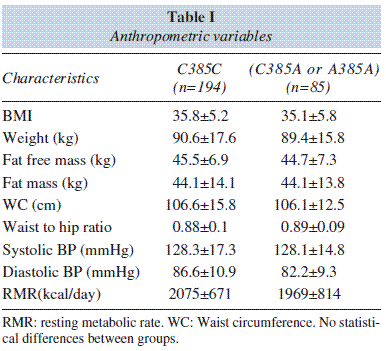
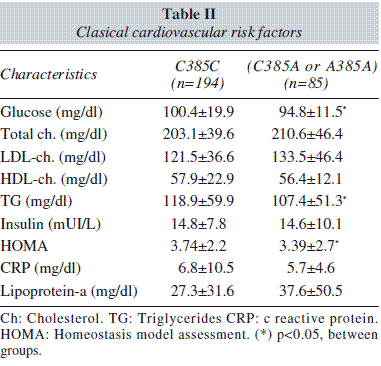
<body><![CDATA[<p><font face="Verdana" size="2">Sample size was calculated to detect differences over 2 kg in body weight with 90% power and 5% significance (n=80, in each group). The results were expressed as average &plusmn; standard deviation. The distribution of variables was analyzed with Kolmogorov-Smirnov test. Quantitative variables with normal distribution were analyzed with a two-tailed Student´s-t test. Non-parametric variables were analyzed with the U-Mann-Whitney test. The statistical analysis was performed for the combined C385A and A385A as a group and wild type C385C as second group. A p-value under 0.05 was considered statistically significant.</font></p>     <p>&nbsp;</p>     <p><font face="Verdana" size="2"><b>Results</b></font></p>     <p><font face="Verdana" size="2">Two hundred and seventy nine patients gave informed consent and were enrolled in the study. The mean age was 44.8+12 years and the mean BMI 35.4 &plusmn; 6.1. All subjects were weight stable during the 2 weeks period preceding the study (body weight change, 0.28 &plusmn; 0.1 kg).</font></p>     <p><font face="Verdana" size="2">One hundred and ninety four patients (69.5%) had the genotype C358C (wild type group) and 76 (27.2%) patients had the genotype <i>C358A</i> or <i>A358A</i> (9 patients,3.2%) (mutant type group). Age was similar in both groups (wild type: 44.70 &plusmn; 15.5 years vs mutant group: 45.5 &plusmn; 15.2 years:ns).</font></p>     <p><font face="Verdana" size="2"><a href="#t1">Table I</a> shows the anthropometric variables. No differences were detected between groups.</font></p>     <p align="center"><font face="Verdana" size="2"><a name="t1"><img src="/img/revistas/nh/v25n6/original11_t1.gif" align="top"></a></font></p>     <p>&nbsp;</p>     <p><font face="Verdana" size="2"><a href="#t2">Table II</a> shows the classic cardiovascular risk factors. Triglycerides, glucose and HOMA values were higher in wild type group than mutant type group.</font></p>     <p align="center"><font face="Verdana" size="2"><a name="t2"><img src="/img/revistas/nh/v25n6/original11_t2.gif" align="top"></a></font></p>     ]]></body>
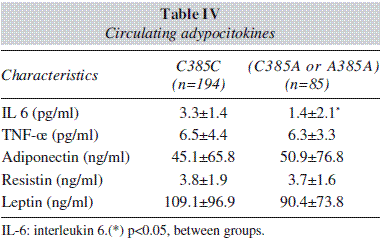
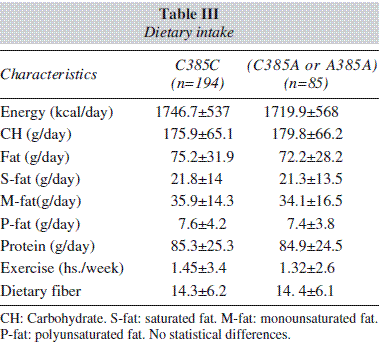
<body><![CDATA[<p><font face="Verdana" size="2"><a href="#t3">Table III</a> shows nutritional intake with 3 days written food records. No statistical differences were detected in caloric, carbohydrate, fat, and protein intakes. Aerobic exercise per week was similar in both groups.</font></p>     <p align="center"><font face="Verdana" size="2"><a name="t3"><img src="/img/revistas/nh/v25n6/original11_t3.gif" align="top"></a></font></p>     <p>&nbsp;</p>     <p><font face="Verdana" size="2"><a href="#t4">Table IV</a> shows levels of adipocytokines. IL-6 levels were higher in wild type group than mutant type group. No differences were detected between both groups in other serum adipocytokine levels.</font></p>     <p align="center"><font face="Verdana" size="2"><a name="t4"><img src="/img/revistas/nh/v25n6/original11_t4.gif" align="top"></a></font></p>     <p>&nbsp;</p>     <p><font face="Verdana" size="2"><b>Discussion</b></font></p>     <p><font face="Verdana" size="2">Since genetic influences are thought to play a greater role in obesity, identification of obesity genes may be more easily detected in the former. A common C358A single nucleotide polymorphism (SNP) of the FAAH results in a missense mutation producing a FAAH with defective expression<sup>23</sup>. Studies of the C358A variant and obesity from various authors have yeldied conflicting results<sup>8-11</sup>.</font></p>     <p><font face="Verdana" size="2">In our study, the percentage of AA genotype (3.2%) was similar than others, for example; 3.7%<sup>9</sup>, 2.3%<sup>25</sup> and 1%<sup>10</sup>. The percentage of AC genotype (27.2%) was similar than other studies; 28.1%<sup>9</sup>, 24.1%<sup>25</sup> and 36.5%<sup>10</sup>, too.</font></p>     <p><font face="Verdana" size="2">In our design, we investigated the effect of FAAH genetic variation on weight, and also on metabolic parameters. The novel finding of this study is the association of the C385C FAAH genotypes with higher levels of IL6, glucose, HOMA and triglycerides than C385A and A385A FAAH genotypes than wild type group, without differences in anthropometric parameters related with obesity.</font></p>     ]]></body>
<body><![CDATA[<p><font face="Verdana" size="2">An association between this polymorphism and metabolic profile has been described. Interestingly, Aberle et al<sup>24</sup> have shown that carriers of the A allele had a significantly greater decrease in the total cholesterol and triglycerides as compared to wild type when folloging a low fat diet.</font></p>     <p><font face="Verdana" size="2">The lack of association between this polymorphism and anthropometric parameters has been described by other authors. The results of our study agree with those of Jensen et al<sup>11</sup> or Papazoglou et al<sup>25</sup> and contrast with those of Sipe et al<sup>9</sup>. It is noteworthy that when BMI was evaluated as a continous variable in subjects, the median BMI was significantly higher in subjects with the A385A genotype compared to the median BMI of the other subjects<sup>9</sup>. The effects of the FAAH A385A could result in the upregulation of natural reward behaviours such as consumption of sweets and palatable food associated with overweigth and obesity. Under normal circumstances, brain endocanabinoid signalling may exert tonic control on the levels of certain neurotransmitters. The mesolimbic addition and reward/craving circuit including the medial forebrain bundle projections to the nucleus accumbens shows a high correlation of FAAH enzyme expression and CB1 receptor density<sup>26</sup>. However, the inconsistencies between association studies may reflect the complex interactions between multiple population-specific genetic and environmental factors. Perhaps, these different results could be explained by inclusion criteria of subjects in previous studies of the literature. These previous studies would require composition analysis of the diet to determine whether dietary components could be responsible for the lipid profile modifications. In our study dietary intake did not show statistical differences between groups, in this way our datas have been controlled by dietary intake and previous discrepancies could be explain by this uncontrolled factor (dietary intake).</font></p>     <p><font face="Verdana" size="2">Accumulating evidence indicates that the endogenous cannabinoid system is an essential homeostatic regulator of energy balance and weight via central appetite-stimulating mechanisms as well as peripheral lipogenesis<sup>27</sup>. The anatomical convergence of CB1 receptors and FAAH enzyme activity capable of regulating endocannabinoid tone supports the notion that FAAH is positioned for regulation of endocannabinoid levels that could influence craving and reward behaviors through the relevant neuronal circuitry. Patients with this polymorphism have half the FAAH enzymatic activity and protein expression when compared with wild-type subjects<sup>23</sup>. This provide a link between the consequences of this polymorphism and the present epidemiological study indicating that the FAAH A385A polymorphism may play a role in decrease or increase metabolic risk associated to obesity.</font></p>     <p><font face="Verdana" size="2">In our study, the elevation of inflammation markers (IL-6) in patients with wild type genotype could be related with an altered postprandial response of fatty acids absorption (no measured in our design). Elevated free fatty acids increases the acummulation of triglycerides in the adipocyte, related with imbalance of lipoprotein lipase activity and overproduction of adipokines such as IL-6. The lack of association of this proimflammatory state with fat mass or BMI could indicate the existence of complex unmeasured gene-gene or gene-environment interactions that may enhance metabolic abnormalities in obese patients.</font></p>     <p><font face="Verdana" size="2">In conclusion, the novel finding of this study is the association of the mutant type group A385C and A385A of FAAH with a better cardiovascular profile (triglyceride, glucose, interleukine 6 and HOMA levels) than wild type group. Further studies are needed to elucidate this complex relationship in an independent way of body mass index.</font></p>     <p>&nbsp;</p>     <p><font face="Verdana" size="2"><b>References</b></font></p>     <!-- ref --><p><font face="Verdana" size="2">1. Aranceta J, Perez Rodrigo C, Serra Majem L. Prevalencia de la obesidad en España: estudio SEEDO 97. Med clin (Barc) 1998; 111: 441-445.</font>&nbsp;&nbsp;&nbsp;&nbsp;&nbsp;&nbsp;&nbsp;&nbsp;[&#160;<a href="javascript:void(0);" onclick="javascript: window.open('/scielo.php?script=sci_nlinks&ref=3574286&pid=S0212-1611201000060001500001&lng=','','width=640,height=500,resizable=yes,scrollbars=1,menubar=yes,');">Links</a>&#160;]<!-- end-ref --><!-- ref --><p><font face="Verdana" size="2">2. Matsuzawa Y. Adipocytokines: Emerging therapeutic targets. Current Atherosclerosis Reports 2005; 7: 58-62.</font>&nbsp;&nbsp;&nbsp;&nbsp;&nbsp;&nbsp;&nbsp;&nbsp;[&#160;<a href="javascript:void(0);" onclick="javascript: window.open('/scielo.php?script=sci_nlinks&ref=3574287&pid=S0212-1611201000060001500002&lng=','','width=640,height=500,resizable=yes,scrollbars=1,menubar=yes,');">Links</a>&#160;]<!-- end-ref --><!-- ref --><p><font face="Verdana" size="2">3. Ameri A. The effects of cannabinnoids on the brain. Prog Neurobiol 1999;58:315-348.</font>&nbsp;&nbsp;&nbsp;&nbsp;&nbsp;&nbsp;&nbsp;&nbsp;[&#160;<a href="javascript:void(0);" onclick="javascript: window.open('/scielo.php?script=sci_nlinks&ref=3574288&pid=S0212-1611201000060001500003&lng=','','width=640,height=500,resizable=yes,scrollbars=1,menubar=yes,');">Links</a>&#160;]<!-- end-ref --><!-- ref --><p><font face="Verdana" size="2">4. Brown SM, Warger- Miller J, Mackie K. Cloning and molecular characterization of the rat CB2 cannabinoid receptor. Biochim Biophys Acta 2002; 1576: 255-264.</font>&nbsp;&nbsp;&nbsp;&nbsp;&nbsp;&nbsp;&nbsp;&nbsp;[&#160;<a href="javascript:void(0);" onclick="javascript: window.open('/scielo.php?script=sci_nlinks&ref=3574289&pid=S0212-1611201000060001500004&lng=','','width=640,height=500,resizable=yes,scrollbars=1,menubar=yes,');">Links</a>&#160;]<!-- end-ref --><!-- ref --><p><font face="Verdana" size="2">5. Fride E. Endocannabinoids in the central nervous system an overview. Prostaglandins Leukot Essent Fatty acids 2002; 66: 221-233.</font>&nbsp;&nbsp;&nbsp;&nbsp;&nbsp;&nbsp;&nbsp;&nbsp;[&#160;<a href="javascript:void(0);" onclick="javascript: window.open('/scielo.php?script=sci_nlinks&ref=3574290&pid=S0212-1611201000060001500005&lng=','','width=640,height=500,resizable=yes,scrollbars=1,menubar=yes,');">Links</a>&#160;]<!-- end-ref --><!-- ref --><p><font face="Verdana" size="2">6. Deustch DG, Ueda N, Yammamoto S. The fatty acid amide hydrolase (FAAH) 1. Prostaglandins Leukot Essent Fatty Acids 2002; 66: 201-210.</font>&nbsp;&nbsp;&nbsp;&nbsp;&nbsp;&nbsp;&nbsp;&nbsp;[&#160;<a href="javascript:void(0);" onclick="javascript: window.open('/scielo.php?script=sci_nlinks&ref=3574291&pid=S0212-1611201000060001500006&lng=','','width=640,height=500,resizable=yes,scrollbars=1,menubar=yes,');">Links</a>&#160;]<!-- end-ref --><!-- ref --><p><font face="Verdana" size="2">7. Lichtman AH, Hawkins EG, Griffin G, Cravatt BF. Pharmacological activity of fatty acid amides is regulated, but not mediated, by fattu acid amide hydrolase in vivo. Pharmacol Exp Ther 2002; 302: 73-79.</font>&nbsp;&nbsp;&nbsp;&nbsp;&nbsp;&nbsp;&nbsp;&nbsp;[&#160;<a href="javascript:void(0);" onclick="javascript: window.open('/scielo.php?script=sci_nlinks&ref=3574292&pid=S0212-1611201000060001500007&lng=','','width=640,height=500,resizable=yes,scrollbars=1,menubar=yes,');">Links</a>&#160;]<!-- end-ref --><!-- ref --><p><font face="Verdana" size="2">8. Sipe JC, Chiang K, Gerber AL, Beutler E, Cravatt BF. A Missense mutation in human fatty acid amide hydroxylase associated with problem drug abuse. Proc Natl Acad Sci USA 2002; 99: 8394-8399.</font>&nbsp;&nbsp;&nbsp;&nbsp;&nbsp;&nbsp;&nbsp;&nbsp;[&#160;<a href="javascript:void(0);" onclick="javascript: window.open('/scielo.php?script=sci_nlinks&ref=3574293&pid=S0212-1611201000060001500008&lng=','','width=640,height=500,resizable=yes,scrollbars=1,menubar=yes,');">Links</a>&#160;]<!-- end-ref --><!-- ref --><p><font face="Verdana" size="2">9. Sipe JC, Waalen J, Gerber A, Beutler E. Overweight and obesity associated with a missense polymorphism ain fatty acd amide hydrolase (FAAH). Inte J of Obes 2005; 29: 755-759.</font>&nbsp;&nbsp;&nbsp;&nbsp;&nbsp;&nbsp;&nbsp;&nbsp;[&#160;<a href="javascript:void(0);" onclick="javascript: window.open('/scielo.php?script=sci_nlinks&ref=3574294&pid=S0212-1611201000060001500009&lng=','','width=640,height=500,resizable=yes,scrollbars=1,menubar=yes,');">Links</a>&#160;]<!-- end-ref --><!-- ref --><p><font face="Verdana" size="2">10. Monteleone P, Tortorella A, Martiadis V, Filippo C, Canestrelli B, Maj M. The CDNA 385 C to A missense polymorphism of the endocannabinoid degrading enzyme fatty acid amide hydrolase (FAAH) os associated with overweight/obesity but not with binge eating disorder in overweight/obese women. Psychoneuroendocrinology 2008; 33: 546-550.</font>&nbsp;&nbsp;&nbsp;&nbsp;&nbsp;&nbsp;&nbsp;&nbsp;[&#160;<a href="javascript:void(0);" onclick="javascript: window.open('/scielo.php?script=sci_nlinks&ref=3574295&pid=S0212-1611201000060001500010&lng=','','width=640,height=500,resizable=yes,scrollbars=1,menubar=yes,');">Links</a>&#160;]<!-- end-ref --><!-- ref --><p><font face="Verdana" size="2">11. Jensen D, Andreasen C, Andersen M, Hansen L, Eiberg H, Borch-Johnsen K, Jorgensen T, Hansen T, Pedersen O. The functional pro129Thr variant of the FAAH gene is not associated with various fat accumulation phenotypes ina a populationbased cohort of 5801 whites. J Mol med 2007; 85: 445-449.</font>&nbsp;&nbsp;&nbsp;&nbsp;&nbsp;&nbsp;&nbsp;&nbsp;[&#160;<a href="javascript:void(0);" onclick="javascript: window.open('/scielo.php?script=sci_nlinks&ref=3574296&pid=S0212-1611201000060001500011&lng=','','width=640,height=500,resizable=yes,scrollbars=1,menubar=yes,');">Links</a>&#160;]<!-- end-ref --><!-- ref --><p><font face="Verdana" size="2">12. Harrold JA, Williams G. The cannabinoid system; a role in both the homeostatic and hedonic control of eating? Br J Nutr 2003; 90: 729-734.</font>&nbsp;&nbsp;&nbsp;&nbsp;&nbsp;&nbsp;&nbsp;&nbsp;[&#160;<a href="javascript:void(0);" onclick="javascript: window.open('/scielo.php?script=sci_nlinks&ref=3574297&pid=S0212-1611201000060001500012&lng=','','width=640,height=500,resizable=yes,scrollbars=1,menubar=yes,');">Links</a>&#160;]<!-- end-ref --><!-- ref --><p><font face="Verdana" size="2">13. Duart MJ, Arroyo CO, Moreno JL. Validation of a insulin model for the reactions in RIA. Clin Chem Lab Med 2002; 40: 1161-1167.</font>&nbsp;&nbsp;&nbsp;&nbsp;&nbsp;&nbsp;&nbsp;&nbsp;[&#160;<a href="javascript:void(0);" onclick="javascript: window.open('/scielo.php?script=sci_nlinks&ref=3574298&pid=S0212-1611201000060001500013&lng=','','width=640,height=500,resizable=yes,scrollbars=1,menubar=yes,');">Links</a>&#160;]<!-- end-ref --><!-- ref --><p><font face="Verdana" size="2">14. Mathews DR, Hosker JP, Rudenski AS, Naylor BA, Treacher Df. Homesotasis model assessment: insulin resistance and beta cell function from fasting plasma glucose and insulin concentrations in man. Diabetologia 1985; 28: 412-414.</font>&nbsp;&nbsp;&nbsp;&nbsp;&nbsp;&nbsp;&nbsp;&nbsp;[&#160;<a href="javascript:void(0);" onclick="javascript: window.open('/scielo.php?script=sci_nlinks&ref=3574299&pid=S0212-1611201000060001500014&lng=','','width=640,height=500,resizable=yes,scrollbars=1,menubar=yes,');">Links</a>&#160;]<!-- end-ref --><!-- ref --><p><font face="Verdana" size="2">15. Pfutzner A, Langefeld M, Kunt T, Lobig M. Evaluation of human resistin assays with serum from patients with type 2 diabetes and different degrees of insulin resistance. Clin Lab 2003; 49: 571-576.</font>&nbsp;&nbsp;&nbsp;&nbsp;&nbsp;&nbsp;&nbsp;&nbsp;[&#160;<a href="javascript:void(0);" onclick="javascript: window.open('/scielo.php?script=sci_nlinks&ref=3574300&pid=S0212-1611201000060001500015&lng=','','width=640,height=500,resizable=yes,scrollbars=1,menubar=yes,');">Links</a>&#160;]<!-- end-ref --><!-- ref --><p><font face="Verdana" size="2">16. Meier U, Gressner M. Endocrine regulation of energy metabolis: review of pathobiochemical and clinical chemical aspects of leptin, Ghrelin, adiponectin, and resistin. Clinical Chemstry 2004; 50: 1511-1525.</font>&nbsp;&nbsp;&nbsp;&nbsp;&nbsp;&nbsp;&nbsp;&nbsp;[&#160;<a href="javascript:void(0);" onclick="javascript: window.open('/scielo.php?script=sci_nlinks&ref=3574301&pid=S0212-1611201000060001500016&lng=','','width=640,height=500,resizable=yes,scrollbars=1,menubar=yes,');">Links</a>&#160;]<!-- end-ref --><!-- ref --><p><font face="Verdana" size="2">17. Suominen P. Evaluation of an enzyme immunometric assay to measure serum adiponectin concentrations. Clin Chem 2004; 50: 219-221.</font>&nbsp;&nbsp;&nbsp;&nbsp;&nbsp;&nbsp;&nbsp;&nbsp;[&#160;<a href="javascript:void(0);" onclick="javascript: window.open('/scielo.php?script=sci_nlinks&ref=3574302&pid=S0212-1611201000060001500017&lng=','','width=640,height=500,resizable=yes,scrollbars=1,menubar=yes,');">Links</a>&#160;]<!-- end-ref --><!-- ref --><p><font face="Verdana" size="2">18. Lubrano V, Cocci F, Battaglia D, Papa A. Usefulness of high-sensitivity IL6 measurmentfor clinical characterization of patients with coronary artery disease. J Clin Lab Anal 2005; 19: 110-114.</font>&nbsp;&nbsp;&nbsp;&nbsp;&nbsp;&nbsp;&nbsp;&nbsp;[&#160;<a href="javascript:void(0);" onclick="javascript: window.open('/scielo.php?script=sci_nlinks&ref=3574303&pid=S0212-1611201000060001500018&lng=','','width=640,height=500,resizable=yes,scrollbars=1,menubar=yes,');">Links</a>&#160;]<!-- end-ref --><!-- ref --><p><font face="Verdana" size="2">19. Khan SS, Smith MS, Reda D, Suffredini AF, Mc Coy JP. Multiplex bead array assays for detection of soluble cytokines: comparisons of sensitivity and quantitative values among kits from multiple manufactures. Cytometry B Clin Cytom 2004; 61: 35-39.</font>&nbsp;&nbsp;&nbsp;&nbsp;&nbsp;&nbsp;&nbsp;&nbsp;[&#160;<a href="javascript:void(0);" onclick="javascript: window.open('/scielo.php?script=sci_nlinks&ref=3574304&pid=S0212-1611201000060001500019&lng=','','width=640,height=500,resizable=yes,scrollbars=1,menubar=yes,');">Links</a>&#160;]<!-- end-ref --><!-- ref --><p><font face="Verdana" size="2">20. Feurer ID, Mullen JL. Bedside measurement of resting energy expenditure and respiratory quotient via indirect calorimetry. Nutr Clin Pract 1986; 1: 43-49.</font>&nbsp;&nbsp;&nbsp;&nbsp;&nbsp;&nbsp;&nbsp;&nbsp;[&#160;<a href="javascript:void(0);" onclick="javascript: window.open('/scielo.php?script=sci_nlinks&ref=3574305&pid=S0212-1611201000060001500020&lng=','','width=640,height=500,resizable=yes,scrollbars=1,menubar=yes,');">Links</a>&#160;]<!-- end-ref --><!-- ref --><p><font face="Verdana" size="2">21. Pichard C, Slosman D, Hirschel B, Kyle U. Bioimpedance analysis: an improved method for nutritional follow up. Clin Res 1993; 41: 53.</font>&nbsp;&nbsp;&nbsp;&nbsp;&nbsp;&nbsp;&nbsp;&nbsp;[&#160;<a href="javascript:void(0);" onclick="javascript: window.open('/scielo.php?script=sci_nlinks&ref=3574306&pid=S0212-1611201000060001500021&lng=','','width=640,height=500,resizable=yes,scrollbars=1,menubar=yes,');">Links</a>&#160;]<!-- end-ref --><!-- ref --><p><font face="Verdana" size="2">22. Mataix J, Mañas M. Tablas de composición de alimentos españoles. Ed: University of Granada, 2003.</font>&nbsp;&nbsp;&nbsp;&nbsp;&nbsp;&nbsp;&nbsp;&nbsp;[&#160;<a href="javascript:void(0);" onclick="javascript: window.open('/scielo.php?script=sci_nlinks&ref=3574307&pid=S0212-1611201000060001500022&lng=','','width=640,height=500,resizable=yes,scrollbars=1,menubar=yes,');">Links</a>&#160;]<!-- end-ref --><!-- ref --><p><font face="Verdana" size="2">23. Chiang KP, Gerber AL, Sipe JC, Cravatt BF. Reduced cellular expresion and activity of the P129T mutant fatty acid amide hydrolase: evidence for a link between defects in the endocannabinoid system and problem drug use. Hum Mol Genet 2004; 13: 2113-2119.</font>&nbsp;&nbsp;&nbsp;&nbsp;&nbsp;&nbsp;&nbsp;&nbsp;[&#160;<a href="javascript:void(0);" onclick="javascript: window.open('/scielo.php?script=sci_nlinks&ref=3574308&pid=S0212-1611201000060001500023&lng=','','width=640,height=500,resizable=yes,scrollbars=1,menubar=yes,');">Links</a>&#160;]<!-- end-ref --><!-- ref --><p><font face="Verdana" size="2">24. Aberle J, Fedderwitz I, Klages N, George E, Beil FU. Genetic variation in two proteins of the endocannabinoid system and their influence on body mass index and metabolism under low fat diet. Horm Metab Res 2007; 39: 395-397.</font>&nbsp;&nbsp;&nbsp;&nbsp;&nbsp;&nbsp;&nbsp;&nbsp;[&#160;<a href="javascript:void(0);" onclick="javascript: window.open('/scielo.php?script=sci_nlinks&ref=3574309&pid=S0212-1611201000060001500024&lng=','','width=640,height=500,resizable=yes,scrollbars=1,menubar=yes,');">Links</a>&#160;]<!-- end-ref --><!-- ref --><p><font face="Verdana" size="2">25. Papazoglou D, Panagopoulos I, Papanas N, Gioka T, Papadopoulos T, Papathanasiou P, Kaitozis O et al. The FAAH Pro129Thr polymorphism is not asociated with severe obesity in Greek Subjects. Horm Metab Res 2008; 40: 907-910.</font>&nbsp;&nbsp;&nbsp;&nbsp;&nbsp;&nbsp;&nbsp;&nbsp;[&#160;<a href="javascript:void(0);" onclick="javascript: window.open('/scielo.php?script=sci_nlinks&ref=3574310&pid=S0212-1611201000060001500025&lng=','','width=640,height=500,resizable=yes,scrollbars=1,menubar=yes,');">Links</a>&#160;]<!-- end-ref --><!-- ref --><p><font face="Verdana" size="2">26. Egertova M, Cravatt BF, Elphick MR. Comparative analysis of FAAH and CB1 canabinoid receptor expression in the mouse brain:evidence of a widespread role for fatty acid amide hydrolase in regulation of endocannabinoid signalling. Neuroscience 2003; 119: 481-496.</font>&nbsp;&nbsp;&nbsp;&nbsp;&nbsp;&nbsp;&nbsp;&nbsp;[&#160;<a href="javascript:void(0);" onclick="javascript: window.open('/scielo.php?script=sci_nlinks&ref=3574311&pid=S0212-1611201000060001500026&lng=','','width=640,height=500,resizable=yes,scrollbars=1,menubar=yes,');">Links</a>&#160;]<!-- end-ref --><!-- ref --><p><font face="Verdana" size="2">27. Cota D, Marsicano G, Lutz B, Vicennatu V, Stalla GK, Pasqualli R, Paggotto U. endogenous cannabinoid system as a modulator of food intake. Int J Obes Relat Metab Disor 2003; 27: 289-301.</font>&nbsp;&nbsp;&nbsp;&nbsp;&nbsp;&nbsp;&nbsp;&nbsp;[&#160;<a href="javascript:void(0);" onclick="javascript: window.open('/scielo.php?script=sci_nlinks&ref=3574312&pid=S0212-1611201000060001500027&lng=','','width=640,height=500,resizable=yes,scrollbars=1,menubar=yes,');">Links</a>&#160;]<!-- end-ref --><p>&nbsp;</p>     <p>&nbsp;</p>     <p><font face="Verdana" size="2"><b><a name="back"></a><a href="#top"><img border="0" src="/img/revistas/nh/v25n6/seta.gif" width="15" height="17"></a>Correspondence:</b>    <br>D. A de Luis    <br>Professor Associated of Nutrition    <br>Executive Director of Institute of Endocrinology and Nutrition.    ]]></body>
<body><![CDATA[<br>Medicine Schooll. Valladolid University.    <br>C/ Los perales 16    <br>47130 Simancas (Valladolid), Spain.    <br>E-mail: <a href="mailto:dadluis@yahoo.es">dadluis@yahoo.es</a></font></p>     <p><font face="Verdana" size="2">Recibido: 8-VI-2010.    <br>1<sup>a</sup> Revisión: 12_VIII-2010.    <br>Aceptado: 11-IX-2010.</font></p>      ]]></body><back>
<ref-list>
<ref id="B1">
<label>1</label><nlm-citation citation-type="journal">
<person-group person-group-type="author">
<name>
<surname><![CDATA[Aranceta]]></surname>
<given-names><![CDATA[J]]></given-names>
</name>
<name>
<surname><![CDATA[Perez Rodrigo]]></surname>
<given-names><![CDATA[C]]></given-names>
</name>
<name>
<surname><![CDATA[Serra Majem]]></surname>
<given-names><![CDATA[L]]></given-names>
</name>
</person-group>
<article-title xml:lang="es"><![CDATA[Prevalencia de la obesidad en España: estudio SEEDO 97]]></article-title>
<source><![CDATA[Med clin (Barc)]]></source>
<year>1998</year>
<volume>111</volume>
<page-range>441-445</page-range></nlm-citation>
</ref>
<ref id="B2">
<label>2</label><nlm-citation citation-type="journal">
<person-group person-group-type="author">
<name>
<surname><![CDATA[Matsuzawa]]></surname>
<given-names><![CDATA[Y]]></given-names>
</name>
</person-group>
<article-title xml:lang="en"><![CDATA[Adipocytokines: Emerging therapeutic targets]]></article-title>
<source><![CDATA[Current Atherosclerosis Reports]]></source>
<year>2005</year>
<volume>7</volume>
<page-range>58-62</page-range></nlm-citation>
</ref>
<ref id="B3">
<label>3</label><nlm-citation citation-type="journal">
<person-group person-group-type="author">
<name>
<surname><![CDATA[Ameri]]></surname>
<given-names><![CDATA[A]]></given-names>
</name>
</person-group>
<article-title xml:lang="en"><![CDATA[The effects of cannabinnoids on the brain]]></article-title>
<source><![CDATA[Prog Neurobiol]]></source>
<year>1999</year>
<volume>58</volume>
<page-range>315-348</page-range></nlm-citation>
</ref>
<ref id="B4">
<label>4</label><nlm-citation citation-type="journal">
<person-group person-group-type="author">
<name>
<surname><![CDATA[Brown]]></surname>
<given-names><![CDATA[SM]]></given-names>
</name>
<name>
<surname><![CDATA[Warger- Miller]]></surname>
<given-names><![CDATA[J]]></given-names>
</name>
<name>
<surname><![CDATA[Mackie]]></surname>
<given-names><![CDATA[K]]></given-names>
</name>
</person-group>
<article-title xml:lang="en"><![CDATA[Cloning and molecular characterization of the rat CB2 cannabinoid receptor]]></article-title>
<source><![CDATA[Biochim Biophys Acta]]></source>
<year>2002</year>
<volume>1576</volume>
<page-range>255-264</page-range></nlm-citation>
</ref>
<ref id="B5">
<label>5</label><nlm-citation citation-type="journal">
<person-group person-group-type="author">
<name>
<surname><![CDATA[Fride]]></surname>
<given-names><![CDATA[E]]></given-names>
</name>
</person-group>
<article-title xml:lang="en"><![CDATA[Endocannabinoids in the central nervous system an overview]]></article-title>
<source><![CDATA[Prostaglandins Leukot Essent Fatty acids]]></source>
<year>2002</year>
<volume>66</volume>
<page-range>221-233</page-range></nlm-citation>
</ref>
<ref id="B6">
<label>6</label><nlm-citation citation-type="journal">
<person-group person-group-type="author">
<name>
<surname><![CDATA[Deustch]]></surname>
<given-names><![CDATA[DG]]></given-names>
</name>
<name>
<surname><![CDATA[Ueda]]></surname>
<given-names><![CDATA[N]]></given-names>
</name>
<name>
<surname><![CDATA[Yammamoto]]></surname>
<given-names><![CDATA[S]]></given-names>
</name>
</person-group>
<article-title xml:lang="en"><![CDATA[The fatty acid amide hydrolase (FAAH) 1]]></article-title>
<source><![CDATA[Prostaglandins Leukot Essent Fatty Acids]]></source>
<year>2002</year>
<volume>66</volume>
<page-range>201-210</page-range></nlm-citation>
</ref>
<ref id="B7">
<label>7</label><nlm-citation citation-type="journal">
<person-group person-group-type="author">
<name>
<surname><![CDATA[Lichtman]]></surname>
<given-names><![CDATA[AH]]></given-names>
</name>
<name>
<surname><![CDATA[Hawkins]]></surname>
<given-names><![CDATA[EG]]></given-names>
</name>
<name>
<surname><![CDATA[Griffin]]></surname>
<given-names><![CDATA[G]]></given-names>
</name>
<name>
<surname><![CDATA[Cravatt]]></surname>
<given-names><![CDATA[BF]]></given-names>
</name>
</person-group>
<article-title xml:lang="en"><![CDATA[Pharmacological activity of fatty acid amides is regulated, but not mediated, by fattu acid amide hydrolase in vivo]]></article-title>
<source><![CDATA[Pharmacol Exp Ther]]></source>
<year>2002</year>
<volume>302</volume>
<page-range>73-79</page-range></nlm-citation>
</ref>
<ref id="B8">
<label>8</label><nlm-citation citation-type="journal">
<person-group person-group-type="author">
<name>
<surname><![CDATA[Sipe]]></surname>
<given-names><![CDATA[JC]]></given-names>
</name>
<name>
<surname><![CDATA[Chiang]]></surname>
<given-names><![CDATA[K]]></given-names>
</name>
<name>
<surname><![CDATA[Gerber]]></surname>
<given-names><![CDATA[AL]]></given-names>
</name>
<name>
<surname><![CDATA[Beutler]]></surname>
<given-names><![CDATA[E]]></given-names>
</name>
<name>
<surname><![CDATA[Cravatt]]></surname>
<given-names><![CDATA[BF]]></given-names>
</name>
</person-group>
<article-title xml:lang="en"><![CDATA[A Missense mutation in human fatty acid amide hydroxylase associated with problem drug abuse]]></article-title>
<source><![CDATA[Proc Natl Acad Sci USA]]></source>
<year>2002</year>
<volume>99</volume>
<page-range>8394-8399</page-range></nlm-citation>
</ref>
<ref id="B9">
<label>9</label><nlm-citation citation-type="journal">
<person-group person-group-type="author">
<name>
<surname><![CDATA[Sipe]]></surname>
<given-names><![CDATA[JC]]></given-names>
</name>
<name>
<surname><![CDATA[Waalen]]></surname>
<given-names><![CDATA[J]]></given-names>
</name>
<name>
<surname><![CDATA[Gerber]]></surname>
<given-names><![CDATA[A]]></given-names>
</name>
<name>
<surname><![CDATA[Beutler]]></surname>
<given-names><![CDATA[E]]></given-names>
</name>
</person-group>
<article-title xml:lang="en"><![CDATA[Overweight and obesity associated with a missense polymorphism ain fatty acd amide hydrolase (FAAH)]]></article-title>
<source><![CDATA[Inte J of Obes]]></source>
<year>2005</year>
<volume>29</volume>
<page-range>755-759</page-range></nlm-citation>
</ref>
<ref id="B10">
<label>10</label><nlm-citation citation-type="journal">
<person-group person-group-type="author">
<name>
<surname><![CDATA[Monteleone]]></surname>
<given-names><![CDATA[P]]></given-names>
</name>
<name>
<surname><![CDATA[Tortorella]]></surname>
<given-names><![CDATA[A]]></given-names>
</name>
<name>
<surname><![CDATA[Martiadis]]></surname>
<given-names><![CDATA[V]]></given-names>
</name>
<name>
<surname><![CDATA[Filippo]]></surname>
<given-names><![CDATA[C]]></given-names>
</name>
<name>
<surname><![CDATA[Canestrelli]]></surname>
<given-names><![CDATA[B]]></given-names>
</name>
<name>
<surname><![CDATA[Maj]]></surname>
<given-names><![CDATA[M]]></given-names>
</name>
</person-group>
<article-title xml:lang="en"><![CDATA[The CDNA 385 C to A missense polymorphism of the endocannabinoid degrading enzyme fatty acid amide hydrolase (FAAH) os associated with overweight/obesity but not with binge eating disorder in overweight/obese women]]></article-title>
<source><![CDATA[Psychoneuroendocrinology]]></source>
<year>2008</year>
<volume>33</volume>
<page-range>546-550</page-range></nlm-citation>
</ref>
<ref id="B11">
<label>11</label><nlm-citation citation-type="journal">
<person-group person-group-type="author">
<name>
<surname><![CDATA[Jensen]]></surname>
<given-names><![CDATA[D]]></given-names>
</name>
<name>
<surname><![CDATA[Andreasen]]></surname>
<given-names><![CDATA[C]]></given-names>
</name>
<name>
<surname><![CDATA[Andersen]]></surname>
<given-names><![CDATA[M]]></given-names>
</name>
<name>
<surname><![CDATA[Hansen]]></surname>
<given-names><![CDATA[L]]></given-names>
</name>
<name>
<surname><![CDATA[Eiberg]]></surname>
<given-names><![CDATA[H]]></given-names>
</name>
<name>
<surname><![CDATA[Borch-Johnsen]]></surname>
<given-names><![CDATA[K]]></given-names>
</name>
<name>
<surname><![CDATA[Jorgensen]]></surname>
<given-names><![CDATA[T]]></given-names>
</name>
<name>
<surname><![CDATA[Hansen]]></surname>
<given-names><![CDATA[T]]></given-names>
</name>
<name>
<surname><![CDATA[Pedersen]]></surname>
<given-names><![CDATA[O]]></given-names>
</name>
</person-group>
<article-title xml:lang="en"><![CDATA[The functional pro129Thr variant of the FAAH gene is not associated with various fat accumulation phenotypes ina a populationbased cohort of 5801 whites]]></article-title>
<source><![CDATA[J Mol med]]></source>
<year>2007</year>
<volume>85</volume>
<page-range>445-449</page-range></nlm-citation>
</ref>
<ref id="B12">
<label>12</label><nlm-citation citation-type="journal">
<person-group person-group-type="author">
<name>
<surname><![CDATA[Harrold]]></surname>
<given-names><![CDATA[JA]]></given-names>
</name>
<name>
<surname><![CDATA[Williams]]></surname>
<given-names><![CDATA[G]]></given-names>
</name>
</person-group>
<article-title xml:lang="en"><![CDATA[The cannabinoid system; a role in both the homeostatic and hedonic control of eating?]]></article-title>
<source><![CDATA[Br J Nutr]]></source>
<year>2003</year>
<volume>90</volume>
<page-range>729-734</page-range></nlm-citation>
</ref>
<ref id="B13">
<label>13</label><nlm-citation citation-type="journal">
<person-group person-group-type="author">
<name>
<surname><![CDATA[Duart]]></surname>
<given-names><![CDATA[MJ]]></given-names>
</name>
<name>
<surname><![CDATA[Arroyo]]></surname>
<given-names><![CDATA[CO]]></given-names>
</name>
<name>
<surname><![CDATA[Moreno]]></surname>
<given-names><![CDATA[JL]]></given-names>
</name>
</person-group>
<article-title xml:lang="en"><![CDATA[Validation of a insulin model for the reactions in RIA]]></article-title>
<source><![CDATA[Clin Chem Lab Med]]></source>
<year>2002</year>
<volume>40</volume>
<page-range>1161-1167</page-range></nlm-citation>
</ref>
<ref id="B14">
<label>14</label><nlm-citation citation-type="journal">
<person-group person-group-type="author">
<name>
<surname><![CDATA[Mathews]]></surname>
<given-names><![CDATA[DR]]></given-names>
</name>
<name>
<surname><![CDATA[Hosker]]></surname>
<given-names><![CDATA[JP]]></given-names>
</name>
<name>
<surname><![CDATA[Rudenski]]></surname>
<given-names><![CDATA[AS]]></given-names>
</name>
<name>
<surname><![CDATA[Naylor]]></surname>
<given-names><![CDATA[BA]]></given-names>
</name>
<name>
<surname><![CDATA[Treacher]]></surname>
<given-names><![CDATA[Df]]></given-names>
</name>
</person-group>
<article-title xml:lang="en"><![CDATA[Homesotasis model assessment: insulin resistance and beta cell function from fasting plasma glucose and insulin concentrations in man]]></article-title>
<source><![CDATA[Diabetologia]]></source>
<year>1985</year>
<volume>28</volume>
<page-range>412-414</page-range></nlm-citation>
</ref>
<ref id="B15">
<label>15</label><nlm-citation citation-type="journal">
<person-group person-group-type="author">
<name>
<surname><![CDATA[Pfutzner]]></surname>
<given-names><![CDATA[A]]></given-names>
</name>
<name>
<surname><![CDATA[Langefeld]]></surname>
<given-names><![CDATA[M]]></given-names>
</name>
<name>
<surname><![CDATA[Kunt]]></surname>
<given-names><![CDATA[T]]></given-names>
</name>
<name>
<surname><![CDATA[Lobig]]></surname>
<given-names><![CDATA[M]]></given-names>
</name>
</person-group>
<article-title xml:lang="en"><![CDATA[Evaluation of human resistin assays with serum from patients with type 2 diabetes and different degrees of insulin resistance]]></article-title>
<source><![CDATA[Clin Lab]]></source>
<year>2003</year>
<volume>49</volume>
<page-range>571-576</page-range></nlm-citation>
</ref>
<ref id="B16">
<label>16</label><nlm-citation citation-type="journal">
<person-group person-group-type="author">
<name>
<surname><![CDATA[Meier]]></surname>
<given-names><![CDATA[U]]></given-names>
</name>
<name>
<surname><![CDATA[Gressner]]></surname>
<given-names><![CDATA[M]]></given-names>
</name>
</person-group>
<article-title xml:lang="en"><![CDATA[Endocrine regulation of energy metabolis: review of pathobiochemical and clinical chemical aspects of leptin, Ghrelin, adiponectin, and resistin]]></article-title>
<source><![CDATA[Clinical Chemstry]]></source>
<year>2004</year>
<volume>50</volume>
<page-range>1511-1525</page-range></nlm-citation>
</ref>
<ref id="B17">
<label>17</label><nlm-citation citation-type="journal">
<person-group person-group-type="author">
<name>
<surname><![CDATA[Suominen]]></surname>
<given-names><![CDATA[P]]></given-names>
</name>
</person-group>
<article-title xml:lang="en"><![CDATA[Evaluation of an enzyme immunometric assay to measure serum adiponectin concentrations]]></article-title>
<source><![CDATA[Clin Chem]]></source>
<year>2004</year>
<volume>50</volume>
<page-range>219-221</page-range></nlm-citation>
</ref>
<ref id="B18">
<label>18</label><nlm-citation citation-type="journal">
<person-group person-group-type="author">
<name>
<surname><![CDATA[Lubrano]]></surname>
<given-names><![CDATA[V]]></given-names>
</name>
<name>
<surname><![CDATA[Cocci]]></surname>
<given-names><![CDATA[F]]></given-names>
</name>
<name>
<surname><![CDATA[Battaglia]]></surname>
<given-names><![CDATA[D]]></given-names>
</name>
<name>
<surname><![CDATA[Papa]]></surname>
<given-names><![CDATA[A]]></given-names>
</name>
</person-group>
<article-title xml:lang="en"><![CDATA[Usefulness of high-sensitivity IL6 measurmentfor clinical characterization of patients with coronary artery disease]]></article-title>
<source><![CDATA[J Clin Lab Anal]]></source>
<year>2005</year>
<volume>19</volume>
<page-range>110-114</page-range></nlm-citation>
</ref>
<ref id="B19">
<label>19</label><nlm-citation citation-type="journal">
<person-group person-group-type="author">
<name>
<surname><![CDATA[Khan]]></surname>
<given-names><![CDATA[SS]]></given-names>
</name>
<name>
<surname><![CDATA[Smith]]></surname>
<given-names><![CDATA[MS]]></given-names>
</name>
<name>
<surname><![CDATA[Reda]]></surname>
<given-names><![CDATA[D]]></given-names>
</name>
<name>
<surname><![CDATA[Suffredini]]></surname>
<given-names><![CDATA[AF]]></given-names>
</name>
<name>
<surname><![CDATA[Mc Coy]]></surname>
<given-names><![CDATA[JP]]></given-names>
</name>
</person-group>
<article-title xml:lang="en"><![CDATA[Multiplex bead array assays for detection of soluble cytokines: comparisons of sensitivity and quantitative values among kits from multiple manufactures]]></article-title>
<source><![CDATA[Cytometry B Clin Cytom]]></source>
<year>2004</year>
<volume>61</volume>
<page-range>35-39</page-range></nlm-citation>
</ref>
<ref id="B20">
<label>20</label><nlm-citation citation-type="journal">
<person-group person-group-type="author">
<name>
<surname><![CDATA[Feurer]]></surname>
<given-names><![CDATA[ID]]></given-names>
</name>
<name>
<surname><![CDATA[Mullen]]></surname>
<given-names><![CDATA[JL]]></given-names>
</name>
</person-group>
<article-title xml:lang="en"><![CDATA[Bedside measurement of resting energy expenditure and respiratory quotient via indirect calorimetry]]></article-title>
<source><![CDATA[Nutr Clin Pract]]></source>
<year>1986</year>
<volume>1</volume>
<page-range>43-49</page-range></nlm-citation>
</ref>
<ref id="B21">
<label>21</label><nlm-citation citation-type="journal">
<person-group person-group-type="author">
<name>
<surname><![CDATA[Pichard]]></surname>
<given-names><![CDATA[C]]></given-names>
</name>
<name>
<surname><![CDATA[Slosman]]></surname>
<given-names><![CDATA[D]]></given-names>
</name>
<name>
<surname><![CDATA[Hirschel]]></surname>
<given-names><![CDATA[B]]></given-names>
</name>
<name>
<surname><![CDATA[Kyle]]></surname>
<given-names><![CDATA[U]]></given-names>
</name>
</person-group>
<article-title xml:lang="en"><![CDATA[Bioimpedance analysis: an improved method for nutritional follow up]]></article-title>
<source><![CDATA[Clin Res]]></source>
<year>1993</year>
<volume>41</volume>
<page-range>53</page-range></nlm-citation>
</ref>
<ref id="B22">
<label>22</label><nlm-citation citation-type="book">
<person-group person-group-type="author">
<name>
<surname><![CDATA[Mataix]]></surname>
<given-names><![CDATA[J]]></given-names>
</name>
<name>
<surname><![CDATA[Mañas]]></surname>
<given-names><![CDATA[M]]></given-names>
</name>
</person-group>
<source><![CDATA[Tablas de composición de alimentos españoles]]></source>
<year>2003</year>
<publisher-name><![CDATA[University of Granada]]></publisher-name>
</nlm-citation>
</ref>
<ref id="B23">
<label>23</label><nlm-citation citation-type="journal">
<person-group person-group-type="author">
<name>
<surname><![CDATA[Chiang]]></surname>
<given-names><![CDATA[KP]]></given-names>
</name>
<name>
<surname><![CDATA[Gerber]]></surname>
<given-names><![CDATA[AL]]></given-names>
</name>
<name>
<surname><![CDATA[Sipe]]></surname>
<given-names><![CDATA[JC]]></given-names>
</name>
<name>
<surname><![CDATA[Cravatt]]></surname>
<given-names><![CDATA[BF]]></given-names>
</name>
</person-group>
<article-title xml:lang="en"><![CDATA[Reduced cellular expresion and activity of the P129T mutant fatty acid amide hydrolase: evidence for a link between defects in the endocannabinoid system and problem drug use]]></article-title>
<source><![CDATA[Hum Mol Genet]]></source>
<year>2004</year>
<volume>13</volume>
<page-range>2113-2119</page-range></nlm-citation>
</ref>
<ref id="B24">
<label>24</label><nlm-citation citation-type="journal">
<person-group person-group-type="author">
<name>
<surname><![CDATA[Aberle]]></surname>
<given-names><![CDATA[J]]></given-names>
</name>
<name>
<surname><![CDATA[Fedderwitz]]></surname>
<given-names><![CDATA[I]]></given-names>
</name>
<name>
<surname><![CDATA[Klages]]></surname>
<given-names><![CDATA[N]]></given-names>
</name>
<name>
<surname><![CDATA[George]]></surname>
<given-names><![CDATA[E]]></given-names>
</name>
<name>
<surname><![CDATA[Beil]]></surname>
<given-names><![CDATA[FU]]></given-names>
</name>
</person-group>
<article-title xml:lang="en"><![CDATA[Genetic variation in two proteins of the endocannabinoid system and their influence on body mass index and metabolism under low fat diet]]></article-title>
<source><![CDATA[Horm Metab Res]]></source>
<year>2007</year>
<volume>39</volume>
<page-range>395-397</page-range></nlm-citation>
</ref>
<ref id="B25">
<label>25</label><nlm-citation citation-type="journal">
<person-group person-group-type="author">
<name>
<surname><![CDATA[Papazoglou]]></surname>
<given-names><![CDATA[D]]></given-names>
</name>
<name>
<surname><![CDATA[Panagopoulos]]></surname>
<given-names><![CDATA[I]]></given-names>
</name>
<name>
<surname><![CDATA[Papanas]]></surname>
<given-names><![CDATA[N]]></given-names>
</name>
<name>
<surname><![CDATA[Gioka]]></surname>
<given-names><![CDATA[T]]></given-names>
</name>
<name>
<surname><![CDATA[Papadopoulos]]></surname>
<given-names><![CDATA[T]]></given-names>
</name>
<name>
<surname><![CDATA[Papathanasiou]]></surname>
<given-names><![CDATA[P]]></given-names>
</name>
<name>
<surname><![CDATA[Kaitozis]]></surname>
<given-names><![CDATA[O]]></given-names>
</name>
</person-group>
<article-title xml:lang="en"><![CDATA[The FAAH Pro129Thr polymorphism is not asociated with severe obesity in Greek Subjects]]></article-title>
<source><![CDATA[Horm Metab Res]]></source>
<year>2008</year>
<volume>40</volume>
<page-range>907-910</page-range></nlm-citation>
</ref>
<ref id="B26">
<label>26</label><nlm-citation citation-type="journal">
<person-group person-group-type="author">
<name>
<surname><![CDATA[Egertova]]></surname>
<given-names><![CDATA[M]]></given-names>
</name>
<name>
<surname><![CDATA[Cravatt]]></surname>
<given-names><![CDATA[BF]]></given-names>
</name>
<name>
<surname><![CDATA[Elphick]]></surname>
<given-names><![CDATA[MR]]></given-names>
</name>
</person-group>
<article-title xml:lang="en"><![CDATA[Comparative analysis of FAAH and CB1 canabinoid receptor expression in the mouse brain: evidence of a widespread role for fatty acid amide hydrolase in regulation of endocannabinoid signalling]]></article-title>
<source><![CDATA[Neuroscience]]></source>
<year>2003</year>
<volume>119</volume>
<page-range>481-496</page-range></nlm-citation>
</ref>
<ref id="B27">
<label>27</label><nlm-citation citation-type="journal">
<person-group person-group-type="author">
<name>
<surname><![CDATA[Cota]]></surname>
<given-names><![CDATA[D]]></given-names>
</name>
<name>
<surname><![CDATA[Marsicano]]></surname>
<given-names><![CDATA[G]]></given-names>
</name>
<name>
<surname><![CDATA[Lutz]]></surname>
<given-names><![CDATA[B]]></given-names>
</name>
<name>
<surname><![CDATA[Vicennatu]]></surname>
<given-names><![CDATA[V]]></given-names>
</name>
<name>
<surname><![CDATA[Stalla]]></surname>
<given-names><![CDATA[GK]]></given-names>
</name>
<name>
<surname><![CDATA[Pasqualli]]></surname>
<given-names><![CDATA[R]]></given-names>
</name>
<name>
<surname><![CDATA[Paggotto]]></surname>
<given-names><![CDATA[U]]></given-names>
</name>
</person-group>
<article-title xml:lang="en"><![CDATA[endogenous cannabinoid system as a modulator of food intake]]></article-title>
<source><![CDATA[Int J Obes Relat Metab Disor]]></source>
<year>2003</year>
<volume>27</volume>
<page-range>289-301</page-range></nlm-citation>
</ref>
</ref-list>
</back>
</article>