<?xml version="1.0" encoding="ISO-8859-1"?><article xmlns:mml="http://www.w3.org/1998/Math/MathML" xmlns:xlink="http://www.w3.org/1999/xlink" xmlns:xsi="http://www.w3.org/2001/XMLSchema-instance">
<front>
<journal-meta>
<journal-id>0212-1611</journal-id>
<journal-title><![CDATA[Nutrición Hospitalaria]]></journal-title>
<abbrev-journal-title><![CDATA[Nutr. Hosp.]]></abbrev-journal-title>
<issn>0212-1611</issn>
<publisher>
<publisher-name><![CDATA[Grupo Arán]]></publisher-name>
</publisher>
</journal-meta>
<article-meta>
<article-id>S0212-16112010000600025</article-id>
<title-group>
<article-title xml:lang="en"><![CDATA[Severe ketoacidosis secondary to starvation in a frutarian patient]]></article-title>
<article-title xml:lang="es"><![CDATA[Cetoacidosis severa secundaria a frugitarismo]]></article-title>
</title-group>
<contrib-group>
<contrib contrib-type="author">
<name>
<surname><![CDATA[Causso]]></surname>
<given-names><![CDATA[C.]]></given-names>
</name>
<xref ref-type="aff" rid="A01"/>
</contrib>
<contrib contrib-type="author">
<name>
<surname><![CDATA[Arrieta]]></surname>
<given-names><![CDATA[F.]]></given-names>
</name>
<xref ref-type="aff" rid="A02"/>
<xref ref-type="aff" rid="A03"/>
</contrib>
<contrib contrib-type="author">
<name>
<surname><![CDATA[Hernández]]></surname>
<given-names><![CDATA[J.]]></given-names>
</name>
<xref ref-type="aff" rid="A04"/>
</contrib>
<contrib contrib-type="author">
<name>
<surname><![CDATA[Botella-Carretero]]></surname>
<given-names><![CDATA[J. I.]]></given-names>
</name>
<xref ref-type="aff" rid="A02"/>
<xref ref-type="aff" rid="A03"/>
</contrib>
<contrib contrib-type="author">
<name>
<surname><![CDATA[Muro]]></surname>
<given-names><![CDATA[M.]]></given-names>
</name>
<xref ref-type="aff" rid="A04"/>
</contrib>
<contrib contrib-type="author">
<name>
<surname><![CDATA[Puerta]]></surname>
<given-names><![CDATA[C.]]></given-names>
</name>
<xref ref-type="aff" rid="A02"/>
<xref ref-type="aff" rid="A03"/>
</contrib>
<contrib contrib-type="author">
<name>
<surname><![CDATA[Balsa]]></surname>
<given-names><![CDATA[J. A.]]></given-names>
</name>
<xref ref-type="aff" rid="A02"/>
<xref ref-type="aff" rid="A03"/>
</contrib>
<contrib contrib-type="author">
<name>
<surname><![CDATA[Zamarron]]></surname>
<given-names><![CDATA[I.]]></given-names>
</name>
<xref ref-type="aff" rid="A02"/>
<xref ref-type="aff" rid="A03"/>
</contrib>
<contrib contrib-type="author">
<name>
<surname><![CDATA[Vázquez]]></surname>
<given-names><![CDATA[C.]]></given-names>
</name>
<xref ref-type="aff" rid="A02"/>
<xref ref-type="aff" rid="A03"/>
</contrib>
</contrib-group>
<aff id="A01">
<institution><![CDATA[,Hospital Universitario Príncipe de Asturias  ]]></institution>
<addr-line><![CDATA[Alcalá de Henares Madrid]]></addr-line>
<country>España</country>
</aff>
<aff id="A02">
<institution><![CDATA[,Hospital Universitario Ramón y Cajal Instituto Ramón y Cajal de Investigación Sanitaria Servicio de Endocrinología y Nutrición]]></institution>
<addr-line><![CDATA[ ]]></addr-line>
</aff>
<aff id="A03">
<institution><![CDATA[,Centro de investigación biomédica en red de Fisiopatología de la Obesidad y Nutrición (CIBEROBN)  ]]></institution>
<addr-line><![CDATA[ ]]></addr-line>
</aff>
<aff id="A04">
<institution><![CDATA[,Hospital Universitario Ramón y Cajal Servicio de Medicina Interna ]]></institution>
<addr-line><![CDATA[Madrid ]]></addr-line>
<country>España</country>
</aff>
<pub-date pub-type="pub">
<day>00</day>
<month>12</month>
<year>2010</year>
</pub-date>
<pub-date pub-type="epub">
<day>00</day>
<month>12</month>
<year>2010</year>
</pub-date>
<volume>25</volume>
<numero>6</numero>
<fpage>1049</fpage>
<lpage>1052</lpage>
<copyright-statement/>
<copyright-year/>
<self-uri xlink:href="http://scielo.isciii.es/scielo.php?script=sci_arttext&amp;pid=S0212-16112010000600025&amp;lng=en&amp;nrm=iso"></self-uri><self-uri xlink:href="http://scielo.isciii.es/scielo.php?script=sci_abstract&amp;pid=S0212-16112010000600025&amp;lng=en&amp;nrm=iso"></self-uri><self-uri xlink:href="http://scielo.isciii.es/scielo.php?script=sci_pdf&amp;pid=S0212-16112010000600025&amp;lng=en&amp;nrm=iso"></self-uri><abstract abstract-type="short" xml:lang="en"><p><![CDATA[The present paper presents the firts clinical case of a patient suffering from Frutarianism a new "Eating disorder" and severe Ketoacidosis. The life-style feed strictly only on fruits (not even other vegetables, since plant death is necessary previous consumption).This behavioural alteration frequently leads to starvation and the subsequent Ketoacidosis due to starvation.]]></p></abstract>
<abstract abstract-type="short" xml:lang="es"><p><![CDATA[El presente trabajo es el primer caso descrito de un paciente que sufre de Frugitarismo "Trastorno de conducta alimentaria de reciente aparición" que ingresa en la UVI por cetoacidosis grave. La alimentación es estrictamente sólo de frutas. Esta alteración del comportamiento alimentario nos lleva a desarrollar una ketoacidosis severa con secundaria a la desnutrición.]]></p></abstract>
<kwd-group>
<kwd lng="en"><![CDATA[Frutarianism]]></kwd>
<kwd lng="en"><![CDATA[Severe Ketoacidosis]]></kwd>
<kwd lng="en"><![CDATA[Starvation]]></kwd>
<kwd lng="es"><![CDATA[Frugitarismo]]></kwd>
<kwd lng="es"><![CDATA[Cetoacidosis severa]]></kwd>
<kwd lng="es"><![CDATA[Ayuno]]></kwd>
</kwd-group>
</article-meta>
</front><body><![CDATA[ <p><font face="Verdana" size="2"><a name="top"></a><b>CASO CLÍNICO</b></font></p>     <p>&nbsp;</p>     <p><font face="Verdana" size="4"><b>Severe ketoacidosis secondary to starvation in a frutarian patient</b></font></p>     <p><font face="Verdana" size="4"><b>Cetoacidosis severa secundaria a frugitarismo</b></font></p>     <p>&nbsp;</p>     <p>&nbsp;</p>     <p><font face="Verdana" size="2"><b>C. Causso<sup>1</sup>, F. Arrieta<sup>2</sup>, J. Hernández<sup>3</sup>, J. I. Botella-Carretero<sup>2</sup>, M. Muro<sup>3</sup>, C. Puerta<sup>2</sup>, J. A. Balsa<sup>2</sup>, I. Zamarron<sup>2</sup> and C. Vázquez<sup>2</sup></b></font></p>     <p><font face="Verdana" size="2"><sup>1</sup>Hospital Universitario Príncipe de Asturias.    <br><sup>2</sup>Unidad de Nutrición, Obesidad y Metabolismo. Servicio de Endocrinología y Nutrición y CIBER de Fisiopatología de la Obesidad y Nutrición (CIBEROBN). Hospital Universitario Ramón y Cajal. IRYCIS.    <br><sup>3</sup>Servicio de Medicina Interna. Hospital Universitario Ramón y Cajal. Madrid. España.</font></p>     ]]></body>
<body><![CDATA[<p><font face="Verdana" size="2"><a href="#back">Correspondence</a></font></p>     <p>&nbsp;</p>     <p>&nbsp;</p> <hr size="1">     <p><font face="Verdana" size="2"><b>ABSTRACT</b></font></p>     <p><font face="Verdana" size="2">The present paper presents the firts clinical case of a patient suffering from Frutarianism a new "Eating disorder" and severe Ketoacidosis. The life-style feed strictly only on fruits (not even other vegetables, since plant death is necessary previous consumption).This behavioural alteration frequently leads to starvation and the subsequent Ketoacidosis due to starvation.</font></p>     <p><font face="Verdana" size="2"><b>Key words:</b> Frutarianism. Severe Ketoacidosis. Starvation.</font></p> <hr size="1">     <p><font face="Verdana" size="2"><b>RESUMEN</b></font></p>     <p><font face="Verdana" size="2">El presente trabajo es el primer caso descrito de un paciente que sufre de Frugitarismo "Trastorno de conducta alimentaria de reciente aparición" que ingresa en la UVI por cetoacidosis grave. La alimentación es estrictamente sólo de frutas. Esta alteración del comportamiento alimentario nos lleva a desarrollar una ketoacidosis severa con secundaria a la desnutrición.</font></p>     <p><font face="Verdana" size="2"><b>Palabras clave:</b> Frugitarismo. Cetoacidosis severa. Ayuno.</font></p> <hr size="1">     <p>&nbsp;</p>     ]]></body>
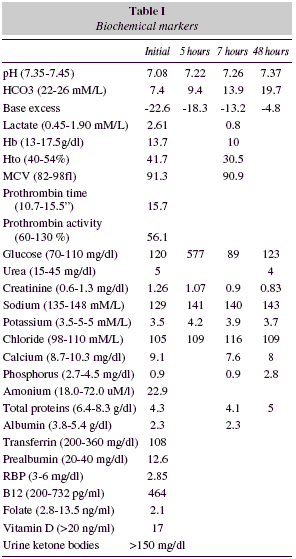
<body><![CDATA[<p><font face="Verdana" size="2"><b>Introduction</b></font></p>     <p><font face="Verdana" size="2">Diabetic ketoacidois is a common cause of metabolic acidosis observed in daily clinical practice. Thus, in the context of a metabolic acidosis involving elevated osmolarity and anion gap, a diagnosis of ketoacidosis due to starvation should be considered in differential diagnosis<sup>1,2</sup>. Metabolic acidosis related to starvation is usually mild, but different factors such as stress could exacerbate it<sup>2</sup>. During prolonged fasting, insulin secretion is diminished and the systemic response to insulin production is altered<sup>1-3</sup>. Diverse metabolic effects resulting from refeeding, are mainly related to alterations in plasma levels of glucose and insulin<sup>4-6</sup>.</font></p>     <p><font face="Verdana" size="2">In recent years, new eating disorders such as orthorexia and bigorexia are arising, which are not officially recognized as such<sup>7</sup>. Orthorexia is an eating disorder which involves an obsession for eating a diet based on strictly selected food items considered "pure and healthy" by followers. Not only these dietary habits can lead to important nutritional deficiencies, but also they may cause disturbances in family relationships as well as social isolation<sup>8</sup>.</font></p>     <p><font face="Verdana" size="2">Vigorexia is a subtype of <i>body dysmorphic disorder</i> that involves an obsession about being muscular. Patients suffering from this, spend excessive time in gymnastic trainings<sup>9</sup>. These eating patterns that might lead to being considered as a part of an Eating Disorder Not Otherwise Specified (ED-NOS), a category of eating disorder that includes patients with early aberrant eating patterns and weight management habits who do not meet the criteria for anorexia or bulimia nerviosa<sup>10</sup>. It occurs in approximately 3 to 5 percent of women between the ages of 15 and 30 in Western countries<sup>11</sup>.</font></p>     <p><font face="Verdana" size="2">To our knowledge, it is the first reported case of ketoacidosis secondary to starvation in a frutarian patient. Thus, there is no published data about its prevalence, and what proportion of these patients develops ketoacidosis as a complication. During the last decade, our patient had being suffering from a progressive eating disorder, starting with a lacto-ovovegetarian diet followed by a strict vegetarian diet, complying with all the alimentary habits that involve fruitarianism. After a week of complete fasting, patient was brought to our hospital by his family, alerted by his noticeable behavioural alteration. Previous week strict fasting was the cause that triggered severe ketoacidosis.</font></p>     <p><font face="Verdana" size="2">We report a case of a patient whose diet was based only on fruits, a dietary habit called fruitarianism or frugivorism, which is the most strict form of vegetarianism known up to date. In our clinical experience, followers of this way of life are vulnerable not only to suffer nutritional deficiencies, but also to develop serious metabolic impairments that may be life-threatening, as occurred in our patient.</font></p>     <p>&nbsp;</p>     <p><font face="Verdana" size="2"><b>Clinical case</b></font></p>     <p><font face="Verdana" size="2">A 35 year old male patient with a medical history of three previous admissions to psychiatric units was brought to the Emergency Room via ambulance, presenting with behavioural disturbances, including aggressiveness and voluntary complete fasting for over a week. In the last 10 years, the patient followed a strict vegetarian diet that leads him progressively to restrict his diet only to fruit. On presentation, patient was ill appearing with psychomotor impairment and incoherent speech. On physical examination, he was hemodynamically stable and he had a body mass index (BMI) of 16. The rest of the exam was unremarkable. Initial laboratory studies revealed, capillary glycemia 57 mg/dl; venous pH 7.08 ; HCO<sub>3</sub> 7.4 mM/L ; pCO2 25mmHg; base excess of -22.6 mM/L; Hb 13.7 g/dl; Hto 41.7 %; MCV 91.3 fl; urea 5 mg/dl; creatinine 1.26 mg/dl; sodium 129 mM/L; potassium 3.5 mM/L; chloride 105 mM/L; phosphorus 0.9 mg/dl; corrected serum calcium for albumin: 8.7 mg/dl; total proteins: 4.3 g/dl ; albumin 2.3 g/dl; amonium 22.9 uM/l (18.0-72.0) and lactate 2.61 mM/L (0.45-1.90); acetoacetate 5.1. Salicylate and ethanol levels were negative. Urinalysis was positive for ketone bodies (&gt 150 mg/dl) (<a href="#t1">table I</a>). These findings make us rule out Diabetic Ketoacidosis as the cause of the metabolic acidosis. Initially, the patient received normal saline 500cc/h. Then, he was started on intravenous infusion of dextrose 20% (200 grams/liter of glucose) at 200 ml/h and received bicarbonate 1/6 M. After five hours of hospitalization, hyperglycaemia of 577 mg/dl occurred requiring continuous infusion of insulin, maintaining glucose levels between 80-100 mg/dl. After 7 hours of hospitalization, the pH was 7.26; phosphorus level, 0.9 mg/dl; prothrombin time (PT), 15.7"; prothrombin activity, 56.1 %. Vitamin B<sub>12</sub>-B<sub>6</sub>-B<sub>1</sub> complexes, vitamin K, calcium gluconate, and magnesium sulphate were supplied via intravenous administration and sodium phosphate by continuous infusion.</font></p>     <p align="center"><font face="Verdana" size="2"><a name="t1"><img src="/img/revistas/nh/v25n6/caso_clinico5_t1.gif" align="top"></a></font></p>     ]]></body>
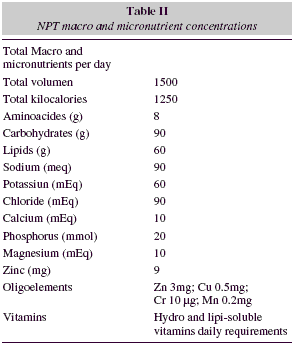
<body><![CDATA[<p>&nbsp;</p>     <p><font face="Verdana" size="2">On the second day of hospitalization, the phosphorus level was 2.8 mg/dl.</font></p>     <p><font face="Verdana" size="2">Patient motivation for eating only fruits was based on the desire to avoid harming animals and vegetables. He only allowed himself to eat fruit because it was produced by a plant, and consumption of the fruit did not kill the plant. The patient refused to receive tube feeding claiming that "receiving enteral nutrition won´t allow him to follow his dietary habit", a subclavian central venous line was placed and total parenteral nutrition was initiated with supplemental phosphate, potassium, calcium and magnesium. A psychiatric consult was requested, and a diagnosis of undetermined psychotic disorder was given. Patient remained hemodynamically stable with normal urine output.</font></p>     <p><font face="Verdana" size="2">Even though, the patient underwent strict fasting for only a week, he showed a protein-calorie malnourished state, as revealed biochemical markers of nutritional status that were obtained plasma albumine level, 2.3 g/dl; retinol-binding protein (RBP) 2.85 mg/dl; transferrin 108 mg/dl and prealbumin, 12.6 mg/dl. Also levels of vitamins were obtained B<sub>12</sub> 464.00 pg/ml (200.00-732.00); folate 2.10 ng/ml (2.80-13.50) and Vitamin D of 17 (30ng/ml). These findings and patient´s underweight alert us of starvation as the possible cause of his ketoacidotic state. Intravenous fluid replacement and parenteral nutrition were discontinued and enteral feedings were started on hospital day 3. Also, the acidosis was resolved, and following cessation of insulin infusion, patient remained normoglycemic.</font></p>     <p align="center"><font face="Verdana" size="2"><img src="/img/revistas/nh/v25n6/caso_clinico5_t2.gif" align="top"></font></p>     <p>&nbsp;</p>     <p><font face="Verdana" size="2"><b>Discussion</b></font></p>     <p><font face="Verdana" size="2">We present the case of a male patient who was a fruitarian (exclusively fruit-based diet). One week prior to admission, patient remained under voluntary fasting and isolation, developing a severe metabolic acidosis. A week voluntary strict fasting prior to admission was considered most likely the cause of ketoacidosis<sup>2,12</sup>. Initially, the presence of ketonemia and low glucose levels ruled out diabetic ketoacidosis, as the cause of severe metabolic acidosis<sup>13</sup>. Moreover, negative laboratory studies for toxicology and alcohol levels led us to consider starvation as the aetiology of the acid-base imbalance<sup>1,4</sup>. Taking into account the patient´s protein-calorie malnutrition and vitamin deficiencies (folate and vitamin D), the potential diagnosis of starvation due to his dietary practices became more important. Ketoacidosis secondary to starvation is due to a diminished insulin secretion, that leads to an increase in lipolysis and ketogenesis<sup>2,12</sup>. Hyperglycemia that occurs promptly after intravenous glucose administration might be secondary to defective insulin secretion during the early refeeding phase. There are several studies focusing on the effects of refeeding on plasma glucose and insulin levels<sup>5,6</sup>. Insulin appears to play a very important role in the physiological adaptation to fasting and refeeding, in that insulin secretion decreases during fasting and increases upon refeeding<sup>4-6</sup>. Several metabolic complications have been described, such as hyperglycemia and hepatic steatosis with parenteral nutrition using dextrose as the sole source of non-protein calories<sup>6,14</sup>.</font></p>     <p><font face="Verdana" size="2">Frugivorism (or fruitarianism) is probably the strictest form of vegetarian diet. People who abide by this dietary restriction, eat exclusively fruit. Frugivores do not eat any animal or plant derived products, in order to avoid interrupting the natural life cycle of animals and plants. Avoiding the intake of all types of meat, fish and poultry, increases the risk of developing nutritional deficiencies, as has been observed among followers of strict vegetarian diets, who frequently end up having vitamin and mineral deficiencies<sup>15,16</sup>.</font></p>     <p><font face="Verdana" size="2">Refeeding after starvation causes an increase in insulin release and an increased shift of phosphate, glucose, potassium, magnesium and water to intracellular compartments<sup>6</sup>. In addition, our patient presents with hyperglycemia after intravenous glucose, what is likely due to an impaired insulin secretion<sup>5,13</sup>.</font></p>     ]]></body>
<body><![CDATA[<p><font face="Verdana" size="2">Fruitarian patients differ from those with anorexia nervosa in that they do not present with body image distortion or anorexigenic behavior, such as vomiting, the abuse of laxatives, etc. Their only obsession is the search for purity in all food items<sup>7</sup>. These food habits are only one aspect of a lifestyle chosen for spiritual, ethnic and health-related motivations.</font></p>     <p><font face="Verdana" size="2">Eating Disorder Not Otherwise Specified (EDNOS), a category of eating disorder that includes patients with early aberrant eating patterns and weight management habits who do not meet the criteria for anorexia or bulimia nerviosa<sup>10</sup>. It occurs in approximately 3 to 5 percent of women between the ages of 15 and 30 in Western countries<sup>11</sup>. We consider, it is imperative that patients who practice these diets be closely monitored in order to prevent them from developing nutritional deficiencies, and thus diffusing the associated health risks which include the risk of death<sup>15,17,18</sup>. The early evaluation of patients who follow these practices is essential for avoiding nutritional, social, and psychological deterioration.</font></p>     <p>&nbsp;</p>     <p><font face="Verdana" size="2"><b>References</b></font></p>     <!-- ref --><p><font face="Verdana" size="2">1. Cahill GF. Fuel metabolism in starvation. <i>Annu Rev Nutr</i> 2006; 26:1-22.</font>&nbsp;&nbsp;&nbsp;&nbsp;&nbsp;&nbsp;&nbsp;&nbsp;[&#160;<a href="javascript:void(0);" onclick="javascript: window.open('/scielo.php?script=sci_nlinks&ref=3574409&pid=S0212-1611201000060002500001&lng=','','width=640,height=500,resizable=yes,scrollbars=1,menubar=yes,');">Links</a>&#160;]<!-- end-ref --><!-- ref --><p><font face="Verdana" size="2">2. Toth HL, Greenbaum LA. Severe acidosis caused by starvation and stress. <i>Am J Kidney Dis</i> 2003; 42: E16-9.</font>&nbsp;&nbsp;&nbsp;&nbsp;&nbsp;&nbsp;&nbsp;&nbsp;[&#160;<a href="javascript:void(0);" onclick="javascript: window.open('/scielo.php?script=sci_nlinks&ref=3574410&pid=S0212-1611201000060002500002&lng=','','width=640,height=500,resizable=yes,scrollbars=1,menubar=yes,');">Links</a>&#160;]<!-- end-ref --><!-- ref --><p><font face="Verdana" size="2">3. Montejo JC. Contribución del soporte nutricional al tratamiento de las alteraciones neuro-musculares del paciente crítico. <i>Nutr Hosp</i> 2006; 21: 118-122.</font>&nbsp;&nbsp;&nbsp;&nbsp;&nbsp;&nbsp;&nbsp;&nbsp;[&#160;<a href="javascript:void(0);" onclick="javascript: window.open('/scielo.php?script=sci_nlinks&ref=3574411&pid=S0212-1611201000060002500003&lng=','','width=640,height=500,resizable=yes,scrollbars=1,menubar=yes,');">Links</a>&#160;]<!-- end-ref --><!-- ref --><p><font face="Verdana" size="2">4. Davids MR, Segal AS, Brunengraber H, Halperin M. An unusual case for ketoacidosis. <i>QJM</i> 2004; 97: 365-376.</font>&nbsp;&nbsp;&nbsp;&nbsp;&nbsp;&nbsp;&nbsp;&nbsp;[&#160;<a href="javascript:void(0);" onclick="javascript: window.open('/scielo.php?script=sci_nlinks&ref=3574412&pid=S0212-1611201000060002500004&lng=','','width=640,height=500,resizable=yes,scrollbars=1,menubar=yes,');">Links</a>&#160;]<!-- end-ref --><!-- ref --><p><font face="Verdana" size="2">5. Stanga Z, Brunner A, Leuenberger M, Grimble RF, Shenkin A, Allison SP et al. Nutrition in clinical practice -the refeeding syndrome: illustrative cases and guidelines for prevention and treatment. <i>Eur J Clin Nutr</i> 2008; 62: 687-94.</font>&nbsp;&nbsp;&nbsp;&nbsp;&nbsp;&nbsp;&nbsp;&nbsp;[&#160;<a href="javascript:void(0);" onclick="javascript: window.open('/scielo.php?script=sci_nlinks&ref=3574413&pid=S0212-1611201000060002500005&lng=','','width=640,height=500,resizable=yes,scrollbars=1,menubar=yes,');">Links</a>&#160;]<!-- end-ref --><!-- ref --><p><font face="Verdana" size="2">6. Panteli JV, Crook MA. Refeeding syndrome still needs to be recognized and managed appropriately. <i>Nutrition</i> 2009; 25: 130-1.</font>&nbsp;&nbsp;&nbsp;&nbsp;&nbsp;&nbsp;&nbsp;&nbsp;[&#160;<a href="javascript:void(0);" onclick="javascript: window.open('/scielo.php?script=sci_nlinks&ref=3574414&pid=S0212-1611201000060002500006&lng=','','width=640,height=500,resizable=yes,scrollbars=1,menubar=yes,');">Links</a>&#160;]<!-- end-ref --><!-- ref --><p><font face="Verdana" size="2">7. Catalina ML, Bote B, Garcia F, Rios B. Ortorexia nerviosa: ¿un nuevo trastorno de la conducta alimentaria? Actas Esp <i>Psiquiatr</i> 2004; 32: 66-68.</font>&nbsp;&nbsp;&nbsp;&nbsp;&nbsp;&nbsp;&nbsp;&nbsp;[&#160;<a href="javascript:void(0);" onclick="javascript: window.open('/scielo.php?script=sci_nlinks&ref=3574415&pid=S0212-1611201000060002500007&lng=','','width=640,height=500,resizable=yes,scrollbars=1,menubar=yes,');">Links</a>&#160;]<!-- end-ref --><!-- ref --><p><font face="Verdana" size="2">8. Bartrina JA. Orthorexia or when a healthy diet becomes an obsession. <i>Arch Latinoam Nutr</i> 2007; 57: 313-5.</font>&nbsp;&nbsp;&nbsp;&nbsp;&nbsp;&nbsp;&nbsp;&nbsp;[&#160;<a href="javascript:void(0);" onclick="javascript: window.open('/scielo.php?script=sci_nlinks&ref=3574416&pid=S0212-1611201000060002500008&lng=','','width=640,height=500,resizable=yes,scrollbars=1,menubar=yes,');">Links</a>&#160;]<!-- end-ref --><!-- ref --><p><font face="Verdana" size="2">9. Leone JE, Sedory EJ, Gray KA. Recognition and treatment of muscle dysmorphia and related body image disorders. <i>J Athl Train</i> 2005; 40: 352-9.</font>&nbsp;&nbsp;&nbsp;&nbsp;&nbsp;&nbsp;&nbsp;&nbsp;[&#160;<a href="javascript:void(0);" onclick="javascript: window.open('/scielo.php?script=sci_nlinks&ref=3574417&pid=S0212-1611201000060002500009&lng=','','width=640,height=500,resizable=yes,scrollbars=1,menubar=yes,');">Links</a>&#160;]<!-- end-ref --><!-- ref --><p><font face="Verdana" size="2">10. American Psychiatric Association, Diagnostic and Statistical Manual of Mental Disorders, 4th Ed, American Psychiatric Association, Washington, DC 1994.</font>&nbsp;&nbsp;&nbsp;&nbsp;&nbsp;&nbsp;&nbsp;&nbsp;[&#160;<a href="javascript:void(0);" onclick="javascript: window.open('/scielo.php?script=sci_nlinks&ref=3574418&pid=S0212-1611201000060002500010&lng=','','width=640,height=500,resizable=yes,scrollbars=1,menubar=yes,');">Links</a>&#160;]<!-- end-ref --><!-- ref --><p><font face="Verdana" size="2">11. Putukian M. The female triad - eating disorders, amenorrhea and osteoporosis. <i>Med Clin North Am</i> 1994; 78: 345.</font>&nbsp;&nbsp;&nbsp;&nbsp;&nbsp;&nbsp;&nbsp;&nbsp;[&#160;<a href="javascript:void(0);" onclick="javascript: window.open('/scielo.php?script=sci_nlinks&ref=3574419&pid=S0212-1611201000060002500011&lng=','','width=640,height=500,resizable=yes,scrollbars=1,menubar=yes,');">Links</a>&#160;]<!-- end-ref --><!-- ref --><p><font face="Verdana" size="2">12. Chalasani S, Fischer J. South Beach Diet associated ketoacidosis: a case report. <i>J Med Case Reports</i> 2008; 2: 45.</font>&nbsp;&nbsp;&nbsp;&nbsp;&nbsp;&nbsp;&nbsp;&nbsp;[&#160;<a href="javascript:void(0);" onclick="javascript: window.open('/scielo.php?script=sci_nlinks&ref=3574420&pid=S0212-1611201000060002500012&lng=','','width=640,height=500,resizable=yes,scrollbars=1,menubar=yes,');">Links</a>&#160;]<!-- end-ref --><!-- ref --><p><font face="Verdana" size="2">13. Shah P, Isley WL. Ketoacidosis during a Low-Carbohidrate Diet. <i>N Engl J Med</i> 2006; 354: 97-98.</font>&nbsp;&nbsp;&nbsp;&nbsp;&nbsp;&nbsp;&nbsp;&nbsp;[&#160;<a href="javascript:void(0);" onclick="javascript: window.open('/scielo.php?script=sci_nlinks&ref=3574421&pid=S0212-1611201000060002500013&lng=','','width=640,height=500,resizable=yes,scrollbars=1,menubar=yes,');">Links</a>&#160;]<!-- end-ref --><!-- ref --><p><font face="Verdana" size="2">14. Kraft MD, Btaiche IF, Sacks GS. Review of the refeeding syndrome. <i>Nutr Clin Pract</i> 2005; 20: 625-633.</font>&nbsp;&nbsp;&nbsp;&nbsp;&nbsp;&nbsp;&nbsp;&nbsp;[&#160;<a href="javascript:void(0);" onclick="javascript: window.open('/scielo.php?script=sci_nlinks&ref=3574422&pid=S0212-1611201000060002500014&lng=','','width=640,height=500,resizable=yes,scrollbars=1,menubar=yes,');">Links</a>&#160;]<!-- end-ref --><!-- ref --><p><font face="Verdana" size="2">15. Key TJ, Appleby PN, Rosell MS. Health effects of vegetarian and vegan diets. Proc Nutr Soc 2006; 65: 35-41.</font>&nbsp;&nbsp;&nbsp;&nbsp;&nbsp;&nbsp;&nbsp;&nbsp;[&#160;<a href="javascript:void(0);" onclick="javascript: window.open('/scielo.php?script=sci_nlinks&ref=3574423&pid=S0212-1611201000060002500015&lng=','','width=640,height=500,resizable=yes,scrollbars=1,menubar=yes,');">Links</a>&#160;]<!-- end-ref --><!-- ref --><p><font face="Verdana" size="2">16. Allen LH. Causes of vitamin B12 and folate deficiency. <i>Food Nutr Bull</i> 2008; 29: S20-34.</font>&nbsp;&nbsp;&nbsp;&nbsp;&nbsp;&nbsp;&nbsp;&nbsp;[&#160;<a href="javascript:void(0);" onclick="javascript: window.open('/scielo.php?script=sci_nlinks&ref=3574424&pid=S0212-1611201000060002500016&lng=','','width=640,height=500,resizable=yes,scrollbars=1,menubar=yes,');">Links</a>&#160;]<!-- end-ref --><!-- ref --><p><font face="Verdana" size="2">17. Cartwright MM. Eating disorder emergencies: understanding the medical complexities of the hospitalized eating disordered patient. <i>Crit Care Nurs Clin North Am</i> 2004; 16: 515-30.</font>&nbsp;&nbsp;&nbsp;&nbsp;&nbsp;&nbsp;&nbsp;&nbsp;[&#160;<a href="javascript:void(0);" onclick="javascript: window.open('/scielo.php?script=sci_nlinks&ref=3574425&pid=S0212-1611201000060002500017&lng=','','width=640,height=500,resizable=yes,scrollbars=1,menubar=yes,');">Links</a>&#160;]<!-- end-ref --><!-- ref --><p><font face="Verdana" size="2">18. Smith AM. Veganism and osteoporosis: a review of the current literature. <i>Int J Nurs Pract</i> 2006; 12: 302-306.</font>&nbsp;&nbsp;&nbsp;&nbsp;&nbsp;&nbsp;&nbsp;&nbsp;[&#160;<a href="javascript:void(0);" onclick="javascript: window.open('/scielo.php?script=sci_nlinks&ref=3574426&pid=S0212-1611201000060002500018&lng=','','width=640,height=500,resizable=yes,scrollbars=1,menubar=yes,');">Links</a>&#160;]<!-- end-ref --><p>&nbsp;</p>     <p>&nbsp;</p>     <p><font face="Verdana" size="2"><b><a name="back"></a><a href="#top"><img border="0" src="/img/revistas/nh/v25n6/seta.gif" width="15" height="17"></a>Correspondence:</b>    <br>Francisco Arrieta Blanco    <br>Hospital Ramón y Cajal    <br>Ctra. Colmenar, Km. 7,2    <br>Madrid, España    <br>E-mail: <a href="mailto:arri68@hotmail.com">arri68@hotmail.com</a></font></p>     ]]></body>
<body><![CDATA[<p><font face="Verdana" size="2">Recibido: 20-VII-2010.    <br>1<sup>a</sup> Revisión: 12-VIII-2010.    <br>Aceptado: 20-IX-2010.</font></p>      ]]></body><back>
<ref-list>
<ref id="B1">
<label>1</label><nlm-citation citation-type="journal">
<person-group person-group-type="author">
<name>
<surname><![CDATA[Cahill]]></surname>
<given-names><![CDATA[GF]]></given-names>
</name>
</person-group>
<article-title xml:lang="en"><![CDATA[Fuel metabolism in starvation]]></article-title>
<source><![CDATA[Annu Rev Nutr]]></source>
<year>2006</year>
<volume>26</volume>
<page-range>1-22</page-range></nlm-citation>
</ref>
<ref id="B2">
<label>2</label><nlm-citation citation-type="journal">
<person-group person-group-type="author">
<name>
<surname><![CDATA[Toth]]></surname>
<given-names><![CDATA[HL]]></given-names>
</name>
<name>
<surname><![CDATA[Greenbaum]]></surname>
<given-names><![CDATA[LA]]></given-names>
</name>
</person-group>
<article-title xml:lang="en"><![CDATA[Severe acidosis caused by starvation and stress]]></article-title>
<source><![CDATA[Am J Kidney Dis]]></source>
<year>2003</year>
<volume>42</volume>
<page-range>E16-9</page-range></nlm-citation>
</ref>
<ref id="B3">
<label>3</label><nlm-citation citation-type="journal">
<person-group person-group-type="author">
<name>
<surname><![CDATA[Montejo]]></surname>
<given-names><![CDATA[JC]]></given-names>
</name>
</person-group>
<article-title xml:lang="es"><![CDATA[Contribución del soporte nutricional al tratamiento de las alteraciones neuro-musculares del paciente crítico]]></article-title>
<source><![CDATA[Nutr Hosp]]></source>
<year>2006</year>
<volume>21</volume>
<page-range>118-122</page-range></nlm-citation>
</ref>
<ref id="B4">
<label>4</label><nlm-citation citation-type="journal">
<person-group person-group-type="author">
<name>
<surname><![CDATA[Davids]]></surname>
<given-names><![CDATA[MR]]></given-names>
</name>
<name>
<surname><![CDATA[Segal]]></surname>
<given-names><![CDATA[AS]]></given-names>
</name>
<name>
<surname><![CDATA[Brunengraber]]></surname>
<given-names><![CDATA[H]]></given-names>
</name>
<name>
<surname><![CDATA[Halperin]]></surname>
<given-names><![CDATA[M]]></given-names>
</name>
</person-group>
<article-title xml:lang="en"><![CDATA[An unusual case for ketoacidosis]]></article-title>
<source><![CDATA[QJM]]></source>
<year>2004</year>
<volume>97</volume>
<page-range>365-376</page-range></nlm-citation>
</ref>
<ref id="B5">
<label>5</label><nlm-citation citation-type="journal">
<person-group person-group-type="author">
<name>
<surname><![CDATA[Stanga]]></surname>
<given-names><![CDATA[Z]]></given-names>
</name>
<name>
<surname><![CDATA[Brunner]]></surname>
<given-names><![CDATA[A]]></given-names>
</name>
<name>
<surname><![CDATA[Leuenberger]]></surname>
<given-names><![CDATA[M]]></given-names>
</name>
<name>
<surname><![CDATA[Grimble]]></surname>
<given-names><![CDATA[RF]]></given-names>
</name>
<name>
<surname><![CDATA[Shenkin]]></surname>
<given-names><![CDATA[A]]></given-names>
</name>
<name>
<surname><![CDATA[Allison]]></surname>
<given-names><![CDATA[SP]]></given-names>
</name>
</person-group>
<article-title xml:lang="en"><![CDATA[Nutrition in clinical practice -the refeeding syndrome: illustrative cases and guidelines for prevention and treatment]]></article-title>
<source><![CDATA[Eur J Clin Nutr]]></source>
<year>2008</year>
<volume>62</volume>
<page-range>687-94</page-range></nlm-citation>
</ref>
<ref id="B6">
<label>6</label><nlm-citation citation-type="journal">
<person-group person-group-type="author">
<name>
<surname><![CDATA[Panteli]]></surname>
<given-names><![CDATA[JV]]></given-names>
</name>
<name>
<surname><![CDATA[Crook]]></surname>
<given-names><![CDATA[MA]]></given-names>
</name>
</person-group>
<article-title xml:lang="en"><![CDATA[Refeeding syndrome still needs to be recognized and managed appropriately]]></article-title>
<source><![CDATA[Nutrition]]></source>
<year>2009</year>
<volume>25</volume>
<page-range>130-1</page-range></nlm-citation>
</ref>
<ref id="B7">
<label>7</label><nlm-citation citation-type="journal">
<person-group person-group-type="author">
<name>
<surname><![CDATA[Catalina]]></surname>
<given-names><![CDATA[ML]]></given-names>
</name>
<name>
<surname><![CDATA[Bote]]></surname>
<given-names><![CDATA[B]]></given-names>
</name>
<name>
<surname><![CDATA[Garcia]]></surname>
<given-names><![CDATA[F]]></given-names>
</name>
<name>
<surname><![CDATA[Rios]]></surname>
<given-names><![CDATA[B]]></given-names>
</name>
</person-group>
<article-title xml:lang="es"><![CDATA[Ortorexia nerviosa: ¿un nuevo trastorno de la conducta alimentaria?]]></article-title>
<source><![CDATA[Actas Esp Psiquiatr]]></source>
<year>2004</year>
<volume>32</volume>
<page-range>66-68</page-range></nlm-citation>
</ref>
<ref id="B8">
<label>8</label><nlm-citation citation-type="journal">
<person-group person-group-type="author">
<name>
<surname><![CDATA[Bartrina]]></surname>
<given-names><![CDATA[JA]]></given-names>
</name>
</person-group>
<article-title xml:lang="en"><![CDATA[Orthorexia or when a healthy diet becomes an obsession]]></article-title>
<source><![CDATA[Arch Latinoam Nutr]]></source>
<year>2007</year>
<volume>57</volume>
<page-range>313-5</page-range></nlm-citation>
</ref>
<ref id="B9">
<label>9</label><nlm-citation citation-type="journal">
<person-group person-group-type="author">
<name>
<surname><![CDATA[Leone]]></surname>
<given-names><![CDATA[JE]]></given-names>
</name>
<name>
<surname><![CDATA[Sedory]]></surname>
<given-names><![CDATA[EJ]]></given-names>
</name>
<name>
<surname><![CDATA[Gray]]></surname>
<given-names><![CDATA[KA]]></given-names>
</name>
</person-group>
<article-title xml:lang="en"><![CDATA[Recognition and treatment of muscle dysmorphia and related body image disorders]]></article-title>
<source><![CDATA[J Athl Train]]></source>
<year>2005</year>
<volume>40</volume>
<page-range>352-9</page-range></nlm-citation>
</ref>
<ref id="B10">
<label>10</label><nlm-citation citation-type="book">
<collab>American Psychiatric Association</collab>
<source><![CDATA[Diagnostic and Statistical Manual of Mental Disorders]]></source>
<year>1994</year>
<edition>4</edition>
<publisher-loc><![CDATA[Washington^eDC DC]]></publisher-loc>
<publisher-name><![CDATA[American Psychiatric Association]]></publisher-name>
</nlm-citation>
</ref>
<ref id="B11">
<label>11</label><nlm-citation citation-type="journal">
<person-group person-group-type="author">
<name>
<surname><![CDATA[Putukian]]></surname>
<given-names><![CDATA[M]]></given-names>
</name>
</person-group>
<article-title xml:lang="en"><![CDATA[The female triad - eating disorders, amenorrhea and osteoporosis]]></article-title>
<source><![CDATA[Med Clin North Am]]></source>
<year>1994</year>
<volume>78</volume>
<page-range>345</page-range></nlm-citation>
</ref>
<ref id="B12">
<label>12</label><nlm-citation citation-type="journal">
<person-group person-group-type="author">
<name>
<surname><![CDATA[Chalasani]]></surname>
<given-names><![CDATA[S]]></given-names>
</name>
<name>
<surname><![CDATA[Fischer]]></surname>
<given-names><![CDATA[J]]></given-names>
</name>
</person-group>
<article-title xml:lang="en"><![CDATA[South Beach Diet associated ketoacidosis: a case report]]></article-title>
<source><![CDATA[J Med Case Reports]]></source>
<year>2008</year>
<volume>2</volume>
<page-range>45</page-range></nlm-citation>
</ref>
<ref id="B13">
<label>13</label><nlm-citation citation-type="journal">
<person-group person-group-type="author">
<name>
<surname><![CDATA[Shah]]></surname>
<given-names><![CDATA[P]]></given-names>
</name>
<name>
<surname><![CDATA[Isley]]></surname>
<given-names><![CDATA[WL]]></given-names>
</name>
</person-group>
<article-title xml:lang="en"><![CDATA[Ketoacidosis during a Low-Carbohidrate Diet]]></article-title>
<source><![CDATA[N Engl J Med]]></source>
<year>2006</year>
<volume>354</volume>
<page-range>97-98</page-range></nlm-citation>
</ref>
<ref id="B14">
<label>14</label><nlm-citation citation-type="journal">
<person-group person-group-type="author">
<name>
<surname><![CDATA[Kraft]]></surname>
<given-names><![CDATA[MD]]></given-names>
</name>
<name>
<surname><![CDATA[Btaiche]]></surname>
<given-names><![CDATA[IF]]></given-names>
</name>
<name>
<surname><![CDATA[Sacks]]></surname>
<given-names><![CDATA[GS]]></given-names>
</name>
</person-group>
<article-title xml:lang="en"><![CDATA[Review of the refeeding syndrome]]></article-title>
<source><![CDATA[Nutr Clin Pract]]></source>
<year>2005</year>
<volume>20</volume>
<page-range>625-633</page-range></nlm-citation>
</ref>
<ref id="B15">
<label>15</label><nlm-citation citation-type="journal">
<person-group person-group-type="author">
<name>
<surname><![CDATA[Key]]></surname>
<given-names><![CDATA[TJ]]></given-names>
</name>
<name>
<surname><![CDATA[Appleby]]></surname>
<given-names><![CDATA[PN]]></given-names>
</name>
<name>
<surname><![CDATA[Rosell]]></surname>
<given-names><![CDATA[MS]]></given-names>
</name>
</person-group>
<article-title xml:lang="en"><![CDATA[Health effects of vegetarian and vegan diets]]></article-title>
<source><![CDATA[Proc Nutr Soc]]></source>
<year>2006</year>
<volume>65</volume>
<page-range>35-41</page-range></nlm-citation>
</ref>
<ref id="B16">
<label>16</label><nlm-citation citation-type="journal">
<person-group person-group-type="author">
<name>
<surname><![CDATA[Allen]]></surname>
<given-names><![CDATA[LH]]></given-names>
</name>
</person-group>
<article-title xml:lang="en"><![CDATA[Causes of vitamin B12 and folate deficiency]]></article-title>
<source><![CDATA[Food Nutr Bull]]></source>
<year>2008</year>
<volume>29</volume>
<page-range>S20-34</page-range></nlm-citation>
</ref>
<ref id="B17">
<label>17</label><nlm-citation citation-type="journal">
<person-group person-group-type="author">
<name>
<surname><![CDATA[Cartwright]]></surname>
<given-names><![CDATA[MM]]></given-names>
</name>
</person-group>
<article-title xml:lang="en"><![CDATA[Eating disorder emergencies: understanding the medical complexities of the hospitalized eating disordered patient]]></article-title>
<source><![CDATA[Crit Care Nurs Clin North Am]]></source>
<year>2004</year>
<volume>16</volume>
<page-range>515-30</page-range></nlm-citation>
</ref>
<ref id="B18">
<label>18</label><nlm-citation citation-type="journal">
<person-group person-group-type="author">
<name>
<surname><![CDATA[Smith]]></surname>
<given-names><![CDATA[AM]]></given-names>
</name>
</person-group>
<article-title xml:lang="en"><![CDATA[Veganism and osteoporosis: a review of the current literature]]></article-title>
<source><![CDATA[Int J Nurs Pract]]></source>
<year>2006</year>
<volume>12</volume>
<page-range>302-306</page-range></nlm-citation>
</ref>
</ref-list>
</back>
</article>