<?xml version="1.0" encoding="ISO-8859-1"?><article xmlns:mml="http://www.w3.org/1998/Math/MathML" xmlns:xlink="http://www.w3.org/1999/xlink" xmlns:xsi="http://www.w3.org/2001/XMLSchema-instance">
<front>
<journal-meta>
<journal-id>0212-1611</journal-id>
<journal-title><![CDATA[Nutrición Hospitalaria]]></journal-title>
<abbrev-journal-title><![CDATA[Nutr. Hosp.]]></abbrev-journal-title>
<issn>0212-1611</issn>
<publisher>
<publisher-name><![CDATA[Grupo Arán]]></publisher-name>
</publisher>
</journal-meta>
<article-meta>
<article-id>S0212-16112011000100001</article-id>
<title-group>
<article-title xml:lang="en"><![CDATA[Consensus on paediatric enteral nutrition access: a document approved by SENPE/SEGHNP/ANECIPN/SECP]]></article-title>
<article-title xml:lang="es"><![CDATA[Documento de consenso SENPE/SEGHNP/ANECIPN/SECP sobre vías de acceso en nutrición enteral pediátrica]]></article-title>
</title-group>
<contrib-group>
<contrib contrib-type="author">
<name>
<surname><![CDATA[Pedrón Giner]]></surname>
<given-names><![CDATA[C.]]></given-names>
</name>
<xref ref-type="aff" rid="A01"/>
</contrib>
<contrib contrib-type="author">
<name>
<surname><![CDATA[Martínez-Costa]]></surname>
<given-names><![CDATA[C.]]></given-names>
</name>
<xref ref-type="aff" rid="A02"/>
<xref ref-type="aff" rid="A03"/>
</contrib>
<contrib contrib-type="author">
<name>
<surname><![CDATA[Navas-López]]></surname>
<given-names><![CDATA[V. M.]]></given-names>
</name>
<xref ref-type="aff" rid="A02"/>
<xref ref-type="aff" rid="A04"/>
</contrib>
<contrib contrib-type="author">
<name>
<surname><![CDATA[Gómez-López]]></surname>
<given-names><![CDATA[L.]]></given-names>
</name>
<xref ref-type="aff" rid="A02"/>
<xref ref-type="aff" rid="A05"/>
</contrib>
<contrib contrib-type="author">
<name>
<surname><![CDATA[Redecillas-Ferrero]]></surname>
<given-names><![CDATA[S.]]></given-names>
</name>
<xref ref-type="aff" rid="A02"/>
<xref ref-type="aff" rid="A06"/>
</contrib>
<contrib contrib-type="author">
<name>
<surname><![CDATA[Moreno-Villares]]></surname>
<given-names><![CDATA[J. M.]]></given-names>
</name>
<xref ref-type="aff" rid="A02"/>
<xref ref-type="aff" rid="A07"/>
</contrib>
<contrib contrib-type="author">
<name>
<surname><![CDATA[Benlloch-Sánchez]]></surname>
<given-names><![CDATA[C.]]></given-names>
</name>
<xref ref-type="aff" rid="A08"/>
<xref ref-type="aff" rid="A12"/>
</contrib>
<contrib contrib-type="author">
<name>
<surname><![CDATA[Blasco-Alonso]]></surname>
<given-names><![CDATA[J.]]></given-names>
</name>
<xref ref-type="aff" rid="A02"/>
<xref ref-type="aff" rid="A04"/>
</contrib>
<contrib contrib-type="author">
<name>
<surname><![CDATA[García-Alcolea]]></surname>
<given-names><![CDATA[B.]]></given-names>
</name>
<xref ref-type="aff" rid="A02"/>
<xref ref-type="aff" rid="A09"/>
</contrib>
<contrib contrib-type="author">
<name>
<surname><![CDATA[Gómez-Fernández]]></surname>
<given-names><![CDATA[B.]]></given-names>
</name>
<xref ref-type="aff" rid="A02"/>
<xref ref-type="aff" rid="A09"/>
</contrib>
<contrib contrib-type="author">
<name>
<surname><![CDATA[Ladero-Morales]]></surname>
<given-names><![CDATA[M.]]></given-names>
</name>
<xref ref-type="aff" rid="A02"/>
<xref ref-type="aff" rid="A09"/>
</contrib>
<contrib contrib-type="author">
<name>
<surname><![CDATA[Moráis-López]]></surname>
<given-names><![CDATA[A.]]></given-names>
</name>
<xref ref-type="aff" rid="A02"/>
<xref ref-type="aff" rid="A10"/>
</contrib>
<contrib contrib-type="author">
<name>
<surname><![CDATA[Rosell Camps]]></surname>
<given-names><![CDATA[A.]]></given-names>
</name>
<xref ref-type="aff" rid="A02"/>
<xref ref-type="aff" rid="A11"/>
</contrib>
</contrib-group>
<aff id="A01">
<institution><![CDATA[,Hospital Infantil Universitario Niño Jesús Division of Pediatric Gastroenterology, Hepatology and Nutrition ]]></institution>
<addr-line><![CDATA[Madrid ]]></addr-line>
<country>Spain</country>
</aff>
<aff id="A02">
<institution><![CDATA[,Spanish Society of Pediatric Gastroenterology, Hepatology and Nutrition (SEGHNP)  ]]></institution>
<addr-line><![CDATA[ ]]></addr-line>
</aff>
<aff id="A03">
<institution><![CDATA[,Hospital Clínico Universitario of Valencia School of Medicine Department of Pediatrics]]></institution>
<addr-line><![CDATA[Valencia ]]></addr-line>
</aff>
<aff id="A04">
<institution><![CDATA[,Hospital Materno Infantil of Málaga Division of Pediatric Gastroenterology, Hepatology and Nutrition ]]></institution>
<addr-line><![CDATA[Málaga ]]></addr-line>
</aff>
<aff id="A05">
<institution><![CDATA[,Hospital San Juan de Dios Division of Pediatric Gastroenterology, Hepatology and Nutrition ]]></institution>
<addr-line><![CDATA[Barcelona ]]></addr-line>
</aff>
<aff id="A06">
<institution><![CDATA[,Hospital General Vall d´Hebrón Nutritional Support Unit ]]></institution>
<addr-line><![CDATA[Barcelona ]]></addr-line>
</aff>
<aff id="A07">
<institution><![CDATA[,Hospital 12 de Octubre Nutrition Unit ]]></institution>
<addr-line><![CDATA[Madrid ]]></addr-line>
</aff>
<aff id="A08">
<institution><![CDATA[,Hospital Clínico Universitario of Valencia Pediatric Surgery ]]></institution>
<addr-line><![CDATA[Valencia ]]></addr-line>
</aff>
<aff id="A12">
<institution><![CDATA[,Spanish Society of Pediatric Surgery (SECP)  ]]></institution>
<addr-line><![CDATA[ ]]></addr-line>
</aff>
<aff id="A09">
<institution><![CDATA[,Hospital Infantil Universitario Niño Jesús Division of Pediatric Gastroenterology, Hepatology and Nutrition ]]></institution>
<addr-line><![CDATA[Madrid ]]></addr-line>
</aff>
<aff id="A10">
<institution><![CDATA[,Hospital La Paz Unit Child Nutrition and Metabolism ]]></institution>
<addr-line><![CDATA[Madrid ]]></addr-line>
</aff>
<aff id="A11">
<institution><![CDATA[,Hospital Universitario Son Dureta Unit of Pediatric Gastroenterology, Hepatology and Nutrition ]]></institution>
<addr-line><![CDATA[Palma de Mallorca ]]></addr-line>
</aff>
<pub-date pub-type="pub">
<day>00</day>
<month>02</month>
<year>2011</year>
</pub-date>
<pub-date pub-type="epub">
<day>00</day>
<month>02</month>
<year>2011</year>
</pub-date>
<volume>26</volume>
<numero>1</numero>
<fpage>1</fpage>
<lpage>15</lpage>
<copyright-statement/>
<copyright-year/>
<self-uri xlink:href="http://scielo.isciii.es/scielo.php?script=sci_arttext&amp;pid=S0212-16112011000100001&amp;lng=en&amp;nrm=iso"></self-uri><self-uri xlink:href="http://scielo.isciii.es/scielo.php?script=sci_abstract&amp;pid=S0212-16112011000100001&amp;lng=en&amp;nrm=iso"></self-uri><self-uri xlink:href="http://scielo.isciii.es/scielo.php?script=sci_pdf&amp;pid=S0212-16112011000100001&amp;lng=en&amp;nrm=iso"></self-uri><abstract abstract-type="short" xml:lang="en"><p><![CDATA[Standardization of clinical procedures has become a desirable objective in contemporary medical practice. To this effect, the Spanish Society of Parenteral and Enteral Nutrition (SENPE) has endeavoured to create clinical practice guidelines and/or documents of consensus as well as quality standards in artificial nutrition. As a result, the SENPE´s Standardization Team has put together the "Document of Consensus in Enteral Access for Paediatric Nutritional Support" supported by the Spanish Society of Pediatric Gastroenterology, Hepatology and Nutrition (SEGHNP), the National Association of Pediatric and Neonatal Intensive Care Nursery (ANECIPN), and the Spanish Society of Pediatric Surgery (SECP). The present publication is a reduced version of our work; the complete document will be published as a monographic issue. It analyzes enteral access options in the pediatric patient, reviews the levels of evidence and provides the team-members´ experience. Similarly, it details general and specific indications for pediatric enteral support, current techniques, care guidelines, methods of administration and complications of each enteral access. The data published by the American Society for Parenteral and Enteral Nutrition (ASPEN) and several European Societies has also been incorporated.]]></p></abstract>
<abstract abstract-type="short" xml:lang="es"><p><![CDATA[La estandarización de procedimientos clínicos se ha convertido en un objetivo deseable en la práctica médica actual. La Sociedad Española de Nutrición Parenteral y Enteral (SENPE) está haciendo un considerable esfuerzo para desarrollar guías clínicas y/o documentos de consenso así como marcadores de calidad en nutrición artificial. Como fruto de ese esfuerzo el Grupo de Estandarización de SENPE ha elaborado un Documento de Consenso sobre Vías de Acceso en Nutrición Enteral Pediátrica, avalado también por la Sociedad Española de Gastroenterología, Hepatología y Nutrición Pediátrica (SEGHNP), la Asociación Nacional de Enfermería de Cuidados Intensivos Pediátricos y Neonatales (ANECIPN) y la Sociedad Española de Cirugía Pediátrica (SECP). Esta publicación es una síntesis del documento consensuado que ha incluido el estudio en profundidad del acceso enteral pediátrico, la revisión de los niveles de evidencia y la experiencia de los componentes del Grupo. Se han considerado también los datos publicados por la American Society for Parenteral and Enteral Nutrition (ASPEN) y por diversas sociedades europeas. El texto completo se publicará como un número monográfico. En este trabajo se detallan las indicaciones generales y específicas de la nutrición enteral pediátrica, las técnicas, los cuidados generales y específicos, el modo de administración y las complicaciones de las diversas vías de acceso.]]></p></abstract>
<kwd-group>
<kwd lng="en"><![CDATA[Enteral nutrition]]></kwd>
<kwd lng="en"><![CDATA[Children]]></kwd>
<kwd lng="en"><![CDATA[Newborn]]></kwd>
<kwd lng="en"><![CDATA[Enteral access]]></kwd>
<kwd lng="en"><![CDATA[Gastrostomy]]></kwd>
<kwd lng="es"><![CDATA[Nutrición enteral]]></kwd>
<kwd lng="es"><![CDATA[Niños]]></kwd>
<kwd lng="es"><![CDATA[Neonato]]></kwd>
<kwd lng="es"><![CDATA[Vías de acceso]]></kwd>
<kwd lng="es"><![CDATA[Gastrostomía]]></kwd>
</kwd-group>
</article-meta>
</front><body><![CDATA[ <p><font face="Verdana" size="2"><a name="top"></a><b>SPECIAL ARTICLE</b></font></p>     <p>&nbsp;</p>     <p><font face="Verdana" size="4"><b>Consensus on paediatric enteral nutrition access: a document approved by SENPE/SEGHNP/ANECIPN/SECP</b></font></p>     <p><font face="Verdana" size="4"><b>Documento de consenso SENPE/SEGHNP/ANECIPN/SECP sobre vías de acceso en nutrición enteral pediátrica</b></font></p>     <p>&nbsp;</p>     <p>&nbsp;</p>     <p><font face="Verdana" size="2"><b>SENPE´s standardization group: C. Pedrón Giner<sup>1</sup>, C. Martínez-Costa<sup>2</sup>, V. M. Navas-López<sup>3</sup>, L. Gómez-López<sup>4</sup>, S. Redecillas-Ferrero<sup>5</sup>, J. M. Moreno-Villares<sup>6</sup>, C. Benlloch-Sánchez<sup>7</sup>, J. Blasco-Alonso<sup>3</sup>, B. García-Alcolea<sup>8</sup>, B. Gómez-Fernández<sup>8</sup>, M. Ladero-Morales<sup>8</sup>, A. Moráis-López<sup>9</sup>  and A. Rosell Camps<sup>10</sup></b></font></p>     <p><font face="Verdana" size="2"><sup>1</sup>Division of Pediatric Gastroenterology, Hepatology and Nutrition. Hospital Infantil Universitario Niño Jesús. Madrid (Coordinator). Member of the Spanish Society of Pediatric Gastroenterology, Hepatology and Nutrition (SEGHNP).    <br><sup>2</sup>Department of Pediatrics. School of Medicine. Hospital Clínico Universitario. University of Valencia. SEGHNP´s member.    <br> <sup>3</sup>Division of Pediatric Gastroenterology, Hepatology and Nutrition. Hospital Materno Infantil. Málaga. SEGHNP´s member.    ]]></body>
<body><![CDATA[<br><sup>4</sup>Division of Pediatric Gastroenterology, Hepatology and Nutrition. Hospital San Juan de Dios. Barcelona. SEGHNP´s member.    <br><sup>5</sup>Nutritional Support Unit. Hospital General Vall d´Hebrón. Barcelona. SEGHNP´s member.    <br><sup>6</sup>Nutrition Unit. Hospital 12 de Octubre. Madrid. SEGHNP´s member.    <br><sup>7</sup>Pediatric Surgery. Hospital Clínico Universitario. Valencia. Member of Spanish Society of Pediatric Surgery (SECP).    <br><sup>8</sup>Nurse. Division of Pediatric Gastroenterology, Hepatology and Nutrition. Hospital Infantil Universitario Niño Jesús. Madrid.    <br><sup>9</sup>Unit Child Nutrition and Metabolism. Hospital La Paz. Madrid. SEGHNP´s member.    <br><sup>10</sup>Unit of Pediatric Gastroenterology, Hepatology and Nutrition. Hospital Universitario Son Dureta. Palma de Mallorca. SEGHNP´s member. Spain.</font></p>     <p><font face="Verdana" size="2">Reviewers:    <br> <b>R. A. Ashbaugh Enguídanos<sup>1</sup>, A. Barco Galvez<sup>2</sup>, A. Bautista Casasnovas<sup>3</sup>, J. J. Díaz Martín<sup>4</sup>, L. Frías Soriano<sup>5</sup>, P. García Molina<sup>6</sup>, C. Gutiérrez Junquera<sup>7</sup>, M. Juste Ruiz<sup>8</sup>, R. A. Lama More<sup>9</sup>, J. M. Marugán de Miguelsanz<sup>10</sup>, J. C. Ollero Fresno<sup>11</sup>, O. Poveda Jovellar<sup>12</sup>, C. Sierra Salinas<sup>2</sup>  and A. Unda Freire<sup>13</sup></b></font></p>     <p><font face="Verdana" size="2"><sup>1</sup>Nurse Unit of Clinical Nutrition and Dietetics. Hospital Universitario Príncipe de Asturias. Alcalá de Henares. Madrid.    ]]></body>
<body><![CDATA[<br><sup>2</sup>Division of Pediatric Gastroenterology, Hepatology and Nutrition. Hospital Materno Infantil. Málaga.    <br><sup>3</sup>Pediatric Surgery Department. Hospital Clínico Universitario. Santiago de Compostela.    <br><sup>4</sup>Division of Pediatric Gastroenterology and Nutrition. Hospital Universitario Central de Asturias. Oviedo.    <br><sup>5</sup>Nurse, Nursing Unit Manager of Clinical Nutrition and Dietetics. H.G.U. Gregorio Marañón. Madrid.    <br><sup>6</sup>Nurse, Pediatric Service. Hospital Clínico Universitario. Valencia.    <br><sup>7</sup>Pediatric Gastroenterology Unit. Hospital Universitario Puerta de Hierro-Majadahonda. Majadahonda. Madrid.    <br><sup>8</sup>Unit of Pediatric Gastroenterology Hepatology and Nutrition. Hospital Universitario San Juan. Alicante.    <br><sup>9</sup>Unit Child Nutrition and Metabolism. Hospital La Paz. Madrid.    <br><sup>10</sup>Division of Pediatric Gastroenterology, Hepatology and Nutrition. Hospital Clínico Universitario. Valladolid.    <br><sup>11</sup>Pediatric Surgery Department. Hospital Infantil Universitario Niño Jesús. Madrid.    ]]></body>
<body><![CDATA[<br><sup>12</sup>Nurse President of the National Nursing Association of Pediatric and Neonatal Intensive Care (ANECIPN).    <br><sup>13</sup>Pediatric Surgery Department. Hospital Materno Infantil Carlos Haya. Málaga.</font></p>     <p><font face="Verdana" size="2">SENPE Educational Committee:    <br> <b>J. Álvarez, G. Olveira, M.<sup>a</sup> M. Cervera Peris, A. Mesejo, Á. Gil Hernández, J. Culebras, E. Camarero</b></font></p>     <p><font face="Verdana" size="2"><a href="#back">Correspondence</a></font></p>     <p>&nbsp;</p>     <p>&nbsp;</p> <hr size="1">     <p><font face="Verdana" size="2"><b>ABSTRACT</b></font></p>     <p><font face="Verdana" size="2">Standardization of clinical procedures has become a desirable objective in contemporary medical practice. To this effect, the Spanish Society of Parenteral and Enteral Nutrition (SENPE) has endeavoured to create clinical practice guidelines and/or documents of consensus as well as quality standards in artificial nutrition. As a result, the SENPE´s Standardization Team has put together the "Document of Consensus in Enteral Access for Paediatric Nutritional Support" supported by the Spanish Society of Pediatric Gastroenterology, Hepatology and Nutrition (SEGHNP), the National Association of Pediatric and Neonatal Intensive Care Nursery (ANECIPN), and the Spanish Society of Pediatric Surgery (SECP). The present publication is a reduced version of our work; the complete document will be published as a monographic issue. It analyzes enteral access options in the pediatric patient, reviews the levels of evidence and provides the team-members´ experience. Similarly, it details general and specific indications for pediatric enteral support, current techniques, care guidelines, methods of administration and complications of each enteral access. The data published by the American Society for Parenteral and Enteral Nutrition (ASPEN) and several European Societies has also been incorporated.</font></p>     <p><font face="Verdana" size="2"><b>Key words:</b> Enteral nutrition. Children. Newborn. Enteral access. Gastrostomy.</font></p> <hr size="1">     ]]></body>
<body><![CDATA[<p><font face="Verdana" size="2"><b>RESUMEN</b></font></p>     <p><font face="Verdana" size="2">La estandarización de procedimientos clínicos se ha convertido en un objetivo deseable en la práctica médica actual. La Sociedad Española de Nutrición Parenteral y Enteral (SENPE) está haciendo un considerable esfuerzo para desarrollar guías clínicas y/o documentos de consenso así como marcadores de calidad en nutrición artificial. Como fruto de ese esfuerzo el Grupo de Estandarización de SENPE ha elaborado un Documento de Consenso sobre Vías de Acceso en Nutrición Enteral Pediátrica, avalado también por la Sociedad Española de Gastroenterología, Hepatología y Nutrición Pediátrica (SEGHNP), la Asociación Nacional de Enfermería de Cuidados Intensivos Pediátricos y Neonatales (ANECIPN) y la Sociedad Española de Cirugía Pediátrica (SECP). Esta publicación es una síntesis del documento consensuado que ha incluido el estudio en profundidad del acceso enteral pediátrico, la revisión de los niveles de evidencia y la experiencia de los componentes del Grupo. Se han considerado también los datos publicados por la American Society for Parenteral and Enteral Nutrition (ASPEN) y por diversas sociedades europeas. El texto completo se publicará como un número monográfico. En este trabajo se detallan las indicaciones generales y específicas de la nutrición enteral pediátrica, las técnicas, los cuidados generales y específicos, el modo de administración y las complicaciones de las diversas vías de acceso.</font></p>     <p><font face="Verdana" size="2"><b>Palabras clave:</b> Nutrición enteral. Niños. Neonato. Vías de acceso. Gastrostomía.</font></p> <hr size="1">     <p>&nbsp;</p>     <p><font face="Verdana" size="2"><b>Abbreviation´s list</b></font></p>     <p><font face="Verdana" size="2">D-PEJ: Direct Percutaneous Endoscopic Jejunostomy.    <br>EN: Enteral nutrition.    <br>EVA: Ethylen-vinyl-acetate.    <br>GERD: Gastroesophageal reflux disease.    <br>NG: Naso-gastric.    ]]></body>
<body><![CDATA[<br>PEG: Percutaneous Endoscopic Gastrostomy.    <br>PEG-J: Percutaneous Endoscopic Gastrostomy Jejunostomy    <br>PVC: Polyvinyl chloride.</font></p>     <p>&nbsp;</p>     <p><font face="Verdana" size="2">Artificial nutritional support must be prescribed to paediatric patients whose requirements cannot be supplied entirely through oral intake of normal foods. The preservation, be it total or partial, of gastrointestinal function is a determining factor when choosing the nutritional support access route: Whenever possible, intake should be supplemented or replaced by oral enteral nutrition (EN) or tube and if this is impossible or insufficient, by parenteral nutrition.</font></p>     <p><font face="Verdana" size="2">The particularity of paediatric patients and their course of illness will influence treatment regimen. Children are constantly growing and maturing and generally demonstrate low tolerance to fasting. Therefore, if the illness is accompanied by reduced food intake, the risk of malnutrition increases.<sup>1</sup> The main indications for EN support are represented in  <a target="_blank" href="/img/revistas/nh/v26n1/en_articulos_especiales_1_t1.gif">table I</a>.</font></p>     <p>&nbsp;</p>     <p><font face="Verdana" size="2"><b>Route of access to the digestive tract and specific indications</b></font></p>     <p><font face="Verdana" size="2">These will be chosen depending on the underlying disease, which influences the treatment and the nutritional support provided.<sup>2-4</sup>.</font></p>     <p><font face="Verdana" size="2"><i>1. Nasoenteral tubes</i></font></p>     ]]></body>
<body><![CDATA[<p><font face="Verdana" size="2"><i>Indications</i>: These represent the access route of choice for short-term NE, less than 8-12 weeks. Also for prolonged NE, in patients for whom surgical procedures or anaesthetic for enterostomy placement are unadvisable, or in those children for whom the estimated time of tube application exceeds 12 weeks but is self-limiting.</font></p>     <p><font face="Verdana" size="2"><i>Contraindications</i>: When passage of a conventional tube through the nasal cavity or through the oesophagus is impossible and in children at high risk of misplacement or perforation.</font></p>     <p><font face="Verdana" size="2"><i>Advantages</i>: Easy placement and removal, immediate use on insertion, skin integrity maintained by taking advantage of the natural orifices.</font></p>     <p><font face="Verdana" size="2"><i>Disadvantages</i>: Easy to accidentally remove, accumulation of secretions in the lumen and the outer wall; prone position may cause injuries to passageway; inability to hide the tube.</font></p>     <p><font face="Verdana" size="2">a) <i>Gastric tube</i>: Intragastric access should be used whenever possible. Suitable gastric emptying is required. It can be placed via the nasal (naso-gastric NG) or oral (oral-gastric) cavities; the latter should be used in neonates (to reduce nasal injury) and in children with choanal atresia.</font></p>     <p><font face="Verdana" size="2">b) <i>Jejunal catheter</i>: Recommended when there is risk of bronchopulmonary aspiration, such as cases of gastric ileus and gastroesophageal reflux disease (GERD), cases of oesophageal or gastric fistula and acute pancreatitis, in order to avoid stimulation of pancreatic secretion. After gastrointestinal surgery, early feeding is facilitated with rapid recovery of jejunal motility in critically ill patients, contributing to intestinal barrier-function maintenance and preventing bacterial translocation.</font></p>     <p><font face="Verdana" size="2"><i>2. Gastrostomy</i></font></p>     <p><font face="Verdana" size="2"><i>Indications</i>: In cases of long duration invasive EN (&gt; 8-12 weeks), provided that the stomach is not affected by primary disease and there are no upper gastrointestinal fistulas. The patient should display adequate gastroduodenal emptying. Gastrostomy types are the following:</font></p>     <p><font face="Verdana" size="2">a) <i>Percutaneous</i>: The recommended technique, either endoscopically (percutaneous endoscopic gastrostomy &#8212;PEG&#8212;) or radiologically. PEG is a simple and safe technique by which nutritional support can be instituted early in patients at risk.<sup>5</sup> Fluoroscopic insertion is recommended in severe oesophageal stenosis when surgical gastrostomy is not possible. In long-term NE gastrostomy, the gastrostomy tube can be replaced by a "button" after 2 to 3 months.</font></p>     <p><font face="Verdana" size="2">b) <i>Surgery</i>: Indicated in children requiring abdominal surgery, which is common in patients who also require gastrostomy, presenting severe GERD prone to surgical correction (fundoplication).<sup>6,7</sup> It is also recommended in the following cases: severe oesophageal injury; orofacial or pharyngeal trauma; when passage of the endoscope is impossible; in patients with severe scoliosis or kyphosis; in those with ascites; in ventriculo-peritoneal patients and in cases of abdominal surgery.<sup>5</sup> Surgery can be done by Stamm or laparoscopy. The <i>laparoscopic</i> technique is recommended in high-risk patients, who also require antireflux correction. Such cases usually concern children with myopathy.<sup>8</sup></font></p>     ]]></body>
<body><![CDATA[<p><font face="Verdana" size="2"><i>Contraindications</i>: In circumstances where surgery can lead to serious complications (blood clotting disorders, heart failure or severe respiratory disorders...). Also surgery should be postponed in patients with intra-abdominal or anterior abdominal-wall infections.</font></p>     <p><font face="Verdana" size="2"><i>Advantages</i>: Provides safe and practical access, avoiding nasopharyngeal injuries resulting from carrying nasoenteral tubing long-term.<sup>5</sup> Tubing is hidden under clothing, thus body image is not marred to the same degree as in NG. Tube calibre is higher than in the nasoenteral tubing, therefore obstruction is unusual.</font></p>     <p><font face="Verdana" size="2"><i>Disadvantages:</i> For placement, children must be anesthetized. Fluoroscopic insertion require appropriate facilities and these imaging techniques cause high irradiation<sup>9</sup>.</font></p>     <p><font face="Verdana" size="2"><i>Jejunostomy: </i>Recommended when there is severe GERD or uncontrollable gastroparesis. Surgical placement in children is exceptional. It is considered when patients require jejunal feeding for more than 6 months, but is rarely used given the high number of surgical complications.<sup>10</sup>.</font></p>     <p>&nbsp;</p>     <p><font face="Verdana" size="2"><b>Techniques of access</b></font></p>     <p><font face="Verdana" size="2"><i>1. Nasoenteral tubing<sup>2-4</sup></i></font></p>     <p><font face="Verdana" size="2">Whenever possible, the child should be informed in order to obtain maximum cooperation and reduce anxiety aroused by the procedure. In case of NG tube placement, the nose-umbilicus distance is used as external reference. When naso- jejunal placement is required, 15-20 cm must be added to this distance. It is essential to verify the correct location.</font></p>     <p><font face="Verdana" size="2">a) <i>Gastric insertion:</i> The tube is inserted, after lubrication when necessary, via the more permeable nostril, with the patient sitting or inclined at 45-90<sup>o</sup> and the neck slightly flexed. The tube is pushed gently, and if the patient can assist he/she is asked to swallow or drink while the tube moves along, in order to facilitate passage through the oesophagus.</font></p>     <p><font face="Verdana" size="2">b) <i>Jejunal insertion:</i> Placement may be performed by normal gastrointestinal peristaltic action but this is laborious and is usually only successful in some cases. It can also be achieved through certain manoeuvres, administering air and postural changes (lying laterally on the right) or by endoscopy.</font></p>     ]]></body>
<body><![CDATA[<p><font face="Verdana" size="2"><i>2. Gastrostomy</i></font></p>     <p><font face="Verdana" size="2">Shall be performed under general anaesthesia, in all cases. Antibiotic prophylaxis may be indicated.</font></p>     <p><font face="Verdana" size="2">a) <i>Percutaneous</i>. There are two main methods:<sup>4,5,11-13</sup>:</font></p>     <p><font face="Verdana" size="2">- The Gauderer and Ponsky pull-through technique: After visualization of the oesophagus, cardia and gastric chamber, the stomach is pumped, a point is chosen on the greater curvature (between the navel and the lower part of costal margin), checking in the monitor image that slight pressure applied to the skin of the abdominal wall corresponds identically to the target area marked on the stomach, the abdominal wall and stomach are punctured, then a guidewire is inserted, held by the endoscopic snare or biopsy forceps. The endoscope-guidewire is pulled out through the mouth. The end of the feeding tube is attached to the guidewire, which is pulled from the abdominal wall. The tube is pulled down through the mouth, oesophagus and stomach. An incision of 3-4 mm is made at the exit point to facilitate egress of the tube, endoscopically checking placement of the tube head. The outer tube is cut to the desired length and the device is secured.</font></p>     <p><font face="Verdana" size="2">- The Sacks-Vine push-pull technique, used in fluoroscopic placement: A NG tube is inserted by which the stomach is insufflated. A radiopaque object is placed in the epigastrium and by fluoroscopy the intraluminal object-gas distance is measured. The stomach is punctured in the left lateral side of the rectus muscle below the costal margin, checking the intragastric incision. Following, with the Seldinger technique, a guidewire is advanced though the lumen of the trocar and necessary dilators and, finally, the tube is passed over the guidewire. Its position is checked by infusing radiocontrast and the tube is secured.</font></p>     <p><font face="Verdana" size="2">- Recently, implementation by gastropexy has been described, which allows direct endoscopic placement of a button.</font></p>     <p><font face="Verdana" size="2">b) <i>Surgery</i><sup>14</sup>: The <i>Stamm</i> technique is recommended for children of any age, due to its simplicity, effectiveness and the ease of removing the device when it is no longer useful, with subsequent spontaneous closure of the gastric and abdominal walls. After a small supra-umbilical midline laparotomy, a segment of the greater curvature is extracted, near the fundus, the anterior stomach wall is fastened to the abdominal wall with temporary sutures in the centre of which an incision (by needle and J-wire) is made.</font></p>     <p><font face="Verdana" size="2">The gastrostomy button or tube is inserted through a small cutaneous counter-incision, and guided into the stomach where it is attached to the abdominal wall. The skin is sutured. In almost all cases, a gastrostomy button is fitted to facilitate the child´s autonomy.</font></p>     <p><font face="Verdana" size="2">Other techniques include minimally invasive procedures (mini-laparotomy and laparoscopy) with cutaneous infiltration of local anaesthetic into aponeurotic-muscle planes, thus the complications arising from this surgical technique have decreased significantly.</font></p>     <p><font face="Verdana" size="2"><i>3. Jejunostomy</i></font></p>     ]]></body>
<body><![CDATA[<p><font face="Verdana" size="2">This modality involves inserting the tube into the jejunum via a surgical technique or through a PEG (gastrojejunostomy).<sup>15</sup> In the latter case, following the placement of a PEG (20 Fr or larger), a jejunostomy tube (9-12 Fr) is passed through it, which is guided endoscopically to the jejunum. Also jejunal placement can be fluoroscopically guided.<sup>7</sup>.</font></p>     <p><font face="Verdana" size="2"><i>4. Removal and replacement of gastrostomy</i></font></p>     <p><font face="Verdana" size="2">PEG tubes can be removed by traction and by endoscopy. Replacement can be accomplished by: 1) low-profile button with internal balloon device or mushroom-shaped tip. The former are easy to replace. The balloon must simply be deflated and removed. Replacing mushroom-shaped devices is more laborious and painful. A snare is introduced through the button so the mushroom can be caught in the stomach and pulled out; 2) balloon gastrostomy tube, which is easy to place because the balloon only needs to be inflated and the tube attached to the abdominal wall.</font></p>     <p>&nbsp;</p>     <p><font face="Verdana" size="2"><b>Material</b></font></p>     <p><font face="Verdana" size="2">EN delivery requires specific equipment, consisting of an infusion system comprising a container, a supply line, a nutrition pump and nasogastric, nasoenteral, gastrostomy or jejunostomy tubes and other accessories.<sup>2,16</sup>.</font></p>     <p><font face="Verdana" size="2"><i>1. Formula container</i></font></p>     <p><font face="Verdana" size="2">It is the container in which the formula to be administered is placed, regardless of its origin. They are made of PVC (polyvinyl chloride), EVA (ethylene-vinylacetate) or other materiales<sup>17</sup>.</font></p>     <p><font face="Verdana" size="2">a) Original container. It is a ready-to-use container holding formula. This reduces the risk of contamination, saves money, can be properly identified and allows exact volumes to be administered. Containers can be made of glass, plastic, tin or Tetra Brick.</font></p>     <p><font face="Verdana" size="2">b) Empty flexi or semi-rigid container. It is generally recommended to use manufactured packaging whenever possible. Flexible and semi-rigid containers can be reused, although it is ideal and desirable to use them once only in 24 or 36 consecutive hours.</font></p>     ]]></body>
<body><![CDATA[<p><font face="Verdana" size="2"><i>2. Supply Lynes</i></font></p>     <p><font face="Verdana" size="2">They are usually made of flexible transparent PVC and there are for administration by both gravity flow or by pump. The proximal end is attached to the container or package and the distal end to the tube.<sup>17</sup> In addition, the system has a filter, drip chamber or a flow regulator.</font></p>     <p><font face="Verdana" size="2"><i>3. Nutrition pump</i></font></p>     <p><font face="Verdana" size="2">Is a device that automatically controls the volume of formula that passes through the tube, allowing a continuous flow or as a bolus without oscillations.<sup>17</sup> There are three types: peristaltic, volumetric and syringe<sup>17</sup> (<a target="_blank" href="/img/revistas/nh/v26n1/en_articulos_especiales_1_t2.gif">table II</a>).</font></p>     <p><font face="Verdana" size="2"><i>4. EN Tubes</i></font></p>     <p><font face="Verdana" size="2">a) <i>Nasoenteral tubes</i>. When selecting, it is recommended to take into consideration: the material used for manufacture, the length, size, use of snare/guide and harness, the type of connector, characteristics of the distal end, the existence of positioning markings and lubricant used.<sup>3,4,18,19</sup> (<a target="_blank" href="/img/revistas/nh/v26n1/en_articulos_especiales_1_t3.gif">table III</a>).</font></p>     <p><font face="Verdana" size="2">b) <i>Tubes for enterostomy::</i></font></p>     <p><font face="Verdana" size="2">1. <i>Gastrostomy tube</i><sup>20</sup> made of polyurethane for medical use or silicone. Those available are (<a target="_blank" href="/img/revistas/nh/v26n1/en_articulos_especiales_1_t4.gif">table IV</a>):</font></p>     <p><font face="Verdana" size="2">- Surgical gastrostomy tube.</font></p>     <p><font face="Verdana" size="2">- Percutaneous gastrostomy tube (endoscopic &#8212;PEG&#8212;, or radiological):</font></p>     ]]></body>
<body><![CDATA[<blockquote> 	    <p><font face="Verdana" size="2">&bull; For the pull-through technique (by traction or the Gauderer-Ponsky technique).</font></p> 	    <p><font face="Verdana" size="2">&bull; For the push-through technique (by pressure or the Sacks-Vine technique).</font></p> 	    <p><font face="Verdana" size="2">&bull; For the direct puncture technique and gastropexy.</font></p> </blockquote>     <p><font face="Verdana" size="2">- Gastrostomy replacement kits (either PEG or surgical).</font></p>     <blockquote> 	    <p><font face="Verdana" size="2">&bull; Balloon catheter kit.</font></p> 	    <p><font face="Verdana" size="2">&bull; Low profile or button kit.</font></p> </blockquote>     <p><font face="Verdana" size="2"><i>2. Jejunostomy tube</i></font></p>     <p><font face="Verdana" size="2">Available: Jejunostomy surgical tubes, direct percutaneous jejunostomy (D-PEJ) and gastrojejunostomy tubes or transgastric jejunostomy (PEG-J) (<a target="_blank" href="/img/revistas/nh/v26n1/en_articulos_especiales_1_t5.gif">table V</a>).</font></p>     ]]></body>
<body><![CDATA[<p><font face="Verdana" size="2"><i>5. Other accessories</i></font></p>     <p><font face="Verdana" size="2">Quick-release and safety clamps; connectors of different sizes for replacement in case of breakage, devices for measuring the depth of the stoma; extension sets to connect the button to the delivery tube; delivery tubes; cleaning brushes; seals.</font></p>     <p>&nbsp;</p>     <p><font face="Verdana" size="2"><b>Care of the enteral nutrition routes</b></font></p>     <p><font face="Verdana" size="2">1. <i>Care common to all EN access</i></font></p>     <p><font face="Verdana" size="2">a) <i>Hand hygiene:</i> the most effective method for prevention and control of infection. The caregiver or the patient should wash their hands under running water, with liquid soap and dry them with disposable paper towels, when preparing the EN or when handling any part of the equipment. At the hospital it is advisable to use, in addition, disposable gloves (grade A recommendation) during administration<sup>15</sup>.</font></p>     <p><font face="Verdana" size="2">b) <i>Position of patient during feeding:</i> Patient should be sitting at an angle of 30<sup>o</sup> to 45<sup>o</sup> during feeding (grade A recommendation)<sup>15</sup> and from between at least half and hour<sup>21</sup> and one hour later, except for jejunum feeding.</font></p>     <p><font face="Verdana" size="2">c) <i>Oral hygiene</i>. Although there is no intake via the mouth, oral hygiene must be maintained by: brushing with fluoride toothpaste twice daily (evidence level 1B, grade B recommendation)<sup>22</sup> or with a gauze and a mouthwash or mouth rinse daily a solution of 0.05% fluorine. Tooth paste should be spat out and it is preferable not to mouth-rinse with water (evidence level 1B). Consumption of food, drink or medicines rich in refined sugars should also be avoided (grade B recommendation).</font></p>     <p><font face="Verdana" size="2">d) <i>Administering water</i>. In hospital or in a nursing-home sterile water should be used for irrigation before and after administration of EN or medicaciones<sup>15</sup> while at home the kind of water depends on the patient and his/her home environment. If there is an increased risk of infection or gastrointestinal barrier disruption, sterile water should be used as the bactericidal effect of gastric barrier is lost (grade C recommendation).<sup>21</sup>.</font></p>     <p><font face="Verdana" size="2">e) <i>Care of the EN formula</i>. It should be stored in a clean, dark place, between 15-25 <sup>o</sup>C, avoiding extreme temperatures (grade B recommendation). It is preferable to avoid handling, thus it is recommended, whenever possible, to choose ready-to-use products rather than powdered formulas to reconstitute (grade A recommendation). <sup>15</sup> In event of handling, it should be done in a clean environment, using aseptic techniques and trained staff (grade A recommendation) and reconstitute with sterile water or purified water (grade B recommendation). The recommendations regarding the time intervals for changing the formulas are shown in  <a target="_blank" href="/img/revistas/nh/v26n1/en_articulos_especiales_1_f1.gif">figure 1</a>.</font></p>     ]]></body>
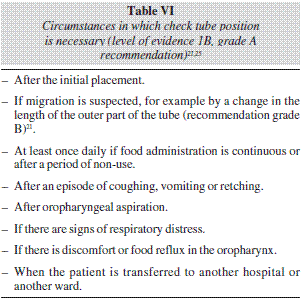
<body><![CDATA[<p><font face="Verdana" size="2">f) <i>Prevention of tube clogging</i>. The appropriate dimension must be chosen for the size of the child, taking into account the viscosity of the product to be infused and the interactions between the pharmaceutical formulations and NE.<sup>21,23</sup> The tubes should be rinsed with warm water with a 20 ml syringe, or larger, before and after food infusion, if the administration is intermittent, or when changing the bag or bottle (every 4 hours)<sup>15</sup> if it is continuous. Also before and after each medication (grade C recommendation)<sup>21</sup> and, although unused, once or twice a day.</font></p>     <p><font face="Verdana" size="2">2. <i>Care of NG tube</i></font></p>     <p><font face="Verdana" size="2">Silicone or polyurethane NG tubes are flexible and can be used for up to 4-6 weeks (grade C recommendation). <sup>21</sup> PVC tubes need to be replaced every 3-4 days. Once installed, do not insert wires or guides, or make sudden or repeated aspirates.</font></p>     <p><font face="Verdana" size="2">a) <i>Attaching the tube</i> to avoid accidental displacement/removal. You should alternate nostrils, using hypoallergenic gauze or Steri-strips<sup>®</sup>, change the area of skin where it is attached and keep the skin and nasal passages hydrated and with high levels of hygiene. The method used to secure the tube depends on the child´s age and mobility (<a target="_blank" href="/img/revistas/nh/v26n1/en_articulos_especiales_1_f2.gif">fig. 2</a>).</font></p>     <p><font face="Verdana" size="2">b) <i>Monitoring tube position.</i> In terms of effectiveness, checking gastric pH (below 5.5) is the closest method to radiological verification,<sup>24</sup> which is the "gold standard" (the tip of the tube should be below D12). Xray can be used if the child needs it for another reason or after tube placement or if pH monitoring is doubtful<sup>25</sup> (children receiving antacid or other medication that affects the acid pH or continuous or frequent NE) (<a href="#t6">table VI</a>). No lung aspirate has been found with a pH below 6.</font></p>     <p align="center"><font face="Verdana" size="2"><a name="t6"><img src="/img/revistas/nh/v26n1/en_articulos_especiales_1_t6.gif" align="top"></a></font></p>     <p>&nbsp;</p>     <p><font face="Verdana" size="2">3. <i>Care of gastrostomy tubes</i></font></p>     <p><font face="Verdana" size="2">a) <i>Gastrocutaneous fistula</i>. Accidental removal of the gastrostomy tube, within 3-4 weeks of placement, should be treated as an emergency because the gastrocutaneous fistula has not been formed and there is a high risk of peritonitis. If removal occurs after this time, the stoma may close within 1-2 hours; therefore a balloon catheter should be inserted as replacement or a Foley the same size as the old catheter, immediate referral to hospital.</font></p>     <p><font face="Verdana" size="2">The gastrostomy balloon may come out because the balloon has deflated or broken. In the event of deflation, if the family is trained to do so, the balloon can be reinserted and re-inflated. If broken, a new tube should be fitted if available. Otherwise, the broken tube should be replaced, anchored with tape to prevent closure of the fistula before reaching the hospital.</font></p>     ]]></body>
<body><![CDATA[<p><font face="Verdana" size="2">Families and other caregivers must have an action plan and enough knowledge to deal with this complication during the fistula formation period. At this stage, a button or PEG should never be used at home without its position having been tested in the hospital previously.</font></p>     <p><font face="Verdana" size="2">b) <i>Stoma skin care</i>. It is essential to prevent infection, abrasions, wounds and granulomas. This is done by keeping the area clean, moisturized and without signs of maceration (avoids it getting wet). The skin of the stoma should be cleaned once a day or more often in the case of secretions (<a target="_blank" href="/img/revistas/nh/v26n1/en_articulos_especiales_1_t7.gif">table VII</a>).</font></p>     <p><font face="Verdana" size="2">c) <i>Monitor PEG position</i> Perform daily on adjusting the PEG, check the graduated markings, check fastening systems are in place and that the external tube length remains constant. In case of doubt, the position will be confirmed by X-ray, ultrasound or by measuring gastric pH with a colorimetric test strip.</font></p>     <p><font face="Verdana" size="2">d) <i>Specific care of the gastrostomy button.</i> Balloon volume should be monitored if there are signs of deflation, and at least once a month under normal circumstances because small amounts of water can evaporate. The button must be replaced biannually. Frequent breakage of the balloon or valve seals requires examination to check for the presence of yeast. Rupture may also be due to the use of inappropriate fluid (it should be filled with water). The cap should be closed after each administration of food or medication.</font></p>     <p><font face="Verdana" size="2">4. <i>Care after enterostomy tube removal</i></font></p>     <p><font face="Verdana" size="2">The most common complication after PEG removal is fistula persistence,<sup>26</sup> depending on the time it has been inserted. If duration was under 9-11 months, spontaneous closure is common.<sup>26,27</sup> On removing a PEG or gastrostomy button, it is sufficient to hold the orifice edges together with Steri-strips<sup>&reg;</sup> to facilitate scar formation. If after 7-15 days it has not closed, the area can be cauterized with silver nitrate, re-align orifice edges with Steri-strips<sup>&reg;</sup> and administer the patient antacids (antiH<sub>2</sub>).<sup>27</sup> If after 3-4 weeks of cauterization the orifice has not closed, it should be closed surgically or endoscopically, combined with cauterization and metal grips.<sup>28</sup></font></p>     <p><font face="Verdana" size="2"><b>EN administration</b></font></p>     <p><font face="Verdana" size="2">1. <i>Infusion site</i></font></p>     <p><font face="Verdana" size="2">Gastric infusion is the most physiological because it enables large volumes of bolus to be administered. Post-pyloric infusion is recommended in patients with GERD and/or gastroparesis and patients at high risk of aspiration. It requires continuous infusion because the partial loss of the digestive and bactericidal processes of the stomach.</font></p>     <p><font face="Verdana" size="2">2. <i>Starting and monitoring EN</i></font></p>     ]]></body>
<body><![CDATA[<p><font face="Verdana" size="2">Nutrition will commence and proceed progressively depending on the child´s nutritional status and gastrointestinal tolerance. To reduce the risk of aspiration during EN administration, the patient´s head will be placed on a bed raised at an angle of 30-45 <sup>o</sup> (evidence Level A).<sup>15</sup>.</font></p>     <p><font face="Verdana" size="2">EN should be carefully monitored observing clinical (vomiting, reflux or aspiration, abdominal distension, abnormal volume and consistency of stool), anthropometric and analytical parameters and all aspects of correct tube positioning and possible complications. As for the control of gastric residue volume, there is no agreement on the need to monitor it; moreover, it can obstruct the tube. It seems advisable to do so in certain clinical situations: preterm newborns or critically ill patients.</font></p>     <p><font face="Verdana" size="2">In critically ill patients receiving continuous EN infusion, it should be conducted every four hours, interrupting nutrition, or changing the infusion rate if the volume is greater than or equal to infusion rate. In the intermittent regimen (bolus), it should be checked before each feed and nutrition discontinued or modified if the volume exceeds 50% of the infused volume in the previous feed<sup>15,29</sup> (evidence level C).</font></p>     <p><font face="Verdana" size="2">3. <i>Infusion regimen</i></font></p>     <p><font face="Verdana" size="2">This depends on several factors: the infusion site (stomach or jejunum), the type of patient (outpatient or hospitalised), feeding schedule (night or not), tolerance to food, the underlying disease (intolerance to fasting), and the presence of specific problems (vomiting, gastroparesis, dumping...).</font></p>     <p><font face="Verdana" size="2">a) <i>Continuous EN:</i> the formula is administered steadily throughout the day, either by gravity or pump. It has the advantages of generating little gastric residue and allowing for more efficient energy balance that intermittent EN.<sup>10</sup> It is recommended<sup>2</sup> for post-pyloric nutrition, in patients with malabsorption or at risk of aspiration, when they do not tolerate intermittent feeding and in situations of high energy expenditure.  <a target="_blank" href="/img/revistas/nh/v26n1/en_articulos_especiales_1_t8.gif">Table VIII</a> gives example infusion rates.</font></p>     <p><font face="Verdana" size="2">b) <i>Cyclical EN:</i> continuous infusion for periods of less than 24 hours (8-12 hours), usually overnight. Allows oral feeding ad libitum during the day.</font></p>     <p><font face="Verdana" size="2">c) <i>Intermittent EN:</i> volumes of formula are administered at regular intervals. This is the most physiological type of nutrition, allowing for greater patient mobility and stimulating oral feeding as it gives rise to periods of hunger and satiety. It is recommended for well-tolerated gastric feeding in non-critical patients, without risk of aspiration, and home nutrition whenever possible.  <a target="_blank" href="/img/revistas/nh/v26n1/en_articulos_especiales_1_t8.gif">Table VIII</a> outlines a guide for starting and monitoring of intermittent EN.</font></p>     <p><font face="Verdana" size="2">d) <i>Trophic EN:</i> refers to the continuous infusion of small amounts of enteral product (0.5 to 25 ml/kg /day) in order to maintain the intestinal barrier and the mucosal integrity<sup>30</sup>.</font></p>     <p><font face="Verdana" size="2">4. <i>Infusion method</i></font></p>     ]]></body>
<body><![CDATA[<p><font face="Verdana" size="2">Infusion can be performed via: a) <i>infusion pump</i> which has the advantage of administering a constant volume, improving tolerance and reducing healthworker or family workload; b) <b> <i>syringe</i></b>, which is used for intermittent feeding of bolus; and c)  <i>gravity</i>, free fall from a syringe or drip systems. Its use is simple, but requires frequent monitoring to ensure that the desired amount passes through.</font></p>     <p><font face="Verdana" size="2">5. <i>Transition from EN</i></font></p>     <p><font face="Verdana" size="2">This represents a change in administration method, be it the place, infusion regimen or the type of formula, with the aim of optimizing feeding and lowering risks to the child. It should be done slowly and gradually, allowing the patient to adapt.</font></p>     <p><font face="Verdana" size="2">In general, the use of diluted formulas at the beginning of the EN is not necessary, and may even be counter-productive by increasing the risk of intolerance to microbial contamination of the formula<sup>15</sup> due to secondary diarrhoea, and undernourishment due to the administration of low-calorie diets.</font></p>     <p><font face="Verdana" size="2">The change from EN to oral feeding can be difficult, especially in children who have been intubated for a long time. It takes time and often patients respond to behavioural therapies. Oral intake should be maintained during the EN in all children who are able to swallow.</font></p>     <p><font face="Verdana" size="2">6. <i>Combined EN</i></font></p>     <p><font face="Verdana" size="2">Under certain circumstances it is necessary to combine EN, in one or more of its forms, and parenteral nutrition, which requires rigorous monitoring<sup>31</sup>.</font></p>     <p>&nbsp;</p>     <p><font face="Verdana" size="2"><b>Complications of en teral access in children</b></font></p>     <p><font face="Verdana" size="2">All healthcare staff dealing with the insertion and maintenance of enteral access should be familiar with possible complications<sup>32</sup>.</font></p>     ]]></body>
<body><![CDATA[<p><font face="Verdana" size="2">1. <i>Complications of nasoenteral tubes</i></font></p>     <p><font face="Verdana" size="2"><i>Misplacement:</i> the tube is in a wrong position (e.g., larynx or trachea) or when in the gut it is not securely fixed (for example, the distal end of the catheter is in the oesophagus, which can cause oesophageal perforation, pneumothorax by perforation or aspiration pneumonia).</font></p>     <p><font face="Verdana" size="2"><i>- Tube clogging:</i> is a common complication for which preventive action must be carried out by rinsing and proper use of formulas and medication. When detected, run warm water through it, and if this is not effective, replaced with a new one. You can also try unblocking (provided there are no contraindications for the patient) with papain (Coca-Cola<sup>&reg;</sup>) or pancreatic ferments<sup>33</sup>.</font></p>     <p><font face="Verdana" size="2"><i>- Injuries caused by prone position or friction in the tubal route:</i> nasal cartilage erosions, oesophagitis, erosive gastritis, less common with tubes made of soft materials.</font></p>     <p><font face="Verdana" size="2">- <i>Tube migration from its initial position  or accidental removal</i> is the most common cause of interrupting scheduled enteral feeding<sup>34</sup>.</font></p>     <p><font face="Verdana" size="2"><i>- Breakage and nasal obstruction, otitis media, sinusitis</i> due to prolonged use of tubing.</font></p>     <p><font face="Verdana" size="2"><i>- Erroneous intravenous administration of EN</i>: extremely serious complications, which can be prevented by the use of devices that are impossible to connect.</font></p>     <p><font face="Verdana" size="2">2. <i>Complications of gastrostomy</i></font></p>     <p><font face="Verdana" size="2">The same as in all other techniques, they are more common in malnourished patients or complex clinical situations.</font></p>     <p><font face="Verdana" size="2">a) <i>Placement related:</i> The most common and/or serious are:</font></p>     ]]></body>
<body><![CDATA[<p><font face="Verdana" size="2"><i>- Peristoma skin infection</i>, usually limited to the skin and subcutaneous tissue. After culture collection, treatment should be given with antiseptics and topical antibiotics preferably in solution (wash or drops)<sup>35</sup></font></p>     <p><font face="Verdana" size="2"><i>- Pneumoperitoneum and paralytic ileus</i>, which usually get better spontaneously.</font></p> <i>     <p><font face="Verdana" size="2">- Separation of the peritoneum from the stomach wall</i>.occurs when the gastrocutaneous fistula has not fully formed and gastrostomy bumpers are loosened or removed accidentally. If not detected early this leads to peritonitis.</font></p>     <p><font face="Verdana" size="2"><i>- Colocutaneous or gastrocolic fistula</i>, occurs if the colon gets in between the abdominal wall and stomach when PEG is preformed. Clinical signs, which start immediately or after the substitution of the initial tubes, take the form of intestinal obstruction or severe diarrhoea on infusing food directly into the colon. Treatment involves tube removal and leaving the fistula to close, sometimes requiring surgery<sup>36</sup>.</font></p>     <p><font face="Verdana" size="2">b) <i>Maintenance related</i></font></p>     <p><font face="Verdana" size="2"><i>- Erosive dermatitis, loss of gastric contents, clogging or accidental removal of the gastrostomy tube</i> (avoidable with appropriate care).</font></p>     <p><font face="Verdana" size="2"><i>- Granulated tissue formation:</i>, granuloma often treated with silver nitrate.</font></p>     <p><font face="Verdana" size="2"><i>- Buried bumper syndrome</i> when the external bumper of the gastrostomy is too close to the abdominal wall, it pulls the inner bumper, which may become buried in the gastric wall. Abdominal pain occurs, mainly with infusion tube movement and the passing of nutrition and fluids through it. This syndrome requires immediate interruption of feeding and tube replacement.<sup>37</sup> If in doubt, gastroscopy should be performed.</font></p>     <p><font face="Verdana" size="2">c) <i>Related to extraction</i>, When the tube has been in position for a long time, which increases the stiffness of the material, and the internal bumper stays behind in the stomach, the disc may press on both cardia and in the cricopharyngeal area. The bumper should be removed with the patient relaxed and sedated<sup>38</sup>.</font></p>     <p><font face="Verdana" size="2"><i>Persistence of the gastrocutaneous fistula</i>. After the definitive withdrawal of the gastrostomy tube, in most cases the hole closes fully within a week with external compression. In 25% of cases (usually those of longer placement duration) the fistula can remain open for more than one month and closure requires surgery<sup>28</sup>.</font></p>     ]]></body>
<body><![CDATA[<p><font face="Verdana" size="2">d) <i>Early replacement of the gastrostomy tube with low-profile button</i> Early replacement (under 2 months) may cause gastrostomy tube migration and secondary peritonitis. Many medical teams prefer checking it endoscopically before its replacement<sup>39</sup>.</font></p>     <p><font face="Verdana" size="2">3. <i>Jejunostomy complications</i></font></p>     <p><font face="Verdana" size="2">Jejunostomy catheters are rarely used in children and therefore there is a low incidence of complications, <sup>40</sup> which may include infection of the surgical wound, intraperitoneal infusion leakage, duodenal fluid egress with subsequent skin burn, accidental tube removal, obstruction of the tube or the small intestine and intestinal necrosis.</font></p>     <p>&nbsp;</p>     <p><font face="Verdana" size="2"><b>References</b></font></p>     <!-- ref --><p><font face="Verdana" size="2">1. Agus MS, Jaksic T. Nutritional support of the critically ill child. <i>Curr Opin Pediatr</i> 2002; 14: 470-81.    &nbsp;&nbsp;&nbsp;&nbsp;&nbsp;&nbsp;&nbsp;&nbsp;[&#160;<a href="javascript:void(0);" onclick="javascript: window.open('/scielo.php?script=sci_nlinks&ref=3591534&pid=S0212-1611201100010000100001&lng=','','width=640,height=500,resizable=yes,scrollbars=1,menubar=yes,');">Links</a>&#160;]<!-- end-ref --></font></p>    <!-- ref --><p><font face="Verdana" size="2">2. Martínez Costa C, Sierra C, Pedrón Giner C, Moreno Villares JM, Lama R, Codoceo R. Nutrición enteral y parenteral en Pediatría. <i>An Esp Pediatr</i> 2000; 52 (Suppl. 3): 1-33.    &nbsp;&nbsp;&nbsp;&nbsp;&nbsp;&nbsp;&nbsp;&nbsp;[&#160;<a href="javascript:void(0);" onclick="javascript: window.open('/scielo.php?script=sci_nlinks&ref=3591536&pid=S0212-1611201100010000100002&lng=','','width=640,height=500,resizable=yes,scrollbars=1,menubar=yes,');">Links</a>&#160;]<!-- end-ref --></font></p>    <!-- ref --><p><font face="Verdana" size="2">3. Pedrón Giner C, Martínez Costa C. Nutrición enteral. En: Sociedad Española de Gastroenterología, Hepatología y Nutrición Pediátrica (SEGHNP), ed. Tratamiento en Gastroenterología, Hepatología y Nutrición Pediátrica. 2<sup>a</sup> Ed. Madrid: Ergon; 2008; pp. 679-94.    &nbsp;&nbsp;&nbsp;&nbsp;&nbsp;&nbsp;&nbsp;&nbsp;[&#160;<a href="javascript:void(0);" onclick="javascript: window.open('/scielo.php?script=sci_nlinks&ref=3591538&pid=S0212-1611201100010000100003&lng=','','width=640,height=500,resizable=yes,scrollbars=1,menubar=yes,');">Links</a>&#160;]<!-- end-ref --></font></p>    <!-- ref --><p><font face="Verdana" size="2">4. Olivares Arnal P. Vías de acceso en nutrición enteral en pediatría. En: Celaya Pérez S, editor. Vías de Acceso en Nutrición Enteral. 2<sup>a</sup> ed. Barcelona: Multimédica; 2001; pp.205-18.    &nbsp;&nbsp;&nbsp;&nbsp;&nbsp;&nbsp;&nbsp;&nbsp;[&#160;<a href="javascript:void(0);" onclick="javascript: window.open('/scielo.php?script=sci_nlinks&ref=3591540&pid=S0212-1611201100010000100004&lng=','','width=640,height=500,resizable=yes,scrollbars=1,menubar=yes,');">Links</a>&#160;]<!-- end-ref --></font></p>    <!-- ref --><p><font face="Verdana" size="2">5. Pereira JL, García-Luna PP. Gastrostomía endoscópica percutánea. <i>Med Clin (Barc)</i> 1998; 110: 498-500.    &nbsp;&nbsp;&nbsp;&nbsp;&nbsp;&nbsp;&nbsp;&nbsp;[&#160;<a href="javascript:void(0);" onclick="javascript: window.open('/scielo.php?script=sci_nlinks&ref=3591542&pid=S0212-1611201100010000100005&lng=','','width=640,height=500,resizable=yes,scrollbars=1,menubar=yes,');">Links</a>&#160;]<!-- end-ref --></font></p>    <!-- ref --><p><font face="Verdana" size="2">6. Samuel M, Holmes K. Quantitative and qualitative analysis of gastroesophageal reflux after percutaneous endoscopic gastrostomy. <i>J Pediatr Surg</i> 2002; 37: 256-61.    &nbsp;&nbsp;&nbsp;&nbsp;&nbsp;&nbsp;&nbsp;&nbsp;[&#160;<a href="javascript:void(0);" onclick="javascript: window.open('/scielo.php?script=sci_nlinks&ref=3591544&pid=S0212-1611201100010000100006&lng=','','width=640,height=500,resizable=yes,scrollbars=1,menubar=yes,');">Links</a>&#160;]<!-- end-ref --></font></p>    <!-- ref --><p><font face="Verdana" size="2">7. Axelrod D, Kazmerski K, Iyer K. Pediatric enteral nutrition. <i>JPEN J Parenter Enteral Nutr</i> 2006; 30: S21-S26.    &nbsp;&nbsp;&nbsp;&nbsp;&nbsp;&nbsp;&nbsp;&nbsp;[&#160;<a href="javascript:void(0);" onclick="javascript: window.open('/scielo.php?script=sci_nlinks&ref=3591546&pid=S0212-1611201100010000100007&lng=','','width=640,height=500,resizable=yes,scrollbars=1,menubar=yes,');">Links</a>&#160;]<!-- end-ref --></font></p>    <!-- ref --><p><font face="Verdana" size="2">8. Durkin ET, Schroth MK, Helin M, Shaaban AF. Early laparoscopic fundoplication and gastrostomy in infants with spinal muscular atrophy type I. <i>J Pediatr Surg</i> 2008; 43: 2031-7.    &nbsp;&nbsp;&nbsp;&nbsp;&nbsp;&nbsp;&nbsp;&nbsp;[&#160;<a href="javascript:void(0);" onclick="javascript: window.open('/scielo.php?script=sci_nlinks&ref=3591548&pid=S0212-1611201100010000100008&lng=','','width=640,height=500,resizable=yes,scrollbars=1,menubar=yes,');">Links</a>&#160;]<!-- end-ref --></font></p>    <!-- ref --><p><font face="Verdana" size="2">9. Chait PG. Interventional gastrointestinal radiology. En: Walter WA, Goulet O, Kleinman RE, Sherman PhM, Shneider BL, Sanderson IR, eds. Pediatric Gastrointestinal Disease. 4<sup>th</sup> ed. Ontario: BC Decker, Hamilton; 2004; pp. 1884-906.    &nbsp;&nbsp;&nbsp;&nbsp;&nbsp;&nbsp;&nbsp;&nbsp;[&#160;<a href="javascript:void(0);" onclick="javascript: window.open('/scielo.php?script=sci_nlinks&ref=3591550&pid=S0212-1611201100010000100009&lng=','','width=640,height=500,resizable=yes,scrollbars=1,menubar=yes,');">Links</a>&#160;]<!-- end-ref --></font></p>    <!-- ref --><p><font face="Verdana" size="2">10. Marchand V. Enteral nutrition tube feedings. En: Baker SS, Baker RD, Davis AM, eds. Pediatric nutritiion support. Boston: Jones and Barlett Publishers 2007; 249-60.    &nbsp;&nbsp;&nbsp;&nbsp;&nbsp;&nbsp;&nbsp;&nbsp;[&#160;<a href="javascript:void(0);" onclick="javascript: window.open('/scielo.php?script=sci_nlinks&ref=3591552&pid=S0212-1611201100010000100010&lng=','','width=640,height=500,resizable=yes,scrollbars=1,menubar=yes,');">Links</a>&#160;]<!-- end-ref --></font></p>    <!-- ref --><p><font face="Verdana" size="2">11. Gauderer MW, Ponsky JL, Izant RJ, Jr. Gastrostomy without laparotomy: a percutaneous endoscopic technique. <i>J Pediatr Surg</i> 1980; 15: 872-5.    &nbsp;&nbsp;&nbsp;&nbsp;&nbsp;&nbsp;&nbsp;&nbsp;[&#160;<a href="javascript:void(0);" onclick="javascript: window.open('/scielo.php?script=sci_nlinks&ref=3591554&pid=S0212-1611201100010000100011&lng=','','width=640,height=500,resizable=yes,scrollbars=1,menubar=yes,');">Links</a>&#160;]<!-- end-ref --></font></p>    <!-- ref --><p><font face="Verdana" size="2">12. Gauderer MW. Percutaneous endoscopic gastrostomy-20 years later: A historical perspective. <i>J Pediatr Surg</i> 2001; 36: 217-9.    &nbsp;&nbsp;&nbsp;&nbsp;&nbsp;&nbsp;&nbsp;&nbsp;[&#160;<a href="javascript:void(0);" onclick="javascript: window.open('/scielo.php?script=sci_nlinks&ref=3591556&pid=S0212-1611201100010000100012&lng=','','width=640,height=500,resizable=yes,scrollbars=1,menubar=yes,');">Links</a>&#160;]<!-- end-ref --></font></p>    <!-- ref --><p><font face="Verdana" size="2">13. Schaepi MG, Mougenot JF, Belli DC. Upper gastrointestinal endoscopy. En: Walter WA, Goulet O, Kleinman RE, Sherman PhM, Shneider BL, Sanderson IR, eds. Pediatric Gastrointestinal Disease. 4<sup>th</sup> ed. Ontario: BC Decker Hamilton; 2004; pp. 1674-1702.    &nbsp;&nbsp;&nbsp;&nbsp;&nbsp;&nbsp;&nbsp;&nbsp;[&#160;<a href="javascript:void(0);" onclick="javascript: window.open('/scielo.php?script=sci_nlinks&ref=3591558&pid=S0212-1611201100010000100013&lng=','','width=640,height=500,resizable=yes,scrollbars=1,menubar=yes,');">Links</a>&#160;]<!-- end-ref --></font></p>    <!-- ref --><p><font face="Verdana" size="2">14. Miguelena Bobadilla JM, Gil Albiol M, Escartín Valderramada J, Barranco Domínguez JI. Gastrostomía quirúrgica mínimamente invasiva. <i>Nutr Hosp</i> 2003; 18: 264-8.    &nbsp;&nbsp;&nbsp;&nbsp;&nbsp;&nbsp;&nbsp;&nbsp;[&#160;<a href="javascript:void(0);" onclick="javascript: window.open('/scielo.php?script=sci_nlinks&ref=3591560&pid=S0212-1611201100010000100014&lng=','','width=640,height=500,resizable=yes,scrollbars=1,menubar=yes,');">Links</a>&#160;]<!-- end-ref --></font></p>    <!-- ref --><p><font face="Verdana" size="2">15. Bankhead R, Boullata J, Brantley S, Corkins M, Guenter P, Krenitsky J et al; A.S.P.E.N. Board of Directors. A.S.P.E.N Enteral nutrition practice recommendations. <i>JPEN J Parenter Enteral Nutr</i> 2009; 33 (2): 122-67.    &nbsp;&nbsp;&nbsp;&nbsp;&nbsp;&nbsp;&nbsp;&nbsp;[&#160;<a href="javascript:void(0);" onclick="javascript: window.open('/scielo.php?script=sci_nlinks&ref=3591562&pid=S0212-1611201100010000100015&lng=','','width=640,height=500,resizable=yes,scrollbars=1,menubar=yes,');">Links</a>&#160;]<!-- end-ref --></font></p>    <!-- ref --><p><font face="Verdana" size="2">16. Kirby DF, Opilla M. Enteral Access and Infusion Equipment. En: Merrit R (ed). The A.S.P.E.N. Nutrition Support Practice Manual (2nd ed). <i>ASPEN</i> 2005: 54-62.    &nbsp;&nbsp;&nbsp;&nbsp;&nbsp;&nbsp;&nbsp;&nbsp;[&#160;<a href="javascript:void(0);" onclick="javascript: window.open('/scielo.php?script=sci_nlinks&ref=3591564&pid=S0212-1611201100010000100016&lng=','','width=640,height=500,resizable=yes,scrollbars=1,menubar=yes,');">Links</a>&#160;]<!-- end-ref --></font></p>    <!-- ref --><p><font face="Verdana" size="2">17. Sanahuja Yll M, Soler de Bièvre N. Contenedores, líneas de infusión y bombas en nutrición enteral. En: Celaya S, ed. Vías de acceso en nutrición enteral. Barcelona: Multimédica; 1995; pp. 199-216.    &nbsp;&nbsp;&nbsp;&nbsp;&nbsp;&nbsp;&nbsp;&nbsp;[&#160;<a href="javascript:void(0);" onclick="javascript: window.open('/scielo.php?script=sci_nlinks&ref=3591566&pid=S0212-1611201100010000100017&lng=','','width=640,height=500,resizable=yes,scrollbars=1,menubar=yes,');">Links</a>&#160;]<!-- end-ref --></font></p>    <!-- ref --><p><font face="Verdana" size="2">18. Cuellar LA, Martín C, de Luis D. Nutrición enteral y parenteral, vías de acceso. En: Bellido D, de Luis D, editores. Manual de nutrición y metabolismo. Madrid: Díaz de Santos; 2006; pp. 545-52.    &nbsp;&nbsp;&nbsp;&nbsp;&nbsp;&nbsp;&nbsp;&nbsp;[&#160;<a href="javascript:void(0);" onclick="javascript: window.open('/scielo.php?script=sci_nlinks&ref=3591568&pid=S0212-1611201100010000100018&lng=','','width=640,height=500,resizable=yes,scrollbars=1,menubar=yes,');">Links</a>&#160;]<!-- end-ref --></font></p>    <!-- ref --><p><font face="Verdana" size="2">19. Álvarez Hernández J, Peláez Torres N, Muñoz Jiménez A. Utilización clínica de la Nutrición Enteral.<i> Nutr Hosp</i> 2006; 21 (Suppl. 2): 87-99.    &nbsp;&nbsp;&nbsp;&nbsp;&nbsp;&nbsp;&nbsp;&nbsp;[&#160;<a href="javascript:void(0);" onclick="javascript: window.open('/scielo.php?script=sci_nlinks&ref=3591570&pid=S0212-1611201100010000100019&lng=','','width=640,height=500,resizable=yes,scrollbars=1,menubar=yes,');">Links</a>&#160;]<!-- end-ref --></font></p>    <!-- ref --><p><font face="Verdana" size="2">20. Sartori S, Trevisani L, Nielsen I, Tassinari D, Ceccotti P, Abbasciano V. Longevity of silicone and polyurethane catheters in long-term enteral feeding via percutaneous endoscopic gastrostomy. <i>Aliment Pharmacol Ther</i> 2003; 17 (6): 853-6.    &nbsp;&nbsp;&nbsp;&nbsp;&nbsp;&nbsp;&nbsp;&nbsp;[&#160;<a href="javascript:void(0);" onclick="javascript: window.open('/scielo.php?script=sci_nlinks&ref=3591572&pid=S0212-1611201100010000100020&lng=','','width=640,height=500,resizable=yes,scrollbars=1,menubar=yes,');">Links</a>&#160;]<!-- end-ref --></font></p>    <!-- ref --><p><font face="Verdana" size="2">21. Stroud M, Duncan H, Nightingale J; British Society of Gastroenterology. Guidelines for enteral feeding in adult hospital patients. <i>Gut</i> 2003; 52 (Suppl. 7): vii1-vii12.    &nbsp;&nbsp;&nbsp;&nbsp;&nbsp;&nbsp;&nbsp;&nbsp;[&#160;<a href="javascript:void(0);" onclick="javascript: window.open('/scielo.php?script=sci_nlinks&ref=3591574&pid=S0212-1611201100010000100021&lng=','','width=640,height=500,resizable=yes,scrollbars=1,menubar=yes,');">Links</a>&#160;]<!-- end-ref --></font></p>    <!-- ref --><p><font face="Verdana" size="2">22. Scottish Intercollegiate Guidelines Network (SIGN). Preventing dental caries in children at high caries risc. A National Clinical Guideline. &#091;monografía en Internet&#093;. Edinburgh:2000 &#091;acceso 10 de octubre de 2008&#093;. Disponible en: <a target="_blank" href="http://www.sign.ac.uk/pdf/sign47.pdf">http://www.sign.ac.uk/pdf/sign47.pdf</a></font>&nbsp;&nbsp;&nbsp;&nbsp;&nbsp;&nbsp;&nbsp;&nbsp;[&#160;<a href="javascript:void(0);" onclick="javascript: window.open('/scielo.php?script=sci_nlinks&ref=3591576&pid=S0212-1611201100010000100022&lng=','','width=640,height=500,resizable=yes,scrollbars=1,menubar=yes,');">Links</a>&#160;]<!-- end-ref --><!-- ref --><p><font face="Verdana" size="2">23. Gómez López L. Guía pediátrica de administración de fármacos por sonda nasogástrica. Madrid: Elsevier España S.L; 2008.    &nbsp;&nbsp;&nbsp;&nbsp;&nbsp;&nbsp;&nbsp;&nbsp;[&#160;<a href="javascript:void(0);" onclick="javascript: window.open('/scielo.php?script=sci_nlinks&ref=3591577&pid=S0212-1611201100010000100023&lng=','','width=640,height=500,resizable=yes,scrollbars=1,menubar=yes,');">Links</a>&#160;]<!-- end-ref --></font></p>    ]]></body>
<body><![CDATA[<!-- ref --><p><font face="Verdana" size="2">24. Turner T. Assessment of position of feeding tubes in infants. Evidence Request P0016. &#091;monografía en Internet&#093;. Clayton: The Health for Kids Paediatric Evidence Centre; 2006 &#091;acceso 10 de octubre de 2008&#093;. Disponible en: <a target="_blank" href="http://www.mihsr.monash.org/hfk/paedevid.html">http://www.mihsr.monash.org/hfk/paedevid.html</a></font>&nbsp;&nbsp;&nbsp;&nbsp;&nbsp;&nbsp;&nbsp;&nbsp;[&#160;<a href="javascript:void(0);" onclick="javascript: window.open('/scielo.php?script=sci_nlinks&ref=3591579&pid=S0212-1611201100010000100024&lng=','','width=640,height=500,resizable=yes,scrollbars=1,menubar=yes,');">Links</a>&#160;]<!-- end-ref --><!-- ref --><p><font face="Verdana" size="2">25. Richardson DS, Branowicki PA, Zeidman-Rogers L et al. An evidence-based approach to nasogastric tube management: special considerations. <i>J Pediatr Nurs</i> 2006; 21 (5): 388-93.    &nbsp;&nbsp;&nbsp;&nbsp;&nbsp;&nbsp;&nbsp;&nbsp;[&#160;<a href="javascript:void(0);" onclick="javascript: window.open('/scielo.php?script=sci_nlinks&ref=3591580&pid=S0212-1611201100010000100025&lng=','','width=640,height=500,resizable=yes,scrollbars=1,menubar=yes,');">Links</a>&#160;]<!-- end-ref --></font></p>    <!-- ref --><p><font face="Verdana" size="2">26. Gordon JM, Langer JC. Gastrocutaneous fistula in children after removal of gastrostomy tube: incidence and predictive factors. <i>J Pediatr Surg</i> 1999; 34 (9): 1345-6.    &nbsp;&nbsp;&nbsp;&nbsp;&nbsp;&nbsp;&nbsp;&nbsp;[&#160;<a href="javascript:void(0);" onclick="javascript: window.open('/scielo.php?script=sci_nlinks&ref=3591582&pid=S0212-1611201100010000100026&lng=','','width=640,height=500,resizable=yes,scrollbars=1,menubar=yes,');">Links</a>&#160;]<!-- end-ref --></font></p>    <!-- ref --><p><font face="Verdana" size="2">27. Janik TA, Hendrickson RJ, Janik JS, Landholm AE. Analysis of factors affecting the spontaneous closure of a gastrocutaneous fistula. <i>J Pediatr Surg</i> 2004; 39 (8): 1197-9.    &nbsp;&nbsp;&nbsp;&nbsp;&nbsp;&nbsp;&nbsp;&nbsp;[&#160;<a href="javascript:void(0);" onclick="javascript: window.open('/scielo.php?script=sci_nlinks&ref=3591584&pid=S0212-1611201100010000100027&lng=','','width=640,height=500,resizable=yes,scrollbars=1,menubar=yes,');">Links</a>&#160;]<!-- end-ref --></font></p>    <!-- ref --><p><font face="Verdana" size="2">28. Teitelbaum JE, Gorcey SA, Fox VL. Combined endoscopic cautery and clip closure of chronic gastrocutaneous fistulas. <i>Gastrointest Endosc</i> 2005; 62 (3): 432-5.    &nbsp;&nbsp;&nbsp;&nbsp;&nbsp;&nbsp;&nbsp;&nbsp;[&#160;<a href="javascript:void(0);" onclick="javascript: window.open('/scielo.php?script=sci_nlinks&ref=3591586&pid=S0212-1611201100010000100028&lng=','','width=640,height=500,resizable=yes,scrollbars=1,menubar=yes,');">Links</a>&#160;]<!-- end-ref --></font></p>    <!-- ref --><p><font face="Verdana" size="2">29. Weckwerth JA. Monitoring enteral nutrition support tolerance in infants and children. <i>Nutr Clin Pract</i> 2004; 19: 496-503.    &nbsp;&nbsp;&nbsp;&nbsp;&nbsp;&nbsp;&nbsp;&nbsp;[&#160;<a href="javascript:void(0);" onclick="javascript: window.open('/scielo.php?script=sci_nlinks&ref=3591588&pid=S0212-1611201100010000100029&lng=','','width=640,height=500,resizable=yes,scrollbars=1,menubar=yes,');">Links</a>&#160;]<!-- end-ref --></font></p>    <!-- ref --><p><font face="Verdana" size="2">30. Moreno JM, Pedrón C. Nutrición enteral en el paciente pediátrico. En: Gil A, ed. Tratado de Nutrición. Madrid: Acción Médica; 2005; pp. 235-66.    &nbsp;&nbsp;&nbsp;&nbsp;&nbsp;&nbsp;&nbsp;&nbsp;[&#160;<a href="javascript:void(0);" onclick="javascript: window.open('/scielo.php?script=sci_nlinks&ref=3591590&pid=S0212-1611201100010000100030&lng=','','width=640,height=500,resizable=yes,scrollbars=1,menubar=yes,');">Links</a>&#160;]<!-- end-ref --></font></p>    <!-- ref --><p><font face="Verdana" size="2">31. Davis AM. Transitional and combination feeding. En: Baker SS, Baker RD, Davis AM, eds. Pediatric nutrition support. Sudbury: Jones and Barlett publishers; 2007; pp. 261-72.    &nbsp;&nbsp;&nbsp;&nbsp;&nbsp;&nbsp;&nbsp;&nbsp;[&#160;<a href="javascript:void(0);" onclick="javascript: window.open('/scielo.php?script=sci_nlinks&ref=3591592&pid=S0212-1611201100010000100031&lng=','','width=640,height=500,resizable=yes,scrollbars=1,menubar=yes,');">Links</a>&#160;]<!-- end-ref --></font></p>    <!-- ref --><p><font face="Verdana" size="2">32. DeLegge MH. Consensus statements regarding optimal management of home enteral nutrition access. <i>JPEN J Parent Enteral Nutr</i> 2006; 30: S39-40.    &nbsp;&nbsp;&nbsp;&nbsp;&nbsp;&nbsp;&nbsp;&nbsp;[&#160;<a href="javascript:void(0);" onclick="javascript: window.open('/scielo.php?script=sci_nlinks&ref=3591594&pid=S0212-1611201100010000100032&lng=','','width=640,height=500,resizable=yes,scrollbars=1,menubar=yes,');">Links</a>&#160;]<!-- end-ref --></font></p>    <!-- ref --><p><font face="Verdana" size="2">33. Bourgault AM, Heyland DK, Drover JW, Keefe L, Newman P, Day AG. Prophylactic pancreatic enzymes to reduce feeding tube occlusions. <i>Nutr Clin Pract</i> 2003; 18: 398-401.    &nbsp;&nbsp;&nbsp;&nbsp;&nbsp;&nbsp;&nbsp;&nbsp;[&#160;<a href="javascript:void(0);" onclick="javascript: window.open('/scielo.php?script=sci_nlinks&ref=3591596&pid=S0212-1611201100010000100033&lng=','','width=640,height=500,resizable=yes,scrollbars=1,menubar=yes,');">Links</a>&#160;]<!-- end-ref --></font></p>    <!-- ref --><p><font face="Verdana" size="2">34. McWey RE, Curry NS, Schabel SI, Reines HD. Complications of nasoenteric feeding tubes. <i>Am J Surg</i> 1988; 155: 253-7.    &nbsp;&nbsp;&nbsp;&nbsp;&nbsp;&nbsp;&nbsp;&nbsp;[&#160;<a href="javascript:void(0);" onclick="javascript: window.open('/scielo.php?script=sci_nlinks&ref=3591598&pid=S0212-1611201100010000100034&lng=','','width=640,height=500,resizable=yes,scrollbars=1,menubar=yes,');">Links</a>&#160;]<!-- end-ref --></font></p>    <!-- ref --><p><font face="Verdana" size="2">35. Åvitsland TL, Kristensen C, Emblem R, Veenstra M, Mala T, Bjørnland K. Percutaneous endoscopic gastrostomy in children: A safe technique with major symptom relief and high parental satisfaction. <i>J Pediatr Gastroenterol Nutr</i> 2006; 43: 624-8.    &nbsp;&nbsp;&nbsp;&nbsp;&nbsp;&nbsp;&nbsp;&nbsp;[&#160;<a href="javascript:void(0);" onclick="javascript: window.open('/scielo.php?script=sci_nlinks&ref=3591600&pid=S0212-1611201100010000100035&lng=','','width=640,height=500,resizable=yes,scrollbars=1,menubar=yes,');">Links</a>&#160;]<!-- end-ref --></font></p>    <!-- ref --><p><font face="Verdana" size="2">36. Seguel Ramírez F, Ollero Fresno JC, Morató Robert P, Rollán Villamarín V, Alvarez Bernaldo de Quirós M. Experiencia en la realización de gastrostomía endoscópica percutánea en 60 niños. <i>Cir Pediatr</i> 2003; 16: 125-7.    &nbsp;&nbsp;&nbsp;&nbsp;&nbsp;&nbsp;&nbsp;&nbsp;[&#160;<a href="javascript:void(0);" onclick="javascript: window.open('/scielo.php?script=sci_nlinks&ref=3591602&pid=S0212-1611201100010000100036&lng=','','width=640,height=500,resizable=yes,scrollbars=1,menubar=yes,');">Links</a>&#160;]<!-- end-ref --></font></p>    <!-- ref --><p><font face="Verdana" size="2">37. Hodges EG, Morano JU, Nowicki MJ. The buried bumper syndrome complicating percutaneous endoscopic gastrostomy in children. <i>J Pediatr Gastroenterol Nutr</i> 2001; 33: 326-8.    &nbsp;&nbsp;&nbsp;&nbsp;&nbsp;&nbsp;&nbsp;&nbsp;[&#160;<a href="javascript:void(0);" onclick="javascript: window.open('/scielo.php?script=sci_nlinks&ref=3591604&pid=S0212-1611201100010000100037&lng=','','width=640,height=500,resizable=yes,scrollbars=1,menubar=yes,');">Links</a>&#160;]<!-- end-ref --></font></p>    <!-- ref --><p><font face="Verdana" size="2">38. Palmer GM, Frawley GP, Heine RG, Oliver MR. Complications associated with endoscopic removal of percutaneous endoscopic gastrostomy (PEG) tubes in children. <i>J Pediatr Gastroenterol Nutr</i> 2006; 42: 443-5.    &nbsp;&nbsp;&nbsp;&nbsp;&nbsp;&nbsp;&nbsp;&nbsp;[&#160;<a href="javascript:void(0);" onclick="javascript: window.open('/scielo.php?script=sci_nlinks&ref=3591606&pid=S0212-1611201100010000100038&lng=','','width=640,height=500,resizable=yes,scrollbars=1,menubar=yes,');">Links</a>&#160;]<!-- end-ref --></font></p>    <!-- ref --><p><font face="Verdana" size="2">39. Beres A, Bratu I, Laberge JM. Attention to small details: big deal for gastrostomies. <i>Sem Pediatr Surg</i> 2009; 18: 87-92.    &nbsp;&nbsp;&nbsp;&nbsp;&nbsp;&nbsp;&nbsp;&nbsp;[&#160;<a href="javascript:void(0);" onclick="javascript: window.open('/scielo.php?script=sci_nlinks&ref=3591608&pid=S0212-1611201100010000100039&lng=','','width=640,height=500,resizable=yes,scrollbars=1,menubar=yes,');">Links</a>&#160;]<!-- end-ref --></font></p>    <!-- ref --><p><font face="Verdana" size="2">40. Smith D, Soucy P. Complications of long-term jejunostomy in children. <i>J Pediatr Surg</i> 1996; 31: 787-90.    &nbsp;&nbsp;&nbsp;&nbsp;&nbsp;&nbsp;&nbsp;&nbsp;[&#160;<a href="javascript:void(0);" onclick="javascript: window.open('/scielo.php?script=sci_nlinks&ref=3591610&pid=S0212-1611201100010000100040&lng=','','width=640,height=500,resizable=yes,scrollbars=1,menubar=yes,');">Links</a>&#160;]<!-- end-ref --></font></p>     <p>&nbsp;</p>     <p>&nbsp;</p>     <p><font face="Verdana" size="2"><b><a name="back"></a><a href="#top"><img border="0" src="/img/revistas/nh/v26n1/seta.gif" width="15" height="17"></a>Correspondence:</b>    <br>Consuelo Pedrón-Giner.    <br>Sección de Gastroenterología y Nutrición.    <br>Hospital Infantil Universitario Niño Jesús.    <br>C/ Menéndez Pelayo, 65.    ]]></body>
<body><![CDATA[<br>28009 Madrid.    <br>E-mail:  <a href="mailto:cpedron.hnjs@salud.madrid.org">cpedron.hnjs@salud.madrid.org</a></font></p>     <p><font face="Verdana" size="2">Recibido: 1-I-2010.    <br>Aceptado: 6-I-2010.</font></p>      ]]></body><back>
<ref-list>
<ref id="B1">
<label>1</label><nlm-citation citation-type="journal">
<person-group person-group-type="author">
<name>
<surname><![CDATA[Agus]]></surname>
<given-names><![CDATA[MS]]></given-names>
</name>
<name>
<surname><![CDATA[Jaksic]]></surname>
<given-names><![CDATA[T]]></given-names>
</name>
</person-group>
<article-title xml:lang="en"><![CDATA[Nutritional support of the critically ill child]]></article-title>
<source><![CDATA[Curr Opin Pediatr]]></source>
<year>2002</year>
<volume>14</volume>
<page-range>470-81</page-range></nlm-citation>
</ref>
<ref id="B2">
<label>2</label><nlm-citation citation-type="journal">
<person-group person-group-type="author">
<name>
<surname><![CDATA[Martínez Costa]]></surname>
<given-names><![CDATA[C]]></given-names>
</name>
<name>
<surname><![CDATA[Sierra]]></surname>
<given-names><![CDATA[C]]></given-names>
</name>
<name>
<surname><![CDATA[Pedrón Giner]]></surname>
<given-names><![CDATA[C]]></given-names>
</name>
<name>
<surname><![CDATA[Moreno Villares]]></surname>
<given-names><![CDATA[JM]]></given-names>
</name>
<name>
<surname><![CDATA[Lama]]></surname>
<given-names><![CDATA[R]]></given-names>
</name>
<name>
<surname><![CDATA[Codoceo]]></surname>
<given-names><![CDATA[R]]></given-names>
</name>
</person-group>
<article-title xml:lang="es"><![CDATA[Nutrición enteral y parenteral en Pediatría]]></article-title>
<source><![CDATA[An Esp Pediatr]]></source>
<year>2000</year>
<volume>52</volume>
<numero>^s3</numero>
<issue>^s3</issue>
<supplement>3</supplement>
<page-range>1-33</page-range></nlm-citation>
</ref>
<ref id="B3">
<label>3</label><nlm-citation citation-type="book">
<person-group person-group-type="author">
<name>
<surname><![CDATA[Pedrón Giner]]></surname>
<given-names><![CDATA[C]]></given-names>
</name>
<name>
<surname><![CDATA[Martínez Costa]]></surname>
<given-names><![CDATA[C]]></given-names>
</name>
</person-group>
<article-title xml:lang="es"><![CDATA[Nutrición enteral]]></article-title>
<collab>Sociedad Española de Gastroenterología, Hepatología y Nutrición Pediátrica (SEGHNP)</collab>
<source><![CDATA[Tratamiento en Gastroenterología, Hepatología y Nutrición Pediátrica]]></source>
<year>2008</year>
<edition>2</edition>
<page-range>679-94</page-range><publisher-loc><![CDATA[Madrid ]]></publisher-loc>
<publisher-name><![CDATA[Ergon]]></publisher-name>
</nlm-citation>
</ref>
<ref id="B4">
<label>4</label><nlm-citation citation-type="book">
<person-group person-group-type="author">
<name>
<surname><![CDATA[Olivares Arnal]]></surname>
<given-names><![CDATA[P]]></given-names>
</name>
</person-group>
<article-title xml:lang="es"><![CDATA[Vías de acceso en nutrición enteral en pediatría]]></article-title>
<person-group person-group-type="editor">
<name>
<surname><![CDATA[Celaya Pérez]]></surname>
<given-names><![CDATA[S]]></given-names>
</name>
</person-group>
<source><![CDATA[Vías de Acceso en Nutrición Enteral]]></source>
<year>2001</year>
<edition>2</edition>
<page-range>205-18</page-range><publisher-loc><![CDATA[Barcelona ]]></publisher-loc>
<publisher-name><![CDATA[Multimédica]]></publisher-name>
</nlm-citation>
</ref>
<ref id="B5">
<label>5</label><nlm-citation citation-type="journal">
<person-group person-group-type="author">
<name>
<surname><![CDATA[Pereira]]></surname>
<given-names><![CDATA[JL]]></given-names>
</name>
<name>
<surname><![CDATA[García-Luna]]></surname>
<given-names><![CDATA[PP]]></given-names>
</name>
</person-group>
<article-title xml:lang="es"><![CDATA[Gastrostomía endoscópica percutánea]]></article-title>
<source><![CDATA[Med Clin (Barc)]]></source>
<year>1998</year>
<volume>110</volume>
<page-range>498-500</page-range></nlm-citation>
</ref>
<ref id="B6">
<label>6</label><nlm-citation citation-type="journal">
<person-group person-group-type="author">
<name>
<surname><![CDATA[Samuel]]></surname>
<given-names><![CDATA[M]]></given-names>
</name>
<name>
<surname><![CDATA[Holmes]]></surname>
<given-names><![CDATA[K]]></given-names>
</name>
</person-group>
<article-title xml:lang="en"><![CDATA[Quantitative and qualitative analysis of gastroesophageal reflux after percutaneous endoscopic gastrostomy]]></article-title>
<source><![CDATA[J Pediatr Surg]]></source>
<year>2002</year>
<volume>37</volume>
<page-range>256-61</page-range></nlm-citation>
</ref>
<ref id="B7">
<label>7</label><nlm-citation citation-type="journal">
<person-group person-group-type="author">
<name>
<surname><![CDATA[Axelrod]]></surname>
<given-names><![CDATA[D]]></given-names>
</name>
<name>
<surname><![CDATA[Kazmerski]]></surname>
<given-names><![CDATA[K]]></given-names>
</name>
<name>
<surname><![CDATA[Iyer]]></surname>
<given-names><![CDATA[K]]></given-names>
</name>
</person-group>
<article-title xml:lang="en"><![CDATA[Pediatric enteral nutrition]]></article-title>
<source><![CDATA[JPEN J Parenter Enteral Nutr]]></source>
<year>2006</year>
<volume>30</volume>
<page-range>S21-S26</page-range></nlm-citation>
</ref>
<ref id="B8">
<label>8</label><nlm-citation citation-type="journal">
<person-group person-group-type="author">
<name>
<surname><![CDATA[Durkin]]></surname>
<given-names><![CDATA[ET]]></given-names>
</name>
<name>
<surname><![CDATA[Schroth]]></surname>
<given-names><![CDATA[MK]]></given-names>
</name>
<name>
<surname><![CDATA[Helin]]></surname>
<given-names><![CDATA[M]]></given-names>
</name>
<name>
<surname><![CDATA[Shaaban]]></surname>
<given-names><![CDATA[AF]]></given-names>
</name>
</person-group>
<article-title xml:lang="en"><![CDATA[Early laparoscopic fundoplication and gastrostomy in infants with spinal muscular atrophy type I]]></article-title>
<source><![CDATA[J Pediatr Surg]]></source>
<year>2008</year>
<volume>43</volume>
<page-range>2031-7</page-range></nlm-citation>
</ref>
<ref id="B9">
<label>9</label><nlm-citation citation-type="book">
<person-group person-group-type="author">
<name>
<surname><![CDATA[Chait]]></surname>
<given-names><![CDATA[PG]]></given-names>
</name>
</person-group>
<article-title xml:lang="en"><![CDATA[Interventional gastrointestinal radiology]]></article-title>
<person-group person-group-type="editor">
<name>
<surname><![CDATA[Walter]]></surname>
<given-names><![CDATA[WA]]></given-names>
</name>
<name>
<surname><![CDATA[Goulet]]></surname>
<given-names><![CDATA[O]]></given-names>
</name>
<name>
<surname><![CDATA[Kleinman]]></surname>
<given-names><![CDATA[RE]]></given-names>
</name>
<name>
<surname><![CDATA[Sherman]]></surname>
<given-names><![CDATA[PhM]]></given-names>
</name>
<name>
<surname><![CDATA[Shneider]]></surname>
<given-names><![CDATA[BL]]></given-names>
</name>
<name>
<surname><![CDATA[Sanderson]]></surname>
<given-names><![CDATA[IR]]></given-names>
</name>
</person-group>
<source><![CDATA[Pediatric Gastrointestinal Disease]]></source>
<year></year>
<edition>4</edition>
<publisher-loc><![CDATA[Hamilton^eOntario Ontario]]></publisher-loc>
<publisher-name><![CDATA[BC Decker]]></publisher-name>
</nlm-citation>
</ref>
<ref id="B10">
<label>10</label><nlm-citation citation-type="book">
<person-group person-group-type="author">
<name>
<surname><![CDATA[Marchand]]></surname>
<given-names><![CDATA[V]]></given-names>
</name>
</person-group>
<article-title xml:lang="en"><![CDATA[Enteral nutrition tube feedings]]></article-title>
<person-group person-group-type="editor">
<name>
<surname><![CDATA[Baker]]></surname>
<given-names><![CDATA[SS]]></given-names>
</name>
<name>
<surname><![CDATA[Baker]]></surname>
<given-names><![CDATA[RD]]></given-names>
</name>
<name>
<surname><![CDATA[Davis]]></surname>
<given-names><![CDATA[AM]]></given-names>
</name>
</person-group>
<source><![CDATA[Pediatric nutritiion support]]></source>
<year>2007</year>
<page-range>249-60</page-range><publisher-loc><![CDATA[Boston ]]></publisher-loc>
<publisher-name><![CDATA[Jones and Barlett Publishers]]></publisher-name>
</nlm-citation>
</ref>
<ref id="B11">
<label>11</label><nlm-citation citation-type="journal">
<person-group person-group-type="author">
<name>
<surname><![CDATA[Gauderer]]></surname>
<given-names><![CDATA[MW]]></given-names>
</name>
<name>
<surname><![CDATA[Ponsky]]></surname>
<given-names><![CDATA[JL]]></given-names>
</name>
<name>
<surname><![CDATA[Izant]]></surname>
<given-names><![CDATA[RJ, Jr]]></given-names>
</name>
</person-group>
<article-title xml:lang="en"><![CDATA[Gastrostomy without laparotomy: a percutaneous endoscopic technique]]></article-title>
<source><![CDATA[J Pediatr Surg]]></source>
<year>1980</year>
<volume>15</volume>
<page-range>872-5</page-range></nlm-citation>
</ref>
<ref id="B12">
<label>12</label><nlm-citation citation-type="journal">
<person-group person-group-type="author">
<name>
<surname><![CDATA[Gauderer]]></surname>
<given-names><![CDATA[MW]]></given-names>
</name>
</person-group>
<article-title xml:lang="en"><![CDATA[Percutaneous endoscopic gastrostomy-20 years later: A historical perspective]]></article-title>
<source><![CDATA[J Pediatr Surg]]></source>
<year>2001</year>
<volume>36</volume>
<page-range>217-9</page-range></nlm-citation>
</ref>
<ref id="B13">
<label>13</label><nlm-citation citation-type="book">
<person-group person-group-type="author">
<name>
<surname><![CDATA[Schaepi]]></surname>
<given-names><![CDATA[MG]]></given-names>
</name>
<name>
<surname><![CDATA[Mougenot]]></surname>
<given-names><![CDATA[JF]]></given-names>
</name>
<name>
<surname><![CDATA[Belli]]></surname>
<given-names><![CDATA[DC]]></given-names>
</name>
</person-group>
<article-title xml:lang="en"><![CDATA[Upper gastrointestinal endoscopy]]></article-title>
<person-group person-group-type="editor">
<name>
<surname><![CDATA[Walter]]></surname>
<given-names><![CDATA[WA]]></given-names>
</name>
<name>
<surname><![CDATA[Goulet]]></surname>
<given-names><![CDATA[O]]></given-names>
</name>
<name>
<surname><![CDATA[Kleinman]]></surname>
<given-names><![CDATA[RE]]></given-names>
</name>
<name>
<surname><![CDATA[Sherman]]></surname>
<given-names><![CDATA[PhM]]></given-names>
</name>
<name>
<surname><![CDATA[Shneider]]></surname>
<given-names><![CDATA[BL]]></given-names>
</name>
<name>
<surname><![CDATA[Sanderson]]></surname>
<given-names><![CDATA[IR]]></given-names>
</name>
</person-group>
<source><![CDATA[Pediatric Gastrointestinal Disease]]></source>
<year>2004</year>
<edition>4</edition>
<page-range>1674-1702</page-range><publisher-loc><![CDATA[Hamilton^eOntario Ontario]]></publisher-loc>
<publisher-name><![CDATA[BC Decker]]></publisher-name>
</nlm-citation>
</ref>
<ref id="B14">
<label>14</label><nlm-citation citation-type="journal">
<person-group person-group-type="author">
<name>
<surname><![CDATA[Miguelena Bobadilla]]></surname>
<given-names><![CDATA[JM]]></given-names>
</name>
<name>
<surname><![CDATA[Gil Albiol]]></surname>
<given-names><![CDATA[M]]></given-names>
</name>
<name>
<surname><![CDATA[Escartín Valderramada]]></surname>
<given-names><![CDATA[J]]></given-names>
</name>
<name>
<surname><![CDATA[Barranco Domínguez]]></surname>
<given-names><![CDATA[JI]]></given-names>
</name>
</person-group>
<article-title xml:lang="es"><![CDATA[Gastrostomía quirúrgica mínimamente invasiva]]></article-title>
<source><![CDATA[Nutr Hosp]]></source>
<year>2003</year>
<volume>18</volume>
<page-range>264-8</page-range></nlm-citation>
</ref>
<ref id="B15">
<label>15</label><nlm-citation citation-type="journal">
<person-group person-group-type="author">
<name>
<surname><![CDATA[Bankhead]]></surname>
<given-names><![CDATA[R]]></given-names>
</name>
<name>
<surname><![CDATA[Boullata]]></surname>
<given-names><![CDATA[J]]></given-names>
</name>
<name>
<surname><![CDATA[Brantley]]></surname>
<given-names><![CDATA[S]]></given-names>
</name>
<name>
<surname><![CDATA[Corkins]]></surname>
<given-names><![CDATA[M]]></given-names>
</name>
<name>
<surname><![CDATA[Guenter]]></surname>
<given-names><![CDATA[P]]></given-names>
</name>
<name>
<surname><![CDATA[Krenitsky]]></surname>
<given-names><![CDATA[J]]></given-names>
</name>
</person-group>
<article-title xml:lang="en"><![CDATA[A. S.P.E.N. Board of Directors. A.S.P.E.N Enteral nutrition practice recommendations]]></article-title>
<source><![CDATA[JPEN J Parenter Enteral Nutr]]></source>
<year>2009</year>
<volume>33</volume>
<numero>2</numero>
<issue>2</issue>
<page-range>122-67</page-range></nlm-citation>
</ref>
<ref id="B16">
<label>16</label><nlm-citation citation-type="book">
<person-group person-group-type="author">
<name>
<surname><![CDATA[Kirby]]></surname>
<given-names><![CDATA[DF]]></given-names>
</name>
<name>
<surname><![CDATA[Opilla]]></surname>
<given-names><![CDATA[M]]></given-names>
</name>
</person-group>
<article-title xml:lang="en"><![CDATA[Enteral Access and Infusion Equipment]]></article-title>
<person-group person-group-type="editor">
<name>
<surname><![CDATA[Merrit]]></surname>
<given-names><![CDATA[R]]></given-names>
</name>
</person-group>
<source><![CDATA[The A.S.P.E.N. Nutrition Support Practice Manual]]></source>
<year>2005</year>
<edition>2</edition>
<page-range>54-62</page-range><publisher-name><![CDATA[ASPEN]]></publisher-name>
</nlm-citation>
</ref>
<ref id="B17">
<label>17</label><nlm-citation citation-type="book">
<person-group person-group-type="author">
<name>
<surname><![CDATA[Sanahuja]]></surname>
<given-names><![CDATA[Yll M]]></given-names>
</name>
<name>
<surname><![CDATA[Soler de Bièvre]]></surname>
<given-names><![CDATA[N]]></given-names>
</name>
</person-group>
<article-title xml:lang="es"><![CDATA[Contenedores, líneas de infusión y bombas en nutrición enteral]]></article-title>
<person-group person-group-type="editor">
<name>
<surname><![CDATA[Celaya]]></surname>
<given-names><![CDATA[S]]></given-names>
</name>
</person-group>
<source><![CDATA[Vías de acceso en nutrición enteral]]></source>
<year>1995</year>
<page-range>199-216</page-range><publisher-loc><![CDATA[Barcelona ]]></publisher-loc>
<publisher-name><![CDATA[Multimédica]]></publisher-name>
</nlm-citation>
</ref>
<ref id="B18">
<label>18</label><nlm-citation citation-type="book">
<person-group person-group-type="author">
<name>
<surname><![CDATA[Cuellar]]></surname>
<given-names><![CDATA[LA]]></given-names>
</name>
<name>
<surname><![CDATA[Martín]]></surname>
<given-names><![CDATA[C]]></given-names>
</name>
<name>
<surname><![CDATA[de Luis]]></surname>
<given-names><![CDATA[D]]></given-names>
</name>
</person-group>
<article-title xml:lang="es"><![CDATA[Nutrición enteral y parenteral, vías de acceso]]></article-title>
<person-group person-group-type="editor">
<name>
<surname><![CDATA[Bellido]]></surname>
<given-names><![CDATA[D]]></given-names>
</name>
<name>
<surname><![CDATA[de Luis]]></surname>
<given-names><![CDATA[D]]></given-names>
</name>
</person-group>
<source><![CDATA[Manual de nutrición y metabolismo]]></source>
<year>2006</year>
<page-range>545-52</page-range><publisher-loc><![CDATA[Madrid ]]></publisher-loc>
<publisher-name><![CDATA[Díaz de Santos]]></publisher-name>
</nlm-citation>
</ref>
<ref id="B19">
<label>19</label><nlm-citation citation-type="journal">
<person-group person-group-type="author">
<name>
<surname><![CDATA[Álvarez Hernández]]></surname>
<given-names><![CDATA[J]]></given-names>
</name>
<name>
<surname><![CDATA[Peláez Torres]]></surname>
<given-names><![CDATA[N]]></given-names>
</name>
<name>
<surname><![CDATA[Muñoz Jiménez]]></surname>
<given-names><![CDATA[A]]></given-names>
</name>
</person-group>
<article-title xml:lang="es"><![CDATA[Utilización clínica de la Nutrición Enteral]]></article-title>
<source><![CDATA[Nutr Hosp]]></source>
<year>2006</year>
<volume>21</volume>
<numero>^s2</numero>
<issue>^s2</issue>
<supplement>2</supplement>
<page-range>87-99</page-range></nlm-citation>
</ref>
<ref id="B20">
<label>20</label><nlm-citation citation-type="journal">
<person-group person-group-type="author">
<name>
<surname><![CDATA[Sartori]]></surname>
<given-names><![CDATA[S]]></given-names>
</name>
<name>
<surname><![CDATA[Trevisani]]></surname>
<given-names><![CDATA[L]]></given-names>
</name>
<name>
<surname><![CDATA[Nielsen]]></surname>
<given-names><![CDATA[I]]></given-names>
</name>
<name>
<surname><![CDATA[Tassinari]]></surname>
<given-names><![CDATA[D]]></given-names>
</name>
<name>
<surname><![CDATA[Ceccotti]]></surname>
<given-names><![CDATA[P]]></given-names>
</name>
<name>
<surname><![CDATA[Abbasciano]]></surname>
<given-names><![CDATA[V]]></given-names>
</name>
</person-group>
<article-title xml:lang="en"><![CDATA[Longevity of silicone and polyurethane catheters in long-term enteral feeding via percutaneous endoscopic gastrostomy]]></article-title>
<source><![CDATA[Aliment Pharmacol Ther]]></source>
<year>2003</year>
<volume>17</volume>
<numero>6</numero>
<issue>6</issue>
<page-range>853-6</page-range></nlm-citation>
</ref>
<ref id="B21">
<label>21</label><nlm-citation citation-type="journal">
<person-group person-group-type="author">
<name>
<surname><![CDATA[Stroud]]></surname>
<given-names><![CDATA[M]]></given-names>
</name>
<name>
<surname><![CDATA[Duncan]]></surname>
<given-names><![CDATA[H]]></given-names>
</name>
<name>
<surname><![CDATA[Nightingale]]></surname>
<given-names><![CDATA[J]]></given-names>
</name>
</person-group>
<collab>British Society of Gastroenterology</collab>
<article-title xml:lang="en"><![CDATA[Guidelines for enteral feeding in adult hospital patients]]></article-title>
<source><![CDATA[Gut]]></source>
<year>2003</year>
<volume>52</volume>
<numero>^s7</numero>
<issue>^s7</issue>
<supplement>7</supplement>
<page-range>vii1-vii12</page-range></nlm-citation>
</ref>
<ref id="B22">
<label>22</label><nlm-citation citation-type="">
<collab>Scottish Intercollegiate Guidelines Network (SIGN)</collab>
<source><![CDATA[Preventing dental caries in children at high caries risc: A National Clinical Guideline]]></source>
<year>2000</year>
<publisher-loc><![CDATA[Edinburgh ]]></publisher-loc>
</nlm-citation>
</ref>
<ref id="B23">
<label>23</label><nlm-citation citation-type="book">
<person-group person-group-type="author">
<name>
<surname><![CDATA[Gómez López]]></surname>
<given-names><![CDATA[L]]></given-names>
</name>
</person-group>
<source><![CDATA[Guía pediátrica de administración de fármacos por sonda nasogástrica]]></source>
<year>2008</year>
<publisher-loc><![CDATA[Madrid ]]></publisher-loc>
<publisher-name><![CDATA[Elsevier España]]></publisher-name>
</nlm-citation>
</ref>
<ref id="B24">
<label>24</label><nlm-citation citation-type="book">
<person-group person-group-type="author">
<name>
<surname><![CDATA[Turner]]></surname>
<given-names><![CDATA[T]]></given-names>
</name>
</person-group>
<source><![CDATA[Assessment of position of feeding tubes in infants: Evidence Request P0016]]></source>
<year>2006</year>
<publisher-loc><![CDATA[Clayton ]]></publisher-loc>
<publisher-name><![CDATA[The Health for Kids Paediatric Evidence Centre]]></publisher-name>
</nlm-citation>
</ref>
<ref id="B25">
<label>25</label><nlm-citation citation-type="journal">
<person-group person-group-type="author">
<name>
<surname><![CDATA[Richardson]]></surname>
<given-names><![CDATA[DS]]></given-names>
</name>
<name>
<surname><![CDATA[Branowicki]]></surname>
<given-names><![CDATA[PA]]></given-names>
</name>
<name>
<surname><![CDATA[Zeidman-Rogers]]></surname>
<given-names><![CDATA[L]]></given-names>
</name>
</person-group>
<article-title xml:lang="en"><![CDATA[An evidence-based approach to nasogastric tube management: special considerations]]></article-title>
<source><![CDATA[J Pediatr Nurs]]></source>
<year>2006</year>
<volume>21</volume>
<numero>5</numero>
<issue>5</issue>
<page-range>388-93</page-range></nlm-citation>
</ref>
<ref id="B26">
<label>26</label><nlm-citation citation-type="journal">
<person-group person-group-type="author">
<name>
<surname><![CDATA[Gordon]]></surname>
<given-names><![CDATA[JM]]></given-names>
</name>
<name>
<surname><![CDATA[Langer]]></surname>
<given-names><![CDATA[JC]]></given-names>
</name>
</person-group>
<article-title xml:lang="en"><![CDATA[Gastrocutaneous fistula in children after removal of gastrostomy tube: incidence and predictive factors]]></article-title>
<source><![CDATA[J Pediatr Surg]]></source>
<year>1999</year>
<volume>34</volume>
<numero>9</numero>
<issue>9</issue>
<page-range>1345-6</page-range></nlm-citation>
</ref>
<ref id="B27">
<label>27</label><nlm-citation citation-type="journal">
<person-group person-group-type="author">
<name>
<surname><![CDATA[Janik]]></surname>
<given-names><![CDATA[TA]]></given-names>
</name>
<name>
<surname><![CDATA[Hendrickson]]></surname>
<given-names><![CDATA[RJ]]></given-names>
</name>
<name>
<surname><![CDATA[Janik]]></surname>
<given-names><![CDATA[JS]]></given-names>
</name>
<name>
<surname><![CDATA[Landholm]]></surname>
<given-names><![CDATA[AE]]></given-names>
</name>
</person-group>
<article-title xml:lang="en"><![CDATA[Analysis of factors affecting the spontaneous closure of a gastrocutaneous fistula]]></article-title>
<source><![CDATA[J Pediatr Surg]]></source>
<year>2004</year>
<volume>39</volume>
<numero>8</numero>
<issue>8</issue>
<page-range>1197-9</page-range></nlm-citation>
</ref>
<ref id="B28">
<label>28</label><nlm-citation citation-type="journal">
<person-group person-group-type="author">
<name>
<surname><![CDATA[Teitelbaum]]></surname>
<given-names><![CDATA[JE]]></given-names>
</name>
<name>
<surname><![CDATA[Gorcey]]></surname>
<given-names><![CDATA[SA]]></given-names>
</name>
<name>
<surname><![CDATA[Fox]]></surname>
<given-names><![CDATA[VL]]></given-names>
</name>
</person-group>
<article-title xml:lang="en"><![CDATA[Combined endoscopic cautery and clip closure of chronic gastrocutaneous fistulas]]></article-title>
<source><![CDATA[Gastrointest Endosc]]></source>
<year>2005</year>
<volume>62</volume>
<numero>3</numero>
<issue>3</issue>
<page-range>432-5</page-range></nlm-citation>
</ref>
<ref id="B29">
<label>29</label><nlm-citation citation-type="journal">
<person-group person-group-type="author">
<name>
<surname><![CDATA[Weckwerth]]></surname>
<given-names><![CDATA[JA]]></given-names>
</name>
</person-group>
<article-title xml:lang="en"><![CDATA[Monitoring enteral nutrition support tolerance in infants and children]]></article-title>
<source><![CDATA[Nutr Clin Pract]]></source>
<year>2004</year>
<volume>19</volume>
<page-range>496-503</page-range></nlm-citation>
</ref>
<ref id="B30">
<label>30</label><nlm-citation citation-type="book">
<person-group person-group-type="author">
<name>
<surname><![CDATA[Moreno]]></surname>
<given-names><![CDATA[JM]]></given-names>
</name>
<name>
<surname><![CDATA[Pedrón]]></surname>
<given-names><![CDATA[C]]></given-names>
</name>
</person-group>
<article-title xml:lang="es"><![CDATA[Nutrición enteral en el paciente pediátrico]]></article-title>
<person-group person-group-type="editor">
<name>
<surname><![CDATA[Gil]]></surname>
<given-names><![CDATA[A]]></given-names>
</name>
</person-group>
<source><![CDATA[Tratado de Nutrición]]></source>
<year>2005</year>
<page-range>235-66</page-range><publisher-loc><![CDATA[Madrid ]]></publisher-loc>
<publisher-name><![CDATA[Acción Médica]]></publisher-name>
</nlm-citation>
</ref>
<ref id="B31">
<label>31</label><nlm-citation citation-type="book">
<person-group person-group-type="author">
<name>
<surname><![CDATA[Davis]]></surname>
<given-names><![CDATA[AM]]></given-names>
</name>
</person-group>
<article-title xml:lang="en"><![CDATA[Transitional and combination feeding]]></article-title>
<person-group person-group-type="editor">
<name>
<surname><![CDATA[Baker]]></surname>
<given-names><![CDATA[SS]]></given-names>
</name>
<name>
<surname><![CDATA[Baker]]></surname>
<given-names><![CDATA[RD]]></given-names>
</name>
<name>
<surname><![CDATA[Davis]]></surname>
<given-names><![CDATA[AM]]></given-names>
</name>
</person-group>
<source><![CDATA[Pediatric nutrition support]]></source>
<year>2007</year>
<page-range>261-72</page-range><publisher-loc><![CDATA[Sudbury ]]></publisher-loc>
<publisher-name><![CDATA[Jones and Barlett publishers]]></publisher-name>
</nlm-citation>
</ref>
<ref id="B32">
<label>32</label><nlm-citation citation-type="journal">
<person-group person-group-type="author">
<name>
<surname><![CDATA[DeLegge]]></surname>
<given-names><![CDATA[MH]]></given-names>
</name>
</person-group>
<article-title xml:lang="en"><![CDATA[Consensus statements regarding optimal management of home enteral nutrition access]]></article-title>
<source><![CDATA[JPEN J Parent Enteral Nutr]]></source>
<year>2006</year>
<volume>30</volume>
<page-range>S39-40</page-range></nlm-citation>
</ref>
<ref id="B33">
<label>33</label><nlm-citation citation-type="journal">
<person-group person-group-type="author">
<name>
<surname><![CDATA[Bourgault]]></surname>
<given-names><![CDATA[AM]]></given-names>
</name>
<name>
<surname><![CDATA[Heyland]]></surname>
<given-names><![CDATA[DK]]></given-names>
</name>
<name>
<surname><![CDATA[Drover]]></surname>
<given-names><![CDATA[JW]]></given-names>
</name>
<name>
<surname><![CDATA[Keefe]]></surname>
<given-names><![CDATA[L]]></given-names>
</name>
<name>
<surname><![CDATA[Newman]]></surname>
<given-names><![CDATA[P]]></given-names>
</name>
<name>
<surname><![CDATA[Day]]></surname>
<given-names><![CDATA[AG]]></given-names>
</name>
</person-group>
<article-title xml:lang="en"><![CDATA[Prophylactic pancreatic enzymes to reduce feeding tube occlusions]]></article-title>
<source><![CDATA[Nutr Clin Pract]]></source>
<year>2003</year>
<volume>18</volume>
<page-range>398-401</page-range></nlm-citation>
</ref>
<ref id="B34">
<label>34</label><nlm-citation citation-type="journal">
<person-group person-group-type="author">
<name>
<surname><![CDATA[McWey]]></surname>
<given-names><![CDATA[RE]]></given-names>
</name>
<name>
<surname><![CDATA[Curry]]></surname>
<given-names><![CDATA[NS]]></given-names>
</name>
<name>
<surname><![CDATA[Schabel]]></surname>
<given-names><![CDATA[SI]]></given-names>
</name>
<name>
<surname><![CDATA[Reines]]></surname>
<given-names><![CDATA[HD]]></given-names>
</name>
</person-group>
<article-title xml:lang="en"><![CDATA[Complications of nasoenteric feeding tubes]]></article-title>
<source><![CDATA[Am J Surg]]></source>
<year>1988</year>
<volume>155</volume>
<page-range>253-7</page-range></nlm-citation>
</ref>
<ref id="B35">
<label>35</label><nlm-citation citation-type="journal">
<person-group person-group-type="author">
<name>
<surname><![CDATA[Åvitsland]]></surname>
<given-names><![CDATA[TL]]></given-names>
</name>
<name>
<surname><![CDATA[Kristensen]]></surname>
<given-names><![CDATA[C]]></given-names>
</name>
<name>
<surname><![CDATA[Emblem]]></surname>
<given-names><![CDATA[R]]></given-names>
</name>
<name>
<surname><![CDATA[Veenstra]]></surname>
<given-names><![CDATA[M]]></given-names>
</name>
<name>
<surname><![CDATA[Mala]]></surname>
<given-names><![CDATA[T]]></given-names>
</name>
<name>
<surname><![CDATA[Bjørnland]]></surname>
<given-names><![CDATA[K]]></given-names>
</name>
</person-group>
<article-title xml:lang="en"><![CDATA[Percutaneous endoscopic gastrostomy in children: A safe technique with major symptom relief and high parental satisfaction]]></article-title>
<source><![CDATA[J Pediatr Gastroenterol Nutr]]></source>
<year>2006</year>
<volume>43</volume>
<page-range>624-8</page-range></nlm-citation>
</ref>
<ref id="B36">
<label>36</label><nlm-citation citation-type="journal">
<person-group person-group-type="author">
<name>
<surname><![CDATA[Seguel Ramírez]]></surname>
<given-names><![CDATA[F]]></given-names>
</name>
<name>
<surname><![CDATA[Ollero Fresno]]></surname>
<given-names><![CDATA[JC]]></given-names>
</name>
<name>
<surname><![CDATA[Morató Robert]]></surname>
<given-names><![CDATA[P]]></given-names>
</name>
<name>
<surname><![CDATA[Rollán Villamarín]]></surname>
<given-names><![CDATA[V]]></given-names>
</name>
<name>
<surname><![CDATA[Alvarez Bernaldo de Quirós]]></surname>
<given-names><![CDATA[M]]></given-names>
</name>
</person-group>
<article-title xml:lang="es"><![CDATA[Experiencia en la realización de gastrostomía endoscópica percutánea en 60 niños]]></article-title>
<source><![CDATA[Cir Pediatr]]></source>
<year>2003</year>
<volume>16</volume>
<page-range>125-7</page-range></nlm-citation>
</ref>
<ref id="B37">
<label>37</label><nlm-citation citation-type="journal">
<person-group person-group-type="author">
<name>
<surname><![CDATA[Hodges]]></surname>
<given-names><![CDATA[EG]]></given-names>
</name>
<name>
<surname><![CDATA[Morano]]></surname>
<given-names><![CDATA[JU]]></given-names>
</name>
<name>
<surname><![CDATA[Nowicki]]></surname>
<given-names><![CDATA[MJ]]></given-names>
</name>
</person-group>
<article-title xml:lang="en"><![CDATA[The buried bumper syndrome complicating percutaneous endoscopic gastrostomy in children]]></article-title>
<source><![CDATA[J Pediatr Gastroenterol Nutr]]></source>
<year>2001</year>
<volume>33</volume>
<page-range>326-8</page-range></nlm-citation>
</ref>
<ref id="B38">
<label>38</label><nlm-citation citation-type="journal">
<person-group person-group-type="author">
<name>
<surname><![CDATA[Palmer]]></surname>
<given-names><![CDATA[GM]]></given-names>
</name>
<name>
<surname><![CDATA[Frawley]]></surname>
<given-names><![CDATA[GP]]></given-names>
</name>
<name>
<surname><![CDATA[Heine]]></surname>
<given-names><![CDATA[RG]]></given-names>
</name>
<name>
<surname><![CDATA[Oliver]]></surname>
<given-names><![CDATA[MR]]></given-names>
</name>
</person-group>
<article-title xml:lang="en"><![CDATA[Complications associated with endoscopic removal of percutaneous endoscopic gastrostomy (PEG) tubes in children]]></article-title>
<source><![CDATA[J Pediatr Gastroenterol Nutr]]></source>
<year>2006</year>
<volume>42</volume>
<page-range>443-5</page-range></nlm-citation>
</ref>
<ref id="B39">
<label>39</label><nlm-citation citation-type="journal">
<person-group person-group-type="author">
<name>
<surname><![CDATA[Beres]]></surname>
<given-names><![CDATA[A]]></given-names>
</name>
<name>
<surname><![CDATA[Bratu]]></surname>
<given-names><![CDATA[I]]></given-names>
</name>
<name>
<surname><![CDATA[Laberge]]></surname>
<given-names><![CDATA[JM]]></given-names>
</name>
</person-group>
<article-title xml:lang="en"><![CDATA[Attention to small details: big deal for gastrostomies]]></article-title>
<source><![CDATA[Sem Pediatr Surg]]></source>
<year>2009</year>
<volume>18</volume>
<page-range>87-92</page-range></nlm-citation>
</ref>
<ref id="B40">
<label>40</label><nlm-citation citation-type="journal">
<person-group person-group-type="author">
<name>
<surname><![CDATA[Smith]]></surname>
<given-names><![CDATA[D]]></given-names>
</name>
<name>
<surname><![CDATA[Soucy]]></surname>
<given-names><![CDATA[P]]></given-names>
</name>
</person-group>
<article-title xml:lang="en"><![CDATA[Complications of long-term jejunostomy in children]]></article-title>
<source><![CDATA[J Pediatr Surg]]></source>
<year>1996</year>
<volume>31</volume>
<page-range>787-90</page-range></nlm-citation>
</ref>
</ref-list>
</back>
</article>
