<?xml version="1.0" encoding="ISO-8859-1"?><article xmlns:mml="http://www.w3.org/1998/Math/MathML" xmlns:xlink="http://www.w3.org/1999/xlink" xmlns:xsi="http://www.w3.org/2001/XMLSchema-instance">
<front>
<journal-meta>
<journal-id>0212-1611</journal-id>
<journal-title><![CDATA[Nutrición Hospitalaria]]></journal-title>
<abbrev-journal-title><![CDATA[Nutr. Hosp.]]></abbrev-journal-title>
<issn>0212-1611</issn>
<publisher>
<publisher-name><![CDATA[Grupo Arán]]></publisher-name>
</publisher>
</journal-meta>
<article-meta>
<article-id>S0212-16112011000100002</article-id>
<title-group>
<article-title xml:lang="en"><![CDATA[The reduction of the metabolyc syndrome in Navarra-Spain (RESMENA-S) study: a multidisciplinary strategy based on chrononutrition and nutritional education, together with dietetic and psychological control]]></article-title>
<article-title xml:lang="es"><![CDATA[El estudio RESMENA-S: reducción del síndrome metabólico; una estrategia multidisciplinar basada en la crononutrición y la educación nutricional, junto con control dietético y psicológico]]></article-title>
</title-group>
<contrib-group>
<contrib contrib-type="author">
<name>
<surname><![CDATA[Zulet]]></surname>
<given-names><![CDATA[M.ª A.]]></given-names>
</name>
<xref ref-type="aff" rid="A01"/>
</contrib>
<contrib contrib-type="author">
<name>
<surname><![CDATA[Bondia-Pons]]></surname>
<given-names><![CDATA[I.]]></given-names>
</name>
<xref ref-type="aff" rid="A01"/>
</contrib>
<contrib contrib-type="author">
<name>
<surname><![CDATA[Abete]]></surname>
<given-names><![CDATA[I.]]></given-names>
</name>
<xref ref-type="aff" rid="A01"/>
</contrib>
<contrib contrib-type="author">
<name>
<surname><![CDATA[de la Iglesia]]></surname>
<given-names><![CDATA[R.]]></given-names>
</name>
<xref ref-type="aff" rid="A01"/>
</contrib>
<contrib contrib-type="author">
<name>
<surname><![CDATA[López-Legarrea]]></surname>
<given-names><![CDATA[P.]]></given-names>
</name>
<xref ref-type="aff" rid="A01"/>
</contrib>
<contrib contrib-type="author">
<name>
<surname><![CDATA[Forga]]></surname>
<given-names><![CDATA[L.]]></given-names>
</name>
<xref ref-type="aff" rid="A02"/>
</contrib>
<contrib contrib-type="author">
<name>
<surname><![CDATA[Navas-Carretero]]></surname>
<given-names><![CDATA[S.]]></given-names>
</name>
<xref ref-type="aff" rid="A01"/>
</contrib>
<contrib contrib-type="author">
<name>
<surname><![CDATA[Martínez]]></surname>
<given-names><![CDATA[J. A.]]></given-names>
</name>
<xref ref-type="aff" rid="A01"/>
</contrib>
</contrib-group>
<aff id="A01">
<institution><![CDATA[,University of Navarra Department of Nutrition, Food Sciences, Physiology & Toxicology ]]></institution>
<addr-line><![CDATA[Pamplona ]]></addr-line>
<country>Spain</country>
</aff>
<aff id="A02">
<institution><![CDATA[,Hospital of Navarra Department of Endocrinology ]]></institution>
<addr-line><![CDATA[Pamplona ]]></addr-line>
<country>Spain</country>
</aff>
<pub-date pub-type="pub">
<day>00</day>
<month>02</month>
<year>2011</year>
</pub-date>
<pub-date pub-type="epub">
<day>00</day>
<month>02</month>
<year>2011</year>
</pub-date>
<volume>26</volume>
<numero>1</numero>
<fpage>16</fpage>
<lpage>26</lpage>
<copyright-statement/>
<copyright-year/>
<self-uri xlink:href="http://scielo.isciii.es/scielo.php?script=sci_arttext&amp;pid=S0212-16112011000100002&amp;lng=en&amp;nrm=iso"></self-uri><self-uri xlink:href="http://scielo.isciii.es/scielo.php?script=sci_abstract&amp;pid=S0212-16112011000100002&amp;lng=en&amp;nrm=iso"></self-uri><self-uri xlink:href="http://scielo.isciii.es/scielo.php?script=sci_pdf&amp;pid=S0212-16112011000100002&amp;lng=en&amp;nrm=iso"></self-uri><abstract abstract-type="short" xml:lang="en"><p><![CDATA[Introduction: The high prevalence of metabolic syndrome (MS) in Spain requires additional efforts for prevention and treatment. Objective: The study RESMENA-S aims to improve clinical criteria and biomarkers associated with MS though an integral therapy approach. Methods: The study is a randomized prospective parallel design in which is expected to participate a total of 100 individuals. The RESMENA-S group (n = 50) is a personalized weight loss (30% energy restriction) diet, with a macronutrient distribution (carbohydrate / fat / protein) of 40/30/30, high meal frequency (7 / day), low glycemic index/load and high antioxidant capacity as well as a high adherence to the Mediterranean diet. The control group (n = 50) is assigned to a diet with the same energy restriction and based on the American Heart Association pattern. Both experimental groups are under dietary and psychological control during 8 weeks. Likewise, for an additional period of 16 weeks of self-control, is expected that volunteers will follow the same pattern but with no dietary advice. Results: Anthropometrical data and body composition determinations as well as blood and urine samples are being collected at the beginning and end of each phase. This project is registered at www.clinicaltrials.gov with the number NCT01087086 and count with the Research Ethics Committee of the University of Navarra approval (065/2009). Conclusions: Intervention trials to promote the adoption of dietary patterns and healthy lifestyle are of great importance to identify the outcomes and nutritional mechanisms that might explain the link between obesity, metabolic syndrome and associated complications.]]></p></abstract>
<abstract abstract-type="short" xml:lang="es"><p><![CDATA[Introducción: La alta prevalencia del síndrome metabólico (SM) en España requiere de esfuerzos adicionales para su prevención y tratamiento. Objetivo: El estudio RESMENA-S tiene como objetivo mejorar criterios clínicos de SM y biomarcadores asociados a través de un tratamiento integral. Métodos: El estudio consiste en un ensayo aleatorizado de diseño paralelo y prospectivo en el que está previsto participen un total de 100 individuos. El grupo RESMENA-S (n = 50) sigue una dieta personalizada de pérdida de peso (restricción energética 30%), con una distribución en macronutrientes (hidratos de carbono/grasas/ proteínas) de 40/30/30, elevada frecuencia de ingestas (7/día), bajo índice/carga glucémica y elevada capacidad antioxidante y adherencia a la dieta Mediterránea. El grupo control (n = 50) sigue una dieta con la misma restricción energética y basada en la Asociación Americana del Corazón. El estudio tiene una duración de 8 semanas bajo control dietético y psicológico en ambos grupos. Durante un periodo adicional de 16 semanas de auto-control, los voluntarios siguen el mismo patrón dietético pero sin ningún asesoramiento específico. Resultados: Datos antropométricos y de composición corporal, así como muestras sanguíneas y de orina están siendo recogidas al inicio y al final de cada fase. Este proyecto está registrado en www.clinicaltrials.gov con el número NCT01087086 y cuenta con la aprobación del Comité de Ética de Investigación de la Universidad de Navarra (065/2009). Conclusiones: Las intervenciones que favorezcan la adopción de patrones dietéticos y de estilo de vida más saludables, son de elevada importancia para identificar los mecanismos que podrían explicar el nexo de unión entre obesidad, SM y complicaciones asociadas.]]></p></abstract>
<kwd-group>
<kwd lng="en"><![CDATA[Metabolic syndrome]]></kwd>
<kwd lng="en"><![CDATA[Weight loss]]></kwd>
<kwd lng="en"><![CDATA[Inflammation]]></kwd>
<kwd lng="en"><![CDATA[Oxidative stress]]></kwd>
<kwd lng="en"><![CDATA[Mediterranean diet]]></kwd>
<kwd lng="es"><![CDATA[Síndrome metabólico]]></kwd>
<kwd lng="es"><![CDATA[Pérdida de peso]]></kwd>
<kwd lng="es"><![CDATA[Inflamación]]></kwd>
<kwd lng="es"><![CDATA[Estrés oxidativo]]></kwd>
<kwd lng="es"><![CDATA[Dieta mediterránea]]></kwd>
</kwd-group>
</article-meta>
</front><body><![CDATA[ <p><font face="Verdana" size="2"><a name="top"></a><b>ARTÍCULO ESPECIAL</b></font></p>     <p>&nbsp;</p>     <p><font face="Verdana" size="4"><b>The reduction of the metabolyc syndrome in Navarra-Spain (RESMENA-S) study; a multidisciplinary strategy based on chrononutrition and nutritional education, together with dietetic and psychological control</b></font></p>     <p><b><font face="Verdana" size="4">El estudio RESMENA-S: reducción del síndrome metabólico; una estrategia multidisciplinar basada en la crononutrición y la educación nutricional, junto con control dietético y psicológico</font></b></p>     <p>&nbsp;</p>     <p>&nbsp;</p>     <p><font face="Verdana" size="2"><b>M.<sup>a</sup> A. Zulet<sup>1</sup>, I. Bondia-Pons<sup>1</sup>, I. Abete<sup>1</sup>, R. de la Iglesia<sup>1</sup>, P. López-Legarrea<sup>1</sup>, L. Forga<sup>2</sup>, S. Navas-Carretero<sup>1</sup> and J. A. Martínez<sup>1</sup></b></font></p>     <p><font face="Verdana" size="2"><sup>1</sup>Department of Nutrition, Food Sciences, Physiology & Toxicology. University of Navarra. Pamplona. Spain.    <br><sup>2</sup>Department of Endocrinology. Hospital of Navarra. Pamplona. Spain.</font></p>     <p><font face="Verdana" size="2">This work is supported by the Health Department of the Government of Navarra (2443/2009) and by Linea Especial about Nutrition, Obesity and Health (University of Navarra LE/97). Government of Navarra also provide research grants to Rocío de la Iglesia (Beca para la Formación de Tecnólogos n<sup>o</sup> 028/02/09) and Patricia López Legarrea (Pre-doctoral n<sup>o</sup> 233/2009). Isabel Bondia-Pons is a recipient of a Sara Borrell postdoctoral fellowship from the Instituto Carlos III de Salud at the Spanish Ministry of Health.</font></p>     ]]></body>
<body><![CDATA[<p><font face="Verdana" size="2"><a href="#back">Correspondence</a></font></p>     <p>&nbsp;</p>     <p>&nbsp;</p> <hr size="1">     <p><font face="Verdana" size="2"><b>ABSTRACT</b></font></p>     <p><font face="Verdana" size="2"><b>Introduction:</b> The high prevalence of metabolic syndrome (MS) in Spain requires additional efforts for prevention and treatment.    <br><b>Objective:</b> The study RESMENA-S aims to improve clinical criteria and biomarkers associated with MS though an integral therapy approach.    <br><b>Methods:</b> The study is a randomized prospective parallel design in which is expected to participate a total of 100 individuals. The RESMENA-S group (n = 50) is a personalized weight loss (30% energy restriction) diet, with a macronutrient distribution (carbohydrate / fat / protein) of 40/30/30, high meal frequency (7 / day), low glycemic index/load and high antioxidant capacity as well as a high adherence to the Mediterranean diet. The control group (n = 50) is assigned to a diet with the same energy restriction and based on the American Heart Association pattern. Both experimental groups are under dietary and psychological control during 8 weeks. Likewise, for an additional period of 16 weeks of self-control, is expected that volunteers will follow the same pattern but with no dietary advice.    <br><b>Results:</b> Anthropometrical data and body composition determinations as well as blood and urine samples are being collected at the beginning and end of each phase. This project is registered at www.clinicaltrials.gov with the number NCT01087086 and count with the Research Ethics Committee of the University of Navarra approval (065/2009).    <br><b>Conclusions:</b> Intervention trials to promote the adoption of dietary patterns and healthy lifestyle are of great importance to identify the outcomes and nutritional mechanisms that might explain the link between obesity, metabolic syndrome and associated complications.</font></p>     <p><font face="Verdana" size="2"><b>Key words:</b> Metabolic syndrome. Weight loss. Inflammation. Oxidative stress. Mediterranean diet.</font></p> <hr size="1">     ]]></body>
<body><![CDATA[<p><font face="Verdana" size="2"><b>RESUMEN</b></font></p>     <p><font face="Verdana" size="2"><b>Introducción:</b> La alta prevalencia del síndrome metabólico (SM) en España requiere de esfuerzos adicionales para su prevención y tratamiento.    <br><b>Objetivo:</b> El estudio RESMENA-S tiene como objetivo mejorar criterios clínicos de SM y biomarcadores asociados a través de un tratamiento integral.    <br><b>Métodos:</b> El estudio consiste en un ensayo aleatorizado de diseño paralelo y prospectivo en el que está previsto participen un total de 100 individuos. El grupo RESMENA-S (n = 50) sigue una dieta personalizada de pérdida de peso (restricción energética 30%), con una distribución en macronutrientes (hidratos de carbono/grasas/ proteínas) de 40/30/30, elevada frecuencia de ingestas (7/día), bajo índice/carga glucémica y elevada capacidad antioxidante y adherencia a la dieta Mediterránea. El grupo control (n = 50) sigue una dieta con la misma restricción energética y basada en la Asociación Americana del Corazón. El estudio tiene una duración de 8 semanas bajo control dietético y psicológico en ambos grupos. Durante un periodo adicional de 16 semanas de auto-control, los voluntarios siguen el mismo patrón dietético pero sin ningún asesoramiento específico.    <br><b>Resultados:</b> Datos antropométricos y de composición corporal, así como muestras sanguíneas y de orina están siendo recogidas al inicio y al final de cada fase. Este proyecto está registrado en www.clinicaltrials.gov con el número NCT01087086 y cuenta con la aprobación del Comité de Ética de Investigación de la Universidad de Navarra (065/2009).    <br><b>Conclusiones:</b> Las intervenciones que favorezcan la adopción de patrones dietéticos y de estilo de vida más saludables, son de elevada importancia para identificar los mecanismos que podrían explicar el nexo de unión entre obesidad, SM y complicaciones asociadas.</font></p>     <p><font face="Verdana" size="2"><b>Palabras clave:</b> Síndrome metabólico. Pérdida de peso. Inflamación. Estrés oxidativo. Dieta mediterránea.</font></p> <hr size="1">     <p>&nbsp;</p>     <p><font face="Verdana" size="2"><b>Abbreviations</b></font></p>     <p><font face="Verdana" size="2">Tumor necrosis factor alpha (TNF-alpha); interleukin (IL); plasminogen activator inhibitor protein-1 (PAI-1); protein C reactive (PCR); complement factor 3 (C3); retinol binding protein 4 (RBP4); malondialdehyde (MDA); cardiovascular disease (CVD); calorie restriction (CR); dual-energy X-ray absorptiometry (DEXA); State-Trait Anxiety Inventory (STAI); homeostasis model assessment-estimated insulin resistance (HOMA-IR),</font></p>     ]]></body>
<body><![CDATA[<p>&nbsp;</p>     <p><font face="Verdana" size="2"><b>Introduction</b></font></p>     <p><font face="Verdana" size="2">Obesity rates are currently achieving epidemic proportions worldwide.<sup>1,2</sup> The metabolic syndrome describes a clustering of metabolic abnormalities that increase the cardiovascular and diabetes risk, which not only includes the obesity as a process characterized by an excess of body fat conditioned by genetic and environmental determinants, but also other related diseases sharing risk factors and most likely mechanisms of action.<sup>3-6</sup> Inflammatory markers, such as tumor necrosis factor alpha (TNF-alpha), interleukin 6 and 18 (IL-6; IL-18), plasminogen activator inhibitor protein-1 (PAI-1), protein C reactive (PCR), complement factor 3 (C3), retinol binding protein 4 (RBP4), intercellular adhesion molecules (ICAMs), vascular cell adhesion molecules (vCAMs), asymmetric dimethylarginine (ADMA), ceruloplasmin and leptin have been negatively correlated to clinical features of the metabolic syndrome.<sup>7-11</sup> In addition, the evaluation of several markers of the oxidant/antioxidant status such as malondialdehyde (MDA), oxidized LDL and the total antioxidant capacity of the plasma might be also relevant to understand the mechanisms behind the development of clinical metabolic syndrome features.<sup>12</sup> Further research in both, the role of inflammation and oxidative stress in the metabolic syndrome is therefore needed to elucidate those mechanisms.<sup>13</sup> For this purpose, new nutritional interventions and complementary approaches for effective prevention and treatment of metabolic syndrome must be designed.</font></p>     <p><font face="Verdana" size="2">The Mediterranean diet, a dietary pattern that has attracted considerable interest because of its potential advantages in the prevention of chronic diseases<sup>14,15</sup> contains many food compounds with putative antiinflammatory and/or antioxidant effects.<sup>16</sup> A Mediterranean diet supplemented with virgin olive oil or nuts has for example recently shown an anti-inflammatory effect reducing serum CRP, IL-6 and endothelial and monocytary adhesion molecules and chemokines in comparison to a low-fat diet in subjects at a high cardiovascular risk in the PREvención con DIeta MEDiterránea (PREDIMED) Study.<sup>17</sup> A regular weekly consumption of legumes within a hypocaloric diet also resulted in a specific reduction in CRP and C3 and a clinically significant improvement of the lipid profile and blood pressure in overweight and obese subjects.<sup>13</sup> The application of nutrigenomics techniques for large-scale profiling of genes, proteins and metabolites recently showed that a short-term double-blind, crossover study with a dietary mix containing resveratrol, alpha-tocopherol, vitamin C, n-3 polyunsaturated fatty acids and tomato extract, all of them naturally present in the Mediterranean diet, was able to modulate inflammation of adipose tissue, improve endothelial function, and increase liver fatty acid oxidation in overweight men with mildly increased C-reactive protein concentrations.<sup>18</sup></font></p>     <p><font face="Verdana" size="2">Other dietary factors have been shown to be effective in metabolic syndrome and related pathologies.<sup>19</sup> For example, high protein diets might guarantee a satiety effect and a lower recovery of the lost weight according to the results derived from The DIet, Obesity and GENES (DIOGENES) study due to the higher thermogenic effect of this nutrient.<sup>20-22</sup> Low glycemic load diets have proved to positively affect gene expression in subcutaneous adipose tissue in persons with metabolic syndrome<sup>11,23</sup> and a daily consumption of 3 portions of whole-grain foods has recently demonstrated to significantly reduce CVD risk in middleaged people mainly through blood pressure-lowering mechanisms.<sup>24</sup></font></p>     <p><font face="Verdana" size="2">In addition to the quantitative and qualitative composition of the diet, other factors related to eating behavior habits might significantly influence the success of a weight-loss nutritional intervention.<sup>24-28</sup> Factors such as the meal frequency, the size of the eating portions, the distribution of the portions along the day, the subjective feelings of hunger and the quality of life and mood of the subject might be taken into account in current and future interventions.<sup>29</sup></font></p>     <p><font face="Verdana" size="2">A decrease in energy intake by means of dietary restriction has also shown to lower the risk of CVD in obese populations.<sup>30</sup> The most common form of dietary restriction implemented is daily calorie restriction (CR), which requires individuals to decrease their energy intake by 15-40% of baseline needs each day.<sup>19,31</sup> Preliminary results from the Comprehensive Assessment of the Long-term Effect of Reducing Intake of Energy (CALERIE) Study, aimed to test the effects of 25% CR in 150 non-obese healthy subjects aged 25-45 years, have pointed out significant alterations in energy metabolism, oxidative damage, insulin sensitivity, and functional changes in both the neuroendocrine and sympathetic nervous systems.<sup>32,33</sup> Interestingly, the 6-month CR intervention not only caused favorable physiological responses in body composition, diabetes risk factors, CVD risk, biomarkers of longevity, energy expenditure, endocrinology and physical activity, but also psychological and behavioral responses.<sup>34,35</sup> However, it is still a challenge for most individuals to practice CR in an obesogenic environment so conducive to overfeeding. Other dietary and non-dietary factors must be also considered in the design of new nutritional strategies involving psychological, health-care and social support to deal with the problem of obesity and overweight.<sup>36,37</sup> Behavioural therapy based on the Mediterranean diet has been recently reported as a useful tool for obesity treatment. <sup>38</sup> Behavioural therapy in relation to body weight management is based on the principles of "conditioning", which indicate that eating is frequently associated with external events closely linked to ingestion.<sup>39</sup> There are different techniques used in behavioural therapy, such as stimulus control, self-monitoring, positive reinforcement, or cognitive restructuring.<sup>38</sup> A healthy lifestyle needs planning, skill in the choice of alternatives and in estimating portion sizes, and compliance in recording food intake and energy expenditure. All this needs time to be learnt and maintained, which is one of the objectives of applying behavioural therapy techniques in nutritional studies dealing with weight loss and maintenance. Subjects can then develop skills in order to adopt proper habits and attain their healthiest weight, learning to establish realistic goals and evaluating their progressin modifying eating and physical activity habits.</font></p>     <p>&nbsp;</p>     <p><font face="Verdana" size="2"><b>Objective</b></font></p>     <p><font face="Verdana" size="2">The main aim of the present study is to reduce body weight and to manage the oxidative and inflammatory impaired status of Spanish obese adults with metabolic syndrome features by means of a controlled parallel nutritional intervention based on caloric restriction personalized diets accompanied by dietary counseling and psychological control.</font></p>     ]]></body>
<body><![CDATA[<p><font face="Verdana" size="2">The specific objectives of the study were the following:</font></p>     <p><font face="Verdana" size="2">1. To diagnose subjects with clinical features of metabolic syndrome based on medical history and measurements of anthropometry and biochemistry.</font></p>     <p><font face="Verdana" size="2">2. To evaluate the dietary intake and non dietary habits (alcohol intake, smoking habits, and physical activity) of the study participants through validated questionnaires.</font></p>     <p><font face="Verdana" size="2">3. To gather psychosocial information that might influence the selection of foods (socio-economical factors) and meal habits (meals outside home per week, eating rate, etc.) of the subjects.</font></p>     <p><font face="Verdana" size="2">4. To estimate the resting energy expenditure of each study participant to design a personalized diet adjusted to his own intake real needs.</font></p>     <p><font face="Verdana" size="2">5. To design a personalized diet characterized by variety, a high adherence to the Mediterranean Diet, a high intake of dietary antioxidants from natural sources, a low glycemic index and a macronutrient distribution by energy of 40/30/30 (carbohydrate/fat/protein) distributed with a high meal frequency (7 meals a day) that compete to conventional AHA-recommendation based diets.</font></p>     <p><font face="Verdana" size="2">6. To promote nutritional education, firstly by means of an informative session for the study participants and their families at the beginning of the study, emphasizing in selecting and distributing foods thorough the day; and secondly by attending dietary counseling with dietitians every 15 days during the intervention period.</font></p>     <p><font face="Verdana" size="2">7. To evaluate the body composition through bioimpedance and dual-energy X-ray absorptiometry (DEXA), at the beginning of the study, after two months of intervention and at the end of the study.</font></p>     <p><font face="Verdana" size="2">8. To measure representative markers of the oxidative and inflammatory status related to adiposity, CVD and insulin resistance, at the beginning and after two months of the intervention.</font></p>     <p><font face="Verdana" size="2">9. To capture changes in the lipid, glucose and hormone metabolism of the subjects due to the nutritional intervention by applying non-targeted metabolic profiling approaches.</font></p>     ]]></body>
<body><![CDATA[<p><font face="Verdana" size="2">10. To elucidate gene-diet interactions due to the nutritional intervention.</font></p>     <p><font face="Verdana" size="2">11. To evaluate the effects of the nutritional intervention on anxiety and psychological traits related metabolism.</font></p>     <p>&nbsp;</p>     <p><font face="Verdana" size="2"><b>Subjects and methods</b></font></p>     <p><font face="Verdana" size="2"><i>Inclusion and exclusion criteria</i></font></p>     <p><font face="Verdana" size="2">The inclusion and exclusion criteria for the study are shown in <a target="_blank" href="/img/revistas/nh/v26n1/articulos_especiales_2_t1.gif">table I</a>. The criteria for metabolic syndrome were based on those established by the International Diabetes Federation.<sup>40</sup></font></p>     <p><font face="Verdana" size="2">The study 065/2009 was approved by the local ethical committee (Research Ethics Committee of the University of Navarra). All study participants signed an informed consent document after verbal and written instructions and according to local legislation (see document). This trial is registered at  <a target="_blank" href="http://www.clinicaltrials.gov">www.clinicaltrials.gov</a> as NCT01087086.</font></p>     <p><font face="Verdana" size="2"><i>Recruitment of participants</i></font></p>     <p><font face="Verdana" size="2">The recruitment of the participants is being carried out with the help of the Department of Endocrinology of the Health Department of Navarra and the Department of General Medicine of the University Hospital of Navarra. Advertisements (poster approved by the Ethical Committee), internet, interviews to local press and to the University of Navarra information office, and databases from previous studies in the Department have been used for recruitment.</font></p>     <p><font face="Verdana" size="2"><i>Sample size estimations</i></font></p>     ]]></body>
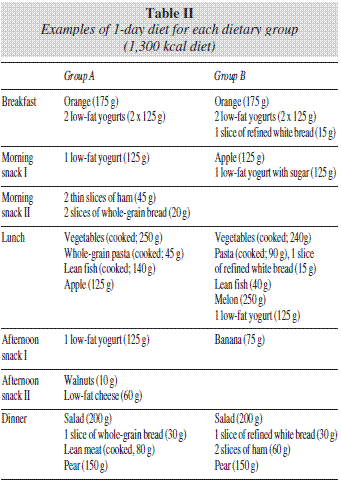
<body><![CDATA[<p><font face="Verdana" size="2">Calculations were based on findings of previous studies. <sup>41,42</sup> A group size of 40 was estimated to be necessary in order to obtain a significant (P &lt; 0.05) difference in the reduction of the waist circumference of 4.3 &plusmn; 6.8 cm with a power of 80%. Given an estimated dropout rate of 25%, the sample size was fixed to 50 subjects in each group (intervention and control group).</font></p>     <p><font face="Verdana" size="2"><i>Study design</i></font></p>     <p><font face="Verdana" size="2">The study was designed as a 6-month weight-loss caloric restriction trial divided in 2 consecutive phases. The first phase consisted of an 8-week controlled parallel intervention period, which was followed by a 16-week self-control second phase. At the beginning of the study, subjects were randomized either to a moderately high protein weight-loss diet (group A, n = 50) or to a weight-loss diet based on the American Heart Association recommendations (Group B, n = 50). Diets in both groups (<a href="#t2">table II</a>) were designed on a daily caloric restriction of 30% of the subjects total energy baseline needs. Group A diets were characterized by a macronutrient distribution of 40/30/30 (carbohydrate/lipid/protein), a high adherence to the Mediterranean dietary pattern, an intake of low glycemic index carbohydrates, a higher supply of energy from protein at the end of the day, a high total antioxidant capacity, and a meal frequency of 7 meals/day. A weekly intake of at least 3 portions of wholegrain pasta, 3-4 portions of legumes, 3 portions of fatty fish and 6 fruits/vegetables portions was mandatory. Group B diets were characterized by a macronutrient content of 55/30/15 (carbohydrate/lipid/protein) distributed in 3-5 meals/day.</font></p>     <p align="center"><font face="Verdana" size="2"><a name="t2"><img src="/img/revistas/nh/v26n1/articulos_especiales_2_t2.gif" align="top"></a></font></p>     <p>&nbsp;</p>     <p><font face="Verdana" size="2">During the first phase of the study, subjects received dietary counseling by qualified nutritionists every 15 days, while during the second phase of the study subjects were asked to follow the diets without any dietary advice. In addition, subjects were asked to fill in a validated personality test (NEO-PIR) at the beginning of the study. Validated psychological tests (Beck depression Inventory;<sup>43</sup> State-Trait Anxiety Inventory (STAI);<sup>44</sup> and Anxiety thermometer)<sup>45</sup> to evaluate their levels of anxiety during the weight-loss diet intervention were filled at the beginning of the study, every 15 days during the first phase, and at the end of the study.  <a target="_blank" href="/img/revistas/nh/v26n1/articulos_especiales_2_f1.gif">Figure 1</a> shows the experimental design of the study.</font></p>     <p><font face="Verdana" size="2"><i>Screening visit</i></font></p>     <p><font face="Verdana" size="2">Recruited participants will attend a screening visit in which they will receive a written document with information about the study together with the informed consent to be signed (<a target="_blank" href="/img/revistas/nh/v26n1/articulos_especiales_2_apendice.html">Appendix</a>). Both documents were approved by the Research Ethics Committee of the University of Navarra. During this visit, any doubt concerning the participation of the subject in the study will be solved by qualified staff. After a medical examination by a physician, anthropometric parameters and blood pressure will be measured and a fasting blood sample will be drawn by a nurse for the biochemical determination of metabolic syndrome clinical features. The subject will be asked to fill in a validated questionnaire concerning food frequency and dietary habits (SUN questionnaire) and a 72-hour food record, data that together with the calculation of the basal metabolic rate of the subject will be used by the dietitian to design their personalized diets.<sup>46</sup> A validated test of personality (NEO-PI-R) will be also filled in by the participant. Those subjects who meet the inclusion criteria will be given an appointment for the first visit of the intervention and for an informative group session.</font></p>     <p><font face="Verdana" size="2"><i>Study visits</i></font></p>     <p><font face="Verdana" size="2">Six visits were planned for each subject in the course of the study at days 0, 15, 30, 45, 60 and 180. Details of the determinations and measurements for each of them are given in  <a target="_blank" href="/img/revistas/nh/v26n1/articulos_especiales_2_t3.gif">table III</a>. The following metabolic determinations and markers will be also calculated at the beginning and end of the study: body mass index, waist-to-hip index, homeostasis model assessmentestimated insulin resistance (HOMA-IR) and atherogenic index.</font></p>     ]]></body>
<body><![CDATA[<p><font face="Verdana" size="2">In addition to the intervention visits, participants from group A were requested to attend an informative group session to reinforce psychological attitude at the beginning of the study. In this session, two qualified nutritionists are explaining the benefits of the dietary pattern to follow in the study, the options to create their own personalized menus with the established personalized diets, as well as emphasized the importance of eating habits and compliance during both the controlled and self-control phases of the study. At the end of the study, participants are receiving a report about the evaluation of their nutritional status in a last dietary counseling visit with the dietitian.</font></p>     <p><font face="Verdana" size="2"><i>Application of "omics" tools in the study</i></font></p>     <p><font face="Verdana" size="2">In addition to traditional determinations, the RESMENA-S study will also apply metabolomics and transcriptomics approaches.</font></p>     <p><font face="Verdana" size="2">Metabolites are the cellular endpoints of gene expression and of any physiological regulatory process. Measuring such compounds might therefore offer deeper insights into mechanisms of health and disease as well as might provide a greater understanding the role of lifestyle and dietary factors<sup>47</sup> in relation to specific diseases such as metabolic syndrome. Currently metabolomics is driven by the breathtaking advancements of analytical techniques providing constantly improved sensitivity and larger metabolite panels, but also by advances in chemometrics and bioinformatics. Among the metabolomics platforms, those based on mass spectrometry are increasingly used to characterize the complex metabolic effects of nutrients and foods.<sup>48</sup> In this sense, in the RESMENA-S study we aim to monitor metabolic changes associated with the 6-month weight loss nutritional intervention by applying non-targeted metabolic profiling approaches to blood and urine samples of the participants at the beginning and end of each phase of the study.<sup>49,50</sup> The application of metabolomics might help to elucidate the effect of the personalized caloric restriction diets on low-grade inflammation, oxidative stress and whole body metabolism with a special interest in the lipid and glucose metabolism. In addition, the metabolomic analyses will be used to investigate the effects that the different diets in the RESMENA-S intervention can have on stress and anxiety trait-related metabolism. In fact, the identification of different metabolic phenotypes and its combination with other phenotypic data to give dietary advice could be envisaged as a potential role of metabolomics in personalized nutrition,<sup>51,52</sup> with a special interest in obesity related diseases such as the metabolic syndrome.</font></p>     <p><font face="Verdana" size="2">Nutrigenomic profiling and epigenetics studies are envisaged in both dietary groups in order to establish predictive patterns concerning the response to the nutritional intervention as well as prognostic markers of the outcomes.<sup>53</sup> These tasks will be performed using molecular and genetic tools such as microarrays, RTPCR and sequencing in selected genes related to inflammation, energy homeostasis, and lipid metabolism in order to elucidate the role of gene expression in metabolic syndrome related phenotypes.</font></p>     <p><font face="Verdana" size="2"><i>Facilities</i></font></p>     <p><font face="Verdana" size="2">The Department of Nutrition, Food Sciences, Physiology and Toxicology at the University of Navarra is provided with the facilities and equipment needed for the evaluation and monitoring of the nutritional status of the study participants. This is mainly based in medical data collection, anthropometry and body composition equipments (tapes, scales, tensiometers, skin fold calipers, devices for bioelectrical impedance analysis and DEXA) and dietary measurements (calorimeter, validated food questionnaires, nutrition softwares such as Medisystem, DIAL, Nutriciun). The availability of a recently renovated Metabolic Unit for individual attention to the patient, monitoring and dietary counseling along the intervention study has been of great help (<a target="_blank" href="/img/revistas/nh/v26n1/articulos_especiales_2_f2.gif">fig. 2</a>). The unit is divided in different areas: an office for medical visiting hours equipped with DEXA and bioimpedance devices; a changing room and a toilet; an area for blood collection; an area for calorimeter measurements; an room for dietary counseling, equipped with a dining room table, microwave, a cooktop, a fridge, and a sink; and an area for participant recruitment formalities, control of medical histories and writing of patient reports.</font></p>     <p>&nbsp;</p>     <p><font face="Verdana" size="2"><b>Novelty of the study and conclusions</b></font></p>     <p><font face="Verdana" size="2">The present initiative is based on our traditional diet but from a more personalized point of view. RESMENA-S Study aims to integrate the main results obtained from the latest observational epidemiological studies and interventional studies in the dietary pattern designed for obese subjects with metabolic syndrome features.<sup>23,54-58</sup> The study will apply the concept of selecting and distributing the foods thorough the day according the physiological needs of each individual, and will not only consider the quantitative and qualitative composition of the diets, but other important factors related to dietary habits. The importance of regular dietary support and psychological control will be also evaluated for a successful loss of weight and improvement of clinical features of metabolic syndrome.</font></p>     ]]></body>
<body><![CDATA[<p><font face="Verdana" size="2">Furthermore, the combination of varied tools generating detailed clinical chemistry, anthropometry, and metabolite and gene data will allow to perform a functional analysis for biological interpretation of the impact of personalized diets based on the Mediterranean dietary pattern and energy restriction in the treatment of metabolic syndrome features.</font></p>     <p>&nbsp;</p>     <p><font face="Verdana" size="2"><b>Acknowledgements</b></font></p>     <p><font face="Verdana" size="2">The authors wish to thank those members of the Nutritional Intervention Metabolic Unit, Verónica Ciáurriz (technical assistant), María Hernández (Dietitian), Blanca Martínez de Morentín (physician) and Salomé Pérez (nurse) the collaboration in this project as well as to Department of Psychiatry and Medical Psychology/University of Navarra, Dra. Francisca Lahortiga and Clara Isabel Lacunza, for advice in psychological questionnaires.</font></p>     <p>&nbsp;</p>     <p><font face="Verdana" size="2"><b>References</b></font></p>     <!-- ref --><p><font face="Verdana" size="2">1. World Health Organization /Food and Agriculture Organization. Diet, nutrition and the prevention of chronic diseases. Report of a Joint WHO/FAO expert consultation. WHO Technical Report Series. Geneva, Switzerland: WHO, 2003.    &nbsp;&nbsp;&nbsp;&nbsp;&nbsp;&nbsp;&nbsp;&nbsp;[&#160;<a href="javascript:void(0);" onclick="javascript: window.open('/scielo.php?script=sci_nlinks&ref=3585327&pid=S0212-1611201100010000200001&lng=','','width=640,height=500,resizable=yes,scrollbars=1,menubar=yes,');">Links</a>&#160;]<!-- end-ref --></font></p>    <!-- ref --><p><font face="Verdana" size="2">2. Martínez Sesmero JM, Bastida S, Sánchez-Muniz FJ. Cardiovascular risk and metabolic síndrome at the Toledo Area Study. <i>Nutr Hosp</i> 2009; 24: 167-175.    &nbsp;&nbsp;&nbsp;&nbsp;&nbsp;&nbsp;&nbsp;&nbsp;[&#160;<a href="javascript:void(0);" onclick="javascript: window.open('/scielo.php?script=sci_nlinks&ref=3585329&pid=S0212-1611201100010000200002&lng=','','width=640,height=500,resizable=yes,scrollbars=1,menubar=yes,');">Links</a>&#160;]<!-- end-ref --></font></p>    ]]></body>
<body><![CDATA[<!-- ref --><p><font face="Verdana" size="2">3. Després JP, Lemieux I, Bergeron J, Pibarot P, Mathieu P, Larose E, Rodés-Cabau J, Bertrand OF, Poirier P. Abdominal obesity and the metabolic syndrome: contribution to global cardiometabolic risk. <i>Arterioscler Thromb Vasc Biol</i>. 2008; 28: 1039-1049.    &nbsp;&nbsp;&nbsp;&nbsp;&nbsp;&nbsp;&nbsp;&nbsp;[&#160;<a href="javascript:void(0);" onclick="javascript: window.open('/scielo.php?script=sci_nlinks&ref=3585331&pid=S0212-1611201100010000200003&lng=','','width=640,height=500,resizable=yes,scrollbars=1,menubar=yes,');">Links</a>&#160;]<!-- end-ref --></font></p>    <!-- ref --><p><font face="Verdana" size="2">4. Ho JS, Cannaday JJ, Barlow CE, Mitchell TL, Cooper KH, FitzGerald SJ. Relation of the number of metabolic syndrome risk factors with all-cause and cardiovascular mortality. <i>Am J Cardiol</i> 2008; 102: 689-692.    &nbsp;&nbsp;&nbsp;&nbsp;&nbsp;&nbsp;&nbsp;&nbsp;[&#160;<a href="javascript:void(0);" onclick="javascript: window.open('/scielo.php?script=sci_nlinks&ref=3585333&pid=S0212-1611201100010000200004&lng=','','width=640,height=500,resizable=yes,scrollbars=1,menubar=yes,');">Links</a>&#160;]<!-- end-ref --></font></p>    <!-- ref --><p><font face="Verdana" size="2">5. Zulet MA, Puchau B, Navarro C, Martí A, Martínez JA. Inflammatory biomarkers: the link between obesity and associated pathologies. <i>Nutr Hosp</i> 2007; 22: 511-527.    &nbsp;&nbsp;&nbsp;&nbsp;&nbsp;&nbsp;&nbsp;&nbsp;[&#160;<a href="javascript:void(0);" onclick="javascript: window.open('/scielo.php?script=sci_nlinks&ref=3585335&pid=S0212-1611201100010000200005&lng=','','width=640,height=500,resizable=yes,scrollbars=1,menubar=yes,');">Links</a>&#160;]<!-- end-ref --></font></p>    <!-- ref --><p><font face="Verdana" size="2">6. Carrasco Naranjo F. Metabolic syndrome: More definitions for a new disease? <i>Nutr Hosp</i> 2006; 21: 222-223.    &nbsp;&nbsp;&nbsp;&nbsp;&nbsp;&nbsp;&nbsp;&nbsp;[&#160;<a href="javascript:void(0);" onclick="javascript: window.open('/scielo.php?script=sci_nlinks&ref=3585337&pid=S0212-1611201100010000200006&lng=','','width=640,height=500,resizable=yes,scrollbars=1,menubar=yes,');">Links</a>&#160;]<!-- end-ref --></font></p>    <!-- ref --><p><font face="Verdana" size="2">7. Martínez MA, Puig JG, Mora M, Aragón R, O´Dogherty P, Antón JL, Sánchez-Villares T, Rubio JM, Rosado J, Torres R, Marcos J, Pallardo LF, Banegas JR; MAPA (Monitorización Ambulatoria de la Presión Arterial) Working Group. Metabolic syndrome: prevalence, associated factors, and C-reactive protein: the MADRIC (MADrid RIesgo Cardiovascular) Study. <i>Metabolism</i> 2008; 57: 1232-1240.    &nbsp;&nbsp;&nbsp;&nbsp;&nbsp;&nbsp;&nbsp;&nbsp;[&#160;<a href="javascript:void(0);" onclick="javascript: window.open('/scielo.php?script=sci_nlinks&ref=3585339&pid=S0212-1611201100010000200007&lng=','','width=640,height=500,resizable=yes,scrollbars=1,menubar=yes,');">Links</a>&#160;]<!-- end-ref --></font></p>    ]]></body>
<body><![CDATA[<!-- ref --><p><font face="Verdana" size="2">8. Hermsdorff HH, Zulet MA, Puchau B, Martínez JA.Fruit and vegetable consumption and proinflammatory gene expression from peripheral blood mononuclear cells in young adults: a translational study. <i>Nutr Metab</i> (Lond) 2010; 7: 42.    &nbsp;&nbsp;&nbsp;&nbsp;&nbsp;&nbsp;&nbsp;&nbsp;[&#160;<a href="javascript:void(0);" onclick="javascript: window.open('/scielo.php?script=sci_nlinks&ref=3585341&pid=S0212-1611201100010000200008&lng=','','width=640,height=500,resizable=yes,scrollbars=1,menubar=yes,');">Links</a>&#160;]<!-- end-ref --></font></p>    <!-- ref --><p><font face="Verdana" size="2">9. Puchau B, Zulet MA, González de Echávarri A, Navarro-Blasco I, Martínez JA. Selenium intake reduces serum C3, an early marker of metabolic syndrome manifestations, in healthy young adults. <i>Eur J Clin Nutr</i> 2009; 63 (7): 858-864.    &nbsp;&nbsp;&nbsp;&nbsp;&nbsp;&nbsp;&nbsp;&nbsp;[&#160;<a href="javascript:void(0);" onclick="javascript: window.open('/scielo.php?script=sci_nlinks&ref=3585343&pid=S0212-1611201100010000200009&lng=','','width=640,height=500,resizable=yes,scrollbars=1,menubar=yes,');">Links</a>&#160;]<!-- end-ref --></font></p>    <!-- ref --><p><font face="Verdana" size="2">10. Junqueira AS, Romêo Filho LJ, Junqueira Cde L Evaluation of the degree of vascular inflammation in patients with metabolic syndrome. <i>Arq Bras Cardiol</i> 2009; 93 (4): 360-366.    &nbsp;&nbsp;&nbsp;&nbsp;&nbsp;&nbsp;&nbsp;&nbsp;[&#160;<a href="javascript:void(0);" onclick="javascript: window.open('/scielo.php?script=sci_nlinks&ref=3585345&pid=S0212-1611201100010000200010&lng=','','width=640,height=500,resizable=yes,scrollbars=1,menubar=yes,');">Links</a>&#160;]<!-- end-ref --></font></p>    <!-- ref --><p><font face="Verdana" size="2">11. Kallio P, Kolehmainen M, Laaksonen DE, Pulkkinen L, Atalay M, Mykkänen H, Uusitupa M, Poutanen K, NiskanenL. Inflammation markers are modulated by responses to diets differing in postprandial insulin responses in individuals with the metabolic syndrome. <i>Am J Clin Nutr</i> 2008; 87: 1497-503.    &nbsp;&nbsp;&nbsp;&nbsp;&nbsp;&nbsp;&nbsp;&nbsp;[&#160;<a href="javascript:void(0);" onclick="javascript: window.open('/scielo.php?script=sci_nlinks&ref=3585347&pid=S0212-1611201100010000200011&lng=','','width=640,height=500,resizable=yes,scrollbars=1,menubar=yes,');">Links</a>&#160;]<!-- end-ref --></font></p>    <!-- ref --><p><font face="Verdana" size="2">12. Puchau B, Zulet MA, de Echávarri AG, Hermsdorff HH, Martínez JA. Dietary total antioxidant capacity is negatively associated with some metabolic syndrome features in healthy young adults. <i>Nutrition</i> 2010; 26: 534-41.    &nbsp;&nbsp;&nbsp;&nbsp;&nbsp;&nbsp;&nbsp;&nbsp;[&#160;<a href="javascript:void(0);" onclick="javascript: window.open('/scielo.php?script=sci_nlinks&ref=3585349&pid=S0212-1611201100010000200012&lng=','','width=640,height=500,resizable=yes,scrollbars=1,menubar=yes,');">Links</a>&#160;]<!-- end-ref --></font></p>    ]]></body>
<body><![CDATA[<!-- ref --><p><font face="Verdana" size="2">13. Hermsdorff HH, Zulet MA, Abete I, Martínez JA. A legumebased hypocaloric diet reduces proinflammatory status and improves metabolic features in overweight/obese subjects. <i>Eur J Nutr</i> 2010.    &nbsp;&nbsp;&nbsp;&nbsp;&nbsp;&nbsp;&nbsp;&nbsp;[&#160;<a href="javascript:void(0);" onclick="javascript: window.open('/scielo.php?script=sci_nlinks&ref=3585351&pid=S0212-1611201100010000200013&lng=','','width=640,height=500,resizable=yes,scrollbars=1,menubar=yes,');">Links</a>&#160;]<!-- end-ref --></font></p>    <!-- ref --><p><font face="Verdana" size="2">14. Martínez-González MA, Bes-Rastrollo M, Serra-Majem L, Lairon D, Estruch R, Trichopoulou A.  <a target="_blank" href="http://www.ncbi.nlm.nih.gov/pubmed/19453663">http://www.ncbi.nlm.nih.gov/pubmed/19453663</a> <i>Nutr Rev</i> 2009;67 Suppl 1:S111-S116</font>&nbsp;&nbsp;&nbsp;&nbsp;&nbsp;&nbsp;&nbsp;&nbsp;[&#160;<a href="javascript:void(0);" onclick="javascript: window.open('/scielo.php?script=sci_nlinks&ref=3585353&pid=S0212-1611201100010000200014&lng=','','width=640,height=500,resizable=yes,scrollbars=1,menubar=yes,');">Links</a>&#160;]<!-- end-ref --><!-- ref --><p><font face="Verdana" size="2">15. Jiménez-Cruz A, Jiménez AB, Pichardo-Osuna A, Chaudry T, Bacardi-Gascon M. Long term effect of Mediterranean diet on weight loss. <i>Nutr Hosp</i> 2009; 24: 751-762.    &nbsp;&nbsp;&nbsp;&nbsp;&nbsp;&nbsp;&nbsp;&nbsp;[&#160;<a href="javascript:void(0);" onclick="javascript: window.open('/scielo.php?script=sci_nlinks&ref=3585354&pid=S0212-1611201100010000200015&lng=','','width=640,height=500,resizable=yes,scrollbars=1,menubar=yes,');">Links</a>&#160;]<!-- end-ref --></font></p>    <!-- ref --><p><font face="Verdana" size="2">16. Trichopoulou A, Bamia C, Trichopoulos D. Anatomy of health effects of Mediterranean diet: Greek EPIC prospective cohort study. <i>BMJ</i> 2009; 23: 338.    &nbsp;&nbsp;&nbsp;&nbsp;&nbsp;&nbsp;&nbsp;&nbsp;[&#160;<a href="javascript:void(0);" onclick="javascript: window.open('/scielo.php?script=sci_nlinks&ref=3585356&pid=S0212-1611201100010000200016&lng=','','width=640,height=500,resizable=yes,scrollbars=1,menubar=yes,');">Links</a>&#160;]<!-- end-ref --></font></p>    <!-- ref --><p><font face="Verdana" size="2">17. Estruch R Anti-inflammatory effects of the Mediterranean diet: the experience of the PREDIMED study. <i>Proc Nutr Soc</i> 2010; 69: 333-340.    &nbsp;&nbsp;&nbsp;&nbsp;&nbsp;&nbsp;&nbsp;&nbsp;[&#160;<a href="javascript:void(0);" onclick="javascript: window.open('/scielo.php?script=sci_nlinks&ref=3585358&pid=S0212-1611201100010000200017&lng=','','width=640,height=500,resizable=yes,scrollbars=1,menubar=yes,');">Links</a>&#160;]<!-- end-ref --></font></p>    <!-- ref --><p><font face="Verdana" size="2">18. Bakker GC, Van Erk MJ, Pellis L, Wopereis S, Rubingh CM, Cnubben NH, Kooistra T, van Ommen B, Hendriks HF. An antiinflammatory dietary mix modulates inflammation and oxidative and metabolic stress in overweight men: a nutrigenomics approach. <i>Am J Clin Nutr</i> 2010; 91: 1044-59.    &nbsp;&nbsp;&nbsp;&nbsp;&nbsp;&nbsp;&nbsp;&nbsp;[&#160;<a href="javascript:void(0);" onclick="javascript: window.open('/scielo.php?script=sci_nlinks&ref=3585360&pid=S0212-1611201100010000200018&lng=','','width=640,height=500,resizable=yes,scrollbars=1,menubar=yes,');">Links</a>&#160;]<!-- end-ref --></font></p>    <!-- ref --><p><font face="Verdana" size="2">19. Abete I, Astrup A, Martínez JA, Thorsdottir I, Zulet MA. Obesity and the metabolic syndrome: role of different dietary macronutrient distribution patterns and specific nutritional components on weight loss and maintenance. <i>Nutr Rev</i> 2010; 68: 214-231.    &nbsp;&nbsp;&nbsp;&nbsp;&nbsp;&nbsp;&nbsp;&nbsp;[&#160;<a href="javascript:void(0);" onclick="javascript: window.open('/scielo.php?script=sci_nlinks&ref=3585362&pid=S0212-1611201100010000200019&lng=','','width=640,height=500,resizable=yes,scrollbars=1,menubar=yes,');">Links</a>&#160;]<!-- end-ref --></font></p>    <!-- ref --><p><font face="Verdana" size="2">20. Sloth B, Due A, Larsen TM, Holst JJ, Heding A, Astrup A. The effect of a high-MUFA, low-glycaemic index diet and a low-fat diet on appetite and glucose metabolism during a 6-month weight maintenance period. <i>Br J Nutr</i> 2009; 101: 1846-58.    &nbsp;&nbsp;&nbsp;&nbsp;&nbsp;&nbsp;&nbsp;&nbsp;[&#160;<a href="javascript:void(0);" onclick="javascript: window.open('/scielo.php?script=sci_nlinks&ref=3585364&pid=S0212-1611201100010000200020&lng=','','width=640,height=500,resizable=yes,scrollbars=1,menubar=yes,');">Links</a>&#160;]<!-- end-ref --></font></p>    <!-- ref --><p><font face="Verdana" size="2">21. Larsen TM, Dalskov S, van Baak M, Jebb S, Kafatos A, Pfeiffer A, Martínez JA, Handjieva-Darlenska T, Kunesová M, Holst C, Saris WH, Astrup A. The Diet, Obesity and Genes (Diogenes) Dietary Study in eight European countries - a comprehensive design for long-term intervention. <i>Obes Rev</i> 2010; 11: 76-91.    &nbsp;&nbsp;&nbsp;&nbsp;&nbsp;&nbsp;&nbsp;&nbsp;[&#160;<a href="javascript:void(0);" onclick="javascript: window.open('/scielo.php?script=sci_nlinks&ref=3585366&pid=S0212-1611201100010000200021&lng=','','width=640,height=500,resizable=yes,scrollbars=1,menubar=yes,');">Links</a>&#160;]<!-- end-ref --></font></p>    <!-- ref --><p><font face="Verdana" size="2">22. Moore CS, Lindroos AK, Kreutzer M, Larsen TM, Astrup A, van Baak MA, Handjieva-Darlenska T, Hlavaty P, Kafatos A, Kohl A, Martinez JA, Monsheimer S, Jebb SA. Dietary strategy to manipulate ad libitum macronutrient intake, and glycaemic index, across eight European countries in the Diogenes Study. <i>Obes Rev</i> 2010; 11: 67-75.    &nbsp;&nbsp;&nbsp;&nbsp;&nbsp;&nbsp;&nbsp;&nbsp;[&#160;<a href="javascript:void(0);" onclick="javascript: window.open('/scielo.php?script=sci_nlinks&ref=3585368&pid=S0212-1611201100010000200022&lng=','','width=640,height=500,resizable=yes,scrollbars=1,menubar=yes,');">Links</a>&#160;]<!-- end-ref --></font></p>    <!-- ref --><p><font face="Verdana" size="2">23. Kallio P, Kolehmainen M, Laaksonen DE, Kekäläinen J, Salopuro T, Sivenius K, Pulkkinen L, Mykkänen HM, Niskanen L, Uusitupa M, Poutanen KS Dietary carbohydrate modification induces alterations in gene expression in abdominal subcutaneous adipose tissue in persons with the metabolic syndrome: the FUNGENUT Study. <i>Am J Clin Nutr</i> 2007; 85: 1417-27.    &nbsp;&nbsp;&nbsp;&nbsp;&nbsp;&nbsp;&nbsp;&nbsp;[&#160;<a href="javascript:void(0);" onclick="javascript: window.open('/scielo.php?script=sci_nlinks&ref=3585370&pid=S0212-1611201100010000200023&lng=','','width=640,height=500,resizable=yes,scrollbars=1,menubar=yes,');">Links</a>&#160;]<!-- end-ref --></font></p>    <!-- ref --><p><font face="Verdana" size="2">24. Tighe P, Duthie G, Vaughan N, Brittenden J, Simpson WG, Duthie S, Mutch W, Wahle K, Horgan G, Thies F. Effect of increased consumption of whole-grain foods on blood pressure and other cardiovascular risk markers in healthy middle-aged persons: a randomized controlled trial. <i>Am J Clin Nutr</i> 2010; 92: 733-740.    &nbsp;&nbsp;&nbsp;&nbsp;&nbsp;&nbsp;&nbsp;&nbsp;[&#160;<a href="javascript:void(0);" onclick="javascript: window.open('/scielo.php?script=sci_nlinks&ref=3585372&pid=S0212-1611201100010000200024&lng=','','width=640,height=500,resizable=yes,scrollbars=1,menubar=yes,');">Links</a>&#160;]<!-- end-ref --></font></p>    <!-- ref --><p><font face="Verdana" size="2">25. Dalle Grave R, Calugi S, Petroni ML, Di Domizio S, Marchesini G; QUOVADIS Study Group Weight management, psychological distress and binge eating in obesity. A reappraisal of the problem.. <i>Appetite</i> 2010; 54: 269-273.    &nbsp;&nbsp;&nbsp;&nbsp;&nbsp;&nbsp;&nbsp;&nbsp;[&#160;<a href="javascript:void(0);" onclick="javascript: window.open('/scielo.php?script=sci_nlinks&ref=3585374&pid=S0212-1611201100010000200025&lng=','','width=640,height=500,resizable=yes,scrollbars=1,menubar=yes,');">Links</a>&#160;]<!-- end-ref --></font></p>    <!-- ref --><p><font face="Verdana" size="2">26. Elfhag K, Morey LC. Personality traits and eating behavior in the obese: poor self-control in emotional and external eating but personality assets in restrained eating. <i>Eat Behav</i> 2008; 9: 285-293</font>&nbsp;&nbsp;&nbsp;&nbsp;&nbsp;&nbsp;&nbsp;&nbsp;[&#160;<a href="javascript:void(0);" onclick="javascript: window.open('/scielo.php?script=sci_nlinks&ref=3585376&pid=S0212-1611201100010000200026&lng=','','width=640,height=500,resizable=yes,scrollbars=1,menubar=yes,');">Links</a>&#160;]<!-- end-ref --><!-- ref --><p><font face="Verdana" size="2">27. Ello-Martin JA, Ledikwe JH, Rolls BJ.The influence of food portion size and energy density on energy intake: implicatins for weight management. <i>Am J Clin Nutr</i> 2005; 82 (1 Suppl.): 236S-241S.    &nbsp;&nbsp;&nbsp;&nbsp;&nbsp;&nbsp;&nbsp;&nbsp;[&#160;<a href="javascript:void(0);" onclick="javascript: window.open('/scielo.php?script=sci_nlinks&ref=3585377&pid=S0212-1611201100010000200027&lng=','','width=640,height=500,resizable=yes,scrollbars=1,menubar=yes,');">Links</a>&#160;]<!-- end-ref --></font></p>    <!-- ref --><p><font face="Verdana" size="2">28. Handjieva-Darlenska T, Handjiev S, Larsen TM, van Baak MA, Jebb S, Papadaki A, Pfeiffer AF, Martínez JA, Kunesova M, Holst C, Saris WH, Astrup A. Initial weight loss on an 800-kcal diet as a predictor of weight loss success after 8 weeks: the Diogenes study.<i> Eur J Clin Nutr</i> 2010; 64 (9): 994-999.    &nbsp;&nbsp;&nbsp;&nbsp;&nbsp;&nbsp;&nbsp;&nbsp;[&#160;<a href="javascript:void(0);" onclick="javascript: window.open('/scielo.php?script=sci_nlinks&ref=3585379&pid=S0212-1611201100010000200028&lng=','','width=640,height=500,resizable=yes,scrollbars=1,menubar=yes,');">Links</a>&#160;]<!-- end-ref --></font></p>    ]]></body>
<body><![CDATA[<!-- ref --><p><font face="Verdana" size="2">29. Rubio MA, Arrieta JL, Ruiz M, Garrido J, Rubio JA, Del Llano J, Casimiro C, Raigada F. Design and validation of a scale to assess preferences of type 2 diabetic patients towards different nutritional supplements. <i>Nutr Hosp</i> 2008; 23: 253-262.    &nbsp;&nbsp;&nbsp;&nbsp;&nbsp;&nbsp;&nbsp;&nbsp;[&#160;<a href="javascript:void(0);" onclick="javascript: window.open('/scielo.php?script=sci_nlinks&ref=3585381&pid=S0212-1611201100010000200029&lng=','','width=640,height=500,resizable=yes,scrollbars=1,menubar=yes,');">Links</a>&#160;]<!-- end-ref --></font></p>    <!-- ref --><p><font face="Verdana" size="2">30. Turk MW, Yang K, Hravnak M, Sereika SM, Ewing LJ, Burke LE. Randomized clinical trials of weight loss maintenance: a review. <i>J Cardiovasc Nurs</i> 2009; 24: 58-80.    &nbsp;&nbsp;&nbsp;&nbsp;&nbsp;&nbsp;&nbsp;&nbsp;[&#160;<a href="javascript:void(0);" onclick="javascript: window.open('/scielo.php?script=sci_nlinks&ref=3585383&pid=S0212-1611201100010000200030&lng=','','width=640,height=500,resizable=yes,scrollbars=1,menubar=yes,');">Links</a>&#160;]<!-- end-ref --></font></p>    <!-- ref --><p><font face="Verdana" size="2">31. Abete I, Parra D, Martinez JA. Energy-restricted diets based on a distinct food selection affecting the glycemic index induce different weight loss and oxidative response. <i>Clin Nutr</i> 2008; 27: 545-251.    &nbsp;&nbsp;&nbsp;&nbsp;&nbsp;&nbsp;&nbsp;&nbsp;[&#160;<a href="javascript:void(0);" onclick="javascript: window.open('/scielo.php?script=sci_nlinks&ref=3585385&pid=S0212-1611201100010000200031&lng=','','width=640,height=500,resizable=yes,scrollbars=1,menubar=yes,');">Links</a>&#160;]<!-- end-ref --></font></p>    <!-- ref --><p><font face="Verdana" size="2">32. Heilbronn LK, de Jonge L, Frisard MI, DeLany JP, Larson-Meyer DE, Rood J, Nguyen T, Martin CK, Volaufova J, Most MM, Greenway FL, Smith SR, Deutsch WA, Williamson DA, Ravussin; Pennington CALERIE Team. Effect of 6-month calorie restriction on biomarkers of longevity, metabolic adaptation, and oxidative stress in overweight individuals: a randomized controlled trial. <i>JAMA</i> 2006; 295: 1539-1548.    &nbsp;&nbsp;&nbsp;&nbsp;&nbsp;&nbsp;&nbsp;&nbsp;[&#160;<a href="javascript:void(0);" onclick="javascript: window.open('/scielo.php?script=sci_nlinks&ref=3585387&pid=S0212-1611201100010000200032&lng=','','width=640,height=500,resizable=yes,scrollbars=1,menubar=yes,');">Links</a>&#160;]<!-- end-ref --></font></p>    <!-- ref --><p><font face="Verdana" size="2">33. Redman LM, Heilbronn LK, Martin CK, de Jonge L, Williamson DA, Delany JP, Ravussin E; Pennington CALERIE Team. Metabolic and behavioral compensations in response to caloric restriction: implications for the maintenance of weight loss. <i>PLoS One</i> 2009; 4: 4377.    &nbsp;&nbsp;&nbsp;&nbsp;&nbsp;&nbsp;&nbsp;&nbsp;[&#160;<a href="javascript:void(0);" onclick="javascript: window.open('/scielo.php?script=sci_nlinks&ref=3585389&pid=S0212-1611201100010000200033&lng=','','width=640,height=500,resizable=yes,scrollbars=1,menubar=yes,');">Links</a>&#160;]<!-- end-ref --></font></p>    ]]></body>
<body><![CDATA[<!-- ref --><p><font face="Verdana" size="2">34. Anton SD, Han H, York E, Martin CK, Ravussin E, Williamson DA Effect of calorie restriction on subjective ratings of appetite. <i>J Hum Nutr Diet</i> 2009; 22: 141-147.    &nbsp;&nbsp;&nbsp;&nbsp;&nbsp;&nbsp;&nbsp;&nbsp;[&#160;<a href="javascript:void(0);" onclick="javascript: window.open('/scielo.php?script=sci_nlinks&ref=3585391&pid=S0212-1611201100010000200034&lng=','','width=640,height=500,resizable=yes,scrollbars=1,menubar=yes,');">Links</a>&#160;]<!-- end-ref --></font></p>    <!-- ref --><p><font face="Verdana" size="2">35. Redman LM, Rood J, Anton SD, Champagne C, Smith SR, Ravussin E; Pennington Comprehensive Assessment of Long-Term Effects of Reducing Intake of Energy (CALERIE) Research Team. Calorie restriction and bone health in young, overweight individuals. <i>Arch Intern Med</i> 2008; 168: 1859-1866.    &nbsp;&nbsp;&nbsp;&nbsp;&nbsp;&nbsp;&nbsp;&nbsp;[&#160;<a href="javascript:void(0);" onclick="javascript: window.open('/scielo.php?script=sci_nlinks&ref=3585393&pid=S0212-1611201100010000200035&lng=','','width=640,height=500,resizable=yes,scrollbars=1,menubar=yes,');">Links</a>&#160;]<!-- end-ref --></font></p>    <!-- ref --><p><font face="Verdana" size="2">36. Pardo A, Ruiz M, Jódar E, Garrido J, de Rosendo JM, Usán LA. Development of a questionnaire for the assessment and quantification of overweight and obesity related lifestyles. <i>Nutr Hosp</i> 2004; 19: 99-109.    &nbsp;&nbsp;&nbsp;&nbsp;&nbsp;&nbsp;&nbsp;&nbsp;[&#160;<a href="javascript:void(0);" onclick="javascript: window.open('/scielo.php?script=sci_nlinks&ref=3585395&pid=S0212-1611201100010000200036&lng=','','width=640,height=500,resizable=yes,scrollbars=1,menubar=yes,');">Links</a>&#160;]<!-- end-ref --></font></p>    <!-- ref --><p><font face="Verdana" size="2">37. Martín de Santa Olaalla L, Sánchez Muniz FJ, Vaquero MP. N-3 fatty acids in glucose metabolism and insulin sensitivity.<i> Nutr Hosp</i> 2009; 24: 113-127.    &nbsp;&nbsp;&nbsp;&nbsp;&nbsp;&nbsp;&nbsp;&nbsp;[&#160;<a href="javascript:void(0);" onclick="javascript: window.open('/scielo.php?script=sci_nlinks&ref=3585397&pid=S0212-1611201100010000200037&lng=','','width=640,height=500,resizable=yes,scrollbars=1,menubar=yes,');">Links</a>&#160;]<!-- end-ref --></font></p>    <!-- ref --><p><font face="Verdana" size="2">38. Garaulet M, Pérez de Heredia F. Behavioral therapy in the treatment of obesity (II): role of the Mediterranean diet. <i>Nutr Hosp</i> 2010; 25: 9-17.    &nbsp;&nbsp;&nbsp;&nbsp;&nbsp;&nbsp;&nbsp;&nbsp;[&#160;<a href="javascript:void(0);" onclick="javascript: window.open('/scielo.php?script=sci_nlinks&ref=3585399&pid=S0212-1611201100010000200038&lng=','','width=640,height=500,resizable=yes,scrollbars=1,menubar=yes,');">Links</a>&#160;]<!-- end-ref --></font></p>    ]]></body>
<body><![CDATA[<!-- ref --><p><font face="Verdana" size="2">39. Dell´ Oso B, Altamura AC, Mundo E, Marazziti D, Hollander E. Diagnosis and treatment of obsessive-compulsive disorder and related disorders. <i>Health Phsychol</i> 2000; 19: 5-16.    &nbsp;&nbsp;&nbsp;&nbsp;&nbsp;&nbsp;&nbsp;&nbsp;[&#160;<a href="javascript:void(0);" onclick="javascript: window.open('/scielo.php?script=sci_nlinks&ref=3585401&pid=S0212-1611201100010000200039&lng=','','width=640,height=500,resizable=yes,scrollbars=1,menubar=yes,');">Links</a>&#160;]<!-- end-ref --></font></p>    <!-- ref --><p><font face="Verdana" size="2">40. International Diabetes Federation: The IDF consensus worldwide definition of the metabolic syndrome  (article online), 2005. Available from <a target="_blank" href="http://www.idf.org/webdata/docs/metac_syndrome_def.pdf">http://www.idf.org/webdata/docs/metac_syndrome_def.pdf</a>.    &nbsp;&nbsp;&nbsp;&nbsp;&nbsp;&nbsp;&nbsp;&nbsp;[&#160;<a href="javascript:void(0);" onclick="javascript: window.open('/scielo.php?script=sci_nlinks&ref=3585403&pid=S0212-1611201100010000200040&lng=','','width=640,height=500,resizable=yes,scrollbars=1,menubar=yes,');">Links</a>&#160;]<!-- end-ref --></font></p>    <!-- ref --><p><font face="Verdana" size="2">41. König D, Deibert P, Frey I, Landmann U, Berg A. Effect of meal replacementon metabolic risk factors in overweight and obese subjects. <i>Ann Nutr Metab</i> 2008; 52: 747-748.    &nbsp;&nbsp;&nbsp;&nbsp;&nbsp;&nbsp;&nbsp;&nbsp;[&#160;<a href="javascript:void(0);" onclick="javascript: window.open('/scielo.php?script=sci_nlinks&ref=3585405&pid=S0212-1611201100010000200041&lng=','','width=640,height=500,resizable=yes,scrollbars=1,menubar=yes,');">Links</a>&#160;]<!-- end-ref --></font></p>    <!-- ref --><p><font face="Verdana" size="2">42. Katcher HI, Legro RS, Kunselman AR, Gillies PJ, Demers LM, Bagshaw DM, Kris-Etherton PM. The effects of a whole grainenriched hypocaloric diet on cardiovascular disease risk factors in men and women with metabolic syndrome. <i>Am J Clin Nutr</i> 2008; 87 (1): 79-90.    &nbsp;&nbsp;&nbsp;&nbsp;&nbsp;&nbsp;&nbsp;&nbsp;[&#160;<a href="javascript:void(0);" onclick="javascript: window.open('/scielo.php?script=sci_nlinks&ref=3585407&pid=S0212-1611201100010000200042&lng=','','width=640,height=500,resizable=yes,scrollbars=1,menubar=yes,');">Links</a>&#160;]<!-- end-ref --></font></p>    <!-- ref --><p><font face="Verdana" size="2">43. Richter P, Werner J, Heerlein A, Kraus A, Sauer H. On the validity of the Beck Depression Inventory. A review. <i>Psychopathology</i> 1998; 31: 160-168.    &nbsp;&nbsp;&nbsp;&nbsp;&nbsp;&nbsp;&nbsp;&nbsp;[&#160;<a href="javascript:void(0);" onclick="javascript: window.open('/scielo.php?script=sci_nlinks&ref=3585409&pid=S0212-1611201100010000200043&lng=','','width=640,height=500,resizable=yes,scrollbars=1,menubar=yes,');">Links</a>&#160;]<!-- end-ref --></font></p>    ]]></body>
<body><![CDATA[<!-- ref --><p><font face="Verdana" size="2">44. Grös DF, Antony MM, Simms LJ, McCabe RE. Psychometric properties of the State-Trait Inventory for Cognitive and Somatic Anxiety (STICSA): comparison to the State-Trait Anxiety Inventory (STAI). <i>Psychol Assess</i> 2007; 19: 369-381.    &nbsp;&nbsp;&nbsp;&nbsp;&nbsp;&nbsp;&nbsp;&nbsp;[&#160;<a href="javascript:void(0);" onclick="javascript: window.open('/scielo.php?script=sci_nlinks&ref=3585411&pid=S0212-1611201100010000200044&lng=','','width=640,height=500,resizable=yes,scrollbars=1,menubar=yes,');">Links</a>&#160;]<!-- end-ref --></font></p>    <!-- ref --><p><font face="Verdana" size="2">45. Houtman IL, Bakker FC. The anxiety thermometer: a validation study.<i> J Pers Assess</i> 1989; 53 (3): 575-82.    &nbsp;&nbsp;&nbsp;&nbsp;&nbsp;&nbsp;&nbsp;&nbsp;[&#160;<a href="javascript:void(0);" onclick="javascript: window.open('/scielo.php?script=sci_nlinks&ref=3585413&pid=S0212-1611201100010000200045&lng=','','width=640,height=500,resizable=yes,scrollbars=1,menubar=yes,');">Links</a>&#160;]<!-- end-ref --></font></p>    <!-- ref --><p><font face="Verdana" size="2">46. Toledo E, de A Carmona-Torre F, Alonso A, Puchau B, Zulet MA, Martínez JA, Martínez-González MA. Hypothesis-oriented food patterns and incidence of hypertension: 6-year follow-up of the SUN (Seguimiento Universidad de Navarra) prospective cohort. <i>Public Health Nutr</i> 2010; 13: 338-349.    &nbsp;&nbsp;&nbsp;&nbsp;&nbsp;&nbsp;&nbsp;&nbsp;[&#160;<a href="javascript:void(0);" onclick="javascript: window.open('/scielo.php?script=sci_nlinks&ref=3585415&pid=S0212-1611201100010000200046&lng=','','width=640,height=500,resizable=yes,scrollbars=1,menubar=yes,');">Links</a>&#160;]<!-- end-ref --></font></p>    <!-- ref --><p><font face="Verdana" size="2">47. Kussmann M, Rezzi S, Daniel H. Profiling techniques in nutrition and health research. <i>Curr Opin Biotechnol</i> 2008; 19: 83-99.    &nbsp;&nbsp;&nbsp;&nbsp;&nbsp;&nbsp;&nbsp;&nbsp;[&#160;<a href="javascript:void(0);" onclick="javascript: window.open('/scielo.php?script=sci_nlinks&ref=3585417&pid=S0212-1611201100010000200047&lng=','','width=640,height=500,resizable=yes,scrollbars=1,menubar=yes,');">Links</a>&#160;]<!-- end-ref --></font></p>    <!-- ref --><p><font face="Verdana" size="2">48. Scalbert A, Brennan L, Fiehn O, Hankemeier T, Kristal BS, van Ommen B, Pujos-Guillot E, Verheij E, Wishart D, Wopereis S. Mass-spectrometry-based metabolomics: limitations and recommendations for future progress with particular focus on nutrition research. <i>Metabolomics</i> 2009; 5: 435-45.    &nbsp;&nbsp;&nbsp;&nbsp;&nbsp;&nbsp;&nbsp;&nbsp;[&#160;<a href="javascript:void(0);" onclick="javascript: window.open('/scielo.php?script=sci_nlinks&ref=3585419&pid=S0212-1611201100010000200048&lng=','','width=640,height=500,resizable=yes,scrollbars=1,menubar=yes,');">Links</a>&#160;]<!-- end-ref --></font></p>    ]]></body>
<body><![CDATA[<!-- ref --><p><font face="Verdana" size="2">49. Bondia-Pons I, Zulet MA, Abete, I, Martínez JA. The RESMENA-S study: A non-targeted metabolic profiling approach in the Reduction of the Metabolic Syndrome in Navarra-Spain through a strategy based on personalized Mediterranean diet and psychological control. Written communication presented at the VIII International Conference on the Mediterranean Diet, Barcelona (Spain) 24-25<sup>th</sup> March 2010.    &nbsp;&nbsp;&nbsp;&nbsp;&nbsp;&nbsp;&nbsp;&nbsp;[&#160;<a href="javascript:void(0);" onclick="javascript: window.open('/scielo.php?script=sci_nlinks&ref=3585421&pid=S0212-1611201100010000200049&lng=','','width=640,height=500,resizable=yes,scrollbars=1,menubar=yes,');">Links</a>&#160;]<!-- end-ref --></font></p>    <!-- ref --><p><font face="Verdana" size="2">50. Bondia-Pons I, Zulet MA, Abete I, López-Legarrea P, De la Iglesia R, Martínez JA. The RESMENA-S study: A non-targeted metabolic profiling approach in the Reduction of the Metabolic Syndrome in Navarra-Spain through a strategy based on personalized tailoring-diets with psychological control. Written communication presented at the Metabolomics 2010 Conference, 27<sup>th</sup> June-1<sup>st</sup> July 2010, Amsterdam (The Netherlands). Abstract book, page 176.    &nbsp;&nbsp;&nbsp;&nbsp;&nbsp;&nbsp;&nbsp;&nbsp;[&#160;<a href="javascript:void(0);" onclick="javascript: window.open('/scielo.php?script=sci_nlinks&ref=3585423&pid=S0212-1611201100010000200050&lng=','','width=640,height=500,resizable=yes,scrollbars=1,menubar=yes,');">Links</a>&#160;]<!-- end-ref --></font></p>    <!-- ref --><p><font face="Verdana" size="2">51. Brennan L. Session 2: Personalised nutrition. Metabolomic applications in nutritional research. <i>Proc Nutr Soc</i> 2008; 67: 404-408.    &nbsp;&nbsp;&nbsp;&nbsp;&nbsp;&nbsp;&nbsp;&nbsp;[&#160;<a href="javascript:void(0);" onclick="javascript: window.open('/scielo.php?script=sci_nlinks&ref=3585425&pid=S0212-1611201100010000200051&lng=','','width=640,height=500,resizable=yes,scrollbars=1,menubar=yes,');">Links</a>&#160;]<!-- end-ref --></font></p>    <!-- ref --><p><font face="Verdana" size="2">52. Lodge JK. Symposium 2: Modern approaches to nutritional research challenges: Targeted and non-targeted approaches for metabolite profiling in nutritional research. <i>Proc Nutr Soc</i> 2010; 69: 95-102.    &nbsp;&nbsp;&nbsp;&nbsp;&nbsp;&nbsp;&nbsp;&nbsp;[&#160;<a href="javascript:void(0);" onclick="javascript: window.open('/scielo.php?script=sci_nlinks&ref=3585427&pid=S0212-1611201100010000200052&lng=','','width=640,height=500,resizable=yes,scrollbars=1,menubar=yes,');">Links</a>&#160;]<!-- end-ref --></font></p>    <!-- ref --><p><font face="Verdana" size="2">53. Marti A, Goyenechea E, Martínez JA. Nutrigenetics: A Tool to Provide Personalized Nutritional Therapy to the Obese. Simopoulos AP, Milner JA (eds): Personalized Nutrition. World Rev Nutr Diet. Basel, Karger, 2010; 101: 21-33.    &nbsp;&nbsp;&nbsp;&nbsp;&nbsp;&nbsp;&nbsp;&nbsp;[&#160;<a href="javascript:void(0);" onclick="javascript: window.open('/scielo.php?script=sci_nlinks&ref=3585429&pid=S0212-1611201100010000200053&lng=','','width=640,height=500,resizable=yes,scrollbars=1,menubar=yes,');">Links</a>&#160;]<!-- end-ref --></font></p>    ]]></body>
<body><![CDATA[<!-- ref --><p><font face="Verdana" size="2">54. Crujeiras AB, Parra MD, Rodríguez MC, Martínez de Morentin BE, Martínez JA.A role for fruit content in energy-restricted diets in improving antioxidant status in obese women during weight loss. <i>Nutrition</i> 2006; 22: 593-599.    &nbsp;&nbsp;&nbsp;&nbsp;&nbsp;&nbsp;&nbsp;&nbsp;[&#160;<a href="javascript:void(0);" onclick="javascript: window.open('/scielo.php?script=sci_nlinks&ref=3585431&pid=S0212-1611201100010000200054&lng=','','width=640,height=500,resizable=yes,scrollbars=1,menubar=yes,');">Links</a>&#160;]<!-- end-ref --></font></p>    <!-- ref --><p><font face="Verdana" size="2">55. Crujeiras AB, Parra D, Abete I, Martínez JA. A hypocaloric diet enriched in legumes specifically mitigates lipid peroxidation in obese subjects. <i>Free Radic Res</i> 2007; 41: 498-506.    &nbsp;&nbsp;&nbsp;&nbsp;&nbsp;&nbsp;&nbsp;&nbsp;[&#160;<a href="javascript:void(0);" onclick="javascript: window.open('/scielo.php?script=sci_nlinks&ref=3585433&pid=S0212-1611201100010000200055&lng=','','width=640,height=500,resizable=yes,scrollbars=1,menubar=yes,');">Links</a>&#160;]<!-- end-ref --></font></p>    <!-- ref --><p><font face="Verdana" size="2">56. Babio N, Sorlí M, Bulló M, Basora J, Ibarrola-Jurado N, Fernández-Ballart J, Martínez-González MA, Serra-Majem L, González-Pérez R, Salas-Salvadó J; on behalf of the Nureta-PREDIMED investigators Association between red meat consumption and metabolic syndrome in a Mediterranean population at high cardiovascular risk: Cross-sectional and 1-year follow-up assessment. <i>Nutr Metab Cardiovasc Dis</i> 2010 doi:10.1016/ j.numecd.2010.06.011</font>&nbsp;&nbsp;&nbsp;&nbsp;&nbsp;&nbsp;&nbsp;&nbsp;[&#160;<a href="javascript:void(0);" onclick="javascript: window.open('/scielo.php?script=sci_nlinks&ref=3585435&pid=S0212-1611201100010000200056&lng=','','width=640,height=500,resizable=yes,scrollbars=1,menubar=yes,');">Links</a>&#160;]<!-- end-ref --><!-- ref --><p><font face="Verdana" size="2">57. Bladbjerg EM, Larsen TM, Due A, Jespersen J, Stender S, Astrup A. Long-term effects on haemostatic variables of three ad libitum diets differing in type and amount of fat and carbohydrate: a 6-month randomised study in obese individuals. <i>Br J Nutr</i> 2010; 30: 1-7.    &nbsp;&nbsp;&nbsp;&nbsp;&nbsp;&nbsp;&nbsp;&nbsp;[&#160;<a href="javascript:void(0);" onclick="javascript: window.open('/scielo.php?script=sci_nlinks&ref=3585436&pid=S0212-1611201100010000200057&lng=','','width=640,height=500,resizable=yes,scrollbars=1,menubar=yes,');">Links</a>&#160;]<!-- end-ref --></font></p>    <!-- ref --><p><font face="Verdana" size="2">58. Richard C, Couture P, Desroches S, Charest A, Lamarche B. Effect of the Mediterranean diet with and without weight loss on cardiovascular risk factors in men with the metabolic syndrome. <i>Nutr Metab Cardiovasc Dis</i> 2010 (in press).    &nbsp;&nbsp;&nbsp;&nbsp;&nbsp;&nbsp;&nbsp;&nbsp;[&#160;<a href="javascript:void(0);" onclick="javascript: window.open('/scielo.php?script=sci_nlinks&ref=3585438&pid=S0212-1611201100010000200058&lng=','','width=640,height=500,resizable=yes,scrollbars=1,menubar=yes,');">Links</a>&#160;]<!-- end-ref --></font></p>     <p>&nbsp;</p>     ]]></body>
<body><![CDATA[<p>&nbsp;</p>     <p><font face="Verdana" size="2"><b><a name="back"></a><a href="#top"><img border="0" src="/img/revistas/nh/v26n1/seta.gif" width="15" height="17"></a>Correspondence:</b>    <br>José Alfredo Martínez Hernández.    <br>Department of Nutrition and Food Sciences, Physiology and Toxicology.    <br>University of Navarra.    <br>Irunlarrea, 1.    <br>31008 Pamplona, Spain.    <br>E-mail:  <a href="mailto:jalfmtz@unav.es">jalfmtz@unav.es</a></font></p>     <p><font face="Verdana" size="2">Recibido: 7-X-2010.    <br>Aceptado: 22-X-2010.</font></p>     ]]></body>
<body><![CDATA[ ]]></body><back>
<ref-list>
<ref id="B1">
<label>1</label><nlm-citation citation-type="book">
<collab>World Health Organization^dFood and Agriculture Organization</collab>
<source><![CDATA[Diet, nutrition and the prevention of chronic diseases: Report of a Joint WHO/FAO expert consultation]]></source>
<year>2003</year>
<publisher-loc><![CDATA[Geneva ]]></publisher-loc>
<publisher-name><![CDATA[WHO]]></publisher-name>
</nlm-citation>
</ref>
<ref id="B2">
<label>2</label><nlm-citation citation-type="journal">
<person-group person-group-type="author">
<name>
<surname><![CDATA[Martínez Sesmero]]></surname>
<given-names><![CDATA[JM]]></given-names>
</name>
<name>
<surname><![CDATA[Bastida]]></surname>
<given-names><![CDATA[S]]></given-names>
</name>
<name>
<surname><![CDATA[Sánchez-Muniz]]></surname>
<given-names><![CDATA[FJ]]></given-names>
</name>
</person-group>
<article-title xml:lang="en"><![CDATA[Cardiovascular risk and metabolic síndrome at the Toledo Area Study]]></article-title>
<source><![CDATA[Nutr Hosp]]></source>
<year>2009</year>
<volume>24</volume>
<page-range>167-175</page-range></nlm-citation>
</ref>
<ref id="B3">
<label>3</label><nlm-citation citation-type="journal">
<person-group person-group-type="author">
<name>
<surname><![CDATA[Després]]></surname>
<given-names><![CDATA[JP]]></given-names>
</name>
<name>
<surname><![CDATA[Lemieux]]></surname>
<given-names><![CDATA[I]]></given-names>
</name>
<name>
<surname><![CDATA[Bergeron]]></surname>
<given-names><![CDATA[J]]></given-names>
</name>
<name>
<surname><![CDATA[Pibarot]]></surname>
<given-names><![CDATA[P]]></given-names>
</name>
<name>
<surname><![CDATA[Mathieu]]></surname>
<given-names><![CDATA[P]]></given-names>
</name>
<name>
<surname><![CDATA[Larose]]></surname>
<given-names><![CDATA[E]]></given-names>
</name>
<name>
<surname><![CDATA[Rodés-Cabau]]></surname>
<given-names><![CDATA[J]]></given-names>
</name>
<name>
<surname><![CDATA[Bertrand]]></surname>
<given-names><![CDATA[OF]]></given-names>
</name>
<name>
<surname><![CDATA[Poirier]]></surname>
<given-names><![CDATA[P]]></given-names>
</name>
</person-group>
<article-title xml:lang="en"><![CDATA[Abdominal obesity and the metabolic syndrome: contribution to global cardiometabolic risk]]></article-title>
<source><![CDATA[Arterioscler Thromb Vasc Biol.]]></source>
<year>2008</year>
<volume>28</volume>
<page-range>1039-1049</page-range></nlm-citation>
</ref>
<ref id="B4">
<label>4</label><nlm-citation citation-type="journal">
<person-group person-group-type="author">
<name>
<surname><![CDATA[Ho]]></surname>
<given-names><![CDATA[JS]]></given-names>
</name>
<name>
<surname><![CDATA[Cannaday]]></surname>
<given-names><![CDATA[JJ]]></given-names>
</name>
<name>
<surname><![CDATA[Barlow]]></surname>
<given-names><![CDATA[CE]]></given-names>
</name>
<name>
<surname><![CDATA[Mitchell]]></surname>
<given-names><![CDATA[TL]]></given-names>
</name>
<name>
<surname><![CDATA[Cooper]]></surname>
<given-names><![CDATA[KH]]></given-names>
</name>
<name>
<surname><![CDATA[FitzGerald]]></surname>
<given-names><![CDATA[SJ]]></given-names>
</name>
</person-group>
<article-title xml:lang="en"><![CDATA[Relation of the number of metabolic syndrome risk factors with all-cause and cardiovascular mortality]]></article-title>
<source><![CDATA[Am J Cardiol]]></source>
<year>2008</year>
<volume>102</volume>
<page-range>689-692</page-range></nlm-citation>
</ref>
<ref id="B5">
<label>5</label><nlm-citation citation-type="journal">
<person-group person-group-type="author">
<name>
<surname><![CDATA[Zulet]]></surname>
<given-names><![CDATA[MA]]></given-names>
</name>
<name>
<surname><![CDATA[Puchau]]></surname>
<given-names><![CDATA[B]]></given-names>
</name>
<name>
<surname><![CDATA[Navarro]]></surname>
<given-names><![CDATA[C]]></given-names>
</name>
<name>
<surname><![CDATA[Martí]]></surname>
<given-names><![CDATA[A]]></given-names>
</name>
<name>
<surname><![CDATA[Martínez]]></surname>
<given-names><![CDATA[JA]]></given-names>
</name>
</person-group>
<article-title xml:lang="en"><![CDATA[Inflammatory biomarkers: the link between obesity and associated pathologies]]></article-title>
<source><![CDATA[Nutr Hosp]]></source>
<year>2007</year>
<volume>22</volume>
<page-range>511-527</page-range></nlm-citation>
</ref>
<ref id="B6">
<label>6</label><nlm-citation citation-type="journal">
<person-group person-group-type="author">
<name>
<surname><![CDATA[Carrasco Naranjo]]></surname>
<given-names><![CDATA[F]]></given-names>
</name>
</person-group>
<article-title xml:lang="en"><![CDATA[Metabolic syndrome: More definitions for a new disease?]]></article-title>
<source><![CDATA[Nutr Hosp]]></source>
<year>2006</year>
<volume>21</volume>
<page-range>222-223</page-range></nlm-citation>
</ref>
<ref id="B7">
<label>7</label><nlm-citation citation-type="journal">
<person-group person-group-type="author">
<name>
<surname><![CDATA[Martínez]]></surname>
<given-names><![CDATA[MA]]></given-names>
</name>
<name>
<surname><![CDATA[Puig]]></surname>
<given-names><![CDATA[JG]]></given-names>
</name>
<name>
<surname><![CDATA[Mora]]></surname>
<given-names><![CDATA[M]]></given-names>
</name>
<name>
<surname><![CDATA[Aragón]]></surname>
<given-names><![CDATA[R]]></given-names>
</name>
<name>
<surname><![CDATA[O´Dogherty]]></surname>
<given-names><![CDATA[P]]></given-names>
</name>
<name>
<surname><![CDATA[Antón]]></surname>
<given-names><![CDATA[JL]]></given-names>
</name>
<name>
<surname><![CDATA[Sánchez-Villares]]></surname>
<given-names><![CDATA[T]]></given-names>
</name>
<name>
<surname><![CDATA[Rubio]]></surname>
<given-names><![CDATA[JM]]></given-names>
</name>
<name>
<surname><![CDATA[Rosado]]></surname>
<given-names><![CDATA[J]]></given-names>
</name>
<name>
<surname><![CDATA[Torres]]></surname>
<given-names><![CDATA[R]]></given-names>
</name>
<name>
<surname><![CDATA[Marcos]]></surname>
<given-names><![CDATA[J]]></given-names>
</name>
<name>
<surname><![CDATA[Pallardo]]></surname>
<given-names><![CDATA[LF]]></given-names>
</name>
<name>
<surname><![CDATA[Banegas]]></surname>
<given-names><![CDATA[JR]]></given-names>
</name>
</person-group>
<collab>MAPA (Monitorización Ambulatoria de la Presión Arterial) Working Group</collab>
<article-title xml:lang="en"><![CDATA[Metabolic syndrome: prevalence, associated factors, and C-reactive protein: the MADRIC (MADrid RIesgo Cardiovascular) Study]]></article-title>
<source><![CDATA[Metabolism]]></source>
<year>2008</year>
<volume>57</volume>
<page-range>1232-1240</page-range></nlm-citation>
</ref>
<ref id="B8">
<label>8</label><nlm-citation citation-type="journal">
<person-group person-group-type="author">
<name>
<surname><![CDATA[Hermsdorff]]></surname>
<given-names><![CDATA[HH]]></given-names>
</name>
<name>
<surname><![CDATA[Zulet]]></surname>
<given-names><![CDATA[MA]]></given-names>
</name>
<name>
<surname><![CDATA[Puchau]]></surname>
<given-names><![CDATA[B]]></given-names>
</name>
<name>
<surname><![CDATA[Martínez]]></surname>
<given-names><![CDATA[JA]]></given-names>
</name>
</person-group>
<article-title xml:lang="en"><![CDATA[Fruit and vegetable consumption and proinflammatory gene expression from peripheral blood mononuclear cells in young adults: a translational study]]></article-title>
<source><![CDATA[Nutr Metab (Lond)]]></source>
<year>2010</year>
<volume>7</volume>
<page-range>42</page-range></nlm-citation>
</ref>
<ref id="B9">
<label>9</label><nlm-citation citation-type="journal">
<person-group person-group-type="author">
<name>
<surname><![CDATA[Puchau]]></surname>
<given-names><![CDATA[B]]></given-names>
</name>
<name>
<surname><![CDATA[Zulet]]></surname>
<given-names><![CDATA[MA]]></given-names>
</name>
<name>
<surname><![CDATA[González de Echávarri]]></surname>
<given-names><![CDATA[A]]></given-names>
</name>
<name>
<surname><![CDATA[Navarro-Blasco]]></surname>
<given-names><![CDATA[I]]></given-names>
</name>
<name>
<surname><![CDATA[Martínez]]></surname>
<given-names><![CDATA[JA]]></given-names>
</name>
</person-group>
<article-title xml:lang="en"><![CDATA[Selenium intake reduces serum C3, an early marker of metabolic syndrome manifestations, in healthy young adults]]></article-title>
<source><![CDATA[Eur J Clin Nutr]]></source>
<year>2009</year>
<volume>63</volume>
<numero>7</numero>
<issue>7</issue>
<page-range>858-864</page-range></nlm-citation>
</ref>
<ref id="B10">
<label>10</label><nlm-citation citation-type="journal">
<person-group person-group-type="author">
<name>
<surname><![CDATA[Junqueira]]></surname>
<given-names><![CDATA[AS]]></given-names>
</name>
<name>
<surname><![CDATA[Romêo]]></surname>
<given-names><![CDATA[Filho LJ]]></given-names>
</name>
<name>
<surname><![CDATA[Junqueira]]></surname>
<given-names><![CDATA[Cde L]]></given-names>
</name>
</person-group>
<article-title xml:lang="en"><![CDATA[Evaluation of the degree of vascular inflammation in patients with metabolic syndrome]]></article-title>
<source><![CDATA[Arq Bras Cardiol]]></source>
<year>2009</year>
<volume>93</volume>
<numero>4</numero>
<issue>4</issue>
<page-range>360-366</page-range></nlm-citation>
</ref>
<ref id="B11">
<label>11</label><nlm-citation citation-type="journal">
<person-group person-group-type="author">
<name>
<surname><![CDATA[Kallio]]></surname>
<given-names><![CDATA[P]]></given-names>
</name>
<name>
<surname><![CDATA[Kolehmainen]]></surname>
<given-names><![CDATA[M]]></given-names>
</name>
<name>
<surname><![CDATA[Laaksonen]]></surname>
<given-names><![CDATA[DE]]></given-names>
</name>
<name>
<surname><![CDATA[Pulkkinen]]></surname>
<given-names><![CDATA[L]]></given-names>
</name>
<name>
<surname><![CDATA[Atalay]]></surname>
<given-names><![CDATA[M]]></given-names>
</name>
<name>
<surname><![CDATA[Mykkänen]]></surname>
<given-names><![CDATA[H]]></given-names>
</name>
<name>
<surname><![CDATA[Uusitupa]]></surname>
<given-names><![CDATA[M]]></given-names>
</name>
<name>
<surname><![CDATA[Poutanen]]></surname>
<given-names><![CDATA[K]]></given-names>
</name>
<name>
<surname><![CDATA[Niskanen]]></surname>
<given-names><![CDATA[L]]></given-names>
</name>
</person-group>
<article-title xml:lang="en"><![CDATA[Inflammation markers are modulated by responses to diets differing in postprandial insulin responses in individuals with the metabolic syndrome]]></article-title>
<source><![CDATA[Am J Clin Nutr]]></source>
<year>2008</year>
<volume>87</volume>
<page-range>1497-503</page-range></nlm-citation>
</ref>
<ref id="B12">
<label>12</label><nlm-citation citation-type="journal">
<person-group person-group-type="author">
<name>
<surname><![CDATA[Puchau]]></surname>
<given-names><![CDATA[B]]></given-names>
</name>
<name>
<surname><![CDATA[Zulet]]></surname>
<given-names><![CDATA[MA]]></given-names>
</name>
<name>
<surname><![CDATA[de Echávarri]]></surname>
<given-names><![CDATA[AG]]></given-names>
</name>
<name>
<surname><![CDATA[Hermsdorff]]></surname>
<given-names><![CDATA[HH]]></given-names>
</name>
<name>
<surname><![CDATA[Martínez]]></surname>
<given-names><![CDATA[JA]]></given-names>
</name>
</person-group>
<article-title xml:lang="en"><![CDATA[Dietary total antioxidant capacity is negatively associated with some metabolic syndrome features in healthy young adults]]></article-title>
<source><![CDATA[Nutrition]]></source>
<year>2010</year>
<volume>26</volume>
<page-range>534-41</page-range></nlm-citation>
</ref>
<ref id="B13">
<label>13</label><nlm-citation citation-type="journal">
<person-group person-group-type="author">
<name>
<surname><![CDATA[Hermsdorff]]></surname>
<given-names><![CDATA[HH]]></given-names>
</name>
<name>
<surname><![CDATA[Zulet]]></surname>
<given-names><![CDATA[MA]]></given-names>
</name>
<name>
<surname><![CDATA[Abete]]></surname>
<given-names><![CDATA[I]]></given-names>
</name>
<name>
<surname><![CDATA[Martínez]]></surname>
<given-names><![CDATA[JA]]></given-names>
</name>
</person-group>
<article-title xml:lang="en"><![CDATA[A legumebased hypocaloric diet reduces proinflammatory status and improves metabolic features in overweight/obese subjects]]></article-title>
<source><![CDATA[Eur J Nutr]]></source>
<year>2010</year>
</nlm-citation>
</ref>
<ref id="B14">
<label>14</label><nlm-citation citation-type="journal">
<person-group person-group-type="author">
<name>
<surname><![CDATA[Martínez-González]]></surname>
<given-names><![CDATA[MA]]></given-names>
</name>
<name>
<surname><![CDATA[Bes-Rastrollo]]></surname>
<given-names><![CDATA[M]]></given-names>
</name>
<name>
<surname><![CDATA[Serra-Majem]]></surname>
<given-names><![CDATA[L]]></given-names>
</name>
<name>
<surname><![CDATA[Lairon]]></surname>
<given-names><![CDATA[D]]></given-names>
</name>
<name>
<surname><![CDATA[Estruch]]></surname>
<given-names><![CDATA[R]]></given-names>
</name>
<name>
<surname><![CDATA[Trichopoulou]]></surname>
<given-names><![CDATA[A]]></given-names>
</name>
</person-group>
<source><![CDATA[Nutr Rev]]></source>
<year>2009</year>
<volume>67</volume>
<numero>^s1</numero>
<issue>^s1</issue>
<supplement>1</supplement>
<page-range>S111-S116</page-range></nlm-citation>
</ref>
<ref id="B15">
<label>15</label><nlm-citation citation-type="journal">
<person-group person-group-type="author">
<name>
<surname><![CDATA[Jiménez-Cruz]]></surname>
<given-names><![CDATA[A]]></given-names>
</name>
<name>
<surname><![CDATA[Jiménez]]></surname>
<given-names><![CDATA[AB]]></given-names>
</name>
<name>
<surname><![CDATA[Pichardo-Osuna]]></surname>
<given-names><![CDATA[A]]></given-names>
</name>
<name>
<surname><![CDATA[Chaudry]]></surname>
<given-names><![CDATA[T]]></given-names>
</name>
<name>
<surname><![CDATA[Bacardi-Gascon]]></surname>
<given-names><![CDATA[M]]></given-names>
</name>
</person-group>
<article-title xml:lang="en"><![CDATA[Long term effect of Mediterranean diet on weight loss]]></article-title>
<source><![CDATA[Nutr Hosp]]></source>
<year>2009</year>
<volume>24</volume>
<page-range>751-762</page-range></nlm-citation>
</ref>
<ref id="B16">
<label>16</label><nlm-citation citation-type="journal">
<person-group person-group-type="author">
<name>
<surname><![CDATA[Trichopoulou]]></surname>
<given-names><![CDATA[A]]></given-names>
</name>
<name>
<surname><![CDATA[Bamia]]></surname>
<given-names><![CDATA[C]]></given-names>
</name>
<name>
<surname><![CDATA[Trichopoulos]]></surname>
<given-names><![CDATA[D]]></given-names>
</name>
</person-group>
<article-title xml:lang="en"><![CDATA[Anatomy of health effects of Mediterranean diet: Greek EPIC prospective cohort study]]></article-title>
<source><![CDATA[BMJ]]></source>
<year>2009</year>
<volume>23</volume>
<page-range>338</page-range></nlm-citation>
</ref>
<ref id="B17">
<label>17</label><nlm-citation citation-type="journal">
<person-group person-group-type="author">
<name>
<surname><![CDATA[Estruch]]></surname>
<given-names><![CDATA[R]]></given-names>
</name>
</person-group>
<article-title xml:lang="en"><![CDATA[Anti-inflammatory effects of the Mediterranean diet: the experience of the PREDIMED study]]></article-title>
<source><![CDATA[Proc Nutr Soc]]></source>
<year>2010</year>
<volume>69</volume>
<page-range>333-340</page-range></nlm-citation>
</ref>
<ref id="B18">
<label>18</label><nlm-citation citation-type="journal">
<person-group person-group-type="author">
<name>
<surname><![CDATA[Bakker]]></surname>
<given-names><![CDATA[GC]]></given-names>
</name>
<name>
<surname><![CDATA[Van Erk]]></surname>
<given-names><![CDATA[MJ]]></given-names>
</name>
<name>
<surname><![CDATA[Pellis]]></surname>
<given-names><![CDATA[L]]></given-names>
</name>
<name>
<surname><![CDATA[Wopereis]]></surname>
<given-names><![CDATA[S]]></given-names>
</name>
<name>
<surname><![CDATA[Rubingh]]></surname>
<given-names><![CDATA[CM]]></given-names>
</name>
<name>
<surname><![CDATA[Cnubben]]></surname>
<given-names><![CDATA[NH]]></given-names>
</name>
<name>
<surname><![CDATA[Kooistra]]></surname>
<given-names><![CDATA[T]]></given-names>
</name>
<name>
<surname><![CDATA[van Ommen]]></surname>
<given-names><![CDATA[B]]></given-names>
</name>
<name>
<surname><![CDATA[Hendriks]]></surname>
<given-names><![CDATA[HF]]></given-names>
</name>
</person-group>
<article-title xml:lang="en"><![CDATA[An antiinflammatory dietary mix modulates inflammation and oxidative and metabolic stress in overweight men: a nutrigenomics approach]]></article-title>
<source><![CDATA[Am J Clin Nutr]]></source>
<year>2010</year>
<volume>91</volume>
<page-range>1044-59</page-range></nlm-citation>
</ref>
<ref id="B19">
<label>19</label><nlm-citation citation-type="journal">
<person-group person-group-type="author">
<name>
<surname><![CDATA[Abete]]></surname>
<given-names><![CDATA[I]]></given-names>
</name>
<name>
<surname><![CDATA[Astrup]]></surname>
<given-names><![CDATA[A]]></given-names>
</name>
<name>
<surname><![CDATA[Martínez]]></surname>
<given-names><![CDATA[JA]]></given-names>
</name>
<name>
<surname><![CDATA[Thorsdottir]]></surname>
<given-names><![CDATA[I]]></given-names>
</name>
<name>
<surname><![CDATA[Zulet]]></surname>
<given-names><![CDATA[MA]]></given-names>
</name>
</person-group>
<article-title xml:lang="en"><![CDATA[Obesity and the metabolic syndrome: role of different dietary macronutrient distribution patterns and specific nutritional components on weight loss and maintenance]]></article-title>
<source><![CDATA[Nutr Rev]]></source>
<year>2010</year>
<volume>68</volume>
<page-range>214-231</page-range></nlm-citation>
</ref>
<ref id="B20">
<label>20</label><nlm-citation citation-type="journal">
<person-group person-group-type="author">
<name>
<surname><![CDATA[Sloth]]></surname>
<given-names><![CDATA[B]]></given-names>
</name>
<name>
<surname><![CDATA[Due]]></surname>
<given-names><![CDATA[A]]></given-names>
</name>
<name>
<surname><![CDATA[Larsen]]></surname>
<given-names><![CDATA[TM]]></given-names>
</name>
<name>
<surname><![CDATA[Holst]]></surname>
<given-names><![CDATA[JJ]]></given-names>
</name>
<name>
<surname><![CDATA[Heding]]></surname>
<given-names><![CDATA[A]]></given-names>
</name>
<name>
<surname><![CDATA[Astrup]]></surname>
<given-names><![CDATA[A]]></given-names>
</name>
</person-group>
<article-title xml:lang="en"><![CDATA[The effect of a high-MUFA, low-glycaemic index diet and a low-fat diet on appetite and glucose metabolism during a 6-month weight maintenance period]]></article-title>
<source><![CDATA[Br J Nutr]]></source>
<year>2009</year>
<volume>101</volume>
<page-range>1846-58</page-range></nlm-citation>
</ref>
<ref id="B21">
<label>21</label><nlm-citation citation-type="journal">
<person-group person-group-type="author">
<name>
<surname><![CDATA[Larsen]]></surname>
<given-names><![CDATA[TM]]></given-names>
</name>
<name>
<surname><![CDATA[Dalskov]]></surname>
<given-names><![CDATA[S]]></given-names>
</name>
<name>
<surname><![CDATA[van Baak]]></surname>
<given-names><![CDATA[M]]></given-names>
</name>
<name>
<surname><![CDATA[Jebb]]></surname>
<given-names><![CDATA[S]]></given-names>
</name>
<name>
<surname><![CDATA[Kafatos]]></surname>
<given-names><![CDATA[A]]></given-names>
</name>
<name>
<surname><![CDATA[Pfeiffer]]></surname>
<given-names><![CDATA[A]]></given-names>
</name>
<name>
<surname><![CDATA[Martínez]]></surname>
<given-names><![CDATA[JA]]></given-names>
</name>
<name>
<surname><![CDATA[Handjieva-Darlenska]]></surname>
<given-names><![CDATA[T]]></given-names>
</name>
<name>
<surname><![CDATA[Kunesová]]></surname>
<given-names><![CDATA[M]]></given-names>
</name>
<name>
<surname><![CDATA[Holst]]></surname>
<given-names><![CDATA[C]]></given-names>
</name>
<name>
<surname><![CDATA[Saris]]></surname>
<given-names><![CDATA[WH]]></given-names>
</name>
<name>
<surname><![CDATA[Astrup]]></surname>
<given-names><![CDATA[A]]></given-names>
</name>
</person-group>
<article-title xml:lang="en"><![CDATA[The Diet, Obesity and Genes (Diogenes) Dietary Study in eight European countries: a comprehensive design for long-term intervention]]></article-title>
<source><![CDATA[Obes Rev]]></source>
<year>2010</year>
<volume>11</volume>
<page-range>76-91</page-range></nlm-citation>
</ref>
<ref id="B22">
<label>22</label><nlm-citation citation-type="journal">
<person-group person-group-type="author">
<name>
<surname><![CDATA[Moore]]></surname>
<given-names><![CDATA[CS]]></given-names>
</name>
<name>
<surname><![CDATA[Lindroos]]></surname>
<given-names><![CDATA[AK]]></given-names>
</name>
<name>
<surname><![CDATA[Kreutzer]]></surname>
<given-names><![CDATA[M]]></given-names>
</name>
<name>
<surname><![CDATA[Larsen]]></surname>
<given-names><![CDATA[TM]]></given-names>
</name>
<name>
<surname><![CDATA[Astrup]]></surname>
<given-names><![CDATA[A]]></given-names>
</name>
<name>
<surname><![CDATA[van Baak]]></surname>
<given-names><![CDATA[MA]]></given-names>
</name>
<name>
<surname><![CDATA[Handjieva-Darlenska]]></surname>
<given-names><![CDATA[T]]></given-names>
</name>
<name>
<surname><![CDATA[Hlavaty]]></surname>
<given-names><![CDATA[P]]></given-names>
</name>
<name>
<surname><![CDATA[Kafatos]]></surname>
<given-names><![CDATA[A]]></given-names>
</name>
<name>
<surname><![CDATA[Kohl]]></surname>
<given-names><![CDATA[A]]></given-names>
</name>
<name>
<surname><![CDATA[Martinez]]></surname>
<given-names><![CDATA[JA]]></given-names>
</name>
<name>
<surname><![CDATA[Monsheimer]]></surname>
<given-names><![CDATA[S]]></given-names>
</name>
<name>
<surname><![CDATA[Jebb]]></surname>
<given-names><![CDATA[SA]]></given-names>
</name>
</person-group>
<article-title xml:lang="en"><![CDATA[Dietary strategy to manipulate ad libitum macronutrient intake, and glycaemic index, across eight European countries in the Diogenes Study]]></article-title>
<source><![CDATA[Obes Rev]]></source>
<year>2010</year>
<volume>11</volume>
<page-range>67-75</page-range></nlm-citation>
</ref>
<ref id="B23">
<label>23</label><nlm-citation citation-type="journal">
<person-group person-group-type="author">
<name>
<surname><![CDATA[Kallio]]></surname>
<given-names><![CDATA[P]]></given-names>
</name>
<name>
<surname><![CDATA[Kolehmainen]]></surname>
<given-names><![CDATA[M]]></given-names>
</name>
<name>
<surname><![CDATA[Laaksonen]]></surname>
<given-names><![CDATA[DE]]></given-names>
</name>
<name>
<surname><![CDATA[Kekäläinen]]></surname>
<given-names><![CDATA[J]]></given-names>
</name>
<name>
<surname><![CDATA[Salopuro]]></surname>
<given-names><![CDATA[T]]></given-names>
</name>
<name>
<surname><![CDATA[Sivenius]]></surname>
<given-names><![CDATA[K]]></given-names>
</name>
<name>
<surname><![CDATA[Pulkkinen]]></surname>
<given-names><![CDATA[L]]></given-names>
</name>
<name>
<surname><![CDATA[Mykkänen]]></surname>
<given-names><![CDATA[HM]]></given-names>
</name>
<name>
<surname><![CDATA[Niskanen]]></surname>
<given-names><![CDATA[L]]></given-names>
</name>
<name>
<surname><![CDATA[Uusitupa]]></surname>
<given-names><![CDATA[M]]></given-names>
</name>
<name>
<surname><![CDATA[Poutanen]]></surname>
<given-names><![CDATA[KS]]></given-names>
</name>
</person-group>
<article-title xml:lang="en"><![CDATA[Dietary carbohydrate modification induces alterations in gene expression in abdominal subcutaneous adipose tissue in persons with the metabolic syndrome: the FUNGENUT Study]]></article-title>
<source><![CDATA[Am J Clin Nutr]]></source>
<year>2007</year>
<volume>85</volume>
<page-range>1417-27</page-range></nlm-citation>
</ref>
<ref id="B24">
<label>24</label><nlm-citation citation-type="journal">
<person-group person-group-type="author">
<name>
<surname><![CDATA[Tighe]]></surname>
<given-names><![CDATA[P]]></given-names>
</name>
<name>
<surname><![CDATA[Duthie]]></surname>
<given-names><![CDATA[G]]></given-names>
</name>
<name>
<surname><![CDATA[Vaughan]]></surname>
<given-names><![CDATA[N]]></given-names>
</name>
<name>
<surname><![CDATA[Brittenden]]></surname>
<given-names><![CDATA[J]]></given-names>
</name>
<name>
<surname><![CDATA[Simpson]]></surname>
<given-names><![CDATA[WG]]></given-names>
</name>
<name>
<surname><![CDATA[Duthie]]></surname>
<given-names><![CDATA[S]]></given-names>
</name>
<name>
<surname><![CDATA[Mutch]]></surname>
<given-names><![CDATA[W]]></given-names>
</name>
<name>
<surname><![CDATA[Wahle]]></surname>
<given-names><![CDATA[K]]></given-names>
</name>
<name>
<surname><![CDATA[Horgan]]></surname>
<given-names><![CDATA[G]]></given-names>
</name>
<name>
<surname><![CDATA[Thies]]></surname>
<given-names><![CDATA[F]]></given-names>
</name>
</person-group>
<article-title xml:lang="en"><![CDATA[Effect of increased consumption of whole-grain foods on blood pressure and other cardiovascular risk markers in healthy middle-aged persons: a randomized controlled trial]]></article-title>
<source><![CDATA[Am J Clin Nutr]]></source>
<year>2010</year>
<volume>92</volume>
<page-range>733-740</page-range></nlm-citation>
</ref>
<ref id="B25">
<label>25</label><nlm-citation citation-type="journal">
<person-group person-group-type="author">
<name>
<surname><![CDATA[Dalle Grave]]></surname>
<given-names><![CDATA[R]]></given-names>
</name>
<name>
<surname><![CDATA[Calugi]]></surname>
<given-names><![CDATA[S]]></given-names>
</name>
<name>
<surname><![CDATA[Petroni]]></surname>
<given-names><![CDATA[ML]]></given-names>
</name>
<name>
<surname><![CDATA[Di Domizio]]></surname>
<given-names><![CDATA[S]]></given-names>
</name>
<name>
<surname><![CDATA[Marchesini]]></surname>
<given-names><![CDATA[G]]></given-names>
</name>
</person-group>
<collab>QUOVADIS Study Group Weight management, psychological distress and binge eating in obesity</collab>
<article-title xml:lang="en"><![CDATA[A reappraisal of the problem]]></article-title>
<source><![CDATA[Appetite]]></source>
<year>2010</year>
<volume>54</volume>
<page-range>269-273</page-range></nlm-citation>
</ref>
<ref id="B26">
<label>26</label><nlm-citation citation-type="journal">
<person-group person-group-type="author">
<name>
<surname><![CDATA[Elfhag]]></surname>
<given-names><![CDATA[K]]></given-names>
</name>
<name>
<surname><![CDATA[Morey]]></surname>
<given-names><![CDATA[LC]]></given-names>
</name>
</person-group>
<article-title xml:lang="en"><![CDATA[Personality traits and eating behavior in the obese: poor self-control in emotional and external eating but personality assets in restrained eating]]></article-title>
<source><![CDATA[Eat Behav]]></source>
<year>2008</year>
<volume>9</volume>
<page-range>285-293</page-range></nlm-citation>
</ref>
<ref id="B27">
<label>27</label><nlm-citation citation-type="journal">
<person-group person-group-type="author">
<name>
<surname><![CDATA[Ello-Martin]]></surname>
<given-names><![CDATA[JA]]></given-names>
</name>
<name>
<surname><![CDATA[Ledikwe]]></surname>
<given-names><![CDATA[JH]]></given-names>
</name>
<name>
<surname><![CDATA[Rolls]]></surname>
<given-names><![CDATA[BJ]]></given-names>
</name>
</person-group>
<article-title xml:lang="en"><![CDATA[The influence of food portion size and energy density on energy intake: implicatins for weight management]]></article-title>
<source><![CDATA[Am J Clin Nutr]]></source>
<year>2005</year>
<volume>82</volume>
<numero>^s1</numero>
<issue>^s1</issue>
<supplement>1</supplement>
<page-range>236S-241S</page-range></nlm-citation>
</ref>
<ref id="B28">
<label>28</label><nlm-citation citation-type="journal">
<person-group person-group-type="author">
<name>
<surname><![CDATA[Handjieva-Darlenska]]></surname>
<given-names><![CDATA[T]]></given-names>
</name>
<name>
<surname><![CDATA[Handjiev]]></surname>
<given-names><![CDATA[S]]></given-names>
</name>
<name>
<surname><![CDATA[Larsen]]></surname>
<given-names><![CDATA[TM]]></given-names>
</name>
<name>
<surname><![CDATA[van Baak]]></surname>
<given-names><![CDATA[MA]]></given-names>
</name>
<name>
<surname><![CDATA[Jebb]]></surname>
<given-names><![CDATA[S]]></given-names>
</name>
<name>
<surname><![CDATA[Papadaki]]></surname>
<given-names><![CDATA[A]]></given-names>
</name>
<name>
<surname><![CDATA[Pfeiffer]]></surname>
<given-names><![CDATA[AF]]></given-names>
</name>
<name>
<surname><![CDATA[Martínez]]></surname>
<given-names><![CDATA[JA]]></given-names>
</name>
<name>
<surname><![CDATA[Kunesova]]></surname>
<given-names><![CDATA[M]]></given-names>
</name>
<name>
<surname><![CDATA[Holst]]></surname>
<given-names><![CDATA[C]]></given-names>
</name>
<name>
<surname><![CDATA[Saris]]></surname>
<given-names><![CDATA[WH]]></given-names>
</name>
<name>
<surname><![CDATA[Astrup]]></surname>
<given-names><![CDATA[A]]></given-names>
</name>
</person-group>
<article-title xml:lang="en"><![CDATA[Initial weight loss on an 800-kcal diet as a predictor of weight loss success after 8 weeks: the Diogenes study]]></article-title>
<source><![CDATA[Eur J Clin Nutr]]></source>
<year>2010</year>
<volume>64</volume>
<numero>9</numero>
<issue>9</issue>
<page-range>994-999</page-range></nlm-citation>
</ref>
<ref id="B29">
<label>29</label><nlm-citation citation-type="journal">
<person-group person-group-type="author">
<name>
<surname><![CDATA[Rubio]]></surname>
<given-names><![CDATA[MA]]></given-names>
</name>
<name>
<surname><![CDATA[Arrieta]]></surname>
<given-names><![CDATA[JL]]></given-names>
</name>
<name>
<surname><![CDATA[Ruiz]]></surname>
<given-names><![CDATA[M]]></given-names>
</name>
<name>
<surname><![CDATA[Garrido]]></surname>
<given-names><![CDATA[J]]></given-names>
</name>
<name>
<surname><![CDATA[Rubio]]></surname>
<given-names><![CDATA[JA]]></given-names>
</name>
<name>
<surname><![CDATA[Del Llano]]></surname>
<given-names><![CDATA[J]]></given-names>
</name>
<name>
<surname><![CDATA[Casimiro]]></surname>
<given-names><![CDATA[C]]></given-names>
</name>
<name>
<surname><![CDATA[Raigada]]></surname>
<given-names><![CDATA[F]]></given-names>
</name>
</person-group>
<article-title xml:lang="en"><![CDATA[Design and validation of a scale to assess preferences of type 2 diabetic patients towards different nutritional supplements]]></article-title>
<source><![CDATA[Nutr Hosp]]></source>
<year>2008</year>
<volume>23</volume>
<page-range>253-262</page-range></nlm-citation>
</ref>
<ref id="B30">
<label>30</label><nlm-citation citation-type="journal">
<person-group person-group-type="author">
<name>
<surname><![CDATA[Turk]]></surname>
<given-names><![CDATA[MW]]></given-names>
</name>
<name>
<surname><![CDATA[Yang]]></surname>
<given-names><![CDATA[K]]></given-names>
</name>
<name>
<surname><![CDATA[Hravnak]]></surname>
<given-names><![CDATA[M]]></given-names>
</name>
<name>
<surname><![CDATA[Sereika]]></surname>
<given-names><![CDATA[SM]]></given-names>
</name>
<name>
<surname><![CDATA[Ewing]]></surname>
<given-names><![CDATA[LJ]]></given-names>
</name>
<name>
<surname><![CDATA[Burke]]></surname>
<given-names><![CDATA[LE]]></given-names>
</name>
</person-group>
<article-title xml:lang="en"><![CDATA[Randomized clinical trials of weight loss maintenance: a review]]></article-title>
<source><![CDATA[J Cardiovasc Nurs]]></source>
<year>2009</year>
<volume>24</volume>
<page-range>58-80</page-range></nlm-citation>
</ref>
<ref id="B31">
<label>31</label><nlm-citation citation-type="journal">
<person-group person-group-type="author">
<name>
<surname><![CDATA[Abete]]></surname>
<given-names><![CDATA[I]]></given-names>
</name>
<name>
<surname><![CDATA[Parra]]></surname>
<given-names><![CDATA[D]]></given-names>
</name>
<name>
<surname><![CDATA[Martinez]]></surname>
<given-names><![CDATA[JA]]></given-names>
</name>
</person-group>
<article-title xml:lang="en"><![CDATA[Energy-restricted diets based on a distinct food selection affecting the glycemic index induce different weight loss and oxidative response]]></article-title>
<source><![CDATA[Clin Nutr]]></source>
<year>2008</year>
<volume>27</volume>
<page-range>545-251</page-range></nlm-citation>
</ref>
<ref id="B32">
<label>32</label><nlm-citation citation-type="journal">
<person-group person-group-type="author">
<name>
<surname><![CDATA[Heilbronn]]></surname>
<given-names><![CDATA[LK]]></given-names>
</name>
<name>
<surname><![CDATA[de Jonge]]></surname>
<given-names><![CDATA[L]]></given-names>
</name>
<name>
<surname><![CDATA[Frisard]]></surname>
<given-names><![CDATA[MI]]></given-names>
</name>
<name>
<surname><![CDATA[DeLany]]></surname>
<given-names><![CDATA[JP]]></given-names>
</name>
<name>
<surname><![CDATA[Larson-Meyer]]></surname>
<given-names><![CDATA[DE]]></given-names>
</name>
<name>
<surname><![CDATA[Rood]]></surname>
<given-names><![CDATA[J]]></given-names>
</name>
<name>
<surname><![CDATA[Nguyen]]></surname>
<given-names><![CDATA[T]]></given-names>
</name>
<name>
<surname><![CDATA[Martin]]></surname>
<given-names><![CDATA[CK]]></given-names>
</name>
<name>
<surname><![CDATA[Volaufova]]></surname>
<given-names><![CDATA[J]]></given-names>
</name>
<name>
<surname><![CDATA[Most]]></surname>
<given-names><![CDATA[MM]]></given-names>
</name>
<name>
<surname><![CDATA[Greenway]]></surname>
<given-names><![CDATA[FL]]></given-names>
</name>
<name>
<surname><![CDATA[Smith]]></surname>
<given-names><![CDATA[SR]]></given-names>
</name>
<name>
<surname><![CDATA[Deutsch]]></surname>
<given-names><![CDATA[WA]]></given-names>
</name>
<name>
<surname><![CDATA[Williamson]]></surname>
<given-names><![CDATA[DA]]></given-names>
</name>
<name>
<surname><![CDATA[Ravussin]]></surname>
</name>
</person-group>
<collab>Pennington CALERIE Team</collab>
<article-title xml:lang="en"><![CDATA[Effect of 6-month calorie restriction on biomarkers of longevity, metabolic adaptation, and oxidative stress in overweight individuals: a randomized controlled trial]]></article-title>
<source><![CDATA[JAMA]]></source>
<year>2006</year>
<volume>295</volume>
<page-range>1539-1548</page-range></nlm-citation>
</ref>
<ref id="B33">
<label>33</label><nlm-citation citation-type="journal">
<person-group person-group-type="author">
<name>
<surname><![CDATA[Redman]]></surname>
<given-names><![CDATA[LM]]></given-names>
</name>
<name>
<surname><![CDATA[Heilbronn]]></surname>
<given-names><![CDATA[LK]]></given-names>
</name>
<name>
<surname><![CDATA[Martin]]></surname>
<given-names><![CDATA[CK]]></given-names>
</name>
<name>
<surname><![CDATA[de Jonge]]></surname>
<given-names><![CDATA[L]]></given-names>
</name>
<name>
<surname><![CDATA[Williamson]]></surname>
<given-names><![CDATA[DA]]></given-names>
</name>
<name>
<surname><![CDATA[Delany]]></surname>
<given-names><![CDATA[JP]]></given-names>
</name>
<name>
<surname><![CDATA[Ravussin]]></surname>
<given-names><![CDATA[E]]></given-names>
</name>
</person-group>
<collab>Pennington CALERIE Team</collab>
<article-title xml:lang="en"><![CDATA[Metabolic and behavioral compensations in response to caloric restriction: implications for the maintenance of weight loss]]></article-title>
<source><![CDATA[PLoS One]]></source>
<year>2009</year>
<volume>4</volume>
<page-range>4377</page-range></nlm-citation>
</ref>
<ref id="B34">
<label>34</label><nlm-citation citation-type="journal">
<person-group person-group-type="author">
<name>
<surname><![CDATA[Anton]]></surname>
<given-names><![CDATA[SD]]></given-names>
</name>
<name>
<surname><![CDATA[Han]]></surname>
<given-names><![CDATA[H]]></given-names>
</name>
<name>
<surname><![CDATA[York]]></surname>
<given-names><![CDATA[E]]></given-names>
</name>
<name>
<surname><![CDATA[Martin]]></surname>
<given-names><![CDATA[CK]]></given-names>
</name>
<name>
<surname><![CDATA[Ravussin]]></surname>
<given-names><![CDATA[E]]></given-names>
</name>
<name>
<surname><![CDATA[Williamson]]></surname>
<given-names><![CDATA[DA]]></given-names>
</name>
</person-group>
<article-title xml:lang="en"><![CDATA[Effect of calorie restriction on subjective ratings of appetite]]></article-title>
<source><![CDATA[J Hum Nutr Diet]]></source>
<year>2009</year>
<volume>22</volume>
<page-range>141-147</page-range></nlm-citation>
</ref>
<ref id="B35">
<label>35</label><nlm-citation citation-type="journal">
<person-group person-group-type="author">
<name>
<surname><![CDATA[Redman]]></surname>
<given-names><![CDATA[LM]]></given-names>
</name>
<name>
<surname><![CDATA[Rood]]></surname>
<given-names><![CDATA[J]]></given-names>
</name>
<name>
<surname><![CDATA[Anton]]></surname>
<given-names><![CDATA[SD]]></given-names>
</name>
<name>
<surname><![CDATA[Champagne]]></surname>
<given-names><![CDATA[C]]></given-names>
</name>
<name>
<surname><![CDATA[Smith]]></surname>
<given-names><![CDATA[SR]]></given-names>
</name>
<name>
<surname><![CDATA[Ravussin]]></surname>
<given-names><![CDATA[E]]></given-names>
</name>
</person-group>
<collab>Pennington Comprehensive Assessment of Long-Term Effects of Reducing Intake of Energy (CALERIE) Research Team</collab>
<article-title xml:lang="en"><![CDATA[Calorie restriction and bone health in young, overweight individuals]]></article-title>
<source><![CDATA[Arch Intern Med]]></source>
<year>2008</year>
<volume>168</volume>
<page-range>1859-1866</page-range></nlm-citation>
</ref>
<ref id="B36">
<label>36</label><nlm-citation citation-type="journal">
<person-group person-group-type="author">
<name>
<surname><![CDATA[Pardo]]></surname>
<given-names><![CDATA[A]]></given-names>
</name>
<name>
<surname><![CDATA[Ruiz]]></surname>
<given-names><![CDATA[M]]></given-names>
</name>
<name>
<surname><![CDATA[Jódar]]></surname>
<given-names><![CDATA[E]]></given-names>
</name>
<name>
<surname><![CDATA[Garrido]]></surname>
<given-names><![CDATA[J]]></given-names>
</name>
<name>
<surname><![CDATA[de Rosendo]]></surname>
<given-names><![CDATA[JM]]></given-names>
</name>
<name>
<surname><![CDATA[Usán]]></surname>
<given-names><![CDATA[LA]]></given-names>
</name>
</person-group>
<article-title xml:lang="en"><![CDATA[Development of a questionnaire for the assessment and quantification of overweight and obesity related lifestyles]]></article-title>
<source><![CDATA[Nutr Hosp]]></source>
<year>2004</year>
<volume>19</volume>
<page-range>99-109</page-range></nlm-citation>
</ref>
<ref id="B37">
<label>37</label><nlm-citation citation-type="journal">
<person-group person-group-type="author">
<name>
<surname><![CDATA[Martín de Santa Olaalla]]></surname>
<given-names><![CDATA[L]]></given-names>
</name>
<name>
<surname><![CDATA[Sánchez Muniz]]></surname>
<given-names><![CDATA[FJ]]></given-names>
</name>
<name>
<surname><![CDATA[Vaquero]]></surname>
<given-names><![CDATA[MP]]></given-names>
</name>
</person-group>
<article-title xml:lang="en"><![CDATA[N-3 fatty acids in glucose metabolism and insulin sensitivity]]></article-title>
<source><![CDATA[Nutr Hosp]]></source>
<year>2009</year>
<volume>24</volume>
<page-range>113-127</page-range></nlm-citation>
</ref>
<ref id="B38">
<label>38</label><nlm-citation citation-type="journal">
<person-group person-group-type="author">
<name>
<surname><![CDATA[Garaulet]]></surname>
<given-names><![CDATA[M]]></given-names>
</name>
<name>
<surname><![CDATA[Pérez de Heredia]]></surname>
<given-names><![CDATA[F]]></given-names>
</name>
</person-group>
<article-title xml:lang="en"><![CDATA[Behavioral therapy in the treatment of obesity (II): role of the Mediterranean diet]]></article-title>
<source><![CDATA[Nutr Hosp]]></source>
<year>2010</year>
<volume>25</volume>
<page-range>9-17</page-range></nlm-citation>
</ref>
<ref id="B39">
<label>39</label><nlm-citation citation-type="journal">
<person-group person-group-type="author">
<name>
<surname><![CDATA[Dell´ Oso]]></surname>
<given-names><![CDATA[B]]></given-names>
</name>
<name>
<surname><![CDATA[Altamura]]></surname>
<given-names><![CDATA[AC]]></given-names>
</name>
<name>
<surname><![CDATA[Mundo]]></surname>
<given-names><![CDATA[E]]></given-names>
</name>
<name>
<surname><![CDATA[Marazziti]]></surname>
<given-names><![CDATA[D]]></given-names>
</name>
<name>
<surname><![CDATA[Hollander]]></surname>
<given-names><![CDATA[E]]></given-names>
</name>
</person-group>
<article-title xml:lang="en"><![CDATA[Diagnosis and treatment of obsessive-compulsive disorder and related disorders]]></article-title>
<source><![CDATA[Health Phsychol]]></source>
<year>2000</year>
<volume>19</volume>
<page-range>5-16</page-range></nlm-citation>
</ref>
<ref id="B40">
<label>40</label><nlm-citation citation-type="">
<collab>International Diabetes Federation</collab>
<source><![CDATA[The IDF consensus worldwide definition of the metabolic syndrome]]></source>
<year>2005</year>
</nlm-citation>
</ref>
<ref id="B41">
<label>41</label><nlm-citation citation-type="journal">
<person-group person-group-type="author">
<name>
<surname><![CDATA[König]]></surname>
<given-names><![CDATA[D]]></given-names>
</name>
<name>
<surname><![CDATA[Deibert]]></surname>
<given-names><![CDATA[P]]></given-names>
</name>
<name>
<surname><![CDATA[Frey]]></surname>
<given-names><![CDATA[I]]></given-names>
</name>
<name>
<surname><![CDATA[Landmann]]></surname>
<given-names><![CDATA[U]]></given-names>
</name>
<name>
<surname><![CDATA[Berg]]></surname>
<given-names><![CDATA[A]]></given-names>
</name>
</person-group>
<article-title xml:lang="en"><![CDATA[Effect of meal replacementon metabolic risk factors in overweight and obese subjects]]></article-title>
<source><![CDATA[Ann Nutr Metab]]></source>
<year>2008</year>
<volume>52</volume>
<page-range>747-748</page-range></nlm-citation>
</ref>
<ref id="B42">
<label>42</label><nlm-citation citation-type="journal">
<person-group person-group-type="author">
<name>
<surname><![CDATA[Katcher]]></surname>
<given-names><![CDATA[HI]]></given-names>
</name>
<name>
<surname><![CDATA[Legro]]></surname>
<given-names><![CDATA[RS]]></given-names>
</name>
<name>
<surname><![CDATA[Kunselman]]></surname>
<given-names><![CDATA[AR]]></given-names>
</name>
<name>
<surname><![CDATA[Gillies]]></surname>
<given-names><![CDATA[PJ]]></given-names>
</name>
<name>
<surname><![CDATA[Demers]]></surname>
<given-names><![CDATA[LM]]></given-names>
</name>
<name>
<surname><![CDATA[Bagshaw]]></surname>
<given-names><![CDATA[DM]]></given-names>
</name>
<name>
<surname><![CDATA[Kris-Etherton]]></surname>
<given-names><![CDATA[PM]]></given-names>
</name>
</person-group>
<article-title xml:lang="en"><![CDATA[The effects of a whole grainenriched hypocaloric diet on cardiovascular disease risk factors in men and women with metabolic syndrome]]></article-title>
<source><![CDATA[Am J Clin Nutr]]></source>
<year>2008</year>
<volume>87</volume>
<numero>1</numero>
<issue>1</issue>
<page-range>79-90</page-range></nlm-citation>
</ref>
<ref id="B43">
<label>43</label><nlm-citation citation-type="journal">
<person-group person-group-type="author">
<name>
<surname><![CDATA[Richter]]></surname>
<given-names><![CDATA[P]]></given-names>
</name>
<name>
<surname><![CDATA[Werner]]></surname>
<given-names><![CDATA[J]]></given-names>
</name>
<name>
<surname><![CDATA[Heerlein]]></surname>
<given-names><![CDATA[A]]></given-names>
</name>
<name>
<surname><![CDATA[Kraus]]></surname>
<given-names><![CDATA[A]]></given-names>
</name>
<name>
<surname><![CDATA[Sauer]]></surname>
<given-names><![CDATA[H]]></given-names>
</name>
</person-group>
<article-title xml:lang="en"><![CDATA[On the validity of the Beck Depression Inventory: A review]]></article-title>
<source><![CDATA[Psychopathology]]></source>
<year>1998</year>
<volume>31</volume>
<page-range>160-168</page-range></nlm-citation>
</ref>
<ref id="B44">
<label>44</label><nlm-citation citation-type="journal">
<person-group person-group-type="author">
<name>
<surname><![CDATA[Grös]]></surname>
<given-names><![CDATA[DF]]></given-names>
</name>
<name>
<surname><![CDATA[Antony]]></surname>
<given-names><![CDATA[MM]]></given-names>
</name>
<name>
<surname><![CDATA[Simms]]></surname>
<given-names><![CDATA[LJ]]></given-names>
</name>
<name>
<surname><![CDATA[McCabe]]></surname>
<given-names><![CDATA[RE]]></given-names>
</name>
</person-group>
<article-title xml:lang="en"><![CDATA[Psychometric properties of the State-Trait Inventory for Cognitive and Somatic Anxiety (STICSA): comparison to the State-Trait Anxiety Inventory (STAI)]]></article-title>
<source><![CDATA[Psychol Assess]]></source>
<year>2007</year>
<volume>19</volume>
<page-range>369-381</page-range></nlm-citation>
</ref>
<ref id="B45">
<label>45</label><nlm-citation citation-type="journal">
<person-group person-group-type="author">
<name>
<surname><![CDATA[Houtman]]></surname>
<given-names><![CDATA[IL]]></given-names>
</name>
<name>
<surname><![CDATA[Bakker]]></surname>
<given-names><![CDATA[FC]]></given-names>
</name>
</person-group>
<article-title xml:lang="en"><![CDATA[The anxiety thermometer: a validation study]]></article-title>
<source><![CDATA[J Pers Assess]]></source>
<year>1989</year>
<volume>53</volume>
<numero>3</numero>
<issue>3</issue>
<page-range>575-82</page-range></nlm-citation>
</ref>
<ref id="B46">
<label>46</label><nlm-citation citation-type="journal">
<person-group person-group-type="author">
<name>
<surname><![CDATA[Toledo]]></surname>
<given-names><![CDATA[E]]></given-names>
</name>
<name>
<surname><![CDATA[de A Carmona-Torre]]></surname>
<given-names><![CDATA[F]]></given-names>
</name>
<name>
<surname><![CDATA[Alonso]]></surname>
<given-names><![CDATA[A]]></given-names>
</name>
<name>
<surname><![CDATA[Puchau]]></surname>
<given-names><![CDATA[B]]></given-names>
</name>
<name>
<surname><![CDATA[Zulet]]></surname>
<given-names><![CDATA[MA]]></given-names>
</name>
<name>
<surname><![CDATA[Martínez]]></surname>
<given-names><![CDATA[JA]]></given-names>
</name>
<name>
<surname><![CDATA[Martínez-González]]></surname>
<given-names><![CDATA[MA]]></given-names>
</name>
</person-group>
<article-title xml:lang="en"><![CDATA[Hypothesis-oriented food patterns and incidence of hypertension: 6-year follow-up of the SUN (Seguimiento Universidad de Navarra) prospective cohort]]></article-title>
<source><![CDATA[Public Health Nutr]]></source>
<year>2010</year>
<volume>13</volume>
<page-range>338-349</page-range></nlm-citation>
</ref>
<ref id="B47">
<label>47</label><nlm-citation citation-type="journal">
<person-group person-group-type="author">
<name>
<surname><![CDATA[Kussmann]]></surname>
<given-names><![CDATA[M]]></given-names>
</name>
<name>
<surname><![CDATA[Rezzi]]></surname>
<given-names><![CDATA[S]]></given-names>
</name>
<name>
<surname><![CDATA[Daniel]]></surname>
<given-names><![CDATA[H]]></given-names>
</name>
</person-group>
<article-title xml:lang="en"><![CDATA[Profiling techniques in nutrition and health research]]></article-title>
<source><![CDATA[Curr Opin Biotechnol]]></source>
<year>2008</year>
<volume>19</volume>
<page-range>83-99</page-range></nlm-citation>
</ref>
<ref id="B48">
<label>48</label><nlm-citation citation-type="journal">
<person-group person-group-type="author">
<name>
<surname><![CDATA[Scalbert]]></surname>
<given-names><![CDATA[A]]></given-names>
</name>
<name>
<surname><![CDATA[Brennan]]></surname>
<given-names><![CDATA[L]]></given-names>
</name>
<name>
<surname><![CDATA[Fiehn]]></surname>
<given-names><![CDATA[O]]></given-names>
</name>
<name>
<surname><![CDATA[Hankemeier]]></surname>
<given-names><![CDATA[T]]></given-names>
</name>
<name>
<surname><![CDATA[Kristal]]></surname>
<given-names><![CDATA[BS]]></given-names>
</name>
<name>
<surname><![CDATA[van Ommen]]></surname>
<given-names><![CDATA[B]]></given-names>
</name>
<name>
<surname><![CDATA[Pujos-Guillot]]></surname>
<given-names><![CDATA[E]]></given-names>
</name>
<name>
<surname><![CDATA[Verheij]]></surname>
<given-names><![CDATA[E]]></given-names>
</name>
<name>
<surname><![CDATA[Wishart]]></surname>
<given-names><![CDATA[D]]></given-names>
</name>
<name>
<surname><![CDATA[Wopereis]]></surname>
<given-names><![CDATA[S]]></given-names>
</name>
</person-group>
<article-title xml:lang="en"><![CDATA[Mass-spectrometry-based metabolomics: limitations and recommendations for future progress with particular focus on nutrition research]]></article-title>
<source><![CDATA[Metabolomics]]></source>
<year>2009</year>
<volume>5</volume>
<page-range>435-45</page-range></nlm-citation>
</ref>
<ref id="B49">
<label>49</label><nlm-citation citation-type="confpro">
<person-group person-group-type="author">
<name>
<surname><![CDATA[Bondia-Pons]]></surname>
<given-names><![CDATA[I]]></given-names>
</name>
<name>
<surname><![CDATA[Zulet]]></surname>
<given-names><![CDATA[MA]]></given-names>
</name>
<name>
<surname><![CDATA[Abete]]></surname>
<given-names><![CDATA[I]]></given-names>
</name>
<name>
<surname><![CDATA[Martínez]]></surname>
<given-names><![CDATA[JA]]></given-names>
</name>
</person-group>
<article-title xml:lang="en"><![CDATA[The RESMENA-S study: A non-targeted metabolic profiling approach in the Reduction of the Metabolic Syndrome in Navarra-Spain through a strategy based on personalized Mediterranean diet and psychological control]]></article-title>
<source><![CDATA[]]></source>
<year></year>
<conf-name><![CDATA[VIII International Conference on the Mediterranean Diet]]></conf-name>
<conf-date>24-25th March 2010</conf-date>
<conf-loc>Barcelona </conf-loc>
</nlm-citation>
</ref>
<ref id="B50">
<label>50</label><nlm-citation citation-type="confpro">
<person-group person-group-type="author">
<name>
<surname><![CDATA[Bondia-Pons]]></surname>
<given-names><![CDATA[I]]></given-names>
</name>
<name>
<surname><![CDATA[Zulet]]></surname>
<given-names><![CDATA[MA]]></given-names>
</name>
<name>
<surname><![CDATA[Abete]]></surname>
<given-names><![CDATA[I]]></given-names>
</name>
<name>
<surname><![CDATA[López-Legarrea]]></surname>
<given-names><![CDATA[P]]></given-names>
</name>
<name>
<surname><![CDATA[De la Iglesia]]></surname>
<given-names><![CDATA[R]]></given-names>
</name>
<name>
<surname><![CDATA[Martínez]]></surname>
<given-names><![CDATA[JA]]></given-names>
</name>
</person-group>
<article-title xml:lang="en"><![CDATA[The RESMENA-S study: A non-targeted metabolic profiling approach in the Reduction of the Metabolic Syndrome in Navarra-Spain through a strategy based on personalized tailoring-diets with psychological control]]></article-title>
<source><![CDATA[]]></source>
<year></year>
<conf-name><![CDATA[ Metabolomics 2010 Conference]]></conf-name>
<conf-date>27th June-1st July 2010</conf-date>
<conf-loc>Amsterdam </conf-loc>
</nlm-citation>
</ref>
<ref id="B51">
<label>51</label><nlm-citation citation-type="journal">
<person-group person-group-type="author">
<name>
<surname><![CDATA[Brennan]]></surname>
<given-names><![CDATA[L]]></given-names>
</name>
</person-group>
<article-title xml:lang="en"><![CDATA[Session 2: Personalised nutrition. Metabolomic applications in nutritional research]]></article-title>
<source><![CDATA[Proc Nutr Soc]]></source>
<year>2008</year>
<volume>67</volume>
<page-range>404-408</page-range></nlm-citation>
</ref>
<ref id="B52">
<label>52</label><nlm-citation citation-type="journal">
<person-group person-group-type="author">
<name>
<surname><![CDATA[Lodge]]></surname>
<given-names><![CDATA[JK]]></given-names>
</name>
</person-group>
<article-title xml:lang="en"><![CDATA[Symposium 2: Modern approaches to nutritional research challenges: Targeted and non-targeted approaches for metabolite profiling in nutritional research]]></article-title>
<source><![CDATA[Proc Nutr Soc]]></source>
<year>2010</year>
<volume>69</volume>
<page-range>95-102</page-range></nlm-citation>
</ref>
<ref id="B53">
<label>53</label><nlm-citation citation-type="book">
<person-group person-group-type="author">
<name>
<surname><![CDATA[Marti]]></surname>
<given-names><![CDATA[A]]></given-names>
</name>
<name>
<surname><![CDATA[Goyenechea]]></surname>
<given-names><![CDATA[E]]></given-names>
</name>
<name>
<surname><![CDATA[Martínez]]></surname>
<given-names><![CDATA[JA]]></given-names>
</name>
</person-group>
<article-title xml:lang="en"><![CDATA[Nutrigenetics: A Tool to Provide Personalized Nutritional Therapy to the Obese]]></article-title>
<source><![CDATA[Personalized Nutrition]]></source>
<year>2010</year>
<volume>101</volume>
<page-range>21-33</page-range><publisher-loc><![CDATA[Basel ]]></publisher-loc>
<publisher-name><![CDATA[World Rev Nutr DietKarger]]></publisher-name>
</nlm-citation>
</ref>
<ref id="B54">
<label>54</label><nlm-citation citation-type="journal">
<person-group person-group-type="author">
<name>
<surname><![CDATA[Crujeiras]]></surname>
<given-names><![CDATA[AB]]></given-names>
</name>
<name>
<surname><![CDATA[Parra]]></surname>
<given-names><![CDATA[MD]]></given-names>
</name>
<name>
<surname><![CDATA[Rodríguez]]></surname>
<given-names><![CDATA[MC]]></given-names>
</name>
<name>
<surname><![CDATA[Martínez de Morentin]]></surname>
<given-names><![CDATA[BE]]></given-names>
</name>
<name>
<surname><![CDATA[Martínez]]></surname>
<given-names><![CDATA[JA]]></given-names>
</name>
</person-group>
<article-title xml:lang="en"><![CDATA[A role for fruit content in energy-restricted diets in improving antioxidant status in obese women during weight loss]]></article-title>
<source><![CDATA[Nutrition]]></source>
<year>2006</year>
<volume>22</volume>
<page-range>593-599</page-range></nlm-citation>
</ref>
<ref id="B55">
<label>55</label><nlm-citation citation-type="journal">
<person-group person-group-type="author">
<name>
<surname><![CDATA[Crujeiras]]></surname>
<given-names><![CDATA[AB]]></given-names>
</name>
<name>
<surname><![CDATA[Parra]]></surname>
<given-names><![CDATA[D]]></given-names>
</name>
<name>
<surname><![CDATA[Abete]]></surname>
<given-names><![CDATA[I]]></given-names>
</name>
<name>
<surname><![CDATA[Martínez]]></surname>
<given-names><![CDATA[JA]]></given-names>
</name>
</person-group>
<article-title xml:lang="en"><![CDATA[A hypocaloric diet enriched in legumes specifically mitigates lipid peroxidation in obese subjects]]></article-title>
<source><![CDATA[Free Radic Res]]></source>
<year>2007</year>
<volume>41</volume>
<page-range>498-506</page-range></nlm-citation>
</ref>
<ref id="B56">
<label>56</label><nlm-citation citation-type="journal">
<person-group person-group-type="author">
<name>
<surname><![CDATA[Babio]]></surname>
<given-names><![CDATA[N]]></given-names>
</name>
<name>
<surname><![CDATA[Sorlí]]></surname>
<given-names><![CDATA[M]]></given-names>
</name>
<name>
<surname><![CDATA[Bulló]]></surname>
<given-names><![CDATA[M]]></given-names>
</name>
<name>
<surname><![CDATA[Basora]]></surname>
<given-names><![CDATA[J]]></given-names>
</name>
<name>
<surname><![CDATA[Ibarrola-Jurado]]></surname>
<given-names><![CDATA[N]]></given-names>
</name>
<name>
<surname><![CDATA[Fernández-Ballart]]></surname>
<given-names><![CDATA[J]]></given-names>
</name>
<name>
<surname><![CDATA[Martínez-González]]></surname>
<given-names><![CDATA[MA]]></given-names>
</name>
<name>
<surname><![CDATA[Serra-Majem]]></surname>
<given-names><![CDATA[L]]></given-names>
</name>
<name>
<surname><![CDATA[González-Pérez]]></surname>
<given-names><![CDATA[R]]></given-names>
</name>
<name>
<surname><![CDATA[Salas-Salvadó]]></surname>
<given-names><![CDATA[J]]></given-names>
</name>
</person-group>
<collab>Nureta-PREDIMED investigators Association between red meat consumption and metabolic syndrome in a Mediterranean population at high cardiovascular risk</collab>
<article-title xml:lang="en"><![CDATA[Cross-sectional and 1-year follow-up assessment]]></article-title>
<source><![CDATA[Nutr Metab Cardiovasc Dis]]></source>
<year>2010</year>
</nlm-citation>
</ref>
<ref id="B57">
<label>57</label><nlm-citation citation-type="journal">
<person-group person-group-type="author">
<name>
<surname><![CDATA[Bladbjerg]]></surname>
<given-names><![CDATA[EM]]></given-names>
</name>
<name>
<surname><![CDATA[Larsen]]></surname>
<given-names><![CDATA[TM]]></given-names>
</name>
<name>
<surname><![CDATA[Due]]></surname>
<given-names><![CDATA[A]]></given-names>
</name>
<name>
<surname><![CDATA[Jespersen]]></surname>
<given-names><![CDATA[J]]></given-names>
</name>
<name>
<surname><![CDATA[Stender]]></surname>
<given-names><![CDATA[S]]></given-names>
</name>
<name>
<surname><![CDATA[Astrup]]></surname>
<given-names><![CDATA[A]]></given-names>
</name>
</person-group>
<article-title xml:lang="en"><![CDATA[Long-term effects on haemostatic variables of three ad libitum diets differing in type and amount of fat and carbohydrate: a 6-month randomised study in obese individuals]]></article-title>
<source><![CDATA[Br J Nutr]]></source>
<year>2010</year>
<volume>30</volume>
<page-range>1-7</page-range></nlm-citation>
</ref>
<ref id="B58">
<label>58</label><nlm-citation citation-type="journal">
<person-group person-group-type="author">
<name>
<surname><![CDATA[Richard]]></surname>
<given-names><![CDATA[C]]></given-names>
</name>
<name>
<surname><![CDATA[Couture]]></surname>
<given-names><![CDATA[P]]></given-names>
</name>
<name>
<surname><![CDATA[Desroches]]></surname>
<given-names><![CDATA[S]]></given-names>
</name>
<name>
<surname><![CDATA[Charest]]></surname>
<given-names><![CDATA[A]]></given-names>
</name>
<name>
<surname><![CDATA[Lamarche]]></surname>
<given-names><![CDATA[B]]></given-names>
</name>
</person-group>
<article-title xml:lang="en"><![CDATA[Effect of the Mediterranean diet with and without weight loss on cardiovascular risk factors in men with the metabolic syndrome]]></article-title>
<source><![CDATA[Nutr Metab Cardiovasc Dis]]></source>
<year>2010</year>
</nlm-citation>
</ref>
</ref-list>
</back>
</article>
