<?xml version="1.0" encoding="ISO-8859-1"?><article xmlns:mml="http://www.w3.org/1998/Math/MathML" xmlns:xlink="http://www.w3.org/1999/xlink" xmlns:xsi="http://www.w3.org/2001/XMLSchema-instance">
<front>
<journal-meta>
<journal-id>0212-1611</journal-id>
<journal-title><![CDATA[Nutrición Hospitalaria]]></journal-title>
<abbrev-journal-title><![CDATA[Nutr. Hosp.]]></abbrev-journal-title>
<issn>0212-1611</issn>
<publisher>
<publisher-name><![CDATA[Grupo Arán]]></publisher-name>
</publisher>
</journal-meta>
<article-meta>
<article-id>S0212-16112011000300032</article-id>
<title-group>
<article-title xml:lang="en"><![CDATA[Biomarkers of metabolic syndrome and its relationship with the zinc nutritional status in obese women]]></article-title>
<article-title xml:lang="es"><![CDATA[Biomarcadores del síndrome metabólico y su relación con el estado nutricional del zinc en mujeres obesas]]></article-title>
</title-group>
<contrib-group>
<contrib contrib-type="author">
<name>
<surname><![CDATA[Ennes Dourado Ferro]]></surname>
<given-names><![CDATA[F.]]></given-names>
</name>
<xref ref-type="aff" rid="A01"/>
</contrib>
<contrib contrib-type="author">
<name>
<surname><![CDATA[Sousa Lima]]></surname>
<given-names><![CDATA[V. B. de]]></given-names>
</name>
<xref ref-type="aff" rid="A01"/>
</contrib>
<contrib contrib-type="author">
<name>
<surname><![CDATA[Mello Soares]]></surname>
<given-names><![CDATA[N. R.]]></given-names>
</name>
<xref ref-type="aff" rid="A01"/>
</contrib>
<contrib contrib-type="author">
<name>
<surname><![CDATA[Franciscato Cozzolino]]></surname>
<given-names><![CDATA[S. M.ª]]></given-names>
</name>
<xref ref-type="aff" rid="A02"/>
</contrib>
<contrib contrib-type="author">
<name>
<surname><![CDATA[Nascimento Marreiro]]></surname>
<given-names><![CDATA[D. do]]></given-names>
</name>
<xref ref-type="aff" rid="A01"/>
</contrib>
</contrib-group>
<aff id="A01">
<institution><![CDATA[,Universidad Federal del Piauí Departamento de Nutrición ]]></institution>
<addr-line><![CDATA[Teresina Piauí]]></addr-line>
<country>Brasil</country>
</aff>
<aff id="A02">
<institution><![CDATA[,Universidad de São Paulo Escuela de Farmacia Departamento de Ciência, Alimentación y Nutrición Experimental]]></institution>
<addr-line><![CDATA[São Paulo São Paulo]]></addr-line>
<country>Brasil</country>
</aff>
<pub-date pub-type="pub">
<day>00</day>
<month>06</month>
<year>2011</year>
</pub-date>
<pub-date pub-type="epub">
<day>00</day>
<month>06</month>
<year>2011</year>
</pub-date>
<volume>26</volume>
<numero>3</numero>
<fpage>650</fpage>
<lpage>654</lpage>
<copyright-statement/>
<copyright-year/>
<self-uri xlink:href="http://scielo.isciii.es/scielo.php?script=sci_arttext&amp;pid=S0212-16112011000300032&amp;lng=en&amp;nrm=iso"></self-uri><self-uri xlink:href="http://scielo.isciii.es/scielo.php?script=sci_abstract&amp;pid=S0212-16112011000300032&amp;lng=en&amp;nrm=iso"></self-uri><self-uri xlink:href="http://scielo.isciii.es/scielo.php?script=sci_pdf&amp;pid=S0212-16112011000300032&amp;lng=en&amp;nrm=iso"></self-uri><abstract abstract-type="short" xml:lang="en"><p><![CDATA[Introduction: Obesity is a chronic disease that induces risk factors for metabolic syndrome and, is associated with disturbances in the metabolism of the zinc. Therefore, the aim of this study was to investigate the existence of relationship between the biomarkers of metabolic syndrome and the zinc nutricional status in obese women. Method: Seventy-three premenopausal women, aged between 20 and 50 years, were divided into two groups: case group, composed of obese (n = 37) and control group, composed of no obese (n = 36). The assessment of the body mass index and waist circumference were carried out using anthropometric measurements. The plasmatic and erythrocytary zinc were analyzed by method atomic absorption spectrophotometry (&lambda; = 213.9 nm). Results: In the study, body mass index and waist circumference were higher in obese women than control group (p < 0.05). The mean plasmatic zinc was 72.2 &plusmn; 9.0 &mu;g/dl in obese women and 73.4 &plusmn; 8.5 &mu;g/dl in control group (p &gt; 0.05). The mean erythrocytary zinc was 36.4 &plusmn; 15.0 &mu;g/gHb and 45.4 &plusmn; 14.3 &mu;g/gHb in the obese and controls, respectively (p < 0.05). Regression analysis showed that the body mass index (t =-2.85) and waist circumference (t = -2.37) have a negative relationship only with the erythrocytary zinc (R² = 0.32, p < 0.05). Conclusions: The study shows that there are alterations in biochemical parameters of zinc in obese women, with low zinc concentrations in erythrocytes. Regression analysis demonstrates that the erythrocytary zinc is influenced by biomarkers of the metabolic syndrome, presenting an inverse relationship with the waist circumference and body mass index.]]></p></abstract>
<abstract abstract-type="short" xml:lang="es"><p><![CDATA[Introducción: La obesidad es una enfermedad crónica que induce factores de riesgo del síndrome metabòlico y se asocia con trastornos en el metabolismo del zinc. Por lo tanto, este estudio investigó la relación entre biomarcadores del síndrome metabólico y el estado nutricional del zinc en mujeres obesas. Métodos: Se incluyeron 73 mujeres premenopáusicas, de 20 a 50 años de edad, que fueron divididos en dos grupos: grupo casos (obesos, n = 37) y grupo control (no obesos, n = 36). Evaluación del índice de masa corporal y la circunferencia de la cintura se realizó con variables antropométricas. El análisis del zinc plasmático y eritrocitario se realizó de acuerdo con el método de espectrofotometría de absorción atómica en llama (&lambda; = 213,9 nm). Resultados: El zinc plasmático medio fue de 72,2 &plusmn; 9,0 &mu;g/dL en las mujeres obesas y 73,4 &plusmn; 8,5 &mu;g/dL en el grupo control (p &gt; 0,05). Los valores medios de zinc eritrocitario fueron de 36,4 &plusmn; 15,0 &mu;g/gHb en mujeres obesas y 45,4 &plusmn; 14,3 &mu;g/gHb en controles (p < 0,05). En la regresión multivariable, el índice de masa corporal (t = -2,85) y la circunferencia de la cintura (t = -2,37) tiene una relación negativa con el zinc eritrocitario (R² = 0,32, p < 0,05). Conclusiones: El estudio muestra que hay cambios en los parámetros del zinc en las mujeres obesas, con bajas concentraciones de zinc en los eritrocitos. Además, el análisis de regresión muestra que el zinc eritrocitario fue influenciado por los biomarcadores del síndrome metabólico, presentando una relación inversa con el índice de masa corporal y circunferencia de la cintura.]]></p></abstract>
<kwd-group>
<kwd lng="en"><![CDATA[Obesity]]></kwd>
<kwd lng="en"><![CDATA[Plasmatic zinc]]></kwd>
<kwd lng="en"><![CDATA[Erythrocytary zinc]]></kwd>
<kwd lng="en"><![CDATA[Metabolic syndrome]]></kwd>
<kwd lng="es"><![CDATA[Obesidad]]></kwd>
<kwd lng="es"><![CDATA[Zinc plasmático]]></kwd>
<kwd lng="es"><![CDATA[Zinc eritrocitario]]></kwd>
<kwd lng="es"><![CDATA[Síndrome metabòlico]]></kwd>
</kwd-group>
</article-meta>
</front><body><![CDATA[ <p><font face="Verdana" size="2"><a name="top"></a><b>CARTAS CIENTÍFICAS</b></font></p>     <p>&nbsp;</p>     <p><font face="Verdana" size="4"><b>Biomarkers of metabolic syndrome and its relationship with the zinc nutritional status in obese women</b></font></p>     <p><font face="Verdana" size="4"><b>Biomarcadores del síndrome metabólico y su relación con el estado nutricional del zinc en mujeres obesas</b></font></p>     <p>&nbsp;</p>     <p>&nbsp;</p>     <p><font face="Verdana" size="2"><b>F. Ennes Dourado Ferro<sup>1</sup>, V. B. de Sousa Lima<sup>1</sup>, N. R. Mello Soares<sup>1</sup>, S. M.<sup>a</sup> Franciscato Cozzolino<sup>2</sup> and D. do Nascimento Marreiro<sup>1</sup></b></font></p>     <p><font face="Verdana" size="2"><sup>1</sup>Departamento de Nutrición. Universidad Federal del Piauí. Teresina. Piauí. Brasil.  <sup>2</sup>Departamento de Ciência, Alimentación y Nutrición Experimental. Escuela de Farmacia. Universidad de São Paulo. São Paulo. Brasil.</font></p>     <p><font face="Verdana" size="2"><a href="#back">Correspondence</a></font></p>     <p>&nbsp;</p>     ]]></body>
<body><![CDATA[<p>&nbsp;</p> <hr size="1">     <p><font face="Verdana" size="2"><b>ABSTRACT</b></font></p>     <p><font face="Verdana" size="2"><b>Introduction:</b> Obesity is a chronic disease that induces risk factors for metabolic syndrome and, is associated with disturbances in the metabolism of the zinc. Therefore, the aim of this study was to investigate the existence of relationship between the biomarkers of metabolic syndrome and the zinc nutricional status in obese women.    <br><b>Method:</b> Seventy-three premenopausal women, aged between 20 and 50 years, were divided into two groups: case group, composed of obese (n = 37) and control group, composed of no obese (n = 36). The assessment of the body mass index and waist circumference were carried out using anthropometric measurements. The plasmatic and erythrocytary zinc were analyzed by method atomic absorption spectrophotometry (&lambda; = 213.9 nm).    <br><b>Results:</b> In the study, body mass index and waist circumference were higher in obese women than control group (p &lt; 0.05). The mean plasmatic zinc was 72.2 &plusmn; 9.0 &mu;g/dl in obese women and 73.4 &plusmn; 8.5 &mu;g/dl in control group (p &gt; 0.05). The mean erythrocytary zinc was 36.4 &plusmn; 15.0 &mu;g/gHb and 45.4 &plusmn; 14.3 &mu;g/gHb in the obese and controls, respectively (p &lt; 0.05). Regression analysis showed that the body mass index (t =-2.85) and waist circumference (t = -2.37) have a negative relationship only with the erythrocytary zinc (R<sup>2</sup> = 0.32, p &lt; 0.05).    <br><b>Conclusions:</b> The study shows that there are alterations in biochemical parameters of zinc in obese women, with low zinc concentrations in erythrocytes. Regression analysis demonstrates that the erythrocytary zinc is influenced by biomarkers of the metabolic syndrome, presenting an inverse relationship with the waist circumference and body mass index.</font></p>     <p><font face="Verdana" size="2"><b>Key words:</b> Obesity. Plasmatic zinc. Erythrocytary zinc. Metabolic syndrome.</font></p> <hr size="1">     <p><font face="Verdana" size="2"><b>RESUMEN</b></font></p>     <p><font face="Verdana" size="2"><b>Introducción:</b> La obesidad es una enfermedad crónica que induce factores de riesgo del síndrome metabòlico y se asocia con trastornos en el metabolismo del zinc. Por lo tanto, este estudio investigó la relación entre biomarcadores del síndrome metabólico y el estado nutricional del zinc en mujeres obesas.    <br><b>Métodos:</b> Se incluyeron 73 mujeres premenopáusicas, de 20 a 50 años de edad, que fueron divididos en dos grupos: grupo casos (obesos, n = 37) y grupo control (no obesos, n = 36). Evaluación del índice de masa corporal y la circunferencia de la cintura se realizó con variables antropométricas. El análisis del zinc plasmático y eritrocitario se realizó de acuerdo con el método de espectrofotometría de absorción atómica en llama (&lambda; = 213,9 nm).    ]]></body>
<body><![CDATA[<br><b>Resultados:</b> El zinc plasmático medio fue de 72,2 &plusmn; 9,0 &mu;g/dL en las mujeres obesas y 73,4 &plusmn; 8,5 &mu;g/dL en el grupo control (p &gt; 0,05). Los valores medios de zinc eritrocitario fueron de 36,4 &plusmn; 15,0 &mu;g/gHb en mujeres obesas y 45,4 &plusmn; 14,3 &mu;g/gHb en controles (p &lt; 0,05). En la regresión multivariable, el índice de masa corporal (t = -2,85) y la circunferencia de la cintura (t = -2,37) tiene una relación negativa con el zinc eritrocitario (R<sup>2</sup> = 0,32, p &lt; 0,05).    <br><b>Conclusiones:</b> El estudio muestra que hay cambios en los parámetros del zinc en las mujeres obesas, con bajas concentraciones de zinc en los eritrocitos. Además, el análisis de regresión muestra que el zinc eritrocitario fue influenciado por los biomarcadores  del síndrome metabólico, presentando una relación inversa con el índice de masa corporal y circunferencia de la cintura.</font></p>     <p><font face="Verdana" size="2"><b>Palabras clave:</b> Obesidad. Zinc plasmático. Zinc eritrocitario. Síndrome metabòlico.</font></p> <hr size="1">     <p><font face="Verdana" size="2"><b>Abbreviations</b>    <br>IL-6: Interleukin-6.    <br>IL-8: Interleukin-8.    <br>TNF-&alpha;: Tumor Necrosis Factor.    <br>BMI: Body Mass Index.    <br>WHO: World Health Organization.    <br>EAR: Estimated Average Requirement.    ]]></body>
<body><![CDATA[<br>NCEP-ATP III: National Cholesterol Education Program Adult Treatment Panel III.</font></p>     <p>&nbsp;</p>     <p><font face="Verdana" size="2"><b>Introduction</b></font></p>     <p><font face="Verdana" size="2">Obesity is a chronic disease considered as the most important risk factor of metabolic syndrome, because induces insulin resistance, dyslipidemia and hypertension.<sup>1,2</sup> This metabolic disorder is also associated with disturbances in the metabolism of trace minerals such as zinc.<sup>3</sup></font></p>     <p><font face="Verdana" size="2">The literature has shown the production of certain hormones and signaling molecules in adipose tissue, which characterizes it as an endocrine organ. Most studies have identified an increased secretion of leptin, interleukin-6 (IL-6), interleukin-8 (IL-8) and tumor necrosis factor &alpha; (TNF-&alpha;) in this tissue. These adipocytokines have an inflammatory function, and commonly are elevated in obese patients. The low-intensity chronic inflammation present in obesity is related to insulin resistance and other factors that influence the manifestation of metabolic syndrome.<sup>2,4</sup></font></p>     <p><font face="Verdana" size="2">In recent years, there has been a growing interest in hormonal, biochemical and nutritional disorders of obese patients. Some studies have shown that obese individuals have low concentrations of zinc in plasma, erythrocytes and serum, associated with alterations in the metabolism of the adipose tissue of these patients.<sup>5-7</sup> This mineral participates of the metabolism of hormones involved in the physiopathology of the obesity, such as insulin, and the thyroid hormones.<sup>8,9</sup></font></p>     <p><font face="Verdana" size="2">Zinc is an essential micronutrient that plays an important metabolic function related to the metabolism of proteins, carbohydrates, lipids and nucleic acids.<sup>10</sup> Studies demonstrated that the zinc deficiency may be associated with insulin resistance, hyperglycemia, and impaired glucose tolerance. The influence of zinc on glucose metabolism may be related to its insulin-like properties.<sup>11,12</sup> Thus, zinc may play an important role in obese patients that have metabolic syndrome.</font></p>     <p><font face="Verdana" size="2">Bearing in mind how important obesity is as a chronic illness, the secretion of diverse adipocytokines in the adipose tissue, and the interaction of these metabolytes in the metabolism of zinc, the determination of biomarkers of the metabolic syndrome in obese patients can help to clarify their influence on the metabolism of the zinc in obesity. Therefore, the aim of this study was to investigate the existence of relationship between the biomarkers of metabolic syndrome and the zinc nutricional status in obese women.</font></p>     <p>&nbsp;</p>     <p><font face="Verdana" size="2"><b>Method</b></font></p>     ]]></body>
<body><![CDATA[<p><font face="Verdana" size="2">A transectional, case-control study involved 73 premenopausal women of 20 to 50 years of age. The participants of study were divided into two groups: a control group composed of no obese women (n = 36) and the case group of obese women (n = 37), who randomly sought treatment at an endocrinology clinic.</font></p>     <p><font face="Verdana" size="2">The obese women who turned up at the clinic were selected for the study if they met the following criteria: their body mass index (BMI) was higher than 30 kg/m<sup>2</sup>, they were not taking any vitamin-mineral supplementation and/or other medicines, and they did not have any illnesses that could interfere with zinc-related nutritional status, such as kidney disease, diabetes, insulin resistance, cancer and acute infections, and nonsmokers. The control group was selected according to the same criteria of the obese women, but had a body mass index 18.5-24.9 kg/m<sup>2</sup>. The project was approved by the Ethics Committee at the Federal University of Piauí, and the individuals gave written consent.</font></p>     <p><font face="Verdana" size="2"><i>Assessment of Nutritional Status</i></font></p>     <p><font face="Verdana" size="2">Body mass index was calculated using measures of weight in kilograms and height in meters. The classification of obesity according to BMI was carried out in line with the criteria of the World Health Organization (WHO).<sup>13</sup></font></p>     <p><font face="Verdana" size="2"><i>Evaluation of Zinc Intake</i></font></p>     <p><font face="Verdana" size="2">The intake of zinc was obtained by recording alimentation over a 3-day period, and the nutritional analysis was made using NutWin software version 1.5.<sup>14</sup> The Estimated Average Requirement (EAR) reference values of zinc used were 6.8 mg/day, for females.<sup>15</sup></font></p>     <p><font face="Verdana" size="2"><i>Collection of Biological Material</i></font></p>     <p><font face="Verdana" size="2">Blood samples (20ml) were taken in the morning, from 7:30 to 9:00 o'clock, after fasting for at least 12 hours. The blood was placed in different tubes: (1) glass tube containing 30% sodium citrate as anticoagulant (10 ml of blood) for zinc analysis; (2) tube without anticoagulant for determination of lipid profile (5 ml of blood); (3) tube with EDTA for fasting glucose analysis (5 ml of blood). All laboratory material used for analysis of zinc was mineral free.</font></p>     <p><font face="Verdana" size="2"><i>Biochemical Parameters for Measuring Plasma and Erythrocyte Zinc Levels</i></font></p>     <p><font face="Verdana" size="2">The plasma was separated from the total blood by centrifugation at 3,000 x <i>g</i> for 15 minutes at 4<sup>o</sup> C (SIGMA 2K15 centrifuge). Three aliquots of each plasma sample were diluted at a ratio of 1:4 with Milli-Q<sup>&reg;</sup> water and aspirated directly into the flame of the atomic absorption spectrophotometry.<sup>16</sup> Tryptizol<sup>&reg;</sup> (Merck), prepared by dilution with Milli-Q<sup>&reg;</sup> water with 3% glycerol at 0.1, 0.2, 0.3, 0.5, and 1.0 &mu;g/ml dilutions was used as a standard.</font></p>     ]]></body>
<body><![CDATA[<p><font face="Verdana" size="2">For the separation of the erythrocytes, the erythrocyte mass obtained from total blood was washed three times with 5 ml of 0.9% saline solution, homogenized by inversion and centrifuged at 10,000 x <i>g</i> for 10 minutes (Sorvall<sup>&reg;</sup> RC-SB) at 4<sup>o</sup>C, and the supernatant was discarded. After the last centrifugation, the saline solution was aspirated and the erythrocyte mass was carefully extracted using a micropipette, placed in demineralized eppendorf tubes, and stored at -20<sup>o</sup>C, for zinc and hemoglobin analysis.<sup>17</sup> To express the results in terms of mass zinc/mass of hemoglobin (&mu;g/gHb), a 20 &mu;l aliquot of lysed erythrocyte was diluted in 5ml of Drabkin solution and measured according to the cyanmethaemoglobin method.<sup>18</sup></font></p>     <p><font face="Verdana" size="2">The erythrocytes analysis was carried out using atomic absorption spectrophotometry.<sup>16</sup> Three aliquots of erythrocyte mass were diluted 40-fold in Milli-Q<sup>&reg;</sup> water. Tritizol was used as a reference, prepared by dilution in Milli-Q<sup>&reg;</sup> water at concentrations of 0.1, 0.2, 0.3, 0.5, and 1.0 &mu;g/ml.</font></p>     <p><font face="Verdana" size="2"><i>Assessment of biomarkers of the Metabolic Syndrome</i></font></p>     <p><font face="Verdana" size="2">In the National Cholesterol Education Program Adult Treatment Panel III (NCEP-ATP III), the metabolic syndrome is represented by a combination of at least three components.<sup>19</sup></font></p>     <p><font face="Verdana" size="2">The biochemical markers of the metabolic syndrome such the concentrations of triglycerides, HDL-cholesterol and fasting glucose were analyzed according to the enzymatic and colorimetric method. Blood pressure was measured with a digital Pulse Meter (G-Tech brand, model BP3AF1-3) after the patient had remained at rest for ten minutes.</font></p>     <p><font face="Verdana" size="2"><i>Statistical Analysis</i></font></p>     <p><font face="Verdana" size="2">The data were processed and analyzed using the S-PLUS software for Windows, version 3.2, and Minitab Release, version 11.0 for Windows 9.0. Student's t test was applied to compare the variables studied, at a significance level of p &lt; 0.05.</font></p>     <p><font face="Verdana" size="2">The relationship between the biomarkers of metabolic syndrome and the zinc nutricional status were evaluated by multivariate regression. The independent variables were: plasma glucose, total cholesterol, triglycerides, HDL-cholesterol, body mass index, waist circumference and blood pressure. The dependents variables were the plasmatic and erythrocytary zinc at a significant level of p <b>&lt;</b> 0.05.</font></p>     <p>&nbsp;</p>     <p><font face="Verdana" size="2"><b>Results</b></font></p>     ]]></body>
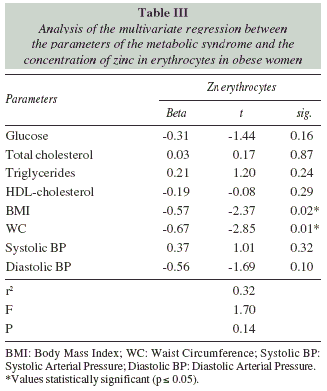
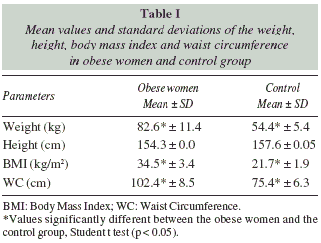
<body><![CDATA[<p><font face="Verdana" size="2">In this study, average age of obese women and control group was 33.7 &plusmn; 7.9 and 31.2 &plusmn; 7.8 years, respectively (p &gt; 0.05). The mean of zinc intake was 10.8 &plusmn; 4.7 mg/day for obese women and 7.6 &plusmn; 2.9 mg/day for the control group (p &lt; 0.05).</font></p>     <p><font face="Verdana" size="2">In this study, were evaluated 37 obese, being that 17 patients met at least three criteria that characterize the metabolic syndrome according to NCEP-ATP III and was not verified the presence of these criteria in the control group. In the results of the biochemical parameters of metabolic syndrome were observed that both groups did not present mean values these parameters superiors at reference of the NCEP-ATP III.</font></p>     <p><font face="Verdana" size="2">Anthropometric parameters results used to measure nutritional status are shown in  <a href="#t1">table I</a>. The weight, body mass index and waist circumference were significantly higher in obese women than in control group (p &lt; 0.05). In  <a href="#t2">table II</a> shows the mean concentration of zinc in plasma, and in erythrocytes of the obese women and control group.</font></p>     <p align="center"><font face="Verdana" size="2"><a name="t1"><img src="/img/revistas/nh/v26n3/32_cartas_cientificas_01_t1.gif" align="top"></a></font></p>     <p>&nbsp;</p>     <p align="center"><font face="Verdana" size="2"><a name="t2"><img src="/img/revistas/nh/v26n3/32_cartas_cientificas_01_t2.gif" align="top"></a></font></p>     <p>&nbsp;</p>     <p><font face="Verdana" size="2">The results of the multivariate regression analysis carried out to investigate the influence of the biomarkers of metabolic syndrome on the zinc nutricional status are shown in  <a href="#t3">table III</a>. Regression analysis revealed the existence of a relationship only between components of metabolic syndrome (body mass index and waist circumference) and, zinc in erythrocytes. In multivariate regression, the waist circumference (t = -2.85) and body mass index (t = -2.37) had an inverse relationship with the zinc in erythrocytes (R<sup>2</sup> = 0.32, p &lt; 0.05).</font></p>     <p align="center"><font face="Verdana" size="2"><a name="t3"><img src="/img/revistas/nh/v26n3/32_cartas_cientificas_01_t3.gif" align="top"></a></font></p>     <p>&nbsp;</p>     ]]></body>
<body><![CDATA[<p><font face="Verdana" size="2"><b>Discussion</b></font></p>     <p><font face="Verdana" size="2">This study investigated the relationship between the biomarkers of metabolic syndrome and the biochemical parameters of zinc in obese women. The mean concentrations of zinc in the plasma showed no statistically significant difference between groups (p &gt; 0.05). Despite no significant difference in plasmatic zinc concentrations, the obese group's diet contained a higher quantity of this mineral (p &lt; 0.05). Thus, the higher zinc intake found in the diets of obese women does not seem to have influenced the plasma levels of the mineral.</font></p>     <p><font face="Verdana" size="2">It should be mentioned that the plasma is a parameter of evaluation of this trace element that has fast dynamics, and that keeps it under a homeostatic control, and may suffer several pathophysiological influences in response to various conditions such as stress, infection, catabolism, hormones and food intake.<sup>20,21</sup></font></p>     <p><font face="Verdana" size="2">Another important aspect is that in the circulation, around 80% of zinc is in the erythrocytes and only 16% is in the plasma. Thus, since the half life of erythrocytes is 120 days, the erythrocyte becomes a parameter of nutritional status of this micronutrient for a longer period, and is therefore a more sensitive parameter.<sup>22,23</sup></font></p>     <p><font face="Verdana" size="2">In order to better understand the metabolic behavior of zinc in obesity, some studies have used more sensitive markers, such as erythrocytes, for assessing the nutritional status of this mineral. Thus, unlike results obtained in plasma, the mean values of zinc concentration in the erythrocytes of obese women in this study were significantly lower than in the control group (p &lt; 0.05). These results are consistent with those already found by Marreiro; Fisberg; Cozzolino<sup>5</sup>, in a study of obese children and adolescents and by Ozata et al.<sup>24</sup> in obese adult men.</font></p>     <p><font face="Verdana" size="2">One important factor is the body composition of the assessed patients. The waist circumference and body mass index were higher in obese women than in the control group (p &lt; 0.05). The obesity is characterized by accumulation of fat mass and is associated with increase of the release of several inflammatory mediators. This dysregulation in the production of pro-inflammatory adipocytokines in obese individuals leads to a state of chronic low-grade inflammation and may promote obesity-linked metabolic disorders such as syndrome metabolic<sup>25,26</sup>.</font></p>     <p><font face="Verdana" size="2">The results of multivariate regression revealed that only the erythrocytary zinc was influenced by bio-markers of the metabolic syndrome. This analysis demonstrated that the waist circumference and body mass index had negative correlation with the concentration of zinc in erythrocytes. This data is associated with the fact of the accumulation of adipose tissue increase the production of cortisol and adipocytokines, which produces a chronic inflammatory process. The inflammation induces the expression of metallothionein and zinc transporter Zip14 in hepatocytes, these proteins promotes the zinc accumulation in the liver and in adipocites, which may have contributed to low of erythrocytary zinc concentration<sup>27-29</sup>.</font></p>     <p>&nbsp;</p>     <p><font face="Verdana" size="2"><b>Conclusions</b></font></p>     <p><font face="Verdana" size="2">The study shows that there are alterations in biochemical parameters of zinc in obese women, with low zinc concentrations in erythrocytes. The results of regression analysis revealed that only the concentration of zinc in erythrocytes has influenced by components anthropometrics of the metabolic syndrome and, the body mass index and waist circumference have a negative relation with this mineral. Moreover, there is no relationship between the zinc nutricional status and the biochemical markers of the metabolic syndrome.</font></p>     ]]></body>
<body><![CDATA[<p>&nbsp;</p>     <p><font face="Verdana" size="2"><b>Acknowledgements</b></font></p>     <p><font face="Verdana" size="2">Prof Dr. José Machado Moita Neto Department of Chemistry, Federal University of Piauí, Teresina, <i>Piauí, Brazil</i> for assisting in statistical analyses.</font></p>     <p>&nbsp;</p>     <p><font face="Verdana" size="2"><b>References</b></font></p>     <!-- ref --><p><font face="Verdana" size="2">1. Ford ES. Prevalence of the metabolic syndrome defined by the International Diabetes Federation among adults in the U.S. <i>Diabetes Care</i> 2005; 28: 2745-49.    &nbsp;&nbsp;&nbsp;&nbsp;&nbsp;&nbsp;&nbsp;&nbsp;[&#160;<a href="javascript:void(0);" onclick="javascript: window.open('/scielo.php?script=sci_nlinks&ref=3604293&pid=S0212-1611201100030003200001&lng=','','width=640,height=500,resizable=yes,scrollbars=1,menubar=yes,');">Links</a>&#160;]<!-- end-ref --></font></p>    <!-- ref --><p><font face="Verdana" size="2">2. Sola E, Jover A, López-Ruiz A, Jarabo M, Vaya A, Morillas C et al. Parameters of Inflammation in Morbid Obesity: Lack of Effect of Moderate Weight Loss. <i>Obes Surg</i> 2009; 19: 571-76.    &nbsp;&nbsp;&nbsp;&nbsp;&nbsp;&nbsp;&nbsp;&nbsp;[&#160;<a href="javascript:void(0);" onclick="javascript: window.open('/scielo.php?script=sci_nlinks&ref=3604295&pid=S0212-1611201100030003200002&lng=','','width=640,height=500,resizable=yes,scrollbars=1,menubar=yes,');">Links</a>&#160;]<!-- end-ref --></font></p>    <!-- ref --><p><font face="Verdana" size="2">3. Tallman DL, Taylor CG. Effects of dietary fat and zinc on adiposity, serum leptin, and adipose fatty acid composition in C57BL/6J mice. <i>J Nutr Biochem</i> 2003; 14: 17-23.    &nbsp;&nbsp;&nbsp;&nbsp;&nbsp;&nbsp;&nbsp;&nbsp;[&#160;<a href="javascript:void(0);" onclick="javascript: window.open('/scielo.php?script=sci_nlinks&ref=3604297&pid=S0212-1611201100030003200003&lng=','','width=640,height=500,resizable=yes,scrollbars=1,menubar=yes,');">Links</a>&#160;]<!-- end-ref --></font></p>    <!-- ref --><p><font face="Verdana" size="2">4. Chudek J, Wiecek, A. Adipose tissue, inflammation and endothelial dysfunction. <i>Pharmacol Rep</i> 2006; 58: 81S-88S.    &nbsp;&nbsp;&nbsp;&nbsp;&nbsp;&nbsp;&nbsp;&nbsp;[&#160;<a href="javascript:void(0);" onclick="javascript: window.open('/scielo.php?script=sci_nlinks&ref=3604299&pid=S0212-1611201100030003200004&lng=','','width=640,height=500,resizable=yes,scrollbars=1,menubar=yes,');">Links</a>&#160;]<!-- end-ref --></font></p>    <!-- ref --><p><font face="Verdana" size="2">5. Marreiro DN, Fisberg M, Cozzolino SMF. Zinc nutritional status and its relationships with hyperinulinemia in obese children and adolescents. <i>Biol Trace Element Res</i> 2004; 99: 137-50.    &nbsp;&nbsp;&nbsp;&nbsp;&nbsp;&nbsp;&nbsp;&nbsp;[&#160;<a href="javascript:void(0);" onclick="javascript: window.open('/scielo.php?script=sci_nlinks&ref=3604301&pid=S0212-1611201100030003200005&lng=','','width=640,height=500,resizable=yes,scrollbars=1,menubar=yes,');">Links</a>&#160;]<!-- end-ref --></font></p>    <!-- ref --><p><font face="Verdana" size="2">6. Marreiro DN, Geloneze B, Tambascia MA, Lerario AC, Halpern A, Cozzolino SM. Effect of zinc supplementation on serum leptin levels and insulin resistance of obese women. <i>Biol Trace Elem Res</i> 2006; 112: 109-18.    &nbsp;&nbsp;&nbsp;&nbsp;&nbsp;&nbsp;&nbsp;&nbsp;[&#160;<a href="javascript:void(0);" onclick="javascript: window.open('/scielo.php?script=sci_nlinks&ref=3604303&pid=S0212-1611201100030003200006&lng=','','width=640,height=500,resizable=yes,scrollbars=1,menubar=yes,');">Links</a>&#160;]<!-- end-ref --></font></p>    <!-- ref --><p><font face="Verdana" size="2">7. Konukoglu D, Turhan MS, Ercan M, Serin O. Relationship between plasma leptin and zinc levels and the effect of insulin and oxidative stress on leptin levels in obese diabetic patients. <i>J Nutr Biochem</i> 2004; 15: 757-60.    &nbsp;&nbsp;&nbsp;&nbsp;&nbsp;&nbsp;&nbsp;&nbsp;[&#160;<a href="javascript:void(0);" onclick="javascript: window.open('/scielo.php?script=sci_nlinks&ref=3604305&pid=S0212-1611201100030003200007&lng=','','width=640,height=500,resizable=yes,scrollbars=1,menubar=yes,');">Links</a>&#160;]<!-- end-ref --></font></p>    <!-- ref --><p><font face="Verdana" size="2">8. Meunier N, O'connor JM, Maiani G, Cashman KD, Secker DL, Ferry M et al. Importance of zinc in the elderly: the zenith study. <i>Eur J Clin Nutr</i> 2005; 59: 1S-4S.    &nbsp;&nbsp;&nbsp;&nbsp;&nbsp;&nbsp;&nbsp;&nbsp;[&#160;<a href="javascript:void(0);" onclick="javascript: window.open('/scielo.php?script=sci_nlinks&ref=3604307&pid=S0212-1611201100030003200008&lng=','','width=640,height=500,resizable=yes,scrollbars=1,menubar=yes,');">Links</a>&#160;]<!-- end-ref --></font></p>    <!-- ref --><p><font face="Verdana" size="2">9. Gomez-García A, Hernandez-Salazar E, Gonzalez-Ortiz M, Martinez-Abundis E. Efecto de la administracion oral de zinc sobre sensibilidad a la insulina y niveles séricos de leptina y andrógenos en hombres con obesidad. <i>Rev Méd Chile</i> 2006;134: 279-84.    &nbsp;&nbsp;&nbsp;&nbsp;&nbsp;&nbsp;&nbsp;&nbsp;[&#160;<a href="javascript:void(0);" onclick="javascript: window.open('/scielo.php?script=sci_nlinks&ref=3604309&pid=S0212-1611201100030003200009&lng=','','width=640,height=500,resizable=yes,scrollbars=1,menubar=yes,');">Links</a>&#160;]<!-- end-ref --></font></p>    <!-- ref --><p><font face="Verdana" size="2">10. Song Y, Wang J, Li XK, Cai L. Zinc and the diabetic heart. <i>Biometals</i> 2005; 18: 325-32.    &nbsp;&nbsp;&nbsp;&nbsp;&nbsp;&nbsp;&nbsp;&nbsp;[&#160;<a href="javascript:void(0);" onclick="javascript: window.open('/scielo.php?script=sci_nlinks&ref=3604311&pid=S0212-1611201100030003200010&lng=','','width=640,height=500,resizable=yes,scrollbars=1,menubar=yes,');">Links</a>&#160;]<!-- end-ref --></font></p>    <!-- ref --><p><font face="Verdana" size="2">11. Tallman DL, Taylor CG. Effects of dietary fat and zinc on adiposity, serum leptin, and adipose fatty acid composition in C57BL/6J mice. <i>J Nutr Biochem</i> 2003; 14:17-23.    &nbsp;&nbsp;&nbsp;&nbsp;&nbsp;&nbsp;&nbsp;&nbsp;[&#160;<a href="javascript:void(0);" onclick="javascript: window.open('/scielo.php?script=sci_nlinks&ref=3604313&pid=S0212-1611201100030003200011&lng=','','width=640,height=500,resizable=yes,scrollbars=1,menubar=yes,');">Links</a>&#160;]<!-- end-ref --></font></p>    <!-- ref --><p><font face="Verdana" size="2">12. Marreiro DN, Fisberg M, Cozzolino SM. Zinc nutritional status in obese children and adolescents. <i>Biol Trace Elem Res</i> 2002;86: 107-22.    &nbsp;&nbsp;&nbsp;&nbsp;&nbsp;&nbsp;&nbsp;&nbsp;[&#160;<a href="javascript:void(0);" onclick="javascript: window.open('/scielo.php?script=sci_nlinks&ref=3604315&pid=S0212-1611201100030003200012&lng=','','width=640,height=500,resizable=yes,scrollbars=1,menubar=yes,');">Links</a>&#160;]<!-- end-ref --></font></p>    <!-- ref --><p><font face="Verdana" size="2">13. World Health Organization (WHO). Obesity: Preventing and managing the global epidemic. <i>Technical report series</i> 2000, n.894.    &nbsp;&nbsp;&nbsp;&nbsp;&nbsp;&nbsp;&nbsp;&nbsp;[&#160;<a href="javascript:void(0);" onclick="javascript: window.open('/scielo.php?script=sci_nlinks&ref=3604317&pid=S0212-1611201100030003200013&lng=','','width=640,height=500,resizable=yes,scrollbars=1,menubar=yes,');">Links</a>&#160;]<!-- end-ref --></font></p>    <!-- ref --><p><font face="Verdana" size="2">14. Anção MS, Cuppari L, Draibe AS, Sigulem D. Programa de apoio  à nutrição Nutwin: versão 1.5. Departamento de Informática em Saúde SPDM 2002; UNIFESP/EPM1 CD-ROM.    &nbsp;&nbsp;&nbsp;&nbsp;&nbsp;&nbsp;&nbsp;&nbsp;[&#160;<a href="javascript:void(0);" onclick="javascript: window.open('/scielo.php?script=sci_nlinks&ref=3604319&pid=S0212-1611201100030003200014&lng=','','width=640,height=500,resizable=yes,scrollbars=1,menubar=yes,');">Links</a>&#160;]<!-- end-ref --></font></p>    <!-- ref --><p><font face="Verdana" size="2">15. Institute of medicine/Food and Nutritional Board. Dietary reference intakes for vitamin A, vitamin K, arsenic, boron, chromium, cooper, iodine, iron, manganese, molybdenun, nickel, silicon, vanadium, and zinc. National Academy, Washington, DC; 2001, 650 p.    &nbsp;&nbsp;&nbsp;&nbsp;&nbsp;&nbsp;&nbsp;&nbsp;[&#160;<a href="javascript:void(0);" onclick="javascript: window.open('/scielo.php?script=sci_nlinks&ref=3604321&pid=S0212-1611201100030003200015&lng=','','width=640,height=500,resizable=yes,scrollbars=1,menubar=yes,');">Links</a>&#160;]<!-- end-ref --></font></p>    <!-- ref --><p><font face="Verdana" size="2">16. Rodríguez MP, Nazarino A, Demczylo V, Cid A. A simpler method for the determination of zinc human plasma levels by flame atomic absorption spectrophometry. <i>At Spectrosc</i> 1989; 10: 68-70.    &nbsp;&nbsp;&nbsp;&nbsp;&nbsp;&nbsp;&nbsp;&nbsp;[&#160;<a href="javascript:void(0);" onclick="javascript: window.open('/scielo.php?script=sci_nlinks&ref=3604323&pid=S0212-1611201100030003200016&lng=','','width=640,height=500,resizable=yes,scrollbars=1,menubar=yes,');">Links</a>&#160;]<!-- end-ref --></font></p>    <!-- ref --><p><font face="Verdana" size="2">17. Whitehouse RC, Prasad AS, Rabbani PI, Cossack ZT. Zinc in plasma, neutrophils, lymphocytes, and erythrocytes as determined by flameless atomic absorption spectrophotometry. <i>Clin Chem</i> 1982; 28: 475-80.    &nbsp;&nbsp;&nbsp;&nbsp;&nbsp;&nbsp;&nbsp;&nbsp;[&#160;<a href="javascript:void(0);" onclick="javascript: window.open('/scielo.php?script=sci_nlinks&ref=3604325&pid=S0212-1611201100030003200017&lng=','','width=640,height=500,resizable=yes,scrollbars=1,menubar=yes,');">Links</a>&#160;]<!-- end-ref --></font></p>    <!-- ref --><p><font face="Verdana" size="2">18. Van Assendelft, O.W. The measurement of hemoglobin. In: Izak, G.; Lewis, S.M., eds. Modern concepts in hematology. Academic press, New York 1972; pp. 14-25.    &nbsp;&nbsp;&nbsp;&nbsp;&nbsp;&nbsp;&nbsp;&nbsp;[&#160;<a href="javascript:void(0);" onclick="javascript: window.open('/scielo.php?script=sci_nlinks&ref=3604327&pid=S0212-1611201100030003200018&lng=','','width=640,height=500,resizable=yes,scrollbars=1,menubar=yes,');">Links</a>&#160;]<!-- end-ref --></font></p>    <!-- ref --><p><font face="Verdana" size="2">19. Expert Panel on Detection, Evaluation and Treatment of High Blood Cholesterol in Adults (Adult Treatment Panel III). Executive Summary of the Third Report of the National Cholesterol Education Program (NCEP). <i>JAMA</i> 2001; 285: 2486-96.    &nbsp;&nbsp;&nbsp;&nbsp;&nbsp;&nbsp;&nbsp;&nbsp;[&#160;<a href="javascript:void(0);" onclick="javascript: window.open('/scielo.php?script=sci_nlinks&ref=3604329&pid=S0212-1611201100030003200019&lng=','','width=640,height=500,resizable=yes,scrollbars=1,menubar=yes,');">Links</a>&#160;]<!-- end-ref --></font></p>    <!-- ref --><p><font face="Verdana" size="2">20. Hess SY, Peerson JM, King JC, Brown KH. Use of serum zinc concentration as an indicator of population zinc status. <i>Food Nutr Bull</i> 2007; 28: 403S-29S.    &nbsp;&nbsp;&nbsp;&nbsp;&nbsp;&nbsp;&nbsp;&nbsp;[&#160;<a href="javascript:void(0);" onclick="javascript: window.open('/scielo.php?script=sci_nlinks&ref=3604331&pid=S0212-1611201100030003200020&lng=','','width=640,height=500,resizable=yes,scrollbars=1,menubar=yes,');">Links</a>&#160;]<!-- end-ref --></font></p>    <!-- ref --><p><font face="Verdana" size="2">21. King JC, Shames DM, Woodhouse LR. Zinc homeostasis in humans. <i>J Nutr </i>2000; 5: 1360S-6S.    &nbsp;&nbsp;&nbsp;&nbsp;&nbsp;&nbsp;&nbsp;&nbsp;[&#160;<a href="javascript:void(0);" onclick="javascript: window.open('/scielo.php?script=sci_nlinks&ref=3604333&pid=S0212-1611201100030003200021&lng=','','width=640,height=500,resizable=yes,scrollbars=1,menubar=yes,');">Links</a>&#160;]<!-- end-ref --></font></p>    <!-- ref --><p><font face="Verdana" size="2">22. Davis CD, Milne DB, Nielsen FH. Changes in dietary zinc and copper affect zinc-status indicators of postmenopausal women, notably, extracellular superoxide dismutase and amyloid precursor proteins. <i>Am J Clin Nutr</i> 2000; 71: 781-8.    &nbsp;&nbsp;&nbsp;&nbsp;&nbsp;&nbsp;&nbsp;&nbsp;[&#160;<a href="javascript:void(0);" onclick="javascript: window.open('/scielo.php?script=sci_nlinks&ref=3604335&pid=S0212-1611201100030003200022&lng=','','width=640,height=500,resizable=yes,scrollbars=1,menubar=yes,');">Links</a>&#160;]<!-- end-ref --></font></p>    <!-- ref --><p><font face="Verdana" size="2">23. Vallee BL, Falchuk KH. The biochemical basis of zinc physiology. <i>PhysiolRev</i> 1993; 73:79-118.    &nbsp;&nbsp;&nbsp;&nbsp;&nbsp;&nbsp;&nbsp;&nbsp;[&#160;<a href="javascript:void(0);" onclick="javascript: window.open('/scielo.php?script=sci_nlinks&ref=3604337&pid=S0212-1611201100030003200023&lng=','','width=640,height=500,resizable=yes,scrollbars=1,menubar=yes,');">Links</a>&#160;]<!-- end-ref --></font></p>    <!-- ref --><p><font face="Verdana" size="2">24. Ozata M, Mergen M, Oktenli C, Aydin A, Sanisoglu SY, Bolu E, et al. Increased oxidative stress and hypozincemia in male obesity. <i>Clin Biochem</i> 2002; 35: 627-31.    &nbsp;&nbsp;&nbsp;&nbsp;&nbsp;&nbsp;&nbsp;&nbsp;[&#160;<a href="javascript:void(0);" onclick="javascript: window.open('/scielo.php?script=sci_nlinks&ref=3604339&pid=S0212-1611201100030003200024&lng=','','width=640,height=500,resizable=yes,scrollbars=1,menubar=yes,');">Links</a>&#160;]<!-- end-ref --></font></p>    <!-- ref --><p><font face="Verdana" size="2">25. Lago F, Dieguez C, Gomez-Reino J, Gualillo O. The emerging role of adipokines as ediators of inflammation and immune responses. <i>Cytokine Growth Factor Rev</i> 2007; 18: 313-25.    &nbsp;&nbsp;&nbsp;&nbsp;&nbsp;&nbsp;&nbsp;&nbsp;[&#160;<a href="javascript:void(0);" onclick="javascript: window.open('/scielo.php?script=sci_nlinks&ref=3604341&pid=S0212-1611201100030003200025&lng=','','width=640,height=500,resizable=yes,scrollbars=1,menubar=yes,');">Links</a>&#160;]<!-- end-ref --></font></p>    <!-- ref --><p><font face="Verdana" size="2">26. Torres-Leal FL, Fonseca-Alaniz MH, Rogero MM, Tirapegui J. The role of inflamed adipose tissue in the insulin resistance.<i> Cell Biochem Funct</i> 2010; 28: 623-31.    &nbsp;&nbsp;&nbsp;&nbsp;&nbsp;&nbsp;&nbsp;&nbsp;[&#160;<a href="javascript:void(0);" onclick="javascript: window.open('/scielo.php?script=sci_nlinks&ref=3604343&pid=S0212-1611201100030003200026&lng=','','width=640,height=500,resizable=yes,scrollbars=1,menubar=yes,');">Links</a>&#160;]<!-- end-ref --></font></p>    <!-- ref --><p><font face="Verdana" size="2">27. Liuzzi JP, Lichten LA, Rivera S, Blanchard RK, Aydemir TB, Knutson MD et al. Interleukin-6 regulates the zinc transporter Zip-14 in liver and contributes to the hypozincemia in the acute-phase response. <i>Proc Natl AcadSci</i> 2005; 102: 6843-48.    &nbsp;&nbsp;&nbsp;&nbsp;&nbsp;&nbsp;&nbsp;&nbsp;[&#160;<a href="javascript:void(0);" onclick="javascript: window.open('/scielo.php?script=sci_nlinks&ref=3604345&pid=S0212-1611201100030003200027&lng=','','width=640,height=500,resizable=yes,scrollbars=1,menubar=yes,');">Links</a>&#160;]<!-- end-ref --></font></p>    <!-- ref --><p><font face="Verdana" size="2">28. Kim JR, Ryu HH, Chung HJ, Lee JH, Kim SW, Kwun WH et al. Association of anti-obesity activity of N-acetylcysteine with metallothionern-II down-regulation. <i>Exp Mol Med</i> 2006; 38: 162-72.    &nbsp;&nbsp;&nbsp;&nbsp;&nbsp;&nbsp;&nbsp;&nbsp;[&#160;<a href="javascript:void(0);" onclick="javascript: window.open('/scielo.php?script=sci_nlinks&ref=3604347&pid=S0212-1611201100030003200028&lng=','','width=640,height=500,resizable=yes,scrollbars=1,menubar=yes,');">Links</a>&#160;]<!-- end-ref --></font></p>    <!-- ref --><p><font face="Verdana" size="2">29. Schroeder JJ, Cousins RJ. Interleukin 6 regulates metallothionein gene expression and zinc metabolism in hepatocyte monolayer cultures. <i>Proc Natl Acad Sci</i> 1990; 87: 3137-41.    &nbsp;&nbsp;&nbsp;&nbsp;&nbsp;&nbsp;&nbsp;&nbsp;[&#160;<a href="javascript:void(0);" onclick="javascript: window.open('/scielo.php?script=sci_nlinks&ref=3604349&pid=S0212-1611201100030003200029&lng=','','width=640,height=500,resizable=yes,scrollbars=1,menubar=yes,');">Links</a>&#160;]<!-- end-ref --></font></p>    <!-- ref --><p><font face="Verdana" size="2">30. Gibson RS. Assessment of trace element status. In: Gibson, RS. Principles of Nutritional. New York: Oxford University Press USA; 1990, pp. 511-76.    &nbsp;&nbsp;&nbsp;&nbsp;&nbsp;&nbsp;&nbsp;&nbsp;[&#160;<a href="javascript:void(0);" onclick="javascript: window.open('/scielo.php?script=sci_nlinks&ref=3604351&pid=S0212-1611201100030003200030&lng=','','width=640,height=500,resizable=yes,scrollbars=1,menubar=yes,');">Links</a>&#160;]<!-- end-ref --></font></p>    <!-- ref --><p><font face="Verdana" size="2">31. Guthierie HA.; Picciano MF. Micronutrient Minerals. In: Guthierie HA. Human nutrition. New York; 1994, pp. 351-357.    &nbsp;&nbsp;&nbsp;&nbsp;&nbsp;&nbsp;&nbsp;&nbsp;[&#160;<a href="javascript:void(0);" onclick="javascript: window.open('/scielo.php?script=sci_nlinks&ref=3604353&pid=S0212-1611201100030003200031&lng=','','width=640,height=500,resizable=yes,scrollbars=1,menubar=yes,');">Links</a>&#160;]<!-- end-ref --></font></p>     <p>&nbsp;</p>     <p>&nbsp;</p>     <p><font face="Verdana" size="2"><b><a name="back"></a><a href="#top"><img border="0" src="/img/revistas/nh/v26n3/seta.gif" width="15" height="17"></a>Correspondence:</b>    ]]></body>
<body><![CDATA[<br>Dilina do Nascimento Marreiro.    <br>Rua Hugo Napoleão, 665, Apt. 2001, Bairro Jóquei.    <br>64048-320 Teresina. Piauí. Brazil.    <br>E-mail: <a href="mailto:dilina.marreiro@gmail.com">dilina.marreiro@gmail.com</a></font></p>     <p><font face="Verdana" size="2">Recibido: 30-XI-2010.    <br>1<sup>a</sup> Revisión: 16-II-2011.    <br>Aceptado: 4-III-2011.</font></p>      ]]></body><back>
<ref-list>
<ref id="B1">
<label>1</label><nlm-citation citation-type="journal">
<person-group person-group-type="author">
<name>
<surname><![CDATA[Ford]]></surname>
<given-names><![CDATA[ES]]></given-names>
</name>
</person-group>
<article-title xml:lang="en"><![CDATA[Prevalence of the metabolic syndrome defined by the International Diabetes Federation among adults in the U.S]]></article-title>
<source><![CDATA[Diabetes Care]]></source>
<year>2005</year>
<volume>28</volume>
<page-range>2745-49</page-range></nlm-citation>
</ref>
<ref id="B2">
<label>2</label><nlm-citation citation-type="journal">
<person-group person-group-type="author">
<name>
<surname><![CDATA[Sola]]></surname>
<given-names><![CDATA[E]]></given-names>
</name>
<name>
<surname><![CDATA[Jover]]></surname>
<given-names><![CDATA[A]]></given-names>
</name>
<name>
<surname><![CDATA[López-Ruiz]]></surname>
<given-names><![CDATA[A]]></given-names>
</name>
<name>
<surname><![CDATA[Jarabo]]></surname>
<given-names><![CDATA[M]]></given-names>
</name>
<name>
<surname><![CDATA[Vaya]]></surname>
<given-names><![CDATA[A]]></given-names>
</name>
<name>
<surname><![CDATA[Morillas]]></surname>
<given-names><![CDATA[C]]></given-names>
</name>
</person-group>
<article-title xml:lang="en"><![CDATA[Parameters of Inflammation in Morbid Obesity: Lack of Effect of Moderate Weight Loss]]></article-title>
<source><![CDATA[Obes Surg]]></source>
<year>2009</year>
<volume>19</volume>
<page-range>571-76</page-range></nlm-citation>
</ref>
<ref id="B3">
<label>3</label><nlm-citation citation-type="journal">
<person-group person-group-type="author">
<name>
<surname><![CDATA[Tallman]]></surname>
<given-names><![CDATA[DL]]></given-names>
</name>
<name>
<surname><![CDATA[Taylor]]></surname>
<given-names><![CDATA[CG]]></given-names>
</name>
</person-group>
<article-title xml:lang="en"><![CDATA[Effects of dietary fat and zinc on adiposity, serum leptin, and adipose fatty acid composition in C57BL/6J mice]]></article-title>
<source><![CDATA[J Nutr Biochem]]></source>
<year>2003</year>
<volume>14</volume>
<page-range>17-23</page-range></nlm-citation>
</ref>
<ref id="B4">
<label>4</label><nlm-citation citation-type="journal">
<person-group person-group-type="author">
<name>
<surname><![CDATA[Chudek]]></surname>
<given-names><![CDATA[J]]></given-names>
</name>
<name>
<surname><![CDATA[Wiecek]]></surname>
<given-names><![CDATA[A]]></given-names>
</name>
</person-group>
<article-title xml:lang="en"><![CDATA[Adipose tissue, inflammation and endothelial dysfunction]]></article-title>
<source><![CDATA[Pharmacol Rep]]></source>
<year>2006</year>
<volume>58</volume>
<page-range>81S-88S</page-range></nlm-citation>
</ref>
<ref id="B5">
<label>5</label><nlm-citation citation-type="journal">
<person-group person-group-type="author">
<name>
<surname><![CDATA[Marreiro]]></surname>
<given-names><![CDATA[DN]]></given-names>
</name>
<name>
<surname><![CDATA[Fisberg]]></surname>
<given-names><![CDATA[M]]></given-names>
</name>
<name>
<surname><![CDATA[Cozzolino]]></surname>
<given-names><![CDATA[SMF]]></given-names>
</name>
</person-group>
<article-title xml:lang="en"><![CDATA[Zinc nutritional status and its relationships with hyperinulinemia in obese children and adolescents]]></article-title>
<source><![CDATA[Biol Trace Element Res]]></source>
<year>2004</year>
<volume>99</volume>
<page-range>137-50</page-range></nlm-citation>
</ref>
<ref id="B6">
<label>6</label><nlm-citation citation-type="journal">
<person-group person-group-type="author">
<name>
<surname><![CDATA[Marreiro]]></surname>
<given-names><![CDATA[DN]]></given-names>
</name>
<name>
<surname><![CDATA[Geloneze]]></surname>
<given-names><![CDATA[B]]></given-names>
</name>
<name>
<surname><![CDATA[Tambascia]]></surname>
<given-names><![CDATA[MA]]></given-names>
</name>
<name>
<surname><![CDATA[Lerario]]></surname>
<given-names><![CDATA[AC]]></given-names>
</name>
<name>
<surname><![CDATA[Halpern]]></surname>
<given-names><![CDATA[A]]></given-names>
</name>
<name>
<surname><![CDATA[Cozzolino]]></surname>
<given-names><![CDATA[SM]]></given-names>
</name>
</person-group>
<article-title xml:lang="en"><![CDATA[Effect of zinc supplementation on serum leptin levels and insulin resistance of obese women]]></article-title>
<source><![CDATA[Biol Trace Elem Res]]></source>
<year>2006</year>
<volume>112</volume>
<page-range>109-18</page-range></nlm-citation>
</ref>
<ref id="B7">
<label>7</label><nlm-citation citation-type="journal">
<person-group person-group-type="author">
<name>
<surname><![CDATA[Konukoglu]]></surname>
<given-names><![CDATA[D]]></given-names>
</name>
<name>
<surname><![CDATA[Turhan]]></surname>
<given-names><![CDATA[MS]]></given-names>
</name>
<name>
<surname><![CDATA[Ercan]]></surname>
<given-names><![CDATA[M]]></given-names>
</name>
<name>
<surname><![CDATA[Serin]]></surname>
<given-names><![CDATA[O]]></given-names>
</name>
</person-group>
<article-title xml:lang="en"><![CDATA[Relationship between plasma leptin and zinc levels and the effect of insulin and oxidative stress on leptin levels in obese diabetic patients]]></article-title>
<source><![CDATA[J Nutr Biochem]]></source>
<year>2004</year>
<volume>15</volume>
<page-range>757-60</page-range></nlm-citation>
</ref>
<ref id="B8">
<label>8</label><nlm-citation citation-type="journal">
<person-group person-group-type="author">
<name>
<surname><![CDATA[Meunier]]></surname>
<given-names><![CDATA[N]]></given-names>
</name>
<name>
<surname><![CDATA[O'connor]]></surname>
<given-names><![CDATA[JM]]></given-names>
</name>
<name>
<surname><![CDATA[Maiani]]></surname>
<given-names><![CDATA[G]]></given-names>
</name>
<name>
<surname><![CDATA[Cashman]]></surname>
<given-names><![CDATA[KD]]></given-names>
</name>
<name>
<surname><![CDATA[Secker]]></surname>
<given-names><![CDATA[DL]]></given-names>
</name>
<name>
<surname><![CDATA[Ferry]]></surname>
<given-names><![CDATA[M]]></given-names>
</name>
</person-group>
<article-title xml:lang="en"><![CDATA[Importance of zinc in the elderly: the zenith study]]></article-title>
<source><![CDATA[Eur J Clin Nutr]]></source>
<year>2005</year>
<volume>59</volume>
<page-range>1S-4S</page-range></nlm-citation>
</ref>
<ref id="B9">
<label>9</label><nlm-citation citation-type="journal">
<person-group person-group-type="author">
<name>
<surname><![CDATA[Gomez-García]]></surname>
<given-names><![CDATA[A]]></given-names>
</name>
<name>
<surname><![CDATA[Hernandez-Salazar]]></surname>
<given-names><![CDATA[E]]></given-names>
</name>
<name>
<surname><![CDATA[Gonzalez-Ortiz]]></surname>
<given-names><![CDATA[M]]></given-names>
</name>
<name>
<surname><![CDATA[Martinez-Abundis]]></surname>
<given-names><![CDATA[E]]></given-names>
</name>
</person-group>
<article-title xml:lang="es"><![CDATA[Efecto de la administracion oral de zinc sobre sensibilidad a la insulina y niveles séricos de leptina y andrógenos en hombres con obesidad]]></article-title>
<source><![CDATA[Rev Méd Chile]]></source>
<year>2006</year>
<volume>134</volume>
<page-range>279-84</page-range></nlm-citation>
</ref>
<ref id="B10">
<label>10</label><nlm-citation citation-type="journal">
<person-group person-group-type="author">
<name>
<surname><![CDATA[Song]]></surname>
<given-names><![CDATA[Y]]></given-names>
</name>
<name>
<surname><![CDATA[Wang]]></surname>
<given-names><![CDATA[J]]></given-names>
</name>
<name>
<surname><![CDATA[Li]]></surname>
<given-names><![CDATA[XK]]></given-names>
</name>
<name>
<surname><![CDATA[Cai]]></surname>
<given-names><![CDATA[L]]></given-names>
</name>
</person-group>
<article-title xml:lang="en"><![CDATA[Zinc and the diabetic heart]]></article-title>
<source><![CDATA[Biometals]]></source>
<year>2005</year>
<volume>18</volume>
<page-range>325-32</page-range></nlm-citation>
</ref>
<ref id="B11">
<label>11</label><nlm-citation citation-type="journal">
<person-group person-group-type="author">
<name>
<surname><![CDATA[Tallman]]></surname>
<given-names><![CDATA[DL]]></given-names>
</name>
<name>
<surname><![CDATA[Taylor]]></surname>
<given-names><![CDATA[CG]]></given-names>
</name>
</person-group>
<article-title xml:lang="en"><![CDATA[Effects of dietary fat and zinc on adiposity, serum leptin, and adipose fatty acid composition in C57BL/6J mice]]></article-title>
<source><![CDATA[J Nutr Biochem]]></source>
<year>2003</year>
<volume>14</volume>
<page-range>17-23</page-range></nlm-citation>
</ref>
<ref id="B12">
<label>12</label><nlm-citation citation-type="journal">
<person-group person-group-type="author">
<name>
<surname><![CDATA[Marreiro]]></surname>
<given-names><![CDATA[DN]]></given-names>
</name>
<name>
<surname><![CDATA[Fisberg]]></surname>
<given-names><![CDATA[M]]></given-names>
</name>
<name>
<surname><![CDATA[Cozzolino]]></surname>
<given-names><![CDATA[SM]]></given-names>
</name>
</person-group>
<article-title xml:lang="en"><![CDATA[Zinc nutritional status in obese children and adolescents]]></article-title>
<source><![CDATA[Biol Trace Elem Res]]></source>
<year>2002</year>
<volume>86</volume>
<page-range>107-22</page-range></nlm-citation>
</ref>
<ref id="B13">
<label>13</label><nlm-citation citation-type="">
<collab>World Health Organization (WHO)</collab>
<source><![CDATA[Obesity: Preventing and managing the global epidemic]]></source>
<year>2000</year>
<volume>894</volume>
</nlm-citation>
</ref>
<ref id="B14">
<label>14</label><nlm-citation citation-type="book">
<person-group person-group-type="author">
<name>
<surname><![CDATA[Anção]]></surname>
<given-names><![CDATA[MS]]></given-names>
</name>
<name>
<surname><![CDATA[Cuppari]]></surname>
<given-names><![CDATA[L]]></given-names>
</name>
<name>
<surname><![CDATA[Draibe]]></surname>
<given-names><![CDATA[AS]]></given-names>
</name>
<name>
<surname><![CDATA[Sigulem]]></surname>
<given-names><![CDATA[D]]></given-names>
</name>
</person-group>
<source><![CDATA[Programa de apoio à nutrição Nutwin: versão 1.5. Departamento de Informática em Saúde SPDM]]></source>
<year>2002</year>
<publisher-name><![CDATA[UNIFESP/EPM1]]></publisher-name>
</nlm-citation>
</ref>
<ref id="B15">
<label>15</label><nlm-citation citation-type="book">
<collab>Institute of medicine/Food and Nutritional Board</collab>
<source><![CDATA[Dietary reference intakes for vitamin A, vitamin K, arsenic, boron, chromium, cooper, iodine, iron, manganese, molybdenun, nickel, silicon, vanadium, and zinc]]></source>
<year>2001</year>
<publisher-loc><![CDATA[Washington^eDC DC]]></publisher-loc>
<publisher-name><![CDATA[National Academy]]></publisher-name>
</nlm-citation>
</ref>
<ref id="B16">
<label>16</label><nlm-citation citation-type="journal">
<person-group person-group-type="author">
<name>
<surname><![CDATA[Rodríguez]]></surname>
<given-names><![CDATA[MP]]></given-names>
</name>
<name>
<surname><![CDATA[Nazarino]]></surname>
<given-names><![CDATA[A]]></given-names>
</name>
<name>
<surname><![CDATA[Demczylo]]></surname>
<given-names><![CDATA[V]]></given-names>
</name>
<name>
<surname><![CDATA[Cid]]></surname>
<given-names><![CDATA[A]]></given-names>
</name>
</person-group>
<article-title xml:lang="en"><![CDATA[A simpler method for the determination of zinc human plasma levels by flame atomic absorption spectrophometry]]></article-title>
<source><![CDATA[At Spectrosc]]></source>
<year>1989</year>
<volume>10</volume>
<page-range>68-70</page-range></nlm-citation>
</ref>
<ref id="B17">
<label>17</label><nlm-citation citation-type="journal">
<person-group person-group-type="author">
<name>
<surname><![CDATA[Whitehouse]]></surname>
<given-names><![CDATA[RC]]></given-names>
</name>
<name>
<surname><![CDATA[Prasad]]></surname>
<given-names><![CDATA[AS]]></given-names>
</name>
<name>
<surname><![CDATA[Rabbani]]></surname>
<given-names><![CDATA[PI]]></given-names>
</name>
<name>
<surname><![CDATA[Cossack]]></surname>
<given-names><![CDATA[ZT]]></given-names>
</name>
</person-group>
<article-title xml:lang="en"><![CDATA[Zinc in plasma, neutrophils, lymphocytes, and erythrocytes as determined by flameless atomic absorption spectrophotometry]]></article-title>
<source><![CDATA[Clin Chem]]></source>
<year>1982</year>
<volume>28</volume>
<page-range>475-80</page-range></nlm-citation>
</ref>
<ref id="B18">
<label>18</label><nlm-citation citation-type="book">
<person-group person-group-type="author">
<name>
<surname><![CDATA[Van Assendelft]]></surname>
<given-names><![CDATA[O.W]]></given-names>
</name>
</person-group>
<article-title xml:lang="en"><![CDATA[The measurement of hemoglobin]]></article-title>
<person-group person-group-type="editor">
<name>
<surname><![CDATA[Izak]]></surname>
<given-names><![CDATA[G.]]></given-names>
</name>
<name>
<surname><![CDATA[Lewis]]></surname>
<given-names><![CDATA[S.M.]]></given-names>
</name>
</person-group>
<source><![CDATA[Modern concepts in hematology]]></source>
<year>1972</year>
<page-range>14-25</page-range><publisher-loc><![CDATA[New York ]]></publisher-loc>
<publisher-name><![CDATA[Academic press]]></publisher-name>
</nlm-citation>
</ref>
<ref id="B19">
<label>19</label><nlm-citation citation-type="journal">
<collab>Expert Panel on Detection, Evaluation and Treatment of High Blood Cholesterol in Adults (Adult Treatment Panel III)</collab>
<article-title xml:lang="en"><![CDATA[Executive Summary of the Third Report of the National Cholesterol Education Program (NCEP)]]></article-title>
<source><![CDATA[JAMA]]></source>
<year>2001</year>
<volume>285</volume>
<page-range>2486-96</page-range></nlm-citation>
</ref>
<ref id="B20">
<label>20</label><nlm-citation citation-type="journal">
<person-group person-group-type="author">
<name>
<surname><![CDATA[Hess]]></surname>
<given-names><![CDATA[SY]]></given-names>
</name>
<name>
<surname><![CDATA[Peerson]]></surname>
<given-names><![CDATA[JM]]></given-names>
</name>
<name>
<surname><![CDATA[King]]></surname>
<given-names><![CDATA[JC]]></given-names>
</name>
<name>
<surname><![CDATA[Brown]]></surname>
<given-names><![CDATA[KH]]></given-names>
</name>
</person-group>
<article-title xml:lang="en"><![CDATA[Use of serum zinc concentration as an indicator of population zinc status]]></article-title>
<source><![CDATA[Food Nutr Bull]]></source>
<year>2007</year>
<volume>28</volume>
<page-range>403S-29S</page-range></nlm-citation>
</ref>
<ref id="B21">
<label>21</label><nlm-citation citation-type="journal">
<person-group person-group-type="author">
<name>
<surname><![CDATA[King]]></surname>
<given-names><![CDATA[JC]]></given-names>
</name>
<name>
<surname><![CDATA[Shames]]></surname>
<given-names><![CDATA[DM]]></given-names>
</name>
<name>
<surname><![CDATA[Woodhouse]]></surname>
<given-names><![CDATA[LR]]></given-names>
</name>
</person-group>
<article-title xml:lang="en"><![CDATA[Zinc homeostasis in humans]]></article-title>
<source><![CDATA[J Nutr]]></source>
<year>2000</year>
<volume>5</volume>
<page-range>1360S-6S</page-range></nlm-citation>
</ref>
<ref id="B22">
<label>22</label><nlm-citation citation-type="journal">
<person-group person-group-type="author">
<name>
<surname><![CDATA[Davis]]></surname>
<given-names><![CDATA[CD]]></given-names>
</name>
<name>
<surname><![CDATA[Milne]]></surname>
<given-names><![CDATA[DB]]></given-names>
</name>
<name>
<surname><![CDATA[Nielsen]]></surname>
<given-names><![CDATA[FH]]></given-names>
</name>
</person-group>
<article-title xml:lang="en"><![CDATA[Changes in dietary zinc and copper affect zinc-status indicators of postmenopausal women, notably, extracellular superoxide dismutase and amyloid precursor proteins]]></article-title>
<source><![CDATA[Am J Clin Nutr]]></source>
<year>2000</year>
<volume>71</volume>
<page-range>781-8</page-range></nlm-citation>
</ref>
<ref id="B23">
<label>23</label><nlm-citation citation-type="journal">
<person-group person-group-type="author">
<name>
<surname><![CDATA[Vallee]]></surname>
<given-names><![CDATA[BL]]></given-names>
</name>
<name>
<surname><![CDATA[Falchuk]]></surname>
<given-names><![CDATA[KH]]></given-names>
</name>
</person-group>
<article-title xml:lang="en"><![CDATA[The biochemical basis of zinc physiology]]></article-title>
<source><![CDATA[PhysiolRev]]></source>
<year>1993</year>
<volume>73</volume>
<page-range>79-118</page-range></nlm-citation>
</ref>
<ref id="B24">
<label>24</label><nlm-citation citation-type="journal">
<person-group person-group-type="author">
<name>
<surname><![CDATA[Ozata]]></surname>
<given-names><![CDATA[M]]></given-names>
</name>
<name>
<surname><![CDATA[Mergen]]></surname>
<given-names><![CDATA[M]]></given-names>
</name>
<name>
<surname><![CDATA[Oktenli]]></surname>
<given-names><![CDATA[C]]></given-names>
</name>
<name>
<surname><![CDATA[Aydin]]></surname>
<given-names><![CDATA[A]]></given-names>
</name>
<name>
<surname><![CDATA[Sanisoglu]]></surname>
<given-names><![CDATA[SY]]></given-names>
</name>
<name>
<surname><![CDATA[Bolu]]></surname>
<given-names><![CDATA[E]]></given-names>
</name>
</person-group>
<article-title xml:lang="en"><![CDATA[Increased oxidative stress and hypozincemia in male obesity]]></article-title>
<source><![CDATA[Clin Biochem]]></source>
<year>2002</year>
<volume>35</volume>
<page-range>627-31</page-range></nlm-citation>
</ref>
<ref id="B25">
<label>25</label><nlm-citation citation-type="journal">
<person-group person-group-type="author">
<name>
<surname><![CDATA[Lago]]></surname>
<given-names><![CDATA[F]]></given-names>
</name>
<name>
<surname><![CDATA[Dieguez]]></surname>
<given-names><![CDATA[C]]></given-names>
</name>
<name>
<surname><![CDATA[Gomez-Reino]]></surname>
<given-names><![CDATA[J]]></given-names>
</name>
<name>
<surname><![CDATA[Gualillo]]></surname>
<given-names><![CDATA[O]]></given-names>
</name>
</person-group>
<article-title xml:lang="en"><![CDATA[The emerging role of adipokines as ediators of inflammation and immune responses]]></article-title>
<source><![CDATA[Cytokine Growth Factor Rev]]></source>
<year>2007</year>
<volume>18</volume>
<page-range>313-25</page-range></nlm-citation>
</ref>
<ref id="B26">
<label>26</label><nlm-citation citation-type="journal">
<person-group person-group-type="author">
<name>
<surname><![CDATA[Torres-Leal]]></surname>
<given-names><![CDATA[FL]]></given-names>
</name>
<name>
<surname><![CDATA[Fonseca-Alaniz]]></surname>
<given-names><![CDATA[MH]]></given-names>
</name>
<name>
<surname><![CDATA[Rogero]]></surname>
<given-names><![CDATA[MM]]></given-names>
</name>
<name>
<surname><![CDATA[Tirapegui]]></surname>
<given-names><![CDATA[J]]></given-names>
</name>
</person-group>
<article-title xml:lang="en"><![CDATA[The role of inflamed adipose tissue in the insulin resistance]]></article-title>
<source><![CDATA[Cell Biochem Funct]]></source>
<year>2010</year>
<volume>28</volume>
<page-range>623-31</page-range></nlm-citation>
</ref>
<ref id="B27">
<label>27</label><nlm-citation citation-type="journal">
<person-group person-group-type="author">
<name>
<surname><![CDATA[Liuzzi]]></surname>
<given-names><![CDATA[JP]]></given-names>
</name>
<name>
<surname><![CDATA[Lichten]]></surname>
<given-names><![CDATA[LA]]></given-names>
</name>
<name>
<surname><![CDATA[Rivera]]></surname>
<given-names><![CDATA[S]]></given-names>
</name>
<name>
<surname><![CDATA[Blanchard]]></surname>
<given-names><![CDATA[RK]]></given-names>
</name>
<name>
<surname><![CDATA[Aydemir]]></surname>
<given-names><![CDATA[TB]]></given-names>
</name>
<name>
<surname><![CDATA[Knutson]]></surname>
<given-names><![CDATA[MD]]></given-names>
</name>
</person-group>
<article-title xml:lang="en"><![CDATA[Interleukin-6 regulates the zinc transporter Zip-14 in liver and contributes to the hypozincemia in the acute-phase response]]></article-title>
<source><![CDATA[Proc Natl AcadSci]]></source>
<year>2005</year>
<volume>102</volume>
<page-range>6843-48</page-range></nlm-citation>
</ref>
<ref id="B28">
<label>28</label><nlm-citation citation-type="journal">
<person-group person-group-type="author">
<name>
<surname><![CDATA[Kim]]></surname>
<given-names><![CDATA[JR]]></given-names>
</name>
<name>
<surname><![CDATA[Ryu]]></surname>
<given-names><![CDATA[HH]]></given-names>
</name>
<name>
<surname><![CDATA[Chung]]></surname>
<given-names><![CDATA[HJ]]></given-names>
</name>
<name>
<surname><![CDATA[Lee]]></surname>
<given-names><![CDATA[JH]]></given-names>
</name>
<name>
<surname><![CDATA[Kim]]></surname>
<given-names><![CDATA[SW]]></given-names>
</name>
<name>
<surname><![CDATA[Kwun]]></surname>
<given-names><![CDATA[WH]]></given-names>
</name>
</person-group>
<article-title xml:lang="en"><![CDATA[Association of anti-obesity activity of N-acetylcysteine with metallothionern-II down-regulation]]></article-title>
<source><![CDATA[Exp Mol Med]]></source>
<year>2006</year>
<volume>38</volume>
<page-range>162-72</page-range></nlm-citation>
</ref>
<ref id="B29">
<label>29</label><nlm-citation citation-type="journal">
<person-group person-group-type="author">
<name>
<surname><![CDATA[Schroeder]]></surname>
<given-names><![CDATA[JJ]]></given-names>
</name>
<name>
<surname><![CDATA[Cousins]]></surname>
<given-names><![CDATA[RJ]]></given-names>
</name>
</person-group>
<article-title xml:lang="en"><![CDATA[Interleukin 6 regulates metallothionein gene expression and zinc metabolism in hepatocyte monolayer cultures]]></article-title>
<source><![CDATA[Proc Natl Acad Sci]]></source>
<year>1990</year>
<volume>87</volume>
<page-range>3137-41</page-range></nlm-citation>
</ref>
<ref id="B30">
<label>30</label><nlm-citation citation-type="book">
<person-group person-group-type="author">
<name>
<surname><![CDATA[Gibson]]></surname>
<given-names><![CDATA[RS]]></given-names>
</name>
</person-group>
<article-title xml:lang="en"><![CDATA[Assessment of trace element status]]></article-title>
<person-group person-group-type="editor">
<name>
<surname><![CDATA[Gibson]]></surname>
<given-names><![CDATA[RS]]></given-names>
</name>
</person-group>
<source><![CDATA[Principles of Nutritional]]></source>
<year>1990</year>
<page-range>511-76</page-range><publisher-loc><![CDATA[New York ]]></publisher-loc>
<publisher-name><![CDATA[Oxford University Press USA]]></publisher-name>
</nlm-citation>
</ref>
<ref id="B31">
<label>31</label><nlm-citation citation-type="">
<person-group person-group-type="author">
<name>
<surname><![CDATA[Guthierie]]></surname>
<given-names><![CDATA[HA.]]></given-names>
</name>
<name>
<surname><![CDATA[Picciano]]></surname>
<given-names><![CDATA[MF]]></given-names>
</name>
</person-group>
<article-title xml:lang="en"><![CDATA[Micronutrient Minerals]]></article-title>
<person-group person-group-type="editor">
<name>
<surname><![CDATA[Guthierie]]></surname>
<given-names><![CDATA[HA]]></given-names>
</name>
</person-group>
<source><![CDATA[Human nutrition]]></source>
<year>1994</year>
<page-range>351-357</page-range><publisher-loc><![CDATA[New York ]]></publisher-loc>
</nlm-citation>
</ref>
</ref-list>
</back>
</article>