<?xml version="1.0" encoding="ISO-8859-1"?><article xmlns:mml="http://www.w3.org/1998/Math/MathML" xmlns:xlink="http://www.w3.org/1999/xlink" xmlns:xsi="http://www.w3.org/2001/XMLSchema-instance">
<front>
<journal-meta>
<journal-id>0212-1611</journal-id>
<journal-title><![CDATA[Nutrición Hospitalaria]]></journal-title>
<abbrev-journal-title><![CDATA[Nutr. Hosp.]]></abbrev-journal-title>
<issn>0212-1611</issn>
<publisher>
<publisher-name><![CDATA[Grupo Arán]]></publisher-name>
</publisher>
</journal-meta>
<article-meta>
<article-id>S0212-16112011000500005</article-id>
<title-group>
<article-title xml:lang="en"><![CDATA[Breakfast quality and its relationship to the prevalence of overweight and obesity in adolescents in Guadalajara (Spain)]]></article-title>
<article-title xml:lang="es"><![CDATA[Calidad del desayuno en adolescentes de Guadalajara (España) y su relación con la prevalencia del sobrepeso y obesidad]]></article-title>
</title-group>
<contrib-group>
<contrib contrib-type="author">
<name>
<surname><![CDATA[Fernández Morales]]></surname>
<given-names><![CDATA[I.]]></given-names>
</name>
<xref ref-type="aff" rid="A01"/>
</contrib>
<contrib contrib-type="author">
<name>
<surname><![CDATA[Aguilar Vilas]]></surname>
<given-names><![CDATA[Mª V.]]></given-names>
</name>
<xref ref-type="aff" rid="A01"/>
</contrib>
<contrib contrib-type="author">
<name>
<surname><![CDATA[Mateos Vega]]></surname>
<given-names><![CDATA[C. J.]]></given-names>
</name>
<xref ref-type="aff" rid="A01"/>
</contrib>
<contrib contrib-type="author">
<name>
<surname><![CDATA[Martínez Para]]></surname>
<given-names><![CDATA[Mª C.]]></given-names>
</name>
<xref ref-type="aff" rid="A01"/>
</contrib>
</contrib-group>
<aff id="A01">
<institution><![CDATA[,Universidad de Alcalá de Henares Facultad de Farmacia Departamento de Nutrición, Bromatologia y Toxicología]]></institution>
<addr-line><![CDATA[Alcalá de Henares Madrid]]></addr-line>
<country>España</country>
</aff>
<pub-date pub-type="pub">
<day>00</day>
<month>10</month>
<year>2011</year>
</pub-date>
<pub-date pub-type="epub">
<day>00</day>
<month>10</month>
<year>2011</year>
</pub-date>
<volume>26</volume>
<numero>5</numero>
<fpage>952</fpage>
<lpage>958</lpage>
<copyright-statement/>
<copyright-year/>
<self-uri xlink:href="http://scielo.isciii.es/scielo.php?script=sci_arttext&amp;pid=S0212-16112011000500005&amp;lng=en&amp;nrm=iso"></self-uri><self-uri xlink:href="http://scielo.isciii.es/scielo.php?script=sci_abstract&amp;pid=S0212-16112011000500005&amp;lng=en&amp;nrm=iso"></self-uri><self-uri xlink:href="http://scielo.isciii.es/scielo.php?script=sci_pdf&amp;pid=S0212-16112011000500005&amp;lng=en&amp;nrm=iso"></self-uri><abstract abstract-type="short" xml:lang="en"><p><![CDATA[Introduction: Many young people today skip the first meal of the day in order to lose weight. Objective: To study the impact of breakfast quality and skipping breakfast on the BMI and on the prevalence of overweight and obesity. Method: A nutritional study was carried out on a population of 467 secondary school students (12-17 years of age) in Guadalajara, Spain based on seven-day food journal and food frequency questionnaires. Sociodemographic data were also collected. Anthropometric measurements of weight and adiposity (BMI, percentage body fat) were also taken. Results: Boys aged 15-17 ate the highest proportion of full breakfasts (18.18 %), compared with 4.34 % for girls the same age. Inverse relationships were recorded between breakfast energy intake and the BMI (-0.1132) and between the BMI and calcium, fibre, dairy product, and cereal intake. There was practically no correlation between protein intake and the BMI. Subjects who did not eat dairy products and those who ate cooked breakfasts had the highest BMIs. Conclusions: Skipping breakfast was not an effective way to lose weight, and weight was inversely related to breakfast quality.]]></p></abstract>
<abstract abstract-type="short" xml:lang="es"><p><![CDATA[Introducción: En la actualidad, una parte importante de la población juvenil española opta por omitir el desayuno en su dieta de adelgazamiento. Objetivo: Estudiar el impacto de la calidad de desayuno y de su omisión en el índice de masa corporal y en la prevalencia del sobrepeso y la obesidad. Método: Se llevó a cabo, en una población de 467 adolescentes (12-17 años de edad) en Guadalajara, España, un estudio nutricional basado en encuestas de diarios dietéticos y en cuestionarios de frecuencia de alimentos de siete días. También se recogieron datos sociodemográficas. Asimismo fueron determinados parámetros antropométricos relacionados con el peso y la adiposidad (IMC y el porcentaje de grasa corporal). Resultados: Los chicos de 15 a 17 años de edad fueron los que ingirieron la proporción más alta de desayunos completos (18,18%), en comparación con una menor proporción (4,34%) en las chicas de la misma edad. Relaciones inversas se registraron entre la ingesta de energía de desayuno y el índice de masa corporal (-0,1132) y entre el índice de masa corporal y calcio, fibra, productos lácteos y la ingesta de cereales. No hubo prácticamente ninguna correlación entre las proteínas y el índice de masa corporal. Sujetos que no tomaron productos lácteos o que tomaron desayunos cocinados tuvieron los IMC más altos. Conclusiones: La omisión del desayuno no es una manera eficaz para perder peso, ya que el peso está inversamente relacionado con calidad de desayuno.]]></p></abstract>
<kwd-group>
<kwd lng="en"><![CDATA[Breakfast quality]]></kwd>
<kwd lng="en"><![CDATA[Overweight]]></kwd>
<kwd lng="en"><![CDATA[Obesity]]></kwd>
<kwd lng="en"><![CDATA[Adolescents]]></kwd>
<kwd lng="es"><![CDATA[Calidad del desayuno]]></kwd>
<kwd lng="es"><![CDATA[Sobrepeso]]></kwd>
<kwd lng="es"><![CDATA[Obesidad]]></kwd>
<kwd lng="es"><![CDATA[Adolescentes]]></kwd>
</kwd-group>
</article-meta>
</front><body><![CDATA[ <p><font face="Verdana" size="2"><a name="top"></a><b>ORIGINAL</b></font></p>     <p>&nbsp;</p>     <p><font face="Verdana" size="4"><b>Breakfast quality and its relationship to the prevalence of overweight and obesity in adolescents in Guadalajara (Spain)</b></font></p>     <p><font face="Verdana" size="4"><b>Calidad del desayuno en adolescentes de Guadalajara (España) y su relación con la prevalencia del sobrepeso y obesidad</b></font></p>     <p>&nbsp;</p>     <p>&nbsp;</p>     <p><font face="Verdana" size="2"><b>I. Fernández Morales, M<sup>a</sup> V. Aguilar Vilas, C. J. Mateos Vega and M<sup>a</sup> C. Martínez Para</b></font></p>     <p><font face="Verdana" size="2">Departamento de Nutrición, Bromatologia y Toxicología. Facultad de Farmacia. Universidad de Alcalá. Campus Universitario. Alcalá de Henares. Madrid. España.</font></p>     <p><font face="Verdana" size="2"><a href="#back">Correspondence</a></font></p>     <p>&nbsp;</p>     ]]></body>
<body><![CDATA[<p>&nbsp;</p> <hr size="1">     <p><font face="Verdana" size="2"><b>ABSTRACT</b></font></p>     <p><font face="Verdana" size="2"><b>Introduction:</b> Many young people today skip the first meal of the day in order to lose weight.    <br><b>Objective:</b> To study the impact of breakfast quality and skipping breakfast on the BMI and on the prevalence of overweight and obesity.    <br><b>Method:</b> A nutritional study was carried out on a population of 467 secondary school students (12-17 years of age) in Guadalajara, Spain based on seven-day food journal and food frequency questionnaires. Sociodemographic data were also collected. Anthropometric measurements of weight and adiposity (BMI, percentage body fat) were also taken.    <br><b>Results:</b> Boys aged 15-17 ate the highest proportion of full breakfasts (18.18 %), compared with 4.34 % for girls the same age. Inverse relationships were recorded between breakfast energy intake and the BMI (-0.1132) and between the BMI and calcium, fibre, dairy product, and cereal intake. There was practically no correlation between protein intake and the BMI. Subjects who did not eat dairy products and those who ate cooked breakfasts had the highest BMIs.    <br><b>Conclusions:</b> Skipping breakfast was not an effective way to lose weight, and weight was inversely related to breakfast quality.</font></p>     <p><font face="Verdana" size="2"><b>Key words:</b> Breakfast quality. Overweight. Obesity. Adolescents.</font></p> <hr size="1">     <p><font face="Verdana" size="2"><b>RESUMEN</b></font></p>     <p><font face="Verdana" size="2"><b>Introducción:</b> En la actualidad, una parte importante de la población juvenil española opta por omitir el desayuno en su dieta de adelgazamiento.    ]]></body>
<body><![CDATA[<br><b>Objetivo:</b> Estudiar el impacto de la calidad de desayuno y de su omisión en el índice de masa corporal y en la prevalencia del sobrepeso y la obesidad.    <br><b>Método:</b> Se llevó a cabo, en una población de 467 adolescentes (12-17 años de edad) en Guadalajara, España, un estudio nutricional basado en encuestas de diarios dietéticos y en cuestionarios de frecuencia de alimentos de siete días. También se recogieron datos sociodemográficas. Asimismo fueron determinados parámetros antropométricos relacionados con el peso y la adiposidad (IMC y el porcentaje de grasa corporal).    <br><b>Resultados:</b> Los chicos de 15 a 17 años de edad fueron los que ingirieron la proporción más alta de desayunos completos (18,18%), en comparación con una menor proporción (4,34%) en las chicas de la misma edad. Relaciones inversas se registraron entre la ingesta de energía de desayuno y el índice de masa corporal (-0,1132) y entre el índice de masa corporal y calcio, fibra, productos lácteos y la ingesta de cereales. No hubo prácticamente ninguna correlación entre las proteínas y el índice de masa corporal. Sujetos que no tomaron productos lácteos o que tomaron desayunos cocinados tuvieron los IMC más altos.    <br><b>Conclusiones:</b> La omisión del desayuno no es una manera eficaz para perder peso, ya que el peso está inversamente relacionado con calidad de desayuno.</font></p>     <p><font face="Verdana" size="2"><b>Palabras clave:</b> Calidad del desayuno. Sobrepeso. Obesidad. Adolescentes.</font></p> <hr size="1">     <p>&nbsp;</p>     <p><font face="Verdana" size="2"><b>Introduction</b></font></p>     <p><font face="Verdana" size="2">Obesity is one of today´s major health problems,<sup>1</sup> with a multitude of associated alterations<sup>2-5</sup> that have a negative impact on life expectancy. This problem is further exacerbated by the substantial drop in the age of onset of obesity in the population in Spain, approximately 25% of children being overweight or obese.<sup>6,7</sup> These figures are readily explained by the changes in eating habits that have taken place in recent years. For this reason it is absolutely necessary to institute educational, legislative, and other measures aimed at changing eating habits and bringing about a return to healthier lifestyles. Breakfast is a factor that appears to be related to the prevalence of overweight and obesity.<sup>8</sup> A balanced daily breakfast supplies a nearly optimal intake of nutrients and helps balance the diet.<sup>9</sup> However, many people skip this first meal of the day in order to lose weight, even though skipping breakfast is usually associated with a higher body mass index (BMI).<sup>10,11</sup> This is not to say that merely eating breakfast will lower the BMI;<sup>12</sup> this will depend on the foods that are eaten at breakfast. Studies carried out by Mirmiran<sup>13</sup> and by Seiquer<sup>14</sup> have disclosed an inverse relationship between eating dairy products, a basic breakfast food, and the BMI. Barton<sup>15</sup> reported a similar finding for cereals and the BMI.</font></p>     <p><font face="Verdana" size="2">However, the relationship between the foods eaten at breakfast and the BMI is not the only relationship that has been found; breakfast duration is also a factor. In a  meta-analysis, Harder<sup>16</sup> found an inverse relationship between breakfast duration and the risk of being overweight (correlation coefficient = 0.94).</font></p>     <p>&nbsp;</p>     ]]></body>
<body><![CDATA[<p><font face="Verdana" size="2"><b>Objective</b></font></p>     <p><font face="Verdana" size="2">The object of this study was to examine possible relationships between breakfast quality and the prevalence of overweight and obesity in a juvenile population in Guadalajara (Castilla-La Mancha, Spain), along with the influence of physiological and sociodemographic factors.</font></p>     <p>&nbsp;</p>     <p><font face="Verdana" size="2"><b>Materials and methods</b></font></p>     <p><font face="Verdana" size="2">As discussed in previous work,<sup>17,18</sup> this cross-sectional study was carried out on a population of 467 secondary school students ranging from 12 to 17 years of age who were attending public schools in the city of Guadalajara (Castilla-La Mancha, Spain) during the 2003-2004 school year. The population was randomly selected and in good health. The express consent of the parents was obtained before interviewing the pupils and taking anthropometric measurements. <a target="_blank" href="/img/revistas/nh/v26n5/05_original_04_t1.gif">Table I</a> summarizes the principal characteristics of the study population.</font></p>     <p><font face="Verdana" size="2"><i>Data collection</i></font></p>     <p><font face="Verdana" size="2">The students participating in this study kept a food journal for seven days with the help of their parents and advice by two expert dieticians, who also verified and quantified the food entries, and they also completed a food frequency questionnaire,<sup>8</sup> likewise verified and quantified by the same two dieticians. In addition, information on family socioeconomic status and lifestyle habits was also compiled on each of the study subjects.<sup>8</sup></font></p>     <p><font face="Verdana" size="2">The DIAL<sup>&copy;</sup> nutrition program was used to calculate nutrient intakes. Intake levels were compared with recommended levels to assess the adequacy of the diet.<sup>19-23</sup></font></p>     <p><font face="Verdana" size="2">Breakfasts were classified either as full or not full according to the criteria set forth by Pinto and Carbajal<sup>9</sup>, i.e., a full breakfast should supply 25% of daily energy requirements and include foods from at least four different groups, e.g., dairy products, cereals, fruit, oils and fats, etc.</font></p>     <p><font face="Verdana" size="2">Weight and height measurements were taken using a Harpenden stadiometer connected to a Seca precision scale (accurate to 100 g), with subjects wearing light clothing in their stocking feet. All measurements were taken by the same operator to eliminate subjective error. These data were then used to calculate the BMI as weight (kg)/height<sup>2</sup> (m).</font></p>     ]]></body>
<body><![CDATA[<p><font face="Verdana" size="2">Body fat content was evaluated by bioelectric impedance using a two-piece Tanita model TBF-521 Body Fat Monitor/Scale.</font></p>     <p><font face="Verdana" size="2">The BMI was used as an indicator of obesity in the study population based on the IOTF<sup>24</sup> cut off points for overweight and obesity for subjects between 2 and 18 years of age by sex.</font></p>     <p><font face="Verdana" size="2"><i>Statistical analysis</i></font></p>     <p><font face="Verdana" size="2">Statistical analyses were carried out using the Statgraphics 5.1 and SPSS (Statistical Package Social Sciences) software packages for Windows 14.0. The results have been expressed as mean values with the corresponding standard deviation values. A multiple comparison procedure (Fisher´s least significant difference test) was employed to test for significant differences between the values. The correlations between breakfast quality and food intake values and/or socioeconomic and cultural factors were calculated using Pearson´s correlation coefficient. In addition, multivariate analysis, i.e., factor analysis and discriminant analysis, was performed to establish relationships between the variables.</font></p>     <p>&nbsp;</p>     <p><font face="Verdana" size="2"><b>Results</b></font></p>     <p><font face="Verdana" size="2">For the anthropometric measurements (<a target="_blank" href="/img/revistas/nh/v26n5/05_original_04_t1.gif">table I</a>), the study population was subdivided into two subgroups, 12 to 14-year-olds and 15 to 17-year-olds, by gender.</font></p>     <p><font face="Verdana" size="2">The 12 to 14-year-olds had a mean height of 156.22 ± 3.62 cm (boys) and 155.84 ± 5.20 cm (girls). According to the Fundación Orbegozo<sup>25</sup> growth curves, the values for both sexes were between the 50th and 75th percentiles. For the 15 to 17-year-olds, the mean height for the boys was 171.64 ± 3.15 cm (50th percentile) and the mean height for the girls was 163.74 ± 5.60 cm (between the 50th and 75th percentiles).</font></p>     <p><font face="Verdana" size="2">The mean weight of the 12 to 14-year-old boys was 54.86 ± 10.69 kg (percentiles 75-90). The mean weight of the girls this same age was slightly lower, 50.32 ± 9.34 kg (percentiles 50-75). Results for the 15 to 17-year-olds were similar, 70.99 ± 9.60 kg (percentiles 75-90) for the boys and 57.32 ± 7.70 kg (percentiles 50-75) for the girls.</font></p>     <p><font face="Verdana" size="2">The mean BMI value was 21.43 ± 23 kg/m<sup>2</sup>, with different values by age and gender (p &lt; 0.05). Adiposity values for the subjects were higher in the girls (29.09 ± 6.96% and 28.52 ± 5.60%) than in the boys (22.10 ± 8.97% and 19.95 ± 5.51%) and decreased with age, particularly in the boys.</font></p>     ]]></body>
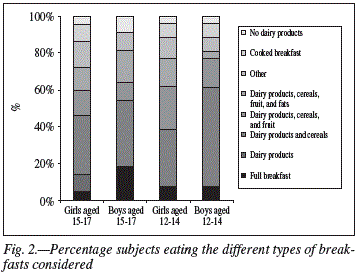
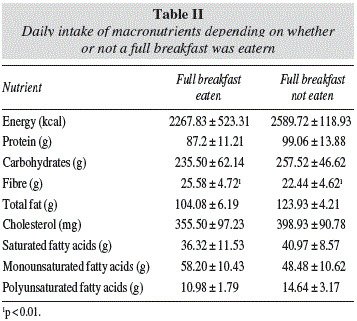
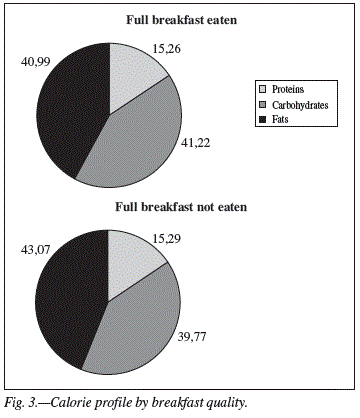
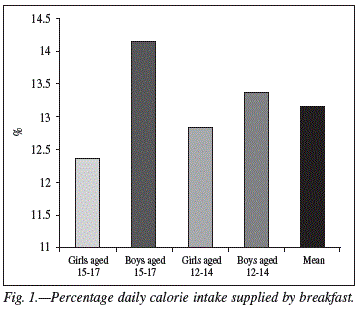
<body><![CDATA[<p><font face="Verdana" size="2">According to the IOTF<sup>24</sup> criteria for obesity and overweight, 16.09 % of subjects were overweight and 6.89 % were obese (<a target="_blank" href="/img/revistas/nh/v26n5/05_original_04_t1.gif">table I</a>). The results varied appreciably for the different groups considered (significant differences by age and sex), with the highest for the boys 15-17 years of age (30% overweight and 10% obese). Girls had significantly lower percentages for both categories (p &lt; 0.01). No 15 to 17-year-old female subjects were obese.</font></p>     <p><font face="Verdana" size="2">From the results summarized in <a target="_blank" href="/img/revistas/nh/v26n5/05_original_04_t1.gif">table I</a>, a group of 15-17-year-old girls (8.70%) skipped breakfast. All the other subjects in the study group ate breakfast.</font></p>     <p><font face="Verdana" size="2">The breakfasts eaten contributed 13.17 ± 5.29 % of the daily calorie intake (<a href="#f1">fig. 1</a>), i.e., approximately 50 % of the recommended contribution for breakfasts. The mean calorie intake differed by subject age and sex, with the boys, particularly 15 to 17-year-olds, consuming the most calories (14.14 ± 6.98%), while girls the same age ingested only 12.36 ± 6.55% of their daily calorie intake at breakfast.</font></p>     <p align="center"><font face="Verdana" size="2"><a name="f1"><img src="/img/revistas/nh/v26n5/05_original_04_f1.gif" align="top"></a></font></p>     <p>&nbsp;</p>     <p><font face="Verdana" size="2">By breakfast type the 15 to 17-year-old boys ate the best quality breakfasts, with 18.18% eating a full breakfast. In contrast, the girls the same age ate the lowest-quality breakfasts, with 4.34 % basically having just milk or milk products (<a href="#f2">fig. 2</a>).</font></p>     <p align="center"><font face="Verdana" size="2"><a name="f2"><img src="/img/revistas/nh/v26n5/05_original_04_f2.gif" align="top"></a></font></p>     <p>&nbsp;</p>     <p><font face="Verdana" size="2">A combination of dairy products and cereals was the breakfast most frequently eaten by all the groups considered. Overall, the girls ate the most fruit, though the 15 to 17-year-old boys also had relatively high levels of fruit consumption. Few of the subjects ate cooked breakfasts, approximately 8-9%. The 15 to 17-year-old boys ate no sausage meats, eggs, or the like over the study period, and around 4-10% of the subjects, depending on age and sex, reported that they did not eat any dairy products at breakfast.</font></p>     <p><font face="Verdana" size="2">Breakfast quality was not significantly related to the daily calorie intake, but a clear trend was nonetheless observable (<a href="#t2">table II</a>). The subjects who ate a full breakfast had a more moderate overall calorie intake, 2,285.00 ± 523.21 kcal, as opposed to 2,623.00 ± 118.19 kcal for those who ate a lower quality breakfast (mean ± SD for the rest of the groups considered). Furthermore, the calorie profile of the subjects who ate a full breakfast was somewhat closer to the recommended level (<a href="#f3">fig. 3</a>), and they consumed less fat, particularly saturated fat and cholesterol (<a href="#t2">table II</a>). This same group also ate more fibre (p &lt; 0.01) and monounsaturated fatty acids.</font></p>     ]]></body>
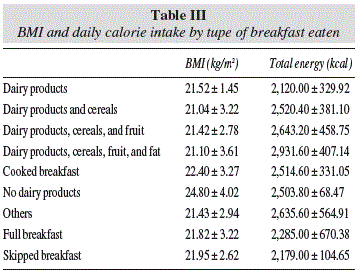
<body><![CDATA[<p align="center"><font face="Verdana" size="2"><a name="t2"><img src="/img/revistas/nh/v26n5/05_original_04_t2.gif" align="top"></a></font></p>     <p>&nbsp;</p>     <p align="center"><font face="Verdana" size="2"><a name="f3"><img src="/img/revistas/nh/v26n5/05_original_04_f3.gif" align="top"></a></font></p>     <p>&nbsp;</p>     <p><font face="Verdana" size="2"><a href="#t3">Table III</a> relates breakfast type and composition to the BMI and shows that the highest BMI values were recorded for those subjects that ate a cooked breakfast (22.4 ± 3.27 kg/m<sup>2</sup>) and for those subjects whose breakfasts did not include dairy products (24.8 ± 4.02 kg/m<sup>2</sup>), this latter value being associated with overweight. BMI values for the rest of the groups considered were similar, ranging from 21.04 ± 3.22 kg/m<sup>2</sup> for the dairy product/cereal group to 21.82 ± 3.21 kg/m<sup>2</sup> for the fullbreakfast group. Skipping the first meal of the day was not associated with lower BMI values (21.95 ± 2.62 kg/m<sup>2</sup>).</font></p>     <p align="center"><font face="Verdana" size="2"><a name="t3"><img src="/img/revistas/nh/v26n5/05_original_04_t3.gif" align="top"></a></font></p>     <p>&nbsp;</p>     <p><font face="Verdana" size="2">Pearson´s correlation coefficient was used to relate the BMI to breakfast energy intake, yielding a non-significant negative correlation between breakfast energy intake and the BMI (-0.1132). Both the obese group and the  overweight group obtained a smaller proportion of their calorie intakes from breakfast (<a target="_blank" href="/img/revistas/nh/v26n5/05_original_04_t4.gif">table IV</a>). The correlations between the BMI and dairy product, cereal, calcium, fibre, and protein consumption were also calculated, and an inverse relationship was observed in all cases, except for the protein. While these relationships were not significant, they nonetheless did point to a clear trend.</font></p>     <p><font face="Verdana" size="2">Parents´ social status did not appear to have any influence, though the number of siblings did, particularly for the subjects who had three or five siblings and those who had two or four siblings. The more siblings, the higher the percentage of the total calorie intake supplied by breakfast.</font></p>     <p>&nbsp;</p>     ]]></body>
<body><![CDATA[<p><font face="Verdana" size="2"><b>Discussion</b></font></p>     <p><font face="Verdana" size="2">The juvenile population in Guadalajara studied here is representative of the population in Spain as a whole, with normal BMI and adiposity values. The findings show that for anatomical and physiological reasons, girls carry more fat, principally in the gluteal region. On looking more closely at the rates of obesity and overweight, the mean values were 16.09% overweight and 6.89% obese. However, the proportion of overweight subjects among the boys was much higher than the values published in the EnKid<sup>26</sup> study (20% of 10 to 13-year-olds and 10.3% of 14 to 17-year-olds), whereas the converse held true for the girls (9.1% of 10 to 13-year-olds and 8% of 14 to 17-year-olds). The prevalence of obesity in all four groups of the study population considered in Guadalajara was much lower than the prevalence reported in the EnKid<sup>26</sup> study.</font></p>     <p><font face="Verdana" size="2">Since breakfast appears to be an indicator of healthy eating habits and to have an effect on whether or not a person becomes overweight or obese<sup>27</sup>, an assessment was performed taking into account both breakfast quality and whether or not breakfast was skipped. The first point to be noted is that, as reported in other national or international studies of this kind, the subjects that made up the population studied here were not aware of the physical and psychological benefits of eating a good breakfast,<sup>28</sup> especially during childhood and adolescence<sup>9</sup>. Accordingly, a group of 15 to 17-year-old female subjects (8.70%) did not have breakfast, some "to lose weight", others because they did not have time to make breakfast. Affenito<sup>27</sup> reported a similar proportion of people who skipped breakfast and also recorded a decrease in breakfast frequency with age.</font></p>     <p><font face="Verdana" size="2">Breakfast supplied only 13.17% of the total energy intake, that is, 50% of the recommended value. Rocandio<sup>29</sup> reported slightly higher values, with breakfast supplying 17% of the total calorie intake. According to the results of this study, both age and sex influenced breakfast eating habits, because of the belief that a small breakfast helps you lose weight, which was more prevalent among the older girls than among the boys.</font></p>     <p><font face="Verdana" size="2">Clearly, given that the proportion of the daily energy intake supplied by breakfast was lower than the recommended value, it follows that the proportion of study subjects who ate a full breakfast was also quite low. The great majority of subjects reported eating dairy products at breakfast, ordinarily chocolate milk in the case of the younger subjects, and cereals (cookies, bread, baked goods, breakfast cereals). Breakfast cereals have increasingly replaced cookies, toast, and home-made baked goods in recent years. This may be ascribable to the influence of eating habits from other countries, advertising, and convenience in a society in which time is becoming an ever scarcer commodity. Additionally, it should be noted that breakfast cereals, which are ordinarily enriched with vitamins and minerals, are looked upon as being indicative of a healthy lifestyle.<sup>30</sup></font></p>     <p><font face="Verdana" size="2">Consumption of fruit and freshly made juices was low, and these foods were eaten mostly by the female subjects in both of the age groups considered. These findings are similar to those reported by other authors, e.g., Folguera and Bonilla<sup>31</sup> and the Instituto de Investigación de Mercado.<sup>32,33</sup> Our study has included a breakfast type referred to as a cooked breakfast, defined as consisting of eggs, sausage meats, and the like, and according to our results this breakfast type was eaten by 8-9% of our subjects. This percentage is higher than the percentage recorded by Moreiras and Carvajal,<sup>34</sup> who reported that 2% of their study population ate cooked breakfasts. The subjects who ate a cooked breakfast tended to have high BMIs, most likely because of their habit of eating high energy dense foods.</font></p>     <p><font face="Verdana" size="2">Depending on age and sex, some 4-10% of the subjects did not consume any type of dairy product at breakfast, which could have an effect on their nutrient intake, particularly calcium intake. In fact, 75% of the subjects surveyed who did not eat dairy products at breakfast had an insufficient calcium intake of around 60% of the RDA. As already pointed out in the previous section, while no significant relationship between breakfast quality and the daily calorie intake was observed, the results obtained did suggest that those subjects who ate an insufficient breakfast felt hungrier, which in turn led to their eating larger amounts of food or to choosing foods with high energy densities for their other meals.<sup>11</sup> As a matter of fact, the subjects who did not eat a full breakfast consumed higher amounts of fats, especially saturated fats and cholesterol, and thus their diet tended to be less healthy overall. The girls who skipped breakfast had low daily energy intakes, because they reported that they were dieting to lose weight, without supervision by a specialist.</font></p>     <p><font face="Verdana" size="2">The relationships between dairy product consumption and calcium intake and the BMI were calculated using the same procedures employed by other researchers,<sup>13,14</sup> with inverse correlations being found in both cases (-0.2147 and -0.2268, respectively). Thus, as in other published reports, eating dairy products not only lowers the risk of osteoporosis and hypertension as adults but also could help prevent and treat obesity. The mechanism by which dairy products influence weight and body fat is unknown, but some studies have claimed that calcium does play such a role.<sup>35-38</sup></font></p>     <p><font face="Verdana" size="2">Different mechanisms could be involved, for instance, inhibition of fat absorption,<sup>39</sup> regulation of the lipid metabolism, or increased expression of UCP<sub>2</sub> and hence thermogenesis in white adipose tissue.<sup>40</sup></font></p>     <p><font face="Verdana" size="2">However, other studies have suggested that the protein content, not calcium, is responsible for weight loss, possibly by interfering with the reninangiotensin system in adipocytes.<sup>41</sup> The results of our study did not explain the inverse relationship between the prevalence of overweight and obesity and the energy intake from breakfast, inasmuch as the correlation coefficient obtained for the BMI and proteins was negligible (0.052). Based on the correlation coefficient values obtained, cereal and fibre consumption exerted a greater influence on body weight. Some other published studies<sup>42-44</sup> have reported cereal consumption at breakfast or over the course of the day to be inversely related to weight gain. This could be attributable to cereal´s high soluble and insoluble fibre contents, which act to reduce fat absorption, to heighten the feeling of satiation, and thus to lower food intake.<sup>45</sup></font></p>     ]]></body>
<body><![CDATA[<p><font face="Verdana" size="2">Because of the low number of subjects who ate a full breakfast, it turned out not to be possible to ascertain the influence of certain socioeconomic factors (family social status, whether breakfast was eaten alone or in the company of other family members, mother´s educational level, or the subjects´ rates of physical activity) on breakfast quality. The sole factor that was observed to have an influence was the number of members making up the family unit. A higher proportion of energy intake was consumed at breakfast and a wider variety of breakfast foods was eaten in families with three or five children.</font></p>     <p>&nbsp;</p>     <p><font face="Verdana" size="2"><b>Conclusions</b></font></p>     <p><font face="Verdana" size="2">The study population generally ate low-quality breakfasts, basically consisting of milk or milk products and cereals, and the breakfasts eaten failed by a wide margin to fulfil the definition of a full breakfast. Breakfast quality was inversely related to the BMI, namely, the poorer the breakfast quality, the higher the prevalence of overweight, and obesity in particular. A trend was observable in the influence of dairy product, cereal, fibre, and calcium consumption on the BMI.</font></p>     <p>&nbsp;</p>     <p><font face="Verdana" size="2"><b>References</b></font></p>     <!-- ref --><p><font face="Verdana" size="2">1. Vázquez R, López Alemany J. Los costes de la obesidad alcanzan el 7 % del gasto sanitario. <i>Rev Esp Econ Salud</i> 2002; 1 (3): 40-42.    &nbsp;&nbsp;&nbsp;&nbsp;&nbsp;&nbsp;&nbsp;&nbsp;[&#160;<a href="javascript:void(0);" onclick="javascript: window.open('/scielo.php?script=sci_nlinks&ref=3631857&pid=S0212-1611201100050000500001&lng=','','width=640,height=500,resizable=yes,scrollbars=1,menubar=yes,');">Links</a>&#160;]<!-- end-ref --></font></p>    <!-- ref --><p><font face="Verdana" size="2">2. Lissner L, Heitmann BL. Dietary fat and obesity: evidence from epidemiology. <i>Eur J Clin Nutr</i> 1995; 49: 79-90.    &nbsp;&nbsp;&nbsp;&nbsp;&nbsp;&nbsp;&nbsp;&nbsp;[&#160;<a href="javascript:void(0);" onclick="javascript: window.open('/scielo.php?script=sci_nlinks&ref=3631859&pid=S0212-1611201100050000500002&lng=','','width=640,height=500,resizable=yes,scrollbars=1,menubar=yes,');">Links</a>&#160;]<!-- end-ref --></font></p>    ]]></body>
<body><![CDATA[<!-- ref --><p><font face="Verdana" size="2">3. National Hearth, Lung and Blood Institute. Clinical guidelines on the identification, evaluation and treatment of overweight and obesity in adults: the evidence report. National Institutes of Health. 1998.    &nbsp;&nbsp;&nbsp;&nbsp;&nbsp;&nbsp;&nbsp;&nbsp;[&#160;<a href="javascript:void(0);" onclick="javascript: window.open('/scielo.php?script=sci_nlinks&ref=3631861&pid=S0212-1611201100050000500003&lng=','','width=640,height=500,resizable=yes,scrollbars=1,menubar=yes,');">Links</a>&#160;]<!-- end-ref --></font></p>    <!-- ref --><p><font face="Verdana" size="2">4. Flegal KM, Carroll MD, Kuczmarski RJ, Jonson CL. Overweight and obesity in the United Status: prevalence and trends, 1960-1994. <i>Int J Obes Relat Metab Disord</i> 1998; 22: 39-47.    &nbsp;&nbsp;&nbsp;&nbsp;&nbsp;&nbsp;&nbsp;&nbsp;[&#160;<a href="javascript:void(0);" onclick="javascript: window.open('/scielo.php?script=sci_nlinks&ref=3631863&pid=S0212-1611201100050000500004&lng=','','width=640,height=500,resizable=yes,scrollbars=1,menubar=yes,');">Links</a>&#160;]<!-- end-ref --></font></p>    <!-- ref --><p><font face="Verdana" size="2">5. Suwaidi JA, Higano ST, Holems DR, Lennon R, Lerman R. Obesity is independently associated with coronary endothelial dysfunction in patients with normal or mildly diseased coronary arteries. <i>J Am Coll Cardiol</i> 2001; 49: 1523-1528.    &nbsp;&nbsp;&nbsp;&nbsp;&nbsp;&nbsp;&nbsp;&nbsp;[&#160;<a href="javascript:void(0);" onclick="javascript: window.open('/scielo.php?script=sci_nlinks&ref=3631865&pid=S0212-1611201100050000500005&lng=','','width=640,height=500,resizable=yes,scrollbars=1,menubar=yes,');">Links</a>&#160;]<!-- end-ref --></font></p>    <!-- ref --><p><font face="Verdana" size="2">6. Soriguer F, Rojo-Martínez G. Esteva de Antonio J, Ruiz de Adana MS, Catalá M, Marelo MJ, Beltran M, Tinahoes FJ. Prevalence of obesity in south-east Spain and its relation with social and health factors. <i>Eur J Epidem</i> 2004; 19: 33-40.    &nbsp;&nbsp;&nbsp;&nbsp;&nbsp;&nbsp;&nbsp;&nbsp;[&#160;<a href="javascript:void(0);" onclick="javascript: window.open('/scielo.php?script=sci_nlinks&ref=3631867&pid=S0212-1611201100050000500006&lng=','','width=640,height=500,resizable=yes,scrollbars=1,menubar=yes,');">Links</a>&#160;]<!-- end-ref --></font></p>    <!-- ref --><p><font face="Verdana" size="2">7. Aranceta J, Serra-Majem LL, Foz Sala M, Moreno Estaban B et al. Prevalencia de obesidad en España. <i>Med Clin (Bare)</i> 2005; 125 (12): 460-466.    &nbsp;&nbsp;&nbsp;&nbsp;&nbsp;&nbsp;&nbsp;&nbsp;[&#160;<a href="javascript:void(0);" onclick="javascript: window.open('/scielo.php?script=sci_nlinks&ref=3631869&pid=S0212-1611201100050000500007&lng=','','width=640,height=500,resizable=yes,scrollbars=1,menubar=yes,');">Links</a>&#160;]<!-- end-ref --></font></p>    ]]></body>
<body><![CDATA[<!-- ref --><p><font face="Verdana" size="2">8. Serra LI y Aranceta J. Estudio EnKid 1998-2000. Barcelona, Masson. 2000.    &nbsp;&nbsp;&nbsp;&nbsp;&nbsp;&nbsp;&nbsp;&nbsp;[&#160;<a href="javascript:void(0);" onclick="javascript: window.open('/scielo.php?script=sci_nlinks&ref=3631871&pid=S0212-1611201100050000500008&lng=','','width=640,height=500,resizable=yes,scrollbars=1,menubar=yes,');">Links</a>&#160;]<!-- end-ref --></font></p>    <!-- ref --><p><font face="Verdana" size="2">9. Pinto JA y Carbajal A. El desayuno saludable. Nutrición y salud. Instituto de Salud Pública, Madrid. 2003.    &nbsp;&nbsp;&nbsp;&nbsp;&nbsp;&nbsp;&nbsp;&nbsp;[&#160;<a href="javascript:void(0);" onclick="javascript: window.open('/scielo.php?script=sci_nlinks&ref=3631873&pid=S0212-1611201100050000500009&lng=','','width=640,height=500,resizable=yes,scrollbars=1,menubar=yes,');">Links</a>&#160;]<!-- end-ref --></font></p>    <!-- ref --><p><font face="Verdana" size="2">10. Lazzeri G, Giallombardo D, Guidoni C, Zani A, Casorelli A, Grasso A, Pozzi T, Rossi S, Giacchi M. Nutritional surveillance in Tuscany: eating habits at breakfast, mid-morning and afternoon snacks among 8-9 year old children. <i> J Prev Med Hyg</i> 2006; 47 (3): 91-99.    &nbsp;&nbsp;&nbsp;&nbsp;&nbsp;&nbsp;&nbsp;&nbsp;[&#160;<a href="javascript:void(0);" onclick="javascript: window.open('/scielo.php?script=sci_nlinks&ref=3631875&pid=S0212-1611201100050000500010&lng=','','width=640,height=500,resizable=yes,scrollbars=1,menubar=yes,');">Links</a>&#160;]<!-- end-ref --></font></p>    <!-- ref --><p><font face="Verdana" size="2">11. Niemeier HM, Raynor HA, Lloyd-Richardson EE, Rogers ML, Wing RR. Fast food consumption and breakfast skipping: predictors of weight gain from adolescence to adulthood in a nationally representative sample. <i>J Ado Health</i> 2006; 39:842-849.    &nbsp;&nbsp;&nbsp;&nbsp;&nbsp;&nbsp;&nbsp;&nbsp;[&#160;<a href="javascript:void(0);" onclick="javascript: window.open('/scielo.php?script=sci_nlinks&ref=3631877&pid=S0212-1611201100050000500011&lng=','','width=640,height=500,resizable=yes,scrollbars=1,menubar=yes,');">Links</a>&#160;]<!-- end-ref --></font></p>    <!-- ref --><p><font face="Verdana" size="2">12. Cho S, Dietrich M, Brown CJP, Clark CA, Block G. The effect of breakfast type on total daily energy intake and body mass index: Results from the Third National Health and Nutrition Examination Survey (NHANES III). <i>J Am Coll Nutr</i> 2003; 22 (4): 296-302.    &nbsp;&nbsp;&nbsp;&nbsp;&nbsp;&nbsp;&nbsp;&nbsp;[&#160;<a href="javascript:void(0);" onclick="javascript: window.open('/scielo.php?script=sci_nlinks&ref=3631879&pid=S0212-1611201100050000500012&lng=','','width=640,height=500,resizable=yes,scrollbars=1,menubar=yes,');">Links</a>&#160;]<!-- end-ref --></font></p>    ]]></body>
<body><![CDATA[<!-- ref --><p><font face="Verdana" size="2">13. Mirmiran P, Esmaillzadeh, Azizi F. Dairy consumption and body mass index: an inverse relationship. <i>Int J Obes</i> 2005; 29: 115-121.    &nbsp;&nbsp;&nbsp;&nbsp;&nbsp;&nbsp;&nbsp;&nbsp;[&#160;<a href="javascript:void(0);" onclick="javascript: window.open('/scielo.php?script=sci_nlinks&ref=3631881&pid=S0212-1611201100050000500013&lng=','','width=640,height=500,resizable=yes,scrollbars=1,menubar=yes,');">Links</a>&#160;]<!-- end-ref --></font></p>    <!-- ref --><p><font face="Verdana" size="2">14. Seiquer I, López Frias M, Muñoz Floyos A, Galdo G, Delgado Andrade C, Mesias M, Navarro MP. Dietary calcium utilization among a group of Spanish boys aged 11-14 years on their usual diets. <i>J Phys Biochem </i>2006; 62 (1): 9-16.    &nbsp;&nbsp;&nbsp;&nbsp;&nbsp;&nbsp;&nbsp;&nbsp;[&#160;<a href="javascript:void(0);" onclick="javascript: window.open('/scielo.php?script=sci_nlinks&ref=3631883&pid=S0212-1611201100050000500014&lng=','','width=640,height=500,resizable=yes,scrollbars=1,menubar=yes,');">Links</a>&#160;]<!-- end-ref --></font></p>    <!-- ref --><p><font face="Verdana" size="2">15. Barton BA.Eldridge AL, Thompson D, Affenito SG, Striegel Moore RH, Franko DI, Albertson AM, Crockett SJ. The Relationship of Breakfast and Cereal Consumption to Nutrient Intake and Body Mass Index: The National Heart, Lung, and Blood Institute Growth and Health Study. <i>Am Diet Assoc</i> 2005; 105:1383-1389.    &nbsp;&nbsp;&nbsp;&nbsp;&nbsp;&nbsp;&nbsp;&nbsp;[&#160;<a href="javascript:void(0);" onclick="javascript: window.open('/scielo.php?script=sci_nlinks&ref=3631885&pid=S0212-1611201100050000500015&lng=','','width=640,height=500,resizable=yes,scrollbars=1,menubar=yes,');">Links</a>&#160;]<!-- end-ref --></font></p>    <!-- ref --><p><font face="Verdana" size="2">16. Harder T, Bergmann R, Kalliscgnigg G, Plagemann A. Duration of breastfeeding and risk of overweight: A meta-analysis. <i>Am J Epid</i> 2005,DOI: 10.1093/aje/kwi222.    &nbsp;&nbsp;&nbsp;&nbsp;&nbsp;&nbsp;&nbsp;&nbsp;[&#160;<a href="javascript:void(0);" onclick="javascript: window.open('/scielo.php?script=sci_nlinks&ref=3631887&pid=S0212-1611201100050000500016&lng=','','width=640,height=500,resizable=yes,scrollbars=1,menubar=yes,');">Links</a>&#160;]<!-- end-ref --></font></p>    <!-- ref --><p><font face="Verdana" size="2">17. Fernández I, Mateos CJ, Aguilar MV, Martínez Para MC. Hábitos alimentarios de una población juvenil de Guadalajara (Castilla-La Mancha). Factores que influyen sobre la elección de alimentos. <i>Rev Esp Nutr Com</i> 2006; 12(3): 172-181.    &nbsp;&nbsp;&nbsp;&nbsp;&nbsp;&nbsp;&nbsp;&nbsp;[&#160;<a href="javascript:void(0);" onclick="javascript: window.open('/scielo.php?script=sci_nlinks&ref=3631889&pid=S0212-1611201100050000500017&lng=','','width=640,height=500,resizable=yes,scrollbars=1,menubar=yes,');">Links</a>&#160;]<!-- end-ref --></font></p>    ]]></body>
<body><![CDATA[<!-- ref --><p><font face="Verdana" size="2">18. Fernández Morales I, Aguilar Vilas MV, Mateos Vega CJ, Martínez Para MC. Ingesta de nutrientes en una población juvenil. Prevalencia de sobrepeso y obesidad. <i>Nutr Clin Diet Hosp</i> 2007; 27 (3): 18-28.    &nbsp;&nbsp;&nbsp;&nbsp;&nbsp;&nbsp;&nbsp;&nbsp;[&#160;<a href="javascript:void(0);" onclick="javascript: window.open('/scielo.php?script=sci_nlinks&ref=3631891&pid=S0212-1611201100050000500018&lng=','','width=640,height=500,resizable=yes,scrollbars=1,menubar=yes,');">Links</a>&#160;]<!-- end-ref --></font></p>    <!-- ref --><p><font face="Verdana" size="2">19. FAO/WHO/ONU. Expert Consultation Report. Energy and Protein Requirements. Technical Report Series 724. WHO, Geneve. 1985.    &nbsp;&nbsp;&nbsp;&nbsp;&nbsp;&nbsp;&nbsp;&nbsp;[&#160;<a href="javascript:void(0);" onclick="javascript: window.open('/scielo.php?script=sci_nlinks&ref=3631893&pid=S0212-1611201100050000500019&lng=','','width=640,height=500,resizable=yes,scrollbars=1,menubar=yes,');">Links</a>&#160;]<!-- end-ref --></font></p>    <!-- ref --><p><font face="Verdana" size="2">20. Departamento de Nutrición. Ingestas recomendadas de energía y nutrientes para la población española. Departamento de Nutrición, Madrid. 1994.    &nbsp;&nbsp;&nbsp;&nbsp;&nbsp;&nbsp;&nbsp;&nbsp;[&#160;<a href="javascript:void(0);" onclick="javascript: window.open('/scielo.php?script=sci_nlinks&ref=3631895&pid=S0212-1611201100050000500020&lng=','','width=640,height=500,resizable=yes,scrollbars=1,menubar=yes,');">Links</a>&#160;]<!-- end-ref --></font></p>    <!-- ref --><p><font face="Verdana" size="2">21. Ortega RM, Requejo AM, Navia B. Ingestas diarias recomendadas de energía y nutrientes. Departamento de Nutrición, Universidad Complutense, Madrid. 1999.    &nbsp;&nbsp;&nbsp;&nbsp;&nbsp;&nbsp;&nbsp;&nbsp;[&#160;<a href="javascript:void(0);" onclick="javascript: window.open('/scielo.php?script=sci_nlinks&ref=3631897&pid=S0212-1611201100050000500021&lng=','','width=640,height=500,resizable=yes,scrollbars=1,menubar=yes,');">Links</a>&#160;]<!-- end-ref --></font></p>    <!-- ref --><p><font face="Verdana" size="2"> 22. Navia B, Ortega RM. Ingestas recomendadas de energía y nutrientes. In  Requejo AM, Ortega RM., editors. Nutriguía. Manual de nutrición clínica en  atención primaria. Madrid. Editorial Complutense. 2000, pp. 3-13.    &nbsp;&nbsp;&nbsp;&nbsp;&nbsp;&nbsp;&nbsp;&nbsp;[&#160;<a href="javascript:void(0);" onclick="javascript: window.open('/scielo.php?script=sci_nlinks&ref=3631899&pid=S0212-1611201100050000500022&lng=','','width=640,height=500,resizable=yes,scrollbars=1,menubar=yes,');">Links</a>&#160;]<!-- end-ref --></font></p>    ]]></body>
<body><![CDATA[<!-- ref --><p><font face="Verdana" size="2">23. Institute of Medicine. Dietary Reference Intakes. Standing Committee on the Scientific Evaluation of Dietary Reference Intakes. Food and Nutrition Board, Institute of Medicine. National Academy Press, Washington DC. 2001.    &nbsp;&nbsp;&nbsp;&nbsp;&nbsp;&nbsp;&nbsp;&nbsp;[&#160;<a href="javascript:void(0);" onclick="javascript: window.open('/scielo.php?script=sci_nlinks&ref=3631901&pid=S0212-1611201100050000500023&lng=','','width=640,height=500,resizable=yes,scrollbars=1,menubar=yes,');">Links</a>&#160;]<!-- end-ref --></font></p>    <!-- ref --><p><font face="Verdana" size="2">24. Cole TJ, Bellizzi MC, Flegal KM, Dietz WH. Establishing a standard definition for child overweight and obesity worldwide: international survey. <i>BMJ</i> 2000; 320: 1240-1245.    &nbsp;&nbsp;&nbsp;&nbsp;&nbsp;&nbsp;&nbsp;&nbsp;[&#160;<a href="javascript:void(0);" onclick="javascript: window.open('/scielo.php?script=sci_nlinks&ref=3631903&pid=S0212-1611201100050000500024&lng=','','width=640,height=500,resizable=yes,scrollbars=1,menubar=yes,');">Links</a>&#160;]<!-- end-ref --></font></p>    <!-- ref --><p><font face="Verdana" size="2">25. Sobradillo B, Aguirre A, Aresti U, Bilbao A et al. Curvas y Tablas de Crecimiento (Longitudinal y Transversal). Instituto de Investigación sobre Crecimiento y Desarrollo. Fundación Faustino Orbegozo Eizaguirre. Bilbao. 2004.    &nbsp;&nbsp;&nbsp;&nbsp;&nbsp;&nbsp;&nbsp;&nbsp;[&#160;<a href="javascript:void(0);" onclick="javascript: window.open('/scielo.php?script=sci_nlinks&ref=3631905&pid=S0212-1611201100050000500025&lng=','','width=640,height=500,resizable=yes,scrollbars=1,menubar=yes,');">Links</a>&#160;]<!-- end-ref --></font></p>    <!-- ref --><p><font face="Verdana" size="2">26. Serra-Majem L, Ribas Barba L, Aranceta Bartrina J, Pérez Rodrigo C, Saavedra Santana P, Peña Quintana L. Obesidad infantil y juvenil en España. Resultados del estudio EnKid (1998-2000). <i>Med Clin (Bare)</i> 2003; 121: 725-732.    &nbsp;&nbsp;&nbsp;&nbsp;&nbsp;&nbsp;&nbsp;&nbsp;[&#160;<a href="javascript:void(0);" onclick="javascript: window.open('/scielo.php?script=sci_nlinks&ref=3631907&pid=S0212-1611201100050000500026&lng=','','width=640,height=500,resizable=yes,scrollbars=1,menubar=yes,');">Links</a>&#160;]<!-- end-ref --></font></p>    <!-- ref --><p><font face="Verdana" size="2">27. Affenito SG, Thompson DR, Barton BA, et al. Breakfast consumption by African-American and white adolescent girls correlates positively with calcium and fiber intake and negatively with body mass index. <i>J Am Diet Assoc</i> 2005; 105: 938-945.    &nbsp;&nbsp;&nbsp;&nbsp;&nbsp;&nbsp;&nbsp;&nbsp;[&#160;<a href="javascript:void(0);" onclick="javascript: window.open('/scielo.php?script=sci_nlinks&ref=3631909&pid=S0212-1611201100050000500027&lng=','','width=640,height=500,resizable=yes,scrollbars=1,menubar=yes,');">Links</a>&#160;]<!-- end-ref --></font></p>    ]]></body>
<body><![CDATA[<!-- ref --><p><font face="Verdana" size="2">28. Chandler AK, Walker SP, Connolly K, Grantham-Mcgregor SM. School breakfast improves verbal fluency in undernourished Jamaican children. <i>J Nutr</i> 1995; 125: 894-900.    &nbsp;&nbsp;&nbsp;&nbsp;&nbsp;&nbsp;&nbsp;&nbsp;[&#160;<a href="javascript:void(0);" onclick="javascript: window.open('/scielo.php?script=sci_nlinks&ref=3631911&pid=S0212-1611201100050000500028&lng=','','width=640,height=500,resizable=yes,scrollbars=1,menubar=yes,');">Links</a>&#160;]<!-- end-ref --></font></p>    <!-- ref --><p><font face="Verdana" size="2">29. Rocandio AM, Ansotegui L, Arroyo M: Comparison of dietary intake among overweight and non-overweight schoolchildren. <i>Int J Obes 2001; 25:</i> 1651-1655.    &nbsp;&nbsp;&nbsp;&nbsp;&nbsp;&nbsp;&nbsp;&nbsp;[&#160;<a href="javascript:void(0);" onclick="javascript: window.open('/scielo.php?script=sci_nlinks&ref=3631913&pid=S0212-1611201100050000500029&lng=','','width=640,height=500,resizable=yes,scrollbars=1,menubar=yes,');">Links</a>&#160;]<!-- end-ref --></font></p>    <!-- ref --><p><font face="Verdana" size="2">30. Siega-Riz AM, Poplin BM, Carson T. Differences in food patterns at breakfast by sociodemographic characteristic among a nationally representative sample of adults in the US. <i>Prev Med</i> 2000; 30:415-424.    &nbsp;&nbsp;&nbsp;&nbsp;&nbsp;&nbsp;&nbsp;&nbsp;[&#160;<a href="javascript:void(0);" onclick="javascript: window.open('/scielo.php?script=sci_nlinks&ref=3631915&pid=S0212-1611201100050000500030&lng=','','width=640,height=500,resizable=yes,scrollbars=1,menubar=yes,');">Links</a>&#160;]<!-- end-ref --></font></p>    <!-- ref --><p><font face="Verdana" size="2">31. Folguera MC, Bonilla Y. Hábitos de salud en los escolares. <i>Revista ROL de Enfermería</i> 1996; 212: 59-63.    &nbsp;&nbsp;&nbsp;&nbsp;&nbsp;&nbsp;&nbsp;&nbsp;[&#160;<a href="javascript:void(0);" onclick="javascript: window.open('/scielo.php?script=sci_nlinks&ref=3631917&pid=S0212-1611201100050000500031&lng=','','width=640,height=500,resizable=yes,scrollbars=1,menubar=yes,');">Links</a>&#160;]<!-- end-ref --></font></p>    <!-- ref --><p><font face="Verdana" size="2">32. Instituto de Investigación de Mercado DYM. Estudio base de cacao en polvo a individuos de 3-65 años. Barcelona. 1993.    &nbsp;&nbsp;&nbsp;&nbsp;&nbsp;&nbsp;&nbsp;&nbsp;[&#160;<a href="javascript:void(0);" onclick="javascript: window.open('/scielo.php?script=sci_nlinks&ref=3631919&pid=S0212-1611201100050000500032&lng=','','width=640,height=500,resizable=yes,scrollbars=1,menubar=yes,');">Links</a>&#160;]<!-- end-ref --></font></p>    ]]></body>
<body><![CDATA[<!-- ref --><p><font face="Verdana" size="2">33. Instituto de Investigación de Mercado PAC. Estudio en niños/as y jóvenes de 6-16 años. Hábitos de desayuno. Barcelona. 1992.    &nbsp;&nbsp;&nbsp;&nbsp;&nbsp;&nbsp;&nbsp;&nbsp;[&#160;<a href="javascript:void(0);" onclick="javascript: window.open('/scielo.php?script=sci_nlinks&ref=3631921&pid=S0212-1611201100050000500033&lng=','','width=640,height=500,resizable=yes,scrollbars=1,menubar=yes,');">Links</a>&#160;]<!-- end-ref --></font></p>    <!-- ref --><p><font face="Verdana" size="2">34. Moreiras O, Carvajal A. El desayuno en los hábitos alimentarios de estudiantes de diversas edades de Madrid; in Problemática del desayuno en la nutrición de los españoles. Publicaciones: Serie Divulgación n<sup>o</sup> 3. Fundación Española de la Nutrición. Madrid. 1984, pp. 20-32.    &nbsp;&nbsp;&nbsp;&nbsp;&nbsp;&nbsp;&nbsp;&nbsp;[&#160;<a href="javascript:void(0);" onclick="javascript: window.open('/scielo.php?script=sci_nlinks&ref=3631923&pid=S0212-1611201100050000500034&lng=','','width=640,height=500,resizable=yes,scrollbars=1,menubar=yes,');">Links</a>&#160;]<!-- end-ref --></font></p>    <!-- ref --><p><font face="Verdana" size="2">35. McCarron DA, Morris CD, Henry HJ, Stanten JL. Blood pressure and nutrient intake in the United States. <i>Science</i> 1984; 224: 1392-1398.    &nbsp;&nbsp;&nbsp;&nbsp;&nbsp;&nbsp;&nbsp;&nbsp;[&#160;<a href="javascript:void(0);" onclick="javascript: window.open('/scielo.php?script=sci_nlinks&ref=3631925&pid=S0212-1611201100050000500035&lng=','','width=640,height=500,resizable=yes,scrollbars=1,menubar=yes,');">Links</a>&#160;]<!-- end-ref --></font></p>    <!-- ref --><p><font face="Verdana" size="2">36. Bursey RG, Sharkey T, Miller GD. High calcium intake lowers weight in lean and fatty Zucker rats. <i>FASEBJ</i> 1989; 3137: A 265.    &nbsp;&nbsp;&nbsp;&nbsp;&nbsp;&nbsp;&nbsp;&nbsp;[&#160;<a href="javascript:void(0);" onclick="javascript: window.open('/scielo.php?script=sci_nlinks&ref=3631927&pid=S0212-1611201100050000500036&lng=','','width=640,height=500,resizable=yes,scrollbars=1,menubar=yes,');">Links</a>&#160;]<!-- end-ref --></font></p>    <!-- ref --><p><font face="Verdana" size="2">37. Fleming KH, Heinbach JT. Consumption of calcium in the US: food sources and intake levels. <i>J Nutr</i>  1994; 124: 1426S-1430S.    &nbsp;&nbsp;&nbsp;&nbsp;&nbsp;&nbsp;&nbsp;&nbsp;[&#160;<a href="javascript:void(0);" onclick="javascript: window.open('/scielo.php?script=sci_nlinks&ref=3631929&pid=S0212-1611201100050000500037&lng=','','width=640,height=500,resizable=yes,scrollbars=1,menubar=yes,');">Links</a>&#160;]<!-- end-ref --></font></p>    ]]></body>
<body><![CDATA[<!-- ref --><p><font face="Verdana" size="2">38. Zemel MB, Shi H, Greer B, Dirienzo D, Zemel PC. Regulation of adiposity by dietary calcium. <i>FASEB J</i> 2000; 14: 1132-1138.    &nbsp;&nbsp;&nbsp;&nbsp;&nbsp;&nbsp;&nbsp;&nbsp;[&#160;<a href="javascript:void(0);" onclick="javascript: window.open('/scielo.php?script=sci_nlinks&ref=3631931&pid=S0212-1611201100050000500038&lng=','','width=640,height=500,resizable=yes,scrollbars=1,menubar=yes,');">Links</a>&#160;]<!-- end-ref --></font></p>    <!-- ref --><p><font face="Verdana" size="2">39. Welberg JWM, Monkelbaan JF, de Vries EGE, Muskiet FAJ, Cats A, Oremus ET, Boersma-van EK, van Rijsbergen H, van der Meer R, Mulder NH. Effects of supplemental dietary calcium on quantitative and qualitative fecal fat excretion in man. <i>Ann Nutr Metab</i> 1994; 38:185-191.    &nbsp;&nbsp;&nbsp;&nbsp;&nbsp;&nbsp;&nbsp;&nbsp;[&#160;<a href="javascript:void(0);" onclick="javascript: window.open('/scielo.php?script=sci_nlinks&ref=3631933&pid=S0212-1611201100050000500039&lng=','','width=640,height=500,resizable=yes,scrollbars=1,menubar=yes,');">Links</a>&#160;]<!-- end-ref --></font></p>    <!-- ref --><p><font face="Verdana" size="2">40. Shi H, DiRienzo D, Zemel MB. Effects of dietary calcium and adiposity lipid metabolism and body weight regulation in energy-restricted ap2-agouti transgenic mice. <i>FASEB</i>  J 2000; 8:291-330.    &nbsp;&nbsp;&nbsp;&nbsp;&nbsp;&nbsp;&nbsp;&nbsp;[&#160;<a href="javascript:void(0);" onclick="javascript: window.open('/scielo.php?script=sci_nlinks&ref=3631935&pid=S0212-1611201100050000500040&lng=','','width=640,height=500,resizable=yes,scrollbars=1,menubar=yes,');">Links</a>&#160;]<!-- end-ref --></font></p>    <!-- ref --><p><font face="Verdana" size="2">41. Morris K, Wong Y, Kim S, Moustaid-MoussaN. Dietary and hormonal regulation of the mammalian fatty acid synthase gene. In Moustaid Moussa N, Berdanier CD editors. Nutrient-gene interactions in health and disease. CRC Press: Boca Raton, FL. 2001.    &nbsp;&nbsp;&nbsp;&nbsp;&nbsp;&nbsp;&nbsp;&nbsp;[&#160;<a href="javascript:void(0);" onclick="javascript: window.open('/scielo.php?script=sci_nlinks&ref=3631937&pid=S0212-1611201100050000500041&lng=','','width=640,height=500,resizable=yes,scrollbars=1,menubar=yes,');">Links</a>&#160;]<!-- end-ref --></font></p>    <!-- ref --><p><font face="Verdana" size="2">42. Huang YL, Hoerr SL, Song WO. Breakfast is the lowest fat meal for young adult women. <i>J Nutr Educ</i> 1997; 29: 184-188.    &nbsp;&nbsp;&nbsp;&nbsp;&nbsp;&nbsp;&nbsp;&nbsp;[&#160;<a href="javascript:void(0);" onclick="javascript: window.open('/scielo.php?script=sci_nlinks&ref=3631939&pid=S0212-1611201100050000500042&lng=','','width=640,height=500,resizable=yes,scrollbars=1,menubar=yes,');">Links</a>&#160;]<!-- end-ref --></font></p>    ]]></body>
<body><![CDATA[<!-- ref --><p><font face="Verdana" size="2">43. Liu S, Willett WC, Manson JE, Hu FB, Rosner B, Colditz G. Relation between changes in intakes of dietary fiber and grain products and changes in weight and development of obesity among middle-aged women. <i>Am J Clin Nutr</i> 2003; 78:920-927.    &nbsp;&nbsp;&nbsp;&nbsp;&nbsp;&nbsp;&nbsp;&nbsp;[&#160;<a href="javascript:void(0);" onclick="javascript: window.open('/scielo.php?script=sci_nlinks&ref=3631941&pid=S0212-1611201100050000500043&lng=','','width=640,height=500,resizable=yes,scrollbars=1,menubar=yes,');">Links</a>&#160;]<!-- end-ref --></font></p>    <!-- ref --><p><font face="Verdana" size="2">44. Bazzano LA, Yiqing Song, Vadim Bubes CK, Good JEM, Liu S. Dietary intake of whole and refined grain breakfast cereals and weight gain in men. <i>Obes Res</i> 2005; 13(11): 1952-1960.    &nbsp;&nbsp;&nbsp;&nbsp;&nbsp;&nbsp;&nbsp;&nbsp;[&#160;<a href="javascript:void(0);" onclick="javascript: window.open('/scielo.php?script=sci_nlinks&ref=3631943&pid=S0212-1611201100050000500044&lng=','','width=640,height=500,resizable=yes,scrollbars=1,menubar=yes,');">Links</a>&#160;]<!-- end-ref --></font></p>    <!-- ref --><p><font face="Verdana" size="2">45. Howarth NC, Saltzman E, Roberts SB. Dietary fiber and weight regulation. <i>Nutr Rev</i> 2001; 59 (5): 129-139.    &nbsp;&nbsp;&nbsp;&nbsp;&nbsp;&nbsp;&nbsp;&nbsp;[&#160;<a href="javascript:void(0);" onclick="javascript: window.open('/scielo.php?script=sci_nlinks&ref=3631945&pid=S0212-1611201100050000500045&lng=','','width=640,height=500,resizable=yes,scrollbars=1,menubar=yes,');">Links</a>&#160;]<!-- end-ref --></font></p>     <p>&nbsp;</p>     <p>&nbsp;</p>     <p><font face="Verdana" size="2"><b><a name="back"></a><a href="#top"><img border="0" src="/img/revistas/nh/v26n5/seta.gif" width="15" height="17"></a>Correspondence:</b>    <br>M<sup>a</sup> Victorina Aguilar Vilas.    ]]></body>
<body><![CDATA[<br>Departamento de Nutrición, Bromatologia y Toxicología.    <br> Facultad de Farmacia. Universidad de Alcalá. Campus Universitario.    <br>28871 Alcalá de Henares. Madrid (Spain).    <br> E-mail: <a href="mailto:mvictorina.aguilar@uah.es">mvictorina.aguilar@uah.es</a></font></p>     <p><font face="Verdana" size="2">Recibido: 14-VII-2010.    <br>1<sup>a</sup> Revisión: 4-X-2010.    <br>2<sup>a</sup> Revisión: 19-X-2010.    <br>3<sup>a</sup> Revisión: 26-X-2010.    <br>Aceptado: 28-XI-2010.</font></p>      ]]></body><back>
<ref-list>
<ref id="B1">
<label>1</label><nlm-citation citation-type="journal">
<person-group person-group-type="author">
<name>
<surname><![CDATA[Vázquez]]></surname>
<given-names><![CDATA[R]]></given-names>
</name>
<name>
<surname><![CDATA[López Alemany]]></surname>
<given-names><![CDATA[J]]></given-names>
</name>
</person-group>
<article-title xml:lang="es"><![CDATA[Los costes de la obesidad alcanzan el 7 % del gasto sanitario]]></article-title>
<source><![CDATA[Rev Esp Econ Salud]]></source>
<year>2002</year>
<volume>1</volume>
<numero>3</numero>
<issue>3</issue>
<page-range>40-42</page-range></nlm-citation>
</ref>
<ref id="B2">
<label>2</label><nlm-citation citation-type="journal">
<person-group person-group-type="author">
<name>
<surname><![CDATA[Lissner]]></surname>
<given-names><![CDATA[L]]></given-names>
</name>
<name>
<surname><![CDATA[Heitmann]]></surname>
<given-names><![CDATA[BL]]></given-names>
</name>
</person-group>
<article-title xml:lang="en"><![CDATA[Dietary fat and obesity: evidence from epidemiology]]></article-title>
<source><![CDATA[Eur J Clin Nutr]]></source>
<year>1995</year>
<volume>49</volume>
<page-range>79-90</page-range></nlm-citation>
</ref>
<ref id="B3">
<label>3</label><nlm-citation citation-type="book">
<collab>National Hearth^dLung and Blood Institute</collab>
<source><![CDATA[Clinical guidelines on the identification, evaluation and treatment of overweight and obesity in adults: the evidence report]]></source>
<year>1998</year>
<publisher-name><![CDATA[National Institutes of Health]]></publisher-name>
</nlm-citation>
</ref>
<ref id="B4">
<label>4</label><nlm-citation citation-type="journal">
<person-group person-group-type="author">
<name>
<surname><![CDATA[Flegal]]></surname>
<given-names><![CDATA[KM]]></given-names>
</name>
<name>
<surname><![CDATA[Carroll]]></surname>
<given-names><![CDATA[MD]]></given-names>
</name>
<name>
<surname><![CDATA[Kuczmarski]]></surname>
<given-names><![CDATA[RJ]]></given-names>
</name>
<name>
<surname><![CDATA[Jonson]]></surname>
<given-names><![CDATA[CL]]></given-names>
</name>
</person-group>
<article-title xml:lang="en"><![CDATA[Overweight and obesity in the United Status: prevalence and trends, 1960-1994]]></article-title>
<source><![CDATA[Int J Obes Relat Metab Disord]]></source>
<year>1998</year>
<volume>22</volume>
<page-range>39-47</page-range></nlm-citation>
</ref>
<ref id="B5">
<label>5</label><nlm-citation citation-type="journal">
<person-group person-group-type="author">
<name>
<surname><![CDATA[Suwaidi]]></surname>
<given-names><![CDATA[JA]]></given-names>
</name>
<name>
<surname><![CDATA[Higano]]></surname>
<given-names><![CDATA[ST]]></given-names>
</name>
<name>
<surname><![CDATA[Holems]]></surname>
<given-names><![CDATA[DR]]></given-names>
</name>
<name>
<surname><![CDATA[Lennon]]></surname>
<given-names><![CDATA[R]]></given-names>
</name>
<name>
<surname><![CDATA[Lerman]]></surname>
<given-names><![CDATA[R]]></given-names>
</name>
</person-group>
<article-title xml:lang="en"><![CDATA[Obesity is independently associated with coronary endothelial dysfunction in patients with normal or mildly diseased coronary arteries]]></article-title>
<source><![CDATA[J Am Coll Cardiol]]></source>
<year>2001</year>
<volume>49</volume>
<page-range>1523-1528</page-range></nlm-citation>
</ref>
<ref id="B6">
<label>6</label><nlm-citation citation-type="journal">
<person-group person-group-type="author">
<name>
<surname><![CDATA[Soriguer]]></surname>
<given-names><![CDATA[F]]></given-names>
</name>
<name>
<surname><![CDATA[Rojo-Martínez]]></surname>
<given-names><![CDATA[G]]></given-names>
</name>
<name>
<surname><![CDATA[Esteva de Antonio]]></surname>
<given-names><![CDATA[J]]></given-names>
</name>
<name>
<surname><![CDATA[Ruiz de Adana]]></surname>
<given-names><![CDATA[MS]]></given-names>
</name>
<name>
<surname><![CDATA[Catalá]]></surname>
<given-names><![CDATA[M]]></given-names>
</name>
<name>
<surname><![CDATA[Marelo]]></surname>
<given-names><![CDATA[MJ]]></given-names>
</name>
<name>
<surname><![CDATA[Beltran]]></surname>
<given-names><![CDATA[M]]></given-names>
</name>
<name>
<surname><![CDATA[Tinahoes]]></surname>
<given-names><![CDATA[FJ]]></given-names>
</name>
</person-group>
<article-title xml:lang="en"><![CDATA[Prevalence of obesity in south-east Spain and its relation with social and health factors]]></article-title>
<source><![CDATA[Eur J Epidem]]></source>
<year>2004</year>
<volume>19</volume>
<page-range>33-40</page-range></nlm-citation>
</ref>
<ref id="B7">
<label>7</label><nlm-citation citation-type="journal">
<person-group person-group-type="author">
<name>
<surname><![CDATA[Aranceta]]></surname>
<given-names><![CDATA[J]]></given-names>
</name>
<name>
<surname><![CDATA[Serra-Majem]]></surname>
<given-names><![CDATA[LL]]></given-names>
</name>
<name>
<surname><![CDATA[Foz Sala]]></surname>
<given-names><![CDATA[M]]></given-names>
</name>
<name>
<surname><![CDATA[Moreno Estaban]]></surname>
<given-names><![CDATA[B]]></given-names>
</name>
</person-group>
<article-title xml:lang="es"><![CDATA[Prevalencia de obesidad en España]]></article-title>
<source><![CDATA[Med Clin (Bare)]]></source>
<year>2005</year>
<volume>125</volume>
<numero>12</numero>
<issue>12</issue>
<page-range>460-466</page-range></nlm-citation>
</ref>
<ref id="B8">
<label>8</label><nlm-citation citation-type="book">
<person-group person-group-type="author">
<name>
<surname><![CDATA[Serra]]></surname>
<given-names><![CDATA[LI]]></given-names>
</name>
<name>
<surname><![CDATA[Aranceta]]></surname>
<given-names><![CDATA[J]]></given-names>
</name>
</person-group>
<source><![CDATA[Estudio EnKid 1998-2000]]></source>
<year>2000</year>
<publisher-loc><![CDATA[Barcelona ]]></publisher-loc>
<publisher-name><![CDATA[Masson]]></publisher-name>
</nlm-citation>
</ref>
<ref id="B9">
<label>9</label><nlm-citation citation-type="book">
<person-group person-group-type="author">
<name>
<surname><![CDATA[Pinto]]></surname>
<given-names><![CDATA[JA]]></given-names>
</name>
<name>
<surname><![CDATA[Carbajal]]></surname>
<given-names><![CDATA[A]]></given-names>
</name>
</person-group>
<source><![CDATA[El desayuno saludable]]></source>
<year>2003</year>
<publisher-loc><![CDATA[Madrid ]]></publisher-loc>
<publisher-name><![CDATA[Instituto de Salud Pública]]></publisher-name>
</nlm-citation>
</ref>
<ref id="B10">
<label>10</label><nlm-citation citation-type="journal">
<person-group person-group-type="author">
<name>
<surname><![CDATA[Lazzeri]]></surname>
<given-names><![CDATA[G]]></given-names>
</name>
<name>
<surname><![CDATA[Giallombardo]]></surname>
<given-names><![CDATA[D]]></given-names>
</name>
<name>
<surname><![CDATA[Guidoni]]></surname>
<given-names><![CDATA[C]]></given-names>
</name>
<name>
<surname><![CDATA[Zani]]></surname>
<given-names><![CDATA[A]]></given-names>
</name>
<name>
<surname><![CDATA[Casorelli]]></surname>
<given-names><![CDATA[A]]></given-names>
</name>
<name>
<surname><![CDATA[Grasso]]></surname>
<given-names><![CDATA[A]]></given-names>
</name>
<name>
<surname><![CDATA[Pozzi]]></surname>
<given-names><![CDATA[T]]></given-names>
</name>
<name>
<surname><![CDATA[Rossi]]></surname>
<given-names><![CDATA[S]]></given-names>
</name>
<name>
<surname><![CDATA[Giacchi]]></surname>
<given-names><![CDATA[M]]></given-names>
</name>
</person-group>
<article-title xml:lang="en"><![CDATA[Nutritional surveillance in Tuscany: eating habits at breakfast, mid-morning and afternoon snacks among 8-9 year old children]]></article-title>
<source><![CDATA[J Prev Med Hyg]]></source>
<year>2006</year>
<volume>47</volume>
<numero>3</numero>
<issue>3</issue>
<page-range>91-99</page-range></nlm-citation>
</ref>
<ref id="B11">
<label>11</label><nlm-citation citation-type="journal">
<person-group person-group-type="author">
<name>
<surname><![CDATA[Niemeier]]></surname>
<given-names><![CDATA[HM]]></given-names>
</name>
<name>
<surname><![CDATA[Raynor]]></surname>
<given-names><![CDATA[HA]]></given-names>
</name>
<name>
<surname><![CDATA[Lloyd-Richardson]]></surname>
<given-names><![CDATA[EE]]></given-names>
</name>
<name>
<surname><![CDATA[Rogers]]></surname>
<given-names><![CDATA[ML]]></given-names>
</name>
<name>
<surname><![CDATA[Wing]]></surname>
<given-names><![CDATA[RR]]></given-names>
</name>
</person-group>
<article-title xml:lang="en"><![CDATA[Fast food consumption and breakfast skipping: predictors of weight gain from adolescence to adulthood in a nationally representative sample]]></article-title>
<source><![CDATA[J Ado Health]]></source>
<year>2006</year>
<volume>39</volume>
<page-range>842-849</page-range></nlm-citation>
</ref>
<ref id="B12">
<label>12</label><nlm-citation citation-type="journal">
<person-group person-group-type="author">
<name>
<surname><![CDATA[Cho]]></surname>
<given-names><![CDATA[S]]></given-names>
</name>
<name>
<surname><![CDATA[Dietrich]]></surname>
<given-names><![CDATA[M]]></given-names>
</name>
<name>
<surname><![CDATA[Brown]]></surname>
<given-names><![CDATA[CJP]]></given-names>
</name>
<name>
<surname><![CDATA[Clark]]></surname>
<given-names><![CDATA[CA]]></given-names>
</name>
<name>
<surname><![CDATA[Block]]></surname>
<given-names><![CDATA[G]]></given-names>
</name>
</person-group>
<article-title xml:lang="en"><![CDATA[The effect of breakfast type on total daily energy intake and body mass index: Results from the Third National Health and Nutrition Examination Survey (NHANES III)]]></article-title>
<source><![CDATA[J Am Coll Nutr]]></source>
<year>2003</year>
<volume>22</volume>
<numero>4</numero>
<issue>4</issue>
<page-range>296-302</page-range></nlm-citation>
</ref>
<ref id="B13">
<label>13</label><nlm-citation citation-type="journal">
<person-group person-group-type="author">
<name>
<surname><![CDATA[Mirmiran]]></surname>
<given-names><![CDATA[P]]></given-names>
</name>
<name>
<surname><![CDATA[Esmaillzadeh]]></surname>
</name>
<name>
<surname><![CDATA[Azizi]]></surname>
<given-names><![CDATA[F]]></given-names>
</name>
</person-group>
<article-title xml:lang="en"><![CDATA[Dairy consumption and body mass index: an inverse relationship]]></article-title>
<source><![CDATA[Int J Obes]]></source>
<year>2005</year>
<volume>29</volume>
<page-range>115-121</page-range></nlm-citation>
</ref>
<ref id="B14">
<label>14</label><nlm-citation citation-type="journal">
<person-group person-group-type="author">
<name>
<surname><![CDATA[Seiquer]]></surname>
<given-names><![CDATA[I]]></given-names>
</name>
<name>
<surname><![CDATA[LópezFrias]]></surname>
<given-names><![CDATA[M]]></given-names>
</name>
<name>
<surname><![CDATA[Muñoz Floyos]]></surname>
<given-names><![CDATA[A]]></given-names>
</name>
<name>
<surname><![CDATA[Galdo]]></surname>
<given-names><![CDATA[G]]></given-names>
</name>
<name>
<surname><![CDATA[Delgado Andrade]]></surname>
<given-names><![CDATA[C]]></given-names>
</name>
<name>
<surname><![CDATA[Mesias]]></surname>
<given-names><![CDATA[M]]></given-names>
</name>
<name>
<surname><![CDATA[Navarro]]></surname>
<given-names><![CDATA[MP]]></given-names>
</name>
</person-group>
<article-title xml:lang="en"><![CDATA[Dietary calcium utilization among a group of Spanish boys aged 11-14 years on their usual diets]]></article-title>
<source><![CDATA[J Phys Biochem]]></source>
<year>2006</year>
<volume>62</volume>
<numero>1</numero>
<issue>1</issue>
<page-range>9-16</page-range></nlm-citation>
</ref>
<ref id="B15">
<label>15</label><nlm-citation citation-type="journal">
<person-group person-group-type="author">
<name>
<surname><![CDATA[Barton]]></surname>
<given-names><![CDATA[BA]]></given-names>
</name>
<name>
<surname><![CDATA[Eldridge]]></surname>
<given-names><![CDATA[AL]]></given-names>
</name>
<name>
<surname><![CDATA[Thompson]]></surname>
<given-names><![CDATA[D]]></given-names>
</name>
<name>
<surname><![CDATA[Affenito]]></surname>
<given-names><![CDATA[SG]]></given-names>
</name>
<name>
<surname><![CDATA[Striegel Moore]]></surname>
<given-names><![CDATA[RH]]></given-names>
</name>
<name>
<surname><![CDATA[Franko]]></surname>
<given-names><![CDATA[DI]]></given-names>
</name>
<name>
<surname><![CDATA[Albertson]]></surname>
<given-names><![CDATA[AM]]></given-names>
</name>
<name>
<surname><![CDATA[Crockett]]></surname>
<given-names><![CDATA[SJ]]></given-names>
</name>
</person-group>
<article-title xml:lang="en"><![CDATA[The Relationship of Breakfast and Cereal Consumption to Nutrient Intake and Body Mass Index: The National Heart, Lung, and Blood Institute Growth and Health Study]]></article-title>
<source><![CDATA[Am Diet Assoc]]></source>
<year>2005</year>
<volume>105</volume>
<page-range>1383-1389</page-range></nlm-citation>
</ref>
<ref id="B16">
<label>16</label><nlm-citation citation-type="journal">
<person-group person-group-type="author">
<name>
<surname><![CDATA[Harder]]></surname>
<given-names><![CDATA[T]]></given-names>
</name>
<name>
<surname><![CDATA[Bergmann]]></surname>
<given-names><![CDATA[R]]></given-names>
</name>
<name>
<surname><![CDATA[Kalliscgnigg]]></surname>
<given-names><![CDATA[G]]></given-names>
</name>
<name>
<surname><![CDATA[Plagemann]]></surname>
<given-names><![CDATA[A]]></given-names>
</name>
</person-group>
<article-title xml:lang="en"><![CDATA[Duration of breastfeeding and risk of overweight: A meta-analysis]]></article-title>
<source><![CDATA[Am J Epid]]></source>
<year>2005</year>
</nlm-citation>
</ref>
<ref id="B17">
<label>17</label><nlm-citation citation-type="journal">
<person-group person-group-type="author">
<name>
<surname><![CDATA[Fernández]]></surname>
<given-names><![CDATA[I]]></given-names>
</name>
<name>
<surname><![CDATA[Mateos]]></surname>
<given-names><![CDATA[CJ]]></given-names>
</name>
<name>
<surname><![CDATA[Aguilar]]></surname>
<given-names><![CDATA[MV]]></given-names>
</name>
<name>
<surname><![CDATA[Martínez Para]]></surname>
<given-names><![CDATA[MC]]></given-names>
</name>
</person-group>
<article-title xml:lang="es"><![CDATA[Hábitos alimentarios de una población juvenil de Guadalajara (Castilla-La Mancha): Factores que influyen sobre la elección de alimentos]]></article-title>
<source><![CDATA[Rev Esp Nutr Com]]></source>
<year>2006</year>
<volume>12</volume>
<numero>3</numero>
<issue>3</issue>
<page-range>172-181</page-range></nlm-citation>
</ref>
<ref id="B18">
<label>18</label><nlm-citation citation-type="journal">
<person-group person-group-type="author">
<name>
<surname><![CDATA[Fernández Morales]]></surname>
<given-names><![CDATA[I]]></given-names>
</name>
<name>
<surname><![CDATA[Aguilar Vilas]]></surname>
<given-names><![CDATA[MV]]></given-names>
</name>
<name>
<surname><![CDATA[Mateos Vega]]></surname>
<given-names><![CDATA[CJ]]></given-names>
</name>
<name>
<surname><![CDATA[Martínez Para]]></surname>
<given-names><![CDATA[MC]]></given-names>
</name>
</person-group>
<article-title xml:lang="es"><![CDATA[Ingesta de nutrientes en una población juvenil: Prevalencia de sobrepeso y obesidad]]></article-title>
<source><![CDATA[Nutr Clin Diet Hosp]]></source>
<year>2007</year>
<volume>27</volume>
<numero>3</numero>
<issue>3</issue>
<page-range>18-28</page-range></nlm-citation>
</ref>
<ref id="B19">
<label>19</label><nlm-citation citation-type="book">
<collab>ONU^dFAO/WHO</collab>
<source><![CDATA[Expert Consultation Report: Energy and Protein Requirements]]></source>
<year>1985</year>
<volume>724</volume>
<publisher-loc><![CDATA[Geneve ]]></publisher-loc>
<publisher-name><![CDATA[WHO]]></publisher-name>
</nlm-citation>
</ref>
<ref id="B20">
<label>20</label><nlm-citation citation-type="book">
<collab>Departamento de Nutrición</collab>
<source><![CDATA[Ingestas recomendadas de energía y nutrientes para la población española]]></source>
<year>1994</year>
<publisher-loc><![CDATA[Madrid ]]></publisher-loc>
<publisher-name><![CDATA[Departamento de Nutrición]]></publisher-name>
</nlm-citation>
</ref>
<ref id="B21">
<label>21</label><nlm-citation citation-type="book">
<person-group person-group-type="author">
<name>
<surname><![CDATA[Ortega]]></surname>
<given-names><![CDATA[RM]]></given-names>
</name>
<name>
<surname><![CDATA[Requejo]]></surname>
<given-names><![CDATA[AM]]></given-names>
</name>
<name>
<surname><![CDATA[Navia]]></surname>
<given-names><![CDATA[B]]></given-names>
</name>
</person-group>
<source><![CDATA[Ingestas diarias recomendadas de energía y nutrientes]]></source>
<year>1999</year>
<publisher-loc><![CDATA[Madrid ]]></publisher-loc>
<publisher-name><![CDATA[Departamento de Nutrición, Universidad Complutense]]></publisher-name>
</nlm-citation>
</ref>
<ref id="B22">
<label>22</label><nlm-citation citation-type="book">
<person-group person-group-type="author">
<name>
<surname><![CDATA[Navia]]></surname>
<given-names><![CDATA[B]]></given-names>
</name>
<name>
<surname><![CDATA[Ortega]]></surname>
<given-names><![CDATA[RM]]></given-names>
</name>
</person-group>
<article-title xml:lang="es"><![CDATA[Ingestas recomendadas de energía y nutrientes]]></article-title>
<person-group person-group-type="editor">
<name>
<surname><![CDATA[Requejo]]></surname>
<given-names><![CDATA[AM]]></given-names>
</name>
<name>
<surname><![CDATA[Ortega]]></surname>
<given-names><![CDATA[RM]]></given-names>
</name>
</person-group>
<source><![CDATA[Nutriguía: Manual de nutrición clínica en atención primaria]]></source>
<year>2000</year>
<page-range>3-13</page-range><publisher-loc><![CDATA[Madrid ]]></publisher-loc>
<publisher-name><![CDATA[Editorial Complutense]]></publisher-name>
</nlm-citation>
</ref>
<ref id="B23">
<label>23</label><nlm-citation citation-type="book">
<collab>Institute of Medicine</collab>
<source><![CDATA[Dietary Reference Intakes: Standing Committee on the Scientific Evaluation of Dietary Reference Intakes. Food and Nutrition Board, Institute of Medicine]]></source>
<year>2001</year>
<publisher-loc><![CDATA[Washington^eDC DC]]></publisher-loc>
<publisher-name><![CDATA[National Academy Press]]></publisher-name>
</nlm-citation>
</ref>
<ref id="B24">
<label>24</label><nlm-citation citation-type="journal">
<person-group person-group-type="author">
<name>
<surname><![CDATA[Cole]]></surname>
<given-names><![CDATA[TJ]]></given-names>
</name>
<name>
<surname><![CDATA[Bellizzi]]></surname>
<given-names><![CDATA[MC]]></given-names>
</name>
<name>
<surname><![CDATA[Flegal]]></surname>
<given-names><![CDATA[KM]]></given-names>
</name>
<name>
<surname><![CDATA[Dietz]]></surname>
<given-names><![CDATA[WH]]></given-names>
</name>
</person-group>
<article-title xml:lang="en"><![CDATA[Establishing a standard definition for child overweight and obesity worldwide: international survey]]></article-title>
<source><![CDATA[BMJ]]></source>
<year>2000</year>
<volume>320</volume>
<page-range>1240-1245</page-range></nlm-citation>
</ref>
<ref id="B25">
<label>25</label><nlm-citation citation-type="book">
<person-group person-group-type="author">
<name>
<surname><![CDATA[Sobradillo]]></surname>
<given-names><![CDATA[B]]></given-names>
</name>
<name>
<surname><![CDATA[Aguirre]]></surname>
<given-names><![CDATA[A]]></given-names>
</name>
<name>
<surname><![CDATA[Aresti]]></surname>
<given-names><![CDATA[U]]></given-names>
</name>
<name>
<surname><![CDATA[Bilbao]]></surname>
<given-names><![CDATA[A]]></given-names>
</name>
</person-group>
<source><![CDATA[Curvas y Tablas de Crecimiento (Longitudinal y Transversal)]]></source>
<year>2004</year>
<publisher-loc><![CDATA[Bilbao ]]></publisher-loc>
<publisher-name><![CDATA[Instituto de Investigación sobre Crecimiento y Desarrollo. Fundación Faustino Orbegozo Eizaguirre]]></publisher-name>
</nlm-citation>
</ref>
<ref id="B26">
<label>26</label><nlm-citation citation-type="journal">
<person-group person-group-type="author">
<name>
<surname><![CDATA[Serra-Majem]]></surname>
<given-names><![CDATA[L]]></given-names>
</name>
<name>
<surname><![CDATA[Ribas Barba]]></surname>
<given-names><![CDATA[L]]></given-names>
</name>
<name>
<surname><![CDATA[Aranceta Bartrina]]></surname>
<given-names><![CDATA[J]]></given-names>
</name>
<name>
<surname><![CDATA[Pérez Rodrigo]]></surname>
<given-names><![CDATA[C]]></given-names>
</name>
<name>
<surname><![CDATA[Saavedra Santana]]></surname>
<given-names><![CDATA[P]]></given-names>
</name>
<name>
<surname><![CDATA[Peña Quintana]]></surname>
<given-names><![CDATA[L]]></given-names>
</name>
</person-group>
<article-title xml:lang="es"><![CDATA[Obesidad infantil y juvenil en España: Resultados del estudio EnKid (1998-2000)]]></article-title>
<source><![CDATA[Med Clin (Bare)]]></source>
<year>2003</year>
<volume>121</volume>
<page-range>725-732</page-range></nlm-citation>
</ref>
<ref id="B27">
<label>27</label><nlm-citation citation-type="journal">
<person-group person-group-type="author">
<name>
<surname><![CDATA[Affenito]]></surname>
<given-names><![CDATA[SG]]></given-names>
</name>
<name>
<surname><![CDATA[Thompson]]></surname>
<given-names><![CDATA[DR]]></given-names>
</name>
<name>
<surname><![CDATA[Barton]]></surname>
<given-names><![CDATA[BA]]></given-names>
</name>
</person-group>
<article-title xml:lang="es"><![CDATA[Breakfast consumption by African-American and white adolescent girls correlates positively with calcium and fiber intake and negatively with body mass index]]></article-title>
<source><![CDATA[J Am Diet Assoc]]></source>
<year>2005</year>
<volume>105</volume>
<page-range>938-945</page-range></nlm-citation>
</ref>
<ref id="B28">
<label>28</label><nlm-citation citation-type="journal">
<person-group person-group-type="author">
<name>
<surname><![CDATA[Chandler]]></surname>
<given-names><![CDATA[AK]]></given-names>
</name>
<name>
<surname><![CDATA[Walker]]></surname>
<given-names><![CDATA[SP]]></given-names>
</name>
<name>
<surname><![CDATA[Connolly]]></surname>
<given-names><![CDATA[K]]></given-names>
</name>
<name>
<surname><![CDATA[Grantham-Mcgregor]]></surname>
<given-names><![CDATA[SM]]></given-names>
</name>
</person-group>
<article-title xml:lang="en"><![CDATA[School breakfast improves verbal fluency in undernourished Jamaican children]]></article-title>
<source><![CDATA[J Nutr]]></source>
<year>1995</year>
<volume>125</volume>
<page-range>894-900</page-range></nlm-citation>
</ref>
<ref id="B29">
<label>29</label><nlm-citation citation-type="journal">
<person-group person-group-type="author">
<name>
<surname><![CDATA[Rocandio]]></surname>
<given-names><![CDATA[AM]]></given-names>
</name>
<name>
<surname><![CDATA[Ansotegui]]></surname>
<given-names><![CDATA[L]]></given-names>
</name>
<name>
<surname><![CDATA[Arroyo]]></surname>
<given-names><![CDATA[M]]></given-names>
</name>
</person-group>
<article-title xml:lang="en"><![CDATA[Comparison of dietary intake among overweight and non-overweight schoolchildren]]></article-title>
<source><![CDATA[Int J Obes]]></source>
<year>2001</year>
<volume>25</volume>
<page-range>1651-1655</page-range></nlm-citation>
</ref>
<ref id="B30">
<label>30</label><nlm-citation citation-type="journal">
<person-group person-group-type="author">
<name>
<surname><![CDATA[Siega-Riz]]></surname>
<given-names><![CDATA[AM]]></given-names>
</name>
<name>
<surname><![CDATA[Poplin]]></surname>
<given-names><![CDATA[BM]]></given-names>
</name>
<name>
<surname><![CDATA[Carson]]></surname>
<given-names><![CDATA[T]]></given-names>
</name>
</person-group>
<article-title xml:lang="en"><![CDATA[Differences in food patterns at breakfast by sociodemographic characteristic among a nationally representative sample of adults in the US]]></article-title>
<source><![CDATA[Prev Med]]></source>
<year>2000</year>
<volume>30</volume>
<page-range>415-424</page-range></nlm-citation>
</ref>
<ref id="B31">
<label>31</label><nlm-citation citation-type="journal">
<person-group person-group-type="author">
<name>
<surname><![CDATA[Folguera]]></surname>
<given-names><![CDATA[MC]]></given-names>
</name>
<name>
<surname><![CDATA[Bonilla]]></surname>
<given-names><![CDATA[Y]]></given-names>
</name>
</person-group>
<article-title xml:lang="es"><![CDATA[Hábitos de salud en los escolares]]></article-title>
<source><![CDATA[Revista ROL de Enfermería]]></source>
<year>1996</year>
<volume>212</volume>
<page-range>59-63</page-range></nlm-citation>
</ref>
<ref id="B32">
<label>32</label><nlm-citation citation-type="">
<collab>Instituto de Investigación de Mercado DYM</collab>
<source><![CDATA[Estudio base de cacao en polvo a individuos de 3-65 años]]></source>
<year>1993</year>
<publisher-loc><![CDATA[Barcelona ]]></publisher-loc>
</nlm-citation>
</ref>
<ref id="B33">
<label>33</label><nlm-citation citation-type="">
<collab>Instituto de Investigación de Mercado PAC</collab>
<source><![CDATA[Estudio en niños/as y jóvenes de 6-16 años: Hábitos de desayuno]]></source>
<year>1992</year>
<publisher-loc><![CDATA[Barcelona ]]></publisher-loc>
</nlm-citation>
</ref>
<ref id="B34">
<label>34</label><nlm-citation citation-type="book">
<person-group person-group-type="author">
<name>
<surname><![CDATA[Moreiras]]></surname>
<given-names><![CDATA[O]]></given-names>
</name>
<name>
<surname><![CDATA[Carvajal]]></surname>
<given-names><![CDATA[A]]></given-names>
</name>
</person-group>
<article-title xml:lang="es"><![CDATA[El desayuno en los hábitos alimentarios de estudiantes de diversas edades de Madrid]]></article-title>
<source><![CDATA[Problemática del desayuno en la nutrición de los españoles]]></source>
<year>1984</year>
<volume>3</volume>
<page-range>20-32</page-range><publisher-loc><![CDATA[Madrid ]]></publisher-loc>
<publisher-name><![CDATA[Fundación Española de la Nutrición]]></publisher-name>
</nlm-citation>
</ref>
<ref id="B35">
<label>35</label><nlm-citation citation-type="journal">
<person-group person-group-type="author">
<name>
<surname><![CDATA[McCarron]]></surname>
<given-names><![CDATA[DA]]></given-names>
</name>
<name>
<surname><![CDATA[Morris]]></surname>
<given-names><![CDATA[CD]]></given-names>
</name>
<name>
<surname><![CDATA[Henry]]></surname>
<given-names><![CDATA[HJ]]></given-names>
</name>
<name>
<surname><![CDATA[Stanten]]></surname>
<given-names><![CDATA[JL]]></given-names>
</name>
</person-group>
<article-title xml:lang="en"><![CDATA[Blood pressure and nutrient intake in the United States]]></article-title>
<source><![CDATA[Science]]></source>
<year>1984</year>
<volume>224</volume>
<page-range>1392-1398</page-range></nlm-citation>
</ref>
<ref id="B36">
<label>36</label><nlm-citation citation-type="journal">
<person-group person-group-type="author">
<name>
<surname><![CDATA[Bursey]]></surname>
<given-names><![CDATA[RG]]></given-names>
</name>
<name>
<surname><![CDATA[Sharkey]]></surname>
<given-names><![CDATA[T]]></given-names>
</name>
<name>
<surname><![CDATA[Miller]]></surname>
<given-names><![CDATA[GD]]></given-names>
</name>
</person-group>
<article-title xml:lang="en"><![CDATA[High calcium intake lowers weight in lean and fatty Zucker rats]]></article-title>
<source><![CDATA[FASEBJ]]></source>
<year>1989</year>
<volume>3137</volume>
<page-range>A 265</page-range></nlm-citation>
</ref>
<ref id="B37">
<label>37</label><nlm-citation citation-type="journal">
<person-group person-group-type="author">
<name>
<surname><![CDATA[Fleming]]></surname>
<given-names><![CDATA[KH]]></given-names>
</name>
<name>
<surname><![CDATA[Heinbach]]></surname>
<given-names><![CDATA[JT]]></given-names>
</name>
</person-group>
<article-title xml:lang="en"><![CDATA[Consumption of calcium in the US: food sources and intake levels]]></article-title>
<source><![CDATA[J Nutr]]></source>
<year>1994</year>
<volume>124</volume>
<page-range>1426S-1430S</page-range></nlm-citation>
</ref>
<ref id="B38">
<label>38</label><nlm-citation citation-type="journal">
<person-group person-group-type="author">
<name>
<surname><![CDATA[Zemel]]></surname>
<given-names><![CDATA[MB]]></given-names>
</name>
<name>
<surname><![CDATA[Shi]]></surname>
<given-names><![CDATA[H]]></given-names>
</name>
<name>
<surname><![CDATA[Greer]]></surname>
<given-names><![CDATA[B]]></given-names>
</name>
<name>
<surname><![CDATA[Dirienzo]]></surname>
<given-names><![CDATA[D]]></given-names>
</name>
<name>
<surname><![CDATA[Zemel]]></surname>
<given-names><![CDATA[PC]]></given-names>
</name>
</person-group>
<article-title xml:lang="en"><![CDATA[Regulation of adiposity by dietary calcium]]></article-title>
<source><![CDATA[FASEB J]]></source>
<year>2000</year>
<volume>14</volume>
<page-range>1132-1138</page-range></nlm-citation>
</ref>
<ref id="B39">
<label>39</label><nlm-citation citation-type="journal">
<person-group person-group-type="author">
<name>
<surname><![CDATA[Welberg]]></surname>
<given-names><![CDATA[JWM]]></given-names>
</name>
<name>
<surname><![CDATA[Monkelbaan]]></surname>
<given-names><![CDATA[JF]]></given-names>
</name>
<name>
<surname><![CDATA[de Vries]]></surname>
<given-names><![CDATA[EGE]]></given-names>
</name>
<name>
<surname><![CDATA[Muskiet]]></surname>
<given-names><![CDATA[FAJ]]></given-names>
</name>
<name>
<surname><![CDATA[Cats]]></surname>
<given-names><![CDATA[A]]></given-names>
</name>
<name>
<surname><![CDATA[Oremus]]></surname>
<given-names><![CDATA[ET]]></given-names>
</name>
<name>
<surname><![CDATA[Boersma-van]]></surname>
<given-names><![CDATA[EK]]></given-names>
</name>
<name>
<surname><![CDATA[van Rijsbergen]]></surname>
<given-names><![CDATA[H]]></given-names>
</name>
<name>
<surname><![CDATA[van der Meer]]></surname>
<given-names><![CDATA[R]]></given-names>
</name>
<name>
<surname><![CDATA[Mulder]]></surname>
<given-names><![CDATA[NH]]></given-names>
</name>
</person-group>
<article-title xml:lang="en"><![CDATA[Effects of supplemental dietary calcium on quantitative and qualitative fecal fat excretion in man]]></article-title>
<source><![CDATA[Ann Nutr Metab]]></source>
<year>1994</year>
<volume>38</volume>
<page-range>185-191</page-range></nlm-citation>
</ref>
<ref id="B40">
<label>40</label><nlm-citation citation-type="journal">
<person-group person-group-type="author">
<name>
<surname><![CDATA[Shi]]></surname>
<given-names><![CDATA[H]]></given-names>
</name>
<name>
<surname><![CDATA[DiRienzo]]></surname>
<given-names><![CDATA[D]]></given-names>
</name>
<name>
<surname><![CDATA[Zemel]]></surname>
<given-names><![CDATA[MB]]></given-names>
</name>
</person-group>
<article-title xml:lang="en"><![CDATA[Effects of dietary calcium and adiposity lipid metabolism and body weight regulation in energy-restricted ap2-agouti transgenic mice]]></article-title>
<source><![CDATA[FASEB J]]></source>
<year>2000</year>
<volume>8</volume>
<page-range>291-330</page-range></nlm-citation>
</ref>
<ref id="B41">
<label>41</label><nlm-citation citation-type="book">
<person-group person-group-type="author">
<name>
<surname><![CDATA[Morris]]></surname>
<given-names><![CDATA[K]]></given-names>
</name>
<name>
<surname><![CDATA[Wong]]></surname>
<given-names><![CDATA[Y]]></given-names>
</name>
<name>
<surname><![CDATA[Kim]]></surname>
<given-names><![CDATA[S]]></given-names>
</name>
<name>
<surname><![CDATA[Moustaid-Moussa]]></surname>
<given-names><![CDATA[N]]></given-names>
</name>
</person-group>
<article-title xml:lang="en"><![CDATA[Dietary and hormonal regulation of the mammalian fatty acid synthase gene]]></article-title>
<person-group person-group-type="editor">
<name>
<surname><![CDATA[Moustaid Moussa]]></surname>
<given-names><![CDATA[N]]></given-names>
</name>
<name>
<surname><![CDATA[Berdanier]]></surname>
<given-names><![CDATA[CD]]></given-names>
</name>
</person-group>
<source><![CDATA[Nutrient-gene interactions in health and disease]]></source>
<year>2001</year>
<publisher-loc><![CDATA[Boca Raton^eFL FL]]></publisher-loc>
<publisher-name><![CDATA[CRC Press]]></publisher-name>
</nlm-citation>
</ref>
<ref id="B42">
<label>42</label><nlm-citation citation-type="journal">
<person-group person-group-type="author">
<name>
<surname><![CDATA[Huang]]></surname>
<given-names><![CDATA[YL]]></given-names>
</name>
<name>
<surname><![CDATA[Hoerr]]></surname>
<given-names><![CDATA[SL]]></given-names>
</name>
<name>
<surname><![CDATA[Song]]></surname>
<given-names><![CDATA[WO]]></given-names>
</name>
</person-group>
<article-title xml:lang="en"><![CDATA[Breakfast is the lowest fat meal for young adult women]]></article-title>
<source><![CDATA[J Nutr Educ]]></source>
<year>1997</year>
<volume>29</volume>
<page-range>184-188</page-range></nlm-citation>
</ref>
<ref id="B43">
<label>43</label><nlm-citation citation-type="journal">
<person-group person-group-type="author">
<name>
<surname><![CDATA[Liu]]></surname>
<given-names><![CDATA[S]]></given-names>
</name>
<name>
<surname><![CDATA[Willett]]></surname>
<given-names><![CDATA[WC]]></given-names>
</name>
<name>
<surname><![CDATA[Manson]]></surname>
<given-names><![CDATA[JE]]></given-names>
</name>
<name>
<surname><![CDATA[Hu]]></surname>
<given-names><![CDATA[FB]]></given-names>
</name>
<name>
<surname><![CDATA[Rosner]]></surname>
<given-names><![CDATA[B]]></given-names>
</name>
<name>
<surname><![CDATA[Colditz]]></surname>
<given-names><![CDATA[G]]></given-names>
</name>
</person-group>
<article-title xml:lang="en"><![CDATA[Relation between changes in intakes of dietary fiber and grain products and changes in weight and development of obesity among middle-aged women]]></article-title>
<source><![CDATA[Am J Clin Nutr]]></source>
<year>2003</year>
<volume>78</volume>
<page-range>920-927</page-range></nlm-citation>
</ref>
<ref id="B44">
<label>44</label><nlm-citation citation-type="journal">
<person-group person-group-type="author">
<name>
<surname><![CDATA[Bazzano]]></surname>
<given-names><![CDATA[LA]]></given-names>
</name>
<name>
<surname><![CDATA[Yiqing]]></surname>
<given-names><![CDATA[Song]]></given-names>
</name>
<name>
<surname><![CDATA[Vadim Bubes]]></surname>
<given-names><![CDATA[CK]]></given-names>
</name>
<name>
<surname><![CDATA[Good]]></surname>
<given-names><![CDATA[JEM]]></given-names>
</name>
<name>
<surname><![CDATA[Liu]]></surname>
<given-names><![CDATA[S]]></given-names>
</name>
</person-group>
<article-title xml:lang="en"><![CDATA[Dietary intake of whole and refined grain breakfast cereals and weight gain in men]]></article-title>
<source><![CDATA[Obes Res]]></source>
<year>2005</year>
<volume>13</volume>
<numero>11</numero>
<issue>11</issue>
<page-range>1952-1960</page-range></nlm-citation>
</ref>
<ref id="B45">
<label>45</label><nlm-citation citation-type="journal">
<person-group person-group-type="author">
<name>
<surname><![CDATA[Howarth]]></surname>
<given-names><![CDATA[NC]]></given-names>
</name>
<name>
<surname><![CDATA[Saltzman]]></surname>
<given-names><![CDATA[E]]></given-names>
</name>
<name>
<surname><![CDATA[Roberts]]></surname>
<given-names><![CDATA[SB]]></given-names>
</name>
</person-group>
<article-title xml:lang="en"><![CDATA[Dietary fiber and weight regulation]]></article-title>
<source><![CDATA[Nutr Rev]]></source>
<year>2001</year>
<volume>59</volume>
<numero>5</numero>
<issue>5</issue>
<page-range>129-139</page-range></nlm-citation>
</ref>
</ref-list>
</back>
</article>