<?xml version="1.0" encoding="ISO-8859-1"?><article xmlns:mml="http://www.w3.org/1998/Math/MathML" xmlns:xlink="http://www.w3.org/1999/xlink" xmlns:xsi="http://www.w3.org/2001/XMLSchema-instance">
<front>
<journal-meta>
<journal-id>0212-1611</journal-id>
<journal-title><![CDATA[Nutrición Hospitalaria]]></journal-title>
<abbrev-journal-title><![CDATA[Nutr. Hosp.]]></abbrev-journal-title>
<issn>0212-1611</issn>
<publisher>
<publisher-name><![CDATA[Grupo Arán]]></publisher-name>
</publisher>
</journal-meta>
<article-meta>
<article-id>S0212-16112011000500011</article-id>
<title-group>
<article-title xml:lang="en"><![CDATA[Influence of omega-3 fatty acids from the flaxseed (Linum usitatissimum) on the brain development of newborn rats]]></article-title>
<article-title xml:lang="es"><![CDATA[Influencia de los ácidos grasos omega-3 de la linaza (Linum usitatissimum) en el desarrollo del cerebro de ratas recién nacidas]]></article-title>
</title-group>
<contrib-group>
<contrib contrib-type="author">
<name>
<surname><![CDATA[Lenzi Almeida]]></surname>
<given-names><![CDATA[K. C.]]></given-names>
</name>
<xref ref-type="aff" rid="A01"/>
</contrib>
<contrib contrib-type="author">
<name>
<surname><![CDATA[Teles Boaventura]]></surname>
<given-names><![CDATA[G.]]></given-names>
</name>
<xref ref-type="aff" rid="A02"/>
</contrib>
<contrib contrib-type="author">
<name>
<surname><![CDATA[Guzmán Silva]]></surname>
<given-names><![CDATA[Mª A.]]></given-names>
</name>
<xref ref-type="aff" rid="A03"/>
</contrib>
</contrib-group>
<aff id="A01">
<institution><![CDATA[,Universidade Federal Fluminense (UFF)  ]]></institution>
<addr-line><![CDATA[ ]]></addr-line>
<country>Brazil</country>
</aff>
<aff id="A02">
<institution><![CDATA[,Universidade Federal Fluminense (UFF) Department of Nutrition and Dietary ]]></institution>
<addr-line><![CDATA[ ]]></addr-line>
</aff>
<aff id="A03">
<institution><![CDATA[,Universidade Federal Fluminense (UFF) Department of Pathology ]]></institution>
<addr-line><![CDATA[Niterói RJ]]></addr-line>
<country>Brazil</country>
</aff>
<pub-date pub-type="pub">
<day>00</day>
<month>10</month>
<year>2011</year>
</pub-date>
<pub-date pub-type="epub">
<day>00</day>
<month>10</month>
<year>2011</year>
</pub-date>
<volume>26</volume>
<numero>5</numero>
<fpage>991</fpage>
<lpage>996</lpage>
<copyright-statement/>
<copyright-year/>
<self-uri xlink:href="http://scielo.isciii.es/scielo.php?script=sci_arttext&amp;pid=S0212-16112011000500011&amp;lng=en&amp;nrm=iso"></self-uri><self-uri xlink:href="http://scielo.isciii.es/scielo.php?script=sci_abstract&amp;pid=S0212-16112011000500011&amp;lng=en&amp;nrm=iso"></self-uri><self-uri xlink:href="http://scielo.isciii.es/scielo.php?script=sci_pdf&amp;pid=S0212-16112011000500011&amp;lng=en&amp;nrm=iso"></self-uri><abstract abstract-type="short" xml:lang="en"><p><![CDATA[Objectives: The importance of essential fatty acids, in particular the omega-3 family, in the central nervous system development of newborns is well documented. The flaxseed (Linum usitatissimum) is considered one of the best vegetable sources of omega-3 fatty acids. The influence of omega-3 fatty acids from flaxseed on the brain development of newborn rats was evaluated. Material and methods: Pups of the F1 generation were obtained from 18 female Wistar rats divided in 3 groups (n = 6), FG: fed with diet based on Flaxseed added with casein, CG: Casein, and MCG: Modified Casein supplemented with fibers and soybean oil. Newborn pups were weighted and submitted to euthanasia; brains were collected for evaluation of weight and lipid profile through gaseous chromatography. Results: Significant increase in brain weight (39%) and relative brain weight (37%) was verified in pups from mothers fed with flaxseed diet. The omega-3 (n-3) fatty acids from the flaxseed were found in abundance in the diet made with this oleaginous and also significant increase in docosahexaenoic acid (DHA) (38%), as well as in total of omega-3 (n-3) fatty acids (62%). Conclusion: Maternal diet of flaxseed during pregnancy influences the incorporation of omega-3 fatty acid in the composition of brain tissue, assuring a good development of this organ in newborn rats.]]></p></abstract>
<abstract abstract-type="short" xml:lang="es"><p><![CDATA[Objetivos: La importancia de los ácidos grasos esenciales, en particular la familia omega-3, en el desarrollo del sistema nervioso central de los recién nacidos está bien documentada. La semilla de linaza (Linum usitatissimum) es considerada una de las mejores fuentes vegetales de ácidos grasos omega-3. Se evaluó la influencia de los ácidos grasos omega-3 de la linaza en el desarrollo del cerebro de ratas recién nacidas. Material y métodos: Las crías de la generación F1 se obtuvieron a partir de 18 ratas Wistar divididas en 3 grupos (n = 6), GL: alimentados con dieta a base de linaza adicionada con caseína, GC: a base de caseína, y GCM: con caseína modificada suplementada con fibras y aceite de soja. Las crías recién nacidas fueron pesadas y sometidas a eutanasia; los cerebros fueron recolectados para la evaluación del peso y el perfil lipídico mediante cromatografía gaseosa. Resultados: Se verificó aumento significativo en el peso cerebral (39%) y en el peso relativo del cerebro (37%) en las crías de madres alimentadas con la dieta de linaza. Los ácidos grasos omega-3 (n-3) de la linaza se encontraron en abundancia en la dieta elaborada con esta oleaginosa, y también hubo importante aumento en el ácido docosahexaenoico (DHA) (38%), así como en el total de ácidos grasos omega-3 (n-3) (62%). Conclusión: La dieta materna a base de linaza durante el embarazo influye en la incorporación de ácidos grasos omega-3 en la composición del tejido cerebral, asegurando un buen desarrollo de este órgano en ratas recién nacidas.]]></p></abstract>
<kwd-group>
<kwd lng="en"><![CDATA[Brain]]></kwd>
<kwd lng="en"><![CDATA[Essential fatty acids]]></kwd>
<kwd lng="en"><![CDATA[Flaxseed]]></kwd>
<kwd lng="en"><![CDATA[Omega-3]]></kwd>
<kwd lng="en"><![CDATA[Rats]]></kwd>
<kwd lng="es"><![CDATA[Cerebro]]></kwd>
<kwd lng="es"><![CDATA[Ácidos grasos esenciales]]></kwd>
<kwd lng="es"><![CDATA[Semillas de linaza]]></kwd>
<kwd lng="es"><![CDATA[Omega-3]]></kwd>
<kwd lng="es"><![CDATA[Ratas]]></kwd>
</kwd-group>
</article-meta>
</front><body><![CDATA[ <p><font face="Verdana" size="2"><a name="top"></a><b>ORIGINAL</b></font></p>     <p>&nbsp;</p>     <p><font face="Verdana" size="4"><b>Influence of omega-3 fatty acids from the flaxseed (Linum usitatissimum) on the brain development of newborn rats</b></font></p>     <p><font face="Verdana" size="4"><b>Influencia de los ácidos grasos omega-3 de la linaza (Linum usitatissimum) en el desarrollo del cerebro de ratas recién nacidas</b></font></p>     <p>&nbsp;</p>     <p>&nbsp;</p>     <p><font face="Verdana" size="2"><b>K. C. Lenzi Almeida<sup>1</sup>, G. Teles Boaventura<sup>2</sup> and M<sup>a</sup> A. Guzmán Silva<sup>3</sup></b></font></p>     <p><font face="Verdana" size="2"><sup>1</sup>Student of the Post-graduation Program in Pathology. Doctorate in Investigate Pathology. UFF.    <br><sup>2</sup>Associate Professor. Department of Nutrition and Dietary. UFF.    <br><sup>3</sup>Associate Professor. Department of Pathology. UFF. Niterói. RJ. Brazil.</font></p>     ]]></body>
<body><![CDATA[<p><font face="Verdana" size="2"><a href="#back">Correspondence</a></font></p>     <p>&nbsp;</p>     <p>&nbsp;</p> <hr size="1">     <p><font face="Verdana" size="2"><b>ABSTRACT</b></font></p>     <p><font face="Verdana" size="2"><b>Objectives:</b> The importance of essential fatty acids, in particular the omega-3 family, in the central nervous system development of newborns is well documented. The flaxseed (Linum usitatissimum) is considered one of the best vegetable sources of omega-3 fatty acids. The influence of omega-3 fatty acids from flaxseed on the brain development of newborn rats was evaluated.    <br><b>Material and methods:</b> Pups of the F1 generation were obtained from 18 female Wistar rats divided in 3 groups (n = 6), FG: fed with diet based on Flaxseed added with casein, CG: Casein, and MCG: Modified Casein supplemented with fibers and soybean oil. Newborn pups were weighted and submitted to euthanasia; brains were collected for evaluation of weight and lipid profile through gaseous chromatography.    <br><b>Results:</b> Significant increase in brain weight (39%) and relative brain weight (37%) was verified in pups from mothers fed with flaxseed diet. The omega-3 (n-3) fatty acids from the flaxseed were found in abundance in the diet made with this oleaginous and also significant increase in docosahexaenoic acid (DHA) (38%), as well as in total of omega-3 (n-3) fatty acids (62%).    <br><b>Conclusion:</b> Maternal diet of flaxseed during pregnancy influences the incorporation of omega-3 fatty acid in the composition of brain tissue, assuring a good development of this organ in newborn rats.</font></p>     <p><font face="Verdana" size="2"><b>Key words:</b> Brain. Essential fatty acids. Flaxseed. Omega-3. Rats.</font></p> <hr size="1">     <p><font face="Verdana" size="2"><b>RESUMEN</b></font></p>     ]]></body>
<body><![CDATA[<p><font face="Verdana" size="2"><b>Objetivos:</b> La importancia de los ácidos grasos esenciales, en particular la familia omega-3, en el desarrollo del sistema nervioso central de los recién nacidos está bien documentada. La semilla de linaza (Linum usitatissimum) es considerada una de las mejores fuentes vegetales de ácidos grasos omega-3. Se evaluó la influencia de los ácidos grasos omega-3 de la linaza en el desarrollo del cerebro de ratas recién nacidas.    <br><b>Material y métodos:</b> Las crías de la generación F1 se obtuvieron a partir de 18 ratas Wistar divididas en 3 grupos (n = 6), GL: alimentados con dieta a base de linaza adicionada con caseína, GC: a base de caseína, y GCM: con caseína modificada suplementada con fibras y aceite de soja. Las crías recién nacidas fueron pesadas y sometidas a eutanasia; los cerebros fueron recolectados para la evaluación del peso y el perfil lipídico mediante cromatografía gaseosa.    <br><b>Resultados:</b> Se verificó aumento significativo en el peso cerebral (39%) y en el peso relativo del cerebro (37%) en las crías de madres alimentadas con la dieta de linaza. Los ácidos grasos omega-3 (n-3) de la linaza se encontraron en abundancia en la dieta elaborada con esta oleaginosa, y también hubo importante aumento en el ácido docosahexaenoico (DHA) (38%), así como en el total de ácidos grasos omega-3 (n-3) (62%).    <br><b>Conclusión:</b> La dieta materna a base de linaza durante el embarazo influye en la incorporación de ácidos grasos omega-3 en la composición del tejido cerebral, asegurando un buen desarrollo de este órgano en ratas recién nacidas.</font></p>     <p><font face="Verdana" size="2"><b>Palabras clave:</b> Cerebro. Ácidos grasos esenciales. Semillas de linaza. Omega-3. Ratas.</font></p> <hr size="1">     <p><font face="Verdana" size="2"><b>Abbreviations</b>    <br>EFA: Essential Fatty Acid.    <br>DHA: Docosahexaenoic Acid.    <br>COBEA: Brazilian College of Animal Experimentation.    <br>UFF: Fluminense Federal University.    ]]></body>
<body><![CDATA[<br>CG: Casein Group.    <br>FG: Flaxseed Group.    <br>MGC: Modified Casein Group.    <br>ALA: Alpha Linolenic Acid.    <br>AA: Aracdonic Acid.    <br>PUFA: Polyunsaturated Fatty Acid.    <br>LC-PUFA: Long Chain Polyunsaturated Fatty Acid.    <br>ALA: Alpha Linolenic Acid.    <br>&Sigma;n-3: Sum of n-3.    <br>UFRJ: Federal University of Rio de Janeiro.    ]]></body>
<body><![CDATA[<br>CAPES: Coordenação de Aperfeiçoamento de Pessoal de Nivel Superior.</font></p>     <p>&nbsp;</p>     <p><font face="Verdana" size="2"><b>Introduction</b></font></p>     <p><font face="Verdana" size="2">Studies show that the intrauterine<sup>1</sup> and postnatal<sup>2</sup> nutrition can influence in the risk of occurrence of  chronic diseases in the adult, suggesting that precocious nutrition with specific fatty acid has a great effect in more advanced age of life. This demonstrates the importance of an appropriate offer of essential fatty acid (EFA) during gestation, nursing and childhood, constituting vulnerable periods for the brain development.<sup>3</sup></font></p>     <p><font face="Verdana" size="2">Nervous fibers of the brain are involved by an insulating membrane of multiple layers denominated myelin sheath. In a similar way to the insulating of an electric cable, this sheath allows the conduction of the electric pulses along the nervous fiber with speed and precision. When myelin is damaged, the nerves don´t drive the pulses in an appropriate way.<sup>4</sup></font></p>     <p><font face="Verdana" size="2">Between the 7<sup>th</sup> and 14<sup>th</sup> post-natal day in rats, during the pick of brain growth and beginning of mielinization, there is a fast accumulation of long chain saturated and unsaturated acids.<sup>5</sup> The increment of fatty acid in the brain in development has as source the acids captured from the maternal circulation during the gestation. <sup>6</sup> An appropriate offer of these acids in the prenatal and postnatal period is fundamental for the fetal and neonatal normal development,<sup>7,8</sup> as well as, neurological functions.<sup>8,9</sup></font></p>     <p><font face="Verdana" size="2">Myelin sheaths are highly enriched with docosahexaenoic acid (DHA).<sup>10</sup> This is incorporated in great amounts in structural lipids during the development of the Nervous System,<sup>11</sup> and its deficiency during the development has been related with behavior abnormalities. <sup>12</sup> Flaxseed is a great source of omega-3 fatty acid, direct precursor of DHA, being a functional food of high protein and lipid content; among all the oleaginous the flaxseed has the largest content of this fatty acid.<sup>13</sup></font></p>     <p><font face="Verdana" size="2">The annual world production of this seed is between 2.3-2.5 million tons, being Canada the main producer. In South America, the largest producer is Argentina, with about 80 tons/year. Brazil presents a low production, about 20 tons/year.<sup>14</sup></font></p>     <p><font face="Verdana" size="2">Rats were fed with a flaxseed diet during lifetime and the influence of the omega-3 fatty acid from flaxseed on the development (i.e. body weight, brain weight, brain relative weight) and brain lipid profile was assessed in the rat pups (F1 generation).</font></p>     <p>&nbsp;</p>     ]]></body>
<body><![CDATA[<p><font face="Verdana" size="2"><b>Materials and methods</b></font></p>     <p><font face="Verdana" size="2"><i>Animals</i></font></p>     <p><font face="Verdana" size="2">The experiment was conducted in agreement with the determinations of the Brazilian College of Animal Experimentation (COBEA) and was approved by the Committee of Ethics in Research of the Medicine School/Antônio Pedro University Hospital of the Fluminense Federal University. Pups of the F1 generation were obtained by polygamic mating female Wistar rats, divided in three groups (n = 6): Flaxseed (FG), fed with diet based on flaxseed added with casein, Casein (CG), fed with diet based on casein, and Modified Casein (MCG), fed with diet based on casein supplemented with fibers and soybean oil to reach the macronutrient distribution similar to FG. The respective experimental diet was given to the matrices and their mates from the weaning till the end of the experiment. They were placed in mating for 15 days when they reached sexual maturity, giving the F1 generation after gestation and delivery. Pregnant rats were housed in individual cages, in a temperature controlled (24 ± 2<sup>o</sup>C) facility with 12-h light-dark cycle. The F1 pups were euthanized 2 hours after birth and used for analysis.</font></p>     <p><font face="Verdana" size="2"><i>Diets</i></font></p>     <p><font face="Verdana" size="2">The diets were isoproteic (17% protein) and isocaloric, following the American Institute of Nutrition (AIN-93G) recommendations.<sup>15</sup> The composition of each diet is detailed in  <a href="#t1">table I</a>.</font></p>     <p align="center"><font face="Verdana" size="2"><a name="t1"><img src="/img/revistas/nh/v26n5/11_original_10_t1.gif" align="top"></a></font></p>     <p>&nbsp;</p>     <p><font face="Verdana" size="2"><i>Experimental protocol</i></font></p>     <p><font face="Verdana" size="2">In each group, females were fertilized by males that received the same diet. FG and CG received food and water <i>ad libitum</i>, while MCG was in pair feeding system with FG, to control differences in food consumption identified in previous studies.</font></p>     <p><font face="Verdana" size="2"><i>Sample collection</i></font></p>     ]]></body>
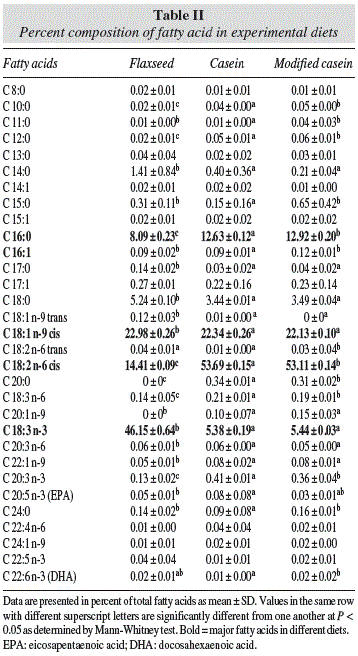
<body><![CDATA[<p><font face="Verdana" size="2">Until two hours after the birth the pups were weight and killed by decapitation. Brains were rapidly removed, weighed, immediately frozen in liquid nitrogen, and stored at -20<sup>o</sup> C.</font></p>     <p><font face="Verdana" size="2"><i>Determination of fatty acid composition</i></font></p>     <p><font face="Verdana" size="2">Lipid extraction, saponification and methylation of fatty acids in experimental diets and brains were performed in duplicate. Fatty acid methyl esters were quantified by gas-liquid chromatography, by using a Perkin Elmer autosystem XL chromatograph (Perkin Elmer, Norwalk, CT, USA) with an ionizable flame detector and Turbochrom software (Perkin Elmer, Norwalk, CT, USA) as previously described.<sup>16</sup></font></p>     <p><font face="Verdana" size="2"><i>Statistical analysis</i></font></p>     <p><font face="Verdana" size="2">Data are presented as the mean and standard deviation. Data of body, brain and relative brain weight were analyzed by ANOVA One Way. Post hoc analysis was performed by Scheffé and Bonferroni tests. Fatty acid composition was analyzed by the nonparametric test of Mann-Whitney. The SPSS software, version 10.0, was used for the analyses and differences were considered significant at <i>P</i> &lt; 0.05.</font></p>     <p>&nbsp;</p>     <p><font face="Verdana" size="2"><b>Results</b></font></p>     <p><font face="Verdana" size="2"><i>Fatty acid profile of the experimental diets</i></font></p>     <p><font face="Verdana" size="2">A total of 31 fatty acids were found in the experimental diets, flaxseed, casein, and modified casein (<a href="#t2">table II</a>). In this study, just the acids already described by the literature, as influential, in some way, in the brain development were taken in consideration for analysis and discussion. According to the fatty acids percentage the majority acids in decreasing order for the group FG were the alpha linolenic acid C18:3 (n-3) (ALA) and C18:1 (n-9)  <i>cis</i>, proceeded by C18:2 (n-6) cis, while in CG and MCG, they were the fatty acids C18:2 (n-6)  <i>cis</i>, C18:1 (n-9) <i>cis</i> and C16:0.</font></p>     <p align="center"><font face="Verdana" size="2"><a name="t2"><img src="/img/revistas/nh/v26n5/11_original_10_t2.gif" align="top"></a></font></p>     ]]></body>
<body><![CDATA[<p>&nbsp;</p>     <p><font face="Verdana" size="2"><i>Body, brain and relative brain weight of the pups</i></font></p>     <p><font face="Verdana" size="2">Brain weight of the newborn rats from FG were 39% heavier than CG and 25% heavier than MCG (<a href="#t3">table III</a>), with statistical significance (<i>P</i> = 0.026). There was no statistical difference in the body weight within the diet groups. Relative brain weight showed higher percentage value in FG, with statistical significance (<i>P</i> = 0.0093), when compared to the others diets, since in this group the relative brain weight was 37% higher than CG and 31% higher than MCG. There was no statistical difference among the last two groups.</font></p>     <p align="center"><font face="Verdana" size="2"><a name="t3"><img src="/img/revistas/nh/v26n5/11_original_10_t3.gif" align="top"></a></font></p>     <p>&nbsp;</p>     <p><font face="Verdana" size="2"><i>Fatty acid profile of the pup´s brain</i></font></p>     <p><font face="Verdana" size="2">A total of 30 fatty acids were found in the pup´s brain (<a href="#t4">table IV</a>). According to the fatty acids percentage the majority acids in decreasing order for the group FG were the acid C16:0 and C18:0, proceeded by DHA C22:6 (n-3), while in CG and MCG, they were the same ones, except for the aracdonic acid C20:4 (n-6) (AA). Pup´s brain from FG presented higher content of DHA than the brains from the other diets, being 38% higher than CG and 32% higher than MCG (<i>P</i> = 0.002).</font></p>     <p align="center"><font face="Verdana" size="2"><a name="t4"><img src="/img/revistas/nh/v26n5/11_original_10_t4.gif" align="top"></a></font></p>     <p>&nbsp;</p>     <p><font face="Verdana" size="2">In pup´s brain from FG the omega 3 (n-3) fatty acid sum was 62% higher than CG and 52% higher compared to MCG (<a href="#t5">table V</a>), being the difference significant (<i>P</i> = 0.002). Similar results were noticed analyzing the polyunsaturated fatty acid (PUFA) sum, since FG was 34% higher compared to CG and 21% higher than MCG (<i>P</i> = 0.002). The essential fatty acid (EFA) sum was also increased in FG being 34% higher than CG and 23% higher compared to MCG, with statistical significance (<i>P</i> = 0.026).</font></p>     ]]></body>
<body><![CDATA[<p>&nbsp;</p>     <p align="center"><font face="Verdana" size="2"><a name="t5"><img src="/img/revistas/nh/v26n5/11_original_10_t5.gif" align="top"></a></font></p>     <p>&nbsp;</p>     <p><font face="Verdana" size="2">The long chain polyunsaturated fatty acid (LCPUFA) sum in pup´s brain from FG was 2% lower compared to CG and 5% lower than MCG, with statistical difference among the three diets (<i>P</i> = 0.002). Significant decrease (41%) in the omega 6 (n-6) fatty acid sum was noticed in FG compared to the other diets (<i>P</i> = 0.002).</font></p>     <p>&nbsp;</p>     <p><font face="Verdana" size="2"><b>Discussion</b></font></p>     <p><font face="Verdana" size="2">The energy supplied by several nutrients in animal species is essential for the maintenance, growth and reproduction. The fat source used in the diet can display significant influence on the growth and use of nutrients in some species. Lipids are the best source of energy used by animals, besides supplying metabolic energy, they are requested for the maintenance of the structure and function of the cellular membrane and supply essential fatty acids to the animals.<sup>17</sup></font></p>     <p><font face="Verdana" size="2">In the current study, the diet based on flaxseed presented a higher alpha lipoic acid (ALA) content when compared to the other diets. Besides this acid, the flaxseed diet presented higher values also in the sum of n-3 fatty acids, PUFA, and EFA. Those differences can be explained by the composition of flaxseed, which presents high percentage (57%) of n-3 fatty acids, causing this increment in the flaxseed diet.<sup>18</sup> Similar results had been found with diet containing flaxseed oil, which also presented sufficiently superior concentration of ALA (18:3 n-3), when compared to diets without the oleaginous.<sup>19</sup> This result shows that the source of lipids can probably drive the fatty acid profile in the final product, due to differences in the amounts of those acids in the composition of different oils, including also the content of fatty acid of the &omega;-3 series in which the oleaginous flaxseed is the richest.<sup>18</sup></font></p>     <p><font face="Verdana" size="2">The central nervous system maturation in human begins in the intrauterine phase and persists for seven years, presenting bigger intensity in the first two years of life.<sup>20</sup> Already in rats, the beginning also start in the intrauterine phase, however persists only until the thirty day of life.<sup>21</sup> The morphogenesis directly associated to the function of the brain requires offer of specific fatty acids, especially of Aracdonic Acid (AA) and DHA. The maternal nutrition becomes very important to this process during gestation and lactation, therefore the embryo and newborn has functional and biochemist increase of the maternal demands of PUFA.<sup>12,22,23</sup> PUFA of the series omega-3 are found in the brain and the retina and participate of the growth, contributing for the process of mielinization, and development of the vision function, in the psychomotor development, and some aspects of the neural function related to behavior.<sup>24,25</sup> PUFA n-3 are transferred of the mother to the fetus through the placenta during the intrauterine development.<sup>26</sup></font></p>     <p><font face="Verdana" size="2">The cephalic growth is one of the best ways of neonatal development evaluation. The end of gestation and beginning of extra uterine life are periods of mielinization that lead to a fast increase in the number of cells and in the dendritic area of cerebral tissue. The brain weight is, therefore, associated to its development suggesting that the incorporation of fatty acids to cerebral tissue has influence on this development.<sup>27</sup> In this study, the greater mean value of cerebral weight in newborn rats was produced by the maternal diet of flaxseed, having statistic significance when compared to the other diets, casein and modified casein.</font></p>     ]]></body>
<body><![CDATA[<p><font face="Verdana" size="2">In this analysis, the influence of fatty acids proceeding from the flaxseed diet offered to the fetus only by the maternal circulation is being evaluated, since these pups had been submitted to euthanasia immediately after birth to assure the evaluations free from the influence of maternal milk. In the present study, the profile of brain fatty acids in newborn rats showed that the mothers´ pups that consumed the flaxseed diet presented a very high percentage of the fatty acid C 22:5 n-3, as well as in the sum of PUFA, EFA and n-3 with statistical difference when compared to the casein diet. This result is perfectly explained by the high concentration of fatty acids of the n-3 family present in the diet offered to these mothers. The percentile amount of DHA was also very high in the pups´ brain of the flaxseed group (FG), showing statistic significance when compared to the other groups fed with casein diet (CG and MCG); this fact confirms the transference of mothers´ DHA for the fetus during the gestation, as already notified in some studies.<sup>12,28,29</sup> It was observed in this study that the supply of flaxseed diet is directly related to the incorporation of fatty acids of the n-3 family in the pups´ brain, and this was well established in the brain composition of acid C 22:6 n-3 (DHA) and in the sum of n-3 (&sum;-3), since these values were higher in FG and with statistic difference compared to CG and MCG. Similar results were expressed in a study that evaluated pups´ brain of rat born from mothers fed with diets with and without EFA; a higher accumulation of DHA and &sigma;n-3 was found on the phospholipids phosphatidylcholine, phosphatidylethanolamine and phosphatidylserine in the pups´ brain proceeding from mothers that had consumed diet with EFA, when compared with the ones that had not consumed it.<sup>29</sup></font></p>     <p><font face="Verdana" size="2">The largest percentage value of relative cerebral weight in the newborns of FG, with statistical significance when compared to the other groups, indicates larger omega-3 fatty acids absorption by this organ, coming from the maternal circulation in this vulnerable period of the Central Nervous System development. <sup>5,30</sup>.</font></p>     <p>&nbsp;</p>     <p><font face="Verdana" size="2"><b>Conclusion</b></font></p>     <p><font face="Verdana" size="2">The omega-3 fatty acids present in the flaxseed were abundant in the diet made with this seed and the pup´s brain originating from mothers fed with this diet also presented higher percentage of these fatty acids. The use of a diet based on flaxseed during the gestation has influence on the incorporation of omega-3 fatty acids in the brain of newborn rats, contributing to a better cerebral development.</font></p>     <p>&nbsp;</p>     <p><font face="Verdana" size="2"><b>Acknowledgement</b></font></p>     <p><font face="Verdana" size="2">The authors are grateful to Dr. Maria das Graças Tavares do Carmo (Josué de Castro Institute of Nutrition, UFRJ, RJ, Brazil) for her technical assistance. Thanks to CAPES (Coordenação de Aperfeiçoamento de Pessoal de Nível Superior) and UFF (Universidade Federal Fluminense) for the institutional support.</font></p>     <p>&nbsp;</p>     <p><font face="Verdana" size="2"><b>References</b></font></p>     ]]></body>
<body><![CDATA[<!-- ref --><p><font face="Verdana" size="2">1. Barker DJP. Mothers, babies and health in later life. London Churchill Livingstone, 1998.    &nbsp;&nbsp;&nbsp;&nbsp;&nbsp;&nbsp;&nbsp;&nbsp;[&#160;<a href="javascript:void(0);" onclick="javascript: window.open('/scielo.php?script=sci_nlinks&ref=3615305&pid=S0212-1611201100050001100001&lng=','','width=640,height=500,resizable=yes,scrollbars=1,menubar=yes,');">Links</a>&#160;]<!-- end-ref --></font></p>    <!-- ref --><p><font face="Verdana" size="2">2. Moura AS, Franco Sá CCN, Cruz HG, Costa CL. Malnutrition during lactation as a metabolic imprinting factor inducing the feeding pattern of offspring rats when adults - The role of insulin and leptin. <i>Braz J Med Biol Res</i> 2002; 35:617-622.    &nbsp;&nbsp;&nbsp;&nbsp;&nbsp;&nbsp;&nbsp;&nbsp;[&#160;<a href="javascript:void(0);" onclick="javascript: window.open('/scielo.php?script=sci_nlinks&ref=3615307&pid=S0212-1611201100050001100002&lng=','','width=640,height=500,resizable=yes,scrollbars=1,menubar=yes,');">Links</a>&#160;]<!-- end-ref --></font></p>    <!-- ref --><p><font face="Verdana" size="2">3. Simopoulos AP, Bazan NG. Omega-3 fatty acids, the brain and retina. <i>World Rev Nutr Diet</i> 2009; 99: 1-12.    &nbsp;&nbsp;&nbsp;&nbsp;&nbsp;&nbsp;&nbsp;&nbsp;[&#160;<a href="javascript:void(0);" onclick="javascript: window.open('/scielo.php?script=sci_nlinks&ref=3615309&pid=S0212-1611201100050001100003&lng=','','width=640,height=500,resizable=yes,scrollbars=1,menubar=yes,');">Links</a>&#160;]<!-- end-ref --></font></p>    <!-- ref --><p><font face="Verdana" size="2">4. Rotenstein L, Herath K, Gould RM, Bellard ME. Characterization of the shark myelin Po protein. <i>Brain Behav Evol</i> 2008; 72: 48-58.    &nbsp;&nbsp;&nbsp;&nbsp;&nbsp;&nbsp;&nbsp;&nbsp;[&#160;<a href="javascript:void(0);" onclick="javascript: window.open('/scielo.php?script=sci_nlinks&ref=3615311&pid=S0212-1611201100050001100004&lng=','','width=640,height=500,resizable=yes,scrollbars=1,menubar=yes,');">Links</a>&#160;]<!-- end-ref --></font></p>    <!-- ref --><p><font face="Verdana" size="2">5. Zomignani AP, Zambelli HJL, Antonio MARGM. Desenvolvimento cerebral em recém-nascidos prematuros. <i>Rev Paul Pediatr</i> 2009;27:198-203.    &nbsp;&nbsp;&nbsp;&nbsp;&nbsp;&nbsp;&nbsp;&nbsp;[&#160;<a href="javascript:void(0);" onclick="javascript: window.open('/scielo.php?script=sci_nlinks&ref=3615313&pid=S0212-1611201100050001100005&lng=','','width=640,height=500,resizable=yes,scrollbars=1,menubar=yes,');">Links</a>&#160;]<!-- end-ref --></font></p>    ]]></body>
<body><![CDATA[<!-- ref --><p><font face="Verdana" size="2">6. Silva DRB, Junior PFM, Soares EA. A importância dos ácidos graxos poliinsaturados de cadeia longa na gestagao e lactação. <i>Rev Bras Saúde Mater Infant</i> 2007; 7: 123-133.    &nbsp;&nbsp;&nbsp;&nbsp;&nbsp;&nbsp;&nbsp;&nbsp;[&#160;<a href="javascript:void(0);" onclick="javascript: window.open('/scielo.php?script=sci_nlinks&ref=3615315&pid=S0212-1611201100050001100006&lng=','','width=640,height=500,resizable=yes,scrollbars=1,menubar=yes,');">Links</a>&#160;]<!-- end-ref --></font></p>    <!-- ref --><p><font face="Verdana" size="2">7. Hay WW Jr. Strategies for feeding the preterm infant. <i>Neonatology</i> 2008; 94: 245-254.    &nbsp;&nbsp;&nbsp;&nbsp;&nbsp;&nbsp;&nbsp;&nbsp;[&#160;<a href="javascript:void(0);" onclick="javascript: window.open('/scielo.php?script=sci_nlinks&ref=3615317&pid=S0212-1611201100050001100007&lng=','','width=640,height=500,resizable=yes,scrollbars=1,menubar=yes,');">Links</a>&#160;]<!-- end-ref --></font></p>    <!-- ref --><p><font face="Verdana" size="2">8. Levant B, Ozias MK, Davis PF, Winter M, Russel KL, Carlson SE et al. Decreased brain docosahexaenoic acid content produces neurobiological effects associated with depression: Interactions with reproductive status in female rats. <i>Psychoneuroendocrinology</i> 2008; 33: 1279-1292.    &nbsp;&nbsp;&nbsp;&nbsp;&nbsp;&nbsp;&nbsp;&nbsp;[&#160;<a href="javascript:void(0);" onclick="javascript: window.open('/scielo.php?script=sci_nlinks&ref=3615319&pid=S0212-1611201100050001100008&lng=','','width=640,height=500,resizable=yes,scrollbars=1,menubar=yes,');">Links</a>&#160;]<!-- end-ref --></font></p>    <!-- ref --><p><font face="Verdana" size="2">9. Gustafson KM, Colombo J, Carlson SE. Docosahexaenoic acid and cognitive function: Is the link mediated by the autonomic nervous system? Prostaglandins <i>Leukot Essent Fatty Acids</i> 2008; 79: 135-140.    &nbsp;&nbsp;&nbsp;&nbsp;&nbsp;&nbsp;&nbsp;&nbsp;[&#160;<a href="javascript:void(0);" onclick="javascript: window.open('/scielo.php?script=sci_nlinks&ref=3615321&pid=S0212-1611201100050001100009&lng=','','width=640,height=500,resizable=yes,scrollbars=1,menubar=yes,');">Links</a>&#160;]<!-- end-ref --></font></p>    <!-- ref --><p><font face="Verdana" size="2">10. Yeh YY, Gehman MF, Yeh SM. Maternal dietary fish oil enriches docosahexaenoate levels in brain subcellular fractions of offspring. <i>J Neurosci Res</i> 1993; 35: 218-226.    &nbsp;&nbsp;&nbsp;&nbsp;&nbsp;&nbsp;&nbsp;&nbsp;[&#160;<a href="javascript:void(0);" onclick="javascript: window.open('/scielo.php?script=sci_nlinks&ref=3615323&pid=S0212-1611201100050001100010&lng=','','width=640,height=500,resizable=yes,scrollbars=1,menubar=yes,');">Links</a>&#160;]<!-- end-ref --></font></p>    ]]></body>
<body><![CDATA[<!-- ref --><p><font face="Verdana" size="2">11. Belkind-Gerson J, Carreón-Rodríguez A, Contreras-Ochoa CO, Estrada-Mondaca S, Parra-Cabrera MS. Fatty Acids and Neurodevelopment. <i>J Pediatr Gastroenterol Nutr</i> 2008; 41:7-9.    &nbsp;&nbsp;&nbsp;&nbsp;&nbsp;&nbsp;&nbsp;&nbsp;[&#160;<a href="javascript:void(0);" onclick="javascript: window.open('/scielo.php?script=sci_nlinks&ref=3615325&pid=S0212-1611201100050001100011&lng=','','width=640,height=500,resizable=yes,scrollbars=1,menubar=yes,');">Links</a>&#160;]<!-- end-ref --></font></p>    <!-- ref --><p><font face="Verdana" size="2">12. Innis SM. Dietary (n-3) fatty acids and brain development. <i>J Nutr</i> 2008; 137: 855-859.    &nbsp;&nbsp;&nbsp;&nbsp;&nbsp;&nbsp;&nbsp;&nbsp;[&#160;<a href="javascript:void(0);" onclick="javascript: window.open('/scielo.php?script=sci_nlinks&ref=3615327&pid=S0212-1611201100050001100012&lng=','','width=640,height=500,resizable=yes,scrollbars=1,menubar=yes,');">Links</a>&#160;]<!-- end-ref --></font></p>    <!-- ref --><p><font face="Verdana" size="2">13. Rosa DD, Sales RL, Moraes LFS, Lourenço FC, Neves CA, Sabarense CM et al. Flaxseed, olive and fish oil influence plasmatic lipids, lymphocyte migration and morphometry of the intestinal of Wistar rats. <i>Acta Cir Bras</i> 2010; 25: 275-280.    &nbsp;&nbsp;&nbsp;&nbsp;&nbsp;&nbsp;&nbsp;&nbsp;[&#160;<a href="javascript:void(0);" onclick="javascript: window.open('/scielo.php?script=sci_nlinks&ref=3615329&pid=S0212-1611201100050001100013&lng=','','width=640,height=500,resizable=yes,scrollbars=1,menubar=yes,');">Links</a>&#160;]<!-- end-ref --></font></p>    <!-- ref --><p><font face="Verdana" size="2">14. Khana G, Penttinem P, Cabanes A, Foxworth A, Chezek A, Mastropole K et al. Maternal flaxseed diet during pregnancy or lactation increases female rat offspring's susceptibility to carcinogen-induced mammary tumorigenesis. <i>Reprod Toxicol</i> 2007; 23: 397-406.    &nbsp;&nbsp;&nbsp;&nbsp;&nbsp;&nbsp;&nbsp;&nbsp;[&#160;<a href="javascript:void(0);" onclick="javascript: window.open('/scielo.php?script=sci_nlinks&ref=3615331&pid=S0212-1611201100050001100014&lng=','','width=640,height=500,resizable=yes,scrollbars=1,menubar=yes,');">Links</a>&#160;]<!-- end-ref --></font></p>    <!-- ref --><p><font face="Verdana" size="2">15. Turatti JM. Oleos vegetáis como fonte de alimentos funcionáis. <i>Óleos e Grãos</i> 2000; 56: 20-27.    &nbsp;&nbsp;&nbsp;&nbsp;&nbsp;&nbsp;&nbsp;&nbsp;[&#160;<a href="javascript:void(0);" onclick="javascript: window.open('/scielo.php?script=sci_nlinks&ref=3615333&pid=S0212-1611201100050001100015&lng=','','width=640,height=500,resizable=yes,scrollbars=1,menubar=yes,');">Links</a>&#160;]<!-- end-ref --></font></p>    ]]></body>
<body><![CDATA[<!-- ref --><p><font face="Verdana" size="2">16. Reeves PG, Nielsen FH, Fahey Jr GC. AIN-93 Purified diet of laboratory rodents: Final report of the American Institute of Nutrition ad hoc Writing Committee on the Reformulation of the AIN-76A Rodent Diet. <i>J Nutr</i> 1993; 123: 1939-1951.    &nbsp;&nbsp;&nbsp;&nbsp;&nbsp;&nbsp;&nbsp;&nbsp;[&#160;<a href="javascript:void(0);" onclick="javascript: window.open('/scielo.php?script=sci_nlinks&ref=3615335&pid=S0212-1611201100050001100016&lng=','','width=640,height=500,resizable=yes,scrollbars=1,menubar=yes,');">Links</a>&#160;]<!-- end-ref --></font></p>    <!-- ref --><p><font face="Verdana" size="2">17. Assumpção RP, Santos FD, Barreto GF, Andrade PMM, Tavares do Carmo MG. Effect of variation of trans fatty acid in lac-tating rat's diet on the lipoprotein lipase activity in mammary gland, liver, and adipose tissue. <i>Nutrition</i> 2004; 20: 806-811.    &nbsp;&nbsp;&nbsp;&nbsp;&nbsp;&nbsp;&nbsp;&nbsp;[&#160;<a href="javascript:void(0);" onclick="javascript: window.open('/scielo.php?script=sci_nlinks&ref=3615337&pid=S0212-1611201100050001100017&lng=','','width=640,height=500,resizable=yes,scrollbars=1,menubar=yes,');">Links</a>&#160;]<!-- end-ref --></font></p>    <!-- ref --><p><font face="Verdana" size="2">18. Uauy R, Valenzuela A. Marine oils: The health benefits of n-3 fatty acids. <i>Nutrition</i> 2000; 16: 680-684.    &nbsp;&nbsp;&nbsp;&nbsp;&nbsp;&nbsp;&nbsp;&nbsp;[&#160;<a href="javascript:void(0);" onclick="javascript: window.open('/scielo.php?script=sci_nlinks&ref=3615339&pid=S0212-1611201100050001100018&lng=','','width=640,height=500,resizable=yes,scrollbars=1,menubar=yes,');">Links</a>&#160;]<!-- end-ref --></font></p>    <!-- ref --><p><font face="Verdana" size="2">19. Morris DH. Flax - A Health and Nutrition Primer (access august 2008). Available from: http://www.flaxcouncil.ca/english/index.php?p=primer&mp=nutrition</font>&nbsp;&nbsp;&nbsp;&nbsp;&nbsp;&nbsp;&nbsp;&nbsp;[&#160;<a href="javascript:void(0);" onclick="javascript: window.open('/scielo.php?script=sci_nlinks&ref=3615341&pid=S0212-1611201100050001100019&lng=','','width=640,height=500,resizable=yes,scrollbars=1,menubar=yes,');">Links</a>&#160;]<!-- end-ref --><!-- ref --><p><font face="Verdana" size="2">20. Visentainer JV, Gomes STM, Hayashi C, Santos-Jr OO, Silva ABM, Justi KC et al. Efeito do tempo de fornecimento de ração suplementada com óleo de linhaça sobre a composição físico-química e de ácidos graxos em cabeças de tilápias do Nilo (<i>Oreochromis niloticus</i>). <i>Cienc Tecnol Aliment</i> 2003; 23: 478-484.    &nbsp;&nbsp;&nbsp;&nbsp;&nbsp;&nbsp;&nbsp;&nbsp;[&#160;<a href="javascript:void(0);" onclick="javascript: window.open('/scielo.php?script=sci_nlinks&ref=3615342&pid=S0212-1611201100050001100020&lng=','','width=640,height=500,resizable=yes,scrollbars=1,menubar=yes,');">Links</a>&#160;]<!-- end-ref --></font></p>    <!-- ref --><p><font face="Verdana" size="2">21. Patin RV, Vitólo MR, Valverde MA, Carvalho PO, Pastore GM, Lopez FA. The influence of sardine consumption on the omega-3 fatty acid content of mature human milk. <i>J Pediatr</i> 2006; 82: 63-69.    &nbsp;&nbsp;&nbsp;&nbsp;&nbsp;&nbsp;&nbsp;&nbsp;[&#160;<a href="javascript:void(0);" onclick="javascript: window.open('/scielo.php?script=sci_nlinks&ref=3615344&pid=S0212-1611201100050001100021&lng=','','width=640,height=500,resizable=yes,scrollbars=1,menubar=yes,');">Links</a>&#160;]<!-- end-ref --></font></p>    <!-- ref --><p><font face="Verdana" size="2">22. Reinis S, Golman JM. Development of the brain - Biological and functional perspective, Illinois Thomas CC Publishers, 1980.    &nbsp;&nbsp;&nbsp;&nbsp;&nbsp;&nbsp;&nbsp;&nbsp;[&#160;<a href="javascript:void(0);" onclick="javascript: window.open('/scielo.php?script=sci_nlinks&ref=3615346&pid=S0212-1611201100050001100022&lng=','','width=640,height=500,resizable=yes,scrollbars=1,menubar=yes,');">Links</a>&#160;]<!-- end-ref --></font></p>    <!-- ref --><p><font face="Verdana" size="2">23. Xiang M, Alfvén G, Blennow M, Trygg M, Zetterstrom R. Long-chain polyunsaturated fatty acids in human milk and brain growth during early infancy. <i>Acta Paediatr</i> 2000; 89: 142-147.    &nbsp;&nbsp;&nbsp;&nbsp;&nbsp;&nbsp;&nbsp;&nbsp;[&#160;<a href="javascript:void(0);" onclick="javascript: window.open('/scielo.php?script=sci_nlinks&ref=3615348&pid=S0212-1611201100050001100023&lng=','','width=640,height=500,resizable=yes,scrollbars=1,menubar=yes,');">Links</a>&#160;]<!-- end-ref --></font></p>    <!-- ref --><p><font face="Verdana" size="2">24. Koletzko B, Rodríguez-Palmero A, Demmelmair H, Fildler N, Jensen R, Sauerwald T. Physiological aspects of human milk lipids. <i>Early Hum Dev</i> 2001; 65: 3-18.    &nbsp;&nbsp;&nbsp;&nbsp;&nbsp;&nbsp;&nbsp;&nbsp;[&#160;<a href="javascript:void(0);" onclick="javascript: window.open('/scielo.php?script=sci_nlinks&ref=3615350&pid=S0212-1611201100050001100024&lng=','','width=640,height=500,resizable=yes,scrollbars=1,menubar=yes,');">Links</a>&#160;]<!-- end-ref --></font></p>    <!-- ref --><p><font face="Verdana" size="2">25. Brenna JT, Diau GY. The influence of dietary docosahexaenoic acid and arachidonic acid on central nervous system polyunsaturated fatty acid composition. <i>Prostaglandins Leukot Essent Fatty Acids</i> 2007; 77: 247-250.    &nbsp;&nbsp;&nbsp;&nbsp;&nbsp;&nbsp;&nbsp;&nbsp;[&#160;<a href="javascript:void(0);" onclick="javascript: window.open('/scielo.php?script=sci_nlinks&ref=3615352&pid=S0212-1611201100050001100025&lng=','','width=640,height=500,resizable=yes,scrollbars=1,menubar=yes,');">Links</a>&#160;]<!-- end-ref --></font></p>    <!-- ref --><p><font face="Verdana" size="2">26. Presa-Owens S, López-Sabater MC, Rivero-Urgell M. Fatty acid composition of human milk in Spain. <i>J Pediatr Gastroenterol Nutr</i> 1996; 22: 180-185.    &nbsp;&nbsp;&nbsp;&nbsp;&nbsp;&nbsp;&nbsp;&nbsp;[&#160;<a href="javascript:void(0);" onclick="javascript: window.open('/scielo.php?script=sci_nlinks&ref=3615354&pid=S0212-1611201100050001100026&lng=','','width=640,height=500,resizable=yes,scrollbars=1,menubar=yes,');">Links</a>&#160;]<!-- end-ref --></font></p>    <!-- ref --><p><font face="Verdana" size="2">27. Koletzko B, Cetin I, Brenna T. Dietary fat intakes for pregnant and lactating women. <i>Br J Nutr 2007;</i> 98: 873-877.    &nbsp;&nbsp;&nbsp;&nbsp;&nbsp;&nbsp;&nbsp;&nbsp;[&#160;<a href="javascript:void(0);" onclick="javascript: window.open('/scielo.php?script=sci_nlinks&ref=3615356&pid=S0212-1611201100050001100027&lng=','','width=640,height=500,resizable=yes,scrollbars=1,menubar=yes,');">Links</a>&#160;]<!-- end-ref --></font></p>    <!-- ref --><p><font face="Verdana" size="2">28. Cocchi M, Pignattic, Carpigiani M, Tarozzi G, Turchetto E. Effect of C 18:3(n-3) dietary supplementation on the fatty acid composition of the rat brain. <i>Acta Vitaminol Enzymol</i> 1984; 6: 151-156.    &nbsp;&nbsp;&nbsp;&nbsp;&nbsp;&nbsp;&nbsp;&nbsp;[&#160;<a href="javascript:void(0);" onclick="javascript: window.open('/scielo.php?script=sci_nlinks&ref=3615358&pid=S0212-1611201100050001100028&lng=','','width=640,height=500,resizable=yes,scrollbars=1,menubar=yes,');">Links</a>&#160;]<!-- end-ref --></font></p>    <!-- ref --><p><font face="Verdana" size="2">29. Tinoco SMB, Sichieri R, Moura AS, Santos FS, Carmo MGT. Importância dos ácidos graxos essenciais e os efeitos dos ácidos graxos <i>trans</i> do leite materno para o desenvolvimento fetal e neonatal. <i>Cad Saúde Pública</i> 2007; 23: 525-534.    &nbsp;&nbsp;&nbsp;&nbsp;&nbsp;&nbsp;&nbsp;&nbsp;[&#160;<a href="javascript:void(0);" onclick="javascript: window.open('/scielo.php?script=sci_nlinks&ref=3615360&pid=S0212-1611201100050001100029&lng=','','width=640,height=500,resizable=yes,scrollbars=1,menubar=yes,');">Links</a>&#160;]<!-- end-ref --></font></p>    <!-- ref --><p><font face="Verdana" size="2">30. Oken E, Mandy B, Belfort MB. Fish, fish oil, and pregnancy. <i>JAMA</i> 2010; 304: 1717-1718.    &nbsp;&nbsp;&nbsp;&nbsp;&nbsp;&nbsp;&nbsp;&nbsp;[&#160;<a href="javascript:void(0);" onclick="javascript: window.open('/scielo.php?script=sci_nlinks&ref=3615362&pid=S0212-1611201100050001100030&lng=','','width=640,height=500,resizable=yes,scrollbars=1,menubar=yes,');">Links</a>&#160;]<!-- end-ref --></font></p>    <!-- ref --><p><font face="Verdana" size="2">31. Lukim WJ, Bazan NG. Docosahexaenoic acid and the aging brain. <i>J Nutr</i> 2008; 138:2510-2514.    &nbsp;&nbsp;&nbsp;&nbsp;&nbsp;&nbsp;&nbsp;&nbsp;[&#160;<a href="javascript:void(0);" onclick="javascript: window.open('/scielo.php?script=sci_nlinks&ref=3615364&pid=S0212-1611201100050001100031&lng=','','width=640,height=500,resizable=yes,scrollbars=1,menubar=yes,');">Links</a>&#160;]<!-- end-ref --></font></p>     <p>&nbsp;</p>     <p>&nbsp;</p>     <p><font face="Verdana" size="2"><b><a name="back"></a><a href="#top"><img border="0" src="/img/revistas/nh/v26n5/seta.gif" width="15" height="17"></a>Correspondence:</b>    <br>Katia Calvi Lenzi de Almeida.    <br>E-mail:  <a href="mailto:calvilenzi@gmail.com">calvilenzi@gmail.com</a></font></p>     <p><font face="Verdana" size="2">Recibido: 21-VII-2010.    <br>1<sup>a</sup> Revisión: 24-XI-2010    <br>Aceptado: 2-XII-2010.</font></p>      ]]></body><back>
<ref-list>
<ref id="B1">
<label>1</label><nlm-citation citation-type="book">
<person-group person-group-type="author">
<name>
<surname><![CDATA[Barker]]></surname>
<given-names><![CDATA[DJP]]></given-names>
</name>
</person-group>
<source><![CDATA[Mothers, babies and health in later life]]></source>
<year>1998</year>
<publisher-loc><![CDATA[London ]]></publisher-loc>
<publisher-name><![CDATA[Churchill Livingstone]]></publisher-name>
</nlm-citation>
</ref>
<ref id="B2">
<label>2</label><nlm-citation citation-type="journal">
<person-group person-group-type="author">
<name>
<surname><![CDATA[Moura]]></surname>
<given-names><![CDATA[AS]]></given-names>
</name>
<name>
<surname><![CDATA[Franco Sá]]></surname>
<given-names><![CDATA[CCN]]></given-names>
</name>
<name>
<surname><![CDATA[Cruz]]></surname>
<given-names><![CDATA[HG]]></given-names>
</name>
<name>
<surname><![CDATA[Costa]]></surname>
<given-names><![CDATA[CL]]></given-names>
</name>
</person-group>
<article-title xml:lang="en"><![CDATA[Malnutrition during lactation as a metabolic imprinting factor inducing the feeding pattern of offspring rats when adults: The role of insulin and leptin]]></article-title>
<source><![CDATA[Braz J Med Biol Res]]></source>
<year>2002</year>
<volume>35</volume>
<page-range>617-622</page-range></nlm-citation>
</ref>
<ref id="B3">
<label>3</label><nlm-citation citation-type="journal">
<person-group person-group-type="author">
<name>
<surname><![CDATA[Simopoulos]]></surname>
<given-names><![CDATA[AP]]></given-names>
</name>
<name>
<surname><![CDATA[Bazan]]></surname>
<given-names><![CDATA[NG]]></given-names>
</name>
</person-group>
<article-title xml:lang="en"><![CDATA[Omega-3 fatty acids, the brain and retina]]></article-title>
<source><![CDATA[World Rev Nutr Diet]]></source>
<year>2009</year>
<volume>99</volume>
<page-range>1-12</page-range></nlm-citation>
</ref>
<ref id="B4">
<label>4</label><nlm-citation citation-type="journal">
<person-group person-group-type="author">
<name>
<surname><![CDATA[Rotenstein]]></surname>
<given-names><![CDATA[L]]></given-names>
</name>
<name>
<surname><![CDATA[Herath]]></surname>
<given-names><![CDATA[K]]></given-names>
</name>
<name>
<surname><![CDATA[Gould]]></surname>
<given-names><![CDATA[RM]]></given-names>
</name>
<name>
<surname><![CDATA[Bellard]]></surname>
<given-names><![CDATA[ME]]></given-names>
</name>
</person-group>
<article-title xml:lang="en"><![CDATA[Characterization of the shark myelin Po protein]]></article-title>
<source><![CDATA[Brain Behav Evol]]></source>
<year>2008</year>
<volume>72</volume>
<page-range>48-58</page-range></nlm-citation>
</ref>
<ref id="B5">
<label>5</label><nlm-citation citation-type="journal">
<person-group person-group-type="author">
<name>
<surname><![CDATA[Zomignani]]></surname>
<given-names><![CDATA[AP]]></given-names>
</name>
<name>
<surname><![CDATA[Zambelli]]></surname>
<given-names><![CDATA[HJL]]></given-names>
</name>
<name>
<surname><![CDATA[Antonio]]></surname>
<given-names><![CDATA[MARGM]]></given-names>
</name>
</person-group>
<article-title xml:lang="pt"><![CDATA[Desenvolvimento cerebral em recém-nascidos prematuros]]></article-title>
<source><![CDATA[Rev Paul Pediatr]]></source>
<year>2009</year>
<volume>27</volume>
<page-range>198-203</page-range></nlm-citation>
</ref>
<ref id="B6">
<label>6</label><nlm-citation citation-type="journal">
<person-group person-group-type="author">
<name>
<surname><![CDATA[Silva]]></surname>
<given-names><![CDATA[DRB]]></given-names>
</name>
<name>
<surname><![CDATA[Junior]]></surname>
<given-names><![CDATA[PFM]]></given-names>
</name>
<name>
<surname><![CDATA[Soares]]></surname>
<given-names><![CDATA[EA]]></given-names>
</name>
</person-group>
<article-title xml:lang="pt"><![CDATA[A importância dos ácidos graxos poliinsaturados de cadeia longa na gestagao e lactação]]></article-title>
<source><![CDATA[Rev Bras Saúde Mater Infant]]></source>
<year>2007</year>
<volume>7</volume>
<page-range>123-133</page-range></nlm-citation>
</ref>
<ref id="B7">
<label>7</label><nlm-citation citation-type="journal">
<person-group person-group-type="author">
<name>
<surname><![CDATA[Hay]]></surname>
<given-names><![CDATA[WW Jr]]></given-names>
</name>
</person-group>
<article-title xml:lang="en"><![CDATA[Strategies for feeding the preterm infant]]></article-title>
<source><![CDATA[Neonatology]]></source>
<year>2008</year>
<volume>94</volume>
<page-range>245-254</page-range></nlm-citation>
</ref>
<ref id="B8">
<label>8</label><nlm-citation citation-type="journal">
<person-group person-group-type="author">
<name>
<surname><![CDATA[Levant]]></surname>
<given-names><![CDATA[B]]></given-names>
</name>
<name>
<surname><![CDATA[Ozias]]></surname>
<given-names><![CDATA[MK]]></given-names>
</name>
<name>
<surname><![CDATA[Davis]]></surname>
<given-names><![CDATA[PF]]></given-names>
</name>
<name>
<surname><![CDATA[Winter]]></surname>
<given-names><![CDATA[M]]></given-names>
</name>
<name>
<surname><![CDATA[Russel]]></surname>
<given-names><![CDATA[KL]]></given-names>
</name>
<name>
<surname><![CDATA[Carlson]]></surname>
<given-names><![CDATA[SE]]></given-names>
</name>
</person-group>
<article-title xml:lang="en"><![CDATA[Decreased brain docosahexaenoic acid content produces neurobiological effects associated with depression: Interactions with reproductive status in female rats]]></article-title>
<source><![CDATA[Psychoneuroendocrinology]]></source>
<year>2008</year>
<volume>33</volume>
<page-range>1279-1292</page-range></nlm-citation>
</ref>
<ref id="B9">
<label>9</label><nlm-citation citation-type="journal">
<person-group person-group-type="author">
<name>
<surname><![CDATA[Gustafson]]></surname>
<given-names><![CDATA[KM]]></given-names>
</name>
<name>
<surname><![CDATA[Colombo]]></surname>
<given-names><![CDATA[J]]></given-names>
</name>
<name>
<surname><![CDATA[Carlson]]></surname>
<given-names><![CDATA[SE]]></given-names>
</name>
</person-group>
<article-title xml:lang="en"><![CDATA[Docosahexaenoic acid and cognitive function: Is the link mediated by the autonomic nervous system?]]></article-title>
<source><![CDATA[Prostaglandins Leukot Essent Fatty Acids]]></source>
<year>2008</year>
<volume>79</volume>
<page-range>135-140</page-range></nlm-citation>
</ref>
<ref id="B10">
<label>10</label><nlm-citation citation-type="journal">
<person-group person-group-type="author">
<name>
<surname><![CDATA[Yeh]]></surname>
<given-names><![CDATA[YY]]></given-names>
</name>
<name>
<surname><![CDATA[Gehman]]></surname>
<given-names><![CDATA[MF]]></given-names>
</name>
<name>
<surname><![CDATA[Yeh]]></surname>
<given-names><![CDATA[SM]]></given-names>
</name>
</person-group>
<article-title xml:lang="en"><![CDATA[Maternal dietary fish oil enriches docosahexaenoate levels in brain subcellular fractions of offspring]]></article-title>
<source><![CDATA[J Neurosci Res]]></source>
<year>1993</year>
<volume>35</volume>
<page-range>218-226</page-range></nlm-citation>
</ref>
<ref id="B11">
<label>11</label><nlm-citation citation-type="journal">
<person-group person-group-type="author">
<name>
<surname><![CDATA[Belkind-Gerson]]></surname>
<given-names><![CDATA[J]]></given-names>
</name>
<name>
<surname><![CDATA[Carreón-Rodríguez]]></surname>
<given-names><![CDATA[A]]></given-names>
</name>
<name>
<surname><![CDATA[Contreras-Ochoa]]></surname>
<given-names><![CDATA[CO]]></given-names>
</name>
<name>
<surname><![CDATA[Estrada-Mondaca]]></surname>
<given-names><![CDATA[S]]></given-names>
</name>
<name>
<surname><![CDATA[Parra-Cabrera]]></surname>
<given-names><![CDATA[MS]]></given-names>
</name>
</person-group>
<article-title xml:lang="en"><![CDATA[Fatty Acids and Neurodevelopment]]></article-title>
<source><![CDATA[J Pediatr Gastroenterol Nutr]]></source>
<year>2008</year>
<volume>41</volume>
<page-range>7-9</page-range></nlm-citation>
</ref>
<ref id="B12">
<label>12</label><nlm-citation citation-type="journal">
<person-group person-group-type="author">
<name>
<surname><![CDATA[Innis]]></surname>
<given-names><![CDATA[SM]]></given-names>
</name>
</person-group>
<article-title xml:lang="en"><![CDATA[Dietary (n-3) fatty acids and brain development]]></article-title>
<source><![CDATA[J Nutr]]></source>
<year>2008</year>
<volume>137</volume>
<page-range>855-859</page-range></nlm-citation>
</ref>
<ref id="B13">
<label>13</label><nlm-citation citation-type="journal">
<person-group person-group-type="author">
<name>
<surname><![CDATA[Rosa]]></surname>
<given-names><![CDATA[DD]]></given-names>
</name>
<name>
<surname><![CDATA[Sales]]></surname>
<given-names><![CDATA[RL]]></given-names>
</name>
<name>
<surname><![CDATA[Moraes]]></surname>
<given-names><![CDATA[LFS]]></given-names>
</name>
<name>
<surname><![CDATA[Lourenço]]></surname>
<given-names><![CDATA[FC]]></given-names>
</name>
<name>
<surname><![CDATA[Neves]]></surname>
<given-names><![CDATA[CA]]></given-names>
</name>
<name>
<surname><![CDATA[Sabarense]]></surname>
<given-names><![CDATA[CM]]></given-names>
</name>
</person-group>
<article-title xml:lang="en"><![CDATA[Flaxseed, olive and fish oil influence plasmatic lipids, lymphocyte migration and morphometry of the intestinal of Wistar rats]]></article-title>
<source><![CDATA[Acta Cir Bras]]></source>
<year>2010</year>
<volume>25</volume>
<page-range>275-280</page-range></nlm-citation>
</ref>
<ref id="B14">
<label>14</label><nlm-citation citation-type="journal">
<person-group person-group-type="author">
<name>
<surname><![CDATA[Khana]]></surname>
<given-names><![CDATA[G]]></given-names>
</name>
<name>
<surname><![CDATA[Penttinem]]></surname>
<given-names><![CDATA[P]]></given-names>
</name>
<name>
<surname><![CDATA[Cabanes]]></surname>
<given-names><![CDATA[A]]></given-names>
</name>
<name>
<surname><![CDATA[Foxworth]]></surname>
<given-names><![CDATA[A]]></given-names>
</name>
<name>
<surname><![CDATA[Chezek]]></surname>
<given-names><![CDATA[A]]></given-names>
</name>
<name>
<surname><![CDATA[Mastropole]]></surname>
<given-names><![CDATA[K]]></given-names>
</name>
</person-group>
<article-title xml:lang="en"><![CDATA[Maternal flaxseed diet during pregnancy or lactation increases female rat offspring's susceptibility to carcinogen-induced mammary tumorigenesis]]></article-title>
<source><![CDATA[Reprod Toxicol]]></source>
<year>2007</year>
<volume>23</volume>
<page-range>397-406</page-range></nlm-citation>
</ref>
<ref id="B15">
<label>15</label><nlm-citation citation-type="journal">
<person-group person-group-type="author">
<name>
<surname><![CDATA[Turatti]]></surname>
<given-names><![CDATA[JM]]></given-names>
</name>
</person-group>
<article-title xml:lang="pt"><![CDATA[Oleos vegetáis como fonte de alimentos funcionáis]]></article-title>
<source><![CDATA[Óleos e Grãos]]></source>
<year>2000</year>
<volume>56</volume>
<page-range>20-27</page-range></nlm-citation>
</ref>
<ref id="B16">
<label>16</label><nlm-citation citation-type="journal">
<person-group person-group-type="author">
<name>
<surname><![CDATA[Reeves]]></surname>
<given-names><![CDATA[PG]]></given-names>
</name>
<name>
<surname><![CDATA[Nielsen]]></surname>
<given-names><![CDATA[FH]]></given-names>
</name>
<name>
<surname><![CDATA[Fahey]]></surname>
<given-names><![CDATA[Jr GC]]></given-names>
</name>
</person-group>
<article-title xml:lang="en"><![CDATA[AIN-93 Purified diet of laboratory rodents: Final report of the American Institute of Nutrition ad hoc Writing Committee on the Reformulation of the AIN-76A Rodent Diet]]></article-title>
<source><![CDATA[J Nutr]]></source>
<year>1993</year>
<volume>123</volume>
<page-range>1939-1951</page-range></nlm-citation>
</ref>
<ref id="B17">
<label>17</label><nlm-citation citation-type="journal">
<person-group person-group-type="author">
<name>
<surname><![CDATA[Assumpção]]></surname>
<given-names><![CDATA[RP]]></given-names>
</name>
<name>
<surname><![CDATA[Santos]]></surname>
<given-names><![CDATA[FD]]></given-names>
</name>
<name>
<surname><![CDATA[Barreto]]></surname>
<given-names><![CDATA[GF]]></given-names>
</name>
<name>
<surname><![CDATA[Andrade]]></surname>
<given-names><![CDATA[PMM]]></given-names>
</name>
<name>
<surname><![CDATA[Tavares do Carmo]]></surname>
<given-names><![CDATA[MG]]></given-names>
</name>
</person-group>
<article-title xml:lang="en"><![CDATA[Effect of variation of trans fatty acid in lac-tating rat's diet on the lipoprotein lipase activity in mammary gland, liver, and adipose tissue]]></article-title>
<source><![CDATA[Nutrition]]></source>
<year>2004</year>
<volume>20</volume>
<page-range>806-811</page-range></nlm-citation>
</ref>
<ref id="B18">
<label>18</label><nlm-citation citation-type="journal">
<person-group person-group-type="author">
<name>
<surname><![CDATA[Uauy]]></surname>
<given-names><![CDATA[R]]></given-names>
</name>
<name>
<surname><![CDATA[Valenzuela]]></surname>
<given-names><![CDATA[A]]></given-names>
</name>
</person-group>
<article-title xml:lang="en"><![CDATA[Marine oils: The health benefits of n-3 fatty acids]]></article-title>
<source><![CDATA[Nutrition]]></source>
<year>2000</year>
<volume>16</volume>
<page-range>680-684</page-range></nlm-citation>
</ref>
<ref id="B19">
<label>19</label><nlm-citation citation-type="">
<person-group person-group-type="author">
<name>
<surname><![CDATA[Morris]]></surname>
<given-names><![CDATA[DH]]></given-names>
</name>
</person-group>
<source><![CDATA[Flax: A Health and Nutrition Primer]]></source>
<year></year>
</nlm-citation>
</ref>
<ref id="B20">
<label>20</label><nlm-citation citation-type="journal">
<person-group person-group-type="author">
<name>
<surname><![CDATA[Visentainer]]></surname>
<given-names><![CDATA[JV]]></given-names>
</name>
<name>
<surname><![CDATA[Gomes]]></surname>
<given-names><![CDATA[STM]]></given-names>
</name>
<name>
<surname><![CDATA[Hayashi]]></surname>
<given-names><![CDATA[C]]></given-names>
</name>
<name>
<surname><![CDATA[Santos-Jr]]></surname>
<given-names><![CDATA[OO]]></given-names>
</name>
<name>
<surname><![CDATA[Silva]]></surname>
<given-names><![CDATA[ABM]]></given-names>
</name>
<name>
<surname><![CDATA[Justi]]></surname>
<given-names><![CDATA[KC]]></given-names>
</name>
</person-group>
<article-title xml:lang="pt"><![CDATA[Efeito do tempo de fornecimento de ração suplementada com óleo de linhaça sobre a composição físico-química e de ácidos graxos em cabeças de tilápias do Nilo (Oreochromis niloticus)]]></article-title>
<source><![CDATA[Cienc Tecnol Aliment]]></source>
<year>2003</year>
<volume>23</volume>
<page-range>478-484</page-range></nlm-citation>
</ref>
<ref id="B21">
<label>21</label><nlm-citation citation-type="journal">
<person-group person-group-type="author">
<name>
<surname><![CDATA[Patin]]></surname>
<given-names><![CDATA[RV]]></given-names>
</name>
<name>
<surname><![CDATA[Vitólo]]></surname>
<given-names><![CDATA[MR]]></given-names>
</name>
<name>
<surname><![CDATA[Valverde]]></surname>
<given-names><![CDATA[MA]]></given-names>
</name>
<name>
<surname><![CDATA[Carvalho]]></surname>
<given-names><![CDATA[PO]]></given-names>
</name>
<name>
<surname><![CDATA[Pastore]]></surname>
<given-names><![CDATA[GM]]></given-names>
</name>
<name>
<surname><![CDATA[Lopez]]></surname>
<given-names><![CDATA[FA]]></given-names>
</name>
</person-group>
<article-title xml:lang="en"><![CDATA[The influence of sardine consumption on the omega-3 fatty acid content of mature human milk]]></article-title>
<source><![CDATA[J Pediatr]]></source>
<year>2006</year>
<volume>82</volume>
<page-range>63-69</page-range></nlm-citation>
</ref>
<ref id="B22">
<label>22</label><nlm-citation citation-type="book">
<person-group person-group-type="author">
<name>
<surname><![CDATA[Reinis]]></surname>
<given-names><![CDATA[S]]></given-names>
</name>
<name>
<surname><![CDATA[Golman]]></surname>
<given-names><![CDATA[JM]]></given-names>
</name>
</person-group>
<source><![CDATA[Development of the brain: Biological and functional perspective]]></source>
<year>1980</year>
<publisher-loc><![CDATA[^eIllinois Illinois]]></publisher-loc>
<publisher-name><![CDATA[Thomas CC]]></publisher-name>
</nlm-citation>
</ref>
<ref id="B23">
<label>23</label><nlm-citation citation-type="journal">
<person-group person-group-type="author">
<name>
<surname><![CDATA[Xiang]]></surname>
<given-names><![CDATA[M]]></given-names>
</name>
<name>
<surname><![CDATA[Alfvén]]></surname>
<given-names><![CDATA[G]]></given-names>
</name>
<name>
<surname><![CDATA[Blennow]]></surname>
<given-names><![CDATA[M]]></given-names>
</name>
<name>
<surname><![CDATA[Trygg]]></surname>
<given-names><![CDATA[M]]></given-names>
</name>
<name>
<surname><![CDATA[Zetterstrom]]></surname>
<given-names><![CDATA[R]]></given-names>
</name>
</person-group>
<article-title xml:lang="en"><![CDATA[Long-chain polyunsaturated fatty acids in human milk and brain growth during early infancy]]></article-title>
<source><![CDATA[Acta Paediatr]]></source>
<year>2000</year>
<volume>89</volume>
<page-range>142-147</page-range></nlm-citation>
</ref>
<ref id="B24">
<label>24</label><nlm-citation citation-type="journal">
<person-group person-group-type="author">
<name>
<surname><![CDATA[Koletzko]]></surname>
<given-names><![CDATA[B]]></given-names>
</name>
<name>
<surname><![CDATA[Rodríguez-Palmero]]></surname>
<given-names><![CDATA[A]]></given-names>
</name>
<name>
<surname><![CDATA[Demmelmair]]></surname>
<given-names><![CDATA[H]]></given-names>
</name>
<name>
<surname><![CDATA[Fildler]]></surname>
<given-names><![CDATA[N]]></given-names>
</name>
<name>
<surname><![CDATA[Jensen]]></surname>
<given-names><![CDATA[R]]></given-names>
</name>
<name>
<surname><![CDATA[Sauerwald]]></surname>
<given-names><![CDATA[T]]></given-names>
</name>
</person-group>
<article-title xml:lang="en"><![CDATA[Physiological aspects of human milk lipids]]></article-title>
<source><![CDATA[Early Hum Dev]]></source>
<year>2001</year>
<volume>65</volume>
<page-range>3-18</page-range></nlm-citation>
</ref>
<ref id="B25">
<label>25</label><nlm-citation citation-type="journal">
<person-group person-group-type="author">
<name>
<surname><![CDATA[Brenna]]></surname>
<given-names><![CDATA[JT]]></given-names>
</name>
<name>
<surname><![CDATA[Diau]]></surname>
<given-names><![CDATA[GY]]></given-names>
</name>
</person-group>
<article-title xml:lang="en"><![CDATA[The influence of dietary docosahexaenoic acid and arachidonic acid on central nervous system polyunsaturated fatty acid composition]]></article-title>
<source><![CDATA[Prostaglandins Leukot Essent Fatty Acids]]></source>
<year>2007</year>
<volume>77</volume>
<page-range>247-250</page-range></nlm-citation>
</ref>
<ref id="B26">
<label>26</label><nlm-citation citation-type="journal">
<person-group person-group-type="author">
<name>
<surname><![CDATA[Presa-Owens]]></surname>
<given-names><![CDATA[S]]></given-names>
</name>
<name>
<surname><![CDATA[López-Sabater]]></surname>
<given-names><![CDATA[MC]]></given-names>
</name>
<name>
<surname><![CDATA[Rivero-Urgell]]></surname>
<given-names><![CDATA[M]]></given-names>
</name>
</person-group>
<article-title xml:lang="en"><![CDATA[Fatty acid composition of human milk in Spain]]></article-title>
<source><![CDATA[J Pediatr Gastroenterol Nutr]]></source>
<year>1996</year>
<volume>22</volume>
<page-range>180-185</page-range></nlm-citation>
</ref>
<ref id="B27">
<label>27</label><nlm-citation citation-type="journal">
<person-group person-group-type="author">
<name>
<surname><![CDATA[Koletzko]]></surname>
<given-names><![CDATA[B]]></given-names>
</name>
<name>
<surname><![CDATA[Cetin]]></surname>
<given-names><![CDATA[I]]></given-names>
</name>
<name>
<surname><![CDATA[Brenna]]></surname>
<given-names><![CDATA[T]]></given-names>
</name>
</person-group>
<article-title xml:lang="en"><![CDATA[Dietary fat intakes for pregnant and lactating women]]></article-title>
<source><![CDATA[Br J Nutr]]></source>
<year>2007</year>
<volume>98</volume>
<page-range>873-877</page-range></nlm-citation>
</ref>
<ref id="B28">
<label>28</label><nlm-citation citation-type="journal">
<person-group person-group-type="author">
<name>
<surname><![CDATA[Cocchi]]></surname>
<given-names><![CDATA[M]]></given-names>
</name>
<name>
<surname><![CDATA[Pignattic]]></surname>
</name>
<name>
<surname><![CDATA[Carpigiani]]></surname>
<given-names><![CDATA[M]]></given-names>
</name>
<name>
<surname><![CDATA[Tarozzi]]></surname>
<given-names><![CDATA[G]]></given-names>
</name>
<name>
<surname><![CDATA[Turchetto]]></surname>
<given-names><![CDATA[E]]></given-names>
</name>
</person-group>
<article-title xml:lang="en"><![CDATA[Effect of C 18: 3(n-3) dietary supplementation on the fatty acid composition of the rat brain]]></article-title>
<source><![CDATA[Acta Vitaminol Enzymol]]></source>
<year>1984</year>
<volume>6</volume>
<page-range>151-156</page-range></nlm-citation>
</ref>
<ref id="B29">
<label>29</label><nlm-citation citation-type="journal">
<person-group person-group-type="author">
<name>
<surname><![CDATA[Tinoco]]></surname>
<given-names><![CDATA[SMB]]></given-names>
</name>
<name>
<surname><![CDATA[Sichieri]]></surname>
<given-names><![CDATA[R]]></given-names>
</name>
<name>
<surname><![CDATA[Moura]]></surname>
<given-names><![CDATA[AS]]></given-names>
</name>
<name>
<surname><![CDATA[Santos]]></surname>
<given-names><![CDATA[FS]]></given-names>
</name>
<name>
<surname><![CDATA[Carmo]]></surname>
<given-names><![CDATA[MGT]]></given-names>
</name>
</person-group>
<article-title xml:lang="pt"><![CDATA[Importância dos ácidos graxos essenciais e os efeitos dos ácidos graxos trans do leite materno para o desenvolvimento fetal e neonatal]]></article-title>
<source><![CDATA[Cad Saúde Pública]]></source>
<year>2007</year>
<volume>23</volume>
<page-range>525-534</page-range></nlm-citation>
</ref>
<ref id="B30">
<label>30</label><nlm-citation citation-type="journal">
<person-group person-group-type="author">
<name>
<surname><![CDATA[Oken]]></surname>
<given-names><![CDATA[E]]></given-names>
</name>
<name>
<surname><![CDATA[Mandy]]></surname>
<given-names><![CDATA[B]]></given-names>
</name>
<name>
<surname><![CDATA[Belfort]]></surname>
<given-names><![CDATA[MB]]></given-names>
</name>
</person-group>
<article-title xml:lang="en"><![CDATA[Fish, fish oil, and pregnancy]]></article-title>
<source><![CDATA[JAMA]]></source>
<year>2010</year>
<volume>304</volume>
<page-range>1717-1718</page-range></nlm-citation>
</ref>
<ref id="B31">
<label>31</label><nlm-citation citation-type="journal">
<person-group person-group-type="author">
<name>
<surname><![CDATA[Lukim]]></surname>
<given-names><![CDATA[WJ]]></given-names>
</name>
<name>
<surname><![CDATA[Bazan]]></surname>
<given-names><![CDATA[NG]]></given-names>
</name>
</person-group>
<article-title xml:lang="en"><![CDATA[Docosahexaenoic acid and the aging brain]]></article-title>
<source><![CDATA[J Nutr]]></source>
<year>2008</year>
<volume>138</volume>
<page-range>2510-2514</page-range></nlm-citation>
</ref>
</ref-list>
</back>
</article>