<?xml version="1.0" encoding="ISO-8859-1"?><article xmlns:mml="http://www.w3.org/1998/Math/MathML" xmlns:xlink="http://www.w3.org/1999/xlink" xmlns:xsi="http://www.w3.org/2001/XMLSchema-instance">
<front>
<journal-meta>
<journal-id>0212-1611</journal-id>
<journal-title><![CDATA[Nutrición Hospitalaria]]></journal-title>
<abbrev-journal-title><![CDATA[Nutr. Hosp.]]></abbrev-journal-title>
<issn>0212-1611</issn>
<publisher>
<publisher-name><![CDATA[Grupo Arán]]></publisher-name>
</publisher>
</journal-meta>
<article-meta>
<article-id>S0212-16112011000800003</article-id>
<title-group>
<article-title xml:lang="en"><![CDATA[Guidelines for specialized nutritional and metabolic support in the critically-ill patient: Update. Consensus SEMICYUC-SENPE: Nutritional assessment]]></article-title>
<article-title xml:lang="es"><![CDATA[Recomendaciones para el soporte nutricional y metabólico especializado del paciente crítico: Actualización. Consenso SEMICYUC-SENPE: Valoración del estado nutricional]]></article-title>
</title-group>
<contrib-group>
<contrib contrib-type="author">
<name>
<surname><![CDATA[Ruiz-Santana]]></surname>
<given-names><![CDATA[S.]]></given-names>
</name>
<xref ref-type="aff" rid="A01"/>
</contrib>
<contrib contrib-type="author">
<name>
<surname><![CDATA[Arboleda Sánchez]]></surname>
<given-names><![CDATA[J. A.]]></given-names>
</name>
<xref ref-type="aff" rid="A02"/>
</contrib>
<contrib contrib-type="author">
<name>
<surname><![CDATA[Abilés]]></surname>
<given-names><![CDATA[J.]]></given-names>
</name>
<xref ref-type="aff" rid="A03"/>
</contrib>
</contrib-group>
<aff id="A01">
<institution><![CDATA[,Hospital Universitario de Gran Canaria Doctor Negrín  ]]></institution>
<addr-line><![CDATA[Las Palmas de Gran Canaria ]]></addr-line>
<country>Spain</country>
</aff>
<aff id="A02">
<institution><![CDATA[,Hospital Regional Universitario Carlos Haya  ]]></institution>
<addr-line><![CDATA[Málaga ]]></addr-line>
<country>Spain</country>
</aff>
<aff id="A03">
<institution><![CDATA[,Hospital Costa del Sol de Marbella  ]]></institution>
<addr-line><![CDATA[Marbella ]]></addr-line>
<country>Spain</country>
</aff>
<pub-date pub-type="pub">
<day>00</day>
<month>11</month>
<year>2011</year>
</pub-date>
<pub-date pub-type="epub">
<day>00</day>
<month>11</month>
<year>2011</year>
</pub-date>
<volume>26</volume>
<fpage>12</fpage>
<lpage>15</lpage>
<copyright-statement/>
<copyright-year/>
<self-uri xlink:href="http://scielo.isciii.es/scielo.php?script=sci_arttext&amp;pid=S0212-16112011000800003&amp;lng=en&amp;nrm=iso"></self-uri><self-uri xlink:href="http://scielo.isciii.es/scielo.php?script=sci_abstract&amp;pid=S0212-16112011000800003&amp;lng=en&amp;nrm=iso"></self-uri><self-uri xlink:href="http://scielo.isciii.es/scielo.php?script=sci_pdf&amp;pid=S0212-16112011000800003&amp;lng=en&amp;nrm=iso"></self-uri><abstract abstract-type="short" xml:lang="en"><p><![CDATA[Current parameters to assess nutritional status in critically-ill patients are useful to evaluate nutritional status prior to admission to the intensive care unit. However, these parameters are of little utility once the patient's nutritional status has been altered by the acute process and its treatment. Changes in water distribution affect anthropometric variables and biochemical biomarkers, which in turn are affected by synthesis and degradation processes. Increased plasma levels of prealbumin and retinol -proteins with a short half-life- can indicate adequate response to nutritional support, while reduced levels of these proteins indicate further metabolic stress. The parameters used in functional assessment, such as those employed to assess muscular or immune function, are often altered by drugs or the presence of infection or polyneuropathy. However, some parameters can be used to monitor metabolic response and refeeding or can aid prognostic evaluation.]]></p></abstract>
<abstract abstract-type="short" xml:lang="es"><p><![CDATA[Los parámetros existentes para valorar el estado nutricional en los pacientes críticos tienen utilidad para evaluar el estado de nutrición previo al momento del ingreso en la unidad de medicina intensiva. Sin embargo, su valor es escaso una vez interferidos con los cambios derivados de los procesos agudos y por su tratamiento. Así, los cambios en la distribución hídrica alteran especialmente las variables antropométricas y algo similar ocurre con los principales biomarcadores bioquímicos, que además se ven afectados por los procesos de síntesis y degradación. El incremento plasmático de las proteínas de vida media corta, prealbúmina y retinol, nos puede informar de una respuesta adecuada al soporte nutritivo y su disminución, de nuevas situaciones de estrés metabólico. Los parámetros de estimación funcional, como los de función muscular o los inmunológicos, están interferidos en muchos enfermos por fármacos o por la presencia de infección o polineuropatía. Sin embargo, algunos parámetros sí que se pueden utilizar para monitorizar la respuesta metabólica y la renutrición o bien son de importancia pronóstica.]]></p></abstract>
<kwd-group>
<kwd lng="en"><![CDATA[Nutritional status]]></kwd>
<kwd lng="en"><![CDATA[Biochemical variables]]></kwd>
<kwd lng="en"><![CDATA[Energy balance]]></kwd>
<kwd lng="es"><![CDATA[Estado nutricional]]></kwd>
<kwd lng="es"><![CDATA[Variables bioquímicas]]></kwd>
<kwd lng="es"><![CDATA[Balance calórico]]></kwd>
</kwd-group>
</article-meta>
</front><body><![CDATA[ <p><font face="Verdana" size="2"><a name="top"></a><b>CHAPTER 3</b></font></p>     <p>&nbsp;</p>     <p><font face="Verdana" size="4"><b>Guidelines for specialized nutritional and metabolic support in the critically-ill patient. Update. Consensus SEMICYUC-SENPE: Nutritional assessment</b></font></p>     <p><font face="Verdana" size="4"><b>Recomendaciones para el soporte nutricional y metabólico especializado del paciente crítico. Actualización. Consenso SEMICYUC-SENPE: Valoración del estado nutricional</b></font></p>     <p>&nbsp;</p>     <p>&nbsp;</p>     <p><font face="Verdana" size="2"><b>S. Ruiz-Santana<sup>a</sup>, J. A. Arboleda Sánchez<sup>b</sup> and J. Abilés<sup>c</sup></b></font></p>     <p><font face="Verdana" size="2"><sup>a</sup>Hospital Universitario de Gran Canaria Dr. Negrín. Las Palmas de Gran Canaria. Spain.    <br><sup>b</sup>Hospital Regional Universitario Carlos Haya. Málaga. Spain.    <br><sup>c</sup>Hospital Costa del Sol. Marbella. Málaga. Spain.</font></p>     ]]></body>
<body><![CDATA[<p><font face="Verdana" size="2"><a href="#bajo">Correspondence</a></font></p>     <p>&nbsp;</p>     <p>&nbsp;</p> <hr size="1">     <p><font face="Verdana" size="2"><b>ABSTRACT</b></font></p>     <p><font face="Verdana" size="2">Current parameters to assess nutritional status in critically-ill patients are useful to evaluate nutritional status prior to admission to the intensive care unit. However, these parameters are of little utility once the patient's nutritional status has been altered by the acute process and its treatment. Changes in water distribution affect anthropometric variables and biochemical biomarkers, which in turn are affected by synthesis and degradation processes. Increased plasma levels of prealbumin and retinol -proteins with a short half-life- can indicate adequate response to nutritional support, while reduced levels of these proteins indicate further metabolic stress. The parameters used in functional assessment, such as those employed to assess muscular or immune function, are often altered by drugs or the presence of infection or polyneuropathy. However, some parameters can be used to monitor metabolic response and refeeding or can aid prognostic evaluation.</font></p>     <p><font face="Verdana" size="2"><b>Key words:</b> Nutritional status. Biochemical variables. Energy balance.</font></p> <hr size="1">     <p><font face="Verdana" size="2"><b>RESUMEN</b></font></p>     <p><font face="Verdana" size="2">Los parámetros existentes para valorar el estado nutricional en los pacientes críticos tienen utilidad para evaluar el estado de nutrición previo al momento del ingreso en la unidad de medicina intensiva. Sin embargo, su valor es escaso una vez interferidos con los cambios derivados de los procesos agudos y por su tratamiento. Así, los cambios en la distribución hídrica alteran especialmente las variables antropométricas y algo similar ocurre con los principales biomarcadores bioquímicos, que además se ven afectados por los procesos de síntesis y degradación. El incremento plasmático de las proteínas de vida media corta, prealbúmina y retinol, nos puede informar de una respuesta adecuada al soporte nutritivo y su disminución, de nuevas situaciones de estrés metabólico. Los parámetros de estimación funcional, como los de función muscular o los inmunológicos, están interferidos en muchos enfermos por fármacos o por la presencia de infección o polineuropatía. Sin embargo, algunos parámetros sí que se pueden utilizar para monitorizar la respuesta metabólica y la renutrición o bien son de importancia pronóstica.</font></p>     <p><font face="Verdana" size="2"><b>Palabras clave:</b> Estado nutricional. Variables bioquímicas. Balance calórico.</font></p> <hr size="1">     <p>&nbsp;</p>     ]]></body>
<body><![CDATA[<p><font face="Verdana" size="2"><b>Introduction</b></font></p>     <p><font face="Verdana" size="2">In the physiopathology of malnutrition related to critical illness, a significant role is played by the diffe - rent levels of acute or chronic inflammation, leading to an altered body composition and a loss of functions including cognitive, immune and muscle function<sup>1,2</sup> (IV). Increased catabolism may in more severe cases contribute to mortality or, conversely, be self-limited if the critical disease itself is resolved<sup>1</sup> (IV).</font></p>     <p><font face="Verdana" size="2">The assessment of nutritional status in critically-ill patients aims:</font></p>     <blockquote>     <p><font face="Verdana" size="2">- To assess nutritional status at the time of admission to the intensive care unit (ICU).</font></p>     <p><font face="Verdana" size="2">- To identify the group of patients most likely to benefit from receiving nutritional support.</font></p>     <p><font face="Verdana" size="2">- To identify individually the causes and consequences in terms of morbidity and mortality of malnutrition.</font></p>     <p><font face="Verdana" size="2">- To identify the limits of the different available techniques of nutritional assessment and their applicability to critically-ill patients.</font></p> </blockquote>     <p>&nbsp;</p>     <p><font face="Verdana" size="2"><b>What value do anthropometric variables and structured questionnaires have in the nutritional assessment of the critically ill?</b></font></p>     ]]></body>
<body><![CDATA[<p><font face="Verdana" size="2"><i>Weight</i></font></p>     <p><font face="Verdana" size="2">It measures in a simplified way total body components. Its diagnostic capacity as an indicator of nutritional status may be improved if it is used to construct indicators such as percent weight loss and body mass index (BMI). An involuntary weight loss greater than 10% within the last 6 months or current weight below 90% of the ideal weight are classical signs of malnutrition. It is an adequate indicator in surgery and chronic diseases and of malnutrition on admission.</font></p>     <p><font face="Verdana" size="2"><i>Body mass index</i></font></p>     <p><font face="Verdana" size="2">It evaluates the correlation between weight and height. Indices &lt; 18.5 kg/m<sup>2</sup> are indicative of malnutrition and are associated with a significant increase in mortality in surgical patients. In contrast, indices &gt; 30-35 kg/m<sup>2</sup> suggest overweight-obesity and allow to assess overnutrition. It has recently been observed that critically-ill patients with higher BMI values showed a greater risk of developing acute respiratory distress syndrome and a longer hospital stay than patients with normal weight<sup>3</sup> (IIb).</font></p>     <p><font face="Verdana" size="2"><i>Other anthropometric variables</i></font></p>     <p><font face="Verdana" size="2">The most commonly used are the triceps skin fold and arm circumference (AC). While the former is the most widely used method to estimate subcutaneous body fat and AC has been postulated as an indicator of the state of preservation of the muscle compartment, both methods are of little value in the nutritional assessment of the critically ill.</font></p>     <p><font face="Verdana" size="2"><i>Subjective global assessment</i></font></p>     <p><font face="Verdana" size="2">It is the structured questionnaire that has been validated in a large part of the population, based on clinical interpretation and on some symptoms and physical parameters. The subjective global assessment (SGA) of nutritional status, performed by experts, is a good indicator of malnutrition and may predict the course of ICU patients<sup>4</sup> (III), though this appears to be questioned in elderly patients<sup>5</sup> (III). Evaluated by experts, it is the most reliable malnutrition parameter on admission.</font></p>     <p>&nbsp;</p>     <p><font face="Verdana" size="2"><b>What biochemical variables are recommended for assessing the nutritional status of the critically ill?</b></font></p>     ]]></body>
<body><![CDATA[<p><font face="Verdana" size="2">As with anthropometric parameters, biochemical variables are affected by the response of the body in the acute phase and are influenced by nonnutritional disorders in critically-ill patients, so their interest in interpreting nutritional status is limited.</font></p>     <p><font face="Verdana" size="2"><i>Biochemical variables indicative of muscle protein status<sup>6,7</sup> (III)</i></font></p>     <blockquote>     <p><font face="Verdana" size="2">- Creatinine/height index. This measures muscle catabolism. Its values are influenced by the amount and protein content of the diet and age. It is not a useful parameter in renal failure. In critically-ill patients, this index detects malnutrition on admission, but has no prognostic or follow-up value alone.</font></p>     <p><font face="Verdana" size="2">- 3 methylhistidine (3-MH). It is an amino acid derived from muscle protein metabolism. Its values increase in situations of hypercatabolism and decrease in the elderly and malnourished patients. In criticallyill patients, it is a parameter for monitoring nutrition, renutrition, and muscle catabolism.</font></p>     <p><font face="Verdana" size="2">- Urea excretion. This is a standard method for measuring protein catabolism. It also estimates creatinine and uric acid loss. Its values vary in relation to intravascular volume, nitrogen intake and renal function. In the critically-ill patient, it is an index of the intensity of the metabolic response to stress.</font></p>     <p><font face="Verdana" size="2">- Nitrogen balance. It is a good renutrition parameter in postoperative patients with stress or moderate malnutrition. It may be useful to establish if a patient is catabolic, in equilibrium, or anabolic. In critically-ill patients, it is not valid as a parameter for malnutrition and nutritional monitoring, but as an index of nutritional prognosis. To monitor nitrogen intake, urea may also be used.</font></p> </blockquote>     <p><font face="Verdana" size="2"><i>Biochemical variables indicative of visceral protein status<sup>6-8</sup> (III)</i></font></p>     <blockquote>     <p><font face="Verdana" size="2">- Albumin. It is the biochemical parameter most commonly used for nutritional assessment. A significant reduction in albumin concentrations is associated with an increased rate of complications and mortality. Its plasma concentration is highly influenced by changes in water content. Albumin values on admi - ssion are prognostic. However, these values are poorly sensitive to acute changes in nutritional status due to the long half-life of albumin of about 20 days.</font></p>     ]]></body>
<body><![CDATA[<p><font face="Verdana" size="2">- Prealbumin or transthyretin. Its half-life, 2 days, makes it a parameter for monitoring the course of critically-ill patients, where it has been seen that is the most sensitive parameter to changes in nutritional status. However, its values are affected by factors unrelated to this status. Its plasma concentration may reflect both a state of malnutrition or be the consequence of the severity of the underlying condition, so its values are not suitable for monitoring nutritional status in patients with systemic inflammatory response. Nevertheless, there are also studies showing its value on admission and as a good predictor of nutritional risk and morbidity and mortality in patients with artificial nutrition<sup>9,10</sup>.</font></p>     <p><font face="Verdana" size="2">- Retinol-binding protein. Its short half-life, 12 h, also makes it a marker for nutritional monitoring, but its values do not rise rapidly with nutritional support until an anabolic status has returned. Its values increase with vitamin A intake, and decrease in liver disease, infection and severe stress. It has a relative value in patients with renal failure.</font></p>     <p><font face="Verdana" size="2">- Transferrin. It has a low sensitivity and specificity when analyzed individually. Its plasma values are increased in iron deficiency anemia and decreased in liver disease, sepsis, malabsorption syndrome and nonspecific inflammatory states.</font></p>     <p><font face="Verdana" size="2">Chronic iron deficiency, multiple transfusions, and changes in intestinal absorption invalidate it as a nutritional parameter in critically-ill patients. Its half-life is 8-10 days.</font></p>     <p><font face="Verdana" size="2">- Somatomedin. This is a low molecular weight peptide, whose synthesis is regulated by the growth hormone and insulin factor 1. It has a short half-life and is stable in serum. It is a good marker of nitrogen balance in severely-ill and hypercatabolic patients and a good parameter for nutritional monitoring of malnourished patients. It has prognostic values for mortality in critically-ill patients with acute renal failure<sup>11</sup> and has been shown to be a more appropriate parameter than transferrin and retinol-binding protein for assessing metabolic status in surgical patients during the stress phase since, unlike these parameters, it is not influenced by the stress level of the patient<sup>6</sup>. Complexity of its measurement and its high cost limit its use.</font></p>     <p><font face="Verdana" size="2">- Cholesterol. A low serum cholesterol value has been observed in malnourished patients, with renal failure, liver failure and malabsorption syndrome. The presence of hypocholesterolemia may be suggestive of malnutrition in critically-ill patients and is associated with an increase in mortality.</font></p>     <p>&nbsp;</p> </blockquote>     <p><font face="Verdana" size="2"><b>What functional estimation parameters are useful in nutritional assessment of the critically-ill patient?</b></font></p>     <p><font face="Verdana" size="2"><i>Muscle function parameters<sup>5</sup> (III)</i></font></p>     <p><font face="Verdana" size="2">Analysis of muscle strength, both actively (strength of respiratory muscles, grasping capacity) and passively (contraction and muscle relaxation response to different electrical intensities), was used as an indicator of nutritional status. Its values were more sensitive and specific in predicting surgical complications, than biochemical markers such as albumin or transferrin<sup>12</sup>. However, in critically-ill patients muscle function tests may be altered by highly diverse factors such as the use of sedation analgesia, muscle relaxants or the presence of myopathy and/or polyneuropathy.</font></p>     ]]></body>
<body><![CDATA[<p><font face="Verdana" size="2"><i>Immune function parameters</i></font></p>     <p><font face="Verdana" size="2">The reduced total lymphocyte count (&lt; 1,500), CD3/CD4 ratio (&lt; 50) and absence of the delayed cell mediated immune response have been associated with malnutrition. In critically-ill patients, both lymphocyte counts and immune function tests may be altered by a large number of clinical situations or by medication. These parameters may be of value in monitoring the course of critically-ill patients showing a deficiency in immunity on admission.</font></p>     <p><font face="Verdana" size="2">The activity of mitochondrial complex I in peripheral blood mononuclear cells decreases with malnutrition and rapidly increases after refeeding, and thus may be a good marker of the nutritional status<sup>13</sup> (IIb).</font></p>     <p><font face="Verdana" size="2">There is no evidence of its usefulness in critically-ill patients or in the study of possible confounding factors in such patients. Measurement of the apoptosis rate of oral epithelium may be another noninvasive technique to determine nutritional status, though this technique requires further studies for it to be validated<sup>14</sup> (III).</font></p>     <p>&nbsp;</p>     <p><font face="Verdana" size="2"><b>Are nutritional prognostic indices of value in critically-ill patients?<sup>6,12</sup> (III)</b></font></p>     <p><font face="Verdana" size="2">These indices have been designed for predicting surgery risk, the development of postoperative complications and the indication to start nutritional support on patient admission, based on assessment of nutritional status. They are not adapted to critically-ill patients and are of little value in them.</font></p>     <p>&nbsp;</p>     <p><font face="Verdana" size="2"><b>Are there other less common parameters useful for nutritional assessment in critically-ill patients?</b></font></p>     <p><font face="Verdana" size="2">The difficulty in assessing the presence of malnutrition in critically-ill patients leads to the need to search for other methods for its detection. Neutron activation analysis, which measures total body nitrogen, bioelectric impedance, which allows calculation of total body water volume, and potassium isotopes, which are used to estimate total lean tissue mass, are techniques of limited clinical value in critically-ill patients at present. Energy balance (defined as the diffe rence between the prescribed calories and dietary administered calories) and the adaptation of diet are valid tools, since a low-calorie diet and persistently negative energy balances are associated with adverse clinical outcomes<sup>15</sup> (IIb).</font></p>     ]]></body>
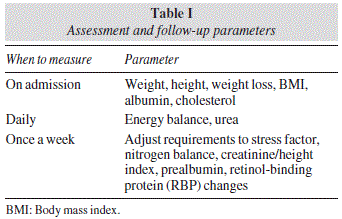
<body><![CDATA[<p><font face="Verdana" size="2">Serum leptin concentrations may be a good predictor of nutritional status, as has been shown in studies done in the elderly, but there is still not sufficient evidence for their value in critically-ill patients<sup>16,17</sup>.</font></p>     <p>&nbsp;</p>     <p><font face="Verdana" size="2"><b>Recommendations</b></font></p>     <p><font face="Verdana" size="2">- The anthropometric parameters or biochemical markers most commonly used to evaluate nutritional status should not be recommended in clinical practice in critically-ill patients (C).</font></p>     <p><font face="Verdana" size="2">- To assess nutritional status on admission, weight loss, BMI or SGA may be used. To monitor renutrition, nitrogen balance, prealbumin, retinol and 3-MH may be used. To assess metabolic response, urea excretion, nitrogen balance and 3-MH may be useful. As prognostic parameters, nitrogen balance and albumin may be used (C).</font></p>     <p><font face="Verdana" size="2">As a guide, the assessment and follow-up parameters proposed in <a href="#t1">Table I</a> may be used.</font></p>     <p align="center"><font face="Verdana" size="2"><a name="t1"><img src="/img/revistas/nh/v26s2/03_capitulo03_t1.gif" align="top" width="342" height="219"></a></font></p>     <p>&nbsp;</p>     <p><font face="Verdana" size="2"><b>Conflicts of interest</b></font></p>     <p><font face="Verdana" size="2">The authors state that they have participated in activi ties financed by the pharmaceutical industry for marketing of nutritional products (clinical studies, educational programs and attendance at scientific events). No pharmaceutical industry has participated in the preparation, discussion, writing and establishing of evidence in any stage of these recommendations.</font></p>     ]]></body>
<body><![CDATA[<p>&nbsp;</p>     <p><font face="Verdana" size="2"><b>References</b></font></p>     <!-- ref --><p><font face="Verdana" size="2">1. Jensen GL, Mirtallo J, Compher C, Dhaliwal R, Forbes A, Grijalba RF, et al. Adult starvation and disease-related malnutrition: A proposal for etiology-based diagnosis in the clinical practice setting for the International Consensus Guidelines Committee. <i>Clin Nutr</i> 2010; 29: 151-3.    &nbsp;&nbsp;&nbsp;&nbsp;&nbsp;&nbsp;&nbsp;&nbsp;[&#160;<a href="javascript:void(0);" onclick="javascript: window.open('/scielo.php?script=sci_nlinks&ref=3651386&pid=S0212-1611201100080000300001&lng=','','width=640,height=500,resizable=yes,scrollbars=1,menubar=yes,');">Links</a>&#160;]<!-- end-ref --></font></p>    <!-- ref --><p><font face="Verdana" size="2">2. Soeters PB, Schols AM. Advances in understanding and asse - ssing malnutrition. <i>Curr Opin Clin Nutr Metab Care</i> 2009; 12: 487-94.    &nbsp;&nbsp;&nbsp;&nbsp;&nbsp;&nbsp;&nbsp;&nbsp;[&#160;<a href="javascript:void(0);" onclick="javascript: window.open('/scielo.php?script=sci_nlinks&ref=3651388&pid=S0212-1611201100080000300002&lng=','','width=640,height=500,resizable=yes,scrollbars=1,menubar=yes,');">Links</a>&#160;]<!-- end-ref --></font></p>    <!-- ref --><p><font face="Verdana" size="2">3. Gong MN, Bajwa EK, Thompson BT, Christiani DC. Body mass index is associated with the development of acute respiratory distress syndrome. <i>Thorax</i> 2010; 65: 44-50.    &nbsp;&nbsp;&nbsp;&nbsp;&nbsp;&nbsp;&nbsp;&nbsp;[&#160;<a href="javascript:void(0);" onclick="javascript: window.open('/scielo.php?script=sci_nlinks&ref=3651390&pid=S0212-1611201100080000300003&lng=','','width=640,height=500,resizable=yes,scrollbars=1,menubar=yes,');">Links</a>&#160;]<!-- end-ref --></font></p>    <!-- ref --><p><font face="Verdana" size="2">4. Sungurtekin H, Sungurtekin U, Oner O, Okke D. Nutrition assessment in critically ill patients. <i>Nutr Clin Pract</i> 2008; 23: 635-41.    &nbsp;&nbsp;&nbsp;&nbsp;&nbsp;&nbsp;&nbsp;&nbsp;[&#160;<a href="javascript:void(0);" onclick="javascript: window.open('/scielo.php?script=sci_nlinks&ref=3651392&pid=S0212-1611201100080000300004&lng=','','width=640,height=500,resizable=yes,scrollbars=1,menubar=yes,');">Links</a>&#160;]<!-- end-ref --></font></p>    ]]></body>
<body><![CDATA[<!-- ref --><p><font face="Verdana" size="2">5. Atalay BG, Yagmur C, Nursal TZ, Atalay H, Noyan T. Use of subjective global assessment and clinical outcomes in critically ill geriatric patients receiving nutrition support. <i>JPEN J Parenter Enteral Nutr</i> 2008; 32: 454-9.    &nbsp;&nbsp;&nbsp;&nbsp;&nbsp;&nbsp;&nbsp;&nbsp;[&#160;<a href="javascript:void(0);" onclick="javascript: window.open('/scielo.php?script=sci_nlinks&ref=3651394&pid=S0212-1611201100080000300005&lng=','','width=640,height=500,resizable=yes,scrollbars=1,menubar=yes,');">Links</a>&#160;]<!-- end-ref --></font></p>    <!-- ref --><p><font face="Verdana" size="2">6. López-Hellín J, Baena-Fustegueras JA, Schwartz-Riera S, García-Arumi E. Usefulness of short-lived proteins and nutritional indicators surgical patients. <i>Clin Nutr</i> 2002; 21: 119-25.    &nbsp;&nbsp;&nbsp;&nbsp;&nbsp;&nbsp;&nbsp;&nbsp;[&#160;<a href="javascript:void(0);" onclick="javascript: window.open('/scielo.php?script=sci_nlinks&ref=3651396&pid=S0212-1611201100080000300006&lng=','','width=640,height=500,resizable=yes,scrollbars=1,menubar=yes,');">Links</a>&#160;]<!-- end-ref --></font></p>    <!-- ref --><p><font face="Verdana" size="2">7. Beghetto MG, Luft VC, Mello ED, polanczyk CA. Accuracy of nutritional assessment tools for predicting adverse hospital outcomes. <i>Nutr Hosp</i> 2009; 24: 56-62.    &nbsp;&nbsp;&nbsp;&nbsp;&nbsp;&nbsp;&nbsp;&nbsp;[&#160;<a href="javascript:void(0);" onclick="javascript: window.open('/scielo.php?script=sci_nlinks&ref=3651398&pid=S0212-1611201100080000300007&lng=','','width=640,height=500,resizable=yes,scrollbars=1,menubar=yes,');">Links</a>&#160;]<!-- end-ref --></font></p>    <!-- ref --><p><font face="Verdana" size="2">8. Donini LM, Savina C, Ricciardi LM, Coletti C, Paolini M, Scavone L et al. Predicting the outcome of artificial nutrition by clinical functional indices. <i>Nutrition</i> 2009; 25: 11-9.    &nbsp;&nbsp;&nbsp;&nbsp;&nbsp;&nbsp;&nbsp;&nbsp;[&#160;<a href="javascript:void(0);" onclick="javascript: window.open('/scielo.php?script=sci_nlinks&ref=3651400&pid=S0212-1611201100080000300008&lng=','','width=640,height=500,resizable=yes,scrollbars=1,menubar=yes,');">Links</a>&#160;]<!-- end-ref --></font></p>    <!-- ref --><p><font face="Verdana" size="2">9. Dennis RA, Johnson LE, Roberson PK, Heif M, Bopp MM, Cook J, et al. Changes in prealbumin, nutrient intake, and systemic inflammation in elderly recuperative care patients. <i>J Am Geriatr Soc</i> 2008; 56: 1270-5.    &nbsp;&nbsp;&nbsp;&nbsp;&nbsp;&nbsp;&nbsp;&nbsp;[&#160;<a href="javascript:void(0);" onclick="javascript: window.open('/scielo.php?script=sci_nlinks&ref=3651402&pid=S0212-1611201100080000300009&lng=','','width=640,height=500,resizable=yes,scrollbars=1,menubar=yes,');">Links</a>&#160;]<!-- end-ref --></font></p>    ]]></body>
<body><![CDATA[<!-- ref --><p><font face="Verdana" size="2">10. Devakonda A, George L, Raoof S, Esan A, Saleh A, Bernstein LH. Transthyretin as marker to predict outcome in critically ill patients. <i>Clin Biochem</i> 2008; 41: 1126-30.    &nbsp;&nbsp;&nbsp;&nbsp;&nbsp;&nbsp;&nbsp;&nbsp;[&#160;<a href="javascript:void(0);" onclick="javascript: window.open('/scielo.php?script=sci_nlinks&ref=3651404&pid=S0212-1611201100080000300010&lng=','','width=640,height=500,resizable=yes,scrollbars=1,menubar=yes,');">Links</a>&#160;]<!-- end-ref --></font></p>    <!-- ref --><p><font face="Verdana" size="2">11. Guimaraes SM, Lima EQ, Cipullo JP, Lobo SM, Burdmann EA. Low insulin-like growth factor 1- and hypocholesterolemia as mortality predictors in acute kidney injury in the intensive care unit. <i>Crit Care Med</i> 2008; 36: 3165-70.    &nbsp;&nbsp;&nbsp;&nbsp;&nbsp;&nbsp;&nbsp;&nbsp;[&#160;<a href="javascript:void(0);" onclick="javascript: window.open('/scielo.php?script=sci_nlinks&ref=3651406&pid=S0212-1611201100080000300011&lng=','','width=640,height=500,resizable=yes,scrollbars=1,menubar=yes,');">Links</a>&#160;]<!-- end-ref --></font></p>    <!-- ref --><p><font face="Verdana" size="2">12. Alvares-da-Silva MR, Reverbel da Silveira T. Comparison between handgrip strength, subjective global assessment, and prognostic nutritional index in assessing malnutrition and predicting clinical outcome in cirrhotic outpatients. <i>Nutrition</i> 2005; 21: 113-7.    &nbsp;&nbsp;&nbsp;&nbsp;&nbsp;&nbsp;&nbsp;&nbsp;[&#160;<a href="javascript:void(0);" onclick="javascript: window.open('/scielo.php?script=sci_nlinks&ref=3651408&pid=S0212-1611201100080000300012&lng=','','width=640,height=500,resizable=yes,scrollbars=1,menubar=yes,');">Links</a>&#160;]<!-- end-ref --></font></p>    <!-- ref --><p><font face="Verdana" size="2">13. Briet F, Twomey C, Jeejeebhoy KN. Effect of feeding malnourished patients for 1 mo on mitochondrial complex I activity and nutritional assessment measurements. <i>Am J Clin Nutr</i> 2004; 79: 787-94.    &nbsp;&nbsp;&nbsp;&nbsp;&nbsp;&nbsp;&nbsp;&nbsp;[&#160;<a href="javascript:void(0);" onclick="javascript: window.open('/scielo.php?script=sci_nlinks&ref=3651410&pid=S0212-1611201100080000300013&lng=','','width=640,height=500,resizable=yes,scrollbars=1,menubar=yes,');">Links</a>&#160;]<!-- end-ref --></font></p>    <!-- ref --><p><font face="Verdana" size="2">14. Luo X, Zhou Y, Tao D, Yu Y, Hu J, Qiu F et al. Usefulness of oral mucosal epithelial cell apoptosis rate in nutritional assessment. <i>Nutrition</i> 2006; 22: 1032-8.    &nbsp;&nbsp;&nbsp;&nbsp;&nbsp;&nbsp;&nbsp;&nbsp;[&#160;<a href="javascript:void(0);" onclick="javascript: window.open('/scielo.php?script=sci_nlinks&ref=3651412&pid=S0212-1611201100080000300014&lng=','','width=640,height=500,resizable=yes,scrollbars=1,menubar=yes,');">Links</a>&#160;]<!-- end-ref --></font></p>    ]]></body>
<body><![CDATA[<!-- ref --><p><font face="Verdana" size="2">15. Villet S, Chiólero R, Bollmann MD, Revelly JP, Cayeux RN, Delarue J et al. Negative impact of hypocaloric feeding and energy balance on clinical outcome in ICU patients. <i>Clin Nutr</i> 2005; 24: 502-9.    &nbsp;&nbsp;&nbsp;&nbsp;&nbsp;&nbsp;&nbsp;&nbsp;[&#160;<a href="javascript:void(0);" onclick="javascript: window.open('/scielo.php?script=sci_nlinks&ref=3651414&pid=S0212-1611201100080000300015&lng=','','width=640,height=500,resizable=yes,scrollbars=1,menubar=yes,');">Links</a>&#160;]<!-- end-ref --></font></p>    <!-- ref --><p><font face="Verdana" size="2">16. Amirkalali B, Sharifi F, Fakhrzadeh H, Mirarefein M, Ghaderpanahi M, Badamchizadeh Z et al. Low serum leptin serves as a biomarker of malnutrition in elderly patients. <i>Nutr Res</i> 2010; 30: 314-19.    &nbsp;&nbsp;&nbsp;&nbsp;&nbsp;&nbsp;&nbsp;&nbsp;[&#160;<a href="javascript:void(0);" onclick="javascript: window.open('/scielo.php?script=sci_nlinks&ref=3651416&pid=S0212-1611201100080000300016&lng=','','width=640,height=500,resizable=yes,scrollbars=1,menubar=yes,');">Links</a>&#160;]<!-- end-ref --></font></p>    <!-- ref --><p><font face="Verdana" size="2">17. Bouillanne O, Golmard JL, Coussieu C, Noël M, Durand D, Piette F et al. Leptin a new biological marker for evaluating malnutrition in elderly patients. <i>Eur J Clin Nutr</i> 2007; 61: 647-54.    &nbsp;&nbsp;&nbsp;&nbsp;&nbsp;&nbsp;&nbsp;&nbsp;[&#160;<a href="javascript:void(0);" onclick="javascript: window.open('/scielo.php?script=sci_nlinks&ref=3651418&pid=S0212-1611201100080000300017&lng=','','width=640,height=500,resizable=yes,scrollbars=1,menubar=yes,');">Links</a>&#160;]<!-- end-ref --></font></p>     <p>&nbsp;</p>     <p>&nbsp;</p>     <p><font face="Verdana" size="2"><a href="#top"><img border="0" src="/img/revistas/nh/v26s2/seta.gif" width="15" height="17"></a><a name="bajo"></a><b>Correspondence:</b>    <br>S. Ruiz-Santana.    ]]></body>
<body><![CDATA[<br>Hospital Universitario de Gran Canaria Dr. Negrín.    <br>Las Palmas de Gran Canaria. Spain.    <br>E-mail: <a href="mailto:sruisan@gobiernodecanarias.org">sruisan@gobiernodecanarias.org</a></font></p>      ]]></body><back>
<ref-list>
<ref id="B1">
<label>1</label><nlm-citation citation-type="journal">
<person-group person-group-type="author">
<name>
<surname><![CDATA[Jensen]]></surname>
<given-names><![CDATA[GL]]></given-names>
</name>
<name>
<surname><![CDATA[Mirtallo]]></surname>
<given-names><![CDATA[J]]></given-names>
</name>
<name>
<surname><![CDATA[Compher]]></surname>
<given-names><![CDATA[C]]></given-names>
</name>
<name>
<surname><![CDATA[Dhaliwal]]></surname>
<given-names><![CDATA[R]]></given-names>
</name>
<name>
<surname><![CDATA[Forbes]]></surname>
<given-names><![CDATA[A]]></given-names>
</name>
<name>
<surname><![CDATA[Grijalba]]></surname>
<given-names><![CDATA[RF]]></given-names>
</name>
</person-group>
<article-title xml:lang="en"><![CDATA[Adult starvation and disease-related malnutrition: A proposal for etiology-based diagnosis in the clinical practice setting for the International Consensus Guidelines Committee]]></article-title>
<source><![CDATA[Clin Nutr]]></source>
<year>2010</year>
<volume>29</volume>
<page-range>151-3</page-range></nlm-citation>
</ref>
<ref id="B2">
<label>2</label><nlm-citation citation-type="journal">
<person-group person-group-type="author">
<name>
<surname><![CDATA[Soeters]]></surname>
<given-names><![CDATA[PB]]></given-names>
</name>
<name>
<surname><![CDATA[Schols]]></surname>
<given-names><![CDATA[AM]]></given-names>
</name>
</person-group>
<article-title xml:lang="en"><![CDATA[Advances in understanding and asse - ssing malnutrition]]></article-title>
<source><![CDATA[Curr Opin Clin Nutr Metab Care]]></source>
<year>2009</year>
<volume>12</volume>
<page-range>487-94</page-range></nlm-citation>
</ref>
<ref id="B3">
<label>3</label><nlm-citation citation-type="journal">
<person-group person-group-type="author">
<name>
<surname><![CDATA[Gong]]></surname>
<given-names><![CDATA[MN]]></given-names>
</name>
<name>
<surname><![CDATA[Bajwa]]></surname>
<given-names><![CDATA[EK]]></given-names>
</name>
<name>
<surname><![CDATA[Thompson]]></surname>
<given-names><![CDATA[BT]]></given-names>
</name>
<name>
<surname><![CDATA[Christiani]]></surname>
<given-names><![CDATA[DC]]></given-names>
</name>
</person-group>
<article-title xml:lang="en"><![CDATA[Body mass index is associated with the development of acute respiratory distress syndrome]]></article-title>
<source><![CDATA[Thorax]]></source>
<year>2010</year>
<volume>65</volume>
<page-range>44-50</page-range></nlm-citation>
</ref>
<ref id="B4">
<label>4</label><nlm-citation citation-type="journal">
<person-group person-group-type="author">
<name>
<surname><![CDATA[Sungurtekin]]></surname>
<given-names><![CDATA[H]]></given-names>
</name>
<name>
<surname><![CDATA[Sungurtekin]]></surname>
<given-names><![CDATA[U]]></given-names>
</name>
<name>
<surname><![CDATA[Oner]]></surname>
<given-names><![CDATA[O]]></given-names>
</name>
<name>
<surname><![CDATA[Okke]]></surname>
<given-names><![CDATA[D]]></given-names>
</name>
</person-group>
<article-title xml:lang="en"><![CDATA[Nutrition assessment in critically ill patients]]></article-title>
<source><![CDATA[Nutr Clin Pract]]></source>
<year>2008</year>
<volume>23</volume>
<page-range>635-41</page-range></nlm-citation>
</ref>
<ref id="B5">
<label>5</label><nlm-citation citation-type="journal">
<person-group person-group-type="author">
<name>
<surname><![CDATA[Atalay]]></surname>
<given-names><![CDATA[BG]]></given-names>
</name>
<name>
<surname><![CDATA[Yagmur]]></surname>
<given-names><![CDATA[C]]></given-names>
</name>
<name>
<surname><![CDATA[Nursal]]></surname>
<given-names><![CDATA[TZ]]></given-names>
</name>
<name>
<surname><![CDATA[Atalay]]></surname>
<given-names><![CDATA[H]]></given-names>
</name>
<name>
<surname><![CDATA[Noyan]]></surname>
<given-names><![CDATA[T]]></given-names>
</name>
</person-group>
<article-title xml:lang="en"><![CDATA[Use of subjective global assessment and clinical outcomes in critically ill geriatric patients receiving nutrition support]]></article-title>
<source><![CDATA[JPEN J Parenter Enteral Nutr]]></source>
<year>2008</year>
<volume>32</volume>
<page-range>454-9</page-range></nlm-citation>
</ref>
<ref id="B6">
<label>6</label><nlm-citation citation-type="journal">
<person-group person-group-type="author">
<name>
<surname><![CDATA[López-Hellín]]></surname>
<given-names><![CDATA[J]]></given-names>
</name>
<name>
<surname><![CDATA[Baena-Fustegueras]]></surname>
<given-names><![CDATA[JA]]></given-names>
</name>
<name>
<surname><![CDATA[Schwartz-Riera]]></surname>
<given-names><![CDATA[S]]></given-names>
</name>
<name>
<surname><![CDATA[García-Arumi]]></surname>
<given-names><![CDATA[E]]></given-names>
</name>
</person-group>
<article-title xml:lang="en"><![CDATA[Usefulness of short-lived proteins and nutritional indicators surgical patients]]></article-title>
<source><![CDATA[Clin Nutr]]></source>
<year>2002</year>
<volume>21</volume>
<page-range>119-25</page-range></nlm-citation>
</ref>
<ref id="B7">
<label>7</label><nlm-citation citation-type="journal">
<person-group person-group-type="author">
<name>
<surname><![CDATA[Beghetto]]></surname>
<given-names><![CDATA[MG]]></given-names>
</name>
<name>
<surname><![CDATA[Luft]]></surname>
<given-names><![CDATA[VC]]></given-names>
</name>
<name>
<surname><![CDATA[Mello]]></surname>
<given-names><![CDATA[ED]]></given-names>
</name>
<name>
<surname><![CDATA[polanczyk]]></surname>
<given-names><![CDATA[CA]]></given-names>
</name>
</person-group>
<article-title xml:lang="en"><![CDATA[Accuracy of nutritional assessment tools for predicting adverse hospital outcomes]]></article-title>
<source><![CDATA[Nutr Hosp]]></source>
<year>2009</year>
<volume>24</volume>
<page-range>56-62</page-range></nlm-citation>
</ref>
<ref id="B8">
<label>8</label><nlm-citation citation-type="journal">
<person-group person-group-type="author">
<name>
<surname><![CDATA[Donini]]></surname>
<given-names><![CDATA[LM]]></given-names>
</name>
<name>
<surname><![CDATA[Savina]]></surname>
<given-names><![CDATA[C]]></given-names>
</name>
<name>
<surname><![CDATA[Ricciardi]]></surname>
<given-names><![CDATA[LM]]></given-names>
</name>
<name>
<surname><![CDATA[Coletti]]></surname>
<given-names><![CDATA[C]]></given-names>
</name>
<name>
<surname><![CDATA[Paolini]]></surname>
<given-names><![CDATA[M]]></given-names>
</name>
<name>
<surname><![CDATA[Scavone]]></surname>
<given-names><![CDATA[L]]></given-names>
</name>
</person-group>
<article-title xml:lang="en"><![CDATA[Predicting the outcome of artificial nutrition by clinical functional indices]]></article-title>
<source><![CDATA[Nutrition]]></source>
<year>2009</year>
<volume>25</volume>
<page-range>11-9</page-range></nlm-citation>
</ref>
<ref id="B9">
<label>9</label><nlm-citation citation-type="journal">
<person-group person-group-type="author">
<name>
<surname><![CDATA[Dennis]]></surname>
<given-names><![CDATA[RA]]></given-names>
</name>
<name>
<surname><![CDATA[Johnson]]></surname>
<given-names><![CDATA[LE]]></given-names>
</name>
<name>
<surname><![CDATA[Roberson]]></surname>
<given-names><![CDATA[PK]]></given-names>
</name>
<name>
<surname><![CDATA[Heif]]></surname>
<given-names><![CDATA[M]]></given-names>
</name>
<name>
<surname><![CDATA[Bopp]]></surname>
<given-names><![CDATA[MM]]></given-names>
</name>
<name>
<surname><![CDATA[Cook]]></surname>
<given-names><![CDATA[J]]></given-names>
</name>
</person-group>
<article-title xml:lang="en"><![CDATA[Changes in prealbumin, nutrient intake, and systemic inflammation in elderly recuperative care patients]]></article-title>
<source><![CDATA[J Am Geriatr Soc]]></source>
<year>2008</year>
<volume>56</volume>
<page-range>1270-5</page-range></nlm-citation>
</ref>
<ref id="B10">
<label>10</label><nlm-citation citation-type="journal">
<person-group person-group-type="author">
<name>
<surname><![CDATA[Devakonda]]></surname>
<given-names><![CDATA[A]]></given-names>
</name>
<name>
<surname><![CDATA[George]]></surname>
<given-names><![CDATA[L]]></given-names>
</name>
<name>
<surname><![CDATA[Raoof]]></surname>
<given-names><![CDATA[S]]></given-names>
</name>
<name>
<surname><![CDATA[Esan]]></surname>
<given-names><![CDATA[A]]></given-names>
</name>
<name>
<surname><![CDATA[Saleh]]></surname>
<given-names><![CDATA[A]]></given-names>
</name>
<name>
<surname><![CDATA[Bernstein]]></surname>
<given-names><![CDATA[LH]]></given-names>
</name>
</person-group>
<article-title xml:lang="en"><![CDATA[Transthyretin as marker to predict outcome in critically ill patients]]></article-title>
<source><![CDATA[Clin Biochem]]></source>
<year>2008</year>
<volume>41</volume>
<page-range>1126-30</page-range></nlm-citation>
</ref>
<ref id="B11">
<label>11</label><nlm-citation citation-type="journal">
<person-group person-group-type="author">
<name>
<surname><![CDATA[Guimaraes]]></surname>
<given-names><![CDATA[SM]]></given-names>
</name>
<name>
<surname><![CDATA[Lima]]></surname>
<given-names><![CDATA[EQ]]></given-names>
</name>
<name>
<surname><![CDATA[Cipullo]]></surname>
<given-names><![CDATA[JP]]></given-names>
</name>
<name>
<surname><![CDATA[Lobo]]></surname>
<given-names><![CDATA[SM]]></given-names>
</name>
<name>
<surname><![CDATA[Burdmann]]></surname>
<given-names><![CDATA[EA]]></given-names>
</name>
</person-group>
<article-title xml:lang="en"><![CDATA[Low insulin-like growth factor 1- and hypocholesterolemia as mortality predictors in acute kidney injury in the intensive care unit]]></article-title>
<source><![CDATA[Crit Care Med]]></source>
<year>2008</year>
<volume>36</volume>
<page-range>3165-70</page-range></nlm-citation>
</ref>
<ref id="B12">
<label>12</label><nlm-citation citation-type="journal">
<person-group person-group-type="author">
<name>
<surname><![CDATA[Alvares-da-Silva]]></surname>
<given-names><![CDATA[MR]]></given-names>
</name>
<name>
<surname><![CDATA[Reverbel da Silveira]]></surname>
<given-names><![CDATA[T]]></given-names>
</name>
</person-group>
<article-title xml:lang="en"><![CDATA[Comparison between handgrip strength, subjective global assessment, and prognostic nutritional index in assessing malnutrition and predicting clinical outcome in cirrhotic outpatients]]></article-title>
<source><![CDATA[Nutrition]]></source>
<year>2005</year>
<volume>21</volume>
<page-range>113-7</page-range></nlm-citation>
</ref>
<ref id="B13">
<label>13</label><nlm-citation citation-type="journal">
<person-group person-group-type="author">
<name>
<surname><![CDATA[Briet]]></surname>
<given-names><![CDATA[F]]></given-names>
</name>
<name>
<surname><![CDATA[Twomey]]></surname>
<given-names><![CDATA[C]]></given-names>
</name>
<name>
<surname><![CDATA[Jeejeebhoy]]></surname>
<given-names><![CDATA[KN]]></given-names>
</name>
</person-group>
<article-title xml:lang="en"><![CDATA[Effect of feeding malnourished patients for 1 mo on mitochondrial complex I activity and nutritional assessment measurements]]></article-title>
<source><![CDATA[Am J Clin Nutr]]></source>
<year>2004</year>
<volume>79</volume>
<page-range>787-94</page-range></nlm-citation>
</ref>
<ref id="B14">
<label>14</label><nlm-citation citation-type="journal">
<person-group person-group-type="author">
<name>
<surname><![CDATA[Luo]]></surname>
<given-names><![CDATA[X]]></given-names>
</name>
<name>
<surname><![CDATA[Zhou]]></surname>
<given-names><![CDATA[Y]]></given-names>
</name>
<name>
<surname><![CDATA[Tao]]></surname>
<given-names><![CDATA[D]]></given-names>
</name>
<name>
<surname><![CDATA[Yu]]></surname>
<given-names><![CDATA[Y]]></given-names>
</name>
<name>
<surname><![CDATA[Hu]]></surname>
<given-names><![CDATA[J]]></given-names>
</name>
<name>
<surname><![CDATA[Qiu]]></surname>
<given-names><![CDATA[F]]></given-names>
</name>
</person-group>
<article-title xml:lang="en"><![CDATA[Usefulness of oral mucosal epithelial cell apoptosis rate in nutritional assessment]]></article-title>
<source><![CDATA[Nutrition]]></source>
<year>2006</year>
<volume>22</volume>
<page-range>1032-8</page-range></nlm-citation>
</ref>
<ref id="B15">
<label>15</label><nlm-citation citation-type="journal">
<person-group person-group-type="author">
<name>
<surname><![CDATA[Villet]]></surname>
<given-names><![CDATA[S]]></given-names>
</name>
<name>
<surname><![CDATA[Chiólero]]></surname>
<given-names><![CDATA[R]]></given-names>
</name>
<name>
<surname><![CDATA[Bollmann]]></surname>
<given-names><![CDATA[MD]]></given-names>
</name>
<name>
<surname><![CDATA[Revelly]]></surname>
<given-names><![CDATA[JP]]></given-names>
</name>
<name>
<surname><![CDATA[Cayeux]]></surname>
<given-names><![CDATA[RN]]></given-names>
</name>
<name>
<surname><![CDATA[Delarue]]></surname>
<given-names><![CDATA[J]]></given-names>
</name>
</person-group>
<article-title xml:lang="en"><![CDATA[Negative impact of hypocaloric feeding and energy balance on clinical outcome in ICU patients]]></article-title>
<source><![CDATA[Clin Nutr]]></source>
<year>2005</year>
<volume>24</volume>
<page-range>502-9</page-range></nlm-citation>
</ref>
<ref id="B16">
<label>16</label><nlm-citation citation-type="journal">
<person-group person-group-type="author">
<name>
<surname><![CDATA[Amirkalali]]></surname>
<given-names><![CDATA[B]]></given-names>
</name>
<name>
<surname><![CDATA[Sharifi]]></surname>
<given-names><![CDATA[F]]></given-names>
</name>
<name>
<surname><![CDATA[Fakhrzadeh]]></surname>
<given-names><![CDATA[H]]></given-names>
</name>
<name>
<surname><![CDATA[Mirarefein]]></surname>
<given-names><![CDATA[M]]></given-names>
</name>
<name>
<surname><![CDATA[Ghaderpanahi]]></surname>
<given-names><![CDATA[M]]></given-names>
</name>
<name>
<surname><![CDATA[Badamchizadeh]]></surname>
<given-names><![CDATA[Z]]></given-names>
</name>
</person-group>
<article-title xml:lang="en"><![CDATA[Low serum leptin serves as a biomarker of malnutrition in elderly patients]]></article-title>
<source><![CDATA[Nutr Res]]></source>
<year>2010</year>
<volume>30</volume>
<page-range>314-19</page-range></nlm-citation>
</ref>
<ref id="B17">
<label>17</label><nlm-citation citation-type="journal">
<person-group person-group-type="author">
<name>
<surname><![CDATA[Bouillanne]]></surname>
<given-names><![CDATA[O]]></given-names>
</name>
<name>
<surname><![CDATA[Golmard]]></surname>
<given-names><![CDATA[JL]]></given-names>
</name>
<name>
<surname><![CDATA[Coussieu]]></surname>
<given-names><![CDATA[C]]></given-names>
</name>
<name>
<surname><![CDATA[Noël]]></surname>
<given-names><![CDATA[M]]></given-names>
</name>
<name>
<surname><![CDATA[Durand]]></surname>
<given-names><![CDATA[D]]></given-names>
</name>
<name>
<surname><![CDATA[Piette]]></surname>
<given-names><![CDATA[F]]></given-names>
</name>
</person-group>
<article-title xml:lang="en"><![CDATA[Leptin a new biological marker for evaluating malnutrition in elderly patients]]></article-title>
<source><![CDATA[Eur J Clin Nutr]]></source>
<year>2007</year>
<volume>61</volume>
<page-range>647-54</page-range></nlm-citation>
</ref>
</ref-list>
</back>
</article>
