<?xml version="1.0" encoding="ISO-8859-1"?><article xmlns:mml="http://www.w3.org/1998/Math/MathML" xmlns:xlink="http://www.w3.org/1999/xlink" xmlns:xsi="http://www.w3.org/2001/XMLSchema-instance">
<front>
<journal-meta>
<journal-id>0212-1611</journal-id>
<journal-title><![CDATA[Nutrición Hospitalaria]]></journal-title>
<abbrev-journal-title><![CDATA[Nutr. Hosp.]]></abbrev-journal-title>
<issn>0212-1611</issn>
<publisher>
<publisher-name><![CDATA[Grupo Arán]]></publisher-name>
</publisher>
</journal-meta>
<article-meta>
<article-id>S0212-16112012000200024</article-id>
<title-group>
<article-title xml:lang="en"><![CDATA[Influence of the glycemic index and glycemic load of the diet in the glycemic control of diabetic children and teenagers]]></article-title>
<article-title xml:lang="es"><![CDATA[Influencia del índice glicémico y la carga glucémica de la dieta en el control glucémico de niños y adolescentes diabéticos]]></article-title>
</title-group>
<contrib-group>
<contrib contrib-type="author">
<name>
<surname><![CDATA[Queiroz]]></surname>
<given-names><![CDATA[K. C.]]></given-names>
</name>
<xref ref-type="aff" rid="A01"/>
<xref ref-type="aff" rid="A02"/>
</contrib>
<contrib contrib-type="author">
<name>
<surname><![CDATA[Novato Silva]]></surname>
<given-names><![CDATA[I.]]></given-names>
</name>
<xref ref-type="aff" rid="A03"/>
</contrib>
<contrib contrib-type="author">
<name>
<surname><![CDATA[de Cássia Gonçalves Alfenas]]></surname>
<given-names><![CDATA[R.]]></given-names>
</name>
<xref ref-type="aff" rid="A04"/>
</contrib>
</contrib-group>
<aff id="A02">
<institution><![CDATA[,Hospital das Clinicas  ]]></institution>
<addr-line><![CDATA[ ]]></addr-line>
</aff>
<aff id="A01">
<institution><![CDATA[,Federal University of Minas Gerais (UFMG)  ]]></institution>
<addr-line><![CDATA[ Minas Gerais]]></addr-line>
<country>Brazil</country>
</aff>
<aff id="A03">
<institution><![CDATA[,Federal University of Minas Gerais (UFMG) Medical School ]]></institution>
<addr-line><![CDATA[ Minas Gerais]]></addr-line>
<country>Brazil</country>
</aff>
<aff id="A04">
<institution><![CDATA[,Federal University of Viçosa Department of Nutrition and Health ]]></institution>
<addr-line><![CDATA[Viçosa ]]></addr-line>
<country>Brazil</country>
</aff>
<pub-date pub-type="pub">
<day>00</day>
<month>04</month>
<year>2012</year>
</pub-date>
<pub-date pub-type="epub">
<day>00</day>
<month>04</month>
<year>2012</year>
</pub-date>
<volume>27</volume>
<numero>2</numero>
<fpage>510</fpage>
<lpage>515</lpage>
<copyright-statement/>
<copyright-year/>
<self-uri xlink:href="http://scielo.isciii.es/scielo.php?script=sci_arttext&amp;pid=S0212-16112012000200024&amp;lng=en&amp;nrm=iso"></self-uri><self-uri xlink:href="http://scielo.isciii.es/scielo.php?script=sci_abstract&amp;pid=S0212-16112012000200024&amp;lng=en&amp;nrm=iso"></self-uri><self-uri xlink:href="http://scielo.isciii.es/scielo.php?script=sci_pdf&amp;pid=S0212-16112012000200024&amp;lng=en&amp;nrm=iso"></self-uri><abstract abstract-type="short" xml:lang="en"><p><![CDATA[Objective: Evaluate the influence of the glycemic index (GI) and glycemic load (GL) of the diet in the glycemic control of children and teenagers with type 1 diabetes mellitus (DM1). Methods: A total of 146 subjects, aged 7-19 years, monitored at the Division of Pediatric Endocrinology at the HC/UFMG participated in the study. The consumed diet was evaluated using a quantitative food frequency questionnaire previously validated and tested in a pilotproject. The GI of the participant´s diet was estimated according to the equation described by Wolever and Jenkins (1986). The GL was estimated using the equation proposed by Foster-Powell et al. (2002). The glycemic control was classified as good, intermediate or poor according to the average of two HbA1c values obtained six months prior to the dietary evaluation date. Results: Subjects that had good glycemic control consumed diets with significantly (Tukey test, p = 0.000) lower GI/GL (54.8 &plusmn; 2.7/118.3 &plusmn; 29.8) than the ones with intermediate (60.1 &plusmn; 3.8/142.5 &plusmn; 27.3) and poor (60.3 &plusmn; 4.1/153.7 &plusmn; 40.7) glycemic control. The diet consumed by 75.5% of diabetics with good glycemic control was classified as medium GL, suggesting that the consumption of medium GL diet may favor an adequate glycemic control. The low GI diet consumed by these participants also presented higher protein content, which might have contributed to the attenuation of the postprandial glycemic response and better glycemic control of these patients. Conclusion: The intake of a reduced GI/GL diet favors the glycemic control of the studied population.]]></p></abstract>
<abstract abstract-type="short" xml:lang="es"><p><![CDATA[Objetivo: Evaluar la influencia del índice glucémico (IG) y de la carga glucémica (CG) de la dieta en el control glucémico de los diabéticos. Métodos: El estudio incluyó 146 individuos con edades comprendidas entre 7-19 años, visto en la División de Endocrinología Pediátrica del HC/UFMG. La dieta fue evaluada utilizando un cuestionario de frecuencia alimentaria cuantitativa validado y previamente probado en un proyecto piloto. El IG de la dieta se estimó de acuerdo con ecuación descrita por Wolever y Jenkins (1986). El CG se calcula utilizando la ecuación propuesta por Foster-Powell et al. (2002). El control glucémico fue calificado como buen, regular o mal a través de la media de dos resultados de la HbA1c de los seis meses anteriores a la fecha de evaluación de la dieta. Resultados: Los sujetos que tenían un buen control glucémico consumieron dietas con IG/CG significativamente (prueba de Tukey, p = 0,000) más baja (54,8 &plusmn; 2,7/118,3 &plusmn; 29,8) que los que tenían el control regular (60,1 &plusmn; 3,8/142,5 &plusmn; 27,3) y mal (60,3 &plusmn; 4,1/153,7 &plusmn; 40,7). La dieta ingerida por 75% de los diabéticos con un buen control glucémico presentó promedio CG, lo que sugiere que el control glucémico también se puede obtener cuando la ingesta alimentaria presenta esta característica. La dieta con IG bajo había un mayor contenido proteico, que puede haber contribuido a la atenuación de la respuesta de la glucemia postprandial, y un mejor control glucémico de los pacientes que ingirieron esta dieta. Conclusión: El consumo de dietas con reducción del IG y CG favoreció el control glucémico de la población estudiada.]]></p></abstract>
<kwd-group>
<kwd lng="en"><![CDATA[Diabetes mellitus]]></kwd>
<kwd lng="en"><![CDATA[Glycemic index]]></kwd>
<kwd lng="en"><![CDATA[Diabetic diet]]></kwd>
<kwd lng="en"><![CDATA[Blood glucose]]></kwd>
<kwd lng="es"><![CDATA[Diabetes mellitus]]></kwd>
<kwd lng="es"><![CDATA[Índice glucémico]]></kwd>
<kwd lng="es"><![CDATA[Dieta para diabéticos]]></kwd>
<kwd lng="es"><![CDATA[Glucemia]]></kwd>
</kwd-group>
</article-meta>
</front><body><![CDATA[ <p><font face="Verdana" size="2"><a name="top"></a><b>ORIGINAL</b></font></p>     <p>&nbsp;</p>     <p><font face="Verdana" size="4"><b>Influence of the glycemic index and glycemic load of the diet in the glycemic control of diabetic children and teenagers</b></font></p>     <p><font face="Verdana" size="4"><b>Influencia del índice glicémico y la carga glucémica de la dieta en el control glucémico de niños y adolescentes diabéticos</b></font></p>     <p>&nbsp;</p>     <p>&nbsp;</p>     <p><font face="Verdana" size="2"><b>K. C. Queiroz<sup>1</sup>, I. Novato Silva<sup>2</sup> and R. de Cássia Gonçalves Alfenas<sup>3</sup></b></font></p>     <p><font face="Verdana" size="2"><sup>1</sup>Nutritionist at the Hospital das Clinicas. Federal University of Minas Gerais (UFMG). Brazil.    <br><sup>2</sup>Associate Professor of Pediatrics at the Medical School of the Federal University of Minas Gerais (UFMG). Brazil.    <br><sup>3</sup>Associate Professor at the Department of Nutrition and Health of Federal University of Viçosa. Brazil.</font></p>     ]]></body>
<body><![CDATA[<p><font face="Verdana" size="2"><a href="#bajo">Correspondence</a></font></p>     <p>&nbsp;</p>     <p>&nbsp;</p> <hr size="1">     <p><font face="Verdana" size="2"><b>ABSTRACT</b></font></p>     <p><font face="Verdana" size="2"><b>Objective:</b> Evaluate the influence of the glycemic index (GI) and glycemic load (GL) of the diet in the glycemic control of children and teenagers with type 1 diabetes mellitus (DM1).    <br><b>Methods:</b> A total of 146 subjects, aged 7-19 years, monitored at the Division of Pediatric Endocrinology at the HC/UFMG participated in the study. The consumed diet was evaluated using a quantitative food frequency questionnaire previously validated and tested in a pilotproject. The GI of the participant´s diet was estimated according to the equation described by Wolever and Jenkins (1986). The GL was estimated using the equation proposed by Foster-Powell et al. (2002). The glycemic control was classified as good, intermediate or poor according to the average of two HbA1c values obtained six months prior to the dietary evaluation date.    <br><b>Results:</b> Subjects that had good glycemic control consumed diets with significantly (Tukey test, p = 0.000) lower GI/GL (54.8 &plusmn; 2.7/118.3 &plusmn; 29.8) than the ones with intermediate (60.1 &plusmn; 3.8/142.5 &plusmn; 27.3) and poor (60.3 &plusmn; 4.1/153.7 &plusmn; 40.7) glycemic control. The diet consumed by 75.5% of diabetics with good glycemic control was classified as medium GL, suggesting that the consumption of medium GL diet may favor an adequate glycemic control. The low GI diet consumed by these participants also presented higher protein content, which might have contributed to the attenuation of the postprandial glycemic response and better glycemic control of these patients.    <br><b>Conclusion:</b> The intake of a reduced GI/GL diet favors the glycemic control of the studied population.</font></p>     <p><font face="Verdana" size="2"><b>Key words:</b> Diabetes mellitus. Glycemic index. Diabetic diet. Blood glucose.</font></p> <hr size="1">     <p><font face="Verdana" size="2"><b>RESUMEN</b></font></p>     ]]></body>
<body><![CDATA[<p><font face="Verdana" size="2"><b>Objetivo:</b> Evaluar la influencia del índice glucémico (IG) y de la carga glucémica (CG) de la dieta en el control glucémico de los diabéticos.    <br><b>Métodos:</b> El estudio incluyó 146 individuos con edades comprendidas entre 7-19 años, visto en la División de Endocrinología Pediátrica del HC/UFMG. La dieta fue evaluada utilizando un cuestionario de frecuencia alimentaria cuantitativa validado y previamente probado en un proyecto piloto. El IG de la dieta se estimó de acuerdo con ecuación descrita por Wolever y Jenkins (1986). El CG se calcula utilizando la ecuación propuesta por Foster-Powell et al. (2002). El control glucémico fue calificado como buen, regular o mal a través de la media de dos resultados de la HbA1c de los seis meses anteriores a la fecha de evaluación de la dieta.    <br><b>Resultados:</b> Los sujetos que tenían un buen control glucémico consumieron dietas con IG/CG significativamente (prueba de Tukey, p = 0,000) más baja (54,8 &plusmn; 2,7/118,3 &plusmn; 29,8) que los que tenían el control regular (60,1 &plusmn; 3,8/142,5 &plusmn; 27,3) y mal (60,3 &plusmn; 4,1/153,7 &plusmn; 40,7). La dieta ingerida por 75% de los diabéticos con un buen control glucémico presentó promedio CG, lo que sugiere que el control glucémico también se puede obtener cuando la ingesta alimentaria presenta esta característica. La dieta con IG bajo había un mayor contenido proteico, que puede haber contribuido a la atenuación de la respuesta de la glucemia postprandial, y un mejor control glucémico de los pacientes que ingirieron esta dieta.    <br><b>Conclusión:</b> El consumo de dietas con reducción del IG y CG favoreció el control glucémico de la población estudiada.</font></p>     <p><font face="Verdana" size="2"><b>Palabras clave:</b> Diabetes mellitus. Índice glucémico. Dieta para diabéticos. Glucemia.</font></p> <hr size="1">     <p><font face="Verdana" size="2"><b>Abbreviations</b>    <br>DM1: Type 1 Diabetes mellitus.    <br>GI: Glycemic index.    <br>GL: Glycemic load.    <br>HC/UFMG: Hospital das Clínicas-Federal University of Minas Gerais.    ]]></body>
<body><![CDATA[<br>MW: Minimum Wage.    <br>IMC: Body mass index.    <br>QFFQ: Quantitative food frequency questionnaire.</font></p>     <p>&nbsp;</p>     <p><font face="Verdana" size="2"><b>Introduction</b></font></p>     <p><font face="Verdana" size="2">Diabetes mellitus (DM) is a metabolic syndromecaused by defects in insulin secretion and/or action.<sup>1</sup> It is characterized by chronic hyperglycemia, affecting the metabolism of carbohydrate, fat and protein.<sup>2</sup> It isthe most frequent endocrine-metabolic disorder that may occur during childhood and adolescence leading to a high morbimortality, with considerable loss of quality of life of its carriers. The achievement of an adequate glycemic control is the main objective in the treatment of DM, which is based in a balance between insulin, diet and physical activity.<sup>3</sup></font></p>     <p><font face="Verdana" size="2">The diet component that has the greatest influence in the glycemia is the carbohydrate. Although the quantity of carbohydrate is considered the main determinant of the postprandial glycemia, the type of carbohydrate can also affect this response.<sup>4</sup> The glycemic index (GI) is a parameter used to classify foods according to their postprandial glycemic response.<sup>5</sup></font></p>     <p><font face="Verdana" size="2">By definition, the GI compares the effect of the consumption of a fixed amount of available carbohydrate (25 or 50 g) on the glycemia, having white bread or glucose as reference food. GI provides a measurement of the quality, but not of the quantity of the consumed carbohydrate. However, since the glycemic response is also affected by the amount of the consumed carbohydrate, the glycemic load (GL) has been considered as a better parameter to quantify the impact of carbohydrate in the glycemia. The GL reflects the glycemic response obtained after the consumption of a meal containing a variable amount of carbohydrates. Despite the fact that the GL is a parameter derived from the GI, the GL reflects better the glycemic response and the insulin demand in free living conditions, since in such conditions the amounts of carbohydrate consumed in each meal usually varies.<sup>6,7</sup></font></p>     <p><font face="Verdana" size="2">In the scientific community, there is an extensive discussion regarding the clinical use of the GI/GL. Results from several random clinical trials have reported that the consumption of low GI diets reduces the glycemic response in diabetic subjects.<sup>8-12</sup> However, this type of benefit was not confirmed in other studies.<sup>13,14</sup> The effect of GL in the glycemic control of diabetic patients is not well documented in the literature.</font></p>     <p><font face="Verdana" size="2">In recent literature review in the main health data bases (MEDLINE, LILACS, SciELO), no publications were found depicting the influence of GI and GL in the glycemic control of Brazilian diabetic children and teenagers. Studies of this nature are important, since they enable the evaluation of the impact of these parameters in the glycemic control of those subjects and consequently, in their quality of life. Thus, the objective of this study was to estimate the GI and GL of the diet consumed by children and teenagers with DM1 and to verify the influence of these parameters in the glycemic control of the studied population.</font></p>     ]]></body>
<body><![CDATA[<p>&nbsp;</p>     <p><font face="Verdana" size="2"><b>Methodology</b></font></p>     <p><i><font face="Verdana" size="2">Participants</font></i></p>     <p><font face="Verdana" size="2">DM1children and teenagers, aged between 7 and 19 years, having the DM diagnosed for at least one year, which were monitored by the Division of Pediatric Endocrinology at the Clinical Hospital of the Federal University of Minas Gerais (HC/UFMG) were selected to participate in the study. Sample size calculation (n = 140) for this study was established considering the total number of DM1children and teenagers (n = 240) that met the previously described inclusion criteria, considering 10% of sample loss. A 5% margin of error, reliability level of 90% and maximum variance for the proportion responses were adopted. The sampling strategy was determined by re-census, that is, subjects that attended the ambulatory at HC/UFMG were interviewed between June 2007 and March 2008, in random and alternate days. The study was approved by the Ethics Committee of the Federal University of Minas Gerais. The parents responsible or the interviewee himself, if over 18, signed a consent form, after full disclosure regarding the objectives of the research.</font></p>     <p>&nbsp;</p>     <p><font face="Verdana" size="2"><b>Materials and methods</b></font></p>     <p><font face="Verdana" size="2">The data used in the study was obtained using a semi-structured questionnaire previously tested in a pilot-study. This questionnaire was answered by the patients themselves and/or by their parent. The complementary information was obtained from the medical files.</font></p>     <p><font face="Verdana" size="2">The family and per capita incomes were evaluated in Brazilian currency (Real) and in terms of Minimum Wage (MW), which at the time of the interview was equivalent to US$ 194.00.</font></p>     <p><font face="Verdana" size="2">Body weight and height were measured according to Jelliffe (1968)<sup>15</sup> technique and the body mass index (BMI) was calculated, dividing the weight in kilograms by the height in meters squared<sup>16</sup>. The children and the teenagers nutritional status was classified based on the obtained BMI value, according to Himes (2009)<sup>17</sup> as: underweight (&lt; 5 percentile), eutrophic (&ge; 5 percentile and &lt; 85 percentile), overweight (&ge; 85 percentile and &lt; 95 percentile) and obese (&ge; 95 percentile), according to the percentiles generated by the DietPro program  (version 4)<sup>18</sup> that uses the anthropometric reference from the Center for Disease Control and Prevention (CDC, 2000).</font></p>     <p><font face="Verdana" size="2">The glycemic control was evaluated, within six months prior to the dietary evaluation date, according to the average of two HbA1c values obtained from medical records (patientsf HbA1c were assessed at each three months). The degree of glycemic control was classified according to the criterion proposed by Chase (1989),<sup>19</sup> dividing the patientfs HbA1c value by the upper limit of reference value for the method used to analyze it: good (&lt; 1,33), intermediate (&ge; 1,33 and &lt; 1,5), and poor (&ge; 1,5).</font></p>     ]]></body>
<body><![CDATA[<p><font face="Verdana" size="2">The habitual food intake of the patients in the six months prior to the interview was assessed using a validated quantitative food frequency questionnaire (QFFQ).<sup>20</sup> This QFFQ was previously tested in a pilotproject. Standardized pictures of small, medium and large food portions were used to increase accuracy in the estimation of the consumed foods by the diabetics (Monteiro et al., 2007).<sup>21</sup> The nutritional composition of the ingested diets was analyzed using the DietPro<sup>&reg;</sup> software (version 4).<sup>18</sup> The nutritional composition of the foods listed in the questionnaire was entered into the software, considering mainly the data from the Brazilian Table of Food Composition (2006).<sup>22</sup> Additional information was taken from two other tables.<sup>23,24</sup></font></p>     <p><font face="Verdana" size="2">The GI of the diet ingested by the participants of the study was estimated from the sum of the GI values of the foods ingested daily, according to the equation described by Wolever and Jenkins (1986)<sup>25</sup> and recommended by FAO (1998). The GI of the consumed diet was obtained multiplying the GI of each ingested food (IG<sub>A</sub>, IG<sub>B</sub>, IG<sub>c</sub>...) by the amount (in grams) of available carbohydrate contained in each one of these foods (g<sub>A</sub>, g<sub>B</sub>, g<sub>C</sub>...), which is then divided by the total amount of available carbohydrate of the diet (g), according to the following equation:</font></p>     <blockquote> 	    <p><font face="Verdana" size="2">Estimated IG = IG<sub>A</sub> x g<sub>A</sub>/g + IG<sub>B</sub> x g<sub>B</sub>/g.....</font></p> </blockquote>     <p><font face="Verdana" size="2">The available carbohydrate content was determined by subtracting the amount of ingested fiber from the total amount of carbohydrate.</font></p>     <p><font face="Verdana" size="2">The GI of each food was obtained, considering glucose as reference, using the values published in the International Table of Glycemic Index<sup>6</sup>. When the GI of certain foods was not listed in this table, the GI of foods having similar nutritional composition and method of preparation was considered.</font></p>     <p><font face="Verdana" size="2">The GL of the consumed diet was estimated multiplying the sum of the GI values of the daily ingested foods by the amount of available carbohydrate present in the diet, divided by 100<sup>6</sup> :</font></p>     <blockquote> 	    <p><font face="Verdana" size="2">Estimated GL = (GI x g of available carbohydrate)/100</font></p> </blockquote>     <p><font face="Verdana" size="2">The GI and the GL of the ingested diet were classified according to the following:</font></p>     ]]></body>
<body><![CDATA[<blockquote> 	    <p><font face="Verdana" size="2">GI: &le; 55 (low), from 56 to 69 (medium) and &ge; 70 (high)<sup>26</sup></font></p> 	    <p><font face="Verdana" size="2">GL: &le; 100 (low), from 101 to 199 (medium) and &ge; 200 (high)<sup>27</sup></font></p> </blockquote>     <p><i><font face="Verdana" size="2">Statistical analysis</font></i></p>     <p><font face="Verdana" size="2">The data were analyzed using the statistical softwares "Statistical Package for the Social Sciences for Windows" (SPSS), version 13.0 and "R Project of Statistical Computing", version 2.6.1. To evaluate the association between categorical variables the Chi- Square test was used or the Fisher Exact test, when indicated. To compare numeric variables between independent groups the T-student and the Anova tests were adopted. Multiple comparisons between the groups were conducted using the Tukey test. Rejection of the null hypothesis was set at 5% (p &lt; 0.05).</font></p>     <p>&nbsp;</p>     <p><font face="Verdana" size="2"><b>Results</b></font></p>     <p><font face="Verdana" size="2">A total of 146 participants, aged 12.9 &plusmn; 3.6 years, with an average disease duration equivalent to 6.9 &plusmn; 3.6 years were included in this study. From all the participants, 91 (62.3%) were females. The great majority (96.2%) of the diabetics (n = 130) had a family income up to 5 and 62.3% up to 2 minimum wages. As for the father and mother´s education, 38.5% and 34.3%, respectively, had up to a fourth grade level. Most of the subjects (87.7%) were eutrophic. Overweight was observed in 5 (3.4%) and underweight in 13 (8.9%) of the participants (n = 146). They received on average 0.84 &plusmn; 0.2 U of insulin/kg/day. Most of them (91.6%) used multiple doses of insulin (4 to 6) adjusted according to their preprandial glycemias. As for the glycemic control presented (n = 139), 38.1% showed good control, 18.0% intermediate control, and 43.9% poor control.</font></p>     <p><font face="Verdana" size="2">The majority of the subjects consumed a medium GI (68.5%) and GL (81.5%) diet. The consumption of diets of low GI (29.4%) and GL (11.0%), and high GI (2.1%) and GL (7.5%) was less frequent among these diabetics.</font></p>     <p><font face="Verdana" size="2">The diet consumed by the subjects that presented good/intermediate/poor glycemic control had GI and GL values equivalent to 54.8 &plusmn; 2.7/60.1 &plusmn; 3.8/60.3 &plusmn; 4.1, and 118.3 &plusmn; 29.8/142.5 &plusmn; 27.3/153.7 &plusmn; 40.7, respectively. The diets consumed by the diabetics with good glycemic control had mean GI and GL significantly lower (p = 0.00) than the ones with intermediate or poor control.</font></p>     ]]></body>
<body><![CDATA[<p><font face="Verdana" size="2">The majority of the subjects with good glycemic control (73.6%) ingested a low GI diet. All (100%) subjects that presented intermediate glycemic control and most of the diabetics with poor (88.5%) control ingested a medium GI diet. Despite the glycemic control presented, most subjects (80.6%) ingested a medium GL diet. However, in the subgroup with good control a higher proportion of subjects ingested a low GL diet (22.6%) than the ones that ingested a high GL diet (1.9%). The opposite was observed between the  subjects with poor control. There was a higher proportion of subjects that ingested a high GL diet (14.7%) than the ones that ingested a low GL diet (4.9%) (<a href="#t1">table I</a>).</font></p>     <p>&nbsp;</p>     <p align="center"><a name="t1"><img src="/img/revistas/nh/v27n2/24_original_14_t1.gif"</p width="340" height="347"></a>     <p>&nbsp;</p>     <p><font face="Verdana" size="2">Since only 3 diabetics consumed high GI diets, the analysis were made considering only the ingestion of low and medium GI diets. It was verified that the low GI diets also presented lower GL; and were lower in carbohydrate and saturated fat, higher in protein and polyunsaturated fat than the medium GI diets (<a href="#t2">table II</a>). The low GL diets were higher in protein and fiber, and lower in cholesterol than the high and medium GL diets (<a href="#t3">table III</a>).</font></p>     <p>&nbsp;</p>     <p align="center"><a name="t2"><img src="/img/revistas/nh/v27n2/24_original_14_t2.gif" width="339" height="369"></a></p>     <p>&nbsp;</p>     <p align="center"><a name="t3"><img src="/img/revistas/nh/v27n2/24_original_14_t3.gif" width="339" height="328"></a></p>     <p>&nbsp;</p>     ]]></body>
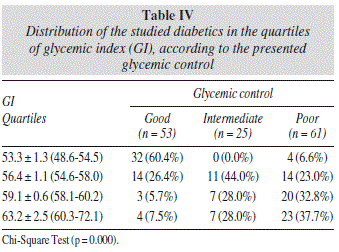
<body><![CDATA[<p><font face="Verdana" size="2">It was observed that 86.8% of the diabetics with good glycemic control consumed a diet with lower GI (IG &le; 58-upper limit of the 2<sup>nd</sup> quartile). On the other hand, the subjects with intermediate (56%) and poor (70.5%)  glycemic control consumed diets with a higher GI (IG &ge; 58.1), located in the 3<sup>rd</sup> and 4<sup>th</sup> quartiles (<a href="#t4">table IV</a>).</font></p>     <p>&nbsp;</p>     <p align="center"><a name="t4"><img src="/img/revistas/nh/v27n2/24_original_14_t4.gif" width="339" height="252"></a></p>     <p>&nbsp;</p>     <p><font face="Verdana" size="2">In a similar manner, 77.4% of the participants with good glycemic control ingested diets with GL located in the 2 first quartiles (CG &le; 130.8) and among those with intermediate (48%) and poor (68,8%), the values of the GL (GL &ge; 131.8) were placed in the 2 last quartiles (<a href="#t5">table V</a>).</font></p>     <p>&nbsp;</p>     <p align="center"><a name="t5"><img src="/img/revistas/nh/v27n2/24_original_14_t5.gif" width="339" height="251"></a></p>     <p>&nbsp;</p>     <p><font face="Verdana" size="2"><b>Discussion</b></font></p>     <p><font face="Verdana" size="2">The dietary treatment has a fundamental role in the metabolic control of DM patients and in the prevention of micro and macrovascular complications related to the disease. A recently published study showed that, while the consumption of diets with high protein content, less saturated fats, and lower GI/GL had a positive effect on glycemic control, the consumption of sucrose and of free snacks provided by the school had a negative influence for children and adolescents with type 1 diabetes.<sup>28</sup> The clinical usefulness of the GI as a tool to prevent complications in DM patients is still debatable in the scientific community. The consumption of high GI diets has been associated with more rapid progression to type 1 diabetes in children with islet autoimmunity.<sup>29</sup> In the present study, the intake of low GI diet had a positive influence in the glycemic control of the patients, which has also been reported in several other studies.<sup>8,9,11,12,30</sup> In a systematic review involving eleven randomised controlled trials of four weeks or longer that compared a low glycaemic index, or low glycaemic load, diet with a higher glycaemic index, or load, or other diet for people with either type 1 or 2 diabetes mellitus, it was showed that a low-GI diet can improve glycaemic control in diabetes without compromising hypoglycaemic events.<sup>31</sup> The dietary data presented in this study reflect the diet ingested by the participants in their daily life conditions, without previous guidance regarding the GI. It was verified that the well controlled patients, besides ingesting low GI diets ingested less carbohydrate and more protein. Therefore, the better glycemic control observed cannot be attributed to the effect of the GI only. However, in a meta-analysis in which the results of 14 randomized clinical trials with a duration of about 10 weeks were analyzed, the positive association between the glycemic control and the GI of the consumed diet was independent from the ingestion of calories, protein, fat, carbohydrate and fiber.<sup>10</sup></font></p>     ]]></body>
<body><![CDATA[<p><font face="Verdana" size="2">In the presented study there was a positive association between the diet´s GL and the glycemic control, reinforcing the fact that the quantity as well as the quality of ingested carbohydrate can influence the glycemic response. It is worth mentioning that some authors have suggested that the GL might be capable of better reflecting the glycemic response after a given meal in daily life conditions than the GI.<sup>6,7</sup> The association between the glycemic control of the participants in this study and the diet´s GI was independent from the intake of fiber, since there was no difference in the fiber content in the low and medium GI diets. However, it should be highlighted that the fiber content of the low GL diets was higher than that presented by the medium and high GL diets. It is known that an increase in fiber content reduces the amount of available carbohydrate, favoring the reduction of the GL itself. However, considering that the diet´s GL also varies with the type of the ingested carbohydrate (GI), the high ingestion of fiber itself does not ensure that the diet will present a low GL.</font></p>     <p><font face="Verdana" size="2">Although the amount of fat consumed is inversely related to the diet´s GI,<sup>32</sup> no differences were verified in the amount of fat and cholesterol in the medium and low GI diets ingested by the diabetics in this study. It was observed, however, that the medium GI diet presented a higher saturated fat percentage and higher level of polyunsaturated fat than in the low GI diet. Many aspects related to the association between the ingestion of fats and glycemic control needs further clarifications. It has been demonstrated that in healthy subjects the consumption of a diet high in saturated fat leads to a reduction in insulin sensibility.<sup>33,34</sup> The mecha nisms by which the type of fat consumed interferes on insulin sensibility are not completely clear. Some authors believe that the high intake of saturated fat can cause a modification in the cell membrane lipid profile, turning the phospholipid membrane more saturated; and consequently more resistant to insulin action.<sup>35</sup> Even though the GI of a diet does not reflect the quality of the ingested diet as a whole,<sup>5</sup> in this study the low GI diets presented a better fat profile than the medium GI diet.</font></p>     <p><font face="Verdana" size="2">Despite the differences seen in the nutritional composition of the diets differing in GI/GL, it was observed that to consume a low GI/GL diet, the subjects in this study, did not have to ingest large amounts of protein, fiber and fat. Thus, it is evident that although the ingestion of these nutrients may help to reduce the GI/GL, it is possible to get an eating plan presenting adequate GI/GL without negatively affecting its nutritional composition.</font></p>     <p><font face="Verdana" size="2">Despite the fact that most well controlled patients consumed a low GI diet, only 22.6% of them ingested a low GL diet. This happened because, among these well controlled subjects, the high intake of available carbohydrate (mean of 215.67 &plusmn; 49.4 g - data not shown) increased the diet´s GL, increasing also the proportion of subjects that consumed a medium GL diet, according to the adopted classification. It is worth mentioning that the participants´ mean fiber intake was  satisfactory.</font></p>     <p><font face="Verdana" size="2">When we evaluated the ingested carbohydrate as % of the diet´s total caloric intake, it was observed that only 5.6% of the participants had a mean percentage of carbohydrate intake above the adopted recommendation (55-60% of total caloric intake - data not shown). However, although most subjects with good glycemic control presented carbohydrate intake below or withinthe adopted  recommendation range, the ingested diet was classified as medium GL. Although the low GL diet is indicated in literature as adequate,<sup>36,37</sup> the intake of a diet that meets the recommendation of carbohydrates in terms of percentage of total caloric intake can make the prescription of a diet with these characteristics difficult. Despite the above mentioned, the results of the present study indicate that differently from what is seen about the effect of the consumption of a low GI  diet in the improvements in the glycemic control, it is possible to obtain an adequate control when a medium GL diet is consumed.</font></p>     <p>&nbsp;</p>     <p><font face="Verdana" size="2"><b>Conclusion</b></font></p>     <p><font face="Verdana" size="2">The results of this study illustrate the positive effects of the consumption of low GI diets in the glycemic control of children and teenagers with DM1 that have never received any instruction about the GI. These results also indicated that it is possible for these patients to obtain an adequate glycemic control when a medium GL diet is consumed.</font></p>     <p>&nbsp;</p>     <p><font face="Verdana" size="2"><b>References</b></font></p>     ]]></body>
<body><![CDATA[<!-- ref --><p><font face="Verdana" size="2">1. American Diabetes Association. Care of children and adolescents with type 1 diabetes. A statement of the American Diabetes Association. <i>Diabetes Care</i> 2005; 28 (1): 186-212.    &nbsp;&nbsp;&nbsp;&nbsp;&nbsp;&nbsp;&nbsp;&nbsp;[&#160;<a href="javascript:void(0);" onclick="javascript: window.open('/scielo.php?script=sci_nlinks&ref=3649550&pid=S0212-1611201200020002400001&lng=','','width=640,height=500,resizable=yes,scrollbars=1,menubar=yes,');">Links</a>&#160;]<!-- end-ref --></font></p>    <!-- ref --><p><font face="Verdana" size="2">2. Sesterheim P., Saitovitch D., Staub HL. Diabetes Mellitus Tipo 1: multifatores que conferem susceptibilidade à patogenia autoimune. <i>Scientia Medica</i> 2007; 17 (4): 212-17.    &nbsp;&nbsp;&nbsp;&nbsp;&nbsp;&nbsp;&nbsp;&nbsp;[&#160;<a href="javascript:void(0);" onclick="javascript: window.open('/scielo.php?script=sci_nlinks&ref=3649552&pid=S0212-1611201200020002400002&lng=','','width=640,height=500,resizable=yes,scrollbars=1,menubar=yes,');">Links</a>&#160;]<!-- end-ref --></font></p>    <!-- ref --><p><font face="Verdana" size="2">3. Choudhary P. Review of dietary recommendations for diabetes mellitus. <i>Diabetes Res Clin Pract</i> 2004; 65: 9-15.    &nbsp;&nbsp;&nbsp;&nbsp;&nbsp;&nbsp;&nbsp;&nbsp;[&#160;<a href="javascript:void(0);" onclick="javascript: window.open('/scielo.php?script=sci_nlinks&ref=3649554&pid=S0212-1611201200020002400003&lng=','','width=640,height=500,resizable=yes,scrollbars=1,menubar=yes,');">Links</a>&#160;]<!-- end-ref --></font></p>    <!-- ref --><p><font face="Verdana" size="2">4. American Diabetes Association. Nutrition recommendations and interventions for diabetes. A position statement of the American Diabetes Association. <i>Diabetes Care</i> 2008; 31 (Suppl. 1): S61-74.    &nbsp;&nbsp;&nbsp;&nbsp;&nbsp;&nbsp;&nbsp;&nbsp;[&#160;<a href="javascript:void(0);" onclick="javascript: window.open('/scielo.php?script=sci_nlinks&ref=3649556&pid=S0212-1611201200020002400004&lng=','','width=640,height=500,resizable=yes,scrollbars=1,menubar=yes,');">Links</a>&#160;]<!-- end-ref --></font></p>    <!-- ref --><p><font face="Verdana" size="2">5. Lottenberg AMP. Características da dieta nas diferentes fases da evoluç&atilde;o do diabetes melito tipo 1. <i>Arq Bras Endocrinol Metab</i> 2008; 52 (2): 250-9.    &nbsp;&nbsp;&nbsp;&nbsp;&nbsp;&nbsp;&nbsp;&nbsp;[&#160;<a href="javascript:void(0);" onclick="javascript: window.open('/scielo.php?script=sci_nlinks&ref=3649558&pid=S0212-1611201200020002400005&lng=','','width=640,height=500,resizable=yes,scrollbars=1,menubar=yes,');">Links</a>&#160;]<!-- end-ref --></font></p>    ]]></body>
<body><![CDATA[<!-- ref --><p><font face="Verdana" size="2">6. Foster-Powell K, Holt SH, Brand-Miller JC. International table of glycemic index and glycemic load values. <i>Am J Clin Nutr</i> 2002; 76 (1): 5-56.    &nbsp;&nbsp;&nbsp;&nbsp;&nbsp;&nbsp;&nbsp;&nbsp;[&#160;<a href="javascript:void(0);" onclick="javascript: window.open('/scielo.php?script=sci_nlinks&ref=3649560&pid=S0212-1611201200020002400006&lng=','','width=640,height=500,resizable=yes,scrollbars=1,menubar=yes,');">Links</a>&#160;]<!-- end-ref --></font></p>    <!-- ref --><p><font face="Verdana" size="2">7. Salmeron J, Ascherio A, Rimm E et al. Dietary fiber, glycemic load, and risk of NIDDM in men. <i>Diabetes Care</i> 1997; 20: 545-50(a).    &nbsp;&nbsp;&nbsp;&nbsp;&nbsp;&nbsp;&nbsp;&nbsp;[&#160;<a href="javascript:void(0);" onclick="javascript: window.open('/scielo.php?script=sci_nlinks&ref=3649562&pid=S0212-1611201200020002400007&lng=','','width=640,height=500,resizable=yes,scrollbars=1,menubar=yes,');">Links</a>&#160;]<!-- end-ref --></font></p>    <!-- ref --><p><font face="Verdana" size="2">8. Burani J, Longo PJ. Low-glycemic index carbohydrates: an effective behavioral change for glycemic control and weight management in patients with type 1 and 2 diabetes. <i>The Diabetes Educator</i> 2006; 32 (1): 78-88.    &nbsp;&nbsp;&nbsp;&nbsp;&nbsp;&nbsp;&nbsp;&nbsp;[&#160;<a href="javascript:void(0);" onclick="javascript: window.open('/scielo.php?script=sci_nlinks&ref=3649564&pid=S0212-1611201200020002400008&lng=','','width=640,height=500,resizable=yes,scrollbars=1,menubar=yes,');">Links</a>&#160;]<!-- end-ref --></font></p>    <!-- ref --><p><font face="Verdana" size="2">9. Opperman AM., Venter CS., Oosthuizen W., Thompson RL., Vorster HH. Meta-analysis of the helath effects of using the glycaemic index in meal-planning. <i>Br J Nutr</i> 2004; 92: 367-81.    &nbsp;&nbsp;&nbsp;&nbsp;&nbsp;&nbsp;&nbsp;&nbsp;[&#160;<a href="javascript:void(0);" onclick="javascript: window.open('/scielo.php?script=sci_nlinks&ref=3649566&pid=S0212-1611201200020002400009&lng=','','width=640,height=500,resizable=yes,scrollbars=1,menubar=yes,');">Links</a>&#160;]<!-- end-ref --></font></p>    <!-- ref --><p><font face="Verdana" size="2">10. Brand-Miller J., Hayne S., Petocz P., Colagiuri S. Low-glycemic índex diets in the management of diabetes. A meta-analysis of randomized controlled trials. <i>Diabetes Care</i> 2003; 26 (8): 2261-67.    &nbsp;&nbsp;&nbsp;&nbsp;&nbsp;&nbsp;&nbsp;&nbsp;[&#160;<a href="javascript:void(0);" onclick="javascript: window.open('/scielo.php?script=sci_nlinks&ref=3649568&pid=S0212-1611201200020002400010&lng=','','width=640,height=500,resizable=yes,scrollbars=1,menubar=yes,');">Links</a>&#160;]<!-- end-ref --></font></p>    ]]></body>
<body><![CDATA[<!-- ref --><p><font face="Verdana" size="2">11. Buyken AE. et al. Glycemic index in the diet of European outpatients with type 1 diabetes: relations to glycated hemoglobin and serum lipids. <i>Am J Clin Nutr</i> 2001; 73: 574-81.    &nbsp;&nbsp;&nbsp;&nbsp;&nbsp;&nbsp;&nbsp;&nbsp;[&#160;<a href="javascript:void(0);" onclick="javascript: window.open('/scielo.php?script=sci_nlinks&ref=3649570&pid=S0212-1611201200020002400011&lng=','','width=640,height=500,resizable=yes,scrollbars=1,menubar=yes,');">Links</a>&#160;]<!-- end-ref --></font></p>    <!-- ref --><p><font face="Verdana" size="2">12. Gilbertson HR. et al. The effect of flexible low glycemic index dietary advice versus measured carbohydrate exchange diets on glycemic control in children with type 1 diabetes. <i>Diabetes Care</i> 2001; 24 (7): 1137-43.    &nbsp;&nbsp;&nbsp;&nbsp;&nbsp;&nbsp;&nbsp;&nbsp;[&#160;<a href="javascript:void(0);" onclick="javascript: window.open('/scielo.php?script=sci_nlinks&ref=3649572&pid=S0212-1611201200020002400012&lng=','','width=640,height=500,resizable=yes,scrollbars=1,menubar=yes,');">Links</a>&#160;]<!-- end-ref --></font></p>    <!-- ref --><p><font face="Verdana" size="2">13. Du H., van der ADL., Van Bakel MM,. Van der Kallen CJ., Blaak EE., van Greevenbroek MM. et al. Glycemic index and glycemic load in relation to food and nutrient intake and metabolic risk factors in a Dutch population. <i>Am J Clin Nutr</i> 2008; 87: 655-61.    &nbsp;&nbsp;&nbsp;&nbsp;&nbsp;&nbsp;&nbsp;&nbsp;[&#160;<a href="javascript:void(0);" onclick="javascript: window.open('/scielo.php?script=sci_nlinks&ref=3649574&pid=S0212-1611201200020002400013&lng=','','width=640,height=500,resizable=yes,scrollbars=1,menubar=yes,');">Links</a>&#160;]<!-- end-ref --></font></p>    <!-- ref --><p><font face="Verdana" size="2">14. Wolever TMS. et al. The Canadian trial of carbohydrates in diabetes (CCD), a 1-y controlled trial of low-glycemic-index dietary carbohydrate in type 2 diabetes: no effect on glycated hemoglobin but reduction in C-reactive protein. <i>Am J Clin Nutr</i> 2008; 87: 114-25.    &nbsp;&nbsp;&nbsp;&nbsp;&nbsp;&nbsp;&nbsp;&nbsp;[&#160;<a href="javascript:void(0);" onclick="javascript: window.open('/scielo.php?script=sci_nlinks&ref=3649576&pid=S0212-1611201200020002400014&lng=','','width=640,height=500,resizable=yes,scrollbars=1,menubar=yes,');">Links</a>&#160;]<!-- end-ref --></font></p>    <!-- ref --><p><font face="Verdana" size="2">15. Jellife DB. Evaluacion del estado de nutrición de la comunidad. Ginebra: Organización Mundial de la Salud; 1968.    &nbsp;&nbsp;&nbsp;&nbsp;&nbsp;&nbsp;&nbsp;&nbsp;[&#160;<a href="javascript:void(0);" onclick="javascript: window.open('/scielo.php?script=sci_nlinks&ref=3649578&pid=S0212-1611201200020002400015&lng=','','width=640,height=500,resizable=yes,scrollbars=1,menubar=yes,');">Links</a>&#160;]<!-- end-ref --></font></p>    ]]></body>
<body><![CDATA[<!-- ref --><p><font face="Verdana" size="2">16. Bray GA, Grey DS. Obesity. Part I - Pathogenesis. <i>West Journal Medicine</i> 1988; 149 (4): 429-41.    &nbsp;&nbsp;&nbsp;&nbsp;&nbsp;&nbsp;&nbsp;&nbsp;[&#160;<a href="javascript:void(0);" onclick="javascript: window.open('/scielo.php?script=sci_nlinks&ref=3649580&pid=S0212-1611201200020002400016&lng=','','width=640,height=500,resizable=yes,scrollbars=1,menubar=yes,');">Links</a>&#160;]<!-- end-ref --></font></p>    <!-- ref --><p><font face="Verdana" size="2">17. Himes J H. Challenges of Accurately Measuring and Using BMI and Other Indicators of Obesity in Children. <i>Pediatrics</i> 2009; (Suppl.): S3-S22.    &nbsp;&nbsp;&nbsp;&nbsp;&nbsp;&nbsp;&nbsp;&nbsp;[&#160;<a href="javascript:void(0);" onclick="javascript: window.open('/scielo.php?script=sci_nlinks&ref=3649582&pid=S0212-1611201200020002400017&lng=','','width=640,height=500,resizable=yes,scrollbars=1,menubar=yes,');">Links</a>&#160;]<!-- end-ref --></font></p>    <!-- ref --><p><font face="Verdana" size="2">18. Diet Pro, vers&atilde;o 4.0: Sistema de suporte à avaliaç&atilde;o nutricional e prescriç&atilde;o de dietas. Monteiro, JBR., Esteves E. A Agromídia Software, 2001. CD-ROM.    &nbsp;&nbsp;&nbsp;&nbsp;&nbsp;&nbsp;&nbsp;&nbsp;[&#160;<a href="javascript:void(0);" onclick="javascript: window.open('/scielo.php?script=sci_nlinks&ref=3649584&pid=S0212-1611201200020002400018&lng=','','width=640,height=500,resizable=yes,scrollbars=1,menubar=yes,');">Links</a>&#160;]<!-- end-ref --></font></p>    <!-- ref --><p><font face="Verdana" size="2">19. Chase HP., Jackson SL., Hoops RS., Cockerham PG., O´ Brien D. Glucose Control and the renal and retinal complications of insulin-dependent diabetes. <i>JAMA</i> 1989; 261 (8): 1155-60.    &nbsp;&nbsp;&nbsp;&nbsp;&nbsp;&nbsp;&nbsp;&nbsp;[&#160;<a href="javascript:void(0);" onclick="javascript: window.open('/scielo.php?script=sci_nlinks&ref=3649586&pid=S0212-1611201200020002400019&lng=','','width=640,height=500,resizable=yes,scrollbars=1,menubar=yes,');">Links</a>&#160;]<!-- end-ref --></font></p>    <!-- ref --><p><font face="Verdana" size="2">20. Ribeiro AB, Cardoso MA. Construç&atilde;o de um questionário de freq&uuml;&ecirc;ncia alimentar como subsídio para programas de prevenç&atilde;o de doenças cr&ocirc;nicas n&atilde;o transmissíveis. <i>Rev Nutr</i> 2002; 15 (2): 239-45.    &nbsp;&nbsp;&nbsp;&nbsp;&nbsp;&nbsp;&nbsp;&nbsp;[&#160;<a href="javascript:void(0);" onclick="javascript: window.open('/scielo.php?script=sci_nlinks&ref=3649588&pid=S0212-1611201200020002400020&lng=','','width=640,height=500,resizable=yes,scrollbars=1,menubar=yes,');">Links</a>&#160;]<!-- end-ref --></font></p>    ]]></body>
<body><![CDATA[<!-- ref --><p><font face="Verdana" size="2">21. Monteiro JP., Pfrimer K., Tremeschin MH., Molina MC., Chiarello P. Consumo Alimentar. Visualizando porç&otilde;es. Rio de Janeiro: Guanabara Koogan, 2007.    &nbsp;&nbsp;&nbsp;&nbsp;&nbsp;&nbsp;&nbsp;&nbsp;[&#160;<a href="javascript:void(0);" onclick="javascript: window.open('/scielo.php?script=sci_nlinks&ref=3649590&pid=S0212-1611201200020002400021&lng=','','width=640,height=500,resizable=yes,scrollbars=1,menubar=yes,');">Links</a>&#160;]<!-- end-ref --></font></p>    <!-- ref --><p><font face="Verdana" size="2">22. Tabela brasileira de composiç&atilde;o de alimentos/NEPA-UNICAMPVers&atilde;o II. Campinas: NEPA-UNICAMP, 2006, 105 p.    &nbsp;&nbsp;&nbsp;&nbsp;&nbsp;&nbsp;&nbsp;&nbsp;[&#160;<a href="javascript:void(0);" onclick="javascript: window.open('/scielo.php?script=sci_nlinks&ref=3649592&pid=S0212-1611201200020002400022&lng=','','width=640,height=500,resizable=yes,scrollbars=1,menubar=yes,');">Links</a>&#160;]<!-- end-ref --></font></p>    <!-- ref --><p><font face="Verdana" size="2">23. Pacheco M. Tabela de equivalentes, medidas caseiras e composiç&atilde;o química dos alimentos. Rio de Janeiro: Livraria e Editora Rubio, 2006, 654 p.    &nbsp;&nbsp;&nbsp;&nbsp;&nbsp;&nbsp;&nbsp;&nbsp;[&#160;<a href="javascript:void(0);" onclick="javascript: window.open('/scielo.php?script=sci_nlinks&ref=3649594&pid=S0212-1611201200020002400023&lng=','','width=640,height=500,resizable=yes,scrollbars=1,menubar=yes,');">Links</a>&#160;]<!-- end-ref --></font></p>    <!-- ref --><p><font face="Verdana" size="2">24. Philippi ST. Tabela de composiç&atilde;o de alimentos: suporte para decis&atilde;o nutricional. 2 ed S&atilde;o Paulo: Roca, 2005, 1228 p.    &nbsp;&nbsp;&nbsp;&nbsp;&nbsp;&nbsp;&nbsp;&nbsp;[&#160;<a href="javascript:void(0);" onclick="javascript: window.open('/scielo.php?script=sci_nlinks&ref=3649596&pid=S0212-1611201200020002400024&lng=','','width=640,height=500,resizable=yes,scrollbars=1,menubar=yes,');">Links</a>&#160;]<!-- end-ref --></font></p>    <!-- ref --><p><font face="Verdana" size="2">25. Wolever TMS., Jenkins DJA. The use of glycemic index in predicting the blood response to mixed meals. <i>Am J Clin Nutr</i> 1986; 43 (1): 167-172.    &nbsp;&nbsp;&nbsp;&nbsp;&nbsp;&nbsp;&nbsp;&nbsp;[&#160;<a href="javascript:void(0);" onclick="javascript: window.open('/scielo.php?script=sci_nlinks&ref=3649598&pid=S0212-1611201200020002400025&lng=','','width=640,height=500,resizable=yes,scrollbars=1,menubar=yes,');">Links</a>&#160;]<!-- end-ref --></font></p>    ]]></body>
<body><![CDATA[<!-- ref --><p><font face="Verdana" size="2">26. Brand-Miller J., Foster-Powel K., Colagiuri A. A nova revoluç&atilde;o da glicose. Rio de Janeiro: Campus;2003.    &nbsp;&nbsp;&nbsp;&nbsp;&nbsp;&nbsp;&nbsp;&nbsp;[&#160;<a href="javascript:void(0);" onclick="javascript: window.open('/scielo.php?script=sci_nlinks&ref=3649600&pid=S0212-1611201200020002400026&lng=','','width=640,height=500,resizable=yes,scrollbars=1,menubar=yes,');">Links</a>&#160;]<!-- end-ref --></font></p>    <!-- ref --><p><font face="Verdana" size="2">27. Brand-Miller JC., Holt SHA., Petocz P: Reply to R. Mendosa. <i>Am J Clin Nutr</i> 2003; 77 (4): 994-995.    &nbsp;&nbsp;&nbsp;&nbsp;&nbsp;&nbsp;&nbsp;&nbsp;[&#160;<a href="javascript:void(0);" onclick="javascript: window.open('/scielo.php?script=sci_nlinks&ref=3649602&pid=S0212-1611201200020002400027&lng=','','width=640,height=500,resizable=yes,scrollbars=1,menubar=yes,');">Links</a>&#160;]<!-- end-ref --></font></p>    <!-- ref --><p><font face="Verdana" size="2">28. Queiroz KC., Silva IN., Alfenas Rde C. Relationship between nutrition factors and glycemic control in children and adolescents with type 1 diabetes mellitus <i>Arq Bras Endocrinol Metabol</i> 2010; 54 (3): 319-325.    &nbsp;&nbsp;&nbsp;&nbsp;&nbsp;&nbsp;&nbsp;&nbsp;[&#160;<a href="javascript:void(0);" onclick="javascript: window.open('/scielo.php?script=sci_nlinks&ref=3649604&pid=S0212-1611201200020002400028&lng=','','width=640,height=500,resizable=yes,scrollbars=1,menubar=yes,');">Links</a>&#160;]<!-- end-ref --></font></p>    <!-- ref --><p><font face="Verdana" size="2">29. Lamb MM., Yin X., Barriga K., Hoffman MR., Barón AE., Eisenbarth GS., Rewers M., Norris JM. Dietary glycemic index, development of islet autoimmunity, and subsequent progression to type 1 diabetes in young children. <i>J Clin Endocrinol Metab</i> 2008; 93 (10): 3936-3942.    &nbsp;&nbsp;&nbsp;&nbsp;&nbsp;&nbsp;&nbsp;&nbsp;[&#160;<a href="javascript:void(0);" onclick="javascript: window.open('/scielo.php?script=sci_nlinks&ref=3649606&pid=S0212-1611201200020002400029&lng=','','width=640,height=500,resizable=yes,scrollbars=1,menubar=yes,');">Links</a>&#160;]<!-- end-ref --></font></p>    <!-- ref --><p><font face="Verdana" size="2">30. Nansel TR., Gellar LG., McGill A. Effect of varying index meals on blood glucose control assessed with continuous glucose monitoring in youth with type 1 diabetes on basal-bolus insulin regimes. <i>Diabetes Care</i> 2008; 31 (4): 695-97.    &nbsp;&nbsp;&nbsp;&nbsp;&nbsp;&nbsp;&nbsp;&nbsp;[&#160;<a href="javascript:void(0);" onclick="javascript: window.open('/scielo.php?script=sci_nlinks&ref=3649608&pid=S0212-1611201200020002400030&lng=','','width=640,height=500,resizable=yes,scrollbars=1,menubar=yes,');">Links</a>&#160;]<!-- end-ref --></font></p>    ]]></body>
<body><![CDATA[<!-- ref --><p><font face="Verdana" size="2">31. Thomas D., Elliott EJ. Low glycaemic index, or low glycaemic load, diets for diabetes mellitus. <i>Cochrane Database Syst Rev</i> 2009; 21 (1): CD006296.    &nbsp;&nbsp;&nbsp;&nbsp;&nbsp;&nbsp;&nbsp;&nbsp;[&#160;<a href="javascript:void(0);" onclick="javascript: window.open('/scielo.php?script=sci_nlinks&ref=3649610&pid=S0212-1611201200020002400031&lng=','','width=640,height=500,resizable=yes,scrollbars=1,menubar=yes,');">Links</a>&#160;]<!-- end-ref --></font></p>    <!-- ref --><p><font face="Verdana" size="2">32. Sartorelli DS. Índice glic&ecirc;mico da dieta habitual e alteraç&atilde;o da homeostase glic&ecirc;mica entre nipo-brasileiros de Bauru. &#091;tese&#093;. S&atilde;o Paulo: Universidade de S&atilde;o Paulo; 2005.    &nbsp;&nbsp;&nbsp;&nbsp;&nbsp;&nbsp;&nbsp;&nbsp;[&#160;<a href="javascript:void(0);" onclick="javascript: window.open('/scielo.php?script=sci_nlinks&ref=3649612&pid=S0212-1611201200020002400032&lng=','','width=640,height=500,resizable=yes,scrollbars=1,menubar=yes,');">Links</a>&#160;]<!-- end-ref --></font></p>    <!-- ref --><p><font face="Verdana" size="2">33. Pérez-Jiménez F., López-Miranda J., Pinillos MD., Gómez P., Paz-Rojas P., Montilla C., Marin C. et al. A Mediterranian and a high-carbohydrate diet improve glucose metabolism in healthy young persons. <i>Diabetología</i> 2001; 44: 2038-43.    &nbsp;&nbsp;&nbsp;&nbsp;&nbsp;&nbsp;&nbsp;&nbsp;[&#160;<a href="javascript:void(0);" onclick="javascript: window.open('/scielo.php?script=sci_nlinks&ref=3649614&pid=S0212-1611201200020002400033&lng=','','width=640,height=500,resizable=yes,scrollbars=1,menubar=yes,');">Links</a>&#160;]<!-- end-ref --></font></p>    <!-- ref --><p><font face="Verdana" size="2">34. Vessby B., Uusitupa M., Hermansen K., Riccardi G., Rivellese AA., Tapsell LC., Nalsen C et al. Substituing dietary saturated for monounsatured fat impairs insulin sensitivity in healthy men and women: the KANWU Study. <i>Diabetología</i> 2001; 44: 312-19.    &nbsp;&nbsp;&nbsp;&nbsp;&nbsp;&nbsp;&nbsp;&nbsp;[&#160;<a href="javascript:void(0);" onclick="javascript: window.open('/scielo.php?script=sci_nlinks&ref=3649616&pid=S0212-1611201200020002400034&lng=','','width=640,height=500,resizable=yes,scrollbars=1,menubar=yes,');">Links</a>&#160;]<!-- end-ref --></font></p>    <!-- ref --><p><font face="Verdana" size="2">35. McAuley K., Mann J. Nutritional determinants of insulin resistance. <i>J Lipid Res</i> 2006; 47: 1668-76.    &nbsp;&nbsp;&nbsp;&nbsp;&nbsp;&nbsp;&nbsp;&nbsp;[&#160;<a href="javascript:void(0);" onclick="javascript: window.open('/scielo.php?script=sci_nlinks&ref=3649618&pid=S0212-1611201200020002400035&lng=','','width=640,height=500,resizable=yes,scrollbars=1,menubar=yes,');">Links</a>&#160;]<!-- end-ref --></font></p>    ]]></body>
<body><![CDATA[<!-- ref --><p><font face="Verdana" size="2">36. Bell SJ., Sears B. Low-glycemic load diets: impact on obesity and chronic diseases. <i>Crit Rev Food Sci Nutr</i> 2003; 43 (4): 357-77.    &nbsp;&nbsp;&nbsp;&nbsp;&nbsp;&nbsp;&nbsp;&nbsp;[&#160;<a href="javascript:void(0);" onclick="javascript: window.open('/scielo.php?script=sci_nlinks&ref=3649620&pid=S0212-1611201200020002400036&lng=','','width=640,height=500,resizable=yes,scrollbars=1,menubar=yes,');">Links</a>&#160;]<!-- end-ref --></font></p>    <!-- ref --><p><font face="Verdana" size="2">37. Sampaio HAC., Silva BYC., Sabry MOD., Almeida PC. Índice Glic&ecirc;mico e Carga Glic&ecirc;mica de dieta consumida por indivíduos obesos. <i>Rev Nutr</i> 2007; 20 (6): 615-24.    &nbsp;&nbsp;&nbsp;&nbsp;&nbsp;&nbsp;&nbsp;&nbsp;[&#160;<a href="javascript:void(0);" onclick="javascript: window.open('/scielo.php?script=sci_nlinks&ref=3649622&pid=S0212-1611201200020002400037&lng=','','width=640,height=500,resizable=yes,scrollbars=1,menubar=yes,');">Links</a>&#160;]<!-- end-ref --></font></p>     <p>&nbsp;</p>     <p>&nbsp;</p>     <p><font face="Verdana" size="2"><a href="#top"><img border="0" src="/img/revistas/nh/v27n2/seta.gif" width="15" height="17"></a><a name="bajo"></a><b>Correspondence:</b>    <br>Ivani Novato Silva    <br>Associate Professor of Pediatrics at the    <br> Medical School of the Federal University of Minas Gerais (UFMG)    ]]></body>
<body><![CDATA[<br>CP: 30130-100 Belo Horizonte    <br>Minas Gerais, Brazil    <br>E-mail: <a href="mailto:invanins@medicina.ufmg.br">invanins@medicina.ufmg.br</a></font></p>     <p><font face="Verdana" size="2">Recibido: 1-XII-2010    <br>1<sup>a</sup> Revisión: 26-IX-2011    <br>Aceptado: 4-X-2011</font></p>      ]]></body><back>
<ref-list>
<ref id="B1">
<label>1</label><nlm-citation citation-type="journal">
<collab>American Diabetes Association</collab>
<article-title xml:lang="en"><![CDATA[Care of children and adolescents with type 1 diabetes: A statement of the American Diabetes Association]]></article-title>
<source><![CDATA[Diabetes Care]]></source>
<year>2005</year>
<volume>28</volume>
<numero>1</numero>
<issue>1</issue>
<page-range>186-212</page-range></nlm-citation>
</ref>
<ref id="B2">
<label>2</label><nlm-citation citation-type="journal">
<person-group person-group-type="author">
<name>
<surname><![CDATA[Sesterheim]]></surname>
<given-names><![CDATA[P.]]></given-names>
</name>
<name>
<surname><![CDATA[Saitovitch]]></surname>
<given-names><![CDATA[D.]]></given-names>
</name>
<name>
<surname><![CDATA[Staub]]></surname>
<given-names><![CDATA[HL]]></given-names>
</name>
</person-group>
<article-title xml:lang="pt"><![CDATA[Diabetes Mellitus Tipo 1: multifatores que conferem susceptibilidade à patogenia autoimune]]></article-title>
<source><![CDATA[Scientia Medica]]></source>
<year>2007</year>
<volume>17</volume>
<numero>4</numero>
<issue>4</issue>
<page-range>212-17</page-range></nlm-citation>
</ref>
<ref id="B3">
<label>3</label><nlm-citation citation-type="journal">
<person-group person-group-type="author">
<name>
<surname><![CDATA[Choudhary]]></surname>
<given-names><![CDATA[P]]></given-names>
</name>
</person-group>
<article-title xml:lang="en"><![CDATA[Review of dietary recommendations for diabetes mellitus]]></article-title>
<source><![CDATA[Diabetes Res Clin Pract]]></source>
<year>2004</year>
<volume>65</volume>
<page-range>9-15</page-range></nlm-citation>
</ref>
<ref id="B4">
<label>4</label><nlm-citation citation-type="journal">
<collab>American Diabetes Association</collab>
<article-title xml:lang="en"><![CDATA[Nutrition recommendations and interventions for diabetes: A position statement of the American Diabetes Association]]></article-title>
<source><![CDATA[Diabetes Care]]></source>
<year>2008</year>
<volume>31</volume>
<numero>^s1</numero>
<issue>^s1</issue>
<supplement>1</supplement>
<page-range>S61-74</page-range></nlm-citation>
</ref>
<ref id="B5">
<label>5</label><nlm-citation citation-type="journal">
<person-group person-group-type="author">
<name>
<surname><![CDATA[Lottenberg]]></surname>
<given-names><![CDATA[AMP]]></given-names>
</name>
</person-group>
<article-title xml:lang="pt"><![CDATA[Características da dieta nas diferentes fases da evolução do diabetes melito tipo 1]]></article-title>
<source><![CDATA[Arq Bras Endocrinol Metab]]></source>
<year>2008</year>
<volume>52</volume>
<numero>2</numero>
<issue>2</issue>
<page-range>250-9</page-range></nlm-citation>
</ref>
<ref id="B6">
<label>6</label><nlm-citation citation-type="journal">
<person-group person-group-type="author">
<name>
<surname><![CDATA[Foster-Powell]]></surname>
<given-names><![CDATA[K]]></given-names>
</name>
<name>
<surname><![CDATA[Holt]]></surname>
<given-names><![CDATA[SH]]></given-names>
</name>
<name>
<surname><![CDATA[Brand-Miller]]></surname>
<given-names><![CDATA[JC]]></given-names>
</name>
</person-group>
<article-title xml:lang="en"><![CDATA[International table of glycemic index and glycemic load values]]></article-title>
<source><![CDATA[Am J Clin Nutr]]></source>
<year>2002</year>
<volume>76</volume>
<numero>1</numero>
<issue>1</issue>
<page-range>5-56</page-range></nlm-citation>
</ref>
<ref id="B7">
<label>7</label><nlm-citation citation-type="journal">
<person-group person-group-type="author">
<name>
<surname><![CDATA[Salmeron]]></surname>
<given-names><![CDATA[J]]></given-names>
</name>
<name>
<surname><![CDATA[Ascherio]]></surname>
<given-names><![CDATA[A]]></given-names>
</name>
<name>
<surname><![CDATA[Rimm]]></surname>
<given-names><![CDATA[E]]></given-names>
</name>
</person-group>
<article-title xml:lang="en"><![CDATA[Dietary fiber, glycemic load, and risk of NIDDM in men]]></article-title>
<source><![CDATA[Diabetes Care]]></source>
<year>1997</year>
<volume>20</volume>
<page-range>545-50(a)</page-range></nlm-citation>
</ref>
<ref id="B8">
<label>8</label><nlm-citation citation-type="journal">
<person-group person-group-type="author">
<name>
<surname><![CDATA[Burani]]></surname>
<given-names><![CDATA[J]]></given-names>
</name>
<name>
<surname><![CDATA[Longo]]></surname>
<given-names><![CDATA[PJ]]></given-names>
</name>
</person-group>
<article-title xml:lang="en"><![CDATA[Low-glycemic index carbohydrates: an effective behavioral change for glycemic control and weight management in patients with type 1 and 2 diabetes]]></article-title>
<source><![CDATA[The Diabetes Educator]]></source>
<year>2006</year>
<volume>32</volume>
<numero>1</numero>
<issue>1</issue>
<page-range>78-88</page-range></nlm-citation>
</ref>
<ref id="B9">
<label>9</label><nlm-citation citation-type="journal">
<person-group person-group-type="author">
<name>
<surname><![CDATA[Opperman]]></surname>
<given-names><![CDATA[AM.]]></given-names>
</name>
<name>
<surname><![CDATA[Venter]]></surname>
<given-names><![CDATA[CS.]]></given-names>
</name>
<name>
<surname><![CDATA[Oosthuizen]]></surname>
<given-names><![CDATA[W.]]></given-names>
</name>
<name>
<surname><![CDATA[Thompson]]></surname>
<given-names><![CDATA[RL.]]></given-names>
</name>
<name>
<surname><![CDATA[Vorster]]></surname>
<given-names><![CDATA[HH]]></given-names>
</name>
</person-group>
<article-title xml:lang="en"><![CDATA[Meta-analysis of the helath effects of using the glycaemic index in meal-planning]]></article-title>
<source><![CDATA[Br J Nutr]]></source>
<year>2004</year>
<volume>92</volume>
<page-range>367-81</page-range></nlm-citation>
</ref>
<ref id="B10">
<label>10</label><nlm-citation citation-type="journal">
<person-group person-group-type="author">
<name>
<surname><![CDATA[Brand-Miller]]></surname>
<given-names><![CDATA[J.]]></given-names>
</name>
<name>
<surname><![CDATA[Hayne]]></surname>
<given-names><![CDATA[S.]]></given-names>
</name>
<name>
<surname><![CDATA[Petocz]]></surname>
<given-names><![CDATA[P.]]></given-names>
</name>
<name>
<surname><![CDATA[Colagiuri]]></surname>
<given-names><![CDATA[S]]></given-names>
</name>
</person-group>
<article-title xml:lang="en"><![CDATA[Low-glycemic índex diets in the management of diabetes: A meta-analysis of randomized controlled trials]]></article-title>
<source><![CDATA[Diabetes Care]]></source>
<year>2003</year>
<volume>26</volume>
<numero>8</numero>
<issue>8</issue>
<page-range>2261-67</page-range></nlm-citation>
</ref>
<ref id="B11">
<label>11</label><nlm-citation citation-type="journal">
<person-group person-group-type="author">
<name>
<surname><![CDATA[Buyken]]></surname>
<given-names><![CDATA[AE.]]></given-names>
</name>
</person-group>
<article-title xml:lang="en"><![CDATA[Glycemic index in the diet of European outpatients with type 1 diabetes: relations to glycated hemoglobin and serum lipids]]></article-title>
<source><![CDATA[Am J Clin Nutr]]></source>
<year>2001</year>
<volume>73</volume>
<page-range>574-81</page-range></nlm-citation>
</ref>
<ref id="B12">
<label>12</label><nlm-citation citation-type="journal">
<person-group person-group-type="author">
<name>
<surname><![CDATA[Gilbertson]]></surname>
<given-names><![CDATA[HR.]]></given-names>
</name>
</person-group>
<article-title xml:lang="en"><![CDATA[The effect of flexible low glycemic index dietary advice versus measured carbohydrate exchange diets on glycemic control in children with type 1 diabetes]]></article-title>
<source><![CDATA[Diabetes Care]]></source>
<year>2001</year>
<volume>24</volume>
<numero>7</numero>
<issue>7</issue>
<page-range>1137-43</page-range></nlm-citation>
</ref>
<ref id="B13">
<label>13</label><nlm-citation citation-type="journal">
<person-group person-group-type="author">
<name>
<surname><![CDATA[Du]]></surname>
<given-names><![CDATA[H.]]></given-names>
</name>
<name>
<surname><![CDATA[van der]]></surname>
<given-names><![CDATA[ADL.]]></given-names>
</name>
<name>
<surname><![CDATA[Van Bakel]]></surname>
<given-names><![CDATA[MM]]></given-names>
</name>
<name>
<surname><![CDATA[Van der Kallen]]></surname>
<given-names><![CDATA[CJ.]]></given-names>
</name>
<name>
<surname><![CDATA[Blaak]]></surname>
<given-names><![CDATA[EE.]]></given-names>
</name>
<name>
<surname><![CDATA[van Greevenbroek]]></surname>
<given-names><![CDATA[MM]]></given-names>
</name>
</person-group>
<article-title xml:lang="en"><![CDATA[Glycemic index and glycemic load in relation to food and nutrient intake and metabolic risk factors in a Dutch population]]></article-title>
<source><![CDATA[Am J Clin Nutr]]></source>
<year>2008</year>
<volume>87</volume>
<page-range>655-61</page-range></nlm-citation>
</ref>
<ref id="B14">
<label>14</label><nlm-citation citation-type="journal">
<person-group person-group-type="author">
<name>
<surname><![CDATA[Wolever]]></surname>
<given-names><![CDATA[TMS.]]></given-names>
</name>
</person-group>
<article-title xml:lang="en"><![CDATA[The Canadian trial of carbohydrates in diabetes (CCD), a 1-y controlled trial of low-glycemic-index dietary carbohydrate in type 2 diabetes: no effect on glycated hemoglobin but reduction in C-reactive protein]]></article-title>
<source><![CDATA[Am J Clin Nutr]]></source>
<year>2008</year>
<volume>87</volume>
<page-range>114-25</page-range></nlm-citation>
</ref>
<ref id="B15">
<label>15</label><nlm-citation citation-type="book">
<person-group person-group-type="author">
<name>
<surname><![CDATA[Jellife]]></surname>
<given-names><![CDATA[DB]]></given-names>
</name>
</person-group>
<source><![CDATA[Evaluacion del estado de nutrición de la comunidad]]></source>
<year>1968</year>
<publisher-loc><![CDATA[Ginebra ]]></publisher-loc>
<publisher-name><![CDATA[Organización Mundial de la Salud]]></publisher-name>
</nlm-citation>
</ref>
<ref id="B16">
<label>16</label><nlm-citation citation-type="journal">
<person-group person-group-type="author">
<name>
<surname><![CDATA[Bray]]></surname>
<given-names><![CDATA[GA]]></given-names>
</name>
<name>
<surname><![CDATA[Grey]]></surname>
<given-names><![CDATA[DS]]></given-names>
</name>
</person-group>
<article-title xml:lang="en"><![CDATA[Obesity: Part I - Pathogenesis]]></article-title>
<source><![CDATA[West Journal Medicine]]></source>
<year>1988</year>
<volume>149</volume>
<numero>4</numero>
<issue>4</issue>
<page-range>429-41</page-range></nlm-citation>
</ref>
<ref id="B17">
<label>17</label><nlm-citation citation-type="journal">
<person-group person-group-type="author">
<name>
<surname><![CDATA[Himes]]></surname>
<given-names><![CDATA[J H]]></given-names>
</name>
</person-group>
<article-title xml:lang="en"><![CDATA[Challenges of Accurately Measuring and Using BMI and Other Indicators of Obesity in Children]]></article-title>
<source><![CDATA[Pediatrics]]></source>
<year>2009</year>
<page-range>S3-S22</page-range></nlm-citation>
</ref>
<ref id="B18">
<label>18</label><nlm-citation citation-type="book">
<person-group person-group-type="author">
<name>
<surname><![CDATA[Monteiro]]></surname>
<given-names><![CDATA[JBR.]]></given-names>
</name>
<name>
<surname><![CDATA[Esteves]]></surname>
<given-names><![CDATA[E]]></given-names>
</name>
</person-group>
<source><![CDATA[Diet Pro, versão 4.0: Sistema de suporte à avaliação nutricional e prescrição de dietas]]></source>
<year>2001</year>
<publisher-name><![CDATA[A Agromídia Software]]></publisher-name>
</nlm-citation>
</ref>
<ref id="B19">
<label>19</label><nlm-citation citation-type="journal">
<person-group person-group-type="author">
<name>
<surname><![CDATA[Chase]]></surname>
<given-names><![CDATA[HP.]]></given-names>
</name>
<name>
<surname><![CDATA[Jackson]]></surname>
<given-names><![CDATA[SL.]]></given-names>
</name>
<name>
<surname><![CDATA[Hoops]]></surname>
<given-names><![CDATA[RS.]]></given-names>
</name>
<name>
<surname><![CDATA[Cockerham]]></surname>
<given-names><![CDATA[PG.]]></given-names>
</name>
<name>
<surname><![CDATA[O´Brien]]></surname>
<given-names><![CDATA[D]]></given-names>
</name>
</person-group>
<article-title xml:lang="en"><![CDATA[Glucose Control and the renal and retinal complications of insulin-dependent diabetes]]></article-title>
<source><![CDATA[JAMA]]></source>
<year>1989</year>
<volume>261</volume>
<numero>8</numero>
<issue>8</issue>
<page-range>1155-60</page-range></nlm-citation>
</ref>
<ref id="B20">
<label>20</label><nlm-citation citation-type="journal">
<person-group person-group-type="author">
<name>
<surname><![CDATA[Ribeiro]]></surname>
<given-names><![CDATA[AB]]></given-names>
</name>
<name>
<surname><![CDATA[Cardoso]]></surname>
<given-names><![CDATA[MA]]></given-names>
</name>
</person-group>
<article-title xml:lang="pt"><![CDATA[Construção de um questionário de freqüência alimentar como subsídio para programas de prevenção de doenças crônicas não transmissíveis]]></article-title>
<source><![CDATA[Rev Nutr]]></source>
<year>2002</year>
<volume>15</volume>
<numero>2</numero>
<issue>2</issue>
<page-range>239-45</page-range></nlm-citation>
</ref>
<ref id="B21">
<label>21</label><nlm-citation citation-type="book">
<person-group person-group-type="author">
<name>
<surname><![CDATA[Monteiro]]></surname>
<given-names><![CDATA[JP.]]></given-names>
</name>
<name>
<surname><![CDATA[Pfrimer]]></surname>
<given-names><![CDATA[K.]]></given-names>
</name>
<name>
<surname><![CDATA[Tremeschin]]></surname>
<given-names><![CDATA[MH.]]></given-names>
</name>
<name>
<surname><![CDATA[Molina]]></surname>
<given-names><![CDATA[MC.]]></given-names>
</name>
<name>
<surname><![CDATA[Chiarello]]></surname>
<given-names><![CDATA[P]]></given-names>
</name>
</person-group>
<source><![CDATA[Consumo Alimentar: Visualizando porções]]></source>
<year>2007</year>
<publisher-loc><![CDATA[Rio de Janeiro ]]></publisher-loc>
<publisher-name><![CDATA[Guanabara Koogan]]></publisher-name>
</nlm-citation>
</ref>
<ref id="B22">
<label>22</label><nlm-citation citation-type="book">
<source><![CDATA[Tabela brasileira de composição de alimentos: NEPA-UNICAMPVersão II]]></source>
<year>2006</year>
<page-range>105</page-range><publisher-loc><![CDATA[Campinas ]]></publisher-loc>
<publisher-name><![CDATA[NEPA-UNICAMP]]></publisher-name>
</nlm-citation>
</ref>
<ref id="B23">
<label>23</label><nlm-citation citation-type="book">
<person-group person-group-type="author">
<name>
<surname><![CDATA[Pacheco]]></surname>
<given-names><![CDATA[M]]></given-names>
</name>
</person-group>
<source><![CDATA[Tabela de equivalentes, medidas caseiras e composição química dos alimentos]]></source>
<year>2006</year>
<page-range>654</page-range><publisher-loc><![CDATA[Rio de Janeiro ]]></publisher-loc>
<publisher-name><![CDATA[Livraria e Editora Rubio]]></publisher-name>
</nlm-citation>
</ref>
<ref id="B24">
<label>24</label><nlm-citation citation-type="book">
<person-group person-group-type="author">
<name>
<surname><![CDATA[Philippi]]></surname>
<given-names><![CDATA[ST]]></given-names>
</name>
</person-group>
<source><![CDATA[Tabela de composição de alimentos: suporte para decisão nutricional]]></source>
<year>2005</year>
<edition>2</edition>
<page-range>1228</page-range><publisher-loc><![CDATA[São Paulo ]]></publisher-loc>
<publisher-name><![CDATA[Roca]]></publisher-name>
</nlm-citation>
</ref>
<ref id="B25">
<label>25</label><nlm-citation citation-type="journal">
<person-group person-group-type="author">
<name>
<surname><![CDATA[Wolever]]></surname>
<given-names><![CDATA[TMS.]]></given-names>
</name>
<name>
<surname><![CDATA[Jenkins]]></surname>
<given-names><![CDATA[DJA]]></given-names>
</name>
</person-group>
<article-title xml:lang="en"><![CDATA[The use of glycemic index in predicting the blood response to mixed meals]]></article-title>
<source><![CDATA[Am J Clin Nutr]]></source>
<year>1986</year>
<volume>43</volume>
<numero>1</numero>
<issue>1</issue>
<page-range>167-172</page-range></nlm-citation>
</ref>
<ref id="B26">
<label>26</label><nlm-citation citation-type="book">
<person-group person-group-type="author">
<name>
<surname><![CDATA[Brand-Miller]]></surname>
<given-names><![CDATA[J.]]></given-names>
</name>
<name>
<surname><![CDATA[Foster-Powel]]></surname>
<given-names><![CDATA[K.]]></given-names>
</name>
<name>
<surname><![CDATA[Colagiuri]]></surname>
<given-names><![CDATA[A]]></given-names>
</name>
</person-group>
<source><![CDATA[A nova revolução da glicose]]></source>
<year>2003</year>
<publisher-loc><![CDATA[Rio de Janeiro ]]></publisher-loc>
<publisher-name><![CDATA[Campus]]></publisher-name>
</nlm-citation>
</ref>
<ref id="B27">
<label>27</label><nlm-citation citation-type="journal">
<person-group person-group-type="author">
<name>
<surname><![CDATA[Brand-Miller]]></surname>
<given-names><![CDATA[JC.]]></given-names>
</name>
<name>
<surname><![CDATA[Holt]]></surname>
<given-names><![CDATA[SHA.]]></given-names>
</name>
<name>
<surname><![CDATA[Petocz]]></surname>
<given-names><![CDATA[P]]></given-names>
</name>
</person-group>
<article-title xml:lang="en"><![CDATA[Reply to R. Mendosa]]></article-title>
<source><![CDATA[Am J Clin Nutr]]></source>
<year>2003</year>
<volume>77</volume>
<numero>4</numero>
<issue>4</issue>
<page-range>994-995</page-range></nlm-citation>
</ref>
<ref id="B28">
<label>28</label><nlm-citation citation-type="journal">
<person-group person-group-type="author">
<name>
<surname><![CDATA[Queiroz]]></surname>
<given-names><![CDATA[KC.]]></given-names>
</name>
<name>
<surname><![CDATA[Silva]]></surname>
<given-names><![CDATA[IN.]]></given-names>
</name>
<name>
<surname><![CDATA[Alfenas]]></surname>
<given-names><![CDATA[Rde C]]></given-names>
</name>
</person-group>
<article-title xml:lang="en"><![CDATA[Relationship between nutrition factors and glycemic control in children and adolescents with type 1 diabetes mellitus]]></article-title>
<source><![CDATA[Arq Bras Endocrinol Metabol]]></source>
<year>2010</year>
<volume>54</volume>
<numero>3</numero>
<issue>3</issue>
<page-range>319-325</page-range></nlm-citation>
</ref>
<ref id="B29">
<label>29</label><nlm-citation citation-type="journal">
<person-group person-group-type="author">
<name>
<surname><![CDATA[Lamb]]></surname>
<given-names><![CDATA[MM.]]></given-names>
</name>
<name>
<surname><![CDATA[Yin]]></surname>
<given-names><![CDATA[X.]]></given-names>
</name>
<name>
<surname><![CDATA[Barriga]]></surname>
<given-names><![CDATA[K.]]></given-names>
</name>
<name>
<surname><![CDATA[Hoffman]]></surname>
<given-names><![CDATA[MR.]]></given-names>
</name>
<name>
<surname><![CDATA[Barón]]></surname>
<given-names><![CDATA[AE.]]></given-names>
</name>
<name>
<surname><![CDATA[Eisenbarth]]></surname>
<given-names><![CDATA[GS.]]></given-names>
</name>
<name>
<surname><![CDATA[Rewers]]></surname>
<given-names><![CDATA[M.]]></given-names>
</name>
<name>
<surname><![CDATA[Norris]]></surname>
<given-names><![CDATA[JM]]></given-names>
</name>
</person-group>
<article-title xml:lang="en"><![CDATA[Dietary glycemic index, development of islet autoimmunity, and subsequent progression to type 1 diabetes in young children]]></article-title>
<source><![CDATA[J Clin Endocrinol Metab]]></source>
<year>2008</year>
<volume>93</volume>
<numero>10</numero>
<issue>10</issue>
<page-range>3936-3942</page-range></nlm-citation>
</ref>
<ref id="B30">
<label>30</label><nlm-citation citation-type="journal">
<person-group person-group-type="author">
<name>
<surname><![CDATA[Nansel]]></surname>
<given-names><![CDATA[TR.]]></given-names>
</name>
<name>
<surname><![CDATA[Gellar]]></surname>
<given-names><![CDATA[LG.]]></given-names>
</name>
<name>
<surname><![CDATA[McGill]]></surname>
<given-names><![CDATA[A]]></given-names>
</name>
</person-group>
<article-title xml:lang="en"><![CDATA[Effect of varying index meals on blood glucose control assessed with continuous glucose monitoring in youth with type 1 diabetes on basal-bolus insulin regimes]]></article-title>
<source><![CDATA[Diabetes Care]]></source>
<year>2008</year>
<volume>31</volume>
<numero>4</numero>
<issue>4</issue>
<page-range>695-97</page-range></nlm-citation>
</ref>
<ref id="B31">
<label>31</label><nlm-citation citation-type="journal">
<person-group person-group-type="author">
<name>
<surname><![CDATA[Thomas]]></surname>
<given-names><![CDATA[D.]]></given-names>
</name>
<name>
<surname><![CDATA[Elliott]]></surname>
<given-names><![CDATA[EJ]]></given-names>
</name>
</person-group>
<article-title xml:lang="en"><![CDATA[Low glycaemic index, or low glycaemic load, diets for diabetes mellitus]]></article-title>
<source><![CDATA[Cochrane Database Syst Rev]]></source>
<year>2009</year>
<volume>21</volume>
<numero>1</numero>
<issue>1</issue>
</nlm-citation>
</ref>
<ref id="B32">
<label>32</label><nlm-citation citation-type="book">
<person-group person-group-type="author">
<name>
<surname><![CDATA[Sartorelli]]></surname>
<given-names><![CDATA[DS]]></given-names>
</name>
</person-group>
<source><![CDATA[Índice glicêmico da dieta habitual e alteração da homeostase glicêmica entre nipo-brasileiros de Bauru]]></source>
<year>2005</year>
<publisher-loc><![CDATA[São Paulo ]]></publisher-loc>
<publisher-name><![CDATA[Universidade de São Paulo]]></publisher-name>
</nlm-citation>
</ref>
<ref id="B33">
<label>33</label><nlm-citation citation-type="journal">
<person-group person-group-type="author">
<name>
<surname><![CDATA[Pérez-Jiménez]]></surname>
<given-names><![CDATA[F.]]></given-names>
</name>
<name>
<surname><![CDATA[López-Miranda]]></surname>
<given-names><![CDATA[J.]]></given-names>
</name>
<name>
<surname><![CDATA[Pinillos]]></surname>
<given-names><![CDATA[MD.]]></given-names>
</name>
<name>
<surname><![CDATA[Gómez]]></surname>
<given-names><![CDATA[P.]]></given-names>
</name>
<name>
<surname><![CDATA[Paz-Rojas]]></surname>
<given-names><![CDATA[P.]]></given-names>
</name>
<name>
<surname><![CDATA[Montilla]]></surname>
<given-names><![CDATA[C.]]></given-names>
</name>
<name>
<surname><![CDATA[Marin]]></surname>
<given-names><![CDATA[C]]></given-names>
</name>
</person-group>
<article-title xml:lang="en"><![CDATA[A Mediterranian and a high-carbohydrate diet improve glucose metabolism in healthy young persons]]></article-title>
<source><![CDATA[Diabetología]]></source>
<year>2001</year>
<volume>44</volume>
<page-range>2038-43</page-range></nlm-citation>
</ref>
<ref id="B34">
<label>34</label><nlm-citation citation-type="journal">
<person-group person-group-type="author">
<name>
<surname><![CDATA[Vessby]]></surname>
<given-names><![CDATA[B.]]></given-names>
</name>
<name>
<surname><![CDATA[Uusitupa]]></surname>
<given-names><![CDATA[M.]]></given-names>
</name>
<name>
<surname><![CDATA[Hermansen]]></surname>
<given-names><![CDATA[K.]]></given-names>
</name>
<name>
<surname><![CDATA[Riccardi]]></surname>
<given-names><![CDATA[G.]]></given-names>
</name>
<name>
<surname><![CDATA[Rivellese]]></surname>
<given-names><![CDATA[AA.]]></given-names>
</name>
<name>
<surname><![CDATA[Tapsell]]></surname>
<given-names><![CDATA[LC.]]></given-names>
</name>
<name>
<surname><![CDATA[Nalsen]]></surname>
<given-names><![CDATA[C]]></given-names>
</name>
</person-group>
<article-title xml:lang="en"><![CDATA[Substituing dietary saturated for monounsatured fat impairs insulin sensitivity in healthy men and women: the KANWU Study]]></article-title>
<source><![CDATA[Diabetología]]></source>
<year>2001</year>
<volume>44</volume>
<page-range>312-19</page-range></nlm-citation>
</ref>
<ref id="B35">
<label>35</label><nlm-citation citation-type="journal">
<person-group person-group-type="author">
<name>
<surname><![CDATA[McAuley]]></surname>
<given-names><![CDATA[K.]]></given-names>
</name>
<name>
<surname><![CDATA[Mann]]></surname>
<given-names><![CDATA[J]]></given-names>
</name>
</person-group>
<article-title xml:lang="en"><![CDATA[Nutritional determinants of insulin resistance]]></article-title>
<source><![CDATA[J Lipid Res]]></source>
<year>2006</year>
<volume>47</volume>
<page-range>1668-76</page-range></nlm-citation>
</ref>
<ref id="B36">
<label>36</label><nlm-citation citation-type="journal">
<person-group person-group-type="author">
<name>
<surname><![CDATA[Bell]]></surname>
<given-names><![CDATA[SJ.]]></given-names>
</name>
<name>
<surname><![CDATA[Sears]]></surname>
<given-names><![CDATA[B]]></given-names>
</name>
</person-group>
<article-title xml:lang="en"><![CDATA[Low-glycemic load diets: impact on obesity and chronic diseases]]></article-title>
<source><![CDATA[Crit Rev Food Sci Nutr]]></source>
<year>2003</year>
<volume>43</volume>
<numero>4</numero>
<issue>4</issue>
<page-range>357-77</page-range></nlm-citation>
</ref>
<ref id="B37">
<label>37</label><nlm-citation citation-type="journal">
<person-group person-group-type="author">
<name>
<surname><![CDATA[Sampaio]]></surname>
<given-names><![CDATA[HAC.]]></given-names>
</name>
<name>
<surname><![CDATA[Silva]]></surname>
<given-names><![CDATA[BYC.]]></given-names>
</name>
<name>
<surname><![CDATA[Sabry]]></surname>
<given-names><![CDATA[MOD.]]></given-names>
</name>
<name>
<surname><![CDATA[Almeida]]></surname>
<given-names><![CDATA[PC]]></given-names>
</name>
</person-group>
<article-title xml:lang="pt"><![CDATA[Índice Glicêmico e Carga Glicêmica de dieta consumida por indivíduos obesos]]></article-title>
<source><![CDATA[Rev Nutr]]></source>
<year>2007</year>
<volume>20</volume>
<numero>6</numero>
<issue>6</issue>
<page-range>615-24</page-range></nlm-citation>
</ref>
</ref-list>
</back>
</article>