<?xml version="1.0" encoding="ISO-8859-1"?><article xmlns:mml="http://www.w3.org/1998/Math/MathML" xmlns:xlink="http://www.w3.org/1999/xlink" xmlns:xsi="http://www.w3.org/2001/XMLSchema-instance">
<front>
<journal-meta>
<journal-id>0212-1611</journal-id>
<journal-title><![CDATA[Nutrición Hospitalaria]]></journal-title>
<abbrev-journal-title><![CDATA[Nutr. Hosp.]]></abbrev-journal-title>
<issn>0212-1611</issn>
<publisher>
<publisher-name><![CDATA[Grupo Arán]]></publisher-name>
</publisher>
</journal-meta>
<article-meta>
<article-id>S0212-16112012000200046</article-id>
<title-group>
<article-title xml:lang="en"><![CDATA[Patterns of food avoidance in chronic fatigue syndrome: is there a case for dietary recommendations?]]></article-title>
<article-title xml:lang="es"><![CDATA[Patrones de evitación alimenticia en el síndrome de fatiga crónica: ¿hay base para dar recomendaciones dietéticas?]]></article-title>
</title-group>
<contrib-group>
<contrib contrib-type="author">
<name>
<surname><![CDATA[Trabal]]></surname>
<given-names><![CDATA[J.]]></given-names>
</name>
<xref ref-type="aff" rid="A01"/>
</contrib>
<contrib contrib-type="author">
<name>
<surname><![CDATA[Leyes]]></surname>
<given-names><![CDATA[P.]]></given-names>
</name>
<xref ref-type="aff" rid="A01"/>
</contrib>
<contrib contrib-type="author">
<name>
<surname><![CDATA[Fernández-Solá]]></surname>
<given-names><![CDATA[J.]]></given-names>
</name>
<xref ref-type="aff" rid="A02"/>
</contrib>
<contrib contrib-type="author">
<name>
<surname><![CDATA[Forga]]></surname>
<given-names><![CDATA[M.ª]]></given-names>
</name>
<xref ref-type="aff" rid="A01"/>
</contrib>
<contrib contrib-type="author">
<name>
<surname><![CDATA[Fernández-Huerta]]></surname>
<given-names><![CDATA[J.]]></given-names>
</name>
<xref ref-type="aff" rid="A02"/>
</contrib>
</contrib-group>
<aff id="A01">
<institution><![CDATA[,Hospital Clínic Servei d´Endocrinología i Nutrició ]]></institution>
<addr-line><![CDATA[Barcelona ]]></addr-line>
<country>Spain</country>
</aff>
<aff id="A02">
<institution><![CDATA[,Hospital Clínic Servei de Medicina Interna ]]></institution>
<addr-line><![CDATA[Barcelona ]]></addr-line>
<country>Spain</country>
</aff>
<pub-date pub-type="pub">
<day>00</day>
<month>04</month>
<year>2012</year>
</pub-date>
<pub-date pub-type="epub">
<day>00</day>
<month>04</month>
<year>2012</year>
</pub-date>
<volume>27</volume>
<numero>2</numero>
<fpage>659</fpage>
<lpage>662</lpage>
<copyright-statement/>
<copyright-year/>
<self-uri xlink:href="http://scielo.isciii.es/scielo.php?script=sci_arttext&amp;pid=S0212-16112012000200046&amp;lng=en&amp;nrm=iso"></self-uri><self-uri xlink:href="http://scielo.isciii.es/scielo.php?script=sci_abstract&amp;pid=S0212-16112012000200046&amp;lng=en&amp;nrm=iso"></self-uri><self-uri xlink:href="http://scielo.isciii.es/scielo.php?script=sci_pdf&amp;pid=S0212-16112012000200046&amp;lng=en&amp;nrm=iso"></self-uri><abstract abstract-type="short" xml:lang="en"><p><![CDATA[Objectives: To assess the dietary habits and food avoidance-behavior in patients with Chronic Fatigue Syndrome (CFS). Methods: Cross-sectional pilot study with 28 patients diagnosed with severe CFS. Eating habits were assessed with a food frequency questionnaire and 3-day food records. We analyzed variables related to dietary restrictions induced by symptoms or external information. Results: The most prevalent restrictions were for dairy products and gluten-containing grains, with 22 and 15 restricting patients, respectively. Patients reported different digestive symptoms, which did not improve with the use of exclusion diets. Thirteen patients had received information against the intake of certain foods through different sources. Six cases of grains restriction and 11 of dairy were compatible with a counseling-induced pattern of exclusion. Conclusions: There is not a homogeneous pattern of food avoidance. Dietary restrictions should be based on a proven food allergy or intolerance. Dietary counseling should be based on sound nutritional knowledge.]]></p></abstract>
<abstract abstract-type="short" xml:lang="es"><p><![CDATA[Objetivos: Valorar los hábitos dietéticos y la conducta de evitación alimenticia en pacientes con Síndrome de Fatiga Crónica. Métodos: Estudio piloto transversal con 28 pacientes diagnosticados de Síndrome de Fatiga Crónica en grado severo. Los hábitos alimenticios se evaluaron mediante un cuestionario de frecuencia de consumo y registros dietéticos de 3 días. Se analizaron variables relacionadas con las restricciones dietéticas inducidas por síntomas o información externa. Resultados: Las restricciones más frecuentes fueron para los productos lácteos y cereales con gluten, con 22 y 15 pacientes que los restringían, respectivamente. Los pacientes informaron de diferentes síntomas digestivos, que no mejoraron con el uso de dietas de exclusión. Trece pacientes habían recibido información contraria al consumo de ciertos alimentos, a través de diferentes fuentes. Seis casos de restricción de cereales y 11 de lácteos fueron compatibles con un patrón de exclusión inducido por consejo. Conclusiones: No hay un patrón homogéneo de evitación alimenticia. Las restricciones dietéticas deberían basarse en una alergia o intolerancia alimentaria probada. El consejo dietético debería basarse en el conocimiento nutricional fundamentado.]]></p></abstract>
<kwd-group>
<kwd lng="en"><![CDATA[Chronic fatigue syndrome]]></kwd>
<kwd lng="en"><![CDATA[Food habits]]></kwd>
<kwd lng="en"><![CDATA[Food hypersensitivity]]></kwd>
<kwd lng="en"><![CDATA[Diet therapy]]></kwd>
<kwd lng="en"><![CDATA[Nutritional status]]></kwd>
<kwd lng="es"><![CDATA[Síndrome de fatiga crónica]]></kwd>
<kwd lng="es"><![CDATA[Hábitos alimenticios]]></kwd>
<kwd lng="es"><![CDATA[Hipersensibilidad a los alimentos]]></kwd>
<kwd lng="es"><![CDATA[Dietoterapia]]></kwd>
<kwd lng="es"><![CDATA[Estado nutricional]]></kwd>
</kwd-group>
</article-meta>
</front><body><![CDATA[ <p><a name="top"></a><font face="Verdana" size="2"><b>COMUNICACIÓN BREVE</b></font></p>     <p>&nbsp;</p>     <p><font face="Verdana" size="4"><b>Patterns of food avoidance in chronic fatigue syndrome; is there a case for dietary recommendations?</b></font></p>     <p><font face="Verdana" size="4"><b>Patrones de evitación alimenticia en el síndrome de fatiga crónica; ¿hay base para dar recomendaciones dietéticas?</b></font></p>     <p>&nbsp;</p>     <p>&nbsp;</p>     <p><font face="Verdana" size="2"><b>J. Trabal<sup>1</sup>, P. Leyes<sup>1</sup>, J. Fernández-Solá<sup>2</sup>, M.<sup>a</sup> Forga<sup>1</sup> and J. Fernández-Huerta<sup>2</sup></b></font></p>     <p><font face="Verdana" size="2"><sup>1</sup>Servei d´Endocrinología i Nutrició. Hospital Clínic. Barcelona.    <br><sup>2</sup>Servei de Medicina Interna. Hospital Clínic. Barcelona. Spain.</font></p>     <p><font face="Verdana" size="2"><a href="#bajo">Correspondence</a></font></p>     ]]></body>
<body><![CDATA[<p>&nbsp;</p>     <p>&nbsp;</p> <hr size="1">     <p><font face="Verdana" size="2"><b>ABSTRACT</b></font></p>     <p><font face="Verdana" size="2"><b>Objectives:</b> To assess the dietary habits and food avoidance-behavior in patients with Chronic Fatigue Syndrome (CFS).    <br><b>Methods:</b> Cross-sectional pilot study with 28 patients diagnosed with severe CFS. Eating habits were assessed with a food frequency questionnaire and 3-day food records. We analyzed variables related to dietary restrictions induced by symptoms or external information.    <br><b>Results:</b> The most prevalent restrictions were for dairy products and gluten-containing grains, with 22 and 15 restricting patients, respectively. Patients reported different digestive symptoms, which did not improve with the use of exclusion diets. Thirteen patients had received information against the intake of certain foods through different sources. Six cases of grains restriction and 11 of dairy were compatible with a counseling-induced pattern of exclusion.    <br><b>Conclusions:</b> There is not a homogeneous pattern of food avoidance. Dietary restrictions should be based on a proven food allergy or intolerance. Dietary counseling should be based on sound nutritional knowledge.</font></p>     <p><font face="Verdana" size="2"><b>Key words:</b> Chronic fatigue syndrome. Food habits. Food hypersensitivity. Diet therapy. Nutritional status.</font></p> <hr size="1">     <p><font face="Verdana" size="2"><b>RESUMEN</b></font></p>     <p><font face="Verdana" size="2"><b>Objetivos:</b> Valorar los hábitos dietéticos y la conducta de evitación alimenticia en pacientes con Síndrome de Fatiga Crónica.    ]]></body>
<body><![CDATA[<br><b>Métodos:</b> Estudio piloto transversal con 28 pacientes diagnosticados de Síndrome de Fatiga Crónica en grado severo. Los hábitos alimenticios se evaluaron mediante un cuestionario de frecuencia de consumo y registros dietéticos de 3 días. Se analizaron variables relacionadas con las restricciones dietéticas inducidas por síntomas o información externa.    <br><b>Resultados:</b> Las restricciones más frecuentes fueron para los productos lácteos y cereales con gluten, con 22 y 15 pacientes que los restringían, respectivamente. Los pacientes informaron de diferentes síntomas digestivos, que no mejoraron con el uso de dietas de exclusión. Trece pacientes habían recibido información contraria al consumo de ciertos alimentos, a través de diferentes fuentes. Seis casos de restricción de cereales y 11 de lácteos fueron compatibles con un patrón de exclusión inducido por consejo.    <br><b>Conclusiones:</b> No hay un patrón homogéneo de evitación alimenticia. Las restricciones dietéticas deberían basarse en una alergia o intolerancia alimentaria probada. El consejo dietético debería basarse en el conocimiento nutricional fundamentado.</font></p>     <p><font face="Verdana" size="2"><b>Palabras clave:</b> Síndrome de fatiga crónica. Hábitos alimenticios. Hipersensibilidad a los alimentos. Dietoterapia. Estado nutricional.</font></p> <hr size="1">     <p><font face="Verdana" size="2"><b>Abbreviations</b>    <br>CFS: Chronic Fatigue Syndrome.    <br>MCS: Multiple Chemical Sensitivity.</font></p>     <p>&nbsp;</p>     <p><font face="Verdana" size="2"><b>Introduction</b></font></p>     <p><font face="Verdana" size="2">Chronic Fatigue Syndrome (CFS) is a clinical entity of recent identification that affects 0.2 to 0.7% of individuals in the general population.<sup>1,2</sup> The main symptom in these subjects is prolonged fatigue for at least six months, in addition to a set of persistent symptoms such as fever, headache, muscular or joint pain, sore throat, impairment in short-term memory or concentration, and unrefreshing sleep.<sup>3</sup> The syndrome has attracted increasing medical and social interest due to the rise in the number of cases, its chronicity, the lack of any effective treatment, and the extent to which it interferes with the everyday life of sufferers.<sup>4</sup></font></p>     ]]></body>
<body><![CDATA[<p><font face="Verdana" size="2">The etiology of CFS is multi-factorial, with predisposing polygenic factors and specific behavioral traits associated with greater psychological sensitivity. Recent studies described viral or toxic and environmental precipitating factors that produce multi-system alterations in inflammatory, hormonal and neuropsychological regulatory mechanisms, the overall effect being heightened sensitivity in central cortical areas.<sup>1,2,5</sup> Its treatment is based in a multidisciplinary approach with cognitive behavior therapy, graded aerobic progressive physical exercise and symptomatic pharmacologic therapy.<sup>6</sup></font></p>     <p><font face="Verdana" size="2">In this multi-symptomatic scenario, an important number of patients with CFS report chemical and food sensitivities, which lead them to follow dietary regimens often based in unscientific information.<sup>7,8,9</sup> In this context, nutritional and dietary factors may play an important role in the treatment of CFS. The lack of objective markers is a major drawback for research in this area, where very few papers have addressed the specific role of dietary habits in subjects with CFS. The aim of the present study was to assess the dietary habits and food avoidance -behavior in patients affected of CFS attended at our Hospital.</font></p>     <p>&nbsp;</p>     <p><font face="Verdana" size="2"><b>Methods</b></font></p>     <p><font face="Verdana" size="2"><i>Participants</i></font></p>     <p><font face="Verdana" size="2">Cross-sectional pilot study with outpatients over 18 years of age diagnosed with CFS. Patients had marked functional, physical and neurocognitive disability. All of them met the Center for Disease Control and Prevention definition criteria for CFS.<sup>3</sup> Fatigue in these subjects was of high degree, with a marked reduction of personal and domestic activities. All subjects were recruited by the CFS and Fibromyalgia Unit of the Hospital Clínic de Barcelona. In a period between April 2007 and June 2008, 330 subjects attended the Unit, of those, 120 were affected in a severe degree, with a marked reduction of personal and domestic activities, and eligible for study entry. We consecutively selected subjects with severe CFS reporting problems related to food intake. Since the male/female ratio of CFS at our unit is 1/14.5, we just selected women to avoid gender differences in nutritional parameters. All patients underwent psychiatric evaluation. Those patients diagnosed with eating disorders following the DSM-IV-TR criteria were excluded from the study.<sup>10</sup></font></p>     <p><font face="Verdana" size="2"><i>Data collection</i></font></p>     <p><font face="Verdana" size="2">Dietary habits and food restrictions were assessed by a dietitian with a food frequency questionnaire and direct questioning for non-listed foods. Participants also completed 3-day food records (including 1 weekend day), previously instructed by a dietitian. Patients were interviewed about the use of dietary supplements, alternative therapies, adhesion to any kind of special diet, and symptoms related to food intake.</font></p>     <p><font face="Verdana" size="2">Based on previous information, different <i>a priori</i> hypothesis were considered: casein intolerance, lactose intolerance, gluten intolerance, and alcohol intolerance. Avoided foods were assessed in order to determine if they followed a specific pattern of exclusion, and to verify if the pattern matched with any of the hypothesis. The evaluation was done by two observers that had to agree in their analysis. Patients were asked if the exclusion of foods was caused by the appearance of symptoms in relation to food intake, or was conditioned by information against the intake of one food group or food component.</font></p>     <p><font face="Verdana" size="2"><i>Data analysis</i></font></p>     ]]></body>
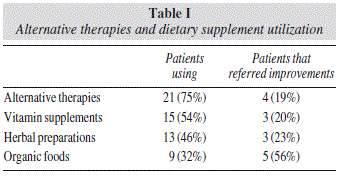
<body><![CDATA[<p><font face="Verdana" size="2">Variables related to weight and dietary restrictions induced by symptoms or external information were analyzed. Descriptive variables were expressed as number and percentage, and means. Continuous variables were analyzed using Mann-Whitney U test and categorical variables with Fisher´s exact test. For all statistics, significance was accepted at the 5% probability level. Data analysis was performed with the use of the statistical analysis software SPSS (version 16, SPSS Inc, USA). All patients provided written informed consent and approval of the study protocol was granted by the Ethics Committee of Clinical Research of the Hospital Clínic de Barcelona.</font></p>     <p>&nbsp;</p>     <p><font face="Verdana" size="2"><b>Results</b></font></p>     <p><font face="Verdana" size="2">A total of 30 women, were found fulfilling enrolment criteria. Of those recruited, one abandoned the study and another one was diagnosed afterwards with an eating disorder. Twenty-eight patients were finally analyzed, with a mean age of 45 ± 8 years and a mean duration of CFS of 3.1 ± 2.4 years. The following comorbidities were observed: fibromyalgia in 21 of 28 (75 %) patients and Sjögren´s Syndrome in 20 (71%) patients, which caused odynophagia in 13 (46%) patients. Five (18%) patients had a BMI below 18.5 and other five patients a weight loss over 10% during the last six months.</font></p>     <p><font face="Verdana" size="2">Regarding food restrictions, the most important was for dairy products, involving 22 (79%) patients. For this food group, 10 (36%) patients excluded all kind of dairy products, seven (25%) excluded lactosecontaining foods and five (18%) made  <i>ad libitum</i> restrictions without any specific pattern. The rest of restrictions are shown in  <a target="_blank" href="/img/revistas/nh/v27n2/46_comunicacion_breve_01_f1.gif">figure 1</a>.</font></p>     <p><font face="Verdana" size="2">Patients reported digestive upset after the intake of certain foods, with the most prevalent symptoms being: slow digestion in 20 of 28 patients, gastralgia in 12 patients, meteorism in 11, pyrosis in eight and vomiting in seven. The use of alternative medicines and the intake of dietary supplements were common, although with unsatisfactory results in the improvement of these symptoms in most cases (<a href="#t1">table I</a>).</font></p>     <p>&nbsp;</p>     <p align="center"><font face="Verdana" size="2"><a name="t1"><img src="/img/revistas/nh/v27n2/46_comunicacion_breve_01_t1.gif" align="top"></a></font></p>     <p>&nbsp;</p>     <p><font face="Verdana" size="2">Information against the intake of one or more foods was reported by 13 (46%) patients. Mainly, these sources of information were alternative therapists (e.g. naturopaths), health care professionals, and self-help books or web pages. Six cases of grains restriction and 11 of dairy restriction were compatible with a counseling-induced pattern of exclusion. Those patients with information against the intake of certain foods from alternative therapists, showed a trend towards taking more vitamin supplements, herbal preparations or "health foods" than those counseled by a health care professional (46.2% vs. 23.1%; p = ns). A similar pattern was observed with the following of exclusion diets (30.8% vs. 15.4%; p = ns).</font></p>     ]]></body>
<body><![CDATA[<p>&nbsp;</p>     <p><font face="Verdana" size="2"><b>Discussion</b></font></p>     <p><font face="Verdana" size="2">The present study shows that there is not a homogeneous pattern of food avoidance in the studied patients with severe CFS. Our results reveal that the most prevalent restrictions were for dairy and grains groups. Very few studies have assessed the dietary habits of CFS patients. Goedendorp et al.<sup>11</sup> observed that an important percentage of patients with CFS had low intakes of vegetables, as we could also observe. Similar results for alcohol intake were found when compared to other studies, with patients greatly decreasing or completely stopping its intake.<sup>11,12</sup> This was not a surprising result due to the toxic nature of alcohol.</font></p>     <p><font face="Verdana" size="2">Almost half of our patients excluded foods from their diet mainly influenced by alternative sources of information and the rest did it on the basis of their own experience. Primarily, the information came from practitioners of alternative therapies proposing the use of elimination diets, which up to date have not proven to offer any health benefits,<sup>9</sup> as well as the use of different dietary supplements or herbal preparations on the basis of anecdotal claims of recovering.<sup>8</sup> It has been previously reported that many CFS patients use dietary supplements, with a 100-200% intake of the Recommended Dietary Allowance for vitamins and minerals and no evidence of benefit.<sup>13</sup> The use of vitamin and mineral supplements can be useful to avoid micronutrient deficiencies in patients that follow restrictive diets, but the uncontrolled intake of these supplements should be discouraged. High intakes of vitamins and minerals have not proven to be effective and could be potentially detrimental. Also, herbal preparations can have potential side effects and some can interfere or interact with prescription medications.<sup>14,15</sup></font></p>     <p><font face="Verdana" size="2">In addition, the actual lack of scientific knowledge and understanding of CFS has given cause for the use of non-scientifically established diagnostic tests for food allergies.<sup>16</sup> Some of the counseling obtained by many of our patients was based on the basis of these tests. These non-evidence-based practices point to food allergies as a responsible for many of the symptoms the patient experience, without any objective data to prove so. Besides, among different alternative therapies it is a common myth that dairy products and gluten are the cause of a wide range of illnesses; therefore, they are usually banned from diet. In general, we found that digestive upset and fatigue did not improve in the majority of patients, showing that the efficacy of these measures is only speculative and without support by available research.<sup>8,9</sup> Although we can not rule out the possibility of intolerance to dairy products in these patients, this should be tested by validated methods.</font></p>     <p><font face="Verdana" size="2">Surprisingly, although patients followed restrictive diets, the percentage of patients that experienced a weight loss remained low. Although these restrictions do not seem to have an overall detrimental effect on health, it is unknown which could be the impact of these unbalanced diets on micronutrient status and fatigue levels on these patients. Although patients with a BMI lower than 18.5 do not meet criteria for CFS,<sup>3</sup> those patients in our sample below this value had lost an important part of their weight after the diagnosis during the course of their illness, therefore, being candidates for recruitment.</font></p>     <p><font face="Verdana" size="2">The use of self-reporting is a methodological limitation of our study, as well as the lack of testing for dairy intolerance. In addition, the small sample size and the cross-sectional design of the study do not allow us to make any causality; therefore it is not possible to draw conclusions about the effect of diet on nutritional status or fatigue levels. It has been previously suggested that intolerance to multiple foods could be a manifestation of somatization traits in these patients, rather than a cause or effect of CFS.<sup>7</sup> On the other hand, it has also been stated that due to frequent overlapping between CFS and Multiple Chemical Sensitivity (MCS), food intolerance may be a digestive manifestation of MCS in patients affected of CFS.<sup>17</sup></font></p>     <p><font face="Verdana" size="2">Finally, although we did not find a homogeneous pattern of food avoidance in CFS patients, information promoting food restrictions is frequent. Organizations like the Royal College of General Practitioners, do not recommend the restriction of foods or the systematic inclusion of dietary supplements, due to lack of scientific evidence.<sup>18</sup> Despite the lack of objective markers for CFS, future research should focus on validated methods to assess food intolerance. In the absence of proven food allergies, the recommended dietary pattern is to follow a balanced diet that includes all the basic food groups. The prescription of a dietary restriction should be based on a proven food allergy or intolerance. If digestive upset is present, the meal plan should include frequent small meals, spaced throughout the day. Dietary counseling should be based on sound nutritional knowledge, although those patients that finally decide to undertake an elimination diet should seek the advice of a registered dietitian to avoid nutrient deficiencies.</font></p>     <p>&nbsp;</p>     <p><font face="Verdana" size="2"><b>References</b></font></p>     ]]></body>
<body><![CDATA[<!-- ref --><p><font face="Verdana" size="2">1. Prins JB, Van der Meer JW, Bleijenberg G. Chronic fatigue syndrome. <i>Lancet</i> 2006; 367 (9507): 346-55.    &nbsp;&nbsp;&nbsp;&nbsp;&nbsp;&nbsp;&nbsp;&nbsp;[&#160;<a href="javascript:void(0);" onclick="javascript: window.open('/scielo.php?script=sci_nlinks&ref=3653748&pid=S0212-1611201200020004600001&lng=','','width=640,height=500,resizable=yes,scrollbars=1,menubar=yes,');">Links</a>&#160;]<!-- end-ref --></font></p>    <!-- ref --><p><font face="Verdana" size="2">2. Wyller VB. The chronic fatigue syndrome-an update. <i>Acta Neurol Scand Suppl</i> 2007; 187: 7-14.    &nbsp;&nbsp;&nbsp;&nbsp;&nbsp;&nbsp;&nbsp;&nbsp;[&#160;<a href="javascript:void(0);" onclick="javascript: window.open('/scielo.php?script=sci_nlinks&ref=3653750&pid=S0212-1611201200020004600002&lng=','','width=640,height=500,resizable=yes,scrollbars=1,menubar=yes,');">Links</a>&#160;]<!-- end-ref --></font></p>    <!-- ref --><p><font face="Verdana" size="2">3. Fukuda K, Straus SE, Hickie I, Sharpe MC, Dobbins JG, Komaroff A. The chronic fatigue syndrome: a comprehensive approach to its definition and study. International Chronic Fatigue Syndrome Study Group. <i>Ann Intern Med</i> 1994; 121 (12): 953-9.    &nbsp;&nbsp;&nbsp;&nbsp;&nbsp;&nbsp;&nbsp;&nbsp;[&#160;<a href="javascript:void(0);" onclick="javascript: window.open('/scielo.php?script=sci_nlinks&ref=3653752&pid=S0212-1611201200020004600003&lng=','','width=640,height=500,resizable=yes,scrollbars=1,menubar=yes,');">Links</a>&#160;]<!-- end-ref --></font></p>    <!-- ref --><p><font face="Verdana" size="2">4. Núñez M, Núñez E, Del Val JL, Fernández-Huerta JM; Gomez E, Godás T, Fernández-Solà J. Health-related quality of life in chronic fatigue syndrome versus rheumatoid arthritis <i>J Chronic Fatigue Syndr</i> 2007; 14 (2): 31-43.    &nbsp;&nbsp;&nbsp;&nbsp;&nbsp;&nbsp;&nbsp;&nbsp;[&#160;<a href="javascript:void(0);" onclick="javascript: window.open('/scielo.php?script=sci_nlinks&ref=3653754&pid=S0212-1611201200020004600004&lng=','','width=640,height=500,resizable=yes,scrollbars=1,menubar=yes,');">Links</a>&#160;]<!-- end-ref --></font></p>    <!-- ref --><p><font face="Verdana" size="2">5. Avellaneda-Fernández A, Pérez-Martín A, Izquierdo-Martínez M, Arruti-Bustillo M, Barbado-Hernández FJ, de la Cruz-Labrado J, Díaz-Delgado-Peñas R, Gutiérrez-Rivas E, Palacín-Delgado C, Rivera-Redondo J, Ramón-Giménez JR. Chronic fatigue syndrome: aetiology, diagnosis and treatment. <i>BMC Psychiatry</i> 2009; 9 (Suppl. 1): S1.    &nbsp;&nbsp;&nbsp;&nbsp;&nbsp;&nbsp;&nbsp;&nbsp;[&#160;<a href="javascript:void(0);" onclick="javascript: window.open('/scielo.php?script=sci_nlinks&ref=3653756&pid=S0212-1611201200020004600005&lng=','','width=640,height=500,resizable=yes,scrollbars=1,menubar=yes,');">Links</a>&#160;]<!-- end-ref --></font></p>    ]]></body>
<body><![CDATA[<!-- ref --><p><font face="Verdana" size="2">6. Whiting P, Bagnall AM, Sowden AJ, Cornell JE, Mulrow CD, Ramírez G. Interventions for the treatment and management of chronic fatigue syndrome: a systematic review. <i>JAMA</i> 2001; 286 (11): 1360-8.    &nbsp;&nbsp;&nbsp;&nbsp;&nbsp;&nbsp;&nbsp;&nbsp;[&#160;<a href="javascript:void(0);" onclick="javascript: window.open('/scielo.php?script=sci_nlinks&ref=3653758&pid=S0212-1611201200020004600006&lng=','','width=640,height=500,resizable=yes,scrollbars=1,menubar=yes,');">Links</a>&#160;]<!-- end-ref --></font></p>    <!-- ref --><p><font face="Verdana" size="2">7. Manu P, Matthews DA, Lane TJ. Food intolerance in patients with chronic fatigue. <i>Int J Eat Disord</i> 1993; 13 (2): 203-9.    &nbsp;&nbsp;&nbsp;&nbsp;&nbsp;&nbsp;&nbsp;&nbsp;[&#160;<a href="javascript:void(0);" onclick="javascript: window.open('/scielo.php?script=sci_nlinks&ref=3653760&pid=S0212-1611201200020004600007&lng=','','width=640,height=500,resizable=yes,scrollbars=1,menubar=yes,');">Links</a>&#160;]<!-- end-ref --></font></p>    <!-- ref --><p><font face="Verdana" size="2">8. Morris DH, Stare FJ. Unproven diet therapies in the treatment of the chronic fatigue syndrome. <i>Arch Fam Med</i> 1993; 2 (2): 181-6.    &nbsp;&nbsp;&nbsp;&nbsp;&nbsp;&nbsp;&nbsp;&nbsp;[&#160;<a href="javascript:void(0);" onclick="javascript: window.open('/scielo.php?script=sci_nlinks&ref=3653762&pid=S0212-1611201200020004600008&lng=','','width=640,height=500,resizable=yes,scrollbars=1,menubar=yes,');">Links</a>&#160;]<!-- end-ref --></font></p>    <!-- ref --><p><font face="Verdana" size="2">9. Hobday RA, Thomas S, O´Donovan A, Murphy M, Pinching AJ. Dietary intervention in chronic fatigue syndrome. <i>J Hum Nutr Diet</i> 2008; 21 (2): 141-9.    &nbsp;&nbsp;&nbsp;&nbsp;&nbsp;&nbsp;&nbsp;&nbsp;[&#160;<a href="javascript:void(0);" onclick="javascript: window.open('/scielo.php?script=sci_nlinks&ref=3653764&pid=S0212-1611201200020004600009&lng=','','width=640,height=500,resizable=yes,scrollbars=1,menubar=yes,');">Links</a>&#160;]<!-- end-ref --></font></p>    <!-- ref --><p><font face="Verdana" size="2">10. American Psychiatric Association. Diagnostic and statistical manual of mental disorders (4th ed., text rev.). Washington (DC): <i>American Psychiatric Association</i>; 2000.    &nbsp;&nbsp;&nbsp;&nbsp;&nbsp;&nbsp;&nbsp;&nbsp;[&#160;<a href="javascript:void(0);" onclick="javascript: window.open('/scielo.php?script=sci_nlinks&ref=3653766&pid=S0212-1611201200020004600010&lng=','','width=640,height=500,resizable=yes,scrollbars=1,menubar=yes,');">Links</a>&#160;]<!-- end-ref --></font></p>    ]]></body>
<body><![CDATA[<!-- ref --><p><font face="Verdana" size="2">11. Goedendorp MM, Knoop H, Schippers GM, Bleijenberg G. The lifestyle of patients with chronic fatigue syndrome and the effect on fatigue and functional impairments. <i>J Hum Nutr Diet</i> 2009; 22 (3): 226-31.    &nbsp;&nbsp;&nbsp;&nbsp;&nbsp;&nbsp;&nbsp;&nbsp;[&#160;<a href="javascript:void(0);" onclick="javascript: window.open('/scielo.php?script=sci_nlinks&ref=3653768&pid=S0212-1611201200020004600011&lng=','','width=640,height=500,resizable=yes,scrollbars=1,menubar=yes,');">Links</a>&#160;]<!-- end-ref --></font></p>    <!-- ref --><p><font face="Verdana" size="2">12. Woolley J, Allen R, Wessely S. Alcohol use in chronic fatigue syndrome. <i>J Psychosom Res</i> 2004; 56 (2): 203-6.    &nbsp;&nbsp;&nbsp;&nbsp;&nbsp;&nbsp;&nbsp;&nbsp;[&#160;<a href="javascript:void(0);" onclick="javascript: window.open('/scielo.php?script=sci_nlinks&ref=3653770&pid=S0212-1611201200020004600012&lng=','','width=640,height=500,resizable=yes,scrollbars=1,menubar=yes,');">Links</a>&#160;]<!-- end-ref --></font></p>    <!-- ref --><p><font face="Verdana" size="2">13. Grant JE, Veldee MS, Buchwald D. Analysis of dietary intake and selected nutrient concentrations in patients with chronic fatigue syndrome. <i>J Am Diet Assoc</i> 1996; 96 (4): 383-6.    &nbsp;&nbsp;&nbsp;&nbsp;&nbsp;&nbsp;&nbsp;&nbsp;[&#160;<a href="javascript:void(0);" onclick="javascript: window.open('/scielo.php?script=sci_nlinks&ref=3653772&pid=S0212-1611201200020004600013&lng=','','width=640,height=500,resizable=yes,scrollbars=1,menubar=yes,');">Links</a>&#160;]<!-- end-ref --></font></p>    <!-- ref --><p><font face="Verdana" size="2">14. Tovar RT. Clinical approach to clinical herbal toxicity. <i>Semin Diagn Pathol</i> 2009; 26 (1): 28-37.    &nbsp;&nbsp;&nbsp;&nbsp;&nbsp;&nbsp;&nbsp;&nbsp;[&#160;<a href="javascript:void(0);" onclick="javascript: window.open('/scielo.php?script=sci_nlinks&ref=3653774&pid=S0212-1611201200020004600014&lng=','','width=640,height=500,resizable=yes,scrollbars=1,menubar=yes,');">Links</a>&#160;]<!-- end-ref --></font></p>    <!-- ref --><p><font face="Verdana" size="2">15. Kennedy DA, Seely D. Clinically based evidence of drug-herb interactions: a systematic review. <i>Expert Opin Drug Saf</i> 2010; 9 (1): 79-124.    &nbsp;&nbsp;&nbsp;&nbsp;&nbsp;&nbsp;&nbsp;&nbsp;[&#160;<a href="javascript:void(0);" onclick="javascript: window.open('/scielo.php?script=sci_nlinks&ref=3653776&pid=S0212-1611201200020004600015&lng=','','width=640,height=500,resizable=yes,scrollbars=1,menubar=yes,');">Links</a>&#160;]<!-- end-ref --></font></p>    ]]></body>
<body><![CDATA[<!-- ref --><p><font face="Verdana" size="2">16. Wüthrich B. Unproven techniques in allergy diagnosis. <i>J Investig Allergol Clin Immunol</i> 2005; 15 (2): 86-90.    &nbsp;&nbsp;&nbsp;&nbsp;&nbsp;&nbsp;&nbsp;&nbsp;[&#160;<a href="javascript:void(0);" onclick="javascript: window.open('/scielo.php?script=sci_nlinks&ref=3653778&pid=S0212-1611201200020004600016&lng=','','width=640,height=500,resizable=yes,scrollbars=1,menubar=yes,');">Links</a>&#160;]<!-- end-ref --></font></p>    <!-- ref --><p><font face="Verdana" size="2">17. Ziem G, Donnay A. Chronic fatigue, fibromyalgia, and chemical sensitivity: overlapping disorders. <i>Arch Intern Med</i> 1995; 155 (17): 1913.    &nbsp;&nbsp;&nbsp;&nbsp;&nbsp;&nbsp;&nbsp;&nbsp;[&#160;<a href="javascript:void(0);" onclick="javascript: window.open('/scielo.php?script=sci_nlinks&ref=3653780&pid=S0212-1611201200020004600017&lng=','','width=640,height=500,resizable=yes,scrollbars=1,menubar=yes,');">Links</a>&#160;]<!-- end-ref --></font></p>    <!-- ref --><p><font face="Verdana" size="2">18. Turnbull N, Shaw EJ, Baker R, Dunsdon S, Costin N, Britton G, Kuntze S, Norman R. Chronic fatigue syndrome/myalgic encephalomyelitis (or encephalopathy): diagnosis and management of chronic fatigue syndrome/myalgic encephalomyelitis (or encephalopathy) in adults and children. London: Royal College of General Practitioners. 2007.    &nbsp;&nbsp;&nbsp;&nbsp;&nbsp;&nbsp;&nbsp;&nbsp;[&#160;<a href="javascript:void(0);" onclick="javascript: window.open('/scielo.php?script=sci_nlinks&ref=3653782&pid=S0212-1611201200020004600018&lng=','','width=640,height=500,resizable=yes,scrollbars=1,menubar=yes,');">Links</a>&#160;]<!-- end-ref --></font></p>     <p>&nbsp;</p>     <p>&nbsp;</p>     <p><font face="Verdana" size="2"><a href="#top"><img border="0" src="/img/revistas/nh/v27n2/seta.gif" width="15" height="17"></a><a name="bajo"></a><b>Correspondence:</b>    <br>Joan Trabal Vílchez.    ]]></body>
<body><![CDATA[<br>Unitat de Nutrició i Dietètica.    <br>Hospital Clínic de Barcelona.    <br>C/ Villarroel, 170.    <br>08036 Barcelona. Spain.    <br>E-mail:  <a href="mailto:joantrabal@gmail.com">joantrabal@gmail.com</a></font></p>     <p><font face="Verdana" size="2">Recibido: 8-XI-2010.    <br>1.<sup>a</sup> Revisión: 10-I-2011.    <br>2.<sup>a</sup> Revisión: 27-IX-2011.    <br>3.<sup>a</sup> Revisión: 6-X-2011.    <br>Aceptado: 13-X-2011.</font></p>     ]]></body>
<body><![CDATA[ ]]></body><back>
<ref-list>
<ref id="B1">
<label>1</label><nlm-citation citation-type="journal">
<person-group person-group-type="author">
<name>
<surname><![CDATA[Prins]]></surname>
<given-names><![CDATA[JB]]></given-names>
</name>
<name>
<surname><![CDATA[Van der Meer]]></surname>
<given-names><![CDATA[JW]]></given-names>
</name>
<name>
<surname><![CDATA[Bleijenberg]]></surname>
<given-names><![CDATA[G]]></given-names>
</name>
</person-group>
<article-title xml:lang="en"><![CDATA[Chronic fatigue syndrome]]></article-title>
<source><![CDATA[Lancet]]></source>
<year>2006</year>
<volume>367</volume>
<numero>9507</numero>
<issue>9507</issue>
<page-range>346-55</page-range></nlm-citation>
</ref>
<ref id="B2">
<label>2</label><nlm-citation citation-type="journal">
<person-group person-group-type="author">
<name>
<surname><![CDATA[Wyller]]></surname>
<given-names><![CDATA[VB]]></given-names>
</name>
</person-group>
<article-title xml:lang="en"><![CDATA[The chronic fatigue syndrome-an update]]></article-title>
<source><![CDATA[Acta Neurol Scand Suppl]]></source>
<year>2007</year>
<volume>187</volume>
<page-range>7-14</page-range></nlm-citation>
</ref>
<ref id="B3">
<label>3</label><nlm-citation citation-type="journal">
<person-group person-group-type="author">
<name>
<surname><![CDATA[Fukuda]]></surname>
<given-names><![CDATA[K]]></given-names>
</name>
<name>
<surname><![CDATA[Straus]]></surname>
<given-names><![CDATA[SE]]></given-names>
</name>
<name>
<surname><![CDATA[Hickie]]></surname>
<given-names><![CDATA[I]]></given-names>
</name>
<name>
<surname><![CDATA[Sharpe]]></surname>
<given-names><![CDATA[MC]]></given-names>
</name>
<name>
<surname><![CDATA[Dobbins]]></surname>
<given-names><![CDATA[JG]]></given-names>
</name>
<name>
<surname><![CDATA[Komaroff]]></surname>
<given-names><![CDATA[A]]></given-names>
</name>
</person-group>
<article-title xml:lang="en"><![CDATA[The chronic fatigue syndrome: a comprehensive approach to its definition and study. International Chronic Fatigue Syndrome Study Group]]></article-title>
<source><![CDATA[Ann Intern Med]]></source>
<year>1994</year>
<volume>121</volume>
<numero>12</numero>
<issue>12</issue>
<page-range>953-9</page-range></nlm-citation>
</ref>
<ref id="B4">
<label>4</label><nlm-citation citation-type="journal">
<person-group person-group-type="author">
<name>
<surname><![CDATA[Núñez]]></surname>
<given-names><![CDATA[M]]></given-names>
</name>
<name>
<surname><![CDATA[Núñez]]></surname>
<given-names><![CDATA[E]]></given-names>
</name>
<name>
<surname><![CDATA[Del Val]]></surname>
<given-names><![CDATA[JL]]></given-names>
</name>
<name>
<surname><![CDATA[Fernández-Huerta]]></surname>
<given-names><![CDATA[JM]]></given-names>
</name>
<name>
<surname><![CDATA[Gomez]]></surname>
<given-names><![CDATA[E]]></given-names>
</name>
<name>
<surname><![CDATA[Godás]]></surname>
<given-names><![CDATA[T]]></given-names>
</name>
<name>
<surname><![CDATA[Fernández-Solà]]></surname>
<given-names><![CDATA[J]]></given-names>
</name>
</person-group>
<article-title xml:lang="en"><![CDATA[Health-related quality of life in chronic fatigue syndrome versus rheumatoid arthritis]]></article-title>
<source><![CDATA[J Chronic Fatigue Syndr]]></source>
<year>2007</year>
<volume>14</volume>
<numero>2</numero>
<issue>2</issue>
<page-range>31-43</page-range></nlm-citation>
</ref>
<ref id="B5">
<label>5</label><nlm-citation citation-type="journal">
<person-group person-group-type="author">
<name>
<surname><![CDATA[Avellaneda-Fernández]]></surname>
<given-names><![CDATA[A]]></given-names>
</name>
<name>
<surname><![CDATA[Pérez-Martín]]></surname>
<given-names><![CDATA[A]]></given-names>
</name>
<name>
<surname><![CDATA[Izquierdo-Martínez]]></surname>
<given-names><![CDATA[M]]></given-names>
</name>
<name>
<surname><![CDATA[Arruti-Bustillo]]></surname>
<given-names><![CDATA[M]]></given-names>
</name>
<name>
<surname><![CDATA[Barbado-Hernández]]></surname>
<given-names><![CDATA[FJ]]></given-names>
</name>
<name>
<surname><![CDATA[de la Cruz-Labrado]]></surname>
<given-names><![CDATA[J]]></given-names>
</name>
<name>
<surname><![CDATA[Díaz-Delgado-Peñas]]></surname>
<given-names><![CDATA[R]]></given-names>
</name>
<name>
<surname><![CDATA[Gutiérrez-Rivas]]></surname>
<given-names><![CDATA[E]]></given-names>
</name>
<name>
<surname><![CDATA[Palacín-Delgado]]></surname>
<given-names><![CDATA[C]]></given-names>
</name>
<name>
<surname><![CDATA[Rivera-Redondo]]></surname>
<given-names><![CDATA[J]]></given-names>
</name>
<name>
<surname><![CDATA[Ramón-Giménez]]></surname>
<given-names><![CDATA[JR]]></given-names>
</name>
</person-group>
<article-title xml:lang="en"><![CDATA[Chronic fatigue syndrome: aetiology, diagnosis and treatment]]></article-title>
<source><![CDATA[BMC Psychiatry]]></source>
<year>2009</year>
<volume>9</volume>
<numero>^s1</numero>
<issue>^s1</issue>
<supplement>1</supplement>
<page-range>S1</page-range></nlm-citation>
</ref>
<ref id="B6">
<label>6</label><nlm-citation citation-type="journal">
<person-group person-group-type="author">
<name>
<surname><![CDATA[Whiting]]></surname>
<given-names><![CDATA[P]]></given-names>
</name>
<name>
<surname><![CDATA[Bagnall]]></surname>
<given-names><![CDATA[AM]]></given-names>
</name>
<name>
<surname><![CDATA[Sowden]]></surname>
<given-names><![CDATA[AJ]]></given-names>
</name>
<name>
<surname><![CDATA[Cornell]]></surname>
<given-names><![CDATA[JE]]></given-names>
</name>
<name>
<surname><![CDATA[Mulrow]]></surname>
<given-names><![CDATA[CD]]></given-names>
</name>
<name>
<surname><![CDATA[Ramírez]]></surname>
<given-names><![CDATA[G]]></given-names>
</name>
</person-group>
<article-title xml:lang="en"><![CDATA[Interventions for the treatment and management of chronic fatigue syndrome: a systematic review]]></article-title>
<source><![CDATA[JAMA]]></source>
<year>2001</year>
<volume>286</volume>
<numero>11</numero>
<issue>11</issue>
<page-range>1360-8</page-range></nlm-citation>
</ref>
<ref id="B7">
<label>7</label><nlm-citation citation-type="journal">
<person-group person-group-type="author">
<name>
<surname><![CDATA[Manu]]></surname>
<given-names><![CDATA[P]]></given-names>
</name>
<name>
<surname><![CDATA[Matthews]]></surname>
<given-names><![CDATA[DA]]></given-names>
</name>
<name>
<surname><![CDATA[Lane]]></surname>
<given-names><![CDATA[TJ]]></given-names>
</name>
</person-group>
<article-title xml:lang="en"><![CDATA[Food intolerance in patients with chronic fatigue]]></article-title>
<source><![CDATA[Int J Eat Disord]]></source>
<year>1993</year>
<volume>13</volume>
<numero>2</numero>
<issue>2</issue>
<page-range>203-9</page-range></nlm-citation>
</ref>
<ref id="B8">
<label>8</label><nlm-citation citation-type="journal">
<person-group person-group-type="author">
<name>
<surname><![CDATA[Morris]]></surname>
<given-names><![CDATA[DH]]></given-names>
</name>
<name>
<surname><![CDATA[Stare]]></surname>
<given-names><![CDATA[FJ]]></given-names>
</name>
</person-group>
<article-title xml:lang="en"><![CDATA[Unproven diet therapies in the treatment of the chronic fatigue syndrome]]></article-title>
<source><![CDATA[Arch Fam Med]]></source>
<year>1993</year>
<volume>2</volume>
<numero>2</numero>
<issue>2</issue>
<page-range>181-6</page-range></nlm-citation>
</ref>
<ref id="B9">
<label>9</label><nlm-citation citation-type="journal">
<person-group person-group-type="author">
<name>
<surname><![CDATA[Hobday]]></surname>
<given-names><![CDATA[RA]]></given-names>
</name>
<name>
<surname><![CDATA[Thomas]]></surname>
<given-names><![CDATA[S]]></given-names>
</name>
<name>
<surname><![CDATA[O´Donovan]]></surname>
<given-names><![CDATA[A]]></given-names>
</name>
<name>
<surname><![CDATA[Murphy]]></surname>
<given-names><![CDATA[M]]></given-names>
</name>
<name>
<surname><![CDATA[Pinching]]></surname>
<given-names><![CDATA[AJ]]></given-names>
</name>
</person-group>
<article-title xml:lang="en"><![CDATA[Dietary intervention in chronic fatigue syndrome]]></article-title>
<source><![CDATA[J Hum Nutr Diet]]></source>
<year>2008</year>
<volume>21</volume>
<numero>2</numero>
<issue>2</issue>
<page-range>141-9</page-range></nlm-citation>
</ref>
<ref id="B10">
<label>10</label><nlm-citation citation-type="book">
<collab>American Psychiatric Association</collab>
<source><![CDATA[Diagnostic and statistical manual of mental disorders]]></source>
<year>2000</year>
<edition>4</edition>
<publisher-loc><![CDATA[Washington^eDC DC]]></publisher-loc>
<publisher-name><![CDATA[American Psychiatric Association]]></publisher-name>
</nlm-citation>
</ref>
<ref id="B11">
<label>11</label><nlm-citation citation-type="journal">
<person-group person-group-type="author">
<name>
<surname><![CDATA[Goedendorp]]></surname>
<given-names><![CDATA[MM]]></given-names>
</name>
<name>
<surname><![CDATA[Knoop]]></surname>
<given-names><![CDATA[H]]></given-names>
</name>
<name>
<surname><![CDATA[Schippers]]></surname>
<given-names><![CDATA[GM]]></given-names>
</name>
<name>
<surname><![CDATA[Bleijenberg]]></surname>
<given-names><![CDATA[G]]></given-names>
</name>
</person-group>
<article-title xml:lang="en"><![CDATA[The lifestyle of patients with chronic fatigue syndrome and the effect on fatigue and functional impairments]]></article-title>
<source><![CDATA[J Hum Nutr Diet]]></source>
<year>2009</year>
<volume>22</volume>
<numero>3</numero>
<issue>3</issue>
<page-range>226-31</page-range></nlm-citation>
</ref>
<ref id="B12">
<label>12</label><nlm-citation citation-type="journal">
<person-group person-group-type="author">
<name>
<surname><![CDATA[Woolley]]></surname>
<given-names><![CDATA[J]]></given-names>
</name>
<name>
<surname><![CDATA[Allen]]></surname>
<given-names><![CDATA[R]]></given-names>
</name>
<name>
<surname><![CDATA[Wessely]]></surname>
<given-names><![CDATA[S]]></given-names>
</name>
</person-group>
<article-title xml:lang="en"><![CDATA[Alcohol use in chronic fatigue syndrome]]></article-title>
<source><![CDATA[J Psychosom Res]]></source>
<year>2004</year>
<volume>56</volume>
<numero>2</numero>
<issue>2</issue>
<page-range>203-6</page-range></nlm-citation>
</ref>
<ref id="B13">
<label>13</label><nlm-citation citation-type="journal">
<person-group person-group-type="author">
<name>
<surname><![CDATA[Grant]]></surname>
<given-names><![CDATA[JE]]></given-names>
</name>
<name>
<surname><![CDATA[Veldee]]></surname>
<given-names><![CDATA[MS]]></given-names>
</name>
<name>
<surname><![CDATA[Buchwald]]></surname>
<given-names><![CDATA[D]]></given-names>
</name>
</person-group>
<article-title xml:lang="en"><![CDATA[Analysis of dietary intake and selected nutrient concentrations in patients with chronic fatigue syndrome]]></article-title>
<source><![CDATA[J Am Diet Assoc]]></source>
<year>1996</year>
<volume>96</volume>
<numero>4</numero>
<issue>4</issue>
<page-range>383-6</page-range></nlm-citation>
</ref>
<ref id="B14">
<label>14</label><nlm-citation citation-type="journal">
<person-group person-group-type="author">
<name>
<surname><![CDATA[Tovar]]></surname>
<given-names><![CDATA[RT]]></given-names>
</name>
</person-group>
<article-title xml:lang="en"><![CDATA[Clinical approach to clinical herbal toxicity]]></article-title>
<source><![CDATA[Semin Diagn Pathol]]></source>
<year>2009</year>
<volume>26</volume>
<numero>1</numero>
<issue>1</issue>
<page-range>28-37</page-range></nlm-citation>
</ref>
<ref id="B15">
<label>15</label><nlm-citation citation-type="journal">
<person-group person-group-type="author">
<name>
<surname><![CDATA[Kennedy]]></surname>
<given-names><![CDATA[DA]]></given-names>
</name>
<name>
<surname><![CDATA[Seely]]></surname>
<given-names><![CDATA[D]]></given-names>
</name>
</person-group>
<article-title xml:lang="en"><![CDATA[Clinically based evidence of drug-herb interactions: a systematic review]]></article-title>
<source><![CDATA[Expert Opin Drug Saf]]></source>
<year>2010</year>
<volume>9</volume>
<numero>1</numero>
<issue>1</issue>
<page-range>79-124</page-range></nlm-citation>
</ref>
<ref id="B16">
<label>16</label><nlm-citation citation-type="journal">
<person-group person-group-type="author">
<name>
<surname><![CDATA[Wüthrich]]></surname>
<given-names><![CDATA[B]]></given-names>
</name>
</person-group>
<article-title xml:lang="en"><![CDATA[Unproven techniques in allergy diagnosis]]></article-title>
<source><![CDATA[J Investig Allergol Clin Immunol]]></source>
<year>2005</year>
<volume>15</volume>
<numero>2</numero>
<issue>2</issue>
<page-range>86-90</page-range></nlm-citation>
</ref>
<ref id="B17">
<label>17</label><nlm-citation citation-type="journal">
<person-group person-group-type="author">
<name>
<surname><![CDATA[Ziem]]></surname>
<given-names><![CDATA[G]]></given-names>
</name>
<name>
<surname><![CDATA[Donnay]]></surname>
<given-names><![CDATA[A]]></given-names>
</name>
</person-group>
<article-title xml:lang="en"><![CDATA[Chronic fatigue, fibromyalgia, and chemical sensitivity: overlapping disorders]]></article-title>
<source><![CDATA[Arch Intern Med]]></source>
<year>1995</year>
<volume>155</volume>
<numero>17</numero>
<issue>17</issue>
<page-range>1913</page-range></nlm-citation>
</ref>
<ref id="B18">
<label>18</label><nlm-citation citation-type="book">
<person-group person-group-type="author">
<name>
<surname><![CDATA[Turnbull]]></surname>
<given-names><![CDATA[N]]></given-names>
</name>
<name>
<surname><![CDATA[Shaw]]></surname>
<given-names><![CDATA[EJ]]></given-names>
</name>
<name>
<surname><![CDATA[Baker]]></surname>
<given-names><![CDATA[R]]></given-names>
</name>
<name>
<surname><![CDATA[Dunsdon]]></surname>
<given-names><![CDATA[S]]></given-names>
</name>
<name>
<surname><![CDATA[Costin]]></surname>
<given-names><![CDATA[N]]></given-names>
</name>
<name>
<surname><![CDATA[Britton]]></surname>
<given-names><![CDATA[G]]></given-names>
</name>
<name>
<surname><![CDATA[Kuntze]]></surname>
<given-names><![CDATA[S]]></given-names>
</name>
<name>
<surname><![CDATA[Norman]]></surname>
<given-names><![CDATA[R]]></given-names>
</name>
</person-group>
<source><![CDATA[Chronic fatigue syndrome/myalgic encephalomyelitis (or encephalopathy): diagnosis and management of chronic fatigue syndrome/myalgic encephalomyelitis (or encephalopathy) in adults and children]]></source>
<year>2007</year>
<publisher-loc><![CDATA[London ]]></publisher-loc>
<publisher-name><![CDATA[Royal College of General Practitioners]]></publisher-name>
</nlm-citation>
</ref>
</ref-list>
</back>
</article>
