<?xml version="1.0" encoding="ISO-8859-1"?><article xmlns:mml="http://www.w3.org/1998/Math/MathML" xmlns:xlink="http://www.w3.org/1999/xlink" xmlns:xsi="http://www.w3.org/2001/XMLSchema-instance">
<front>
<journal-meta>
<journal-id>0212-1611</journal-id>
<journal-title><![CDATA[Nutrición Hospitalaria]]></journal-title>
<abbrev-journal-title><![CDATA[Nutr. Hosp.]]></abbrev-journal-title>
<issn>0212-1611</issn>
<publisher>
<publisher-name><![CDATA[Grupo Arán]]></publisher-name>
</publisher>
</journal-meta>
<article-meta>
<article-id>S0212-16112012000300013</article-id>
<article-id pub-id-type="doi">10.3305/nh.2012.27.3.5684</article-id>
<title-group>
<article-title xml:lang="en"><![CDATA[Nutritional assessment of hospitalized HIV-infected patients by the phase angle z-score measurement]]></article-title>
<article-title xml:lang="es"><![CDATA[Evaluación nutricional de los pacientes hospitalizados infectados por el VIH mediante la medición de la puntuación z del ángulo de fase]]></article-title>
</title-group>
<contrib-group>
<contrib contrib-type="author">
<name>
<surname><![CDATA[Araujo Antunes]]></surname>
<given-names><![CDATA[A.]]></given-names>
</name>
<xref ref-type="aff" rid="A01"/>
</contrib>
<contrib contrib-type="author">
<name>
<surname><![CDATA[Alves Pereira Rodrigues]]></surname>
<given-names><![CDATA[A. P.]]></given-names>
</name>
<xref ref-type="aff" rid="A01"/>
</contrib>
<contrib contrib-type="author">
<name>
<surname><![CDATA[Geraix]]></surname>
<given-names><![CDATA[J.]]></given-names>
</name>
<xref ref-type="aff" rid="A01"/>
</contrib>
<contrib contrib-type="author">
<name>
<surname><![CDATA[Vaz de Arruda Silveira]]></surname>
<given-names><![CDATA[L.]]></given-names>
</name>
<xref ref-type="aff" rid="A02"/>
</contrib>
<contrib contrib-type="author">
<name>
<surname><![CDATA[Câmara Marques Pereira]]></surname>
<given-names><![CDATA[P.]]></given-names>
</name>
<xref ref-type="aff" rid="A01"/>
</contrib>
<contrib contrib-type="author">
<name>
<surname><![CDATA[Barros Leite Carvalhaes]]></surname>
<given-names><![CDATA[M.ª A.]]></given-names>
</name>
<xref ref-type="aff" rid="A01"/>
</contrib>
</contrib-group>
<aff id="A01">
<institution><![CDATA[,São Paulo State University (UNESP) Botucatu School of Medicine ]]></institution>
<addr-line><![CDATA[ ]]></addr-line>
<country>Brazil</country>
</aff>
<aff id="A02">
<institution><![CDATA[,São Paulo State University (UNESP) Institute of Biosciences ]]></institution>
<addr-line><![CDATA[ ]]></addr-line>
<country>Brazil</country>
</aff>
<pub-date pub-type="pub">
<day>00</day>
<month>06</month>
<year>2012</year>
</pub-date>
<pub-date pub-type="epub">
<day>00</day>
<month>06</month>
<year>2012</year>
</pub-date>
<volume>27</volume>
<numero>3</numero>
<fpage>771</fpage>
<lpage>774</lpage>
<copyright-statement/>
<copyright-year/>
<self-uri xlink:href="http://scielo.isciii.es/scielo.php?script=sci_arttext&amp;pid=S0212-16112012000300013&amp;lng=en&amp;nrm=iso"></self-uri><self-uri xlink:href="http://scielo.isciii.es/scielo.php?script=sci_abstract&amp;pid=S0212-16112012000300013&amp;lng=en&amp;nrm=iso"></self-uri><self-uri xlink:href="http://scielo.isciii.es/scielo.php?script=sci_pdf&amp;pid=S0212-16112012000300013&amp;lng=en&amp;nrm=iso"></self-uri><abstract abstract-type="short" xml:lang="en"><p><![CDATA[Background: This study analyzed the phase-angle (PA) values of hospitalized HVI-infected patients by comparing them with those reported for a healthy population and investigated their relation with nutritional parameters. Methods: This is a cross-sectional study including 101 hospitalized patients diagnosed with HIV infection and evaluated by bioimpedance, anthropometry and biochemical tests. The phase angle values, weight loss percentage (%WL), body mass index (BMI), arm muscle circumference (AMC), tricipital skinfold (TSF), body fat percentage (%BF) and albumin were considered. In order to compare with values for the healthy population, the PA z-score of the patients under study was calculated. Spearman's correlation and the multiple linear regression model were used to identify nutritional parameters associated with the PA z-score. Results: The patients showed a mean PA z-score of -2.6 ± 1.5, and only 6.6% of them with a positive value. The PA z-score values correlated with %WL (r = -0.51; p < 0.0001), albumin (r = 0.49; p < 0.0001), BMI (r = 0.58; p < 0.0001), AMC (r = 0.41; p < 0.0001), TSF (r = 0.47; p < 0.001) and %BF (r = 0.48, p < 0.0001). In multiple analysis %WL (p = 0.008), albumin (p = 0.01), AMC (p < 0.0001) and %BF (p = 0.0003) remained associated with the score. Conclusions: Low PA z-score values were observed, suggesting a worse clinical prognosis for the patients. The inclusion of the PA z-score as a nutritional indicator during care provision to HIV-infected patients is recommended.]]></p></abstract>
<abstract abstract-type="short" xml:lang="es"><p><![CDATA[Antecedentes: Este estudio analizaba los valores del ángulo de fase (AF) de pacientes hospitalizados e infectados por el VIH al compararlos con los notificados para un población sana e investigaba su relación con los parámetros nutricionales. Métodos: Se trataba de un estudio transversal que incluyó a 101 pacientes hospitalizados diagnosticados de infección por el VIH y en los que se evaluó la bioimpedancia, la antropometría y parámetros bioquímicos. Se consideraron los valores del ángulo de fase, el porcentaje de pérdida de peso (%PP), el índice de masa corporal (IMC), la circunferencia muscular del brazo (CMB), el pliegue tricipital (PT), el porcentaje de grasa corporal (%GC) y la albúmina. Para compararlos con los de una población sana, se calcularon las puntuaciones z del AF de los pacientes estudiados. Se emplearon la correlación de Spearman y el modelo de regresión linear múltiple para identificar los parámetros nutricionales asociados con la puntuación z del AF. Resultados: Los pacientes mostraron una puntuación z del AF de -2,6 ± 1,5, el 23,7% de ellos tenían un valor superior a -1,65 y sólo el 6,6% un valor positivo. Los valores de las puntuaciones z del AF se correlacionaron con el %PP (r = -0,51; p < 0,0001), la albúmina (r = 0,49; p < 0,0001), el IMC (r = 0,58; p < 0,0001), la CMB (r = 0,41; p < 0,0001), el PT (r = 0,47; p < 0,001) y el %GC (r = 0,48, p < 0,0001). En el análisis múltiple, el %PP (p = 0,008), la albúmina (p = 0,01), la CMB (p < 0,0001) y el %GC (p = 0,0003) seguían asociándose con la puntuación z. Conclusiones: Obtuvimos unos valores bajos de puntuación z del AF, lo que sugiere un peor pronóstico clínico en los pacientes. Recomendamos la inclusión de la puntuación z del AF como un indicador nutricional durante la provisión de la atención sanitaria a los pacientes infectados por el VIH.]]></p></abstract>
<kwd-group>
<kwd lng="en"><![CDATA[Electrical bioimpedance]]></kwd>
<kwd lng="en"><![CDATA[HIV]]></kwd>
<kwd lng="en"><![CDATA[Nutritional status]]></kwd>
<kwd lng="en"><![CDATA[Phase angle]]></kwd>
<kwd lng="es"><![CDATA[Bioimpedancia eléctrica]]></kwd>
<kwd lng="es"><![CDATA[HIV]]></kwd>
<kwd lng="es"><![CDATA[Estado nutritivo]]></kwd>
<kwd lng="es"><![CDATA[Angulo de fase]]></kwd>
</kwd-group>
</article-meta>
</front><body><![CDATA[ <p><a name="top"></a><font face="Verdana" size="2"><b>ORIGINAL</b></font></p>     <p>&nbsp;</p>     <p><font face="Verdana" size="4"><b>Nutritional assessment of hospitalized HIV-infected patients by the phase angle z-score measurement</b></font></p>     <p><font face="Verdana" size="4"><b>Evaluación nutricional de los pacientes hospitalizados infectados por el  VIH mediante la medición de la puntuación z del ángulo de fase</b></font></p>     <p>&nbsp;</p>     <p>&nbsp;</p>     <p><font face="Verdana" size="2"><b>A. Araujo Antunes<sup>1</sup>, A. P. Alves Pereira Rodrigues<sup>1</sup>, J. Geraix<sup>1</sup>, L. Vaz de Arruda Silveira<sup>2</sup>, P. Câmara Marques Pereira<sup>1</sup> and M.<sup>a</sup> A. Barros Leite Carvalhaes<sup>1</sup></b></font></p>     <p><font face="Verdana" size="2"><sup>1</sup>Botucatu School of Medicine. São Paulo State University. UNESP. Brazil.    <br><sup>2</sup>Institute of Biosciences. São Paulo State University. UNESP. Brazil.</font></p>     <p><font face="Verdana" size="2"><a href="#bajo">Correspondence</a></font></p>     ]]></body>
<body><![CDATA[<p>&nbsp;</p>     <p>&nbsp;</p> <hr size="1">     <p><font face="Verdana" size="2"><b>ABSTRACT</b></font></p>     <p><font face="Verdana" size="2"><b>Background:</b> This study analyzed the phase-angle (PA) values of hospitalized HVI-infected patients by comparing them with those reported for a healthy population and investigated their relation with nutritional parameters.    <br><b>Methods:</b> This is a cross-sectional study including 101 hospitalized patients diagnosed with HIV infection and evaluated by bioimpedance, anthropometry and biochemical tests. The phase angle values, weight loss percentage (%WL), body mass index (BMI), arm muscle circumference (AMC), tricipital skinfold (TSF), body fat percentage (%BF) and albumin were considered. In order to compare with values for the healthy population, the PA z-score of the patients under study was calculated. Spearman's correlation and the multiple linear regression model were used to identify nutritional parameters associated with the PA z-score.    <br><b>Results:</b> The patients showed a mean PA z-score of -2.6 &plusmn; 1.5, and only 6.6% of them with a positive value. The PA z-score values correlated with %WL (r = -0.51; p &lt; 0.0001), albumin (r = 0.49; p &lt; 0.0001), BMI (r = 0.58; p &lt; 0.0001), AMC (r = 0.41; p &lt; 0.0001), TSF (r = 0.47; p &lt; 0.001) and %BF (r = 0.48, p &lt; 0.0001). In multiple analysis %WL (p = 0.008), albumin (p = 0.01), AMC (p &lt; 0.0001) and %BF (p = 0.0003) remained associated with the score.    <br><b>Conclusions:</b> Low PA z-score values were observed, suggesting a worse clinical prognosis for the patients. The inclusion of the PA z-score as a nutritional indicator during care provision to HIV-infected patients is recommended.</font></p>     <p><font face="Verdana" size="2"><b>Key words:</b> Electrical bioimpedance. HIV. Nutritional status. Phase angle.</font></p> <hr size="1">     <p><font face="Verdana" size="2"><b>RESUMEN</b></font></p>     <p><font face="Verdana" size="2"><b>Antecedentes:</b> Este estudio analizaba los valores del ángulo de fase (AF) de pacientes hospitalizados e infectados por el VIH al compararlos con los notificados para un población sana e investigaba su relación con los parámetros nutricionales.    ]]></body>
<body><![CDATA[<br><b>Métodos:</b> Se trataba de un estudio transversal que incluyó a 101 pacientes hospitalizados diagnosticados de infección por el VIH y en los que se evaluó la bioimpedancia, la antropometría y parámetros bioquímicos. Se consideraron los valores del ángulo de fase, el porcentaje de pérdida de peso (%PP), el índice de masa corporal (IMC), la circunferencia muscular del brazo (CMB), el pliegue tricipital (PT), el porcentaje de grasa corporal (%GC) y la albúmina. Para compararlos con los de una población sana, se calcularon las puntuaciones z del AF de los pacientes estudiados. Se emplearon la correlación de Spearman y el modelo de regresión linear múltiple para identificar los parámetros nutricionales asociados con la puntuación z del AF.    <br><b>Resultados:</b> Los pacientes mostraron una puntuación z del AF de -2,6 &plusmn; 1,5, el 23,7% de ellos tenían un valor superior a -1,65 y sólo el 6,6% un valor positivo. Los valores de las puntuaciones z del AF se correlacionaron con el %PP (r = -0,51; p &lt; 0,0001), la albúmina (r = 0,49; p &lt; 0,0001), el IMC (r = 0,58; p &lt; 0,0001), la CMB (r = 0,41; p &lt; 0,0001), el PT (r = 0,47; p &lt; 0,001) y el %GC (r = 0,48, p &lt; 0,0001). En el análisis múltiple, el %PP (p = 0,008), la albúmina (p = 0,01), la CMB (p &lt; 0,0001) y el %GC (p = 0,0003) seguían asociándose con la puntuación z.    <br><b>Conclusiones:</b> Obtuvimos unos valores bajos de puntuación z del AF, lo que sugiere un peor pronóstico clínico en los pacientes. Recomendamos la inclusión de la puntuación z del AF como un indicador nutricional durante la provisión de la atención sanitaria a los pacientes infectados por el VIH.</font></p>     <p><font face="Verdana" size="2"><b>Palabras clave:</b> Bioimpedancia eléctrica. HIV. Estado nutritivo. Angulo de fase.</font></p> <hr size="1">     <p><font face="Verdana" size="2"><b>Abbreviations</b>    <br>AC: Arm circumference.    <br>AMC: Arm muscle circumference.    <br>BIA: Bioimpedance.    <br>BMI: Body mass index.    <br>PA: Phase angle.    ]]></body>
<body><![CDATA[<br>PW: Present weight.    <br>TSF: Tricipital skinfold.    <br>UW: Usual weight.    <br>%BF: Body fat percentage.    <br>%WL: Weight loss percentage.</font></p>     <p>&nbsp;</p>     <p><font face="Verdana" size="2"><b>Introduction</b></font></p>     <p><font face="Verdana" size="2">Nutritional assessment is a key tool to identify patients at nutritional risk and to more effectively treat HIV-infected patients.<sup>1</sup> Bioimpedance analysis (BIA) is widely used to evaluate body composition because it can be easily performed and it is a non-invasive low-cost method.<sup>2</sup> However, BIA does not directly measure body components, but it estimates resistance and reactance values, which are used in equations that calculate body components. Such equations have been developed for specific populations, and they are restricted to such populations.<sup>3</sup></font></p>     <p><font face="Verdana" size="2">The phase angle (PA) is a parameter that is directly obtained from the relationship between reactance and resistance by a simple calculation, and it can be interpreted as a marker for muscle depletion and for nutritional status general compromising.<sup>4-6</sup> Its values are influenced by chronic HIV infection and the existence of opportunistic diseases, and low values are associated with worse survival for HIV-infected patients, regardless of the immune deficiency level or viremia.<sup>7,8</sup></font></p>     <p><font face="Verdana" size="2">The interpretation of PA values in clinical practice has been limited to the consideration of only one cutoff point, without distinction between genders and patient ages. Values lower than 5.3<sup>o</sup> in HIV patients,<sup>7</sup> to 6<sup>o</sup> in dialysis patients<sup>9</sup> and to 4.5<sup>o</sup> in lung cancer patients<sup>10</sup> are referred to, in the literature, as mortality predictors. The consideration of only one cutoff point for PA seems to be adequate for its interpretation as a prognostic factor, but not as a nutritional indicator.</font></p>     ]]></body>
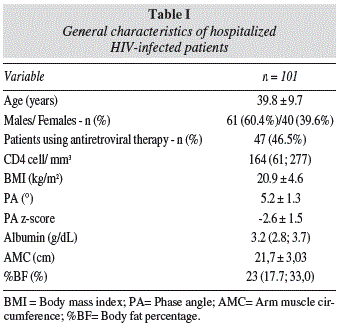
<body><![CDATA[<p><font face="Verdana" size="2">This study analyzed PA values of hospitalized HIV-infected patients by comparing them with the distribution of values in a healthy population<sup>3</sup> in terms of the z-score. The presence of a correlation between the PA z-score and nutritional parameters commonly used in clinical practice was also investigated.</font></p>     <p>&nbsp;</p>     <p><font face="Verdana" size="2"><b>Methodology</b></font></p>     <p><font face="Verdana" size="2">This cross-sectional study was approved by the local Research Ethics Committee, and participants provided written informed consent. The study was conducted in 2006 and 2007 and included 101 patients of both genders who were older than 18 years and hospitalized with an HIV diagnosis confirmed by the ELISA (enzyme-linked immunosorbent assay) method, regardless of the disease stage. Pregnant women were excluded. Data concerning age, gender, antiretroviral therapy use and CD4 lymphocytes were collected.</font></p>     <p><font face="Verdana" size="2">Nutritional assessment, including BIA, anthropometry and biochemical testing, was performed up to two days after patients' hospitalization. BIA (equipment Model 101; 50 KHz, 800 &mu;A; RJL Systems, Detroit, MI) was used for PA estimation (arc-tangent reactance x 180<sup>o</sup>/resistance X &pi;), which was expressed as the PA z-score (z-score = patient's observed value -median for the healthy population/standard deviation for the healthy population) of each evaluated patient. The values for the healthy population, according to gender and age range and as presented by Barbosa-Silva et al. (2005)<sup>3</sup>, were adopted as reference.</font></p>     <p><font face="Verdana" size="2">A Lange<sup>&reg;</sup> adipometer, an extensible measuring tape and a digital scale with a stadiometer were used for anthropometric evaluation. Present weight (PW) and height as well as the tricipital (TSF), bicipital, suprascapular and suprailiac skinfolds and arm circumference (AC) on the patient's non-dominant side were measured. The patient was asked about his/her usual weight six month ago (UW). Then, the body mass index (BMI = PW/height<sup>2</sup>), body fat percentage (%BF) by the sum of the 4 skinfolds<sup>11,12</sup>, arm muscle circumference (AMC = AC - TSF x 0.314) and weight loss percentage in the last six months (%WL= (UW - PW)/UW x 100) were calculated. In the laboratory analysis, albumin was dosed (bromocresol green method).</font></p>     <p><font face="Verdana" size="2">Data were expressed as percentage, mean &plusmn; standard deviation or median and 1<sup>st</sup> and 3<sup>ri</sup> quartiles. Spearman's correlation and the multiple linear regression model were used to identify the nutritional parameters associated with the PA z-score. The model was adjusted for CD4 and included all the variables showing p &lt; 0.05 in the correlation analysis. Statistical difference was considered when p &lt; 0.05. Statistical analysis was performed by using software SAS 9.2 (Cary, NC,EUA).</font></p>     <p>&nbsp;</p>     <p><font face="Verdana" size="2"><b>Results</b></font></p>     <p><font face="Verdana" size="2">The patients were predominantly males, 40 years old on average and 89.4% of them showed CD4 values lower than 500 cell/mm<sup>3</sup>. A large number of patients (53.5%) did not use antiretroviral therapy (<a href="#t1">table I</a>). 32.7% showed BMI lower than 18.5 kg/m<sup>2</sup>, and 70.3% showed albumin lower than 3.5 g/dL. The patients showed a PA z-score mean of -2.6 &plusmn; 1.5, with a median of -2.54 (-3.62; -1.6), minimum value of -6.0 and maximum value of 0.75.</font></p>     ]]></body>
<body><![CDATA[<p align="center"><font face="Verdana" size="2"><a name="t1"><img src="/img/revistas/nh/v27n3/13_original_10_t1.gif" align="top"></a></font></p>     <p>&nbsp;</p>     <p><font face="Verdana" size="2">By comparing to normal PA values of a healthy population, the patients showed lower values, with only 6.6% of them showing a positive score value (<a href="#f1">fig. 1</a>).</font></p>     <p align="center"><font face="Verdana" size="2"><a name="f1"><img src="/img/revistas/nh/v27n3/13_original_10_f1.gif" align="top"></a></font></p>     <p>&nbsp;</p>     <p><font face="Verdana" size="2">The PA z-score correlated with several nutritional parameters (<a href="#t2">table II</a>), and such association was reinforced by multiple analysis for parameters %WL, albumin, AMC and %BF, regardless of the CD4 level, an indicator of the disease stage (<a href="#t3">table III</a>).</font></p>     <p>&nbsp;</p>     <p align="center"><font face="Verdana" size="2"><a name="t2"><img src="/img/revistas/nh/v27n3/13_original_10_t2.gif" align="top"></a></font></p>     <p>&nbsp;</p>     <p align="center"><font face="Verdana" size="2"><a name="t3"><img src="/img/revistas/nh/v27n3/13_original_10_t3.gif" align="top"></a></font></p>     ]]></body>
<body><![CDATA[<p>&nbsp;</p>     <p><font face="Verdana" size="2"><b>Discussion</b></font></p>     <p><font face="Verdana" size="2">PA is considered as a cell integrity marker, and it has shown to be a prognostic factor in various clinical situations, but its use as a nutritional indicator is still incipient in clinical practice.</font></p>     <p><font face="Verdana" size="2">In several pathologies, an association between lower PA values and worse nutritional status has been observed.<sup>4-6</sup> Maggiorie et al. (1996)<sup>4</sup> identified PA association with AMC, albumin, protein intake and the subjective global assessment score (SGA) in hemodialysis-treated patients. When evaluating patients in the preoperative period of gastrointestinal surgery, Barbosa-Silva et al. (2003)<sup>6</sup> observed a significant decrease in PA values with malnutrition aggravation, as diagnosed by SGA, pointing to an association between a low phase angle and subcutaneous fat tissue depletion, muscle mass depletion and body mass depletion, all parameters considered in SGA. However, in a study on patients before elective gastrointestinal surgery or hernia repair, the PA z-score presented weak agreement with BMI, SGA and Nutritional Risk Screening.<sup>13</sup> Reinforcing the role played by PA as a nutritional status marker, in this study, a positive association was observed between that parameter and %BF, AMC and albumin, and a negative association was found with %WL even after adjustment for CD4 in hospitalized HIV-infected patients. Considering that this population is very susceptible to nutritional disorders, evidence of muscle or fat mass depletion suggests worse prognosis and, therefore, should be viewed with caution. Hence, the use of comparing the PA z-score in HIV-infected patients with that of a healthy population for detection of global nutritional deficit seems to be promising.</font></p>     <p><font face="Verdana" size="2">Considering the influence of malnutrition on HIV progression and on the prognosis of infected patients, higher PA values are associated with patients' longer survival,<sup>7,8</sup> which has added to the use of PA as a nutritional parameter in this group of patients.</font></p>     <p><font face="Verdana" size="2">In the study by Schwenk et al. (2000),<sup>7</sup> HIV-infected patients with PA smaller than 5.3<sup>o</sup> showed higher mortality than those with larger values (p &lt; 0.001), and relative mortality risk was 67% higher with a 1 degree reduction in PA. Additionally, the relationship of PA with CD4 lymphocytes and viral load reinforces its role as an indicator of disease status and its development.</font></p>     <p><font face="Verdana" size="2">The methodology for analysis of PA as a z-score adopted in this study was recently used by Paiva et al. (2011)<sup>14</sup> in the prognostic assessment of patients with cancer. The authors observed that patients with PA z-score lower than -1.65 showed higher mortality (OR 3.12 CI: 2.03-4.79; p &lt; 0.00) in relation to those with higher values.</font></p>     <p><font face="Verdana" size="2">Given the cross-sectional design in this study, population survival was not evaluated; however, 51.4% of the patients showed PA values lower than 5.3<sup>o</sup>, and 76.3% of them showed a lower PA z-score than -1.65. These data suggest a worse prognosis for this population.</font></p>     <p><font face="Verdana" size="2">In the nutritional evaluation by BIA, PA is obtained by a simple calculation, regardless of the pathology presented by the patient, since it is based on the relationship between reactance and resistance. These parameters are directly measured and not only estimated by the equipment. However, in order to determine free adipose and fat mass by BIA, formulas whose use is limited only to the population for which they were developed are used, and these equations are inadequate for other clinical situations, particularly in cases of alteration in hydration status.<sup>3</sup></font></p>     <p><font face="Verdana" size="2">In the nutritional evaluation, considering the PA z-score is preferable to using its absolute values, since it allows for quantifying the distance for each value in relation to the distribution expected for a healthy population instead of using only one reference value as normality for the evaluation. Hence, negative PA z-score values suggest malnutrition, and the more negative such values are, the worse the nutritional status. This form of analysis facilitates the perception of the magnitude of nutritional compromising in these patients. Therefore, using PA for nutritional assessment in clinical practice seems to be extremely valuable due to its practicality and dependability, and it can be adopted as a nutritional parameter in the care for hospitalized HIV-infected patients.</font></p>     ]]></body>
<body><![CDATA[<p><font face="Verdana" size="2">Once the influence of gender and age on body composition, and consequently on the absolute values of PA<sup>15</sup>, is known, the availability of a reference standard which takes such factors into account, thus enabling PA expression as a z-score, makes it possible to compare individuals and populations with different characteristics (gender, age) as well as to monitor each individual's nutrition.</font></p>     <p><font face="Verdana" size="2">As to our knowledge, this is the first study that has quantified the dispersion of PA values in a population of HIV-positive individuals around values that are considered to be indicative of a healthy clinical condition and related the magnitude of such dispersion to parameters which are frequently used for that population's nutritional assessment.</font></p>     <p><font face="Verdana" size="2">A nutritional assessment routine for hospitalized patients must be established due to the important nutritional alterations that occur in the course of HIV infection and to its impact on patients' clinical development.<sup>16,17</sup> The PA z-score is a useful, practical, accessible and reproducible tool that can help with the assessment of hospitalized patients' nutritional status.</font></p>     <p>&nbsp;</p>     <p><font face="Verdana" size="2"><b>References</b></font></p>     <!-- ref --><p><font face="Verdana" size="2">1. Earthman CP. Evaluation of nutrition assessment parameters in the presence of human immunodeficiency virus infection. <i>Nutr Clin Pract</i> 2004; 19: 330-339.    &nbsp;&nbsp;&nbsp;&nbsp;&nbsp;&nbsp;&nbsp;&nbsp;[&#160;<a href="javascript:void(0);" onclick="javascript: window.open('/scielo.php?script=sci_nlinks&ref=3655916&pid=S0212-1611201200030001300001&lng=','','width=640,height=500,resizable=yes,scrollbars=1,menubar=yes,');">Links</a>&#160;]<!-- end-ref --></font></p>    <!-- ref --><p><font face="Verdana" size="2">2. Volgyi E, Tylavsky FA, Lyytikainen A, Suominen H, Alen M, Cheng S. Assessing body composition with DEXA and bioimpedance: effects of obesity, physical activity, and age. <i>Obesity</i> 2008; 16: 700-705.    &nbsp;&nbsp;&nbsp;&nbsp;&nbsp;&nbsp;&nbsp;&nbsp;[&#160;<a href="javascript:void(0);" onclick="javascript: window.open('/scielo.php?script=sci_nlinks&ref=3655918&pid=S0212-1611201200030001300002&lng=','','width=640,height=500,resizable=yes,scrollbars=1,menubar=yes,');">Links</a>&#160;]<!-- end-ref --></font></p>    <!-- ref --><p><font face="Verdana" size="2">3. Barbosa-Silva MC, Barros AJD, Wang J, Heymsfield SB, Pierson Jr RN. Bioelectrical impedance analysis: population reference values for phase angle by age and sex. <i>Am J Clin Nutr</i> 2005; 82: 49-52.    &nbsp;&nbsp;&nbsp;&nbsp;&nbsp;&nbsp;&nbsp;&nbsp;[&#160;<a href="javascript:void(0);" onclick="javascript: window.open('/scielo.php?script=sci_nlinks&ref=3655920&pid=S0212-1611201200030001300003&lng=','','width=640,height=500,resizable=yes,scrollbars=1,menubar=yes,');">Links</a>&#160;]<!-- end-ref --></font></p>    <!-- ref --><p><font face="Verdana" size="2">4. Maggiore Q, Nigrelli S, Ciccarelli C, Grimaldi C, Rossi GA, Michelassi C. Nutritional and prognostic correlates of bioimpedance indexes in hemodialysis patients. <i>Kidney Int</i> 1996; 50:2103-2108.    &nbsp;&nbsp;&nbsp;&nbsp;&nbsp;&nbsp;&nbsp;&nbsp;[&#160;<a href="javascript:void(0);" onclick="javascript: window.open('/scielo.php?script=sci_nlinks&ref=3655922&pid=S0212-1611201200030001300004&lng=','','width=640,height=500,resizable=yes,scrollbars=1,menubar=yes,');">Links</a>&#160;]<!-- end-ref --></font></p>    <!-- ref --><p><font face="Verdana" size="2">5. Nagano M, Suita S, Yamanouchi T. The validity of bioelectrical impedance phase angle for nutritional assessment in children. <i>J Pediatr Surg</i> 2000; 35: 1035-1039.    &nbsp;&nbsp;&nbsp;&nbsp;&nbsp;&nbsp;&nbsp;&nbsp;[&#160;<a href="javascript:void(0);" onclick="javascript: window.open('/scielo.php?script=sci_nlinks&ref=3655924&pid=S0212-1611201200030001300005&lng=','','width=640,height=500,resizable=yes,scrollbars=1,menubar=yes,');">Links</a>&#160;]<!-- end-ref --></font></p>    <!-- ref --><p><font face="Verdana" size="2">6. Barbosa-Silva MCG, Barros AJD, Post CLA, Waitzberg DL, Heymsfield SB. Can bioelectrical impedance analysis identify malnutrition in preoperative nutrition assessment? <i>Nutrition</i> 2003; 19: 422-426.    &nbsp;&nbsp;&nbsp;&nbsp;&nbsp;&nbsp;&nbsp;&nbsp;[&#160;<a href="javascript:void(0);" onclick="javascript: window.open('/scielo.php?script=sci_nlinks&ref=3655926&pid=S0212-1611201200030001300006&lng=','','width=640,height=500,resizable=yes,scrollbars=1,menubar=yes,');">Links</a>&#160;]<!-- end-ref --></font></p>    <!-- ref --><p><font face="Verdana" size="2">7. Schwenk A, Beisenherz A, Romer K, Kremer G, Salzberger B, Elia M. Phase angle from bioelectrical impedance analysis remains an independent predictive marker in HIV-infected patients in the era of highly active antiretroviral treatment. <i>Am J Clin Nutr</i> 2000; 72: 496-501.    &nbsp;&nbsp;&nbsp;&nbsp;&nbsp;&nbsp;&nbsp;&nbsp;[&#160;<a href="javascript:void(0);" onclick="javascript: window.open('/scielo.php?script=sci_nlinks&ref=3655928&pid=S0212-1611201200030001300007&lng=','','width=640,height=500,resizable=yes,scrollbars=1,menubar=yes,');">Links</a>&#160;]<!-- end-ref --></font></p>    <!-- ref --><p><font face="Verdana" size="2">8. Ott M, Fischer H, Polat H, Helm EB, Frenz M, Caspary WF et al. Bioelectrical impedance analysis as a predictor of survival in patients with human immunodeficiency virus infection. <i>J Aqcquir Defic Syndr Hum Retrovirol</i> 1995; 9: 20-25.    &nbsp;&nbsp;&nbsp;&nbsp;&nbsp;&nbsp;&nbsp;&nbsp;[&#160;<a href="javascript:void(0);" onclick="javascript: window.open('/scielo.php?script=sci_nlinks&ref=3655930&pid=S0212-1611201200030001300008&lng=','','width=640,height=500,resizable=yes,scrollbars=1,menubar=yes,');">Links</a>&#160;]<!-- end-ref --></font></p>    <!-- ref --><p><font face="Verdana" size="2">9. Antunes AA, Vannini FD, Silveira LVA, Martin LC, Barretti P, Caramori JCT. Influence of protein intake and muscle mass on survival in chronic dialysis patients. <i>Ren Fail</i> 2010; 32: 1055-1059.    &nbsp;&nbsp;&nbsp;&nbsp;&nbsp;&nbsp;&nbsp;&nbsp;[&#160;<a href="javascript:void(0);" onclick="javascript: window.open('/scielo.php?script=sci_nlinks&ref=3655932&pid=S0212-1611201200030001300009&lng=','','width=640,height=500,resizable=yes,scrollbars=1,menubar=yes,');">Links</a>&#160;]<!-- end-ref --></font></p>    <!-- ref --><p><font face="Verdana" size="2">10. Toso S, Piccoli A, Gusella M et al. Altered tissue electric properties in lung cancer patients as detected by bioelectric impedance vector analysis. <i>Nutrition</i> 2000;16:120-124.    &nbsp;&nbsp;&nbsp;&nbsp;&nbsp;&nbsp;&nbsp;&nbsp;[&#160;<a href="javascript:void(0);" onclick="javascript: window.open('/scielo.php?script=sci_nlinks&ref=3655934&pid=S0212-1611201200030001300010&lng=','','width=640,height=500,resizable=yes,scrollbars=1,menubar=yes,');">Links</a>&#160;]<!-- end-ref --></font></p>    <!-- ref --><p><font face="Verdana" size="2">11. Durnin JVGA, Womersley I. Body fat assessed from total body density and its estimation from skinfold thickness: measurement on 481 men and women aged from 16 to 72 years. <i>Br J Nutr</i> 1974; 32: 77-97.    &nbsp;&nbsp;&nbsp;&nbsp;&nbsp;&nbsp;&nbsp;&nbsp;[&#160;<a href="javascript:void(0);" onclick="javascript: window.open('/scielo.php?script=sci_nlinks&ref=3655936&pid=S0212-1611201200030001300011&lng=','','width=640,height=500,resizable=yes,scrollbars=1,menubar=yes,');">Links</a>&#160;]<!-- end-ref --></font></p>    <!-- ref --><p><font face="Verdana" size="2">12. Siri WE. Body composition from fluid space and density: analysis of methods. In: Brozek J, Henschel A, editors. Techniques for measuring body composition. <i>National Academy of Science</i> 1961: 223-44.    &nbsp;&nbsp;&nbsp;&nbsp;&nbsp;&nbsp;&nbsp;&nbsp;[&#160;<a href="javascript:void(0);" onclick="javascript: window.open('/scielo.php?script=sci_nlinks&ref=3655938&pid=S0212-1611201200030001300012&lng=','','width=640,height=500,resizable=yes,scrollbars=1,menubar=yes,');">Links</a>&#160;]<!-- end-ref --></font></p>    <!-- ref --><p><font face="Verdana" size="2">13. Scheunemann L, Wazlawik E, Bastos JL, Ristow Cardinal T, Mayumi Nakazora L. Agreement and association between the phase angle and parameters of nutritional status assessment in surgical patients. <i>Nutr Hosp</i> 2011; 26: 480-487.    &nbsp;&nbsp;&nbsp;&nbsp;&nbsp;&nbsp;&nbsp;&nbsp;[&#160;<a href="javascript:void(0);" onclick="javascript: window.open('/scielo.php?script=sci_nlinks&ref=3655940&pid=S0212-1611201200030001300013&lng=','','width=640,height=500,resizable=yes,scrollbars=1,menubar=yes,');">Links</a>&#160;]<!-- end-ref --></font></p>    <!-- ref --><p><font face="Verdana" size="2">14. Paiva SI, Borges LR, Halpern-Silveira D, Assunção MCF, Barros AJD, Gonzalez MC. Standardized phase angle from bioelectrical impedance analysis as prognostic factor for survival in patients with cancer. <i>Support Care Cancer</i> 2011; 19: 187-192.    &nbsp;&nbsp;&nbsp;&nbsp;&nbsp;&nbsp;&nbsp;&nbsp;[&#160;<a href="javascript:void(0);" onclick="javascript: window.open('/scielo.php?script=sci_nlinks&ref=3655942&pid=S0212-1611201200030001300014&lng=','','width=640,height=500,resizable=yes,scrollbars=1,menubar=yes,');">Links</a>&#160;]<!-- end-ref --></font></p>    <!-- ref --><p><font face="Verdana" size="2">15. Dittmar M. Reliability and variability of bioimpedance measures in normal adults: effects of age, gender, and body mass. <i>Am J Phys Anthropol</i> 2003; 122: 361-370.    &nbsp;&nbsp;&nbsp;&nbsp;&nbsp;&nbsp;&nbsp;&nbsp;[&#160;<a href="javascript:void(0);" onclick="javascript: window.open('/scielo.php?script=sci_nlinks&ref=3655944&pid=S0212-1611201200030001300015&lng=','','width=640,height=500,resizable=yes,scrollbars=1,menubar=yes,');">Links</a>&#160;]<!-- end-ref --></font></p>    <!-- ref --><p><font face="Verdana" size="2">16. Ockenga J, Grimble R, Jonkers-Schuitema C, Macallan D, Melchior JC, Sauerwein HP et al. ESPEN guidelines on enteral nutrition: wasting in HIV and other chronic infectious diseases. <i>Clin Nutr</i> 2006; 25: 319-329.    &nbsp;&nbsp;&nbsp;&nbsp;&nbsp;&nbsp;&nbsp;&nbsp;[&#160;<a href="javascript:void(0);" onclick="javascript: window.open('/scielo.php?script=sci_nlinks&ref=3655946&pid=S0212-1611201200030001300016&lng=','','width=640,height=500,resizable=yes,scrollbars=1,menubar=yes,');">Links</a>&#160;]<!-- end-ref --></font></p>    <!-- ref --><p><font face="Verdana" size="2">17. Kotler DP. Nutritional alterations associated with HIV infection. <i>J Acquir Immune Defic Syndr Hum Retrovirol</i> 2000; 25:81-87.    &nbsp;&nbsp;&nbsp;&nbsp;&nbsp;&nbsp;&nbsp;&nbsp;[&#160;<a href="javascript:void(0);" onclick="javascript: window.open('/scielo.php?script=sci_nlinks&ref=3655948&pid=S0212-1611201200030001300017&lng=','','width=640,height=500,resizable=yes,scrollbars=1,menubar=yes,');">Links</a>&#160;]<!-- end-ref --></font></p>     <p>&nbsp;</p>     ]]></body>
<body><![CDATA[<p>&nbsp;</p>     <p><font face="Verdana" size="2"><a href="#top"><img border="0" src="/img/revistas/nh/v27n3/seta.gif" width="15" height="17"></a><a name="bajo"></a><b>Correspondence:</b>    <br>Aline de Araujo Antunes.    <br>Departamento de Clínica Médica.    <br>Faculdade de Medicina de Botucatu.    <br>São Paulo State University - UNESP.    <br>18618-970 - Botucatu - SP - Brasil.    <br>E-mail: <a href="mailto:alineantunes00@gmail.com">alineantunes00@gmail.com</a></font></p>     <p><font face="Verdana" size="2">Recibido: 16-XII-2011.    <br>Aceptado: 11-I-2012.</font></p>     ]]></body>
<body><![CDATA[ ]]></body><back>
<ref-list>
<ref id="B1">
<label>1</label><nlm-citation citation-type="journal">
<person-group person-group-type="author">
<name>
<surname><![CDATA[Earthman]]></surname>
<given-names><![CDATA[CP]]></given-names>
</name>
</person-group>
<article-title xml:lang="en"><![CDATA[Evaluation of nutrition assessment parameters in the presence of human immunodeficiency virus infection]]></article-title>
<source><![CDATA[Nutr Clin Pract]]></source>
<year>2004</year>
<volume>19</volume>
<page-range>330-339</page-range></nlm-citation>
</ref>
<ref id="B2">
<label>2</label><nlm-citation citation-type="journal">
<person-group person-group-type="author">
<name>
<surname><![CDATA[Volgyi]]></surname>
<given-names><![CDATA[E]]></given-names>
</name>
<name>
<surname><![CDATA[Tylavsky]]></surname>
<given-names><![CDATA[FA]]></given-names>
</name>
<name>
<surname><![CDATA[Lyytikainen]]></surname>
<given-names><![CDATA[A]]></given-names>
</name>
<name>
<surname><![CDATA[Suominen]]></surname>
<given-names><![CDATA[H]]></given-names>
</name>
<name>
<surname><![CDATA[Alen]]></surname>
<given-names><![CDATA[M]]></given-names>
</name>
<name>
<surname><![CDATA[Cheng]]></surname>
<given-names><![CDATA[S]]></given-names>
</name>
</person-group>
<article-title xml:lang="en"><![CDATA[Assessing body composition with DEXA and bioimpedance: effects of obesity, physical activity, and age]]></article-title>
<source><![CDATA[Obesity]]></source>
<year>2008</year>
<volume>16</volume>
<page-range>700-705</page-range></nlm-citation>
</ref>
<ref id="B3">
<label>3</label><nlm-citation citation-type="journal">
<person-group person-group-type="author">
<name>
<surname><![CDATA[Barbosa-Silva]]></surname>
<given-names><![CDATA[MC]]></given-names>
</name>
<name>
<surname><![CDATA[Barros]]></surname>
<given-names><![CDATA[AJD]]></given-names>
</name>
<name>
<surname><![CDATA[Wang]]></surname>
<given-names><![CDATA[J]]></given-names>
</name>
<name>
<surname><![CDATA[Heymsfield]]></surname>
<given-names><![CDATA[SB]]></given-names>
</name>
<name>
<surname><![CDATA[Pierson]]></surname>
<given-names><![CDATA[Jr RN]]></given-names>
</name>
</person-group>
<article-title xml:lang="en"><![CDATA[Bioelectrical impedance analysis: population reference values for phase angle by age and sex]]></article-title>
<source><![CDATA[Am J Clin Nutr]]></source>
<year>2005</year>
<volume>82</volume>
<page-range>49-52</page-range></nlm-citation>
</ref>
<ref id="B4">
<label>4</label><nlm-citation citation-type="journal">
<person-group person-group-type="author">
<name>
<surname><![CDATA[Maggiore]]></surname>
<given-names><![CDATA[Q]]></given-names>
</name>
<name>
<surname><![CDATA[Nigrelli]]></surname>
<given-names><![CDATA[S]]></given-names>
</name>
<name>
<surname><![CDATA[Ciccarelli]]></surname>
<given-names><![CDATA[C]]></given-names>
</name>
<name>
<surname><![CDATA[Grimaldi]]></surname>
<given-names><![CDATA[C]]></given-names>
</name>
<name>
<surname><![CDATA[Rossi]]></surname>
<given-names><![CDATA[GA]]></given-names>
</name>
<name>
<surname><![CDATA[Michelassi]]></surname>
<given-names><![CDATA[C]]></given-names>
</name>
</person-group>
<article-title xml:lang="en"><![CDATA[Nutritional and prognostic correlates of bioimpedance indexes in hemodialysis patients]]></article-title>
<source><![CDATA[Kidney Int]]></source>
<year>1996</year>
<volume>50</volume>
<page-range>2103-2108</page-range></nlm-citation>
</ref>
<ref id="B5">
<label>5</label><nlm-citation citation-type="journal">
<person-group person-group-type="author">
<name>
<surname><![CDATA[Nagano]]></surname>
<given-names><![CDATA[M]]></given-names>
</name>
<name>
<surname><![CDATA[Suita]]></surname>
<given-names><![CDATA[S]]></given-names>
</name>
<name>
<surname><![CDATA[Yamanouchi]]></surname>
<given-names><![CDATA[T]]></given-names>
</name>
</person-group>
<article-title xml:lang="en"><![CDATA[The validity of bioelectrical impedance phase angle for nutritional assessment in children]]></article-title>
<source><![CDATA[J Pediatr Surg]]></source>
<year>2000</year>
<volume>35</volume>
<page-range>1035-1039</page-range></nlm-citation>
</ref>
<ref id="B6">
<label>6</label><nlm-citation citation-type="journal">
<person-group person-group-type="author">
<name>
<surname><![CDATA[Barbosa-Silva]]></surname>
<given-names><![CDATA[MCG]]></given-names>
</name>
<name>
<surname><![CDATA[Barros]]></surname>
<given-names><![CDATA[AJD]]></given-names>
</name>
<name>
<surname><![CDATA[Post]]></surname>
<given-names><![CDATA[CLA]]></given-names>
</name>
<name>
<surname><![CDATA[Waitzberg]]></surname>
<given-names><![CDATA[DL]]></given-names>
</name>
<name>
<surname><![CDATA[Heymsfield]]></surname>
<given-names><![CDATA[SB]]></given-names>
</name>
</person-group>
<article-title xml:lang="en"><![CDATA[Can bioelectrical impedance analysis identify malnutrition in preoperative nutrition assessment?]]></article-title>
<source><![CDATA[Nutrition]]></source>
<year>2003</year>
<volume>19</volume>
<page-range>422-426</page-range></nlm-citation>
</ref>
<ref id="B7">
<label>7</label><nlm-citation citation-type="journal">
<person-group person-group-type="author">
<name>
<surname><![CDATA[Schwenk]]></surname>
<given-names><![CDATA[A]]></given-names>
</name>
<name>
<surname><![CDATA[Beisenherz]]></surname>
<given-names><![CDATA[A]]></given-names>
</name>
<name>
<surname><![CDATA[Romer]]></surname>
<given-names><![CDATA[K]]></given-names>
</name>
<name>
<surname><![CDATA[Kremer]]></surname>
<given-names><![CDATA[G]]></given-names>
</name>
<name>
<surname><![CDATA[Salzberger]]></surname>
<given-names><![CDATA[B]]></given-names>
</name>
<name>
<surname><![CDATA[Elia]]></surname>
<given-names><![CDATA[M]]></given-names>
</name>
</person-group>
<article-title xml:lang="en"><![CDATA[Phase angle from bioelectrical impedance analysis remains an independent predictive marker in HIV-infected patients in the era of highly active antiretroviral treatment]]></article-title>
<source><![CDATA[Am J Clin Nutr]]></source>
<year>2000</year>
<volume>72</volume>
<page-range>496-501</page-range></nlm-citation>
</ref>
<ref id="B8">
<label>8</label><nlm-citation citation-type="journal">
<person-group person-group-type="author">
<name>
<surname><![CDATA[Ott]]></surname>
<given-names><![CDATA[M]]></given-names>
</name>
<name>
<surname><![CDATA[Fischer]]></surname>
<given-names><![CDATA[H]]></given-names>
</name>
<name>
<surname><![CDATA[Polat]]></surname>
<given-names><![CDATA[H]]></given-names>
</name>
<name>
<surname><![CDATA[Helm]]></surname>
<given-names><![CDATA[EB]]></given-names>
</name>
<name>
<surname><![CDATA[Frenz]]></surname>
<given-names><![CDATA[M]]></given-names>
</name>
<name>
<surname><![CDATA[Caspary]]></surname>
<given-names><![CDATA[WF et al]]></given-names>
</name>
</person-group>
<article-title xml:lang="en"><![CDATA[Bioelectrical impedance analysis as a predictor of survival in patients with human immunodeficiency virus infection]]></article-title>
<source><![CDATA[J Aqcquir Defic Syndr Hum Retrovirol]]></source>
<year>1995</year>
<volume>9</volume>
<page-range>20-25</page-range></nlm-citation>
</ref>
<ref id="B9">
<label>9</label><nlm-citation citation-type="journal">
<person-group person-group-type="author">
<name>
<surname><![CDATA[Antunes]]></surname>
<given-names><![CDATA[AA]]></given-names>
</name>
<name>
<surname><![CDATA[Vannini]]></surname>
<given-names><![CDATA[FD]]></given-names>
</name>
<name>
<surname><![CDATA[Silveira]]></surname>
<given-names><![CDATA[LVA]]></given-names>
</name>
<name>
<surname><![CDATA[Martin]]></surname>
<given-names><![CDATA[LC]]></given-names>
</name>
<name>
<surname><![CDATA[Barretti]]></surname>
<given-names><![CDATA[P]]></given-names>
</name>
<name>
<surname><![CDATA[Caramori]]></surname>
<given-names><![CDATA[JCT]]></given-names>
</name>
</person-group>
<article-title xml:lang="en"><![CDATA[Influence of protein intake and muscle mass on survival in chronic dialysis patients]]></article-title>
<source><![CDATA[Ren Fail]]></source>
<year>2010</year>
<volume>32</volume>
<page-range>1055-1059</page-range></nlm-citation>
</ref>
<ref id="B10">
<label>10</label><nlm-citation citation-type="journal">
<person-group person-group-type="author">
<name>
<surname><![CDATA[Toso]]></surname>
<given-names><![CDATA[S]]></given-names>
</name>
<name>
<surname><![CDATA[Piccoli]]></surname>
<given-names><![CDATA[A]]></given-names>
</name>
<name>
<surname><![CDATA[Gusella]]></surname>
<given-names><![CDATA[M et al]]></given-names>
</name>
</person-group>
<article-title xml:lang="en"><![CDATA[Altered tissue electric properties in lung cancer patients as detected by bioelectric impedance vector analysis]]></article-title>
<source><![CDATA[Nutrition]]></source>
<year>2000</year>
<volume>16</volume>
<page-range>120-124</page-range></nlm-citation>
</ref>
<ref id="B11">
<label>11</label><nlm-citation citation-type="journal">
<person-group person-group-type="author">
<name>
<surname><![CDATA[Durnin]]></surname>
<given-names><![CDATA[JVGA]]></given-names>
</name>
<name>
<surname><![CDATA[Womersley]]></surname>
<given-names><![CDATA[I]]></given-names>
</name>
</person-group>
<article-title xml:lang="en"><![CDATA[Body fat assessed from total body density and its estimation from skinfold thickness: measurement on 481 men and women aged from 16 to 72 years]]></article-title>
<source><![CDATA[Br J Nutr]]></source>
<year>1974</year>
<volume>32</volume>
<page-range>77-97</page-range></nlm-citation>
</ref>
<ref id="B12">
<label>12</label><nlm-citation citation-type="book">
<person-group person-group-type="author">
<name>
<surname><![CDATA[Siri]]></surname>
<given-names><![CDATA[WE]]></given-names>
</name>
</person-group>
<article-title xml:lang="en"><![CDATA[Body composition from fluid space and density: analysis of methods]]></article-title>
<person-group person-group-type="editor">
<name>
<surname><![CDATA[Brozek]]></surname>
<given-names><![CDATA[J]]></given-names>
</name>
<name>
<surname><![CDATA[Henschel]]></surname>
<given-names><![CDATA[A]]></given-names>
</name>
</person-group>
<source><![CDATA[Techniques for measuring body composition]]></source>
<year>1961</year>
<page-range>223-44</page-range><publisher-name><![CDATA[National Academy of Science]]></publisher-name>
</nlm-citation>
</ref>
<ref id="B13">
<label>13</label><nlm-citation citation-type="journal">
<person-group person-group-type="author">
<name>
<surname><![CDATA[Scheunemann]]></surname>
<given-names><![CDATA[L]]></given-names>
</name>
<name>
<surname><![CDATA[Wazlawik]]></surname>
<given-names><![CDATA[E]]></given-names>
</name>
<name>
<surname><![CDATA[Bastos]]></surname>
<given-names><![CDATA[JL]]></given-names>
</name>
<name>
<surname><![CDATA[Ristow Cardinal]]></surname>
<given-names><![CDATA[T]]></given-names>
</name>
<name>
<surname><![CDATA[Mayumi Nakazora]]></surname>
<given-names><![CDATA[L]]></given-names>
</name>
</person-group>
<article-title xml:lang="en"><![CDATA[Agreement and association between the phase angle and parameters of nutritional status assessment in surgical patients]]></article-title>
<source><![CDATA[Nutr Hosp]]></source>
<year>2011</year>
<volume>26</volume>
<page-range>480-487</page-range></nlm-citation>
</ref>
<ref id="B14">
<label>14</label><nlm-citation citation-type="journal">
<person-group person-group-type="author">
<name>
<surname><![CDATA[Paiva]]></surname>
<given-names><![CDATA[SI]]></given-names>
</name>
<name>
<surname><![CDATA[Borges]]></surname>
<given-names><![CDATA[LR]]></given-names>
</name>
<name>
<surname><![CDATA[Halpern-Silveira]]></surname>
<given-names><![CDATA[D]]></given-names>
</name>
<name>
<surname><![CDATA[Assunção]]></surname>
<given-names><![CDATA[MCF]]></given-names>
</name>
<name>
<surname><![CDATA[Barros]]></surname>
<given-names><![CDATA[AJD]]></given-names>
</name>
<name>
<surname><![CDATA[Gonzalez]]></surname>
<given-names><![CDATA[MC]]></given-names>
</name>
</person-group>
<article-title xml:lang="en"><![CDATA[Standardized phase angle from bioelectrical impedance analysis as prognostic factor for survival in patients with cancer]]></article-title>
<source><![CDATA[Support Care Cancer]]></source>
<year>2011</year>
<volume>19</volume>
<page-range>187-192</page-range></nlm-citation>
</ref>
<ref id="B15">
<label>15</label><nlm-citation citation-type="journal">
<person-group person-group-type="author">
<name>
<surname><![CDATA[Dittmar]]></surname>
<given-names><![CDATA[M]]></given-names>
</name>
</person-group>
<article-title xml:lang="en"><![CDATA[Reliability and variability of bioimpedance measures in normal adults: effects of age, gender, and body mass]]></article-title>
<source><![CDATA[Am J Phys Anthropol]]></source>
<year>2003</year>
<volume>122</volume>
<page-range>361-370</page-range></nlm-citation>
</ref>
<ref id="B16">
<label>16</label><nlm-citation citation-type="journal">
<person-group person-group-type="author">
<name>
<surname><![CDATA[Ockenga]]></surname>
<given-names><![CDATA[J]]></given-names>
</name>
<name>
<surname><![CDATA[Grimble]]></surname>
<given-names><![CDATA[R]]></given-names>
</name>
<name>
<surname><![CDATA[Jonkers-Schuitema]]></surname>
<given-names><![CDATA[C]]></given-names>
</name>
<name>
<surname><![CDATA[Macallan]]></surname>
<given-names><![CDATA[D]]></given-names>
</name>
<name>
<surname><![CDATA[Melchior]]></surname>
<given-names><![CDATA[JC]]></given-names>
</name>
<name>
<surname><![CDATA[Sauerwein]]></surname>
<given-names><![CDATA[HP]]></given-names>
</name>
</person-group>
<article-title xml:lang="en"><![CDATA[ESPEN guidelines on enteral nutrition: wasting in HIV and other chronic infectious diseases]]></article-title>
<source><![CDATA[Clin Nutr]]></source>
<year>2006</year>
<volume>25</volume>
<page-range>319-329</page-range></nlm-citation>
</ref>
<ref id="B17">
<label>17</label><nlm-citation citation-type="journal">
<person-group person-group-type="author">
<name>
<surname><![CDATA[Kotler]]></surname>
<given-names><![CDATA[DP]]></given-names>
</name>
</person-group>
<article-title xml:lang="en"><![CDATA[Nutritional alterations associated with HIV infection]]></article-title>
<source><![CDATA[J Acquir Immune Defic Syndr Hum Retrovirol]]></source>
<year>2000</year>
<volume>25</volume>
<page-range>81-87</page-range></nlm-citation>
</ref>
</ref-list>
</back>
</article>
