<?xml version="1.0" encoding="ISO-8859-1"?><article xmlns:mml="http://www.w3.org/1998/Math/MathML" xmlns:xlink="http://www.w3.org/1999/xlink" xmlns:xsi="http://www.w3.org/2001/XMLSchema-instance">
<front>
<journal-meta>
<journal-id>0212-1611</journal-id>
<journal-title><![CDATA[Nutrición Hospitalaria]]></journal-title>
<abbrev-journal-title><![CDATA[Nutr. Hosp.]]></abbrev-journal-title>
<issn>0212-1611</issn>
<publisher>
<publisher-name><![CDATA[Grupo Arán]]></publisher-name>
</publisher>
</journal-meta>
<article-meta>
<article-id>S0212-16112012000400045</article-id>
<article-id pub-id-type="doi">10.3305/nh.2012.27.4.5861</article-id>
<title-group>
<article-title xml:lang="en"><![CDATA[Dietary intake increases serum levels of carboxymethil-lysine (CML) in diabetic patients]]></article-title>
<article-title xml:lang="es"><![CDATA[La ingesta dietaria de carboximetil-lisina (CML) aumenta los niveles plasmáticos de este compuesto en pacientes diabéticos]]></article-title>
</title-group>
<contrib-group>
<contrib contrib-type="author">
<name>
<surname><![CDATA[Jara]]></surname>
<given-names><![CDATA[N.]]></given-names>
</name>
<xref ref-type="aff" rid="A01"/>
</contrib>
<contrib contrib-type="author">
<name>
<surname><![CDATA[Leal]]></surname>
<given-names><![CDATA[M. J.]]></given-names>
</name>
<xref ref-type="aff" rid="A01"/>
</contrib>
<contrib contrib-type="author">
<name>
<surname><![CDATA[Bunout]]></surname>
<given-names><![CDATA[D.]]></given-names>
</name>
<xref ref-type="aff" rid="A01"/>
</contrib>
<contrib contrib-type="author">
<name>
<surname><![CDATA[Hirsch]]></surname>
<given-names><![CDATA[S.]]></given-names>
</name>
<xref ref-type="aff" rid="A01"/>
</contrib>
<contrib contrib-type="author">
<name>
<surname><![CDATA[Barrera]]></surname>
<given-names><![CDATA[G.]]></given-names>
</name>
<xref ref-type="aff" rid="A01"/>
</contrib>
<contrib contrib-type="author">
<name>
<surname><![CDATA[Leiva]]></surname>
<given-names><![CDATA[L.]]></given-names>
</name>
<xref ref-type="aff" rid="A01"/>
</contrib>
<contrib contrib-type="author">
<name>
<surname><![CDATA[de la Maza]]></surname>
<given-names><![CDATA[M. P.]]></given-names>
</name>
<xref ref-type="aff" rid="A01"/>
</contrib>
</contrib-group>
<aff id="A01">
<institution><![CDATA[,Universidad de Chile Instituto de Nutrición y Tecnología de los Alimentos (INTA) Departamento de Envejecimiento y Enfermedades Crónicas Asociadas a la Nutrición (EECRAN)]]></institution>
<addr-line><![CDATA[ ]]></addr-line>
<country>Chile</country>
</aff>
<pub-date pub-type="pub">
<day>00</day>
<month>08</month>
<year>2012</year>
</pub-date>
<pub-date pub-type="epub">
<day>00</day>
<month>08</month>
<year>2012</year>
</pub-date>
<volume>27</volume>
<numero>4</numero>
<fpage>1272</fpage>
<lpage>1278</lpage>
<copyright-statement/>
<copyright-year/>
<self-uri xlink:href="http://scielo.isciii.es/scielo.php?script=sci_arttext&amp;pid=S0212-16112012000400045&amp;lng=en&amp;nrm=iso"></self-uri><self-uri xlink:href="http://scielo.isciii.es/scielo.php?script=sci_abstract&amp;pid=S0212-16112012000400045&amp;lng=en&amp;nrm=iso"></self-uri><self-uri xlink:href="http://scielo.isciii.es/scielo.php?script=sci_pdf&amp;pid=S0212-16112012000400045&amp;lng=en&amp;nrm=iso"></self-uri><abstract abstract-type="short" xml:lang="en"><p><![CDATA[Introduction: Advanced glycation end products are produced endogenously, in association with hyperglycemia and oxidative stress. They can also be generated during cooking or food processing and, once absorbed, alter protein function and promote inflammation. Methods: We selected 40 healthy male subjects, 17 patients with type 2 diabetes of both sexes and 15 patients with type 1 diabetes of both sexes. Each participant underwent both a food frequency questionnaire (FFQ) and 24-hour dietary recall specially adapted for measuring CML intake, anthropometry, measurement of blood pressure and biochemical parameters in blood and urine. Results: Serum CML levels were significantly higher in patients with diabetes compared to healthy subjects (p 0.04), showing a direct relationship between dietary intake and serum levels of CML in T2D patients (r 0.53 p 0.03). sCML levels correlated positively with length of diabetes mellitus, and inversely with body mass index (BMI). The most important dietary factor contributing to raise CML levels in these patients with diabetes was the consumption of milk powder. Conclusion: Serum levels of CML were found to be higher among diabetic subjects, associated to length of diabetes as expected, but also with the ingestion of foods containing higher amounts of ML. The consumption of milk powder in this group is a major determinant of increased serum levels.]]></p></abstract>
<abstract abstract-type="short" xml:lang="es"><p><![CDATA[Introducción: Los productos avanzados de la glicación se producen de forma endógena en relación con la hiperglucemia y el estrés oxidativo. También pueden generarse durante el cocinado o el procesamiento de los alimentos; una vez absorbidos, alteran la función proteica y favorecen la inflamación. Métodos: Seleccionamos a 40 hombres sanos, 17 pacientes con diabetes tipo 2 de ambos sexos y 15 pacientes con diabetes tipo 1 de ambos sexos. A cada participante se le realizó un cuestionario de frecuencia de consumo de alimentos (CFA) y un recordatorio de 24 horas especialmente adaptado para medir el consumo de CML, antropometría, medición de la presión sanguínea y parámetros bioquímicos en la sangre y la orina. Resultados: Las concentraciones séricas de CML fueron significativamente mayores en pacientes con diabetes en comparación con los individuos sanos (p = 0,04). Se encontró una relación directa entre el consumo dietético y las concentraciones séricas de CML en los pacientes con diabetes tipo 2 (r = 0,53; p = 0,03). Las concentraciones séricas de CML se correlacionan positivamente con la duración de la diabetes mellitus e inversamente con el índice de masa corporal (IMC). El alimento que más contribuye al aumento de las concentraciones plasmáticas de CML en estos pacientes fue el consumo de leche en polvo. Conclusión: Se encontró que las concentraciones séricas de CML eran mayores en los sujetos diabéticos, asociado con la duración de la diabetes, como era de esperar, pero también con la ingestión de alimentos que contienen mayores cantidades de CML. El consumo de leche en polvo en este grupo es un factor determinante en el aumento de las concentraciones séricas de CML.]]></p></abstract>
<kwd-group>
<kwd lng="en"><![CDATA[Diabetes]]></kwd>
<kwd lng="en"><![CDATA[Carboxymethyl-lysine (CML)]]></kwd>
<kwd lng="en"><![CDATA[Advanced glycation end products (AGES)]]></kwd>
<kwd lng="en"><![CDATA[Diet]]></kwd>
<kwd lng="en"><![CDATA[Dietary intake]]></kwd>
<kwd lng="es"><![CDATA[Diabetes]]></kwd>
<kwd lng="es"><![CDATA[Carboximetil-lisina (CML)]]></kwd>
<kwd lng="es"><![CDATA[Productos de glicación avanzada (AGES)]]></kwd>
<kwd lng="es"><![CDATA[Dieta]]></kwd>
<kwd lng="es"><![CDATA[Ingesta dietaria]]></kwd>
</kwd-group>
</article-meta>
</front><body><![CDATA[ <p><font face="Verdana" size="2"><b>ORIGINAL</b></font></p>     <p>&nbsp;</p>     <p><font face="Verdana" size="4"><b>Dietary intake increases serum levels of carboxymethil-lysine (CML) in diabetic patients</b></font></p>     <p><font face="Verdana" size="4"><b>La ingesta dietaria de carboximetil-lisina (CML) aumenta los niveles plasmáticos de este compuesto en pacientes diabéticos</b></font></p>     <p>&nbsp;</p>     <p>&nbsp;</p>     <p><font face="Verdana" size="2"><b>N. Jara, M. J. Leal, D. Bunout, S. Hirsch, G. Barrera, L. Leiva and M. P. de la Maza</b></font></p>     <p><font face="Verdana" size="2">Departamento de Envejecimiento y Enfermedades Crónicas Asociadas a la Nutrición (EECRAN). Instituto de Nutrición y Tecnología de los Alimentos (INTA). Universidad de Chile. Chile</font></p>     <p><font face="Verdana" size="2"><a href="#bajo">Correspondence</a></font></p>     <p>&nbsp;</p>     ]]></body>
<body><![CDATA[<p>&nbsp;</p> <hr size="1">     <p><font face="Verdana" size="2"><b>ABSTRACT</b></font></p>     <p><font face="Verdana" size="2"><b>Introduction:</b> Advanced glycation end products are produced endogenously, in association with hyperglycemia and oxidative stress. They can also be generated during cooking or food processing and, once absorbed, alter protein function and promote inflammation.    <br><b>Methods:</b> We selected 40 healthy male subjects, 17 patients with type 2 diabetes of both sexes and 15 patients with type 1 diabetes of both sexes. Each participant underwent both a food frequency questionnaire (FFQ) and 24-hour dietary recall specially adapted for measuring CML intake, anthropometry, measurement of blood pressure and biochemical parameters in blood and urine.    <br><b>Results:</b> Serum CML levels were significantly higher in patients with diabetes compared to healthy subjects (p 0.04), showing a direct relationship between dietary intake and serum levels of CML in T2D patients (r 0.53 p 0.03). sCML levels correlated positively with length of diabetes mellitus, and inversely with body mass index (BMI). The most important dietary factor contributing to raise CML levels in these patients with diabetes was the consumption of milk powder.    <br><b>Conclusion:</b> Serum levels of CML were found to be higher among diabetic subjects, associated to length of diabetes as expected, but also with the ingestion of foods containing higher amounts of ML. The consumption of milk powder in this group is a major determinant of increased serum levels.</font></p>     <p><font face="Verdana" size="2"><b>Key words:</b> Diabetes. Carboxymethyl-lysine (CML). Advanced glycation end products (AGES). Diet. Dietary intake.</font></p> <hr size="1">     <p><font face="Verdana" size="2"><b>RESUMEN</b></font></p>     <p><font face="Verdana" size="2"><b>Introducción:</b> Los productos avanzados de la glicación se producen de forma endógena en relación con la hiperglucemia y el estrés oxidativo. También pueden generarse durante el cocinado o el procesamiento de los alimentos; una vez absorbidos, alteran la función proteica y favorecen la inflamación.    <br><b>Métodos:</b> Seleccionamos a 40 hombres sanos, 17 pacientes con diabetes tipo 2 de ambos sexos y 15 pacientes con diabetes tipo 1 de ambos sexos. A cada participante se le realizó un cuestionario de frecuencia de consumo de alimentos (CFA) y un recordatorio de 24 horas especialmente adaptado para medir el consumo de CML, antropometría, medición de la presión sanguínea y parámetros bioquímicos en la sangre y la orina.    ]]></body>
<body><![CDATA[<br><b>Resultados:</b> Las concentraciones séricas de CML fueron significativamente mayores en pacientes con diabetes en comparación con los individuos sanos (p = 0,04). Se encontró una relación directa entre el consumo dietético y las concentraciones séricas de CML en los pacientes con diabetes tipo 2 (r = 0,53; p = 0,03). Las concentraciones séricas de CML se correlacionan positivamente con la duración de la diabetes mellitus e inversamente con el índice de masa corporal (IMC). El alimento que más contribuye al aumento de las concentraciones plasmáticas de CML en estos pacientes fue el consumo de leche en polvo.    <br><b>Conclusión:</b> Se encontró que las concentraciones séricas de CML eran mayores en los sujetos diabéticos, asociado con la duración de la diabetes, como era de esperar, pero también con la ingestión de alimentos que contienen mayores cantidades de CML. El consumo de leche en polvo en este grupo es un factor determinante en el aumento de las concentraciones séricas de CML.</font></p>     <p><font face="Verdana" size="2"><b>Palabras clave:</b> Diabetes. Carboximetil-lisina (CML). Productos de glicación avanzada (AGES). Dieta. Ingesta dietaria.</font></p> <hr size="1">     <p>&nbsp;</p>     <p><font face="Verdana" size="2"><b>Introduction</b></font></p>     <p><font face="Verdana" size="2">AGEs (advanced glycation end-products) are a group of heterogeneus molecules produced by the covalent union of reactive sugars or their oxidation products with proteins, nucleic acids or lipids, through several chemical processes.<sup>1,2</sup> This occurs through the Maillard reaction and contributes to food organoleptic properties such as color, flavor and aroma, widely employed by the food industry.<sup>3</sup></font></p>     <p><font face="Verdana" size="2">These glycation products can be formed in the body or be incorporated through food or smoking. They are present in the form of peptides immobilized on tissues or free in the extra and intracellular space. Apparently, the intracellular concentration of AGEs is greater than that of plasma.<sup>4,5</sup> In the presence of hyperglycemia and oxidative stress, AGEs are produced at higher rates.<sup>1,6</sup> Molecules modified by AGEs circulate throughout the body and exert their action in two main ways: by interacting with receptors or directly by binding covalently to proteins, altering their structure and function. The glomerular damage in patients with diabetes is an example of the latter mechanism.<sup>7,8</sup></font></p>     <p><font face="Verdana" size="2">AGEs are formed in food during cooking with heat by the same reactions as within the body. Several factors influence the formation of AGEs in food, with high temperature being one of the most important. Low moisture, high pH, prolonged cooking time and the presence of some minerals<sup>9-12</sup> also have an effect, increasing the rate of AGEs formation during cooking. Thus, foods with higher protein or lipid content are more susceptible to the formation of AGEs in the presence of heat and dryness. Several authors have analyzed the content of Carboxymethyl-lysine (ML), one of the most common AGEs, in more than 500 food items.<sup>4,12-14</sup> Those containing higher levels are of animal origin (meat, cheese) and bakery products.</font></p>     <p><font face="Verdana" size="2">CML is one of the most studied compounds in the last decade, both in patients with diabetes and in healthy subjects. It is known that about 10% of ingested CML is absorbed from the gut, and 30% of this CML absorbed fraction is excreted by the kidneys.<sup>13</sup> According to Uribarri et al.<sup>15</sup> plasma CML content increased significantly after an oral load of this compound, showing plasma and urine peaks at 4 to 6 hours post ingestion.</font></p>     <p><font face="Verdana" size="2">In the U.S. population, the average CML intake is approximately 15,000<sup>16</sup>-16,000<sup>17,18</sup> kU per day and this value is set as the limit for &quot;safe&quot; consumption.<sup>12</sup> It is difficult to establish a number to consider a low dietary intake of AGEs, since it is impossible to reach zero ingestion, but a 60% reduction in CML intake is associated with decreased oxidative stress, less insulin resistance, age related renal function deterioration in humans and improved survival in animals.<sup>19-21</sup> Animal models fed with isocaloric and isoproteic diets low in CML have shown less visceral fat and weight gain, and lower AGE content in tissues. Animals fed with diets rich in CML, had greater insulin resistance and higher levels of inflammation.<sup>19,22</sup> In healthy humans, a high CML diet induces a significant decrease in plasma leptin,<sup>23</sup> increase in pro-inflammatory molecules IL-6, endothelial dysfunction markers as E-selectin, ICAM-1, VCAM-1, TNFa and oxidative stress measured by TBARS or 8-isoprostanes.<sup>13-16,20,21,23-26</sup> All these effects are probably mediated through the membrane receptor (RAGE).<sup>26</sup></font></p>     ]]></body>
<body><![CDATA[<p><font face="Verdana" size="2">Plasma levels of AGES are usually higher in patients with diabetes than in healthy subjects.<sup>15,27-29</sup> Chronic endothelial CML accumulation accelerates atherosclerosis and precedes kidney and retinal damage and diffuse coronary artery disease in humans with diabetes and in experimental animals.<sup>23,30,31</sup> When the diet contains a high amount of AGEs, complications occur earlier and have a faster progression in patients with diabetes.<sup>15,22,23,27,29,32-35</sup></font></p>     <p><font face="Verdana" size="2">The aim of this study was to establish whether a high dietary intake of CML is associated with elevated serum concentration of this compound and increased inflammation (measured as hsCPR) in both patients with diabetes and healthy subjects.</font></p>     <p>&nbsp;</p>     <p><font face="Verdana" size="2"><b>Methodology</b></font></p>     <p><font face="Verdana" size="2"><i>Patients</i></font></p>     <p><font face="Verdana" size="2">We selected 3 groups of participants. Group 1 included 40 healthy male subjects, aged 25-80 years (31 younger than 50 years, and 9 over 65 years) with the following exclusion criteria: presence of diabetes, chronic renal failure, liver, pulmonary or cardiac failure, invasive cancer or AIDS, smoking (defined as a 5 cigarettes/day for 10 years) and a vegetarian diet. Group 2 was composed by 17 patients with type 2 diabetes (T2D) of both sexes (7 females), aged 50-80 years, and group 3 was composed by 15 patients with type 1 diabetes (T1D) of both sexes (6 females), aged 17-37 years. The last two groups had a diagnosis of diabetes for more than 5 years, and HbA1c less than 9%, and met the same exclusion criteria of group 1 except for the presence of diabetes.</font></p>     <p><font face="Verdana" size="2"><i>Methods</i></font></p>     <p><font face="Verdana" size="2">This study was conducted according to the Helsinki declaration and approved by INTA (Institute of Nutrition and Food Technology), University of Chile ethics committee. After obtaining written informed consent, each participant underwent anthropometry (weight, height, waist and hip circumferences), and blood pressure measurement. After 12 hours fast, blood and urine samples were obtained to measure CML, lipid profile, creatinine, high sensitivity C reactive protein (hsCRP), blood glucose and insulin. Glycated haemoglobin (HbA1c) and microalbuminuria were additionally measured in T1D and T2D. In healthy subjects, serum glucose and insulin were measured at -30, -15, 0, 15, 30, 60, 90 and 120 min after a 75 g oral glucose load. All measurements, except HbA1c were performed on samples that were frozen at -70<sup>o</sup> C and analyzed once the study was completed. Routine laboratory parameters (lipid profile, creatinine, glucose, insulin, creatinine, and microalbuminuria) were performed in the Clinical Laboratory VidaIntegra (Santiago, Chile) using automated methods. Hs C-Reactive protein was performed with ELISA kit DRG International Inc. Glomerular filtration rate (GFR) was estimated with Cockroft-Gault formula.<sup>36</sup> HOMA and Matsuda indexes were calculated to assess insulin sensitivity.<sup>37</sup></font></p>     <p><font face="Verdana" size="2"><i>CML intake surveys</i></font></p>     <p><font face="Verdana" size="2">Each Cpatient Cunderwent Ca Cfood- Cfrequency Cquestionnaire C(which Cestimates Cweekly Cfood consumption)<sup>38</sup> and a 24 hour recall (estimates consumption of the day before the assessment day)<sup>38</sup> especially adapted to measure CML intake, based on the list published by Uribarri et al.<sup>12</sup> T1D patients also underwent three 24-hour recalls (2 weekdays and 1 weekend day).</font></p>     ]]></body>
<body><![CDATA[<p><font face="Verdana" size="2"><i>CML measurement</i></font></p>     <p><font face="Verdana" size="2">Serum CML was measured with a competitive ELISA kit (MicroCoat laboratory Biotechnologie GmbH, Bernried, Germany) where the intensity of color is inversely proportional to the concentration of CML. The interassay variation was 0.57 &plusmn; 0.49% a (04.45%).</font></p>     <p><font face="Verdana" size="2"><i>Statistical analysis</i></font></p>     <p><font face="Verdana" size="2">Data was analyzed with Stata10 for Windows. Variables were assessed for parametric or nonparametric distribution through Shapiro Wilks test. Descriptive statistics were used to compare mean or median values between groups using analysis of variance or Kruskall Wallis respectively.</font></p>     <p><font face="Verdana" size="2">The results were expressed as mean and standard deviation if the distribution was normal, or as median and range otherwise. To assess correlations between variables Pearson or Spearman test were used. Multiple linear regression was used to evaluate association between variables.</font></p>     <p>&nbsp;</p>     <p><font face="Verdana" size="2"><b>Results</b></font></p>     <p><font face="Verdana" size="2">Demographic and anthropometric data are presented in table <a target="_blank" href="/img/revistas/nh/v27n4/45_original_34_t1.gif">I</a> and <a target="_blank" href="/img/revistas/nh/v27n4/45_original_34_t2.gif">II</a>.</font></p>     <p><font face="Verdana" size="2"><i>CML intake survey</i></font></p>     <p><font face="Verdana" size="2">Dietary CML intake according to FFQ was 21,945 kU/day (14,767-24,650), 7,314 kU/day (4,129-12,615) and 24,143 kU/day (13,906-27,323) for groups 1, 2 and 3 respectively (p &lt; 0.001). Subjects older than fifty years had a significantly lower intake of CML compared to younger subjects both among healthy subjects and patients with diabetes (<a target="_blank" href="/img/revistas/nh/v27n4/45_original_34_t4.gif">table IV</a>).</font></p>     ]]></body>
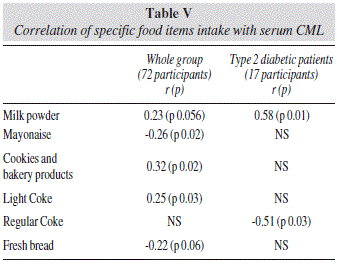
<body><![CDATA[<p><font face="Verdana" size="2">CML intake determined with 24 hour recall was significantly lower compared with FFQ: 8,556 kU/day (5,215-14,277), 3,943 kU/day (2,315-6,106) and 13,640 kU/day (12,094-18,462) respectively in groups 1, 2 and 3. Both surveys (FFQ and 24 hour recall) showed a correlation coefficient of 0.51 in the whole sample (p &lt; 0.001). CML intake had a positive and significant correlation with caloric (r 0.7), protein (r 0.6) and lipid intake (r 0.76), both in FFQ and 24 h recall.</font></p>     <p><font face="Verdana" size="2">Regression analysis including CML intake by FFQ and consumption of grilled and fried meat, avocados and olives, bread with melted cheese and breakfast cereals; showed that consumption of grilled and fried meat and avocados and olives, significantly determines CML intake in the whole group (p 0.000). In subjects with diabetes (type 1 and 2) the consumption of avocados and olives, bread with melted cheese and grilled and fried meat were also significant in defining total CML intake (p &lt; 0.02). These items determined 80% of total CML ingestion in this group.</font></p>     <p><font face="Verdana" size="2"><i>Serum CML (sCML)</i></font></p>     <p><font face="Verdana" size="2">CML serum levels in the entire sample averaged 653 &plusmn; 115 ng/ml (427-933), with no significant differences between sexes. Patients with diabetes had significantly higher levels of CML compared with healthy subjects (684 &plusmn; 112 ng/ml and 628 &plusmn; 112 ng/ml, p 0.04).</font></p>     <p><font face="Verdana" size="2">In the whole study group, there was a negative correlation between BMI, waist circumference and sCML levels (r - 0.3 p 0.009, r -0.33, p 0.04 respectively). No laboratory parameter (<a target="_blank" href="/img/revistas/nh/v27n4/45_original_34_t3.gif">table III</a>) was associated with sCML, only GFR was associated specifically with this variable among healthy subjects (r -0.34 p 0.03).</font></p>     <p><font face="Verdana" size="2">In T2D patients there was a positive relationship between CML intake measured by FFQ and CML serum levels (r 0.53 p 0.03). There was also a positive relation between sCML levels and lipid intake in T1D and T2D subjects (r 0.57, p 0.01).</font></p>     <p><font face="Verdana" size="2">Milk powder intake was an important contributor to higher sCML levels in patients with T2D (r 0.58 p 0.01) (<a href="#t5">table V</a>); sCML level was 739 &plusmn; 125 ng/ml among those who consumed milk powder compared to 609 &plusmn; 81 ng/ml sCML in patients that did not, without differences in HbA1c levels, BMI, basal glycaemia and GFR. In the whole sample, this difference did not reach statistical significance (712 &plusmn; 110 ng/ml and 639 &plusmn; 113 ng/ml among consumers and non consumers of milk powder, respectively, p 0.054). Serum CML was also associated with fried and grilled meat intake in subjects over 65 years (r 0.59 p 0.007), consumption of cookies and pastry (r 0.34 p 0.01) and bread with melted cheese (r 0.32 p 0.02) in subjects younger than 65 years.</font></p>     <p>&nbsp;</p>     <p align=center><a name="t5"><img src="/img/revistas/nh/v27n4/45_original_34_t5.gif"></a></p>     <p>&nbsp;</p>     ]]></body>
<body><![CDATA[<p><font face="Verdana" size="2">A negative association between alcohol intake and sCML was suggested by the analysis of extreme values of both variables. Subjects with lowest sCML concentration (10<sup>th</sup> centile) drank 21.9 &plusmn; 18 g/day of alcohol compared to those with highest sCML (90C centile) whose mean alcohol intake was 5 &plusmn; 5.6 g/day (p 0.03). In fact, those whose consumption was more than 50 g/day showed lower sCML levels than those subjects with lower than 50 g/day intake (586 &plusmn; 119 <i>vs</i> 661 &plusmn; 111 ng/ml sCML, p 0.08).</font></p>     <p><font face="Verdana" size="2">A multiple stepwise regression analysis including the sCML as dependent variable, presence of diabetes, age, CML intake, alcohol and powder milk intake, and BMI, accepted only BMI and presence of diabetes as significant predictors of sCML levels in the whole sample (p &lt; 0.04). Among diabetic participants, where length of diabetes was also incorporated to the model, this last factor and milk powder intake were predictors of sCML (p &lt; 0.03).</font></p>     <p><font face="Verdana" size="2">Mean serum levels of hsCRP were normal (less than 3 mg/dl) in both healthy and diabetic patients. There was no relationship between hsCRP and sCML in any group (<a target="_blank" href="/img/revistas/nh/v27n4/45_original_34_t3.gif">table III</a>), neither with CML intake, BMI, GFR, levels of smoking or physical activity.</font></p>     <p>&nbsp;</p>     <p><font face="Verdana" size="2"><b>Discussion</b></font></p>     <p><font face="Verdana" size="2">In this study, we found an association between sCML and CML dietary content in patients with diabetes, in agreement with previous findings in the literature.<sup>3,15,21,24,39</sup> We also found an inverse relationship between sCML and BMI and alcohol intake.</font></p>     <p><font face="Verdana" size="2">The inverse relationship between sCML levels and BMI has been previously described, and attributed to CML deposit in fatty tissue, thereby decreasing their circulating levels,<sup>40-42</sup> although this is still unclear. It has also been shown that alcohol consumption (acetaldehyde levels) has a protective effect in the formation of AGEs, by joining to AGEs precursor molecules, preventing progression to advanced glycation end  products.<sup>43</sup></font></p>     <p><font face="Verdana" size="2">We found higher CML levels in patients with diabetes, compared to healthy subjects, which could be explained by many factors, including hyperglycemia. Other groups have described levels of 800 to 1.000 ng/ml in patients with type 1 and 2 diabetes, with and without complications.<sup>44,45</sup> These levels are higher compared to those of our study groups, probably because our patients were metabolically compensated and they did not have microangiopathy (none had microalbuminuria). This fact could also explain the lack of association between sCML levels and GFR in this group. Serum AGEs are cleared by kidneys,<sup>20,29</sup> in healthy subjects sCML levels return to normal after 18 to 20 hours after and oral load of AGEs, whereas in patients with mild diabetic nephropathy this occurs in 36 - 48 hrs and in renal failure patients this occurs after 48 hours.<sup>13</sup></font></p>     <p><font face="Verdana" size="2">Dietary CML intake in this sample is similar to that reported in North American populations. Intake level of most participants exceeded the limit of 15,000 kU/day, set as a &quot;safe&quot; limit.<sup>15,24,46</sup> However, in contrast with reports in the United States,<sup>16</sup> subjects over 65 years consumed significantly less CML. This can be explained by Chilean traditional cooking methods that include mostly boiled rather than fried meats. The opposite was observed in young subjects in which their cooking methods and food intake is &quot;westernized&quot;, favoring the intake ofjunk food. From our data, it appears that consumption of specific foods rather than total consumption of CML had the greatest influence on CML serum levels, which can be seen in the significant relationships that sCML show with certain foods, like milk powder, fried and grilled meat, cookies and pastry and bread with melted cheese.</font></p>     <p><font face="Verdana" size="2">The importance of milk powder intake is noteworthy, mainly among participants with diabetes. However, this could represent a local problem, since government supplies elderly (healthy subjects older than 65 years, and patients with chronic diseases (hypertension, type 2 diabetes) older than 60 years) with a specially formulated dairy powdered drink, which is probably stored for long periods of time. Elevation of AGE levels in products such as milk powder, meat and cheese (with high levels of lysine), occur during high temperature drying<sup>47</sup> and storage at room temperature.<sup>3</sup> Its relevance has been studied in animals, and its importance has also been confirmed in infants, showing that formula fed children have higher sCML<sup>48,49</sup> which are comparable to adult levels. This has also been shown in teenagers in relation to cocoa powder intake.<sup>50</sup></font></p>     ]]></body>
<body><![CDATA[<p><font face="Verdana" size="2">The main weakness of this study was the reduced sample size, splitting into different groups according to age and disease, further decreases the sample for different analyses.</font></p>     <p><font face="Verdana" size="2">It is very important to highlight that there is still no consensus on serum AGE level measurement. Although CML is the most quantified and described, it is not known whether this is the one with greater biological activity, with many compounds described and many also still not been identified.<sup>50,51</sup></font></p>     <p><font face="Verdana" size="2">Our study confirms that consumption of specific food, especially if they are elaborated in dry and high temperature settings, such as milk powder and friedgrilled meat, is essential in increasing serum CML levels, especially among the diabetic population.</font></p>     <p>&nbsp;</p>     <p><font face="Verdana" size="2"><b>Authors contributions</b></font></p>     <p><font face="Verdana" size="2">N. J., designed the study, researched data, wrote manuscript, reviewed/edited manuscript. M. J. L., researched data. D. B., reviewed/edited manuscript, contributed to discussion. G. B., researched data, contributed to discussion. L. L., researched data, contributed to discussion. S. H., reviewed/edited manuscript, contributed to discussion. M. P. M., designed the study, obtained support, research data, contributed to discussion reviewed/edited manuscript.</font></p>     <p>&nbsp;</p>     <p><font face="Verdana" size="2"><b>Acknowledgements</b></font></p>     <p><font face="Verdana" size="2">To Ms Nancy Cruz for help in contacting volunteers.</font></p>     <p>&nbsp;</p>     ]]></body>
<body><![CDATA[<p><font face="Verdana" size="2"><b>References</b></font></p>     <!-- ref --><p><font face="Verdana" size="2">1. Singh R, Barden A, Mori T, Beilin L, Advanced glycation end-products: a review. <i>Diabetologia</i> 2001; 44 (2): 129-46.    &nbsp;&nbsp;&nbsp;&nbsp;&nbsp;&nbsp;&nbsp;&nbsp;[&#160;<a href="javascript:void(0);" onclick="javascript: window.open('/scielo.php?script=sci_nlinks&ref=3671207&pid=S0212-1611201200040004500001&lng=','','width=640,height=500,resizable=yes,scrollbars=1,menubar=yes,');">Links</a>&#160;]<!-- end-ref --></font></p>    <!-- ref --><p><font face="Verdana" size="2">2. Vlassara H. Advanced glycation in health and disease: role of the modern environment. <i>Ann N Y Acad Sci</i> 2005; 1043: 452-60.    &nbsp;&nbsp;&nbsp;&nbsp;&nbsp;&nbsp;&nbsp;&nbsp;[&#160;<a href="javascript:void(0);" onclick="javascript: window.open('/scielo.php?script=sci_nlinks&ref=3671209&pid=S0212-1611201200040004500002&lng=','','width=640,height=500,resizable=yes,scrollbars=1,menubar=yes,');">Links</a>&#160;]<!-- end-ref --></font></p>    <!-- ref --><p><font face="Verdana" size="2">3. Bengmark CS. Advanced Fglycation Fand Flipoxidation Fend Fproducts-amplifiers Fof inflammation: the role of food. <i>JPEN J Parenter Enteral Nutr</i> 2007; 31 (5): 430-40.    &nbsp;&nbsp;&nbsp;&nbsp;&nbsp;&nbsp;&nbsp;&nbsp;[&#160;<a href="javascript:void(0);" onclick="javascript: window.open('/scielo.php?script=sci_nlinks&ref=3671211&pid=S0212-1611201200040004500003&lng=','','width=640,height=500,resizable=yes,scrollbars=1,menubar=yes,');">Links</a>&#160;]<!-- end-ref --></font></p>    <!-- ref --><p><font face="Verdana" size="2">4. Ames JM. Determination of N epsilon-(carboxymethyl) lysine in foods and related systems. <i>Ann N Y Acad Sci</i> 2008; 1126: 20-4.    &nbsp;&nbsp;&nbsp;&nbsp;&nbsp;&nbsp;&nbsp;&nbsp;[&#160;<a href="javascript:void(0);" onclick="javascript: window.open('/scielo.php?script=sci_nlinks&ref=3671213&pid=S0212-1611201200040004500004&lng=','','width=640,height=500,resizable=yes,scrollbars=1,menubar=yes,');">Links</a>&#160;]<!-- end-ref --></font></p>    <!-- ref --><p><font face="Verdana" size="2">5. Somoza V. Cive years of research on health risks and benefits of Maillard reaction products: an update. <i>Mol Nutr Food Res</i> 2005; 49 (7): 663-72.    &nbsp;&nbsp;&nbsp;&nbsp;&nbsp;&nbsp;&nbsp;&nbsp;[&#160;<a href="javascript:void(0);" onclick="javascript: window.open('/scielo.php?script=sci_nlinks&ref=3671215&pid=S0212-1611201200040004500005&lng=','','width=640,height=500,resizable=yes,scrollbars=1,menubar=yes,');">Links</a>&#160;]<!-- end-ref --></font></p>    <!-- ref --><p><font face="Verdana" size="2">6. Kankova K. Diabetic threesome (hyperglycaemia, renal function and nutrition) and advanced glycation end products: evidence for the multiple-hit agent? <i>Proc Nutr Soc</i> 2008; 67 (1):60-74.    &nbsp;&nbsp;&nbsp;&nbsp;&nbsp;&nbsp;&nbsp;&nbsp;[&#160;<a href="javascript:void(0);" onclick="javascript: window.open('/scielo.php?script=sci_nlinks&ref=3671217&pid=S0212-1611201200040004500006&lng=','','width=640,height=500,resizable=yes,scrollbars=1,menubar=yes,');">Links</a>&#160;]<!-- end-ref --></font></p>    <!-- ref --><p><font face="Verdana" size="2">7. Coughlan MT, Mibus AL, Forbes JM. Oxidative stress and advanced glycation in diabetic nephropathy. <i>Ann N Y Acad Sci</i> 2008; 1126: 190-3.    &nbsp;&nbsp;&nbsp;&nbsp;&nbsp;&nbsp;&nbsp;&nbsp;[&#160;<a href="javascript:void(0);" onclick="javascript: window.open('/scielo.php?script=sci_nlinks&ref=3671219&pid=S0212-1611201200040004500007&lng=','','width=640,height=500,resizable=yes,scrollbars=1,menubar=yes,');">Links</a>&#160;]<!-- end-ref --></font></p>    <!-- ref --><p><font face="Verdana" size="2">8. Dyer DG, Dunn JA, Thorpe SR, Bailie KE, Lyons TJ, McCance DR, Baynes JW. Accumulation of Maillard reaction products in skin collagen in diabetes and aging. <i>J Clin Invest</i> 1993; 91 (6):2463-9.    &nbsp;&nbsp;&nbsp;&nbsp;&nbsp;&nbsp;&nbsp;&nbsp;[&#160;<a href="javascript:void(0);" onclick="javascript: window.open('/scielo.php?script=sci_nlinks&ref=3671221&pid=S0212-1611201200040004500008&lng=','','width=640,height=500,resizable=yes,scrollbars=1,menubar=yes,');">Links</a>&#160;]<!-- end-ref --></font></p>    <!-- ref --><p><font face="Verdana" size="2">9. Miranda I. Actividad citotoxica y antioxidante de los productos de la reacción de Maillard de los sistemas modelo D-glucosa-glicina y D-glucosa-L-lisina. <i>Revista de la Sociedad Quimica de Peru</i> 2007; 73 (4): 215-225.    &nbsp;&nbsp;&nbsp;&nbsp;&nbsp;&nbsp;&nbsp;&nbsp;[&#160;<a href="javascript:void(0);" onclick="javascript: window.open('/scielo.php?script=sci_nlinks&ref=3671223&pid=S0212-1611201200040004500009&lng=','','width=640,height=500,resizable=yes,scrollbars=1,menubar=yes,');">Links</a>&#160;]<!-- end-ref --></font></p>    <!-- ref --><p><font face="Verdana" size="2">10. Rossi J. La combinación de los azucares con las biomoleculas o como alimentarse en forma saludable. <i>Medicina (Buenos Aires)</i> 2007; 67: 161-166.    &nbsp;&nbsp;&nbsp;&nbsp;&nbsp;&nbsp;&nbsp;&nbsp;[&#160;<a href="javascript:void(0);" onclick="javascript: window.open('/scielo.php?script=sci_nlinks&ref=3671225&pid=S0212-1611201200040004500010&lng=','','width=640,height=500,resizable=yes,scrollbars=1,menubar=yes,');">Links</a>&#160;]<!-- end-ref --></font></p>    <!-- ref --><p><font face="Verdana" size="2">11. Ruiz B. Propiedades antioxidantes de los productos de la reacción de Maillard y su influencia en la absorción de hierro y cobre. Reacción con la capacidad quelante de metales., in Unidad de nutrición animal de la estación experimental de Zaidin. 2009, Universidad de Granada: Granada, p. 461.    &nbsp;&nbsp;&nbsp;&nbsp;&nbsp;&nbsp;&nbsp;&nbsp;[&#160;<a href="javascript:void(0);" onclick="javascript: window.open('/scielo.php?script=sci_nlinks&ref=3671227&pid=S0212-1611201200040004500011&lng=','','width=640,height=500,resizable=yes,scrollbars=1,menubar=yes,');">Links</a>&#160;]<!-- end-ref --></font></p>    <!-- ref --><p><font face="Verdana" size="2">12. Uribarri J, Woodruff S, Goodman S, Cai W, Chen X, Pyzik R, Yong A, Striker GE, Vlassara H. Advanced glycation end products in foods and a practical guide to their reduction in the diet. <i>J Am Diet Assoc</i> 2010; 110 (6): 911-16 e12.    &nbsp;&nbsp;&nbsp;&nbsp;&nbsp;&nbsp;&nbsp;&nbsp;[&#160;<a href="javascript:void(0);" onclick="javascript: window.open('/scielo.php?script=sci_nlinks&ref=3671229&pid=S0212-1611201200040004500012&lng=','','width=640,height=500,resizable=yes,scrollbars=1,menubar=yes,');">Links</a>&#160;]<!-- end-ref --></font></p>    <!-- ref --><p><font face="Verdana" size="2">13. Koschinsky T, He CJ, Mitsuhashi T, Bucala R, Liu C, Buenting C, Heitmann K, Vlassara H. Orally absorbed reactive glycation products (glycotoxins): an environmental risk factor in diabetic nephropathy. <i>Proc Natl Acad Sci USA</i> 1997; 94 (12): 6474-9.    &nbsp;&nbsp;&nbsp;&nbsp;&nbsp;&nbsp;&nbsp;&nbsp;[&#160;<a href="javascript:void(0);" onclick="javascript: window.open('/scielo.php?script=sci_nlinks&ref=3671231&pid=S0212-1611201200040004500013&lng=','','width=640,height=500,resizable=yes,scrollbars=1,menubar=yes,');">Links</a>&#160;]<!-- end-ref --></font></p>    <!-- ref --><p><font face="Verdana" size="2">14. Uribarri J, Peppa M, Cai W, Goldberg T, Lu M, He C, Vlassara H. Restriction of dietary glycotoxins reduces excessive advanced glycation end products in renal failure patients. <i>J Am Soc Nephrol</i> 2003; 14 (3): 728-31.    &nbsp;&nbsp;&nbsp;&nbsp;&nbsp;&nbsp;&nbsp;&nbsp;[&#160;<a href="javascript:void(0);" onclick="javascript: window.open('/scielo.php?script=sci_nlinks&ref=3671233&pid=S0212-1611201200040004500014&lng=','','width=640,height=500,resizable=yes,scrollbars=1,menubar=yes,');">Links</a>&#160;]<!-- end-ref --></font></p>    <!-- ref --><p><font face="Verdana" size="2">15. Uribarri J, Stirban A, Sander D, Cai W, Negrean M, Buenting CE, Koschinsky T, Vlassara H. Single oral challenge by advanced glycation end products acutely impairs endothelial function in diabetic and nondiabetic subjects. <i>Diabetes Care</i> 2007; 30 (10): 2579-82.    &nbsp;&nbsp;&nbsp;&nbsp;&nbsp;&nbsp;&nbsp;&nbsp;[&#160;<a href="javascript:void(0);" onclick="javascript: window.open('/scielo.php?script=sci_nlinks&ref=3671235&pid=S0212-1611201200040004500015&lng=','','width=640,height=500,resizable=yes,scrollbars=1,menubar=yes,');">Links</a>&#160;]<!-- end-ref --></font></p>    <!-- ref --><p><font face="Verdana" size="2">16. Uribarri J, Cai W, Peppa M, Goodman S, Ferrucci L, Striker G, Vlassara H. Circulating Fglycotoxins Fand Fdietary Fadvanced Fglycation Fendproducts: Ftwo Flinks Fto inflammatory response, oxidative stress, and aging. <i>J Gerontol A Biol Sci Med Sci</i> 2007; 62 (4): 427-33.    &nbsp;&nbsp;&nbsp;&nbsp;&nbsp;&nbsp;&nbsp;&nbsp;[&#160;<a href="javascript:void(0);" onclick="javascript: window.open('/scielo.php?script=sci_nlinks&ref=3671237&pid=S0212-1611201200040004500016&lng=','','width=640,height=500,resizable=yes,scrollbars=1,menubar=yes,');">Links</a>&#160;]<!-- end-ref --></font></p>    <!-- ref --><p><font face="Verdana" size="2">17. Goldberg T, Cai W, Peppa M, Dardaine V, Baliga BS, Uribarri J, Vlassara H. Advanced glycoxidation end products in commonly consumed foods. <i>J Am Diet Assoc</i> 2004; 104 (8): 1287-91.    &nbsp;&nbsp;&nbsp;&nbsp;&nbsp;&nbsp;&nbsp;&nbsp;[&#160;<a href="javascript:void(0);" onclick="javascript: window.open('/scielo.php?script=sci_nlinks&ref=3671239&pid=S0212-1611201200040004500017&lng=','','width=640,height=500,resizable=yes,scrollbars=1,menubar=yes,');">Links</a>&#160;]<!-- end-ref --></font></p>    <!-- ref --><p><font face="Verdana" size="2">18. Xanthis A, Hatzitolios A, Koliakos G, Tatola V. Advanced glycosylation end products and nutrition-a possible relation with diabetic atherosclerosis and how to prevent it. <i>J Food Sci</i> 2007; 72 (8): R125-9.    &nbsp;&nbsp;&nbsp;&nbsp;&nbsp;&nbsp;&nbsp;&nbsp;[&#160;<a href="javascript:void(0);" onclick="javascript: window.open('/scielo.php?script=sci_nlinks&ref=3671241&pid=S0212-1611201200040004500018&lng=','','width=640,height=500,resizable=yes,scrollbars=1,menubar=yes,');">Links</a>&#160;]<!-- end-ref --></font></p>    <!-- ref --><p><font face="Verdana" size="2">19. Cai W, He JC, Zhu L, Chen X, Zheng F, Striker GE, Vlassara H. Oral glycotoxins determine the effects of calorie restriction on oxidant stress, age-related diseases, and lifespan. <i>Am J Pathol</i> 2008; 173 (2): 327-36.    &nbsp;&nbsp;&nbsp;&nbsp;&nbsp;&nbsp;&nbsp;&nbsp;[&#160;<a href="javascript:void(0);" onclick="javascript: window.open('/scielo.php?script=sci_nlinks&ref=3671243&pid=S0212-1611201200040004500019&lng=','','width=640,height=500,resizable=yes,scrollbars=1,menubar=yes,');">Links</a>&#160;]<!-- end-ref --></font></p>    <!-- ref --><p><font face="Verdana" size="2">20. Vlassara H, Cai W, Goodman S, Pyzik R, Yong A, Chen X, Zhu L, Neade T, Beeri M, Silverman JM, Ferrucci L, Tansman L, Striker GE, Uribarri J. Protection against loss of innate defenses in adulthood by low advanced glycation end products (AGE) intake: role of the antiinflammatory AGE receptor-1. <i>J Clin Endocrinol Metab</i> 2009; 94 (11): 4483-91.    &nbsp;&nbsp;&nbsp;&nbsp;&nbsp;&nbsp;&nbsp;&nbsp;[&#160;<a href="javascript:void(0);" onclick="javascript: window.open('/scielo.php?script=sci_nlinks&ref=3671245&pid=S0212-1611201200040004500020&lng=','','width=640,height=500,resizable=yes,scrollbars=1,menubar=yes,');">Links</a>&#160;]<!-- end-ref --></font></p>    <!-- ref --><p><font face="Verdana" size="2">21. Uribarri J, Cai W, Ramdas M, Goodman S, Pyzik R, Chen X, Zhu L, Striker GE, Vlassara H. Restriction of advanced glycation end products improves insulin resistance in human type 2 diabetes: potential role of AGER1 and SIRT1. <i>Diabetes Care</i> 2011; 34 (7): 1610-6.    &nbsp;&nbsp;&nbsp;&nbsp;&nbsp;&nbsp;&nbsp;&nbsp;[&#160;<a href="javascript:void(0);" onclick="javascript: window.open('/scielo.php?script=sci_nlinks&ref=3671247&pid=S0212-1611201200040004500021&lng=','','width=640,height=500,resizable=yes,scrollbars=1,menubar=yes,');">Links</a>&#160;]<!-- end-ref --></font></p>    <!-- ref --><p><font face="Verdana" size="2">22. Sandu O, Song K, Cai W, Zheng F, Uribarri J, Vlassara H. Insulin resistance and type 2 diabetes in high-fat-fed mice are linked to high glycotoxin intake. <i>Diabetes</i> 2005; 54 (8): 2314-9.    &nbsp;&nbsp;&nbsp;&nbsp;&nbsp;&nbsp;&nbsp;&nbsp;[&#160;<a href="javascript:void(0);" onclick="javascript: window.open('/scielo.php?script=sci_nlinks&ref=3671249&pid=S0212-1611201200040004500022&lng=','','width=640,height=500,resizable=yes,scrollbars=1,menubar=yes,');">Links</a>&#160;]<!-- end-ref --></font></p>    <!-- ref --><p><font face="Verdana" size="2">23. Negrean M, Stirban A, Stratmann B, Gawlowski T, Horstmann T, Gotting C, Kleesiek K, Mueller-Roesel M, Koschinsky T, Uribarri J, Vlassara H, Tschoepe D. Effects of low- and high-advanced glycation endproduct meals on macro- and microvascular endothelial function and oxidative stress in patients with type 2 diabetes mellitus. <i>Am J Clin Nutr</i> 2007; 85 (5): 1236-43.    &nbsp;&nbsp;&nbsp;&nbsp;&nbsp;&nbsp;&nbsp;&nbsp;[&#160;<a href="javascript:void(0);" onclick="javascript: window.open('/scielo.php?script=sci_nlinks&ref=3671251&pid=S0212-1611201200040004500023&lng=','','width=640,height=500,resizable=yes,scrollbars=1,menubar=yes,');">Links</a>&#160;]<!-- end-ref --></font></p>    <!-- ref --><p><font face="Verdana" size="2">24. Birlouez-Aragon I, Saavedra G, Tessier FJ, Galinier A, Ait-Ameur L, Lacoste F, Niamba CN, Alt N, Somoza V, Lecerf JM. A diet based on high-heat-treated foods promotes risk factors for diabetes mellitus and cardiovascular diseases. <i>Am J Clin Nutr </i>2010; 91 (5): 1220-6.    &nbsp;&nbsp;&nbsp;&nbsp;&nbsp;&nbsp;&nbsp;&nbsp;[&#160;<a href="javascript:void(0);" onclick="javascript: window.open('/scielo.php?script=sci_nlinks&ref=3671253&pid=S0212-1611201200040004500024&lng=','','width=640,height=500,resizable=yes,scrollbars=1,menubar=yes,');">Links</a>&#160;]<!-- end-ref --></font></p>    <!-- ref --><p><font face="Verdana" size="2">25. Stirban A, Negrean M, Gotting C, Uribarri J, Gawlowski T, Stratmann B, Kleesiek K, Koschinsky T, Vlassara H, Tschoepe D. Dietary advanced glycation endproducts and oxidative stress: in vivo effects on endothelial function and adipokines. <i>Ann N Y Acad Sci</i> 2008; 1126: 276-9.    &nbsp;&nbsp;&nbsp;&nbsp;&nbsp;&nbsp;&nbsp;&nbsp;[&#160;<a href="javascript:void(0);" onclick="javascript: window.open('/scielo.php?script=sci_nlinks&ref=3671255&pid=S0212-1611201200040004500025&lng=','','width=640,height=500,resizable=yes,scrollbars=1,menubar=yes,');">Links</a>&#160;]<!-- end-ref --></font></p>    <!-- ref --><p><font face="Verdana" size="2">26. Tikellis C, Thomas MC, Harcourt BE, Coughlan MT, Pete J, Bialkowski K, Tan A, Bierhaus A, Cooper ME, Forbes JM. Cardiac inflammation associated with a Western diet is mediated via activation of RAGE by AGEs. <i>Am J Physiol Endocrinol Metab</i> 2008; 295 (2): E323-30.    &nbsp;&nbsp;&nbsp;&nbsp;&nbsp;&nbsp;&nbsp;&nbsp;[&#160;<a href="javascript:void(0);" onclick="javascript: window.open('/scielo.php?script=sci_nlinks&ref=3671257&pid=S0212-1611201200040004500026&lng=','','width=640,height=500,resizable=yes,scrollbars=1,menubar=yes,');">Links</a>&#160;]<!-- end-ref --></font></p>    <!-- ref --><p><font face="Verdana" size="2">27. Aso Y, Inukai T, Tayama K, Takemura Y. Serum concentrations of advanced glycation endproducts are associated with the development of atherosclerosis as well as diabetic microangiopathy in patients with type 2 diabetes. <i>Acta Diabetol</i> 2000; 37 (2): 87-92.    &nbsp;&nbsp;&nbsp;&nbsp;&nbsp;&nbsp;&nbsp;&nbsp;[&#160;<a href="javascript:void(0);" onclick="javascript: window.open('/scielo.php?script=sci_nlinks&ref=3671259&pid=S0212-1611201200040004500027&lng=','','width=640,height=500,resizable=yes,scrollbars=1,menubar=yes,');">Links</a>&#160;]<!-- end-ref --></font></p>    <!-- ref --><p><font face="Verdana" size="2">28. Hirata K, Kubo K. Relationship between blood levels of N-carboxymethyl-lysine and pentosidine and the severity of microangiopathy in type 2 diabetes. <i>Endocr J</i> 2004. 51 (6): 537-44.    &nbsp;&nbsp;&nbsp;&nbsp;&nbsp;&nbsp;&nbsp;&nbsp;[&#160;<a href="javascript:void(0);" onclick="javascript: window.open('/scielo.php?script=sci_nlinks&ref=3671261&pid=S0212-1611201200040004500028&lng=','','width=640,height=500,resizable=yes,scrollbars=1,menubar=yes,');">Links</a>&#160;]<!-- end-ref --></font></p>    <!-- ref --><p><font face="Verdana" size="2">29. Wautier MP, Massin P, Guillausseau PJ, Huijberts M, Levy B, Boulanger E, Laloi-Michelin M, Wautier JL. N(carboxymethyl)lysine as a biomarker for microvascular complications in type 2 diabetic patients. <i>Diabetes Metab</i> 2003; 29 (1): 44-52.    &nbsp;&nbsp;&nbsp;&nbsp;&nbsp;&nbsp;&nbsp;&nbsp;[&#160;<a href="javascript:void(0);" onclick="javascript: window.open('/scielo.php?script=sci_nlinks&ref=3671263&pid=S0212-1611201200040004500029&lng=','','width=640,height=500,resizable=yes,scrollbars=1,menubar=yes,');">Links</a>&#160;]<!-- end-ref --></font></p>    <!-- ref --><p><font face="Verdana" size="2">30. Gao X, Zhang H, Schmidt AM, Zhang C. AGE/RAGE produces endothelial dysfunction in coronary arterioles in type 2 diabetic mice. <i>Am J Physiol Heart Circ Physiol</i> 2008; 295 (2):H491-8.    &nbsp;&nbsp;&nbsp;&nbsp;&nbsp;&nbsp;&nbsp;&nbsp;[&#160;<a href="javascript:void(0);" onclick="javascript: window.open('/scielo.php?script=sci_nlinks&ref=3671265&pid=S0212-1611201200040004500030&lng=','','width=640,height=500,resizable=yes,scrollbars=1,menubar=yes,');">Links</a>&#160;]<!-- end-ref --></font></p>    <!-- ref --><p><font face="Verdana" size="2">31. Yamagishi S, Matsui T, Ueda S, Nakamura K, Imaizumi T. Advanced glycation end products (AGEs) and cardiovascular disease (CVD) in diabetes. <i>Cardiovasc Hematol Agents Med Chem</i> 2007; 5 (3): 236-40.    &nbsp;&nbsp;&nbsp;&nbsp;&nbsp;&nbsp;&nbsp;&nbsp;[&#160;<a href="javascript:void(0);" onclick="javascript: window.open('/scielo.php?script=sci_nlinks&ref=3671267&pid=S0212-1611201200040004500031&lng=','','width=640,height=500,resizable=yes,scrollbars=1,menubar=yes,');">Links</a>&#160;]<!-- end-ref --></font></p>    <!-- ref --><p><font face="Verdana" size="2">32. Barbosa J, Tojal e Seara L. O papel dos produtos finais da glicacao avancada (AGEs) no desencadeamento das complicacoes vasculares do diabetes. <i>Arq Bras Endocrinol Metab</i> 2008; 52 (6): 940-950.    &nbsp;&nbsp;&nbsp;&nbsp;&nbsp;&nbsp;&nbsp;&nbsp;[&#160;<a href="javascript:void(0);" onclick="javascript: window.open('/scielo.php?script=sci_nlinks&ref=3671269&pid=S0212-1611201200040004500032&lng=','','width=640,height=500,resizable=yes,scrollbars=1,menubar=yes,');">Links</a>&#160;]<!-- end-ref --></font></p>    <!-- ref --><p><font face="Verdana" size="2">33. Sebekova K. Somoza V. Dietary advanced glycation endproducts (AGEs) and their health effects-PRO. <i>Mol Nutr Food Res</i> 2007; 51 (9): 1079-84.    &nbsp;&nbsp;&nbsp;&nbsp;&nbsp;&nbsp;&nbsp;&nbsp;[&#160;<a href="javascript:void(0);" onclick="javascript: window.open('/scielo.php?script=sci_nlinks&ref=3671271&pid=S0212-1611201200040004500033&lng=','','width=640,height=500,resizable=yes,scrollbars=1,menubar=yes,');">Links</a>&#160;]<!-- end-ref --></font></p>    <!-- ref --><p><font face="Verdana" size="2">34. Yamagishi S, Matsui T, Nakamura K. Possible link of food-derived advanced glycation end products (AGEs) to the development of diabetes. <i>Med Hypotheses</i> 2008; 71 (6): 876-8.    &nbsp;&nbsp;&nbsp;&nbsp;&nbsp;&nbsp;&nbsp;&nbsp;[&#160;<a href="javascript:void(0);" onclick="javascript: window.open('/scielo.php?script=sci_nlinks&ref=3671273&pid=S0212-1611201200040004500034&lng=','','width=640,height=500,resizable=yes,scrollbars=1,menubar=yes,');">Links</a>&#160;]<!-- end-ref --></font></p>    <!-- ref --><p><font face="Verdana" size="2">35. De la Maza M, Garrido F, Escalante N, Leiva L, Barrera G, Schnitzler S, Zanolli M, Verdaguer J, Hirsch S, Jara N, Bunout D. Cluorescent advanced glycation endproducts (AGEs) detected by spectrophotofluorimetry, as a screening tool to detect diabetic microvascular complications. <i>Journal of Diabetes Mellitus</i>, 2012; in press.    &nbsp;&nbsp;&nbsp;&nbsp;&nbsp;&nbsp;&nbsp;&nbsp;[&#160;<a href="javascript:void(0);" onclick="javascript: window.open('/scielo.php?script=sci_nlinks&ref=3671275&pid=S0212-1611201200040004500035&lng=','','width=640,height=500,resizable=yes,scrollbars=1,menubar=yes,');">Links</a>&#160;]<!-- end-ref --></font></p>    <!-- ref --><p><font face="Verdana" size="2">36. Cockcroft DW, Gault MH. Prediction of creatinine clearance from serum creatinine. <i>Nephron</i> 1976; 16 (1): 31-41.    &nbsp;&nbsp;&nbsp;&nbsp;&nbsp;&nbsp;&nbsp;&nbsp;[&#160;<a href="javascript:void(0);" onclick="javascript: window.open('/scielo.php?script=sci_nlinks&ref=3671277&pid=S0212-1611201200040004500036&lng=','','width=640,height=500,resizable=yes,scrollbars=1,menubar=yes,');">Links</a>&#160;]<!-- end-ref --></font></p>    <!-- ref --><p><font face="Verdana" size="2">37. Matsuda M. Measuring and estimating insulin resistance in clinical and research settings. <i>Nutr Metab Cardiovasc Dis</i> 2010; 20 (2): 79-86.    &nbsp;&nbsp;&nbsp;&nbsp;&nbsp;&nbsp;&nbsp;&nbsp;[&#160;<a href="javascript:void(0);" onclick="javascript: window.open('/scielo.php?script=sci_nlinks&ref=3671279&pid=S0212-1611201200040004500037&lng=','','width=640,height=500,resizable=yes,scrollbars=1,menubar=yes,');">Links</a>&#160;]<!-- end-ref --></font></p>    <!-- ref --><p><font face="Verdana" size="2">38. Sabate J. Estimating food consumption: methods and challenges. <i>Med Clin (Barc)</i> 1993; 100 (15): 591-6.    &nbsp;&nbsp;&nbsp;&nbsp;&nbsp;&nbsp;&nbsp;&nbsp;[&#160;<a href="javascript:void(0);" onclick="javascript: window.open('/scielo.php?script=sci_nlinks&ref=3671281&pid=S0212-1611201200040004500038&lng=','','width=640,height=500,resizable=yes,scrollbars=1,menubar=yes,');">Links</a>&#160;]<!-- end-ref --></font></p>    <!-- ref --><p><font face="Verdana" size="2">39. Uribarri J, Cai W, Sandu O, Peppa M, Goldberg T, Vlassara H. Diet-derived advanced glycation end products are major contributors to the body's AGE pool and induce inflammation in healthy subjects. <i>Ann N Y Acad Sci</i> 2005; 1043: 461-6.    &nbsp;&nbsp;&nbsp;&nbsp;&nbsp;&nbsp;&nbsp;&nbsp;[&#160;<a href="javascript:void(0);" onclick="javascript: window.open('/scielo.php?script=sci_nlinks&ref=3671283&pid=S0212-1611201200040004500039&lng=','','width=640,height=500,resizable=yes,scrollbars=1,menubar=yes,');">Links</a>&#160;]<!-- end-ref --></font></p>    <!-- ref --><p><font face="Verdana" size="2">40. Cai W, He JC, Zhu L, Chen X, Wallenstein S, Striker GE, Vlassara H. Reduced oxidant stress and extended lifespan in mice exposed to a low glycotoxin diet: association with increased AGER1 expression. <i>Am J Pathol</i> 2007; 170 (6): 1893-902.    &nbsp;&nbsp;&nbsp;&nbsp;&nbsp;&nbsp;&nbsp;&nbsp;[&#160;<a href="javascript:void(0);" onclick="javascript: window.open('/scielo.php?script=sci_nlinks&ref=3671285&pid=S0212-1611201200040004500040&lng=','','width=640,height=500,resizable=yes,scrollbars=1,menubar=yes,');">Links</a>&#160;]<!-- end-ref --></font></p>    <!-- ref --><p><font face="Verdana" size="2">41. Sebekova K, Somoza V, Jarcuskova M, Heidland A, Podracka L. Plasma advanced glycation end products are decreased in obese children compared with lean controls. <i>Int J Pediatr Obes</i> 2009; 4 (2): 112-8.    &nbsp;&nbsp;&nbsp;&nbsp;&nbsp;&nbsp;&nbsp;&nbsp;[&#160;<a href="javascript:void(0);" onclick="javascript: window.open('/scielo.php?script=sci_nlinks&ref=3671287&pid=S0212-1611201200040004500041&lng=','','width=640,height=500,resizable=yes,scrollbars=1,menubar=yes,');">Links</a>&#160;]<!-- end-ref --></font></p>    <!-- ref --><p><font face="Verdana" size="2">42. Semba RD, Arab L, Sun K, Nicklett EJ, Ferrucci L. Cat Mass Is Inversely Associated with Serum Carboxymethyl-Lysine, An Advanced Glycation End Product, in Adults. <i>J Nutr</i> 2011.    &nbsp;&nbsp;&nbsp;&nbsp;&nbsp;&nbsp;&nbsp;&nbsp;[&#160;<a href="javascript:void(0);" onclick="javascript: window.open('/scielo.php?script=sci_nlinks&ref=3671289&pid=S0212-1611201200040004500042&lng=','','width=640,height=500,resizable=yes,scrollbars=1,menubar=yes,');">Links</a>&#160;]<!-- end-ref --></font></p>    <!-- ref --><p><font face="Verdana" size="2">43. Al-Abed Y, Mitsuhashi T, Li H, Lawson JA, FitzGerald GA, Founds H, Donnelly T, Cerami A, Ulrich P, Bucala R. Inhibition of advanced glycation endproduct formation by acetaldehyde: role in the cardioprotective effect of ethanol. <i>Proc Natl Acad Sci USA</i> 1999; 96 (5): 2385-90.    &nbsp;&nbsp;&nbsp;&nbsp;&nbsp;&nbsp;&nbsp;&nbsp;[&#160;<a href="javascript:void(0);" onclick="javascript: window.open('/scielo.php?script=sci_nlinks&ref=3671291&pid=S0212-1611201200040004500043&lng=','','width=640,height=500,resizable=yes,scrollbars=1,menubar=yes,');">Links</a>&#160;]<!-- end-ref --></font></p>    <!-- ref --><p><font face="Verdana" size="2">44. Boehm BO, Schilling S, Rosinger S, Lang GE, Lang GK, Kientsch-Engel R, Stahl P. Elevated serum levels of N(epsilon)-carboxymethyl-lysine, an advanced glycation end product, are associated with proliferative diabetic retinopathy and macular oedema. <i>Diabetologia</i> 2004; 47 (8): 1376-9.    &nbsp;&nbsp;&nbsp;&nbsp;&nbsp;&nbsp;&nbsp;&nbsp;[&#160;<a href="javascript:void(0);" onclick="javascript: window.open('/scielo.php?script=sci_nlinks&ref=3671293&pid=S0212-1611201200040004500044&lng=','','width=640,height=500,resizable=yes,scrollbars=1,menubar=yes,');">Links</a>&#160;]<!-- end-ref --></font></p>    <!-- ref --><p><font face="Verdana" size="2">45. Schiel R, Franke S, Appel T, Voigt U, Ross IS, Kientsch-Engel R, Muller UA, Stein G. Improvement of the quality of diabetes control and decrease in the concentrations of AGE-products in patients with type 1 and insulin-treated type 2 diabetes mellitus: results from a 10 year-prospective, population-based survey on the quality of diabetes care in Germany (JEVIN). <i>Eur J Med Res</i> 2004; 9 (8): 391-9.    &nbsp;&nbsp;&nbsp;&nbsp;&nbsp;&nbsp;&nbsp;&nbsp;[&#160;<a href="javascript:void(0);" onclick="javascript: window.open('/scielo.php?script=sci_nlinks&ref=3671295&pid=S0212-1611201200040004500045&lng=','','width=640,height=500,resizable=yes,scrollbars=1,menubar=yes,');">Links</a>&#160;]<!-- end-ref --></font></p>    <!-- ref --><p><font face="Verdana" size="2">46. Chao PC, Huang CN, Hsu CC, Yin MC, Guo YR. Association of dietary AGEs with circulating AGEs, glycated LDL, IL-1alpha and MCP-1 levels in type 2 diabetic patients. <i>Eur J Nutr</i> 49 (7): 429-34.    &nbsp;&nbsp;&nbsp;&nbsp;&nbsp;&nbsp;&nbsp;&nbsp;[&#160;<a href="javascript:void(0);" onclick="javascript: window.open('/scielo.php?script=sci_nlinks&ref=3671297&pid=S0212-1611201200040004500046&lng=','','width=640,height=500,resizable=yes,scrollbars=1,menubar=yes,');">Links</a>&#160;]<!-- end-ref --></font></p>    <!-- ref --><p><font face="Verdana" size="2">47. Ahmed N, Mirshekar-Syahkal B, Kennish L, Karachalias N, Babaei-Jadidi R, Thornalley PJ. Assay of advanced glycation endproducts in selected beverages and food by liquid chromatography with tandem mass spectrometric detection. <i>Mol Nutr Food Res</i> 2005; 49 (7): 691-9.    &nbsp;&nbsp;&nbsp;&nbsp;&nbsp;&nbsp;&nbsp;&nbsp;[&#160;<a href="javascript:void(0);" onclick="javascript: window.open('/scielo.php?script=sci_nlinks&ref=3671299&pid=S0212-1611201200040004500047&lng=','','width=640,height=500,resizable=yes,scrollbars=1,menubar=yes,');">Links</a>&#160;]<!-- end-ref --></font></p>    <!-- ref --><p><font face="Verdana" size="2">48. Mericq V, Piccardo C, Cai W, Chen X, Zhu L, Striker GE, Vlassara H, Uribarri J. Maternally transmitted and food-derived glycotoxins: a factor preconditioning the young to diabetes? <i>Diabetes Care</i> 2010; 33 (10): 2232-7.    &nbsp;&nbsp;&nbsp;&nbsp;&nbsp;&nbsp;&nbsp;&nbsp;[&#160;<a href="javascript:void(0);" onclick="javascript: window.open('/scielo.php?script=sci_nlinks&ref=3671301&pid=S0212-1611201200040004500048&lng=','','width=640,height=500,resizable=yes,scrollbars=1,menubar=yes,');">Links</a>&#160;]<!-- end-ref --></font></p>    <!-- ref --><p><font face="Verdana" size="2">49. Sebekova K, Saavedra G, Zumpe C, Somoza V, Klenovicsova K, Birlouez-Aragon I. Plasma concentration and urinary excretion of N epsilon-(carboxymethyl)lysine in breast milk- and formulafed infants. <i>Ann N Y Acad Sci</i> 2008; 1126: 177-80.    &nbsp;&nbsp;&nbsp;&nbsp;&nbsp;&nbsp;&nbsp;&nbsp;[&#160;<a href="javascript:void(0);" onclick="javascript: window.open('/scielo.php?script=sci_nlinks&ref=3671303&pid=S0212-1611201200040004500049&lng=','','width=640,height=500,resizable=yes,scrollbars=1,menubar=yes,');">Links</a>&#160;]<!-- end-ref --></font></p>    <!-- ref --><p><font face="Verdana" size="2">50. Delgado-Andrade C, Seiquer I, Navarro MP, Morales FJ. Maillard reaction indicators in diets usually consumed by adolescent population. <i>Mol Nutr Food Res</i> 2007; 51 (3): 341-51.    &nbsp;&nbsp;&nbsp;&nbsp;&nbsp;&nbsp;&nbsp;&nbsp;[&#160;<a href="javascript:void(0);" onclick="javascript: window.open('/scielo.php?script=sci_nlinks&ref=3671305&pid=S0212-1611201200040004500050&lng=','','width=640,height=500,resizable=yes,scrollbars=1,menubar=yes,');">Links</a>&#160;]<!-- end-ref --></font></p>    <!-- ref --><p><font face="Verdana" size="2">51. Sun JK, Keenan HA, Cavallerano JD, Asztalos BF, Schaefer EJ, Sell DR, Strauch CM, Monnier VM, Doria A, Aiello LP, King GL. Protection from retinopathy and other complications in patients with type 1 diabetes of extreme duration: the joslin 50-year medalist study. <i>Diabetes Care</i> 2011; 34 (4): 968-74.    &nbsp;&nbsp;&nbsp;&nbsp;&nbsp;&nbsp;&nbsp;&nbsp;[&#160;<a href="javascript:void(0);" onclick="javascript: window.open('/scielo.php?script=sci_nlinks&ref=3671307&pid=S0212-1611201200040004500051&lng=','','width=640,height=500,resizable=yes,scrollbars=1,menubar=yes,');">Links</a>&#160;]<!-- end-ref --></font></p>     <p>&nbsp;</p>     <p>&nbsp;</p>     <p><font face="Verdana" size="2"><a href="#top"><img border="0" src="/img/revistas/nh/v27n4/seta.gif" width="15" height="17"></a><a name="bajo"></a><b>Correspondence:</b>    <br>Natalia Jara MD    <br>Department of Aging and Chronic Diseases Associated with    <br>Nutrition (EECRAN)    <br>El Líbano 5524. Macul. Santiago. Chile    ]]></body>
<body><![CDATA[<br>E-mail: <a href="mailto:nmjara@gmail.com">nmjara@gmail.com</a></font></p>     <p><font face="Verdana" size="2">Recibido: 20-III-2012    <br>Aceptado: 27-III-2012</font></p>      ]]></body><back>
<ref-list>
<ref id="B1">
<label>1</label><nlm-citation citation-type="journal">
<person-group person-group-type="author">
<name>
<surname><![CDATA[Singh]]></surname>
<given-names><![CDATA[R]]></given-names>
</name>
<name>
<surname><![CDATA[Barden]]></surname>
<given-names><![CDATA[A]]></given-names>
</name>
<name>
<surname><![CDATA[Mori]]></surname>
<given-names><![CDATA[T]]></given-names>
</name>
<name>
<surname><![CDATA[Beilin]]></surname>
<given-names><![CDATA[L]]></given-names>
</name>
</person-group>
<article-title xml:lang="en"><![CDATA[Advanced glycation end-products: a review]]></article-title>
<source><![CDATA[Diabetologia]]></source>
<year>2001</year>
<volume>44</volume>
<numero>2</numero>
<issue>2</issue>
<page-range>129-46</page-range></nlm-citation>
</ref>
<ref id="B2">
<label>2</label><nlm-citation citation-type="journal">
<person-group person-group-type="author">
<name>
<surname><![CDATA[Vlassara]]></surname>
<given-names><![CDATA[H]]></given-names>
</name>
</person-group>
<article-title xml:lang="en"><![CDATA[Advanced glycation in health and disease: role of the modern environment]]></article-title>
<source><![CDATA[Ann N Y Acad Sci]]></source>
<year>2005</year>
<volume>1043</volume>
<page-range>452-60</page-range></nlm-citation>
</ref>
<ref id="B3">
<label>3</label><nlm-citation citation-type="journal">
<person-group person-group-type="author">
<name>
<surname><![CDATA[Bengmark]]></surname>
<given-names><![CDATA[CS]]></given-names>
</name>
</person-group>
<article-title xml:lang="en"><![CDATA[Advanced Fglycation Fand Flipoxidation Fend Fproducts-amplifiers Fof inflammation: the role of food]]></article-title>
<source><![CDATA[JPEN J Parenter Enteral Nutr]]></source>
<year>2007</year>
<volume>31</volume>
<numero>5</numero>
<issue>5</issue>
<page-range>430-40</page-range></nlm-citation>
</ref>
<ref id="B4">
<label>4</label><nlm-citation citation-type="journal">
<person-group person-group-type="author">
<name>
<surname><![CDATA[Ames]]></surname>
<given-names><![CDATA[JM]]></given-names>
</name>
</person-group>
<article-title xml:lang="en"><![CDATA[Determination of N epsilon-(carboxymethyl) lysine in foods and related systems]]></article-title>
<source><![CDATA[Ann N Y Acad Sci]]></source>
<year>2008</year>
<volume>1126</volume>
<page-range>20-4</page-range></nlm-citation>
</ref>
<ref id="B5">
<label>5</label><nlm-citation citation-type="journal">
<person-group person-group-type="author">
<name>
<surname><![CDATA[Somoza]]></surname>
<given-names><![CDATA[V]]></given-names>
</name>
</person-group>
<article-title xml:lang="en"><![CDATA[Cive years of research on health risks and benefits of Maillard reaction products: an update]]></article-title>
<source><![CDATA[Mol Nutr Food Res]]></source>
<year>2005</year>
<volume>49</volume>
<numero>7</numero>
<issue>7</issue>
<page-range>663-72</page-range></nlm-citation>
</ref>
<ref id="B6">
<label>6</label><nlm-citation citation-type="journal">
<person-group person-group-type="author">
<name>
<surname><![CDATA[Kankova]]></surname>
<given-names><![CDATA[K]]></given-names>
</name>
</person-group>
<article-title xml:lang="en"><![CDATA[Diabetic threesome (hyperglycaemia, renal function and nutrition) and advanced glycation end products: evidence for the multiple-hit agent?]]></article-title>
<source><![CDATA[Proc Nutr Soc]]></source>
<year>2008</year>
<volume>67</volume>
<numero>1</numero>
<issue>1</issue>
<page-range>60-74</page-range></nlm-citation>
</ref>
<ref id="B7">
<label>7</label><nlm-citation citation-type="journal">
<person-group person-group-type="author">
<name>
<surname><![CDATA[Coughlan]]></surname>
<given-names><![CDATA[MT]]></given-names>
</name>
<name>
<surname><![CDATA[Mibus]]></surname>
<given-names><![CDATA[AL]]></given-names>
</name>
<name>
<surname><![CDATA[Forbes]]></surname>
<given-names><![CDATA[JM]]></given-names>
</name>
</person-group>
<article-title xml:lang="en"><![CDATA[Oxidative stress and advanced glycation in diabetic nephropathy]]></article-title>
<source><![CDATA[Ann N Y Acad Sci]]></source>
<year>2008</year>
<volume>1126</volume>
<page-range>190-3</page-range></nlm-citation>
</ref>
<ref id="B8">
<label>8</label><nlm-citation citation-type="journal">
<person-group person-group-type="author">
<name>
<surname><![CDATA[Dyer]]></surname>
<given-names><![CDATA[DG]]></given-names>
</name>
<name>
<surname><![CDATA[Dunn]]></surname>
<given-names><![CDATA[JA]]></given-names>
</name>
<name>
<surname><![CDATA[Thorpe]]></surname>
<given-names><![CDATA[SR]]></given-names>
</name>
<name>
<surname><![CDATA[Bailie]]></surname>
<given-names><![CDATA[KE]]></given-names>
</name>
<name>
<surname><![CDATA[Lyons]]></surname>
<given-names><![CDATA[TJ]]></given-names>
</name>
<name>
<surname><![CDATA[McCance]]></surname>
<given-names><![CDATA[DR]]></given-names>
</name>
<name>
<surname><![CDATA[Baynes]]></surname>
<given-names><![CDATA[JW]]></given-names>
</name>
</person-group>
<article-title xml:lang="en"><![CDATA[Accumulation of Maillard reaction products in skin collagen in diabetes and aging]]></article-title>
<source><![CDATA[J Clin Invest]]></source>
<year>1993</year>
<volume>91</volume>
<numero>6</numero>
<issue>6</issue>
<page-range>2463-9</page-range></nlm-citation>
</ref>
<ref id="B9">
<label>9</label><nlm-citation citation-type="journal">
<person-group person-group-type="author">
<name>
<surname><![CDATA[Miranda]]></surname>
<given-names><![CDATA[I]]></given-names>
</name>
</person-group>
<article-title xml:lang="es"><![CDATA[Actividad citotoxica y antioxidante de los productos de la reacción de Maillard de los sistemas modelo D-glucosa-glicina y D-glucosa-L-lisina]]></article-title>
<source><![CDATA[Revista de la Sociedad Quimica de Peru]]></source>
<year>2007</year>
<volume>73</volume>
<numero>4</numero>
<issue>4</issue>
<page-range>215-225</page-range></nlm-citation>
</ref>
<ref id="B10">
<label>10</label><nlm-citation citation-type="journal">
<person-group person-group-type="author">
<name>
<surname><![CDATA[Rossi]]></surname>
<given-names><![CDATA[J]]></given-names>
</name>
</person-group>
<article-title xml:lang="es"><![CDATA[La combinación de los azucares con las biomoleculas o como alimentarse en forma saludable]]></article-title>
<source><![CDATA[Medicina (Buenos Aires)]]></source>
<year>2007</year>
<volume>67</volume>
<page-range>161-166</page-range></nlm-citation>
</ref>
<ref id="B11">
<label>11</label><nlm-citation citation-type="book">
<person-group person-group-type="author">
<name>
<surname><![CDATA[Ruiz]]></surname>
<given-names><![CDATA[B]]></given-names>
</name>
</person-group>
<source><![CDATA[Propiedades antioxidantes de los productos de la reacción de Maillard y su influencia en la absorción de hierro y cobre: Reacción con la capacidad quelante de metales., in Unidad de nutrición animal de la estación experimental de Zaidin]]></source>
<year>2009</year>
<page-range>461</page-range><publisher-loc><![CDATA[Granada ]]></publisher-loc>
<publisher-name><![CDATA[Universidad de Granada]]></publisher-name>
</nlm-citation>
</ref>
<ref id="B12">
<label>12</label><nlm-citation citation-type="journal">
<person-group person-group-type="author">
<name>
<surname><![CDATA[Uribarri]]></surname>
<given-names><![CDATA[J]]></given-names>
</name>
<name>
<surname><![CDATA[Woodruff]]></surname>
<given-names><![CDATA[S]]></given-names>
</name>
<name>
<surname><![CDATA[Goodman]]></surname>
<given-names><![CDATA[S]]></given-names>
</name>
<name>
<surname><![CDATA[Cai]]></surname>
<given-names><![CDATA[W]]></given-names>
</name>
<name>
<surname><![CDATA[Chen]]></surname>
<given-names><![CDATA[X]]></given-names>
</name>
<name>
<surname><![CDATA[Pyzik]]></surname>
<given-names><![CDATA[R]]></given-names>
</name>
<name>
<surname><![CDATA[Yong]]></surname>
<given-names><![CDATA[A]]></given-names>
</name>
<name>
<surname><![CDATA[Striker]]></surname>
<given-names><![CDATA[GE]]></given-names>
</name>
<name>
<surname><![CDATA[Vlassara]]></surname>
<given-names><![CDATA[H]]></given-names>
</name>
</person-group>
<article-title xml:lang="en"><![CDATA[Advanced glycation end products in foods and a practical guide to their reduction in the diet]]></article-title>
<source><![CDATA[J Am Diet Assoc]]></source>
<year>2010</year>
<volume>110</volume>
<numero>6</numero>
<issue>6</issue>
<page-range>911-16 e12</page-range></nlm-citation>
</ref>
<ref id="B13">
<label>13</label><nlm-citation citation-type="journal">
<person-group person-group-type="author">
<name>
<surname><![CDATA[Koschinsky]]></surname>
<given-names><![CDATA[T]]></given-names>
</name>
<name>
<surname><![CDATA[He]]></surname>
<given-names><![CDATA[CJ]]></given-names>
</name>
<name>
<surname><![CDATA[Mitsuhashi]]></surname>
<given-names><![CDATA[T]]></given-names>
</name>
<name>
<surname><![CDATA[Bucala]]></surname>
<given-names><![CDATA[R]]></given-names>
</name>
<name>
<surname><![CDATA[Liu]]></surname>
<given-names><![CDATA[C]]></given-names>
</name>
<name>
<surname><![CDATA[Buenting]]></surname>
<given-names><![CDATA[C]]></given-names>
</name>
<name>
<surname><![CDATA[Heitmann]]></surname>
<given-names><![CDATA[K]]></given-names>
</name>
<name>
<surname><![CDATA[Vlassara]]></surname>
<given-names><![CDATA[H]]></given-names>
</name>
</person-group>
<article-title xml:lang="en"><![CDATA[Orally absorbed reactive glycation products (glycotoxins): an environmental risk factor in diabetic nephropathy]]></article-title>
<source><![CDATA[Proc Natl Acad Sci USA]]></source>
<year>1997</year>
<volume>94</volume>
<numero>12</numero>
<issue>12</issue>
<page-range>6474-9</page-range></nlm-citation>
</ref>
<ref id="B14">
<label>14</label><nlm-citation citation-type="journal">
<person-group person-group-type="author">
<name>
<surname><![CDATA[Uribarri]]></surname>
<given-names><![CDATA[J]]></given-names>
</name>
<name>
<surname><![CDATA[Peppa]]></surname>
<given-names><![CDATA[M]]></given-names>
</name>
<name>
<surname><![CDATA[Cai]]></surname>
<given-names><![CDATA[W]]></given-names>
</name>
<name>
<surname><![CDATA[Goldberg]]></surname>
<given-names><![CDATA[T]]></given-names>
</name>
<name>
<surname><![CDATA[Lu]]></surname>
<given-names><![CDATA[M]]></given-names>
</name>
<name>
<surname><![CDATA[He]]></surname>
<given-names><![CDATA[C]]></given-names>
</name>
<name>
<surname><![CDATA[Vlassara]]></surname>
<given-names><![CDATA[H]]></given-names>
</name>
</person-group>
<article-title xml:lang="en"><![CDATA[Restriction of dietary glycotoxins reduces excessive advanced glycation end products in renal failure patients]]></article-title>
<source><![CDATA[J Am Soc Nephrol]]></source>
<year>2003</year>
<volume>14</volume>
<numero>3</numero>
<issue>3</issue>
<page-range>728-31</page-range></nlm-citation>
</ref>
<ref id="B15">
<label>15</label><nlm-citation citation-type="journal">
<person-group person-group-type="author">
<name>
<surname><![CDATA[Uribarri]]></surname>
<given-names><![CDATA[J]]></given-names>
</name>
<name>
<surname><![CDATA[Stirban]]></surname>
<given-names><![CDATA[A]]></given-names>
</name>
<name>
<surname><![CDATA[Sander]]></surname>
<given-names><![CDATA[D]]></given-names>
</name>
<name>
<surname><![CDATA[Cai]]></surname>
<given-names><![CDATA[W]]></given-names>
</name>
<name>
<surname><![CDATA[Negrean]]></surname>
<given-names><![CDATA[M]]></given-names>
</name>
<name>
<surname><![CDATA[Buenting]]></surname>
<given-names><![CDATA[CE]]></given-names>
</name>
<name>
<surname><![CDATA[Koschinsky]]></surname>
<given-names><![CDATA[T]]></given-names>
</name>
<name>
<surname><![CDATA[Vlassara]]></surname>
<given-names><![CDATA[H]]></given-names>
</name>
</person-group>
<article-title xml:lang="en"><![CDATA[Single oral challenge by advanced glycation end products acutely impairs endothelial function in diabetic and nondiabetic subjects]]></article-title>
<source><![CDATA[Diabetes Care]]></source>
<year>2007</year>
<volume>30</volume>
<numero>10</numero>
<issue>10</issue>
<page-range>2579-82</page-range></nlm-citation>
</ref>
<ref id="B16">
<label>16</label><nlm-citation citation-type="journal">
<person-group person-group-type="author">
<name>
<surname><![CDATA[Uribarri]]></surname>
<given-names><![CDATA[J]]></given-names>
</name>
<name>
<surname><![CDATA[Cai]]></surname>
<given-names><![CDATA[W]]></given-names>
</name>
<name>
<surname><![CDATA[Peppa]]></surname>
<given-names><![CDATA[M]]></given-names>
</name>
<name>
<surname><![CDATA[Goodman]]></surname>
<given-names><![CDATA[S]]></given-names>
</name>
<name>
<surname><![CDATA[Ferrucci]]></surname>
<given-names><![CDATA[L]]></given-names>
</name>
<name>
<surname><![CDATA[Striker]]></surname>
<given-names><![CDATA[G]]></given-names>
</name>
<name>
<surname><![CDATA[Vlassara]]></surname>
<given-names><![CDATA[H]]></given-names>
</name>
</person-group>
<article-title xml:lang="en"><![CDATA[Circulating Fglycotoxins Fand Fdietary Fadvanced Fglycation Fendproducts: Ftwo Flinks Fto inflammatory response, oxidative stress, and aging]]></article-title>
<source><![CDATA[J Gerontol A Biol Sci Med Sci]]></source>
<year>2007</year>
<volume>62</volume>
<numero>4</numero>
<issue>4</issue>
<page-range>427-33</page-range></nlm-citation>
</ref>
<ref id="B17">
<label>17</label><nlm-citation citation-type="journal">
<person-group person-group-type="author">
<name>
<surname><![CDATA[Goldberg]]></surname>
<given-names><![CDATA[T]]></given-names>
</name>
<name>
<surname><![CDATA[Cai]]></surname>
<given-names><![CDATA[W]]></given-names>
</name>
<name>
<surname><![CDATA[Peppa]]></surname>
<given-names><![CDATA[M]]></given-names>
</name>
<name>
<surname><![CDATA[Dardaine]]></surname>
<given-names><![CDATA[V]]></given-names>
</name>
<name>
<surname><![CDATA[Baliga]]></surname>
<given-names><![CDATA[BS]]></given-names>
</name>
<name>
<surname><![CDATA[Uribarri]]></surname>
<given-names><![CDATA[J]]></given-names>
</name>
<name>
<surname><![CDATA[Vlassara]]></surname>
<given-names><![CDATA[H]]></given-names>
</name>
</person-group>
<article-title xml:lang="en"><![CDATA[Advanced glycoxidation end products in commonly consumed foods]]></article-title>
<source><![CDATA[J Am Diet Assoc]]></source>
<year>2004</year>
<volume>104</volume>
<numero>8</numero>
<issue>8</issue>
<page-range>1287-91</page-range></nlm-citation>
</ref>
<ref id="B18">
<label>18</label><nlm-citation citation-type="journal">
<person-group person-group-type="author">
<name>
<surname><![CDATA[Xanthis]]></surname>
<given-names><![CDATA[A]]></given-names>
</name>
<name>
<surname><![CDATA[Hatzitolios]]></surname>
<given-names><![CDATA[A]]></given-names>
</name>
<name>
<surname><![CDATA[Koliakos]]></surname>
<given-names><![CDATA[G]]></given-names>
</name>
<name>
<surname><![CDATA[Tatola]]></surname>
<given-names><![CDATA[V]]></given-names>
</name>
</person-group>
<article-title xml:lang="en"><![CDATA[Advanced glycosylation end products and nutrition-a possible relation with diabetic atherosclerosis and how to prevent it]]></article-title>
<source><![CDATA[J Food Sci]]></source>
<year>2007</year>
<volume>72</volume>
<numero>8</numero>
<issue>8</issue>
<page-range>R125-9</page-range></nlm-citation>
</ref>
<ref id="B19">
<label>19</label><nlm-citation citation-type="journal">
<person-group person-group-type="author">
<name>
<surname><![CDATA[Cai]]></surname>
<given-names><![CDATA[W]]></given-names>
</name>
<name>
<surname><![CDATA[He]]></surname>
<given-names><![CDATA[JC]]></given-names>
</name>
<name>
<surname><![CDATA[Zhu]]></surname>
<given-names><![CDATA[L]]></given-names>
</name>
<name>
<surname><![CDATA[Chen]]></surname>
<given-names><![CDATA[X]]></given-names>
</name>
<name>
<surname><![CDATA[Zheng]]></surname>
<given-names><![CDATA[F]]></given-names>
</name>
<name>
<surname><![CDATA[Striker]]></surname>
<given-names><![CDATA[GE]]></given-names>
</name>
<name>
<surname><![CDATA[Vlassara]]></surname>
<given-names><![CDATA[H]]></given-names>
</name>
</person-group>
<article-title xml:lang="en"><![CDATA[Oral glycotoxins determine the effects of calorie restriction on oxidant stress, age-related diseases, and lifespan]]></article-title>
<source><![CDATA[Am J Pathol]]></source>
<year>2008</year>
<volume>173</volume>
<numero>2</numero>
<issue>2</issue>
<page-range>327-36</page-range></nlm-citation>
</ref>
<ref id="B20">
<label>20</label><nlm-citation citation-type="journal">
<person-group person-group-type="author">
<name>
<surname><![CDATA[Vlassara]]></surname>
<given-names><![CDATA[H]]></given-names>
</name>
<name>
<surname><![CDATA[Cai]]></surname>
<given-names><![CDATA[W]]></given-names>
</name>
<name>
<surname><![CDATA[Goodman]]></surname>
<given-names><![CDATA[S]]></given-names>
</name>
<name>
<surname><![CDATA[Pyzik]]></surname>
<given-names><![CDATA[R]]></given-names>
</name>
<name>
<surname><![CDATA[Yong]]></surname>
<given-names><![CDATA[A]]></given-names>
</name>
<name>
<surname><![CDATA[Chen]]></surname>
<given-names><![CDATA[X]]></given-names>
</name>
<name>
<surname><![CDATA[Zhu]]></surname>
<given-names><![CDATA[L]]></given-names>
</name>
<name>
<surname><![CDATA[Neade]]></surname>
<given-names><![CDATA[T]]></given-names>
</name>
<name>
<surname><![CDATA[Beeri]]></surname>
<given-names><![CDATA[M]]></given-names>
</name>
<name>
<surname><![CDATA[Silverman]]></surname>
<given-names><![CDATA[JM]]></given-names>
</name>
<name>
<surname><![CDATA[Ferrucci]]></surname>
<given-names><![CDATA[L]]></given-names>
</name>
<name>
<surname><![CDATA[Tansman]]></surname>
<given-names><![CDATA[L]]></given-names>
</name>
<name>
<surname><![CDATA[Striker]]></surname>
<given-names><![CDATA[GE]]></given-names>
</name>
<name>
<surname><![CDATA[Uribarri]]></surname>
<given-names><![CDATA[J]]></given-names>
</name>
</person-group>
<article-title xml:lang="en"><![CDATA[Protection against loss of innate defenses in adulthood by low advanced glycation end products (AGE) intake: role of the antiinflammatory AGE receptor-1]]></article-title>
<source><![CDATA[J Clin Endocrinol Metab]]></source>
<year>2009</year>
<volume>94</volume>
<numero>11</numero>
<issue>11</issue>
<page-range>4483-91</page-range></nlm-citation>
</ref>
<ref id="B21">
<label>21</label><nlm-citation citation-type="journal">
<person-group person-group-type="author">
<name>
<surname><![CDATA[Uribarri]]></surname>
<given-names><![CDATA[J]]></given-names>
</name>
<name>
<surname><![CDATA[Cai]]></surname>
<given-names><![CDATA[W]]></given-names>
</name>
<name>
<surname><![CDATA[Ramdas]]></surname>
<given-names><![CDATA[M]]></given-names>
</name>
<name>
<surname><![CDATA[Goodman]]></surname>
<given-names><![CDATA[S]]></given-names>
</name>
<name>
<surname><![CDATA[Pyzik]]></surname>
<given-names><![CDATA[R]]></given-names>
</name>
<name>
<surname><![CDATA[Chen]]></surname>
<given-names><![CDATA[X]]></given-names>
</name>
<name>
<surname><![CDATA[Zhu]]></surname>
<given-names><![CDATA[L]]></given-names>
</name>
<name>
<surname><![CDATA[Striker]]></surname>
<given-names><![CDATA[GE]]></given-names>
</name>
<name>
<surname><![CDATA[Vlassara]]></surname>
<given-names><![CDATA[H]]></given-names>
</name>
</person-group>
<article-title xml:lang="en"><![CDATA[Restriction of advanced glycation end products improves insulin resistance in human type 2 diabetes: potential role of AGER1 and SIRT1]]></article-title>
<source><![CDATA[Diabetes Care]]></source>
<year>2011</year>
<volume>34</volume>
<numero>7</numero>
<issue>7</issue>
<page-range>1610-6</page-range></nlm-citation>
</ref>
<ref id="B22">
<label>22</label><nlm-citation citation-type="journal">
<person-group person-group-type="author">
<name>
<surname><![CDATA[Sandu]]></surname>
<given-names><![CDATA[O]]></given-names>
</name>
<name>
<surname><![CDATA[Song]]></surname>
<given-names><![CDATA[K]]></given-names>
</name>
<name>
<surname><![CDATA[Cai]]></surname>
<given-names><![CDATA[W]]></given-names>
</name>
<name>
<surname><![CDATA[Zheng]]></surname>
<given-names><![CDATA[F]]></given-names>
</name>
<name>
<surname><![CDATA[Uribarri]]></surname>
<given-names><![CDATA[J]]></given-names>
</name>
<name>
<surname><![CDATA[Vlassara]]></surname>
<given-names><![CDATA[H]]></given-names>
</name>
</person-group>
<article-title xml:lang="en"><![CDATA[Insulin resistance and type 2 diabetes in high-fat-fed mice are linked to high glycotoxin intake]]></article-title>
<source><![CDATA[Diabetes]]></source>
<year>2005</year>
<volume>54</volume>
<numero>8</numero>
<issue>8</issue>
<page-range>2314-9</page-range></nlm-citation>
</ref>
<ref id="B23">
<label>23</label><nlm-citation citation-type="journal">
<person-group person-group-type="author">
<name>
<surname><![CDATA[Negrean]]></surname>
<given-names><![CDATA[M]]></given-names>
</name>
<name>
<surname><![CDATA[Stirban]]></surname>
<given-names><![CDATA[A]]></given-names>
</name>
<name>
<surname><![CDATA[Stratmann]]></surname>
<given-names><![CDATA[B]]></given-names>
</name>
<name>
<surname><![CDATA[Gawlowski]]></surname>
<given-names><![CDATA[T]]></given-names>
</name>
<name>
<surname><![CDATA[Horstmann]]></surname>
<given-names><![CDATA[T]]></given-names>
</name>
<name>
<surname><![CDATA[Gotting]]></surname>
<given-names><![CDATA[C]]></given-names>
</name>
<name>
<surname><![CDATA[Kleesiek]]></surname>
<given-names><![CDATA[K]]></given-names>
</name>
<name>
<surname><![CDATA[Mueller-Roesel]]></surname>
<given-names><![CDATA[M]]></given-names>
</name>
<name>
<surname><![CDATA[Koschinsky]]></surname>
<given-names><![CDATA[T]]></given-names>
</name>
<name>
<surname><![CDATA[Uribarri]]></surname>
<given-names><![CDATA[J]]></given-names>
</name>
<name>
<surname><![CDATA[Vlassara]]></surname>
<given-names><![CDATA[H]]></given-names>
</name>
<name>
<surname><![CDATA[Tschoepe]]></surname>
<given-names><![CDATA[D]]></given-names>
</name>
</person-group>
<article-title xml:lang="en"><![CDATA[Effects of low- and high-advanced glycation endproduct meals on macro- and microvascular endothelial function and oxidative stress in patients with type 2 diabetes mellitus]]></article-title>
<source><![CDATA[Am J Clin Nutr]]></source>
<year>2007</year>
<volume>85</volume>
<numero>5</numero>
<issue>5</issue>
<page-range>1236-43</page-range></nlm-citation>
</ref>
<ref id="B24">
<label>24</label><nlm-citation citation-type="journal">
<person-group person-group-type="author">
<name>
<surname><![CDATA[Birlouez-Aragon]]></surname>
<given-names><![CDATA[I]]></given-names>
</name>
<name>
<surname><![CDATA[Saavedra]]></surname>
<given-names><![CDATA[G]]></given-names>
</name>
<name>
<surname><![CDATA[Tessier]]></surname>
<given-names><![CDATA[FJ]]></given-names>
</name>
<name>
<surname><![CDATA[Galinier]]></surname>
<given-names><![CDATA[A]]></given-names>
</name>
<name>
<surname><![CDATA[Ait-Ameur]]></surname>
<given-names><![CDATA[L]]></given-names>
</name>
<name>
<surname><![CDATA[Lacoste]]></surname>
<given-names><![CDATA[F]]></given-names>
</name>
<name>
<surname><![CDATA[Niamba]]></surname>
<given-names><![CDATA[CN]]></given-names>
</name>
<name>
<surname><![CDATA[Alt]]></surname>
<given-names><![CDATA[N]]></given-names>
</name>
<name>
<surname><![CDATA[Somoza]]></surname>
<given-names><![CDATA[V]]></given-names>
</name>
<name>
<surname><![CDATA[Lecerf]]></surname>
<given-names><![CDATA[JM]]></given-names>
</name>
</person-group>
<article-title xml:lang="en"><![CDATA[A diet based on high-heat-treated foods promotes risk factors for diabetes mellitus and cardiovascular diseases]]></article-title>
<source><![CDATA[Am J Clin Nutr]]></source>
<year>2010</year>
<volume>91</volume>
<numero>5</numero>
<issue>5</issue>
<page-range>1220-6</page-range></nlm-citation>
</ref>
<ref id="B25">
<label>25</label><nlm-citation citation-type="journal">
<person-group person-group-type="author">
<name>
<surname><![CDATA[Stirban]]></surname>
<given-names><![CDATA[A]]></given-names>
</name>
<name>
<surname><![CDATA[Negrean]]></surname>
<given-names><![CDATA[M]]></given-names>
</name>
<name>
<surname><![CDATA[Gotting]]></surname>
<given-names><![CDATA[C]]></given-names>
</name>
<name>
<surname><![CDATA[Uribarri]]></surname>
<given-names><![CDATA[J]]></given-names>
</name>
<name>
<surname><![CDATA[Gawlowski]]></surname>
<given-names><![CDATA[T]]></given-names>
</name>
<name>
<surname><![CDATA[Stratmann]]></surname>
<given-names><![CDATA[B]]></given-names>
</name>
<name>
<surname><![CDATA[Kleesiek]]></surname>
<given-names><![CDATA[K]]></given-names>
</name>
<name>
<surname><![CDATA[Koschinsky]]></surname>
<given-names><![CDATA[T]]></given-names>
</name>
<name>
<surname><![CDATA[Vlassara]]></surname>
<given-names><![CDATA[H]]></given-names>
</name>
<name>
<surname><![CDATA[Tschoepe]]></surname>
<given-names><![CDATA[D]]></given-names>
</name>
</person-group>
<article-title xml:lang="en"><![CDATA[Dietary advanced glycation endproducts and oxidative stress: in vivo effects on endothelial function and adipokines]]></article-title>
<source><![CDATA[Ann N Y Acad Sci]]></source>
<year>2008</year>
<volume>1126</volume>
<page-range>276-9</page-range></nlm-citation>
</ref>
<ref id="B26">
<label>26</label><nlm-citation citation-type="journal">
<person-group person-group-type="author">
<name>
<surname><![CDATA[Tikellis]]></surname>
<given-names><![CDATA[C]]></given-names>
</name>
<name>
<surname><![CDATA[Thomas]]></surname>
<given-names><![CDATA[MC]]></given-names>
</name>
<name>
<surname><![CDATA[Harcourt]]></surname>
<given-names><![CDATA[BE]]></given-names>
</name>
<name>
<surname><![CDATA[Coughlan]]></surname>
<given-names><![CDATA[MT]]></given-names>
</name>
<name>
<surname><![CDATA[Pete]]></surname>
<given-names><![CDATA[J]]></given-names>
</name>
<name>
<surname><![CDATA[Bialkowski]]></surname>
<given-names><![CDATA[K]]></given-names>
</name>
<name>
<surname><![CDATA[Tan]]></surname>
<given-names><![CDATA[A]]></given-names>
</name>
<name>
<surname><![CDATA[Bierhaus]]></surname>
<given-names><![CDATA[A]]></given-names>
</name>
<name>
<surname><![CDATA[Cooper]]></surname>
<given-names><![CDATA[ME]]></given-names>
</name>
<name>
<surname><![CDATA[Forbes]]></surname>
<given-names><![CDATA[JM]]></given-names>
</name>
</person-group>
<article-title xml:lang="en"><![CDATA[Cardiac inflammation associated with a Western diet is mediated via activation of RAGE by AGEs]]></article-title>
<source><![CDATA[Am J Physiol Endocrinol Metab]]></source>
<year>2008</year>
<volume>295</volume>
<numero>2</numero>
<issue>2</issue>
<page-range>E323-30</page-range></nlm-citation>
</ref>
<ref id="B27">
<label>27</label><nlm-citation citation-type="journal">
<person-group person-group-type="author">
<name>
<surname><![CDATA[Aso]]></surname>
<given-names><![CDATA[Y]]></given-names>
</name>
<name>
<surname><![CDATA[Inukai]]></surname>
<given-names><![CDATA[T]]></given-names>
</name>
<name>
<surname><![CDATA[Tayama]]></surname>
<given-names><![CDATA[K]]></given-names>
</name>
<name>
<surname><![CDATA[Takemura]]></surname>
<given-names><![CDATA[Y]]></given-names>
</name>
</person-group>
<article-title xml:lang="en"><![CDATA[Serum concentrations of advanced glycation endproducts are associated with the development of atherosclerosis as well as diabetic microangiopathy in patients with type 2 diabetes]]></article-title>
<source><![CDATA[Acta Diabetol]]></source>
<year>2000</year>
<volume>37</volume>
<numero>2</numero>
<issue>2</issue>
<page-range>87-92</page-range></nlm-citation>
</ref>
<ref id="B28">
<label>28</label><nlm-citation citation-type="journal">
<person-group person-group-type="author">
<name>
<surname><![CDATA[Hirata]]></surname>
<given-names><![CDATA[K]]></given-names>
</name>
<name>
<surname><![CDATA[Kubo]]></surname>
<given-names><![CDATA[K]]></given-names>
</name>
</person-group>
<article-title xml:lang="en"><![CDATA[Relationship between blood levels of N-carboxymethyl-lysine and pentosidine and the severity of microangiopathy in type 2 diabetes]]></article-title>
<source><![CDATA[Endocr J]]></source>
<year>2004</year>
<volume>51</volume>
<numero>6</numero>
<issue>6</issue>
<page-range>537-44</page-range></nlm-citation>
</ref>
<ref id="B29">
<label>29</label><nlm-citation citation-type="journal">
<person-group person-group-type="author">
<name>
<surname><![CDATA[Wautier]]></surname>
<given-names><![CDATA[MP]]></given-names>
</name>
<name>
<surname><![CDATA[Massin]]></surname>
<given-names><![CDATA[P]]></given-names>
</name>
<name>
<surname><![CDATA[Guillausseau]]></surname>
<given-names><![CDATA[PJ]]></given-names>
</name>
<name>
<surname><![CDATA[Huijberts]]></surname>
<given-names><![CDATA[M]]></given-names>
</name>
<name>
<surname><![CDATA[Levy]]></surname>
<given-names><![CDATA[B]]></given-names>
</name>
<name>
<surname><![CDATA[Boulanger]]></surname>
<given-names><![CDATA[E]]></given-names>
</name>
<name>
<surname><![CDATA[Laloi-Michelin]]></surname>
<given-names><![CDATA[M]]></given-names>
</name>
<name>
<surname><![CDATA[Wautier]]></surname>
<given-names><![CDATA[JL]]></given-names>
</name>
</person-group>
<article-title xml:lang="en"><![CDATA[N(carboxymethyl)lysine as a biomarker for microvascular complications in type 2 diabetic patients]]></article-title>
<source><![CDATA[Diabetes Metab]]></source>
<year>2003</year>
<volume>29</volume>
<numero>1</numero>
<issue>1</issue>
<page-range>44-52</page-range></nlm-citation>
</ref>
<ref id="B30">
<label>30</label><nlm-citation citation-type="journal">
<person-group person-group-type="author">
<name>
<surname><![CDATA[Gao]]></surname>
<given-names><![CDATA[X]]></given-names>
</name>
<name>
<surname><![CDATA[Zhang]]></surname>
<given-names><![CDATA[H]]></given-names>
</name>
<name>
<surname><![CDATA[Schmidt]]></surname>
<given-names><![CDATA[AM]]></given-names>
</name>
<name>
<surname><![CDATA[Zhang]]></surname>
<given-names><![CDATA[C]]></given-names>
</name>
</person-group>
<article-title xml:lang="en"><![CDATA[AGE/RAGE produces endothelial dysfunction in coronary arterioles in type 2 diabetic mice]]></article-title>
<source><![CDATA[Am J Physiol Heart Circ Physiol]]></source>
<year>2008</year>
<volume>295</volume>
<numero>2</numero>
<issue>2</issue>
<page-range>H491-8</page-range></nlm-citation>
</ref>
<ref id="B31">
<label>31</label><nlm-citation citation-type="journal">
<person-group person-group-type="author">
<name>
<surname><![CDATA[Yamagishi]]></surname>
<given-names><![CDATA[S]]></given-names>
</name>
<name>
<surname><![CDATA[Matsui]]></surname>
<given-names><![CDATA[T]]></given-names>
</name>
<name>
<surname><![CDATA[Ueda]]></surname>
<given-names><![CDATA[S]]></given-names>
</name>
<name>
<surname><![CDATA[Nakamura]]></surname>
<given-names><![CDATA[K]]></given-names>
</name>
<name>
<surname><![CDATA[Imaizumi]]></surname>
<given-names><![CDATA[T]]></given-names>
</name>
</person-group>
<article-title xml:lang="en"><![CDATA[Advanced glycation end products (AGEs) and cardiovascular disease (CVD) in diabetes]]></article-title>
<source><![CDATA[Cardiovasc Hematol Agents Med Chem]]></source>
<year>2007</year>
<volume>5</volume>
<numero>3</numero>
<issue>3</issue>
<page-range>236-40</page-range></nlm-citation>
</ref>
<ref id="B32">
<label>32</label><nlm-citation citation-type="journal">
<person-group person-group-type="author">
<name>
<surname><![CDATA[Barbosa]]></surname>
<given-names><![CDATA[J]]></given-names>
</name>
<name>
<surname><![CDATA[Tojal e Seara]]></surname>
<given-names><![CDATA[L]]></given-names>
</name>
</person-group>
<article-title xml:lang="pt"><![CDATA[O papel dos produtos finais da glicacao avancada (AGEs) no desencadeamento das complicacoes vasculares do diabetes]]></article-title>
<source><![CDATA[Arq Bras Endocrinol Metab]]></source>
<year>2008</year>
<volume>52</volume>
<numero>6</numero>
<issue>6</issue>
<page-range>940-950</page-range></nlm-citation>
</ref>
<ref id="B33">
<label>33</label><nlm-citation citation-type="journal">
<person-group person-group-type="author">
<name>
<surname><![CDATA[Sebekova]]></surname>
<given-names><![CDATA[K]]></given-names>
</name>
<name>
<surname><![CDATA[Somoza]]></surname>
<given-names><![CDATA[V]]></given-names>
</name>
</person-group>
<article-title xml:lang="en"><![CDATA[Dietary advanced glycation endproducts (AGEs) and their health effects-PRO]]></article-title>
<source><![CDATA[Mol Nutr Food Res]]></source>
<year>2007</year>
<volume>51</volume>
<numero>9</numero>
<issue>9</issue>
<page-range>1079-84</page-range></nlm-citation>
</ref>
<ref id="B34">
<label>34</label><nlm-citation citation-type="journal">
<person-group person-group-type="author">
<name>
<surname><![CDATA[Yamagishi]]></surname>
<given-names><![CDATA[S]]></given-names>
</name>
<name>
<surname><![CDATA[Matsui]]></surname>
<given-names><![CDATA[T]]></given-names>
</name>
<name>
<surname><![CDATA[Nakamura]]></surname>
<given-names><![CDATA[K]]></given-names>
</name>
</person-group>
<article-title xml:lang="en"><![CDATA[Possible link of food-derived advanced glycation end products (AGEs) to the development of diabetes]]></article-title>
<source><![CDATA[Med Hypotheses]]></source>
<year>2008</year>
<volume>71</volume>
<numero>6</numero>
<issue>6</issue>
<page-range>876-8</page-range></nlm-citation>
</ref>
<ref id="B35">
<label>35</label><nlm-citation citation-type="journal">
<person-group person-group-type="author">
<name>
<surname><![CDATA[De la Maza]]></surname>
<given-names><![CDATA[M]]></given-names>
</name>
<name>
<surname><![CDATA[Garrido]]></surname>
<given-names><![CDATA[F]]></given-names>
</name>
<name>
<surname><![CDATA[Escalante]]></surname>
<given-names><![CDATA[N]]></given-names>
</name>
<name>
<surname><![CDATA[Leiva]]></surname>
<given-names><![CDATA[L]]></given-names>
</name>
<name>
<surname><![CDATA[Barrera]]></surname>
<given-names><![CDATA[G]]></given-names>
</name>
<name>
<surname><![CDATA[Schnitzler]]></surname>
<given-names><![CDATA[S]]></given-names>
</name>
<name>
<surname><![CDATA[Zanolli]]></surname>
<given-names><![CDATA[M]]></given-names>
</name>
<name>
<surname><![CDATA[Verdaguer]]></surname>
<given-names><![CDATA[J]]></given-names>
</name>
<name>
<surname><![CDATA[Hirsch]]></surname>
<given-names><![CDATA[S]]></given-names>
</name>
<name>
<surname><![CDATA[Jara]]></surname>
<given-names><![CDATA[N]]></given-names>
</name>
<name>
<surname><![CDATA[Bunout]]></surname>
<given-names><![CDATA[D]]></given-names>
</name>
</person-group>
<article-title xml:lang="en"><![CDATA[Cluorescent advanced glycation endproducts (AGEs) detected by spectrophotofluorimetry, as a screening tool to detect diabetic microvascular complications]]></article-title>
<source><![CDATA[Journal of Diabetes Mellitus]]></source>
<year>2012</year>
</nlm-citation>
</ref>
<ref id="B36">
<label>36</label><nlm-citation citation-type="journal">
<person-group person-group-type="author">
<name>
<surname><![CDATA[Cockcroft]]></surname>
<given-names><![CDATA[DW]]></given-names>
</name>
<name>
<surname><![CDATA[Gault]]></surname>
<given-names><![CDATA[MH]]></given-names>
</name>
</person-group>
<article-title xml:lang="en"><![CDATA[Prediction of creatinine clearance from serum creatinine]]></article-title>
<source><![CDATA[Nephron]]></source>
<year>1976</year>
<volume>16</volume>
<numero>1</numero>
<issue>1</issue>
<page-range>31-41</page-range></nlm-citation>
</ref>
<ref id="B37">
<label>37</label><nlm-citation citation-type="journal">
<person-group person-group-type="author">
<name>
<surname><![CDATA[Matsuda]]></surname>
<given-names><![CDATA[M]]></given-names>
</name>
</person-group>
<article-title xml:lang="en"><![CDATA[Measuring and estimating insulin resistance in clinical and research settings]]></article-title>
<source><![CDATA[Nutr Metab Cardiovasc Dis]]></source>
<year>2010</year>
<volume>20</volume>
<numero>2</numero>
<issue>2</issue>
<page-range>79-86</page-range></nlm-citation>
</ref>
<ref id="B38">
<label>38</label><nlm-citation citation-type="journal">
<person-group person-group-type="author">
<name>
<surname><![CDATA[Sabate]]></surname>
<given-names><![CDATA[J]]></given-names>
</name>
</person-group>
<article-title xml:lang="en"><![CDATA[Estimating food consumption: methods and challenges]]></article-title>
<source><![CDATA[Med Clin (Barc)]]></source>
<year>1993</year>
<volume>100</volume>
<numero>15</numero>
<issue>15</issue>
<page-range>591-6</page-range></nlm-citation>
</ref>
<ref id="B39">
<label>39</label><nlm-citation citation-type="journal">
<person-group person-group-type="author">
<name>
<surname><![CDATA[Uribarri]]></surname>
<given-names><![CDATA[J]]></given-names>
</name>
<name>
<surname><![CDATA[Cai]]></surname>
<given-names><![CDATA[W]]></given-names>
</name>
<name>
<surname><![CDATA[Sandu]]></surname>
<given-names><![CDATA[O]]></given-names>
</name>
<name>
<surname><![CDATA[Peppa]]></surname>
<given-names><![CDATA[M]]></given-names>
</name>
<name>
<surname><![CDATA[Goldberg]]></surname>
<given-names><![CDATA[T]]></given-names>
</name>
<name>
<surname><![CDATA[Vlassara]]></surname>
<given-names><![CDATA[H]]></given-names>
</name>
</person-group>
<article-title xml:lang="en"><![CDATA[Diet-derived advanced glycation end products are major contributors to the body's AGE pool and induce inflammation in healthy subjects]]></article-title>
<source><![CDATA[Ann N Y Acad Sci]]></source>
<year>2005</year>
<volume>1043</volume>
<page-range>461-6</page-range></nlm-citation>
</ref>
<ref id="B40">
<label>40</label><nlm-citation citation-type="journal">
<person-group person-group-type="author">
<name>
<surname><![CDATA[Cai]]></surname>
<given-names><![CDATA[W]]></given-names>
</name>
<name>
<surname><![CDATA[He]]></surname>
<given-names><![CDATA[JC]]></given-names>
</name>
<name>
<surname><![CDATA[Zhu]]></surname>
<given-names><![CDATA[L]]></given-names>
</name>
<name>
<surname><![CDATA[Chen]]></surname>
<given-names><![CDATA[X]]></given-names>
</name>
<name>
<surname><![CDATA[Wallenstein]]></surname>
<given-names><![CDATA[S]]></given-names>
</name>
<name>
<surname><![CDATA[Striker]]></surname>
<given-names><![CDATA[GE]]></given-names>
</name>
<name>
<surname><![CDATA[Vlassara]]></surname>
<given-names><![CDATA[H]]></given-names>
</name>
</person-group>
<article-title xml:lang="en"><![CDATA[Reduced oxidant stress and extended lifespan in mice exposed to a low glycotoxin diet: association with increased AGER1 expression]]></article-title>
<source><![CDATA[Am J Pathol]]></source>
<year>2007</year>
<volume>170</volume>
<numero>6</numero>
<issue>6</issue>
<page-range>1893-902</page-range></nlm-citation>
</ref>
<ref id="B41">
<label>41</label><nlm-citation citation-type="journal">
<person-group person-group-type="author">
<name>
<surname><![CDATA[Sebekova]]></surname>
<given-names><![CDATA[K]]></given-names>
</name>
<name>
<surname><![CDATA[Somoza]]></surname>
<given-names><![CDATA[V]]></given-names>
</name>
<name>
<surname><![CDATA[Jarcuskova]]></surname>
<given-names><![CDATA[M]]></given-names>
</name>
<name>
<surname><![CDATA[Heidland]]></surname>
<given-names><![CDATA[A]]></given-names>
</name>
<name>
<surname><![CDATA[Podracka]]></surname>
<given-names><![CDATA[L]]></given-names>
</name>
</person-group>
<article-title xml:lang="en"><![CDATA[Plasma advanced glycation end products are decreased in obese children compared with lean controls]]></article-title>
<source><![CDATA[Int J Pediatr Obes]]></source>
<year>2009</year>
<volume>4</volume>
<numero>2</numero>
<issue>2</issue>
<page-range>112-8</page-range></nlm-citation>
</ref>
<ref id="B42">
<label>42</label><nlm-citation citation-type="journal">
<person-group person-group-type="author">
<name>
<surname><![CDATA[Semba]]></surname>
<given-names><![CDATA[RD]]></given-names>
</name>
<name>
<surname><![CDATA[Arab]]></surname>
<given-names><![CDATA[L]]></given-names>
</name>
<name>
<surname><![CDATA[Sun]]></surname>
<given-names><![CDATA[K]]></given-names>
</name>
<name>
<surname><![CDATA[Nicklett]]></surname>
<given-names><![CDATA[EJ]]></given-names>
</name>
<name>
<surname><![CDATA[Ferrucci]]></surname>
<given-names><![CDATA[L]]></given-names>
</name>
</person-group>
<article-title xml:lang="en"><![CDATA[Cat Mass Is Inversely Associated with Serum Carboxymethyl-Lysine, An Advanced Glycation End Product, in Adults]]></article-title>
<source><![CDATA[J Nutr]]></source>
<year>2011</year>
</nlm-citation>
</ref>
<ref id="B43">
<label>43</label><nlm-citation citation-type="journal">
<person-group person-group-type="author">
<name>
<surname><![CDATA[Al-Abed]]></surname>
<given-names><![CDATA[Y]]></given-names>
</name>
<name>
<surname><![CDATA[Mitsuhashi]]></surname>
<given-names><![CDATA[T]]></given-names>
</name>
<name>
<surname><![CDATA[Li]]></surname>
<given-names><![CDATA[H]]></given-names>
</name>
<name>
<surname><![CDATA[Lawson]]></surname>
<given-names><![CDATA[JA]]></given-names>
</name>
<name>
<surname><![CDATA[FitzGerald]]></surname>
<given-names><![CDATA[GA]]></given-names>
</name>
<name>
<surname><![CDATA[Founds]]></surname>
<given-names><![CDATA[H]]></given-names>
</name>
<name>
<surname><![CDATA[Donnelly]]></surname>
<given-names><![CDATA[T]]></given-names>
</name>
<name>
<surname><![CDATA[Cerami]]></surname>
<given-names><![CDATA[A]]></given-names>
</name>
<name>
<surname><![CDATA[Ulrich]]></surname>
<given-names><![CDATA[P]]></given-names>
</name>
<name>
<surname><![CDATA[Bucala]]></surname>
<given-names><![CDATA[R]]></given-names>
</name>
</person-group>
<article-title xml:lang="en"><![CDATA[Inhibition of advanced glycation endproduct formation by acetaldehyde: role in the cardioprotective effect of ethanol]]></article-title>
<source><![CDATA[Proc Natl Acad Sci USA]]></source>
<year>1999</year>
<volume>96</volume>
<numero>5</numero>
<issue>5</issue>
<page-range>2385-90</page-range></nlm-citation>
</ref>
<ref id="B44">
<label>44</label><nlm-citation citation-type="journal">
<person-group person-group-type="author">
<name>
<surname><![CDATA[Boehm]]></surname>
<given-names><![CDATA[BO]]></given-names>
</name>
<name>
<surname><![CDATA[Schilling]]></surname>
<given-names><![CDATA[S]]></given-names>
</name>
<name>
<surname><![CDATA[Rosinger]]></surname>
<given-names><![CDATA[S]]></given-names>
</name>
<name>
<surname><![CDATA[Lang]]></surname>
<given-names><![CDATA[GE]]></given-names>
</name>
<name>
<surname><![CDATA[Lang]]></surname>
<given-names><![CDATA[GK]]></given-names>
</name>
<name>
<surname><![CDATA[Kientsch-Engel]]></surname>
<given-names><![CDATA[R]]></given-names>
</name>
<name>
<surname><![CDATA[Stahl]]></surname>
<given-names><![CDATA[P]]></given-names>
</name>
</person-group>
<article-title xml:lang="en"><![CDATA[Elevated serum levels of N(epsilon)-carboxymethyl-lysine, an advanced glycation end product, are associated with proliferative diabetic retinopathy and macular oedema]]></article-title>
<source><![CDATA[Diabetologia]]></source>
<year>2004</year>
<volume>47</volume>
<numero>8</numero>
<issue>8</issue>
<page-range>1376-9</page-range></nlm-citation>
</ref>
<ref id="B45">
<label>45</label><nlm-citation citation-type="journal">
<person-group person-group-type="author">
<name>
<surname><![CDATA[Schiel]]></surname>
<given-names><![CDATA[R]]></given-names>
</name>
<name>
<surname><![CDATA[Franke]]></surname>
<given-names><![CDATA[S]]></given-names>
</name>
<name>
<surname><![CDATA[Appel]]></surname>
<given-names><![CDATA[T]]></given-names>
</name>
<name>
<surname><![CDATA[Voigt]]></surname>
<given-names><![CDATA[U]]></given-names>
</name>
<name>
<surname><![CDATA[Ross]]></surname>
<given-names><![CDATA[IS]]></given-names>
</name>
<name>
<surname><![CDATA[Kientsch-Engel]]></surname>
<given-names><![CDATA[R]]></given-names>
</name>
<name>
<surname><![CDATA[Muller]]></surname>
<given-names><![CDATA[UA]]></given-names>
</name>
<name>
<surname><![CDATA[Stein]]></surname>
<given-names><![CDATA[G]]></given-names>
</name>
</person-group>
<article-title xml:lang="en"><![CDATA[Improvement of the quality of diabetes control and decrease in the concentrations of AGE-products in patients with type 1 and insulin-treated type 2 diabetes mellitus: results from a 10 year-prospective, population-based survey on the quality of diabetes care in Germany (JEVIN)]]></article-title>
<source><![CDATA[Eur J Med Res]]></source>
<year>2004</year>
<volume>9</volume>
<numero>8</numero>
<issue>8</issue>
<page-range>391-9</page-range></nlm-citation>
</ref>
<ref id="B46">
<label>46</label><nlm-citation citation-type="journal">
<person-group person-group-type="author">
<name>
<surname><![CDATA[Chao]]></surname>
<given-names><![CDATA[PC]]></given-names>
</name>
<name>
<surname><![CDATA[Huang]]></surname>
<given-names><![CDATA[CN]]></given-names>
</name>
<name>
<surname><![CDATA[Hsu]]></surname>
<given-names><![CDATA[CC]]></given-names>
</name>
<name>
<surname><![CDATA[Yin]]></surname>
<given-names><![CDATA[MC]]></given-names>
</name>
<name>
<surname><![CDATA[Guo]]></surname>
<given-names><![CDATA[YR]]></given-names>
</name>
</person-group>
<article-title xml:lang="en"><![CDATA[Association of dietary AGEs with circulating AGEs, glycated LDL, IL-1alpha and MCP-1 levels in type 2 diabetic patients]]></article-title>
<source><![CDATA[Eur J Nutr]]></source>
<year></year>
<volume>49</volume>
<numero>7</numero>
<issue>7</issue>
<page-range>429-34</page-range></nlm-citation>
</ref>
<ref id="B47">
<label>47</label><nlm-citation citation-type="journal">
<person-group person-group-type="author">
<name>
<surname><![CDATA[Ahmed]]></surname>
<given-names><![CDATA[N]]></given-names>
</name>
<name>
<surname><![CDATA[Mirshekar-Syahkal]]></surname>
<given-names><![CDATA[B]]></given-names>
</name>
<name>
<surname><![CDATA[Kennish]]></surname>
<given-names><![CDATA[L]]></given-names>
</name>
<name>
<surname><![CDATA[Karachalias]]></surname>
<given-names><![CDATA[N]]></given-names>
</name>
<name>
<surname><![CDATA[Babaei-Jadidi]]></surname>
<given-names><![CDATA[R]]></given-names>
</name>
<name>
<surname><![CDATA[Thornalley]]></surname>
<given-names><![CDATA[PJ]]></given-names>
</name>
</person-group>
<article-title xml:lang="en"><![CDATA[Assay of advanced glycation endproducts in selected beverages and food by liquid chromatography with tandem mass spectrometric detection]]></article-title>
<source><![CDATA[Mol Nutr Food Res]]></source>
<year>2005</year>
<volume>49</volume>
<numero>7</numero>
<issue>7</issue>
<page-range>691-9</page-range></nlm-citation>
</ref>
<ref id="B48">
<label>48</label><nlm-citation citation-type="journal">
<person-group person-group-type="author">
<name>
<surname><![CDATA[Mericq]]></surname>
<given-names><![CDATA[V]]></given-names>
</name>
<name>
<surname><![CDATA[Piccardo]]></surname>
<given-names><![CDATA[C]]></given-names>
</name>
<name>
<surname><![CDATA[Cai]]></surname>
<given-names><![CDATA[W]]></given-names>
</name>
<name>
<surname><![CDATA[Chen]]></surname>
<given-names><![CDATA[X]]></given-names>
</name>
<name>
<surname><![CDATA[Zhu]]></surname>
<given-names><![CDATA[L]]></given-names>
</name>
<name>
<surname><![CDATA[Striker]]></surname>
<given-names><![CDATA[GE]]></given-names>
</name>
<name>
<surname><![CDATA[Vlassara]]></surname>
<given-names><![CDATA[H]]></given-names>
</name>
<name>
<surname><![CDATA[Uribarri]]></surname>
<given-names><![CDATA[J]]></given-names>
</name>
</person-group>
<article-title xml:lang="en"><![CDATA[Maternally transmitted and food-derived glycotoxins: a factor preconditioning the young to diabetes?]]></article-title>
<source><![CDATA[Diabetes Care]]></source>
<year>2010</year>
<volume>33</volume>
<numero>10</numero>
<issue>10</issue>
<page-range>2232-7</page-range></nlm-citation>
</ref>
<ref id="B49">
<label>49</label><nlm-citation citation-type="journal">
<person-group person-group-type="author">
<name>
<surname><![CDATA[Sebekova]]></surname>
<given-names><![CDATA[K]]></given-names>
</name>
<name>
<surname><![CDATA[Saavedra]]></surname>
<given-names><![CDATA[G]]></given-names>
</name>
<name>
<surname><![CDATA[Zumpe]]></surname>
<given-names><![CDATA[C]]></given-names>
</name>
<name>
<surname><![CDATA[Somoza]]></surname>
<given-names><![CDATA[V]]></given-names>
</name>
<name>
<surname><![CDATA[Klenovicsova]]></surname>
<given-names><![CDATA[K]]></given-names>
</name>
<name>
<surname><![CDATA[Birlouez-Aragon]]></surname>
<given-names><![CDATA[I]]></given-names>
</name>
</person-group>
<article-title xml:lang="en"><![CDATA[Plasma concentration and urinary excretion of N epsilon-(carboxymethyl)lysine in breast milk- and formulafed infants]]></article-title>
<source><![CDATA[Ann N Y Acad Sci]]></source>
<year>2008</year>
<volume>1126</volume>
<page-range>177-80</page-range></nlm-citation>
</ref>
<ref id="B50">
<label>50</label><nlm-citation citation-type="journal">
<person-group person-group-type="author">
<name>
<surname><![CDATA[Delgado-Andrade]]></surname>
<given-names><![CDATA[C]]></given-names>
</name>
<name>
<surname><![CDATA[Seiquer]]></surname>
<given-names><![CDATA[I]]></given-names>
</name>
<name>
<surname><![CDATA[Navarro]]></surname>
<given-names><![CDATA[MP]]></given-names>
</name>
<name>
<surname><![CDATA[Morales]]></surname>
<given-names><![CDATA[FJ]]></given-names>
</name>
</person-group>
<article-title xml:lang="en"><![CDATA[Maillard reaction indicators in diets usually consumed by adolescent population]]></article-title>
<source><![CDATA[Mol Nutr Food Res]]></source>
<year>2007</year>
<volume>51</volume>
<numero>3</numero>
<issue>3</issue>
<page-range>341-51</page-range></nlm-citation>
</ref>
<ref id="B51">
<label>51</label><nlm-citation citation-type="journal">
<person-group person-group-type="author">
<name>
<surname><![CDATA[Sun]]></surname>
<given-names><![CDATA[JK]]></given-names>
</name>
<name>
<surname><![CDATA[Keenan]]></surname>
<given-names><![CDATA[HA]]></given-names>
</name>
<name>
<surname><![CDATA[Cavallerano]]></surname>
<given-names><![CDATA[JD]]></given-names>
</name>
<name>
<surname><![CDATA[Asztalos]]></surname>
<given-names><![CDATA[BF]]></given-names>
</name>
<name>
<surname><![CDATA[Schaefer]]></surname>
<given-names><![CDATA[EJ]]></given-names>
</name>
<name>
<surname><![CDATA[Sell]]></surname>
<given-names><![CDATA[DR]]></given-names>
</name>
<name>
<surname><![CDATA[Strauch]]></surname>
<given-names><![CDATA[CM]]></given-names>
</name>
<name>
<surname><![CDATA[Monnier]]></surname>
<given-names><![CDATA[VM]]></given-names>
</name>
<name>
<surname><![CDATA[Doria]]></surname>
<given-names><![CDATA[A]]></given-names>
</name>
<name>
<surname><![CDATA[Aiello]]></surname>
<given-names><![CDATA[LP]]></given-names>
</name>
<name>
<surname><![CDATA[King]]></surname>
<given-names><![CDATA[GL]]></given-names>
</name>
</person-group>
<article-title xml:lang="en"><![CDATA[Protection from retinopathy and other complications in patients with type 1 diabetes of extreme duration: the joslin 50-year medalist study]]></article-title>
<source><![CDATA[Diabetes Care]]></source>
<year>2011</year>
<volume>34</volume>
<numero>4</numero>
<issue>4</issue>
<page-range>968-74</page-range></nlm-citation>
</ref>
</ref-list>
</back>
</article>
