<?xml version="1.0" encoding="ISO-8859-1"?><article xmlns:mml="http://www.w3.org/1998/Math/MathML" xmlns:xlink="http://www.w3.org/1999/xlink" xmlns:xsi="http://www.w3.org/2001/XMLSchema-instance">
<front>
<journal-meta>
<journal-id>0212-1611</journal-id>
<journal-title><![CDATA[Nutrición Hospitalaria]]></journal-title>
<abbrev-journal-title><![CDATA[Nutr. Hosp.]]></abbrev-journal-title>
<issn>0212-1611</issn>
<publisher>
<publisher-name><![CDATA[Grupo Arán]]></publisher-name>
</publisher>
</journal-meta>
<article-meta>
<article-id>S0212-16112012000400056</article-id>
<article-id pub-id-type="doi">10.3305/nh.2012.27.4.5890</article-id>
<title-group>
<article-title xml:lang="en"><![CDATA[Risk factors associated with hepatic steatosis: a study in patients in the Northeast Brazil]]></article-title>
<article-title xml:lang="es"><![CDATA[Factores asociados a la esteatosis hepática: un estudio en pacientes del nordeste brasileño]]></article-title>
</title-group>
<contrib-group>
<contrib contrib-type="author">
<name>
<surname><![CDATA[Alves de Carvalho]]></surname>
<given-names><![CDATA[M.ª do S.]]></given-names>
</name>
<xref ref-type="aff" rid="A01"/>
</contrib>
<contrib contrib-type="author">
<name>
<surname><![CDATA[Coelho Cabral]]></surname>
<given-names><![CDATA[P.]]></given-names>
</name>
<xref ref-type="aff" rid="A01"/>
</contrib>
<contrib contrib-type="author">
<name>
<surname><![CDATA[Kruze Grande de Arruda]]></surname>
<given-names><![CDATA[I.]]></given-names>
</name>
<xref ref-type="aff" rid="A01"/>
</contrib>
<contrib contrib-type="author">
<name>
<surname><![CDATA[Goretti Pessoa de Araújo Burgos]]></surname>
<given-names><![CDATA[M.ª]]></given-names>
</name>
<xref ref-type="aff" rid="A01"/>
</contrib>
<contrib contrib-type="author">
<name>
<surname><![CDATA[Silva Diniz]]></surname>
<given-names><![CDATA[A. da]]></given-names>
</name>
<xref ref-type="aff" rid="A01"/>
</contrib>
<contrib contrib-type="author">
<name>
<surname><![CDATA[Barros Pernambuco]]></surname>
<given-names><![CDATA[J. R.]]></given-names>
</name>
<xref ref-type="aff" rid="A02"/>
</contrib>
<contrib contrib-type="author">
<name>
<surname><![CDATA[Cabral de Lira]]></surname>
<given-names><![CDATA[P. I.]]></given-names>
</name>
<xref ref-type="aff" rid="A01"/>
</contrib>
</contrib-group>
<aff id="A01">
<institution><![CDATA[,Federal University of Pernambuco (UFPE) Department of Nutrition Cidade Universitária]]></institution>
<addr-line><![CDATA[Recife Pernambuco]]></addr-line>
<country>Brazil</country>
</aff>
<aff id="A02">
<institution><![CDATA[,Federal University of Pernambuco (UFPE) Department of Clinical Medicine ]]></institution>
<addr-line><![CDATA[Recife PE]]></addr-line>
<country>Brazil</country>
</aff>
<pub-date pub-type="pub">
<day>00</day>
<month>08</month>
<year>2012</year>
</pub-date>
<pub-date pub-type="epub">
<day>00</day>
<month>08</month>
<year>2012</year>
</pub-date>
<volume>27</volume>
<numero>4</numero>
<fpage>1344</fpage>
<lpage>1350</lpage>
<copyright-statement/>
<copyright-year/>
<self-uri xlink:href="http://scielo.isciii.es/scielo.php?script=sci_arttext&amp;pid=S0212-16112012000400056&amp;lng=en&amp;nrm=iso"></self-uri><self-uri xlink:href="http://scielo.isciii.es/scielo.php?script=sci_abstract&amp;pid=S0212-16112012000400056&amp;lng=en&amp;nrm=iso"></self-uri><self-uri xlink:href="http://scielo.isciii.es/scielo.php?script=sci_pdf&amp;pid=S0212-16112012000400056&amp;lng=en&amp;nrm=iso"></self-uri><abstract abstract-type="short" xml:lang="en"><p><![CDATA[Introduction: Although there are several studies in the international literature regarding hepatic steatosis, few large-scale studies of risk factors are available. Objective: To verify potential risk factors associated with hepatic steatosis, such as: alcohol consumption, overweight, dyslipidemia, hypertension, and type 2 diabetes mellitus. Methods: This is a case series study including a control group (without hepatic steatosis), carried out at the gastroenterology outpatient clinic in Northeast Brazil. The sample was composed of 219 patients with hepatic steatosis and 82 without the disease. Results: There was an association between hepatic steatosis and socioeconomic status. Prevalence Ratio (PR) for family income < 2 minimum wage was (PR = 1.35 CI 95%, 1.18-1.54) and education level < primary education (PR = 1.44, CI 95%,1.27-1.64). Regarding anthropometric and clinical characteristics and lipid profile, there was an association with overweight (PR = 1.59, CI 95%, 1.38-1.83), abdominal circumference in the range of very high risk (PR = 2.28, IC 95%,1.68-3.09), hypertension (PR = 1.30, CI 95%, 1.15-1.48) and type 2 diabetes mellitus (PR = 1.23, CI 95%, 1.07-1.64), low HDL-choles-terol (PR = 1,96, CI 95%, 1.55-2.48), hypertriglyceridemia (PR = 2.10, CI 95%, 1.64-2.68). In the regression model three variables remained independently associated to hepatic steatosis, abdominal circumference in the range of very high risk (PRadjusted = 1.74), low HDL-cholesterol (PRadjusted = 1.39) and overweight (PRadjusted = 1.28). Conclusion: The results showed an association of hepatic steatosis with some risk factors, being abdominal circumference (very high risk) the most strongly associated, followed by low HDL-cholesterol and overweight.]]></p></abstract>
<abstract abstract-type="short" xml:lang="es"><p><![CDATA[Introducción: Aunque hay varios estudios en la literatura internacional sobre la esteatosis hepática, pocos estudios a gran escala de factores de riesgo están disponibles. Objetivo: Verificar potenciales factores de riesgo asociados a la esteatosis hepática como: consumo de alcohol, exceso de peso, dislipidemia, hipertensión arterial y diabetes mellitus tipo 2. Método: Estudio del tipo serie de casos, incluyendo un grupo control (sin esteatosis hepática), realizado en el ambulatorio de gastroenterología de un hospital universitario en el nordeste brasileño, compuesto por 219 pacientes con esteatosis hepática y 82 sin la enfermedad. Resultados: Hubo asociación entre la esteatosis hepática y condiciones socioeconómicas, el renta familiar < 2 salarios mínimos presentó Razón de Prevalencia (RP) = 1,35, IC 95%, 1,18-1,54) y escolaridad < 1º grado (RP = 1,44, IC 95%, 1,27-1,64). Respecto a las características antropométricas, clínicas y perfil lipídico, hubo asociación con exceso de peso (RP = 1,59, IC 95%, 1,38-1,83), circunferencia abdominal en el intervalo de muy alto riesgo (RP = 2,28, IC 95%, 1,68-3,09), hipertensión arterial (RP = 1,30, IC 95%, 1,15-1,48) y diabetes mellitus (RP = 1,23, IC 95%, 1,07-1,64), high density lipoprotein cholesterol-HDLc bajo (RP = 1,96, IC 95%, 1,55-2,48), triglicéridos-TG elevado (RP = 2,10, IC 95%, 1,64-2,68). En el modelo de regresión con factores de riesgo para la esteatosis hepática, se constató que tres variables permanecieron independientemente asociadas, circunferencia abdominal en el intervalo de muy alto riesgo (RP ajustada = 1,74), high density lipoprotein cholesterol-HDLc bajo (RP ajustada = 1,39) y exceso de peso (RP ajustada = 1,28). Conclusión: los resultados muestran una asociación de la EH con algunos factores de riesgo, destacándose la circunferencia abdominal en el intervalo de muy alto riesgo seguidos por el high density lipoprotein cholesterol-HDLc bajo y el exceso de peso.]]></p></abstract>
<kwd-group>
<kwd lng="en"><![CDATA[Hepatic steatosis]]></kwd>
<kwd lng="en"><![CDATA[Risk factors]]></kwd>
<kwd lng="en"><![CDATA[Abdominal obesity]]></kwd>
<kwd lng="en"><![CDATA[Body mass index]]></kwd>
<kwd lng="es"><![CDATA[Esteatosis hepática]]></kwd>
<kwd lng="es"><![CDATA[Factores de riesgo]]></kwd>
<kwd lng="es"><![CDATA[Obesidad abdominal]]></kwd>
<kwd lng="es"><![CDATA[Índice de masa corporal]]></kwd>
</kwd-group>
</article-meta>
</front><body><![CDATA[ <p><font face="Verdana" size="2"><b>ORIGINAL</b></font></p>     <p>&nbsp;</p>     <p><font face="Verdana" size="4"><b>Risk factors associated with hepatic steatosis; a study in patients in the Northeast Brazil</b></font></p>     <p><font face="Verdana" size="4"><b>Factores asociados a la esteatosis hepática; un estudio en pacientes del nordeste brasileño</b></font></p>     <p>&nbsp;</p>     <p>&nbsp;</p>     <p><font face="Verdana" size="2"><b>M.<sup>a</sup> do S. Alves de Carvalho<sup>1</sup>, P. Coelho Cabral<sup>1</sup>, I. Kruze Grande de Arruda<sup>1</sup>, M.<sup>a</sup> Goretti Pessoa de Araújo Burgos<sup>1</sup>, A. da Silva Diniz<sup>1</sup>, J. R. Barros Pernambuco<sup>2</sup> and P. I. Cabral de Lira<sup>1</sup></b></font></p>     <p><font face="Verdana" size="2"><sup>1</sup>Department of Nutrition. Federal University of Pernambuco (UFPE). Cidade Universitária. Recife. Pernambuco (PE). Brazil    <br><sup>2</sup>Department of Clinical Medicine. UFPE. Recife. PE. Brazil</font></p>     <p><font face="Verdana" size="2"><a href="#bajo">Correspondence</a></font></p>     ]]></body>
<body><![CDATA[<p>&nbsp;</p>     <p>&nbsp;</p> <hr size="1">     <p><font face="Verdana" size="2"><b>ABSTRACT</b></font></p>     <p><font face="Verdana" size="2"><b>Introduction:</b> Although there are several studies in the international literature regarding hepatic steatosis, few large-scale studies of risk factors are available.    <br><b>Objective:</b> To verify potential risk factors associated with hepatic steatosis, such as: alcohol consumption, overweight, dyslipidemia, hypertension, and type 2 diabetes mellitus.    <br><b>Methods:</b> This is a case series study including a control group (without hepatic steatosis), carried out at the gastroenterology outpatient clinic in Northeast Brazil. The sample was composed of 219 patients with hepatic steatosis and 82 without the disease.    <br><b>Results:</b> There was an association between hepatic steatosis and socioeconomic status. Prevalence Ratio (PR) for family income <u>&lt;</u> 2 minimum wage was (PR = 1.35 CI 95%, 1.18-1.54) and education level &lt; primary education (PR = 1.44, CI 95%,1.27-1.64). Regarding anthropometric and clinical characteristics and lipid profile, there was an association with overweight (PR = 1.59, CI 95%, 1.38-1.83), abdominal circumference in the range of very high risk (PR = 2.28, IC 95%,1.68-3.09), hypertension (PR = 1.30, CI 95%, 1.15-1.48) and type 2 diabetes mellitus (PR = 1.23, CI 95%, 1.07-1.64), low HDL-choles-terol (PR = 1,96, CI 95%, 1.55-2.48), hypertriglyceridemia (PR = 2.10, CI 95%, 1.64-2.68). In the regression model three variables remained independently associated to hepatic steatosis, abdominal circumference in the range of very high risk (PRadjusted = 1.74), low HDL-cholesterol (PRadjusted = 1.39) and overweight (PRadjusted = 1.28).    <br><b>Conclusion:</b> The results showed an association of hepatic steatosis with some risk factors, being abdominal circumference (very high risk) the most strongly associated, followed by low HDL-cholesterol and overweight.</font></p>     <p><font face="Verdana" size="2"><b>Key words:</b> Hepatic steatosis. Risk factors. Abdominal obesity. Body mass index.</font></p> <hr size="1">     <p><font face="Verdana" size="2"><b>RESUMEN</b></font></p>     ]]></body>
<body><![CDATA[<p><font face="Verdana" size="2"><b>Introducción:</b> Aunque hay varios estudios en la literatura internacional sobre la esteatosis hepática, pocos estudios a gran escala de factores de riesgo están disponibles.    <br><b>Objetivo:</b> Verificar potenciales factores de riesgo asociados a la esteatosis hepática como: consumo de alcohol, exceso de peso, dislipidemia, hipertensión arterial y diabetes mellitus tipo 2.    <br><b>Método:</b> Estudio del tipo serie de casos, incluyendo un grupo control (sin esteatosis hepática), realizado en el ambulatorio de gastroenterología de un hospital universitario en el nordeste brasileño, compuesto por 219 pacientes con esteatosis hepática y 82 sin la enfermedad.    <br><b>Resultados:</b> Hubo asociación entre la esteatosis hepática y condiciones socioeconómicas, el renta familiar  <u>&lt;</u> 2 salarios mínimos presentó Razón de Prevalencia (RP) = 1,35, IC 95%, 1,18-1,54) y escolaridad &lt; 1<sup>o</sup> grado (RP = 1,44, IC 95%, 1,27-1,64). Respecto a las características antropométricas, clínicas y perfil lipídico, hubo asociación con exceso de peso (RP = 1,59, IC 95%, 1,38-1,83), circunferencia abdominal en el intervalo de muy alto riesgo (RP = 2,28, IC 95%, 1,68-3,09), hipertensión arterial (RP = 1,30, IC 95%, 1,15-1,48) y diabetes mellitus (RP = 1,23, IC 95%, 1,07-1,64), high density lipoprotein cholesterol-HDLc bajo (RP = 1,96, IC 95%, 1,55-2,48), triglicéridos-TG elevado (RP = 2,10, IC 95%, 1,64-2,68). En el modelo de regresión con factores de riesgo para la esteatosis hepática, se constató que tres variables permanecieron independientemente asociadas, circunferencia abdominal en el intervalo de muy alto riesgo (RP ajustada = 1,74), high density lipoprotein cholesterol-HDLc bajo (RP ajustada = 1,39) y exceso de peso (RP ajustada = 1,28).    <br><b>Conclusión:</b> los resultados muestran una asociación de la EH con algunos factores de riesgo, destacándose la circunferencia abdominal en el intervalo de muy alto riesgo seguidos por el high density lipoprotein cholesterol-HDLc bajo y el exceso de peso.</font></p>     <p><font face="Verdana" size="2"><b>Palabras clave:</b> Esteatosis hepática. Factores de riesgo. Obesidad abdominal. Índice de masa corporal.</font></p> <hr size="1">     <p><font face="Verdana" size="2"><b>Abbreviations</b>    <br>HS: Hepatic steatosis.    <br>NAFLD: Non-alcoholic fatty liver disease.    <br>T2DM:Type 2 diabetes mellitus.    ]]></body>
<body><![CDATA[<br>USG: Ultrasonography.    <br>MHz: Mega hertz-frequency measurement.    <br>AST: Aspartate aminotransferase.    <br>ALT: Alanine aminotransferase.    <br>GGT: Gamma-glutamyl transferase.    <br>ALP: Alkaline phosphatase.    <br>AgHbs and Anti-HCV: Viral hepatitis markers.    <br>TC: Total cholesterol.    <br>LDLc: LDL cholesterol    <br>HDLc: HDL cholesterol.    ]]></body>
<body><![CDATA[<br>TG: triglycerides.    <br>FG: fasting glucose.    <br>BMI: Body Mass Index.    <br>WHO: World Health Organization.    <br>AC: Abdominal circumference.    <br>ADA: American Diabetes Association.    <br>NCEP: National Cholesterol Education Program.    <br>PR: Prevalence ratios.    <br>NCCD: Non-communicable chronic diseases.    <br>MS: Metabolic syndrome.    ]]></body>
<body><![CDATA[<br>IR: Insulin resistance.</font></p>     <p>&nbsp;</p>     <p><font face="Verdana" size="2"><b>Introduction</b></font></p>     <p><font face="Verdana" size="2">Hepatic steatosis (HS) is characterized by lipid deposition, particularly triglycerides, in the hepatocytes of the liver parenchyma, exceeding 5% of the liver weight. HS can be accompanied by cellular inflammatory infiltration, hepatocellular ballooning as well as pericellular and perisinusoidal fibrosis, including cirrhosis, similar to that observed in alcoholic hepatitis. Although HS has been identified as a component of non-alcoholic fatty liver disease (NAFLD),<sup>1</sup> it can affect both alcoholic and non-alcoholic patients and other associated factors, such as obesity, type 2 diabetes mellitus (T2DM), and hyper-lipidemia.<sup>2</sup></font></p>     <p><font face="Verdana" size="2">HS occurs in parallel to obesity and insulin resis-tance,<sup>2</sup> the two most common risk factors of this type of hepatic disease, and ranges from 16.4% in normal-weight population to 75.8% in obese patients who do not consume alcohol.<sup>3</sup> In Europe, Australia, North America, South America and Japan, it affects 10 to 40% of the population.<sup>4</sup> In Brazil, data regarding HS prevalence are lacking; however, it is thought to be high since there is an increasing prevalence of obesity, type 2 diabetes, and metabolic syndrome in the population.</font></p>     <p><font face="Verdana" size="2">Also, the central obesity or more precisely the visceral fat appears to be involved in the development of HS independent of overall obesity, which is defined by the BMI.<sup>5</sup> In addition, visceral adipocytes have been shown to be more resistant to insulin and associated with elevated levels of inflammatory mediators compared with subcutaneous adipocytes.<sup>6</sup></font></p>     <p><font face="Verdana" size="2">Recent evidence supports an association between HS and atherosclerosis. In a large study by Kim et al.<sup>7</sup> HS was an independent predictor of elevated coronary artery calcification and there was a positive correlation between level of this calcification and severity of HS.</font></p>     <p><font face="Verdana" size="2">Although there are several studies in the international literature regarding HS, few large-scale studies of risk factors are available, especially in the Brazilian context. Therefore, the objective of this study was to identify the potential risk factors associated with HS in patients assisted at outpatient clinics in order to contribute to the development of strategies based on preventive and therapeutic measures, thus, leading to improved quality of life and reduced public health costs.</font></p>     <p>&nbsp;</p>     <p><font face="Verdana" size="2"><b>Methods</b></font></p>     ]]></body>
<body><![CDATA[<p><font face="Verdana" size="2"><i>Study design and sample</i></font></p>     <p><font face="Verdana" size="2">This case series study was carried out at the gastroen-terology outpatient clinic of a university hospital in Northeast Brazil between November 2009 and April 2010. 219 patients were select for the study under the following eligibility criteria: (i) patients diagnosed with HS assessed by ultrasonography (USG); (ii) to be 20-80 years old; (iii) to have no viral or non-viral chronic hepatitis, metabolic, self-immune hepatic diseases, chronic and consumptive pathologies; (iv) to have no toxicodependency, exposure to toxic substances, hemochromatosis or other diseases that may affect the hepatic histology; (v) to have no use of medications such as corticoids, diltiazem nifedipine, amiodarone.<sup>8</sup></font></p>     <p><font face="Verdana" size="2">The control group comprised 82 apparently healthy volunteers of both sexes, selected from among employees of the same hospital or among relatives of patients, with socioeconomic status and age similar to those of the patients with HS. To compose the control group all participants also underwent a USG, with negative diagnosis for HS. The choice of age range between 20 and 80 years was due to the fact that the gastroenterology clinic where the study was conducted only attends patients over 20 years and we found no case more than 75 years old.</font></p>     <p><font face="Verdana" size="2">The diagnosis criteria for HS included liver echogenicity exceeding that of the renal cortex and spleen, attenuation of the ultrasound wave, loss of definition of the diaphragm and poor delineation of the intrahepatic architecture.<sup>9</sup> USG was performed using Aloka SSD 500 with 3.5 MHz convex transducer (mega hertz- frequency measurement unit equivalent to 1 million cycles per second), which is related to the speed of the device processor.</font></p>     <p><font face="Verdana" size="2">All patients diagnosed with HS, who represented the case group, were included and the information from medical records was transcribed for the filling out of a questionnaire regarding socioeconomic, demographic, clinical, and biochemical conditions, as well as hepatic and anthropometric functions of each patient. Data from subjects without HS (control group) were obtained from interviews with volunteers according to the eligibility criteria.</font></p>     <p><font face="Verdana" size="2">Laboratory examinations included aspartate amino-transferase (AST), alanine aminotransferase (ALT), gamma-glutamyl transferase (GGT), viral hepatitis markers (AgHbs and Anti-HCV), total cholesterol (TC), LDL cholesterol (LDLc), HDL cholesterol (HDLc), triglycerides (TG) and fasting glucose (FG).</font></p>     <p><font face="Verdana" size="2">Weight was measured using a FILIZOLA<sup>&reg;</sup> scale with capacity of 150 kg and precision of 100 g. Height was measured using an anthropometer attached to the scale, with capacity of 1.90 m with precision in millimeters. All patients were asked to stand straight with their heels together wearing no shoes. Both weight and height were measured according to techniques described by Lohman et al.<sup>10</sup> BMI was obtained by weight in kg divided by height squared in meters. Participants were considered overweight if BMI &ge; 25 kg/m<sup>2</sup>, according to the classification for adults proposed by the World Health Organization (1997).<sup>11</sup> For older individuals, Lipschitz (1994) classification was used, considering the cutoff points of BMI &gt; 27 kg/m<sup>2</sup>.<sup>12</sup> Abdominal circumference (AC) was obtained using a non-extensible tape measure positioned at the midpoint between the iliac crest and the last rib. Abdominal obesity was diagnosed by the cutoff points established by the WHO (1997)<sup>13</sup> as follows: very high risk &ge; 102 cm (males), &ge; 88 cm (females) for both groups, since they were patients with high prevalence. All anthropometric measurements were collected by the researcher responsible for the study.</font></p>     <p><font face="Verdana" size="2">Both case and control patients were considered hypertensive if they had been previously reported on medical records and/or interviews and were taking antihypertensive medications, considering systolic blood pressure &ge; 130 mmHg or diastolic blood pressure &ge; 85 mmHg.<sup>14</sup> The <i>American Diabetes Association ADA</i> (2004)<sup>15</sup> criteria were used for diagnosing diabetes mellitus, as well as data from records with defined diagnosis (case) and interview answers based on medical history. Diagnosis for dyslipidemia was interpreted using the reference values for National Cholesterol Education Program-NCEP.<sup>16</sup> Individuals who smoked at least one cigarette a day for at least one year were considered smokers. Those who had never smoked were considered non-smokers. Alcohol consumption was collected according to data from medical records (case) and interview answers (control), by means of affirmative and negative answers.</font></p>     <p><font face="Verdana" size="2">Data were double entered and verified using VALIDATE module (Epi-info, version 6.04) to check data consistency and validation. Statistical analysis was performed using EPI-INFO, version 6.04, SPSS version 13.0 and STATA 7.0. Poisson regression was used to assess the association between risk factors and the prevalence of HS. Prevalence ratios (PR) were calculated using a robust method and the confidence interval of 95% was presented. The significance level was set at 5%. All variables with p &lt; 0.20 at the non-adjusted univariate analysis were selected for multi-variate analysis. Stepwise backward was used in adjusted analysis. The final model was composed of variables associated with a value of p &lt; 0.05.</font></p>     <p><font face="Verdana" size="2">This study was approved by the ethics committee of the Health Sciences Center of the Federal University of Pernambuco (Process N<sup>o</sup> 333/2009), being the procedures employed in the study in accordance with the ethical standards for human studies. All participants signed a written informed consent.</font></p>     ]]></body>
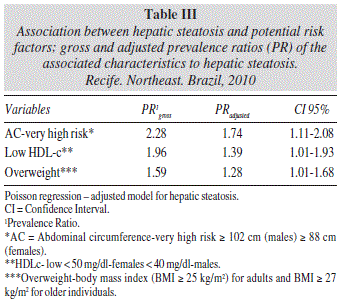
<body><![CDATA[<p>&nbsp;</p>     <p><font face="Verdana" size="2"><b>Results</b></font></p>     <p><font face="Verdana" size="2">A sample of 219 patients and 82 controls were studied. The losses occurred in the control group (n = 20) during the diagnosis phase, because when performing ultrasound showed HS giving rise to the case group. The demographic variables gender and age were not considered in the analysis due to the large heterogeneity found between case and control groups which could distort the results. When assessing hepatic function by enzyme analysis, AST was altered in 24.3% and 2.8% of case and control patients, respectively (PR = 1.73 CI<sub>95%</sub> 1.45-2.07) and ALT in 45.6% and 12.0% of case and control groups, respectively (PR=1.66 CI<sub>95%</sub> 1.35-2.05).</font></p>     <p><font face="Verdana" size="2"><a target="_blank" href="/img/revistas/nh/v27n4/56_original_45_t1.gif">Table I</a> shows socioeconomic and lifestyle variables associated with the occurrence of HS in the univariate analysis. Among socioeconomic variables, participants with family income &le; 2 minimum wage (PR = 1.35 CI<sub>95%</sub> 1.18-1.54) and those with education level &lt; primary school (PR = 1.44 CI<sub>95</sub>% 1.27-1.64) showed increased risk for HS. Regarding lifestyle variables (alcohol consumption and smoking), no significant statistical association with HS was found.</font></p>     <p><font face="Verdana" size="2"><a target="_blank" href="/img/revistas/nh/v27n4/56_original_45_t2.gif">Table II</a> shows anthropometric, clinical characteristics and lipid profile of the patients. Individuals assessed by the BMI &ge; 25 kg/m<sup>2</sup> for adults and BMI &ge; 27 kg/m<sup>2</sup> for older individuals (PR = 1.59, CI<sub>95%</sub> 1.381.83), as well as individuals assessed by the AC (very high risk &ge; 102 cm (males), &ge; 88 cm (females), showed higher risk for HS (PR = 2.28 CI<sub>95%</sub> 1.68-3.09), whereas AC showed twice the risk. The variables hypertension (PR = 1.30 CI 95% 1.15-1.48) and diabetes mellitus (PR = 1.23 CI 95% 1.07-1.64) showed a significant association with HS. Regarding lipid profile, HS showed no significant association with total cholesterol. On the other hand, patients with low HDL-c for values under the cutoff points of normality &lt; 40 mg/dl (PR = 1.96 CI<sub>95%</sub> 1.55-2.48), had a two-fold risk for the development of the disease.</font></p>     <p><font face="Verdana" size="2"><a href="#t3">Table III</a> shows that after adjustment of the final model obtained by Poisson regression, three variables remained independently associated with HS, AC - very high risk; low HDLc and overweight. According to this model, AC in the range of very high risk is strongly associated with HS (PR<sub>adjusted</sub> = 1.74 CI<sub>95%</sub> 1.11-2.08), followed by low HDLc (PR = 1.39 CI<sub>95%</sub> 1.01-1.93) and overweight (PR<sub>adjusted</sub> = 1.28 CI<sub>95%</sub> 1.01-1.68).</font></p>     <p>&nbsp;</p>     <p align=center><a name="t3"><img src="/img/revistas/nh/v27n4/56_original_45_t3.gif"></a></p>     <p>&nbsp;</p>     <p><font face="Verdana" size="2"><b>Discussion</b></font></p>     ]]></body>
<body><![CDATA[<p><font face="Verdana" size="2">HS is most of the times asymptomatic and can be observed in both men and women and in several age groups. It is diagnosed by USG and serum biochemical alterations of hepatic enzymes in routine examinations, although normal exams do not exclude the presence of the disease, increases in ALT and AST are the most frequent markers.<sup>2</sup></font></p>     <p><font face="Verdana" size="2">In our sample, alterations in the AST (24.3%) and ALT (45.6%) were found in patients with HS. Similar results were found by Bellentani,<sup>3</sup> that observed high prevalence of ALT alterations, with a 3.76 times higher risk for patients with HS.</font></p>     <p><font face="Verdana" size="2">It is interesting to note that the patients of the present study have low socioeconomic status which may increase the risk of developing HS. This can be explained by the fact that low family income leads to high-calorie food intake, including saturated fat and simple carbohy-drates.<sup>17</sup> In our data, the lower education levels raised the risk for the development of HS by 1.5, demonstrating an unfavorable condition that may interfere with understanding and compliance of the proposed guidelines for prevention and treatment of disease. This is possibly explained by the association with the significant unhealthy food intake, which is also considered a risk for the development of cardiovascular diseases. Similarly, Furuta et al.<sup>18</sup> evidenced an association between HS and other cardiovascular risk variables.</font></p>     <p><font face="Verdana" size="2">In the present study, no significant statistical association was found regarding alcohol intake, since it was difficult to obtain reliable answers and very few were affirmative. According to Maher,<sup>19</sup> patients tend to conceal abusive alcohol consumption and this can underestimate medical assessment. This leads to poor diagnosis because there is a relation between the amount of alcohol consumption and the absolute risk of HS.</font></p>     <p><font face="Verdana" size="2">Regarding smoking habits, only a few answers were affirmative showing no significant statistical association. However, the higher smoking rate among alcoholic patients can be one of the possible agents for the association between chronic alcohol consumption and the development of cirrhosis and cancer.<sup>20</sup></font></p>     <p><font face="Verdana" size="2">Regarding anthropometric variables, most of the patients were overweight and obese, thus, raising the risk for the development of HS by over 1.5. Obesity is the most significant single risk factor for the development of HS. Other predictive factors for liver disease progression have been identified, but at present the treatment of obesity remains the most effective preventive strategy.<sup>21</sup> Because of the increased prevalence of HS with metabolic syndrome (MS) components such as obesity, type 2 diabetes melittus (T2DM) and dyslipidemia, one can understand that the etiopatho-genic mechanisms between these variables can be common.<sup>22</sup></font></p>     <p><font face="Verdana" size="2">Besides BMI, the AC measurement is used to assess body fat distribution and nutritional risk, which determines a significantly statistical association with the amount of visceral fat, which is responsible for insulin resistance and MS.<sup>23</sup> Increases in BMI and AC are associated with metabolic alterations (hyperinsulinemia, hypertriglyceridemia and T2DM) and HS. These indexes are related to the severity of steatosis and steatohepatitis.<sup>24</sup></font></p>     <p><font face="Verdana" size="2">In the regression model, AC was considered an independent risk factor for steatosis. Similar results were found by Bellentani et al.,<sup>3</sup> with a risk almost three times higher. However, Gunji et al. <sup>25</sup> found no association between HS and AC, which could explained by the methodological differences among the studies.</font></p>     <p><font face="Verdana" size="2">The results of the present study showed that hypertension is associated with HS, with prevalence of 30% in these patients, who presented risk higher than 1.0 for HS. Similar findings were shown by Donati et al.,<sup>26</sup> who demonstrated that obese and hypertensive patients were at high risk of developing HS, which was observed in 30.9% of the hypertensive non-diabetic patients compared to 12.7% of normotensive controls. Nevertheless, HS is not commonly investigated in hypertensive patients, mainly those who do not have components of MS. As for hypertensive patients, it is important to consider the diagnosis for HS and examine the slightest increases in serum transami-nases. This is important for patients at risk of HS progression, mainly those with central obesity and T2DM.<sup>27</sup> It is important to note that hypertension is a known aspect of MS and that 50% of non-obese hypertensive patients have hyperinsulinemia. In addition, abdominal (central) obesity is a characteristic of MS, being a risk factor for hypertension.<sup>28</sup></font></p>     <p><font face="Verdana" size="2">Regarding T2DM, the results of the present study showed an association with HS, with a prevalence of 23% and a significant risk factor, which can be explained by the metabolic disorders derived from the disease, as well as insulin resistance. It is interesting to note that HS is an indicative of T2DM, independent on the classic risk factors, suggesting an early marker of atherosclerosis, caused by the increase of hepatic enzymes preceding cardiovascular disease. Mechanisms that explain the association between HS and insulin resistance are the lipid metabolism harmed at hepatic level and the increase of oxidative stress that can lead to fat deposition and activation of several cytokines. These factors would consequently lead to the progression of the inflammatory process and fibrosis.<sup>28</sup></font></p>     ]]></body>
<body><![CDATA[<p><font face="Verdana" size="2">Dyslipidemia was associated with HS, i.e. low HDLc showed almost two-fold the risk and TGR over two-fold the risk for the development of the disease. Although high CT and LDLc showed no statistical significance in this study, the literature has shown strong evidence that metabolic disorders are considered risk factors for HS.<sup>29</sup> Similar results were found by Cotrim et al.,<sup>30</sup> suggesting that dyslipidemia is one of the most frequent and significant risk factor for the development of HS, correlating with TG levels, MS, and severity of hepatic disease. Since these factors are associated with MS, HS has been suggested to be another component of this syndrome.</font></p>     <p><font face="Verdana" size="2">Although LDL was not significantly associated with HS, triglycerides showed significant clinical importance, with a two-fold risk for HS. Similar results were observed by Bellentani et al.<sup>3</sup> with values 2.48 higher.</font></p>     <p><font face="Verdana" size="2">The association between HS and dyslipidemia ranges from 20 to 92%, being the hypertriglyceridemia the most common alteration.<sup>30</sup> Altered triglycerides and diabetes have shown to be an important trend as predictors. Is important to emphasize that in this study we used in the estimation of HS risk the Poisson regression, while other studies has estimated by means of odds ratio and logistic regression, which overestimate the risk.</font></p>     <p><font face="Verdana" size="2">Among the study limitations, we can mention, the first non-use of liver biopsy in case definition, because it is an invasive, expensive and not without risk. Second, the fact we have not evaluated the dietary intake of patients nor the physical exercise and finally the small number of individuals in the control group due to the difficulty in finding people that met the inclusion criteria for the control group in the hospital environment. With respect to food intake data from an unpublished master's thesis with a similar population to ours show that patients with HS eat more calories, carbohydrates and proteins that the comparison group. On the other hand, a lower educational level was observed in the case group, which also showed an association with food choice. It is known that the low level of education is associated with greater consumption of calories, macronutrients and unhealthy foods. Thus, food consumption may be behaving as a confounding variable in this study, But unfortunately this important variable was not collected.</font></p>     <p><font face="Verdana" size="2">In the adjusted Poisson regression, AC in the range of very high risk was considered the most significant risk factor independently associated to steatosis, showing an (PR<sub>adjusted</sub> = 1.74 CI<sub>95%</sub> 1.11-2.08), followed by HDLc (PR<sub>adjusted</sub>= 1.39 CI<sub>95%</sub> 1.01-1.93), and overweight (PR<sub>adjusted</sub> = 1.28 IC<sub>95%</sub>1.01-1.68). Similar results for AC were found by Browning et al.<sup>4</sup>, who demonstrated an (OR<sub>adjusted</sub> of 2.97 CI<sub>95%</sub>2.00-4.43), and Gunji et al.<sup>25</sup> found opposite results with adjusted OR of 0.989, what can be explained by the methodological differences. For overweight, similar results were found by Bellantini et al.,<sup>3</sup> who demonstrated an adjusted OR of 2.19 for overweight and 6.78 for obesity.</font></p>     <p><font face="Verdana" size="2">It can be concluded that the results of the present study showed an association of HS with some risk factors, highlighting AC (very high risk), followed by low HDLc and overweight.</font></p>     <p><font face="Verdana" size="2"><b>Final considerations</b></font></p>     <p><font face="Verdana" size="2">Overweight and central obesity and low HDL are risk factors for HS, showing the need for screening these individuals for HS aimed at early diagnosis and no the disease progression for complications such as steatohepatitis and fibrosis. Thus, prevention and control of excess body weight are highly recommended to combat the problem.</font></p>     <p>&nbsp;</p>     <p><font face="Verdana" size="2"><b>References</b></font></p>     ]]></body>
<body><![CDATA[<!-- ref --><p><font face="Verdana" size="2">1. Adams LA, Angulo P. Recent concepts in non-alcoholic fatty liver disease. <i>Diabet Med</i> 2005; 22: 1129-33.    &nbsp;&nbsp;&nbsp;&nbsp;&nbsp;&nbsp;&nbsp;&nbsp;[&#160;<a href="javascript:void(0);" onclick="javascript: window.open('/scielo.php?script=sci_nlinks&ref=3693458&pid=S0212-1611201200040005600001&lng=','','width=640,height=500,resizable=yes,scrollbars=1,menubar=yes,');">Links</a>&#160;]<!-- end-ref --></font></p>    <!-- ref --><p><font face="Verdana" size="2">2. Sass DA, Chang P, Chopra KB. Nonalcoholic Fatty Liver Disease: A clinical review. <i>Dig Dis Sci</i> 2005;50: 171-80.    &nbsp;&nbsp;&nbsp;&nbsp;&nbsp;&nbsp;&nbsp;&nbsp;[&#160;<a href="javascript:void(0);" onclick="javascript: window.open('/scielo.php?script=sci_nlinks&ref=3693460&pid=S0212-1611201200040005600002&lng=','','width=640,height=500,resizable=yes,scrollbars=1,menubar=yes,');">Links</a>&#160;]<!-- end-ref --></font></p>    <!-- ref --><p><font face="Verdana" size="2">3. Bellentani S, Saccoccio G, Masultti F, Croce LS, Brandi G, Sasso F. Prevalence of and risk factors for hepatic steatosis in Northern Italy. <i>Ann Intern Med</i> 2000; 132: 112-7.    &nbsp;&nbsp;&nbsp;&nbsp;&nbsp;&nbsp;&nbsp;&nbsp;[&#160;<a href="javascript:void(0);" onclick="javascript: window.open('/scielo.php?script=sci_nlinks&ref=3693462&pid=S0212-1611201200040005600003&lng=','','width=640,height=500,resizable=yes,scrollbars=1,menubar=yes,');">Links</a>&#160;]<!-- end-ref --></font></p>    <!-- ref --><p><font face="Verdana" size="2">4. Browning JD, Szczepaniak LS, Dobbins R. Prevalence of hepatic steatosis in an urban population in the United States: impact of ethnicity. <i>Hepatology</i> 2004; 40: 387-395.    &nbsp;&nbsp;&nbsp;&nbsp;&nbsp;&nbsp;&nbsp;&nbsp;[&#160;<a href="javascript:void(0);" onclick="javascript: window.open('/scielo.php?script=sci_nlinks&ref=3693464&pid=S0212-1611201200040005600004&lng=','','width=640,height=500,resizable=yes,scrollbars=1,menubar=yes,');">Links</a>&#160;]<!-- end-ref --></font></p>    <!-- ref --><p><font face="Verdana" size="2">5. Stranges S, Dorn JM, Muti P et al. Body fat distribution, relative weight, and liver enzyme levels: a population-based study. <i>Hepatology</i> 2004; 39: 754-763.    &nbsp;&nbsp;&nbsp;&nbsp;&nbsp;&nbsp;&nbsp;&nbsp;[&#160;<a href="javascript:void(0);" onclick="javascript: window.open('/scielo.php?script=sci_nlinks&ref=3693466&pid=S0212-1611201200040005600005&lng=','','width=640,height=500,resizable=yes,scrollbars=1,menubar=yes,');">Links</a>&#160;]<!-- end-ref --></font></p>    ]]></body>
<body><![CDATA[<!-- ref --><p><font face="Verdana" size="2">6. Angulo P. Nafld, obesity, and bariatric surgery. <i>Gastroenterology</i> 2006; 130: 1848-1852.    &nbsp;&nbsp;&nbsp;&nbsp;&nbsp;&nbsp;&nbsp;&nbsp;[&#160;<a href="javascript:void(0);" onclick="javascript: window.open('/scielo.php?script=sci_nlinks&ref=3693468&pid=S0212-1611201200040005600006&lng=','','width=640,height=500,resizable=yes,scrollbars=1,menubar=yes,');">Links</a>&#160;]<!-- end-ref --></font></p>    <!-- ref --><p><font face="Verdana" size="2">7. Kim DH, Choi SY, Park EH, Yang JI, Kim W, Kim YJ, Yoon JH, Lee HS, Shin CS, Cho SH, Oh BH. Non-alcoholic fatty liver disease (NAFLD) as a risk factor of coronary heart disease; relation of NAFLD to coronary artery calcification score by multi- detector computed tomography: The 43rd Annual Meeting of the European Association for the Study of the Liver Milan, Italy, 2008.    &nbsp;&nbsp;&nbsp;&nbsp;&nbsp;&nbsp;&nbsp;&nbsp;[&#160;<a href="javascript:void(0);" onclick="javascript: window.open('/scielo.php?script=sci_nlinks&ref=3693470&pid=S0212-1611201200040005600007&lng=','','width=640,height=500,resizable=yes,scrollbars=1,menubar=yes,');">Links</a>&#160;]<!-- end-ref --></font></p>    <!-- ref --><p><font face="Verdana" size="2">8. Hamer WO, Aguirre DA, Casola G, Lavine JE, Wonckhaus M, Sirlin CB. Fatty Liver: imaging patterns and pitfalls. <i>Radiographics</i> 2006; 26: 1637-53.    &nbsp;&nbsp;&nbsp;&nbsp;&nbsp;&nbsp;&nbsp;&nbsp;[&#160;<a href="javascript:void(0);" onclick="javascript: window.open('/scielo.php?script=sci_nlinks&ref=3693472&pid=S0212-1611201200040005600008&lng=','','width=640,height=500,resizable=yes,scrollbars=1,menubar=yes,');">Links</a>&#160;]<!-- end-ref --></font></p>    <!-- ref --><p><font face="Verdana" size="2">9. Farrel GC, Liddle C. Drugs and liver updated. <i>Semin Liver Dis</i> 2002; 22 (2): 109-13.    &nbsp;&nbsp;&nbsp;&nbsp;&nbsp;&nbsp;&nbsp;&nbsp;[&#160;<a href="javascript:void(0);" onclick="javascript: window.open('/scielo.php?script=sci_nlinks&ref=3693474&pid=S0212-1611201200040005600009&lng=','','width=640,height=500,resizable=yes,scrollbars=1,menubar=yes,');">Links</a>&#160;]<!-- end-ref --></font></p>    <!-- ref --><p><font face="Verdana" size="2">10. Lohman TG, Roche AF, Martorell R. Anthropometric standardization reference manual. Abridged ,1991, 90 p.    &nbsp;&nbsp;&nbsp;&nbsp;&nbsp;&nbsp;&nbsp;&nbsp;[&#160;<a href="javascript:void(0);" onclick="javascript: window.open('/scielo.php?script=sci_nlinks&ref=3693476&pid=S0212-1611201200040005600010&lng=','','width=640,height=500,resizable=yes,scrollbars=1,menubar=yes,');">Links</a>&#160;]<!-- end-ref --></font></p>    ]]></body>
<body><![CDATA[<!-- ref --><p><font face="Verdana" size="2">11. WHO. World Health Organization. Obesity epidemic puts millions at risk from related disease. <i>WHO Pres Relate</i> 1997; 46: 12.    &nbsp;&nbsp;&nbsp;&nbsp;&nbsp;&nbsp;&nbsp;&nbsp;[&#160;<a href="javascript:void(0);" onclick="javascript: window.open('/scielo.php?script=sci_nlinks&ref=3693478&pid=S0212-1611201200040005600011&lng=','','width=640,height=500,resizable=yes,scrollbars=1,menubar=yes,');">Links</a>&#160;]<!-- end-ref --></font></p>    <!-- ref --><p><font face="Verdana" size="2">12. Lipschitz DA. Screning for nutritional status in the elderly. <i>Primary Care</i> 1994; 21:55-67.    &nbsp;&nbsp;&nbsp;&nbsp;&nbsp;&nbsp;&nbsp;&nbsp;[&#160;<a href="javascript:void(0);" onclick="javascript: window.open('/scielo.php?script=sci_nlinks&ref=3693480&pid=S0212-1611201200040005600012&lng=','','width=640,height=500,resizable=yes,scrollbars=1,menubar=yes,');">Links</a>&#160;]<!-- end-ref --></font></p>    <!-- ref --><p><font face="Verdana" size="2">13. WHO. World Health Organization. Obesity: preventing and managing the global epidemic. Geneva, 1998, pp. 4-48.    &nbsp;&nbsp;&nbsp;&nbsp;&nbsp;&nbsp;&nbsp;&nbsp;[&#160;<a href="javascript:void(0);" onclick="javascript: window.open('/scielo.php?script=sci_nlinks&ref=3693482&pid=S0212-1611201200040005600013&lng=','','width=640,height=500,resizable=yes,scrollbars=1,menubar=yes,');">Links</a>&#160;]<!-- end-ref --></font></p>    <!-- ref --><p><font face="Verdana" size="2">14. Joint-The seventh Report of the Joint national Committee on Prevent, Detection, Evaluation and Treatment of High Blood Pressure. U.S. Department of Health and Human Services National Institutes of Health National Heart, Lung, and Blood Institute National High Blood Pressure Education Program. NIH Publication No. 04-5230-August 2004.    &nbsp;&nbsp;&nbsp;&nbsp;&nbsp;&nbsp;&nbsp;&nbsp;[&#160;<a href="javascript:void(0);" onclick="javascript: window.open('/scielo.php?script=sci_nlinks&ref=3693484&pid=S0212-1611201200040005600014&lng=','','width=640,height=500,resizable=yes,scrollbars=1,menubar=yes,');">Links</a>&#160;]<!-- end-ref --></font></p>    <!-- ref --><p><font face="Verdana" size="2">15. American Diabetes Association: Nutrition principles and recommendations in diabetes (Position Statement). <i>Diabetes Care</i> 2004; 27 (Suppl. 1): S36-S46.    &nbsp;&nbsp;&nbsp;&nbsp;&nbsp;&nbsp;&nbsp;&nbsp;[&#160;<a href="javascript:void(0);" onclick="javascript: window.open('/scielo.php?script=sci_nlinks&ref=3693486&pid=S0212-1611201200040005600015&lng=','','width=640,height=500,resizable=yes,scrollbars=1,menubar=yes,');">Links</a>&#160;]<!-- end-ref --></font></p>    ]]></body>
<body><![CDATA[<!-- ref --><p><font face="Verdana" size="2">16. NCEP. National Cholesterol Education Program (Expert Panel on Detection, evoluation, and treatment of high blood cholesterol in adults (Adults Treatement Panel III). Third Report of the National Cholesterol Education Program (NCEP), final report. <i>Circulation </i>2002; 106: 3143-3421.    &nbsp;&nbsp;&nbsp;&nbsp;&nbsp;&nbsp;&nbsp;&nbsp;[&#160;<a href="javascript:void(0);" onclick="javascript: window.open('/scielo.php?script=sci_nlinks&ref=3693488&pid=S0212-1611201200040005600016&lng=','','width=640,height=500,resizable=yes,scrollbars=1,menubar=yes,');">Links</a>&#160;]<!-- end-ref --></font></p>    <!-- ref --><p><font face="Verdana" size="2">17. Popkin BM,Gordon-Larsen P. The nutrition transition: world-wide obesity dynamic and their determinants.  <i>Int J Obes Relat Disord</i> 2004; 28 (Suppl. 3): 2-9.    &nbsp;&nbsp;&nbsp;&nbsp;&nbsp;&nbsp;&nbsp;&nbsp;[&#160;<a href="javascript:void(0);" onclick="javascript: window.open('/scielo.php?script=sci_nlinks&ref=3693490&pid=S0212-1611201200040005600017&lng=','','width=640,height=500,resizable=yes,scrollbars=1,menubar=yes,');">Links</a>&#160;]<!-- end-ref --></font></p>    <!-- ref --><p><font face="Verdana" size="2">18. Furuta K, Sato S, Ishine J, Okamoto E, Tobita H, Miyake T, Ishihara S, Amano Y, Adachi K, Maruyama R, Kinoshita Y. Predictive factors for severity of liver histology in patients with non-alcoholic steatohepatitis: Usefulness of measurement of arteriosclerosis indicators: Digestive Disease Week 2008. San Diego, CA, 2008.    &nbsp;&nbsp;&nbsp;&nbsp;&nbsp;&nbsp;&nbsp;&nbsp;[&#160;<a href="javascript:void(0);" onclick="javascript: window.open('/scielo.php?script=sci_nlinks&ref=3693492&pid=S0212-1611201200040005600018&lng=','','width=640,height=500,resizable=yes,scrollbars=1,menubar=yes,');">Links</a>&#160;]<!-- end-ref --></font></p>    <!-- ref --><p><font face="Verdana" size="2">19. Maher JJ. Why do some alcoholics develop liver disease while others o not? <i>AASLD Postgraduate Course (Handouts)</i> 2005; 85-91.    &nbsp;&nbsp;&nbsp;&nbsp;&nbsp;&nbsp;&nbsp;&nbsp;[&#160;<a href="javascript:void(0);" onclick="javascript: window.open('/scielo.php?script=sci_nlinks&ref=3693494&pid=S0212-1611201200040005600019&lng=','','width=640,height=500,resizable=yes,scrollbars=1,menubar=yes,');">Links</a>&#160;]<!-- end-ref --></font></p>    <!-- ref --><p><font face="Verdana" size="2">20. McKillop IH, Schrum LW. Alcohol and liver cancer. <i>Alcohol</i> 2005; 35: 195-203.    &nbsp;&nbsp;&nbsp;&nbsp;&nbsp;&nbsp;&nbsp;&nbsp;[&#160;<a href="javascript:void(0);" onclick="javascript: window.open('/scielo.php?script=sci_nlinks&ref=3693496&pid=S0212-1611201200040005600020&lng=','','width=640,height=500,resizable=yes,scrollbars=1,menubar=yes,');">Links</a>&#160;]<!-- end-ref --></font></p>    ]]></body>
<body><![CDATA[<!-- ref --><p><font face="Verdana" size="2">21. Festi D, Colecchia A, Sacco T, Bondi M, Roda E, Marchesini G. Hepatic steatosis in obese patients: clinical aspects and prognostic significance. <i>Obes Rev</i> 2004; 5: 27-42.    &nbsp;&nbsp;&nbsp;&nbsp;&nbsp;&nbsp;&nbsp;&nbsp;[&#160;<a href="javascript:void(0);" onclick="javascript: window.open('/scielo.php?script=sci_nlinks&ref=3693498&pid=S0212-1611201200040005600021&lng=','','width=640,height=500,resizable=yes,scrollbars=1,menubar=yes,');">Links</a>&#160;]<!-- end-ref --></font></p>    <!-- ref --><p><font face="Verdana" size="2">22. Day CP. Pathogenesis of steatohepatitis. <i>Best Pratice &amp; Research Clinical Gastroenterology</i> 2002; 16 (5): 663-78.    &nbsp;&nbsp;&nbsp;&nbsp;&nbsp;&nbsp;&nbsp;&nbsp;[&#160;<a href="javascript:void(0);" onclick="javascript: window.open('/scielo.php?script=sci_nlinks&ref=3693500&pid=S0212-1611201200040005600022&lng=','','width=640,height=500,resizable=yes,scrollbars=1,menubar=yes,');">Links</a>&#160;]<!-- end-ref --></font></p>    <!-- ref --><p><font face="Verdana" size="2">23. Day CP, Saksena S. Nonalcoholic steatohepatitis: definitions and pathogenesis. <i>J Gastroenterol Hepatol</i> 2002; 17: S384.    &nbsp;&nbsp;&nbsp;&nbsp;&nbsp;&nbsp;&nbsp;&nbsp;[&#160;<a href="javascript:void(0);" onclick="javascript: window.open('/scielo.php?script=sci_nlinks&ref=3693502&pid=S0212-1611201200040005600023&lng=','','width=640,height=500,resizable=yes,scrollbars=1,menubar=yes,');">Links</a>&#160;]<!-- end-ref --></font></p>    <!-- ref --><p><font face="Verdana" size="2">24. Scheen AJ, Luyckx FH. Obesity and liver disease. <i>J Clin Endocrinol Metab</i> 2002; 6: 703-716.    &nbsp;&nbsp;&nbsp;&nbsp;&nbsp;&nbsp;&nbsp;&nbsp;[&#160;<a href="javascript:void(0);" onclick="javascript: window.open('/scielo.php?script=sci_nlinks&ref=3693504&pid=S0212-1611201200040005600024&lng=','','width=640,height=500,resizable=yes,scrollbars=1,menubar=yes,');">Links</a>&#160;]<!-- end-ref --></font></p>    <!-- ref --><p><font face="Verdana" size="2">25. Gunji T, Matsuhashi, Sato H, Lijima K, Fujibayashi K, Okumura M, Sasabe N, Urabe A. Risk factors for serum alanine aminotransferase elevation: A cross-sectional study of healthly adult males in Tokyo, Japan. Dig. Liver Dis, 2010.    &nbsp;&nbsp;&nbsp;&nbsp;&nbsp;&nbsp;&nbsp;&nbsp;[&#160;<a href="javascript:void(0);" onclick="javascript: window.open('/scielo.php?script=sci_nlinks&ref=3693506&pid=S0212-1611201200040005600025&lng=','','width=640,height=500,resizable=yes,scrollbars=1,menubar=yes,');">Links</a>&#160;]<!-- end-ref --></font></p>    ]]></body>
<body><![CDATA[<!-- ref --><p><font face="Verdana" size="2">26. Donati G, Stagni B, Piscaglia F, Venturoli, N, Morselli-Lobate, AM, Rasciti L, Bolondi, L. Increased prevalence of fatty liver in arterial hypertensive patients with normal liver enzymes: role of insulin resistance. <i>Gut</i> 2004; 53: 1020-23.    &nbsp;&nbsp;&nbsp;&nbsp;&nbsp;&nbsp;&nbsp;&nbsp;[&#160;<a href="javascript:void(0);" onclick="javascript: window.open('/scielo.php?script=sci_nlinks&ref=3693508&pid=S0212-1611201200040005600026&lng=','','width=640,height=500,resizable=yes,scrollbars=1,menubar=yes,');">Links</a>&#160;]<!-- end-ref --></font></p>    <!-- ref --><p><font face="Verdana" size="2">27. Brookes MJ, Cooper BT. Hypertension and fatty liver: guilty by association? <i>J Hum Hypertens</i> 2007; 21: 264-70.    &nbsp;&nbsp;&nbsp;&nbsp;&nbsp;&nbsp;&nbsp;&nbsp;[&#160;<a href="javascript:void(0);" onclick="javascript: window.open('/scielo.php?script=sci_nlinks&ref=3693510&pid=S0212-1611201200040005600027&lng=','','width=640,height=500,resizable=yes,scrollbars=1,menubar=yes,');">Links</a>&#160;]<!-- end-ref --></font></p>    <!-- ref --><p><font face="Verdana" size="2">28. Amarapurkar DN, Amarapurkar AD, Aptel N D, Agal S, Baigal R, Gupte P, Pramanik S. Nonalcoholoc steatohepatitis (NASH) with diabetes: predictors of liver Fibrosis. <i>Annals of Hepatology </i>2006; 5-(1): 30-3.    &nbsp;&nbsp;&nbsp;&nbsp;&nbsp;&nbsp;&nbsp;&nbsp;[&#160;<a href="javascript:void(0);" onclick="javascript: window.open('/scielo.php?script=sci_nlinks&ref=3693512&pid=S0212-1611201200040005600028&lng=','','width=640,height=500,resizable=yes,scrollbars=1,menubar=yes,');">Links</a>&#160;]<!-- end-ref --></font></p>    <!-- ref --><p><font face="Verdana" size="2">29. Pagano G, Pacini G, Musso G et al. Nonalcoholic steatohep-atitis, insulin resistance, and metabolic syndrome: further evidence for an etiologic association. <i>Hepatology</i> 2002; 35:367-372.    &nbsp;&nbsp;&nbsp;&nbsp;&nbsp;&nbsp;&nbsp;&nbsp;[&#160;<a href="javascript:void(0);" onclick="javascript: window.open('/scielo.php?script=sci_nlinks&ref=3693514&pid=S0212-1611201200040005600029&lng=','','width=640,height=500,resizable=yes,scrollbars=1,menubar=yes,');">Links</a>&#160;]<!-- end-ref --></font></p>    <!-- ref --><p><font face="Verdana" size="2">30. Cotrim, HP, Carvalho, FM, Siqueira, AC, Lordelo, M. Rocha, R. Freitas, LA Nonalcoholic fatty liver and insulin resistance among petrochemical workers. <i>JAMA</i> 2005; 294 (13): 1618-1620.    &nbsp;&nbsp;&nbsp;&nbsp;&nbsp;&nbsp;&nbsp;&nbsp;[&#160;<a href="javascript:void(0);" onclick="javascript: window.open('/scielo.php?script=sci_nlinks&ref=3693516&pid=S0212-1611201200040005600030&lng=','','width=640,height=500,resizable=yes,scrollbars=1,menubar=yes,');">Links</a>&#160;]<!-- end-ref --></font></p>     ]]></body>
<body><![CDATA[<p>&nbsp;</p>     <p>&nbsp;</p>     <p><font face="Verdana" size="2"><a href="#top"><img border="0" src="/img/revistas/nh/v27n4/seta.gif" width="15" height="17"></a><a name="bajo"></a><b>Correspondence:</b>    <br>Poliana Coelho Cabral    <br>Rua Conselheiro Ribas 131 Casa Amarela    <br>CEP: 52070-400, Recife. PE. Brazil    <br>E-mail: <a href="mailto:cabralpc@yahoo.com.br">cabralpc@yahoo.com.br</a></font></p>     <p><font face="Verdana" size="2">Recibido: 5-IV-2012    <br>Aceptado: 10-IV-2012</font></p>      ]]></body><back>
<ref-list>
<ref id="B1">
<label>1</label><nlm-citation citation-type="journal">
<person-group person-group-type="author">
<name>
<surname><![CDATA[Adams]]></surname>
<given-names><![CDATA[LA]]></given-names>
</name>
<name>
<surname><![CDATA[Angulo]]></surname>
<given-names><![CDATA[P]]></given-names>
</name>
</person-group>
<article-title xml:lang="en"><![CDATA[Recent concepts in non-alcoholic fatty liver disease]]></article-title>
<source><![CDATA[Diabet Med]]></source>
<year>2005</year>
<volume>22</volume>
<page-range>1129-33</page-range></nlm-citation>
</ref>
<ref id="B2">
<label>2</label><nlm-citation citation-type="journal">
<person-group person-group-type="author">
<name>
<surname><![CDATA[Sass]]></surname>
<given-names><![CDATA[DA]]></given-names>
</name>
<name>
<surname><![CDATA[Chang]]></surname>
<given-names><![CDATA[P]]></given-names>
</name>
<name>
<surname><![CDATA[Chopra]]></surname>
<given-names><![CDATA[KB]]></given-names>
</name>
</person-group>
<article-title xml:lang="en"><![CDATA[Nonalcoholic Fatty Liver Disease: A clinical review]]></article-title>
<source><![CDATA[Dig Dis Sci]]></source>
<year>2005</year>
<volume>50</volume>
<page-range>171-80</page-range></nlm-citation>
</ref>
<ref id="B3">
<label>3</label><nlm-citation citation-type="journal">
<person-group person-group-type="author">
<name>
<surname><![CDATA[Bellentani]]></surname>
<given-names><![CDATA[S]]></given-names>
</name>
<name>
<surname><![CDATA[Saccoccio]]></surname>
<given-names><![CDATA[G]]></given-names>
</name>
<name>
<surname><![CDATA[Masultti]]></surname>
<given-names><![CDATA[F]]></given-names>
</name>
<name>
<surname><![CDATA[Croce]]></surname>
<given-names><![CDATA[LS]]></given-names>
</name>
<name>
<surname><![CDATA[Brandi]]></surname>
<given-names><![CDATA[G]]></given-names>
</name>
<name>
<surname><![CDATA[Sasso]]></surname>
<given-names><![CDATA[F]]></given-names>
</name>
</person-group>
<article-title xml:lang="en"><![CDATA[Prevalence of and risk factors for hepatic steatosis in Northern Italy]]></article-title>
<source><![CDATA[Ann Intern Med]]></source>
<year>2000</year>
<volume>132</volume>
<page-range>112-7</page-range></nlm-citation>
</ref>
<ref id="B4">
<label>4</label><nlm-citation citation-type="journal">
<person-group person-group-type="author">
<name>
<surname><![CDATA[Browning]]></surname>
<given-names><![CDATA[JD]]></given-names>
</name>
<name>
<surname><![CDATA[Szczepaniak]]></surname>
<given-names><![CDATA[LS]]></given-names>
</name>
<name>
<surname><![CDATA[Dobbins]]></surname>
<given-names><![CDATA[R]]></given-names>
</name>
</person-group>
<article-title xml:lang="en"><![CDATA[Prevalence of hepatic steatosis in an urban population in the United States: impact of ethnicity]]></article-title>
<source><![CDATA[Hepatology]]></source>
<year>2004</year>
<volume>40</volume>
<page-range>387-395</page-range></nlm-citation>
</ref>
<ref id="B5">
<label>5</label><nlm-citation citation-type="journal">
<person-group person-group-type="author">
<name>
<surname><![CDATA[Stranges]]></surname>
<given-names><![CDATA[S]]></given-names>
</name>
<name>
<surname><![CDATA[Dorn]]></surname>
<given-names><![CDATA[JM]]></given-names>
</name>
<name>
<surname><![CDATA[Muti]]></surname>
<given-names><![CDATA[P]]></given-names>
</name>
</person-group>
<article-title xml:lang="en"><![CDATA[Body fat distribution, relative weight, and liver enzyme levels: a population-based study]]></article-title>
<source><![CDATA[Hepatology]]></source>
<year>2004</year>
<volume>39</volume>
<page-range>754-763</page-range></nlm-citation>
</ref>
<ref id="B6">
<label>6</label><nlm-citation citation-type="journal">
<person-group person-group-type="author">
<name>
<surname><![CDATA[Angulo]]></surname>
<given-names><![CDATA[P]]></given-names>
</name>
</person-group>
<article-title xml:lang="en"><![CDATA[Nafld, obesity, and bariatric surgery]]></article-title>
<source><![CDATA[Gastroenterology]]></source>
<year>2006</year>
<volume>130</volume>
<page-range>1848-1852</page-range></nlm-citation>
</ref>
<ref id="B7">
<label>7</label><nlm-citation citation-type="confpro">
<person-group person-group-type="author">
<name>
<surname><![CDATA[Kim]]></surname>
<given-names><![CDATA[DH]]></given-names>
</name>
<name>
<surname><![CDATA[Choi]]></surname>
<given-names><![CDATA[SY]]></given-names>
</name>
<name>
<surname><![CDATA[Park]]></surname>
<given-names><![CDATA[EH]]></given-names>
</name>
<name>
<surname><![CDATA[Yang]]></surname>
<given-names><![CDATA[JI]]></given-names>
</name>
<name>
<surname><![CDATA[Kim]]></surname>
<given-names><![CDATA[W]]></given-names>
</name>
<name>
<surname><![CDATA[Kim]]></surname>
<given-names><![CDATA[YJ]]></given-names>
</name>
<name>
<surname><![CDATA[Yoon]]></surname>
<given-names><![CDATA[JH]]></given-names>
</name>
<name>
<surname><![CDATA[Lee]]></surname>
<given-names><![CDATA[HS]]></given-names>
</name>
<name>
<surname><![CDATA[Shin]]></surname>
<given-names><![CDATA[CS]]></given-names>
</name>
<name>
<surname><![CDATA[Cho]]></surname>
<given-names><![CDATA[SH]]></given-names>
</name>
<name>
<surname><![CDATA[Oh]]></surname>
<given-names><![CDATA[BH]]></given-names>
</name>
</person-group>
<article-title xml:lang="en"><![CDATA[Non-alcoholic fatty liver disease (NAFLD) as a risk factor of coronary heart disease: relation of NAFLD to coronary artery calcification score by multi- detector computed tomography]]></article-title>
<source><![CDATA[]]></source>
<year></year>
<conf-name><![CDATA[43 Annual Meeting of the European Association for the Study of the Liver]]></conf-name>
<conf-date>2008</conf-date>
<conf-loc>Milan </conf-loc>
</nlm-citation>
</ref>
<ref id="B8">
<label>8</label><nlm-citation citation-type="journal">
<person-group person-group-type="author">
<name>
<surname><![CDATA[Hamer]]></surname>
<given-names><![CDATA[WO]]></given-names>
</name>
<name>
<surname><![CDATA[Aguirre]]></surname>
<given-names><![CDATA[DA]]></given-names>
</name>
<name>
<surname><![CDATA[Casola]]></surname>
<given-names><![CDATA[G]]></given-names>
</name>
<name>
<surname><![CDATA[Lavine]]></surname>
<given-names><![CDATA[JE]]></given-names>
</name>
<name>
<surname><![CDATA[Wonckhaus]]></surname>
<given-names><![CDATA[M]]></given-names>
</name>
<name>
<surname><![CDATA[Sirlin]]></surname>
<given-names><![CDATA[CB]]></given-names>
</name>
</person-group>
<article-title xml:lang="en"><![CDATA[Fatty Liver: imaging patterns and pitfalls]]></article-title>
<source><![CDATA[Radiographics]]></source>
<year>2006</year>
<volume>26</volume>
<page-range>1637-53</page-range></nlm-citation>
</ref>
<ref id="B9">
<label>9</label><nlm-citation citation-type="journal">
<person-group person-group-type="author">
<name>
<surname><![CDATA[Farrel]]></surname>
<given-names><![CDATA[GC]]></given-names>
</name>
<name>
<surname><![CDATA[Liddle]]></surname>
<given-names><![CDATA[C]]></given-names>
</name>
</person-group>
<article-title xml:lang="en"><![CDATA[Drugs and liver updated]]></article-title>
<source><![CDATA[Semin Liver Dis]]></source>
<year>2002</year>
<volume>22</volume>
<numero>2</numero>
<issue>2</issue>
<page-range>109-13</page-range></nlm-citation>
</ref>
<ref id="B10">
<label>10</label><nlm-citation citation-type="">
<person-group person-group-type="author">
<name>
<surname><![CDATA[Lohman]]></surname>
<given-names><![CDATA[TG]]></given-names>
</name>
<name>
<surname><![CDATA[Roche]]></surname>
<given-names><![CDATA[AF]]></given-names>
</name>
<name>
<surname><![CDATA[Martorell]]></surname>
<given-names><![CDATA[R]]></given-names>
</name>
</person-group>
<source><![CDATA[Anthropometric standardization reference manual]]></source>
<year>1991</year>
</nlm-citation>
</ref>
<ref id="B11">
<label>11</label><nlm-citation citation-type="journal">
<collab>WHO. World Health Organization</collab>
<article-title xml:lang="en"><![CDATA[Obesity epidemic puts millions at risk from related disease]]></article-title>
<source><![CDATA[WHO Pres Relate]]></source>
<year>1997</year>
<volume>46</volume>
<page-range>12</page-range></nlm-citation>
</ref>
<ref id="B12">
<label>12</label><nlm-citation citation-type="journal">
<person-group person-group-type="author">
<name>
<surname><![CDATA[Lipschitz]]></surname>
<given-names><![CDATA[DA]]></given-names>
</name>
</person-group>
<article-title xml:lang="en"><![CDATA[Screning for nutritional status in the elderly]]></article-title>
<source><![CDATA[Primary Care]]></source>
<year>1994</year>
<volume>21</volume>
<page-range>55-67</page-range></nlm-citation>
</ref>
<ref id="B13">
<label>13</label><nlm-citation citation-type="">
<collab>WHO. World Health Organization</collab>
<source><![CDATA[Obesity: preventing and managing the global epidemic]]></source>
<year>1998</year>
<page-range>4-48</page-range><publisher-loc><![CDATA[Geneva ]]></publisher-loc>
</nlm-citation>
</ref>
<ref id="B14">
<label>14</label><nlm-citation citation-type="journal">
<article-title xml:lang="en"><![CDATA[Joint-The seventh Report of the Joint national Committee on Prevent, Detection, Evaluation and Treatment of High Blood Pressure: U.S. Department of Health and Human Services National Institutes of Health National Heart, Lung, and Blood Institute National High Blood Pressure Education Program]]></article-title>
<source><![CDATA[NIH Publication]]></source>
<year>Augu</year>
<month>st</month>
<day> 2</day>
<numero>04-5230</numero>
<issue>04-5230</issue>
</nlm-citation>
</ref>
<ref id="B15">
<label>15</label><nlm-citation citation-type="journal">
<collab>American Diabetes Association</collab>
<article-title xml:lang="en"><![CDATA[Nutrition principles and recommendations in diabetes (Position Statement)]]></article-title>
<source><![CDATA[Diabetes Care]]></source>
<year>2004</year>
<volume>27</volume>
<numero>^s1</numero>
<issue>^s1</issue>
<supplement>1</supplement>
<page-range>S36-S46</page-range></nlm-citation>
</ref>
<ref id="B16">
<label>16</label><nlm-citation citation-type="journal">
<article-title xml:lang="en"><![CDATA[NCEP. National Cholesterol Education Program (Expert Panel on Detection, evoluation, and treatment of high blood cholesterol in adults (Adults Treatement Panel III): Third Report of the National Cholesterol Education Program (NCEP), final report]]></article-title>
<source><![CDATA[Circulation]]></source>
<year>2002</year>
<volume>106</volume>
<page-range>3143-3421</page-range></nlm-citation>
</ref>
<ref id="B17">
<label>17</label><nlm-citation citation-type="journal">
<person-group person-group-type="author">
<name>
<surname><![CDATA[Popkin]]></surname>
<given-names><![CDATA[BM]]></given-names>
</name>
<name>
<surname><![CDATA[Gordon-Larsen]]></surname>
<given-names><![CDATA[P]]></given-names>
</name>
</person-group>
<article-title xml:lang="en"><![CDATA[The nutrition transition: world-wide obesity dynamic and their determinants]]></article-title>
<source><![CDATA[Int J Obes Relat Disord]]></source>
<year>2004</year>
<volume>28</volume>
<numero>^s3</numero>
<issue>^s3</issue>
<supplement>3</supplement>
<page-range>2-9</page-range></nlm-citation>
</ref>
<ref id="B18">
<label>18</label><nlm-citation citation-type="">
<person-group person-group-type="author">
<name>
<surname><![CDATA[Furuta]]></surname>
<given-names><![CDATA[K]]></given-names>
</name>
<name>
<surname><![CDATA[Sato]]></surname>
<given-names><![CDATA[S]]></given-names>
</name>
<name>
<surname><![CDATA[Ishine]]></surname>
<given-names><![CDATA[J]]></given-names>
</name>
<name>
<surname><![CDATA[Okamoto]]></surname>
<given-names><![CDATA[E]]></given-names>
</name>
<name>
<surname><![CDATA[Tobita]]></surname>
<given-names><![CDATA[H]]></given-names>
</name>
<name>
<surname><![CDATA[Miyake]]></surname>
<given-names><![CDATA[T]]></given-names>
</name>
<name>
<surname><![CDATA[Ishihara]]></surname>
<given-names><![CDATA[S]]></given-names>
</name>
<name>
<surname><![CDATA[Amano]]></surname>
<given-names><![CDATA[Y]]></given-names>
</name>
<name>
<surname><![CDATA[Adachi]]></surname>
<given-names><![CDATA[K]]></given-names>
</name>
<name>
<surname><![CDATA[Maruyama]]></surname>
<given-names><![CDATA[R]]></given-names>
</name>
<name>
<surname><![CDATA[Kinoshita]]></surname>
<given-names><![CDATA[Y]]></given-names>
</name>
</person-group>
<source><![CDATA[Predictive factors for severity of liver histology in patients with non-alcoholic steatohepatitis: Usefulness of measurement of arteriosclerosis indicators: Digestive Disease Week 2008]]></source>
<year>2008</year>
<publisher-loc><![CDATA[San Diego^eCA CA]]></publisher-loc>
</nlm-citation>
</ref>
<ref id="B19">
<label>19</label><nlm-citation citation-type="book">
<person-group person-group-type="author">
<name>
<surname><![CDATA[Maher]]></surname>
<given-names><![CDATA[JJ]]></given-names>
</name>
</person-group>
<source><![CDATA[Why do some alcoholics develop liver disease while others o not?]]></source>
<year>2005</year>
<page-range>85-91</page-range><publisher-name><![CDATA[AASLD Postgraduate Course (Handouts)]]></publisher-name>
</nlm-citation>
</ref>
<ref id="B20">
<label>20</label><nlm-citation citation-type="journal">
<person-group person-group-type="author">
<name>
<surname><![CDATA[McKillop]]></surname>
<given-names><![CDATA[IH]]></given-names>
</name>
<name>
<surname><![CDATA[Schrum]]></surname>
<given-names><![CDATA[LW]]></given-names>
</name>
</person-group>
<article-title xml:lang="en"><![CDATA[Alcohol and liver cancer]]></article-title>
<source><![CDATA[Alcohol]]></source>
<year>2005</year>
<volume>35</volume>
<page-range>195-203</page-range></nlm-citation>
</ref>
<ref id="B21">
<label>21</label><nlm-citation citation-type="journal">
<person-group person-group-type="author">
<name>
<surname><![CDATA[Festi]]></surname>
<given-names><![CDATA[D]]></given-names>
</name>
<name>
<surname><![CDATA[Colecchia]]></surname>
<given-names><![CDATA[A]]></given-names>
</name>
<name>
<surname><![CDATA[Sacco]]></surname>
<given-names><![CDATA[T]]></given-names>
</name>
<name>
<surname><![CDATA[Bondi]]></surname>
<given-names><![CDATA[M]]></given-names>
</name>
<name>
<surname><![CDATA[Roda]]></surname>
<given-names><![CDATA[E]]></given-names>
</name>
<name>
<surname><![CDATA[Marchesini]]></surname>
<given-names><![CDATA[G]]></given-names>
</name>
</person-group>
<article-title xml:lang="en"><![CDATA[Hepatic steatosis in obese patients: clinical aspects and prognostic significance]]></article-title>
<source><![CDATA[Obes Rev]]></source>
<year>2004</year>
<volume>5</volume>
<page-range>27-42</page-range></nlm-citation>
</ref>
<ref id="B22">
<label>22</label><nlm-citation citation-type="journal">
<person-group person-group-type="author">
<name>
<surname><![CDATA[Day]]></surname>
<given-names><![CDATA[CP]]></given-names>
</name>
</person-group>
<article-title xml:lang="en"><![CDATA[Pathogenesis of steatohepatitis]]></article-title>
<source><![CDATA[Best Pratice & Research Clinical Gastroenterology]]></source>
<year>2002</year>
<volume>16</volume>
<numero>5</numero>
<issue>5</issue>
<page-range>663-78</page-range></nlm-citation>
</ref>
<ref id="B23">
<label>23</label><nlm-citation citation-type="journal">
<person-group person-group-type="author">
<name>
<surname><![CDATA[Day]]></surname>
<given-names><![CDATA[CP]]></given-names>
</name>
<name>
<surname><![CDATA[Saksena]]></surname>
<given-names><![CDATA[S]]></given-names>
</name>
</person-group>
<article-title xml:lang="en"><![CDATA[Nonalcoholic steatohepatitis: definitions and pathogenesis]]></article-title>
<source><![CDATA[J Gastroenterol Hepatol]]></source>
<year>2002</year>
<volume>17</volume>
<page-range>S384</page-range></nlm-citation>
</ref>
<ref id="B24">
<label>24</label><nlm-citation citation-type="journal">
<person-group person-group-type="author">
<name>
<surname><![CDATA[Scheen]]></surname>
<given-names><![CDATA[AJ]]></given-names>
</name>
<name>
<surname><![CDATA[Luyckx]]></surname>
<given-names><![CDATA[FH]]></given-names>
</name>
</person-group>
<article-title xml:lang="en"><![CDATA[Obesity and liver disease]]></article-title>
<source><![CDATA[J Clin Endocrinol Metab]]></source>
<year>2002</year>
<volume>6</volume>
<page-range>703-716</page-range></nlm-citation>
</ref>
<ref id="B25">
<label>25</label><nlm-citation citation-type="journal">
<person-group person-group-type="author">
<name>
<surname><![CDATA[Gunji]]></surname>
<given-names><![CDATA[T]]></given-names>
</name>
<name>
<surname><![CDATA[Matsuhashi]]></surname>
</name>
<name>
<surname><![CDATA[Sato]]></surname>
<given-names><![CDATA[H]]></given-names>
</name>
<name>
<surname><![CDATA[Lijima]]></surname>
<given-names><![CDATA[K]]></given-names>
</name>
<name>
<surname><![CDATA[Fujibayashi]]></surname>
<given-names><![CDATA[K]]></given-names>
</name>
<name>
<surname><![CDATA[Okumura]]></surname>
<given-names><![CDATA[M]]></given-names>
</name>
<name>
<surname><![CDATA[Sasabe]]></surname>
<given-names><![CDATA[N]]></given-names>
</name>
<name>
<surname><![CDATA[Urabe]]></surname>
<given-names><![CDATA[A]]></given-names>
</name>
</person-group>
<article-title xml:lang="en"><![CDATA[Risk factors for serum alanine aminotransferase elevation: A cross-sectional study of healthly adult males in Tokyo]]></article-title>
<source><![CDATA[Japan. Dig. Liver Dis]]></source>
<year>2010</year>
</nlm-citation>
</ref>
<ref id="B26">
<label>26</label><nlm-citation citation-type="journal">
<person-group person-group-type="author">
<name>
<surname><![CDATA[Donati]]></surname>
<given-names><![CDATA[G]]></given-names>
</name>
<name>
<surname><![CDATA[Stagni]]></surname>
<given-names><![CDATA[B]]></given-names>
</name>
<name>
<surname><![CDATA[Piscaglia]]></surname>
<given-names><![CDATA[F]]></given-names>
</name>
<name>
<surname><![CDATA[Venturoli]]></surname>
<given-names><![CDATA[N]]></given-names>
</name>
<name>
<surname><![CDATA[Morselli-Lobate]]></surname>
<given-names><![CDATA[AM]]></given-names>
</name>
<name>
<surname><![CDATA[Rasciti]]></surname>
<given-names><![CDATA[L]]></given-names>
</name>
<name>
<surname><![CDATA[Bolondi]]></surname>
<given-names><![CDATA[L]]></given-names>
</name>
</person-group>
<article-title xml:lang="en"><![CDATA[Increased prevalence of fatty liver in arterial hypertensive patients with normal liver enzymes: role of insulin resistance]]></article-title>
<source><![CDATA[Gut]]></source>
<year>2004</year>
<volume>53</volume>
<page-range>1020-23</page-range></nlm-citation>
</ref>
<ref id="B27">
<label>27</label><nlm-citation citation-type="journal">
<person-group person-group-type="author">
<name>
<surname><![CDATA[Brookes]]></surname>
<given-names><![CDATA[MJ]]></given-names>
</name>
<name>
<surname><![CDATA[Cooper]]></surname>
<given-names><![CDATA[BT]]></given-names>
</name>
</person-group>
<article-title xml:lang="en"><![CDATA[Hypertension and fatty liver: guilty by association?]]></article-title>
<source><![CDATA[J Hum Hypertens]]></source>
<year>2007</year>
<volume>21</volume>
<page-range>264-70</page-range></nlm-citation>
</ref>
<ref id="B28">
<label>28</label><nlm-citation citation-type="journal">
<person-group person-group-type="author">
<name>
<surname><![CDATA[Amarapurkar]]></surname>
<given-names><![CDATA[DN]]></given-names>
</name>
<name>
<surname><![CDATA[Amarapurkar]]></surname>
<given-names><![CDATA[AD]]></given-names>
</name>
<name>
<surname><![CDATA[Aptel]]></surname>
<given-names><![CDATA[N D]]></given-names>
</name>
<name>
<surname><![CDATA[Agal]]></surname>
<given-names><![CDATA[S]]></given-names>
</name>
<name>
<surname><![CDATA[Baigal]]></surname>
<given-names><![CDATA[R]]></given-names>
</name>
<name>
<surname><![CDATA[Gupte]]></surname>
<given-names><![CDATA[P]]></given-names>
</name>
<name>
<surname><![CDATA[Pramanik]]></surname>
<given-names><![CDATA[S]]></given-names>
</name>
</person-group>
<article-title xml:lang="en"><![CDATA[Nonalcoholoc steatohepatitis (NASH) with diabetes: predictors of liver Fibrosis]]></article-title>
<source><![CDATA[Annals of Hepatology]]></source>
<year>2006</year>
<volume>5</volume>
<numero>1</numero>
<issue>1</issue>
<page-range>30-3</page-range></nlm-citation>
</ref>
<ref id="B29">
<label>29</label><nlm-citation citation-type="journal">
<person-group person-group-type="author">
<name>
<surname><![CDATA[Pagano]]></surname>
<given-names><![CDATA[G]]></given-names>
</name>
<name>
<surname><![CDATA[Pacini]]></surname>
<given-names><![CDATA[G]]></given-names>
</name>
<name>
<surname><![CDATA[Musso]]></surname>
<given-names><![CDATA[G]]></given-names>
</name>
</person-group>
<article-title xml:lang="en"><![CDATA[Nonalcoholic steatohep-atitis, insulin resistance, and metabolic syndrome: further evidence for an etiologic association]]></article-title>
<source><![CDATA[Hepatology]]></source>
<year>2002</year>
<volume>35</volume>
<page-range>367-372</page-range></nlm-citation>
</ref>
<ref id="B30">
<label>30</label><nlm-citation citation-type="journal">
<person-group person-group-type="author">
<name>
<surname><![CDATA[Cotrim]]></surname>
<given-names><![CDATA[HP]]></given-names>
</name>
<name>
<surname><![CDATA[Carvalho]]></surname>
<given-names><![CDATA[FM]]></given-names>
</name>
<name>
<surname><![CDATA[Siqueira]]></surname>
<given-names><![CDATA[AC]]></given-names>
</name>
<name>
<surname><![CDATA[Lordelo]]></surname>
<given-names><![CDATA[M]]></given-names>
</name>
<name>
<surname><![CDATA[Rocha]]></surname>
<given-names><![CDATA[R]]></given-names>
</name>
<name>
<surname><![CDATA[Freitas]]></surname>
<given-names><![CDATA[LA]]></given-names>
</name>
</person-group>
<article-title xml:lang="en"><![CDATA[Nonalcoholic fatty liver and insulin resistance among petrochemical workers]]></article-title>
<source><![CDATA[JAMA]]></source>
<year>2005</year>
<volume>294</volume>
<numero>13</numero>
<issue>13</issue>
<page-range>1618-1620</page-range></nlm-citation>
</ref>
</ref-list>
</back>
</article>
