<?xml version="1.0" encoding="ISO-8859-1"?><article xmlns:mml="http://www.w3.org/1998/Math/MathML" xmlns:xlink="http://www.w3.org/1999/xlink" xmlns:xsi="http://www.w3.org/2001/XMLSchema-instance">
<front>
<journal-meta>
<journal-id>0212-1611</journal-id>
<journal-title><![CDATA[Nutrición Hospitalaria]]></journal-title>
<abbrev-journal-title><![CDATA[Nutr. Hosp.]]></abbrev-journal-title>
<issn>0212-1611</issn>
<publisher>
<publisher-name><![CDATA[Grupo Arán]]></publisher-name>
</publisher>
</journal-meta>
<article-meta>
<article-id>S0212-16112012000500005</article-id>
<article-id pub-id-type="doi">10.3305/nh.2012.27.5.5917</article-id>
<title-group>
<article-title xml:lang="en"><![CDATA[The role of hyperglycemia in the induction of oxidative stress and inflammatory process]]></article-title>
<article-title xml:lang="es"><![CDATA[El papel de la hiperglucemia en la inducción del estrés oxidativo y del proceso inflamatorio]]></article-title>
</title-group>
<contrib-group>
<contrib contrib-type="author">
<name>
<surname><![CDATA[Carvalho Vidigal]]></surname>
<given-names><![CDATA[F. de]]></given-names>
</name>
<xref ref-type="aff" rid="A01"/>
</contrib>
<contrib contrib-type="author">
<name>
<surname><![CDATA[Guedes Cocate]]></surname>
<given-names><![CDATA[P.]]></given-names>
</name>
<xref ref-type="aff" rid="A01"/>
</contrib>
<contrib contrib-type="author">
<name>
<surname><![CDATA[Gonçalves Pereira]]></surname>
<given-names><![CDATA[L.]]></given-names>
</name>
<xref ref-type="aff" rid="A01"/>
</contrib>
<contrib contrib-type="author">
<name>
<surname><![CDATA[Cássia Gonçalves Alfenas]]></surname>
<given-names><![CDATA[R. de]]></given-names>
</name>
<xref ref-type="aff" rid="A02"/>
</contrib>
</contrib-group>
<aff id="A01">
<institution><![CDATA[,Federal University of Viçosa  ]]></institution>
<addr-line><![CDATA[Minas Gerais ]]></addr-line>
<country>Brazil</country>
</aff>
<aff id="A02">
<institution><![CDATA[,Federal University of Viçosa Nutrition and Health Department ]]></institution>
<addr-line><![CDATA[Minas Gerais ]]></addr-line>
<country>Brazil</country>
</aff>
<pub-date pub-type="pub">
<day>00</day>
<month>10</month>
<year>2012</year>
</pub-date>
<pub-date pub-type="epub">
<day>00</day>
<month>10</month>
<year>2012</year>
</pub-date>
<volume>27</volume>
<numero>5</numero>
<fpage>1391</fpage>
<lpage>1398</lpage>
<copyright-statement/>
<copyright-year/>
<self-uri xlink:href="http://scielo.isciii.es/scielo.php?script=sci_arttext&amp;pid=S0212-16112012000500005&amp;lng=en&amp;nrm=iso"></self-uri><self-uri xlink:href="http://scielo.isciii.es/scielo.php?script=sci_abstract&amp;pid=S0212-16112012000500005&amp;lng=en&amp;nrm=iso"></self-uri><self-uri xlink:href="http://scielo.isciii.es/scielo.php?script=sci_pdf&amp;pid=S0212-16112012000500005&amp;lng=en&amp;nrm=iso"></self-uri><abstract abstract-type="short" xml:lang="en"><p><![CDATA[Introduction: In many countries, the prevalence of obesity and chronic diseases has been increased, which are normally associated with changes in lifestyle, that are especially characterized by high consumption of diets rich in carbohydrates of rapid absorption. Such diets classified as high glycemic index and high glycemic load can lead to hyperglycemia. Objectives: Discuss the role of the diets of high glycemic index and/or high glycemic load on the oxidative stress and inflammatory process, in order to verify their influence on those diseases. Results and discussion: Studies demonstrate direct relationship between hyperglycemia, inflammatory process and oxidative stress that contribute to the development of chronic diseases.]]></p></abstract>
<abstract abstract-type="short" xml:lang="es"><p><![CDATA[Introducción: En muchos países, la prevalencia de la obesidad y las enfermedades crónicas ha aumentado y normalmente se asocia con cambios en el estilo de vida, que se caracteriza sobre todo por el alto consumo de dietas ricas en hidratos de carbono de rápida absorción. Este tipo de dieta clasificada como alto índice glucemico y alta carga glucemica puede llevar a la hiperglucemia. Objetivos: Discutir el papel de las dietas de alto índice glucemico y/o alta carga glucemica en el estrés oxidativo y en el proceso inflamatorio, a fin de verificar su influencia en las enfermedades. Resultados y discusión: Los estudios demuestran una relación directa entre la hiperglucemia, el proceso inflamatorio y el estrés oxidativo, que contribuyen al desarrollo de enfermedades crónicas.]]></p></abstract>
<kwd-group>
<kwd lng="en"><![CDATA[Oxidative stress]]></kwd>
<kwd lng="en"><![CDATA[Inflammation]]></kwd>
<kwd lng="en"><![CDATA[Hyperglycemia]]></kwd>
<kwd lng="es"><![CDATA[Estrés oxidativo]]></kwd>
<kwd lng="es"><![CDATA[Inflamación]]></kwd>
<kwd lng="es"><![CDATA[Hiperglucemia]]></kwd>
</kwd-group>
</article-meta>
</front><body><![CDATA[ <p><a name="top"></a><font face="Verdana" size="2"><b>REVISIÓN</b></font></p>     <p>&nbsp;</p>     <p><font face="Verdana" size="4"><b>The role of hyperglycemia in the induction of oxidative stress and inflammatory process</b></font></p>     <p><font face="Verdana" size="4"><b>El papel de la hiperglucemia en la inducción del estrés oxidativo y del proceso inflamatorio</b></font></p>     <p>&nbsp;</p>     <p>&nbsp;</p>     <p><font face="Verdana" size="2"><b>F. de Carvalho Vidigal<sup>1</sup>, P. Guedes Cocate<sup>1</sup>, L. Gonçalves Pereira<sup>2</sup> and R. de Cássia Gonçalves Alfenas<sup>3</sup></b></font></p>     <p><font face="Verdana" size="2"><sup>1</sup>Candidate for doctoral degree in Nutrition Science. Federal University of Viçosa. Minas Gerais. Brazil.    <br><sup>2</sup>Master in Nutrition Science. Federal University of Viçosa. Minas Gerais. Brazil.    <br><sup>3</sup>Assistant Professor. Nutrition and Health Department. Federal University of Viçosa. Minas Gerais. Brazil.</font></p>     ]]></body>
<body><![CDATA[<p><font face="Verdana" size="2"><a href="#bajo">Correspondence</a></font></p>     <p>&nbsp;</p>     <p>&nbsp;</p> <hr size="1">     <p><font face="Verdana" size="2"><b>ABSTRACT</b></font></p>     <p><font face="Verdana" size="2"><b>Introduction:</b> In many countries, the prevalence of obesity and chronic diseases has been increased, which are normally associated with changes in lifestyle, that are especially characterized by high consumption of diets rich in carbohydrates of rapid absorption. Such diets classified as high glycemic index and high glycemic load can lead to hyperglycemia.    <br><b>Objectives:</b> Discuss the role of the diets of high glycemic index and/or high glycemic load on the oxidative stress and inflammatory process, in order to verify their influence on those diseases.    <br><b>Results and discussion:</b> Studies demonstrate direct relationship between hyperglycemia, inflammatory process and oxidative stress that contribute to the development of chronic diseases.</font></p>     <p><font face="Verdana" size="2"><b>Key words:</b> Oxidative stress. Inflammation. Hyperglycemia.</font></p> <hr size="1">     <p><font face="Verdana" size="2"><b>RESUMEN</b></font></p>     <p><font face="Verdana" size="2"><b>Introducción:</b> En muchos países, la prevalencia de la obesidad y las enfermedades crónicas ha aumentado y normalmente se asocia con cambios en el estilo de vida, que se caracteriza sobre todo por el alto consumo de dietas ricas en hidratos de carbono de rápida absorción. Este tipo de dieta clasificada como alto índice glucemico y alta carga glucemica puede llevar a la hiperglucemia.    ]]></body>
<body><![CDATA[<br><b>Objetivos:</b> Discutir el papel de las dietas de alto índice glucemico y/o alta carga glucemica en el estrés oxidativo y en el proceso inflamatorio, a fin de verificar su influencia en las enfermedades.    <br><b>Resultados y discusión:</b> Los estudios demuestran una relación directa entre la hiperglucemia, el proceso inflamatorio y el estrés oxidativo, que contribuyen al desarrollo de enfermedades crónicas.</font></p>     <p><font face="Verdana" size="2"><b>Palabras clave:</b> Estrés oxidativo. Inflamación. Hiperglucemia.</font></p> <hr size="1">     <p><font face="Verdana" size="2"><b>Abbreviations</b>    <br>ANOVA: Analysis of variance.    <br>BMI: Body mass index.    <br>CAD: Coronary arterial disease.    <br>CURES: The Chennai Urban Rural Epidemiology Study.    <br>DNA: Deoxyribonucleic acid.    <br>eNOS: Endothelial nitric oxide synthase.    ]]></body>
<body><![CDATA[<br>GI: Glycemic index.    <br>GL: Glycemic load.    <br>HDL: High density lipoprotein cholesterol.    <br>HGI: High glycemic index.    <br>HGL: High glycemic load.    <br>ICAM-1: Intercellular-1 adhesion molecule.    <br>IL: Interleukin.    <br>LDL: Low density lipoprotein cholesterol.    <br>LGI: Low glycemic index.    <br>MDA: Malondialdehyde.    ]]></body>
<body><![CDATA[<br>NAD<sup>+</sup>: Nicotinamide adenine dinucleotide.    <br>NADH: Reduced nicotinamide adenine dinucleotide.    <br>NADPH: Nicotinamide adeninedinucleotide phosphate.    <br>NF-kB: Transcription factor nuclear factor-kappa B.    <br>NO: Nitric oxide.    <br>OR: Odds ratio.    <br>PAI-1: Plasminogen activator inhibitor-1.    <br>PCR: Protein C reactive.    <br>ROS: Reactive oxygen species.    <br>TLRs: Toll-like receptors.    ]]></body>
<body><![CDATA[<br>TNF&alpha;: Tumour necrosis factor-alfa.    <br>VCAM-1: Vascular-1 cell adhesion molecule.</font></p>     <p>&nbsp;</p>     <p><font face="Verdana" size="2"><b>Introduction</b></font></p>     <p><font face="Verdana" size="2">Modern life habits are characterized by low energy expenditure daily and by the excesive ingestion of foods rich in carbohydrates and lipids, making the positive energetic balance a reality. The result is the increase of the body mass index (BMI) and the prevalence of obesity,<sup>1</sup> in developed as well as developing countries.<sup>2</sup></font></p>     <p><font face="Verdana" size="2">Data from the Survey of Family Budget, made by the Brazilian Institute of Geography and Statistics 2002-2003, revealed that the frequency of overweight and obesity in Brazilians surpasses in eight times the weight deficit among women and fifteen times in males. It was verified, from the 95.5 million people over the age of 20, there are 38.8 million (40.6%) overweight and 10.5 million (10.9%) with obesity.<sup>3</sup> Inadequate eating and excess weight are directly related with the development of chronic diseases. Projections for the next decades indicate an epidemic growth of these diseases in most of the developing countries, specially cardiovascular diseases and type 2 diabetes.<sup>2</sup></font></p>     <p><font face="Verdana" size="2">According to the Brazilian Institute of Geography and Statistics data, the national population eat food that have a high content of sugar, especially soft drinks, and a low quantity of fruits and vegetables.<sup>3</sup> This eating pattern characterizes the consumption of a diet of high glycemic index (HGI) and high glycemic load (HGL).<sup>4</sup> Some authors suggest that the consumption of this type of diet is responsible for the increase of the prevalence of obesity,<sup>5-7</sup> which might lead to the alteration of the oxidative state and inflammatory markers, besides favoring lipogenesis, hyperglycemia, hyperinsulinemia, reduction of insulin sensibility, hypertriglyceridemia and decrease the concentration of HDL-cholesterol in the blood.<sup>8</sup></font></p>     <p><font face="Verdana" size="2">The alteration of the oxidative state seen by the increase in production of reactive oxygen species (ROS) and the reduction of antioxidant concentrations, can be explained by the constant hyperglycemia generated by the chronic consumption of HGI and HGL diets.<sup>9</sup> Furthermore, the hyperinsulinemia associated to insulin resistance can increase the production and release of powerful endothelial vasoconstrictor called endothelin-1, contributing to endothelial cellular injury.<sup>10</sup></font></p>     <p><font face="Verdana" size="2">The levels of inflammation markers can predict the development of chronic diseases,<sup>11</sup> aiding in the prevention of future health complications.<sup>12</sup> However, nowadays there are only a few studies that relate the intake of HGI and HGL diets with the referred markers, despite several researches confirming the direct association of these diets with the occurrence of obesity, type 2 diabetes and cardiovascular diseases.<sup>13-15</sup></font></p>     <p><font face="Verdana" size="2">The studies that assess the relation between oxidative stress markers with the consumption of HGI and HGL diets are scarces. Some authors<sup>16</sup> suggest that the oxidative stress can be an early event in the metabolic cascade cause by the ingestion of HGI diets, increasing the risk of cardiovascular diseases and type 2 diabetes.</font></p>     ]]></body>
<body><![CDATA[<p><font face="Verdana" size="2">Therefore, the objective of the present study was to point-out some theoretical references that evaluate the role of consumption of HGI and HGL diets in the oxidative stress and inflammatory process, in order to verify the influence of these types of diets in the predisposition and development of some chronic diseases.</font></p>     <p>&nbsp;</p>     <p><font face="Verdana" size="2"><b>Methods</b></font></p>     <p><font face="Verdana" size="2">A bibliographic revision was made evaluating the national and international journals indexed in the scientific data bases <i>Pubmed, Science Direct</i> and <i>Scielo.</i> The descriptors used were: <i>glycemic index, glycemic load, oxidative stress, hyperglycemia, carbohydrate, inflammatory markers, inflammation, inflammation mediators, cardiovascular diseases, chronic diseases</i> and their correspondent in Portuguese. The terms of the research were built combining two or more descriptors or using them isolated.</font></p>     <p><font face="Verdana" size="2">Articles published between the years 2000 and 2010 were used, approaching the influence of consuming HGI and HGL diets in the oxidative stress and inflammatory process. Relevant articles referenced in the selected studies were also used. The bibliographic research included original and review articles, excluding the studies that evaluated the effects of other interventions, besides diet, in the levels of inflammatory markers and oxidative state. A critical analysis was made of the selected studies to verify the validity of the results obtained.</font></p>     <p>&nbsp;</p>     <p><font face="Verdana" size="2"><b>Oxidative stress and its consequences on chronic diseases</b></font></p>     <p><font face="Verdana" size="2">The oxidative stress happens by the overlapping of pro-oxidizing compounds in relation to the antioxidants. This unbalance generates the oxidation of biomolecules with later loss of biological function consequently causing oxidative damages in cells and tissues. The chronic effect of these processes result in relevant implications on the etiology of chronic diseases, for instance, arteriosclerosis, type 2 diabetes, obesity and cancer.<sup>17</sup></font></p>     <p><font face="Verdana" size="2">ROS that favor oxidative damage can be comprised of free radicals that contains one odd electron in the electronic layer, such as superoxide, hydroxyl, hydroperoxyl, peroxyl, alkoxy, carbonate, carbon dioxide, nitric oxide and nitrogen dioxide and by nonradical reactive species, such, as hydrogen peroxide, hypobromous acid, peroxynitrite and nitrous oxide.<sup>18</sup></font></p>     <p><font face="Verdana" size="2">The ROS are formed mainly by the enzymatic complexes nicotinamide adeninedinucleotide phosphate (NADPH) oxidases and the endothelial nitric oxide synthase (eNOS).<sup>19</sup> In synthesizing nitric oxide (NO) and the eNOS receives and stores electrons to transform oxygen and L-arginine in NO and L-citruline. However, when there is no substrate or co-factors the activated eNOS does not catalyze the oxidation of L-arginine into NO. Although, the enzyme continuous with the capacity to receive and store electrons in the reductase, donating them to the oxygen substrate. Therefore, the eNOS generates superoxide instead of NO.<sup>20</sup></font></p>     ]]></body>
<body><![CDATA[<p><font face="Verdana" size="2">The superoxide reacts rapidly with the local NO and forms a reactive species of nitrogen, called peroxynitrite, causing damages in the cellular DNA as well as induces the decoupling of eNOS, which leads to a higher production of superoxide maintaining the conditions of endothelial damage.<sup>20</sup></font></p>     <p><font face="Verdana" size="2">The inflamed endothelium expresses that adhesion molecules called selectin and integrins, they activate the adhesion of leucocytes in their surface. Therefore, endothelial dysfunction and consequent arteriosclerosis can be triggered by an intermediate accentuated inflammatory response, for example, by oxidation of the low density lipoprotein cholesterol (LDL) which activates the protein kinase C and the transcription factor nuclear factor-kappa B (NF-kB), leading to the increase of conversion enzymes of the angiotensin II, adhesion molecules and inflammatory cytokines.<sup>21</sup></font></p>     <p><font face="Verdana" size="2">The relation endothelial-dependent vessel is abnormal in several disease, for instance, type 2 diabetes, heart failure and high blood pressure and they normally associate themselves with the loss of endothelial production and/or bioavailability of NO that trigger in endothelial dysfunction. Furthermore, the endothelial dysfunction can be related to damages of other important functions distinct to vasodilatation, which includes anticoagulation and anti-inflammatory properties of the endothelial.<sup>19</sup></font></p>     <p><font face="Verdana" size="2">The determination of the level of oxidative markers is relevance for the early detection of metabolic process that causes the chronic diseases. Therefore, the evaluation of the oxidative stress becomes important to elucidate the mechanisms and biological implications of the oxidative damage. According, there are some methods of analyses, based on the measurement of concentration of molecules resulting from the reaction with the reactive species, by the quantification of the magnitude of the damage produced by the reactive species through the measurement of products of the lipid peroxidation, such as, malondialdehyde (MDA) and F2-isoprostane and by the quantification of the antioxidant capacity.<sup>22</sup></font></p>     <p>&nbsp;</p>     <p><font face="Verdana" size="2"><b>Inflammatory responses and its consequences on chronic diseases</b></font></p>     <p><font face="Verdana" size="2">A typical inflammatory response occurs from four components: inducers, sensors, mediators and target tissues. The inducers correspond to the factor that triggers the beginning of the inflammatory response, they are detected by sensors, like, the Toll-like receptors (TLRs) which are expressed in specialized sentinel cells, such as, macrophages, dendritic cells and mastocytes that induce the production of mediators, including cytokines (tumour necrosis factor-alfa (TNF&alpha;), interleukin-1 (IL-1), interleukin-6 (IL-6), chemokines, bioactive amines, eicosanoids and products of proteolytic cascades, which act like inflammatory mediators in several target-tissue.<sup>23</sup></font></p>     <p><font face="Verdana" size="2">The condition of subclinical inflammation state causes lesions in the tissue through the activation of the immune system innate for a long period of time, which can cause future manifestations of chronic diseases, such as, cardiovascular disease, type 2 diabetes, obesity, cancer and metabolic syndrome. The mechanism responsible for the manifestation of these diseases starts with determined specific conditions, such as, abnormally glycosylated protein, high blood pressure, hyperlipidemia, sedentary and abnormal obesity that stimulate the pro-inflammatory mediators (TNF&alpha;, interleukins, intercellular-1 adhesion molecule (ICAM-1), vascular-1 cell adhesion molecule (VCAM-1), monocyte chemoattractant protein 1) they trigger insulin resistance, the lack of control in the metabolism of lipids, endothelial dysfunction and oxidative stress, generating the development of the referred chronic diseases.<sup>24</sup></font></p>     <p><font face="Verdana" size="2">The acute inflammatory condition can evolve to chronic condition, among these that stand-out in current society, are the inflammatory conditions associated to the diseases mentioned above. In the case of these diseases, it seems to have a vicious cycle between the inflammation and the pathological process.<sup>23</sup></font></p>     <p><font face="Verdana" size="2">There are several biomarkers of the inflammatory process that have been used in clinical practice and research associate to diseases, such as, hypertension, type 2 diabetes, arteriosclerosis and obesity. Among them are the adhesion molecules (E-selectin, P-selectin, ICAM-1 and VCAM-1), the interleukins (IL-1-&beta;, IL-6), the proteins of acute stage &#091;fibrinogen, serum amyloid protein A, protein C reactive (PCR) ultra-sensitive&#093; and the leukocyte count.<sup>25</sup></font></p>     ]]></body>
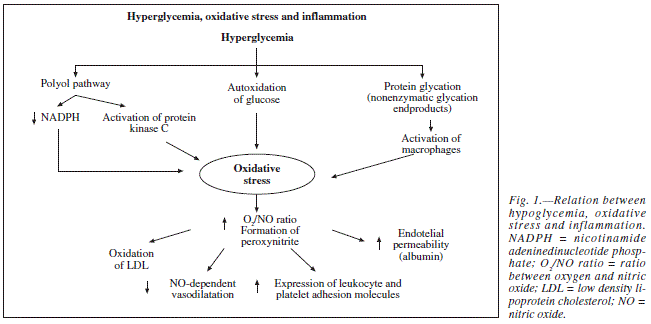
<body><![CDATA[<p><font face="Verdana" size="2">It must be considered that some epidemiological studies have identified the relation between basal levels of TNF&alpha; and IL-6 with the increased cardiovascular risk.<sup>26,27</sup> Adding, Volp et al.<sup>28</sup> in an article review, discussed about several studies that relate IL-6, TNF&alpha; and PCR with the occurrence of cardiovascular disease, type 2 diabetes, obesity and metabolic syndrome. Such results indicate that the early detection of specific biomarkers can be predictors of chronic diseases, and therefore, aiding in the prevention of future health complications.</font></p>     <p>&nbsp;</p>     <p><font face="Verdana" size="2"><b>Relation between the oxidative stress and inflammatory process with hyperglycemia</b></font></p>     <p><font face="Verdana" size="2">There is an increase of evidence that post-prandial hyperglycemia is an important risk factor for cardiovascular morbidities and mortality of the general population,<sup>29</sup> since the adverse consequences of repeated post-prandial hyperglycemia can build up over a period of several months.<sup>16</sup> Experimental data suggest that the oxidative stress can be an important mechanism that contributes for the relation between acute hyperglycemia and the increase in cardiovascular risk.<sup>30</sup></font></p>     <p><font face="Verdana" size="2">Acute hyperglycemia can increase the production of free radicals through the non-enzymatic glycosylation and the unbalance of the NADH/NAD<sup>+</sup> induced by the glucose in cells.<sup>31</sup> Studies made in normal and diabetes subjects showed that hyperglycemia generated in the test of oral tolerance to glucose<sup>32</sup> or after the consumption of meals<sup>33</sup> can induce the oxidative stress and reduce the antioxidant defenses. In diabetic subjects, the increase in oxidative stress was significantly higher after the meals that reproduced a larger increase in glycemia.<sup>34</sup></font></p>     <p><font face="Verdana" size="2">In vivo studies revealed that the oxidative stress, secondary to glycemia, happens after the later complications of diabetes manifest themselves clinically.<sup>35,36</sup> This hypothesis is supported by evidence that several biochemical pathways strictly associated to hyperglycemia (autoxidation of glucose, polyol pathway, protein glycation) can increase the production of free radicals<sup>37</sup> (<a href="#f1">fig. 1</a>).</font></p>     <p>&nbsp;</p>     <p align="center"><font face="Verdana" size="2"><a name="f1"><img src="/img/revistas/nh/v27n5/05_revision_02_f1.gif" align="top"></a></font></p>     <p>&nbsp;</p>     <p><font face="Verdana" size="2">According to Brownlee (2001)<sup>38</sup> the hyperglycemia leads to mitochondrial superoxide production in endothelial cells and it is implicated in the genesis of complications with diabetes. The superoxide anion binds to the NO, harming its action in the endothelial.<sup>39</sup> Furthermore, the increased production of superoxide activates the protein kinase C, which induced the synthesis of enzyme NADPH oxidase that also contributes to the production of superoxide.<sup>40</sup></font></p>     ]]></body>
<body><![CDATA[<p><font face="Verdana" size="2">Protein kinase C, a family of enzymes that are involved in controlling the function of other proteins, has been associated to vascular alterations, such as increase of permeability, contraction, synthesis of extracellular matrix, cellular and apoptosis growth, angiogenesis, leukocytes adhesion, activation and inhibition of cytokines. These disturbances in the cell's vascular homeostasis caused by different isoforms of the protein kinase C (-&alpha;, -&beta;1/2, -&delta;) are linked to the development of diseases that affect the large vessels (aterosclerosis, cardiomiopathy) and complications in the small vessels (retinopathy, nephropathy and neuropathy).<sup>41</sup></font></p>     <p><font face="Verdana" size="2">Cosentino et al.<sup>42</sup> studied the genetic expression of eNOS and the production of NO in endothelial cells of the human aorta exposed to normal (90 mg/dL) and elevated (396 mg/dL) levels of glucose for five days. This study showed that the prolonged exposure to elevated levels of glucose increases the genetic expression of the eNOS, the expression of protein and the release of NO. However, there is an accentuated increase concomitant from the production of superoxide, a powerful oxidant. These results provide a molecular base for the comprehension of how chronic exposure to elevated levels of glucose lead to unbalance between NO and superoxide.</font></p>     <p><font face="Verdana" size="2">To elucidate the relation between nutrition and the generation of ROS, Mohanty et al. (2000)<sup>43</sup> evaluated 14 healthy subjects and collected fasting blood samples and 1, 2 and 3 h after the intake of 75 g of glucose. The authors verified that the generation of ROS by polymorphonuclear leukocytes and mononuclear cells increased until reaching a peak of 244 &plusmn; 42% and 233 &plusmn; 34% of basal levels, respectively, after 2 h. The levels of p47<sup>phox</sup>, a key protein in enzyme NADPH oxidase in homogenized mononuclear cells, increased significantly 2 and 3 h after the intake of glucose. The levels of &alpha;-tocoferol, an antioxidant, decreased significantly in 1, 2 and 3 h.</font></p>     <p><font face="Verdana" size="2">Several studies have demonstrated that the hyperglycemia is one of the most important metabolic factors in the development of micro and macrovascular complications in diabetic patients,<sup>41,44-46</sup> since the inadequate glycemic control increase the inflammatory activity and the microalbuminuria and favors the endothelial dysfunction, contributing to the predisposition of vascular diseases.<sup>47,48</sup></font></p>     <p><font face="Verdana" size="2">Schram et al.<sup>48</sup>, in a case-control study with 543 subjects with type 1 diabetics participating in the EURODIAB Prospective Complications Study, verified the glycosylated hemoglobin that reflects the biological activity of the hyperglycemia, was significantly associated with inflammation markers, assessed by means of serum levels of PCR, IL-6 and TNF&alpha;.</font></p>     <p><font face="Verdana" size="2">Mohan et al.<sup>49</sup> evaluated 150 subjects selected from <i>The Chennai Urban Rural Epidemiology Study</i> (CURES), which were divided in 3 groups. Group 1 comprised by non-diabetic subjects without coronary arterial disease (CAD) (n = 50), group 2 comprised by diabetic subjects without CAD (n = 50) and group 3 comprised by diabetic subjects with CAD (n = 50). The diabetic subjects with and without CAD had levels significantly higher of ultra-sensitive PCR (2.89 mg/L and 2.25 mg/L, respectively) when compared with non-diabetic subjects without CAD (0.99 mg/L) (p &lt; 0.001). Values of ultra-sensitive PCR increased with the increase of terciles of body fat and glycosylated hemoglobin (ANOVA p &lt; 0.001). Analysis of multiple logistic regression revealed that the ultra-sensitive PCR was strongly associated with CAD (OR = 1.649, p &lt; 0.05) and diabetes (OR = 2.264, p &lt; 0.01) even after the age and gender adjustments. Therefore, the information mentioned above indicate the direct influence of acute and/or chronic hyperglycemia in the increase of inflammatory activity and oxidative stress.</font></p>     <p>&nbsp;</p>     <p><font face="Verdana" size="2"><b>Influence of the glycemic index and/or glycemic load of diet in the oxidative stress and inflammatory process</b></font></p>     <p><font face="Verdana" size="2">Considering that the hyperglycemia leads to the increase of risk factors for chronic diseases,<sup>50</sup> several evidences show the influence of the quality and quantity of the dietary carbohydrate in the increase in the incidence of these diseases, especially cardiovascular<sup>51</sup> and type 2 diabetes.<sup>52</sup> This influence of eating in the risk and protection factors related to such diseases is directly related to HGI and HGL diets. In prospective study, it was verified that HGI as well as HGL diets were independent risk factors for cardiovascular events.<sup>53</sup> In another study<sup>52</sup> the association was verified between the consumption of HGI diets with a higher risk for type 2 diabetes, especially in sedentary women and the ones with a familiar history of diabetes.</font></p>     <p><font face="Verdana" size="2">The concept of GI was introduced in 1981, in order to quantify the post-prandial glycemic response to different foods sources of carbohydrate. The GI classify the foods containing carbohydrates according to the glycemic response that they promote, in relation to the response seen after the consumption of a reference food (glucose or white bread). It is defines as the area formed below the glycemic response curve after the intake of 25 g or 50 g of available carbohydrate of test food, divided by the area under the curve of glycemic response after the consumption of a reference food containing the same level of available carbohydrate.<sup>54,55</sup> In considering glucose as reference product, the GI diets can be classified as low (<u>&lt;</u> 55), moderate (56-69) or high (<u>&gt;</u> 70).<sup>56</sup></font></p>     ]]></body>
<body><![CDATA[<p><font face="Verdana" size="2">While the GI refers to the glycemic response after the consumption of a fixed quantity of carbohydrate, the GL refers to this type of response after a meal containing a variable quantity of carbohydrate. The GL can be calculated by multiplying the total of available carbohydrate (g) ingested in a meal by the GI diet. This value is then divided by 100.<sup>57</sup> The GL diet is classified as low (<u>&lt;</u> 100), medium (101 to 199) or high (<u>&gt;</u> 200).<sup>58</sup></font></p>     <p><font face="Verdana" size="2">Observational and interventional studies suggest that the intake of HGI and/or HGL diets contribute to the increase of oxidative stress indicators<sup>16,59</sup> and inflammatory markers,<sup>60-62</sup> been this contribution responsible for the relation between this type of diet and chronic diseases.</font></p>     <p><font face="Verdana" size="2">Hu et al.<sup>59</sup>, investigated if the consumption of a HGI or HGL diet is associated to a higher occurrence of oxidative stress measured by the concentration of two markers of lipid peroxidation, MDA and F2-isoprostane. Participated in the study 292 healthy adults (46.7 &plusmn; 13.5 years, 27.6 &plusmn; 5.7 kg/m<sup>2</sup>). The GI and the GL diet were obtained applying a validated food frequency questionnaire. It was seen that the GI of the diet was positively associated with levels of MDA and F2-isoprostane. The GL was also positively associated to both markers, but the linear relation was only significant for the plasmatic MDA. Furthermore, the positive association between the GI and MDA was stronger in those subjects with BMI below the median (BMI &lt; 26.5 kg/m<sup>2</sup>) than those with BMI a 26.5 kg/m<sup>2</sup>. The ingestion of carbohydrate was not associated with the concentrations from both markers.</font></p>     <p><font face="Verdana" size="2">In the study mentioned above<sup>59</sup> observed that the direct relation between the GI diet and levels of oxidative stress markers was independent from other factors, such as, age, sex, consumption of alcohol and cigarette and energetic, protein, fiber, folate, cholesterol intake. The increase seen in the concentrations of MDA and F2-isoprostane from the lowest to the highest quartile of GI is comparable to the differences in these markers among passive and active smokers and among eutrophic and overweight subjects, respectively.<sup>63</sup> Despite the data of this transversal study did not prove causality, they suggest that the chronic consumption of HGI diet can lead to the chronic increase of oxidative stress.</font></p>     <p><font face="Verdana" size="2">Botero et al.<sup>16</sup> conducted a study to evaluate the acute effect of diets with low glycemic index (LGI) compared to diets with HGI diet in the oxidative stress and in the risk factors for cardiovascular diseases. It was a crossover study, with 10 days of duration for each stage and interval from 2 to 12 weeks between each stage, both made with subject admitted in clinical research center. Twelve overweight or obese men (27 to 45 kg/m<sup>2</sup>, 18 and 35 years) that consumed LGI or HGI diets were evaluated. Both diets were consumed in the research center and they had the same composition of macronutrients and fibers. In the seventh day of the study, the blood was collected after a night fasting and during 5 hours after having breakfast to assess the total antioxidant capacity (capacity of absorbance of the oxygen radical in plasma) and the level of oxidative stress (urinary F2&alpha;-isoprostane). In the tenth day, were measured the cardiovascular risk factors (blood pressure, total cholesterol, HDL-cholesterol, tryglycerols, PAI-1, fibrinogen and PCR). In fasting conditions, the total antioxidant capacity was significantly higher during the consumption of the LGI diet compared with the HGI diet. No effects of diets for the other variables were seen. The increase in total antioxidant capacity of the plasma occurred after a week of ingestion of the LGI diet, before changes occur in other risk factors, increasing the possibility that this phenomenon could mediate, at least in part, the effects previously reported of GI in health.</font></p>     <p><font face="Verdana" size="2">This study suggests that the changes in total antioxidant capacity comprise in an initial cascade event of metabolic events that relate the GI of the diet to the risk of cardiovascular diseases and diabetes. Furthermore, the intake of HGL diet and low in nutrients diet (specifically with small quantities of antioxidant nutrients) can be harmful to health.<sup>16</sup></font></p>     <p><font face="Verdana" size="2">Dickinson et al.<sup>62</sup> evaluated the acute alterations of NF-kB (important mediator of the transcription gene of pro-inflammatory cytokines) after the consumption of two meals with the same composition of macro and micronutrients but differing in the GI. After 10 hours of fasting, 10 healthy eutrophic subjects ingested in separate days 3 meals containing 50 g of carbohydrate available as glucose (HGI), white bread (HGI) and pasta (LGI). Samples of venous blood were collected from fasting (time 0), 1, 2 and 3 hours after the ingestion of the tested meals. Acute changes in other markers of oxidative stress (nitrotyrosine and ICAM-1) were also assessed. The increase in NF-kB was 3 times higher after the ingestion of white bread and glucose compared to the ingestion of pasta (p &lt; 0.05). Similarly, the changes in the levels of nitrotyrosine, but not ICAM-1, were higher after the ingestion of glucose and white bread compared to the pasta (p = 0.01 in 2 hours). The results suggest that the increase in glycemia after the ingestion of meals worsen the inflammatory processes in healthy adults and young people. This mechanism can aid in explaining the relation between carbohydrates, GI and chronic diseases.</font></p>     <p><font face="Verdana" size="2">Qi et al.<sup>61</sup> also wanted to assess the influence of ingesting whole cereals, brans and fibers to the levels  of inflammation markers in diabetic women of the Nurses' Health Study, furthermore the relation of the GI and GL diet with such markers. The research was made with 902 diabetic women and the food intake was assessed by means of a semi-quantitative food frequency questionnaire. An elevated correlation was seen between the GI diet and concentrations of PCR and TNF&alpha; (involved in the genesis of insulin resistance). The concentrations of these inflammation markers were 32% and 11% higher, respectively, in the highest quintile of the GI diet compared with the lowest quintile. Although the women that ingested a HGL diet presented a tendency to higher concentrations of PCR and TNF&alpha;, the tendency test were not significant. The ingestion of whole cereals, bran and fiber were associated with values significantly lower of PCR and TNF&alpha;. The results highlight the recommendation that patients with type 2 diabetes should increase the ingestion of whole products and maintain a diet with LGI. However, the fact that this study is observational, causality cannot be affirmed. Future research is needed to test the potential benefits of these diet factors in patients with type 2 diabetes.</font></p>     <p><font face="Verdana" size="2">Similar results were seen by Liu et al.<sup>60</sup> in non-diabetic subjects. The objective of this study was to evaluate if the intake of a HGL diet was associated to elevated concentrations PCR and if this association was modified by BMI. In 244 apparently healthy women, the concentration of plasmatic PCR was measured and the GL diet determined by means of a previously validated semi-quantitative food frequency questionnaire. Through the use of regression models, the association between the GL diet and plasmatic PCR was assessed after adjustments for age, level of physical activity, smoking habits, BMI, family history of heart attack in the myocardium, history of hypertension, diabetes, elevated cholesterol, use of postmenopause hormone, consumption of alcohol and other diet variables.</font></p>     <p><font face="Verdana" size="2">The authors verifies the occurrence of the positive and strong association and also statistically significant between the GL diet and plasmatic PCR. This association was significantly modified by the BMI. Among women with BMI <u>&gt;</u> 25 kg/m<sup>2</sup>, the concentration of PCR in the lower quintile for GL was 1.6 mg/L and in the higher quintile was 5.0 mg/L. However, among women with BMI &lt; 25 kg/m<sup>2</sup>, the corresponding means were 1.1 and 3.1 mg/L, respectively (p = 0.01 for the interaction). Therefore, the GL diet was significantly and positively associated with the plasmatic concentrations of PCR in healthy middle aged women, independently from other risk factors for ischemic cardiac diseases. This study suggests that the rising of the pro-inflammatory process can be a mechanism in which a consumption of HGI diets increases the risk of ischemic cardiac disease, specifically in overweight women.</font></p>     ]]></body>
<body><![CDATA[<p><font face="Verdana" size="2">Griffith et al.<sup>64</sup> evaluated the relation between GI and GL diet and the levels of ultra-sensitive PCR. During 1 year, 582 men and women that participated of a study to detect the seasonal variations in the levels of blood lipids, were followed, with visits at the beginning of the study and every 13 weeks, totaling 5 visits per volunteer. No significant associations were seen between the GI and GL diet and levels of PCR. However, it was verified an opposite correlation between GL and PCR among the obese subjects (BMI &gt; 30 kg/m<sup>2</sup>). These results are surprising for diverging from the ones obtained in other studies<sup>58,59</sup> and in a previous study led by the same authors,<sup>65</sup> when it was verified that the PCR concentrations were inversely related to the intake of fibers, which is a factor that can affect the GI.</font></p>     <p><font face="Verdana" size="2">The differences seen in the studies by Liu et al.<sup>60</sup> and Griffith et al.<sup>64</sup> could be explained by the considerably lower PCR values obtained in this studies, which could have limited the ability to detect an association between GI or GL and PCR. Due to a limited number of studies on this issue and the conflicting results, future investigations are needed to clarify the effect of the GI/GL in the levels of inflammatory biomarkers, such as, PCR.</font></p>     <p>&nbsp;</p>     <p><font face="Verdana" size="2"><b>Conclusion</b></font></p>     <p><font face="Verdana" size="2">The oxidative stress and inflammatory process are directly associated to chronic diseases, especially cardiovascular and type 2 diabetes. Among the factors that predispose such conditions we highlight chronic hyperglycemia. Some studies have evidenced that the consumption of HGI and/or HGL diets has as a consequence an rising concentrations of blood glucose and present potential for the triggering of oxidative stress and increase in inflammatory activity, therefore, a possible relation with the future occurrence of chronic diseases.</font></p>     <p><font face="Verdana" size="2">Due to these consequences, the increase in the intake of HGI and/or HGL diets around the world is concerning. However, to have more scientific support with the intent to warn the population on the harms in adopting these types of diets and the real influence of GI and GL in the oxidative stress and inflammatory process, further study is needed, especially well designed and controlled intervention studies, in which the levels of several types of markers can be analyzed.</font></p>     <p>&nbsp;</p>     <p><font face="Verdana" size="2"><b>References</b></font></p>     <!-- ref --><p><font face="Verdana" size="2">1. Blair SN, Church TS. The fitness, obesity, and health equation: is physical activity the common denominator? JAMA 2004 8; 292 (10): 1232-4.    &nbsp;&nbsp;&nbsp;&nbsp;&nbsp;&nbsp;&nbsp;&nbsp;[&#160;<a href="javascript:void(0);" onclick="javascript: window.open('/scielo.php?script=sci_nlinks&ref=3675883&pid=S0212-1611201200050000500001&lng=','','width=640,height=500,resizable=yes,scrollbars=1,menubar=yes,');">Links</a>&#160;]<!-- end-ref --></font></p>    ]]></body>
<body><![CDATA[<!-- ref --><p><font face="Verdana" size="2">2. Barreto SM, Pinheiro ARdO, Sichieri R, Monteiro CA, Filho MB, Schimidt MI, et al. Análise da Estratégia Global para Alimentação, Atividade Física e Saúde, da Organização Mundial da Saúde. Epidemiol Serv Saúde 2005; 14 (1): 41-68.    &nbsp;&nbsp;&nbsp;&nbsp;&nbsp;&nbsp;&nbsp;&nbsp;[&#160;<a href="javascript:void(0);" onclick="javascript: window.open('/scielo.php?script=sci_nlinks&ref=3675885&pid=S0212-1611201200050000500002&lng=','','width=640,height=500,resizable=yes,scrollbars=1,menubar=yes,');">Links</a>&#160;]<!-- end-ref --></font></p>    <!-- ref --><p><font face="Verdana" size="2">3. BRASIL. Pesquisa de Orçamentos Familiares - POF 2002-2003: Excesso de peso atinge 38,8 milhões de brasileiros adultos. Instituto Brasileiro de Geografia e Estatística (IBGE) - Ministério da Saúde. Disponível em: http://www.ibge.gov.br/home/presidencia/noticias/noticia_visualiza.php?id_noticia=278&amp;id_pagina=1. Acesso em: 3 jun. 2010.    &nbsp;&nbsp;&nbsp;&nbsp;&nbsp;&nbsp;&nbsp;&nbsp;[&#160;<a href="javascript:void(0);" onclick="javascript: window.open('/scielo.php?script=sci_nlinks&ref=3675887&pid=S0212-1611201200050000500003&lng=','','width=640,height=500,resizable=yes,scrollbars=1,menubar=yes,');">Links</a>&#160;]<!-- end-ref --></font></p>    <!-- ref --><p><font face="Verdana" size="2">4. Hu FB, Stampfer MJ, Manson JE, Grodstein F, Colditz GA, Speizer FE, et al. Trends in the Incidence of Coronary Heart Disease and Changes in Diet and Lifestyle in Women. New England Journal of Medicine 2000; 343 (8): 530-7.    &nbsp;&nbsp;&nbsp;&nbsp;&nbsp;&nbsp;&nbsp;&nbsp;[&#160;<a href="javascript:void(0);" onclick="javascript: window.open('/scielo.php?script=sci_nlinks&ref=3675889&pid=S0212-1611201200050000500004&lng=','','width=640,height=500,resizable=yes,scrollbars=1,menubar=yes,');">Links</a>&#160;]<!-- end-ref --></font></p>    <!-- ref --><p><font face="Verdana" size="2">5. Ebbeling CB, Leidig MM, Sinclair KB, Hangen JP, Ludwig DS. A Reduced-Glycemic Load Diet in the Treatment of Adolescent Obesity. Arch Pediatr Adolesc Med 2003; 157 (8): 773-9.    &nbsp;&nbsp;&nbsp;&nbsp;&nbsp;&nbsp;&nbsp;&nbsp;[&#160;<a href="javascript:void(0);" onclick="javascript: window.open('/scielo.php?script=sci_nlinks&ref=3675891&pid=S0212-1611201200050000500005&lng=','','width=640,height=500,resizable=yes,scrollbars=1,menubar=yes,');">Links</a>&#160;]<!-- end-ref --></font></p>    <!-- ref --><p><font face="Verdana" size="2">6. Ludwig DS. The glycemic index: physiological mechanisms relating to obesity, diabetes, and cardiovascular disease. JAMA 2002; 287 (18): 2414-23.    &nbsp;&nbsp;&nbsp;&nbsp;&nbsp;&nbsp;&nbsp;&nbsp;[&#160;<a href="javascript:void(0);" onclick="javascript: window.open('/scielo.php?script=sci_nlinks&ref=3675893&pid=S0212-1611201200050000500006&lng=','','width=640,height=500,resizable=yes,scrollbars=1,menubar=yes,');">Links</a>&#160;]<!-- end-ref --></font></p>    ]]></body>
<body><![CDATA[<!-- ref --><p><font face="Verdana" size="2">7. Silva MVL, Alfenas RCG. Effect of the glycemic index on lipid oxidation and body composition. Nutr Hosp 2011; 26 (1): 48-55.    &nbsp;&nbsp;&nbsp;&nbsp;&nbsp;&nbsp;&nbsp;&nbsp;[&#160;<a href="javascript:void(0);" onclick="javascript: window.open('/scielo.php?script=sci_nlinks&ref=3675895&pid=S0212-1611201200050000500007&lng=','','width=640,height=500,resizable=yes,scrollbars=1,menubar=yes,');">Links</a>&#160;]<!-- end-ref --></font></p>    <!-- ref --><p><font face="Verdana" size="2">8. Frost G, Leeds AA, Dore CJ, Madeiros S, Brading S, Dornhorst A. Glycaemic index as a determinant of serum HDL-cholesterol concentration. Lancet 1999; 353 (9158): 1045-8.    &nbsp;&nbsp;&nbsp;&nbsp;&nbsp;&nbsp;&nbsp;&nbsp;[&#160;<a href="javascript:void(0);" onclick="javascript: window.open('/scielo.php?script=sci_nlinks&ref=3675897&pid=S0212-1611201200050000500008&lng=','','width=640,height=500,resizable=yes,scrollbars=1,menubar=yes,');">Links</a>&#160;]<!-- end-ref --></font></p>    <!-- ref --><p><font face="Verdana" size="2">9. Brown AA, Hu FB. Dietary modulation of endothelial function: implications for cardiovascular disease. Am J Clin Nutr 2001; 73 (4): 673-86.    &nbsp;&nbsp;&nbsp;&nbsp;&nbsp;&nbsp;&nbsp;&nbsp;[&#160;<a href="javascript:void(0);" onclick="javascript: window.open('/scielo.php?script=sci_nlinks&ref=3675899&pid=S0212-1611201200050000500009&lng=','','width=640,height=500,resizable=yes,scrollbars=1,menubar=yes,');">Links</a>&#160;]<!-- end-ref --></font></p>    <!-- ref --><p><font face="Verdana" size="2">10. Mather K, Anderson TJ, Verma S. Insulin action in the vasculature: physiology and pathophysiology. J Vasc Res 2001; 38 (5): 415-22.    &nbsp;&nbsp;&nbsp;&nbsp;&nbsp;&nbsp;&nbsp;&nbsp;[&#160;<a href="javascript:void(0);" onclick="javascript: window.open('/scielo.php?script=sci_nlinks&ref=3675901&pid=S0212-1611201200050000500010&lng=','','width=640,height=500,resizable=yes,scrollbars=1,menubar=yes,');">Links</a>&#160;]<!-- end-ref --></font></p>    <!-- ref --><p><font face="Verdana" size="2">11. De Luis DA, Sagrado MG, Conde R, Aller R, Izaola O, Castro MJ. Circulating adipocytokines in morbid obese patients, relation with cardiovascular risk factors and anthropometric parameters. Nutr Hosp 2011; 26 (1): 91-6.    &nbsp;&nbsp;&nbsp;&nbsp;&nbsp;&nbsp;&nbsp;&nbsp;[&#160;<a href="javascript:void(0);" onclick="javascript: window.open('/scielo.php?script=sci_nlinks&ref=3675903&pid=S0212-1611201200050000500011&lng=','','width=640,height=500,resizable=yes,scrollbars=1,menubar=yes,');">Links</a>&#160;]<!-- end-ref --></font></p>    ]]></body>
<body><![CDATA[<!-- ref --><p><font face="Verdana" size="2">12. Dandona P, Chaudhuri A, Ghanim H, Mohanty P. Proinflammatory effects of glucose and anti-inflammatory effect of insulin: relevance to cardiovascular disease. Am J Cardiol 2007; 99 (4A): 15B-26B.    &nbsp;&nbsp;&nbsp;&nbsp;&nbsp;&nbsp;&nbsp;&nbsp;[&#160;<a href="javascript:void(0);" onclick="javascript: window.open('/scielo.php?script=sci_nlinks&ref=3675905&pid=S0212-1611201200050000500012&lng=','','width=640,height=500,resizable=yes,scrollbars=1,menubar=yes,');">Links</a>&#160;]<!-- end-ref --></font></p>    <!-- ref --><p><font face="Verdana" size="2">13. Brand-Miller JC, Holt SH, Pawlak DB, McMillan J. Glycemic index and obesity. Am J Clin Nutr 2002; 76 (1): 281S-5S.    &nbsp;&nbsp;&nbsp;&nbsp;&nbsp;&nbsp;&nbsp;&nbsp;[&#160;<a href="javascript:void(0);" onclick="javascript: window.open('/scielo.php?script=sci_nlinks&ref=3675907&pid=S0212-1611201200050000500013&lng=','','width=640,height=500,resizable=yes,scrollbars=1,menubar=yes,');">Links</a>&#160;]<!-- end-ref --></font></p>    <!-- ref --><p><font face="Verdana" size="2">14. Volp ACP, Alfenas RdCG. Índice glicêmico, carga glicêmica e doenças cardiovasculares. Rev Bras Nutr Clin 2006; 21 (4):302-8.    &nbsp;&nbsp;&nbsp;&nbsp;&nbsp;&nbsp;&nbsp;&nbsp;[&#160;<a href="javascript:void(0);" onclick="javascript: window.open('/scielo.php?script=sci_nlinks&ref=3675909&pid=S0212-1611201200050000500014&lng=','','width=640,height=500,resizable=yes,scrollbars=1,menubar=yes,');">Links</a>&#160;]<!-- end-ref --></font></p>    <!-- ref --><p><font face="Verdana" size="2">15. Brand-Miller J, Dickinson S, Barclay A, Celermajer D. The glycemic index and cardiovascular disease risk. Curr Atheroscler Rep 2007; 9 (6): 479-85.    &nbsp;&nbsp;&nbsp;&nbsp;&nbsp;&nbsp;&nbsp;&nbsp;[&#160;<a href="javascript:void(0);" onclick="javascript: window.open('/scielo.php?script=sci_nlinks&ref=3675911&pid=S0212-1611201200050000500015&lng=','','width=640,height=500,resizable=yes,scrollbars=1,menubar=yes,');">Links</a>&#160;]<!-- end-ref --></font></p>    <!-- ref --><p><font face="Verdana" size="2">16. Botero D, Ebbeling CB, Blumberg JB, Ribaya-Mercado JD, Creager MA, Swain JF et al. Acute effects of dietary glycemic index on antioxidant capacity in a nutrient-controlled feeding study. Obesity (Silver Spring) 2009; 17 (9): 1664-70.    &nbsp;&nbsp;&nbsp;&nbsp;&nbsp;&nbsp;&nbsp;&nbsp;[&#160;<a href="javascript:void(0);" onclick="javascript: window.open('/scielo.php?script=sci_nlinks&ref=3675913&pid=S0212-1611201200050000500016&lng=','','width=640,height=500,resizable=yes,scrollbars=1,menubar=yes,');">Links</a>&#160;]<!-- end-ref --></font></p>    ]]></body>
<body><![CDATA[<!-- ref --><p><font face="Verdana" size="2">17. Barbosa KBF, Costa NMB, Alfenas RdCG, Paula SOd, Minin VPR, Bressan J. Estresse oxidativo: avaliação de marcadores/Oxidative stress: assessment of biomarkers. Nutrire Rev Soc Bras Aliment Nutr 2008; 33 (2): 111-28.    &nbsp;&nbsp;&nbsp;&nbsp;&nbsp;&nbsp;&nbsp;&nbsp;[&#160;<a href="javascript:void(0);" onclick="javascript: window.open('/scielo.php?script=sci_nlinks&ref=3675915&pid=S0212-1611201200050000500017&lng=','','width=640,height=500,resizable=yes,scrollbars=1,menubar=yes,');">Links</a>&#160;]<!-- end-ref --></font></p>    <!-- ref --><p><font face="Verdana" size="2">18. Halliwell B, Whiteman M. Measuring reactive species and oxidative damage in vivo and in cell culture: how should you do it and what do the results mean? Br J Pharmacol 2004; 142 (2):231-55.    &nbsp;&nbsp;&nbsp;&nbsp;&nbsp;&nbsp;&nbsp;&nbsp;[&#160;<a href="javascript:void(0);" onclick="javascript: window.open('/scielo.php?script=sci_nlinks&ref=3675917&pid=S0212-1611201200050000500018&lng=','','width=640,height=500,resizable=yes,scrollbars=1,menubar=yes,');">Links</a>&#160;]<!-- end-ref --></font></p>    <!-- ref --><p><font face="Verdana" size="2">19. Zalba G, González A, Beaumont J, San José G, Moreno U, López B et al. Estrés oxidativo vascular y disfunción endotelial. Nefrología 2001; XXI (Suppl. 1): 61-6.    &nbsp;&nbsp;&nbsp;&nbsp;&nbsp;&nbsp;&nbsp;&nbsp;[&#160;<a href="javascript:void(0);" onclick="javascript: window.open('/scielo.php?script=sci_nlinks&ref=3675919&pid=S0212-1611201200050000500019&lng=','','width=640,height=500,resizable=yes,scrollbars=1,menubar=yes,');">Links</a>&#160;]<!-- end-ref --></font></p>    <!-- ref --><p><font face="Verdana" size="2">20. Bahia L, Aguiar LGKd, Villela NR, Bottino D, Bouskela E. O endotélio na síndrome metabolica. Arq Bras Endocrinol Metab 2006; 50 (2): 291-303.    &nbsp;&nbsp;&nbsp;&nbsp;&nbsp;&nbsp;&nbsp;&nbsp;[&#160;<a href="javascript:void(0);" onclick="javascript: window.open('/scielo.php?script=sci_nlinks&ref=3675921&pid=S0212-1611201200050000500020&lng=','','width=640,height=500,resizable=yes,scrollbars=1,menubar=yes,');">Links</a>&#160;]<!-- end-ref --></font></p>    <!-- ref --><p><font face="Verdana" size="2">21. Behrendt D, Ganz P. Endothelial function. From vascular biology to clinical applications. Am J Cardiol 2002; 90 (10C): 40L-8L.    &nbsp;&nbsp;&nbsp;&nbsp;&nbsp;&nbsp;&nbsp;&nbsp;[&#160;<a href="javascript:void(0);" onclick="javascript: window.open('/scielo.php?script=sci_nlinks&ref=3675923&pid=S0212-1611201200050000500021&lng=','','width=640,height=500,resizable=yes,scrollbars=1,menubar=yes,');">Links</a>&#160;]<!-- end-ref --></font></p>    ]]></body>
<body><![CDATA[<!-- ref --><p><font face="Verdana" size="2">22. Reyes GC, Sánchez IR, Calzada-Mendoza CC, Olivares-Corichi IM. Disfunción endotelial y estrés oxidativo. Rev Endocrinol Nutr 2006; 14 (4): 233-6.    &nbsp;&nbsp;&nbsp;&nbsp;&nbsp;&nbsp;&nbsp;&nbsp;[&#160;<a href="javascript:void(0);" onclick="javascript: window.open('/scielo.php?script=sci_nlinks&ref=3675925&pid=S0212-1611201200050000500022&lng=','','width=640,height=500,resizable=yes,scrollbars=1,menubar=yes,');">Links</a>&#160;]<!-- end-ref --></font></p>    <!-- ref --><p><font face="Verdana" size="2">23. Medzhitov R. Inflammation 2010: new adventures of an old flame. Cell 2010; 140 (6): 771-6.    &nbsp;&nbsp;&nbsp;&nbsp;&nbsp;&nbsp;&nbsp;&nbsp;[&#160;<a href="javascript:void(0);" onclick="javascript: window.open('/scielo.php?script=sci_nlinks&ref=3675927&pid=S0212-1611201200050000500023&lng=','','width=640,height=500,resizable=yes,scrollbars=1,menubar=yes,');">Links</a>&#160;]<!-- end-ref --></font></p>    <!-- ref --><p><font face="Verdana" size="2">24. Lahoz C, Mostaza JM. Atherosclerosis As a Systemic Disease. Rev Esp Cardiol 2007; 60 (2): 184-95.    &nbsp;&nbsp;&nbsp;&nbsp;&nbsp;&nbsp;&nbsp;&nbsp;[&#160;<a href="javascript:void(0);" onclick="javascript: window.open('/scielo.php?script=sci_nlinks&ref=3675929&pid=S0212-1611201200050000500024&lng=','','width=640,height=500,resizable=yes,scrollbars=1,menubar=yes,');">Links</a>&#160;]<!-- end-ref --></font></p>    <!-- ref --><p><font face="Verdana" size="2">25. Pearson TA, Mensah GA, Alexander RW, Anderson JL, Cannon RO, 3rd, Criqui M et al. Markers of inflammation and cardiovascular disease: application to clinical and public health practice: A statement for healthcare professionals from the Centers for Disease Control and Prevention and the American Heart Association. Circulation 2003; 107 (3): 499-511.    &nbsp;&nbsp;&nbsp;&nbsp;&nbsp;&nbsp;&nbsp;&nbsp;[&#160;<a href="javascript:void(0);" onclick="javascript: window.open('/scielo.php?script=sci_nlinks&ref=3675931&pid=S0212-1611201200050000500025&lng=','','width=640,height=500,resizable=yes,scrollbars=1,menubar=yes,');">Links</a>&#160;]<!-- end-ref --></font></p>    <!-- ref --><p><font face="Verdana" size="2">26. Ridker PM, Hennekens CH, Buring JE, Rifai N. C-reactive protein and other markers of inflammation in the prediction of cardiovascular disease in women. N Engl J Med 2000; 342 (12): 836-43.    &nbsp;&nbsp;&nbsp;&nbsp;&nbsp;&nbsp;&nbsp;&nbsp;[&#160;<a href="javascript:void(0);" onclick="javascript: window.open('/scielo.php?script=sci_nlinks&ref=3675933&pid=S0212-1611201200050000500026&lng=','','width=640,height=500,resizable=yes,scrollbars=1,menubar=yes,');">Links</a>&#160;]<!-- end-ref --></font></p>    ]]></body>
<body><![CDATA[<!-- ref --><p><font face="Verdana" size="2">27. Ridker PM, Rifai N, Stampfer MJ, Hennekens CH. Plasma concentration of interleukin-6 and the risk of future myocardial infarction among apparently healthy men. Circulation 2000; 101 (15): 1767-72.    &nbsp;&nbsp;&nbsp;&nbsp;&nbsp;&nbsp;&nbsp;&nbsp;[&#160;<a href="javascript:void(0);" onclick="javascript: window.open('/scielo.php?script=sci_nlinks&ref=3675935&pid=S0212-1611201200050000500027&lng=','','width=640,height=500,resizable=yes,scrollbars=1,menubar=yes,');">Links</a>&#160;]<!-- end-ref --></font></p>    <!-- ref --><p><font face="Verdana" size="2">28. Volp ACP, Alfenas RdCG, Costa NMB, Minim VPR, Stringueta PC, Bressan J. Capacidade dos biomarcadores inflamatórios em predizer a síndrome metabólica: Inflammation biomarkers capacity in predicting the metabolic syndrome. Arq Bras Endocrinol Metab 2008; 52 (3): 537-49.    &nbsp;&nbsp;&nbsp;&nbsp;&nbsp;&nbsp;&nbsp;&nbsp;[&#160;<a href="javascript:void(0);" onclick="javascript: window.open('/scielo.php?script=sci_nlinks&ref=3675937&pid=S0212-1611201200050000500028&lng=','','width=640,height=500,resizable=yes,scrollbars=1,menubar=yes,');">Links</a>&#160;]<!-- end-ref --></font></p>    <!-- ref --><p><font face="Verdana" size="2">29. Bonora E. Postprandial peaks as a risk factor for cardiovascular disease: epidemiological perspectives. Int J Clin Pract Suppl 2002; (129): 5-11.    &nbsp;&nbsp;&nbsp;&nbsp;&nbsp;&nbsp;&nbsp;&nbsp;[&#160;<a href="javascript:void(0);" onclick="javascript: window.open('/scielo.php?script=sci_nlinks&ref=3675939&pid=S0212-1611201200050000500029&lng=','','width=640,height=500,resizable=yes,scrollbars=1,menubar=yes,');">Links</a>&#160;]<!-- end-ref --></font></p>    <!-- ref --><p><font face="Verdana" size="2">30. Ceriello A. The post-prandial state and cardiovascular disease: relevance to diabetes mellitus. Diabetes Metab Res Rev 2000; 16 (2): 125-32.    &nbsp;&nbsp;&nbsp;&nbsp;&nbsp;&nbsp;&nbsp;&nbsp;[&#160;<a href="javascript:void(0);" onclick="javascript: window.open('/scielo.php?script=sci_nlinks&ref=3675941&pid=S0212-1611201200050000500030&lng=','','width=640,height=500,resizable=yes,scrollbars=1,menubar=yes,');">Links</a>&#160;]<!-- end-ref --></font></p>    <!-- ref --><p><font face="Verdana" size="2">31. Ceriello A. Acute hyperglycaemia and oxidative stress generation. Diabet Med 1997; 14 (Suppl. 3): S45-9.    &nbsp;&nbsp;&nbsp;&nbsp;&nbsp;&nbsp;&nbsp;&nbsp;[&#160;<a href="javascript:void(0);" onclick="javascript: window.open('/scielo.php?script=sci_nlinks&ref=3675943&pid=S0212-1611201200050000500031&lng=','','width=640,height=500,resizable=yes,scrollbars=1,menubar=yes,');">Links</a>&#160;]<!-- end-ref --></font></p>    ]]></body>
<body><![CDATA[<!-- ref --><p><font face="Verdana" size="2">32. Ceriello A, Bortolotti N, Crescentini A, Motz E, Lizzio S, Russo A et al. Antioxidant defences are reduced during the oral glucose tolerance test in normal and non-insulin-dependent diabetic subjects. Eur J Clin Invest 1998; 28 (4): 329-33.    &nbsp;&nbsp;&nbsp;&nbsp;&nbsp;&nbsp;&nbsp;&nbsp;[&#160;<a href="javascript:void(0);" onclick="javascript: window.open('/scielo.php?script=sci_nlinks&ref=3675945&pid=S0212-1611201200050000500032&lng=','','width=640,height=500,resizable=yes,scrollbars=1,menubar=yes,');">Links</a>&#160;]<!-- end-ref --></font></p>    <!-- ref --><p><font face="Verdana" size="2">33. Ceriello A, Bortolotti N, Motz E, Crescentini A, Lizzio S, Russo A et al. Meal-generated oxidative stress in type 2 diabetic patients. Diabetes Care 1998; 21 (9): 1529-33.    &nbsp;&nbsp;&nbsp;&nbsp;&nbsp;&nbsp;&nbsp;&nbsp;[&#160;<a href="javascript:void(0);" onclick="javascript: window.open('/scielo.php?script=sci_nlinks&ref=3675947&pid=S0212-1611201200050000500033&lng=','','width=640,height=500,resizable=yes,scrollbars=1,menubar=yes,');">Links</a>&#160;]<!-- end-ref --></font></p>    <!-- ref --><p><font face="Verdana" size="2">34. Ceriello A, Bortolotti N, Motz E, Pieri C, Marra M, Tonutti L, et al. Meal-induced oxidative stress and low-density lipoprotein oxidation in diabetes: the possible role of hyperglycemia. Metabolism 1999; 48 (12): 1503-8.    &nbsp;&nbsp;&nbsp;&nbsp;&nbsp;&nbsp;&nbsp;&nbsp;[&#160;<a href="javascript:void(0);" onclick="javascript: window.open('/scielo.php?script=sci_nlinks&ref=3675949&pid=S0212-1611201200050000500034&lng=','','width=640,height=500,resizable=yes,scrollbars=1,menubar=yes,');">Links</a>&#160;]<!-- end-ref --></font></p>    <!-- ref --><p><font face="Verdana" size="2">35. Giugliano D, Ceriello A, Paolisso G. Diabetes mellitus, hypertension, and cardiovascular disease: which role for oxidative stress? Metabolism 1995; 44 (3): 363-8.    &nbsp;&nbsp;&nbsp;&nbsp;&nbsp;&nbsp;&nbsp;&nbsp;[&#160;<a href="javascript:void(0);" onclick="javascript: window.open('/scielo.php?script=sci_nlinks&ref=3675951&pid=S0212-1611201200050000500035&lng=','','width=640,height=500,resizable=yes,scrollbars=1,menubar=yes,');">Links</a>&#160;]<!-- end-ref --></font></p>    <!-- ref --><p><font face="Verdana" size="2">36. Hamilton SJ, Chew GT, Watts GF. Therapeutic regulation of endothelial dysfunction in type 2 diabetes mellitus. Diab Vasc Dis Res 2007; 4 (2): 89-102.    &nbsp;&nbsp;&nbsp;&nbsp;&nbsp;&nbsp;&nbsp;&nbsp;[&#160;<a href="javascript:void(0);" onclick="javascript: window.open('/scielo.php?script=sci_nlinks&ref=3675953&pid=S0212-1611201200050000500036&lng=','','width=640,height=500,resizable=yes,scrollbars=1,menubar=yes,');">Links</a>&#160;]<!-- end-ref --></font></p>    ]]></body>
<body><![CDATA[<!-- ref --><p><font face="Verdana" size="2">37. Giugliano D, Ceriello A, Paolisso G. Oxidative stress and diabetic vascular complications. Diabetes Care 1996; 19 (3):257-67.    &nbsp;&nbsp;&nbsp;&nbsp;&nbsp;&nbsp;&nbsp;&nbsp;[&#160;<a href="javascript:void(0);" onclick="javascript: window.open('/scielo.php?script=sci_nlinks&ref=3675955&pid=S0212-1611201200050000500037&lng=','','width=640,height=500,resizable=yes,scrollbars=1,menubar=yes,');">Links</a>&#160;]<!-- end-ref --></font></p>    <!-- ref --><p><font face="Verdana" size="2">38. Brownlee M. Biochemistry and molecular cell biology of diabetic complications. Nature 2001; 414 (6865): 813-20.    &nbsp;&nbsp;&nbsp;&nbsp;&nbsp;&nbsp;&nbsp;&nbsp;[&#160;<a href="javascript:void(0);" onclick="javascript: window.open('/scielo.php?script=sci_nlinks&ref=3675957&pid=S0212-1611201200050000500038&lng=','','width=640,height=500,resizable=yes,scrollbars=1,menubar=yes,');">Links</a>&#160;]<!-- end-ref --></font></p>    <!-- ref --><p><font face="Verdana" size="2">39. Nishikawa T, Edelstein D, Du XL, Yamagishi S, Matsumura T, Kaneda Y, et al. Normalizing mitochondrial superoxide production blocks three pathways of hyperglycaemic damage. Nature 2000; 404 (6779): 787-90.    &nbsp;&nbsp;&nbsp;&nbsp;&nbsp;&nbsp;&nbsp;&nbsp;[&#160;<a href="javascript:void(0);" onclick="javascript: window.open('/scielo.php?script=sci_nlinks&ref=3675959&pid=S0212-1611201200050000500039&lng=','','width=640,height=500,resizable=yes,scrollbars=1,menubar=yes,');">Links</a>&#160;]<!-- end-ref --></font></p>    <!-- ref --><p><font face="Verdana" size="2">40. Spitaler MM, Graier WF. Vascular targets of redox signalling in diabetes mellitus. Diabetologia 2002; 45 (4): 476-94.    &nbsp;&nbsp;&nbsp;&nbsp;&nbsp;&nbsp;&nbsp;&nbsp;[&#160;<a href="javascript:void(0);" onclick="javascript: window.open('/scielo.php?script=sci_nlinks&ref=3675961&pid=S0212-1611201200050000500040&lng=','','width=640,height=500,resizable=yes,scrollbars=1,menubar=yes,');">Links</a>&#160;]<!-- end-ref --></font></p>    <!-- ref --><p><font face="Verdana" size="2">41. Geraldes P, King GL. Activation of protein kinase C isoforms and its impact on diabetic complications. Circ Res 2010; 106 (8): 1319-31.    &nbsp;&nbsp;&nbsp;&nbsp;&nbsp;&nbsp;&nbsp;&nbsp;[&#160;<a href="javascript:void(0);" onclick="javascript: window.open('/scielo.php?script=sci_nlinks&ref=3675963&pid=S0212-1611201200050000500041&lng=','','width=640,height=500,resizable=yes,scrollbars=1,menubar=yes,');">Links</a>&#160;]<!-- end-ref --></font></p>    ]]></body>
<body><![CDATA[<!-- ref --><p><font face="Verdana" size="2">42. Cosentino F, Hishikawa K, Katusic ZS, Luscher TF. High glucose increases nitric oxide synthase expression and superoxide anion generation in human aortic endothelial cells. Circulation 1997; 96 (1): 25-8.    &nbsp;&nbsp;&nbsp;&nbsp;&nbsp;&nbsp;&nbsp;&nbsp;[&#160;<a href="javascript:void(0);" onclick="javascript: window.open('/scielo.php?script=sci_nlinks&ref=3675965&pid=S0212-1611201200050000500042&lng=','','width=640,height=500,resizable=yes,scrollbars=1,menubar=yes,');">Links</a>&#160;]<!-- end-ref --></font></p>    <!-- ref --><p><font face="Verdana" size="2">43. Mohanty P, Hamouda W, Garg R, Aljada A, Ghanim H, Dandona P. Glucose challenge stimulates reactive oxygen species (ROS) generation by leucocytes. J Clin Endocrinol Metab 2000; 85 (8): 2970-3.    &nbsp;&nbsp;&nbsp;&nbsp;&nbsp;&nbsp;&nbsp;&nbsp;[&#160;<a href="javascript:void(0);" onclick="javascript: window.open('/scielo.php?script=sci_nlinks&ref=3675967&pid=S0212-1611201200050000500043&lng=','','width=640,height=500,resizable=yes,scrollbars=1,menubar=yes,');">Links</a>&#160;]<!-- end-ref --></font></p>    <!-- ref --><p><font face="Verdana" size="2">44. The effect of intensive treatment of diabetes on the development and progression of long-term complications in insulindependent diabetes mellitus. The Diabetes Control and Complications Trial Research Group. N Engl J Med 1993; 329 (14):977-86.    &nbsp;&nbsp;&nbsp;&nbsp;&nbsp;&nbsp;&nbsp;&nbsp;[&#160;<a href="javascript:void(0);" onclick="javascript: window.open('/scielo.php?script=sci_nlinks&ref=3675969&pid=S0212-1611201200050000500044&lng=','','width=640,height=500,resizable=yes,scrollbars=1,menubar=yes,');">Links</a>&#160;]<!-- end-ref --></font></p>    <!-- ref --><p><font face="Verdana" size="2">45. Nathan DM, Cleary PA, Backlund JY, Genuth SM, Lachin JM, Orchard TJ, et al. Intensive diabetes treatment and cardiovascular disease in patients with type 1 diabetes. N Engl J Med 2005; 353 (25): 2643-53.    &nbsp;&nbsp;&nbsp;&nbsp;&nbsp;&nbsp;&nbsp;&nbsp;[&#160;<a href="javascript:void(0);" onclick="javascript: window.open('/scielo.php?script=sci_nlinks&ref=3675971&pid=S0212-1611201200050000500045&lng=','','width=640,height=500,resizable=yes,scrollbars=1,menubar=yes,');">Links</a>&#160;]<!-- end-ref --></font></p>    <!-- ref --><p><font face="Verdana" size="2">46. UKPDS 28: a randomized trial of efficacy of early addition of metformin in sulfonylurea-treated type 2 diabetes. U.K. Prospective Diabetes Study Group. Diabetes Care 1998; 21 (1):87-92.    &nbsp;&nbsp;&nbsp;&nbsp;&nbsp;&nbsp;&nbsp;&nbsp;[&#160;<a href="javascript:void(0);" onclick="javascript: window.open('/scielo.php?script=sci_nlinks&ref=3675973&pid=S0212-1611201200050000500046&lng=','','width=640,height=500,resizable=yes,scrollbars=1,menubar=yes,');">Links</a>&#160;]<!-- end-ref --></font></p>    ]]></body>
<body><![CDATA[<!-- ref --><p><font face="Verdana" size="2">47. Stehouwer CD, Gall MA, Twisk JW, Knudsen E, Emeis JJ, Parving HH. Increased urinary albumin excretion, endothelial dysfunction, and chronic low-grade inflammation in type 2 diabetes: progressive, interrelated, and independently associated with risk of death. Diabetes 2002; 51 (4): 1157-65.    &nbsp;&nbsp;&nbsp;&nbsp;&nbsp;&nbsp;&nbsp;&nbsp;[&#160;<a href="javascript:void(0);" onclick="javascript: window.open('/scielo.php?script=sci_nlinks&ref=3675975&pid=S0212-1611201200050000500047&lng=','','width=640,height=500,resizable=yes,scrollbars=1,menubar=yes,');">Links</a>&#160;]<!-- end-ref --></font></p>    <!-- ref --><p><font face="Verdana" size="2">48. Schram MT, Chaturvedi N, Schalkwijk C, Giorgino F, Ebeling P, Fuller JH, et al. Vascular risk factors and markers of endothelial function as determinants of inflammatory markers in type 1 diabetes: the EURODIAB Prospective Complications Study. Diabetes Care 2003; 26 (7): 2165-73.    &nbsp;&nbsp;&nbsp;&nbsp;&nbsp;&nbsp;&nbsp;&nbsp;[&#160;<a href="javascript:void(0);" onclick="javascript: window.open('/scielo.php?script=sci_nlinks&ref=3675977&pid=S0212-1611201200050000500048&lng=','','width=640,height=500,resizable=yes,scrollbars=1,menubar=yes,');">Links</a>&#160;]<!-- end-ref --></font></p>    <!-- ref --><p><font face="Verdana" size="2">49. Mohan V, Deepa R, Velmurugan K, Premalatha G. Association of C-reactive protein with body fat, diabetes and coronary artery disease in Asian Indians: the Chennai Urban Rural Epidemiology Study (CURES-6). Diabet Med 2005; 22 (7):863-70.    &nbsp;&nbsp;&nbsp;&nbsp;&nbsp;&nbsp;&nbsp;&nbsp;[&#160;<a href="javascript:void(0);" onclick="javascript: window.open('/scielo.php?script=sci_nlinks&ref=3675979&pid=S0212-1611201200050000500049&lng=','','width=640,height=500,resizable=yes,scrollbars=1,menubar=yes,');">Links</a>&#160;]<!-- end-ref --></font></p>    <!-- ref --><p><font face="Verdana" size="2">50. Alonso CV, Carmona TG, Díaz MJ. Guidelines for specialized nutritional and metabolic support in the critically-ill patient. Update. Consensus SEMICYUC-SENPE: Hyperglycemia and diabetes mellitus. Nutr Hosp 2011; 26 (Suppl. 2): 46-9.    &nbsp;&nbsp;&nbsp;&nbsp;&nbsp;&nbsp;&nbsp;&nbsp;[&#160;<a href="javascript:void(0);" onclick="javascript: window.open('/scielo.php?script=sci_nlinks&ref=3675981&pid=S0212-1611201200050000500050&lng=','','width=640,height=500,resizable=yes,scrollbars=1,menubar=yes,');">Links</a>&#160;]<!-- end-ref --></font></p>    <!-- ref --><p><font face="Verdana" size="2">51. Liu S, Willett WC, Stampfer MJ, Hu FB, Franz M, Sampson L, et al. A prospective study of dietary glycemic load, carbohydrate intake, and risk of coronary heart disease in US women. Am J Clin Nutr 2000; 71 (6): 1455-61.    &nbsp;&nbsp;&nbsp;&nbsp;&nbsp;&nbsp;&nbsp;&nbsp;[&#160;<a href="javascript:void(0);" onclick="javascript: window.open('/scielo.php?script=sci_nlinks&ref=3675983&pid=S0212-1611201200050000500051&lng=','','width=640,height=500,resizable=yes,scrollbars=1,menubar=yes,');">Links</a>&#160;]<!-- end-ref --></font></p>    ]]></body>
<body><![CDATA[<!-- ref --><p><font face="Verdana" size="2">52. Schulze MB, Liu S, Rimm EB, Manson JE, Willett WC, Hu FB. Glycemic index, glycemic load, and dietary fiber intake and incidence of type 2 diabetes in younger and middle-aged women. Am J Clin Nutr 2004; 80 (2): 348-56.    &nbsp;&nbsp;&nbsp;&nbsp;&nbsp;&nbsp;&nbsp;&nbsp;[&#160;<a href="javascript:void(0);" onclick="javascript: window.open('/scielo.php?script=sci_nlinks&ref=3675985&pid=S0212-1611201200050000500052&lng=','','width=640,height=500,resizable=yes,scrollbars=1,menubar=yes,');">Links</a>&#160;]<!-- end-ref --></font></p>    <!-- ref --><p><font face="Verdana" size="2">53. Beulens JW, de Bruijne LM, Stolk RP, Peeters PH, Bots ML, Grobbee DE, et al. High dietary glycemic load and glycemic index increase risk of cardiovascular disease among middle-aged women: a population-based follow-up study. J Am Coll Cardiol 2007; 50 (1): 14-21.    &nbsp;&nbsp;&nbsp;&nbsp;&nbsp;&nbsp;&nbsp;&nbsp;[&#160;<a href="javascript:void(0);" onclick="javascript: window.open('/scielo.php?script=sci_nlinks&ref=3675987&pid=S0212-1611201200050000500053&lng=','','width=640,height=500,resizable=yes,scrollbars=1,menubar=yes,');">Links</a>&#160;]<!-- end-ref --></font></p>    <!-- ref --><p><font face="Verdana" size="2">54. Jenkins DJ, Wolever TM, Taylor RH, Barker H, Fielden H, Baldwin JM, et al. Glycemic index of foods: a physiological basis for carbohydrate exchange. Am J Clin Nutr 1981; 34 (3):362-6.    &nbsp;&nbsp;&nbsp;&nbsp;&nbsp;&nbsp;&nbsp;&nbsp;[&#160;<a href="javascript:void(0);" onclick="javascript: window.open('/scielo.php?script=sci_nlinks&ref=3675989&pid=S0212-1611201200050000500054&lng=','','width=640,height=500,resizable=yes,scrollbars=1,menubar=yes,');">Links</a>&#160;]<!-- end-ref --></font></p>    <!-- ref --><p><font face="Verdana" size="2">55. Wolever TM, Jenkins DJ, Jenkins AL, Josse RG. The glycemic index: methodology and clinical implications. Am J Clin Nutr 1991; 54 (5): 846-54.    &nbsp;&nbsp;&nbsp;&nbsp;&nbsp;&nbsp;&nbsp;&nbsp;[&#160;<a href="javascript:void(0);" onclick="javascript: window.open('/scielo.php?script=sci_nlinks&ref=3675991&pid=S0212-1611201200050000500055&lng=','','width=640,height=500,resizable=yes,scrollbars=1,menubar=yes,');">Links</a>&#160;]<!-- end-ref --></font></p>    <!-- ref --><p><font face="Verdana" size="2">56. Brand-Miller J, Foster-Powell K. Diets with a low glycemic index: from theory to practice. Nutr Today 1999; 34 (2): 64-72.    &nbsp;&nbsp;&nbsp;&nbsp;&nbsp;&nbsp;&nbsp;&nbsp;[&#160;<a href="javascript:void(0);" onclick="javascript: window.open('/scielo.php?script=sci_nlinks&ref=3675993&pid=S0212-1611201200050000500056&lng=','','width=640,height=500,resizable=yes,scrollbars=1,menubar=yes,');">Links</a>&#160;]<!-- end-ref --></font></p>    ]]></body>
<body><![CDATA[<!-- ref --><p><font face="Verdana" size="2">57. Foster-Powell K, Holt SH, Brand-Miller JC. International table of glycemic index and glycemic load values: 2002. Am J Clin Nutr 2002; 76 (1): 5-56.    &nbsp;&nbsp;&nbsp;&nbsp;&nbsp;&nbsp;&nbsp;&nbsp;[&#160;<a href="javascript:void(0);" onclick="javascript: window.open('/scielo.php?script=sci_nlinks&ref=3675995&pid=S0212-1611201200050000500057&lng=','','width=640,height=500,resizable=yes,scrollbars=1,menubar=yes,');">Links</a>&#160;]<!-- end-ref --></font></p>    <!-- ref --><p><font face="Verdana" size="2">58. Brand-Miller J, Holt SH, Petocz P. Reply to R. Mendosa. Am J Clin Nutr 2003; 77 (4): 994-5.    &nbsp;&nbsp;&nbsp;&nbsp;&nbsp;&nbsp;&nbsp;&nbsp;[&#160;<a href="javascript:void(0);" onclick="javascript: window.open('/scielo.php?script=sci_nlinks&ref=3675997&pid=S0212-1611201200050000500058&lng=','','width=640,height=500,resizable=yes,scrollbars=1,menubar=yes,');">Links</a>&#160;]<!-- end-ref --></font></p>    <!-- ref --><p><font face="Verdana" size="2">59. Hu Y, Block G, Norkus EP, Morrow JD, Dietrich M, Hudes M. Relations of glycemic index and glycemic load with plasma oxidative stress markers. Am J Clin Nutr 2006; 84 (1): 70-6; quiz 266-7.    &nbsp;&nbsp;&nbsp;&nbsp;&nbsp;&nbsp;&nbsp;&nbsp;[&#160;<a href="javascript:void(0);" onclick="javascript: window.open('/scielo.php?script=sci_nlinks&ref=3675999&pid=S0212-1611201200050000500059&lng=','','width=640,height=500,resizable=yes,scrollbars=1,menubar=yes,');">Links</a>&#160;]<!-- end-ref --></font></p>    <!-- ref --><p><font face="Verdana" size="2">60. Liu S, Manson JE, Buring JE, Stampfer MJ, Willett WC, Ridker PM. Relation between a diet with a high glycemic load and plasma concentrations of high-sensitivity C-reactive protein in middle-aged women. Am J Clin Nutr 2002; 75 (3):492-8.    &nbsp;&nbsp;&nbsp;&nbsp;&nbsp;&nbsp;&nbsp;&nbsp;[&#160;<a href="javascript:void(0);" onclick="javascript: window.open('/scielo.php?script=sci_nlinks&ref=3676001&pid=S0212-1611201200050000500060&lng=','','width=640,height=500,resizable=yes,scrollbars=1,menubar=yes,');">Links</a>&#160;]<!-- end-ref --></font></p>    <!-- ref --><p><font face="Verdana" size="2">61. Qi L, van Dam RM, Liu S, Franz M, Mantzoros C, Hu FB. Whole-grain, bran, and cereal fiber intakes and markers of systemic inflammation in diabetic women. Diabetes Care 2006; 29 (2): 207-11.    &nbsp;&nbsp;&nbsp;&nbsp;&nbsp;&nbsp;&nbsp;&nbsp;[&#160;<a href="javascript:void(0);" onclick="javascript: window.open('/scielo.php?script=sci_nlinks&ref=3676003&pid=S0212-1611201200050000500061&lng=','','width=640,height=500,resizable=yes,scrollbars=1,menubar=yes,');">Links</a>&#160;]<!-- end-ref --></font></p>    ]]></body>
<body><![CDATA[<!-- ref --><p><font face="Verdana" size="2">62. Dickinson S, Hancock DP, Petocz P, Ceriello A, Brand-Miller J. High-glycemic index carbohydrate increases nuclear factor-kappaB activation in mononuclear cells of young, lean healthy subjects. Am J Clin Nutr 2008; 87 (5): 1188-93.    &nbsp;&nbsp;&nbsp;&nbsp;&nbsp;&nbsp;&nbsp;&nbsp;[&#160;<a href="javascript:void(0);" onclick="javascript: window.open('/scielo.php?script=sci_nlinks&ref=3676005&pid=S0212-1611201200050000500062&lng=','','width=640,height=500,resizable=yes,scrollbars=1,menubar=yes,');">Links</a>&#160;]<!-- end-ref --></font></p>    <!-- ref --><p><font face="Verdana" size="2">63. Block G, Dietrich M, Norkus EP, Morrow JD, Hudes M, Caan B, et al. Factors associated with oxidative stress in human populations. Am J Epidemiol 2002; 156 (3): 274-85.    &nbsp;&nbsp;&nbsp;&nbsp;&nbsp;&nbsp;&nbsp;&nbsp;[&#160;<a href="javascript:void(0);" onclick="javascript: window.open('/scielo.php?script=sci_nlinks&ref=3676007&pid=S0212-1611201200050000500063&lng=','','width=640,height=500,resizable=yes,scrollbars=1,menubar=yes,');">Links</a>&#160;]<!-- end-ref --></font></p>    <!-- ref --><p><font face="Verdana" size="2">64. Griffith JA, Ma Y, Chasan-Taber L, Olendzki BC, Chiriboga DE, Stanek EJ, 3<sup>rd</sup> et al. Association between dietary glycemic index, glycemic load, and high-sensitivity C-reactive protein. Nutrition 2008; 24 (5): 401-6.    &nbsp;&nbsp;&nbsp;&nbsp;&nbsp;&nbsp;&nbsp;&nbsp;[&#160;<a href="javascript:void(0);" onclick="javascript: window.open('/scielo.php?script=sci_nlinks&ref=3676009&pid=S0212-1611201200050000500064&lng=','','width=640,height=500,resizable=yes,scrollbars=1,menubar=yes,');">Links</a>&#160;]<!-- end-ref --></font></p>    <!-- ref --><p><font face="Verdana" size="2">65. Ma Y, Griffith JA, Chasan-Taber L, Olendzki BC, Jackson E, Stanek EJ, 3<sup>rd</sup> et al. Association between dietary fiber and serum C-reactive protein. Am J Clin Nutr 2006; 83 (4): 760-6.    &nbsp;&nbsp;&nbsp;&nbsp;&nbsp;&nbsp;&nbsp;&nbsp;[&#160;<a href="javascript:void(0);" onclick="javascript: window.open('/scielo.php?script=sci_nlinks&ref=3676011&pid=S0212-1611201200050000500065&lng=','','width=640,height=500,resizable=yes,scrollbars=1,menubar=yes,');">Links</a>&#160;]<!-- end-ref --></font></p>     <p>&nbsp;</p>     <p>&nbsp;</p>     ]]></body>
<body><![CDATA[<p><font face="Verdana" size="2"><a href="#top"><img border="0" src="/img/revistas/nh/v27n5/seta.gif" width="15" height="17"></a><a name="bajo"></a><b>Correspondence:</b>    <br>Fernanda de Carvalho Vidigal.    <br>Universidade Federal de Viçosa.    <br>Departamento de Nutrição e Saúde.    <br>Av. PH Rolfs, s/n.    <br>CEP 36570-000 Viçosa. Minas Gerais. Brazil.    <br>E-mail:  <a href="mailto:fcvidigal@gmail.com">fcvidigal@gmail.com</a> /  <a href="mailto:fcvidigal@yahoo.com.br">fcvidigal@yahoo.com.br</a>    <br> <a href="mailto:fcvidigal@hotmail.com">fcvidigal@hotmail.com</a> /  <a href="mailto:fernanda.vidigal@ufv.br">fernanda.vidigal@ufv.br</a></font></p>     <p><font face="Verdana" size="2">Recibido: 27-IV-2012.    <br>Aceptado: 3-V-2012.</font></p>     ]]></body>
<body><![CDATA[ ]]></body><back>
<ref-list>
<ref id="B1">
<label>1</label><nlm-citation citation-type="journal">
<person-group person-group-type="author">
<name>
<surname><![CDATA[Blair]]></surname>
<given-names><![CDATA[SN]]></given-names>
</name>
<name>
<surname><![CDATA[Church]]></surname>
<given-names><![CDATA[TS]]></given-names>
</name>
</person-group>
<article-title xml:lang="en"><![CDATA[The fitness, obesity, and health equation: is physical activity the common denominator?]]></article-title>
<source><![CDATA[JAMA]]></source>
<year>2004</year>
<month> 8</month>
<volume>292</volume>
<numero>10</numero>
<issue>10</issue>
<page-range>1232-4</page-range></nlm-citation>
</ref>
<ref id="B2">
<label>2</label><nlm-citation citation-type="journal">
<person-group person-group-type="author">
<name>
<surname><![CDATA[Barreto]]></surname>
<given-names><![CDATA[SM]]></given-names>
</name>
<name>
<surname><![CDATA[Pinheiro]]></surname>
<given-names><![CDATA[ARdO]]></given-names>
</name>
<name>
<surname><![CDATA[Sichieri]]></surname>
<given-names><![CDATA[R]]></given-names>
</name>
<name>
<surname><![CDATA[Monteiro]]></surname>
<given-names><![CDATA[CA]]></given-names>
</name>
<name>
<surname><![CDATA[Filho]]></surname>
<given-names><![CDATA[MB]]></given-names>
</name>
<name>
<surname><![CDATA[Schimidt]]></surname>
<given-names><![CDATA[MI]]></given-names>
</name>
</person-group>
<article-title xml:lang="pt"><![CDATA[Análise da Estratégia Global para Alimentação, Atividade Física e Saúde, da Organização Mundial da Saúde]]></article-title>
<source><![CDATA[Epidemiol Serv Saúde]]></source>
<year>2005</year>
<volume>14</volume>
<numero>1</numero>
<issue>1</issue>
<page-range>41-68</page-range></nlm-citation>
</ref>
<ref id="B3">
<label>3</label><nlm-citation citation-type="">
<collab>Ministério da Saúde^dInstituto Brasileiro de Geografia e Estatística (IBGE)</collab>
<source><![CDATA[BRASIL. Pesquisa de Orçamentos Familiares - POF 2002-2003: Excesso de peso atinge 38,8 milhões de brasileiros adultos]]></source>
<year></year>
</nlm-citation>
</ref>
<ref id="B4">
<label>4</label><nlm-citation citation-type="journal">
<person-group person-group-type="author">
<name>
<surname><![CDATA[Hu]]></surname>
<given-names><![CDATA[FB]]></given-names>
</name>
<name>
<surname><![CDATA[Stampfer]]></surname>
<given-names><![CDATA[MJ]]></given-names>
</name>
<name>
<surname><![CDATA[Manson]]></surname>
<given-names><![CDATA[JE]]></given-names>
</name>
<name>
<surname><![CDATA[Grodstein]]></surname>
<given-names><![CDATA[F]]></given-names>
</name>
<name>
<surname><![CDATA[Colditz]]></surname>
<given-names><![CDATA[GA]]></given-names>
</name>
<name>
<surname><![CDATA[Speizer]]></surname>
<given-names><![CDATA[FE]]></given-names>
</name>
</person-group>
<article-title xml:lang="en"><![CDATA[Trends in the Incidence of Coronary Heart Disease and Changes in Diet and Lifestyle in Women]]></article-title>
<source><![CDATA[New England Journal of Medicine]]></source>
<year>2000</year>
<volume>343</volume>
<numero>8</numero>
<issue>8</issue>
<page-range>530-7</page-range></nlm-citation>
</ref>
<ref id="B5">
<label>5</label><nlm-citation citation-type="journal">
<person-group person-group-type="author">
<name>
<surname><![CDATA[Ebbeling]]></surname>
<given-names><![CDATA[CB]]></given-names>
</name>
<name>
<surname><![CDATA[Leidig]]></surname>
<given-names><![CDATA[MM]]></given-names>
</name>
<name>
<surname><![CDATA[Sinclair]]></surname>
<given-names><![CDATA[KB]]></given-names>
</name>
<name>
<surname><![CDATA[Hangen]]></surname>
<given-names><![CDATA[JP]]></given-names>
</name>
<name>
<surname><![CDATA[Ludwig]]></surname>
<given-names><![CDATA[DS]]></given-names>
</name>
</person-group>
<article-title xml:lang="en"><![CDATA[A Reduced-Glycemic Load Diet in the Treatment of Adolescent Obesity]]></article-title>
<source><![CDATA[Arch Pediatr Adolesc Med]]></source>
<year>2003</year>
<volume>157</volume>
<numero>8</numero>
<issue>8</issue>
<page-range>773-9</page-range></nlm-citation>
</ref>
<ref id="B6">
<label>6</label><nlm-citation citation-type="journal">
<person-group person-group-type="author">
<name>
<surname><![CDATA[Ludwig]]></surname>
<given-names><![CDATA[DS]]></given-names>
</name>
</person-group>
<article-title xml:lang="en"><![CDATA[The glycemic index: physiological mechanisms relating to obesity, diabetes, and cardiovascular disease]]></article-title>
<source><![CDATA[JAMA]]></source>
<year>2002</year>
<volume>287</volume>
<numero>18</numero>
<issue>18</issue>
<page-range>2414-23</page-range></nlm-citation>
</ref>
<ref id="B7">
<label>7</label><nlm-citation citation-type="journal">
<person-group person-group-type="author">
<name>
<surname><![CDATA[Silva]]></surname>
<given-names><![CDATA[MVL]]></given-names>
</name>
<name>
<surname><![CDATA[Alfenas]]></surname>
<given-names><![CDATA[RCG]]></given-names>
</name>
</person-group>
<article-title xml:lang="en"><![CDATA[Effect of the glycemic index on lipid oxidation and body composition]]></article-title>
<source><![CDATA[Nutr Hosp]]></source>
<year>2011</year>
<volume>26</volume>
<numero>1</numero>
<issue>1</issue>
<page-range>48-55</page-range></nlm-citation>
</ref>
<ref id="B8">
<label>8</label><nlm-citation citation-type="journal">
<person-group person-group-type="author">
<name>
<surname><![CDATA[Frost]]></surname>
<given-names><![CDATA[G]]></given-names>
</name>
<name>
<surname><![CDATA[Leeds]]></surname>
<given-names><![CDATA[AA]]></given-names>
</name>
<name>
<surname><![CDATA[Dore]]></surname>
<given-names><![CDATA[CJ]]></given-names>
</name>
<name>
<surname><![CDATA[Madeiros]]></surname>
<given-names><![CDATA[S]]></given-names>
</name>
<name>
<surname><![CDATA[Brading]]></surname>
<given-names><![CDATA[S]]></given-names>
</name>
<name>
<surname><![CDATA[Dornhorst]]></surname>
<given-names><![CDATA[A]]></given-names>
</name>
</person-group>
<article-title xml:lang="en"><![CDATA[Glycaemic index as a determinant of serum HDL-cholesterol concentration]]></article-title>
<source><![CDATA[Lancet]]></source>
<year>1999</year>
<volume>353</volume>
<numero>9158</numero>
<issue>9158</issue>
<page-range>1045-8</page-range></nlm-citation>
</ref>
<ref id="B9">
<label>9</label><nlm-citation citation-type="journal">
<person-group person-group-type="author">
<name>
<surname><![CDATA[Brown]]></surname>
<given-names><![CDATA[AA]]></given-names>
</name>
<name>
<surname><![CDATA[Hu]]></surname>
<given-names><![CDATA[FB]]></given-names>
</name>
</person-group>
<article-title xml:lang="en"><![CDATA[Dietary modulation of endothelial function: implications for cardiovascular disease]]></article-title>
<source><![CDATA[Am J Clin Nutr]]></source>
<year>2001</year>
<volume>73</volume>
<numero>4</numero>
<issue>4</issue>
<page-range>673-86</page-range></nlm-citation>
</ref>
<ref id="B10">
<label>10</label><nlm-citation citation-type="journal">
<person-group person-group-type="author">
<name>
<surname><![CDATA[Mather]]></surname>
<given-names><![CDATA[K]]></given-names>
</name>
<name>
<surname><![CDATA[Anderson]]></surname>
<given-names><![CDATA[TJ]]></given-names>
</name>
<name>
<surname><![CDATA[Verma]]></surname>
<given-names><![CDATA[S]]></given-names>
</name>
</person-group>
<article-title xml:lang="en"><![CDATA[Insulin action in the vasculature: physiology and pathophysiology]]></article-title>
<source><![CDATA[J Vasc Res]]></source>
<year>2001</year>
<volume>38</volume>
<numero>5</numero>
<issue>5</issue>
<page-range>415-22</page-range></nlm-citation>
</ref>
<ref id="B11">
<label>11</label><nlm-citation citation-type="journal">
<person-group person-group-type="author">
<name>
<surname><![CDATA[De Luis]]></surname>
<given-names><![CDATA[DA]]></given-names>
</name>
<name>
<surname><![CDATA[Sagrado]]></surname>
<given-names><![CDATA[MG]]></given-names>
</name>
<name>
<surname><![CDATA[Conde]]></surname>
<given-names><![CDATA[R]]></given-names>
</name>
<name>
<surname><![CDATA[Aller]]></surname>
<given-names><![CDATA[R]]></given-names>
</name>
<name>
<surname><![CDATA[Izaola]]></surname>
<given-names><![CDATA[O]]></given-names>
</name>
<name>
<surname><![CDATA[Castro]]></surname>
<given-names><![CDATA[MJ]]></given-names>
</name>
</person-group>
<article-title xml:lang="en"><![CDATA[Circulating adipocytokines in morbid obese patients, relation with cardiovascular risk factors and anthropometric parameters]]></article-title>
<source><![CDATA[Nutr Hosp]]></source>
<year>2011</year>
<volume>26</volume>
<numero>1</numero>
<issue>1</issue>
<page-range>91-6</page-range></nlm-citation>
</ref>
<ref id="B12">
<label>12</label><nlm-citation citation-type="journal">
<person-group person-group-type="author">
<name>
<surname><![CDATA[Dandona]]></surname>
<given-names><![CDATA[P]]></given-names>
</name>
<name>
<surname><![CDATA[Chaudhuri]]></surname>
<given-names><![CDATA[A]]></given-names>
</name>
<name>
<surname><![CDATA[Ghanim]]></surname>
<given-names><![CDATA[H]]></given-names>
</name>
<name>
<surname><![CDATA[Mohanty]]></surname>
<given-names><![CDATA[P]]></given-names>
</name>
</person-group>
<article-title xml:lang="en"><![CDATA[Proinflammatory effects of glucose and anti-inflammatory effect of insulin: relevance to cardiovascular disease]]></article-title>
<source><![CDATA[Am J Cardiol]]></source>
<year>2007</year>
<volume>99</volume>
<numero>4A</numero>
<issue>4A</issue>
<page-range>15B-26B</page-range></nlm-citation>
</ref>
<ref id="B13">
<label>13</label><nlm-citation citation-type="journal">
<person-group person-group-type="author">
<name>
<surname><![CDATA[Brand-Miller]]></surname>
<given-names><![CDATA[JC]]></given-names>
</name>
<name>
<surname><![CDATA[Holt]]></surname>
<given-names><![CDATA[SH]]></given-names>
</name>
<name>
<surname><![CDATA[Pawlak]]></surname>
<given-names><![CDATA[DB]]></given-names>
</name>
<name>
<surname><![CDATA[McMillan]]></surname>
<given-names><![CDATA[J]]></given-names>
</name>
</person-group>
<article-title xml:lang="en"><![CDATA[Glycemic index and obesity]]></article-title>
<source><![CDATA[Am J Clin Nutr]]></source>
<year>2002</year>
<volume>76</volume>
<numero>1</numero>
<issue>1</issue>
<page-range>281S-5S</page-range></nlm-citation>
</ref>
<ref id="B14">
<label>14</label><nlm-citation citation-type="journal">
<person-group person-group-type="author">
<name>
<surname><![CDATA[Volp]]></surname>
<given-names><![CDATA[ACP]]></given-names>
</name>
<name>
<surname><![CDATA[Alfenas]]></surname>
<given-names><![CDATA[RdCG]]></given-names>
</name>
</person-group>
<article-title xml:lang="pt"><![CDATA[Índice glicêmico, carga glicêmica e doenças cardiovasculares]]></article-title>
<source><![CDATA[Rev Bras Nutr Clin]]></source>
<year>2006</year>
<volume>21</volume>
<numero>4</numero>
<issue>4</issue>
<page-range>302-8</page-range></nlm-citation>
</ref>
<ref id="B15">
<label>15</label><nlm-citation citation-type="journal">
<person-group person-group-type="author">
<name>
<surname><![CDATA[Brand-Miller]]></surname>
<given-names><![CDATA[J]]></given-names>
</name>
<name>
<surname><![CDATA[Dickinson]]></surname>
<given-names><![CDATA[S]]></given-names>
</name>
<name>
<surname><![CDATA[Barclay]]></surname>
<given-names><![CDATA[A]]></given-names>
</name>
<name>
<surname><![CDATA[Celermajer]]></surname>
<given-names><![CDATA[D]]></given-names>
</name>
</person-group>
<article-title xml:lang="en"><![CDATA[The glycemic index and cardiovascular disease risk]]></article-title>
<source><![CDATA[Curr Atheroscler Rep]]></source>
<year>2007</year>
<volume>9</volume>
<numero>6</numero>
<issue>6</issue>
<page-range>479-85</page-range></nlm-citation>
</ref>
<ref id="B16">
<label>16</label><nlm-citation citation-type="journal">
<person-group person-group-type="author">
<name>
<surname><![CDATA[Botero]]></surname>
<given-names><![CDATA[D]]></given-names>
</name>
<name>
<surname><![CDATA[Ebbeling]]></surname>
<given-names><![CDATA[CB]]></given-names>
</name>
<name>
<surname><![CDATA[Blumberg]]></surname>
<given-names><![CDATA[JB]]></given-names>
</name>
<name>
<surname><![CDATA[RibayaMercado]]></surname>
<given-names><![CDATA[JD]]></given-names>
</name>
<name>
<surname><![CDATA[Creager]]></surname>
<given-names><![CDATA[MA]]></given-names>
</name>
<name>
<surname><![CDATA[Swain]]></surname>
<given-names><![CDATA[JF]]></given-names>
</name>
</person-group>
<article-title xml:lang="en"><![CDATA[Acute effects of dietary glycemic index on antioxidant capacity in a nutrient-controlled feeding study]]></article-title>
<source><![CDATA[Obesity (Silver Spring)]]></source>
<year>2009</year>
<volume>17</volume>
<numero>9</numero>
<issue>9</issue>
<page-range>1664-70</page-range></nlm-citation>
</ref>
<ref id="B17">
<label>17</label><nlm-citation citation-type="journal">
<person-group person-group-type="author">
<name>
<surname><![CDATA[Barbosa]]></surname>
<given-names><![CDATA[KBF]]></given-names>
</name>
<name>
<surname><![CDATA[Costa]]></surname>
<given-names><![CDATA[NMB]]></given-names>
</name>
<name>
<surname><![CDATA[Alfenas]]></surname>
<given-names><![CDATA[RdCG]]></given-names>
</name>
<name>
<surname><![CDATA[Paula]]></surname>
<given-names><![CDATA[SOd]]></given-names>
</name>
<name>
<surname><![CDATA[Minin]]></surname>
<given-names><![CDATA[VPR]]></given-names>
</name>
<name>
<surname><![CDATA[Bressan]]></surname>
<given-names><![CDATA[J]]></given-names>
</name>
</person-group>
<article-title xml:lang="pt"><![CDATA[Estresse oxidativo: avaliação de marcadores/Oxidative stress: assessment of biomarkers]]></article-title>
<source><![CDATA[Nutrire Rev Soc Bras Aliment Nutr]]></source>
<year>2008</year>
<volume>33</volume>
<numero>2</numero>
<issue>2</issue>
<page-range>111-28</page-range></nlm-citation>
</ref>
<ref id="B18">
<label>18</label><nlm-citation citation-type="journal">
<person-group person-group-type="author">
<name>
<surname><![CDATA[Halliwell]]></surname>
<given-names><![CDATA[B]]></given-names>
</name>
<name>
<surname><![CDATA[Whiteman]]></surname>
<given-names><![CDATA[M]]></given-names>
</name>
</person-group>
<article-title xml:lang="en"><![CDATA[Measuring reactive species and oxidative damage in vivo and in cell culture: how should you do it and what do the results mean?]]></article-title>
<source><![CDATA[Br J Pharmacol]]></source>
<year>2004</year>
<volume>142</volume>
<numero>2</numero>
<issue>2</issue>
<page-range>231-55</page-range></nlm-citation>
</ref>
<ref id="B19">
<label>19</label><nlm-citation citation-type="journal">
<person-group person-group-type="author">
<name>
<surname><![CDATA[Zalba]]></surname>
<given-names><![CDATA[G]]></given-names>
</name>
<name>
<surname><![CDATA[González]]></surname>
<given-names><![CDATA[A]]></given-names>
</name>
<name>
<surname><![CDATA[Beaumont]]></surname>
<given-names><![CDATA[J]]></given-names>
</name>
<name>
<surname><![CDATA[San]]></surname>
<given-names><![CDATA[José G]]></given-names>
</name>
<name>
<surname><![CDATA[Moreno]]></surname>
<given-names><![CDATA[U]]></given-names>
</name>
<name>
<surname><![CDATA[López]]></surname>
<given-names><![CDATA[B et al]]></given-names>
</name>
</person-group>
<article-title xml:lang="es"><![CDATA[Estrés oxidativo vascular y disfunción endotelial]]></article-title>
<source><![CDATA[Nefrología]]></source>
<year>2001</year>
<volume>XXI</volume>
<numero>^s1</numero>
<issue>^s1</issue>
<supplement>1</supplement>
<page-range>61-6</page-range></nlm-citation>
</ref>
<ref id="B20">
<label>20</label><nlm-citation citation-type="journal">
<person-group person-group-type="author">
<name>
<surname><![CDATA[Bahia]]></surname>
<given-names><![CDATA[L]]></given-names>
</name>
<name>
<surname><![CDATA[Aguiar]]></surname>
<given-names><![CDATA[LGKd]]></given-names>
</name>
<name>
<surname><![CDATA[Villela]]></surname>
<given-names><![CDATA[NR]]></given-names>
</name>
<name>
<surname><![CDATA[Bottino]]></surname>
<given-names><![CDATA[D]]></given-names>
</name>
<name>
<surname><![CDATA[Bouskela]]></surname>
<given-names><![CDATA[E]]></given-names>
</name>
</person-group>
<article-title xml:lang="pt"><![CDATA[O endotélio na síndrome metabolica]]></article-title>
<source><![CDATA[Arq Bras Endocrinol Metab]]></source>
<year>2006</year>
<volume>50</volume>
<numero>2</numero>
<issue>2</issue>
<page-range>291-303</page-range></nlm-citation>
</ref>
<ref id="B21">
<label>21</label><nlm-citation citation-type="journal">
<person-group person-group-type="author">
<name>
<surname><![CDATA[Behrendt]]></surname>
<given-names><![CDATA[D]]></given-names>
</name>
<name>
<surname><![CDATA[Ganz]]></surname>
<given-names><![CDATA[P]]></given-names>
</name>
</person-group>
<article-title xml:lang="en"><![CDATA[Endothelial function: From vascular biology to clinical applications]]></article-title>
<source><![CDATA[Am J Cardiol]]></source>
<year>2002</year>
<volume>90</volume>
<numero>10C</numero>
<issue>10C</issue>
<page-range>40L-8L</page-range></nlm-citation>
</ref>
<ref id="B22">
<label>22</label><nlm-citation citation-type="journal">
<person-group person-group-type="author">
<name>
<surname><![CDATA[Reyes]]></surname>
<given-names><![CDATA[GC]]></given-names>
</name>
<name>
<surname><![CDATA[Sánchez]]></surname>
<given-names><![CDATA[IR]]></given-names>
</name>
<name>
<surname><![CDATA[Calzada-Mendoza]]></surname>
<given-names><![CDATA[CC]]></given-names>
</name>
<name>
<surname><![CDATA[Olivares-Corichi]]></surname>
<given-names><![CDATA[IM]]></given-names>
</name>
</person-group>
<article-title xml:lang="es"><![CDATA[Disfunción endotelial y estrés oxidativo]]></article-title>
<source><![CDATA[Rev Endocrinol Nutr]]></source>
<year>2006</year>
<volume>14</volume>
<numero>4</numero>
<issue>4</issue>
<page-range>233-6</page-range></nlm-citation>
</ref>
<ref id="B23">
<label>23</label><nlm-citation citation-type="journal">
<person-group person-group-type="author">
<name>
<surname><![CDATA[Medzhitov]]></surname>
<given-names><![CDATA[R]]></given-names>
</name>
</person-group>
<article-title xml:lang="en"><![CDATA[Inflammation 2010: new adventures of an old flame]]></article-title>
<source><![CDATA[Cell]]></source>
<year>2010</year>
<volume>140</volume>
<numero>6</numero>
<issue>6</issue>
<page-range>771-6</page-range></nlm-citation>
</ref>
<ref id="B24">
<label>24</label><nlm-citation citation-type="journal">
<person-group person-group-type="author">
<name>
<surname><![CDATA[Lahoz]]></surname>
<given-names><![CDATA[C]]></given-names>
</name>
<name>
<surname><![CDATA[Mostaza]]></surname>
<given-names><![CDATA[JM]]></given-names>
</name>
</person-group>
<article-title xml:lang="en"><![CDATA[Atherosclerosis As a Systemic Disease]]></article-title>
<source><![CDATA[Rev Esp Cardiol]]></source>
<year>2007</year>
<volume>60</volume>
<numero>2</numero>
<issue>2</issue>
<page-range>184-95</page-range></nlm-citation>
</ref>
<ref id="B25">
<label>25</label><nlm-citation citation-type="journal">
<person-group person-group-type="author">
<name>
<surname><![CDATA[Pearson]]></surname>
<given-names><![CDATA[TA]]></given-names>
</name>
<name>
<surname><![CDATA[Mensah]]></surname>
<given-names><![CDATA[GA]]></given-names>
</name>
<name>
<surname><![CDATA[Alexander]]></surname>
<given-names><![CDATA[RW]]></given-names>
</name>
<name>
<surname><![CDATA[Anderson]]></surname>
<given-names><![CDATA[JL]]></given-names>
</name>
<name>
<surname><![CDATA[Cannon]]></surname>
<given-names><![CDATA[RO, 3rd]]></given-names>
</name>
<name>
<surname><![CDATA[Criqui]]></surname>
<given-names><![CDATA[M]]></given-names>
</name>
</person-group>
<article-title xml:lang="en"><![CDATA[Markers of inflammation and cardiovascular disease: application to clinical and public health practice: A statement for healthcare professionals from the Centers for Disease Control and Prevention and the American Heart Association]]></article-title>
<source><![CDATA[Circulation]]></source>
<year>2003</year>
<volume>107</volume>
<numero>3</numero>
<issue>3</issue>
<page-range>499-511</page-range></nlm-citation>
</ref>
<ref id="B26">
<label>26</label><nlm-citation citation-type="journal">
<person-group person-group-type="author">
<name>
<surname><![CDATA[Ridker]]></surname>
<given-names><![CDATA[PM]]></given-names>
</name>
<name>
<surname><![CDATA[Hennekens]]></surname>
<given-names><![CDATA[CH]]></given-names>
</name>
<name>
<surname><![CDATA[Buring]]></surname>
<given-names><![CDATA[JE]]></given-names>
</name>
<name>
<surname><![CDATA[Rifai]]></surname>
<given-names><![CDATA[N]]></given-names>
</name>
</person-group>
<article-title xml:lang="en"><![CDATA[C-reactive protein and other markers of inflammation in the prediction of cardiovascular disease in women]]></article-title>
<source><![CDATA[N Engl J Med]]></source>
<year>2000</year>
<volume>342</volume>
<numero>12</numero>
<issue>12</issue>
<page-range>836-43</page-range></nlm-citation>
</ref>
<ref id="B27">
<label>27</label><nlm-citation citation-type="journal">
<person-group person-group-type="author">
<name>
<surname><![CDATA[Ridker]]></surname>
<given-names><![CDATA[PM]]></given-names>
</name>
<name>
<surname><![CDATA[Rifai]]></surname>
<given-names><![CDATA[N]]></given-names>
</name>
<name>
<surname><![CDATA[Stampfer]]></surname>
<given-names><![CDATA[MJ]]></given-names>
</name>
<name>
<surname><![CDATA[Hennekens]]></surname>
<given-names><![CDATA[CH]]></given-names>
</name>
</person-group>
<article-title xml:lang="en"><![CDATA[Plasma concentration of interleukin-6 and the risk of future myocardial infarction among apparently healthy men]]></article-title>
<source><![CDATA[Circulation]]></source>
<year>2000</year>
<volume>101</volume>
<numero>15</numero>
<issue>15</issue>
<page-range>1767-72</page-range></nlm-citation>
</ref>
<ref id="B28">
<label>28</label><nlm-citation citation-type="journal">
<person-group person-group-type="author">
<name>
<surname><![CDATA[Volp]]></surname>
<given-names><![CDATA[ACP]]></given-names>
</name>
<name>
<surname><![CDATA[Alfenas]]></surname>
<given-names><![CDATA[RdCG]]></given-names>
</name>
<name>
<surname><![CDATA[Costa]]></surname>
<given-names><![CDATA[NMB]]></given-names>
</name>
<name>
<surname><![CDATA[Minim]]></surname>
<given-names><![CDATA[VPR]]></given-names>
</name>
<name>
<surname><![CDATA[Stringueta]]></surname>
<given-names><![CDATA[PC]]></given-names>
</name>
<name>
<surname><![CDATA[Bressan]]></surname>
<given-names><![CDATA[J]]></given-names>
</name>
</person-group>
<article-title xml:lang="pt"><![CDATA[Capacidade dos biomarcadores inflamatórios em predizer a síndrome metabólica: Inflammation biomarkers capacity in predicting the metabolic syndrome]]></article-title>
<source><![CDATA[Arq Bras Endocrinol Metab]]></source>
<year>2008</year>
<volume>52</volume>
<numero>3</numero>
<issue>3</issue>
<page-range>537-49</page-range></nlm-citation>
</ref>
<ref id="B29">
<label>29</label><nlm-citation citation-type="journal">
<person-group person-group-type="author">
<name>
<surname><![CDATA[Bonora]]></surname>
<given-names><![CDATA[E]]></given-names>
</name>
</person-group>
<article-title xml:lang="en"><![CDATA[Postprandial peaks as a risk factor for cardiovascular disease: epidemiological perspectives]]></article-title>
<source><![CDATA[Int J Clin Pract Suppl]]></source>
<year>2002</year>
<volume>129</volume>
<page-range>5-11</page-range></nlm-citation>
</ref>
<ref id="B30">
<label>30</label><nlm-citation citation-type="journal">
<person-group person-group-type="author">
<name>
<surname><![CDATA[Ceriello]]></surname>
<given-names><![CDATA[A]]></given-names>
</name>
</person-group>
<article-title xml:lang="en"><![CDATA[The post-prandial state and cardiovascular disease: relevance to diabetes mellitus]]></article-title>
<source><![CDATA[Diabetes Metab Res Rev]]></source>
<year>2000</year>
<volume>16</volume>
<numero>2</numero>
<issue>2</issue>
<page-range>125-32</page-range></nlm-citation>
</ref>
<ref id="B31">
<label>31</label><nlm-citation citation-type="journal">
<person-group person-group-type="author">
<name>
<surname><![CDATA[Ceriello]]></surname>
<given-names><![CDATA[A]]></given-names>
</name>
</person-group>
<article-title xml:lang="en"><![CDATA[Acute hyperglycaemia and oxidative stress generation]]></article-title>
<source><![CDATA[Diabet Med]]></source>
<year>1997</year>
<volume>14</volume>
<numero>^s3</numero>
<issue>^s3</issue>
<supplement>3</supplement>
<page-range>S45-9</page-range></nlm-citation>
</ref>
<ref id="B32">
<label>32</label><nlm-citation citation-type="journal">
<person-group person-group-type="author">
<name>
<surname><![CDATA[Ceriello]]></surname>
<given-names><![CDATA[A]]></given-names>
</name>
<name>
<surname><![CDATA[Bortolotti]]></surname>
<given-names><![CDATA[N]]></given-names>
</name>
<name>
<surname><![CDATA[Crescentini]]></surname>
<given-names><![CDATA[A]]></given-names>
</name>
<name>
<surname><![CDATA[Motz]]></surname>
<given-names><![CDATA[E]]></given-names>
</name>
<name>
<surname><![CDATA[Lizzio]]></surname>
<given-names><![CDATA[S]]></given-names>
</name>
<name>
<surname><![CDATA[Russo]]></surname>
<given-names><![CDATA[A]]></given-names>
</name>
</person-group>
<article-title xml:lang="en"><![CDATA[Antioxidant defences are reduced during the oral glucose tolerance test in normal and non-insulin-dependent diabetic subjects]]></article-title>
<source><![CDATA[Eur J Clin Invest]]></source>
<year>1998</year>
<volume>28</volume>
<numero>4</numero>
<issue>4</issue>
<page-range>329-33</page-range></nlm-citation>
</ref>
<ref id="B33">
<label>33</label><nlm-citation citation-type="journal">
<person-group person-group-type="author">
<name>
<surname><![CDATA[Ceriello]]></surname>
<given-names><![CDATA[A]]></given-names>
</name>
<name>
<surname><![CDATA[Bortolotti]]></surname>
<given-names><![CDATA[N]]></given-names>
</name>
<name>
<surname><![CDATA[Motz]]></surname>
<given-names><![CDATA[E]]></given-names>
</name>
<name>
<surname><![CDATA[Crescentini]]></surname>
<given-names><![CDATA[A]]></given-names>
</name>
<name>
<surname><![CDATA[Lizzio]]></surname>
<given-names><![CDATA[S]]></given-names>
</name>
<name>
<surname><![CDATA[Russo]]></surname>
<given-names><![CDATA[A]]></given-names>
</name>
</person-group>
<article-title xml:lang="en"><![CDATA[Meal-generated oxidative stress in type 2 diabetic patients]]></article-title>
<source><![CDATA[Diabetes Care]]></source>
<year>1998</year>
<volume>21</volume>
<numero>9</numero>
<issue>9</issue>
<page-range>1529-33</page-range></nlm-citation>
</ref>
<ref id="B34">
<label>34</label><nlm-citation citation-type="journal">
<person-group person-group-type="author">
<name>
<surname><![CDATA[Ceriello]]></surname>
<given-names><![CDATA[A]]></given-names>
</name>
<name>
<surname><![CDATA[Bortolotti]]></surname>
<given-names><![CDATA[N]]></given-names>
</name>
<name>
<surname><![CDATA[Motz]]></surname>
<given-names><![CDATA[E]]></given-names>
</name>
<name>
<surname><![CDATA[Pieri]]></surname>
<given-names><![CDATA[C]]></given-names>
</name>
<name>
<surname><![CDATA[Marra]]></surname>
<given-names><![CDATA[M]]></given-names>
</name>
<name>
<surname><![CDATA[Tonutti]]></surname>
<given-names><![CDATA[L]]></given-names>
</name>
</person-group>
<article-title xml:lang="en"><![CDATA[Meal-induced oxidative stress and low-density lipoprotein oxidation in diabetes: the possible role of hyperglycemia]]></article-title>
<source><![CDATA[Metabolism]]></source>
<year>1999</year>
<volume>48</volume>
<numero>12</numero>
<issue>12</issue>
<page-range>1503-8</page-range></nlm-citation>
</ref>
<ref id="B35">
<label>35</label><nlm-citation citation-type="journal">
<person-group person-group-type="author">
<name>
<surname><![CDATA[Giugliano]]></surname>
<given-names><![CDATA[D]]></given-names>
</name>
<name>
<surname><![CDATA[Ceriello]]></surname>
<given-names><![CDATA[A]]></given-names>
</name>
<name>
<surname><![CDATA[Paolisso]]></surname>
<given-names><![CDATA[G]]></given-names>
</name>
</person-group>
<article-title xml:lang="en"><![CDATA[Diabetes mellitus, hypertension, and cardiovascular disease: which role for oxidative stress?]]></article-title>
<source><![CDATA[Metabolism]]></source>
<year>1995</year>
<volume>44</volume>
<numero>3</numero>
<issue>3</issue>
<page-range>363-8</page-range></nlm-citation>
</ref>
<ref id="B36">
<label>36</label><nlm-citation citation-type="journal">
<person-group person-group-type="author">
<name>
<surname><![CDATA[Hamilton]]></surname>
<given-names><![CDATA[SJ]]></given-names>
</name>
<name>
<surname><![CDATA[Chew]]></surname>
<given-names><![CDATA[GT]]></given-names>
</name>
<name>
<surname><![CDATA[Watts]]></surname>
<given-names><![CDATA[GF]]></given-names>
</name>
</person-group>
<article-title xml:lang="en"><![CDATA[Therapeutic regulation of endothelial dysfunction in type 2 diabetes mellitus]]></article-title>
<source><![CDATA[Diab Vasc Dis Res]]></source>
<year>2007</year>
<volume>4</volume>
<numero>2</numero>
<issue>2</issue>
<page-range>89-102</page-range></nlm-citation>
</ref>
<ref id="B37">
<label>37</label><nlm-citation citation-type="journal">
<person-group person-group-type="author">
<name>
<surname><![CDATA[Giugliano]]></surname>
<given-names><![CDATA[D]]></given-names>
</name>
<name>
<surname><![CDATA[Ceriello]]></surname>
<given-names><![CDATA[A]]></given-names>
</name>
<name>
<surname><![CDATA[Paolisso]]></surname>
<given-names><![CDATA[G]]></given-names>
</name>
</person-group>
<article-title xml:lang="en"><![CDATA[Oxidative stress and diabetic vascular complications]]></article-title>
<source><![CDATA[Diabetes Care]]></source>
<year>1996</year>
<volume>19</volume>
<numero>3</numero>
<issue>3</issue>
<page-range>257-67</page-range></nlm-citation>
</ref>
<ref id="B38">
<label>38</label><nlm-citation citation-type="journal">
<person-group person-group-type="author">
<name>
<surname><![CDATA[Brownlee]]></surname>
<given-names><![CDATA[M]]></given-names>
</name>
</person-group>
<article-title xml:lang="en"><![CDATA[Biochemistry and molecular cell biology of diabetic complications]]></article-title>
<source><![CDATA[Nature]]></source>
<year>2001</year>
<volume>414</volume>
<numero>6865</numero>
<issue>6865</issue>
<page-range>813-20</page-range></nlm-citation>
</ref>
<ref id="B39">
<label>39</label><nlm-citation citation-type="journal">
<person-group person-group-type="author">
<name>
<surname><![CDATA[Nishikawa]]></surname>
<given-names><![CDATA[T]]></given-names>
</name>
<name>
<surname><![CDATA[Edelstein]]></surname>
<given-names><![CDATA[D]]></given-names>
</name>
<name>
<surname><![CDATA[Du]]></surname>
<given-names><![CDATA[XL]]></given-names>
</name>
<name>
<surname><![CDATA[Yamagishi]]></surname>
<given-names><![CDATA[S]]></given-names>
</name>
<name>
<surname><![CDATA[Matsumura]]></surname>
<given-names><![CDATA[T]]></given-names>
</name>
<name>
<surname><![CDATA[Kaneda]]></surname>
<given-names><![CDATA[Y]]></given-names>
</name>
</person-group>
<article-title xml:lang="en"><![CDATA[Normalizing mitochondrial superoxide production blocks three pathways of hyperglycaemic damage]]></article-title>
<source><![CDATA[Nature]]></source>
<year>2000</year>
<volume>404</volume>
<numero>6779</numero>
<issue>6779</issue>
<page-range>787-90</page-range></nlm-citation>
</ref>
<ref id="B40">
<label>40</label><nlm-citation citation-type="journal">
<person-group person-group-type="author">
<name>
<surname><![CDATA[Spitaler]]></surname>
<given-names><![CDATA[MM]]></given-names>
</name>
<name>
<surname><![CDATA[Graier]]></surname>
<given-names><![CDATA[WF]]></given-names>
</name>
</person-group>
<article-title xml:lang="en"><![CDATA[Vascular targets of redox signalling in diabetes mellitus]]></article-title>
<source><![CDATA[Diabetologia]]></source>
<year>2002</year>
<volume>45</volume>
<numero>4</numero>
<issue>4</issue>
<page-range>476-94</page-range></nlm-citation>
</ref>
<ref id="B41">
<label>41</label><nlm-citation citation-type="journal">
<person-group person-group-type="author">
<name>
<surname><![CDATA[Geraldes]]></surname>
<given-names><![CDATA[P]]></given-names>
</name>
<name>
<surname><![CDATA[King]]></surname>
<given-names><![CDATA[GL]]></given-names>
</name>
</person-group>
<article-title xml:lang="en"><![CDATA[Activation of protein kinase C isoforms and its impact on diabetic complications]]></article-title>
<source><![CDATA[Circ Res]]></source>
<year>2010</year>
<volume>106</volume>
<numero>8</numero>
<issue>8</issue>
<page-range>1319-31</page-range></nlm-citation>
</ref>
<ref id="B42">
<label>42</label><nlm-citation citation-type="journal">
<person-group person-group-type="author">
<name>
<surname><![CDATA[Cosentino]]></surname>
<given-names><![CDATA[F]]></given-names>
</name>
<name>
<surname><![CDATA[Hishikawa]]></surname>
<given-names><![CDATA[K]]></given-names>
</name>
<name>
<surname><![CDATA[Katusic]]></surname>
<given-names><![CDATA[ZS]]></given-names>
</name>
<name>
<surname><![CDATA[Luscher]]></surname>
<given-names><![CDATA[TF]]></given-names>
</name>
</person-group>
<article-title xml:lang="en"><![CDATA[High glucose increases nitric oxide synthase expression and superoxide anion generation in human aortic endothelial cells]]></article-title>
<source><![CDATA[Circulation]]></source>
<year>1997</year>
<volume>96</volume>
<numero>1</numero>
<issue>1</issue>
<page-range>25-8</page-range></nlm-citation>
</ref>
<ref id="B43">
<label>43</label><nlm-citation citation-type="journal">
<person-group person-group-type="author">
<name>
<surname><![CDATA[Mohanty]]></surname>
<given-names><![CDATA[P]]></given-names>
</name>
<name>
<surname><![CDATA[Hamouda]]></surname>
<given-names><![CDATA[W]]></given-names>
</name>
<name>
<surname><![CDATA[Garg]]></surname>
<given-names><![CDATA[R]]></given-names>
</name>
<name>
<surname><![CDATA[Aljada]]></surname>
<given-names><![CDATA[A]]></given-names>
</name>
<name>
<surname><![CDATA[Ghanim]]></surname>
<given-names><![CDATA[H]]></given-names>
</name>
<name>
<surname><![CDATA[Dandona]]></surname>
<given-names><![CDATA[P]]></given-names>
</name>
</person-group>
<article-title xml:lang="en"><![CDATA[Glucose challenge stimulates reactive oxygen species (ROS) generation by leucocytes]]></article-title>
<source><![CDATA[J Clin Endocrinol Metab]]></source>
<year>2000</year>
<volume>85</volume>
<numero>8</numero>
<issue>8</issue>
<page-range>2970-3</page-range></nlm-citation>
</ref>
<ref id="B44">
<label>44</label><nlm-citation citation-type="journal">
<collab>The Diabetes Control and Complications Trial Research Group</collab>
<article-title xml:lang="en"><![CDATA[The effect of intensive treatment of diabetes on the development and progression of long-term complications in insulindependent diabetes mellitus]]></article-title>
<source><![CDATA[N Engl J Med]]></source>
<year>1993</year>
<volume>329</volume>
<numero>14</numero>
<issue>14</issue>
<page-range>977-86</page-range></nlm-citation>
</ref>
<ref id="B45">
<label>45</label><nlm-citation citation-type="journal">
<person-group person-group-type="author">
<name>
<surname><![CDATA[Nathan]]></surname>
<given-names><![CDATA[DM]]></given-names>
</name>
<name>
<surname><![CDATA[Cleary]]></surname>
<given-names><![CDATA[PA]]></given-names>
</name>
<name>
<surname><![CDATA[Backlund]]></surname>
<given-names><![CDATA[JY]]></given-names>
</name>
<name>
<surname><![CDATA[Genuth]]></surname>
<given-names><![CDATA[SM]]></given-names>
</name>
<name>
<surname><![CDATA[Lachin]]></surname>
<given-names><![CDATA[JM]]></given-names>
</name>
<name>
<surname><![CDATA[Orchard]]></surname>
<given-names><![CDATA[TJ]]></given-names>
</name>
</person-group>
<article-title xml:lang="en"><![CDATA[Intensive diabetes treatment and cardiovascular disease in patients with type 1 diabetes]]></article-title>
<source><![CDATA[N Engl J Med]]></source>
<year>2005</year>
<volume>353</volume>
<numero>25</numero>
<issue>25</issue>
<page-range>2643-53</page-range></nlm-citation>
</ref>
<ref id="B46">
<label>46</label><nlm-citation citation-type="journal">
<collab>U. K. Prospective Diabetes Study Group</collab>
<article-title xml:lang="en"><![CDATA[UKPDS 28: a randomized trial of efficacy of early addition of metformin in sulfonylurea-treated type 2 diabetes]]></article-title>
<source><![CDATA[Diabetes Care]]></source>
<year>1998</year>
<volume>21</volume>
<numero>1</numero>
<issue>1</issue>
<page-range>87-92</page-range></nlm-citation>
</ref>
<ref id="B47">
<label>47</label><nlm-citation citation-type="journal">
<person-group person-group-type="author">
<name>
<surname><![CDATA[Stehouwer]]></surname>
<given-names><![CDATA[CD]]></given-names>
</name>
<name>
<surname><![CDATA[Gall]]></surname>
<given-names><![CDATA[MA]]></given-names>
</name>
<name>
<surname><![CDATA[Twisk]]></surname>
<given-names><![CDATA[JW]]></given-names>
</name>
<name>
<surname><![CDATA[Knudsen]]></surname>
<given-names><![CDATA[E]]></given-names>
</name>
<name>
<surname><![CDATA[Emeis]]></surname>
<given-names><![CDATA[JJ]]></given-names>
</name>
<name>
<surname><![CDATA[Parving]]></surname>
<given-names><![CDATA[HH]]></given-names>
</name>
</person-group>
<article-title xml:lang="en"><![CDATA[Increased urinary albumin excretion, endothelial dysfunction, and chronic low-grade inflammation in type 2 diabetes: progressive, interrelated, and independently associated with risk of death]]></article-title>
<source><![CDATA[Diabetes]]></source>
<year>2002</year>
<volume>51</volume>
<numero>4</numero>
<issue>4</issue>
<page-range>1157-65</page-range></nlm-citation>
</ref>
<ref id="B48">
<label>48</label><nlm-citation citation-type="journal">
<person-group person-group-type="author">
<name>
<surname><![CDATA[Schram]]></surname>
<given-names><![CDATA[MT]]></given-names>
</name>
<name>
<surname><![CDATA[Chaturvedi]]></surname>
<given-names><![CDATA[N]]></given-names>
</name>
<name>
<surname><![CDATA[Schalkwijk]]></surname>
<given-names><![CDATA[C]]></given-names>
</name>
<name>
<surname><![CDATA[Giorgino]]></surname>
<given-names><![CDATA[F]]></given-names>
</name>
<name>
<surname><![CDATA[Ebeling]]></surname>
<given-names><![CDATA[P]]></given-names>
</name>
<name>
<surname><![CDATA[Fuller]]></surname>
<given-names><![CDATA[JH]]></given-names>
</name>
</person-group>
<article-title xml:lang="en"><![CDATA[Vascular risk factors and markers of endothelial function as determinants of inflammatory markers in type 1 diabetes: the EURODIAB Prospective Complications Study]]></article-title>
<source><![CDATA[Diabetes Care]]></source>
<year>2003</year>
<volume>26</volume>
<numero>7</numero>
<issue>7</issue>
<page-range>2165-73</page-range></nlm-citation>
</ref>
<ref id="B49">
<label>49</label><nlm-citation citation-type="journal">
<person-group person-group-type="author">
<name>
<surname><![CDATA[Mohan]]></surname>
<given-names><![CDATA[V]]></given-names>
</name>
<name>
<surname><![CDATA[Deepa]]></surname>
<given-names><![CDATA[R]]></given-names>
</name>
<name>
<surname><![CDATA[Velmurugan]]></surname>
<given-names><![CDATA[K]]></given-names>
</name>
<name>
<surname><![CDATA[Premalatha]]></surname>
<given-names><![CDATA[G]]></given-names>
</name>
</person-group>
<article-title xml:lang="en"><![CDATA[Association of C-reactive protein with body fat, diabetes and coronary artery disease in Asian Indians: the Chennai Urban Rural Epidemiology Study (CURES-6)]]></article-title>
<source><![CDATA[Diabet Med]]></source>
<year>2005</year>
<volume>22</volume>
<numero>7</numero>
<issue>7</issue>
<page-range>863-70</page-range></nlm-citation>
</ref>
<ref id="B50">
<label>50</label><nlm-citation citation-type="journal">
<person-group person-group-type="author">
<name>
<surname><![CDATA[Alonso]]></surname>
<given-names><![CDATA[CV]]></given-names>
</name>
<name>
<surname><![CDATA[Carmona]]></surname>
<given-names><![CDATA[TG]]></given-names>
</name>
<name>
<surname><![CDATA[Díaz]]></surname>
<given-names><![CDATA[MJ]]></given-names>
</name>
</person-group>
<article-title xml:lang="en"><![CDATA[Guidelines for specialized nutritional and metabolic support in the critically-ill patient. Update. Consensus SEMICYUC-SENPE: Hyperglycemia and diabetes mellitus]]></article-title>
<source><![CDATA[Nutr Hosp]]></source>
<year>2011</year>
<volume>26</volume>
<numero>^s2</numero>
<issue>^s2</issue>
<supplement>2</supplement>
<page-range>46-9</page-range></nlm-citation>
</ref>
<ref id="B51">
<label>51</label><nlm-citation citation-type="journal">
<person-group person-group-type="author">
<name>
<surname><![CDATA[Liu]]></surname>
<given-names><![CDATA[S]]></given-names>
</name>
<name>
<surname><![CDATA[Willett]]></surname>
<given-names><![CDATA[WC]]></given-names>
</name>
<name>
<surname><![CDATA[Stampfer]]></surname>
<given-names><![CDATA[MJ]]></given-names>
</name>
<name>
<surname><![CDATA[Hu]]></surname>
<given-names><![CDATA[FB]]></given-names>
</name>
<name>
<surname><![CDATA[Franz]]></surname>
<given-names><![CDATA[M]]></given-names>
</name>
<name>
<surname><![CDATA[Sampson]]></surname>
<given-names><![CDATA[L]]></given-names>
</name>
</person-group>
<article-title xml:lang="en"><![CDATA[A prospective study of dietary glycemic load, carbohydrate intake, and risk of coronary heart disease in US women]]></article-title>
<source><![CDATA[Am J Clin Nutr]]></source>
<year>2000</year>
<volume>71</volume>
<numero>6</numero>
<issue>6</issue>
<page-range>1455-61</page-range></nlm-citation>
</ref>
<ref id="B52">
<label>52</label><nlm-citation citation-type="journal">
<person-group person-group-type="author">
<name>
<surname><![CDATA[Schulze]]></surname>
<given-names><![CDATA[MB]]></given-names>
</name>
<name>
<surname><![CDATA[Liu]]></surname>
<given-names><![CDATA[S]]></given-names>
</name>
<name>
<surname><![CDATA[Rimm]]></surname>
<given-names><![CDATA[EB]]></given-names>
</name>
<name>
<surname><![CDATA[Manson]]></surname>
<given-names><![CDATA[JE]]></given-names>
</name>
<name>
<surname><![CDATA[Willett]]></surname>
<given-names><![CDATA[WC]]></given-names>
</name>
<name>
<surname><![CDATA[Hu]]></surname>
<given-names><![CDATA[FB]]></given-names>
</name>
</person-group>
<article-title xml:lang="en"><![CDATA[Glycemic index, glycemic load, and dietary fiber intake and incidence of type 2 diabetes in younger and middle-aged women]]></article-title>
<source><![CDATA[Am J Clin Nutr]]></source>
<year>2004</year>
<volume>80</volume>
<numero>2</numero>
<issue>2</issue>
<page-range>348-56</page-range></nlm-citation>
</ref>
<ref id="B53">
<label>53</label><nlm-citation citation-type="journal">
<person-group person-group-type="author">
<name>
<surname><![CDATA[Beulens]]></surname>
<given-names><![CDATA[JW]]></given-names>
</name>
<name>
<surname><![CDATA[de Bruijne]]></surname>
<given-names><![CDATA[LM]]></given-names>
</name>
<name>
<surname><![CDATA[Stolk]]></surname>
<given-names><![CDATA[RP]]></given-names>
</name>
<name>
<surname><![CDATA[Peeters]]></surname>
<given-names><![CDATA[PH]]></given-names>
</name>
<name>
<surname><![CDATA[Bots]]></surname>
<given-names><![CDATA[ML]]></given-names>
</name>
<name>
<surname><![CDATA[Grobbee]]></surname>
<given-names><![CDATA[DE]]></given-names>
</name>
</person-group>
<article-title xml:lang="en"><![CDATA[High dietary glycemic load and glycemic index increase risk of cardiovascular disease among middle-aged women: a population-based follow-up study]]></article-title>
<source><![CDATA[J Am Coll Cardiol]]></source>
<year>2007</year>
<volume>50</volume>
<numero>1</numero>
<issue>1</issue>
<page-range>14-21</page-range></nlm-citation>
</ref>
<ref id="B54">
<label>54</label><nlm-citation citation-type="journal">
<person-group person-group-type="author">
<name>
<surname><![CDATA[Jenkins]]></surname>
<given-names><![CDATA[DJ]]></given-names>
</name>
<name>
<surname><![CDATA[Wolever]]></surname>
<given-names><![CDATA[TM]]></given-names>
</name>
<name>
<surname><![CDATA[Taylor]]></surname>
<given-names><![CDATA[RH]]></given-names>
</name>
<name>
<surname><![CDATA[Barker]]></surname>
<given-names><![CDATA[H]]></given-names>
</name>
<name>
<surname><![CDATA[Fielden]]></surname>
<given-names><![CDATA[H]]></given-names>
</name>
<name>
<surname><![CDATA[Baldwin]]></surname>
<given-names><![CDATA[JM]]></given-names>
</name>
</person-group>
<article-title xml:lang="en"><![CDATA[Glycemic index of foods: a physiological basis for carbohydrate exchange]]></article-title>
<source><![CDATA[Am J Clin Nutr]]></source>
<year>1981</year>
<volume>34</volume>
<numero>3</numero>
<issue>3</issue>
<page-range>362-6</page-range></nlm-citation>
</ref>
<ref id="B55">
<label>55</label><nlm-citation citation-type="journal">
<person-group person-group-type="author">
<name>
<surname><![CDATA[Wolever]]></surname>
<given-names><![CDATA[TM]]></given-names>
</name>
<name>
<surname><![CDATA[Jenkins]]></surname>
<given-names><![CDATA[DJ]]></given-names>
</name>
<name>
<surname><![CDATA[Jenkins]]></surname>
<given-names><![CDATA[AL]]></given-names>
</name>
<name>
<surname><![CDATA[Josse]]></surname>
<given-names><![CDATA[RG]]></given-names>
</name>
</person-group>
<article-title xml:lang="en"><![CDATA[The glycemic index: methodology and clinical implications]]></article-title>
<source><![CDATA[Am J Clin Nutr]]></source>
<year>1991</year>
<volume>54</volume>
<numero>5</numero>
<issue>5</issue>
<page-range>846-54</page-range></nlm-citation>
</ref>
<ref id="B56">
<label>56</label><nlm-citation citation-type="journal">
<person-group person-group-type="author">
<name>
<surname><![CDATA[Brand-Miller]]></surname>
<given-names><![CDATA[J]]></given-names>
</name>
<name>
<surname><![CDATA[Foster-Powell]]></surname>
<given-names><![CDATA[K]]></given-names>
</name>
</person-group>
<article-title xml:lang="en"><![CDATA[Diets with a low glycemic index: from theory to practice]]></article-title>
<source><![CDATA[Nutr Today]]></source>
<year>1999</year>
<volume>34</volume>
<numero>2</numero>
<issue>2</issue>
<page-range>64-72</page-range></nlm-citation>
</ref>
<ref id="B57">
<label>57</label><nlm-citation citation-type="journal">
<person-group person-group-type="author">
<name>
<surname><![CDATA[Foster-Powell]]></surname>
<given-names><![CDATA[K]]></given-names>
</name>
<name>
<surname><![CDATA[Holt]]></surname>
<given-names><![CDATA[SH]]></given-names>
</name>
<name>
<surname><![CDATA[Brand-Miller]]></surname>
<given-names><![CDATA[JC]]></given-names>
</name>
</person-group>
<article-title xml:lang="en"><![CDATA[International table of glycemic index and glycemic load values: 2002]]></article-title>
<source><![CDATA[Am J Clin Nutr]]></source>
<year>2002</year>
<volume>76</volume>
<numero>1</numero>
<issue>1</issue>
<page-range>5-56</page-range></nlm-citation>
</ref>
<ref id="B58">
<label>58</label><nlm-citation citation-type="journal">
<person-group person-group-type="author">
<name>
<surname><![CDATA[Brand-Miller]]></surname>
<given-names><![CDATA[J]]></given-names>
</name>
<name>
<surname><![CDATA[Holt]]></surname>
<given-names><![CDATA[SH]]></given-names>
</name>
<name>
<surname><![CDATA[Petocz]]></surname>
<given-names><![CDATA[P]]></given-names>
</name>
</person-group>
<article-title xml:lang="en"><![CDATA[Reply to R. Mendosa]]></article-title>
<source><![CDATA[Am J Clin Nutr]]></source>
<year>2003</year>
<volume>77</volume>
<numero>4</numero>
<issue>4</issue>
<page-range>994-5</page-range></nlm-citation>
</ref>
<ref id="B59">
<label>59</label><nlm-citation citation-type="journal">
<person-group person-group-type="author">
<name>
<surname><![CDATA[Hu]]></surname>
<given-names><![CDATA[Y]]></given-names>
</name>
<name>
<surname><![CDATA[Block]]></surname>
<given-names><![CDATA[G]]></given-names>
</name>
<name>
<surname><![CDATA[Norkus]]></surname>
<given-names><![CDATA[EP]]></given-names>
</name>
<name>
<surname><![CDATA[Morrow]]></surname>
<given-names><![CDATA[JD]]></given-names>
</name>
<name>
<surname><![CDATA[Dietrich]]></surname>
<given-names><![CDATA[M]]></given-names>
</name>
<name>
<surname><![CDATA[Hudes]]></surname>
<given-names><![CDATA[M]]></given-names>
</name>
</person-group>
<article-title xml:lang="en"><![CDATA[Relations of glycemic index and glycemic load with plasma oxidative stress markers]]></article-title>
<source><![CDATA[Am J Clin Nutr]]></source>
<year>2006</year>
<volume>84</volume>
<numero>1</numero>
<issue>1</issue>
<page-range>70-6; quiz 266-7</page-range></nlm-citation>
</ref>
<ref id="B60">
<label>60</label><nlm-citation citation-type="journal">
<person-group person-group-type="author">
<name>
<surname><![CDATA[Liu]]></surname>
<given-names><![CDATA[S]]></given-names>
</name>
<name>
<surname><![CDATA[Manson]]></surname>
<given-names><![CDATA[JE]]></given-names>
</name>
<name>
<surname><![CDATA[Buring]]></surname>
<given-names><![CDATA[JE]]></given-names>
</name>
<name>
<surname><![CDATA[Stampfer]]></surname>
<given-names><![CDATA[MJ]]></given-names>
</name>
<name>
<surname><![CDATA[Willett]]></surname>
<given-names><![CDATA[WC]]></given-names>
</name>
<name>
<surname><![CDATA[Ridker]]></surname>
<given-names><![CDATA[PM]]></given-names>
</name>
</person-group>
<article-title xml:lang="en"><![CDATA[Relation between a diet with a high glycemic load and plasma concentrations of high-sensitivity C-reactive protein in middle-aged women]]></article-title>
<source><![CDATA[Am J Clin Nutr]]></source>
<year>2002</year>
<volume>75</volume>
<numero>3</numero>
<issue>3</issue>
<page-range>492-8</page-range></nlm-citation>
</ref>
<ref id="B61">
<label>61</label><nlm-citation citation-type="journal">
<person-group person-group-type="author">
<name>
<surname><![CDATA[Qi]]></surname>
<given-names><![CDATA[L]]></given-names>
</name>
<name>
<surname><![CDATA[van Dam]]></surname>
<given-names><![CDATA[RM]]></given-names>
</name>
<name>
<surname><![CDATA[Liu]]></surname>
<given-names><![CDATA[S]]></given-names>
</name>
<name>
<surname><![CDATA[Franz]]></surname>
<given-names><![CDATA[M]]></given-names>
</name>
<name>
<surname><![CDATA[Mantzoros]]></surname>
<given-names><![CDATA[C]]></given-names>
</name>
<name>
<surname><![CDATA[Hu]]></surname>
<given-names><![CDATA[FB]]></given-names>
</name>
</person-group>
<article-title xml:lang="en"><![CDATA[Whole-grain, bran, and cereal fiber intakes and markers of systemic inflammation in diabetic women]]></article-title>
<source><![CDATA[Diabetes Care]]></source>
<year>2006</year>
<volume>29</volume>
<numero>2</numero>
<issue>2</issue>
<page-range>207-11</page-range></nlm-citation>
</ref>
<ref id="B62">
<label>62</label><nlm-citation citation-type="journal">
<person-group person-group-type="author">
<name>
<surname><![CDATA[Dickinson]]></surname>
<given-names><![CDATA[S]]></given-names>
</name>
<name>
<surname><![CDATA[Hancock]]></surname>
<given-names><![CDATA[DP]]></given-names>
</name>
<name>
<surname><![CDATA[Petocz]]></surname>
<given-names><![CDATA[P]]></given-names>
</name>
<name>
<surname><![CDATA[Ceriello]]></surname>
<given-names><![CDATA[A]]></given-names>
</name>
<name>
<surname><![CDATA[Brand-Miller]]></surname>
<given-names><![CDATA[J]]></given-names>
</name>
</person-group>
<article-title xml:lang="en"><![CDATA[High-glycemic index carbohydrate increases nuclear factor-kappaB activation in mononuclear cells of young, lean healthy subjects]]></article-title>
<source><![CDATA[Am J Clin Nutr]]></source>
<year>2008</year>
<volume>87</volume>
<numero>5</numero>
<issue>5</issue>
<page-range>1188-93</page-range></nlm-citation>
</ref>
<ref id="B63">
<label>63</label><nlm-citation citation-type="journal">
<person-group person-group-type="author">
<name>
<surname><![CDATA[Block]]></surname>
<given-names><![CDATA[G]]></given-names>
</name>
<name>
<surname><![CDATA[Dietrich]]></surname>
<given-names><![CDATA[M]]></given-names>
</name>
<name>
<surname><![CDATA[Norkus]]></surname>
<given-names><![CDATA[EP]]></given-names>
</name>
<name>
<surname><![CDATA[Morrow]]></surname>
<given-names><![CDATA[JD]]></given-names>
</name>
<name>
<surname><![CDATA[Hudes]]></surname>
<given-names><![CDATA[M]]></given-names>
</name>
<name>
<surname><![CDATA[Caan]]></surname>
<given-names><![CDATA[B]]></given-names>
</name>
</person-group>
<article-title xml:lang="en"><![CDATA[Factors associated with oxidative stress in human populations]]></article-title>
<source><![CDATA[Am J Epidemiol]]></source>
<year>2002</year>
<volume>156</volume>
<numero>3</numero>
<issue>3</issue>
<page-range>274-85</page-range></nlm-citation>
</ref>
<ref id="B64">
<label>64</label><nlm-citation citation-type="journal">
<person-group person-group-type="author">
<name>
<surname><![CDATA[Griffith]]></surname>
<given-names><![CDATA[JA]]></given-names>
</name>
<name>
<surname><![CDATA[Ma]]></surname>
<given-names><![CDATA[Y]]></given-names>
</name>
<name>
<surname><![CDATA[Chasan-Taber]]></surname>
<given-names><![CDATA[L]]></given-names>
</name>
<name>
<surname><![CDATA[Olendzki]]></surname>
<given-names><![CDATA[BC]]></given-names>
</name>
<name>
<surname><![CDATA[Chiriboga]]></surname>
<given-names><![CDATA[DE]]></given-names>
</name>
<name>
<surname><![CDATA[Stanek]]></surname>
<given-names><![CDATA[EJ, 3rd]]></given-names>
</name>
</person-group>
<article-title xml:lang="en"><![CDATA[Association between dietary glycemic index, glycemic load, and high-sensitivity C-reactive protein]]></article-title>
<source><![CDATA[Nutrition]]></source>
<year>2008</year>
<volume>24</volume>
<numero>5</numero>
<issue>5</issue>
<page-range>401-6</page-range></nlm-citation>
</ref>
<ref id="B65">
<label>65</label><nlm-citation citation-type="journal">
<person-group person-group-type="author">
<name>
<surname><![CDATA[Ma]]></surname>
<given-names><![CDATA[Y]]></given-names>
</name>
<name>
<surname><![CDATA[Griffith]]></surname>
<given-names><![CDATA[JA]]></given-names>
</name>
<name>
<surname><![CDATA[Chasan-Taber]]></surname>
<given-names><![CDATA[L]]></given-names>
</name>
<name>
<surname><![CDATA[Olendzki]]></surname>
<given-names><![CDATA[BC]]></given-names>
</name>
<name>
<surname><![CDATA[Jackson]]></surname>
<given-names><![CDATA[E]]></given-names>
</name>
<name>
<surname><![CDATA[Stanek]]></surname>
<given-names><![CDATA[EJ, 3rd]]></given-names>
</name>
</person-group>
<article-title xml:lang="en"><![CDATA[Association between dietary fiber and serum C-reactive protein]]></article-title>
<source><![CDATA[Am J Clin Nutr]]></source>
<year>2006</year>
<volume>83</volume>
<numero>4</numero>
<issue>4</issue>
<page-range>760-6</page-range></nlm-citation>
</ref>
</ref-list>
</back>
</article>
