<?xml version="1.0" encoding="ISO-8859-1"?><article xmlns:mml="http://www.w3.org/1998/Math/MathML" xmlns:xlink="http://www.w3.org/1999/xlink" xmlns:xsi="http://www.w3.org/2001/XMLSchema-instance">
<front>
<journal-meta>
<journal-id>0212-1611</journal-id>
<journal-title><![CDATA[Nutrición Hospitalaria]]></journal-title>
<abbrev-journal-title><![CDATA[Nutr. Hosp.]]></abbrev-journal-title>
<issn>0212-1611</issn>
<publisher>
<publisher-name><![CDATA[Grupo Arán]]></publisher-name>
</publisher>
</journal-meta>
<article-meta>
<article-id>S0212-16112012000500022</article-id>
<article-id pub-id-type="doi">10.3305/nh.2012.27.5.5880</article-id>
<title-group>
<article-title xml:lang="en"><![CDATA[Study of hyperglycemia in non critically-ill patients receiving parenteral nutrition: incidence and risk factors]]></article-title>
<article-title xml:lang="es"><![CDATA[Estudio de hiperglicemia en pacientes no críticos tratados con nutrición parenteral: incidencia y factores de riesgo]]></article-title>
</title-group>
<contrib-group>
<contrib contrib-type="author">
<name>
<surname><![CDATA[Llop]]></surname>
<given-names><![CDATA[J. M.]]></given-names>
</name>
<xref ref-type="aff" rid="A01"/>
</contrib>
<contrib contrib-type="author">
<name>
<surname><![CDATA[Leiva]]></surname>
<given-names><![CDATA[E.]]></given-names>
</name>
<xref ref-type="aff" rid="A01"/>
</contrib>
<contrib contrib-type="author">
<name>
<surname><![CDATA[Mateu-de Antonio]]></surname>
<given-names><![CDATA[J.]]></given-names>
</name>
<xref ref-type="aff" rid="A02"/>
</contrib>
<contrib contrib-type="author">
<name>
<surname><![CDATA[Berlana]]></surname>
<given-names><![CDATA[D.]]></given-names>
</name>
<xref ref-type="aff" rid="A03"/>
</contrib>
<contrib contrib-type="author">
<name>
<surname><![CDATA[Badia]]></surname>
<given-names><![CDATA[M.]]></given-names>
</name>
<xref ref-type="aff" rid="A01"/>
</contrib>
<contrib contrib-type="author">
<name>
<surname><![CDATA[Casasín]]></surname>
<given-names><![CDATA[T.]]></given-names>
</name>
<xref ref-type="aff" rid="A06"/>
</contrib>
<contrib contrib-type="author">
<name>
<surname><![CDATA[Miana]]></surname>
<given-names><![CDATA[M.]]></given-names>
</name>
<xref ref-type="aff" rid="A07"/>
</contrib>
<contrib contrib-type="author">
<name>
<surname><![CDATA[Pons]]></surname>
<given-names><![CDATA[M.]]></given-names>
</name>
<xref ref-type="aff" rid="A04"/>
</contrib>
<contrib contrib-type="author">
<name>
<surname><![CDATA[Maroto]]></surname>
<given-names><![CDATA[M.]]></given-names>
</name>
<xref ref-type="aff" rid="A03"/>
</contrib>
<contrib contrib-type="author">
<name>
<surname><![CDATA[Chicharro]]></surname>
<given-names><![CDATA[L.]]></given-names>
</name>
<xref ref-type="aff" rid="A03"/>
</contrib>
<contrib contrib-type="author">
<name>
<surname><![CDATA[López-Suñé]]></surname>
<given-names><![CDATA[E.]]></given-names>
</name>
<xref ref-type="aff" rid="A07"/>
</contrib>
<contrib contrib-type="author">
<name>
<surname><![CDATA[Díaz-Munio]]></surname>
<given-names><![CDATA[E.]]></given-names>
</name>
<xref ref-type="aff" rid="A07"/>
</contrib>
<contrib contrib-type="author">
<name>
<surname><![CDATA[Sevilla]]></surname>
<given-names><![CDATA[D.]]></given-names>
</name>
<xref ref-type="aff" rid="A07"/>
</contrib>
<contrib contrib-type="author">
<name>
<surname><![CDATA[Martínez]]></surname>
<given-names><![CDATA[I.]]></given-names>
</name>
<xref ref-type="aff" rid="A08"/>
</contrib>
<contrib contrib-type="author">
<name>
<surname><![CDATA[Vitales]]></surname>
<given-names><![CDATA[M.]]></given-names>
</name>
<xref ref-type="aff" rid="A05"/>
</contrib>
<contrib contrib-type="author">
<name>
<surname><![CDATA[Casajuana]]></surname>
<given-names><![CDATA[M. T.]]></given-names>
</name>
<xref ref-type="aff" rid="A05"/>
</contrib>
<contrib contrib-type="author">
<name>
<surname><![CDATA[Bobis]]></surname>
<given-names><![CDATA[M. A.]]></given-names>
</name>
<xref ref-type="aff" rid="A09"/>
</contrib>
</contrib-group>
<aff id="A01">
<institution><![CDATA[,Institut d'Investigació Biomèdica de Bellvitge (IDIBELL) Hospital Universitari Bellvitge ]]></institution>
<addr-line><![CDATA[ ]]></addr-line>
</aff>
<aff id="A02">
<institution><![CDATA[,Hospital Del Mar  ]]></institution>
<addr-line><![CDATA[ ]]></addr-line>
</aff>
<aff id="A03">
<institution><![CDATA[,Hospital Vall d'Hebrón  ]]></institution>
<addr-line><![CDATA[ ]]></addr-line>
</aff>
<aff id="A04">
<institution><![CDATA[,Hospital Sagrat Cor  ]]></institution>
<addr-line><![CDATA[ ]]></addr-line>
</aff>
<aff id="A05">
<institution><![CDATA[,Hospital General Vic  ]]></institution>
<addr-line><![CDATA[Vic ]]></addr-line>
</aff>
<aff id="A06">
<institution><![CDATA[,Hospital Viladecans  ]]></institution>
<addr-line><![CDATA[ ]]></addr-line>
</aff>
<aff id="A07">
<institution><![CDATA[,Hospital Clinic de Barcelona  ]]></institution>
<addr-line><![CDATA[Barcelona ]]></addr-line>
</aff>
<aff id="A08">
<institution><![CDATA[,Hospital Sant Pau i Santa Tecla  ]]></institution>
<addr-line><![CDATA[ ]]></addr-line>
</aff>
<aff id="A09">
<institution><![CDATA[,Hospital Josep Trueta  ]]></institution>
<addr-line><![CDATA[ ]]></addr-line>
<country>Spain</country>
</aff>
<pub-date pub-type="pub">
<day>00</day>
<month>10</month>
<year>2012</year>
</pub-date>
<pub-date pub-type="epub">
<day>00</day>
<month>10</month>
<year>2012</year>
</pub-date>
<volume>27</volume>
<numero>5</numero>
<fpage>1521</fpage>
<lpage>1526</lpage>
<copyright-statement/>
<copyright-year/>
<self-uri xlink:href="http://scielo.isciii.es/scielo.php?script=sci_arttext&amp;pid=S0212-16112012000500022&amp;lng=en&amp;nrm=iso"></self-uri><self-uri xlink:href="http://scielo.isciii.es/scielo.php?script=sci_abstract&amp;pid=S0212-16112012000500022&amp;lng=en&amp;nrm=iso"></self-uri><self-uri xlink:href="http://scielo.isciii.es/scielo.php?script=sci_pdf&amp;pid=S0212-16112012000500022&amp;lng=en&amp;nrm=iso"></self-uri><abstract abstract-type="short" xml:lang="en"><p><![CDATA[Background: The objectives of our study on non-critically ill patients receiving parenteral nutrition (PN) are to assess the incidence of hyperglycemia, the risk factors associated to its development and its influence in patient's evolution. Methods: A multicentric prospective observational study was performed in 9 hospitals. Four multivariate studies were developed to study the temporal risk in the occurrence of hyperglycemia (endpoint), intensive care unit (ICU) admission, length of stay (LOS) and death. Demographics, nutrients, drugs and clinical variables were collected. Independent variables studied as a possible risk factors were: sex, diabetes mellitus 2, baseline glycemia, albuminemia, pancreatitis, surgery in the 7 days prior to the end point, infection, insulin/somatostatin/corticoids administration during the study, glomerular filtration rate (GFR), and difference in the amount of glucose administration between the endpoint and one day before. Results: 119 patients were enrolled in the study, 25 cases of hyperglycemia were detected. In the clinical factors associated with PN hyperglycemia, significant variables were: surgery in the 7 days before the end point, GFR, glucose load in the 24 hours previous to the end point insulin administration and somatostatine/octreotide administration during the study. Hyperglycemia was significantly associated with ICU admission and increased LOS. Conclusions: Glucose administration in non-critically ill patients receiving PN should be reassessed downwards, especially in the immediate postsurgery, renal impairment and in patients treated with somatostatin analogues. It should be taken into account that an increase in glucose dose may lead to hyperglycemia in these patients and hyperglycemia correlates with longer hospital stay and increased frequency of ICU admissions.]]></p></abstract>
<abstract abstract-type="short" xml:lang="es"><p><![CDATA[Antecedentes y objetivo: El estudio está dirigido a pacientes no críticos tratados con nutrición parenteral (NP) y tiene como objetivo evaluar la incidencia de hiperglucemia, los factores de riesgo asociados a su aparición y su influencia sobre su evolución clínica. Métodos: Estudio multicéntrico prospectivo y observacional en 9 hospitales. Se construyeron 4 modelos multivariantes para estudiar el riesgo de aparición de hiperglucemia (evento final), el ingreso en cuidados intensivos (UCI), el tiempo de hospitalización y muerte. Se recogieron variables demográficas, de nutrientes aportados, medicación y variables clínicas. La variables independientes estudiadas como posibles factores de riesgo fueron: sexo, diabetes mellitus tipo 2, glucemia basal, pancreatitis, cirugía en los 7 días previos al evento final, infección, administración durante el estudio de insulina/somatostatina/corticoides, nivel de filtración glomerular (GFR) y las diferencias entre el aporte de glucosa administrada entre el evento final y el día previo. Resultados: Se incluyeron 119 pacientes, de los cuales 25 presentaron hiperglucemia. Entre los factores clínicos asociados a la aparición de hiperglucemia, las variables significativas fueron: la cirugía en los 7 días previos al evento final, GFR, carga de glucosa en las 24 horas previas al evento final, administración de insulina y de somatostatina/octreotido. La hiperglucemia se asoció significativamente al ingreso en UCI y a la estancia hospitalaria. Conclusión: La administración de glucosa en pacientes no críticos en tratamiento con NP debería ser reevaluada con criterios restrictivos, especialmente en el postoperatorio inmediato, en insuficiencia renal y en pacientes tratados con análogos de la somatostatina. Debería tenerse en cuenta que los incrementos del aporte de glucosa se asocian a hiperglucemia, y esta se correlaciona con un incremento de la estancia hospitalaria y a una mayor frecuencia de ingresos en UCI.]]></p></abstract>
<kwd-group>
<kwd lng="en"><![CDATA[Parenteral nutrition]]></kwd>
<kwd lng="en"><![CDATA[Hyperglycemia]]></kwd>
<kwd lng="en"><![CDATA[Not-critically ill patients]]></kwd>
<kwd lng="en"><![CDATA[Hyperglycemia risk factors]]></kwd>
<kwd lng="es"><![CDATA[Nutrición parenteral]]></kwd>
<kwd lng="es"><![CDATA[Hiperglucemia]]></kwd>
<kwd lng="es"><![CDATA[Pacientes no críticos]]></kwd>
<kwd lng="es"><![CDATA[Factores de riesgo asociados a hiperglucemica]]></kwd>
</kwd-group>
</article-meta>
</front><body><![CDATA[ <p><font face="Verdana" size="2"><a name="top"></a><b>ORIGINAL</b></font></p>     <p>&nbsp;</p>     <p><font face="Verdana" size="4"><b>Study of hyperglycemia in non critically-ill patients receiving parenteral nutrition; incidence and risk factors</b></font></p>     <p><font face="Verdana" size="4"><b>Estudio de hiperglicemia en pacientes no críticos tratados con nutrición parenteral; incidencia y factores de riesgo</b></font></p>     <p>&nbsp;</p>     <p>&nbsp;</p>     <p><font face="Verdana" size="2"><b>J. M. Llop<sup>1</sup>, E. Leiva<sup>1</sup>, J. Mateu-de Antonio<sup>2</sup>, D. Berlana<sup>3</sup>, M. Badia<sup>1</sup>, T. Casasín<sup>6</sup>, M. Miana<sup>7</sup>, M. Pons<sup>4</sup>, M. Maroto<sup>3</sup>, L. Chicharro<sup>3</sup>, E. López-Suñé<sup>7</sup>, E. Díaz-Munio<sup>7</sup>, D. Sevilla<sup>7</sup>, I. Martínez<sup>8</sup>, M. Vitales<sup>5</sup>, M. T. Casajuana<sup>5</sup> and M. A. Bobis<sup>9</sup></b></font></p>     <p><font face="Verdana" size="2"><sup>1</sup>Hospital Universitari Bellvitge-IDIBELL    <br><sup>2</sup>Hospital Del Mar    <br><sup>3</sup>Hospital Vall d'Hebrón    ]]></body>
<body><![CDATA[<br><sup>4</sup>Hospital Sagrat Cor    <br><sup>5</sup>Hospital General Vic    <br><sup>6</sup>Hospital Viladecans    <br><sup>7</sup>Hospital Clinic de Barcelona    <br><sup>8</sup>Hospital Sant Pau i Santa Tecla    <br><sup>9</sup>Hospital Josep Trueta. Barcelona. Spain</font></p>     <p><font face="Verdana" size="2"><a href="#bajo">Correspondence</a></font></p>     <p>&nbsp;</p>     <p>&nbsp;</p> <hr size="1">     <p><b><font face="Verdana" size="2">ABSTRACT</font></b></p>     ]]></body>
<body><![CDATA[<p><font face="Verdana" size="2"><b>Background:</b> The objectives of our study on non-critically ill patients receiving parenteral nutrition (PN) are to assess the incidence of hyperglycemia, the risk factors associated to its development and its influence in patient's evolution.    <br><b>Methods:</b> A multicentric prospective observational study was performed in 9 hospitals. Four multivariate studies were developed to study the temporal risk in the occurrence of hyperglycemia (endpoint), intensive care unit (ICU) admission, length of stay (LOS) and death. Demographics, nutrients, drugs and clinical variables were collected. Independent variables studied as a possible risk factors were: sex, diabetes mellitus 2, baseline glycemia, albuminemia, pancreatitis, surgery in the 7 days prior to the end point, infection, insulin/somatostatin/corticoids administration during the study, glomerular filtration rate (GFR), and difference in the amount of glucose administration between the endpoint and one day before.    <br><b>Results:</b> 119 patients were enrolled in the study, 25 cases of hyperglycemia were detected. In the clinical factors associated with PN hyperglycemia, significant variables were: surgery in the 7 days before the end point, GFR, glucose load in the 24 hours previous to the end point insulin administration and somatostatine/octreotide administration during the study. Hyperglycemia was significantly associated with ICU admission and increased LOS.    <br><b>Conclusions:</b> Glucose administration in non-critically ill patients receiving PN should be reassessed downwards, especially in the immediate postsurgery, renal impairment and in patients treated with somatostatin analogues. It should be taken into account that an increase in glucose dose may lead to hyperglycemia in these patients and hyperglycemia correlates with longer hospital stay and increased frequency of ICU admissions.</font></p>     <p><font face="Verdana" size="2"><b>Key words:</b> Parenteral nutrition. Hyperglycemia. Not-critically ill patients. Hyperglycemia risk factors.</font></p> <hr size="1">     <p><font face="Verdana" size="2"><b>RESUMEN</b></font></p>     <p><font face="Verdana" size="2"><b>Antecedentes y objetivo:</b> El estudio está dirigido a pacientes no críticos tratados con nutrición parenteral (NP) y tiene como objetivo evaluar la incidencia de hiperglucemia, los factores de riesgo asociados a su aparición y su influencia sobre su evolución clínica.    <br><b>Métodos:</b> Estudio multicéntrico prospectivo y observacional en 9 hospitales. Se construyeron 4 modelos multivariantes para estudiar el riesgo de aparición de hiperglucemia (evento final), el ingreso en cuidados intensivos (UCI), el tiempo de hospitalización y muerte. Se recogieron variables demográficas, de nutrientes aportados, medicación y variables clínicas. La variables independientes estudiadas como posibles factores de riesgo fueron: sexo, diabetes mellitus tipo 2, glucemia basal, pancreatitis, cirugía en los 7 días previos al evento final, infección, administración durante el estudio de insulina/somatostatina/corticoides, nivel de filtración glomerular (GFR) y las diferencias entre el aporte de glucosa administrada entre el evento final y el día previo.    <br><b>Resultados:</b> Se incluyeron 119 pacientes, de los cuales 25 presentaron hiperglucemia. Entre los factores clínicos asociados a la aparición de hiperglucemia, las variables significativas fueron: la cirugía en los 7 días previos al evento final, GFR, carga de glucosa en las 24 horas previas al evento final, administración de insulina y de somatostatina/octreotido. La hiperglucemia se asoció significativamente al ingreso en UCI y a la estancia hospitalaria.    <br><b>Conclusión:</b> La administración de glucosa en pacientes no críticos en tratamiento con NP debería ser reevaluada con criterios restrictivos, especialmente en el postoperatorio inmediato, en insuficiencia renal y en pacientes tratados con análogos de la somatostatina. Debería tenerse en cuenta que los incrementos del aporte de glucosa se asocian a hiperglucemia, y esta se correlaciona con un incremento de la estancia hospitalaria y a una mayor frecuencia de ingresos en UCI.</font></p>     ]]></body>
<body><![CDATA[<p><font face="Verdana" size="2"><b>Palabras clave:</b> Nutrición parenteral. Hiperglucemia. Pacientes no críticos. Factores de riesgo asociados a hiperglucemica.</font></p> <hr size="1">     <p>&nbsp;</p>     <p><font face="Verdana" size="2"><b>Introduction</b></font></p>     <p><font face="Verdana" size="2">Hyperglycemia during hospitalization has been linked to a poor outcome in patients without previous diagnose of diabetes.<sup>1,2</sup> Stress hyperglycemia and its control in critically ill patients have generated a great number of studies in the recent past.<sup>3,4,5,6</sup>. Hyperglycemia has also been associated to worse illness markers, increased morbidity, or mortality in non-critically ill patients suffering coronary artery disease, stroke, pneumonia, undergoing surgical procedures, and in organ transplantation.<sup>1,2</sup> Hyperglycemia is the most common complication in patients on parenteral nutrition (PN) since they receive great amounts of glucose as part of their nutritional support<sup>7</sup>. Hyperglycemia during PN has also been associated to increased complication rate and mortality. In recent studies, increased blood glucose during PN resulted in increased risk of cardiac complications, infection, systemic sepsis, acute renal failure, respiratory failure, and death.<sup>8,9,10,11,12</sup> The prevalence of hyperglycemia during PN has been scarcely studied in recent years, when caloric requirements have decreased compared to former guidelines and strict glycemic control has been implemented.<sup>13</sup> Hyperglycemia has been reported on 17% to 44% of patients under PN.<sup>9,11,12,14</sup> Glucose load has been considered the main factor for developing hyperglycemia during PN and other factors are also known to predispose to this complication,<sup>7,14</sup> but their importance varies in function of the clinical features of patients.</font></p>     <p><font face="Verdana" size="2">Most of studies of hyperglycemia in PN refer to critically ill patients due to their hypermetabolic state leading to a difficult control of glucose levels. However, there are few studies in non-critically ill patients with gastrointestinal tract impairment and hence, candidates for PN. These type of patients are in principle expected to have a better tolerance to glucose load.</font></p>     <p><font face="Verdana" size="2">The objectives of our study on non-critically ill patients receiving PN are to assess the incidence of hyperglycemia, the risk factors associated to its development and its influence in patient's evolution.</font></p>     <p>&nbsp;</p>     <p><font face="Verdana" size="2"><b>Material and methods</b></font></p>     <p><font face="Verdana" size="2"><i>Study design and study population</i></font></p>     <p><font face="Verdana" size="2">A multicentric prospective observational study was performed from July 2007 to August 2008 in 9 different hospitals. Patients older than 18 years on treatment with total PN as their only energy supply were included. Exclusion criteria were diabetes mellitus type I, diabetes mellitus type II requiring insulin treatment, patients with glycemia <u>&gt;</u> 180 mg/dL (&ge; 10 mmol/L) 24 hours prior to PN or admission in Intensive Care Unit (ICU) before starting PN.</font></p>     ]]></body>
<body><![CDATA[<p><font face="Verdana" size="2">Patients were followed until the endpoint was achieved. This was defined as: a documented event of hyperglycemia (glycemia <u>&gt;</u> 180 mg/dL or <u>&gt;</u> 10 mmol/L, measured either by capillary or plasma glycemic level), end of the PN or establishment of enteral/oral feeding (except for water).</font></p>     <p><font face="Verdana" size="2"><i>Data collection</i></font></p>     <p><font face="Verdana" size="2">Information was collected:</font></p>     <blockquote>     <p><font face="Verdana" size="2">- Demographics: sex, age and body mass index (BMI) calculated by the formula: weight (kg)/(height (m))<sup>2</sup>.</font></p>     <p><font face="Verdana" size="2">- Clinical variables:</font></p>     <blockquote>     <p><font face="Verdana" size="2">&bull; Past medical history as: non-insulin-dependent type II diabetes, dyslipidemia, chronic renal impairment and/or hypertension.</font></p>     <p><font face="Verdana" size="2">&bull; PN indication.</font></p>     <p><font face="Verdana" size="2">&bull; Pancreatitis (yes/no).</font></p>     ]]></body>
<body><![CDATA[<p><font face="Verdana" size="2">&bull; Surgery (yes/no) and days between surgery and the endpoint.</font></p>     <p><font face="Verdana" size="2">&bull; Infection: the type of infection was classified as wound infection, sepsis or other infections. Based on the ACCP/SCCM consensus conference,<sup>15</sup> sepsis was established when the patient presented systemic inflammatory response syndrome (SIRS) due to infection. SIRS was confirmed by at least two of the following criteria: (a) fever <u>&gt;</u> 38<sup>o</sup> C or &le; 36<sup>o</sup> C, (b) tachycardia with heart rate <sup>3</sup>90 beats/min, (c) tachypnea with paCO2 <u>&lt;</u> 32 mmHg or mechanical ventilation; (d) leukocytes &gt; 12 x 10<sup>9 </sup>cells/L. If the patient additionally met the criteria for associated persistent hypotension despite adequate fluid resuscitation or the necessity of vasopressor administration to maintain a mean arterial blood pressure of 70 mmHg, the case was classified as septic shock.</font></p>     <p><font face="Verdana" size="2">&bull; ICU admission after the end point (yes/no).</font></p>     <p><font face="Verdana" size="2">&bull; Hospital length stay (days).</font></p>     <p><font face="Verdana" size="2">&bull; Death (yes/no).</font></p> </blockquote>     <p><font face="Verdana" size="2">- Nutrients and drugs:</font></p>     <blockquote>     <p><font face="Verdana" size="2">&bull; Glucose, lipids and nitrogen administered at the endpoint (g/kg/day).</font></p>     <p><font face="Verdana" size="2">&bull; Glucose administered in the 24 h prior to the endpoint both in the PN and in dextrose solutions (g/kg/day) and the difference in the amount of glucose administration between the final event day and 24 h prior.</font></p>     <p><font face="Verdana" size="2">&bull; Duration of PN treatment expressed in days until the endpoint.</font></p>     ]]></body>
<body><![CDATA[<p><font face="Verdana" size="2">&bull; Insulin administration during the study (yes/no).</font></p>     <p><font face="Verdana" size="2">&bull; Administration in the 48 h before the endpoint of somatostatin/octreotide and/or corticoids (yes/no).</font></p> </blockquote>     <p><font face="Verdana" size="2">- Plasma samples were collected daily at 7 am and those obtained at the endpoint (and if not available, those obtained the day before or after) were included in the study. Plasma determinations were:</font></p>     <blockquote>     <p><font face="Verdana" size="2">&bull; Glucose blood levels (mg/dL) and hyperglycemia (&gt; 180 mg/dL)</font></p>     <p><font face="Verdana" size="2">&bull; Renal function measured as plasmatic creatinine and calculated glomerular filtration (MDRD-4). Renal function impairment was defined as GFR &lt; 60 mL/min/1,73m<sup>2</sup>.</font></p>     <p><font face="Verdana" size="2">&bull; Albumin (g/L).</font></p> </blockquote> </blockquote>     <p><font face="Verdana" size="2">All data were collected in each hospital using their own record information and blood analysis systems, and put together in a single database for the analysis.</font></p>     <p><font face="Verdana" size="2"><i>Statistical analysis</i></font></p>     <p><font face="Verdana" size="2">To study the risk factors related with hyperglycemias, univariate and multivariate statistics analyses were performed using IBM Statistics SPSS 19.</font></p>     ]]></body>
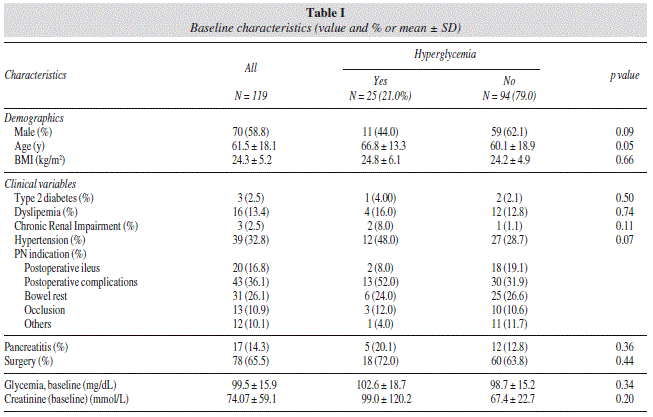
<body><![CDATA[<p><font face="Verdana" size="2">The univariate tests used were Chi-square for categorical variables and t-test for quantitative variables. These tests were performed to search for statistical differences in the variables between patients that developed hyperglycemia and those who did not.</font></p>     <p><font face="Verdana" size="2">Four multivariate studies were performed: one Cox proportional hazards regression model to study the temporal risk of the hyperglycemia occurrence (endpoint), two logistic regressions for the dependent variables of death and ICU admission; and one multiple linear regression for the dependent variable of hospital length stay. All variables were included by a stepwise method (p &lt; 0.1 for inclusion). Significance was studied using the confidence interval.</font></p>     <p><font face="Verdana" size="2">In the Cox regression model to determine the clinical factors associated with hyperglycemia occurrence, independent variables studied as a possible risk factors were: sex, diabetes mellitus type 2, pancreatitis, surgery in the 7 days prior to the endpoint, infection, difference in the amount of glucose administration between the endpoint and the day before; insulin, somatostatin and corticoids administration during the study; baseline glycemia, GFR and albumin blood level.</font></p>     <p><font face="Verdana" size="2">To determine the clinical factors associated with ICU admission, hospital length stay and death, the independent variables studied as possible risk factors were: diabetes mellitus type 2, surgery, infection, hyperglycemia, GFR and albumin blood levels.</font></p>     <p>&nbsp;</p>     <p><font face="Verdana" size="2"><b>Results</b></font></p>     <p><font face="Verdana" size="2">A total of 119 patients were enrolled in the study. For 96.6% of patients at least one daily determination of glucose was performed. Hyperglycemia (&gt; 180 mg/dL) was detected in 25 cases (21%) after an average of 4.2 &plusmn; 3.6 days after starting PN. The group of patients without hyperglycemia received PN for a period of 9.3 &plusmn; 6.6 days. There were no differences in the baseline characteristics between the group that developed hyperglycemia and the rest of patients studied except for age (<a href="#t1">table I</a>). Eight determinations of plasma glucose out of a total of 362 (2.2%) were lower than 50 mg/dL and were corrected by adjusting the pattern of insulin.</font></p>     <p>&nbsp;</p>     <p align="center"><a name="t1"><img src="/img/revistas/nh/v27n5/22_original_13_t1.gif"></a></p>     <p>&nbsp;</p>     ]]></body>
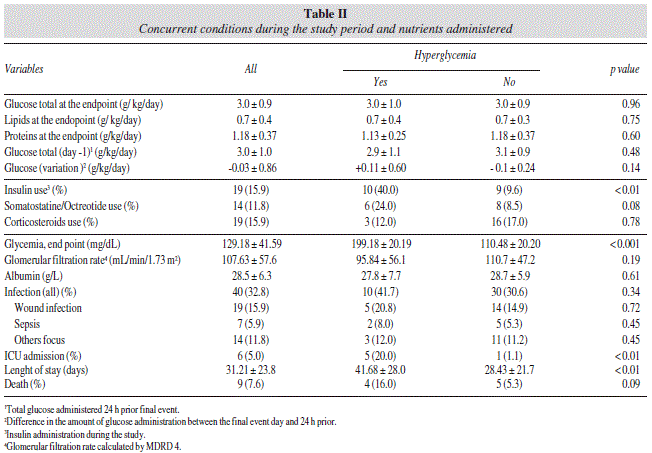
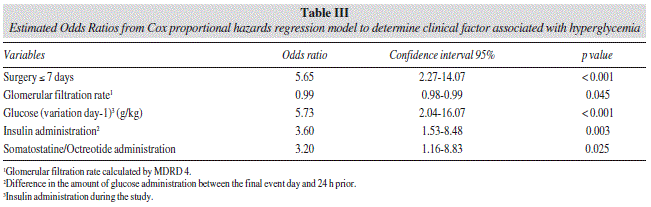
<body><![CDATA[<p><font face="Verdana" size="2"><a href="#t2">Table II</a> shows clinical variables during the study period in both groups and the amount of nutrients administered. The group of patients with hyperglycemia had significantly more days of stay and more ICU admissions than the group without hyperglycemia. The mean amount of glucose, lipid and proteins administered in the 24 h prior to the endpoint were 3 &plusmn; 0.9 g/kg/day, 0.7 &plusmn; 0.4 g/kg/day and 1.2 &plusmn; 0.4 g/kg/day, respectively.</font></p>     <p>&nbsp;</p>     <p align="center"><a name="t2"><img src="/img/revistas/nh/v27n5/22_original_13_t2.gif"></a></p>     <p>&nbsp;</p>     <p><font face="Verdana" size="2">The significant variables, as yielded by the statistical model constructed to determine the clinical factors associated with hyperglycemia, are summarized in <a href="#t3">table III</a>. Significant variables were: surgery in the 7 days before the endpoint, glomerular filtration rate, the difference of glucose amount administration in the 24 h previous to the endpoint. insulin administration and somatostatine/octreotide administration.</font></p>     <p>&nbsp;</p>     <p align="center"><a name="t3"><img src="/img/revistas/nh/v27n5/22_original_13_t3.gif"></a></p>     <p>&nbsp;</p>     <p><font face="Verdana" size="2">The only variable studied associated with a risk of ICU admission was having a hyperglycemic episode OR = 23.2 (IC 95%: 2.57-209.98). The hospital length of stay significantly increased with high values of glycemia at the endpoint coefficient b = 0.19 (IC 95%: 0.01-0.219) and showed a tendency with the presence of infection coefficient b = 0.17 (IC 95%: 0.05-17.55). In the death model none of the variables was significant.</font></p>     <p>&nbsp;</p>     ]]></body>
<body><![CDATA[<p><font face="Verdana" size="2"><b>Discussion</b></font></p>     <p><font face="Verdana" size="2">In our prospective series of non-critically patients treated with PN, we found that hyperglycemia was present in 21% of the patients, meaning that approximately one in every five patients treated with PN presented hyperglycemia. This complication was found to be related to surgical procedures in the previous 7 days, the use of somatostatin or octreotide, impaired renal function and the increase of glucose infused in the 24 h previous to the endpoint. In addition, those patients who developed hyperglycemia were more frequently admitted to ICU and had a longer hospital stay</font></p>     <p><font face="Verdana" size="2">Although similar studies showed lower rates of hyperglycemia, they were made with higher cut-offs for hyperglycemia.<sup>16,17</sup> Therefore, it is reasonable to assume that they could have higher rates with our thresholding. In fact, our incidence of hyperglycemia agrees with a recent study in non-critically ill patients with PN<sup>9</sup> that showed an incidence of 17% with a cutoff of 180 mg/L (10 mmol/L). Our results are in accordance with these in previous studies showing that patients with higher blood glucose levels during PN have longer hospital stay and more ICU admissions.<sup>8,10,11</sup> In contrast, no relationship was found between hyperglycemia and in-hospital mortality as prior works did.<sup>8,9,10,11</sup> This situation together with the lack of relationship between infection/sepsis and hyperglycemia may be due to the less critically ill population studied in comparison to other studies, which included both critically and non-critically ill patients.</font></p>     <p><font face="Verdana" size="2">Several investigators have reported hyperglycemia as a complication of PN use; however, several changes in clinical practice have been occurring in the last years proposing low levels for the standard control of glycemia. It has been shown that maintaining normoglycemia improves outcome, but may result in hypoglycemia<sup>18</sup> and associated metabolic disturbance. In our series, given the profile of patients, the onset of hypoglycemia was irrelevant.</font></p>     <p><font face="Verdana" size="2">On the other hand, poor glycemic control is a particular problem in post-operative patients receiving PN and is associated with poorer outcome an increased septic complications. Surgery, like other aggressions, lead to a chain reaction including release of stress hormones and inflammation mediators like cytokines, with a high impact on the metabolic situation in order to achieve a correct wound cicatrization.<sup>19</sup> In this context, we found that during recent post-surgery period (&le; 7 days) patients treated with PN had significant more incidence of hyperglycemia independently of the amount of glucose intake. One way to control glycemia level has been proposed by Lidder et al.<sup>20</sup> who showed that, in a specific postoperative situation (postoesophagectomy). Glycemic control can be improved by a regimen that combines enteral with parenteral feeding. Nevertheless, in our study, patients that could tolerate some oral or enteral nutrition were excluded.</font></p>     <p><font face="Verdana" size="2">Gluconeogenesis and reabsorption of filtered glucose are the main kidney mechanisms affecting glucose homeostasis together with insulin metabolization.<sup>21</sup> In patients with kidney injury, hyperglycemia and insulin resistance are common findings.<sup>22</sup> In addition, uraemia has been associated to decreased glucose tissue uptake.<sup>23</sup> In our study, we found that patients with impaired renal function have more incidence of hyperglycemia.</font></p>     <p><font face="Verdana" size="2">Current guidelines for PN recommend glucose infusions of no more than 5-7 mg/kg/min because stress-induced hypercatabolism reduces the ability to oxidize glucose and potentially induces lipogenesis, fatty liver, and hyperglycemia.<sup>24,25</sup> A recent study reported a glucose administration rate over 4 mg/kg/min as the only predictor of hyperglycemia in surgical patients.<sup>26 </sup>Glucose and caloric infusions for our cohort were consistent with current nutrition support practice guidelines (mean glucose 2.08 mg/kg/min; 23.7 kcal/kg), and none of our participants received more than 4 mg/kg/min. However, we found that a rise in glucose load within the last 24 hours is related with hyperglycemia. In fact, the risk of hyperglycemia increased 5.73 times (CI 95%: 2.1-16.1) per each extra g/kg/day administered in comparison with the day before of the hyperglycemia development.</font></p>     <p><font face="Verdana" size="2">Since hyperglycemia occurring during PN treatment is associated with increased adverse outcomes and mortality in patients receiving PN;<sup>10,11</sup> staff involved in nutrition support should be aware that patients on PN after recent surgery and renal impairment have more probability of developing hyperglycemia. The current literature documenting the adverse effects of hyperglycemia prompts a need to identify patients at risk and the development of guidelines that ensure that PN administration does not precipitate hyperglycemia. Prophylactic use of insulin in PN may be considered when administered to risk patients for whom an increase in glucose load is planned. Our results agree with studies published<sup>27,28</sup> in which patients who needed insulin to control their glucose homeostasis presented an increased risk of hyperglycemia.</font></p>     <p><font face="Verdana" size="2">Therapy with somatostatin analogues affects glucose homeostasis by inhibiting insulin pancreatic secretion. Nevertheless, even when administered under conventional dosing regimens the clinical impact is marginal, it could be sufficient to trigger an hyperglycemic event.<sup>29,30</sup> Our results are in accordance with those in previous studies where patients treated with somatostatin analogues showed high risk to developing hyperglycemia.</font></p>     <p><font face="Verdana" size="2">This study has some limitations. First, it does not evaluate the effects of persistent hyperglycemia, because hyperglycemia has been defined as a single episode appearance. In addition, patients have been collected in several hospitals with different protocols for monitoring blood glucose; therefore, there was not a unique protocol to control hyperglycemia and euglycemia for all patients included.</font></p>     ]]></body>
<body><![CDATA[<p><font face="Verdana" size="2">In conclusion, our results suggest that in addition to most of the current guidelines considerations, glucose parenteral load in non-critically ill patients receiving PN should be reassessed downwards, especially in the immediate postsurgery, renal impairment and in patients treated with somatostatin analogues. It should be taken into account that an increase in glucose dose may lead to hyperglycemia in these patients and hyperglycemia correlates with longer hospital stay and increased frequency of ICU admissions.</font></p>     <p>&nbsp;</p>     <p><font face="Verdana" size="2"><b>References</b></font></p>     <!-- ref --><p><font face="Verdana" size="2">1. Asadollahi K, Beeching N, Gill G. Hyperglycaemia and mortality. <i>J R Soc Med</i> 2007; 100 (11): 503-7.    &nbsp;&nbsp;&nbsp;&nbsp;&nbsp;&nbsp;&nbsp;&nbsp;[&#160;<a href="javascript:void(0);" onclick="javascript: window.open('/scielo.php?script=sci_nlinks&ref=3699428&pid=S0212-1611201200050002200001&lng=','','width=640,height=500,resizable=yes,scrollbars=1,menubar=yes,');">Links</a>&#160;]<!-- end-ref --></font></p>    <!-- ref --><p><font face="Verdana" size="2">2. Moghissi ES, Korytkowski MT, DiNardo M, Einhorn D, Hellman R, Hirsch IB et al. American Association of Clinical Endocrinologists and American Diabetes Association consensus statement on inpatient glycemic control. <i>Diabetes Care</i> 2009; 32 (6): 1119-31.    &nbsp;&nbsp;&nbsp;&nbsp;&nbsp;&nbsp;&nbsp;&nbsp;[&#160;<a href="javascript:void(0);" onclick="javascript: window.open('/scielo.php?script=sci_nlinks&ref=3699430&pid=S0212-1611201200050002200002&lng=','','width=640,height=500,resizable=yes,scrollbars=1,menubar=yes,');">Links</a>&#160;]<!-- end-ref --></font></p>    <!-- ref --><p><font face="Verdana" size="2">3. Inzucchi SE, Siegel MD. Glucose control in the ICU-how tight is too tight? <i>N Engl J Med</i> 2009; 360 (13): 1346-9.    &nbsp;&nbsp;&nbsp;&nbsp;&nbsp;&nbsp;&nbsp;&nbsp;[&#160;<a href="javascript:void(0);" onclick="javascript: window.open('/scielo.php?script=sci_nlinks&ref=3699432&pid=S0212-1611201200050002200003&lng=','','width=640,height=500,resizable=yes,scrollbars=1,menubar=yes,');">Links</a>&#160;]<!-- end-ref --></font></p>    <!-- ref --><p><font face="Verdana" size="2">4. Marik PE, Preiser JC. Toward understanding tight glycemic control in the ICU: a systematic review and metaanalysis. <i>Chest</i> 2010; 137 (3): 544-51.    &nbsp;&nbsp;&nbsp;&nbsp;&nbsp;&nbsp;&nbsp;&nbsp;[&#160;<a href="javascript:void(0);" onclick="javascript: window.open('/scielo.php?script=sci_nlinks&ref=3699434&pid=S0212-1611201200050002200004&lng=','','width=640,height=500,resizable=yes,scrollbars=1,menubar=yes,');">Links</a>&#160;]<!-- end-ref --></font></p>    <!-- ref --><p><font face="Verdana" size="2">5. Van den Berghe G, Wouters P, Weekers T, et al. Intensive insulin therapy in the critically ill patients. <i>N Engl J Med</i> 2001; 345: 1359-1367.    &nbsp;&nbsp;&nbsp;&nbsp;&nbsp;&nbsp;&nbsp;&nbsp;[&#160;<a href="javascript:void(0);" onclick="javascript: window.open('/scielo.php?script=sci_nlinks&ref=3699436&pid=S0212-1611201200050002200005&lng=','','width=640,height=500,resizable=yes,scrollbars=1,menubar=yes,');">Links</a>&#160;]<!-- end-ref --></font></p>    <!-- ref --><p><font face="Verdana" size="2">6. Van den Berghe G, Wouters PJ, Bouillon R, et al. Outcome benefit of intensive insulin therapy in the critically ill: insulin dose versus glycemic control. <i>Crit Care Mes</i> 2003; 31: 359-366.    &nbsp;&nbsp;&nbsp;&nbsp;&nbsp;&nbsp;&nbsp;&nbsp;[&#160;<a href="javascript:void(0);" onclick="javascript: window.open('/scielo.php?script=sci_nlinks&ref=3699438&pid=S0212-1611201200050002200006&lng=','','width=640,height=500,resizable=yes,scrollbars=1,menubar=yes,');">Links</a>&#160;]<!-- end-ref --></font></p>    <!-- ref --><p><font face="Verdana" size="2">7. Btaiche IF, Khalidi N. Metabolic complications of parenteral nutrition in adults, part 1. <i>Am J Health Syst Pharm</i> 2004; 61 (18): 1938-49.    &nbsp;&nbsp;&nbsp;&nbsp;&nbsp;&nbsp;&nbsp;&nbsp;[&#160;<a href="javascript:void(0);" onclick="javascript: window.open('/scielo.php?script=sci_nlinks&ref=3699440&pid=S0212-1611201200050002200007&lng=','','width=640,height=500,resizable=yes,scrollbars=1,menubar=yes,');">Links</a>&#160;]<!-- end-ref --></font></p>    <!-- ref --><p><font face="Verdana" size="2">8. Cheung NW, Napier B, Zaccaria C, Fletcher JP. Hyperglycemia is associated with adverse outcomes in patients receiving total parenteral nutrition. <i>Diabetes Care</i> 2005; 28 (10): 2367-71.    &nbsp;&nbsp;&nbsp;&nbsp;&nbsp;&nbsp;&nbsp;&nbsp;[&#160;<a href="javascript:void(0);" onclick="javascript: window.open('/scielo.php?script=sci_nlinks&ref=3699442&pid=S0212-1611201200050002200008&lng=','','width=640,height=500,resizable=yes,scrollbars=1,menubar=yes,');">Links</a>&#160;]<!-- end-ref --></font></p>    <!-- ref --><p><font face="Verdana" size="2">9. Sarkisian S, Fenton TR, Shaheen AA, Raman M. Parenteral nutrition-associated hyperglycemia in noncritically ill inpa-tients is associated with higher mortality. <i>Can J Gastroenterol</i> 2010; 24 (7): 453-7.    &nbsp;&nbsp;&nbsp;&nbsp;&nbsp;&nbsp;&nbsp;&nbsp;[&#160;<a href="javascript:void(0);" onclick="javascript: window.open('/scielo.php?script=sci_nlinks&ref=3699444&pid=S0212-1611201200050002200009&lng=','','width=640,height=500,resizable=yes,scrollbars=1,menubar=yes,');">Links</a>&#160;]<!-- end-ref --></font></p>    <!-- ref --><p><font face="Verdana" size="2">10. Lin LY, Lin HC, Lee PC, Ma WY, Lin HD. Hyperglycemia correlates with outcomes in patients receiving total parenteral nutrition. <i>Am J Med Sci</i> 2007; 333 (5): 261-5.    &nbsp;&nbsp;&nbsp;&nbsp;&nbsp;&nbsp;&nbsp;&nbsp;[&#160;<a href="javascript:void(0);" onclick="javascript: window.open('/scielo.php?script=sci_nlinks&ref=3699446&pid=S0212-1611201200050002200010&lng=','','width=640,height=500,resizable=yes,scrollbars=1,menubar=yes,');">Links</a>&#160;]<!-- end-ref --></font></p>    <!-- ref --><p><font face="Verdana" size="2">11. Pasquel FJ, Spiegelman R, McCauley M, Smiley D, Umpierrez D, Johnson R, et al. Hyperglycemia during total parenteral nutrition: an important marker of poor outcome and mortality in hospitalized patients. <i>Diabetes Care</i> 2010; 33 (4): 739-41.    &nbsp;&nbsp;&nbsp;&nbsp;&nbsp;&nbsp;&nbsp;&nbsp;[&#160;<a href="javascript:void(0);" onclick="javascript: window.open('/scielo.php?script=sci_nlinks&ref=3699448&pid=S0212-1611201200050002200011&lng=','','width=640,height=500,resizable=yes,scrollbars=1,menubar=yes,');">Links</a>&#160;]<!-- end-ref --></font></p>    <!-- ref --><p><font face="Verdana" size="2">12. Dissanaike S, Shelton M, Warner K, O'Keefe GE. The risk for bloodstream infections is associated with increased parenteral caloric intake in patients receiving parenteral nutrition. <i>Crit Care</i> 2007; 11 (5): R114.    &nbsp;&nbsp;&nbsp;&nbsp;&nbsp;&nbsp;&nbsp;&nbsp;[&#160;<a href="javascript:void(0);" onclick="javascript: window.open('/scielo.php?script=sci_nlinks&ref=3699450&pid=S0212-1611201200050002200012&lng=','','width=640,height=500,resizable=yes,scrollbars=1,menubar=yes,');">Links</a>&#160;]<!-- end-ref --></font></p>    <!-- ref --><p><font face="Verdana" size="2">13. Blackburn GL, Wollner S, Bistrian BR. Nutrition support in the intensive care unit: an evolving science. <i>Arch Surg</i> 2010; 145 (6): 533-8.    &nbsp;&nbsp;&nbsp;&nbsp;&nbsp;&nbsp;&nbsp;&nbsp;[&#160;<a href="javascript:void(0);" onclick="javascript: window.open('/scielo.php?script=sci_nlinks&ref=3699452&pid=S0212-1611201200050002200013&lng=','','width=640,height=500,resizable=yes,scrollbars=1,menubar=yes,');">Links</a>&#160;]<!-- end-ref --></font></p>    <!-- ref --><p><font face="Verdana" size="2">14. Marti-Bonmati E, Ortega-Garcia MP, Cervera-Casino P, Lacasa C, Llop JL, Villalobos JL,  et al. Multicenter study on the prevalence of hyperglycemia among hospitalized patients with parenteral nutrition. <i>Farm Hosp</i> 2006; 30 (1): 12-9.    &nbsp;&nbsp;&nbsp;&nbsp;&nbsp;&nbsp;&nbsp;&nbsp;[&#160;<a href="javascript:void(0);" onclick="javascript: window.open('/scielo.php?script=sci_nlinks&ref=3699454&pid=S0212-1611201200050002200014&lng=','','width=640,height=500,resizable=yes,scrollbars=1,menubar=yes,');">Links</a>&#160;]<!-- end-ref --></font></p>    <!-- ref --><p><font face="Verdana" size="2">15. American College of Chest Physicians/Society of Critical Care Medicine Consensus Conference: definitions for sepsis and organ failure and guidelines for the use of innovative therapies in sepsis. <i>Crit Care Med</i> 1992; 20 (6): 864-74.    &nbsp;&nbsp;&nbsp;&nbsp;&nbsp;&nbsp;&nbsp;&nbsp;[&#160;<a href="javascript:void(0);" onclick="javascript: window.open('/scielo.php?script=sci_nlinks&ref=3699456&pid=S0212-1611201200050002200015&lng=','','width=640,height=500,resizable=yes,scrollbars=1,menubar=yes,');">Links</a>&#160;]<!-- end-ref --></font></p>    <!-- ref --><p><font face="Verdana" size="2">16. Pleva M, Mirtallo JM, Steinberg SM. Hyperglycemic events in non-intensive care unit patients receiving parenteral nutrition. <i>Nutr Clin Pract</i> 2009; 24 (5): 626-34.    &nbsp;&nbsp;&nbsp;&nbsp;&nbsp;&nbsp;&nbsp;&nbsp;[&#160;<a href="javascript:void(0);" onclick="javascript: window.open('/scielo.php?script=sci_nlinks&ref=3699458&pid=S0212-1611201200050002200016&lng=','','width=640,height=500,resizable=yes,scrollbars=1,menubar=yes,');">Links</a>&#160;]<!-- end-ref --></font></p>    <!-- ref --><p><font face="Verdana" size="2">17. Valero MA, Alegre E, Gomis P, Moreno JM, Miguelez S, Leon-Sanz M. Clinical management of hyperglycaemic patients receiving total parenteral nutrition. <i>Clin Nutr</i> 1996; 15 (1): 11-5.    &nbsp;&nbsp;&nbsp;&nbsp;&nbsp;&nbsp;&nbsp;&nbsp;[&#160;<a href="javascript:void(0);" onclick="javascript: window.open('/scielo.php?script=sci_nlinks&ref=3699460&pid=S0212-1611201200050002200017&lng=','','width=640,height=500,resizable=yes,scrollbars=1,menubar=yes,');">Links</a>&#160;]<!-- end-ref --></font></p>    <!-- ref --><p><font face="Verdana" size="2">18. Collier B, Dossett LA, May AK, Diaz JJ. Glucose control and the inflammatory response. <i>Nutr Clin Pract</i> 2008; 23 (1): 3-15.    &nbsp;&nbsp;&nbsp;&nbsp;&nbsp;&nbsp;&nbsp;&nbsp;[&#160;<a href="javascript:void(0);" onclick="javascript: window.open('/scielo.php?script=sci_nlinks&ref=3699462&pid=S0212-1611201200050002200018&lng=','','width=640,height=500,resizable=yes,scrollbars=1,menubar=yes,');">Links</a>&#160;]<!-- end-ref --></font></p>    <!-- ref --><p><font face="Verdana" size="2">19. Karen C. McCowen, Atul Malhotra, Bruce R. Bistrian. Stress-Induced Hyperglycemia. <i>Critical Care Clinics</i> 2001; 17 (1):107-124.    &nbsp;&nbsp;&nbsp;&nbsp;&nbsp;&nbsp;&nbsp;&nbsp;[&#160;<a href="javascript:void(0);" onclick="javascript: window.open('/scielo.php?script=sci_nlinks&ref=3699464&pid=S0212-1611201200050002200019&lng=','','width=640,height=500,resizable=yes,scrollbars=1,menubar=yes,');">Links</a>&#160;]<!-- end-ref --></font></p>    <!-- ref --><p><font face="Verdana" size="2">20. Lidder P, Flanagan D, Fleming S, Rusell M et al. Combining enteral with parenteral nutrition to improve postoperative glucose control. <i>British Journal of Nutrition</i> 2010; 103: 1635-1641.    &nbsp;&nbsp;&nbsp;&nbsp;&nbsp;&nbsp;&nbsp;&nbsp;[&#160;<a href="javascript:void(0);" onclick="javascript: window.open('/scielo.php?script=sci_nlinks&ref=3699466&pid=S0212-1611201200050002200020&lng=','','width=640,height=500,resizable=yes,scrollbars=1,menubar=yes,');">Links</a>&#160;]<!-- end-ref --></font></p>    <!-- ref --><p><font face="Verdana" size="2">21. Fiaccadori E, Parenti E, Maggiore U. Nutritional support in acute kidney injury. <i>J Nephrol</i> 2008; 21 (5): 645-56.    &nbsp;&nbsp;&nbsp;&nbsp;&nbsp;&nbsp;&nbsp;&nbsp;[&#160;<a href="javascript:void(0);" onclick="javascript: window.open('/scielo.php?script=sci_nlinks&ref=3699468&pid=S0212-1611201200050002200021&lng=','','width=640,height=500,resizable=yes,scrollbars=1,menubar=yes,');">Links</a>&#160;]<!-- end-ref --></font></p>    <!-- ref --><p><font face="Verdana" size="2">22. Cano NJ, Aparicio M, Brunori G, Carrero JJ, Cianciaruso B, Fiaccadori E, et al. ESPEN Guidelines on Parenteral Nutrition: adult renal failure. <i>Clin Nutr</i> 2009; 28 (4): 401-14.    &nbsp;&nbsp;&nbsp;&nbsp;&nbsp;&nbsp;&nbsp;&nbsp;[&#160;<a href="javascript:void(0);" onclick="javascript: window.open('/scielo.php?script=sci_nlinks&ref=3699470&pid=S0212-1611201200050002200022&lng=','','width=640,height=500,resizable=yes,scrollbars=1,menubar=yes,');">Links</a>&#160;]<!-- end-ref --></font></p>    <!-- ref --><p><font face="Verdana" size="2">23. Basi S, Pupim LB, Simmons EM, Sezer MT, Shyr Y, Freedman S, et al. Insulin resistance in critically ill patients with acute renal failure. <i>Am J Physiol Renal Physiol</i> 2005; 289 (2): F259-F264.    &nbsp;&nbsp;&nbsp;&nbsp;&nbsp;&nbsp;&nbsp;&nbsp;[&#160;<a href="javascript:void(0);" onclick="javascript: window.open('/scielo.php?script=sci_nlinks&ref=3699472&pid=S0212-1611201200050002200023&lng=','','width=640,height=500,resizable=yes,scrollbars=1,menubar=yes,');">Links</a>&#160;]<!-- end-ref --></font></p>    <!-- ref --><p><font face="Verdana" size="2">24. Mirtallo J, Canada T, Johnson D, Kumpf V, Petersen C, Sacks G, et al. Safe practices for parenteral nutrition. <i>JPEN J Parenter Enteral Nutr</i> 2004; 28 (6): S39-S70.    &nbsp;&nbsp;&nbsp;&nbsp;&nbsp;&nbsp;&nbsp;&nbsp;[&#160;<a href="javascript:void(0);" onclick="javascript: window.open('/scielo.php?script=sci_nlinks&ref=3699474&pid=S0212-1611201200050002200024&lng=','','width=640,height=500,resizable=yes,scrollbars=1,menubar=yes,');">Links</a>&#160;]<!-- end-ref --></font></p>    <!-- ref --><p><font face="Verdana" size="2">25. Rosmarin DK, Wardlaw GM, Mirtallo J. Hyperglycemia associated with high, continuous infusion rates of total parenteral nutrition dextrose. <i>Nutr Clin Pract</i> 1996; 11 (4): 151-6.    &nbsp;&nbsp;&nbsp;&nbsp;&nbsp;&nbsp;&nbsp;&nbsp;[&#160;<a href="javascript:void(0);" onclick="javascript: window.open('/scielo.php?script=sci_nlinks&ref=3699476&pid=S0212-1611201200050002200025&lng=','','width=640,height=500,resizable=yes,scrollbars=1,menubar=yes,');">Links</a>&#160;]<!-- end-ref --></font></p>    <!-- ref --><p><font face="Verdana" size="2">26. Ahrens CL, Barletta JF, Kanji S, Tyburski JG, Wilson RF, Janisse JJ, et al. Effect of low-calorie parenteral nutrition on the incidence and severity of hyperglycemia in surgical patients: a randomized, controlled trial. <i>Crit Care Med</i> 2005; 33 (11): 2507-12.    &nbsp;&nbsp;&nbsp;&nbsp;&nbsp;&nbsp;&nbsp;&nbsp;[&#160;<a href="javascript:void(0);" onclick="javascript: window.open('/scielo.php?script=sci_nlinks&ref=3699478&pid=S0212-1611201200050002200026&lng=','','width=640,height=500,resizable=yes,scrollbars=1,menubar=yes,');">Links</a>&#160;]<!-- end-ref --></font></p>    <!-- ref --><p><font face="Verdana" size="2">27. Cely CM, Arora P, Quartin AA, Kett DH, Schein RM. Relationship of baseline glucose homeostasis to hyperglycemia during medical critical illness. <i>Chest</i> 2004; 126 (3):879-87.    &nbsp;&nbsp;&nbsp;&nbsp;&nbsp;&nbsp;&nbsp;&nbsp;[&#160;<a href="javascript:void(0);" onclick="javascript: window.open('/scielo.php?script=sci_nlinks&ref=3699480&pid=S0212-1611201200050002200027&lng=','','width=640,height=500,resizable=yes,scrollbars=1,menubar=yes,');">Links</a>&#160;]<!-- end-ref --></font></p>    <!-- ref --><p><font face="Verdana" size="2">28. Moghissi ES. Addressing hyperglycemia from hospital admission to discharge. <i>Curr Med Res Opin</i> 2010; 26 (3): 589-98.    &nbsp;&nbsp;&nbsp;&nbsp;&nbsp;&nbsp;&nbsp;&nbsp;[&#160;<a href="javascript:void(0);" onclick="javascript: window.open('/scielo.php?script=sci_nlinks&ref=3699482&pid=S0212-1611201200050002200028&lng=','','width=640,height=500,resizable=yes,scrollbars=1,menubar=yes,');">Links</a>&#160;]<!-- end-ref --></font></p>    <!-- ref --><p><font face="Verdana" size="2">29. Pereira AM, Biermasz NR, Roelfsema F, Romijn JA. Pharma-cologic therapies for acromegaly: a review of their effects on glucose metabolism and insulin resistance. <i>Treat Endocrinol</i> 2005; 4 (1): 43-53.    &nbsp;&nbsp;&nbsp;&nbsp;&nbsp;&nbsp;&nbsp;&nbsp;[&#160;<a href="javascript:void(0);" onclick="javascript: window.open('/scielo.php?script=sci_nlinks&ref=3699484&pid=S0212-1611201200050002200029&lng=','','width=640,height=500,resizable=yes,scrollbars=1,menubar=yes,');">Links</a>&#160;]<!-- end-ref --></font></p>    <!-- ref --><p><font face="Verdana" size="2">30. Resmini E, Minuto F, Colao A, Ferone D. Secondary diabetes associated with principal endocrinopathies: the impact of new treatment modalities. <i>Acta Diabetol</i> 2009; 46 (2): 85-95.    &nbsp;&nbsp;&nbsp;&nbsp;&nbsp;&nbsp;&nbsp;&nbsp;[&#160;<a href="javascript:void(0);" onclick="javascript: window.open('/scielo.php?script=sci_nlinks&ref=3699486&pid=S0212-1611201200050002200030&lng=','','width=640,height=500,resizable=yes,scrollbars=1,menubar=yes,');">Links</a>&#160;]<!-- end-ref --></font></p>     <p>&nbsp;</p>     <p>&nbsp;</p>     <p><font face="Verdana" size="2"><a href="#top"><img border="0" src="/img/revistas/nh/v27n5/seta.gif" width="15" height="17"></a><a name="bajo"></a><b>Correspondence:</b>    <br>Josep Llop Talaveron    <br>Servicio de Farmacia    <br>Hospital Universitari Bellvitge-IDIBELL    <br>08907 L'Hospitalet de Llobregat. Barcelona    ]]></body>
<body><![CDATA[<br>E-mail: <a href="mailto:josep.llop@bellvitgehospital.cat">josep.llop@bellvitgehospital.cat</a></font></p>     <p><font face="Verdana" size="2">Recibido: 1-IV-2012    <br>1<sup>a</sup> Revisión: 19-IV-2012    <br>Aceptado: 28-IV-2012</font></p>      ]]></body><back>
<ref-list>
<ref id="B1">
<label>1</label><nlm-citation citation-type="journal">
<person-group person-group-type="author">
<name>
<surname><![CDATA[Asadollahi]]></surname>
<given-names><![CDATA[K]]></given-names>
</name>
<name>
<surname><![CDATA[Beeching]]></surname>
<given-names><![CDATA[N]]></given-names>
</name>
<name>
<surname><![CDATA[Gill]]></surname>
<given-names><![CDATA[G]]></given-names>
</name>
</person-group>
<article-title xml:lang="en"><![CDATA[Hyperglycaemia and mortality]]></article-title>
<source><![CDATA[J R Soc Med]]></source>
<year>2007</year>
<volume>100</volume>
<numero>11</numero>
<issue>11</issue>
<page-range>503-7</page-range></nlm-citation>
</ref>
<ref id="B2">
<label>2</label><nlm-citation citation-type="journal">
<person-group person-group-type="author">
<name>
<surname><![CDATA[Moghissi]]></surname>
<given-names><![CDATA[ES]]></given-names>
</name>
<name>
<surname><![CDATA[Korytkowski]]></surname>
<given-names><![CDATA[MT]]></given-names>
</name>
<name>
<surname><![CDATA[DiNardo]]></surname>
<given-names><![CDATA[M]]></given-names>
</name>
<name>
<surname><![CDATA[Einhorn]]></surname>
<given-names><![CDATA[D]]></given-names>
</name>
<name>
<surname><![CDATA[Hellman]]></surname>
<given-names><![CDATA[R]]></given-names>
</name>
<name>
<surname><![CDATA[Hirsch]]></surname>
<given-names><![CDATA[IB]]></given-names>
</name>
</person-group>
<article-title xml:lang="en"><![CDATA[American Association of Clinical Endocrinologists and American Diabetes Association consensus statement on inpatient glycemic control]]></article-title>
<source><![CDATA[Diabetes Care]]></source>
<year>2009</year>
<volume>32</volume>
<numero>6</numero>
<issue>6</issue>
<page-range>1119-31</page-range></nlm-citation>
</ref>
<ref id="B3">
<label>3</label><nlm-citation citation-type="journal">
<person-group person-group-type="author">
<name>
<surname><![CDATA[Inzucchi]]></surname>
<given-names><![CDATA[SE]]></given-names>
</name>
<name>
<surname><![CDATA[Siegel]]></surname>
<given-names><![CDATA[MD]]></given-names>
</name>
</person-group>
<article-title xml:lang="en"><![CDATA[Glucose control in the ICU-how tight is too tight?]]></article-title>
<source><![CDATA[N Engl J Med]]></source>
<year>2009</year>
<volume>360</volume>
<numero>13</numero>
<issue>13</issue>
<page-range>1346-9</page-range></nlm-citation>
</ref>
<ref id="B4">
<label>4</label><nlm-citation citation-type="journal">
<person-group person-group-type="author">
<name>
<surname><![CDATA[Marik]]></surname>
<given-names><![CDATA[PE]]></given-names>
</name>
<name>
<surname><![CDATA[Preiser]]></surname>
<given-names><![CDATA[JC]]></given-names>
</name>
</person-group>
<article-title xml:lang="en"><![CDATA[Toward understanding tight glycemic control in the ICU: a systematic review and metaanalysis]]></article-title>
<source><![CDATA[Chest]]></source>
<year>2010</year>
<volume>137</volume>
<numero>3</numero>
<issue>3</issue>
<page-range>544-51</page-range></nlm-citation>
</ref>
<ref id="B5">
<label>5</label><nlm-citation citation-type="journal">
<person-group person-group-type="author">
<name>
<surname><![CDATA[Van den Berghe]]></surname>
<given-names><![CDATA[G]]></given-names>
</name>
<name>
<surname><![CDATA[Wouters]]></surname>
<given-names><![CDATA[P]]></given-names>
</name>
<name>
<surname><![CDATA[Weekers]]></surname>
<given-names><![CDATA[T]]></given-names>
</name>
</person-group>
<article-title xml:lang="en"><![CDATA[Intensive insulin therapy in the critically ill patients]]></article-title>
<source><![CDATA[N Engl J Med]]></source>
<year>2001</year>
<volume>345</volume>
<page-range>1359-1367</page-range></nlm-citation>
</ref>
<ref id="B6">
<label>6</label><nlm-citation citation-type="journal">
<person-group person-group-type="author">
<name>
<surname><![CDATA[Van den Berghe]]></surname>
<given-names><![CDATA[G]]></given-names>
</name>
<name>
<surname><![CDATA[Wouters]]></surname>
<given-names><![CDATA[PJ]]></given-names>
</name>
<name>
<surname><![CDATA[Bouillon]]></surname>
<given-names><![CDATA[R]]></given-names>
</name>
</person-group>
<article-title xml:lang="en"><![CDATA[Outcome benefit of intensive insulin therapy in the critically ill: insulin dose versus glycemic control]]></article-title>
<source><![CDATA[Crit Care Mes]]></source>
<year>2003</year>
<volume>31</volume>
<page-range>359-366</page-range></nlm-citation>
</ref>
<ref id="B7">
<label>7</label><nlm-citation citation-type="journal">
<person-group person-group-type="author">
<name>
<surname><![CDATA[Btaiche]]></surname>
<given-names><![CDATA[IF]]></given-names>
</name>
<name>
<surname><![CDATA[Khalidi]]></surname>
<given-names><![CDATA[N]]></given-names>
</name>
</person-group>
<article-title xml:lang="en"><![CDATA[Metabolic complications of parenteral nutrition in adults, part 1]]></article-title>
<source><![CDATA[Am J Health Syst Pharm]]></source>
<year>2004</year>
<volume>61</volume>
<numero>18</numero>
<issue>18</issue>
<page-range>1938-49</page-range></nlm-citation>
</ref>
<ref id="B8">
<label>8</label><nlm-citation citation-type="journal">
<person-group person-group-type="author">
<name>
<surname><![CDATA[Cheung]]></surname>
<given-names><![CDATA[NW]]></given-names>
</name>
<name>
<surname><![CDATA[Napier]]></surname>
<given-names><![CDATA[B]]></given-names>
</name>
<name>
<surname><![CDATA[Zaccaria]]></surname>
<given-names><![CDATA[C]]></given-names>
</name>
<name>
<surname><![CDATA[Fletcher]]></surname>
<given-names><![CDATA[JP]]></given-names>
</name>
</person-group>
<article-title xml:lang="en"><![CDATA[Hyperglycemia is associated with adverse outcomes in patients receiving total parenteral nutrition]]></article-title>
<source><![CDATA[Diabetes Care]]></source>
<year>2005</year>
<volume>28</volume>
<numero>10</numero>
<issue>10</issue>
<page-range>2367-71</page-range></nlm-citation>
</ref>
<ref id="B9">
<label>9</label><nlm-citation citation-type="journal">
<person-group person-group-type="author">
<name>
<surname><![CDATA[Sarkisian]]></surname>
<given-names><![CDATA[S]]></given-names>
</name>
<name>
<surname><![CDATA[Fenton]]></surname>
<given-names><![CDATA[TR]]></given-names>
</name>
<name>
<surname><![CDATA[Shaheen]]></surname>
<given-names><![CDATA[AA]]></given-names>
</name>
<name>
<surname><![CDATA[Raman]]></surname>
<given-names><![CDATA[M]]></given-names>
</name>
</person-group>
<article-title xml:lang="en"><![CDATA[Parenteral nutrition-associated hyperglycemia in noncritically ill inpa-tients is associated with higher mortality]]></article-title>
<source><![CDATA[Can J Gastroenterol]]></source>
<year>2010</year>
<volume>24</volume>
<numero>7</numero>
<issue>7</issue>
<page-range>453-7</page-range></nlm-citation>
</ref>
<ref id="B10">
<label>10</label><nlm-citation citation-type="journal">
<person-group person-group-type="author">
<name>
<surname><![CDATA[Lin]]></surname>
<given-names><![CDATA[LY]]></given-names>
</name>
<name>
<surname><![CDATA[Lin]]></surname>
<given-names><![CDATA[HC]]></given-names>
</name>
<name>
<surname><![CDATA[Lee]]></surname>
<given-names><![CDATA[PC]]></given-names>
</name>
<name>
<surname><![CDATA[Ma]]></surname>
<given-names><![CDATA[WY]]></given-names>
</name>
<name>
<surname><![CDATA[Lin]]></surname>
<given-names><![CDATA[HD]]></given-names>
</name>
</person-group>
<article-title xml:lang="en"><![CDATA[Hyperglycemia correlates with outcomes in patients receiving total parenteral nutrition]]></article-title>
<source><![CDATA[Am J Med Sci]]></source>
<year>2007</year>
<volume>333</volume>
<numero>5</numero>
<issue>5</issue>
<page-range>261-5</page-range></nlm-citation>
</ref>
<ref id="B11">
<label>11</label><nlm-citation citation-type="journal">
<person-group person-group-type="author">
<name>
<surname><![CDATA[Pasquel]]></surname>
<given-names><![CDATA[FJ]]></given-names>
</name>
<name>
<surname><![CDATA[Spiegelman]]></surname>
<given-names><![CDATA[R]]></given-names>
</name>
<name>
<surname><![CDATA[McCauley]]></surname>
<given-names><![CDATA[M]]></given-names>
</name>
<name>
<surname><![CDATA[Smiley]]></surname>
<given-names><![CDATA[D]]></given-names>
</name>
<name>
<surname><![CDATA[Umpierrez]]></surname>
<given-names><![CDATA[D]]></given-names>
</name>
<name>
<surname><![CDATA[Johnson]]></surname>
<given-names><![CDATA[R]]></given-names>
</name>
</person-group>
<article-title xml:lang="en"><![CDATA[Hyperglycemia during total parenteral nutrition: an important marker of poor outcome and mortality in hospitalized patients]]></article-title>
<source><![CDATA[Diabetes Care]]></source>
<year>2010</year>
<volume>33</volume>
<numero>4</numero>
<issue>4</issue>
<page-range>739-41</page-range></nlm-citation>
</ref>
<ref id="B12">
<label>12</label><nlm-citation citation-type="journal">
<person-group person-group-type="author">
<name>
<surname><![CDATA[Dissanaike]]></surname>
<given-names><![CDATA[S]]></given-names>
</name>
<name>
<surname><![CDATA[Shelton]]></surname>
<given-names><![CDATA[M]]></given-names>
</name>
<name>
<surname><![CDATA[Warner]]></surname>
<given-names><![CDATA[K]]></given-names>
</name>
<name>
<surname><![CDATA[O'Keefe]]></surname>
<given-names><![CDATA[GE]]></given-names>
</name>
</person-group>
<article-title xml:lang="en"><![CDATA[The risk for bloodstream infections is associated with increased parenteral caloric intake in patients receiving parenteral nutrition]]></article-title>
<source><![CDATA[Crit Care]]></source>
<year>2007</year>
<volume>11</volume>
<numero>5</numero>
<issue>5</issue>
<page-range>R114</page-range></nlm-citation>
</ref>
<ref id="B13">
<label>13</label><nlm-citation citation-type="journal">
<person-group person-group-type="author">
<name>
<surname><![CDATA[Blackburn]]></surname>
<given-names><![CDATA[GL]]></given-names>
</name>
<name>
<surname><![CDATA[Wollner]]></surname>
<given-names><![CDATA[S]]></given-names>
</name>
<name>
<surname><![CDATA[Bistrian]]></surname>
<given-names><![CDATA[BR]]></given-names>
</name>
</person-group>
<article-title xml:lang="en"><![CDATA[Nutrition support in the intensive care unit: an evolving science]]></article-title>
<source><![CDATA[Arch Surg]]></source>
<year>2010</year>
<volume>145</volume>
<numero>6</numero>
<issue>6</issue>
<page-range>533-8</page-range></nlm-citation>
</ref>
<ref id="B14">
<label>14</label><nlm-citation citation-type="journal">
<person-group person-group-type="author">
<name>
<surname><![CDATA[Marti-Bonmati]]></surname>
<given-names><![CDATA[E]]></given-names>
</name>
<name>
<surname><![CDATA[Ortega-Garcia]]></surname>
<given-names><![CDATA[MP]]></given-names>
</name>
<name>
<surname><![CDATA[Cervera-Casino]]></surname>
<given-names><![CDATA[P]]></given-names>
</name>
<name>
<surname><![CDATA[Lacasa]]></surname>
<given-names><![CDATA[C]]></given-names>
</name>
<name>
<surname><![CDATA[Llop]]></surname>
<given-names><![CDATA[JL]]></given-names>
</name>
<name>
<surname><![CDATA[Villalobos]]></surname>
<given-names><![CDATA[JL]]></given-names>
</name>
</person-group>
<article-title xml:lang="en"><![CDATA[Multicenter study on the prevalence of hyperglycemia among hospitalized patients with parenteral nutrition]]></article-title>
<source><![CDATA[Farm Hosp]]></source>
<year>2006</year>
<volume>30</volume>
<numero>1</numero>
<issue>1</issue>
<page-range>12-9</page-range></nlm-citation>
</ref>
<ref id="B15">
<label>15</label><nlm-citation citation-type="journal">
<collab>American College of Chest Physicians</collab>
<collab>Society of Critical Care Medicine</collab>
<article-title xml:lang="en"><![CDATA[Consensus Conference: definitions for sepsis and organ failure and guidelines for the use of innovative therapies in sepsis]]></article-title>
<source><![CDATA[Crit Care Med]]></source>
<year>1992</year>
<volume>20</volume>
<numero>6</numero>
<issue>6</issue>
<page-range>864-74</page-range></nlm-citation>
</ref>
<ref id="B16">
<label>16</label><nlm-citation citation-type="journal">
<person-group person-group-type="author">
<name>
<surname><![CDATA[Pleva]]></surname>
<given-names><![CDATA[M]]></given-names>
</name>
<name>
<surname><![CDATA[Mirtallo]]></surname>
<given-names><![CDATA[JM]]></given-names>
</name>
<name>
<surname><![CDATA[Steinberg]]></surname>
<given-names><![CDATA[SM]]></given-names>
</name>
</person-group>
<article-title xml:lang="en"><![CDATA[Hyperglycemic events in non-intensive care unit patients receiving parenteral nutrition]]></article-title>
<source><![CDATA[Nutr Clin Pract]]></source>
<year>2009</year>
<volume>24</volume>
<numero>5</numero>
<issue>5</issue>
<page-range>626-34</page-range></nlm-citation>
</ref>
<ref id="B17">
<label>17</label><nlm-citation citation-type="journal">
<person-group person-group-type="author">
<name>
<surname><![CDATA[Valero]]></surname>
<given-names><![CDATA[MA]]></given-names>
</name>
<name>
<surname><![CDATA[Alegre]]></surname>
<given-names><![CDATA[E]]></given-names>
</name>
<name>
<surname><![CDATA[Gomis]]></surname>
<given-names><![CDATA[P]]></given-names>
</name>
<name>
<surname><![CDATA[Moreno]]></surname>
<given-names><![CDATA[JM]]></given-names>
</name>
<name>
<surname><![CDATA[Miguelez]]></surname>
<given-names><![CDATA[S]]></given-names>
</name>
<name>
<surname><![CDATA[Leon-Sanz]]></surname>
<given-names><![CDATA[M]]></given-names>
</name>
</person-group>
<article-title xml:lang="en"><![CDATA[Clinical management of hyperglycaemic patients receiving total parenteral nutrition]]></article-title>
<source><![CDATA[Clin Nutr]]></source>
<year>1996</year>
<volume>15</volume>
<numero>1</numero>
<issue>1</issue>
<page-range>11-5</page-range></nlm-citation>
</ref>
<ref id="B18">
<label>18</label><nlm-citation citation-type="journal">
<person-group person-group-type="author">
<name>
<surname><![CDATA[Collier]]></surname>
<given-names><![CDATA[B]]></given-names>
</name>
<name>
<surname><![CDATA[Dossett]]></surname>
<given-names><![CDATA[LA]]></given-names>
</name>
<name>
<surname><![CDATA[May]]></surname>
<given-names><![CDATA[AK]]></given-names>
</name>
<name>
<surname><![CDATA[Diaz]]></surname>
<given-names><![CDATA[JJ]]></given-names>
</name>
</person-group>
<article-title xml:lang="en"><![CDATA[Glucose control and the inflammatory response]]></article-title>
<source><![CDATA[Nutr Clin Pract]]></source>
<year>2008</year>
<volume>23</volume>
<numero>1</numero>
<issue>1</issue>
<page-range>3-15</page-range></nlm-citation>
</ref>
<ref id="B19">
<label>19</label><nlm-citation citation-type="journal">
<person-group person-group-type="author">
<name>
<surname><![CDATA[McCowen]]></surname>
<given-names><![CDATA[Karen C.]]></given-names>
</name>
<name>
<surname><![CDATA[Malhotra]]></surname>
<given-names><![CDATA[Atul]]></given-names>
</name>
<name>
<surname><![CDATA[Bistrian]]></surname>
<given-names><![CDATA[Bruce R.]]></given-names>
</name>
</person-group>
<article-title xml:lang="en"><![CDATA[Stress-Induced Hyperglycemia]]></article-title>
<source><![CDATA[Critical Care Clinics]]></source>
<year>2001</year>
<volume>17</volume>
<numero>1</numero>
<issue>1</issue>
<page-range>107-124</page-range></nlm-citation>
</ref>
<ref id="B20">
<label>20</label><nlm-citation citation-type="journal">
<person-group person-group-type="author">
<name>
<surname><![CDATA[Lidder]]></surname>
<given-names><![CDATA[P]]></given-names>
</name>
<name>
<surname><![CDATA[Flanagan]]></surname>
<given-names><![CDATA[D]]></given-names>
</name>
<name>
<surname><![CDATA[Fleming]]></surname>
<given-names><![CDATA[S]]></given-names>
</name>
<name>
<surname><![CDATA[Rusell]]></surname>
<given-names><![CDATA[M]]></given-names>
</name>
</person-group>
<article-title xml:lang="en"><![CDATA[Combining enteral with parenteral nutrition to improve postoperative glucose control]]></article-title>
<source><![CDATA[British Journal of Nutrition]]></source>
<year>2010</year>
<volume>103</volume>
<page-range>1635-1641</page-range></nlm-citation>
</ref>
<ref id="B21">
<label>21</label><nlm-citation citation-type="journal">
<person-group person-group-type="author">
<name>
<surname><![CDATA[Fiaccadori]]></surname>
<given-names><![CDATA[E]]></given-names>
</name>
<name>
<surname><![CDATA[Parenti]]></surname>
<given-names><![CDATA[E]]></given-names>
</name>
<name>
<surname><![CDATA[Maggiore]]></surname>
<given-names><![CDATA[U]]></given-names>
</name>
</person-group>
<article-title xml:lang="en"><![CDATA[Nutritional support in acute kidney injury]]></article-title>
<source><![CDATA[J Nephrol]]></source>
<year>2008</year>
<volume>21</volume>
<numero>5</numero>
<issue>5</issue>
<page-range>645-56</page-range></nlm-citation>
</ref>
<ref id="B22">
<label>22</label><nlm-citation citation-type="journal">
<person-group person-group-type="author">
<name>
<surname><![CDATA[Cano]]></surname>
<given-names><![CDATA[NJ]]></given-names>
</name>
<name>
<surname><![CDATA[Aparicio]]></surname>
<given-names><![CDATA[M]]></given-names>
</name>
<name>
<surname><![CDATA[Brunori]]></surname>
<given-names><![CDATA[G]]></given-names>
</name>
<name>
<surname><![CDATA[Carrero]]></surname>
<given-names><![CDATA[JJ]]></given-names>
</name>
<name>
<surname><![CDATA[Cianciaruso]]></surname>
<given-names><![CDATA[B]]></given-names>
</name>
<name>
<surname><![CDATA[Fiaccadori]]></surname>
<given-names><![CDATA[E]]></given-names>
</name>
</person-group>
<article-title xml:lang="en"><![CDATA[ESPEN Guidelines on Parenteral Nutrition: adult renal failure]]></article-title>
<source><![CDATA[Clin Nutr]]></source>
<year>2009</year>
<volume>28</volume>
<numero>4</numero>
<issue>4</issue>
<page-range>401-14</page-range></nlm-citation>
</ref>
<ref id="B23">
<label>23</label><nlm-citation citation-type="journal">
<person-group person-group-type="author">
<name>
<surname><![CDATA[Basi]]></surname>
<given-names><![CDATA[S]]></given-names>
</name>
<name>
<surname><![CDATA[Pupim]]></surname>
<given-names><![CDATA[LB]]></given-names>
</name>
<name>
<surname><![CDATA[Simmons]]></surname>
<given-names><![CDATA[EM]]></given-names>
</name>
<name>
<surname><![CDATA[Sezer]]></surname>
<given-names><![CDATA[MT]]></given-names>
</name>
<name>
<surname><![CDATA[Shyr]]></surname>
<given-names><![CDATA[Y]]></given-names>
</name>
<name>
<surname><![CDATA[Freedman]]></surname>
<given-names><![CDATA[S]]></given-names>
</name>
</person-group>
<article-title xml:lang="en"><![CDATA[Insulin resistance in critically ill patients with acute renal failure]]></article-title>
<source><![CDATA[Am J Physiol Renal Physiol]]></source>
<year>2005</year>
<volume>289</volume>
<numero>2</numero>
<issue>2</issue>
<page-range>F259-F264</page-range></nlm-citation>
</ref>
<ref id="B24">
<label>24</label><nlm-citation citation-type="journal">
<person-group person-group-type="author">
<name>
<surname><![CDATA[Mirtallo]]></surname>
<given-names><![CDATA[J]]></given-names>
</name>
<name>
<surname><![CDATA[Canada]]></surname>
<given-names><![CDATA[T]]></given-names>
</name>
<name>
<surname><![CDATA[Johnson]]></surname>
<given-names><![CDATA[D]]></given-names>
</name>
<name>
<surname><![CDATA[Kumpf]]></surname>
<given-names><![CDATA[V]]></given-names>
</name>
<name>
<surname><![CDATA[Petersen]]></surname>
<given-names><![CDATA[C]]></given-names>
</name>
<name>
<surname><![CDATA[Sacks]]></surname>
<given-names><![CDATA[G]]></given-names>
</name>
</person-group>
<article-title xml:lang="en"><![CDATA[Safe practices for parenteral nutrition]]></article-title>
<source><![CDATA[JPEN J Parenter Enteral Nutr]]></source>
<year>2004</year>
<volume>28</volume>
<numero>6</numero>
<issue>6</issue>
<page-range>S39-S70</page-range></nlm-citation>
</ref>
<ref id="B25">
<label>25</label><nlm-citation citation-type="journal">
<person-group person-group-type="author">
<name>
<surname><![CDATA[Rosmarin]]></surname>
<given-names><![CDATA[DK]]></given-names>
</name>
<name>
<surname><![CDATA[Wardlaw]]></surname>
<given-names><![CDATA[GM]]></given-names>
</name>
<name>
<surname><![CDATA[Mirtallo]]></surname>
<given-names><![CDATA[J]]></given-names>
</name>
</person-group>
<article-title xml:lang="en"><![CDATA[Hyperglycemia associated with high, continuous infusion rates of total parenteral nutrition dextrose]]></article-title>
<source><![CDATA[Nutr Clin Pract]]></source>
<year>1996</year>
<volume>11</volume>
<numero>4</numero>
<issue>4</issue>
<page-range>151-6</page-range></nlm-citation>
</ref>
<ref id="B26">
<label>26</label><nlm-citation citation-type="journal">
<person-group person-group-type="author">
<name>
<surname><![CDATA[Ahrens]]></surname>
<given-names><![CDATA[CL]]></given-names>
</name>
<name>
<surname><![CDATA[Barletta]]></surname>
<given-names><![CDATA[JF]]></given-names>
</name>
<name>
<surname><![CDATA[Kanji]]></surname>
<given-names><![CDATA[S]]></given-names>
</name>
<name>
<surname><![CDATA[Tyburski]]></surname>
<given-names><![CDATA[JG]]></given-names>
</name>
<name>
<surname><![CDATA[Wilson]]></surname>
<given-names><![CDATA[RF]]></given-names>
</name>
<name>
<surname><![CDATA[Janisse]]></surname>
<given-names><![CDATA[JJ]]></given-names>
</name>
</person-group>
<article-title xml:lang="en"><![CDATA[Effect of low-calorie parenteral nutrition on the incidence and severity of hyperglycemia in surgical patients: a randomized, controlled trial]]></article-title>
<source><![CDATA[Crit Care Med]]></source>
<year>2005</year>
<volume>33</volume>
<numero>11</numero>
<issue>11</issue>
<page-range>2507-12</page-range></nlm-citation>
</ref>
<ref id="B27">
<label>27</label><nlm-citation citation-type="journal">
<person-group person-group-type="author">
<name>
<surname><![CDATA[Cely]]></surname>
<given-names><![CDATA[CM]]></given-names>
</name>
<name>
<surname><![CDATA[Arora]]></surname>
<given-names><![CDATA[P]]></given-names>
</name>
<name>
<surname><![CDATA[Quartin]]></surname>
<given-names><![CDATA[AA]]></given-names>
</name>
<name>
<surname><![CDATA[Kett]]></surname>
<given-names><![CDATA[DH]]></given-names>
</name>
<name>
<surname><![CDATA[Schein]]></surname>
<given-names><![CDATA[RM]]></given-names>
</name>
</person-group>
<article-title xml:lang="en"><![CDATA[Relationship of baseline glucose homeostasis to hyperglycemia during medical critical illness]]></article-title>
<source><![CDATA[Chest]]></source>
<year>2004</year>
<volume>126</volume>
<numero>3</numero>
<issue>3</issue>
<page-range>879-87</page-range></nlm-citation>
</ref>
<ref id="B28">
<label>28</label><nlm-citation citation-type="journal">
<person-group person-group-type="author">
<name>
<surname><![CDATA[Moghissi]]></surname>
<given-names><![CDATA[ES]]></given-names>
</name>
</person-group>
<article-title xml:lang="en"><![CDATA[Addressing hyperglycemia from hospital admission to discharge]]></article-title>
<source><![CDATA[Curr Med Res Opin]]></source>
<year>2010</year>
<volume>26</volume>
<numero>3</numero>
<issue>3</issue>
<page-range>589-98</page-range></nlm-citation>
</ref>
<ref id="B29">
<label>29</label><nlm-citation citation-type="journal">
<person-group person-group-type="author">
<name>
<surname><![CDATA[Pereira]]></surname>
<given-names><![CDATA[AM]]></given-names>
</name>
<name>
<surname><![CDATA[Biermasz]]></surname>
<given-names><![CDATA[NR]]></given-names>
</name>
<name>
<surname><![CDATA[Roelfsema]]></surname>
<given-names><![CDATA[F]]></given-names>
</name>
<name>
<surname><![CDATA[Romijn]]></surname>
<given-names><![CDATA[JA]]></given-names>
</name>
</person-group>
<article-title xml:lang="en"><![CDATA[Pharma-cologic therapies for acromegaly: a review of their effects on glucose metabolism and insulin resistance]]></article-title>
<source><![CDATA[Treat Endocrinol]]></source>
<year>2005</year>
<volume>4</volume>
<numero>1</numero>
<issue>1</issue>
<page-range>43-53</page-range></nlm-citation>
</ref>
<ref id="B30">
<label>30</label><nlm-citation citation-type="journal">
<person-group person-group-type="author">
<name>
<surname><![CDATA[Resmini]]></surname>
<given-names><![CDATA[E]]></given-names>
</name>
<name>
<surname><![CDATA[Minuto]]></surname>
<given-names><![CDATA[F]]></given-names>
</name>
<name>
<surname><![CDATA[Colao]]></surname>
<given-names><![CDATA[A]]></given-names>
</name>
<name>
<surname><![CDATA[Ferone]]></surname>
<given-names><![CDATA[D]]></given-names>
</name>
</person-group>
<article-title xml:lang="en"><![CDATA[Secondary diabetes associated with principal endocrinopathies: the impact of new treatment modalities]]></article-title>
<source><![CDATA[Acta Diabetol]]></source>
<year>2009</year>
<volume>46</volume>
<numero>2</numero>
<issue>2</issue>
<page-range>85-95</page-range></nlm-citation>
</ref>
</ref-list>
</back>
</article>