<?xml version="1.0" encoding="ISO-8859-1"?><article xmlns:mml="http://www.w3.org/1998/Math/MathML" xmlns:xlink="http://www.w3.org/1999/xlink" xmlns:xsi="http://www.w3.org/2001/XMLSchema-instance">
<front>
<journal-meta>
<journal-id>0212-1611</journal-id>
<journal-title><![CDATA[Nutrición Hospitalaria]]></journal-title>
<abbrev-journal-title><![CDATA[Nutr. Hosp.]]></abbrev-journal-title>
<issn>0212-1611</issn>
<publisher>
<publisher-name><![CDATA[Grupo Arán]]></publisher-name>
</publisher>
</journal-meta>
<article-meta>
<article-id>S0212-16112012000500027</article-id>
<article-id pub-id-type="doi">10.3305/nh.2012.27.5.5922</article-id>
<title-group>
<article-title xml:lang="en"><![CDATA[Anatomical location for waist circumference measurement in older adults: a preliminary study]]></article-title>
<article-title xml:lang="es"><![CDATA[Localización anatómica para medición de la circunferencia de la cintura en ancianos: estudio preliminar]]></article-title>
</title-group>
<contrib-group>
<contrib contrib-type="author">
<name>
<surname><![CDATA[Guerra]]></surname>
<given-names><![CDATA[R.S.]]></given-names>
</name>
<xref ref-type="aff" rid="A01"/>
<xref ref-type="aff" rid="A02"/>
</contrib>
<contrib contrib-type="author">
<name>
<surname><![CDATA[Amarai]]></surname>
<given-names><![CDATA[T.F.]]></given-names>
</name>
<xref ref-type="aff" rid="A01"/>
<xref ref-type="aff" rid="A03"/>
</contrib>
<contrib contrib-type="author">
<name>
<surname><![CDATA[Marques]]></surname>
<given-names><![CDATA[E.A.]]></given-names>
</name>
<xref ref-type="aff" rid="A04"/>
</contrib>
<contrib contrib-type="author">
<name>
<surname><![CDATA[Mota]]></surname>
<given-names><![CDATA[J.]]></given-names>
</name>
<xref ref-type="aff" rid="A04"/>
</contrib>
<contrib contrib-type="author">
<name>
<surname><![CDATA[Restivo]]></surname>
<given-names><![CDATA[M.ª T.]]></given-names>
</name>
<xref ref-type="aff" rid="A01"/>
</contrib>
</contrib-group>
<aff id="A01">
<institution><![CDATA[,University of Porto Faculty of Engineering Instituto de Engenharia Mecânica (IDMEC)]]></institution>
<addr-line><![CDATA[Porto ]]></addr-line>
<country>Portugal</country>
</aff>
<aff id="A02">
<institution><![CDATA[,University of Porto Faculty of Medicine Department of Biochemistry]]></institution>
<addr-line><![CDATA[Porto ]]></addr-line>
<country>Portugal</country>
</aff>
<aff id="A03">
<institution><![CDATA[,University of Porto Faculty of Nutrition and Food Sciences ]]></institution>
<addr-line><![CDATA[Porto ]]></addr-line>
<country>Portugal</country>
</aff>
<aff id="A04">
<institution><![CDATA[,University of Porto Faculty of Sports Research Centre in Physical Activity. Health and Leisure]]></institution>
<addr-line><![CDATA[Porto ]]></addr-line>
<country>Portugal</country>
</aff>
<pub-date pub-type="pub">
<day>00</day>
<month>10</month>
<year>2012</year>
</pub-date>
<pub-date pub-type="epub">
<day>00</day>
<month>10</month>
<year>2012</year>
</pub-date>
<volume>27</volume>
<numero>5</numero>
<fpage>1554</fpage>
<lpage>1561</lpage>
<copyright-statement/>
<copyright-year/>
<self-uri xlink:href="http://scielo.isciii.es/scielo.php?script=sci_arttext&amp;pid=S0212-16112012000500027&amp;lng=en&amp;nrm=iso"></self-uri><self-uri xlink:href="http://scielo.isciii.es/scielo.php?script=sci_abstract&amp;pid=S0212-16112012000500027&amp;lng=en&amp;nrm=iso"></self-uri><self-uri xlink:href="http://scielo.isciii.es/scielo.php?script=sci_pdf&amp;pid=S0212-16112012000500027&amp;lng=en&amp;nrm=iso"></self-uri><abstract abstract-type="short" xml:lang="en"><p><![CDATA[Background and objective: Different anatomical locations for measuring waist circumference are described in the literature but the best anatomical location for measuring waist circumference in older adults has yet to be established. Thus, an exploratory study was developed to examine which waist circumference best explains abdominal fat mass in older adults. Methods: Waist circumference was measured in the ten different anatomical locations from a sample of 51 older adults. The choice of which waist circumference measurement best associated with abdominal fat mass was evaluated with dual-energy X-ray absorptiometry (DXA) measurement of abdominal fat. Results: Mean waist circumference values varied from 81.9 (standard deviation (SD): 8.7) cm and 91.5 (SD: 11.2) cm for women and between 95.7 (SD: 8.2) cm and 101.5 (SD: 10.4) cm for men, according to the different anatomical locations. The coefficients of determination of the linear regression model varied from 0.545 to 0.698 (p < 0.001) and the standardised coefficients varied from 0.738 and 0.836 (p < 0.001). The anatomical landmark situated 2.5 cm above the umbilicus was the waist circumference measurement that associated best with abdominal fat mass measured by DXA. Conclusion: This exploratory study contributes to the recognition that the anatomical location where the waist circumference measurement is taken gives considerably different results. The waist circumference measurement 2.5 cm above the umbilicus was the best surrogate measure of abdominal fat in this older adult's sample.]]></p></abstract>
<abstract abstract-type="short" xml:lang="es"><p><![CDATA[Fundamento y objetivo: La literatura describe diferentes localizaciones anatómicas para medir la circunferencia de la cintura. Sin embargo, la mejor localización anatómica para tal medición en ancianos aun no se ha establecido. El presente estudio exploratorio pretende determinar cuál es el lugar anatómico que se asocia mejor entre la medida del perímetro de la cintura y el tejido adiposo abdominal en esta población. Método: Se midió la circunferencia de la cintura en diez lugares anatómicos diferentes, en una muestra de 51 ancianos. El tejido adiposo abdominal se determinó mediante absorciometría de doble energía de rayos X (DXA). Resultados: Los valores medios de la circunferencia de cintura, teniendo en cuenta las mediciones en distintos lugares anatómicos, variaron de 81,9 cm (desviación estándar (DE): 8,7) a 91,5 cm (DE: 11,2) entre las mujeres y de 95,7 cm (DE: 8,2) a 101,5 cm (DE: 10,4) entre los hombres. Los coeficientes de determinación del modelo de regresión lineal variaron entre 0,545 y 0,698 (p < 0,001) y los coeficientes estandarizados variaron entre 0,738 y 0,836 (p < 0,001). El punto de referencia anatómico situado a 2,5 cm por encima del ombligo ha sido la medición de la circunferencia de cintura que mejor se asocia con el tejido adiposo abdominal medida por DXA. Conclusión: Este estudio exploratorio demuestra que la localización anatómica donde se realiza la medición de circunferencia de la cintura influye en los resultados que se obtienen. La medición a 2,5 cm por encima del ombligo se ha mostrado como el mejor indicador del tejido adiposo en esta muestra de ancianos.]]></p></abstract>
<kwd-group>
<kwd lng="en"><![CDATA[Waist circumference]]></kwd>
<kwd lng="en"><![CDATA[Anatomical location for measurement]]></kwd>
<kwd lng="en"><![CDATA[Abdominal fat mass]]></kwd>
<kwd lng="en"><![CDATA[Dual energy X-ray absorptiometry]]></kwd>
<kwd lng="en"><![CDATA[Older adults]]></kwd>
<kwd lng="es"><![CDATA[Circunferencia de la cintura]]></kwd>
<kwd lng="es"><![CDATA[Localización anatómica para la medición]]></kwd>
<kwd lng="es"><![CDATA[Tejido adiposo]]></kwd>
<kwd lng="es"><![CDATA[Abdominal]]></kwd>
<kwd lng="es"><![CDATA[Absorciometría de doble energía de rayos X]]></kwd>
<kwd lng="es"><![CDATA[Ancianos]]></kwd>
</kwd-group>
</article-meta>
</front><body><![CDATA[ <p><font face="Verdana" size="2"><a name="top"></a><b>ORIGINAL</b></font></p>     <p>&nbsp;</p>     <p><font face="Verdana" size="4"><b>Anatomical location for waist circumference measurement in older adults; a preliminary study</b></font></p>     <p><font face="Verdana" size="4"><b>Localización anatómica para medición de la circunferencia de la cintura en ancianos; estudio preliminar</b></font></p>     <p>&nbsp;</p>     <p>&nbsp;</p>     <p><font face="Verdana" size="2"><b>R.S. Guerra<sup>1,2</sup>, T.F. Amarai<sup>3,1</sup>, E.A. Marques<sup>4</sup>, J. Mota<sup>4</sup> and M.<sup>a</sup> T. Restivo<sup>1</sup></b></font></p>     <p><font face="Verdana" size="2"><sup>1</sup>UISPA-IDMEC. Faculty of Engineering. University of Porto. Porto. Portugal    <br><sup>2</sup>Department of Biochemistry. Faculty of Medicine. University of Porto. Porto. Portugal    <br><sup>3</sup>Faculty of Nutrition and Food Sciences. University of Porto. Porto. Portugal    ]]></body>
<body><![CDATA[<br><sup>4</sup>Research Centre in Physical Activity. Health and Leisure. Faculty of Sports. University of Porto. Porto. Portugal</font></p>     <p><font face="Verdana" size="2"><a href="#bajo">Correspondence</a></font></p>     <p>&nbsp;</p>     <p>&nbsp;</p> <hr size="1">     <p><b><font face="Verdana" size="2">ABSTRACT</font></b></p>     <p><font face="Verdana" size="2"><b>Background and objective:</b> Different anatomical locations for measuring waist circumference are described in the literature but the best anatomical location for measuring waist circumference in older adults has yet to be established. Thus, an exploratory study was developed to examine which waist circumference best explains abdominal fat mass in older adults.    <br><b>Methods:</b> Waist circumference was measured in the ten different anatomical locations from a sample of 51 older adults. The choice of which waist circumference measurement best associated with abdominal fat mass was evaluated with dual-energy X-ray absorptiometry (DXA) measurement of abdominal fat.    <br><b>Results:</b> Mean waist circumference values varied from 81.9 (standard deviation (SD): 8.7) cm and 91.5 (SD: 11.2) cm for women and between 95.7 (SD: 8.2) cm and 101.5 (SD: 10.4) cm for men, according to the different anatomical locations. The coefficients of determination of the linear regression model varied from 0.545 to 0.698 (p &lt; 0.001) and the standardised coefficients varied from 0.738 and 0.836 (p &lt; 0.001). The anatomical landmark situated 2.5 cm above the umbilicus was the waist circumference measurement that associated best with abdominal fat mass measured by DXA.    <br><b>Conclusion:</b> This exploratory study contributes to the recognition that the anatomical location where the waist circumference measurement is taken gives considerably different results. The waist circumference measurement 2.5 cm above the umbilicus was the best surrogate measure of abdominal fat in this older adult's sample.</font></p>     <p><font face="Verdana" size="2"><b>Key words:</b> Waist circumference. Anatomical location for measurement. Abdominal fat mass. Dual energy X-ray absorptiometry. Older adults.</font></p> <hr size="1">     ]]></body>
<body><![CDATA[<p><font face="Verdana" size="2"><b>RESUMEN</b></font></p>     <p><font face="Verdana" size="2"><b>Fundamento y objetivo:</b> La literatura describe diferentes localizaciones anatómicas para medir la circunferencia de la cintura. Sin embargo, la mejor localización anatómica para tal medición en ancianos aun no se ha establecido. El presente estudio exploratorio pretende determinar cuál es el lugar anatómico que se asocia mejor entre la medida del perímetro de la cintura y el tejido adiposo abdominal en esta población.    <br><b>Método:</b> Se midió la circunferencia de la cintura en diez lugares anatómicos diferentes, en una muestra de 51 ancianos. El tejido adiposo abdominal se determinó mediante absorciometría de doble energía de rayos X (DXA).    <br><b>Resultados:</b> Los valores medios de la circunferencia de cintura, teniendo en cuenta las mediciones en distintos lugares anatómicos, variaron de 81,9 cm (desviación estándar (DE): 8,7) a 91,5 cm (DE: 11,2) entre las mujeres y de 95,7 cm (DE: 8,2) a 101,5 cm (DE: 10,4) entre los hombres. Los coeficientes de determinación del modelo de regresión lineal variaron entre 0,545 y 0,698 (p &lt; 0,001) y los coeficientes estandarizados variaron entre 0,738 y 0,836 (p &lt; 0,001). El punto de referencia anatómico situado a 2,5 cm por encima del ombligo ha sido la medición de la circunferencia de cintura que mejor se asocia con el tejido adiposo abdominal medida por DXA.    <br><b>Conclusión:</b> Este estudio exploratorio demuestra que la localización anatómica donde se realiza la medición de circunferencia de la cintura influye en los resultados que se obtienen. La medición a 2,5 cm por encima del ombligo se ha mostrado como el mejor indicador del tejido adiposo en esta muestra de ancianos.</font></p>     <p><font face="Verdana" size="2"><b>Palabras clave:</b> Circunferencia de la cintura. Localización anatómica para la medición. Tejido adiposo. Abdominal. Absorciometría de doble energía de rayos X. Ancianos.</font></p> <hr size="1">     <p><font face="Verdana" size="2"><b>Abbreviations</b>    <br>BMI: Body mass index.    <br>DXA: Dual-energy X-ray absorptiometry.    <br>L1: First lumbar vertebrae.    ]]></body>
<body><![CDATA[<br>L4: Fourth lumbar vertebrae.    <br>NSC: Non-standardised coefficients.    <br><i>R<sup>2</sup>:</i> Coefficients of determination.    <br>SD: Standard deviation.    <br>SC: Standardised coefficients.    <br>WC: Waist circumference.    <br><i>%</i>BF: Percentage body fat.</font></p>     <p>&nbsp;</p>     <p><font face="Verdana" size="2"><b>Introduction</b></font></p>     <p><font face="Verdana" size="2">The prevalence of obesity in older adults is increasing worldwide.<sup>1</sup> There is a considerable amount of evidence showing that obesity-related complications are linked more to body fat distribution than total body fat.<sup>2</sup> Abdominal visceral fat is different from fat present in subcutaneous areas. The type of adipocytes, their endocrine function, lipolytic activity, presence of inflammatory cells, response to insulin and other hormones differ between subcutaneous adipose tissue and visceral adipose tissue.<sup>3,4</sup> Visceral fat accumulation is associated with dyslipidemia and high blood glucose clustering in the older adults.<sup>5</sup></font></p>     ]]></body>
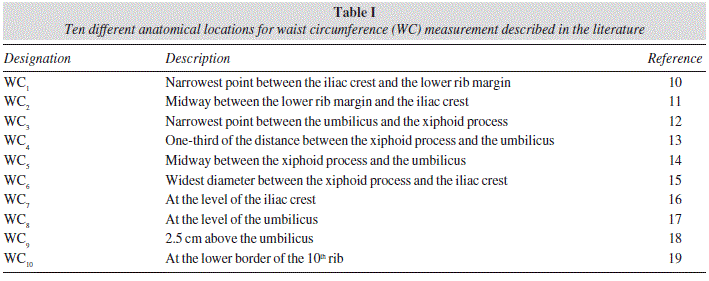
<body><![CDATA[<p><font face="Verdana" size="2">Visceral adipose tissue is directly and accurately measured by magnetic resonance imaging or computerized tomography scans.<sup>2</sup> Dual-energy X-ray absorptiometry (DXA) overcomes the unavailability, radiation and costs of this equipment allowing for separation of the body into regions of interest, including the abdominal region.<sup>6</sup> However, due to technical demands,<sup>7</sup> waist circumference is widely used as a surrogate marker of visceral adiposity. This indirect measurement cannot differentiate between visceral and subcutaneous adipose tissue but it is more strongly correlated with visceral than subcutaneous adipose tissue<sup>8</sup> and is also a well established predictor of cardiovascular disease risk and metabolic disturbances.<sup>9</sup></font></p>     <p><font face="Verdana" size="2">Despite its recognized utility, there is no consensus on the best anatomical location for measurement and several locations can be identified.<sup>10-19</sup> Measurement site influences the magnitude of waist circumference and the prevalence of abdominal obesity<sup>20</sup> according to the recommended thresholds established by the World Health Organization, &gt; 88 cm for women and &gt; 102 cm for men, for defining type 2 diabetes, hypertension and cardiovascular disease risk.<sup>21</sup> Moreover, these thresholds may not have the same clinical utility at all anatomical locations of waist circumference measurement.<sup>22</sup> Thus, an exploratory study was developed to examine which anatomical location best explains abdominal fat mass measured by DXA in older adults.</font></p>     <p>&nbsp;</p>     <p><font face="Verdana" size="2"><b>Methods</b></font></p>     <p><font face="Verdana" size="2"><i>Subjects and design</i></font></p>     <p><font face="Verdana" size="2">An exploratory cross-sectional study was conducted, between November 2009 and June 2010, comparing the association between waist circumference measurements and DXA abdominal fat mass as reference among older adults.</font></p>     <p><font face="Verdana" size="2">The sample comprised of 51 caucasian individuals, aged between 60 and 84 years old, engaged in an exercise program at the Research Centre in Physical Activity, Health and Leisure of the Faculty of Sports, University of Porto. The study was conducted according to the guidelines laid down in the Declaration of Helsinki.<sup>23</sup> All the participants were informed of the study purposes as well as the different procedures. Verbal informed consent from all the subjects was witnessed and formally recorded.</font></p>     <p><font face="Verdana" size="2"><i>Data collection</i></font></p>     <p><font face="Verdana" size="2">Height (m) was measured with the individuals barefooted, using a stadiometer (Seca 708<sup>&reg;</sup>; Seca Limited, Birmingham, UK), with a resolution of 0.001 m.<sup>24</sup> Body mass (kg) was measured by a scale (Seca<sup>&reg;</sup>), resolution of 0.1 kg, with the individuals barefooted and wearing light clothes.<sup>24</sup> Body mass index (BMI) was calculated using the standard formula (mass (kg)/ height<sup>2</sup> (m)).</font></p>     <p><font face="Verdana" size="2">Ten different sites for measuring waist circumference are described in the literature (<a href="#t1">table I</a>)<sup>10-19</sup>. For some of those sites more than one reference was found and so the reference with the more complete procedure was chosen. The circumference at the trunk bending point<sup>25</sup> was also identified but not used due to the difficulty of the technician in finding this anatomical landmark within this sample of older adults.</font></p>     ]]></body>
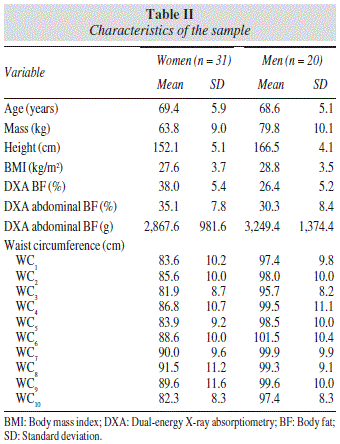
<body><![CDATA[<p>&nbsp;</p>     <p align="center"><a name="t1"><img src="/img/revistas/nh/v27n5/27_original_18_t1.gif"></a></p>     <p>&nbsp;</p>     <p><font face="Verdana" size="2">Waist circumference was measured in the ten different anatomical locations (<a href="#t1">table I</a>) by the same trained technician with a Rosscraft<sup>&reg;</sup> tape, at the end of a normal expiration.</font></p>     <p><font face="Verdana" size="2">Total and abdominal body fat were evaluated in a three-compartment model with a DXA equipment (Hologic QDR-4500<sup>&reg;</sup>). Body composition was estimated by QDR Software for Windows XP, version 12.4 (from Hologic, Inc., Bedford, MA, USA). All scans were performed by the same trained technician using standard procedures as described in the Hologic Users Manual. Complete body DXA scans were made with scan time of approximately 8 minutes. The percentage body fat (%BF) determined by the system represents (fat mass (g)/total mass (g) x 100). After analysis of the whole body scan, to define abdominal region and to determine abdominal fat mass, a quadrilateral box was manually drawn by the same technician around the first (L1) and the fourth (L4) lumbar vertebrae region bounded inferiorly by the horizontal line identifying the L4/L5 vertebral space and superiorly by the horizontal line identifying the 12<sup>th</sup> thoracic vertebra/Ll vertebral space.<sup>6</sup></font></p>     <p><font face="Verdana" size="2"><i>Data analysis</i></font></p>     <p><font face="Verdana" size="2">The normal distribution of the variables was tested using the Kolmogorov-Smirnov test. Means and standard deviations were calculated for the quantitative and continua variables and frequencies were calculated to describe categorical variables. The mean values of %BF determined by DXA were compared with Coin et al.<sup>26</sup> reference values, according to the gender and age. As all quantitative and continua variables followed a normal distribution, the choice of which waist circumference measurement (independent variables) best explained abdominal fat mass (dependent variable) was evaluated with DXA using a linear regression model. The adopted level of statistical significance was <i>p</i> &lt; 0.05. All the statistical analyses were carried out using the Software Package for Social Sciences for Windows, version 14.0 (SPSS, Inc., Chicago, IL, USA) and Microsoft Excel, version 2007 (Microsoft, Redmond, WA).</font></p>     <p>&nbsp;</p>     <p><font face="Verdana" size="2"><b>Results</b></font></p>     <p><font face="Verdana" size="2">Descriptive statistics of the sample are presented in <a href="#t2">table II</a>. Although mean BMI for women and men was in the overweight category, and 23 individuals (45.1%) were overweight and 17 (33.3%) were obese, the mean %BF determined by DXA was within the tabled normal body fat reference values for both genders.<sup>26</sup> In fact, regarding individual %BF values, all women and 14 men (70%) were in the normal %BF range, while 5 men (25%) were below and one man (5%) was above the %BF normal range.</font></p>     ]]></body>
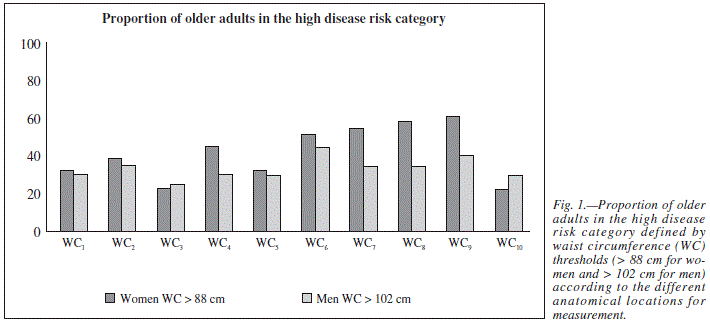
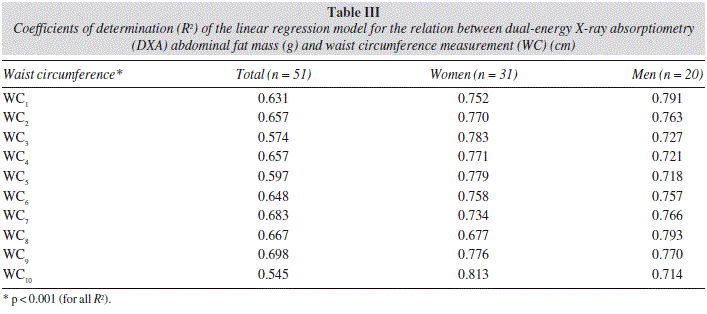
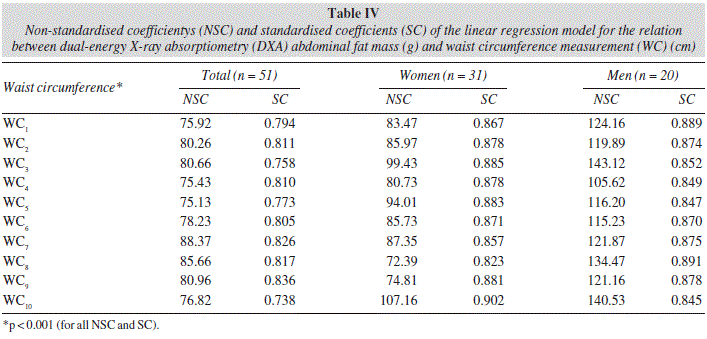
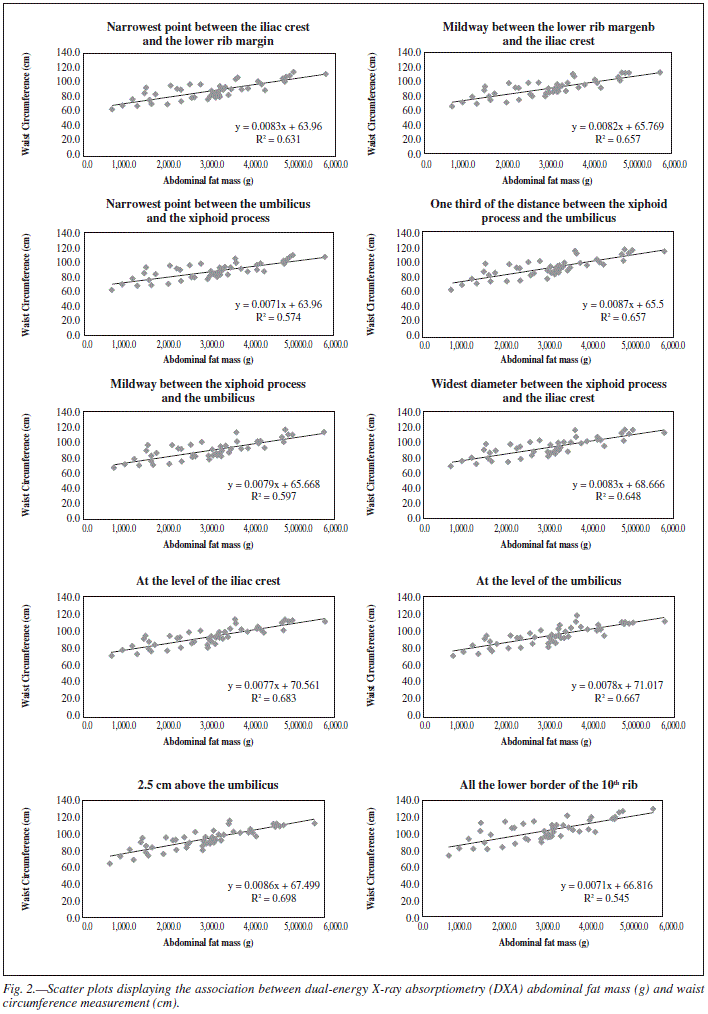
<body><![CDATA[<p>&nbsp;</p>     <p align="center"><a name="t2"><img src="/img/revistas/nh/v27n5/27_original_18_t2.gif"></a></p>     <p>&nbsp;</p>     <p><font face="Verdana" size="2">Women presented a higher %BF (<i>p</i> &lt; 0.001) and a higher % abdominal fat (p = 0.044) than men. However, men presented higher waist circumferences (p &lt; 0.012) than women. No differences were found between genders for abdominal fat mass (<i>p</i> = 0.289).</font></p>     <p><font face="Verdana" size="2">As expected, measurement at different anatomical locations rendered different waist circumference values. Mean varied from 81.9 (standard deviation (SD): 8.7) cm and 91.5 (SD: 11.2) cm for women and between 95.7 (SD: 8.2) cm and 101.5 (SD: 10.4) cm for men, according to the anatomical location (<a href="#t2">table II</a>). In fact, the proportion of older adults in the high disease risk category defined by waist circumference thresholds, &gt; 88 cm for women and &gt; 102 cm for men,<sup>21 </sup>varied with the measurement site as well (<a href="#f1">fig. 1</a>). Waist circumference measurement 2.5 cm above the umbilicus<sup>18</sup> identified 61% of women in the high disease risk. On the contrary, measurement in the narrowest point between the umbilicus and the xiphoid process<sup>12</sup> and at the lower border of the 10<sup>th</sup> rib<sup>19</sup> identified only 23% of women in the high category risk. Measurement at the widest diameter between the xiphoid process and the iliac crest<sup>15</sup> identified 45% of men in the high category risk while measurement at the narrowest point between the umbilicus and the xiphoid process<sup>12</sup> identified only 25% of them in the high category risk (<a href="#f1">fig. 1</a>).</font></p>     <p>&nbsp;</p>     <p align="center"><a name="f1"><img src="/img/revistas/nh/v27n5/27_original_18_f1.gif"></a></p>     <p>&nbsp;</p>     <p><font face="Verdana" size="2">The coefficients of determination (<i>R<sup>2</sup>)</i> of the linear regression model for the relation between abdominal fat mass (g) and the different waist circumference measurement (cm) are presented in <a href="#t3">table III</a> and in <a href="#f2">figure 2</a>. The <i>R<sup>2</sup></i> were all statistically significant (<i>p</i> &lt; 0.001) and varied from 0.545 to 0.698 for the total sample. The non-standardised coefficients (NSC) and the standardised coefficients (SC) for this linear regression model are presented in <a href="#t4">table IV</a>. The NSC varied from 75.13 to 88.37 and the SC varied from 0.738 and 0.836 and they were all statistically significant (p &lt; 0.001). The anatomical landmark situated 2.5 cm above the umbilicus<sup>18</sup> was the waist circumference measurement that associated best with abdominal fat mass measured by DXA, explaining the variance of 69.8% and presenting a SC equal to 0.836. However, measurement at the level of the iliac crest<sup>16</sup> and at the level of the umbilicus<sup>17</sup> gave very close results. Otherwise, measurement of waist circumference at the lower border of the 10<sup>th</sup> rib<sup>19</sup> was the one that associated worst with abdominal fat mass (tables<a href="#t3">III</a> and <a href="#t4">IV</a>, <a href="#f2">fig. 2</a>).</font></p>     <p>&nbsp;</p>     ]]></body>
<body><![CDATA[<p align="center"><a name="t3"><img src="/img/revistas/nh/v27n5/27_original_18_t3.gif"></a></p>     <p>&nbsp;</p>     <p align="center"><a name="t4"><img src="/img/revistas/nh/v27n5/27_original_18_t4.gif"></a></p>     <p>&nbsp;</p>     <p align="center"><a name="f2"><img src="/img/revistas/nh/v27n5/27_original_18_f2.gif"></a></p>     <p>&nbsp;</p>     <p><font face="Verdana" size="2">In order to understand if the preferable measurement site was different for women and men, we stratified the sample by gender. The <i>R<sup>2</sup></i> and the SC increased as the dispersion of the data decreased, also suggesting that ideal measurement site varies with gender. Measurement of waist circumference at the lower border of the 10<sup>th</sup> rib<sup>19</sup> was the anatomical location that associated best with abdominal fat mass for women and that associated worst for men. Measurement at the level of the umbilicus<sup>17</sup> was the circumference that associated worst with abdominal fat for women and measurement in the narrowest point between the iliac crest and the lower rib margin<sup>10</sup> was the circumference that associated best with abdominal fat for men (tables<a href="#t3">III</a> and <a href="#t4">IV</a>).</font></p>     <p>&nbsp;</p>     <p><font face="Verdana" size="2"><b>Discussion</b></font></p>     <p><font face="Verdana" size="2">Waist circumference is a widely-used surrogate marker of visceral adiposity and a well established predictor of the risk of cardiovascular disease and metabolic disturbances.<sup>9</sup> However, at least ten different anatomical locations to perform this measurement are described in the literature.<sup>10-19</sup> We therefore evaluated these ten waist circumference measurements in order to ascertain which best explained abdominal fat mass, using an exploratory study.</font></p>     ]]></body>
<body><![CDATA[<p><font face="Verdana" size="2">DXA abdominal region, defined as the L1-L4 region compared with computerized tomography proved to be both reliable and accurate method to determine abdominal obesity.<sup>6</sup> Our results showed that the waist circumference values obtained from the several anatomical locations differed in a substantial way, and therefore, influenced the proportion of individuals in the established category of risk for abdominal obesity. The anatomical landmark situated 2.5 cm above the umbilicus<sup>18</sup> was the one that associated best with abdominal fat mass in this sample of older adults, thus explaining the variance of 69.8% and showing the highest standardised coefficient.</font></p>     <p><font face="Verdana" size="2">Despite the higher %BF and higher % abdominal fat in women, men had higher waist circumferences and there was no difference in abdominal fat mass between genders. However, the linear regression revealed that the preferable anatomical location for measuring waist circumference was not the same for women and men.</font></p>     <p><font face="Verdana" size="2">Although small, this sample size allowed the identification of significant associations. This study contributes to the recognition that the anatomical location where the measurement is taken gives considerably different results therefore emphasizing the need to standardize the procedure. To our knowledge, this is the first study to compare all these different anatomical locations for waist circumference measurement described in the literature and to determine which associated best with abdominal fat mass. However, in two previous studies, Mason and Katzmarzyk discussed the importance of the measurement site. The authors measured waist circumference at the superior border of the iliac crest, midpoint between the iliac crest and the lowest rib, umbilicus, and minimal waist, in community-dwelling adults aged 20-67 years.<sup>20,22</sup> In 542 individuals, they verified that waist circumference measurements made at all anatomic sites were highly correlated with each other (<i>r</i> &gt; 0.948, <i>p</i> &lt; 0.0001). In women, the mean waist circumference for all sites were significantly different from each other (<i>p</i> &lt; 0.008), with the exception of the iliac crest and midpoint between the iliac crest and the lowest rib. In contrast, no significant differences between sites were found in men. Measurement site had an influence on the prevalence of abdominal obesity (&gt; 88/102 cm), ranging from 23 to 34% in men and from 31 to 55% in women.<sup>20</sup> Our results are in accordance with this finding. The authors also calculated the sensitivity and specificity of waist circumference thresholds for detecting individuals with risk factor clustering (&ge; 2 risk factors) for each waist circumference measurement site in 520 adults. Waist circumference &gt; 88 cm for women and &gt; 102 cm for men at the umbilicus showed the greatest sensitivity for all outcomes, whereas measurements at the minimal waist had the best specificity. The sensitivity of waist circumference &gt; 88 cm or &gt; 102 cm for detecting <u>&gt;</u> 2 risk factors ranged from 75 to 89% in women and from 48 to 59% in men, and specificity ranged from 52 to 79% in women and from 77 to 88% in men, across measurement sites. Therefore the authors concluded that recommended waist circumference thresholds may not have the same clinical utility at all anatomical locations of waist circumference measurement.<sup>22</sup> Our results are in agreement with this finding as well.</font></p>     <p><font face="Verdana" size="2">Several studies reported high and significant correlations between abdominal fat quantified with DXA and waist circumference measured midway between the lower rib margin and the iliac crest in individuals aged 14-65 years (<i>r</i>: 0.65-0.96, p &lt; 0.001)<sup>27,29</sup> and a good agreement between DXA measures of fatness and waist circumference in adults aged 50-79 years.<sup>30</sup> Although we used DXA as the reference method, we are aware of its limitations. In a study conducted in 152 healthy adults, %BF determined by DXA was significantly lower compared with the criterion four compartment model approach.<sup>31</sup> Also, DXA and waist circumferences have inherent methodological characteristics and differences that may have influenced the results. Waist circumference measurement is taken at the end of a normal expiration while DXA scans take approximately 8 minutes and evidently during this period individuals inhale and exhale. Moreover, individuals are lying down during the DXA scans and waist circumference is measured with the individuals standing. The effect of gravity may then account for the differences between methods as well.</font></p>     <p><font face="Verdana" size="2">The lack of a random sample selection can be recognized as a study limitation. Our sample was composed of moderately active caucasian older adults who exercised at least 50 minutes for two days a week, therefore, results are not transposable to other age and ethnic groups. Furthermore, the age spam of participants is wide. Further studies should include larger samples that would allow presenting its results according different age strata, &le; 70 and &gt; 70 years old individuals and also including other age and ethnical groups. Finally, the association of waist circumference measurement with abdominal visceral fat measured by magnetic resonance imaging or computerized tomography scans would allow a better recognition of the clinical risk.</font></p>     <p><font face="Verdana" size="2">Further research should explore which waist circumference measurement associates best with the clinical risk of abdominal adiposity, as cardiometabolic risk factors like glycaemia, blood pressure, LDL and HDL cholesterol or triacilglycerols were not analysed. Also, it remains unknown if the recommended waist circumference thresholds are suitable for defining type 2 diabetes, hypertension and cardiovascular disease risk for each one of waist circumference anatomical locations used.</font></p>     <p>&nbsp;</p>     <p><font face="Verdana" size="2"><b>Conclusion</b></font></p>     <p><font face="Verdana" size="2">Waist circumference measurement 2.5 cm above the umbilicus<sup>18</sup> was the best surrogate measure of abdominal fat in this older individual's sample. The measurement at the level of the iliac crest<sup>16</sup> and at the level of the umbilicus<sup>17</sup> gave very close results, and therefore the possibility that these two measurements could also be recommended for measuring waist circumference in older adults should be considered. This is an exploratory study which contributes to the recognition that the anatomical location where the waist circumference measurement is taken gives considerably different results and therefore highlights the importance to standardize the procedure.</font></p>     <p>&nbsp;</p>     ]]></body>
<body><![CDATA[<p><font face="Verdana" size="2"><b>Acknowledgments</b></font></p>     <p><font face="Verdana" size="2">This research received no specific grant from any funding agency in the public, commercial or non-profit sectors. R. S. G. and E. A. M. were supported by a doctoral grant from FCT-MCTES (SFRH/BD/61656/2009; SFRH/BD/36319/2007).</font></p>     <p>&nbsp;</p>     <p><font face="Verdana" size="2"><b>References</b></font></p>     <!-- ref --><p><font face="Verdana" size="2">1. World Health Organization: Keep fit for life - Meeting the nutritional needs of older persons. 2002. <a target="_blank" href="http://whqlibdoc.who.int/publications/9241562102.pdf">http://whqlibdoc.who.int/publications/9241562102.pdf</a>.    &nbsp;&nbsp;&nbsp;&nbsp;&nbsp;&nbsp;&nbsp;&nbsp;[&#160;<a href="javascript:void(0);" onclick="javascript: window.open('/scielo.php?script=sci_nlinks&ref=3694281&pid=S0212-1611201200050002700001&lng=','','width=640,height=500,resizable=yes,scrollbars=1,menubar=yes,');">Links</a>&#160;]<!-- end-ref --></font></p>    <!-- ref --><p><font face="Verdana" size="2">2. Machann J, Thamer C, Schnoedt B, Haap M, Haring HU, Claussen CD, Stumvoll M, Fritsche A, Schick F. Standardized assessment of whole body adipose tissue topography by MRI. <i>J Magn Reson Imaging</i> 2005; 21: 455-462.    &nbsp;&nbsp;&nbsp;&nbsp;&nbsp;&nbsp;&nbsp;&nbsp;[&#160;<a href="javascript:void(0);" onclick="javascript: window.open('/scielo.php?script=sci_nlinks&ref=3694283&pid=S0212-1611201200050002700002&lng=','','width=640,height=500,resizable=yes,scrollbars=1,menubar=yes,');">Links</a>&#160;]<!-- end-ref --></font></p>    <!-- ref --><p><font face="Verdana" size="2">3. Curat CA, Wegner V, Sengenés C, Miranville A, Tonus C, Busse R, Bouloumié A. Macrophages in human visceral adipose tissue: increased accumulation in obesity and a source of resistin and visfatin. <i>Diabetologia</i> 2006; 49: 744-747.    &nbsp;&nbsp;&nbsp;&nbsp;&nbsp;&nbsp;&nbsp;&nbsp;[&#160;<a href="javascript:void(0);" onclick="javascript: window.open('/scielo.php?script=sci_nlinks&ref=3694285&pid=S0212-1611201200050002700003&lng=','','width=640,height=500,resizable=yes,scrollbars=1,menubar=yes,');">Links</a>&#160;]<!-- end-ref --></font></p>    ]]></body>
<body><![CDATA[<!-- ref --><p><font face="Verdana" size="2">4. Bruun JM, Lihn AS, Pedersen SB, Richelsen B: Monocyte chemoattractant Protein-1 release is higher in visceral than subcutaneous human adipose tissue (AT): implication of macrophages resident in the AT. <i>J Clin Endocrinol Metab</i> 2005; 90: 2282-2289.    &nbsp;&nbsp;&nbsp;&nbsp;&nbsp;&nbsp;&nbsp;&nbsp;[&#160;<a href="javascript:void(0);" onclick="javascript: window.open('/scielo.php?script=sci_nlinks&ref=3694287&pid=S0212-1611201200050002700004&lng=','','width=640,height=500,resizable=yes,scrollbars=1,menubar=yes,');">Links</a>&#160;]<!-- end-ref --></font></p>    <!-- ref --><p><font face="Verdana" size="2">5. Nomura K, Eto M, Kojima T, Ogawa S, Iijima K, Nakamura T, Araki A, Akishita M, Ouchi Y. Visceral fat accumulation and metabolic risk factor clustering in older adults. <i>J Am Geriatr Soc</i> 2010; 58: 1658-1663.    &nbsp;&nbsp;&nbsp;&nbsp;&nbsp;&nbsp;&nbsp;&nbsp;[&#160;<a href="javascript:void(0);" onclick="javascript: window.open('/scielo.php?script=sci_nlinks&ref=3694289&pid=S0212-1611201200050002700005&lng=','','width=640,height=500,resizable=yes,scrollbars=1,menubar=yes,');">Links</a>&#160;]<!-- end-ref --></font></p>    <!-- ref --><p><font face="Verdana" size="2">6. Glickman SG, Marn CS, Supiano MA, Dengel DR. Validity and reliability of dual-energy X-ray absorptiometry for the assessment of abdominal adiposity. <i>J Appl Physiol</i> 2004; 97:509-514.    &nbsp;&nbsp;&nbsp;&nbsp;&nbsp;&nbsp;&nbsp;&nbsp;[&#160;<a href="javascript:void(0);" onclick="javascript: window.open('/scielo.php?script=sci_nlinks&ref=3694291&pid=S0212-1611201200050002700006&lng=','','width=640,height=500,resizable=yes,scrollbars=1,menubar=yes,');">Links</a>&#160;]<!-- end-ref --></font></p>    <!-- ref --><p><font face="Verdana" size="2">7. Geer EB, Shen W. Gender differences in insulin resistance, body composition, and energy balance. <i>Gend Med</i> 2009; 6 (Suppl. 1): 60-75.    &nbsp;&nbsp;&nbsp;&nbsp;&nbsp;&nbsp;&nbsp;&nbsp;[&#160;<a href="javascript:void(0);" onclick="javascript: window.open('/scielo.php?script=sci_nlinks&ref=3694293&pid=S0212-1611201200050002700007&lng=','','width=640,height=500,resizable=yes,scrollbars=1,menubar=yes,');">Links</a>&#160;]<!-- end-ref --></font></p>    <!-- ref --><p><font face="Verdana" size="2">8. Van der Kooy K, Seidell JC. Techniques for the measurement of visceral fat: a practical guide. <i>Int J Obes Relat Metab Disord</i> 1993; 17: 187-196.    &nbsp;&nbsp;&nbsp;&nbsp;&nbsp;&nbsp;&nbsp;&nbsp;[&#160;<a href="javascript:void(0);" onclick="javascript: window.open('/scielo.php?script=sci_nlinks&ref=3694295&pid=S0212-1611201200050002700008&lng=','','width=640,height=500,resizable=yes,scrollbars=1,menubar=yes,');">Links</a>&#160;]<!-- end-ref --></font></p>    ]]></body>
<body><![CDATA[<!-- ref --><p><font face="Verdana" size="2">9. No authors listed: Relationship of body size and shape to the development of diabetes in the diabetes prevention program. <i>Obesity (Silver Spring)</i> 2006; 14: 2107-2117.    &nbsp;&nbsp;&nbsp;&nbsp;&nbsp;&nbsp;&nbsp;&nbsp;[&#160;<a href="javascript:void(0);" onclick="javascript: window.open('/scielo.php?script=sci_nlinks&ref=3694297&pid=S0212-1611201200050002700009&lng=','','width=640,height=500,resizable=yes,scrollbars=1,menubar=yes,');">Links</a>&#160;]<!-- end-ref --></font></p>    <!-- ref --><p><font face="Verdana" size="2">10. Marfell-Jones M, Olds T, Stewart A, Carter L. International standards for anthropometric assessment. Potchefstroom: International Society for the Advancement of Kinanthropometry, 2001, p. 83.    &nbsp;&nbsp;&nbsp;&nbsp;&nbsp;&nbsp;&nbsp;&nbsp;[&#160;<a href="javascript:void(0);" onclick="javascript: window.open('/scielo.php?script=sci_nlinks&ref=3694299&pid=S0212-1611201200050002700010&lng=','','width=640,height=500,resizable=yes,scrollbars=1,menubar=yes,');">Links</a>&#160;]<!-- end-ref --></font></p>    <!-- ref --><p><font face="Verdana" size="2">11. Korhonen PE, Jaatinen PT, Aarnio PT, Kantola IM, Saaresranta T. Waist circumference home measurement - a device to find out patients in cardiovascular risk. <i>Eur J Public Health</i> 2009; 19: 95-99.    &nbsp;&nbsp;&nbsp;&nbsp;&nbsp;&nbsp;&nbsp;&nbsp;[&#160;<a href="javascript:void(0);" onclick="javascript: window.open('/scielo.php?script=sci_nlinks&ref=3694301&pid=S0212-1611201200050002700011&lng=','','width=640,height=500,resizable=yes,scrollbars=1,menubar=yes,');">Links</a>&#160;]<!-- end-ref --></font></p>    <!-- ref --><p><font face="Verdana" size="2">12. Echiburú B, Pérez-Bravo F, Maliqueo M, Sánchez F, Crisosto N, Sir-Petermann T. Polymorphism T  - C (-34 base pairs) of gene CYP17 promoter in women with polycystic ovary syndrome is associated with increased body weight and insulin resistance: a preliminary study. <i>Metabolism</i> 2008; 57: 1765-1771.    &nbsp;&nbsp;&nbsp;&nbsp;&nbsp;&nbsp;&nbsp;&nbsp;[&#160;<a href="javascript:void(0);" onclick="javascript: window.open('/scielo.php?script=sci_nlinks&ref=3694303&pid=S0212-1611201200050002700012&lng=','','width=640,height=500,resizable=yes,scrollbars=1,menubar=yes,');">Links</a>&#160;]<!-- end-ref --></font></p>    <!-- ref --><p><font face="Verdana" size="2">13. Krotkiewski M, Bj&ouml;rntorp P, Sjostrom L, Smith U. Impact of obesity on metabolism in men and women. Importance of regional adipose tissue distribution. <i>J Clin Invest</i> 1983; 72:1150-1162.    &nbsp;&nbsp;&nbsp;&nbsp;&nbsp;&nbsp;&nbsp;&nbsp;[&#160;<a href="javascript:void(0);" onclick="javascript: window.open('/scielo.php?script=sci_nlinks&ref=3694305&pid=S0212-1611201200050002700013&lng=','','width=640,height=500,resizable=yes,scrollbars=1,menubar=yes,');">Links</a>&#160;]<!-- end-ref --></font></p>    ]]></body>
<body><![CDATA[<!-- ref --><p><font face="Verdana" size="2">14. Krotkiewski M, Bjorntorp P: Muscle tissue in obesity with different distribution of adipose tissue. Effects of physical training. <i>Int J Obes</i> 1986; 10: 331-341.    &nbsp;&nbsp;&nbsp;&nbsp;&nbsp;&nbsp;&nbsp;&nbsp;[&#160;<a href="javascript:void(0);" onclick="javascript: window.open('/scielo.php?script=sci_nlinks&ref=3694307&pid=S0212-1611201200050002700014&lng=','','width=640,height=500,resizable=yes,scrollbars=1,menubar=yes,');">Links</a>&#160;]<!-- end-ref --></font></p>    <!-- ref --><p><font face="Verdana" size="2">15. Piestrzeniewicz K, Luczak K, Goch JH. Factors associated with C-reactive protein at the early stage of acute myocardial infarction in men. <i>Cardiol J</i> 2009; 16: 36-42.    &nbsp;&nbsp;&nbsp;&nbsp;&nbsp;&nbsp;&nbsp;&nbsp;[&#160;<a href="javascript:void(0);" onclick="javascript: window.open('/scielo.php?script=sci_nlinks&ref=3694309&pid=S0212-1611201200050002700015&lng=','','width=640,height=500,resizable=yes,scrollbars=1,menubar=yes,');">Links</a>&#160;]<!-- end-ref --></font></p>    <!-- ref --><p><font face="Verdana" size="2">16. NHLBI Obesity Education Initiative Expert Panel. The Practical Guide: Identification, Evaluation, and Treatment of Overweight and Obesity in Adults. North America: NIH Publication, 2000, p. 9.    &nbsp;&nbsp;&nbsp;&nbsp;&nbsp;&nbsp;&nbsp;&nbsp;[&#160;<a href="javascript:void(0);" onclick="javascript: window.open('/scielo.php?script=sci_nlinks&ref=3694311&pid=S0212-1611201200050002700016&lng=','','width=640,height=500,resizable=yes,scrollbars=1,menubar=yes,');">Links</a>&#160;]<!-- end-ref --></font></p>    <!-- ref --><p><font face="Verdana" size="2">17. Alonso AL, Munguía-Miranda C, Ramos-Ponce D, Hernandez-Saavedra D, Kumate J, Cruz M. Waist perimeter cutoff points and prediction of metabolic syndrome risk. A study in a Mexican population. <i>Arch Med Res</i> 2008; 39: 346-351.    &nbsp;&nbsp;&nbsp;&nbsp;&nbsp;&nbsp;&nbsp;&nbsp;[&#160;<a href="javascript:void(0);" onclick="javascript: window.open('/scielo.php?script=sci_nlinks&ref=3694313&pid=S0212-1611201200050002700017&lng=','','width=640,height=500,resizable=yes,scrollbars=1,menubar=yes,');">Links</a>&#160;]<!-- end-ref --></font></p>    <!-- ref --><p><font face="Verdana" size="2">18. Camhi SM, Kuo J, Young DR. Identifying adolescent metabolic syndrome using body mass index and waist circumference. <i>Prev ChronicDis</i> 2008; 5: A115.    &nbsp;&nbsp;&nbsp;&nbsp;&nbsp;&nbsp;&nbsp;&nbsp;[&#160;<a href="javascript:void(0);" onclick="javascript: window.open('/scielo.php?script=sci_nlinks&ref=3694315&pid=S0212-1611201200050002700018&lng=','','width=640,height=500,resizable=yes,scrollbars=1,menubar=yes,');">Links</a>&#160;]<!-- end-ref --></font></p>    ]]></body>
<body><![CDATA[<!-- ref --><p><font face="Verdana" size="2">19. Johnston FE, Wadden TA, Stunkard AJ, Peña M, Wang J, Pierson RN, Van Itallie TB. Body fat deposition in adult obese women. I. Patterns of fat distribution. <i>Am J Clin Nutr</i> 1988; 47:225-228.    &nbsp;&nbsp;&nbsp;&nbsp;&nbsp;&nbsp;&nbsp;&nbsp;[&#160;<a href="javascript:void(0);" onclick="javascript: window.open('/scielo.php?script=sci_nlinks&ref=3694317&pid=S0212-1611201200050002700019&lng=','','width=640,height=500,resizable=yes,scrollbars=1,menubar=yes,');">Links</a>&#160;]<!-- end-ref --></font></p>    <!-- ref --><p><font face="Verdana" size="2">20. Mason C, Katzmarzyk PT. Variability in waist circumference measurements according to anatomic measurement site. <i>Obesity (Silver Spring)</i> 2009; 17: 1789-1795.    &nbsp;&nbsp;&nbsp;&nbsp;&nbsp;&nbsp;&nbsp;&nbsp;[&#160;<a href="javascript:void(0);" onclick="javascript: window.open('/scielo.php?script=sci_nlinks&ref=3694319&pid=S0212-1611201200050002700020&lng=','','width=640,height=500,resizable=yes,scrollbars=1,menubar=yes,');">Links</a>&#160;]<!-- end-ref --></font></p>    <!-- ref --><p><font face="Verdana" size="2">21. World Health Organization: WHO Technical Report Series - Diet, nutrition and the prevention of chronic diseases. 2003. <a target="_blank" href="http://whqlibdoc.who.int/trs/WHO_TRS_916.pdf">http://whqlibdoc.who.int/trs/WHO_TRS_916.pdf</a>.    &nbsp;&nbsp;&nbsp;&nbsp;&nbsp;&nbsp;&nbsp;&nbsp;[&#160;<a href="javascript:void(0);" onclick="javascript: window.open('/scielo.php?script=sci_nlinks&ref=3694321&pid=S0212-1611201200050002700021&lng=','','width=640,height=500,resizable=yes,scrollbars=1,menubar=yes,');">Links</a>&#160;]<!-- end-ref --></font></p>    <!-- ref --><p><font face="Verdana" size="2">22. Mason C, Katzmarzyk PT. Waist circumference thresholds for the prediction of cardiometabolic risk: is measurement site important? <i>Eur J Clin Nutr</i> 2010; 64: 862-867.    &nbsp;&nbsp;&nbsp;&nbsp;&nbsp;&nbsp;&nbsp;&nbsp;[&#160;<a href="javascript:void(0);" onclick="javascript: window.open('/scielo.php?script=sci_nlinks&ref=3694323&pid=S0212-1611201200050002700022&lng=','','width=640,height=500,resizable=yes,scrollbars=1,menubar=yes,');">Links</a>&#160;]<!-- end-ref --></font></p>    <!-- ref --><p><font face="Verdana" size="2">23. The World Medical Association: Declaration of Helsinki - ethical principles for medical research involving human subjects. 2008.    &nbsp;&nbsp;&nbsp;&nbsp;&nbsp;&nbsp;&nbsp;&nbsp;[&#160;<a href="javascript:void(0);" onclick="javascript: window.open('/scielo.php?script=sci_nlinks&ref=3694325&pid=S0212-1611201200050002700023&lng=','','width=640,height=500,resizable=yes,scrollbars=1,menubar=yes,');">Links</a>&#160;]<!-- end-ref --></font></p>    ]]></body>
<body><![CDATA[<!-- ref --><p><font face="Verdana" size="2">24. Lee RD, Nieman DC. Anthropometry. In Lee RD (ed): Nutritional Assessment, 4<sup>th</sup> ed. Boston: McGraw Hill Higher Education, 2007, pp. 169-221.    &nbsp;&nbsp;&nbsp;&nbsp;&nbsp;&nbsp;&nbsp;&nbsp;[&#160;<a href="javascript:void(0);" onclick="javascript: window.open('/scielo.php?script=sci_nlinks&ref=3694327&pid=S0212-1611201200050002700024&lng=','','width=640,height=500,resizable=yes,scrollbars=1,menubar=yes,');">Links</a>&#160;]<!-- end-ref --></font></p>    <!-- ref --><p><font face="Verdana" size="2">25. Clark P, Tesoriero LJ, Morton DJ, Talavera JO, Karlamangla A, Schneider DL, Wooten WJ, Barrett-Connor E. Hip axis length variation: its correlation with anthropometric measurements in women from three ethnic groups. <i>Osteoporos Int</i> 2008; 19: 1301-1306.    &nbsp;&nbsp;&nbsp;&nbsp;&nbsp;&nbsp;&nbsp;&nbsp;[&#160;<a href="javascript:void(0);" onclick="javascript: window.open('/scielo.php?script=sci_nlinks&ref=3694329&pid=S0212-1611201200050002700025&lng=','','width=640,height=500,resizable=yes,scrollbars=1,menubar=yes,');">Links</a>&#160;]<!-- end-ref --></font></p>    <!-- ref --><p><font face="Verdana" size="2">26. Coin A, Sergi G, Minicuci N, Giannini S, Barbiero E, Manzato E, Pedrazzoni M, Minisola S, Rossini M, Del Puente A, Zamboni M, Inelmen EM, Enzi G. Fat-free mass and fat mass reference values by dual energy X-ray absorptiometry (DEXA) in a 20-80 year-old Italian population. <i>Clin Nutr</i> 2008; 27: 87-94.    &nbsp;&nbsp;&nbsp;&nbsp;&nbsp;&nbsp;&nbsp;&nbsp;[&#160;<a href="javascript:void(0);" onclick="javascript: window.open('/scielo.php?script=sci_nlinks&ref=3694331&pid=S0212-1611201200050002700026&lng=','','width=640,height=500,resizable=yes,scrollbars=1,menubar=yes,');">Links</a>&#160;]<!-- end-ref --></font></p>    <!-- ref --><p><font face="Verdana" size="2">27. Vatanparast H, Chilibeck PD, Cornish SM, Little JP, Paus-Jenssen LS, Case AM, Biem HJ. DXA derived abdominal fat mass, waist circumference, and blood lipids in postmenopausal women. <i>Obesity (SilverSpring)</i> 2009; 17: 1635-1640.    &nbsp;&nbsp;&nbsp;&nbsp;&nbsp;&nbsp;&nbsp;&nbsp;[&#160;<a href="javascript:void(0);" onclick="javascript: window.open('/scielo.php?script=sci_nlinks&ref=3694333&pid=S0212-1611201200050002700027&lng=','','width=640,height=500,resizable=yes,scrollbars=1,menubar=yes,');">Links</a>&#160;]<!-- end-ref --></font></p>    <!-- ref --><p><font face="Verdana" size="2">28. Sillanp&auml;&auml; E, H&auml;kkinen A, Nyman K, Mattila M, Cheng S, Karavirta L, Laaksonen DE, Huuhka N, Kraemer WJ, H&auml;kkinen K. Body composition and fitness during strength and/or endurance training in older men. <i>Med Sci Sports Exerc</i> 2008; 40: 950-958, 2008.    &nbsp;&nbsp;&nbsp;&nbsp;&nbsp;&nbsp;&nbsp;&nbsp;[&#160;<a href="javascript:void(0);" onclick="javascript: window.open('/scielo.php?script=sci_nlinks&ref=3694335&pid=S0212-1611201200050002700028&lng=','','width=640,height=500,resizable=yes,scrollbars=1,menubar=yes,');">Links</a>&#160;]<!-- end-ref --></font></p>    ]]></body>
<body><![CDATA[<!-- ref --><p><font face="Verdana" size="2">29. Toscani M, Migliavacca R, Sisson de Castro JA, Spritzer PM. Estimation of truncal adiposity using waist circumference or the sum of trunk skinfolds: a pilot study for insulin resistance screening in hirsute patients with or without polycystic ovary syndrome. <i>Metabolism</i> 2007; 56: 992-997.    &nbsp;&nbsp;&nbsp;&nbsp;&nbsp;&nbsp;&nbsp;&nbsp;[&#160;<a href="javascript:void(0);" onclick="javascript: window.open('/scielo.php?script=sci_nlinks&ref=3694337&pid=S0212-1611201200050002700029&lng=','','width=640,height=500,resizable=yes,scrollbars=1,menubar=yes,');">Links</a>&#160;]<!-- end-ref --></font></p>    <!-- ref --><p><font face="Verdana" size="2">30. Shaw KA, Srikanth VK, Fryer JL, Blizzard L, Dwyer T, Venn AJ: Dual energy X-ray absorptiometry body composition and aging in a population-based older cohort. <i>Int J Obes (Lond)</i> 2007; 31: 279-84.    &nbsp;&nbsp;&nbsp;&nbsp;&nbsp;&nbsp;&nbsp;&nbsp;[&#160;<a href="javascript:void(0);" onclick="javascript: window.open('/scielo.php?script=sci_nlinks&ref=3694339&pid=S0212-1611201200050002700030&lng=','','width=640,height=500,resizable=yes,scrollbars=1,menubar=yes,');">Links</a>&#160;]<!-- end-ref --></font></p>    <!-- ref --><p><font face="Verdana" size="2">31. Van Der Ploeg GE, Withers RT, Laforgia J. Percent body fat via DEXA: comparison with a four-compartment model. <i>J Appl Physiol</i> 2003; 94:499-506.    &nbsp;&nbsp;&nbsp;&nbsp;&nbsp;&nbsp;&nbsp;&nbsp;[&#160;<a href="javascript:void(0);" onclick="javascript: window.open('/scielo.php?script=sci_nlinks&ref=3694341&pid=S0212-1611201200050002700031&lng=','','width=640,height=500,resizable=yes,scrollbars=1,menubar=yes,');">Links</a>&#160;]<!-- end-ref --></font></p>     <p>&nbsp;</p>     <p>&nbsp;</p>     <p><font face="Verdana" size="2"><a href="#top"><img border="0" src="/img/revistas/nh/v27n5/seta.gif" width="15" height="17"></a><a name="bajo"></a><b>Correspondence:</b>    <br>Rita S. Guerra    ]]></body>
<body><![CDATA[<br>IDMEC - Pólo FEUP    <br>Faculdade de Engenharia da Universidade do Porto    <br>Rua Dr. Roberto Frias, s/n    <br>4200-465 Porto. Portugal    <br>E-mail: <a href="mailto:ritacsguerra@gmail.com">ritacsguerra@gmail.com</a></font></p>     <p><font face="Verdana" size="2">Recibido: 18-II-2012    <br>Aceptado: 3-V-2012</font></p>      ]]></body><back>
<ref-list>
<ref id="B1">
<label>1</label><nlm-citation citation-type="">
<collab>World Health Organization</collab>
<source><![CDATA[Keep fit for life: Meeting the nutritional needs of older persons]]></source>
<year>2002</year>
</nlm-citation>
</ref>
<ref id="B2">
<label>2</label><nlm-citation citation-type="journal">
<person-group person-group-type="author">
<name>
<surname><![CDATA[Machann]]></surname>
<given-names><![CDATA[J]]></given-names>
</name>
<name>
<surname><![CDATA[Thamer]]></surname>
<given-names><![CDATA[C]]></given-names>
</name>
<name>
<surname><![CDATA[Schnoedt]]></surname>
<given-names><![CDATA[B]]></given-names>
</name>
<name>
<surname><![CDATA[Haap]]></surname>
<given-names><![CDATA[M]]></given-names>
</name>
<name>
<surname><![CDATA[Haring]]></surname>
<given-names><![CDATA[HU]]></given-names>
</name>
<name>
<surname><![CDATA[Claussen]]></surname>
<given-names><![CDATA[CD]]></given-names>
</name>
<name>
<surname><![CDATA[Stumvoll]]></surname>
<given-names><![CDATA[M]]></given-names>
</name>
<name>
<surname><![CDATA[Fritsche]]></surname>
<given-names><![CDATA[A]]></given-names>
</name>
<name>
<surname><![CDATA[Schick]]></surname>
<given-names><![CDATA[F]]></given-names>
</name>
</person-group>
<article-title xml:lang="en"><![CDATA[Standardized assessment of whole body adipose tissue topography by MRI]]></article-title>
<source><![CDATA[J Magn Reson Imaging]]></source>
<year>2005</year>
<volume>21</volume>
<page-range>455-462</page-range></nlm-citation>
</ref>
<ref id="B3">
<label>3</label><nlm-citation citation-type="journal">
<person-group person-group-type="author">
<name>
<surname><![CDATA[Curat]]></surname>
<given-names><![CDATA[CA]]></given-names>
</name>
<name>
<surname><![CDATA[Wegner]]></surname>
<given-names><![CDATA[V]]></given-names>
</name>
<name>
<surname><![CDATA[Sengenés]]></surname>
<given-names><![CDATA[C]]></given-names>
</name>
<name>
<surname><![CDATA[Miranville]]></surname>
<given-names><![CDATA[A]]></given-names>
</name>
<name>
<surname><![CDATA[Tonus]]></surname>
<given-names><![CDATA[C]]></given-names>
</name>
<name>
<surname><![CDATA[Busse]]></surname>
<given-names><![CDATA[R]]></given-names>
</name>
<name>
<surname><![CDATA[Bouloumié]]></surname>
<given-names><![CDATA[A]]></given-names>
</name>
</person-group>
<article-title xml:lang="en"><![CDATA[Macrophages in human visceral adipose tissue: increased accumulation in obesity and a source of resistin and visfatin]]></article-title>
<source><![CDATA[Diabetologia]]></source>
<year>2006</year>
<volume>49</volume>
<page-range>744-747</page-range></nlm-citation>
</ref>
<ref id="B4">
<label>4</label><nlm-citation citation-type="journal">
<person-group person-group-type="author">
<name>
<surname><![CDATA[Bruun]]></surname>
<given-names><![CDATA[JM]]></given-names>
</name>
<name>
<surname><![CDATA[Lihn]]></surname>
<given-names><![CDATA[AS]]></given-names>
</name>
<name>
<surname><![CDATA[Pedersen]]></surname>
<given-names><![CDATA[SB]]></given-names>
</name>
<name>
<surname><![CDATA[Richelsen]]></surname>
<given-names><![CDATA[B]]></given-names>
</name>
</person-group>
<article-title xml:lang="en"><![CDATA[Monocyte chemoattractant Protein-1 release is higher in visceral than subcutaneous human adipose tissue (AT): implication of macrophages resident in the AT]]></article-title>
<source><![CDATA[J Clin Endocrinol Metab]]></source>
<year>2005</year>
<volume>90</volume>
<page-range>2282-2289</page-range></nlm-citation>
</ref>
<ref id="B5">
<label>5</label><nlm-citation citation-type="journal">
<person-group person-group-type="author">
<name>
<surname><![CDATA[Nomura]]></surname>
<given-names><![CDATA[K]]></given-names>
</name>
<name>
<surname><![CDATA[Eto]]></surname>
<given-names><![CDATA[M]]></given-names>
</name>
<name>
<surname><![CDATA[Kojima]]></surname>
<given-names><![CDATA[T]]></given-names>
</name>
<name>
<surname><![CDATA[Ogawa]]></surname>
<given-names><![CDATA[S]]></given-names>
</name>
<name>
<surname><![CDATA[Iijima]]></surname>
<given-names><![CDATA[K]]></given-names>
</name>
<name>
<surname><![CDATA[Nakamura]]></surname>
<given-names><![CDATA[T]]></given-names>
</name>
<name>
<surname><![CDATA[Araki]]></surname>
<given-names><![CDATA[A]]></given-names>
</name>
<name>
<surname><![CDATA[Akishita]]></surname>
<given-names><![CDATA[M]]></given-names>
</name>
<name>
<surname><![CDATA[Ouchi]]></surname>
<given-names><![CDATA[Y]]></given-names>
</name>
</person-group>
<article-title xml:lang="en"><![CDATA[Visceral fat accumulation and metabolic risk factor clustering in older adults]]></article-title>
<source><![CDATA[J Am Geriatr Soc]]></source>
<year>2010</year>
<volume>58</volume>
<page-range>1658-1663</page-range></nlm-citation>
</ref>
<ref id="B6">
<label>6</label><nlm-citation citation-type="journal">
<person-group person-group-type="author">
<name>
<surname><![CDATA[Glickman]]></surname>
<given-names><![CDATA[SG]]></given-names>
</name>
<name>
<surname><![CDATA[Marn]]></surname>
<given-names><![CDATA[CS]]></given-names>
</name>
<name>
<surname><![CDATA[Supiano]]></surname>
<given-names><![CDATA[MA]]></given-names>
</name>
<name>
<surname><![CDATA[Dengel]]></surname>
<given-names><![CDATA[DR]]></given-names>
</name>
</person-group>
<article-title xml:lang="en"><![CDATA[Validity and reliability of dual-energy X-ray absorptiometry for the assessment of abdominal adiposity]]></article-title>
<source><![CDATA[J Appl Physiol]]></source>
<year>2004</year>
<volume>97</volume>
<page-range>509-514</page-range></nlm-citation>
</ref>
<ref id="B7">
<label>7</label><nlm-citation citation-type="journal">
<person-group person-group-type="author">
<name>
<surname><![CDATA[Geer]]></surname>
<given-names><![CDATA[EB]]></given-names>
</name>
<name>
<surname><![CDATA[Shen]]></surname>
<given-names><![CDATA[W]]></given-names>
</name>
</person-group>
<article-title xml:lang="en"><![CDATA[Gender differences in insulin resistance, body composition, and energy balance]]></article-title>
<source><![CDATA[Gend Med]]></source>
<year>2009</year>
<volume>6</volume>
<numero>^s1</numero>
<issue>^s1</issue>
<supplement>1</supplement>
<page-range>60-75</page-range></nlm-citation>
</ref>
<ref id="B8">
<label>8</label><nlm-citation citation-type="journal">
<person-group person-group-type="author">
<name>
<surname><![CDATA[Van der Kooy]]></surname>
<given-names><![CDATA[K]]></given-names>
</name>
<name>
<surname><![CDATA[Seidell]]></surname>
<given-names><![CDATA[JC]]></given-names>
</name>
</person-group>
<article-title xml:lang="en"><![CDATA[Techniques for the measurement of visceral fat: a practical guide]]></article-title>
<source><![CDATA[Int J Obes Relat Metab Disord]]></source>
<year>1993</year>
<volume>17</volume>
<page-range>187-196</page-range></nlm-citation>
</ref>
<ref id="B9">
<label>9</label><nlm-citation citation-type="journal">
<article-title xml:lang="en"><![CDATA[Relationship of body size and shape to the development of diabetes in the diabetes prevention program]]></article-title>
<source><![CDATA[Obesity (Silver Spring)]]></source>
<year>2006</year>
<volume>14</volume>
<page-range>2107-2117</page-range></nlm-citation>
</ref>
<ref id="B10">
<label>10</label><nlm-citation citation-type="book">
<person-group person-group-type="author">
<name>
<surname><![CDATA[Marfell-Jones]]></surname>
<given-names><![CDATA[M]]></given-names>
</name>
<name>
<surname><![CDATA[Olds]]></surname>
<given-names><![CDATA[T]]></given-names>
</name>
<name>
<surname><![CDATA[Stewart]]></surname>
<given-names><![CDATA[A]]></given-names>
</name>
<name>
<surname><![CDATA[Carter]]></surname>
<given-names><![CDATA[L]]></given-names>
</name>
</person-group>
<source><![CDATA[International standards for anthropometric assessment]]></source>
<year>2001</year>
<page-range>83</page-range><publisher-loc><![CDATA[Potchefstroom ]]></publisher-loc>
<publisher-name><![CDATA[International Society for the Advancement of Kinanthropometry]]></publisher-name>
</nlm-citation>
</ref>
<ref id="B11">
<label>11</label><nlm-citation citation-type="journal">
<person-group person-group-type="author">
<name>
<surname><![CDATA[Korhonen]]></surname>
<given-names><![CDATA[PE]]></given-names>
</name>
<name>
<surname><![CDATA[Jaatinen]]></surname>
<given-names><![CDATA[PT]]></given-names>
</name>
<name>
<surname><![CDATA[Aarnio]]></surname>
<given-names><![CDATA[PT]]></given-names>
</name>
<name>
<surname><![CDATA[Kantola]]></surname>
<given-names><![CDATA[IM]]></given-names>
</name>
<name>
<surname><![CDATA[Saaresranta]]></surname>
<given-names><![CDATA[T]]></given-names>
</name>
</person-group>
<article-title xml:lang="en"><![CDATA[Waist circumference home measurement: a device to find out patients in cardiovascular risk]]></article-title>
<source><![CDATA[Eur J Public Health]]></source>
<year>2009</year>
<volume>19</volume>
<page-range>95-99</page-range></nlm-citation>
</ref>
<ref id="B12">
<label>12</label><nlm-citation citation-type="journal">
<person-group person-group-type="author">
<name>
<surname><![CDATA[Echiburú]]></surname>
<given-names><![CDATA[B]]></given-names>
</name>
<name>
<surname><![CDATA[Pérez-Bravo]]></surname>
<given-names><![CDATA[F]]></given-names>
</name>
<name>
<surname><![CDATA[Maliqueo]]></surname>
<given-names><![CDATA[M]]></given-names>
</name>
<name>
<surname><![CDATA[Sánchez]]></surname>
<given-names><![CDATA[F]]></given-names>
</name>
<name>
<surname><![CDATA[Crisosto]]></surname>
<given-names><![CDATA[N]]></given-names>
</name>
<name>
<surname><![CDATA[Sir-Petermann]]></surname>
<given-names><![CDATA[T]]></given-names>
</name>
</person-group>
<article-title xml:lang="en"><![CDATA[Polymorphism T - C (-34 base pairs) of gene CYP17 promoter in women with polycystic ovary syndrome is associated with increased body weight and insulin resistance: a preliminary study]]></article-title>
<source><![CDATA[Metabolism]]></source>
<year>2008</year>
<volume>57</volume>
<page-range>1765-1771</page-range></nlm-citation>
</ref>
<ref id="B13">
<label>13</label><nlm-citation citation-type="journal">
<person-group person-group-type="author">
<name>
<surname><![CDATA[Krotkiewski]]></surname>
<given-names><![CDATA[M]]></given-names>
</name>
<name>
<surname><![CDATA[Björntorp]]></surname>
<given-names><![CDATA[P]]></given-names>
</name>
<name>
<surname><![CDATA[Sjostrom]]></surname>
<given-names><![CDATA[L]]></given-names>
</name>
<name>
<surname><![CDATA[Smith]]></surname>
<given-names><![CDATA[U]]></given-names>
</name>
</person-group>
<article-title xml:lang="en"><![CDATA[Impact of obesity on metabolism in men and women: Importance of regional adipose tissue distribution]]></article-title>
<source><![CDATA[J Clin Invest]]></source>
<year>1983</year>
<volume>72</volume>
<page-range>1150-1162</page-range></nlm-citation>
</ref>
<ref id="B14">
<label>14</label><nlm-citation citation-type="journal">
<person-group person-group-type="author">
<name>
<surname><![CDATA[Krotkiewski]]></surname>
<given-names><![CDATA[M]]></given-names>
</name>
<name>
<surname><![CDATA[Bjorntorp]]></surname>
<given-names><![CDATA[P]]></given-names>
</name>
</person-group>
<article-title xml:lang="en"><![CDATA[Muscle tissue in obesity with different distribution of adipose tissue: Effects of physical training]]></article-title>
<source><![CDATA[Int J Obes]]></source>
<year>1986</year>
<volume>10</volume>
<page-range>331-341</page-range></nlm-citation>
</ref>
<ref id="B15">
<label>15</label><nlm-citation citation-type="journal">
<person-group person-group-type="author">
<name>
<surname><![CDATA[Piestrzeniewicz]]></surname>
<given-names><![CDATA[K]]></given-names>
</name>
<name>
<surname><![CDATA[Luczak]]></surname>
<given-names><![CDATA[K]]></given-names>
</name>
<name>
<surname><![CDATA[Goch]]></surname>
<given-names><![CDATA[JH]]></given-names>
</name>
</person-group>
<article-title xml:lang="en"><![CDATA[Factors associated with C-reactive protein at the early stage of acute myocardial infarction in men]]></article-title>
<source><![CDATA[Cardiol J]]></source>
<year>2009</year>
<volume>16</volume>
<page-range>36-42</page-range></nlm-citation>
</ref>
<ref id="B16">
<label>16</label><nlm-citation citation-type="book">
<collab>NHLBI^dObesity Education Initiative Expert Panel</collab>
<source><![CDATA[The Practical Guide: Identification, Evaluation, and Treatment of Overweight and Obesity in Adults]]></source>
<year>2000</year>
<page-range>9</page-range><publisher-name><![CDATA[NIH Publication]]></publisher-name>
</nlm-citation>
</ref>
<ref id="B17">
<label>17</label><nlm-citation citation-type="journal">
<person-group person-group-type="author">
<name>
<surname><![CDATA[Alonso]]></surname>
<given-names><![CDATA[AL]]></given-names>
</name>
<name>
<surname><![CDATA[Munguía-Miranda]]></surname>
<given-names><![CDATA[C]]></given-names>
</name>
<name>
<surname><![CDATA[Ramos-Ponce]]></surname>
<given-names><![CDATA[D]]></given-names>
</name>
<name>
<surname><![CDATA[Hernandez-Saavedra]]></surname>
<given-names><![CDATA[D]]></given-names>
</name>
<name>
<surname><![CDATA[Kumate]]></surname>
<given-names><![CDATA[J]]></given-names>
</name>
<name>
<surname><![CDATA[Cruz]]></surname>
<given-names><![CDATA[M]]></given-names>
</name>
</person-group>
<article-title xml:lang="en"><![CDATA[Waist perimeter cutoff points and prediction of metabolic syndrome risk: A study in a Mexican population]]></article-title>
<source><![CDATA[Arch Med Res]]></source>
<year>2008</year>
<volume>39</volume>
<page-range>346-351</page-range></nlm-citation>
</ref>
<ref id="B18">
<label>18</label><nlm-citation citation-type="journal">
<person-group person-group-type="author">
<name>
<surname><![CDATA[Camhi]]></surname>
<given-names><![CDATA[SM]]></given-names>
</name>
<name>
<surname><![CDATA[Kuo]]></surname>
<given-names><![CDATA[J]]></given-names>
</name>
<name>
<surname><![CDATA[Young]]></surname>
<given-names><![CDATA[DR]]></given-names>
</name>
</person-group>
<article-title xml:lang="en"><![CDATA[Identifying adolescent metabolic syndrome using body mass index and waist circumference]]></article-title>
<source><![CDATA[Prev ChronicDis]]></source>
<year>2008</year>
<volume>5</volume>
<page-range>A115</page-range></nlm-citation>
</ref>
<ref id="B19">
<label>19</label><nlm-citation citation-type="journal">
<person-group person-group-type="author">
<name>
<surname><![CDATA[Johnston]]></surname>
<given-names><![CDATA[FE]]></given-names>
</name>
<name>
<surname><![CDATA[Wadden]]></surname>
<given-names><![CDATA[TA]]></given-names>
</name>
<name>
<surname><![CDATA[Stunkard]]></surname>
<given-names><![CDATA[AJ]]></given-names>
</name>
<name>
<surname><![CDATA[Peña]]></surname>
<given-names><![CDATA[M]]></given-names>
</name>
<name>
<surname><![CDATA[Wang]]></surname>
<given-names><![CDATA[J]]></given-names>
</name>
<name>
<surname><![CDATA[Pierson]]></surname>
<given-names><![CDATA[RN]]></given-names>
</name>
<name>
<surname><![CDATA[Van Itallie]]></surname>
<given-names><![CDATA[TB]]></given-names>
</name>
</person-group>
<article-title xml:lang="en"><![CDATA[Body fat deposition in adult obese women: I. Patterns of fat distribution]]></article-title>
<source><![CDATA[Am J Clin Nutr]]></source>
<year>1988</year>
<volume>47</volume>
<page-range>225-228</page-range></nlm-citation>
</ref>
<ref id="B20">
<label>20</label><nlm-citation citation-type="journal">
<person-group person-group-type="author">
<name>
<surname><![CDATA[Mason]]></surname>
<given-names><![CDATA[C]]></given-names>
</name>
<name>
<surname><![CDATA[Katzmarzyk]]></surname>
<given-names><![CDATA[PT]]></given-names>
</name>
</person-group>
<article-title xml:lang="en"><![CDATA[Variability in waist circumference measurements according to anatomic measurement site]]></article-title>
<source><![CDATA[Obesity (Silver Spring)]]></source>
<year>2009</year>
<volume>17</volume>
<page-range>1789-1795</page-range></nlm-citation>
</ref>
<ref id="B21">
<label>21</label><nlm-citation citation-type="">
<collab>World Health Organization</collab>
<source><![CDATA[Diet, nutrition and the prevention of chronic diseases]]></source>
<year>2003</year>
</nlm-citation>
</ref>
<ref id="B22">
<label>22</label><nlm-citation citation-type="journal">
<person-group person-group-type="author">
<name>
<surname><![CDATA[Mason]]></surname>
<given-names><![CDATA[C]]></given-names>
</name>
<name>
<surname><![CDATA[Katzmarzyk]]></surname>
<given-names><![CDATA[PT]]></given-names>
</name>
</person-group>
<article-title xml:lang="en"><![CDATA[Waist circumference thresholds for the prediction of cardiometabolic risk: is measurement site important?]]></article-title>
<source><![CDATA[Eur J Clin Nutr]]></source>
<year>2010</year>
<volume>64</volume>
<page-range>862-867</page-range></nlm-citation>
</ref>
<ref id="B23">
<label>23</label><nlm-citation citation-type="">
<collab>The World Medical Association</collab>
<source><![CDATA[Declaration of Helsinki: ethical principles for medical research involving human subjects]]></source>
<year>2008</year>
</nlm-citation>
</ref>
<ref id="B24">
<label>24</label><nlm-citation citation-type="book">
<person-group person-group-type="author">
<name>
<surname><![CDATA[Lee]]></surname>
<given-names><![CDATA[RD]]></given-names>
</name>
<name>
<surname><![CDATA[Nieman]]></surname>
<given-names><![CDATA[DC]]></given-names>
</name>
</person-group>
<article-title xml:lang="en"><![CDATA[Anthropometry]]></article-title>
<person-group person-group-type="editor">
<name>
<surname><![CDATA[Lee]]></surname>
<given-names><![CDATA[RD]]></given-names>
</name>
</person-group>
<source><![CDATA[Nutritional Assessment]]></source>
<year>2007</year>
<edition>4</edition>
<page-range>169-221</page-range><publisher-loc><![CDATA[Boston ]]></publisher-loc>
<publisher-name><![CDATA[McGraw Hill Higher Education]]></publisher-name>
</nlm-citation>
</ref>
<ref id="B25">
<label>25</label><nlm-citation citation-type="journal">
<person-group person-group-type="author">
<name>
<surname><![CDATA[Clark]]></surname>
<given-names><![CDATA[P]]></given-names>
</name>
<name>
<surname><![CDATA[Tesoriero]]></surname>
<given-names><![CDATA[LJ]]></given-names>
</name>
<name>
<surname><![CDATA[Morton]]></surname>
<given-names><![CDATA[DJ]]></given-names>
</name>
<name>
<surname><![CDATA[Talavera]]></surname>
<given-names><![CDATA[JO]]></given-names>
</name>
<name>
<surname><![CDATA[Karlamangla]]></surname>
<given-names><![CDATA[A]]></given-names>
</name>
<name>
<surname><![CDATA[Schneider]]></surname>
<given-names><![CDATA[DL]]></given-names>
</name>
<name>
<surname><![CDATA[Wooten]]></surname>
<given-names><![CDATA[WJ]]></given-names>
</name>
<name>
<surname><![CDATA[Barrett-Connor]]></surname>
<given-names><![CDATA[E]]></given-names>
</name>
</person-group>
<article-title xml:lang="en"><![CDATA[Hip axis length variation: its correlation with anthropometric measurements in women from three ethnic groups]]></article-title>
<source><![CDATA[Osteoporos Int]]></source>
<year>2008</year>
<volume>19</volume>
<page-range>1301-1306</page-range></nlm-citation>
</ref>
<ref id="B26">
<label>26</label><nlm-citation citation-type="journal">
<person-group person-group-type="author">
<name>
<surname><![CDATA[Coin]]></surname>
<given-names><![CDATA[A]]></given-names>
</name>
<name>
<surname><![CDATA[Sergi]]></surname>
<given-names><![CDATA[G]]></given-names>
</name>
<name>
<surname><![CDATA[Minicuci]]></surname>
<given-names><![CDATA[N]]></given-names>
</name>
<name>
<surname><![CDATA[Giannini]]></surname>
<given-names><![CDATA[S]]></given-names>
</name>
<name>
<surname><![CDATA[Barbiero]]></surname>
<given-names><![CDATA[E]]></given-names>
</name>
<name>
<surname><![CDATA[Manzato]]></surname>
<given-names><![CDATA[E]]></given-names>
</name>
<name>
<surname><![CDATA[Pedrazzoni]]></surname>
<given-names><![CDATA[M]]></given-names>
</name>
<name>
<surname><![CDATA[Minisola]]></surname>
<given-names><![CDATA[S]]></given-names>
</name>
<name>
<surname><![CDATA[Rossini]]></surname>
<given-names><![CDATA[M]]></given-names>
</name>
<name>
<surname><![CDATA[Del Puente]]></surname>
<given-names><![CDATA[A]]></given-names>
</name>
<name>
<surname><![CDATA[Zamboni]]></surname>
<given-names><![CDATA[M]]></given-names>
</name>
<name>
<surname><![CDATA[Inelmen]]></surname>
<given-names><![CDATA[EM]]></given-names>
</name>
<name>
<surname><![CDATA[Enzi]]></surname>
<given-names><![CDATA[G]]></given-names>
</name>
</person-group>
<article-title xml:lang="en"><![CDATA[Fat-free mass and fat mass reference values by dual energy X-ray absorptiometry (DEXA) in a 20-80 year-old Italian population]]></article-title>
<source><![CDATA[Clin Nutr]]></source>
<year>2008</year>
<volume>27</volume>
<page-range>87-94</page-range></nlm-citation>
</ref>
<ref id="B27">
<label>27</label><nlm-citation citation-type="journal">
<person-group person-group-type="author">
<name>
<surname><![CDATA[Vatanparast]]></surname>
<given-names><![CDATA[H]]></given-names>
</name>
<name>
<surname><![CDATA[Chilibeck]]></surname>
<given-names><![CDATA[PD]]></given-names>
</name>
<name>
<surname><![CDATA[Cornish]]></surname>
<given-names><![CDATA[SM]]></given-names>
</name>
<name>
<surname><![CDATA[Little]]></surname>
<given-names><![CDATA[JP]]></given-names>
</name>
<name>
<surname><![CDATA[Paus-Jenssen]]></surname>
<given-names><![CDATA[LS]]></given-names>
</name>
<name>
<surname><![CDATA[Case]]></surname>
<given-names><![CDATA[AM]]></given-names>
</name>
<name>
<surname><![CDATA[Biem]]></surname>
<given-names><![CDATA[HJ]]></given-names>
</name>
</person-group>
<article-title xml:lang="en"><![CDATA[DXA derived abdominal fat mass, waist circumference, and blood lipids in postmenopausal women]]></article-title>
<source><![CDATA[Obesity (SilverSpring)]]></source>
<year>2009</year>
<volume>17</volume>
<page-range>1635-1640</page-range></nlm-citation>
</ref>
<ref id="B28">
<label>28</label><nlm-citation citation-type="journal">
<person-group person-group-type="author">
<name>
<surname><![CDATA[Sillanpää]]></surname>
<given-names><![CDATA[E]]></given-names>
</name>
<name>
<surname><![CDATA[Häkkinen]]></surname>
<given-names><![CDATA[A]]></given-names>
</name>
<name>
<surname><![CDATA[Nyman]]></surname>
<given-names><![CDATA[K]]></given-names>
</name>
<name>
<surname><![CDATA[Mattila]]></surname>
<given-names><![CDATA[M]]></given-names>
</name>
<name>
<surname><![CDATA[Cheng]]></surname>
<given-names><![CDATA[S]]></given-names>
</name>
<name>
<surname><![CDATA[Karavirta]]></surname>
<given-names><![CDATA[L]]></given-names>
</name>
<name>
<surname><![CDATA[Laaksonen]]></surname>
<given-names><![CDATA[DE]]></given-names>
</name>
<name>
<surname><![CDATA[Huuhka]]></surname>
<given-names><![CDATA[N]]></given-names>
</name>
<name>
<surname><![CDATA[Kraemer]]></surname>
<given-names><![CDATA[WJ]]></given-names>
</name>
<name>
<surname><![CDATA[Häkkinen]]></surname>
<given-names><![CDATA[K]]></given-names>
</name>
</person-group>
<article-title xml:lang="en"><![CDATA[Body composition and fitness during strength and/or endurance training in older men]]></article-title>
<source><![CDATA[Med Sci Sports Exerc]]></source>
<year>2008</year>
<volume>40</volume>
<page-range>950-958</page-range></nlm-citation>
</ref>
<ref id="B29">
<label>29</label><nlm-citation citation-type="journal">
<person-group person-group-type="author">
<name>
<surname><![CDATA[Toscani]]></surname>
<given-names><![CDATA[M]]></given-names>
</name>
<name>
<surname><![CDATA[Migliavacca]]></surname>
<given-names><![CDATA[R]]></given-names>
</name>
<name>
<surname><![CDATA[Sisson de Castro]]></surname>
<given-names><![CDATA[JA]]></given-names>
</name>
<name>
<surname><![CDATA[Spritzer]]></surname>
<given-names><![CDATA[PM]]></given-names>
</name>
</person-group>
<article-title xml:lang="en"><![CDATA[Estimation of truncal adiposity using waist circumference or the sum of trunk skinfolds: a pilot study for insulin resistance screening in hirsute patients with or without polycystic ovary syndrome]]></article-title>
<source><![CDATA[Metabolism]]></source>
<year>2007</year>
<volume>56</volume>
<page-range>992-997</page-range></nlm-citation>
</ref>
<ref id="B30">
<label>30</label><nlm-citation citation-type="journal">
<person-group person-group-type="author">
<name>
<surname><![CDATA[Shaw]]></surname>
<given-names><![CDATA[KA]]></given-names>
</name>
<name>
<surname><![CDATA[Srikanth]]></surname>
<given-names><![CDATA[VK]]></given-names>
</name>
<name>
<surname><![CDATA[Fryer]]></surname>
<given-names><![CDATA[JL]]></given-names>
</name>
<name>
<surname><![CDATA[Blizzard]]></surname>
<given-names><![CDATA[L]]></given-names>
</name>
<name>
<surname><![CDATA[Dwyer]]></surname>
<given-names><![CDATA[T]]></given-names>
</name>
<name>
<surname><![CDATA[Venn]]></surname>
<given-names><![CDATA[AJ]]></given-names>
</name>
</person-group>
<article-title xml:lang="en"><![CDATA[Dual energy X-ray absorptiometry body composition and aging in a population-based older cohort]]></article-title>
<source><![CDATA[Int J Obes (Lond)]]></source>
<year>2007</year>
<volume>31</volume>
<page-range>279-84</page-range></nlm-citation>
</ref>
<ref id="B31">
<label>31</label><nlm-citation citation-type="journal">
<person-group person-group-type="author">
<name>
<surname><![CDATA[Van Der Ploeg]]></surname>
<given-names><![CDATA[GE]]></given-names>
</name>
<name>
<surname><![CDATA[Withers]]></surname>
<given-names><![CDATA[RT]]></given-names>
</name>
<name>
<surname><![CDATA[Laforgia]]></surname>
<given-names><![CDATA[J]]></given-names>
</name>
</person-group>
<article-title xml:lang="en"><![CDATA[Percent body fat via DEXA: comparison with a four-compartment model]]></article-title>
<source><![CDATA[J Appl Physiol]]></source>
<year>2003</year>
<volume>94</volume>
<page-range>499-506</page-range></nlm-citation>
</ref>
</ref-list>
</back>
</article>