<?xml version="1.0" encoding="ISO-8859-1"?><article xmlns:mml="http://www.w3.org/1998/Math/MathML" xmlns:xlink="http://www.w3.org/1999/xlink" xmlns:xsi="http://www.w3.org/2001/XMLSchema-instance">
<front>
<journal-meta>
<journal-id>0212-1611</journal-id>
<journal-title><![CDATA[Nutrición Hospitalaria]]></journal-title>
<abbrev-journal-title><![CDATA[Nutr. Hosp.]]></abbrev-journal-title>
<issn>0212-1611</issn>
<publisher>
<publisher-name><![CDATA[Grupo Arán]]></publisher-name>
</publisher>
</journal-meta>
<article-meta>
<article-id>S0212-16112012000500034</article-id>
<article-id pub-id-type="doi">10.3305/nh.2012.27.5.5944</article-id>
<title-group>
<article-title xml:lang="en"><![CDATA[Trace elements and toxic metals in intensively produced tomatoes (lycopersicon esculentum)]]></article-title>
<article-title xml:lang="es"><![CDATA[Metales traza y metales tóxicos en tomates producidos intensivamente (lycopersicon esculentum)]]></article-title>
</title-group>
<contrib-group>
<contrib contrib-type="author">
<name>
<surname><![CDATA[Luis]]></surname>
<given-names><![CDATA[G.]]></given-names>
</name>
<xref ref-type="aff" rid="A01"/>
</contrib>
<contrib contrib-type="author">
<name>
<surname><![CDATA[Hernández]]></surname>
<given-names><![CDATA[C.]]></given-names>
</name>
<xref ref-type="aff" rid="A01"/>
</contrib>
<contrib contrib-type="author">
<name>
<surname><![CDATA[Rubio]]></surname>
<given-names><![CDATA[C.]]></given-names>
</name>
<xref ref-type="aff" rid="A01"/>
</contrib>
<contrib contrib-type="author">
<name>
<surname><![CDATA[González-Weller]]></surname>
<given-names><![CDATA[D.]]></given-names>
</name>
<xref ref-type="aff" rid="A02"/>
</contrib>
<contrib contrib-type="author">
<name>
<surname><![CDATA[Gutiérrez]]></surname>
<given-names><![CDATA[Á.]]></given-names>
</name>
<xref ref-type="aff" rid="A01"/>
</contrib>
<contrib contrib-type="author">
<name>
<surname><![CDATA[Revert]]></surname>
<given-names><![CDATA[C.]]></given-names>
</name>
<xref ref-type="aff" rid="A01"/>
</contrib>
<contrib contrib-type="author">
<name>
<surname><![CDATA[Hardisson]]></surname>
<given-names><![CDATA[A.]]></given-names>
</name>
<xref ref-type="aff" rid="A01"/>
</contrib>
</contrib-group>
<aff id="A01">
<institution><![CDATA[,University of La Laguna Department of Toxicology ]]></institution>
<addr-line><![CDATA[Tenerife ]]></addr-line>
<country>Spain</country>
</aff>
<aff id="A02">
<institution><![CDATA[,Canary Health Service Health Inspection and Laboratory ]]></institution>
<addr-line><![CDATA[Tenerife ]]></addr-line>
<country>Spain</country>
</aff>
<pub-date pub-type="pub">
<day>00</day>
<month>10</month>
<year>2012</year>
</pub-date>
<pub-date pub-type="epub">
<day>00</day>
<month>10</month>
<year>2012</year>
</pub-date>
<volume>27</volume>
<numero>5</numero>
<fpage>1605</fpage>
<lpage>1609</lpage>
<copyright-statement/>
<copyright-year/>
<self-uri xlink:href="http://scielo.isciii.es/scielo.php?script=sci_arttext&amp;pid=S0212-16112012000500034&amp;lng=en&amp;nrm=iso"></self-uri><self-uri xlink:href="http://scielo.isciii.es/scielo.php?script=sci_abstract&amp;pid=S0212-16112012000500034&amp;lng=en&amp;nrm=iso"></self-uri><self-uri xlink:href="http://scielo.isciii.es/scielo.php?script=sci_pdf&amp;pid=S0212-16112012000500034&amp;lng=en&amp;nrm=iso"></self-uri><abstract abstract-type="short" xml:lang="en"><p><![CDATA[Introduction: Tomato is considered a healthy food due to its high content in lycopene and other health-promoting natural compounds. Tomatoes have, undoubtedly, assumed the status of a food with functional properties, considering the epidemiological evidence of reducing the risk of certain types of cancers. Objective: Samples of tomatoes from Morocco were analyzed for the mineral composition. Methods: 94 tomato samples from Morocco were analyzed. Flame Atomic Absorption Spectrophotometry (FAAS) was used to determine essential elements (Copper (Cu), iron (Fe), manganese (Mn) and zinc (Zn)) and Atomic Absorption Spectrophotometry with Graphite Furnace (GAAS) was used to analyzed cadmium (Cd) and lead (Pb). Results: The mean concentrations were 0.17 mg/kg, 0.73 mg/kg, 0.20 mg/kg, 0.44 mg/kg, 7.58 &#956;g/kg and 15.8 &#956;g/kg for Cu, Fe, Mn, Zn, Cd and Pb, respectively. The highest contribution to the intakes was observed for Cu (0.67% for adults) while that Zn showed the lowest contribution (0.14% for adult males and 0.20% for adult females). Conclusions: Tomatoes are a good source of essential elements for the diet, mainly iron and zinc. Tomatoes consumption does not significantly affect the intake of heavy metals.]]></p></abstract>
<abstract abstract-type="short" xml:lang="es"><p><![CDATA[Introducción: El tomate es considerado un alimento saludable debido a su alto contenido en licopeno y otros componentes naturales promotores de salud. Indudablemente, los tomates han asumido el estatus de un alimento con propiedades funcionales, considerando desde un punto de vista epidemiológico reducir ciertos tipos de cánceres Objetivo: Analizar la composición mineral de muestras de tomates de Marruecos. Métodos: 94 muestras de tomates de Marruecos fueron analizadas. Espectrofotometría de Absorción Atómica por llama (FAAS) se usó para determinar elementos esenciales (Cobre (Cu), hierro (Fe), manganeso (Mn) y zinc (Zn) y Espectrofotometría de Absorción Atómica con cámara de grafito (GAAS) se usó para analizar cadmio (Cd) y plomo (Pb). Resultados: Las concentraciones medias fueron 0,17 mg/kg, 0,73 mg/kg, 0,20 mg/kg, 0,44 mg/kg, 7,58 &#956;g/kg and 15,8 &#956;g/kg para Cu, Fe, Mn, Zn, Cd y Pb, respectivamente. La contribución a la ingesta más alta fue observada para el Cu (0,67% para adultos) mientras que el Zn presentó la contribución más baja (0,14% para hombres adultos y 0,20% para mujeres adultas). Conclusión: Los tomates son una buena fuente de elementos esenciales para la dieta, principalmente hierro y zinc. El consumo de tomates no afecta significativamente a la ingesta de metales pesados.]]></p></abstract>
<kwd-group>
<kwd lng="en"><![CDATA[Morocco]]></kwd>
<kwd lng="en"><![CDATA[Tomatoes]]></kwd>
<kwd lng="en"><![CDATA[Essential elements]]></kwd>
<kwd lng="en"><![CDATA[Toxic metals]]></kwd>
<kwd lng="en"><![CDATA[Intake]]></kwd>
<kwd lng="es"><![CDATA[Marruecos]]></kwd>
<kwd lng="es"><![CDATA[Tomates]]></kwd>
<kwd lng="es"><![CDATA[Elementos esenciales]]></kwd>
<kwd lng="es"><![CDATA[Metales tóxicos]]></kwd>
<kwd lng="es"><![CDATA[Ingesta]]></kwd>
</kwd-group>
</article-meta>
</front><body><![CDATA[ <p><font face="Verdana" size="2"><a name="top"></a><b>ORIGINAL</b></font></p>     <p>&nbsp;</p>     <p><font face="Verdana" size="4"><b>Trace elements and toxic metals in intensively produced tomatoes <i>(lycopersicon esculentum)</i></b></font></p>     <p><font face="Verdana" size="4"><b>Metales traza y metales tóxicos en tomates producidos intensivamente <i>(lycopersicon esculentum)</i></b></font></p>     <p>&nbsp;</p>     <p>&nbsp;</p>     <p><font face="Verdana" size="2"><b>G. Luis<sup>1</sup>, C. Hernández<sup>1</sup>, C. Rubio<sup>1</sup>, D. González-Weller<sup>2</sup>, Á. Gutiérrez<sup>1</sup>, C. Revert<sup>1</sup> and A. Hardisson<sup>1</sup></b></font></p>     <p><font face="Verdana" size="2"><sup>1</sup>Department of Toxicology. University of La Laguna. Tenerife. Spain    <br><sup>2</sup>Health Inspection and Laboratory Service. Canary Health Service. S/C de Tenerife. Spain</font></p>     <p><font face="Verdana" size="2"><a href="#bajo">Correspondence</a></font></p>     ]]></body>
<body><![CDATA[<p>&nbsp;</p>     <p>&nbsp;</p> <hr size="1">     <p><font face="Verdana" size="2"><b>ABSTRACT</b></font></p>     <p><font face="Verdana" size="2"><b>Introduction:</b> Tomato is considered a healthy food due to its high content in lycopene and other health-promoting natural compounds. Tomatoes have, undoubtedly, assumed the status of a food with functional properties, considering the epidemiological evidence of reducing the risk of certain types of cancers.    <br><b>Objective:</b> Samples of tomatoes from Morocco were analyzed for the mineral composition.    <br><b>Methods:</b> 94 tomato samples from Morocco were analyzed. Flame Atomic Absorption Spectrophotometry (FAAS) was used to determine essential elements (Copper (Cu), iron (Fe), manganese (Mn) and zinc (Zn)) and Atomic Absorption Spectrophotometry with Graphite Furnace (GAAS) was used to analyzed cadmium (Cd) and lead (Pb).    <br><b>Results:</b> The mean concentrations were 0.17 mg/kg, 0.73 mg/kg, 0.20 mg/kg, 0.44 mg/kg, 7.58 &mu;g/kg and 15.8 &mu;g/kg for Cu, Fe, Mn, Zn, Cd and Pb, respectively. The highest contribution to the intakes was observed for Cu (0.67% for adults) while that Zn showed the lowest contribution (0.14% for adult males and 0.20% for adult females).    <br><b>Conclusions:</b> Tomatoes are a good source of essential elements for the diet, mainly iron and zinc. Tomatoes consumption does not significantly affect the intake of heavy metals.</font></p>     <p><font face="Verdana" size="2"><b>Key words:</b> Morocco. Tomatoes. Essential elements. Toxic metals. Intake.</font></p> <hr size="1">     <p><font face="Verdana" size="2"><b>RESUMEN</b></font></p>     ]]></body>
<body><![CDATA[<p><font face="Verdana" size="2"><b>Introducción:</b> El tomate es considerado un alimento saludable debido a su alto contenido en licopeno y otros componentes naturales promotores de salud. Indudablemente, los tomates han asumido el estatus de un alimento con propiedades funcionales, considerando desde un punto de vista epidemiológico reducir ciertos tipos de cánceres    <br><b>Objetivo:</b> Analizar la composición mineral de muestras de tomates de Marruecos.    <br><b>Métodos:</b> 94 muestras de tomates de Marruecos fueron analizadas. Espectrofotometría de Absorción Atómica por llama (FAAS) se usó para determinar elementos esenciales (Cobre (Cu), hierro (Fe), manganeso (Mn) y zinc (Zn) y Espectrofotometría de Absorción Atómica con cámara de grafito (GAAS) se usó para analizar cadmio (Cd) y plomo (Pb).    <br><b>Resultados:</b> Las concentraciones medias fueron 0,17 mg/kg, 0,73 mg/kg, 0,20 mg/kg, 0,44 mg/kg, 7,58 &mu;g/kg and 15,8 &mu;g/kg para Cu, Fe, Mn, Zn, Cd y Pb, respectivamente. La contribución a la ingesta más alta fue observada para el Cu (0,67% para adultos) mientras que el Zn presentó la contribución más baja (0,14% para hombres adultos y 0,20% para mujeres adultas).    <br><b>Conclusión:</b> Los tomates son una buena fuente de elementos esenciales para la dieta, principalmente hierro y zinc. El consumo de tomates no afecta significativamente a la ingesta de metales pesados.</font></p>     <p><font face="Verdana" size="2"><b>Palabras clave:</b> Marruecos. Tomates. Elementos esenciales. Metales tóxicos. Ingesta.</font></p> <hr size="1">     <p><font face="Verdana" size="2"><b>Abbreviations</b>    <br>AESAN: Spanish Food Safety Agency.    <br>FAAS: Flame Atomic Absorption Spectrophotometry.    <br>GAAS: Graphite Furnace Absorption Spectrophotometry.    ]]></body>
<body><![CDATA[<br>HNO<sub>3</sub>: Nitric Acid.    <br>NIST: National Institute of Standard and Technology.    <br>PTMI: Provisional Tolerable Monthly Intake.    <br>PTWI<sub>S</sub>: Provisional Tolerable Weekly Intakes.    <br>RDA<sub>S</sub>: Recommended Daily Allowances.    <br>SRM: Standard Reference Material.    <br>TWI: Tolerable Weekly Intake.    <br>b.w.: Body weight.</font></p>     <p>&nbsp;</p>     <p><font face="Verdana" size="2"><b>Introduction</b></font></p>     ]]></body>
<body><![CDATA[<p><font face="Verdana" size="2">Tomatoes <i>(Lycopersicon esculentum)</i> are one of the world's major vegetables with an annual production of 121 million tons in 2005. Souss-Massa is the leading tomato producing region in Morocco and between 85-90% of its total production is exported to Europe.<sup>1</sup> the quality of the tomatoes they buy.<sup>2</sup> Therefore, producers have tried to improve the quality of the tomatoes they produce by introducing new agricultural practices, growing more productive varieties of tomatoes, and reducing their use of pesticides.<sup>3</sup></font></p>     <p><font face="Verdana" size="2">The tomato is considered a healthy food due to its high content in lycopene and other health-promoting natural compounds.<sup>4,5</sup> Tomatoes have, undoubtedly, assumed the status of a food with functional properties, considering the epidemiological evidence of reducing the risk of certain types of cancers.<sup>3,5</sup></font></p>     <p><font face="Verdana" size="2">Mineral element content analysis allows the evaluation of nutritional quality and helps to analyze if the bodily needs are covered.<sup>5,6</sup> RDAs (Recommended Dietary Allowances) are the daily levels of intake of essential nutrients judged to be adequate to meet the known nutrient needs of practically all healthy persons.<sup>7</sup> The actual daily requirements (RDAs) of an adult are as follows: 900 ng Cu/day for men and women; 8 mg Fe/day for men and 18 mg Fe/day for women; 2.3 mg Mn/day for men and 1.8 mg Mn/day for women; 11 mg Zn/day for men and 8 mg Zn/day for women.<sup>8</sup></font></p>     <p><font face="Verdana" size="2">The determination of heavy metals in foods allows for the evaluation of risk, and this is part of every food safety program. Regulation (EC) 1881/2006 of the European Commission has set maximum levels for certain contaminants in vegetables establishing a maximum level of 0.05 mg/kg for Cd and 0.10 mg/kg for Pb.<sup>9</sup></font></p>     <p><font face="Verdana" size="2">The EFSA's Panel on Contaminants in the Food Chain (CONTAM Panel) concluded that for cadmium the current Tolerable Weekly Intake (TWI) of 2.5 Hg/kg body weight (b.w.) established in 2009 should be maintained in order to ensure a high level of consumer protection, including subgroups of the population such as children, vegetarians or people living in highly contaminated areas.<sup>10</sup></font></p>     <p><font face="Verdana" size="2">Provisional Tolerable Weekly Intakes (PTWI) are set for substances, such as heavy metals, that are contaminants in food and are known to accumulate in animals and humans. PTWIs have been set for cadmium, lead, mercury and tin. The PTWI recommended by the Joint FAO/WHO Expert Committee on Food Additives (JECFA) was previously 7 ng Cd/kg b.w.<sup>11,12</sup> In 2010 the JECFA reviewed the evaluation on cadmium and established a new provisional tolerable monthly intake (PTMI) of 25 &mu;g/kg b.w. which corresponds to a weekly intake of 5.8 ng/kg b.w.<sup>11</sup>. For Pb, the PTWI set by JECFA is 25 &mu;g Pb/kg b.w.<sup>12,13</sup></font></p>     <p><font face="Verdana" size="2">Combining data on metal levels with information on food consumption allows for the estimation of metal intakes from a food group in population groups.<sup>14</sup> The dietary intake of each element was calculated by multiplying the concentration of the element in tomatoes by the mean consumption for this food group established in the most recent Spanish diet survey.<sup>15</sup></font></p>     <p><font face="Verdana" size="2">Some studies highlight the fact that vegetables are an important route of metal transfer from the soil to the human consumer.<sup>16-18</sup> Others factors such as climate, agricultural practices (for example the addition of fertilizers and metal-based pesticides), transportation, harvesting processes, and storage and commercialization conditions could explain differences in the concentrations of trace and heavy elements in vegetables.<sup>19</sup></font></p>     <p><font face="Verdana" size="2">The objectives of this study were: (1) to determine the levels of four essential metal elements (Cu, Fe, Mn and Zn) and two toxic heavy metals (Cd and Pb) in samples of tomatoes from Morocco, and (2) to estimate the contribution of the tomato consumption to the RDAs and PTWIs set for essential and toxic metals, respectively.</font></p>     <p>&nbsp;</p>     ]]></body>
<body><![CDATA[<p><font face="Verdana" size="2"><b>Materials and methods</b></font></p>     <p><font face="Verdana" size="2"><i>Sampling collection</i></font></p>     <p><font face="Verdana" size="2">A total of 94 samples of tomatoes were studied. All samples were harvested between May 2008 and June 2009 and acquired from 20 farmer plots. Samples were collected in a proportional and representative way in accordance with quantities cultivated of the region.</font></p>     <p><font face="Verdana" size="2"><i>Sample treatment and analytical procedure</i></font></p>     <p><font face="Verdana" size="2">Each tomato sample was washed in de-ionised water for 15-20 s to remove dirt and soil particles. 20 g of each sample was placed in a porcelain crucible and then oven-dried at 80<sup>o</sup> C for 48 h. Dried samples were subjected to pyrolysis in a muffle-oven at 450<sup>o</sup> C for 50 h. White ashes were dissolved in 5 % nitric acid (HNO<sub>3</sub>) solution to a volume of 50 mL.<sup>20</sup></font></p>     <p><font face="Verdana" size="2">Essential elements (Cu, Fe, Mn and Zn) were then analyzed by Flame Atomic Absorption Spectrophotometry (FAAS) using a Perkin-Elmer 2100 spectrophotometer with air-acetylene (Wellesley, MA, USA). All analyses were performed in duplicate. Quantitation was performed using external standards (Merck IV, multielement standard solution) and all the standard curves were obtained at five different concentrations presenting a correlation coefficient &ge; 0.998.</font></p>     <p><font face="Verdana" size="2">Cd and Pb determinations were done by a Perkin-Elmer spectrophotometer model 4100 ZL Zeeman, equipped with a graphite furnace tube with an automatic sampler. A mixture of NH<sub>4</sub>H<sub>2</sub>PO<sub>4</sub> and Mg(NO<sub>3</sub>)<sub>2 </sub>was used as matrix modifier.</font></p>     <p><font face="Verdana" size="2"><i>Quality control</i></font></p>     <p><font face="Verdana" size="2">Quality control of the analytical measurements was performed using blank samples and the following certified reference materials sRm 1573a (Tomato Leaves) and SRM 1515 (Apple Leaves) from the National Institute of Standard and Technology (NIST) (<a target="_blank" href="/img/revistas/nh/v27n5/34_original_25_t1.gif">table I</a>). No significant differences were observed between the levels measured and the certified values. The obtained recovery percentages with the reference materials were all above 92 %.</font></p>     <p><font face="Verdana" size="2">All glassware was washed with acid and rinsed with purified water.</font></p>     ]]></body>
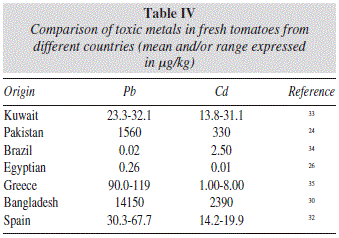
<body><![CDATA[<p><font face="Verdana" size="2"><i>Statistical analysis</i></font></p>     <p><font face="Verdana" size="2">All results were tested for normality with Kolmogorov-Smirnov and Shapiro-Wilk tests. Levene test was used to check the homogeneity of the variance. P values of &lt; 0.05 were considered statistically significant.</font></p>     <p>&nbsp;</p>     <p><font face="Verdana" size="2"><b>Results and discussion</b></font></p>     <p><font face="Verdana" size="2">Essential elements and heavy metal contents detected in tomatoes from Souss-Massa are detailed in <a target="_blank" href="/img/revistas/nh/v27n5/34_original_25_t2.gif">table II</a>. Among all analyzed elements Fe was the most important trace element, with levels between 0.28 and 1.89 mg/kg, followed by Zn, Mn and Cu. Positive correlations among Fe, Cu and Mn at the 0.01 level and between Mn and Zn at the 0.05 level were detected.</font></p>     <p><font face="Verdana" size="2"><a target="_blank" href="/img/revistas/nh/v27n5/34_original_25_t3.gif">Table III</a> shows a comparison of the obtained element contents with results published in existing literature.<sup>21-32</sup> Tomatoes' trace element contents vary widely among different countries.</font></p>     <p><font face="Verdana" size="2">In general, the mean concentrations of the trace elements considered in this study were most similar to those obtained for tomatoes in Spain by Bakkali et al. (2009). Bangladesh and Turkey presented the highest tomatoes contents in micro-minerals compared with those found for other countries.</font></p>     <p><font face="Verdana" size="2">As for heavy metals, mean levels of Pb were higher than Cd contents. None of the samples in this study contained Pb or Cd levels that exceeded the limits established for vegetable products by European legislation.<sup>9</sup></font></p>     <p><font face="Verdana" size="2"><a target="_blank" href="/img/revistas/nh/v27n5/33_original_24_t4.gif">Table IV</a> shows a comparison of the obtained heavy metal contents with results published in existing literature.<sup>24,26,30,32-35</sup> Heavy metals contents vary widely among different countries. Levels of heavy metals found in this study were lower than those obtained in several countries with exception of Brazil and Egypt. Bangladesh presents the highest lead (14,150 &mu;gPb/kg) and cadmium (2,390 &mu;gCd/kg) concentrations in tomatoes, perhaps due to low standards of environmental protection and contaminated soils and water.</font></p>     <p>&nbsp;</p>     ]]></body>
<body><![CDATA[<p align="center"><a name="t4"><img src="/img/revistas/nh/v27n5/34_original_25_t4.gif"></a></p>     <p>&nbsp;</p>     <p><font face="Verdana" size="2">In order to know the contribution of tomato consumption to the Recommended Daily Intakes and to evaluate the risk of dietary heavy metal exposure through tomato consumption, the daily consumption of tomatoes set by the Spanish Food Safety Agency (AESAN) has been used. According to this agency the estimated average consumption of tomatoes for the Spanish population aged between 17 and 60 years is 35.3 g/person/day.<sup>16</sup></font></p>     <p><font face="Verdana" size="2">The estimated intakes of trace elements were compared to the Recommended Daily Allowances (RDAs) while the estimated intakes of lead and cadmium were compared to the Provisional Tolerable Weekly Intakes (PTWIs).</font></p>     <p><font face="Verdana" size="2"><a target="_blank" href="/img/revistas/nh/v27n5/34_original_25_t5.gif">Table V</a> presents the average daily trace element and heavy metal intakes based on a 35.3 g/person/day tomato consumption and their contributions to the RDAs and PTWIs. Within the micro-minerals, the highest contribution to the intakes was observed for Cu (0.67% for adults) while that Zn showed the lowest contribution (0.14 % for adult males and 0.20% for adult females). Due to the differences in Fe requirements among men and women, tomato consumption contributions to the recommended Fe intakes are significantly different among sexes (0.33% for males and 0.14% for females, respectively). The estimated daily intakes of Pb and Cd due to the consumption of tomatoes are very low and contribute very little to the PTWI (0.45% for Cd and 0.26% for Pb, respectively).</font></p>     <p>&nbsp;</p>     <p><font face="Verdana" size="2"><b>Conclusions</b></font></p>     <p><font face="Verdana" size="2">This study can provide a better knowledge about macroelements, microelements and toxic metal contents in crops. Tomatoes are a good source of essential elements for the diet, mainly iron and zinc. A daily tomato consumption pattern contributes to the recommended dietary intakes of trace elements, mostly Cu. Tomatoes consumption does not significantly affect the intake of heavy metals. There is no toxicological risk caused by the daily consumption of tomatoes.</font></p>     <p>&nbsp;</p>     <p><font face="Verdana" size="2"><b>References</b></font></p>     ]]></body>
<body><![CDATA[<!-- ref --><p><font face="Verdana" size="2">1. Food and Agriculture Organization of the United Nations (FAO); 2007 FAOSTAT-Prodstat, Restrieved 2010-3. (updated 2011 October 6; cited 2011 October 14). Available from: <a target="_blank" href="http://faostat.fao.org/site/339/default.aspx">http://faostat.fao.org/site/339/default.aspx</a>.    &nbsp;&nbsp;&nbsp;&nbsp;&nbsp;&nbsp;&nbsp;&nbsp;[&#160;<a href="javascript:void(0);" onclick="javascript: window.open('/scielo.php?script=sci_nlinks&ref=3695934&pid=S0212-1611201200050003400001&lng=','','width=640,height=500,resizable=yes,scrollbars=1,menubar=yes,');">Links</a>&#160;]<!-- end-ref --></font></p>    <!-- ref --><p><font face="Verdana" size="2">2. Gundersen V, McCall D, Bechmann, IE. Comparison of major and trace element concentrations in Danish greenhouse tomatoes <i>(Lycopersicon esculentum cv. Aromata F1)</i> cultivated in different substrates. <i>J Agric Food Chem</i> 2001; 49: 3808-15.    &nbsp;&nbsp;&nbsp;&nbsp;&nbsp;&nbsp;&nbsp;&nbsp;[&#160;<a href="javascript:void(0);" onclick="javascript: window.open('/scielo.php?script=sci_nlinks&ref=3695936&pid=S0212-1611201200050003400002&lng=','','width=640,height=500,resizable=yes,scrollbars=1,menubar=yes,');">Links</a>&#160;]<!-- end-ref --></font></p>    <!-- ref --><p><font face="Verdana" size="2">3. Salghi R, Luis G, Rubio C, Hormatallah A, Bazzi L, Gutiérrez AJ, Hardisson A. Pesticide residues in tomatoes from greenhouses in Souss Massa valley, Morocco. <i>Bull Environ Contam Toxicol</i> 2012; DOI 10.1007/s00128-011-0503-9.    &nbsp;&nbsp;&nbsp;&nbsp;&nbsp;&nbsp;&nbsp;&nbsp;[&#160;<a href="javascript:void(0);" onclick="javascript: window.open('/scielo.php?script=sci_nlinks&ref=3695938&pid=S0212-1611201200050003400003&lng=','','width=640,height=500,resizable=yes,scrollbars=1,menubar=yes,');">Links</a>&#160;]<!-- end-ref --></font></p>    <!-- ref --><p><font face="Verdana" size="2">4. López-Millán AF, Sagardoy R, Solanas M, Abadía A, Abadía J. Cadmium toxicity in tomato <i>(Lycopersicon esculentum)</i> plants grown in hydroponics. <i>Environ Exp Bot</i> 2009; 65: 376-85.    &nbsp;&nbsp;&nbsp;&nbsp;&nbsp;&nbsp;&nbsp;&nbsp;[&#160;<a href="javascript:void(0);" onclick="javascript: window.open('/scielo.php?script=sci_nlinks&ref=3695940&pid=S0212-1611201200050003400004&lng=','','width=640,height=500,resizable=yes,scrollbars=1,menubar=yes,');">Links</a>&#160;]<!-- end-ref --></font></p>    <!-- ref --><p><font face="Verdana" size="2">5. Lima RLFC, Costa MJC, Filizola RG, Asciuti PhDLSR, Leite RF, Ferreira RDASM, Faintuch J. Consumption of fruits and vegetables and C-reactive protein in women undergoing cosmetic surgery. <i>Nutr Hosp</i> 2010; 25 (5): 763-7.    &nbsp;&nbsp;&nbsp;&nbsp;&nbsp;&nbsp;&nbsp;&nbsp;[&#160;<a href="javascript:void(0);" onclick="javascript: window.open('/scielo.php?script=sci_nlinks&ref=3695942&pid=S0212-1611201200050003400005&lng=','','width=640,height=500,resizable=yes,scrollbars=1,menubar=yes,');">Links</a>&#160;]<!-- end-ref --></font></p>    ]]></body>
<body><![CDATA[<!-- ref --><p><font face="Verdana" size="2">6. García-Gabarra A. Ingesta de Nutrientes: Conceptos y Recomendaciones Internacionales (1<sup>a</sup> Parte). <i>Nutr Hosp</i> 2006; 21(3): 291-9.    &nbsp;&nbsp;&nbsp;&nbsp;&nbsp;&nbsp;&nbsp;&nbsp;[&#160;<a href="javascript:void(0);" onclick="javascript: window.open('/scielo.php?script=sci_nlinks&ref=3695944&pid=S0212-1611201200050003400006&lng=','','width=640,height=500,resizable=yes,scrollbars=1,menubar=yes,');">Links</a>&#160;]<!-- end-ref --></font></p>    <!-- ref --><p><font face="Verdana" size="2">7. García-Gabarra A. Ingesta de Nutrientes: Conceptos y Recomendaciones Internacionales (2<sup>a</sup> Parte). <i>Nutr Hosp</i> 2006; 21(4): 437-47.    &nbsp;&nbsp;&nbsp;&nbsp;&nbsp;&nbsp;&nbsp;&nbsp;[&#160;<a href="javascript:void(0);" onclick="javascript: window.open('/scielo.php?script=sci_nlinks&ref=3695946&pid=S0212-1611201200050003400007&lng=','','width=640,height=500,resizable=yes,scrollbars=1,menubar=yes,');">Links</a>&#160;]<!-- end-ref --></font></p>    <!-- ref --><p><font face="Verdana" size="2">8. Institute of Medicine, Food and Nutrition Board. Dietary reference intakes for arsenic, boron, chromium, copper, iodine, iron, manganese, molybdenum, nickel, silicon, vanadium, and zinc. Washington, DC: National Academy Press, 2001.    &nbsp;&nbsp;&nbsp;&nbsp;&nbsp;&nbsp;&nbsp;&nbsp;[&#160;<a href="javascript:void(0);" onclick="javascript: window.open('/scielo.php?script=sci_nlinks&ref=3695948&pid=S0212-1611201200050003400008&lng=','','width=640,height=500,resizable=yes,scrollbars=1,menubar=yes,');">Links</a>&#160;]<!-- end-ref --></font></p>    <!-- ref --><p><font face="Verdana" size="2">9. DOUE. Commission Regulation (EC) N<sup>o</sup> 1881/2006 of 19 December 2006 setting maximum levels of certain contaminants in foodstuffs. DOUE L364/5-L364/24, 2006.    &nbsp;&nbsp;&nbsp;&nbsp;&nbsp;&nbsp;&nbsp;&nbsp;[&#160;<a href="javascript:void(0);" onclick="javascript: window.open('/scielo.php?script=sci_nlinks&ref=3695950&pid=S0212-1611201200050003400009&lng=','','width=640,height=500,resizable=yes,scrollbars=1,menubar=yes,');">Links</a>&#160;]<!-- end-ref --></font></p>    <!-- ref --><p><font face="Verdana" size="2">10. EFSA. SCIENTIFIC OPINION; Statement on tolerable weekly intake for cadmium. EFSA Panel on Contaminants in the Food Chain (CONTAM). <i>EFSA J</i> 2011; 1975.    &nbsp;&nbsp;&nbsp;&nbsp;&nbsp;&nbsp;&nbsp;&nbsp;[&#160;<a href="javascript:void(0);" onclick="javascript: window.open('/scielo.php?script=sci_nlinks&ref=3695952&pid=S0212-1611201200050003400010&lng=','','width=640,height=500,resizable=yes,scrollbars=1,menubar=yes,');">Links</a>&#160;]<!-- end-ref --></font></p>    ]]></body>
<body><![CDATA[<!-- ref --><p><font face="Verdana" size="2">11. Speijers GJ. Precision of estimates of an ADI (or TDI or PTWI). <i>Regul Toxicol Pharmacol</i> 1999; 2: S87-93.    &nbsp;&nbsp;&nbsp;&nbsp;&nbsp;&nbsp;&nbsp;&nbsp;[&#160;<a href="javascript:void(0);" onclick="javascript: window.open('/scielo.php?script=sci_nlinks&ref=3695954&pid=S0212-1611201200050003400011&lng=','','width=640,height=500,resizable=yes,scrollbars=1,menubar=yes,');">Links</a>&#160;]<!-- end-ref --></font></p>    <!-- ref --><p><font face="Verdana" size="2">12. Food and Agriculture Organization of the United Nations (FAO). Joint FAO/WHO expert committee on food additives. Sixty- first Meeting, Rome, June 10-19, 2003. (updated 2011 October 6; cited 2011 October 14). Available from: <a target="_blank" href="ftp://ftp.fao.org/es/esn/jecfa/jecfa61sc.pdf">ftp://ftp.fao.org/es/esn/jecfa/jecfa61sc.pdf</a>.    &nbsp;&nbsp;&nbsp;&nbsp;&nbsp;&nbsp;&nbsp;&nbsp;[&#160;<a href="javascript:void(0);" onclick="javascript: window.open('/scielo.php?script=sci_nlinks&ref=3695956&pid=S0212-1611201200050003400012&lng=','','width=640,height=500,resizable=yes,scrollbars=1,menubar=yes,');">Links</a>&#160;]<!-- end-ref --></font></p>    <!-- ref --><p><font face="Verdana" size="2">13. Food and Agriculture Organization of the United Nations (FAO). Evaluation of certain food additives and contaminants. 41<sup>st</sup> Report of Joint FAO/WHO Committee on Food Additives, Geneve, Switzerland, 1993.    &nbsp;&nbsp;&nbsp;&nbsp;&nbsp;&nbsp;&nbsp;&nbsp;[&#160;<a href="javascript:void(0);" onclick="javascript: window.open('/scielo.php?script=sci_nlinks&ref=3695958&pid=S0212-1611201200050003400013&lng=','','width=640,height=500,resizable=yes,scrollbars=1,menubar=yes,');">Links</a>&#160;]<!-- end-ref --></font></p>    <!-- ref --><p><font face="Verdana" size="2">14. Zukowska J, Biziuk M. Methodological evaluation of method for dietary heavy metal intake. <i>J Food Sci</i> 2008; 73: R21-9.    &nbsp;&nbsp;&nbsp;&nbsp;&nbsp;&nbsp;&nbsp;&nbsp;[&#160;<a href="javascript:void(0);" onclick="javascript: window.open('/scielo.php?script=sci_nlinks&ref=3695960&pid=S0212-1611201200050003400014&lng=','','width=640,height=500,resizable=yes,scrollbars=1,menubar=yes,');">Links</a>&#160;]<!-- end-ref --></font></p>    <!-- ref --><p><font face="Verdana" size="2">15. Agencia Española de Seguridad Alimentaria (AESAN). Modelo de dieta española para la determinación de la exposición del consumidor a sustancias químicas, 2006.    &nbsp;&nbsp;&nbsp;&nbsp;&nbsp;&nbsp;&nbsp;&nbsp;[&#160;<a href="javascript:void(0);" onclick="javascript: window.open('/scielo.php?script=sci_nlinks&ref=3695962&pid=S0212-1611201200050003400015&lng=','','width=640,height=500,resizable=yes,scrollbars=1,menubar=yes,');">Links</a>&#160;]<!-- end-ref --></font></p>    ]]></body>
<body><![CDATA[<!-- ref --><p><font face="Verdana" size="2">16. Piotrowska M, Kabata-Pendias A. Impact of soils amended with Zn and Pb smelter dust on Cd in potatoes. <i>J Geochem Explor</i> 1997; 58: 319-22.    &nbsp;&nbsp;&nbsp;&nbsp;&nbsp;&nbsp;&nbsp;&nbsp;[&#160;<a href="javascript:void(0);" onclick="javascript: window.open('/scielo.php?script=sci_nlinks&ref=3695964&pid=S0212-1611201200050003400016&lng=','','width=640,height=500,resizable=yes,scrollbars=1,menubar=yes,');">Links</a>&#160;]<!-- end-ref --></font></p>    <!-- ref --><p><font face="Verdana" size="2">17. Dugo G, La Pera L, Lo Turco V, Giuffrida D, Restuccia S. Determination of copper, zinc, selenium, lead and cadmium in potatoes (Solanum tuberosum L) using potentiometric stripping methods. <i>Food Addit Contam</i> 2004; 21:649-57.    &nbsp;&nbsp;&nbsp;&nbsp;&nbsp;&nbsp;&nbsp;&nbsp;[&#160;<a href="javascript:void(0);" onclick="javascript: window.open('/scielo.php?script=sci_nlinks&ref=3695966&pid=S0212-1611201200050003400017&lng=','','width=640,height=500,resizable=yes,scrollbars=1,menubar=yes,');">Links</a>&#160;]<!-- end-ref --></font></p>    <!-- ref --><p><font face="Verdana" size="2">18. Reid RJ, Dunbar KR, McLaughlin MJ. Cadmium loading into potato tubers: the roles of the periderm, xylem and phloem. <i>Plant Cell Environ</i> 2003; 26: 201-6.    &nbsp;&nbsp;&nbsp;&nbsp;&nbsp;&nbsp;&nbsp;&nbsp;[&#160;<a href="javascript:void(0);" onclick="javascript: window.open('/scielo.php?script=sci_nlinks&ref=3695968&pid=S0212-1611201200050003400018&lng=','','width=640,height=500,resizable=yes,scrollbars=1,menubar=yes,');">Links</a>&#160;]<!-- end-ref --></font></p>    <!-- ref --><p><font face="Verdana" size="2">19. Bovell-Benjamin AC. Sweet potato: A review of its past, present, and future role in human nutrition. <i>Adv Food Nutr Res</i> 2007; 52: 1-59.    &nbsp;&nbsp;&nbsp;&nbsp;&nbsp;&nbsp;&nbsp;&nbsp;[&#160;<a href="javascript:void(0);" onclick="javascript: window.open('/scielo.php?script=sci_nlinks&ref=3695970&pid=S0212-1611201200050003400019&lng=','','width=640,height=500,resizable=yes,scrollbars=1,menubar=yes,');">Links</a>&#160;]<!-- end-ref --></font></p>    <!-- ref --><p><font face="Verdana" size="2">20. Luis G, Rubio C, Gutiérrez AJ, Hernández C, González-Weller D, Revert C, Castilla A, Abreu P, Hardisson A. Palm tree syrup; nutritional composition of a natural edulcorant. <i>Nutr Hosp</i> 2012; 27 (2): 548-52.    &nbsp;&nbsp;&nbsp;&nbsp;&nbsp;&nbsp;&nbsp;&nbsp;[&#160;<a href="javascript:void(0);" onclick="javascript: window.open('/scielo.php?script=sci_nlinks&ref=3695972&pid=S0212-1611201200050003400020&lng=','','width=640,height=500,resizable=yes,scrollbars=1,menubar=yes,');">Links</a>&#160;]<!-- end-ref --></font></p>    ]]></body>
<body><![CDATA[<!-- ref --><p><font face="Verdana" size="2">21. Tinggi U, Reilly C, Pattersod C. Determination of manganese and chromium in foods by atomic absorption spectrometry after wet digestion. <i>Food Chem</i> 1997; 60: 123-8.    &nbsp;&nbsp;&nbsp;&nbsp;&nbsp;&nbsp;&nbsp;&nbsp;[&#160;<a href="javascript:void(0);" onclick="javascript: window.open('/scielo.php?script=sci_nlinks&ref=3695974&pid=S0212-1611201200050003400021&lng=','','width=640,height=500,resizable=yes,scrollbars=1,menubar=yes,');">Links</a>&#160;]<!-- end-ref --></font></p>    <!-- ref --><p><font face="Verdana" size="2">22. Sánchez-Castillo RV, Dewey PJS, Aguirre A, Lara JJ, Escamilla I, James PT. The mineral content of Mexican fruits and vegetables. <i>J Food Compos Anal</i> 1998; 11: 340-56.    &nbsp;&nbsp;&nbsp;&nbsp;&nbsp;&nbsp;&nbsp;&nbsp;[&#160;<a href="javascript:void(0);" onclick="javascript: window.open('/scielo.php?script=sci_nlinks&ref=3695976&pid=S0212-1611201200050003400022&lng=','','width=640,height=500,resizable=yes,scrollbars=1,menubar=yes,');">Links</a>&#160;]<!-- end-ref --></font></p>    <!-- ref --><p><font face="Verdana" size="2">23. Mohamed AE, Rashed MN, Mofty A. Assessment of essential and toxic elements in some kinds of vegetables. <i>Ecotoxicol Environ Saf</i> 2003; 55: 251-60.    &nbsp;&nbsp;&nbsp;&nbsp;&nbsp;&nbsp;&nbsp;&nbsp;[&#160;<a href="javascript:void(0);" onclick="javascript: window.open('/scielo.php?script=sci_nlinks&ref=3695978&pid=S0212-1611201200050003400023&lng=','','width=640,height=500,resizable=yes,scrollbars=1,menubar=yes,');">Links</a>&#160;]<!-- end-ref --></font></p>    <!-- ref --><p><font face="Verdana" size="2">24. Parveen Z, Khuhro M.I, Rafiq N. Market basket survey for lead, cadmium, copper, chromium, nickel and zinc in fruits and vegetables. <i>Bull Environ Contam Toxicol</i> 2003; 71: 1260-64.    &nbsp;&nbsp;&nbsp;&nbsp;&nbsp;&nbsp;&nbsp;&nbsp;[&#160;<a href="javascript:void(0);" onclick="javascript: window.open('/scielo.php?script=sci_nlinks&ref=3695980&pid=S0212-1611201200050003400024&lng=','','width=640,height=500,resizable=yes,scrollbars=1,menubar=yes,');">Links</a>&#160;]<!-- end-ref --></font></p>    <!-- ref --><p><font face="Verdana" size="2">25. Ferreira KS, Gomes JC, Chaves JBP. Copper content of commonly consumed food in Brazil. <i>Food Chem</i> 2005; 92: 29-32.    &nbsp;&nbsp;&nbsp;&nbsp;&nbsp;&nbsp;&nbsp;&nbsp;[&#160;<a href="javascript:void(0);" onclick="javascript: window.open('/scielo.php?script=sci_nlinks&ref=3695982&pid=S0212-1611201200050003400025&lng=','','width=640,height=500,resizable=yes,scrollbars=1,menubar=yes,');">Links</a>&#160;]<!-- end-ref --></font></p>    ]]></body>
<body><![CDATA[<!-- ref --><p><font face="Verdana" size="2">26. Radwan MA, Salama AK. Market basket Surrey for some heavy metals in Egyptian fruits and vegetables. <i>Food Chem Toxicol</i> 2006; 44: 1273-78.    &nbsp;&nbsp;&nbsp;&nbsp;&nbsp;&nbsp;&nbsp;&nbsp;[&#160;<a href="javascript:void(0);" onclick="javascript: window.open('/scielo.php?script=sci_nlinks&ref=3695984&pid=S0212-1611201200050003400026&lng=','','width=640,height=500,resizable=yes,scrollbars=1,menubar=yes,');">Links</a>&#160;]<!-- end-ref --></font></p>    <!-- ref --><p><font face="Verdana" size="2">27. Ekholm P, Reinivuo H, Mattilac P, Pakkalab H, Koponen J, Happonen A, Hellstrom J, Ovaskainen ML. Changes in the mineral and trace element contents of cereals, fruits and vegetables in Finland. <i>J Food Compos Anal</i> 2007; 20: 487-95.    &nbsp;&nbsp;&nbsp;&nbsp;&nbsp;&nbsp;&nbsp;&nbsp;[&#160;<a href="javascript:void(0);" onclick="javascript: window.open('/scielo.php?script=sci_nlinks&ref=3695986&pid=S0212-1611201200050003400027&lng=','','width=640,height=500,resizable=yes,scrollbars=1,menubar=yes,');">Links</a>&#160;]<!-- end-ref --></font></p>    <!-- ref --><p><font face="Verdana" size="2">28. Hernández-Suárez M, Rodríguez-Rodríguez EM, Díaz-Romero C. Mineral and trace element concentrations in cultivars of tomatoes. <i>Food Chem</i> 2007; 104: 489-99.    &nbsp;&nbsp;&nbsp;&nbsp;&nbsp;&nbsp;&nbsp;&nbsp;[&#160;<a href="javascript:void(0);" onclick="javascript: window.open('/scielo.php?script=sci_nlinks&ref=3695988&pid=S0212-1611201200050003400028&lng=','','width=640,height=500,resizable=yes,scrollbars=1,menubar=yes,');">Links</a>&#160;]<!-- end-ref --></font></p>    <!-- ref --><p><font face="Verdana" size="2">29. Paredes E, Prats MS, Maestre SE, Todolí JL. Rapid analytical method for the determination of organic and inorganic species in tomato samples through HPLC-ICP-AES coupling. <i>Food Chem</i> 2008; 111: 468-75.    &nbsp;&nbsp;&nbsp;&nbsp;&nbsp;&nbsp;&nbsp;&nbsp;[&#160;<a href="javascript:void(0);" onclick="javascript: window.open('/scielo.php?script=sci_nlinks&ref=3695990&pid=S0212-1611201200050003400029&lng=','','width=640,height=500,resizable=yes,scrollbars=1,menubar=yes,');">Links</a>&#160;]<!-- end-ref --></font></p>     <!-- ref --><p><font face="Verdana" size="2">30. Ahmad JU, Goni MA. Heavy metal contamination in water, soil, and vegetables of the industrial areas in Dhaka, Bangladesh. <i>Environ Monit Assess</i> 2010; 166: 347-57.    &nbsp;&nbsp;&nbsp;&nbsp;&nbsp;&nbsp;&nbsp;&nbsp;[&#160;<a href="javascript:void(0);" onclick="javascript: window.open('/scielo.php?script=sci_nlinks&ref=3695992&pid=S0212-1611201200050003400030&lng=','','width=640,height=500,resizable=yes,scrollbars=1,menubar=yes,');">Links</a>&#160;]<!-- end-ref --></font></p>    ]]></body>
<body><![CDATA[<!-- ref --><p><font face="Verdana" size="2">31. Bakkali K, Ramos-Martos N, Souhail B, Ballesteros E. Characterization of trace metals in vegetables by graphite furnace atomic absorption spectrometry alter closed vessel microwave digestion. <i>Food Chem</i> 2009; 116: 590-4.    &nbsp;&nbsp;&nbsp;&nbsp;&nbsp;&nbsp;&nbsp;&nbsp;[&#160;<a href="javascript:void(0);" onclick="javascript: window.open('/scielo.php?script=sci_nlinks&ref=3695994&pid=S0212-1611201200050003400031&lng=','','width=640,height=500,resizable=yes,scrollbars=1,menubar=yes,');">Links</a>&#160;]<!-- end-ref --></font></p>    <!-- ref --><p><font face="Verdana" size="2">32. Demirbas A. Oil, micronutrient and heavy metal contents of tomatoes. <i>Food Chem</i> 2010; 118: 504-7.    &nbsp;&nbsp;&nbsp;&nbsp;&nbsp;&nbsp;&nbsp;&nbsp;[&#160;<a href="javascript:void(0);" onclick="javascript: window.open('/scielo.php?script=sci_nlinks&ref=3695996&pid=S0212-1611201200050003400032&lng=','','width=640,height=500,resizable=yes,scrollbars=1,menubar=yes,');">Links</a>&#160;]<!-- end-ref --></font></p>    <!-- ref --><p><font face="Verdana" size="2">33. Husain A, Baroon Z, Al-Khalafawi M, Al-Ati T, Sawaya W. Toxic metals in imported fruits and vegetables marketed in Kuwait. <i>Environ Int</i> 1995; 21: 803-5.    &nbsp;&nbsp;&nbsp;&nbsp;&nbsp;&nbsp;&nbsp;&nbsp;[&#160;<a href="javascript:void(0);" onclick="javascript: window.open('/scielo.php?script=sci_nlinks&ref=3695998&pid=S0212-1611201200050003400033&lng=','','width=640,height=500,resizable=yes,scrollbars=1,menubar=yes,');">Links</a>&#160;]<!-- end-ref --></font></p>    <!-- ref --><p><font face="Verdana" size="2">34. Santos EE, Lauria DC, Porto da Silvera CL. Assessment of daily intake of trace elements due to consumption of foodstuffs by adult inhabitants of Rio de Janeiro city. <i>Sci Total Environ</i> 2004; 327: 69-79.    &nbsp;&nbsp;&nbsp;&nbsp;&nbsp;&nbsp;&nbsp;&nbsp;[&#160;<a href="javascript:void(0);" onclick="javascript: window.open('/scielo.php?script=sci_nlinks&ref=3696000&pid=S0212-1611201200050003400034&lng=','','width=640,height=500,resizable=yes,scrollbars=1,menubar=yes,');">Links</a>&#160;]<!-- end-ref --></font></p>    <!-- ref --><p><font face="Verdana" size="2">35. Golia EE, Dimirkou A, Mitsios IK. Influence of some soil parameters on heavy metals accumulation by vegetables grown in agricultural soils of different soil orders. <i>Bull Environ Contam Toxicol</i> 2008; 81:80-4.    &nbsp;&nbsp;&nbsp;&nbsp;&nbsp;&nbsp;&nbsp;&nbsp;[&#160;<a href="javascript:void(0);" onclick="javascript: window.open('/scielo.php?script=sci_nlinks&ref=3696002&pid=S0212-1611201200050003400035&lng=','','width=640,height=500,resizable=yes,scrollbars=1,menubar=yes,');">Links</a>&#160;]<!-- end-ref --></font></p>     ]]></body>
<body><![CDATA[<p>&nbsp;</p>     <p>&nbsp;</p>     <p><font face="Verdana" size="2"><a href="#top"><img border="0" src="/img/revistas/nh/v27n5/seta.gif" width="15" height="17"></a><a name="bajo"></a><b>Correspondence:</b>    <br>Carmen Rubio Armendáriz    <br>Facultad de Medicina. Universidad de La Laguna    <br>Area de Toxicología. Universidad de La Laguna    <br>38071 La Laguna. S/C de Tenerife. España    <br>E-mail: <a href="mailto:crubiotox@gmail.com">crubiotox@gmail.com</a></font></p>     <p><font face="Verdana" size="2">Recibido: 14-V-2012    <br>Aceptado: 1-VII-2012</font></p>     ]]></body>
<body><![CDATA[ ]]></body><back>
<ref-list>
<ref id="B1">
<label>1</label><nlm-citation citation-type="">
<collab>Food and Agriculture Organization of the United Nations (FAO)</collab>
<source><![CDATA[FAOSTAT-Prodstat, Restrieved 2010-3]]></source>
<year>2007</year>
</nlm-citation>
</ref>
<ref id="B2">
<label>2</label><nlm-citation citation-type="journal">
<person-group person-group-type="author">
<name>
<surname><![CDATA[Gundersen]]></surname>
<given-names><![CDATA[V]]></given-names>
</name>
<name>
<surname><![CDATA[McCall]]></surname>
<given-names><![CDATA[D]]></given-names>
</name>
<name>
<surname><![CDATA[Bechmann]]></surname>
<given-names><![CDATA[IE]]></given-names>
</name>
</person-group>
<article-title xml:lang="en"><![CDATA[Comparison of major and trace element concentrations in Danish greenhouse tomatoes (Lycopersicon esculentum cv.Aromata F1) cultivated in different substrates]]></article-title>
<source><![CDATA[J Agric Food Chem]]></source>
<year>2001</year>
<volume>49</volume>
<page-range>3808-15</page-range></nlm-citation>
</ref>
<ref id="B3">
<label>3</label><nlm-citation citation-type="journal">
<person-group person-group-type="author">
<name>
<surname><![CDATA[Salghi]]></surname>
<given-names><![CDATA[R]]></given-names>
</name>
<name>
<surname><![CDATA[Luis]]></surname>
<given-names><![CDATA[G]]></given-names>
</name>
<name>
<surname><![CDATA[Rubio]]></surname>
<given-names><![CDATA[C]]></given-names>
</name>
<name>
<surname><![CDATA[Hormatallah]]></surname>
<given-names><![CDATA[A]]></given-names>
</name>
<name>
<surname><![CDATA[Bazzi]]></surname>
<given-names><![CDATA[L]]></given-names>
</name>
<name>
<surname><![CDATA[Gutiérrez]]></surname>
<given-names><![CDATA[AJ]]></given-names>
</name>
<name>
<surname><![CDATA[Hardisson]]></surname>
<given-names><![CDATA[A]]></given-names>
</name>
</person-group>
<article-title xml:lang="en"><![CDATA[Pesticide residues in tomatoes from greenhouses in Souss Massa valley, Morocco]]></article-title>
<source><![CDATA[Bull Environ Contam Toxicol]]></source>
<year>2012</year>
</nlm-citation>
</ref>
<ref id="B4">
<label>4</label><nlm-citation citation-type="journal">
<person-group person-group-type="author">
<name>
<surname><![CDATA[López-Millán]]></surname>
<given-names><![CDATA[AF]]></given-names>
</name>
<name>
<surname><![CDATA[Sagardoy]]></surname>
<given-names><![CDATA[R]]></given-names>
</name>
<name>
<surname><![CDATA[Solanas]]></surname>
<given-names><![CDATA[M]]></given-names>
</name>
<name>
<surname><![CDATA[Abadía]]></surname>
<given-names><![CDATA[A]]></given-names>
</name>
<name>
<surname><![CDATA[Abadía]]></surname>
<given-names><![CDATA[J]]></given-names>
</name>
</person-group>
<article-title xml:lang="en"><![CDATA[Cadmium toxicity in tomato (Lycopersicon esculentum) plants grown in hydroponics]]></article-title>
<source><![CDATA[Environ Exp Bot]]></source>
<year>2009</year>
<volume>65</volume>
<page-range>376-85</page-range></nlm-citation>
</ref>
<ref id="B5">
<label>5</label><nlm-citation citation-type="journal">
<person-group person-group-type="author">
<name>
<surname><![CDATA[Lima]]></surname>
<given-names><![CDATA[RLFC]]></given-names>
</name>
<name>
<surname><![CDATA[Costa]]></surname>
<given-names><![CDATA[MJC]]></given-names>
</name>
<name>
<surname><![CDATA[Filizola]]></surname>
<given-names><![CDATA[RG]]></given-names>
</name>
<name>
<surname><![CDATA[Asciuti]]></surname>
<given-names><![CDATA[PhDLSR]]></given-names>
</name>
<name>
<surname><![CDATA[Leite]]></surname>
<given-names><![CDATA[RF]]></given-names>
</name>
<name>
<surname><![CDATA[Ferreira]]></surname>
<given-names><![CDATA[RDASM]]></given-names>
</name>
<name>
<surname><![CDATA[Faintuch]]></surname>
<given-names><![CDATA[J]]></given-names>
</name>
</person-group>
<article-title xml:lang="en"><![CDATA[Consumption of fruits and vegetables and C-reactive protein in women undergoing cosmetic surgery]]></article-title>
<source><![CDATA[Nutr Hosp]]></source>
<year>2010</year>
<volume>25</volume>
<numero>5</numero>
<issue>5</issue>
<page-range>763-7</page-range></nlm-citation>
</ref>
<ref id="B6">
<label>6</label><nlm-citation citation-type="journal">
<person-group person-group-type="author">
<name>
<surname><![CDATA[García-Gabarra]]></surname>
<given-names><![CDATA[A]]></given-names>
</name>
</person-group>
<article-title xml:lang="es"><![CDATA[Ingesta de Nutrientes: Conceptos y Recomendaciones Internacionales (1ª Parte)]]></article-title>
<source><![CDATA[Nutr Hosp]]></source>
<year>2006</year>
<volume>21</volume>
<numero>3</numero>
<issue>3</issue>
<page-range>291-9</page-range></nlm-citation>
</ref>
<ref id="B7">
<label>7</label><nlm-citation citation-type="journal">
<person-group person-group-type="author">
<name>
<surname><![CDATA[García-Gabarra]]></surname>
<given-names><![CDATA[A]]></given-names>
</name>
</person-group>
<article-title xml:lang="es"><![CDATA[Ingesta de Nutrientes: Conceptos y Recomendaciones Internacionales (2ª Parte)]]></article-title>
<source><![CDATA[Nutr Hosp]]></source>
<year>2006</year>
<volume>21</volume>
<numero>4</numero>
<issue>4</issue>
<page-range>437-47</page-range></nlm-citation>
</ref>
<ref id="B8">
<label>8</label><nlm-citation citation-type="book">
<collab>Institute of Medicine^dFood and Nutrition Board</collab>
<source><![CDATA[Dietary reference intakes for arsenic, boron, chromium, copper, iodine, iron, manganese, molybdenum, nickel, silicon, vanadium, and zinc]]></source>
<year>2001</year>
<publisher-loc><![CDATA[Washington^eDC DC]]></publisher-loc>
<publisher-name><![CDATA[National Academy Press]]></publisher-name>
</nlm-citation>
</ref>
<ref id="B9">
<label>9</label><nlm-citation citation-type="journal">
<collab>DOUE</collab>
<article-title xml:lang="en"><![CDATA[Commission Regulation (EC) Nº 1881/2006 of 19 December 2006 setting maximum levels of certain contaminants in foodstuffs]]></article-title>
<source><![CDATA[DOUE]]></source>
<year>2006</year>
<page-range>L364/5-L364/24</page-range></nlm-citation>
</ref>
<ref id="B10">
<label>10</label><nlm-citation citation-type="journal">
<collab>EFSA</collab>
<article-title xml:lang="en"><![CDATA[SCIENTIFIC OPINION: Statement on tolerable weekly intake for cadmium. EFSA Panel on Contaminants in the Food Chain (CONTAM)]]></article-title>
<source><![CDATA[EFSA J]]></source>
<year>2011</year>
<month>19</month>
<day>75</day>
</nlm-citation>
</ref>
<ref id="B11">
<label>11</label><nlm-citation citation-type="journal">
<person-group person-group-type="author">
<name>
<surname><![CDATA[Speijers]]></surname>
<given-names><![CDATA[GJ]]></given-names>
</name>
</person-group>
<article-title xml:lang="en"><![CDATA[Precision of estimates of an ADI (or TDI or PTWI)]]></article-title>
<source><![CDATA[Regul Toxicol Pharmacol]]></source>
<year>1999</year>
<volume>2</volume>
<page-range>S87-93</page-range></nlm-citation>
</ref>
<ref id="B12">
<label>12</label><nlm-citation citation-type="confpro">
<collab>Food and Agriculture Organization of the United Nations (FAO)</collab>
<source><![CDATA[]]></source>
<year></year>
<conf-name><![CDATA[ Joint FAO/WHO expert committee on food additives. Sixty- first Meeting]]></conf-name>
<conf-date>June 10-19, 2003</conf-date>
<conf-loc>Rome </conf-loc>
</nlm-citation>
</ref>
<ref id="B13">
<label>13</label><nlm-citation citation-type="">
<collab>Food and Agriculture Organization of the United Nations (FAO)</collab>
<source><![CDATA[Evaluation of certain food additives and contaminants.: 41st Report of Joint FAO/WHO Committee on Food Additives]]></source>
<year>1993</year>
<publisher-loc><![CDATA[Geneve ]]></publisher-loc>
</nlm-citation>
</ref>
<ref id="B14">
<label>14</label><nlm-citation citation-type="journal">
<person-group person-group-type="author">
<name>
<surname><![CDATA[Zukowska]]></surname>
<given-names><![CDATA[J]]></given-names>
</name>
<name>
<surname><![CDATA[Biziuk]]></surname>
<given-names><![CDATA[M]]></given-names>
</name>
</person-group>
<article-title xml:lang="en"><![CDATA[Methodological evaluation of method for dietary heavy metal intake]]></article-title>
<source><![CDATA[J Food Sci]]></source>
<year>2008</year>
<volume>73</volume>
<page-range>R21-9</page-range></nlm-citation>
</ref>
<ref id="B15">
<label>15</label><nlm-citation citation-type="">
<collab>Agencia Española de Seguridad Alimentaria (AESAN)</collab>
<source><![CDATA[Modelo de dieta española para la determinación de la exposición del consumidor a sustancias químicas]]></source>
<year>2006</year>
</nlm-citation>
</ref>
<ref id="B16">
<label>16</label><nlm-citation citation-type="journal">
<person-group person-group-type="author">
<name>
<surname><![CDATA[Piotrowska]]></surname>
<given-names><![CDATA[M]]></given-names>
</name>
<name>
<surname><![CDATA[Kabata-Pendias]]></surname>
<given-names><![CDATA[A]]></given-names>
</name>
</person-group>
<article-title xml:lang="en"><![CDATA[Impact of soils amended with Zn and Pb smelter dust on Cd in potatoes]]></article-title>
<source><![CDATA[J Geochem Explor]]></source>
<year>1997</year>
<volume>58</volume>
<page-range>319-22</page-range></nlm-citation>
</ref>
<ref id="B17">
<label>17</label><nlm-citation citation-type="journal">
<person-group person-group-type="author">
<name>
<surname><![CDATA[Dugo]]></surname>
<given-names><![CDATA[G]]></given-names>
</name>
<name>
<surname><![CDATA[La Pera]]></surname>
<given-names><![CDATA[L]]></given-names>
</name>
<name>
<surname><![CDATA[Lo Turco]]></surname>
<given-names><![CDATA[V]]></given-names>
</name>
<name>
<surname><![CDATA[Giuffrida]]></surname>
<given-names><![CDATA[D]]></given-names>
</name>
<name>
<surname><![CDATA[Restuccia]]></surname>
<given-names><![CDATA[S]]></given-names>
</name>
</person-group>
<article-title xml:lang="en"><![CDATA[Determination of copper, zinc, selenium, lead and cadmium in potatoes (Solanum tuberosum L) using potentiometric stripping methods]]></article-title>
<source><![CDATA[Food Addit Contam]]></source>
<year>2004</year>
<volume>21</volume>
<page-range>649-57</page-range></nlm-citation>
</ref>
<ref id="B18">
<label>18</label><nlm-citation citation-type="journal">
<person-group person-group-type="author">
<name>
<surname><![CDATA[Reid]]></surname>
<given-names><![CDATA[RJ]]></given-names>
</name>
<name>
<surname><![CDATA[Dunbar]]></surname>
<given-names><![CDATA[KR]]></given-names>
</name>
<name>
<surname><![CDATA[McLaughlin]]></surname>
<given-names><![CDATA[MJ]]></given-names>
</name>
</person-group>
<article-title xml:lang="en"><![CDATA[Cadmium loading into potato tubers: the roles of the periderm, xylem and phloem]]></article-title>
<source><![CDATA[Plant Cell Environ]]></source>
<year>2003</year>
<volume>26</volume>
<page-range>201-6</page-range></nlm-citation>
</ref>
<ref id="B19">
<label>19</label><nlm-citation citation-type="journal">
<person-group person-group-type="author">
<name>
<surname><![CDATA[Bovell-Benjamin]]></surname>
<given-names><![CDATA[AC]]></given-names>
</name>
</person-group>
<article-title xml:lang="en"><![CDATA[Sweet potato: A review of its past, present, and future role in human nutrition]]></article-title>
<source><![CDATA[Adv Food Nutr Res]]></source>
<year>2007</year>
<volume>52</volume>
<page-range>1-59</page-range></nlm-citation>
</ref>
<ref id="B20">
<label>20</label><nlm-citation citation-type="journal">
<person-group person-group-type="author">
<name>
<surname><![CDATA[Luis]]></surname>
<given-names><![CDATA[G]]></given-names>
</name>
<name>
<surname><![CDATA[Rubio]]></surname>
<given-names><![CDATA[C]]></given-names>
</name>
<name>
<surname><![CDATA[Gutiérrez]]></surname>
<given-names><![CDATA[AJ]]></given-names>
</name>
<name>
<surname><![CDATA[Hernández]]></surname>
<given-names><![CDATA[C]]></given-names>
</name>
<name>
<surname><![CDATA[González-Weller]]></surname>
<given-names><![CDATA[D]]></given-names>
</name>
<name>
<surname><![CDATA[Revert]]></surname>
<given-names><![CDATA[C]]></given-names>
</name>
<name>
<surname><![CDATA[Castilla]]></surname>
<given-names><![CDATA[A]]></given-names>
</name>
<name>
<surname><![CDATA[Abreu]]></surname>
<given-names><![CDATA[P]]></given-names>
</name>
<name>
<surname><![CDATA[Hardisson]]></surname>
<given-names><![CDATA[A]]></given-names>
</name>
</person-group>
<article-title xml:lang="en"><![CDATA[Palm tree syrup; nutritional composition of a natural edulcorant]]></article-title>
<source><![CDATA[Nutr Hosp]]></source>
<year>2012</year>
<volume>27</volume>
<numero>2</numero>
<issue>2</issue>
<page-range>548-52</page-range></nlm-citation>
</ref>
<ref id="B21">
<label>21</label><nlm-citation citation-type="journal">
<person-group person-group-type="author">
<name>
<surname><![CDATA[Tinggi]]></surname>
<given-names><![CDATA[U]]></given-names>
</name>
<name>
<surname><![CDATA[Reilly]]></surname>
<given-names><![CDATA[C]]></given-names>
</name>
<name>
<surname><![CDATA[Pattersod]]></surname>
<given-names><![CDATA[C]]></given-names>
</name>
</person-group>
<article-title xml:lang="en"><![CDATA[Determination of manganese and chromium in foods by atomic absorption spectrometry after wet digestion]]></article-title>
<source><![CDATA[Food Chem]]></source>
<year>1997</year>
<volume>60</volume>
<page-range>123-8</page-range></nlm-citation>
</ref>
<ref id="B22">
<label>22</label><nlm-citation citation-type="journal">
<person-group person-group-type="author">
<name>
<surname><![CDATA[Sánchez-Castillo]]></surname>
<given-names><![CDATA[RV]]></given-names>
</name>
<name>
<surname><![CDATA[Dewey]]></surname>
<given-names><![CDATA[PJS]]></given-names>
</name>
<name>
<surname><![CDATA[Aguirre]]></surname>
<given-names><![CDATA[A]]></given-names>
</name>
<name>
<surname><![CDATA[Lara]]></surname>
<given-names><![CDATA[JJ]]></given-names>
</name>
<name>
<surname><![CDATA[Escamilla]]></surname>
<given-names><![CDATA[I]]></given-names>
</name>
<name>
<surname><![CDATA[James]]></surname>
<given-names><![CDATA[PT]]></given-names>
</name>
</person-group>
<article-title xml:lang="en"><![CDATA[The mineral content of Mexican fruits and vegetables]]></article-title>
<source><![CDATA[J Food Compos Anal]]></source>
<year>1998</year>
<volume>11</volume>
<page-range>340-56</page-range></nlm-citation>
</ref>
<ref id="B23">
<label>23</label><nlm-citation citation-type="journal">
<person-group person-group-type="author">
<name>
<surname><![CDATA[Mohamed]]></surname>
<given-names><![CDATA[AE]]></given-names>
</name>
<name>
<surname><![CDATA[Rashed]]></surname>
<given-names><![CDATA[MN]]></given-names>
</name>
<name>
<surname><![CDATA[Mofty]]></surname>
<given-names><![CDATA[A]]></given-names>
</name>
</person-group>
<article-title xml:lang="en"><![CDATA[Assessment of essential and toxic elements in some kinds of vegetables]]></article-title>
<source><![CDATA[Ecotoxicol Environ Saf]]></source>
<year>2003</year>
<volume>55</volume>
<page-range>251-60</page-range></nlm-citation>
</ref>
<ref id="B24">
<label>24</label><nlm-citation citation-type="journal">
<person-group person-group-type="author">
<name>
<surname><![CDATA[Parveen]]></surname>
<given-names><![CDATA[Z]]></given-names>
</name>
<name>
<surname><![CDATA[Khuhro]]></surname>
<given-names><![CDATA[M.I]]></given-names>
</name>
<name>
<surname><![CDATA[Rafiq]]></surname>
<given-names><![CDATA[N]]></given-names>
</name>
</person-group>
<article-title xml:lang="en"><![CDATA[Market basket survey for lead, cadmium, copper, chromium, nickel and zinc in fruits and vegetables]]></article-title>
<source><![CDATA[Bull Environ Contam Toxicol]]></source>
<year>2003</year>
<volume>71</volume>
<page-range>1260-64</page-range></nlm-citation>
</ref>
<ref id="B25">
<label>25</label><nlm-citation citation-type="journal">
<person-group person-group-type="author">
<name>
<surname><![CDATA[Ferreira]]></surname>
<given-names><![CDATA[KS]]></given-names>
</name>
<name>
<surname><![CDATA[Gomes]]></surname>
<given-names><![CDATA[JC]]></given-names>
</name>
<name>
<surname><![CDATA[Chaves]]></surname>
<given-names><![CDATA[JBP]]></given-names>
</name>
</person-group>
<article-title xml:lang="en"><![CDATA[Copper content of commonly consumed food in Brazil]]></article-title>
<source><![CDATA[Food Chem]]></source>
<year>2005</year>
<volume>92</volume>
<page-range>29-32</page-range></nlm-citation>
</ref>
<ref id="B26">
<label>26</label><nlm-citation citation-type="journal">
<person-group person-group-type="author">
<name>
<surname><![CDATA[Radwan]]></surname>
<given-names><![CDATA[MA]]></given-names>
</name>
<name>
<surname><![CDATA[Salama]]></surname>
<given-names><![CDATA[AK]]></given-names>
</name>
</person-group>
<article-title xml:lang="en"><![CDATA[Market basket Surrey for some heavy metals in Egyptian fruits and vegetables]]></article-title>
<source><![CDATA[Food Chem Toxicol]]></source>
<year>2006</year>
<volume>44</volume>
<page-range>1273-78</page-range></nlm-citation>
</ref>
<ref id="B27">
<label>27</label><nlm-citation citation-type="journal">
<person-group person-group-type="author">
<name>
<surname><![CDATA[Ekholm]]></surname>
<given-names><![CDATA[P]]></given-names>
</name>
<name>
<surname><![CDATA[Reinivuo]]></surname>
<given-names><![CDATA[H]]></given-names>
</name>
<name>
<surname><![CDATA[Mattilac]]></surname>
<given-names><![CDATA[P]]></given-names>
</name>
<name>
<surname><![CDATA[Pakkalab]]></surname>
<given-names><![CDATA[H]]></given-names>
</name>
<name>
<surname><![CDATA[Koponen]]></surname>
<given-names><![CDATA[J]]></given-names>
</name>
<name>
<surname><![CDATA[Happonen]]></surname>
<given-names><![CDATA[A]]></given-names>
</name>
<name>
<surname><![CDATA[Hellstrom]]></surname>
<given-names><![CDATA[J]]></given-names>
</name>
<name>
<surname><![CDATA[Ovaskainen]]></surname>
<given-names><![CDATA[ML]]></given-names>
</name>
</person-group>
<article-title xml:lang="en"><![CDATA[Changes in the mineral and trace element contents of cereals, fruits and vegetables in Finland]]></article-title>
<source><![CDATA[J Food Compos Anal]]></source>
<year>2007</year>
<volume>20</volume>
<page-range>487-95</page-range></nlm-citation>
</ref>
<ref id="B28">
<label>28</label><nlm-citation citation-type="journal">
<person-group person-group-type="author">
<name>
<surname><![CDATA[Hernández-Suárez]]></surname>
<given-names><![CDATA[M]]></given-names>
</name>
<name>
<surname><![CDATA[Rodríguez-Rodríguez]]></surname>
<given-names><![CDATA[EM]]></given-names>
</name>
<name>
<surname><![CDATA[Díaz-Romero]]></surname>
<given-names><![CDATA[C]]></given-names>
</name>
</person-group>
<article-title xml:lang="en"><![CDATA[Mineral and trace element concentrations in cultivars of tomatoes]]></article-title>
<source><![CDATA[Food Chem]]></source>
<year>2007</year>
<volume>104</volume>
<page-range>489-99</page-range></nlm-citation>
</ref>
<ref id="B29">
<label>29</label><nlm-citation citation-type="journal">
<person-group person-group-type="author">
<name>
<surname><![CDATA[Paredes]]></surname>
<given-names><![CDATA[E]]></given-names>
</name>
<name>
<surname><![CDATA[Prats]]></surname>
<given-names><![CDATA[MS]]></given-names>
</name>
<name>
<surname><![CDATA[Maestre]]></surname>
<given-names><![CDATA[SE]]></given-names>
</name>
<name>
<surname><![CDATA[Todolí]]></surname>
<given-names><![CDATA[JL]]></given-names>
</name>
</person-group>
<article-title xml:lang="en"><![CDATA[Rapid analytical method for the determination of organic and inorganic species in tomato samples through HPLC-ICP-AES coupling]]></article-title>
<source><![CDATA[Food Chem]]></source>
<year>2008</year>
<volume>111</volume>
<page-range>468-75</page-range></nlm-citation>
</ref>
<ref id="B30">
<label>30</label><nlm-citation citation-type="journal">
<person-group person-group-type="author">
<name>
<surname><![CDATA[Ahmad]]></surname>
<given-names><![CDATA[JU]]></given-names>
</name>
<name>
<surname><![CDATA[Goni]]></surname>
<given-names><![CDATA[MA]]></given-names>
</name>
</person-group>
<article-title xml:lang="en"><![CDATA[Heavy metal contamination in water, soil, and vegetables of the industrial areas in Dhaka, Bangladesh]]></article-title>
<source><![CDATA[Environ Monit Assess]]></source>
<year>2010</year>
<volume>166</volume>
<page-range>347-57</page-range></nlm-citation>
</ref>
<ref id="B31">
<label>31</label><nlm-citation citation-type="journal">
<person-group person-group-type="author">
<name>
<surname><![CDATA[Bakkali]]></surname>
<given-names><![CDATA[K]]></given-names>
</name>
<name>
<surname><![CDATA[Ramos-Martos]]></surname>
<given-names><![CDATA[N]]></given-names>
</name>
<name>
<surname><![CDATA[Souhail]]></surname>
<given-names><![CDATA[B]]></given-names>
</name>
<name>
<surname><![CDATA[Ballesteros]]></surname>
<given-names><![CDATA[E]]></given-names>
</name>
</person-group>
<article-title xml:lang="en"><![CDATA[Characterization of trace metals in vegetables by graphite furnace atomic absorption spectrometry alter closed vessel microwave digestion]]></article-title>
<source><![CDATA[Food Chem]]></source>
<year>2009</year>
<volume>116</volume>
<page-range>590-4</page-range></nlm-citation>
</ref>
<ref id="B32">
<label>32</label><nlm-citation citation-type="journal">
<person-group person-group-type="author">
<name>
<surname><![CDATA[Demirbas]]></surname>
<given-names><![CDATA[A]]></given-names>
</name>
</person-group>
<article-title xml:lang="en"><![CDATA[Oil, micronutrient and heavy metal contents of tomatoes]]></article-title>
<source><![CDATA[Food Chem]]></source>
<year>2010</year>
<volume>118</volume>
<page-range>504-7</page-range></nlm-citation>
</ref>
<ref id="B33">
<label>33</label><nlm-citation citation-type="journal">
<person-group person-group-type="author">
<name>
<surname><![CDATA[Husain]]></surname>
<given-names><![CDATA[A]]></given-names>
</name>
<name>
<surname><![CDATA[Baroon]]></surname>
<given-names><![CDATA[Z]]></given-names>
</name>
<name>
<surname><![CDATA[Al-Khalafawi]]></surname>
<given-names><![CDATA[M]]></given-names>
</name>
<name>
<surname><![CDATA[Al-Ati]]></surname>
<given-names><![CDATA[T]]></given-names>
</name>
<name>
<surname><![CDATA[Sawaya]]></surname>
<given-names><![CDATA[W]]></given-names>
</name>
</person-group>
<article-title xml:lang="en"><![CDATA[Toxic metals in imported fruits and vegetables marketed in Kuwait]]></article-title>
<source><![CDATA[Environ Int]]></source>
<year>1995</year>
<volume>21</volume>
<page-range>803-5</page-range></nlm-citation>
</ref>
<ref id="B34">
<label>34</label><nlm-citation citation-type="journal">
<person-group person-group-type="author">
<name>
<surname><![CDATA[Santos]]></surname>
<given-names><![CDATA[EE]]></given-names>
</name>
<name>
<surname><![CDATA[Lauria]]></surname>
<given-names><![CDATA[DC]]></given-names>
</name>
<name>
<surname><![CDATA[Porto da Silvera]]></surname>
<given-names><![CDATA[CL]]></given-names>
</name>
</person-group>
<article-title xml:lang="en"><![CDATA[Assessment of daily intake of trace elements due to consumption of foodstuffs by adult inhabitants of Rio de Janeiro city]]></article-title>
<source><![CDATA[Sci Total Environ]]></source>
<year>2004</year>
<volume>327</volume>
<page-range>69-79</page-range></nlm-citation>
</ref>
<ref id="B35">
<label>35</label><nlm-citation citation-type="journal">
<person-group person-group-type="author">
<name>
<surname><![CDATA[Golia]]></surname>
<given-names><![CDATA[EE]]></given-names>
</name>
<name>
<surname><![CDATA[Dimirkou]]></surname>
<given-names><![CDATA[A]]></given-names>
</name>
<name>
<surname><![CDATA[Mitsios]]></surname>
<given-names><![CDATA[IK]]></given-names>
</name>
</person-group>
<article-title xml:lang="en"><![CDATA[Influence of some soil parameters on heavy metals accumulation by vegetables grown in agricultural soils of different soil orders]]></article-title>
<source><![CDATA[Bull Environ Contam Toxicol]]></source>
<year>2008</year>
<volume>81</volume>
<page-range>80-4</page-range></nlm-citation>
</ref>
</ref-list>
</back>
</article>
