<?xml version="1.0" encoding="ISO-8859-1"?><article xmlns:mml="http://www.w3.org/1998/Math/MathML" xmlns:xlink="http://www.w3.org/1999/xlink" xmlns:xsi="http://www.w3.org/2001/XMLSchema-instance">
<front>
<journal-meta>
<journal-id>0212-1611</journal-id>
<journal-title><![CDATA[Nutrición Hospitalaria]]></journal-title>
<abbrev-journal-title><![CDATA[Nutr. Hosp.]]></abbrev-journal-title>
<issn>0212-1611</issn>
<publisher>
<publisher-name><![CDATA[Grupo Arán]]></publisher-name>
</publisher>
</journal-meta>
<article-meta>
<article-id>S0212-16112012000500044</article-id>
<article-id pub-id-type="doi">10.3305/nh.2012.27.5.5933</article-id>
<title-group>
<article-title xml:lang="en"><![CDATA[The use of body circumferences for the prediction of intra-abdominal fat in obese women with polycystic ovary syndrome]]></article-title>
<article-title xml:lang="es"><![CDATA[El uso de circunferencias corporales para la predicción de la grasa intra-abdominal en mujeres obesas con el síndrome del ovario poliquístico]]></article-title>
</title-group>
<contrib-group>
<contrib contrib-type="author">
<name>
<surname><![CDATA[Rodrigues de Oliveira Penaforte]]></surname>
<given-names><![CDATA[F.]]></given-names>
</name>
<xref ref-type="aff" rid="A01"/>
<xref ref-type="aff" rid="A02"/>
</contrib>
<contrib contrib-type="author">
<name>
<surname><![CDATA[Cremonezi Japur]]></surname>
<given-names><![CDATA[C.]]></given-names>
</name>
<xref ref-type="aff" rid="A02"/>
</contrib>
<contrib contrib-type="author">
<name>
<surname><![CDATA[Díez-García]]></surname>
<given-names><![CDATA[R.W.]]></given-names>
</name>
<xref ref-type="aff" rid="A02"/>
</contrib>
<contrib contrib-type="author">
<name>
<surname><![CDATA[Salles Macedo]]></surname>
<given-names><![CDATA[C.]]></given-names>
</name>
<xref ref-type="aff" rid="A03"/>
</contrib>
<contrib contrib-type="author">
<name>
<surname><![CDATA[García Chiarello]]></surname>
<given-names><![CDATA[P.]]></given-names>
</name>
<xref ref-type="aff" rid="A02"/>
</contrib>
</contrib-group>
<aff id="A01">
<institution><![CDATA[,Universidad Federal do Triângulo Mineiro Departamento de Nutrição ]]></institution>
<addr-line><![CDATA[Uberaba Minas Gerais]]></addr-line>
<country>Brazil</country>
</aff>
<aff id="A02">
<institution><![CDATA[,Universidade de São Paulo Faculdade de Medicina de Ribeirão Preto Laboratorio de Prácticas e Comportamento Alimentares (PrátiCA)]]></institution>
<addr-line><![CDATA[Ribeirão Preto São Paulo]]></addr-line>
<country>Brasil</country>
</aff>
<aff id="A03">
<institution><![CDATA[,Universidade de São Paulo Faculdade de Medicina de Ribeirao Preto Departamento de Ginecología e Obstetricia]]></institution>
<addr-line><![CDATA[Ribeirão Preto São Paulo]]></addr-line>
<country>Brasil</country>
</aff>
<pub-date pub-type="pub">
<day>00</day>
<month>10</month>
<year>2012</year>
</pub-date>
<pub-date pub-type="epub">
<day>00</day>
<month>10</month>
<year>2012</year>
</pub-date>
<volume>27</volume>
<numero>5</numero>
<fpage>1662</fpage>
<lpage>1666</lpage>
<copyright-statement/>
<copyright-year/>
<self-uri xlink:href="http://scielo.isciii.es/scielo.php?script=sci_arttext&amp;pid=S0212-16112012000500044&amp;lng=en&amp;nrm=iso"></self-uri><self-uri xlink:href="http://scielo.isciii.es/scielo.php?script=sci_abstract&amp;pid=S0212-16112012000500044&amp;lng=en&amp;nrm=iso"></self-uri><self-uri xlink:href="http://scielo.isciii.es/scielo.php?script=sci_pdf&amp;pid=S0212-16112012000500044&amp;lng=en&amp;nrm=iso"></self-uri><abstract abstract-type="short" xml:lang="en"><p><![CDATA[Introduction: Computerizd tomography (CT) is the gold standard for the evaluation of intra- (IAF) and total (TAF) abdominal fat; however, the high cost of the procedure and exposure to radiation limit its routine use. Objective: To develop equations that utilize anthropometric measures for the estimate of IAF and TAF in obese women with polycystic ovary syndrome (PCOS). Methods: The weight, height, BMI, and abdominal (AC), waist (WC), chest (CC), and neck (NC) circumferences of thirty obese women with PCOS were measured, and their IAF and TAF were analyzed by CT. Results: The anthropometric variables AC, CC, and NC were chosen for the TAF linear regression model because they were better correlated with the fat deposited in this region. The model proposed for TAF (predicted) was: 4.63725 + 0.01483 x AC - 0.00117 x NC - 0.00177 x CC (R² = 0.78); and the model proposed for IAF was: IAF (predicted) = 1.88541 + 0.01878 x WC + 0.05687 x NC -0.01529 x CC (R²=0.51). AC was the only independent predictor of TAF (p < 0.01). Conclusion: The equations proposed showed good correlation with the real value measured by CT, and can be used in clinical practice.]]></p></abstract>
<abstract abstract-type="short" xml:lang="es"><p><![CDATA[Introducción: La tomografia computarizada (TC) es el estándar de oro para la evaluación de la grasa intra-abdominal (GIA) y abdominal total (GAT), pero los altos costos y la exposición a la radiación limitan su uso rutinario. Objetivo: Desarrollar ecuaciones para la estimación de la GIA y la GAT en mujeres obesas con el sindrome del ovario poliquistico, utilizando medidas antropométricas. Métodos: Se evaluó el peso, la altura, el IMC y las circunferencias abdominal (CA), cintura (CC), pecho (CP) y cuello (Ccu) de 30 mujeres obesas con SOP. La GIA y GAT fueron analizados por la TC. Resultados: El modelo propuesto fue: GAT = 4,63725 + 0,01483 x CA - 0.00117 x CCu - 0,00177 x CP (R² = 0,78); y para la GIA fue: GIA = 1, 88541 + 0, 01878 x CC + 0,05687 x CCu - 0,01529 x CP (R² = 0,51). La CA fue La única variable predictora independiente de la GAT (p < 0,01). Conclusión: Las equaciones propuestas correlacionaronse bien con el valor real, medido a través de la TC, y se puede utilizarlas en la práctica clínica.]]></p></abstract>
<kwd-group>
<kwd lng="en"><![CDATA[Obesity]]></kwd>
<kwd lng="en"><![CDATA[Polycystic ovary syndrome]]></kwd>
<kwd lng="en"><![CDATA[Abdominal fat]]></kwd>
<kwd lng="en"><![CDATA[Anthropometry]]></kwd>
<kwd lng="es"><![CDATA[Obesidad]]></kwd>
<kwd lng="es"><![CDATA[Síndrome del ovario poliquistico]]></kwd>
<kwd lng="es"><![CDATA[Grasa abdominal]]></kwd>
<kwd lng="es"><![CDATA[Antropometría]]></kwd>
</kwd-group>
</article-meta>
</front><body><![CDATA[ <p><font face="Verdana" size="2"><a name="top"></a><b>SHORT COMMUNICATION</b></font></p>     <p>&nbsp;</p>     <p><font face="Verdana" size="4"><b>The use of body circumferences for the prediction of intra-abdominal fat in obese women with polycystic ovary syndrome</b></font></p>     <p><font face="Verdana" size="4"><b>El uso de circunferencias corporales para la predicción de la grasa intra-abdominal en mujeres obesas con el síndrome del ovario poliquístico</b></font></p>     <p>&nbsp;</p>     <p>&nbsp;</p>     <p><font face="Verdana" size="2"><b>F. Rodrigues de Oliveira Penaforte<sup>1,2</sup>, C. Cremonezi Japur<sup>2</sup>, R.W. Díez-García<sup>2</sup>, C. Salles Macedo<sup>3</sup> and P. García Chiarello<sup>2</sup></b></font></p>     <p><font face="Verdana" size="2"><sup>1</sup>Departamento de Nutri&ccedil;&atilde;o. Universidade Federal do Triângulo Mineiro. Uberaba. Minas Gerais. Brazil    <br><sup>2</sup>Laboratorio de Práticas e Comportamento Alimentares (PrátiCA). Curso de Nutri&ccedil;&atilde;o e Metabolismo. Faculdade de Medicina de Ribeir&atilde;o Preto. Universidade de S&atilde;o Paulo. Ribeir&atilde;o Preto. S&atilde;o Paulo. Brasil    <br><sup>3</sup>Departamento de Ginecologia e Obstetricia. Faculdade de Medicina de Ribeir&atilde;o Preto. Universidade de S&atilde;o Paulo. Ribeir&atilde;o Preto. S&atilde;o Paulo. Brasil</font></p>     ]]></body>
<body><![CDATA[<p><font face="Verdana" size="2"><a href="#bajo">Correspondence</a></font></p>     <p>&nbsp;</p>     <p>&nbsp;</p> <hr size="1">     <p><font face="Verdana" size="2"><b>ABSTRACT</b></font></p>     <p><font face="Verdana" size="2"><b>Introduction:</b> Computerizd tomography (CT) is the gold standard for the evaluation of intra- (IAF) and total (TAF) abdominal fat; however, the high cost of the procedure and exposure to radiation limit its routine use.    <br><b>Objective:</b> To develop equations that utilize anthropometric measures for the estimate of IAF and TAF in obese women with polycystic ovary syndrome (PCOS).    <br><b>Methods:</b> The weight, height, BMI, and abdominal (AC), waist (WC), chest (CC), and neck (NC) circumferences of thirty obese women with PCOS were measured, and their IAF and TAF were analyzed by CT.    <br><b>Results:</b> The anthropometric variables AC, CC, and NC were chosen for the TAF linear regression model because they were better correlated with the fat deposited in this region. The model proposed for TAF (predicted) was: 4.63725 + 0.01483 x AC - 0.00117 x NC - 0.00177 x CC (R<sup>2</sup> = 0.78); and the model proposed for IAF was: IAF (predicted) = 1.88541 + 0.01878 x WC + 0.05687 x NC -0.01529 x CC (R<sup>2</sup>=0.51). AC was the only independent predictor of TAF (p &lt; 0.01).    <br><b>Conclusion:</b> The equations proposed showed good correlation with the real value measured by CT, and can be used in clinical practice.</font></p>     <p><font face="Verdana" size="2"><b>Key words:</b> Obesity. Polycystic ovary syndrome. Abdominal fat. Anthropometry.</font></p> <hr size="1">     ]]></body>
<body><![CDATA[<p><font face="Verdana" size="2"><b>RESUMEN</b></font></p>     <p><font face="Verdana" size="2"><b>Introducción:</b> La tomografia computarizada (TC) es el estándar de oro para la evaluación de la grasa intra-abdominal (GIA) y abdominal total (GAT), pero los altos costos y la exposición a la radiación limitan su uso rutinario.    <br><b>Objetivo:</b> Desarrollar ecuaciones para la estimación de la GIA y la GAT en mujeres obesas con el sindrome del ovario poliquistico, utilizando medidas antropométricas.    <br><b>Métodos:</b> Se evaluó el peso, la altura, el IMC y las circunferencias abdominal (CA), cintura (CC), pecho (CP) y cuello (Ccu) de 30 mujeres obesas con SOP. La GIA y GAT fueron analizados por la TC.    <br><b>Resultados:</b> El modelo propuesto fue: GAT = 4,63725 + 0,01483 x CA - 0.00117 x CCu - 0,00177 x CP (R<sup>2</sup> = 0,78); y para la GIA fue: GIA = 1, 88541 + 0, 01878 x CC + 0,05687 x CCu - 0,01529 x CP (R<sup>2</sup> = 0,51). La CA fue La única variable predictora independiente de la GAT (p &lt; 0,01).    <br><b>Conclusión:</b> Las equaciones propuestas correlacionaronse bien con el valor real, medido a través de la TC, y se puede utilizarlas en la práctica clínica.</font></p>     <p><font face="Verdana" size="2"><b>Palabras clave:</b> Obesidad. Síndrome del ovario poliquistico. Grasa abdominal. Antropometría.</font></p> <hr size="1">     <p><font face="Verdana" size="2"><b>Abbreviations</b>    <br>PCOS: Polycystic ovary syndrome.    <br>CT: Computerized tomography.    ]]></body>
<body><![CDATA[<br>IAF: Intra-abdominal fat.    <br>TAF: Total abdominal fat.    <br>HCFMRP-USP: Hospital das Clínicas da Faculdade de Medicina de Ribeir&atilde;o Preto da Universidade de S&atilde;o Paulo.    <br>BMI: Body mass index.    <br>WC: Waist circumference.    <br>AC: Abdominal circumference.    <br>TC: Trunk circumference.    <br>NC: Neck circumference.    <br>SD: Standard deviation.</font></p>     <p>&nbsp;</p>     ]]></body>
<body><![CDATA[<p><font face="Verdana" size="2"><b>Introduction</b></font></p>     <p><font face="Verdana" size="2">There is a high prevalence of obesity<sup>1</sup> and preferential androgenic distribution of body fat in women with polycystic ovary syndrome (PCOS), which contrasts with the typical profile expected for the female gender, characterized by larger concentration of fat in the gluteal-femoral region.<sup>2</sup></font></p>     <p><font face="Verdana" size="2">The abdominal obesity phenotype is commonly associated with insulin resistance and hyperandrogenism<sup>2</sup>. The localization of adipocytes determines differences in the metabolic role of these cells. Intra-abdominal fat has the most deleterious impact on tissue insulin resistance<sup>3</sup> because of the high plasma levels of non-esterified fatty acids originating from intra-abdominal fat tissue lipolysis.<sup>4</sup> For this reason, a more detailed assessment of body fat, especially in the abdominal and intra-abdominal regions, is mandatory in the case of women with PCOS. Nowadays computerized tomography (CT) is the gold standard method for evaluation of intra- (IAF) and total (TAF) abdominal fat. However, its routine use is restricted by high costs, availability, and patient exposure to radiation.<sup>5</sup> Therefore, the aim of the present study was to develop equations for the estimate of intra- and total abdominal fat in obese women with PCOS by means of inexpensive, easy-to-apply, noninvasive anthropometric measurements.</font></p>     <p>&nbsp;</p>     <p><font face="Verdana" size="2"><b>Materials and methods</b></font></p>     <p><font face="Verdana" size="2">Thirty women with PCOS selected at the Gynecologic Endocrinology outpatient clinics of Hospital das Clínicas, Faculdade de Medicina de Ribeiráo Preto, Universidade de Sao Paulo (HCFMRP-USP) were included in the study using the following inclusion criteria: PCOS diagnosis according to the Rotterdam criteria (2004)<sup>6</sup> and made at least one year before the study, age between 20 and 40 years, and body mass index (BMI) &ge; 30 kg.m<sup>-2</sup>. Previous ovarian failure, thyroid dysfunction, infectious diseases, presence of symptoms of menopause, diabetes mellitus type I or II, use of hormones over the previous months, recent weight loss (&gt; 5% weight loss over the previous three months) and regular consumption of cigaretts and/or alcohol were the exclusion criteria. All the participants were submitted to anthropometric evaluation and CT. The study was approved by the HCFMRP-USP Research Ethics Committee and was registered under process number 4675/2006. All subjects gave written informed consent to participate.</font></p>     <p><font face="Verdana" size="2">Body weight (kg) was measured on an electronic platform-type Filizola<sup>&reg;</sup> scale with maximum capacity of 300 kg and 0.1 kg precision, with the subject standing upright in the center of the equipment, barefoot and wearing a minimum amount of clothing. Height (m) was obtained using a height rod with 0.5 cm graduation, with the subject positioned on the center of the equipment, barefoot and bareheaded, standing upright with arms extended along the body, according to standard techniques.<sup>7</sup> Obesity was classified according to the BMI.<sup>8</sup></font></p>     <p><font face="Verdana" size="2">Body circumferences were measured with an inextensible tape measure with 0.1 mm graduations, according to standardized techniques.</font></p>     <p><font face="Verdana" size="2">Waist circumference (WC) - The patient was asked to stand upright, and a measure of the smallest curvature between the ribs and the iliac crest was taken without compressing the tissues.<sup>9</sup></font></p>     <p><font face="Verdana" size="2">Abdominal circumference (AC) - AC was measured at the point corresponding to the navel, since it is the same point employed for assessment of abdominal fat by CT.</font></p>     ]]></body>
<body><![CDATA[<p><font face="Verdana" size="2">Trunk circumference (TC) - TC was measured on the posterior part of the trunk, 3 cm under the armpit. The patient was asked to place her arms parallel to the body. The tape measure was placed horizontally, and the complete circumference around the thorax was measured.<sup>10</sup></font></p>     <p><font face="Verdana" size="2">Neck circumference (NC) - NC was measured at the upper margin of the thyroid cartilage.<sup>11</sup></font></p>     <p><font face="Verdana" size="2">All anthropometric measurements were made by the same investigator, previously trained and habilitated for this activity.</font></p>     <p><font face="Verdana" size="2">CT was performed for the determination of IAF and TAF. All measurements were performed by the same technician. Twelve-hour fasting patients were placed in the supine position and asked to stretch their arms over their head. Oral contrast agents were not administered. Patients had been instructed to remove clothing and metal objects and to wear only a hospital gown during the exam.</font></p>     <p><font face="Verdana" size="2">IAF and TAF were measured between L4 and L5. To this end, 10 mm-thick slices were determined for all measurements according to a previously standardized procedure.<sup>12</sup> The adipose tissue determined by assessment of body segments was calculated with the aid of the Mircro software (MRIcro, Atlanta, GA, EUA), which provides results in cm<sup>3</sup>. The volume of adipose tissue obtained was converted to mass (g) by means of the following equation: density = mass per volume unit, using the value of fat specific density, which is 0.9 g.cm<sup>-3</sup> at 37<sup>o</sup> C.<sup>13</sup></font></p>     <p><font face="Verdana" size="2"><i>Statistical analyses</i></font></p>     <p><font face="Verdana" size="2">Results are presented as the mean &plusmn; standard deviation (SD). Correlations between the studied variables were analyzed by the Spearman coefficient. The level of significance was set at 5% (p &lt; 0. 05).</font></p>     <p><font face="Verdana" size="2">To adjust the model for the variables IAF and TAF, multiple linear regression models were proposed, and some co-variables were considered to be possible independent variables. These models assume that the difference between the values predicted by the model and the observed values have normal distribution with constant mean and variance. In the situations in which this assumption was not confirmed, transformed response variables were employed. The model was adjusted by means of the SAS software version 9<sup>&reg;</sup>.</font></p>     <p>&nbsp;</p>     <p><font face="Verdana" size="2"><b>Results</b></font></p>     ]]></body>
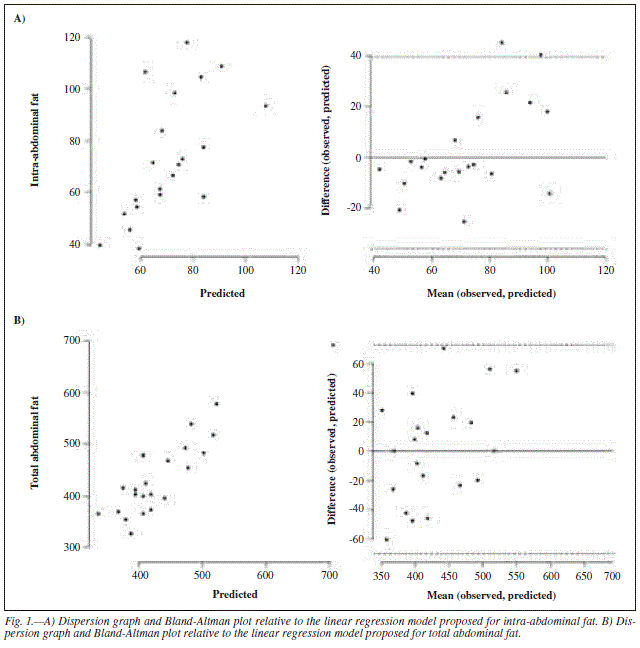
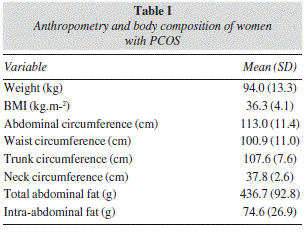
<body><![CDATA[<p><font face="Verdana" size="2">The patients included in the study were 30.5 &plusmn; 5.0 years old and had a BMI of 36.3 &plusmn; 4.1 kg.m<sup>-2</sup>. Anthropometric and CT data are listed in <a href="#t1">table I</a>.</font></p>     <p>&nbsp;</p>     <p align="center"><a name="t1"><img src="/img/revistas/nh/v27n5/44_comunicacion_breve_01_t1.gif"></a></p>     <p>&nbsp;</p>     <p><font face="Verdana" size="2">A multiple linear regression model was proposed for IAF. Waist, trunk, and neck circumferences were considered as independent variables because they correlate well with this type of fat (r = 0.74 and p &lt; 0.0001; r = 0.62 and p &lt; 0.0006; r = 0.70 and p &lt; 0.0006, respectively). The proposed linear regression model was: IAF (predicted) = 1.88541 + 0.01878 x waist circumference + 0.05687 x neck circumference - 0.01529 x trunk circumference (R<sup>2</sup> = 0.51).</font></p>     <p><font face="Verdana" size="2">A multiple linear regression model was proposed for TAF. Abdominal, trunk, and neck circumferences were considered as possible independent variables, since they correlated well with this kind of fat (r = 0.85 and p &lt; 0.0001; r = 0.59 and p &lt; 0.0001; r = 0.49 and p &lt; 0.0006, respectively). Among the variables analyzed, abdominal circumference was the only independent predictor of TAF (b coefficient 0.01; p &lt; 0.01). The proposed linear regression model was: TAF (predicted) = 4.63725 + 0.01483 x abdominal circumference - 0.00117 x neck circumference - 0.00177 x trunk circumference (R<sup>2</sup> = 0.78). The dispersion and Bland-Altman graphs, which evaluate both equations for prediction, are displayed in <a href="#f1">figure 1</a>.</font></p>     <p>&nbsp;</p>     <p align="center"><a name="f1"><img src="/img/revistas/nh/v27n5/44_comunicacion_breve_01_f1.gif"></a></p>     <p>&nbsp;</p>     <p><font face="Verdana" size="2"><b>Discussion</b></font></p>     ]]></body>
<body><![CDATA[<p><font face="Verdana" size="2">The predictive equation models proposed herein for the evaluation of IAF and TAF employ easy-to-perform anthropometric measurements that correlate well with the gold standard method used for such assessment (CT). Abdominal, trunk, and neck circumferences were employed for TAF prediction, whereas waist, trunk, and neck circumferences were used for IAF prediction.</font></p>     <p><font face="Verdana" size="2">There are few studies examining fat compartmentalization in PCOS, especially in the abdominal region, even though it has been documented that women with PCOS tend to accumulate fat in this area.<sup>4,14</sup> A study conducted by Yildirim et al (2003) on the relationship between abdominal fat and metabolic disorders has found that women with PCOS have significantly larger abdominal fat accumulation compared to women without the syndrome paired for weight and age. It has also been verified that women with PCOS and abdominal distribution of body fat present a higher prevalence of metabolic disorders such as hyperinsulinemia and elevated triglyceride levels compared to control.<sup>14</sup> Similar results have been reported by Kirchengast and Huber (2001), who described that only 30% of women with PCOS have body fat distribution of the gynoid type, whilst 100% of the women in the group without the disorder (paired for age, weight, and BMI) have the latter type of body fat distribution.<sup>3</sup></font></p>     <p><font face="Verdana" size="2">The limitations inherent to CT for analysis of IAF and TAF justify the design of alternative and more easily accessible methods for the reliable evaluation of body fat distribution. Therefore, the regression models proposed for estimation of IAF and TAF are extremely relevant.</font></p>     <p><font face="Verdana" size="2">Previous studies aiming to develop equations for IAF and TAF estimation have already been conducted. For these models, the authors utilized demographic and anthropometric variables such as age, gender, BMI, and hip and waist circumferences,<sup>15</sup> for example. Some of these equations were designed for populations with specific characteristics, e.g., the elderly and Indians. Nevertheless, there are no literature studies specifically involving obese women with PCOS.</font></p>     <p><font face="Verdana" size="2">In this respect, the present study was the first to develop this type of equations for application to obese women with PCOS. Our aim was to provide more easily applicable tools for the assessment of body fat distribution in this population, thereby facilitating clinical practice. It is noteworthy that there are no reference values for IAF and TAF. For this reason, it is important that analysis of these parameters by means of the proposed equations be carried out in a serial order, so that evolution of body fat distribution in patients submitted to weight loss, for instance, can be monitored.</font></p>     <p><font face="Verdana" size="2">The small number of patients evaluated and the need for future studies on the validation of the proposed equations are limitations of the present work.</font></p>     <p><font face="Verdana" size="2">We may conclude that it is possible to employ the proposed equations in clinical practice for IAF and TAF evaluation in obese women with PCOS since they related well to the real measurement obtained by the gold standard method. However, it is still necessary to validate these equations, especially to permit their use in other populations, because it is extremely important to adequately evaluate adiposity in this body segment.</font></p>     <p>&nbsp;</p>     <p><font face="Verdana" size="2"><b>References</b></font></p>     <!-- ref --><p><font face="Verdana" size="2">1. Alvarez-Blasco F, Botella-Carretero JI, San Milla JL, Escobar-Morreale HF: Prevalence and Characteristics of the Polycystic Ovary Syndrome in Overweight and Obese Women. <i>Arch Intern Med</i> 2006; 23:2081-2086.    &nbsp;&nbsp;&nbsp;&nbsp;&nbsp;&nbsp;&nbsp;&nbsp;[&#160;<a href="javascript:void(0);" onclick="javascript: window.open('/scielo.php?script=sci_nlinks&ref=3683336&pid=S0212-1611201200050004400001&lng=','','width=640,height=500,resizable=yes,scrollbars=1,menubar=yes,');">Links</a>&#160;]<!-- end-ref --></font></p>    <!-- ref --><p><font face="Verdana" size="2">2. Cascella T, Palomba S, De Sio I, Manguso F, Giallauria F, De Simone B, Tafuri D, Lombardi G, Colao A, Orio F: Visceral fat is associated with cardiovascular risk in women with polycystic ovary syndrome. <i>Human Reproduction</i> 2008; 23 (1): 153-159.    &nbsp;&nbsp;&nbsp;&nbsp;&nbsp;&nbsp;&nbsp;&nbsp;[&#160;<a href="javascript:void(0);" onclick="javascript: window.open('/scielo.php?script=sci_nlinks&ref=3683338&pid=S0212-1611201200050004400002&lng=','','width=640,height=500,resizable=yes,scrollbars=1,menubar=yes,');">Links</a>&#160;]<!-- end-ref --></font></p>    <!-- ref --><p><font face="Verdana" size="2">3. Filho FFR, Mariosa LS, Ferreira SRG, Zanella MT: Gordura visceral e síndrome metabólica: mais que uma simples associa&ccedil;&atilde;o. <i>Arq Bras Metab</i> 2006; 50 (2): 230-238.    &nbsp;&nbsp;&nbsp;&nbsp;&nbsp;&nbsp;&nbsp;&nbsp;[&#160;<a href="javascript:void(0);" onclick="javascript: window.open('/scielo.php?script=sci_nlinks&ref=3683340&pid=S0212-1611201200050004400003&lng=','','width=640,height=500,resizable=yes,scrollbars=1,menubar=yes,');">Links</a>&#160;]<!-- end-ref --></font></p>    <!-- ref --><p><font face="Verdana" size="2">4. Wilding JP: The importance of free fatty acids in the development of type 2 diabetes. <i>Diabet Med</i> 2007; 24 (9): 934-945.    &nbsp;&nbsp;&nbsp;&nbsp;&nbsp;&nbsp;&nbsp;&nbsp;[&#160;<a href="javascript:void(0);" onclick="javascript: window.open('/scielo.php?script=sci_nlinks&ref=3683342&pid=S0212-1611201200050004400004&lng=','','width=640,height=500,resizable=yes,scrollbars=1,menubar=yes,');">Links</a>&#160;]<!-- end-ref --></font></p>    <!-- ref --><p><font face="Verdana" size="2">5. Rankinen T, Kim SY, Pérusse L, Després JP, Bouchard: The prediction of abdominal visceral fat level from body composition and anthropometry: ROC analysis. <i>Inter J Obes</i> 1999; 23: 801-809.    &nbsp;&nbsp;&nbsp;&nbsp;&nbsp;&nbsp;&nbsp;&nbsp;[&#160;<a href="javascript:void(0);" onclick="javascript: window.open('/scielo.php?script=sci_nlinks&ref=3683344&pid=S0212-1611201200050004400005&lng=','','width=640,height=500,resizable=yes,scrollbars=1,menubar=yes,');">Links</a>&#160;]<!-- end-ref --></font></p>    <!-- ref --><p><font face="Verdana" size="2">6. The Rotterdam ESHRE/ASRM-sponsored PCOS consensus workshop group. Revised 2003 consensus on diagnostic criteria and longterm health risks related to polycystic ovary syndrome (PCOS). <i>Human Reproduction</i> 2004; 19 (1): 41-47.    &nbsp;&nbsp;&nbsp;&nbsp;&nbsp;&nbsp;&nbsp;&nbsp;[&#160;<a href="javascript:void(0);" onclick="javascript: window.open('/scielo.php?script=sci_nlinks&ref=3683346&pid=S0212-1611201200050004400006&lng=','','width=640,height=500,resizable=yes,scrollbars=1,menubar=yes,');">Links</a>&#160;]<!-- end-ref --></font></p>    <!-- ref --><p><font face="Verdana" size="2">7. BRASIL. Vigil&acirc;ncia alimentar e nutricional - SISVAN: orienta&ccedil;&otilde;es básicas para a coleta, processamento, análise de dados e informa&ccedil;&atilde;o em servi&ccedil;os de saúde. Brasilia: Ministério da Saúde, 2004.    &nbsp;&nbsp;&nbsp;&nbsp;&nbsp;&nbsp;&nbsp;&nbsp;[&#160;<a href="javascript:void(0);" onclick="javascript: window.open('/scielo.php?script=sci_nlinks&ref=3683348&pid=S0212-1611201200050004400007&lng=','','width=640,height=500,resizable=yes,scrollbars=1,menubar=yes,');">Links</a>&#160;]<!-- end-ref --></font></p>    <!-- ref --><p><font face="Verdana" size="2">8. World Health Organization. Obesity: preventing and managing the global epidemic. Report of a WHO Consulation. Geneva: World Health Organization; 1998 (Technical Report Series, N<sup>o</sup> 894).    &nbsp;&nbsp;&nbsp;&nbsp;&nbsp;&nbsp;&nbsp;&nbsp;[&#160;<a href="javascript:void(0);" onclick="javascript: window.open('/scielo.php?script=sci_nlinks&ref=3683350&pid=S0212-1611201200050004400008&lng=','','width=640,height=500,resizable=yes,scrollbars=1,menubar=yes,');">Links</a>&#160;]<!-- end-ref --></font></p>    <!-- ref --><p><font face="Verdana" size="2">9. Callway CW, Chumlea WC, Bouchard C, Himes JH, Lohman TG, Martin AD, Mitchell CD, Mueller WH, Roche AF, Seefeldt VD. Circumferences. In: Lohman TG, Roche AF, Martorell R. Anthropometric standardization reference  manual. Champaign, IL: Human Kinetics; 1988, pp. 39-54.    &nbsp;&nbsp;&nbsp;&nbsp;&nbsp;&nbsp;&nbsp;&nbsp;[&#160;<a href="javascript:void(0);" onclick="javascript: window.open('/scielo.php?script=sci_nlinks&ref=3683352&pid=S0212-1611201200050004400009&lng=','','width=640,height=500,resizable=yes,scrollbars=1,menubar=yes,');">Links</a>&#160;]<!-- end-ref --><!-- ref --><p><font face="Verdana" size="2">10. Penaforte FR, Japur CC, Diez-Garcia RW, Chiarello PG: Upper trunk fat assessment and its relationship with metabolic and biochemical variables and body fat in polycystic ovary syndrome. <i>J Hum Nutr Diet</i> 2011; 24 (1): 39-46.    &nbsp;&nbsp;&nbsp;&nbsp;&nbsp;&nbsp;&nbsp;&nbsp;[&#160;<a href="javascript:void(0);" onclick="javascript: window.open('/scielo.php?script=sci_nlinks&ref=3683353&pid=S0212-1611201200050004400010&lng=','','width=640,height=500,resizable=yes,scrollbars=1,menubar=yes,');">Links</a>&#160;]<!-- end-ref --></font></p>    <!-- ref --><p><font face="Verdana" size="2">11. Dixon JB, O'Brien PE. Neck circumference a good predictor of raised insulin and free androgen index in obese premenopausal women: changes with weight loss. <i>Clinical Endocrinology</i> 2002; 57: 769-778.    &nbsp;&nbsp;&nbsp;&nbsp;&nbsp;&nbsp;&nbsp;&nbsp;[&#160;<a href="javascript:void(0);" onclick="javascript: window.open('/scielo.php?script=sci_nlinks&ref=3683355&pid=S0212-1611201200050004400011&lng=','','width=640,height=500,resizable=yes,scrollbars=1,menubar=yes,');">Links</a>&#160;]<!-- end-ref --></font></p>    ]]></body>
<body><![CDATA[<!-- ref --><p><font face="Verdana" size="2">12. Seidell JC, Bakker CJG, van der Kooy K. Imaging techniques for measuring adipose-tissue distribution-a comparison between computed tomography and 1.5-T magnetic resonance. <i>Am J Clin Nutr</i> 1990; 51: 953-7.    &nbsp;&nbsp;&nbsp;&nbsp;&nbsp;&nbsp;&nbsp;&nbsp;[&#160;<a href="javascript:void(0);" onclick="javascript: window.open('/scielo.php?script=sci_nlinks&ref=3683357&pid=S0212-1611201200050004400012&lng=','','width=640,height=500,resizable=yes,scrollbars=1,menubar=yes,');">Links</a>&#160;]<!-- end-ref --></font></p>    <!-- ref --><p><font face="Verdana" size="2">13. Lukaski HC. Methods for the assessment of human body composition: traditional and new. <i>Am J Clin Nutr</i> 1987; 46 (4): 537-56.    &nbsp;&nbsp;&nbsp;&nbsp;&nbsp;&nbsp;&nbsp;&nbsp;[&#160;<a href="javascript:void(0);" onclick="javascript: window.open('/scielo.php?script=sci_nlinks&ref=3683359&pid=S0212-1611201200050004400013&lng=','','width=640,height=500,resizable=yes,scrollbars=1,menubar=yes,');">Links</a>&#160;]<!-- end-ref --></font></p>    <!-- ref --><p><font face="Verdana" size="2">14. Yildirim B, Sabir N, Kaleli B. Relation of intra-abdominal fat distribution to metabolic disorders in nonobese patients with polycystic ovary syndrome. <i>Fertility and Sterility</i> 2003; 79 (6):1358-1364.    &nbsp;&nbsp;&nbsp;&nbsp;&nbsp;&nbsp;&nbsp;&nbsp;[&#160;<a href="javascript:void(0);" onclick="javascript: window.open('/scielo.php?script=sci_nlinks&ref=3683361&pid=S0212-1611201200050004400014&lng=','','width=640,height=500,resizable=yes,scrollbars=1,menubar=yes,');">Links</a>&#160;]<!-- end-ref --></font></p>    <!-- ref --><p><font face="Verdana" size="2">15. Goel K, Gupta N, Misra A, Poddar P, Pandey RM, Vikram NK, Wasir JS: Predictive equations for body fat and abdominal fat with DXA and MRI as reference in Asian Indians. <i>Obesity</i> 2008; 16 (2): 451-456.    &nbsp;&nbsp;&nbsp;&nbsp;&nbsp;&nbsp;&nbsp;&nbsp;[&#160;<a href="javascript:void(0);" onclick="javascript: window.open('/scielo.php?script=sci_nlinks&ref=3683363&pid=S0212-1611201200050004400015&lng=','','width=640,height=500,resizable=yes,scrollbars=1,menubar=yes,');">Links</a>&#160;]<!-- end-ref --></font></p>     <p>&nbsp;</p>     <p>&nbsp;</p>     ]]></body>
<body><![CDATA[<p><font face="Verdana" size="2"><a href="#top"><img border="0" src="/img/revistas/nh/v27n5/seta.gif" width="15" height="17"></a><a name="bajo"></a><b>Correspondence:</b>    <br>Fernanda Rodrigues de Oliveira Penaforte    <br>Professor of Endocrinology and Nutrition    <br>Departamento de Clínica Médica    <br>Faculdade de Medicina de Ribeirão Preto/USP    <br>Avenida Bandeirantes, n.<sup>o</sup> 3900    <br>14049-900. Ribeirão Preto. SP. Brasil    <br>E-mail: <a href="mailto:ferpenaforte@usp.br">ferpenaforte@usp.br</a></font></p>     <p><font face="Verdana" size="2">Recibido: 3-IV-2012    <br>Aceptado: 10-V-2012</font></p>     ]]></body>
<body><![CDATA[ ]]></body><back>
<ref-list>
<ref id="B1">
<label>1</label><nlm-citation citation-type="journal">
<person-group person-group-type="author">
<name>
<surname><![CDATA[Alvarez-Blasco]]></surname>
<given-names><![CDATA[F]]></given-names>
</name>
<name>
<surname><![CDATA[Botella-Carretero]]></surname>
<given-names><![CDATA[JI]]></given-names>
</name>
<name>
<surname><![CDATA[San Milla]]></surname>
<given-names><![CDATA[JL]]></given-names>
</name>
<name>
<surname><![CDATA[Escobar-Morreale]]></surname>
<given-names><![CDATA[HF]]></given-names>
</name>
</person-group>
<article-title xml:lang="en"><![CDATA[Prevalence and Characteristics of the Polycystic Ovary Syndrome in Overweight and Obese Women]]></article-title>
<source><![CDATA[Arch Intern Med]]></source>
<year>2006</year>
<volume>23</volume>
<page-range>2081-2086</page-range></nlm-citation>
</ref>
<ref id="B2">
<label>2</label><nlm-citation citation-type="journal">
<person-group person-group-type="author">
<name>
<surname><![CDATA[Cascella]]></surname>
<given-names><![CDATA[T]]></given-names>
</name>
<name>
<surname><![CDATA[Palomba]]></surname>
<given-names><![CDATA[S]]></given-names>
</name>
<name>
<surname><![CDATA[De Sio]]></surname>
<given-names><![CDATA[I]]></given-names>
</name>
<name>
<surname><![CDATA[Manguso]]></surname>
<given-names><![CDATA[F]]></given-names>
</name>
<name>
<surname><![CDATA[Giallauria]]></surname>
<given-names><![CDATA[F]]></given-names>
</name>
<name>
<surname><![CDATA[De Simone]]></surname>
<given-names><![CDATA[B]]></given-names>
</name>
<name>
<surname><![CDATA[Tafuri]]></surname>
<given-names><![CDATA[D]]></given-names>
</name>
<name>
<surname><![CDATA[Lombardi]]></surname>
<given-names><![CDATA[G]]></given-names>
</name>
<name>
<surname><![CDATA[Colao]]></surname>
<given-names><![CDATA[A]]></given-names>
</name>
<name>
<surname><![CDATA[Orio]]></surname>
<given-names><![CDATA[F]]></given-names>
</name>
</person-group>
<article-title xml:lang="en"><![CDATA[Visceral fat is associated with cardiovascular risk in women with polycystic ovary syndrome]]></article-title>
<source><![CDATA[Human Reproduction]]></source>
<year>2008</year>
<volume>23</volume>
<numero>1</numero>
<issue>1</issue>
<page-range>153-159</page-range></nlm-citation>
</ref>
<ref id="B3">
<label>3</label><nlm-citation citation-type="journal">
<person-group person-group-type="author">
<name>
<surname><![CDATA[Filho]]></surname>
<given-names><![CDATA[FFR]]></given-names>
</name>
<name>
<surname><![CDATA[Mariosa]]></surname>
<given-names><![CDATA[LS]]></given-names>
</name>
<name>
<surname><![CDATA[Ferreira]]></surname>
<given-names><![CDATA[SRG]]></given-names>
</name>
<name>
<surname><![CDATA[Zanella]]></surname>
<given-names><![CDATA[MT]]></given-names>
</name>
</person-group>
<article-title xml:lang="pt"><![CDATA[Gordura visceral e síndrome metabólica: mais que uma simples associação]]></article-title>
<source><![CDATA[Arq Bras Metab]]></source>
<year>2006</year>
<volume>50</volume>
<numero>2</numero>
<issue>2</issue>
<page-range>230-238</page-range></nlm-citation>
</ref>
<ref id="B4">
<label>4</label><nlm-citation citation-type="journal">
<person-group person-group-type="author">
<name>
<surname><![CDATA[Wilding]]></surname>
<given-names><![CDATA[JP]]></given-names>
</name>
</person-group>
<article-title xml:lang="en"><![CDATA[The importance of free fatty acids in the development of type 2 diabetes]]></article-title>
<source><![CDATA[Diabet Med]]></source>
<year>2007</year>
<volume>24</volume>
<numero>9</numero>
<issue>9</issue>
<page-range>934-945</page-range></nlm-citation>
</ref>
<ref id="B5">
<label>5</label><nlm-citation citation-type="journal">
<person-group person-group-type="author">
<name>
<surname><![CDATA[Rankinen]]></surname>
<given-names><![CDATA[T]]></given-names>
</name>
<name>
<surname><![CDATA[Kim]]></surname>
<given-names><![CDATA[SY]]></given-names>
</name>
<name>
<surname><![CDATA[Pérusse]]></surname>
<given-names><![CDATA[L]]></given-names>
</name>
<name>
<surname><![CDATA[Després]]></surname>
<given-names><![CDATA[JP]]></given-names>
</name>
<name>
<surname><![CDATA[Bouchard]]></surname>
</name>
</person-group>
<article-title xml:lang="en"><![CDATA[The prediction of abdominal visceral fat level from body composition and anthropometry: ROC analysis]]></article-title>
<source><![CDATA[Inter J Obes]]></source>
<year>1999</year>
<volume>23</volume>
<page-range>801-809</page-range></nlm-citation>
</ref>
<ref id="B6">
<label>6</label><nlm-citation citation-type="journal">
<collab>The Rotterdam ESHRE/ASRM-sponsored PCOS consensus workshop group</collab>
<article-title xml:lang="en"><![CDATA[Revised 2003 consensus on diagnostic criteria and longterm health risks related to polycystic ovary syndrome (PCOS)]]></article-title>
<source><![CDATA[Human Reproduction]]></source>
<year>2004</year>
<volume>19</volume>
<numero>1</numero>
<issue>1</issue>
<page-range>41-47</page-range></nlm-citation>
</ref>
<ref id="B7">
<label>7</label><nlm-citation citation-type="book">
<source><![CDATA[BRASIL. Vigilância alimentar e nutricional - SISVAN: orientações básicas para a coleta, processamento, análise de dados e informação em serviços de saúde]]></source>
<year>2004</year>
<publisher-loc><![CDATA[Brasilia ]]></publisher-loc>
<publisher-name><![CDATA[Ministério da Saúde]]></publisher-name>
</nlm-citation>
</ref>
<ref id="B8">
<label>8</label><nlm-citation citation-type="book">
<collab>World Health Organization</collab>
<source><![CDATA[Obesity: preventing and managing the global epidemic: Report of a WHO Consulation]]></source>
<year>1998</year>
<volume>894</volume>
<publisher-loc><![CDATA[Geneva ]]></publisher-loc>
<publisher-name><![CDATA[World Health Organization]]></publisher-name>
</nlm-citation>
</ref>
<ref id="B9">
<label>9</label><nlm-citation citation-type="book">
<person-group person-group-type="author">
<name>
<surname><![CDATA[Callway]]></surname>
<given-names><![CDATA[CW]]></given-names>
</name>
<name>
<surname><![CDATA[Chumlea]]></surname>
<given-names><![CDATA[WC]]></given-names>
</name>
<name>
<surname><![CDATA[Bouchard]]></surname>
<given-names><![CDATA[C]]></given-names>
</name>
<name>
<surname><![CDATA[Himes]]></surname>
<given-names><![CDATA[JH]]></given-names>
</name>
<name>
<surname><![CDATA[Lohman]]></surname>
<given-names><![CDATA[TG]]></given-names>
</name>
<name>
<surname><![CDATA[Martin]]></surname>
<given-names><![CDATA[AD]]></given-names>
</name>
<name>
<surname><![CDATA[Mitchell]]></surname>
<given-names><![CDATA[CD]]></given-names>
</name>
<name>
<surname><![CDATA[Mueller]]></surname>
<given-names><![CDATA[WH]]></given-names>
</name>
<name>
<surname><![CDATA[Roche]]></surname>
<given-names><![CDATA[AF]]></given-names>
</name>
<name>
<surname><![CDATA[Seefeldt]]></surname>
<given-names><![CDATA[VD]]></given-names>
</name>
</person-group>
<article-title xml:lang="en"><![CDATA[Circumferences]]></article-title>
<person-group person-group-type="editor">
<name>
<surname><![CDATA[Lohman]]></surname>
<given-names><![CDATA[TG]]></given-names>
</name>
<name>
<surname><![CDATA[Roche]]></surname>
<given-names><![CDATA[AF]]></given-names>
</name>
<name>
<surname><![CDATA[Martorell]]></surname>
<given-names><![CDATA[R]]></given-names>
</name>
</person-group>
<source><![CDATA[Anthropometric standardization reference manual]]></source>
<year>1988</year>
<page-range>39-54</page-range><publisher-loc><![CDATA[Champaign^eIL IL]]></publisher-loc>
<publisher-name><![CDATA[Human Kinetics]]></publisher-name>
</nlm-citation>
</ref>
<ref id="B10">
<label>10</label><nlm-citation citation-type="journal">
<person-group person-group-type="author">
<name>
<surname><![CDATA[Penaforte]]></surname>
<given-names><![CDATA[FR]]></given-names>
</name>
<name>
<surname><![CDATA[Japur]]></surname>
<given-names><![CDATA[CC]]></given-names>
</name>
<name>
<surname><![CDATA[Diez-Garcia]]></surname>
<given-names><![CDATA[RW]]></given-names>
</name>
<name>
<surname><![CDATA[Chiarello]]></surname>
<given-names><![CDATA[PG]]></given-names>
</name>
</person-group>
<article-title xml:lang="en"><![CDATA[Upper trunk fat assessment and its relationship with metabolic and biochemical variables and body fat in polycystic ovary syndrome]]></article-title>
<source><![CDATA[J Hum Nutr Diet]]></source>
<year>2011</year>
<volume>24</volume>
<numero>1</numero>
<issue>1</issue>
<page-range>39-46</page-range></nlm-citation>
</ref>
<ref id="B11">
<label>11</label><nlm-citation citation-type="journal">
<person-group person-group-type="author">
<name>
<surname><![CDATA[Dixon]]></surname>
<given-names><![CDATA[JB]]></given-names>
</name>
<name>
<surname><![CDATA[O'Brien]]></surname>
<given-names><![CDATA[PE]]></given-names>
</name>
</person-group>
<article-title xml:lang="en"><![CDATA[Neck circumference a good predictor of raised insulin and free androgen index in obese premenopausal women: changes with weight loss]]></article-title>
<source><![CDATA[Clinical Endocrinology]]></source>
<year>2002</year>
<volume>57</volume>
<page-range>769-778</page-range></nlm-citation>
</ref>
<ref id="B12">
<label>12</label><nlm-citation citation-type="journal">
<person-group person-group-type="author">
<name>
<surname><![CDATA[Seidell]]></surname>
<given-names><![CDATA[JC]]></given-names>
</name>
<name>
<surname><![CDATA[Bakker]]></surname>
<given-names><![CDATA[CJG]]></given-names>
</name>
<name>
<surname><![CDATA[van der Kooy]]></surname>
<given-names><![CDATA[K]]></given-names>
</name>
</person-group>
<article-title xml:lang="en"><![CDATA[Imaging techniques for measuring adipose-tissue distribution-a comparison between computed tomography and 1. 5-T magnetic resonance]]></article-title>
<source><![CDATA[Am J Clin Nutr]]></source>
<year>1990</year>
<volume>51</volume>
<page-range>953-7</page-range></nlm-citation>
</ref>
<ref id="B13">
<label>13</label><nlm-citation citation-type="journal">
<person-group person-group-type="author">
<name>
<surname><![CDATA[Lukaski]]></surname>
<given-names><![CDATA[HC]]></given-names>
</name>
</person-group>
<article-title xml:lang="en"><![CDATA[Methods for the assessment of human body composition: traditional and new]]></article-title>
<source><![CDATA[Am J Clin Nutr]]></source>
<year>1987</year>
<volume>46</volume>
<numero>4</numero>
<issue>4</issue>
<page-range>537-56</page-range></nlm-citation>
</ref>
<ref id="B14">
<label>14</label><nlm-citation citation-type="journal">
<person-group person-group-type="author">
<name>
<surname><![CDATA[Yildirim]]></surname>
<given-names><![CDATA[B]]></given-names>
</name>
<name>
<surname><![CDATA[Sabir]]></surname>
<given-names><![CDATA[N]]></given-names>
</name>
<name>
<surname><![CDATA[Kaleli]]></surname>
<given-names><![CDATA[B]]></given-names>
</name>
</person-group>
<article-title xml:lang="en"><![CDATA[Relation of intra-abdominal fat distribution to metabolic disorders in nonobese patients with polycystic ovary syndrome]]></article-title>
<source><![CDATA[Fertility and Sterility]]></source>
<year>2003</year>
<volume>79</volume>
<numero>6</numero>
<issue>6</issue>
<page-range>1358-1364</page-range></nlm-citation>
</ref>
<ref id="B15">
<label>15</label><nlm-citation citation-type="journal">
<person-group person-group-type="author">
<name>
<surname><![CDATA[Goel]]></surname>
<given-names><![CDATA[K]]></given-names>
</name>
<name>
<surname><![CDATA[Gupta]]></surname>
<given-names><![CDATA[N]]></given-names>
</name>
<name>
<surname><![CDATA[Misra]]></surname>
<given-names><![CDATA[A]]></given-names>
</name>
<name>
<surname><![CDATA[Poddar]]></surname>
<given-names><![CDATA[P]]></given-names>
</name>
<name>
<surname><![CDATA[Pandey]]></surname>
<given-names><![CDATA[RM]]></given-names>
</name>
<name>
<surname><![CDATA[Vikram]]></surname>
<given-names><![CDATA[NK]]></given-names>
</name>
<name>
<surname><![CDATA[Wasir]]></surname>
<given-names><![CDATA[JS]]></given-names>
</name>
</person-group>
<article-title xml:lang="en"><![CDATA[Predictive equations for body fat and abdominal fat with DXA and MRI as reference in Asian Indians]]></article-title>
<source><![CDATA[Obesity]]></source>
<year>2008</year>
<volume>16</volume>
<numero>2</numero>
<issue>2</issue>
<page-range>451-456</page-range></nlm-citation>
</ref>
</ref-list>
</back>
</article>