<?xml version="1.0" encoding="ISO-8859-1"?><article xmlns:mml="http://www.w3.org/1998/Math/MathML" xmlns:xlink="http://www.w3.org/1999/xlink" xmlns:xsi="http://www.w3.org/2001/XMLSchema-instance">
<front>
<journal-meta>
<journal-id>0212-1611</journal-id>
<journal-title><![CDATA[Nutrición Hospitalaria]]></journal-title>
<abbrev-journal-title><![CDATA[Nutr. Hosp.]]></abbrev-journal-title>
<issn>0212-1611</issn>
<publisher>
<publisher-name><![CDATA[Grupo Arán]]></publisher-name>
</publisher>
</journal-meta>
<article-meta>
<article-id>S0212-16112012000600008</article-id>
<article-id pub-id-type="doi">10.3305/nh.2012.27.6.6076</article-id>
<title-group>
<article-title xml:lang="en"><![CDATA[Recommendations of the GARIN group for managing non-critically ill patients with diabetes or stress hyperglycaemia and artificial nutrition]]></article-title>
<article-title xml:lang="es"><![CDATA[Recomendaciones del grupo GARIN para el manejo de pacientes no críticos con diabetes o hiperglucemia de estrés y nutrición artificial]]></article-title>
</title-group>
<contrib-group>
<contrib contrib-type="author">
<name>
<surname><![CDATA[Olveira]]></surname>
<given-names><![CDATA[G.]]></given-names>
</name>
<xref ref-type="aff" rid="A01"/>
<xref ref-type="aff" rid="A02"/>
</contrib>
<contrib contrib-type="author">
<name>
<surname><![CDATA[García-Luna]]></surname>
<given-names><![CDATA[P. P.]]></given-names>
</name>
<xref ref-type="aff" rid="A03"/>
</contrib>
<contrib contrib-type="author">
<name>
<surname><![CDATA[Pereira]]></surname>
<given-names><![CDATA[J. L.]]></given-names>
</name>
<xref ref-type="aff" rid="A03"/>
</contrib>
<contrib contrib-type="author">
<name>
<surname><![CDATA[Rebollo]]></surname>
<given-names><![CDATA[I.]]></given-names>
</name>
<xref ref-type="aff" rid="A04"/>
</contrib>
<contrib contrib-type="author">
<name>
<surname><![CDATA[García-Almeida]]></surname>
<given-names><![CDATA[J. M.]]></given-names>
</name>
<xref ref-type="aff" rid="A05"/>
</contrib>
<contrib contrib-type="author">
<name>
<surname><![CDATA[Serrano]]></surname>
<given-names><![CDATA[P.]]></given-names>
</name>
<xref ref-type="aff" rid="A03"/>
</contrib>
<contrib contrib-type="author">
<name>
<surname><![CDATA[Irles]]></surname>
<given-names><![CDATA[J. A.]]></given-names>
</name>
<xref ref-type="aff" rid="A06"/>
</contrib>
<contrib contrib-type="author">
<name>
<surname><![CDATA[Muñoz-Aguilar]]></surname>
<given-names><![CDATA[A.]]></given-names>
</name>
<xref ref-type="aff" rid="A01"/>
</contrib>
<contrib contrib-type="author">
<name>
<surname><![CDATA[Molina]]></surname>
<given-names><![CDATA[M.ª J.]]></given-names>
</name>
<xref ref-type="aff" rid="A07"/>
</contrib>
<contrib contrib-type="author">
<name>
<surname><![CDATA[Tapia]]></surname>
<given-names><![CDATA[M.ª J.]]></given-names>
</name>
<xref ref-type="aff" rid="A01"/>
</contrib>
</contrib-group>
<aff id="A01">
<institution><![CDATA[,Hopital Regional Universitario Carlos Haya Servicio de Endrocrinología y Nutrición ]]></institution>
<addr-line><![CDATA[Málaga ]]></addr-line>
<country>España</country>
</aff>
<aff id="A02">
<institution><![CDATA[,Instituto de Salud Carlos III CIBER of Diabetes and Associated Metabolic Diseases (CIBERDEM) ]]></institution>
<addr-line><![CDATA[ ]]></addr-line>
<country>Spain</country>
</aff>
<aff id="A03">
<institution><![CDATA[,Hopital Universitario Virgen del Rocio Servicio de Endrocrinología y Nutrición ]]></institution>
<addr-line><![CDATA[Sevilla ]]></addr-line>
</aff>
<aff id="A04">
<institution><![CDATA[,Hopital Juan Ramón Jiménez Servicio de Endrocrinología y Nutrición ]]></institution>
<addr-line><![CDATA[Huelva ]]></addr-line>
</aff>
<aff id="A05">
<institution><![CDATA[,Hopital Clínico Universitario Virgen de la Víctoria Servicio de Endrocrinología y Nutrición ]]></institution>
<addr-line><![CDATA[Málaga ]]></addr-line>
</aff>
<aff id="A06">
<institution><![CDATA[,Hopital Universitario de Valme Servicio de Endrocrinología y Nutrición ]]></institution>
<addr-line><![CDATA[Sevilla ]]></addr-line>
</aff>
<aff id="A07">
<institution><![CDATA[,Hopital Universitario Reina Sofía Servicio de Endrocrinología y Nutrición ]]></institution>
<addr-line><![CDATA[Córdoba ]]></addr-line>
<country>España</country>
</aff>
<pub-date pub-type="pub">
<day>00</day>
<month>12</month>
<year>2012</year>
</pub-date>
<pub-date pub-type="epub">
<day>00</day>
<month>12</month>
<year>2012</year>
</pub-date>
<volume>27</volume>
<numero>6</numero>
<fpage>1837</fpage>
<lpage>1849</lpage>
<copyright-statement/>
<copyright-year/>
<self-uri xlink:href="http://scielo.isciii.es/scielo.php?script=sci_arttext&amp;pid=S0212-16112012000600008&amp;lng=en&amp;nrm=iso"></self-uri><self-uri xlink:href="http://scielo.isciii.es/scielo.php?script=sci_abstract&amp;pid=S0212-16112012000600008&amp;lng=en&amp;nrm=iso"></self-uri><self-uri xlink:href="http://scielo.isciii.es/scielo.php?script=sci_pdf&amp;pid=S0212-16112012000600008&amp;lng=en&amp;nrm=iso"></self-uri><abstract abstract-type="short" xml:lang="en"><p><![CDATA[Background & aims: By means of this update, the GARIN working group aims to define its position regarding the treatment of patients with diabetes or stress hyperglycaemia and artificial nutrition. In this area there are many aspects of uncertainty, especially in non-critically ill patients. Methods: Bibliographical review, and specific questions in advance were discussed and answered at a meeting in the form of conclusions. Results: We propose a definition of stress hyperglycaemia. The indications and access routes for artificial nutrition are no different in patients with diabetes/stress hyperglycaemia than in non-diabetics. The objective must be to keep pre-prandial blood glucose levels between 100 and 140 mg/dl and post-prandial levels between 140 and 180 mg/dl. Hyperglycemia can be prevented through systematic monitoring of capillary glycaemias and adequately calculate energy-protein needs. We recommend using enteral formulas designed for patients with diabetes (high monounsaturated fat) to facilitate metabolic control. The best drug treatment for treating hyperglycaemia/diabetes in hospitalised patients is insulin and we make recommendations for adapt the theoretical insulin action to the nutrition infusion regimen. We also addressed recommendations for future investigation. Conclusions: This recommendations about artificial nutrition in patients with diabetes or stress hyperglycaemia can add value to clinical work.]]></p></abstract>
<abstract abstract-type="short" xml:lang="es"><p><![CDATA[Introducción y objetivos: En el tratamiento de los pacientes con diabetes o hiperglucemia de estrés y la nutrición artificial existen muchas áreas de incertidumbre, sobre todo en pacientes no críticos. El grupo de trabajo GARIN tiene como objetivo definir su posición en este campo. Material y métodos: Revisión bibliográfica previa y reunión presencial en la que se discutieron y contestaron preguntas específicas sobre el tema. Resultados: Proponemos una definición de hiperglucemia de estrés. Las indicaciones y las rutas de acceso a la nutrición artificial no difieren en los pacientes con hiperglucemia de estrés o diabetes respecto a los no diabéticos. El objetivo debe ser mantener los niveles de glucemia preprandial entre 100 y 140 mg/dl y postprandial entre 140 y 180 mg/dl. La hiperglucemia puede prevenirse a través de una monitorización sistemática de las glucemias capilares y un cálculo adecuado de las necesidades energético-proteicas. Recomendamos el uso de fórmulas enterales diseñadas para pacientes con diabetes (alto contenido en grasas monoinsaturadas) para facilitar el control metabólico. El mejor tratamiento farmacológico para tratar la hiperglucemia/diabetes en pacientes hospitalizados es la insulina, aconsejando adaptar la acción teórica de la insulina al régimen de infusión de la nutrición. También realizamos recomendaciones para investigaciones futuras. Conclusiones: Estas recomendaciones aportan respuestas concretas sobre cuestiones comunes en la asistencia a pacientes con diabetes o hiperglucemia de estrés y nutrición artificial.]]></p></abstract>
<kwd-group>
<kwd lng="en"><![CDATA[Diabetes]]></kwd>
<kwd lng="en"><![CDATA[Stress hyperglycaemia]]></kwd>
<kwd lng="en"><![CDATA[Enteral nutrition]]></kwd>
<kwd lng="en"><![CDATA[Parenteral nutrition]]></kwd>
<kwd lng="en"><![CDATA[Non-critically ill patients]]></kwd>
<kwd lng="es"><![CDATA[Diabetes]]></kwd>
<kwd lng="es"><![CDATA[Hiperglucemia de estrés]]></kwd>
<kwd lng="es"><![CDATA[Nutrición enteral]]></kwd>
<kwd lng="es"><![CDATA[Nutrición parenteral]]></kwd>
<kwd lng="es"><![CDATA[Pacientes no críticos]]></kwd>
</kwd-group>
</article-meta>
</front><body><![CDATA[ <p><a name="top"></a><font face="Verdana" size="2"><b>REVIEWS</b></font></p>     <p>&nbsp;</p>     <p><font face="Verdana" size="4"><b>Recommendations of the GARIN group for managing non-critically ill patients with diabetes or stress hyperglycaemia and artificial nutrition</b></font></p>     <p><font face="Verdana" size="4"><b>Recomendaciones del grupo GARIN para el manejo de pacientes no críticos con diabetes o hiperglucemia de estrés y nutrición artificial</b></font></p>     <p>&nbsp;</p>     <p>&nbsp;</p>     <p><font face="Verdana" size="2"><b>G. Olveira<sup>1,2</sup>, P. P. García-Luna<sup>3</sup>, J. L. Pereira<sup>3</sup>, I. Rebollo<sup>4</sup>, J. M. García-Almeida<sup>5</sup>, P. Serrano<sup>3</sup>, J. A. Irles<sup>6</sup>, A. Muñoz-Aguilar<sup>1</sup>, M.<sup>a</sup> J. Molina<sup>7</sup>, M.<sup>a</sup> J. Tapia<sup>1</sup>; GARIN group (Andalusian Group for Nutrition Reflection and Investigation)</b></font></p>     <p><font face="Verdana" size="2"><sup>1</sup>Endocrinología y Nutrición. Hospital Regional Universitario Carlos Haya. Málaga.    <br><sup>2</sup>CIBERDEM. CIBER of Diabetes and Associated Metabolic Diseases (CB07/08/0019). Instituto de Salud Carlos III. Spain.    <br><sup>3</sup>Endocrinología y Nutrición. Hospital Universitario Virgen del Rocío. Sevilla.    ]]></body>
<body><![CDATA[<br><sup>4</sup>Endocrinología y Nutrición. Hospital Juan Ramón Jiménez. Huelva.    <br><sup>5</sup>Endocrinología y Nutrición. Hospital Clínico Universitario Virgen de la Victoria. Málaga.    <br><sup>6</sup>Endocrinología y Nutrición. Hospital Universitario de Valme. Sevilla.    <br><sup>7</sup>Endocrinología y Nutrición. Hospital Universitario Reina Sofía. Córdoba. España.</font></p>     <p><font face="Verdana" size="2">Funding: Nestlé Health Nutrition covered all expenses for transportation and rental of the room where the meeting was held but did not take part in any way in the conception or design of the study, manuscript revision or group conclusions.</font></p>     <p><font face="Verdana" size="2"><a href="#bajo">Correspondence</a></font></p>     <p>&nbsp;</p>     <p>&nbsp;</p> <hr size="1">     <p><font face="Verdana" size="2"><b>ABSTRACT</b></font></p>     <p><font face="Verdana" size="2"><b>Background &amp; aims:</b> By means of this update, the GARIN working group aims to define its position regarding the treatment of patients with diabetes or stress hyperglycaemia and artificial nutrition. In this area there are many aspects of uncertainty, especially in non-critically ill patients.    ]]></body>
<body><![CDATA[<br><b>Methods:</b> Bibliographical review, and specific questions in advance were discussed and answered at a meeting in the form of conclusions.    <br><b>Results:</b> We propose a definition of stress hyperglycaemia. The indications and access routes for artificial nutrition are no different in patients with diabetes/stress hyperglycaemia than in non-diabetics. The objective must be to keep pre-prandial blood glucose levels between 100 and 140 mg/dl and post-prandial levels between 140 and 180 mg/dl. Hyperglycemia can be prevented through systematic monitoring of capillary glycaemias and adequately calculate energy-protein needs. We recommend using enteral formulas designed for patients with diabetes (high monounsaturated fat) to facilitate metabolic control. The best drug treatment for treating hyperglycaemia/diabetes in hospitalised patients is insulin and we make recommendations for adapt the theoretical insulin action to the nutrition infusion regimen. We also addressed recommendations for future investigation.    <br><b>Conclusions:</b> This recommendations about artificial nutrition in patients with diabetes or stress hyperglycaemia can add value to clinical work.</font></p>     <p><font face="Verdana" size="2"><b>Key words:</b> Diabetes. Stress hyperglycaemia. Enteral nutrition. Parenteral nutrition. Non-critically ill patients.</font></p> <hr size="1">     <p><font face="Verdana" size="2"><b>RESUMEN</b></font></p>     <p><font face="Verdana" size="2"><b>Introducción y objetivos:</b> En el tratamiento de los pacientes con diabetes o hiperglucemia de estrés y la nutrición artificial existen muchas áreas de incertidumbre, sobre todo en pacientes no críticos. El grupo de trabajo GARIN tiene como objetivo definir su posición en este campo.    <br><b>Material y métodos:</b> Revisión bibliográfica previa y reunión presencial en la que se discutieron y contestaron preguntas específicas sobre el tema.    <br><b>Resultados:</b> Proponemos una definición de hiperglucemia de estrés. Las indicaciones y las rutas de acceso a la nutrición artificial no difieren en los pacientes con hiperglucemia de estrés o diabetes respecto a los no diabéticos. El objetivo debe ser mantener los niveles de glucemia preprandial entre 100 y 140 mg/dl y postprandial entre 140 y 180 mg/dl. La hiperglucemia puede prevenirse a través de una monitorización sistemática de las glucemias capilares y un cálculo adecuado de las necesidades energético-proteicas.    <br>Recomendamos el uso de fórmulas enterales diseñadas para pacientes con diabetes (alto contenido en grasas monoinsaturadas) para facilitar el control metabólico. El mejor tratamiento farmacológico para tratar la hiperglucemia/diabetes en pacientes hospitalizados es la insulina, aconsejando adaptar la acción teórica de la insulina al régimen de infusión de la nutrición. También realizamos recomendaciones para investigaciones futuras.    <br><b>Conclusiones:</b> Estas recomendaciones aportan respuestas concretas sobre cuestiones comunes en la asistencia a pacientes con diabetes o hiperglucemia de estrés y nutrición artificial.</font></p>     ]]></body>
<body><![CDATA[<p><font face="Verdana" size="2"><b>Palabras clave:</b> Diabetes. Hiperglucemia de estrés. Nutrición enteral. Nutrición parenteral. Pacientes no críticos.</font></p> <hr size="1">     <p>&nbsp;</p>     <p><font face="Verdana" size="2"><b>Introduction</b></font></p>     <p><font face="Verdana" size="2">Although dietary recommendations have formed part of medicine for many centuries, nutrition has only been considered a scientific discipline for about 200 years, initially starting alongside advances in chemistry when early experiments into nutrient oxidation were conducted.<sup>1</sup> However, the &quot;clinical nutrition&quot; discipline did not emerge until the end of the 1960s when it was proven to be possible to maintain the growth and life of a child by exclusively administering nutrients parenterally.<sup>2</sup> Today, clinical nutrition is a multi-disciplinary area that supports most medical specialties and has come of age by incorporating scientific methodology and evidence-based medicine to establish clinical practice guidelines.<sup>3,4</sup></font></p>     <p><font face="Verdana" size="2">Nevertheless, there are still many areas of uncertainty due to it being a relatively young specialty and it being difficult to conduct well-designed studies (observational and/or randomised, prospective clinical trials with a sufficient number of patients) allowing conclusions based on the best available evidence to be reached.</font></p>     <p><font face="Verdana" size="2">One of these areas is artificial nutrition in patients with diabetes or stress hyperglycaemia in which there are many aspects still requiring clarification, especially in non-critically ill patients. In fact, the latest clinical practice guidelines on the management of hyperglycaemia in non-critical hospitalised patients, published by the U.S. Endocrine Society<sup>5</sup> and the American Society for Parenteral and Enteral Nutrition (ASPEN),<sup>6</sup> only make three evidence-based recommendations on general aspects of care for patients receiving artificial nutrition (enteral or parenteral), which shows the high degree of uncertainty faced by clinicians; the first one<sup>5</sup> also only makes one strong recommendation based in high quality evidence and two weak recommendations based on very low quality evidence and the second one<sup>6</sup> two strong recommendations and it cannot make a recommendation about the third question because of lack of evidence. Also the recent clinical practice guidelines published by the American College of Physicians about use of Intensive Insulin Therapy for the Management of Glycemic Control in Hospitalized Patients only makes three recommendations focused on critical patients; the two strong recommendations are about not using intensive insulin therapy and the weaker recommends a target blood glucose level if insulin therapy is used.<sup>7</sup> Also the recent consensus of SEMICYUC-SENPE makes recommendations only centered in critically ill patients.<sup>8</sup></font></p>     <p><font face="Verdana" size="2">Therefore, in fields with high levels of uncertainty and low quality evidence, expert consensus or recommendations can add value to clinical work.</font></p>     <p><font face="Verdana" size="2">By means of this revision and update, the GARIN (Grupo Andaluz de Reflexión e Investigación en Nutrición) working group aims to define its position regarding the treatment of patients with diabetes and artificial nutrition based on the critical reading of literature and also the experience of group members.</font></p>     <p>&nbsp;</p>     <p><font face="Verdana" size="2"><b>Material and methods</b></font></p>     ]]></body>
<body><![CDATA[<p><font face="Verdana" size="2">The main objectives of the GARIN group include reflecting on various aspects of clinical nutrition and generating recommendations agreed by consensus. Its members meet once a year in Osuna (Andalusia, Spain) after first systematically reviewing the best available evidence on a pre-agreed specific topic. Initially, a bibliographical review is carried out of the papers published on PubMed regarding enteral nutrition, parenteral nutrition and hyperglycaemia or diabetes: all members review this literature prior to the meeting (two months in advance). The topic was formally presented by the coordinator at the meeting for 45 minutes and then a series of specific questions that were written by the coordinator (GO) in advance (of which all were pre-informed) were discussed for the next four hours. These were answered at the meeting in the form of conclusions. The review of the literature and the answers to these questions are reflected in this article, which has been prepared by the coordinator and then discussed and adopted by all participants.</font></p>     <p>&nbsp;</p>     <p><font face="Verdana" size="2"><b>Review of the literature</b></font></p>     <p><font face="Verdana" size="2"><i>Prevalence of diabetes mellitus and hyperglycemia in hospitalised patients receiving artificial nutrition</i></font></p>     <p><font face="Verdana" size="2">It is estimated that there are currently 246 million people with diabetes in the world and that this figure will increase over the next few years, reaching 380 million by the year 2025 according to the latest predictions.<sup>9</sup> An ageing population and lifestyle-related factors (changes in diet and increased sedentary lifestyle with consequent weight gain and obesity) are the main factors behind this epidemic.<sup>10,11</sup></font></p>     <p><font face="Verdana" size="2">It is estimated that around 14% of the adult population in Spain has diabetes.<sup>12,13</sup> The prevalence of diabetes in the hospital setting is also very high, at about 11%, if data are taken from the administrative databases generated from hospital discharge reports,<sup>13-15</sup> exceeding 21% in the subgroup of patients over the age of 75 years.<sup>14</sup> However, if data are taken from hospital medical charts or prospective studies, the prevalence is higher still, at around 20-30%, while in patients over the age of 65 years or patients admitted to certain departments such as cardiology or cardiovascular surgery, the prevalence is even higher than 30%.<sup>16-18</sup></font></p>     <p><font face="Verdana" size="2">The presence of diabetes in hospitalised patients is associated with an increased risk of death during hospitalisation, an increased length of hospital stay (3-4 days on average) and increased costs.<sup>14,15,19</sup></font></p>     <p><font face="Verdana" size="2">Stress hyperglycaemia (in patients without diabetes) associated with acute diseases also seems to increase the morbidity and mortality of hospitalised patients <sup>20</sup>. Nevertheless, there are no reliable data regarding the prevalence of this disorder as different definitions are given in the literature and none are accepted internationally.<sup>21-23</sup></font></p>     <p><font face="Verdana" size="2">It is estimated that 8% of hospitalised patients receive some type of artificial enteral feeding support to treat or prevent malnutrition, whether as supplements or complete diets.<sup>24,25</sup> Approximately 2-3% more receives total parenteral nutritional support (TPN) for the same purpose.</font></p>     <p><font face="Verdana" size="2">Hyperglycaemia is a common complication in hospitalised patients receiving enteral nutrition.<sup>26,27</sup> Nevertheless, the prevalence of diabetes in patients receiving enteral nutrition is unknown. In one study involving an internal medicine department, 34% of patients receiving TEN had blood glucose levels over 200 mg/dl.<sup>28</sup> In another study assessing dependent geriatric patients (with severe cognitive impairment) admitted to long-term care units and receiving enteral nutrition, 50% had diabetes (defined as an HbA1C above 7%) with 44% of them being undiagnosed.<sup>29</sup> In a randomised study comparing two insulin therapy regimens in patients with enteral nutrition and diabetes (defined as two blood glucose levels above 130 mg/dl), half of the 50 randomised patients did not know they had diabetes.<sup>30</sup></font></p>     ]]></body>
<body><![CDATA[<p><font face="Verdana" size="2">Between 16 and 30% of the subjects randomised to intervention trials comparing intensive and conventional insulin treatment in critically ill patients had diabetes mellitus prior to randomisation.<sup>31-36</sup> Nevertheless, the prevalence of hyperglycaemia or previously diagnosed diabetes in patients receiving TPN treatment, especially in patients from non-critically ill units, has not been well studied. In a series of 50 retrospective cases, Pleva et al. describe rates of hyperglycaemia above 150 mg/dl in more than 90% of patients receiving TPN.<sup>37</sup> Among hospitalised patients receiving TPN in Spain from general wards (not intensive care units), prevalences of hyperglycaemia above 200 mg/dl have been described in 12-27% of patients.<sup>38,39</sup> In a recent study conducted by the Group for the Study of Hyperglycaemia during Parenteral Nutrition of the Area of Nutrition of the Sociedad Española de Endocrinología y Nutrición (Spanish Society of Endocrinology and Nutrition),<sup>40</sup> 51% of patients (non-critically ill) prescribed TPN had some type of glucose metabolism alteration prior to starting TPN (based on blood glucose and glycated haemoglobin values): known diabetes 18%, undiagnosed diabetes 3.8%, stress hyperglycaemia 12.4%, being at risk for the development of diabetes 15%. During the TPN infusion, 80% of patients had at least one capillary blood glucose measurement above 140mg/dl with 51% above 180 mg/dl.</font></p>     <p><font face="Verdana" size="2"><i>Effects of hyperglycaemia on the outcome of hospitalised patients</i></font></p>     <p><font face="Verdana" size="2">Short-term hyperglycaemia in hospitalised patients has been related to an increased susceptibility to infections and other alterations, such as increased oxidative stress, increased hypercoagulability, dyslipidemia, etc., resulting in a secondary increase in morbidity, mortality and generated costs.<sup>25</sup> This increase in complications and mortality has been observed with different clinical conditions (myocardial infarction, strokes, trauma, coronary bypass, COPD, elderly patients, etc.).<sup>41</sup></font></p>     <p><font face="Verdana" size="2">Experimental data are currently available on potential mechanisms from observational and intervention clinical studies that support the fact that hyperglycaemia per se, in addition to being a marker of illness severity, causes major adverse effects that affect the prognosis of hospitalised patients, including increased mortality, rates of infection and length of hospital stay. Some studies also suggest that stricter control of blood glucose levels in critically ill patients with and without diabetes could improve their prognosis.<sup>5,18,26,42</sup></font></p>     <p><font face="Verdana" size="2">In the case of patients receiving TPN (both in critically ill and non-critically ill patients), it seems that hyperglycaemia per se, possibly independently of the previous presence of diabetes, could worsen the prognosis of patients by increasing morbidity and mortality (increased cardiac, infectious and septic complications, renal failure, etc.), especially if not associated with insulin therapy.<sup>26,43-49</sup></font></p>     <p><font face="Verdana" size="2"><i>Objectives of hyperglycaemia treatment in non-critically ill patients</i></font></p>     <p><font face="Verdana" size="2">Until the beginning of the 21<sup>st</sup> century, it was generally accepted that blood glucose levels of hospitalised patients should be kept within safe limits between 150 and 250 mg/dl. However, following the first papers published by the Van den Berghe group in ICU patients,<sup>36</sup> this concept was rethought and substituted by another concept supporting a more active approach in order to achieve better glycaemic control. Therefore, over recent years, the management of hyperglycaemia during hospitalisation has become particularly relevant with recommendations being established that suggest that the objective of glycaemic control during hospitalisation should be to normalise blood glucose levels.<sup>18,26,42</sup></font></p>     <p><font face="Verdana" size="2">Nevertheless, the treatment of hyperglycaemia with the objective of normalising blood glucose levels has had contradictory results in the literature, especially in critically ill patients, the area where most randomised and controlled trials have been conducted. Therefore, studies by Van den Berghe in critically ill patients showed a reduction in mortality in surgical patients assigned to intensive IV insulin treatment (objective 80-110 mg/dl) compared to conventional treatment (starting infusion with blood glucose levels above 220 mg/dl with the objective of 180-200 mg/dl).<sup>36</sup> The same group managed to replicate results (lower mortality) in critically ill patients in ICUs, but only in those patients receiving treatment for more than 3 days.<sup>35</sup> However, other randomised, multi-centre studies in critically ill patients comparing intensive and conventional treatment (generally with stricter control in the conventional group than in studies conducted by Van den Berghe) have not been able to replicate the same results (no reduction in mortality has been observed and in some cases an increase in mortality has even been noted, possibly related to hypoglycaemia).<sup>31-34</sup></font></p>     <p><font face="Verdana" size="2">Although there is a huge debate in the literature<sup>41,48,50-52</sup> regarding the disparity between results in the different papers on intensive treatment, part of the effects could be due to the nutritional therapy used in the different studies (higher parenteral infusion rate of glucose and nutrients in the Van den Berghe studies compared to the others).</font></p>     <p><font face="Verdana" size="2">In a recent systematic review and meta-analysis on the use of intensive insulin therapy (with an approximate treatment objective of 140-180 mg/dl) in noncritically ill patients, a reduced risk of infections and a tendency towards a higher incidence of hypoglycaemia compared to patients treated with conventional insulin therapy was observed.<sup>53</sup></font></p>     ]]></body>
<body><![CDATA[<p><font face="Verdana" size="2">After initially adopting the objective of normoglycaemia, clinical practice guidelines and consensus currently recommend maintaining a pre-prandial glucose level of less than 140 mg/dl and a glucose level of 180 mg/dl at all other times in most &quot;non-critically ill&quot; patients.<sup>5,18</sup> Objectives may vary based on the clinical situation (with objectives being less strict, for example, in patients with a short vital prognosis or a high risk of hypoglycaemia).</font></p>     <p><font face="Verdana" size="2"><i>Indications for artificial nutrition in patients with diabetes</i></font></p>     <p><font face="Verdana" size="2">Indications for artificial nutritional support in patients with diabetes are no different from those for patients without diabetes. Enteral nutrition is indicated in those patients that cannot, should not or do not want to meet adequate nutritional requirements by oral intake and who have a functioning, accessible gastrointestinal tract.</font></p>     <p><font face="Verdana" size="2">Between 5 and 8% of hospitalised patients receive some type of artificial enteral feeding support, either as supplements or complete diets.<sup>25</sup> If we apply the actual hospital diabetes prevalence rates, we can estimate that 1-2% of hospitalised patients are diabetic and receive some type of enteral artificial nutritional support.</font></p>     <p><font face="Verdana" size="2">The prescription of home enteral nutrition (HEN) is also gradually increasing.<sup>54</sup> The main indications for the use of HEN<sup>54,55</sup> are neurological alterations preventing swallowing and neoplasms, which are more common conditions in adults of advanced age. This means that the prevalence of diabetes in patients prescribed home enteral nutrition is potentially very high.</font></p>     <p><font face="Verdana" size="2">TPN is prescribed to approximately 1-3% of hospitalised patients (based on their complexity) and has proven to be effective and safe for restoring or maintaining the nutritional status of patients who cannot ingest or tolerate food via the digestive tract.<sup>56</sup></font></p>     <p><font face="Verdana" size="2">However, as mentioned above, both parenteral and enteral nutrition increase the risk of hyperglycaemia regardless of the previously diagnosed presence of diabetes<sup>28,40,44,49,57</sup> and therefore strategies should be implemented to prevent deleterious effects on the outcome of patients, including the prevention and adequate treatment of this complication.</font></p>     <p>&nbsp;</p>     <p><font face="Verdana" size="2"><b>Treatment of hyperglycaemia/diabetes and enteral nutrition</b></font></p>     <p><font face="Verdana" size="2"><i>Selection of enteral formulas in diabetes/hyperglycaemia</i></font></p>     ]]></body>
<body><![CDATA[<p><font face="Verdana" size="2">&quot;Standard&quot; commercial formulas used in enteral nutrition have a high carbohydrate content (about 50%), a low-moderate lipid content (about 30%) and contain no dietary fibre. These liquid formulations seem to increase the glycaemic and insulin response more in healthy people or patients with diabetes mellitus when compared with a similar intake of nutrients from a mixed meal. Although any formula can be used in patients with diabetes, adjusting the insulin therapy as required, enteral formulas designed specifically for patients with diabetes and stress hyperglycaemia have been marketed over recent years to reduce glycaemic response and also improve lipid profile and other cardiovascular risk factors.<sup>25</sup></font></p>     <p><font face="Verdana" size="2">All formulas &quot;for diabetes&quot; contain sources of carbohydrates with a low glycaemic index, such as non-hydrolysed starch or modified maltodextrin. Although the addition of fructose is currently a matter of debate, most add this nutrient in moderate-low amounts. Likewise, all diabetic formulas add fibre, almost always with a high proportion or exclusive content of fermentable (&quot;soluble&quot;) fibre, which is associated with an improved glucose and lipid profile.<sup>58-62</sup></font></p>     <p><font face="Verdana" size="2">Also, most diabetes-specific enteral formulas have increased the percentage of fat (preferably monounsaturated) compared to carbohydrates. In general, postprandial glycaemic response with a high intake of a formula with a high monounsaturated fat content is lower compared to formulas with a high carbohydrate content as response depends fundamentally on the total carbohydrate content. As the carbohydrate content of the formulas increases, other factors also affect glycaemic response, such as the carbohydrate source or content and the type of fibre.<sup>58,60,62-64</sup></font></p>     <p><font face="Verdana" size="2">Diabetes and stress diabetes-specific diets (especially those high in fats) in hospitalised patients (in intensive care or on general wards) reduce blood glucose levels and insulin requirements without modifying aspects such as hospital stay, infectious morbidity or mortality.<sup>65,66</sup> High-fat diets also do not worsen lipid control and even tend to improve it<sup>67</sup> compared to high-carbohydrate diets. The use of a diabetes-specific supplement in outpatients, high in fat when compared to a hyperprotein supplement, reduced medium-term glycaemic control (HbA1C).<sup>68</sup> Short and mediumterm (up to three months) high-fat diabetes-specific diets in tube-fed outpatients also improve metabolic control (blood glucose levels, HbA1C and insulin requirements in some cases) compared to standard formulas (generally with fibre), although they do not modify morbidity.<sup>69-73</sup> These formulas may also reduce glycaemic variability and hypoglycaemia compared to standard formulas, at least in the short term.<sup>71,73-75</sup></font></p>     <p><font face="Verdana" size="2">To summarise, it must be highlighted that diets designed for people with diabetes and stress hyperglycaemia (especially those high in monounsaturated fats) are safe and clearly reduce post-prandial blood glucose levels, insulin requirements and, according to some papers, glycaemic variability and medium-term HbA1C without worsening or maybe even improving the lipid profile.</font></p>     <p><font face="Verdana" size="2">Nevertheless, more randomised and preferably double-blind studies must be conducted that involve more patients, lower rates of withdrawal from the protocol and a longer duration in different clinical situations to assess the efficacy and efficiency (cost/effectiveness) of such diets on metabolic effect and morbidity and mortality in order to be able to give better evidence-based recommendations.</font></p>     <p><font face="Verdana" size="2">In fact, although there are meta-analysis supporting its use,<sup>62</sup> the recent ASPEN guidelines conclude that there aren't sufficient data to recommend the use of these formulas in hospitalized adult patients with hyperglycemia.<sup>6</sup></font></p>     <p><font face="Verdana" size="2"><i>Treatment of hyperglycaemia in patients with diabetes/stress hyperglycaemia and enteral nutrition</i></font></p>     <p><font face="Verdana" size="2">To date, only one prospective randomised study has been published that evaluates different insulin therapy regimens in this type of patient.<sup>30</sup> Korytkoswski et al. studied 50 patients, 25 randomised to receive treatment with insulin glargine and regular insulin compared to 25 randomised to sliding-scale insulin with added NPH insulin if poor control persisted. Both strategies showed a similar efficacy and safety in non-critically ill patients receiving enteral nutrition. Half of the patients in the sliding-scale group required added NPH insulin.</font></p>     <p><font face="Verdana" size="2">Other retrospective studies with a small number of patients have shown the efficacy of the injection of basal-bolus insulin regimens (insulin glargine + rapidacting insulin), 70% NPH and 30% rapid-acting insulin biphasic insulin mixes (divided into 2 or 3 doses) and NPH insulin sliding-scale regimens (divided into 4-6 doses) in patients receiving continuous enteral nutrition with diabetes.<sup>76,77,78</sup> Although conclusions cannot easily be generalised (due to being retrospective studies with few patients), it seems that the biphasic insulin regimen in three doses or the NPH insulin sliding-scale regimen (four daily injections) could be advantageous for achieving better therapeutic objectives, thus reducing hypoglycaemia. The use of insulin glargine + insulin lispro in patients receiving enteral nutrition in boluses also seems to be effective at controlling hyperglycaemia.<sup>79</sup></font></p>     ]]></body>
<body><![CDATA[<p><font face="Verdana" size="2">The percentage of hypoglycaemia in most studies conducted with enteral nutrition and insulin therapy varies between 3 and 5%, which is slightly higher than the percentage achieved in other studies in non-critically ill hospitalised patients not receiving enteral nutrition.<sup>80</sup> It must be considered that it is not uncommon for enteral nutrition to be unexpectedly suspended (due to gastrointestinal complications, diagnostic test requirements, accidental feeding tube removal, drug administration, etc.).</font></p>     <p><font face="Verdana" size="2">The lack of prospective randomised studies involving an adequate number of patients encourages guidelines, reviews and consensuses to make recommendations based not on evidence but on the experience of the different groups.<sup>5,17,75,81</sup></font></p>     <p><font face="Verdana" size="2">Therefore, some authors suggest that the administration of lower but more frequent doses of intermediate-acting insulins (NPH, NPL or similar) or regular insulin could reduce the risk of hypoglycaemia and insulin-associated risks and, moreover, reduce the number of injections and controls. Furthermore, intermediate-acting insulins could be more useful when adjusting the dose of enteral nutrition received (since its half-life is shorter), adding regular insulin or rapid-acting insulin analogs as needed.<sup>5,75,77</sup> They could also be used in patients receiving night-time EN infusions in one or two doses. Long-acting insulins (insulin glargine or two doses of insulin detemir) would be reserved for patients with more stable requirements or receiving EN infusion as boluses combined with ultrafast-acting insulin.<sup>5,17,75</sup> Nevertheless, all imaginable options are possible, especially if the theoretical insulin action is adapted to the enteral nutrition infusion regimen (continuous, bolus, cyclic, nocturnal, etc.).<sup>5</sup></font></p>     <p><font face="Verdana" size="2"><i>Treatment of hyperglycaemia in non-critically ill patients receiving TPN</i></font></p>     <p><font face="Verdana" size="2">The current discussion in literature regarding intensive treatment with insulin therapy in critically ill patients has been mentioned above. In most of these studies, parenteral nutrition and/or glucose solution infusions are combined with enteral nutrition administering insulin by way of perfusion pumps that are separate from the TPN. However, outside the intensive care units (where the health professional-to-patient ratio is high) or outside the context of clinical trials, the use of protocols for intravenous insulin therapy with separate nutrition infusion is less common, except in cases with very poor metabolic control.</font></p>     <p><font face="Verdana" size="2">In 2006, a group of hospital pharmacists in Spain reported that up to 18% of patients with TPN and hyperglycaemia with blood sugar levels above 200 mg/dl were not receiving any insulin treatment and almost 57% were only receiving such treatment via subcutaneous injection.<sup>39</sup></font></p>     <p><font face="Verdana" size="2">However, more recently, in 605 non-critically ill patients receiving TPN under the care of endocrinologists in the Nutrition Units, 71.1% of the cases evaluated were prescribed insulin, with 58.1% of the patients with no glucose metabolism alteration also receiving insulin. In this study, of all the cases treated with insulin (n = 433), intravenous insulin was used in 55% of the cases, added to the TPN bag (36%) or by intravenous perfusion (8.8%). Subcutaneous administration alone was used in 55.1 % of cases.<sup>82</sup></font></p>     <p><font face="Verdana" size="2">The use of insulin added to the TPN bag, with adjustments of subcutaneous regular insulin every 6-8 hours (or rapid-acting insulin analogs every 4 to 6 hours), is a common practice in Spain and other countries that often allows reasonable metabolic control to be achieved in patients.<sup>5,38,75,81,83</sup> Nevertheless, there are no randomised studies comparing the efficacy and effectiveness of different insulin therapy regimens in TPN.<sup>83</sup> Although adsorption to the bags is a controversial subject,<sup>84,85</sup> the percentage lost seems to be minimal in ternary mixtures using the new bags. To adjust the insulin therapy, one-half to two-thirds of the subcutaneous units administered the previous day are added to the bag. The mean doses used in patients with known diabetes generally reach 0.7-0.8 IU/kg of bodyweight or 0.3 IU/gram of infused carbohydrate.<sup>38,82</sup> In patients with stress hyperglycaemia, the usual doses range between 0.1 and 0.15 IU per gram of carbohydrate infused via TPN. With this regimen, the risk of hypoglycaemia is low since the insulin perfusion is discontinued with TPN withdrawal.</font></p>     <p><font face="Verdana" size="2">There are other specific protocols for managing insulin in TPN that have been recently proposed, such as adding regular insulin (2/3 of the calculated dose) to the bag with NPH insulin every 6-8 hours (a total of 1 unit every 5 to 20 grams of carbohydrate based on whether diabetes was previously diagnosed or not and the blood glucose levels at the start) and &quot;basal&quot; insulin in diabetics or corticosteroids at doses of 0.15 to 0.25 IU/kg administered as NPH insulin every 6 to 8 hours. This regimen could be more effective than ad hoc regimens in which insulin was added on demand.<sup>86</sup> Satisfactory results have also been published in short studies or isolated clinical cases with other slow-acting insulins such as insulin glargine or NPL<sup>78,87</sup>. When it is not possible to control hyperglycaemia, the infusion of IV insulin separately from TPN may be necessary.<sup>5</sup></font></p>     <p><font face="Verdana" size="2">On the other hand, as was mentioned earlier on, it is fundamental to adequately calculate requirements, not to administer high doses of glucose and to take into account all nutrients supplied (not just from TPN but also including dextrose/glucosaline solutions) in order to prevent and treat TPN-associated hyperglycaemia<sup>83,88-90</sup> as hyperglycaemia and complications would be affected by the total amount of glucose and calories infused.<sup>49,91</sup></font></p>     ]]></body>
<body><![CDATA[<p><font face="Verdana" size="2">In the case of type 1 diabetes, some authors suggest administering low doses of insulin detemir or glargine to prevent ketoacidosis if TPN is suddenly discontinued.<sup>17</sup></font></p>     <p><font face="Verdana" size="2">Although the use of special amino acid (e.g. enriched with glutamine)<sup>92-94</sup> or lipid formulas (based on olive oil or supplemented with omega-3 fatty acids)<sup>83</sup> may be beneficial to prevent or treat hyperglycaemia, there is not sufficient data in the literature to make recommendations.</font></p>     <p>&nbsp;</p>     <p><font face="Verdana" size="2"><b>Conclusions of the Garin Group</b></font></p>     <p><font face="Verdana" size="2">After systematically reading the literature and in view of the lack of studies allowing recommendations based upon high-level evidence to be reached regarding the best strategy for preventing and treating patients with diabetes and hyperglycaemia and artificial nutrition, we hereby make the following recommendations based on data from the literature and the group's clinical experience.</font></p>     <p><font face="Verdana" size="2"><i>Question 1: Is hyperglycaemia and the presence of diabetes a major problem in patients receiving artificial nutrition?</i></font></p>     <p><font face="Verdana" size="2">1. Hyperglycaemia in patients receiving enteral or parenteral nutrition is a major problem in both hospitalised patients and outpatients due to its high prevalence and possible consequences in terms of morbidity and mortality, regardless of the pre-existence of glucose metabolism disorders.</font></p>     <p><font face="Verdana" size="2">2. It is recommended that these patients be monitored by nutritional support teams with specific training in clinical nutrition and diabetology given that it is common that specific hypoglycaemic treatments which can determine the effectiveness of parenteral and enteral artificial nutrition are used.</font></p>     <p><font face="Verdana" size="2"><i>Question 2: Are the indications for artificial nutrition different in patients with diabetes or hyperglycaemia vs. non-diabetics?</i></font></p>     <p><font face="Verdana" size="2">3. The indications and access routes for artificial nutrition are no different in patients with diabetes or stress hyperglycaemia than in non-diabetics. As an exception, in the case of diabetic gastroparesis requiring EN, post-pyloric (non-gastric) enteral access placement is recommended.</font></p>     ]]></body>
<body><![CDATA[<p><font face="Verdana" size="2"><i>Question 3: What is the definition of stress hyperglycaemia and &quot;at risk for the development of diabetes?&quot;</i></font></p>     <p><font face="Verdana" size="2">4. In hospitalised patients with unknown diabetes and in the context of an acute disease, stress hyperglycaemia is defined as plasma glucose levels above 126 mg/dl in fasting conditions or above 200 mg/dl at any time with glycated haemoglobin levels below 5.7%. By definition, this increase would be transient (it disappears once the disease causing admission is resolved) then we recommend reassessing metabolic state three months after reaching clinical stability by doing blood glucose and HbA1C tests.</font></p>     <p><font face="Verdana" size="2">5. We propose defining hospitalised patients as being &quot;at risk for the development of diabetes&quot; prior to admission when said patients have unknown diabetes and, in the context of an acute disease, have plasma glucose levels above 126 mg/dl in fasting conditions or above 200 mg/dl at any time with glycated haemoglobin levels between 5.7% and 6.5% as having preadmission glucose metabolism alteration. We recommend reassessing metabolic state three months after reaching clinical stability by performing blood glucose and HbA1C tests.</font></p>     <p><font face="Verdana" size="2">6. To define both stress hyperglycaemia and being pre-admission &quot;at risk for the development of diabetes&quot;, it would be necessary to measure HbA1C in all hospitalised patients with hyperglycaemia (above 126 mg/dl) in order to correctly classify the condition and determine the best possible hypoglycaemic treatment during admission and upon discharge (<a href="#t1">table I</a>).</font></p>     <p>&nbsp;</p>     <p align="center"><font face="Verdana" size="2"><a name="t1"><img src="/img/revistas/nh/v27n6/08_revision_07_t1.gif" align="top"></a></font></p>     <p>&nbsp;</p>     <p><font face="Verdana" size="2"><i>Question 4: Are there any proven benefits from strictly controlling blood glucose levels in patients receiving artificial nutrition and what would be the objectives of such controls in non-critically ill patients?</i></font></p>     <p><font face="Verdana" size="2">7. Strict blood glucose level control (80-110 mg/dl) is not recommended for ICU patients or non-critically ill patients receiving artificial nutrition. The objectives of metabolic control (during admission), if receiving continuous nutrient infusion, must be to keep blood glucose levels between 140 and 180 mg/dl. In patients receiving discontinuous artificial feeding infusion, the objective must be to keep pre-prandial blood glucose levels between 100 and 140 mg/dl and post-prandial levels between 140 and 180 mg/dl. It is necessary to inform the patient of the importance of taking a series of blood glucose measurements and of starting drug treatment if these limits are exceeded. Insulin therapy must be started in patients with blood glucose levels above 180 mg/dl. We also recommend starting insulin therapy at levels above 140 mg/dl, although therapy can be personalised based on the patient's individual characteristics (risk of hypoglycaemia).</font></p>     <p><font face="Verdana" size="2"><i>Question 5: Can hyperglycaemia be prevented in patients receiving artificial nutrition?</i></font></p>     ]]></body>
<body><![CDATA[<p><font face="Verdana" size="2">8. It is recommended that all patients starting artificial nutrition (enteral and/or parenteral), with or without a history of diabetes, have their blood glucose levels monitored initially every 6-8 hours and for at least 24 hours after reaching the total estimated requirements. After this, if blood glucose levels are below 140 mg/dl, the number of controls may be decreased based on the patient's clinical condition (<a href="#t2">table II</a>).</font></p>     <p>&nbsp;</p>     <p align="center"><font face="Verdana" size="2"><a name="t2"><img src="/img/revistas/nh/v27n6/08_revision_07_t2.gif" align="top"></a></font></p>     <p>&nbsp;</p>     <p><font face="Verdana" size="2">9. Hyperglycaemia can be prevented in patients receiving artificial nutrition by implementing local protocols that adequately calculate energy-protein needs. It is vital to provide individualised nutritional requirements based on the patient's clinical condition, body composition, age and gender. This implies not giving excess calories to a population that often suffers from obesity. We therefore recommend calculating baseline requirements by applying the Harris-Benedict formula as this includes age as a variable. To calculate the total requirements, we recommend multiplying the baseline energy expenditure (Harris-Benedict) by a stress factor of between 1.1 and 1.3, depending on the condition indicating the use of artificial nutrition (greater requirements are only needed in exceptional cases). We recommend using the real weight in malnourished and normally nourished patients (up to a BMI of 25 kg/m<sup>2</sup>) for calculations. Above this limit we recommend using the adjusted weight, taking the weight that would give a BMI of 24 kg/m<sup>2</sup>.</font></p>     <p><font face="Verdana" size="2">10. In all patients receiving artificial nutrition, especially those receiving parenteral nutrition, it is necessary to take into account all glucose administered (including glucose drips) to prevent the deleterious effects of hyperglycaemia.</font></p>     <p><font face="Verdana" size="2">11. In the case of outpatients, to calculate total energy expenditure we recommend applying the Harris-Benedict formula and multiplying by a coefficient that takes into account physical activity or using the equations proposed by the US National Academy of Sciences (which already include physical activity).<sup>95,96</sup></font></p>     <p><font face="Verdana" size="2">12. The estimated protein requirement, in the absence of limiting renal or hepatic disease, will depend on the degree of metabolic stress shown by the patient. General estimates are 1 g/kg/day (in patients with no or minimum stress) and 1.5 g/kg/day (in patients with severe stress), which may be increased in exceptional cases with large additional losses (e.g. large burn areas).</font></p>     <p><font face="Verdana" size="2"><i>Question 6: In the field of enteral nutrition and hyperglycaemia and diabetes, should diets designed for patients with diabetes be used in the presence of stress hyperglycaemia/ diabetes? What would be the recommended macronutrient composition?</i></font></p>     <p><font face="Verdana" size="2">13. In patients with enteral nutrition and stress diabetes, we recommend using diets designed for patients with diabetes and stress hyperglycaemia with a high or moderate monounsaturated fat content to facilitate metabolic control and achieve therapeutic objectives as these formulas have proven to reduce post-prandial blood glucose levels, insulin requirements and, in some papers, glycaemic variability and medium-term HbA1C without worsening or maybe even improving the lipid profile. However, there is no evidence of improvement in morbidity and mortality. We recommend initially avoiding these diets in patients with gastroparesis if enteral nutrition is given via the gastric route. We recommend high-monounsaturated fat formulas that give between 38 and 52% of lipids plus fibre (high proportion of fermentable/soluble fibre) and low glycaemic index/load carbohydrates.</font></p>     ]]></body>
<body><![CDATA[<p><font face="Verdana" size="2">14. In the presence of other underlying concomitant conditions requiring treatment with enteral nutrition and specific formulas (e.g. renal failure, liver failure), treatment according to the main condition will prevail. Choosing between the different preparations will therefore also depend on the clinical situation of the patient in question (presence of malabsorption, severe renal, liver or lung failure, presence of diabetic gastroparesis, site of formula infusion, special requirements, restriction of certain nutrients or volume, etc.). In these cases, compliance with therapeutic objectives will basically depend on the insulin therapy prescribed.</font></p>     <p><font face="Verdana" size="2"><i>Question 7: What is the best drug treatment for treating hyperglycaemia/diabetes in hospitalised patients and outpatients?</i></font></p>     <p><font face="Verdana" size="2">15. In hospitalised patients with stress hyperglycaemia or diabetes, the best treatment is insulin therapy.</font></p>     <p><font face="Verdana" size="2">16. For outpatients, drug treatment will follow the same recommendations and clinical practice guidelines as all other general patients (with both insulin and oral anti-diabetic drugs being used).</font></p>     <p><font face="Verdana" size="2"><i>Question 8: What is the best insulin therapy regimen in hospitalised patients and outpatients receiving enteral nutrition?</i></font></p>     <p><font face="Verdana" size="2">17. It is not known which is the best insulin therapy regimen in hospitalised patients or outpatients receiving artificial nutrition. We recommend (<a href="#t3">table III</a>):</font></p>     <p>&nbsp;</p>     <p align="center"><font face="Verdana" size="2"><a name="t3"><img src="/img/revistas/nh/v27n6/08_revision_07_t3.gif" align="top"></a></font></p>     <p>&nbsp;</p>     <p><font face="Verdana" size="2">a) Basal-bolus regimens in patients receiving enteral nutrition by bolus feeding or gravity. Total initial requirements will depend on previous treatments.</font></p>     ]]></body>
<body><![CDATA[<blockquote> 	    <p><font face="Verdana" size="2">a) If treated previously with oral anti-diabetic drugs, we recommend estimating the total initial insulin dose between 0.3 and 0.5 U/kg of adjusted bodyweight/day (based on BMI, home treatment, intercurrent processes, admission blood glucose levels and/or corticosteroid prescription).</font></p> 	    <p><font face="Verdana" size="2">b) If treated previously with insulin therapy, the dose will be personalised based on previous doses and clinical condition.</font></p> 	    <p><font face="Verdana" size="2">c) In general, doses with 40% of total insulin as basal insulin and 60% as prandial insulin will be applied (to prevent hypoglycaemia if enteral nutrition is suddenly discontinued). Prandial insulin injections will preferably be ultra-rapid-acting insulin (aspart, lispro or glulisine) injected just before starting the infusion or after completing infusion (if there is a risk of intolerance to prevent hypoglycaemia). The prandial dose will depend on the amount of carbohydrates infused and adjustment based on blood glucose levels prior to infusion.</font></p> 	    <p><font face="Verdana" size="2">d) When starting enteral nutrition or in unstable patients (requiring frequent dose adjustments), we recommend covering baseline requirements with NPH, NPL or detemir. In stable patients or patients receiving enteral nutrition at final doses, insulin glargine may also be used.</font></p> </blockquote>     <p><font face="Verdana" size="2">b) In patients receiving continuous enteral nutrition, we recommend a baseline insulin regimen of 40% basal insulin and 60% prandial insulin preferably every 8 hours with rapid-acting insulin (regular) as nutritional insulin in three equal parts (every 8 hours) + adjustment regimen (based on pre-injection blood glucose levels). Basal insulin may be insulin glargine once a day, detemir twice a day, NPH or NPL 2-3 times a day or NPH or NPL insulin mix two or three times a day. Dose calculation will be similar to that described above.</font></p>     <p><font face="Verdana" size="2">c) In patients receiving cyclic (e.g. night-time) feeding, we recommend using a medium-acting basal insulin (NPH, NPL or Detemir) injected a half hour to an hour before starting infusion + adjustments, if required, with regular or ultrarapid-acting insulin on starting the infusion and every 4-8 hours according to controls.</font></p>     <p><font face="Verdana" size="2"><i>Question 9: In the field of parenteral nutrition and hyperglycaemia and diabetes, what proportion of macronutrients would be best?</i></font></p>     <p><font face="Verdana" size="2">18. There are no specific studies regarding the best proportion of macronutrients to prevent hyperglycaemia in patients with diabetes or stress hyperglycaemia. However, if total requirements are estimated according to the recommendations given above, the proportion of carbohydrates and lipids for infusion will be adequate. After estimating total calories, we recommend calculating amino acid requirements and subtracting the resulting calories from the total. The remaining calories (non-protein) will then be divided between carbohydrates and lipids in percentages that may range between 60% carbohydrates and 40% lipids to a maximum of 60% lipids and 40% carbohydrates (if there is a greater risk of hyperglycaemia or hyperglycaemia cannot be controlled). Either way, this calculation procedure entails infusing 2-4 grams/kg of bodyweight/day of carbohydrates and 1-1.3 g/kg of bodyweight/day of lipids (we recommend not exceeding 1.5 grams of lipids per kg/day, especially in severely ill patients).</font></p>     <p><font face="Verdana" size="2"><i>Question 10: In the field of parenteral nutrition and hyperglycaemia and diabetes, what type of macro- and micronutrients would be best?</i></font></p>     ]]></body>
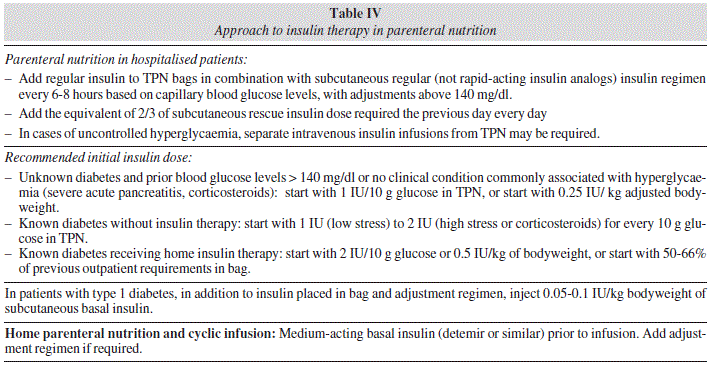
<body><![CDATA[<p><font face="Verdana" size="2">19. There are no data in the literature specifically evaluating these aspects. However, based on physiopathological studies, the use of glutamine or lipids based on olive oil or supplemented with omega-3 fatty acids in patients with increasing metabolic stress could be a reasonable option.</font></p>     <p><font face="Verdana" size="2"><i>Question 11: What is the best insulin therapy regimen in non-critically ill hospitalised patients with diabetes/hyperglycaemia receiving TPN?</i></font></p>     <p><font face="Verdana" size="2">20. We recommend adding regular insulin to TPN bags with a subcutaneous regular (not rapid-acting insulin analogs) insulin regimen every 6-8 hours based on capillary blood glucose levels, with adjustments above 140 mg/dl. In all cases, if the therapeutic objectives are not achieved, the equivalent of 2/3 of the subcutaneous rescue insulin dose required the previous day will be added daily to the bag (<a href="#t4">table IV</a>). We have applied the following assumptions:</font></p>     <p>&nbsp;</p>     <p align="center"><font face="Verdana" size="2"><a name="t4"><img src="/img/revistas/nh/v27n6/08_revision_07_t4.gif" align="top"></a></font></p>     <p>&nbsp;</p>     <p><font face="Verdana" size="2">a) No known diabetes and blood glucose levels prior to starting the TPN infusion above 140 mg/dl or no clinical condition commonly associated with hyperglycaemia (severe acute pancreatitis, concomitant use of corticosteroids): start with 1 IU/10 g of glucose in the TPN. Alternative: start with 0.25 IU/kg of adjusted bodyweight.</font></p>     <p><font face="Verdana" size="2">b) Known diabetes without insulin therapy: start with 1 IU (low stress) to 2 IU (high stress or corticosteroids) for every 10 g of glucose in the TPN.</font></p>     <p><font face="Verdana" size="2">c) Known diabetes undergoing home treatment with insulin: start with 2 IU per 10 g of glucose or 0.5 IU/kg of bodyweight. As an alternative, start with half (if low stress) to 2/3 (if high stress) of previous outpatient requirements in the bag.</font></p>     <p><font face="Verdana" size="2">21. In patients with type 1 diabetes, in addition to the insulin placed in the bag and the adjustment regimen, we recommend injecting between 0.05 and 0.1 IU/kg of subcutaneous basal insulin (to prevent ketoacidosis if the TPN infusion is suddenly discontinued). We recommend a preferable use of insulin glargine (once a day) or detemir (once or twice a day) in these cases.</font></p>     ]]></body>
<body><![CDATA[<p><font face="Verdana" size="2">22. In patients receiving home parenteral nutrition and cyclic infusion, subcutaneous insulin may achieve reasonable control of TPN-associated hyperglycaemia in non-diabetic patients. We recommend a dose of detemir prior to infusion.</font></p>     <p><font face="Verdana" size="2">23. If metabolic objectives are not achieved with the usual regimen, continuous insulin infusion using separate infusion pumps from TPN would be proposed.</font></p>     <p><font face="Verdana" size="2"><i>Question 12: What would your future investigation recommendations be in the field of diabetes/ hyperglycaemia and artificial nutrition?</i></font></p>     <p><font face="Verdana" size="2">24. It is necessary to expand on studies assessing the prevalence of glucose metabolism alterations (diabetes and stress hyperglycaemia) in patients receiving both parenteral and enteral artificial nutrition (in different clinical situations, both hospitalised and as outpatients).</font></p>     <p><font face="Verdana" size="2">25. It is necessary to assess the physiopathological determining factors of stress hyperglycaemia and, at a clinical level, the natural history of this condition, with it being necessary to reassess the persistence of longterm glucose metabolism alterations after acute processes in order to reclassify patients. Considering these data, a consensus should be reached regarding diagnostic criteria for stress hyperglycaemia and other glucose metabolism alterations.</font></p>     <p><font face="Verdana" size="2">26. More studies are required in non-critically ill hospitalised patients in order to define glycaemic control objectives by evaluating morbidity, mortality and efficiency criteria.</font></p>     <p><font face="Verdana" size="2">27. Prospective clinical studies must be conducted to compare the use of different enteral nutrition formulas in patients with diabetes and/or stress hyperglycaemia. These must include more patients, lower protocol withdrawal rates, longer duration (especially in outpatients), be randomised and preferably double-blind in different clinical situations and should assess the efficacy and efficiency (cost/effectiveness) of such formulas on metabolic effect and morbidity/mortality in order to be able to make evidence-based recommendations.</font></p>     <p><font face="Verdana" size="2">28. It is necessary to conduct clinical trials comparing different insulin therapy regimens in both enteral and parenteral nutrition and different clinical scenarios, assessing not only metabolic control parameters but also their effect on morbidity and mortality.</font></p>     <p><font face="Verdana" size="2">29. Studies assessing the role of other aspects of the treatment of patients receiving artificial nutrition with hyperglycaemia should be conducted (such as the addition of micronutrients, drug nutrients, glutamine, whey proteins, omega-3 fatty acids, etc.).</font></p>     <p>&nbsp;</p>     ]]></body>
<body><![CDATA[<p><font face="Verdana" size="2"><b>Statement of Authorship</b></font></p>     <p><font face="Verdana" size="2">All authors contributed to the conception and design of the study, drafting of the manuscript and critical revision thereof.</font></p>     <p>&nbsp;</p>     <p><font face="Verdana" size="2"><b>Conflicts of interest Statement</b></font></p>     <p><font face="Verdana" size="2">None of the authors has any conflict of interest to disclose.</font></p>     <p>&nbsp;</p>     <p><font face="Verdana" size="2"><b>References</b></font></p>     <!-- ref --><p><font face="Verdana" size="2">1. Olveira G. El futuro de la Nutrición Clínica y Dietética en el seno de la Endocrinología y Nutrición. In: Soriguer F, ed. El futuro de la Endocrinología. Málaga: Arguval, 2008: 97-126.    &nbsp;&nbsp;&nbsp;&nbsp;&nbsp;&nbsp;&nbsp;&nbsp;[&#160;<a href="javascript:void(0);" onclick="javascript: window.open('/scielo.php?script=sci_nlinks&ref=3686328&pid=S0212-1611201200060000800001&lng=','','width=640,height=500,resizable=yes,scrollbars=1,menubar=yes,');">Links</a>&#160;]<!-- end-ref --></font></p>    <!-- ref --><p><font face="Verdana" size="2">2. Wilmore DW, Dudrick SJ. Growth and development of an infant receiving all nutrients exclusively by vein. <i>JAMA</i> 1968; 203: 860-4.    &nbsp;&nbsp;&nbsp;&nbsp;&nbsp;&nbsp;&nbsp;&nbsp;[&#160;<a href="javascript:void(0);" onclick="javascript: window.open('/scielo.php?script=sci_nlinks&ref=3686330&pid=S0212-1611201200060000800002&lng=','','width=640,height=500,resizable=yes,scrollbars=1,menubar=yes,');">Links</a>&#160;]<!-- end-ref --></font></p>    <!-- ref --><p><font face="Verdana" size="2">3. Schutz T, Herbst B, Koller M. Methodology for the development of the ESPEN Guidelines on Enteral Nutrition. <i>Clin Nutr</i> 2006; 25: 203-9.    &nbsp;&nbsp;&nbsp;&nbsp;&nbsp;&nbsp;&nbsp;&nbsp;[&#160;<a href="javascript:void(0);" onclick="javascript: window.open('/scielo.php?script=sci_nlinks&ref=3686332&pid=S0212-1611201200060000800003&lng=','','width=640,height=500,resizable=yes,scrollbars=1,menubar=yes,');">Links</a>&#160;]<!-- end-ref --></font></p>    <!-- ref --><p><font face="Verdana" size="2">4. Druyan ME, Compher C, Boullata JI, Braunschweig CL, George DE, Simpser E, et al. Clinical Guidelines for the Use of Parenteral and Enteral Nutrition in Adult and Pediatric Patients: Applying the GRADE System to Development of A.S.P.E.N. Clinical Guidelines. <i>JPEN J Parenter Enteral Nutr</i> 2012; 36:77-80.    &nbsp;&nbsp;&nbsp;&nbsp;&nbsp;&nbsp;&nbsp;&nbsp;[&#160;<a href="javascript:void(0);" onclick="javascript: window.open('/scielo.php?script=sci_nlinks&ref=3686334&pid=S0212-1611201200060000800004&lng=','','width=640,height=500,resizable=yes,scrollbars=1,menubar=yes,');">Links</a>&#160;]<!-- end-ref --></font></p>    <!-- ref --><p><font face="Verdana" size="2">5. Umpierrez GE, Hellman R, Korytkowski MT, Kosiborod M, Maynard GA, Montori VM, et al. Management of hyperglycemia in hospitalized patients in non-critical care setting: an endocrine society clinical practice guideline. <i>J Clin Endocrinol Metab</i> 2012; 97: 16-38.    &nbsp;&nbsp;&nbsp;&nbsp;&nbsp;&nbsp;&nbsp;&nbsp;[&#160;<a href="javascript:void(0);" onclick="javascript: window.open('/scielo.php?script=sci_nlinks&ref=3686336&pid=S0212-1611201200060000800005&lng=','','width=640,height=500,resizable=yes,scrollbars=1,menubar=yes,');">Links</a>&#160;]<!-- end-ref --></font></p>    <!-- ref --><p><font face="Verdana" size="2">6. McMahon MM, Nystrom E, Braunschweig C, Miles J, Compher C. A.S.P.E.N. Clinical Guidelines: Nutrition Support of Adult Patients With Hyperglycemia. <i>JPEN J Parenter Enteral Nutr</i> 2012 (in press).    &nbsp;&nbsp;&nbsp;&nbsp;&nbsp;&nbsp;&nbsp;&nbsp;[&#160;<a href="javascript:void(0);" onclick="javascript: window.open('/scielo.php?script=sci_nlinks&ref=3686338&pid=S0212-1611201200060000800006&lng=','','width=640,height=500,resizable=yes,scrollbars=1,menubar=yes,');">Links</a>&#160;]<!-- end-ref --></font></p>    <!-- ref --><p><font face="Verdana" size="2">7. Qaseem A, Humphrey LL, Chou R, Snow V, Shekelle P. Use of Intensive Insulin Therapy for the Management of Glycemic Control in Hospitalized Patients: A Clinical Practice Guideline From the American College of Physicians. <i>Ann Intern Med</i> 2011; 154: 260-7.    &nbsp;&nbsp;&nbsp;&nbsp;&nbsp;&nbsp;&nbsp;&nbsp;[&#160;<a href="javascript:void(0);" onclick="javascript: window.open('/scielo.php?script=sci_nlinks&ref=3686340&pid=S0212-1611201200060000800007&lng=','','width=640,height=500,resizable=yes,scrollbars=1,menubar=yes,');">Links</a>&#160;]<!-- end-ref --></font></p>    <!-- ref --><p><font face="Verdana" size="2">8. Vaquerizo Alonso C, Grau Carmona T, Juan Díaz M. Guidelines for specialized nutritional and metabolic support in the critically-ill patient. Update. Consensus SEMICYUC-SENPE: hyperglycemia and diabtes mellitus. <i>Nutr Hosp</i> 2011; 26(Suppl. 2): 37-40.    &nbsp;&nbsp;&nbsp;&nbsp;&nbsp;&nbsp;&nbsp;&nbsp;[&#160;<a href="javascript:void(0);" onclick="javascript: window.open('/scielo.php?script=sci_nlinks&ref=3686342&pid=S0212-1611201200060000800008&lng=','','width=640,height=500,resizable=yes,scrollbars=1,menubar=yes,');">Links</a>&#160;]<!-- end-ref --></font></p>    <!-- ref --><p><font face="Verdana" size="2">9. Federation ID. Diabetes Atlas, Third edition. 2006.    &nbsp;&nbsp;&nbsp;&nbsp;&nbsp;&nbsp;&nbsp;&nbsp;[&#160;<a href="javascript:void(0);" onclick="javascript: window.open('/scielo.php?script=sci_nlinks&ref=3686344&pid=S0212-1611201200060000800009&lng=','','width=640,height=500,resizable=yes,scrollbars=1,menubar=yes,');">Links</a>&#160;]<!-- end-ref --></font></p>    <!-- ref --><p><font face="Verdana" size="2">10. Herman WH, Zimmet P. Type 2 Diabetes: An Epidemic Requiring Global Attention and Urgent Action. <i>Diabetes Care</i> 2012; 35: 943-4.    &nbsp;&nbsp;&nbsp;&nbsp;&nbsp;&nbsp;&nbsp;&nbsp;[&#160;<a href="javascript:void(0);" onclick="javascript: window.open('/scielo.php?script=sci_nlinks&ref=3686346&pid=S0212-1611201200060000800010&lng=','','width=640,height=500,resizable=yes,scrollbars=1,menubar=yes,');">Links</a>&#160;]<!-- end-ref --></font></p>    <!-- ref --><p><font face="Verdana" size="2">11. Hu FB. Globalization of diabetes: the role of diet, lifestyle, and genes. <i>Diabetes Care</i> 2011; 34: 1249-57.    &nbsp;&nbsp;&nbsp;&nbsp;&nbsp;&nbsp;&nbsp;&nbsp;[&#160;<a href="javascript:void(0);" onclick="javascript: window.open('/scielo.php?script=sci_nlinks&ref=3686348&pid=S0212-1611201200060000800011&lng=','','width=640,height=500,resizable=yes,scrollbars=1,menubar=yes,');">Links</a>&#160;]<!-- end-ref --></font></p>    <!-- ref --><p><font face="Verdana" size="2">12. Soriguer F, Goday A, Bosch-Comas A, Bordiu E, Calle-Pascual A, Carmena R, et al. Prevalence of diabetes mellitus and impaired glucose regulation in Spain: the Di@bet.es Study. <i>Diabetologia</i> 2012; 55: 88-93.    &nbsp;&nbsp;&nbsp;&nbsp;&nbsp;&nbsp;&nbsp;&nbsp;[&#160;<a href="javascript:void(0);" onclick="javascript: window.open('/scielo.php?script=sci_nlinks&ref=3686350&pid=S0212-1611201200060000800012&lng=','','width=640,height=500,resizable=yes,scrollbars=1,menubar=yes,');">Links</a>&#160;]<!-- end-ref --></font></p>    <!-- ref --><p><font face="Verdana" size="2">13. Valdes S, Rojo-Martínez G, Soriguer F. Evolution of prevalence of type 2 diabetes in adult Spanish population. <i>Med Clin (Barc)</i> 2007; 129: 352-5.    &nbsp;&nbsp;&nbsp;&nbsp;&nbsp;&nbsp;&nbsp;&nbsp;[&#160;<a href="javascript:void(0);" onclick="javascript: window.open('/scielo.php?script=sci_nlinks&ref=3686352&pid=S0212-1611201200060000800013&lng=','','width=640,height=500,resizable=yes,scrollbars=1,menubar=yes,');">Links</a>&#160;]<!-- end-ref --></font></p>    <!-- ref --><p><font face="Verdana" size="2">14. Olveira-Fuster G, Olvera-Marquez P, Carral-Sanlaureano F, Gonzalez-Romero S, Aguilar-Diosdado M, Soriguer-Escofet F. Excess hospitalizations, hospital days, and inpatient costs among people with diabetes in Andalusia, Spain. <i>Diabetes Care</i> 2004; 27: 1904-9.    &nbsp;&nbsp;&nbsp;&nbsp;&nbsp;&nbsp;&nbsp;&nbsp;[&#160;<a href="javascript:void(0);" onclick="javascript: window.open('/scielo.php?script=sci_nlinks&ref=3686354&pid=S0212-1611201200060000800014&lng=','','width=640,height=500,resizable=yes,scrollbars=1,menubar=yes,');">Links</a>&#160;]<!-- end-ref --></font></p>    <!-- ref --><p><font face="Verdana" size="2">15. Carral F, Olveira G, Salas J, García L, Sillero A, Aguilar M. Care resource utilization and direct costs incurred by people with diabetes in a Spanish hospital. <i>Diabetes Res Clin Pract</i> 2002; 56: 27-34.    &nbsp;&nbsp;&nbsp;&nbsp;&nbsp;&nbsp;&nbsp;&nbsp;[&#160;<a href="javascript:void(0);" onclick="javascript: window.open('/scielo.php?script=sci_nlinks&ref=3686356&pid=S0212-1611201200060000800015&lng=','','width=640,height=500,resizable=yes,scrollbars=1,menubar=yes,');">Links</a>&#160;]<!-- end-ref --></font></p>    <!-- ref --><p><font face="Verdana" size="2">16. Carral F, Olveira G, Aguilar M, Ortego J, Gavilan I, Domenech I, et al. Hospital discharge records under-report the prevalence of diabetes in inpatients. <i>Diabetes Res Clin Pract</i> 2003; 59: 145-51.    &nbsp;&nbsp;&nbsp;&nbsp;&nbsp;&nbsp;&nbsp;&nbsp;[&#160;<a href="javascript:void(0);" onclick="javascript: window.open('/scielo.php?script=sci_nlinks&ref=3686358&pid=S0212-1611201200060000800016&lng=','','width=640,height=500,resizable=yes,scrollbars=1,menubar=yes,');">Links</a>&#160;]<!-- end-ref --></font></p>    <!-- ref --><p><font face="Verdana" size="2">17. Via MA, Mechanick JI. Inpatient enteral and parenteral (corrected) nutrition for patients with diabetes. <i>Curr Diab Rep</i> 2011; 11: 99-105.    &nbsp;&nbsp;&nbsp;&nbsp;&nbsp;&nbsp;&nbsp;&nbsp;[&#160;<a href="javascript:void(0);" onclick="javascript: window.open('/scielo.php?script=sci_nlinks&ref=3686360&pid=S0212-1611201200060000800017&lng=','','width=640,height=500,resizable=yes,scrollbars=1,menubar=yes,');">Links</a>&#160;]<!-- end-ref --></font></p>    <!-- ref --><p><font face="Verdana" size="2">18. Moghissi ES, Korytkowski MT, DiNardo M, Einhorn D, Hellman R, Hirsch IB, et al. American Association of Clinical Endocrinologists and American Diabetes Association consensus statement on inpatient glycemic control. <i>Diabetes Care</i> 2009; 32: 1119-31.    &nbsp;&nbsp;&nbsp;&nbsp;&nbsp;&nbsp;&nbsp;&nbsp;[&#160;<a href="javascript:void(0);" onclick="javascript: window.open('/scielo.php?script=sci_nlinks&ref=3686362&pid=S0212-1611201200060000800018&lng=','','width=640,height=500,resizable=yes,scrollbars=1,menubar=yes,');">Links</a>&#160;]<!-- end-ref --></font></p>    <!-- ref --><p><font face="Verdana" size="2">19. Carral F, Aguilar M, Olveira G, Mangas A, Domenech I, Torres I. Increased hospital expenditures in diabetic patients hospitalized for cardiovascular diseases. <i>J Diabetes Complications</i> 2003; 17: 331-6.    &nbsp;&nbsp;&nbsp;&nbsp;&nbsp;&nbsp;&nbsp;&nbsp;[&#160;<a href="javascript:void(0);" onclick="javascript: window.open('/scielo.php?script=sci_nlinks&ref=3686364&pid=S0212-1611201200060000800019&lng=','','width=640,height=500,resizable=yes,scrollbars=1,menubar=yes,');">Links</a>&#160;]<!-- end-ref --></font></p>    <!-- ref --><p><font face="Verdana" size="2">20. Umpierrez GE, Isaacs SD, Bazargan N, You X, Thaler LM, Kitabchi AE. Hyperglycemia: an independent marker of inhospital mortality in patients with undiagnosed diabetes. <i>J Clin Endocrinol Metab</i> 2002; 87: 978-82.    &nbsp;&nbsp;&nbsp;&nbsp;&nbsp;&nbsp;&nbsp;&nbsp;[&#160;<a href="javascript:void(0);" onclick="javascript: window.open('/scielo.php?script=sci_nlinks&ref=3686366&pid=S0212-1611201200060000800020&lng=','','width=640,height=500,resizable=yes,scrollbars=1,menubar=yes,');">Links</a>&#160;]<!-- end-ref --></font></p>    <!-- ref --><p><font face="Verdana" size="2">21. American Diabetes Association. Standards of medical care in diabetes-2012. <i>Diabetes Care</i> 2012; 35 (Suppl. 1): S11-63.    &nbsp;&nbsp;&nbsp;&nbsp;&nbsp;&nbsp;&nbsp;&nbsp;[&#160;<a href="javascript:void(0);" onclick="javascript: window.open('/scielo.php?script=sci_nlinks&ref=3686368&pid=S0212-1611201200060000800021&lng=','','width=640,height=500,resizable=yes,scrollbars=1,menubar=yes,');">Links</a>&#160;]<!-- end-ref --></font></p>    <!-- ref --><p><font face="Verdana" size="2">22. Dungan KM, Braithwaite SS, Preiser JC. Stress hyperglycaemia. <i>Lancet</i> 2009; 373: 1798-807.    &nbsp;&nbsp;&nbsp;&nbsp;&nbsp;&nbsp;&nbsp;&nbsp;[&#160;<a href="javascript:void(0);" onclick="javascript: window.open('/scielo.php?script=sci_nlinks&ref=3686370&pid=S0212-1611201200060000800022&lng=','','width=640,height=500,resizable=yes,scrollbars=1,menubar=yes,');">Links</a>&#160;]<!-- end-ref --></font></p>    <!-- ref --><p><font face="Verdana" size="2">23. Dungan K, Hall C, Schuster D, Osei K. Differential response between diabetes and stress-induced hyperglycaemia to algorithmic use of detemir and flexible mealtime aspart among stable postcardiac surgery patients requiring intravenous insulin. <i>Diabetes Obes Metab</i> 2011; 13: 1130-5.    &nbsp;&nbsp;&nbsp;&nbsp;&nbsp;&nbsp;&nbsp;&nbsp;[&#160;<a href="javascript:void(0);" onclick="javascript: window.open('/scielo.php?script=sci_nlinks&ref=3686372&pid=S0212-1611201200060000800023&lng=','','width=640,height=500,resizable=yes,scrollbars=1,menubar=yes,');">Links</a>&#160;]<!-- end-ref --></font></p>    <!-- ref --><p><font face="Verdana" size="2">24. Olveira G, García-Doncel L, Carral F, Domenech I, Arencibia T, Manzano MV. Dispensación de los productos dietoterapéuticos mediante dosis unitarias en un Hospital Universitario: efectos sobre el consumo y costes. <i>Nutr Hosp</i> 2000; 15: 58-63.    &nbsp;&nbsp;&nbsp;&nbsp;&nbsp;&nbsp;&nbsp;&nbsp;[&#160;<a href="javascript:void(0);" onclick="javascript: window.open('/scielo.php?script=sci_nlinks&ref=3686374&pid=S0212-1611201200060000800024&lng=','','width=640,height=500,resizable=yes,scrollbars=1,menubar=yes,');">Links</a>&#160;]<!-- end-ref --></font></p>    <!-- ref --><p><font face="Verdana" size="2">25. Olveira G, Gonzalo M. Fórmulas de nutrición enteral para personas con diabetes mellitus. <i>Endocrinol Nutr</i> 2005; 52:516-524.    &nbsp;&nbsp;&nbsp;&nbsp;&nbsp;&nbsp;&nbsp;&nbsp;[&#160;<a href="javascript:void(0);" onclick="javascript: window.open('/scielo.php?script=sci_nlinks&ref=3686376&pid=S0212-1611201200060000800025&lng=','','width=640,height=500,resizable=yes,scrollbars=1,menubar=yes,');">Links</a>&#160;]<!-- end-ref --></font></p>    <!-- ref --><p><font face="Verdana" size="2">26. Marik PE, Varon J. Intensive insulin therapy in the ICU: is it now time to jump off the bandwagon? <i>Resuscitation</i> 2007; 74:191-3.    &nbsp;&nbsp;&nbsp;&nbsp;&nbsp;&nbsp;&nbsp;&nbsp;[&#160;<a href="javascript:void(0);" onclick="javascript: window.open('/scielo.php?script=sci_nlinks&ref=3686378&pid=S0212-1611201200060000800026&lng=','','width=640,height=500,resizable=yes,scrollbars=1,menubar=yes,');">Links</a>&#160;]<!-- end-ref --></font></p>    <!-- ref --><p><font face="Verdana" size="2">27. Marik R, Fackler M, Gabrielson E, Zeiger MA, Sukumar S, Stearns V, et al. DNA methylation-related vitamin D receptor insensitivity in breast cancer. <i>Cancer Biol Ther</i> 2010; 10: 44-53.    &nbsp;&nbsp;&nbsp;&nbsp;&nbsp;&nbsp;&nbsp;&nbsp;[&#160;<a href="javascript:void(0);" onclick="javascript: window.open('/scielo.php?script=sci_nlinks&ref=3686380&pid=S0212-1611201200060000800027&lng=','','width=640,height=500,resizable=yes,scrollbars=1,menubar=yes,');">Links</a>&#160;]<!-- end-ref --></font></p>    <!-- ref --><p><font face="Verdana" size="2">28. Pancorbo-Hidalgo PL, Garcia-Fernandez FP, Ramirez-Perez C. Complications associated with enteral nutrition by nasogastric tube in an internal medicine unit. <i>J Clin Nurs</i> 2001; 10: 482-90.    &nbsp;&nbsp;&nbsp;&nbsp;&nbsp;&nbsp;&nbsp;&nbsp;[&#160;<a href="javascript:void(0);" onclick="javascript: window.open('/scielo.php?script=sci_nlinks&ref=3686382&pid=S0212-1611201200060000800028&lng=','','width=640,height=500,resizable=yes,scrollbars=1,menubar=yes,');">Links</a>&#160;]<!-- end-ref --></font></p>    <!-- ref --><p><font face="Verdana" size="2">29. Arinzon Z, Shabat S, Shuval I, Peisakh A, Berner Y. Prevalence of diabetes mellitus in elderly patients received enteral nutrition long-term care service. <i>Arch Gerontol Geriatr</i> 2008; 47: 383-93.    &nbsp;&nbsp;&nbsp;&nbsp;&nbsp;&nbsp;&nbsp;&nbsp;[&#160;<a href="javascript:void(0);" onclick="javascript: window.open('/scielo.php?script=sci_nlinks&ref=3686384&pid=S0212-1611201200060000800029&lng=','','width=640,height=500,resizable=yes,scrollbars=1,menubar=yes,');">Links</a>&#160;]<!-- end-ref --></font></p>    <!-- ref --><p><font face="Verdana" size="2">30. Korytkowski MT, Salata RJ, Koerbel GL, Selzer F, Karslioglu E, Idriss AM, et al. Insulin therapy and glycemic control in hospitalized patients with diabetes during enteral nutrition therapy: a randomized controlled clinical trial. <i>Diabetes Care</i> 2009; 32: 594-6.    &nbsp;&nbsp;&nbsp;&nbsp;&nbsp;&nbsp;&nbsp;&nbsp;[&#160;<a href="javascript:void(0);" onclick="javascript: window.open('/scielo.php?script=sci_nlinks&ref=3686386&pid=S0212-1611201200060000800030&lng=','','width=640,height=500,resizable=yes,scrollbars=1,menubar=yes,');">Links</a>&#160;]<!-- end-ref --></font></p>    <!-- ref --><p><font face="Verdana" size="2">31. Brunkhorst FM, Engel C, Bloos F, Meier-Hellmann A, Ragaller M, Weiler N, et al. Intensive insulin therapy and pentastarch resuscitation in severe sepsis. <i>N Engl J Med</i> 2008; 358: 125-39.    &nbsp;&nbsp;&nbsp;&nbsp;&nbsp;&nbsp;&nbsp;&nbsp;[&#160;<a href="javascript:void(0);" onclick="javascript: window.open('/scielo.php?script=sci_nlinks&ref=3686388&pid=S0212-1611201200060000800031&lng=','','width=640,height=500,resizable=yes,scrollbars=1,menubar=yes,');">Links</a>&#160;]<!-- end-ref --></font></p>    <!-- ref --><p><font face="Verdana" size="2">32. Finfer S, Chittock DR, Su SY, Blair D, Foster D, Dhingra V, et al. Intensive versus conventional glucose control in critically ill patients. <i>N Engl J Med</i> 2009; 360: 1283-97.    &nbsp;&nbsp;&nbsp;&nbsp;&nbsp;&nbsp;&nbsp;&nbsp;[&#160;<a href="javascript:void(0);" onclick="javascript: window.open('/scielo.php?script=sci_nlinks&ref=3686390&pid=S0212-1611201200060000800032&lng=','','width=640,height=500,resizable=yes,scrollbars=1,menubar=yes,');">Links</a>&#160;]<!-- end-ref --></font></p>    <!-- ref --><p><font face="Verdana" size="2">33. Preiser JC, Devos P, Ruiz-Santana S, Melot C, Annane D, Groeneveld J, et al. A prospective randomised multi-centre controlled trial on tight glucose control by intensive insulin therapy in adult intensive care units: the Glucontrol study. <i>Intensive Care Med</i> 2009; 35: 1738-48.    &nbsp;&nbsp;&nbsp;&nbsp;&nbsp;&nbsp;&nbsp;&nbsp;[&#160;<a href="javascript:void(0);" onclick="javascript: window.open('/scielo.php?script=sci_nlinks&ref=3686392&pid=S0212-1611201200060000800033&lng=','','width=640,height=500,resizable=yes,scrollbars=1,menubar=yes,');">Links</a>&#160;]<!-- end-ref --></font></p>    <!-- ref --><p><font face="Verdana" size="2">34. De La Rosa G del C, Donado JH, Restrepo AH, Quintero AM, González LG, Saldarriaga NE, et al. Strict glycaemic control in patients hospitalised in a mixed medical and surgical intensive care unit: a randomised clinical trial. <i>Crit Care</i> 2008; 12: R120.    &nbsp;&nbsp;&nbsp;&nbsp;&nbsp;&nbsp;&nbsp;&nbsp;[&#160;<a href="javascript:void(0);" onclick="javascript: window.open('/scielo.php?script=sci_nlinks&ref=3686394&pid=S0212-1611201200060000800034&lng=','','width=640,height=500,resizable=yes,scrollbars=1,menubar=yes,');">Links</a>&#160;]<!-- end-ref --></font></p>    <!-- ref --><p><font face="Verdana" size="2">35. Van den Berghe G, Wilmer A, Hermans G, Meersseman W, Wouters PJ, Milants I, et al. Intensive insulin therapy in the medical ICU. <i>N Engl J Med</i> 2006; 354: 449-61.    &nbsp;&nbsp;&nbsp;&nbsp;&nbsp;&nbsp;&nbsp;&nbsp;[&#160;<a href="javascript:void(0);" onclick="javascript: window.open('/scielo.php?script=sci_nlinks&ref=3686396&pid=S0212-1611201200060000800035&lng=','','width=640,height=500,resizable=yes,scrollbars=1,menubar=yes,');">Links</a>&#160;]<!-- end-ref --></font></p>    <!-- ref --><p><font face="Verdana" size="2">36. Van den Berghe G, Wouters P, Weekers F, Verwaest C, Bruyninckx F, Schetz M, et al. Intensive insulin therapy in critically ill patients. <i>N Engl J Med</i> 2001; 345: 1359-67.    &nbsp;&nbsp;&nbsp;&nbsp;&nbsp;&nbsp;&nbsp;&nbsp;[&#160;<a href="javascript:void(0);" onclick="javascript: window.open('/scielo.php?script=sci_nlinks&ref=3686398&pid=S0212-1611201200060000800036&lng=','','width=640,height=500,resizable=yes,scrollbars=1,menubar=yes,');">Links</a>&#160;]<!-- end-ref --></font></p>    <!-- ref --><p><font face="Verdana" size="2">37. Pleva M, Mirtallo JM, Steinberg SM. Hyperglycemic events in non-intensive care unit patients receiving parenteral nutrition. <i>Nutr Clin Pract</i> 2009; 24: 626-34.    &nbsp;&nbsp;&nbsp;&nbsp;&nbsp;&nbsp;&nbsp;&nbsp;[&#160;<a href="javascript:void(0);" onclick="javascript: window.open('/scielo.php?script=sci_nlinks&ref=3686400&pid=S0212-1611201200060000800037&lng=','','width=640,height=500,resizable=yes,scrollbars=1,menubar=yes,');">Links</a>&#160;]<!-- end-ref --></font></p>    <!-- ref --><p><font face="Verdana" size="2">38. Valero MA, Alegre E, Gomis P, Moreno JM, Miguelez S, Leon-Sanz M. Clinical management of hyperglycaemic patients receiving total parenteral nutrition. <i>Clin Nutr</i> 1996; 15: 11-5.    &nbsp;&nbsp;&nbsp;&nbsp;&nbsp;&nbsp;&nbsp;&nbsp;[&#160;<a href="javascript:void(0);" onclick="javascript: window.open('/scielo.php?script=sci_nlinks&ref=3686402&pid=S0212-1611201200060000800038&lng=','','width=640,height=500,resizable=yes,scrollbars=1,menubar=yes,');">Links</a>&#160;]<!-- end-ref --></font></p>    <!-- ref --><p><font face="Verdana" size="2">39. Marti-Bonmati E, Ortega-Garcia MP, Cervera-Casino P, Lacasa C, Llop JL, Villalobos JL, et al. Multicenter study on the prevalence of hyperglycemia among hospitalized patients with parenteral nutrition. <i>Farm Hosp</i> 2006; 30: 12-9.    &nbsp;&nbsp;&nbsp;&nbsp;&nbsp;&nbsp;&nbsp;&nbsp;[&#160;<a href="javascript:void(0);" onclick="javascript: window.open('/scielo.php?script=sci_nlinks&ref=3686404&pid=S0212-1611201200060000800039&lng=','','width=640,height=500,resizable=yes,scrollbars=1,menubar=yes,');">Links</a>&#160;]<!-- end-ref --></font></p>    <!-- ref --><p><font face="Verdana" size="2">40. Tapia Guerrero MJ, Olveira G, Hyperglycaemia in Parenteral Nutrition Study Group. Hipergycemia and diabetes during total parenteral nutrition in non-critical hospitalised patients in Spain. <i>Clin Nutr</i> 2011; 6 (Supp.1): 120.    &nbsp;&nbsp;&nbsp;&nbsp;&nbsp;&nbsp;&nbsp;&nbsp;[&#160;<a href="javascript:void(0);" onclick="javascript: window.open('/scielo.php?script=sci_nlinks&ref=3686406&pid=S0212-1611201200060000800040&lng=','','width=640,height=500,resizable=yes,scrollbars=1,menubar=yes,');">Links</a>&#160;]<!-- end-ref --></font></p>    <!-- ref --><p><font face="Verdana" size="2">41. Corathers SD, Falciglia M. The role of hyperglycemia in acute illness: supporting evidence and its limitations. <i>Nutrition</i> 2011; 27: 276-81.    &nbsp;&nbsp;&nbsp;&nbsp;&nbsp;&nbsp;&nbsp;&nbsp;[&#160;<a href="javascript:void(0);" onclick="javascript: window.open('/scielo.php?script=sci_nlinks&ref=3686408&pid=S0212-1611201200060000800041&lng=','','width=640,height=500,resizable=yes,scrollbars=1,menubar=yes,');">Links</a>&#160;]<!-- end-ref --></font></p>    <!-- ref --><p><font face="Verdana" size="2">42. Pérez Pérez A, Conthe Gutiérrez P, Aguilar Diosdado M, Bertomeu Martinez V, Galdos Anuncibay P, Garcia de Casasola G, et al. Hospital management of hyperglycemia. <i>Med Clin (Bare)</i> 2009; 132: 465-75.    &nbsp;&nbsp;&nbsp;&nbsp;&nbsp;&nbsp;&nbsp;&nbsp;[&#160;<a href="javascript:void(0);" onclick="javascript: window.open('/scielo.php?script=sci_nlinks&ref=3686410&pid=S0212-1611201200060000800042&lng=','','width=640,height=500,resizable=yes,scrollbars=1,menubar=yes,');">Links</a>&#160;]<!-- end-ref --></font></p>    <!-- ref --><p><font face="Verdana" size="2">43. der Voort PH, Feenstra RA, Bakker AJ, Heide L, Boerma EC, van der Horst IC. Intravenous glucose intake independently related to intensive care unit and hospital mortality: an argument for glucose toxicity in critically ill patients. <i>Clin Endocrinol (Oxf)</i> 2006; 64: 141-5.    &nbsp;&nbsp;&nbsp;&nbsp;&nbsp;&nbsp;&nbsp;&nbsp;[&#160;<a href="javascript:void(0);" onclick="javascript: window.open('/scielo.php?script=sci_nlinks&ref=3686412&pid=S0212-1611201200060000800043&lng=','','width=640,height=500,resizable=yes,scrollbars=1,menubar=yes,');">Links</a>&#160;]<!-- end-ref --></font></p>    <!-- ref --><p><font face="Verdana" size="2">44. Lin LY, Lin HC, Lee PC, Ma WY, Lin HD. Hyperglycemia correlates with outcomes in patients receiving total parenteral nutrition. <i>Am J Med Sci</i> 2007; 333: 261-5.    &nbsp;&nbsp;&nbsp;&nbsp;&nbsp;&nbsp;&nbsp;&nbsp;[&#160;<a href="javascript:void(0);" onclick="javascript: window.open('/scielo.php?script=sci_nlinks&ref=3686414&pid=S0212-1611201200060000800044&lng=','','width=640,height=500,resizable=yes,scrollbars=1,menubar=yes,');">Links</a>&#160;]<!-- end-ref --></font></p>    <!-- ref --><p><font face="Verdana" size="2">45. Cheung NW, Napier B, Zaccaria C, Fletcher JP. Hyperglycemia is associated with adverse outcomes in patients receiving total parenteral nutrition. <i>Diabetes Care</i> 2005; 28:2367-71.    &nbsp;&nbsp;&nbsp;&nbsp;&nbsp;&nbsp;&nbsp;&nbsp;[&#160;<a href="javascript:void(0);" onclick="javascript: window.open('/scielo.php?script=sci_nlinks&ref=3686416&pid=S0212-1611201200060000800045&lng=','','width=640,height=500,resizable=yes,scrollbars=1,menubar=yes,');">Links</a>&#160;]<!-- end-ref --></font></p>    <!-- ref --><p><font face="Verdana" size="2">46. Sheean PM, Freels SA, Helton WS, Braunschweig CA. Adverse clinical consequences of hyperglycemia from total parenteral nutrition exposure during hematopoietic stem cell transplantation. <i>Biol Blood Marrow Transplant</i> 2006; 12: 656-64.    &nbsp;&nbsp;&nbsp;&nbsp;&nbsp;&nbsp;&nbsp;&nbsp;[&#160;<a href="javascript:void(0);" onclick="javascript: window.open('/scielo.php?script=sci_nlinks&ref=3686418&pid=S0212-1611201200060000800046&lng=','','width=640,height=500,resizable=yes,scrollbars=1,menubar=yes,');">Links</a>&#160;]<!-- end-ref --></font></p>    <!-- ref --><p><font face="Verdana" size="2">47. Kumar PR, Crotty P, Raman M. Hyperglycemia in hospitalized patients receiving parental nutrition is associated with increased morbidity and mortality: a review. <i>Gastroenterol Res Pract</i> 2011; 2011.    &nbsp;&nbsp;&nbsp;&nbsp;&nbsp;&nbsp;&nbsp;&nbsp;[&#160;<a href="javascript:void(0);" onclick="javascript: window.open('/scielo.php?script=sci_nlinks&ref=3686420&pid=S0212-1611201200060000800047&lng=','','width=640,height=500,resizable=yes,scrollbars=1,menubar=yes,');">Links</a>&#160;]<!-- end-ref --></font></p>    <!-- ref --><p><font face="Verdana" size="2">48. Olveira G, Tapia MJ, Ocón J , Cabrejas-Gómez MC, Ballesteros-Pomar MD, Vidal-Casariego A, et al. Parenteral Nutrition-Associated hyperglycemia in noncritically ill inpatients increases the risk of inhospital mortality (Multicenter Study). <i>Diab Care</i> 2012 (in press).    &nbsp;&nbsp;&nbsp;&nbsp;&nbsp;&nbsp;&nbsp;&nbsp;[&#160;<a href="javascript:void(0);" onclick="javascript: window.open('/scielo.php?script=sci_nlinks&ref=3686422&pid=S0212-1611201200060000800048&lng=','','width=640,height=500,resizable=yes,scrollbars=1,menubar=yes,');">Links</a>&#160;]<!-- end-ref --></font></p>    <!-- ref --><p><font face="Verdana" size="2">49. Lee H, Koh SO, Park MS. Higher dextrose delivery via TPN related to the development of hyperglycemia in non-diabetic critically ill patients. <i>Nutr Res Pract</i> 2011; 5: 450-4.    &nbsp;&nbsp;&nbsp;&nbsp;&nbsp;&nbsp;&nbsp;&nbsp;[&#160;<a href="javascript:void(0);" onclick="javascript: window.open('/scielo.php?script=sci_nlinks&ref=3686424&pid=S0212-1611201200060000800049&lng=','','width=640,height=500,resizable=yes,scrollbars=1,menubar=yes,');">Links</a>&#160;]<!-- end-ref --></font></p>    <!-- ref --><p><font face="Verdana" size="2">50. Schultz MJ, Spronk PE, van Braam Houckgeest F. Glucontrol, no control, or out of control? <i>Intensive Care Med</i> 2010; 36: 173-4; author reply 175-6.    &nbsp;&nbsp;&nbsp;&nbsp;&nbsp;&nbsp;&nbsp;&nbsp;[&#160;<a href="javascript:void(0);" onclick="javascript: window.open('/scielo.php?script=sci_nlinks&ref=3686426&pid=S0212-1611201200060000800050&lng=','','width=640,height=500,resizable=yes,scrollbars=1,menubar=yes,');">Links</a>&#160;]<!-- end-ref --></font></p>    <!-- ref --><p><font face="Verdana" size="2">51. Van den Berghe G, Schetz M, Vlasselaers D, Hermans G, Wilmer A, Bouillon R, et al. Clinical review: Intensive insulin therapy in critically ill patients: NICE-SUGAR or Leuven blood glucose target? <i>J Clin Endocrinol Metab</i> 2009; 94: 3163-70.    &nbsp;&nbsp;&nbsp;&nbsp;&nbsp;&nbsp;&nbsp;&nbsp;[&#160;<a href="javascript:void(0);" onclick="javascript: window.open('/scielo.php?script=sci_nlinks&ref=3686428&pid=S0212-1611201200060000800051&lng=','','width=640,height=500,resizable=yes,scrollbars=1,menubar=yes,');">Links</a>&#160;]<!-- end-ref --></font></p>    <!-- ref --><p><font face="Verdana" size="2">52. Marik PE, Preiser JC. Toward understanding tight glycemic control in the ICU: a systematic review and metaanalysis. <i>Chest</i> 2010; 137: 544-51.    &nbsp;&nbsp;&nbsp;&nbsp;&nbsp;&nbsp;&nbsp;&nbsp;[&#160;<a href="javascript:void(0);" onclick="javascript: window.open('/scielo.php?script=sci_nlinks&ref=3686430&pid=S0212-1611201200060000800052&lng=','','width=640,height=500,resizable=yes,scrollbars=1,menubar=yes,');">Links</a>&#160;]<!-- end-ref --></font></p>    <!-- ref --><p><font face="Verdana" size="2">53. Murad MH, Coburn JA, Coto-Yglesias F, Dzyubak S, Hazem A, Lane MA, et al. Glycemic control in non-critically ill hospitalized patients: a systematic review and meta-analysis. <i>J Clin Endocrinol Metab</i> 2012; 97: 49-58.    &nbsp;&nbsp;&nbsp;&nbsp;&nbsp;&nbsp;&nbsp;&nbsp;[&#160;<a href="javascript:void(0);" onclick="javascript: window.open('/scielo.php?script=sci_nlinks&ref=3686432&pid=S0212-1611201200060000800053&lng=','','width=640,height=500,resizable=yes,scrollbars=1,menubar=yes,');">Links</a>&#160;]<!-- end-ref --></font></p>    <!-- ref --><p><font face="Verdana" size="2">54. Olveira G, Tapia MJ, Colomo N, Munoz A, Gonzalo M, F CS. Usefulness of the daily defined dose method to estimate trends in the consumption, costs and prevalence of the use of home enteral nutrition. <i>Clin Nutr</i> 2009; 28: 285-90.    &nbsp;&nbsp;&nbsp;&nbsp;&nbsp;&nbsp;&nbsp;&nbsp;[&#160;<a href="javascript:void(0);" onclick="javascript: window.open('/scielo.php?script=sci_nlinks&ref=3686434&pid=S0212-1611201200060000800054&lng=','','width=640,height=500,resizable=yes,scrollbars=1,menubar=yes,');">Links</a>&#160;]<!-- end-ref --></font></p>    <!-- ref --><p><font face="Verdana" size="2">55. Wanden-Berghe C, Puiggros JC, Calanas A, Cuerda C, Garcia-Luna PP, Rabassa-Soler A, et al. The Spanish Home Enteral Nutrition registry of the year 2009: from the NADYA-SENPE group. <i>Nutr Hosp</i> 2010; 25: 959-63.    &nbsp;&nbsp;&nbsp;&nbsp;&nbsp;&nbsp;&nbsp;&nbsp;[&#160;<a href="javascript:void(0);" onclick="javascript: window.open('/scielo.php?script=sci_nlinks&ref=3686436&pid=S0212-1611201200060000800055&lng=','','width=640,height=500,resizable=yes,scrollbars=1,menubar=yes,');">Links</a>&#160;]<!-- end-ref --></font></p>    <!-- ref --><p><font face="Verdana" size="2">56. Olveira Fuster G, Mancha Doblas I, González-Romero S, Goiburu ME, Munoz Aguilar A, García Almeida JM. The quality of the care in parenteral nutrition: the benefits after the incorporation of a nutritional support team. <i>Nutr Hosp</i> 2000; 15: 118-22.    &nbsp;&nbsp;&nbsp;&nbsp;&nbsp;&nbsp;&nbsp;&nbsp;[&#160;<a href="javascript:void(0);" onclick="javascript: window.open('/scielo.php?script=sci_nlinks&ref=3686438&pid=S0212-1611201200060000800056&lng=','','width=640,height=500,resizable=yes,scrollbars=1,menubar=yes,');">Links</a>&#160;]<!-- end-ref --></font></p>    <!-- ref --><p><font face="Verdana" size="2">57. Ziegler TR. Parenteral nutrition in the critically ill patient. <i>N Engl J Med</i> 2009; 361: 1088-97.    &nbsp;&nbsp;&nbsp;&nbsp;&nbsp;&nbsp;&nbsp;&nbsp;[&#160;<a href="javascript:void(0);" onclick="javascript: window.open('/scielo.php?script=sci_nlinks&ref=3686440&pid=S0212-1611201200060000800057&lng=','','width=640,height=500,resizable=yes,scrollbars=1,menubar=yes,');">Links</a>&#160;]<!-- end-ref --></font></p>    <!-- ref --><p><font face="Verdana" size="2">58. del Carmen Crespillo M, Olveira G, de Adana MS, Rojo-Martinez G, Garcia-Aleman J, Olvera P et al. Metabolic effects of an enteral nutrition formula for diabetes: comparison with standard formulas in patients with type 1 diabetes. <i>Clin Nutr</i> 2003; 22: 483-7.    &nbsp;&nbsp;&nbsp;&nbsp;&nbsp;&nbsp;&nbsp;&nbsp;[&#160;<a href="javascript:void(0);" onclick="javascript: window.open('/scielo.php?script=sci_nlinks&ref=3686442&pid=S0212-1611201200060000800058&lng=','','width=640,height=500,resizable=yes,scrollbars=1,menubar=yes,');">Links</a>&#160;]<!-- end-ref --></font></p>    <!-- ref --><p><font face="Verdana" size="2">59. Coulston AM. Enteral nutrition in the patient with diabetes mellitus. <i>Curr Opin Clin Nutr Metab Care</i> 2000; 3: 11-5.    &nbsp;&nbsp;&nbsp;&nbsp;&nbsp;&nbsp;&nbsp;&nbsp;[&#160;<a href="javascript:void(0);" onclick="javascript: window.open('/scielo.php?script=sci_nlinks&ref=3686444&pid=S0212-1611201200060000800059&lng=','','width=640,height=500,resizable=yes,scrollbars=1,menubar=yes,');">Links</a>&#160;]<!-- end-ref --></font></p>    <!-- ref --><p><font face="Verdana" size="2">60. Sanz-Paris A, Calvo L, Guallard A, Salazar I, Albero R. Highfat versus high-carbohydrate enteral formulae: effect on blood glucose, C-peptide, and ketones in patients with type 2 diabetes treated with insulin or sulfonylurea. <i>Nutrition</i> 1998; 14: 840-5.    &nbsp;&nbsp;&nbsp;&nbsp;&nbsp;&nbsp;&nbsp;&nbsp;[&#160;<a href="javascript:void(0);" onclick="javascript: window.open('/scielo.php?script=sci_nlinks&ref=3686446&pid=S0212-1611201200060000800060&lng=','','width=640,height=500,resizable=yes,scrollbars=1,menubar=yes,');">Links</a>&#160;]<!-- end-ref --></font></p>    <!-- ref --><p><font face="Verdana" size="2">61. Hofman Z, van Drunen JD, de Later C, Kuipers H. The effect of different nutritional feeds on the postprandial glucose response in healthy volunteers and patients with type II diabetes. <i>Eur J Clin Nutr</i> 2004; 58: 1553-6.    &nbsp;&nbsp;&nbsp;&nbsp;&nbsp;&nbsp;&nbsp;&nbsp;[&#160;<a href="javascript:void(0);" onclick="javascript: window.open('/scielo.php?script=sci_nlinks&ref=3686448&pid=S0212-1611201200060000800061&lng=','','width=640,height=500,resizable=yes,scrollbars=1,menubar=yes,');">Links</a>&#160;]<!-- end-ref --></font></p>    <!-- ref --><p><font face="Verdana" size="2">62. Elia M, Ceriello A, Laube H, Sinclair AJ, Engfer M, Stratton RJ. Enteral nutritional support and use of diabetes-specific formulas for patients with diabetes: a systematic review and meta-analysis. <i>Diabetes Care</i> 2005; 28: 2267-79.    &nbsp;&nbsp;&nbsp;&nbsp;&nbsp;&nbsp;&nbsp;&nbsp;[&#160;<a href="javascript:void(0);" onclick="javascript: window.open('/scielo.php?script=sci_nlinks&ref=3686450&pid=S0212-1611201200060000800062&lng=','','width=640,height=500,resizable=yes,scrollbars=1,menubar=yes,');">Links</a>&#160;]<!-- end-ref --></font></p>    <!-- ref --><p><font face="Verdana" size="2">63. Mesa García MD BG, García Rodríguez CE, Olza Meneses J, Moreno-Torres R, Pérez de la Cruz A, Gil Hernández A. Respuesta glucémica y de péptidos gastrointestinales en sujetos sanos tras la ingesga de un suplementos nutricional específico para diabéticos. <i>Nutr Hosp</i> 2009; 24 (Suppl. 1): 1.    &nbsp;&nbsp;&nbsp;&nbsp;&nbsp;&nbsp;&nbsp;&nbsp;[&#160;<a href="javascript:void(0);" onclick="javascript: window.open('/scielo.php?script=sci_nlinks&ref=3686452&pid=S0212-1611201200060000800063&lng=','','width=640,height=500,resizable=yes,scrollbars=1,menubar=yes,');">Links</a>&#160;]<!-- end-ref --></font></p>    <!-- ref --><p><font face="Verdana" size="2">64. Hofman Z, De Van Drunen J, Kuipers H. The Glycemic Index of standard and diabetes-specific enteral formulas. <i>Asia Pac J Clin Nutr</i> 2006; 15: 412-7.    &nbsp;&nbsp;&nbsp;&nbsp;&nbsp;&nbsp;&nbsp;&nbsp;[&#160;<a href="javascript:void(0);" onclick="javascript: window.open('/scielo.php?script=sci_nlinks&ref=3686454&pid=S0212-1611201200060000800064&lng=','','width=640,height=500,resizable=yes,scrollbars=1,menubar=yes,');">Links</a>&#160;]<!-- end-ref --></font></p>    <!-- ref --><p><font face="Verdana" size="2">65. Mesejo A, Acosta JA, Ortega C, Vila J, Fernandez M, Ferreres J, et al. Comparison of a high-protein disease-specific enteral formula with a high-protein enteral formula in hyperglycemic critically ill patients. <i>Clin Nutr</i> 2003; 22: 295-305.    &nbsp;&nbsp;&nbsp;&nbsp;&nbsp;&nbsp;&nbsp;&nbsp;[&#160;<a href="javascript:void(0);" onclick="javascript: window.open('/scielo.php?script=sci_nlinks&ref=3686456&pid=S0212-1611201200060000800065&lng=','','width=640,height=500,resizable=yes,scrollbars=1,menubar=yes,');">Links</a>&#160;]<!-- end-ref --></font></p>    <!-- ref --><p><font face="Verdana" size="2">66. Celaya S, Sanz A, Homs C, Luque P, de la Orden P, Civeira E, et al. Experience with an enteral diet with fiber and a high fat content in ICU patients with glucose intolerance. <i>Nutr Hosp</i> 1992; 7: 260-9.    &nbsp;&nbsp;&nbsp;&nbsp;&nbsp;&nbsp;&nbsp;&nbsp;[&#160;<a href="javascript:void(0);" onclick="javascript: window.open('/scielo.php?script=sci_nlinks&ref=3686458&pid=S0212-1611201200060000800066&lng=','','width=640,height=500,resizable=yes,scrollbars=1,menubar=yes,');">Links</a>&#160;]<!-- end-ref --></font></p>    <!-- ref --><p><font face="Verdana" size="2">67. León-Sanz M, Garcia-Luna PP, Sanz-Paris A, Gómez-Candela C, Casimiro C, Chamorro J, et al. Glycemic and lipid control in hospitalized type 2 diabetic patients: evaluation of 2 enteral nutrition formulas (low carbohydrate-high monounsaturated fat vs high carbohydrate). <i>JPEN J Parenter Enteral Nutr</i> 2005; 29:21-9.    &nbsp;&nbsp;&nbsp;&nbsp;&nbsp;&nbsp;&nbsp;&nbsp;[&#160;<a href="javascript:void(0);" onclick="javascript: window.open('/scielo.php?script=sci_nlinks&ref=3686460&pid=S0212-1611201200060000800067&lng=','','width=640,height=500,resizable=yes,scrollbars=1,menubar=yes,');">Links</a>&#160;]<!-- end-ref --></font></p>    <!-- ref --><p><font face="Verdana" size="2">68. de Luis DA, Izaola O, Aller R, Cuellar L, Terroba MC, Martin T, et al. A randomized clinical trial with two enteral diabetes-specific supplements in patients with diabetes mellitus type 2: metabolic effects. <i>Eur Rev Med Pharmacol Sci</i> 2008; 12: 261-6.    &nbsp;&nbsp;&nbsp;&nbsp;&nbsp;&nbsp;&nbsp;&nbsp;[&#160;<a href="javascript:void(0);" onclick="javascript: window.open('/scielo.php?script=sci_nlinks&ref=3686462&pid=S0212-1611201200060000800068&lng=','','width=640,height=500,resizable=yes,scrollbars=1,menubar=yes,');">Links</a>&#160;]<!-- end-ref --></font></p>    <!-- ref --><p><font face="Verdana" size="2">69. Craig LD, Nicholson S, SilVerstone FA, Kennedy RD. Use of a reduced-carbohydrate, modified-fat enteral formula for improving metabolic control and clinical outcomes in long-term care residents with type 2 diabetes: results of a pilot trial. <i>Nutrition</i> 1998; 14: 529-34.    &nbsp;&nbsp;&nbsp;&nbsp;&nbsp;&nbsp;&nbsp;&nbsp;[&#160;<a href="javascript:void(0);" onclick="javascript: window.open('/scielo.php?script=sci_nlinks&ref=3686464&pid=S0212-1611201200060000800069&lng=','','width=640,height=500,resizable=yes,scrollbars=1,menubar=yes,');">Links</a>&#160;]<!-- end-ref --></font></p>    <!-- ref --><p><font face="Verdana" size="2">70. Pohl M, Mayr P, Mertl-Roetzer M, Lauster F, Lerch M, Eriksen J, et al. Glycaemic control in type II diabetic tube-fed patients with a new enteral formula low in carbohydrates and high in monounsaturated fatty acids: a randomised controlled trial. <i>Eur J Clin Nutr</i> 2005; 59: 1221-32.    &nbsp;&nbsp;&nbsp;&nbsp;&nbsp;&nbsp;&nbsp;&nbsp;[&#160;<a href="javascript:void(0);" onclick="javascript: window.open('/scielo.php?script=sci_nlinks&ref=3686466&pid=S0212-1611201200060000800070&lng=','','width=640,height=500,resizable=yes,scrollbars=1,menubar=yes,');">Links</a>&#160;]<!-- end-ref --></font></p>    <!-- ref --><p><font face="Verdana" size="2">71. Pohl M, Mayr P, Mertl-Roetzer M, Lauster F, Haslbeck M, Hipper B, et al. Glycemic control in patients with type 2 diabetes mellitus with a disease-specific enteral formula: stage II of a randomized, controlled multicenter trial. <i>JPEN J Parenter Enteral Nutr</i> 2009; 33: 37-49.    &nbsp;&nbsp;&nbsp;&nbsp;&nbsp;&nbsp;&nbsp;&nbsp;[&#160;<a href="javascript:void(0);" onclick="javascript: window.open('/scielo.php?script=sci_nlinks&ref=3686468&pid=S0212-1611201200060000800071&lng=','','width=640,height=500,resizable=yes,scrollbars=1,menubar=yes,');">Links</a>&#160;]<!-- end-ref --></font></p>    <!-- ref --><p><font face="Verdana" size="2">72. Vaisman N, Lansink M, Rouws CH, van Laere KM, Segal R, Niv E, et al. Tube feeding with a diabetes-specific feed for 12 weeks improves glycaemic control in type 2 diabetes patients. <i>Clin Nutr</i> 2009; 28: 549-55.    &nbsp;&nbsp;&nbsp;&nbsp;&nbsp;&nbsp;&nbsp;&nbsp;[&#160;<a href="javascript:void(0);" onclick="javascript: window.open('/scielo.php?script=sci_nlinks&ref=3686470&pid=S0212-1611201200060000800072&lng=','','width=640,height=500,resizable=yes,scrollbars=1,menubar=yes,');">Links</a>&#160;]<!-- end-ref --></font></p>    <!-- ref --><p><font face="Verdana" size="2">73. Ceriello A, Lansink M, Rouws CH, van Laere KM, Frost GS. Administration of a new diabetes-specific enteral formula results in an improved 24h glucose profile in type 2 diabetic patients. <i>Diabetes Res Clin Pract</i> 2009; 84: 259-66.    &nbsp;&nbsp;&nbsp;&nbsp;&nbsp;&nbsp;&nbsp;&nbsp;[&#160;<a href="javascript:void(0);" onclick="javascript: window.open('/scielo.php?script=sci_nlinks&ref=3686472&pid=S0212-1611201200060000800073&lng=','','width=640,height=500,resizable=yes,scrollbars=1,menubar=yes,');">Links</a>&#160;]<!-- end-ref --></font></p>    <!-- ref --><p><font face="Verdana" size="2">74. Alish CJ, Garvey WT, Maki KC, Sacks GS, Hustead DS, Hegazi RA, et al. A diabetes-specific enteral formula improves glycemic variability in patients with type 2 diabetes. <i>Diabetes Technol Ther</i> 2010; 12: 419-25.    &nbsp;&nbsp;&nbsp;&nbsp;&nbsp;&nbsp;&nbsp;&nbsp;[&#160;<a href="javascript:void(0);" onclick="javascript: window.open('/scielo.php?script=sci_nlinks&ref=3686474&pid=S0212-1611201200060000800074&lng=','','width=640,height=500,resizable=yes,scrollbars=1,menubar=yes,');">Links</a>&#160;]<!-- end-ref --></font></p>    <!-- ref --><p><font face="Verdana" size="2">75. Pichardo-Lowden AR, Fan CY, Gabbay RA. Management of hyperglycemia in the non-intensive care patient: featuring subcutaneous insulin protocols. <i>Endocr Pract</i> 2011; 17: 249-60.    &nbsp;&nbsp;&nbsp;&nbsp;&nbsp;&nbsp;&nbsp;&nbsp;[&#160;<a href="javascript:void(0);" onclick="javascript: window.open('/scielo.php?script=sci_nlinks&ref=3686476&pid=S0212-1611201200060000800075&lng=','','width=640,height=500,resizable=yes,scrollbars=1,menubar=yes,');">Links</a>&#160;]<!-- end-ref --></font></p>    <!-- ref --><p><font face="Verdana" size="2">76. Hsia E, Seggelke SA, Gibbs J, Rasouli N, Draznin B. Comparison of 70/30 biphasic insulin with glargine/lispro regimen in non-critically ill diabetic patients on continuous enteral nutrition therapy. <i>Nutr Clin Pract</i> 2011; 26: 714-7.    &nbsp;&nbsp;&nbsp;&nbsp;&nbsp;&nbsp;&nbsp;&nbsp;[&#160;<a href="javascript:void(0);" onclick="javascript: window.open('/scielo.php?script=sci_nlinks&ref=3686478&pid=S0212-1611201200060000800076&lng=','','width=640,height=500,resizable=yes,scrollbars=1,menubar=yes,');">Links</a>&#160;]<!-- end-ref --></font></p>    <!-- ref --><p><font face="Verdana" size="2">77. Cook A, Burkitt D, McDonald L, Sublett L. Evaluation of glycemic control using NPH insulin sliding scale versus insulin aspart sliding scale in continuously tube-fed patients. <i>Nutr Clin Pract</i> 2009; 24: 718-22.    &nbsp;&nbsp;&nbsp;&nbsp;&nbsp;&nbsp;&nbsp;&nbsp;[&#160;<a href="javascript:void(0);" onclick="javascript: window.open('/scielo.php?script=sci_nlinks&ref=3686480&pid=S0212-1611201200060000800077&lng=','','width=640,height=500,resizable=yes,scrollbars=1,menubar=yes,');">Links</a>&#160;]<!-- end-ref --></font></p>    <!-- ref --><p><font face="Verdana" size="2">78. Fatati G, Mirri E, Del Tosto S, Palazzi M, Vendetti AL, Mattei R, et al. Use of insulin glargine in patients with hyperglycaemia receiving artificial nutrition. <i>Acta Diabetol</i> 2005; 42: 182-6.    &nbsp;&nbsp;&nbsp;&nbsp;&nbsp;&nbsp;&nbsp;&nbsp;[&#160;<a href="javascript:void(0);" onclick="javascript: window.open('/scielo.php?script=sci_nlinks&ref=3686482&pid=S0212-1611201200060000800078&lng=','','width=640,height=500,resizable=yes,scrollbars=1,menubar=yes,');">Links</a>&#160;]<!-- end-ref --></font></p>    <!-- ref --><p><font face="Verdana" size="2">79. Grainger A, Eiden K, Kemper J, Reeds D. A pilot study to evaluate the effectiveness of glargine and multiple injections of lispro in patients with type 2 diabetes receiving tube feedings in a cardiovascular intensive care unit. <i>Nutr Clin Pract</i> 2007; 22:545-52.    &nbsp;&nbsp;&nbsp;&nbsp;&nbsp;&nbsp;&nbsp;&nbsp;[&#160;<a href="javascript:void(0);" onclick="javascript: window.open('/scielo.php?script=sci_nlinks&ref=3686484&pid=S0212-1611201200060000800079&lng=','','width=640,height=500,resizable=yes,scrollbars=1,menubar=yes,');">Links</a>&#160;]<!-- end-ref --></font></p>    <!-- ref --><p><font face="Verdana" size="2">80. Umpierrez GE, Smiley D, Zisman A, Prieto LM, Palacio A, Ceron M, et al. Randomized study of basal-bolus insulin therapy in the inpatient management of patients with type 2 diabetes (RABBIT 2 trial). <i>Diabetes Care</i> 2007; 30: 2181-6.    &nbsp;&nbsp;&nbsp;&nbsp;&nbsp;&nbsp;&nbsp;&nbsp;[&#160;<a href="javascript:void(0);" onclick="javascript: window.open('/scielo.php?script=sci_nlinks&ref=3686486&pid=S0212-1611201200060000800080&lng=','','width=640,height=500,resizable=yes,scrollbars=1,menubar=yes,');">Links</a>&#160;]<!-- end-ref --></font></p>    <!-- ref --><p><font face="Verdana" size="2">81. Sanz Paris A, Riobo P, Álvarez D, Albero Gamboa R. Insulinización en el paciente diabético en tratamiento con nutrición enteral y parenteral. <i>Av Diabetol</i> 2006; 22: 9.    &nbsp;&nbsp;&nbsp;&nbsp;&nbsp;&nbsp;&nbsp;&nbsp;[&#160;<a href="javascript:void(0);" onclick="javascript: window.open('/scielo.php?script=sci_nlinks&ref=3686488&pid=S0212-1611201200060000800081&lng=','','width=640,height=500,resizable=yes,scrollbars=1,menubar=yes,');">Links</a>&#160;]<!-- end-ref --></font></p>    <!-- ref --><p><font face="Verdana" size="2">82. Olveira G, Tapia Guerrero MJ, Hyperglycaemia in Parenteral Nutrition Study Group. Tratamiento de la hiperglucemia en nutrición parenteral en pacientes no críticos en España. <i>Endocrinol Nutr</i> 2012; 59: 18-19.    &nbsp;&nbsp;&nbsp;&nbsp;&nbsp;&nbsp;&nbsp;&nbsp;[&#160;<a href="javascript:void(0);" onclick="javascript: window.open('/scielo.php?script=sci_nlinks&ref=3686490&pid=S0212-1611201200060000800082&lng=','','width=640,height=500,resizable=yes,scrollbars=1,menubar=yes,');">Links</a>&#160;]<!-- end-ref --></font></p>    <!-- ref --><p><font face="Verdana" size="2">83. Gosmanov AR, Umpierrez GE. Medical nutrition therapy in hospitalized patients with diabetes. <i>Curr Diab Rep</i> 2012; 12: 93-100.    &nbsp;&nbsp;&nbsp;&nbsp;&nbsp;&nbsp;&nbsp;&nbsp;[&#160;<a href="javascript:void(0);" onclick="javascript: window.open('/scielo.php?script=sci_nlinks&ref=3686492&pid=S0212-1611201200060000800083&lng=','','width=640,height=500,resizable=yes,scrollbars=1,menubar=yes,');">Links</a>&#160;]<!-- end-ref --></font></p>    <!-- ref --><p><font face="Verdana" size="2">84. Doglietto GB, Bellantone R, Bossola M, Perri V, Ratto C, Pacelli F, et al. Insulin adsorption to three-liter ethylen vinyl acetate bags during 24-hour infusion. <i>JPEN J Parenter Enteral Nutr</i> 1989; 13: 539-41.    &nbsp;&nbsp;&nbsp;&nbsp;&nbsp;&nbsp;&nbsp;&nbsp;[&#160;<a href="javascript:void(0);" onclick="javascript: window.open('/scielo.php?script=sci_nlinks&ref=3686494&pid=S0212-1611201200060000800084&lng=','','width=640,height=500,resizable=yes,scrollbars=1,menubar=yes,');">Links</a>&#160;]<!-- end-ref --></font></p>    <!-- ref --><p><font face="Verdana" size="2">85. Seifi A, Mowla A, Vaziri MM, Talei AR, Namazy MR. Insulin adsorbance to polyvinylchloride (PVC) surfaces of fluid container and infusion-set. <i>Middle East J Anesthesiol</i> 2004; 17:975-81.    &nbsp;&nbsp;&nbsp;&nbsp;&nbsp;&nbsp;&nbsp;&nbsp;[&#160;<a href="javascript:void(0);" onclick="javascript: window.open('/scielo.php?script=sci_nlinks&ref=3686496&pid=S0212-1611201200060000800085&lng=','','width=640,height=500,resizable=yes,scrollbars=1,menubar=yes,');">Links</a>&#160;]<!-- end-ref --></font></p>    <!-- ref --><p><font face="Verdana" size="2">86. Jakoby MGt, Nannapaneni N. An Insulin Protocol for Management of Hyperglycemia in Patients Receiving Parenteral Nutrition Is Superior to Ad Hoc Management. <i>JPEN J Parenter Enteral Nutr</i> 2012; 36: 183-8.    &nbsp;&nbsp;&nbsp;&nbsp;&nbsp;&nbsp;&nbsp;&nbsp;[&#160;<a href="javascript:void(0);" onclick="javascript: window.open('/scielo.php?script=sci_nlinks&ref=3686498&pid=S0212-1611201200060000800086&lng=','','width=640,height=500,resizable=yes,scrollbars=1,menubar=yes,');">Links</a>&#160;]<!-- end-ref --></font></p>    <!-- ref --><p><font face="Verdana" size="2">87. Fatati G, Mirri E, Papi M, Coaccioli S. Use of neutral protamine lispro (NPL) insulin in a patient affected by acute pancreatitis under parenteral nutrition. <i>Clin Ter</i> 2011; 162: 231-4.    &nbsp;&nbsp;&nbsp;&nbsp;&nbsp;&nbsp;&nbsp;&nbsp;[&#160;<a href="javascript:void(0);" onclick="javascript: window.open('/scielo.php?script=sci_nlinks&ref=3686500&pid=S0212-1611201200060000800087&lng=','','width=640,height=500,resizable=yes,scrollbars=1,menubar=yes,');">Links</a>&#160;]<!-- end-ref --></font></p>    <!-- ref --><p><font face="Verdana" size="2">88. Singer P, Berger MM, Van den Berghe G, Biolo G, Calder P, Forbes A, et al. ESPEN Guidelines on Parenteral Nutrition: intensive care. <i>Clin Nutr</i> 2009; 28: 387-400.    &nbsp;&nbsp;&nbsp;&nbsp;&nbsp;&nbsp;&nbsp;&nbsp;[&#160;<a href="javascript:void(0);" onclick="javascript: window.open('/scielo.php?script=sci_nlinks&ref=3686502&pid=S0212-1611201200060000800088&lng=','','width=640,height=500,resizable=yes,scrollbars=1,menubar=yes,');">Links</a>&#160;]<!-- end-ref --></font></p>    <!-- ref --><p><font face="Verdana" size="2">89. Ziegler TR. Nutrition support in critical illness-bridging the evidence gap. <i>N Engl J Med</i> 2011; 365: 562-4.    &nbsp;&nbsp;&nbsp;&nbsp;&nbsp;&nbsp;&nbsp;&nbsp;[&#160;<a href="javascript:void(0);" onclick="javascript: window.open('/scielo.php?script=sci_nlinks&ref=3686504&pid=S0212-1611201200060000800089&lng=','','width=640,height=500,resizable=yes,scrollbars=1,menubar=yes,');">Links</a>&#160;]<!-- end-ref --></font></p>    <!-- ref --><p><font face="Verdana" size="2">90. McClave SA, Martindale RG, Vanek VW, McCarthy M, Roberts P, Taylor B, et al. Guidelines for the Provision and Assessment of Nutrition Support Therapy in the Adult Critically Ill Patient: Society of Critical Care Medicine (SCCM) and American Society for Parenteral and Enteral Nutrition (A.S.P.E.N.). <i>JPEN J Parenter Enteral Nutr</i> 2009; 33: 277-316.    &nbsp;&nbsp;&nbsp;&nbsp;&nbsp;&nbsp;&nbsp;&nbsp;[&#160;<a href="javascript:void(0);" onclick="javascript: window.open('/scielo.php?script=sci_nlinks&ref=3686506&pid=S0212-1611201200060000800090&lng=','','width=640,height=500,resizable=yes,scrollbars=1,menubar=yes,');">Links</a>&#160;]<!-- end-ref --></font></p>    <!-- ref --><p><font face="Verdana" size="2">91. Dissanaike S, Shelton M, Warner K, O'Keefe GE. The risk for bloodstream infections is associated with increased parenteral caloric intake in patients receiving parenteral nutrition. <i>Crit Care</i> 2007; 11: R114.    &nbsp;&nbsp;&nbsp;&nbsp;&nbsp;&nbsp;&nbsp;&nbsp;[&#160;<a href="javascript:void(0);" onclick="javascript: window.open('/scielo.php?script=sci_nlinks&ref=3686508&pid=S0212-1611201200060000800091&lng=','','width=640,height=500,resizable=yes,scrollbars=1,menubar=yes,');">Links</a>&#160;]<!-- end-ref --></font></p>    <!-- ref --><p><font face="Verdana" size="2">92. Grau T, Bonet A, Minambres E, Pineiro L, Irles JA, Robles A. et al. The effect of L-alanyl-L-glutamine dipeptide supplemented total parenteral nutrition on infectious morbidity and insulin sensitivity in critically ill patients. <i>Crit Care Med</i> 2011; 39:1263-8.    &nbsp;&nbsp;&nbsp;&nbsp;&nbsp;&nbsp;&nbsp;&nbsp;[&#160;<a href="javascript:void(0);" onclick="javascript: window.open('/scielo.php?script=sci_nlinks&ref=3686510&pid=S0212-1611201200060000800092&lng=','','width=640,height=500,resizable=yes,scrollbars=1,menubar=yes,');">Links</a>&#160;]<!-- end-ref --></font></p>    <!-- ref --><p><font face="Verdana" size="2">93. Bakalar B, Duska F, Pachl J, Fric M, Otahal M, Pazout J, et al. Parenterally administered dipeptide alanyl-glutamine prevents worsening of insulin sensitivity in multiple-trauma patients. <i>Crit Care Med</i> 2006; 34: 381-6.    &nbsp;&nbsp;&nbsp;&nbsp;&nbsp;&nbsp;&nbsp;&nbsp;[&#160;<a href="javascript:void(0);" onclick="javascript: window.open('/scielo.php?script=sci_nlinks&ref=3686512&pid=S0212-1611201200060000800093&lng=','','width=640,height=500,resizable=yes,scrollbars=1,menubar=yes,');">Links</a>&#160;]<!-- end-ref --></font></p>    <!-- ref --><p><font face="Verdana" size="2">94. Déchelotte P, Hasselmann M, Cynober L, Allaouchiche B, Coeffier M, Hecketsweiler B, et al. L-alanyl-L-glutamine dipep-tidesupplemented total parenteral nutrition reduces infectious complications and glucose intolerance in critically ill patients: The French controlled, randomized, double-blind, multicenter study. <i>Crit Care Med</i> 2006; 34: 598-604.    &nbsp;&nbsp;&nbsp;&nbsp;&nbsp;&nbsp;&nbsp;&nbsp;[&#160;<a href="javascript:void(0);" onclick="javascript: window.open('/scielo.php?script=sci_nlinks&ref=3686514&pid=S0212-1611201200060000800094&lng=','','width=640,height=500,resizable=yes,scrollbars=1,menubar=yes,');">Links</a>&#160;]<!-- end-ref --></font></p>    <!-- ref --><p><font face="Verdana" size="2">95. Institute of Medicine. Dietary Reference Intakes for energy, carbohydrate, fiber, fat, fatty acids, cholesterol, protein, and amino acids. Washington DC: Food and Nutrition Board. Washington DC: National Academy Press; 2002.    &nbsp;&nbsp;&nbsp;&nbsp;&nbsp;&nbsp;&nbsp;&nbsp;[&#160;<a href="javascript:void(0);" onclick="javascript: window.open('/scielo.php?script=sci_nlinks&ref=3686516&pid=S0212-1611201200060000800095&lng=','','width=640,height=500,resizable=yes,scrollbars=1,menubar=yes,');">Links</a>&#160;]<!-- end-ref --></font></p>    <!-- ref --><p><font face="Verdana" size="2">96. Olveira G, Tapia MJ. Requerimientos nutricionales en nutrición artificial y síndrome de realimentación. In: Olveira G, editor. Manual de Nutrición Clínica y Dietética. Madrid: Díaz de Santos, 2007: 141-54.    &nbsp;&nbsp;&nbsp;&nbsp;&nbsp;&nbsp;&nbsp;&nbsp;[&#160;<a href="javascript:void(0);" onclick="javascript: window.open('/scielo.php?script=sci_nlinks&ref=3686518&pid=S0212-1611201200060000800096&lng=','','width=640,height=500,resizable=yes,scrollbars=1,menubar=yes,');">Links</a>&#160;]<!-- end-ref --></font></p>     <p>&nbsp;</p>     ]]></body>
<body><![CDATA[<p>&nbsp;</p>     <p><font face="Verdana" size="2"><a href="#top"><img border="0" src="/img/revistas/nh/v27n6/seta.gif" width="15" height="17"></a><a name="bajo"></a><b>Correspondence:</b>    <br>Gabriel Olveira.    <br>Nutrition Unit, 4<sup>th</sup> floor, Pabellón A. Hospital Carlos Haya.    <br>Ciberdem (CIBER of Diabetes and Associated Metabolic Diseases).    <br>Avenida Carlos Haya.    <br>29010 Málaga (Spain).    <br>E-mail: <a href="mailto:gabrielm.olveira.sspa@juntadeandalucia.es">gabrielm.olveira.sspa@juntadeandalucia.es</a></font></p>     <p><font face="Verdana" size="2">Recibido: 23-VII-2012.    <br>Aceptado: 7-VIII-2012.</font></p>     ]]></body>
<body><![CDATA[ ]]></body><back>
<ref-list>
<ref id="B1">
<label>1</label><nlm-citation citation-type="book">
<person-group person-group-type="author">
<name>
<surname><![CDATA[Olveira]]></surname>
<given-names><![CDATA[G]]></given-names>
</name>
</person-group>
<article-title xml:lang="es"><![CDATA[El futuro de la Nutrición Clínica y Dietética en el seno de la Endocrinología y Nutrición]]></article-title>
<person-group person-group-type="editor">
<name>
<surname><![CDATA[Soriguer]]></surname>
<given-names><![CDATA[F]]></given-names>
</name>
</person-group>
<source><![CDATA[El futuro de la Endocrinología]]></source>
<year>2008</year>
<page-range>97-126</page-range><publisher-loc><![CDATA[Málaga ]]></publisher-loc>
<publisher-name><![CDATA[Arguval]]></publisher-name>
</nlm-citation>
</ref>
<ref id="B2">
<label>2</label><nlm-citation citation-type="journal">
<person-group person-group-type="author">
<name>
<surname><![CDATA[Wilmore]]></surname>
<given-names><![CDATA[DW]]></given-names>
</name>
<name>
<surname><![CDATA[Dudrick]]></surname>
<given-names><![CDATA[SJ]]></given-names>
</name>
</person-group>
<article-title xml:lang="en"><![CDATA[Growth and development of an infant receiving all nutrients exclusively by vein]]></article-title>
<source><![CDATA[JAMA]]></source>
<year>1968</year>
<volume>203</volume>
<page-range>860-4</page-range></nlm-citation>
</ref>
<ref id="B3">
<label>3</label><nlm-citation citation-type="journal">
<person-group person-group-type="author">
<name>
<surname><![CDATA[Schutz]]></surname>
<given-names><![CDATA[T]]></given-names>
</name>
<name>
<surname><![CDATA[Herbst]]></surname>
<given-names><![CDATA[B]]></given-names>
</name>
<name>
<surname><![CDATA[Koller]]></surname>
<given-names><![CDATA[M]]></given-names>
</name>
</person-group>
<article-title xml:lang="en"><![CDATA[Methodology for the development of the ESPEN Guidelines on Enteral Nutrition]]></article-title>
<source><![CDATA[Clin Nutr]]></source>
<year>2006</year>
<volume>25</volume>
<page-range>203-9</page-range></nlm-citation>
</ref>
<ref id="B4">
<label>4</label><nlm-citation citation-type="journal">
<person-group person-group-type="author">
<name>
<surname><![CDATA[Druyan]]></surname>
<given-names><![CDATA[ME]]></given-names>
</name>
<name>
<surname><![CDATA[Compher]]></surname>
<given-names><![CDATA[C]]></given-names>
</name>
<name>
<surname><![CDATA[Boullata]]></surname>
<given-names><![CDATA[JI]]></given-names>
</name>
<name>
<surname><![CDATA[Braunschweig]]></surname>
<given-names><![CDATA[CL]]></given-names>
</name>
<name>
<surname><![CDATA[George]]></surname>
<given-names><![CDATA[DE]]></given-names>
</name>
<name>
<surname><![CDATA[Simpser]]></surname>
<given-names><![CDATA[E]]></given-names>
</name>
</person-group>
<article-title xml:lang="en"><![CDATA[Clinical Guidelines for the Use of Parenteral and Enteral Nutrition in Adult and Pediatric Patients: Applying the GRADE System to Development of A. S.P.E.N. Clinical Guidelines]]></article-title>
<source><![CDATA[JPEN J Parenter Enteral Nutr]]></source>
<year>2012</year>
<volume>36</volume>
<page-range>77-80</page-range></nlm-citation>
</ref>
<ref id="B5">
<label>5</label><nlm-citation citation-type="journal">
<person-group person-group-type="author">
<name>
<surname><![CDATA[Umpierrez]]></surname>
<given-names><![CDATA[GE]]></given-names>
</name>
<name>
<surname><![CDATA[Hellman]]></surname>
<given-names><![CDATA[R]]></given-names>
</name>
<name>
<surname><![CDATA[Korytkowski]]></surname>
<given-names><![CDATA[MT]]></given-names>
</name>
<name>
<surname><![CDATA[Kosiborod]]></surname>
<given-names><![CDATA[M]]></given-names>
</name>
<name>
<surname><![CDATA[Maynard]]></surname>
<given-names><![CDATA[GA]]></given-names>
</name>
<name>
<surname><![CDATA[Montori]]></surname>
<given-names><![CDATA[VM]]></given-names>
</name>
</person-group>
<article-title xml:lang="en"><![CDATA[Management of hyperglycemia in hospitalized patients in non-critical care setting: an endocrine society clinical practice guideline]]></article-title>
<source><![CDATA[J Clin Endocrinol Metab]]></source>
<year>2012</year>
<volume>97</volume>
<page-range>16-38</page-range></nlm-citation>
</ref>
<ref id="B6">
<label>6</label><nlm-citation citation-type="journal">
<person-group person-group-type="author">
<name>
<surname><![CDATA[McMahon]]></surname>
<given-names><![CDATA[MM]]></given-names>
</name>
<name>
<surname><![CDATA[Nystrom]]></surname>
<given-names><![CDATA[E]]></given-names>
</name>
<name>
<surname><![CDATA[Braunschweig]]></surname>
<given-names><![CDATA[C]]></given-names>
</name>
<name>
<surname><![CDATA[Miles]]></surname>
<given-names><![CDATA[J]]></given-names>
</name>
<name>
<surname><![CDATA[Compher]]></surname>
<given-names><![CDATA[C]]></given-names>
</name>
</person-group>
<article-title xml:lang="en"><![CDATA[A.S.P.E.N. Clinical Guidelines: Nutrition Support of Adult Patients With Hyperglycemia]]></article-title>
<source><![CDATA[JPEN J Parenter Enteral Nutr]]></source>
<year>2012</year>
</nlm-citation>
</ref>
<ref id="B7">
<label>7</label><nlm-citation citation-type="journal">
<person-group person-group-type="author">
<name>
<surname><![CDATA[Qaseem]]></surname>
<given-names><![CDATA[A]]></given-names>
</name>
<name>
<surname><![CDATA[Humphrey]]></surname>
<given-names><![CDATA[LL]]></given-names>
</name>
<name>
<surname><![CDATA[Chou]]></surname>
<given-names><![CDATA[R]]></given-names>
</name>
<name>
<surname><![CDATA[Snow]]></surname>
<given-names><![CDATA[V]]></given-names>
</name>
<name>
<surname><![CDATA[Shekelle]]></surname>
<given-names><![CDATA[P]]></given-names>
</name>
</person-group>
<article-title xml:lang="en"><![CDATA[Use of Intensive Insulin Therapy for the Management of Glycemic Control in Hospitalized Patients: A Clinical Practice Guideline From the American College of Physicians]]></article-title>
<source><![CDATA[Ann Intern Med]]></source>
<year>2011</year>
<volume>154</volume>
<page-range>260-7</page-range></nlm-citation>
</ref>
<ref id="B8">
<label>8</label><nlm-citation citation-type="journal">
<person-group person-group-type="author">
<name>
<surname><![CDATA[Vaquerizo Alonso]]></surname>
<given-names><![CDATA[C]]></given-names>
</name>
<name>
<surname><![CDATA[Grau Carmona]]></surname>
<given-names><![CDATA[T]]></given-names>
</name>
<name>
<surname><![CDATA[Juan Díaz]]></surname>
<given-names><![CDATA[M]]></given-names>
</name>
</person-group>
<article-title xml:lang="en"><![CDATA[Guidelines for specialized nutritional and metabolic support in the critically-ill patient. Update: Consensus SEMICYUC-SENPE:hyperglycemia and diabtes mellitus]]></article-title>
<source><![CDATA[Nutr Hosp]]></source>
<year>2011</year>
<volume>26</volume>
<numero>^s2</numero>
<issue>^s2</issue>
<supplement>2</supplement>
<page-range>37-40</page-range></nlm-citation>
</ref>
<ref id="B9">
<label>9</label><nlm-citation citation-type="">
<collab>Federation ID</collab>
<source><![CDATA[Diabetes Atlas]]></source>
<year>2006</year>
</nlm-citation>
</ref>
<ref id="B10">
<label>10</label><nlm-citation citation-type="journal">
<person-group person-group-type="author">
<name>
<surname><![CDATA[Herman]]></surname>
<given-names><![CDATA[WH]]></given-names>
</name>
<name>
<surname><![CDATA[Zimmet]]></surname>
<given-names><![CDATA[P]]></given-names>
</name>
</person-group>
<article-title xml:lang="en"><![CDATA[Type 2 Diabetes: An Epidemic Requiring Global Attention and Urgent Action]]></article-title>
<source><![CDATA[Diabetes Care]]></source>
<year>2012</year>
<volume>35</volume>
<page-range>943-4</page-range></nlm-citation>
</ref>
<ref id="B11">
<label>11</label><nlm-citation citation-type="journal">
<person-group person-group-type="author">
<name>
<surname><![CDATA[Hu]]></surname>
<given-names><![CDATA[FB]]></given-names>
</name>
</person-group>
<article-title xml:lang="en"><![CDATA[Globalization of diabetes: the role of diet, lifestyle, and genes]]></article-title>
<source><![CDATA[Diabetes Care]]></source>
<year>2011</year>
<volume>34</volume>
<page-range>1249-57</page-range></nlm-citation>
</ref>
<ref id="B12">
<label>12</label><nlm-citation citation-type="journal">
<person-group person-group-type="author">
<name>
<surname><![CDATA[Soriguer]]></surname>
<given-names><![CDATA[F]]></given-names>
</name>
<name>
<surname><![CDATA[Goday]]></surname>
<given-names><![CDATA[A]]></given-names>
</name>
<name>
<surname><![CDATA[Bosch-Comas]]></surname>
<given-names><![CDATA[A]]></given-names>
</name>
<name>
<surname><![CDATA[Bordiu]]></surname>
<given-names><![CDATA[E]]></given-names>
</name>
<name>
<surname><![CDATA[Calle-Pascual]]></surname>
<given-names><![CDATA[A]]></given-names>
</name>
<name>
<surname><![CDATA[Carmena]]></surname>
<given-names><![CDATA[R]]></given-names>
</name>
</person-group>
<article-title xml:lang="en"><![CDATA[Prevalence of diabetes mellitus and impaired glucose regulation in Spain: the Di@bet.es Study]]></article-title>
<source><![CDATA[Diabetologia]]></source>
<year>2012</year>
<volume>55</volume>
<page-range>88-93</page-range></nlm-citation>
</ref>
<ref id="B13">
<label>13</label><nlm-citation citation-type="journal">
<person-group person-group-type="author">
<name>
<surname><![CDATA[Valdes]]></surname>
<given-names><![CDATA[S]]></given-names>
</name>
<name>
<surname><![CDATA[Rojo-Martínez]]></surname>
<given-names><![CDATA[G]]></given-names>
</name>
<name>
<surname><![CDATA[Soriguer]]></surname>
<given-names><![CDATA[F]]></given-names>
</name>
</person-group>
<article-title xml:lang="en"><![CDATA[Evolution of prevalence of type 2 diabetes in adult Spanish population]]></article-title>
<source><![CDATA[Med Clin (Barc)]]></source>
<year>2007</year>
<volume>129</volume>
<page-range>352-5</page-range></nlm-citation>
</ref>
<ref id="B14">
<label>14</label><nlm-citation citation-type="journal">
<person-group person-group-type="author">
<name>
<surname><![CDATA[Olveira-Fuster]]></surname>
<given-names><![CDATA[G]]></given-names>
</name>
<name>
<surname><![CDATA[Olvera-Marquez]]></surname>
<given-names><![CDATA[P]]></given-names>
</name>
<name>
<surname><![CDATA[Carral-Sanlaureano]]></surname>
<given-names><![CDATA[F]]></given-names>
</name>
<name>
<surname><![CDATA[Gonzalez-Romero]]></surname>
<given-names><![CDATA[S]]></given-names>
</name>
<name>
<surname><![CDATA[Aguilar-Diosdado]]></surname>
<given-names><![CDATA[M]]></given-names>
</name>
<name>
<surname><![CDATA[Soriguer-Escofet]]></surname>
<given-names><![CDATA[F]]></given-names>
</name>
</person-group>
<article-title xml:lang="en"><![CDATA[Excess hospitalizations, hospital days, and inpatient costs among people with diabetes in Andalusia, Spain]]></article-title>
<source><![CDATA[Diabetes Care]]></source>
<year>2004</year>
<volume>27</volume>
<page-range>1904-9</page-range></nlm-citation>
</ref>
<ref id="B15">
<label>15</label><nlm-citation citation-type="journal">
<person-group person-group-type="author">
<name>
<surname><![CDATA[Carral]]></surname>
<given-names><![CDATA[F]]></given-names>
</name>
<name>
<surname><![CDATA[Olveira]]></surname>
<given-names><![CDATA[G]]></given-names>
</name>
<name>
<surname><![CDATA[Salas]]></surname>
<given-names><![CDATA[J]]></given-names>
</name>
<name>
<surname><![CDATA[García]]></surname>
<given-names><![CDATA[L]]></given-names>
</name>
<name>
<surname><![CDATA[Sillero]]></surname>
<given-names><![CDATA[A]]></given-names>
</name>
<name>
<surname><![CDATA[Aguilar]]></surname>
<given-names><![CDATA[M]]></given-names>
</name>
</person-group>
<article-title xml:lang="en"><![CDATA[Care resource utilization and direct costs incurred by people with diabetes in a Spanish hospital]]></article-title>
<source><![CDATA[Diabetes Res Clin Pract]]></source>
<year>2002</year>
<volume>56</volume>
<page-range>27-34</page-range></nlm-citation>
</ref>
<ref id="B16">
<label>16</label><nlm-citation citation-type="journal">
<person-group person-group-type="author">
<name>
<surname><![CDATA[Carral]]></surname>
<given-names><![CDATA[F]]></given-names>
</name>
<name>
<surname><![CDATA[Olveira]]></surname>
<given-names><![CDATA[G]]></given-names>
</name>
<name>
<surname><![CDATA[Aguilar]]></surname>
<given-names><![CDATA[M]]></given-names>
</name>
<name>
<surname><![CDATA[Ortego]]></surname>
<given-names><![CDATA[J]]></given-names>
</name>
<name>
<surname><![CDATA[Gavilan]]></surname>
<given-names><![CDATA[I]]></given-names>
</name>
<name>
<surname><![CDATA[Domenech]]></surname>
<given-names><![CDATA[I]]></given-names>
</name>
</person-group>
<article-title xml:lang="en"><![CDATA[Hospital discharge records under-report the prevalence of diabetes in inpatients]]></article-title>
<source><![CDATA[Diabetes Res Clin Pract]]></source>
<year>2003</year>
<volume>59</volume>
<page-range>145-51</page-range></nlm-citation>
</ref>
<ref id="B17">
<label>17</label><nlm-citation citation-type="journal">
<person-group person-group-type="author">
<name>
<surname><![CDATA[Via]]></surname>
<given-names><![CDATA[MA]]></given-names>
</name>
<name>
<surname><![CDATA[Mechanick]]></surname>
<given-names><![CDATA[JI]]></given-names>
</name>
</person-group>
<article-title xml:lang="en"><![CDATA[Inpatient enteral and parenteral (corrected) nutrition for patients with diabetes]]></article-title>
<source><![CDATA[Curr Diab Rep]]></source>
<year>2011</year>
<volume>11</volume>
<page-range>99-105</page-range></nlm-citation>
</ref>
<ref id="B18">
<label>18</label><nlm-citation citation-type="journal">
<person-group person-group-type="author">
<name>
<surname><![CDATA[Moghissi]]></surname>
<given-names><![CDATA[ES]]></given-names>
</name>
<name>
<surname><![CDATA[Korytkowski]]></surname>
<given-names><![CDATA[MT]]></given-names>
</name>
<name>
<surname><![CDATA[DiNardo]]></surname>
<given-names><![CDATA[M]]></given-names>
</name>
<name>
<surname><![CDATA[Einhorn]]></surname>
<given-names><![CDATA[D]]></given-names>
</name>
<name>
<surname><![CDATA[Hellman]]></surname>
<given-names><![CDATA[R]]></given-names>
</name>
<name>
<surname><![CDATA[Hirsch]]></surname>
<given-names><![CDATA[IB]]></given-names>
</name>
</person-group>
<article-title xml:lang="en"><![CDATA[American Association of Clinical Endocrinologists and American Diabetes Association consensus statement on inpatient glycemic control]]></article-title>
<source><![CDATA[Diabetes Care]]></source>
<year>2009</year>
<volume>32</volume>
<page-range>1119-31</page-range></nlm-citation>
</ref>
<ref id="B19">
<label>19</label><nlm-citation citation-type="journal">
<person-group person-group-type="author">
<name>
<surname><![CDATA[Carral]]></surname>
<given-names><![CDATA[F]]></given-names>
</name>
<name>
<surname><![CDATA[Aguilar]]></surname>
<given-names><![CDATA[M]]></given-names>
</name>
<name>
<surname><![CDATA[Olveira]]></surname>
<given-names><![CDATA[G]]></given-names>
</name>
<name>
<surname><![CDATA[Mangas]]></surname>
<given-names><![CDATA[A]]></given-names>
</name>
<name>
<surname><![CDATA[Domenech]]></surname>
<given-names><![CDATA[I]]></given-names>
</name>
<name>
<surname><![CDATA[Torres]]></surname>
<given-names><![CDATA[I]]></given-names>
</name>
</person-group>
<article-title xml:lang="en"><![CDATA[Increased hospital expenditures in diabetic patients hospitalized for cardiovascular diseases]]></article-title>
<source><![CDATA[J Diabetes Complications]]></source>
<year>2003</year>
<volume>17</volume>
<page-range>331-6</page-range></nlm-citation>
</ref>
<ref id="B20">
<label>20</label><nlm-citation citation-type="journal">
<person-group person-group-type="author">
<name>
<surname><![CDATA[Umpierrez]]></surname>
<given-names><![CDATA[GE]]></given-names>
</name>
<name>
<surname><![CDATA[Isaacs]]></surname>
<given-names><![CDATA[SD]]></given-names>
</name>
<name>
<surname><![CDATA[Bazargan]]></surname>
<given-names><![CDATA[N]]></given-names>
</name>
<name>
<surname><![CDATA[You]]></surname>
<given-names><![CDATA[X]]></given-names>
</name>
<name>
<surname><![CDATA[Thaler]]></surname>
<given-names><![CDATA[LM]]></given-names>
</name>
<name>
<surname><![CDATA[Kitabchi]]></surname>
<given-names><![CDATA[AE]]></given-names>
</name>
</person-group>
<article-title xml:lang="en"><![CDATA[Hyperglycemia: an independent marker of inhospital mortality in patients with undiagnosed diabetes]]></article-title>
<source><![CDATA[J Clin Endocrinol Metab]]></source>
<year>2002</year>
<volume>87</volume>
<page-range>978-82</page-range></nlm-citation>
</ref>
<ref id="B21">
<label>21</label><nlm-citation citation-type="journal">
<collab>American Diabetes Association</collab>
<article-title xml:lang="en"><![CDATA[Standards of medical care in diabetes-2012]]></article-title>
<source><![CDATA[Diabetes Care]]></source>
<year>2012</year>
<volume>35</volume>
<numero>^s1</numero>
<issue>^s1</issue>
<supplement>1</supplement>
<page-range>S11-63</page-range></nlm-citation>
</ref>
<ref id="B22">
<label>22</label><nlm-citation citation-type="journal">
<person-group person-group-type="author">
<name>
<surname><![CDATA[Dungan]]></surname>
<given-names><![CDATA[KM]]></given-names>
</name>
<name>
<surname><![CDATA[Braithwaite]]></surname>
<given-names><![CDATA[SS]]></given-names>
</name>
<name>
<surname><![CDATA[Preiser]]></surname>
<given-names><![CDATA[JC]]></given-names>
</name>
</person-group>
<article-title xml:lang="en"><![CDATA[Stress hyperglycaemia]]></article-title>
<source><![CDATA[Lancet]]></source>
<year>2009</year>
<volume>373</volume>
<page-range>1798-807</page-range></nlm-citation>
</ref>
<ref id="B23">
<label>23</label><nlm-citation citation-type="journal">
<person-group person-group-type="author">
<name>
<surname><![CDATA[Dungan]]></surname>
<given-names><![CDATA[K]]></given-names>
</name>
<name>
<surname><![CDATA[Hall]]></surname>
<given-names><![CDATA[C]]></given-names>
</name>
<name>
<surname><![CDATA[Schuster]]></surname>
<given-names><![CDATA[D]]></given-names>
</name>
<name>
<surname><![CDATA[Osei]]></surname>
<given-names><![CDATA[K]]></given-names>
</name>
</person-group>
<article-title xml:lang="en"><![CDATA[Differential response between diabetes and stress-induced hyperglycaemia to algorithmic use of detemir and flexible mealtime aspart among stable postcardiac surgery patients requiring intravenous insulin]]></article-title>
<source><![CDATA[Diabetes Obes Metab]]></source>
<year>2011</year>
<volume>13</volume>
<page-range>1130-5</page-range></nlm-citation>
</ref>
<ref id="B24">
<label>24</label><nlm-citation citation-type="journal">
<person-group person-group-type="author">
<name>
<surname><![CDATA[Olveira]]></surname>
<given-names><![CDATA[G]]></given-names>
</name>
<name>
<surname><![CDATA[García-Doncel]]></surname>
<given-names><![CDATA[L]]></given-names>
</name>
<name>
<surname><![CDATA[Carral]]></surname>
<given-names><![CDATA[F]]></given-names>
</name>
<name>
<surname><![CDATA[Domenech]]></surname>
<given-names><![CDATA[I]]></given-names>
</name>
<name>
<surname><![CDATA[Arencibia]]></surname>
<given-names><![CDATA[T]]></given-names>
</name>
<name>
<surname><![CDATA[Manzano]]></surname>
<given-names><![CDATA[MV]]></given-names>
</name>
</person-group>
<article-title xml:lang="es"><![CDATA[Dispensación de los productos dietoterapéuticos mediante dosis unitarias en un Hospital Universitario: efectos sobre el consumo y costes]]></article-title>
<source><![CDATA[Nutr Hosp]]></source>
<year>2000</year>
<volume>15</volume>
<page-range>58-63</page-range></nlm-citation>
</ref>
<ref id="B25">
<label>25</label><nlm-citation citation-type="journal">
<person-group person-group-type="author">
<name>
<surname><![CDATA[Olveira]]></surname>
<given-names><![CDATA[G]]></given-names>
</name>
<name>
<surname><![CDATA[Gonzalo]]></surname>
<given-names><![CDATA[M]]></given-names>
</name>
</person-group>
<article-title xml:lang="es"><![CDATA[Fórmulas de nutrición enteral para personas con diabetes mellitus]]></article-title>
<source><![CDATA[Endocrinol Nutr]]></source>
<year>2005</year>
<volume>52</volume>
<page-range>516-524</page-range></nlm-citation>
</ref>
<ref id="B26">
<label>26</label><nlm-citation citation-type="journal">
<person-group person-group-type="author">
<name>
<surname><![CDATA[Marik]]></surname>
<given-names><![CDATA[PE]]></given-names>
</name>
<name>
<surname><![CDATA[Varon]]></surname>
<given-names><![CDATA[J]]></given-names>
</name>
</person-group>
<article-title xml:lang="en"><![CDATA[Intensive insulin therapy in the ICU: is it now time to jump off the bandwagon?]]></article-title>
<source><![CDATA[Resuscitation]]></source>
<year>2007</year>
<volume>74</volume>
<page-range>191-3</page-range></nlm-citation>
</ref>
<ref id="B27">
<label>27</label><nlm-citation citation-type="journal">
<person-group person-group-type="author">
<name>
<surname><![CDATA[Marik]]></surname>
<given-names><![CDATA[R]]></given-names>
</name>
<name>
<surname><![CDATA[Fackler]]></surname>
<given-names><![CDATA[M]]></given-names>
</name>
<name>
<surname><![CDATA[Gabrielson]]></surname>
<given-names><![CDATA[E]]></given-names>
</name>
<name>
<surname><![CDATA[Zeiger]]></surname>
<given-names><![CDATA[MA]]></given-names>
</name>
<name>
<surname><![CDATA[Sukumar]]></surname>
<given-names><![CDATA[S]]></given-names>
</name>
<name>
<surname><![CDATA[Stearns]]></surname>
<given-names><![CDATA[V]]></given-names>
</name>
</person-group>
<article-title xml:lang="en"><![CDATA[DNA methylation-related vitamin D receptor insensitivity in breast cancer]]></article-title>
<source><![CDATA[Cancer Biol Ther]]></source>
<year>2010</year>
<volume>10</volume>
<page-range>44-53</page-range></nlm-citation>
</ref>
<ref id="B28">
<label>28</label><nlm-citation citation-type="journal">
<person-group person-group-type="author">
<name>
<surname><![CDATA[Pancorbo-Hidalgo]]></surname>
<given-names><![CDATA[PL]]></given-names>
</name>
<name>
<surname><![CDATA[Garcia-Fernandez]]></surname>
<given-names><![CDATA[FP]]></given-names>
</name>
<name>
<surname><![CDATA[Ramirez-Perez]]></surname>
<given-names><![CDATA[C]]></given-names>
</name>
</person-group>
<article-title xml:lang="en"><![CDATA[Complications associated with enteral nutrition by nasogastric tube in an internal medicine unit]]></article-title>
<source><![CDATA[J Clin Nurs]]></source>
<year>2001</year>
<volume>10</volume>
<page-range>482-90</page-range></nlm-citation>
</ref>
<ref id="B29">
<label>29</label><nlm-citation citation-type="journal">
<person-group person-group-type="author">
<name>
<surname><![CDATA[Arinzon]]></surname>
<given-names><![CDATA[Z]]></given-names>
</name>
<name>
<surname><![CDATA[Shabat]]></surname>
<given-names><![CDATA[S]]></given-names>
</name>
<name>
<surname><![CDATA[Shuval]]></surname>
<given-names><![CDATA[I]]></given-names>
</name>
<name>
<surname><![CDATA[Peisakh]]></surname>
<given-names><![CDATA[A]]></given-names>
</name>
<name>
<surname><![CDATA[Berner]]></surname>
<given-names><![CDATA[Y]]></given-names>
</name>
</person-group>
<article-title xml:lang="en"><![CDATA[Prevalence of diabetes mellitus in elderly patients received enteral nutrition long-term care service]]></article-title>
<source><![CDATA[Arch Gerontol Geriatr]]></source>
<year>2008</year>
<volume>47</volume>
<page-range>383-93</page-range></nlm-citation>
</ref>
<ref id="B30">
<label>30</label><nlm-citation citation-type="journal">
<person-group person-group-type="author">
<name>
<surname><![CDATA[Korytkowski]]></surname>
<given-names><![CDATA[MT]]></given-names>
</name>
<name>
<surname><![CDATA[Salata]]></surname>
<given-names><![CDATA[RJ]]></given-names>
</name>
<name>
<surname><![CDATA[Koerbel]]></surname>
<given-names><![CDATA[GL]]></given-names>
</name>
<name>
<surname><![CDATA[Selzer]]></surname>
<given-names><![CDATA[F]]></given-names>
</name>
<name>
<surname><![CDATA[Karslioglu]]></surname>
<given-names><![CDATA[E]]></given-names>
</name>
<name>
<surname><![CDATA[Idriss]]></surname>
<given-names><![CDATA[AM]]></given-names>
</name>
</person-group>
<article-title xml:lang="en"><![CDATA[Insulin therapy and glycemic control in hospitalized patients with diabetes during enteral nutrition therapy: a randomized controlled clinical trial]]></article-title>
<source><![CDATA[Diabetes Care]]></source>
<year>2009</year>
<volume>32</volume>
<page-range>594-6</page-range></nlm-citation>
</ref>
<ref id="B31">
<label>31</label><nlm-citation citation-type="journal">
<person-group person-group-type="author">
<name>
<surname><![CDATA[Brunkhorst]]></surname>
<given-names><![CDATA[FM]]></given-names>
</name>
<name>
<surname><![CDATA[Engel]]></surname>
<given-names><![CDATA[C]]></given-names>
</name>
<name>
<surname><![CDATA[Bloos]]></surname>
<given-names><![CDATA[F]]></given-names>
</name>
<name>
<surname><![CDATA[Meier-Hellmann]]></surname>
<given-names><![CDATA[A]]></given-names>
</name>
<name>
<surname><![CDATA[Ragaller]]></surname>
<given-names><![CDATA[M]]></given-names>
</name>
<name>
<surname><![CDATA[Weiler]]></surname>
<given-names><![CDATA[N]]></given-names>
</name>
</person-group>
<article-title xml:lang="en"><![CDATA[Intensive insulin therapy and pentastarch resuscitation in severe sepsis]]></article-title>
<source><![CDATA[N Engl J Med]]></source>
<year>2008</year>
<volume>358</volume>
<page-range>125-39</page-range></nlm-citation>
</ref>
<ref id="B32">
<label>32</label><nlm-citation citation-type="journal">
<person-group person-group-type="author">
<name>
<surname><![CDATA[Finfer]]></surname>
<given-names><![CDATA[S]]></given-names>
</name>
<name>
<surname><![CDATA[Chittock]]></surname>
<given-names><![CDATA[DR]]></given-names>
</name>
<name>
<surname><![CDATA[Su]]></surname>
<given-names><![CDATA[SY]]></given-names>
</name>
<name>
<surname><![CDATA[Blair]]></surname>
<given-names><![CDATA[D]]></given-names>
</name>
<name>
<surname><![CDATA[Foster]]></surname>
<given-names><![CDATA[D]]></given-names>
</name>
<name>
<surname><![CDATA[Dhingra]]></surname>
<given-names><![CDATA[V]]></given-names>
</name>
</person-group>
<article-title xml:lang="en"><![CDATA[Intensive versus conventional glucose control in critically ill patients]]></article-title>
<source><![CDATA[N Engl J Med]]></source>
<year>2009</year>
<volume>360</volume>
<page-range>1283-97</page-range></nlm-citation>
</ref>
<ref id="B33">
<label>33</label><nlm-citation citation-type="journal">
<person-group person-group-type="author">
<name>
<surname><![CDATA[Preiser]]></surname>
<given-names><![CDATA[JC]]></given-names>
</name>
<name>
<surname><![CDATA[Devos]]></surname>
<given-names><![CDATA[P]]></given-names>
</name>
<name>
<surname><![CDATA[Ruiz-Santana]]></surname>
<given-names><![CDATA[S]]></given-names>
</name>
<name>
<surname><![CDATA[Melot]]></surname>
<given-names><![CDATA[C]]></given-names>
</name>
<name>
<surname><![CDATA[Annane]]></surname>
<given-names><![CDATA[D]]></given-names>
</name>
<name>
<surname><![CDATA[Groeneveld]]></surname>
<given-names><![CDATA[J]]></given-names>
</name>
</person-group>
<article-title xml:lang="en"><![CDATA[A prospective randomised multi-centre controlled trial on tight glucose control by intensive insulin therapy in adult intensive care units: the Glucontrol study]]></article-title>
<source><![CDATA[Intensive Care Med]]></source>
<year>2009</year>
<volume>35</volume>
<page-range>1738-48</page-range></nlm-citation>
</ref>
<ref id="B34">
<label>34</label><nlm-citation citation-type="journal">
<person-group person-group-type="author">
<name>
<surname><![CDATA[De La Rosa G del]]></surname>
<given-names><![CDATA[C]]></given-names>
</name>
<name>
<surname><![CDATA[Donado]]></surname>
<given-names><![CDATA[JH]]></given-names>
</name>
<name>
<surname><![CDATA[Restrepo]]></surname>
<given-names><![CDATA[AH]]></given-names>
</name>
<name>
<surname><![CDATA[Quintero]]></surname>
<given-names><![CDATA[AM]]></given-names>
</name>
<name>
<surname><![CDATA[González]]></surname>
<given-names><![CDATA[LG]]></given-names>
</name>
<name>
<surname><![CDATA[Saldarriaga]]></surname>
<given-names><![CDATA[NE]]></given-names>
</name>
</person-group>
<article-title xml:lang="en"><![CDATA[Strict glycaemic control in patients hospitalised in a mixed medical and surgical intensive care unit: a randomised clinical trial]]></article-title>
<source><![CDATA[Crit Care]]></source>
<year>2008</year>
<volume>12</volume>
<page-range>R120</page-range></nlm-citation>
</ref>
<ref id="B35">
<label>35</label><nlm-citation citation-type="journal">
<person-group person-group-type="author">
<name>
<surname><![CDATA[Van den Berghe]]></surname>
<given-names><![CDATA[G]]></given-names>
</name>
<name>
<surname><![CDATA[Wilmer]]></surname>
<given-names><![CDATA[A]]></given-names>
</name>
<name>
<surname><![CDATA[Hermans]]></surname>
<given-names><![CDATA[G]]></given-names>
</name>
<name>
<surname><![CDATA[Meersseman]]></surname>
<given-names><![CDATA[W]]></given-names>
</name>
<name>
<surname><![CDATA[Wouters]]></surname>
<given-names><![CDATA[PJ]]></given-names>
</name>
<name>
<surname><![CDATA[Milants]]></surname>
<given-names><![CDATA[I]]></given-names>
</name>
</person-group>
<article-title xml:lang="en"><![CDATA[Intensive insulin therapy in the medical ICU]]></article-title>
<source><![CDATA[N Engl J Med]]></source>
<year>2006</year>
<volume>354</volume>
<page-range>449-61</page-range></nlm-citation>
</ref>
<ref id="B36">
<label>36</label><nlm-citation citation-type="journal">
<person-group person-group-type="author">
<name>
<surname><![CDATA[Van den Berghe]]></surname>
<given-names><![CDATA[G]]></given-names>
</name>
<name>
<surname><![CDATA[Wouters]]></surname>
<given-names><![CDATA[P]]></given-names>
</name>
<name>
<surname><![CDATA[Weekers]]></surname>
<given-names><![CDATA[F]]></given-names>
</name>
<name>
<surname><![CDATA[Verwaest]]></surname>
<given-names><![CDATA[C]]></given-names>
</name>
<name>
<surname><![CDATA[Bruyninckx]]></surname>
<given-names><![CDATA[F]]></given-names>
</name>
<name>
<surname><![CDATA[Schetz]]></surname>
<given-names><![CDATA[M]]></given-names>
</name>
</person-group>
<article-title xml:lang="en"><![CDATA[Intensive insulin therapy in critically ill patients]]></article-title>
<source><![CDATA[N Engl J Med]]></source>
<year>2001</year>
<volume>345</volume>
<page-range>1359-67</page-range></nlm-citation>
</ref>
<ref id="B37">
<label>37</label><nlm-citation citation-type="journal">
<person-group person-group-type="author">
<name>
<surname><![CDATA[Pleva]]></surname>
<given-names><![CDATA[M]]></given-names>
</name>
<name>
<surname><![CDATA[Mirtallo]]></surname>
<given-names><![CDATA[JM]]></given-names>
</name>
<name>
<surname><![CDATA[Steinberg]]></surname>
<given-names><![CDATA[SM]]></given-names>
</name>
</person-group>
<article-title xml:lang="en"><![CDATA[Hyperglycemic events in non-intensive care unit patients receiving parenteral nutrition]]></article-title>
<source><![CDATA[Nutr Clin Pract]]></source>
<year>2009</year>
<volume>24</volume>
<page-range>626-34</page-range></nlm-citation>
</ref>
<ref id="B38">
<label>38</label><nlm-citation citation-type="journal">
<person-group person-group-type="author">
<name>
<surname><![CDATA[Valero]]></surname>
<given-names><![CDATA[MA]]></given-names>
</name>
<name>
<surname><![CDATA[Alegre]]></surname>
<given-names><![CDATA[E]]></given-names>
</name>
<name>
<surname><![CDATA[Gomis]]></surname>
<given-names><![CDATA[P]]></given-names>
</name>
<name>
<surname><![CDATA[Moreno]]></surname>
<given-names><![CDATA[JM]]></given-names>
</name>
<name>
<surname><![CDATA[Miguelez]]></surname>
<given-names><![CDATA[S]]></given-names>
</name>
<name>
<surname><![CDATA[Leon-Sanz]]></surname>
<given-names><![CDATA[M]]></given-names>
</name>
</person-group>
<article-title xml:lang="en"><![CDATA[Clinical management of hyperglycaemic patients receiving total parenteral nutrition]]></article-title>
<source><![CDATA[Clin Nutr]]></source>
<year>1996</year>
<volume>15</volume>
<page-range>11-5</page-range></nlm-citation>
</ref>
<ref id="B39">
<label>39</label><nlm-citation citation-type="journal">
<person-group person-group-type="author">
<name>
<surname><![CDATA[Marti-Bonmati]]></surname>
<given-names><![CDATA[E]]></given-names>
</name>
<name>
<surname><![CDATA[Ortega-Garcia]]></surname>
<given-names><![CDATA[MP]]></given-names>
</name>
<name>
<surname><![CDATA[Cervera-Casino]]></surname>
<given-names><![CDATA[P]]></given-names>
</name>
<name>
<surname><![CDATA[Lacasa]]></surname>
<given-names><![CDATA[C]]></given-names>
</name>
<name>
<surname><![CDATA[Llop]]></surname>
<given-names><![CDATA[JL]]></given-names>
</name>
<name>
<surname><![CDATA[Villalobos]]></surname>
<given-names><![CDATA[JL]]></given-names>
</name>
</person-group>
<article-title xml:lang="en"><![CDATA[Multicenter study on the prevalence of hyperglycemia among hospitalized patients with parenteral nutrition]]></article-title>
<source><![CDATA[Farm Hosp]]></source>
<year>2006</year>
<volume>30</volume>
<page-range>12-9</page-range></nlm-citation>
</ref>
<ref id="B40">
<label>40</label><nlm-citation citation-type="journal">
<person-group person-group-type="author">
<name>
<surname><![CDATA[Tapia Guerrero]]></surname>
<given-names><![CDATA[MJ]]></given-names>
</name>
<name>
<surname><![CDATA[Olveira]]></surname>
<given-names><![CDATA[G]]></given-names>
</name>
</person-group>
<collab>Hyperglycaemia in Parenteral Nutrition Study Group</collab>
<article-title xml:lang="en"><![CDATA[Hipergycemia and diabetes during total parenteral nutrition in non-critical hospitalised patients in Spain]]></article-title>
<source><![CDATA[Clin Nutr]]></source>
<year>2011</year>
<volume>6</volume>
<numero>^s1</numero>
<issue>^s1</issue>
<supplement>1</supplement>
<page-range>120</page-range></nlm-citation>
</ref>
<ref id="B41">
<label>41</label><nlm-citation citation-type="journal">
<person-group person-group-type="author">
<name>
<surname><![CDATA[Corathers]]></surname>
<given-names><![CDATA[SD]]></given-names>
</name>
<name>
<surname><![CDATA[Falciglia]]></surname>
<given-names><![CDATA[M]]></given-names>
</name>
</person-group>
<article-title xml:lang="en"><![CDATA[The role of hyperglycemia in acute illness: supporting evidence and its limitations]]></article-title>
<source><![CDATA[Nutrition]]></source>
<year>2011</year>
<volume>27</volume>
<page-range>276-81</page-range></nlm-citation>
</ref>
<ref id="B42">
<label>42</label><nlm-citation citation-type="journal">
<person-group person-group-type="author">
<name>
<surname><![CDATA[Pérez Pérez]]></surname>
<given-names><![CDATA[A]]></given-names>
</name>
<name>
<surname><![CDATA[Conthe Gutiérrez]]></surname>
<given-names><![CDATA[P]]></given-names>
</name>
<name>
<surname><![CDATA[Aguilar Diosdado]]></surname>
<given-names><![CDATA[M]]></given-names>
</name>
<name>
<surname><![CDATA[Bertomeu Martinez]]></surname>
<given-names><![CDATA[V]]></given-names>
</name>
<name>
<surname><![CDATA[Galdos Anuncibay]]></surname>
<given-names><![CDATA[P]]></given-names>
</name>
<name>
<surname><![CDATA[Garcia de Casasola]]></surname>
<given-names><![CDATA[G]]></given-names>
</name>
</person-group>
<article-title xml:lang="en"><![CDATA[Hospital management of hyperglycemia]]></article-title>
<source><![CDATA[Med Clin (Bare)]]></source>
<year>2009</year>
<volume>132</volume>
<page-range>465-75</page-range></nlm-citation>
</ref>
<ref id="B43">
<label>43</label><nlm-citation citation-type="journal">
<person-group person-group-type="author">
<name>
<surname><![CDATA[der Voort]]></surname>
<given-names><![CDATA[PH]]></given-names>
</name>
<name>
<surname><![CDATA[Feenstra]]></surname>
<given-names><![CDATA[RA]]></given-names>
</name>
<name>
<surname><![CDATA[Bakker]]></surname>
<given-names><![CDATA[AJ]]></given-names>
</name>
<name>
<surname><![CDATA[Heide]]></surname>
<given-names><![CDATA[L]]></given-names>
</name>
<name>
<surname><![CDATA[Boerma]]></surname>
<given-names><![CDATA[EC]]></given-names>
</name>
<name>
<surname><![CDATA[van der Horst]]></surname>
<given-names><![CDATA[IC]]></given-names>
</name>
</person-group>
<article-title xml:lang="en"><![CDATA[Intravenous glucose intake independently related to intensive care unit and hospital mortality: an argument for glucose toxicity in critically ill patients]]></article-title>
<source><![CDATA[Clin Endocrinol (Oxf)]]></source>
<year>2006</year>
<volume>64</volume>
<page-range>141-5</page-range></nlm-citation>
</ref>
<ref id="B44">
<label>44</label><nlm-citation citation-type="journal">
<person-group person-group-type="author">
<name>
<surname><![CDATA[Lin]]></surname>
<given-names><![CDATA[LY]]></given-names>
</name>
<name>
<surname><![CDATA[Lin]]></surname>
<given-names><![CDATA[HC]]></given-names>
</name>
<name>
<surname><![CDATA[Lee]]></surname>
<given-names><![CDATA[PC]]></given-names>
</name>
<name>
<surname><![CDATA[Ma]]></surname>
<given-names><![CDATA[WY]]></given-names>
</name>
<name>
<surname><![CDATA[Lin]]></surname>
<given-names><![CDATA[HD]]></given-names>
</name>
</person-group>
<article-title xml:lang="en"><![CDATA[Hyperglycemia correlates with outcomes in patients receiving total parenteral nutrition]]></article-title>
<source><![CDATA[Am J Med Sci]]></source>
<year>2007</year>
<volume>333</volume>
<page-range>261-5</page-range></nlm-citation>
</ref>
<ref id="B45">
<label>45</label><nlm-citation citation-type="journal">
<person-group person-group-type="author">
<name>
<surname><![CDATA[Cheung]]></surname>
<given-names><![CDATA[NW]]></given-names>
</name>
<name>
<surname><![CDATA[Napier]]></surname>
<given-names><![CDATA[B]]></given-names>
</name>
<name>
<surname><![CDATA[Zaccaria]]></surname>
<given-names><![CDATA[C]]></given-names>
</name>
<name>
<surname><![CDATA[Fletcher]]></surname>
<given-names><![CDATA[JP]]></given-names>
</name>
</person-group>
<article-title xml:lang="en"><![CDATA[Hyperglycemia is associated with adverse outcomes in patients receiving total parenteral nutrition]]></article-title>
<source><![CDATA[Diabetes Care]]></source>
<year>2005</year>
<volume>28</volume>
<page-range>2367-71</page-range></nlm-citation>
</ref>
<ref id="B46">
<label>46</label><nlm-citation citation-type="journal">
<person-group person-group-type="author">
<name>
<surname><![CDATA[Sheean]]></surname>
<given-names><![CDATA[PM]]></given-names>
</name>
<name>
<surname><![CDATA[Freels]]></surname>
<given-names><![CDATA[SA]]></given-names>
</name>
<name>
<surname><![CDATA[Helton]]></surname>
<given-names><![CDATA[WS]]></given-names>
</name>
<name>
<surname><![CDATA[Braunschweig]]></surname>
<given-names><![CDATA[CA]]></given-names>
</name>
</person-group>
<article-title xml:lang="en"><![CDATA[Adverse clinical consequences of hyperglycemia from total parenteral nutrition exposure during hematopoietic stem cell transplantation]]></article-title>
<source><![CDATA[Biol Blood Marrow Transplant]]></source>
<year>2006</year>
<volume>12</volume>
<page-range>656-64</page-range></nlm-citation>
</ref>
<ref id="B47">
<label>47</label><nlm-citation citation-type="journal">
<person-group person-group-type="author">
<name>
<surname><![CDATA[Kumar]]></surname>
<given-names><![CDATA[PR]]></given-names>
</name>
<name>
<surname><![CDATA[Crotty]]></surname>
<given-names><![CDATA[P]]></given-names>
</name>
<name>
<surname><![CDATA[Raman]]></surname>
<given-names><![CDATA[M]]></given-names>
</name>
</person-group>
<article-title xml:lang="en"><![CDATA[Hyperglycemia in hospitalized patients receiving parental nutrition is associated with increased morbidity and mortality: a review]]></article-title>
<source><![CDATA[Gastroenterol Res Pract]]></source>
<year>2011</year>
<page-range>2011</page-range></nlm-citation>
</ref>
<ref id="B48">
<label>48</label><nlm-citation citation-type="journal">
<person-group person-group-type="author">
<name>
<surname><![CDATA[Olveira]]></surname>
<given-names><![CDATA[G]]></given-names>
</name>
<name>
<surname><![CDATA[Tapia]]></surname>
<given-names><![CDATA[MJ]]></given-names>
</name>
<name>
<surname><![CDATA[Ocón]]></surname>
<given-names><![CDATA[J]]></given-names>
</name>
<name>
<surname><![CDATA[Cabrejas-Gómez]]></surname>
<given-names><![CDATA[MC]]></given-names>
</name>
<name>
<surname><![CDATA[Ballesteros-Pomar]]></surname>
<given-names><![CDATA[MD]]></given-names>
</name>
<name>
<surname><![CDATA[Vidal-Casariego]]></surname>
<given-names><![CDATA[A]]></given-names>
</name>
</person-group>
<article-title xml:lang="en"><![CDATA[Parenteral Nutrition-Associated hyperglycemia in noncritically ill inpatients increases the risk of inhospital mortality: Multicenter Study]]></article-title>
<source><![CDATA[Diab Care]]></source>
<year>2012</year>
</nlm-citation>
</ref>
<ref id="B49">
<label>49</label><nlm-citation citation-type="journal">
<person-group person-group-type="author">
<name>
<surname><![CDATA[Lee]]></surname>
<given-names><![CDATA[H]]></given-names>
</name>
<name>
<surname><![CDATA[Koh]]></surname>
<given-names><![CDATA[SO]]></given-names>
</name>
<name>
<surname><![CDATA[Park]]></surname>
<given-names><![CDATA[MS]]></given-names>
</name>
</person-group>
<article-title xml:lang="en"><![CDATA[Higher dextrose delivery via TPN related to the development of hyperglycemia in non-diabetic critically ill patients]]></article-title>
<source><![CDATA[Nutr Res Pract]]></source>
<year>2011</year>
<volume>5</volume>
<page-range>450-4</page-range></nlm-citation>
</ref>
<ref id="B50">
<label>50</label><nlm-citation citation-type="journal">
<person-group person-group-type="author">
<name>
<surname><![CDATA[Schultz]]></surname>
<given-names><![CDATA[MJ]]></given-names>
</name>
<name>
<surname><![CDATA[Spronk]]></surname>
<given-names><![CDATA[PE]]></given-names>
</name>
<name>
<surname><![CDATA[van Braam Houckgeest]]></surname>
<given-names><![CDATA[F]]></given-names>
</name>
</person-group>
<article-title xml:lang="en"><![CDATA[Glucontrol, no control, or out of control?]]></article-title>
<source><![CDATA[Intensive Care Med]]></source>
<year>2010</year>
<volume>36</volume>
<page-range>173-4</page-range></nlm-citation>
</ref>
<ref id="B51">
<label>51</label><nlm-citation citation-type="journal">
<person-group person-group-type="author">
<name>
<surname><![CDATA[Van den Berghe]]></surname>
<given-names><![CDATA[G]]></given-names>
</name>
<name>
<surname><![CDATA[Schetz]]></surname>
<given-names><![CDATA[M]]></given-names>
</name>
<name>
<surname><![CDATA[Vlasselaers]]></surname>
<given-names><![CDATA[D]]></given-names>
</name>
<name>
<surname><![CDATA[Hermans]]></surname>
<given-names><![CDATA[G]]></given-names>
</name>
<name>
<surname><![CDATA[Wilmer]]></surname>
<given-names><![CDATA[A]]></given-names>
</name>
<name>
<surname><![CDATA[Bouillon]]></surname>
<given-names><![CDATA[R]]></given-names>
</name>
</person-group>
<article-title xml:lang="en"><![CDATA[Clinical review: Intensive insulin therapy in critically ill patients:NICE-SUGAR or Leuven blood glucose target?]]></article-title>
<source><![CDATA[J Clin Endocrinol Metab]]></source>
<year>2009</year>
<volume>94</volume>
<page-range>3163-70</page-range></nlm-citation>
</ref>
<ref id="B52">
<label>52</label><nlm-citation citation-type="journal">
<person-group person-group-type="author">
<name>
<surname><![CDATA[Marik]]></surname>
<given-names><![CDATA[PE]]></given-names>
</name>
<name>
<surname><![CDATA[Preiser]]></surname>
<given-names><![CDATA[JC]]></given-names>
</name>
</person-group>
<article-title xml:lang="en"><![CDATA[Toward understanding tight glycemic control in the ICU: a systematic review and metaanalysis]]></article-title>
<source><![CDATA[Chest]]></source>
<year>2010</year>
<volume>137</volume>
<page-range>544-51</page-range></nlm-citation>
</ref>
<ref id="B53">
<label>53</label><nlm-citation citation-type="journal">
<person-group person-group-type="author">
<name>
<surname><![CDATA[Murad]]></surname>
<given-names><![CDATA[MH]]></given-names>
</name>
<name>
<surname><![CDATA[Coburn]]></surname>
<given-names><![CDATA[JA]]></given-names>
</name>
<name>
<surname><![CDATA[Coto-Yglesias]]></surname>
<given-names><![CDATA[F]]></given-names>
</name>
<name>
<surname><![CDATA[Dzyubak]]></surname>
<given-names><![CDATA[S]]></given-names>
</name>
<name>
<surname><![CDATA[Hazem]]></surname>
<given-names><![CDATA[A]]></given-names>
</name>
<name>
<surname><![CDATA[Lane]]></surname>
<given-names><![CDATA[MA]]></given-names>
</name>
</person-group>
<article-title xml:lang="en"><![CDATA[Glycemic control in non-critically ill hospitalized patients: a systematic review and meta-analysis]]></article-title>
<source><![CDATA[J Clin Endocrinol Metab]]></source>
<year>2012</year>
<volume>97</volume>
<page-range>49-58</page-range></nlm-citation>
</ref>
<ref id="B54">
<label>54</label><nlm-citation citation-type="journal">
<person-group person-group-type="author">
<name>
<surname><![CDATA[Olveira]]></surname>
<given-names><![CDATA[G]]></given-names>
</name>
<name>
<surname><![CDATA[Tapia]]></surname>
<given-names><![CDATA[MJ]]></given-names>
</name>
<name>
<surname><![CDATA[Colomo]]></surname>
<given-names><![CDATA[N]]></given-names>
</name>
<name>
<surname><![CDATA[Munoz]]></surname>
<given-names><![CDATA[A]]></given-names>
</name>
<name>
<surname><![CDATA[Gonzalo]]></surname>
<given-names><![CDATA[M]]></given-names>
</name>
<name>
<surname><![CDATA[F]]></surname>
<given-names><![CDATA[CS]]></given-names>
</name>
</person-group>
<article-title xml:lang="en"><![CDATA[Usefulness of the daily defined dose method to estimate trends in the consumption, costs and prevalence of the use of home enteral nutrition]]></article-title>
<source><![CDATA[Clin Nutr]]></source>
<year>2009</year>
<volume>28</volume>
<page-range>285-90</page-range></nlm-citation>
</ref>
<ref id="B55">
<label>55</label><nlm-citation citation-type="journal">
<person-group person-group-type="author">
<name>
<surname><![CDATA[Wanden-Berghe]]></surname>
<given-names><![CDATA[C]]></given-names>
</name>
<name>
<surname><![CDATA[Puiggros]]></surname>
<given-names><![CDATA[JC]]></given-names>
</name>
<name>
<surname><![CDATA[Calanas]]></surname>
<given-names><![CDATA[A]]></given-names>
</name>
<name>
<surname><![CDATA[Cuerda]]></surname>
<given-names><![CDATA[C]]></given-names>
</name>
<name>
<surname><![CDATA[Garcia-Luna]]></surname>
<given-names><![CDATA[PP]]></given-names>
</name>
<name>
<surname><![CDATA[Rabassa-Soler]]></surname>
<given-names><![CDATA[A]]></given-names>
</name>
</person-group>
<article-title xml:lang="en"><![CDATA[The Spanish Home Enteral Nutrition registry of the year 2009: from the NADYA-SENPE group]]></article-title>
<source><![CDATA[Nutr Hosp]]></source>
<year>2010</year>
<volume>25</volume>
<page-range>959-63</page-range></nlm-citation>
</ref>
<ref id="B56">
<label>56</label><nlm-citation citation-type="journal">
<person-group person-group-type="author">
<name>
<surname><![CDATA[Olveira Fuster]]></surname>
<given-names><![CDATA[G]]></given-names>
</name>
<name>
<surname><![CDATA[Mancha Doblas]]></surname>
<given-names><![CDATA[I]]></given-names>
</name>
<name>
<surname><![CDATA[González-Romero]]></surname>
<given-names><![CDATA[S]]></given-names>
</name>
<name>
<surname><![CDATA[Goiburu]]></surname>
<given-names><![CDATA[ME]]></given-names>
</name>
<name>
<surname><![CDATA[Munoz Aguilar]]></surname>
<given-names><![CDATA[A]]></given-names>
</name>
<name>
<surname><![CDATA[García Almeida]]></surname>
<given-names><![CDATA[JM]]></given-names>
</name>
</person-group>
<article-title xml:lang="en"><![CDATA[The quality of the care in parenteral nutrition: the benefits after the incorporation of a nutritional support team]]></article-title>
<source><![CDATA[Nutr Hosp]]></source>
<year>2000</year>
<volume>15</volume>
<page-range>118-22</page-range></nlm-citation>
</ref>
<ref id="B57">
<label>57</label><nlm-citation citation-type="journal">
<person-group person-group-type="author">
<name>
<surname><![CDATA[Ziegler]]></surname>
<given-names><![CDATA[TR]]></given-names>
</name>
</person-group>
<article-title xml:lang="en"><![CDATA[Parenteral nutrition in the critically ill patient]]></article-title>
<source><![CDATA[N Engl J Med]]></source>
<year>2009</year>
<volume>361</volume>
<page-range>1088-97</page-range></nlm-citation>
</ref>
<ref id="B58">
<label>58</label><nlm-citation citation-type="journal">
<person-group person-group-type="author">
<name>
<surname><![CDATA[del Carmen Crespillo]]></surname>
<given-names><![CDATA[M]]></given-names>
</name>
<name>
<surname><![CDATA[Olveira]]></surname>
<given-names><![CDATA[G]]></given-names>
</name>
<name>
<surname><![CDATA[de Adana]]></surname>
<given-names><![CDATA[MS]]></given-names>
</name>
<name>
<surname><![CDATA[Rojo-Martinez]]></surname>
<given-names><![CDATA[G]]></given-names>
</name>
<name>
<surname><![CDATA[Garcia-Aleman]]></surname>
<given-names><![CDATA[J]]></given-names>
</name>
<name>
<surname><![CDATA[Olvera]]></surname>
<given-names><![CDATA[P]]></given-names>
</name>
</person-group>
<article-title xml:lang="en"><![CDATA[Metabolic effects of an enteral nutrition formula for diabetes: comparison with standard formulas in patients with type 1 diabetes]]></article-title>
<source><![CDATA[Clin Nutr]]></source>
<year>2003</year>
<volume>22</volume>
<page-range>483-7</page-range></nlm-citation>
</ref>
<ref id="B59">
<label>59</label><nlm-citation citation-type="journal">
<person-group person-group-type="author">
<name>
<surname><![CDATA[Coulston]]></surname>
<given-names><![CDATA[AM]]></given-names>
</name>
</person-group>
<article-title xml:lang="en"><![CDATA[Enteral nutrition in the patient with diabetes mellitus]]></article-title>
<source><![CDATA[Curr Opin Clin Nutr Metab Care]]></source>
<year>2000</year>
<volume>3</volume>
<page-range>11-5</page-range></nlm-citation>
</ref>
<ref id="B60">
<label>60</label><nlm-citation citation-type="journal">
<person-group person-group-type="author">
<name>
<surname><![CDATA[Sanz-Paris]]></surname>
<given-names><![CDATA[A]]></given-names>
</name>
<name>
<surname><![CDATA[Calvo]]></surname>
<given-names><![CDATA[L]]></given-names>
</name>
<name>
<surname><![CDATA[Guallard]]></surname>
<given-names><![CDATA[A]]></given-names>
</name>
<name>
<surname><![CDATA[Salazar]]></surname>
<given-names><![CDATA[I]]></given-names>
</name>
<name>
<surname><![CDATA[Albero]]></surname>
<given-names><![CDATA[R]]></given-names>
</name>
</person-group>
<article-title xml:lang="en"><![CDATA[Highfat versus high-carbohydrate enteral formulae: effect on blood glucose, C-peptide, and ketones in patients with type 2 diabetes treated with insulin or sulfonylurea]]></article-title>
<source><![CDATA[Nutrition]]></source>
<year>1998</year>
<volume>14</volume>
<page-range>840-5</page-range></nlm-citation>
</ref>
<ref id="B61">
<label>61</label><nlm-citation citation-type="journal">
<person-group person-group-type="author">
<name>
<surname><![CDATA[Hofman]]></surname>
<given-names><![CDATA[Z]]></given-names>
</name>
<name>
<surname><![CDATA[van Drunen]]></surname>
<given-names><![CDATA[JD]]></given-names>
</name>
<name>
<surname><![CDATA[de Later]]></surname>
<given-names><![CDATA[C]]></given-names>
</name>
<name>
<surname><![CDATA[Kuipers]]></surname>
<given-names><![CDATA[H]]></given-names>
</name>
</person-group>
<article-title xml:lang="en"><![CDATA[The effect of different nutritional feeds on the postprandial glucose response in healthy volunteers and patients with type II diabetes]]></article-title>
<source><![CDATA[Eur J Clin Nutr]]></source>
<year>2004</year>
<volume>58</volume>
<page-range>1553-6</page-range></nlm-citation>
</ref>
<ref id="B62">
<label>62</label><nlm-citation citation-type="journal">
<person-group person-group-type="author">
<name>
<surname><![CDATA[Elia]]></surname>
<given-names><![CDATA[M]]></given-names>
</name>
<name>
<surname><![CDATA[Ceriello]]></surname>
<given-names><![CDATA[A]]></given-names>
</name>
<name>
<surname><![CDATA[Laube]]></surname>
<given-names><![CDATA[H]]></given-names>
</name>
<name>
<surname><![CDATA[Sinclair]]></surname>
<given-names><![CDATA[AJ]]></given-names>
</name>
<name>
<surname><![CDATA[Engfer]]></surname>
<given-names><![CDATA[M]]></given-names>
</name>
<name>
<surname><![CDATA[Stratton]]></surname>
<given-names><![CDATA[RJ]]></given-names>
</name>
</person-group>
<article-title xml:lang="en"><![CDATA[Enteral nutritional support and use of diabetes-specific formulas for patients with diabetes: a systematic review and meta-analysis]]></article-title>
<source><![CDATA[Diabetes Care]]></source>
<year>2005</year>
<volume>28</volume>
<page-range>2267-79</page-range></nlm-citation>
</ref>
<ref id="B63">
<label>63</label><nlm-citation citation-type="journal">
<person-group person-group-type="author">
<name>
<surname><![CDATA[Mesa García]]></surname>
<given-names><![CDATA[MD BG]]></given-names>
</name>
<name>
<surname><![CDATA[García Rodríguez]]></surname>
<given-names><![CDATA[CE]]></given-names>
</name>
<name>
<surname><![CDATA[Olza Meneses]]></surname>
<given-names><![CDATA[J]]></given-names>
</name>
<name>
<surname><![CDATA[Moreno-Torres]]></surname>
<given-names><![CDATA[R]]></given-names>
</name>
<name>
<surname><![CDATA[Pérez de la Cruz]]></surname>
<given-names><![CDATA[A]]></given-names>
</name>
<name>
<surname><![CDATA[Gil Hernández]]></surname>
<given-names><![CDATA[A]]></given-names>
</name>
</person-group>
<article-title xml:lang="es"><![CDATA[Respuesta glucémica y de péptidos gastrointestinales en sujetos sanos tras la ingesga de un suplementos nutricional específico para diabéticos]]></article-title>
<source><![CDATA[Nutr Hosp]]></source>
<year>2009</year>
<volume>24</volume>
<numero>^s1</numero>
<issue>^s1</issue>
<supplement>1</supplement>
<page-range>1</page-range></nlm-citation>
</ref>
<ref id="B64">
<label>64</label><nlm-citation citation-type="journal">
<person-group person-group-type="author">
<name>
<surname><![CDATA[Hofman]]></surname>
<given-names><![CDATA[Z]]></given-names>
</name>
<name>
<surname><![CDATA[De Van Drunen]]></surname>
<given-names><![CDATA[J]]></given-names>
</name>
<name>
<surname><![CDATA[Kuipers]]></surname>
<given-names><![CDATA[H]]></given-names>
</name>
</person-group>
<article-title xml:lang="en"><![CDATA[The Glycemic Index of standard and diabetes-specific enteral formulas]]></article-title>
<source><![CDATA[Asia Pac J Clin Nutr]]></source>
<year>2006</year>
<volume>15</volume>
<page-range>412-7</page-range></nlm-citation>
</ref>
<ref id="B65">
<label>65</label><nlm-citation citation-type="journal">
<person-group person-group-type="author">
<name>
<surname><![CDATA[Mesejo]]></surname>
<given-names><![CDATA[A]]></given-names>
</name>
<name>
<surname><![CDATA[Acosta]]></surname>
<given-names><![CDATA[JA]]></given-names>
</name>
<name>
<surname><![CDATA[Ortega]]></surname>
<given-names><![CDATA[C]]></given-names>
</name>
<name>
<surname><![CDATA[Vila]]></surname>
<given-names><![CDATA[J]]></given-names>
</name>
<name>
<surname><![CDATA[Fernandez]]></surname>
<given-names><![CDATA[M]]></given-names>
</name>
<name>
<surname><![CDATA[Ferreres]]></surname>
<given-names><![CDATA[J]]></given-names>
</name>
</person-group>
<article-title xml:lang="en"><![CDATA[Comparison of a high-protein disease-specific enteral formula with a high-protein enteral formula in hyperglycemic critically ill patients]]></article-title>
<source><![CDATA[Clin Nutr]]></source>
<year>2003</year>
<volume>22</volume>
<page-range>295-305</page-range></nlm-citation>
</ref>
<ref id="B66">
<label>66</label><nlm-citation citation-type="journal">
<person-group person-group-type="author">
<name>
<surname><![CDATA[Celaya]]></surname>
<given-names><![CDATA[S]]></given-names>
</name>
<name>
<surname><![CDATA[Sanz]]></surname>
<given-names><![CDATA[A]]></given-names>
</name>
<name>
<surname><![CDATA[Homs]]></surname>
<given-names><![CDATA[C]]></given-names>
</name>
<name>
<surname><![CDATA[Luque]]></surname>
<given-names><![CDATA[P]]></given-names>
</name>
<name>
<surname><![CDATA[de la Orden]]></surname>
<given-names><![CDATA[P]]></given-names>
</name>
<name>
<surname><![CDATA[Civeira]]></surname>
<given-names><![CDATA[E]]></given-names>
</name>
</person-group>
<article-title xml:lang="en"><![CDATA[Experience with an enteral diet with fiber and a high fat content in ICU patients with glucose intolerance]]></article-title>
<source><![CDATA[Nutr Hosp]]></source>
<year>1992</year>
<volume>7</volume>
<page-range>260-9</page-range></nlm-citation>
</ref>
<ref id="B67">
<label>67</label><nlm-citation citation-type="journal">
<person-group person-group-type="author">
<name>
<surname><![CDATA[León-Sanz]]></surname>
<given-names><![CDATA[M]]></given-names>
</name>
<name>
<surname><![CDATA[Garcia-Luna]]></surname>
<given-names><![CDATA[PP]]></given-names>
</name>
<name>
<surname><![CDATA[Sanz-Paris]]></surname>
<given-names><![CDATA[A]]></given-names>
</name>
<name>
<surname><![CDATA[Gómez-Candela]]></surname>
<given-names><![CDATA[C]]></given-names>
</name>
<name>
<surname><![CDATA[Casimiro]]></surname>
<given-names><![CDATA[C]]></given-names>
</name>
<name>
<surname><![CDATA[Chamorro]]></surname>
<given-names><![CDATA[J]]></given-names>
</name>
</person-group>
<article-title xml:lang="en"><![CDATA[Glycemic and lipid control in hospitalized type 2 diabetic patients: evaluation of 2 enteral nutrition formulas (low carbohydrate-high monounsaturated fat vs high carbohydrate)]]></article-title>
<source><![CDATA[JPEN J Parenter Enteral Nutr]]></source>
<year>2005</year>
<volume>29</volume>
<page-range>21-9</page-range></nlm-citation>
</ref>
<ref id="B68">
<label>68</label><nlm-citation citation-type="journal">
<person-group person-group-type="author">
<name>
<surname><![CDATA[de Luis]]></surname>
<given-names><![CDATA[DA]]></given-names>
</name>
<name>
<surname><![CDATA[Izaola]]></surname>
<given-names><![CDATA[O]]></given-names>
</name>
<name>
<surname><![CDATA[Aller]]></surname>
<given-names><![CDATA[R]]></given-names>
</name>
<name>
<surname><![CDATA[Cuellar]]></surname>
<given-names><![CDATA[L]]></given-names>
</name>
<name>
<surname><![CDATA[Terroba]]></surname>
<given-names><![CDATA[MC]]></given-names>
</name>
<name>
<surname><![CDATA[Martin]]></surname>
<given-names><![CDATA[T]]></given-names>
</name>
</person-group>
<article-title xml:lang="en"><![CDATA[A randomized clinical trial with two enteral diabetes-specific supplements in patients with diabetes mellitus type 2: metabolic effects]]></article-title>
<source><![CDATA[Eur Rev Med Pharmacol Sci]]></source>
<year>2008</year>
<volume>12</volume>
<page-range>261-6</page-range></nlm-citation>
</ref>
<ref id="B69">
<label>69</label><nlm-citation citation-type="journal">
<person-group person-group-type="author">
<name>
<surname><![CDATA[Craig]]></surname>
<given-names><![CDATA[LD]]></given-names>
</name>
<name>
<surname><![CDATA[Nicholson]]></surname>
<given-names><![CDATA[S]]></given-names>
</name>
<name>
<surname><![CDATA[SilVerstone]]></surname>
<given-names><![CDATA[FA]]></given-names>
</name>
<name>
<surname><![CDATA[Kennedy]]></surname>
<given-names><![CDATA[RD]]></given-names>
</name>
</person-group>
<article-title xml:lang="en"><![CDATA[Use of a reduced-carbohydrate, modified-fat enteral formula for improving metabolic control and clinical outcomes in long-term care residents with type 2 diabetes: results of a pilot trial]]></article-title>
<source><![CDATA[Nutrition]]></source>
<year>1998</year>
<volume>14</volume>
<page-range>529-34</page-range></nlm-citation>
</ref>
<ref id="B70">
<label>70</label><nlm-citation citation-type="journal">
<person-group person-group-type="author">
<name>
<surname><![CDATA[Pohl]]></surname>
<given-names><![CDATA[M]]></given-names>
</name>
<name>
<surname><![CDATA[Mayr]]></surname>
<given-names><![CDATA[P]]></given-names>
</name>
<name>
<surname><![CDATA[Mertl-Roetzer]]></surname>
<given-names><![CDATA[M]]></given-names>
</name>
<name>
<surname><![CDATA[Lauster]]></surname>
<given-names><![CDATA[F]]></given-names>
</name>
<name>
<surname><![CDATA[Lerch]]></surname>
<given-names><![CDATA[M]]></given-names>
</name>
<name>
<surname><![CDATA[Eriksen]]></surname>
<given-names><![CDATA[J]]></given-names>
</name>
</person-group>
<article-title xml:lang="en"><![CDATA[Glycaemic control in type II diabetic tube-fed patients with a new enteral formula low in carbohydrates and high in monounsaturated fatty acids: a randomised controlled trial]]></article-title>
<source><![CDATA[Eur J Clin Nutr]]></source>
<year>2005</year>
<volume>59</volume>
<page-range>1221-32</page-range></nlm-citation>
</ref>
<ref id="B71">
<label>71</label><nlm-citation citation-type="journal">
<person-group person-group-type="author">
<name>
<surname><![CDATA[Pohl]]></surname>
<given-names><![CDATA[M]]></given-names>
</name>
<name>
<surname><![CDATA[Mayr]]></surname>
<given-names><![CDATA[P]]></given-names>
</name>
<name>
<surname><![CDATA[Mertl-Roetzer]]></surname>
<given-names><![CDATA[M]]></given-names>
</name>
<name>
<surname><![CDATA[Lauster]]></surname>
<given-names><![CDATA[F]]></given-names>
</name>
<name>
<surname><![CDATA[Haslbeck]]></surname>
<given-names><![CDATA[M]]></given-names>
</name>
<name>
<surname><![CDATA[Hipper]]></surname>
<given-names><![CDATA[B]]></given-names>
</name>
</person-group>
<article-title xml:lang="en"><![CDATA[Glycemic control in patients with type 2 diabetes mellitus with a disease-specific enteral formula: stage II of a randomized, controlled multicenter trial]]></article-title>
<source><![CDATA[JPEN J Parenter Enteral Nutr]]></source>
<year>2009</year>
<volume>33</volume>
<page-range>37-49</page-range></nlm-citation>
</ref>
<ref id="B72">
<label>72</label><nlm-citation citation-type="journal">
<person-group person-group-type="author">
<name>
<surname><![CDATA[Vaisman]]></surname>
<given-names><![CDATA[N]]></given-names>
</name>
<name>
<surname><![CDATA[Lansink]]></surname>
<given-names><![CDATA[M]]></given-names>
</name>
<name>
<surname><![CDATA[Rouws]]></surname>
<given-names><![CDATA[CH]]></given-names>
</name>
<name>
<surname><![CDATA[van Laere]]></surname>
<given-names><![CDATA[KM]]></given-names>
</name>
<name>
<surname><![CDATA[Segal]]></surname>
<given-names><![CDATA[R]]></given-names>
</name>
<name>
<surname><![CDATA[Niv]]></surname>
<given-names><![CDATA[E]]></given-names>
</name>
</person-group>
<article-title xml:lang="en"><![CDATA[Tube feeding with a diabetes-specific feed for 12 weeks improves glycaemic control in type 2 diabetes patients]]></article-title>
<source><![CDATA[Clin Nutr]]></source>
<year>2009</year>
<volume>28</volume>
<page-range>549-55</page-range></nlm-citation>
</ref>
<ref id="B73">
<label>73</label><nlm-citation citation-type="journal">
<person-group person-group-type="author">
<name>
<surname><![CDATA[Ceriello]]></surname>
<given-names><![CDATA[A]]></given-names>
</name>
<name>
<surname><![CDATA[Lansink]]></surname>
<given-names><![CDATA[M]]></given-names>
</name>
<name>
<surname><![CDATA[Rouws]]></surname>
<given-names><![CDATA[CH]]></given-names>
</name>
<name>
<surname><![CDATA[van Laere]]></surname>
<given-names><![CDATA[KM]]></given-names>
</name>
<name>
<surname><![CDATA[Frost]]></surname>
<given-names><![CDATA[GS]]></given-names>
</name>
</person-group>
<article-title xml:lang="en"><![CDATA[Administration of a new diabetes-specific enteral formula results in an improved 24h glucose profile in type 2 diabetic patients]]></article-title>
<source><![CDATA[Diabetes Res Clin Pract]]></source>
<year>2009</year>
<volume>84</volume>
<page-range>259-66</page-range></nlm-citation>
</ref>
<ref id="B74">
<label>74</label><nlm-citation citation-type="journal">
<person-group person-group-type="author">
<name>
<surname><![CDATA[Alish]]></surname>
<given-names><![CDATA[CJ]]></given-names>
</name>
<name>
<surname><![CDATA[Garvey]]></surname>
<given-names><![CDATA[WT]]></given-names>
</name>
<name>
<surname><![CDATA[Maki]]></surname>
<given-names><![CDATA[KC]]></given-names>
</name>
<name>
<surname><![CDATA[Sacks]]></surname>
<given-names><![CDATA[GS]]></given-names>
</name>
<name>
<surname><![CDATA[Hustead]]></surname>
<given-names><![CDATA[DS]]></given-names>
</name>
<name>
<surname><![CDATA[Hegazi]]></surname>
<given-names><![CDATA[RA]]></given-names>
</name>
</person-group>
<article-title xml:lang="en"><![CDATA[A diabetes-specific enteral formula improves glycemic variability in patients with type 2 diabetes]]></article-title>
<source><![CDATA[Diabetes Technol Ther]]></source>
<year>2010</year>
<volume>12</volume>
<page-range>419-25</page-range></nlm-citation>
</ref>
<ref id="B75">
<label>75</label><nlm-citation citation-type="journal">
<person-group person-group-type="author">
<name>
<surname><![CDATA[Pichardo-Lowden]]></surname>
<given-names><![CDATA[AR]]></given-names>
</name>
<name>
<surname><![CDATA[Fan]]></surname>
<given-names><![CDATA[CY]]></given-names>
</name>
<name>
<surname><![CDATA[Gabbay]]></surname>
<given-names><![CDATA[RA]]></given-names>
</name>
</person-group>
<article-title xml:lang="en"><![CDATA[Management of hyperglycemia in the non-intensive care patient: featuring subcutaneous insulin protocols]]></article-title>
<source><![CDATA[Endocr Pract]]></source>
<year>2011</year>
<volume>17</volume>
<page-range>249-60</page-range></nlm-citation>
</ref>
<ref id="B76">
<label>76</label><nlm-citation citation-type="journal">
<person-group person-group-type="author">
<name>
<surname><![CDATA[Hsia]]></surname>
<given-names><![CDATA[E]]></given-names>
</name>
<name>
<surname><![CDATA[Seggelke]]></surname>
<given-names><![CDATA[SA]]></given-names>
</name>
<name>
<surname><![CDATA[Gibbs]]></surname>
<given-names><![CDATA[J]]></given-names>
</name>
<name>
<surname><![CDATA[Rasouli]]></surname>
<given-names><![CDATA[N]]></given-names>
</name>
<name>
<surname><![CDATA[Draznin]]></surname>
<given-names><![CDATA[B]]></given-names>
</name>
</person-group>
<article-title xml:lang="en"><![CDATA[Comparison of 70/30 biphasic insulin with glargine/lispro regimen in non-critically ill diabetic patients on continuous enteral nutrition therapy]]></article-title>
<source><![CDATA[Nutr Clin Pract]]></source>
<year>2011</year>
<volume>26</volume>
<page-range>714-7</page-range></nlm-citation>
</ref>
<ref id="B77">
<label>77</label><nlm-citation citation-type="journal">
<person-group person-group-type="author">
<name>
<surname><![CDATA[Cook]]></surname>
<given-names><![CDATA[A]]></given-names>
</name>
<name>
<surname><![CDATA[Burkitt]]></surname>
<given-names><![CDATA[D]]></given-names>
</name>
<name>
<surname><![CDATA[McDonald]]></surname>
<given-names><![CDATA[L]]></given-names>
</name>
<name>
<surname><![CDATA[Sublett]]></surname>
<given-names><![CDATA[L]]></given-names>
</name>
</person-group>
<article-title xml:lang="en"><![CDATA[Evaluation of glycemic control using NPH insulin sliding scale versus insulin aspart sliding scale in continuously tube-fed patients]]></article-title>
<source><![CDATA[Nutr Clin Pract]]></source>
<year>2009</year>
<volume>24</volume>
<page-range>718-22</page-range></nlm-citation>
</ref>
<ref id="B78">
<label>78</label><nlm-citation citation-type="journal">
<person-group person-group-type="author">
<name>
<surname><![CDATA[Fatati]]></surname>
<given-names><![CDATA[G]]></given-names>
</name>
<name>
<surname><![CDATA[Mirri]]></surname>
<given-names><![CDATA[E]]></given-names>
</name>
<name>
<surname><![CDATA[Del Tosto]]></surname>
<given-names><![CDATA[S]]></given-names>
</name>
<name>
<surname><![CDATA[Palazzi]]></surname>
<given-names><![CDATA[M]]></given-names>
</name>
<name>
<surname><![CDATA[Vendetti]]></surname>
<given-names><![CDATA[AL]]></given-names>
</name>
<name>
<surname><![CDATA[Mattei]]></surname>
<given-names><![CDATA[R]]></given-names>
</name>
</person-group>
<article-title xml:lang="en"><![CDATA[Use of insulin glargine in patients with hyperglycaemia receiving artificial nutrition]]></article-title>
<source><![CDATA[Acta Diabetol]]></source>
<year>2005</year>
<volume>42</volume>
<page-range>182-6</page-range></nlm-citation>
</ref>
<ref id="B79">
<label>79</label><nlm-citation citation-type="journal">
<person-group person-group-type="author">
<name>
<surname><![CDATA[Grainger]]></surname>
<given-names><![CDATA[A]]></given-names>
</name>
<name>
<surname><![CDATA[Eiden]]></surname>
<given-names><![CDATA[K]]></given-names>
</name>
<name>
<surname><![CDATA[Kemper]]></surname>
<given-names><![CDATA[J]]></given-names>
</name>
<name>
<surname><![CDATA[Reeds]]></surname>
<given-names><![CDATA[D]]></given-names>
</name>
</person-group>
<article-title xml:lang="en"><![CDATA[A pilot study to evaluate the effectiveness of glargine and multiple injections of lispro in patients with type 2 diabetes receiving tube feedings in a cardiovascular intensive care unit]]></article-title>
<source><![CDATA[Nutr Clin Pract]]></source>
<year>2007</year>
<volume>22</volume>
<page-range>545-52</page-range></nlm-citation>
</ref>
<ref id="B80">
<label>80</label><nlm-citation citation-type="journal">
<person-group person-group-type="author">
<name>
<surname><![CDATA[Umpierrez]]></surname>
<given-names><![CDATA[GE]]></given-names>
</name>
<name>
<surname><![CDATA[Smiley]]></surname>
<given-names><![CDATA[D]]></given-names>
</name>
<name>
<surname><![CDATA[Zisman]]></surname>
<given-names><![CDATA[A]]></given-names>
</name>
<name>
<surname><![CDATA[Prieto]]></surname>
<given-names><![CDATA[LM]]></given-names>
</name>
<name>
<surname><![CDATA[Palacio]]></surname>
<given-names><![CDATA[A]]></given-names>
</name>
<name>
<surname><![CDATA[Ceron]]></surname>
<given-names><![CDATA[M]]></given-names>
</name>
</person-group>
<article-title xml:lang="en"><![CDATA[Randomized study of basal-bolus insulin therapy in the inpatient management of patients with type 2 diabetes (RABBIT 2 trial)]]></article-title>
<source><![CDATA[Diabetes Care]]></source>
<year>2007</year>
<volume>30</volume>
<page-range>2181-6</page-range></nlm-citation>
</ref>
<ref id="B81">
<label>81</label><nlm-citation citation-type="journal">
<person-group person-group-type="author">
<name>
<surname><![CDATA[Sanz Paris]]></surname>
<given-names><![CDATA[A]]></given-names>
</name>
<name>
<surname><![CDATA[Riobo]]></surname>
<given-names><![CDATA[P]]></given-names>
</name>
<name>
<surname><![CDATA[Álvarez]]></surname>
<given-names><![CDATA[D]]></given-names>
</name>
<name>
<surname><![CDATA[Albero Gamboa]]></surname>
<given-names><![CDATA[R]]></given-names>
</name>
</person-group>
<article-title xml:lang="es"><![CDATA[Insulinización en el paciente diabético en tratamiento con nutrición enteral y parenteral]]></article-title>
<source><![CDATA[Av Diabetol]]></source>
<year>2006</year>
<volume>22</volume>
<page-range>9</page-range></nlm-citation>
</ref>
<ref id="B82">
<label>82</label><nlm-citation citation-type="journal">
<person-group person-group-type="author">
<name>
<surname><![CDATA[Olveira]]></surname>
<given-names><![CDATA[G]]></given-names>
</name>
<name>
<surname><![CDATA[Tapia Guerrero]]></surname>
<given-names><![CDATA[MJ]]></given-names>
</name>
</person-group>
<collab>Hyperglycaemia in Parenteral Nutrition Study Group</collab>
<article-title xml:lang="es"><![CDATA[Tratamiento de la hiperglucemia en nutrición parenteral en pacientes no críticos en España]]></article-title>
<source><![CDATA[Endocrinol Nutr]]></source>
<year>2012</year>
<volume>59</volume>
<page-range>18-19</page-range></nlm-citation>
</ref>
<ref id="B83">
<label>83</label><nlm-citation citation-type="journal">
<person-group person-group-type="author">
<name>
<surname><![CDATA[Gosmanov]]></surname>
<given-names><![CDATA[AR]]></given-names>
</name>
<name>
<surname><![CDATA[Umpierrez]]></surname>
<given-names><![CDATA[GE]]></given-names>
</name>
</person-group>
<article-title xml:lang="en"><![CDATA[Medical nutrition therapy in hospitalized patients with diabetes]]></article-title>
<source><![CDATA[Curr Diab Rep]]></source>
<year>2012</year>
<volume>12</volume>
<page-range>93-100</page-range></nlm-citation>
</ref>
<ref id="B84">
<label>84</label><nlm-citation citation-type="journal">
<person-group person-group-type="author">
<name>
<surname><![CDATA[Doglietto]]></surname>
<given-names><![CDATA[GB]]></given-names>
</name>
<name>
<surname><![CDATA[Bellantone]]></surname>
<given-names><![CDATA[R]]></given-names>
</name>
<name>
<surname><![CDATA[Bossola]]></surname>
<given-names><![CDATA[M]]></given-names>
</name>
<name>
<surname><![CDATA[Perri]]></surname>
<given-names><![CDATA[V]]></given-names>
</name>
<name>
<surname><![CDATA[Ratto]]></surname>
<given-names><![CDATA[C]]></given-names>
</name>
<name>
<surname><![CDATA[Pacelli]]></surname>
<given-names><![CDATA[F]]></given-names>
</name>
</person-group>
<article-title xml:lang="en"><![CDATA[Insulin adsorption to three-liter ethylen vinyl acetate bags during 24-hour infusion]]></article-title>
<source><![CDATA[JPEN J Parenter Enteral Nutr]]></source>
<year>1989</year>
<volume>13</volume>
<page-range>539-41</page-range></nlm-citation>
</ref>
<ref id="B85">
<label>85</label><nlm-citation citation-type="journal">
<person-group person-group-type="author">
<name>
<surname><![CDATA[Seifi]]></surname>
<given-names><![CDATA[A]]></given-names>
</name>
<name>
<surname><![CDATA[Mowla]]></surname>
<given-names><![CDATA[A]]></given-names>
</name>
<name>
<surname><![CDATA[Vaziri]]></surname>
<given-names><![CDATA[MM]]></given-names>
</name>
<name>
<surname><![CDATA[Talei]]></surname>
<given-names><![CDATA[AR]]></given-names>
</name>
<name>
<surname><![CDATA[Namazy]]></surname>
<given-names><![CDATA[MR]]></given-names>
</name>
</person-group>
<article-title xml:lang="en"><![CDATA[Insulin adsorbance to polyvinylchloride (PVC) surfaces of fluid container and infusion-set]]></article-title>
<source><![CDATA[Middle East J Anesthesiol]]></source>
<year>2004</year>
<volume>17</volume>
<page-range>975-81</page-range></nlm-citation>
</ref>
<ref id="B86">
<label>86</label><nlm-citation citation-type="journal">
<person-group person-group-type="author">
<name>
<surname><![CDATA[Jakoby]]></surname>
<given-names><![CDATA[MGt]]></given-names>
</name>
<name>
<surname><![CDATA[Nannapaneni]]></surname>
<given-names><![CDATA[N]]></given-names>
</name>
</person-group>
<article-title xml:lang="en"><![CDATA[An Insulin Protocol for Management of Hyperglycemia in Patients Receiving Parenteral Nutrition Is Superior to Ad Hoc Management]]></article-title>
<source><![CDATA[JPEN J Parenter Enteral Nutr]]></source>
<year>2012</year>
<volume>36</volume>
<page-range>183-8</page-range></nlm-citation>
</ref>
<ref id="B87">
<label>87</label><nlm-citation citation-type="journal">
<person-group person-group-type="author">
<name>
<surname><![CDATA[Fatati]]></surname>
<given-names><![CDATA[G]]></given-names>
</name>
<name>
<surname><![CDATA[Mirri]]></surname>
<given-names><![CDATA[E]]></given-names>
</name>
<name>
<surname><![CDATA[Papi]]></surname>
<given-names><![CDATA[M]]></given-names>
</name>
<name>
<surname><![CDATA[Coaccioli]]></surname>
<given-names><![CDATA[S]]></given-names>
</name>
</person-group>
<article-title xml:lang="en"><![CDATA[Use of neutral protamine lispro (NPL) insulin in a patient affected by acute pancreatitis under parenteral nutrition]]></article-title>
<source><![CDATA[Clin Ter]]></source>
<year>2011</year>
<volume>162</volume>
<page-range>231-4</page-range></nlm-citation>
</ref>
<ref id="B88">
<label>88</label><nlm-citation citation-type="journal">
<person-group person-group-type="author">
<name>
<surname><![CDATA[Singer]]></surname>
<given-names><![CDATA[P]]></given-names>
</name>
<name>
<surname><![CDATA[Berger]]></surname>
<given-names><![CDATA[MM]]></given-names>
</name>
<name>
<surname><![CDATA[Van den Berghe]]></surname>
<given-names><![CDATA[G]]></given-names>
</name>
<name>
<surname><![CDATA[Biolo]]></surname>
<given-names><![CDATA[G]]></given-names>
</name>
<name>
<surname><![CDATA[Calder]]></surname>
<given-names><![CDATA[P]]></given-names>
</name>
<name>
<surname><![CDATA[Forbes]]></surname>
<given-names><![CDATA[A]]></given-names>
</name>
</person-group>
<article-title xml:lang="en"><![CDATA[ESPEN Guidelines on Parenteral Nutrition: intensive care]]></article-title>
<source><![CDATA[Clin Nutr]]></source>
<year>2009</year>
<volume>28</volume>
<page-range>387-400</page-range></nlm-citation>
</ref>
<ref id="B89">
<label>89</label><nlm-citation citation-type="journal">
<person-group person-group-type="author">
<name>
<surname><![CDATA[Ziegler]]></surname>
<given-names><![CDATA[TR]]></given-names>
</name>
</person-group>
<article-title xml:lang="en"><![CDATA[Nutrition support in critical illness-bridging the evidence gap]]></article-title>
<source><![CDATA[N Engl J Med]]></source>
<year>2011</year>
<volume>365</volume>
<page-range>562-4</page-range></nlm-citation>
</ref>
<ref id="B90">
<label>90</label><nlm-citation citation-type="journal">
<person-group person-group-type="author">
<name>
<surname><![CDATA[McClave]]></surname>
<given-names><![CDATA[SA]]></given-names>
</name>
<name>
<surname><![CDATA[Martindale]]></surname>
<given-names><![CDATA[RG]]></given-names>
</name>
<name>
<surname><![CDATA[Vanek]]></surname>
<given-names><![CDATA[VW]]></given-names>
</name>
<name>
<surname><![CDATA[McCarthy]]></surname>
<given-names><![CDATA[M]]></given-names>
</name>
<name>
<surname><![CDATA[Roberts]]></surname>
<given-names><![CDATA[P]]></given-names>
</name>
<name>
<surname><![CDATA[Taylor]]></surname>
<given-names><![CDATA[B]]></given-names>
</name>
</person-group>
<article-title xml:lang="en"><![CDATA[Guidelines for the Provision and Assessment of Nutrition Support Therapy in the Adult Critically Ill Patient: Society of Critical Care Medicine (SCCM) and American Society for Parenteral and Enteral Nutrition (A.S.P.E.N.).]]></article-title>
<source><![CDATA[JPEN J Parenter Enteral Nutr]]></source>
<year>2009</year>
<volume>33</volume>
<page-range>277-316</page-range></nlm-citation>
</ref>
<ref id="B91">
<label>91</label><nlm-citation citation-type="journal">
<person-group person-group-type="author">
<name>
<surname><![CDATA[Dissanaike]]></surname>
<given-names><![CDATA[S]]></given-names>
</name>
<name>
<surname><![CDATA[Shelton]]></surname>
<given-names><![CDATA[M]]></given-names>
</name>
<name>
<surname><![CDATA[Warner]]></surname>
<given-names><![CDATA[K]]></given-names>
</name>
<name>
<surname><![CDATA[O'Keefe]]></surname>
<given-names><![CDATA[GE]]></given-names>
</name>
</person-group>
<article-title xml:lang="en"><![CDATA[The risk for bloodstream infections is associated with increased parenteral caloric intake in patients receiving parenteral nutrition]]></article-title>
<source><![CDATA[Crit Care]]></source>
<year>2007</year>
<volume>11</volume>
<page-range>R114</page-range></nlm-citation>
</ref>
<ref id="B92">
<label>92</label><nlm-citation citation-type="journal">
<person-group person-group-type="author">
<name>
<surname><![CDATA[Grau]]></surname>
<given-names><![CDATA[T]]></given-names>
</name>
<name>
<surname><![CDATA[Bonet]]></surname>
<given-names><![CDATA[A]]></given-names>
</name>
<name>
<surname><![CDATA[Minambres]]></surname>
<given-names><![CDATA[E]]></given-names>
</name>
<name>
<surname><![CDATA[Pineiro]]></surname>
<given-names><![CDATA[L]]></given-names>
</name>
<name>
<surname><![CDATA[Irles]]></surname>
<given-names><![CDATA[JA]]></given-names>
</name>
<name>
<surname><![CDATA[Robles]]></surname>
<given-names><![CDATA[A]]></given-names>
</name>
</person-group>
<article-title xml:lang="en"><![CDATA[The effect of L-alanyl-L-glutamine dipeptide supplemented total parenteral nutrition on infectious morbidity and insulin sensitivity in critically ill patients]]></article-title>
<source><![CDATA[Crit Care Med]]></source>
<year>2011</year>
<volume>39</volume>
<page-range>1263-8</page-range></nlm-citation>
</ref>
<ref id="B93">
<label>93</label><nlm-citation citation-type="journal">
<person-group person-group-type="author">
<name>
<surname><![CDATA[Bakalar]]></surname>
<given-names><![CDATA[B]]></given-names>
</name>
<name>
<surname><![CDATA[Duska]]></surname>
<given-names><![CDATA[F]]></given-names>
</name>
<name>
<surname><![CDATA[Pachl]]></surname>
<given-names><![CDATA[J]]></given-names>
</name>
<name>
<surname><![CDATA[Fric]]></surname>
<given-names><![CDATA[M]]></given-names>
</name>
<name>
<surname><![CDATA[Otahal]]></surname>
<given-names><![CDATA[M]]></given-names>
</name>
<name>
<surname><![CDATA[Pazout]]></surname>
<given-names><![CDATA[J]]></given-names>
</name>
</person-group>
<article-title xml:lang="en"><![CDATA[Parenterally administered dipeptide alanyl-glutamine prevents worsening of insulin sensitivity in multiple-trauma patients]]></article-title>
<source><![CDATA[Crit Care Med]]></source>
<year>2006</year>
<volume>34</volume>
<page-range>381-6</page-range></nlm-citation>
</ref>
<ref id="B94">
<label>94</label><nlm-citation citation-type="journal">
<person-group person-group-type="author">
<name>
<surname><![CDATA[Déchelotte]]></surname>
<given-names><![CDATA[P]]></given-names>
</name>
<name>
<surname><![CDATA[Hasselmann]]></surname>
<given-names><![CDATA[M]]></given-names>
</name>
<name>
<surname><![CDATA[Cynober]]></surname>
<given-names><![CDATA[L]]></given-names>
</name>
<name>
<surname><![CDATA[Allaouchiche]]></surname>
<given-names><![CDATA[B]]></given-names>
</name>
<name>
<surname><![CDATA[Coeffier]]></surname>
<given-names><![CDATA[M]]></given-names>
</name>
<name>
<surname><![CDATA[Hecketsweiler]]></surname>
<given-names><![CDATA[B]]></given-names>
</name>
</person-group>
<article-title xml:lang="en"><![CDATA[L-alanyl-L-glutamine dipep-tidesupplemented total parenteral nutrition reduces infectious complications and glucose intolerance in critically ill patients: The French controlled, randomized, double-blind, multicenter study]]></article-title>
<source><![CDATA[Crit Care Med]]></source>
<year>2006</year>
<volume>34</volume>
<page-range>598-604</page-range></nlm-citation>
</ref>
<ref id="B95">
<label>95</label><nlm-citation citation-type="book">
<collab>Institute of Medicine</collab>
<source><![CDATA[Dietary Reference Intakes for energy, carbohydrate, fiber, fat, fatty acids, cholesterol, protein, and amino acids]]></source>
<year>2002</year>
<publisher-loc><![CDATA[Washington^eDC DC]]></publisher-loc>
<publisher-name><![CDATA[Food and Nutrition BoardNational Academy Press]]></publisher-name>
</nlm-citation>
</ref>
<ref id="B96">
<label>96</label><nlm-citation citation-type="book">
<person-group person-group-type="author">
<name>
<surname><![CDATA[Olveira]]></surname>
<given-names><![CDATA[G]]></given-names>
</name>
<name>
<surname><![CDATA[Tapia]]></surname>
<given-names><![CDATA[MJ]]></given-names>
</name>
</person-group>
<article-title xml:lang="es"><![CDATA[Requerimientos nutricionales en nutrición artificial y síndrome de realimentación]]></article-title>
<person-group person-group-type="editor">
<name>
<surname><![CDATA[Olveira]]></surname>
<given-names><![CDATA[G]]></given-names>
</name>
</person-group>
<source><![CDATA[Manual de Nutrición Clínica y Dietética]]></source>
<year>2007</year>
<page-range>141-54</page-range><publisher-loc><![CDATA[Madrid ]]></publisher-loc>
<publisher-name><![CDATA[Díaz de Santos]]></publisher-name>
</nlm-citation>
</ref>
</ref-list>
</back>
</article>