<?xml version="1.0" encoding="ISO-8859-1"?><article xmlns:mml="http://www.w3.org/1998/Math/MathML" xmlns:xlink="http://www.w3.org/1999/xlink" xmlns:xsi="http://www.w3.org/2001/XMLSchema-instance">
<front>
<journal-meta>
<journal-id>0212-1611</journal-id>
<journal-title><![CDATA[Nutrición Hospitalaria]]></journal-title>
<abbrev-journal-title><![CDATA[Nutr. Hosp.]]></abbrev-journal-title>
<issn>0212-1611</issn>
<publisher>
<publisher-name><![CDATA[Grupo Arán]]></publisher-name>
</publisher>
</journal-meta>
<article-meta>
<article-id>S0212-16112012000600010</article-id>
<article-id pub-id-type="doi">10.3305/nh.2012.27.6.6010</article-id>
<title-group>
<article-title xml:lang="en"><![CDATA[Antitumor effect of oleic acid; mechanisms of action: A review]]></article-title>
<article-title xml:lang="es"><![CDATA[Efecto antitumoral del ácido oleico; mecanismos de acción: revisión científica]]></article-title>
</title-group>
<contrib-group>
<contrib contrib-type="author">
<name>
<surname><![CDATA[Carrillo]]></surname>
<given-names><![CDATA[C.]]></given-names>
</name>
<xref ref-type="aff" rid="A01"/>
</contrib>
<contrib contrib-type="author">
<name>
<surname><![CDATA[Cavia]]></surname>
<given-names><![CDATA[M.ª del M.]]></given-names>
</name>
<xref ref-type="aff" rid="A01"/>
</contrib>
<contrib contrib-type="author">
<name>
<surname><![CDATA[Alonso-Torre]]></surname>
<given-names><![CDATA[S. R.]]></given-names>
</name>
<xref ref-type="aff" rid="A01"/>
</contrib>
</contrib-group>
<aff id="A01">
<institution><![CDATA[,Universidad de Burgos Facultad de Ciencias Área de Nutrición y Bromatología]]></institution>
<addr-line><![CDATA[Burgos ]]></addr-line>
<country>Spain</country>
</aff>
<pub-date pub-type="pub">
<day>00</day>
<month>12</month>
<year>2012</year>
</pub-date>
<pub-date pub-type="epub">
<day>00</day>
<month>12</month>
<year>2012</year>
</pub-date>
<volume>27</volume>
<numero>6</numero>
<fpage>1860</fpage>
<lpage>1865</lpage>
<copyright-statement/>
<copyright-year/>
<self-uri xlink:href="http://scielo.isciii.es/scielo.php?script=sci_arttext&amp;pid=S0212-16112012000600010&amp;lng=en&amp;nrm=iso"></self-uri><self-uri xlink:href="http://scielo.isciii.es/scielo.php?script=sci_abstract&amp;pid=S0212-16112012000600010&amp;lng=en&amp;nrm=iso"></self-uri><self-uri xlink:href="http://scielo.isciii.es/scielo.php?script=sci_pdf&amp;pid=S0212-16112012000600010&amp;lng=en&amp;nrm=iso"></self-uri><abstract abstract-type="short" xml:lang="en"><p><![CDATA[Introduction: The beneficial effects of oleic acid in cancer processes can no longer be doubted, but little is known about the mechanisms of action behind this phenomenon. Aim: The aim of the present review is to clarify whether oleic acid has an effect on important mechanisms related to the carcinogenic processes. Methods: We searched electronic databases and bibliographies of selected articles were inspected for further reference. We focused our research on two cellular transformations characterizing cancer development: proliferation and cell death or apoptosis. Results: Numerous studies have reported an inhibition in cell proliferation induced by oleic acid in different tumor cell lines. Herein, oleic acid could suppress the over-expression of HER2 (erbB-2), a well-characterized oncogene which plays a key role in the etiology, invasive progression and metastasis in several human cancers. In addition, oleic acid could play a role in intracellular calcium signaling pathways linked to the proliferation event. Regarding cell death, oleic acid has been shown to induce apoptosis in carcinoma cells. The mechanisms behind the apoptotic event induced by oleic acid could be related to an increase in intracellular ROS production or caspase 3 activity. Several unsaturated fatty acids have been reported to induce apoptosis through a release of calcium from intracellular stores. However, evidence regarding such a role in oleic acid is lacking. Conclusions: Oleic acid plays a role in the activation of different intracellular pathways involved in carcinoma cell development. Such a role could be the root of its antitumoral effects reported in clinical studies.]]></p></abstract>
<abstract abstract-type="short" xml:lang="es"><p><![CDATA[Introducción: Los estudios epidemiológicos atribuyen un papel protector al ácido oleico frente a determinados tipos de cáncer. Sin embargo, el conocimiento relativo al mecanismo por el cual tal ácido graso ejerce sus efectos es escaso. Objetivo: La presente revisión bibliográfica tiene como objetivo recopilar aquellos trabajos que centran su atención en los mecanismos intracelulares que podrían explicar los efectos clínicos atribuidos al ácido oleico. Métodos: Se ha realizado una búsqueda bibliográfica a través de bases de datos electrónicas y las referencias de los artículos de interés han sido utilizadas como fuente de búsquedas más avanzadas. Nuestra revisión se ha centrado en la descripción de dos de las transformaciones celulares que caracterizan el desarrollo de cáncer: proliferación y muerte celular. Resultados: Numerosos estudios atribuyen un papel inhibidor de la proliferación de células tumorales al ácido oleico. Entre los mecanismos de acción, se encuentran su capacidad para suprimir la expresión de HER2 (erbB-2), un oncogén bien conocido por su implicación en la etiología, progresión y metástasis de distintos tipos de cáncer. Además, el ácido oleico podría jugar un papel en la activación de la señalización de calcio intracelular, rutas igualmente ligadas a la proliferación celular. En cuanto a su papel en los fenómenos de muerte celular, el ácido oleico puede inducir apoptosis en células tumorales describiéndose como mecanismos implicados la producción de intracelular de especies reactivas o la activación de la actividad caspasa 3. Aunque muchos estudios relacionan la apoptosis inducida por los ácidos grasos insaturados con la liberación de calcio de los depósitos intracelulares, faltan estudios que aclaren el papel del ácido oleico a este respecto. Conclusión: El ácido oleico juega un papel en la activación de diferentes rutas intracelulares implicadas en el desarrollo de células tumorales. Estos mecanismos podrían ser la base de los efectos protectores que le atribuyen los estudios clínicos.]]></p></abstract>
<kwd-group>
<kwd lng="en"><![CDATA[Oleic acid]]></kwd>
<kwd lng="en"><![CDATA[Apoptosis]]></kwd>
<kwd lng="en"><![CDATA[Proliferation]]></kwd>
<kwd lng="en"><![CDATA[Intracellular signaling]]></kwd>
<kwd lng="es"><![CDATA[Ácido oleico]]></kwd>
<kwd lng="es"><![CDATA[Apoptosis]]></kwd>
<kwd lng="es"><![CDATA[Proliferación celular]]></kwd>
<kwd lng="es"><![CDATA[Señalización celular]]></kwd>
</kwd-group>
</article-meta>
</front><body><![CDATA[ <p><a name="top"></a><font face="Verdana" size="2"><b>REVIEWS</b></font></p>     <p>&nbsp;</p>     <p><font face="Verdana" size="4"><b>Antitumor effect of oleic acid; mechanisms of action. A review</b></font></p>     <p><font face="Verdana" size="4"><b>Efecto antitumoral del ácido oleico; mecanismos de acción; revisión científica</b></font></p>     <p>&nbsp;</p>     <p>&nbsp;</p>     <p><font face="Verdana" size="2"><b>C. Carrillo, M.<sup>a</sup> del M. Cavia and S. R. Alonso-Torre</b></font></p>     <p><font face="Verdana" size="2">Área de Nutrición y Bromatología. Facultad de Ciencias. Universidad de Burgos. Burgos. Spain.</font></p>     <p><font face="Verdana" size="2"><a href="#bajo">Correspondence</a></font></p>     <p>&nbsp;</p>     ]]></body>
<body><![CDATA[<p>&nbsp;</p> <hr size="1">     <p><font face="Verdana" size="2"><b>ABSTRACT</b></font></p>     <p><font face="Verdana" size="2"><b>Introduction:</b> The beneficial effects of oleic acid in cancer processes can no longer be doubted, but little is known about the mechanisms of action behind this phenomenon.    <br><b>Aim:</b> The aim of the present review is to clarify whether oleic acid has an effect on important mechanisms related to the carcinogenic processes.    <br><b>Methods:</b> We searched electronic databases and bibliographies of selected articles were inspected for further reference. We focused our research on two cellular transformations characterizing cancer development: proliferation and cell death or apoptosis.    <br><b>Results:</b> Numerous studies have reported an inhibition in cell proliferation induced by oleic acid in different tumor cell lines. Herein, oleic acid could suppress the over-expression of HER2 (erbB-2), a well-characterized oncogene which plays a key role in the etiology, invasive progression and metastasis in several human cancers. In addition, oleic acid could play a role in intracellular calcium signaling pathways linked to the proliferation event. Regarding cell death, oleic acid has been shown to induce apoptosis in carcinoma cells. The mechanisms behind the apoptotic event induced by oleic acid could be related to an increase in intracellular ROS production or caspase 3 activity. Several unsaturated fatty acids have been reported to induce apoptosis through a release of calcium from intracellular stores. However, evidence regarding such a role in oleic acid is lacking.    <br><b>Conclusions:</b> Oleic acid plays a role in the activation of different intracellular pathways involved in carcinoma cell development. Such a role could be the root of its antitumoral effects reported in clinical studies.</font></p>     <p><font face="Verdana" size="2"><b>Key words:</b> Oleic acid. Apoptosis. Proliferation. Intracellular signaling.</font></p> <hr size="1">     <p><font face="Verdana" size="2"><b>RESUMEN</b></font></p>     <p><font face="Verdana" size="2"><b>Introducción:</b> Los estudios epidemiológicos atribuyen un papel protector al ácido oleico frente a determinados tipos de cáncer. Sin embargo, el conocimiento relativo al mecanismo por el cual tal ácido graso ejerce sus efectos es escaso.    ]]></body>
<body><![CDATA[<br><b>Objetivo:</b> La presente revisión bibliográfica tiene como objetivo recopilar aquellos trabajos que centran su atención en los mecanismos intracelulares que podrían explicar los efectos clínicos atribuidos al ácido oleico.    <br><b>Métodos:</b> Se ha realizado una búsqueda bibliográfica a través de bases de datos electrónicas y las referencias de los artículos de interés han sido utilizadas como fuente de búsquedas más avanzadas. Nuestra revisión se ha centrado en la descripción de dos de las transformaciones celulares que caracterizan el desarrollo de cáncer: proliferación y muerte celular.    <br><b>Resultados:</b> Numerosos estudios atribuyen un papel inhibidor de la proliferación de células tumorales al ácido oleico. Entre los mecanismos de acción, se encuentran su capacidad para suprimir la expresión de HER2 (erbB-2), un oncogén bien conocido por su implicación en la etiología, progresión y metástasis de distintos tipos de cáncer. Además, el ácido oleico podría jugar un papel en la activación de la señalización de calcio intracelular, rutas igualmente ligadas a la proliferación celular. En cuanto a su papel en los fenómenos de muerte celular, el ácido oleico puede inducir apoptosis en células tumorales describiéndose como mecanismos implicados la producción de intracelular de especies reactivas o la activación de la actividad caspasa 3. Aunque muchos estudios relacionan la apoptosis inducida por los ácidos grasos insaturados con la liberación de calcio de los depósitos intracelulares, faltan estudios que aclaren el papel del ácido oleico a este respecto.    <br><b>Conclusión:</b> El ácido oleico juega un papel en la activación de diferentes rutas intracelulares implicadas en el desarrollo de células tumorales. Estos mecanismos podrían ser la base de los efectos protectores que le atribuyen los estudios clínicos.</font></p>     <p><font face="Verdana" size="2"><b>Palabras clave:</b> Ácido oleico. Apoptosis. Proliferación celular. Señalización celular.</font></p> <hr size="1">     <p><font face="Verdana" size="2"><b>Abbreviations</b>    <br>OA: Oleic acid.    <br>PUFA: Polyunsaturated fatty acids.    <br>MUFA: Monounsaturated fatty acids.    <br>SOC: Store-operated channels.    ]]></body>
<body><![CDATA[<br>SOCE: Store-operated Ca<sup>2+</sup> entry.    <br>ROS: Reactive oxygen species.    <br>DHA: Docosahexaenoic acid.</font></p>     <p>&nbsp;</p>     <p><font face="Verdana" size="2"><b>Introduction</b></font></p>     <p><font face="Verdana" size="2"><i>General evidence of the antitumor effect of oleic acid</i></font></p>     <p><font face="Verdana" size="2">Epidemiological studies have suggested a positive association between the total fat intake and the risk of cancer, particularly breast, colorectal and prostate cancers.<sup>1</sup> Carcinogenesis models have also provided evidence for a lipid specific action beyond their caloric supply, thus suggesting that the type of fat and its unique composition are of greater importance than overall fat intake.<sup>2-7</sup></font></p>     <p><font face="Verdana" size="2">Whereas a high intake of n-6 polyunsaturated fatty acids (PUFA) has tumor-enhancing effects, n-3 PUFA have inhibitory effects. However, there are few experimental studies addressing the role of monounsaturated fatty acids (MUFA) of the n-9 family, such as oleic acid (OA), on cancer, if compared to the investigations about the role of other dietary lipids.</font></p>     <p><font face="Verdana" size="2">OA has attracted much attention, especially in the last few years, as the &quot;Mediterranean diet&quot;, characterized by a high olive oil (rich in OA) consumption, has been traditionally linked to a protective effect against cancer.<sup>8</sup> A wide range of studies have been conducted into breast cancer, where a potential protective effect of olive oil and OA has been described.<sup>9-11</sup> In addition, epidemiological studies suggest that olive oil may have a protective effect on colorectal cancer development.<sup>12-14</sup> In this sense, some animal studies have also shown that dietary olive oil prevented the development of colon carcinomas in rats, corroborating that olive oil may have chemopreventive properties against colon carcinogenesis.<sup>15-17</sup></font></p>     <p><font face="Verdana" size="2">Finally, a novel approach to chemotherapy has the potential to yield novel dietary-drug combinations that can provide additive or even synergistic protection against the progression of cancer and it is especially relevant when the etiology of disease development has varied mechanistic routes. With regard to this novel approach, OA has been reported to act synergistically with cytotoxic drugs, thus enhancing their antitumor effect.<sup>17-19</sup></font></p>     ]]></body>
<body><![CDATA[<p><font face="Verdana" size="2">Thus, both epidemiological and animal studies have reported a protective role of oleic acid in several cancers. However, the mechanisms behind the antitumor effect of such a fatty acid are not well understood. The aim of the present review is to clarify where the knowledge concerning this topic is.</font></p>     <p>&nbsp;</p>     <p><font face="Verdana" size="2"><b>Materials and methods</b></font></p>     <p><font face="Verdana" size="2"><i>Search strategy</i></font></p>     <p><font face="Verdana" size="2">We consulted studies published in electronic databases such as Pubmed or Medline. The bibliographies of selected articles were inspected for any further reference.</font></p>     <p><font face="Verdana" size="2">Firstly, we studied the title and abstract of all kind of papers (regular or review papers) with a potential interest to understand the role of oleic acid in cancer events. We mostly focused on those related to the mechanisms of action of such a fatty acid at the cellular level. Thus, the main key words used in the search were: &quot;oleic acid&quot;, &quot;apoptosis&quot;, &quot;proliferation&quot;, &quot;carcinoma cells&quot;, &quot;intracellular signaling&quot;. Then, the text of the main trials that met the criteria previously mentioned was fully examined to extract the specific data included in the review.</font></p>     <p>&nbsp;</p>     <p><font face="Verdana" size="2"><b>Results and discussion</b></font></p>     <p><font face="Verdana" size="2">Cancer development is characterized by specific cellular transformations involving changes in proliferation rates, inactivation of tumor-suppressor genes and inhibition of apoptosis. Thus, we will describe the ability of oleic acid to induce apoptosis and/or inhibit cell proliferation in cancer cell lines.</font></p>     <p><font face="Verdana" size="2"><i>Oleic acid-proliferation</i></font></p>     ]]></body>
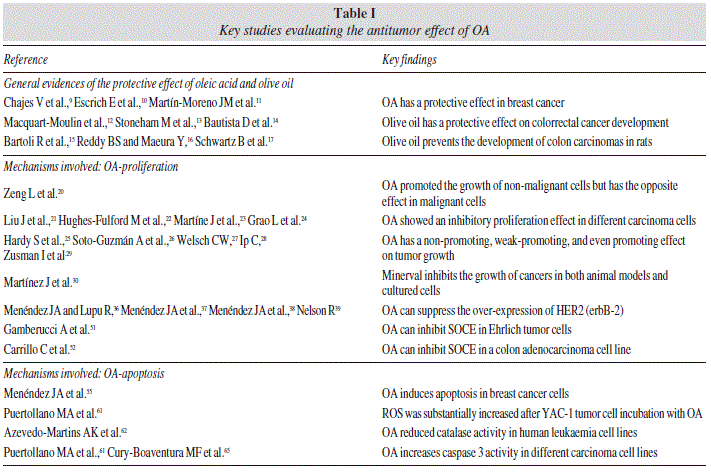
<body><![CDATA[<p><font face="Verdana" size="2">It has been recently shown that OA promoted the growth of non-malignant cells but, in fact, it had the opposite effect, in malignant cells.<sup>20</sup> Several researchers have also demonstrated that both oleic and &alpha;-linolenic acid showed a proliferation inhibition effect on prostate carcinoma cells.<sup>21,22</sup> According to these results, numerous studies have also reported an inhibition in cell proliferation induced by OA in different tumor cell lines.<sup>23,24</sup> However, other inconsistent results have been also obtained, including non-promoting, weak-promoting, and even promoting effects on tumor growth.<sup>25-29</sup> Such contradictory observations may be in part the result of the different methods used in the determinations.</font></p>     <p><font face="Verdana" size="2">On the basis that OA and other fatty acids are good cellular fuels that can be degraded through &beta;-oxidation when imported into the mitochondria, some researchers have designed a new synthetic OA analog, &quot;minerval&quot; with a modification that blocks the biological activity of fatty acids. Thus, enzymes involved in those processes may not recognize this modified fatty acid, so that its utilization as a source of energy would be decreased, and subsequently, its availability to modify cell signaling increased. Supporting the above-mention suggestion, they showed a markedly increase of the antiproliferative activity of minerval with respect to OA in human adenocarcinoma cells, with no apparent toxic effects. They additionally showed that exposure to minerval inhibits the growth of cancers in both animal models and cultured cells.<sup>30</sup></font></p>     <p>&nbsp;</p>     <p align="center"><font face="Verdana" size="2"><img src="/img/revistas/nh/v27n6/10_revision_09_t1.gif" align="top"></font></p>     <p>&nbsp;</p>     <p><font face="Verdana" size="2">Several mechanisms have been proposed for the antiproliferative effect of unsaturated fatty acids. Among them, a reduction in the synthesis of eicosanoids derived from arachidonic acid could be considered to be involved in the growth inhibitory effect.<sup>31-33</sup> Specific changes in gene expression patterns have been also suggested.<sup>34,35</sup> In this sense, OA can suppress the over-expression of HER2 (erbB-2), a well-characterized oncogene which plays a key role in the etiology, invasive progression and metastasis in several human cancers.<sup>36-39</sup> Finally, different studies have reported that unsaturated fatty acids can modulate the activity of the components of intracellular signaling.<sup>40-42</sup> It is well established that Ca<sup>2+</sup> is among the major intracellular factors involved in the signaling transduction pathways evoking cell growth and proliferation, and other key processes such as gene expression.<sup>43,44</sup> Within Ca<sup>2+</sup> mechanisms contributing to the increases in intracellular Ca<sup>2+</sup> concentration (&#091;Ca<sup>2+</sup>&#093;<sub>i</sub>), particular attention has been paid to the role of Ca<sup>2+</sup> entry through store-operated channels (SOC).<sup>45</sup> Thus, store-operated Ca<sup>2+</sup> entry (SOCE) has been involved in cell signaling occurring in non-excitable cells to evoke different cell processes including gene regulation and cell growth.<sup>46</sup> Entry in cell cycle is preceded by SOC activation.<sup>47</sup> In addition, the growth factor stimulation of cell proliferation is accompanied by increased activity and/or expression of TRP channels that are related to SOCE.<sup>48</sup> Moreover, SOCE inhibition by different means abolishes tumor cell proliferation.<sup>49,50</sup> It has been recently observed that the addition of PUFA to cells cultured <i>in vitro</i>, modifies the extent of SOCE.<sup>51</sup> Thus, OA can inhibit SOCE in Ehrlich tumor cells, possibly because they intercalate into the plasma membrane and directly affect the activity of the channels involved.<sup>51</sup> In addition, it has been recently reported a SOCE-inhibitory effect induced by oleic acid in a colon adenocarcinoma cell line.<sup>52</sup></font></p>     <p><font face="Verdana" size="2"><i>Oleic acid-apoptosis</i></font></p>     <p><font face="Verdana" size="2">Unsaturated fatty acids have been widely reported to induce apoptosis in several cell lines.<sup>53-55</sup> The mechanisms behind cell death are numerous and involve a complex set of pathways.</font></p>     <p><font face="Verdana" size="2">In the apoptotic pathway, the collapse of the mitochondrial membrane potential is a common event that leads to mitochondrial dysfunction and the production of reactive oxygen species (ROS). In fact, increased ROS production has been associated with the induction of apoptotic cell death in different cells.<sup>56</sup> According to these findings, exposure of neonatal cardiomyocytes to hydrogen peroxide or superoxide anion (O<sub>2</sub><sup>·-</sup>) induces apoptosis.<sup>57</sup> Whether apoptosis induced by fatty acids is associated with an increased production of ROS remains controversial and seems to depend on the type of fatty acid. Some researchers studied the role of ROS in palmitate-induced apoptosis in the neonatal rat cardiomyocyte and reported no evidence of ROS involvement.<sup>58</sup> By contrast, docosahexaenoic acid (DHA), a n-3 PUFA, is able to disrupt the mitochondrial membrane permeability and induce ROS production in tumor cells.<sup>59,60</sup> Regarding the effect of the MUFA, some researchers have reported that the production of ROS was substantially increased after YAC-1 tumor cell incubation with OA and other unsaturated fatty acids.<sup>61</sup></font></p>     <p><font face="Verdana" size="2">Moreover, fatty acid may disturb the redox state of the cells not only owing to an increase in ROS generation as previously shown, but also due to a reduction in antioxidant enzyme activities. Thus, some researchers demonstrated that OA reduced catalase activity in human leukaemia cell lines.<sup>62</sup></font></p>     ]]></body>
<body><![CDATA[<p><font face="Verdana" size="2">Apart from (and in line with) this increase in intracellular ROS production, unsaturated fatty acids-induced apoptosis has been reported to be mediated by an increase in caspase-3 activity in different carcinoma cell lines.<sup>59,61,63-65</sup></font></p>     <p><font face="Verdana" size="2">In addition, alterations in intracellular Ca<sup>2+</sup> homeostasis are commonly observed during apoptosis.<sup>66,67</sup> It has been demonstrated that the depletion of the endoplasmic reticulum Ca<sup>2+</sup> stores can directly induce apoptosis.<sup>68</sup> Several reports have shown the ability of unsaturated fatty acids to induce Ca<sup>2+</sup> release from the intracellular stores<sup>59,69,70</sup> and to induce ROS generation with a subsequent cell death.<sup>59,71</sup> This way, Aires et al. propose a model for the mechanism of action of DHA in which this fatty acid mobilizes Ca<sup>2+</sup> from the intra-cellular pool and stimulates ROS production from the mitochondria, followed by downstream signaling, which will involve the activation of caspase-3, leading to chromatin fragmentation and apoptosis.<sup>59</sup> However, evidence regarding the role of OA in these pathways is lacking.</font></p>     <p><font face="Verdana" size="2">In summary, research has demonstrated the advantageous effects of olive oil and OA on health at both the epidemiologic and cellular level. However, as far as we are concerned, little is known about the mechanisms by which OA could affect cell proliferation and cell death of cancer cells. Thus, much research needs to be conducted especially at the cellular level, to more fully understand the pathways by which OA could reduce cancer risk.</font></p>     <p>&nbsp;</p>     <p><font face="Verdana" size="2"><b>Acknowledgements</b></font></p>     <p><font face="Verdana" size="2">We thank Gonzalo Moreno for his support.</font></p>     <p>&nbsp;</p>     <p><font face="Verdana" size="2"><b>References</b></font></p>     <!-- ref --><p><font face="Verdana" size="2">1. Kushi L, Giovannucci E. Dietary fat and cancer. <i>Am J Med</i> 2002; 113 (Suppl. 9B): 63S-70S.    &nbsp;&nbsp;&nbsp;&nbsp;&nbsp;&nbsp;&nbsp;&nbsp;[&#160;<a href="javascript:void(0);" onclick="javascript: window.open('/scielo.php?script=sci_nlinks&ref=3688068&pid=S0212-1611201200060001000001&lng=','','width=640,height=500,resizable=yes,scrollbars=1,menubar=yes,');">Links</a>&#160;]<!-- end-ref --></font></p>    ]]></body>
<body><![CDATA[<!-- ref --><p><font face="Verdana" size="2">2. Wiseman M. The second World Cancer Research Fund/American Institute for Cancer Research expert report. Food, nutrition, physical activity, and the prevention of cancer: a global perspective. <i>Proc Nutr Soc</i> 2008; 67 (3): 253-6.    &nbsp;&nbsp;&nbsp;&nbsp;&nbsp;&nbsp;&nbsp;&nbsp;[&#160;<a href="javascript:void(0);" onclick="javascript: window.open('/scielo.php?script=sci_nlinks&ref=3688070&pid=S0212-1611201200060001000002&lng=','','width=640,height=500,resizable=yes,scrollbars=1,menubar=yes,');">Links</a>&#160;]<!-- end-ref --></font></p>    <!-- ref --><p><font face="Verdana" size="2">3. Bartsch H, Nair J, Owen RW. Dietary polyunsaturated fatty acids and cancers of the breast and colorectum: emerging evidence for their role as risk modifiers. <i>Carcinogenesis</i> 1999; 20 (12): 2209-18.    &nbsp;&nbsp;&nbsp;&nbsp;&nbsp;&nbsp;&nbsp;&nbsp;[&#160;<a href="javascript:void(0);" onclick="javascript: window.open('/scielo.php?script=sci_nlinks&ref=3688072&pid=S0212-1611201200060001000003&lng=','','width=640,height=500,resizable=yes,scrollbars=1,menubar=yes,');">Links</a>&#160;]<!-- end-ref --></font></p>    <!-- ref --><p><font face="Verdana" size="2">4. Kolonel LN, Nomura AM, Cooney RV. Dietary fat and prostate cancer: current status. <i>J Natl Cancer Inst</i> 1999; 91(5): 414-28.    &nbsp;&nbsp;&nbsp;&nbsp;&nbsp;&nbsp;&nbsp;&nbsp;[&#160;<a href="javascript:void(0);" onclick="javascript: window.open('/scielo.php?script=sci_nlinks&ref=3688074&pid=S0212-1611201200060001000004&lng=','','width=640,height=500,resizable=yes,scrollbars=1,menubar=yes,');">Links</a>&#160;]<!-- end-ref --></font></p>    <!-- ref --><p><font face="Verdana" size="2">5. Rose DP. Effects of dietary fatty acids on breast and prostate cancers: evidence from in vitro experiments and animal studies. <i>Am J Clin Nutr</i> 1997; 66 (6 Suppl.): 1513S-22S.    &nbsp;&nbsp;&nbsp;&nbsp;&nbsp;&nbsp;&nbsp;&nbsp;[&#160;<a href="javascript:void(0);" onclick="javascript: window.open('/scielo.php?script=sci_nlinks&ref=3688076&pid=S0212-1611201200060001000005&lng=','','width=640,height=500,resizable=yes,scrollbars=1,menubar=yes,');">Links</a>&#160;]<!-- end-ref --></font></p>    <!-- ref --><p><font face="Verdana" size="2">6. Wynder EL, Cohen LA, Muscat JE, Winters B, Dwyer JT, Blackburn G. Breast cancer: weighing the evidence for a promoting role of dietary fat. <i>J Natl Cancer Inst</i> 1997; 89 (11):766-75.    &nbsp;&nbsp;&nbsp;&nbsp;&nbsp;&nbsp;&nbsp;&nbsp;[&#160;<a href="javascript:void(0);" onclick="javascript: window.open('/scielo.php?script=sci_nlinks&ref=3688078&pid=S0212-1611201200060001000006&lng=','','width=640,height=500,resizable=yes,scrollbars=1,menubar=yes,');">Links</a>&#160;]<!-- end-ref --></font></p>    ]]></body>
<body><![CDATA[<!-- ref --><p><font face="Verdana" size="2">7. Zock PL. Dietary fats and cancer. <i>Curr Opin Lipidol</i> 2001; 12(1): 5-10.    &nbsp;&nbsp;&nbsp;&nbsp;&nbsp;&nbsp;&nbsp;&nbsp;[&#160;<a href="javascript:void(0);" onclick="javascript: window.open('/scielo.php?script=sci_nlinks&ref=3688080&pid=S0212-1611201200060001000007&lng=','','width=640,height=500,resizable=yes,scrollbars=1,menubar=yes,');">Links</a>&#160;]<!-- end-ref --></font></p>    <!-- ref --><p><font face="Verdana" size="2">8. Trichopoulou A, Lagiou P, Kuper H, Trichopoulos D. Cancer and Mediterranean dietary traditions. <i>Cancer Epidemiol Biomarkers Prev</i> 2000; 9 (9): 869-73.    &nbsp;&nbsp;&nbsp;&nbsp;&nbsp;&nbsp;&nbsp;&nbsp;[&#160;<a href="javascript:void(0);" onclick="javascript: window.open('/scielo.php?script=sci_nlinks&ref=3688082&pid=S0212-1611201200060001000008&lng=','','width=640,height=500,resizable=yes,scrollbars=1,menubar=yes,');">Links</a>&#160;]<!-- end-ref --></font></p>    <!-- ref --><p><font face="Verdana" size="2">9. Chajes V, Thiebaut AC, Rotival M, Gauthier E, Maillard V, Boutron-Ruault MC, et al. Association between serum transmonounsaturated fatty acids and breast cancer risk in the E3N-EPIC Study. <i>Am J Epidemiol</i> 2008; 167 (11): 1312-20.    &nbsp;&nbsp;&nbsp;&nbsp;&nbsp;&nbsp;&nbsp;&nbsp;[&#160;<a href="javascript:void(0);" onclick="javascript: window.open('/scielo.php?script=sci_nlinks&ref=3688084&pid=S0212-1611201200060001000009&lng=','','width=640,height=500,resizable=yes,scrollbars=1,menubar=yes,');">Links</a>&#160;]<!-- end-ref --></font></p>    <!-- ref --><p><font face="Verdana" size="2">10. Escrich E, Solanas M, Moral R, Grau L, Costa I, Vela EE, R. Dietary lipids and breast cancer: Scientific clinical, anatomopathological and molecular evidences. <i>Revista Española de Obesidad</i> 2008; 6(3):129-38.    &nbsp;&nbsp;&nbsp;&nbsp;&nbsp;&nbsp;&nbsp;&nbsp;[&#160;<a href="javascript:void(0);" onclick="javascript: window.open('/scielo.php?script=sci_nlinks&ref=3688086&pid=S0212-1611201200060001000010&lng=','','width=640,height=500,resizable=yes,scrollbars=1,menubar=yes,');">Links</a>&#160;]<!-- end-ref --></font></p>    <!-- ref --><p><font face="Verdana" size="2">11. Martín-Moreno JM, Willett WC, Gorgojo L, Banegas JR, Rodríguez-Artalejo F, Fernández-Rodríguez JC et al. Dietary fat, olive oil intake and breast cancer risk. <i>Int J Cancer</i> 1994; 58(6): 774-80.    &nbsp;&nbsp;&nbsp;&nbsp;&nbsp;&nbsp;&nbsp;&nbsp;[&#160;<a href="javascript:void(0);" onclick="javascript: window.open('/scielo.php?script=sci_nlinks&ref=3688088&pid=S0212-1611201200060001000011&lng=','','width=640,height=500,resizable=yes,scrollbars=1,menubar=yes,');">Links</a>&#160;]<!-- end-ref --></font></p>    ]]></body>
<body><![CDATA[<!-- ref --><p><font face="Verdana" size="2">12. Macquart-Moulin G, Riboli E, Cornee J, Charnay B, Berthezene P, Day N. Case-control study on colorectal cancer and diet in Marseilles. <i>Int J Cancer</i> 1986; 38 (2): 183-91.    &nbsp;&nbsp;&nbsp;&nbsp;&nbsp;&nbsp;&nbsp;&nbsp;[&#160;<a href="javascript:void(0);" onclick="javascript: window.open('/scielo.php?script=sci_nlinks&ref=3688090&pid=S0212-1611201200060001000012&lng=','','width=640,height=500,resizable=yes,scrollbars=1,menubar=yes,');">Links</a>&#160;]<!-- end-ref --></font></p>    <!-- ref --><p><font face="Verdana" size="2">13. Stoneham M, Goldacre M, Seagroatt V, Gill L. Olive oil, diet and colorectal cancer: an ecological study and a hypothesis. <i>J Epidemiol Community Health</i> 2000; 54 (10): 756-60.    &nbsp;&nbsp;&nbsp;&nbsp;&nbsp;&nbsp;&nbsp;&nbsp;[&#160;<a href="javascript:void(0);" onclick="javascript: window.open('/scielo.php?script=sci_nlinks&ref=3688092&pid=S0212-1611201200060001000013&lng=','','width=640,height=500,resizable=yes,scrollbars=1,menubar=yes,');">Links</a>&#160;]<!-- end-ref --></font></p>    <!-- ref --><p><font face="Verdana" size="2">14. Bautista D, Obrador A, Moreno V, Cabeza E, Canet R, Benito E, et al. Ki-Ras mutation modifies the protective effect of dietary monounsaturated fat and calcium on sporadic colorectal cancer. <i>Cancer Epidemiol Biomarkers Prev</i> 1997; 6 (1): 57-61.    &nbsp;&nbsp;&nbsp;&nbsp;&nbsp;&nbsp;&nbsp;&nbsp;[&#160;<a href="javascript:void(0);" onclick="javascript: window.open('/scielo.php?script=sci_nlinks&ref=3688094&pid=S0212-1611201200060001000014&lng=','','width=640,height=500,resizable=yes,scrollbars=1,menubar=yes,');">Links</a>&#160;]<!-- end-ref --></font></p>    <!-- ref --><p><font face="Verdana" size="2">15. Bartoli R, Fernández-Banares F, Navarro E, Castella E, Mane J, Alvarez M, et al. Effect of olive oil on early and late events of colon carcinogenesis in rats: modulation of arachidonic acid metabolism and local prostaglandin E<sub>2</sub> synthesis. <i>Gut</i> 2000; 46(2): 191-9.    &nbsp;&nbsp;&nbsp;&nbsp;&nbsp;&nbsp;&nbsp;&nbsp;[&#160;<a href="javascript:void(0);" onclick="javascript: window.open('/scielo.php?script=sci_nlinks&ref=3688096&pid=S0212-1611201200060001000015&lng=','','width=640,height=500,resizable=yes,scrollbars=1,menubar=yes,');">Links</a>&#160;]<!-- end-ref --></font></p>    <!-- ref --><p><font face="Verdana" size="2">16. Reddy BS, Maeura Y. Tumor promotion by dietary fat in azoxymethane-induced colon carcinogenesis in female F344 rats: influence of amount and source of dietary fat. <i>J Natl Cancer Inst</i> 1984; 72 (3): 745-50.    &nbsp;&nbsp;&nbsp;&nbsp;&nbsp;&nbsp;&nbsp;&nbsp;[&#160;<a href="javascript:void(0);" onclick="javascript: window.open('/scielo.php?script=sci_nlinks&ref=3688098&pid=S0212-1611201200060001000016&lng=','','width=640,height=500,resizable=yes,scrollbars=1,menubar=yes,');">Links</a>&#160;]<!-- end-ref --></font></p>    ]]></body>
<body><![CDATA[<!-- ref --><p><font face="Verdana" size="2">17. Schwartz B, Birk Y, Raz A, Madar Z. Nutritional-pharmacological combinations - a novel approach to reducing colon cancer incidence. <i>Eur J Nutr</i> 2004; 43 (4): 221-9.    &nbsp;&nbsp;&nbsp;&nbsp;&nbsp;&nbsp;&nbsp;&nbsp;[&#160;<a href="javascript:void(0);" onclick="javascript: window.open('/scielo.php?script=sci_nlinks&ref=3688100&pid=S0212-1611201200060001000017&lng=','','width=640,height=500,resizable=yes,scrollbars=1,menubar=yes,');">Links</a>&#160;]<!-- end-ref --></font></p>    <!-- ref --><p><font face="Verdana" size="2">18. Shaikh IA, Brown I, Wahle KW, Heys SD. Enhancing cytotoxic therapies for breast and prostate cancers with polyunsaturated fatty acids. <i>Nutr Cancer</i> 2010; 62 (3): 284-96.    &nbsp;&nbsp;&nbsp;&nbsp;&nbsp;&nbsp;&nbsp;&nbsp;[&#160;<a href="javascript:void(0);" onclick="javascript: window.open('/scielo.php?script=sci_nlinks&ref=3688102&pid=S0212-1611201200060001000018&lng=','','width=640,height=500,resizable=yes,scrollbars=1,menubar=yes,');">Links</a>&#160;]<!-- end-ref --></font></p>    <!-- ref --><p><font face="Verdana" size="2">19. Menéndez JA, del Mar Barbacid M, Montero S, Sevilla E, Escrich E, Solanas M, et al. Effects of gamma-linolenic acid and oleic acid on paclitaxel cytotoxicity in human breast cancer cells. <i>Eur J Cancer</i> 2001; 37 (3): 402-13.    &nbsp;&nbsp;&nbsp;&nbsp;&nbsp;&nbsp;&nbsp;&nbsp;[&#160;<a href="javascript:void(0);" onclick="javascript: window.open('/scielo.php?script=sci_nlinks&ref=3688104&pid=S0212-1611201200060001000019&lng=','','width=640,height=500,resizable=yes,scrollbars=1,menubar=yes,');">Links</a>&#160;]<!-- end-ref --></font></p>    <!-- ref --><p><font face="Verdana" size="2">20. Zeng L, Biernacka KM, Holly JM, Jarrett C, Morrison AA, Morgan A et al. Hyperglycaemia confers resistance to chemotherapy on breast cancer cells: the role of fatty acid synthase. <i>Endocr Relat Cancer</i> 2010; 17 (2): 539-51.    &nbsp;&nbsp;&nbsp;&nbsp;&nbsp;&nbsp;&nbsp;&nbsp;[&#160;<a href="javascript:void(0);" onclick="javascript: window.open('/scielo.php?script=sci_nlinks&ref=3688106&pid=S0212-1611201200060001000020&lng=','','width=640,height=500,resizable=yes,scrollbars=1,menubar=yes,');">Links</a>&#160;]<!-- end-ref --></font></p>    <!-- ref --><p><font face="Verdana" size="2">21. Liu J, Shimizu K, Kondo R. Anti-androgenic activity of fatty acids. <i>Chem Biodivers</i> 2009; 6 (4): 503-12.    &nbsp;&nbsp;&nbsp;&nbsp;&nbsp;&nbsp;&nbsp;&nbsp;[&#160;<a href="javascript:void(0);" onclick="javascript: window.open('/scielo.php?script=sci_nlinks&ref=3688108&pid=S0212-1611201200060001000021&lng=','','width=640,height=500,resizable=yes,scrollbars=1,menubar=yes,');">Links</a>&#160;]<!-- end-ref --></font></p>    ]]></body>
<body><![CDATA[<!-- ref --><p><font face="Verdana" size="2">22. Hughes-Fulford M, Chen Y, Tjandrawinata RR. Fatty acid regulates gene expression and growth of human prostate cancer PC-3 cells. <i>Carcinogenesis</i> 2001; 22 (5): 701-7.    &nbsp;&nbsp;&nbsp;&nbsp;&nbsp;&nbsp;&nbsp;&nbsp;[&#160;<a href="javascript:void(0);" onclick="javascript: window.open('/scielo.php?script=sci_nlinks&ref=3688110&pid=S0212-1611201200060001000022&lng=','','width=640,height=500,resizable=yes,scrollbars=1,menubar=yes,');">Links</a>&#160;]<!-- end-ref --></font></p>    <!-- ref --><p><font face="Verdana" size="2">23. Martínez J, Gutiérrez A, Casas J, Llado V, López-Bellan A, Besalduch J, et al. The repression of E2F-1 is critical for the activity of Minerval against cancer. <i>J Pharmacol Exp Ther</i> 2005; 315 (1): 466-74.    &nbsp;&nbsp;&nbsp;&nbsp;&nbsp;&nbsp;&nbsp;&nbsp;[&#160;<a href="javascript:void(0);" onclick="javascript: window.open('/scielo.php?script=sci_nlinks&ref=3688112&pid=S0212-1611201200060001000023&lng=','','width=640,height=500,resizable=yes,scrollbars=1,menubar=yes,');">Links</a>&#160;]<!-- end-ref --></font></p>    <!-- ref --><p><font face="Verdana" size="2">24. Girao LA, Ruck AC, Cantrill RC, Davidson BC. The effect of C18 fatty acids on cancer cells in culture. <i>Anticancer Res</i> 1986; 6 (2): 241-4.    &nbsp;&nbsp;&nbsp;&nbsp;&nbsp;&nbsp;&nbsp;&nbsp;[&#160;<a href="javascript:void(0);" onclick="javascript: window.open('/scielo.php?script=sci_nlinks&ref=3688114&pid=S0212-1611201200060001000024&lng=','','width=640,height=500,resizable=yes,scrollbars=1,menubar=yes,');">Links</a>&#160;]<!-- end-ref --></font></p>    <!-- ref --><p><font face="Verdana" size="2">25. Hardy S, St-Onge GG, Joly E, Langelier Y, Prentki M. Oleate promotes the proliferation of breast cancer cells via the G protein-coupled receptor GPR40. <i>J Biol Chem</i> 2005; 280 (14):13285-91.    &nbsp;&nbsp;&nbsp;&nbsp;&nbsp;&nbsp;&nbsp;&nbsp;[&#160;<a href="javascript:void(0);" onclick="javascript: window.open('/scielo.php?script=sci_nlinks&ref=3688116&pid=S0212-1611201200060001000025&lng=','','width=640,height=500,resizable=yes,scrollbars=1,menubar=yes,');">Links</a>&#160;]<!-- end-ref --></font></p>    <!-- ref --><p><font face="Verdana" size="2">26. Soto-Guzmán A, Navarro-Tito N, Castro-Sánchez L, Martínez-Orozco R, Salazar EP. Oleic acid promotes MMP-9 secretion and invasion in breast cancer cells. <i>Clin Exp Metastasis</i> 2010; 27 (7): 505-15.    &nbsp;&nbsp;&nbsp;&nbsp;&nbsp;&nbsp;&nbsp;&nbsp;[&#160;<a href="javascript:void(0);" onclick="javascript: window.open('/scielo.php?script=sci_nlinks&ref=3688118&pid=S0212-1611201200060001000026&lng=','','width=640,height=500,resizable=yes,scrollbars=1,menubar=yes,');">Links</a>&#160;]<!-- end-ref --></font></p>    ]]></body>
<body><![CDATA[<!-- ref --><p><font face="Verdana" size="2">27. Welsch CW. Relationship between dietary fat and experimental mammary tumorigenesis: a review and critique. <i>Cancer Res</i> 1992; 52 (7 Suppl.): 2040s-8s.    &nbsp;&nbsp;&nbsp;&nbsp;&nbsp;&nbsp;&nbsp;&nbsp;[&#160;<a href="javascript:void(0);" onclick="javascript: window.open('/scielo.php?script=sci_nlinks&ref=3688120&pid=S0212-1611201200060001000027&lng=','','width=640,height=500,resizable=yes,scrollbars=1,menubar=yes,');">Links</a>&#160;]<!-- end-ref --></font></p>    <!-- ref --><p><font face="Verdana" size="2">28. Ip C. Review of the effects of trans fatty acids, oleic acid, n-3 polyunsaturated fatty acids, and conjugated linoleic acid on mammary carcinogenesis in animals. <i>Am J Clin Nutr</i> 1997; 66 (6 Suppl.): 1523S-9S.    &nbsp;&nbsp;&nbsp;&nbsp;&nbsp;&nbsp;&nbsp;&nbsp;[&#160;<a href="javascript:void(0);" onclick="javascript: window.open('/scielo.php?script=sci_nlinks&ref=3688122&pid=S0212-1611201200060001000028&lng=','','width=640,height=500,resizable=yes,scrollbars=1,menubar=yes,');">Links</a>&#160;]<!-- end-ref --></font></p>    <!-- ref --><p><font face="Verdana" size="2">29. Zusman I, Gurevich P, Madar Z, Nyska A, Korol D, Timar B, et al. Tumor-promoting and tumor-protective effects of high-fat diets on chemically induced mammary cancer in rats. <i>Anticancer Res</i> 1997; 17 (1A): 349-56.    &nbsp;&nbsp;&nbsp;&nbsp;&nbsp;&nbsp;&nbsp;&nbsp;[&#160;<a href="javascript:void(0);" onclick="javascript: window.open('/scielo.php?script=sci_nlinks&ref=3688124&pid=S0212-1611201200060001000029&lng=','','width=640,height=500,resizable=yes,scrollbars=1,menubar=yes,');">Links</a>&#160;]<!-- end-ref --></font></p>    <!-- ref --><p><font face="Verdana" size="2">30. Martínez J, Vogler O, Casas J, Barcelo F, Alemany R, Prades J, et al. Membrane structure modulation, protein kinase C alpha activation, and anticancer activity of minerval. <i>Mol Pharmacol</i> 2005; 67 (2): 531-40.    &nbsp;&nbsp;&nbsp;&nbsp;&nbsp;&nbsp;&nbsp;&nbsp;[&#160;<a href="javascript:void(0);" onclick="javascript: window.open('/scielo.php?script=sci_nlinks&ref=3688126&pid=S0212-1611201200060001000030&lng=','','width=640,height=500,resizable=yes,scrollbars=1,menubar=yes,');">Links</a>&#160;]<!-- end-ref --></font></p>    <!-- ref --><p><font face="Verdana" size="2">31. Das UN. Essential fatty acids and their metabolites and cancer. <i>Nutrition</i> 1999; 15 (3): 239-40.    &nbsp;&nbsp;&nbsp;&nbsp;&nbsp;&nbsp;&nbsp;&nbsp;[&#160;<a href="javascript:void(0);" onclick="javascript: window.open('/scielo.php?script=sci_nlinks&ref=3688128&pid=S0212-1611201200060001000031&lng=','','width=640,height=500,resizable=yes,scrollbars=1,menubar=yes,');">Links</a>&#160;]<!-- end-ref --></font></p>    ]]></body>
<body><![CDATA[<!-- ref --><p><font face="Verdana" size="2">32. Karmali RA. Eicosanoids in neoplasia. <i>Prev Med</i> 1987; 16 (4):493-502.    &nbsp;&nbsp;&nbsp;&nbsp;&nbsp;&nbsp;&nbsp;&nbsp;[&#160;<a href="javascript:void(0);" onclick="javascript: window.open('/scielo.php?script=sci_nlinks&ref=3688130&pid=S0212-1611201200060001000032&lng=','','width=640,height=500,resizable=yes,scrollbars=1,menubar=yes,');">Links</a>&#160;]<!-- end-ref --></font></p>    <!-- ref --><p><font face="Verdana" size="2">33. Rose DP, Connolly JM, Rayburn J, Coleman M. Influence of diets containing eicosapentaenoic or docosahexaenoic acid on growth and metastasis of breast cancer cells in nude mice. <i>J Natl Cancer Inst</i> 1995; 87 (8): 587-92.    &nbsp;&nbsp;&nbsp;&nbsp;&nbsp;&nbsp;&nbsp;&nbsp;[&#160;<a href="javascript:void(0);" onclick="javascript: window.open('/scielo.php?script=sci_nlinks&ref=3688132&pid=S0212-1611201200060001000033&lng=','','width=640,height=500,resizable=yes,scrollbars=1,menubar=yes,');">Links</a>&#160;]<!-- end-ref --></font></p>    <!-- ref --><p><font face="Verdana" size="2">34. Sampath H, Ntambi JM. Polyunsaturated fatty acid regulation of genes of lipid metabolism. <i>Annu Rev Nutr</i> 2005; 25: 317-40.    &nbsp;&nbsp;&nbsp;&nbsp;&nbsp;&nbsp;&nbsp;&nbsp;[&#160;<a href="javascript:void(0);" onclick="javascript: window.open('/scielo.php?script=sci_nlinks&ref=3688134&pid=S0212-1611201200060001000034&lng=','','width=640,height=500,resizable=yes,scrollbars=1,menubar=yes,');">Links</a>&#160;]<!-- end-ref --></font></p>    <!-- ref --><p><font face="Verdana" size="2">35. Narayanan BA, Narayanan NK, Simi B, Reddy BS. Modulation of inducible nitric oxide synthase and related proinflammatory genes by the omega-3 fatty acid docosahexaenoic acid in human colon cancer cells. <i>Cancer Res</i> 2003; 63 (5): 972-9.    &nbsp;&nbsp;&nbsp;&nbsp;&nbsp;&nbsp;&nbsp;&nbsp;[&#160;<a href="javascript:void(0);" onclick="javascript: window.open('/scielo.php?script=sci_nlinks&ref=3688136&pid=S0212-1611201200060001000035&lng=','','width=640,height=500,resizable=yes,scrollbars=1,menubar=yes,');">Links</a>&#160;]<!-- end-ref --></font></p>    <!-- ref --><p><font face="Verdana" size="2">36. Menéndez JA, Lupu R. Mediterranean dietary traditions for the molecular treatment of human cancer: anti-oncogenic actions of the main olive oil's monounsaturated fatty acid oleic acid (18:1n-9). <i>Curr Pharm Biotechnol</i> 2006; 7 (6): 495-502.    &nbsp;&nbsp;&nbsp;&nbsp;&nbsp;&nbsp;&nbsp;&nbsp;[&#160;<a href="javascript:void(0);" onclick="javascript: window.open('/scielo.php?script=sci_nlinks&ref=3688138&pid=S0212-1611201200060001000036&lng=','','width=640,height=500,resizable=yes,scrollbars=1,menubar=yes,');">Links</a>&#160;]<!-- end-ref --></font></p>    ]]></body>
<body><![CDATA[<!-- ref --><p><font face="Verdana" size="2">37. Menéndez JA, Vázquez-Martín A, Colomer R, Brunet J, Carrasco-Pancorbo A, García-Villalba R, et al. Olive oil's bitter principle reverses acquired autoresistance to trastuzumab (Herceptin) in HER2-overexpressing breast cancer cells. <i>BMC Cancer</i> 2007; 7: 80.    &nbsp;&nbsp;&nbsp;&nbsp;&nbsp;&nbsp;&nbsp;&nbsp;[&#160;<a href="javascript:void(0);" onclick="javascript: window.open('/scielo.php?script=sci_nlinks&ref=3688140&pid=S0212-1611201200060001000037&lng=','','width=640,height=500,resizable=yes,scrollbars=1,menubar=yes,');">Links</a>&#160;]<!-- end-ref --></font></p>    <!-- ref --><p><font face="Verdana" size="2">38. Menéndez JA, Papadimitropoulou A, Vellon L, Lupu R. A genomic explanation connecting &quot;Mediterranean diet&quot;, olive oil and cancer: oleic acid, the main monounsaturated fatty acid of olive oil, induces formation of inhibitory &quot;PEA3 transcription factor-PEA3 DNA binding site&quot; complexes at the Her-2/neu (erbB-2) oncogene promoter in breast, ovarian and stomach cancer cells. <i>Eur J Cancer</i> 2006; 42 (15): 2425-32.    &nbsp;&nbsp;&nbsp;&nbsp;&nbsp;&nbsp;&nbsp;&nbsp;[&#160;<a href="javascript:void(0);" onclick="javascript: window.open('/scielo.php?script=sci_nlinks&ref=3688142&pid=S0212-1611201200060001000038&lng=','','width=640,height=500,resizable=yes,scrollbars=1,menubar=yes,');">Links</a>&#160;]<!-- end-ref --></font></p>    <!-- ref --><p><font face="Verdana" size="2">39. Nelson R. Oleic acid suppresses overexpression of ERBB2 oncogene. <i>Lancet Oncol</i> 2005; 6 (2): 69.    &nbsp;&nbsp;&nbsp;&nbsp;&nbsp;&nbsp;&nbsp;&nbsp;[&#160;<a href="javascript:void(0);" onclick="javascript: window.open('/scielo.php?script=sci_nlinks&ref=3688144&pid=S0212-1611201200060001000039&lng=','','width=640,height=500,resizable=yes,scrollbars=1,menubar=yes,');">Links</a>&#160;]<!-- end-ref --></font></p>    <!-- ref --><p><font face="Verdana" size="2">40. Rao CV, Reddy BS. Modulating effect of amount and types of dietary fat on ornithine decarboxylase, tyrosine protein kinase and prostaglandins production during colon carcinogenesis in male F344 rats. <i>Carcinogenesis</i> 1993; 14 (7): 1327-33.    &nbsp;&nbsp;&nbsp;&nbsp;&nbsp;&nbsp;&nbsp;&nbsp;[&#160;<a href="javascript:void(0);" onclick="javascript: window.open('/scielo.php?script=sci_nlinks&ref=3688146&pid=S0212-1611201200060001000040&lng=','','width=640,height=500,resizable=yes,scrollbars=1,menubar=yes,');">Links</a>&#160;]<!-- end-ref --></font></p>    <!-- ref --><p><font face="Verdana" size="2">41. Marignani PA, Sebaldt RJ. Formation of second messenger diradylglycerol in murine peritoneal macrophages is altered after in vivo (n-3) polyunsaturated fatty acid supplementation. <i>J Nutr</i> 1995; 125 (12): 3030-40.    &nbsp;&nbsp;&nbsp;&nbsp;&nbsp;&nbsp;&nbsp;&nbsp;[&#160;<a href="javascript:void(0);" onclick="javascript: window.open('/scielo.php?script=sci_nlinks&ref=3688148&pid=S0212-1611201200060001000041&lng=','','width=640,height=500,resizable=yes,scrollbars=1,menubar=yes,');">Links</a>&#160;]<!-- end-ref --></font></p>    ]]></body>
<body><![CDATA[<!-- ref --><p><font face="Verdana" size="2">42. de Jonge HW, Dekkers DH, Lamers JM. Polyunsaturated fatty acids and signalling via phospholipase C-beta and A<sub>2</sub> in myocardium. <i>Mol Cell Biochem</i> 1996; 157 (1-2): 199-210.    &nbsp;&nbsp;&nbsp;&nbsp;&nbsp;&nbsp;&nbsp;&nbsp;[&#160;<a href="javascript:void(0);" onclick="javascript: window.open('/scielo.php?script=sci_nlinks&ref=3688150&pid=S0212-1611201200060001000042&lng=','','width=640,height=500,resizable=yes,scrollbars=1,menubar=yes,');">Links</a>&#160;]<!-- end-ref --></font></p>    <!-- ref --><p><font face="Verdana" size="2">43. Berridge MJ. Calcium signalling and cell proliferation. <i>Bioessays</i> 1995; 17 (6): 491-500.    &nbsp;&nbsp;&nbsp;&nbsp;&nbsp;&nbsp;&nbsp;&nbsp;[&#160;<a href="javascript:void(0);" onclick="javascript: window.open('/scielo.php?script=sci_nlinks&ref=3688152&pid=S0212-1611201200060001000043&lng=','','width=640,height=500,resizable=yes,scrollbars=1,menubar=yes,');">Links</a>&#160;]<!-- end-ref --></font></p>    <!-- ref --><p><font face="Verdana" size="2">44. Kahl CR, Means AR. Regulation of cell cycle progression by calcium/calmodulin-dependent pathways. <i>Endocr Rev</i> 2003; 24 (6): 719-36.    &nbsp;&nbsp;&nbsp;&nbsp;&nbsp;&nbsp;&nbsp;&nbsp;[&#160;<a href="javascript:void(0);" onclick="javascript: window.open('/scielo.php?script=sci_nlinks&ref=3688154&pid=S0212-1611201200060001000044&lng=','','width=640,height=500,resizable=yes,scrollbars=1,menubar=yes,');">Links</a>&#160;]<!-- end-ref --></font></p>    <!-- ref --><p><font face="Verdana" size="2">45. Parekh AB, Putney JW, Jr. Store-operated calcium channels. <i>Physiol Rev</i> 2005; 85 (2): 757-810.    &nbsp;&nbsp;&nbsp;&nbsp;&nbsp;&nbsp;&nbsp;&nbsp;[&#160;<a href="javascript:void(0);" onclick="javascript: window.open('/scielo.php?script=sci_nlinks&ref=3688156&pid=S0212-1611201200060001000045&lng=','','width=640,height=500,resizable=yes,scrollbars=1,menubar=yes,');">Links</a>&#160;]<!-- end-ref --></font></p>    <!-- ref --><p><font face="Verdana" size="2">46. Parekh AB, Penner R. Store depletion and calcium influx. <i>Physiol Rev</i> 1997; 77 (4): 901-30.    &nbsp;&nbsp;&nbsp;&nbsp;&nbsp;&nbsp;&nbsp;&nbsp;[&#160;<a href="javascript:void(0);" onclick="javascript: window.open('/scielo.php?script=sci_nlinks&ref=3688158&pid=S0212-1611201200060001000046&lng=','','width=640,height=500,resizable=yes,scrollbars=1,menubar=yes,');">Links</a>&#160;]<!-- end-ref --></font></p>    ]]></body>
<body><![CDATA[<!-- ref --><p><font face="Verdana" size="2">47. Sugioka M, Yamashita M. Calcium signaling to nucleus via store-operated system during cell cycle in retinal neuroepithelium. <i>Neurosci Res</i> 2003; 45 (4): 447-58.    &nbsp;&nbsp;&nbsp;&nbsp;&nbsp;&nbsp;&nbsp;&nbsp;[&#160;<a href="javascript:void(0);" onclick="javascript: window.open('/scielo.php?script=sci_nlinks&ref=3688160&pid=S0212-1611201200060001000047&lng=','','width=640,height=500,resizable=yes,scrollbars=1,menubar=yes,');">Links</a>&#160;]<!-- end-ref --></font></p>    <!-- ref --><p><font face="Verdana" size="2">48. Golovina VA, Platoshyn O, Bailey CL, Wang J, Limsuwan A, Sweeney M et al. Upregulated TRP and enhanced capacitative Ca<sup>2+</sup> entry in human pulmonary artery myocytes during proliferation. <i>Am J Physiol Heart Circ Physiol</i> 2001; 280 (2): H746-55.    &nbsp;&nbsp;&nbsp;&nbsp;&nbsp;&nbsp;&nbsp;&nbsp;[&#160;<a href="javascript:void(0);" onclick="javascript: window.open('/scielo.php?script=sci_nlinks&ref=3688162&pid=S0212-1611201200060001000048&lng=','','width=640,height=500,resizable=yes,scrollbars=1,menubar=yes,');">Links</a>&#160;]<!-- end-ref --></font></p>    <!-- ref --><p><font face="Verdana" size="2">49. Weiss H, Amberger A, Widschwendter M, Margreiter R, Ofner D, Dietl P. Inhibition of store-operated calcium entry contributes to the anti-proliferative effect of non-steroidal anti-inflammatory drugs in human colon cancer cells. <i>Int J Cancer</i> 2001; 92(6): 877-82.    &nbsp;&nbsp;&nbsp;&nbsp;&nbsp;&nbsp;&nbsp;&nbsp;[&#160;<a href="javascript:void(0);" onclick="javascript: window.open('/scielo.php?script=sci_nlinks&ref=3688164&pid=S0212-1611201200060001000049&lng=','','width=640,height=500,resizable=yes,scrollbars=1,menubar=yes,');">Links</a>&#160;]<!-- end-ref --></font></p>    <!-- ref --><p><font face="Verdana" size="2">50. Zitt C, Strauss B, Schwarz EC, Spaeth N, Rast G, Hatzelmann A et al. Potent inhibition of Ca<sup>2+</sup> release-activated Ca<sup>2+</sup> channels and T-lymphocyte activation by the pyrazole derivative BTP<sub>2</sub>. <i>J Biol Chem</i> 2004; 279 (13): 12427-37.    &nbsp;&nbsp;&nbsp;&nbsp;&nbsp;&nbsp;&nbsp;&nbsp;[&#160;<a href="javascript:void(0);" onclick="javascript: window.open('/scielo.php?script=sci_nlinks&ref=3688166&pid=S0212-1611201200060001000050&lng=','','width=640,height=500,resizable=yes,scrollbars=1,menubar=yes,');">Links</a>&#160;]<!-- end-ref --></font></p>    <!-- ref --><p><font face="Verdana" size="2">51. Gamberucci A, Fulceri R, Benedetti A. Inhibition of storedependent capacitative Ca2+ influx by unsaturated fatty acids. <i>Cell Calcium</i> 1997; 21 (5): 375-85.    &nbsp;&nbsp;&nbsp;&nbsp;&nbsp;&nbsp;&nbsp;&nbsp;[&#160;<a href="javascript:void(0);" onclick="javascript: window.open('/scielo.php?script=sci_nlinks&ref=3688168&pid=S0212-1611201200060001000051&lng=','','width=640,height=500,resizable=yes,scrollbars=1,menubar=yes,');">Links</a>&#160;]<!-- end-ref --></font></p>    ]]></body>
<body><![CDATA[<!-- ref --><p><font face="Verdana" size="2">52. Carrillo C, Cavia MM, Alonso-Torre SR. Oleic acid inhibits store-operated calcium entry in human colorectal adenocarcinoma cells. <i>Eur J Nutr</i> 2011: DOI: 10.1007/s00394-011-0246-8</font>&nbsp;&nbsp;&nbsp;&nbsp;&nbsp;&nbsp;&nbsp;&nbsp;[&#160;<a href="javascript:void(0);" onclick="javascript: window.open('/scielo.php?script=sci_nlinks&ref=3688170&pid=S0212-1611201200060001000052&lng=','','width=640,height=500,resizable=yes,scrollbars=1,menubar=yes,');">Links</a>&#160;]<!-- end-ref --><!-- ref --><p><font face="Verdana" size="2">53. Habermann N, Schon A, Lund EK, Glei M. Fish fatty acids alter markers of apoptosis in colorectal adenoma and adenocarcinoma cell lines but fish consumption has no impact on apoptosis-induction ex vivo. <i>Apoptosis</i> 2010; 15 (5): 621-30.    &nbsp;&nbsp;&nbsp;&nbsp;&nbsp;&nbsp;&nbsp;&nbsp;[&#160;<a href="javascript:void(0);" onclick="javascript: window.open('/scielo.php?script=sci_nlinks&ref=3688171&pid=S0212-1611201200060001000053&lng=','','width=640,height=500,resizable=yes,scrollbars=1,menubar=yes,');">Links</a>&#160;]<!-- end-ref --></font></p>    <!-- ref --><p><font face="Verdana" size="2">54. Llor X, Pons E, Roca A, Alvarez M, Mane J, Fernández-Banares F, et al. The effects of fish oil, olive oil, oleic acid and linoleic acid on colorectal neoplastic processes. <i>Clin Nutr</i> 2003; 22 (1): 71-9.    &nbsp;&nbsp;&nbsp;&nbsp;&nbsp;&nbsp;&nbsp;&nbsp;[&#160;<a href="javascript:void(0);" onclick="javascript: window.open('/scielo.php?script=sci_nlinks&ref=3688173&pid=S0212-1611201200060001000054&lng=','','width=640,height=500,resizable=yes,scrollbars=1,menubar=yes,');">Links</a>&#160;]<!-- end-ref --></font></p>    <!-- ref --><p><font face="Verdana" size="2">55. Menendez JA, Vellon L, Colomer R, Lupu R. Oleic acid, the main monounsaturated fatty acid of olive oil, suppresses Her-2/neu (erbB-2) expression and synergistically enhances the growth inhibitory effects of trastuzumab (Herceptin) in breast cancer cells with Her-2/neu oncogene amplification. <i>Ann Oncol</i> 2005; 16 (3): 359-71.    &nbsp;&nbsp;&nbsp;&nbsp;&nbsp;&nbsp;&nbsp;&nbsp;[&#160;<a href="javascript:void(0);" onclick="javascript: window.open('/scielo.php?script=sci_nlinks&ref=3688175&pid=S0212-1611201200060001000055&lng=','','width=640,height=500,resizable=yes,scrollbars=1,menubar=yes,');">Links</a>&#160;]<!-- end-ref --></font></p>    <!-- ref --><p><font face="Verdana" size="2">56. Kamata H, Hirata H. Redox regulation of cellular signalling. <i>Cell Signal</i> 1999; 11 (1): 1-14.    &nbsp;&nbsp;&nbsp;&nbsp;&nbsp;&nbsp;&nbsp;&nbsp;[&#160;<a href="javascript:void(0);" onclick="javascript: window.open('/scielo.php?script=sci_nlinks&ref=3688177&pid=S0212-1611201200060001000056&lng=','','width=640,height=500,resizable=yes,scrollbars=1,menubar=yes,');">Links</a>&#160;]<!-- end-ref --></font></p>    <!-- ref --><p><font face="Verdana" size="2">57. von Harsdorf R, Li PF, Dietz R. Signaling pathways in reactive oxygen species-induced cardiomyocyte apoptosis. <i>Circulation</i> 1999; 99 (22): 2934-41.    &nbsp;&nbsp;&nbsp;&nbsp;&nbsp;&nbsp;&nbsp;&nbsp;[&#160;<a href="javascript:void(0);" onclick="javascript: window.open('/scielo.php?script=sci_nlinks&ref=3688179&pid=S0212-1611201200060001000057&lng=','','width=640,height=500,resizable=yes,scrollbars=1,menubar=yes,');">Links</a>&#160;]<!-- end-ref --></font></p>    <!-- ref --><p><font face="Verdana" size="2">58. Hickson-Bick DL, Sparagna GC, Buja LM, McMillin JB. Palmitate-induced apoptosis in neonatal cardiomyocytes is not dependent on the generation of ROS. <i>Am J Physiol Heart Circ Physiol</i> 2002; 282 (2): H656-64.    &nbsp;&nbsp;&nbsp;&nbsp;&nbsp;&nbsp;&nbsp;&nbsp;[&#160;<a href="javascript:void(0);" onclick="javascript: window.open('/scielo.php?script=sci_nlinks&ref=3688181&pid=S0212-1611201200060001000058&lng=','','width=640,height=500,resizable=yes,scrollbars=1,menubar=yes,');">Links</a>&#160;]<!-- end-ref --></font></p>    <!-- ref --><p><font face="Verdana" size="2">59. Aires V, Hichami A, Filomenko R, Ple A, Rebe C, Bettaieb A, et al. Docosahexaenoic acid induces increases in &#091;Ca<sup>2+</sup>&#093;<sub>i</sub> via inositol 1,4,5-triphosphate production and activates protein kinase C gamma and -delta via phosphatidylserine binding site: implication in apoptosis in U937 cells. <i>Mol Pharmacol</i> 2007; 72 (6): 1545-56.    &nbsp;&nbsp;&nbsp;&nbsp;&nbsp;&nbsp;&nbsp;&nbsp;[&#160;<a href="javascript:void(0);" onclick="javascript: window.open('/scielo.php?script=sci_nlinks&ref=3688183&pid=S0212-1611201200060001000059&lng=','','width=640,height=500,resizable=yes,scrollbars=1,menubar=yes,');">Links</a>&#160;]<!-- end-ref --></font></p>    <!-- ref --><p><font face="Verdana" size="2">60. Arita K, Kobuchi H, Utsumi T, Takehara Y, Akiyama J, Horton AA, et al. Mechanism of apoptosis in HL-60 cells induced by n-3 and n-6 polyunsaturated fatty acids. <i>Biochem Pharmacol</i> 2001; 62 (7): 821-8.    &nbsp;&nbsp;&nbsp;&nbsp;&nbsp;&nbsp;&nbsp;&nbsp;[&#160;<a href="javascript:void(0);" onclick="javascript: window.open('/scielo.php?script=sci_nlinks&ref=3688185&pid=S0212-1611201200060001000060&lng=','','width=640,height=500,resizable=yes,scrollbars=1,menubar=yes,');">Links</a>&#160;]<!-- end-ref --></font></p>    <!-- ref --><p><font face="Verdana" size="2">61. Puertollano MA, de Pablo MA, Alvarez de Cienfuegos G. Polyunsaturated fatty acids induce cell death in YAC-1 lymphoma by a caspase-3-independent mechanism. <i>Anticancer Res</i> 2003; 23 (5A): 3905-10.    &nbsp;&nbsp;&nbsp;&nbsp;&nbsp;&nbsp;&nbsp;&nbsp;[&#160;<a href="javascript:void(0);" onclick="javascript: window.open('/scielo.php?script=sci_nlinks&ref=3688187&pid=S0212-1611201200060001000061&lng=','','width=640,height=500,resizable=yes,scrollbars=1,menubar=yes,');">Links</a>&#160;]<!-- end-ref --></font></p>    <!-- ref --><p><font face="Verdana" size="2">62. Azevedo-Martins AK, Curi R. Fatty acids decrease catalase activity in human leukaemia cell lines. <i>Cell Biochem Funct</i> 2008; 26 (1): 87-94.    &nbsp;&nbsp;&nbsp;&nbsp;&nbsp;&nbsp;&nbsp;&nbsp;[&#160;<a href="javascript:void(0);" onclick="javascript: window.open('/scielo.php?script=sci_nlinks&ref=3688189&pid=S0212-1611201200060001000062&lng=','','width=640,height=500,resizable=yes,scrollbars=1,menubar=yes,');">Links</a>&#160;]<!-- end-ref --></font></p>    <!-- ref --><p><font face="Verdana" size="2">63. Diep QN, Touyz RM, Schiffrin EL. Docosahexaenoic acid, a peroxisome proliferator-activated receptor-alpha ligand, induces apoptosis in vascular smooth muscle cells by stimulation of p38 mitogen-activated protein kinase. <i>Hypertension</i> 2000; 36 (5): 851-5.    &nbsp;&nbsp;&nbsp;&nbsp;&nbsp;&nbsp;&nbsp;&nbsp;[&#160;<a href="javascript:void(0);" onclick="javascript: window.open('/scielo.php?script=sci_nlinks&ref=3688191&pid=S0212-1611201200060001000063&lng=','','width=640,height=500,resizable=yes,scrollbars=1,menubar=yes,');">Links</a>&#160;]<!-- end-ref --></font></p>    <!-- ref --><p><font face="Verdana" size="2">64. Kim HJ, Vosseler CA, Weber PC, Erl W. Docosahexaenoic acid induces apoptosis in proliferating human endothelial cells. <i>J Cell Physiol</i> 2005; 204 (3): 881-8.    &nbsp;&nbsp;&nbsp;&nbsp;&nbsp;&nbsp;&nbsp;&nbsp;[&#160;<a href="javascript:void(0);" onclick="javascript: window.open('/scielo.php?script=sci_nlinks&ref=3688193&pid=S0212-1611201200060001000064&lng=','','width=640,height=500,resizable=yes,scrollbars=1,menubar=yes,');">Links</a>&#160;]<!-- end-ref --></font></p>    <!-- ref --><p><font face="Verdana" size="2">65. Cury-Boaventura MF, Cristine Kanunfre C, Gorjao R, Martins de Lima T, Curi R. Mechanisms involved in Jurkat cell death induced by oleic and linoleic acids. <i>Clin Nutr</i> 2006; 25 (6): 1004-14.    &nbsp;&nbsp;&nbsp;&nbsp;&nbsp;&nbsp;&nbsp;&nbsp;[&#160;<a href="javascript:void(0);" onclick="javascript: window.open('/scielo.php?script=sci_nlinks&ref=3688195&pid=S0212-1611201200060001000065&lng=','','width=640,height=500,resizable=yes,scrollbars=1,menubar=yes,');">Links</a>&#160;]<!-- end-ref --></font></p>    <!-- ref --><p><font face="Verdana" size="2">66. McConkey DJ, Orrenius S. The role of calcium in the regulation of apoptosis. <i>Biochem Biophys Res Commun</i> 1997; 239 (2): 357-66.    &nbsp;&nbsp;&nbsp;&nbsp;&nbsp;&nbsp;&nbsp;&nbsp;[&#160;<a href="javascript:void(0);" onclick="javascript: window.open('/scielo.php?script=sci_nlinks&ref=3688197&pid=S0212-1611201200060001000066&lng=','','width=640,height=500,resizable=yes,scrollbars=1,menubar=yes,');">Links</a>&#160;]<!-- end-ref --></font></p>    <!-- ref --><p><font face="Verdana" size="2">67. Nicotera P, Orrenius S. The role of calcium in apoptosis. <i>Cell Calcium</i> 1998; 23 (2-3): 173-80.    &nbsp;&nbsp;&nbsp;&nbsp;&nbsp;&nbsp;&nbsp;&nbsp;[&#160;<a href="javascript:void(0);" onclick="javascript: window.open('/scielo.php?script=sci_nlinks&ref=3688199&pid=S0212-1611201200060001000067&lng=','','width=640,height=500,resizable=yes,scrollbars=1,menubar=yes,');">Links</a>&#160;]<!-- end-ref --></font></p>    <!-- ref --><p><font face="Verdana" size="2">68. Pan Z, Damron D, Nieminen AL, Bhat MB, Ma J. Depletion of intracellular Ca<sup>2+</sup> by caffeine and ryanodine induces apoptosis of Chinese hamster ovary cells transfected with ryanodine receptor. <i>J Biol Chem</i> 2000; 275 (26): 19978-84.    &nbsp;&nbsp;&nbsp;&nbsp;&nbsp;&nbsp;&nbsp;&nbsp;[&#160;<a href="javascript:void(0);" onclick="javascript: window.open('/scielo.php?script=sci_nlinks&ref=3688201&pid=S0212-1611201200060001000068&lng=','','width=640,height=500,resizable=yes,scrollbars=1,menubar=yes,');">Links</a>&#160;]<!-- end-ref --></font></p>    <!-- ref --><p><font face="Verdana" size="2">69. Bonin A, Khan NA. Regulation of calcium signalling by docosahexaenoic acid in human T-cells. Implication of CRAC channels. <i>J Lipid Res</i> 2000; 41 (2): 277-84.    &nbsp;&nbsp;&nbsp;&nbsp;&nbsp;&nbsp;&nbsp;&nbsp;[&#160;<a href="javascript:void(0);" onclick="javascript: window.open('/scielo.php?script=sci_nlinks&ref=3688203&pid=S0212-1611201200060001000069&lng=','','width=640,height=500,resizable=yes,scrollbars=1,menubar=yes,');">Links</a>&#160;]<!-- end-ref --></font></p>    <!-- ref --><p><font face="Verdana" size="2">70. Gamberucci A, Fulceri R, Bygrave FL, Benedetti A. Unsaturated fatty acids mobilize intracellular calcium independent of IP<sub>3</sub> generation and VIA insertion at the plasma membrane. <i>Biochem Biophys Res Commun</i> 1997; 241 (2): 312-6.    &nbsp;&nbsp;&nbsp;&nbsp;&nbsp;&nbsp;&nbsp;&nbsp;[&#160;<a href="javascript:void(0);" onclick="javascript: window.open('/scielo.php?script=sci_nlinks&ref=3688205&pid=S0212-1611201200060001000070&lng=','','width=640,height=500,resizable=yes,scrollbars=1,menubar=yes,');">Links</a>&#160;]<!-- end-ref --></font></p>    <!-- ref --><p><font face="Verdana" size="2">71. Puskas LG, Feher LZ, Vizler C, Ayaydin F, Raso E, Molnar E, et al. Polyunsaturated fatty acids synergize with lipid droplet binding thalidomide analogs to induce oxidative stress in cancer cells. <i>Lipids Health Dis</i> 2010; 9: 56.    &nbsp;&nbsp;&nbsp;&nbsp;&nbsp;&nbsp;&nbsp;&nbsp;[&#160;<a href="javascript:void(0);" onclick="javascript: window.open('/scielo.php?script=sci_nlinks&ref=3688207&pid=S0212-1611201200060001000071&lng=','','width=640,height=500,resizable=yes,scrollbars=1,menubar=yes,');">Links</a>&#160;]<!-- end-ref --></font></p>     <p>&nbsp;</p>     ]]></body>
<body><![CDATA[<p>&nbsp;</p>     <p><font face="Verdana" size="2"><a href="#top"><img border="0" src="/img/revistas/nh/v27n6/seta.gif" width="15" height="17"></a><a name="bajo"></a><b>Correspondence:</b>    <br>Sara R. Alonso-Torre.    <br>Área de Nutrición y Bromatología.    <br>Facultad de Ciencias.    <br>Universidad de Burgos.    <br>Pl. Misael Bañuelos s/n.    <br>09001 Burgos. Spain.    <br>E-mail: <a href="mailto:salonso@ubu.es">salonso@ubu.es</a></p>     <p><font face="Verdana" size="2">Recibido: 17-VI-2012.    ]]></body>
<body><![CDATA[<br>Aceptado: 7-VIII-2012.</font></p>      ]]></body><back>
<ref-list>
<ref id="B1">
<label>1</label><nlm-citation citation-type="journal">
<person-group person-group-type="author">
<name>
<surname><![CDATA[Kushi]]></surname>
<given-names><![CDATA[L]]></given-names>
</name>
<name>
<surname><![CDATA[Giovannucci]]></surname>
<given-names><![CDATA[E]]></given-names>
</name>
</person-group>
<article-title xml:lang="en"><![CDATA[Dietary fat and cancer]]></article-title>
<source><![CDATA[Am J Med]]></source>
<year>2002</year>
<volume>113</volume>
<numero>^s9B</numero>
<issue>^s9B</issue>
<supplement>9B</supplement>
<page-range>63S-70S</page-range></nlm-citation>
</ref>
<ref id="B2">
<label>2</label><nlm-citation citation-type="journal">
<person-group person-group-type="author">
<name>
<surname><![CDATA[Wiseman]]></surname>
<given-names><![CDATA[M]]></given-names>
</name>
</person-group>
<article-title xml:lang="en"><![CDATA[The second World Cancer Research Fund/American Institute for Cancer Research expert report. Food, nutrition, physical activity, and the prevention of cancer: a global perspective]]></article-title>
<source><![CDATA[Proc Nutr Soc]]></source>
<year>2008</year>
<volume>67</volume>
<numero>3</numero>
<issue>3</issue>
<page-range>253-6</page-range></nlm-citation>
</ref>
<ref id="B3">
<label>3</label><nlm-citation citation-type="journal">
<person-group person-group-type="author">
<name>
<surname><![CDATA[Bartsch]]></surname>
<given-names><![CDATA[H]]></given-names>
</name>
<name>
<surname><![CDATA[Nair]]></surname>
<given-names><![CDATA[J]]></given-names>
</name>
<name>
<surname><![CDATA[Owen]]></surname>
<given-names><![CDATA[RW]]></given-names>
</name>
</person-group>
<article-title xml:lang="en"><![CDATA[Dietary polyunsaturated fatty acids and cancers of the breast and colorectum: emerging evidence for their role as risk modifiers]]></article-title>
<source><![CDATA[Carcinogenesis]]></source>
<year>1999</year>
<volume>20</volume>
<numero>12</numero>
<issue>12</issue>
<page-range>2209-18</page-range></nlm-citation>
</ref>
<ref id="B4">
<label>4</label><nlm-citation citation-type="journal">
<person-group person-group-type="author">
<name>
<surname><![CDATA[Kolonel]]></surname>
<given-names><![CDATA[LN]]></given-names>
</name>
<name>
<surname><![CDATA[Nomura]]></surname>
<given-names><![CDATA[AM]]></given-names>
</name>
<name>
<surname><![CDATA[Cooney]]></surname>
<given-names><![CDATA[RV]]></given-names>
</name>
</person-group>
<article-title xml:lang="en"><![CDATA[Dietary fat and prostate cancer: current status]]></article-title>
<source><![CDATA[J Natl Cancer Inst]]></source>
<year>1999</year>
<volume>91</volume>
<numero>5</numero>
<issue>5</issue>
<page-range>414-28</page-range></nlm-citation>
</ref>
<ref id="B5">
<label>5</label><nlm-citation citation-type="journal">
<person-group person-group-type="author">
<name>
<surname><![CDATA[Rose]]></surname>
<given-names><![CDATA[DP]]></given-names>
</name>
</person-group>
<article-title xml:lang="en"><![CDATA[Effects of dietary fatty acids on breast and prostate cancers: evidence from in vitro experiments and animal studies]]></article-title>
<source><![CDATA[Am J Clin Nutr]]></source>
<year>1997</year>
<volume>66</volume>
<numero>^s6</numero>
<issue>^s6</issue>
<supplement>6</supplement>
<page-range>1513S-22S</page-range></nlm-citation>
</ref>
<ref id="B6">
<label>6</label><nlm-citation citation-type="journal">
<person-group person-group-type="author">
<name>
<surname><![CDATA[Wynder]]></surname>
<given-names><![CDATA[EL]]></given-names>
</name>
<name>
<surname><![CDATA[Cohen]]></surname>
<given-names><![CDATA[LA]]></given-names>
</name>
<name>
<surname><![CDATA[Muscat]]></surname>
<given-names><![CDATA[JE]]></given-names>
</name>
<name>
<surname><![CDATA[Winters]]></surname>
<given-names><![CDATA[B]]></given-names>
</name>
<name>
<surname><![CDATA[Dwyer]]></surname>
<given-names><![CDATA[JT]]></given-names>
</name>
<name>
<surname><![CDATA[Blackburn]]></surname>
<given-names><![CDATA[G]]></given-names>
</name>
</person-group>
<article-title xml:lang="en"><![CDATA[Breast cancer: weighing the evidence for a promoting role of dietary fat]]></article-title>
<source><![CDATA[J Natl Cancer Inst]]></source>
<year>1997</year>
<volume>89</volume>
<numero>11</numero>
<issue>11</issue>
<page-range>766-75</page-range></nlm-citation>
</ref>
<ref id="B7">
<label>7</label><nlm-citation citation-type="journal">
<person-group person-group-type="author">
<name>
<surname><![CDATA[Zock]]></surname>
<given-names><![CDATA[PL]]></given-names>
</name>
</person-group>
<article-title xml:lang="en"><![CDATA[Dietary fats and cancer]]></article-title>
<source><![CDATA[Curr Opin Lipidol]]></source>
<year>2001</year>
<volume>12</volume>
<numero>1</numero>
<issue>1</issue>
<page-range>5-10</page-range></nlm-citation>
</ref>
<ref id="B8">
<label>8</label><nlm-citation citation-type="journal">
<person-group person-group-type="author">
<name>
<surname><![CDATA[Trichopoulou]]></surname>
<given-names><![CDATA[A]]></given-names>
</name>
<name>
<surname><![CDATA[Lagiou]]></surname>
<given-names><![CDATA[P]]></given-names>
</name>
<name>
<surname><![CDATA[Kuper]]></surname>
<given-names><![CDATA[H]]></given-names>
</name>
<name>
<surname><![CDATA[Trichopoulos]]></surname>
<given-names><![CDATA[D]]></given-names>
</name>
</person-group>
<article-title xml:lang="en"><![CDATA[Cancer and Mediterranean dietary traditions]]></article-title>
<source><![CDATA[Cancer Epidemiol Biomarkers Prev]]></source>
<year>2000</year>
<volume>9</volume>
<numero>9</numero>
<issue>9</issue>
<page-range>869-73</page-range></nlm-citation>
</ref>
<ref id="B9">
<label>9</label><nlm-citation citation-type="journal">
<person-group person-group-type="author">
<name>
<surname><![CDATA[Chajes]]></surname>
<given-names><![CDATA[V]]></given-names>
</name>
<name>
<surname><![CDATA[Thiebaut]]></surname>
<given-names><![CDATA[AC]]></given-names>
</name>
<name>
<surname><![CDATA[Rotival]]></surname>
<given-names><![CDATA[M]]></given-names>
</name>
<name>
<surname><![CDATA[Gauthier]]></surname>
<given-names><![CDATA[E]]></given-names>
</name>
<name>
<surname><![CDATA[Maillard]]></surname>
<given-names><![CDATA[V]]></given-names>
</name>
<name>
<surname><![CDATA[Boutron-Ruault]]></surname>
<given-names><![CDATA[MC]]></given-names>
</name>
</person-group>
<article-title xml:lang="en"><![CDATA[Association between serum transmonounsaturated fatty acids and breast cancer risk in the E3N-EPIC Study]]></article-title>
<source><![CDATA[Am J Epidemiol]]></source>
<year>2008</year>
<volume>167</volume>
<numero>11</numero>
<issue>11</issue>
<page-range>1312-20</page-range></nlm-citation>
</ref>
<ref id="B10">
<label>10</label><nlm-citation citation-type="journal">
<person-group person-group-type="author">
<name>
<surname><![CDATA[Escrich]]></surname>
<given-names><![CDATA[E]]></given-names>
</name>
<name>
<surname><![CDATA[Solanas]]></surname>
<given-names><![CDATA[M]]></given-names>
</name>
<name>
<surname><![CDATA[Moral]]></surname>
<given-names><![CDATA[R]]></given-names>
</name>
<name>
<surname><![CDATA[Grau]]></surname>
<given-names><![CDATA[L]]></given-names>
</name>
<name>
<surname><![CDATA[Costa]]></surname>
<given-names><![CDATA[I]]></given-names>
</name>
<name>
<surname><![CDATA[Vela]]></surname>
<given-names><![CDATA[EE, R]]></given-names>
</name>
</person-group>
<article-title xml:lang="en"><![CDATA[Dietary lipids and breast cancer: Scientific clinical, anatomopathological and molecular evidences]]></article-title>
<source><![CDATA[Revista Española de Obesidad]]></source>
<year>2008</year>
<volume>6</volume>
<numero>3</numero>
<issue>3</issue>
<page-range>129-38</page-range></nlm-citation>
</ref>
<ref id="B11">
<label>11</label><nlm-citation citation-type="journal">
<person-group person-group-type="author">
<name>
<surname><![CDATA[Martín-Moreno]]></surname>
<given-names><![CDATA[JM]]></given-names>
</name>
<name>
<surname><![CDATA[Willett]]></surname>
<given-names><![CDATA[WC]]></given-names>
</name>
<name>
<surname><![CDATA[Gorgojo]]></surname>
<given-names><![CDATA[L]]></given-names>
</name>
<name>
<surname><![CDATA[Banegas]]></surname>
<given-names><![CDATA[JR]]></given-names>
</name>
<name>
<surname><![CDATA[Rodríguez-Artalejo]]></surname>
<given-names><![CDATA[F]]></given-names>
</name>
<name>
<surname><![CDATA[Fernández-Rodríguez]]></surname>
<given-names><![CDATA[JC]]></given-names>
</name>
</person-group>
<article-title xml:lang="en"><![CDATA[Dietary fat, olive oil intake and breast cancer risk]]></article-title>
<source><![CDATA[Int J Cancer]]></source>
<year>1994</year>
<volume>58</volume>
<numero>6</numero>
<issue>6</issue>
<page-range>774-80</page-range></nlm-citation>
</ref>
<ref id="B12">
<label>12</label><nlm-citation citation-type="journal">
<person-group person-group-type="author">
<name>
<surname><![CDATA[Macquart-Moulin]]></surname>
<given-names><![CDATA[G]]></given-names>
</name>
<name>
<surname><![CDATA[Riboli]]></surname>
<given-names><![CDATA[E]]></given-names>
</name>
<name>
<surname><![CDATA[Cornee]]></surname>
<given-names><![CDATA[J]]></given-names>
</name>
<name>
<surname><![CDATA[Charnay]]></surname>
<given-names><![CDATA[B]]></given-names>
</name>
<name>
<surname><![CDATA[Berthezene]]></surname>
<given-names><![CDATA[P]]></given-names>
</name>
<name>
<surname><![CDATA[Day]]></surname>
<given-names><![CDATA[N]]></given-names>
</name>
</person-group>
<article-title xml:lang="en"><![CDATA[Case-control study on colorectal cancer and diet in Marseilles]]></article-title>
<source><![CDATA[Int J Cancer]]></source>
<year>1986</year>
<volume>38</volume>
<numero>2</numero>
<issue>2</issue>
<page-range>183-91</page-range></nlm-citation>
</ref>
<ref id="B13">
<label>13</label><nlm-citation citation-type="journal">
<person-group person-group-type="author">
<name>
<surname><![CDATA[Stoneham]]></surname>
<given-names><![CDATA[M]]></given-names>
</name>
<name>
<surname><![CDATA[Goldacre]]></surname>
<given-names><![CDATA[M]]></given-names>
</name>
<name>
<surname><![CDATA[Seagroatt]]></surname>
<given-names><![CDATA[V]]></given-names>
</name>
<name>
<surname><![CDATA[Gill]]></surname>
<given-names><![CDATA[L]]></given-names>
</name>
</person-group>
<article-title xml:lang="en"><![CDATA[Olive oil, diet and colorectal cancer: an ecological study and a hypothesis]]></article-title>
<source><![CDATA[J Epidemiol Community Health]]></source>
<year>2000</year>
<volume>54</volume>
<numero>10</numero>
<issue>10</issue>
<page-range>756-60</page-range></nlm-citation>
</ref>
<ref id="B14">
<label>14</label><nlm-citation citation-type="journal">
<person-group person-group-type="author">
<name>
<surname><![CDATA[Bautista]]></surname>
<given-names><![CDATA[D]]></given-names>
</name>
<name>
<surname><![CDATA[Obrador]]></surname>
<given-names><![CDATA[A]]></given-names>
</name>
<name>
<surname><![CDATA[Moreno]]></surname>
<given-names><![CDATA[V]]></given-names>
</name>
<name>
<surname><![CDATA[Cabeza]]></surname>
<given-names><![CDATA[E]]></given-names>
</name>
<name>
<surname><![CDATA[Canet]]></surname>
<given-names><![CDATA[R]]></given-names>
</name>
<name>
<surname><![CDATA[Benito]]></surname>
<given-names><![CDATA[E]]></given-names>
</name>
</person-group>
<article-title xml:lang="en"><![CDATA[Ki-Ras mutation modifies the protective effect of dietary monounsaturated fat and calcium on sporadic colorectal cancer]]></article-title>
<source><![CDATA[Cancer Epidemiol Biomarkers Prev]]></source>
<year>1997</year>
<volume>6</volume>
<numero>1</numero>
<issue>1</issue>
<page-range>57-61</page-range></nlm-citation>
</ref>
<ref id="B15">
<label>15</label><nlm-citation citation-type="journal">
<person-group person-group-type="author">
<name>
<surname><![CDATA[Bartoli]]></surname>
<given-names><![CDATA[R]]></given-names>
</name>
<name>
<surname><![CDATA[Fernández-Banares]]></surname>
<given-names><![CDATA[F]]></given-names>
</name>
<name>
<surname><![CDATA[Navarro]]></surname>
<given-names><![CDATA[E]]></given-names>
</name>
<name>
<surname><![CDATA[Castella]]></surname>
<given-names><![CDATA[E]]></given-names>
</name>
<name>
<surname><![CDATA[Mane]]></surname>
<given-names><![CDATA[J]]></given-names>
</name>
<name>
<surname><![CDATA[Alvarez]]></surname>
<given-names><![CDATA[M]]></given-names>
</name>
</person-group>
<article-title xml:lang="en"><![CDATA[Effect of olive oil on early and late events of colon carcinogenesis in rats: modulation of arachidonic acid metabolism and local prostaglandin E2 synthesis]]></article-title>
<source><![CDATA[Gut]]></source>
<year>2000</year>
<volume>46</volume>
<numero>2</numero>
<issue>2</issue>
<page-range>191-9</page-range></nlm-citation>
</ref>
<ref id="B16">
<label>16</label><nlm-citation citation-type="journal">
<person-group person-group-type="author">
<name>
<surname><![CDATA[Reddy]]></surname>
<given-names><![CDATA[BS]]></given-names>
</name>
<name>
<surname><![CDATA[Maeura]]></surname>
<given-names><![CDATA[Y]]></given-names>
</name>
</person-group>
<article-title xml:lang="en"><![CDATA[Tumor promotion by dietary fat in azoxymethane-induced colon carcinogenesis in female F344 rats: influence of amount and source of dietary fat]]></article-title>
<source><![CDATA[J Natl Cancer Inst]]></source>
<year>1984</year>
<volume>72</volume>
<numero>3</numero>
<issue>3</issue>
<page-range>745-50</page-range></nlm-citation>
</ref>
<ref id="B17">
<label>17</label><nlm-citation citation-type="journal">
<person-group person-group-type="author">
<name>
<surname><![CDATA[Schwartz]]></surname>
<given-names><![CDATA[B]]></given-names>
</name>
<name>
<surname><![CDATA[Birk]]></surname>
<given-names><![CDATA[Y]]></given-names>
</name>
<name>
<surname><![CDATA[Raz]]></surname>
<given-names><![CDATA[A]]></given-names>
</name>
<name>
<surname><![CDATA[Madar]]></surname>
<given-names><![CDATA[Z]]></given-names>
</name>
</person-group>
<article-title xml:lang="en"><![CDATA[Nutritional-pharmacological combinations: a novel approach to reducing colon cancer incidence]]></article-title>
<source><![CDATA[Eur J Nutr]]></source>
<year>2004</year>
<volume>43</volume>
<numero>4</numero>
<issue>4</issue>
<page-range>221-9</page-range></nlm-citation>
</ref>
<ref id="B18">
<label>18</label><nlm-citation citation-type="journal">
<person-group person-group-type="author">
<name>
<surname><![CDATA[Shaikh]]></surname>
<given-names><![CDATA[IA]]></given-names>
</name>
<name>
<surname><![CDATA[Brown]]></surname>
<given-names><![CDATA[I]]></given-names>
</name>
<name>
<surname><![CDATA[Wahle]]></surname>
<given-names><![CDATA[KW]]></given-names>
</name>
<name>
<surname><![CDATA[Heys]]></surname>
<given-names><![CDATA[SD]]></given-names>
</name>
</person-group>
<article-title xml:lang="en"><![CDATA[Enhancing cytotoxic therapies for breast and prostate cancers with polyunsaturated fatty acids]]></article-title>
<source><![CDATA[Nutr Cancer]]></source>
<year>2010</year>
<volume>62</volume>
<numero>3</numero>
<issue>3</issue>
<page-range>284-96</page-range></nlm-citation>
</ref>
<ref id="B19">
<label>19</label><nlm-citation citation-type="journal">
<person-group person-group-type="author">
<name>
<surname><![CDATA[Menéndez]]></surname>
<given-names><![CDATA[JA]]></given-names>
</name>
<name>
<surname><![CDATA[del Mar Barbacid]]></surname>
<given-names><![CDATA[M]]></given-names>
</name>
<name>
<surname><![CDATA[Montero]]></surname>
<given-names><![CDATA[S]]></given-names>
</name>
<name>
<surname><![CDATA[Sevilla]]></surname>
<given-names><![CDATA[E]]></given-names>
</name>
<name>
<surname><![CDATA[Escrich]]></surname>
<given-names><![CDATA[E]]></given-names>
</name>
<name>
<surname><![CDATA[Solanas]]></surname>
<given-names><![CDATA[M]]></given-names>
</name>
</person-group>
<article-title xml:lang="en"><![CDATA[Effects of gamma-linolenic acid and oleic acid on paclitaxel cytotoxicity in human breast cancer cells]]></article-title>
<source><![CDATA[Eur J Cancer]]></source>
<year>2001</year>
<volume>37</volume>
<numero>3</numero>
<issue>3</issue>
<page-range>402-13</page-range></nlm-citation>
</ref>
<ref id="B20">
<label>20</label><nlm-citation citation-type="journal">
<person-group person-group-type="author">
<name>
<surname><![CDATA[Zeng]]></surname>
<given-names><![CDATA[L]]></given-names>
</name>
<name>
<surname><![CDATA[Biernacka]]></surname>
<given-names><![CDATA[KM]]></given-names>
</name>
<name>
<surname><![CDATA[Holly]]></surname>
<given-names><![CDATA[JM]]></given-names>
</name>
<name>
<surname><![CDATA[Jarrett]]></surname>
<given-names><![CDATA[C]]></given-names>
</name>
<name>
<surname><![CDATA[Morrison]]></surname>
<given-names><![CDATA[AA]]></given-names>
</name>
<name>
<surname><![CDATA[Morgan]]></surname>
<given-names><![CDATA[A]]></given-names>
</name>
</person-group>
<article-title xml:lang="en"><![CDATA[Hyperglycaemia confers resistance to chemotherapy on breast cancer cells: the role of fatty acid synthase]]></article-title>
<source><![CDATA[Endocr Relat Cancer]]></source>
<year>2010</year>
<volume>17</volume>
<numero>2</numero>
<issue>2</issue>
<page-range>539-51</page-range></nlm-citation>
</ref>
<ref id="B21">
<label>21</label><nlm-citation citation-type="journal">
<person-group person-group-type="author">
<name>
<surname><![CDATA[Liu]]></surname>
<given-names><![CDATA[J]]></given-names>
</name>
<name>
<surname><![CDATA[Shimizu]]></surname>
<given-names><![CDATA[K]]></given-names>
</name>
<name>
<surname><![CDATA[Kondo]]></surname>
<given-names><![CDATA[R]]></given-names>
</name>
</person-group>
<article-title xml:lang="en"><![CDATA[Anti-androgenic activity of fatty acids]]></article-title>
<source><![CDATA[Chem Biodivers]]></source>
<year>2009</year>
<volume>6</volume>
<numero>4</numero>
<issue>4</issue>
<page-range>503-12</page-range></nlm-citation>
</ref>
<ref id="B22">
<label>22</label><nlm-citation citation-type="journal">
<person-group person-group-type="author">
<name>
<surname><![CDATA[Hughes-Fulford]]></surname>
<given-names><![CDATA[M]]></given-names>
</name>
<name>
<surname><![CDATA[Chen]]></surname>
<given-names><![CDATA[Y]]></given-names>
</name>
<name>
<surname><![CDATA[Tjandrawinata]]></surname>
<given-names><![CDATA[RR]]></given-names>
</name>
</person-group>
<article-title xml:lang="en"><![CDATA[Fatty acid regulates gene expression and growth of human prostate cancer PC-3 cells]]></article-title>
<source><![CDATA[Carcinogenesis]]></source>
<year>2001</year>
<volume>22</volume>
<numero>5</numero>
<issue>5</issue>
<page-range>701-7</page-range></nlm-citation>
</ref>
<ref id="B23">
<label>23</label><nlm-citation citation-type="journal">
<person-group person-group-type="author">
<name>
<surname><![CDATA[Martínez]]></surname>
<given-names><![CDATA[J]]></given-names>
</name>
<name>
<surname><![CDATA[Gutiérrez]]></surname>
<given-names><![CDATA[A]]></given-names>
</name>
<name>
<surname><![CDATA[Casas]]></surname>
<given-names><![CDATA[J]]></given-names>
</name>
<name>
<surname><![CDATA[Llado]]></surname>
<given-names><![CDATA[V]]></given-names>
</name>
<name>
<surname><![CDATA[López-Bellan]]></surname>
<given-names><![CDATA[A]]></given-names>
</name>
<name>
<surname><![CDATA[Besalduch]]></surname>
<given-names><![CDATA[J]]></given-names>
</name>
</person-group>
<article-title xml:lang="en"><![CDATA[The repression of E2F-1 is critical for the activity of Minerval against cancer]]></article-title>
<source><![CDATA[J Pharmacol Exp Ther]]></source>
<year>2005</year>
<volume>315</volume>
<numero>1</numero>
<issue>1</issue>
<page-range>466-74</page-range></nlm-citation>
</ref>
<ref id="B24">
<label>24</label><nlm-citation citation-type="journal">
<person-group person-group-type="author">
<name>
<surname><![CDATA[Girao]]></surname>
<given-names><![CDATA[LA]]></given-names>
</name>
<name>
<surname><![CDATA[Ruck]]></surname>
<given-names><![CDATA[AC]]></given-names>
</name>
<name>
<surname><![CDATA[Cantrill]]></surname>
<given-names><![CDATA[RC]]></given-names>
</name>
<name>
<surname><![CDATA[Davidson]]></surname>
<given-names><![CDATA[BC]]></given-names>
</name>
</person-group>
<article-title xml:lang="en"><![CDATA[The effect of C18 fatty acids on cancer cells in culture]]></article-title>
<source><![CDATA[Anticancer Res]]></source>
<year>1986</year>
<volume>6</volume>
<numero>2</numero>
<issue>2</issue>
<page-range>241-4</page-range></nlm-citation>
</ref>
<ref id="B25">
<label>25</label><nlm-citation citation-type="journal">
<person-group person-group-type="author">
<name>
<surname><![CDATA[Hardy]]></surname>
<given-names><![CDATA[S]]></given-names>
</name>
<name>
<surname><![CDATA[St-Onge]]></surname>
<given-names><![CDATA[GG]]></given-names>
</name>
<name>
<surname><![CDATA[Joly]]></surname>
<given-names><![CDATA[E]]></given-names>
</name>
<name>
<surname><![CDATA[Langelier]]></surname>
<given-names><![CDATA[Y]]></given-names>
</name>
<name>
<surname><![CDATA[Prentki]]></surname>
<given-names><![CDATA[M]]></given-names>
</name>
</person-group>
<article-title xml:lang="en"><![CDATA[Oleate promotes the proliferation of breast cancer cells via the G protein-coupled receptor GPR40]]></article-title>
<source><![CDATA[J Biol Chem]]></source>
<year>2005</year>
<volume>280</volume>
<numero>14</numero>
<issue>14</issue>
<page-range>13285-91</page-range></nlm-citation>
</ref>
<ref id="B26">
<label>26</label><nlm-citation citation-type="journal">
<person-group person-group-type="author">
<name>
<surname><![CDATA[Soto-Guzmán]]></surname>
<given-names><![CDATA[A]]></given-names>
</name>
<name>
<surname><![CDATA[Navarro-Tito]]></surname>
<given-names><![CDATA[N]]></given-names>
</name>
<name>
<surname><![CDATA[Castro-Sánchez]]></surname>
<given-names><![CDATA[L]]></given-names>
</name>
<name>
<surname><![CDATA[Martínez-Orozco]]></surname>
<given-names><![CDATA[R]]></given-names>
</name>
<name>
<surname><![CDATA[Salazar]]></surname>
<given-names><![CDATA[EP]]></given-names>
</name>
</person-group>
<article-title xml:lang="en"><![CDATA[Oleic acid promotes MMP-9 secretion and invasion in breast cancer cells]]></article-title>
<source><![CDATA[Clin Exp Metastasis]]></source>
<year>2010</year>
<volume>27</volume>
<numero>7</numero>
<issue>7</issue>
<page-range>505-15</page-range></nlm-citation>
</ref>
<ref id="B27">
<label>27</label><nlm-citation citation-type="journal">
<person-group person-group-type="author">
<name>
<surname><![CDATA[Welsch]]></surname>
<given-names><![CDATA[CW]]></given-names>
</name>
</person-group>
<article-title xml:lang="en"><![CDATA[Relationship between dietary fat and experimental mammary tumorigenesis: a review and critique]]></article-title>
<source><![CDATA[Cancer Res]]></source>
<year>1992</year>
<volume>52</volume>
<numero>^s7</numero>
<issue>^s7</issue>
<supplement>7</supplement>
<page-range>2040s-8s</page-range></nlm-citation>
</ref>
<ref id="B28">
<label>28</label><nlm-citation citation-type="journal">
<person-group person-group-type="author">
<name>
<surname><![CDATA[Ip]]></surname>
<given-names><![CDATA[C]]></given-names>
</name>
</person-group>
<article-title xml:lang="en"><![CDATA[Review of the effects of trans fatty acids, oleic acid, n-3 polyunsaturated fatty acids, and conjugated linoleic acid on mammary carcinogenesis in animals]]></article-title>
<source><![CDATA[Am J Clin Nutr]]></source>
<year>1997</year>
<volume>66</volume>
<numero>^s6</numero>
<issue>^s6</issue>
<supplement>6</supplement>
<page-range>1523S-9S</page-range></nlm-citation>
</ref>
<ref id="B29">
<label>29</label><nlm-citation citation-type="journal">
<person-group person-group-type="author">
<name>
<surname><![CDATA[Zusman]]></surname>
<given-names><![CDATA[I]]></given-names>
</name>
<name>
<surname><![CDATA[Gurevich]]></surname>
<given-names><![CDATA[P]]></given-names>
</name>
<name>
<surname><![CDATA[Madar]]></surname>
<given-names><![CDATA[Z]]></given-names>
</name>
<name>
<surname><![CDATA[Nyska]]></surname>
<given-names><![CDATA[A]]></given-names>
</name>
<name>
<surname><![CDATA[Korol]]></surname>
<given-names><![CDATA[D]]></given-names>
</name>
<name>
<surname><![CDATA[Timar]]></surname>
<given-names><![CDATA[B]]></given-names>
</name>
</person-group>
<article-title xml:lang="en"><![CDATA[Tumor-promoting and tumor-protective effects of high-fat diets on chemically induced mammary cancer in rats]]></article-title>
<source><![CDATA[Anticancer Res]]></source>
<year>1997</year>
<volume>17</volume>
<numero>1A</numero>
<issue>1A</issue>
<page-range>349-56</page-range></nlm-citation>
</ref>
<ref id="B30">
<label>30</label><nlm-citation citation-type="journal">
<person-group person-group-type="author">
<name>
<surname><![CDATA[Martínez]]></surname>
<given-names><![CDATA[J]]></given-names>
</name>
<name>
<surname><![CDATA[Vogler]]></surname>
<given-names><![CDATA[O]]></given-names>
</name>
<name>
<surname><![CDATA[Casas]]></surname>
<given-names><![CDATA[J]]></given-names>
</name>
<name>
<surname><![CDATA[Barcelo]]></surname>
<given-names><![CDATA[F]]></given-names>
</name>
<name>
<surname><![CDATA[Alemany]]></surname>
<given-names><![CDATA[R]]></given-names>
</name>
<name>
<surname><![CDATA[Prades]]></surname>
<given-names><![CDATA[J]]></given-names>
</name>
</person-group>
<article-title xml:lang="en"><![CDATA[Membrane structure modulation, protein kinase C alpha activation, and anticancer activity of minerval]]></article-title>
<source><![CDATA[Mol Pharmacol]]></source>
<year>2005</year>
<volume>67</volume>
<numero>2</numero>
<issue>2</issue>
<page-range>531-40</page-range></nlm-citation>
</ref>
<ref id="B31">
<label>31</label><nlm-citation citation-type="journal">
<person-group person-group-type="author">
<name>
<surname><![CDATA[Das]]></surname>
<given-names><![CDATA[UN]]></given-names>
</name>
</person-group>
<article-title xml:lang="en"><![CDATA[Essential fatty acids and their metabolites and cancer]]></article-title>
<source><![CDATA[Nutrition]]></source>
<year>1999</year>
<volume>15</volume>
<numero>3</numero>
<issue>3</issue>
<page-range>239-40</page-range></nlm-citation>
</ref>
<ref id="B32">
<label>32</label><nlm-citation citation-type="journal">
<person-group person-group-type="author">
<name>
<surname><![CDATA[Karmali]]></surname>
<given-names><![CDATA[RA]]></given-names>
</name>
</person-group>
<article-title xml:lang="en"><![CDATA[Eicosanoids in neoplasia]]></article-title>
<source><![CDATA[Prev Med]]></source>
<year>1987</year>
<volume>16</volume>
<numero>4</numero>
<issue>4</issue>
<page-range>493-502</page-range></nlm-citation>
</ref>
<ref id="B33">
<label>33</label><nlm-citation citation-type="journal">
<person-group person-group-type="author">
<name>
<surname><![CDATA[Rose]]></surname>
<given-names><![CDATA[DP]]></given-names>
</name>
<name>
<surname><![CDATA[Connolly]]></surname>
<given-names><![CDATA[JM]]></given-names>
</name>
<name>
<surname><![CDATA[Rayburn]]></surname>
<given-names><![CDATA[J]]></given-names>
</name>
<name>
<surname><![CDATA[Coleman]]></surname>
<given-names><![CDATA[M]]></given-names>
</name>
</person-group>
<article-title xml:lang="en"><![CDATA[Influence of diets containing eicosapentaenoic or docosahexaenoic acid on growth and metastasis of breast cancer cells in nude mice]]></article-title>
<source><![CDATA[J Natl Cancer Inst]]></source>
<year>1995</year>
<volume>87</volume>
<numero>8</numero>
<issue>8</issue>
<page-range>587-92</page-range></nlm-citation>
</ref>
<ref id="B34">
<label>34</label><nlm-citation citation-type="journal">
<person-group person-group-type="author">
<name>
<surname><![CDATA[Sampath]]></surname>
<given-names><![CDATA[H]]></given-names>
</name>
<name>
<surname><![CDATA[Ntambi]]></surname>
<given-names><![CDATA[JM]]></given-names>
</name>
</person-group>
<article-title xml:lang="en"><![CDATA[Polyunsaturated fatty acid regulation of genes of lipid metabolism]]></article-title>
<source><![CDATA[Annu Rev Nutr]]></source>
<year>2005</year>
<volume>25</volume>
<page-range>317-40</page-range></nlm-citation>
</ref>
<ref id="B35">
<label>35</label><nlm-citation citation-type="journal">
<person-group person-group-type="author">
<name>
<surname><![CDATA[Narayanan]]></surname>
<given-names><![CDATA[BA]]></given-names>
</name>
<name>
<surname><![CDATA[Narayanan]]></surname>
<given-names><![CDATA[NK]]></given-names>
</name>
<name>
<surname><![CDATA[Simi]]></surname>
<given-names><![CDATA[B]]></given-names>
</name>
<name>
<surname><![CDATA[Reddy]]></surname>
<given-names><![CDATA[BS]]></given-names>
</name>
</person-group>
<article-title xml:lang="en"><![CDATA[Modulation of inducible nitric oxide synthase and related proinflammatory genes by the omega-3 fatty acid docosahexaenoic acid in human colon cancer cells]]></article-title>
<source><![CDATA[Cancer Res]]></source>
<year>2003</year>
<volume>63</volume>
<numero>5</numero>
<issue>5</issue>
<page-range>972-9</page-range></nlm-citation>
</ref>
<ref id="B36">
<label>36</label><nlm-citation citation-type="journal">
<person-group person-group-type="author">
<name>
<surname><![CDATA[Menéndez]]></surname>
<given-names><![CDATA[JA]]></given-names>
</name>
<name>
<surname><![CDATA[Lupu]]></surname>
<given-names><![CDATA[R]]></given-names>
</name>
</person-group>
<article-title xml:lang="en"><![CDATA[Mediterranean dietary traditions for the molecular treatment of human cancer: anti-oncogenic actions of the main olive oil's monounsaturated fatty acid oleic acid (18:1n-9)]]></article-title>
<source><![CDATA[Curr Pharm Biotechnol]]></source>
<year>2006</year>
<volume>7</volume>
<numero>6</numero>
<issue>6</issue>
<page-range>495-502</page-range></nlm-citation>
</ref>
<ref id="B37">
<label>37</label><nlm-citation citation-type="journal">
<person-group person-group-type="author">
<name>
<surname><![CDATA[Menéndez]]></surname>
<given-names><![CDATA[JA]]></given-names>
</name>
<name>
<surname><![CDATA[Vázquez-Martín]]></surname>
<given-names><![CDATA[A]]></given-names>
</name>
<name>
<surname><![CDATA[Colomer]]></surname>
<given-names><![CDATA[R]]></given-names>
</name>
<name>
<surname><![CDATA[Brunet]]></surname>
<given-names><![CDATA[J]]></given-names>
</name>
<name>
<surname><![CDATA[Carrasco-Pancorbo]]></surname>
<given-names><![CDATA[A]]></given-names>
</name>
<name>
<surname><![CDATA[García-Villalba]]></surname>
<given-names><![CDATA[R]]></given-names>
</name>
</person-group>
<article-title xml:lang="en"><![CDATA[Olive oil's bitter principle reverses acquired autoresistance to trastuzumab (Herceptin) in HER2-overexpressing breast cancer cells]]></article-title>
<source><![CDATA[BMC Cancer]]></source>
<year>2007</year>
<volume>7</volume>
<page-range>80</page-range></nlm-citation>
</ref>
<ref id="B38">
<label>38</label><nlm-citation citation-type="journal">
<person-group person-group-type="author">
<name>
<surname><![CDATA[Menéndez]]></surname>
<given-names><![CDATA[JA]]></given-names>
</name>
<name>
<surname><![CDATA[Papadimitropoulou]]></surname>
<given-names><![CDATA[A]]></given-names>
</name>
<name>
<surname><![CDATA[Vellon]]></surname>
<given-names><![CDATA[L]]></given-names>
</name>
<name>
<surname><![CDATA[Lupu]]></surname>
<given-names><![CDATA[R]]></given-names>
</name>
</person-group>
<article-title xml:lang="en"><![CDATA[A genomic explanation connecting "Mediterranean diet", olive oil and cancer: oleic acid, the main monounsaturated fatty acid of olive oil, induces formation of inhibitory "PEA3 transcription factor-PEA3 DNA binding site" complexes at the Her-2/neu (erbB-2) oncogene promoter in breast, ovarian and stomach cancer cells]]></article-title>
<source><![CDATA[Eur J Cancer]]></source>
<year>2006</year>
<volume>42</volume>
<numero>15</numero>
<issue>15</issue>
<page-range>2425-32</page-range></nlm-citation>
</ref>
<ref id="B39">
<label>39</label><nlm-citation citation-type="journal">
<person-group person-group-type="author">
<name>
<surname><![CDATA[Nelson]]></surname>
<given-names><![CDATA[R]]></given-names>
</name>
</person-group>
<article-title xml:lang="en"><![CDATA[Oleic acid suppresses overexpression of ERBB2 oncogene]]></article-title>
<source><![CDATA[Lancet Oncol]]></source>
<year>2005</year>
<volume>6</volume>
<numero>2</numero>
<issue>2</issue>
<page-range>69</page-range></nlm-citation>
</ref>
<ref id="B40">
<label>40</label><nlm-citation citation-type="journal">
<person-group person-group-type="author">
<name>
<surname><![CDATA[Rao]]></surname>
<given-names><![CDATA[CV]]></given-names>
</name>
<name>
<surname><![CDATA[Reddy]]></surname>
<given-names><![CDATA[BS]]></given-names>
</name>
</person-group>
<article-title xml:lang="en"><![CDATA[Modulating effect of amount and types of dietary fat on ornithine decarboxylase, tyrosine protein kinase and prostaglandins production during colon carcinogenesis in male F344 rats]]></article-title>
<source><![CDATA[Carcinogenesis]]></source>
<year>1993</year>
<volume>14</volume>
<numero>7</numero>
<issue>7</issue>
<page-range>1327-33</page-range></nlm-citation>
</ref>
<ref id="B41">
<label>41</label><nlm-citation citation-type="journal">
<person-group person-group-type="author">
<name>
<surname><![CDATA[Marignani]]></surname>
<given-names><![CDATA[PA]]></given-names>
</name>
<name>
<surname><![CDATA[Sebaldt]]></surname>
<given-names><![CDATA[RJ]]></given-names>
</name>
</person-group>
<article-title xml:lang="en"><![CDATA[Formation of second messenger diradylglycerol in murine peritoneal macrophages is altered after in vivo (n-3) polyunsaturated fatty acid supplementation]]></article-title>
<source><![CDATA[J Nutr]]></source>
<year>1995</year>
<volume>125</volume>
<numero>12</numero>
<issue>12</issue>
<page-range>3030-40</page-range></nlm-citation>
</ref>
<ref id="B42">
<label>42</label><nlm-citation citation-type="journal">
<person-group person-group-type="author">
<name>
<surname><![CDATA[de Jonge]]></surname>
<given-names><![CDATA[HW]]></given-names>
</name>
<name>
<surname><![CDATA[Dekkers]]></surname>
<given-names><![CDATA[DH]]></given-names>
</name>
<name>
<surname><![CDATA[Lamers]]></surname>
<given-names><![CDATA[JM]]></given-names>
</name>
</person-group>
<article-title xml:lang="en"><![CDATA[Polyunsaturated fatty acids and signalling via phospholipase C-beta and A2 in myocardium]]></article-title>
<source><![CDATA[Mol Cell Biochem]]></source>
<year>1996</year>
<volume>157</volume>
<numero>1-2</numero>
<issue>1-2</issue>
<page-range>199-210</page-range></nlm-citation>
</ref>
<ref id="B43">
<label>43</label><nlm-citation citation-type="journal">
<person-group person-group-type="author">
<name>
<surname><![CDATA[Berridge]]></surname>
<given-names><![CDATA[MJ]]></given-names>
</name>
</person-group>
<article-title xml:lang="en"><![CDATA[Calcium signalling and cell proliferation]]></article-title>
<source><![CDATA[Bioessays]]></source>
<year>1995</year>
<volume>17</volume>
<numero>6</numero>
<issue>6</issue>
<page-range>491-500</page-range></nlm-citation>
</ref>
<ref id="B44">
<label>44</label><nlm-citation citation-type="journal">
<person-group person-group-type="author">
<name>
<surname><![CDATA[Kahl]]></surname>
<given-names><![CDATA[CR]]></given-names>
</name>
<name>
<surname><![CDATA[Means]]></surname>
<given-names><![CDATA[AR]]></given-names>
</name>
</person-group>
<article-title xml:lang="en"><![CDATA[Regulation of cell cycle progression by calcium/calmodulin-dependent pathways]]></article-title>
<source><![CDATA[Endocr Rev]]></source>
<year>2003</year>
<volume>24</volume>
<numero>6</numero>
<issue>6</issue>
<page-range>719-36</page-range></nlm-citation>
</ref>
<ref id="B45">
<label>45</label><nlm-citation citation-type="journal">
<person-group person-group-type="author">
<name>
<surname><![CDATA[Parekh]]></surname>
<given-names><![CDATA[AB]]></given-names>
</name>
<name>
<surname><![CDATA[Putney]]></surname>
<given-names><![CDATA[JW, Jr]]></given-names>
</name>
</person-group>
<article-title xml:lang="en"><![CDATA[Store-operated calcium channels]]></article-title>
<source><![CDATA[Physiol Rev]]></source>
<year>2005</year>
<volume>85</volume>
<numero>2</numero>
<issue>2</issue>
<page-range>757-810</page-range></nlm-citation>
</ref>
<ref id="B46">
<label>46</label><nlm-citation citation-type="journal">
<person-group person-group-type="author">
<name>
<surname><![CDATA[Parekh]]></surname>
<given-names><![CDATA[AB]]></given-names>
</name>
<name>
<surname><![CDATA[Penner]]></surname>
<given-names><![CDATA[R]]></given-names>
</name>
</person-group>
<article-title xml:lang="en"><![CDATA[Store depletion and calcium influx]]></article-title>
<source><![CDATA[Physiol Rev]]></source>
<year>1997</year>
<volume>77</volume>
<numero>4</numero>
<issue>4</issue>
<page-range>901-30</page-range></nlm-citation>
</ref>
<ref id="B47">
<label>47</label><nlm-citation citation-type="journal">
<person-group person-group-type="author">
<name>
<surname><![CDATA[Sugioka]]></surname>
<given-names><![CDATA[M]]></given-names>
</name>
<name>
<surname><![CDATA[Yamashita]]></surname>
<given-names><![CDATA[M]]></given-names>
</name>
</person-group>
<article-title xml:lang="en"><![CDATA[Calcium signaling to nucleus via store-operated system during cell cycle in retinal neuroepithelium]]></article-title>
<source><![CDATA[Neurosci Res]]></source>
<year>2003</year>
<volume>45</volume>
<numero>4</numero>
<issue>4</issue>
<page-range>447-58</page-range></nlm-citation>
</ref>
<ref id="B48">
<label>48</label><nlm-citation citation-type="journal">
<person-group person-group-type="author">
<name>
<surname><![CDATA[Golovina]]></surname>
<given-names><![CDATA[VA]]></given-names>
</name>
<name>
<surname><![CDATA[Platoshyn]]></surname>
<given-names><![CDATA[O]]></given-names>
</name>
<name>
<surname><![CDATA[Bailey]]></surname>
<given-names><![CDATA[CL]]></given-names>
</name>
<name>
<surname><![CDATA[Wang]]></surname>
<given-names><![CDATA[J]]></given-names>
</name>
<name>
<surname><![CDATA[Limsuwan]]></surname>
<given-names><![CDATA[A]]></given-names>
</name>
<name>
<surname><![CDATA[Sweeney]]></surname>
<given-names><![CDATA[M]]></given-names>
</name>
</person-group>
<article-title xml:lang="en"><![CDATA[Upregulated TRP and enhanced capacitative Ca2+ entry in human pulmonary artery myocytes during proliferation]]></article-title>
<source><![CDATA[Am J Physiol Heart Circ Physiol]]></source>
<year>2001</year>
<volume>280</volume>
<numero>2</numero>
<issue>2</issue>
<page-range>H746-55</page-range></nlm-citation>
</ref>
<ref id="B49">
<label>49</label><nlm-citation citation-type="journal">
<person-group person-group-type="author">
<name>
<surname><![CDATA[Weiss]]></surname>
<given-names><![CDATA[H]]></given-names>
</name>
<name>
<surname><![CDATA[Amberger]]></surname>
<given-names><![CDATA[A]]></given-names>
</name>
<name>
<surname><![CDATA[Widschwendter]]></surname>
<given-names><![CDATA[M]]></given-names>
</name>
<name>
<surname><![CDATA[Margreiter]]></surname>
<given-names><![CDATA[R]]></given-names>
</name>
<name>
<surname><![CDATA[Ofner]]></surname>
<given-names><![CDATA[D]]></given-names>
</name>
<name>
<surname><![CDATA[Dietl]]></surname>
<given-names><![CDATA[P]]></given-names>
</name>
</person-group>
<article-title xml:lang="en"><![CDATA[Inhibition of store-operated calcium entry contributes to the anti-proliferative effect of non-steroidal anti-inflammatory drugs in human colon cancer cells]]></article-title>
<source><![CDATA[Int J Cancer]]></source>
<year>2001</year>
<volume>92</volume>
<numero>6</numero>
<issue>6</issue>
<page-range>877-82</page-range></nlm-citation>
</ref>
<ref id="B50">
<label>50</label><nlm-citation citation-type="journal">
<person-group person-group-type="author">
<name>
<surname><![CDATA[Zitt]]></surname>
<given-names><![CDATA[C]]></given-names>
</name>
<name>
<surname><![CDATA[Strauss]]></surname>
<given-names><![CDATA[B]]></given-names>
</name>
<name>
<surname><![CDATA[Schwarz]]></surname>
<given-names><![CDATA[EC]]></given-names>
</name>
<name>
<surname><![CDATA[Spaeth]]></surname>
<given-names><![CDATA[N]]></given-names>
</name>
<name>
<surname><![CDATA[Rast]]></surname>
<given-names><![CDATA[G]]></given-names>
</name>
<name>
<surname><![CDATA[Hatzelmann]]></surname>
<given-names><![CDATA[A]]></given-names>
</name>
</person-group>
<article-title xml:lang="en"><![CDATA[Potent inhibition of Ca2+ release-activated Ca2+ channels and T-lymphocyte activation by the pyrazole derivative BTP2]]></article-title>
<source><![CDATA[J Biol Chem]]></source>
<year>2004</year>
<volume>279</volume>
<numero>13</numero>
<issue>13</issue>
<page-range>12427-37</page-range></nlm-citation>
</ref>
<ref id="B51">
<label>51</label><nlm-citation citation-type="journal">
<person-group person-group-type="author">
<name>
<surname><![CDATA[Gamberucci]]></surname>
<given-names><![CDATA[A]]></given-names>
</name>
<name>
<surname><![CDATA[Fulceri]]></surname>
<given-names><![CDATA[R]]></given-names>
</name>
<name>
<surname><![CDATA[Benedetti]]></surname>
<given-names><![CDATA[A]]></given-names>
</name>
</person-group>
<article-title xml:lang="en"><![CDATA[Inhibition of storedependent capacitative Ca2+ influx by unsaturated fatty acids]]></article-title>
<source><![CDATA[Cell Calcium]]></source>
<year>1997</year>
<volume>21</volume>
<numero>5</numero>
<issue>5</issue>
<page-range>375-85</page-range></nlm-citation>
</ref>
<ref id="B52">
<label>52</label><nlm-citation citation-type="journal">
<person-group person-group-type="author">
<name>
<surname><![CDATA[Carrillo]]></surname>
<given-names><![CDATA[C]]></given-names>
</name>
<name>
<surname><![CDATA[Cavia]]></surname>
<given-names><![CDATA[MM]]></given-names>
</name>
<name>
<surname><![CDATA[Alonso-Torre]]></surname>
<given-names><![CDATA[SR]]></given-names>
</name>
</person-group>
<article-title xml:lang="en"><![CDATA[Oleic acid inhibits store-operated calcium entry in human colorectal adenocarcinoma cells]]></article-title>
<source><![CDATA[Eur J Nutr]]></source>
<year>2011</year>
</nlm-citation>
</ref>
<ref id="B53">
<label>53</label><nlm-citation citation-type="journal">
<person-group person-group-type="author">
<name>
<surname><![CDATA[Habermann]]></surname>
<given-names><![CDATA[N]]></given-names>
</name>
<name>
<surname><![CDATA[Schon]]></surname>
<given-names><![CDATA[A]]></given-names>
</name>
<name>
<surname><![CDATA[Lund]]></surname>
<given-names><![CDATA[EK]]></given-names>
</name>
<name>
<surname><![CDATA[Glei]]></surname>
<given-names><![CDATA[M]]></given-names>
</name>
</person-group>
<article-title xml:lang="en"><![CDATA[Fish fatty acids alter markers of apoptosis in colorectal adenoma and adenocarcinoma cell lines but fish consumption has no impact on apoptosis-induction ex vivo]]></article-title>
<source><![CDATA[Apoptosis]]></source>
<year>2010</year>
<volume>15</volume>
<numero>5</numero>
<issue>5</issue>
<page-range>621-30</page-range></nlm-citation>
</ref>
<ref id="B54">
<label>54</label><nlm-citation citation-type="journal">
<person-group person-group-type="author">
<name>
<surname><![CDATA[Llor]]></surname>
<given-names><![CDATA[X]]></given-names>
</name>
<name>
<surname><![CDATA[Pons]]></surname>
<given-names><![CDATA[E]]></given-names>
</name>
<name>
<surname><![CDATA[Roca]]></surname>
<given-names><![CDATA[A]]></given-names>
</name>
<name>
<surname><![CDATA[Alvarez]]></surname>
<given-names><![CDATA[M]]></given-names>
</name>
<name>
<surname><![CDATA[Mane]]></surname>
<given-names><![CDATA[J]]></given-names>
</name>
<name>
<surname><![CDATA[Fernández-Banares]]></surname>
<given-names><![CDATA[F]]></given-names>
</name>
</person-group>
<article-title xml:lang="en"><![CDATA[The effects of fish oil, olive oil, oleic acid and linoleic acid on colorectal neoplastic processes]]></article-title>
<source><![CDATA[Clin Nutr]]></source>
<year>2003</year>
<volume>22</volume>
<numero>1</numero>
<issue>1</issue>
<page-range>71-9</page-range></nlm-citation>
</ref>
<ref id="B55">
<label>55</label><nlm-citation citation-type="journal">
<person-group person-group-type="author">
<name>
<surname><![CDATA[Menendez]]></surname>
<given-names><![CDATA[JA]]></given-names>
</name>
<name>
<surname><![CDATA[Vellon]]></surname>
<given-names><![CDATA[L]]></given-names>
</name>
<name>
<surname><![CDATA[Colomer]]></surname>
<given-names><![CDATA[R]]></given-names>
</name>
<name>
<surname><![CDATA[Lupu]]></surname>
<given-names><![CDATA[R]]></given-names>
</name>
</person-group>
<article-title xml:lang="en"><![CDATA[Oleic acid, the main monounsaturated fatty acid of olive oil, suppresses Her-2/neu (erbB-2) expression and synergistically enhances the growth inhibitory effects of trastuzumab (Herceptin) in breast cancer cells with Her-2/neu oncogene amplification]]></article-title>
<source><![CDATA[Ann Oncol]]></source>
<year>2005</year>
<volume>16</volume>
<numero>3</numero>
<issue>3</issue>
<page-range>359-71</page-range></nlm-citation>
</ref>
<ref id="B56">
<label>56</label><nlm-citation citation-type="journal">
<person-group person-group-type="author">
<name>
<surname><![CDATA[Kamata]]></surname>
<given-names><![CDATA[H]]></given-names>
</name>
<name>
<surname><![CDATA[Hirata]]></surname>
<given-names><![CDATA[H]]></given-names>
</name>
</person-group>
<article-title xml:lang="en"><![CDATA[Redox regulation of cellular signalling]]></article-title>
<source><![CDATA[Cell Signal]]></source>
<year>1999</year>
<volume>11</volume>
<numero>1</numero>
<issue>1</issue>
<page-range>1-14</page-range></nlm-citation>
</ref>
<ref id="B57">
<label>57</label><nlm-citation citation-type="journal">
<person-group person-group-type="author">
<name>
<surname><![CDATA[von Harsdorf]]></surname>
<given-names><![CDATA[R]]></given-names>
</name>
<name>
<surname><![CDATA[Li]]></surname>
<given-names><![CDATA[PF]]></given-names>
</name>
<name>
<surname><![CDATA[Dietz]]></surname>
<given-names><![CDATA[R]]></given-names>
</name>
</person-group>
<article-title xml:lang="en"><![CDATA[Signaling pathways in reactive oxygen species-induced cardiomyocyte apoptosis]]></article-title>
<source><![CDATA[Circulation]]></source>
<year>1999</year>
<volume>99</volume>
<numero>22</numero>
<issue>22</issue>
<page-range>2934-41</page-range></nlm-citation>
</ref>
<ref id="B58">
<label>58</label><nlm-citation citation-type="journal">
<person-group person-group-type="author">
<name>
<surname><![CDATA[Hickson-Bick]]></surname>
<given-names><![CDATA[DL]]></given-names>
</name>
<name>
<surname><![CDATA[Sparagna]]></surname>
<given-names><![CDATA[GC]]></given-names>
</name>
<name>
<surname><![CDATA[Buja]]></surname>
<given-names><![CDATA[LM]]></given-names>
</name>
<name>
<surname><![CDATA[McMillin]]></surname>
<given-names><![CDATA[JB]]></given-names>
</name>
</person-group>
<article-title xml:lang="en"><![CDATA[Palmitate-induced apoptosis in neonatal cardiomyocytes is not dependent on the generation of ROS]]></article-title>
<source><![CDATA[Am J Physiol Heart Circ Physiol]]></source>
<year>2002</year>
<volume>282</volume>
<numero>2</numero>
<issue>2</issue>
<page-range>H656-64</page-range></nlm-citation>
</ref>
<ref id="B59">
<label>59</label><nlm-citation citation-type="journal">
<person-group person-group-type="author">
<name>
<surname><![CDATA[Aires]]></surname>
<given-names><![CDATA[V]]></given-names>
</name>
<name>
<surname><![CDATA[Hichami]]></surname>
<given-names><![CDATA[A]]></given-names>
</name>
<name>
<surname><![CDATA[Filomenko]]></surname>
<given-names><![CDATA[R]]></given-names>
</name>
<name>
<surname><![CDATA[Ple]]></surname>
<given-names><![CDATA[A]]></given-names>
</name>
<name>
<surname><![CDATA[Rebe]]></surname>
<given-names><![CDATA[C]]></given-names>
</name>
<name>
<surname><![CDATA[Bettaieb]]></surname>
<given-names><![CDATA[A]]></given-names>
</name>
</person-group>
<article-title xml:lang="en"><![CDATA[Docosahexaenoic acid induces increases in [Ca2+]i via inositol 1,4,5-triphosphate production and activates protein kinase C gamma and -delta via phosphatidylserine binding site: implication in apoptosis in U937 cells]]></article-title>
<source><![CDATA[Mol Pharmacol]]></source>
<year>2007</year>
<volume>72</volume>
<numero>6</numero>
<issue>6</issue>
<page-range>1545-56</page-range></nlm-citation>
</ref>
<ref id="B60">
<label>60</label><nlm-citation citation-type="journal">
<person-group person-group-type="author">
<name>
<surname><![CDATA[Arita]]></surname>
<given-names><![CDATA[K]]></given-names>
</name>
<name>
<surname><![CDATA[Kobuchi]]></surname>
<given-names><![CDATA[H]]></given-names>
</name>
<name>
<surname><![CDATA[Utsumi]]></surname>
<given-names><![CDATA[T]]></given-names>
</name>
<name>
<surname><![CDATA[Takehara]]></surname>
<given-names><![CDATA[Y]]></given-names>
</name>
<name>
<surname><![CDATA[Akiyama]]></surname>
<given-names><![CDATA[J]]></given-names>
</name>
<name>
<surname><![CDATA[Horton]]></surname>
<given-names><![CDATA[AA]]></given-names>
</name>
</person-group>
<article-title xml:lang="en"><![CDATA[Mechanism of apoptosis in HL-60 cells induced by n-3 and n-6 polyunsaturated fatty acids]]></article-title>
<source><![CDATA[Biochem Pharmacol]]></source>
<year>2001</year>
<volume>62</volume>
<numero>7</numero>
<issue>7</issue>
<page-range>821-8</page-range></nlm-citation>
</ref>
<ref id="B61">
<label>61</label><nlm-citation citation-type="journal">
<person-group person-group-type="author">
<name>
<surname><![CDATA[Puertollano]]></surname>
<given-names><![CDATA[MA]]></given-names>
</name>
<name>
<surname><![CDATA[de Pablo]]></surname>
<given-names><![CDATA[MA]]></given-names>
</name>
<name>
<surname><![CDATA[Alvarez de Cienfuegos]]></surname>
<given-names><![CDATA[G]]></given-names>
</name>
</person-group>
<article-title xml:lang="en"><![CDATA[Polyunsaturated fatty acids induce cell death in YAC-1 lymphoma by a caspase-3-independent mechanism]]></article-title>
<source><![CDATA[Anticancer Res]]></source>
<year>2003</year>
<volume>23</volume>
<numero>5A</numero>
<issue>5A</issue>
<page-range>3905-10</page-range></nlm-citation>
</ref>
<ref id="B62">
<label>62</label><nlm-citation citation-type="journal">
<person-group person-group-type="author">
<name>
<surname><![CDATA[Azevedo-Martins]]></surname>
<given-names><![CDATA[AK]]></given-names>
</name>
<name>
<surname><![CDATA[Curi]]></surname>
<given-names><![CDATA[R]]></given-names>
</name>
</person-group>
<article-title xml:lang="en"><![CDATA[Fatty acids decrease catalase activity in human leukaemia cell lines]]></article-title>
<source><![CDATA[Cell Biochem Funct]]></source>
<year>2008</year>
<volume>26</volume>
<numero>1</numero>
<issue>1</issue>
<page-range>87-94</page-range></nlm-citation>
</ref>
<ref id="B63">
<label>63</label><nlm-citation citation-type="journal">
<person-group person-group-type="author">
<name>
<surname><![CDATA[Diep]]></surname>
<given-names><![CDATA[QN]]></given-names>
</name>
<name>
<surname><![CDATA[Touyz]]></surname>
<given-names><![CDATA[RM]]></given-names>
</name>
<name>
<surname><![CDATA[Schiffrin]]></surname>
<given-names><![CDATA[EL]]></given-names>
</name>
</person-group>
<article-title xml:lang="en"><![CDATA[Docosahexaenoic acid, a peroxisome proliferator-activated receptor-alpha ligand, induces apoptosis in vascular smooth muscle cells by stimulation of p38 mitogen-activated protein kinase]]></article-title>
<source><![CDATA[Hypertension]]></source>
<year>2000</year>
<volume>36</volume>
<numero>5</numero>
<issue>5</issue>
<page-range>851-5</page-range></nlm-citation>
</ref>
<ref id="B64">
<label>64</label><nlm-citation citation-type="journal">
<person-group person-group-type="author">
<name>
<surname><![CDATA[Kim]]></surname>
<given-names><![CDATA[HJ]]></given-names>
</name>
<name>
<surname><![CDATA[Vosseler]]></surname>
<given-names><![CDATA[CA]]></given-names>
</name>
<name>
<surname><![CDATA[Weber]]></surname>
<given-names><![CDATA[PC]]></given-names>
</name>
<name>
<surname><![CDATA[Erl]]></surname>
<given-names><![CDATA[W]]></given-names>
</name>
</person-group>
<article-title xml:lang="en"><![CDATA[Docosahexaenoic acid induces apoptosis in proliferating human endothelial cells]]></article-title>
<source><![CDATA[J Cell Physiol]]></source>
<year>2005</year>
<volume>204</volume>
<numero>3</numero>
<issue>3</issue>
<page-range>881-8</page-range></nlm-citation>
</ref>
<ref id="B65">
<label>65</label><nlm-citation citation-type="journal">
<person-group person-group-type="author">
<name>
<surname><![CDATA[Cury-Boaventura]]></surname>
<given-names><![CDATA[MF]]></given-names>
</name>
<name>
<surname><![CDATA[Cristine Kanunfre]]></surname>
<given-names><![CDATA[C]]></given-names>
</name>
<name>
<surname><![CDATA[Gorjao]]></surname>
<given-names><![CDATA[R]]></given-names>
</name>
<name>
<surname><![CDATA[Martins de Lima]]></surname>
<given-names><![CDATA[T]]></given-names>
</name>
<name>
<surname><![CDATA[Curi]]></surname>
<given-names><![CDATA[R]]></given-names>
</name>
</person-group>
<article-title xml:lang="en"><![CDATA[Mechanisms involved in Jurkat cell death induced by oleic and linoleic acids]]></article-title>
<source><![CDATA[Clin Nutr]]></source>
<year>2006</year>
<volume>25</volume>
<numero>6</numero>
<issue>6</issue>
<page-range>1004-14</page-range></nlm-citation>
</ref>
<ref id="B66">
<label>66</label><nlm-citation citation-type="journal">
<person-group person-group-type="author">
<name>
<surname><![CDATA[McConkey]]></surname>
<given-names><![CDATA[DJ]]></given-names>
</name>
<name>
<surname><![CDATA[Orrenius]]></surname>
<given-names><![CDATA[S]]></given-names>
</name>
</person-group>
<article-title xml:lang="en"><![CDATA[The role of calcium in the regulation of apoptosis]]></article-title>
<source><![CDATA[Biochem Biophys Res Commun]]></source>
<year>1997</year>
<volume>239</volume>
<numero>2</numero>
<issue>2</issue>
<page-range>357-66</page-range></nlm-citation>
</ref>
<ref id="B67">
<label>67</label><nlm-citation citation-type="journal">
<person-group person-group-type="author">
<name>
<surname><![CDATA[Nicotera]]></surname>
<given-names><![CDATA[P]]></given-names>
</name>
<name>
<surname><![CDATA[Orrenius]]></surname>
<given-names><![CDATA[S]]></given-names>
</name>
</person-group>
<article-title xml:lang="en"><![CDATA[The role of calcium in apoptosis]]></article-title>
<source><![CDATA[Cell Calcium]]></source>
<year>1998</year>
<volume>23</volume>
<numero>2-3</numero>
<issue>2-3</issue>
<page-range>173-80</page-range></nlm-citation>
</ref>
<ref id="B68">
<label>68</label><nlm-citation citation-type="journal">
<person-group person-group-type="author">
<name>
<surname><![CDATA[Pan]]></surname>
<given-names><![CDATA[Z]]></given-names>
</name>
<name>
<surname><![CDATA[Damron]]></surname>
<given-names><![CDATA[D]]></given-names>
</name>
<name>
<surname><![CDATA[Nieminen]]></surname>
<given-names><![CDATA[AL]]></given-names>
</name>
<name>
<surname><![CDATA[Bhat]]></surname>
<given-names><![CDATA[MB]]></given-names>
</name>
<name>
<surname><![CDATA[Ma]]></surname>
<given-names><![CDATA[J]]></given-names>
</name>
</person-group>
<article-title xml:lang="en"><![CDATA[Depletion of intracellular Ca2+ by caffeine and ryanodine induces apoptosis of Chinese hamster ovary cells transfected with ryanodine receptor]]></article-title>
<source><![CDATA[J Biol Chem]]></source>
<year>2000</year>
<volume>275</volume>
<numero>26</numero>
<issue>26</issue>
<page-range>19978-84</page-range></nlm-citation>
</ref>
<ref id="B69">
<label>69</label><nlm-citation citation-type="journal">
<person-group person-group-type="author">
<name>
<surname><![CDATA[Bonin]]></surname>
<given-names><![CDATA[A]]></given-names>
</name>
<name>
<surname><![CDATA[Khan]]></surname>
<given-names><![CDATA[NA]]></given-names>
</name>
</person-group>
<article-title xml:lang="en"><![CDATA[Regulation of calcium signalling by docosahexaenoic acid in human T-cells: Implication of CRAC channels]]></article-title>
<source><![CDATA[J Lipid Res]]></source>
<year>2000</year>
<volume>41</volume>
<numero>2</numero>
<issue>2</issue>
<page-range>277-84</page-range></nlm-citation>
</ref>
<ref id="B70">
<label>70</label><nlm-citation citation-type="journal">
<person-group person-group-type="author">
<name>
<surname><![CDATA[Gamberucci]]></surname>
<given-names><![CDATA[A]]></given-names>
</name>
<name>
<surname><![CDATA[Fulceri]]></surname>
<given-names><![CDATA[R]]></given-names>
</name>
<name>
<surname><![CDATA[Bygrave]]></surname>
<given-names><![CDATA[FL]]></given-names>
</name>
<name>
<surname><![CDATA[Benedetti]]></surname>
<given-names><![CDATA[A]]></given-names>
</name>
</person-group>
<article-title xml:lang="en"><![CDATA[Unsaturated fatty acids mobilize intracellular calcium independent of IP3 generation and VIA insertion at the plasma membrane]]></article-title>
<source><![CDATA[Biochem Biophys Res Commun]]></source>
<year>1997</year>
<volume>241</volume>
<numero>2</numero>
<issue>2</issue>
<page-range>312-6</page-range></nlm-citation>
</ref>
<ref id="B71">
<label>71</label><nlm-citation citation-type="journal">
<person-group person-group-type="author">
<name>
<surname><![CDATA[Puskas]]></surname>
<given-names><![CDATA[LG]]></given-names>
</name>
<name>
<surname><![CDATA[Feher]]></surname>
<given-names><![CDATA[LZ]]></given-names>
</name>
<name>
<surname><![CDATA[Vizler]]></surname>
<given-names><![CDATA[C]]></given-names>
</name>
<name>
<surname><![CDATA[Ayaydin]]></surname>
<given-names><![CDATA[F]]></given-names>
</name>
<name>
<surname><![CDATA[Raso]]></surname>
<given-names><![CDATA[E]]></given-names>
</name>
<name>
<surname><![CDATA[Molnar]]></surname>
<given-names><![CDATA[E]]></given-names>
</name>
</person-group>
<article-title xml:lang="en"><![CDATA[Polyunsaturated fatty acids synergize with lipid droplet binding thalidomide analogs to induce oxidative stress in cancer cells]]></article-title>
<source><![CDATA[Lipids Health Dis]]></source>
<year>2010</year>
<volume>9</volume>
<page-range>56</page-range></nlm-citation>
</ref>
</ref-list>
</back>
</article>
