<?xml version="1.0" encoding="ISO-8859-1"?><article xmlns:mml="http://www.w3.org/1998/Math/MathML" xmlns:xlink="http://www.w3.org/1999/xlink" xmlns:xsi="http://www.w3.org/2001/XMLSchema-instance">
<front>
<journal-meta>
<journal-id>0212-1611</journal-id>
<journal-title><![CDATA[Nutrición Hospitalaria]]></journal-title>
<abbrev-journal-title><![CDATA[Nutr. Hosp.]]></abbrev-journal-title>
<issn>0212-1611</issn>
<publisher>
<publisher-name><![CDATA[Grupo Arán]]></publisher-name>
</publisher>
</journal-meta>
<article-meta>
<article-id>S0212-16112012000600016</article-id>
<article-id pub-id-type="doi">10.3305/nh.2012.27.6.5992</article-id>
<title-group>
<article-title xml:lang="en"><![CDATA[Effect of a mixture of inulin and fructo-oligosaccharide on lactobacillus and bifidobacterium intestinal microbiota of patients receiving radiotherapy: a randomised, double-blind, placebo-controlled trial]]></article-title>
<article-title xml:lang="es"><![CDATA[Efecto de una mezcla de inulina y fructo-oligosacárido sobre la microflora intestinal de lactobacillus y bifidobacterium de pacientes que reciben radioterapia: un ensayo aleatorio, a doble ciego y controlado con placebo]]></article-title>
</title-group>
<contrib-group>
<contrib contrib-type="author">
<name>
<surname><![CDATA[García-Peris]]></surname>
<given-names><![CDATA[P.]]></given-names>
</name>
<xref ref-type="aff" rid="A01"/>
</contrib>
<contrib contrib-type="author">
<name>
<surname><![CDATA[Velasco]]></surname>
<given-names><![CDATA[C.]]></given-names>
</name>
<xref ref-type="aff" rid="A01"/>
</contrib>
<contrib contrib-type="author">
<name>
<surname><![CDATA[Lozano]]></surname>
<given-names><![CDATA[M. A.]]></given-names>
</name>
<xref ref-type="aff" rid="A02"/>
</contrib>
<contrib contrib-type="author">
<name>
<surname><![CDATA[Moreno]]></surname>
<given-names><![CDATA[Y.]]></given-names>
</name>
<xref ref-type="aff" rid="A03"/>
</contrib>
<contrib contrib-type="author">
<name>
<surname><![CDATA[Paron]]></surname>
<given-names><![CDATA[L.]]></given-names>
</name>
<xref ref-type="aff" rid="A01"/>
</contrib>
<contrib contrib-type="author">
<name>
<surname><![CDATA[de la Cuerda]]></surname>
<given-names><![CDATA[C.]]></given-names>
</name>
<xref ref-type="aff" rid="A01"/>
</contrib>
<contrib contrib-type="author">
<name>
<surname><![CDATA[Bretón]]></surname>
<given-names><![CDATA[I.]]></given-names>
</name>
<xref ref-type="aff" rid="A01"/>
</contrib>
<contrib contrib-type="author">
<name>
<surname><![CDATA[Camblor]]></surname>
<given-names><![CDATA[M.]]></given-names>
</name>
<xref ref-type="aff" rid="A01"/>
</contrib>
<contrib contrib-type="author">
<name>
<surname><![CDATA[García-Hernández]]></surname>
<given-names><![CDATA[J.]]></given-names>
</name>
<xref ref-type="aff" rid="A03"/>
</contrib>
<contrib contrib-type="author">
<name>
<surname><![CDATA[Guarner]]></surname>
<given-names><![CDATA[F.]]></given-names>
</name>
<xref ref-type="aff" rid="A04"/>
</contrib>
<contrib contrib-type="author">
<name>
<surname><![CDATA[Hernández]]></surname>
<given-names><![CDATA[M.]]></given-names>
</name>
<xref ref-type="aff" rid="A03"/>
</contrib>
</contrib-group>
<aff id="A01">
<institution><![CDATA[,Hospital General Universitario Gregorio Marañón Nutrition Unit ]]></institution>
<addr-line><![CDATA[Madrid ]]></addr-line>
<country>Spain</country>
</aff>
<aff id="A02">
<institution><![CDATA[,Hospital General Universitario Gregorio Marañón Radiotherapy Service ]]></institution>
<addr-line><![CDATA[Madrid ]]></addr-line>
<country>Spain</country>
</aff>
<aff id="A03">
<institution><![CDATA[,Universitat Politècnica de Valencia Centro Avanzado de Mibrobiología de Alimentos ]]></institution>
<addr-line><![CDATA[Valencia ]]></addr-line>
<country>Spain</country>
</aff>
<aff id="A04">
<institution><![CDATA[,Hospital General Vall d'Hebron Digestive System Research Unit ]]></institution>
<addr-line><![CDATA[Barcelona ]]></addr-line>
<country>Spain</country>
</aff>
<pub-date pub-type="pub">
<day>00</day>
<month>12</month>
<year>2012</year>
</pub-date>
<pub-date pub-type="epub">
<day>00</day>
<month>12</month>
<year>2012</year>
</pub-date>
<volume>27</volume>
<numero>6</numero>
<fpage>1908</fpage>
<lpage>1915</lpage>
<copyright-statement/>
<copyright-year/>
<self-uri xlink:href="http://scielo.isciii.es/scielo.php?script=sci_arttext&amp;pid=S0212-16112012000600016&amp;lng=en&amp;nrm=iso"></self-uri><self-uri xlink:href="http://scielo.isciii.es/scielo.php?script=sci_abstract&amp;pid=S0212-16112012000600016&amp;lng=en&amp;nrm=iso"></self-uri><self-uri xlink:href="http://scielo.isciii.es/scielo.php?script=sci_pdf&amp;pid=S0212-16112012000600016&amp;lng=en&amp;nrm=iso"></self-uri><abstract abstract-type="short" xml:lang="en"><p><![CDATA[Background & aims: The pathogenesis of enteritis after abdominal radiotherapy is unknown, although changes in faecal microbiota may be involved. In several studies, Lactobacillus and Bifidobacterium have proven beneficial for the host. Prebiotics stimulate the proliferation of Lactobacillus and Bifidobacterium, and this may have positive effects on the intestinal mucosa during abdominal radiotherapy. Methods: We performed a randomised double-blind, placebo-controlled trial including 31 patients with gynaecological cancer who received radiotherapy (29 sessions, 52.2 Gy) after surgery. Patients were randomised to two groups: prebiotic and placebo. The first group received a mixture of fibre (50% inulin and 50% fructo-oligosaccharide) and the second received 6 g of maltodextrin twice daily from one week before to three weeks after radiotherapy. Lactobacillus and Bifidobacterium counts were determined in faeces samples (day -7 before radiotherapy, day 15 of radiotherapy, at the end of treatment, and three weeks after radiotherapy) by culture in selective media and fluorescent in situ hybridization (FISH) using genus-specific probes. Bacterial counts by FISH were significantly higher than by culture method. Results: There were no differences in baseline microbiota between groups. At the end of radiotherapy, we observed a statistically significant decrease in Lactobacillus and Bifidobacterium counts in both groups. By cultural analysis, we observed higher numbers of Lactobacillus and Bifidobacterium three weeks after radiotherapy in the prebiotic group (5.6 vs. 6.3, p = 0.04 and 5.5 vs. 6 log cfu/g, p = 0.03). Conclusions: Abdominal radiotherapy negatively affects Lactobacillus and Bifidobacterium counts. The prebiotic mixture of inulin and fructoligosaccharide can improve the recovery of both genera after radiotherapy. Registered under ClinicalTrials.gov Identifier no. NCT01549782]]></p></abstract>
<abstract abstract-type="short" xml:lang="es"><p><![CDATA[Antecedentes y objetivos: Se desconoce la patogenia de la enteritis tras la radioterapia abdominal, si bien podrían estar implicados cambios en la microflora fecal. Diversos estudios han demostrado que los Lactobacillus y Bifidobacterium confieren beneficios al huésped. Los prebióticos estimulan la proliferación de Lactobacillus y Bifidobacterium y esto podría tener efectos positivos sobre la mucosa intestinal durante la radioterapia abdominal. Métodos: Realizamos un estudio de distribución aleatoria, a doble ciego y controlado con placebo que incluyó a 31 pacientes con cáncer ginecológico que recibieron radioterapia (29 sesiones, 52,2 Gy) tras la cirugía. Se distribuyó al azar a las pacientes en dos grupos: prebiótico y placebo. El primer grupo recibió una mezcla de fibra (50% de inulina y 50% de fructo-oligosacárido) y el segundo 6 g de maltodextrina dos veces al día desde una semana antes hasta 3 semanas después de la radioterapia. Se determinaron los recuentos de Lactobacillus y Bifidobacterium en muestras fecales (día 7 antes de la radioterapia, día 15 de radioterapia, al final del tratamiento y tres semanas después de la radioterapia) mediante un cultivo en medios seleccionados y con hibridación in situ fluorescente (FISH) con sondas específicas de la especie. Los recuentos bacterianos con FISH fueron significativamente superiores que por el método de cultivo. Resultados: No hubo diferencias en la microflora basal entre los grupos. Al final de la radioterapia, observamos un descenso estadísticamente significativo en los recuentos de Lactobacillus y Bifidobacterium en ambos grupos. Mediante el análisis de los cultivos, observamos un mayor recuento de Lactobacillus y Bifidobacterium a las tres semanas de finalizar la radioterapia en el grupo con prebiótico (5,6 frente a 6,3, p = 0,04 and 5,5 frente a 6 log ufc/g, p = 0,03). Conclusiones: La radioterapia abdominal afecta de forma negativa los recuentos de Lactobacillus y Bifidobacterium. La mezcla de prebióticos de inulina y fructo-oligo-sacárido puede mejorar la recuperación de ambas especies tras la radioterapia. Registrado en el ClinicalTrials.gov con el identificador núm. NCT01549782.]]></p></abstract>
<kwd-group>
<kwd lng="en"><![CDATA[Prebiotics]]></kwd>
<kwd lng="en"><![CDATA[Microbiota]]></kwd>
<kwd lng="en"><![CDATA[Radiotherapy]]></kwd>
<kwd lng="en"><![CDATA[Gyneacological cancer]]></kwd>
<kwd lng="es"><![CDATA[Prebióticos]]></kwd>
<kwd lng="es"><![CDATA[Microflora]]></kwd>
<kwd lng="es"><![CDATA[Radioterapia]]></kwd>
<kwd lng="es"><![CDATA[Cáncer ginecológico]]></kwd>
</kwd-group>
</article-meta>
</front><body><![CDATA[ <p><font face="Verdana" size="2"><a name="top"></a><b>ORIGINAL</b></font></p>     <p>&nbsp;</p>     <p><font face="Verdana" size="4"><b>Effect of a mixture of inulin and fructo-oligosaccharide on <i>lactobacillus</i> and <i>bifidobacterium</i> intestinal microbiota of patients receiving radiotherapy; a randomised, double-blind, placebo-controlled trial</b></font></p>     <p><font face="Verdana" size="4"><b>Efecto de una mezcla de inulina y fructo-oligosacárido sobre la microflora intestinal de <i>lactobacillus</i> y <i>bifidobacterium</i> de pacientes que reciben radioterapia; un ensayo aleatorio, a doble ciego y controlado con placebo</b></font></p>     <p>&nbsp;</p>     <p>&nbsp;</p>     <p><font face="Verdana" size="2"><b>P. García-Peris<sup>1</sup>, C. Velasco<sup>1</sup>, M. A. Lozano<sup>2</sup>, Y. Moreno<sup>3</sup>, L. Paron<sup>1</sup>, C. de la Cuerda<sup>1</sup>, I. Bretón<sup>1</sup>, M. Camblor<sup>1</sup>, J. García-Hernández<sup>3</sup>, F. Guarner<sup>4</sup> and M. Hernández<sup>3</sup></b></font></p>     <p><font face="Verdana" size="2"><sup>1</sup>Nutrition Unit. HGU Gregorio Marañón. Madrid. Spain    <br><sup>2</sup>Radiotherapy Service. HGU Gregorio Marañón. Madrid. Spain    <br><sup>3</sup>Centro Avanzado de Mibrobiología de Alimentos. Universitat Politècnica de Valencia. Valencia. Spain    ]]></body>
<body><![CDATA[<br><sup>4</sup>Digestive System Research Unit. Hospital General Vall d'Hebron. Barcelona. Spain</font></p>     <p><font face="Verdana" size="2">This work was supported in part by grants from Vegenat (Spain).</font></p>     <p><font face="Verdana" size="2"><a href="#bajo">Correspondence</a></font></p>     <p>&nbsp;</p>     <p>&nbsp;</p> <hr size="1">     <p><font face="Verdana" size="2"><b>ABSTRACT</b></font></p>     <p><font face="Verdana" size="2"><b>Background &amp; aims:</b> The pathogenesis of enteritis after abdominal radiotherapy is unknown, although changes in faecal microbiota may be involved. In several studies, <i>Lactobacillus</i> and <i>Bifidobacterium</i> have proven beneficial for the host. Prebiotics stimulate the proliferation of <i>Lactobacillus</i> and <i>Bifidobacterium,</i> and this may have positive effects on the intestinal mucosa during abdominal radiotherapy.    <br><b>Methods:</b> We performed a randomised double-blind, placebo-controlled trial including 31 patients with gynaecological cancer who received radiotherapy (29 sessions, 52.2 Gy) after surgery. Patients were randomised to two groups: prebiotic and placebo. The first group received a mixture of fibre (50% inulin and 50% fructo-oligosaccharide) and the second received 6 g of maltodextrin twice daily from one week before to three weeks after radiotherapy. <i>Lactobacillus</i> and <i>Bifidobacterium</i> counts were determined in faeces samples (day -7 before radiotherapy, day 15 of radiotherapy, at the end of treatment, and three weeks after radiotherapy) by culture in selective media and fluorescent in situ hybridization (FISH) using genus-specific probes. Bacterial counts by FISH were significantly higher than by culture method.    <br><b>Results:</b> There were no differences in baseline microbiota between groups. At the end of radiotherapy, we observed a statistically significant decrease in <i>Lactobacillus</i> and <i>Bifidobacterium</i> counts in both groups. By cultural analysis, we observed higher numbers of <i>Lactobacillus</i> and <i>Bifidobacterium</i> three weeks after radiotherapy in the prebiotic group (5.6 <i>vs.</i> 6.3, p = 0.04 and 5.5 <i>vs.</i> 6 log cfu/g, p = 0.03).    <br><b>Conclusions:</b> Abdominal radiotherapy negatively affects Lactobacillus and Bifidobacterium counts. The prebiotic mixture of inulin and fructoligosaccharide can improve the recovery of both genera after radiotherapy.    ]]></body>
<body><![CDATA[<br>Registered under ClinicalTrials.gov Identifier no. NCT01549782</font></p>     <p><font face="Verdana" size="2"><b>Key words:</b> Prebiotics. Microbiota. Radiotherapy. Gyneacological cancer.</font></p> <hr size="1">     <p><font face="Verdana" size="2"><b>RESUMEN</b></font></p>     <p><font face="Verdana" size="2"><b>Antecedentes y objetivos:</b> Se desconoce la patogenia de la enteritis tras la radioterapia abdominal, si bien podrían estar implicados cambios en la microflora fecal. Diversos estudios han demostrado que los <i>Lactobacillus</i> y <i>Bifidobacterium</i> confieren beneficios al huésped. Los prebióticos estimulan la proliferación de <i>Lactobacillus</i> y <i>Bifidobacterium</i> y esto podría tener efectos positivos sobre la mucosa intestinal durante la radioterapia abdominal.    <br><b>Métodos:</b> Realizamos un estudio de distribución aleatoria, a doble ciego y controlado con placebo que incluyó a 31 pacientes con cáncer ginecológico que recibieron radioterapia (29 sesiones, 52,2 Gy) tras la cirugía. Se distribuyó al azar a las pacientes en dos grupos: prebiótico y placebo. El primer grupo recibió una mezcla de fibra (50% de inulina y 50% de fructo-oligosacárido) y el segundo 6 g de maltodextrina dos veces al día desde una semana antes hasta 3 semanas después de la radioterapia. Se determinaron los recuentos de <i>Lactobacillus</i> y <i>Bifidobacterium</i> en muestras fecales (día 7 antes de la radioterapia, día 15 de radioterapia, al final del tratamiento y tres semanas después de la radioterapia) mediante un cultivo en medios seleccionados y con hibridación in situ fluorescente (FISH) con sondas específicas de la especie. Los recuentos bacterianos con FISH fueron significativamente superiores que por el método de cultivo.    <br><b>Resultados:</b> No hubo diferencias en la microflora basal entre los grupos. Al final de la radioterapia, observamos un descenso estadísticamente significativo en los recuentos de <i>Lactobacillus</i> y <i>Bifidobacterium</i> en ambos grupos. Mediante el análisis de los cultivos, observamos un mayor recuento de <i>Lactobacillus</i> y <i>Bifidobacterium</i> a las tres semanas de finalizar la radioterapia en el grupo con prebiótico (5,6 frente a 6,3, p = 0,04 and 5,5 frente a 6 log ufc/g, p = 0,03).    <br><b>Conclusiones:</b> La radioterapia abdominal afecta de forma negativa los recuentos de <i>Lactobacillus</i> y <i>Bifidobacterium.</i> La mezcla de prebióticos de inulina y fructo-oligo-sacárido puede mejorar la recuperación de ambas especies tras la radioterapia.    <br>Registrado en el ClinicalTrials.gov con el identificador núm. NCT01549782.</font></p>     <p><font face="Verdana" size="2"><b>Palabras clave:</b> Prebióticos, Microflora, Radioterapia, Cáncer ginecológico.</font></p> <hr size="1">     <p>&nbsp;</p>     ]]></body>
<body><![CDATA[<p><font face="Verdana" size="2"><b>Introduction</b></font></p>     <p><font face="Verdana" size="2">The human intestine is home to several types of microorganisms, the most common of which is bacteria.<sup>1-2</sup></font></p>     <p><font face="Verdana" size="2">It is estimated that a human being has 100 billion bacteria and that more than 95% of this population lives in the gastrointestinal tract, mainly in the colon.</font></p>     <p><font face="Verdana" size="2">The adult intestine contains 500-1,000 different species of bacteria, with 30-40 species comprising 99% of the total population.<sup>2-3</sup> Culture on selective media shows that strict anaerobic bacteria outnumber aerobes by a factor of 100 to 1,000. The most common genera are <i>Bacteroides, Bifidobacterium, Eubacterium, Clostridium, Lactobacillus, Fusobacterium,</i> and various anaerobic Grampositive cocci. Enterococci and <i>Enterobacteriaceae</i> are present in lower numbers.<sup>4</sup></font></p>     <p><font face="Verdana" size="2">Some intestinal bacteria strains are pathogenic or become pathogenic when the integrity of the mucosal barrier is broken. However, bacteria strains belonging to <i>Bifidobacterium</i> and <i>Lactobacillus</i> have been shown to be beneficial for the host.<sup>5-8</sup></font></p>     <p><font face="Verdana" size="2"><i>Bifidobacterium</i> constitute up to 25% of the intestinal cultural microbiota of an adult.<sup>9</sup></font></p>     <p><font face="Verdana" size="2">The main beneficial effects described in the literature include synthesis of vitamin B, pathogen growth inhibition, decreased intestinal pH and cholesterol levels, protection from intestinal infections, stimulation of intestinal function, and improved immune response.</font></p>     <p><font face="Verdana" size="2">The positive effects of <i>Lactobacillus<sup>10</sup></i> include pathogen growth inhibition, decreased intestinal pH, and prevention of excessive growth of <i>Candida, Pseudomonas, Staphylococcus</i>, and <i>Escherichia coli</i> during antibiotic treatment.</font></p>     <p><font face="Verdana" size="2">Several disorders are associated with changes in the composition and metabolism of enteric flora.<sup>10</sup> For instance, many acute diarrhoeal diseases are caused by pathogens that proliferate and invade or produce toxins. Antibiotic-associated diarrhoea is due to an imbalance in the composition of intestinal flora with overgrowth of pathogenic species (eg, some strains of <i>Clostridium difficile</i>) that produce toxins and cause pseudomembranous colitis. Some authors have shown that putrefaction of proteins in the intestinal lumen is associated with the pathogenesis of hepatic encephalopathy in patients with chronic or acute liver failure.<sup>1</sup></font></p>     <p><font face="Verdana" size="2">Abdominal and pelvic radiotherapy (RT) reduces the renewal capacity of the epithelium. Rectal biopsies obtained from patients receiving pelvic RT have revealed atrophy of surface epithelium, acute cryptitis, crypt abscesses, crypt distortion and atrophy, and stromal inflammation.<sup>11</sup> Modifications in intestinal microbiota, such as an increase in the number of pathogens, may contribute to intestinal injury. The factors involved include the volume of bowel in the radiation fields, the fractionation schedule used, the total dose, the radiation technique, and concurrent chemotherapy.</font></p>     ]]></body>
<body><![CDATA[<p><font face="Verdana" size="2">Gibson et al.,<sup>12</sup> recently redefined prebiotics as selectively fermented ingredients in the colon that produce specific changes in the composition and/or activity of gastrointestinal microbiota and have beneficial effects for host health. Therefore, the criteria for defining a prebiotic are resistance to digestion in the small intestine, hydrolyzation, fermentation by colonic microbiota, and selective stimulation of colonic bacteria.</font></p>     <p><font face="Verdana" size="2">The prebiotic effect of a carbohydrate is assessed by its capacity to stimulate the proliferation of healthy bacteria <i>(Bifidobacterium, Lactobacillus)</i> rather than pathogenic bacteria <i>(Clostridium, E. coli).<sup>1,13</sup></i> Not all carbohydrates have prebiotic activity,<sup>12,14</sup> and it seems that bacteria prefer to metabolize smaller carbohydrates (oligosaccharides) than larger carbohydrates (polysaccharides). Interest in the fructans inulin and fructo oligosaccharide (FOS) has recently been increasing because of their prebiotic effect, and some authors have demonstrated in vivo and in vitro their beneficial effect on intestinal microbiota.<sup>15-20</sup> Some recent studies suggest that prebiotics that have been designed to produce quite selective changes in the commensal flora may have benefits in irritable bowel syndrome<sup>21-22</sup> and on minimal hepatic encephalopathy.<sup>23</sup></font></p>     <p><font face="Verdana" size="2">Our objective was to study the effect of pelvic RT on intestinal microbiota (especially <i>Lactobacillus</i> and <i>Bifidobacterium)</i> and the effects of a mixture of inulin and FOS on both populations and on the intestinal mucosa (desquamation, inflammation) by using both, cultural and molecular methods.</font></p>     <p>&nbsp;</p>     <p><font face="Verdana" size="2"><b>Subjects and methods</b></font></p>     <p><font face="Verdana" size="2"><i>Study group</i></font></p>     <p><font face="Verdana" size="2">The inclusion criteria for participation in the study were female gender, age  &ge; 18 years, and a diagnosis of gynaecologic cancer requiring postoperative pelvic RT. The exclusion criteria were previous RT, previous or adjuvant chemotherapy, other types of pelvic tumours or other gynaecologic malignancies, antibiotic or inmunosuppressive treatment one week before inclusion or during treatment, and the presence of acute or chronic gastrointestinal disease contraindicating ingestion of the fibre. RT was administered using a linear accelerator (15 Mv). The patients were in the supine position when RT was delivered using a four-field technique or in the prone position when RT was delivered using a two-field technique. A pelvic plane computed tomography scan was performed with the patient in the treatment position and 5-mm slices were obtained.</font></p>     <p><font face="Verdana" size="2">The clinical volume was the surgical field and the areas potentially harbouring microscopic disease, namely, the vagina, the obturator externus, and the internal, external, common iliac, and presacral lymph node areas. Para-aortic areas were included when indicated (ie, when periaortic or iliac biopsy samples were positive and when no periaortic lymph node biopsy samples were available).</font></p>     <p><font face="Verdana" size="2">Patients received a dose of 1.8 Gy/d, five times weekly for 29 days. The total prescribed dose was 52.2 Gy. Heterogeneous dose distribution was ensured by following the International Commission on Radiation Units and Measurements (Report 50).</font></p>     <p><font face="Verdana" size="2">Brachytherapy was administered one week later at low doses and using individual moulds when there was involvement of the cervix or lymph-vascular space. When the results of peritoneal cytology or cytology for serous carcinoma were positive, we used whole abdominal radiation, limiting the renal dose to &le; 20 Gy and the hepatic dose to <u>&lt;</u> 28 Gy at 0.8 Gy/fraction, two fractions daily, five days per week. The pelvic region was treated with 56 Gy using the same fractional dose (70 fractions, 35 days).<sup>24</sup></font></p>     ]]></body>
<body><![CDATA[<p><font face="Verdana" size="2">All patients provided written informed consent to participate in the study. The study was performed in accordance with the Declaration of Helsinki and Spanish laws on scientific research, and was approved by the local Ethics Committee.</font></p>     <p><font face="Verdana" size="2"><i>Clinical study</i></font></p>     <p><font face="Verdana" size="2">This was a randomised double-blind placebo-controlled clinical trial in two parallel groups.</font></p>     <p><font face="Verdana" size="2">At the first visit, patients were randomised to receive either 6 g twice daily for a mixture of fibre (50% inulin and 50% FOS) (Raftilose<sup>&reg;</sup> Synergy 1 Orafti, Tienen, Belgium) or the same amount of matching placebo (maltodextrin). Both products were prepared by Vegenat SA (Badajoz, Spain) and supplied in coded sachets (double-blind study). Fibre and placebo in powder form were dissolved in 200 ml of water.</font></p>     <p><font face="Verdana" size="2">After randomisation, the patients underwent a 1-week run-in period before starting RT and continued taking the same products throughout the treatment course, until three weeks after RT was finished. Also, written recommendations including exclusion of fibre and lactose were given to all patients to homogenize their diet. Patients were not permitted to eat foods produced by fermentation during treatment. The use of other prebiotics and probiotics were excluded.</font></p>     <p><font face="Verdana" size="2">Concomitant pharmacotherapy with antimotility drugs, immunosuppressors, or antibiotics was not permitted. The need for any of these treatments led to the patient being withdrawn from the study.</font></p>     <p><font face="Verdana" size="2">Stool samples were collected four times: day -7 before starting RT, day 15 after starting RT, at the end of RT, and three weeks after RT was finished. The <i>Lactobacillus</i> and <i>Bifidobacterium</i> counts were analyzed to study changes in intestinal microbiota. Faecal calprotectin was measured as a marker of intes 163 tinal inflammation<sup>25-26</sup> and faecal DNA as a marker of epithelial desquamation.<sup>27</sup> Stool samples were rapidly frozen and conserved at -30<sup>o</sup> C.</font></p>     <p><font face="Verdana" size="2">Patients were followed weekly in a specific nutrition outpatient department for patients receiving radiotherapy. The total duration of the study for each patient was three months.</font></p>     <p><font face="Verdana" size="2"><i>Microbiological studies</i></font></p>     <p><font face="Verdana" size="2">Enumeration of <i>Bifidobacterium</i> and <i>Lactobacillus</i> cells by culturing</font></p>     ]]></body>
<body><![CDATA[<p><font face="Verdana" size="2">Faeces diluted</font></p>     <p><font face="Verdana" size="2">(1:10) in PBS 1x (130 mM sodium chloride, 10 mM sodium phosphate (pH 7.2) were homogenized in a stomacher Lab-Blender 400 (Seward Medical, London, UK) for 2 min. Serial dilutions ranging from 10-2 to 10-8 from homogenized fecal samples were plated on the appropriate agar media in duplicate. Lactobacilli were enumerated on MRS Agar (Man, Rogose and Sharpe, Merck) and incubated in a 5% CO2 atmosphere at 35<sup>o</sup> &plusmn; 2<sup>o</sup> C for 48 hours. Bifidobacteria were enumerated on selective media: BFM Agar<sup>28</sup> and Beerens agar (Oxoid). The plates were anaerobically incubated at 37<sup>o</sup> C for 72 hours. Duplicate plate values were averaged and bacterial densities were expressed as the log10 of the number of CFU/g wet weight of faeces.</font></p>     <p><font face="Verdana" size="2">Enumeration of <i>Bifidobacterium</i> and <i>Lactobacillus</i> cells by FISH</font></p>     <p><font face="Verdana" size="2">Total <i>Lactobacillus</i> and <i>Bifidobacterium</i> counts were also determined by fluorescent <i>in situ</i> hybridization using genus-specific probes.<sup>29-30</sup> The Bif164 genus specific probe was used to target all <i>Bifidobacterium</i> species and the LAC158 probe was selected for the specific hybridization of <i>Lactobacilli.<sup>31</sup></i> Probes sequences were confirmed to match with <i>Lactobacilli</i> and <i>Bifidobacterium</i> by the gapped Probe Match at RDP II (Michigan State University) and by a BLAST (National Center for Biotechnology Information (<a target="_blank" href="http://www.ncbi.nlm.nih.gov/blast/">http://www.ncbi.nlm.nih.gov/blast/</a>)) search. Although the LAC158 probe also measure enterococci, lactobacilli were discriminated from those because of the cell shape and size. The EUB 338 universal probe, complementary to a region of 16S rRNA of the domain <i>Eubacteria</i> was used only as a positive hibridization control to select all bacteria present in the sample.<sup>32</sup> Specificity of the probes was tested by fluorescent <i>in</i> situ hybridization (FISH) of different <i>Bifidobacterium,</i> lactic acid bacteria (LAB) reference strains and LAB isolates from dairy products. Probes were synthesized and labelled with FITC and CY3 by MOLBIOL (Berlin, Germany).</font></p>     <p><font face="Verdana" size="2">To establish the optimal conditions of FISH analysis, 1 g from each sample of faeces was diluted in 9 ml of PBS buffer (130 mM sodium chloride, 10 mM sodium phosphate, &#091;pH 7.2&#093;). 1 ml of the mixture was then centrifuged (1,000 x g, at 4<sup>o</sup>C for 10 min followed by 4,000 x g, at 4<sup>o</sup> C for 10 min), resuspended in PBS buffer and fixed with three volumes of 4% paraformaldehyde at 4<sup>o</sup> C for 2 h. Subsequently, fixed samples were centrifuged again, washed with PBS buffer and finally resuspended in 1:1 PBS/ethanol (vol/vol).</font></p>     <p><font face="Verdana" size="2">An aliquot of 5 l fixed bacteria was placed on a gelatine-coated slide, air dried, dehydrated (50, 80, 100% ethanol) and hybridized as described by Amann et al.<sup>33</sup> LAB fixed cells were permeabilized by adding 10 l of a 50 mg.ml-1 lysozyme solution for 30 minutes. To provide a specific hybridization to the target organisms, a final concentration of formamide was established at 20 % in the hybridization buffer (0.9 M NaCl, 0.01% SDS, 20 mM Tris-HCl, pH 7.6).</font></p>     <p><font face="Verdana" size="2">Slides were mounted with FluoroGuard Antifade Reagent (Bio-Rad) and visualized by Olympus BX50 microscopy system with filters U-MWIB and U-MWIG. Digital colour micrographs were done by PM10SP camera (Olympus Optical CO., Germany). A minimum of 20 fields were counted.</font></p>     <p><font face="Verdana" size="2"><i>Effect on the inflammation</i></font></p>     <p><font face="Verdana" size="2">Calprotectin concentrations as a marker of inflammation were determined using a calprotectin enzymelinked-immunosorbent assay that measured leucocytes in faeces.<sup>34</sup> The results are expressed as micrograms of calprotectin per gram of faeces.</font></p>     <p><font face="Verdana" size="2">Faecal DNA was quantified by real-time polymerase chain reaction of a sequence of the human &beta;-globin gene,<sup>27</sup> which makes it possible to estimate the number of desquamated cells in stool. The results of DNA excretion in faeces are expressed as copies/g of dry faecal weight.</font></p>     ]]></body>
<body><![CDATA[<p><font face="Verdana" size="2"><i>Statistical analysis</i></font></p>     <p><font face="Verdana" size="2">Categorical variables were expressed as relative frequencies and percentages. Quantitative variables were expressed as the median and range (maximum and minimum). The size of the <i>Lactobacillus</i> and <i>Bifidobacterium</i> counts was expressed logarithmically according to the type of data and in order to better appreciate the results.</font></p>     <p><font face="Verdana" size="2">Non-parametric tests were used due to the type of variable and the small sample size.</font></p>     <p><font face="Verdana" size="2">Statistical analysis was performed with the statistical package SAS, version 9.1.</font></p>     <p><font face="Verdana" size="2">Significance was set at p &lt; 0.05.</font></p>     <p>&nbsp;</p>     <p><font face="Verdana" size="2"><b>Results</b></font></p>     <p><font face="Verdana" size="2">Between June 2005 and December 2007, a total of 40 patients were randomly allocated to the prebiotic mixture or placebo. Nine patients were excluded from the study: four because they were prescribed antibiotics, three for personal reasons, and two due to lack of adherence. Flow chart is showed in <a target="_blank" href="/img/revistas/nh/v27n6/16_original_05_f1.gif">figure 1</a>. The remaining 31 patients constituted the study population: 16 received the prebiotic mixture and 15 received the placebo. In general, the prebiotic mixture was well tolerated. Only one patient complained of abdominal distension.</font></p>     <p><font face="Verdana" size="2">Mean age was 58 years (36-77 years). All patients were diagnosed with gynaecological cancer and had undergone surgery. The baseline characteristics are shown in <a target="_blank" href="/img/revistas/nh/v27n6/16_original_05_t1.gif">table I</a>.</font></p>     <p><font face="Verdana" size="2">Both groups were well matched according to standard variables.</font></p>     ]]></body>
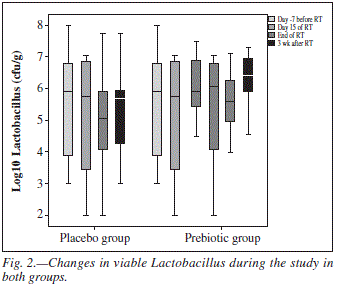
<body><![CDATA[<p><font face="Verdana" size="2">Our results show that RT negatively affected the <i>Lactobacillus</i> and <i>Bifidobacterium</i> viable counts in both groups. A statically significant decrease in <i>Lactobacillus</i> and <i>Bifidobacterium</i> counts was observed in both groups (<a href="#t2">table II</a>). However, recovery of the <i> Lactobacillus</i> and <i>Bifidobacterium</i> viable counts was statistically significant in patients treated with the prebiotic mixture after three weeks of treatment (figs. <a href="#f2">2</a> and <a href="#f3">3</a>).</font></p>     <p>&nbsp;</p>     <p align=center><a name="t2"><img src="/img/revistas/nh/v27n6/16_original_05_t2.gif"></a></p>     <p>&nbsp;</p>     <p align=center><a name="f2"><img src="/img/revistas/nh/v27n6/16_original_05_f2.gif"></a></p>     <p>&nbsp;</p>     <p align=center><a name="f3"><img src="/img/revistas/nh/v27n6/16_original_05_f3.gif"></a></p>     <p>&nbsp;</p>     <p><font face="Verdana" size="2">Viable <i>Lactobacillus</i> counts between the both groups (<a href="#f2">fig. 2</a>), show an statistically significant increase in viable <i>Lactobacillus</i> count for the prebiotic group at three weeks after RT. However, there were no differences in the total number of <i>Lactobacillus</i> cells measured by FISH (<a target="_blank" href="/img/revistas/nh/v27n6/16_original_05_f4.gif">fig. 4</a>).</font></p>     <p><font face="Verdana" size="2"><a href="#f3">Figure 3</a> shows the progress of viable <i>Bifidobacterium</i> counts in both groups during the study. Once again, we observed statistically significant differences 3 weeks after RT had finished. We did not observe differences in the total number of <i>Bifidobacterium</i> cells (<a target="_blank" href="/img/revistas/nh/v27n6/16_original_05_f5.gif">fig. 5</a>).</font></p>     ]]></body>
<body><![CDATA[<p><font face="Verdana" size="2">FISH enumeration showed that the prebiotic group maintained higher <i>Lactobacillus</i> and <i>Bifidobacterium</i> counts during treatment than the placebo group (figs. <a target="_blank" href="/img/revistas/nh/v27n6/16_original_05_f4.gif">4</a>-<a target="_blank" href="/img/revistas/nh/v27n6/16_original_05_f5.gif">5</a>).</font></p>     <p><font face="Verdana" size="2">There were no statistically significant differences in calprotectin levels between the groups during treatment.</font></p>     <p><font face="Verdana" size="2">We did not observe statistically significant changes in DNA between the groups during treatment.</font></p>     <p><font face="Verdana" size="2">The patients were tested for the presence of <i>Clostridium difficile</i> and none were infected.</font></p>     <p>&nbsp;</p>     <p><font face="Verdana" size="2"><b>Discussion</b></font></p>     <p><font face="Verdana" size="2">Although no significant changes in the total number of <i>Lactobacillus</i> was observed along the treatment, there was a difference in the response of the viable counts indicating more resistance to RT or an increase of the rate of reproduction. Population levels of <i>Bifidobacterium</i> varied during the treatment period with a significant increase in both, viable and total counts. These results are in line with those obtained by Gibson et al.<sup>17</sup> who reported that prebiotics stimulate the multiplication or activity of some bacterial groups as <i>Lactobacilli</i> or <i>Bifidobacterium.</i> Other prebiotics are used to selectively stimulate the growth and activity of <i>Lactobacilli</i> and <i>bifidobacteria</i> in the colon. However, there is little information on the mechanisms whereby prebiotics exert their specific effects upon such microorganisms.<sup>36</sup></font></p>     <p><font face="Verdana" size="2">Therefore, these results seem to indicate that, as soon as the microbiota recovers, the patient experiences fewer intestinal complications. Both inulin and FOS have proven beneficial in conditions such as pouchitis and ulcerative colititis. In one placebo controlled clinical trial 20, twenty patients with pouchitis received 24 g of inulin or placebo daily for three weeks. Dietary supplementation with inulin increased butyrate concentrations, lowered pH, decreased numbers of <i>Bacteroides fragilis</i>, and diminished concentrations of secondary bile acids in faeces. This was associated with a significant reduction in the endoscopic and histological scores of mucosal inflammation in the ileal reservoir. Furthermore, a recent study<sup>37</sup> analyzed a synbiotic preparation combining a probiotic <i>(Bifidobacterium longum)</i> and FOS-enriched inulin (l2 g of Synergy 1 per day) in a one-month double-blind randomised controlled trial involving 18 patients with active ulcerative colitis. After treatment, expression of inflammatory cytokines in rectal biopsies was significantly reduced in the synbiotic group but not in the placebo group.</font></p>     <p><font face="Verdana" size="2">There were no statistically significant differences in calprotectin levels between the groups during treatment. Calprotectin is a calcium-binding protein found in neutrophilic granulocytes. It resists metabolic degradation and is easily measured in faeces. Faecal calprotectin levels can successfully predict relapses in patients with inflammatory bowel disease.<sup>27</sup></font></p>     <p><font face="Verdana" size="2">Excretion of human DNA in faeces is another surrogate marker of intestinal inflammation.<sup>38</sup> We did not observe statistically significant changes in DNA between the groups during treatment.</font></p>     ]]></body>
<body><![CDATA[<p><font face="Verdana" size="2">In our opinion, the improvements in the radiotherapy techniques have influenced the results obtained in the markers of intestinal inflammation. So, patients presented less intestinal damage.</font></p>     <p><font face="Verdana" size="2">The mixture of inulin and FOS is used because these fibres are well-defined prebiotics that can increase <i>Lactobacillus</i> and <i>Bifidobacterium</i> counts in human colonic lumen.<sup>29</sup></font></p>     <p><font face="Verdana" size="2">We used a mixture of 6 g of inulin and 6 g of FOS, which is similar to doses administered in other studies.<sup>39-40</sup> A number of controlled clinical trials have shown that prebiotics are safe and may be effective in the prevention of acute gastrointestinal conditions.<sup>39,41-43</sup></font></p>     <p><font face="Verdana" size="2">Our study shows that Synergy 1 is well tolerated by patients.</font></p>     <p><font face="Verdana" size="2">Further studies with larger samples are needed to investigate the clinical effects of the prebiotic in patients receiving abdominal RT. Nowadays; our group is performing a study evaluating the clinical effects of prebiotics in gynaecological cancer patients treated with RT that includes clinical variables and a quality of life questionnaire.</font></p>     <p><font face="Verdana" size="2">In conclusions, results of our randomised controlled trial suggest that abdominal RT produces a significant decrease in <i>Lactobacillus</i> and <i>Bifidobacterium</i> counts. The prebiotic mixture Synergy 1 stimulates bacterial reactivation and enables both populations to recover at the end of RT.</font></p>     <p>&nbsp;</p>     <p><font face="Verdana" size="2"><b>Statement of authorship</b></font></p>     <p><font face="Verdana" size="2">PG designed the study, carried out the data analyses and drafted the manuscript. CV participated in the carried out of the study, performed the statistical analysis and helped to draft the manuscript. MAL was the patients' radiotherapist and participated in the design of the study. YM carried out the analysis of <i>Lactobacillus and Bifidobacterium.</i> LP carried out the study. CC participated in the design of the study and helped to draft the manuscript. MC and IB participated in the design of the study. JGH helped to draft the manuscript. FG participated in the design of the study and carried out with the analysis of calprotectin and DNA. MH participated in the design of the study and carried out with the analysis of <i>Lactobacillus and Bifidobacterium.</i></font></p>     <p><font face="Verdana" size="2">All authors read and approved the final manuscript. Authors have no conflict of interest.</font></p>     ]]></body>
<body><![CDATA[<p>&nbsp;</p>     <p><font face="Verdana" size="2"><b>References</b></font></p>     <!-- ref --><p><font face="Verdana" size="2">1. Guarner F. Enteric flora in health and disease. <i>Digestion</i> 2006; 73 (Suppl. 1): 5-12.    &nbsp;&nbsp;&nbsp;&nbsp;&nbsp;&nbsp;&nbsp;&nbsp;[&#160;<a href="javascript:void(0);" onclick="javascript: window.open('/scielo.php?script=sci_nlinks&ref=3688769&pid=S0212-1611201200060001600001&lng=','','width=640,height=500,resizable=yes,scrollbars=1,menubar=yes,');">Links</a>&#160;]<!-- end-ref --></font></p>    <!-- ref --><p><font face="Verdana" size="2">2. Sekirov I, Russell SL, Antunes LCA, Brett Finlay B. Gut Microbiota in Health and Disease. <i>Physiol Rev</i> 2010; 90: 859-904.    &nbsp;&nbsp;&nbsp;&nbsp;&nbsp;&nbsp;&nbsp;&nbsp;[&#160;<a href="javascript:void(0);" onclick="javascript: window.open('/scielo.php?script=sci_nlinks&ref=3688771&pid=S0212-1611201200060001600002&lng=','','width=640,height=500,resizable=yes,scrollbars=1,menubar=yes,');">Links</a>&#160;]<!-- end-ref --></font></p>    <!-- ref --><p><font face="Verdana" size="2">3. Guarner F, Malagelada JR. Gut flora in health and disease. <i>The Lancet</i> 2003; 360: 512-519.    &nbsp;&nbsp;&nbsp;&nbsp;&nbsp;&nbsp;&nbsp;&nbsp;[&#160;<a href="javascript:void(0);" onclick="javascript: window.open('/scielo.php?script=sci_nlinks&ref=3688773&pid=S0212-1611201200060001600003&lng=','','width=640,height=500,resizable=yes,scrollbars=1,menubar=yes,');">Links</a>&#160;]<!-- end-ref --></font></p>    <!-- ref --><p><font face="Verdana" size="2">4. Tannock GW. Molecular assessment of intestinal microflora. <i>Am J Clin Nutr</i> 2001;73 (Suppl.): 410S-414S.    &nbsp;&nbsp;&nbsp;&nbsp;&nbsp;&nbsp;&nbsp;&nbsp;[&#160;<a href="javascript:void(0);" onclick="javascript: window.open('/scielo.php?script=sci_nlinks&ref=3688775&pid=S0212-1611201200060001600004&lng=','','width=640,height=500,resizable=yes,scrollbars=1,menubar=yes,');">Links</a>&#160;]<!-- end-ref --></font></p>    ]]></body>
<body><![CDATA[<!-- ref --><p><font face="Verdana" size="2">5. Salminen S, Bouley C, Boutron MC, Cummings JH, Franck A, Gibson GR, Isolauri E, Moreau MC, Roberfroid M, Rowland I. Functional food science and gastrointestinal physiology and function. <i>Br J Nutr</i> 1998; 80 (Suppl. 1): 147S-171S.    &nbsp;&nbsp;&nbsp;&nbsp;&nbsp;&nbsp;&nbsp;&nbsp;[&#160;<a href="javascript:void(0);" onclick="javascript: window.open('/scielo.php?script=sci_nlinks&ref=3688777&pid=S0212-1611201200060001600005&lng=','','width=640,height=500,resizable=yes,scrollbars=1,menubar=yes,');">Links</a>&#160;]<!-- end-ref --></font></p>    <!-- ref --><p><font face="Verdana" size="2">6. Cummings J.H., Pomare E.W. &amp; Branch W.J. Short chain fatty acids in human large intestine, portal, hepatic and venous blood. <i>Gut</i> 1987; 28: 1221-1227.    &nbsp;&nbsp;&nbsp;&nbsp;&nbsp;&nbsp;&nbsp;&nbsp;[&#160;<a href="javascript:void(0);" onclick="javascript: window.open('/scielo.php?script=sci_nlinks&ref=3688779&pid=S0212-1611201200060001600006&lng=','','width=640,height=500,resizable=yes,scrollbars=1,menubar=yes,');">Links</a>&#160;]<!-- end-ref --></font></p>    <!-- ref --><p><font face="Verdana" size="2">7. Hill M.J. Intestinal flora and endogenous vitamin synthesis. <i>Eur J Cancer Prev</i> 1997; 6 (Suppl.): 43S-45S.    &nbsp;&nbsp;&nbsp;&nbsp;&nbsp;&nbsp;&nbsp;&nbsp;[&#160;<a href="javascript:void(0);" onclick="javascript: window.open('/scielo.php?script=sci_nlinks&ref=3688781&pid=S0212-1611201200060001600007&lng=','','width=640,height=500,resizable=yes,scrollbars=1,menubar=yes,');">Links</a>&#160;]<!-- end-ref --></font></p>    <!-- ref --><p><font face="Verdana" size="2">8. Lievin V, Peiffer I, Hudault S, Rochat F, Brassart D, Neeser JR, Servin AL. <i>Bifidobacterium</i> strains from resident infant human gastrointestinal microflora exerts antimicrobial activity. <i>Gut</i>  2000; 47: 646-652.    &nbsp;&nbsp;&nbsp;&nbsp;&nbsp;&nbsp;&nbsp;&nbsp;[&#160;<a href="javascript:void(0);" onclick="javascript: window.open('/scielo.php?script=sci_nlinks&ref=3688783&pid=S0212-1611201200060001600008&lng=','','width=640,height=500,resizable=yes,scrollbars=1,menubar=yes,');">Links</a>&#160;]<!-- end-ref --></font></p>    <!-- ref --><p><font face="Verdana" size="2">9. Macfarlane S. &amp; Macfarlane G.T. Bacterial diversity in large intestine. <i>Adv Appl Microbial</i> 2004; 54: 261-289.    &nbsp;&nbsp;&nbsp;&nbsp;&nbsp;&nbsp;&nbsp;&nbsp;[&#160;<a href="javascript:void(0);" onclick="javascript: window.open('/scielo.php?script=sci_nlinks&ref=3688785&pid=S0212-1611201200060001600009&lng=','','width=640,height=500,resizable=yes,scrollbars=1,menubar=yes,');">Links</a>&#160;]<!-- end-ref --></font></p>    ]]></body>
<body><![CDATA[<!-- ref --><p><font face="Verdana" size="2">10. Turnbaugh PJ, Ley RE, Hamady M, Fraser-Liggett CM, Knight R, Gordon JI. The human microbiome project. <i>Nature</i> 2007; 449: 804-810.    &nbsp;&nbsp;&nbsp;&nbsp;&nbsp;&nbsp;&nbsp;&nbsp;[&#160;<a href="javascript:void(0);" onclick="javascript: window.open('/scielo.php?script=sci_nlinks&ref=3688787&pid=S0212-1611201200060001600010&lng=','','width=640,height=500,resizable=yes,scrollbars=1,menubar=yes,');">Links</a>&#160;]<!-- end-ref --></font></p>    <!-- ref --><p><font face="Verdana" size="2">11. Hovdenak N, Fajardo LF, Hauer-Jensen M. Acute radiation proctitis: A sequential clinicopathologic study during pelvic radiotherapy. <i>Int J Radiat Oncol Biol Phys</i> 2000: 48; 1111-1117.    &nbsp;&nbsp;&nbsp;&nbsp;&nbsp;&nbsp;&nbsp;&nbsp;[&#160;<a href="javascript:void(0);" onclick="javascript: window.open('/scielo.php?script=sci_nlinks&ref=3688789&pid=S0212-1611201200060001600011&lng=','','width=640,height=500,resizable=yes,scrollbars=1,menubar=yes,');">Links</a>&#160;]<!-- end-ref --></font></p>    <!-- ref --><p><font face="Verdana" size="2">12. Gibson GR, Probert HM, Van Loo J, Rastall RA, Roberfroid M. Dietary modulation of the human colonic microbiota: updating the concept of prebiotics. <i>Nutr Res Rev</i> 2004; 17: 259-275.    &nbsp;&nbsp;&nbsp;&nbsp;&nbsp;&nbsp;&nbsp;&nbsp;[&#160;<a href="javascript:void(0);" onclick="javascript: window.open('/scielo.php?script=sci_nlinks&ref=3688791&pid=S0212-1611201200060001600012&lng=','','width=640,height=500,resizable=yes,scrollbars=1,menubar=yes,');">Links</a>&#160;]<!-- end-ref --></font></p>    <!-- ref --><p><font face="Verdana" size="2">13. Macfarlane S, Macfarlane GT, Cummings JH. Review article: prebiotics in the gastrointestinal tract. <i>Aliment Pharmacol Ther</i> 2006; 24: 701-714.    &nbsp;&nbsp;&nbsp;&nbsp;&nbsp;&nbsp;&nbsp;&nbsp;[&#160;<a href="javascript:void(0);" onclick="javascript: window.open('/scielo.php?script=sci_nlinks&ref=3688793&pid=S0212-1611201200060001600013&lng=','','width=640,height=500,resizable=yes,scrollbars=1,menubar=yes,');">Links</a>&#160;]<!-- end-ref --></font></p>    <!-- ref --><p><font face="Verdana" size="2">14. Olveira G, González-Molero I. Prebióticos y prebióticos en la práctica clínica. <i>Nutr Hosp</i> 2007; 22 (Suppl. 2): 26-34.    &nbsp;&nbsp;&nbsp;&nbsp;&nbsp;&nbsp;&nbsp;&nbsp;[&#160;<a href="javascript:void(0);" onclick="javascript: window.open('/scielo.php?script=sci_nlinks&ref=3688795&pid=S0212-1611201200060001600014&lng=','','width=640,height=500,resizable=yes,scrollbars=1,menubar=yes,');">Links</a>&#160;]<!-- end-ref --></font></p>    ]]></body>
<body><![CDATA[<!-- ref --><p><font face="Verdana" size="2">15. Langlands SJ, Hopkins MJ, Coleman N, Cumming JH. Prebiotic carbohydrates modify the mucosa associated microflora of the human large bowel. <i>Gut</i> 2004; 53: 1610-1616.    &nbsp;&nbsp;&nbsp;&nbsp;&nbsp;&nbsp;&nbsp;&nbsp;[&#160;<a href="javascript:void(0);" onclick="javascript: window.open('/scielo.php?script=sci_nlinks&ref=3688797&pid=S0212-1611201200060001600015&lng=','','width=640,height=500,resizable=yes,scrollbars=1,menubar=yes,');">Links</a>&#160;]<!-- end-ref --></font></p>    <!-- ref --><p><font face="Verdana" size="2">16. Cumming JH, Christie S, Cole TJ. A study of fructo-oligosac-charides in the prevention of traveller's diarrhoea. <i>Aliment Pharmacol Ther</i> 2001; 15: 1139-1145.    &nbsp;&nbsp;&nbsp;&nbsp;&nbsp;&nbsp;&nbsp;&nbsp;[&#160;<a href="javascript:void(0);" onclick="javascript: window.open('/scielo.php?script=sci_nlinks&ref=3688799&pid=S0212-1611201200060001600016&lng=','','width=640,height=500,resizable=yes,scrollbars=1,menubar=yes,');">Links</a>&#160;]<!-- end-ref --></font></p>    <!-- ref --><p><font face="Verdana" size="2">17. Gibson GR, Beatty ER, Wang X, Cummings J. Selective stimulation of bifidobacteria in the human colon by oligofructose and inulin. <i>Gastroenterology</i> 1995; 108: 975-982.    &nbsp;&nbsp;&nbsp;&nbsp;&nbsp;&nbsp;&nbsp;&nbsp;[&#160;<a href="javascript:void(0);" onclick="javascript: window.open('/scielo.php?script=sci_nlinks&ref=3688801&pid=S0212-1611201200060001600017&lng=','','width=640,height=500,resizable=yes,scrollbars=1,menubar=yes,');">Links</a>&#160;]<!-- end-ref --></font></p>    <!-- ref --><p><font face="Verdana" size="2">18. Geier M, Butler R, Howarth G. Inflammatory bowel disease: current insights into pathogenesis and new therapeutic options; probiotics, prebiotics and symbiotics. <i>Int J Food Microbiol</i> 2007; 115: 1-11.    &nbsp;&nbsp;&nbsp;&nbsp;&nbsp;&nbsp;&nbsp;&nbsp;[&#160;<a href="javascript:void(0);" onclick="javascript: window.open('/scielo.php?script=sci_nlinks&ref=3688803&pid=S0212-1611201200060001600018&lng=','','width=640,height=500,resizable=yes,scrollbars=1,menubar=yes,');">Links</a>&#160;]<!-- end-ref --></font></p>    <!-- ref --><p><font face="Verdana" size="2">19. Lindsay JO, Whelan K, Stagg AJ, Gobin P, Al-Hassi HO, Rayment N, Kamm MA, Knight SC, Forbes A. Clinical, microbiological and immunological effects of fructo-oligosaccharide in patients with Crohn's disease. <i>Gut</i> 2006; 55: 348-355.    &nbsp;&nbsp;&nbsp;&nbsp;&nbsp;&nbsp;&nbsp;&nbsp;[&#160;<a href="javascript:void(0);" onclick="javascript: window.open('/scielo.php?script=sci_nlinks&ref=3688805&pid=S0212-1611201200060001600019&lng=','','width=640,height=500,resizable=yes,scrollbars=1,menubar=yes,');">Links</a>&#160;]<!-- end-ref --></font></p>    ]]></body>
<body><![CDATA[<!-- ref --><p><font face="Verdana" size="2">20. Welters CFM, Heineman E, Thunnissen BJM. Effect of dietary inulin supplementation on inflammation of pouch mucosa in patients with an ileal pouch-anal anastomosis. <i>Dis Colon Rectum</i> 2002; 45: 621-627.    &nbsp;&nbsp;&nbsp;&nbsp;&nbsp;&nbsp;&nbsp;&nbsp;[&#160;<a href="javascript:void(0);" onclick="javascript: window.open('/scielo.php?script=sci_nlinks&ref=3688807&pid=S0212-1611201200060001600020&lng=','','width=640,height=500,resizable=yes,scrollbars=1,menubar=yes,');">Links</a>&#160;]<!-- end-ref --></font></p>    <!-- ref --><p><font face="Verdana" size="2">21. Silk DBA, Davis A, Vulevic J et al. Clinical trial: the effects of a trans-galactooligosaccheride on faecal microbiota and symptoms in irritable bowel syndrome. <i>Aliment Pharmacol Ther</i>  2009; 29: 508-18.    &nbsp;&nbsp;&nbsp;&nbsp;&nbsp;&nbsp;&nbsp;&nbsp;[&#160;<a href="javascript:void(0);" onclick="javascript: window.open('/scielo.php?script=sci_nlinks&ref=3688809&pid=S0212-1611201200060001600021&lng=','','width=640,height=500,resizable=yes,scrollbars=1,menubar=yes,');">Links</a>&#160;]<!-- end-ref --></font></p>    <!-- ref --><p><font face="Verdana" size="2">22. Quigley EM. Therapies aimed at the gut microbiota and inflammation: antibiotics, prebiotics, probiotics, synbiotics, anti-inflammatory therapies. <i>Gastroenterol Clin North Am</i> 2011; 40: 207-22.    &nbsp;&nbsp;&nbsp;&nbsp;&nbsp;&nbsp;&nbsp;&nbsp;[&#160;<a href="javascript:void(0);" onclick="javascript: window.open('/scielo.php?script=sci_nlinks&ref=3688811&pid=S0212-1611201200060001600022&lng=','','width=640,height=500,resizable=yes,scrollbars=1,menubar=yes,');">Links</a>&#160;]<!-- end-ref --></font></p>    <!-- ref --><p><font face="Verdana" size="2">23. Shukla S, Shukla A, Mehboob S, Guha S. Meta-analysis: the effects of gut flora modulation using prebiotics, probiotics and symbiotics on minimal hepatic encephalopathy. <i>Aliment Pharmacol Ther</i> 2011; 33: 662-71.    &nbsp;&nbsp;&nbsp;&nbsp;&nbsp;&nbsp;&nbsp;&nbsp;[&#160;<a href="javascript:void(0);" onclick="javascript: window.open('/scielo.php?script=sci_nlinks&ref=3688813&pid=S0212-1611201200060001600023&lng=','','width=640,height=500,resizable=yes,scrollbars=1,menubar=yes,');">Links</a>&#160;]<!-- end-ref --></font></p>    <!-- ref --><p><font face="Verdana" size="2">24. Fein DA, Morgan L, Marcus R, Mendenhall W, Sombeck M, Freeman D, Million R. Stage III ovarian carcinoma: an analysis of treatment results and complications following hyperfractionated abdominopelvic irradiation for salvage. <i>Int J Radiat Oncol Biol Phys</i> 1994; 29: 169-176.    &nbsp;&nbsp;&nbsp;&nbsp;&nbsp;&nbsp;&nbsp;&nbsp;[&#160;<a href="javascript:void(0);" onclick="javascript: window.open('/scielo.php?script=sci_nlinks&ref=3688815&pid=S0212-1611201200060001600024&lng=','','width=640,height=500,resizable=yes,scrollbars=1,menubar=yes,');">Links</a>&#160;]<!-- end-ref --></font></p>    ]]></body>
<body><![CDATA[<!-- ref --><p><font face="Verdana" size="2">25. Costa A, Mumolo MG, Bellini M, Romano MR, Ceccarelli L, Arpe P, Sterpi C, Marchi S, Maltinti G. Role of faecal calprotectin as non-invasive marked of intestinal inflammation. <i>Dig Liver Dis</i> 2003; 35: 642-647.    &nbsp;&nbsp;&nbsp;&nbsp;&nbsp;&nbsp;&nbsp;&nbsp;[&#160;<a href="javascript:void(0);" onclick="javascript: window.open('/scielo.php?script=sci_nlinks&ref=3688817&pid=S0212-1611201200060001600025&lng=','','width=640,height=500,resizable=yes,scrollbars=1,menubar=yes,');">Links</a>&#160;]<!-- end-ref --></font></p>    <!-- ref --><p><font face="Verdana" size="2">26. Poulis A, Foster R, Northfield TC, Mendall MA. Review article: Faecal markers in assessment of activity in inflammatory bowel disease. <i>Aliment Pharmacol Ther</i> 2002; 16: 675-681.    &nbsp;&nbsp;&nbsp;&nbsp;&nbsp;&nbsp;&nbsp;&nbsp;[&#160;<a href="javascript:void(0);" onclick="javascript: window.open('/scielo.php?script=sci_nlinks&ref=3688819&pid=S0212-1611201200060001600026&lng=','','width=640,height=500,resizable=yes,scrollbars=1,menubar=yes,');">Links</a>&#160;]<!-- end-ref --></font></p>    <!-- ref --><p><font face="Verdana" size="2">27. Casellas F, Antolin M, Varela E, García-Lafuente A, Guarner F, Borruel N, Armengol Miro JR, Malagelada JR. Fecal excretion of human deoxyribonucleic acid as an index of inflammatory activity in ulcerative colitis. <i>Clin Gastroenterol Hepatol</i>  2004; 2: 683-689.    &nbsp;&nbsp;&nbsp;&nbsp;&nbsp;&nbsp;&nbsp;&nbsp;[&#160;<a href="javascript:void(0);" onclick="javascript: window.open('/scielo.php?script=sci_nlinks&ref=3688821&pid=S0212-1611201200060001600027&lng=','','width=640,height=500,resizable=yes,scrollbars=1,menubar=yes,');">Links</a>&#160;]<!-- end-ref --></font></p>    <!-- ref --><p><font face="Verdana" size="2">28. Nebra Y, Blanch AR. A New Selective Medium for <i>Bifidobacterium</i> spp. <i>Appl Environ Microbiol</i> 1999; 65: 5173-5176.    &nbsp;&nbsp;&nbsp;&nbsp;&nbsp;&nbsp;&nbsp;&nbsp;[&#160;<a href="javascript:void(0);" onclick="javascript: window.open('/scielo.php?script=sci_nlinks&ref=3688823&pid=S0212-1611201200060001600028&lng=','','width=640,height=500,resizable=yes,scrollbars=1,menubar=yes,');">Links</a>&#160;]<!-- end-ref --></font></p>    <!-- ref --><p><font face="Verdana" size="2">29. Collado MC, Moreno Y, Cobo JM, Mateos JA, Hernández M. Molecular detection of <i>Bifidobacterium animalis</i> DN-173010 in human feces during fermented milk administration. <i>Food Research International</i> 2006; 39: 530-535.    &nbsp;&nbsp;&nbsp;&nbsp;&nbsp;&nbsp;&nbsp;&nbsp;[&#160;<a href="javascript:void(0);" onclick="javascript: window.open('/scielo.php?script=sci_nlinks&ref=3688825&pid=S0212-1611201200060001600029&lng=','','width=640,height=500,resizable=yes,scrollbars=1,menubar=yes,');">Links</a>&#160;]<!-- end-ref --></font></p>    ]]></body>
<body><![CDATA[<!-- ref --><p><font face="Verdana" size="2">30. Tuohy KM, Finlay RK, Wynne AG, Gibson GR. A human volunteer study on the prebiotic effects of HP-inulin-faecal bacteria enumerated using fluorescent in situ hybridisation (FISH). <i>Anaerobe</i> 2001; 7: 113-118.    &nbsp;&nbsp;&nbsp;&nbsp;&nbsp;&nbsp;&nbsp;&nbsp;[&#160;<a href="javascript:void(0);" onclick="javascript: window.open('/scielo.php?script=sci_nlinks&ref=3688827&pid=S0212-1611201200060001600030&lng=','','width=640,height=500,resizable=yes,scrollbars=1,menubar=yes,');">Links</a>&#160;]<!-- end-ref --></font></p>    <!-- ref --><p><font face="Verdana" size="2">31. Harmsen HJM, Gibson GR, Elfferich P, Raangs GC, Wildeboer-Veloo AC, Argaiz A, Roberfroid MB, Welling GW. Comparison of viable cell counts and fluorescence in situ hybridization using specific rRNA-based probes for the quantification of human fecal bacteria. <i>FEMS Microbiol Lett</i> 1999; 183: 125-129.    &nbsp;&nbsp;&nbsp;&nbsp;&nbsp;&nbsp;&nbsp;&nbsp;[&#160;<a href="javascript:void(0);" onclick="javascript: window.open('/scielo.php?script=sci_nlinks&ref=3688829&pid=S0212-1611201200060001600031&lng=','','width=640,height=500,resizable=yes,scrollbars=1,menubar=yes,');">Links</a>&#160;]<!-- end-ref --></font></p>    <!-- ref --><p><font face="Verdana" size="2">32. Moreno Y, Hernández M, Ferrús MA, Alonso JL, Botella S, Montes R, Hernández J. Direct detection of thermotolerant campylobacters in chicken products by PCR and in situ hybridization. <i>Res Microbiol</i> 2001; 152: 577-582.    &nbsp;&nbsp;&nbsp;&nbsp;&nbsp;&nbsp;&nbsp;&nbsp;[&#160;<a href="javascript:void(0);" onclick="javascript: window.open('/scielo.php?script=sci_nlinks&ref=3688831&pid=S0212-1611201200060001600032&lng=','','width=640,height=500,resizable=yes,scrollbars=1,menubar=yes,');">Links</a>&#160;]<!-- end-ref --></font></p>    <!-- ref --><p><font face="Verdana" size="2">33. Amann RI, Ludwig W, Schleifer KH. Phylogenetic identification and in situ detection of individual microbial cells without cultivation. <i>Microbiol Rev</i> 1995; 59: 143-169.    &nbsp;&nbsp;&nbsp;&nbsp;&nbsp;&nbsp;&nbsp;&nbsp;[&#160;<a href="javascript:void(0);" onclick="javascript: window.open('/scielo.php?script=sci_nlinks&ref=3688833&pid=S0212-1611201200060001600033&lng=','','width=640,height=500,resizable=yes,scrollbars=1,menubar=yes,');">Links</a>&#160;]<!-- end-ref --></font></p>    <!-- ref --><p><font face="Verdana" size="2">34. Bjarnason I, Sherwood R. Fecal calprotectin: a significant step in the non-invasive assessment of intestinal inflammation. <i>J Pediatr Gastroenterol Nutr</i> 2001; 33: 11-13.    &nbsp;&nbsp;&nbsp;&nbsp;&nbsp;&nbsp;&nbsp;&nbsp;[&#160;<a href="javascript:void(0);" onclick="javascript: window.open('/scielo.php?script=sci_nlinks&ref=3688835&pid=S0212-1611201200060001600034&lng=','','width=640,height=500,resizable=yes,scrollbars=1,menubar=yes,');">Links</a>&#160;]<!-- end-ref --></font></p>    ]]></body>
<body><![CDATA[<!-- ref --><p><font face="Verdana" size="2">35. Gibson GR, Roberfroid MB. Dietary modulation of the human colonic microbiota introducing the concept of probiotics. <i>J Nutr</i> 1995; 125: 1401-1412.    &nbsp;&nbsp;&nbsp;&nbsp;&nbsp;&nbsp;&nbsp;&nbsp;[&#160;<a href="javascript:void(0);" onclick="javascript: window.open('/scielo.php?script=sci_nlinks&ref=3688837&pid=S0212-1611201200060001600035&lng=','','width=640,height=500,resizable=yes,scrollbars=1,menubar=yes,');">Links</a>&#160;]<!-- end-ref --></font></p>    <!-- ref --><p><font face="Verdana" size="2">36. Saulnier DM, Molenaar D, De Vos WM, Gibson GR, Kolida S. Identification of prebiotic fructooligosaccharides metabolism in Identification of prebiotic fructooligosaccharides metabolism in <i>Lactobacillus plantarum</i> WCFS1 through microarrays. <i>Appl Environ</i> 2007; 73: 1753-1765.    &nbsp;&nbsp;&nbsp;&nbsp;&nbsp;&nbsp;&nbsp;&nbsp;[&#160;<a href="javascript:void(0);" onclick="javascript: window.open('/scielo.php?script=sci_nlinks&ref=3688839&pid=S0212-1611201200060001600036&lng=','','width=640,height=500,resizable=yes,scrollbars=1,menubar=yes,');">Links</a>&#160;]<!-- end-ref --></font></p>    <!-- ref --><p><font face="Verdana" size="2">37. Furrie E, Macfarlane S, Kennedy A, Cummings JH, Walsh SV, O'neil DA, Macfarlane GT. Symbiotic therapy (Bifidobacterium longum/Synergy 1) initiates resolution of inflammation in patients with active ulcerative colitis: a randomised controlled pilot trial. <i>Gut</i> 2005; 54: 242-249.    &nbsp;&nbsp;&nbsp;&nbsp;&nbsp;&nbsp;&nbsp;&nbsp;[&#160;<a href="javascript:void(0);" onclick="javascript: window.open('/scielo.php?script=sci_nlinks&ref=3688841&pid=S0212-1611201200060001600037&lng=','','width=640,height=500,resizable=yes,scrollbars=1,menubar=yes,');">Links</a>&#160;]<!-- end-ref --></font></p>    <!-- ref --><p><font face="Verdana" size="2">38. Tibble JA, Sighorsson G, Bridger S, Fagerhol MK, Bjarnason I. Surrogate markers of intestinal inflammation are predictive of relapse in patients with inflammatory bowel disease. <i>Gastroenterology</i> 2000; 119: 15-22.    &nbsp;&nbsp;&nbsp;&nbsp;&nbsp;&nbsp;&nbsp;&nbsp;[&#160;<a href="javascript:void(0);" onclick="javascript: window.open('/scielo.php?script=sci_nlinks&ref=3688843&pid=S0212-1611201200060001600038&lng=','','width=640,height=500,resizable=yes,scrollbars=1,menubar=yes,');">Links</a>&#160;]<!-- end-ref --></font></p>    <!-- ref --><p><font face="Verdana" size="2">39. Kolida S, Meyes D, Gibson GR. A double-blind-placebo-controlled study to establish the bifidogenic dose of inulin in healthy humans. <i>Eur J Clin Nutr</i> 2007; 61: 11189-1195.    &nbsp;&nbsp;&nbsp;&nbsp;&nbsp;&nbsp;&nbsp;&nbsp;[&#160;<a href="javascript:void(0);" onclick="javascript: window.open('/scielo.php?script=sci_nlinks&ref=3688845&pid=S0212-1611201200060001600039&lng=','','width=640,height=500,resizable=yes,scrollbars=1,menubar=yes,');">Links</a>&#160;]<!-- end-ref --></font></p>    ]]></body>
<body><![CDATA[<!-- ref --><p><font face="Verdana" size="2">40. Bouhnick Y, Raskine L, Champion K, Andrieux C, Penven S, Jacobs H, Simoneau G. Prolonged administration of low-dose inulin stimulates the growth of bifidobacteria in human. <i>Nutr Res</i> 2007; 27: 187-193.    &nbsp;&nbsp;&nbsp;&nbsp;&nbsp;&nbsp;&nbsp;&nbsp;[&#160;<a href="javascript:void(0);" onclick="javascript: window.open('/scielo.php?script=sci_nlinks&ref=3688847&pid=S0212-1611201200060001600040&lng=','','width=640,height=500,resizable=yes,scrollbars=1,menubar=yes,');">Links</a>&#160;]<!-- end-ref --></font></p>    <!-- ref --><p><font face="Verdana" size="2">41. Saavedra JM, Tschenia A. Human studies with probiotics and prebiotics: clinical implications. <i>Br J Nutr</i> 2002; 87 (Suppl. 2): S241-S246.    &nbsp;&nbsp;&nbsp;&nbsp;&nbsp;&nbsp;&nbsp;&nbsp;[&#160;<a href="javascript:void(0);" onclick="javascript: window.open('/scielo.php?script=sci_nlinks&ref=3688849&pid=S0212-1611201200060001600041&lng=','','width=640,height=500,resizable=yes,scrollbars=1,menubar=yes,');">Links</a>&#160;]<!-- end-ref --></font></p>    <!-- ref --><p><font face="Verdana" size="2">42. Gibson GR. Prebiotics as gut microflora management tools. <i>J Clin Gastroenterol</i> 2008; 42 (Suppl. 2): S75-S79.    &nbsp;&nbsp;&nbsp;&nbsp;&nbsp;&nbsp;&nbsp;&nbsp;[&#160;<a href="javascript:void(0);" onclick="javascript: window.open('/scielo.php?script=sci_nlinks&ref=3688851&pid=S0212-1611201200060001600042&lng=','','width=640,height=500,resizable=yes,scrollbars=1,menubar=yes,');">Links</a>&#160;]<!-- end-ref --></font></p>    <!-- ref --><p><font face="Verdana" size="2">43. Fanaro S, Vigi V. Which role for prebiotics at weaning? <i>J Clin Gastroenterol</i> 2008; 42 (Suppl. 3): S209-S213.    &nbsp;&nbsp;&nbsp;&nbsp;&nbsp;&nbsp;&nbsp;&nbsp;[&#160;<a href="javascript:void(0);" onclick="javascript: window.open('/scielo.php?script=sci_nlinks&ref=3688853&pid=S0212-1611201200060001600043&lng=','','width=640,height=500,resizable=yes,scrollbars=1,menubar=yes,');">Links</a>&#160;]<!-- end-ref --></font></p>     <p>&nbsp;</p>     <p>&nbsp;</p>     ]]></body>
<body><![CDATA[<p><font face="Verdana" size="2"><a href="#top"><img border="0" src="/img/revistas/nh/v27n6/seta.gif" width="15" height="17"></a><a name="bajo"></a><b>Correspondence:</b>    <br>Pilar García Peris    <br>Nutrition Unit    <br>Hospital General Universitario Gregorio Marañón    <br>C/ Doctor Esquerdo, 46    <br>28007 Madrid. Spain    <br>E-mail: <a href="mailto:pgarciap.hgugm@salud.madrid.org">pgarciap.hgugm@salud.madrid.org</a></font></p>     <p><font face="Verdana" size="2">Recibido: 9-VI-2012    <br>Aceptado: 15-VII-2012</font></p>      ]]></body><back>
<ref-list>
<ref id="B1">
<label>1</label><nlm-citation citation-type="journal">
<person-group person-group-type="author">
<name>
<surname><![CDATA[Guarner]]></surname>
<given-names><![CDATA[F]]></given-names>
</name>
</person-group>
<article-title xml:lang="en"><![CDATA[Enteric flora in health and disease]]></article-title>
<source><![CDATA[Digestion]]></source>
<year>2006</year>
<volume>73</volume>
<numero>^s1</numero>
<issue>^s1</issue>
<supplement>1</supplement>
<page-range>5-12</page-range></nlm-citation>
</ref>
<ref id="B2">
<label>2</label><nlm-citation citation-type="journal">
<person-group person-group-type="author">
<name>
<surname><![CDATA[Sekirov]]></surname>
<given-names><![CDATA[I]]></given-names>
</name>
<name>
<surname><![CDATA[Russell]]></surname>
<given-names><![CDATA[SL]]></given-names>
</name>
<name>
<surname><![CDATA[Antunes]]></surname>
<given-names><![CDATA[LCA]]></given-names>
</name>
<name>
<surname><![CDATA[Brett Finlay]]></surname>
<given-names><![CDATA[B]]></given-names>
</name>
</person-group>
<article-title xml:lang="en"><![CDATA[Gut Microbiota in Health and Disease]]></article-title>
<source><![CDATA[Physiol Rev]]></source>
<year>2010</year>
<volume>90</volume>
<page-range>859-904</page-range></nlm-citation>
</ref>
<ref id="B3">
<label>3</label><nlm-citation citation-type="journal">
<person-group person-group-type="author">
<name>
<surname><![CDATA[Guarner]]></surname>
<given-names><![CDATA[F]]></given-names>
</name>
<name>
<surname><![CDATA[Malagelada]]></surname>
<given-names><![CDATA[JR]]></given-names>
</name>
</person-group>
<article-title xml:lang="en"><![CDATA[Gut flora in health and disease]]></article-title>
<source><![CDATA[The Lancet]]></source>
<year>2003</year>
<volume>360</volume>
<page-range>512-519</page-range></nlm-citation>
</ref>
<ref id="B4">
<label>4</label><nlm-citation citation-type="journal">
<person-group person-group-type="author">
<name>
<surname><![CDATA[Tannock]]></surname>
<given-names><![CDATA[GW]]></given-names>
</name>
</person-group>
<article-title xml:lang="en"><![CDATA[Molecular assessment of intestinal microflora]]></article-title>
<source><![CDATA[Am J Clin Nutr]]></source>
<year>2001</year>
<volume>73</volume>
<page-range>410S-414S</page-range></nlm-citation>
</ref>
<ref id="B5">
<label>5</label><nlm-citation citation-type="journal">
<person-group person-group-type="author">
<name>
<surname><![CDATA[Salminen]]></surname>
<given-names><![CDATA[S]]></given-names>
</name>
<name>
<surname><![CDATA[Bouley]]></surname>
<given-names><![CDATA[C]]></given-names>
</name>
<name>
<surname><![CDATA[Boutron]]></surname>
<given-names><![CDATA[MC]]></given-names>
</name>
<name>
<surname><![CDATA[Cummings]]></surname>
<given-names><![CDATA[JH]]></given-names>
</name>
<name>
<surname><![CDATA[Franck]]></surname>
<given-names><![CDATA[A]]></given-names>
</name>
<name>
<surname><![CDATA[Gibson]]></surname>
<given-names><![CDATA[GR]]></given-names>
</name>
<name>
<surname><![CDATA[Isolauri]]></surname>
<given-names><![CDATA[E]]></given-names>
</name>
<name>
<surname><![CDATA[Moreau]]></surname>
<given-names><![CDATA[MC]]></given-names>
</name>
<name>
<surname><![CDATA[Roberfroid]]></surname>
<given-names><![CDATA[M]]></given-names>
</name>
<name>
<surname><![CDATA[Rowland]]></surname>
<given-names><![CDATA[I]]></given-names>
</name>
</person-group>
<article-title xml:lang="en"><![CDATA[Functional food science and gastrointestinal physiology and function]]></article-title>
<source><![CDATA[Br J Nutr]]></source>
<year>1998</year>
<volume>80</volume>
<numero>^s1</numero>
<issue>^s1</issue>
<supplement>1</supplement>
<page-range>147S-171S</page-range></nlm-citation>
</ref>
<ref id="B6">
<label>6</label><nlm-citation citation-type="journal">
<person-group person-group-type="author">
<name>
<surname><![CDATA[Cummings]]></surname>
<given-names><![CDATA[J.H.]]></given-names>
</name>
<name>
<surname><![CDATA[Pomare]]></surname>
<given-names><![CDATA[E.W.]]></given-names>
</name>
<name>
<surname><![CDATA[Branch]]></surname>
<given-names><![CDATA[W.J]]></given-names>
</name>
</person-group>
<article-title xml:lang="en"><![CDATA[Short chain fatty acids in human large intestine, portal, hepatic and venous blood]]></article-title>
<source><![CDATA[Gut]]></source>
<year>1987</year>
<volume>28</volume>
<page-range>1221-1227</page-range></nlm-citation>
</ref>
<ref id="B7">
<label>7</label><nlm-citation citation-type="journal">
<person-group person-group-type="author">
<name>
<surname><![CDATA[Hill]]></surname>
<given-names><![CDATA[M.J]]></given-names>
</name>
</person-group>
<article-title xml:lang="en"><![CDATA[Intestinal flora and endogenous vitamin synthesis]]></article-title>
<source><![CDATA[Eur J Cancer Prev]]></source>
<year>1997</year>
<volume>6</volume>
<numero>^sSuppl.</numero>
<issue>^sSuppl.</issue>
<supplement>Suppl.</supplement>
<page-range>43S-45S</page-range></nlm-citation>
</ref>
<ref id="B8">
<label>8</label><nlm-citation citation-type="journal">
<person-group person-group-type="author">
<name>
<surname><![CDATA[Lievin]]></surname>
<given-names><![CDATA[V]]></given-names>
</name>
<name>
<surname><![CDATA[Peiffer]]></surname>
<given-names><![CDATA[I]]></given-names>
</name>
<name>
<surname><![CDATA[Hudault]]></surname>
<given-names><![CDATA[S]]></given-names>
</name>
<name>
<surname><![CDATA[Rochat]]></surname>
<given-names><![CDATA[F]]></given-names>
</name>
<name>
<surname><![CDATA[Brassart]]></surname>
<given-names><![CDATA[D]]></given-names>
</name>
<name>
<surname><![CDATA[Neeser]]></surname>
<given-names><![CDATA[JR]]></given-names>
</name>
<name>
<surname><![CDATA[Servin]]></surname>
<given-names><![CDATA[AL]]></given-names>
</name>
</person-group>
<article-title xml:lang="en"><![CDATA[Bifidobacterium strains from resident infant human gastrointestinal microflora exerts antimicrobial activity]]></article-title>
<source><![CDATA[Gut]]></source>
<year>2000</year>
<volume>47</volume>
<page-range>646-652</page-range></nlm-citation>
</ref>
<ref id="B9">
<label>9</label><nlm-citation citation-type="journal">
<person-group person-group-type="author">
<name>
<surname><![CDATA[Macfarlane]]></surname>
<given-names><![CDATA[S.]]></given-names>
</name>
<name>
<surname><![CDATA[Macfarlane]]></surname>
<given-names><![CDATA[G.T]]></given-names>
</name>
</person-group>
<article-title xml:lang="en"><![CDATA[Bacterial diversity in large intestine]]></article-title>
<source><![CDATA[Adv Appl Microbial]]></source>
<year>2004</year>
<volume>54</volume>
<page-range>261-289</page-range></nlm-citation>
</ref>
<ref id="B10">
<label>10</label><nlm-citation citation-type="journal">
<person-group person-group-type="author">
<name>
<surname><![CDATA[Turnbaugh]]></surname>
<given-names><![CDATA[PJ]]></given-names>
</name>
<name>
<surname><![CDATA[Ley]]></surname>
<given-names><![CDATA[RE]]></given-names>
</name>
<name>
<surname><![CDATA[Hamady]]></surname>
<given-names><![CDATA[M]]></given-names>
</name>
<name>
<surname><![CDATA[Fraser-Liggett]]></surname>
<given-names><![CDATA[CM]]></given-names>
</name>
<name>
<surname><![CDATA[Knight]]></surname>
<given-names><![CDATA[R]]></given-names>
</name>
<name>
<surname><![CDATA[Gordon]]></surname>
<given-names><![CDATA[JI]]></given-names>
</name>
</person-group>
<article-title xml:lang="en"><![CDATA[The human microbiome project]]></article-title>
<source><![CDATA[Nature]]></source>
<year>2007</year>
<volume>449</volume>
<page-range>804-810</page-range></nlm-citation>
</ref>
<ref id="B11">
<label>11</label><nlm-citation citation-type="journal">
<person-group person-group-type="author">
<name>
<surname><![CDATA[Hovdenak]]></surname>
<given-names><![CDATA[N]]></given-names>
</name>
<name>
<surname><![CDATA[Fajardo]]></surname>
<given-names><![CDATA[LF]]></given-names>
</name>
<name>
<surname><![CDATA[Hauer-Jensen]]></surname>
<given-names><![CDATA[M]]></given-names>
</name>
</person-group>
<article-title xml:lang="en"><![CDATA[Acute radiation proctitis: A sequential clinicopathologic study during pelvic radiotherapy]]></article-title>
<source><![CDATA[Int J Radiat Oncol Biol Phys]]></source>
<year>2000</year>
<volume>48</volume>
<page-range>1111-1117</page-range></nlm-citation>
</ref>
<ref id="B12">
<label>12</label><nlm-citation citation-type="journal">
<person-group person-group-type="author">
<name>
<surname><![CDATA[Gibson]]></surname>
<given-names><![CDATA[GR]]></given-names>
</name>
<name>
<surname><![CDATA[Probert]]></surname>
<given-names><![CDATA[HM]]></given-names>
</name>
<name>
<surname><![CDATA[Van Loo]]></surname>
<given-names><![CDATA[J]]></given-names>
</name>
<name>
<surname><![CDATA[Rastall]]></surname>
<given-names><![CDATA[RA]]></given-names>
</name>
<name>
<surname><![CDATA[Roberfroid]]></surname>
<given-names><![CDATA[M]]></given-names>
</name>
</person-group>
<article-title xml:lang="en"><![CDATA[Dietary modulation of the human colonic microbiota: updating the concept of prebiotics]]></article-title>
<source><![CDATA[Nutr Res Rev]]></source>
<year>2004</year>
<volume>17</volume>
<page-range>259-275</page-range></nlm-citation>
</ref>
<ref id="B13">
<label>13</label><nlm-citation citation-type="journal">
<person-group person-group-type="author">
<name>
<surname><![CDATA[Macfarlane]]></surname>
<given-names><![CDATA[S]]></given-names>
</name>
<name>
<surname><![CDATA[Macfarlane]]></surname>
<given-names><![CDATA[GT]]></given-names>
</name>
<name>
<surname><![CDATA[Cummings]]></surname>
<given-names><![CDATA[JH]]></given-names>
</name>
</person-group>
<article-title xml:lang="en"><![CDATA[Review article: prebiotics in the gastrointestinal tract]]></article-title>
<source><![CDATA[Aliment Pharmacol Ther]]></source>
<year>2006</year>
<volume>24</volume>
<page-range>701-714</page-range></nlm-citation>
</ref>
<ref id="B14">
<label>14</label><nlm-citation citation-type="journal">
<person-group person-group-type="author">
<name>
<surname><![CDATA[Olveira]]></surname>
<given-names><![CDATA[G]]></given-names>
</name>
<name>
<surname><![CDATA[González-Molero]]></surname>
<given-names><![CDATA[I]]></given-names>
</name>
</person-group>
<article-title xml:lang="es"><![CDATA[Prebióticos y prebióticos en la práctica clínica]]></article-title>
<source><![CDATA[Nutr Hosp]]></source>
<year>2007</year>
<volume>22</volume>
<numero>^s2</numero>
<issue>^s2</issue>
<supplement>2</supplement>
<page-range>26-34</page-range></nlm-citation>
</ref>
<ref id="B15">
<label>15</label><nlm-citation citation-type="journal">
<person-group person-group-type="author">
<name>
<surname><![CDATA[Langlands]]></surname>
<given-names><![CDATA[SJ]]></given-names>
</name>
<name>
<surname><![CDATA[Hopkins]]></surname>
<given-names><![CDATA[MJ]]></given-names>
</name>
<name>
<surname><![CDATA[Coleman]]></surname>
<given-names><![CDATA[N]]></given-names>
</name>
<name>
<surname><![CDATA[Cumming]]></surname>
<given-names><![CDATA[JH]]></given-names>
</name>
</person-group>
<article-title xml:lang="en"><![CDATA[Prebiotic carbohydrates modify the mucosa associated microflora of the human large bowel]]></article-title>
<source><![CDATA[Gut]]></source>
<year>2004</year>
<volume>53</volume>
<page-range>1610-1616</page-range></nlm-citation>
</ref>
<ref id="B16">
<label>16</label><nlm-citation citation-type="journal">
<person-group person-group-type="author">
<name>
<surname><![CDATA[Cumming]]></surname>
<given-names><![CDATA[JH]]></given-names>
</name>
<name>
<surname><![CDATA[Christie]]></surname>
<given-names><![CDATA[S]]></given-names>
</name>
<name>
<surname><![CDATA[Cole]]></surname>
<given-names><![CDATA[TJ]]></given-names>
</name>
</person-group>
<article-title xml:lang="en"><![CDATA[A study of fructo-oligosac-charides in the prevention of traveller's diarrhoea]]></article-title>
<source><![CDATA[Aliment Pharmacol Ther]]></source>
<year>2001</year>
<volume>15</volume>
<page-range>1139-1145</page-range></nlm-citation>
</ref>
<ref id="B17">
<label>17</label><nlm-citation citation-type="journal">
<person-group person-group-type="author">
<name>
<surname><![CDATA[Gibson]]></surname>
<given-names><![CDATA[GR]]></given-names>
</name>
<name>
<surname><![CDATA[Beatty]]></surname>
<given-names><![CDATA[ER]]></given-names>
</name>
<name>
<surname><![CDATA[Wang]]></surname>
<given-names><![CDATA[X]]></given-names>
</name>
<name>
<surname><![CDATA[Cummings]]></surname>
<given-names><![CDATA[J]]></given-names>
</name>
</person-group>
<article-title xml:lang="en"><![CDATA[Selective stimulation of bifidobacteria in the human colon by oligofructose and inulin]]></article-title>
<source><![CDATA[Gastroenterology]]></source>
<year>1995</year>
<volume>108</volume>
<page-range>975-982</page-range></nlm-citation>
</ref>
<ref id="B18">
<label>18</label><nlm-citation citation-type="journal">
<person-group person-group-type="author">
<name>
<surname><![CDATA[Geier]]></surname>
<given-names><![CDATA[M]]></given-names>
</name>
<name>
<surname><![CDATA[Butler]]></surname>
<given-names><![CDATA[R]]></given-names>
</name>
<name>
<surname><![CDATA[Howarth]]></surname>
<given-names><![CDATA[G]]></given-names>
</name>
</person-group>
<article-title xml:lang="en"><![CDATA[Inflammatory bowel disease: current insights into pathogenesis and new therapeutic options; probiotics, prebiotics and symbiotics]]></article-title>
<source><![CDATA[Int J Food Microbiol]]></source>
<year>2007</year>
<volume>115</volume>
<page-range>1-11</page-range></nlm-citation>
</ref>
<ref id="B19">
<label>19</label><nlm-citation citation-type="journal">
<person-group person-group-type="author">
<name>
<surname><![CDATA[Lindsay]]></surname>
<given-names><![CDATA[JO]]></given-names>
</name>
<name>
<surname><![CDATA[Whelan]]></surname>
<given-names><![CDATA[K]]></given-names>
</name>
<name>
<surname><![CDATA[Stagg]]></surname>
<given-names><![CDATA[AJ]]></given-names>
</name>
<name>
<surname><![CDATA[Gobin]]></surname>
<given-names><![CDATA[P]]></given-names>
</name>
<name>
<surname><![CDATA[Al-Hassi]]></surname>
<given-names><![CDATA[HO]]></given-names>
</name>
<name>
<surname><![CDATA[Rayment]]></surname>
<given-names><![CDATA[N]]></given-names>
</name>
<name>
<surname><![CDATA[Kamm]]></surname>
<given-names><![CDATA[MA]]></given-names>
</name>
<name>
<surname><![CDATA[Knight]]></surname>
<given-names><![CDATA[SC]]></given-names>
</name>
<name>
<surname><![CDATA[Forbes]]></surname>
<given-names><![CDATA[A]]></given-names>
</name>
</person-group>
<article-title xml:lang="en"><![CDATA[Clinical, microbiological and immunological effects of fructo-oligosaccharide in patients with Crohn's disease]]></article-title>
<source><![CDATA[Gut]]></source>
<year>2006</year>
<volume>55</volume>
<page-range>348-355</page-range></nlm-citation>
</ref>
<ref id="B20">
<label>20</label><nlm-citation citation-type="journal">
<person-group person-group-type="author">
<name>
<surname><![CDATA[Welters]]></surname>
<given-names><![CDATA[CFM]]></given-names>
</name>
<name>
<surname><![CDATA[Heineman]]></surname>
<given-names><![CDATA[E]]></given-names>
</name>
<name>
<surname><![CDATA[Thunnissen]]></surname>
<given-names><![CDATA[BJM]]></given-names>
</name>
</person-group>
<article-title xml:lang="en"><![CDATA[Effect of dietary inulin supplementation on inflammation of pouch mucosa in patients with an ileal pouch-anal anastomosis]]></article-title>
<source><![CDATA[Dis Colon Rectum]]></source>
<year>2002</year>
<volume>45</volume>
<page-range>621-627</page-range></nlm-citation>
</ref>
<ref id="B21">
<label>21</label><nlm-citation citation-type="journal">
<person-group person-group-type="author">
<name>
<surname><![CDATA[Silk]]></surname>
<given-names><![CDATA[DBA]]></given-names>
</name>
<name>
<surname><![CDATA[Davis]]></surname>
<given-names><![CDATA[A]]></given-names>
</name>
<name>
<surname><![CDATA[Vulevic]]></surname>
<given-names><![CDATA[J]]></given-names>
</name>
</person-group>
<article-title xml:lang="en"><![CDATA[Clinical trial: the effects of a trans-galactooligosaccheride on faecal microbiota and symptoms in irritable bowel syndrome]]></article-title>
<source><![CDATA[Aliment Pharmacol Ther]]></source>
<year>2009</year>
<volume>29</volume>
<page-range>508-18</page-range></nlm-citation>
</ref>
<ref id="B22">
<label>22</label><nlm-citation citation-type="journal">
<person-group person-group-type="author">
<name>
<surname><![CDATA[Quigley]]></surname>
<given-names><![CDATA[EM]]></given-names>
</name>
</person-group>
<article-title xml:lang="en"><![CDATA[Therapies aimed at the gut microbiota and inflammation: antibiotics, prebiotics, probiotics, synbiotics, anti-inflammatory therapies]]></article-title>
<source><![CDATA[Gastroenterol Clin North Am]]></source>
<year>2011</year>
<volume>40</volume>
<page-range>207-22</page-range></nlm-citation>
</ref>
<ref id="B23">
<label>23</label><nlm-citation citation-type="journal">
<person-group person-group-type="author">
<name>
<surname><![CDATA[Shukla]]></surname>
<given-names><![CDATA[S]]></given-names>
</name>
<name>
<surname><![CDATA[Shukla]]></surname>
<given-names><![CDATA[A]]></given-names>
</name>
<name>
<surname><![CDATA[Mehboob]]></surname>
<given-names><![CDATA[S]]></given-names>
</name>
<name>
<surname><![CDATA[Guha]]></surname>
<given-names><![CDATA[S]]></given-names>
</name>
</person-group>
<article-title xml:lang="en"><![CDATA[Meta-analysis: the effects of gut flora modulation using prebiotics, probiotics and symbiotics on minimal hepatic encephalopathy]]></article-title>
<source><![CDATA[Aliment Pharmacol Ther]]></source>
<year>2011</year>
<volume>33</volume>
<page-range>662-71</page-range></nlm-citation>
</ref>
<ref id="B24">
<label>24</label><nlm-citation citation-type="journal">
<person-group person-group-type="author">
<name>
<surname><![CDATA[Fein]]></surname>
<given-names><![CDATA[DA]]></given-names>
</name>
<name>
<surname><![CDATA[Morgan]]></surname>
<given-names><![CDATA[L]]></given-names>
</name>
<name>
<surname><![CDATA[Marcus]]></surname>
<given-names><![CDATA[R]]></given-names>
</name>
<name>
<surname><![CDATA[Mendenhall]]></surname>
<given-names><![CDATA[W]]></given-names>
</name>
<name>
<surname><![CDATA[Sombeck]]></surname>
<given-names><![CDATA[M]]></given-names>
</name>
<name>
<surname><![CDATA[Freeman]]></surname>
<given-names><![CDATA[D]]></given-names>
</name>
<name>
<surname><![CDATA[Million]]></surname>
<given-names><![CDATA[R]]></given-names>
</name>
</person-group>
<article-title xml:lang="en"><![CDATA[Stage III ovarian carcinoma: an analysis of treatment results and complications following hyperfractionated abdominopelvic irradiation for salvage]]></article-title>
<source><![CDATA[Int J Radiat Oncol Biol Phys]]></source>
<year>1994</year>
<volume>29</volume>
<page-range>169-176</page-range></nlm-citation>
</ref>
<ref id="B25">
<label>25</label><nlm-citation citation-type="journal">
<person-group person-group-type="author">
<name>
<surname><![CDATA[Costa]]></surname>
<given-names><![CDATA[A]]></given-names>
</name>
<name>
<surname><![CDATA[Mumolo]]></surname>
<given-names><![CDATA[MG]]></given-names>
</name>
<name>
<surname><![CDATA[Bellini]]></surname>
<given-names><![CDATA[M]]></given-names>
</name>
<name>
<surname><![CDATA[Romano]]></surname>
<given-names><![CDATA[MR]]></given-names>
</name>
<name>
<surname><![CDATA[Ceccarelli]]></surname>
<given-names><![CDATA[L]]></given-names>
</name>
<name>
<surname><![CDATA[Arpe]]></surname>
<given-names><![CDATA[P]]></given-names>
</name>
<name>
<surname><![CDATA[Sterpi]]></surname>
<given-names><![CDATA[C]]></given-names>
</name>
<name>
<surname><![CDATA[Marchi]]></surname>
<given-names><![CDATA[S]]></given-names>
</name>
<name>
<surname><![CDATA[Maltinti]]></surname>
<given-names><![CDATA[G]]></given-names>
</name>
</person-group>
<article-title xml:lang="en"><![CDATA[Role of faecal calprotectin as non-invasive marked of intestinal inflammation]]></article-title>
<source><![CDATA[Dig Liver Dis]]></source>
<year>2003</year>
<volume>35</volume>
<page-range>642-647</page-range></nlm-citation>
</ref>
<ref id="B26">
<label>26</label><nlm-citation citation-type="journal">
<person-group person-group-type="author">
<name>
<surname><![CDATA[Poulis]]></surname>
<given-names><![CDATA[A]]></given-names>
</name>
<name>
<surname><![CDATA[Foster]]></surname>
<given-names><![CDATA[R]]></given-names>
</name>
<name>
<surname><![CDATA[Northfield]]></surname>
<given-names><![CDATA[TC]]></given-names>
</name>
<name>
<surname><![CDATA[Mendall]]></surname>
<given-names><![CDATA[MA]]></given-names>
</name>
</person-group>
<article-title xml:lang="en"><![CDATA[Review article: Faecal markers in assessment of activity in inflammatory bowel disease]]></article-title>
<source><![CDATA[Aliment Pharmacol Ther]]></source>
<year>2002</year>
<volume>16</volume>
<page-range>675-681</page-range></nlm-citation>
</ref>
<ref id="B27">
<label>27</label><nlm-citation citation-type="journal">
<person-group person-group-type="author">
<name>
<surname><![CDATA[Casellas]]></surname>
<given-names><![CDATA[F]]></given-names>
</name>
<name>
<surname><![CDATA[Antolin]]></surname>
<given-names><![CDATA[M]]></given-names>
</name>
<name>
<surname><![CDATA[Varela]]></surname>
<given-names><![CDATA[E]]></given-names>
</name>
<name>
<surname><![CDATA[García-Lafuente]]></surname>
<given-names><![CDATA[A]]></given-names>
</name>
<name>
<surname><![CDATA[Guarner]]></surname>
<given-names><![CDATA[F]]></given-names>
</name>
<name>
<surname><![CDATA[Borruel]]></surname>
<given-names><![CDATA[N]]></given-names>
</name>
<name>
<surname><![CDATA[Armengol Miro]]></surname>
<given-names><![CDATA[JR]]></given-names>
</name>
<name>
<surname><![CDATA[Malagelada]]></surname>
<given-names><![CDATA[JR]]></given-names>
</name>
</person-group>
<article-title xml:lang="en"><![CDATA[Fecal excretion of human deoxyribonucleic acid as an index of inflammatory activity in ulcerative colitis]]></article-title>
<source><![CDATA[Clin Gastroenterol Hepatol]]></source>
<year>2004</year>
<volume>2</volume>
<page-range>683-689</page-range></nlm-citation>
</ref>
<ref id="B28">
<label>28</label><nlm-citation citation-type="journal">
<person-group person-group-type="author">
<name>
<surname><![CDATA[Nebra]]></surname>
<given-names><![CDATA[Y]]></given-names>
</name>
<name>
<surname><![CDATA[Blanch]]></surname>
<given-names><![CDATA[AR]]></given-names>
</name>
</person-group>
<article-title xml:lang="en"><![CDATA[A New Selective Medium for Bifidobacterium spp]]></article-title>
<source><![CDATA[Appl Environ Microbiol]]></source>
<year>1999</year>
<volume>65</volume>
<page-range>5173-5176</page-range></nlm-citation>
</ref>
<ref id="B29">
<label>29</label><nlm-citation citation-type="journal">
<person-group person-group-type="author">
<name>
<surname><![CDATA[Collado]]></surname>
<given-names><![CDATA[MC]]></given-names>
</name>
<name>
<surname><![CDATA[Moreno]]></surname>
<given-names><![CDATA[Y]]></given-names>
</name>
<name>
<surname><![CDATA[Cobo]]></surname>
<given-names><![CDATA[JM]]></given-names>
</name>
<name>
<surname><![CDATA[Mateos]]></surname>
<given-names><![CDATA[JA]]></given-names>
</name>
<name>
<surname><![CDATA[Hernández]]></surname>
<given-names><![CDATA[M]]></given-names>
</name>
</person-group>
<article-title xml:lang="en"><![CDATA[Molecular detection of Bifidobacterium animalis DN-173010 in human feces during fermented milk administration]]></article-title>
<source><![CDATA[Food Research International]]></source>
<year>2006</year>
<volume>39</volume>
<page-range>530-535</page-range></nlm-citation>
</ref>
<ref id="B30">
<label>30</label><nlm-citation citation-type="journal">
<person-group person-group-type="author">
<name>
<surname><![CDATA[Tuohy]]></surname>
<given-names><![CDATA[KM]]></given-names>
</name>
<name>
<surname><![CDATA[Finlay]]></surname>
<given-names><![CDATA[RK]]></given-names>
</name>
<name>
<surname><![CDATA[Wynne]]></surname>
<given-names><![CDATA[AG]]></given-names>
</name>
<name>
<surname><![CDATA[Gibson]]></surname>
<given-names><![CDATA[GR]]></given-names>
</name>
</person-group>
<article-title xml:lang="en"><![CDATA[A human volunteer study on the prebiotic effects of HP-inulin-faecal bacteria enumerated using fluorescent in situ hybridisation (FISH)]]></article-title>
<source><![CDATA[Anaerobe]]></source>
<year>2001</year>
<volume>7</volume>
<page-range>113-118</page-range></nlm-citation>
</ref>
<ref id="B31">
<label>31</label><nlm-citation citation-type="journal">
<person-group person-group-type="author">
<name>
<surname><![CDATA[Harmsen]]></surname>
<given-names><![CDATA[HJM]]></given-names>
</name>
<name>
<surname><![CDATA[Gibson]]></surname>
<given-names><![CDATA[GR]]></given-names>
</name>
<name>
<surname><![CDATA[Elfferich]]></surname>
<given-names><![CDATA[P]]></given-names>
</name>
<name>
<surname><![CDATA[Raangs]]></surname>
<given-names><![CDATA[GC]]></given-names>
</name>
<name>
<surname><![CDATA[Wildeboer-Veloo]]></surname>
<given-names><![CDATA[AC]]></given-names>
</name>
<name>
<surname><![CDATA[Argaiz]]></surname>
<given-names><![CDATA[A]]></given-names>
</name>
<name>
<surname><![CDATA[Roberfroid]]></surname>
<given-names><![CDATA[MB]]></given-names>
</name>
<name>
<surname><![CDATA[Welling]]></surname>
<given-names><![CDATA[GW]]></given-names>
</name>
</person-group>
<article-title xml:lang="en"><![CDATA[Comparison of viable cell counts and fluorescence in situ hybridization using specific rRNA-based probes for the quantification of human fecal bacteria]]></article-title>
<source><![CDATA[FEMS Microbiol Lett]]></source>
<year>1999</year>
<volume>183</volume>
<page-range>125-129</page-range></nlm-citation>
</ref>
<ref id="B32">
<label>32</label><nlm-citation citation-type="journal">
<person-group person-group-type="author">
<name>
<surname><![CDATA[Moreno]]></surname>
<given-names><![CDATA[Y]]></given-names>
</name>
<name>
<surname><![CDATA[Hernández]]></surname>
<given-names><![CDATA[M]]></given-names>
</name>
<name>
<surname><![CDATA[Ferrús]]></surname>
<given-names><![CDATA[MA]]></given-names>
</name>
<name>
<surname><![CDATA[Alonso]]></surname>
<given-names><![CDATA[JL]]></given-names>
</name>
<name>
<surname><![CDATA[Botella]]></surname>
<given-names><![CDATA[S]]></given-names>
</name>
<name>
<surname><![CDATA[Montes]]></surname>
<given-names><![CDATA[R]]></given-names>
</name>
<name>
<surname><![CDATA[Hernández]]></surname>
<given-names><![CDATA[J]]></given-names>
</name>
</person-group>
<article-title xml:lang="en"><![CDATA[Direct detection of thermotolerant campylobacters in chicken products by PCR and in situ hybridization]]></article-title>
<source><![CDATA[Res Microbiol]]></source>
<year>2001</year>
<volume>152</volume>
<page-range>577-582</page-range></nlm-citation>
</ref>
<ref id="B33">
<label>33</label><nlm-citation citation-type="journal">
<person-group person-group-type="author">
<name>
<surname><![CDATA[Amann]]></surname>
<given-names><![CDATA[RI]]></given-names>
</name>
<name>
<surname><![CDATA[Ludwig]]></surname>
<given-names><![CDATA[W]]></given-names>
</name>
<name>
<surname><![CDATA[Schleifer]]></surname>
<given-names><![CDATA[KH]]></given-names>
</name>
</person-group>
<article-title xml:lang="en"><![CDATA[Phylogenetic identification and in situ detection of individual microbial cells without cultivation]]></article-title>
<source><![CDATA[Microbiol Rev]]></source>
<year>1995</year>
<volume>59</volume>
<page-range>143-169</page-range></nlm-citation>
</ref>
<ref id="B34">
<label>34</label><nlm-citation citation-type="journal">
<person-group person-group-type="author">
<name>
<surname><![CDATA[Bjarnason]]></surname>
<given-names><![CDATA[I]]></given-names>
</name>
<name>
<surname><![CDATA[Sherwood]]></surname>
<given-names><![CDATA[R]]></given-names>
</name>
</person-group>
<article-title xml:lang="en"><![CDATA[Fecal calprotectin: a significant step in the non-invasive assessment of intestinal inflammation]]></article-title>
<source><![CDATA[J Pediatr Gastroenterol Nutr]]></source>
<year>2001</year>
<volume>33</volume>
<page-range>11-13</page-range></nlm-citation>
</ref>
<ref id="B35">
<label>35</label><nlm-citation citation-type="journal">
<person-group person-group-type="author">
<name>
<surname><![CDATA[Gibson]]></surname>
<given-names><![CDATA[GR]]></given-names>
</name>
<name>
<surname><![CDATA[Roberfroid]]></surname>
<given-names><![CDATA[MB]]></given-names>
</name>
</person-group>
<article-title xml:lang="en"><![CDATA[Dietary modulation of the human colonic microbiota introducing the concept of probiotics]]></article-title>
<source><![CDATA[J Nutr]]></source>
<year>1995</year>
<volume>125</volume>
<page-range>1401-1412</page-range></nlm-citation>
</ref>
<ref id="B36">
<label>36</label><nlm-citation citation-type="journal">
<person-group person-group-type="author">
<name>
<surname><![CDATA[Saulnier]]></surname>
<given-names><![CDATA[DM]]></given-names>
</name>
<name>
<surname><![CDATA[Molenaar]]></surname>
<given-names><![CDATA[D]]></given-names>
</name>
<name>
<surname><![CDATA[De Vos]]></surname>
<given-names><![CDATA[WM]]></given-names>
</name>
<name>
<surname><![CDATA[Gibson]]></surname>
<given-names><![CDATA[GR]]></given-names>
</name>
<name>
<surname><![CDATA[Kolida]]></surname>
<given-names><![CDATA[S]]></given-names>
</name>
</person-group>
<article-title xml:lang="en"><![CDATA[Identification of prebiotic fructooligosaccharides metabolism in Identification of prebiotic fructooligosaccharides metabolism in Lactobacillus plantarum WCFS1 through microarrays]]></article-title>
<source><![CDATA[Appl Environ]]></source>
<year>2007</year>
<volume>73</volume>
<page-range>1753-1765</page-range></nlm-citation>
</ref>
<ref id="B37">
<label>37</label><nlm-citation citation-type="journal">
<person-group person-group-type="author">
<name>
<surname><![CDATA[Furrie]]></surname>
<given-names><![CDATA[E]]></given-names>
</name>
<name>
<surname><![CDATA[Macfarlane]]></surname>
<given-names><![CDATA[S]]></given-names>
</name>
<name>
<surname><![CDATA[Kennedy]]></surname>
<given-names><![CDATA[A]]></given-names>
</name>
<name>
<surname><![CDATA[Cummings]]></surname>
<given-names><![CDATA[JH]]></given-names>
</name>
<name>
<surname><![CDATA[Walsh]]></surname>
<given-names><![CDATA[SV]]></given-names>
</name>
<name>
<surname><![CDATA[O'neil]]></surname>
<given-names><![CDATA[DA]]></given-names>
</name>
<name>
<surname><![CDATA[Macfarlane]]></surname>
<given-names><![CDATA[GT]]></given-names>
</name>
</person-group>
<article-title xml:lang="en"><![CDATA[Symbiotic therapy (Bifidobacterium longum/Synergy 1) initiates resolution of inflammation in patients with active ulcerative colitis: a randomised controlled pilot trial]]></article-title>
<source><![CDATA[Gut]]></source>
<year>2005</year>
<volume>54</volume>
<page-range>242-249</page-range></nlm-citation>
</ref>
<ref id="B38">
<label>38</label><nlm-citation citation-type="journal">
<person-group person-group-type="author">
<name>
<surname><![CDATA[Tibble]]></surname>
<given-names><![CDATA[JA]]></given-names>
</name>
<name>
<surname><![CDATA[Sighorsson]]></surname>
<given-names><![CDATA[G]]></given-names>
</name>
<name>
<surname><![CDATA[Bridger]]></surname>
<given-names><![CDATA[S]]></given-names>
</name>
<name>
<surname><![CDATA[Fagerhol]]></surname>
<given-names><![CDATA[MK]]></given-names>
</name>
<name>
<surname><![CDATA[Bjarnason]]></surname>
<given-names><![CDATA[I]]></given-names>
</name>
</person-group>
<article-title xml:lang="en"><![CDATA[Surrogate markers of intestinal inflammation are predictive of relapse in patients with inflammatory bowel disease]]></article-title>
<source><![CDATA[Gastroenterology]]></source>
<year>2000</year>
<volume>119</volume>
<page-range>15-22</page-range></nlm-citation>
</ref>
<ref id="B39">
<label>39</label><nlm-citation citation-type="journal">
<person-group person-group-type="author">
<name>
<surname><![CDATA[Kolida]]></surname>
<given-names><![CDATA[S]]></given-names>
</name>
<name>
<surname><![CDATA[Meyes]]></surname>
<given-names><![CDATA[D]]></given-names>
</name>
<name>
<surname><![CDATA[Gibson]]></surname>
<given-names><![CDATA[GR]]></given-names>
</name>
</person-group>
<article-title xml:lang="en"><![CDATA[A double-blind-placebo-controlled study to establish the bifidogenic dose of inulin in healthy humans]]></article-title>
<source><![CDATA[Eur J Clin Nutr]]></source>
<year>2007</year>
<volume>61</volume>
<page-range>11189-1195</page-range></nlm-citation>
</ref>
<ref id="B40">
<label>40</label><nlm-citation citation-type="journal">
<person-group person-group-type="author">
<name>
<surname><![CDATA[Bouhnick]]></surname>
<given-names><![CDATA[Y]]></given-names>
</name>
<name>
<surname><![CDATA[Raskine]]></surname>
<given-names><![CDATA[L]]></given-names>
</name>
<name>
<surname><![CDATA[Champion]]></surname>
<given-names><![CDATA[K]]></given-names>
</name>
<name>
<surname><![CDATA[Andrieux]]></surname>
<given-names><![CDATA[C]]></given-names>
</name>
<name>
<surname><![CDATA[Penven]]></surname>
<given-names><![CDATA[S]]></given-names>
</name>
<name>
<surname><![CDATA[Jacobs]]></surname>
<given-names><![CDATA[H]]></given-names>
</name>
<name>
<surname><![CDATA[Simoneau]]></surname>
<given-names><![CDATA[G]]></given-names>
</name>
</person-group>
<article-title xml:lang="en"><![CDATA[Prolonged administration of low-dose inulin stimulates the growth of bifidobacteria in human]]></article-title>
<source><![CDATA[Nutr Res]]></source>
<year>2007</year>
<volume>27</volume>
<page-range>187-193</page-range></nlm-citation>
</ref>
<ref id="B41">
<label>41</label><nlm-citation citation-type="journal">
<person-group person-group-type="author">
<name>
<surname><![CDATA[Saavedra]]></surname>
<given-names><![CDATA[JM]]></given-names>
</name>
<name>
<surname><![CDATA[Tschenia]]></surname>
<given-names><![CDATA[A]]></given-names>
</name>
</person-group>
<article-title xml:lang="en"><![CDATA[Human studies with probiotics and prebiotics: clinical implications]]></article-title>
<source><![CDATA[Br J Nutr]]></source>
<year>2002</year>
<volume>87</volume>
<numero>^s2</numero>
<issue>^s2</issue>
<supplement>2</supplement>
<page-range>S241-S246</page-range></nlm-citation>
</ref>
<ref id="B42">
<label>42</label><nlm-citation citation-type="journal">
<person-group person-group-type="author">
<name>
<surname><![CDATA[Gibson]]></surname>
<given-names><![CDATA[GR]]></given-names>
</name>
</person-group>
<article-title xml:lang="en"><![CDATA[Prebiotics as gut microflora management tools]]></article-title>
<source><![CDATA[J Clin Gastroenterol]]></source>
<year>2008</year>
<volume>42</volume>
<numero>^s2</numero>
<issue>^s2</issue>
<supplement>2</supplement>
<page-range>S75-S79</page-range></nlm-citation>
</ref>
<ref id="B43">
<label>43</label><nlm-citation citation-type="journal">
<person-group person-group-type="author">
<name>
<surname><![CDATA[Fanaro]]></surname>
<given-names><![CDATA[S]]></given-names>
</name>
<name>
<surname><![CDATA[Vigi]]></surname>
<given-names><![CDATA[V]]></given-names>
</name>
</person-group>
<article-title xml:lang="en"><![CDATA[Which role for prebiotics at weaning?]]></article-title>
<source><![CDATA[J Clin Gastroenterol]]></source>
<year>2008</year>
<volume>42</volume>
<numero>^s3</numero>
<issue>^s3</issue>
<supplement>3</supplement>
<page-range>S209-S213</page-range></nlm-citation>
</ref>
</ref-list>
</back>
</article>