<?xml version="1.0" encoding="ISO-8859-1"?><article xmlns:mml="http://www.w3.org/1998/Math/MathML" xmlns:xlink="http://www.w3.org/1999/xlink" xmlns:xsi="http://www.w3.org/2001/XMLSchema-instance">
<front>
<journal-meta>
<journal-id>0212-1611</journal-id>
<journal-title><![CDATA[Nutrición Hospitalaria]]></journal-title>
<abbrev-journal-title><![CDATA[Nutr. Hosp.]]></abbrev-journal-title>
<issn>0212-1611</issn>
<publisher>
<publisher-name><![CDATA[Grupo Arán]]></publisher-name>
</publisher>
</journal-meta>
<article-meta>
<article-id>S0212-16112012000600026</article-id>
<article-id pub-id-type="doi">10.3305/nh.2012.27.6.5891</article-id>
<title-group>
<article-title xml:lang="en"><![CDATA[Effect of vitamin A supplementation on clinical evolution in patients undergoing coronary artery bypass grafting, according to serum levels of zinc]]></article-title>
<article-title xml:lang="es"><![CDATA[Efecto de la suplementación con vitamina A sobre la evolución clínica en pacientes sometidos a cirugía de revascularización miocárdica, de acuerdo con los niveles séricos de zinc]]></article-title>
</title-group>
<contrib-group>
<contrib contrib-type="author">
<name>
<surname><![CDATA[Matos]]></surname>
<given-names><![CDATA[A. C.]]></given-names>
</name>
<xref ref-type="aff" rid="A01"/>
</contrib>
<contrib contrib-type="author">
<name>
<surname><![CDATA[Souza]]></surname>
<given-names><![CDATA[G. G.]]></given-names>
</name>
<xref ref-type="aff" rid="A01"/>
</contrib>
<contrib contrib-type="author">
<name>
<surname><![CDATA[Moreira]]></surname>
<given-names><![CDATA[V.]]></given-names>
</name>
<xref ref-type="aff" rid="A01"/>
</contrib>
<contrib contrib-type="author">
<name>
<surname><![CDATA[Ramalho]]></surname>
<given-names><![CDATA[A.]]></given-names>
</name>
<xref ref-type="aff" rid="A01"/>
</contrib>
</contrib-group>
<aff id="A01">
<institution><![CDATA[,Federal University of Rio de Janeiro Center for Health Sciences.Center for Research on Micronutrients (NPqM) Institute of Nutrition]]></institution>
<addr-line><![CDATA[Rio de Janeiro RJ]]></addr-line>
<country>Brazil</country>
</aff>
<pub-date pub-type="pub">
<day>00</day>
<month>12</month>
<year>2012</year>
</pub-date>
<pub-date pub-type="epub">
<day>00</day>
<month>12</month>
<year>2012</year>
</pub-date>
<volume>27</volume>
<numero>6</numero>
<fpage>1981</fpage>
<lpage>1986</lpage>
<copyright-statement/>
<copyright-year/>
<self-uri xlink:href="http://scielo.isciii.es/scielo.php?script=sci_arttext&amp;pid=S0212-16112012000600026&amp;lng=en&amp;nrm=iso"></self-uri><self-uri xlink:href="http://scielo.isciii.es/scielo.php?script=sci_abstract&amp;pid=S0212-16112012000600026&amp;lng=en&amp;nrm=iso"></self-uri><self-uri xlink:href="http://scielo.isciii.es/scielo.php?script=sci_pdf&amp;pid=S0212-16112012000600026&amp;lng=en&amp;nrm=iso"></self-uri><abstract abstract-type="short" xml:lang="en"><p><![CDATA[Vitamin A and zinc are powerful antioxidants with synergy between them, thus protecting the organism against oxidative stress during the pre and postoperative periods. Our aim was to investigate the evolution clinical in patients undergoing coronary artery bypass grafting while receiving vitamin A supplements according to their zinc nutritional status. They were randomly divided into two groups (2:1): Control group (G1 = 60); and Supplemented group (G2 = 30) and subdivided according to the nutritional status of zinc. Serum concentrations of retinol, &#946;-carotene, zinc and levels of malondialdehyde were measured prior to (T0) and on the 21st day (T1) following surgery. After surgery, was found a significant difference between G1 and G2 when comparing retinol (G1 = 38.7 ± 17.1 &#956;g/dL and G2 = 62.1 ± 20.3 &#956;g/dL; p < 0.001) and &#946;-carotene (G1 = 12.3 ± 5.7 &#956;g/dL and G2 = 53.5 ± 20.9 &#956;g/dL; p < 0.001) in the patients with adequate concentrations of zinc. Analyzing the evolution clinical, operative mortality was 8.33% in G1 and 3.33% in G2. Hospitalization time significantly smaller in the G2 was found in the patients who had adequate concentrations of zinc (p = 0.001), as well as time in the intensive care unit both in those with adequate and inadequate levels of zinc (p = 0.047; p = 0.039). Such results may indicate that vitamin A supplementation may have a positive impact in combating the oxidative stress to which these patients are exposed above all in patients with adequate levels of zinc.]]></p></abstract>
<abstract abstract-type="short" xml:lang="es"><p><![CDATA[La vitamina A y zinc son antioxidantes de gran alcance con la sinergia entre ellos, lo que protege el organismo contra el estrés oxidativo durante los períodos pre y postoperatorio. Nuestro objetivo fue investigar la evolución clínica en pacientes sometidos a cirugía miocàrdica, mientras que recibir suplementos de vitamina A en función de su estado nutricional de zinc. Ellos fueron divididos aleatoriamente en dos grupos (2:1): grupo control (G1 = 60) y el grupo suplementado (G2 = 30) y se subdividen de acuerdo con el estado nutricional de zinc. Las concentraciones séricas de retinol, &#946;-caroteno, el zinc y los niveles de malondialdehído se midieron antes (T0) y el día 21 (T1) después de la cirugía. Después de la cirugía, se encontró una diferencia significativa entre G1 y G2, al comparar el retinol (G1 = 38,7 ± 17,1 &#956;g / dl y G2 = 62,1 ± 20,3 &#956;g/dl, p < 0,001) y el &#946;-caroteno (G1 = 12,3 + 5,7 g/dl y G2 = 53,5 ± 20,9 &#956;g/dl, p <0,001) en los pacientes con concentraciones adecuadas de zinc. El anàlisis de la evolución clínica, la mortalidad operatoria fue del 8,33% en el G1 y el 3,33% en el G2. El tiempo de hospitalización significativamente menor en el G2 se encontró en los pacientes que tenían concentraciones adecuadas de zinc (p = 0,001), así como el tiempo en la unidad de cuidados intensivos, tanto en aquellos con niveles adecuados e inadecuados de zinc (p = 0,047, p = 0,039). Estos resultados podrían indicar que suplementos de vitamina A puede tener un impacto positivo en la lucha contra el estrés oxidativo al que estos pacientes estàn expuestos, sobre todo en pacientes con niveles adecuados de zinc.]]></p></abstract>
<kwd-group>
<kwd lng="en"><![CDATA[Vitamin A]]></kwd>
<kwd lng="en"><![CDATA[Zinc]]></kwd>
<kwd lng="en"><![CDATA[Coronary artery bypass grafting]]></kwd>
<kwd lng="es"><![CDATA[Vitamina A]]></kwd>
<kwd lng="es"><![CDATA[Zinc]]></kwd>
<kwd lng="es"><![CDATA[Revascularización miocárdica]]></kwd>
</kwd-group>
</article-meta>
</front><body><![CDATA[ <p><font face="Verdana" size="2"><a name="top"></a><b>ORIGINAL</b></font></p>     <p>&nbsp;</p>     <p><font face="Verdana" size="4"><b>Effect of vitamin A supplementation on clinical evolution in patients undergoing coronary artery bypass grafting, according to serum levels of zinc</b></font></p>     <p><font face="Verdana" size="4"><b>Efecto de la suplementación con vitamina A sobre la evolución clínica en pacientes sometidos a cirugía de revascularización miocárdica, de acuerdo con los niveles séricos de zinc</b></font></p>     <p>&nbsp;</p>     <p>&nbsp;</p>     <p><font face="Verdana" size="2"><b>A. C. Matos, G. G. Souza, V. Moreira and A. Ramalho</b></font></p>     <p><font face="Verdana" size="2">Department of Social and Applied Nutrition. Institute of Nutrition. Center for Health Sciences. Center for Research on Micronutrients (NPqM). Federal University of Rio de Janeiro. Rio de Janeiro - RJ - Brazil</font></p>     <p><font face="Verdana" size="2">This work was supported by National Counsel of Technological and Scientific Development - CNPq and Foundation for Research of the State of Rio de Janeiro - FAPERJ.</font></p>     <p><font face="Verdana" size="2"><a href="#bajo">Correspondence</a></font></p>     ]]></body>
<body><![CDATA[<p>&nbsp;</p>     <p>&nbsp;</p> <hr size="1">     <p><font face="Verdana" size="2"><b>ABSTRACT</b></font></p>     <p><font face="Verdana" size="2">Vitamin A and zinc are powerful antioxidants with synergy between them, thus protecting the organism against oxidative stress during the pre and postoperative periods. Our aim was to investigate the evolution clinical in patients undergoing coronary artery bypass grafting while receiving vitamin A supplements according to their zinc nutritional status. They were randomly divided into two groups (2:1): Control group (G1 = 60); and Supplemented group (G2 = 30) and subdivided according to the nutritional status of zinc. Serum concentrations of retinol, &beta;-carotene, zinc and levels of malondialdehyde were measured prior to (T0) and on the 21<sup>st</sup> day (T1) following surgery. After surgery, was found a significant difference between G1 and G2 when comparing retinol (G1 = 38.7 &plusmn; 17.1 &mu;g/dL and G2 = 62.1 &plusmn; 20.3 &mu;g/dL; p &lt; 0.001) and &beta;-carotene (G1 = 12.3 &plusmn; 5.7 &mu;g/dL and G2 = 53.5 &plusmn; 20.9 &mu;g/dL; p &lt; 0.001) in the patients with adequate concentrations of zinc. Analyzing the evolution clinical, operative mortality was 8.33% in G1 and 3.33% in G2. Hospitalization time significantly smaller in the G2 was found in the patients who had adequate concentrations of zinc (p = 0.001), as well as time in the intensive care unit both in those with adequate and inadequate levels of zinc (p = 0.047; p = 0.039). Such results may indicate that vitamin A supplementation may have a positive impact in combating the oxidative stress to which these patients are exposed above all in patients with adequate levels of zinc.</font></p>     <p><font face="Verdana" size="2"><b>Key words:</b> Vitamin A. Zinc. Coronary artery bypass grafting.</font></p> <hr size="1">     <p><font face="Verdana" size="2"><b>RESUMEN</b></font></p>     <p><font face="Verdana" size="2">La vitamina A y zinc son antioxidantes de gran alcance con la sinergia entre ellos, lo que protege el organismo contra el estrés oxidativo durante los períodos pre y postoperatorio. Nuestro objetivo fue investigar la evolución clínica en pacientes sometidos a cirugía miocàrdica, mientras que recibir suplementos de vitamina A en función de su estado nutricional de zinc. Ellos fueron divididos aleatoriamente en dos grupos (2:1): grupo control (G1 = 60) y el grupo suplementado (G2 = 30) y se subdividen de acuerdo con el estado nutricional de zinc. Las concentraciones séricas de retinol, &beta;-caroteno, el zinc y los niveles de malondialdehído se midieron antes (T0) y el día 21 (T1) después de la cirugía. Después de la cirugía, se encontró una diferencia significativa entre G1 y G2, al comparar el retinol (G1 = 38,7 &plusmn; 17,1 &mu;g / dl y G2 = 62,1 &plusmn; 20,3 &mu;g/dl, p &lt; 0,001) y el &beta;-caroteno (G1 = 12,3 + 5,7 g/dl y G2 = 53,5 &plusmn; 20,9 &mu;g/dl, p &lt;0,001) en los pacientes con concentraciones adecuadas de zinc. El anàlisis de la evolución clínica, la mortalidad operatoria fue del 8,33% en el G1 y el 3,33% en el G2. El tiempo de hospitalización significativamente menor en el G2 se encontró en los pacientes que tenían concentraciones adecuadas de zinc (p = 0,001), así como el tiempo en la unidad de cuidados intensivos, tanto en aquellos con niveles adecuados e inadecuados de zinc (p = 0,047, p = 0,039). Estos resultados podrían indicar que suplementos de vitamina A puede tener un impacto positivo en la lucha contra el estrés oxidativo al que estos pacientes estàn expuestos, sobre todo en pacientes con niveles adecuados de zinc.</font></p>     <p><font face="Verdana" size="2"><b>Palabras clave:</b> Vitamina A. Zinc. Revascularización miocárdica.</font></p> <hr size="1">     <p>&nbsp;</p>     <p><font face="Verdana" size="2"><b>Introduction</b></font></p>     ]]></body>
<body><![CDATA[<p><font face="Verdana" size="2">Cardiovascular diseases (CVD) are regarded as a major global health issue,<sup>1</sup> being the world's leading cause of death.<sup>2</sup> The World Health Organization (2012)<sup>2</sup> estimates that 17.1 million people die of CVD per year and, if appropriate measures are not taken, the number of deaths stemming from such illnesses will rise to around 23.6 million per year by 2030.</font></p>     <p><font face="Verdana" size="2">Coronary artery bypass grafting (CABG) is standard treatment for ischaemic heart disease in a number of subgroups <sup>3</sup>. It is a major surgical procedure known to have a high rate of morbidity and operative mortality, and it is much more costly than therapeutic medication.<sup>4</sup></font></p>     <p><font face="Verdana" size="2">The rise in oxidative stress in patients who undergo heart surgery is well documented,<sup>5</sup> as are the undesirable consequences such operations provoke<sup>6</sup> - with a drop in immunological response<sup>7</sup> and the onset of postoperative complications.<sup>6</sup></font></p>     <p><font face="Verdana" size="2">One of the most used indicators for the assessment of oxidative stress is the malondialdehyde (MDA), which is a product of lipid peroxidation, in which is estimated by measurement of thiobarbituric acid reactive substances (TBARS nmol/L), the method most used in studies of lipid peroxidation due to be simple and sensitive.<sup>8</sup></font></p>     <p><font face="Verdana" size="2">Vitamin A and zinc are not just potent antioxidants that work in synergy,<sup>9</sup> they are also closely linked to the immunological system,<sup>10</sup> protecting the organism against oxidative stress and the postoperative complications associated with heart surgery.</font></p>     <p><font face="Verdana" size="2">In recent years conflicting findings have surfaced in studies associating vitamin A with a reduction in oxidative stress and cardiovascular diseases<sup>1,11</sup> however, these studies did not investigate the relationship between this vitamin and zinc nutritional status. Hence, we investigated the clinical evolution in patients undergoing CABG receiving vitamin A supplementation according to zinc nutritional status.</font></p>     <p>&nbsp;</p>     <p><font face="Verdana" size="2"><b>Patients and methods</b></font></p>     <p><font face="Verdana" size="2">The participants in this study were adult patients undergoing CABG at a public hospital in the city of Rio de Janeiro between July 2008 and December 2009. This research was approved by the research ethics committee of the National Cardiology Institute of Laranjeiras.</font></p>     <p><font face="Verdana" size="2">Were used as inclusion criteria patients hospitalized to elective surgery of CABG, age <u>&gt;</u> 20 years<sup>12</sup> and that they gave their formal authorization to take part in the study by signing the Consent Form (Free and Clear). We excluded patients who were suffering from malabsorption syndromes, acute and chronic infections, kidney diseases, alcoholism, acquired immune deficiency syndrome (AIDS), took medication or vitamin supplements containing vitamin A or zinc over the last six months, and who had previously undergone CABG.</font></p>     ]]></body>
<body><![CDATA[<p><font face="Verdana" size="2">This study was composed of 90 patients distributed, through randomized table 2:1, into two groups: Control group (G1 = 60), made up of patients given a standard hospital diet; and supplemented group (G2 = 30), made up of patients who were given vitamin A supplementation of 5,000 IU, daily for 21 days, in the form of retinol palmitate. These groups were subdivided in those with adequate zinc concentrations and inadequate.</font></p>     <p><font face="Verdana" size="2">Supplementation in the form of a single pill began immediately after a blood sample was taken before surgery (T0). The patients from both groups were accompanied for 21 days, the second blood sample was taken, 21 days post surgery (T1).</font></p>     <p><font face="Verdana" size="2">The method for determining serum retinol and carotene levels was high performance liquid chromatography (HPLC).<sup>13</sup> We adopted the cut points &lt; 30 Hg/dl for inadequate serum retinol levels and <u>&lt;</u> 40 &mu;g/dL for inadequate serum &beta;-carotene levels.<sup>14,15</sup></font></p>     <p><font face="Verdana" size="2">Zinc was measured using atomic absorption spectrometry, with values &lt; 0.7 mg/L deemed to be inadequate.<sup>16</sup></font></p>     <p><font face="Verdana" size="2">The levels of MDA were evaluated through Spectrophotometry<sup>17</sup>. In addition, it was analyzed through the HPLC-UV method also.<sup>18</sup></font></p>     <p><font face="Verdana" size="2">In considering the intraoperative period, we evaluated duration of surgery, duration of extracorporeal circulation (T CEC), clamp duration (T clamp), and the number of grafts of each patient. We took note of: time hospitalized, in the intensive care unit (ICU), and on breathing support (BS) through visits and by checking the patients' medical records. All deaths to occurring during the length of hospital stay or the 1<sup>st</sup> month post surgery were counted as operative mortality.</font></p>     <p><font face="Verdana" size="2">In analyzing the data, quantitative variables were expressed as mean and standard deviation and qualitative variables as percentages. The Kolmogorov-Smirnov test was used to test the normality of the continuous variables. For variables with normal distribution was used the t-Student test and for variables with non-normal distribution, the Mann-Whitney test was used to compare two groups. Was employed the Chi-square test, for assessing the association between categorical variables, as well as Spearman's correlation coefficient. The level of significance adopted was 5% (p &lt; 0.05). The analyses were performed on the SPSS program version 15.0.</font></p>     <p>&nbsp;</p>     <p><font face="Verdana" size="2"><b>Results</b></font></p>     <p><font face="Verdana" size="2">The sample group was comprised of 90 patients. Following a randomization procedure (2:1), G1 (control) was comprised of 60 patients, while G2 (supplemented), 30 patients.</font></p>     ]]></body>
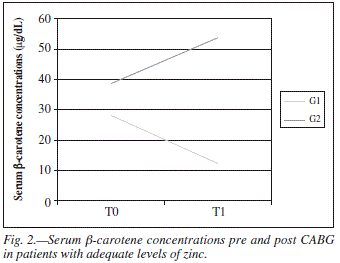
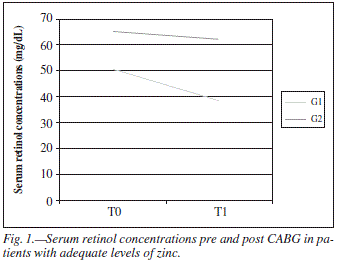
<body><![CDATA[<p><font face="Verdana" size="2">Average age was 65.06 &plusmn; 9.81 in G1 and 63.06 &plusmn; 9.3 in G2. It wasn't observed any significant difference between the groups according to the intra-operative profile: duration of surgery (p = 0.93), extracorporeal circulation (p = 0.41), clamp time (p = 0.29), and number of grafts (p = 0.91).</font></p>     <p><font face="Verdana" size="2">When assessing the Vitamin A serum level (retinol and -carotene), there was no significant difference between the groups at T0 among the individuals who presented adequate zinc concentrations (G1 = 50.4 &plusmn; 14.6 &mu;g/dL and G2 = 65.3 &plusmn; 15.7 &mu;g/dL; p = 0.051) to retinol and (G1 = 28.1 &plusmn; 8.98 ug/dL and G2 = 38.5 &plusmn; 13.1 &mu;g/dL; p = 0.051) to &beta;-carotene, as well as inadequate (G1 = 44.5 &plusmn; 17.3 &mu;g/dL and G2 = 52.1 &plusmn; 17.7 &mu;g/dL; p = 0.052) to retinol and (G1 = 25 &plusmn; 0,1 &mu;g/dL and G2 = 31.6 &plusmn; 6.7 &mu;g/dL; p = 0.06) to &beta;-carotene, respectively.</font></p>     <p><font face="Verdana" size="2">After surgery, was found a significant difference between G1 and G2 when comparing retinol (G1 = 38.7 &plusmn; 17.1 &mu;g/dL and G2 = 62.1 &plusmn; 20.3 &mu;g/dL; p &lt; 0.001) and &beta;-carotene (G1 = 12.3 &plusmn; 5.7 &mu;g/dL and G2 = 53.5 &plusmn; 20.9 &mu;g/dL; p &lt; 0.001) in the patients with adequate concentrations of zinc (figs. <a href="#f1">1</a> and <a href="#f2">2</a>).</font></p>     <p>&nbsp;</p>     <p align=center><a name="f1"><img src="/img/revistas/nh/v27n6/26_original_15_f1.gif"></a></p>     <p>&nbsp;</p>     <p align=center><a name="f2"><img src="/img/revistas/nh/v27n6/26_original_15_f2.gif"></a></p>     <p>&nbsp;</p>     <p><font face="Verdana" size="2">A strong and positive correlation was found between concentrations of serum retinol and &beta;-carotene following supplementation, in patients with adequate serum concentrations of zinc (r = 0.852 and p = 0.014).</font></p>     <p><font face="Verdana" size="2">After surgery, MDA concentrations were significantly higher at T1 in patients with inadequate serum levels of zinc (G1 = 3.5 &plusmn; 2.8 nmol/L and G2 = 2.6 &plusmn; 1.6 nmol/L) compared to those with adequate concentrations (G1 = 3.0 &plusmn; 1.5 nmol/L and G2 = 1.6 &plusmn; 1.1 nmol/L), in both groups, G1 and G2 (p &lt; 0.001 and p = 0.002), respectively (<a target="_blank" href="/img/revistas/nh/v27n6/26_original_15_f3.gif">fig. III</a>). At T0 there was not significance difference between this variables in G1 (p = 0.48) and G2 (p = 0.053).</font></p>     ]]></body>
<body><![CDATA[<p><font face="Verdana" size="2">In analyzing evolution clinical, operative mortality was found to be 8.33% in G1 and 3.33% in G2. We noted a significant difference in time hospitalized between the control and supplemented groups, in patients with adequate levels of zinc (p = 0.001), and in time in ICU, both in those with adequate and inadequate levels of zinc (p = 0.047; p = 0.039). Now as for time on breathing support, no significant difference was found between the groups according to zinc nutritional status (<a target="_blank" href="/img/revistas/nh/v27n6/26_original_15_t1.gif">table I</a>).</font></p>     <p>&nbsp;</p>     <p><font face="Verdana" size="2"><b>Discussion</b></font></p>     <p><font face="Verdana" size="2">Intense study into the involvement of oxidative stress in the etiology of cardiovascular diseases has been undertaken,<sup>19,20</sup> however, the effect of the deficiency of micronutrients with antioxidant properties, like vitamin A and zinc, is so far not well established for cardiac patients, especially those undergoing surgical treatment.</font></p>     <p><font face="Verdana" size="2">CABG is one of the surgical procedures performed most frequently around the world.<sup>21</sup> This procedure exposes patients to powerful oxidative stress<sup>5</sup> with a subsequent rise in demand for antioxidants; not to mention it having undesirable consequences for the patient,<sup>6</sup> like weakened immune response,<sup>7</sup> harmed production and performance of T- and natural killer cells,<sup>22</sup> and the onset of postoperative complications.<sup>6</sup></font></p>     <p><font face="Verdana" size="2">Morbimortality post myocardial revascularization surgery is of great interest, having given rise to several postoperative management protocols and risk models with the aim of curtailing cardiovascular complications.<sup>23</sup> In our research operative mortality was found to be 8.33% in the control group - a rate similar to that reported for Brazil (7.2%). In the supplemented group a death rate of 3.33% was found, which is quite a satisfactory result given how close it is to the mortality rate (2.9%) documented in developed nations.<sup>24,25</sup></font></p>     <p><font face="Verdana" size="2">The patients exhibiting adequate zinc levels who were given vitamin A supplementation saw a significant drop in concentrations of MDA compared to those deficient in zinc, suggesting that adequate vitamin A and zinc concentrations are indeed effective in combating oxidative stress. This finding may indicate a relationship between zinc and vitamin A nutritional status in the patients from the study. There is research showing that zinc deficiency can hinder retinol-binding protein (RBP) synthesis, resulting in secondary vitamin A deficiency.<sup>26</sup></font></p>     <p><font face="Verdana" size="2">By analyzing patients' clinical progression according to zinc nutritional status, we noticed a significantly shorter time in hospital among those from the supplemented group with adequate zinc levels (p = 0.001), with no significance found in the zinc-deficient patients. This finding suggests that vitamin A supplementation had no effect on zinc-deficient patients. Furthermore, significantly greater concentrations of vitamin A were found in the supplemented group, mainly among those with adequate levels of zinc, showing that the dosages proposed for keeping serum vitamin A concentrations were sufficient above all in the patients without hypozincemia. In a cross-sectional study performed by Wahed et al. (2008)<sup>27</sup> on children suffering pneumonia, a significant difference in time hospitalized (p &lt; 0.01) was found between the control group and the group supplemented with antioxidants, among them vitamin A and zinc. Mda et al. (2010)<sup>28</sup> described a significantly shorter hospital stay in HIV-infected children who were given supplements containing vitamin A and zinc compared to those given placebo (p &lt; 0.05).</font></p>     <p><font face="Verdana" size="2">As for time in the ICU, there was a significant difference between the groups both in patients with adequate zinc concentrations (p = 0.047) and inadequate zinc concentrations (p = 0.039) - that is, vitamin A supplementation was shown to have a positive effect regardless of zinc concentrations. These findings are similar to those of Heyland et al. (2008),<sup>29</sup> who found no significant association between zinc supplementation and the time patients in critical condition spent in the ICU (p = 0.17). Within this context, Robbins &amp; Fletcher (1993)<sup>30</sup> found a significant reduction in length of stay at a neonatal ICU in the group supplemented with 2,500 IU of vitamin A, however, the study did not take into account the zinc nutritional status of these patients.</font></p>     <p><font face="Verdana" size="2">As for time on breathing support, no significant difference was found between the groups according to zinc concentrations. Though no significance was found according to zinc nutritional status, we must stress that a drop in zinc concentrations may lead to a drop in retinol concentrations and consequently affect &beta;-carotene concentrations, seeing as we found a positive and significant correlation between retinol and &beta;-carotene, suggesting that the more retinol available the less &beta;-carotene is converted into retinol, preserving its important antioxidant function of battling free radicals in the patients studied. These finding corroborate those of Mecocci et al. (2000)<sup>31,</sup> who reported that vitamin A nutritional status lowers bioconversion of carotenoids into retinol, revealing a relationship between retinol and carotenoid nutritional status exists.</font></p>     ]]></body>
<body><![CDATA[<p><font face="Verdana" size="2">Vitamin's A role in the regeneration of pulmonary epithelium has been thoroughly emphasized<sup>32,</sup> as has its involvement in regulating the genes needed for pulmonary growth and increasing surfactant production in animal models.<sup>33</sup>. Supplementation of this vitamin may have been beneficial because of how the nutrient interferes with epithelial cell differentiation and integrity, and a deficiency of it is associated with the loss of ciliar cells and metaplasia in squamous cell lung tissue<sup>34.</sup> Robbins &amp; Fletcher (1993)<sup>30</sup> found a lesser tendency towards breathing support in the group supplemented with vitamin A. Chuwers et al. (1997)<sup>35</sup> suggests &beta;-carotene and retinol supplementation had a protective effect on ventilatory function in 816 patients.</font></p>     <p><font face="Verdana" size="2">Vitamin A supplementation may have improved the clinical progression of patients undergoing CABG especially in patients with adequate levels of zinc. Such findings are significant in that they bring us to reflect on the little-explored interaction between vitamin A and zinc in these patients, which may better equip clinical practice to deal with the powerful oxidative stress to which these patients are exposed.</font></p>     <p>&nbsp;</p>     <p><font face="Verdana" size="2"><b>References</b></font></p>     <!-- ref --><p><font face="Verdana" size="2">1. Riccioni G, Bucciarelli T, Mancini B, Ilio CD, Capra V, D'Orazio N. The role of the antioxidant vitamin supplementation in the prevention of cardiovascular diseases. <i>Expert Opinion Invest Drugs</i> 2007; 16 (Suppl. 1): 1-8.    &nbsp;&nbsp;&nbsp;&nbsp;&nbsp;&nbsp;&nbsp;&nbsp;[&#160;<a href="javascript:void(0);" onclick="javascript: window.open('/scielo.php?script=sci_nlinks&ref=3691773&pid=S0212-1611201200060002600001&lng=','','width=640,height=500,resizable=yes,scrollbars=1,menubar=yes,');">Links</a>&#160;]<!-- end-ref --></font></p>    <!-- ref --><p><font face="Verdana" size="2">2. World Health Organization (WHO). Cardiovascular diseases prevention and control. <a target="_blank" href="http://www.afro.who.int/en/divisionsaprogrammes/dnc/noncommunicablediseasesmanagementndm/programme-components/cardiovascular-diseases.html">http://www.afro.who.int/en/divisionsaprogrammes/dnc/noncommunicablediseasesmanagementndm/programme-components/cardiovascular-diseases.html</a>, accessed March 3, 2012.    &nbsp;&nbsp;&nbsp;&nbsp;&nbsp;&nbsp;&nbsp;&nbsp;[&#160;<a href="javascript:void(0);" onclick="javascript: window.open('/scielo.php?script=sci_nlinks&ref=3691775&pid=S0212-1611201200060002600002&lng=','','width=640,height=500,resizable=yes,scrollbars=1,menubar=yes,');">Links</a>&#160;]<!-- end-ref --></font></p>    <!-- ref --><p><font face="Verdana" size="2">3. Carvalho ARS, Matsuda LM, Carvalho MSS, Almeida R, Schneider D, Piccoli M. Estudo retrospectivo das complica&ccedil;&otilde;es intra-operatórias na cirurgia de evasculariza&ccedil;&atilde;o do miocardio. Rev Eletr Enf (Internet) 2008; 10 (4):1057-65. Available from: <a target="_blank" href="http://www.fen.ufg.br/revista/v10/n4/v10n4a18.html">http://www.fen.ufg.br/revista/v10/n4/v10n4a18.html</a>.    &nbsp;&nbsp;&nbsp;&nbsp;&nbsp;&nbsp;&nbsp;&nbsp;[&#160;<a href="javascript:void(0);" onclick="javascript: window.open('/scielo.php?script=sci_nlinks&ref=3691777&pid=S0212-1611201200060002600003&lng=','','width=640,height=500,resizable=yes,scrollbars=1,menubar=yes,');">Links</a>&#160;]<!-- end-ref --></font></p>    ]]></body>
<body><![CDATA[<!-- ref --><p><font face="Verdana" size="2">4. Iglézias JC, Oliveira Junior Jl, Fels KW, Dallan LA, Stolf N, Oliveira AS et al. Fatores prognósticos na revasculariza&ccedil;&atilde;o do miocardio em pacientes idosos. <i>Rev Bras Cir Cardiovasc</i> 1997; 12 (Suppl. 4) São Paulo Oct./Dec.    &nbsp;&nbsp;&nbsp;&nbsp;&nbsp;&nbsp;&nbsp;&nbsp;[&#160;<a href="javascript:void(0);" onclick="javascript: window.open('/scielo.php?script=sci_nlinks&ref=3691779&pid=S0212-1611201200060002600004&lng=','','width=640,height=500,resizable=yes,scrollbars=1,menubar=yes,');">Links</a>&#160;]<!-- end-ref --></font></p>    <!-- ref --><p><font face="Verdana" size="2">5. Chambers DJ. Oxidative stress injury during cardiac surgery: how important is it? <i>Cardiovasc Res</i> 2007; 73 (Suppl. 4): 626-628.    &nbsp;&nbsp;&nbsp;&nbsp;&nbsp;&nbsp;&nbsp;&nbsp;[&#160;<a href="javascript:void(0);" onclick="javascript: window.open('/scielo.php?script=sci_nlinks&ref=3691781&pid=S0212-1611201200060002600005&lng=','','width=640,height=500,resizable=yes,scrollbars=1,menubar=yes,');">Links</a>&#160;]<!-- end-ref --></font></p>    <!-- ref --><p><font face="Verdana" size="2">6. Caparrós AC, Cabrera AMM, Mercadé EO, Vergara IN. Comparative Analysis of Antioxidant Defense During On-Pump and Off-Pump Cardiac Surgery. <i>Rev Esp Cardiol</i> 2005; 58: 822-829.    &nbsp;&nbsp;&nbsp;&nbsp;&nbsp;&nbsp;&nbsp;&nbsp;[&#160;<a href="javascript:void(0);" onclick="javascript: window.open('/scielo.php?script=sci_nlinks&ref=3691783&pid=S0212-1611201200060002600006&lng=','','width=640,height=500,resizable=yes,scrollbars=1,menubar=yes,');">Links</a>&#160;]<!-- end-ref --></font></p>    <!-- ref --><p><font face="Verdana" size="2">7. Lee CJ, Wan M. Vitamin E supplementation improves cellmediated immunity and oxidative stress of asian men and women. <i>J Nutr</i> 2000; 130: 2932-2937.    &nbsp;&nbsp;&nbsp;&nbsp;&nbsp;&nbsp;&nbsp;&nbsp;[&#160;<a href="javascript:void(0);" onclick="javascript: window.open('/scielo.php?script=sci_nlinks&ref=3691785&pid=S0212-1611201200060002600007&lng=','','width=640,height=500,resizable=yes,scrollbars=1,menubar=yes,');">Links</a>&#160;]<!-- end-ref --></font></p>    <!-- ref --><p><font face="Verdana" size="2">8. Junior DRA, Souza RB. Os radicáis livres de oxig&ecirc;nio e as doenças pulmonares. <i>J Bras Pneumol</i> 2005; 31 (Suppl.1): 60-68.    &nbsp;&nbsp;&nbsp;&nbsp;&nbsp;&nbsp;&nbsp;&nbsp;[&#160;<a href="javascript:void(0);" onclick="javascript: window.open('/scielo.php?script=sci_nlinks&ref=3691787&pid=S0212-1611201200060002600008&lng=','','width=640,height=500,resizable=yes,scrollbars=1,menubar=yes,');">Links</a>&#160;]<!-- end-ref --></font></p>    ]]></body>
<body><![CDATA[<!-- ref --><p><font face="Verdana" size="2">9. Ramalho RA, Accioly E, Silva LM. Doenças Cardiovasculares: Efeito Antioxidante das Vitaminas A, C e E. <i>Rev Metabol Nutr</i> 2003; 17 (Suppl. 1): 6-9.    &nbsp;&nbsp;&nbsp;&nbsp;&nbsp;&nbsp;&nbsp;&nbsp;[&#160;<a href="javascript:void(0);" onclick="javascript: window.open('/scielo.php?script=sci_nlinks&ref=3691789&pid=S0212-1611201200060002600009&lng=','','width=640,height=500,resizable=yes,scrollbars=1,menubar=yes,');">Links</a>&#160;]<!-- end-ref --></font></p>    <!-- ref --><p><font face="Verdana" size="2">10. Wintergerst ES, Maggini S, Hornig D. Contribution of selected vitamins and trace elements to immune function. <i>Ann Nutr Metab</i> 2007; 51: 301-323.    &nbsp;&nbsp;&nbsp;&nbsp;&nbsp;&nbsp;&nbsp;&nbsp;[&#160;<a href="javascript:void(0);" onclick="javascript: window.open('/scielo.php?script=sci_nlinks&ref=3691791&pid=S0212-1611201200060002600010&lng=','','width=640,height=500,resizable=yes,scrollbars=1,menubar=yes,');">Links</a>&#160;]<!-- end-ref --></font></p>    <!-- ref --><p><font face="Verdana" size="2">11. Buijsse B, Feskens EJ, Schlettwein-Gsell D. Plasma carotene and alpha-tocopherol in relation to 10-y all-cause and cause-specific mortality in European elderly: the Survey in Europe on Nutrition and the Elderly, a Concerted Action (SENECA). <i>Am J Clin Nutr</i> 2005; 82: 879-886.    &nbsp;&nbsp;&nbsp;&nbsp;&nbsp;&nbsp;&nbsp;&nbsp;[&#160;<a href="javascript:void(0);" onclick="javascript: window.open('/scielo.php?script=sci_nlinks&ref=3691793&pid=S0212-1611201200060002600011&lng=','','width=640,height=500,resizable=yes,scrollbars=1,menubar=yes,');">Links</a>&#160;]<!-- end-ref --></font></p>    <!-- ref --><p><font face="Verdana" size="2">12. World Health Organization (WHO) - Who Discussion Papers On Adolescence - Issues in Adolescent Health and development - World Health Organization 2004.    &nbsp;&nbsp;&nbsp;&nbsp;&nbsp;&nbsp;&nbsp;&nbsp;[&#160;<a href="javascript:void(0);" onclick="javascript: window.open('/scielo.php?script=sci_nlinks&ref=3691795&pid=S0212-1611201200060002600012&lng=','','width=640,height=500,resizable=yes,scrollbars=1,menubar=yes,');">Links</a>&#160;]<!-- end-ref --></font></p>    <!-- ref --><p><font face="Verdana" size="2">13. CLAE-UV. The Unites States Pharmacopeia (Usp 28). The National Formulary (Nf 23) (2004). The United States Pharmacopeia Convention Inc. 12601Twinbrook Parkway, Rockville, MD 20852, pp.2353-2354.    &nbsp;&nbsp;&nbsp;&nbsp;&nbsp;&nbsp;&nbsp;&nbsp;[&#160;<a href="javascript:void(0);" onclick="javascript: window.open('/scielo.php?script=sci_nlinks&ref=3691797&pid=S0212-1611201200060002600013&lng=','','width=640,height=500,resizable=yes,scrollbars=1,menubar=yes,');">Links</a>&#160;]<!-- end-ref --></font></p>    ]]></body>
<body><![CDATA[<!-- ref --><p><font face="Verdana" size="2">14. World Health Organization (WHO). Indicators for assessing vitamin A deficiency and their application in monitoring and evaluating intervention programmes. Micronutrient Series, WHO/NUT. 10. World Health Organization, Geneva, Switzerland, 1996.    &nbsp;&nbsp;&nbsp;&nbsp;&nbsp;&nbsp;&nbsp;&nbsp;[&#160;<a href="javascript:void(0);" onclick="javascript: window.open('/scielo.php?script=sci_nlinks&ref=3691799&pid=S0212-1611201200060002600014&lng=','','width=640,height=500,resizable=yes,scrollbars=1,menubar=yes,');">Links</a>&#160;]<!-- end-ref --></font></p>    <!-- ref --><p><font face="Verdana" size="2">15. Sauberlich HE, Hodges RE, Wallace DL, Kolder H, Canham JE, Hood J, et al. Vitamin A metabolism and requirements in the human studied with the use of labeled retinol. <i>Vitam Horm</i> 1974; 32: 251-75.    &nbsp;&nbsp;&nbsp;&nbsp;&nbsp;&nbsp;&nbsp;&nbsp;[&#160;<a href="javascript:void(0);" onclick="javascript: window.open('/scielo.php?script=sci_nlinks&ref=3691801&pid=S0212-1611201200060002600015&lng=','','width=640,height=500,resizable=yes,scrollbars=1,menubar=yes,');">Links</a>&#160;]<!-- end-ref --></font></p>    <!-- ref --><p><font face="Verdana" size="2">16. Hotz C, Peerson JM, Brown KH. Suggested lower cutoffs of serum zinc concentrations for assessing zinc status: reanalysis of the second National Health and Nutrition Examination Survey data (1976-1980). <i>A J Clin Nutri</i> 2003; 78: 756-64.    &nbsp;&nbsp;&nbsp;&nbsp;&nbsp;&nbsp;&nbsp;&nbsp;[&#160;<a href="javascript:void(0);" onclick="javascript: window.open('/scielo.php?script=sci_nlinks&ref=3691803&pid=S0212-1611201200060002600016&lng=','','width=640,height=500,resizable=yes,scrollbars=1,menubar=yes,');">Links</a>&#160;]<!-- end-ref --></font></p>    <!-- ref --><p><font face="Verdana" size="2">17. Ohkawa H, Oshishi N, Yagi K. Assay for lipid peroxides in animal tissues by thiobarbituric acid reaction. <i>Anal Biochem</i> 1979; 95: 351-358.    &nbsp;&nbsp;&nbsp;&nbsp;&nbsp;&nbsp;&nbsp;&nbsp;[&#160;<a href="javascript:void(0);" onclick="javascript: window.open('/scielo.php?script=sci_nlinks&ref=3691805&pid=S0212-1611201200060002600017&lng=','','width=640,height=500,resizable=yes,scrollbars=1,menubar=yes,');">Links</a>&#160;]<!-- end-ref --></font></p>    <!-- ref --><p><font face="Verdana" size="2">18. Karatas F, Karatepe M, Baysar A. Determination of free malondialdehyde in human serum by high-performance liquid chromatography. <i>Anal Biochem</i> 2002; 311: 76-79.    &nbsp;&nbsp;&nbsp;&nbsp;&nbsp;&nbsp;&nbsp;&nbsp;[&#160;<a href="javascript:void(0);" onclick="javascript: window.open('/scielo.php?script=sci_nlinks&ref=3691807&pid=S0212-1611201200060002600018&lng=','','width=640,height=500,resizable=yes,scrollbars=1,menubar=yes,');">Links</a>&#160;]<!-- end-ref --></font></p>    ]]></body>
<body><![CDATA[<!-- ref --><p><font face="Verdana" size="2">19. Jaikirshan J, Khatri CJ, Magid R, Lessner M, Laude KM, Dikalov SI, et al. Vascular oxidant stress enhances progression and angiogenesis of experimental atheroma. <i>Circulation</i> 2004; 109: 520-525.    &nbsp;&nbsp;&nbsp;&nbsp;&nbsp;&nbsp;&nbsp;&nbsp;[&#160;<a href="javascript:void(0);" onclick="javascript: window.open('/scielo.php?script=sci_nlinks&ref=3691809&pid=S0212-1611201200060002600019&lng=','','width=640,height=500,resizable=yes,scrollbars=1,menubar=yes,');">Links</a>&#160;]<!-- end-ref --></font></p>    <!-- ref --><p><font face="Verdana" size="2">20. Giordano FJ. Oxygen, oxidative stress, hypoxia, and heart failure. <i>J Clin Invest</i> 2005; 115(Suppl. 3): 500-508.    &nbsp;&nbsp;&nbsp;&nbsp;&nbsp;&nbsp;&nbsp;&nbsp;[&#160;<a href="javascript:void(0);" onclick="javascript: window.open('/scielo.php?script=sci_nlinks&ref=3691811&pid=S0212-1611201200060002600020&lng=','','width=640,height=500,resizable=yes,scrollbars=1,menubar=yes,');">Links</a>&#160;]<!-- end-ref --></font></p>    <!-- ref --><p><font face="Verdana" size="2">21. Eagle KA, Guyton RA, Davidoff R, Edwards FH, Ewy GA, Gardner TJ, et al. Guideline update for coronary artery bypass graft surgery: a report of the American College of Cardiol ogy/American Heart Association Task Force on Practice Guidelines. <i>Circulation</i> 2004; 110 (Suppl. 14):340-437.    &nbsp;&nbsp;&nbsp;&nbsp;&nbsp;&nbsp;&nbsp;&nbsp;[&#160;<a href="javascript:void(0);" onclick="javascript: window.open('/scielo.php?script=sci_nlinks&ref=3691813&pid=S0212-1611201200060002600021&lng=','','width=640,height=500,resizable=yes,scrollbars=1,menubar=yes,');">Links</a>&#160;]<!-- end-ref --></font></p>    <!-- ref --><p><font face="Verdana" size="2">22. Malmberg KJ, Lenkei R, Petersson M, Ohlum T, Ichihara F, Glimelius B, et al. A short-term dietary supplementation of high doses of vitamin E increases T helper 1 cytokine production in patients with advanced colorectal cancer. <i>Clin Cancer Res</i> 2002; 8 (Suppl. 6): 1772-1778.    &nbsp;&nbsp;&nbsp;&nbsp;&nbsp;&nbsp;&nbsp;&nbsp;[&#160;<a href="javascript:void(0);" onclick="javascript: window.open('/scielo.php?script=sci_nlinks&ref=3691815&pid=S0212-1611201200060002600022&lng=','','width=640,height=500,resizable=yes,scrollbars=1,menubar=yes,');">Links</a>&#160;]<!-- end-ref --></font></p>    <!-- ref --><p><font face="Verdana" size="2">23. Azzolin KO, Castro I, Feier F, Pandolfo F, Oderich, C. Valor prognóstico do índice de performance miocárdica no pós-operatório de cirurgia de revasculariza&ccedil;&atilde;o miocàrdica. <i>Arq Bras Cardiol</i> 2006; 87 (Suppl. 4): 456-461.    &nbsp;&nbsp;&nbsp;&nbsp;&nbsp;&nbsp;&nbsp;&nbsp;[&#160;<a href="javascript:void(0);" onclick="javascript: window.open('/scielo.php?script=sci_nlinks&ref=3691817&pid=S0212-1611201200060002600023&lng=','','width=640,height=500,resizable=yes,scrollbars=1,menubar=yes,');">Links</a>&#160;]<!-- end-ref --></font></p>    ]]></body>
<body><![CDATA[<!-- ref --><p><font face="Verdana" size="2">24. Campagnucci VP, Silva AMRP, Pereira WL, Chamlian EG, Gandra SMA, Rivetti LA. EuroSCORE e os pacientes submetidos a revasculariza&ccedil;&atilde;o do miocárdio na Santa Casa de S&atilde;o Paulo. <i>Rev Bras Cir Cardiovasc</i> 2008; 12: 262-267.    &nbsp;&nbsp;&nbsp;&nbsp;&nbsp;&nbsp;&nbsp;&nbsp;[&#160;<a href="javascript:void(0);" onclick="javascript: window.open('/scielo.php?script=sci_nlinks&ref=3691819&pid=S0212-1611201200060002600024&lng=','','width=640,height=500,resizable=yes,scrollbars=1,menubar=yes,');">Links</a>&#160;]<!-- end-ref --></font></p>    <!-- ref --><p><font face="Verdana" size="2">25. Guaragna LP, Dall'Alba DP, Goulart PR, Guaragna JCVG, Bodanese LC, Magedanz EH, et al. O impacto da obesidade na morbimortalidade de pacientes submetidos à cirurgia de revasculariza&ccedil;&atilde;o miocàrdica. <i>Sci Med</i> 2008; 18 (Suppl. 2): 75-80.    &nbsp;&nbsp;&nbsp;&nbsp;&nbsp;&nbsp;&nbsp;&nbsp;[&#160;<a href="javascript:void(0);" onclick="javascript: window.open('/scielo.php?script=sci_nlinks&ref=3691821&pid=S0212-1611201200060002600025&lng=','','width=640,height=500,resizable=yes,scrollbars=1,menubar=yes,');">Links</a>&#160;]<!-- end-ref --></font></p>    <!-- ref --><p><font face="Verdana" size="2">26. Ramalho A, Saunders C, Souza G, Thiapó AP, Silva L. Micronutrientes na Gesta&ccedil;&atilde;o e Lacta&ccedil;&atilde;o. <i>Rev Bras Saude Mater Infant</i> 2007; 7 (Suppl. 3) Recife jul./set.    &nbsp;&nbsp;&nbsp;&nbsp;&nbsp;&nbsp;&nbsp;&nbsp;[&#160;<a href="javascript:void(0);" onclick="javascript: window.open('/scielo.php?script=sci_nlinks&ref=3691823&pid=S0212-1611201200060002600026&lng=','','width=640,height=500,resizable=yes,scrollbars=1,menubar=yes,');">Links</a>&#160;]<!-- end-ref --></font></p>    <!-- ref --><p><font face="Verdana" size="2">27. Wahed MA, Islam MA, Khondakar P, Haque MA. Effect of micronutrients on morbidity and duration of hospital stay in childhood pneumonia. <i>JPEN J Parenter Enteral Nutr</i> 2008; 32 (Suppl.5): 509-519. Epub 2008 Jul 31.    &nbsp;&nbsp;&nbsp;&nbsp;&nbsp;&nbsp;&nbsp;&nbsp;[&#160;<a href="javascript:void(0);" onclick="javascript: window.open('/scielo.php?script=sci_nlinks&ref=3691825&pid=S0212-1611201200060002600027&lng=','','width=640,height=500,resizable=yes,scrollbars=1,menubar=yes,');">Links</a>&#160;]<!-- end-ref --></font></p>    <!-- ref --><p><font face="Verdana" size="2">28. Mda S, van Raaij JM, de Villiers FP, MacIntyre UE, Kok FJ. Short-term micronutrient supplementation reduces the duration of pneumonia and diarrheal episodes in HIV-infected children. <i>J Nutri</i> 2010; 140 (Suppl. 5): 969-974. Epub 2010 Mar 24.    &nbsp;&nbsp;&nbsp;&nbsp;&nbsp;&nbsp;&nbsp;&nbsp;[&#160;<a href="javascript:void(0);" onclick="javascript: window.open('/scielo.php?script=sci_nlinks&ref=3691827&pid=S0212-1611201200060002600028&lng=','','width=640,height=500,resizable=yes,scrollbars=1,menubar=yes,');">Links</a>&#160;]<!-- end-ref --></font></p>    ]]></body>
<body><![CDATA[<!-- ref --><p><font face="Verdana" size="2">29. Heyland DK, Jones N, Cvijanovich NZ, Wong H. Zinc supplementation in critically ill patients: a key pharmaconutrient? <i>JPEN J Parenter Enteral Nutr</i> 2008; 32 (Suppl. 5): 582-4.    &nbsp;&nbsp;&nbsp;&nbsp;&nbsp;&nbsp;&nbsp;&nbsp;[&#160;<a href="javascript:void(0);" onclick="javascript: window.open('/scielo.php?script=sci_nlinks&ref=3691829&pid=S0212-1611201200060002600029&lng=','','width=640,height=500,resizable=yes,scrollbars=1,menubar=yes,');">Links</a>&#160;]<!-- end-ref --></font></p>    <!-- ref --><p><font face="Verdana" size="2">30. Robbins ST, Fletcher AB. Early vs delayed vitamin A supplementation in very-low-birth-weight infants. <i>JPEN J Parenter Enteral</i> Nutr.1993; 17 (Suppl. 3): 220-225.    &nbsp;&nbsp;&nbsp;&nbsp;&nbsp;&nbsp;&nbsp;&nbsp;[&#160;<a href="javascript:void(0);" onclick="javascript: window.open('/scielo.php?script=sci_nlinks&ref=3691831&pid=S0212-1611201200060002600030&lng=','','width=640,height=500,resizable=yes,scrollbars=1,menubar=yes,');">Links</a>&#160;]<!-- end-ref --></font></p>    <!-- ref --><p><font face="Verdana" size="2">31. Mecocci P, Polidori C, Troiano L, Cherubini A, Cecchetti R. Plasma antioxidants and longevity: a study of health centenarians. <i>Free Radical Biol Med</i> 2000; 28 (Suppl. 8): 1243-1248.    &nbsp;&nbsp;&nbsp;&nbsp;&nbsp;&nbsp;&nbsp;&nbsp;[&#160;<a href="javascript:void(0);" onclick="javascript: window.open('/scielo.php?script=sci_nlinks&ref=3691833&pid=S0212-1611201200060002600031&lng=','','width=640,height=500,resizable=yes,scrollbars=1,menubar=yes,');">Links</a>&#160;]<!-- end-ref --></font></p>    <!-- ref --><p><font face="Verdana" size="2">32. Váquez, Jairo Miguel G. (2000) Oxidantes y Antioxidantes en Niños. <a target="_blank" href="http://www.encolombia.com/medicina/neumologia/neumo12400com-oxidantes.htm">http://www.encolombia.com/medicina/neumologia/neumo12400com-oxidantes.htm</a>.    &nbsp;&nbsp;&nbsp;&nbsp;&nbsp;&nbsp;&nbsp;&nbsp;[&#160;<a href="javascript:void(0);" onclick="javascript: window.open('/scielo.php?script=sci_nlinks&ref=3691835&pid=S0212-1611201200060002600032&lng=','','width=640,height=500,resizable=yes,scrollbars=1,menubar=yes,');">Links</a>&#160;]<!-- end-ref --></font></p>    <!-- ref --><p><font face="Verdana" size="2">33. Albertine KH, Dahl MJ, Gonzales LW, Wang ZM, Metcalfe D, Hyde DM, Plopper CG, Starcher BC, Carlton DP, Bland RD. Chronic lung disease in preterm lambs: effect of daily vitamin A treatment on alveolarization. <i>Am J Physiol Lung Cell Mol Physiol</i> 2010; 299 (Suppl. 1): L59-72. Epub 2010 Apr 9.    &nbsp;&nbsp;&nbsp;&nbsp;&nbsp;&nbsp;&nbsp;&nbsp;[&#160;<a href="javascript:void(0);" onclick="javascript: window.open('/scielo.php?script=sci_nlinks&ref=3691837&pid=S0212-1611201200060002600033&lng=','','width=640,height=500,resizable=yes,scrollbars=1,menubar=yes,');">Links</a>&#160;]<!-- end-ref --></font></p>    ]]></body>
<body><![CDATA[<!-- ref --><p><font face="Verdana" size="2">34. Leone Cléa R. Displasia Broncopulmonar. In: Kopelman, Benjamin e Milton Miyoshi, et al. Disturbios Respiratórios no Periodo Neonatal. 1.<sup>a</sup> ed. S&atilde;o Paulo: Atheneu, 1998.    &nbsp;&nbsp;&nbsp;&nbsp;&nbsp;&nbsp;&nbsp;&nbsp;[&#160;<a href="javascript:void(0);" onclick="javascript: window.open('/scielo.php?script=sci_nlinks&ref=3691839&pid=S0212-1611201200060002600034&lng=','','width=640,height=500,resizable=yes,scrollbars=1,menubar=yes,');">Links</a>&#160;]<!-- end-ref --></font></p>    <!-- ref --><p><font face="Verdana" size="2">35. Chuwers P, Barnhart S, Blanc P, Brodkin CA, Cullen M, Kelly T, Keogh J, Omenn G, Williams J, Balmes JR. The protective effect of beta-carotene and retinol on ventilatory function in an asbestos-exposed cohort. <i>Am J Respir Crit Care Med</i> 1997; 155 (Suppl. 3): 1066-1071.    &nbsp;&nbsp;&nbsp;&nbsp;&nbsp;&nbsp;&nbsp;&nbsp;[&#160;<a href="javascript:void(0);" onclick="javascript: window.open('/scielo.php?script=sci_nlinks&ref=3691841&pid=S0212-1611201200060002600035&lng=','','width=640,height=500,resizable=yes,scrollbars=1,menubar=yes,');">Links</a>&#160;]<!-- end-ref --></font></p>     <p>&nbsp;</p>     <p>&nbsp;</p>     <p><font face="Verdana" size="2"><a href="#top"><img border="0" src="/img/revistas/nh/v27n6/seta.gif" width="15" height="17"></a><a name="bajo"></a><b>Correspondence:</b>    <br>Andrea Cardoso de Matos    <br>Department of Social and Applied Nutrition    <br>Institute of Nutrition. Center for Health Sciences    ]]></body>
<body><![CDATA[<br>Center for Research on Micronutrients    <br>Federal University of Rio de Janeiro    <br>Av. Brigadeiro Trompovwsky, s/n. 2<sup>o</sup> andar, Bloco J, Ilha do Fund&atilde;o    <br>CEP: 21941-590 Rio de Janeiro - RJ - Brazil    <br>E-mail: <a href="mailto:andrea.bob@gmail.com">andrea.bob@gmail.com</a></font></p>     <p><font face="Verdana" size="2">Recibido: 7-IV-2012    <br>Aceptado: 7-VIII-2012</font></p>      ]]></body><back>
<ref-list>
<ref id="B1">
<label>1</label><nlm-citation citation-type="journal">
<person-group person-group-type="author">
<name>
<surname><![CDATA[Riccioni]]></surname>
<given-names><![CDATA[G]]></given-names>
</name>
<name>
<surname><![CDATA[Bucciarelli]]></surname>
<given-names><![CDATA[T]]></given-names>
</name>
<name>
<surname><![CDATA[Mancini]]></surname>
<given-names><![CDATA[B]]></given-names>
</name>
<name>
<surname><![CDATA[Ilio]]></surname>
<given-names><![CDATA[CD]]></given-names>
</name>
<name>
<surname><![CDATA[Capra]]></surname>
<given-names><![CDATA[V]]></given-names>
</name>
<name>
<surname><![CDATA[D'Orazio]]></surname>
<given-names><![CDATA[N]]></given-names>
</name>
</person-group>
<article-title xml:lang="en"><![CDATA[The role of the antioxidant vitamin supplementation in the prevention of cardiovascular diseases]]></article-title>
<source><![CDATA[Expert Opinion Invest Drugs]]></source>
<year>2007</year>
<volume>16</volume>
<numero>^s1</numero>
<issue>^s1</issue>
<supplement>1</supplement>
<page-range>1-8</page-range></nlm-citation>
</ref>
<ref id="B2">
<label>2</label><nlm-citation citation-type="">
<collab>World Health Organization (WHO)</collab>
<source><![CDATA[Cardiovascular diseases prevention and control]]></source>
<year></year>
</nlm-citation>
</ref>
<ref id="B3">
<label>3</label><nlm-citation citation-type="journal">
<person-group person-group-type="author">
<name>
<surname><![CDATA[Carvalho]]></surname>
<given-names><![CDATA[ARS]]></given-names>
</name>
<name>
<surname><![CDATA[Matsuda]]></surname>
<given-names><![CDATA[LM]]></given-names>
</name>
<name>
<surname><![CDATA[Carvalho]]></surname>
<given-names><![CDATA[MSS]]></given-names>
</name>
<name>
<surname><![CDATA[Almeida]]></surname>
<given-names><![CDATA[R]]></given-names>
</name>
<name>
<surname><![CDATA[Schneider]]></surname>
<given-names><![CDATA[D]]></given-names>
</name>
<name>
<surname><![CDATA[Piccoli]]></surname>
<given-names><![CDATA[M]]></given-names>
</name>
</person-group>
<article-title xml:lang="pt"><![CDATA[Estudo retrospectivo das complicações intra-operatórias na cirurgia de evascularização do miocardio]]></article-title>
<source><![CDATA[Rev Eletr Enf (Internet)]]></source>
<year>2008</year>
<volume>10</volume>
<numero>4</numero>
<issue>4</issue>
<page-range>1057-65</page-range></nlm-citation>
</ref>
<ref id="B4">
<label>4</label><nlm-citation citation-type="journal">
<person-group person-group-type="author">
<name>
<surname><![CDATA[Iglézias]]></surname>
<given-names><![CDATA[JC]]></given-names>
</name>
<name>
<surname><![CDATA[Oliveira Junior]]></surname>
<given-names><![CDATA[Jl]]></given-names>
</name>
<name>
<surname><![CDATA[Fels]]></surname>
<given-names><![CDATA[KW]]></given-names>
</name>
<name>
<surname><![CDATA[Dallan]]></surname>
<given-names><![CDATA[LA]]></given-names>
</name>
<name>
<surname><![CDATA[Stolf]]></surname>
<given-names><![CDATA[N]]></given-names>
</name>
<name>
<surname><![CDATA[Oliveira]]></surname>
<given-names><![CDATA[AS]]></given-names>
</name>
</person-group>
<article-title xml:lang="pt"><![CDATA[Fatores prognósticos na revascularização do miocardio em pacientes idosos]]></article-title>
<source><![CDATA[Rev Bras Cir Cardiovasc]]></source>
<year>1997</year>
<volume>12</volume>
<numero>^s4</numero>
<issue>^s4</issue>
<supplement>4</supplement>
<publisher-loc><![CDATA[São Paulo ]]></publisher-loc>
</nlm-citation>
</ref>
<ref id="B5">
<label>5</label><nlm-citation citation-type="journal">
<person-group person-group-type="author">
<name>
<surname><![CDATA[Chambers]]></surname>
<given-names><![CDATA[DJ]]></given-names>
</name>
</person-group>
<article-title xml:lang="en"><![CDATA[Oxidative stress injury during cardiac surgery: how important is it?]]></article-title>
<source><![CDATA[Cardiovasc Res]]></source>
<year>2007</year>
<volume>73</volume>
<numero>^s4</numero>
<issue>^s4</issue>
<supplement>4</supplement>
<page-range>626-628</page-range></nlm-citation>
</ref>
<ref id="B6">
<label>6</label><nlm-citation citation-type="journal">
<person-group person-group-type="author">
<name>
<surname><![CDATA[Caparrós]]></surname>
<given-names><![CDATA[AC]]></given-names>
</name>
<name>
<surname><![CDATA[Cabrera]]></surname>
<given-names><![CDATA[AMM]]></given-names>
</name>
<name>
<surname><![CDATA[Mercadé]]></surname>
<given-names><![CDATA[EO]]></given-names>
</name>
<name>
<surname><![CDATA[Vergara]]></surname>
<given-names><![CDATA[IN]]></given-names>
</name>
</person-group>
<article-title xml:lang="en"><![CDATA[Comparative Analysis of Antioxidant Defense During On-Pump and Off-Pump Cardiac Surgery]]></article-title>
<source><![CDATA[Rev Esp Cardiol]]></source>
<year>2005</year>
<volume>58</volume>
<page-range>822-829</page-range></nlm-citation>
</ref>
<ref id="B7">
<label>7</label><nlm-citation citation-type="journal">
<person-group person-group-type="author">
<name>
<surname><![CDATA[Lee]]></surname>
<given-names><![CDATA[CJ]]></given-names>
</name>
<name>
<surname><![CDATA[Wan]]></surname>
<given-names><![CDATA[M]]></given-names>
</name>
</person-group>
<article-title xml:lang="en"><![CDATA[Vitamin E supplementation improves cellmediated immunity and oxidative stress of asian men and women]]></article-title>
<source><![CDATA[J Nutr]]></source>
<year>2000</year>
<volume>130</volume>
<page-range>2932-2937</page-range></nlm-citation>
</ref>
<ref id="B8">
<label>8</label><nlm-citation citation-type="journal">
<person-group person-group-type="author">
<name>
<surname><![CDATA[Junior]]></surname>
<given-names><![CDATA[DRA]]></given-names>
</name>
<name>
<surname><![CDATA[Souza]]></surname>
<given-names><![CDATA[RB]]></given-names>
</name>
</person-group>
<article-title xml:lang="pt"><![CDATA[Os radicáis livres de oxigênio e as doenças pulmonares]]></article-title>
<source><![CDATA[J Bras Pneumol]]></source>
<year>2005</year>
<volume>31</volume>
<numero>^s1</numero>
<issue>^s1</issue>
<supplement>1</supplement>
<page-range>60-68</page-range></nlm-citation>
</ref>
<ref id="B9">
<label>9</label><nlm-citation citation-type="journal">
<person-group person-group-type="author">
<name>
<surname><![CDATA[Ramalho]]></surname>
<given-names><![CDATA[RA]]></given-names>
</name>
<name>
<surname><![CDATA[Accioly]]></surname>
<given-names><![CDATA[E]]></given-names>
</name>
<name>
<surname><![CDATA[Silva]]></surname>
<given-names><![CDATA[LM]]></given-names>
</name>
</person-group>
<article-title xml:lang="pt"><![CDATA[Doenças Cardiovasculares: Efeito Antioxidante das Vitaminas A, C e E]]></article-title>
<source><![CDATA[Rev Metabol Nutr]]></source>
<year>2003</year>
<volume>17</volume>
<numero>^s1</numero>
<issue>^s1</issue>
<supplement>1</supplement>
<page-range>6-9</page-range></nlm-citation>
</ref>
<ref id="B10">
<label>10</label><nlm-citation citation-type="journal">
<person-group person-group-type="author">
<name>
<surname><![CDATA[Wintergerst]]></surname>
<given-names><![CDATA[ES]]></given-names>
</name>
<name>
<surname><![CDATA[Maggini]]></surname>
<given-names><![CDATA[S]]></given-names>
</name>
<name>
<surname><![CDATA[Hornig]]></surname>
<given-names><![CDATA[D]]></given-names>
</name>
</person-group>
<article-title xml:lang="en"><![CDATA[Contribution of selected vitamins and trace elements to immune function]]></article-title>
<source><![CDATA[Ann Nutr Metab]]></source>
<year>2007</year>
<volume>51</volume>
<page-range>301-323</page-range></nlm-citation>
</ref>
<ref id="B11">
<label>11</label><nlm-citation citation-type="journal">
<person-group person-group-type="author">
<name>
<surname><![CDATA[Buijsse]]></surname>
<given-names><![CDATA[B]]></given-names>
</name>
<name>
<surname><![CDATA[Feskens]]></surname>
<given-names><![CDATA[EJ]]></given-names>
</name>
<name>
<surname><![CDATA[Schlettwein-Gsell]]></surname>
<given-names><![CDATA[D]]></given-names>
</name>
</person-group>
<article-title xml:lang="en"><![CDATA[Plasma carotene and alpha-tocopherol in relation to 10-y all-cause and cause-specific mortality in European elderly: the Survey in Europe on Nutrition and the Elderly, a Concerted Action (SENECA)]]></article-title>
<source><![CDATA[Am J Clin Nutr]]></source>
<year>2005</year>
<volume>82</volume>
<page-range>879-886</page-range></nlm-citation>
</ref>
<ref id="B12">
<label>12</label><nlm-citation citation-type="book">
<collab>World Health Organization (WHO)</collab>
<source><![CDATA[Issues in Adolescent Health and development]]></source>
<year>2004</year>
<publisher-name><![CDATA[World Health Organization]]></publisher-name>
</nlm-citation>
</ref>
<ref id="B13">
<label>13</label><nlm-citation citation-type="confpro">
<article-title xml:lang="en"><![CDATA[CLAE-UV: The Unites States Pharmacopeia (Usp 28). The National Formulary (Nf 23)]]></article-title>
<source><![CDATA[]]></source>
<year>2004</year>
<conf-name><![CDATA[ The United States Pharmacopeia Convention]]></conf-name>
<conf-loc>Rockville MD</conf-loc>
<page-range>2353-2354</page-range></nlm-citation>
</ref>
<ref id="B14">
<label>14</label><nlm-citation citation-type="book">
<collab>World Health Organization (WHO)</collab>
<source><![CDATA[Indicators for assessing vitamin A deficiency and their application in monitoring and evaluating intervention programmes]]></source>
<year>1996</year>
<volume>10</volume>
<publisher-loc><![CDATA[Geneva ]]></publisher-loc>
<publisher-name><![CDATA[World Health Organization]]></publisher-name>
</nlm-citation>
</ref>
<ref id="B15">
<label>15</label><nlm-citation citation-type="journal">
<person-group person-group-type="author">
<name>
<surname><![CDATA[Sauberlich]]></surname>
<given-names><![CDATA[HE]]></given-names>
</name>
<name>
<surname><![CDATA[Hodges]]></surname>
<given-names><![CDATA[RE]]></given-names>
</name>
<name>
<surname><![CDATA[Wallace]]></surname>
<given-names><![CDATA[DL]]></given-names>
</name>
<name>
<surname><![CDATA[Kolder]]></surname>
<given-names><![CDATA[H]]></given-names>
</name>
<name>
<surname><![CDATA[Canham]]></surname>
<given-names><![CDATA[JE]]></given-names>
</name>
<name>
<surname><![CDATA[Hood]]></surname>
<given-names><![CDATA[J]]></given-names>
</name>
</person-group>
<article-title xml:lang="en"><![CDATA[Vitamin A metabolism and requirements in the human studied with the use of labeled retinol]]></article-title>
<source><![CDATA[Vitam Horm]]></source>
<year>1974</year>
<volume>32</volume>
<page-range>251-75</page-range></nlm-citation>
</ref>
<ref id="B16">
<label>16</label><nlm-citation citation-type="journal">
<person-group person-group-type="author">
<name>
<surname><![CDATA[Hotz]]></surname>
<given-names><![CDATA[C]]></given-names>
</name>
<name>
<surname><![CDATA[Peerson]]></surname>
<given-names><![CDATA[JM]]></given-names>
</name>
<name>
<surname><![CDATA[Brown]]></surname>
<given-names><![CDATA[KH]]></given-names>
</name>
</person-group>
<article-title xml:lang="en"><![CDATA[Suggested lower cutoffs of serum zinc concentrations for assessing zinc status: reanalysis of the second National Health and Nutrition Examination Survey data (1976-1980)]]></article-title>
<source><![CDATA[A J Clin Nutri]]></source>
<year>2003</year>
<volume>78</volume>
<page-range>756-64</page-range></nlm-citation>
</ref>
<ref id="B17">
<label>17</label><nlm-citation citation-type="journal">
<person-group person-group-type="author">
<name>
<surname><![CDATA[Ohkawa]]></surname>
<given-names><![CDATA[H]]></given-names>
</name>
<name>
<surname><![CDATA[Oshishi]]></surname>
<given-names><![CDATA[N]]></given-names>
</name>
<name>
<surname><![CDATA[Yagi]]></surname>
<given-names><![CDATA[K]]></given-names>
</name>
</person-group>
<article-title xml:lang="en"><![CDATA[Assay for lipid peroxides in animal tissues by thiobarbituric acid reaction]]></article-title>
<source><![CDATA[Anal Biochem]]></source>
<year>1979</year>
<volume>95</volume>
<page-range>351-358</page-range></nlm-citation>
</ref>
<ref id="B18">
<label>18</label><nlm-citation citation-type="journal">
<person-group person-group-type="author">
<name>
<surname><![CDATA[Karatas]]></surname>
<given-names><![CDATA[F]]></given-names>
</name>
<name>
<surname><![CDATA[Karatepe]]></surname>
<given-names><![CDATA[M]]></given-names>
</name>
<name>
<surname><![CDATA[Baysar]]></surname>
<given-names><![CDATA[A]]></given-names>
</name>
</person-group>
<article-title xml:lang="en"><![CDATA[Determination of free malondialdehyde in human serum by high-performance liquid chromatography]]></article-title>
<source><![CDATA[Anal Biochem]]></source>
<year>2002</year>
<volume>311</volume>
<page-range>76-79</page-range></nlm-citation>
</ref>
<ref id="B19">
<label>19</label><nlm-citation citation-type="journal">
<person-group person-group-type="author">
<name>
<surname><![CDATA[Jaikirshan]]></surname>
<given-names><![CDATA[J]]></given-names>
</name>
<name>
<surname><![CDATA[Khatri]]></surname>
<given-names><![CDATA[CJ]]></given-names>
</name>
<name>
<surname><![CDATA[Magid]]></surname>
<given-names><![CDATA[R]]></given-names>
</name>
<name>
<surname><![CDATA[Lessner]]></surname>
<given-names><![CDATA[M]]></given-names>
</name>
<name>
<surname><![CDATA[Laude]]></surname>
<given-names><![CDATA[KM]]></given-names>
</name>
<name>
<surname><![CDATA[Dikalov]]></surname>
<given-names><![CDATA[SI]]></given-names>
</name>
</person-group>
<article-title xml:lang="en"><![CDATA[Vascular oxidant stress enhances progression and angiogenesis of experimental atheroma]]></article-title>
<source><![CDATA[Circulation]]></source>
<year>2004</year>
<volume>109</volume>
<page-range>520-525</page-range></nlm-citation>
</ref>
<ref id="B20">
<label>20</label><nlm-citation citation-type="journal">
<person-group person-group-type="author">
<name>
<surname><![CDATA[Giordano]]></surname>
<given-names><![CDATA[FJ]]></given-names>
</name>
</person-group>
<article-title xml:lang="en"><![CDATA[Oxygen, oxidative stress, hypoxia, and heart failure]]></article-title>
<source><![CDATA[J Clin Invest]]></source>
<year>2005</year>
<volume>115</volume>
<numero>^s3</numero>
<issue>^s3</issue>
<supplement>3</supplement>
<page-range>500-508</page-range></nlm-citation>
</ref>
<ref id="B21">
<label>21</label><nlm-citation citation-type="journal">
<person-group person-group-type="author">
<name>
<surname><![CDATA[Eagle]]></surname>
<given-names><![CDATA[KA]]></given-names>
</name>
<name>
<surname><![CDATA[Guyton]]></surname>
<given-names><![CDATA[RA]]></given-names>
</name>
<name>
<surname><![CDATA[Davidoff]]></surname>
<given-names><![CDATA[R]]></given-names>
</name>
<name>
<surname><![CDATA[Edwards]]></surname>
<given-names><![CDATA[FH]]></given-names>
</name>
<name>
<surname><![CDATA[Ewy]]></surname>
<given-names><![CDATA[GA]]></given-names>
</name>
<name>
<surname><![CDATA[Gardner]]></surname>
<given-names><![CDATA[TJ]]></given-names>
</name>
</person-group>
<article-title xml:lang="en"><![CDATA[Guideline update for coronary artery bypass graft surgery: a report of the American College of Cardiol ogy/American Heart Association Task Force on Practice Guidelines]]></article-title>
<source><![CDATA[Circulation]]></source>
<year>2004</year>
<volume>110</volume>
<numero>^s14</numero>
<issue>^s14</issue>
<supplement>14</supplement>
<page-range>340-437</page-range></nlm-citation>
</ref>
<ref id="B22">
<label>22</label><nlm-citation citation-type="journal">
<person-group person-group-type="author">
<name>
<surname><![CDATA[Malmberg]]></surname>
<given-names><![CDATA[KJ]]></given-names>
</name>
<name>
<surname><![CDATA[Lenkei]]></surname>
<given-names><![CDATA[R]]></given-names>
</name>
<name>
<surname><![CDATA[Petersson]]></surname>
<given-names><![CDATA[M]]></given-names>
</name>
<name>
<surname><![CDATA[Ohlum]]></surname>
<given-names><![CDATA[T]]></given-names>
</name>
<name>
<surname><![CDATA[Ichihara]]></surname>
<given-names><![CDATA[F]]></given-names>
</name>
<name>
<surname><![CDATA[Glimelius]]></surname>
<given-names><![CDATA[B]]></given-names>
</name>
</person-group>
<article-title xml:lang="en"><![CDATA[A short-term dietary supplementation of high doses of vitamin E increases T helper 1 cytokine production in patients with advanced colorectal cancer]]></article-title>
<source><![CDATA[Clin Cancer Res]]></source>
<year>2002</year>
<volume>8</volume>
<numero>^s6</numero>
<issue>^s6</issue>
<supplement>6</supplement>
<page-range>1772-1778</page-range></nlm-citation>
</ref>
<ref id="B23">
<label>23</label><nlm-citation citation-type="journal">
<person-group person-group-type="author">
<name>
<surname><![CDATA[Azzolin]]></surname>
<given-names><![CDATA[KO]]></given-names>
</name>
<name>
<surname><![CDATA[Castro]]></surname>
<given-names><![CDATA[I]]></given-names>
</name>
<name>
<surname><![CDATA[Feier]]></surname>
<given-names><![CDATA[F]]></given-names>
</name>
<name>
<surname><![CDATA[Pandolfo]]></surname>
<given-names><![CDATA[F]]></given-names>
</name>
<name>
<surname><![CDATA[Oderich]]></surname>
<given-names><![CDATA[C]]></given-names>
</name>
</person-group>
<article-title xml:lang="pt"><![CDATA[Valor prognóstico do índice de performance miocárdica no pós-operatório de cirurgia de revascularização miocàrdica]]></article-title>
<source><![CDATA[Arq Bras Cardiol]]></source>
<year>2006</year>
<volume>87</volume>
<numero>^s4</numero>
<issue>^s4</issue>
<supplement>4</supplement>
<page-range>456-461</page-range></nlm-citation>
</ref>
<ref id="B24">
<label>24</label><nlm-citation citation-type="journal">
<person-group person-group-type="author">
<name>
<surname><![CDATA[Campagnucci]]></surname>
<given-names><![CDATA[VP]]></given-names>
</name>
<name>
<surname><![CDATA[Silva]]></surname>
<given-names><![CDATA[AMRP]]></given-names>
</name>
<name>
<surname><![CDATA[Pereira]]></surname>
<given-names><![CDATA[WL]]></given-names>
</name>
<name>
<surname><![CDATA[Chamlian]]></surname>
<given-names><![CDATA[EG]]></given-names>
</name>
<name>
<surname><![CDATA[Gandra]]></surname>
<given-names><![CDATA[SMA]]></given-names>
</name>
<name>
<surname><![CDATA[Rivetti]]></surname>
<given-names><![CDATA[LA]]></given-names>
</name>
</person-group>
<article-title xml:lang="pt"><![CDATA[EuroSCORE e os pacientes submetidos a revascularização do miocárdio na Santa Casa de São Paulo]]></article-title>
<source><![CDATA[Rev Bras Cir Cardiovasc]]></source>
<year>2008</year>
<volume>12</volume>
<page-range>262-267</page-range></nlm-citation>
</ref>
<ref id="B25">
<label>25</label><nlm-citation citation-type="journal">
<person-group person-group-type="author">
<name>
<surname><![CDATA[Guaragna]]></surname>
<given-names><![CDATA[LP]]></given-names>
</name>
<name>
<surname><![CDATA[Dall'Alba]]></surname>
<given-names><![CDATA[DP]]></given-names>
</name>
<name>
<surname><![CDATA[Goulart]]></surname>
<given-names><![CDATA[PR]]></given-names>
</name>
<name>
<surname><![CDATA[Guaragna]]></surname>
<given-names><![CDATA[JCVG]]></given-names>
</name>
<name>
<surname><![CDATA[Bodanese]]></surname>
<given-names><![CDATA[LC]]></given-names>
</name>
<name>
<surname><![CDATA[Magedanz]]></surname>
<given-names><![CDATA[EH]]></given-names>
</name>
</person-group>
<article-title xml:lang="pt"><![CDATA[O impacto da obesidade na morbimortalidade de pacientes submetidos à cirurgia de revascularização miocàrdica]]></article-title>
<source><![CDATA[Sci Med]]></source>
<year>2008</year>
<volume>18</volume>
<numero>^s2</numero>
<issue>^s2</issue>
<supplement>2</supplement>
<page-range>75-80</page-range></nlm-citation>
</ref>
<ref id="B26">
<label>26</label><nlm-citation citation-type="journal">
<person-group person-group-type="author">
<name>
<surname><![CDATA[Ramalho]]></surname>
<given-names><![CDATA[A]]></given-names>
</name>
<name>
<surname><![CDATA[Saunders]]></surname>
<given-names><![CDATA[C]]></given-names>
</name>
<name>
<surname><![CDATA[Souza]]></surname>
<given-names><![CDATA[G]]></given-names>
</name>
<name>
<surname><![CDATA[Thiapó]]></surname>
<given-names><![CDATA[AP]]></given-names>
</name>
<name>
<surname><![CDATA[Silva]]></surname>
<given-names><![CDATA[L]]></given-names>
</name>
</person-group>
<article-title xml:lang="pt"><![CDATA[Micronutrientes na Gestação e Lactação]]></article-title>
<source><![CDATA[Rev Bras Saude Mater Infant]]></source>
<year>2007</year>
<volume>7</volume>
<numero>^s3</numero>
<issue>^s3</issue>
<supplement>3</supplement>
<publisher-loc><![CDATA[Recife ]]></publisher-loc>
</nlm-citation>
</ref>
<ref id="B27">
<label>27</label><nlm-citation citation-type="journal">
<person-group person-group-type="author">
<name>
<surname><![CDATA[Wahed]]></surname>
<given-names><![CDATA[MA]]></given-names>
</name>
<name>
<surname><![CDATA[Islam]]></surname>
<given-names><![CDATA[MA]]></given-names>
</name>
<name>
<surname><![CDATA[Khondakar]]></surname>
<given-names><![CDATA[P]]></given-names>
</name>
<name>
<surname><![CDATA[Haque]]></surname>
<given-names><![CDATA[MA]]></given-names>
</name>
</person-group>
<article-title xml:lang="en"><![CDATA[Effect of micronutrients on morbidity and duration of hospital stay in childhood pneumonia]]></article-title>
<source><![CDATA[JPEN J Parenter Enteral Nutr]]></source>
<year>2008</year>
<volume>32</volume>
<numero>^s5</numero>
<issue>^s5</issue>
<supplement>5</supplement>
<page-range>509-519</page-range></nlm-citation>
</ref>
<ref id="B28">
<label>28</label><nlm-citation citation-type="journal">
<person-group person-group-type="author">
<name>
<surname><![CDATA[Mda]]></surname>
<given-names><![CDATA[S]]></given-names>
</name>
<name>
<surname><![CDATA[van Raaij]]></surname>
<given-names><![CDATA[JM]]></given-names>
</name>
<name>
<surname><![CDATA[de Villiers]]></surname>
<given-names><![CDATA[FP]]></given-names>
</name>
<name>
<surname><![CDATA[MacIntyre]]></surname>
<given-names><![CDATA[UE]]></given-names>
</name>
<name>
<surname><![CDATA[Kok]]></surname>
<given-names><![CDATA[FJ]]></given-names>
</name>
</person-group>
<article-title xml:lang="en"><![CDATA[Short-term micronutrient supplementation reduces the duration of pneumonia and diarrheal episodes in HIV-infected children]]></article-title>
<source><![CDATA[J Nutri]]></source>
<year>2010</year>
<volume>140</volume>
<numero>^s5</numero>
<issue>^s5</issue>
<supplement>5</supplement>
<page-range>969-974</page-range></nlm-citation>
</ref>
<ref id="B29">
<label>29</label><nlm-citation citation-type="journal">
<person-group person-group-type="author">
<name>
<surname><![CDATA[Heyland]]></surname>
<given-names><![CDATA[DK]]></given-names>
</name>
<name>
<surname><![CDATA[Jones]]></surname>
<given-names><![CDATA[N]]></given-names>
</name>
<name>
<surname><![CDATA[Cvijanovich]]></surname>
<given-names><![CDATA[NZ]]></given-names>
</name>
<name>
<surname><![CDATA[Wong]]></surname>
<given-names><![CDATA[H]]></given-names>
</name>
</person-group>
<article-title xml:lang="en"><![CDATA[Zinc supplementation in critically ill patients: a key pharmaconutrient?]]></article-title>
<source><![CDATA[JPEN J Parenter Enteral Nutr]]></source>
<year>2008</year>
<volume>32</volume>
<numero>^s5</numero>
<issue>^s5</issue>
<supplement>5</supplement>
<page-range>582-4</page-range></nlm-citation>
</ref>
<ref id="B30">
<label>30</label><nlm-citation citation-type="journal">
<person-group person-group-type="author">
<name>
<surname><![CDATA[Robbins]]></surname>
<given-names><![CDATA[ST]]></given-names>
</name>
<name>
<surname><![CDATA[Fletcher]]></surname>
<given-names><![CDATA[AB]]></given-names>
</name>
</person-group>
<article-title xml:lang="en"><![CDATA[Early vs delayed vitamin A supplementation in very-low-birth-weight infants]]></article-title>
<source><![CDATA[JPEN J Parenter Enteral Nutr.]]></source>
<year>1993</year>
<volume>17</volume>
<numero>^s3</numero>
<issue>^s3</issue>
<supplement>3</supplement>
<page-range>220-225</page-range></nlm-citation>
</ref>
<ref id="B31">
<label>31</label><nlm-citation citation-type="journal">
<person-group person-group-type="author">
<name>
<surname><![CDATA[Mecocci]]></surname>
<given-names><![CDATA[P]]></given-names>
</name>
<name>
<surname><![CDATA[Polidori]]></surname>
<given-names><![CDATA[C]]></given-names>
</name>
<name>
<surname><![CDATA[Troiano]]></surname>
<given-names><![CDATA[L]]></given-names>
</name>
<name>
<surname><![CDATA[Cherubini]]></surname>
<given-names><![CDATA[A]]></given-names>
</name>
<name>
<surname><![CDATA[Cecchetti]]></surname>
<given-names><![CDATA[R]]></given-names>
</name>
</person-group>
<article-title xml:lang="en"><![CDATA[Plasma antioxidants and longevity: a study of health centenarians]]></article-title>
<source><![CDATA[Free Radical Biol Med]]></source>
<year>2000</year>
<volume>28</volume>
<numero>^s8</numero>
<issue>^s8</issue>
<supplement>8</supplement>
<page-range>1243-1248</page-range></nlm-citation>
</ref>
<ref id="B32">
<label>32</label><nlm-citation citation-type="">
<person-group person-group-type="author">
<name>
<surname><![CDATA[Váquez]]></surname>
<given-names><![CDATA[Jairo Miguel G.]]></given-names>
</name>
</person-group>
<article-title xml:lang="es"><![CDATA[Oxidantes y Antioxidantes en Niños]]></article-title>
<source><![CDATA[]]></source>
<year>2000</year>
</nlm-citation>
</ref>
<ref id="B33">
<label>33</label><nlm-citation citation-type="journal">
<person-group person-group-type="author">
<name>
<surname><![CDATA[Albertine]]></surname>
<given-names><![CDATA[KH]]></given-names>
</name>
<name>
<surname><![CDATA[Dahl]]></surname>
<given-names><![CDATA[MJ]]></given-names>
</name>
<name>
<surname><![CDATA[Gonzales]]></surname>
<given-names><![CDATA[LW]]></given-names>
</name>
<name>
<surname><![CDATA[Wang]]></surname>
<given-names><![CDATA[ZM]]></given-names>
</name>
<name>
<surname><![CDATA[Metcalfe]]></surname>
<given-names><![CDATA[D]]></given-names>
</name>
<name>
<surname><![CDATA[Hyde]]></surname>
<given-names><![CDATA[DM]]></given-names>
</name>
<name>
<surname><![CDATA[Plopper]]></surname>
<given-names><![CDATA[CG]]></given-names>
</name>
<name>
<surname><![CDATA[Starcher]]></surname>
<given-names><![CDATA[BC]]></given-names>
</name>
<name>
<surname><![CDATA[Carlton]]></surname>
<given-names><![CDATA[DP]]></given-names>
</name>
<name>
<surname><![CDATA[Bland]]></surname>
<given-names><![CDATA[RD]]></given-names>
</name>
</person-group>
<article-title xml:lang="en"><![CDATA[Chronic lung disease in preterm lambs: effect of daily vitamin A treatment on alveolarization]]></article-title>
<source><![CDATA[Am J Physiol Lung Cell Mol Physiol]]></source>
<year>2010</year>
<volume>299</volume>
<numero>^s1</numero>
<issue>^s1</issue>
<supplement>1</supplement>
<page-range>L59-72</page-range></nlm-citation>
</ref>
<ref id="B34">
<label>34</label><nlm-citation citation-type="book">
<person-group person-group-type="author">
<name>
<surname><![CDATA[Leone Cléa]]></surname>
<given-names><![CDATA[R]]></given-names>
</name>
</person-group>
<article-title xml:lang="pt"><![CDATA[Displasia Broncopulmonar]]></article-title>
<person-group person-group-type="editor">
<name>
<surname><![CDATA[Kopelman]]></surname>
<given-names><![CDATA[Benjamin]]></given-names>
</name>
<name>
<surname><![CDATA[Milton]]></surname>
<given-names><![CDATA[Miyoshi]]></given-names>
</name>
</person-group>
<source><![CDATA[Disturbios Respiratórios no Periodo Neonatal]]></source>
<year>1998</year>
<edition>1</edition>
<publisher-loc><![CDATA[São Paulo ]]></publisher-loc>
<publisher-name><![CDATA[Atheneu]]></publisher-name>
</nlm-citation>
</ref>
<ref id="B35">
<label>35</label><nlm-citation citation-type="journal">
<person-group person-group-type="author">
<name>
<surname><![CDATA[Chuwers]]></surname>
<given-names><![CDATA[P]]></given-names>
</name>
<name>
<surname><![CDATA[Barnhart]]></surname>
<given-names><![CDATA[S]]></given-names>
</name>
<name>
<surname><![CDATA[Blanc]]></surname>
<given-names><![CDATA[P]]></given-names>
</name>
<name>
<surname><![CDATA[Brodkin]]></surname>
<given-names><![CDATA[CA]]></given-names>
</name>
<name>
<surname><![CDATA[Cullen]]></surname>
<given-names><![CDATA[M]]></given-names>
</name>
<name>
<surname><![CDATA[Kelly]]></surname>
<given-names><![CDATA[T]]></given-names>
</name>
<name>
<surname><![CDATA[Keogh]]></surname>
<given-names><![CDATA[J]]></given-names>
</name>
<name>
<surname><![CDATA[Omenn]]></surname>
<given-names><![CDATA[G]]></given-names>
</name>
<name>
<surname><![CDATA[Williams]]></surname>
<given-names><![CDATA[J]]></given-names>
</name>
<name>
<surname><![CDATA[Balmes]]></surname>
<given-names><![CDATA[JR]]></given-names>
</name>
</person-group>
<article-title xml:lang="en"><![CDATA[The protective effect of beta-carotene and retinol on ventilatory function in an asbestos-exposed cohort]]></article-title>
<source><![CDATA[Am J Respir Crit Care Med]]></source>
<year>1997</year>
<volume>155</volume>
<numero>^s3</numero>
<issue>^s3</issue>
<supplement>3</supplement>
<page-range>1066-1071</page-range></nlm-citation>
</ref>
</ref-list>
</back>
</article>