<?xml version="1.0" encoding="ISO-8859-1"?><article xmlns:mml="http://www.w3.org/1998/Math/MathML" xmlns:xlink="http://www.w3.org/1999/xlink" xmlns:xsi="http://www.w3.org/2001/XMLSchema-instance">
<front>
<journal-meta>
<journal-id>0212-1611</journal-id>
<journal-title><![CDATA[Nutrición Hospitalaria]]></journal-title>
<abbrev-journal-title><![CDATA[Nutr. Hosp.]]></abbrev-journal-title>
<issn>0212-1611</issn>
<publisher>
<publisher-name><![CDATA[Grupo Arán]]></publisher-name>
</publisher>
</journal-meta>
<article-meta>
<article-id>S0212-16112012000600031</article-id>
<article-id pub-id-type="doi">10.3305/nh.2012.27.6.6009</article-id>
<title-group>
<article-title xml:lang="en"><![CDATA[Nutritional screening in clinical patients at a University Hospital in Northeastern Brazil]]></article-title>
<article-title xml:lang="es"><![CDATA[Evaluación nutricional en pacientes clínicos en un hospital universitario en el noreste de Brasil]]></article-title>
</title-group>
<contrib-group>
<contrib contrib-type="author">
<name>
<surname><![CDATA[Lisboa da Silva]]></surname>
<given-names><![CDATA[D.]]></given-names>
</name>
<xref ref-type="aff" rid="A01"/>
<xref ref-type="aff" rid="A02"/>
</contrib>
<contrib contrib-type="author">
<name>
<surname><![CDATA[Alves Santos]]></surname>
<given-names><![CDATA[P.]]></given-names>
</name>
<xref ref-type="aff" rid="A01"/>
<xref ref-type="aff" rid="A03"/>
</contrib>
<contrib contrib-type="author">
<name>
<surname><![CDATA[Coelho Cabral]]></surname>
<given-names><![CDATA[P.]]></given-names>
</name>
<xref ref-type="aff" rid="A04"/>
</contrib>
<contrib contrib-type="author">
<name>
<surname><![CDATA[Pessoa de Araujo Burgos]]></surname>
<given-names><![CDATA[M.ª Goretti]]></given-names>
</name>
<xref ref-type="aff" rid="A04"/>
</contrib>
</contrib-group>
<aff id="A01">
<institution><![CDATA[,Universidade Federal de Pernambuco  ]]></institution>
<addr-line><![CDATA[ Pernambuco]]></addr-line>
<country>Brazil</country>
</aff>
<aff id="A02">
<institution><![CDATA[,Hospital das Clínicas da Universidade de Pernambuco Enfermería de Clínica Médica ]]></institution>
<addr-line><![CDATA[ Pernambuco]]></addr-line>
<country>Brazil</country>
</aff>
<aff id="A03">
<institution><![CDATA[,Hospital das Clínicas da Universidade de Pernambuco  ]]></institution>
<addr-line><![CDATA[ Pernambuco]]></addr-line>
<country>Brazil</country>
</aff>
<aff id="A04">
<institution><![CDATA[,Universidade Federal de Pernambuco Departamento de Nutrição ]]></institution>
<addr-line><![CDATA[Recife Pernambuco]]></addr-line>
<country>Brazil</country>
</aff>
<pub-date pub-type="pub">
<day>00</day>
<month>12</month>
<year>2012</year>
</pub-date>
<pub-date pub-type="epub">
<day>00</day>
<month>12</month>
<year>2012</year>
</pub-date>
<volume>27</volume>
<numero>6</numero>
<fpage>2015</fpage>
<lpage>2019</lpage>
<copyright-statement/>
<copyright-year/>
<self-uri xlink:href="http://scielo.isciii.es/scielo.php?script=sci_arttext&amp;pid=S0212-16112012000600031&amp;lng=en&amp;nrm=iso"></self-uri><self-uri xlink:href="http://scielo.isciii.es/scielo.php?script=sci_abstract&amp;pid=S0212-16112012000600031&amp;lng=en&amp;nrm=iso"></self-uri><self-uri xlink:href="http://scielo.isciii.es/scielo.php?script=sci_pdf&amp;pid=S0212-16112012000600031&amp;lng=en&amp;nrm=iso"></self-uri><abstract abstract-type="short" xml:lang="en"><p><![CDATA[Objectives: According to the Brazilian Hospital Nutritional Assessment Inquiry, malnutrition in hospitals reaches 48.1% in Brazil, with this figure reaching as high as 63.9% in the northern and northeastern regions of the country. Despite its high prevalence, hospital malnutrition is not well identified by the majority of professionals on healthcare teams. The aim of the present study was to identify nutritional risk in patients hospitalized for clinical conditions. Method: This study was conducted at a university hospital in northeastern Brazil. Data were collected using the NRS 2002 screening tool (score &#8805; 3 for nutritional risk) within 48 hours after admission to hospital. Results: Ninety-nine patients (44.4% men and 55.6% women; 58.6% elderly individuals and 41.4%) were studied between April and October 2010. Nutritional risk was identified in 39.4% upon admission to hospital. Reduced food intake and body mass index were associated with nutritional risk. Conclusions: A high percentage of clinical patients were at nutritional risk, which corroborates findings described in the literature. Low food intake was associated with nutritional risk. These results underscore the importance of nutritional care upon admission to hospital, which can contribute to improving or maintaining nutritional status and the avoidance of complications throughout the hospitalization period.]]></p></abstract>
<abstract abstract-type="short" xml:lang="es"><p><![CDATA[Objetivos: De acuerdo con la Encuesta de Evaluación Nutricional del Hospital de Brasil, la desnutrición en los hospitales alcanza el 48,1% en Brasil, esta cifra alcanza hasta el 63,9% en las regiones del norte y noreste del país. A pesar de su elevada prevalencia, la desnutrición hospitalaria no está bien identificado por la mayoría de los profesionales en los equipos de salud. El objetivo del presente estudio fue identificar el riesgo nutricional en pacientes hospitalizados por cuadros clínicos. Método: El estudio se llevó a cabo en un hospital universitario en el noreste de Brasil. Los datos fueron recolectados a través de la herramienta de detección NRS 2002 (puntuación &#8805; 3 para riesgo nutricional) dentro de las 48 horas después del ingreso al hospital. Resultados: Noventa y nueve pacientes (44,4% los hombres y las mujeres 55,6%, 58,6% personas de edad avanzada y 41,4%) fueron estudiados entre abril y octubre de 2010. El riesgo nutricional fue identificado en 39,4% al momento del ingreso al hospital. Reducción de la ingesta de alimentos y el índice de masa corporal se asoció con riesgo nutricional. Conclusiones: Un alto porcentaje de pacientes clínicos estaban en riesgo nutricional, lo que corrobora los hallazgos descritos en la literatura. Baja ingesta de alimentos se asoció con riesgo nutricional. Estos resultados subrayan la importancia de la atención nutricional al ingreso en el hospital, que puede contribuir a mejorar o mantener el estado nutricional y la prevención de complicaciones durante el período de hospitalización.]]></p></abstract>
<kwd-group>
<kwd lng="en"><![CDATA[Nutritional risk]]></kwd>
<kwd lng="en"><![CDATA[Malnutrition]]></kwd>
<kwd lng="en"><![CDATA[Nutritional risk screening]]></kwd>
<kwd lng="en"><![CDATA[NRS 2002]]></kwd>
<kwd lng="en"><![CDATA[Nutritional screening]]></kwd>
<kwd lng="es"><![CDATA[Riesgo nutricional]]></kwd>
<kwd lng="es"><![CDATA[Desnutrición]]></kwd>
<kwd lng="es"><![CDATA[Detección de riesgo nutricional NRS 2002]]></kwd>
<kwd lng="es"><![CDATA[Cribado nutricional]]></kwd>
</kwd-group>
</article-meta>
</front><body><![CDATA[ <p><font face="Verdana" size="2"><a name="top"></a><b>ORIGINAL</b></font></p>     <p>&nbsp;</p>     <p><font face="Verdana" size="4"><b>Nutritional screening in clinical patients at a University Hospital in Northeastern Brazil</b></font></p>     <p><font face="Verdana" size="4"><b>Evaluación nutricional en pacientes clínicos en un hospital universitario en el noreste de Brasil</b></font></p>     <p>&nbsp;</p>     <p>&nbsp;</p>     <p><font face="Verdana" size="2"><b>D. Lisboa da Silva<sup>1</sup>, P. Alves Santos<sup>2</sup>, P. Coelho Cabral<sup>3</sup> and M.<sup>a</sup> Goretti Pessoa de Araujo Burgos<sup>3</sup></b></font></p>     <p><font face="Verdana" size="2"><sup>1</sup>Universidade Federal de Pernambuco. Hospital das Clínicas da Universidade de Pernambuco. Enfermería de Clínica Médica. Pernambuco. Brazil    <br><sup>2</sup>Universidade Federal de Pernambuco. Hospital das Clínica da Universidade de Pernambuco. Pernambuco. Brazil    <br><sup>3</sup>Universidade Federal de Pernambuco. Departamento de Nutrição. Recife. Pernambuco. Brazil</font></p>     ]]></body>
<body><![CDATA[<p><font face="Verdana" size="2"><a href="#bajo">Correspondence</a></font></p>     <p>&nbsp;</p>     <p>&nbsp;</p> <hr size="1">     <p><font face="Verdana" size="2"><b>ABSTRACT</b></font></p>     <p><font face="Verdana" size="2"><b>Objectives:</b> According to the Brazilian Hospital Nutritional Assessment Inquiry, malnutrition in hospitals reaches 48.1% in Brazil, with this figure reaching as high as 63.9% in the northern and northeastern regions of the country. Despite its high prevalence, hospital malnutrition is not well identified by the majority of professionals on healthcare teams. The aim of the present study was to identify nutritional risk in patients hospitalized for clinical conditions.    <br><b>Method:</b> This study was conducted at a university hospital in northeastern Brazil. Data were collected using the NRS 2002 screening tool (score &ge; 3 for nutritional risk) within 48 hours after admission to hospital.    <br><b>Results:</b> Ninety-nine patients (44.4% men and 55.6% women; 58.6% elderly individuals and 41.4%) were studied between April and October 2010. Nutritional risk was identified in 39.4% upon admission to hospital. Reduced food intake and body mass index were associated with nutritional risk.    <br><b>Conclusions:</b> A high percentage of clinical patients were at nutritional risk, which corroborates findings described in the literature. Low food intake was associated with nutritional risk. These results underscore the importance of nutritional care upon admission to hospital, which can contribute to improving or maintaining nutritional status and the avoidance of complications throughout the hospitalization period.</font></p>     <p><font face="Verdana" size="2"><b>Key words:</b> Nutritional risk. Malnutrition. Nutritional risk screening. NRS 2002. Nutritional screening.</font></p> <hr size="1">     <p><font face="Verdana" size="2"><b>RESUMEN</b></font></p>     ]]></body>
<body><![CDATA[<p><font face="Verdana" size="2"><b>Objetivos:</b> De acuerdo con la Encuesta de Evaluación Nutricional del Hospital de Brasil, la desnutrición en los hospitales alcanza el 48,1% en Brasil, esta cifra alcanza hasta el 63,9% en las regiones del norte y noreste del país. A pesar de su elevada prevalencia, la desnutrición hospitalaria no está bien identificado por la mayoría de los profesionales en los equipos de salud. El objetivo del presente estudio fue identificar el riesgo nutricional en pacientes hospitalizados por cuadros clínicos.    <br><b>Método:</b> El estudio se llevó a cabo en un hospital universitario en el noreste de Brasil. Los datos fueron recolectados a través de la herramienta de detección NRS 2002 (puntuación &ge; 3 para riesgo nutricional) dentro de las 48 horas después del ingreso al hospital.    <br><b>Resultados:</b> Noventa y nueve pacientes (44,4% los hombres y las mujeres 55,6%, 58,6% personas de edad avanzada y 41,4%) fueron estudiados entre abril y octubre de 2010. El riesgo nutricional fue identificado en 39,4% al momento del ingreso al hospital. Reducción de la ingesta de alimentos y el índice de masa corporal se asoció con riesgo nutricional.    <br><b>Conclusiones:</b> Un alto porcentaje de pacientes clínicos estaban en riesgo nutricional, lo que corrobora los hallazgos descritos en la literatura. Baja ingesta de alimentos se asoció con riesgo nutricional. Estos resultados subrayan la importancia de la atención nutricional al ingreso en el hospital, que puede contribuir a mejorar o mantener el estado nutricional y la prevención de complicaciones durante el período de hospitalización.</font></p>     <p><font face="Verdana" size="2"><b>Palabras clave:</b> Riesgo nutricional. Desnutrición. Detección de riesgo nutricional NRS 2002. Cribado nutricional.</font></p> <hr size="1">     <p>&nbsp;</p>     <p><font face="Verdana" size="2"><b>Introduction</b></font></p>     <p><font face="Verdana" size="2">Although not well identified by professionals on healthcare teams, malnutrition is highly prevalent in hospitals.<sup>1</sup> According to Ferreira and Fran&ccedil;a, malnutrition affects 15 to 20% of hospitalized patients in developed countries.<sup>2</sup> The following are among the problems that contribute to hospital malnutrition: a lack of nutritional screening upon admission; highly restrictive non-supplemented diets for long periods; meals not served due to interference by medical procedures and clinical tests; and a non-monitored lack of appetite in patients.<sup>3,4</sup></font></p>     <p><font face="Verdana" size="2">The American Dietetic Association (ADA), Joint Commission on Accreditation of Healthcare Organizations and the Nutritional Screening Initiative define nutritional screening as the identification of characteristics associated with dietary or nutritional problems.<sup>6 </sup>Nutritional screening consists of a simple inquiry directed at the patient or family members with the aim of determining nutritional risk, changes in the heath condition that affect nutritional status and factors that can lead to nutrition-related problems.<sup>6,7</sup> The European Society for Parenteral and Enteral Nutrition (2002) recommends the use of two screening tools for the adult population in Europe: the Malnutrition Universal Screening Tool and Nutritional Risk Screening 2002 (NRS 2002).<sup>8</sup></font></p>     <p><font face="Verdana" size="2">There is a need to administer nutritional screening in hospitalized patients to optimize early nutritional care. Thus, the aim of the present study was to identify nutritional risk in patients hospitalized for clinical conditions.</font></p>     ]]></body>
<body><![CDATA[<p>&nbsp;</p>     <p><font face="Verdana" size="2"><b>Materials and methods</b></font></p>     <p><font face="Verdana" size="2"><i>Study design and patients</i></font></p>     <p><font face="Verdana" size="2">This study was conducted at the hospital of the <i>Universidade Federal de Pernambuco</i> (UFPE, Brazil), involving 99 male and female adult and elderly patients interned in the medical clinic infirmary between April and October 2010. The study received approval from the UFPE Human Research Ethics Committee and all participants signed a statement of informed consent. The minimum age for inclusion in the study was 16 years. Patients with terminal diseases under palliative treatment, those unable to answer the questionnaire or had no caregiver available to answer the questionnaire, those having been hospitalized in the previous six months and those who refused to participate were excluded from the study.</font></p>     <p><font face="Verdana" size="2"><i>Assessment methods</i></font></p>     <p><font face="Verdana" size="2">Data were collected using a chart with information on patient name, age, weight, height, body mass index (BMI), weight loss and food intake in the week prior to admission. This chart was filled out only by the researcher within 48 hours after admission to hospital. The information from this chart was used to fill out the NRS 2002, which is composed of questions on BMI, unintentional weight loss in the previous three months, appetite, food intake and absorption and stress stemming from illness. In this type of screening, age over 70 years is considered an important additional risk factor. Nutritional risk was defined by a cutoff point of &ge; 3.<sup>8</sup></font></p>     <p><font face="Verdana" size="2">Weight and height were determined using a Filizola<sup>&reg;</sup> scale (capacity: 150 kg) and stadiometer. These data were used to determine the BMI, with nutritional status determined based on Lipchitz (1994)<sup>9</sup> for elderly individuals and the World Health Organization (2000)<sup>10</sup> for adults. Adjustments were made for patients with swelling in the upper and/or lower limbs, ascitis and/or anasarca based on Rosa et al. (2008).<sup>11</sup></font></p>     <p><font face="Verdana" size="2"><i>Statistical analysis</i></font></p>     <p><font face="Verdana" size="2">The Excel 2003 program was used for the construction of the databank. The statistical analysis was performed using the Statistical Package for Social Sciences, version 13.0 for Windows (SPSS Inc., Chicago, IL, USA). The Kolmogorov-Smirnov test was used to determine the normality of the distribution of the continuous variables. The results are presented in tables with respective absolute and relative frequencies. Either the chi-squared test or Fisher's exact test were used, when appropriate, to determine statistically significant associations, with the level of significance set to 5% (p &lt; 0.05).</font></p>     <p>&nbsp;</p>     ]]></body>
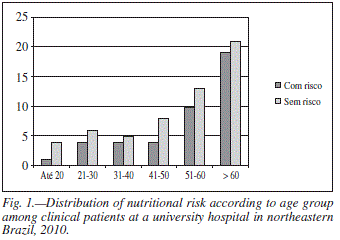
<body><![CDATA[<p><font face="Verdana" size="2"><b>Results</b></font></p>     <p><font face="Verdana" size="2">Ninety-nine patients were included in the present study. Mean age was 53.91 &plusmn; 19 years (range: 17 to 90 years); mean weight was 58.07 &plusmn; 15 kg and mean BMI was 22.77 &plusmn; 5.3 kg/m<sup>2</sup>. <a href="#t1">Table I</a> displays the characteristics of the sample regarding gender, age, base disease, weight loss and nutritional status. The highest percentage of risk was found in patients diagnosed with neoplasm (38.4%), followed by patients with conditions classified as &quot;others&quot; (conditions with a low incidence in the infirmary throughout the study period). Upon admission to hospital, 39.4% (n = 39) of the patients were at nutritional risk.</font></p>     <p>&nbsp;</p>     <p align=center><a name="t1"><img src="/img/revistas/nh/v27n6/31_original_20_t1.gif"></a></p>     <p>&nbsp;</p>     <p><font face="Verdana" size="2"><a target="_blank" href="/img/revistas/nh/v27n6/31_original_20_t2.gif">Table II</a> displays the association between nutritional risk and the variables addressed on the NRS 2002. Reduced food intake (p &lt; 0.001), reduced BMI (p = 0.004) and unintentional weight loss (p = 0.01) were significantly associated with nutritional risk. Age, gender and base disease were not associated with nutritional risk. <a href="#f1">Figure 1</a> displays the distribution by age. Nutritional risk was detected in 19 adult patients (48.7%) and 20 (51.3%) elderly patients.</font></p>     <p>&nbsp;</p>     <p align=center><a name="f1"><img src="/img/revistas/nh/v27n6/31_original_20_f1.gif"></a></p>     <p>&nbsp;</p>     <p><font face="Verdana" size="2"><b>Discussion</b></font></p>     ]]></body>
<body><![CDATA[<p><font face="Verdana" size="2">Based on the results of the internationally validated NRS 2002 screening tool, 39.4% of clinical patients at the UFPE hospital were at nutritional risk. Underweight, reduced food intake and unintentional weight loss were significantly associated with this risk. These findings underscore the importance of establishing nutritional screening as a routine in Brazilian hospitals, as the country does not yet employ a single validated method that can contribute toward the prevention of hospital malnutrition.</font></p>     <p><font face="Verdana" size="2">The present study allows an understanding of the nutritional status of patients upon admission to university hospitals in northeastern Brazil. There are few studies in the country addressing the detection of nutritional risk upon admission to hospital. In contrast, a number of centers in other countries have performed this type of analysis. Data from the literature demonstrate variable degrees of malnutrition upon admission to hospital, with the frequency ranging from 10 to 67.4%.<sup>12-14</sup> According to Beghetto (2008), the Subjective Global Assessment is not the best predictor for the determination of hospital malnutrition or nutritional risk.<sup>15</sup> A trial conducted at the hospital of the <i>Universidade de S&atilde;o Paulo</i> involving the assessment of malnutrition using the Subjective Global Assessment reports a 7.5% frequency of moderate malnutrition among clinical patients.<sup>16</sup> A study carried out in Portugal reports a 58.4% frequency of malnutrition among clinical patients using the BMI, arm muscle circumference and triceps skinfold as the assessment parameters.<sup>17</sup> In the present study, the BMI classification revealed a 30.3% frequency of malnutrition. This difference likely occurred due to the limitation of the BMI when used alone in comparison to other methods employed for the diagnostic criteria of nutritional status.</font></p>     <p><font face="Verdana" size="2">Exclusively analyzing surgery patients, a number of studies have screened for malnutrition using different methods (Subjective Global Assessment, Nutritional Risk Index) and report different percentages (10-67.4%, 58.3%, respectively).<sup>18,19</sup> These figures are higher than those found in the present study (hospital malnutrition: 30.3%; nutritional risk: 39.4%).</font></p>     <p><font face="Verdana" size="2">There are few studies on the detection of nutritional risk that offer data for the purposes of comparison. Screening for nutritional risk in elderly individuals with a mean age of 82.1 years in the United Kingdom, Sarah et al. (2008)<sup>18</sup> found that different methodologies revealed different risk percentages, with 10.43% determined to be at risk using the Malnutrition Universal Screening Tool and 6.69% at risk using the Birmingham Nutrition Risk score. Moreover, the authors found that 17.39% were at risk when using both methods and concluded that the Malnutrition Universal Screening Tool is specific for predicting mortality among elderly individuals, which was not true for the Birmingham Nutrition Risk score or BMI. In the present study, a 48.78% frequency of nutritional risk was found among elderly individuals (&ge; 60 years), which may be explained by difficulties regarding access to health care and the precarious socioeconomic status of the population studied.</font></p>     <p><font face="Verdana" size="2">A study carried out in Austria involving elderly individuals (&ge; 65 years) found a 28% frequency of nutritional risk using the Short Form of the Mini Nutritional Assessment, with malnutrition associated with depression, hematocrit, fasting blood glucose and daily activities.<sup>19 </sup>The authors concluded that the individuals had an increased risk due to the effect of preexisting conditions that are common in this age group, along with physical dependence, resulting in inadequate food intake. In comparison, the present study found a higher frequency of nutritional risk among elderly individuals (48.78%).</font></p>     <p><font face="Verdana" size="2">Studies involving the NRS 2002 for the detection of nutritional risk report frequencies greater than 30%  among hospitalized patients,<sup>17,20,21</sup> which is in agreement with the percentage in the present study. In contrast, a study carried out in Denmark<sup>22</sup> and a publication from the European continent<sup>23</sup> report somewhat lower percentages of nutritional risk (20% and 27%, respectively). A cohort study carried out for the validation of the NRS 2002 as a nutritional screening tool in Turkey found a 15% frequency of nutritional risk.<sup>12</sup> A study carried out at five public hospitals in Portugal reports a 64.1% frequency of clinical patients at nutritional risk,<sup>17</sup> which is much higher than the figure found in the present study. Such divergences may be attributed to differences in population characteristics, socioeconomic status, sample size and age. The higher percentage of individuals at risk in northeastern Brazil likely occurs due to difficulties regarding access to healthcare services as well as a lack of awareness on the part of professionals on healthcare teams regarding the importance of determining nutritional status upon admission to the clinical evolution of patients.</font></p>     <p><font face="Verdana" size="2">In the present study, no statistically significant associations were found between nutritional risk and gender, base disease or age. These findings may be explained by the sample size, the considerable variability in diseases and the homogeneity of the sample in terms of age.</font></p>     <p><font face="Verdana" size="2">The present study offers an outline of the nutritional status of clinical patients upon admission to a university hospital in northeastern Brazil. The results of this study may serve as the basis for comparisons with subsequent studies involving a larger sample and other hospital institutions. This issue is of considerable importance to the scientific community as well as patients who will benefit from the most adequate treatment strategy.</font></p>     <p>&nbsp;</p>     <p><font face="Verdana" size="2"><b>Conclusion</b></font></p>     ]]></body>
<body><![CDATA[<p><font face="Verdana" size="2">A high percentage of clinical patients in the present study were at nutritional risk, which corroborates findings described in the literature. Nutritional risk was associated with low food intake, underweight and unintentional weight loss. These results underscore the importance of nutritional care upon admission to hospital, which can contribute to improving or maintaining nutritional status and the avoidance of complications throughout the hospitalization period.</font></p>     <p>&nbsp;</p>     <p><font face="Verdana" size="2"><b>Acknowledgements</b></font></p>     <p><font face="Verdana" size="2">The authors are grateful to the Pernambuco State Secretary of Health, the Residency Program of the UFPE Department of Nutrition and the UFPE hospital for allowing the execution of this study.</font></p>     <p>&nbsp;</p>     <p><font face="Verdana" size="2"><b>References</b></font></p>     <!-- ref --><p><font face="Verdana" size="2">1. Atalay B., et al. Value of body mass index in the detection of severe malnutrition: influence of the pathology and changes in anthropometric parameters. <i>Clin Nutr</i> 2005; 23: 551-9.    &nbsp;&nbsp;&nbsp;&nbsp;&nbsp;&nbsp;&nbsp;&nbsp;[&#160;<a href="javascript:void(0);" onclick="javascript: window.open('/scielo.php?script=sci_nlinks&ref=3711851&pid=S0212-1611201200060003100001&lng=','','width=640,height=500,resizable=yes,scrollbars=1,menubar=yes,');">Links</a>&#160;]<!-- end-ref --></font></p>    <!-- ref --><p><font face="Verdana" size="2">2. Ferreira HS, Fran&ccedil;a AOS. Evolu&ccedil;&atilde;o do estado nutricional de crian&ccedil;as submetidas à interna&ccedil;&atilde;o hospitalar. <i>J Pediat (Rio J)</i> 2002; 78: 6.    &nbsp;&nbsp;&nbsp;&nbsp;&nbsp;&nbsp;&nbsp;&nbsp;[&#160;<a href="javascript:void(0);" onclick="javascript: window.open('/scielo.php?script=sci_nlinks&ref=3711853&pid=S0212-1611201200060003100002&lng=','','width=640,height=500,resizable=yes,scrollbars=1,menubar=yes,');">Links</a>&#160;]<!-- end-ref --></font></p>    ]]></body>
<body><![CDATA[<!-- ref --><p><font face="Verdana" size="2">3. Willians UG, et al. Increased length of hospital stay in underweight and overweight patients at hospital admission: a controlled population study. <i>Clin Nutr</i> 2005; 24: 133-42.    &nbsp;&nbsp;&nbsp;&nbsp;&nbsp;&nbsp;&nbsp;&nbsp;[&#160;<a href="javascript:void(0);" onclick="javascript: window.open('/scielo.php?script=sci_nlinks&ref=3711855&pid=S0212-1611201200060003100003&lng=','','width=640,height=500,resizable=yes,scrollbars=1,menubar=yes,');">Links</a>&#160;]<!-- end-ref --></font></p>    <!-- ref --><p><font face="Verdana" size="2">4. Sorensen J, Holm L, Frost MB, Kondrup J. Food for patients at nutritional risk: a model of food sensory quality to promote intake. <i>Clin Nutr</i> 2012.    &nbsp;&nbsp;&nbsp;&nbsp;&nbsp;&nbsp;&nbsp;&nbsp;[&#160;<a href="javascript:void(0);" onclick="javascript: window.open('/scielo.php?script=sci_nlinks&ref=3711857&pid=S0212-1611201200060003100004&lng=','','width=640,height=500,resizable=yes,scrollbars=1,menubar=yes,');">Links</a>&#160;]<!-- end-ref --></font></p>    <!-- ref --><p><font face="Verdana" size="2">5. Barrocas A. Rastreamento nutricional. In: Waitzberg D L. Nutri&ccedil;&atilde;o oral, enteral e parenteral na pratica clinica, 2<sup>a</sup> edi&ccedil;&atilde;o, S&atilde;o Paulo: Atheneu; 2001: 193-6.    &nbsp;&nbsp;&nbsp;&nbsp;&nbsp;&nbsp;&nbsp;&nbsp;[&#160;<a href="javascript:void(0);" onclick="javascript: window.open('/scielo.php?script=sci_nlinks&ref=3711859&pid=S0212-1611201200060003100005&lng=','','width=640,height=500,resizable=yes,scrollbars=1,menubar=yes,');">Links</a>&#160;]<!-- end-ref --></font></p>    <!-- ref --><p><font face="Verdana" size="2">6. ASPEN. American Society for Parenteral and Enteral Nutrition Board of Directors: definition of terms used in ASPEN guidelines and Standards. <i>J Parenter Enteral Nutr</i> 1995; 19: 1-2.    &nbsp;&nbsp;&nbsp;&nbsp;&nbsp;&nbsp;&nbsp;&nbsp;[&#160;<a href="javascript:void(0);" onclick="javascript: window.open('/scielo.php?script=sci_nlinks&ref=3711861&pid=S0212-1611201200060003100006&lng=','','width=640,height=500,resizable=yes,scrollbars=1,menubar=yes,');">Links</a>&#160;]<!-- end-ref --></font></p>    <!-- ref --><p><font face="Verdana" size="2">7. Kuppinger D, Hartl WH, Bertok M, Hoffmann JM, Cederbaum J, K&uuml;chenhoff H, et al. Nutritional screening for risk prediction in patients scheduled for abdominal operations. <i>Br J Surg</i> 2012.    &nbsp;&nbsp;&nbsp;&nbsp;&nbsp;&nbsp;&nbsp;&nbsp;[&#160;<a href="javascript:void(0);" onclick="javascript: window.open('/scielo.php?script=sci_nlinks&ref=3711863&pid=S0212-1611201200060003100007&lng=','','width=640,height=500,resizable=yes,scrollbars=1,menubar=yes,');">Links</a>&#160;]<!-- end-ref --></font></p>    ]]></body>
<body><![CDATA[<!-- ref --><p><font face="Verdana" size="2">8. Kondrup J, et al. Nutritional risk screening (NRS 2002): a new method based on an analysis of controlled clinical trials. <i>Clin Nutr</i> 2003; 22 (3): 321-36.    &nbsp;&nbsp;&nbsp;&nbsp;&nbsp;&nbsp;&nbsp;&nbsp;[&#160;<a href="javascript:void(0);" onclick="javascript: window.open('/scielo.php?script=sci_nlinks&ref=3711865&pid=S0212-1611201200060003100008&lng=','','width=640,height=500,resizable=yes,scrollbars=1,menubar=yes,');">Links</a>&#160;]<!-- end-ref --></font></p>    <!-- ref --><p><font face="Verdana" size="2">9. Lipschitz, D. A. Screening for nutritional status in the elderly. <i>P Care</i> 1994; 21: 55-67.    &nbsp;&nbsp;&nbsp;&nbsp;&nbsp;&nbsp;&nbsp;&nbsp;[&#160;<a href="javascript:void(0);" onclick="javascript: window.open('/scielo.php?script=sci_nlinks&ref=3711867&pid=S0212-1611201200060003100009&lng=','','width=640,height=500,resizable=yes,scrollbars=1,menubar=yes,');">Links</a>&#160;]<!-- end-ref --></font></p>    <!-- ref --><p><font face="Verdana" size="2">10. World Health Organization. Obesity: preventing and managing the global epidemic. Geneva: World Health Organization (WHO). Technical Report Series 894, 2000.    &nbsp;&nbsp;&nbsp;&nbsp;&nbsp;&nbsp;&nbsp;&nbsp;[&#160;<a href="javascript:void(0);" onclick="javascript: window.open('/scielo.php?script=sci_nlinks&ref=3711869&pid=S0212-1611201200060003100010&lng=','','width=640,height=500,resizable=yes,scrollbars=1,menubar=yes,');">Links</a>&#160;]<!-- end-ref --></font></p>    <!-- ref --><p><font face="Verdana" size="2">11. Rosa G et al. Avalia&ccedil;&atilde;o na composi&ccedil;&atilde;o corporal aplicada, 1<sup>a</sup> edi&ccedil;&atilde;o. Guanabara Koogan, Rio de Janeiro 2008; p. 33.    &nbsp;&nbsp;&nbsp;&nbsp;&nbsp;&nbsp;&nbsp;&nbsp;[&#160;<a href="javascript:void(0);" onclick="javascript: window.open('/scielo.php?script=sci_nlinks&ref=3711871&pid=S0212-1611201200060003100011&lng=','','width=640,height=500,resizable=yes,scrollbars=1,menubar=yes,');">Links</a>&#160;]<!-- end-ref --></font></p>    <!-- ref --><p><font face="Verdana" size="2">12. Korfali G, G&uuml;ndogdu H et al. Nutritional risk of hospitalized patients in Turkey. <i>Clin Nutr</i> 2009; 28: 533-37.    &nbsp;&nbsp;&nbsp;&nbsp;&nbsp;&nbsp;&nbsp;&nbsp;[&#160;<a href="javascript:void(0);" onclick="javascript: window.open('/scielo.php?script=sci_nlinks&ref=3711873&pid=S0212-1611201200060003100012&lng=','','width=640,height=500,resizable=yes,scrollbars=1,menubar=yes,');">Links</a>&#160;]<!-- end-ref --></font></p>    ]]></body>
<body><![CDATA[<!-- ref --><p><font face="Verdana" size="2">13. Kuzu MA, Terzioglu H, Genc V, Erkek AB, Ozben M, Sonyurek P, et al. Preoperative nutritional risk assessment in predicting postoperative outcome in patients undergoing major surgery. <i>World J Surg</i> 2006; 30: 378-90.    &nbsp;&nbsp;&nbsp;&nbsp;&nbsp;&nbsp;&nbsp;&nbsp;[&#160;<a href="javascript:void(0);" onclick="javascript: window.open('/scielo.php?script=sci_nlinks&ref=3711875&pid=S0212-1611201200060003100013&lng=','','width=640,height=500,resizable=yes,scrollbars=1,menubar=yes,');">Links</a>&#160;]<!-- end-ref --></font></p>    <!-- ref --><p><font face="Verdana" size="2">14. Nursal TZ, Noyan T, Atalay BG, K&ouml;z N, Karakayali H. Simple two-part tool forscreening of malnutrition. <i>Nutrition</i> 2005; 21:659-65.    &nbsp;&nbsp;&nbsp;&nbsp;&nbsp;&nbsp;&nbsp;&nbsp;[&#160;<a href="javascript:void(0);" onclick="javascript: window.open('/scielo.php?script=sci_nlinks&ref=3711877&pid=S0212-1611201200060003100014&lng=','','width=640,height=500,resizable=yes,scrollbars=1,menubar=yes,');">Links</a>&#160;]<!-- end-ref --></font></p>    <!-- ref --><p><font face="Verdana" size="2">15. Beghetto M, et al. Triagem nutricional em adultos hospitalizados. <i>Rev Nutr</i> 2008; 21 (5): 589-91.    &nbsp;&nbsp;&nbsp;&nbsp;&nbsp;&nbsp;&nbsp;&nbsp;[&#160;<a href="javascript:void(0);" onclick="javascript: window.open('/scielo.php?script=sci_nlinks&ref=3711879&pid=S0212-1611201200060003100015&lng=','','width=640,height=500,resizable=yes,scrollbars=1,menubar=yes,');">Links</a>&#160;]<!-- end-ref --></font></p>    <!-- ref --><p><font face="Verdana" size="2">16. Correia MI, Waitzberg DL. The impact of malnutrition on morbidity, mortality, length of hospital stay and costs evaluated through a multivariate model analysis. <i>Clin Nutr</i> 2003; 22: 235-39.    &nbsp;&nbsp;&nbsp;&nbsp;&nbsp;&nbsp;&nbsp;&nbsp;[&#160;<a href="javascript:void(0);" onclick="javascript: window.open('/scielo.php?script=sci_nlinks&ref=3711881&pid=S0212-1611201200060003100016&lng=','','width=640,height=500,resizable=yes,scrollbars=1,menubar=yes,');">Links</a>&#160;]<!-- end-ref --></font></p>    <!-- ref --><p><font face="Verdana" size="2">17. Amaral TF, et al. Undernutrition and associated factors among hospitalized patients. <i>Clin Nutr</i> 2010; 29 (5): 508-85.    &nbsp;&nbsp;&nbsp;&nbsp;&nbsp;&nbsp;&nbsp;&nbsp;[&#160;<a href="javascript:void(0);" onclick="javascript: window.open('/scielo.php?script=sci_nlinks&ref=3711883&pid=S0212-1611201200060003100017&lng=','','width=640,height=500,resizable=yes,scrollbars=1,menubar=yes,');">Links</a>&#160;]<!-- end-ref --></font></p>    ]]></body>
<body><![CDATA[<!-- ref --><p><font face="Verdana" size="2">18. Sarah H, et al. Do the malnutrition universal screening tool (MUST) and Birmingham nutrition risk (BNR) score predict mortality in older hospitalized patients? <i>BMC Geriatrics</i> 2008; 26 (8): 1-6.    &nbsp;&nbsp;&nbsp;&nbsp;&nbsp;&nbsp;&nbsp;&nbsp;[&#160;<a href="javascript:void(0);" onclick="javascript: window.open('/scielo.php?script=sci_nlinks&ref=3711885&pid=S0212-1611201200060003100018&lng=','','width=640,height=500,resizable=yes,scrollbars=1,menubar=yes,');">Links</a>&#160;]<!-- end-ref --></font></p>    <!-- ref --><p><font face="Verdana" size="2">19.  Ülger Z, et al. Comprehensive assessment of malnutrition risk and related factors in a large group of community-dwelling older adults. <i>Clin Nutr</i> 2010; 29: 507-11.    &nbsp;&nbsp;&nbsp;&nbsp;&nbsp;&nbsp;&nbsp;&nbsp;[&#160;<a href="javascript:void(0);" onclick="javascript: window.open('/scielo.php?script=sci_nlinks&ref=3711887&pid=S0212-1611201200060003100019&lng=','','width=640,height=500,resizable=yes,scrollbars=1,menubar=yes,');">Links</a>&#160;]<!-- end-ref --></font></p>    <!-- ref --><p><font face="Verdana" size="2">20. Kondrup J, Johansen N, Plum LM, Bak L, Larsen IH, Martinsen A, et al. Incidence of nutritional risk and causes of inadequate nutritional care in hospitals. <i>Clin Nutr</i> 2002; 21: 461-68.    &nbsp;&nbsp;&nbsp;&nbsp;&nbsp;&nbsp;&nbsp;&nbsp;[&#160;<a href="javascript:void(0);" onclick="javascript: window.open('/scielo.php?script=sci_nlinks&ref=3711889&pid=S0212-1611201200060003100020&lng=','','width=640,height=500,resizable=yes,scrollbars=1,menubar=yes,');">Links</a>&#160;]<!-- end-ref --></font></p>    <!-- ref --><p><font face="Verdana" size="2">21. Liang X, Jiang ZM, Nolan MT, Efron DT, Kondrup J. Comparative survey on nutritional risk and nutritional support between Beijing and Baltimore teaching hospitals. <i>Nutrition</i> 2008; 24: 9.    &nbsp;&nbsp;&nbsp;&nbsp;&nbsp;&nbsp;&nbsp;&nbsp;[&#160;<a href="javascript:void(0);" onclick="javascript: window.open('/scielo.php?script=sci_nlinks&ref=3711891&pid=S0212-1611201200060003100021&lng=','','width=640,height=500,resizable=yes,scrollbars=1,menubar=yes,');">Links</a>&#160;]<!-- end-ref --></font></p>    <!-- ref --><p><font face="Verdana" size="2">22. Sorensen J, Kondrup J, Prokopowicz J, Schiesser M, Krahenb&uuml;hl L, Meier R et al. EupoOOPS: an international multicentre study to implement nutritional risk screening and evaluate clinical outcome. <i>Clin Nutr</i> 2008; 27: 340-49.    &nbsp;&nbsp;&nbsp;&nbsp;&nbsp;&nbsp;&nbsp;&nbsp;[&#160;<a href="javascript:void(0);" onclick="javascript: window.open('/scielo.php?script=sci_nlinks&ref=3711893&pid=S0212-1611201200060003100022&lng=','','width=640,height=500,resizable=yes,scrollbars=1,menubar=yes,');">Links</a>&#160;]<!-- end-ref --></font></p>    ]]></body>
<body><![CDATA[<!-- ref --><p><font face="Verdana" size="2">23. Schindler K, et al. How nutritional risk is assessed and managed in European hospitals: A survey of 21, 007. patients findings from 2007-2008 cross-sectional nutrition Day survey. <i>Clin Nutr</i> 2010; 29 (5): 552-59.    &nbsp;&nbsp;&nbsp;&nbsp;&nbsp;&nbsp;&nbsp;&nbsp;[&#160;<a href="javascript:void(0);" onclick="javascript: window.open('/scielo.php?script=sci_nlinks&ref=3711895&pid=S0212-1611201200060003100023&lng=','','width=640,height=500,resizable=yes,scrollbars=1,menubar=yes,');">Links</a>&#160;]<!-- end-ref --></font></p>     <p>&nbsp;</p>     <p>&nbsp;</p>     <p><font face="Verdana" size="2"><a href="#top"><img border="0" src="/img/revistas/nh/v27n6/seta.gif" width="15" height="17"></a><a name="bajo"></a><b>Correspondence:</b>    <br>Goretti Burgos    <br>Departamento de Nutri&ccedil;&atilde;o    <br>Centro de Ciéncias da Saude (CCS)    <br>Universidade Federal de Pernambuco (UFPE)    <br>Campus Universitario    ]]></body>
<body><![CDATA[<br>CEP: 50670-901 Recife. Pernambuco. Brazil    <br>E-mail: <a href="mailto:gburgos@hotlink.com.br">gburgos@hotlink.com.br</a></font></p>     <p><font face="Verdana" size="2">Recibido: 15-VI-2012    <br>Aceptado: 7-VIII-2012</font></p>      ]]></body><back>
<ref-list>
<ref id="B1">
<label>1</label><nlm-citation citation-type="journal">
<person-group person-group-type="author">
<name>
<surname><![CDATA[Atalay]]></surname>
<given-names><![CDATA[B.]]></given-names>
</name>
</person-group>
<article-title xml:lang="en"><![CDATA[Value of body mass index in the detection of severe malnutrition: influence of the pathology and changes in anthropometric parameters]]></article-title>
<source><![CDATA[Clin Nutr]]></source>
<year>2005</year>
<volume>23</volume>
<page-range>551-9</page-range></nlm-citation>
</ref>
<ref id="B2">
<label>2</label><nlm-citation citation-type="journal">
<person-group person-group-type="author">
<name>
<surname><![CDATA[Ferreira]]></surname>
<given-names><![CDATA[HS]]></given-names>
</name>
<name>
<surname><![CDATA[França]]></surname>
<given-names><![CDATA[AOS]]></given-names>
</name>
</person-group>
<article-title xml:lang="pt"><![CDATA[Evolução do estado nutricional de crianças submetidas à internação hospitalar]]></article-title>
<source><![CDATA[J Pediat (Rio J)]]></source>
<year>2002</year>
<volume>78</volume>
<page-range>6</page-range></nlm-citation>
</ref>
<ref id="B3">
<label>3</label><nlm-citation citation-type="journal">
<person-group person-group-type="author">
<name>
<surname><![CDATA[Willians]]></surname>
<given-names><![CDATA[UG]]></given-names>
</name>
</person-group>
<article-title xml:lang="en"><![CDATA[Increased length of hospital stay in underweight and overweight patients at hospital admission: a controlled population study]]></article-title>
<source><![CDATA[Clin Nutr]]></source>
<year>2005</year>
<volume>24</volume>
<page-range>133-42</page-range></nlm-citation>
</ref>
<ref id="B4">
<label>4</label><nlm-citation citation-type="journal">
<person-group person-group-type="author">
<name>
<surname><![CDATA[Sorensen]]></surname>
<given-names><![CDATA[J]]></given-names>
</name>
<name>
<surname><![CDATA[Holm]]></surname>
<given-names><![CDATA[L]]></given-names>
</name>
<name>
<surname><![CDATA[Frost]]></surname>
<given-names><![CDATA[MB]]></given-names>
</name>
<name>
<surname><![CDATA[Kondrup]]></surname>
<given-names><![CDATA[J]]></given-names>
</name>
</person-group>
<article-title xml:lang="en"><![CDATA[Food for patients at nutritional risk: a model of food sensory quality to promote intake]]></article-title>
<source><![CDATA[Clin Nutr]]></source>
<year>2012</year>
</nlm-citation>
</ref>
<ref id="B5">
<label>5</label><nlm-citation citation-type="book">
<person-group person-group-type="author">
<name>
<surname><![CDATA[Barrocas]]></surname>
<given-names><![CDATA[A]]></given-names>
</name>
</person-group>
<article-title xml:lang="pt"><![CDATA[Rastreamento nutricional]]></article-title>
<person-group person-group-type="editor">
<name>
<surname><![CDATA[Waitzberg]]></surname>
<given-names><![CDATA[D L]]></given-names>
</name>
</person-group>
<source><![CDATA[Nutrição oral, enteral e parenteral na pratica clinica]]></source>
<year>2001</year>
<edition>2</edition>
<page-range>193-6</page-range><publisher-loc><![CDATA[São Paulo ]]></publisher-loc>
<publisher-name><![CDATA[Atheneu]]></publisher-name>
</nlm-citation>
</ref>
<ref id="B6">
<label>6</label><nlm-citation citation-type="journal">
<collab>American Society for Parenteral and Enteral Nutrition Board of Directors</collab>
<article-title xml:lang="en"><![CDATA[definition of terms used in ASPEN guidelines and Standards]]></article-title>
<source><![CDATA[J Parenter Enteral Nutr]]></source>
<year>1995</year>
<volume>19</volume>
<page-range>1-2</page-range></nlm-citation>
</ref>
<ref id="B7">
<label>7</label><nlm-citation citation-type="journal">
<person-group person-group-type="author">
<name>
<surname><![CDATA[Kuppinger]]></surname>
<given-names><![CDATA[D]]></given-names>
</name>
<name>
<surname><![CDATA[Hartl]]></surname>
<given-names><![CDATA[WH]]></given-names>
</name>
<name>
<surname><![CDATA[Bertok]]></surname>
<given-names><![CDATA[M]]></given-names>
</name>
<name>
<surname><![CDATA[Hoffmann]]></surname>
<given-names><![CDATA[JM]]></given-names>
</name>
<name>
<surname><![CDATA[Cederbaum]]></surname>
<given-names><![CDATA[J]]></given-names>
</name>
<name>
<surname><![CDATA[Küchenhoff]]></surname>
<given-names><![CDATA[H]]></given-names>
</name>
</person-group>
<article-title xml:lang="en"><![CDATA[Nutritional screening for risk prediction in patients scheduled for abdominal operations]]></article-title>
<source><![CDATA[Br J Surg]]></source>
<year>2012</year>
</nlm-citation>
</ref>
<ref id="B8">
<label>8</label><nlm-citation citation-type="journal">
<person-group person-group-type="author">
<name>
<surname><![CDATA[Kondrup]]></surname>
<given-names><![CDATA[J]]></given-names>
</name>
</person-group>
<article-title xml:lang="en"><![CDATA[Nutritional risk screening (NRS 2002): a new method based on an analysis of controlled clinical trials]]></article-title>
<source><![CDATA[Clin Nutr]]></source>
<year>2003</year>
<volume>22</volume>
<numero>3</numero>
<issue>3</issue>
<page-range>321-36</page-range></nlm-citation>
</ref>
<ref id="B9">
<label>9</label><nlm-citation citation-type="journal">
<person-group person-group-type="author">
<name>
<surname><![CDATA[Lipschitz]]></surname>
<given-names><![CDATA[D.A]]></given-names>
</name>
</person-group>
<article-title xml:lang="en"><![CDATA[Screening for nutritional status in the elderly]]></article-title>
<source><![CDATA[P Care]]></source>
<year>1994</year>
<volume>21</volume>
<page-range>55-67</page-range></nlm-citation>
</ref>
<ref id="B10">
<label>10</label><nlm-citation citation-type="book">
<collab>World Health Organization</collab>
<source><![CDATA[Obesity: preventing and managing the global epidemic]]></source>
<year>2000</year>
<volume>894</volume>
<publisher-loc><![CDATA[Geneva ]]></publisher-loc>
<publisher-name><![CDATA[World Health Organization (WHO)]]></publisher-name>
</nlm-citation>
</ref>
<ref id="B11">
<label>11</label><nlm-citation citation-type="book">
<person-group person-group-type="author">
<name>
<surname><![CDATA[Rosa]]></surname>
<given-names><![CDATA[G]]></given-names>
</name>
</person-group>
<source><![CDATA[Avaliação na composição corporal aplicada]]></source>
<year>2008</year>
<edition>1</edition>
<page-range>33</page-range><publisher-loc><![CDATA[Rio de Janeiro ]]></publisher-loc>
<publisher-name><![CDATA[Guanabara Koogan]]></publisher-name>
</nlm-citation>
</ref>
<ref id="B12">
<label>12</label><nlm-citation citation-type="journal">
<person-group person-group-type="author">
<name>
<surname><![CDATA[Korfali]]></surname>
<given-names><![CDATA[G]]></given-names>
</name>
<name>
<surname><![CDATA[Gündogdu]]></surname>
<given-names><![CDATA[H]]></given-names>
</name>
</person-group>
<article-title xml:lang="en"><![CDATA[Nutritional risk of hospitalized patients in Turkey]]></article-title>
<source><![CDATA[Clin Nutr]]></source>
<year>2009</year>
<volume>28</volume>
<page-range>533-37</page-range></nlm-citation>
</ref>
<ref id="B13">
<label>13</label><nlm-citation citation-type="journal">
<person-group person-group-type="author">
<name>
<surname><![CDATA[Kuzu]]></surname>
<given-names><![CDATA[MA]]></given-names>
</name>
<name>
<surname><![CDATA[Terzioglu]]></surname>
<given-names><![CDATA[H]]></given-names>
</name>
<name>
<surname><![CDATA[Genc]]></surname>
<given-names><![CDATA[V]]></given-names>
</name>
<name>
<surname><![CDATA[Erkek]]></surname>
<given-names><![CDATA[AB]]></given-names>
</name>
<name>
<surname><![CDATA[Ozben]]></surname>
<given-names><![CDATA[M]]></given-names>
</name>
<name>
<surname><![CDATA[Sonyurek]]></surname>
<given-names><![CDATA[P]]></given-names>
</name>
</person-group>
<article-title xml:lang="en"><![CDATA[Preoperative nutritional risk assessment in predicting postoperative outcome in patients undergoing major surgery]]></article-title>
<source><![CDATA[World J Surg]]></source>
<year>2006</year>
<volume>30</volume>
<page-range>378-90</page-range></nlm-citation>
</ref>
<ref id="B14">
<label>14</label><nlm-citation citation-type="journal">
<person-group person-group-type="author">
<name>
<surname><![CDATA[Nursal]]></surname>
<given-names><![CDATA[TZ]]></given-names>
</name>
<name>
<surname><![CDATA[Noyan]]></surname>
<given-names><![CDATA[T]]></given-names>
</name>
<name>
<surname><![CDATA[Atalay]]></surname>
<given-names><![CDATA[BG]]></given-names>
</name>
<name>
<surname><![CDATA[Köz]]></surname>
<given-names><![CDATA[N]]></given-names>
</name>
<name>
<surname><![CDATA[Karakayali]]></surname>
<given-names><![CDATA[H]]></given-names>
</name>
</person-group>
<article-title xml:lang="en"><![CDATA[Simple two-part tool forscreening of malnutrition]]></article-title>
<source><![CDATA[Nutrition]]></source>
<year>2005</year>
<volume>21</volume>
<page-range>659-65</page-range></nlm-citation>
</ref>
<ref id="B15">
<label>15</label><nlm-citation citation-type="journal">
<person-group person-group-type="author">
<name>
<surname><![CDATA[Beghetto]]></surname>
<given-names><![CDATA[M]]></given-names>
</name>
</person-group>
<article-title xml:lang="pt"><![CDATA[Triagem nutricional em adultos hospitalizados]]></article-title>
<source><![CDATA[Rev Nutr]]></source>
<year>2008</year>
<volume>21</volume>
<numero>5</numero>
<issue>5</issue>
<page-range>589-91</page-range></nlm-citation>
</ref>
<ref id="B16">
<label>16</label><nlm-citation citation-type="journal">
<person-group person-group-type="author">
<name>
<surname><![CDATA[Correia]]></surname>
<given-names><![CDATA[MI]]></given-names>
</name>
<name>
<surname><![CDATA[Waitzberg]]></surname>
<given-names><![CDATA[DL]]></given-names>
</name>
</person-group>
<article-title xml:lang="en"><![CDATA[The impact of malnutrition on morbidity, mortality, length of hospital stay and costs evaluated through a multivariate model analysis]]></article-title>
<source><![CDATA[Clin Nutr]]></source>
<year>2003</year>
<volume>22</volume>
<page-range>235-39</page-range></nlm-citation>
</ref>
<ref id="B17">
<label>17</label><nlm-citation citation-type="journal">
<person-group person-group-type="author">
<name>
<surname><![CDATA[Amaral]]></surname>
<given-names><![CDATA[TF]]></given-names>
</name>
</person-group>
<article-title xml:lang="en"><![CDATA[Undernutrition and associated factors among hospitalized patients]]></article-title>
<source><![CDATA[Clin Nutr]]></source>
<year>2010</year>
<volume>29</volume>
<numero>5</numero>
<issue>5</issue>
<page-range>508-85</page-range></nlm-citation>
</ref>
<ref id="B18">
<label>18</label><nlm-citation citation-type="journal">
<person-group person-group-type="author">
<name>
<surname><![CDATA[Sarah]]></surname>
<given-names><![CDATA[H]]></given-names>
</name>
</person-group>
<article-title xml:lang="en"><![CDATA[Do the malnutrition universal screening tool (MUST) and Birmingham nutrition risk (BNR) score predict mortality in older hospitalized patients?]]></article-title>
<source><![CDATA[BMC Geriatrics]]></source>
<year>2008</year>
<volume>26</volume>
<numero>8</numero>
<issue>8</issue>
<page-range>1-6</page-range></nlm-citation>
</ref>
<ref id="B19">
<label>19</label><nlm-citation citation-type="journal">
<person-group person-group-type="author">
<name>
<surname><![CDATA[Ülger]]></surname>
<given-names><![CDATA[Z]]></given-names>
</name>
</person-group>
<article-title xml:lang="en"><![CDATA[Comprehensive assessment of malnutrition risk and related factors in a large group of community-dwelling older adults]]></article-title>
<source><![CDATA[Clin Nutr]]></source>
<year>2010</year>
<volume>29</volume>
<page-range>507-11</page-range></nlm-citation>
</ref>
<ref id="B20">
<label>20</label><nlm-citation citation-type="journal">
<person-group person-group-type="author">
<name>
<surname><![CDATA[Kondrup]]></surname>
<given-names><![CDATA[J]]></given-names>
</name>
<name>
<surname><![CDATA[Johansen]]></surname>
<given-names><![CDATA[N]]></given-names>
</name>
<name>
<surname><![CDATA[Plum]]></surname>
<given-names><![CDATA[LM]]></given-names>
</name>
<name>
<surname><![CDATA[Bak]]></surname>
<given-names><![CDATA[L]]></given-names>
</name>
<name>
<surname><![CDATA[Larsen]]></surname>
<given-names><![CDATA[IH]]></given-names>
</name>
<name>
<surname><![CDATA[Martinsen]]></surname>
<given-names><![CDATA[A]]></given-names>
</name>
</person-group>
<article-title xml:lang="en"><![CDATA[Incidence of nutritional risk and causes of inadequate nutritional care in hospitals]]></article-title>
<source><![CDATA[Clin Nutr]]></source>
<year>2002</year>
<volume>21</volume>
<page-range>461-68</page-range></nlm-citation>
</ref>
<ref id="B21">
<label>21</label><nlm-citation citation-type="journal">
<person-group person-group-type="author">
<name>
<surname><![CDATA[Liang]]></surname>
<given-names><![CDATA[X]]></given-names>
</name>
<name>
<surname><![CDATA[Jiang]]></surname>
<given-names><![CDATA[ZM]]></given-names>
</name>
<name>
<surname><![CDATA[Nolan]]></surname>
<given-names><![CDATA[MT]]></given-names>
</name>
<name>
<surname><![CDATA[Efron]]></surname>
<given-names><![CDATA[DT]]></given-names>
</name>
<name>
<surname><![CDATA[Kondrup]]></surname>
<given-names><![CDATA[J]]></given-names>
</name>
</person-group>
<article-title xml:lang="en"><![CDATA[Comparative survey on nutritional risk and nutritional support between Beijing and Baltimore teaching hospitals]]></article-title>
<source><![CDATA[Nutrition]]></source>
<year>2008</year>
<volume>24</volume>
<page-range>9</page-range></nlm-citation>
</ref>
<ref id="B22">
<label>22</label><nlm-citation citation-type="journal">
<person-group person-group-type="author">
<name>
<surname><![CDATA[Sorensen]]></surname>
<given-names><![CDATA[J]]></given-names>
</name>
<name>
<surname><![CDATA[Kondrup]]></surname>
<given-names><![CDATA[J]]></given-names>
</name>
<name>
<surname><![CDATA[Prokopowicz]]></surname>
<given-names><![CDATA[J]]></given-names>
</name>
<name>
<surname><![CDATA[Schiesser]]></surname>
<given-names><![CDATA[M]]></given-names>
</name>
<name>
<surname><![CDATA[Krahenbühl]]></surname>
<given-names><![CDATA[L]]></given-names>
</name>
<name>
<surname><![CDATA[Meier]]></surname>
<given-names><![CDATA[R]]></given-names>
</name>
</person-group>
<article-title xml:lang="en"><![CDATA[EupoOOPS: an international multicentre study to implement nutritional risk screening and evaluate clinical outcome]]></article-title>
<source><![CDATA[Clin Nutr]]></source>
<year>2008</year>
<volume>27</volume>
<page-range>340-49</page-range></nlm-citation>
</ref>
<ref id="B23">
<label>23</label><nlm-citation citation-type="journal">
<person-group person-group-type="author">
<name>
<surname><![CDATA[Schindler]]></surname>
<given-names><![CDATA[K]]></given-names>
</name>
</person-group>
<article-title xml:lang="en"><![CDATA[How nutritional risk is assessed and managed in European hospitals: A survey of 21,007. patients findings from 2007-2008 cross-sectional nutrition Day survey]]></article-title>
<source><![CDATA[Clin Nutr]]></source>
<year>2010</year>
<volume>29</volume>
<numero>5</numero>
<issue>5</issue>
<page-range>552-59</page-range></nlm-citation>
</ref>
</ref-list>
</back>
</article>